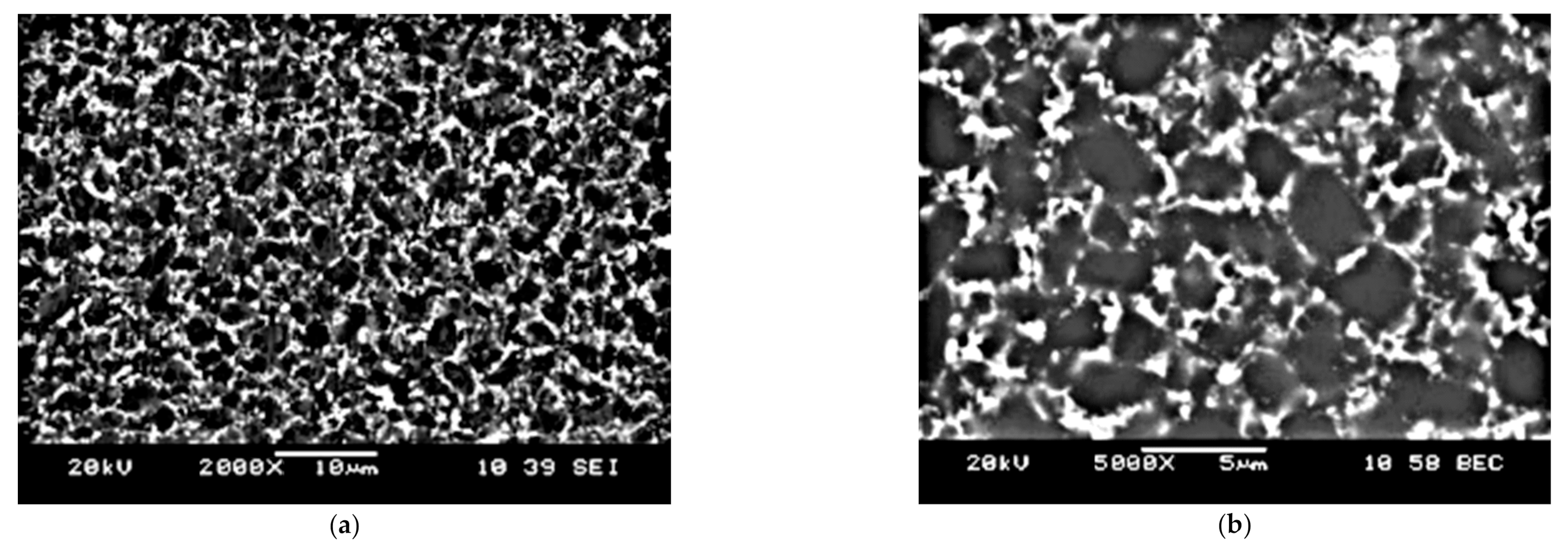
Cutting Forces and Tool Wear Investigation during Turning of Sintered Nickel-Cobalt Alloy with CBN Tools


Abstract
1. Introduction
2. Materials and Methods
- -
- cutting speed: vc = 160, 180, 200 m/min
- -
- feed: f = 0.048 mm/rev
- -
- cutting depth: ap = 0.5 mm
- -
- dry machining
- -
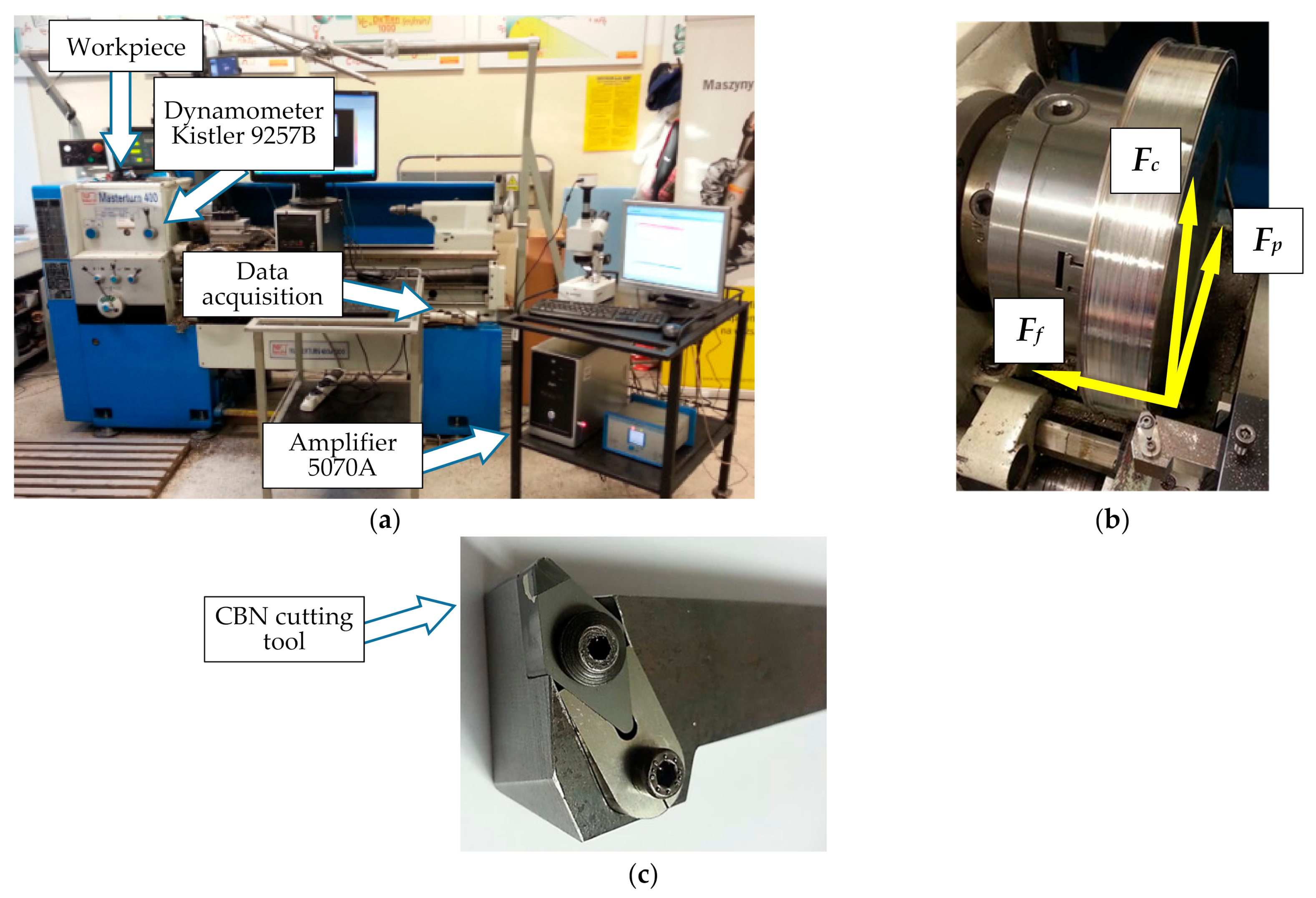
- Masterturn 400 lathe (KNUTH Werkzeugmaschinen GmbH, Wasbek, Germany),
- -
- piezoelectric dynamometer type 9257B, with a Kistler 5070A amplifier (Kistler, Winterthur, Switzerland) and DynoWare software (Version 2825A, Kistler Group, Winterthur, Switzerland),
- -
- test bench equipped with an Intra 50 profilometer by Taylor Hobson (Leicester, UK) for measuring surface roughness
- -
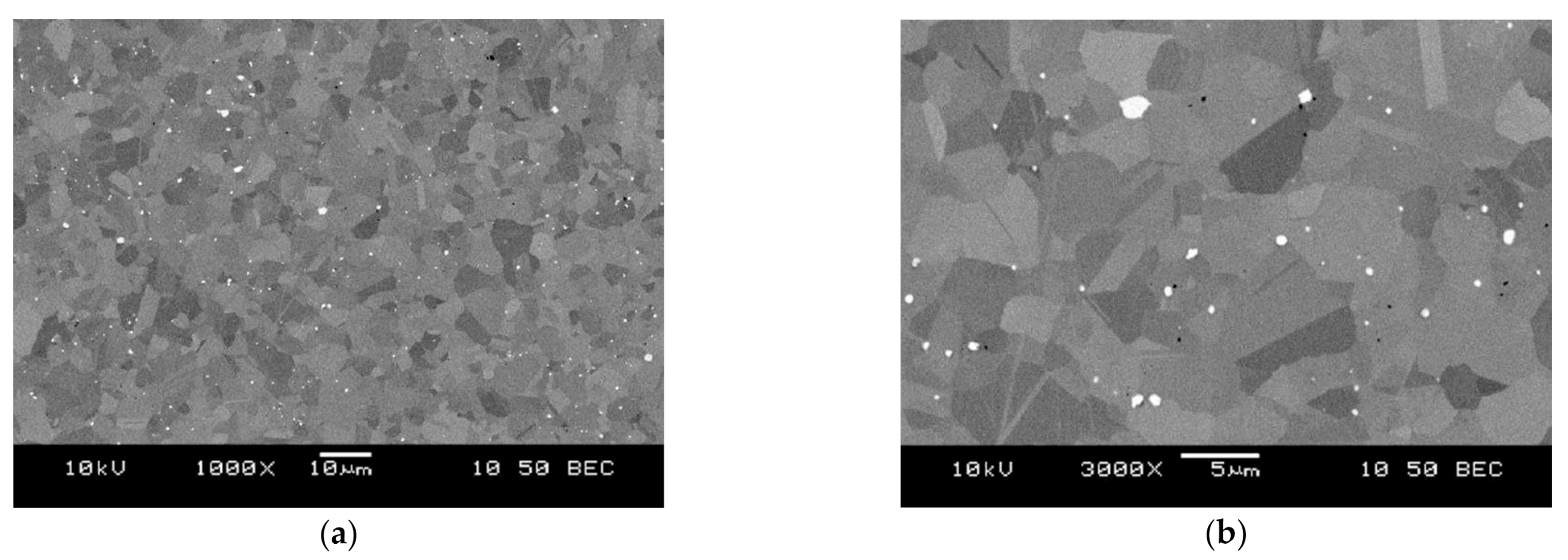
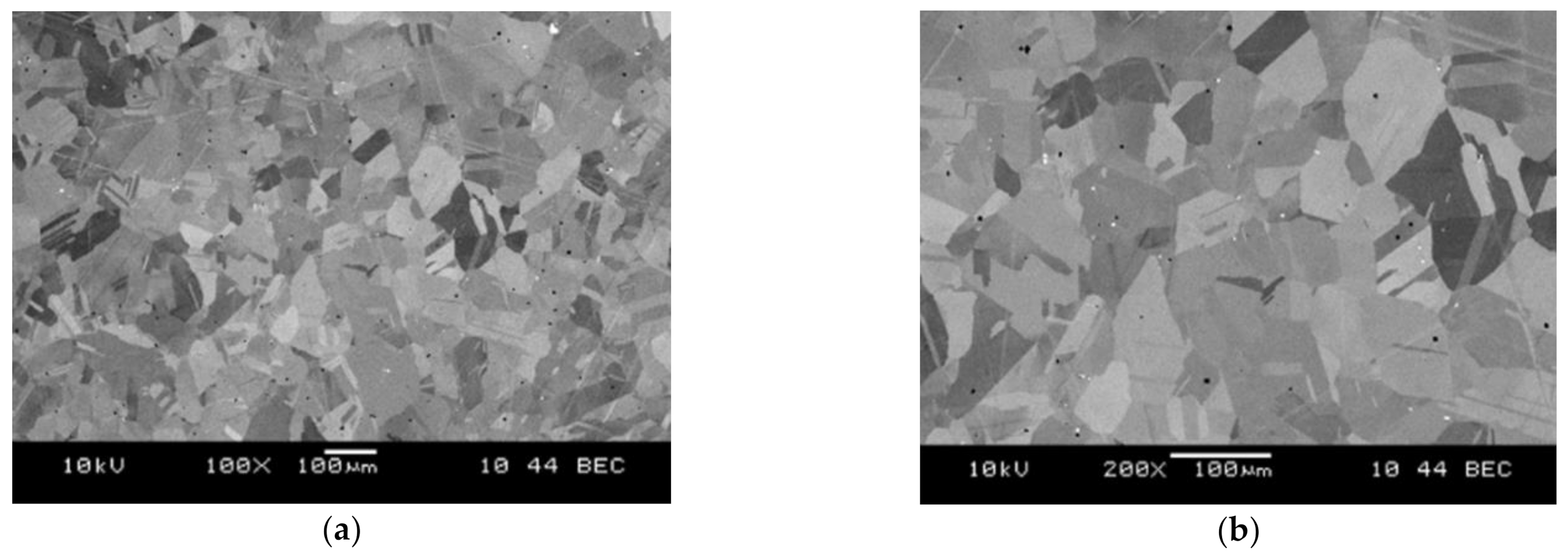
- Jeol JSM 6460LV (JEOL Ltd., Tokyo, Japan) microscope for examining the microstructure by scanning electron microscopy.
3. Results and Discussion
4. Conclusions
- -
- In the article the characteristics of the machining process were presented for the parts made of sintered nickel-cobalt alloy while using CBN tools.
- -
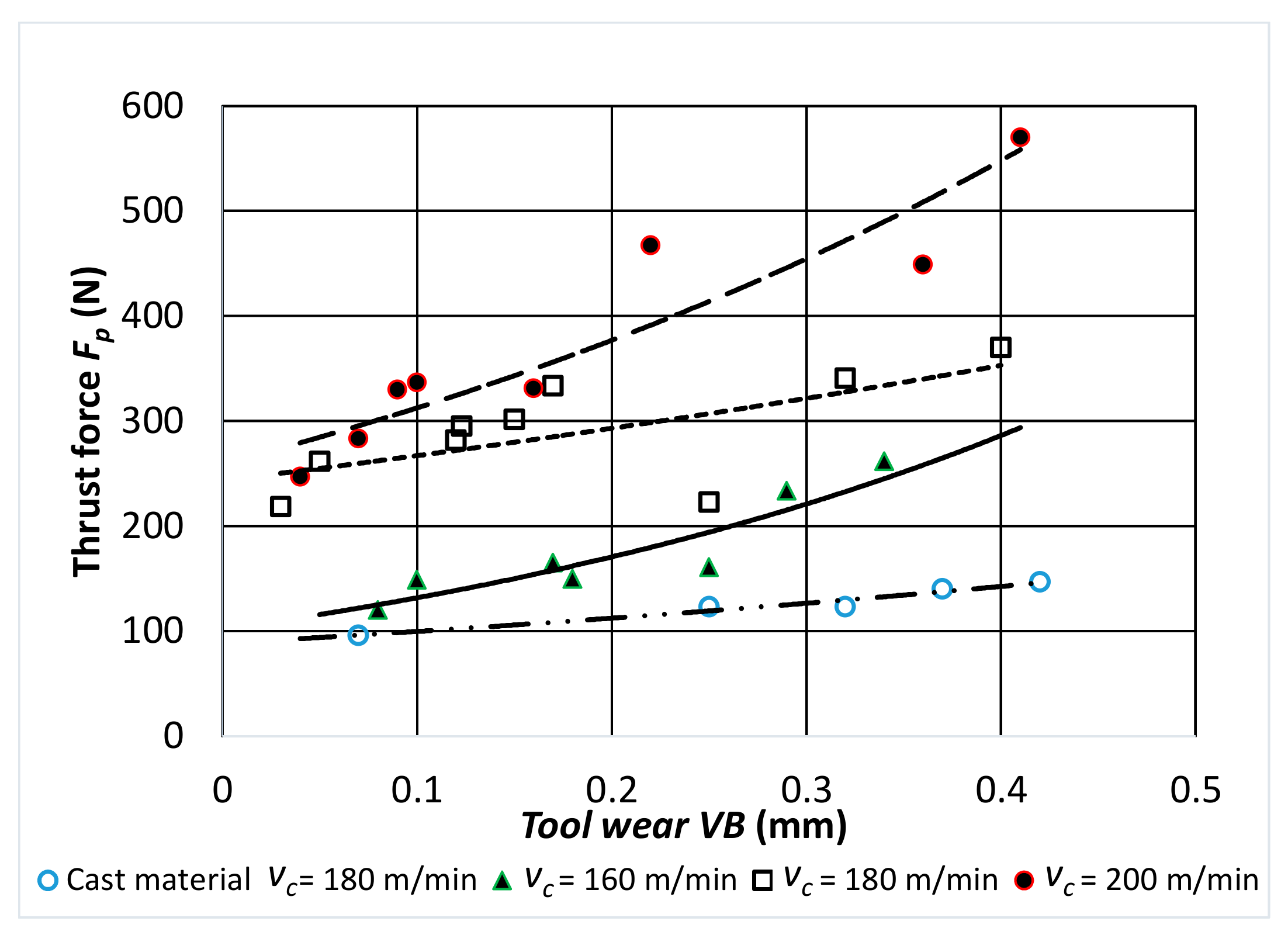
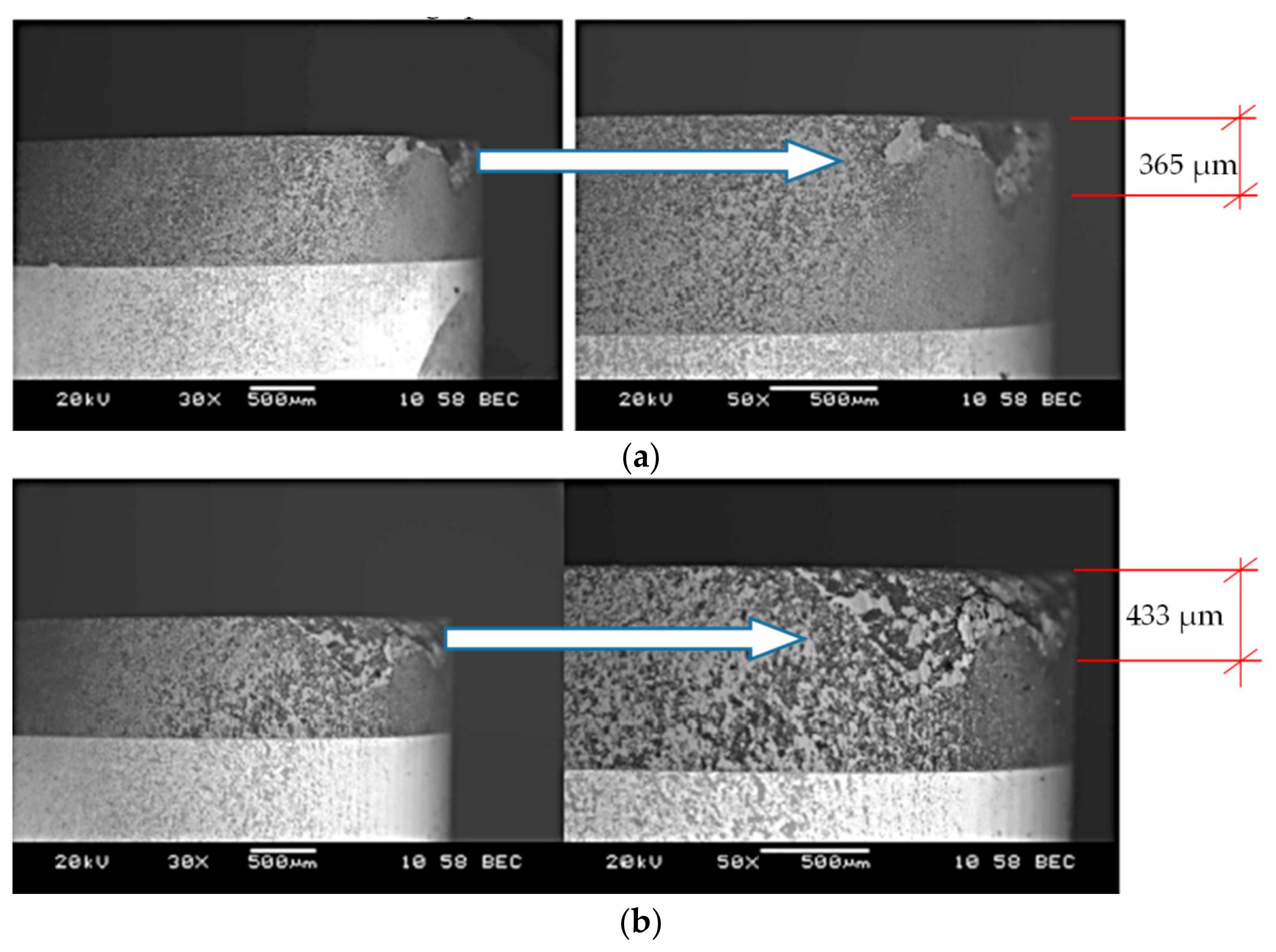
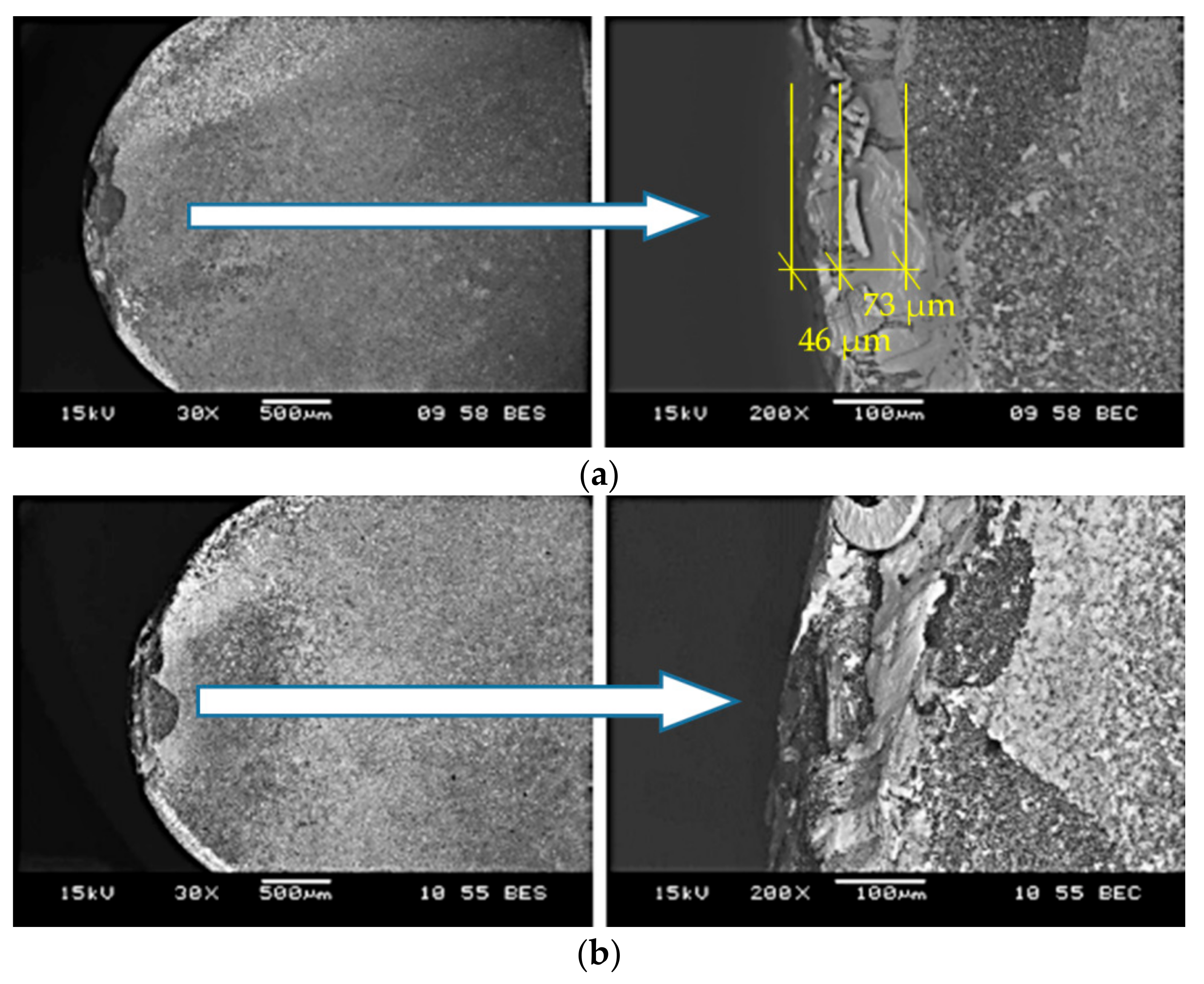
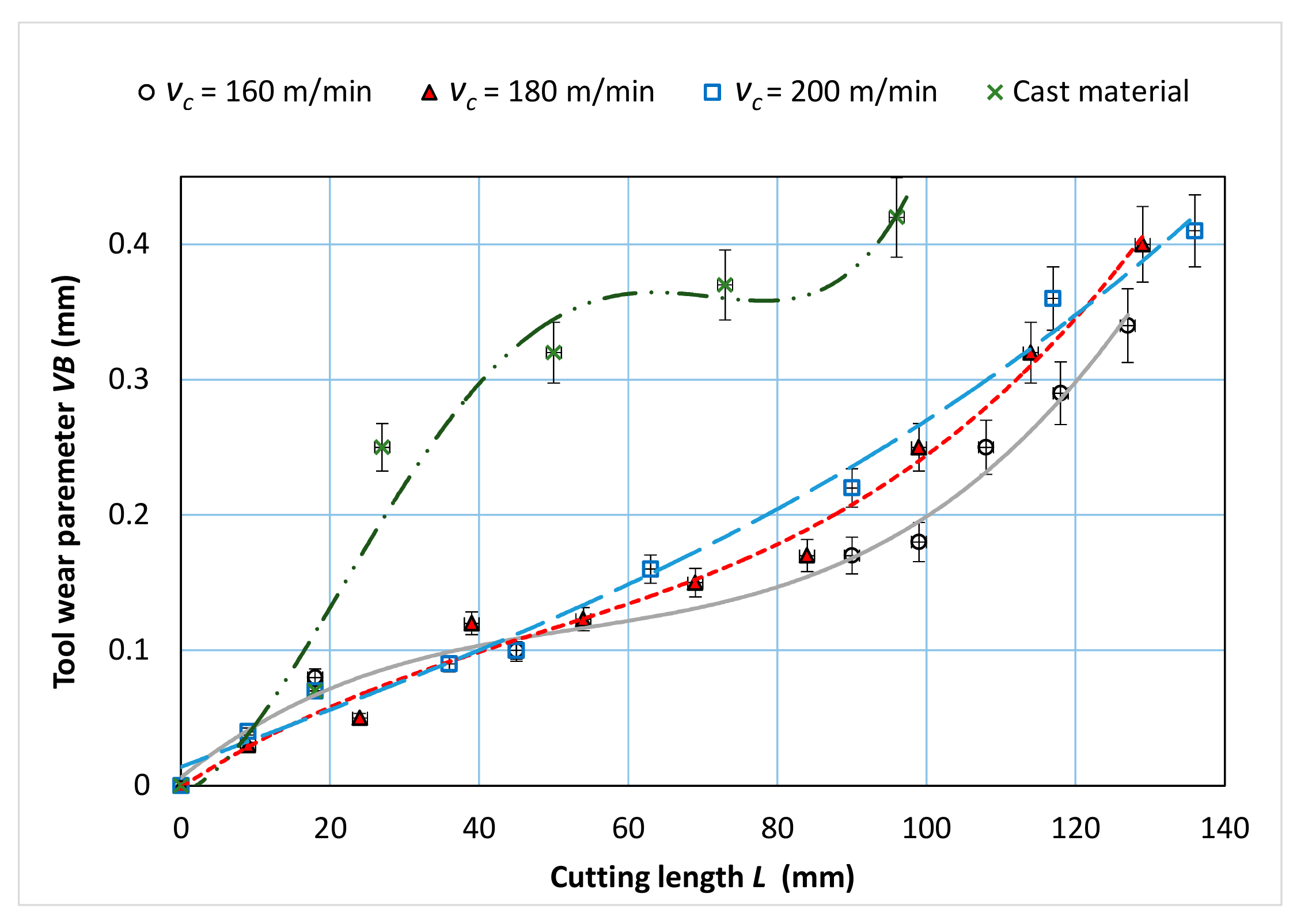
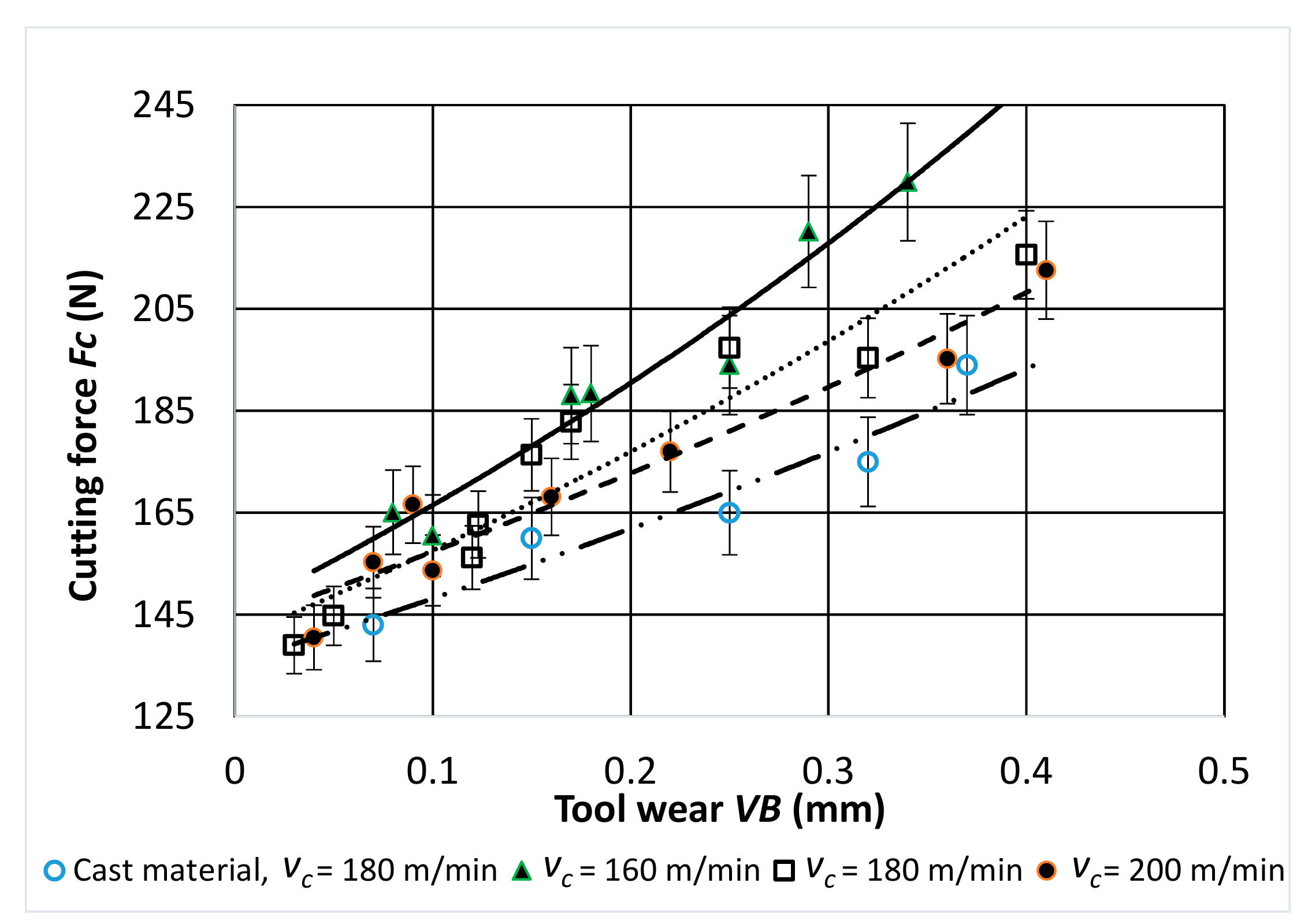
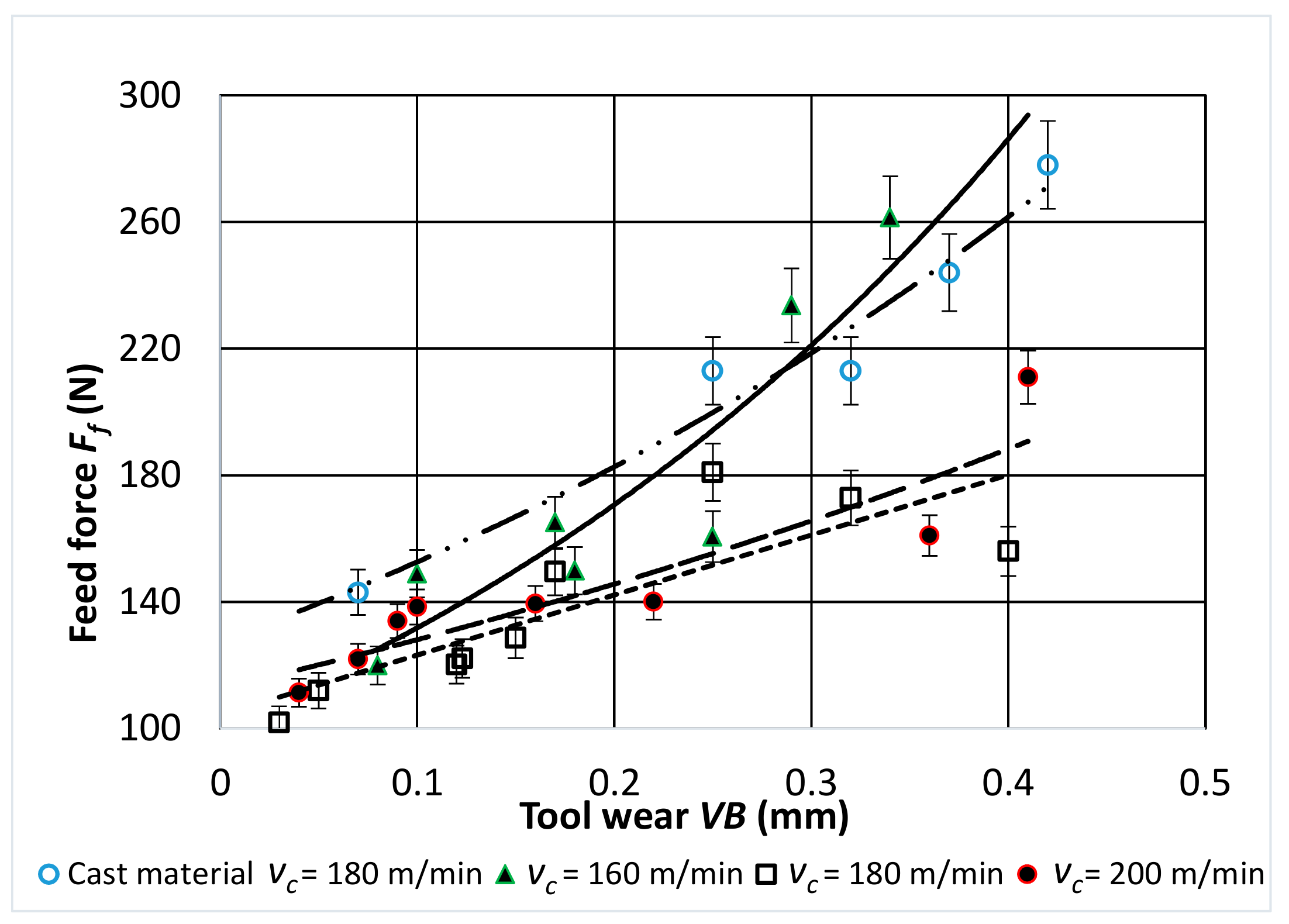
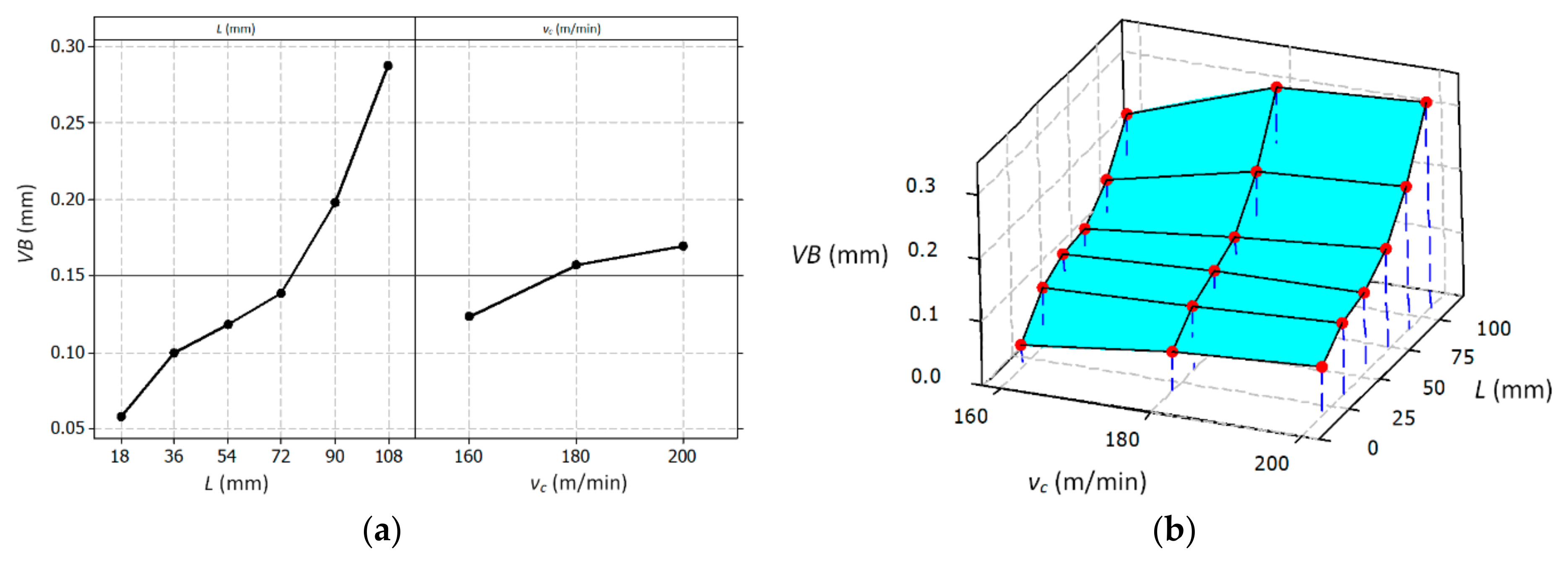
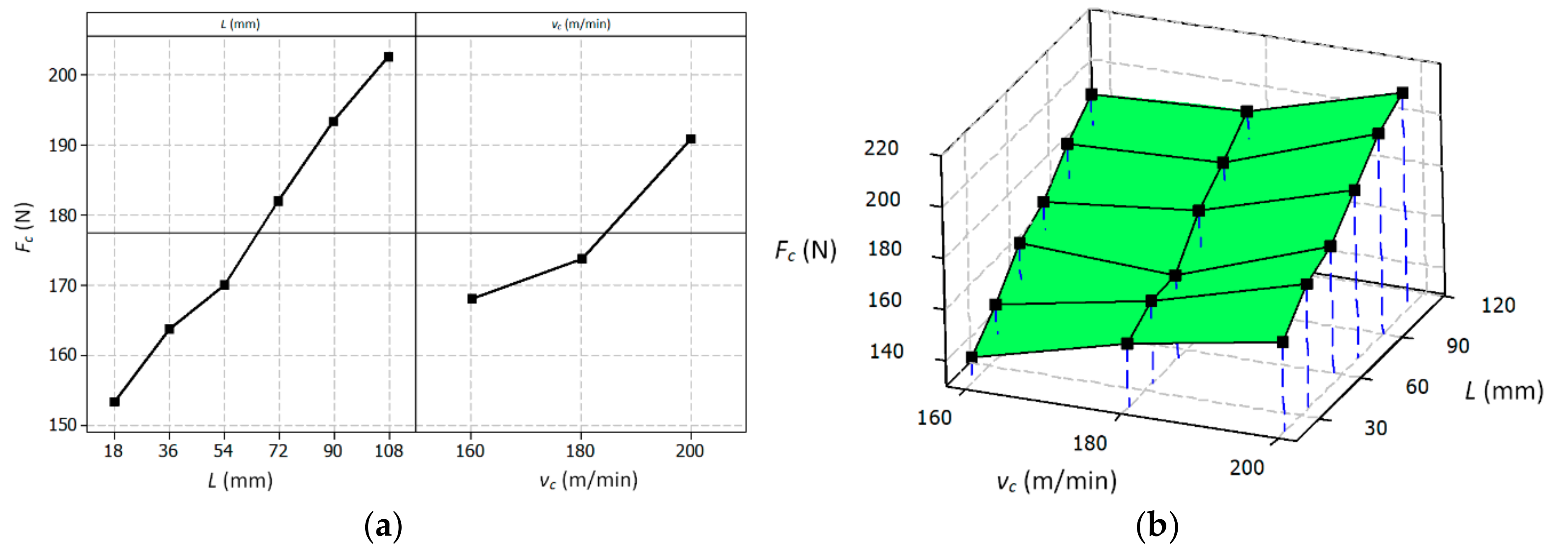
- During longitudinal turning of the sintered nickel-cobalt alloy, tool wear was observed. The wear on the rake face in the form of cracks and chipping material was determined. The analysis of the research results showed a significant influence of the cutting edge wear on the values of the cutting forces (Fc, Fp, Ff), specific cutting force kc, surface roughness Ra, and chip form.
- -
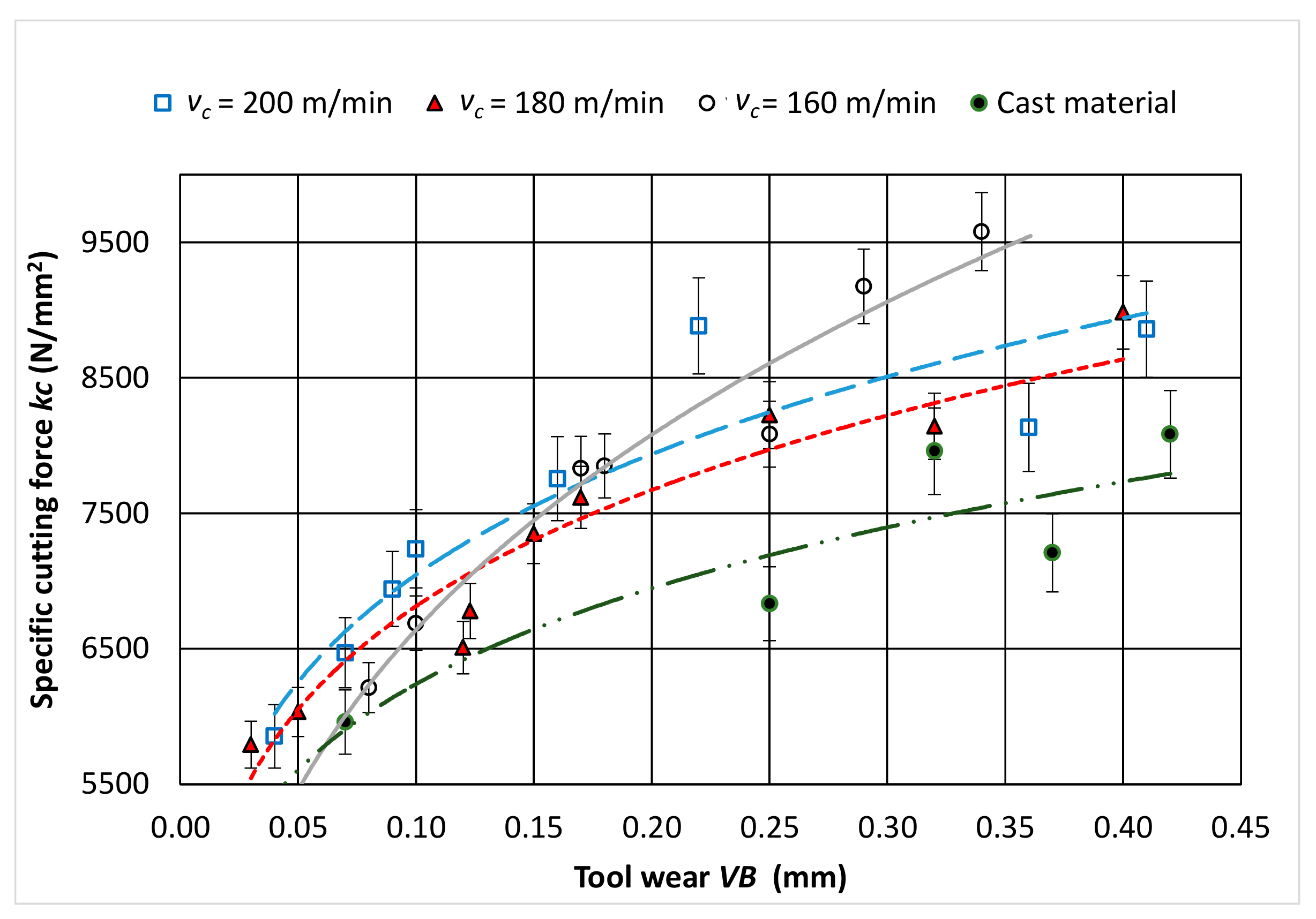
- In case of the tool wear in the range of VB = 0–0.2 mm, the specific cutting force values increased slightly and reached similar values equal to kc = 5500–7500 N/mm2. In turn, for the tool wear VB > 0.2 mm, the specific cutting force values increased significantly and they were characterized by a large scatter. The probable cause of this phenomenon was the change of the cross-section of the cutting layer with time due to the tool wear, as well as the change of the nature of the wear on the insert rake face: the observed chipping.
- -
- The tool wear when machining the cast nickel-cobalt alloy was significantly higher and the tool life was shorter. Moreover, the specific cutting force values were on average lower by 1000 N/mm2 than the values for turning a sintered nickel-cobalt alloy.
- -
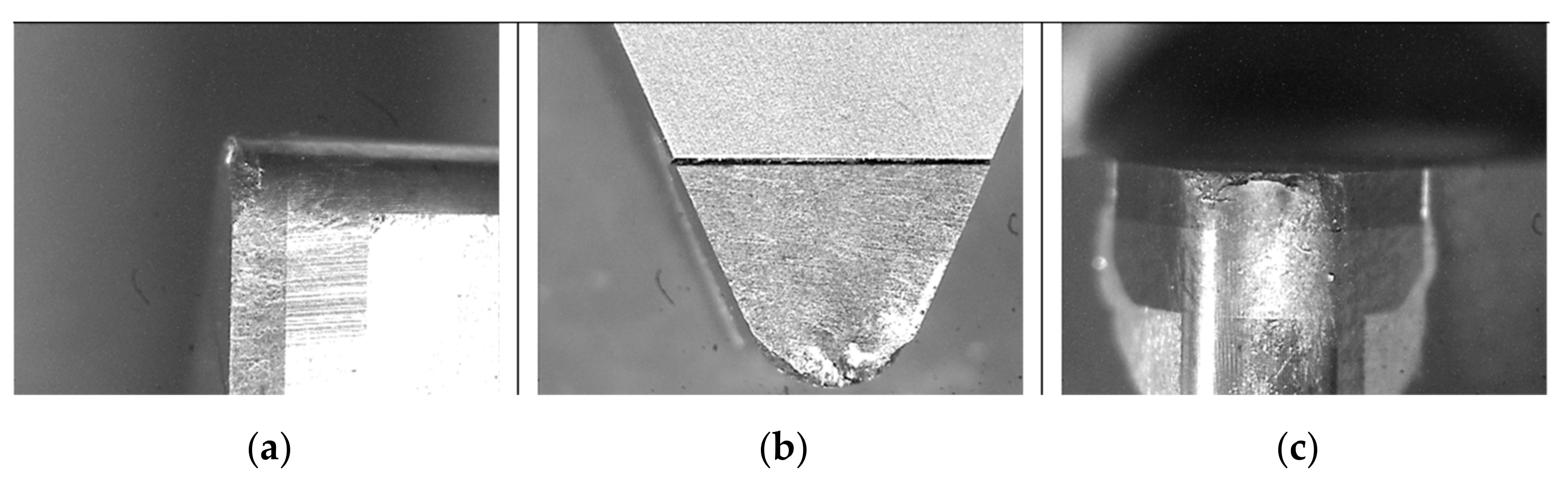
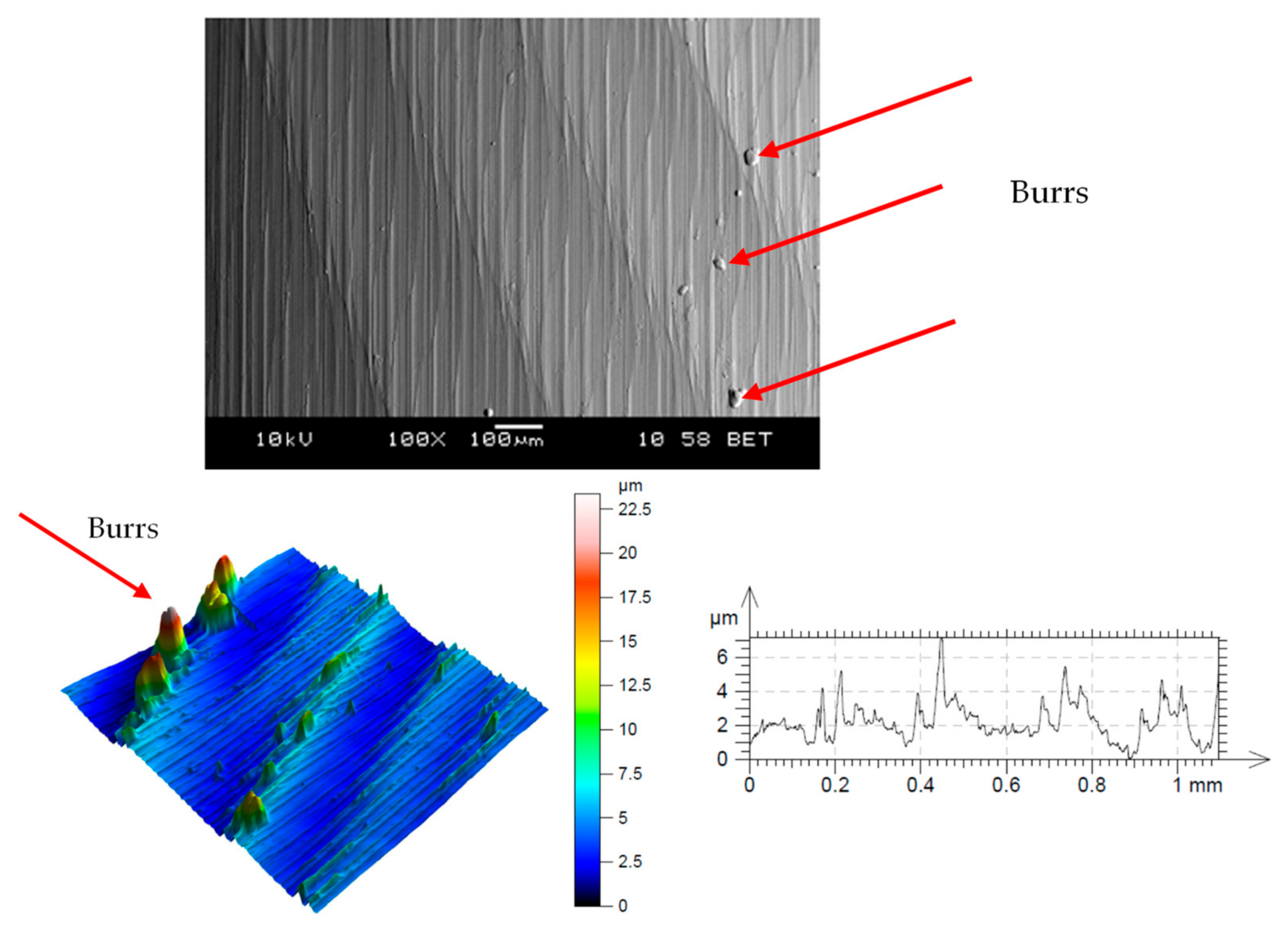
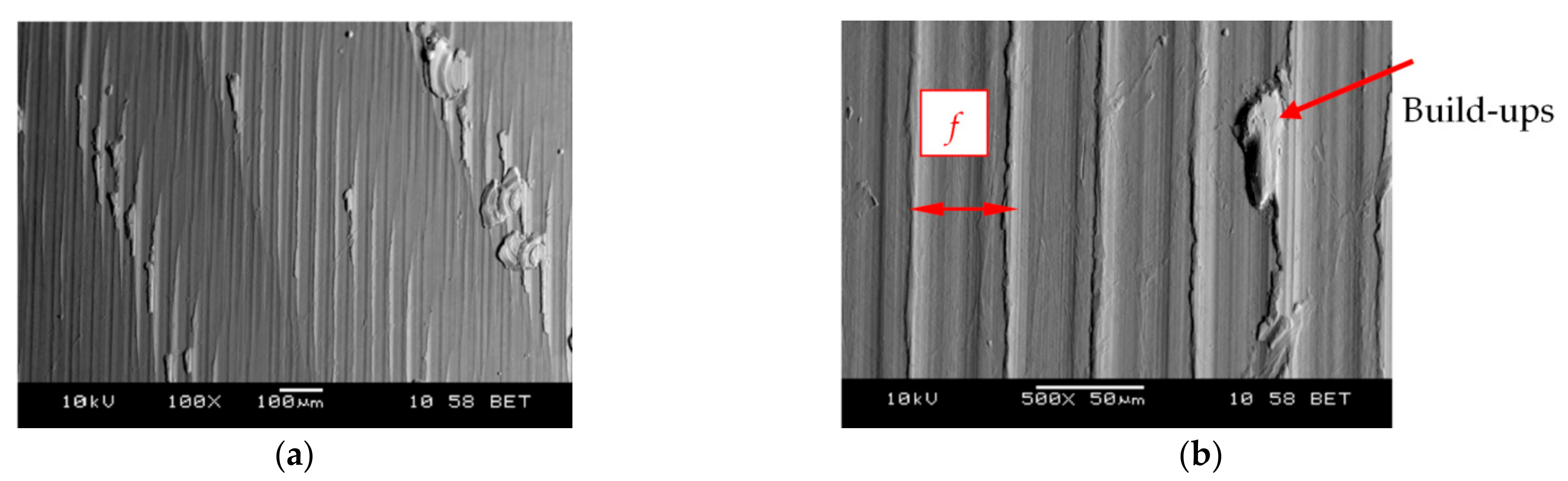
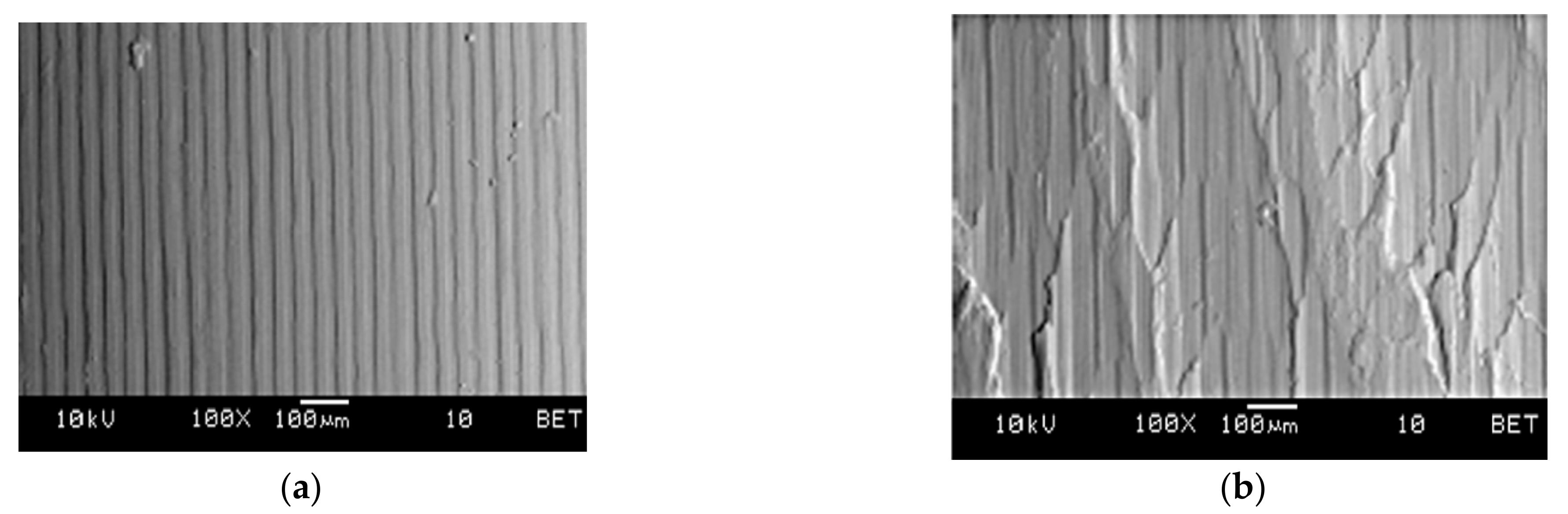
- The microscopic analyses of the machined surface showed visible deformations, deposits, and burrs that could significantly affect the parameter values describing the surface roughness (such as Ra). The deterioration in the quality of the surface finish resulted from the significant tool wear. The analysis of the results showed that the surface parameter Ra was higher at the beginning of the tool work, and it increased significantly for the tool wear VB > 0.3 mm.
- -
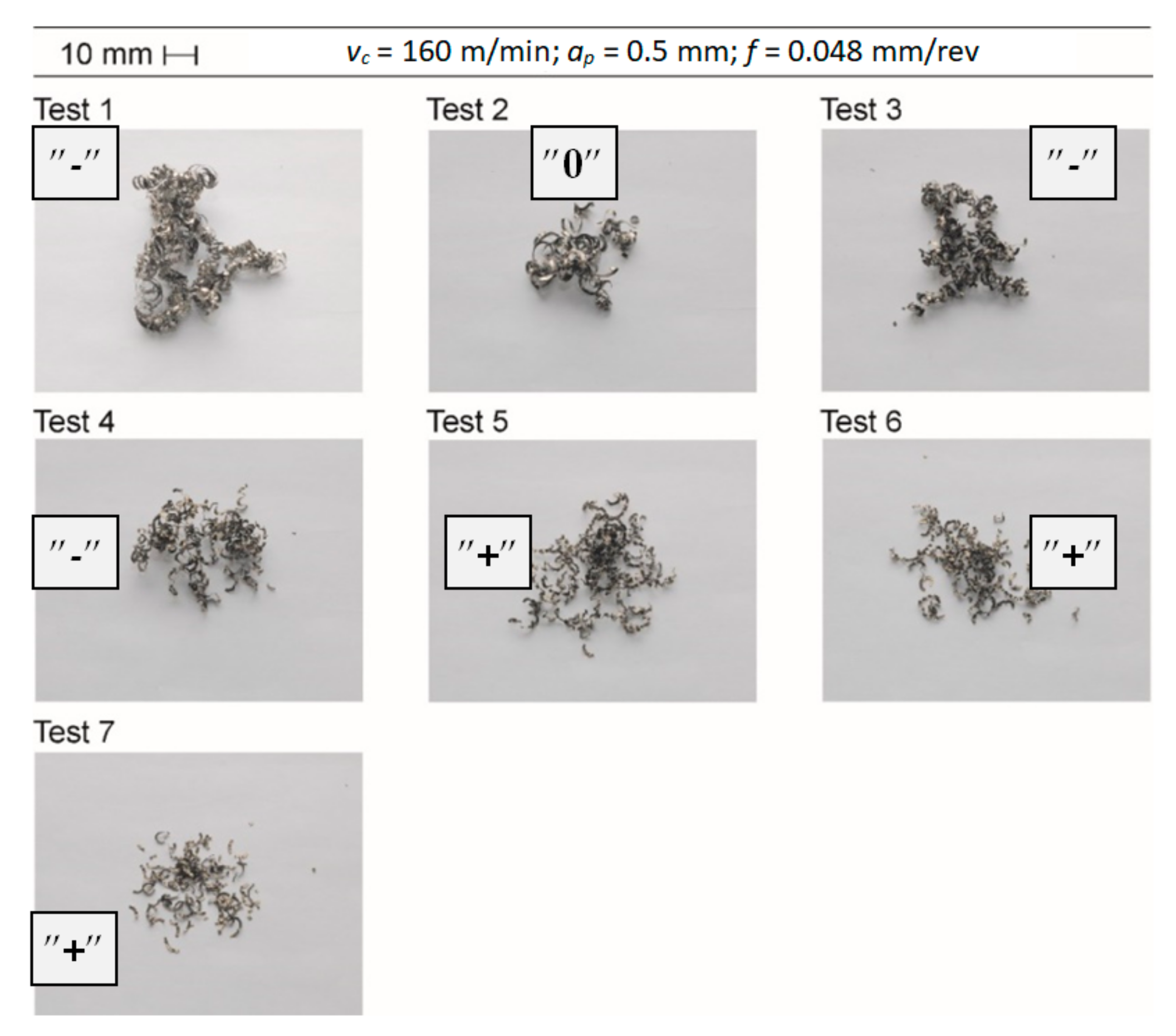
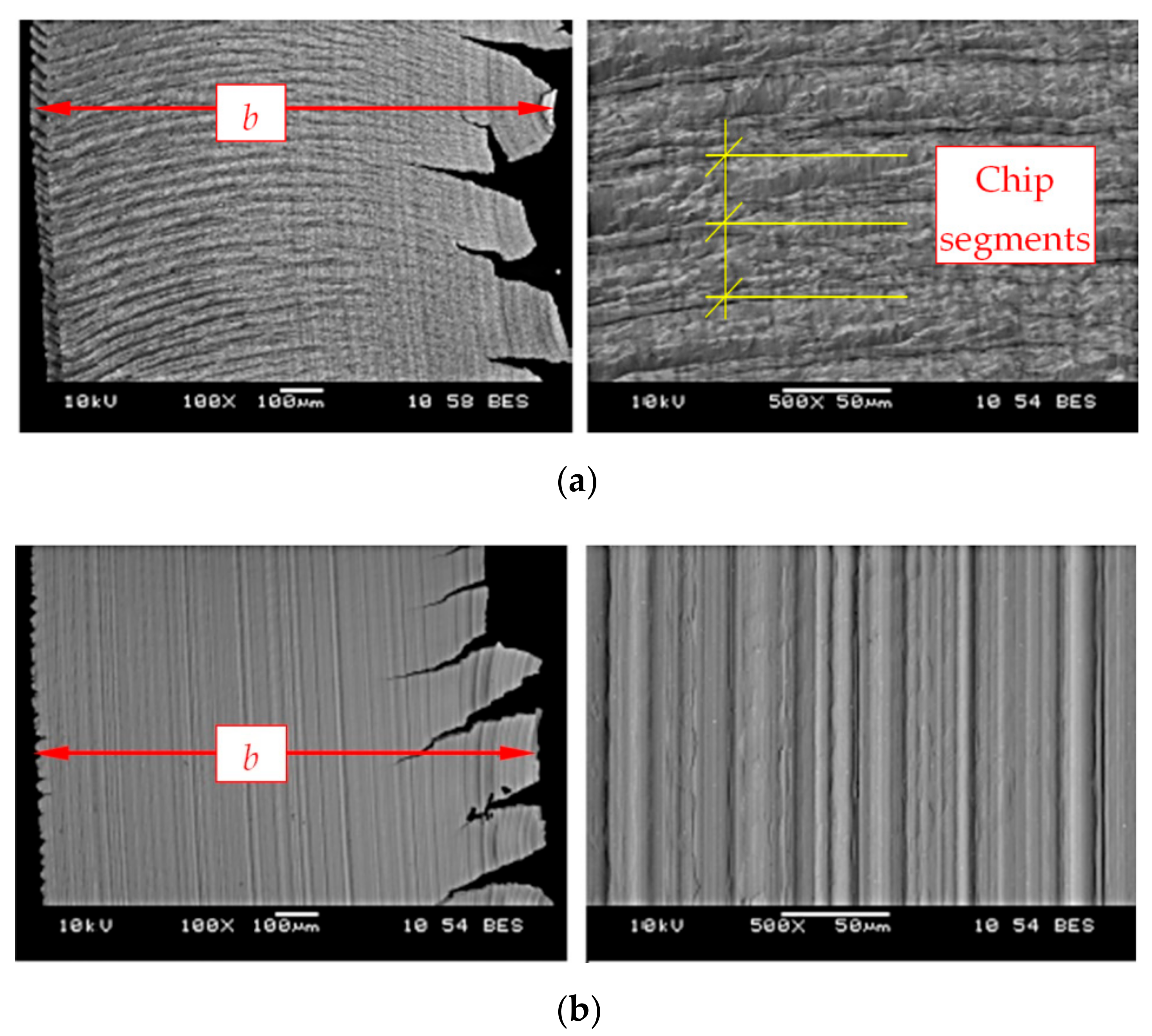
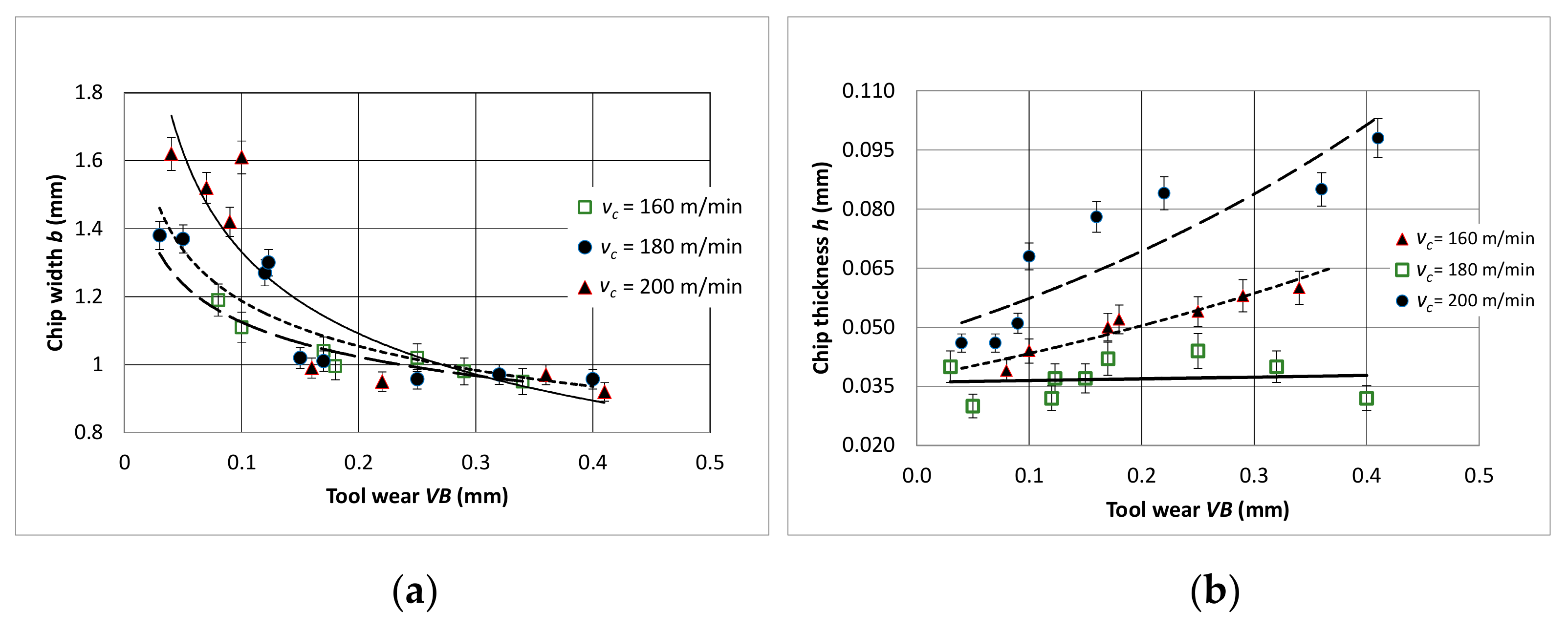
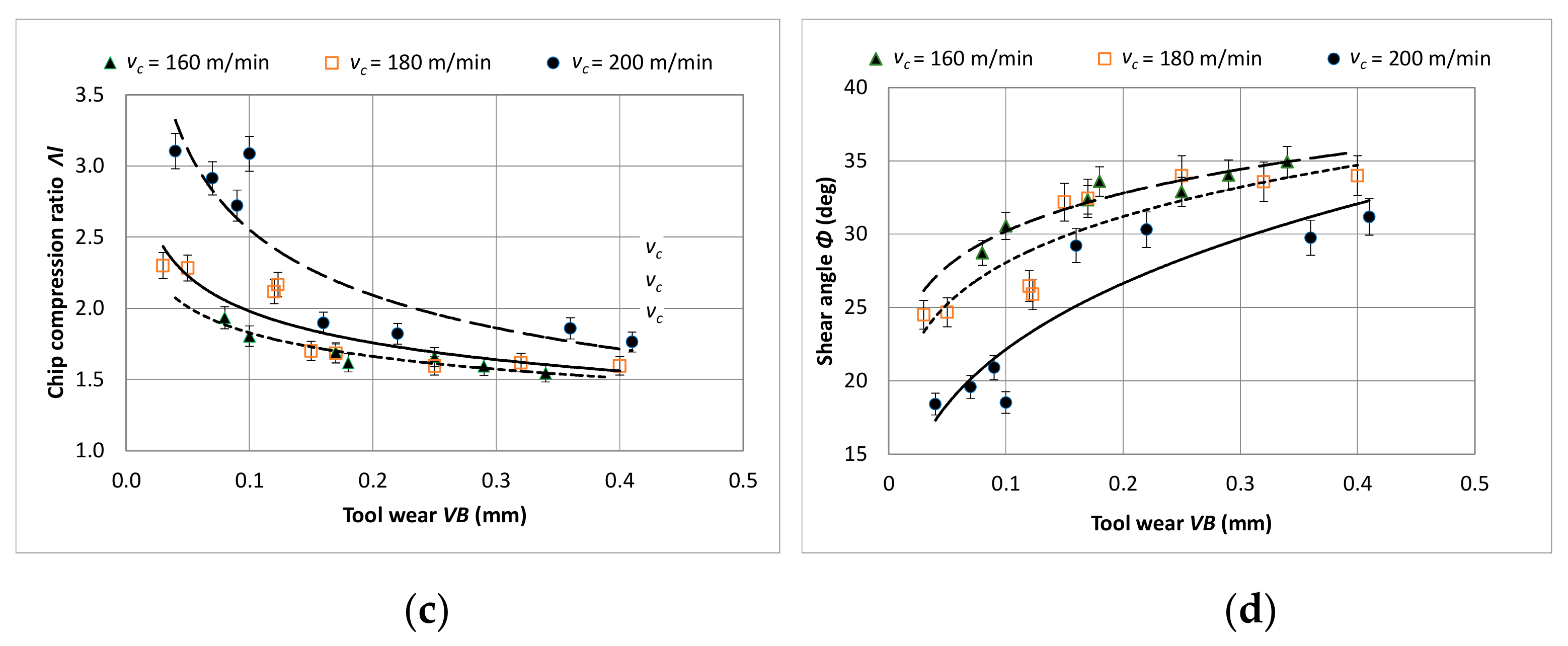
- The research showed the influence of the tool wear on the geometrical dimensions of the chips, and the relationships characterizing the process, e.g., the shear angle and the chip compression ratio. A change of the chip form as a function of the cutting edge wear was indicated.
Author Contributions
Funding
Institutional Review Board Statement
Informed Consent Statement
Data Availability Statement
Conflicts of Interest
Abbreviations
| Κr | Main cutting edge angle (°) |
| α | Rake angle (°) |
| λ | Cutting edge inclination angle (°) |
| Ra | Arithmetic mean value of surface roughness (µm) |
| Fc | Cutting force (N) |
| Fp | Thrust force (N) |
| Ff | Feed force (N) |
| vc | Cutting speed (m/min) |
| kc | Specific cutting force (N/mm2) |
References
- Thellaputtaa, G.R.; Bose, P.S.C.; Rao, C.S.P. Machinability of nickel based superalloys: A review. Mater. Today Proc. 2017, 4, 3712–3721. [Google Scholar] [CrossRef]
- Deng, D.; Peng, R.L.; Brodin, H.; Moverare, J. Microstructure and mechanical properties of Inconel 718 produced by selective laser melting: Sample orientation dependence and effects of post heat treatments. Mater. Sci. Eng. A 2018, 713, 294–306. [Google Scholar] [CrossRef]
- Thakur, D.G.; Ramamoorthy, B.; Vijayaraghavan, L. Study on the machinability characteristics of superalloy Inconel 718 during high speed turning. Mater. Des. 2009, 30, 1718–1725. [Google Scholar] [CrossRef]
- Hosseini, E.; Popovich, V. A review of mechanical properties of additively manufactured Inconel 718. Addit. Manuf. 2019, 30, 100877. [Google Scholar] [CrossRef]
- Ezugwu, E.O.; Wang, Z.M.; Machado, A.R. The machinability of nickel based alloys: A review. J. Mater. Process. Technol. 1999, 86, 1–6. [Google Scholar] [CrossRef]
- Anbarasan, N.; Gupta, B.K.; Prakash, S.; Muthukumar, P.; Oyyaravelu, R.; John Felix Kumar, R.; Jerome, S. Effect of heat treatment on the microstructure and mechanical properties of Inconel 718. Mater. Today Proc. 2018, 5, 7716–7724. [Google Scholar] [CrossRef]
- Thomas, A.; El-Wahabi, M.; Cabrera, J.M.; Prado, J.M. High temperature deformation of Inconel 718. J. Mater. Process. Technol. 2006, 177, 469–472. [Google Scholar] [CrossRef]
- Babu, V.S.; Pavlovic, A.S.; Seehra, M.S. Oxidation Characteristics and Thermal Expansion of Inconel Alloy 718 from 300 K to 1273 K; The Minerals, Metals & Materials Society: Warrendale, PA, USA, 1997; pp. 689–693. [Google Scholar]
- Yoo, J.T.; Yoon, J.H.; Lee, H.S.; Youn, S.K. Material characterization of Inconel 718 from free bulging test at high temperature. J. Mech. Sci. Technol. 2012, 26, 2101–2105. [Google Scholar] [CrossRef]
- Arunachalam, R.M.; Mannan, M.A.; Spowage, A.C. Residual stress and surface roughness when facing age hardened Inconel 718 with CBN and ceramic cutting tools. Int. J. Mach. Tools Manuf. 2004, 44, 879–887. [Google Scholar] [CrossRef]
- Wrigth, P.K.; Chow, J.G. Deformation characteristic of nickel alloys during machining. J. Eng. Mater. Technol. 1982, 104, 85–93. [Google Scholar]
- Pawade, R.S.; Joshi, S. Mechanism of chip formation in high-speed turning of Inconel 718. Mach. Sci. Technol. 2011, 15, 132–152. [Google Scholar] [CrossRef]
- Peng, H.; Dong, P.; Cheng, X.; Zhang, C.; Tang, W.; Xing, Y.; Zhou, X. Semi-Empirical Prediction of Residual Stress Distributions Introduced by Turning Inconel 718 Alloy Based on Lorentz Function. Materials 2020, 13, 4341. [Google Scholar] [CrossRef]
- Struzikiewicz, G.; Zębala, W.; Słodki, B. Cutting parameters selection for sintered alloy AlSi10Mg longitudinal turning. Measurement 2019, 138, 39–53. [Google Scholar] [CrossRef]
- Fayed, E.M.; Shahriari, D.; Saadati, M.; Brailovski, V.; Jahazi, M.; Medraj, M. Influence of Homogenization and Solution Treatments Time on the Microstructure and Hardness of Inconel 718 Fabricated by Laser Powder Bed Fusion Process. Materials 2020, 13, 2574. [Google Scholar] [CrossRef] [PubMed]
- Krawczyk, M.; Królikowski, M.; Grochała, D.; Powałka, B.; Figiel, P.; Wojciechowski, S. Evaluation of Surface Topography after Face Turning od CoCR Alloys Fabricated by Casting and Selective Laser Melting. Materials 2020, 13, 2448. [Google Scholar] [CrossRef] [PubMed]
- Araujo, L.S.; Santos, D.S.D.; Godet, S.; Dille, J.; Pinto, A.L.; de Almeida, L.H. Analysis of Grain Boundary Character in a Fine-Grained Nickel-Based Superalloy 718. J. Mater. Eng. Perform. 2014, 23, 4130–4141. [Google Scholar]
- Nayan, N.; Gurao, N.P.; Murty, S.V.S.N.; Jha, A.K.; Pant, B.; George, K.M. Microstructure and micro-texture evolution during large strain deformation of Inconel alloy IN718. Mater. Charact. 2015, 110, 236–241. [Google Scholar] [CrossRef]
- Wang, J.; Liu, D.; Ding, X.; Wang, H.; Wang, H.; Chen, J.; Yang, Y. Microstructure Heredity of Inconel 718 Nickel-Based Superalloy during Preheating and Following Deformation. Crystals 2020, 10, 303. [Google Scholar] [CrossRef]
- DebRoy, T.; Wei, H.L.; Zuback, J.S.; Mukherjee, T.; Elmer, J.W.; Milewski, J.O.; Beese, A.M.; Wilson-Heid, A.; De, A.; Zhang, W. Additive manufacturing of metallic components—Process, structure and properties. Prog. Mater. Sci. 2018, 92, 112–224. [Google Scholar] [CrossRef]
- Tucho, W.M.; Cuvillier, P.; Sjolyst-Kverneland, A.; Hansen, V. Microstructure and hardness studies of Inconel 718 manufactured by selective laser melting before and after solution heat treatment. Mater. Sci. Eng. A 2017, 689, 220–232. [Google Scholar] [CrossRef]
- Niaki, M.K.; Torabi, S.A.; Nonino, F. Why manufacturers adopt additive manufacturing technologies: The role of sustainability. J. Clean. Prod. 2019, 222, 381–392. [Google Scholar] [CrossRef]
- Thakur, A.; Gangopadhyay, S. State-of-the-art in surface integrity in machining of nickel-based superalloys. Int. J. Mach. Tools Manuf. 2016, 100, 25–54. [Google Scholar] [CrossRef]
- Jawahir, I.S.; Brinksmeier, E.; M’Saoubi, R.; Aspinwall, D.K.; Outeiro, J.C.; Meyer, D.; Umbrello, D.; Jayal, A.D. Surface integrity in material removal processes: Recent advances. CIRP Ann. Manuf. Technol. 2011, 60, 603–626. [Google Scholar] [CrossRef]
- Chen, Z.; Lin Peng, R.; Moverare, J.; Avdovic, P.; Zhou, J.M.; Johansson, S. Surface Integrity and Structural Stability of Broached, Inconel 718 at High Temperatures. Metall. Mater. Trans. A 2016, 47, 3664–3676. [Google Scholar] [CrossRef]
- Ezugwu, E.O.; Tang, S.H. Surface abuse when machining cast iron (G-17) and nickel base superalloy (Inconel 718) with ceramic tools. J. Mater. Process. Technol. 1995, 55, 63–69. [Google Scholar] [CrossRef]
- Devillez, A.; Le, G.; Dominiak, S.; Dudzinski, D. Dry machining of Inconel 718, workpiece surface integrity. J. Mater. Process. Technol. 2011, 211, 1590–1598. [Google Scholar] [CrossRef]
- Pawade, R.S.; Suhas, S.; Joshi, S.; Brahmankar, P.K.; Rahman, M. An investigation of cutting forces and surface damage in high-speed turning of Inconel 718. J. Mater. Process. Technol. 2007, 192–193, 139–146. [Google Scholar] [CrossRef]
- Sadat, A.B. Surface characteristics of machined Inconel-718 nickel-base superalloy using natural and controlled contact length tools. Int. J. Mach. Tool Manuf. 1987, 27, 333–342. [Google Scholar] [CrossRef]
- Sharman, A.R.C.; Hughes, J.I. Workpiece surface integrity and tool life issues when turning Inconel 718™ nickel based superalloy. J. Mach. Sci. Technol. 2004, 200, 424–432. [Google Scholar] [CrossRef]
- Zhou, J.Z.; Bushlya, V.; Stahl, J.E. An investigation of surface damage in the high speed turning of Inconel 718 with use of whisker reinforced ceramic tools. J. Mater. Process. Technol. 2012, 212, 372–384. [Google Scholar] [CrossRef]
- Zhou, J.; Chen, Z.; Persson, H.; Peng, R.L.; M’Saoubi, R.; Gustasson, D. Comparative Assessment of the Surface Integrity of AD730® and IN718 Superalloys in High-Speed Turning with a CBN Tool. J. Manuf. Mater. Process. 2019, 3, 73. [Google Scholar] [CrossRef]
- Gupta, M.K.; Mozammel, M.; Pruncu, C.I.; Kapłonek, W.; Nadolny, K.; Patra, K.; Mikolajczyk, T.; Pimenov, D.Y.; Sarikaya, M.; Sharma, V.S. Parametric optimization and process capability analysis for machining of nickel-based superalloy. Int. J. Adv. Manuf. Technol. 2019, 102, 3995–4009. [Google Scholar] [CrossRef]
- Hua, Y.; Liu, Z. Experimental Investigation of Principal Residual Stress and Fatigue Performance for Turned Nickel-Based Superalloy Inconel 718. Materials 2018, 11, 879. [Google Scholar] [CrossRef]
- Pawade, R.S.; Joshi, S.S.; Brahmankar, P.K. Effect of machining parameters and cutting edge geometry on surface integrity of high-speed turned Inconel 718. Int. J. Mach. Tools Manuf. 2008, 48, 15–28. [Google Scholar] [CrossRef]
- Arrazola, P.J.; Kortabarria, A.; Madariaga, A.; Esnaola, J.A.; Fernandez, E.; Cappellini, C.; Ulutan, D.; Özel, T. On the machining induced residual stresses in IN718 nickel-based alloy: Experiments and predictions with finite element simulation. Simul. Model. Pract. Theory 2014, 41, 87–103. [Google Scholar] [CrossRef]
- Hua, Y.; Liu, Z. Effects of cutting parameters and tool nose radius on surface roughness and work hardening during dry turning Inconel 718. Int. J. Adv. Manuf. Technol. 2018, 96, 2421–2430. [Google Scholar] [CrossRef]
- D’Addona, D.M.; Raykar, S.J.; Narke, M.M. High Speed Machining of Inconel 718: Tool Wear and Surface Roughness Analysis. Proc. CIRP 2017, 62, 269–274. [Google Scholar] [CrossRef]
- Krolczyk, G.; Legutko, S.; Nieslony, P.; Gajek, M. Study of the surface integrity microhardness of austenitic stainless steel after turning. Tehn. Vjesnik Tech. Gazette 2014, 21, 1307–1311. [Google Scholar]
- Čep, R.; Janásek, A.; Petrů, J.; Sadílek, M.; Mohyla, P.; Valíček, J.; Harničarová, M.; Czán, A. Surface roughness after machining and influence of feed rate on process. Prec. Mach. 2014, 7, 341–347. [Google Scholar] [CrossRef]
- Velchev, S.; Kolev, I.; Ivanov, K. Empirical mathematical models of the dependence of the specific cutting force on thickness of cut in turning. Ann. Faculty Eng. Hunedoara-Int. J. Eng. 2001, 3, 303–312. [Google Scholar]





| Nickel-Cobalt Alloy | Average Grain Size (µm) | |
|---|---|---|
| At the Edge of the Sample | In the Middle of the Sample | |
| Sintered | 3.38 ± 0.2 | 3.22 ± 0.1 |
| Cast | 34.8 ± 1.9 | |
| Ni | Co | Cr | Mo | Ti | Si | Al |
|---|---|---|---|---|---|---|
| 57.4 | 20.6 | 13.5 | 2.6 | 2.7 | 0.9 | 2.3 |
| Main Cutting Edge Angle Κr | Cutting Edge Inclination Angle λ | Rake Angle α |
|---|---|---|
| 95° | 0° | −5° |
| Number | A | B | L (mm) | vc (m/min) |
|---|---|---|---|---|
| 1 | 1 | 1 | 18 | 160 |
| 2 | 1 | 2 | 18 | 180 |
| 3 | 1 | 3 | 18 | 200 |
| 4 | 2 | 1 | 36 | 160 |
| 5 | 2 | 2 | 36 | 180 |
| 6 | 2 | 3 | 36 | 200 |
| 7 | 3 | 1 | 54 | 160 |
| 8 | 3 | 2 | 54 | 180 |
| 9 | 3 | 3 | 54 | 200 |
| 10 | 4 | 1 | 72 | 160 |
| 11 | 4 | 2 | 72 | 180 |
| 12 | 4 | 3 | 72 | 200 |
| 13 | 5 | 1 | 90 | 160 |
| 14 | 5 | 2 | 90 | 180 |
| 15 | 5 | 3 | 90 | 200 |
| 16 | 6 | 1 | 108 | 160 |
| 17 | 6 | 2 | 108 | 180 |
| 18 | 6 | 3 | 108 | 200 |
| Test Number | L | vc | ap | f | Fp_avg | Ff_avg | Fc_avg | Ra_avg | VBmax |
|---|---|---|---|---|---|---|---|---|---|
| (mm) | (m/min) | (mm) | (mm/rev) | (N) | (N) | (N) | (µm) | (mm) | |
| 1 | 18 | 160 | 0.5 | 0.048 | 300.5 | 119.9 | 140.0 | 0.34 | 0.035 |
| 2 | 45 | 160 | 0.5 | 0.048 | 238.2 | 148.9 | 160.5 | 0.48 | 0.10 |
| 3 | 90 | 160 | 0.5 | 0.048 | 389.9 | 165.0 | 185.0 | 1.02 | 0.16 |
| 4 | 99 | 160 | 0.5 | 0.048 | 379.6 | 149.8 | 188.4 | 2.00 | 0.18 |
| 5 | 108 | 160 | 0.5 | 0.048 | 387.4 | 160.6 | 195.0 | 2.15 | 0.23 |
| 6 | 118 | 160 | 0.5 | 0.048 | 499.1 | 233.6 | 220.2 | 1.21 | 0.29 |
| 7 | 127 | 160 | 0.5 | 0.048 | 468.6 | 261.4 | 229.9 | 0.89 | 0.34 |
| Test Number | L | vc | ap | f | Fp_avg | Ff_avg | Fc_avg | Ra_avg | VBmax |
|---|---|---|---|---|---|---|---|---|---|
| (mm) | (m/min) | (mm) | (mm/rev) | (N) | (N) | (N) | (µm) | (mm) | |
| 1 | 9 | 180 | 0.5 | 0.048 | 218.6 | 101.9 | 139.0 | 0.41 | 0.03 |
| 2 | 18 | 180 | 0.5 | 0.048 | 261.5 | 111.9 | 155.0 | 1.50 | 0.06 |
| 3 | 27 | 180 | 0.5 | 0.048 | 281.6 | 120.2 | 151.3 | 2.06 | 0.11 |
| 4 | 36 | 180 | 0.5 | 0.048 | 295.1 | 122.1 | 156.2 | 1.56 | 0.12 |
| 5 | 45 | 180 | 0.5 | 0.048 | 301.6 | 128.7 | 162.7 | 1.09 | 0.123 |
| 6 | 54 | 180 | 0.5 | 0.048 | 333.7 | 149.6 | 176.4 | 1.22 | 0.125 |
| 7 | 63 | 180 | 0.5 | 0.048 | 222.6 | 180.9 | 182.8 | 1.40 | 0.13 |
| 8 | 72 | 180 | 0.5 | 0.048 | 340.7 | 172.9 | 197.4 | 1.43 | 0.14 |
| 9 | 81 | 180 | 0.5 | 0.048 | 370.0 | 156.0 | 195.4 | 1.58 | 0.32 |
| 10 | 90 | 180 | 0.5 | 0.048 | 380.4 | 178.5 | 215.6 | 1.75 | 0.21 |
| Test Number | L | vc | ap | f | Fp | Ff | Fc | Ra_avg | VBmax |
|---|---|---|---|---|---|---|---|---|---|
| mm | m/min | mm | mm/rev | N | N | N | µm | mm | |
| 1 | 9 | 200 | 0.5 | 0.048 | 246.8 | 111.3 | 140.5 | 0.92 | 0.04 |
| 2 | 18 | 200 | 0.5 | 0.048 | 283.1 | 121.9 | 155.3 | 2.85 | 0.07 |
| 3 | 36 | 200 | 0.5 | 0.048 | 329.9 | 134.0 | 166.6 | 2.05 | 0.09 |
| 4 | 45 | 200 | 0.5 | 0.048 | 336.7 | 138.4 | 173.7 | 1.47 | 0.10 |
| 5 | 63 | 200 | 0.5 | 0.048 | 331.0 | 139.4 | 186.1 | 2.08 | 0.16 |
| 6 | 90 | 200 | 0.5 | 0.048 | 467.0 | 140.0 | 213.2 | 2.24 | 0.22 |
| 7 | 117 | 200 | 0.5 | 0.048 | 449.0 | 160.9 | 195.2 | 4.96 | 0.36 |
| 8 | 135 | 200 | 0.5 | 0.048 | 570.0 | 211.0 | 212.6 | 2.24 | 0.41 |
| A | B | L (mm) | vc (m/min) | VB_avg (mm) | Ra_avg (µm) | Fc_avg (N) |
|---|---|---|---|---|---|---|
| 1 | 1 | 18 | 160 | 0.035 | 0.34 | 140 |
| 1 | 2 | 18 | 180 | 0.062 | 1.50 | 155 |
| 1 | 3 | 18 | 200 | 0.076 | 2.75 | 165 |
| 2 | 1 | 36 | 160 | 0.090 | 0.42 | 151 |
| 2 | 2 | 36 | 180 | 0.100 | 0.95 | 162 |
| 2 | 3 | 36 | 200 | 0.110 | 2.06 | 178 |
| 3 | 1 | 54 | 160 | 0.110 | 0.54 | 165 |
| 3 | 2 | 54 | 180 | 0.120 | 1.25 | 162 |
| 3 | 3 | 54 | 200 | 0.125 | 1.81 | 183 |
| 4 | 1 | 72 | 160 | 0.115 | 0.75 | 172 |
| 4 | 2 | 72 | 180 | 0.140 | 1.25 | 178 |
| 4 | 3 | 72 | 200 | 0.160 | 2.10 | 196 |
| 5 | 1 | 90 | 160 | 0.160 | 1.02 | 185 |
| 5 | 2 | 90 | 180 | 0.210 | 1.40 | 187 |
| 5 | 3 | 90 | 200 | 0.223 | 2.22 | 208 |
| 6 | 1 | 108 | 160 | 0.230 | 2.15 | 195 |
| 6 | 2 | 108 | 180 | 0.310 | 1.58 | 198 |
| 6 | 3 | 108 | 200 | 0.323 | 4.24 | 215 |
| Source | DF | Seq SS | Adj SS | Adj MS | F | P |
|---|---|---|---|---|---|---|
| L (mm) | 5 | 0.100166 | 0.100166 | 0.020033 | 75.73 | 0.0 |
| vc (m/min) | 2 | 0.006842 | 0.006842 | 0.003421 | 12.93 | 0.002 |
| Residual Error | 10 | 0.002645 | 0.002645 | 0.000265 | - | - |
| Total | 17 | 0.109653 | - | - | - | - |
| R-Sq = 98.3% | - | - | - | - | - | - |
| Source | DF | Seq SS | Adj SS | Adj MS | F | P |
|---|---|---|---|---|---|---|
| L (mm) | 5 | 5207.8 | 5207.8 | 1041.57 | 789.53 | 0.0 |
| vc (m/min) | 2 | 1696.3 | 1696.3 | 848.17 | 72.91 | 0.0 |
| Residual Error | 10 | 116.3 | 116.3 | 11.63 | - | - |
| Total | 17 | 7020.5 | - | - | - | - |
| R-Sq = 98.3% | - | - | - | - | - | - |
| Source | DF | Seq SS | Adj SS | Adj MS | F | P |
|---|---|---|---|---|---|---|
| L (mm) | 5 | 4.630 | 4.630 | 0.9259 | 3.91 | 0.016 |
| vc (m/min) | 2 | 8.839 | 8.839 | 4.4197 | 23.46 | 0.0 |
| Residual Error | 10 | 1.884 | 1.884 | 0.1884 | - | - |
| Total | 17 | 15.353 | - | - | - | - |
| R-Sq = 87.7% | - | - | - | - | - | - |
Publisher’s Note: MDPI stays neutral with regard to jurisdictional claims in published maps and institutional affiliations. |
© 2021 by the authors. Licensee MDPI, Basel, Switzerland. This article is an open access article distributed under the terms and conditions of the Creative Commons Attribution (CC BY) license (http://creativecommons.org/licenses/by/4.0/).
Share and Cite
Zębala, W.; Struzikiewicz, G.; Rumian, K. Cutting Forces and Tool Wear Investigation during Turning of Sintered Nickel-Cobalt Alloy with CBN Tools. Materials 2021, 14, 1623. https://doi.org/10.3390/ma14071623
Zębala W, Struzikiewicz G, Rumian K. Cutting Forces and Tool Wear Investigation during Turning of Sintered Nickel-Cobalt Alloy with CBN Tools. Materials. 2021; 14(7):1623. https://doi.org/10.3390/ma14071623
Chicago/Turabian StyleZębala, Wojciech, Grzegorz Struzikiewicz, and Ksenia Rumian. 2021. "Cutting Forces and Tool Wear Investigation during Turning of Sintered Nickel-Cobalt Alloy with CBN Tools" Materials 14, no. 7: 1623. https://doi.org/10.3390/ma14071623
APA StyleZębala, W., Struzikiewicz, G., & Rumian, K. (2021). Cutting Forces and Tool Wear Investigation during Turning of Sintered Nickel-Cobalt Alloy with CBN Tools. Materials, 14(7), 1623. https://doi.org/10.3390/ma14071623