Article

Effect of Inhomogeneous Broadening in Ultraviolet III-Nitride Light-Emitting Diodes
1
Lehrstuhl für Optoelektronik, Friedrich-Alexander-Universität Erlangen-Nürnberg, Cauerstraße 7, D-91058 Erlangen, Germany
2
Institut für Festkörperphysik, Technische Universität Berlin, Hardenbergstraße 36, D-10623 Berlin, Germany
*
Author to whom correspondence should be addressed.
Materials 2021, 14(24), 7890; https://doi.org/10.3390/ma14247890
Submission received: 25 November 2021 / Revised: 14 December 2021 / Accepted: 15 December 2021 / Published: 20 December 2021
(This article belongs to the Special Issue Advances in Light-Emitting Structures and Materials)

Abstract

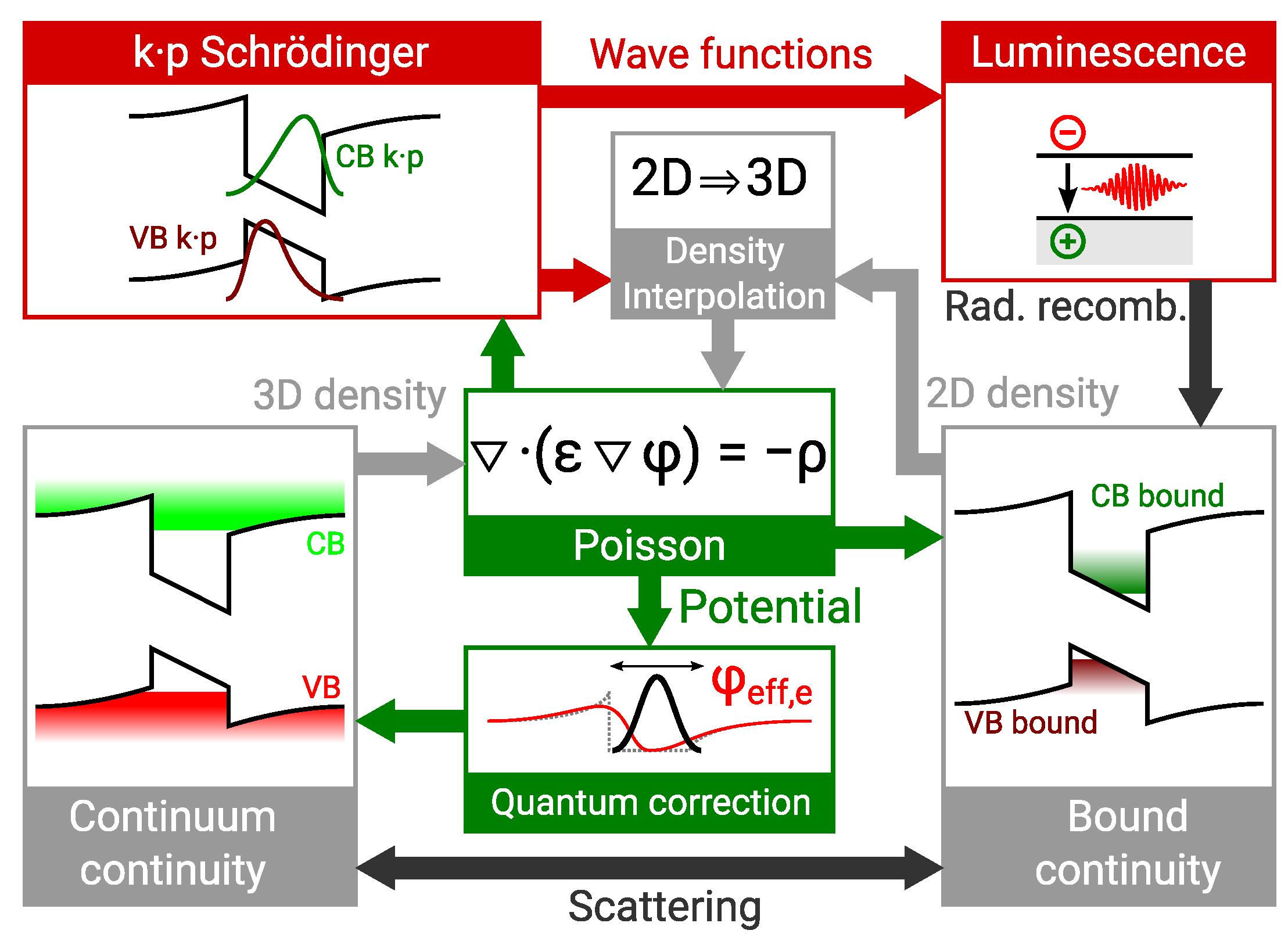
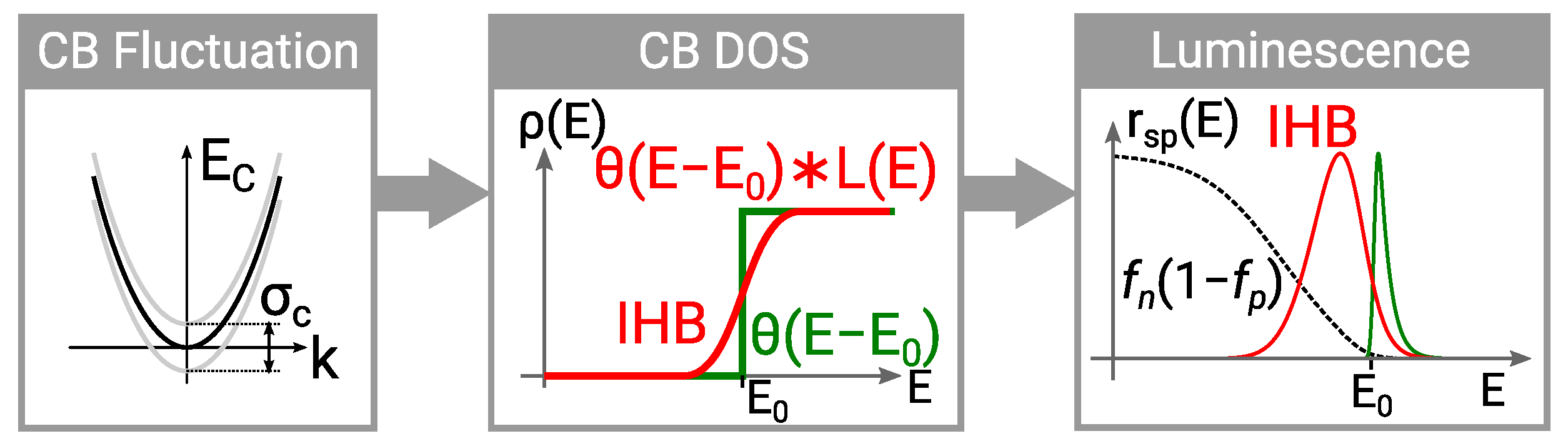
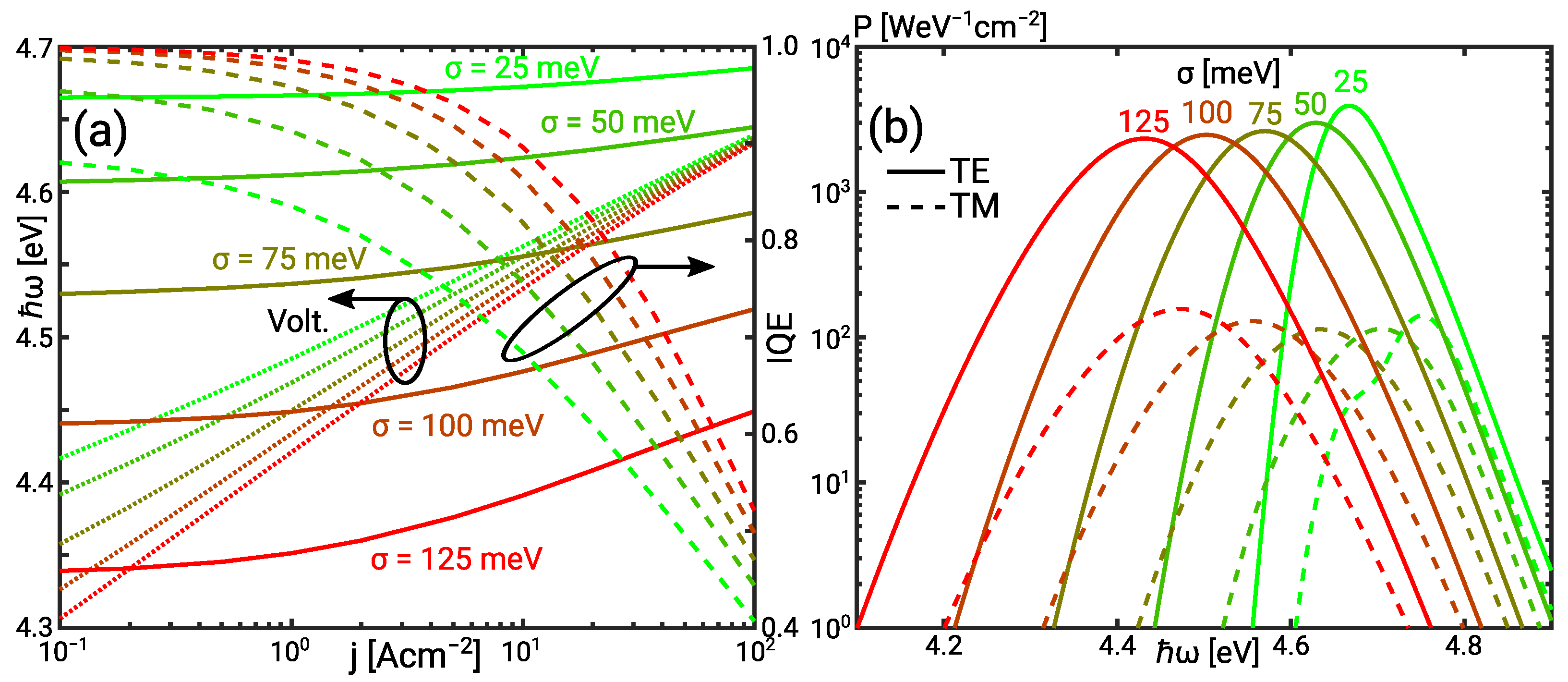
In the past years, light-emitting diodes (LED) made of GaN and its related ternary compounds with indium and aluminium have become an enabling technology in all areas of lighting. Visible LEDs have yet matured, but research on deep ultraviolet (UV) LEDs is still in progress. The polarisation in the anisotropic wurtzite lattice and the low free hole density in p-doped III-nitride compounds with high aluminium content make the design for high efficiency a critical step. The growth kinetics of the rather thin active quantum wells in III-nitride LEDs makes them prone to inhomogeneous broadening (IHB). Physical modelling of the active region of III-nitride LEDs supports the optimisation by revealing the opaque active region physics. In this work, we analyse the impact of the IHB on the luminescence and carrier transport III-nitride LEDs with multi-quantum well (MQW) active regions by numerical simulations comparing them to experimental results. The IHB is modelled with a statistical model that enables efficient and deterministic simulations. We analyse how the lumped electronic characteristics including the quantum efficiency and the diode ideality factor are related to the IHB and discuss how they can be used in the optimisation process.
Keywords: light emitting diode; III-nitride; inhomogeneous broadening; efficiency; numerical modelling light emitting diode; III-nitride; inhomogeneous broadening; efficiency; numerical modelling