Article

Cross-Contamination Risk of Dental Tray Adhesives: An In Vitro Study
1
Department of Prosthodontics and Materials Science, University of Leipzig, Liebigstrasse 12, D-04103 Leipzig, Germany
2
Institute for Medical Microbiology and Virology, University Hospital of Leipzig, Liebigstrasse 21, D-04103 Leipzig, Germany
*
Author to whom correspondence should be addressed.
Materials 2021, 14(20), 6138; https://doi.org/10.3390/ma14206138
Submission received: 5 September 2021 / Revised: 6 October 2021 / Accepted: 12 October 2021 / Published: 15 October 2021
(This article belongs to the Special Issue Advanced Materials for Oral Application)

Abstract

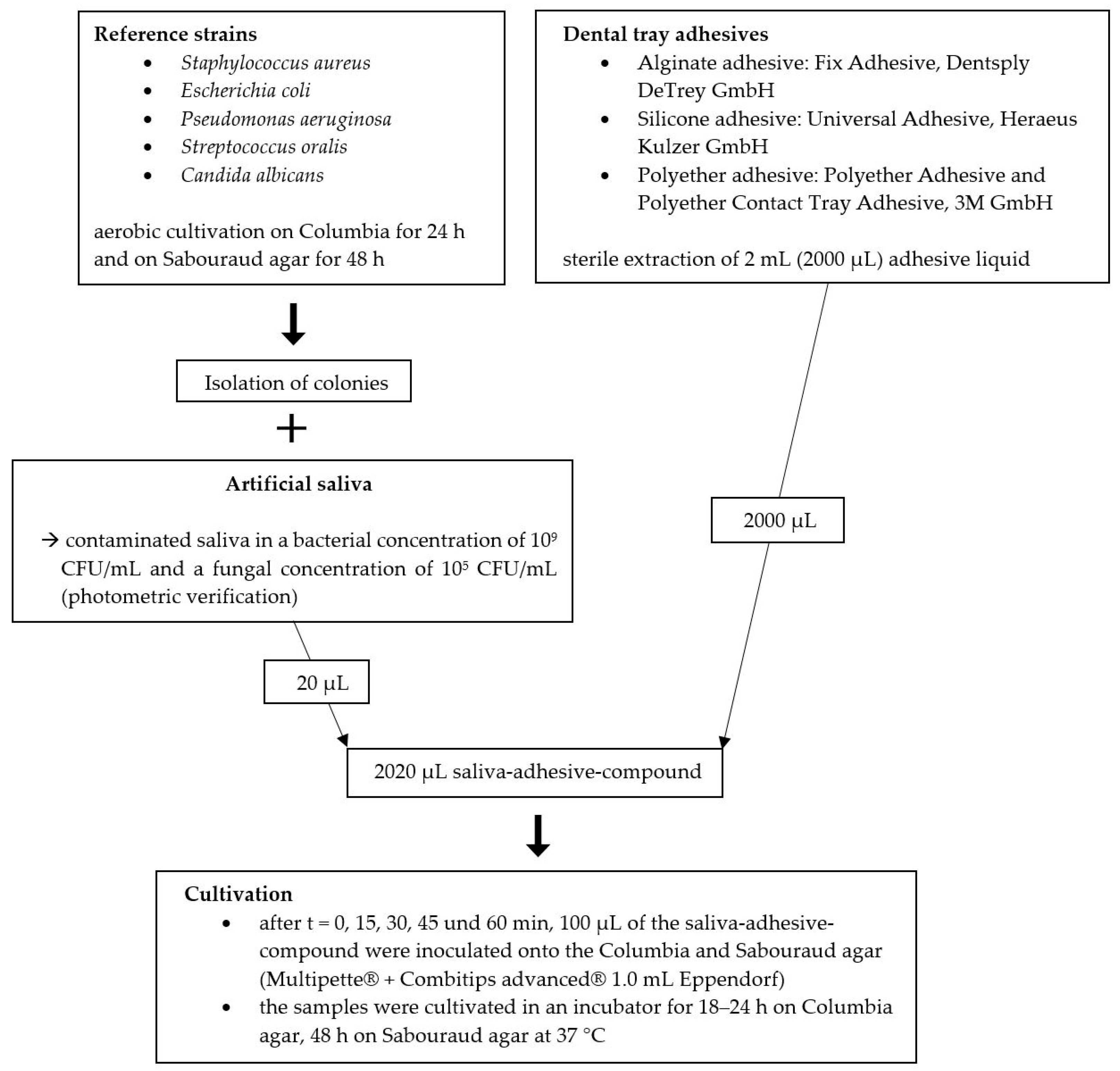
Background: The aim of this study was to investigate the risk of cross-contamination in dental tray adhesives with reusable brush systems. Methods: Four dental tray adhesives with different disinfectant components were examined for risk as a potential transmission medium for Staphylococcus aureus, Escherichia coli, Pseudomonas aeruginosa, Streptococcus oralis, and Candida albicans. Bacterial and fungal strains were mixed with artificial saliva. The contaminated saliva was intentionally added to tray adhesive liquid samples. At baseline and up to 60 min, 100 microliters of each sample were collected and cultivated aerobically on Columbia and Sabouraud agar for 24 or 48 h, respectively. Results: At baseline, contamination with Staphylococcus aureus and Candida albicans could be identified in three out of four adhesives. In the subsequent samples, low counts of up to 20 colony-forming units per milliliter could be observed for Staphylococcus aureus. All other strains did not form colonies at baseline or subsequently. Adhesives with isopropanol or ethyl acetate as disinfectant additives were most effective in preventing contamination, while adhesives with hydrogen chloride or acetone as a disinfectant additive were the least effective. Conclusion: Within 15 min, the tested adhesives appeared to be sufficiently bactericidal and fungicidal against all microorganisms tested.
Keywords: dental tray adhesive; reusable brush; disinfectant additive; cross-contamination risk; disinfection dental tray adhesive; reusable brush; disinfectant additive; cross-contamination risk; disinfection