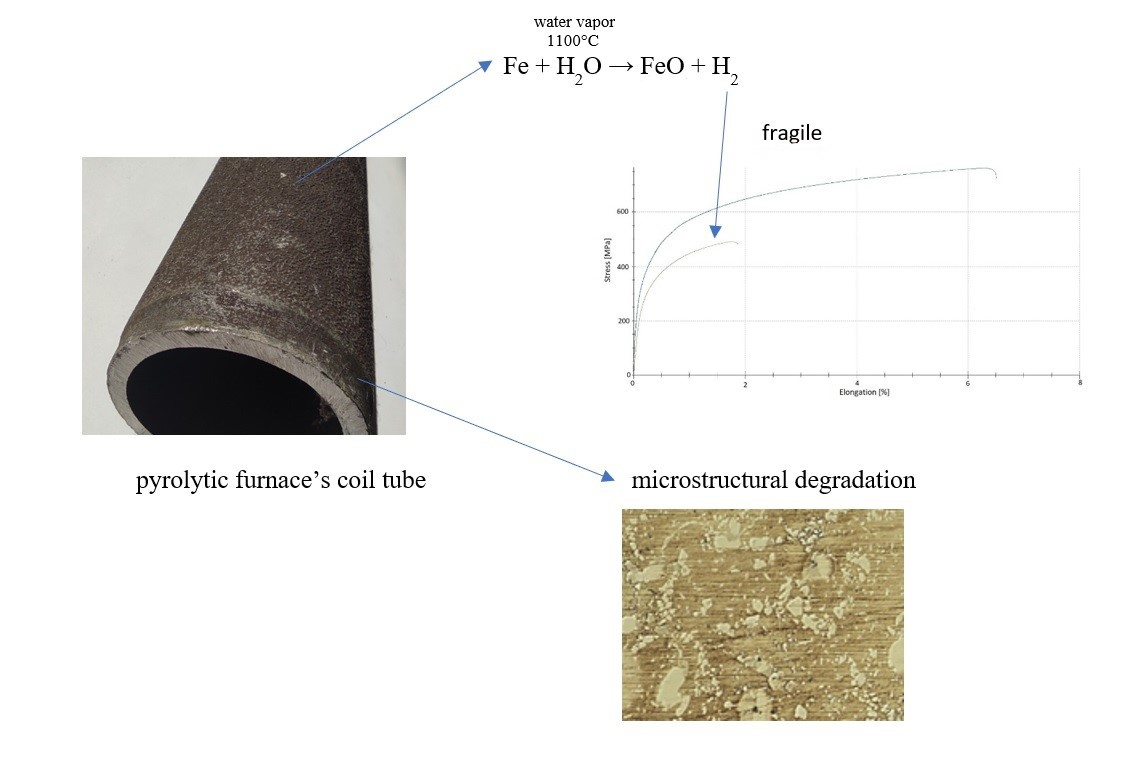
Investigation of the 0.4C-35Cr-45Ni-Nb Alloy after Service in High-Temperature Steam and Hydrocarbons Environment

 , ,
, , Abstract
Share and Cite
Orlikowski, J.; Szociński, M.; Zygmuntowicz, J.; Gajewski, G.; Filipkowski, W.; Darowicki, K. Investigation of the 0.4C-35Cr-45Ni-Nb Alloy after Service in High-Temperature Steam and Hydrocarbons Environment. Materials 2021, 14, 6139. https://doi.org/10.3390/ma14206139
Orlikowski J, Szociński M, Zygmuntowicz J, Gajewski G, Filipkowski W, Darowicki K. Investigation of the 0.4C-35Cr-45Ni-Nb Alloy after Service in High-Temperature Steam and Hydrocarbons Environment. Materials. 2021; 14(20):6139. https://doi.org/10.3390/ma14206139
Chicago/Turabian StyleOrlikowski, Juliusz, Michał Szociński, Janusz Zygmuntowicz, Gabriel Gajewski, Wojciech Filipkowski, and Kazimierz Darowicki. 2021. "Investigation of the 0.4C-35Cr-45Ni-Nb Alloy after Service in High-Temperature Steam and Hydrocarbons Environment" Materials 14, no. 20: 6139. https://doi.org/10.3390/ma14206139
APA StyleOrlikowski, J., Szociński, M., Zygmuntowicz, J., Gajewski, G., Filipkowski, W., & Darowicki, K. (2021). Investigation of the 0.4C-35Cr-45Ni-Nb Alloy after Service in High-Temperature Steam and Hydrocarbons Environment. Materials, 14(20), 6139. https://doi.org/10.3390/ma14206139