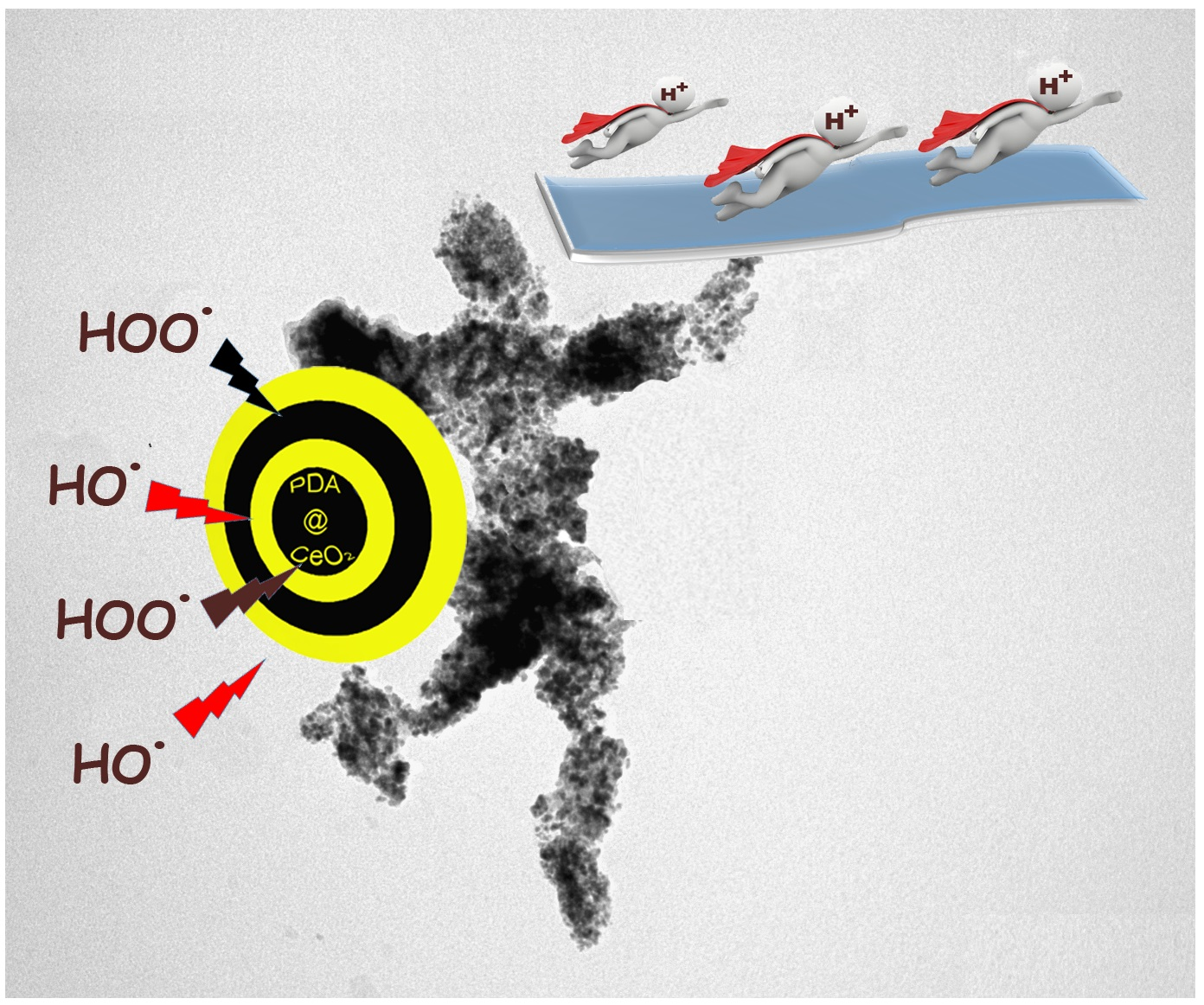
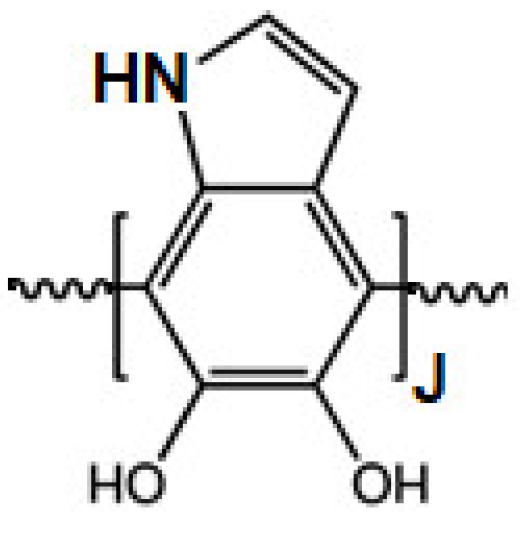
Polydopamine Coated CeO2 as Radical Scavenger Filler for Aquivion Membranes with High Proton Conductivity
 , , ,
, , ,  ,
,  ,
,  and
and Abstract

Share and Cite
D’Amato, R.; Donnadio, A.; Battocchio, C.; Sassi, P.; Pica, M.; Carbone, A.; Gatto, I.; Casciola, M. Polydopamine Coated CeO2 as Radical Scavenger Filler for Aquivion Membranes with High Proton Conductivity. Materials 2021, 14, 5280. https://doi.org/10.3390/ma14185280
D’Amato R, Donnadio A, Battocchio C, Sassi P, Pica M, Carbone A, Gatto I, Casciola M. Polydopamine Coated CeO2 as Radical Scavenger Filler for Aquivion Membranes with High Proton Conductivity. Materials. 2021; 14(18):5280. https://doi.org/10.3390/ma14185280
Chicago/Turabian StyleD’Amato, Roberto, Anna Donnadio, Chiara Battocchio, Paola Sassi, Monica Pica, Alessandra Carbone, Irene Gatto, and Mario Casciola. 2021. "Polydopamine Coated CeO2 as Radical Scavenger Filler for Aquivion Membranes with High Proton Conductivity" Materials 14, no. 18: 5280. https://doi.org/10.3390/ma14185280
APA StyleD’Amato, R., Donnadio, A., Battocchio, C., Sassi, P., Pica, M., Carbone, A., Gatto, I., & Casciola, M. (2021). Polydopamine Coated CeO2 as Radical Scavenger Filler for Aquivion Membranes with High Proton Conductivity. Materials, 14(18), 5280. https://doi.org/10.3390/ma14185280