Transition-Metal-Catalyzed Diarylation of Isocyanides with Triarylbismuthines for the Selective Synthesis of Imine Derivatives
 ,
,  ,
,
Abstract
:1. Introduction
2. Results and Discussion
3. Materials and Methods
3.1. General Comments
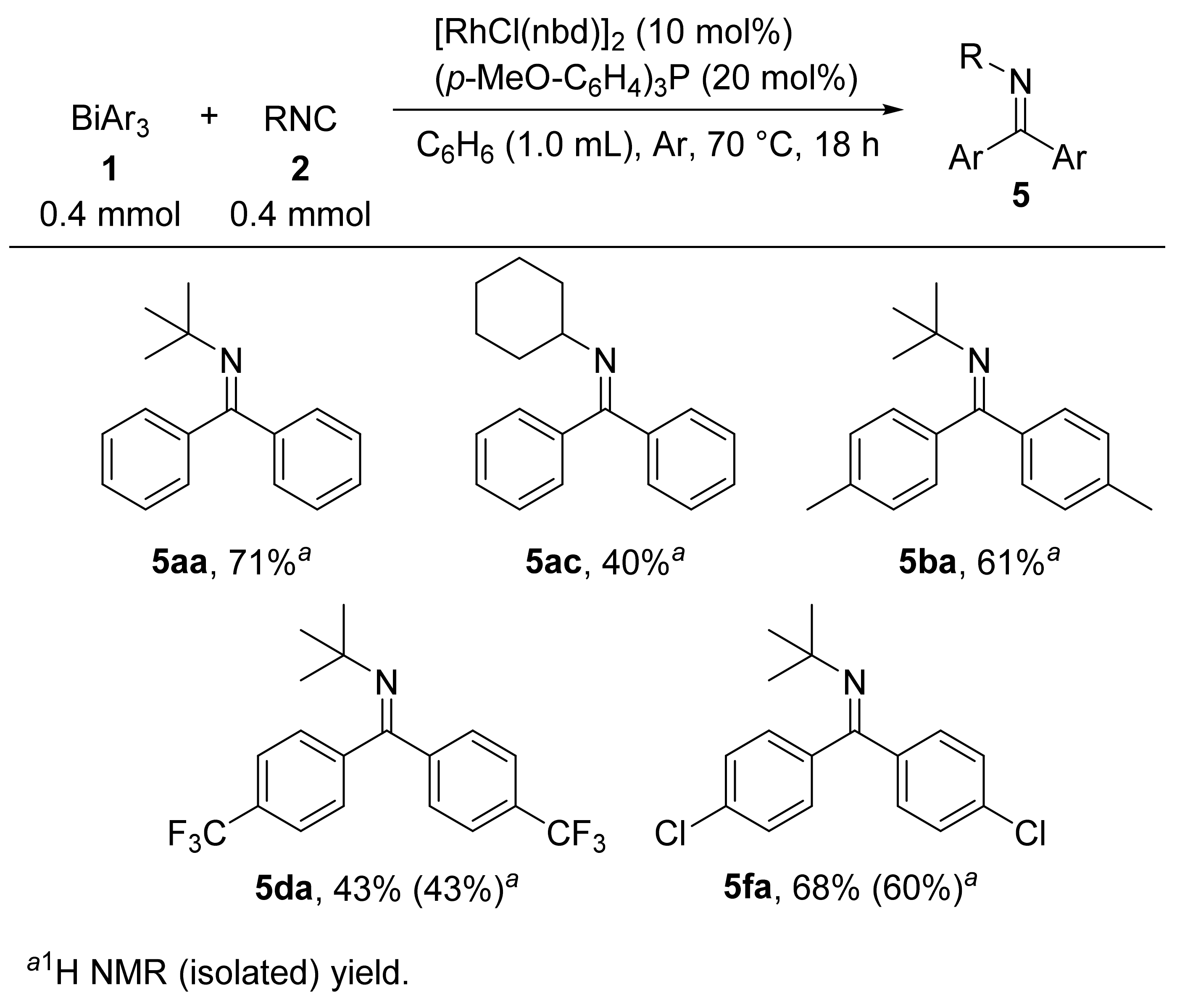
3.2. Typical Reaction Procedure for Ketimine Synthesis
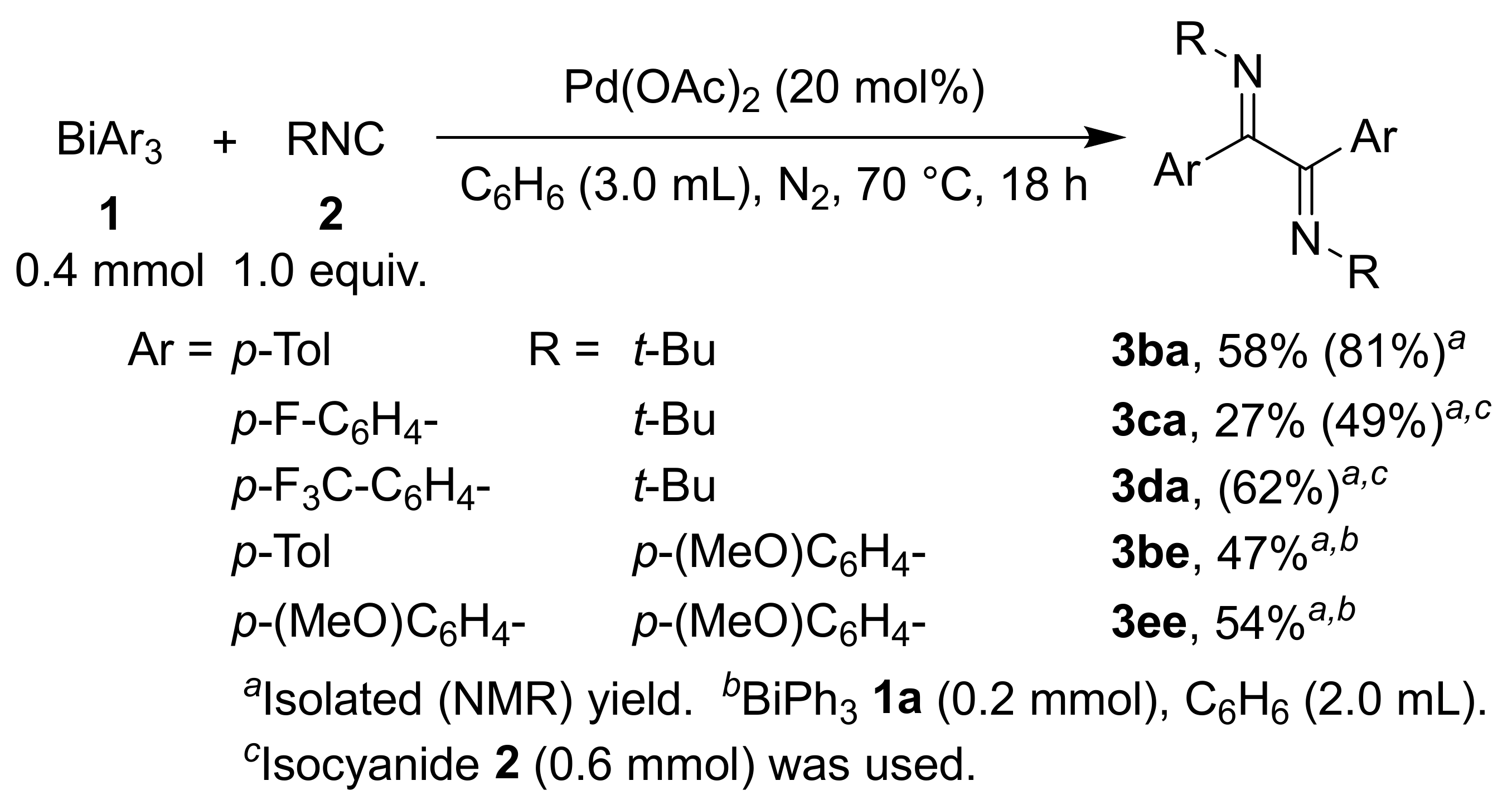
3.3. Typical Reaction Procedure for α-Diimine Synthesis (Schemes 3 and 4)
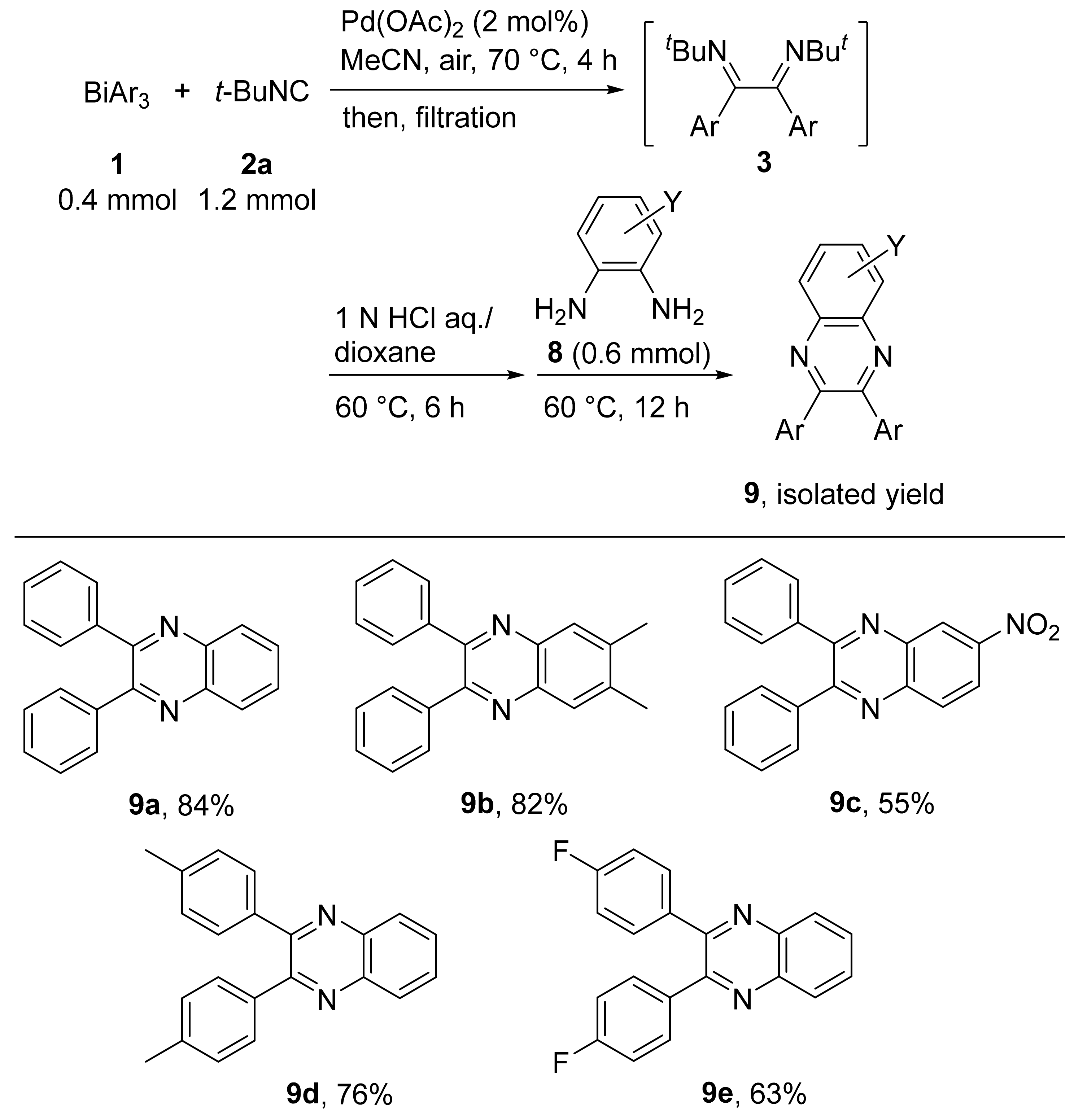
3.4. Typical Reaction Procedure for Cascade Synthesis of 2,3-Diarylquinoxalines (Scheme 4)
4. Conclusions
Supplementary Materials
Author Contributions
Funding
Institutional Review Board Statement
Informed Consent Statement
Data Availability Statement
Conflicts of Interest
References
- Marczenko, K.M.; Zurakowski, J.A.; Bamford, K.L.; MacMillan, J.W.M.; Chitnis, S.S. Hydrostibination. Angew. Chem. Int. Ed. 2019, 58, 18096–18101. [Google Scholar] [CrossRef] [PubMed]
- Chu, T.; Nikonov, G.I. Oxidative addition and reductive elimination at main-group element centers. Chem. Rev. 2018, 118, 3608–3680. [Google Scholar] [CrossRef]
- Dostál, L. Quest for stable or masked pnictinidenes: Emerging and exciting class of group 15 compounds. Coord. Chem. Rev. 2017, 353, 142–158. [Google Scholar] [CrossRef]
- Parke, S.M.; Boone, M.P.; Rivard, E. Marriage of heavy main group elements with π-conjugated materials for optoelectronic applications. Chem. Commun. 2016, 52, 9485–9505. [Google Scholar] [CrossRef]
- Yadav, S.; Saha, S.; Sen, S.S. Compounds with Low-Valent p-Block Elements for Small Molecule Activation and Catalysis. ChemCatChem 2016, 8, 486–501. [Google Scholar] [CrossRef]
- Schulz, S. Covalently bonded compounds of heavy group 15/16 elements—Synthesis, structure and potential application in material sciences. Coord. Chem. Rev. 2015, 297–298, 49–76. [Google Scholar] [CrossRef]
- Xiong, Y.; Yao, S.; Driess, M. Chemical Tricks to Stabilize Silanones and Their Heavier Homologues with E = O Bonds (E=Si−Pb): From Elusive Species to Isolable Building Blocks. Angew. Chem. Int. Ed. 2013, 52, 4302–4311. [Google Scholar] [CrossRef]
- Sasamori, T.; Tokitoh, N. A New Family of Multiple-Bond Compounds between Heavier Group 14 Elements. Bull. Chem. Soc. Jpn. 2013, 86, 1005–1021. [Google Scholar] [CrossRef]
- Mandal, S.K.; Roesky, H.W. Group 14 Hydrides with Low Valent Elements for Activation of Small Molecules. Acc. Chem. Res. 2012, 45, 298–307. [Google Scholar] [CrossRef]
- Power, P.P. Interaction of Multiple Bonded and Unsaturated Heavier Main Group Compounds with Hydrogen, Ammonia, Olefins, and Related Molecules. Acc. Chem. Res. 2011, 44, 627–637. [Google Scholar] [CrossRef]
- Fischer, R.C.; Power, P.P. π-Bonding and the lone pair effect in multiple bonds involving heavier main group elements: Developments in the new millennium. Chem. Rev. 2010, 110, 3877–3923. [Google Scholar] [CrossRef]
- Escudié, J.; Ranaivonjatovo, H. Group 14 and 15 Heteroallenes ECC and ECE’. Organometallics 2007, 26, 1542–1559. [Google Scholar] [CrossRef]
- Ollevier, T. (Ed.) Bismuth-Mediated Organic Reactions; Springer: Berlin, Germany, 2012; p. 311. [Google Scholar]
- Gagnon, A.; Dansereau, J.; Le Roch, A. Organobismuth Reagents: Synthesis, Properties and Applications in Organic Synthesis. Synthesis 2017, 49, 1707–1745. [Google Scholar] [CrossRef]
- Elliott, G.I.; Konopelski, J.P. Arylation with organolead and organobismuth reagents. Tetrahedron 2001, 57, 5683–5705. [Google Scholar] [CrossRef]
- Finet, J.-P. Arylation reactions with organobismuth reagents. Chem. Rev. 1989, 89, 1487–1501. [Google Scholar] [CrossRef]
- Barton, D.H.R.; Ozbalik, N.; Ramesh, M. The chemistry of organobismuth reagents. Part XIII ligand coupling induced by Pd(O). Tetrahedron 1988, 44, 5661–5668. [Google Scholar] [CrossRef]
- Barton, D.H.R.; Blazejewski, J.-C.; Charpiot, B.; Motherwell, W.B. Tetraphenylbismuth Monofluoroacetate: A New Reagent for Regioselective Aryl Ether Formation. J. Chem. Soc. Chem. Commun. 1981, 503, 503–504. [Google Scholar] [CrossRef]
- Barton, D.H.R.; Blazejewski, J.-C.; Charpiot, B.; Lester, D.J.; Motherwell, W.G.; Papoula, M.T.B. Comparative Arylation Reactions with Pentaphenylbismuth and with Triphenylbismuth Carbonate. J. Chem. Soc. Chem. Commun. 1980, 17, 827–829. [Google Scholar] [CrossRef]
- Abramovitch, R.A.; Barton, D.H.R.; Finet, J.-P. Newer methods of arylation. Tetrahedron 1988, 44, 3039–3071. [Google Scholar] [CrossRef]
- Cho, C.S.; Yoshimori, Y.; Uemura, S. Rhodium(I)- and Palladium(0)-Catalyzed Carbonylation of Triarylbismuthines with Carbon Monoxide via a Possible Oxidative Addition of a Carbon–Bismuth Bond to Rhodium(I) and Palladium(0). Bull. Chem. Soc. Jpn. 1995, 68, 950–957. [Google Scholar] [CrossRef]
- Malysheva, Y.B.; Moiseev, D.V.; Gushchin, A.V.; Dodonov, V.A. Palladium-Catalyzed C-Phenylation of Methyl Acrylate with Triphenylbismuth Dicarboxylates. Russ. J. Gen. Chem. 2005, 75, 1766–1770. [Google Scholar] [CrossRef]
- Shimada, S.; Yamazaki, O.; Tanaka, T.; Rao, M.L.; Suzuki, Y.; Tanaka, M. 5,6,7,12-tetrahydrodibenz[c,f][1,5]azabismocines: Highly reactive and recoverable organobismuth reagents for cross-coupling reactions with aryl bromides. Angew. Chem. Int. Ed. 2003, 42, 1845–1848. [Google Scholar] [CrossRef]
- Qin, W.; Yasuike, S.; Kakusawa, N.; Sugawara, Y.; Kawahata, M.; Yamaguchi, K.; Kurita, J. Triarylantimony dicarboxylates as pseudo-halides for palladium-catalyzed cross-coupling reaction with arylboronic acids and triarylbismuthanes without any base. J. Organomet. Chem. 2008, 693, 109–116. [Google Scholar] [CrossRef]
- Rao, M.L.N.; Yamazaki, O.; Shimada, S.; Tanaka, T.; Suzuki, Y.; Tanaka, M. Palladium-Catalyzed Cross-Coupling Reaction of Triarylbismuths with Aryl Halides and Triflates. Org. Lett. 2001, 3, 4103–4105. [Google Scholar] [CrossRef]
- Murakami, M.; Masuda, H.; Kawano, T.; Nakamura, H.; Ito, Y. Facile Synthesis of Vicinal Di- and Tricarbonyl Compounds by Samarium Diiodide-Mediated Double Insertion of Isocyanides into Organic Halides. J. Org. Chem. 1991, 56, 1–2. [Google Scholar] [CrossRef]
- Onitsuka, K.; Ogawa, K.; Joh, T.; Takahashi, S.; Yamamoto, Y.; Yamazaki, H. Reactions of μ-ethynediyl complexes of transition metals: Selective double insertion of isocyanides and molecular structure of [Cl(Et3P)2PdC≡CC(=NPh)C(=NPh)Pd(Et3P)2Cl]. J. Chem. Soc. Dalton Trans. 1991, 6, 1531–1536. [Google Scholar] [CrossRef]
- Vicente, J.; Abad, J.-A.; Shaw, K.F.; Gil-Rubio, J.; Ramírez de Arellano, M.C.; Jones, P.G. Palladium-Assisted Formation of Carbon−Carbon Bonds. 7.1 Reactions of (2,3,4-Trimethoxy-6-X-phenyl)palladium Complexes with Alkynes (X = C(O)NHBut) and Isocyanides (X = C(O)NHBut, C(O)Me, CHO): Crystal and Molecular Structures of [Pd{C6H{C(O)NHBut}-6-(OMe)3-2,3,4}(bpy)](CF3SO3), [Pd{C(CO2Me)=C(CO2Me)C6H{C(O)NHBut}-6-(OMe)3-2,3,4}-Cl(PPh3)], [Pd{C-(=NXy)C6H{C(O)NHBut}-6-(OMe)3-2,3,4}-(bpy)](CF3SO3), and the Ketenimine 2-(2,6-Dimethylphenyl)-1-(((2,6-dimethylphenyl)imino)-methylene)-5,6,7-trimethoxy-3-oxoisoindoline. Organometallics 1997, 16, 4557–4566. [Google Scholar]
- Vincente, J.; Abad, J.-A.; Frankland, A.D.; López-Serrano, J.; Ramírez de Arellano, M.C.; Jones, P.G. Synthesis and Reactivity toward Isonitriles of (2-Aminoaryl)-palladium(II) Complexes. Organometallics 2002, 21, 272–282. [Google Scholar] [CrossRef]
- Owen, G.R.; Vilar, R.; White, A.J.P.; Williams, D.J. Synthesis and Structural Characterization of a Novel Dipalladium Complex with an Unprecedented PdCN Bonding Motif. Organometallics 2003, 22, 3025–3027. [Google Scholar] [CrossRef]
- Dechert-Schmitt, A.-M.; Garnsey, M.R.; Wisniewska, H.M.; Murray, J.I.; Lee, T.; Kung, D.W.; Sach, N.; Blackmond, D.G. Highly Modular Synthesis of 1,2- Diketones via Multicomponent Coupling Reactions of Isocyanides as CO Equivalents. ACS Catal. 2019, 9, 4508–4515. [Google Scholar] [CrossRef]
- Peng, X.; Qin, F.; Xu, M.; Zhu, S.; Pan, Y.; Tang, H.; Meng, X.; Wang, H. Synthesis of imidazo[1,2-c]thiazoles through Pd-catalyzed bicyclization of tert-butyl isonitrile with thioamides. Org. Biomol. Chem. 2019, 17, 8403–8407. [Google Scholar] [CrossRef] [PubMed]
- Sun, H.; Tang, S.; Li, D.; Zhou, Y.; Huang, J.; Zhu, Q. Cascade Double Isocyanide Insertion and C−N Coupling of 2-iodo-2’- isocyano-1,1’-biphenyls. Org. Biomol. Chem. 2018, 16, 3893–3896. [Google Scholar] [CrossRef] [PubMed]
- Hu, W.; Li, M.; Jiang, G.; Wu, W.; Jiang, H. Synthesis of 2,3-Difunctionalized Benzofuran Derivatives through Palladium-Catalyzed Double Isocyanide Insertion Reaction. Org. Lett. 2018, 20, 3500–3503. [Google Scholar] [CrossRef]
- Hu, W.; Li, J.; Xu, Y.; Li, J.; Wu, W.; Liu, H.; Jiang, H. Palladium-Catalyzed RedoxNeutral N−O/C(sp3)-H Functionalization of Aryl Oximes with Isocyanides. Org. Lett. 2017, 19, 678–681. [Google Scholar] [CrossRef]
- Qiu, G.; Wang, Q.; Zhu, J. Palladium-Catalyzed Three-Component Reaction of Propargyl Carbonates, Isocyanides, and Alcohols or Water: Switchable Synthesis of Pyrroles and Its Bicyclic Analogues. Org. Lett. 2017, 19, 270–273. [Google Scholar] [CrossRef] [PubMed]
- Senadi, G.C.; Lu, T.Y.; Dhandabani, G.K.; Wang, J.J. Palladium-Catalyzed Double-Isocyanide Insertion via Oxidative N−O Cleavage of Acetyl Oximes: Syntheses of 2H-Pyrrol-2-imines. Org. Lett. 2017, 19, 1172–1175. [Google Scholar] [CrossRef]
- Chen, Z.-B.; Zhang, Y.; Yuan, Q.; Zhang, F.-L.; Zhu, Y.-M.; Shen, J.-K. Palladium-Catalyzed Synthesis of α-Iminonitriles from Aryl Halides via Isocyanide Double Insertion Reaction. J. Org. Chem. 2016, 81, 1610–1616. [Google Scholar] [CrossRef]
- Peng, J.; Gao, Y.; Hu, W.; Gao, Y.; Wu, W.; Ren, Y.; Jiang, H. Palladium-Catalyzed Multicomponent Reaction (MCR) of Propargylic Carbonates with Isocyanides. Org. Lett. 2016, 18, 5924–5927. [Google Scholar] [CrossRef]
- Senadi, G.C.; Hu, W.-P.; Boominathan, S.S.K.; Wang, J.-J. Palladium(0)-Catalyzed Single and Double Isonitrile Insertion: A Facile Synthesis of Benzofurans, Indoles, and Isatins. Chem. Eur. J. 2015, 21, 998–1003. [Google Scholar] [CrossRef] [PubMed]
- Whitby, R.J.; Saluste, C.G.; Furber, M. Synthesis of α-iminoimidates by palladium catalysed double isonitrile insertion. Org. Biomol. Chem. 2004, 2, 1974–1976. [Google Scholar] [CrossRef]
- Kobiki, Y.; Kawaguchi, S.-I.; Ogawa, A. Palladium-Catalyzed Synthesis of α-Diimines from Triarylbismuthines and Isocyanides. Org. Lett. 2015, 17, 3490–3493. [Google Scholar] [CrossRef] [PubMed]
- Tran, C.C.; Kawaguchi, S.-I.; Kobiki, Y.; Matsubara, H.; Tran, P.D.; Kodama, S.; Nomoto, A.; Ogawa, A. Palladium-Catalyzed Diarylation of Isocyanides with Tetraarylleads for the Selective Synthesis of Imines and α-Diimines. J. Org. Chem. 2019, 84, 11741–11751. [Google Scholar] [CrossRef] [PubMed]
- Ōkubo, M.; Yoshida, M.; Horinouchi, K.; Nishida, H.; Fukuyama, Y. Aryliminodimagnesium Reagents. VI. The Reactions with Conjugated Carbonyl Compounds. The Initial Coordination and the Electron-transfer in the Reactions of Organomagnesium Reagents. Bull. Chem. Soc. Jpn. 1983, 56, 1196–1202. [Google Scholar] [CrossRef] [Green Version]
- Ōkubo, M.; Fukuyama, Y.; Sato, M.; Matsuo, K.; Kitahara, T.; Nakashima, M. Reaction of aryliminodimagnesium with diphenyl diketones: Heat evolution accompanying single electron transfer and chelate formation, and product distribution. J. Phys. Org. Chem. 1990, 3, 379–389. [Google Scholar] [CrossRef]
- Qi, C.; Jiang, H.; Huang, L.; Chen, Z.; Chen, H. DABCO-Catalyzed Oxidation of Deoxybenzoins to Benzils with Air and One-Pot Synthesis of Quinoxalines. Synthesis 2011, 3, 387–396. [Google Scholar]
- Akkilagunta, V.K.; Reddy, V.P.; Kakulapati, R.R. Aqueous-Phase Aerobic Oxidation of Alcohols by Ru/C in the Presence of Cyclodextrin: One-Pot Biomimetic Approach to Quinoxaline Synthesis. Synlett 2010, 17, 2571–2574. [Google Scholar] [CrossRef]
- Karami, B.; Khodabakhshi, S.; Nikrooz, M. Synthesis of Aza-Polycyclic Compounds: Novel Phenazines and Quinoxalines using Molybdate Sulfuric Acid (MSA). Polycyclic Aromat. Compd. 2011, 31, 97–109. [Google Scholar] [CrossRef]




 | |||||
|---|---|---|---|---|---|
| Entry | Cat. M (mol%) | Solv. | Time (h) | Yields (%) a | |
| 5aa | 3aa | ||||
| 1 | Pd(OAc)2 (20) | C6H6 | 18 | 9 | 90 |
| 2 | Pd(PPh3)4 (20) | C6H6 | 18 | trace | 23 |
| 3 | PdCl2 (20) | C6H6 | 18 | 5 | 71 |
| 4 | Pd(PPh3)2Cl2 (20) | C6H6 | 18 | 11 | 62 |
| 5 b | Pd(OAc)2 (20) | C6H6 | 18 | 5 | 66 |
| 6 | Pd2(dba)3·CHCl3 (10) | C6H6 | 18 | trace | 56 |
| 7 | none | C6H6 | 18 | 0 | 2 |
| 8 c | Pd(OAc)2 (20) | C6H6 | 18 | trace | 58 |
| 9 d | Pd(OAc)2 (20) | C6H6 | 18 | 10 | 82 |
| 10 e | Pd(OAc)2 (20) | C6H6 | 18 | 8 | 59 |
| 11 | Pd(OAc)2 (10) | C6H6 | 18 | 4 | 65 |
| 12 | Pd(OAc)2 (5) | C6H6 | 18 | 4 | 51 |
| 13 | Pd(OAc)2 (20) | THF | 18 | 21 | 63 |
| 14 | Pd(OAc)2 (20) | EtOH | 18 | trace | 49 |
| 15 | Pd(OAc)2 (20) | MeCN | 18 | 0 | 84 |
| 16 | Pd(OAc)2 (20) | PhMe | 18 | 9 | 73 |
| 17 | Pd(OAc)2 (20) | C6H6 | 4 | 1 | 81 |
| 18 f | Pd(OAc)2 (20) | C6H6 | 18 | 6 | 77 |
 | ||
|---|---|---|
| Entry | Rh Catalyst (mol%) | Yield of 5aa (%) a |
| 1 b | [RhCl(nbd)]2 (10) | 50 |
| 2 b | [RhCl(nbd)]2 (5) | 32 |
| 3 b,c | [RhCl(nbd)]2 (10) | 75 |
| 4 b | RhH(CO)(PPh3)3 (20) | 20 |
| 5 | [RhCl(nbd)]2/(p-MeO-C6H4)3P (10/20) | 51 |
| 6 d | [RhCl(nbd)]2/(p-MeO-C6H4)3P (10/20) | 61 |
| 7 e | [RhCl(nbd)]2/(p-MeO-C6H4)3P (10/20) | 71 |
| 8 f | [RhCl(nbd)]2/(p-MeO-C6H4)3P (10/20) | 57 |
| 9 e,g | [RhCl(nbd)]2/(p-MeO-C6H4)3P (10/20) | 66 |
| 10 | RhCl(PPh3)3 (10) | 12 |
| 11 | RhH(PPh3)3 (10) | 12 |
| 12 | RhBr(PPh3)3 (10) | 17 |
| 13 | trans-RhCl(CO)(PPh3)3 (10) | 55 |
| 14 | [Rh(dppp)(cod)]+BF4− (10) | 0 |
| 15 | RhCl3 (10) | 2 |
| 16 | [Rh(OAc)2]2 (10) | 6 |
 | ||||
|---|---|---|---|---|
| Entry | 2a (mmol) | 1c (Equiv.) | Yields (%) a | |
| 3ca | 5ca | |||
| 1 | 0.2 | 1.0 | 37 | 48 |
| 2 | 0.2 | 0.75 | 45 | 43 |
| 3 | 0.2 | 0.5 | 74 | 2 |
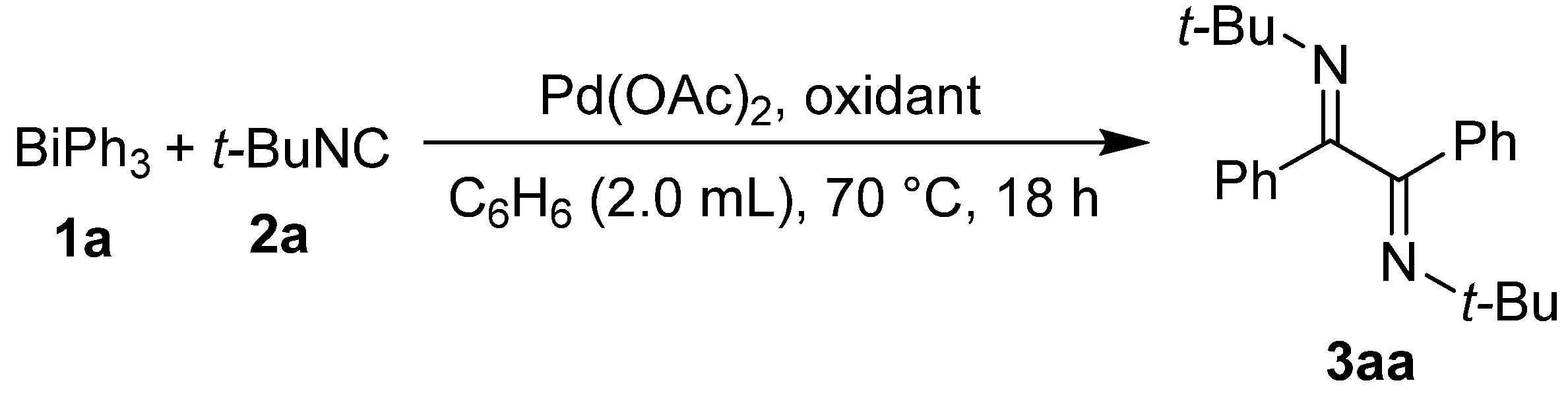 | |||||
|---|---|---|---|---|---|
| Entry | Oxidant (Equiv.) | Cat. (mol%) | 2a (mmol) | 1a (Equiv.) | Yields (%) a |
| 1 | none (N2 atm.) | 5 | 0.4 | 1 | 27 |
| 2 | air | 5 | 0.4 | 1 | 85 |
| 3 | O2 | 5 | 0.4 | 1 | 77 |
| 4 | Cu(OAc)2∙H2O (1/2) | 5 | 0.4 | 1 | 0 |
| 5 | CuCO3∙Cu(OH)2∙H2O (1/4) | 5 | 0.4 | 1 | 19 |
| 6 | air | 5 | 0.4 | 1/3 | 85 b |
| 7 | air | 1 | 1.5 | 1/3 | 69 b |
| 8 | air | 2 | 1.5 | 1/3 | 81 b |
Publisher’s Note: MDPI stays neutral with regard to jurisdictional claims in published maps and institutional affiliations. |
© 2021 by the authors. Licensee MDPI, Basel, Switzerland. This article is an open access article distributed under the terms and conditions of the Creative Commons Attribution (CC BY) license (https://creativecommons.org/licenses/by/4.0/).
Share and Cite
Kodama, S.; Yamamoto, Y.; Kobiki, Y.; Matsubara, H.; Tran, C.C.; Kawaguchi, S.-i.; Nomoto, A.; Ogawa, A. Transition-Metal-Catalyzed Diarylation of Isocyanides with Triarylbismuthines for the Selective Synthesis of Imine Derivatives. Materials 2021, 14, 4271. https://doi.org/10.3390/ma14154271
Kodama S, Yamamoto Y, Kobiki Y, Matsubara H, Tran CC, Kawaguchi S-i, Nomoto A, Ogawa A. Transition-Metal-Catalyzed Diarylation of Isocyanides with Triarylbismuthines for the Selective Synthesis of Imine Derivatives. Materials. 2021; 14(15):4271. https://doi.org/10.3390/ma14154271
Chicago/Turabian StyleKodama, Shintaro, Yuki Yamamoto, Yohsuke Kobiki, Hitomi Matsubara, Cong Chi Tran, Shin-ichi Kawaguchi, Akihiro Nomoto, and Akiya Ogawa. 2021. "Transition-Metal-Catalyzed Diarylation of Isocyanides with Triarylbismuthines for the Selective Synthesis of Imine Derivatives" Materials 14, no. 15: 4271. https://doi.org/10.3390/ma14154271
APA StyleKodama, S., Yamamoto, Y., Kobiki, Y., Matsubara, H., Tran, C. C., Kawaguchi, S.-i., Nomoto, A., & Ogawa, A. (2021). Transition-Metal-Catalyzed Diarylation of Isocyanides with Triarylbismuthines for the Selective Synthesis of Imine Derivatives. Materials, 14(15), 4271. https://doi.org/10.3390/ma14154271