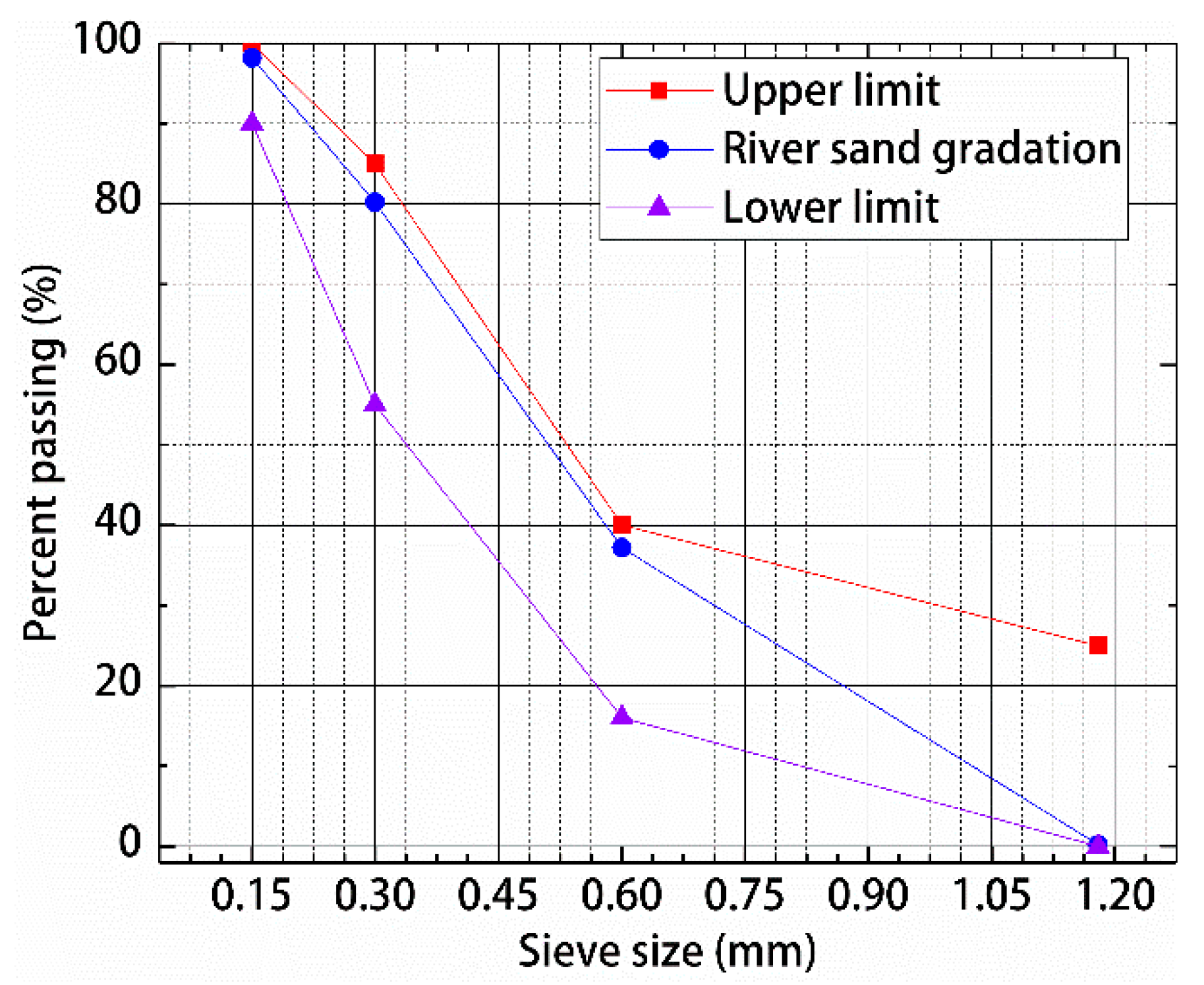
Figure 1.
Gradation of river sand used in this study.
Figure 1.
Gradation of river sand used in this study.
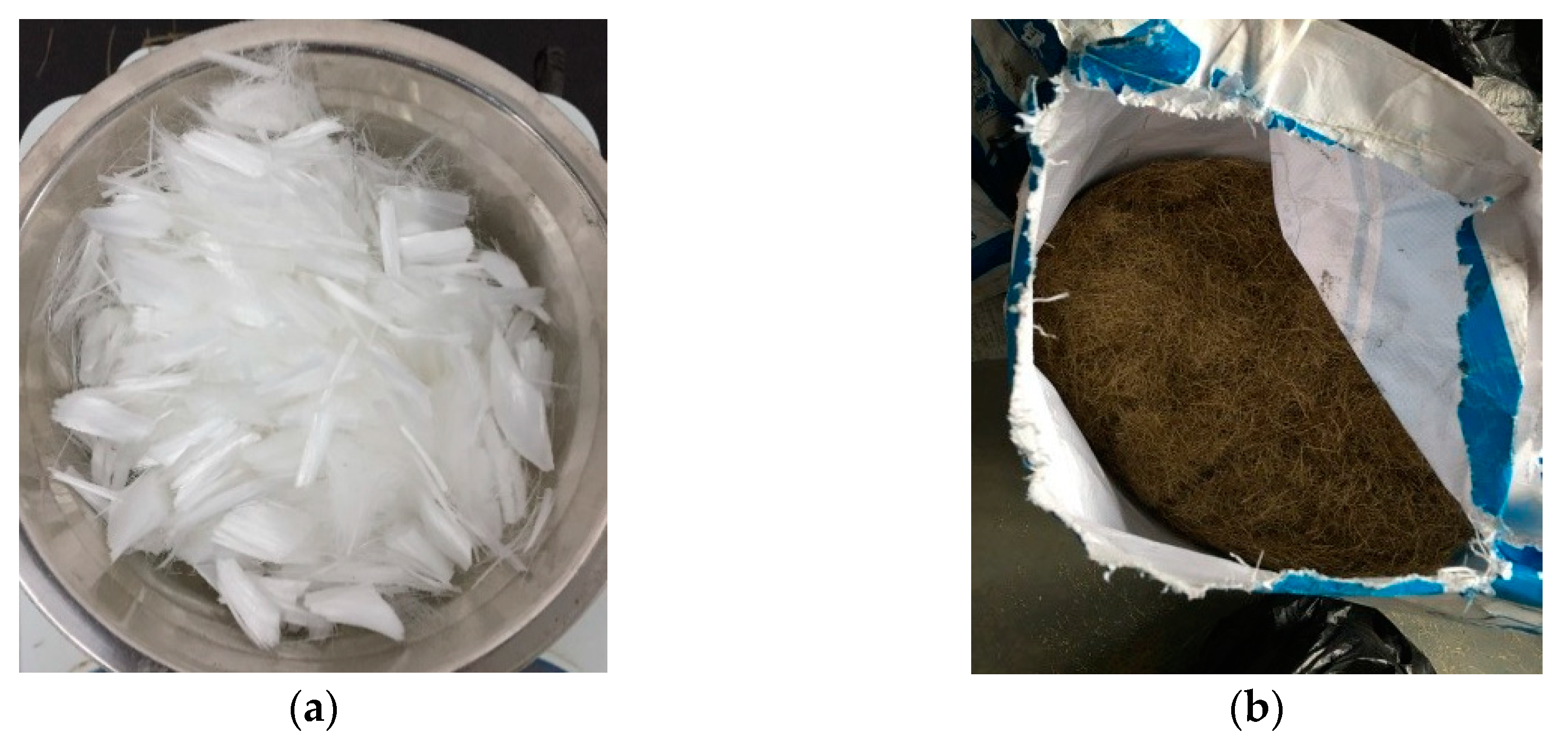
Figure 2.
Fibers used in this study: (a) polypropylene fiber and (b) steel fiber.
Figure 2.
Fibers used in this study: (a) polypropylene fiber and (b) steel fiber.
Figure 3.
Specimen processing: (a) vacuum drying and (b) gold spraying.
Figure 3.
Specimen processing: (a) vacuum drying and (b) gold spraying.
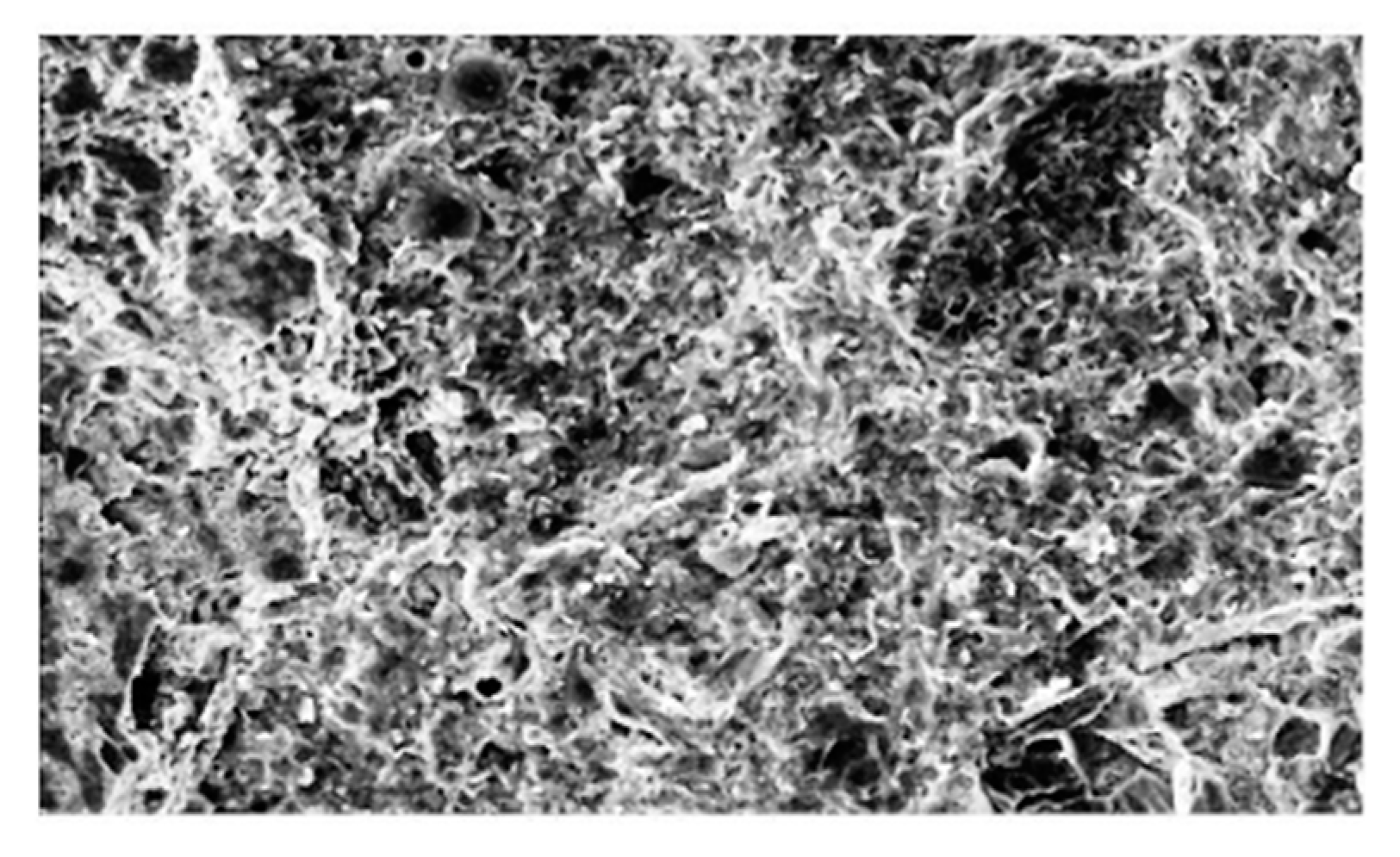
Figure 4.
Image noise reduction.
Figure 4.
Image noise reduction.
Figure 5.
Image sharpening.
Figure 5.
Image sharpening.
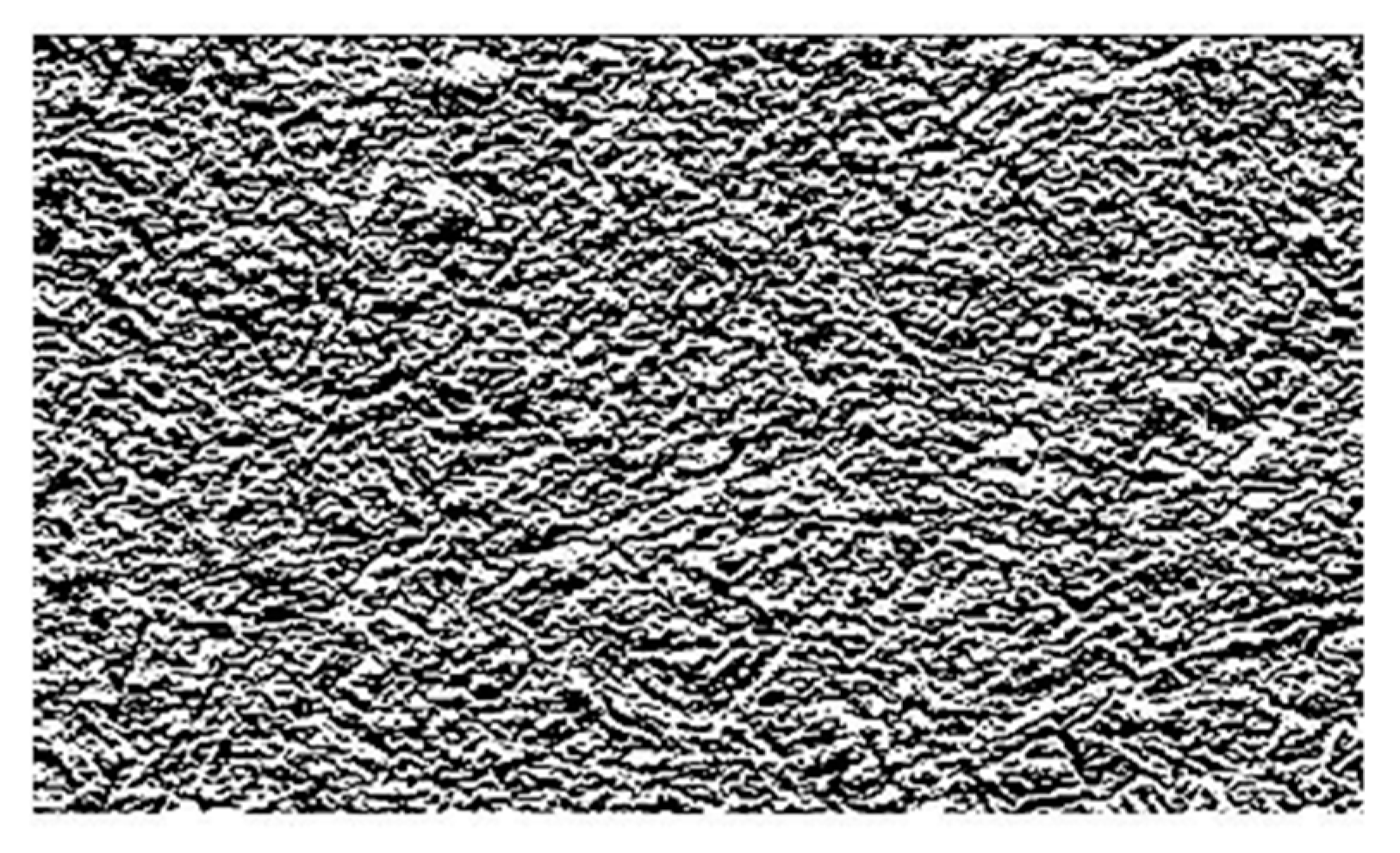
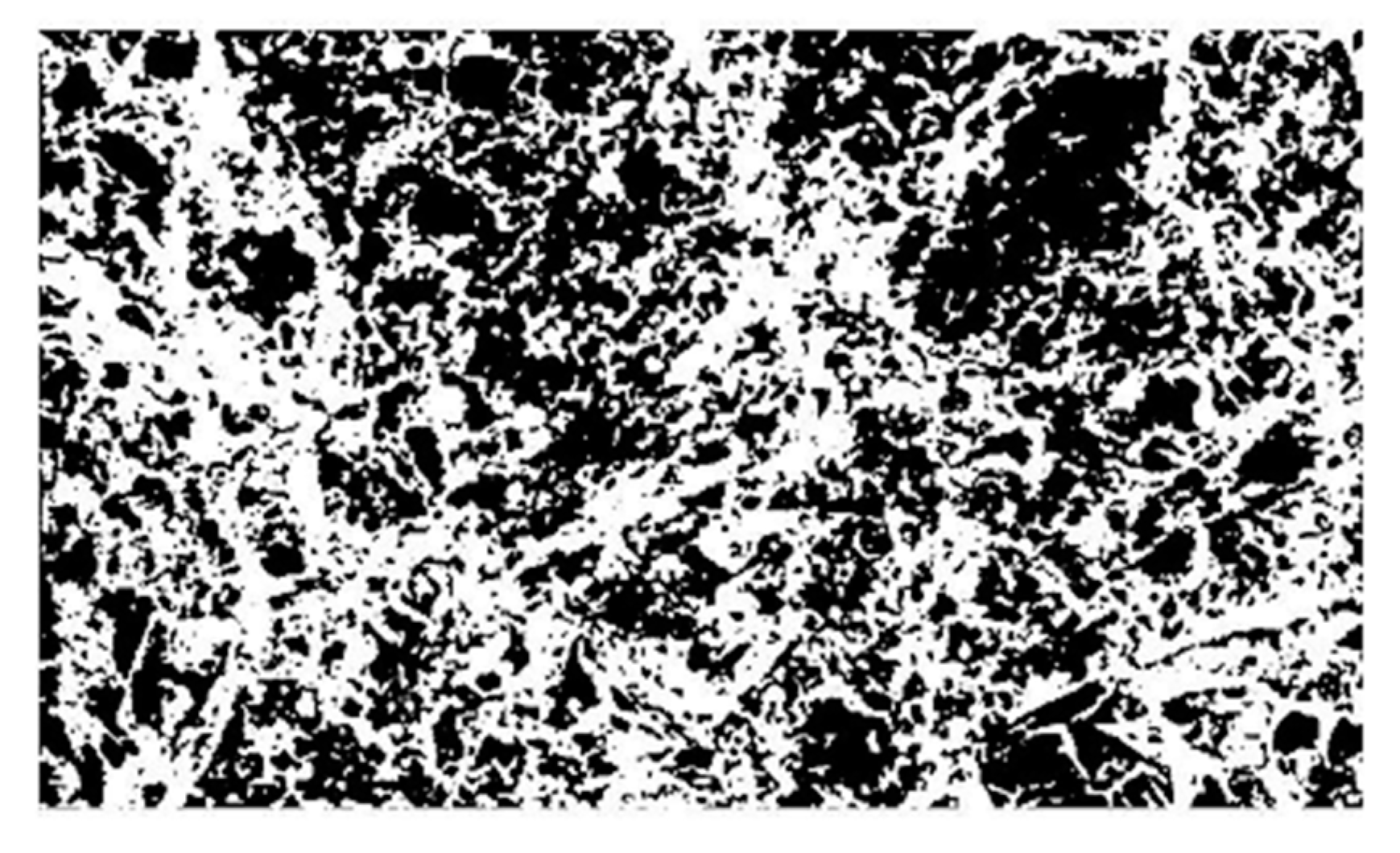
Figure 6.
Image segmentation.
Figure 6.
Image segmentation.
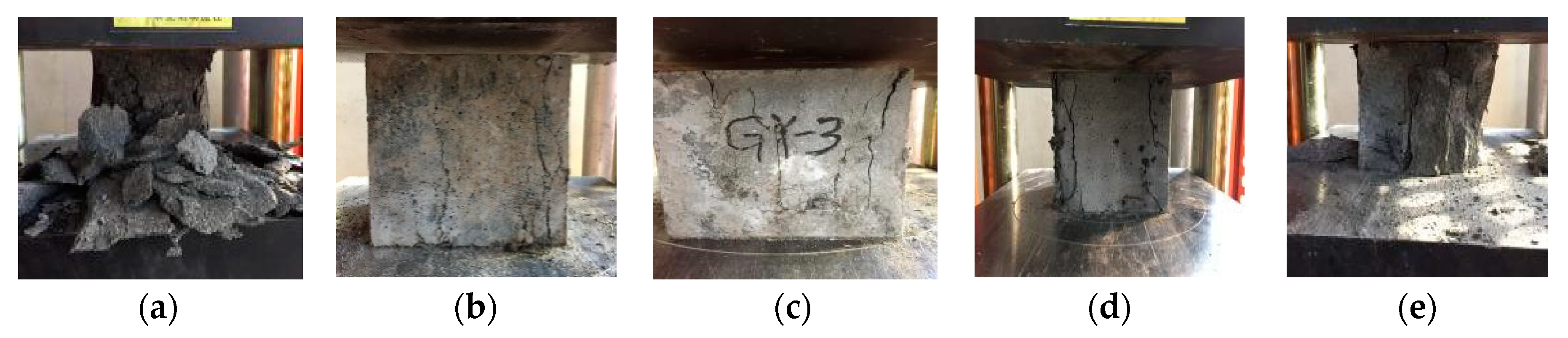
Figure 7.
Compressive strength failure mode of polypropylene fiber RPC: (a) 0%, (b) 0.15%, (c) 0.3%, (d) 0.45%, and (e) 0.6%.
Figure 7.
Compressive strength failure mode of polypropylene fiber RPC: (a) 0%, (b) 0.15%, (c) 0.3%, (d) 0.45%, and (e) 0.6%.
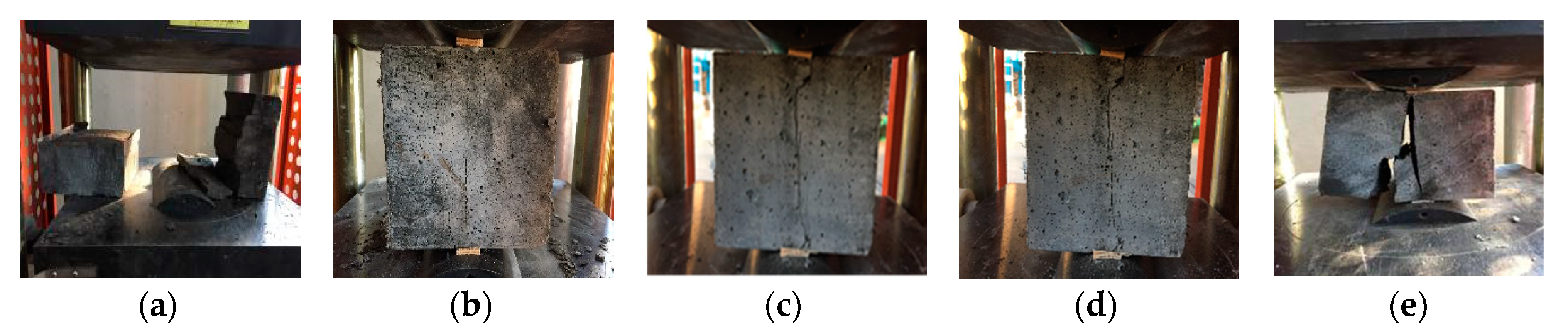
Figure 8.
Splitting tensile strength failure mode of polypropylene fiber RPC: (a) 0%, (b) 0.15%, (c) 0.3%, (d) 0.45%, and (e) 0.6%.
Figure 8.
Splitting tensile strength failure mode of polypropylene fiber RPC: (a) 0%, (b) 0.15%, (c) 0.3%, (d) 0.45%, and (e) 0.6%.
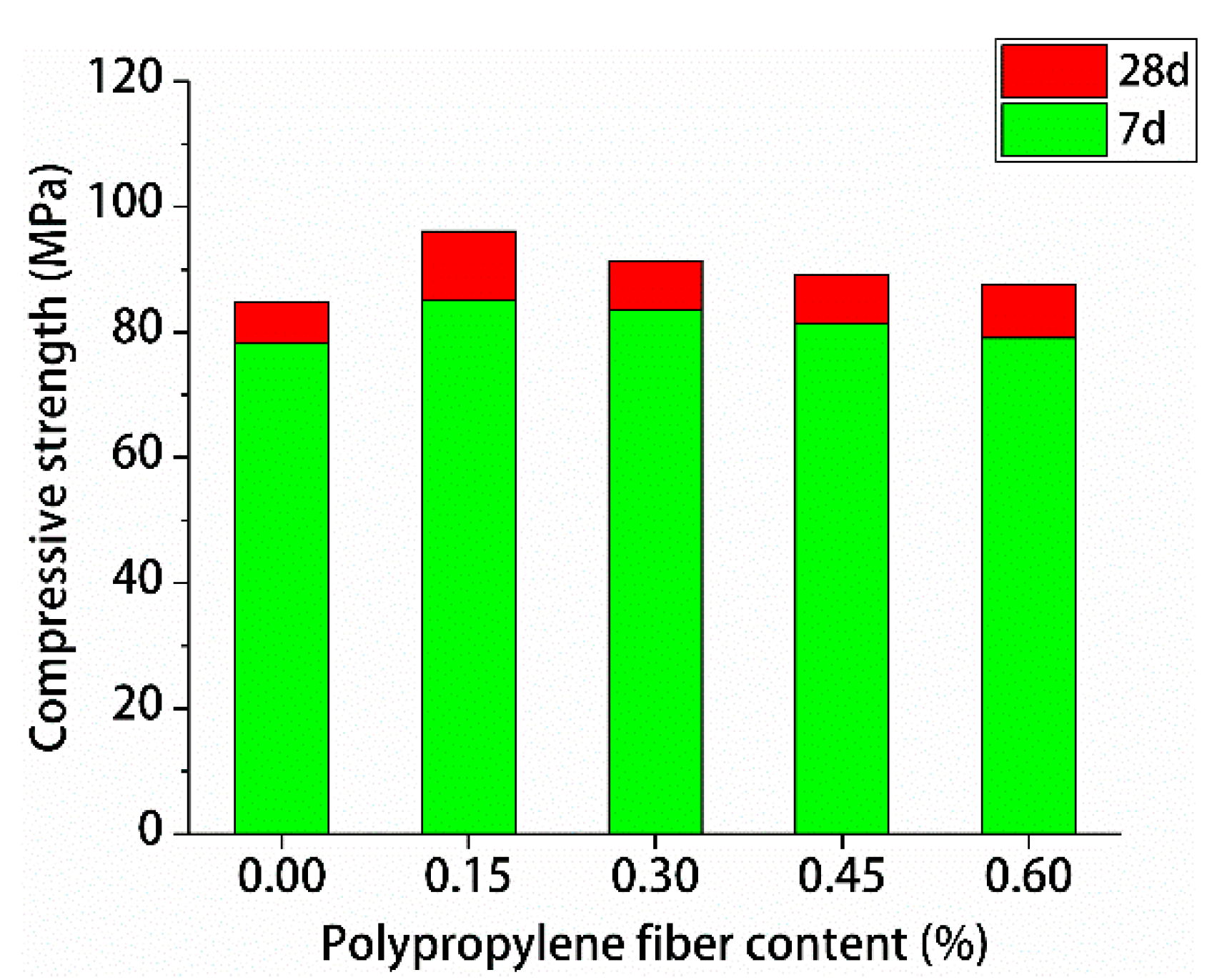
Figure 9.
Test results for compressive strength.
Figure 9.
Test results for compressive strength.
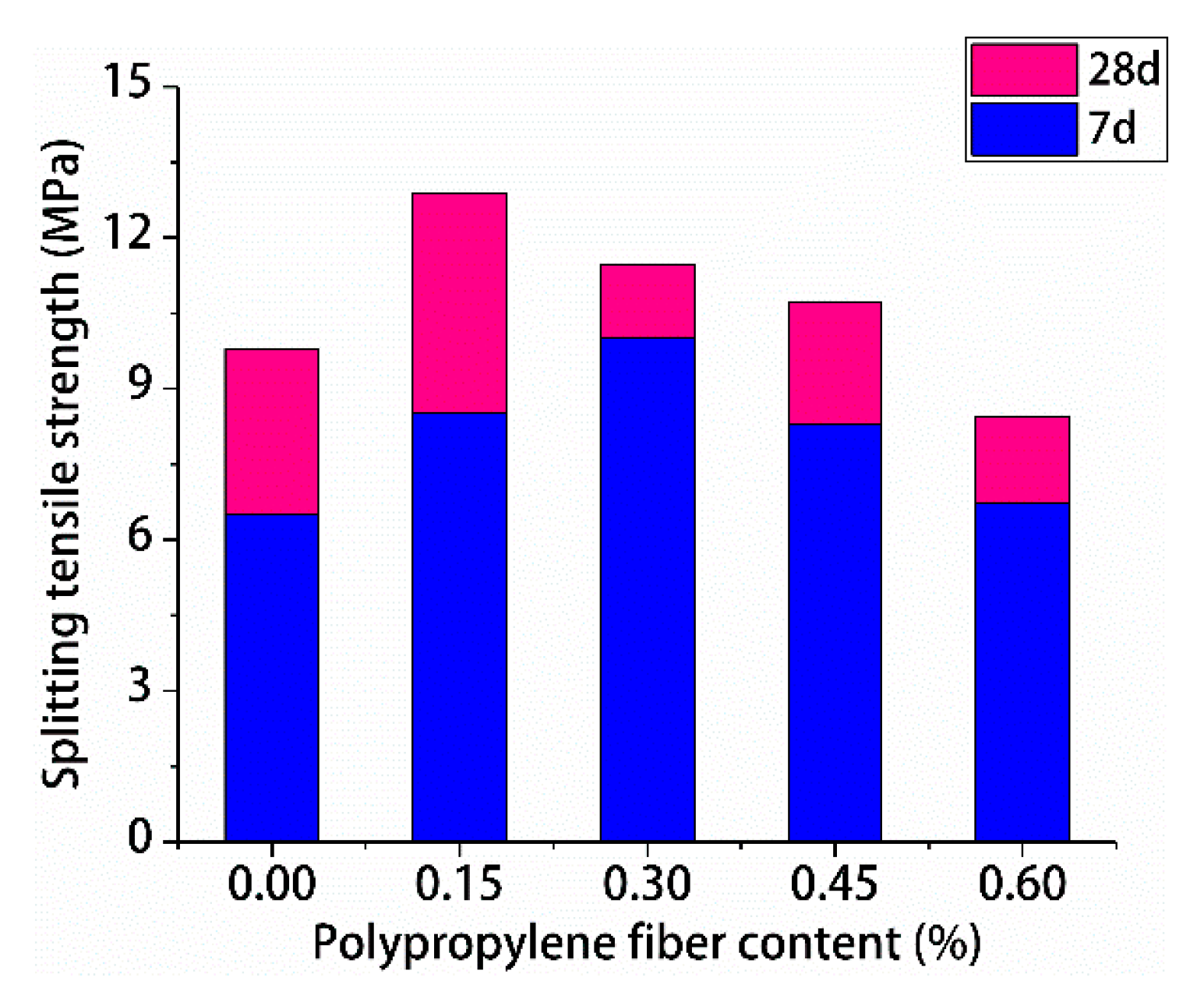
Figure 10.
Test results for splitting tensile strength.
Figure 10.
Test results for splitting tensile strength.
Figure 11.
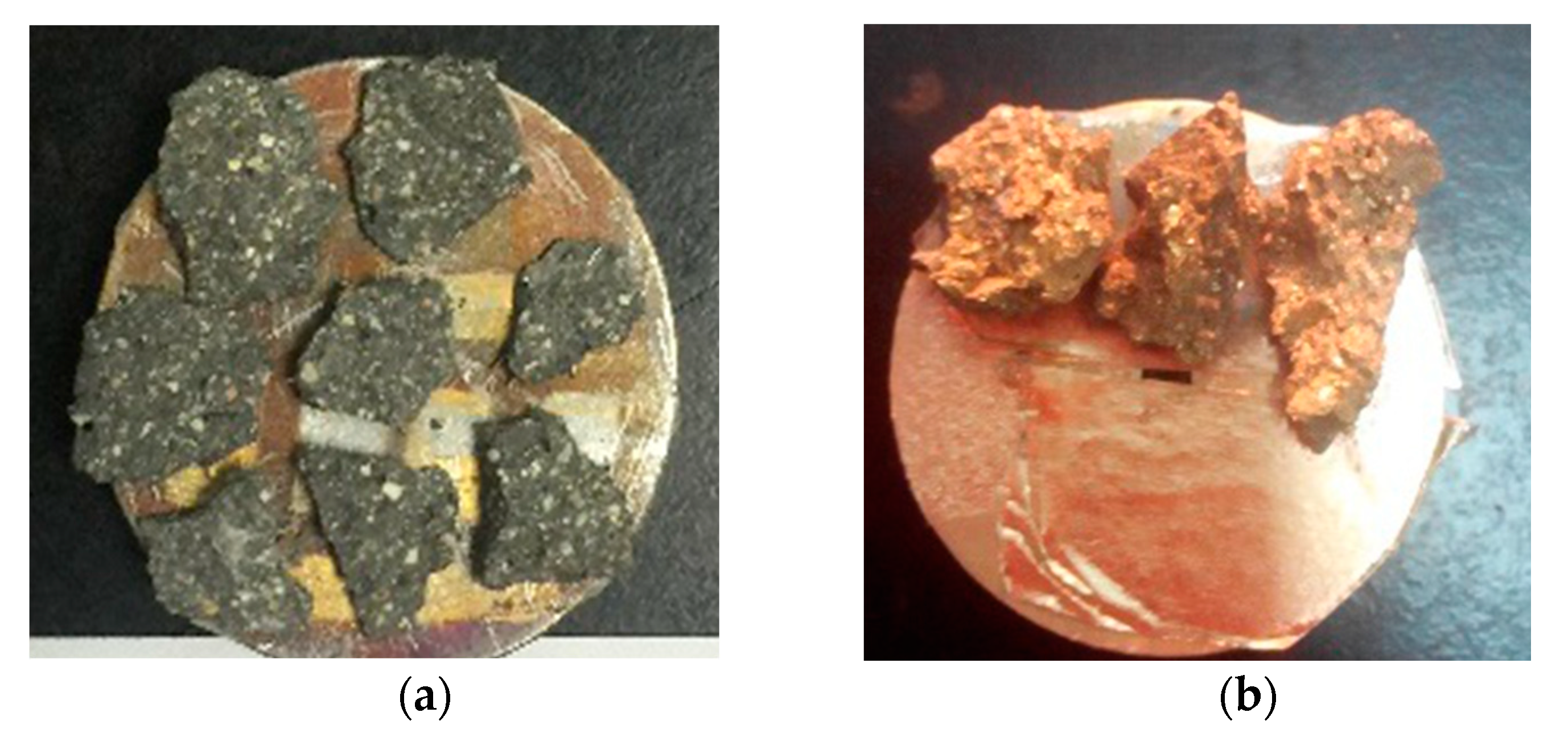
Compressive strength failure mode of hybrid polypropylene-steel fiber RPC: (a) 0%, (b) 1%, (c) 1.25%, (d) 1.5%, (e) 1.75 and (f) 2%.
Figure 11.
Compressive strength failure mode of hybrid polypropylene-steel fiber RPC: (a) 0%, (b) 1%, (c) 1.25%, (d) 1.5%, (e) 1.75 and (f) 2%.
Figure 12.
Splitting tensile strength failure mode of hybrid polypropylene-steel fiber RPC: (a) 0%, (b) 1%, (c) 1.25%, (d) 1.5%, (e) 1.75 and (f) 2%.
Figure 12.
Splitting tensile strength failure mode of hybrid polypropylene-steel fiber RPC: (a) 0%, (b) 1%, (c) 1.25%, (d) 1.5%, (e) 1.75 and (f) 2%.
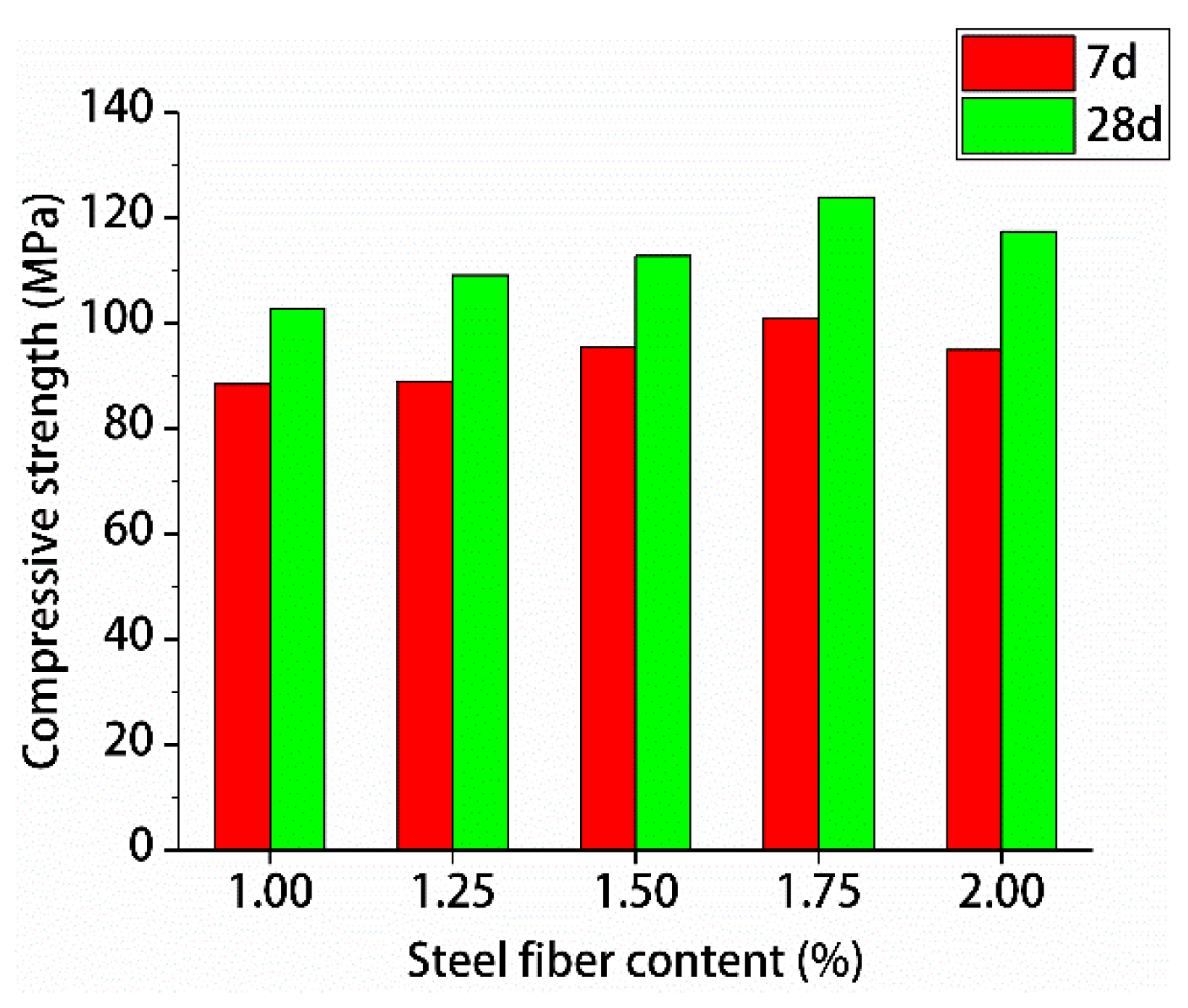
Figure 13.
Test results for compressive strength.
Figure 13.
Test results for compressive strength.
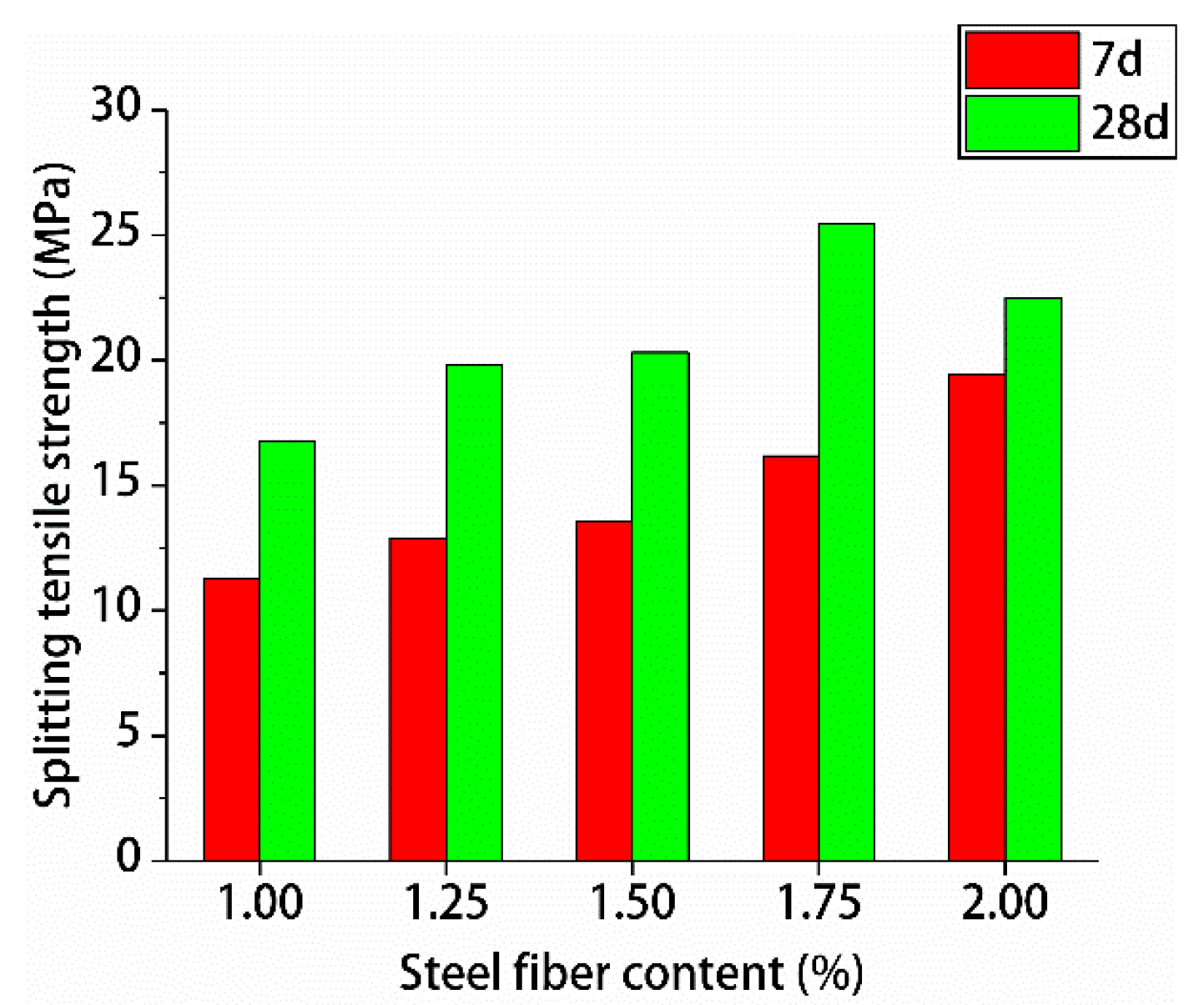
Figure 14.
Test results for splitting tensile strength.
Figure 14.
Test results for splitting tensile strength.
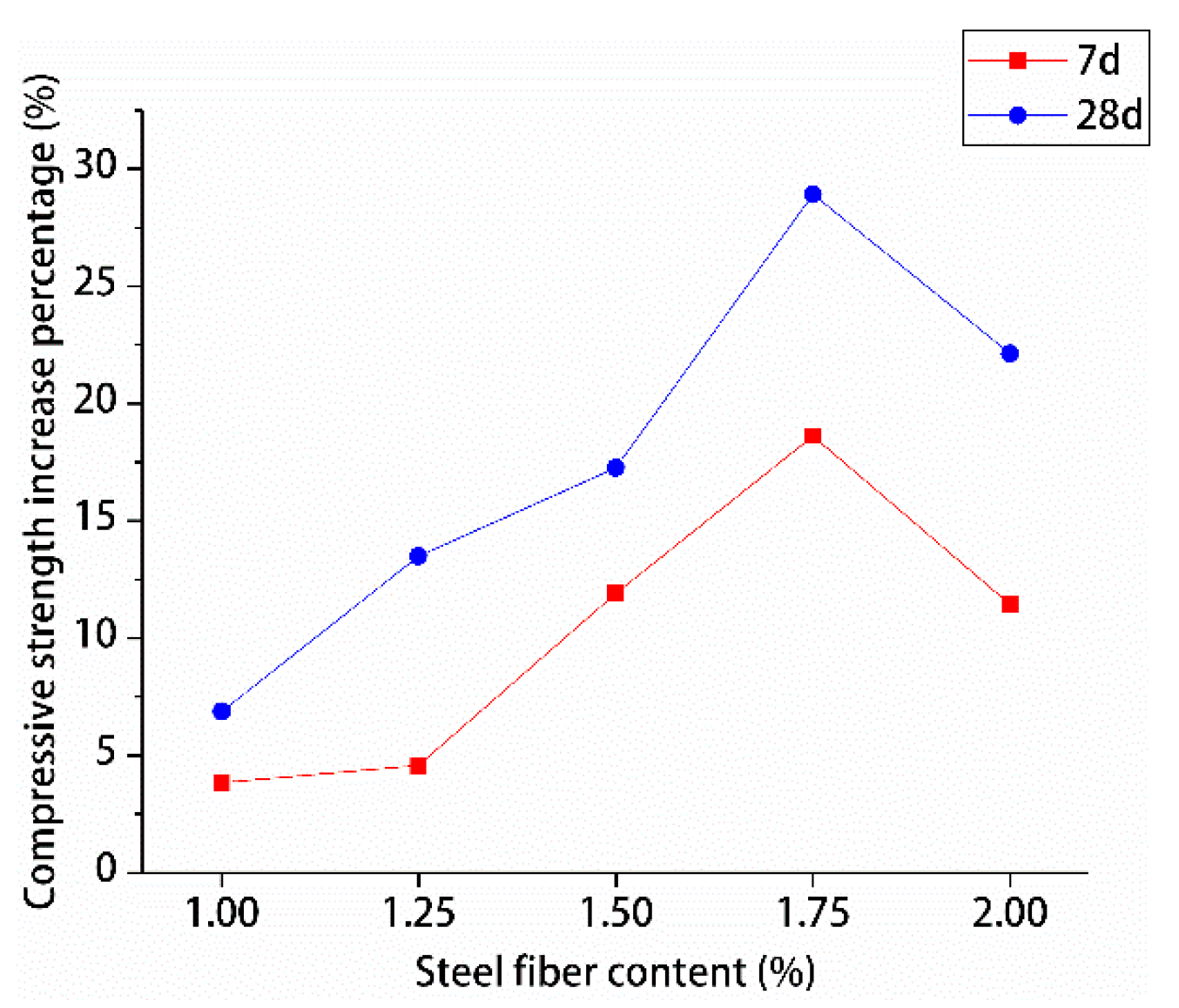
Figure 15.
Increase percentage of compressive strength.
Figure 15.
Increase percentage of compressive strength.
Figure 16.
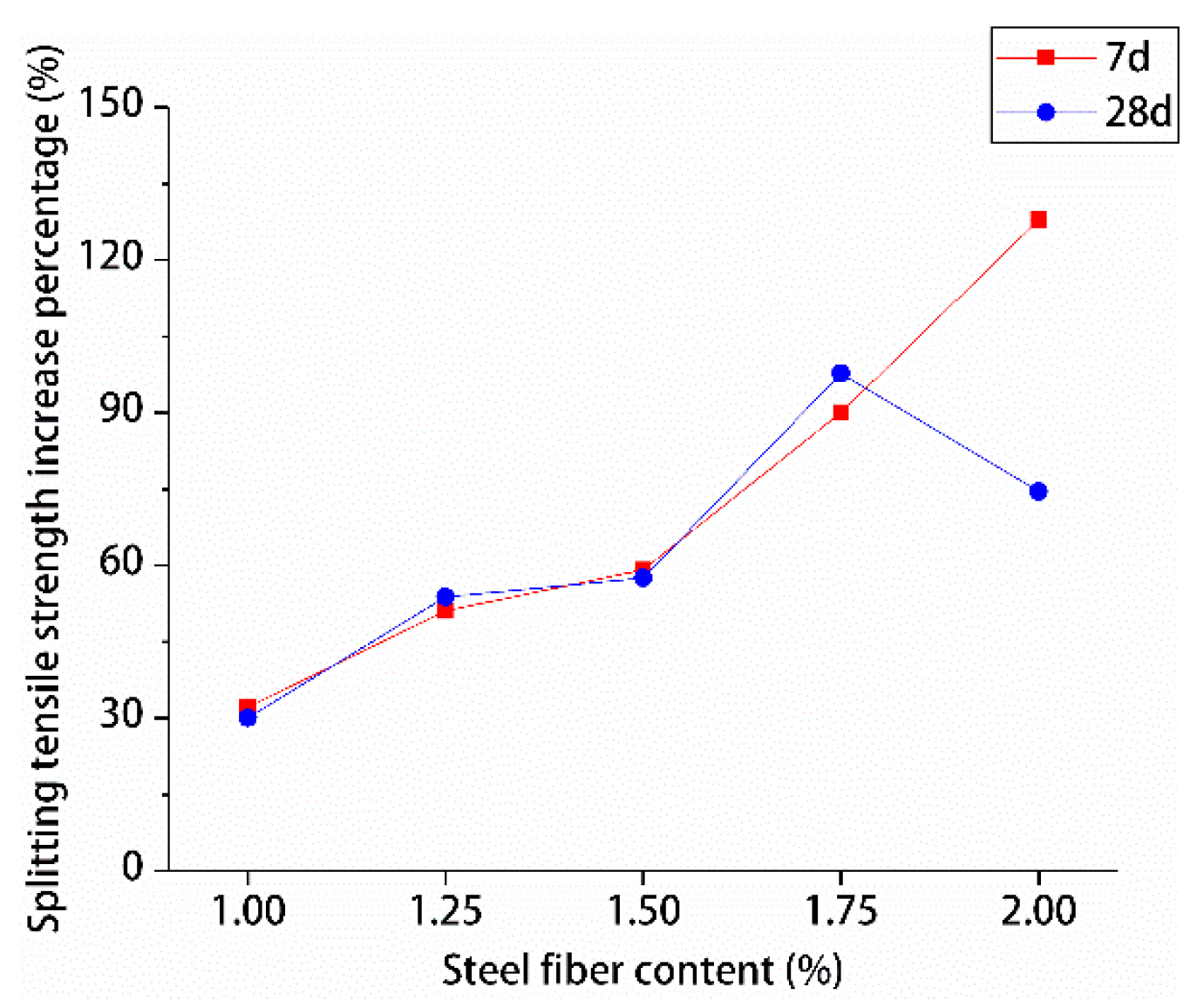
Increase percentage of splitting tensile strength.
Figure 16.
Increase percentage of splitting tensile strength.
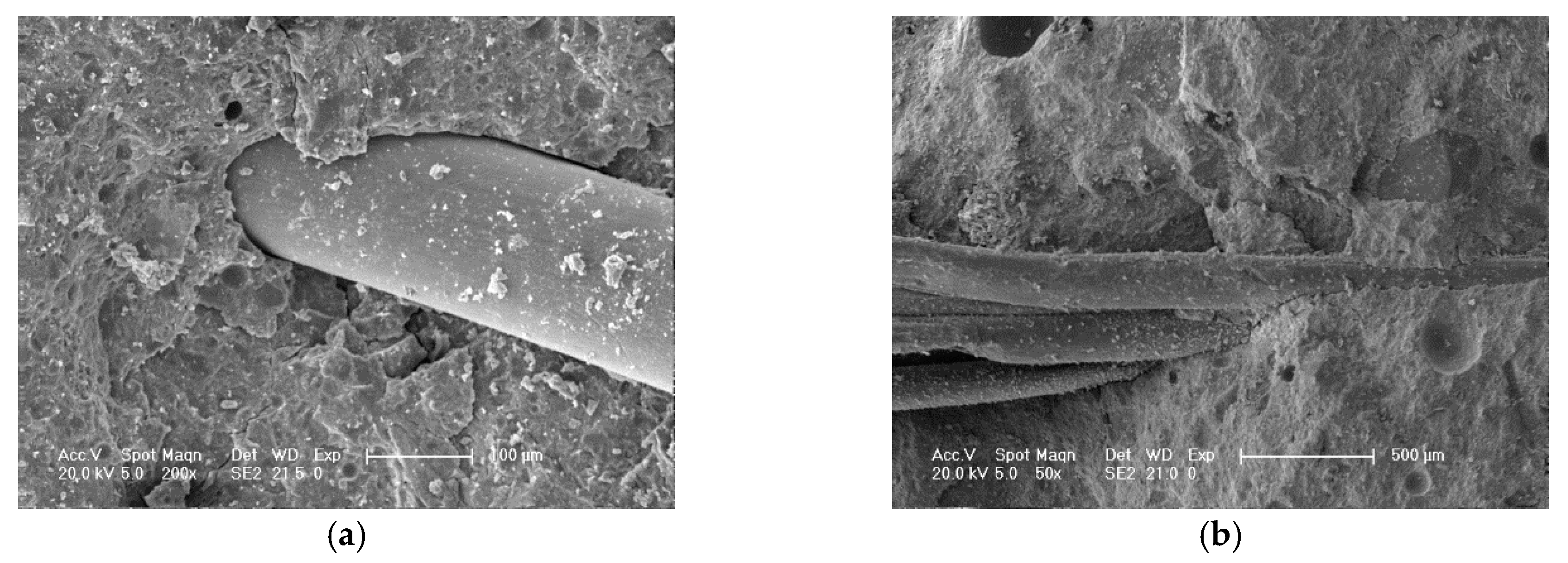
Figure 17.
Microscopic picture of hybrid polypropylene-steel fiber RPC: (a) Interface transition zone between steel fiber and matrix and (b) steel fiber knot.
Figure 17.
Microscopic picture of hybrid polypropylene-steel fiber RPC: (a) Interface transition zone between steel fiber and matrix and (b) steel fiber knot.
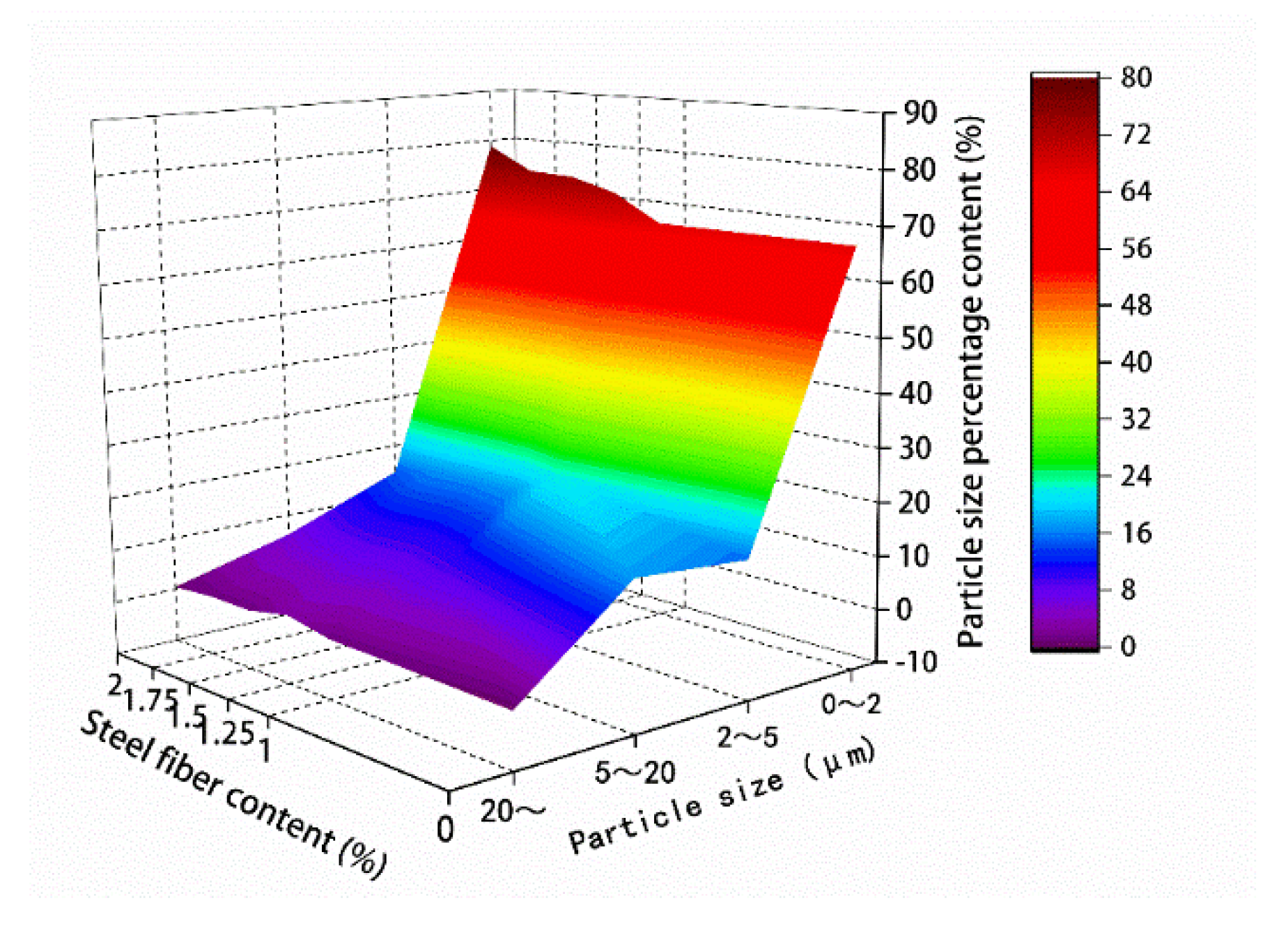
Figure 18.
Particle size percentage content.
Figure 18.
Particle size percentage content.
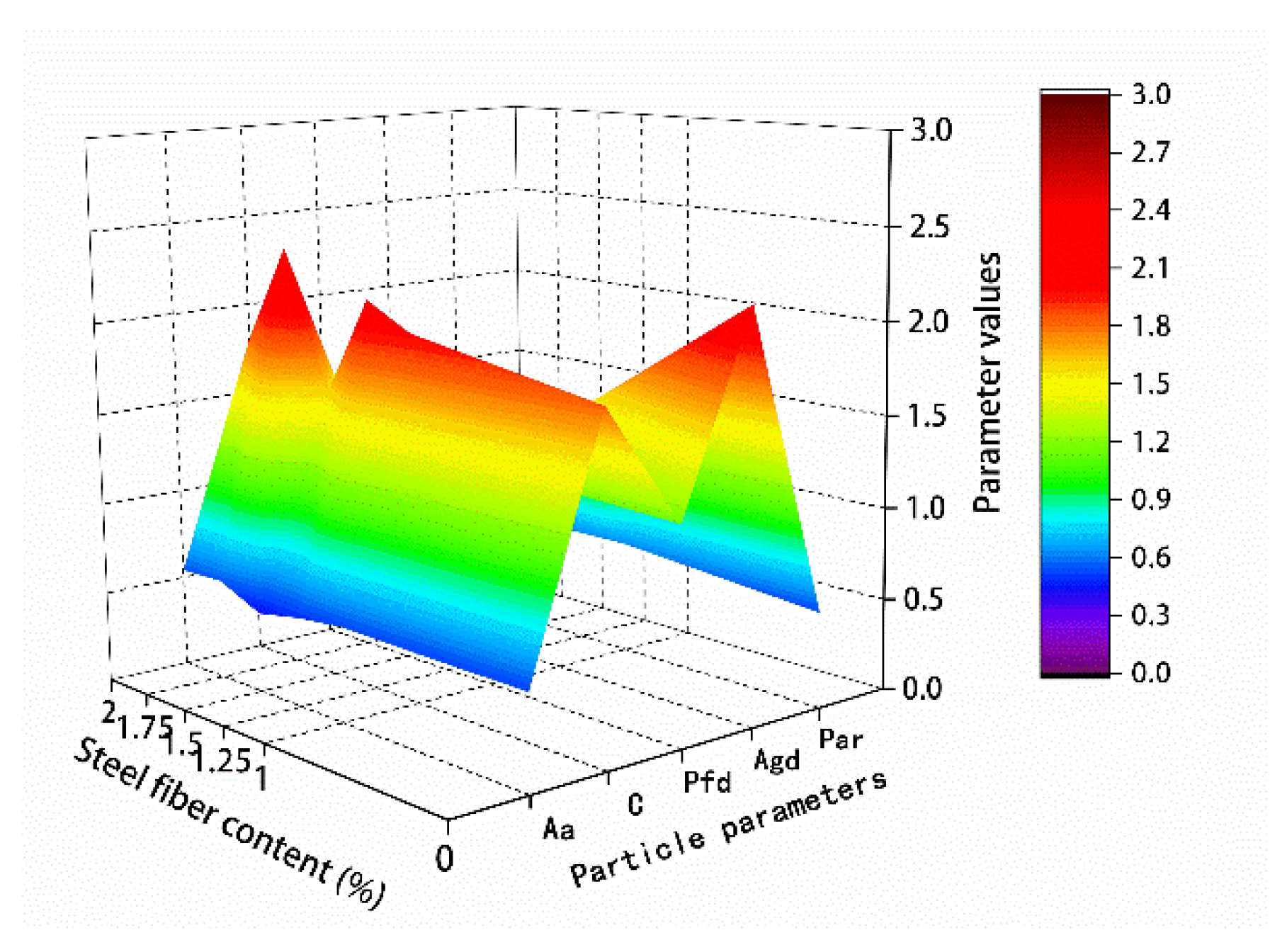
Figure 19.
Microparticle parameter.
Figure 19.
Microparticle parameter.
Figure 20.
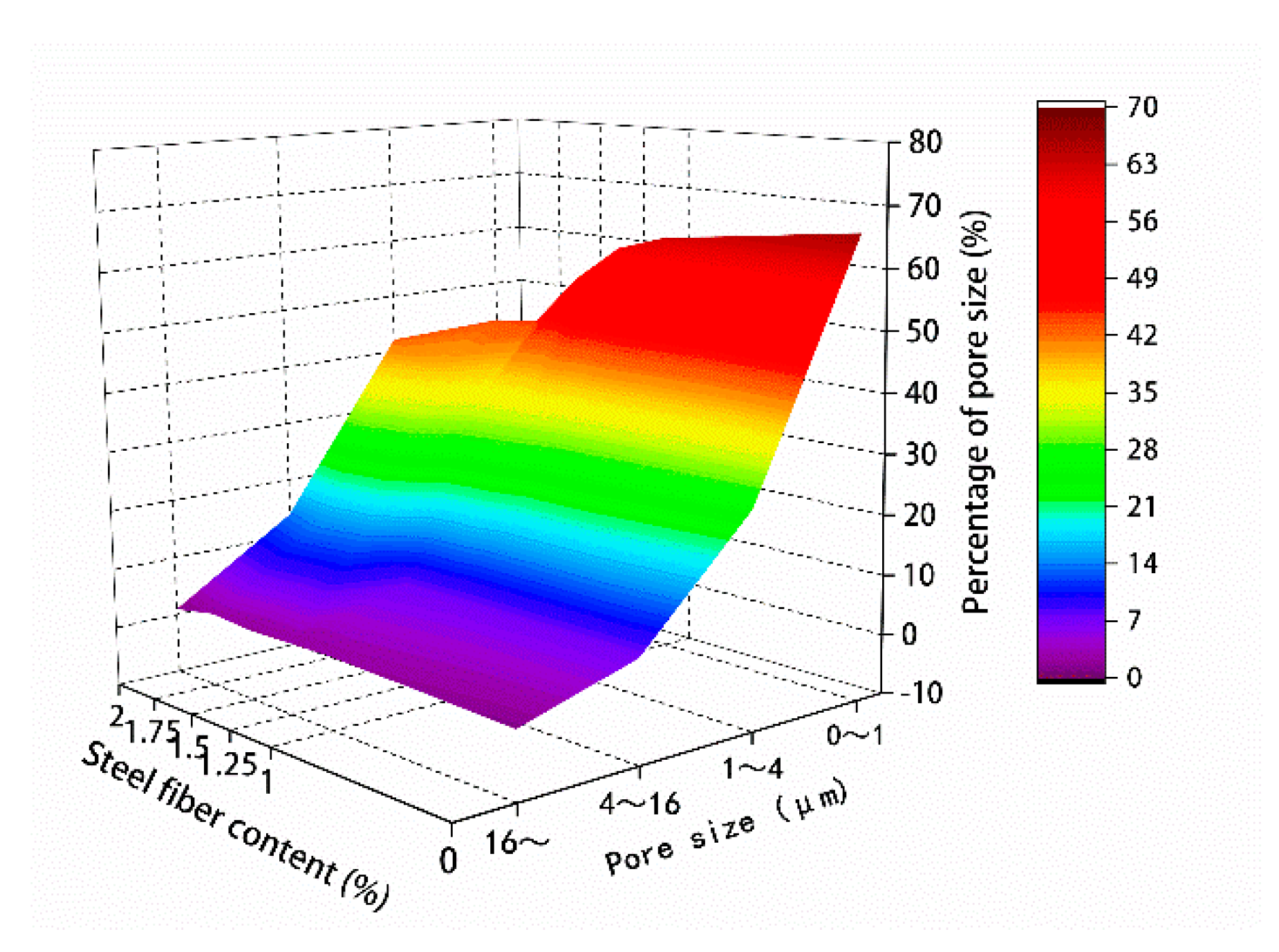
Percentage of pore size.
Figure 20.
Percentage of pore size.
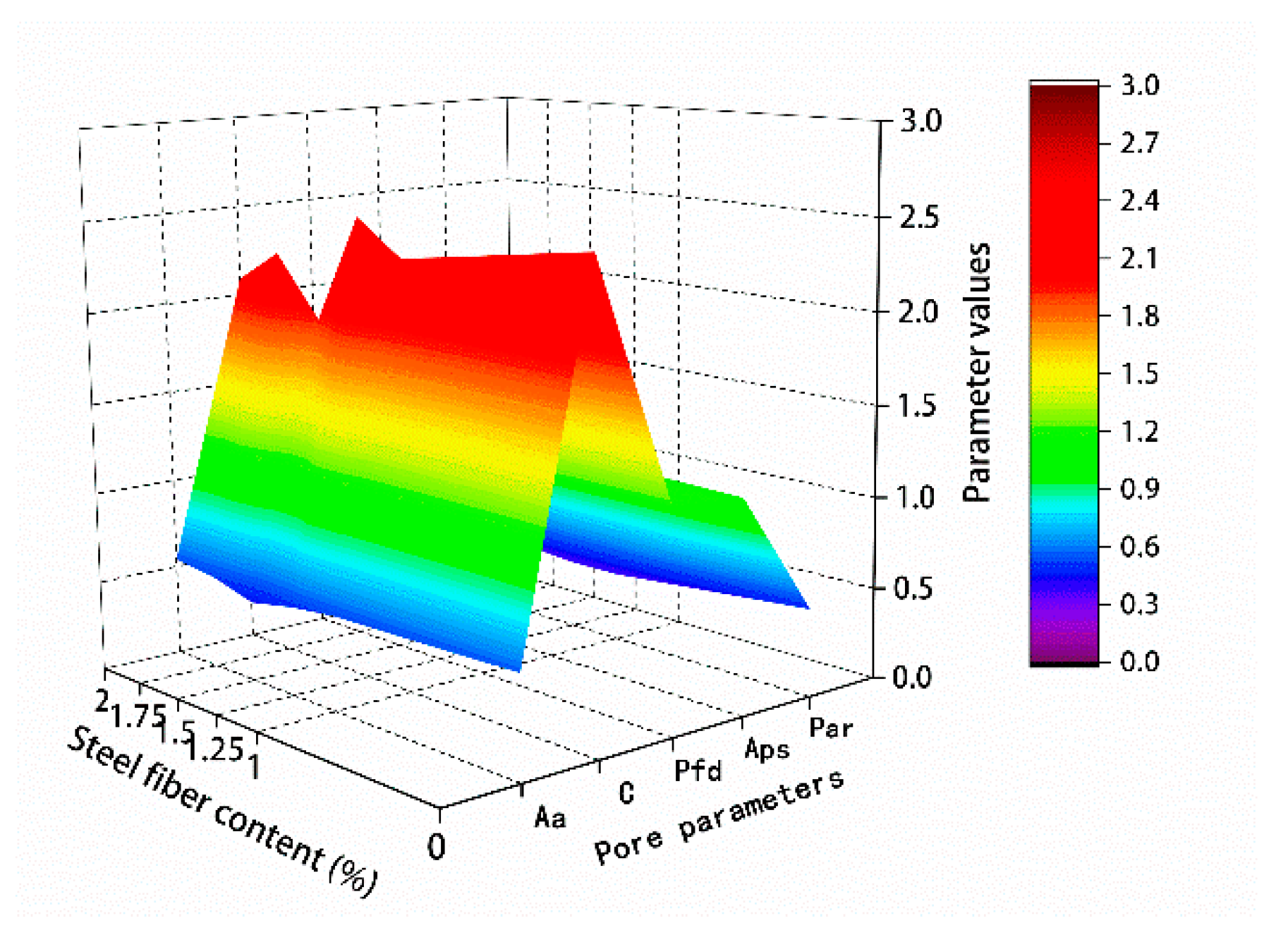
Figure 21.
Pore microparameter.
Figure 21.
Pore microparameter.
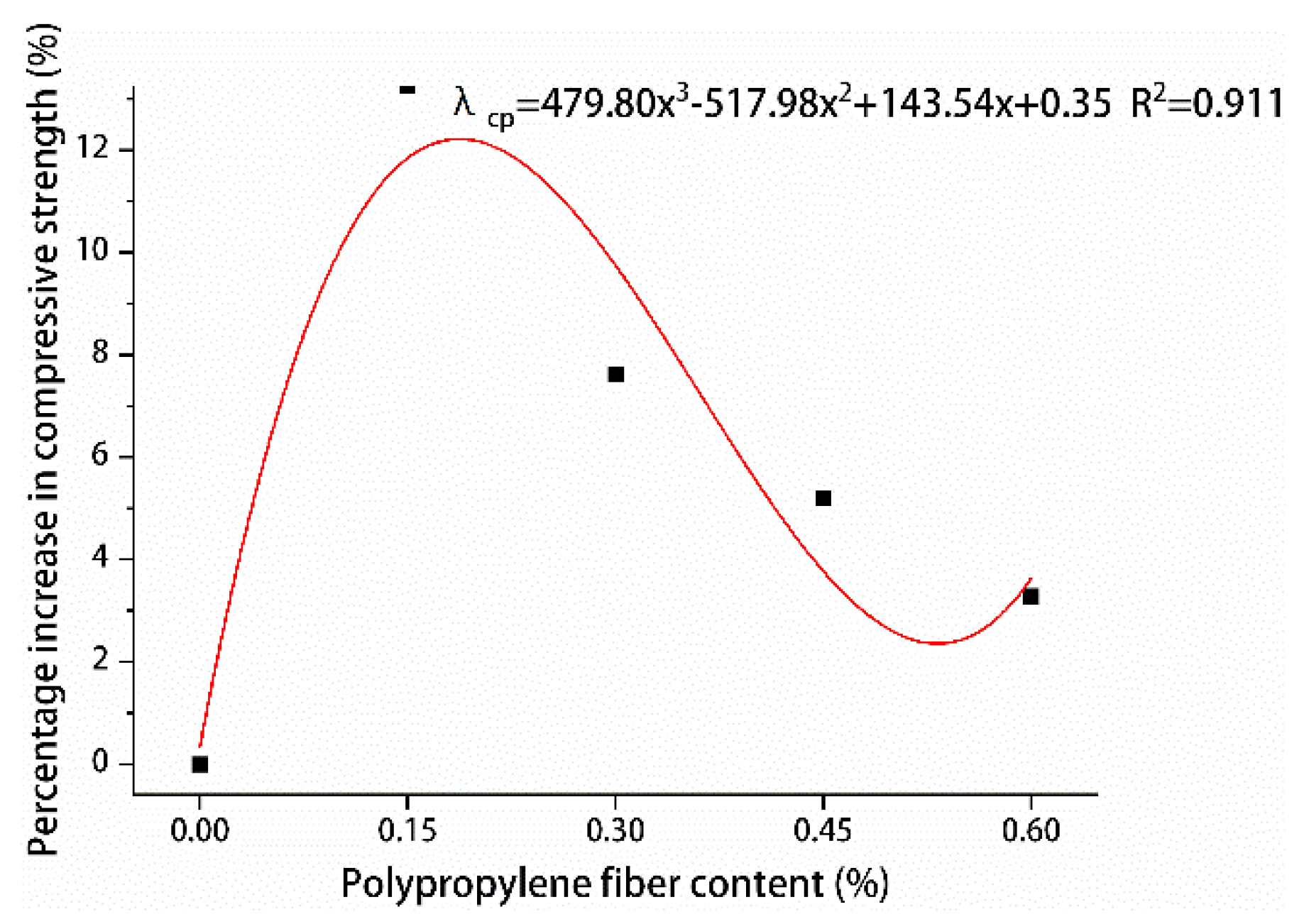
Figure 22.
Relationship between compressive strength and polypropylene fiber content.
Figure 22.
Relationship between compressive strength and polypropylene fiber content.
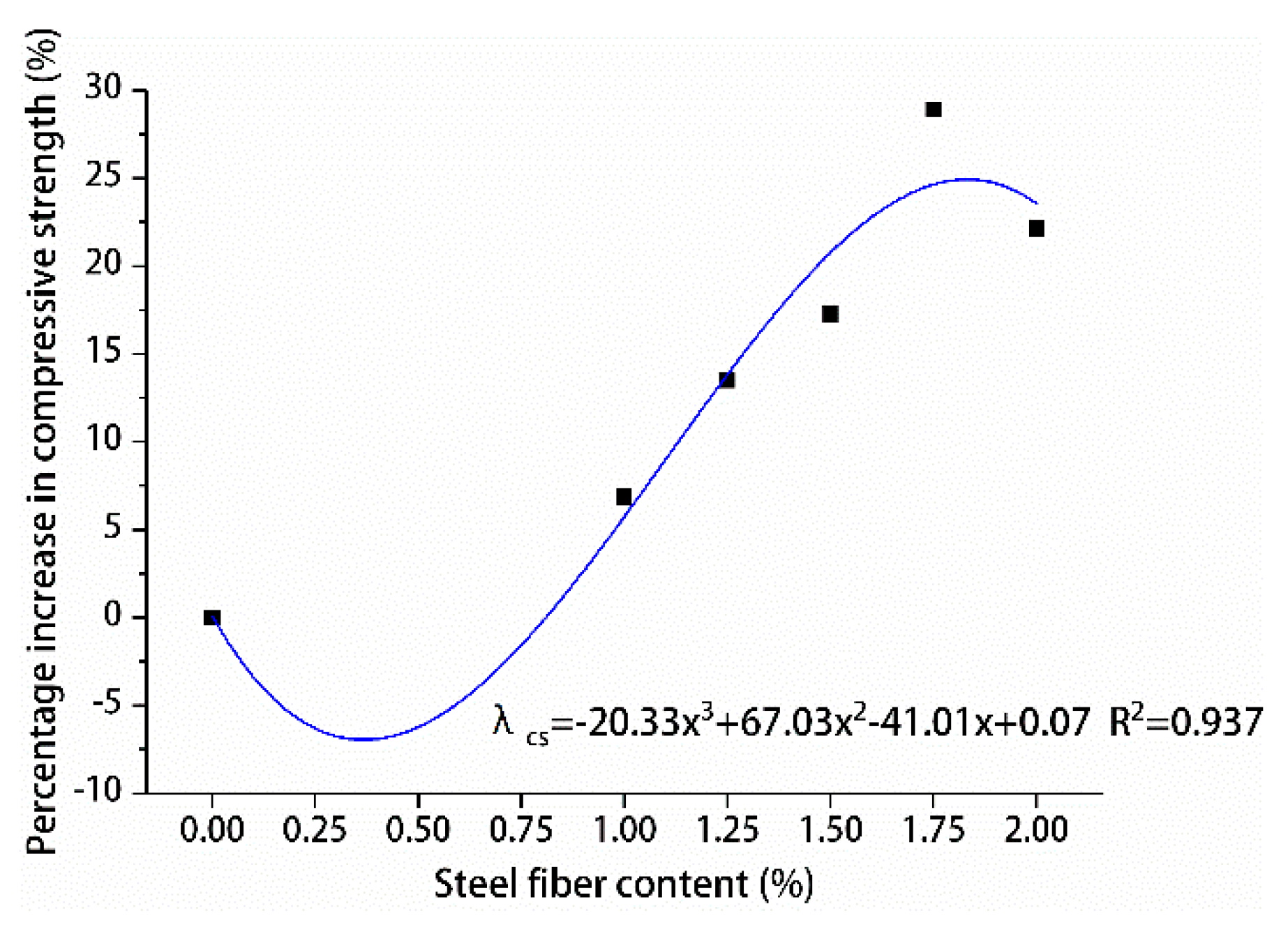
Figure 23.
Relationship between compressive strength and steel fiber content.
Figure 23.
Relationship between compressive strength and steel fiber content.
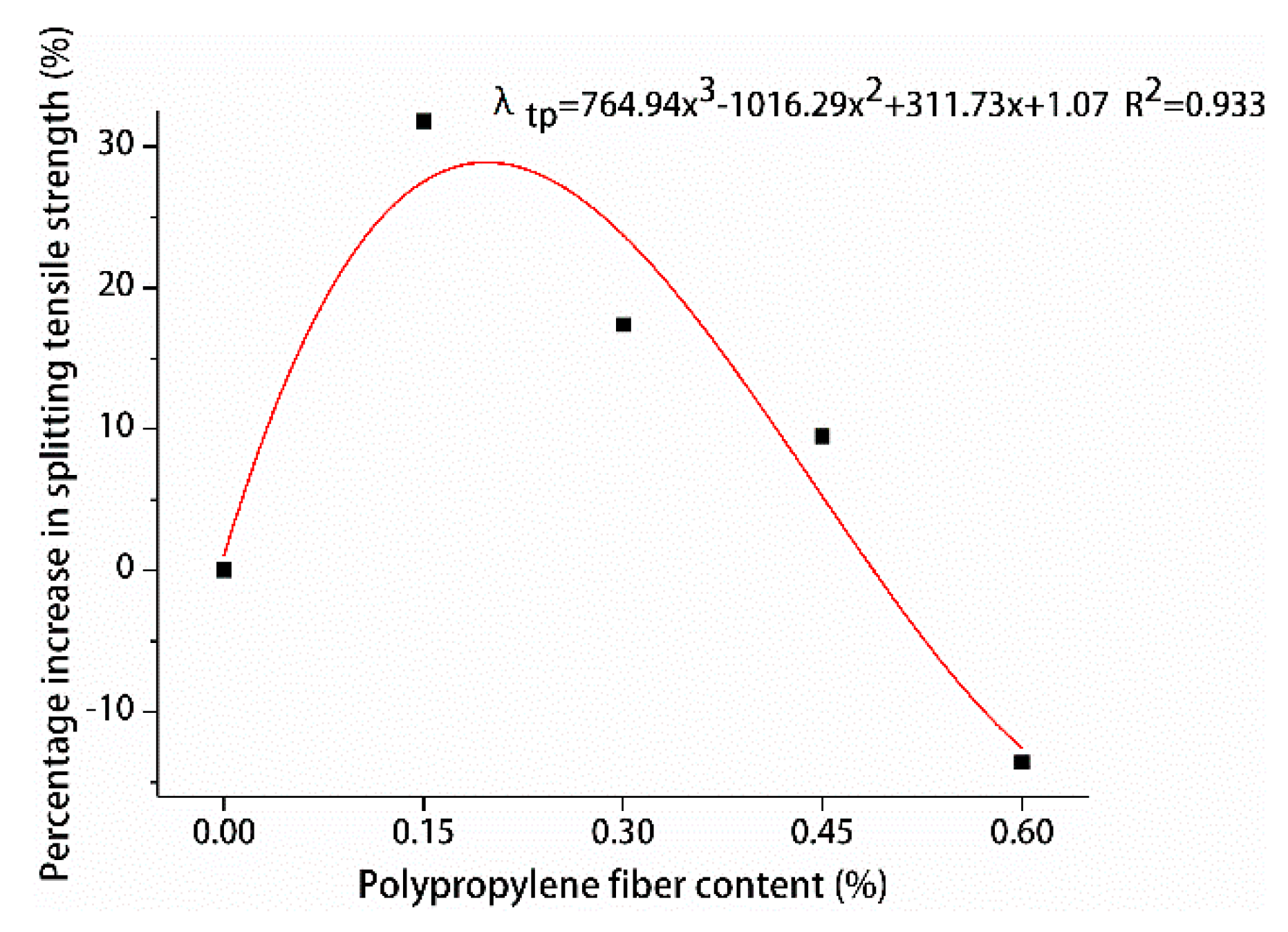
Figure 24.
Relationship between splitting tensile strength and polypropylene fiber content.
Figure 24.
Relationship between splitting tensile strength and polypropylene fiber content.
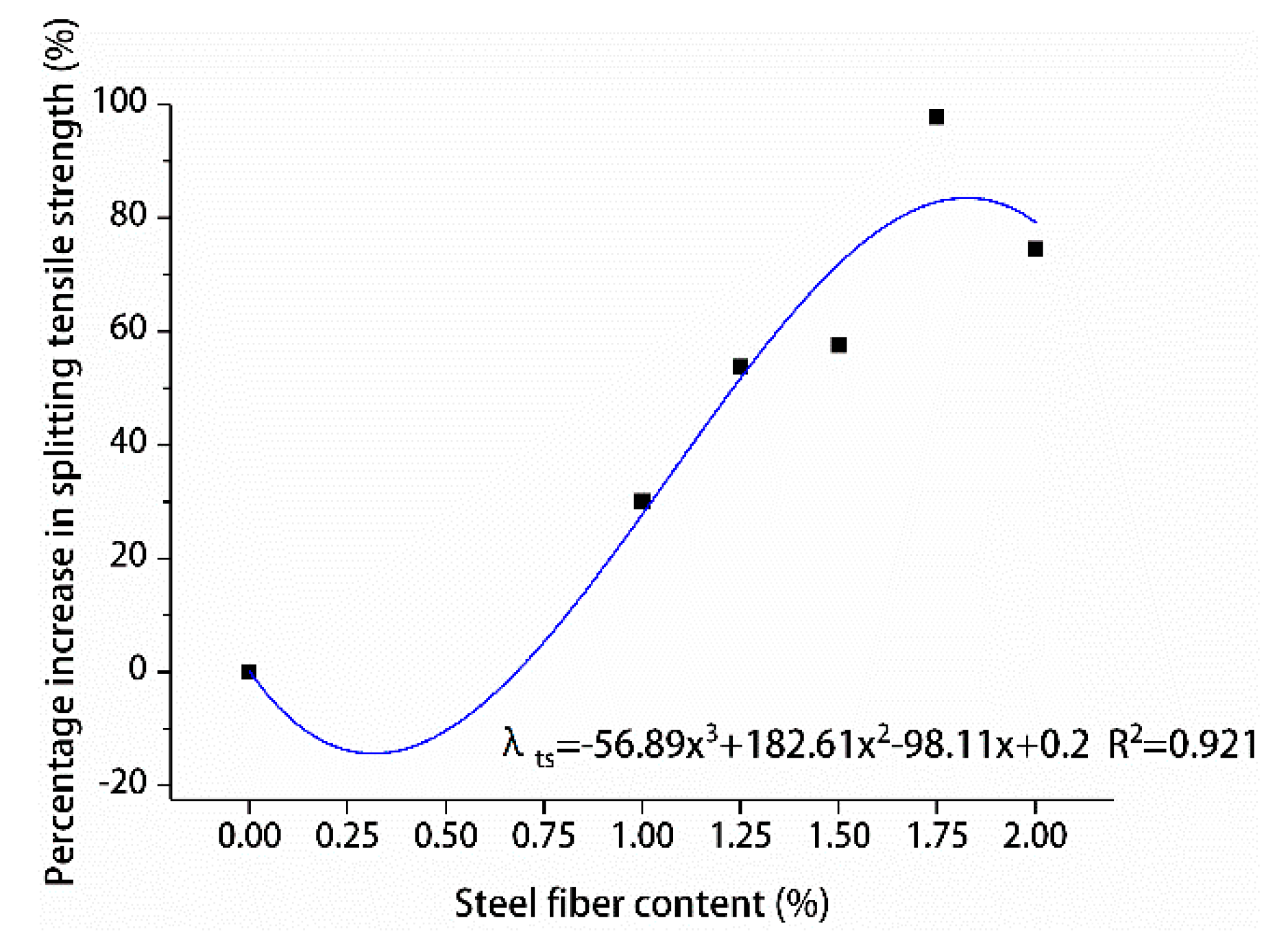
Figure 25.
Relationship between splitting tensile strength and steel fiber content.
Figure 25.
Relationship between splitting tensile strength and steel fiber content.
Table 1.
Physical and chemical properties of cement.
Table 1.
Physical and chemical properties of cement.
| Properties | Standard Value | Actual Value |
|---|
| Physical properties | Specific surface area (m2/kg) | ≥300 | 367 |
| Initial set (min) | ≥45 | 99 |
| Final set (min) | ≤390 | 145 |
| Compressive strength | 3 day (MPa) | ≥23.0 | 29.1 |
| 7 day (MPa) | ≥52.5 | |
| Flexural strength | 3 day (MPa) | ≥4.0 | 6.0 |
| 7 day (MPa) | ≥7.0 | |
| Chemical properties | Stability | Qualified | Qualified |
| Loss on ignition (%) | ≤3.5 | 1.61 |
| MgO (%) | ≤5.0 | 0.98 |
| SO3 (%) | ≤3.5 | 2.62 |
| Insolubles (%) | ≤1.5 | 1.01 |
| Cl− (%) | ≤0.06 | 0.007 |
Table 2.
Physical and chemical properties of silica fume.
Table 2.
Physical and chemical properties of silica fume.
| Properties | Standard Value | Actual Value |
|---|
| Physical properties | Specific surface area (m2/kg) | ≥15 | 20 |
| Pozzolanic activity index (%) | ≥85 | 116 |
| Chemical properties | SiO2 (%) | ≥85.0 | 94.5 |
| Loss on ignition (%) | ≤6.0 | 2.5 |
| Cl− (%) | ≤0.02 | 0.02 |
| Moisture content (%) | ≤3.0 | 1.2 |
| Water demand ratio (%) | ≤125 | 118 |
Table 3.
Chemical properties of fly ash.
Table 3.
Chemical properties of fly ash.
| Properties | Standard Value | Actual Value |
|---|
| Chemical properties | Water demand ratio (%) | ≤105 | 94 |
| Loss on ignition (%) | ≤8.0 | 1.0 |
| Moisture content (%) | ≤1.0 | 0.1 |
| SO3 (%) | ≤3.0 | 0.3 |
| CaO3 (%) | ≤1.0 | 0.16 |
| MgO (%) | ≤5.0 | 1.08 |
| Cl− (%) | ≤0.02 | 0.01 |
Table 4.
Physical and chemical properties of superplasticizer.
Table 4.
Physical and chemical properties of superplasticizer.
| Properties | Standard Value | Actual Value |
|---|
| Physical properties | Water reduction rate | ≥25 | 28.5 |
| Gas content (%) | ≤6.0 | 3.2 |
| Bleeding rate (%) | ≤60 | 50 |
| Chemical properties | Cl− (%) | ≤0.1 | 0.05 |
| OH− (%) | ≤3 | 1.2 |
| Na2SO4 | ≤0.5 | 0.06 |
Table 5.
River sand screening results.
Table 5.
River sand screening results.
| Properties | Sieve Size (mm) |
|---|
| 1.18 | 0.6 | 0.3 | 0.15 | Sieve Bottom |
|---|
| Sieve residue (g) | 1 | 185 | 215 | 90 | 9 |
| Submeter (%) | 0.2 | 37 | 43 | 18 | 1.8 |
| Cumulative (%) | 0.2 | 37.2 | 80.2 | 98.2 | 100 |
Table 6.
Physical properties of polypropylene fiber and steel fiber.
Table 6.
Physical properties of polypropylene fiber and steel fiber.
| Fiber Type | Diameter (mm) | Length (mm) | Tensile Strength (MPa) |
|---|
| Polypropylene fiber | 0.034 | 18 | 358 |
| Steel fiber | 0.2 | 20 | 2850 |
Table 7.
Polypropylene fiber reactive powder concrete (RPC) mix proportions.
Table 7.
Polypropylene fiber reactive powder concrete (RPC) mix proportions.
| No. | Polypropylene Fiber Content (%) | Water/Binder Ratio | Cement (kg/m3) | Fly Ash (kg/m3) | Silica Fume (kg/m3) | Sand/Binder Ratio | Number of Specimens |
|---|
| P0 | 0 | 0.18 | 980 | 280 | 140 | 0.75 | 12 |
| P1 | 0.15 | 12 |
| P2 | 0.3 | 12 |
| P3 | 0.45 | 12 |
| P4 | 0.6 | 12 |
Table 8.
Results of mechanical property test on polypropylene fiber RPC.
Table 8.
Results of mechanical property test on polypropylene fiber RPC.
| No. | Compressive Strength (MPa) | Coefficient of Variation (%) | Splitting Tensile Strength (MPa) | Coefficient of Variation (%) |
|---|
| 7-Day | 28-Day | 7-Day | 28-Day | 7-Day | 28-Day | 7-Day | 28-Day |
|---|
| P0 | 78.26 | 84.86 | 8.46 | 4.61 | 6.5 | 9.78 | 7.12 | 4.07 |
| P1 | 85.12 | 96.12 | 3.48 | 5.21 | 8.52 | 12.89 | 6.23 | 6.86 |
| P2 | 83.64 | 91.33 | 3.07 | 5.40 | 10.02 | 11.48 | 4.62 | 6.92 |
| P3 | 81.34 | 89.27 | 2.10 | 5.78 | 8.29 | 10.71 | 6.57 | 3.32 |
| P4 | 79.03 | 87.65 | 4.96 | 3.03 | 6.73 | 8.45 | 1.35 | 6.40 |
Table 9.
Hybrid polypropylene-steel fiber RPC mix proportions.
Table 9.
Hybrid polypropylene-steel fiber RPC mix proportions.
| No. | Polypropylene Fiber Content (%) | Steel Fiber Content (%) | Number of Specimens |
|---|
| SP0 | 0.15 | 0 | 12 |
| SP1 | 1 | 12 |
| SP2 | 1.25 | 12 |
| SP3 | 1.5 | 12 |
| SP4 | 1.75 | 12 |
| SP5 | 2 | 12 |
Table 10.
Results of mechanical property test on hybrid polypropylene-steel fiber RPC.
Table 10.
Results of mechanical property test on hybrid polypropylene-steel fiber RPC.
| No. | Compressive Strength (MPa) | Coefficient of Variation (%) | Splitting Tensile Strength (MPa) | Coefficient of Variation (%) |
|---|
| 7-Day | 28-Day | 7-Day | 28-Day | 7-Day | 28-Day | 7-Day | 28-Day |
|---|
| SP0 | 85.12 | 96.12 | 4.89 | 2.54 | 8.52 | 12.89 | 6.48 | 2.10 |
| SP1 | 88.39 | 102.72 | 1.68 | 7.59 | 11.26 | 16.77 | 3.54 | 15.15 |
| SP2 | 89.01 | 109.08 | 4.21 | 0.66 | 12.87 | 19.83 | 11.65 | 4.70 |
| SP3 | 95.26 | 112.71 | 4.68 | 1.85 | 13.56 | 20.31 | 9.52 | 2.76 |
| SP4 | 100.96 | 123.92 | 2.03 | 2.35 | 16.19 | 25.49 | 3.31 | 5.34 |
| SP5 | 94.85 | 117.39 | 5.22 | 3.49 | 19.42 | 22.5 | 8.32 | 5.43 |
Table 11.
Particle size percentage content.
Table 11.
Particle size percentage content.
| No. | Particle Size Percentage Content (%) |
|---|
| 0–2 μm | 2–5 μm | 5–20 μm | >20 μm |
|---|
| SP0 | 67.18 | 15.42 | 17.18 | 0.22 |
| SP1 | 67.05 | 22.53 | 9.26 | 1.16 |
| SP2 | 71.93 | 17.14 | 8.13 | 2.8 |
| SP3 | 74.22 | 16.25 | 8.42 | 1.11 |
| SP4 | 74.51 | 16.52 | 7.82 | 1.15 |
| SP5 | 78.82 | 14.55 | 6.18 | 0.45 |
Table 12.
Microparticle parameters.
Table 12.
Microparticle parameters.
| No. | Particle Area Ratio (%) | Average Particle Size (μm) | Granular Fractal Dimension (−) | Circularity (−) | Average Abundance (−) |
|---|
| SP0 | 0.52 | 2.20 | 1.16 | 1.82 | 0.51 |
| SP1 | 0.62 | 1.39 | 1.21 | 2.00 | 0.52 |
| SP2 | 0.62 | 1.29 | 1.20 | 2.14 | 0.49 |
| SP3 | 0.60 | 1.17 | 1.18 | 1.59 | 0.44 |
| SP4 | 0.71 | 1.14 | 1.17 | 2.35 | 0.55 |
| SP5 | 0.38 | 0.93 | 1.15 | 1.80 | 0.54 |
Table 13.
Percentage of pore size.
Table 13.
Percentage of pore size.
| No. | Percentage of Pore Size (%) |
|---|
| 0–1 μm | 1–4 μm | 4–16 μm | >16 μm |
|---|
| SP0 | 66.21 | 25.82 | 6.87 | 1.1 |
| SP1 | 61.92 | 28.76 | 7.12 | 2.19 |
| SP2 | 59.29 | 31.16 | 7.53 | 2.01 |
| SP3 | 52.88 | 32.93 | 14.38 | 1.79 |
| SP4 | 44.09 | 39.09 | 15.45 | 2.36 |
| SP5 | 43.14 | 42.15 | 13.73 | 0.98 |
Table 14.
Pore microparameters.
Table 14.
Pore microparameters.
| No. | Pore Area Ratio (%) | Average Pore Size (μm) | Pore Fractal Dimension (−) | Circularity (−) | Average Abundance (−) |
|---|
| SP0 | 0.48 | 1.16 | 1.20 | 2.51 | 0.55 |
| SP1 | 0.38 | 1.19 | 1.21 | 2.34 | 0.52 |
| SP2 | 0.38 | 1.27 | 1.2 | 2.53 | 0.49 |
| SP3 | 0.40 | 1.31 | 1.17 | 1.94 | 0.44 |
| SP4 | 0.29 | 1.33 | 1.18 | 2.27 | 0.51 |
| SP5 | 0.62 | 1.51 | 1.2 | 2.09 | 0.54 |
Table 15.
Compressive strength of hybrid polypropylene-steel fiber RPC at 28 days.
Table 15.
Compressive strength of hybrid polypropylene-steel fiber RPC at 28 days.
| Polypropylene Fiber Content (%) | | Steel Fiber Content (%) | | Calculated Value (MPa) | Actual Value (MPa) | Error (%) |
|---|
| 0.15 | 1.12 | 0 | 1.00 | 94.98 | 96.12 | −1.20 |
| 1 | 1.06 | 100.38 | 102.72 | −2.33 |
| 1.25 | 1.14 | 108.04 | 109.08 | −0.96 |
| 1.5 | 1.21 | 114.61 | 112.71 | 1.66 |
| 1.75 | 1.25 | 118.28 | 123.92 | −4.76 |
| 2 | 1.23 | 117.24 | 117.39 | −0.12 |
Table 16.
Hybrid polypropylene-steel fiber RPC compressive strength [
35].
Table 16.
Hybrid polypropylene-steel fiber RPC compressive strength [
35].
| Polypropylene Fiber Content (%) | | Steel Fiber Content (%) | | Calculated Value (MPa) | Actual Value (MPa) | Error (%) |
|---|
| 0.1 | 1.10 | 0.5 | 0.94 | 98.21 | 103.41 | −5.29 |
| 1 | 1.06 | 110.76 | 113.56 | −2.53 |
| 1.5 | 1.21 | 126.46 | 125.47 | 0.79 |
| 2 | 1.23 | 129.36 | 138.13 | −6.78 |
| 0.15 | 1.12 | 0.5 | 0.94 | 99.86 | 107.36 | −7.52 |
| 1 | 1.06 | 112.61 | 109.30 | 2.94 |
| 1.5 | 1.21 | 128.58 | 143.54 | −11.63 |
| 2 | 1.23 | 131.53 | 140.27 | −6.64 |
| 0.2 | 1.12 | 0.5 | 0.94 | 100.15 | 101.95 | −1.80 |
| 1 | 1.06 | 112.94 | 103.32 | 8.52 |
| 1.5 | 1.21 | 128.96 | 144.68 | −12.19 |
| 2 | 1.23 | 131.92 | 128.77 | 2.39 |
| 0.25 | 1.11 | 0.5 | 0.94 | 99.42 | 105.51 | −6.13 |
| 1 | 1.06 | 112.12 | 107.72 | 3.92 |
| 1.5 | 1.21 | 128.02 | 145.59 | −13.72 |
| 2 | 1.23 | 130.96 | 148.51 | −13.40 |
Table 17.
Splitting tensile strength of hybrid polypropylene-steel fiber RPC at 28 days.
Table 17.
Splitting tensile strength of hybrid polypropylene-steel fiber RPC at 28 days.
| Polypropylene Fiber Content (%) | | Steel Fiber Content (%) | | Calculated Value (MPa) | Actual Value (MPa) | Error (%) |
|---|
| 0.15 | 1.28 | 0 | 1.00 | 12.50 | 12.89 | −3.13 |
| 1 | 1.28 | 15.94 | 16.77 | −5.19 |
| 1.25 | 1.52 | 18.93 | 19.83 | −4.74 |
| 1.5 | 1.72 | 21.44 | 20.31 | 5.28 |
| 1.75 | 1.83 | 22.81 | 25.49 | −11.75 |
| 2 | 1.80 | 22.37 | 22.5 | −0.60 |