


A Review of Systems and Technologies for Smart Homes and Smart Grids


Abstract
:1. Introduction
2. State of the Art
2.1. The Advent of Smart Homes
- Automation: the ability to accommodate automatic devices or perform automatic functions;
- Multi-functionality: the ability to perform various duties or generate different outcomes;
- Adaptability: the ability to learn, predict and meet the needs of users;
- Interactivity: the ability to allow the interaction among users;
- Efficiency: the ability to perform functions in a convenient manner that saves time and costs.
2.2. The Advent of the Smart Grid: A Communication Method for Smart Homes to Overcome Traditional Power Grids
2.3. The Role of the ICTs in Smart Homes and the Smart Grid
2.4. The New Role of the Users
3. Aim of the Work
4. Classification Criteria for the Selection of Smart Home Technologies
- Data collection: the technology allows the collection of all relevant data and provides access to them;
- Data processing: the technology allows the processing and analyzing of relevant data and can combine them;
- Data representation: the technology allows the relevant data to be made accessible to the users;
- Control and interaction capabilities: the technology enables users to access the status and monitor the functions of related technologies (bidirectional communication and interaction).
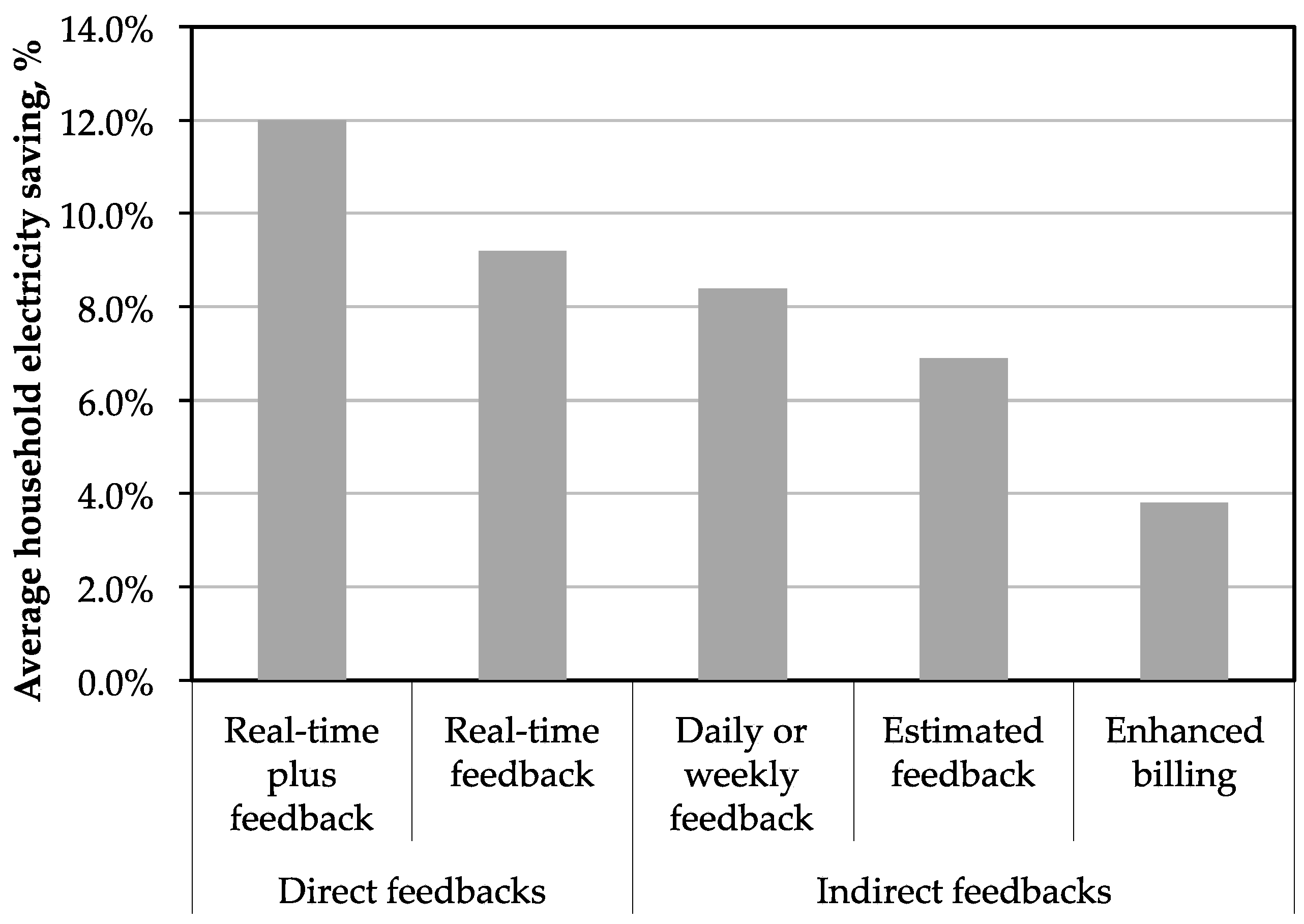
- Direct: the more immediate the feedback is, the more effective it is, but it requires a certain degree of knowledge and preparation from users;
- Personalized: the way of presenting data is customized to end-users’ needs;
- Comparable: end-users can compare their actual electricity usage with benchmarks as well as with their historical data;
- Flexible: the feedback technology needs to be continually improved, in response to users’ suggestions and requests.
- Systemic: the house exists in a systemic context, and the data, retrieved by means of a smart grid, are presented at an individual household level and compared with the average system performance [45].
- Gamification: the feedback is presented by using elements and concepts that are typical in computer games and is often integrated in a graphical user interface (GUI).
5. Review of the Technologies for Smart Homes
- Integrated wireless technology (IWT);
- Home energy management system (HEMS);
- Smart home micro-computers (SHMC);
- Home automation (SHS/HA).
5.1. Integrated Wireless Technology and Network
5.2. Home Energy Management
- (i)
- The increased savings for both users and utilities providers;
- (ii)
- A reduced peak-to-average ratio and peak loads;
- (iii)
- They can include local energy production from renewable sources;
- (iv)
- They allows the household to be inserted in a systemic context, as a separate local grid, and allow it to be connected to the outside world, i.e., creates a smart grid;
- (v)
- They allow for historical comparisons of home energy usage.
5.3. Smart Home Micro-Computers
5.4. Home Automation Systems
6. Discussion
6.1. Challenges Related to Smart Home Technologies
6.2. Challenges, Benefits, and Motivations Related to the Users
- (i)
- Rationalizing the amount of energy required from controllable loads: smart grids enable providers to better control and plan production and to adjust the price levels of electricity. Previous studies have systematized approaches to home energy management, which may belong to one or any mix of the following three categories: (i) a technology-oriented approach; (ii) an economically-oriented approach or (iii) an environmentally-oriented approach.
- (ii)
- Wisely scheduling running times for smart appliances that are likely to be shifted in time. Households’ involvement in cutting their overall energy demand and the evening peaks in energy usage is still being explored. Currently, a lot of interest is being directed to making homes more flexible energy users. This flexibility aims to modify households’ load shape thanks to feedback on real-time energy usage and an indication from them of which tariff information they found useful in relation to optimizing their energy costs.
- (iii)
- Turning themselves into potential carbon-free generators of energy, through the use of renewable resources: so far, the focus of smart grid technologies has been on integrating RES into the grid to reduce the cost of power generation. Integrating these resources requires storage systems. Load/generation shifting can be used by customers, utility providers, or renewable power producers to take advantage of the different electricity rates available at various times of the day [113].
6.3. Barriers and Futures Trends
7. Conclusions
Acknowledgments
Author Contributions
Conflicts of Interest
Abbreviations
| ACORD | appliance coordination |
| ACORD-FI | appliance coordination with feed |
| AiSEG | artificial intelligence and smart energy gateway |
| BT | bluetooth |
| CPP | critical peak pricing |
| CPU | central processing unit |
| DD | dashboard or display device |
| DR | demand-response |
| DsT | decision support tool |
| EC | European commission |
| EMU | energy management unit |
| GHGs | greenhouse gasses |
| GSM/GPRS | global system mobile |
| GUI | graphical users interface |
| HAN | home area network |
| HEMS | home energy management system |
| IP | internet protocol |
| IPPC | intergovernmental panel on climate change |
| ICTs | information and communication technologies |
| IBR | inclining block rates |
| IN | insteon |
| IPMR | intelligent power management rostrum |
| IWT | integrated wireless technology |
| LP | linear programming |
| MAC | medium access control |
| NAN | neighborhood area networks |
| OLM | optimum load management |
| OREM | optimization-based residential energy management |
| PC | physical component |
| PV | Photovoltaics |
| RC | remote control |
| RFID | radio frequency identification |
| REF | renewable energy source |
| RTP | real time pricing |
| S | sensor |
| SHMC | smart home micro-computers |
| SHS/HA | smart home systems/home automation |
| SM | smart meter |
| ToU | time of use |
| ZB | zigBee |
| ZW | Z-wave |
| WAN | wide area network |
| WSHAN | wireless sensor home area network |
| WSN | wireless sensor networks |
| xDSL | digital subscriber lines |
References
- Comité Européen de Normalisation. Energy Performance of Buildings—Impact of Building Automation, Control, and Building Management; European Technical Standard EN 15232; CEN: Brussels, Belgium, 2012. [Google Scholar]
- European Parliament. Directive 2010/31/EU of the European Parliament and of the Council of 19 May 2010 on the Energy Performance of Buildings; Directive 2010/31/EU; The European Parliament and the Council of the European Uninion: Brussels, Belgium, 2010. [Google Scholar]
- European Climate Foundation. Roadmap 2050 Project. Available online: http://www.roadmap2050.eu/ (accessed on 16 November 2015).
- Graditi, G.; Ippolito, M.G.; Lamedica, R.; Piccolo, A.; Ruvio, A.; Santini, E.; Siano, P.; Izzo, G. Innovative control logics for a rational utilization of electric loads and air-conditioning systems in a residential building. Energy Build. 2015, 102, 1–17. [Google Scholar] [CrossRef]
- Alam, M.R.; Alauddin, M.A. A review of smart homes-past, present, and future. IEEE Trans. Syst. Man Cybern. C Appl. Rev. 2012, 42, 1190–1203. [Google Scholar] [CrossRef]
- Chan, M.; Estève, D.; Escriba, C.; Campo, E. A review of smart homes-present state and future challenges. Comput. Methods Progr. Biomed. 2008, 91, 55–81. [Google Scholar] [CrossRef] [PubMed]
- Liyanage, C.D.S.; Chamin, M.; Iskandar, M.P. State of the art of smart homes. Eng. Appl. Artifi. Intell. 2012, 25, 1313–1321. [Google Scholar]
- Satpathy, L. Smart Housing: Technology to Aid Aging in Place. New Opportunities and Challenges. Master’s Thesis, Mississippi State University, Starkville, MS, USA, 2006. [Google Scholar]
- Cook, D.J.; Das, S.K. How smart are our environments? An updated look at the state of the art. Pervasive Mob. Comput. 2007, 3, 53–73. [Google Scholar] [CrossRef]
- Al-sumaiti, A.S.; Ahmed, M.H.; Salama, M.M. Smart home activities: A literature review. Electr. Power Compon. Syst. 2014, 42, 294–305. [Google Scholar] [CrossRef]
- Ding, D.; Cooper, R.A.; Pasquina, P.F.; Fici-Pasquina, L. Sensor technology for smart homes. Maturitas 2011, 69, 131–136. [Google Scholar] [CrossRef] [PubMed]
- Somayya, R.; Ramaswamy, R. Smart homes. In Proceedings of the 2nd International Symposium on Computational and Business Intelligence, New Delhi, India, 7–8 December 2014.
- Le, Q.; Nguyen, H.; Barnett, T. Smart homes for older people: Positive aging in a digital world. Future Internet 2012, 4, 607–617. [Google Scholar] [CrossRef]
- Kok, K.; Karnouskos, S.; Dimeas, N.D.A.; Weidlich, A.; Warmer, C.; Strauss, P.; Buchholz, B.; Drenkard, S.; Hatziargyriou, N.; Lioliou, V. Smart houses for a smart grid. In Proceedings of the 20th International Conference and Exhibition on Electricity Distribution (CIRED 2009), Prague, Czech Republic, 8–11 June 2009.
- Roncero, J.R. Integration is key to smart grid management. In Proceedings of the IET-CIRED Seminar on SmartGrids for Distribution, Frankfurt, Germany, 23 June 2008.
- Erol-Kantarci, M.; Mouftah, H.T. Wireless sensor networks for domestic energy management in smart grids. In Proceedings of the 25th Biennial Symposium on Communications, Kingston, ON, Canada, 12–14 May 2010.
- Costanzo, G.T.; Zhu, G.; Anjos, M.F.; Savard, G. A system architecture for autonomous demand side load management in smart buildings. IEEE Trans. Smart Grid 2012, 3, 2157–2165. [Google Scholar] [CrossRef]
- World Business Council for Sustainable Development. Transforming the Market: Energy Efficiency in the Buildings; World Business Council for Sustainable Development: Brussels, Belgium, 2009. [Google Scholar]
- Kailas, A.; Cecchi, V.; Mukherjee, A. A survey of communications and networking technologies for energy management in buildings and home automation. J. Comput. Netw. Commun. 2012, 1–12. [Google Scholar] [CrossRef]
- Darby, S. The Effectiveness of Feedback on a Review for Defra of the Literature on Metering, Billing and Direct Displays. Environmental Change Institute—University of Oxford: Oxford, UK, 2006. [Google Scholar]
- Javaid, N.; Khan, I.; Ullah, M.N.; Mahmood, A.; Farooq, M.U. A survey of home energy management systems in future smart grid communications. In Proceedings of the IEEE 8th International Conference on Broadband, Wireless Computing, Communication and Applications, Compiegne, France, 28–30 October 2013.
- Siano, P.; Graditi, G.; Atrigna, M.; Piccolo, A. Designing and testing decision support and energy management systems for smart homes. J. Ambient Intell. Hum. Comput. 2013, 4, 651–661. [Google Scholar] [CrossRef]
- Han, J.; Choi, C.; Park, W.; Lee, I. Green home energy management system through comparison of energy usage between the same kinds of home appliances. In Proceedings of the 15th IEEE International Symposium on Consumer Electronics, Singapore, 14–17 June 2011.
- Lien, C.; Bai, Y.; Lin, M. Remote-controllable power outlet system for home power management. IEEE Trans. Consum. Electron. 2007, 53, 1634–1641. [Google Scholar] [CrossRef]
- Mohsenian-Rad, A.-H.; Leon-Garcia, A. Optimal residential load control with price prediction in real-time electricity pricing environments. IEEE Trans. Smart Grid 2010, 1, 120–133. [Google Scholar] [CrossRef]
- Erol-Kantarci, M.; Mouftah, H. Wireless sensor networks for cost-efficient residential energy management in the smart grid. IEEE Trans. Smart Grid 2011, 2, 314–325. [Google Scholar] [CrossRef]
- Khan, I.; Mahmood, A.; Javaid, N.; Razzaq, S.; Khan, R.D.; Ilahi, M. Home energy management systems in future smart grids. Available online: http://arxiv.org/abs/1306.1137 (accessed on 10 November 2015).
- Graditi, G.; Ippolito, M.G.; Telaretti, E.; Zizzo, G. An innovative conversion device to the grid interface of combined RES-based generators and electric storage systems. IEEE Trans. Ind. Electron. 2015, 62, 2540–2550. [Google Scholar] [CrossRef]
- Berardi, U. A cross-country comparison of the building energy consumptions and their trends. Resour. Conserv. Recycl. 2016, in press. [Google Scholar] [CrossRef]
- Murata, A.; Kondou, Y.; Hailin, M.; Weisheng, Z. Electricity demand in the Chinese urban household-sector. Appl. Energy 2008, 85, 1113–1125. [Google Scholar] [CrossRef]
- Boegle, A.; Singh, D.; Sant, G. Estimating technical energy saving potential from improved appliance efficiency in indian households in American council for an energy-efficient economy. In Proceedings of the 16th Biennal ACEEE Summer Study Energy Efficiency in Buildings, Pacific Grove, CA, USA, 15–20 August 2010.
- Morishita, C.; Ghisi, E. Assessment of the Impact of energy-efficient household appliances on the electricity consumption in the residential sector of Brazil. In Proceedings of World Energy Council Conference, Montreal, Quebec, QC, Canada, 12–16 September 2010.
- Di Silvestre, M.L.; Graditi, G.; Sanseverino, E.R. A generalized framework for optimal sizing of distributed energy resources in micro-grids using an indicator-based swarm approach. IEEE Trans. Ind. Inform. 2014, 10, 152–162. [Google Scholar] [CrossRef]
- Jiang, B.; Fei, Y. Smart home in smart microgrid: A cost-effective energy ecosystem with intelligent hierarchical agents. IEEE Trans. Smart Grid 2014, 6, 3–13. [Google Scholar] [CrossRef]
- IPCC. Intergovernmental Panel on Climate Change. In Climate Change 2014: Mitigation of Climate Change; Cambridge University Press: New York, NY, USA, 2014. [Google Scholar]
- Fitzgerald, M. Finding and Fixing a Homes Power Hogs. 2008. Available online: http://www.nytimes.com/2008/07/27/technology/27proto.html (accessed on 16 November 2015).
- Gellings, C.W. The Smart Grid: Enabling Energy Efficiency and Demand Response. CRC Press: Boca Raton, FL, USA, 2009. [Google Scholar]
- Ahmad, A.; Latif, K.; Javaid, N.; Khan, A.; Qasim, U. Density controlled divide-and-rule scheme for energy efficient ruoting in wireless sensor networks. In Proceedings of the 26th IEEE Canadian Conference on Electrical and Computer Engineering (CCECE2013), Regina, SK, Canada, 5–8 May 2013.
- Khan, M.Y.; Javaid, N.; Khan, M.A.; Javaid, A.; Khan, Z.A.; Qasim, U. Hybrid DEEC: Towards efficient energy utilization in wireless sensor networks. World Appl. Sci. J. 2013, 22, 126–132. [Google Scholar]
- Aslam, M.; Shah, T.; Javaid, N.; Rahim, A.; Rahman, Z.; Khan, Z.A. CEEC: Centralized energy efficient clustering a new routing protocol for WSNs. In Proceedings of the 9th IEEE Communications Society Conference on Sensor, Mesh and Ad Hoc Communications and Networks (SECON), Seoul, Korea, 18–21 June 2012.
- Aman, S.; Simmhan, Y.; Prasanna, V.K. Energy management systems: State of the art and emerging trends. IEEE Commun. Mag. 2013, 51, 114–119. [Google Scholar] [CrossRef]
- Ehrhardt-Martinez, K.; Donnelly, K.A.; Laitne, J. Advanced Metering Initiatives and Residential Feedback Programs: A Meta-Review for Household Electricity-Saving Opportunities; American Council for an Energy-Efficient Economy: Washington, DC, USA, 2010. [Google Scholar]
- The BEHAVE Energy Conference. The BEHAVE Energy Conference. 29 October 2014. Available online: http://behaveconference.com/programme/ (accessed on 8 January 2016).
- Löfström, E. Visualisera Energi i Hushåll Avdomesticeringen av Sociotekniska System och Individ Respektive Artefaktbunden Energianvändning. Linköping University, Department of Technology and Social Change: Linköping, Sweden, 2008. [Google Scholar]
- Löfström, E. Smart meters and people using the grid: Exploring the potential benefits of AMR-technology. Energy Procedia 2014, 58, 65–72. [Google Scholar] [CrossRef]
- Güngör, V.C.; Sahin, D.; Kocak, T.; Ergüt, S.; Buccella, C.; Cecati, C. Smart grid technologies: Communication technologies and standards. IEEE Trans. Ind. Inform. 2011, 7, 529–539. [Google Scholar] [CrossRef]
- Parikh, P.P.; Kanabar, M.G.; Sidhu, T.S. Opportunities and challenges of wireless communication technologies for smart grid applications. In Proceedings of the IEEE Proceedings on Power and Energy Society General Meeting, Minneapolis, MN, USA, 25–29 July 2010.
- Lee, J.; Su, Y.; Shen, C. A comparative study of wireless protocols: Bluetooth, UWB, ZigBee, and Wi-Fi. In Proceedings of the 33rd Annual Conference of the IEEE Industrial Electronics Society (IECON), Taipei, Taiwan, 5–8 November 2007.
- Rafiei, M.; Elmi, S.M.; Zare, A. Wireless communication protocols for smart metering applications in power distribution networks. In Proceedings of the 17th Conference on Electrical Power Distribution Networks (EPDC), Tehran, Iran, 2–3 May 2012.
- Al-Qutayri, M.; Jeedella, S. Integrated Wireless Technologies for Smart Homes Applications. In Smart Home Systems; INTECH Open Access Publisher: Rijeka, Croatia, 2010; pp. 17–42. [Google Scholar]
- Gonnot, T.; Saniie, J. User defined interactions between devices on a 6LoWPAN network for home automation. In Proceedings of the IEEE International Technology Management Conference (ITMC), Chicago, IL, USA, 12–15 June 2014.
- Ma, X.; Luo, W. The Analysis of 6LowPAN Technology. In PACIIA '08. Pacific-Asia Workshop on Computational Intelligence and Industrial Application; IEEE: Piscataway, NJ, USA, 2008; Volume 1, pp. 963–966. [Google Scholar]
- Davies, A.C. An overview of Bluetooth wireless technology TM and some competing LAN standards. In Proceedings of the 1st IEEE International Conference on Circuits and Systems for Communications, St. Petersburg, Russia, 26–28 June 2002.
- Bisdikian, C. An overview of the Bluetooth wireless technology. IEEE Commun. Mag. 2002, 39, 86–94. [Google Scholar] [CrossRef]
- Dash7-Alliance. DASH7 Technology. Available online: http://www.dash7-alliance.org/ (accessed on 15 February 2016).
- Anders. EnOcean Technology—Energy Harvesting Wireless. EnOcean. Available online: http://www.enocean.com/en/home/ (accessed on 14 September 2014).
- Learn GSM. Available online: http://www.tutorialspoint.com/gsm/gsm_specification.htm (accessed on 15 February 2016).
- DevLab—Development Laboratories, MyriaNed Wireless Sensor Network, DevLab. Available online: http://www.devlab.nl/projects/myrianed/ (accessed on 20 February 2016).
- Hester, L.; Huang, Y.; Andric, O.; Allen, A.; Chen, P. NeuRon™ netform: A self-organizing wireless sensor network. In Proceedings of the Eleventh International Conference on Computer Communications and Networks, Miami, FL, USA, 14–16 October 2002.
- Xiaolin, J.; Quanyuan, F.; Taihua, F.; Quanshui, L. RFID technology and its applications in Internet of Things (IoT). In Proceedings of the 2nd International Conference on Consumer Electronics, Communications and Networks (CECNet), Yichang, China, 21–23 April 2012.
- Porcino, D.; Hirt, W. Ultra-wideband radio technology: Potential and challenges ahead. IEEE Commun. Mag. 2003, 41, 66–74. [Google Scholar] [CrossRef]
- Lee, J.S.; Chuang, C.C.; Shen, C.C. Applications of short-range wireless technologies to industrial automation: A ZigBee approach. In Proceedings of the Fifth Advanced International Conference on Telecommunications, Venice, Italy, 24–28 May 2009.
- Wang, W.; Xu, Y.; Khanna, M. A survey on the communication architectures in smart grid. Comput. Netw. 2011, 55, 3604–3629. [Google Scholar] [CrossRef]
- Knite, M. How Safe is Z-Wave? IEEE J. IET Comput. Control Eng. 2006, 19, 18–23. [Google Scholar]
- Tsang, K.F.; Lee, W.C.; Lam, K.L.; Tung, H.Y.; Xuan, K. An integrated ZigBee automation system: An energy saving solution. In Proceedings of the 14th International Conference on Mechatronics and Machine Visionin Practice, Xiamen, China, 4–6 December 2007.
- ZigBee Alliance. 2014. Available online: http://www.zigbee.org/About/AboutTechnology/ZigBeeTechnology.aspx (accessed on 1 September 2014).
- Berlad, A.L.; Salzano, F.J.; Batey, J. On enthalpy management in small buildings. Energy 1976, 1, 429–443. [Google Scholar] [CrossRef]
- Beaudin, M.; Zareipour, H. Home energy management systems: A review of modelling and complexity. Renew. Sustain. Energy Rev. 2015, 45, 318–335. [Google Scholar] [CrossRef]
- LaMarche, J.; Cheney, K.; Roth, K.; Sachs, O.; Pritoni, M. Home Energy Management: Products & Trends. In Proceedings of 17th Biennial ACEEE Summer Study on Energy Efficiency in Buildings, Pacific Grove, CA, USA, 12–17 August 2012.
- GreenTech Media. Smart Grid HAN Strategy Report 2011: Technologies, Market Forecast, and Leading Players. GreenTech Media, 2011. Available online: http://www.greentechmedia.com/research/report/smart-grid-han-strategy-2011. (accessed on 7 October 2014).
- Cisco. Bringing the Smart Grid into the Home: The Value of Home Energy Management for Utilities. Available online: http://poweronltd.ca/wp-content/uploads/2011/03/Bringing-the-Smart-Grid-into-the-Home.pdf (accessed on 15 September 2014).
- DigitalSTROM. DigitalSTROM System. Available online: http://www.digitalstrom.com/en/ (accessed on 18 September 2014).
- Makad Energy. Consumer Managed Energy at Your Fingertips. Available online: http://www.makadenergy.com/ (accessed on 18 September 2014).
- Gobierno de Espana—Ministero de Industria, Energia y Turismo. e-GOTHAM Sustainable Smart Grid Open System. Available online: http://www.e-gotham.eu/ (accessed on 15 August 2014).
- EmonCMS. Emoncms Open-Source Energy Visualisation. OpenEnergyMonitor. Available online: http://emoncms.org/ (accessed on 18 September 2014).
- Energy Team. Available online: http://www.energyteam.it/en/ (accessed on 20 February 2016).
- Google. Google PowerMeter: A Google.org Project. Available online: http://www.google.com/powermeter/about/ (accessed on 18 September 2014).
- Savant. Energy Management Systems. Available online: http://www.savantsystems.com/energy_management.aspx (accessed on 15 August 2014).
- Panasonic. Energy Solutions for Homes. 2014. Available online: http://panasonic.net/es/solution-works/HouseEnergy/ (accessed on 15 August 2014).
- Fisch, M.N.; Pinkernell, C.; Plesser, S.; Rumpe, B. The energy navigator—A web-platform for performance design and management. In Proceedings of the 7th International Conference on Energy Efficiency in Commercial Buildings (IEECB), Frankfurt, Germany, 18–19 April 2012.
- Rao, P.B.; Uma, S.K. Raspberry Pi home automation with wireless sensors using smart phone. Int. J. Comput. Sci. Mob. Comput. 2015, 4, 797–803. [Google Scholar]
- Robles, J.; Kim, T. Application, systems and methods in smart home technolog: A review. Int. J. Adv. Sci. Technol. 2010, 15, 37–48. [Google Scholar]
- Carlucci, S.; Causone, F.; De Rosa, F.; Pagliano, L. A review of indices for assessing visual comfort with a view to their use in optimization processes to support building integrated design. Renew. Sustain. Energy Rev. 2015, 47, 1016–1033. [Google Scholar] [CrossRef]
- Carlucci, S.; Pagliano, L. A review of indices for the long-term evaluation of the general thermal comfort conditions in buildings. Energy Build. 2012, 53, 194–205. [Google Scholar] [CrossRef]
- Arduino. Available online: http://arduino.cc/ (accessed on 18 September 2014).
- Banana Pi. Banana Pi—A Highend Single-Board Computer. Available online: http://www.bananapi.org/ (accessed on 18 September 2014).
- BeagleBone Black. Available online: http://beagleboard.org/black (accessed on 18 September 2014).
- RaspberryPi. Available online: http://www.raspberrypi.org/ (accessed on 18 Septembe 2014).
- Libelium. Libelium—Waspmote. Available online: http://www.libelium.com/products/waspmote/ (accessed on 11 January 2016).
- British Gas. Control Your Energy—Technologies to Control the Energy Use at Home. 2014. Available online: http://www.britishgas.co.uk/smarter-living/control-energy.html (accessed on 15 September 2014).
- Control4. Control4 Home Automation. Available online: http://www.control4.com/ (accessed on 19 September 2014).
- Creston. Creston Smart Home Technology, Home Automation and Lighting Control Systems. Available online: http://www.crestron.eu/?q=en (accessed on 19 September 2014).
- GE Appliances. GE Brillion™ Connected Appliances. General Electric. Available online: http://www.geappliances.com/connected-home-smart-appliances/ (accessed on 7 October 2014).
- HomeSeer. HomeSeer—Home Control System. Available online: http://www.homeseer.com/ (accessed on 20 January 2016).
- Honda. Honda Smart Home US. Available online: http://www.hondasmarthome.com/ (accessed on 19 September 2014).
- Apple. HomeKit. Available online: https://developer.apple.com/homekit/ (accessed on 15 September 2014).
- Lowe’s. Iris by Lowe’s Smart Home. Available online: https://www.irisbylowes.com/ (accessed on 20 January 2016).
- KNX. KNX Technology. 8 May 2013. Available online: http://www.knx.org/no/knx-standard/introduksjon/ (accessed on 15 September 2014).
- LG. LG Smart ThinQ. 1 February 2012. Available online: http://www.lg.com/us/discover/smartthinq/thinq (accessed on 7 October 2014).
- Echelon Corporation. LONWORKS. Available online: http://www.rtaautomation.com/technologies/lonworks/ (accessed on 10 April 2016).
- Nexia. Nexia Home Intelligence. Available online: http://www.nexiahome.com/ (accessed on 20 January 2016).
- OpenHAB. Available online: http://www.openhab.org/index.html (accessed on 19 September 2014).
- Panasonic. Panasonic Smart Cloud Services. 21 August 2012. Available online: http://panasonic.co.jp/corp/news/official.data/data.dir/2012/08/en120821-9/en120821-9.html (accessed on 7 October 2014).
- Samsung. SmartThings—Smart Home Intelligent Living. Available online: https://www.smartthings.com/ (accessed on 20 January 2016).
- Staples. Staples Connect. Available online: http://www.staples.com/sbd/cre/marketing/staples-connect/staples-connect.html (accessed on 20 January 2016).
- UPnP. UPnP Forum. Available online: http://upnp.org/ (accessed on 7 October 2014).
- Vera Control, Ltd. Vera Smarter Home Control. Available online: http://getvera.com/ (accessed on 20 January 2016).
- WeBee. Webee: The Real Smart Home. WeBee Universe. Available online: https://www.indiegogo.com/projects/webee-the-real-smart-home (accessed on 19 September 2014).
- Whirlpool. Whirlpool Smart Appliances with 6th Sense Live Technology. Available online: http://www.whirlpool.com/smart-appliances/ (accessed on 7 October 2014).
- Wink. Wink—A Simpler Way to a Smarter Home, Wink Inc. Available online: http://www.wink.com/ (accessed on 20 January 2016).
- Graditi, G.; Di Silvestre, M.L.; Gallea, R.; Sanseverino, E.R. Heuristic-based shiftable loads optimal management in smart micro-grids. IEEE Trans. Ind. Inform. 2015, 11, 271–280. [Google Scholar] [CrossRef]
- Chen, C.; Duan, S.; Cai, T.; Liu, B.; Hu, G. Smart energy management system for optimal microgrid economic operation. IET Renew. Power Gener. 2010, 5, 258–267. [Google Scholar] [CrossRef]
- Graditi, G.; Ippolito, M.G.; Telaretti, E.; Zizzo, G. Technical and economical assessment of distributed electrochemical storages for load shifting applications: An Italian case study. Renew. Sustain. Energy Rev. 2016, 57, 515–523. [Google Scholar] [CrossRef]
- Fabi, V.; Andersen, R.V.; Corgnati, S.P. Window opening behaviour: Simulations of occupant behaviour in residential buildings using models based on a field survey. In Proceedings of the 7th Windsor Conference: The Changing Context of Comfort in an Unpredictable World, London, UK, 12–15 April 2012.
- Gauthier, S.; Shipworth, D. Review of methods to map people’s daily activity—Application for smart homes. Smart Innov. Syst. Technol. 2013, 22, 401–411. [Google Scholar]
- Carlucci, S.; Lobaccaro, G.; Li, Y.; Catto Lucchino, E.; Ramaci, R. The effect of the randomization of stochastically-generated occupancy schedules on the energy performance of a multi-residential building. Energy Build. 2016. under review. [Google Scholar]
- Miller, M.; Griendling, K.; Mavris, D. Exploring human factors effects in the smart grid system of systems demand response. In Proceedings of the International Conference System of Systems Engineering (SoSE), Genova, Italy, 16–19 July 2012.
- Löfström, E. Visuaizing Energy in Households. Ph.D. Thesis, Linköping University, Linköping, Sweden, 2008. [Google Scholar]
- Zhou, Y.; Chen, Y.; Xu, G. Distributed energy resources with home energy management in smartgrid. In Proceedings of the 23rd International Symposium on Industrial Electronics (ISIE), Istanbul, Turkey, 1–4 June 2014; pp. 2578–2583.
- Hirsch, E.; Silverstone, R. Consuming Technologies: Media and Information in Domestic Spaces; Routledge: London, UK; New York, NY, USA, 1992. [Google Scholar]
- Salen, K.; Zimmermann, E. Rules of Play: Game Design Fundamentals. MIT Press: Boston, MA, USA, 2004. [Google Scholar]

| Symstems and Technologies | Company | Country | Automation | Visualization | Wireless Protocol | Commercial Availability | Source Availability Model | ||||||||||||||
|---|---|---|---|---|---|---|---|---|---|---|---|---|---|---|---|---|---|---|---|---|---|
| On | Off | ||||||||||||||||||||
| RC | SM | S | DD | PC | App | ZB | ZW | BT | RFID | GSM | IN | Wi-Fi | Other | Web | Prod | Op. | Cl. | ||||
| IWT | 6LoWPAN | International | – | – | – | √ | – | – | – | – | – | – | – | – | – | – | √ | – | √ | √ | |
| Bluetooth | Sweden | – | – | – | √ | – | – | – | – | – | √ | – | – | – | – | – | √ | √ | √ | ||
| DASH7 | Europe | – | – | – | √ | – | – | – | – | – | – | – | – | – | – | √ | – | √ | – | √ | |
| EnOcean Technology | International | √ | √ | √ | – | – | √ | √ | √ | – | – | – | – | – | – | – | √ | √ | √ | – | |
| GSM | International | – | – | – | √ | – | – | – | – | – | – | – | √ | – | – | – | – | √ | – | √ | |
| MyriaNed | The Netherlands | – | – | √ | – | – | – | – | – | – | – | – | – | – | – | √ | – | √ | – | √ | |
| NeuRFon™ Netform | International | – | – | √ | √ | – | – | – | – | – | – | – | – | – | – | √ | – | √ | – | √ | |
| RFID | International | – | – | – | √ | – | – | – | – | – | – | √ | – | – | – | – | – | √ | – | √ | |
| UWB | International | – | – | – | √ | – | – | – | – | – | – | – | – | – | – | √ | – | √ | √ | ||
| Wifi | USA | – | – | – | √ | – | – | – | – | – | – | – | – | – | √ | – | √ | √ | √ | ||
| Z-wave | International | – | – | – | √ | – | – | – | – | – | – | – | – | – | – | – | √ | √ | √ | ||
| ZigBee | USA | – | – | – | √ | – | – | – | √ | – | – | – | – | – | – | – | √ | √ | √ | ||
| HEMS | CISCO | USA | – | √ | √ | √ | – | – | √ | – | – | – | – | – | – | √ | – | √ | √ | √ | |
| DigitalSTROM | Germany | √ | √ | √ | – | – | – | √ | – | – | – | – | – | – | √ | – | √ | √ | √ | ||
| Dreamwatts | International | – | √ | √ | – | √ | – | √ | √ | – | – | – | – | – | √ | – | √ | √ | – | √ | |
| e-GOTHAM | Europe | – | √ | √ | – | – | – | √ | – | √ | – | – | – | √ | – | √ | √ | √ | – | ||
| EmonCMS | International | – | √ | – | √ | – | – | √ | – | – | – | – | – | – | √ | – | √ | √ | √ | – | |
| Energy Team | Italy | – | √ | √ | √ | – | √ | – | – | – | – | √ | – | √ | – | – | √ | √ | |||
| Google PowerMeter | USA | – | √ | – | √ | – | – | √ | – | – | – | – | – | – | √ | – | √ | – | √ | – | |
| Savant | USA | √ | √ | √ | √ | √ | √ | √ | – | – | – | – | – | – | – | √ | √ | √ | |||
| SMARTHEMS™ | Japan | √ | √ | √ | √ | – | √ | – | – | – | – | – | – | – | √ | – | √ | √ | – | √ | |
| The Energy Navigator | Germany | √ | √ | √ | – | – | √ | – | – | – | – | – | – | – | – | √ | – | √ | – | √ | |
| SHMC | Arduino | Italy | – | – | – | √ | – | √ | – | √ | – | – | – | – | – | √ | – | – | √ | √ | – |
| Banana Pi | United Kingdom | – | – | – | √ | – | √ | – | √ | – | – | – | – | – | √ | – | – | √ | √ | – | |
| BeagleBone | USA | – | – | – | √ | – | √ | – | √ | – | – | – | – | – | √ | – | – | √ | √ | – | |
| Raspberry Pi | United Kingdom | – | – | – | √ | – | √ | – | √ | – | – | – | – | – | √ | – | – | √ | √ | – | |
| Libelium Waspmote | Spain | – | – | – | √ | – | √ | – | √ | – | – | – | – | – | √ | √ | – | √ | √ | – | |
| SHS/HA | British Gas | United Kingdom | – | √ | – | – | – | √ | √ | – | – | – | – | – | √ | – | – | – | √ | √ | – |
| Control4 | USA | √ | – | √ | – | √ | √ | √ | √ | – | √ | – | – | – | √ | – | √ | √ | – | √ | |
| Creston | USA | √ | √ | √ | – | √ | √ | √ | – | – | – | – | – | – | √ | – | √ | √ | – | √ | |
| GE Brillion Technology | USA | √ | – | – | – | – | – | √ | – | – | – | – | – | – | √ | – | – | √ | √ | – | |
| HomeSeer HS3 | – | – | – | – | – | √ | √ | √ | – | – | – | – | – | – | – | – | √ | – | – | √ | |
| Honda | Japan | – | √ | – | √ | – | √ | – | – | – | – | – | – | – | √ | – | √ | √ | √ | – | |
| iHome | USA | √ | – | – | – | √ | – | – | – | – | – | – | √ | – | – | √ | √ | ||||
| Iris | USA | √ | – | – | – | √ | – | √ | √ | – | – | – | – | √ | – | √ | |||||
| KNX | Europe | √ | √ | √ | – | √ | √ | √ | √ | – | √ | √ | – | – | √ | – | √ | √ | √ | – | |
| LGSmart Thinq | South Korea | √ | √ | – | – | √ | – | √ | – | – | – | – | √ | – | – | √ | – | √ | |||
| LonWorks | USA | √ | √ | – | – | √ | – | – | √ | – | – | √ | – | √ | – | √ | |||||
| Nexia | USA | √ | – | – | – | √ | – | √ | – | – | – | – | √ | – | √ | ||||||
| OpenHAB | Germany | √ | √ | √ | – | – | √ | √ | √ | – | √ | – | – | √ | – | √ | √ | √ | |||
| Panasonic | Japan | √ | – | – | – | √ | – | √ | – | – | – | – | √ | – | √ | √ | |||||
| Samsung SmartThings | South Korea | √ | – | – | – | – | – | √ | – | – | – | – | – | – | √ | – | √ | – | – | √ | |
| Staples Connect | USA | √ | – | – | – | – | – | √ | √ | √ | √ | – | – | – | √ | – | √ | √ | – | √ | |
| UPnP Technology | International | – | – | – | √ | √ | – | – | – | – | – | – | – | √ | – | √ | √ | √ | |||
| Vera smarter home control | China | – | – | – | – | √ | – | – | √ | √ | – | – | – | √ | √ | – | – | √ | – | √ | |
| WeBee | USA | √ | √ | √ | – | – | – | √ | √ | – | – | – | – | – | √ | – | √ | √ | √ | ||
| Whirlpool | USA | √ | – | – | – | √ | – | √ | – | – | – | – | – | – | √ | – | – | √ | – | √ | |
| Wink | International | √ | – | – | – | – | – | √ | – | √ | √ | – | – | – | √ | – | – | √ | – | √ | |
| IWT | Description and Main Features | Max Transmission Speed/Operation Range | Transmission Distance | Standard | Internet Protocol (IP) Support | Adoption Rate | Strengths | Reference |
|---|---|---|---|---|---|---|---|---|
| 6LoWPAN | (1) Its full name is IPv6 over Low-Power Wireless Personal Area Networks; (2) It is a networking technology that allows IPv6 packets to be carried efficiently within small link layer frames, such as those defined by IEEE 802.15.4; (3) It enables IEEE 802.15.4 (IEEE * subcommittee for low rate WPAN) and IPv6 to work together in order to achieve IP enabled low-power networks of small devices including sensors, controllers etc.; (4) The standard IETF RFC 4944 describes the mechanism of combining IP and WPAN technologies | 250 kbps, 2.4 GHz; 40 kbps, 915 MHz; 20 kbps, 868 MHz; | Up to 200 m | IETF RFC 4944; IEEE 802.15.4 | IPv6 | Medium | (1) Benefits of both IP and Bluetooth; (2) Low energy usage | [51,52] |
| Bluetooth | (1) It is wireless communications system used to exchange data over short distances; (2) It employs short-wave length radio transmission in the Industrial, scientific and medical (ISM) band (2400–2480 MHz); (3) Its main features are low energy usage and fast data exchange as well as widespread availability | 721 kbps for v1; 2.1 Mbps for v2.0 + EDR **; 24 Mbps for v3 + HS ***; 25 Mbps for v4 | 10 m typical | IEEE 802.15.1 | – | Extremely high | (1) Ease of access; (2) No configuration requirement;Secure connection | [53,54] |
| DASH7 | (1) It is an open source wireless network protocol for sensors and actuators, which operates in the 433 MHz, 868 MHz and 915 MHz unlicensed ISM band/SRD band;It provides multi-year battery life; (2) It ranges of up to 2 km; (3)It has low latency for connecting with moving things; (4) It has a very small open source protocol stack | 200 kbps | 0–500 m and 0.3–1 km | ISO/IEC 18000-7 | Yes | Medium | (1) It penetrates concrete and water; (2) It transmits and receives over very long ranges without requiring a large power draw on a battery | [55] |
| (5) It has AES 128-bit shared key encryption support; (6) It has a data transfer of up to 167 kbit/s; (7) DASH7 Alliance Protocol is the name of the technology promoted by the non-profit consortium called the DASH7 Alliance | ||||||||
| EnOcean Technology | (1) It is an innovative energy harvesting wireless technology with the smallest amount of energy from their environment; (2) It consists of wireless technology components for self-powered wireless control, signalling and monitoring of systems | It is on the 868.3 or 315 MHz frequency | 30 m (in-doors) | ISO/IEC 14543-3-1; IEEE 802.15.4 | Yes | Medium | (1) Energy management and highly efficient energy storage; (2) It uses wireless standards optimized for solutions with ultra-low power consumption. | [56] |
| GSM | (1) Global system mobile (GSM/GPRS) is a mobile phone communication that operates in geographical cells. The sizes of these cells depends on the required need for traffic distribution and demand; (2) It is better known as a mobile wireless system and it operates at either 900 MHz or 1800 MHz frequency band | 270 kbps | Several kilometers | Gaussian Minimum Shift Keying (GMSK) | Yes, static and dynamic IP | Widely adopted | (1) Low cost; (2) High-quality signal; (3) High compatibility | [57] |
| MyriaNed | (1) It is a self-organizing, gossiping wireless sensor network (WSN) platform; (2) It uses an epidemic communication style based on standard radio broadcasting; (3) It is inspired by biological processes where many nodes (e.g., birds, ants, cells) operate in large distributed systems (flocks, organized colonies, organisms); (4) Its technology is a decentralized system based on bottom up approach, where the behavior of a single element (node) will result in emerging behavior of the system (application) | 2.4 GHz radio frequency; 868 MHz radio frequency; Other frequencies are under development | Several meters | MyriaNed GOSSIP protocol; MAC **** protocol | Yes | Medium/low: the system is developing | (1) Low energy usage; (2) Low cost; (3) Scalable; (4) Self-configuring | [58] |
| NeuRFon™ Netform | (1) It is a self-organizing wireless network for low data rate, low-power fixed sensor nodes; (2) The protocol utilizes a logical backbone architecture through which data communication between all the network nodes are supported by hierarchical routing | 250 kbps | 20 m | IEEE 802.15.4; MAC **** protocol | – | Medium | (1) Low data rate; (2) Low energy usage | [59] |
| RFID | (1) Radio frequency identification (RFID) is a system that transmits the objects identity wirelessly by radio waves; (2) It can be categorized based on its used frequency range: low (124–135 KHz), high (13.56 MHz) and ultra-high frequency (860–960 MHz) | Low 124-135 KHz; High 13.56 MHz; Ultra-high 860–960 MHz | Low 30 cm;
High 1.5 m; Ultra-high 1–15 m | Various standards | Yes | Widely adopted | (1) Stable technology; (2) Continue evolution; (3) Open architectures becoming increasingly available | [60] |
| UWB | (1) It has recently attracted much attention as an indoor short-range high-speed wireless communication [36]; (2) One of the most interesting characteristics is that its bandwidth is over 110 Mbps (up to 480 Mbps), which can satisfy most of the multimedia applications such as audio and video delivery in home networking; (3) It can also act as a wireless cable replacement of high speed serial bus such as USB 2.0 and IEEE 1394 | 100 Mbps | 10 m | 802.15.3a | Yes | Medium | (1) Indoor short-range high-speed; (2) Its bandwidth satisfies most of the multimedia applications | [61] |
| Wi-Fi | (1) It is a very popular technology used in HANs, mobile phones, personal computers and many other electronic devices; (2) Its main feature is the existing wide support: almost every new electronic device, be it a personal computer, laptop, game console or a peripheral device, comes with installed Wi-Fi technology; | 300 Mbps | 100 m | IEEE 802.11 | IPv6 | Extremely high | High speed mature standard | [62] |
| (3) It is generally upper layer protocol with IP being the most predominant protocol, allowing communications over the internet without needing a protocol translator | ||||||||
| WLAN | (1) Wireless local area network (WLAN) employs the spread spectrum technology, so that users can occupy the same frequency bands while causing minimal interference to each other; (2) Also known as Wireless Ethernet, it is able to provide robust communications with low latency and capable of point-to-point as well as point-to-multi-point transmissions | 150 Mbps | 250 m | IEEE 802.11 | IPv6 | Extremely high | Low interference from users | [63] |
| Z-Wave | (1) It is a proprietary standard intended exclusively for remote control applications in residential and business areas; (2) This protocol works at 868 MHz in Europe and 908 MHz ISM band in USA; (3) It has typically 30 min door range, which extends up to 100 m outdoors; (4) Mesh networking is employed in Z-Wave, essentially meaning an unlimited range; (5) The main advantages of this technology comes from simple command structure, freedom from household interference, low-band width control medium and IP support | 100 kbps | 30 m indoor;
100 m outdoor | Proprietary | Yes | Medium | No interference from household devices | [64] |
| ZigBee | (1) It is a wireless mesh network that proved to be very efficient and cost effective; (2) It offers low data rate for Personal area networks (PANs); (3) It can be used broadly in device control, reliable messaging, home and building automation, consumer electronics, remote monitoring, health care, and many other areas | 250 kbps (2.4 GHz); 40 kbps (915 MHz) | 10–75 m | IEEE 802.15.4 | IPv6 only in SEP2 | Widely adopted | Low cost, low power usage, high number of nodes | [62,65,66] |
| Category | Technology | Description | Examples |
|---|---|---|---|
| Control devices | Centralized | It allows communicating with multiple appliances in the home environment. The users can manage them from a single location and often using multiple inputs |
|
| Device/Appliance-Level | User controls a single device or function and standalone control |
| |
| On-Board (automated on appliance level) | Control functionality integrated in the device |
| |
| Graphical User Interfaces | Home Energy Display | Stand-alone in home display; often portable |
|
| Web Dashboard/Portal | Online interface accessible from any Internet-enabled device | ||
| Smartphone Application | Device-specific interfaces for iPhones, Android phones, and others |
| |
| Others (e.g., TV) |
| ||
| Enabling Technologies | Sensing | Acquisition of dynamic variables within the home environment |
|
| Communications | Physical devices necessary to support the network |
| |
| Communication Protocols | Standards that allow individual nodes within a network to communicate |
|
| Product Name | Main Features | Strengths | Weaknesses | Reference |
|---|---|---|---|---|
| CISCO | It provides energy management to industry of all sizes and homes. The service, called Cisco Energy Optimization Services, uses advanced technology to maximize energy and cost savings across the network and datacenters; | (1) Demand-response programs: utilities can significantly improve grid capacity and asset usage at peak times by reducing the load on generation and distribution; (2) The pricing programs, such as critical-peak and time-of-day, for reducing and shifting the power demand have been embedded | The system has not been integrated in the CISCO Connected Grid Energy Management system | [71] |
| DigitalSTROM | It is a system that connects all home electronic devices through the existing power lines. It includes a control system and smart metering | (1) The system works using the existing electric power lines of the house; (2) The components of the system are largely invisible and they could be applied on any equipment of the house that works with electricity; (3) There are many apps compatible with the system | (1) The system works well only with dedicated apps; (2) The system cannot be used for managing the energy of an entire district | [72] |
| Dreamwatts® | It is a web-enabled, user-friendly HEMS for monitoring and controlling the energy usages of buildings | (1) The system is open source and accessible from everywhere; (2) The system helps to demonstrate the importance of access to energy information; (3) The system has user-friendly interface, low cost monitoring and control system; (4) It provides the lowest cost of ownership of any product on the market | The system is an energy monitoring tool that doesn’t allow any changes by the users | [73] |
| e-GOTHAM | It is an open smart-grid system that allows users to manage components within a micro-grid, and to operate in collaboration with the overall smart grid | (1) The system has multiple local controllers; (2) It offers communication among producers, users, a common information model, databases and algorithms in order to coordinate the appliances via the user applications | (1) The system has only been tested in a large scale living lab for Smart Grid activities in the community of Steinkjer (Norway); (2) The system needs to become more flexible and scalable in order to be used in industrial or tertiary sector | [74] |
| EmonCMS | It is a free app for processing, logging and visualizing energy usage, temperature and environmental data | (1) The users can have full control of the energy data; (2) The app can be install on a private server or on the hosted service; (3) Input processing allows for conversion and processing before storage. There are over 23 different input processes from simple calibration to power data, and can be represented with an histogram; (4) Zoom through large data-set, compare multiple datasets by using the multi-graph visualization builder; (5) The system could be installed directly by the users | The system doesn’t allow any remote control for managing and controlling the energy of the house as well as to create a users’ schedule in order to setting the turn on/off time of the home equipment | [75] |
| Energy Team’s Energy Data Collector Tool | (1) The tool is constituted of (i) an integrated web server for the configuration of the system and data analysis; and (ii) a gateway to collect, store and send data to a the server; (2) It visualizes energy usage trough a web application | (1) It can manage hundreds of sensors and up to 1600 measures; (2) Direct Wi-Fi connection to the device even with no web platforms available; (3) HTML 5 web application, optimized for mobile devices that automatically adapts to the equipment used; (4) 8 GB of local storage memory | (1) The system is an energy monitoring tool that doesn’t allow any direct changes by the users; (2) Design of components optimized for industrial applications and not for home installation; (3) A touchscreen is not available to enhance the user’s experience | [76] |
| Google PowerMeter | It is an energy monitoring utility including the visualization of energy usage, the possibility to share information and energy saving tips | (1) The system is open source and accessible from everywhere; (2) The system helps to demonstrate the importance of access to energy information; (3) The system allows to personalize recommendations in order to save energy | (1) The system is an energy monitoring tool that doesn’t allow any changes by the users; (2) The system need more development | [77] |
| Savant | The Savant HEMS allows setting and controlling the energy usages of the home from a GUI on electronic devices | (1) The system permits the users to monitor energy usage and production in real time, including historical data of multiple energy management devices; (2) Users can reduce energy usage and costs by controlling how and when specific devices use power-particularly during peak pricing or load periods | (1) This system requires professional installation; (2) The company does not offer technical support of any kind | [78] |
| SMARTHEMS™ | Panasonic has developed its own HEMS. It uses Artificial Intelligence and Smart Energy Gateway (AiSEG) to manage energy generation, storage and savings equipment | (1) The system allows to promote energy savings by visualizing energy usages. It makes the flow of energy throughout the entire home visible by exchanging information with home appliances; (2) By using smartphone, TV, and other equipment, residents can check the energy used by each home appliance and in each room | The system has not been integrated in a smart grid yet | [79] |
| The Energy Navigator platform | (1) It is a web-based platform of a building management system; (2) It automatically creates reports to inform other users about the current system status, and potential performance issues of the building | (1) It allows monitoring and specify the behavior of a building management system; (2) The user will be able to create custom analyses for the monitored building; (3) The platform was designed for multiuser access (data import, preprocessing, analysis reporting and specification); (4) It establishes the concept of templates for every artifact: an user can specify his/her knowledge once at the beginning and use the templates easily for every building that he/she operates or manages | Some function are more suitable for energy expert: for example they can use the platform to visualize the imported data with multiple plot types, e.g. line plots, scatter plots or carpet plots | [80] |
| Product Name | Main Features | Strengths | Weaknesses | Reference |
|---|---|---|---|---|
| Arduino | (1) It is an open-source electronics platform equipped with hardware and software; (2) It senses the environment by receiving inputs from many sensors, and affects its surroundings by controlling lights, motors, and other actuators | (1) High flexibility and compatibility with the different kind of sensors; (2) It is intended for anyone making interactive projects | (1) All these systems require the user to have some technical background and electronics basics; (2) It also requires time to be learned and become expert in assembling and using it. However, many tutorials and detailed information about their assembly and use are free available on line; (3) Another barrier is constituted by their commercial price that can also reach thousands of euros | [85] |
| Banana Pi | (1) It is a single-board computer; (2) It can serve as a platform to make many applications for different purposes | (1) It targets to be a cheap, small and flexible enough computer for daily life; (2) It is built with ARM Cortex-A7 Dual-core CPU and Mali400MP2 GPU and open source software; (3) Most of common extension accessories Including LCD panel, touch screen, camera module, UART console and GPIO control pins are accessible from Banana Pi on-board connectors and headers | [86] | |
| BeagleBone Black | (1) It is an open hardware micro-computer similar to both Raspberry Pi and Banana Pi; (2) It has a MR Cortex-A8 processor. It is equipped with Ubuntu and Android; (3) It is an open hardware, community-supported embedded computer for developers and hobbyists | (1) High flexibility and compatibility with the different kind of sensors; (2) It is intended for anyone making interactive projects | [87] | |
| Raspberry Pi | It is a capable credit-card sized computer that allows developing electronics projects | (1) Ability to interact with the outside world, and has been used in a wide array of digital maker projects, from music machines and parent detectors to weather stations and tweeting birdhouses with infra-red cameras; (2) Could be used by people of all ages; (3) Its challenge is to be used by people of all ages to explore computing and to learn how to program in languages like Scratch and Python and how to manipulate the electronic world around them | [88] | |
| Libelium Waspmote | (1) It is an advanced mote for Wireless sensor networks (WSN); (2) It allows a total control over the hardware devices. It could be connected with any kind of sensor | (1) It is robust and waterproof; (2) It supports the following protocols: ZigBee, Wi-Fi, LoRaWAN, LoRa, Sigfox; (3) It has a graphical and intuitive programming interface | [89] |
| Product Name | Main Features | Strengths | Weaknesses | Reference |
|---|---|---|---|---|
| British Gas Smarter living & Energy saving—Smart meters | It is a smart home energy monitoring and controlling system developed by British Gas for their customers in order to keep a better control of the energy bills | (1) It allows users to interact with home appliances and works with a smart energy monitor that can be placed anywhere in the home; (2) It shows the used energy, gas and electricity, as well as its cost | It is a system developed by the British Gas company and therefore it is linked to a contract | [90] |
| Control4Home Automation | It is a HA system that allows the products and devices that the users already have and use every day, work together | (1) Compatible with any other smart technology; (2) User-friendly control by a dedicated app | (1) The system allows the users to control lights, audio and security in the house, but not monitoring the energy usage and production; (2) The system must be installed professionally by an authorized dealer; (3) It works only with internet connection and only with families of peripherals that are compatible with the controllers in this system are Bluetooth, Wi-Fi, KNX, Z-Wave and ZigBee; (4) It offers limited mobile access functionality with its base system setup; (5) The Help & Support section of the system is poorly performed | [91] |
| Creston Home Automation & Entertainment | Complete control of home appliances: turn on TVs, lights, adjust thermostats, fish tank or sauna, etc. | (1) The simplicity of the system and the user-friendly GUI; (2) It is fully compatible with media players and with home automation peripherals; (3) Customers’ service can support the users all the time. Moreover, the user manual, FAQs, email support, phone support and tutorials are available | (1) The system allows the users to control lights, audio and security in the house, but not monitoring the energy usages and production; (2) Many of the peripherals are specifically designed to work with Crestron hardware controllers; (3) The home automation system installation must be set by professionals. Only after the installation, the users can add compatible devices; (4) It does not have a live chat support option or a user forum | [92] |
| General Electric Brillion Technology | It allows the user to interact with their smart home appliances using smartphones | It allows the user to monitor and control appliances anytime, anywhere with a smartphone app | (1) It only works with General Electric appliances; (2) It is closed sourced | [93] |
| HomeSeer HS3 | It is a home HA system relatively easy to use, but it takes time to master. It’s highly compatible with a variety of home-control technologies and gives a wide range of software compatibility as well | (1) Compatible with a variety of others systems and programs; (2) Online store available; (3) It is compatible with the most popular operating systems; (4) The software gives you the option to create simple or complex programs to help you get the level of customization you desire for your smart home. These programs can activate automatically, manually and even using voice control; (5) It is offers a strong customer support such as video tutorials, telephone support and live chat, as well as user manual and an online knowledgebase and active community forum; (6) The system works also without internet connection | (1) It does not offer a home security monitoring subscription; (2) The Pro version requires an extra payment; (3) It doesn’t support Bluetooth, KNX and ZigBee control technologies | [94] |
| Honda Smart Home US | It is a hardware and software system that monitors, controls and optimizes electrical generation and usage throughout the home micro-grid | (1) The HA system stores solar energy generated during the day for use at night, when household demand typically peaks and electric vehicles are usually charged; (2) Capability of ‘listening’ to the grid to ensure only draws power at the most carbon-efficient times; (3) Solar energy and plug-in electric vehicles can join forces to provide zero carbon living and mobility | It is not compatible with other smart technologies systems | [95] |
| iHome or Apple HomeKit | It has not been presented yet, but Apple has announced that the system will be released along with IOS8. However, several iHome products are already available in the market | (1) It would use the location and the movements’ data from devices using GPS technology to anticipate occupants’ upcoming actions by providing an intelligent reaction; (2) A central hub device will allow connecting all the home appliances | (1) It has not been available on the market yet; (2) It only works with Whirlpool appliances; (3) It is closed sourced | [96] |
| Iris | It is a simple, customizable smart home management system by connecting with compatible smart devices through a single app | The system is easy to control and has great software compatibility | (1) It does not interact with media players; (2) It does not natively support Wi-Fi; (3) The basic plan does not allow advanced control to create rules and programs across devices | [97] |
| KNX | It is an intelligent home and building control that enables the combination of different technologies and systems | (1) It is a worldwide open standard; (2) It is a flexible system able to combine different technologies, appliances and systems from different manufacturers within one system | The system is expensive | [98] |
| LG Smart Thinq™ | It is a HA system constituted by all the home appliances that can communicate each other | (1) It allows user to monitor and control appliances anytime, anywhere with a smartphone app; (2) It provides personal suggestions customized to the users habits, lifestyle and schedule to save energy and improve efficiency (3) The system communicates with the customers center or transmits data over Wi-Fi to the smartphone app for quick and easy diagnosis and solutions in case of malfunctioning | (1) It only works with LG appliances; (2) It is closed sourced | [99] |
| LonWorks | LonWorks is a standard network in buildings market with a number of Building Automation Systems suppliers standardizing on LON including Siemens Building Systems and Honeywell | (1) LonWorks is a standard technology for many of the global standards organizations including ASHRAE, IEEE, ANSI, SEMI and others; (2) It is used for the automation of various functions within buildings such as lighting and HVAC | It was mostly applied in commercial buildings because its slow development during the last few years | [100] |
| Nexia | The system works to monitor and improve home energy usage patterns and by integrating security components such as security cameras, entry sensors and door locks | (1) It is easy to use given its relatively few features; (2) It does not require professional help to install, unless the users use one of the thermostats system controller coupled with the system | (1) The system does not support peripherals other than Z-Wave; (2) The system does not work with window shading, such as blind and curtain motors, or home theater systems; (3) The system does not offer any compatibility with other smart home control technologies | [101] |
| OpenHAB | Easy integration with different HA systems | (1) The system is fully open source; (2) No remote access is possible, if it is not desired; (3) Everything works nicely within the intranet and does not even require an Internet connection; (4) The system is easily extensible to integrate new devices; (5) It can be run on any device that is capable of running a Java virtual machine | The system allows the users to control lights, audio and security in the house, but not monitoring the energy usage and production | [102] |
| Panasonic smart appliance | It is a HA system constituted by all the home appliances that can communicate each other | It allows the user to control and manage their smart appliances and power usage. They can be remotely controlled and set on pause when energy costs are high | (1) It only works with Panasonic appliances; (2) It is closed sourced | [103] |
| Samsung SmartThings | (1) It is a complete home monitoring and security solution; (2) It has to be coupled with a Hub system | The system gives you several ways to take control of your smart home | (1) The use of the app helps the system to stay simple, but also make remote access using a PC or Mac impossible; (2) It does not support home audio functionality, as well as voice control or home security monitoring features | [104] |
| Staples Connect | It allows to connect appliances and systems like lighting, heating and air-conditioning, and even window shading may be all controlled using one of the dedicated app | (1) The system is compatible with many peripherals; (2) It also has a security control; (3) It has a strong technical support services such as email, live chat and telephone, user forum and FAQs; (4) The system is principally available online | (1) It does not support legacy HA protocols; (2) It does not have a user manual; (3) It is not compatible with home theater systems; (4) It does not support control technologies like Insteon, KNX, UPB or X10 | [105] |
| UPnP | It is defined as universal architecture for pervasive peer-to-peer network connectivity of intelligent appliances, devices and computers | (1) Universal means that no device drivers are required, but only common protocols are used; (2) It allows true plug-and-play compatibility with all UPnP enabled devices | It could cause heavy network traffic. Every device will communicate with any other device on the network, and in such ways slow the network down (depends on the bandwidth) | [106] |
| Vera smarter home control | It offers smart home controllers with good device and software compatibility | (1) The best feature is its support of remote access: the MiOS software. It allows connecting the system with any devices, which have a friendly GUI helping the users to achieve maximum control and energy efficiency; (2) The support service works by email, telephone and live chat | (1) It is not compatible with home theater systems; (2) It also does not support voice control technology | [107] |
| WeBee | It is an app that allows to be connected to all the appliances in the smart home | (1) It provides personal suggestions customized to the users habits, lifestyle and schedule in order to save energy and improve efficiency; (2) Compatible with any other smart technology | – | [108] |
| Whirlpool Smart appliances | It is a HA system constituted by all the home appliances that can communicate each other | It enables the user of having full control over the smart appliances and can be set on pause when the energy costs are high | (1) It only works with Whirlpool appliances; (2) It is closed sourced | [109] |
| Wink | (1) The system works with the most common home control technologies; (2) It has to be coupled with a Hub system | (1) The system is compatible with many devices of different brands; (2) It is easy to use for connecting different devices | The Hub Wi-Fi sometimes does not work properly | [110] |
© 2016 by the authors; licensee MDPI, Basel, Switzerland. This article is an open access article distributed under the terms and conditions of the Creative Commons Attribution (CC-BY) license (http://creativecommons.org/licenses/by/4.0/).
Share and Cite
Lobaccaro, G.; Carlucci, S.; Löfström, E. A Review of Systems and Technologies for Smart Homes and Smart Grids. Energies 2016, 9, 348. https://doi.org/10.3390/en9050348
Lobaccaro G, Carlucci S, Löfström E. A Review of Systems and Technologies for Smart Homes and Smart Grids. Energies. 2016; 9(5):348. https://doi.org/10.3390/en9050348
Chicago/Turabian StyleLobaccaro, Gabriele, Salvatore Carlucci, and Erica Löfström. 2016. "A Review of Systems and Technologies for Smart Homes and Smart Grids" Energies 9, no. 5: 348. https://doi.org/10.3390/en9050348
APA StyleLobaccaro, G., Carlucci, S., & Löfström, E. (2016). A Review of Systems and Technologies for Smart Homes and Smart Grids. Energies, 9(5), 348. https://doi.org/10.3390/en9050348

