1. Introduction
The rapid changes in climate and geopolitics are increasingly affecting everyday life. These global transformations impact multiple layers of society, and among the most critical sectors involved is the energy system [
1]. Traditional supply chains are under pressure due to international political instability, while conventional energy sources are becoming progressively unsustainable. Consequently, the need to increase efficiency in energy production, both in terms of cost and emissions, is becoming urgent. The green transition toward a system that relies more on renewable energy sources (RESs) represents a key strategy to mitigate these challenges [
2].
However, changing the production mix alone is not sufficient. Energy demand is forecasted to increase in the coming years, further stressing the system. Moreover, renewable technologies such as photovoltaic and wind power are characterized by a high degree of uncontrollability. At the same time, the system is shifting from a centralized model with few large production plants to a configuration that is going to heavily rely on distributed energy resources (DERs). If not properly managed, this variability and distribution of resources may introduce additional challenges for grid stability and availability [
3,
4,
5,
6].
For this reason, improving efficiency and coordination in energy usage becomes essential [
7]. The deployment of smart metering and smart control systems enables the coordinated management of distributed resources, including generation plants, storage systems, and loads, leading to the development of smart grids (SGs) [
8].
Also in response to these challenges, recent European legislation, alongside a full package of regulations [
9,
10], introduced renewable energy communities (RECs) as a regulatory and organizational framework to promote local energy sharing and active participation of consumers and prosumers.
To achieve this objective, modern grid frameworks integrate hierarchical control systems such as power management systems (PMSs) and energy management systems (EMSs) [
10]. The PMS operates in real time, monitoring and maintaining the network’s operational status. The EMS acts as a supervisory planner, scheduling and optimizing the use of available resources according to economic or energy-related objectives [
11].
The primary goal of an EMS is to optimize the usage of flexible resources of a user, such as controllable loads and battery energy storage systems, according to a specified objective. These optimization processes rely on predictive information about future consumption and generation [
12,
13].
Such systems are typically implemented using a rolling-horizon approach forecasting and optimization are executed repeatedly over time. At each step, predicted trajectories are updated with the most recent measurements and the optimization problem is solved again [
14,
15]. Consequently, control performance is tightly linked to forecasting accuracy. Inaccurate forecasts lead to suboptimal decisions and reduce economic benefits. More precise predictions extend the effective foresight of the EMS and improve its ability to coordinate energy flows efficiently [
16,
17].
Climate change and the increasing occurrence of extreme events are making the EMS an essential asset for guarantee the correct function of the grid under such extreme condition by strengthening the resilience of the electric system [
18].
Forecasting, referred to as predicting the future trend of a profile based on its historical trend and recent observations, is therefore a fundamental component of such systems [
19]. Starting from historical measurements, it aims to predict the future evolution of a time series over a selected horizon. In electrical systems, predictions are typically performed with a sampling granularity between 15 min and one hour [
20,
21], depending on control requirements. Accurate short-term forecasting is essential because control effectiveness depends on the ability to anticipate future operating conditions.
Time series forecasting has been extensively studied and a common baseline for evaluating performance is the persistence model, which assumes that the next value equals the most recent measurement. In multi-step forecasting, the seasonal persistence model predicts each future point by repeating the value observed at the same hour of the previous day or week. Although simple, these baselines are often competitive, and any advanced method must demonstrate consistent improvements over them [
22].
Energy consumption and production forecasting is a long-standing problem in power systems, yet it remains challenging, especially at fine temporal and spatial resolutions [
23]. While forecasting renewable production, particularly for photovoltaic systems, largely depends on meteorological predictions, electrical load forecasting presents a different challenge. Load time series exhibit a strong stochastic component driven by human behavior, lifestyle variability, and external factors that are difficult to model explicitly [
24]. As a result, load forecasting is regarded as a more complex and uncertain task, especially at the single-household level [
25].
Classical statistical models such as ARMA, ARIMA, and ARIMAX have historically shown solid performance for time series with stable autocorrelation structures and identifiable seasonal patterns [
26,
27]. These models are computationally efficient and interpretable, making them suitable for environments with limited computational resources. However, their linear structure limits their ability to capture nonlinear dependencies and abrupt changes typical of prosumer electrical loads. Within the study of stochastic properties of load time series, an alternative approach consists in directly extracting statistical dependencies from historical data and approximating the autocorrelation structure of the process, leading to lightweight and easily implementable methodologies [
28].
With the increase in computational power, artificial intelligence and deep learning approaches have become central in short-term load forecasting research. Techniques include feed-forward neural networks [
29,
30,
31], recurrent neural networks [
32], long short-term memory networks [
33,
34], hybrid models [
35,
36,
37], and Bayesian [
38] and transformer architectures [
39,
40]. Among these, LSTM networks are often considered state of the art due to their ability to model long-range temporal dependencies and nonlinear relationships.
Nevertheless, increased architectural complexity does not automatically translate into superior forecasting performance. This is especially true in low-aggregation settings such as buildings, households and small energy communities, where historical records are often limited and load profiles are more volatile [
41]. Under these conditions, deep sequence models may generalize poorly or yield only marginal gains unless they are supported by global training, transfer learning or architecture-aware preprocessing [
42]. Recent studies show that transformer and LSTM-based performance is highly sensitive to the training regime and data representation, rather than being uniformly superior across settings.
Moreover, the trade-off between predictive accuracy and operational efficiency remains central in applied energy forecasting: tree-based models such as LightGBM have recently outperformed several deep architectures in both accuracy and robustness [
43], while lower-complexity models remain attractive for EMS integration because they enable faster retraining, lower latency and easier real-time deployment [
44]. At the same time, this should not be interpreted as a blanket limitation of deep models, since efficient sparse-attention Transformer variants can achieve competitive accuracy with significantly faster inference [
45]. These findings motivate the exploration of forecasting approaches that jointly optimize accuracy, robustness and computational efficiency rather than maximizing architectural complexity alone [
46,
47].
In this work, the authors investigate the application of multilayer neural network with multi-valued neurons to the electrical load forecasting problem. Unlike traditional real-valued neural networks, MLMVNs operate entirely in the complex domain, with both weights and activation functions being complex-valued. This formulation introduces additional expressiveness, enabling the model to capture intricate relationships even with relatively simple network architectures, whereas real-valued networks may require significantly more complex structures to achieve comparable performance. A detailed explanation of this type of network is provided in
Section 2.1.
The objective of the authors is to evaluate the performance of this neural network in the context of load forecasting by designing a predictor capable of estimating the behavior of a time series over the next three days based on the previous three days.
Section 2.2 describes the different preprocessing methodologies adopted to prepare the data before feeding it to the network.
Section 3.1 presents the training procedure together with the hyperparameter tuning process. Finally,
Section 3.2 reports and discusses the obtained results.
2. Materials and Methods
2.1. MLMVN and Proposed Architecture
The neural network tool used for solving a time series forecasting problem considered here is a multilayer feedforward neural network with multi-valued neurons (MLMVN) whose continuous formulation was given in [
48]. The mapping from
n inputs of a multi-valued neuron (MVN) to a single output is defined by
n variables in the function
, where
denotes the set of points
located on the unit circle of the complex plane, or in the more general case by the function
, where
C is a field of complex numbers. Thus, while an MVN input can be either a complex number located on the unit circle or an arbitrary complex-valued number, its output is located on the unit circle if the continuous MVN activation function is used. It is defined as:
where
represents the weighted sum (a complex number), and
denotes the phase (argument) of
. Thus, the neuron output, in the continuous version (regression output) corresponds to the projection of the weighted sum onto the unit circle, as determined by the activation function. In neural networks based on MVNs, the learning process relies on the generalization of the error-correction rule rather than on an iterative minimization procedure. In general, the weight update rule is expressed as:
where
denotes the error term,
is the component-wise reciprocal of the input vector,
r indicates the learning step index,
is the number of neuron inputs,
and
are the weight vectors before and after correction, respectively,
is a weighted sum on the step
r, and
represents the learning rate (complex-valued in general, but in all known applications
is used).
MLMVN is a multilayer neural network employing this type of neuron and has a standard feedforward architecture: neurons are arranged in layers, and each neuron’s output in a given layer feeds the corresponding inputs of neurons in the subsequent layer.
The adoption of MVNs as fundamental processing units introduces significant differences and advantages compared to the classical multilayer perceptron (MLP), as detailed in [
48]. The canonical training algorithm for MLMVNs extends the same error-correction principle used for a single MVN, propagating the error backward to the hidden layers. For example, in a network with one output neuron and
hidden neurons in a single hidden layer, the global output error is defined as:
where
and
denote the desired and actual network outputs, respectively.
For training neurons in the input layer, a local error term is employed:
The weights are corrected by adding an adjustment:
where the tilde indicates a corrected weight,
is the number of a respective neuron inputs,
is the learning rate,
represents the actual output of the
i-th hidden layer neuron (with the tilde indicating correction and the overbar indicating complex conjugation), and
is an absolute value of the current weighted sum of a respective neuron. The convergence of the process based on the previous learning rule is formally proven in [
49].
In the case of a two-layer network with a single output, operating with real-valued inputs and output in the real domain, the real inputs
are converted into complex inputs
using:
where
is a suitable function mapping the input data into the interval [0, 2π). The complex output of the final neuron is then converted back into a real value through the
function.
A major limitation of MLMVNs is their relatively slower training time compared to real-valued neural networks [
49]. However, this drawback has been significantly alleviated by an improved training algorithm explained in [
50], which introduces a batch algorithm based on QR decomposition of errors calculated over the whole dataset or a large batch of elements of a big learning set. In the same paper, the high effectiveness of MLMVNs for continuous function approximation is also demonstrated.
In our application the objective of the model is to forecast active power consumption for the next three days, using the consumption measured during the previous three days as an input, with an hourly sampling rate. So, the number of inputs and the number of outputs are taken equally to be 72.
With respect to the single layer format described above, if we have outputs the change is simply in the fact that the error term is calculated as the sum over all output neurons, so the hidden-layer error aggregates contributions from every output error through the inverse outgoing weights.
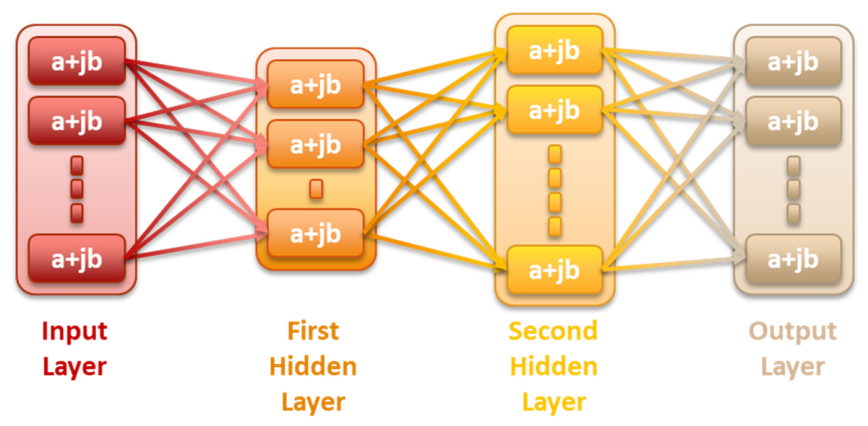
The architectural choice shown in
Figure 1 results in a compact yet expressive structure suitable for experimentation and follows an intentional design strategy:
The first hidden layer performs a compression of the input data, projecting the high-dimensional time series into a compact complex subspace; the second hidden layer expands this representation to reconstruct the temporal structure required for multi-day forecasting. This compression–expansion mechanism proved effective in extracting relevant patterns while keeping the overall complexity manageable.
2.2. Evaluated Data Processing
During the experimentation phase, several preprocessing strategies were assessed to determine their influence on the performance and stability of the MLMVN. Domestic load data are inherently noisy, highly irregular, and strongly influenced by daily and weekly periodicities. For this reason, preprocessing plays a critical role in shaping the input representation before it is passed to MLMVN.
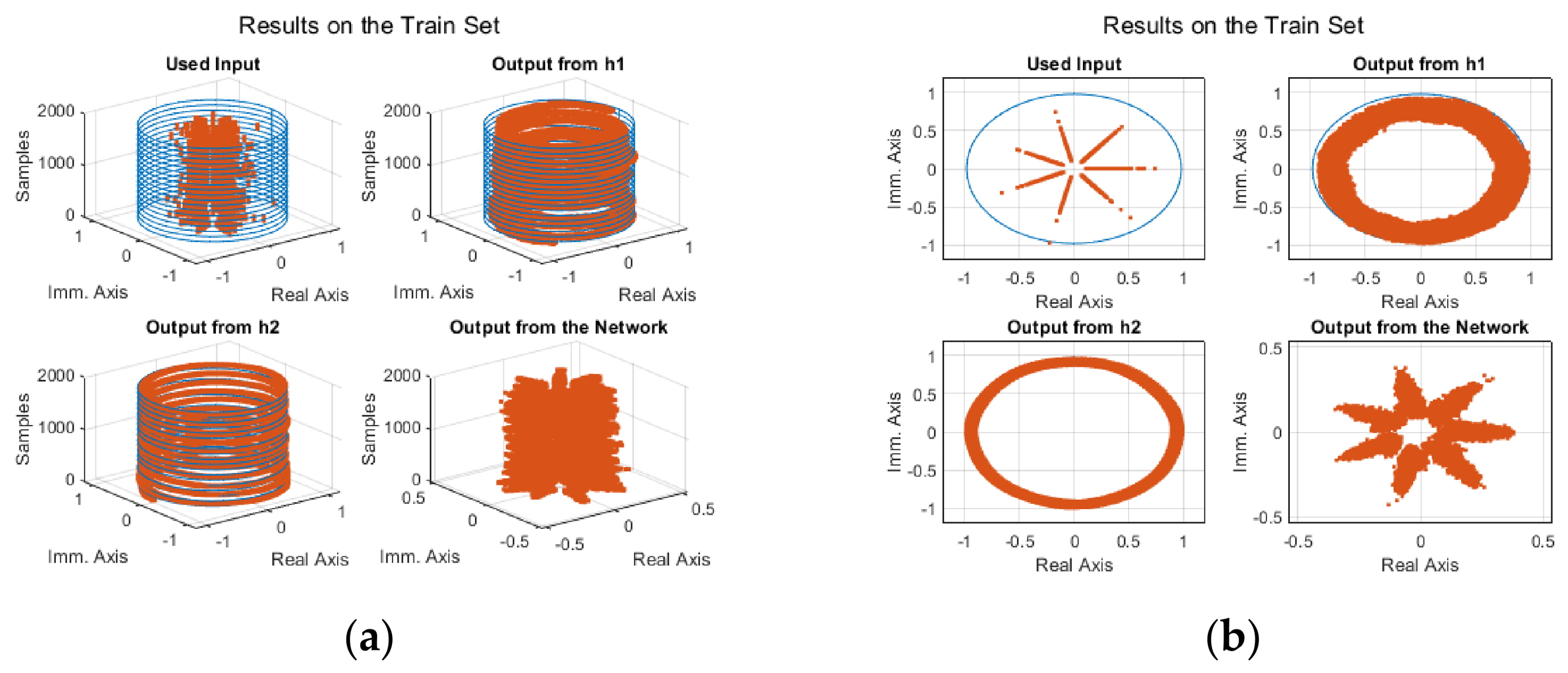
The following subsections describe the different strategies explored, each designed to enhance the compatibility of the data with complex-domain operations and to facilitate the learning dynamics of the network. A notable advantage of a custom training code is the ability to visualize how information propagates through the layers of the MLMVN. Because the network operates in the complex domain, the transformations applied to the samples can be observed as rotations, distortions and twists within the complex plane.
This offers valuable insight into the internal behavior of the model, an uncommon but powerful feature in deep learning workflows. For every normalization approach considered, the evolution of the training sequences across the network layers will be shown. In the resulting plots, each “plane” corresponds to one sequence of the training set, enabling a direct visualization of how the MLMVN manipulates the data in the complex domain.
All the proposed methodologies implement a logarithmic normalization step. In this way we achieve a reduction in dynamics, given that electrical loads often have highly skewed distributions (daily/seasonal peaks vs. low nighttime values) and the logarithmic transform compresses large values and expands small ones. This prevents both the peaks from dominating the training and gradients from exploding or concentrating in a few regions; therefore, the problem becomes better conditioned for optimization.
Moreover, with the log transform, the network becomes more sensitive to relative (percentage) variations rather than absolute ones, linearizing the distribution.
2.2.1. Unit Circle Normalization
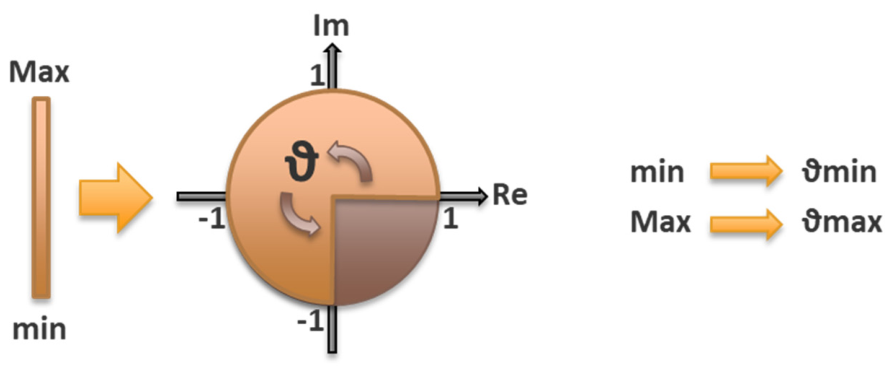
The first normalization strategy consists of encoding active power information into the phase of complex numbers. In
Figure 2, a graphical representation of this approach is shown.
The preprocessing pipeline involves:
Mapping the resulting values onto a sector of the unit circle, specifically within the interval radians. This angular interval was selected empirically to ensure a good balance between resolution and phase separability. Given and are respectively the maximum and minimum boundaries of the considered angular sector, and and are respectively the maximum and minimum values observable in the training set post-log normalization, the corresponding “unit circle” sequence is defined as shown in Equation (8).
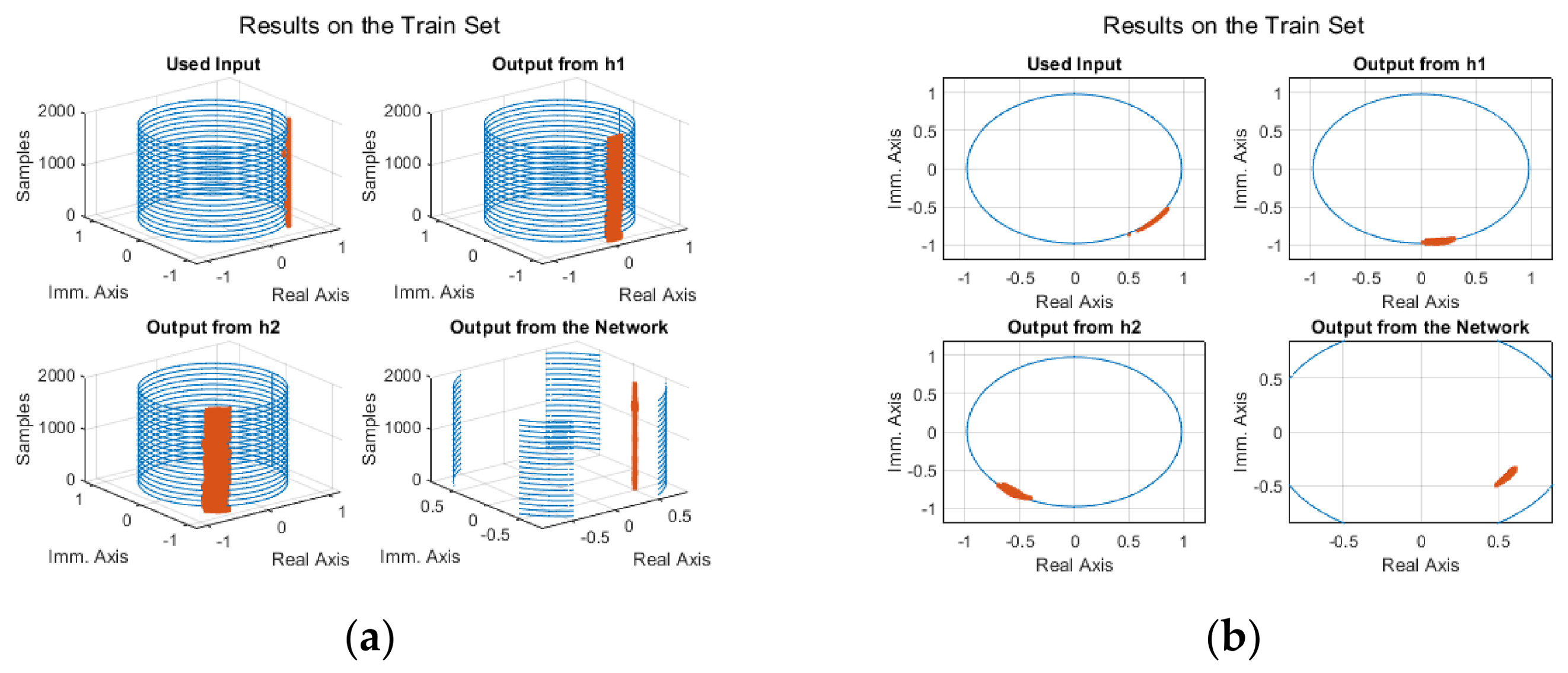
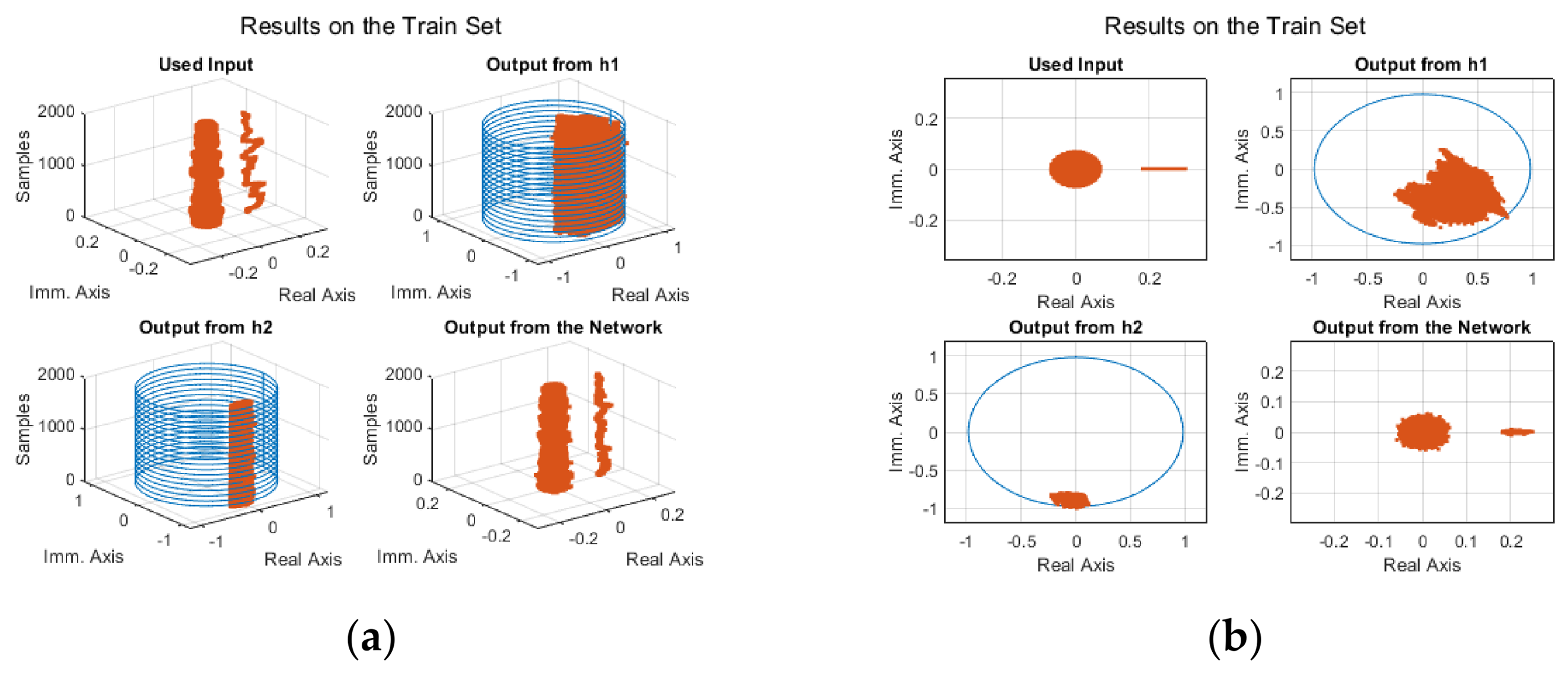
Figure 3 shows how the data are transformed by the network. In this case, the transformations experienced by the data as they propagate through the network layers are relatively simple. At a macroscopic level, the samples preserve their angular-sector shape after each layer and continue rotating along the unit circle.
Since in this normalization all information is encoded exclusively in the phase, the geometric evolution remains constrained to that sector. The output of the network eventually settles in the same angular region as the input, confirming that the MLMVN preserves and reshapes the phase structure.
2.2.2. Normalization via Fourier Transform
A second preprocessing approach consists of transforming the input time series using the fast Fourier transform (FFT). Working in the frequency domain naturally aligns with the mathematical structure of MLMVN, given its strong affinity with complex arithmetic and harmonic components.
The methodology is simple:
Apply the logarithmic compression;
Compute the FFT of the load profile;
Normalize the Fourier spectrum by its maximum magnitude;
Pass the resulting complex vector directly to the MLMVN.
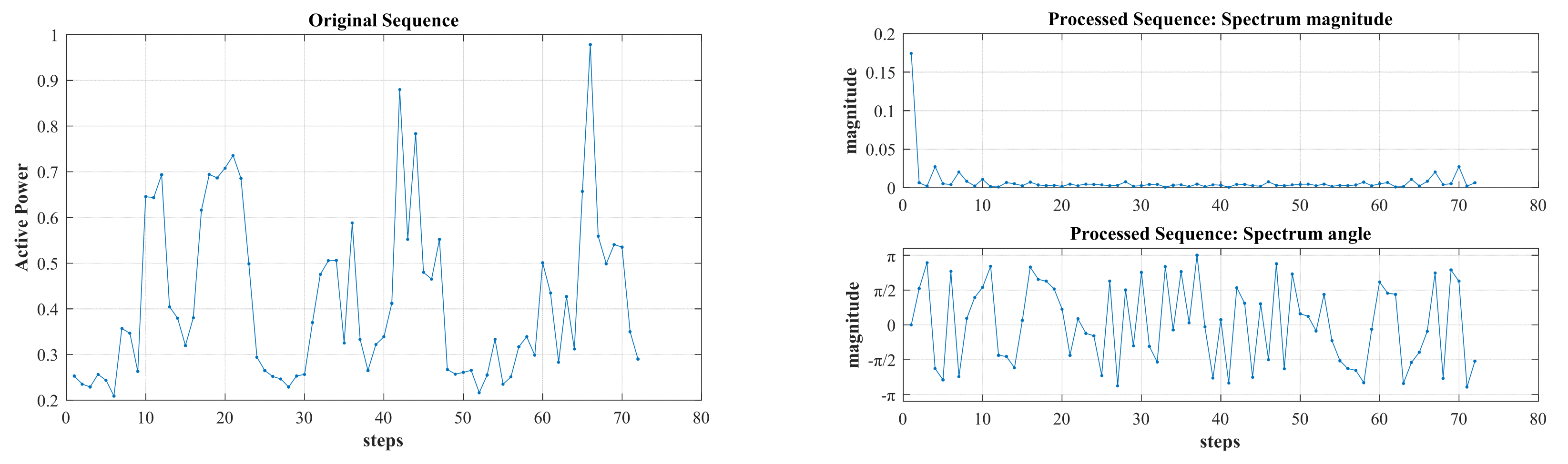
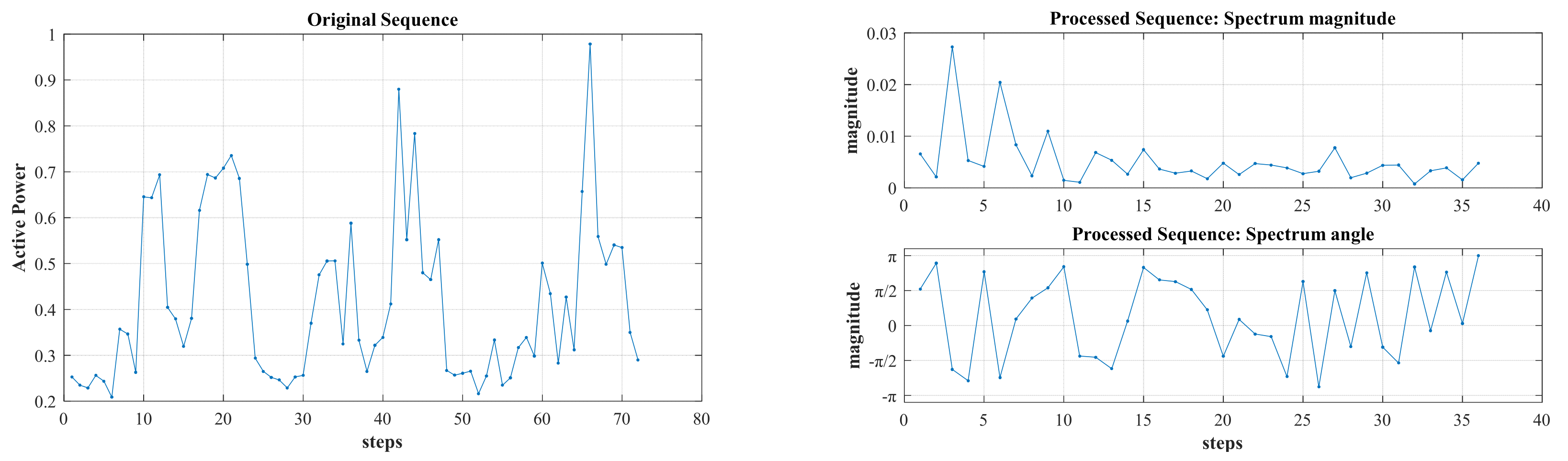
As the information is already expressed in amplitude and phase, the format is inherently compatible with complex-valued operations. In
Figure 4 an example of the effect of the use of such transformation on a time series sequence is shown.
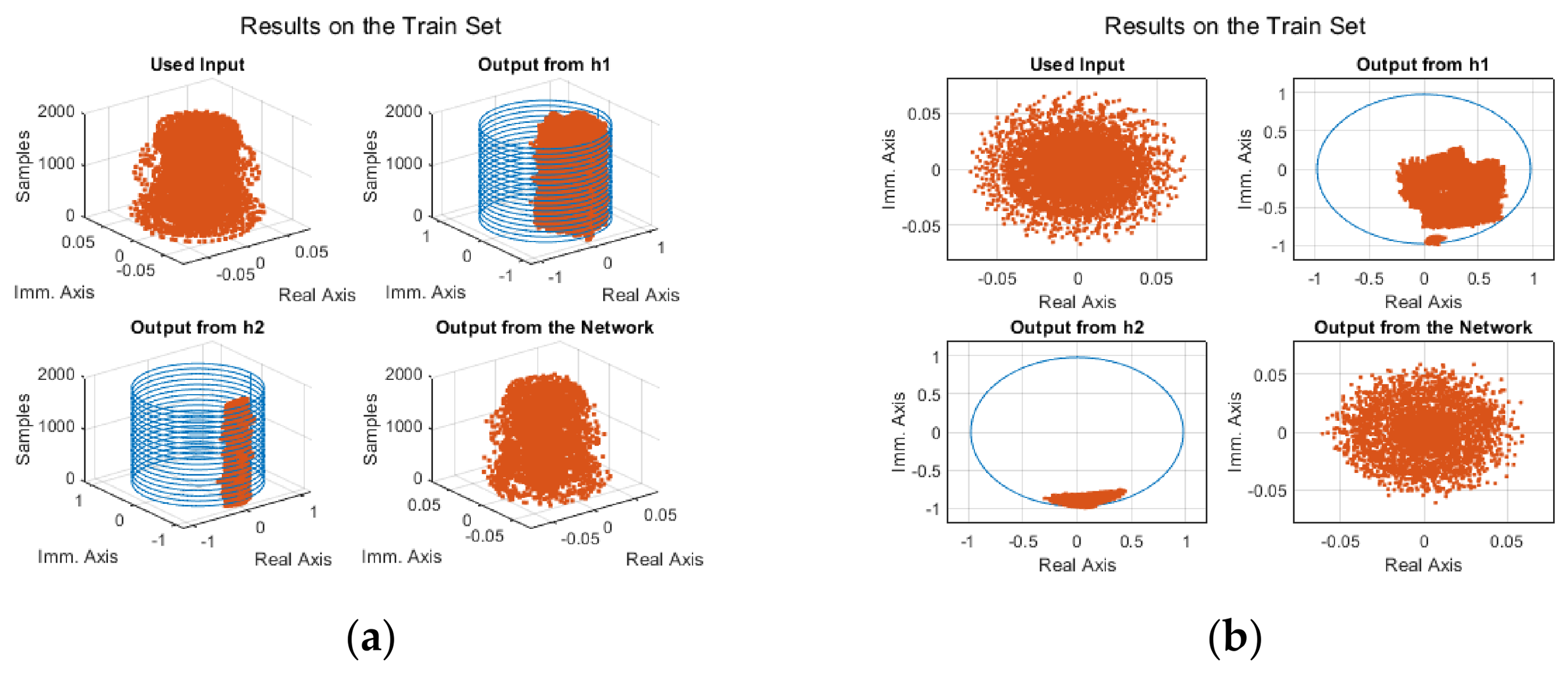
Figure 5 shows how, in this configuration, the geometric transformation applied by the network becomes more significant: the FFT spectrum initially appears as a “pillar” in the complex plane, then the activations collapse into a compact angular sector on the unit circle after both hidden layers, before expanding again toward the final output. This behavior reflects how the network contracts and reorganizes frequency components during processing.
2.2.3. Simplified FFT Normalization
A variation of the previous method exploits two well-known properties of the Fourier transform:
The DC component (“zero” frequency coefficient) can be removed and later reintroduced after prediction;
On real-valued time-domain signals, the Fourier spectrum exhibits conjugate symmetry, meaning that only half of the coefficients carry unique information.
Following these principles, this preprocessing approach follows these steps:
Logarithmic compression;
FFT computation;
Removal of the DC component from the input;
Retention of only half of the spectrum;
Re-mirroring and reinsertion of the DC term in post-processing to reconstruct the full signal.
This reduces the input dimensionality and computational burden while preserving all relevant frequency information.
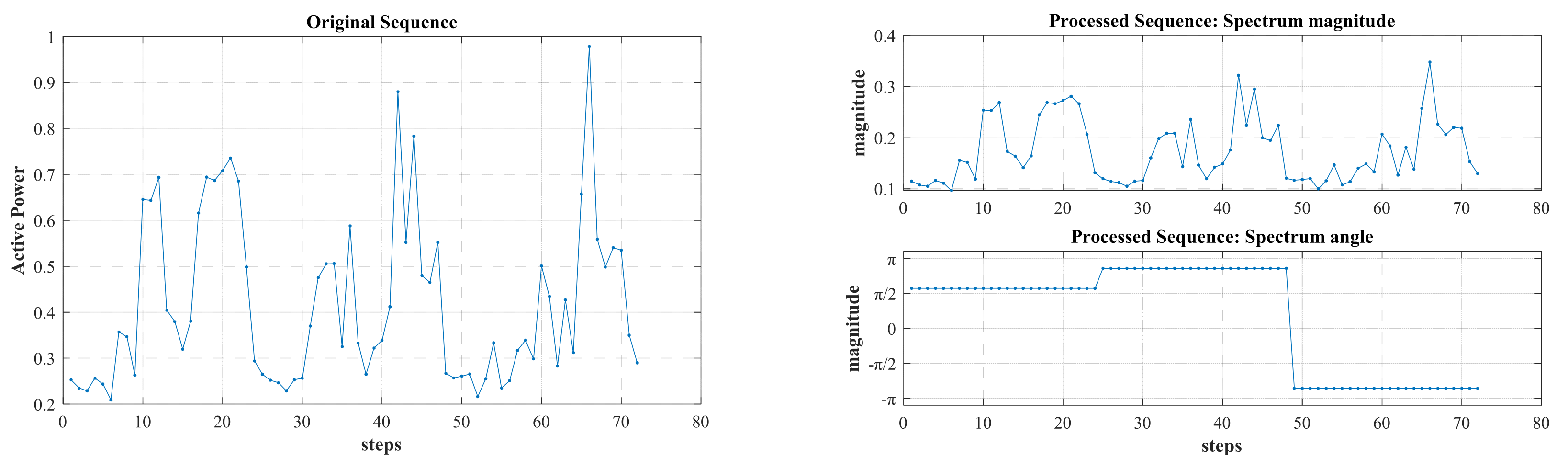
Figure 6 shows an example of the use of this third method of preprocessing on the input data.
Geometrically,
Figure 7 shows how the transformations across the MLMVN layers resemble those obtained in the full FFT method, though the points are less tightly concentrated around the unit circle due to the reduced spectral content.
2.2.4. Encoding the Day of the Week
To enrich the input and strengthen the representation of weekly seasonality, the day of the week was also integrated into the complex-valued input.
Complex numbers are naturally suited to encode two-dimensional information: one variable in the magnitude, the other in the phase.
The procedure is as follows:
The active power is mapped to the modulus of the complex number, using logarithmic compression to linearize its distribution;
The day of the week, encoded as an integer from 1 to 7, is mapped to the phase.
This angular encoding is particularly effective since the phase is a circular variable: the mapping covers the full
range, ensuring smooth transitions between adjacent days (e.g., from Sunday to Monday). In
Figure 8 an example of the form of the magnitude and phase of the complex-valued input sequence obtained by using this methodology is shown.
Figure 9 shows how, in this configuration, the input dataset takes a seven-point star shape when represented in three dimensions. After passing through the first and second layers, this structure is transformed into a spiral, reflecting how the MLMVN manipulates the phase–magnitude coordinates. At the output, the seven-point star re-emerges, demonstrating the network’s ability to reconstruct the encoded weekly periodicity.
2.3. Benchmark Definition
To properly evaluate the performance of the developed MLMVN architectures, two benchmark models were identified. The first model is a seasonal persistence predictor, selected as the baseline to surpass. The second model is a long short-term memory (LSTM) network, used as the gold standard to match or approach.
These two benchmarks were deliberately chosen to bracket the expected performance range for short-term load forecasting. The seasonal persistence predictor represents the minimum acceptable threshold: any viable forecasting method must outperform a naive, training-free reference. The LSTM, on the other hand, represents the current gold standard for sequence modeling, offering a well-established and competitive upper reference. Together, they provide a meaningful evaluation framework, allowing the proposed architectures to be assessed in terms of both practical utility and competitiveness with state-of-the-art approaches.
The seasonal persistence baseline was defined on a weekly horizon: the predictor assumes that the future load value at each time step is equal to the value observed exactly one week earlier. This choice reflects the strong weekly periodicity often present in residential consumption patterns and provides a simple, yet surprisingly competitive, reference point.
The LSTM network was designed to exploit both active power measurements and the day-of-week index, allowing the model to internalize weekly seasonality. The day-of-week variable was transformed using its sine and cosine components, producing a smooth circular encoding and avoiding discontinuities between consecutive days, for example from Sunday to Monday. The active power was logarithmically normalized, as done in the MLMVN configurations, to compress the dynamic range.
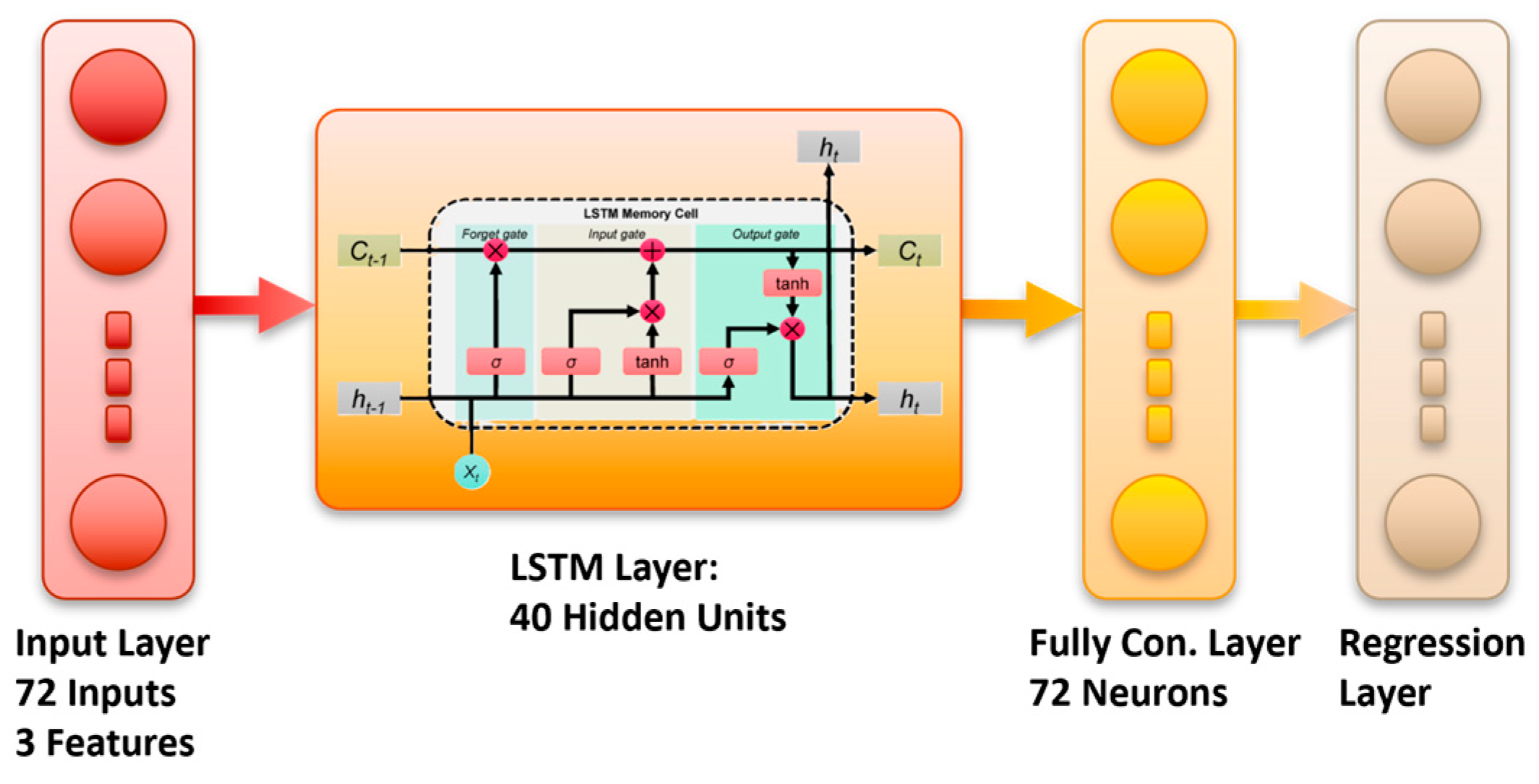
Figure 10 shows the four-layer LSTM architecture, implemented in MATLAB, used in this study. The number of hidden units in the LSTM layer was set to 40, following empirical tuning aimed at balancing representational capacity and training stability.
2.4. Comparison Metrics
Defining as the response of the network at an input sequence and as the expected ground truth, the performance of all predictors, the MLMVN variants, the LSTM model and the seasonal persistence, was evaluated on the test set of samples using two complementary metrics:
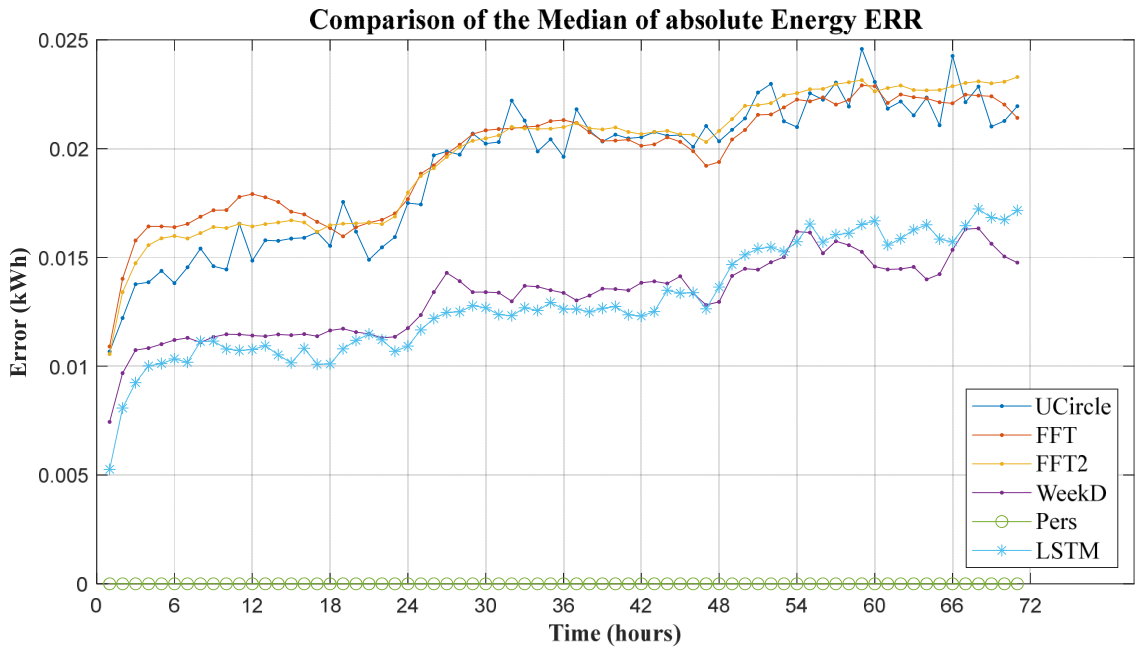
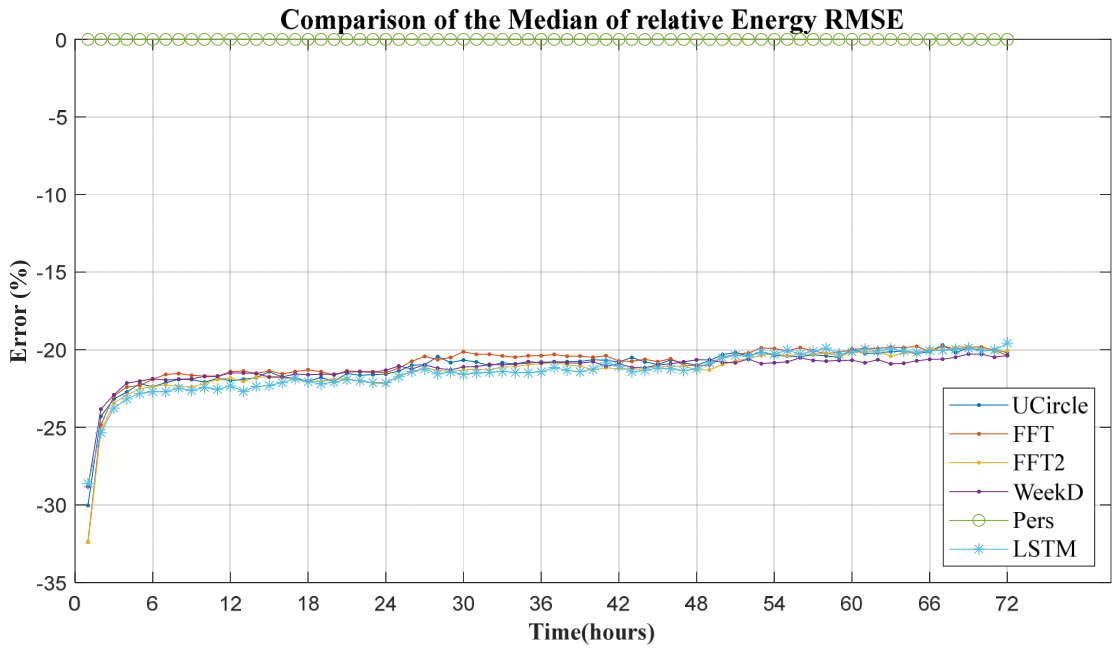
RMSE, which quantifies the magnitude of prediction error across the forecast horizon. The metric was evaluated for each step of the forecasting horizon, showing how the error varies while the predicted points get closer to the present. To do so, the following formulation was applied for each step of the sequence:
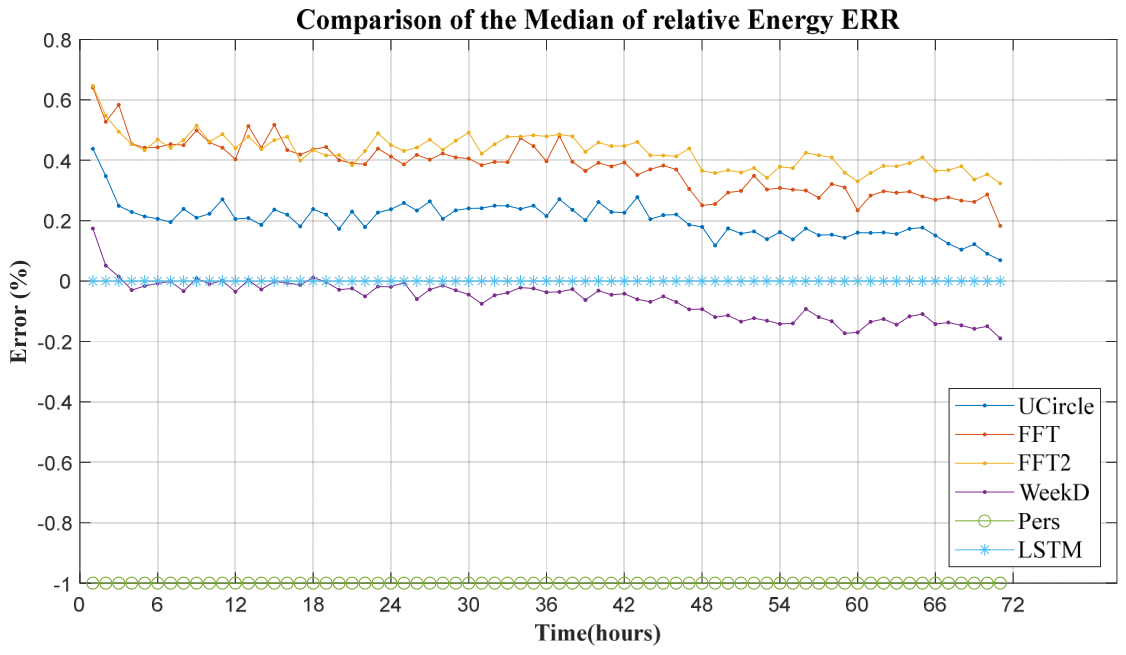
ERR (error reduction ratio), which evaluates the ability of the predictor to adapt its forecast trajectory as new data become available. denotes the number of steps between the moment the forecast was generated and the present time. To quantify how effectively the predictor reduces the absolute prediction error as the target samples in the sequence , forecast at a past step, become closer to the present, the following formulation is adopted to define the error reduction in (10) and then to define the metric in (11):
2.5. Dataset
The methodologies were evaluated on the historical load data of the Ausgrid dataset [
51]. This dataset collects load and production profiles of Australian prosumers with a time resolution of half an hour. From the available data, one full year was extracted and 127 profiles, those with the fewest missing values, were selected and then converted to an hourly resolution.
For each user, the time series was divided into monthly subsets of 30 days, corresponding to 720 h. The neural networks were trained using three adjacent months as the training set and the subsequent month as the test set. With the aim of exploiting information about the behavior of the previous three days to forecast the following 72 h, the dataset was organized into pairs of “past sequences” and corresponding “real future sequences”, each with a length of 72 time steps.
This entire procedure was repeated five times on different months for each user, resulting in a total of different evaluated scenarios, each composed of 720 distinct input–output sequence pairs.
3. Results
3.1. Training Description and Tuning of the Hyperparameters
The software simulator is designed in MATLAB (2025b). The folder with all the material used is available on GitHub to allow the reproducibility of the experiments [
52]. Each layer employs a complex logarithmic-normalization activation function, applied to the modulus of the complex-valued signals flowing through the network. This choice stabilizes the magnitude of activations, mitigates gradient explosion, and preserves the phase information that is essential when operating in the complex domain. Such activation functions are commonly used in MLMVN because they balance non-linearity with the need to maintain meaningful geometric transformations in the complex plane.
Training is performed using supervised learning with early stopping based on a validation set. A fixed 5% portion of the training dataset is always held out and used as a validation set to determine convergence and prevent overfitting. Training is halted when the validation loss fails to improve for a predefined number of epochs, ensuring that the model does not over-adapt to noise.
This architecture, although relatively simple in terms of depth and parameter count, enables the exploration of the unique representational capabilities of complex-valued neural networks and sets the foundation for the more advanced experiments described in the following sections.
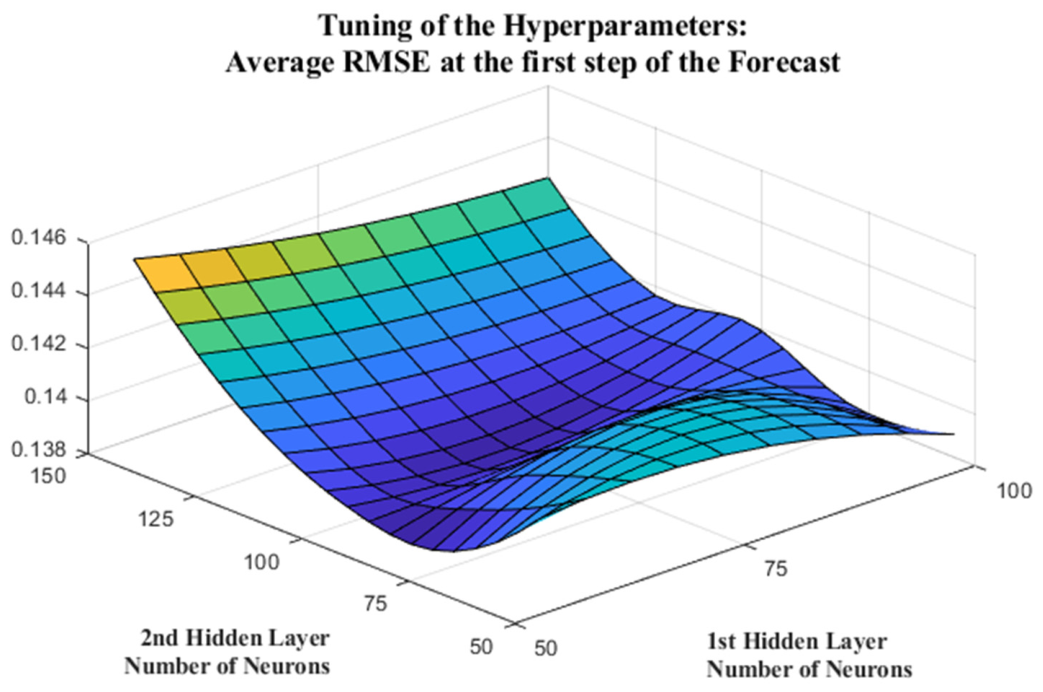
To tune the number of neurons in the two layers of the architecture, a small subset of the dataset was used to train and preliminarily evaluate the RMSE of the first step of the forecast horizon. Such a tuning map, shown in
Figure 11, has been drawn by repeating.
The training and the metric evaluation in multiple configurations, changing each time the number of neurons in the layers to cover as many cases as possible.
Note that each configuration of the network was tested for all the preprocessing methodologies, and the result is an average of all cases. The map presents a minimum, albeit not heavily defined, when the first hidden layer has 75 neurons and the second has 100 neurons, and this configuration was used for the rest of the tests.
3.2. Evaluation of the Metrics
To evaluate the performance of the proposed methods, all the methodologies previously discussed were implemented using the dataset sequences. To compare the performance of all the proposed MLMVN configurations against the two benchmark models, the metrics were evaluated over the entire length of the forecasted sequence for each of the different scenarios.
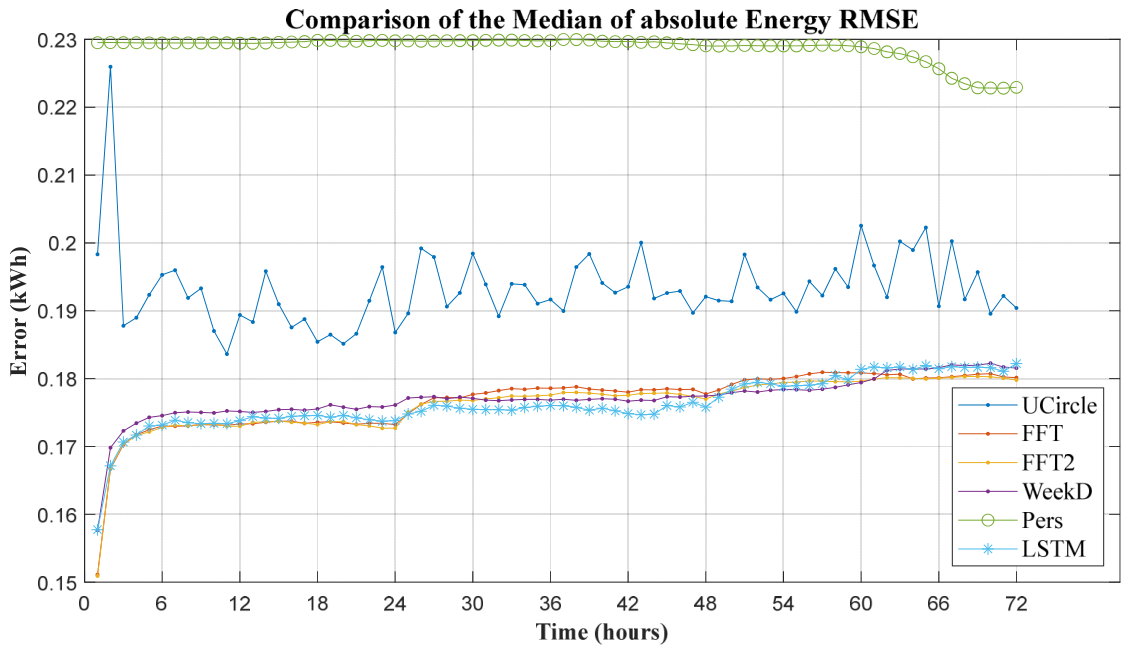
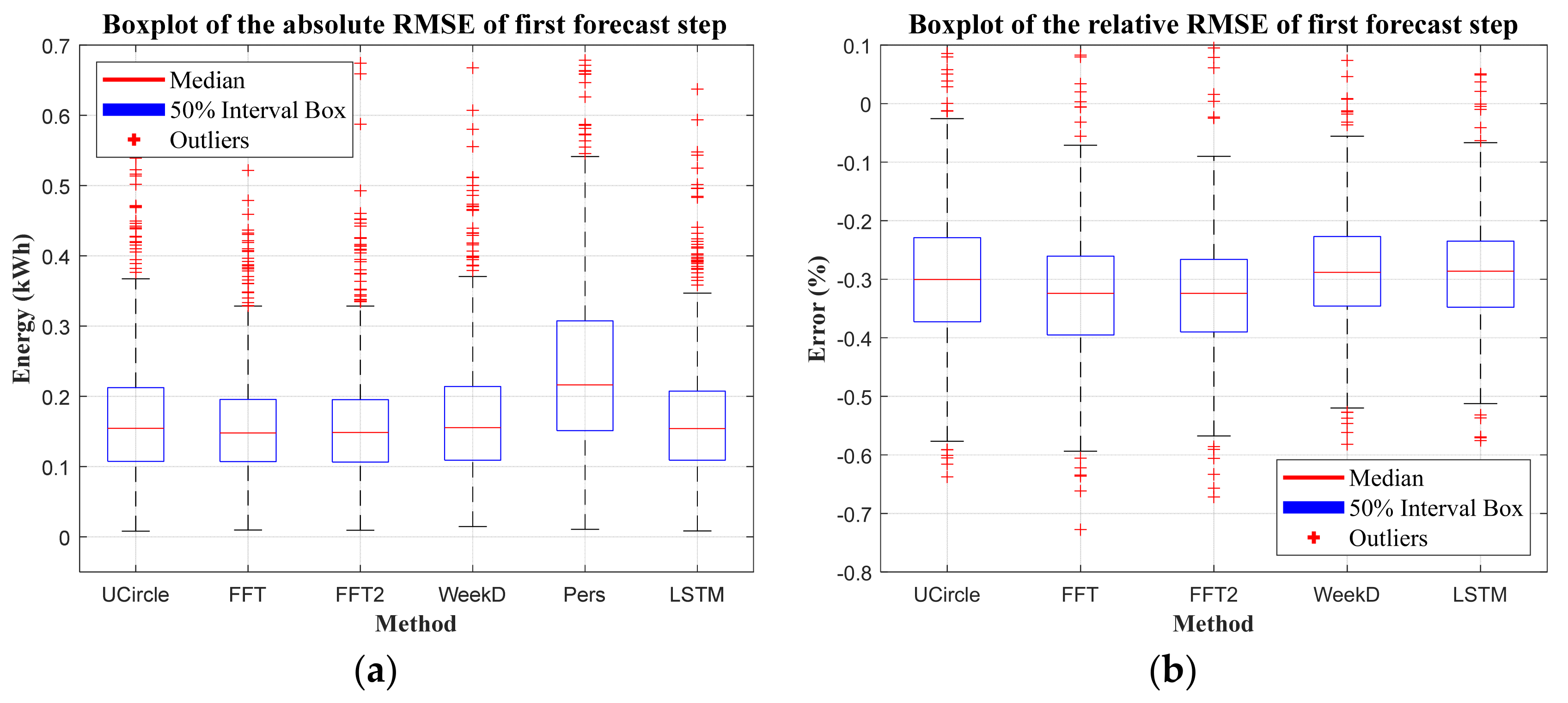
Some of the following figures, show a comparison of the metrics across the different methodologies. In these cases, the different approaches are referred to as: Normalization on the Unit Circle (UCircle), Normalization via Fourier Transform (FFT), Simplified FFT Normalization (FFT2), Day of the Week Encoding (WeekD), Persistency (Pers) and LSTM.
In
Figure 12 and
Figure 13, the metric results are presented as the median values computed over the full output sequence across all scenarios. The choice of reporting median errors rather than mean values is intended to reduce the influence of heavy-tailed error distributions and to highlight the typical model performance.
In
Table 1 and
Table 2, the same results are expressed in terms of distributions. The chi-square distribution was then used to estimate the boundaries of the confidence intervals. Here,
represents the observed value,
is the mean,
is the number of observations, and
denotes the degrees of freedom of the chi-square distribution. To remove outliers, the first and ninety-ninth percentiles of the resulting datasets were excluded for all methodologies and for all steps of the forecast horizon.
In this study, is chosen equal to 0.05, corresponding to a confidence interval of 95%.
The comparison based on absolute values is useful for assessing the actual magnitude of the metrics; however, when used alone, it may be misleading when comparing different methodologies. To ensure a fairer comparison with the benchmark, the results were normalized using the persistence model as a reference. For each methodology, the RMSE values were processed independently for each hour of the forecasting horizon according to (14):
Such relative results are expressed as percentage in
Figure 14 as median values, and in
Table 3 as distributions with a confidence interval of 95%.
In
Figure 15, the RMSE of the first step of the prediction error committed by each method is represented as a boxplot, showing it both in absolute and relative form.
Regarding the ERR, persistency is affected by a full incapacity for self-correcting, making it unsuitable as a reference for showing the results in relative form. For this reason, the LSTM has been used as the reference.
The results are presented once again as percentages, with the median values of the full horizon shown in
Figure 16 and the distribution shown in
Table 4.
4. Discussion
The overall results show that the methodologies based on the MLMVN achieve, for the considered case study, performance comparable to or even better than that of the LSTM, both in terms of RMSE and ERR, while relying on significantly simpler architectures. A lower RMSE indicates a smaller magnitude of the prediction error, whereas a higher ERR reflects a stronger ability of the network to correct its forecast trajectory as new data become available. These findings suggest that complex-valued representations may offer expressive modeling capabilities without the computational overhead typically associated with recurrent networks.
In particular, the results consistently highlight the promise of approaches based on the Fourier transform, which in some forecasting steps exhibit even lower RMSE values than the LSTM and a noticeably higher ERR. This indicates that such forecasting networks are expected not only to produce smaller errors overall, but also to show greater reactivity in correcting prediction mistakes.
While these results are encouraging, the proposed approach also presents limitations and open directions for future research. Further investigation is required to assess whether this behavior leads to tangible improvements in the complete control chain, and to validate the robustness and generality of these findings across different contexts.
Future work may proceed along three main directions.
First, a more detailed analysis of computational complexity and training time could provide additional insights into the scalability of the method, particularly in scenarios involving larger datasets or more complex architectures. Although training cost is not a critical factor in typical energy management workflows, where the time scale allows the models to be trained and updated almost offline, its systematic evaluation may become relevant in large-scale or adaptive frameworks.
Second, future research may explore the integration and direct comparison with more recent architectures, such as transformer-based and temporal convolutional network (TCN) models. However, such investigation should carefully account for deployment constraints, as these architectures often require higher computational and memory resources, which may limit their applicability in resource-constrained or edge environments.
Third, and most importantly, a key objective will be the integration of the proposed methods into a full closed-loop EMS control framework to evaluate their operative performance.
In conclusion, the proposed approach demonstrates promising performance within the considered application context, justifying further developments along the directions outlined above.