Fault Diagnosis Method for Asynchronous Motors Based on Incomplete Dataset


Abstract
1. Introduction
2. Materials and Methods
2.1. Principle of Partial Least Squares (PLS)
2.2. Principle of Kernel Partial Least Squares (KPLS)

| Detailed Calculation Steps for T and W |
|---|
| 1. Initialization: Set (), randomly initialize the weight vector , and set termination conditions . |
| 2. Iteration: |
| Calculate score vector ; |
| Calculate output weight vector ; |
| Update input weight vector ; |
| Loop until . |
| 3. Save and by using Equation (14). |
| 4. Update Matrices: |
| Update output data ; |
| Update kernel matrix ; |
| 5. Loop: Set , return to Step 2. When , stop iteration and output matrices and . |
3. Multi-Fidelity Modeling Method Based on PCA-KPLS
3.1. Principle of PCA-KPLS
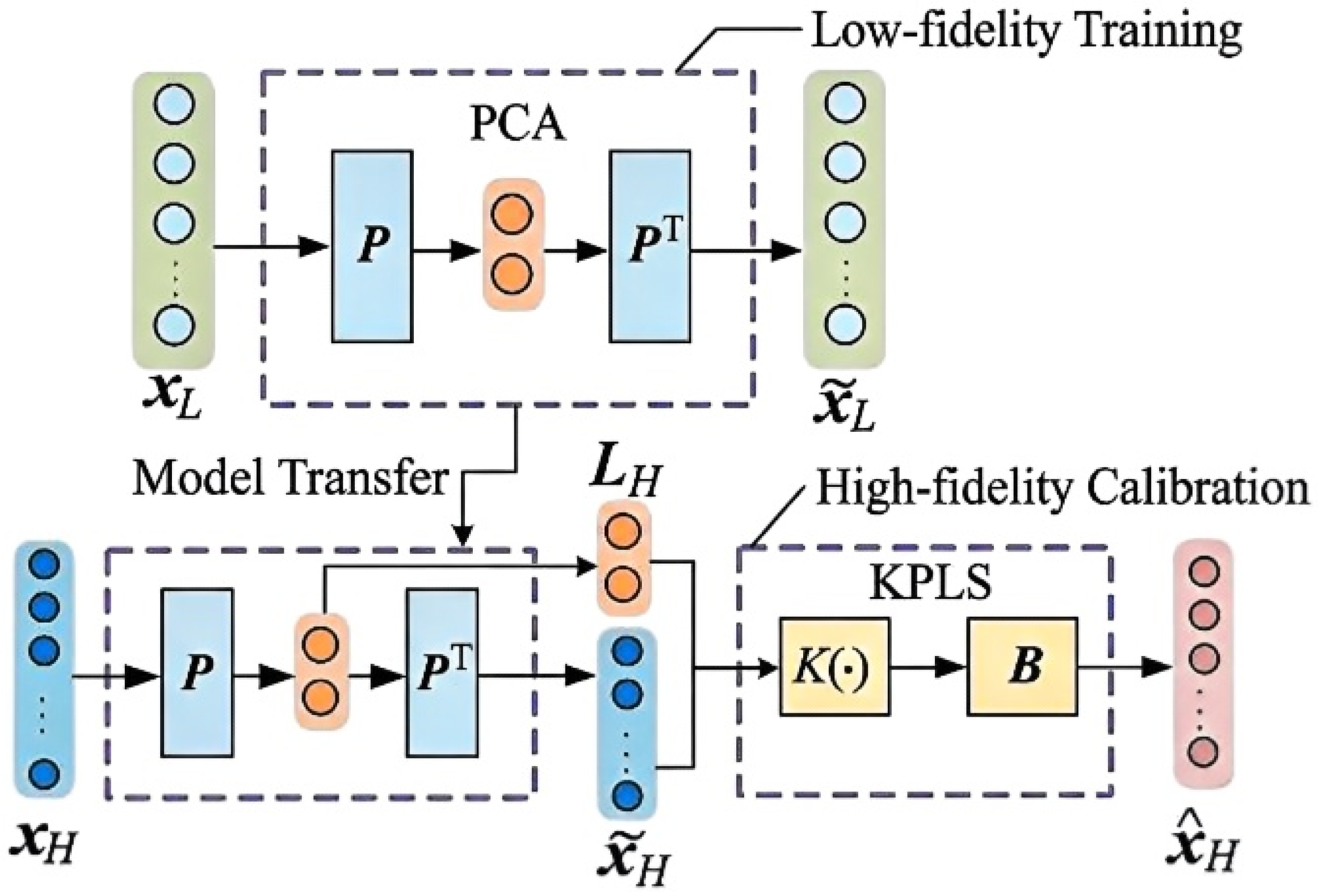
3.2. Structure of Multi-Fidelity Model Based on PCA-KPLS
| Steps for Multi-Fidelity Modeling Based on PCA-KPLS |
|---|
| 1. Input: |
| Normalized low-fidelity dataset and high-fidelity dataset . |
| 2. PCA Model Pre-training: |
| Train the PCA model using low-fidelity data and save the principal component space projection matrix . |
| 3. Data Preprocessing: |
| Select a portion of high-fidelity data as the training set, with the residual data forming the testing set . |
| Use projection matrix to perform the projection transformation (Equation (19)) on the data to obtain the final KPLS model training set . |
| 4. PCA-KPLS Modeling: |
| Use a linear kernel as the kernel function; optimize the latent variable count for the KPLS model via cross-validation. |
| Input the projected model training set into the KPLS model for training. |
| Save the trained KPLS model parameters. |
| Construct the multi-fidelity model using KPLS model parameters and projection matrix . |
| 5. PCA-KPLS Model Testing: |
| Input the test set into the multi-fidelity model to evaluate performance. |
4. Results and Analysis
4.1. Numerical Case Study
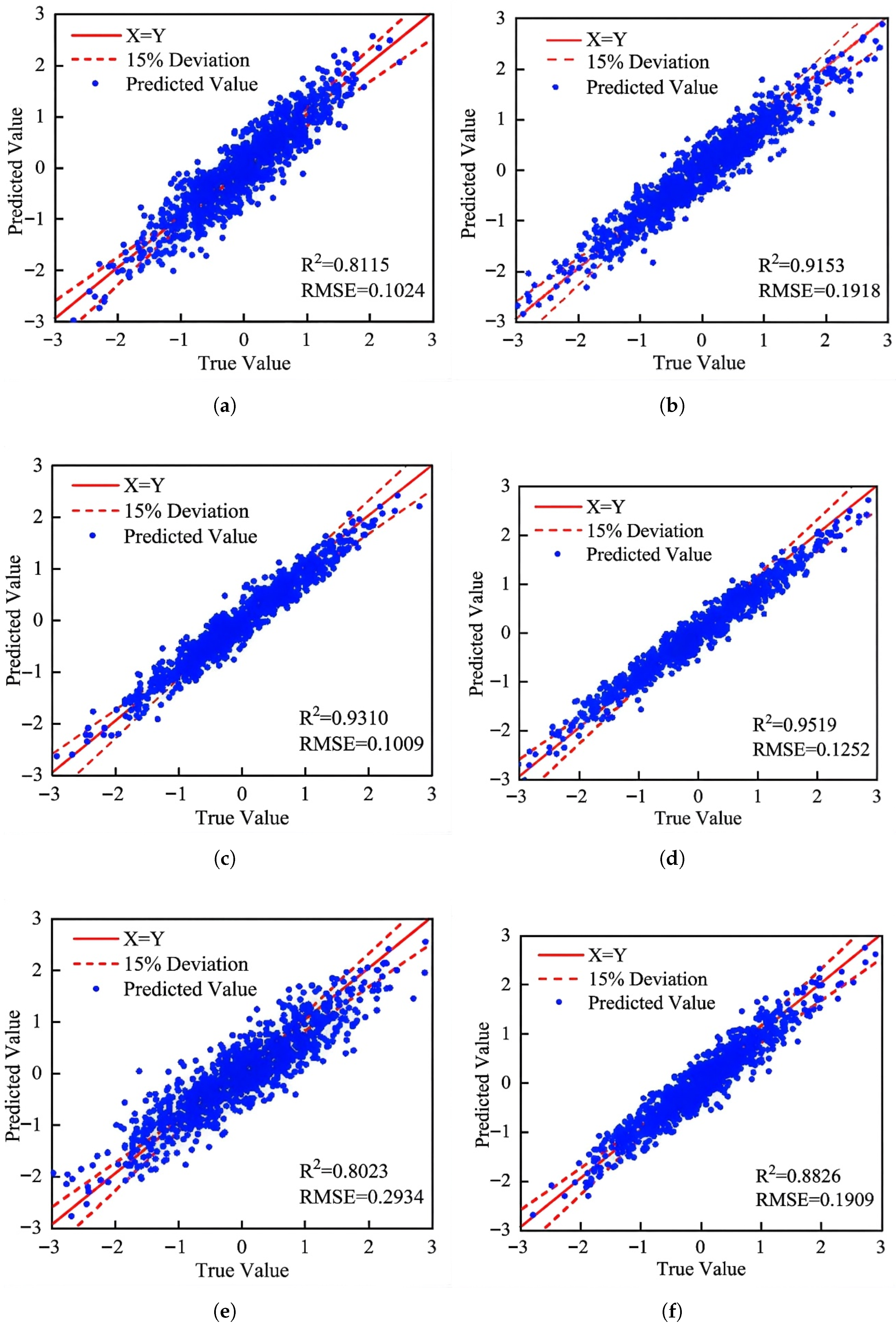
- Low-fidelity model: Constructed using low-fidelity data for the PCA model; high-fidelity data is used for testing.
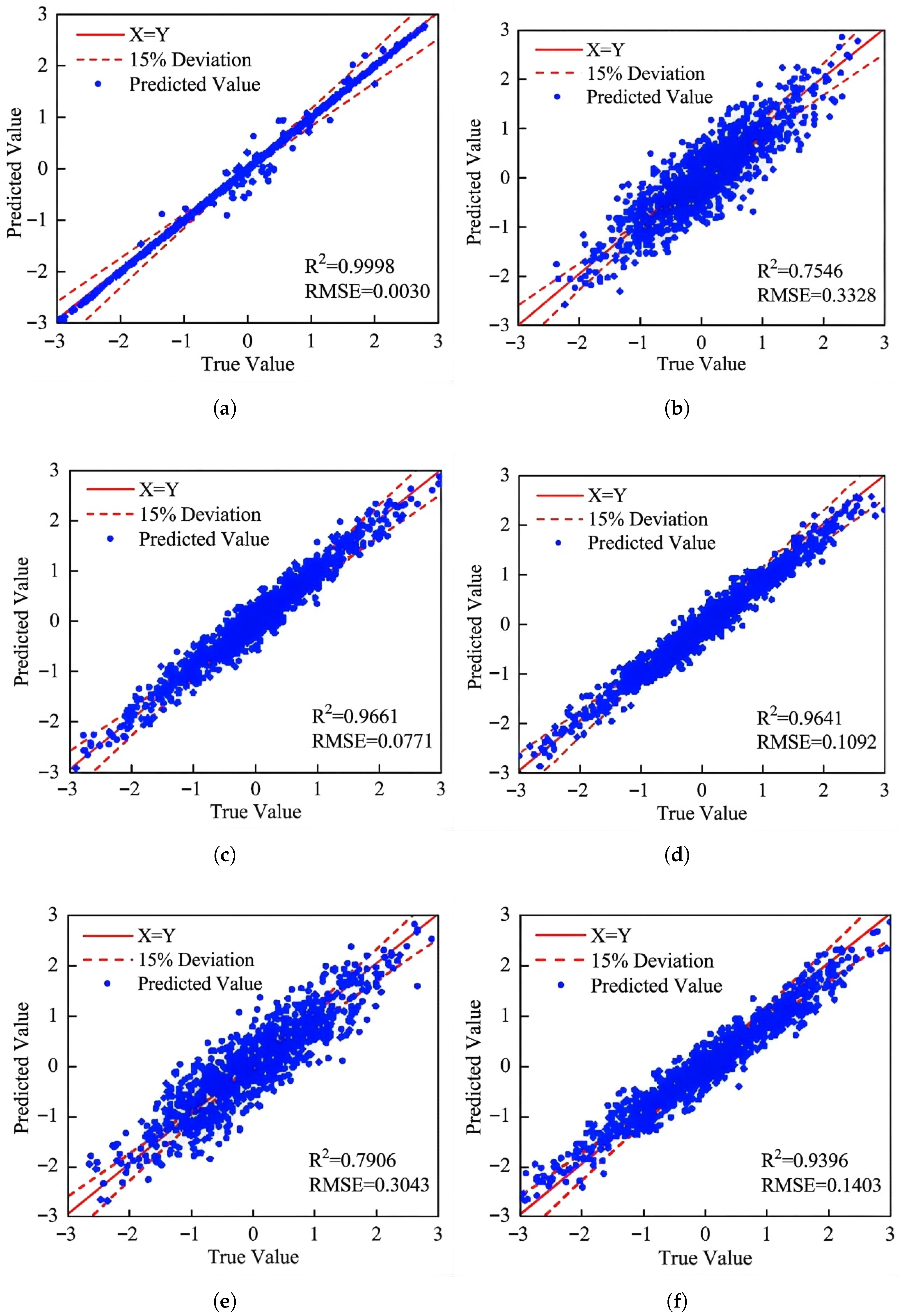
- High-fidelity model: 51 sets of data with parameters distributed within the interval are selected for PCA training, with the remaining portion of the high-fidelity data used for testing.
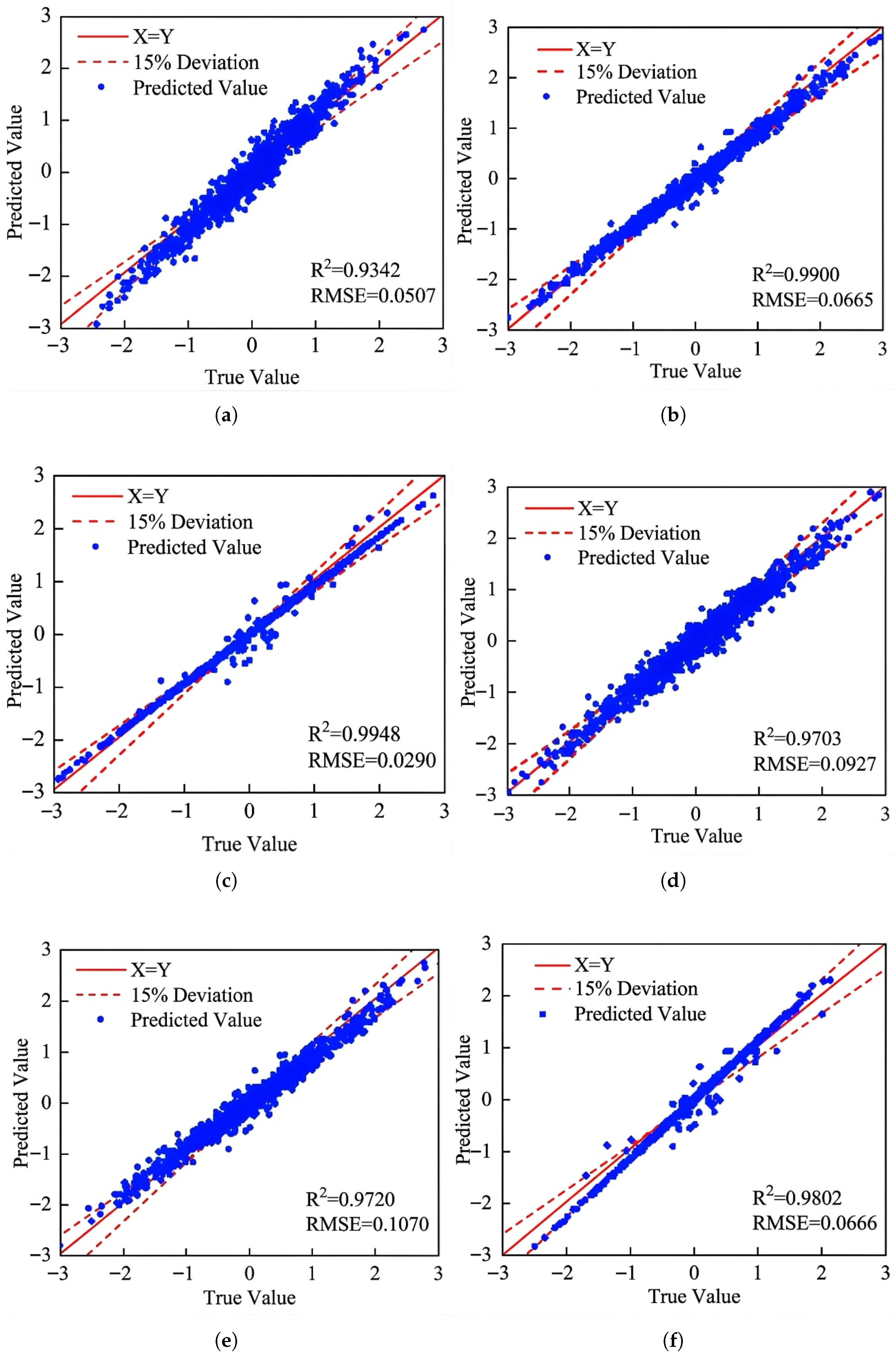
- Multi-fidelity model: Uses low-fidelity data to build the PCA model and the selected small sample set for KPLS training; tested on the remaining high-fidelity data.


4.2. Engineering Case Study
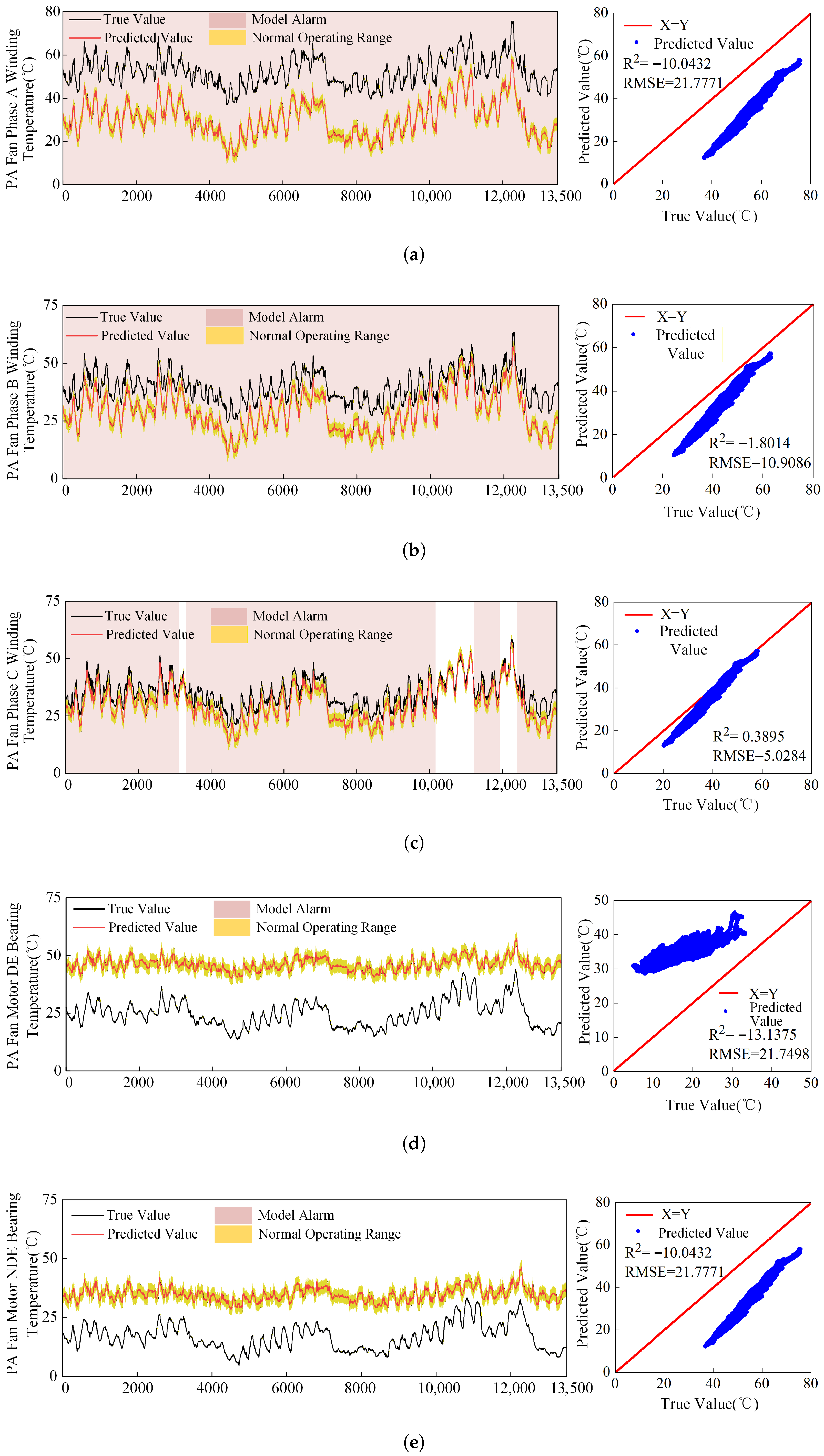
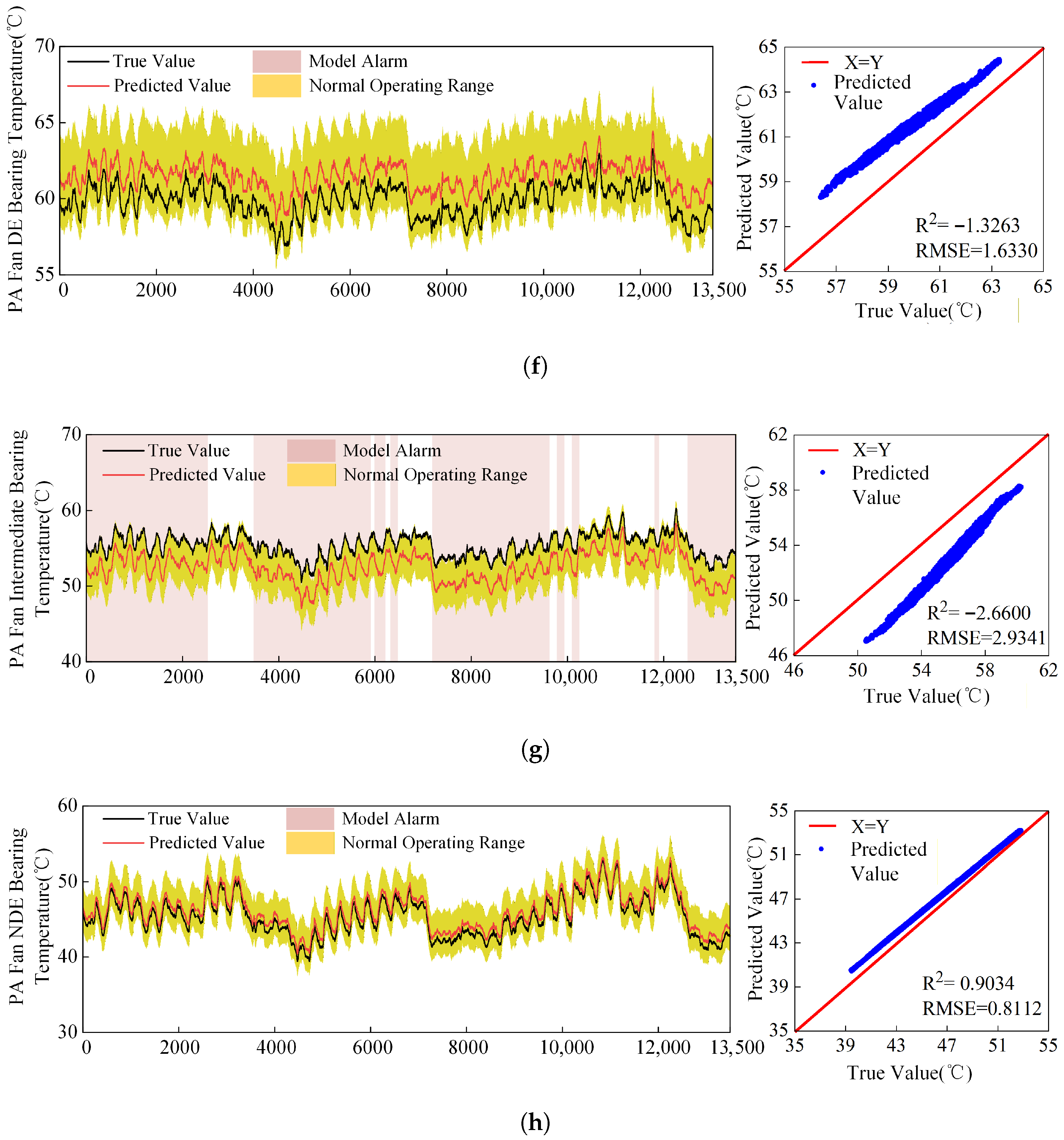
- Low-fidelity model: The complete dataset of the source domain primary air fan is utilized to train a PCA model, and the dataset is the test set to assess the predictive performance of the low-fidelity model.
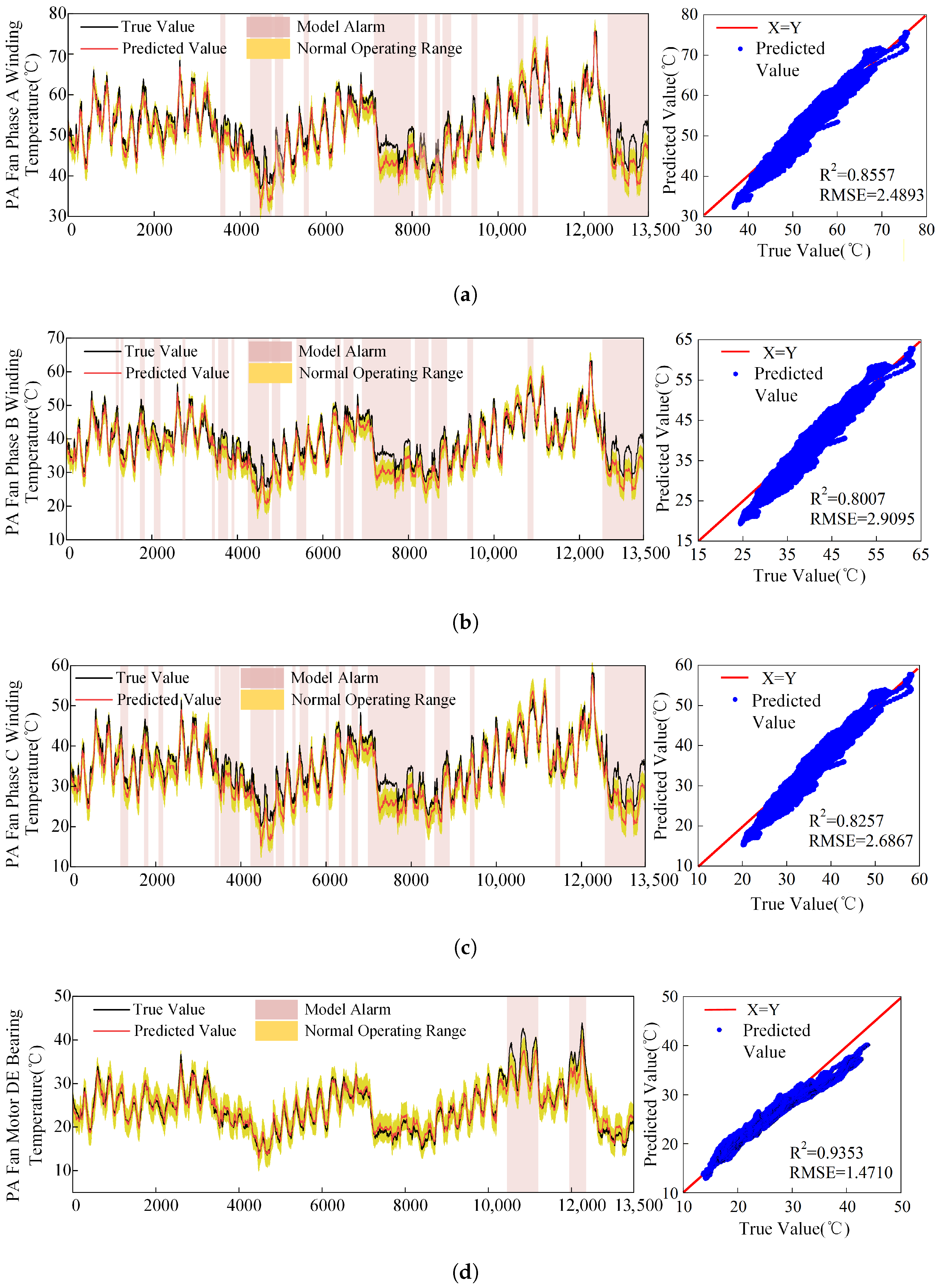
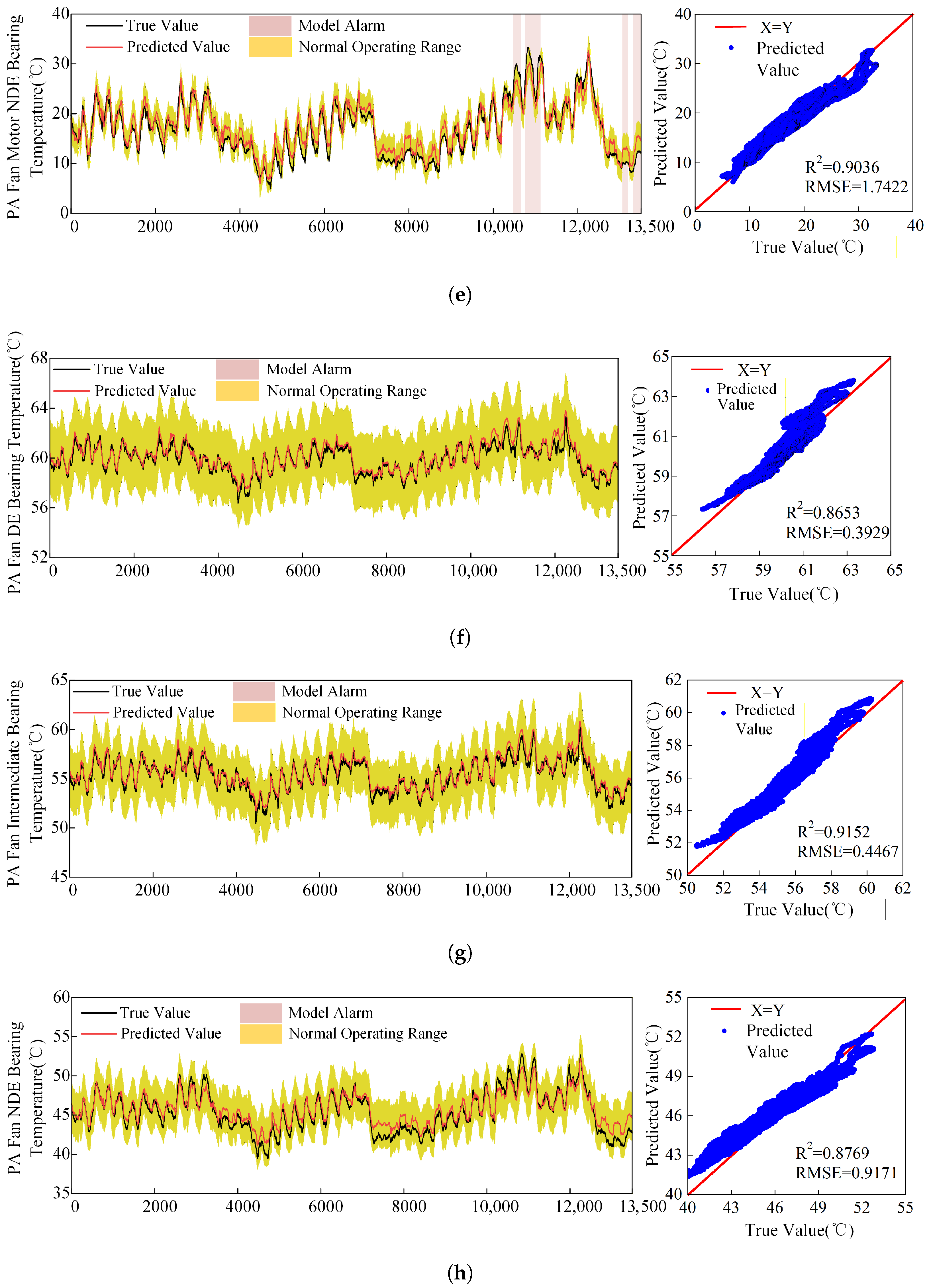
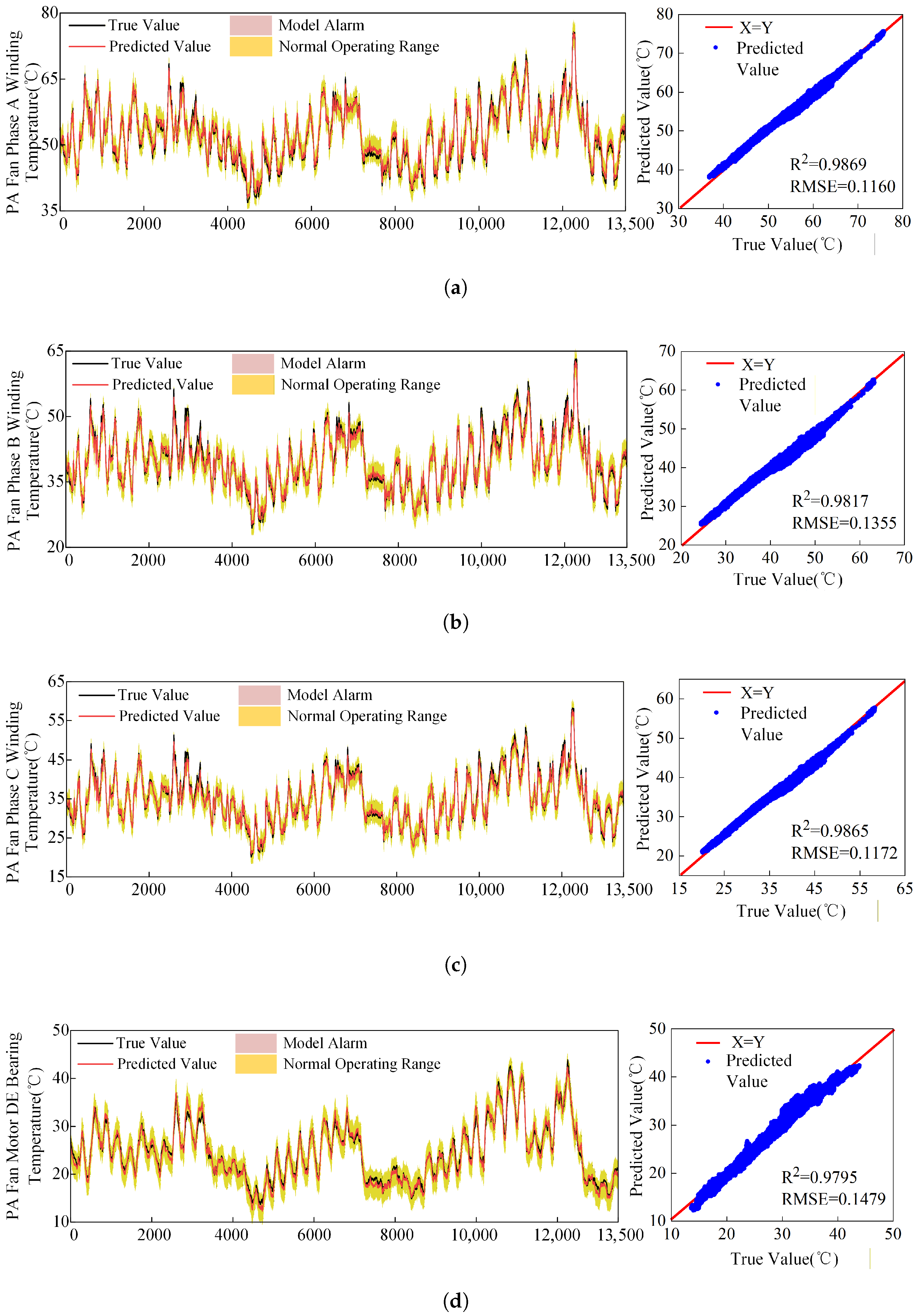
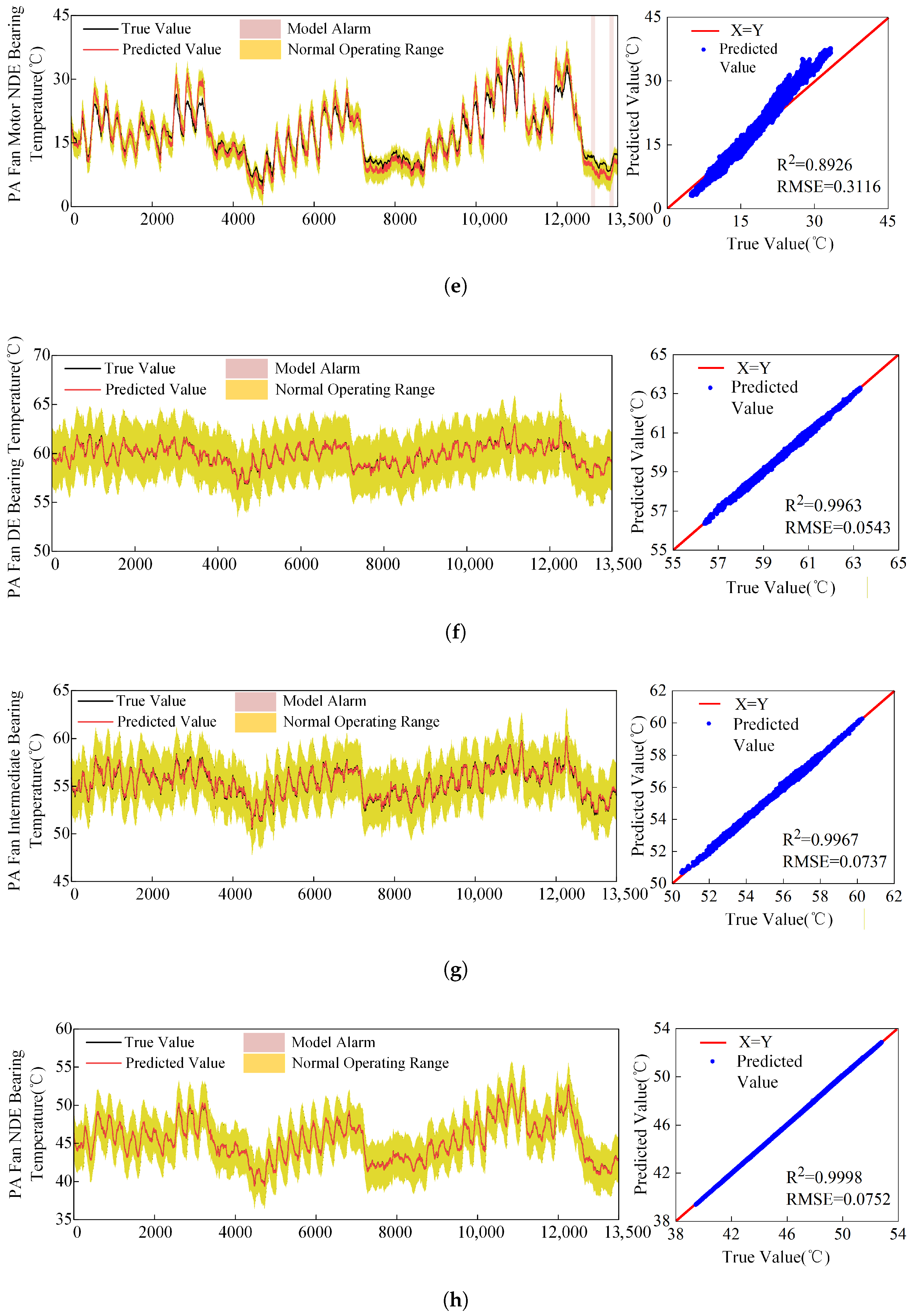
- High-fidelity model: The 120 sets of incomplete data from the target domain primary air fan are utilized to train a PCA model, and the dataset is used as the test set to evaluate the predictive performance of the high-fidelity model.
- Multi-fidelity model: A PCA model is first constructed based on the complete dataset of the source domain primary air fan; then, the training set is utilized to build a multi-fidelity model based on PCA-KPLS, and the dataset is used as the test set to evaluate its predictive performance.
5. Conclusions
Author Contributions
Funding
Data Availability Statement
Conflicts of Interest
References
- Zhen, J.; Wang, Y.; Li, S. Sustainable development through strategic retreat: Pathways for enhancing the efficiency of coal-fired power plant retirement. Energy 2026, 344, 140033. [Google Scholar] [CrossRef]
- Impram, S.; Nese, S.V.; Oral, B. Challenges of renewable energy penetration on power system flexibility: A survey. Energy Strategy Rev. 2020, 31, 100539. [Google Scholar] [CrossRef]
- Zhang, H.; Pang, Y.; Cui, H.; Li, J.; Wang, W.; Zhang, Z. Thermal economy analysis on deep peak regulation operation of supercritical 630 MW coal-fired unit. Front. Energy Res. 2025, 13, 1611001. [Google Scholar] [CrossRef]
- Susilo, S.D.; Tristanto, A.D.; Prasetya, W.; Ichwan, M.; Sihotang, F.; Intan, I.; Karnyoto, A. Redesigning the element profile of air preheater in coal-fired power plants for emission reduction and efficiency improvement. Int. J. Environ. Sustain. Soc. Sci. 2024, 5, 1082. [Google Scholar] [CrossRef]
- Yeh, J.-C.; Lee, Y.-C.; Huang, C.-H.; Li, M.-Y.; Wei, C.-C. Study of corrosion, power consumption, and wear characteristics of herringbone-grooved fan bearings in high-temperature and high-humidity environments. Lubricants 2025, 13, 245. [Google Scholar] [CrossRef]
- Lu, Y.; Yang, X.; E, L.; Fang, Z.; Li, Y.; Liang, C.; Shi, Z.; Wang, C. Characterizing a year-round particulate matter concentration and variation under different environmental controls in a naturally ventilated dairy barn. Agriculture 2023, 13, 902. [Google Scholar] [CrossRef]
- ElAraby, W.S.; Madian, A.H.; Saad, M.H. Fault diagnosis for rotating machinery based on deep learning. Noise Vib. Worldw. 2025, 56, 400–421. [Google Scholar] [CrossRef]
- Wang, R.; Zhan, X.; Bai, H.; Dong, E.; Cheng, Z.; Jia, X. A review of fault diagnosis methods for rotating machinery using infrared thermography. Micromachines 2022, 13, 1644. [Google Scholar] [CrossRef]
- de Souza, R.P.P.; Agulhari, C.M.; Goedtel, A.; Moriñigo-Sotelo, D.; Duque-Pérez, Ó.; Fernández-Cavero, V. Broken rotor bar fault detection—A virtual current approach combined with a robust linear parameter-varying observer. Control Eng. Pract. 2025, 156, 106233. [Google Scholar] [CrossRef]
- Sleiti, A.K.; Kapat, J.S.; Vesely, L. Digital twin in energy industry: Proposed robust digital twin for power plant and other complex capital-intensive large engineering systems. Energy Rep. 2022, 8, 3704–3726. [Google Scholar] [CrossRef]
- Ge, Z. Review on data-driven modeling and monitoring for plant-wide industrial processes. Chemom. Intell. Lab. Syst. 2017, 171, 16–25. [Google Scholar] [CrossRef]
- Mallick, M.R.; Imtiaz, S.A. A hybrid method for process fault detection and diagnosis. In Proceedings of the 10th IFAC International Symposium on Dynamics and Control of Process Systems, Mumbai, India, 18–20 December 2013; pp. 827–832. [Google Scholar] [CrossRef]
- Yoon, S.; MacGregor, J.F. Statistical and causal model-based approaches to fault detection and isolation. AIChE J. 2000, 46, 1813–1824. [Google Scholar] [CrossRef]
- Pani, A.K. Non-linear process monitoring using kernel principal component analysis: A review of the basic and modified techniques with industrial applications. Braz. J. Chem. Eng. 2022, 39, 327–344. [Google Scholar] [CrossRef]
- Said, M.; Taouali, O. Improved dynamic optimized kernel partial least squares for nonlinear process fault detection. Math. Probl. Eng. 2021, 2021, 6677944. [Google Scholar] [CrossRef]
- Widodo, A.; Yang, B.S. Support vector machine in machine condition monitoring and fault diagnosis. Mech. Syst. Signal Process. 2007, 21, 2560–2574. [Google Scholar] [CrossRef]
- Lei, Y.; Lin, J.; He, Z.; Zuo, M.J. A review on empirical mode decomposition in fault diagnosis of rotating machinery. Mech. Syst. Signal Process. 2013, 35, 108–126. [Google Scholar] [CrossRef]
- Lei, Y.; Yang, B.; Jiang, X.; Jia, F.; Nandi, A.K. Applications of machine learning to machine fault diagnosis: A review and roadmap. Mech. Syst. Signal Process. 2020, 138, 106587. [Google Scholar] [CrossRef]
- Bao, Z.; Liu, C.; Yang, H.; Zhang, J.; Li, Y. From theory to industry: A survey of deep learning-enabled bearing fault diagnosis in complex environments. Eng. Appl. Artif. Intell. 2026, 163, 113068. [Google Scholar] [CrossRef]
- Shao, H.; Jiang, H.; Zhao, H.; Wang, F. A novel deep autoencoder feature learning method for rotating machinery fault diagnosis. Mech. Syst. Signal Process. 2017, 95, 187–204. [Google Scholar] [CrossRef]
- Amjad, S.; Faraz, M.; Naqvi, S.Z.H. Fault diagnosis in rotating machines using vibration signal analysis and machine learning. In Proceedings of the 2024 19th International Conference on Emerging Technologies (ICET), Topi, Pakistan, 19–20 November 2024; pp. 1–6. [Google Scholar] [CrossRef]
- Khalil, A.F.; Rostam, S. Machine learning-based predictive maintenance for fault detection in rotating machinery: A case study. Eng. Technol. Appl. Sci. Res. 2024, 14, 13181–13189. [Google Scholar] [CrossRef]
- Zhao, J.; Wang, W.; Huang, J.; Ma, X. A comprehensive review of deep learning-based fault diagnosis approaches for rolling bearings: Advancements and challenges. AIP Adv. 2025, 15, 020702. [Google Scholar] [CrossRef]
- Zhu, Z.; Lei, Y.; Qi, G.; Chai, Y.; Mazur, N.; An, Y.; Huang, X. A review of the application of deep learning in intelligent fault diagnosis of rotating machinery. Measurement 2023, 206, 112346. [Google Scholar] [CrossRef]
- Wang, H.; Wang, H.; Tang, X. A review of deep learning in rotating machinery fault diagnosis and its prospects for port applications. Appl. Sci. 2025, 15, 11303. [Google Scholar] [CrossRef]
- Zhong, X.; Zhang, L.; Ban, H. Deep reinforcement learning for class imbalance fault diagnosis of equipment in nuclear power plants. Ann. Nucl. Energy 2023, 184, 109685. [Google Scholar] [CrossRef]
- Zhu, J.; Zhu, L. Fault diagnosis for imbalanced datasets based on deep convolution fuzzy system. Machines 2025, 13, 326. [Google Scholar] [CrossRef]
- Guo, C.; Potekhin, V.V. Generative adversarial network for classification of mechanical fault diagnosis model. Comput. Telecommun. Control 2025, 18, 30–43. [Google Scholar] [CrossRef]
- Liu, Q.; Ma, G.; Cheng, C. Data fusion generative adversarial network for multi-class imbalanced fault diagnosis of rotating machinery. IEEE Access 2020, 8, 70111–70124. [Google Scholar] [CrossRef]
- Mao, W.; Liu, Y.; Ding, L.; Li, Y. Imbalanced fault diagnosis of rolling bearing based on generative adversarial network: A comparative study. IEEE Access 2019, 7, 9515–9530. [Google Scholar] [CrossRef]
- Pan, S.J.; Yang, Q. A survey on transfer learning. IEEE Trans. Knowl. Data Eng. 2010, 22, 1345–1359. [Google Scholar] [CrossRef]
- Li, X.; Zhang, W.; Ding, Q. Cross-domain fault diagnosis of rolling element bearings using deep generative neural networks. IEEE Trans. Ind. Electron. 2019, 66, 5525–5534. [Google Scholar] [CrossRef]
- Huang, X.; Xie, T.; Zhou, Q. Digital twin-assisted bearing fault diagnosis using multi-fidelity incremental learning. In Proceedings of the 2024 10th International Conference on Control, Automation and Robotics (ICCAR), Singapore, 27–29 April 2024; pp. 184–190. [Google Scholar] [CrossRef]
- Gao, T.; Yang, J.; Tang, Q. A multi-source domain information fusion network for rotating machinery fault diagnosis under variable operating conditions. Inf. Fusion 2024, 106, 102278. [Google Scholar] [CrossRef]


| k-Fold Cross-Validation Steps |
|---|
| 1. Dataset Partitioning: |
| Randomly split the dataset into k subsets (folds). |
| 2. Cross-Validation Loop: |
| Set the number of latent variables from 1 to n. For each latent variable count a, perform complete k-fold cross-validation. |
| In each cross-validation, conduct k iterations, utilizing () segments for training while sequestering the remaining fold for testing. |
| In each test, calculate the model’s prediction error (usually Mean Squared Error, MSE). |
| 3. Determine Optimal Latent Variables: |
| For each latent variable count, record the average MSE of the k tests. |
| Select the latent variable count A with the minimum error as the optimal solution. |
| 4. Return: |
| Best latent variable count A. |
| Variables | Low-Fidelity Model | High-Fidelity Model | Multi-Fidelity Model | |||||
|---|---|---|---|---|---|---|---|---|
| RMSE | RMSE | RMSE | ||||||
| 1 | 0.8115 | 0.1024 | 0.9998 | 0.0030 | 0.9342 | 0.0507 | ||
| 2 | 0.9153 | 0.1918 | 0.7546 | 0.3328 | 0.9900 | 0.0665 | ||
| 3 | 0.9310 | 0.1009 | 0.9661 | 0.0771 | 0.9948 | 0.0290 | ||
| 4 | 0.9519 | 0.1252 | 0.9641 | 0.1092 | 0.9703 | 0.0927 | ||
| 5 | 0.8023 | 0.2934 | 0.7906 | 0.3043 | 0.9720 | 0.1070 | ||
| 6 | 0.8826 | 0.1909 | 0.9396 | 0.1403 | 0.9802 | 0.0666 | ||
| Variables | Low-Fidelity Model | High-Fidelity Model | Multi-Fidelity Model | |||||
|---|---|---|---|---|---|---|---|---|
| RMSE | RMSE | RMSE | ||||||
| A-phase Coil Temperature/°C | −10.0432 | 21.7771 | 0.8557 | 2.4893 | 0.9869 | 0.1160 | ||
| B-phase Coil Temperature/°C | −1.8014 | 10.9086 | 0.8007 | 2.9095 | 0.9817 | 0.1355 | ||
| C-phase Coil Temperature/°C | 0.3895 | 5.0284 | 0.8257 | 2.6867 | 0.9865 | 0.1172 | ||
| Motor Front Bearing Temperature/°C | −13.1375 | 21.7498 | 0.9353 | 1.4710 | 0.9795 | 0.1479 | ||
| Motor Rear Bearing Temperature/°C | −9.6912 | 21.7771 | 0.9036 | 1.7422 | 0.8926 | 0.3116 | ||
| Fan Front Bearing Temperature/°C | −1.3263 | 1.6330 | 0.8653 | 0.3929 | 0.9963 | 0.0543 | ||
| Fan Intermediate Bearing Temperature/°C | −2.6600 | 2.9341 | 0.9152 | 0.4467 | 0.9967 | 0.0737 | ||
| Fan Rear Bearing Temperature/°C | 0.9034 | 0.8112 | 0.8769 | 0.9171 | 0.9998 | 0.0752 | ||
Disclaimer/Publisher’s Note: The statements, opinions and data contained in all publications are solely those of the individual author(s) and contributor(s) and not of MDPI and/or the editor(s). MDPI and/or the editor(s) disclaim responsibility for any injury to people or property resulting from any ideas, methods, instructions or products referred to in the content. |
© 2026 by the authors. Licensee MDPI, Basel, Switzerland. This article is an open access article distributed under the terms and conditions of the Creative Commons Attribution (CC BY) license.
Share and Cite
Li, F.; Yang, S.; Ren, S.; An, N.; Li, X.; Si, F. Fault Diagnosis Method for Asynchronous Motors Based on Incomplete Dataset. Energies 2026, 19, 2176. https://doi.org/10.3390/en19092176
Li F, Yang S, Ren S, An N, Li X, Si F. Fault Diagnosis Method for Asynchronous Motors Based on Incomplete Dataset. Energies. 2026; 19(9):2176. https://doi.org/10.3390/en19092176
Chicago/Turabian StyleLi, Fei, Senquan Yang, Shaojun Ren, Nan An, Xi Li, and Fengqi Si. 2026. "Fault Diagnosis Method for Asynchronous Motors Based on Incomplete Dataset" Energies 19, no. 9: 2176. https://doi.org/10.3390/en19092176
APA StyleLi, F., Yang, S., Ren, S., An, N., Li, X., & Si, F. (2026). Fault Diagnosis Method for Asynchronous Motors Based on Incomplete Dataset. Energies, 19(9), 2176. https://doi.org/10.3390/en19092176