Article

Enhanced Gas Drainage via Gas Injection Displacement Based on Hydraulic Flushing: Numerical Simulation and Field Test

1
Research Institute of Macro-Safety Science, University of Science and Technology Beijing, Beijing 100083, China
2
School of Resources and Safety Engineering, University of Science and Technology Beijing, Beijing 100083, China
3
Institute of Mine Safety, North China Institute of Science and Technology, Langfang 065201, China
*
Author to whom correspondence should be addressed.
Energies 2026, 19(9), 2061; https://doi.org/10.3390/en19092061
Submission received: 29 March 2026 / Revised: 19 April 2026 / Accepted: 21 April 2026 / Published: 24 April 2026
(This article belongs to the Special Issue Petroleum and Natural Gas Engineering: 2nd Edition)

Abstract

Hydraulic flushing is an effective permeability enhancement technology for coal seams in underground coal mines and has been widely applied in several mining areas in China. However, in low-permeability coal seams, gas drainage from hydraulic flushing boreholes often enters a rapid depletion phase, and achieving secondary enhanced drainage remains a critical challenge. To address this issue, this study investigates a synergistic gas drainage technology that combines gas injection displacement with hydraulic flushing. Taking the No. 3 coal seam in the Lu’an mining area of China as the research object, the optimal process parameters of this synergistic technology are systematically determined through numerical simulation and validated by underground field tests. A fully coupled numerical model incorporating the adsorption–desorption–seepage processes of the CH4/N2/O2 ternary gas system is established. The influences of injection spacing and injection pressure on drainage performance are systematically analyzed. Simulation results identify the optimal process parameters as an injection spacing of 3.5 m and an injection pressure of 1.4 MPa. Under these conditions, the relative coal permeability reaches a maximum of 1.06, the permeability enhancement zone fully covers the region between the injection and drainage boreholes, and the coal seam gas content decreases to the critical threshold of 8 m3/t in approximately 235 days. The model is quantitatively validated using 82-day field monitoring data from the synergistic module, with a relative error of approximately 1.1% between the simulated and field-derived recovery ratios. Subsequently, four sets of underground engineering trials—conventional drainage, gas injection displacement alone, hydraulic flushing alone, and the synergistic technology—are conducted in the target coal seam based on the optimized parameters. Statistical analysis of the 82-day field data shows that the synergistic technology achieves a cumulative pure methane volume of 4.83 m3, outperforming conventional drainage by 85.8% (4.83 m3 compared with 2.60 m3), gas injection alone by 23.5% (4.83 m3 compared with 3.91 m3), and hydraulic flushing alone by 52.4% (4.83 m3 compared with 3.17 m3). The mean flow rate of the synergistic module during the injection phase reaches 0.070 ± 0.012 L/min, significantly higher than that of gas injection alone (0.044 ± 0.011 L/min). This study provides economically feasible theoretical and technical support for efficient gas drainage in low-permeability coal seams in underground mines.

1. Introduction

Coal seam gas (CH4) is not only the source of gas disasters during coal mining but also a clean unconventional natural gas resource with development value [1,2]. Pre-mining gas drainage is a core measure for preventing gas disasters and achieving synergistic resource development [3]. However, a large number of coal seams worldwide exhibit ultra-low permeability characteristics, with China being a typical example. Compared with Australia and the United States, the permeability of coal seams in China is generally three to four orders of magnitude lower, resulting in significant resistance to gas migration, excessively long drainage cycles, and low efficiency for conventional borehole drainage, making it difficult to meet the requirements for safe and efficient mine production [4]. To address this challenge, researchers have conducted a series of studies on pressure relief, permeability enhancement, and enhanced gas drainage in low-permeability coal seams [5], mainly including hydraulic measures (hydraulic fracturing, hydraulic slotting, hydraulic flushing) [6,7,8], blasting-induced fracturing and permeability enhancement technology [9], and gas injection displacement technology for enhanced gas drainage [10].
Among these, hydraulic flushing technology, owing to its mature process and significant local pressure relief and permeability enhancement effects, has been applied at scale in several mining areas in China [11]. Both theoretical research and field tests have confirmed that this technology can form a pressure-relief cavity by breaking the coal body with high-pressure water jets, alter the stress–seepage coupling state of the coal body, and effectively improve the stress state and permeability of the coal around the borehole [12,13]. Field monitoring has also verified the effective range of its pressure relief and permeability enhancement effects and its drainage performance [14,15]. Technological optimizations for complex geological conditions such as extra-thick coal seams have further expanded its application scenarios [16]. However, this technology still has inherent limitations: the permeability enhancement zone is mainly concentrated around the flushing cavity, making it difficult to achieve uniform permeability enhancement across the entire coal body between boreholes, and stress concentration tends to occur at the periphery of the pressure-relief zone, which may hinder gas migration.
Gas injection displacement technology, particularly nitrogen (N2) or carbon dioxide (CO2) injection for enhanced coalbed methane recovery (ECBM), originated in the 1990s. Pioneering field trials include the Allison Unit CO2-ECBM pilot in the San Juan Basin, USA (1995–2001) [17], the Fenn Big Valley CO2 and flue gas injection trial in Alberta, Canada [18], and N2 injection tests in the Bowen Basin, Australia [19]. Based on observations from these early field trials, subsequent mechanistic studies established the theoretical foundation of gas injection [20]. International research on ECBM has since expanded to encompass optimization of injection parameters, comparative evaluation of different injectants (N2, CO2, flue gas, and air), and assessment of technical and economic feasibility under diverse geological conditions [21,22,23]. Relevant studies indicate that this technology can establish a stable pressure gradient to drive gas migration, reduce the partial pressure of methane to promote efficient desorption of adsorbed gas, and alleviate the stress concentration induced by hydraulic flushing, further improving the permeability environment of the coal seam [24,25,26]. Numerous researchers have conducted a series of studies on enhanced gas drainage via gas injection displacement: Lin et al. [27] and Lyu et al. [28] confirmed the significant effect of nitrogen injection displacement in improving gas drainage in low-permeability coal seams through field tests; Fan et al. [29] and Gao et al. [30] conducted underground air injection studies and confirmed that air, owing to its convenient availability and significant drainage enhancement effect, has good potential for engineering application; the applicability of this technology in different scenarios such as mining-affected zones and excavation faces was also validated by Li et al. [31] through field tests; meanwhile, Lin et al. [32] conducted optimization studies on different injection modes such as continuous and intermittent gas injection. Lin et al. [33] systematically reviewed the development history and application prospects of underground gas injection displacement technology in China, further clarifying the engineering application value of the air medium. Existing studies have preliminarily confirmed the gas drainage enhancement potential of the synergistic technology combining hydraulic flushing and gas injection displacement [34], and have also formed a field comparison and evaluation system for different permeability enhancement technologies [35]. However, overall, the synergistic enhanced gas drainage technology combining hydraulic flushing and gas injection displacement still has the following deficiencies: first, existing studies have mostly focused on pure nitrogen, with limited systematic exploration of air, which offers better economic efficiency, and its timeliness in low-permeability coal seams remains unclear; second, the optimal matching parameters between hydraulic flushing and gas injection displacement have not yet been determined, making it impossible to provide quantitative guidance for field application; third, existing achievements are mostly concentrated at the numerical simulation level, with few reports on underground comparative tests of this synergistic technology, and its actual engineering feasibility and drainage enhancement effects still lack practical support.
Therefore, building upon our previous numerical feasibility study of this synergistic technology [25], in which the coupled model framework was established and the theoretical potential was demonstrated using N2 injection, this study extends that work by replacing N2 with compressed air and correspondingly extending the model to a CH4/N2/O2 ternary system, and takes the No. 3 coal seam in the Lu’an mining area as the research object to systematically investigate the key process parameters of the synergistic technology combining hydraulic flushing and gas injection displacement and to verify the actual engineering application effect of air as the displacement medium. The specific research contents of this paper include: (1) Establishing a numerical model that fully couples the adsorption–desorption–seepage processes of the CH4/N2/O2 ternary gas system, fully considering the effects of fluid–solid coupling in coal and matrix–fracture interaction on the dynamic evolution of permeability, systematically analyzing the influences of injection pressure and injection–drainage borehole spacing on the drainage performance of the synergistic technology, and determining the optimal combination of process parameters; (2) Based on the optimal parameters determined by numerical simulation, designing and conducting four sets of underground comparative tests under different working conditions in the target coal seam, and comprehensively evaluating the drainage enhancement effect of the synergistic technology by analyzing the variations in parameters such as gas concentration and drainage flow rate.

2. Numerical Simulation

2.1. Model Assumptions and Establishment

The Basic assumptions:
(1)
The coal body is regarded as an elastic porous continuous medium with single permeability and dual porosity;
(2)
The migration of ternary gases is an isothermal process, and the adsorption–desorption process conforms to the extended Langmuir equation;
(3)
The ternary gases follow the ideal gas law. Gas seepage in fractures follows Darcy’s law, and gas diffusion in the matrix pores follows Fick’s law;
(4)
The chemical reactions between CH4/N2/O2 and the coal body are neglected, the temperature variation in the coal seam is neglected, and the influence of the water phase is neglected. This simplification is justified by the low coal seam temperature (~20 °C), relatively high residual moisture content after hydraulic flushing, inherently low spontaneous combustion propensity of the No. 3 coal seam, and the limited time scale of this study (80–300 days).
Model establishment:
Considering the effective stress and swelling stress induced by adsorption, the Navier-type deformation governing equation for coal is as follows [36,37]:
G u i , k k + G 1 2 ν u k , ki α f P f , i α m P m , i K 1 λ ( 1 + L f / L m ) 3 ε s + f i = 0
where G is the shear modulus, with G = E/[2(1 + ν)]; ui and uj are the displacement components in the i and j directions, respectively; fi is the body force in the i direction.
The governing equation for gas transport in the coal matrix can be derived as [38,39]:
t [ ρ sgi ρ c V Li b Li p mgi 1 + i = 1 n b Li p mgi + ϕ m M gi RT p mgi ] = 1 τ i M gi RT ( p mgi p fgi )
where τi is the desorption time of component i; Mgi is the molar mass of component i; R is the universal gas constant; T is the coal seam temperature; pmgi is the partial pressure of component i in the coal matrix; pfgi is the partial pressure of component i in the fractures; ρsg is the gas density of component i; ρc is the density of coal.
The governing equation for gas transport in coal fractures is as follows:
p fgi ϕ f t + ϕ f p fgi t = 1 τ i ( p mgi p fgi ) ( k μ i ( p fgi + b k ) p fgi )
where μi is the gas viscosity coefficient of component 1, 2 and 3, respectively.
The coal seam can be regarded as a single-permeability dual-porosity medium composed of fractures, matrix bridges, and matrices with internal pores [26]. In addition, due to the inhibiting effect of matrix bridges, the matrix swelling strain induced by adsorption is constrained. Therefore, only part of the swelling strain can alter the fracture aperture, which dominates the coal permeability. The governing equation for coal permeability can be expressed as follows:
k = k 0 ( ϕ f ϕ f 0 ) 3 = k 0 { 1 + λ 3 ε s 1 ( 1 + ϕ f 0 / 3 ) Δ σ e 3 K f } 3
where Kf is the fracture bulk modulus; Δσe is the mean effective stress increment, which can be calculated by Equation [40]:
Δ σ e = 2 ( 1 λ ) 9 ( 1 + L f / L m ) 3 E 1 v ε s 1 + v 3 ( 1 v ) { α f ( p f i p f 0 ) + α m ( p m i p m i 0 ) }
where λ is the internal swelling volume coefficient; Lf is the initial fracture aperture, with Lf = 6k0f0; Lm is the initial matrix width, with Lm = 3Lf/ϕf0; k0 is the initial coal permeability; ϕf0 is the initial fracture porosity; E is the elastic modulus; Km is the bulk modulus of the coal matrix; Ks is the bulk modulus of the coal skeleton; ν is Poisson’s ratio; αf and αm are Biot coefficients, with αf = K/(1/Km − 1/Ks), αm = 1 − K/K; Km = Em/3(1 − 2ν), Ks = Em/[3(1 − 2ν) − 9ϕm(1 − ν)/2], K = E/[3(1 − 2ν)]; pfi0 and pmi0 are the initial total gas pressure in fractures and matrix, respectively.
The governing equation for coal matrix porosity is expressed as [41]:
ϕ m = ϕ m 0 exp { ( 1 ϕ m 0 ϕ m 0 ) ( ε s Δ σ e K m ) }
where ϕm0 is the initial matrix porosity.

2.2. Geological Conditions and Numerical Model

2.2.1. Geological Conditions

The Lu’an mining area is located in the central–southern section of the Qinshui Basin. The main mining seam, the No. 3 coal seam, is a single thick coal seam with an average thickness of approximately 6.0 m and a burial depth of 500–700 m. The coal seam gas content ranges from 5 to 18 m3/t, and the permeability coefficient ranges from 0.1460 to 1.0938 m2/(MPa2·d). The Lu’an mining area exhibits overall characteristics of high gas occurrence, with relatively high coal seam gas content. In the S6 floor drainage roadway of one mine in this area, the coal seam gas content is approximately 12 m3/t, the gas pressure is 0.5 MPa, and the measured permeability is approximately 0.0056 mD, classifying it as a typical low-permeability coal seam with difficult drainage.

2.2.2. Numerical Model and Operating Condition Design

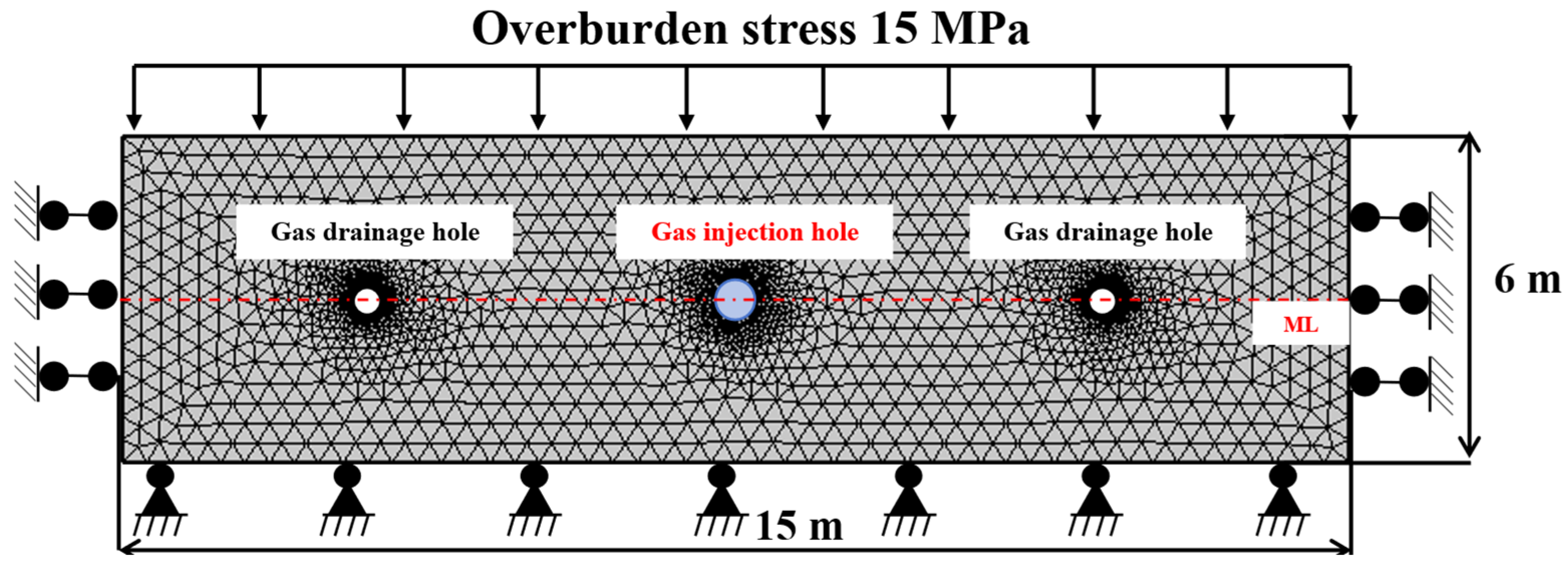
Numerical simulation was conducted using the Solid Mechanics module and the PDE Custom module in COMSOL (version 6.2) software to solve the system of partial differential equations. The established geometric model is shown in Figure 1. The model has dimensions of 15 m in length and 6 m in height. The upper boundary of the model is a stress boundary, with a vertical stress of 15 MPa applied (equivalent to a burial depth of approximately 600 m). The lower boundary is a fixed boundary, and the left and right boundaries are roller boundaries. The upper and lower boundaries of the coal seam are impermeable, i.e., zero flux boundaries. The initial relative gas pressure in the coal seam is 0.5 MPa, and the initial coal seam gas content is approximately 12.2 m3/t. The central borehole serves as the injection borehole, with a flushing radius of 0.2 m. The boreholes on both sides serve as drainage boreholes, with a borehole radius of 60 mm. A monitoring line (ML) was set in the middle of the model for variable detection. The relevant parameters used in the numerical simulation are listed in Table 1.
To investigate the effects of injection spacing and injection pressure on gas drainage enhancement performance, the simulation cases were designed as shown in Table 2: (1) With the injection pressure fixed at 1.0 MPa, the injection–drainage borehole spacing was set to 2.5 m (Case 1-1), 3.5 m (Case 1-2), and 4.5 m (Case 1-3). The optimal injection spacing (Si−d) was determined by comparing the distribution and evolution patterns of gas content. (2) Based on the optimal injection spacing (Si−d) determined above, the injection pressure (Pinj) was set to 0.6 MPa (Case 2-1), 1.0 MPa (Case 2-2), and 1.4 MPa (Case 2-3). The gas drainage performance under different pressures was further analyzed, and the optimal combination of parameters was ultimately determined.

2.3. Results Analysis

2.3.1. Optimal Gas Injection Spacing

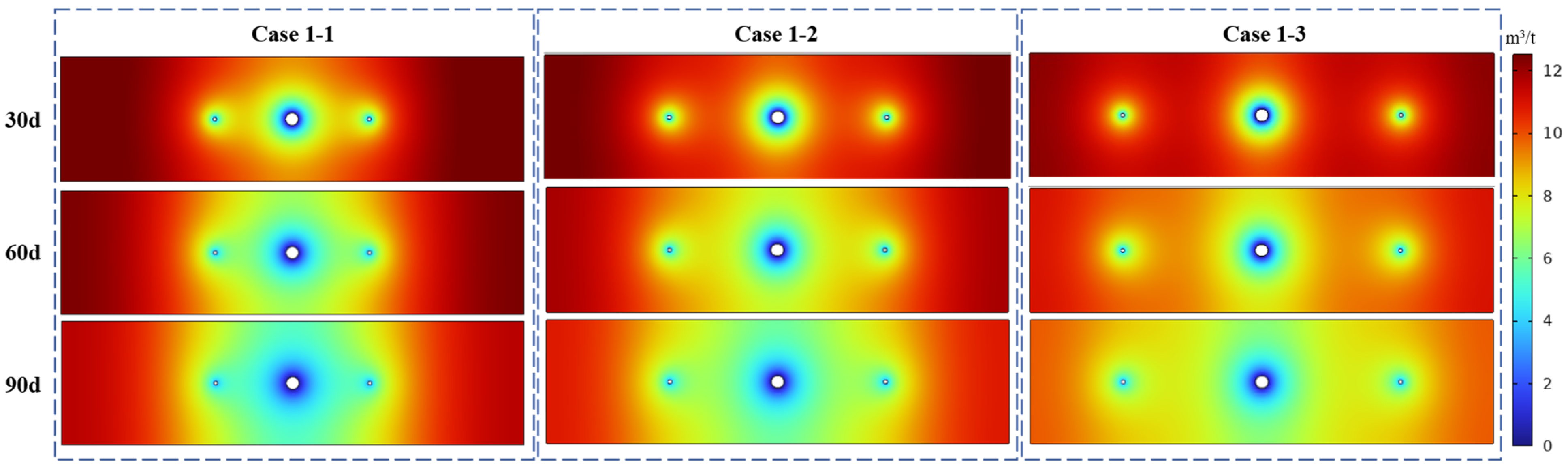
Figure 2 shows the distribution contours of coal seam gas content over time under different injection spacing cases. As can be seen from the figure, with the advancement of simulation time, the gas content around the injection borehole gradually decreases, and significant differences exist in the attenuation range of gas content under different injection spacing cases.
In Case 1-1, the spacing between the injection borehole and the drainage borehole is relatively small, resulting in a strong superposition effect of injection pressure and drainage performance. The gas content attenuation zone is concentrated in the narrow area between the two boreholes. At 30 d, a low-gas zone rapidly forms near the injection borehole due to the strong displacement effect. From 60 d to 90 d, the attenuation range of gas content shows almost no lateral expansion, and the gas content in areas far from the boreholes remains high, indicating that the displacement effect cannot radiate to coal seam areas distant from the boreholes. In Case 1-2, the gas content attenuation zone exhibits symmetrical and uniform expansion characteristics, and the attenuation range steadily expands over time. At 30 d, a distinct low-gas content zone forms around the injection borehole. From 60 d to 90 d, the displacement and drainage exhibit good synergy, continuously converging gas from distant areas toward the drainage borehole. In Case 1-3, due to the excessively large spacing, attenuation of injection pressure transmission occurs. Although the gas content attenuation zone is large, the attenuation rate is slow. The injection pressure slowly drives gas migration toward the drainage borehole, and a high-gas retention zone still exists between the injection borehole and the drainage borehole at 90 d.
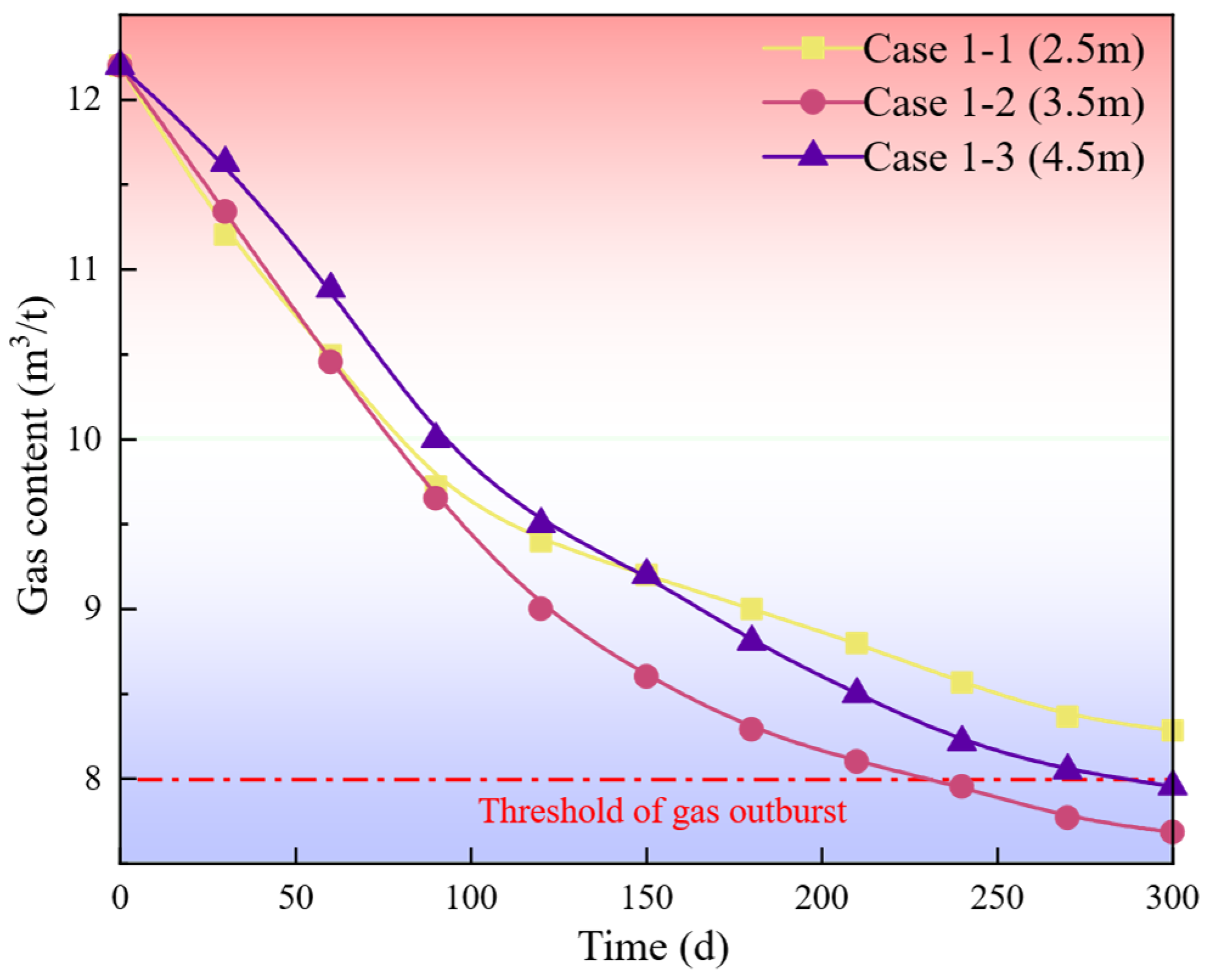
Figure 3 presents the evolution curves of average gas content in the coal seam over time under different injection spacings. The attenuation characteristics of gas content vary significantly with spacing. At 30 d, Case 1-1 (2.5 m) exhibits the optimal drainage performance due to the strong coupling between injection pressure and drainage negative pressure, with a gas content of 11.2 m3/t, lower than those of Case 1-2 (3.5 m, 11.3 m3/t) and Case 1-3 (4.5 m, 11.6 m3/t). At 60 d, the gas content in Case 1-1 and Case 1-2 approaches 10.5 m3/t, while Case 1-3 remains at 10.8 m3/t. At 90 d, Case 1-2 surpasses the others, with the gas content decreasing to 9.6 m3/t, outperforming Case 1-1 (9.7 m3/t) and Case 1-3 (10.0 m3/t). At this stage, Case 1-1 has reached a drainage bottleneck, as the displacement effect is confined to the vicinity of the boreholes. At 180 d, the gas content in Case 1-2 continues to decrease to 8.3 m3/t, while the reduction in Case 1-3 exceeds that in Case 1-1, with gas contents of 8.8 m3/t and 9.0 m3/t, respectively. At 300 d, the gas content in Case 1-2 decreases to 7.5 m3/t, falling below the critical value of 8 m3/t; Case 1-3 barely meets the standard (7.9 m3/t), while Case 1-1 fails to meet the standard (8.4 m3/t).
In summary, an injection spacing of 3.5 m is identified as the optimal spacing for ensuring drainage efficiency. This spacing avoids the excessive superposition of pressure fields associated with smaller spacings and overcomes the pressure attenuation effect associated with larger spacings, thereby establishing a stable displacement environment for efficient drainage. Subsequent optimization of injection pressure is conducted based on this spacing.

2.3.2. Optimal Gas Injection Pressure

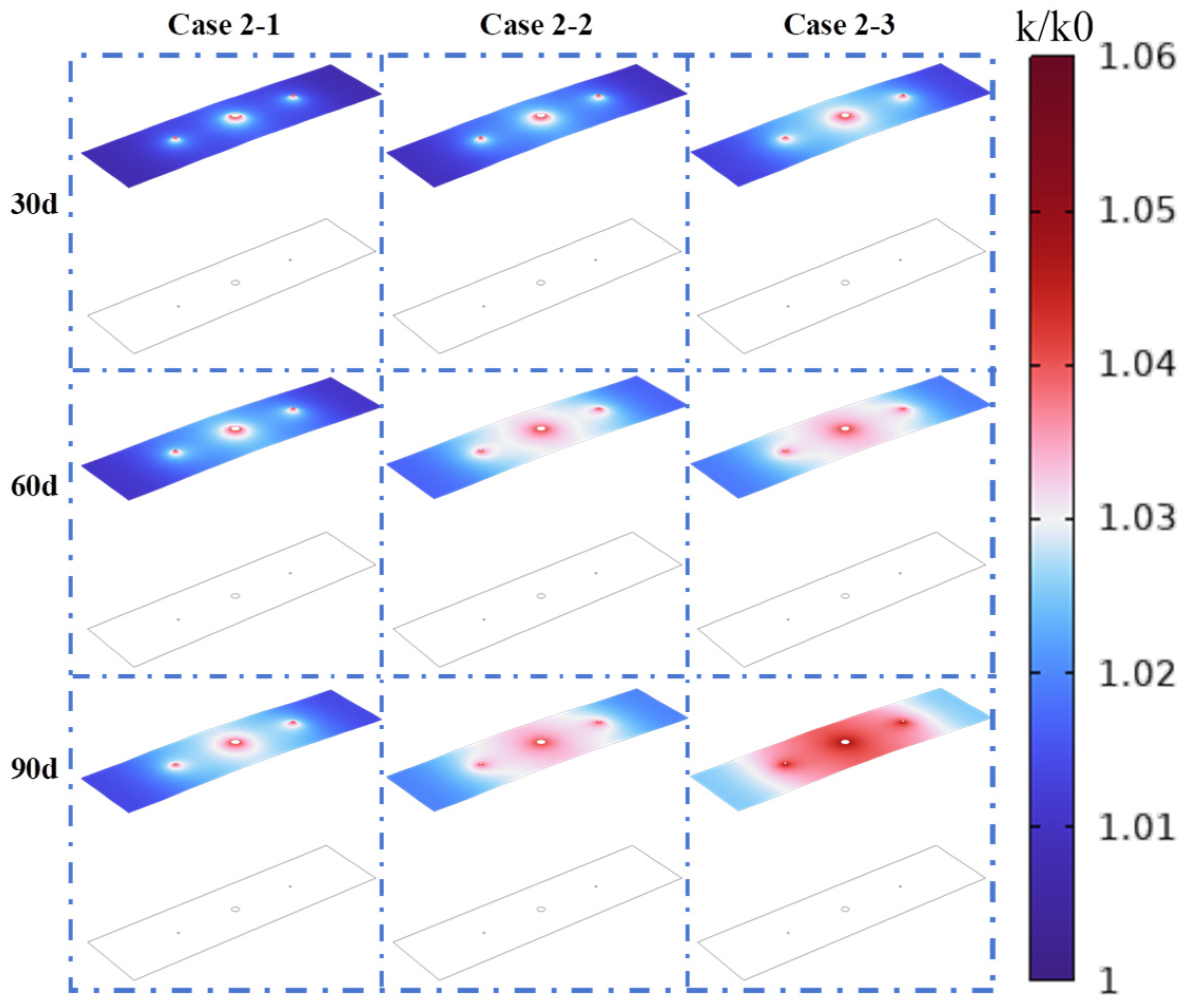
Based on the optimal gas injection spacing of 3.5 m, this study further investigates the effect of injection pressure on gas drainage performance. Three cases with gas injection pressures of 0.6 MPa (Case 2-1), 1.0 MPa (Case 2-2), and 1.4 MPa (Case 2-3) were selected for simulation. The analysis was conducted from the perspectives of permeability evolution (Figure 4) and average coal seam gas content (Figure 5).
Figure 4 presents the distribution contours of the relative permeability (k/k0) of the coal seam under different injection pressures, intuitively reflecting the influence of injection pressure on coal permeability. The results show that both the permeability enhancement zone and the magnitude of permeability increase expand with increasing injection pressure. Under the low injection pressure of Case 2-1, the maximum relative permeability reaches approximately k/k0 ≈ 1.035, with localized permeability enhancement zones forming only around the injection borehole and the drainage borehole. The pressure gradient attenuates rapidly and cannot effectively connect the fractures in the distant coal mass. Under the moderate injection pressure of Case 2-2, the relative permeability increases to k/k0 = 1.04, and the permeability enhancement zone expands to the region between the two boreholes. A synergistic effect is formed between the pressure-driven fracture opening and the matrix shrinkage induced by gas desorption, resulting in a significant improvement in permeability enhancement. Under the high injection pressure of Case 2-3, the relative permeability reaches a maximum value of k/k0 = 1.06, and the permeability enhancement zone covers the entire region between the injection borehole and the drainage borehole, achieving dual maximization of both the magnitude of fracture opening and the extent of expansion, thereby providing unobstructed pathways for gas migration.
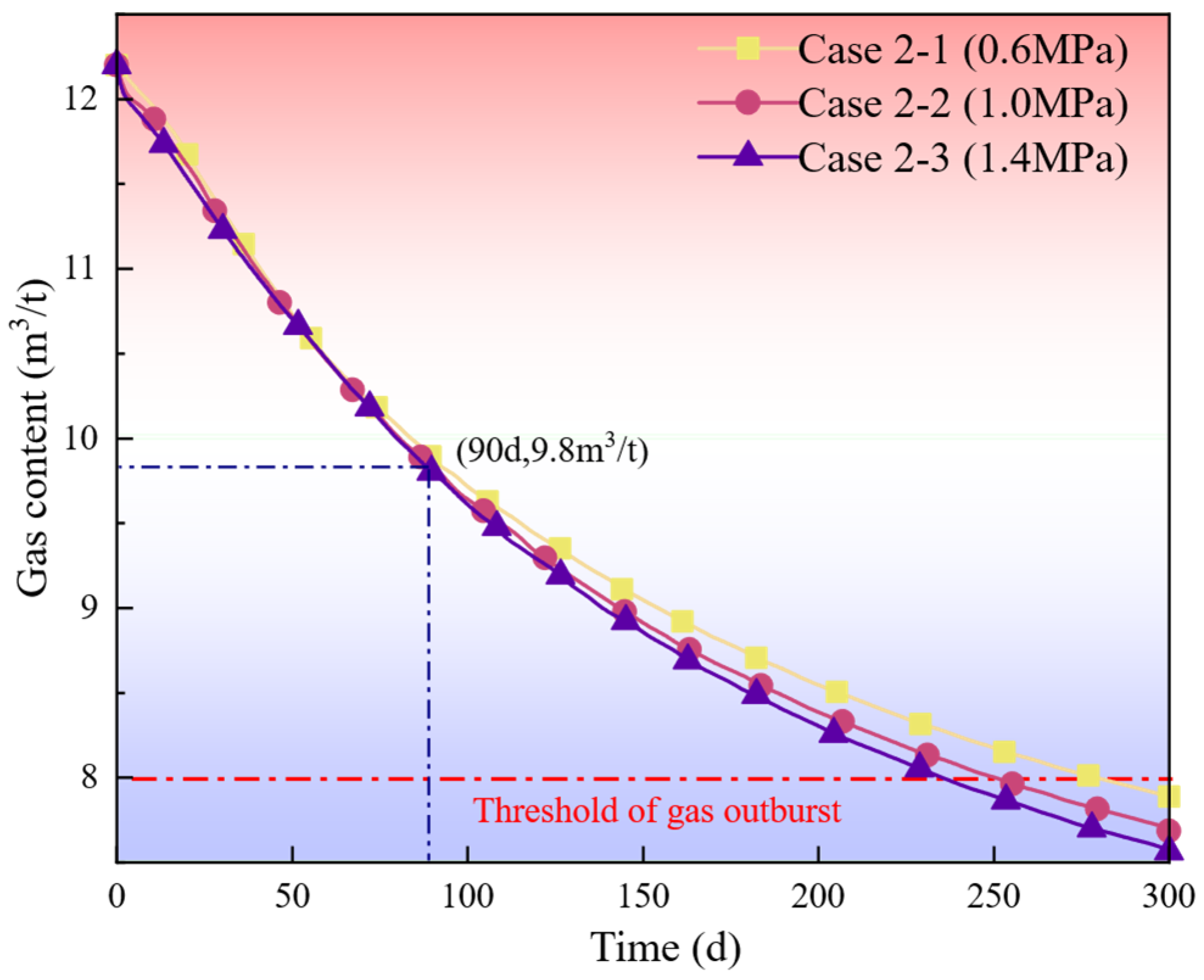
Figure 5 presents the evolution curves of average coal seam gas content over time under different gas injection pressures (the red dashed line indicates the threshold of gas outburst of 8 m3/t). The results show that the attenuation rate of coal seam gas content increases with higher gas injection pressure, and the drainage enhancement efficiency is consistent with the trend of coal permeability enhancement.
In the early stage of gas injection (0–90 d), the gas in the coal mass is predominantly in the adsorbed state, and the differences in the decline rate of gas content under different gas injection pressures are not significant, with the curves exhibiting a similar trend. The primary reason is that during this stage, there is a time-dependent accumulation effect on fracture propagation and permeability enhancement in the coal mass, and the differences in permeability enhancement induced by gas injection pressure have not yet been fully reflected in the gas migration rate. Meanwhile, the initial gas content of the coal seam is relatively high, and under low-pressure conditions, a small amount of gas migration can be driven by the concentration gradient, while the permeability enhancement advantage of high-pressure conditions has not yet been fully realized.
In the middle to late stage of gas injection (90–300 d), the influence of gas injection pressure on permeability enhancement and drainage performance gradually becomes evident. In Case 2-1, the permeability enhancement effect is limited, resulting in narrow gas migration pathways and a slow decline in gas content, reaching the threshold at approximately 275 d. In Case 2-2, the permeability enhancement effect is relatively good, with migration pathways continuously expanding, reaching the threshold at approximately 250 d. Under the high gas injection pressure of Case 2-3, the permeability enhancement zone covers the entire region, gas migration pathways are fully connected, and the efficiency of gas desorption and migration is optimal, reaching the threshold at approximately 235 d.
In summary, the optimal gas injection parameters for the synergistic technology are determined to be an injection spacing of 3.5 m and an injection pressure of 1.4 MPa. Under these parameters, the coal seam achieves optimal permeability enhancement and gas drainage performance, providing parameter guidance for subsequent field tests.

2.4. Model Validation

To validate the reliability of the numerical model under the synergistic technology conditions, a quantitative comparison was performed using field monitoring data from Module 4 (synergistic technology, optimal parameters: 3.5 m spacing, 1.4 MPa pressure). The cumulative pure methane production over the 82-day monitoring period was calculated from the measured daily flow rates (see Section 3.3) as 4.83 m3. Based on the simulation results for the optimal case (Case 2-3), the gas content at 82 days is approximately 10.0 m3/t, representing a decline of 2.2 m3/t (18.0%) from the initial value of 12.2 m3/t. Using the measured cumulative production, the implied coal mass affected by drainage is 4.83 m3 ÷ 2.2 m3/t ≈ 2.20 t. The initial gas in place for this coal mass is 2.20 t × 12.2 m3/t ≈ 26.8 m3, yielding a field-derived recovery ratio of 18.2%.
Table 3 summarizes the validation parameters. The simulated gas content decline ratio (18.0%) and the field-derived recovery ratio (18.2%) show good agreement, with a relative error of approximately 1.1%. The small discrepancy can be attributed to several factors: (1) the model assumption of negligible water phase, whereas residual water in the actual coal seam may occupy pore space and slightly reduce gas-phase permeability; (2) interpolation uncertainty in estimating the simulated gas content at 82 days from discrete output time points; (3) cumulative measurement errors in the field flow rate data (accuracy ±0.01 L/min over 82 days); (4) simplifications inherent in the 2D plane-strain model, which neglects gas migration along the borehole axis and local geological heterogeneity; and (5) the assumption of uniform initial gas content in the model. Despite these minor deviations, the close correspondence confirms that the numerical model reliably captures the gas depletion behavior of the synergistic technology under the Lu’an No. 3 coal seam conditions.

3. Field Test

3.1. Field Test Site Overview

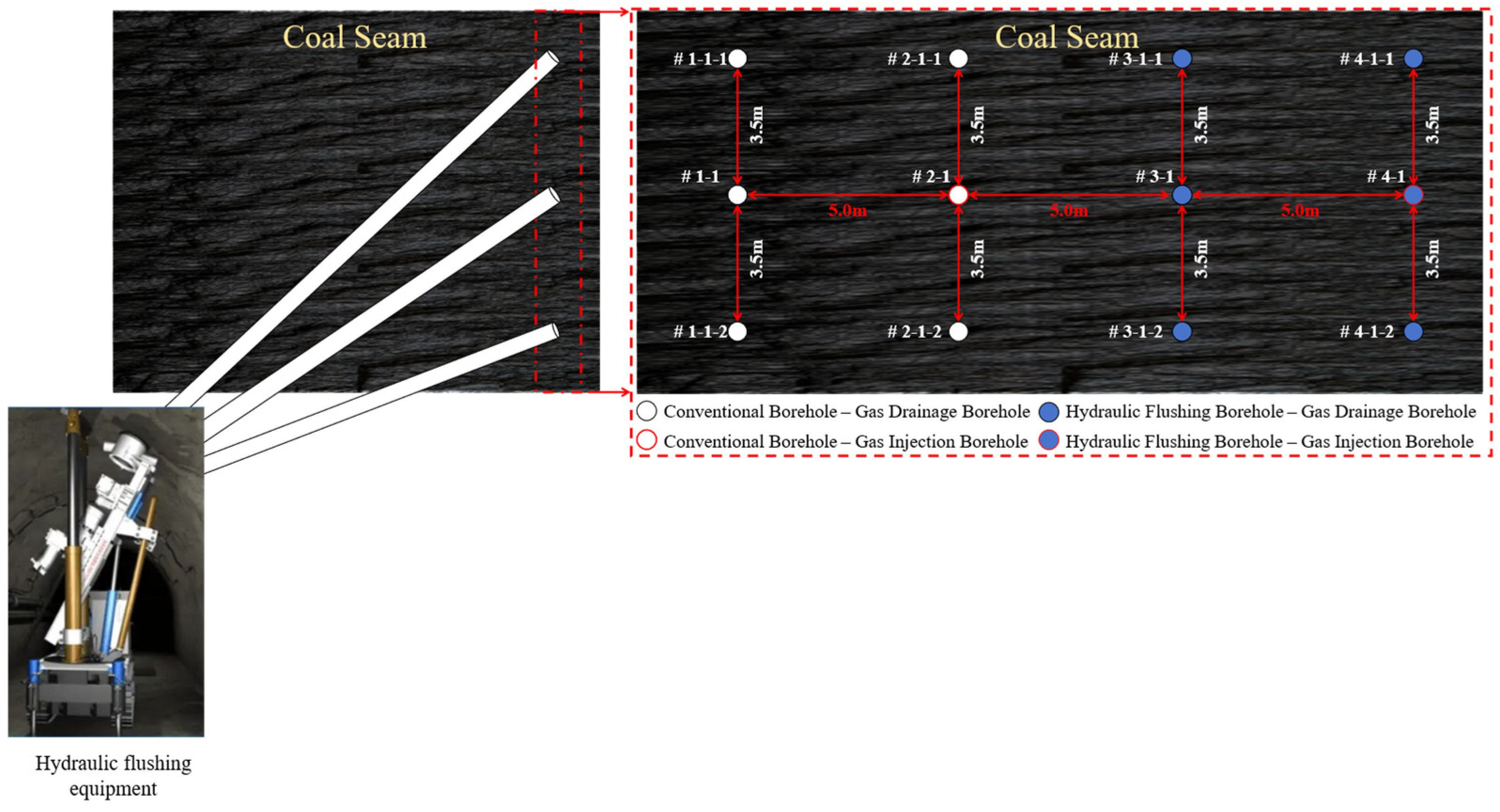
To validate the engineering application effect of the optimal process parameters determined by the numerical simulation (gas injection spacing of 3.5 m, gas injection pressure of 1.4 MPa) under actual geological conditions, a field test was conducted in the S6 floor drainage roadway of a mine in the Lu’an mining area. The coal seam gas occurrence conditions in this area are consistent with those described in Section 2.2.1: the coal permeability is approximately 0.0056 mD, the original gas content is approximately 12 m3/t, the gas pressure is 0.5 MPa, and the average coal seam thickness is approximately 6.0 m. This area is equipped with a well-established underground compressed air system and mature monitoring facilities, making it suitable for comparative tests. To systematically compare the performance of different drainage modes, four sets of comparative tests were designed in the S6 floor drainage roadway, corresponding to conventional drainage, gas injection displacement alone, hydraulic flushing alone, and the synergistic technology combining hydraulic flushing and gas injection displacement. Figure 6 shows the spatial layout of the four test modules (Modules 1–4) in the coal seam. Each module consists of a gas injection borehole and a drainage borehole, with borehole numbers corresponding to those in Table 4.

3.2. Test System and Scheme Design

3.2.1. Test System Establishment

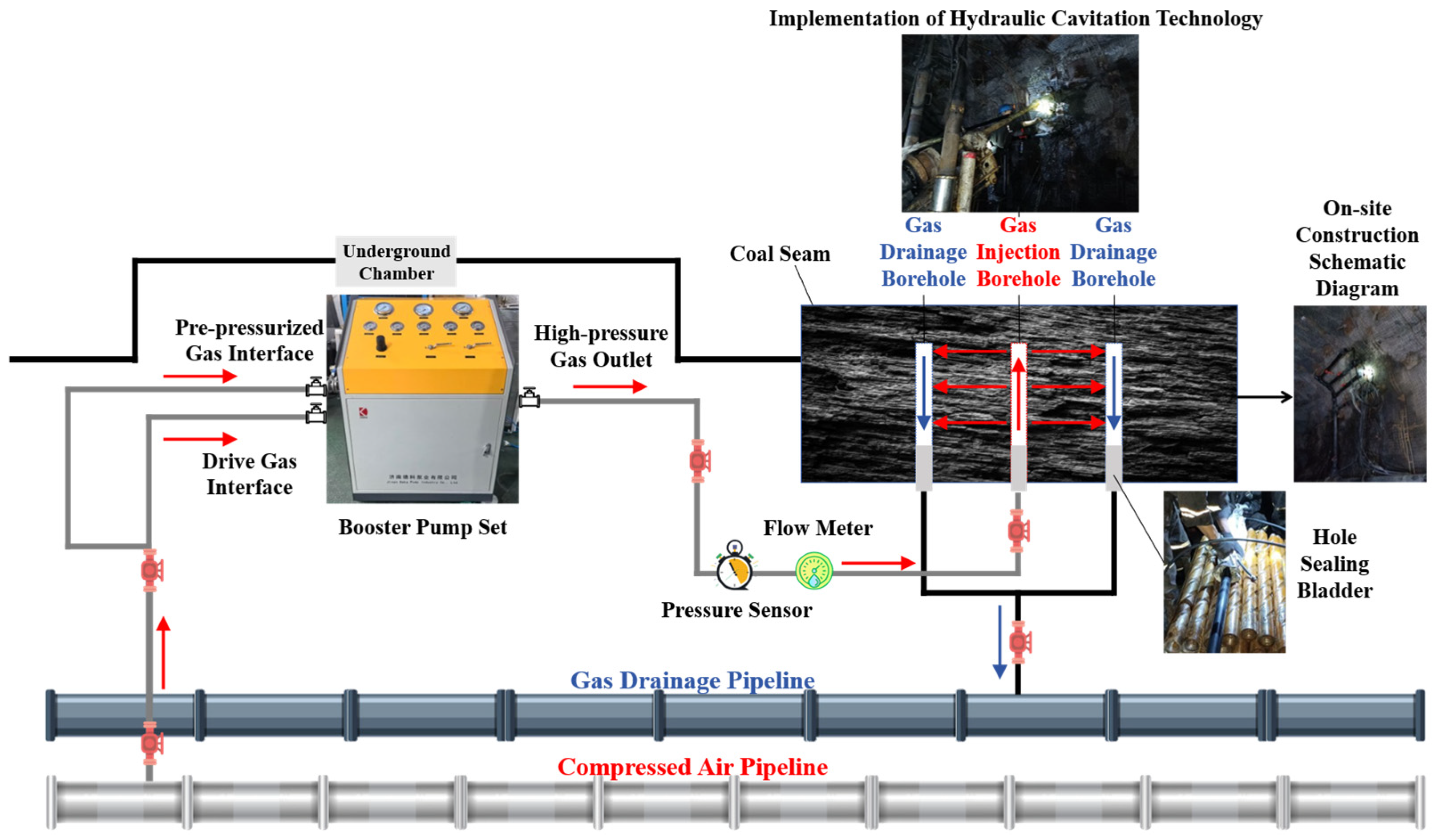
Figure 7 shows the field test setup for the synergistic enhanced gas drainage technology. The test system uses the existing underground compressed air as the gas source and consists of three subsystems: a pneumatic boosting system, a gas injection system, and a drainage monitoring system. The pneumatic boosting system is composed of a compressed air pipeline and a pneumatic booster pump, providing stable pressure for gas displacement. The gas injection system includes a pressure regulating valve, a gas injection steel pipe, and a borehole sealing pipe, which can regulate the gas injection pressure and achieve sealed delivery of high-pressure air. The drainage monitoring system is equipped with a drainage pipeline, a flowmeter, and an optical interference methane detector, enabling real-time monitoring of gas flow rate and CH4 concentration. The pneumatic booster pump has a pressure boosting range of 0–2.0 MPa, and the measurement accuracies of the flowmeter and the methane detector are ±0.01 L/min and ±0.1%, respectively.

3.2.2. Test Scheme Design

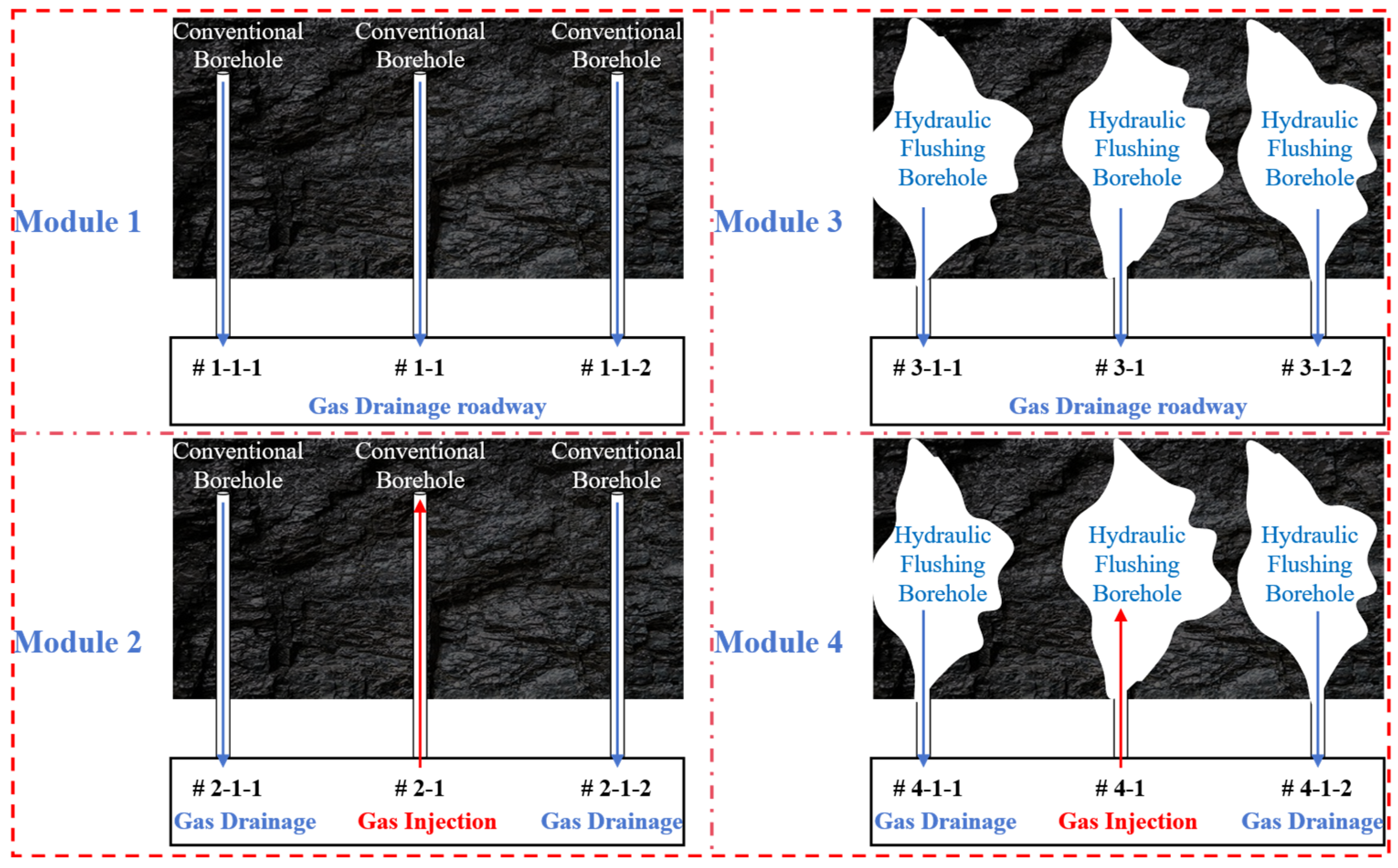
To ensure that the test model matches the geometric boundaries of the numerical simulation, four test modules were designed with differentiated settings of borehole types (conventional borehole/hydraulic flushing borehole) and gas injection pressure for comparison. All boreholes were sealed using the “two-plugging and one-injection” method. Gas injection was conducted at a constant pressure of 1.4 MPa, while drainage operated under a constant negative pressure of approximately −20 kPa. Detailed borehole information is shown in Table 4, and the schematic diagram of borehole layout is shown in Figure 8.

3.3. Test Results Analysis

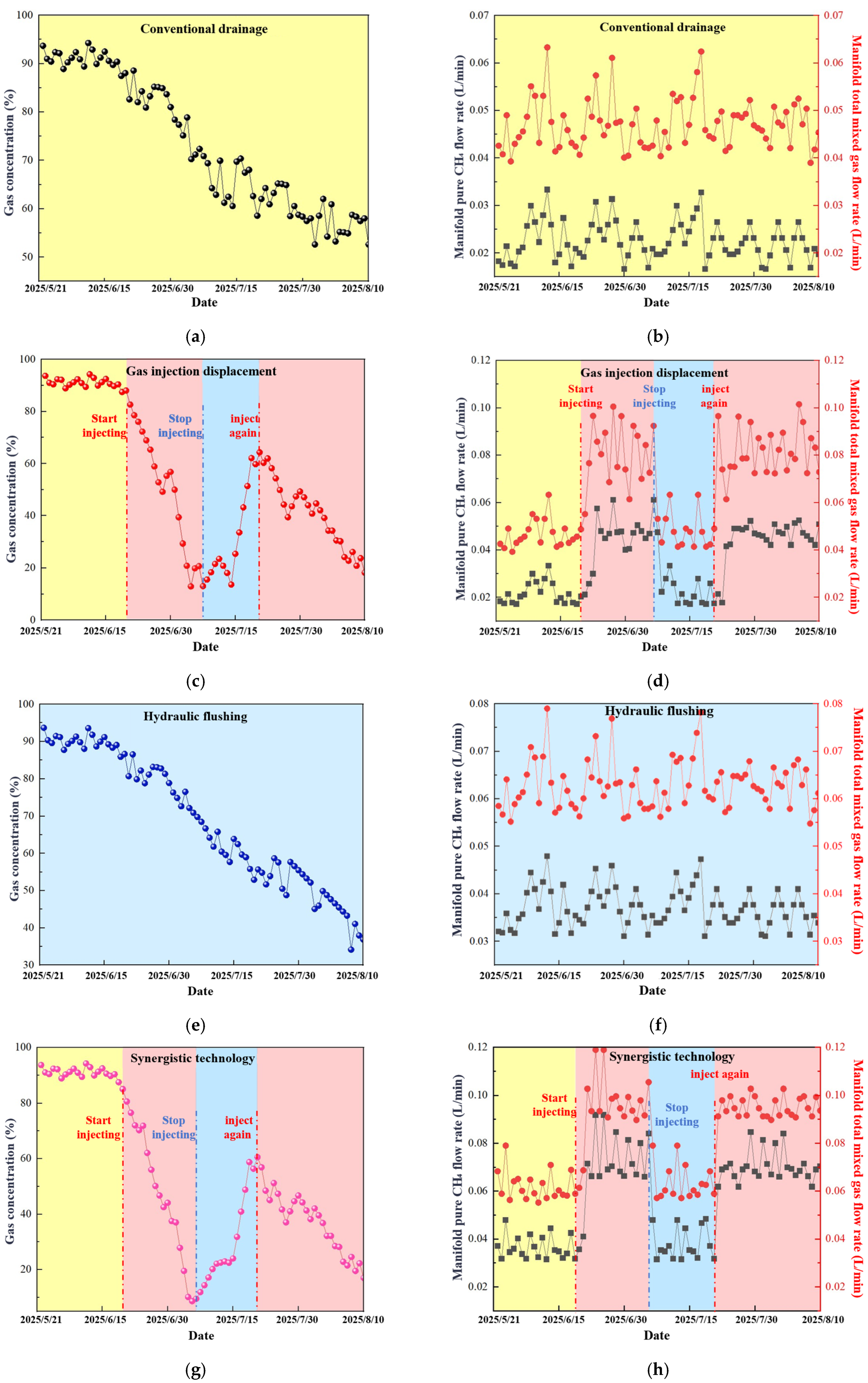
Figure 9 shows the variation curves of gas concentration and flow rate during the test period for the four test modules (conventional drainage, gas injection displacement, hydraulic flushing, and the synergistic technology), reflecting the drainage enhancement effects of different drainage modes.
In Module 1 (conventional drainage), the gas concentration gradually decreased from 95% in the initial stage to 50% at the final stage; the gas pure flow rate ranged from 0.015 to 0.035 L/min, remaining at a low level overall, indicating that conventional drainage has limited gas migration driving capacity and low drainage efficiency. In Module 2 (gas injection displacement alone), the gas concentration responded significantly at the gas injection nodes, decreasing from 95% to below 20% after gas injection and recovering to 60% after stop injecting; the peak gas pure flow rate reached 0.04–0.06 L/min. In Module 3 (hydraulic flushing alone), the gas concentration declined faster than that of conventional drainage, decreasing from 95% to 35% at the final stage; the gas pure flow rate ranged from 0.03 to 0.05 L/min, outperforming conventional drainage overall, indicating that hydraulic flushing can effectively widen gas migration pathways, but the driving force for gas migration remains insufficient due to the lack of external displacement. In Module 4 (synergistic technology), the gas concentration responded more stably at the gas injection nodes, rapidly decreasing to 15% after gas injection, with a smaller recovery amplitude after stop injecting compared to gas injection displacement alone; the peak gas pure flow rate reached 0.06–0.09 L/min and remained at a high level even after stop injecting, demonstrating the synergistic effect of permeability enhancement by hydraulic flushing and energy enhancement by gas injection, ensuring drainage intensity and drainage timeliness.
In summary, through the synergistic effect of permeability enhancement by hydraulic flushing and gas injection displacement, the synergistic technology both widens gas migration pathways and strengthens the driving force for gas migration, achieving significantly better drainage performance than the other three modes, thereby validating the reliability of the previous numerical simulation results.
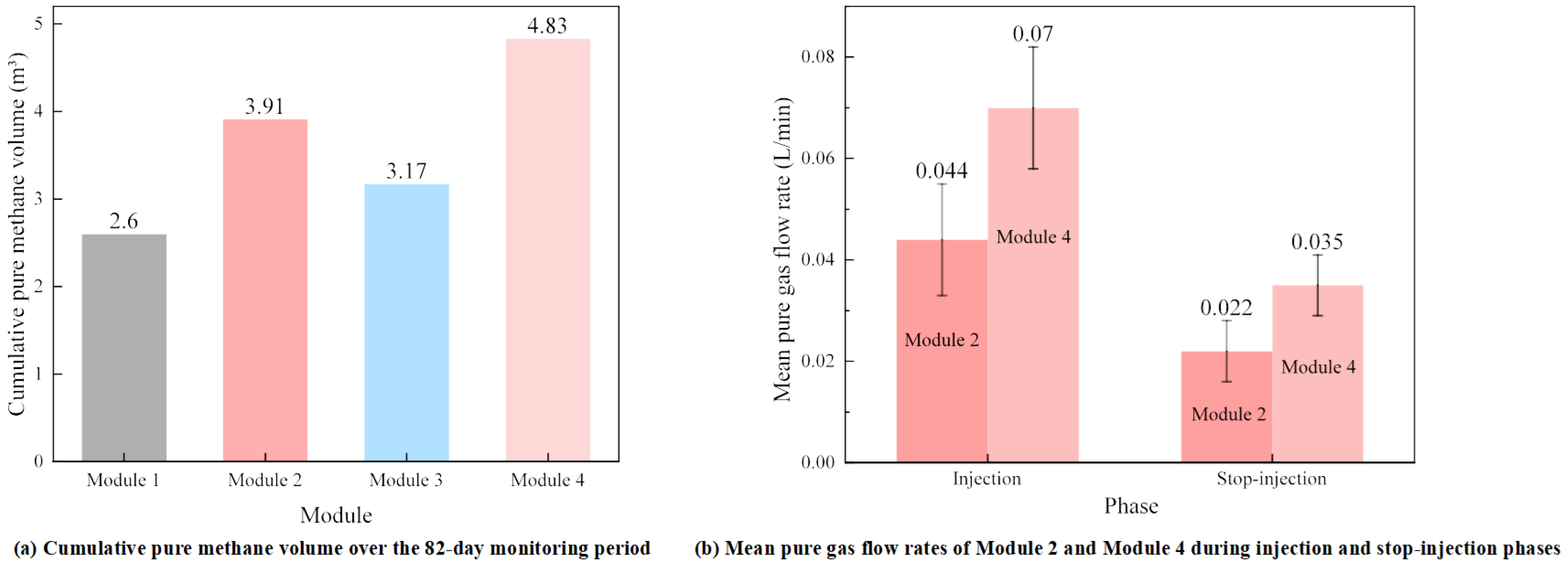
To provide a more robust quantitative comparison, the cumulative pure methane volume over the 82-day monitoring period was calculated by summing the daily gas production, where daily production (m3) = instantaneous flow rate (L/min) × 1440 min/1000. As shown in Figure 10a, Module 4 (synergistic technology) achieved a cumulative volume of 4.83 m3, outperforming Module 1 (conventional drainage, 2.60 m3) by 85.8%, Module 2 (gas injection alone, 3.91 m3) by 23.5%, and Module 3 (hydraulic flushing alone, 3.17 m3) by 52.4%. Figure 10b presents the mean pure gas flow rates of Module 2 and Module 4 during injection and stop-injection phases, with error bars representing ±one standard deviation calculated from the daily measurements within each phase. During the injection phase, Module 4 exhibited a mean flow rate of 0.070 ± 0.012 L/min, substantially higher than Module 2 (0.044 ± 0.011 L/min). During the stop-injection phase, Module 4 maintained a mean flow rate of 0.035 ± 0.006 L/min, outperforming Module 2 (0.022 ± 0.006 L/min). These metrics provide a more stable assessment of drainage performance than instantaneous peak values, consistently demonstrating the superior effectiveness of the synergistic technology.

4. Discussion and Prospects

Based on the existing achievements and limitations of the synergistic technology, future research can be conducted in the following directions. First, it is necessary to systematically investigate the oxidation reaction kinetics characteristics of O2 in air under different gas injection parameters (pressure, flow rate) and coal seam conditions (gas content, temperature, water content), clarify the migration and diffusion behavior of O2 in the coal fracture–matrix system and the risk of lagging enrichment throughout the gas injection process, define the safe threshold of O2 concentration under different geological and engineering conditions, and develop targeted anti-oxidation control technologies (such as inert gas pre-dilution before gas injection, real-time early warning of O2 concentration throughout the drainage process, and closed-loop regulation of gas injection parameters), thereby establishing a safety baseline for the application of the synergistic technology in coal seams prone to spontaneous combustion.
Second, research on dynamic matching and synergistic regulation of injection and drainage parameters should be conducted. The optimal process parameters determined in this study are fixed values, which are difficult to adapt to the time-dependent evolution characteristics of coal stress, permeability, and gas pressure throughout the entire drainage cycle. Furthermore, the current numerical model provides validation based on cumulative production data (Section 2.4), whereas direct transient flow rate calibration was not performed—a limitation inherent to the 2D plane-strain modeling approach. Addressing these gaps, future work should pursue two directions: (1) establishing a dynamic response model of coal seam gas migration and permeability evolution, and developing dynamic optimization methods for injection pressure, flow rate, and intermittent injection cycles to construct a refined process system suitable for different drainage stages; and (2) incorporating transient flow rate simulation with systematic calibration against field production curves to further enhance the quantitative accuracy of the model.

5. Conclusions

In this paper, a multi-physics coupled model was established to conduct numerical simulations on the effects of key parameters, namely gas injection spacing and gas injection pressure, on drainage performance, and underground tests under four working conditions (conventional drainage, gas injection displacement, hydraulic flushing, and the synergistic technology combining hydraulic flushing and gas injection displacement) were implemented. The main conclusions are as follows:
(1)
Through numerical simulation, the optimal process parameters for the synergistic technology were determined as a gas injection spacing of 3.5 m and a gas injection pressure of 1.4 MPa. Under these parameters, the relative coal permeability of the target coal seam reached 1.06, the permeability enhancement zone covered the entire region between the gas injection borehole and the drainage borehole, and the time required for the gas content to fall below the critical threshold of gas outburst (8 m3/t) was the shortest, approximately 235 d. The model was quantitatively validated using field data from the synergistic module, with a relative error of approximately 1.1% between the simulated (18.0%) and field-derived (18.2%) recovery ratios, confirming the model’s reliability, providing precise process parameter guidance for field application.
(2)
Compared with conventional drainage, gas injection displacement, and hydraulic flushing, the synergistic technology achieved superior drainage performance. Based on 82-day cumulative pure methane volume, the synergistic technology outperformed conventional drainage by 85.8% (4.83 m3 compared with 2.60 m3), gas injection alone by 23.5% (4.83 m3 compared with 3.91 m3), and hydraulic flushing alone by 52.4% (4.83 m3 compared with 3.17 m3). During the injection phase, the mean flow rate of the synergistic module reached 0.070 ± 0.012 L/min, significantly higher than that of gas injection alone (0.044 ± 0.011 L/min). During the stop-injection phase, the synergistic module maintained 0.035 ± 0.006 L/min, outperforming gas injection alone (0.022 ± 0.006 L/min).
(3)
Compared with nitrogen injection displacement technology, the synergistic technology utilizes the existing underground compressed air system as the gas source, achieving low gas source cost without the need for additional nitrogen production equipment, significantly reducing economic costs. In addition, the system integration complexity is low, making it particularly suitable for mines lacking large-scale nitrogen production capacity, providing an economically feasible alternative for gas management in low-permeability coal seams.

Author Contributions

X.Y.: Methodology, Investigation, Writing—original draft. F.T.: Investigation, Writing—original draft. Q.Z.: Conceptualization, Formal analysis, Writing—review and editing. All authors have read and agreed to the published version of the manuscript.

Funding

The Project was Supported by the National Natural Science Foundation of China (52204196).

Data Availability Statement

The data presented in this study are internal project data and are not deposited in a public repository due to institutional data management policies. They are available on reasonable request from the corresponding author.

Conflicts of Interest

The authors declare that they have no known competing financial interests or personal relationships that could have appeared to influence the work reported in this paper.

References

  1. Karacan, C.O.; Ruiz, F.A.; Cote, M.; Phipps, S. Coal mine methane: A review of capture and utilization practices with benefits to mining safety and to greenhouse gas reduction. Int. J. Coal Geol. 2011, 86, 121–156. [Google Scholar] [CrossRef]
  2. Flores, R.M. Coalbed methane: From hazard to resource. Int. J. Coal Geol. 1998, 35, 3–26. [Google Scholar] [CrossRef]
  3. Zhang, L.; Zhang, H.; Guo, H. A case study of gas drainage to low permeability coal seam. Int. J. Min. Sci. Technol. 2017, 27, 687–692. [Google Scholar] [CrossRef]
  4. Yang, X.; Wang, G.; Ni, M.; Shu, L.; Gong, H.; Wang, Z. Investigation on key parameters of N2 injection to enhance coal seam gas drainage (N2-ECGD). Energies 2022, 15, 5064. [Google Scholar] [CrossRef]
  5. Zhou, X.; Li, X.; Bai, G.; Chai, L.; Wang, Y.; Xiao, M.; Xia, S. Research method of pressure relief and permeability enhancement in low permeability coal seam: A review. AIP Adv. 2022, 12, 010702. [Google Scholar] [CrossRef]
  6. Zhao, X.; Huang, B.; Li, H.; Chen, S. Field investigation of multi-stage pulse hydraulic fracturing for improving permeability of coal seam in directional long borehole in underground coal mines. Environ. Earth Sci. 2023, 82, 519. [Google Scholar] [CrossRef]
  7. Wei, G.; Wen, H.; Deng, J.; Li, Z.; Fan, S.; Lei, C.; Liu, M.; Ren, L. Enhanced coalbed permeability and methane recovery via hydraulic slotting combined with liquid CO2 injection. Process Saf. Environ. Prot. 2021, 147, 234–244. [Google Scholar] [CrossRef]
  8. Li, Y.; Zhang, X.; Liu, X.; Wang, L.; Zhang, J. Comparative analysis of the drainage effect based on improved hydraulic flushing technology. ACS Omega 2022, 7, 44310–44321. [Google Scholar] [CrossRef]
  9. Li, H.; Zhang, K.; Zu, H.; Qian, J. Study on the technology of permeability enhancement of deep hole pre-splitting blasting in a low-permeability coal seam. Environ. Earth Sci. 2024, 83, 40. [Google Scholar] [CrossRef]
  10. Yan, F.; Lin, B.; Zhu, C.; Shen, C.; Zou, Q.; Guo, C.; Liu, T. A novel ECBM extraction technology based on the integration of hydraulic slotting and hydraulic fracturing. J. Nat. Gas Sci. Eng. 2015, 22, 571–579. [Google Scholar] [CrossRef]
  11. Yang, X.; He, L.; Lu, T.; Liu, Y.; Li, X.; Cao, J.; Luo, G.; Yang, H. Optimization and field application of water jet for coal bed methane stimulation. Energy Sci. Eng. 2019, 7, 3186–3203. [Google Scholar] [CrossRef]
  12. Connell, L.D. Coupled flow and geomechanical processes during gas production from coal seams. Int. J. Coal Geol. 2009, 79, 18–28. [Google Scholar] [CrossRef]
  13. Wei, C.F.; Li, B.; Li, H.M.; Wang, F.Z. A study on the pressure relief scope and the stress variation of hydraulic flushing borehole. J. Eng. Sci. Technol. Rev. 2014, 7, 103–108. [Google Scholar] [CrossRef]
  14. Shen, R.; Qiu, L.; Lv, G.; Wang, E.; Li, H.; Han, X.; Zhang, X.; Hou, Z. An effect evaluation method of coal seam hydraulic flushing by EMR. J. Nat. Gas Sci. Eng. 2018, 54, 154–162. [Google Scholar] [CrossRef]
  15. Qiu, L.; Song, D.; Wang, E.; Liu, Z.; Shen, R.; Li, D.; Jia, H.; Hong, S. Determination of hydraulic flushing impact range by DC resistivity test method. Int. J. Rock. Mech. Min. Sci. 2018, 107, 127–135. [Google Scholar] [CrossRef]
  16. Zhang, R.; Cheng, Y.; Yuan, L.; Zhou, H.; Wang, L.; Zhao, W. Enhancement of gas drainage efficiency in a special thick coal seam through hydraulic flushing. Int. J. Rock. Mech. Min. Sci. 2019, 124, 104085. [Google Scholar] [CrossRef]
  17. Reeves, S.R. The Coal-Seq project: Key results from field, laboratory, and modeling studies. In Greenhouse Gas Control Technologies 7; Elsevier: Oxford, UK, 2005; pp. 1399–1403. [Google Scholar]
  18. Moore, T.A. Coalbed methane: A review. Int. J. Coal Geol. 2012, 101, 36–81. [Google Scholar] [CrossRef]
  19. Packham, R.; Connell, L.; Cinar, Y.; Moreby, R. Observations from an enhanced gas recovery field trial for coal mine gas management. Int. J. Coal Geol. 2012, 100, 82–92. [Google Scholar] [CrossRef]
  20. Liu, T.; Lin, B.Q.; Yang, W. Impact of matrix–fracture interactions on coal permeability: Model development and analysis. Fuel 2017, 207, 522–532. [Google Scholar] [CrossRef]
  21. White, C.M.; Smith, D.H.; Jones, K.L.; Goodman, A.L.; Jikich, S.A.; LaCount, R.B.; DuBose, S.B.; Ozdemir, E.; Morsi, B.I.; Schroeder, K.T. Sequestration of carbon dioxide in coal with enhanced coalbed methane recovery: A review. Energy Fuels 2005, 19, 659–724. [Google Scholar] [CrossRef]
  22. Mazzotti, M.; Pini, R.; Storti, G. Enhanced coalbed methane recovery. J. Supercrit. Fluids 2009, 47, 619–627. [Google Scholar] [CrossRef]
  23. Busch, A.; Gensterblum, Y. CBM and CO2-ECBM related sorption processes in coal: A review. Int. J. Coal Geol. 2011, 87, 49–71. [Google Scholar] [CrossRef]
  24. Shi, J.Q.; Durucan, S. A model for changes in coalbed permeability during primary and enhanced methane recovery. SPE Reserv. Eval. Eng. 2005, 8, 291–299. [Google Scholar] [CrossRef]
  25. Yang, X.; Zhang, Q.; Tan, F.; Zuo, Y.; Zhang, Y.; Dong, J.; Du, F. Study on the feasibility of enhancing gas extraction efficiency based on hydraulic flushing combined with gas injection displacement (HF-GID): Model development and numerical simulation. ACS Omega 2025, 10, 62322–62335. [Google Scholar] [CrossRef]
  26. Ren, T.; Wang, G.; Cheng, Y.; Qi, Q. Model development and simulation study of the feasibility of enhancing gas drainage efficiency through nitrogen injection. Fuel 2017, 194, 406–422. [Google Scholar] [CrossRef]
  27. Lin, J.; Ren, T.; Wang, G.; Booth, P.; Cheng, Y.; Black, D.; Hungerford, F.; Nemcik, J. Field trials of nitrogen injection enhanced gas drainage in hard-to-drain coal seam by using underground in-seam (UIS) boreholes. Fuel 2022, 328, 125293. [Google Scholar] [CrossRef]
  28. Lyu, S.; Xiao, Y.; Chen, L.; Xiong, Z.; Wang, S. Enhancement of coalbed methane via nitrogen injection in a coal mining area: A laboratory and field study. J. Energy Eng. 2023, 149, 04023047. [Google Scholar] [CrossRef]
  29. Fan, Y.; Shu, L.; Song, X.; Gong, H. Study on air injection to enhance coalbed gas extraction. Processes 2025, 13, 1882. [Google Scholar] [CrossRef]
  30. Gao, H. Simulation and optimization of high-pressure air injection promoting underground coal seam gas drainage. Energy Sources Part A Recover. Util. Environ. Eff. 2024, 46, 13258–13274. [Google Scholar]
  31. Li, H.; Guo, C.; Sun, Y.; Guo, S. Study on permeability improvement technology by injecting air into the gas drainage borehole in low-permeability coal seam. Adv. Civ. Eng. 2018, 2018, 1912383. [Google Scholar]
  32. Lin, J.; Ren, T.; Cheng, Y.; Nemcik, J.; Wang, G. Cyclic N2 injection for enhanced coal seam gas recovery: A laboratory study. Energy 2019, 188, 116115. [Google Scholar] [CrossRef]
  33. Lin, H.; Ji, P.; Kong, X.; Li, S.; Bai, Y.; Long, H.; Li, B.; He, D. Progress and prospect of gas extraction technology by underground gas injection displacement for increasing flow in low-permeability coal seam in China. J. China Coal Soc. 2023, 48, 730–749. [Google Scholar]
  34. Shi, Y.; Lin, B.; Liu, T.; Zhao, Y.; Hao, Z. Synergistic ECBM extraction technology and engineering application based on hydraulic flushing combining gas injection displacement in low permeability coal seams. Fuel 2022, 318, 123688. [Google Scholar] [CrossRef]
  35. Lei, Y.; Liu, J.; Zhang, S.; Zhang, W.; Wang, H. Contrast test of different permeability improvement technologies for gas-rich low-permeability coal seams. J. Nat. Gas Sci. Eng. 2016, 33, 1282–1290. [Google Scholar] [CrossRef]
  36. Teng, T.; Xue, Y.; Zhang, C. Modeling and simulation on heat-injection enhanced coal seam gas recovery with experimentally validated non-Darcy gas flow. J. Pet. Sci. Eng. 2019, 177, 734–744. [Google Scholar] [CrossRef]
  37. Li, S.; Fan, C.; Han, J.; Luo, M.; Yang, Z.; Bi, H. A fully coupled thermal-hydraulic-mechanical model with two-phase flow for coalbed methane extraction. J. Nat. Gas Sci. Eng. 2016, 33, 324–336. [Google Scholar] [CrossRef]
  38. Cui, X.; Bustin, R.M. Volumetric strain associated with methane desorption and its impact on coalbed gas production from deep coal seams. AAPG Bull. 2005, 89, 1181–1202. [Google Scholar] [CrossRef]
  39. Liu, W.; Han, D.; Xu, H.; Zhou, Y.; Li, T. Mechanism investigation and models evaluation of gas transport in dual-porosity coal seam. Coal Sci. Technol. 2025, 53, 151–162. [Google Scholar]
  40. Liu, J.; Chen, Z.; Elsworth, D.; Miao, X.; Mao, X. Evolution of coal permeability from stress-controlled to displacement-controlled swelling conditions. Fuel 2011, 90, 2987–2997. [Google Scholar] [CrossRef]
  41. Pan, Z.; Connell, L.D. Modelling of anisotropic coal swelling and its impact on permeability behaviour for primary and enhanced coalbed methane recovery. Int. J. Coal Geol. 2011, 85, 257–267. [Google Scholar] [CrossRef]
Figure 1. Schematic diagram of the numerical model and boundary conditions.
Energies 19 02061 g001
Figure 2. Distribution contours of gas content over time under different injection spacings.
Energies 19 02061 g002
Figure 3. Average gas content over time under different injection spacings.
Energies 19 02061 g003
Figure 4. Permeability enhancement effect over time under different gas injection pressures.
Energies 19 02061 g004
Figure 5. Average coal seam gas content over time under different gas injection pressures.
Energies 19 02061 g005
Figure 6. Schematic diagram of the layout of test boreholes in the S6 floor drainage roadway.
Energies 19 02061 g006
Figure 7. Field test system.
Energies 19 02061 g007
Figure 8. Schematic diagram of borehole layout and process modes of the four test modules in the S6 floor drainage roadway.
Energies 19 02061 g008
Figure 9. Variation curves of gas concentration and flow rate under different drainage modes. (a) Module 1 (conventional drainage): variation curve of gas concentration over time; (b) Module 1 (conventional drainage): variation curves of gas flow rate and mixed flow rate over time; (c) Module 2 (gas injection displacement): variation curve of gas concentration over time; (d) Module 2 (gas injection displacement): variation curves of gas flow rate and mixed flow rate over time; (e) Module 3 (hydraulic flushing): variation curve of gas concentration over time; (f) Module 3 (hydraulic flushing): variation curves of gas flow rate and mixed flow rate over time; (g) Module 4 (synergistic technology): variation curve of gas concentration over time; (h) Module 4 (synergistic technology): variation curves of gas flow rate and mixed flow rate over time.
Energies 19 02061 g009
Figure 10. Statistical analysis of field test results (Error bars represent ±one standard deviation).
Energies 19 02061 g010
Table 1. Main input parameters of the numerical model.
ParameterValue
Elastic modulus of coal, Ec2700 (MPa)
Elastic modulus of coal matrix, Km1500 (MPa)
Fracture bulk modulus of coal, Kf0.048 (GPa)
Bulk modulus of coal skeleton, Ks2.1 (GPa)
Poisson’s ratio of coal, v0.2
Initial relative gas pressure, p00.5 (MPa)
Initial permeability, k05.5 × 10−18 (m2)
Initial fracture porosity, ϕf00.02
Initial matrix porosity, ϕm00.04
Klinkenberg factor, k1.44 × 105 (Pa)
CH4 Langmuir volume, VL131.25 (m3/t)
N2 Langmuir volume, VL215.00 (m3/t)
O2 Langmuir volume, VL311.00 (m3/t)
CH4 Langmuir pressure, PL10.781 (MPa)
N2 Langmuir pressure, PL22.61 (MPa)
O2 Langmuir pressure, PL32.8 (MPa)
CH4 density under standard conditions, ρsg10.7174 (kg/m3)
N2 density under standard conditions, ρsg21.25 (kg/m3)
O2 density under standard conditions, ρsg31.43 (kg/m3)
CH4 adsorption time, τ10.33 (d)
N2 adsorption time, τ20.20 (d)
O2 adsorption time, τ30.18 (d)
Swelling coefficient, λ0.45
Influence coefficient of body stress on permeability, b0.10 (MPa)
Maximum volumetric strain induced by adsorption, εsmax3.01 (%)
Langmuir pressure for adsorption deformation1
Coal seam temperature, T293 (K)
CH4 molar mass, M116 (g/mol)
N2 molar mass, M228 (g/mol)
O2 molar mass, M332 (g/mol)
Apparent density of coal, ρc1400 (kg/m3)
Universal gas constant, R8.314 (J/mol/K)
Gas molar volume, V22.4 (L/mol)
CH4 dynamic viscosity, μ11.08 × 10⁻⁵ (Pa·s)
N2 dynamic viscosity, μ21.7 × 10⁻⁵ (Pa·s)
O2 dynamic viscosity, μ32.22 × 10⁻⁵ (Pa·s)
CH4 Langmuir strain coefficient, εL10.0127
N2 Langmuir strain coefficient, εL20.0058
O2 Langmuir strain coefficient, εL30.0152
Table 2. Design of simulation cases.
Case No.Injection–Drainage Borehole Spacing Si−d (m)Gas Injection Pressure Pinj (MPa)
Case 1-12.51.0
Case 1-23.51.0
Case 1-34.51.0
Case 2-1Si−d0.6
Case 2-2Si−d1.0
Case 2-3Si−d1.4
Table 3. Quantitative validation of the numerical model using Module 4 field data.
ParameterValueSource
Initial gas content (m3/t)12.2Measured and model input
Cumulative production at 82 days (m3)4.83Calculated from measured daily flow rates
Simulated gas content at 82 days (m3/t)10.0Model (Case 2-3, interpolated)
Simulated content decline (m3/t)2.2Calculated
Simulated decline ratio18.0%Calculated
Implied coal mass (t)2.20=4.83/2.2
Initial gas in place (m3)26.8=2.20 × 12.2
Field-derived recovery ratio18.2%=4.83/26.8
Relative error1.1%=|18.2 − 18.0%|/18.0%
Table 4. Design of test boreholes.
Borehole TypeTest ModuleBorehole No.Borehole Spacing (m)Gas Injection Pressure (MPa)Remarks
Conventional boreholeModule 11-13.5 m/Gas drainage borehole
1-1-1
1-1-2
Conventional boreholeModule 22-11.4 MPaGas injection borehole
2-1-1/Gas drainage borehole
2-1-2
Hydraulic flushing boreholeModule 33-1/Gas drainage borehole
3-1-1
3-1-2
Hydraulic flushing boreholeModule 44-11.4 MPaGas injection borehole
4-1-1/Gas drainage borehole
4-1-2
Disclaimer/Publisher’s Note: The statements, opinions and data contained in all publications are solely those of the individual author(s) and contributor(s) and not of MDPI and/or the editor(s). MDPI and/or the editor(s) disclaim responsibility for any injury to people or property resulting from any ideas, methods, instructions or products referred to in the content.