Enhanced Gas Drainage via Gas Injection Displacement Based on Hydraulic Flushing: Numerical Simulation and Field Test
Abstract
1. Introduction
2. Numerical Simulation
2.1. Model Assumptions and Establishment
- (1)
- The coal body is regarded as an elastic porous continuous medium with single permeability and dual porosity;
- (2)
- The migration of ternary gases is an isothermal process, and the adsorption–desorption process conforms to the extended Langmuir equation;
- (3)
- The ternary gases follow the ideal gas law. Gas seepage in fractures follows Darcy’s law, and gas diffusion in the matrix pores follows Fick’s law;
- (4)
- The chemical reactions between CH4/N2/O2 and the coal body are neglected, the temperature variation in the coal seam is neglected, and the influence of the water phase is neglected. This simplification is justified by the low coal seam temperature (~20 °C), relatively high residual moisture content after hydraulic flushing, inherently low spontaneous combustion propensity of the No. 3 coal seam, and the limited time scale of this study (80–300 days).
2.2. Geological Conditions and Numerical Model
2.2.1. Geological Conditions
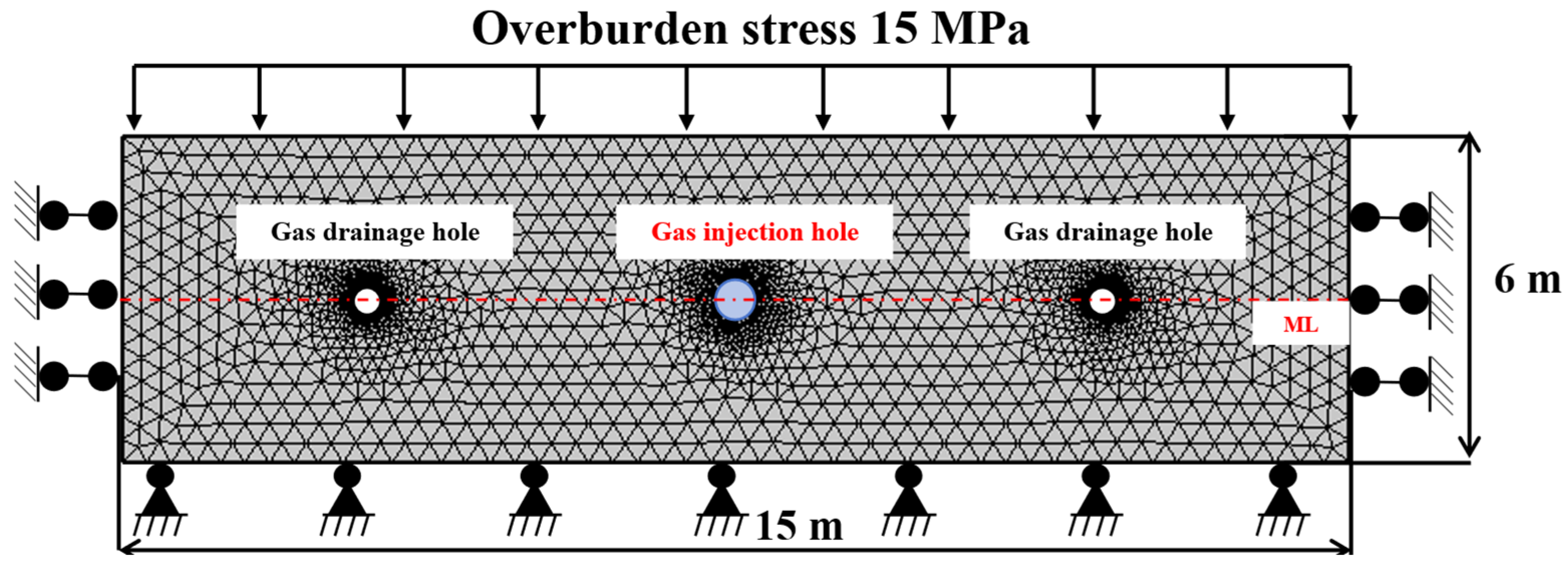
2.2.2. Numerical Model and Operating Condition Design
2.3. Results Analysis
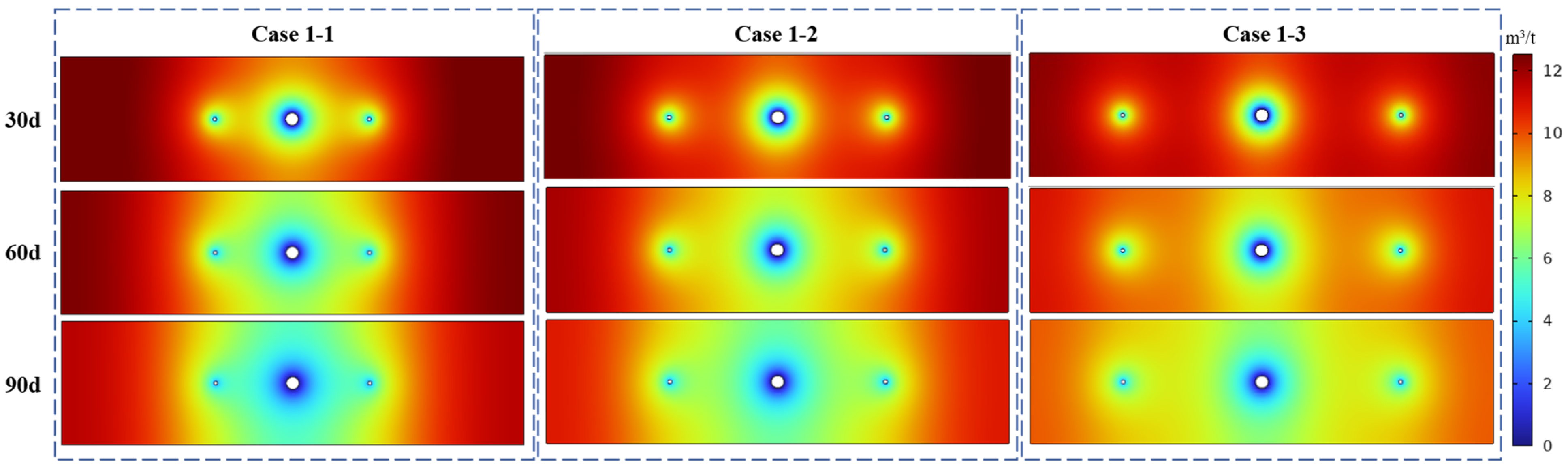
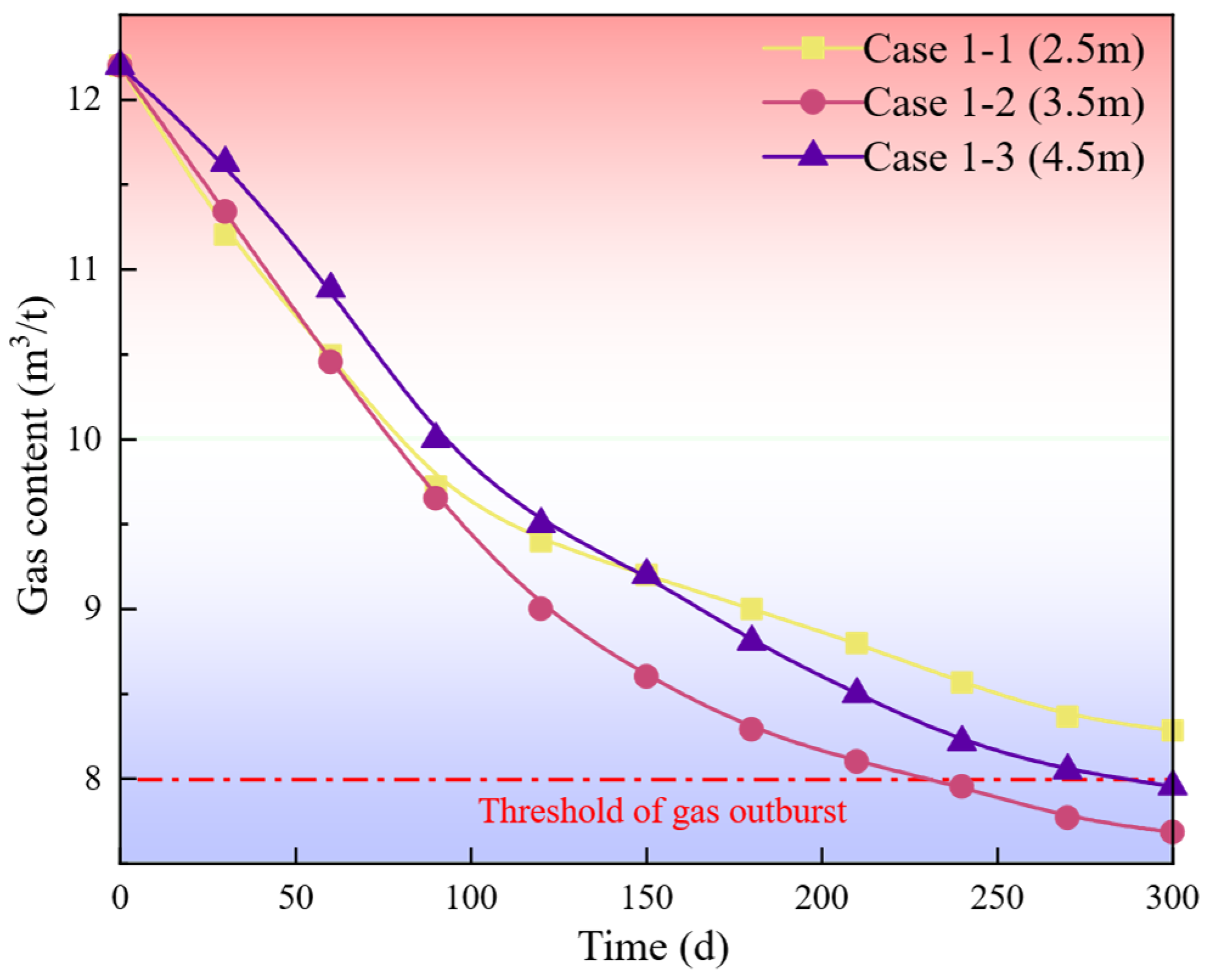
2.3.1. Optimal Gas Injection Spacing
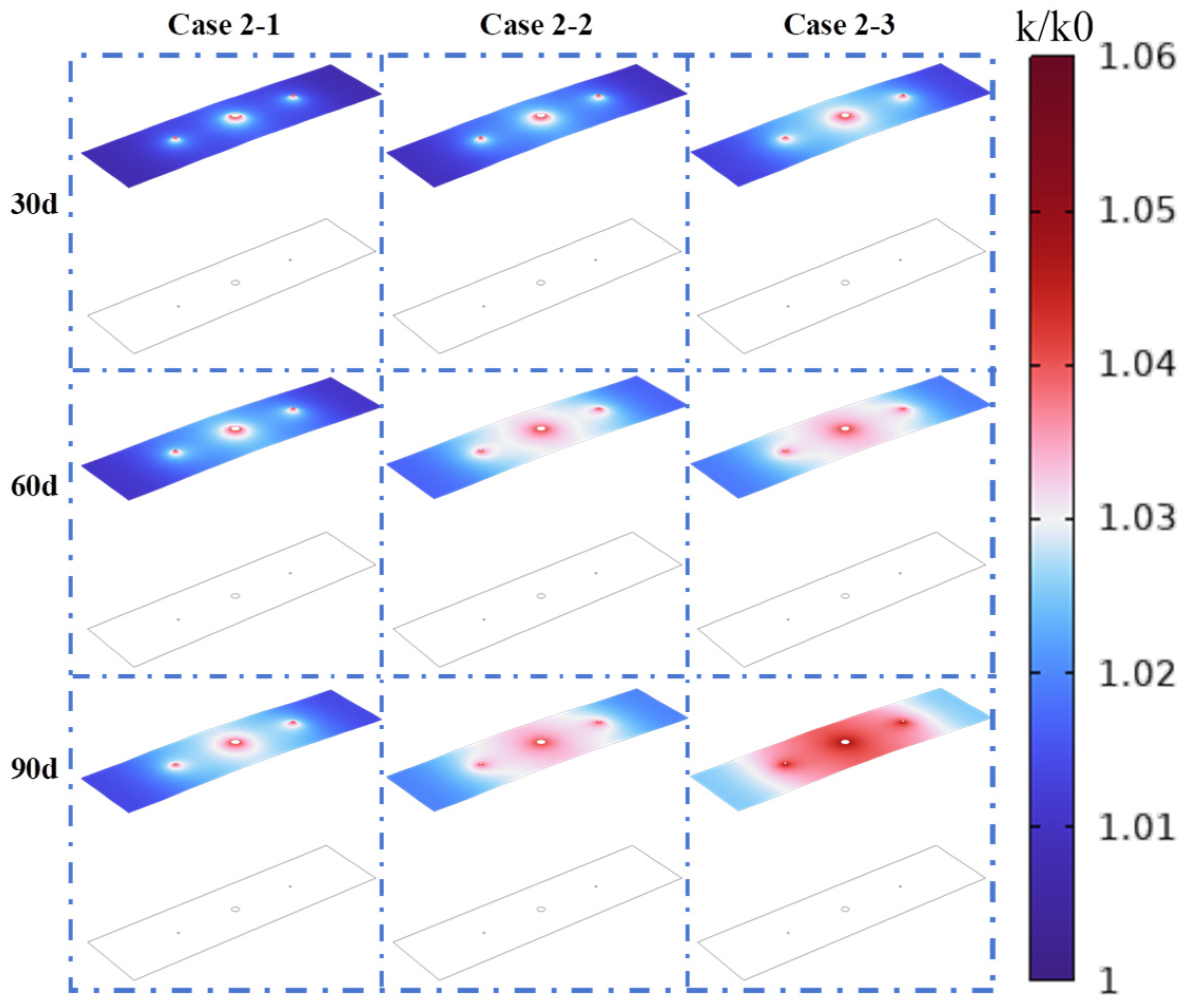
2.3.2. Optimal Gas Injection Pressure
2.4. Model Validation
3. Field Test
3.1. Field Test Site Overview
3.2. Test System and Scheme Design
3.2.1. Test System Establishment
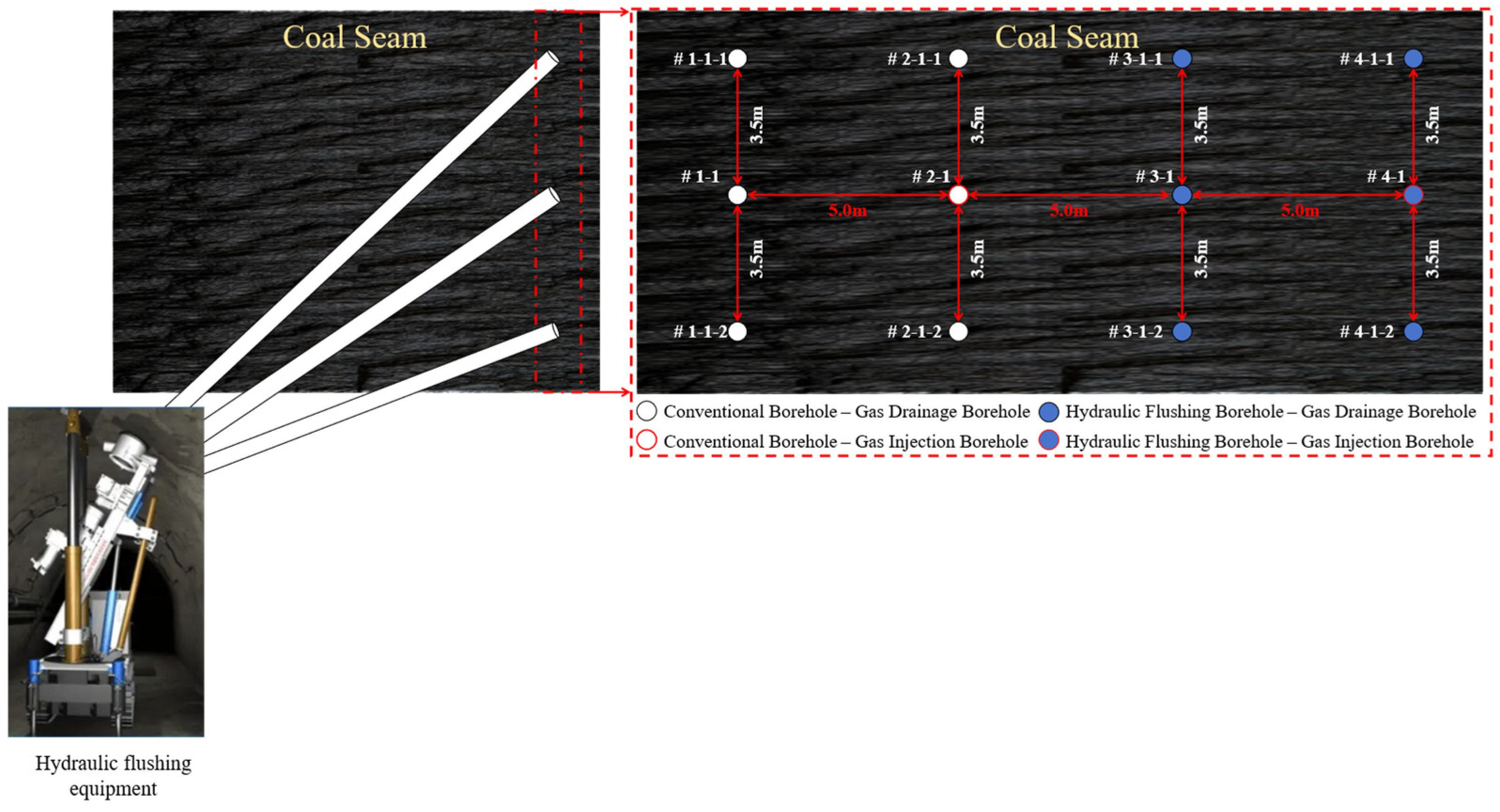
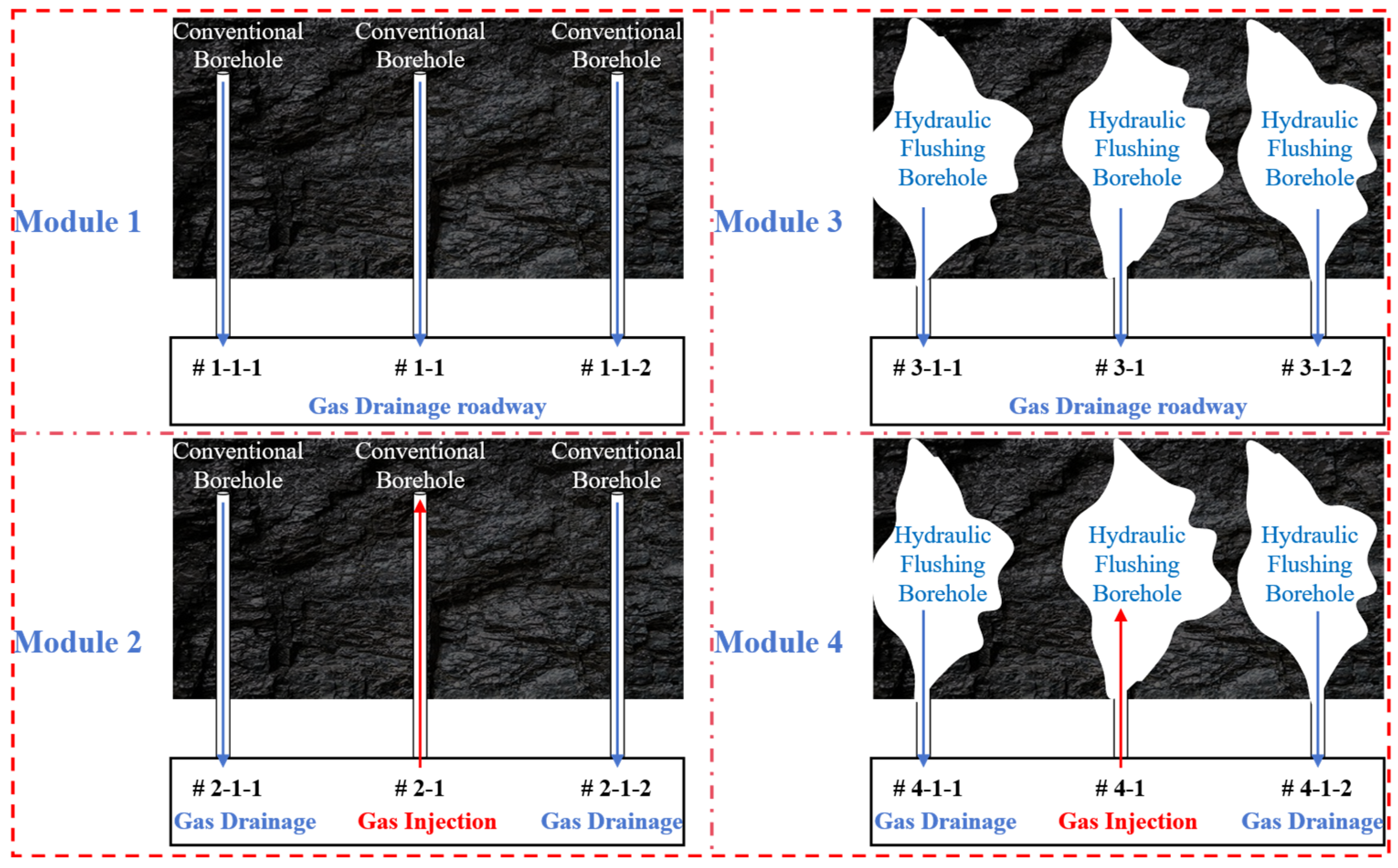
3.2.2. Test Scheme Design
3.3. Test Results Analysis
4. Discussion and Prospects
5. Conclusions
- (1)
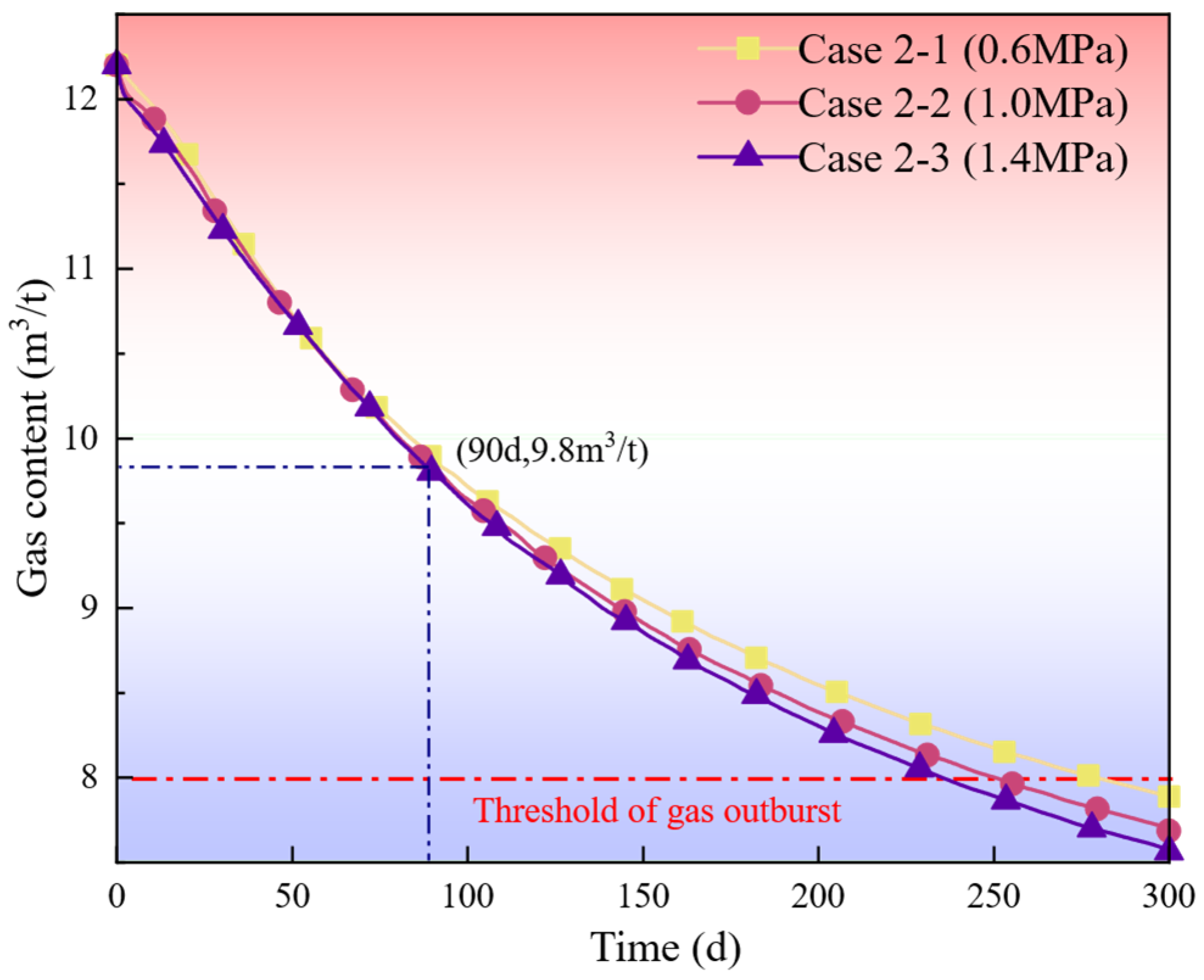
- Through numerical simulation, the optimal process parameters for the synergistic technology were determined as a gas injection spacing of 3.5 m and a gas injection pressure of 1.4 MPa. Under these parameters, the relative coal permeability of the target coal seam reached 1.06, the permeability enhancement zone covered the entire region between the gas injection borehole and the drainage borehole, and the time required for the gas content to fall below the critical threshold of gas outburst (8 m3/t) was the shortest, approximately 235 d. The model was quantitatively validated using field data from the synergistic module, with a relative error of approximately 1.1% between the simulated (18.0%) and field-derived (18.2%) recovery ratios, confirming the model’s reliability, providing precise process parameter guidance for field application.
- (2)
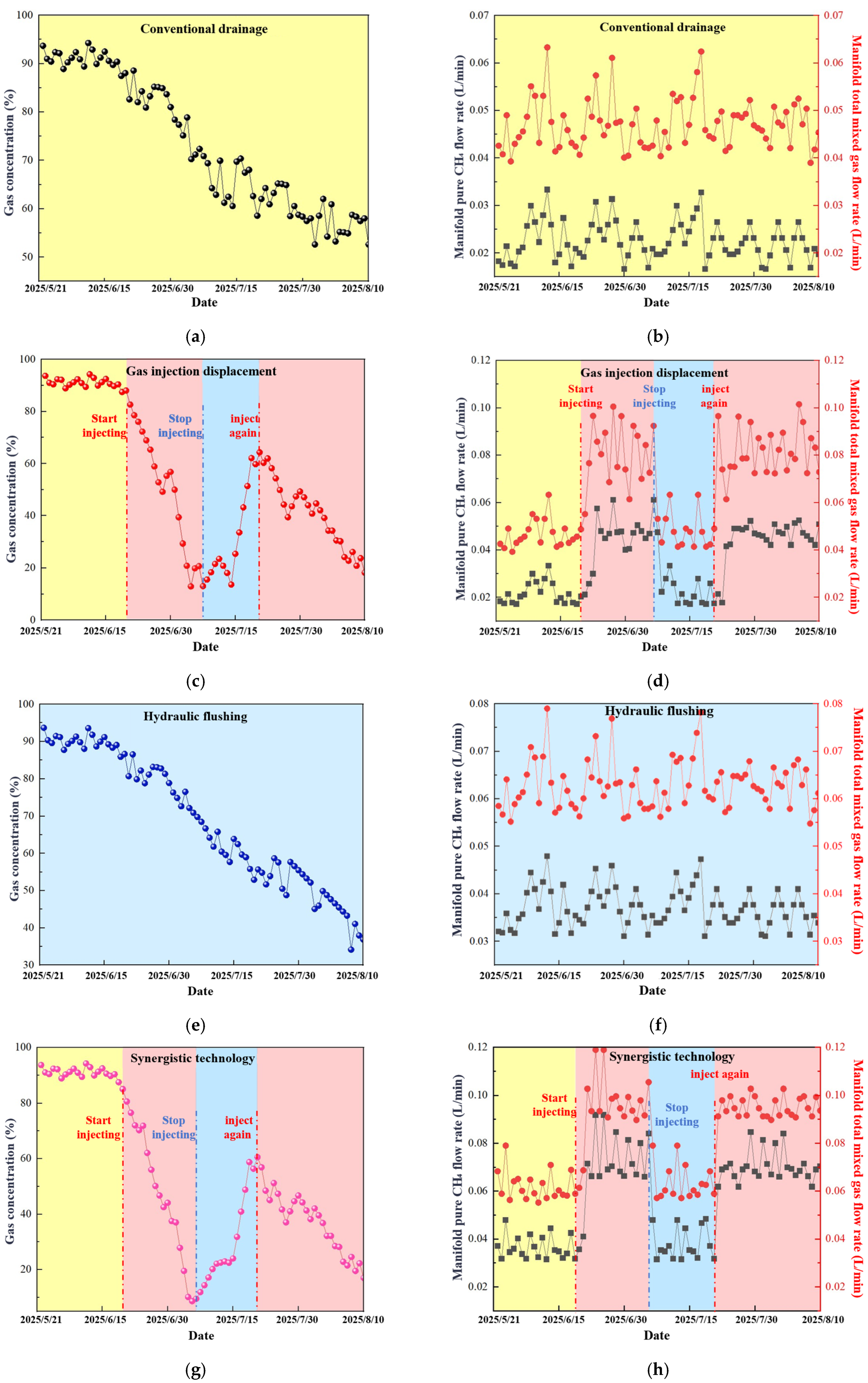
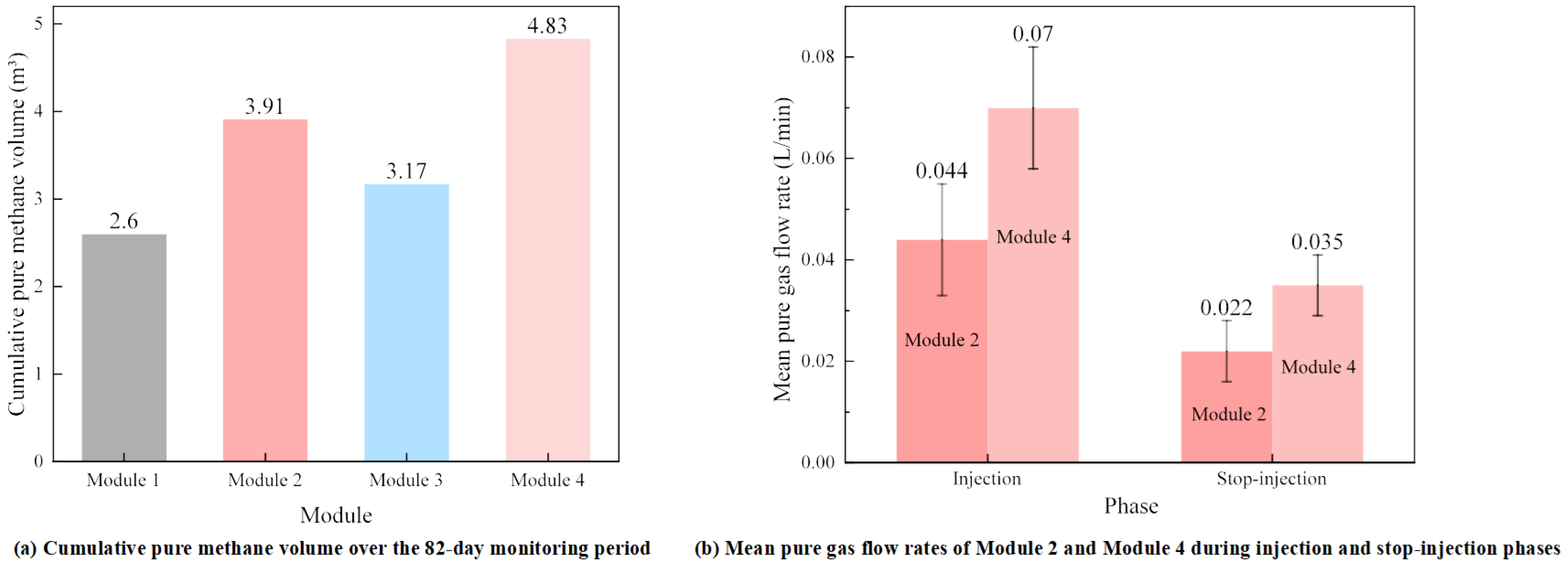
- Compared with conventional drainage, gas injection displacement, and hydraulic flushing, the synergistic technology achieved superior drainage performance. Based on 82-day cumulative pure methane volume, the synergistic technology outperformed conventional drainage by 85.8% (4.83 m3 compared with 2.60 m3), gas injection alone by 23.5% (4.83 m3 compared with 3.91 m3), and hydraulic flushing alone by 52.4% (4.83 m3 compared with 3.17 m3). During the injection phase, the mean flow rate of the synergistic module reached 0.070 ± 0.012 L/min, significantly higher than that of gas injection alone (0.044 ± 0.011 L/min). During the stop-injection phase, the synergistic module maintained 0.035 ± 0.006 L/min, outperforming gas injection alone (0.022 ± 0.006 L/min).
- (3)
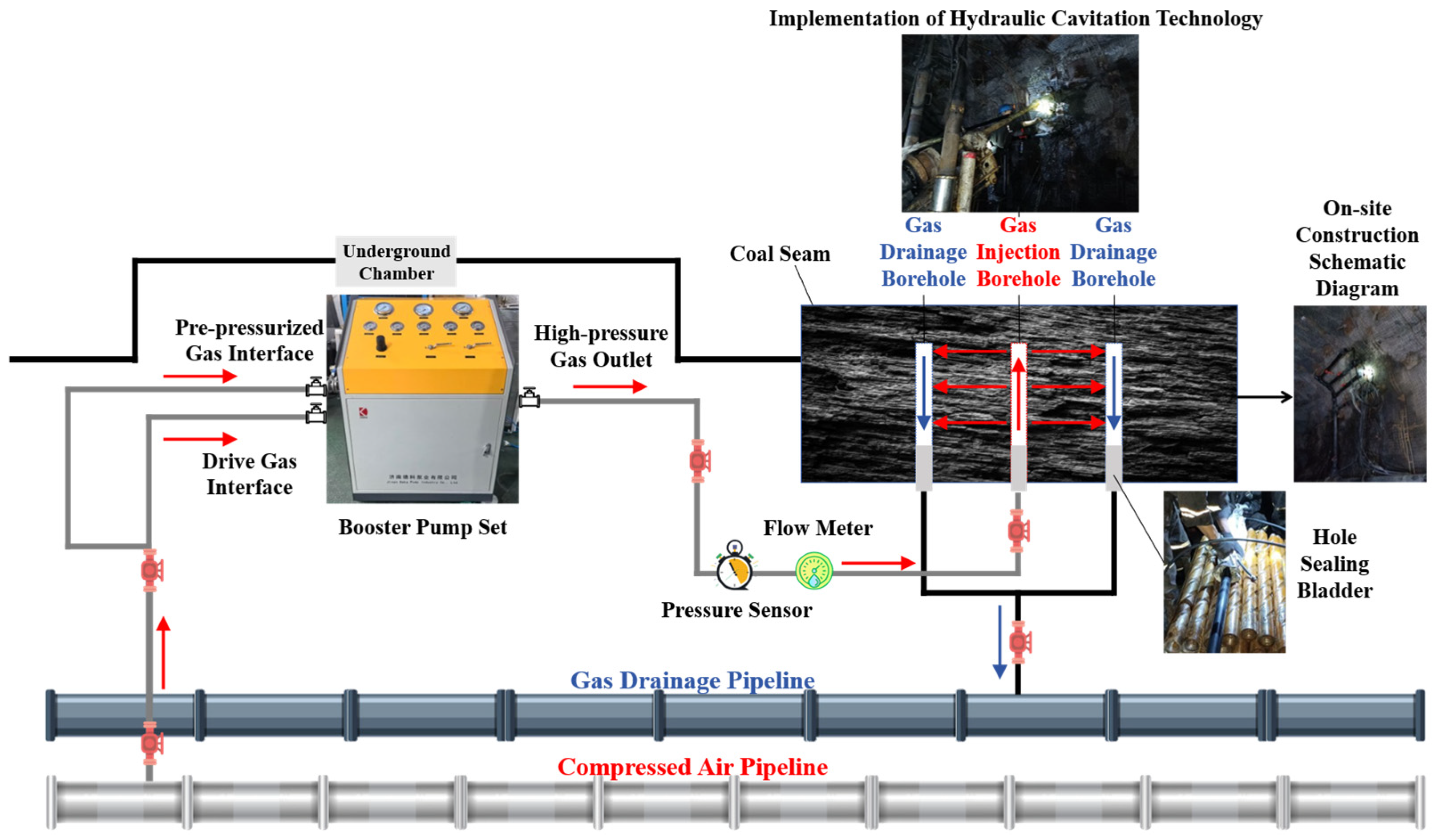
- Compared with nitrogen injection displacement technology, the synergistic technology utilizes the existing underground compressed air system as the gas source, achieving low gas source cost without the need for additional nitrogen production equipment, significantly reducing economic costs. In addition, the system integration complexity is low, making it particularly suitable for mines lacking large-scale nitrogen production capacity, providing an economically feasible alternative for gas management in low-permeability coal seams.
Author Contributions
Funding
Data Availability Statement
Conflicts of Interest
References
- Karacan, C.O.; Ruiz, F.A.; Cote, M.; Phipps, S. Coal mine methane: A review of capture and utilization practices with benefits to mining safety and to greenhouse gas reduction. Int. J. Coal Geol. 2011, 86, 121–156. [Google Scholar] [CrossRef]
- Flores, R.M. Coalbed methane: From hazard to resource. Int. J. Coal Geol. 1998, 35, 3–26. [Google Scholar] [CrossRef]
- Zhang, L.; Zhang, H.; Guo, H. A case study of gas drainage to low permeability coal seam. Int. J. Min. Sci. Technol. 2017, 27, 687–692. [Google Scholar] [CrossRef]
- Yang, X.; Wang, G.; Ni, M.; Shu, L.; Gong, H.; Wang, Z. Investigation on key parameters of N2 injection to enhance coal seam gas drainage (N2-ECGD). Energies 2022, 15, 5064. [Google Scholar] [CrossRef]
- Zhou, X.; Li, X.; Bai, G.; Chai, L.; Wang, Y.; Xiao, M.; Xia, S. Research method of pressure relief and permeability enhancement in low permeability coal seam: A review. AIP Adv. 2022, 12, 010702. [Google Scholar] [CrossRef]
- Zhao, X.; Huang, B.; Li, H.; Chen, S. Field investigation of multi-stage pulse hydraulic fracturing for improving permeability of coal seam in directional long borehole in underground coal mines. Environ. Earth Sci. 2023, 82, 519. [Google Scholar] [CrossRef]
- Wei, G.; Wen, H.; Deng, J.; Li, Z.; Fan, S.; Lei, C.; Liu, M.; Ren, L. Enhanced coalbed permeability and methane recovery via hydraulic slotting combined with liquid CO2 injection. Process Saf. Environ. Prot. 2021, 147, 234–244. [Google Scholar] [CrossRef]
- Li, Y.; Zhang, X.; Liu, X.; Wang, L.; Zhang, J. Comparative analysis of the drainage effect based on improved hydraulic flushing technology. ACS Omega 2022, 7, 44310–44321. [Google Scholar] [CrossRef]
- Li, H.; Zhang, K.; Zu, H.; Qian, J. Study on the technology of permeability enhancement of deep hole pre-splitting blasting in a low-permeability coal seam. Environ. Earth Sci. 2024, 83, 40. [Google Scholar] [CrossRef]
- Yan, F.; Lin, B.; Zhu, C.; Shen, C.; Zou, Q.; Guo, C.; Liu, T. A novel ECBM extraction technology based on the integration of hydraulic slotting and hydraulic fracturing. J. Nat. Gas Sci. Eng. 2015, 22, 571–579. [Google Scholar] [CrossRef]
- Yang, X.; He, L.; Lu, T.; Liu, Y.; Li, X.; Cao, J.; Luo, G.; Yang, H. Optimization and field application of water jet for coal bed methane stimulation. Energy Sci. Eng. 2019, 7, 3186–3203. [Google Scholar] [CrossRef]
- Connell, L.D. Coupled flow and geomechanical processes during gas production from coal seams. Int. J. Coal Geol. 2009, 79, 18–28. [Google Scholar] [CrossRef]
- Wei, C.F.; Li, B.; Li, H.M.; Wang, F.Z. A study on the pressure relief scope and the stress variation of hydraulic flushing borehole. J. Eng. Sci. Technol. Rev. 2014, 7, 103–108. [Google Scholar] [CrossRef]
- Shen, R.; Qiu, L.; Lv, G.; Wang, E.; Li, H.; Han, X.; Zhang, X.; Hou, Z. An effect evaluation method of coal seam hydraulic flushing by EMR. J. Nat. Gas Sci. Eng. 2018, 54, 154–162. [Google Scholar] [CrossRef]
- Qiu, L.; Song, D.; Wang, E.; Liu, Z.; Shen, R.; Li, D.; Jia, H.; Hong, S. Determination of hydraulic flushing impact range by DC resistivity test method. Int. J. Rock. Mech. Min. Sci. 2018, 107, 127–135. [Google Scholar] [CrossRef]
- Zhang, R.; Cheng, Y.; Yuan, L.; Zhou, H.; Wang, L.; Zhao, W. Enhancement of gas drainage efficiency in a special thick coal seam through hydraulic flushing. Int. J. Rock. Mech. Min. Sci. 2019, 124, 104085. [Google Scholar] [CrossRef]
- Reeves, S.R. The Coal-Seq project: Key results from field, laboratory, and modeling studies. In Greenhouse Gas Control Technologies 7; Elsevier: Oxford, UK, 2005; pp. 1399–1403. [Google Scholar]
- Moore, T.A. Coalbed methane: A review. Int. J. Coal Geol. 2012, 101, 36–81. [Google Scholar] [CrossRef]
- Packham, R.; Connell, L.; Cinar, Y.; Moreby, R. Observations from an enhanced gas recovery field trial for coal mine gas management. Int. J. Coal Geol. 2012, 100, 82–92. [Google Scholar] [CrossRef]
- Liu, T.; Lin, B.Q.; Yang, W. Impact of matrix–fracture interactions on coal permeability: Model development and analysis. Fuel 2017, 207, 522–532. [Google Scholar] [CrossRef]
- White, C.M.; Smith, D.H.; Jones, K.L.; Goodman, A.L.; Jikich, S.A.; LaCount, R.B.; DuBose, S.B.; Ozdemir, E.; Morsi, B.I.; Schroeder, K.T. Sequestration of carbon dioxide in coal with enhanced coalbed methane recovery: A review. Energy Fuels 2005, 19, 659–724. [Google Scholar] [CrossRef]
- Mazzotti, M.; Pini, R.; Storti, G. Enhanced coalbed methane recovery. J. Supercrit. Fluids 2009, 47, 619–627. [Google Scholar] [CrossRef]
- Busch, A.; Gensterblum, Y. CBM and CO2-ECBM related sorption processes in coal: A review. Int. J. Coal Geol. 2011, 87, 49–71. [Google Scholar] [CrossRef]
- Shi, J.Q.; Durucan, S. A model for changes in coalbed permeability during primary and enhanced methane recovery. SPE Reserv. Eval. Eng. 2005, 8, 291–299. [Google Scholar] [CrossRef]
- Yang, X.; Zhang, Q.; Tan, F.; Zuo, Y.; Zhang, Y.; Dong, J.; Du, F. Study on the feasibility of enhancing gas extraction efficiency based on hydraulic flushing combined with gas injection displacement (HF-GID): Model development and numerical simulation. ACS Omega 2025, 10, 62322–62335. [Google Scholar] [CrossRef]
- Ren, T.; Wang, G.; Cheng, Y.; Qi, Q. Model development and simulation study of the feasibility of enhancing gas drainage efficiency through nitrogen injection. Fuel 2017, 194, 406–422. [Google Scholar] [CrossRef]
- Lin, J.; Ren, T.; Wang, G.; Booth, P.; Cheng, Y.; Black, D.; Hungerford, F.; Nemcik, J. Field trials of nitrogen injection enhanced gas drainage in hard-to-drain coal seam by using underground in-seam (UIS) boreholes. Fuel 2022, 328, 125293. [Google Scholar] [CrossRef]
- Lyu, S.; Xiao, Y.; Chen, L.; Xiong, Z.; Wang, S. Enhancement of coalbed methane via nitrogen injection in a coal mining area: A laboratory and field study. J. Energy Eng. 2023, 149, 04023047. [Google Scholar] [CrossRef]
- Fan, Y.; Shu, L.; Song, X.; Gong, H. Study on air injection to enhance coalbed gas extraction. Processes 2025, 13, 1882. [Google Scholar] [CrossRef]
- Gao, H. Simulation and optimization of high-pressure air injection promoting underground coal seam gas drainage. Energy Sources Part A Recover. Util. Environ. Eff. 2024, 46, 13258–13274. [Google Scholar]
- Li, H.; Guo, C.; Sun, Y.; Guo, S. Study on permeability improvement technology by injecting air into the gas drainage borehole in low-permeability coal seam. Adv. Civ. Eng. 2018, 2018, 1912383. [Google Scholar]
- Lin, J.; Ren, T.; Cheng, Y.; Nemcik, J.; Wang, G. Cyclic N2 injection for enhanced coal seam gas recovery: A laboratory study. Energy 2019, 188, 116115. [Google Scholar] [CrossRef]
- Lin, H.; Ji, P.; Kong, X.; Li, S.; Bai, Y.; Long, H.; Li, B.; He, D. Progress and prospect of gas extraction technology by underground gas injection displacement for increasing flow in low-permeability coal seam in China. J. China Coal Soc. 2023, 48, 730–749. [Google Scholar]
- Shi, Y.; Lin, B.; Liu, T.; Zhao, Y.; Hao, Z. Synergistic ECBM extraction technology and engineering application based on hydraulic flushing combining gas injection displacement in low permeability coal seams. Fuel 2022, 318, 123688. [Google Scholar] [CrossRef]
- Lei, Y.; Liu, J.; Zhang, S.; Zhang, W.; Wang, H. Contrast test of different permeability improvement technologies for gas-rich low-permeability coal seams. J. Nat. Gas Sci. Eng. 2016, 33, 1282–1290. [Google Scholar] [CrossRef]
- Teng, T.; Xue, Y.; Zhang, C. Modeling and simulation on heat-injection enhanced coal seam gas recovery with experimentally validated non-Darcy gas flow. J. Pet. Sci. Eng. 2019, 177, 734–744. [Google Scholar] [CrossRef]
- Li, S.; Fan, C.; Han, J.; Luo, M.; Yang, Z.; Bi, H. A fully coupled thermal-hydraulic-mechanical model with two-phase flow for coalbed methane extraction. J. Nat. Gas Sci. Eng. 2016, 33, 324–336. [Google Scholar] [CrossRef]
- Cui, X.; Bustin, R.M. Volumetric strain associated with methane desorption and its impact on coalbed gas production from deep coal seams. AAPG Bull. 2005, 89, 1181–1202. [Google Scholar] [CrossRef]
- Liu, W.; Han, D.; Xu, H.; Zhou, Y.; Li, T. Mechanism investigation and models evaluation of gas transport in dual-porosity coal seam. Coal Sci. Technol. 2025, 53, 151–162. [Google Scholar]
- Liu, J.; Chen, Z.; Elsworth, D.; Miao, X.; Mao, X. Evolution of coal permeability from stress-controlled to displacement-controlled swelling conditions. Fuel 2011, 90, 2987–2997. [Google Scholar] [CrossRef]
- Pan, Z.; Connell, L.D. Modelling of anisotropic coal swelling and its impact on permeability behaviour for primary and enhanced coalbed methane recovery. Int. J. Coal Geol. 2011, 85, 257–267. [Google Scholar] [CrossRef]



| Parameter | Value |
|---|---|
| Elastic modulus of coal, Ec | 2700 (MPa) |
| Elastic modulus of coal matrix, Km | 1500 (MPa) |
| Fracture bulk modulus of coal, Kf | 0.048 (GPa) |
| Bulk modulus of coal skeleton, Ks | 2.1 (GPa) |
| Poisson’s ratio of coal, v | 0.2 |
| Initial relative gas pressure, p0 | 0.5 (MPa) |
| Initial permeability, k0 | 5.5 × 10⁻¹⁸ (m2) |
| Initial fracture porosity, ϕf0 | 0.02 |
| Initial matrix porosity, ϕm0 | 0.04 |
| Klinkenberg factor, k | 1.44 × 10⁵ (Pa) |
| CH4 Langmuir volume, VL1 | 31.25 (m3/t) |
| N2 Langmuir volume, VL2 | 15.00 (m3/t) |
| O2 Langmuir volume, VL3 | 11.00 (m3/t) |
| CH4 Langmuir pressure, PL1 | 0.781 (MPa) |
| N2 Langmuir pressure, PL2 | 2.61 (MPa) |
| O2 Langmuir pressure, PL3 | 2.8 (MPa) |
| CH4 density under standard conditions, ρsg1 | 0.7174 (kg/m3) |
| N2 density under standard conditions, ρsg2 | 1.25 (kg/m3) |
| O2 density under standard conditions, ρsg3 | 1.43 (kg/m3) |
| CH4 adsorption time, τ1 | 0.33 (d) |
| N2 adsorption time, τ2 | 0.20 (d) |
| O2 adsorption time, τ3 | 0.18 (d) |
| Swelling coefficient, λ | 0.45 |
| Influence coefficient of body stress on permeability, b | 0.10 (MPa) |
| Maximum volumetric strain induced by adsorption, εsmax | 3.01 (%) |
| Langmuir pressure for adsorption deformation | 1 |
| Coal seam temperature, T | 293 (K) |
| CH4 molar mass, M1 | 16 (g/mol) |
| N2 molar mass, M2 | 28 (g/mol) |
| O2 molar mass, M3 | 32 (g/mol) |
| Apparent density of coal, ρc | 1400 (kg/m3) |
| Universal gas constant, R | 8.314 (J/mol/K) |
| Gas molar volume, V | 22.4 (L/mol) |
| CH4 dynamic viscosity, μ1 | 1.08 × 10⁻⁵ (Pa·s) |
| N2 dynamic viscosity, μ2 | 1.7 × 10⁻⁵ (Pa·s) |
| O2 dynamic viscosity, μ3 | 2.22 × 10⁻⁵ (Pa·s) |
| CH4 Langmuir strain coefficient, εL1 | 0.0127 |
| N2 Langmuir strain coefficient, εL2 | 0.0058 |
| O2 Langmuir strain coefficient, εL3 | 0.0152 |
| Case No. | Injection–Drainage Borehole Spacing Si−d (m) | Gas Injection Pressure Pinj (MPa) |
|---|---|---|
| Case 1-1 | 2.5 | 1.0 |
| Case 1-2 | 3.5 | 1.0 |
| Case 1-3 | 4.5 | 1.0 |
| Case 2-1 | Si−d | 0.6 |
| Case 2-2 | Si−d | 1.0 |
| Case 2-3 | Si−d | 1.4 |
| Parameter | Value | Source |
|---|---|---|
| Initial gas content (m3/t) | 12.2 | Measured and model input |
| Cumulative production at 82 days (m3) | 4.83 | Calculated from measured daily flow rates |
| Simulated gas content at 82 days (m3/t) | 10.0 | Model (Case 2-3, interpolated) |
| Simulated content decline (m3/t) | 2.2 | Calculated |
| Simulated decline ratio | 18.0% | Calculated |
| Implied coal mass (t) | 2.20 | =4.83/2.2 |
| Initial gas in place (m3) | 26.8 | =2.20 × 12.2 |
| Field-derived recovery ratio | 18.2% | =4.83/26.8 |
| Relative error | 1.1% | =|18.2 − 18.0%|/18.0% |
| Borehole Type | Test Module | Borehole No. | Borehole Spacing (m) | Gas Injection Pressure (MPa) | Remarks |
|---|---|---|---|---|---|
| Conventional borehole | Module 1 | 1-1 | 3.5 m | / | Gas drainage borehole |
| 1-1-1 | |||||
| 1-1-2 | |||||
| Conventional borehole | Module 2 | 2-1 | 1.4 MPa | Gas injection borehole | |
| 2-1-1 | / | Gas drainage borehole | |||
| 2-1-2 | |||||
| Hydraulic flushing borehole | Module 3 | 3-1 | / | Gas drainage borehole | |
| 3-1-1 | |||||
| 3-1-2 | |||||
| Hydraulic flushing borehole | Module 4 | 4-1 | 1.4 MPa | Gas injection borehole | |
| 4-1-1 | / | Gas drainage borehole | |||
| 4-1-2 |
Disclaimer/Publisher’s Note: The statements, opinions and data contained in all publications are solely those of the individual author(s) and contributor(s) and not of MDPI and/or the editor(s). MDPI and/or the editor(s) disclaim responsibility for any injury to people or property resulting from any ideas, methods, instructions or products referred to in the content. |
© 2026 by the authors. Licensee MDPI, Basel, Switzerland. This article is an open access article distributed under the terms and conditions of the Creative Commons Attribution (CC BY) license.
Share and Cite
Yang, X.; Tan, F.; Zhang, Q. Enhanced Gas Drainage via Gas Injection Displacement Based on Hydraulic Flushing: Numerical Simulation and Field Test. Energies 2026, 19, 2061. https://doi.org/10.3390/en19092061
Yang X, Tan F, Zhang Q. Enhanced Gas Drainage via Gas Injection Displacement Based on Hydraulic Flushing: Numerical Simulation and Field Test. Energies. 2026; 19(9):2061. https://doi.org/10.3390/en19092061
Chicago/Turabian StyleYang, Xin, Feiyan Tan, and Qingcheng Zhang. 2026. "Enhanced Gas Drainage via Gas Injection Displacement Based on Hydraulic Flushing: Numerical Simulation and Field Test" Energies 19, no. 9: 2061. https://doi.org/10.3390/en19092061
APA StyleYang, X., Tan, F., & Zhang, Q. (2026). Enhanced Gas Drainage via Gas Injection Displacement Based on Hydraulic Flushing: Numerical Simulation and Field Test. Energies, 19(9), 2061. https://doi.org/10.3390/en19092061