1. Introduction
The rapid growth of variable renewable generation is increasing the need for fast and geographically distributed flexibility. Secondary frequency regulation (SFR) is particularly valuable in this context because it requires both a rapid response and sustained power adjustment. Public EV charging networks are attractive candidates. They aggregate large controllable loads across many sites and support digitally dispatchable charging. However, in open public charging systems, the reserve capacity is not a purely aggregate quantity. It is jointly determined by the charger ratings, station import limits, session evolution, and user service requirements. Therefore, the key challenge is not only to achieve charging flexibility, but to convert it into a reserve capacity that is market-biddable ex ante and still physically deliverable and service compatible ex post.
The existing studies explain important parts of this problem, but not the full chain from bidding to delivery. At the infrastructure and station operation levels, Rivera et al. [
1] summarize the charging chain from grid to battery and show that controllability is constrained by the converter structure and charging technology. Rana et al. [
2] further review EV charging technologies and their impacts on grids, highlighting the tight coupling among charging speed, power quality, and network stress. Ghanbari Motlagh et al. [
3] review charging station operations under market dynamics and grid interaction, covering smart charging, bidirectional charging, pricing, and optimization. These works explain where charging flexibility comes from. However, they do not show how that flexibility can be turned into an SFR product whose offered capacity remains feasible during real-time deployment.
A second group of studies focuses on charging network planning and economic activation of flexibility. Yuvaraj et al. [
4] review charging station allocation in distribution networks from the perspective of siting and network constraints. Elghanam et al. [
5] study location selection for wireless charging lanes, while Hung and Michailidis [
6] address the charging station location-routing problem using a data-driven framework. Cui et al. [
7] optimize public charging prices in coupled transportation and power systems. Related studies also consider grid-constrained flexibility scheduling and pricing. Zografou-Barredo et al. [
8] develop a robust resilience-oriented scheduling model for microgrids, and Aguiar et al. [
9] design a network-constrained Stackelberg game for pricing demand flexibility. These studies improve planning and economic coordination, but they do not provide an execution-oriented reserve envelope for open multi-site public charging networks.
Another important line of work strengthens aggregation and market participation models. Attarha et al. [
10] propose a network-secure and price-elastic bidding framework for aggregators in energy and reserve markets. Wang et al. [
11,
12] study coordinated operation between virtual power plants (VPPs) and EV charging stations, and analyze VPP operation under reserve uncertainty. Wen et al. [
13] derive the exact aggregate feasible region of distributed energy resources and propose tractable approximations. At the scheduling level, Ngoc and Huu [
14] use a receding-horizon charging framework, Aljohani et al. [
15] develop a tri-level coordination architecture for large-scale EV charging, Aldulaimi et al. [
16] introduce a predictive grid-impact index for coordinated fast charging, and Duan et al. [
17] co-optimize bidding and charging schedules for urban electric buses. These studies improve portfolio-level flexibility representation and market realism. Still, they mainly address generic DER portfolios, closed fleets, or station-level scheduling. They do not explicitly resolve the operational coupling among market bids, heterogeneous chargers, site import caps, and evolving user sessions in open public charging networks.
The literature most related to this paper concerns EV participation in frequency regulation. Wang et al. [
18] explicitly study charging time-constrained deliverable SFRs and connect reserve provision with dynamic verification through co-simulation. Wang et al. [
19] show that charging flexibility also depends on proper incentive design. Shang et al. [
20] emphasize that multi-station coordination should account for user waiting loss. Zhang et al. [
21] improve scalability through a mean field game strategy for EV aggregation-based VPPs, with rolling capability evaluation and distributed regulation allocation. Ghatuari and Kumar [
22] study coordinated EV control for power system frequency support. These works move beyond nominal reserve procurement and narrow the gap between scheduling and response. Nevertheless, they still do not provide a unified treatment of ex ante reserve bidding, rolling service-feasible planning, and ex post AGC tracking for open public charging systems.
A further gap lies in service protection. For public charging networks, endpoint energy satisfaction alone is too weak as a service criterion. Azzouz et al. [
23], based on a multi-site UK study, show that user experience depends not only on the delivered energy, but also on the availability, reliability, usability, remote assistance, security, and site amenities. This implies that even when a charging session remains deadline feasible, aggressive throttling or a persistent lag in charging progress may still damage user acceptance. Hence, reserve provision in open public charging systems should preserve not only the completion feasibility, but also the charging continuity and intermediate progress.
The execution problem also requires a broader control and systems perspective. Ma et al. [
24] show that the communication architecture affects the cost and effectiveness of demand response. Liu et al. [
25] demonstrate that key node identification matters in distribution networks with large-scale DG and EV integration. Xia et al. [
26] review bounded rationality in local energy markets and caution against idealized user response assumptions. Fotopoulou et al. [
27] show that demand response optimization can improve voltage performance and reduce losses when network constraints are explicitly considered. Yang et al. [
28] demonstrate the value of state-driven aggregation for hierarchical bidding, and Zhou et al. [
29] show how large network-constrained scheduling problems under uncertainty can be accelerated. In addition, tracking control studies provide useful methodological insights. Luan et al. [
30], Wang et al. [
31], Zhong et al. [
32], and Luo et al. [
33] develop coordinated or resilient tracking methods under delays, asymmetric constraints, attacks, and uncertainties. These studies are not designed for public charging networks, but they indicate that scalable SFR delivery should be communication-aware, network-aware, and tracking-oriented.
Taken together, the existing studies still leave a practical gap regarding open public charging networks: how to connect ex ante reserve commitments, rolling service-feasible recourse, and ex post AGC delivery within one deployable framework under heterogeneous charger ratings, station import caps, and evolving session states. To address this gap, this paper develops a service-aware closed-loop coordination framework for multi-site charging networks participating in secondary frequency regulation. The main contributions are threefold.
First, we formulate a baseline-anchored symmetric reserve certification model that links interval-level market bids with slot-level rolling deliverability under charger, station, and session constraints. This model turns the charging flexibility into a reserve capacity that is not only market-biddable ex ante but also physically supportable during subsequent execution.
Second, we introduce two tractable service safeguards—a completion margin constraint and a progress protection trajectory—to preserve the deadline margin and charging continuity during reserve provision. These safeguards provide an operational middle ground between terminal-only feasibility and full user behavior modeling while keeping the planning problem convex.
Third, we design a coordinator-assisted distributed execution scheme for real-time AGC tracking, in which station-level regulation is coordinated through a scalar dual signal and charger-level adjustments are allocated according to urgency. This execution layer closes the loop between market commitment and real-time delivery with limited inter-station information exchange.
2. Three-Layer Coordinated Architecture and System Modeling
The main notation used in
Section 2 and
Section 3 is summarized here for readability.
denotes a market delivery interval,
a rolling planning slot, and
a fast execution interval.
denotes the symmetric reserve capacity committed for market interval
,
the slot-wise deliverable symmetric reserve capacity,
and
the station-level and system-level baseline charging powers,
the station-level regulation command,
the charger-level deviation from baseline,
the completion margin ratio, and
/
the ex ante/realized performance coefficients. The power-related variables are measured in kW, the energy-related variables in kWh, and the time-related quantities in min or h according to the corresponding layer resolution.
2.1. Three-Layer Coordinated Architecture
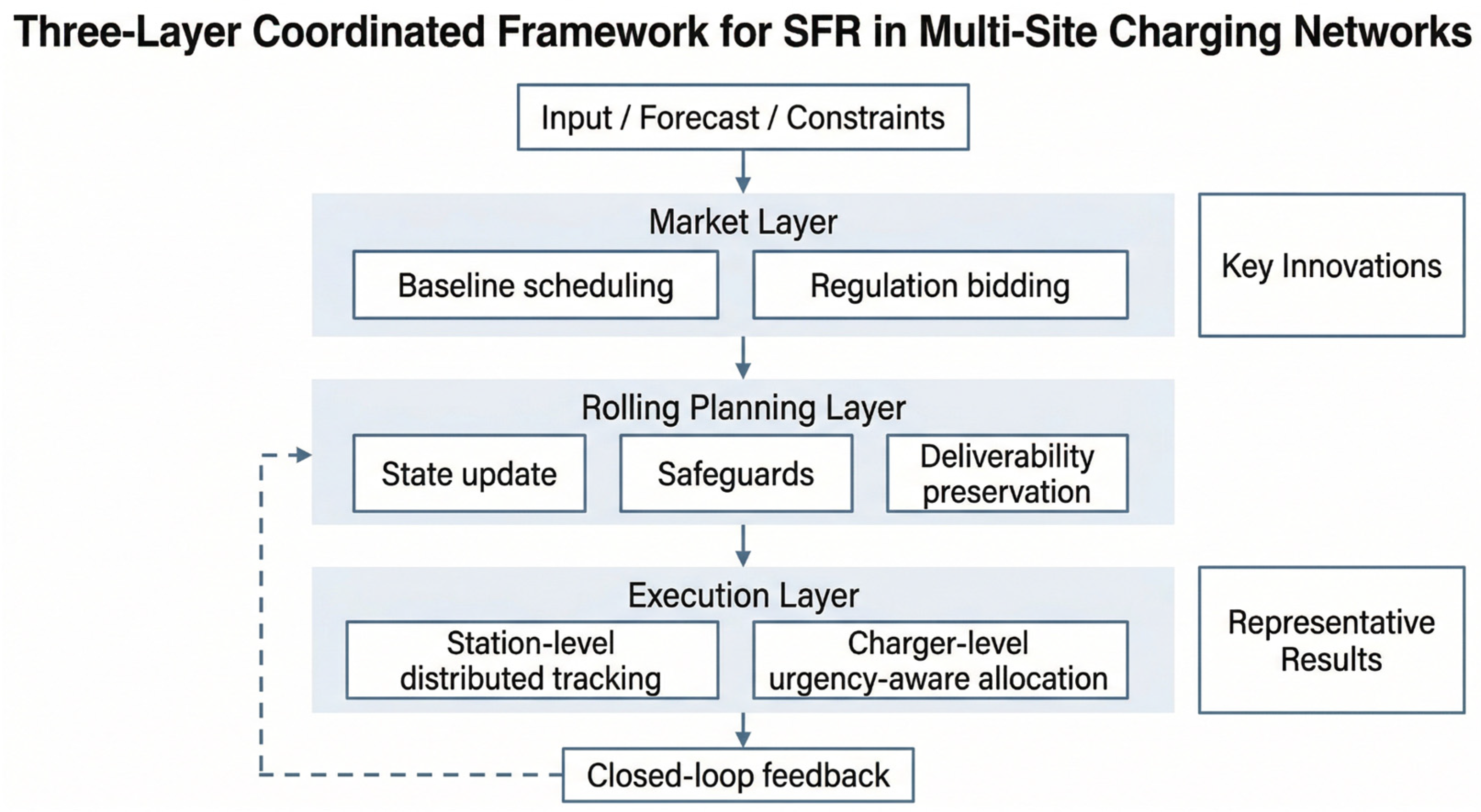
The method is organized as a three-layer closed loop composed of a market layer, a rolling planning layer, and an execution layer. These layers answer three coupled questions: how much reserve can be committed to the market, whether that commitment remains supportable as charging session states evolve, and how the instructed AGC response is delivered in real time. The market layer outputs interval-level reserve commitments, the planning layer converts them into slot-wise baseline schedules and deliverability certificates, and the execution layer tracks AGC around the planning baseline while feeding the realized charging states to the next rolling update.
The three layers also operate at different timescales and serve different decision roles. The market layer works at the bid submission and market clearing timescale, where the interval-level reserve commitments and the corresponding baseline reference are determined. The rolling planning layer updates the remaining baseline trajectory using the latest session information while preserving the reserve quantities whose market gate closure has passed. The execution layer works at a fast control timescale, where the charging network tracks AGC commands around the planning layer baseline through station-level coordination and charger-level allocation.
Figure 1 summarizes this hierarchy. Forecast information and operating constraints enter the market layer for baseline scheduling and regulation bidding. The rolling planning layer then updates the user states, enforces service safeguards, and certifies slot-wise deliverability. Finally, the execution layer performs station-level distributed tracking and charger-level urgency-aware allocation, and the realized states are fed back to the next planning step.
2.2. Session-Level Charging Model and Station Capacity
This subsection defines the physical charging model used by the market and rolling planning layers. It specifies the session-level, station-level, and system-level baselines from which the reserve margins are derived and within which the service safeguards must remain feasible.
Each connection between a vehicle and a charger is represented as a charging session
. For session
, the arrival slot
, departure slot
, required charging energy
, and rated charging limit
are assumed to be known or predictable over the planning horizon
. Let
denote the baseline charging power assigned to session
in planning slot
. This baseline must remain zero when the session is not connected and cannot exceed the session’s rated limit when it is connected, i.e.,
where
is the connection state indicator, taking a value of 1 if session
is physically connected during slot
, and 0 otherwise.
To keep the aggregation levels explicit, the session-level, station-level, and system-level charging powers are denoted by
,
, and
, respectively. Let
be the set of charging stations, and let
denote the set of sessions served by station
. The baseline charging power of station
is then the sum of the baseline powers of its connected sessions, while the total charging power of the whole network is obtained by summing over all stations:
Equivalently, if denotes the station to which session belongs, then . With this notation, is explicitly defined as the system-wide aggregate baseline power, which will also be used later in the market layer objective and reserve envelope formulation.
To respect the transformer and grid interconnection limits at each station, the station-level baseline charging power must satisfy
where
denotes the import capacity limit of station
.
Finally, each charging session must receive its required energy before departure. Defining the connected time window of session
as
, the terminal energy requirement is written as
Equations (1)–(4) thus define the baseline charging model from an individual session level to the whole network and provide the feasible set used in the service safeguard and reserve envelope formulations that follow.
2.3. Proxy-Based Service Safeguards: Completion Margin and Progress Protection
At the rolling planning layer, the framework does not attempt to model user experience in full behavioral detail. Instead, it operationalizes two service risks that most directly affect reserve deployment in open public charging: deadline risk and process-level charging lag. These are represented by a completion margin requirement and a progress protection trajectory. The objective is to prevent reserve provision from systematically pushing charging to the end of the connection window or allowing persistent backlogs to accumulate.
To reduce end-of-session urgency, a comfort deadline is imposed before the physical departure time. Let
denote the comfort deadline of session
. It is defined from the departure slot
by reserving a completion margin ratio
, i.e.,
so that at least one planning slot remains available and the user’s required energy is encouraged to be completed before the actual departure. To preserve feasibility under stressed operating conditions, a non-negative slack variable
is introduced, and the completion margin constraint is written as
where
represents the allowed shortfall with respect to the comfort deadline and will be penalized in the objective function. When
, session
is completed no later than the comfort deadline; when
, the model still remains feasible but records a service quality violation.
To make the effect of the completion margin ratio
on the finish ahead time explicit, define the realized completion slot of session
as
and define the corresponding finish ahead time as
When the comfort deadline slack is inactive, i.e.,
, constraint (6) implies
, and therefore
Let
denote the connected duration of session
in the planning slots. From (5), the comfort deadline satisfies
so that the enforced temporal buffer before physical departure is
up to the minimum one-slot safeguard. Hence, when the comfort deadline slack is not activated,
Averaging over all sessions yields
This shows that acts as a direct regulator of finish ahead time: increasing enlarges the minimum completion buffer and shifts the feasible schedules toward an earlier completion. Because the final schedule is still jointly shaped by electricity prices, reserve requirements, station capacity coupling, and possible activation of slack variables, the realized mapping from to the average finish ahead time is generally monotone, but not exactly affine.
In addition to this terminal safeguard, a progress protection constraint is imposed throughout the connection window in order to prevent prolonged under-charging during intermediate slots. Let
denote the minimum cumulative energy that session
is expected to have received by the end of slot
, where
. This trajectory may be chosen, for example, as a linear reference between arrival and the comfort deadline, or as any prescribed nondecreasing profile consistent with the service policy. With a non-negative slack variable
, the progress protection constraint is expressed as
where
softens the trajectory requirement at slot
. This formulation ensures that the charging progress is protected not only at the departure endpoint, but also along the whole session evolution.
Together, the completion margin constraint and the progress protection constraint form two complementary service safeguards. The former protects the deadline-related charging quality by discouraging last-minute energy concentration, whereas the latter limits the accumulation of charging backlog during a session. Both constraints are linear in their decision variables and can therefore be embedded directly into the rolling planning problem without destroying convexity.
2.4. Symmetric Regulation Capacity Envelope
Given the baseline charging model and the service safeguards above, we now define the deliverable symmetric regulation capacity that links physical feasibility to market participation. In the proposed architecture, reserve bidding is not set as an exogenous percentage of connected load. It is derived from a baseline schedule that remains feasible under session-level, station-level, and service-preserving constraints.
For session
in planning slot
, the upward regulation margin is the amount by which its baseline charging power can be reduced, while the downward regulation margin is the additional charging power that can still be increased without violating the session-level power bound in (1). Accordingly, the two directional margins are defined as
Here, denotes the upward regulation capability of session at slot , and denotes its downward regulation capability. This definition directly reflects the fact that a charging load can provide upward regulation only by curtailing its baseline consumption, and can provide downward regulation only if residual charging headroom remains.
After aggregation over all sessions connected to station
, the station-level upward regulation margin equals the amount of baseline charging power that can be curtailed, whereas the station-level downward regulation margin is jointly limited by the charger-side residual headroom and the station import capacity headroom. To make this distinction explicit, define the charger-side downward headroom of station i in slot t as
The station-side downward headroom is
Then, the station-level directional margins are
At the system level, summing the directional margins of all stations yields
Because the regulation product considered here is symmetric, the cleared regulation capacity in slot t, denoted by
, must be supportable in both directions. Therefore, the biddable symmetric regulation capacity is constrained by
Equations (16)–(18) show that the downward reserve capability of a charging station is not determined by the transformer headroom alone. The charger-level residual capability and station-level import headroom act in series, so the physically deliverable downward margin is the smaller of the two. This distinction avoids overestimating downward reserve bids and preserves consistency between market layer certification and execution layer charger allocation.
The envelope defined by (15)–(20) is a slot-wise power deliverability certificate rather than a market commitment by itself. For a symmetric SFR product, a reserve bid is operationally admissible only if two conditions hold simultaneously: the instructed regulation power can be tracked instantaneously within the slot-wise directional margins, and any cumulative energy deviation caused by biased AGC activation over the delivery interval can be absorbed by a feasible recovery schedule without violating the charging service constraints in (4), (6), and (14). The framework therefore distinguishes instantaneous power deliverability from cumulative activation energy recoverability, and requires both before a market commitment is accepted.
Compared with treating the reserve capacity as an exogenous proportion of connected power, this formulation makes the physical source of biddable capacity explicit. It distinguishes the load-reduction capability from the load-increase capability, preserves the aggregation hierarchy from sessions to stations to the whole network, and provides an interface between slot-wise planning deliverability and interval-level market commitment. Specifically, denotes the symmetric reserve capacity that remains physically supportable in planning slot , whereas denotes the reserve quantity committed for market interval . The planning layer certifies and preserves , and the market layer chooses subject to that certification.
2.5. Joint Optimization of the Market and Planning Layers
This subsection formalizes that interface. It first presents the deterministic core that co-optimizes the baseline charging schedules and interval-level reserve commitments under the current forecast, and then embeds that core in a rolling implementation that freezes closed market intervals, re-optimizes the remaining baseline trajectory, and applies uncertainty-aware deliverability checks over the residual horizon.
The nominal model is presented for clarity, whereas the rolling formulation in
Section 2.5.3 is the operational version used in deployment and in the case study.
2.5.1. Revenue Model and Performance Interface
Three indices remain distinct throughout this subsection. The market layer operates on the delivery intervals indexed by , where the operator commits a symmetric reserve capacity . The rolling planning layer operates on scheduling slots indexed by , where the baseline charging trajectory and the slot-wise deliverable envelope are updated using the latest session information. The execution layer operates on fast control intervals indexed by , where the network tracks AGC commands around the planning layer baseline. The market–planning model therefore chooses and the baseline trajectory so that every committed interval remains supported by the corresponding planning slots, while the execution later determines the realized response and settlement performance.
Let
denote the symmetric regulation capacity committed for market delivery interval
. Let
and
denote the corresponding capacity and mileage prices, respectively, and let
denote the forecast performance coefficient used for ex ante economic evaluation. The expected ancillary service revenue in market interval
is written as
where
is the expected regulation mileage associated with interval
.
To estimate the mileage, let
denote the normalized AGC command at fast interval
. Define the normalized mileage factor of market interval
as
Then, the expected regulation mileage of interval
is approximated by
Therefore, the total expected ancillary service revenue over the planning horizon is
The interface with the execution layer is defined at the fast timescale. For each fast interval
, the instructed regulation power is
where
is the committed symmetric regulation capacity of the market interval containing fast interval
. Let
denote the actual aggregate regulation response delivered by the charging network relative to the planning layer baseline. The tracking error at fast interval
is then defined as
Based on the tracking errors over all fast intervals contained in market delivery interval
, the realized settlement performance coefficient is defined by
where
is a small constant introduced to avoid division by zero. When the delivered response closely follows the instructed AGC signal, the average normalized tracking error remains small and
approaches
.
Accordingly, is the forecast performance coefficient used in the market and planning layers, whereas is the realized settlement coefficient obtained after execution. This distinction separates ex ante bidding from ex post settlement. In practical applications, the proxy definition above may be replaced directly by the official performance-scoring rule of a specific market operator without changing the structure of the proposed framework.
2.5.2. Objective Function and Constraints
At each rolling update, the market–planning core maximizes the expected ancillary service revenue while accounting for the electricity purchasing cost, soft violations of the service safeguards, and excessive reshaping of the baseline charging profile. Using the revenue model in (21)–(24), the deterministic core objective is formulated as
Here, denotes the system-wide aggregate baseline charging power in planning slot , is the electricity purchase price, is the completion margin slack, is the progress protection slack, and is an auxiliary variable used to penalize excessive inter-slot baseline variation.
The baseline-smoothing term is enforced by
so that
at the optimum.
This optimization is subject to session-level charging constraints, station capacity constraints, the terminal energy requirement, and service safeguard constraints:
At the planning timescale, the slot-wise deliverable symmetric reserve envelope is described by
with
The market commitment and the planning layer envelope are coupled through
Constraint (33) ensures that the market-cleared symmetric capacity of interval is supportable in every planning slot belonging to that interval. In other words, is the interval-level market decision, whereas is the slot-level deliverability certificate provided by the rolling planner.
Equations (28)–(33) show that reserve bidding and baseline scheduling cannot be separated. A lower baseline reduces the electricity purchasing cost but also reduces the upward regulation margin . A higher baseline enlarges but increases energy cost and may reduce the downward regulation margin . The joint formulation therefore internalizes the trade-off among market revenue, charging cost, reserve deliverability, and service protection.
With , , and the price parameters treated as exogenous coefficients, the above problem remains convex. The objective in (28) is linear, and all constraints in (29)–(33) are affine. Therefore, once the already-committed market quantities are fixed as parameters, the resulting model can be solved as a linear program.
2.5.3. Rolling Update and Uncertainty Handling
In practical operation, session states continue to evolve, so the deterministic core above is solved in a rolling manner at the scheduling timescale. This subsection adds gate closure logic and an uncertainty-aware deliverability check to convert the core model into the deployment model. At a rolling update, the planner optimizes the remaining horizon
The rolling update does not reopen intervals whose market gate closure has already passed. Instead, it reshapes the remaining baseline trajectory and verifies that previously committed reserve quantities remain deliverable under the latest session states.
Let
denote the forecast remaining energy demand of session
at rolling update
, and let
denote the forecast connection state indicator. Their forecast errors are represented by
and
, respectively, so that
These uncertainties are assumed to belong to the bounded budget set
where
is the set of sessions relevant at update
, and
is the uncertainty budget parameter.
For any future planning slot
, define the robust slot-wise deliverable envelope as
where
Let
denote the set of market intervals whose gate closure has already passed at update
, and let
denote the set of intervals that remain open for bidding. For closed intervals, the reserve commitment is fixed as a parameter:
In addition, the remaining horizon schedule must preserve the deliverability of that commitment:
For intervals that are still open, the bid remains a decision variable but must satisfy the same robust deliverability condition:
Equations (37)–(41) make the coupling among the market layer, the rolling planning layer, and uncertainty handling explicit. Once a market interval has passed gate closure, its committed capacity cannot be changed by the rolling planner; the planner can only reshape the remaining baseline trajectory so that the commitment remains physically deliverable. By contrast, for market intervals that remain open, the bid can still be optimized subject to the robust slot-wise envelope over the remaining horizon.
In practical implementations, a deterministic safety factor can be interpreted as a simplified approximation of the robust tightening in Equations (37) and (38). Specifically, one may use
where
is the nominal slot-wise envelope obtained from the latest forecast. This approximation preserves the temporal consistency of the framework while avoiding repeated evaluation of worst-case margins in large-scale rolling implementations.
The uncertainty treatment is limited to the bounded uncertainty in the remaining energy demand and connection states. It should therefore be understood as a tractable robustness-aware safeguard for reserve deliverability and charging service, rather than a full stochastic behavioral model of heterogeneous user preferences and arrivals.
2.6. Distributed Tracking at the Execution Layer and Charger-Level Decomposition
2.6.1. Station-Level Envelope and Convex Coordination
Once the rolling planner has determined the baseline charging schedule, the execution layer must track the AGC instruction at a faster timescale while preserving station-level feasibility. Let
denote the fast control interval, and let
be the planning slot to which interval
belongs. Over one execution interval, the baseline obtained for slot
is treated as fixed, so the station-level regulation capability can be constructed directly from the corresponding station baseline power. For station
, the upward and downward regulation envelopes available at fast interval
are written as
where
is the maximum load reduction that station
can provide relative to its baseline, and
is the maximum additional charging power that can still be absorbed when both the charger-side residual headroom and the station import capacity headroom are respected.
Let
denote the regulation contribution assigned to station
at fast interval
, measured relative to the baseline. By convention,
represents downward regulation, that is, an increase in charging power relative to the baseline, whereas
represents upward regulation, that is, a reduction in charging power. The station-level regulation decision must then satisfy
To make the execution architecture distributed, the station-level tracking layer is implemented over a star communication graph composed of one coordinator node and all station nodes. At fast interval
, the coordinator broadcasts the AGC instruction together with a scalar coordination variable, while each station sends back only its local regulation response. The coordinator does not require charger-level session states, urgency weights, or detailed within-station charging trajectories. Each station uses only its local envelope bounds, its previous fast-timescale command, and the scalar coordination signal received from the coordinator. The station-level execution problem is therefore solved without a central full-information optimization over all stations and chargers. At fast interval
, the aggregate regulation response delivered by the charging network is
To track the instructed AGC command while suppressing excessive fluctuations in station commands, an equivalent distributed coordination form is introduced by augmenting the tracking mismatch with an auxiliary residual variable:
subject to
where
is the station-level smoothing weight and
is the tracking weight. The variable
represents the instantaneous tracking residual. This formulation is equivalent to the original station-level quadratic tracking problem, but it exposes a separable structure with only one affine coupling constraint, enabling distributed implementation through dual decomposition.
Define the lower and upper local bounds as
Introducing the Lagrange multiplier
for the coupling constraint
, the resulting Lagrangian becomes
Because the Lagrangian is separable across stations for a given
, each station solves the following local one-dimensional subproblem independently:
Its closed-form solution is the projection
where
denotes the Euclidean projection onto the interval [
l,
u]. In parallel, the coordinator updates the residual variable as
Using the aggregated primal residual, the coordinator then updates the scalar coordination variable according to
where
is the dual step size. The iteration is terminated when the coupling residual satisfies
or when a prescribed maximum number of iterations
is reached. To accelerate convergence in real-time operation, the multiplier is warm-started by the converged value from the previous fast interval, i.e.,
.
The information boundary is explicit. The coordinator requires only the AGC target , the received scalar responses , and the updated multiplier . Each station requires only its own local envelope , its previous command , and the broadcast multiplier . No station needs the states of other stations, and no charger-level data are revealed to the coordinator. The implementation burden and privacy exposure are therefore both limited.
Because
and
, the primal problem is strongly convex and admits a unique optimum. The dual function is continuously differentiable, and the distributed gradient iteration converges to the global optimum when the step size satisfies
Hence, the proposed station-level execution scheme is a coordinator-assisted distributed optimization algorithm with an explicit communication graph, local decision structure, stopping rule, and convergence condition.
The communication cost of the proposed execution layer is modest. At each dual iteration, each station uploads one scalar and receives one scalar . Therefore, the total communication volume is scalars per iteration. In the present case study with 20 stations, this corresponds to 40 scalar exchanges per iteration, which is lightweight for minute-level AGC tracking. After convergence, the optimal station command is passed to the charger-level allocation layer described next. The execution layer thus combines distributed station-level tracking with within-station urgency-aware decomposition.
2.6.2. Charger-Level Urgency-Weighted Allocation
After the station-level coordination problem determines how much regulation each station should provide, the execution layer decomposes that station command among the active charging sessions within each station. This within-station allocation must remain charger feasible while protecting more urgent sessions from disproportionate service degradation.
Let
denote the actual charging power of session
at fast interval
, and let
be the baseline charging power assigned to that session by the planning layer in the corresponding slot
. The charger-level regulation adjustment is then defined as
With this definition, means that session is charging above its baseline and is therefore contributing to downward regulation, whereas means that its charging power is reduced below the baseline and is therefore contributing to upward regulation.
For an active session
connected at fast interval
, the available upward and downward adjustment margins follow directly from its baseline and rated charging limit:
where
is the fast-timescale connection state indicator. Therefore, the charger-level adjustment must satisfy
Within each station
, the charger-level adjustments must add up to the station command obtained from the upper coordination layer. Hence, for all
and
,
To protect sessions with limited remaining flexibility, an urgency weight is assigned to each active session. Let
denote the remaining energy demand of session
at fast interval
, and let
denote its remaining connected time. The urgency weight of session
n is then defined as
where
and
are the weighting coefficients for the energy urgency and time urgency, respectively, and
is a small positive constant introduced to avoid division by zero. Sessions with larger unmet energy demand or shorter remaining connection time are assigned larger urgency weights and should be less heavily curtailed during regulation deployment.
Using these urgency weights, the station command
is allocated among active sessions through a weighted feasibility problem. A convenient convex formulation is
subject to
In this formulation, sessions with larger urgency weights incur a higher penalty when their charging powers are adjusted away from the baseline. The optimization therefore assigns more of the station-level regulation burden to sessions that still have greater temporal or energy flexibility, while protecting those closer to their comfort deadline or with a substantial remaining energy demand.
Once
has been obtained, the actual charger-level power is recovered as
If additional suppression of high-frequency charger-level fluctuations is desired, a ramp-rate constraint can also be enforced:
where
is the allowable charger-level ramp-rate limit of session
. This constraint helps avoid excessive fast switching and improves the smoothness of execution layer power trajectories.
The charger-level allocation layer is the final link between system-wide AGC tracking and charging service protection. The station-level coordination determines how much regulation each station should provide, whereas this layer determines which sessions within that station absorb the regulation burden. By combining instantaneous power feasibility with urgency-aware weighting, the decomposition preserves the tracking accuracy while reducing the likelihood that critical sessions will suffer persistent charging delays or severe progress loss.
Feedback from the execution layer to the rolling planning layer is applied once per planning slot. At the end of planning slot, the execution layer aggregates the realized charger-level energy delivery, updated connection states, and tracking statistics over all fast intervals, and passes these quantities to the next rolling update.
The next rolling optimization therefore uses execution-corrected session states rather than relying solely on ex ante forecasts. The market layer determines the interval-level reserve commitments, the planning layer updates the slot-level baselines and deliverability envelopes, and the execution layer provides fast AGC tracking around those baselines while feeding the realized states back into the next planning cycle. This closes the loop among bidding, planning, and execution.
3. Results
This section validates the proposed framework along three dimensions: market–planning biddability and settlement consistency, protection of charging service during reserve provision, and real-time deliverability under fast AGC activation. The aim is not to report isolated gains by separate metrics, but to verify the full chain from biddable capacity to service-aware planning and real-time execution.
3.1. Case Setup
Because no public dataset simultaneously reports multi-station session-level charging trajectories, station import capacity limits, and operator-issued AGC commands in a unified format, the case study is constructed as a reproducible synthetic scenario for methodological validation rather than a site-specific field demonstration. The test system contains 20 charging stations, 600 chargers, and 1108 charging sessions per day. The charger ratings are 30, 45, 60, and 90 kW; the station import capacities range from 646 to 820 kW under an installed capacity tightness rule; and single-session energy demands range from 13.3 to 65.0 kWh. The planning layer is evaluated at a 15 min resolution and the execution layer at a 1 min resolution. The planning-side benchmarks test biddability and service preservation, and the execution-side controllers test real-time deliverability.
Although synthetic, the test system preserves the structural features that determine the reserve biddability and execution consistency in public charging networks, including spatially distributed stations, heterogeneous charger ratings, bounded station capacities, time-varying session arrivals and departures, and heterogeneous charging demands. The scenario generator is designed to reproduce practically relevant operating patterns, such as clustered arrivals, moderate connection durations, and incomplete simultaneity across stations. The case should therefore be interpreted as representative in a structural and operational sense for mechanism-level validation.
To evaluate the framework’s relative robustness beyond a single realization, seed perturbations and stress tests are conducted on the demand intensity, arrival shifts, and AGC amplitude. The market environment combines a time-of-use tariff with a capacity-plus-mileage settlement, and a 15% completion margin (minimum one slot) is enforced. The parameters are calibrated via a two-stage offline procedure: Stage A sets the safety factor based on the 10th percentile robust contraction ratio, while Stage B uses a multi-seed grid search to determine the penalty weights () that optimally balance service quality and economic benefit. To isolate the contribution of each layer under controlled conditions, all comparative studies are conducted on the same synthetic session set, station capacity realization, tariff trajectory, and AGC signal for each seed. The planning-side comparators therefore share the same physical charging model, session information, and market inputs, and differ only in how the reserve coupling, service protection, and uncertainty treatment are represented. Specifically, the cost-first benchmark solves the charging scheduling without reserve-oriented co-optimization, the unconstrained co-optimization benchmark co-optimizes the baseline and reserve without the proposed service safeguards, and the proposed method adds the completion margin and progress protection terms within the same solver framework. The stochastic and robust baselines are implemented as uncertainty-aware reference variants under the same data and model interface; they are intended to isolate the effect of expectation-based and conservative bidding treatments rather than to reproduce any single published method verbatim.
Table 1 summarizes the synthetic scenario and network configuration used in the case study, including the network size, charger composition, session characteristics, station capacity range, and the temporal resolutions of the planning and execution layers. Under this common test setting, the execution-side comparison is designed separately to avoid conflating planning quality with control quality. All execution controllers are evaluated on the same planning baseline, the same AGC window, and the same charger/station feasibility set, including the same station capacity clipping and charger ramp-limit enforcement. The VPP-style hierarchical controller and the RL-style adaptive controller are lightweight reference implementations under this common interface. In particular, the RL-style baseline should be interpreted as an online score-adaptive dispatch heuristic rather than a fully trained deep reinforcement learning agent. This common interface design improves comparability while keeping the baseline implementations aligned under a unified evaluation setting.
To strengthen the credibility of the case design, the scenario generator is parameterized not by arbitrary point values but by bounded distributions chosen to reproduce three stylized characteristics of public charging networks: clustered arrivals around commuting and evening peaks, moderate connection durations with partial charger utilization, and incomplete simultaneity at the station level. The revised manuscript therefore reports descriptive statistics for arrival times, session durations, energy demand quantiles, charger mix composition, station occupancy, and station import ratio distributions, together with AGC diagnostics, including net energy bias, sign-switching frequency, and signal mileage over the evaluation window. Monte Carlo seed perturbations and stress tests on the demand intensity, arrival shifts, and AGC amplitude are also provided to show that the comparative conclusions are not driven by a single random draw.
To connect
Section 2.5.3 more directly to the case implementation, this study further compares the alpha = 0.92 approximation with the full budget robust model. The simplified implementation reproduces the full model tracking quality with a negligible NMAE gap while remaining conservative about the committed reserve, supporting the use of a fixed alpha in deployment-oriented rolling optimization.
3.2. Market–Planning Performance and Adjustable Capacity Envelope
The study provides three diagnostics for the implementation of
Section 2.5.3: a single-case comparison of the alpha-simplified model and the full budget robust model, a calibration trace for the reserve contraction ratios used to identify the q10 anchor, and a multi-seed validation table over alpha values from 0.88 to 0.96. The selected alpha = 0.92 is the nearest conservative operating point to the calibration anchor and reproduces the tracking quality of the full model while preserving conservative reserve commitments.
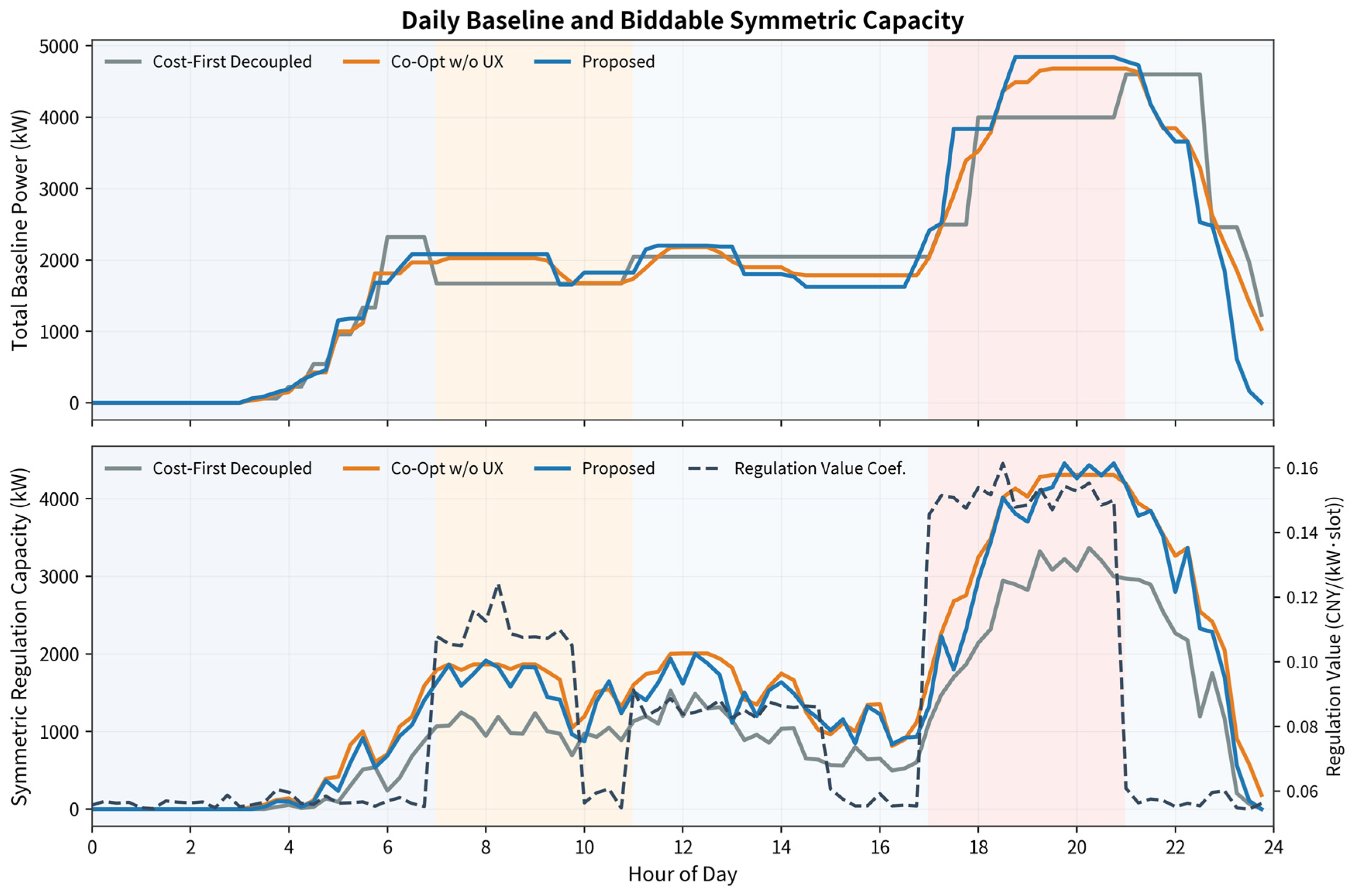
As shown in
Figure 2, the proposed method jointly determines the daily baseline charging profile and the corresponding biddable symmetric regulation capacity over time.
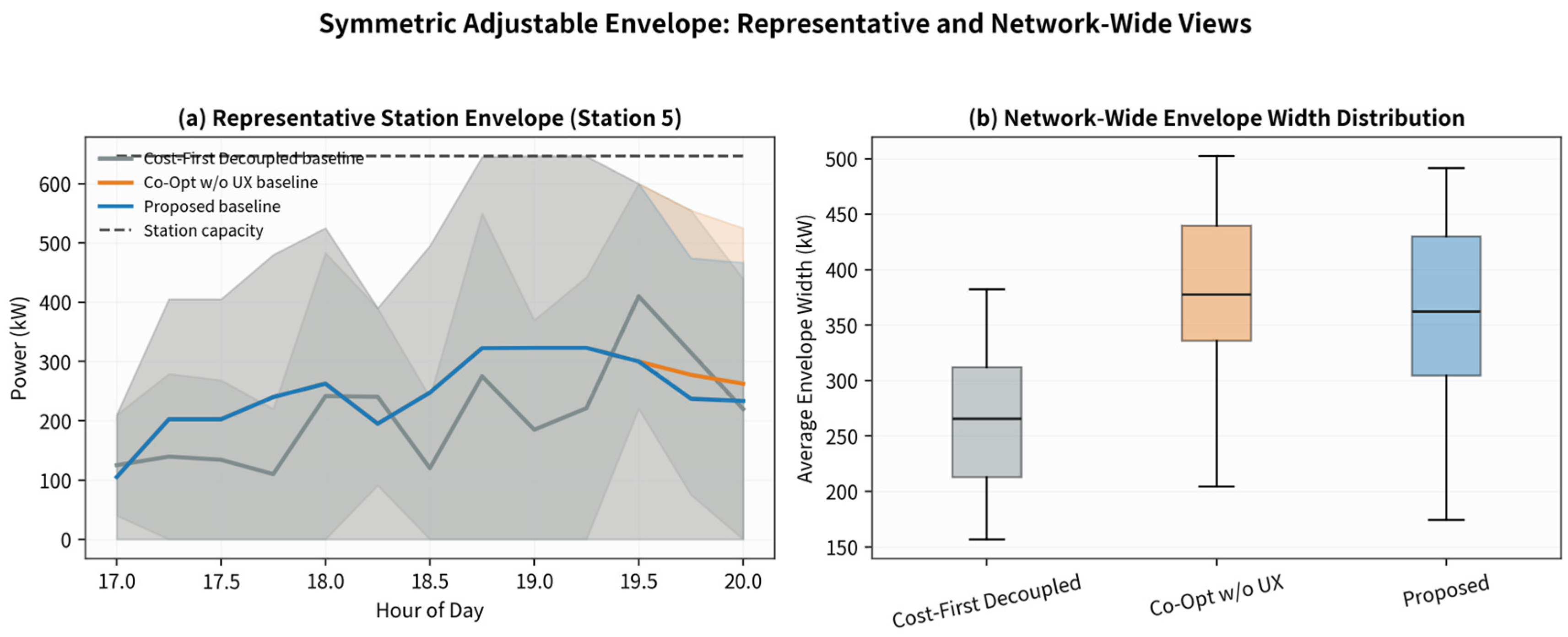
Figure 3 illustrates the station-level mechanism. For a representative station, the proposed baseline avoids local load extrema and thereby preserves a broader admissible margin for symmetric reserve deployment while respecting both the charger and station transformer capacity limits.
Figure 3b shows that this is not an isolated effect: the network-wide envelope widths are substantially broader under the co-optimized models than under the decoupled baseline. The contribution is therefore not a new aggregate feasible region formulation, but a baseline-anchored reserve envelope that enlarges the deliverable symmetric margin around economically selected operating points while remaining compatible with the rolling progress updates and station-level execution constraints.
To keep the planning-side comparison fair, all five methods are solved on the same session realization and network instance, using the same station import limits, charger ratings, and baseline market signals. The comparative intent is therefore not to contrast heterogeneous solver stacks, but to quantify the marginal effect of three modeling choices under a common optimization backbone: reserve-aware baseline coupling, service-aware proxy constraints, and uncertainty-aware tightening. This shared model design allows for the observed differences in
Table 2 to be interpreted as structural effects of those modeling choices rather than as artifacts of inconsistent data interfaces or implementation details.
The proposed method outperforms the cost-first benchmark by boosting the average symmetric capacity by 42.8% and the settlement-adjusted net benefit by 50.7%. Relative to the unconstrained co-optimization, it sacrifices some nominal reserve headroom to achieve an 11.2% higher settlement performance () and a 77.5% smaller progress gap, proving its effectiveness at balancing the closed-loop trade-offs rather than dominating every single metric.
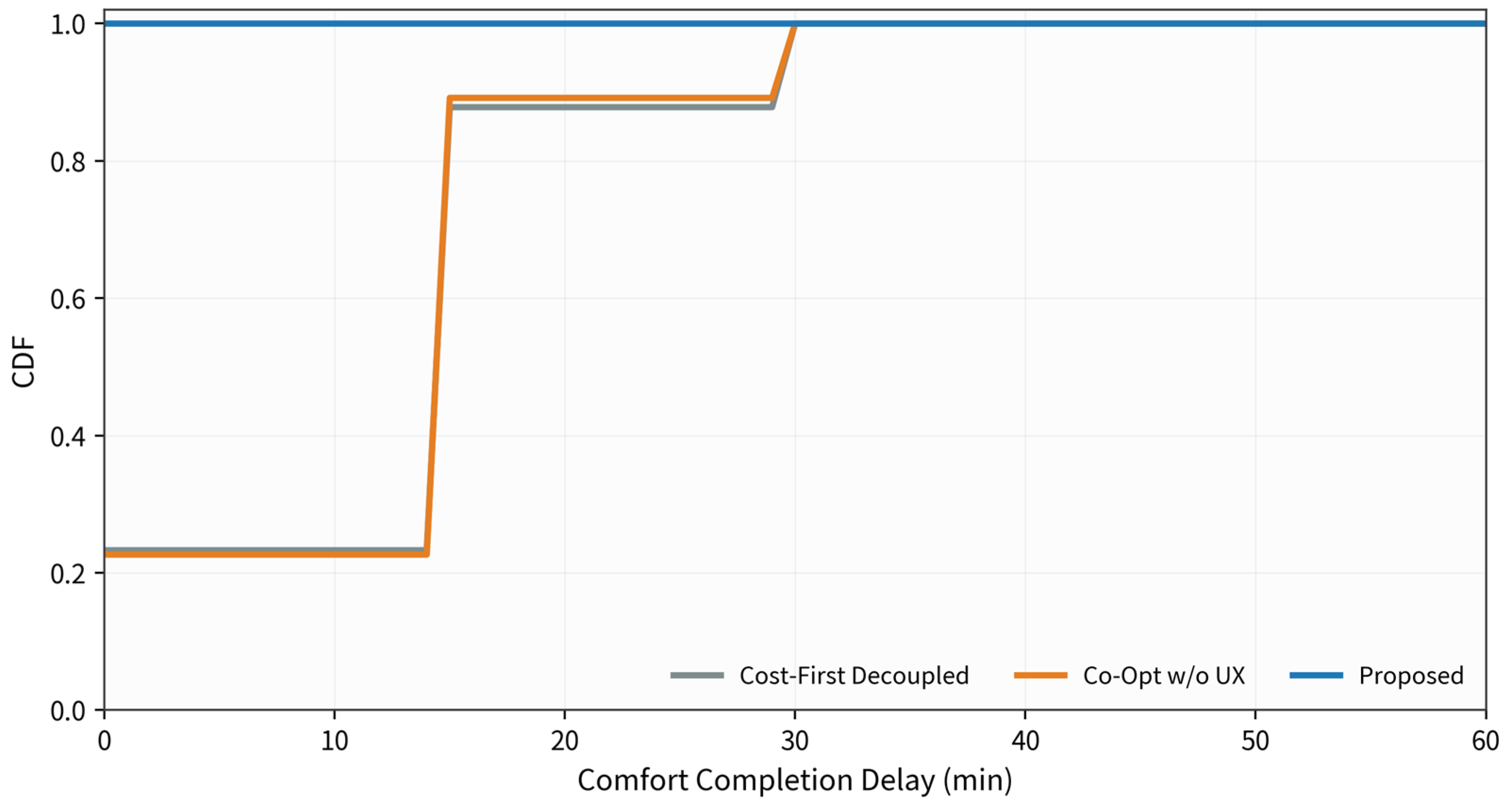
Table 2 shows that the proposed method improves the trade-off among market value, real-time deliverability, and charging service protection rather than dominating every comparator in every metric. Compared with the cost-first decoupled benchmark, it substantially improves the average symmetric capacity, settlement-adjusted net benefit, and service-related metrics, indicating that reserve participation should be embedded in baseline formation rather than appended after cost-minimizing charging decisions. Compared with the co-optimized model without service safeguards, the proposed method gives up part of the nominal reserve headroom and ex ante revenue in exchange for a markedly better settlement performance, full comfort on-time completion in the tested case, and a much smaller progress gap metric. Relative to the stochastic and robust baselines, its main advantage is the most balanced closed-loop outcome across market value, real-time deliverability, and process-level charging protection.
To reduce the risk that the reported ranking is driven by a single random seed, the case study further examines the seed perturbations and stress tests on the demand intensity, arrival shifts, and AGC amplitude. These additional tests preserve the same comparative trends and support the robustness of the main conclusions.
3.3. Service Preservation and Revenue Trade-Off
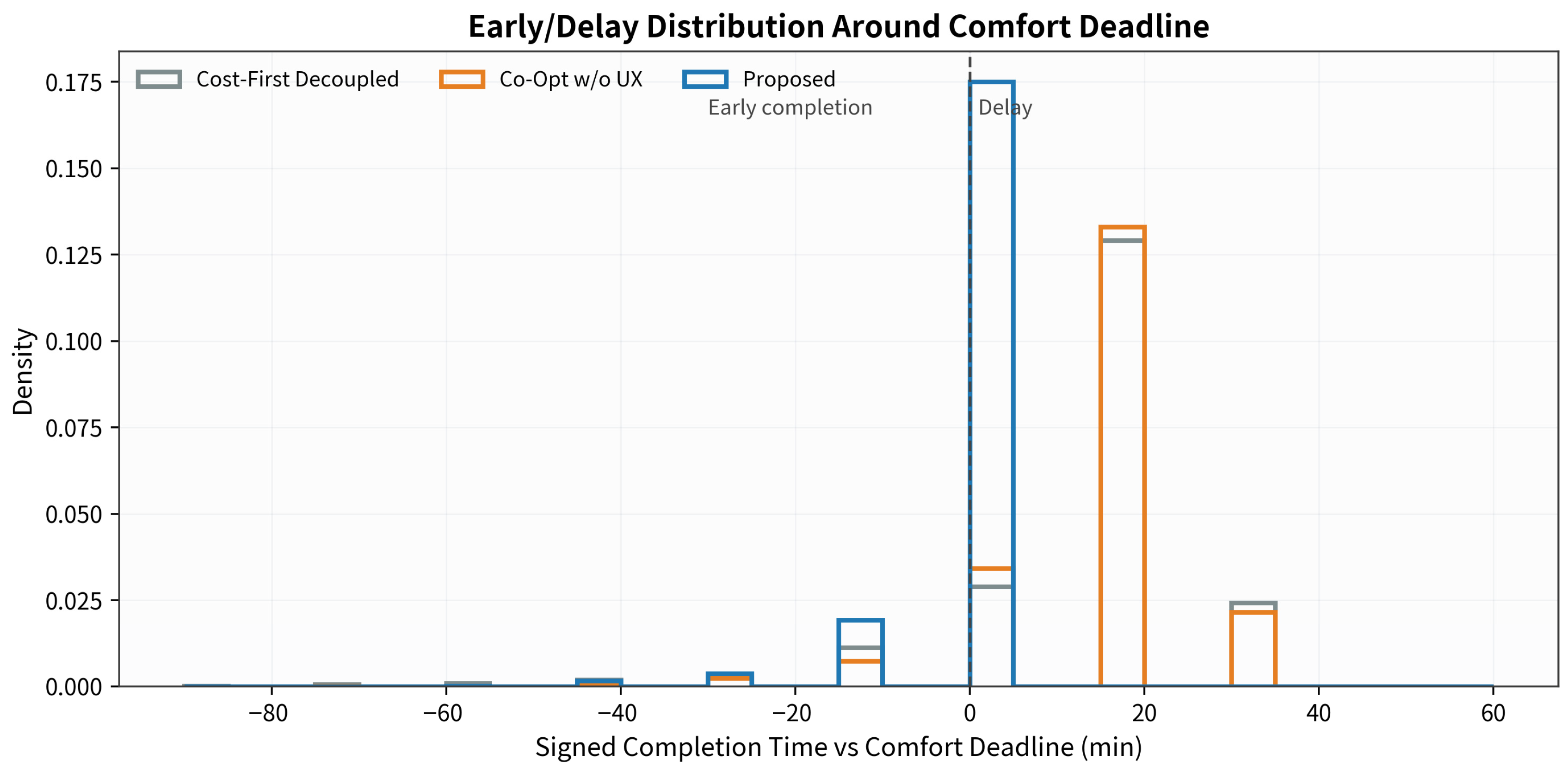
This subsection examines whether reserve provision can remain compatible with process-level charging service rather than merely endpoint energy satisfaction. The focus is therefore not only on whether sessions are eventually completed, but also on whether the charging progress remains sufficiently continuous and whether completion occurs with an adequate time margin before departure.
Figure 4,
Figure 5,
Figure 6 and
Figure 7 and the corresponding indicators in
Table 2 evaluate this effect through the comfort completion delay, finish-ahead time, progress gap suppression, and the resulting revenue–service trade-off.
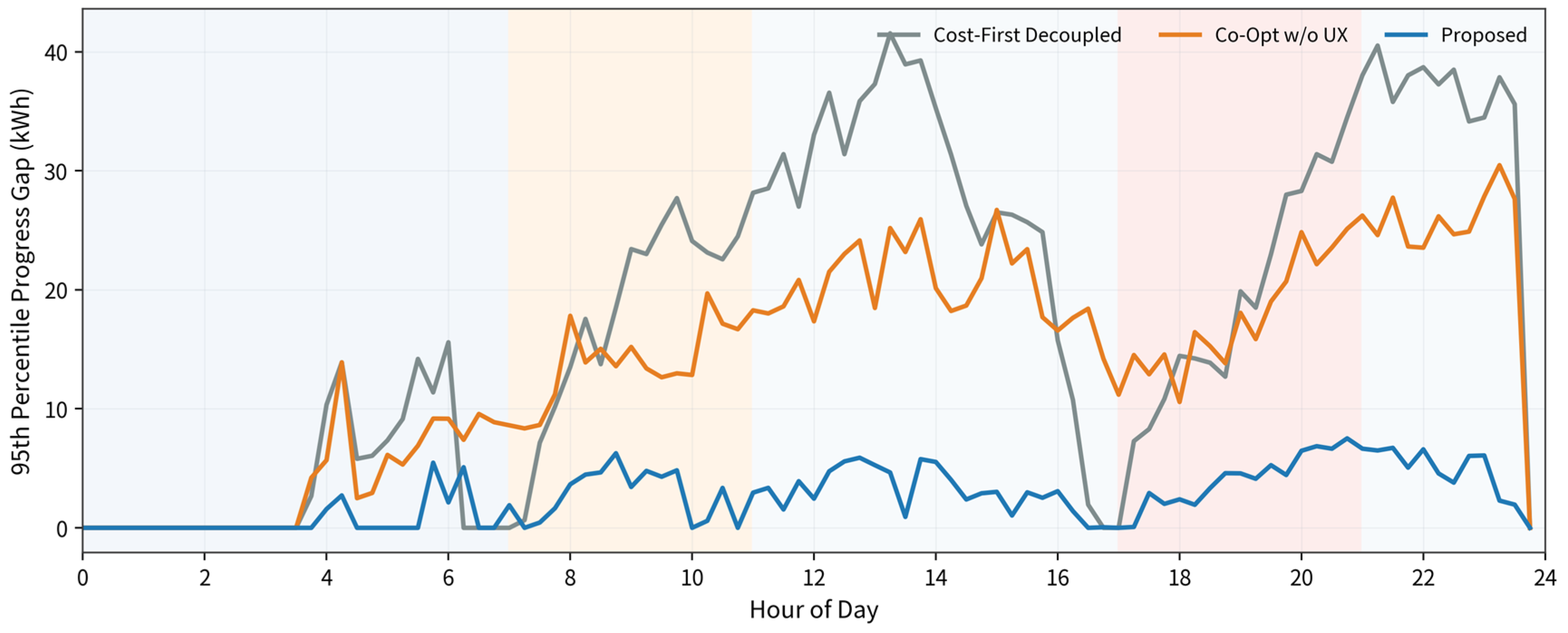
Figure 6 quantifies the process-level impact through the 95th percentile progress gap. Although the co-optimized model without service safeguards enhances reserve revenue, it still accumulates substantial charging backlogs during the midday and evening peak periods. In contrast, the proposed progress protection constraint effectively limits this accumulation throughout the day, reducing the mean 95th percentile progress gap to 3.83 kWh, compared with 17.06 kWh for the unconstrained co-optimization approach and 23.44 kWh for the cost-first baseline.
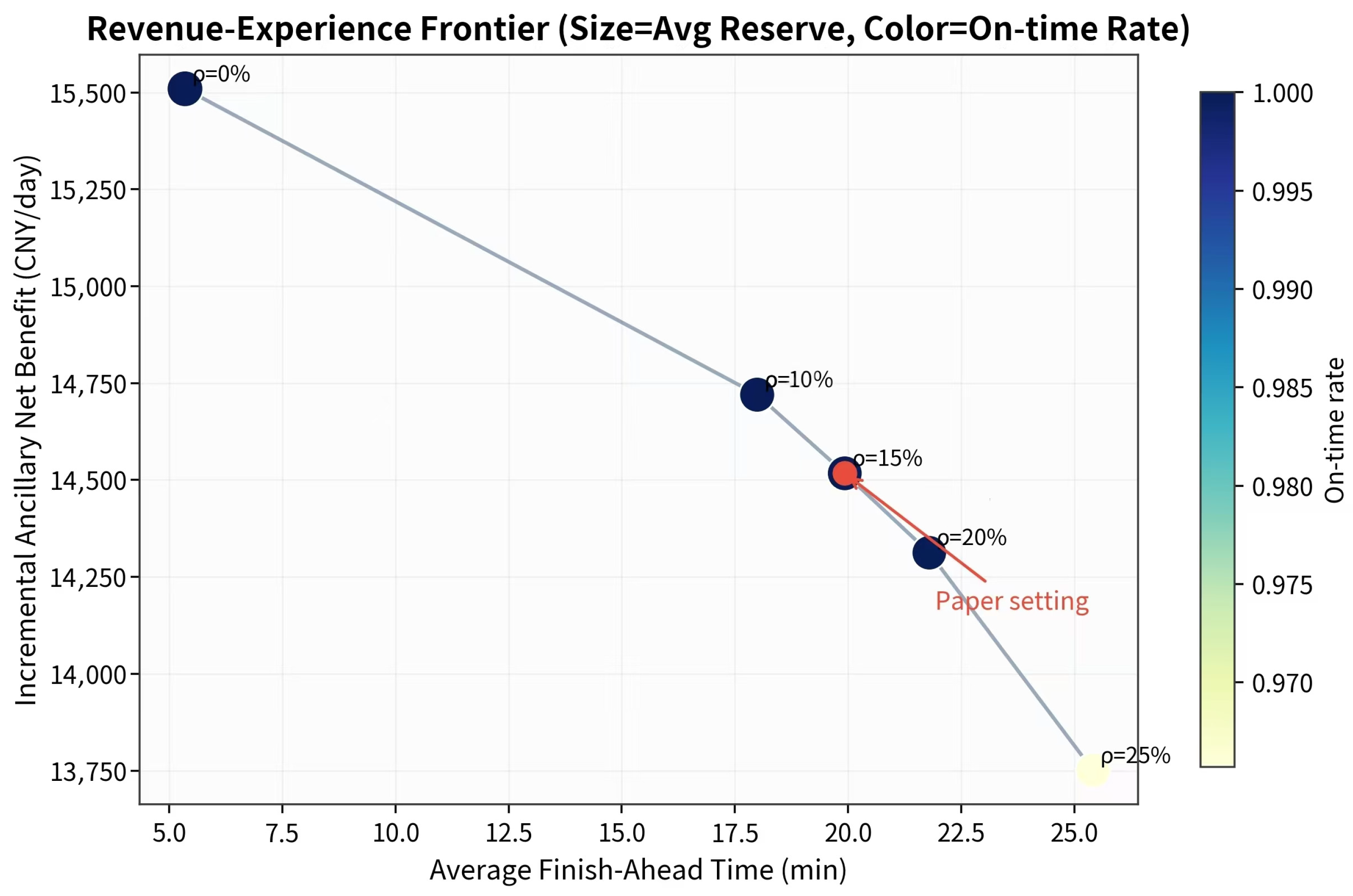
Figure 7 summarizes the revenue–service frontier obtained by varying the completion margin ratio
from 0% to 25%. The observed increase in the finish-ahead time is not only empirical, but also follows from the comfort deadline construction in (5)–(6). Specifically, for session
with connected duration
, increasing
reserves an explicit temporal buffer of
planning slots before the physical departure time when the comfort deadline slack is inactive. Therefore, the realized finish-ahead time of that session is lower-bounded by approximately
, and the mean finish-ahead time over all sessions is expected to increase monotonically with
. In the aggregated system, this analytical relation is smoothed by heterogeneous session durations and further shaped by electricity prices, reserve bidding incentives, station capacity limits, and rolling recourse, so the frontier in
Figure 7 should be interpreted as the system-level realization of this derived monotone relation rather than as a purely empirical curve. As
increases, the scheduler allocates a greater completion margin before the physical departure time, which raises the average finish-ahead time from 5.35 to 25.41 min while moderately reducing the incremental ancillary service benefit from 15,509.5 to 13,750.9 CNY/day. The adopted setting,
= 15%, lies near the middle of this discrete frontier and delivers an average finish-ahead time of 19.9 min together with a net benefit of 14,517.3 CNY/day, representing a pragmatic compromise between market value and process-level charging protection under the present case configuration.
3.4. Execution Layer Tracking Performance
This subsection evaluates the execution layer fairness under a common dispatch interface. To isolate the controller quality from planning quality, all four execution policies are tested on the same planning layer baseline produced by the proposed market–planning model, over the same AGC realization and under the same charger and station feasibility constraints. In all cases, charger-level ramp limits and station capacity clipping are enforced in the same way, so the comparison focuses on how each controller allocates feasible regulation effort rather than on differences in ex ante reserve schedules.
Within this common interface, the global proportional controller represents a fully decentralized proportional rule, the VPP-style hierarchical controller represents a station-first proportional coordination benchmark, and the RL-style adaptive controller represents an online score-adaptive variant of the same station-first architecture. These baselines are intended as reproducible reference implementations rather than exact replicas of individual literature methods. The proposed controller is then evaluated both in its full rolling form and, in the study, in a static-baseline form to separate the gain from station-convex coordination and urgency-aware allocation from the additional gain brought by rolling recourse.
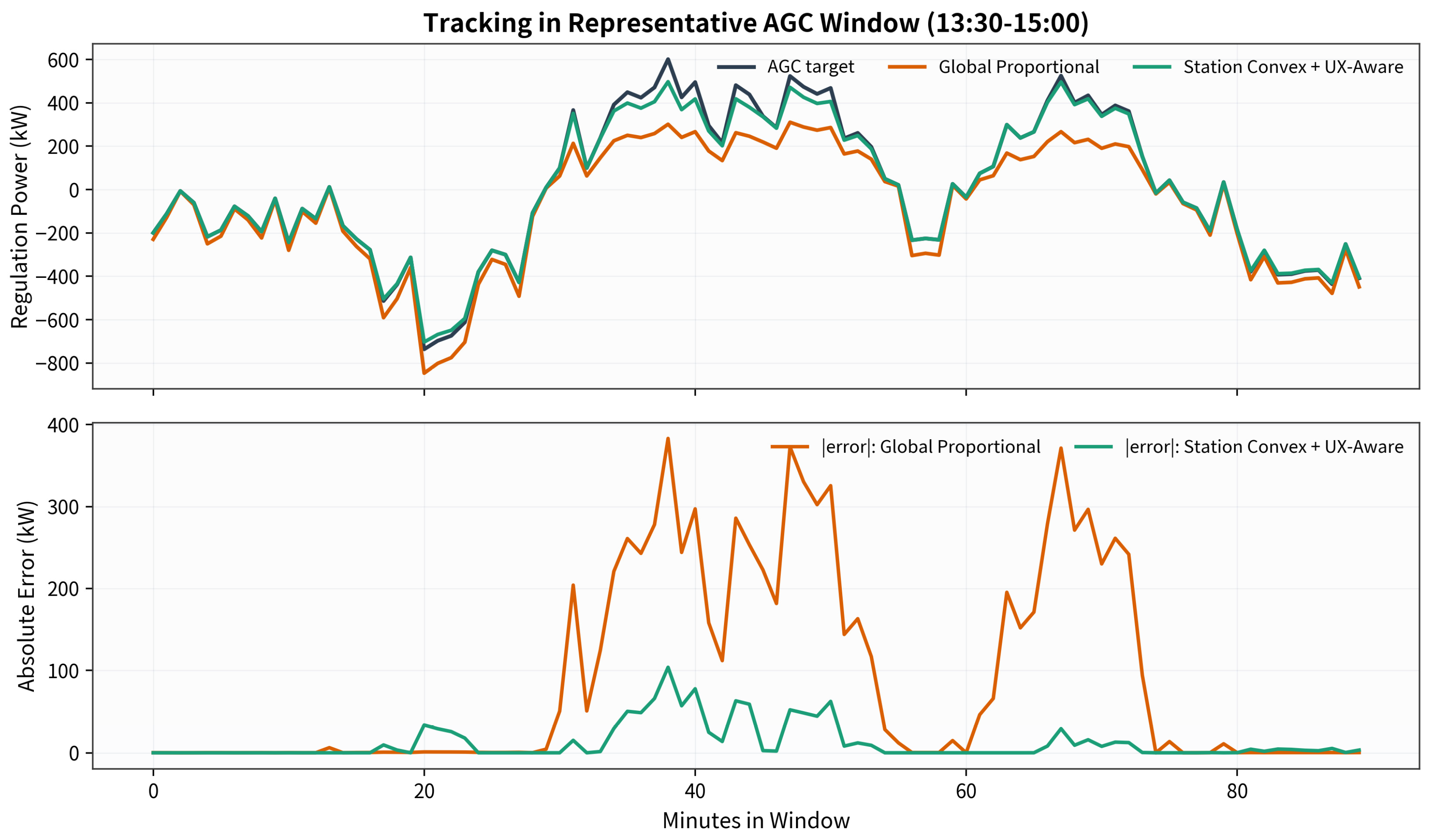
Figure 8 illustrates the tracking performance of the compared execution controllers within a representative AGC window.
As summarized in
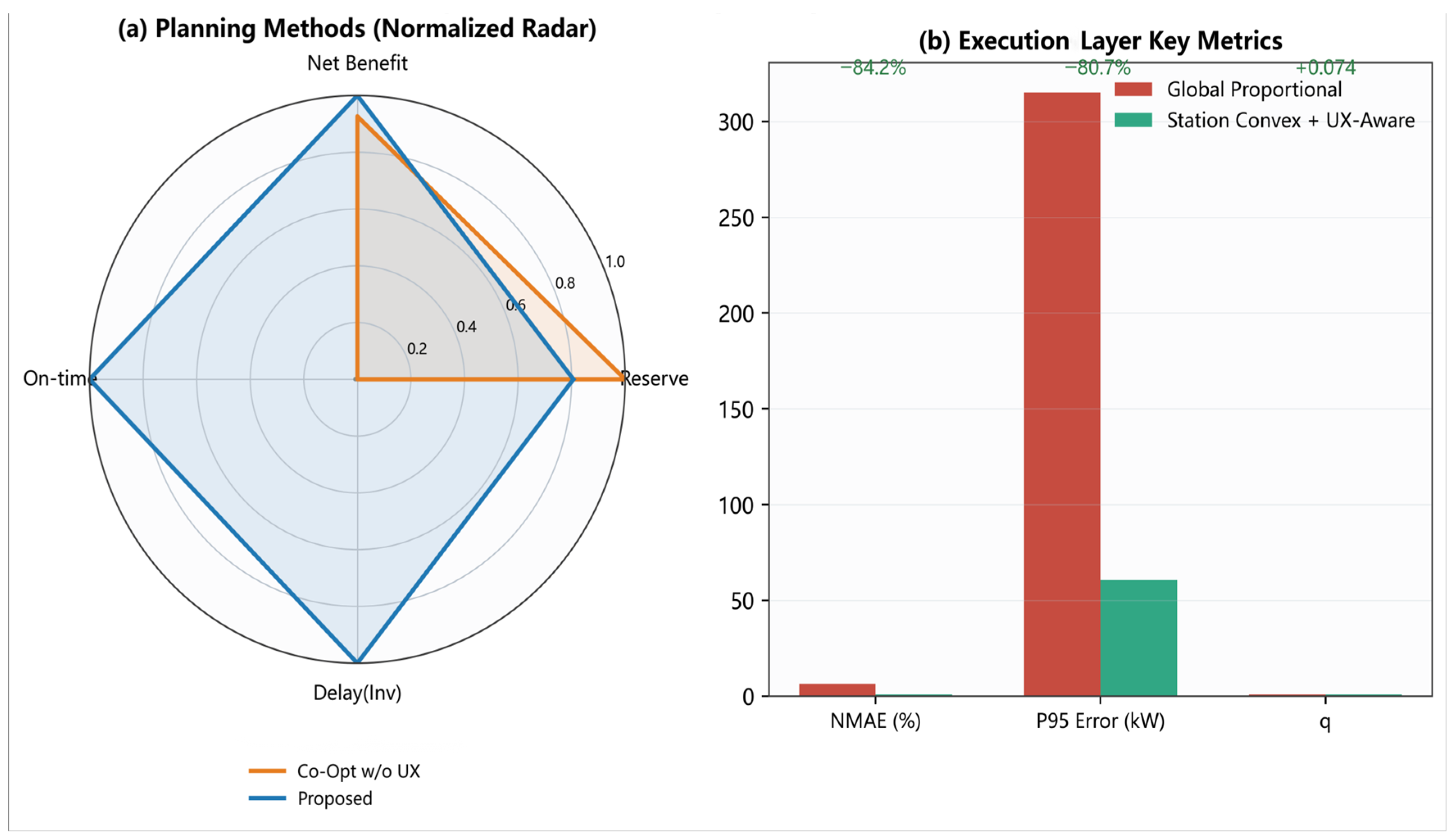
Table 3, the proposed execution layer reduces the NMAE by 84.2%, raises the tracking performance coefficient q from 0.912 to 0.986, and narrows the 95th percentile absolute error by more than 250 kW. The improvement in critical session curtailment is deliberately modest because the evaluation window exhibits a near-zero net energy bias. Under such conditions, the main advantage lies not in bulk energy transfer, but in precise bidirectional power modulation within station-level capacity constraints. A supplementary static-baseline evaluation derived from the refined implementation yields an NMAE of 0.99% and a 95th percentile error of 50.4 kW, indicating that most of the improvement comes from spatial envelope projection and urgency-aware decomposition rather than from aggressive rolling recourse.
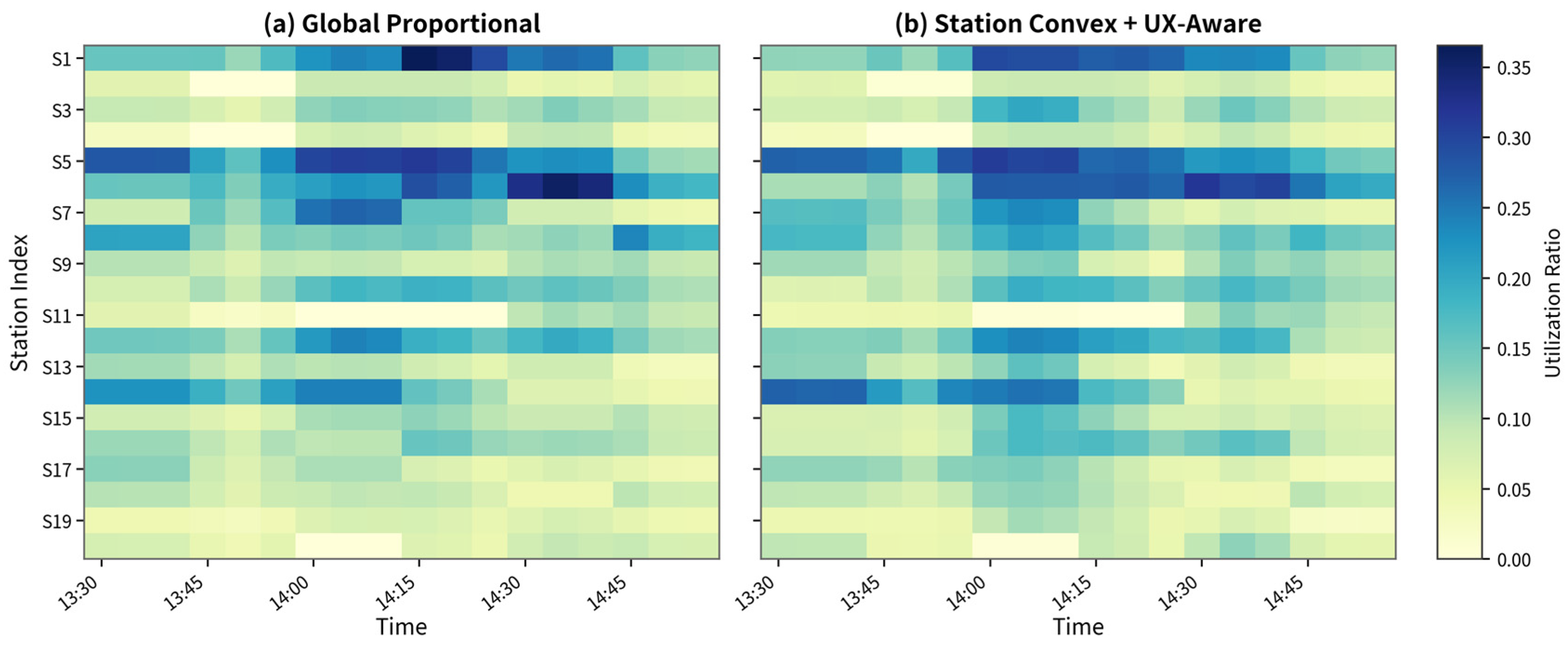
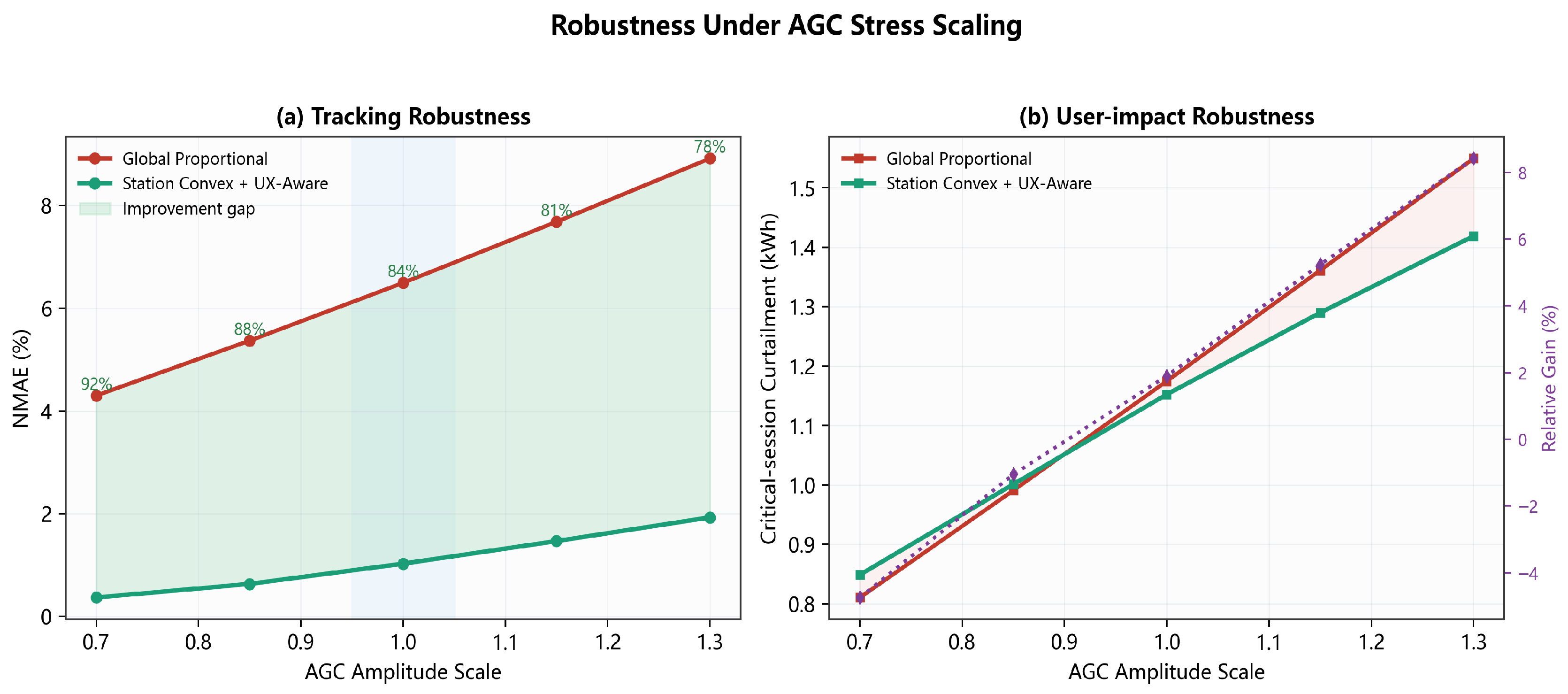
Figure 9 further shows that the proposed coordination strategy redistributes the regulation effort more evenly across the network, thereby mitigating persistent hot spots at heavily loaded stations. Although the improvement in the average station utilization coefficient of variation (CV) is moderate in the primary rolling experiment, the spatial distribution is visibly smoother and the concentration of localized overloads is reduced. The supplementary AGC stress tests corroborate this robustness: as the AGC amplitude is scaled from 0.7 to 1.3, the NMAE of the proposed method remains bounded between 0.37% and 1.93%, whereas the performance of the global proportional baseline deteriorates from 4.30% to 8.92%. The proposed coordinator-assisted distributed controller therefore preserves both the tracking fidelity and operational resilience under intensified regulation demands.
Figure 10 and
Figure 11 summarize the closed-loop comparison dashboard and the AGC stress robustness results. Together, these diagnostics indicate that the comparative ranking remains stable under stronger baselines and perturbation scenarios.
4. Discussion
The results indicate that reserve provision by public charging networks must be conceptualized as a closed-loop coordination problem rather than a series of disparate decisions. Within this paradigm, the market layer determines the economically viable symmetric regulation capacity, the planning layer evaluates the ongoing compatibility of this capacity with dynamic charging requirements, and the execution layer verifies whether the instructed automatic generation control (AGC) signal can be delivered under local physical constraints. Consequently, the proposed framework seamlessly integrates interval-level bids with slot-wise deliverability certificates, rolling service-aware baseline updates, and distributed real-time tracking.
A secondary implication is that charging service protection extends beyond mere terminal energy fulfillment. In open public charging systems, user acceptance hinges not only on the ultimate delivery of the requisite energy but also on the continuity of the charging progress and the assurance of an adequate completion margin prior to departure. Therefore, the proposed completion margin and progress protection constraints should be interpreted as operational service safeguards rather than comprehensive behavioral models of user experience.
Nevertheless, this study has several limitations. First, the employed service model relies on proxies, lacking an explicit representation of heterogeneous user preferences, endogenous waiting behaviors, and responses to dynamic charging conditions. Second, the treatment of uncertainty is confined to bounded variations in residual demand and connection states, omitting fully stochastic arrival and departure dynamics. Third, while the reproducible synthetic scenarios used in the case study validate the proposed mechanism, they cannot substitute for empirical field evidence.
These limitations highlight key avenues for future research. Primarily, planning layer safeguards and reserve-tightening rules should be calibrated using empirical charging session data and operator scoring records. Additionally, the framework could be expanded to accommodate greater heterogeneity—such as differentiated user classes and endogenous participation decisions—and to incorporate uncertainty models that merge bounded robustness with data-driven probabilistic structures. Finally, validating the coordination logic within a field pilot or a digital twin environment—accounting for realistic communication latencies, station telemetry, and market gate timelines—will enable a joint assessment of economic value, service quality, and implementation overhead under real-world deployment conditions.