From Price-Taker to Price-Setter: Quantifying the Dynamic Market Power Threshold for Wind Energy in Oligopolistic Markets

Abstract
1. Introduction
- Methodological isolation: We employ a high-resolution discretized MPEC method (Grid Search) against a competitive fringe, we aim to isolate the wind availability threshold (the tipping point) at which a renewable producer might transition from a price-taker to a strategic agent, avoiding the numerical artifacts often associated with continuous EPECs.
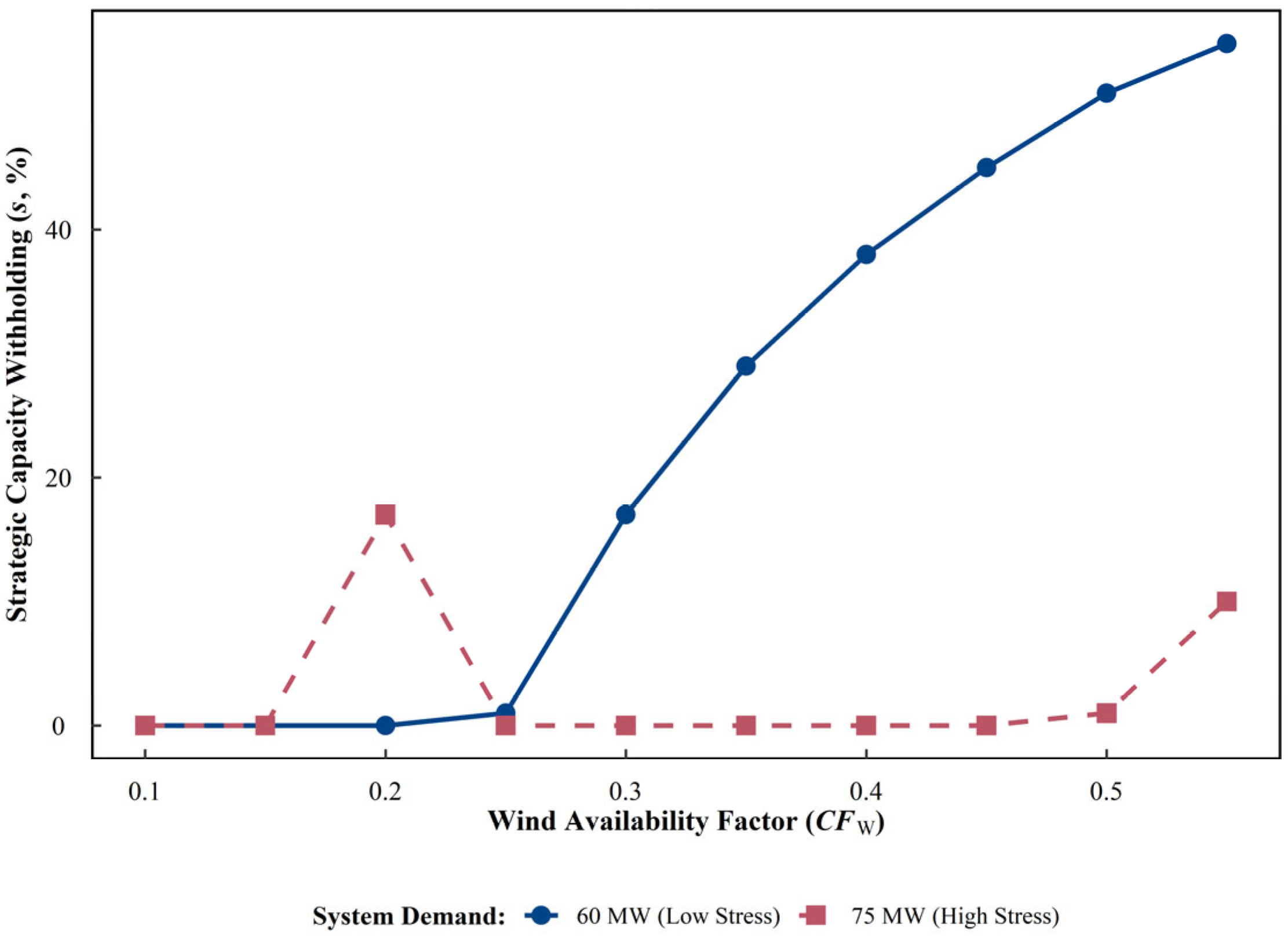
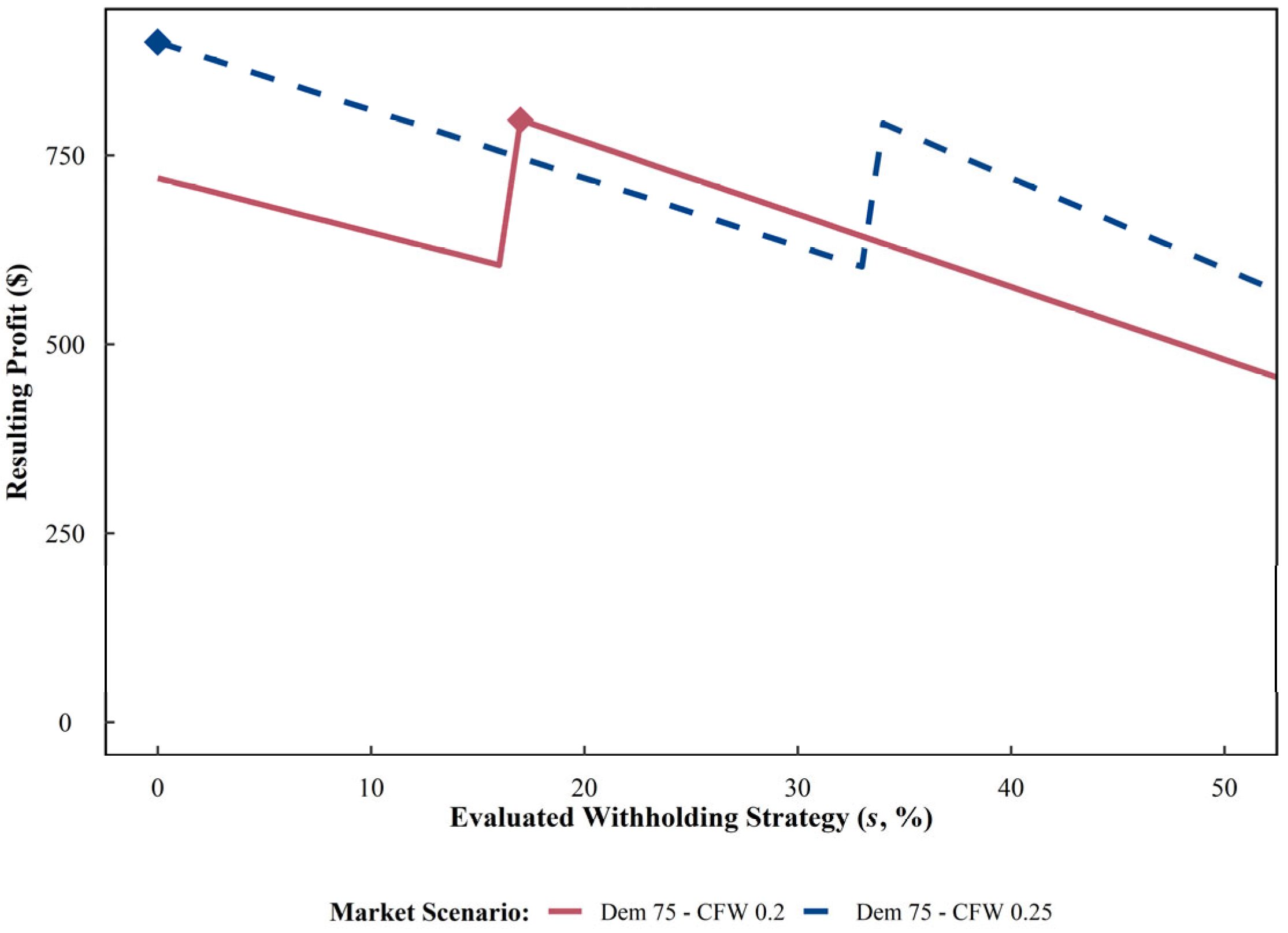
- Characterization of Strategic Mechanisms: Our results suggest that physical capacity withholding is not monolithic, but rather evolves through three distinct behavioral regimes: a defensive “Price-Support” strategy to mitigate price collapses, a “Scarcity Creation” threshold that facilitates price spikes, and a return to competitive “Volume Maximization”.
- Meteorological Demand Interaction: We analyze market power structurally through the interaction of exogenous meteorological conditions (wind availability factor, and demand pressure, highlighting that renewable market power tends to be conditional rather than absolute.
1.1. The Colombian Case
1.2. Modeling Unilateral Market Power: An MPEC and Competitive Fringe Approach
2. Materials and Methods
2.1. Model Assumptions
- Strategic Structure: The market is modeled as a leader-follower game. The wind generator (W) acts as the single leader, while the remaining generators (H, T1, T2) constitute a non-strategic competitive fringe.
- ○
- Justification: This asymmetric structure isolates the specific market power threshold of the wind generator. By neutralizing the strategic behavior of traditional generators, the model guarantees that any observed manipulation is exclusively attributable to the renewable agent’s actions, providing a clean and quantifiable identification of its tipping point without confounding oligopolistic coordination.
- Competitive fringe: Generators in the competitive fringe act as pure price-takers, offering 100% of their available capacity at their true marginal cost.
- ○
- Justification: Assuming traditional generators bid their true short-run marginal costs reflects a perfectly competitive or strictly monitored baseline scenario. This is a standard approach in MPEC literature [13] to evaluate the maximum disruptive potential of a new dominant entrant (the wind agent) against a disciplined market background.
- Bidding constraints: each generator submits a single quantity-price pair. The wind generator offers its market volume at $0/MWh to ensure priority dispatch.
- ○
- Justification: Wind power inherently has near-zero short-run marginal operating costs. Bidding at $0/MWh ensures priority dispatch in the merit order, aligning the model with the reality of renewable energy markets where the primary mechanism for exercising power market is physical capacity withholding (reducing offered volume) rather than financial withholding (artificially marking up bids).
- Physical availability: The maximum generation feasible for W is dictated ex-ante by the physical Wind Availability Factor ().
- ○
- Justification: Unlike dispatchable thermal plants, meteorological conditions bound renewable output. Explicitly separating the ex-ante physical availability () from the ex-post commercial dispatch ensures the model accurately respects the natural constraints of wind energy before any strategic market behavior is applied.
- System Constraints: The model focuses on energy market clearance; we decided to omit network transmission constraints to isolate the pure market power threshold. Demand is inelastic and the electric system must fully cover it.
- ○
- Justification: The omission of transmission constraints prevents the emergence of local market power, ensuring the calculated thresholds reflect true system-wide structural dominance. Furthermore, short-term wholesale electricity demand is inelastic, justifying a fixed-demand assumption to accurately stress-test the market structure under scarcity conditions. However, ignoring demand elasticity is a recognized limitation; the gradual integration of demand response mechanisms in real electricity markets could theoretically penalize artificial price spikes and potentially mitigate the market power thresholds identified in this article.
2.2. Mathematical Model
2.2.1. Upper Level—Strategic Leader Problem (Wind Generator)
2.2.2. Competitive Fringe Behavior
2.2.3. Lower Level—Follower Problem (ISO Market Clearing)
2.2.4. Solution Approach: Discretized Best-Response Algorithm
2.2.5. Computational Environment and Reproducibility
2.3. Solution Algorithm
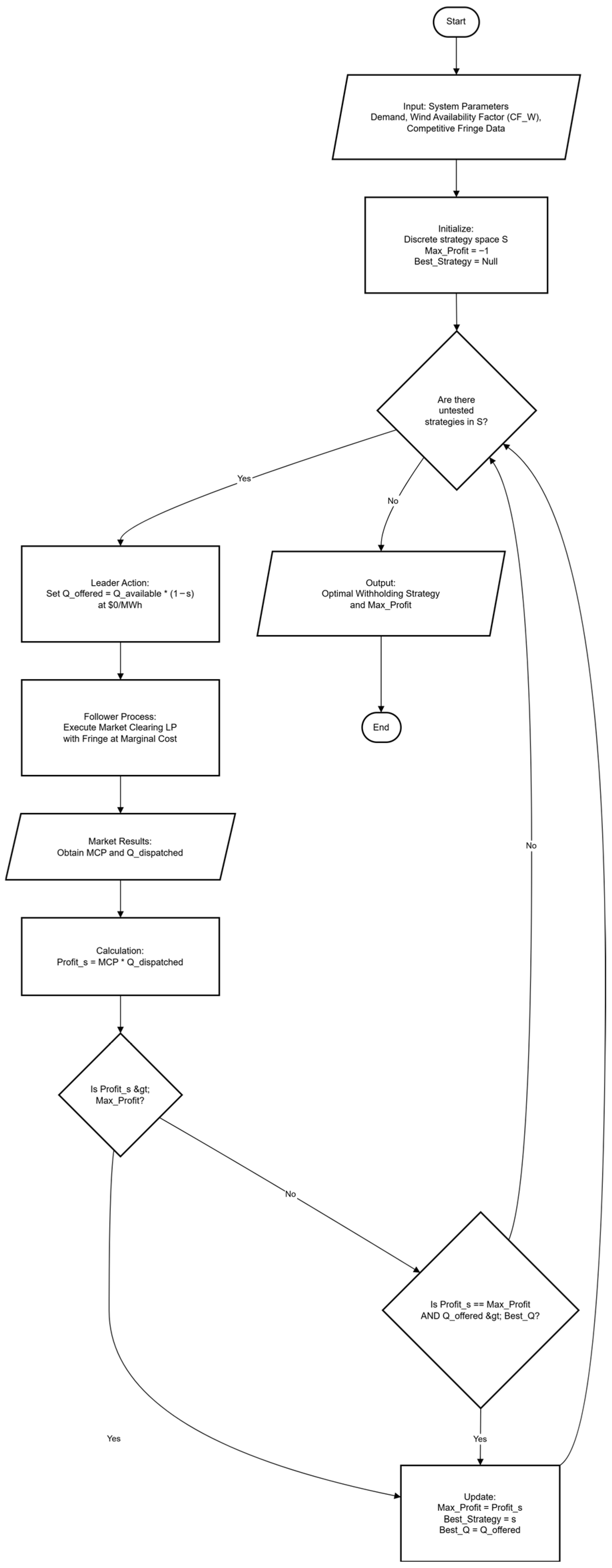
- Initialization: The algorithm defines a discrete strategy space S representing the physical capacity withholding levels. In our implementation, S ranges from 0 (0% withholding, full competitive behavior) to 1 (100% withholding), with a step size of 0.01 (1% resolution). The variables tracking maximum profit and the best strategy are initialized to zero.
- Iterative Strategy Evaluation (Upper level): For each candidate strategy , the algorithm simulates the leader’s action. The wind generator calculates its physical available capacity based on the specific wind capacity factor scenario (). It then sets its offered market quantity as and bids this volume into the market at its true marginal cost of $0/MWh.
- Market Clearing (lower level): the follower problem is executed. The Independent System Operator (ISO) clears the market by solving a Linear Programming (LP) economic dispatch model. In this step, the rival generators (the competitive fridge) are assumed to bid their full available capacities at their respective short-run marginal costs.
- Profit Calculation: The LP solver returns the Market Clearing Price (MCP) and the specific quantity dispatched to the wind agent (). The strategic profit for the evaluated state is calculated as the product of the MCP and ).
- Decision Rule and Tie-Breaking: The algorithm compares the profit of the current strategy against the highest profit found so far. If the current profit is strictly greater, the optimal strategy and the maximum profit are updated. If the current profit equals the maximum profit (within a tight numerical tolerance), a tie-breaking rule is applied: the algorithm selects the strategy that yields a higher dispatched volume (i.e., a lower withholding level s). This explicitly models a rational agent who avoids unnecessary market distortion and regulatory scrutiny when no additional financial gain is achieved.
- Output: Once all strategies in S are evaluated, the algorithm outputs the global optimal withholding strategy and the corresponding maximum profit for that specific demand and wind availability scenario.
| Algorithm 1: Discretized Best-Response Market Clearing |
|
3. Results
3.1. Regime A: Defensive: Price-Support Withholding
3.2. Regime B: Scarcity Creation Tipping Point
3.3. Regime C: Return to Competitive Volume Maximization
4. Discussion
4.1. Economic Significance of the Strategic Regimes
4.2. Policy and Regulatory Implications
4.3. Limitations and Future Research
- Strategic Interactions among market leaders: By assuming rival thermal and hydro generators act purely as price-takers, the model intentionally suppresses the multi-leader oligopolistic interactions present in concentrated settings like the Colombian market. Future research should extend this baseline using advanced Equilibrium Problems with Equilibrium Constraints (EPECs) to assess how strategic interdependence alters these thresholds.
- Integration of uncertainty modeling: Wind power availability is modeled deterministically to map physical boundaries ex-ante (). This simplification neglects empirically significant sources of uncertainty, such as wind speed forecasting errors and intraday variability. Methodological advances in wind power uncertainty modeling, particularly scenario-based stochastic programming and the integration of probabilistic forecasting [37,38], are necessary steps. Transitioning from this deterministic baseline to robust stochastic optimization framework will allow future studies to evaluate strategic responses across diverse probabilistic scenarios.
- Empirical calibration and validation: Model outcomes currently rely on stylized parameter assumptions. Where feasible, future studies should aim to calibrate and validate these tipping points using operational data from the Colombian electricity market (e.g., XM clearing prices, verified wind generation time series, and real system load profiles).
- Systematic Parameter Sensitivity: While the extensive evaluation of and demand stress levels serves as our primary sensitivity analysis for volume thresholds, the current baseline fixes marginal generation costs and assumes inelastic demand. Future multilayer models should systematically explore varied costs spreads between thermal and hydro units, as well as the integration of demand elasticity, to observe how these economic parameters shift the specific numerical coordinates of the identified tipping points.
- Additionally, expanding the model to include network transmission constraints and energy storage systems represents an important avenue for extending this framework. Finally, as power systems transition toward high DER (Distributed Energy Resource) retail participation, future research should explore how novel market designs—such as hourly electricity rights, yield derivatives, and Blockchain-based architectures [39]—interact with or potentially mitigate the unilateral market power thresholds identified in this study.
5. Conclusions
Supplementary Materials
Author Contributions
Funding
Data Availability Statement
Acknowledgments
Conflicts of Interest
References
- Net Zero by 2050—Analysis—IEA. Available online: https://www.iea.org/reports/net-zero-by-2050 (accessed on 26 June 2025).
- International Energy Agency. “World Energy Outlook 2024,” Paris, 2024. Available online: https://www.iea.org/reports/world-energy-outlook-2024 (accessed on 26 June 2025).
- Sands, P. The United Nations framework convention on climate change. Rev. Eur. Comp. Int’l Envtl. L. 1992, 1, 270. [Google Scholar] [CrossRef]
- Agreement, P. Paris Agreement. In Report of the Conference of the Parties to the United Nations Framework Convention on Climate Change (21st session, 2015: Paris). p. 2. Available online: https://digitallibrary.un.org/record/831052?v=pdf (accessed on 1 February 2026).
- Long, Y.; Chen, Y.; Xu, C.; Li, Z.; Liu, Y.; Wang, H. The role of global installed wind energy in mitigating CO2 emission and temperature rising. J. Clean. Prod. 2023, 423, 138778. [Google Scholar] [CrossRef]
- Ghanbari, S.; Bahramara, S.; Golpîra, H. Modeling market trading strategies of the intermediary entity for microgrids: A reinforcement learning-based approach. Electr. Power Syst. Res. 2024, 227, 109989. [Google Scholar] [CrossRef]
- Heptonstall, P.J.; Gross, R.J.K. A systematic review of the costs and impacts of integrating variable renewables into power grids. Nat. Energy 2021, 6, 72–83. [Google Scholar] [CrossRef]
- Reichenberg, L.; Ekholm, T.; Boomsma, T. Revenue and risk of variable renewable electricity investment: The cannibalization effect under high market penetration. Energy 2023, 284, 128419. [Google Scholar] [CrossRef]
- Zhou, Z.; Botterud, A.; Levin, T. Price Formation in Zero-Carbon Electricity Markets: The Role of Hydropower; Argonne National Laboratory: Argonne, IL, USA, 2022. [Google Scholar] [CrossRef]
- Pham, T. Market Power Issues in Liberalized Wholesale Electricity Markets: A Review of the Literature with a Look into the Future. Rev. Econ. Polit. 2019, 129, 325–354. [Google Scholar] [CrossRef]
- Zhu, W.; Wu, W.; Zhang, J.; Liu, S. Analysis of Strategic Bidding Behavior of Renewable Energy Participation in Electricity Spot Markets. In 2024 4th Power System and Green Energy Conference (PSGEC); IEEE: Piscataway, NJ, USA, 2024; pp. 552–556. [Google Scholar] [CrossRef]
- Guo, H.; Chen, Q.; Fang, X.; Liu, K.; Xia, Q.; Kang, C. Efficiency Loss for Variable Renewable Energy Incurred by Competition in Electricity Markets. IEEE Trans. Sustain. Energy 2020, 11, 1951–1964. [Google Scholar] [CrossRef]
- Dai, T.; Qiao, W. Optimal Bidding Strategy of a Strategic Wind Power Producer in the Short-Term Market. IEEE Trans. Sustain. Energy 2015, 6, 707–719. [Google Scholar] [CrossRef]
- Kenis, M.; Höschle, H.; Bruninx, K. Strategic bidding of wind power producers in electricity markets in presence of information sharing. Energy Econ. 2022, 110, 106036. [Google Scholar] [CrossRef]
- Cheng, L.; Huang, P.; Zhang, M.; Yang, R.; Wang, Y. Optimizing electricity markets through game-theoretical methods: Strategic and policy implications for power purchasing and generation enterprises. Mathematics 2025, 13, 373. [Google Scholar] [CrossRef]
- Pozo, D.; Contreras, J. Finding multiple nash equilibria in pool-based markets: A stochastic EPEC approach. IEEE Trans. Power Syst. 2011, 26, 1744–1752. [Google Scholar] [CrossRef]
- Luna, J.P.; Sagastizábal, C.; Filiberti, J.; Gabriel, S.A.; Solodov, M.V. Regularized equilibrium problems with equilibrium constraints with application to energy markets. SIAM J. Optim. 2023, 33, 1767–1796. [Google Scholar] [CrossRef]
- Borenstein, S.; Bushnell, J.B.; Wolak, F.A. Measuring market inefficiencies in California’s restructured wholesale electricity market. Am. Econ. Rev. 2002, 92, 1376–1405. [Google Scholar] [CrossRef]
- Joskow, P.L.; Kahn, E. quantitative analysis of pricing behavior in California’s wholesale electricity market during summer 2000. Energy J. 2002, 23, 1–35. [Google Scholar] [CrossRef]
- Brown, D.P.; Eckert, A. Analyzing firm behavior in restructured electricity markets: Empirical challenges with a residual demand analysis. Int. J. Ind. Organ. 2021, 74, 102676. [Google Scholar] [CrossRef]
- Sensfuß, F.; Ragwitz, M.; Genoese, M. The merit-order effect: A detailed analysis of the price effect of renewable electricity generation on spot market prices in Germany. Energy Policy 2008, 36, 3086–3094. [Google Scholar] [CrossRef]
- XM. Reporte Integral de Sostenibilidad, Operación y Mercado 2024; p. 384. Available online: https://www.xm.com.co/reporte-integral-de-sostenibilidad-operacion-y-mercado-2024 (accessed on 20 July 2025).
- Arango, S.; Dyner, I.; Larsen, E.R. Lessons from deregulation: Understanding electricity markets in South America. Util. Policy 2006, 14, 196–207. [Google Scholar] [CrossRef]
- Pozo, D.; Sauma, E.; Contreras, J. Basic theoretical foundations and insights on bilevel models and their applications to power systems. Ann. Oper. Res. 2017, 254, 303–334. [Google Scholar] [CrossRef]
- Gabriel, S.A.; Conejo, A.J.; Fuller, J.D.; Hobbs, B.F.; Ruiz, C. Complementarity Modeling in Energy Markets; Springer Science & Business Media: Heidelberg, Germany, 2012. [Google Scholar]
- Baringo, L.; Conejo, A.J. Strategic offering for a wind power producer. IEEE Trans. Power Syst. 2013, 28, 4645–4654. [Google Scholar] [CrossRef]
- He, Q.; Lin, Z.; Chen, H.; Dai, X.; Li, Y.; Zeng, X. Bi-Level Optimization Based Two-Stage Market Clearing Model Considering Guaranteed Accommodation of Renewable Energy Generation. Prot. Control Mod. Power Syst. 2022, 7, 1–13. [Google Scholar] [CrossRef]
- Gabriel, S.A.; Leuthold, F.U. Solving discretely-constrained MPEC problems with applications in electric power markets. Energy Econ. 2010, 32, 3–14. [Google Scholar] [CrossRef]
- Tómasson, E.; Hesamzadeh, M.R.; Wolak, F.A. Optimal offer-bid strategy of an energy storage portfolio: A linear quasi-relaxation approach. Appl. Energy 2020, 260, 114251. [Google Scholar] [CrossRef]
- Taheri, S.; Kekatos, V.; Veeramachaneni, S. Strategic generation investment in energy markets: A multiparametric programming approach. IEEE Trans. Power Syst. 2021, 37, 2590–2600. [Google Scholar] [CrossRef]
- Pineda, S.; Morales, J.M. Solving linear bilevel problems using big-Ms: Not all that glitters is gold. IEEE Trans. Power Syst. 2019, 34, 2469–2471. [Google Scholar] [CrossRef]
- Wolak, F.A. An empirical analysis of the impact of hedge contracts on bidding behavior in a competitive electricity market. Int. Econ. J. 2000, 14, 1–39. [Google Scholar] [CrossRef]
- Bushnell, J.B.; Mansur, E.T.; Saravia, C. Vertical arrangements, market structure, and competition: An analysis of restructured US electricity markets. Am. Econ. Rev. 2008, 98, 237–266. [Google Scholar] [CrossRef]
- Joskow, P.L. Capacity payments in imperfect electricity markets: Need and design. Util. Policy 2008, 16, 159–170. [Google Scholar] [CrossRef]
- Cramton, P.; Ockenfels, A.; Stoft, S. Capacity market fundamentals. Econ. Energy Environ. Policy 2013, 2, 27–46. [Google Scholar] [CrossRef]
- Levin, T.; Botterud, A. Electricity market design for generator revenue sufficiency with increased variable generation. Energy Policy 2015, 87, 392–406. [Google Scholar] [CrossRef]
- Zugno, M.; Morales, J.M.; Pinson, P.; Madsen, H. A bilevel model for electricity retailers’ participation in a demand response market environment. Energy Econ. 2013, 36, 182–197. [Google Scholar] [CrossRef]
- Morales, J.M.; Conejo, A.J.; Madsen, H.; Pinson, P.; Zugno, M. Integrating Renewables in Electricity Markets: Operational Problems; Springer Science & Business Media: Heidelberg, Germany, 2013. [Google Scholar]
- Evdokimov, V.; Kudin, A.; Chikhladze, V.; Artemchuk, V. A Blockchain Architecture for Hourly Electricity Rights and Yield Derivatives. FinTech 2025, 5, 2. [Google Scholar] [CrossRef]



| Agent of Generation | Real Generation (GWh) | Participation 2024 (%) |
|---|---|---|
| Empresas públicas de Medellín | 20,962.8 | 25.18 |
| Enel Colombia | 14,051.2 | 16.87 |
| Isagen S.A. E.S.P | 13,038.4 | 15.66 |
| Termobarranquilla S.A. E.S.P | 4225.7 | 5.11 |
| Generadora y Comercializadora de Energía del Caribe S.A. E.S.P | 4152.3 | 4.99 |
| Aes Colombia & Cia. S.C.A. E.S.P | 3096.5 | 3.72 |
| Prime Termoflores S.A.S E.S.P | 3039.6 | 3.65 |
| Other agents | 20,700.8 | 24.9 |
| Generation Type | Marginal Cost $/MWh |
|---|---|
| Low-cost hydro technology (H) | 0 |
| Wind technology (W) | 0 |
| Medium-cost thermal technology (T1) | 60 |
| State-of-the-art thermal technology (T2) | 80 |
| System Demand | Wind Avail. Factor () | Physical Avail. (MW) | Strategic Withholding (s, %) | Dispatched Vol. (MW) | Market Price ($/MWh) | Strategic Regime Observed |
|---|---|---|---|---|---|---|
| 60 MW (Low Stress) | 0.10 | 6.0 | 0.0% | 6.0 | 60 | Competitive (Volume Max) |
| 60 MW (Low Stress) | 0.35 | 21.0 | 33.3% | 14.0 | 60 | Defensive (Price Support) |
| 75 MW (High Stress) | 0.10 | 6.0 | 0.0% | 6.0 | 80 | Competitive (Volume Max) |
| 75 MW (High Stress) | 0.20 | 12.0 | 16.7% | 10.0 | 80 | Scarcity Creation (Tipping Point) |
| 75 MW (High Stress) | 0.25 | 15.0 | 0.0% | 15.0 | 60 | Competitive (Volume Max) |
Disclaimer/Publisher’s Note: The statements, opinions and data contained in all publications are solely those of the individual author(s) and contributor(s) and not of MDPI and/or the editor(s). MDPI and/or the editor(s) disclaim responsibility for any injury to people or property resulting from any ideas, methods, instructions or products referred to in the content. |
© 2026 by the authors. Licensee MDPI, Basel, Switzerland. This article is an open access article distributed under the terms and conditions of the Creative Commons Attribution (CC BY) license.
Share and Cite
Henao Pérez, A.A.; Guzman, L. From Price-Taker to Price-Setter: Quantifying the Dynamic Market Power Threshold for Wind Energy in Oligopolistic Markets. Energies 2026, 19, 1557. https://doi.org/10.3390/en19061557
Henao Pérez AA, Guzman L. From Price-Taker to Price-Setter: Quantifying the Dynamic Market Power Threshold for Wind Energy in Oligopolistic Markets. Energies. 2026; 19(6):1557. https://doi.org/10.3390/en19061557
Chicago/Turabian StyleHenao Pérez, Alvin Arturo, and Luceny Guzman. 2026. "From Price-Taker to Price-Setter: Quantifying the Dynamic Market Power Threshold for Wind Energy in Oligopolistic Markets" Energies 19, no. 6: 1557. https://doi.org/10.3390/en19061557
APA StyleHenao Pérez, A. A., & Guzman, L. (2026). From Price-Taker to Price-Setter: Quantifying the Dynamic Market Power Threshold for Wind Energy in Oligopolistic Markets. Energies, 19(6), 1557. https://doi.org/10.3390/en19061557