


Abstract
Metallurgical-grade silicon (MG-Si) is an important source material for many industrial applications, including the manufacture of alloys, solar photovoltaics, and electronics. The process to refine raw materials into MG-Si is energy-intensive, with the predominant method of submerged-arc furnaces requiring energy consumption of approximately 11–13 kWh/kg Si. Recent research has discussed promising methods for reducing the energy required for the silicon production process, including the use of molten-salt electrolysis (MSE), a technique that offers potential savings in energy consumption without requiring carbon inputs for the process. This paper presents a techno-economic study of a potential industrial-scale MSE plant for MG-Si production to evaluate the trade-offs between capital and operating costs of the system. Capital costs are sourced from recent MG-Si plants and an existing cost model developed for MSE processes that includes the size of the plant and the operating temperature among its inputs. The results show that MSE technology has the potential to be an economically cost-competitive option for MG-Si production if the technology successfully scales to industrial production and matures enough to allow for financing costs similar to that of a comparably sized submerged-arc furnace plant.
1. Introduction
1.1. Motivation
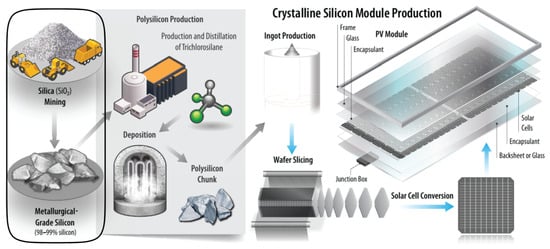
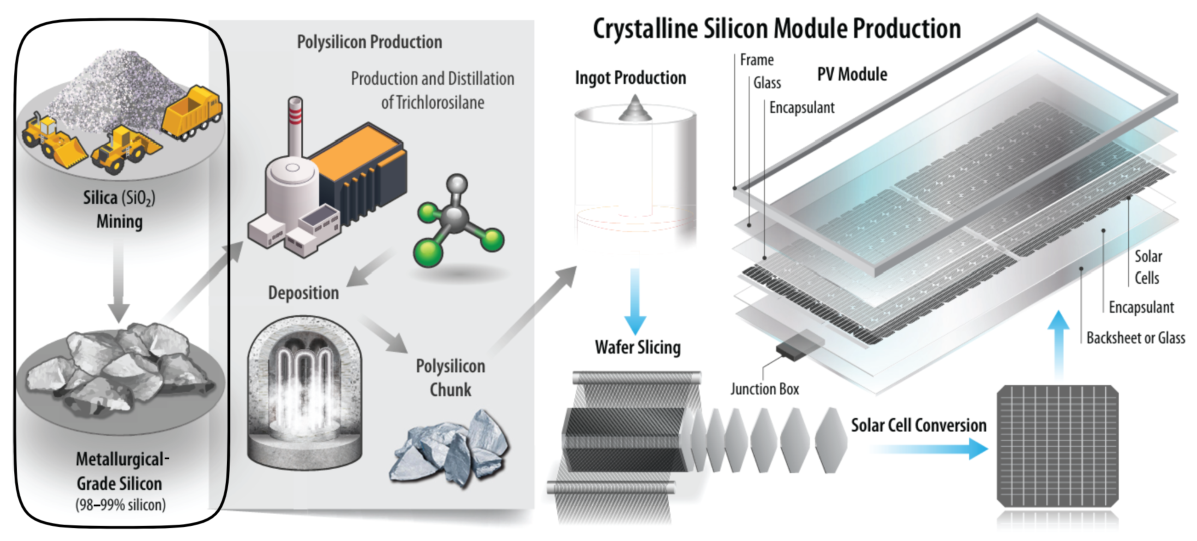
Silicon (Si) is the second most abundant element in the Earth’s crust and is used in a wide variety of commercial and industrial applications once it is refined from its naturally occurring form in sands and dusts [1]. Metallurgical-grade silicon (MG-Si), which has a purity of 98–99.5% Si, is a raw material used in several industrial applications in the United States. MG-Si is alloyed with aluminum for use in aerospace and automotive components, as the alloys are stronger and harder than aluminum while remaining less dense than steel [2]. MG-Si may be chemically processed with carbon, hydrogen, and oxygen to form silicones, which, owing to their biocompatibility and bio-durability, are used in the medical and pharmaceutical industries [3]. MG-Si is also a precursor material that is refined to higher purity via a separate process (e.g,. the Siemens process [4]) to create polysilicon, a high-purity form of silicon (99.9999%+) used in solar applications [5] and electronics [6]; an example of the use of MG-Si as a feedstock for photovoltaic cell production is shown in Figure 1. The relatively high demand in these industries compared to domestic production has led to approximately 150,000 tons of net imports of MG-Si into the United States in 2025 [7], indicating potential to add capacity to domestic production. This reliance on imports and the relative importance of silicon to the energy sector contributed to its listing as a near-critical mineral for the United States in the medium term [8] and makes a case for exploring the potential of a new MG-Si production facility in the United States.
Figure 1.
Summary of the supply chain to develop solar-grade crystalline silicon modules that are used in photovoltaic cells. The focus of this study is the development of MG-Si, shown in the encircled part of the left-hand side of the graphic. Illustration by Alfred Hicks, NLR.
1.2. State of the Art in MG-Si Production
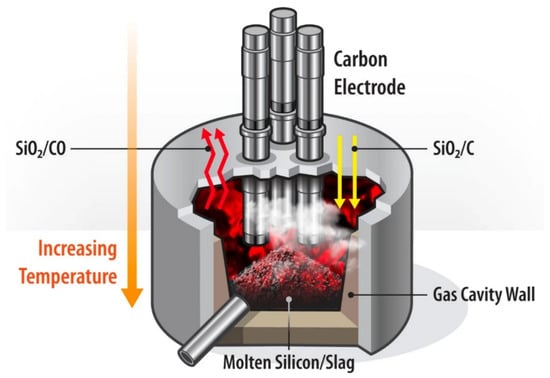
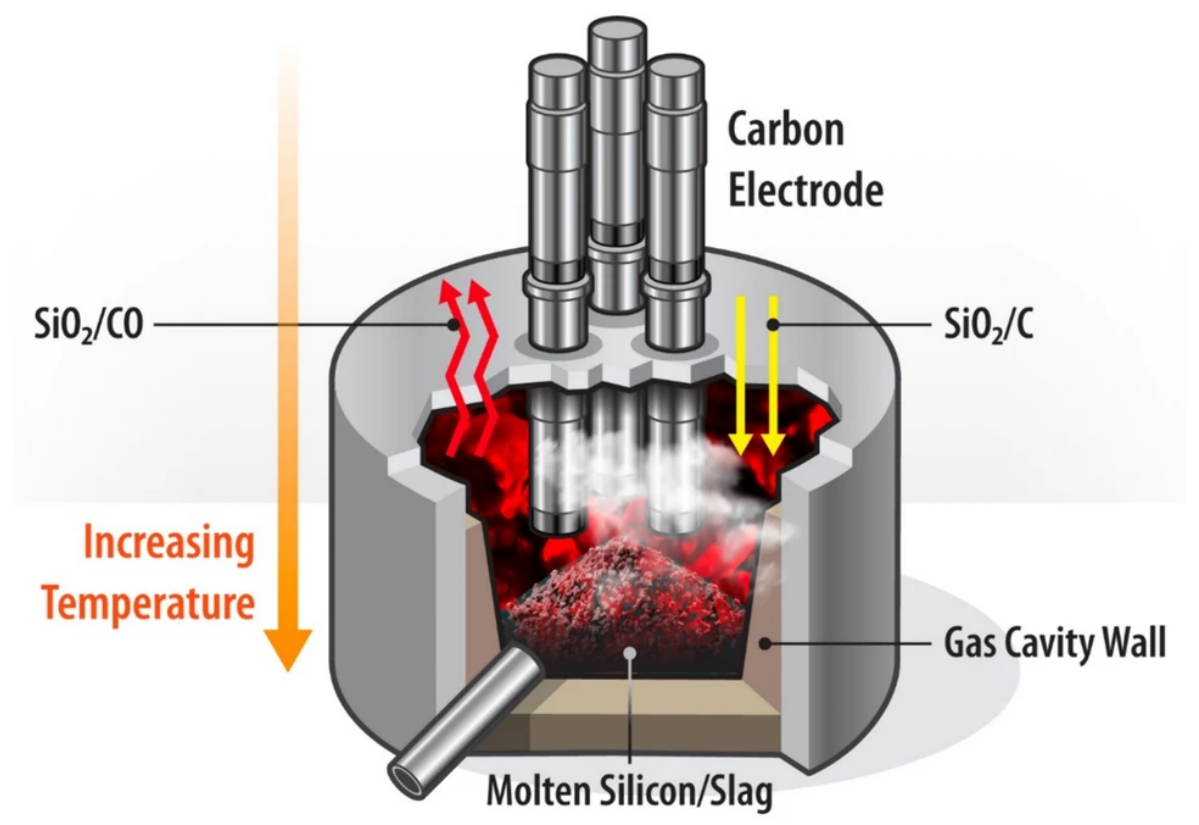
MG-Si is primarily produced by carbothermic reduction of the silica-rich mineral quartz in an open or semi-open submerged-arc furnace (SAF) [9]. Producing MG-Si via an SAF, which is summarized in Figure 2, is an energy-intensive process that employs heat at nearly 2000 °C and consumes approximately 11–13 kWh of electrical energy while requiring multiple kilograms of carbon-based feedstocks per kilogram of MG-Si produced [10]. The feedstocks include metallurgical-grade coal, coke, wood chips, and charcoal [11]. While the use of an SAF is the predominant process for producing MG-Si from raw materials at scale, there is interest in reducing both energy and material inputs to the system. Nøstvold et al. [12] present a life cycle assessment of a conversion of the carbon-based feedstock mix to a fully biobased mix, eliminating coal and coke from the inputs and obtaining Si at 85% to 95% purity from the process. While the proposed biobased mix offers potential cost savings compared to the existing mix, the purity achieved does not qualify the product as MG-Si. As alternatives, Hoover et al. [10] present a collection of emerging technologies that offer potential savings in energy and emissions. Of the alternative methods presented in [10], molten-salt electrolysis (MSE) exhibits the highest potential for energy and economic savings compared to carbothermic reduction.
Figure 2.
Summary of the SAF process at a single electrode [10]. Fresh raw materials including silica flow downward while gases diffuse upward. Molten silicon and slag are removed from the bottom of the furnace. Illustration by Alfred Hicks, NLR.
1.3. Contribution
The main contribution of this study is to provide a techno-economic comparison of the existing carbothermic reduction method of MG-Si production in the United States and an emerging potential application, molten-salt electrolysis (MSE), which is performed at a lower temperature and yields reduced process emissions. Because MSE is not currently deployed at scale for MG-Si production, we employ a cost model from the literature that is calibrated to existing large-scale electrowinning plants for the production of aluminum and other metals as a surrogate to estimate capital costs, and we compare levelized costs between the MSE and SAF technologies for two contrived cases similar in location and capacity to existing SAF plants in the United States. We then compare process and energy inputs over time to obtain levelized costs of MG-Si for both production methods. Finally, we present sensitivity analyses of the cost of capital and the cell current for the MSE method to assess the impact of key uncertain parameters on the techno-economic potential of this emerging technology application. While recent work by Moudgal et al. [13] presents a technoeconomic model of a similar scaling up of an MSE plant for solar silicon production, the novelty of our contribution is in the focus on MG-Si production and a comparison to an analogous plant using the existing SAF technology to assess whether an MSE facility would be economically competitive if the technology were implemented at scale. This contribution is not intended to be an accurate estimate of MG-Si production for a new facility, but rather, to assess the relative economic competitiveness of MSE compared to SAF production of MG-Si under similar economic conditions and financing assumptions.
2. Materials and Methods
This section describes the methodology of the study, in which we adapt existing life-cycle assessments and capital cost models to perform a techno-economic analysis comparing carbothermic reduction to a molten-salt electrolysis process applied to MG-Si production. Specifically, we estimate the difference in (i) capital expenditures, (ii) electrical energy consumption (which, in turn, informs utility expenses), and (iii) process inputs and outputs. For this approach, we adopt two case studies that represent existing, operating plants producing MG-Si in Alloy, WV, and Selma, AL, United States; these facilities are estimated to produce 75,000 and 22,000 tons of MG-Si per year, respectively [14,15].
2.1. Overview of SAF and MSE Processes
This section describes the chemical reactions that take place for both the SAF and MSE processes to produce Si. Both the SAF and MSE processes accept powdered quartz (SiO2) as input and produce MG-Si as output; however, the processes are significantly different for each process as the SAF includes carbon anodes that are consumed in a process composed of multiple reactions, whereas the MSE process has fewer reactions owing to the presence of dimensionally stable anodes. The descriptions in this overview are primarily sourced from [10].
2.1.1. SAF
The carbothermic reduction process employed in the SAF consists of a collection of five different reactions that take place to produce liquid elemental Si, shown in Equations (1)–(5) with left-to-right heat transfer included on the right-hand side of each reaction.
Reactions (1) through (5) take place in two different temperature zones within the SAF. The high-temperature zone is at the bottom of Figure 2, in which reaction (5) and the reverse of reaction (3) take place to produce silicon monoxide (SiO) gas; liquid Si and carbon monoxide (CO) gas are also produced from silicon carbide (SiC) and SiO via reaction (4) in this zone. In the lower-temperature zone in the SAF, both SiO and CO gas rise from the reacts with either carbon inputs or carbon monoxide gas via reactions (1) and (2), respectively, to produce the silicon carbide that is required to produce liquid Si in the high-temperature zone. SiO and CO gas that escape the furnace into the air will oxidize to produce microsilica and carbon dioxide, respectively.
2.1.2. MSE
Unlike the SAF method, MSE does not require additional carbon inputs; rather, electrons directly serve as the reductant to separate quartz into silicon and oxygen. Specifically, quartz and calcium oxide (CaO) (which forms within the calcium chloride (CaCl2) bath) produce a calcium silicate via reaction (6):
The product is then reduced to silicon, CaO, and oxygen ions via electrical input in reaction (7):
From there, the Si is deposited onto the cathode while the oxygen ions travel to the anode to form oxygen gas via reaction (8):
which maintains mass balance in the system [16]; the oxygen ions either travel to the anode and form oxygen gas or react with the calcium chloride electrolyte to form additional CaO. Oxygen and CaO must be harvested from the system as more SiO2 is deposited and Si is removed; in the case of CaO, the CaO-rich salt can be bled from the system and treated with hydrochloric acid (HCl) to produce the original CaCl2 and water [17].
2.2. Capital Cost Model
Recent installations of SAF plants and MSE plants for metal production are used to inform capital costs in this study. The SAF cost references the most recent installation in the US and applies a flat per-ton-year cost after adjusting for inflation. Because no MSE system for MG-Si production has deployed at the scale of existing SAF plants, we adopt cost functions for metallurgical MSE processes from the work of Stinn and Allanore [18]. The cost model, which is generic for MSE, is calibrated to the production of aluminum, magnesium and other metals and accounts for temperature and system size, among other factors relevant to project cost. The model employed by Stinn and Allanore to estimate capital cost is shown in Equation (9):
in which C is the total direct capital cost in 2018$, T is the electrolysis temperature in °C, P is the installed yearly production capacity in metric tons (t), p is the total installed production rate in kg/s, z is the moles of electrons reacting to produce a mole of product, F is the Faraday constant in A/mol, j is the current density in A/m2, A is the electrode area in m2, is the current efficiency, M is the electrolysis product molar mass in kg/mol, Q is the installed power capacity in MW, V is the cell operating voltage in volts, and N is the number of rectifier lines.
Using this cost function and the assumed inputs for an aluminum smelting plant producing 600,000 tons per year, the resulting cost was approximately $4.8 billion, compared to a 2025 estimate of $4 billion for a plant currently under construction in Oklahoma [19]. Nonetheless, we apply a 30% inflation factor to reflect the change in the consumer price index (CPI) between 2018 and 2026.
2.3. Energy Inputs
This study sources energy and peak demand cost rates from the Utility Rate Database [20], which is actively managed and accessible through the Open Energy Data Initiative [21]. The analysis considers a difference in energy delivery needs associated with the two MG-Si production processes according to the energy consumption comparison discussed in [10]. Specifically, we assume 12 kWh per kg MG-Si for the SAF production method and 9 kWh per kg MG-Si for MSE, the midpoint and high point of the ranges discussed in [10,22], respectively. We select the highest value of the consumption range from [22] for MSE to allow for efficiency losses that may result from scaling up the process from laboratory scale to industrial scale.
2.4. Process Inputs
There are multiple inputs to the system for both of the processes beyond the heat input described in Section 2.3. The carbothermic reduction process includes both graphite anodes and carbon inputs, which are consumed in the process. We assume that approximately 100 kg of graphite anode is consumed per ton of MG-Si produced [12], with the remaining carbon being sourced from a combination of petcoke, coal, charcoal and wood chips. While the SAF allows flexibility, the inputs vary in carbon content, and the choice of reductant can impact the efficiency and productivity of the system [23,24,25]. We select the mix of fossil-based inputs from the work of Wen et al. [26].
The quartz cost is sourced from Moudgal et al. [13] but increased from $150 to $179 per ton to reflect the 19% increase in the CPI from 2021 to 2026. The product yield of the SAF is assumed to be 90% [10,12]. We assume that the yield of the MSE process is also 90%, as, while film deposition has been demonstrated at laboratory scale [22], making high yields technically feasible, the lack of demonstration at industrial scale makes it difficult to predict process yields. This is a conservative assumption compared to the work of Moudgal et al. [13], which assumes a product yield close to the stoichiometric limit.
2.5. Operations and Maintenance
We assume that the operations and maintenance (O&M) costs are similar for both systems, except for the variable cost of carbon inputs for the SAF method. A relative lack of (i) data on the O&M cost of existing carbothermic reduction processes and (ii) molten-salt electrolysis projects that produce MG-Si at scale precludes an accurate estimate of costs. Salt replacement to remove the oxygen accumulation and relatively infrequent titanium replacement are expected for the MSE plant at unknown cost rates for an industrial-scale facility, while frequent carbon electrode replacement requires full-time staffing for the SAF plant; however, we have left specific costing of these items out of the scope of this study owing to a lack of available data, and instead assume that both plants incur labor costs at a similar rate to that given by Moudgal et al. [13] as flat per-metric-ton cost rates. Specifically, we assume that O&M costs $367 per ton-year MG-Si, and we assume an overhead rate of 25% of energy costs, input costs, and O&M costs.
3. Results
This section summarizes the case studies we employ for the techno-economic comparison. The two case studies are contrived greenfield plants that are the same size as two existing MG-Si SAF plants in Selma, Alabama, and Alloy, West Virginia. The Selma and Alloy facilities are estimated to have production capacities of 22,000 and 75,000 tons per year and electrical capacities of 38,000 kW and 120,000 kW, respectively.
3.1. System Costs
3.1.1. Capital Costs
Table 1 details the inputs to the capital cost function in [18] employed for the MSE plant. The assumed process temperature of 850 °C is used directly in [10], and a range of 800 °C to 900 °C is explored in [27]. The current efficiency of 90% is from both the magnesium application in Stinn and Allanore [18] and the solar Si analysis in [13]. While Stinn and Allanore [18] include separate inputs for cathode area and current density, we use the product of the two rather than the individual variables. Moudgal et al. propose a range of cell currents from 100 kA to 300 kA per cell in their sensitivity analysis on capital cost, and we adopt the low end and midpoint of this range for the Selma and Alloy plants, respectively. The current efficiency of 90% is taken from the magnesium application described in Stinn and Allanore [18] and cited in the solar Si analysis in [13]. A cell voltage range of 2.4–2.6 V was proposed by [22] for film deposition of Si, with lower voltage leading to nanowire formation; voltage above that range leads to the deposition of calcium in addition to Si [27], and so we adopt the midpoint of the range in Ge et al. (2.5 V). The number of rectifier lines matches the referenced plants in [18] with production rates similar to those in this study, as only aluminum plants with more than 500,000 tons per year of production utilized multiple rectifier lines in the set of plants used to calibrate their cost model.
Table 1.
Summary of key inputs used in the capital cost calculation from [18] for the two case studies.
Applying the values in Table 1 to Equation (9) and then adding a 30% increase to account for inflation from 2018 to 2026 yields a capital cost estimate of $29,512 and $16,578 per ton per year for the Selma and Alloy plants, respectively. The capital cost of the SAF plant is assumed to be $8203 per ton per year, using the reference point of a $214 million facility built in Mississippi with a capacity of 36,000 tons per year [29], then applying a 38% increase representing the CPI increase between 2015 and 2026.
3.1.2. Energy Costs
Energy costs are calculated assuming 24/7 production at capacity to produce the projected MG-Si. Energy and demand costs assume industrial electric rates for each plant’s location from the United States Utility Rate Database [20,21]; specifically, we use the current high-load industrial rate from Alabama Power Co. (Birmingham, AL, USA) for the Selma plant and the current transmission industrial rate from Appalachian Power Co. (Charleston, WV, USA) for the Alloy plant. We assume that the energy demand and consumption of the MSE plants are 75% of those of the equivalent SAF facility to be consistent with the assumed energy efficiency difference. Table 2 summarizes the annual energy costs for the plants, assuming a constant input at the rated capacity of the plants and assuming a proportional reduction in power and energy consumption for the MSE plant. We note that the Selma rate structure includes separate energy costs for summer and winter.
Table 2.
Summary of calculated annual energy costs assumed for the Selma and Alloy plants employing the MSE and SAF methods.
3.1.3. Process Input Costs
Table 3 summarizes the usage and cost rates of carbon-based inputs for the SAF process. The graphite consumption is sourced from [12], and the remaining carbon input feedstock usage rates are sourced from case 1 of [26]. We assume that the process inputs for the MSE procedure are included with the general O&M cost, which includes titanium anode refurbishing and salt management. Quartz cost is included in the results, but the consumption rate is equal for the SAF and MSE processes, and so it is excluded from this section.
Table 3.
Summary of SAF carbon-based feedstock inputs for the two case studies. † Midpoint of cost range used.
3.2. Levelized Cost Multiple Calculation
We employ a fixed cost ratio (FCR) to determine levelized costs using Equation (10):
in which the annual operating cost is defined as the process input (including quartz), energy, and O&M costs plus overhead. We adopt a simple model of the FCR:
in which r is the real interest rate and n is the number of years required for capital recovery.
3.3. Techno-Economic Comparison
Table 4 displays the results of the techno-economic comparison between the MSE and SAF technologies for two contrived case studies of greenfield plants in the United States. We adopt the assumption from Jones et al. [34], which suggests a real interest rate of % and -year term loan for a lithium supply chain application, yielding an FCR of 8% which we keep consistent for both applications. In addition, we employ uncertainty bands of 50% around the final levelized cost of the MSE plants to reflect the early-stage nature of this analysis and the uncertainty in extrapolating the cost function from the SAF process; these uncertainty bands are consistent with the suggestion in [18] for early studies such as this.
Table 4.
Summary of the year 1 costs and levelized cost of Si (LCOSi) for the MSE and SAF plants.
The results in Table 4 show that under the specific conditions for capital, energy and process input costs, the MSE and SAF greenfield plants are comparable (i.e., with a point estimate within 8%) in cost in the Alloy case, while the smaller Selma case is not economical for an MSE plant owing to the small capacity and correspondingly lower cell current. The annualized capital costs are the largest contributor to the cost of the MSE plants. While the levelized costs are higher than the spot price of MG-Si as of this writing, this is not an indication that a new MG-Si facility would not be profitable; rather, this analysis is intended to assess the relative economic competitiveness of MSE production compared to an SAF process under similar economic conditions.
3.4. Sensitivity Analysis
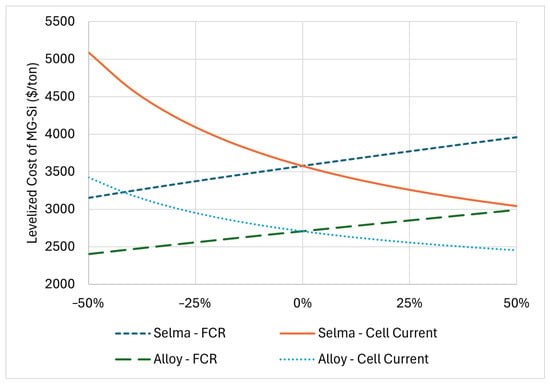
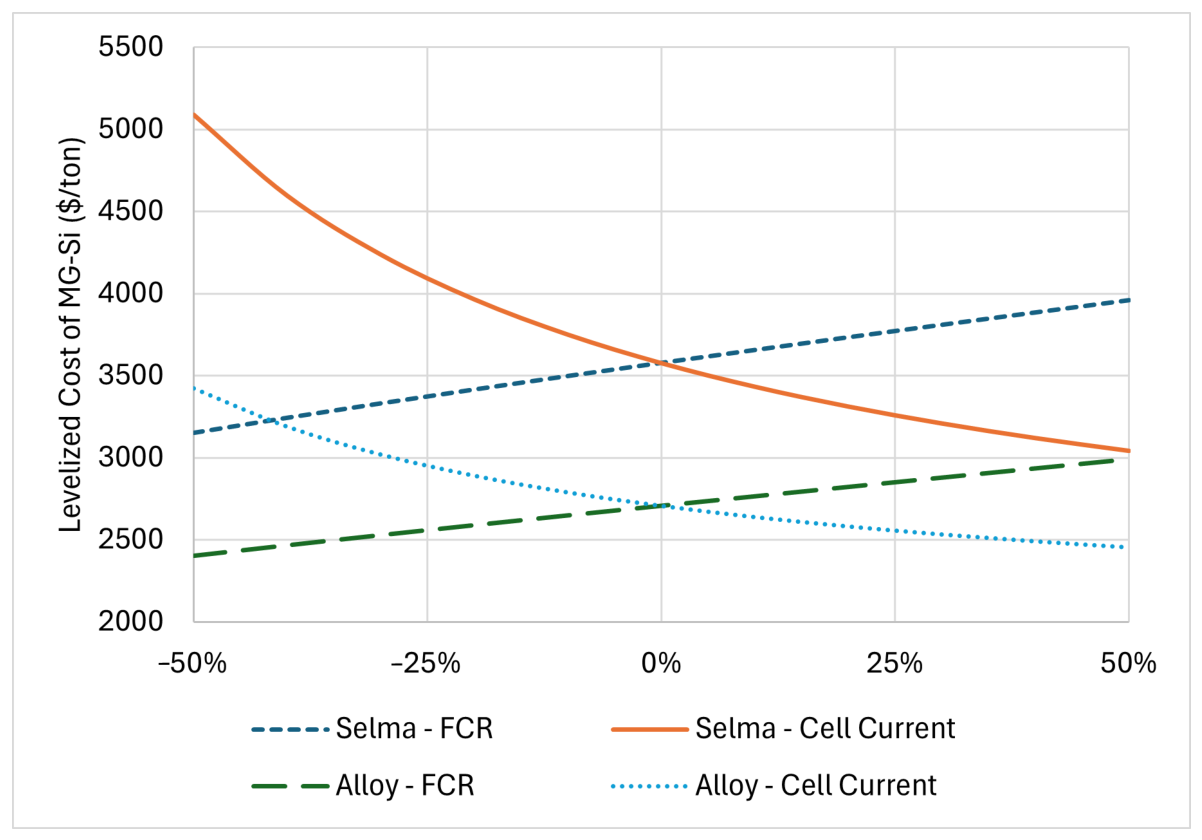
While the closest analog to MG-Si production at commercial scale discussed in [18] is the Hall–Heroult process used for aluminum production, there are significant differences in electrolytes, electrode materials, and operating temperature, among other factors. In the sensitivity analysis that follows, we alter the parameters from the cost function used in Section 2 to estimate the impact of these uncertain parameters. We update the FCR because of uncertainty in the cost of capital, given that the MSE technology is not yet deployed at scale for Si production. We also perform a sensitivity analysis on cell current, given its impact on the capital cost of MSE plants. Figure 3 displays the impact of FCR and cell current on the levelized cost multiple of the MSE plant relative to the SAF facility in each location. For each case, the parameter is varied by 50% in either direction, e.g., the range of FCR assessed was 4% to 12%. The results exhibit elasticity of levelized costs to both the FCR and the cell current of the system.
Figure 3.
Sensitivity analysis of FCR and current density on the levelized cost multiple of MG-Si production for each of the two MSE case studies. Baseline values were 100 kA for Selma cell current, 200 kA for Alloy cell current, and 8% FCR for both plants.
4. Discussion
The results display conditions under which a contrived MSE plant for MG-Si production is cost-competitive with an SAF facility. Our case study’s application of the same fixed charge rate for both the SAF and MSE processes is based on an assumption that the cost of capital is the same for both processes and, in turn, that the two processes pose a similar technology risk to the SAF facility. This is unlikely to be the case in the short term, as SAF plants are deployed at an industrial scale worldwide, while MSE plants are not. The sensitivity analysis in Figure 3 shows that a technology with higher perceived risk, such as a first-of-its-kind commercial-scale MSE plant, may incur greater costs of capital, resulting in less economically competitive costs for such a facility, although scaling production higher presents a potential opportunity given the lower levelized costs of the larger Alloy facility. Similar to FCR, the current density of the system exhibits a significant impact on system cost. While a wide range of current densities have been achieved for MG-Si production via MSE according to the review by Abramkin et al. [35], the most energy-efficient process noted in [22] for MSE production of MG-Si was significantly lower, which would make it cost-prohibitive to deploy at scale according to the results of Figure 3.
The closest work to this one assessing the capital cost of an MSE facility to produce MG-Si is that of Moudgal et al. [13], which suggests a capital cost of $10,500 per ton/year, a number lower than ours for a 160,000 ton/year plant at 1100 °C for a single-step process for solar-grade Si. The relatively low cost compared to the results of this study can be attributed to (i) the 30% inflation factor employed in our study, (ii) our assumption of 200 kA in current per cell as opposed to 300 kA in their study, and (iii) the lower production rates in our study compared to the 160,000-ton-per-year plant proposed by Moudgal et al. Scaling the Alloy facility to 160,000 tons per year and raising the production rate and power rating accordingly yields a cost rate of $15,135 per ton-year in the baseline case.
While the technical potential of MSE for MG-Si production has been studied in the literature, there is limited consensus on the best design for such a plant; for example, a mix of fluoride and chloride salts has been suggested as a promising electrolyte mix in the review by Abramkin et al. [35]. Because the technology has not been deployed at scale for MG-Si production, the capital and operating costs are highly uncertain. The analysis is also sensitive to the price of coal-based inputs, which may fluctuate in the future as demand fluctuates for other fuels such as natural gas [36]. Additionally, graphite prices are likely to fluctuate in price as potential supply constraints arise as a result in lithium-ion battery production [33].
The cost function employed in this study was calibrated to the Hall–Heroult process in [18], which is fundamentally different from the MSE process proposed in this study. In particular, the electrodeposition of material onto the electrodes in this MSE process as opposed to collection at the bottom of the tanks in the Hall–Heroult process presents an engineering challenge in harvesting produced MG-Si at scale. While the cost functions employed in this study were used with uncertainty bands of 50% consistent with the suggestion in [18] for an early-scale study, the relative economic competitiveness of the MSE process compared to an SAF is still highly uncertain. In the authors’ interpretation, the results of this study are not conclusive evidence that MSE is economically competitive but, rather, that it exhibits potential to be an economically competitive option for MG-Si production if the technology can be scaled up successfully.
5. Conclusions
This paper presents a techno-economic study of MG-Si production via MSE and compares the levelized cost of production to the results of a greenfield SAF study using a proposed MSE cost model calibrated to metal production. The following insights may be drawn from this analysis:
- Under the baseline assumptions of this study, a contrived MSE plant at a capacity of 75,000 tons per year exhibits similar economic potential to a new SAF facility with a similar location and scale, with the point estimate of the MSE plant falling 8% lower than that of the SAF facility.
- However, the estimated levelized costs of both technologies exceed current market prices for MG-Si, indicating limited market potential for new plants.
- The results exhibit sensitivity to both the cost of capital and the achievable cell current for an MSE plant. This, in addition to engineering challenges with respect to scaling up the MSE technology, indicates that while the technology has potential, the study warrants revisiting after pilot-scale systems have been developed and proven.
While further study is required to determine whether the scaling is achievable under the configuration developed in [22], the MSE technology’s lack of material inputs to the system and potentially more efficient refining process compared to the SAF highlight the potential for the technology to serve as an option to meet future critical mineral requirements.
Author Contributions
Conceptualization, A.Z., H.H. and K.R.; methodology, A.Z., H.H. and K.R.; software, A.Z.; validation, A.Z., H.H. and K.R.; formal analysis, A.Z.; investigation, A.Z. and H.H.; resources, K.R.; data curation, A.Z.; writing—original draft preparation, A.Z.; writing—review and editing, A.Z. and K.R.; visualization, A.Z.; supervision, K.R.; project administration, K.R.; funding acquisition, K.R. All authors have read and agreed to the published version of the manuscript.
Funding
This work was authored by the National Laboratory of the Rockies, for the U.S. Department of Energy (DOE) under Contract No. DE-AC36-08GO28308. This research was funded by the Laboratory-directed Research and Development program at the National Laboratory of the Rockies.
Data Availability Statement
The original contributions presented in this study are included in the article. Further inquiries can be directed to the corresponding author.
Acknowledgments
The authors express gratitude for the feedback from three anonymous reviewers, whose feedback improved the quality of this study. The views expressed in the article do not necessarily represent the views of the DOE or the U.S. Government. The U.S. Government retains and the publisher, by accepting the article for publication, acknowledges that the U.S. Government retains a nonexclusive, paid-up, irrevocable, worldwide license to publish or reproduce the published form of this work, or allow others to do so, for U.S. Government purposes.
Conflicts of Interest
The authors declare no conflicts of interest.
Abbreviations
The following abbreviations are used in this manuscript:
| °C | degrees Celsius |
| C | carbon |
| CaO | calcium oxide |
| CO | carbon monoxide |
| CPI | consumer price index |
| FCR | fixed cost ratio |
| kA | kiloamperes |
| kg | kilogram |
| kWh | kilowatt-hours |
| MG-Si | metallurgical-grade silicon |
| MSE | molten-salt electrolysis |
| SAF | submerged-arc furnace |
| O&M | operations and maintenance |
| Si | silicon |
| SiC | silicon carbide |
| SiO | silicon monoxide |
| SiO2 | silicon dioxide (quartz) |
References
- Jiang, T.; Xu, X.; Chen, G.Z. Silicon prepared by electro-reduction in molten salts as new energy materials. J. Energy Chem. 2020, 47, 46–61. [Google Scholar] [CrossRef] [Scilit]
- Majumdar, S.; Sinha, A.; Das, A.; Datta, P.; Nag, D. An insight view of evolution of advanced aluminum alloy for aerospace and automotive industry: Current status and future prospects. J. Inst. Eng. (India) Ser. D 2024, 1–18. [Google Scholar] [CrossRef] [Scilit]
- Chruściel, J.J. Most Important Biomedical and Pharmaceutical Applications of Silicones. Materials 2025, 18, 2561. [Google Scholar] [CrossRef] [Scilit]
- Lv, Q.; Yuan, X.; Guo, L.; Zhao, D.; Ma, W.; Xie, G.; Hou, Y.; Shen, J.; Yang, N. Advances in production and optimization of electronic-grade polysilicon: A review of modified Siemens and silane methods. Sol. Energy Mater. Sol. Cells 2025, 283, 113446. [Google Scholar] [CrossRef] [Scilit]
- Ramírez-Márquez, C. Solar-Grade Silicon in the Energy Transition: A Strategic Commodity for the Global Photovoltaic Market. Commodities 2025, 4, 18. [Google Scholar] [CrossRef] [Scilit]
- Fidon, E.; Guillou, S.; Rivoira, Y.; Vauche, L. Electronic-Grade Silicon (EG Si) Wafer Production: Review and Update of Life Cycle Inventory (LCI) Data. Eng. Proc. 2026, 127, 16. [Google Scholar] [CrossRef] [Scilit]
- U.S. Geological Survey. Mineral Commodity Summaries 2026; Report 2026; Ver. 1.2, April 2026; U.S. Geological Survey: Reston, VA, USA, 2026. [CrossRef] [Scilit]
- Bauer, D.; Khazdozian, H.; Mehta, J.; Nguyen, R.; Severson, M.; Vaagensmith, B.; Toba, L.; Zhang, B.; Hossain, T.; Sibal, A.; et al. 2023 Critical Materials Strategy; Technical Report INL/RPT–23-72323-Rev.001, 1998242; INL: Idaho Falls, ID, USA, 2023. [CrossRef] [Scilit]
- Degel, R.; Fröhling, C.; Köneke, M.; Hecker, E.; Oterdoom, H.; Van Niekerk, A. History and new milestones in submerged arc furnace technology for ferro alloy and silicon production. In Proceedings of the Infacon XIV–The Fourteenth International Ferro-Alloys Congress, Kiev, Ukraine, 31 May–4 June 2015; pp. 7–16. [Google Scholar]
- Hoover, H.; Bell, R.; Rippy, K. Emerging Technologies for Decarbonizing Silicon Production. J. Sustain. Metall. 2024, 10, 1921–1932. [Google Scholar] [CrossRef] [Scilit]
- Chigondo, F. From metallurgical-grade to solar-grade silicon: An overview. Silicon 2018, 10, 789–798. [Google Scholar] [CrossRef] [Scilit]
- Nøstvold, C.; Pastor-Vallés, E.; Andersen, V.; Tranell, G.; Pettersen, J.B. Life Cycle Assessment of Metallurgical Grade Silicon Comparing Charge Mixtures and Yields. J. Sustain. Metall. 2025, 11, 436–455. [Google Scholar] [CrossRef] [Scilit]
- Moudgal, A.; Buasai, S.; Wu, Y.J.; McMahon, A.; Hazerjian, J.M.; Luu, V.; Ly, A.; Asadikiya, M.; Powell, A.; Pal, U.; et al. Finite element analysis and techno-economic modeling of solar silicon molten salt electrolysis. JOM 2021, 73, 233–243. [Google Scholar] [CrossRef] [Scilit]
- Corathers, L. 2009 Minerals Yearbook; US Geological Survey: Reston, VA, USA, 2009.
- UB Community Development, LLC. $13.5 Million in New Markets Tax Credit Allocations Toward the Silicon Metal Manufacturing Facility in Selma, Alabama. 2023. Available online: https://nmtccoalition.org/project/globe-metallurgical-inc/ (accessed on 13 January 2026).
- Juzeliunas, E.; Fray, D.J. Silicon electrochemistry in molten salts. Chem. Rev. 2019, 120, 1690–1709. [Google Scholar] [CrossRef] [Scilit]
- Sun, Z.; Yu, F.C.; Li, F.; Li, S.; Fan, L.S. Experimental study of HCl capture using CaO sorbents: Activation, deactivation, reactivation, and ionic transfer mechanism. Ind. Eng. Chem. Res. 2011, 50, 6034–6043. [Google Scholar] [CrossRef] [Scilit]
- Stinn, C.; Allanore, A. Estimating the capital costs of electrowinning processes. Electrochem. Soc. Interface 2020, 29, 44. [Google Scholar] [CrossRef] [Scilit]
- Bohnen, J. Aluminum Plant Proposed for Inola Becomes a Joint Venture. Available online: https://www.okenergytoday.com/2026/01/aluminum-plant-proposed-for-inola-becomes-a-joint-venture/ (accessed on 31 January 2026).
- Ong, S.; McKeel, R. National Utility Rate Database; Technical Report; National Renewable Energy Laboratory (NREL): Golden, CO, USA, 2012. [CrossRef] [Scilit]
- Zimny-Schmitt, D.; Huggins, J. Utility Rate Database (URDB). Open Energy Data Initiative (OEDI). National Renewable Energy Laboratory (NREL). 2010. Available online: https://data.openei.org/submissions/5 (accessed on 30 March 2026).
- Ge, J.; Zou, X.; Almassi, S.; Ji, L.; Chaplin, B.P.; Bard, A.J. Electrochemical production of Si without generation of CO2 based on the use of a dimensionally stable anode in molten CaCl2. Angew. Chem. Int. Ed. 2019, 58, 16223–16228. [Google Scholar] [CrossRef] [Scilit] [PubMed]
- Chen, Z.; Ma, W.; Li, S.; Wu, J.; Wei, K.; Yu, Z.; Ding, W. Influence of carbon material on the production process of different electric arc furnaces. J. Clean. Prod. 2018, 174, 17–25. [Google Scholar] [CrossRef] [Scilit]
- Brekke, A.; Soldal, E. Can’t see the forest for coal: The environmental impacts from the use of bio-based materials in the silicon industry. In Proceedings of the Silicon for the Chemical & Solar Industry XVI, Trondheim, Norway, 31 May 2022. [Google Scholar] [CrossRef] [Scilit]
- Sommerfeld, M.; Friedrich, B. Replacing Fossil Carbon in the Production of Ferroalloys with a Focus on Bio-Based Carbon: A Review. Minerals 2021, 11, 1286. [Google Scholar] [CrossRef] [Scilit]
- Wen, J.; Zhang, H.; Chen, Z.; Zhang, Z.; Ma, W.; Wu, J. Exergy Analysis of Silicon Metallurgy in 22.5 MVA Submerged Arc Furnaces. Silicon 2023, 15, 1897–1912. [Google Scholar] [CrossRef] [Scilit]
- Padamata, S.K.; Haarberg, G.M.; Saevarsdottir, G. Electrochemical Production of Silicon Using an Oxygen-Evolving SnO2 Anode in Molten CaCl2-NaCl. Ceramics 2025, 8, 150. [Google Scholar] [CrossRef] [Scilit]
- Padamata, S.K.; Saevarsdottir, G. Silicon electrowinning by molten salts electrolysis. Front. Chem. 2023, 11, 1133990. [Google Scholar] [CrossRef] [Scilit] [PubMed]
- Rural Development Partners. Mississippi Silicon: 2019 Impact Report; Technical Report; LifeCity: New Orleans, LA, USA, 2019; Available online: https://www.rdpimpact.com/wp-content/uploads/2018/09/Mississippi-Silicon-11.4-Edited.pdf (accessed on 31 January 2026).
- EIA. Annual Coal Report 2024; Technical Report; U.S. Department of Energy Information Administration: Washington, DC, USA, 2025. Available online: https://www.eia.gov/coal/annual/pdf/acr.pdf (accessed on 31 January 2026).
- IndexBox. World–Wood Charcoal–Market Analysis, Forecast, Size, Trends and Insights. 2026. Available online: https://www.indexbox.io/store/world-wood-charcoal-market-analysis-forecast-size-trends-and-insights/ (accessed on 31 January 2026).
- Baral, S.; Mackes, K.; West Fordham, A.; Anderson, N.; Gaetani, M. Woody Biomass Utilization, Consumption and Production in Colorado; U.S. Department of Agriculture: Fort Collins, CO, USA, 2025. [CrossRef] [Scilit]
- Bhattacharyya, S.; Roy, S.; Lin, X.; Campagnol, N.; Vlad, A.; Ajayan, P.M. Graphite: The new critical mineral. Nat. Rev. Mater. 2026, 11, 65–78. [Google Scholar] [CrossRef] [Scilit]
- Jones, E.C. Lithium Supply Chain Optimization: A Global Analysis of Critical Minerals for Batteries. Energies 2024, 17, 2685. [Google Scholar] [CrossRef] [Scilit]
- Abramkin, G.; Stopic, S.; Yasinskiy, A.; Birich, A.; Friedrich, B. Electrochemical Deposition of Silicon: A Critical Review of Electrolyte Systems for Industrial Implementation. Materials 2025, 18, 4009. [Google Scholar] [CrossRef] [Scilit] [PubMed]
- Rembeza, J.; Katarzyński, D. Have the Links Between Natural Gas and Coal Prices Changed over Time? Evidence for European and Pacific Markets. Energies 2025, 18, 2201. [Google Scholar] [CrossRef] [Scilit]

Disclaimer/Publisher’s Note: The statements, opinions and data contained in all publications are solely those of the individual author(s) and contributor(s) and not of MDPI and/or the editor(s). MDPI and/or the editor(s) disclaim responsibility for any injury to people or property resulting from any ideas, methods, instructions or products referred to in the content. |
© 2026 by the authors. Licensee MDPI, Basel, Switzerland. This article is an open access article distributed under the terms and conditions of the Creative Commons Attribution (CC BY) license.