The Use of Modern Hybrid Membranes for CO2 Separation from Synthetic and Industrial Gas Mixtures in Light of the Energy Transition





Abstract
1. Introduction
2. Different Sources of CO2 and Associated Separation Conditions
3. Technologies for CO2 Separation
4. Separation Parameters and Transport Mechanisms in Composite Membranes
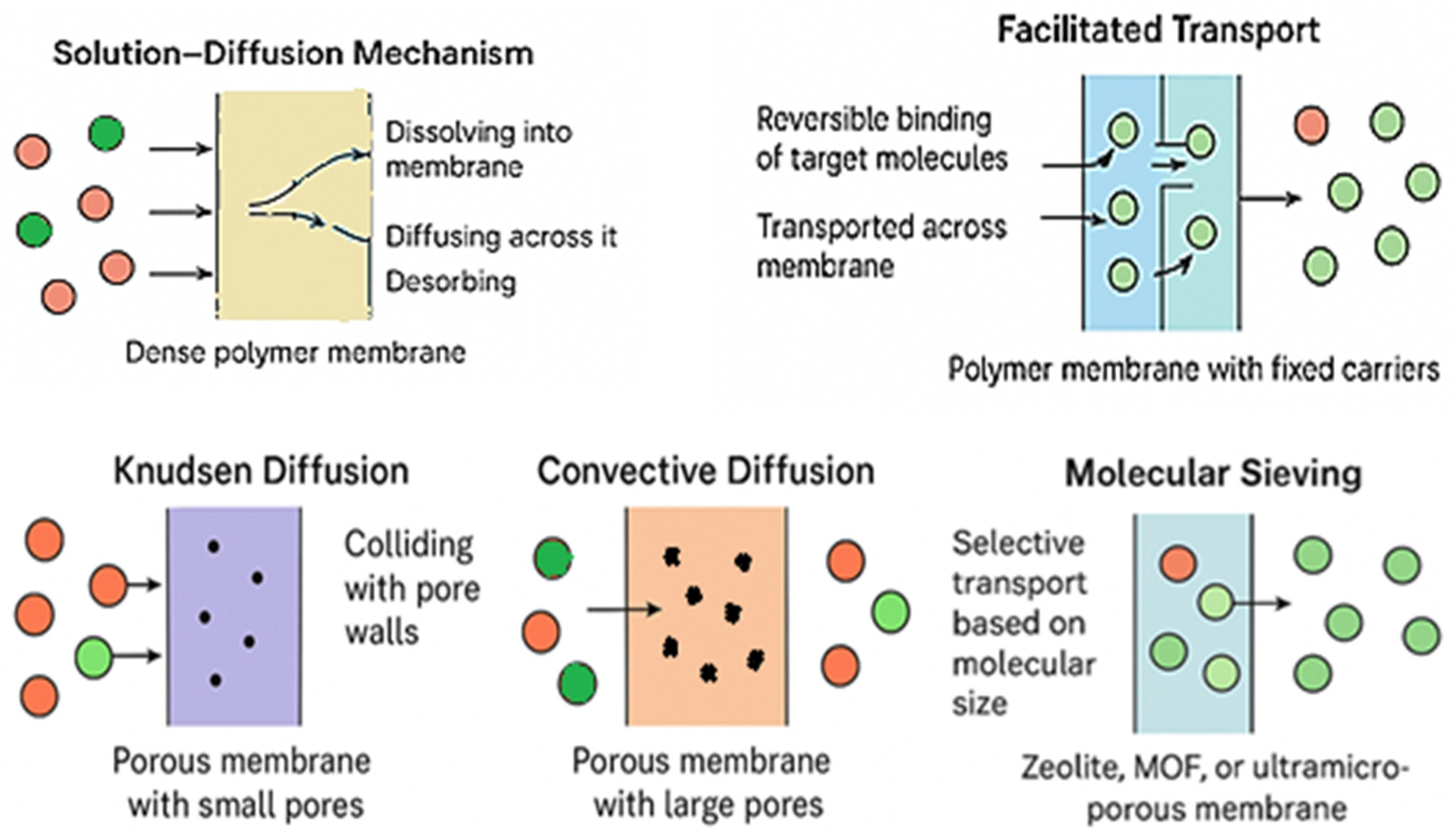
4.1. Transport Mechanisms in Porous Membranes
4.2. Gas Transport in Dense Polymeric Membranes: Solution–Diffusion Mechanism
4.3. Facilitated Transport Mechanisms
4.4. Gas Transport Models for Inorganic–Organic Hybrid Membranes
5. Membranes for CO2 Separation
5.1. Key Criteria for Membrane Material Selection
5.2. Polymer Membranes for CO2 Separation
5.2.1. CO2-Philic Polymer Membranes
5.2.2. High-Free-Volume Polymers
5.2.3. Facilitated Transport Membranes
5.3. Inorganic Membranes
5.3.1. Carbon Molecular Sieve Membranes
5.3.2. Zeolite and MOF Membranes
5.3.3. Metallic Membranes
5.4. Mixed Matrix and Hybrid Membranes for CO2 Separation
5.4.1. Zeolite Filler
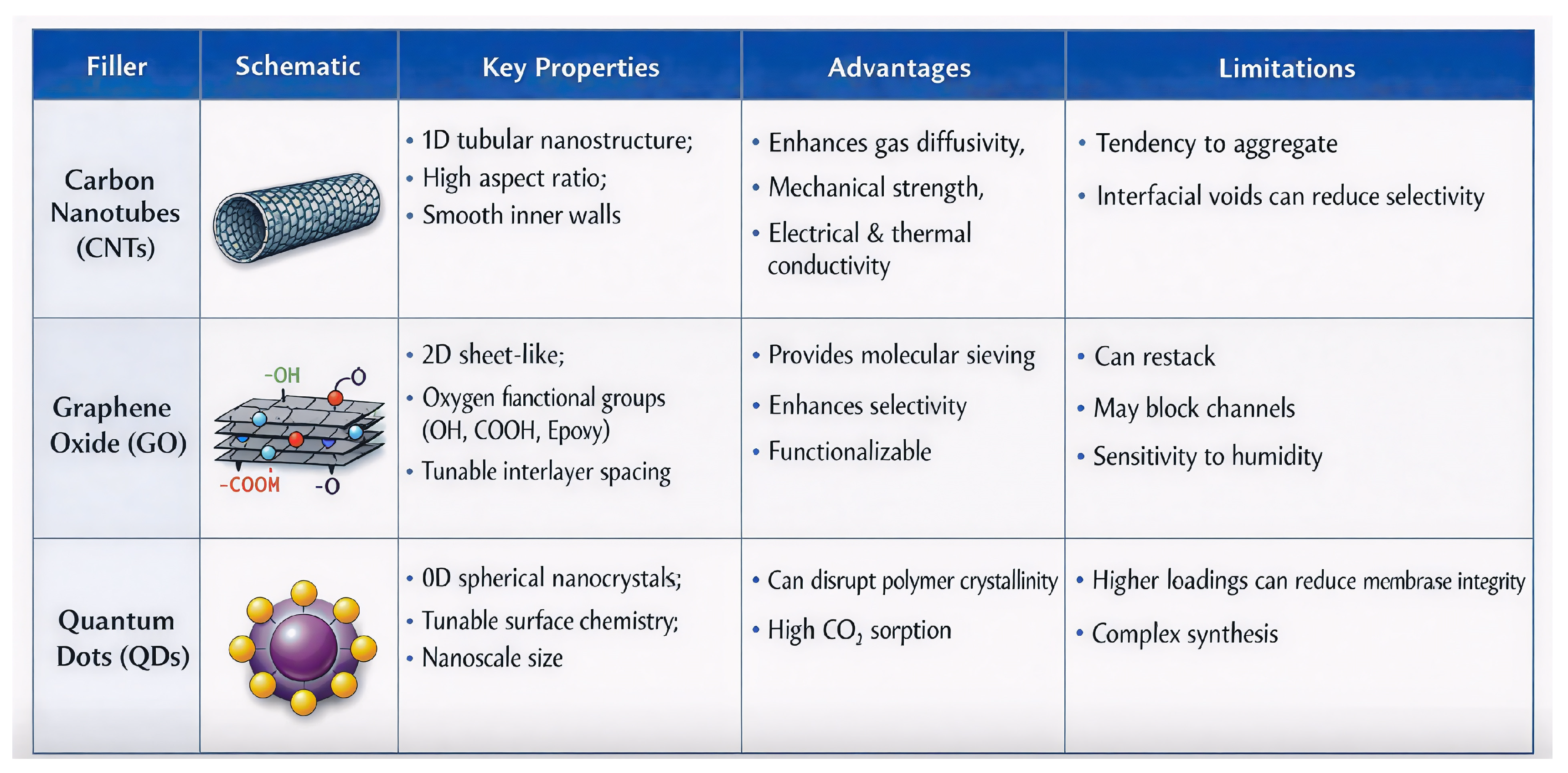
5.4.2. Graphene- and Graphene Oxide-Based Fillers
5.4.3. Carbon Nanotube and Nanocarbon Fillers

| Filler Type | Polymer Matrix | Filler Loading [wt.%] | Conditions | Permeability (Barrer) | Selectivity α* | Advantages | Limitations | Ref. |
|---|---|---|---|---|---|---|---|---|
| GO nanosheet | PDMS | 8 | p = 10 bar, T = 35 °C | PCO2 = 27.7 | CO2/N2 = 24 | Extremely high aspect ratio; strong selectivity enhancement | Basal planes impermeable to gases; severe permeability loss due to restacking | [207] |
| GO nanosheet | Pebax, PEG | 0.3 | p = 1 bar, T = 35 °C | PCO2 = 650 | CO2/N2 = 55.8 | Tunable chemistry; improved CO2 affinity; enhances plasticization resistance | Aggregation and restacking; humidity sensitivity; limited permeability at high loadings | [209] |
| GO | PIM-1 | 5 | p = 1.5 bar, T = 25 °C | PCO2 = 5235 PCH4 = 359 | CO2/CH4 = 14.9 | Strong aging suppression; long-term stability | Covalent grafting increases cost and complexity | [210] |
| Amino-GO nanosheet | Pebax | 0.9 | p = 2 bar, T = 35 °C | PCO2 = 934.3 | CO2/N2 = 71.1 CO2/CH4 = 40.9 | High permeability and selectivity under humid conditions; improved dispersion | Excessive functionalization may weaken mechanical stability | [211] |
| Porous Reduced GO | Pebax 1657 | 5 | p = 2 bar, T = 30 °C | PCO2 = 119 | CO2/N2 = 104 | Balanced permeability–selectivity trade-off; reduced restacking | Complex synthesis; precise reduction control required | [207] |
| Porous Graphene Oxide (PGO) | Pebax | 2 | p = 1 bar, T = 25 °C | PCO2 = 232.7 | CO2/N2 = 80.7 | High selectivity with moderate permeability; structural stability | Multistep fabrication; interlayer control critical | [213] |
| GO + MWCNT Hybrid | Matrimid® | 5 | p = 2 bar, T = 30 °C | PCO2 = 38.07 PCH4 = 0.45 PN2 = 0.47 | CO2/N2 = 81.0 CO2/CH4 = 84.6 | Synergistic permeability and selectivity enhancement | Filler–filler dispersion complexity | [214] |
| SWCNTs | Polysulfone (PSf) | 5 | p = 4 bar, T = 35 °C | PCO2 = 5.12 PCH4 = 0.27 PN2 = 0.23 | CO2/N2 = 22.26 CO2/CH4 = 18.82 | Extremely fast gas diffusion due to near-frictionless transport | High cost; aggregation; difficult large-scale dispersion | [215], |
| Pristine MWCNTs | Cellulose acetate (CA) | 0.1 | p = 3 bar, T = 35 °C | PCO2 = 741.67 PN2 = 18.46 | CO2/N2 = 40.17 | Better availability; mechanical reinforcement | Poor interfacial compatibility; risk of non-selective voids | [168] |
| Amino- functionalized MWCNTs (MWCNT–NH2) | Pebax® 1657 | 33 | p = 7 bar, T = 35 °C | PCO2 = 361 | CO2/N2 = 52 CO2/CH4 = 16 | Improved polymer–filler adhesion; enhanced CO2 affinity | Excessive loading may reduce selectivity | [217] |
| Hydrogel-wrapped MWCNTs | Pebax® 1657 | 5 | p = 2 bar, T = 25 °C | PCO2 = 567 | CO2/N2 = 70 CO2/CH4 = 35 | Synergistic effect: CNT fast transport + hydrogel CO2-philicity | Performance depends strongly on humidity | [218] |
5.4.4. Magnetic Nanofillers
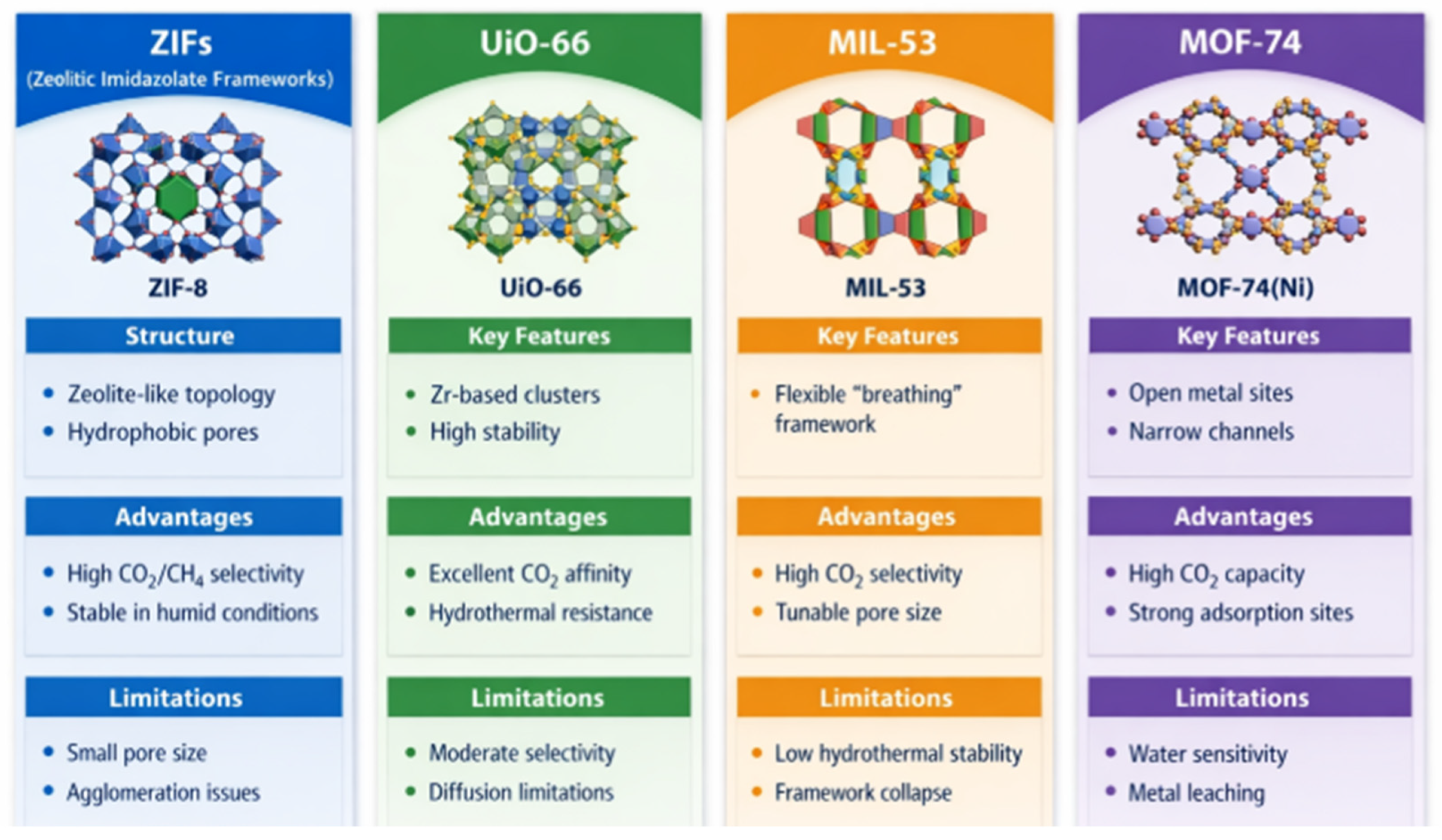
5.4.5. Metal–Organic Frameworks (MOFs)
5.4.6. MXene-Based Fillers
5.4.7. Oxide Nanoparticles
5.4.8. g-C3N4-Based Membranes
5.4.9. Layered Double Hydroxide Membranes
5.4.10. Transition Metal Dichalcogenide Membranes
5.4.11. Covalent Organic Framework Membranes
| Membrane Type | Filler | Polymer Matrix | Loading (wt.%) | Conditions | Permeability (Barrer) | Selectivity α* | Advantages | Ref. |
|---|---|---|---|---|---|---|---|---|
| Layer-by-layer membrane (Chitosan–g-C3N4/ZIF-8 on PES) | Chitosan– g-C3N4/ ZIF-8 | PES | 29 | p = 2 bar T = 30 °C | PCO2 = 63.5 | CO2/CH4 = 24.2 | Amine-rich chitosan enhanced CO2 affinity; denser selective layer; reduced brittleness | [289] |
| g-C3N4/Pebax MMM | g-C3N4 | Pebax | 0.25 | p = 3 bar T = 25 °C | PCO2 = 5900 | CO2/N2 = 67.2 | Affinity–sieving mechanism; etching time tuning optimized P and α | [290] |
| g-C3N4/GO composite membrane | GO | g-C3N4 | 30 | T = 30 °C | PH2 = 451 PCO2 = 11.5 | H2/CO2 = 39.2 | Defect “healing” via –NH/–COOH interactions; enhanced mechanical integrity and stability | [291] |
| ZIF-90@g-C3N4 hybrid membrane | ZIF-90@g-C3N4 | Pebax | 8 | p = 2 bar T = 25 °C | PCO2 = 110.5 | CO2/N2 = 84.4 | Increased free volume; enhanced sieving–adsorption synergy | [292] |
| Functionalized g-C3N4/PIM-1 MMM | g-C3N4 | PIM-1 | 1 | p = 3.5 bar T = 35 °C | PCO2 = 3740 | CO2/N2 = 19.8 CO2/CH4 = 12.4 | Strong dipole–quadrupole interactions with CO2 | [293] |
| g-C3N4-based SILM | g-C3N4- | p = 1 bar T = 25 °C | PCO2 = 794 PCO2 = 928 | CO2/N2 = 52.49 CO2/CH4 = 48.41 | Combined high CO2 affinity with structural stability | [294] | ||
| ZnAl–NO3 LDH membrane on porous alumina | ZnAl–NO3 LDH | p = 1 bar T = 180 °C | PH2 = 267.5 PCO2 = 46.1 | H2/CO2 = 5.8 | CO2 in precursor solution influenced membrane orientation and thickness | [296] | ||
| ZIF-8@LDH/Pebax MMM | ZIF-8@LDH | Pebax | 2 | - | PCO2 = 1307 | CO2/CH4 = 31.6 | Hydroxyl-rich interfaces enhanced CO2 solubility; aligned ZIF-8 reduced resistance | [298] |
| COF-LZUI/CoAl-LDH membrane | - | - | - | p = 1 bar T = 25 °C | PH2 = 7200 PCO2 = 227.8 | H2/CO2 = 31.6 | 0.3–0.4 nm interlayer spacing; ultrahigh H2 permeability | [299] |
| 3D hollow CoNi-LDH/Pebax MMM | CoNi-LDH | Pebax | 1 | p = 8 bar T = 25 °C | PCO2 = 172.62 | CO2/N2 = 71.66 | Hollow structure shortened diffusion pathways; hydroxyl groups enhanced CO2 affinity | [300] |
| MoS2/Pebax-1657 MMM | MoS2 | Pebax-1657 | 0.15 | p = 2 bar T = 30 °C | PCO2 = 64 | CO2/N2 = 93 | Defect-free MoS2 dispersion; PDMS gutter prevents pore blockage; enhanced CO2-philic transport pathways | [305] |
| WS2–IL SILM | WS2–IL | p = 14 bar T = 25 °C | PCO2 = 18.9 | CO2/N2 = 153.21 CO2/CH4 = 68.81 CO2/H2 = 13.56 | Nanoscale IL confinement; facilitated CO2 transport; strong IL–CO2 interactions; improved compressive stability | [306] | ||
| WS2/fluoropolymer composite | WS2 | FPPO | 10 | p = 0.7 bar T = 18 °C | PCO2 = 472 | CO2/N2 = 29.6 CO2/CH4 = 39.4 | Increased free volume via –CF3 groups; continuous CO2 diffusion channels; improved solubilization selectivity | [307] |
| Cys-MoS2/Pebax MMM | Cys-MoS2 | Pebax | 1.5 | p = 1 bar T = 25 °C | PCO2 = 297 | CO2/N2 = 120 | Amine-enhanced CO2 affinity; defect-induced selective adsorption; strong hydrogen bonding improves interfacial compatibility | [308] |
| GO/COF layered composite membrane | GO/COF | PCO2 = - PH2 = 1.067 × 10⁻⁶ mol·m−2·s−1·Pa−1 | H2/CO2 = 25.57 | GO-guided layered architecture; continuous and defect-free membrane; improved mechanical robustness | [311] | |||
| PVAm- functionalized COF MMM | COF | PVAm/mPSf | 10 | p = 1.5 bar T = 25 °C | PCO2 = 234.6 | CO2/H2 = 17.2 | Enhanced interfacial adhesion; restricted pore mobility; selective CO2 sorption via amine groups | [312] |
| 2D COF/PEO hybrid membrane | PCO2 = 803.9 | CO2/N2 = 61.4 CO2/CH4 = 19.8 CO2/H2 = 15.0 | Molecular-level mixing; reduced aggregation; continuous transport nanochannels | [313] | ||||
| Hollow COF microspheres/Pebax MMM | Hollow COF microspheres | Pebax | PCO2 = 1044 | CO2/CH4 = 24 | Hollow structure lowers diffusion resistance; PEG enhances CO2 affinity; improved polymer compatibility | [314] | ||
| ZIF-8@COF (core–shell) MMM | ZIF-8@COF | PCO2 = 288 | CO2/N2 = 91 | Dual-function core–shell design: COF transport + ZIF-8 molecular sieving; improved filler–polymer adhesion | [315] |
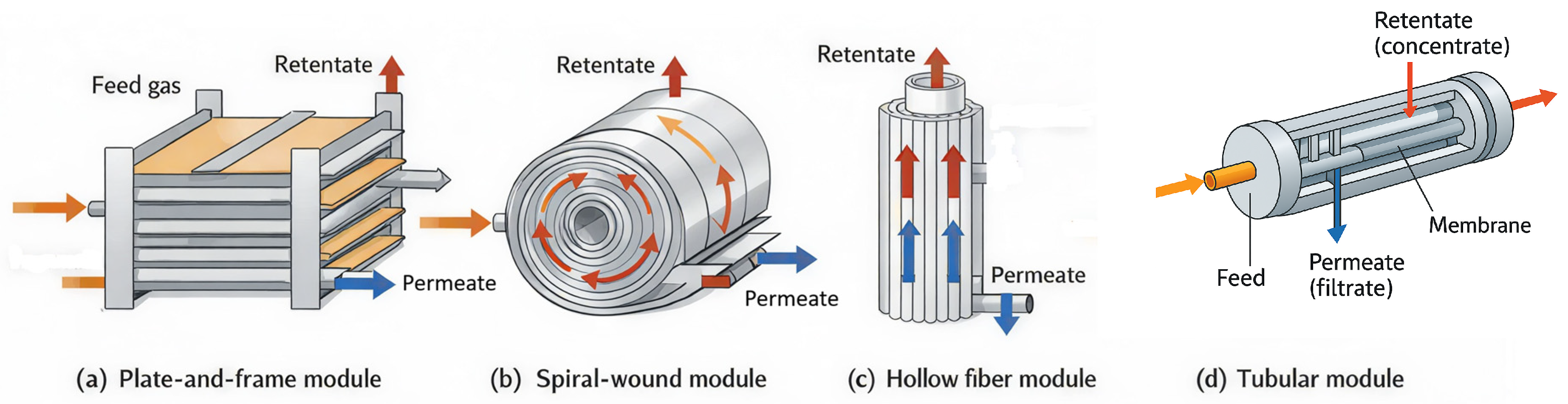
6. Membrane Module Configurations and Process Design Considerations
7. Industrial Applications of Membrane-Based CO2 Separation
7.1. CO2/CH4 Separation
7.1.1. Natural Gas Sweetening
7.1.2. Biogas Upgrading
7.2. CO2/N2 Separation
7.3. CO2/H2 Separation
CO2-Selective Membranes
| Application | Membrane Type | Representative Materials/ Systems | Typical Performance Range | Key Advantages | Main Limitations | Ref. |
|---|---|---|---|---|---|---|
| CO2/CH4 (Natural gas sweetening) | Polymer | Cellulose acetate (CA), PSf, Matrimid | PCO2~10–40 Barrer; αCO2/CH4: 15–60 | Low cost; mature technology; good long-term stability; commercial availability | Lower permeability than advanced materials; plasticization at high pressure | [58,168,355,356,357,358] |
| Polymer (modified) | Crosslinked, blended, nanofiller-enhanced polymers | Stable operation at 30–50 bar; improved plasticization resistance | Improved durability; compatible with existing modules | Still below upper-bound lab-scale materials | [359,360,361,362,363,364,365,366,367,368] | |
| CO2/CH4 (Biogas upgrading) | Polymer | CA, PSf, PI, PEI | CO2 permeance: ~10–20 GPU; PCO2~10–40 Barrer αCO2/CH4: ~30–40 | Cost-effective for small/medium scale; compact systems | Multistage systems required; compression cost dominates | [369,370] |
| Inorganic | CMS hollow fibers | αCO2/CH4: up to ~246; permeance ~7.75 GPU PCO2 = 155 Barrer | Very high selectivity; reduced CH4 loss | Lower permeance; scalability challenges | [371] | |
| CO2/N2 (Post- combustion) | Polymer | PES, PolyActive, Polaris (MTR), GO hybrids | CO2 permeance: ~1000–1700 GPU; PCO2 = 100–170 Barrer αCO2/N2: 50–73 | Scalable thin-film composites; good manufacturability | Sensitive to impurities and humidity | [373,374,384,385,386,387] |
| Facilitated transport (FTM) | Fixed/mobile amine carriers; Pebax–amine systems | CO2 permeance: 500–1500 GPU PCO2 = 50–100 Barrer; αCO2/N2 100–200 | Excellent low-pressure performance; water-compatible; high selectivity; pilot validated | Water management; carrier degradation; scale-up complexity | [378,379,380,381,382,383] | |
| Hybrid | GO-based, mixed-matrix membranes | CO2 permeance up to ~1000 GPU PCO2 up to 110 Barrer αCO2/N2 up to 80 | Tunable nanochannels; potential high flux | Defect control at large scale remains challenging | [71,375,384] | |
| CO2/H2 (Pre- combustion) | CO2-selective polymer | PEO-based membranes; FTMs | αCO2/H2 < 30 (PEO); up to ~300 (FTM); PCO2 > 3000 Barrer (FTM) | Effective under humid syngas conditions; strong facilitated transport effect | Limited thermal stability (polymeric systems) | [389,390] |
| H2-selective polymer | PBI | H2 permeance up to ~100 GPU PH2 up to 35 Barrer αH2/CO2 = 18–40 | High-temperature operation; good thermal stability | Moderate permeability | [266,388] | |
| Inorganic | ceramic–carbonate membranes | high flux at elevated T | Exceptional purity; high-temperature and pressure tolerance | High cost; poisoning sensitivity; scalability issues | [391] |
8. Big Data and Machine Learning for CO2 Separation Membranes
9. Summary and Future Development Directions
10. Conclusions
Author Contributions
Funding
Institutional Review Board Statement
Informed Consent Statement
Data Availability Statement
Conflicts of Interest
References
- Pedersen, J.T.S.; van Vuuren, D.; Gupta, J.; Santos, F.D.; Edmonds, J.; Swart, R. IPCC emission scenarios: How did critiques affect their quality and relevance 1990–2022? Glob. Environ. Change 2022, 75, 102538. [Google Scholar] [CrossRef]
- Gao, Y.; Gao, X.; Zhang, X. The 2 °C global temperature target and the evolution of the long-term goal of addressing climate change—From the United Nations framework convention on climate change to the Paris agreement. Engineering 2017, 3, 272–278. [Google Scholar] [CrossRef]
- Haites, E. Carbon taxes and greenhouse gas emissions trading systems: What have we learned? Clim. Policy 2018, 18, 955–966. [Google Scholar] [CrossRef]
- Wang, X.X.; Song, C.S. Carbon capture from flue gas and the atmosphere: A perspective. Front. Energy Res. 2020, 8, 265. [Google Scholar] [CrossRef]
- Madejski, P.; Chmiel, K.; Subramanian, N.; Kuś, T. Methods and techniques for CO2 capture: Review of potential solutions and applications in modern energy technologies. Energies 2022, 15, 887. [Google Scholar] [CrossRef]
- Yang, J.; Cao, N.; Liu, Y.; Lu, Y. CO2 capture with adsorption strategies: Achievements, challenges, and prospects. J. Clean. Prod. 2025, 515, 145798. [Google Scholar] [CrossRef]
- Low, Z.X.; Budd, P.M.; McKeown, N.B.; Patterson, D.A. Gas permeation properties, physical aging, and its mitigation in high free volume glassy polymers. Chem. Rev. 2018, 118, 5871–5911. [Google Scholar] [CrossRef] [PubMed]
- Kadirkhan, F.; Goh, P.S.; Ismail, A.F.; Wan Mustapa, W.N.F.; Halim, M.H.M.; Soh, W.K.; Yeo, S.Y. Recent Advances of Polymeric Membranes in Tackling Plasticization and Aging for Practical Industrial CO2/CH4 Applications—A Review. Membranes 2022, 12, 71. [Google Scholar] [CrossRef]
- Jue, M.L.; Lively, R.P. Targeted gas separations through polymer membrane functionalization. React. Funct. Polym. 2015, 86, 88–110. [Google Scholar] [CrossRef]
- Imtiaz, A.; Othman, M.H.D.; Jilani, A.; Khan, I.U.; Kamaludin, R.; Iqbal, J.; Al-Sehemi, A.G. Challenges, opportunities and future directions of membrane technology for natural gas purification: A critical review. Crit. Rev. 2022, 12, 646. [Google Scholar] [CrossRef]
- Mondal, M.K.; Balsora, H.K.; Varshney, P. Progress and trends in CO2 capture/separation technologies: A review. Energy Environ. Sci. 2012, 46, 431–441. [Google Scholar] [CrossRef]
- Baena-Moreno, F.M.; le Sache, E.; Pastor-Perez, L.; Reina, T.R. Membrane-based technologies for biogas upgrading: A review. J. Environ. Chem. Lett. 2020, 18, 1649–1658. [Google Scholar] [CrossRef]
- Lin, H.; Yavari, M. Upper bound of polymeric membranes for mixed-gas CO2/CH4 separations. J. Membr. Sci. 2015, 475, 101–109. [Google Scholar] [CrossRef]
- Chung, T.-S.; Jiang, L.Y.; Li, Y.; Kulprathipanja, S. Mixed matrix membranes (MMMs) comprising organic polymers with dispersed inorganic fillers for gas separation. Prog. Polym. Sci. 2007, 32, 483–507. [Google Scholar] [CrossRef]
- Wang, Y.; Wang, X.; Guan, J.; Yang, L.; Ren, Y.; Nasir, N.; Wu, H.; Chen, Z.; Jiang, Z. 110th anniversary: Mixed matrix membranes with fillers of intrinsic nanopores for gas separation. Ind. Eng. Chem. Res. 2019, 58, 7706–7724. [Google Scholar] [CrossRef]
- Ahmad, N.N.R.; Leo, C.P.; Mohammad, A.W.; Ahmad, A.L. Modification of gas selective SAPO zeolites using imidazolium ionic liquid to develop polysulfone mixed matrix membrane for CO2 gas separation. Microporous Mesoporous Mater. 2017, 244, 21–30. [Google Scholar] [CrossRef]
- Huang, M.; Wang, Z.; Jin, J. Two-dimensional microporous material-based mixed matrix membranes for gas separation. Chem. Asian J. 2020, 15, 2303–2315. [Google Scholar] [CrossRef] [PubMed]
- Yin, J.; Deng, B. Polymer-matrix nanocomposite membranes for water treatment. J. Membr. Sci. 2015, 479, 256–275. [Google Scholar] [CrossRef]
- Chaumpong, W.; Mayyas, M.; Razmjou, A.; Chen, V. Modification of GO-based pervaporation membranes to improve stability in oscillating temperature operation. Desalination 2021, 516, 115215. [Google Scholar] [CrossRef]
- Zhang, Y.; Zhang, S.; Gao, J.; Chung, T.-S. Layer-by-layer construction of graphene oxide (GO) framework composite membranes for highly efficient heavy metal removal. J. Membr. Sci. 2016, 515, 230–237. [Google Scholar] [CrossRef]
- Jimmy, J.; Kandasubramanian, B. MXene functionalized polymer composites: Synthesis and applications. Eur. Polym. J. 2020, 122, 109367. [Google Scholar] [CrossRef]
- Niu, P.; Zhang, L.; Liu, G.; Cheng, H.-M. Graphene-like carbon nitride nanosheets for improved photocatalytic activities. Adv. Funct. Mater. 2012, 22, 4763–4770. [Google Scholar] [CrossRef]
- Wang, H.; He, S.; Qin, X.; Li, C.; Li, T. nterfacial engineering in metal–organic framework-based mixed matrix membranes using covalently grafted polyimide brushes. J. Am. Chem. Soc. 2018, 140, 17203–17210. [Google Scholar] [CrossRef]
- Hosseini Monjezi, B.; Kutonova, K.; Tsotsalas, M.; Henke, S.; Knebel, A. Current trends in metal-organic and covalent organic framework membrane materials. Angew. Chem. Int. Ed. 2021, 60, 15153–15164. [Google Scholar] [CrossRef] [PubMed]
- Manzeli, S.; Ovchinnikov, D.; Pasquier, D.; Yazyev, O.V.; Kis, A. 2D transition metal dichalcogenides. Nat. Rev. Mater. 2017, 2, 17033. [Google Scholar] [CrossRef]
- Guo, X.; Zhang, F.; Evans, D.G.; Duan, X. Layered double hydroxide films: Synthesis, properties and applications. Chem. Commun. 2010, 46, 5197–5210. [Google Scholar] [CrossRef] [PubMed]
- Dai, Y.; Niu, Z.; Luo, W.; Wang, Y.; Mu, P.; Li, J. A review on the recent advances in composite membranes for CO2 capture processes. Sep. Purif. Technol. 2023, 307, 122752. [Google Scholar] [CrossRef]
- Pohlmann, J.; Bram, M.; Wilkner, K.; Brinkmann, T. Pilot scale separation of CO2 from power plant flue gases by membrane technology. Int. J. Greenh. Gas Control 2016, 53, 56–64. [Google Scholar] [CrossRef]
- Widjojo, N.; Li, Y.; Jiang, L.; Chung, T.-S. Advanced Materials for Membrane Preparation; Bentham Science Publishers: Singapore, 2012; pp. 64–82. [Google Scholar]
- Rybak, A.; Rybak, A. Methods of ensuring energy security with the use of hard coal—The case of Poland. Energies 2021, 14, 5609. [Google Scholar] [CrossRef]
- Rybak, A.; Rybak, A.; Joostberens, J.; Pielot, J.; Toś, P. Analysis of the impact of clean coal technologies on the share of coal in Poland’s energy mix. Energies 2024, 17, 1394. [Google Scholar] [CrossRef]
- Rybak, A.; Rybak, A. The Role of Clean Coal Technologies in Energy Transformation and Energy Security; Springer: Berlin/Heidelberg, Germany, 2025. [Google Scholar]
- Rybak, A.; Rybak, A.; Kolev, S.D. Analysis of the EU-27 Countries Energy Markets Integration in Terms of the Sustainable Development SDG7 Implementation. Energies 2021, 14, 7079. [Google Scholar] [CrossRef]
- Rybak, A.; Rybak, A.; Joostberens, J.; Kolev, S.D. Cluster analysis of the EU-27 countries in light of the guiding principles of the European Green Deal, with particular emphasis on Poland. Energies 2022, 15, 5082. [Google Scholar] [CrossRef]
- Rybak, A.; Rybak, A.; Joostberens, J.; Kolev, S.D. Assessment of the Impact of Renewable Energy Sources and Clean Coal Technologies on the Stability of Energy Systems in Poland and Sweden. Energies 2025, 18, 4377. [Google Scholar] [CrossRef]
- Rybak, A.; Rybak, A. The impact of the COVID-19 pandemic on gaseous and solid air pollutants concentrations and emissions in the EU, with particular emphasis on Poland. Energies 2021, 14, 3264. [Google Scholar] [CrossRef]
- Flores, M.; Gonçalves, B.; Figueiredo, K. CO2 Separation by Mixed Matrix Membranes Incorporated with Carbon Nanotubes: A Review of Morphological, Mechanical, Thermal and Transport Properties. Braz. J. Chem. Eng. 2021, 38, 777–810. [Google Scholar] [CrossRef]
- Rybak, A.; Rybak, A.; Boncel, S.; Kaszuwara, W.; Kolev, S.D. Hybrid organic–inorganic membranes based on sulfonated poly (ether ether ketone) matrix and iron-encapsulated carbon nanotubes and their application in CO2 separation. RSC Adv. 2022, 12, 13367–13380. [Google Scholar] [CrossRef] [PubMed]
- Bui, M.; Adjiman, C.S.; Bardow, A.; Anthony, E.J.; Boston, A.; Fennell, P.S.; Galindo, A.; Hackett, L.A. Carbon capture and storage: The way forward. Energy Environ. Sci. 2018, 11, 1062–1176. [Google Scholar] [CrossRef]
- Eskander, S.M.S.U.; Fankhauser, S. Reduction in greenhouse gas emissions from climate legislation. Nat. Clim. Change 2020, 10, 750–756. [Google Scholar] [CrossRef]
- Buckingham, J.; Reina, T.R.; Duyar, M.S. Recent advances in carbon dioxide capture for process intensification. Carbon Capture Sci. Technol. 2022, 2, 100031. [Google Scholar] [CrossRef]
- Buhre, B.J.; Elliott, L.K.; Sheng, C.; Gupta, R.P.; Wall, T.F. Oxy-fuel combustion for coal-fired power generation. Prog. Energy Combust. Sci. 2005, 31, 283–307. [Google Scholar] [CrossRef]
- Akers Solutions. Unleashing ZEUS: Zero Emission Power Station with Advanced CO2 Management Technology. Available online: https://www.akersolutions.com (accessed on 29 January 2026).
- Shi, B.; Xu, W.; Wu, E.; Wu, W.; Kuo, P.-C. Novel design of integrated gasification combined cycle (IGCC) power plants with CO2 capture. J. Clean Prod. 2018, 195, 176–186. [Google Scholar] [CrossRef]
- Bains, P.; Psarras, P.; Wilcox, J. CO2 capture from the industry sector. Prog. Energy Combust. Sci. 2017, 63, 146–172. [Google Scholar] [CrossRef]
- Pérez-Fortes, M.; Moya, J.A.; Vatopoulos, K.; Tzimas, E. CO2 capture and utilization in cement and steel industries. Energy Procedia 2014, 63, 6534–6543. [Google Scholar] [CrossRef]
- Smith, T.; Jalkanen, J.; Anderson, B.; Corbett, J.; Faber, J.; Hanayama, S. Third IMO Greenhouse Gas Study; IMO Report; International Maritime Organization (IMO): London, UK, 2015.
- García-Mariaca, A.; Llera-Sastresa, E. Review on carbon capture in ICE-driven transport. Energies 2021, 14, 6865. [Google Scholar] [CrossRef]
- Wang, M.; Lawal, A.; Stephenson, P.; Sidders, J.; Ramshaw, C. Post-combustion CO2 capture with chemical absorption. Chem. Eng. Res. Des. 2011, 89, 1609–1624. [Google Scholar] [CrossRef]
- Asif, M.; Suleman, M.; Haq, I.; Jamal, S.A. Post-combustion CO2 capture with chemical absorption and hybrid system: Current status and challenges. J. Greenh. Gas Sci. Technol. 2018, 8, 998–1031. [Google Scholar] [CrossRef]
- Kolle, J.M.; Fayaz, M.; Sayari, A. Understanding the effect of water on CO2 adsorption. Chem. Rev. 2021, 121, 7280–7345. [Google Scholar] [CrossRef]
- He, J.; Jin, Z.; Gan, F.; Xie, L.; Guo, J.; Zhang, S.; Jia, C.Q.; Ma, D.; Dai, Z.; Jiang, X. Liquefiable biomass-derived porous carbons and their applications in CO2 capture and conversion. Green Chem. 2022, 24, 3376–3415. [Google Scholar] [CrossRef]
- Pullumbi, P.; Brandani, F.; Brandani, S. Gas separation by adsorption: Technological drivers and opportunities. Curr. Opin. Chem. Eng. 2019, 24, 131–142. [Google Scholar] [CrossRef]
- Wang, J.-X.; Liang, C.-C.; Gu, X.-W.; Wen, H.-M.; Jiang, C.; Li, B.; Qian, G.; Chen, B. Recent advances in microporous metal–organic frameworks as promising adsorbents for gas separation. J. Mater. Chem. A 2022, 10, 17878–17916. [Google Scholar] [CrossRef]
- McQueen, N.; Gomes, K.V.; McCormick, C.; Blumanthal, K.; Pisciotta, M.; Wilcox, J. A review of direct air capture (DAC): Scaling up commercial technologies and innovating for the future. Prog. Energy Combust. Sci. 2021, 3, 032001. [Google Scholar] [CrossRef]
- Berstad, D.; Anantharaman, R.; Nekså, P. Low-temperature CO2 capture technologies—Applications and potential. Int. J. Refrig. 2013, 36, 1403–1416. [Google Scholar] [CrossRef]
- Baker, R.W. Membrane Technology and Applications; John Wiley & Sons: Hoboken, NJ, USA, 2024. [Google Scholar]
- Baker, R.W.; Low, B.T. Gas separation membrane materials: A perspective. Macromolecules 2014, 47, 6999–7013. [Google Scholar] [CrossRef]
- Zhao, S.; Feron, P.H.M.; Deng, L.; Favre, E.; Chabanon, E.; Yan, S.; Hou, J.; Chen, V.; Qi, H. Status and progress of membrane contactors in post-combustion carbon capture: A state-of-the-art review of new developments. J. Membr. Sci. 2016, 511, 180–206. [Google Scholar] [CrossRef]
- Dalane, K.; Dai, Z.; Mogseth, G.; Hillestad, M.; Deng, L. Potential applications of membrane separation for subsea natural gas processing: A review. J. Nat. Gas Sci. Eng. 2017, 39, 101–117. [Google Scholar] [CrossRef]
- Chen, D.; Wang, K.; Yuan, Z.; Lin, Z.; Zhang, M.; Li, Y.; Tang, J.; Liang, Z.; Chen, L.; Li, L.; et al. Boosting membranes for CO2 capture toward industrial decarbonization. Carbon Capture Sci. Technol. 2023, 7, 100117. [Google Scholar] [CrossRef]
- Shi, L.; Zhao, Y.; Matz, S.; Gottesfeld, S.; Setzler, B.P.; Yan, Y. A shorted membrane electrochemical cell powered by hydrogen to remove CO2 from the air feed of hydroxide exchange membrane fuel cells. Nat. Energy 2022, 7, 238–247. [Google Scholar] [CrossRef]
- Wade, J.L.; Lopez Marques, H.; Wang, W.; Flory, J.; Freeman, B. Moisture-driven CO2 pump for direct air capture. J. Membr. Sci. 2023, 685, 121954. [Google Scholar] [CrossRef]
- Mosadegh-Sedghi, S.; Rodrigue, D.; Brisson, J.; Iliuta, M.C. Wetting phenomenon in membrane contactors—Causes and prevention. J. Membr. Sci. 2014, 452, 332–353. [Google Scholar] [CrossRef]
- Li, H.; Haas-Santo, K.; Schygulla, U.; Dittmeyer, R. Inorganic microporous membranes for H2 and CO2 separation—Review of experimental and modeling progress. Chem. Eng. Sci. 2015, 127, 401–417. [Google Scholar] [CrossRef]
- Xiao, J.; Wei, J. Diffusion mechanism of hydrocarbons in zeolites—I Theory. Chem. Eng. Sci. 1992, 47, 1123–1141. [Google Scholar] [CrossRef]
- Mulder, M. Basic Principles of Membrane Technology, 2nd ed.; Kluwer Academic Publishers: Dordrecht, The Netherlands, 1996. [Google Scholar]
- Petersen, R.J. Composite reverse osmosis and nanofiltration membranes. J. Membr. Sci. 1993, 83, 81–150. [Google Scholar] [CrossRef]
- Robeson, L.M. The upper bound revisited. J. Membr. Sci. 2008, 320, 390–400. [Google Scholar] [CrossRef]
- Baker, R.W. Future directions of membrane gas separation technology. Ind. Eng. Chem. Res. 2002, 41, 1393–1411. [Google Scholar] [CrossRef]
- Wang, S.F.; Liu, Y.; Zhang, M.W.; Shi, D.D.; Li, Y.F.; Peng, D.D.; He, G.W.; Wu, H.; Chen, J.F.; Jiang, Z.Y. Facilitated transport behavior of CO2 carrier membranes. J. Membr. Sci. 2016, 505, 44–52. [Google Scholar] [CrossRef]
- Klemm, A.; Lee, Y.Y.; Mao, H.; Gurkan, B. Facilitated transport membranes with ionic liquids for CO2 separation. Front. Chem. 2020, 8, 637. [Google Scholar] [CrossRef]
- Klepic, M.; Fuoco, A.; Monteleone, M.; Esposito, E.; Friess, K.; Izak, P.; Jansen, J.C. Effect of the CO2-philic ionic liquid [BMIM][Tf2N] on the single and mixed gas transport in PolyActive™ membranes. Sep. Purif. Technol. 2021, 256, 117813. [Google Scholar] [CrossRef]
- Friess, K.; Izak, P.; Karaszova, M.; Pasichnyk, M.; Lanc, M.; Nikolaeva, D.; Luis, P.; Jansen, J.C. A review on ionic liquid gas separation membranes. Membranes 2021, 11, 97. [Google Scholar] [CrossRef]
- Touaj, K.; Tbeur, N.; Hor, M.; Verchere, J.F.; Hlaibi, M. A supported liquid membrane (SLM) with resorcinarene for facilitated transport of methyl glycopyranosides: Parameters and mechanism relating to the transport. J. Membr. Sci. 2009, 337, 28–38. [Google Scholar] [CrossRef]
- Petropoulos, J.H. A comparative study of approaches applied to the permeability of binary composite polymeric material. J. Polym. Sci. Polym. Phys. Ed. 1985, 23, 1309–1324. [Google Scholar] [CrossRef]
- Pal, R. Permeation models for mixed-matrix membranes. J. Colloid Interface Sci. 2008, 317, 191–198. [Google Scholar] [CrossRef]
- Bouma, H.B.; Checchetti, A.; Chidichimo, G.; Drioli, E. Permeation through heterogeneous membranes: The effect of the dispersed phase. J. Membr. Sci. 1997, 128, 141–149. [Google Scholar] [CrossRef]
- Vinh-Thang, H.; Kaliaguine, S. Predictive models for mixed-matrix membrane performance. Chem. Rev. 2013, 113, 4980–5028. [Google Scholar] [CrossRef]
- Vu, Q.; Koros, W.J.; Miller, S.J. Mixed matrix membranes using carbon molecular sieves: I. Preparation and experimental results. J. Membr. Sci. 2003, 211, 311–334. [Google Scholar] [CrossRef]
- Mahajan, R.; Koros, W.J. Factors Controlling Successful Formation of Mixed-Matrix Gas Separation Materials. Ind. Eng. Chem. Res. 2000, 39, 2692–2696. [Google Scholar] [CrossRef]
- Hamilton, R.L.; Crosser, O.K. Thermal conductivity of heterogeneous systems. Ind. Eng. Chem. Fundam. 1962, 1, 187–191. [Google Scholar] [CrossRef]
- Kang, D.Y.; Jones, C.W.; Nair, S. Modeling molecular transport in composite membranes with tubular fillers. J. Membr. Sci. 2011, 381, 50–63. [Google Scholar] [CrossRef]
- Chehrazi, E.; Raef, M.; Noroozi, M.; Panahi-Sarmad, M. A theoretical model for the gas permeation prediction of nanotube-mixed matrix membranes: Unveiling the effect of interfacial layer. J. Membr. Sci. 2019, 570–571, 168–175. [Google Scholar] [CrossRef]
- Rybak, A.; Rybak, A.; Kaszuwara, W.; Kolanowska, A.; Kolev, S.D. Characteristics of inorganic–organic hybrid membranes containing carbon nanotubes with increased iron-encapsulated content for CO2 separation. Membranes 2022, 12, 132. [Google Scholar] [CrossRef]
- Chehrazi, E. Gas permeation model for mixed matrix membranes: The new renovated Maxwell model. Compos. Interfaces 2023, 30, 899–908. [Google Scholar] [CrossRef]
- Nielsen, L.E.; Lewis, T.A. Polymer Composites: Principles and Applications; Elsevier: New York, NY, USA, 1989. [Google Scholar]
- Bauhofer, W.; Kovacs, J.Z. A review and analysis of electrical percolation in carbon nanotube polymer composites. Compos. Sci. Technol. 2009, 69, 1486–1498. [Google Scholar] [CrossRef]
- Li, C.; Qi, A.; Ling, Y.; Tao, Y.; Zhang, Y.B.; Li, T. Gas transport highways in MOF-based mixed matrix membranes. Sci. Adv. 2023, 9, eadf5087. [Google Scholar] [CrossRef]
- Paul, D.R.; Robeson, L.M. Polymer nanotechnology: Nanocomposites. Polymer 2008, 49, 3187–3204. [Google Scholar] [CrossRef]
- Lin, H.; Freeman, B.D. Materials selection guidelines for membranes that remove CO2 from gas mixtures. J. Mol. Struct. 2005, 739, 57–74. [Google Scholar] [CrossRef]
- Yampolskii, Y.; Pinnau, I.; Freeman, B.D. Materials science of membranes for gas separation. Macromolecules 2006, 39, 4965–4974. [Google Scholar]
- Schneider, D.; Kapteijn, F.; Valiullin, R. Transport properties of mixed-matrix membranes: A kinetic Monte Carlo study. Phys. Rev. Appl. 2019, 12, 044034. [Google Scholar] [CrossRef]
- Wu, H.; Zamanian, M.; Kruczek, B.; Thibault, J. Gas permeation model of mixed-matrix membranes with embedded impermeable cuboid nanoparticles. Membranes 2020, 10, 422. [Google Scholar] [CrossRef]
- Zhao, J.; Ai, H.; Guan, J.; Wang, R. Resistance model approach for gas separation in mixed-matrix membranes: Progress and application. RSC Adv. 2025, 15, 36656–36669. [Google Scholar] [CrossRef]
- Sabouri, R.; Ladewig, B.P.; Prasetya, N. Mixed matrix membranes for hydrogen separation: A comprehensive review and performance analysis. J. Mater. Chem. A 2026, 14, 681–701. [Google Scholar] [CrossRef]
- Aninwede, C.; Kratky, L. Modeling trends in multicomponent gas membrane separation process: A review. J. Eng. Appl. Sci. 2025, 72, 41. [Google Scholar] [CrossRef]
- Dai, Z.; Ansaloni, L.; Deng, L. Multi-layer polymeric membranes for CO2 separation. Green Energy Environ. 2016, 1, 102–128. [Google Scholar] [CrossRef]
- Ma, Y.; Guo, H.; Selyanchyn, R.; Wang, B.; Deng, L.; Dai, Z.; Jiang, X. Hydrogen sulfide removal from natural gas using membrane technology: A review. J. Mater. Chem. A 2021, 9, 20211–20240. [Google Scholar] [CrossRef]
- Yampolskii, Y.; Freeman, B. Membrane Gas Separation; John Wiley & Sons: Hoboken, NJ, USA, 2010. [Google Scholar]
- Wang, Y.; Ghanem, B.S.; Han, Y.; Pinnau, I. State-of-the-art polymers of intrinsic microporosity for high-performance gas separation membranes. Curr. Opin. Chem. Eng. 2022, 35, 100755. [Google Scholar] [CrossRef]
- Liu, M.; Nothling, M.D.; Zhang, S.; Fu, Q.; Qiao, G.G. Thin film composite membranes for post-combustion carbon capture: Polymers and beyond. Prog. Polym. Sci. 2022, 126, 101504. [Google Scholar] [CrossRef]
- Bandehali, S.; Moghadassi, A.; Parvizian, F.; Hosseini, S.M.; Matsuura, T.; Joudaki, E. Advances in high carbon dioxide separation performance of poly (ethylene oxide)-based membranes. J. Energy Chem. 2020, 46, 30–52. [Google Scholar] [CrossRef]
- Zhu, B.; He, S.; Wu, Y.; Li, S.; Shao, L. One-step synthesis of structurally stable CO2-philic membranes with ultra-high PEO loading for enhanced carbon capture. Engineering 2023, 26, 220–228. [Google Scholar] [CrossRef]
- Lee, J.H.; Jung, J.P.; Jang, E.; Lee, K.B.; Kang, Y.S.; Kim, J.H. CO2-philic PBEM-g-POEM comb copolymer membranes for CO2/N2 separation. J. Membr. Sci. 2016, 502, 191–201. [Google Scholar] [CrossRef]
- Guo, X.; Qiao, Z.; Liu, D.; Zhong, C. Mixed-matrix membranes for CO2 separation: Role of the third component. J. Mater. Chem. A 2019, 7, 24738–24759. [Google Scholar] [CrossRef]
- Shen, J.; Zhang, S.; Fang, X.; Salmon, S. Carbonic anhydrase enhanced UV-crosslinked PEG-DA/PEO extruded hydrogel flexible filaments and durable grids for CO2 capture. Gels 2023, 9, 341. [Google Scholar] [CrossRef]
- Deng, J.; Dai, Z.; Yan, J.; Sandru, M.; Sandru, E.; Spontak, R.J.; Deng, L. Solvent-free PEG-based membranes with interpenetrating networks for CO2 separation. J. Membr. Sci. 2019, 570, 455–463. [Google Scholar] [CrossRef]
- Setiawan, W.K.; Chiang, K.-Y. Enhancement strategies of poly (ether-block-amide) copolymer membranes for CO2 separation: A review. Chemosphere 2023, 338, 139478. [Google Scholar] [CrossRef]
- Ahmad, J.; Rehman, W.U.; Deshmukh, K.; Basha, S.K.; Ahamed, B.; Chidambaram, K. Recent advances in poly (amide-B-ethylene) based membranes for carbon dioxide (CO2) capture: A review. Polym.-Plast. Technol. Mater. 2019, 58, 366–383. [Google Scholar]
- Sasikumar, B.; Arthanareeswaran, G.; Ismail, A. Recent progress in ionic liquid membranes for gas separation. J. Mol. Liq. 2018, 266, 330–341. [Google Scholar] [CrossRef]
- Mulk, W.U.; Ali, S.A.; Shah, S.N.; Shah, M.U.H.; Zhang, Q.-J.; Younas, M.; Fatehizadeh, A.; Sheikh, M.; Rezakazemi, M. Breaking boundaries in CO2 capture: Ionic liquid-based membrane separation for post-combustion applications. J. CO2 Util. 2023, 75, 102555. [Google Scholar]
- Li, W.; Musa, D.A.R.; Ahmad, N.; Adil, M.; Altimari, U.S.; Ibrahim, A.K.; Alshehri, A.M.; Riyahi, Y.; Jaber, A.S.; Kadhim, S.I.; et al. Comprehensive review on the efficiency of ionic liquid materials for membrane separation and environmental applications. Chemosphere 2023, 332, 138826. [Google Scholar] [CrossRef]
- Jiang, H.; Li, T.; Bai, L.; Han, J.; Zhang, X.; Dong, H.; Zeng, S.; Luo, S.; Zhang, X. Polyimide/ionic liquids hybrid membranes with NH3-philic channels for ammonia-based CO2 separation processes. ACS Appl. Mater. Interfaces 2023, 15, 51204–51214. [Google Scholar]
- O’Harra, K.; Kammakakam, I.; Shinde, P.; Giri, C.; Tuan, Y.; Jackson, E.M.; Bara, J.E. Poly(ether ether ketone) ionenes: Ultrahigh-performance polymers with ionic liquids. ACS Appl. Polym. Mater. 2022, 4, 8365–8376. [Google Scholar] [CrossRef]
- Foorginezhad, S.; Yu, G.; Ji, X. Reviewing and screening ionic liquids and deep eutectic solvents for effective CO2 capture. Front. Chem. 2022, 10, 951951. [Google Scholar] [CrossRef]
- Wang, Y.; Jiang, H.; Guo, Z.; Ma, H.; Wang, S.; Wang, H.; Song, S.; Zhang, J.; Yin, Y.; Wu, H.; et al. Advances in organic microporous membranes for CO2 separation. Energy Environ. Sci. 2023, 16, 53–75. [Google Scholar] [CrossRef]
- Budd, P.M.; Ghanem, B.S.; Makhseed, S.; McKeown, N.B.; Msayib, K.J.; Tattershall, C.E. Polymers of intrinsic microporosity (PIMs): Robust, solution-processable, organic nanoporous materials. Chem. Commun. 2004, 2, 230–231. [Google Scholar] [CrossRef]
- Yavari, M.; Le, T.; Lin, H. Physical aging of glassy perfluoropolymers in thin film composite membranes. Part I. Gas transport properties. J. Membr. Sci. 2017, 525, 387–398. [Google Scholar] [CrossRef]
- Bandehali, S.; Amooghin, A.E.; Sanaeepur, H.; Ahmadi, R.; Fuoco, A.; Jansen, J.C.; Shirazi, S. PIM and thermally rearranged polymer membranes for gas separation. Sep. Purif. Technol. 2021, 278, 119513. [Google Scholar] [CrossRef]
- Liu, Q.; Liu, J.; Jia, P.; Yu, T.; Qi, N.; Zhou, W.; Li, N.; Chen, Z. Tunable free volume structure on the gas separation performance of thermally rearranged poly (benzoxazole-co-imide) membranes studied by positron annihilation. ACS Appl. Polym. Mater. 2023, 5, 9245–9254. [Google Scholar] [CrossRef]
- Chang, Y.S.; Kumari, P.; Munro, C.J.; Szekely, G.; Vega, L.F.; Nunes, S.; Dumée, L.F. Plasticization mitigation strategies for gas and liquid filtration membranes—A review. J. Membr. Sci. 2023, 666, 121125. [Google Scholar] [CrossRef]
- Tiwari, R.R.; Smith, Z.P.; Lin, H.; Freeman, B.D.; Paul, D.R. Gas permeation in thin films of “high free-volume” glassy perfluoropolymers: Part II. CO2 plasticization and sorption. Polymer 2015, 61, 1–14. [Google Scholar] [CrossRef]
- Nguyen, P.T.; Lasseuguette, E.; Medina-Gonzalez, Y.; Remigy, J.C.; Roizard, D.; Favre, E. A dense membrane contactor for intensified CO2 gas/liquid absorption in post-combustion capture. J. Membr. Sci. 2011, 377, 261–272. [Google Scholar] [CrossRef]
- Sandru, M.; Sandru, E.M.; Ingram, W.F.; Deng, J.; Stenstad, P.M.; Deng, L.; Spontak, R.J. An integrated materials approach to ultrapermeable and ultraselective CO2 polymer membranes. Science 2022, 376, 90–94. [Google Scholar] [CrossRef] [PubMed]
- Rafiq, S.; Deng, L.; Hägg, M.-B. Role of facilitated transport membranes and composite membranes for efficient CO2 capture–A review. J. ChemBioEng Rev. 2016, 3, 68–85. [Google Scholar] [CrossRef]
- Rea, R.; De Angelis, M.G.; Baschetti, M.G. Models for facilitated transport membranes: A review. Membranes 2019, 9, 26. [Google Scholar] [CrossRef]
- Wang, Z.; Dong, C.; Li, Q.; Wang, S. Polyvinyl amine/polyacrylonitrile composite membranes for CO2 separation. J. Chem. Ind. Eng. 2003, 54, 1188–1191. [Google Scholar]
- Deng, L.; Kim, T.-J.; Hägg, M.-B. Facilitated transport of CO2 in novel PVAm/PVA blend membrane. J. Membr. Sci. 2010, 340, 154–163. [Google Scholar] [CrossRef]
- Karim, S.S.; Matsuura, T.; Hussain, A.; Farrukh, S. Facilitated transport membrane models and reaction mechanisms. In Facilitated Transport Membranes for CO2 Capture; Springer: Cham, Switzerland, 2023; pp. 25–45. [Google Scholar]
- Deng, L.; Hägg, M.-B. Carbon nanotube reinforced PVAm/PVA blend FSC nanocomposite membrane for CO2/CH4 separation. Int. J. Greenh. Gas Control 2014, 26, 127–134. [Google Scholar] [CrossRef]
- Helberg, R.M.L.; Torstensen, J.Ø.; Dai, Z.; Janakiram, S.; Chinga-Carrasco, G.; Gregersen, Ø.W.; Syverud, K.; Deng, L. Nanocomposite membranes with high-charge and size-screened phosphorylated nanocellulose fibrils for CO2 separation. Green Energy Environ. 2021, 6, 585–596. [Google Scholar] [CrossRef]
- Liao, J.; Wang, Z.; Gao, C.; Wang, M.; Yan, K.; Xie, X.; Zhao, S.; Wang, J.; Wang, S. A high performance PVAm–HT membrane containing high-speed facilitated transport channels for CO2 separation. J. Mater. Chem. A 2015, 3, 16746–16761. [Google Scholar] [CrossRef]
- Li, H.; Wang, F.; Li, H.; Sengupta, B.; Behera, D.K.; Li, S.; Yu, M. Ultra-selective membrane composed of charge-stabilized fixed carrier and amino acid-based ionic liquid mobile carrier for highly efficient carbon capture. Chem. Eng. J. 2023, 453, 139780. [Google Scholar] [CrossRef]
- Anggarini, U.; Nagasawa, H.; Kanezashi, M.; Tsuru, T. An ultrahigh permeance and CO2 selective membrane of organosilica-based coordination polymer tailored via nickel crosslinking. J. Membr. Sci. 2023, 679, 121698. [Google Scholar] [CrossRef]
- Belaissaoui, B.; Lasseuguette, E.; Janakiram, S.; Deng, L.; Ferrari, M.-C. Analysis of CO2 facilitation transport effect through a hybrid poly (allyl amine) membrane: Pathways for further improvement. Membranes 2020, 10, 367. [Google Scholar] [CrossRef]
- Zhu, H.; Yuan, J.; Zhao, J.; Liu, G.; Jin, W. Enhanced CO2/N2 separation performance by using dopamine/polyethyleneimine-grafted TiO2 nanoparticles filled PEBA mixed-matrix membranes. Sep. Purif. Technol. 2019, 214, 78–86. [Google Scholar] [CrossRef]
- Tong, Z.; Ho, W.S.W. New sterically hindered polyvinylamine membranes for CO2 separation and capture. J. Membr. Sci. 2017, 543, 202–211. [Google Scholar] [CrossRef]
- Chen, T.-Y.; Deng, X.; Lin, L.-C.; Ho, W.S.W. New sterically hindered polyvinylamine-containing membranes for CO2 capture from flue gas. J. Membr. Sci. 2022, 645, 120195. [Google Scholar] [CrossRef]
- Zou, J.; Ho, W.S.W. CO2-selective polymeric membranes containing amines in crosslinked poly (vinyl alcohol). J. Membr. Sci. 2006, 286, 310–321. [Google Scholar] [CrossRef]
- Helberg, R.M.L.; Dai, Z.; Ansaloni, L.; Deng, L. PVA/PVP blend polymer matrix for hosting carriers in facilitated transport membranes: Synergistic enhancement of CO2 separation performance. Green Energy Environ. 2020, 5, 59–68. [Google Scholar] [CrossRef]
- Deng, J.; Bai, L.; Zeng, S.; Zhang, X.; Nie, Y.; Deng, L.; Zhang, S. Ether-functionalized ionic liquid composite membranes for carbon dioxide separation. RSC Adv. 2016, 6, 45184–45192. [Google Scholar] [CrossRef]
- Ding, R.; Li, Z.; Dai, Y.; Li, X.; Ruan, X.; Gao, J.; Zheng, W.; He, G. Boosting the CO2/N2 selectivity of MMMs by vesicle shaped ZIF-8 with high amino content. Sep. Purif. Technol. 2022, 298, 121594. [Google Scholar] [CrossRef]
- Xu, W.; Lindbråthen, A.; Janakiram, S.; Ansaloni, L.; Deng, L. Enhanced CO2/H2 separation using GO-embedded PVAm membranes. J. Membr. Sci. 2023, 671, 121397. [Google Scholar] [CrossRef]
- Ansaloni, L.; Zhao, Y.; Jung, B.T.; Ramasubramanian, K.; Baschetti, M.G.; Ho, W.W. Facilitated transport membranes containing amino-functionalized multi-walled carbon nanotubes for high-pressure CO2 separations. J. Membr. Sci. 2015, 490, 18–28. [Google Scholar] [CrossRef]
- Wu, H.; Li, Q.; Sheng, M.; Wang, Z.; Zhao, S.; Wang, J.; Mao, S.; Wang, D.; Guo, B.; Ye, N.; et al. Industrial-scale spiral-wound facilitated transport membrane modules for post-combustion CO2 capture: Development, investigation and optimization. J. Membr. Sci. 2023, 670, 121368. [Google Scholar] [CrossRef]
- Gao, X.; Wang, Z.; Chen, T.; Hu, L.; Yang, S.; Kawi, S. MOF membranes for CO2 capture. Carbon Capture Sci. Technol. 2022, 5, 100073. [Google Scholar]
- Demir, S.; Türkmen, H.; Yilmaz, G. MOF membranes for CO2 capture: Past, present and future. Carbon Capture Sci. Technol. 2022, 2, 100026. [Google Scholar] [CrossRef]
- Lei, L.; Bai, L.; Lindbråthen, A.; Pan, F.; Zhang, X.; He, X. Carbon membranes for CO2 removal: Status and perspectives from materials to processes. Chem. Eng. J. 2020, 401, 126084. [Google Scholar] [CrossRef]
- Liu, S.; Kang, Z.; Fan, L.; Li, X.; Zhang, B.; Feng, Y.; Liu, H.; Fan, W.; Wang, R.; Sun, D. Carbon molecular sieve membranes derived from hydrogen-bonded organic frameworks for CO2/CH4 separation. J. Membr. Sci. 2023, 678, 121674. [Google Scholar] [CrossRef]
- Richter, H.; Voss, H.; Kaltenborn, N.; Kämnitz, S.; Wollbrink, A.; Feldhoff, A.; Caro, J.; Roitsch, S.; Voigt, I. High-flux carbon molecular sieve membranes for gas separation. Angew. Chem. Int. Ed. 2017, 56, 7760–7763. [Google Scholar] [CrossRef]
- Dai, Z.; Guo, H.; Deng, J.; Deng, L.; Yan, J.; Spontak, R.J. Carbon molecular-sieve membranes developed from a Tröger’s base polymer and possessing superior gas-separation performance. J. Membr. Sci. 2023, 680, 121731. [Google Scholar] [CrossRef]
- Guo, H.; Wei, J.; Ma, Y.; Qin, Z.; Ma, X.; Selyanchyn, R.; Wang, B.; He, X.; Tang, B.; Yang, L.; et al. Carbon molecular sieve membranes fabricated at low carbonization temperatures with novel polymeric acid porogen for light gas separation. Sep. Purif. Technol. 2023, 317, 123883. [Google Scholar] [CrossRef]
- Zhou, Y.; Du, P.; Song, Z.; Zhang, X.; Liu, Y.; Zhang, Y.; Gu, X. Synthesis of thin DD3R zeolite membranes on hollow fibers using gradient-centrifuged seeds for CO2/CH4 separation. J. Membr. Sci. Lett. 2023, 3, 100038. [Google Scholar] [CrossRef]
- Fu, J.; Das, S.; Xing, G.; Ben, T.; Valtchev, V.; Qiu, S. Fabrication of COF-MOF composite membranes and their highly selective separation of H2/CO2. J. Am. Chem. Soc. 2016, 138, 7673–7680. [Google Scholar] [CrossRef] [PubMed]
- Chen, G.; Liu, G.; Pan, Y.; Gu, X.; Jin, W.; Xu, N. Zeolites and metal–organic frameworks for gas separation: The possibility of translating adsorbents into membranes. Chem. Soc. Rev. 2023, 52, 4586–4602. [Google Scholar] [CrossRef] [PubMed]
- Jokar, S.M.; Farokhnia, A.; Tavakolian, M.; Pejman, M.; Parvasi, P.; Javanmardi, J.; Zare, F.; Gonçalves, M.C.; Basile, A. The recent areas of applicability of palladium based membrane technologies for hydrogen production from methane and natural gas: A review. Int. J. Hydrogen Energy 2023, 48, 6451–6476. [Google Scholar] [CrossRef]
- Liuzzi, D.; Fernandez, E.; Perez, S.; Ipinazar, E.; Arteche, A.; Fierro, J.L.G.; Viviente, J.L. Advances in membranes and membrane reactors for the Fischer-Tropsch synthesis process for biofuel production. Rev. Chem. Eng. 2022, 38, 55–76. [Google Scholar] [CrossRef]
- Gabitto, J.; Tsouris, C. Modeling sulfur poisoning of palladium membranes used for hydrogen separation. Int. J. Chem. Eng. 2019, 2019, 9825280. [Google Scholar] [CrossRef]
- Hu, L.; Chen, K.; Lee, W.-I.; Kisslinger, K.; Rumsey, C.; Fan, S.; Bui, V.T.; Esmaeili, N.; Tran, T.; Ding, Y.; et al. Palladium-percolated networks enabled by low loadings of branched nanorods for enhanced H2 separation. Adv. Mater. 2023, 35, 2301007. [Google Scholar] [CrossRef]
- Okumus, E.; Gurkan, T.; Yilmaz, L. Development of mixed-matrix membranes for pervaporation. Sep. Sci. Technol. 1994, 29, 2451–2473. [Google Scholar] [CrossRef]
- Pacheco, M.J.; Vences, L.J.; Moreno, H.; Pacheco, J.O.; Valdivia, R.; Hernandez, C. Mixed-matrix membranes with CNTs for CO2 separation. Membranes 2021, 11, 457. [Google Scholar] [CrossRef]
- Yu, Y.; Zhang, C.; Fan, J.; Liu, D.; Meng, J. A mixed matrix membrane for enhanced CO2/N2 separation via aligning hierarchical porous zeolite with a polyethersulfone based comb-like polymer. J. Taiwan Inst. Chem. Eng. 2022, 132, 104132. [Google Scholar] [CrossRef]
- Ismail, A.F.; Goh, P.S.; Sanip, S.M.; Aziz, M. Gas separation properties of functionalized carbon nanotubes mixed matrix membranes. Sep. Purif. Technol. 2009, 70, 12–26. [Google Scholar] [CrossRef]
- Gupta, O.; Roy, S.; Rao, L.; Mitra, S. Graphene oxide-carbon nanotube (GO-CNT) hybrid mixed matrix membrane for pervaporative dehydration of ethanol. Membranes 2022, 12, 1227. [Google Scholar] [CrossRef] [PubMed]
- Zhao, P.; Zhang, G.; Yan, H.; Zhao, Y. Amine-functionalized solid adsorbents for post-combustion CO2 capture. Chin. J. Chem. Eng. 2021, 35, 17–43. [Google Scholar] [CrossRef]
- Dechnik, J.; Sumby, C.J.; Janiak, C. Enhancing mixed-matrix membrane performance with metal–organic framework additives. Cryst. Growth Des. 2017, 17, 4467–4488. [Google Scholar] [CrossRef]
- Ahmad, A.L.; Jawad, Z.A.; Low, S.C.; Zein, S.H.S.A. A cellulose acetate/multi-walled carbon nanotube mixed matrix membrane for CO2/N2 separation. J. Membr. Sci. 2014, 451, 55–66. [Google Scholar] [CrossRef]
- Shah Buddin, M.M.H.; Ahmad, A.L. MOFs as fillers in MMMs for CO2 separation. J. CO2 Util. 2021, 51, 101616. [Google Scholar] [CrossRef]
- Basu, S.; Cano-Odena, A.; Vankelecom, I.F.J. MOF-containing mixed-matrix membranes for CO2/CH4 and CO2/N2 binary gas mixture separations. Sep. Purif. Technol. 2011, 81, 31–40. [Google Scholar] [CrossRef]
- Casado-Coterillo, C.; Fernandez-Barquin, A.; Zornoza, B.; Tellez, C.; Coronas, J.; Irabien, Á. Synthesis and characterisation of MOF/ionic liquid/chitosan mixed matrix membranes for CO2/N2 separation. RSC Adv. 2015, 5, 102350–102361. [Google Scholar] [CrossRef]
- Lei, L.; Cheng, Y.; Chen, C.; Kosari, M.; Jiang, Z.; He, C. Taming structure and modulating carbon dioxide (CO2) adsorption isosteric heat of nickel-based metal organic framework (MOF-74 (Ni)) for remarkable CO2 capture. J. Colloid Interface Sci. 2022, 612, 132–145. [Google Scholar] [CrossRef] [PubMed]
- Guo, A.; Ban, Y.; Yang, K.; Yang, W. Metal-organic framework-based mixed matrix membranes: Synergetic effect of adsorption and diffusion for CO2/CH4 separation. J. Membr. Sci. 2018, 562, 76–84. [Google Scholar] [CrossRef]
- Goh, S.; Lau, H.; Yong, W. Metal-Organic Frameworks (MOFs)-Based Mixed Matrix Membranes (MMMs) for Gas Separation: A Review on Advanced Materials in Harsh Environmental Applications. Small 2022, 18, e2107536. [Google Scholar] [CrossRef]
- Li, T.; Pan, Y.; Peinemann, K.V.; Lai, Z. Carbon dioxide selective mixed matrix composite membrane containing ZIF-7 nano-fillers. J. Membr. Sci. 2013, 425, 235–242. [Google Scholar] [CrossRef]
- Hu, L.; Liu, J.; Zhu, L.; Hou, X.; Huang, L.; Lin, H.; Cheng, J. Highly permeable mixed matrix materials comprising ZIF-8 nanoparticles in rubbery amorphous poly(ethylene oxide) for CO2 capture. Sep. Purif. Technol. 2018, 205, 58–65. [Google Scholar] [CrossRef]
- Zhang, Y.; Tong, Y.; Li, X.; Guo, S.; Zhang, H.; Chen, X.; Cai, K.; Cheng, L.; He, W. Pebax mixed-matrix membrane with highly dispersed ZIF-8@ CNTs to enhance CO2/N2 separation. ACS Omega 2021, 6, 18566–18575. [Google Scholar] [CrossRef]
- Barooah, M.; Mandal, B. Enhanced CO2 separation performance by PVA/PEG/silica mixed matrix membrane. J. Appl. Polym. Sci. 2018, 135, 46481. [Google Scholar] [CrossRef]
- Kim, S.; Wang, H.; Lee, Y.M. 2D nanosheets and their composite membranes for water, gas, and ion separation. Angew. Chem. Int. Ed. 2019, 58, 17512–17527. [Google Scholar] [CrossRef] [PubMed]
- Wang, P.; Peng, Y.; Zhu, C.; Yao, R.; Song, H.; Kun, L.; Yang, W. Single-phase covalent organic framework staggered stacking nanosheet membrane for CO2-selective separation. Angew. Chem. Int. Ed. 2021, 60, 19047–19052. [Google Scholar] [CrossRef]
- Chuah, C.Y.; Lee, J.; Bao, Y.; Song, J.; Bae, T.-H. High-performance porous carbon-zeolite mixed-matrix membranes for CO2/N2 separation. J. Membr. Sci. 2021, 622, 119031. [Google Scholar] [CrossRef]
- Chuah, C.Y.; Goh, K.; Yang, Y.; Gong, H.; Li, W.; Karahan, H.E.; Guiver, M.D.; Wang, R.; Bae, T.-H. Harnessing filler materials for enhancing biogas separation membranes. Chem. Rev. 2018, 118, 8655–8769. [Google Scholar] [CrossRef]
- Qin, Z.; Ma, Y.; Wei, J.; Guo, H.; Wang, B.; Deng, J.; Yi, C.; Li, N.; Yi, S.; Deng, Y.; et al. Recent progress in ternary mixed matrix membranes for CO2 separation. Green Energy Environ. 2024, 9, 831–858. [Google Scholar] [CrossRef]
- Li, G.; Kujawski, W.; Knozowska, K.; Kujawa, J. Thin film mixed matrix hollow fiber membrane fabricated by incorporation of amine functionalized metal-organic framework for CO2/N2 separation. Materials 2021, 14, 3366. [Google Scholar] [CrossRef] [PubMed]
- Zhu, G.; Zhang, F.; Rivera, M.P.; Hu, X.; Zhang, G.; Jones, C.W.; Lively, R.P. Molecularly Mixed Composite Membranes for Advanced Separation Processes. Angew. Chem. Int. Ed. 2019, 58, 2638–2643. [Google Scholar] [CrossRef]
- Wong, K.C.; Goh, P.S.; Ismail, A.F.; Kang, H.S.; Guo, Q.J.; Jiang, X.X.; Ma, J.J. The state-of-the-art functionalized nanomaterials for carbon dioxide separation membrane. Membranes 2022, 12, 186. [Google Scholar] [CrossRef]
- Weitkamp, J. Zeolites and catalysis. Solid State Ion. 2000, 131, 175–188. [Google Scholar] [CrossRef]
- Cejka, J.; van Bekkum, H.; Corma, A.; Schueth, F. Introduction to Zeolite Science and Practice, 3rd ed.; Elsevier: Amsterdam, The Netherlands, 2007. [Google Scholar]
- Choi, H.L.; Jeong, Y.; Lee, H.; Bae, T.-H. High-performance mixed-matrix membranes using a zeolite@ MOF core–shell structure synthesized via ion-exchange-induced crystallization and post-synthetic conversion. JACS Au 2024, 4, 253–262. [Google Scholar] [CrossRef]
- Mahenthiran, A.V.; Jawad, Z.A.; Chin, B.L.F. Development of blend PEG-PES/NMP-DMF mixed matrix membrane for CO2/N2 separation. Environ. Sci. Pollut. Res. 2023, 30, 124654–124676. [Google Scholar] [CrossRef]
- Asghari, M.; Mosadegh, M.; Harami, H.R. upported PEBA-zeolite 13× nano-composite membranes for gas separation: Preparation, characterization and molecular dynamics simulation. Chem. Eng. Sci. 2018, 187, 67–78. [Google Scholar] [CrossRef]
- Jusoh, N.; Yeong, Y.F.; Lau, K.K.; Shariff, A.M. Enhanced gas separation performance using mixed matrix membranes containing zeolite T and 6FDA-durene polyimide. J. Membr. Sci. 2016, 520, 715–725. [Google Scholar] [CrossRef]
- Ahmad, J.; Hägg, M.-B. Preparation and characterization of polyvinyl acetate/zeolite 4A mixed matrix membrane for gas separation. J. Membr. Sci. 2013, 427, 73–84. [Google Scholar] [CrossRef]
- Adams, R.T.; Lee, J.S.; Bae, T.-H.; Ward, J.K.; Johnson, J.R.; Jones, C.W.; Nair, S.; Koros, W.J. CO2–CH4 permeation in high zeolite 4A loading mixed matrix membranes. J. Membr. Sci. 2011, 367, 197–203. [Google Scholar] [CrossRef]
- Zhao, J.; Xie, K.; Liu, L.; Liu, M.; Qiu, W.; Webley, P.A. Enhancing plasticization-resistance of mixed-matrix membranes with exceptionally high CO2/CH4 selectivity through incorporating ZSM-25 zeolite. J. Membr. Sci. 2019, 583, 23–30. [Google Scholar] [CrossRef]
- Zhang, B.; Yang, C.; Zheng, Y.; Wu, Y.; Song, C.; Liu, Q.; Wang, Z. PEG/NaY zeolite-based MMMs for CO2 separation. J. Membr. Sci. 2021, 627, 119239. [Google Scholar] [CrossRef]
- Li, W.; Goh, K.; Chuah, C.Y.; Bae, T.-H. Mixed-matrix carbon molecular sieve membranes using hierarchical zeolite: A simple approach towards high CO2 permeability enhancements. J. Membr. Sci. 2019, 588, 117220. [Google Scholar] [CrossRef]
- Mashhadikhan, S.; Amooghin, A.E.; Moghadassi, A.; Sanaeepur, H. Functionalized filler/synthesized 6FDA-Durene high performance mixed matrix membrane for CO2 separation. J. Ind. Eng. Chem. 2021, 93, 482–494. [Google Scholar] [CrossRef]
- Chen, X.Y.; Nik, O.G.; Rodrigue, D.; Kaliaguine, S. Mixed matrix membranes of aminosilanes grafted FAU/EMT zeolite and cross-linked polyimide for CO2/CH4 separation. Polymer 2012, 53, 3269–3280. [Google Scholar] [CrossRef]
- Amooghin, A.E.; Omidkhah, M.; Kargari, A. Aminosilane-grafted NaY/Matrimid MMMs for CO2 separation. J. Membr. Sci. 2015, 490, 364–379. [Google Scholar]
- Khan, A.L.; Cano-Odena, A.; Gutiérrez, B.; Minguillón, C.; Vankelecom, I.F.J. Hydrogen separation and purification using polysulfone acrylate–zeolite mixed matrix membranes. J. Membr. Sci. 2010, 350, 340–346. [Google Scholar] [CrossRef]
- Khan, A.L.; Klaysom, C.; Gahlaut, A.; Vankelecom, I.F.J. Polysulfone acrylate membranes containing functionalized mesoporous MCM-41 for CO2 separation. J. Membr. Sci. 2013, 436, 145–153. [Google Scholar] [CrossRef]
- Ahmad, N.N.R.; Leo, C.P.; Ahmad, A.L. Effects of solvent and ionic liquid properties on ionic liquid enhanced polysulfone/SAPO-34 mixed matrix membrane for CO2 removal. Microporous Mesoporous Mater. 2019, 283, 64–72. [Google Scholar] [CrossRef]
- Shindo, R.; Kishida, M.; Sawa, H.; Kidesaki, T.; Sato, S.; Kanehashi, S.; Nagai, K. Characterization and gas permeation properties of polyimide/ZSM-5 zeolite composite membranes containing ionic liquid. J. Membr. Sci. 2014, 454, 330–338. [Google Scholar] [CrossRef]
- Singh, Z.V.; Cowan, M.G.; McDanel, W.M.; Luo, Y.; Zhou, R.; Gin, D.L.; Noble, R.D. Determination and optimization of factors affecting CO2/CH4 separation performance in poly (ionic liquid)-ionic liquid-zeolite mixed-matrix membranes. J. Membr. Sci. 2016, 509, 149–155. [Google Scholar] [CrossRef]
- Dunn, C.A.; Denning, S.; Crawford, J.M.; Zhou, R.; Dwulet, G.E.; Carreon, M.A.; Gin, D.L.; Noble, R.D. CO2/CH4 separation characteristics of poly (RTIL)-RTIL-zeolite mixed-matrix membranes evaluated under binary feeds up to 40 bar and 50 ° C. J. Membr. Sci. 2021, 621, 118979. [Google Scholar] [CrossRef]
- Ha, H.; Park, J.; Ando, S.; Kim, C.B.; Nagai, K.; Freeman, B.D.; Ellison, C.J. Gas permeation and selectivity of poly (dimethylsiloxane)/graphene oxide composite elastomer membranes. J. Membr. Sci. 2016, 518, 131–140. [Google Scholar] [CrossRef]
- Karunakaran, M.; Villalobos, L.F.; Kumar, M.; Shevate, R.; Akhtar, F.H.; Peinemann, K.V. Graphene oxide doped ionic liquid ultrathin composite membranes for efficient CO2 capture. J. Mater. Chem. A 2017, 5, 649–656. [Google Scholar] [CrossRef]
- Shin, J.E.; Lee, S.K.; Cho, Y.H.; Park, H.B. Pebax/GO mixed matrix membranes for CO2 separation. J. Membr. Sci. 2019, 572, 300–308. [Google Scholar] [CrossRef]
- Luque-Alled, J.M.; Ameen, A.W.; Alberto, M.; Tamaddondar, M.; Foster, A.B.; Budd, P.M.; Vijayaraghavan, A.; Gorgojo, P. Gas separation performance of MMMs containing (PIM-1)-functionalized GO derivatives. J. Membr. Sci. 2021, 623, 118902. [Google Scholar] [CrossRef]
- Zhang, J.; Xin, Q.; Li, X.; Yun, M.; Xu, R.; Wang, S.; Li, Y.; Lin, L.; Ding, X.; Ye, H.; et al. Mixed matrix membranes comprising aminosilane-functionalized graphene oxide for enhanced CO2 separation. J. Membr. Sci. 2019, 570–571, 343–354. [Google Scholar] [CrossRef]
- Dong, G.; Hou, J.; Wang, J.; Zhang, Y.; Chen, V.; Liu, J. Enhanced CO2/N2 separation by porous reduced graphene oxide/Pebax mixed matrix membranes. J. Membr. Sci. 2016, 520, 860–868. [Google Scholar] [CrossRef]
- He, R.; Cong, S.; Wang, J.; Liu, J.; Zhang, Y. Porous Graphene Oxide/Porous Organic Polymer Hybrid Nanosheets Functionalized Mixed Matrix Membrane for Efficient CO2 Capture. ACS Appl. Mater. Interfaces 2019, 11, 4338–4344. [Google Scholar] [CrossRef]
- Li, X.; Ma, L.; Zhang, H.; Wang, S.; Jiang, Z.; Guo, R.; Wu, H.; Cao, X.; Yang, J.; Wang, B. Synergistic effect of combining carbon nanotubes and graphene oxide in mixed matrix membranes for efficient CO2 separation. J. Membr. Sci. 2015, 479, 1–10. [Google Scholar] [CrossRef]
- Kim, S.; Chen, L.; Johnson, J.K.; Marand, E. Polysulfone/CNT MMMs for gas separation. J. Membr. Sci. 2007, 294, 147–158. [Google Scholar] [CrossRef]
- Skoulidas, A.I.; Ackerman, D.M.; Johnson, J.K.; Sholl, D.S. Rapid transport of gases in carbon nanotubes. Phys. Rev. Lett. 2002, 89, 185901. [Google Scholar] [CrossRef]
- Zhao, D.; Ren, J.; Li, H.; Li, X.; Deng, M. Pebax/MWCNT-NH2 MMMs for gas separation. J. Membr. Sci. 2014, 467, 41–47. [Google Scholar] [CrossRef]
- Zhang, H.; Guo, R.; Hou, J.; Wei, Z.; Li, X. Mixed Matrix Membranes Containing Carbon Nanotubes Composite with Hydrogel for Efficient CO2 Separation. ACS Appl. Mater. Interfaces 2016, 8, 29044–29051. [Google Scholar] [CrossRef] [PubMed]
- Shi, F.; Tian, Q.; Wang, J.; Wang, Q.; Li, Y.; Nunes, S.P. Carbon quantum dot-enabled tuning of the microphase structures of poly (ether-b-amide) membrane for CO2 separation. Ind. Eng. Chem. Res. 2020, 59, 14960–14969. [Google Scholar] [CrossRef]
- Pazani, F.; Salehi Maleh, M.; Shariatifar, M.; Jalaly, M.; Sadrzadeh, M.; Rezakazemi, M. Engineered graphene-based mixed matrix membranes to boost CO2 separation performance: Latest developments and future prospects. Renew. Sustain. Energy Rev. 2022, 160, 112294. [Google Scholar] [CrossRef]
- Rybak, A.; Grzywna, Z.J.; Sysel, P. Mixed matrix membranes composed of various polymer matrices and magnetic powder for air separation. Sep. Purif. Technol. 2013, 118, 424–431. [Google Scholar] [CrossRef]
- Rybak, A.; Rybak, A.; Kaszuwara, W.; Awietjan, S.; Sysel, P.; Grzywna, Z.J. The studies on novel magnetic polyimide inorganic-organic hybrid membranes for air separation. Mater. Lett. 2017, 208, 14–18. [Google Scholar] [CrossRef]
- Oueiny, C.; Berlioz, S.; Perrin, F.X. Carbon nanotube–Polyaniline composites. Prog. Polym. Sci. 2014, 39, 707–748. [Google Scholar] [CrossRef]
- Muhulet, A.; Miculescu, F.; Voicu, S.I.; Schütt, F.; Thakur, V.K.; Mishra, Y.K. Fundamentals and scopes of doped carbon nanotubes towards energy and biosensing applications. Mater. Today Energy 2018, 9, 154–186. [Google Scholar] [CrossRef]
- Sieffert, D.; Staudt, C. Preparation of hybrid materials containing copolyimides covalently linked with carbon nanotubes. Sep. Purif. Technol. 2011, 77, 99–103. [Google Scholar] [CrossRef]
- Rybak, A.; Rybak, A.; Kaszuwara, W.; Awietjan, S.; Molak, R.; Sysel, P.; Grzywna, Z.J. The magnetic inorganic-organic hybrid membranes based on polyimide matrices for gas separation. Compos. B Eng. 2017, 110, 161–170. [Google Scholar] [CrossRef]
- Boncel, S.; Herman, A.P.; Walczak, K.Z. Magnetic carbon nanostructures in medicine. J. Mater. Chem. 2012, 22, 31–37. [Google Scholar] [CrossRef]
- Bok-Badura, J.; Jakobik-Kolon, A.; Turek, M.; Boncel, S.; Karon, K. A versatile method for direct determination of iron content in multi-wall carbon nanotubes by inductively coupled plasma atomic emission spectrometry with slurry sample introduction. RSC Adv. 2015, 5, 101634–101640. [Google Scholar] [CrossRef]
- Liu, S.; Boeshore, S.; Fernandez, A.; Sayagues, M.J.; Fischer, J.E.; Gedanken, A. Study of cobalt-filled carbon nanoflasks. J. Phys. Chem. B 2001, 105, 7606–7611. [Google Scholar] [CrossRef]
- Rybak, A.; Kaszuwara, W. Magnetic properties of the magnetic hybrid membranes based on various polymer matrices and inorganic fillers. J. Alloys Compd. 2015, 648, 205–214. [Google Scholar] [CrossRef]
- Rybak, A.; Rybak, A.; Kaszuwara, W.; Awietjan, S.; Jaroszewicz, J. The rheological and mechanical properties of magnetic hybrid membranes for gas mixtures separation. Mater. Lett. 2016, 183, 170–174. [Google Scholar] [CrossRef]
- Wu, B.; Li, X.; An, D.; Zhao, S.; Wang, Y. Electro-casting aligned MWCNTs/polystyrene composite membranes for enhanced gas separation performance. J. Membr. Sci. 2014, 462, 62–68. [Google Scholar] [CrossRef]
- Rybak, A.; Rybak, A.; Kaszuwara, W.; Boncel, S. Poly (2, 6-dimethyl-1, 4-phenylene oxide) hybrid membranes filled with magnetically aligned iron-encapsulated carbon nanotubes (Fe@ MWCNTs) for enhanced air separation. Diam. Relat. Mater. 2018, 83, 21–29. [Google Scholar] [CrossRef]
- Rybak, A.; Rybak, A.; Sysel, P. Modeling of gas permeation through mixed-matrix membranes using novel computer application MOT. Appl. Sci. 2018, 8, 1166. [Google Scholar] [CrossRef]
- Rybak, A.; Rybak, A.; Kaszuwara, W.; Nyc, M. Metal substituted sulfonated poly (2, 6-dimethyl-1, 4-phenylene oxide) hybrid membranes with magnetic fillers for gas separation. Sep. Purif. Technol. 2019, 210, 479–490. [Google Scholar] [CrossRef]
- Zhu, W.; Qin, Y.; Wang, Z.; Zhang, J.; Guo, R.; Li, X. Incorporating the magnetic alignment of GO composites into Pebax matrix for gas separation. J. Energy Chem. 2019, 31, 1–10. [Google Scholar] [CrossRef]
- Yap, Y.K.; Oh, P.C. Effects of an Alternating Magnetic Field towards Dispersion of α-Fe2O3/TiO2 Magnetic Filler in PPOdm Polymer for CO2/CH4 Gas Separation. Membranes 2021, 11, 641. [Google Scholar] [CrossRef]
- Yang, K.; Dai, Y.; Ruan, X.; Zheng, W.; Yang, X.; Ding, R.; He, G. Stretched ZIF-8@GO flake-like fillers via pre-Zn(II)-doping strategy to enhance CO2 permeation in mixed matrix membranes. J. Membr. Sci. 2020, 601, 117934. [Google Scholar] [CrossRef]
- Wu, X.; Zhang, H.; Yin, Z.; Yang, Y.; Wang, Z. ZIF-8/GO sandwich composite membranes through a precursor conversion strategy for H2/CO2 separation. J. Membr. Sci. 2022, 647, 120291. [Google Scholar] [CrossRef]
- Choi, W.; Choi, S.E.; Seol, J.S.; Kim, J.P.; Kim, M.; Ji, H.; Kwon, O.; Kim, H.; Kim, K.C.; Kim, D.W. Polyethylene oxide-intercalated nanoporous graphene membranes for ultrafast H2/CO2 separation: Role of graphene confinement effect on gas molecule binding. J. Membr. Sci. 2022, 660, 120821. [Google Scholar] [CrossRef]
- Rong, R.; Sun, Y.; Ji, T.; Liu, Y. Fabrication of highly CO2/N2 selective polycrystalline UiO-66 membrane with two-dimensional transition metal dichalcogenides as zirconium source via tertiary solvothermal growth. J. Membr. Sci. 2020, 610, 118275. [Google Scholar] [CrossRef]
- Li, G.; Kujawski, W.; Valek, R.; Koter, S. A review—The development of hollow fibre membranes for gas separation processes. Int. J. Greenh. Gas Control 2021, 104, 103195. [Google Scholar] [CrossRef]
- Li, G.; Kujawski, W.; Knozowska, K.; Kujawa, J. The effects of PEI hollow fiber substrate characteristics on PDMS/PEI hollow fiber membranes for CO2/N2 separation. Membranes 2021, 11, 56. [Google Scholar] [CrossRef] [PubMed]
- An, H.; Jung, W.; Shin, J.H.; Shin, M.C.; Park, J.H.; Lee, J.; Lee, J.S. Highly concentrated multivariate ZIF-8 mixed-matrix hollow fiber membranes for CO2 separation: Scalable fabrication and process analysis. J. Membr. Sci. 2023, 684, 121875. [Google Scholar] [CrossRef]
- Ahmadi, M.; Omidkhah, M.; Lin, H. MOF mixed matrix membranes for gas separation. J. Membr. Sci. 2018, 556, 144–167. [Google Scholar]
- Rangaraj, V.M.; Wahab, M.A.; Reddy, B.M. MOF-based MMMs for CO2 separation. Sep. Purif. Technol. 2020, 252, 117448. [Google Scholar]
- Demir, S.; Türkmen, H.; Yilmaz, G. Performance limits of MOF–polymer MMMs. Prog. Polym. Sci. 2022, 125, 101476. [Google Scholar]
- Tehrani, E.; Chehrazi, P. CO2-philic MOFs for MMMs. Chem. Eng. J. 2024, 475, 146231. [Google Scholar]
- Christensen, T.; Lee, S.; Lin, H. Advances in MOF-based hybrid membranes. J. Membr. Sci. 2025, 681, 121812. [Google Scholar]
- Yahia, M.; Benamor, A.; Barhoumi, A. Adsorption-assisted CO2 separation using MOF–polymer membranes. Sep. Purif. Technol. 2023, 313, 123407. [Google Scholar]
- Fu, Q.; Xu, Z.; Caro, J. Metal–organic framework membranes for gas separation. Adv. Mater. 2016, 28, 3829–3859. [Google Scholar]
- Cheng, Y.; Ying, Y.; Peng, X. Mixed matrix membranes containing MOF@ COF hybrid fillers for efficient CO2/CH4 separation. J. Membr. Sci. 2019, 573, 97–106. [Google Scholar] [CrossRef]
- Tanvidkar, N.; Mahajan, A.; Koros, W.J. Interfacial engineering in MOF-based mixed matrix membranes. Ind. Eng. Chem. Res. 2022, 61, 14580–14592. [Google Scholar]
- Szwast, M.; Polak, M. Hybrid MOF–COF architectures for high-selectivity gas separation membranes. Chem. Eng. J. 2025, 482, 148721. [Google Scholar]
- Duan, K.; Wang, J.; Zhang, Y.; Liu, J. Covalent organic frameworks (COFs) functionalized mixed matrix membrane for effective CO2/N2 separation. J. Membr. Sci. 2019, 572, 588–595. [Google Scholar] [CrossRef]
- Naguib, M.; Kurtoglu, M.; Presser, V.; Lu, J.; Niu, J.; Heon, M.; Hultman, L.; Gogotsi, Y.; Barsoum, M.W. Two-dimensional nanocrystals produced by exfoliation of Ti3AlC2. Adv. Mater. 2011, 23, 4248–4253. [Google Scholar] [CrossRef]
- Ding, L.; Wei, Y.; Wang, Y.; Chen, H.; Caro, J.; Wang, H. A two-dimensional lamellar membrane: MXene nanosheet stacks. Angew. Chem. Int. Ed. 2017, 56, 1825–1829. [Google Scholar] [CrossRef]
- Luo, W.; Niu, Z.; Mu, P.; Li, J. Pebax and CMC@ MXene-based mixed matrix membrane with high mechanical strength for the highly efficient capture of CO2. Macromolecules 2022, 55, 9851–9859. [Google Scholar] [CrossRef]
- Khazaei, M.; Arai, M.; Sasaki, T.; Chung, C.-Y.; Venkataramanan, N.S.; Estili, M.; Sakka, Y.; Kawazoe, Y. Novel Electronic and Magnetic Properties of Two-Dimensional Transition Metal Carbides and Nitrides. Adv. Funct. Mater. 2013, 23, 2185–2192. [Google Scholar] [CrossRef]
- Liu, Z.; Zhang, Y.; Zhang, H.-B.; Dai, Y.; Liu, J.; Li, X.; Yu, Z.-Z. Electrically conductive aluminum ion-reinforced MXene films for efficient electromagnetic interference shielding. J. Mater. Chem. C 2020, 8, 1673–1683. [Google Scholar] [CrossRef]
- Li, T.; Ding, B.; Wang, J.; Qin, Z.; Fernando, J.F.S.; Bando, Y.; Nanjundan, A.K.; Kaneti, Y.V.; Golberg, D.; Yamauchi, Y. Sandwich-structured ordered mesoporous polydopamine/MXene hybrids as high-performance anodes for lithium-ion batteries. ACS Appl. Mater. Interfaces 2020, 12, 14993–15001. [Google Scholar] [CrossRef] [PubMed]
- Shen, J.; Liu, G.; Ji, Y.; Liu, Q.; Cheng, L.; Guan, K.; Zhang, M.; Liu, G.; Xiong, J.; Yang, J.; et al. 2D MXene nanofilms with tunable gas transport channels. Adv. Funct. Mater. 2018, 28, 1801511. [Google Scholar] [CrossRef]
- Shamsabadi, A.A.; Isfahani, A.P.; Salestan, S.K.; Rahimpour, A.; Ghalei, B.; Sivaniah, E.; Soroush, M. MXene-embedded rubbery membranes for CO2 separation. ACS Appl. Mater. Interfaces 2020, 12, 3984–3992. [Google Scholar] [CrossRef]
- Sun, Y.; Song, C.; Guo, X.; Hong, S.; Choi, J.; Liu, Y. Microstructural optimization of NH2-MIL-125 membranes with superior H2/CO2 separation performance by innovating metal sources and heating modes. J. Membr. Sci. 2020, 616, 118615. [Google Scholar] [CrossRef]
- Lin, H.; Gong, K.; Hykys, P.; Chen, D.; Ying, W.; Sofer, Z.; Yan, Y.; Li, Z.; Peng, X. Nanoconfined deep eutectic solvent in MXene laminates for CO2 separation. Chem. Eng. J. 2021, 405, 126961. [Google Scholar] [CrossRef]
- Qu, K.; Dai, L.; Xia, Y.; Wang, Y.; Zhang, D.; Wu, Y.; Yao, Z.; Huang, K.; Guo, X.; Xu, Z. Self-crosslinked MXene hollow fiber membranes for H2/CO2 separation. J. Membr. Sci. 2021, 638, 119669. [Google Scholar] [CrossRef]
- Zhang, Y.; Chen, D.; Li, N.; Xu, Q.; Li, H.; He, J.; Lu, J. High-performance and stable two-dimensional MXene-polyethyleneimine composite lamellar membranes for molecular separation. ACS Appl. Mater. Interfaces 2022, 14, 10237–10245. [Google Scholar] [CrossRef]
- Wang, Q.; Fan, Y.; Wu, C.; Jin, Y.; Li, C.; Sunarso, J.; Meng, X.; Yang, N. Palladium-intercalated MXene membrane for efficient separation of H2/CO2: Combined experimental and modeling work. J. Membr. Sci. 2022, 653, 120533. [Google Scholar] [CrossRef]
- Li, Y.; Wang, H.; Zhang, X.; Liu, Z. MXenes in membrane-based gas separation. J. Membr. Sci. 2024, 688, 121873. [Google Scholar]
- Zhang, P.; Zhang, C.; Zhu, C.; Dong, J.; Zhang, H.; Shao, T.; Ma, D.; Tian, Y.; Zou, X. Fluorinated covalent organic framework membranes enable high-efficiency and water-resistance CO2/N2 separation. Adv. Funct. Mater. 2025, 35, 2420008. [Google Scholar] [CrossRef]
- Lichaei, R.; Thibault, J. MXene-based mixed matrix membranes: Transport and stability challenges. Sep. Purif. Technol. 2024, 329, 123219. [Google Scholar]
- Tena, A.; Fernández, L.; Sánchez, M.; Palacio, L.; Lozano, A.E.; Hernández, A.; Prádanos, P. Mixed matrix membranes of 6FDA-6FpDA with surface functionalized γ-alumina particles. An analysis of the improvement of permselectivity for several gas pairs. Chem. Eng. Sci. 2010, 65, 2227–2235. [Google Scholar] [CrossRef]
- Hosseini, S.S.; Li, Y.; Chung, T.-S.; Liu, Y. MgO nanoparticle-filled membranes for gas separation. J. Membr. Sci. 2007, 302, 207–217. [Google Scholar] [CrossRef]
- Ahn, J.; Chung, W.-J.; Pinnau, I.; Song, J.; Du, N.; Robertson, G.P.; Guiver, M.D. Gas transport behavior of mixed-matrix membranes composed of silica nanoparticles in a polymer of intrinsic microporosity (PIM-1). J. Membr. Sci. 2010, 346, 280–287. [Google Scholar] [CrossRef]
- Ahmad, J.; Hägg, M.-B. PVAc/TiO2 nanocomposite membranes for gas separation. J. Membr. Sci. 2013, 445, 200–210. [Google Scholar] [CrossRef]
- Farashi, Z.; Azizi, N.; Homayoon, R. Applying Pebax-1657/ZnO mixed matrix membranes for CO2/CH4 separation. Pet. Sci. Technol. 2019, 37, 2412–2419. [Google Scholar] [CrossRef]
- Ameri, E.; Sadeghi, M.; Zarei, N.; Pournaghshband, A. Enhancement of the gas separation properties of polyurethane membranes by alumina nanoparticles. J. Membr. Sci. 2015, 479, 11–19. [Google Scholar] [CrossRef]
- Molki, B.; Aframehr, W.M.; Bagheri, R.; Salimi, J. Polyurethane/NiO MMMs for CO2 separation. J. Membr. Sci. 2018, 549, 588–601. [Google Scholar] [CrossRef]
- Su, N.C.; Buss, H.G.; McCloskey, B.D.; Urban, J.J. Enhancing separation and mechanical performance of hybrid membranes through nanoparticle surface modification. ACS Macro Lett. 2015, 4, 1239–1243. [Google Scholar] [CrossRef] [PubMed]
- Kudo, Y.; Mikami, H.; Tanaka, M.; Isaji, T.; Odaka, K.; Yamato, M.; Kawakami, H. Dendritic silica particle-filled MMMs. J. Membr. Sci. 2020, 597, 117627. [Google Scholar] [CrossRef]
- Bilchak, C.R.; Jhalaria, M.; Huang, Y.; Abbas, Z.; Midya, J.; Benedetti, F.M.; Parisi, D.; Egger, W.; Dickmann, M.; Minelli, M.; et al. Tuning selectivities in gas separation membranes based on polymer-grafted nanoparticles. ACS Nano 2020, 14, 17174–17183. [Google Scholar] [CrossRef]
- Yang, L.; Liu, X.; Wu, H.; Wang, S.; Liang, X.; Ma, L.; Ren, Y.; Wu, Y.; Liu, Y.; Sun, M.; et al. Amino-POSS/GO membranes for biogas upgrading. J. Membr. Sci. 2020, 596, 117733. [Google Scholar] [CrossRef]
- Kim, J.H.; Vijayakumar, V.; Kim, D.J.; Nam, S.Y. Preparation and characterization of POSS-PEG high performance membranes for gas separation. J. Membr. Sci. 2020, 606, 118115. [Google Scholar] [CrossRef]
- Ansaloni, L.; Louradour, E.; Radmanesh, F.; van Veen, H.; Pilz, M.; Simon, C.; Benes, N.E.; Peters, T.A. UUpscaling polyPOSS-imide membranes for high temperature H2 upgrading. J. Membr. Sci. 2021, 620, 118875. [Google Scholar] [CrossRef]
- Zhou, C.; Shi, R.; Shang, L.; Wu, L.-Z.; Tung, C.-H.; Zhang, T. synthesis of g-C3N4 microtubes for enhanced visible light-driven photocatalytic H2 production. Nano Res. 2018, 11, 3462–3468. [Google Scholar] [CrossRef]
- Cui, J.; Qi, D.; Wang, X. Research on the techniques of ultrasound-assisted liquid-phase peeling, thermal oxidation peeling and acid-base chemical peeling for ultra-thin graphite carbon nitride nanosheets. Ultrason. Sonochem. 2018, 48, 181–187. [Google Scholar] [CrossRef]
- Liu, J.; Yu, Y.; Qi, R.; Cao, C.; Liu, X.; Zheng, Y.; Song, W. Enhanced electron separation on in-plane benzene-ring doped g-C3N4 nanosheets for visible light photocatalytic hydrogen evolution. Appl. Catal. B 2019, 244, 459–464. [Google Scholar] [CrossRef]
- Cao, K.; Jiang, Z.; Zhang, X.; Zhang, Y.; Zhao, J.; Xing, R.; Yang, S.; Gao, C.; Pan, F. Highly water-selective hybrid membrane by incorporating g-C3N4 nanosheets into polymer matrix. J. Membr. Sci. 2015, 490, 72–83. [Google Scholar] [CrossRef]
- Jomekian, A.; Bazooyar, B.; Esmaeilzadeh, J.; Behbahani, R.M. Highly CO2 selective chitosan/g-C3N4/ZIF-8 membrane on polyethersulfone microporous substrate. Sep. Purif. Technol. 2020, 236, 116307. [Google Scholar] [CrossRef]
- Cheng, L.; Song, Y.; Chen, H.; Liu, G.; Liu, G.; Jin, W. g-C3N4 nanosheets with tunable affinity and sieving effect endowing polymeric membranes with enhanced CO2 capture property. Sep. Purif. Technol. 2020, 250, 117200. [Google Scholar] [CrossRef]
- Zhou, Y.; Zhang, Y.; Xue, J.; Wang, R.; Yin, Z.; Ding, L.; Wang, H. Graphene oxide-modified g-C3N4 nanosheet membranes for efficient hydrogen purification. Chem. Eng. J. 2021, 420, 129574. [Google Scholar] [CrossRef]
- Guo, F.; Li, D.; Ding, R.; Gao, J.; Ruan, X.; Jiang, X.; He, G.; Xiao, W. Constructing MOF-doped two-dimensional composite material ZIF-90@C3N4 mixed matrix membranes for CO2/N2 separation. Sep. Purif. Technol. 2022, 280, 119803. [Google Scholar] [CrossRef]
- Voon, B.K.; Lau, H.S.; Liang, C.Z.; Yong, W.F. Functionalized two-dimensional g-C3N4 nanosheets in PIM-1 mixed matrix membranes for gas separation. Sep. Purif. Technol. 2022, 296, 121354. [Google Scholar] [CrossRef]
- Niu, Z.; Luo, W.; Mu, P.; Li, J. Nanoconfined CO2-philic ionic liquid in laminated g-C3N4 membrane for the highly efficient separation of CO2. Sep. Purif. Technol. 2022, 297, 121513. [Google Scholar] [CrossRef]
- Gao, Y.; Wang, Q.; Wang, J.; Huang, L.; Yan, X.; Zhang, X.; He, Q.; Xing, Z.; Guo, Z. LDH-based nanocomposites via solvent mixing. ACS Appl. Mater. Interfaces 2014, 6, 5094–5104. [Google Scholar] [CrossRef]
- Liu, Y.; Wang, N.; Caro, J. In situ formation of LDH membranes of different microstructures with molecular sieve gas selectivity. J. Mater. Chem. A 2014, 2, 5716–5723. [Google Scholar] [CrossRef]
- Liu, Y.; Pan, J.H.; Wang, N.; Steinbach, F.; Liu, X.; Caro, J. MOF–LDH laminated membranes. Angew. Chem. Int. Ed. 2015, 54, 3028–3032. [Google Scholar] [CrossRef]
- Zhang, N.; Wu, H.; Li, F.; Dong, S.; Yang, L.; Ren, Y.; Wu, Y.; Wu, X.; Jiang, Z.; Cao, X. Heterostructured filler in mixed matrix membranes to coordinate physical and chemical selectivities for enhanced CO2 separation. J. Membr. Sci. 2018, 567, 272–280. [Google Scholar] [CrossRef]
- Fan, H.; Peng, M.; Strauss, I.; Mundstock, A.; Meng, H.; Caro, J. High-flux vertically aligned 2D covalent organic framework membrane with enhanced hydrogen separation. J. Am. Chem. Soc. 2020, 142, 6872–6877. [Google Scholar] [CrossRef] [PubMed]
- Zheng, W.; Yu, J.; Hu, Z.; Ruan, X.; Li, X.; Dai, Y.; He, G. 3D hollow CoNi-LDH nanocages based MMMs with low resistance and CO2-philic transport channel to boost CO2 capture. J. Membr. Sci. 2022, 653, 120542. [Google Scholar] [CrossRef]
- Wang, H.; Yuan, H.; Hong, S.S.; Li, Y.; Cui, Y. Physical and chemical tuning of two-dimensional transition metal dichalcogenides. Chem. Soc. Rev. 2015, 44, 2664–2680. [Google Scholar] [CrossRef]
- Sun, Y.L.; Huang, H.; Song, Z.; Mao, Y.; Xu, Z.; Peng, X. Ultrafast molecule separation through layered WS2 nanosheet membranes. ACS Nano 2014, 8, 6304–6311. [Google Scholar] [CrossRef]
- Jariwala, D.; Sangwan, V.K.; Lauhon, L.J.; Marks, T.J.; Hersam, M.C. Emerging device applications for semiconducting two-dimensional transition metal dichalcogenides. ACS Nano 2014, 8, 1102–1120. [Google Scholar] [CrossRef]
- Ahmed, B.; Anjum, D.H.; Hedhili, M.N.; Alshareef, H.N. Mechanistic insight into the stability of HfO2-coated MoS2 nanosheet anodes for sodium ion batteries. Small 2015, 11, 4341–4350. [Google Scholar] [CrossRef]
- Shen, Y.; Wang, H.; Zhang, X.; Zhang, Y. MoS2 nanosheets functionalized composite mixed matrix membrane for enhanced CO2 capture via surface drop-coating method. ACS Appl. Mater. Interfaces 2016, 8, 23371–23378. [Google Scholar] [CrossRef] [PubMed]
- Chen, D.; Wang, W.; Ying, W.; Guo, Y.; Meng, D.; Yan, Y.; Yan, R.; Peng, X. CO2-philic WS 2 laminated membranes with a nanoconfined ionic liquid. J. Mater. Chem. A 2018, 6, 16566–16573. [Google Scholar] [CrossRef]
- Geng, Z.; Song, Q.; Zhang, X.; Yu, B.; Shen, Y.; Cong, H. WS2/polymer MMMs via Suzuki reaction. J. Membr. Sci. 2018, 565, 226–232. [Google Scholar] [CrossRef]
- Wang, Y.; Jin, Z.; Zhang, X.; Li, J. Enhancing CO2 separation performance of mixed matrix membranes by incorporation of L-cysteine-functionalized MoS2. Sep. Purif. Technol. 2022, 297, 121560. [Google Scholar] [CrossRef]
- Fan, A.M.H.; Feldhoff, A.; Knebel, A.; Gu, J.; Meng, H.; Caro, J. Covalent organic framework–covalent organic framework bilayer membranes for highly selective gas separation. J. Am. Chem. Soc. 2018, 140, 10094–10098. [Google Scholar] [CrossRef]
- Li, J.; Zhou, X.; Wang, J.; Li, X. Two-dimensional covalent organic frameworks (COFs) for membrane separation: A mini review. Ind. Eng. Chem. Res. 2019, 58, 15394–15406. [Google Scholar] [CrossRef]
- Tang, Y.; Feng, S.; Fan, L.; Pang, J.; Fan, W.; Kong, G.; Kang, Z.; Sun, D. Covalent organic frameworks combined with graphene oxide to fabricate membranes for H2/CO2 separation. Sep. Purif. Technol. 2019, 223, 10–16. [Google Scholar] [CrossRef]
- Cao, X.; Xu, H.; Dong, S.; Xu, J.; Qiao, Z.; Zhao, S.; Wang, J.; Wang, Z. COF surface-modified mixed matrix membranes for CO2/H2 separation. J. Membr. Sci. 2020, 601, 117882. [Google Scholar] [CrossRef]
- Zhang, Y.; Ma, L.; Lv, Y.; Tan, T. Facile manufacture of COF-based mixed matrix membranes for efficient CO2 separation. Chem. Eng. J. 2022, 430, 133001. [Google Scholar] [CrossRef]
- Liu, Y.; Wu, H.; Wu, S.; Song, S.; Guo, Z.; Ren, Y.; Zhao, R.; Yang, L.; Wu, Y.; Jiang, Z. Multifunctional covalent organic framework (COF)-Based mixed matrix membranes for enhanced CO2 separation. J. Membr. Sci. 2021, 618, 118693. [Google Scholar] [CrossRef]
- Zhang, X.; Ren, X.; Wang, Y.; Li, J. ZIF-8@ NENP-NH2 embedded mixed matrix composite membranes utilized as CO2 capture. Sep. Purif. Technol. 2022, 303, 122195. [Google Scholar] [CrossRef]
- Aydin, S.; Keskin, S.; Yilmaz, G. Covalent organic frameworks as next-generation fillers in mixed matrix membranes. Prog. Polym. Sci. 2023, 138, 101646. [Google Scholar]
- Knebel, A.; Caro, J. Covalent organic framework membranes for gas separation. Adv. Funct. Mater. 2022, 32, 2105347. [Google Scholar]
- Ankit, A.; Banerjee, R.; Kharul, U.K. Interface-controlled COF-based MMMs for CO2 separation. Sep. Purif. Technol. 2024, 335, 124356. [Google Scholar]
- Luo, Y.; Zhang, K.; Liu, G.; Zhang, Z. Functionalized COFs for high-performance gas separation membranes. J. Membr. Sci. 2024, 692, 121948. [Google Scholar]
- Xu, W.; Liu, Y.; Zhang, L.; Wang, H. Rational Design of Covalent Organic Framework-Based Membranes with Pore-in-Pore Structure for Efficient Mass Transport. Adv. Funct. Mater. 2024, 34, 2310542. [Google Scholar]
- Bibi, F.; Hanan, A.; Soomro, I.; Numan, A.; Khalid, M. Double transition metal MXenes for enhanced electrochemical applications: Challenges and opportunities. EcoMat 2024, 6, e12485. [Google Scholar] [CrossRef]
- Li, N.; Huo, J.; Zhang, Y.; Ye, B.; Chen, X.; Li, X.; Xu, S.; He, J.; Tang, Y.; Zhu, Y.; et al. Transition metal carbides and nitrides (MXenes). Sep. Purif. Technol. 2024, 330, 125325. [Google Scholar] [CrossRef]
- Eghbali, P.; Hassani, A.; Wacławek, S.; Lin, K.; Sayyar, Z.; Ghanbari, F. Recent advances in design and engineering of MXene-based catalysts for photocatalysis and persulfate-based advanced oxidation processes: A state-of-the-art review. Chem. Eng. J. 2024, 480, 147920. [Google Scholar] [CrossRef]
- Vasyukova, I.; Zakharova, O.; Kuznetsov, D.; Gusev, A. Synthesis, toxicity assessment, environmental and biomedical applications of MXenes: A review. Nanomaterials 2022, 12, 1797. [Google Scholar] [CrossRef] [PubMed]
- Abraham, A.; George, S. A Review of MXene’s Retroactive Development in Energy Storage Applications. ChemistrySelect 2025, 10, e02846. [Google Scholar] [CrossRef]
- Kruger, D.; García, H.; Primo, A. Molten salt derived MXenes: Synthesis and applications. Adv. Sci. 2024, 11, 2307106. [Google Scholar] [CrossRef]
- Wang, J.; Wang, S. Graphitic carbon nitride-based materials: A critical review. Coord. Chem. Rev. 2022, 453, 214338. [Google Scholar] [CrossRef]
- Gaddam, S.; Pothu, R.; Boddula, R. Graphitic carbon nitride (g-C3N4) reinforced polymer nanocomposite systems—A review. Polym. Compos. 2020, 41, 430–442. [Google Scholar] [CrossRef]
- Qamar, M.; Javed, M.; Shahid, S.; Shariq, M.; Fadhali, M.; Ali, S.; Khan, M. Synthesis and applications of graphitic carbon nitride (g-C3N4) based membranes for wastewater treatment: A critical review. Heliyon 2023, 9, e12685. [Google Scholar] [CrossRef]
- Wudil, Y.; Ahmad, U.; Gondal, M.; Al-Osta, M.; Almohammedi, A.; Sa’id, R.; Hrahsheh, F.; Haruna, K.; Mohamed, M. Tuning of graphitic carbon nitride (g-C3N4) for photocatalysis: A critical review. Arab. J. Chem. 2023, 16, 104542. [Google Scholar] [CrossRef]
- Alaghmandfard, A.; Ghandi, K. A comprehensive review of graphitic carbon nitride (g-C3N4)–metal oxide-based nanocomposites: Potential for photocatalysis and sensing. Nanomaterials 2022, 12, 294. [Google Scholar] [CrossRef]
- Ren, Y.; Zeng, D.; Ong, W. g-C3N4-based heterojunction photocatalysts. Chin. J. Catal. 2019, 40, 289–319. [Google Scholar] [CrossRef]
- Luo, J.; Cui, Y.; Xu, L.; Zhang, J.; Chen, J.; Li, X.; Zeng, B.; Deng, Z.; Shao, L. Layered double hydroxides for regenerative nanomedicine and tissue engineering: Recent advances and future perspectives. J. Nanobiotechnol. 2025, 23, 370. [Google Scholar] [CrossRef]
- Jiang, S.; Zhang, M.; Xu, C.; Liu, G.; Zhang, K.; Zhang, Z.; Peng, H.; Liu, B.; Zhang, W. Recent developments in nickel-based layered double hydroxides for photo (-/) electrocatalytic water oxidation. ACS Nano 2024, 18, 16413–16449. [Google Scholar] [CrossRef]
- Xue, G.; Qin, B.; Yin, P.; Liu, C.; Liu, K. Large-area epitaxial growth of transition metal dichalcogenides. Chem. Rev. 2024, 124, 9785–9865. [Google Scholar] [CrossRef]
- Scholes, C.A. Pilot plants of membrane technology in industry: Challenges and key learnings. Front. Chem. Sci. Eng. 2020, 14, 305–316. [Google Scholar] [CrossRef]
- Gilassi, S.; Taghavi, S.M.; Rodrigue, D.; Kaliaguine, S. Simulation of gas separation using partial element stage cut modeling of hollow fiber membrane modules. AIChE J. 2018, 64, 1766–1777. [Google Scholar] [CrossRef]
- Mourgues, A.; Sanchez, J. Theoretical analysis of concentration polarization in membrane modules for gas separation with feed inside the hollow-fibers. J. Membr. Sci. 2005, 252, 133–144. [Google Scholar] [CrossRef]
- Thundyil, M.J.; Koros, W.J. Mathematical modeling of gas separation permeators—For radial crossflow, countercurrent, and cocurrent hollow fiber membrane modules. J. Membr. Sci. 1997, 125, 275–291. [Google Scholar] [CrossRef]
- Janakiram, S.; Martín Espejo, J.L.; Yu, X.; Ansaloni, L.; Deng, L. Facilitated transport membranes containing graphene oxide-based nanoplatelets for CO2 separation: Effect of 2D filler properties. J. Membr. Sci. 2020, 616, 118626. [Google Scholar] [CrossRef]
- Dai, Z.; Deng, J.; Peng, K.-J.; Liu, Y.-L.; Deng, L. Pebax/PEG grafted CNT hybrid membranes for enhanced CO2/N2 separation. Ind. Eng. Chem. Res. 2019, 58, 12226–12234. [Google Scholar] [CrossRef]
- Dai, Z.; Deng, J.; Aboukeila, H.; Yan, J.; Ansaloni, L.; Mineart, K.P.; Baschetti, M.G.; Spontak, R.J.; Deng, L. Highly CO2-permeable membranes derived from a midblock-sulfonated multiblock polymer after submersion in water. NPG Asia Mater. 2019, 11, 53. [Google Scholar] [CrossRef]
- Yang, Q.; Lin, Q.; Liang, X. Modeling CO2 separation on amine-containing facilitated transport membranes (AFTMs) by linking effects of relative humidity, temperature, and pressure. Int. J. Greenh. Gas Control 2021, 108, 103327. [Google Scholar] [CrossRef]
- Crowder, M.L.; Gooding, C.H. Spiral wound, hollow fiber membrane modules: A new approach to higher mass transfer efficiency. J. Membr. Sci. 1997, 137, 17–29. [Google Scholar] [CrossRef]
- Schopf, R.; Schmidt, F.; Linner, J.; Kulozik, U. Comparative assessment of tubular ceramic, spiral wound, and hollow fiber membrane microfiltration module systems for milk protein fractionation. Foods 2021, 10, 692. [Google Scholar] [CrossRef]
- Ahmad, F.; Lau, K.K.; Shariff, A.M.; Yeong, Y.F. Temperature and pressure dependence of membrane permeance and its effect on process economics of hollow fiber gas separation system. J. Membr. Sci. 2013, 430, 44–55. [Google Scholar] [CrossRef]
- Favre, E. Membrane processes and postcombustion carbon dioxide capture: Challenges and prospects. Chem. Eng. J. 2011, 171, 782–793. [Google Scholar] [CrossRef]
- Li, Q.; Wu, H.; Wang, Z.; Wang, J. Analysis and optimal design of membrane processes for flue gas CO2 capture. Sep. Purif. Technol. 2022, 298, 121584. [Google Scholar] [CrossRef]
- Xu, J.; Wu, H.; Wang, Z.; Qiao, Z.; Zhao, S.; Wang, J. Recent advances on the membrane processes for CO2 separation. Chin. J. Chem. Eng. 2018, 26, 2280–2291. [Google Scholar] [CrossRef]
- Janakiram, S.; Lindbråthen, A.; Ansaloni, L.; Peters, T.; Deng, L. Two-stage membrane cascades for post-combustion CO2 capture using facilitated transport membranes: Importance on sequence of membrane types. Int. J. Greenh. Gas Control 2022, 119, 103698. [Google Scholar] [CrossRef]
- Haider, S.; Lindbråthen, A.; Lie, J.A.; Carstensen, P.V.; Johannessen, T.; Hägg, M.-B. Vehicle fuel from biogas with carbon membranes; a comparison between simulation predictions and actual field demonstration. Green Energy Environ. 2018, 3, 266–276. [Google Scholar] [CrossRef]
- He, X.; Chen, D.; Liang, Z.; Yang, F. Insight and comparison of energy-efficient membrane processes for CO2 capture from flue gases in power plant and energy-intensive industry. Carbon Capture Sci. Technol. 2022, 2, 100020. [Google Scholar] [CrossRef]
- Hong, W.Y. A techno-economic review on carbon capture, utilisation and storage systems for achieving a net-zero CO2 emissions future. Carbon Capture Sci. Technol. 2022, 3, 100044. [Google Scholar] [CrossRef]
- Khan, U.; Ogbaga, C.C.; Abiodun, O.-A.-O.; Adeleke, A.A.; Ikubanni, P.P.; Okoye, P.U.; Okolie, J.A. Assessing absorption-based CO2 capture: Research progress and techno-economic assessment overview. Carbon Capture Sci. Technol. 2023, 8, 100125. [Google Scholar] [CrossRef]
- Dong, G.; Li, H.; Chen, V. Plasticization mechanisms and effects of thermal annealing of Matrimid hollow fiber membranes for CO2 removal. J. Membr. Sci. 2011, 369, 206–220. [Google Scholar] [CrossRef]
- Singh, S.; Varghese, A.M.; Reddy, K.S.K.; Romanos, G.E.; Karanikolos, G.N. Polysulfone mixed-matrix membranes comprising poly (ethylene glycol)-grafted carbon nanotubes: Mechanical properties and CO2 separation performance. Ind. Eng. Chem. Res. 2021, 60, 11289–11308. [Google Scholar] [CrossRef]
- Rufford, T.E.; Smart, S.; Watson, G.C.Y.; Graham, B.F.; Boxall, J.; da Costa, J.C.D.; May, E.F. he removal of CO2 and N2 from natural gas: A review of conventional and emerging process technologies. J. Pet. Sci. Eng. 2012, 94, 123–154. [Google Scholar] [CrossRef]
- Baker, R.W.; Lokhandwala, K. Natural gas processing with membranes: An overview. Ind. Eng. Chem. Res. 2008, 47, 2109–2121. [Google Scholar] [CrossRef]
- Sun, Y.; Zhang, J.; Li, H.; Fan, F.; Zhao, Q.; He, G.; Ma, C. Ester-crosslinked polymers of intrinsic microporosity membranes with enhanced plasticization resistance for CO2 separation. Sep. Purif. Technol. 2023, 314, 123623. [Google Scholar] [CrossRef]
- Zhang, Y.; Xin, J.; Huo, G.; Zhang, Z.; Zhou, X.; Bi, J.; Kang, S.; Dai, Z.; Li, N. Cross-linked PI membranes with simultaneously improved CO2 permeability and plasticization resistance via tunning polymer precursor orientation degree. J. Membr. Sci. 2023, 687, 121994. [Google Scholar] [CrossRef]
- Yu, H.J.; An, H.; Shin, J.H.; Brunetti, A.; Lee, J.S. Polyimide Hollow Fiber Membranes Derived from in Situ Thermal Imidization and Cross-Linking for CO2/CH4 Separation. Chem. Eng. J. 2023, 473, 145378. [Google Scholar] [CrossRef]
- Shi, Y.; Wang, Z.; Shi, Y.; Zhu, S.; Zhang, Y.; Jin, J. Synergistic design of enhanced π–π interaction and decarboxylation cross-linking of polyimide membranes for natural gas separation. Macromolecules 2022, 55, 2970–2982. [Google Scholar] [CrossRef]
- Wu, S.; Liang, J.; Shi, Y.; Huang, M.; Bi, X.; Wang, Z.; Jin, J. Design of interchain hydrogen bond in polyimide membrane for improved gas selectivity and membrane stability. J. Membr. Sci. 2021, 618, 118659. [Google Scholar] [CrossRef]
- Janakiram, S.; Ahmadi, M.; Dai, Z.; Ansaloni, L.; Deng, L. Performance of nanocomposite membranes containing 0D to 2D nanofillers for CO2 separation: A review. Membranes 2018, 8, 24. [Google Scholar] [CrossRef]
- Chen, K.; Ni, L.; Guo, X.; Xiao, C.; Yang, Y.; Zhou, Y.; Zhu, Z.; Qi, J.; Li, J. Introducing pyrazole-based MOF to polymer of intrinsic microporosity for mixed matrix membranes with enhanced CO2/CH4 separation performance. J. Membr. Sci. 2023, 688, 122110. [Google Scholar] [CrossRef]
- Houben, M.; Kloos, J.; van Essen, M.; Nijmeijer, K.; Borneman, Z. Systematic investigation of methods to suppress membrane plasticization during CO2 permeation at supercritical conditions. J. Membr. Sci. 2022, 647, 120292. [Google Scholar] [CrossRef]
- Yahaya, G.O.; Hayek, A.; Alsamah, A.; Shalabi, Y.A.; Ben Sultan, M.M.; Alhajry, R.H. Copolyimide membranes with improved H2S/CH4 selectivity for high-pressure sour mixed-gas separation. Sep. Purif. Technol. 2021, 272, 118897. [Google Scholar] [CrossRef]
- Thür, R.; Lemmens, V.; Van Havere, D.; van Essen, M.; Nijmeijer, K.; Vankelecom, I.F.J. Tuning 6FDA-DABA membrane performance for CO2 removal by physical densification and decarboxylation cross-linking during simple thermal treatment. J. Membr. Sci. 2020, 610, 118195. [Google Scholar] [CrossRef]
- Kapoor, R.; Ghosh, P.; Kumar, M.; Vijay, V.K. Evaluation of biogas upgrading technologies and future perspectives: A review. Environ. Sci. Pollut. Res. 2019, 26, 11631–11661. [Google Scholar] [CrossRef]
- Liu, Y.; Sim, J.; Hailemariam, R.H.; Lee, J.; Rho, H.; Park, K.-D.; Kim, D.W.; Woo, Y.C. Status and future trends of hollow fiber biogas separation membrane fabrication and modification techniques. Chemosphere 2022, 303, 134959. [Google Scholar] [CrossRef]
- Haider, S.; Lindbråthen, A.; Hägg, M.-B. Techno-economical evaluation of membrane based biogas upgrading system: A comparison between polymeric membrane and carbon membrane technology. Green Energy Environ. 2016, 1, 222–234. [Google Scholar] [CrossRef]
- Karaszova, M.; Zach, B.; Petrusova, Z.; Cervenka, V.; Bobak, M.; Syc, M.; Izak, P. Post-combustion carbon capture by membrane separation, Review. Sep. Purif. Technol. 2020, 238, 116448. [Google Scholar] [CrossRef]
- White, L.S.; Wei, X.; Pande, S.; Wu, T.; Merkel, T.C. Extended flue gas trials with a membrane-based pilot plant at a one-ton-per-day carbon capture rate. J. Membr. Sci. 2015, 496, 48–57. [Google Scholar] [CrossRef]
- Merkel, T.; Kniep, J.; Wei, X.; Carlisle, T.; White, S.; Pande, S.; Fulton, D.; Watson, R.; Hoffman, T.; Freeman, B. Pilot Testing of Membrane Systems for Post-Combustion CO2 Capture; Membrane Technology and Research, Incorporated: Newark, CA, USA, 2015. [Google Scholar]
- Han, Y.; Yang, Y.; Ho, W.S.W. Recent progress in the engineering of polymeric membranes for CO2 capture from flue gas. Membranes 2020, 10, 365. [Google Scholar] [CrossRef]
- He, X.; Lindbråthen, A.; Kim, T.-J.; Hägg, M.-B. Pilot testing on fixed-site-carrier membranes for CO2 capture from flue gas. Int. J. Greenh. Gas Control 2017, 64, 323–332. [Google Scholar] [CrossRef]
- Hägg, M.-B.; Lindbråthen, A.; He, X.; Nodeland, S.G.; Cantero, T. Pilot demonstration-reporting on CO2 capture from a cement plant using hollow fiber process. Energy Procedia 2017, 114, 6150–6165. [Google Scholar] [CrossRef]
- Dai, Z.; Spontak, R.J.; Marino, N.G.; Riccardo, C.; Deng, L. Field test of a pre-pilot scale hollow fiber facilitated transport membrane for CO2 capture. Int. J. Greenh. Gas Control 2019, 86, 191–200. [Google Scholar] [CrossRef]
- Aqualung Carbon Capture. Available online: https://aqualung-cc.com (accessed on 28 January 2026).
- Wu, D.; Han, Y.; Zhao, L.; Salim, W.; Vakharia, V.; Ho, W.S.W. Scale-up of zeolite-Y/polyethersulfone substrate for composite membrane fabrication in CO2 separation. J. Membr. Sci. 2018, 562, 56–66. [Google Scholar] [CrossRef]
- Wu, L.; Zhao, L.; Vakharia, V.K.; Salim, W.; Ho, W.S.W. Synthesis and characterization of nanoporous polyethersulfone membrane as support for composite membrane in CO2 separation: From lab to pilot scale. J. Membr. Sci. 2016, 510, 58–71. [Google Scholar] [CrossRef]
- Sheng, M.; Dong, S.; Qiao, Z.; Li, Q.; Yuan, Y.; Xing, G.; Zhao, S.; Wang, J.; Wang, Z. Large-scale preparation of multilayer composite membranes for post-combustion CO2 capture. J. Membr. Sci. 2021, 636, 119595. [Google Scholar] [CrossRef]
- Wu, H.; Li, Q.; Sheng, M.; Wang, Z.; Zhao, S.; Wang, J.; Mao, S.; Wang, D.; Guo, B.; Ye, N.; et al. Membrane technology for CO2 capture: From pilot-scale investigation of two-stage plant to actual system design. J. Membr. Sci. 2021, 624, 119137. [Google Scholar] [CrossRef]
- Yoo, M.J.; Lee, J.H.; Yoo, S.Y.; Oh, J.Y.; Roh, J.M.; Grasso, G.; Lee, J.H.; Lee, D.; Oh, W.J.; Yeo, J.-G. Defect control for large-scale thin-film composite membrane and its bench-scale demonstration. J. Membr. Sci. 2018, 566, 374–382. [Google Scholar] [CrossRef]
- Han, Y.; Salim, W.; Chen, K.K.; Wu, D.; Ho, W.S.W. Field trial of spiral-wound facilitated transport membrane module for CO2 capture from flue gas. J. Membr. Sci. 2019, 575, 242–251. [Google Scholar] [CrossRef]
- Choi, S.-H.; Kim, J.-H.; Lee, Y. Pilot-scale multistage membrane process for the separation of CO2 from LNG-fired flue gas. Sep. Purif. Technol. 2013, 110, 170–180. [Google Scholar] [CrossRef]
- Brinkmann, T.; Lillepärg, J.; Notzke, H.; Pohlmann, J.; Shishatskiy, S.; Wind, J.; Wolff, T. Development of CO2 selective poly (ethylene oxide)-based membranes: From laboratory to pilot plant scale. Engineering 2017, 3, 485–493. [Google Scholar] [CrossRef]
- Etxeberria-Benavides, M.; Johnson, T.; Cao, S.; Zornoza, B.; Coronas, J.; Sanchez-Lainez, J.; Sabetghadam, A.; Liu, X.; Andres-Garcia, E.; Kapteijn, F. PBI mixed matrix hollow fiber membrane: Influence of ZIF-8 filler over H2/CO2 separation performance at high temperature and pressure. Sep. Purif. Technol. 2020, 237, 116347. [Google Scholar] [CrossRef]
- Scholes, C.A.; Bacus, J.; Chen, G.Q.; Tao, W.X.; Li, G.; Qader, A.; Stevens, G.W.; Kentish, S.E. Pilot plant performance of rubbery polymeric membranes for carbon dioxide separation from syngas. J. Membr. Sci. 2012, 389, 470–477. [Google Scholar] [CrossRef]
- Xing, R.; Ho, W.S.W. Crosslinked polyvinylalcohol–polysiloxane/fumed silica mixed matrix membranes containing amines for CO2/H2 separation. J. Membr. Sci. 2011, 367, 91–102. [Google Scholar] [CrossRef]
- Chen, T.; Wang, Z.; Hu, J.; Wai, M.H.; Kawi, S.; Lin, Y.S. High CO2 permeability of ceramic-carbonate dual-phase hollow fiber membrane at medium-high temperature. J. Membr. Sci. 2020, 597, 117770. [Google Scholar] [CrossRef]
- Wang, J.; Tian, K.; Li, D.; Chen, M.; Feng, X.; Zhang, Y.; Wang, Y.; Van der Bruggen, B. Machine learning in gas separation membrane developing: Ready for prime time. Sep. Purif. Technol. 2023, 313, 123493. [Google Scholar] [CrossRef]
- Osman, A.I.; Nasr, M.; Farghali, M.; Bakr, S.S.; Eltaweil, A.S.; Rashwan, A.K.; Abd El Monaem, E.M. Machine learning for membrane design in energy production, gas separation, and water treatment: A review. Environ. Chem. Lett. 2024, 22, 505–560. [Google Scholar] [CrossRef]
- Khan, S.; Mim, J.J.; Shorna, J.F.; Hasan, M.A.; Tarek, H.R.; Islam, M.A.; Hossain, N. Machine learning for renewable energy advancements: Prospects and emerging techniques. Energy Rep. 2026, 15, 109008. [Google Scholar] [CrossRef]
- Ignacz, G.; Bader, L.; Beke, A.K.; Ghunaim, Y.; Shastry, T.; Vovusha, H.; Carbone, M.R.; Ghanem, B.; Székely, G. Machine learning for the advancement of membrane science and technology: A critical review. J. Membr. Sci. 2025, 713, 123256. [Google Scholar] [CrossRef]
- Xu, J.; Suleiman, A.; Liu, G.; Zhang, R.; Jiang, M.; Guo, R.; Luo, T. ranscend the boundaries: Machine learning for designing polymeric membrane materials for gas separation. Chem. Phys. Rev. 2024, 5, 041311. [Google Scholar] [CrossRef]
- Jason, Y.; Tao, L.; He, J.; McCutcheon, J.R.; Li, Y. Machine learning enables interpretable discovery of innovative polymers for gas separation membranes. Sci. Adv. 2022, 8, eabn9545. [Google Scholar] [CrossRef]
- Basdogan, Y.; Pollard, D.R.; Shastry, T.; Carbone, M.R.; Kumar, S.K.; Wang, Z.-G. Machine learning-guided discovery of polymer membranes for CO2 separation with genetic algorithm. J. Membr. Sci. 2024, 712, 123169. [Google Scholar] [CrossRef]
- Gasos, A.; Becattini, V.; Brunetti, A.; Barbieri, G.; Mazzotti, M. rocess performance maps for membrane-based CO2 separation using artificial neural networks. Int. J. Greenh. Gas Control 2023, 122, 103812. [Google Scholar] [CrossRef]
- Chong, S.; Lee, S.; Kim, B.; Kim, J. Applications of machine learning in metal–organic frameworks. Coord. Chem. Rev. 2020, 423, 213487. [Google Scholar] [CrossRef]
- Tang, H.; Duan, L.; Jiang, J. Leveraging machine learning for metal–organic frameworks: A perspective. Langmuir 2023, 39, 15849–15863. [Google Scholar] [CrossRef]
- Budhathoki, S.; Ajayi, O.; Steckel, J.A.; Wilmer, C.E. High-throughput computational prediction of the cost of carbon capture using mixed matrix membranes. Energy Environ. Sci. 2019, 12, 1255–1264. [Google Scholar] [CrossRef]
- Cheng, X.; Liao, Y.; Lei, Z.; Li, J.; Fan, X.; Xiao, X. Multi-scale design of MOF-based membrane separation for CO2/CH4 mixture via integration of molecular simulation, machine learning and process modeling and simulation. J. Membr. Sci. 2023, 672, 121430. [Google Scholar] [CrossRef]
- Dangayach, R.; Jeong, N.; Demirel, E.; Uzal, N.; Fung, V.; Chen, Y. Machine learning aided inverse design of polymer membranes. ACS Appl. Mater. Interfaces 2024, 16, 20990–21000. [Google Scholar]
- Nazari, S.; Abdelrasoul, A.; Sallam, M. Artificial intelligence in membrane technology. RSC Adv. 2025, 15, 32741–32765. [Google Scholar]
- Budhathoki, R.; Liu, J.; Wilmer, C.E.; Snurr, R.Q.; Sholl, D.S. High-throughput screening of MOFs and MMMs using machine learning. Energy Environ. Sci. 2023, 16, 3962–3976. [Google Scholar]
- Cheng, Y.; Li, Z.; Zhang, X.; Wang, Y.; Chen, H. Multi-scale modeling of MOF-based membranes integrating machine learning. Chem. Eng. J. 2024, 475, 146187. [Google Scholar]
- Gasos, C.; Papadopoulos, A.I.; Seferlis, P. Multi-objective optimization of membrane-based CO2 separation using machine learning. Comput. Chem. Eng. 2023, 170, 108035. [Google Scholar]
- Takaba, H. Design of membrane materials via machine learning and molecular simulation. Membrane 2025, 50, 12–20. [Google Scholar]


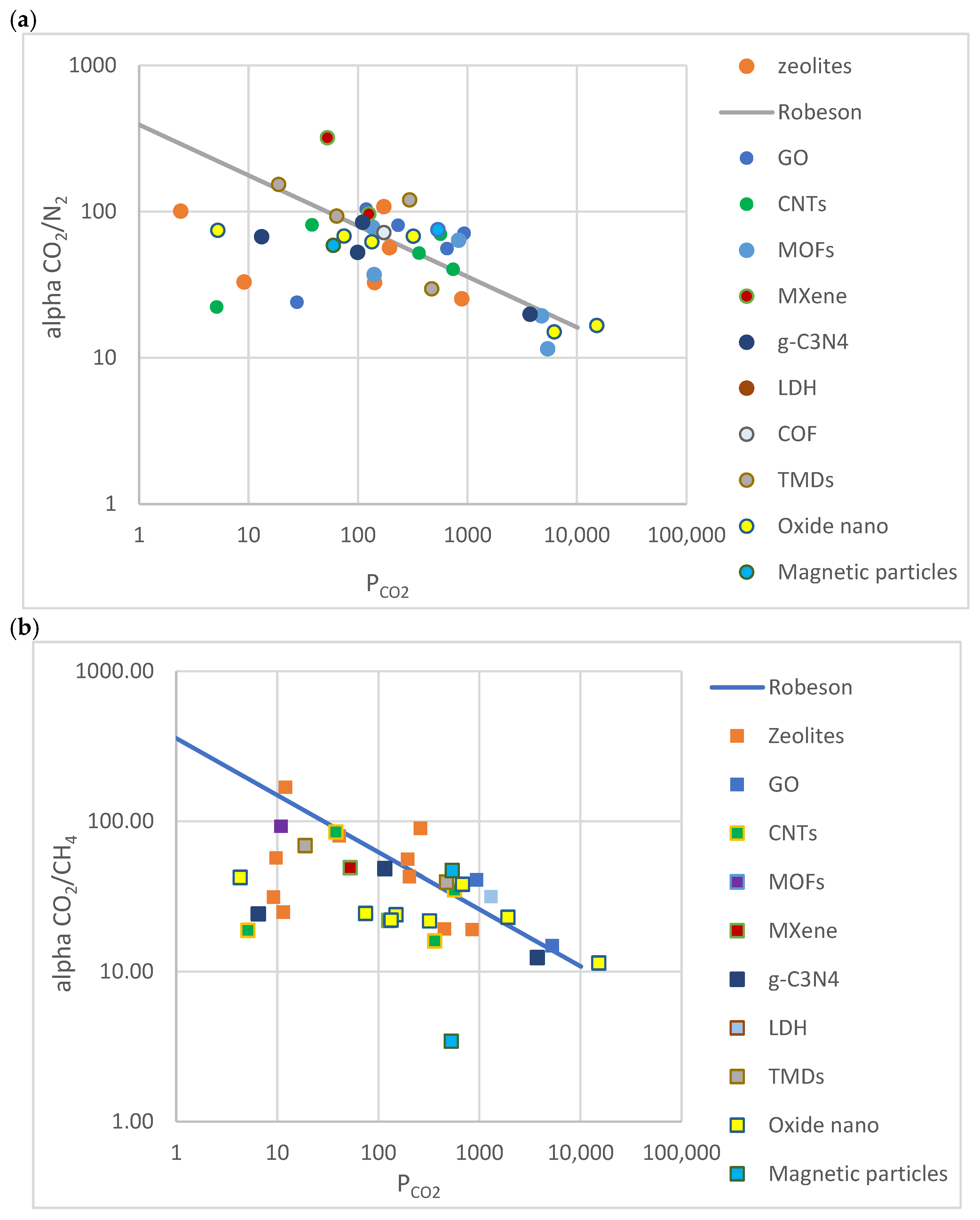
| CO2 Source/Sector | Typical CO2 Concentration | Separation Route/Context | Key Advantages | Main Limitations | Key Challenges & Research Needs |
|---|---|---|---|---|---|
| Fossil fuel power generation | 4–15% (post-combustion flue gas) | Post-combustion capture | Retrofit compatibility; flexible operation; mature infrastructure | Low CO2 partial pressure; large gas volumes; high energy penalty | Development of high-permeability/selective membranes; reduction in capture energy |
| 5–25% (syngas) | Pre-combustion (IGCC) | High CO2 concentration; elevated pressure; strong driving force | High capital cost; complex system design | Cost reduction; simplified gasification systems | |
| >90% | Oxy-fuel combustion | Produces high-purity CO2 directly | Very energy-intensive oxygen separation | Energy-efficient air separation units | |
| Cement industry | 14–33% | Post-combustion/process emissions | Large point sources; continuous operation | CO2 from both fuel combustion and calcination | Capture under harsh conditions; process integration |
| Iron & steel industry | 20–27% | Post-combustion/process gas | Concentrated emission points | Carbon-based reduction inherently emits CO2 | Alternative reduction pathways; CCS integration |
| Transport—road | Low, dispersed | Indirect (via electrification) | Emission shift to centralized sources | Depends on grid decarbonization | Clean electricity generation |
| Transport—maritime | 5–15% | Onboard CCS | Enables decarbonization of long-distance shipping | Space, weight, and energy constraints | Compact, low-energy capture systems |
| Natural gas industry | 4–20% | Pre-processing separation | Largest industrial CO2 separation application; high pressure | Handling large CO2 volumes | CCS chain integration; cost-effective membranes |
| Biogas upgrading | 30–50% | CH4 enrichment | Renewable energy source; potential negative emissions | Variable gas composition | CO2 utilization/storage; robust separation materials |
| Small/distributed sources (agriculture, waste) | Variable | Often overlooked | Large cumulative mitigation potential | Low concentration; decentralized nature | Modular, low-cost capture technologies |
| Type of Carrier | Description | Advantages | Limitations/Challenges | Common Filler Systems |
|---|---|---|---|---|
| Fixed carriers | Carrier groups covalently bound to polymer chains; immobilized amines, IL fragments, metal complexes. | High structural stability; no leaching; consistent long-term selectivity. | Limited mobility reduces carrier-mediated flux; potential steric constraints. | Amine-grafted polymers, IL-functionalized backbones, immobilized metal complexes [72,74]. |
| Mobile carriers | Free-diffusing carriers dispersed within the membrane (amines, ILs, task-specific ILs). | High mobility → higher CO2 transport rates; chemically tunable. | Risk of leaching; phase separation; lower long-term stability depending on polymer compatibility. | Supported ionic liquid membranes, polymer–IL blends, mobile amine systems [72,73]. |
| Semi-mobile carriers | Carriers constrained but not fully immobilized by fillers (nanoparticles, MOFs, IL-infused particles). | Balance of mobility and stability; reduced leaching; enhanced interfacial transport. | Diffusion limitations due to filler density; performance highly dependent on dispersion quality. | Amine-functionalized silica, IL-infused nanofillers, reactive MOFs [74,75]. |
| Membrane Type | Dominant Transport Mechanism | Key Advantages | Main Limitations | Typical Applications/ Remarks |
|---|---|---|---|---|
| Conventional polymeric membranes | Solution–diffusion |
|
| Natural gas sweetening, limited post-combustion capture; dominant in current industrial use |
| CO2-philic polymeric membranes | Solution–diffusion with enhanced CO2 solubility |
|
| Post-combustion capture; hybrid and MMM concepts; mostly laboratory and pilot scale |
| High-free-volume polymers (PIMs, TR, TB, modified PIs) | Solution–diffusion with size-selective diffusion |
|
| Advanced MMMs; research-driven development; limited industrial implementation |
| Facilitated transport membranes (FTMs) | Reaction–diffusion via fixed or mobile carriers |
|
| Highly promising for post-combustion CO2 capture (3–15% CO2, near ambient pressure) |
| Carbon molecular sieve (CMS) membranes | Molecular sieving |
|
| Natural gas sweetening, H2/CO2 separation; niche and emerging industrial use |
| Zeolite membranes | Molecular sieving + adsorption |
|
| Mainly laboratory-scale demonstrations |
| MOF membranes | Molecular sieving + adsorption–diffusion |
|
| Proof-of-concept CO2 separations; low TRL |
| Metallic Membranes (Pd-based) | Proton-conductive transport (H2-selective) |
|
| H2/CO2 separation, membrane reactors for CCS |
| Zeolite Type | Polymer Matrix | Filler Loading [wt.%] | Conditions | PCO2 [Barrer] | Selectivity α* | Key Features | Advantages | Limitations | Ref. |
|---|---|---|---|---|---|---|---|---|---|
| Zeolite 13× | PEBAX | 1 | p = 14 bar, T = 25 °C | 194.1 | CO2/N2: 56.5, CO2/CH4: 56 | Deposited on PSf/PE | Improved permeability and selectivity at low loading | Potential interfacial defects at higher loadings | [191] |
| Zeolite T | 6FDA-durene | 1 | p = 3.5 bar, T = 30 °C | 843.6 | CO2/CH4: 19.1 | Neat filler | High permeability, plasticization-resistant up to 20 bar | Limited adaptability to other gas pairs | [192] |
| Zeolite 4A | PVAc | 25 | p = 0.1 MPa, T = 30 °C | 2.41 | CO2/N2: 100.5 | Unmodified | Enhanced selectivity | Reduced permeance | [193] |
| Zeolite 4A | PVAc | 50 | p = 440 psi, T = 35 °C | 11.4 | CO2/CH4: 25 | High loading | Maintains selectivity at high filler content | High pressure needed; scalability concerns | [194] |
| LNZ-25 (Li/Na-ZSM-25) | Matrimid® 5218 | 5 | p = 5 bar, T = 35 °C | 12 | CO2/CH4: 169 | Partially lithiated | Very high selectivity, plasticization resistant | Low CO2 permeability | [195] |
| NaY + PEG-600 | Pebax | 30 | p = 0.15 MPa, T = 35 °C | 172.6 | CO2/N2: 107.9 | Tertiary-component MMM | High selectivity, CO2 enrichment from 15% to 96.7% | Complex fabrication | [196] |
| Hierarchical Zeolite 5A | Carbonized Matrimid® 5218 | 30 | p = 1 bar, T = 35 °C | 450 | CO2/CH4: 19.3 | Micropores + mesopores, thermally carbonized | Reduced transport resistance, improved free volume | Moderate selectivity | [197] |
| Zeolite 13× (NH2-silanized) | 6FDA-Durene | 15 | p = 0.2 MPa, T = 25 °C | 887 | CO2/N2: 25.3 | Surface functionalization | Enhanced filler–polymer compatibility | Functionalization adds complexity | [198] |
| EMC-2 (NH2-silanized) | 6FDA-ODA | 25 | p = 150 psi, T = 35 °C | 40.9 | CO2/CH4: 80.2 | Crosslinked | High selectivity | Moderate permeability | [199] |
| NaY (NH2-silanized) | Matrimid® 5218 | 15 | p = 2 bar, T = 35 °C | 9.7 | CO2/CH4: 57.1 | Crosslinked with APDEMS | Improved filler dispersion, increased selectivity | Low permeability | [200] |
| Zeolite 3A (NH2-silanized) | PSf | 40 | p = 12 bar, T = 25 °C | 4.22 GPU | H2/CO2: 7.12 | Crosslinked with APTMS | High H2 selectivity | Moderate CO2 performance | [201] |
| MCM-41 (NH2-silanized) | PSf | 30 | p = 10 bar, T = 25 °C | 9.13 | CO2/N2: 32.97, CO2/CH4: 31.48 | Crosslinked | High ideal selectivity | Complex preparation | [202] |
| SAPO-34 + IL | PSf | 5 | p = 3.5 bar, T = 30 °C | 7.19 GPU | CO2/N2: 44.9 | Ionic liquid added | Seals interfacial defects, enhances selectivity | Low permeability | [203] |
| ZSM-5 + IL | 6FDA-TeMPD | 15 | p = 75 mmHg, T = 35 °C | 142 | CO2/N2: 32.6, CO2/H2: 25.6 | Ionic liquid | Improved interfacial adhesion | Moderate selectivity | [204] |
| SAPO-34 + PIL–RTIL | – | 25–30 | p = 40 bar, T = 25 °C | 202–260 | CO2/CH4: 43–90 | Poly(ionic) liquid + RTIL | High CO2 solubility, mechanical stability | Complex multicomponent system | [205,206] |
| Filler Type | Polymer Matrix | Filler Loading [wt.%] | Conditions | Permeability (Barrer) | Selectivity α* | Key Advantages | Main Limitations | Ref. |
|---|---|---|---|---|---|---|---|---|
| ZIF-8@GO | Pebax | 20 | p = 3 bar, T = 25 °C | PCO2 = 136.2 | CO2/N2 = 77.9 | Improved dispersion, reduced transport resistance, enhanced mechanical strength | High filler loading may reduce flexibility and scalability | [238] |
| ZIF-8 within GO interlayers | ZnEG on alumina HF support | mass ratio of ZnEG/GO = 90 | p = 1 bar, T = 25 °C | PH2 = 365.4 PCO2 = 11.9 | H2/CO2 = 30.8 | Improved nanoparticle localization, minimized agglomeration | Multi-step synthesis; ceramic support limits scale-up | [239] |
| NG | PEO | 3 | p = 1 bar, T = 25 °C | PH2 = 32,240 PCO2 = 1289.6 | H2/CO2 = 25 | Strong CO2 affinity of PEO; ordered layered architecture | PEO crystallinity reduces permeability | [240] |
| ZIF-8 +[Emim][Ac] HKUST-1 | Chitosan | 10 5 | T = 25 °C | PCO2 = 5413 PCO2 = 4754 | CO2/N2 = 11.5 CO2/N2 = 19.3 | Improved interfacial adhesion; reduced filler content | Phase stability; potential IL leaching | [171] |
| UiO-66/UiO-66–NH2 (60–80 nm) | - | - | - | PCO2 = 39.3 | CO2/N2 = 31.3 | High chemical & hydrothermal stability; humid resistance | Moderate permeability gains vs. ZIF systems | [241] |
| MOF-74(Ni) | - | - | p = 0.15 bar, T = 25 °C | - | CO2/N2 = 49 | Strong adsorption via open metal sites | Limited permeability data | [172] |
| ZIF-8 | Polyimide P84 | 17 | p = 3 bar, T = 25 °C | PCO2 = 10.92 | CO2/CH4 = 92.6 | Synergistic adsorption–diffusion mechanism | Dependent on dispersion quality | [173] |
| UiO-66–NH2 | Pebax 2533 | 10 | p = 2 bar, T = 25 °C | PCO2 = 140.4 | CO2/N2 = 37 | Industrially relevant configuration; scalable geometry | Lower performance than flat-sheet membranes | [184] |
| Membrane Type | Filler Type | Polymer Matrix | Filler Loading [wt.%] | Conditions | Permeability (Barrer) | Selectivity (α*) | Modification Strategy | Key Advantages | Ref. |
|---|---|---|---|---|---|---|---|---|---|
| Ti3C2Tx/Pebax1657 MMM | Ti3C2Tx MXene nanosheets | Pebax1657 | 0.1 | p = 4 bar T = 25 °C | PCO2 = 126 | CO2/N2 = 96 CO2/H2 = 12.8, CO2/CH4 = 21.9 | Hydrogen bonding (MXene–amide groups) | Enhanced interfacial adhesion; reduced non-selective voids | [263] |
| NH2-MIL-125 hybrid membrane (MXene-derived Ti source) | - | - | 0.025 | T = 30 °C | PCO2 = 186.5 PH2 = 1492 | H2/CO2 = 8.0 | Solvothermal epitaxial growth | MXene enabled MOF growth and improved membrane integrity | [264] |
| Supported ionic liquid membrane (Ti3C2Tx + ChCl/EG) | - | - | - | p = 0.6 bar T = 25 °C | PCO2 = 52.7 | CO2/N2 = 319.15, CO2/CH4 = 249.01, CO2/H2 = 12.38 | Deep eutectic solvent confinement between layers | Stabilized lamellar channels via hydrogen bonding and electrostatic interactions | [265] |
| Self-crosslinked MXene Ti3CTx hollow fiber membrane | - | - | - | p = 1 bar T = 25 °C | PH2 = 15.53 PCO2 = 0.512 | H2/CO2 = 30.3 | Thermal self-crosslinking | Achieved uniform stacking and controlled interlayer spacing | [266] |
| Pd2+-intercalated MXene membrane | T = 25 °C | PH2 = 1108 PCO2 = 3.11 | H2/CO2 = 356 | Pd2+ ion intercalation | Reversible Pd–H interaction; exceptional selectivity under ambient conditions | [268] |
| Filler | Polymer Matrix | Loading (wt.%) | Conditions | Permeability (Barrer) | Selectivity (α*) | Advantages | Limitations | Ref. |
|---|---|---|---|---|---|---|---|---|
| MgO-Ag+ | Matrimid® 5218 | 20 | p = 3.5 bar T = 35 °C | PCO2 = 4.31 | CO2/CH4 = 42.3 | High CO2 affinity, reversible π-complexation | Low absolute permeability | [273] |
| SiO2 | PIM | 6.7 | p = 0.28 bar T = 23 °C | PCO2 = 6200 | CO2/N2 = 15 | Increased permeability due to interfacial voids | Reduced CO2/N2 selectivity | [274] |
| TiO2 | PVAc | 10 | p = 2 bar T = 30 °C | PCO2 = 5.26 | CO2/N2 = 74.3 | Improved thermal stability and gas permeability | Limited selectivity improvement | [275] |
| ZnO | PEBAX | 10 | p = 2 bar T = 30 °C | PCO2 = 149.81 | CO2/CH4 = 23.9 | Enhanced CO2 permeability and selectivity | Moderate loading required | [276] |
| Al2O3 | PU | 20 | p = 1 bar T = 35 °C | PCO2 = 74.67 | CO2/N2 = 67.89 CO2/CH4 = 23.48 | Significant selectivity improvement | Decreased permeability | [277] |
| NiO | PU | 5 | p = 1 bar T = 30 °C | PCO2 = 321 | CO2/N2 = 67.72 CO2/CH4 = 21.76 | Improved selectivity at low loading | Slight permeability decrease at high loading | [278] |
| SiO2–APTMS | PEG | 2.7 | T = 35 °C | PCO2 = 134 | CO2/N2 = 62 CO2/CH4 = 22 | Improved permeability without selectivity loss | Low loading required | [279] |
| Dendritic Amino SiO2 | 6FDA-DABA | 25 | p = 1 bar T = 35 °C | PCO2 = 1920 | CO2/CH4 = 23 | High CO2 permeability with maintained selectivity | High filler content can be challenging | [280] |
| Dendritic Amino SiO2 | PIM-1 | 50 | p = 1 bar T = 35 °C | PCO2 = 15,200 | CO2/N2 = 16.6 CO2/CH4 = 11.4 | Surpassed Robeson 2008 upper bound | Very high loading may cause brittleness | [280] |
| POSS–NH2 | GO | 5 | p = 2 bar T = 25 °C | – | CO2/CH4 = 74.5 | Improved interlayer spacing, reduced swelling | Limited permeability data | [282] |
| PEG–POSS | PMHS | 0.25 | p = 2 bar T = 25 °C | PCO2 = 679 | CO2/CH4 = 38.1 | Tunable flexibility and transport | Membrane brittleness at high POSS | [283] |
| poly–POSS | PI | 0.9 | p = 10 bar T = 300 °C | PCO2 = 69 PH2 = 522 | H2/CO2 = 7.6 | Enhanced selectivity and permeance | Requires ionic liquid | [284] |
| Module Type | Membrane Geometry | Typical Flow Pattern | Key Advantages | Major Limitations | Best-Suited Applications | Representative Notes/Studies |
|---|---|---|---|---|---|---|
| Plate-and-frame | Flat-sheet | Cross-flow | Simple design; easy membrane replacement; good control of operating conditions | Very low packing density; high module footprint; limited industrial scalability | Laboratory and pilot-scale studies | Mainly used for material screening rather than industrial CO2 separation |
| Spiral-wound | Flat-sheet | Cross-flow | Higher packing density than plate-and-frame; mature industrial technology; adjustable hydrodynamics via feed spacers; relatively low concentration polarization | Complex internal structure; difficult cleaning; moderate pressure drop | Flue gas CO2/N2 separation; post-combustion capture | Feed spacer optimization reduces boundary layer resistance |
| Hollow fiber | Cylindrical (fibers) | Counter-current or cross-flow | Highest packing density (3–4× spiral-wound); low cost per area; high surface-to-volume ratio; ideal for large gas flows | Prone to pressure drop and concentration polarization; sealing and mechanical stability challenges | Industrial-scale CO2 capture; high-throughput gas separation | Optimized designs outperform spiral-wound modules |
| Tubular | Tubes | Cross-flow | Excellent mechanical strength; high temperature and chemical resistance; easy cleaning | Very low packing density; high capital cost | High-temperature or aggressive gas environments |
| Design Variable | Primary Technical Role | Key Advantages | Main Drawbacks/ Trade-Offs |
|---|---|---|---|
| Membrane permeability | Determines gas flux and required membrane area | Enables compact modules | May increase concentration polarization; often trades off with selectivity |
| Membrane selectivity (CO2/other gases) | Controls product purity and stage requirements | Improves CO2 purity and recovery | Often reduces permeability; may increase membrane cost |
| Module configuration (spiral-wound, hollow fiber, etc.) | Defines packing density and flow hydrodynamics | Hollow fibers minimize module cost | Higher pressure drop; more complex sealing |
| Operating pressure | Provides driving force for permeation | Enhances productivity | Compression energy dominates |
| Operating temperature | Affects permeability and facilitated transport | Improves kinetics in FTMs | Thermal management cost; membrane stability limits |
| Number of stages | Determines achievable purity and recovery | Enables high-purity CO2 capture | Higher control and maintenance costs |
| Recycle ratio | Enhances recovery and purity | Allows flexible process tuning | Raises energy consumption and pressure drop |
| Membrane type selection per stage | Matches performance to stage function | Enables performance–cost optimization | Increases design complexity |
| Plant capacity | Scale of operation | Membranes cost-effective at small–medium scale | Absorption favored at very large scale |
| Relative humidity (RH) | Affects solution–diffusion and facilitated transport | Essential for FTMs and hydrophilic polymers | Humidity control adds system complexity |
| Filler | Thickness (µm) | α* CO2/N2 | α* CO2/CH4 | PCO2 (Barrer) | Advantages | Limitations | Future Directions |
|---|---|---|---|---|---|---|---|
| COFs | 0.2–50 | 61–91 | 19–24 | 234–1044 | Well-defined nanochannels; tunable chemistry; good CO2 affinity; fully organic | Large intrinsic pore size (>1 nm) can reduce selectivity; defect formation; complex fabrication | Pore size tuning < 1 nm; polymer functionalization; scalable defect-free membranes |
| MOFs | 1–10 | 11–78 | up to 92.6 | 11–5413 | High surface area; molecular sieving; selective adsorption; tunable metal centers | Moisture sensitivity; particle aggregation; moderate stability | Amine-functionalized MOFs; core–shell MOF@COF hybrids; large-scale MMM fabrication |
| Graphene Oxide (GO) | 40–70 | 24–104 | 15–41 | 27–5235 | Layered structure; tunable interlayer spacing; good polymer adhesion | Aggregation; permeability–selectivity trade-off; water sensitivity | GO/COF or GO/polymer hybrids; crosslinking; aligned laminates |
| TMDs (e.g., MoS2) | 0.4–50 | 29–153 | 39–69 | 19–472 | High CO2 affinity via amine functionalization; 2D transport channels | Limited scalability; potential restacking; moderate mechanical strength | Cys-MoS2 nanosheets; functionalization to improve selectivity and adhesion |
| CNTs | 40–55 | 22–81 | 16–85 | 5–742 | High aspect ratio; fast transport channels; mechanical reinforcement | Aggregation; poor polymer compatibility; limited size control | Functionalized CNTs (–COOH, –NH2); aligned CNT membranes; mixed 2D/1D MMM |
| g-C3N4 | 0.8–179 | 20–84 | 12–48 | 6–3740 | High thermal and chemical stability; tunable porosity; 2D structure | Lower permeability; aggregation; limited CO2 selectivity | Exfoliated nanosheets; surface functionalization; hybridization with MOFs/COFs |
| LDH (Layered Double Hydroxides) | 2–2.5 | Up to 71 | Up to 32 | 11–1307 | Tunable layer spacing; anion exchangeable; good thermal stability | Moderate CO2 permeability; poor long-term stability; aggregation | Interlayer modification; combination with polymers/COFs; exfoliated nanosheets |
| Zeolites | 50–160 | 33–108 | 19–169 | 2–887 | Molecular sieving; thermal stability; established industrial use | Low permeability; sensitivity to fouling; difficulty in thin-film fabrication | Nanozeolites; hierarchical porosity; zeolite@polymer hybrids |
| Metal Oxides (e.g., TiO2, Al2O3) | 25–300 | 15–74 | 22–74 | 4–15,200 | High chemical/thermal stability; robust; easy synthesis | Low intrinsic selectivity; aggregation; poor polymer compatibility | Surface functionalization; mixed filler approaches; thin-film integration |
| Magnetic Nanoparticles | 30–170 | 58–75 | 3–47 | 59–538 | Facilitated transport via magnetic alignment; potential for external control; reinforcement | Complex synthesis; limited long-term stability; aggregation | Functionalized Fe3O4; field-aligned MMM; hybrid 2D/NP systems |
| MXenes (e.g., Ti3C2Tx) | 0.2–70 | 96–319 | 22–249 | 23–126 | 2D layered structure; high surface area; surface terminations for CO2 interaction; improved polymer adhesion | Aggregation at high loadings; oxidation; limited scalability | Surface functionalization; MXene/COF hybrids; aligned nanosheets for directional transport |
| Membrane Type | L (µm) | Mixture | Selectivity α* | Separation Factor α | Permeability (Barrer) | Permeability Gas Mixture (Barrer) | Ref. |
|---|---|---|---|---|---|---|---|
| GO/PIM-1 | 40–50 | - | CO2/CH4 = 14.9 | - | PCO2 = 5235 PCH4 = 359 | - | [210] |
| PGO/Pebax | 55 | CO2:N2 = 10:90 | CO2/N2 = 80.7 | CO2/N2 = 87 | PCO2 = 232.7 | PCO2 = 1150 | [213] |
| MWCNT/Pebax | - | - | CO2/N2 = 70 CO2/CH4 = 35 | - | PCO2 = 567 | - | [218] |
| ZIF-8@GO/Pebax | CO2/N2 = 77.9 | PCO2 = 136.2 | [238] | ||||
| ZIF-8 within GO interlayers | 0.9 | H2:CO2 = 50:50 | H2/CO2 = 30.8 | H2/CO2 = 25 | PH2 = 365.4 PCO2 = 11.9 | PH2 = 1150 PCO2 = 46 | [239] |
| NG/PEO | 1.8 | H2/CO2 = 25 | H2/CO2 = 13 | PH2 = 32,240 PCO2 = 1289.6 | PH2 = 13,110 PCO2 = 1008 | [240] | |
| ZIF-8 +[Emim][Ac] HKUST-1/Chitosan | CO2/N2 = 11.5 CO2/N2 = 19.3 | PCO2 = 5413 PCO2 = 4754 | [171] | ||||
| UiO-66/UiO-66–NH2 (60–80 nm) | 3.5 | CO2:N2 = 50:50 | CO2/N2 = 31.3 | CO2/N2 = 21.4 | PCO2 = 386 | PCO2 = 245 | [241] |
| ZIF-8/Polyimide P84 | CO2/CH4 = 92.6 | PCO2 = 10.92 | [173] | ||||
| UiO-66–NH2/Pebax 2533 | 5–7 | CO2/N2 = 37 | PCO2 = 140.4 | [184] | |||
| Ti3C2Tx/Pebax1657 | 60–70 | CO2:N2 = 30:70 | CO2/N2 = 42 | CO2/N2 = 31 | PCO2 = 139 | PCO2 = 95 | [263] |
| NH2-MIL-125 hybrid membrane (MXene-derived Ti source) | 1 | H2/CO2 = 8.0 | - | PCO2 = 186.5 PH2 = 1492 | - | [264] | |
| Supported ionic liquid membrane (Ti3C2Tx + ChCl/EG) | 2 | - | CO2/N2 = 319.15, CO2/CH4 = 249.01, CO2/H2 = 12.38 | - | PCO2 = 52.7 | - | [265] |
| Self-crosslinked MXene Ti3CTx hollow fiber membrane | 0.22 | CO2:H2 = 10: 90 | H2/CO2 = 30.3 | H2/CO2 = 16 | PH2 = 15.53 PCO2 = 0.51 | PH2 = 3.74 PCO2 = 0.23 | [266] |
| Pd2+-intercalated MXene membrane | 0.78 | CO2:H2 = 50: 50 | H2/CO2 = 356 | H2/CO2 = 242 | PH2 = 1108 PCO2 = 3.11 | PH2 = 620 PCO2 = 2.56 | [268] |
| Layer-by-layer membrane (Chitosan–g-C3N4/ZIF-8 on PES) | 0.8 | CO2:CH4 = 50:50 | CO2/CH4 = 24.2 | CO2/CH4 = 17.8 | PCO2 = 63.5 | PCO2 = 43.7 | [289] |
| g-C3N4/Pebax MMM | 179 | CO2:N2 = 50:50 | CO2/N2 = 67.2 | CO2/N2 = 50 | PCO2 = 5900 | PCO2 = 4600 | [290] |
| g-C3N4/GO composite membrane | 0.7 | - | H2/CO2 = 39.2 | H2/CO2 = 24 | PH2 = 451 PCO2 = 11.5 | PH2 = 543 PCO2 = 22.6 | [291] |
| ZIF-90@g-C3N4 hybrid membrane | 50–70 | - | CO2/N2 = 84.4 | - | PCO2 = 110.5 | - | [292] |
| Functionalized g-C3N4/PIM-1 MMM | 50 | - | CO2/N2 = 19.8 CO2/CH4 = 12.4 | - | PCO2 = 3740 | - | [293] |
| g-C3N4-based SILM | 0.8 | CO2:N2 = 50:5 CO2:CH4 = 50:50 | CO2/N2 = 52.49 CO2/CH4 = 48.41 | PCO2 = 794 PCO2 = 928 | [294] | ||
| MgO-Ag+/Matrimid | 50 | CO2/CH4 = 42.3 | PCO2 = 4.31 | [273] | |||
| TiO2/PVA | 25–35 | CO2/N2 = 74.3 | PCO2 = 5.26 | [275] | |||
| ZnO/Pebax | 50–60 | CO2/CH4 = 23.9 | PCO2 = 149.81 | [276] | |||
| Amino SiO2/6FDA-DABA | 30–99 | CO2/CH4 = 23 | PCO2 = 1920 | [280] | |||
| PEG–POSS/PMHS | 200–300 | CO2:N2 = 32:68 | CO2/CH4 = 38.1 | CO2/CH4 = 23.4 | PCO2 = 679 | PCO2 = 506 | [283] |
| poly–POSS/PI | 0.2 | H2/CO2 = 7.6 | H2/CO2 = 2.5 | PCO2 = 69 PH2 = 522 | PCO2 = 144 PH2 = 360 | [284] | |
| ZnAl–NO3 LDH membrane on porous alumina | 2.5 | H2:CO2 = 50:50 | H2/CO2 = 5.8 | PH2 = 267.5 PCO2 = 46.1 | [296] | ||
| ZIF-8@LDH/Pebax MMM | 2 | CO2:CH4 = 50:50 | CO2/CH4 = 31.6 | PCO2 = 1307 | [298] | ||
| COF-LZUI/CoAl-LDH membrane | 2 | H2:CO2 = 50:50 | H2/CO2 = 31.6 | PH2 = 7200 PCO2 = 227.8 | [299] | ||
| 3D hollow CoNi-LDH/Pebax MMM | - | CO2/N2 = 71.66 | CO2/N2 = 38 | PCO2 = 172.62 | PCO2 = 125 | [300] | |
| MoS2/Pebax-1657 MMM | 5 | - | CO2/N2 = 93 | PCO2 = 64 | [305] | ||
| WS2–IL SILM | 0.4 | - | CO2/N2 = 153.21 CO2/CH4 = 68.81 CO2/H2 = 13.56 | PH2 = 18.9 | [306] | ||
| WS2/fluoropolymer composite | CO2/N2 = 29.6 CO2/CH4 = 39.4 | PCO2 = 472 | [307] | ||||
| Cys-MoS2/Pebax MMM | 30–50 | CO2/N2 = 120 | CO2/N2 = 116.5 | PCO2 = 297 | PCO2 = 285 | [308] | |
| GO/COF layered composite membrane | H2/CO2 = 25.57 | PCO2 = - PH2 = 1.067 × 10⁻⁶ mol·m−2·s−1·Pa−1 | [311] | ||||
| PVAm- functionalized COF MMM | 0.165 | CO2:H2 = 40:60 | CO2/H2 = 17.2 | CO2/H2 = 17.2 | PCO2 = 234.6 | PCO2 = 211 | [312] |
| 2D COF/PEO hybrid membrane | CO2/N2 = 61.4 CO2/CH4 = 19.8 CO2/H2 = 15.0 | PCO2 = 803.9 | [313] | ||||
| Hollow COF microspheres/Pebax MMM | CO2/CH4 = 24 | PCO2 = 1044 | [314] | ||||
| ZIF-8@COF (core–shell) MMM | 0.96 | CO2:N2 = 15:85 | CO2/N2 = 91 | CO2/N2 = 101 | PCO2 = 288 | PCO2 = 358 | [315] |
Disclaimer/Publisher’s Note: The statements, opinions and data contained in all publications are solely those of the individual author(s) and contributor(s) and not of MDPI and/or the editor(s). MDPI and/or the editor(s) disclaim responsibility for any injury to people or property resulting from any ideas, methods, instructions or products referred to in the content. |
© 2026 by the authors. Licensee MDPI, Basel, Switzerland. This article is an open access article distributed under the terms and conditions of the Creative Commons Attribution (CC BY) license.
Share and Cite
Rybak, A.; Rybak, A.; Joostberens, J.; Kolev, S.D. The Use of Modern Hybrid Membranes for CO2 Separation from Synthetic and Industrial Gas Mixtures in Light of the Energy Transition. Energies 2026, 19, 2002. https://doi.org/10.3390/en19082002
Rybak A, Rybak A, Joostberens J, Kolev SD. The Use of Modern Hybrid Membranes for CO2 Separation from Synthetic and Industrial Gas Mixtures in Light of the Energy Transition. Energies. 2026; 19(8):2002. https://doi.org/10.3390/en19082002
Chicago/Turabian StyleRybak, Aleksandra, Aurelia Rybak, Jarosław Joostberens, and Spas D. Kolev. 2026. "The Use of Modern Hybrid Membranes for CO2 Separation from Synthetic and Industrial Gas Mixtures in Light of the Energy Transition" Energies 19, no. 8: 2002. https://doi.org/10.3390/en19082002
APA StyleRybak, A., Rybak, A., Joostberens, J., & Kolev, S. D. (2026). The Use of Modern Hybrid Membranes for CO2 Separation from Synthetic and Industrial Gas Mixtures in Light of the Energy Transition. Energies, 19(8), 2002. https://doi.org/10.3390/en19082002