Review

The Smart City from the Energy Perspective

by
Florentin-Robert Drăgan
,
Lucian Toma
* and
Irina-Ioana Picioroagă
Faculty of Energy Engineering, National University of Science and Technology POLITEHNICA Bucharest, 313 Splaiul Independentei, Sector 6, 060042 Bucharest, Romania
*
Author to whom correspondence should be addressed.
Energies 2026, 19(8), 1993; https://doi.org/10.3390/en19081993
Submission received: 20 January 2026 / Revised: 9 April 2026 / Accepted: 10 April 2026 / Published: 21 April 2026
(This article belongs to the Special Issue Digital Engineering for Future Smart Cities)

Abstract

The accelerated development of Smart Cities globally, driven by rapid urbanization and urgent climate challenges, underscores the critical role of advanced energy infrastructures integrated with emerging digital technologies. This article explores the evolution of smart cities from an energy-centric viewpoint, emphasizing the interdependence among energy systems, digitalization and cutting-edge communication technologies. Adopting a system-of-systems perspective, we examine how different urban subsystems, including energy grids, transportation networks and data management systems, interact to improve overall urban functionality and long-term viability. Through a structured analysis of recent literature, we highlight the transformative potential of renewable energy integration, intelligent energy management systems and the crucial transition from 5G to 6G communication infrastructures, which collectively promise significant enhancements in urban sustainability, efficiency and resilience. Additionally, we address key challenges such as cybersecurity vulnerabilities, fragmented standardization frameworks and the need for comprehensive data governance. Viewing smart cities as a complex system of systems, this article argues for a holistic and interdisciplinary approach, emphasizing enhanced interoperability, robust cybersecurity protocols and inclusive participatory governance frameworks.

1. Introduction

The global trend toward urbanization has intensified the need for smarter and more sustainable urban development. In 2023, more than half of the world population lived in cities and consumed up to two-thirds of the global resources [1]. This imbalance underscores the necessity for cities to adopt intelligent strategies that optimize urban space and promote long-term resilience through sustainable planning. According to the ISO/IEC 30145-1:2021 standard titled “Information technology—Smart City ICT reference framework; Part 1: Smart city business process framework” [2], Smart Cities can be understood as urban environments driven by integrated IT architectures that coordinate business and public processes across interconnected digital platforms. Crucially, this infrastructure includes the energy sector, which plays a foundational role in enabling the transition toward low-carbon, resilient urban environments [2]. However, the proliferation of nonlinear household loads, such as LED lighting and inverter-based devices, introduces significant power quality challenges, necessitating advanced harmonic mitigation strategies [3]. Standardization ensures scalable development, allowing interoperability across smart energy systems, communication networks and big data platforms [4]. This scalability must be supported by advanced disturbance analysis that identifies root causes—such as capacitor switching or incipient faults—to prevent catastrophic cascading failures in complex urban grids [5]. New generations of wireless communication, such as 6G, further support this ecosystem with higher data throughput, lower energy consumption and enhanced data protection. Ultimately, the integration of IoT devices across sectors facilitates data-driven urban management, promoting sustainability, energy autonomy and resilience in the evolving smart city landscape [6]. This management is increasingly dependent on high-fidelity long-term electricity load forecasting (LTLF) models that capture complex temporal and frequency-domain dependencies [7]. Authors of [8] emphasize the importance of AI in enhancing governance through IoT and transparent frameworks. Furthermore, deep reinforcement learning integration with evolutionary algorithms is proposed in [9] to optimize energy-sector operations and address urban uncertainties in dynamic environments. Similarly, deep learning and blockchain techniques are employed in [10] to secure authentication mechanisms for device-to-device communication. To better understand IoT challenges and opportunities in smart city transitions, authors of [11] present a comprehensive overview of successful IoT implementation across the energy, transportation, community and healthcare sectors. Telecommunication infrastructure serves as a backbone of smart cities, as efficient AI deployment relies on a large volume of data. The survey performed in [12] highlights the role of beyond 5G networks in emergency response, healthcare, and autonomous transport. Additionally, the authors of [13] stress the importance of telecommunications for integrating IoT and enabling large-scale data flows. These contributions point to B5G/6G as essential enablers for ultra-low latency, reliability, and connectivity among billions of devices. However, security and trust are equally critical. Studies in [14,15] explore blockchain methods for protecting IoT and smart grids. Meanwhile, the authors of [16] expand the review of energy infrastructure security to classical approaches and next-generation technologies, ranging from firewalls and cryptography to edge computing. Together, these works propose decentralized trust frameworks as alternatives to vulnerable centralized models. In [17], the authors propose an activity-network-things (ANTs)-centric architecture to increase flexibility in security provision across key smart-city domains. Finally, sustainability and inclusiveness remain core challenges. In [18], a cognitive city platform is introduced to integrate resilience and anomaly analytics, while authors of [19,20] highlight risks of exclusion under top-down governance models. Regional studies from Indonesia [21] and Korea [22,23] address the living lab methodology and eco-district planning to improve quality of life in terms of economy, mobility, and the environment. Concurrently, authors of [24,25] examine the intelligent vehicles and digital twin approach to improve the mobility infrastructure for a sustainable transportation sector. These findings confirm that future smart cities must balance technological innovation with social justice, inclusiveness, and sustainability.
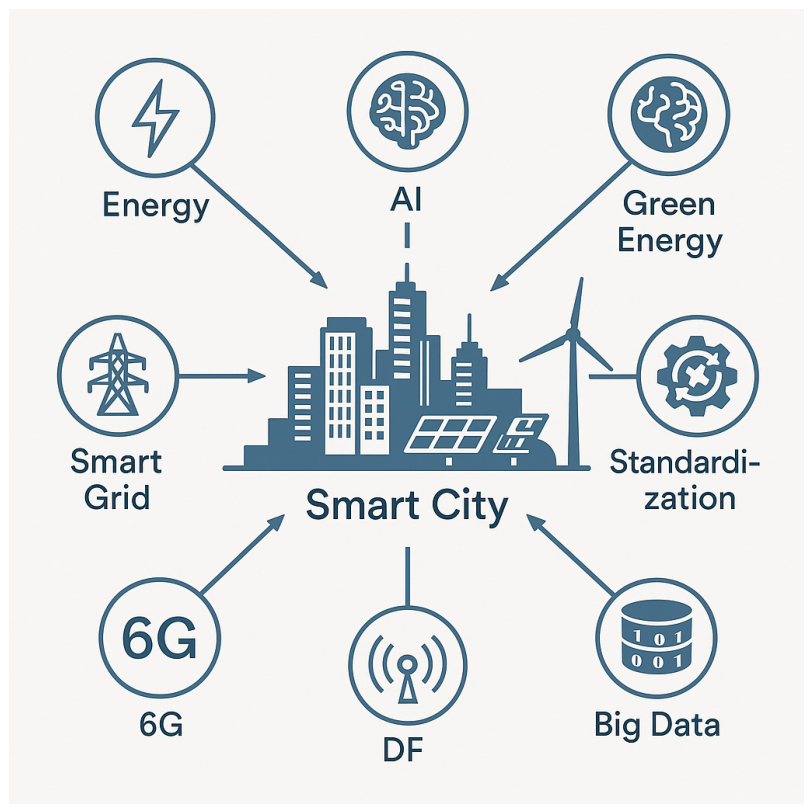
The primary objective of this study was to conduct a comprehensive, systematic review of the existing literature regarding Smart Cities from an energy-centric perspective. It specifically analyzes the interdependence of renewable energy sources, smart grids, and digital technologies (IoT, AI, 6G), identifying the relationship between technological capabilities and standardization gaps (Figure 1). Rather than proposing a novel conceptual framework, this review synthesizes current knowledge to highlight the transition from 5G to 6G and the role of digital twins in energy management, thereby offering a consolidated foundation for future urban policy and planning research.

2. Materials and Methods

The evaluation of energy systems in the context of Smart City development requires a multidisciplinary approach that integrates emerging technologies, digital infrastructure and smart efficient energy grids. To analyze the optimal transition to a sustainable and digital energy sector, and to address the standardization of development processes, this article employs a methodology based on a comprehensive literature review. The findings are synthesized and presented by using a graphical representation of the results, ensuring a structured and accessible overview.
Our research on the Smart City concept was conducted with emphasis on Renewable Energy, Smart Grid, Energy Efficiency, Digitalization, IoT, 6G and Big Data.
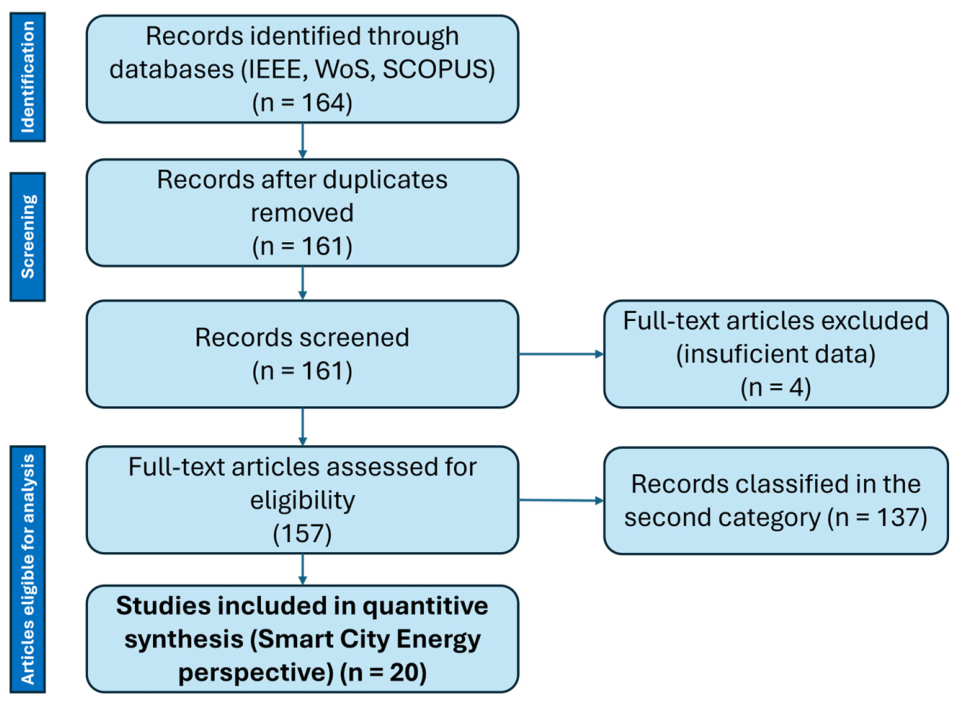
The review methodology adhered to PRISMA (Preferred Reporting Items for Systematic reviews and Meta-Analyses) reporting standards for scoping reviews, ensuring transparency and reproducibility of the selection process. The literature search was conducted using the Web of Science and Scopus databases, covering the period from 2015 to 2024 to capture the most recent advancements in 6G and AI integration. The search query employed a combination of keywords: “Smart City” OR “Smart Grid” and “Renewable Energy” OR “Energy Efficiency” and “6G” OR “IoT” OR “Artificial Intelligence”) and “Standardization”. Inclusion criteria were restricted to peer-reviewed journal articles and conference proceedings published in English that explicitly addressed the intersection of energy systems and digital infrastructure. Following the application of these criteria, a total of approximately 20 peer-reviewed articles were selected for detailed analysis and are summarized in Table 1. Following selection, the results were synthesized and are represented graphically to facilitate coordination between different perspectives and ensure a structured, accessible overview.
Furthermore, the analysis essentially involved examining technical standards applicable to smart city development using international standard libraries [45,46]. The identified standards were categorized into relevant sections including smart grid infrastructure, smart cities, IoT, cybersecurity, communications, and new-generation technologies such as 6G. The implementation level of these standards was assessed by comparing them with case studies of smart cities that have integrated such technologies. This comparison provides valuable insights into their adoption effectiveness.
Although the article selection was based on multiple criteria, this methodology has certain limitations. For example, some analyzed articles may reflect geographical and economic factors specific to certain regions. Consequently, the author’s findings may be challenging to replicate in different geopolitical contexts.
Technical standards are constantly evolving, and their adoption can significantly depend on the local policies and the technical know-how available in each city. These differences can impact the effective implementation of energy solutions in smart cities, thereby making standardization and interoperability of these systems key challenges in the transition to a smarter urban infrastructure.
The proposed methodology conducts a semantic analysis of the relationship between the digitalization of urban spaces, energy efficiency and standardization within the framework of smart urban development, offering a comprehensive perspective on the various development trajectories while identifying potential challenges during the implementation and development process.

3. Results

3.1. Growing Cities: A Catalyst for Smart Infrastructure

In 2023, the World Bank reported that more than four billion people lived in cities, representing 57% of the global population [1]. Over the past 15 years, average urban density has increased from an average of 3500 to 4261 inhabitants per square kilometer; although cities occupy 5% of the global land area, they require more than 75% of the world’s natural resources [47]. This highlights the urgent need for cities to pursue smarter development by emphasizing sustainability and the improved optimization of urban spaces. Implementing smart solutions across various urban systems is crucial to support viable growth and long-term resilience plans [48]. In this context, the replication of successful smart city solutions acts as a vital policy instrument. This replication allows cities to scale innovations while minimizing the risks associated with missing technical skills or financial constraints [49,50]. An effective transformation process requires a collaborative approach that ensures sustained commitment from all actors. As stated in [31], the success of community engagement in the zero-emission transition is dependent on public–private partnerships, trust-building among stakeholders and early resident involvement in the decision-making process. To illustrate this, a Participatory Action Research (PAR) framework was applied in a zero-carbon community project in Pinglin, Taiwan. The study focused on the following stages: (1) identifying key factors influencing community engagement, drawing on a collective action theory and a co-evolution theory, and (2) implementing the participatory planning model. This model ensured direct involvement in all the stages of the project, including community selection, local resource assessment, carbon footprint inventory and the integration of energy efficiency and green energy strategies. Project implementation was assessed through qualitative and quantitative data collection, utilizing participant observation, interviews with representatives of the community and policymakers, workshops and the analysis of the government documentation.
In [32], a series of indicators were applied to urban planning strategies in Incheon Metropolitan City and Goyang-si, South Korea, to evaluate their current level of sustainability and smart city integration. The methodology used to diagnose smart city plans focused on identifying the optimal transition pathway for more sustainable and intelligent urban development. To assess and diagnose the urban landscape from a sustainability perspective, the authors proposed a set of evaluation indicators based on five components: factual analysis (current situation and forecasting), objectives and targets (goal setting and progress measurement), policies and strategies (sustainable urban development strategies), cooperation and governance (stakeholder participation) and the implementation feasibility (efficiency of policies).
The average sustainability score of the analyzed urban plans was 45.58/100, highlighting the need for significant improvement. The urban intelligence score was even lower at 24.14/100, indicating the limited integration of smart urban technologies in the planning process. General urban development master plans tend to be uniform and fail to account for specific characteristics of each urban landscape. Conversely, urban regeneration plans that score higher in cooperation and governance lack effective integration of smart emerging technologies. These findings highlight the need for tailored planning approaches that incorporate the adaptation of emerging technology and stronger local engagement in the strategy development phase [51]. Smart city initiatives should move beyond purely technical goals toward holistic urban sustainability. Participatory platforms empower citizens to engage directly in urban decision-making processes. However, these initiatives often focus on governance and environment and can overlook social and cultural dimensions. Integrating human-centric urbanism ensures that technology serves the diverse needs of the entire population [52].
This approach aligns smart strategies with the lived experiences of city inhabitants. The transition to Industry 5.0 further emphasizes a human-centric approach to urban development. It prioritizes the well-being of citizens alongside technological progress. This paradigm shifts focus toward sustainable and resilient urban value chains. It fosters collaboration between humans and intelligent systems to meet societal needs [53].
A primary concern in widespread technology implementation in the urban landscape is information security during the planning and managing phase, where data exposure can lead to physical and economic impact. Therefore, ensuring cyber-resilience through blockchain is crucial for protecting individuals and institutions at the urban scale. This is particularly true in managing malicious behaviors such as electricity theft and false data injection during energy transactions [54].
The authors of [32] concluded that, rather than solely implementing technology for technological competitiveness, the application of smart technologies should align with the urban development goals, regional conditions and public acceptance.
The findings from these urban planning and community engagement studies underscore an important point: the successful technical implementation of energy and communication systems (as discussed in subsequent sections) is conditional on robust, adaptable, and inclusive governance models. Specifically, the data-driven urban management facilitated by advanced digital infrastructure must be supported by transparent and participatory frameworks to ensure public trust and policy effectiveness. Furthermore, this trust must be supported by strong cybersecurity and data protection protocols. This highlights clear interdependence: technology provides the means (data and efficient operation) but governance provides the framework (trust, standardization) essential for the transition [55].

3.2. Renewable Energy Systems and Their Urban Applications

The integration of renewable energy sources is a fundamental pillar in the global energy transition. However, this implementation presents challenges such as grid instability and lack of supportive policies for green initiatives [56,57]. To accelerate this transition, AI, IoT and big data platforms are among the most widely adopted technologies. These solutions enable the optimization of energy usage and emission reduction by facilitating decentralized energy production and seamless integration into urban energy flows. Consequently, this enhances the stability of both traditional and smart grids [26]. A specific challenge in these low-inertia systems is that providing frequency regulation can electromechanically excite torsional vibrations in wind turbine drivetrains [58]. These vibrations can be mitigated using hybrid control schemes—combining linear and sliding mode controllers—that leverage battery energy storage systems (BESSs) for active damping [59]. Urban renewable stability is further improved by co-locating floating solar (FPV) with hydropower reservoirs, utilizing their daily and seasonal complementarity to reduce power variability [60]. At the local level, this efficiency is maximized through Soft Actor-Critic (SAC)-based Maximum Power Point Tracking (MPPT) controllers. These controllers outperform traditional methods in identifying the global maximum power point under complex partial shading conditions [61,62].
With the ongoing integration of green energy solutions in power distribution networks and communication systems, there has been a growing focus on controlling and protecting these newly interconnected systems [63]. A key priority is safeguarding energy infrastructure against cybernetic threats, underscoring the need for a robust protection strategy. The rapidly increased usage of solar systems, inverters and Intelligent Electronic Devices (IEDs) has highlighted the vulnerability of energy infrastructures to cyber-threats, raising concerns about the sustainability and resilience of the power grid. Specifically, the intelligent inverters used in photovoltaic plants and the protection relays are vulnerable to malicious attacks due to their reliance on wireless communications and advanced Supervisory Control and Data Acquisition (SCADA) systems. Furthermore, the absence of up-to-date firmware can result in the malfunction of the control protocols, exposing significant vulnerabilities that compromise grid reliability [29].
In [26], Smart City initiatives in Southeast Asia were analyzed, with a focus on optimization strategies and improving energy storage and distribution management by examining key existing infrastructures and applied development trajectories. Through this analysis, the authors thus identified realistic progress along with major challenges that influenced the adoption of smart energy solutions. These challenges were assessed from economic, technological and legislative perspectives to highlight the factors that impact the implementation and scalability of novel solutions.
A critical aspect of implementing smart energy infrastructure relies on feasibility studies. These studies assess the actual environmental impact of renewable energy systems and the large-scale adoption of micro-grids based on the climatic conditions of each urban landscape. Furthermore, selecting the appropriate energy management models is essential for ensuring the implementation of a functional and efficient energy system within the urban environment [64,65].
A multi-criteria decision making (MCDM) methodology used to assess the energy and climate sustainability of the EU-27 member states is presented in [39]. Applying a multi-criteria framework combining five complementary methods (including TOPSIS and VIKOR) against 17 sustainability indicators aligned with EU 2020 [46] and UN SDG [26] targets, the study ranked all 27 member states across three reference years (2010, 2015, 2020). Results revealed notable disparities: Scandinavian and Alpine countries consistently led in performance, while Bulgaria, Cyprus, Poland and the Czech Republic lagged behind due to lower energy efficiency and slower progress in reducing greenhouse gas emissions.
The study in [39] emphasizes a growing share of renewable energy in final energy consumption, transmission and electricity production, alongside an overall reduction in greenhouse gas emissions across the EU. However, variations in sustainability levels have been observed, indicating that environmental and energy policies are implemented differently, shaped by economic and social factors [66]. In this regard, the transition to sustainable urbanism is supported by the adoption of green technology innovations. These innovations prioritize energy substitution and the optimization of building enclosure structures to reduce the cooling and heating loads of large-scale sports facilities [67]. Finally, the strategic development of urban green spaces and the mitigation of the urban heat island effect are essential for reducing localized cooling energy demands and improving the overall energy efficiency of dense metropolitan areas [68].

3.3. From 5G to 6G: Advancing Communication Infrastructure for Smart Cities

The 6G infrastructure represents the successor of 5G technology. Both new infrastructures operate at a much higher radio frequency. This enables the transfer of larger quantities of data, supporting the widespread use of Internet of Things (IoT). According to [6], the use of sensors is expected to reach billions of units in the near future. A significant advantage of 6G is its substantially lower energy consumption compared to previous generations and its improved security, owing to the capability to detect cyber-threats and to encrypt data within secure decentralized systems. These aspects make the use of such communication infrastructure highly appealing for smart applications at the urban scale [69].
Smart Cities and 6G will transform the urban environments, but their integration presents challenges including spectrum allocation, infrastructure investment, security risks and regulatory complexities. Achieving global coverage requires massive deployment of base stations. Furthermore, higher-frequency bands demand additional infrastructure to mitigate signal disruptions while requiring a critical balance between transmitter linearity and power efficiency [70,71]. According to [6], despite these challenges, 6G will be a driving force in Smart City innovation. It enables ultra-fast, low-latency connectivity for autonomous transport, smart grids and public safety. Additionally, it facilitates enhanced real-time data communication, optimized energy management and strengthened emergency response systems; in this context, the deployment of low-altitude UAVs equipped with LiDAR sensors represents a critical mobile sensing layer that facilitates the rapid physical twinning of urban infrastructure to support real-time situational awareness and high-fidelity disaster modeling [72].
By simulating four different scenarios regarding implementation and operation in the Netherlands and Croatia, the authors of [27] assessed the impact of the increasing number of user devices (UDs) on energy consumption and 5G network data sharing efficiency. Four base station deployment strategies were modeled, ranging from incremental rollout and energy-saving pause modes to full pre-installation and hybrid power optimization schemes, in order to assess long-term trade-offs between energy efficiency and network coverage.
The analysis identified two key effects over a ten-year period between 2020 and 2030 in the Netherlands and Croatia. First, the energy and data transmission efficiency will improve due to more advanced infrastructures; second, the network coverage may decrease in areas with fewer users due to an increased size of the data packets. Between the two countries, the Netherlands experiences a significant increase in user density in urban areas, leading to higher energy efficiency in data transmission per unit. In contrast, Croatia, which has a more geographically dispersed user base, will require a greater number of base stations in rural areas, resulting in an overall increase in total energy consumption.
In conclusion, 5G networks will improve their energy efficiency per unit of data transfer in the coming years, but overall energy usage will increase. However, the implementation of optimization techniques, such as intelligent BSs power management and pause mode utilization, can enhance overall energy efficiency. Consequently, energy and communication infrastructure operators should prioritize a balanced approach in their respective development strategies. This approach must optimize both data transfer and energy usage, considering population density and the distinct needs of urban and rural areas [27].
6G technologies play a crucial role in the transformation of smart cities, requiring a reevaluation of the communications sector and wireless technologies in urban environments. This transition must be built on emerging IoT infrastructure and economic factors that support the development and reliable operation of smart cities [44].
According to [6], the most important features of the reevaluation of the communication sector are interoperability, data privacy and the security of digital devices, alongside the different implementation difficulties. 6G is an ideal solution for IoT technologies, which are expected to scale to billions of devices in the coming years, due to their ability to operate at higher radio frequency with a greater capacity and lower latency.
This novel technology presents significant improvements over 5G by utilizing THz frequency bands with the purpose of improving data transfer rates while reducing energy consumption. It can also introduce decentralized intelligent networks that present enhanced security and distributed data processing, integrating AI for a dynamic network and resource management system [73].
Smart cities leverage digital technologies to optimize resource management, including intelligent urban transport networks, improved water supply monitoring, optimized waste management, and more efficient lighting and heating solutions for buildings. With the increasing use of IoT and other digital technologies specific to urban environments, the generated data has reached massive volumes, with continuous daily growth. Thus, data analytics, management systems, storage and infrastructure have become critical components for the development of smart cities. Data analytics enables cities to interpret this information and make data-driven decisions to enhance efficiency and sustainability. A ubiquitous connectivity system can support large-scale IoT infrastructure for enhanced transport and urban management, alongside improving energy efficiency with low-power communication and energy distributed networks resulting in overall reduced power consumption. Another fundamental component in smart cities is represented by a robust data infrastructure that serves as the foundation for all data-related activities, including networks, hardware, and software required for data storage, processing, and analysis. With a well-developed data infrastructure, cities can fully leverage the benefits of big data and analytics, fostering a smarter and more sustainable future.
Therefore, 6G can enhance smart energy management systems, enabling cities to coordinate energy production and consumption by integrating renewable sources and storage solutions while also reducing energy losses in telecom networks through edge and mobile edge computing by minimizing long-distance data transmission. Additionally, smart grids will benefit from IoT sensors and AI, improving anomaly detection and optimizing energy distribution based on real-time demand [6,73,74]. Within this infrastructure, non-invasive monitoring using the Negative Voltage Factor (NVF) allows for the early identification of stator inter-turn and single phasing faults in urban industrial motors [75]. IoT-based controlled islanding strategies further enhance grid resilience, and these systems detect cascading failures using Wide Area Monitoring Systems. The MQTT protocol facilitates low-latency communication between grid nodes. Splitting the grid into stable islands prevents large-scale urban blackouts [76]. This partitioning is technically optimized through spectral clustering applied to the nodal admittance matrix (NAM), which identifies subsystems with weak physical coupling to facilitate localized small-signal stability analysis in large-scale power electronics-based networks [77]. Ensuring the stability of these systems also requires advanced protection for synchronous units, such as monitoring excitation system output quantities to provide faster and more accurate Loss of Excitation (LOE) detection [78,79].

3.4. Advancing Urban Energy Management with Smart Grids and IoT

Implementing Internet of Things (IoT) sensors across different sectors provides significant potential for developing new smart energy systems with highly enhanced performance. The resulting complexity of these systems is effectively managed through constrained spectral clustering, which simplifies massive electrical grids into accurate dynamic equivalents [80]. Recently, as presented in [81], microgrids and nanogrids have increasingly replaced traditional systems in peer-to-peer energy trading due to their ability to facilitate horizontal energy transactions through their decentralized structure [82]. Consequently, this enables energy transfer in an islanded mode, reducing reliance on the main grid and enhancing energy autonomy. The coordination of these decentralized units is optimally managed by energy community aggregators (ECAs). These aggregators utilize hierarchical bidding strategies to handle the heterogeneity of flexible loads, such as electric vehicles and HVAC systems, ensuring both market efficiency and grid support [83,84]. However, the reliability of these horizontal transactions depends on honesty verification mechanisms that address potential dishonest bidding behavior among prosumers to ensure market integrity [85,86]. The reliability of these P2P energy networks is strengthened by blockchain-based reputation management systems that evaluate prosumer honesty and response precision [87]. Integrating these diverse resources requires fast reconfiguration, which is achieved by reducing complex feeders with DERs into equivalent Pi-models using data-driven regression [88,89]. However, such reconfigurations can affect small-signal stability [90]. To address this, two-stage frameworks utilize controllable loads to adjust system damping before and after topology changes, ensuring that cost-minimization objectives do not jeopardize operational stability [91].
In this context, the integration of IoT-based systems in key sectors, such as communication and navigation, represents a significant opportunity for the development of the existing energy system. The adoption of smart grids controlled via IoT technologies can lead to enhanced performance, reduced transaction costs and optimized energy storage capacity [92].
According to [28], optimizing energy transaction solutions requires addressing a primary challenge: ensuring scalability and real-time adaptability. These issues can be effectively addressed through IoT-driven task orchestration and management—a concept introduced by Ashton Kevin, who proposed the digital transformation of the physical world for seamless energy transactions. While IoT-based task management is widely applied in healthcare and manufacturing, its adaptation in the energy sector remains relatively limited. Previous research has focused primarily on energy management within smart grids, but there is significant potential to extend IoT applications to key subsectors such as energy trading. Reevaluation of these solutions requires alignment with emerging renewable energy technologies at both large-scale and individual levels. Additionally, it necessitates the integration of new energy storage solutions and the facilitation of peer-to-peer energy transactions. The authors of [28] demonstrated, through a PSO-based optimization model, that meaningful cost reductions are achievable in nanogrid energy transactions when compared to unoptimized baselines, validating the approach across multiple simulation intervals and confirming its potential to improve both financial and energy efficiency [93]. Energy DAOs can specifically govern decentralized energy communities. They facilitate secure peer-to-peer (P2P) energy trading without third parties. Trust is maintained through Decentralized Identifiers (DIDs) and Verifiable Credentials. This approach enhances the autonomy of local nanogrids and microgrids. Automated smart contracts execute transactions based on predefined community rules [94]. The optimization of Energy Storage System (ESS) utilization was assessed under three different scenarios: a regular day, a high solar generation day and a solar energy deficit day. In each of the three cases, the proposed IoT-orchestrated system efficiently managed the charging and discharging processes, ensuring optimal energy allocation. This approach allowed nanogrids to adapt quickly to energy demand fluctuations either by storing surplus energy or utilizing stored energy to compensate for production deficits [95].
The growing adoption of decentralized photovoltaic installations has highlighted the vulnerability of smart grids, particularly exposing adaptive overcurrent relays (OCRs) to potential cyberattacks, which can compromise grid stability and security.
Simulated attacks, including false data injection (FDI), denial of service (DoS) and Man-in-the-Middle (MITM), targeting smart inverters and OCR protection systems, revealed in [29] that OCRs struggle to correctly identify and manage faults leading to grid instability and power losses. A more critical threat involves ‘blind’ false data injection attacks (FDIAs), where attackers utilize subspace estimation from available measurements to launch guaranteed successful attacks without needing access to sensitive physical model information or grid topology [96,97]. A complementary demand-side threat is the dynamic LAA, which targets the grid’s electromechanical stability by switching flexible loads in a way that excites power oscillations and triggers protective frequency relays [98]. To counter such threats, a secure federated learning approach using homomorphic encryption can verify model updates on a private blockchain to ensure robust detection of malicious data injections [99]. A systematic mapping of smart city vulnerabilities reveals that security weaknesses are not limited to hardware; software-related issues, such as broken access control and injection flaws, represent significant entry points for cyberattacks [100]. To address the computational complexity of large-scale grids, Graphon Neural Networks (WNNs) offer a scalable and efficient alternative for detecting false data injection attacks (FDIAs), utilizing learning transference to adapt to dynamic spatio-temporal power systems [101,102]. During normal operating conditions, the grid remained stable, maintaining constant voltage and power outputs. However, during cyberattacks, significant current spikes, voltage fluctuations and reduction in active and reactive power were observed, impacting grid stability. Detailed simulations showed that pulsed signal attacks caused harmonic distortions and power losses, which the OCRs failed to detect due to the short duration of signals; sinusoidal and scaling attacks led to voltage and current fluctuations, resulting in grid faults and PV disconnections; and ramp signal attacks triggered a faster OCR response, but still caused instability.
In [29], the authors utilized an EMTP (Electromagnetic Transient Program) to analyze the transient behavior of electrical grids under both physical faults and cyberattacks. The findings emphasize the need for advanced protective measures to enhance grid resilience against cybersecurity threats.
The results highlight the urgent need to enhance smart grid protection against cyberattacks by strengthening communication security between protection and control equipment, such as securing the IEC 61,850 protocol. The study also emphasizes the development of adaptive protection algorithms that consider not only current levels but also harmonic and voltage variations, alongside early attack detection strategies based on network anomaly analysis for improving grid resilience and mitigating cybersecurity threats.
IoT integration plays a crucial role in multiple critical sectors of smart cities. According to [44], defining key requirements for urban water infrastructure and developing an IoT-based architecture can lead to enhanced management and security of wastewater treatment and critical water supply. Similarly, data-driven reliability modeling for district heating networks enables better failure prediction by considering specific working conditions and pipe features rather than simple age-based rankings [103]. A NB-IoT (Narrowband Internet of Things) network was assessed by the authors due to its low energy consumption, wide coverage and enhanced security. The system employs distributed sensors that regulate water levels and monitor chemical treatment in wastewater facilities while defining performance indicators to evaluate the overall system efficiency. The architecture of the NB-IoT system proposed in [44] consists of two main components: the computing core, comprising the central IoT platform, data storage system and servers for analysis and monitoring, and the action and measurement group, which consists of the NB-IoT sensors and actuators integrated into the water supply and wastewater treatment systems.
As 6G facilitates the predicted scaling of IoT devices and massive data generation, the challenges shift from pure connectivity to effective data management and governance. The need for enhanced interoperability, data privacy, and security, driven by the increased volume and velocity of urban data, directly informs the policy and governance frameworks discussed in Section 3.1. The development of legally secure and interoperable data platforms, such as the Municipal Data Utility [34] (Table 1), becomes essential in translating the technical capabilities of 6G into tangible, data-driven improvements in urban energy efficiency and sustainability (Section 3.2). In essence, 6G is the enabling technology that makes data governance a necessary priority for achieving energy sustainability.
However, a significant constraint in urban renewable energy planning is the scarcity of physical space for generation assets. The high density of the built environment often limits the potential for large-scale onsite PV generation. To mitigate this, energy master planning must adopt flexible strategies that assess the geographic and climatic potential of the community [31]. This includes integrating building-integrated photovoltaics (BIPVs) and optimizing the placement of assets to balance the load profile with the limited generation surface area available.

3.5. The Role of Energy in Smart City Transformation

Energy is a fundamental pillar in the development of smart cities, driving the transition toward a more sustainable urban environment through the integration of advanced digital infrastructures [104,105].
The rapid growth of urbanization has led to significant challenges, including increased air pollution and growing energy demand. Smart cities offer an integrated solution to mitigate the environmental impact by utilizing sustainable technologies such as smart grids and efficient resource management to enhance urban resilience and reduce emissions. Implementing smart city policies requires a gradual transition to clean energy, reducing the reliance on fossil fuels. This development trajectory, therefore, must prioritize the creation of a more sustainable and resilient urban environment through innovative and green technologies and policies [106].
Positive Energy Districts (PEDs) are a key aspect of the European Strategy for a full transition from fossil fuel-based economy to a renewable-energy-driven system, according to [30]. This concept represents urban areas that generate at least as much energy as they use annually. To maintain this balance, autonomous DC microgrids can utilize collaborative control strategies to mitigate the intermittent effects of solar and wind power on local distribution [107]. To achieve this goal, an integrated and distributed renewable energy generation system is required within these districts. In this study, which focused on the development and optimization of PEDs to support urban decarbonization and energy sustainability, PEDs were defined as interconnected urban areas that produce surplus renewable energy, rely on smart storage solutions and employ an efficient energy management system. The methodology introduced in the study implies a fuzzy logic-based energy management system designed to enhance self-sufficiency and self-consumption within residential PEDs. The authors of [30] highlighted a research gap in the integration of multiple energy demands, including electromobility, household energy usage, thermal energy needs and urban infrastructure. In addition, a holistic approach in the optimization of battery charging states and energy costs remains underexplored. Recent research has begun to address this by modeling microgrids as multi-source systems where scheduling is dynamically adjusted to account for the intermittent nature of solar and wind power [108,109]. The proposed restorative fuzzy logic-based system applied to small-scale PEDs focuses on efficient local resource utilization and minimization of renewable energy waste. This model ensures full use of the available renewable energy, considering the electrical grid as a backup supply, thus reducing the energy costs for residents through optimized consumption patterns, demonstrating system stability under significant climate changes. The system was successfully implemented in urban landscapes such as Sønderborg, Denmark, where residential energy storage was integrated with photovoltaic systems, enhancing grid feasibility.
A similar study also achieved significant results by implementing and testing the proposed fuzzy logic-based energy management system in a PED in Bilbao, Spain. Results indicated strong performance, with both self-sufficiency and self-consumption exceeding 75% in simulated conditions, and the storage system maintaining safe charge margins for nearly 90% of the operating time. Projected improvements under future climate scenarios—attributable to higher solar irradiance—further support the long-term viability of the approach [16]. From an economic point of view, initial investments were recovered within 6 to 12 years, depending on the chosen scenario. However, extreme climatic and geopolitical events can significantly impact PED performance, where energy bills have the potential to increase by 76.7%, or some climate crises may reduce average energy costs due to higher renewable energy generation.
A study proposing a governance and implementation model for Renewable Energy Communities (RECs) integrated into Positive Energy Districts (PEDs), using Italian and European regulations as a reference framework, examined the technical, administrative and social challenges associated with the formation and management of RECs in [33]. Drawing on a comparative analysis of Italian and EU regulatory frameworks, the authors developed a layered governance model for RECs, using PEST analysis to identify key success factors across political, economic, and technological dimensions.
The integration of RECs into Italian regulations has demonstrated that a decentralized participation model, based on cooperation among locals, businesses and public administration, can significantly accelerate the energy transition. This model ensures active participation through a democratic decision-making process, maximizing efficiency. Nevertheless, several challenges remain, such as legislative and bureaucratic barriers for the establishment of RECs, the need for effective benefit redistribution mechanisms and the importance of public awareness and social acceptance of renewable energy [33].

3.6. Leveraging AI for Urban Sustainability and Efficiency

Artificial Intelligence (AI) holds great potential to lead the transition toward a smart urban infrastructure by enhancing energy efficiency and overall sustainability. Ultimately, this transition aims to improve citizens’ day-to-day lives through the reconfiguration of urban space to better accommodate the needs of local communities [37,74]. To achieve this goal, AI can assist local authorities in various ways, including recreating digital twins of systems (such as the energy infrastructure), analyzing complex interactions between the different urban components and managing large datasets. This data management is essential for smart sensors and automations within the interconnected system of systems. In the energy sector, this involves not only collecting big data but also applying interpretability techniques to understand the clear interactions between sky cover and time of day for more accurate resource allocation [110].
Beyond the benefits for local authorities, AI can also assist residents and tourists. This assistance is often provided via chatbots that act as virtual assistants in public services, as well as by providing real-time directions and instructions. These AI applications can also identify real issues faced by residents and potential issues in the transport infrastructure, thereby providing valuable insights for improvement [6,111]. Moreover, the integration of these digital tools facilitates a more relational understanding of urban design where online participation serves as a bridge between professional planning expertise and the lived experience of the community to ensure more inclusive regeneration outcomes [112,113].
By using a bibliometric analysis based on scientometric methods to explore the social, conceptual and intellectual structure of the research landscape, a recent study revealed a sharp increase in publications on AI and blockchain convergence in smart cities since 2019, reflecting growing academic interest [37]. Key research themes focus on smart grids, cybersecurity, IoT, big data and digital twins, thus emphasizing AI and blockchain applications for urban infrastructure optimization and data protection. A significant evolution is the transition to Physics-Informed Kolmogorov–Arnold Networks (PIKANs). These networks integrate physical laws into the learning process to accurately predict power system dynamics with smaller network sizes. Additionally, Large Language Models (LLMs) are now being fine-tuned to analyze time-series data from protective relays, providing a high-level reasoning capability to distinguish between genuine electrical faults and sophisticated cyber–physical attacks [114]. In addition to predictive models, meta-heuristic optimization techniques—such as hybrid Grey Wolf and Particle Swarm optimization—are being integrated into adaptive control loops (e.g., SMART-PSS) to ensure real-time damping of oscillations in non-stationary urban energy environments [115]. A significant evolution in this field is the transition from conventional Multi-Layer Perceptrons (MLPs) to Physics-Informed Kolmogorov–Arnold Networks (PIKANs), which integrate physical laws directly into the learning process to accurately predict power system dynamics like generator rotor angles and frequencies [116]. Advancing this optimization requires a synergy between local intelligence and economic fairness. While on-device learning improves the accuracy of individual photovoltaic forecasting, Pareto-optimal allocation models ensure that the resulting financial benefits are distributed fairly despite inherent prediction errors [117,118]. Historically, initial research was centered on authentication and security concerns. However, recent trends emphasize decentralized networks, peer-to-peer energy trading and AI-driven optimization.
For example, the proposed machine learning model in [38] evaluated the accuracy of user routes in shared mobility systems. The model was developed in four stages: firstly, vehicle identification was performed by modeling the technical data of each vehicle; secondly, travel data was collected, structuring key parameters such as maximum speed, energy consumption and GPS positioning. In the third step, trip classification was conducted using machine learning algorithms, including decision trees, Naïve Bayes, SVM, KNN, neural networks and ensemble models; lastly the model was optimized by focusing on the algorithm with the lowest classification error rate. Results indicated that the Ensemble (Tree) model provided the highest accuracy (94.13% for training data and 93.7% for testing data). The model demonstrated high accuracy, making it suitable for practical implementation, with the most critical parameters influencing trip classification being energy consumption, average speed and travel time. To facilitate real-time monitoring, a dedicated application was developed to integrate the model for real-time analysis of user routes in the shared mobility system. This solution can automate trip evaluation, reducing the need for manual intervention, improving fleet management and lowering maintenance costs. Ultimately, the model can enhance urban transportation safety and sustainability, allowing operators to monitor and optimize the shared mobility system in real time, and deep learning modules further enhance mobility through automated hazard detection [119]. Furthermore, the use of Large Language Models (LLMs) to automatically construct scientific ontologies provides a powerful tool for accelerating knowledge discovery and supporting next-generation urban decision support systems [120]. Utilizing expert-driven decision models allows for the decomposition of multifaceted urban problems into smaller, manageable sub-problems. This decomposition facilitates more consistent and explainable decision-making during the implementation of large-scale smart city projects [121].
A comparative analysis of digital twin models used in electrical energy systems is proposed in [43], focusing on architecture integration, functionality, and implementation challenges. The analysis evaluates existing solutions in terms of interoperability, data security, continuous model updates and the use of AI to enhance performance. The authors propose a model, based on a physical-emulated (P + E) approach, that combines real physical devices with virtual components to simulate operational scenarios in energy systems. The findings indicated that simulation-based models offer greater flexibility and scalability than those relying solely on physical data. However, major challenges include cybersecurity risks, high implementation costs and a lack of global standardization. While physical-emulated models allow scenario testing, they have limitations in data accuracy compared to real energy networks. Consequently, AI integration is a key factor in process optimization and prediction accuracy, yet it remains underutilized in existing models.
Digital twins offer a promising solution for optimizing energy networks, but their effective implementation requires standardization and interoperability, and the use of hybrid platforms that combine physical and simulated models [25]. Integrating data-driven fault diagnosis schemes into these digital twins allows for the rapid identification and isolation of rotating machine defects [122]. This technology enables both controlled scenario testing and real-time data integration, highlighting the need for a clear regulatory framework and industry–academia partnerships to accelerate the adoption of digital twins in energy systems [43,123]. Finally, Retrieval-Augmented Generation (RAG) enhances the interaction with these energy digital twins. It allows Large Language Models to access real-time technical documentation. This approach provides accurate and context-aware responses to operator queries [124].

3.7. Big Data as a Strategic Asset in Smart City Governance

With the expanding adoption of Internet of Things (IoT) technologies in smart cities, the volume of generated data has grown significantly. These new data streams provide a close-up perspective on the various inner workings of the city with a strong emphasis on energy transactions, energy usage patterns, public safety and the security of energy supply, along with other critical infrastructures of the city [6].
Data analysis enables smart cities to interpret information and supports decision-making based on realistic trends, an approach that favors the improvement of energy efficiency and the overall sustainability of the urban environment. Management and storage of data is essential in a smart city; it must ensure secure yet instant access to the various institutions that regulate and shape the urban landscape. This approach should avoid imposing the Silo effect, which creates barriers between the city’s governing entities and hinders information sharing.
The development of a municipal data utility (KDW—Kommunales Datenwerke) designed to facilitate data sharing among municipal actors in Mainz, Germany, was examined in a real-world case in [34]. This case study focused on urban mobility and public transportation infrastructure. The model was used to prioritize functional and non-functional requirements to ensure an efficient and user-oriented platform. Firstly, a requirement analysis was conducted using qualitative research, including experts, local administration, municipal companies, IT departments and public utility services. The analysis involved interviews based on the Mayring method to identify expectations and concerns regarding data sharing. A legal framework was then established, ensuring compliance with European regulations and specific German regulations. This framework defined a data governance model that guaranteed controlled access and legal use of the municipal data. The architecture of KDW was developed as a modular platform structured into three layers. The first layer is responsible for data collection from multiple sectors, ensuring historical records and real-time sensor data. The second layer, representing the data management layer, ensures seamless data handling and identity access management systems based on Keycloak, providing secure and controlled access to the database. The final output layer incorporates the data catalog and analytics tools to create visual representation, such as maps and interactive dashboards. This facilitates data interpretation and advanced decision-making.
The study in [34] highlighted several key aspects of the development and adoption of the KDW platform. First, the need for interoperability and standardization emerged as a priority within the interviews, emphasizing the importance of a standardized data-sharing framework aligned with European standards. Second, the legal framework was identified as a critical factor to ensure data protection and clear legal responsibilities for platform adoption. User acceptance was another essential factor, with key functionalities valued by users such as an open data portal, integrated data analytics, visualization and data-sharing agreements. The scalability of the model enabled the integration of data across various domains such as the environment, transportation and the economy, as well as potential future expansion at national and international levels. The complexity of such a system remains a challenge, requiring a robust legal framework and technology supported by scalable infrastructure.
In [41], a comparative methodology was employed to analyze the digitalization process in Rotterdam and Brno, focusing on urban digital platforms. The framework defined digital platform architecture and established data processing methods, as well as identifying cybersecurity risks and evaluating potential military applications in both cities. Rotterdam developed a complex 3D digital twin model that integrates multiple data sources such as infrastructure, mobility and energy usage. Meanwhile, newer conceptual extensions like the V/R twin model propose integrating diverse information presentation devices to further enhance the interaction between digital and physical environments [125]. In contrast, Brno’s approach was based on 2D mapping, focusing on data transparency and accessibility through an API-based model. The comparison highlighted key differences in the digitalization strategies: Rotterdam focused on a multi-layered urban infrastructure visualization, while Brno emphasized open data accessibility for its citizens and developers. Several cybersecurity threats were identified, such as data confidentiality, interception attacks and vulnerabilities in the cloud infrastructure. These findings also noted military applications of smart cities, such as the strategic collection of mobility and critical infrastructure data. However, highly digitalized cities also face increased risks of cyberattacks, which could disrupt essential urban functions.
Urban digitalization is inevitable, but it must be implemented with a concrete cybersecurity and data protection plan. Consequently, each city must tailor its smart city strategy based on its unique social and physical landscape [42]. Nevertheless, international collaboration and knowledge sharing could accelerate smart technology adoption. Urban digital platforms remain in their early stages, presenting significant opportunities for integrating AI into municipal decision-making processes [41].
Technological trends, legal frameworks and public acceptance in Italy and Switzerland were investigated in [42]. This was achieved by utilizing a methodology based on documentary analysis of regulations, case studies and comparative interpretation of smart city initiatives, which highlighted how data collection and usage can impact individual freedoms, raising privacy and security concerns. The research highlighted how data-driven urbanism is, assessing various levels of urban monitoring, including big data, geolocation surveillance and AI-driven behavioral analysis. This was accomplished by combining case studies from Italian and Swiss cities, and analyzing the European data protection laws, to highlight gaps in the policies and security risks. Findings showed that the smartest city initiatives lacked adequate data protection measures, leading to increased risks of surveillance and profiling, with key issues identified including legal and transparency gaps, the “datafication” of human activities, and the use of facial recognition and geolocation without a clear legal framework.
To prevent excessive digital control in smart cities, solutions proposed include data protection policies “by design”, which integrate technical and legislative safeguards to minimize misuse. Additional measures include independent oversight mechanisms and auditors for monitoring data practices and public participation in decision-making. Ultimately, these steps aim to ensure a balance between security and individual freedoms [41,42].

3.8. Public Transport Systems and the Future of Urban Mobility

Studies indicated that the most significant improvements in the transportation sector are the perceived relative advantage and compatibility with user needs, while service complexity and trialability have a lesser overall impact. Additionally, the observability and visibility of benefits resulting from an eMobility approach can positively influence adoption decisions, according to [36]. Younger individuals with higher education levels and income are more likely to embrace these services. However, several challenges were identified, such as high operational cost, limited charging infrastructure and user skepticism regarding emerging technologies. Furthermore, integration difficulties with the local authorities poses a significant barrier to widespread adoption. Efforts to promote eMobility sharing adoption focus on improving vehicle accessibility and availability by offering trial opportunities and expanding the charging infrastructure through public policy support and incentives. Digital integration such as blockchain-based payment systems can streamline the user experience, a factor that emerged as a key point in widespread user adoption. Moreover, collaboration between municipalities and private companies is crucial for successful implementation within smart communities and for prompting end-user adoption [25,36].
A study from Odesa, Ukraine, identified three key factors influencing passenger satisfaction in the public transportation system: punctuality, environmental benefits and fuel efficiency. Punctuality proved to be the most critical aspect, with 95% of respondents considering it the top priority, followed by environmental benefits at 87% and fuel savings at 72% [35]. Currently, there are major inefficiencies in Odesa’s public transport network, exemplified by route overlap, a lack of centralized coordination and high congestion in central areas. According to [35], these challenges contribute to the overall shortcomings and negatively impact public reception of the transport system, thereby underscoring the need for network optimization and improved management strategies. Significant variations in passenger flow were also observed throughout the day and across different routes. This emphasizes the need for an optimized schedule policy based on a proper correlation between route length and passenger volume, as longer routes posed a higher risk of delays and traffic safety issues. Adjusting route schedules based on passenger flow analysis would allow for better frequency adaptation and improved user satisfaction. Additionally, smart traffic management technologies can be leveraged to monitor real-time data and optimize resource allocation, leading to a more advanced and efficient transport operation, focused on user needs and patterns. An approach of this type can offer valuable insights for policymakers and transportation system operators, serving as a foundation for urban mobility master plans [126]. Ultimately, the findings in [35] underscored that a well-managed public transport system can significantly reduce traffic congestion and enhance urban sustainability and resident quality of life.
A mixed approach has been proposed in [36] for investigating the key factors that influence the adaptation of eMobility sharing services in smart communities by using quantitative analysis involving a 40-participant survey from 18 organizations in Norway and Ireland. Here, a statistical evaluation using SPSS (Statistical Package for Social Science) was utilized to identify five key factors affecting adoption: perceived relative advantage, compatibility, complexity, trialability and observability.

3.9. Standardization as a Framework for Urban Resilience and Innovation

Standardization is essential in the development and implementation of smart city technologies, ensuring interoperability, security and scalability across the digital and energy systems. Smart Cities can be viewed as a complex ecosystem of interconnected infrastructures, consisting of smart grids, transportation systems, advanced communication networks like 6G and large-scale big data platforms. Standardization can be utilized to facilitate seamless communication between interconnected infrastructures, preventing fragmented technology adaptation and facilitating integrated data exchange across different systems such as power grids, energy transaction software and energy systems based on IoT. By establishing common protocols, standardization optimizes resource use and enhances the efficiency and reliability of urban energy networks [4,127]. Standardizing the startup sequences for VSC-HVDC and traditional generators ensures a coordinated and efficient load restoration process following catastrophic blackouts [128].
Information regarding 6G wireless technology standards is limited, but the rapid advancement in wireless systems renders the transition to 6G technologies inevitable. Compared to the previous generation (5G), 6G technologies require less energy and offer enhanced security with improved threat detection and decentralized encryption for data protection [6,129].
As presented in previous sections, AI and blockchain technology integration can enhance security and energy efficiency by improving data management capabilities in smart cities. However, challenges persist in terms of scalability, interoperability and data privacy, according to [37]. These findings, alongside the lack of global standardization for these emerging technologies, remain a key barrier. Future research should focus on federated AI models and hybrid blockchain networks to boost overall security and sustainability of smart urban ecosystems [130]. To achieve this, future standards must address the challenges of decentralized data governance by establishing specific protocols for permissioned blockchains that can be scaled to meet the high-frequency reporting needs of dense metropolitan populations while ensuring the anonymity and safety of all participants [131]. Clear guidelines are necessary for managing decentralized energy transactions; interoperability across building management systems remains a technical priority, while these standards will facilitate the transition to a more democratic energy economy [132].
Analysis of existing literature on Smart City Assessment (SCA) in developing economies, using a methodology that included data collection from Google Scholar, literature findings, data coding and method classification, such as Conceptual Models, Cognitive Maps, Hierarchical Methods, Best–Worst Method (BWM) and Multi-Criterial Decision Making, identified that the key frameworks used were ISO 37122:2019 [87], Smart City Index India, Smart Cities Ranking of European Medium-Sized Cities and the IoT-Enabled Smart City Framework [40].
Smart City assessments in developing economies showed the prioritization of industrial development, IoT integration, sustainability, energy research and political engagement, while ISO 37122:2019 [87] emerged as the most widely adopted framework due to its structured methodology and cross-city compatibility. As stated in [40], a lack of standardization among evaluation models limits the comparability of results. Furthermore, many existing models are complex and difficult to implement, posing challenges for local administrations in the most analyzed areas (Malaysia, Romania, India and Turkey). The involvement of key stakeholders, including policymakers, investors, researchers and citizens, was identified as a critical point for the success of smart city initiatives, as there is a need for an integrated methodology that aligns smart city evaluations with urban planning strategies for sustainable and equitable development.

3.9.1. General Landscape of Smart City and Sustainability Standards

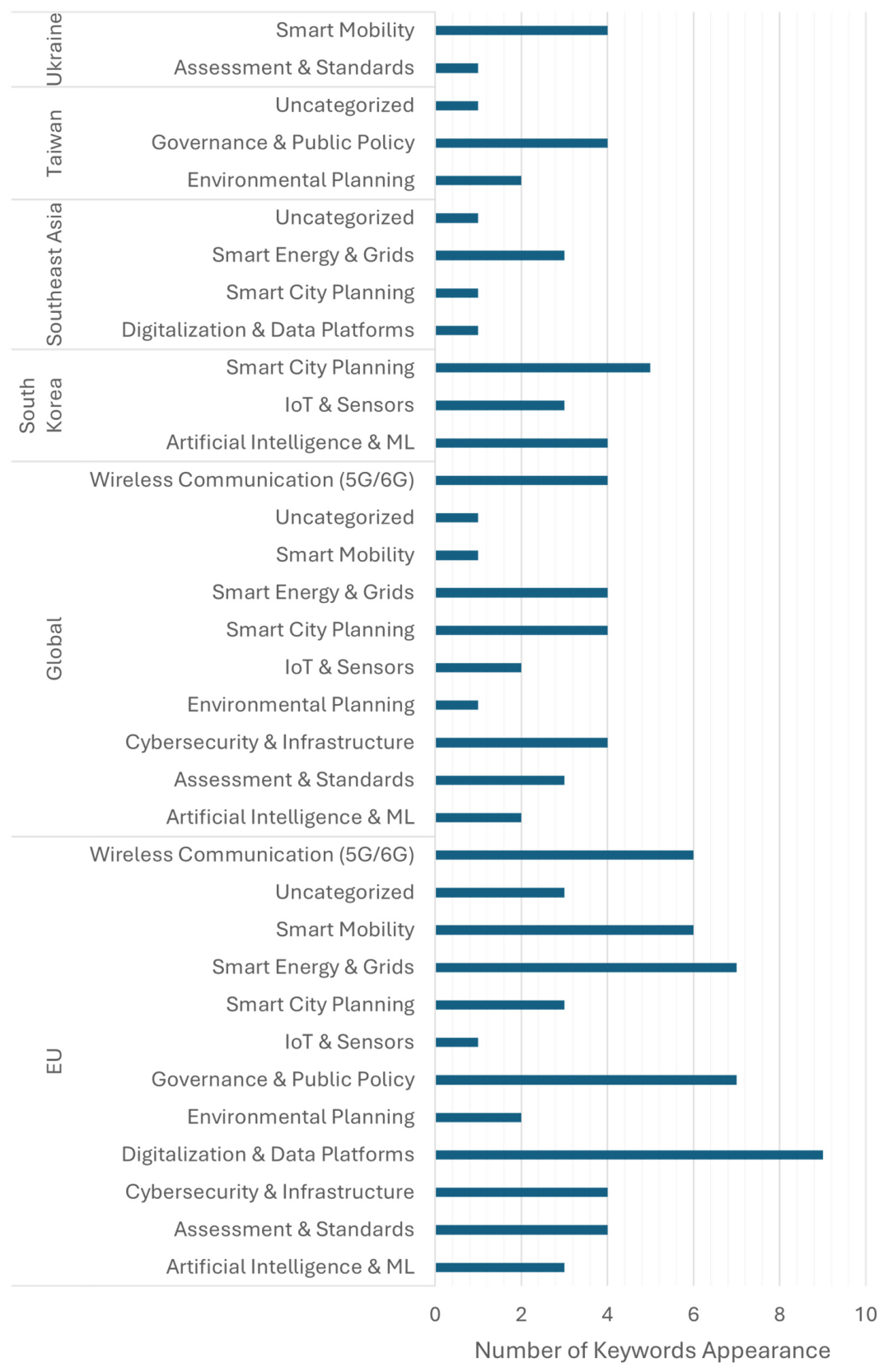
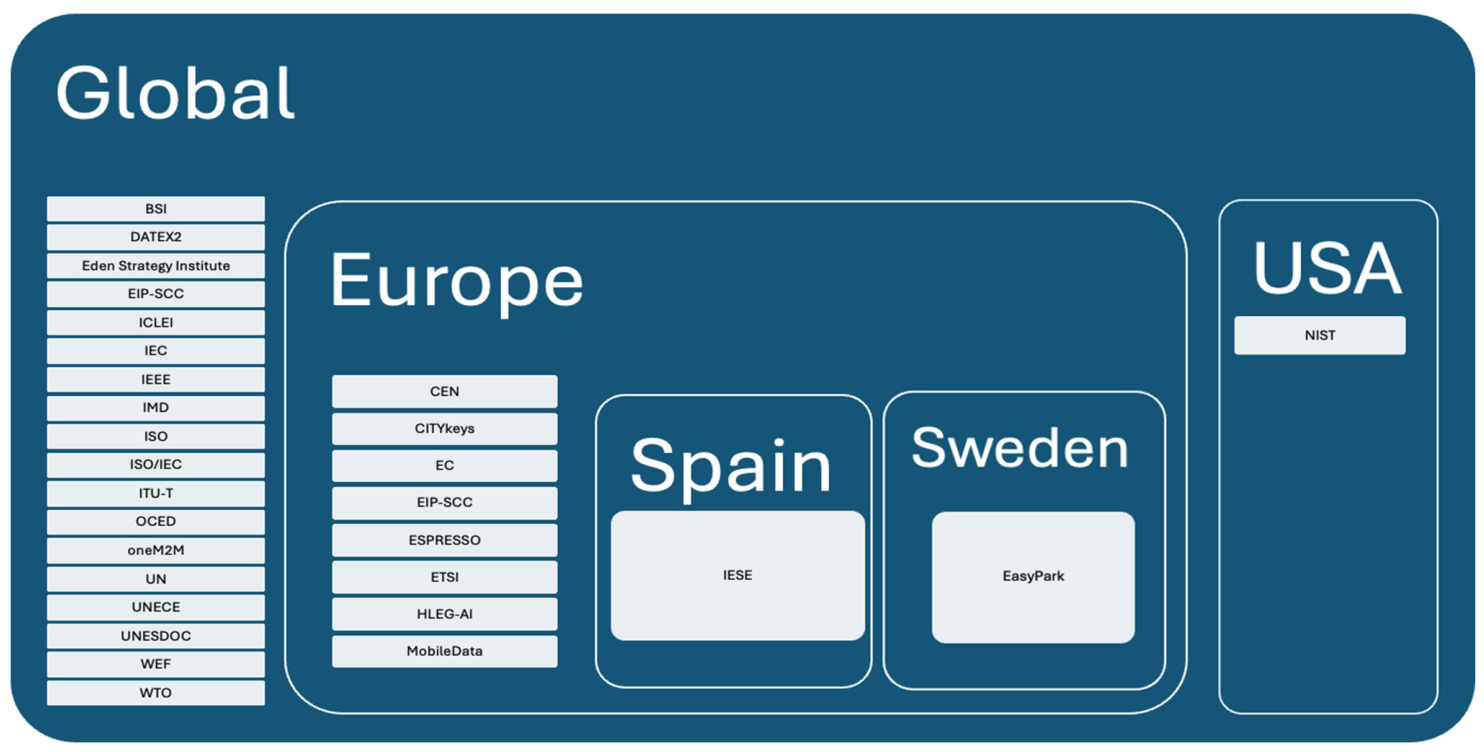
By analyzing the Landscape of Smart Cities Standards, it is possible to map the standardization organizations based on the countries or geographic regions where their frameworks and guidelines are applied (Table 2). This geographical mapping illustrates the regional focus and influence of each standardization body. Consequently, it offers insights into policy alignment, technological priorities and urban development strategies adopted globally.
Current standards can be categorized by their specific domain of application. This classification provides a clear understanding of the scope, objectives and technical focus of each standard, thereby supporting more effective implementation and interoperability across smart city initiatives.

3.9.2. ISO Standard Family for Urban Sustainable Development

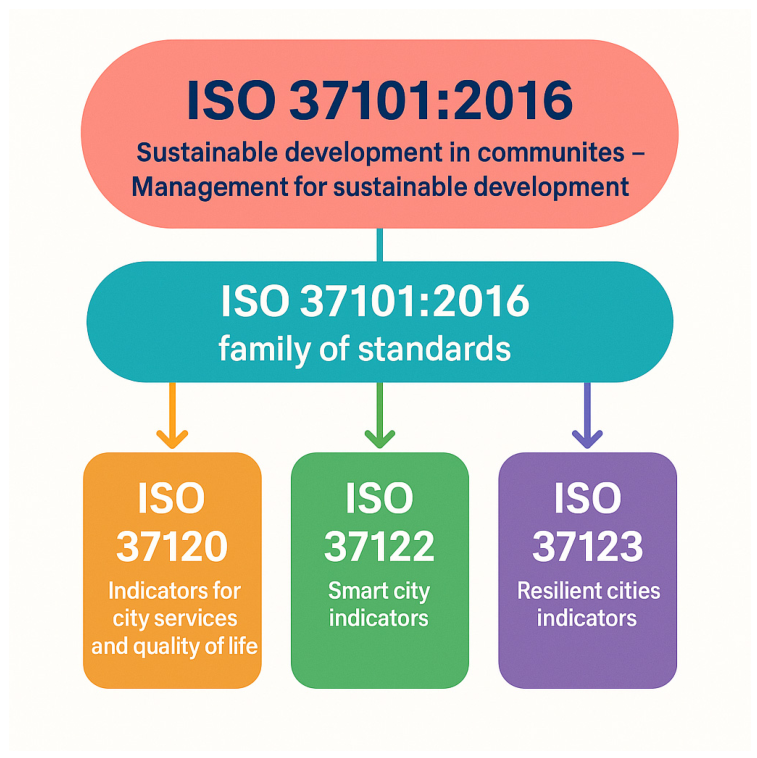
The ISO 37101:2016 standard [134], titled “Sustainable development in communities—Management system for sustainable development—Requirements with guidance for use ”, establishes a structured framework to support communities in achieving sustainability, resilience and improved quality of life through a systematic management approach. This standard assists local authorities and other stakeholders in defining, implementing and monitoring strategies aligned with development objectives (Figure 2).
ISO 37101 [134] belongs to a broader family of standards, including ISO 37120 (Indicators for city services and quality of life) [135], ISO 37122 (smart city indicators) [87] and ISO 37123 (resilient cities indicators) [136]. Collectively, these standards provide guidance on performance measurement, governance and integration of smart and sustainable principles in urban development. Together, these standards enable a holistic, indicator-based approach to urban planning and policy development, fostering transparency, comparability and continuous improvement in community performance at local, regional and national levels (Figure 3).
The foundational standard supporting the development of smart cities is ISO 37120 [135], originally published in 2014, under the title “Sustainable cities and communities—Indicators for city services and quality of life” (Figure 4). The standard provides a comprehensive framework of standardized indicators that enable cities to measure and compare the performance of public services and overall quality of life consistently and objectively. It was first revised in 2018 to incorporate emerging trends in urban governance, technology and sustainability. A new update is scheduled for release in 2025, and as of the time of this article, the draft reached 90.93% completion and was officially confirmed as an in International Standard [135]. This convergence is further exemplified by the integration of GPU-accelerated simulation platforms for rapid grid assessment and advanced relay coordination strategies to protect the physical layer of the smart city against operational contingencies [137,138]. The forthcoming version aims to align more closely with the United Nations Sustainable Development Goals (SDGs), deepen the integration of smart and resilient city concepts, and adapt the indicator framework to address current urban challenges such as digital transformation, climate change and social inclusion.

3.9.3. International Organization for Standardization’s Technical Committee for Sustainable Development

ISO/TC 268, named “Sustainable cities and communities,” is a technical committee established by the International Organization for Standardization (ISO) in 2012. Its primary objective is to develop international standards that facilitate sustainable development in urban and rural communities, emphasizing aspects such as smartness and resilience. These standards provide requirements, frameworks, guidance, and supporting techniques to assist communities and their stakeholders in achieving sustainability goals [139]. Figure 5 shows the Sustainable Development Goals as defined by the UN [56].
As of the latest update, ISO/TC 268 has published 56 ISO standards (19 under its direct responsibility) and is currently developing 22 new standards (8 of which are directly managed by the committee) [139].
The structure of the committee is split into two different working groups focusing on various aspects of sustainable development:
-
ISO/TC 268/SC 1: Smart community infrastructures
-
ISO/TC 268/SC 2: Sustainable mobility and transportation

3.9.4. IEEE Standards Association

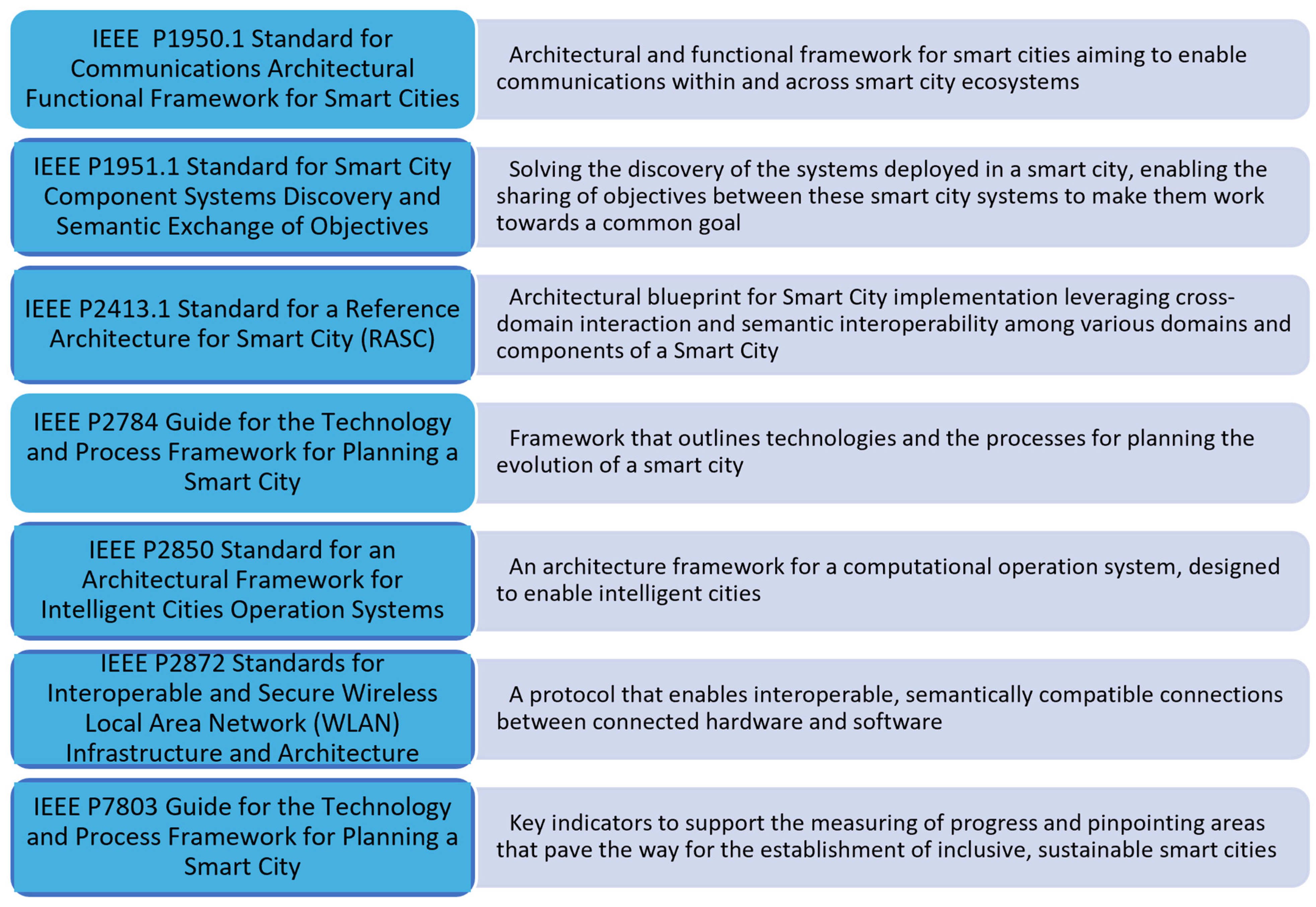
IEEE SA is dedicated to advancing the standardization of smart cities by offering a comprehensive portfolio of standards and programs that address critical components of the smart city framework (Figure 6) [140].

3.9.5. Analysis of Smart and Urban System Standards Categorization

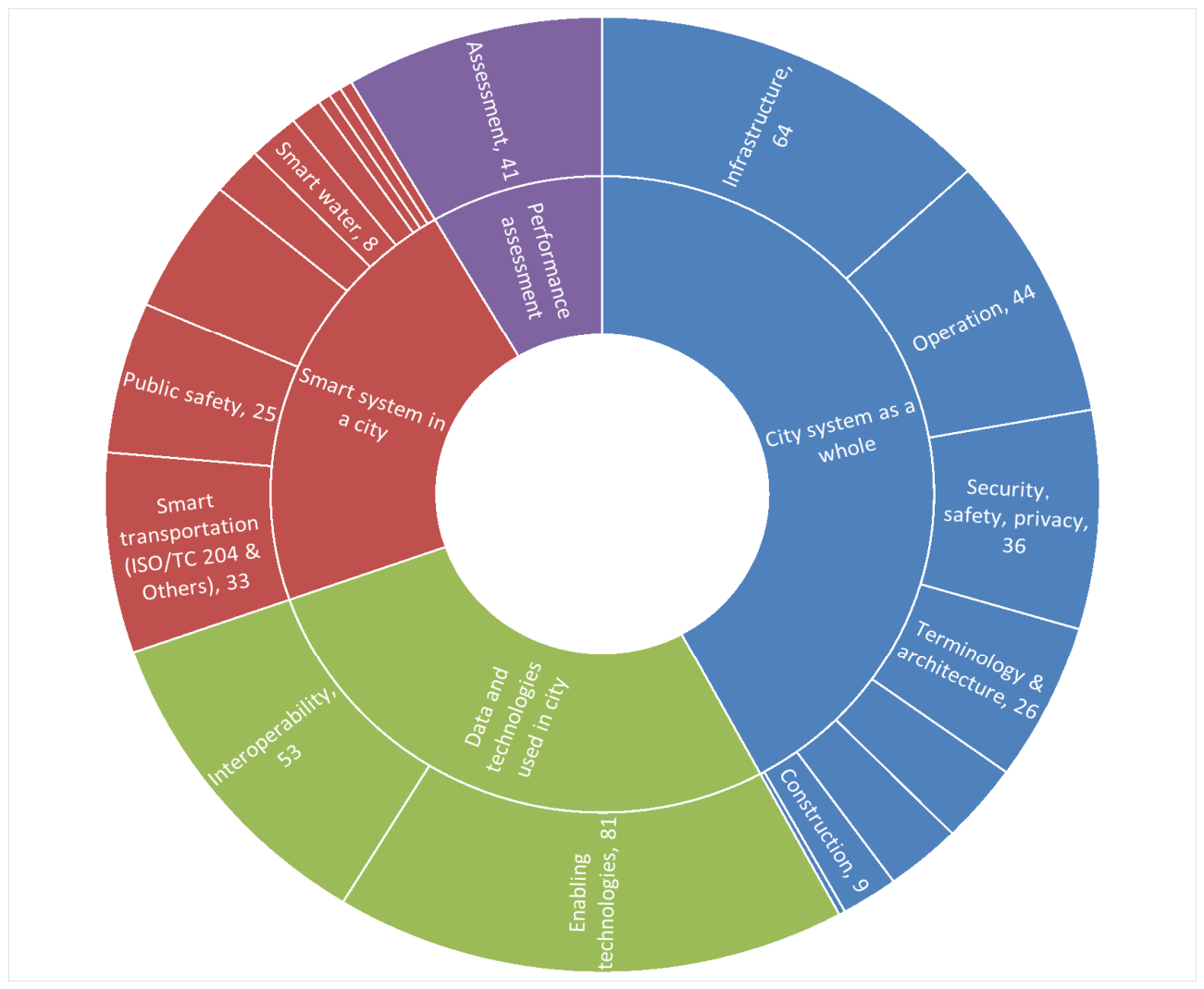
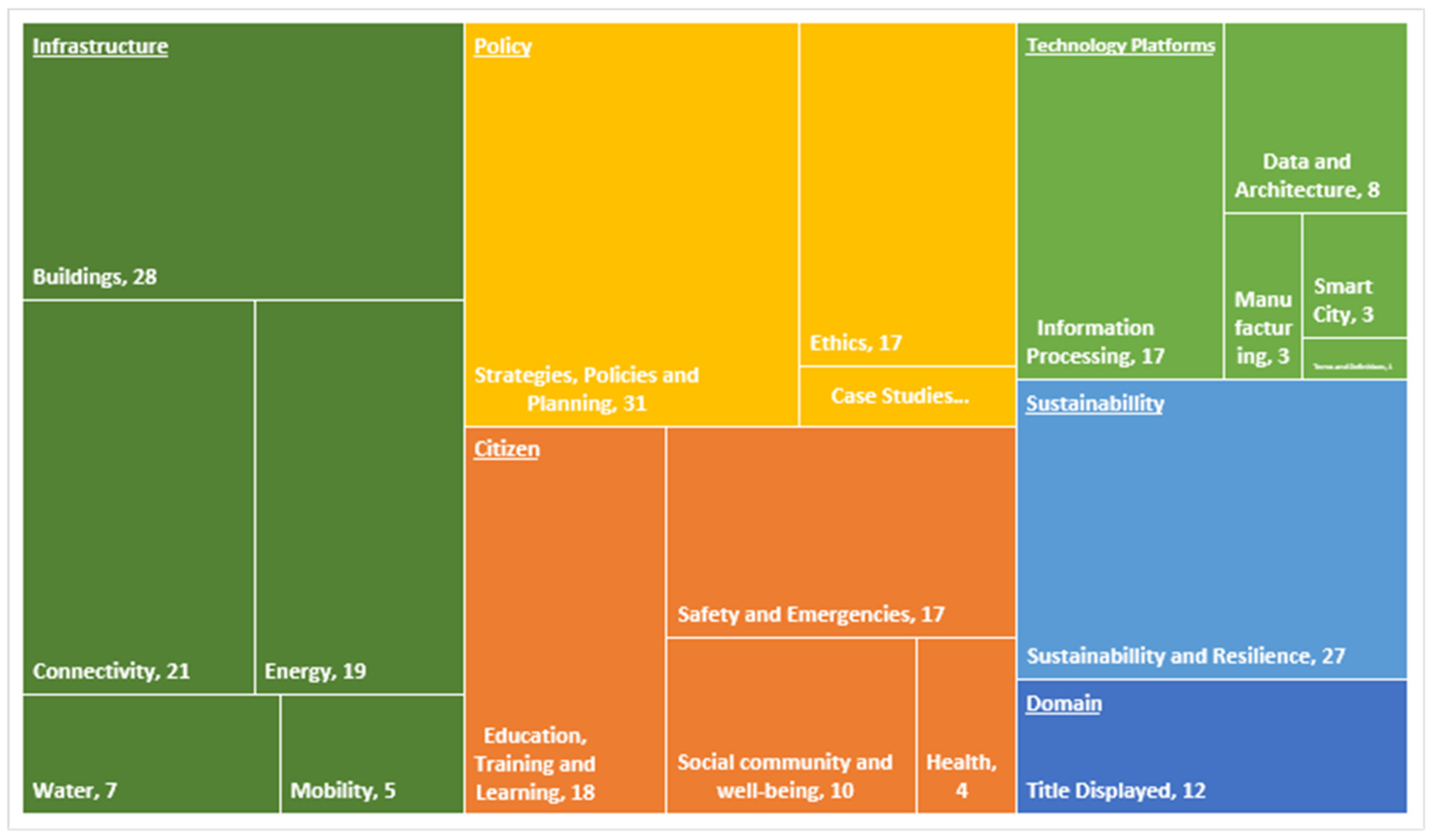
To further understand the standardization landscape in the context of smart cities, a detailed analysis was conducted on various categories of standards and the themes addressed, extracted from a comprehensive inventory of smart city standards [141]. This inventory encompasses standards published or under development up to the year 2024. The inventory includes over 300 standards and specifications relevant for smart city development, as well as the essential standardization organizations analyzed: CEN (European Committee of Standardization), ETSI (European Telecommunications Standards Institute), IEC (International Electrotechnical Commission), IEEE (Institute of Electrical and Electronics Engineers), ISO (International Organization for Standardization), ISO/IEC JTC 1 (ISO and IEC Joint Technical Committee JTC 1 for information technology), ITU-T (ITU’s Telecommunication Standardization Sector) and OGC (Open Geospatial Consortium) [141]. Figure 7 consolidates all relevant standards identified in the referenced list. Subsequent graphical representations focus on each of the four primary sectors, providing a more comprehensive and detailed examination.
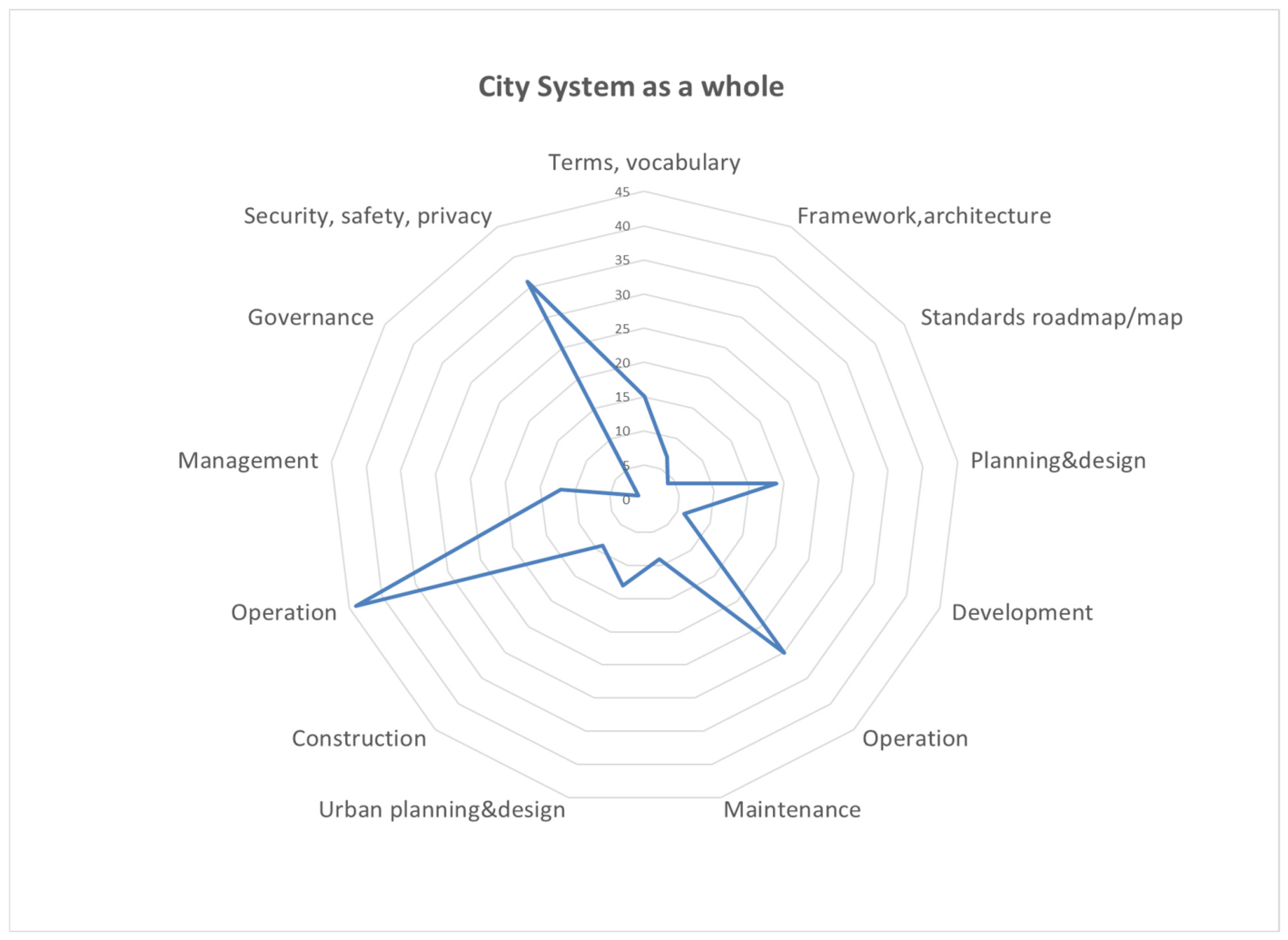
Figure 8 illustrates the distribution of standards according to different aspects of the urban system as a whole. A predominance of standards related to “Operation” and “Security, safety, privacy” is observed, suggesting the paramount importance of the daily functioning of the city. Other significant categories include “Planning and design of infrastructure” and “Management”. This distribution highlights the smart city approach as a “system of systems” where robust governance and security are essential for ensuring long-term urban functionality and resilience. The importance of “Terminology & architecture” is also highlighted, with “Terms, vocabulary” and “Framework, architecture” exhibiting a high number of appearances, indicating their crucial role in standardization.
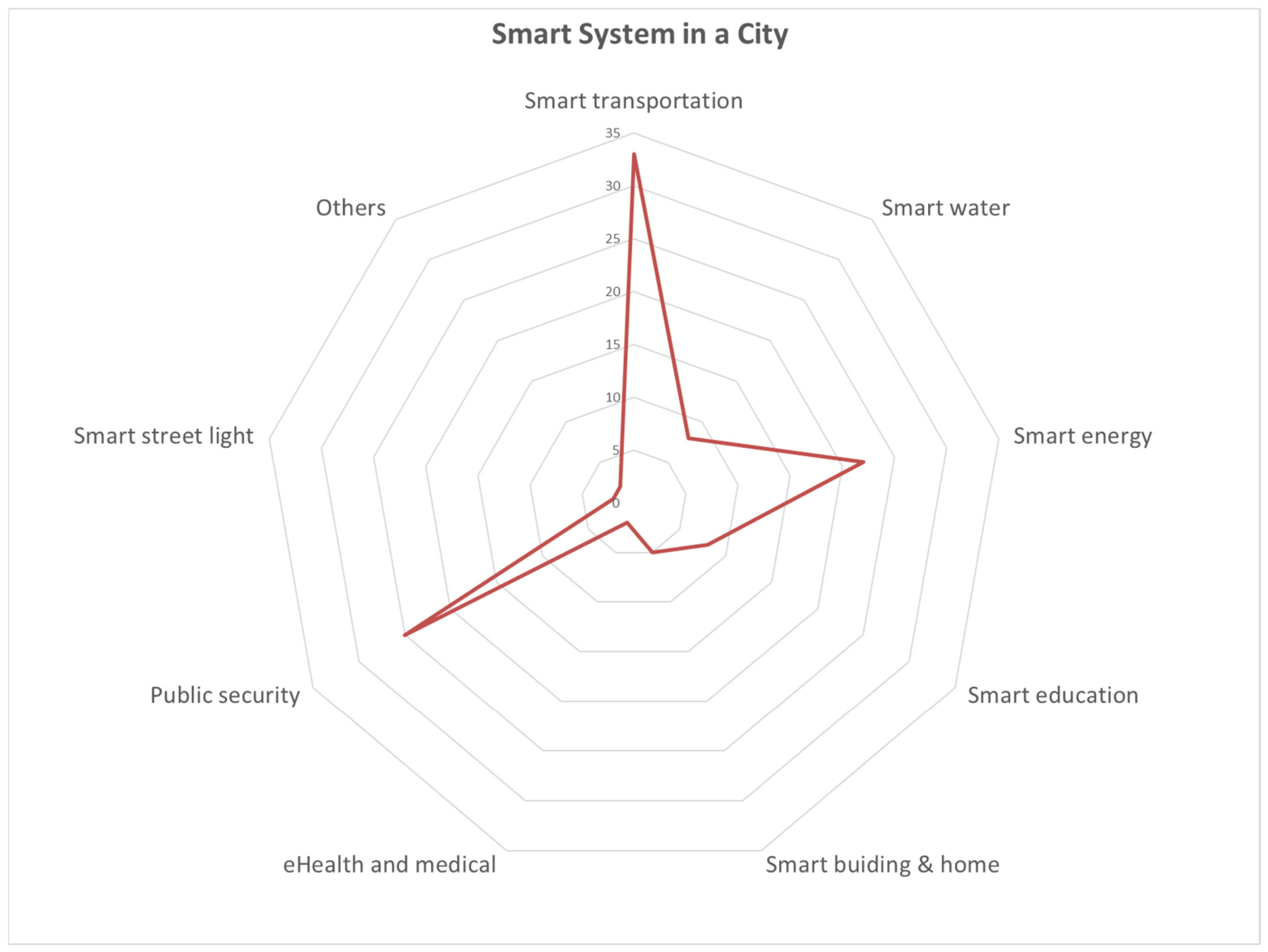
The visualization in Figure 9 details the categories of standards focused on specific smart systems within a city. Among the most prominent areas are “Smart transportation”; “Public Safety” and “Smart Energy”; the importance of the energy sector is reaffirmed, confirming its fundamental role in the transition to a sustainable urban environment and the integration of advanced technologies. Furthermore, the emphasis on transport and safety reflects key priorities in optimizing urban functions and improving citizens’ quality of life.
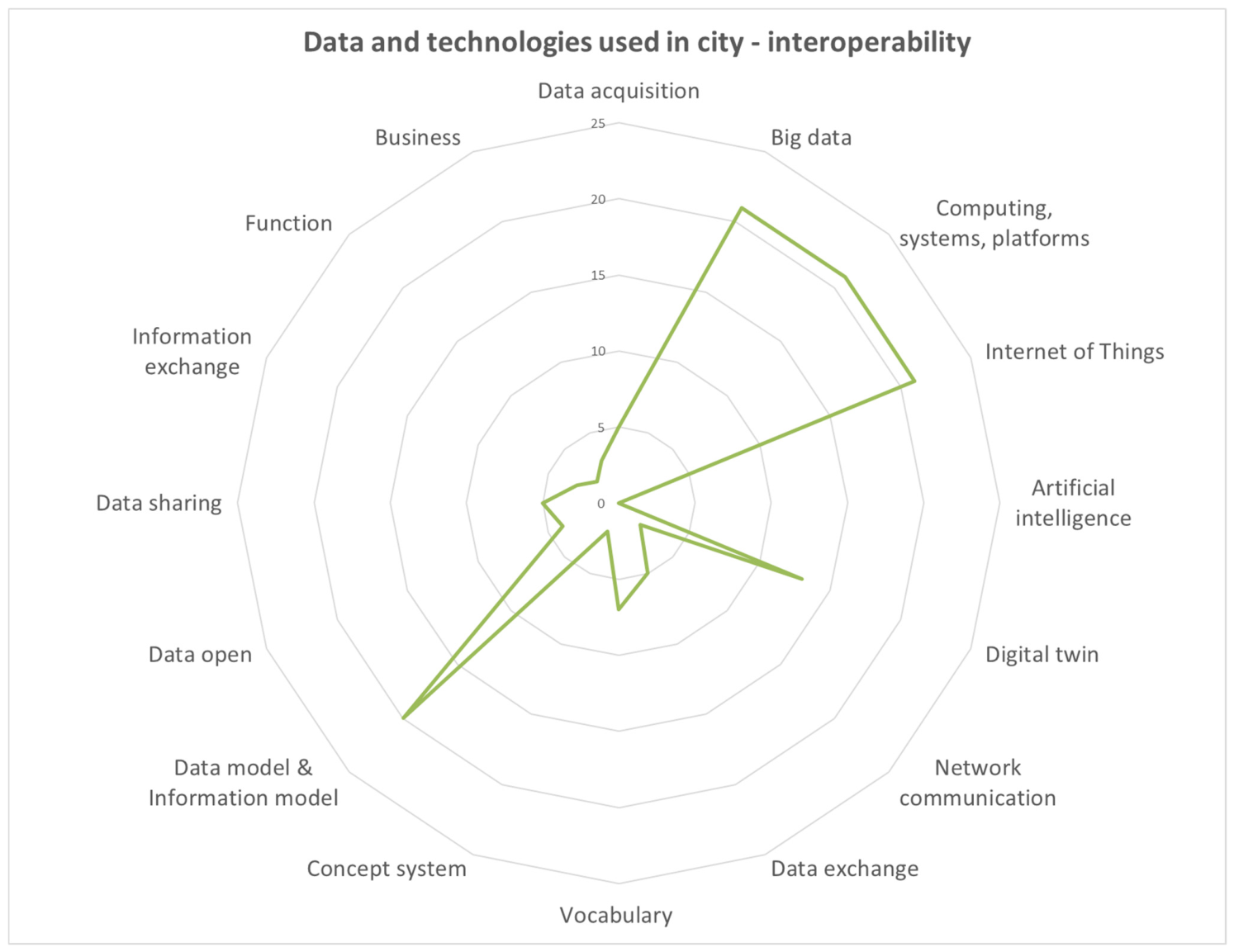
The radar chart shown in Figure 10 illustrates the prevalence and application of various data and technological aspects within a city context, categorized into “Enabling Technologies” and “Interoperability”. Notably, the categories of “Enabling technologies Internet of Things” and “Enabling technologies Computing, systems, platforms” demonstrate the highest levels of adoption, indicating a strong reliance on these foundational technologies; nevertheless, the lack of technical interoperability and the persistence of vertical silos remain significant barriers, highlighting the necessity for standardized frameworks that facilitate seamless data exchange and prevent vendor lock-in within the evolving urban digital architecture [142,143]. The absence of “Artificial Intelligence” is observed, suggesting its potential cross-cutting integration within other thematic standards.
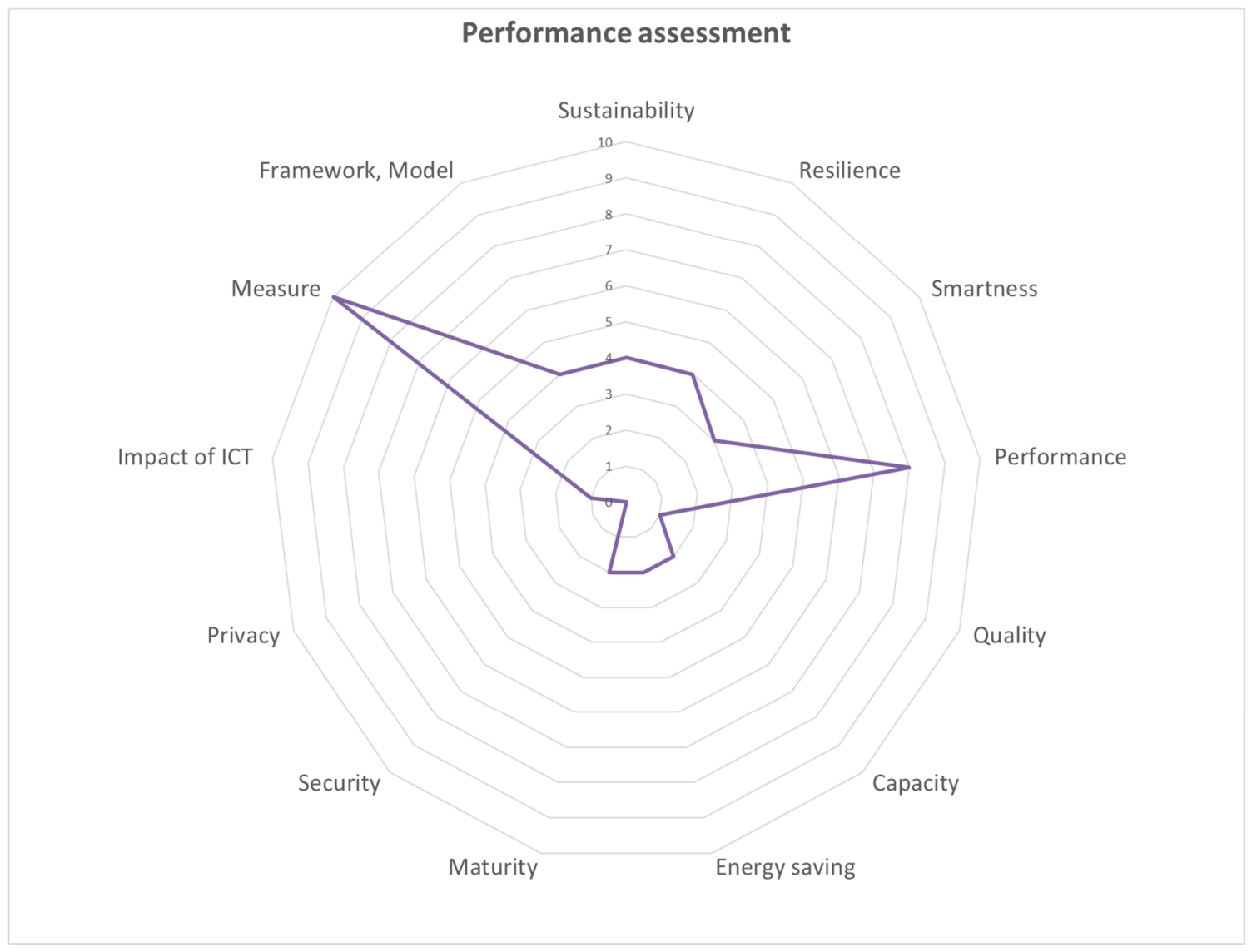
The radar chart presented in Figure 11 exhibits the results of a “Performance assessment” across various domains, including “Performance,” “Sustainability,” “Resilience, “and “Smartness”, with scores ranging from 0 to 10. These metrics are crucial for monitoring the progress and success of smart city initiatives toward their sustainability, efficiency, and resilience objectives. The assessment highlights particularly strong performance in “Assessment Measure” and “Assessment Performance,” reaching scores close to the maximum. In contrast, areas such as “Assessment Impact of ICT” and “Assessment Privacy” show considerably lower scores, suggesting either less emphasis or areas requiring significant improvement.
In practice, the application of international standards such as ISO 37120 [135] is often hindered by the fragmentation of local data availability. While these standards provide a comprehensive set of indicators for sustainability and quality of life, many municipalities lack the integrated sensor infrastructure to report on these metrics in real time. This creates a disparity where standards serve as theoretical benchmarks rather than operational tools, necessitating a phased approach to standardization that aligns with the digital maturity of the specific urban environment.

4. Discussion

The foundational shift towards the Smart City paradigm is defined not by isolated technological breakthroughs, but by the strategic and systemic convergence of three core pillars: advanced energy infrastructures, next-generation digital connectivity, and robust governance frameworks. While the literature highlights the transformative potential of each domain (Table 3), our structured analysis reveals a complex landscape characterized by both profound complementarities and significant tensions, which must be acknowledged for long-term viability. For instance, the complementarity is evident in the fact that the shift to decentralized renewable energy (Section 3.2) requires the high-throughput, secure communication capacity of 6G (Section 3.3) to enable real-time smart grid management (Table 4). However, a major tension arises because this very increase in connectivity simultaneously exposes the critical energy infrastructure to heightened cybersecurity vulnerabilities [29]. Addressing these vulnerabilities requires a holistic fusion of cyber- and physical monitoring, using GNNs to model the inherent graph structure of the power grid for robust attack detection [144,145]. Furthermore, the technical push for interoperability and data-driven efficiency is often constrained by fragmented standardization frameworks and the need for inclusive policy and data governance (Section 3.1). These interdependencies confirm the Smart City as a true system of systems, where performance and resilience hinge on the coordinated management of these trade-offs [146]. Critical synergy in this management lies between resource planning and grid monitoring. While hybrid solar–hydro-systems optimize generation profiles, hierarchical state estimation ensures that the resulting power flows are accurately monitored without overwhelming computational resources [147]. One such trade-off involves optimizing infrastructure by designing transmission capacity around average power delivery needs rather than peak loads, which can significantly reduce line capacity requirements while maintaining reliability [148]. Coordinated management must also address frequency asymmetries by utilizing energy storage systems to restore a balanced frequency distribution and ensure high-quality power delivery [149]. A prominent example of this interdependency is the vulnerability of optimized systems; while multi-objective models can significantly reduce greenhouse energy costs, the increased connectivity required for such optimization necessitates GNN-based security layers to prevent attackers from mimicking legitimate load variations to mask stability threats [150,151].
The evolution of smart cities relies on the strategic convergence of advanced energy systems, digital technologies and robust governance frameworks. As urban population expands and resource demand intensifies [1], our findings underscore that transitioning to decentralized renewable energy sources is critical not only from an environmental perspective but also as a driver of economic resilience [30,153]. Achieving this requires overcoming the fragmented nature of current AI applications and moving toward integrated ecosystems where technological advancements are balanced with legal and social readiness [154]. The integration of next-generation 6G communications with IoT-enabled smart grids and AI-driven analytics holds considerable potential for optimizing energy consumption and enhancing operational efficiency [27]. Implementing these technologies effectively requires accounting for residential randomness and individual discomfort levels to ensure fair and consistent DR market rules [155]. Nonetheless, these technological advances must be accompanied by comprehensive cybersecurity measures and adherence to standardized protocols to ensure interoperability across diverse urban infrastructures. Moreover, effective public–private partnerships and active community engagement are indispensable for addressing policy fragmentation and regulatory challenges, thereby ensuring that innovations in renewable energy and digital connectivity translate into sustainable, citizen-driven urban development [35,36]. In conclusion, this study advocates for a holistic, interdisciplinary approach to smart city transformation that balances technological innovation with strategic regulatory oversight and stakeholder inclusivity, paving the way for resilient and adaptive urban environments.
Our analysis indicates that the transition from 5G to 6G is poised to significantly transform the energy landscape by advancing digitalization and integrating IoT-enabled smart grids. Enhanced spectral efficiency and decentralized security protocols embedded in 6G technologies promise significant reductions in energy consumption and improved data transmission, which are vital for managing the increasingly complex urban network [46]. However, these benefits are tempered by substantial challenges such as the capital investments required for upgrading or deploying new 6G base stations, coupled with the need for seamless interoperability with established legacy systems, which presents notable financial and technical barriers [30,33]. Additionally, a surge in connected devices and the expensive coverage demanded by 6G technology, alongside cybersecurity vulnerabilities, poses a risk that could undermine the stability and integrity of energy infrastructures. Simulation studies further reveal geographic discrepancies, in regions such as the Netherlands versus Croatia, that complicate the optimization of network performance and energy efficiency across different urban landscapes [30]. Collectively, these findings underscore the necessity for coordinated policy measures, rigorous standardization and proactive cybersecurity strategies to fully harness the potential of 6G while ensuring sustainable digital integration in the energy sector.
The energy sector plays a foundational role in smart city evolution, serving as an enabler of sustainability and a catalyst for integrating advanced technologies into the urban landscape. A smart city’s transition toward green development is fundamentally tied to modernizing its energy infrastructure. Clean energy smart grids are not merely technical upgrades, as they are strategic instruments to mitigate urban challenges such as pollution and resource strain. Implementing smart city policies in China has been shown to require a gradual shift to renewable energy and reduced fossil fuel reliance, demonstrating how energy initiatives underpin broader urban innovation efforts [2]. In practice, this means deploying distributed renewable generation, enhancing energy efficiency in buildings and transport infrastructure, and utilizing digital controls to balance supply and demand in real time. Such measures directly improve urban resilience and reduce emissions, yielding cleaner air and more reliable energy services for citizens [6].
To enable a structured analysis and visual representation, a total of 111 individual keywords extracted from the reviewed articles were normalized and grouped into thematic categories. The initial keywords varied in phrasing and specificity, including technical terms (e.g., “5G Network”, “Digital Twin”), methodological references (e.g., “PRISMA”, “Systematic Review”) and broader thematic concepts (e.g., “Smart Mobility”, “Citizen Empowerment”).
A manual content analysis was performed to cluster semantically related terms under broader, representative categories. For instance, “5G”, “6G” and “Wireless Communication” were grouped under Wireless Communication (5G/6G), while terms such as “AI”, “Machine Learning” and “Deep Learning” were assigned to Artificial Intelligence & ML. This normalization process reduced redundancy, improved clarity and enabled cross-comparison between articles and regions. In total, 11 primary categories were defined, along with an additional “Uncategorized” label for terms that did not clearly fit within the main themes.
One prominent example of energy-centric urban innovation is the development of Positive Energy Districts (PEDs) in Europe. PEDs are urban areas that produce at least as much energy as they consume annually, embodying the EU’s vision for a renewable-powered city district. A recent study introduced a fuzzy-logic energy management system in a residential PED, achieving over 75% self-sufficiency and self-consumption by dynamically optimizing battery storage and solar PV usage [34]. These results underscore that integrated local generation and storage, coupled with intelligent control, can turn neighborhoods into net energy producers while meeting residents’ needs. However, they also highlight emerging challenges—for example, effectively coordinating various energy demands (household electricity, electric vehicle charging, heating/cooling) remains complex. Moreover, extreme events (climatic or geopolitical) can impact PED performance and payback periods, reminding planners that energy strategies must account for uncertainty.
Beyond technical performance, energy initiatives in smart cities are closely linked to governance and community engagement. The rise of Renewable Energy Communities (RECs) exemplifies how energy projects can spur social innovation. In Italy, a multi-level governance model for RECs within PEDs was proposed to enhance citizen participation and multi-stakeholder coordination [37]. This model recognized that decentralized energy systems thrive on local cooperation, and that clear frameworks are needed to distribute benefits, navigate bureaucracy, and earn public trust. Such findings suggest that the energy sector’s role extends beyond engineering, as it is an anchor for interdisciplinary collaboration in smart cities, binding together policy, society, and technology. In summary, prioritizing the energy sector in smart city transformation yields concrete sustainability gains (such as emission reductions and energy autonomy) and sets the stage for holistic urban innovation. Yet it requires aligning new technologies with supportive policies and active public involvement to ensure that cleaner energy translates into long-term sustainable urban development.
Modern smart cities are often characterized as a “system of systems”, meaning they consist of multiple interdependent subsystems—energy grids, transportation networks, communication systems, water and waste utilities, public services, and more—that must operate in harmony. This integrated perspective underscores that the value of a smart city emerges not from isolated smart components, but from the synergies among them [4]. Interoperability is therefore paramount: each subsystem should seamlessly exchange data and work together toward common urban objectives. Standardization is a key enabler in this context, as it provides common protocols and interfaces that allow heterogeneous systems to communicate. As noted in recent works, adopting shared standards (for example, in data formats or IoT communication protocols) helps prevent fragmented technology adoption and ensures that a smart grid can “talk to” a smart building or an electric vehicle charging network without custom integration efforts [45]. However, large-scale electrification requires high-fidelity load models that account for the diverse voltage and frequency responses of EV chargers from different manufacturers to ensure grid stability during faults [2,156]. The operational management of this infrastructure is further supported by ultra-short-term load forecasting, utilizing Snake Optimizer-improved Variational Mode Decomposition (SO-VMD) to capture the non-linear fluctuations of vehicle charging demand with high accuracy [157,158]. Indeed, international standards bodies (ISO, IEC, IEEE, etc.) and initiatives are actively shaping frameworks for urban data sharing, IoT interoperability, and performance metrics. The ISO 37122:2019 standard [87] for smart city indicators, for instance, has gained traction as a baseline for consistent assessment across cities [44]. Cities that embrace these standards are better positioned to integrate new solutions without redeveloping systems each time, accelerating innovation.
Interoperability is closely tied to resilience. A system-of-systems approach means that a shock in one domain (e.g., a cyberattack on the power grid or a natural disaster flooding transport tunnels) can cascade across other systems. Conversely, well-integrated city systems can support each other during crises. For example, intelligent energy grids can prioritize power to hospitals and emergency services during outages, and open data from telecom networks can assist traffic management in rerouting around problematic areas. The resilience of a smart city thus hinges on both robust individual systems and their coordinated response capabilities. One critical area of focus is improving the resilience of energy infrastructure against new digital threats. The introduction of IoT sensors and ICT in energy (smart meters, automated substations, and so forth) has improved efficiency but also created cyber-vulnerabilities that can threaten physical grid stability [33]. Simulation studies of coordinated cyberattacks on power distribution components (such as photovoltaic inverters and protection relays) show that traditional grid protection schemes may fail to detect or isolate incidents in time, leading to widespread outages and equipment damage. These findings have important implications: they urge the adoption of advanced, cross-cutting security mechanisms and adaptive control algorithms that maintain stability even when data inputs are untrustworthy. More generally, building urban resilience means ensuring that each city subsystem has not only its own backup and recovery plans, but also city-level contingency strategies when interdependencies come into play.
Data governance is another pillar in the system-of-systems paradigm. With a vast number of devices and organizations generating urban data, robust governance is needed to manage data sharing, privacy, and ownership. The Mainz data utility example again serves as an instructive case: by establishing a legal framework and a multi-layer architecture for data exchange, the city created a neutral space for different departments and external partners to contribute and use data securely. A sound governance model should define who can access what data, under what conditions, and how data quality and security are maintained. Such governance prevents the formation of data silos—where information is trapped in one agency—and instead promotes a “connective tissue” of information that all city systems can draw from. However, achieving this is challenging. Interviews with stakeholders in various cities highlight concerns about liability, compliance, and trust when sharing data [38]. Establishing trust requires not only technical solutions (like encryption and access controls) but also institutional arrangements (policies, agreements, and perhaps third-party audits) to reassure participants that their data will not be misused. In the absence of robust governance, cities risk either constrained innovation due to overly restrictive data practices or, conversely, exposure to security breaches and public backlash if data flows freely without safeguards. Therefore, treating the smart city as a system of systems naturally leads to a call for integrated governance frameworks—frameworks that align technology deployment with regulatory policy and stakeholder engagement. Such frameworks enhance interoperability and resilience by ensuring that all parts of the urban system move in the same direction, guided by shared principles of security, openness, and sustainability.
Figure 12 compares the prevalence of key Smart City research themes across different regions. The horizontal bar chart shows how often each normalized keyword category appears in studies from the EU, South Korea, Southeast Asia, Taiwan and Ukraine as well as globally. Categories such as Artificial Intelligence & Machine Learning, Smart Mobility, Smart Energy & Grids, Governance & Public Policy and others are plotted, revealing clear regional discrepancies in focus. For instance, European studies exhibit a strong emphasis on governance frameworks and energy systems, reflecting the region’s push for integrated policy and sustainability (for example, the widespread adoption of standards like ISO 37122). In contrast, East Asian contexts feature higher frequencies of technology-centric keywords such as AI, IoT and 5G/6G connectivity, indicative of a drive toward cutting-edge ICT solutions for urban infrastructure. Regions like Southeast Asia prioritize topics such as IoT-enabled development and energy sustainability, aligning with local development, whereas Ukraine’s contributions are case-specific, spotlighting smart mobility and urban transport optimization. Overall, this figure underscores that regional research priorities differ markedly, shaped by distinct urban challenges and policy environments.
The global distribution of keyword categories appears relatively balanced across themes, while European studies distinctly emphasize digitalization. This reflects Europe’s ongoing strategic priority of comprehensive digital transformation. Figure 13 illustrates that heightened standardization correlates closely with increased interest in technological advancements and global urban development strategies. This observation effectively connects the insights depicted in Figure 12 and Figure 13, highlighting how standardization efforts directly support and stimulate broader technological progress and research trends.
Figure 13 details the standardization landscape, mapping out Smart City standardization bodies by region. The horizontal bar chart reflects the frequency of keyword appearances grouped by region (Europe, Global, South Korea, Southeast Asia, Taiwan, and Ukraine). Each keyword category, such as Artificial Intelligence & ML, Smart Mobility, Smart Energy & Grids, Governance & Public Policy, and others, is plotted along the vertical axis, while the horizontal axis shows the number of times the category appears in the reviewed literature. This organizational diagram illustrates a fragmented but layered governance of standards: global entities such as ISO, IEC, ITU-T and oneM2M sit at the international tier, providing broad frameworks for interoperability, while regional alliances and initiatives (for example, CEN and CITYkeys in Europe) develop area-specific guidelines. At the national level, individual countries promote their own standards, for instance NIST in the United States or EasyPark in Sweden, targeting local urban priorities.
The visualization reveals that standardization efforts are widespread and decentralized, as virtually every major region has its mix of standard bodies and projects. While the diversity allows tailoring to local contexts, it also highlights fragmentation, where multiple frameworks often address similar Smart City aspects, risking overlap and incompatibilities. A recent “Landscape of Smart Cities Standards” review [133] confirms a proliferation of initiatives, noting that a lack of harmonization among various evaluation models has limited the comparability of smart city outcomes across countries. In practice, city officials and planners face a complex mosaic of guidelines, from high-level sustainability indices to domain-specific technical protocols.
Figure 13’s regional mapping of these organizations underscores both the opportunities and technological priorities that are being shaped globally, yet the absence of a unified framework can hinder global interoperability and knowledge sharing. This infographic presents both the geographic distribution and layered influence of international, regional and national stakeholders in shaping smart and sustainable urban development. This fragmentation has been observed to pose challenges for local administrations, who may struggle with implementing complex or numerous standards without clear cohesion.
Figure 14 complements this by offering a macroscopic view of thematic categories in Smart City literature through a treemap visualization. Each colored block represents a broad topic area, with its size proportional to the number of publications addressing that theme. Dominant blocks correspond to infrastructure and policy-related themes. Notably, categories tied to technological infrastructure such as digital connectivity and architecture, energy grids and urban mobility occupy a large share of the map, alongside a block dedicated to sustainability and resilience initiatives. Governance and planning themes also feature prominently, underscoring the importance of policy direction and standardized strategies in Smart City disclosure. By contrast, comparatively smaller blocks in the treemap (for example, those related to ethics, social inclusion or sector-specific applications such as food systems) suggest these areas are underrepresented. This imbalance points to a research gap: while cities worldwide have heavily explored digital infrastructure and energy/climate initiatives, fewer studies delve into community-centric and ethical dimensions. Although some pioneering work integrates citizen empowerment and participatory planning (for example a zero-carbon community project in Taiwan used a participatory approach to engage local stakeholders), such human-centered topics remain a minority in the overall Smart City literature.
The critical interpretation highlights several implications for future research and policy planning. Firstly, the dominance of infrastructure-driven and policy/planning themes (Figure 12 and Figure 14) suggests that academia and industry have made significant progress on the technical and governance foundations of Smart Cities, for example, in integrating energy grids with ICT and developing sustainability metrics. This focus is in accordance with the needs of rapid digitalization and urbanization, where energy-efficient communication networks and robust urban policies must be mutually aligned. However, the relatively smaller emphasis on social, ethical, and human-centric issues implies that these aspects warrant greater future attention. Future research should broaden address citizen engagement, data ethics, and equity in Smart Cities, ensuring that technological innovation translates into tangible improvements in quality of life and inclusivity. As noted, empowering local communities in the planning process, through participatory methods, can greatly enhance project outcomes. Second, the regional discrepancies in the research sector call for greater cross-integration of ideas.
European experiences in policy integration could improve projects in Asia and vice versa, while lessons from pioneering smart mobility trials in Ukraine or sustainability efforts in Southeast Asia could benefit other regions if disseminated. Policymakers and scholars might consider more comparative studies and international pilot projects to bridge these gaps, adapting successful strategies to local conditions.
Finally, the fragmented standardization landscape (Figure 13) highlights an urgent need for coordination and convergence in Smart City standards. Without jeopardizing local adaptability, stakeholders should strive toward interoperable frameworks, for instance, by aligning city indicators with well-established international standards to enable benchmarking and shared learning. Current literature emphasizes immature integrated methodologies that align smart city evaluations with urban planning strategies and stress multi-stakeholder collaboration to overcome policy silos. This means urban planners, technology providers and standard bodies must work collectively in coordinating policy measures and rigorous standardization efforts to fully harness emerging technologies (such as 6G and IoT) for sustainable city development.
Our initial analysis of distributed keyword categories across regional studies (Figure 12) mapped standardization bodies by region (Figure 13) and visualized thematic categories (Figure 9). These insights are reinforced by another detailed analysis of the IEC standards inventory, allowing for further dissection of standardization priorities.
The figures detailing the “City system as a whole” and “Smart systems in a city” from the standards inventory (Figure 8 and Figure 9, as discussed in Section 3.9.5) highlight the emphasis on daily operations, security, and key areas such as transportation and energy. This reinforces the observation that a large part of the existing literature and standardization efforts focus on building the technical and sustainable backbone of smart cities, and on the efficient governance of these interdependent systems. The prevalence of operation-related standards underscores the importance of ensuring continuous functionality and efficient resource management in a city considered a “system of systems”.
Furthermore, the analysis of “Data and technologies used in the city” (Figure 10 and Figure 11) provides crucial insight into the role of digitalization. Significant investments in Big Data, IoT, and Digital Twins are confirmed, reflecting efforts to optimize data-driven urban management. Of particular relevance to the theme of interoperability is the high weight of standards dedicated to “Data and information models” and “Vocabulary” within the interoperability section. This observation strengthens the argument that standardizing communication protocols and data formats is fundamental to enabling subsystems to collaborate efficiently and thereby prevent technological fragmentation, which is a key point of smart city resilience. The discrepancy regarding the number of standards exclusively dedicated to AI compared to the widespread recognition of its role (mentioned in other sources) suggests that AI is either cross-cuttingly integrated into other areas of standardization (e.g., smart grids, smart transport), or that specific AI standards are still in an early stage of development.
The consistent presence of “Smart energy” and “Sustainability” in this standards analysis underscores the coherence with the study’s previous conclusions, which emphasize the fundamental role of the energy sector in the evolution of smart cities and in achieving sustainability and emission reduction goals.
The evolution of smart cities is conditioned by the strategic convergence of advanced energy systems, digital technologies, and robust governance frameworks. As urban populations grow and resource demand intensifies, our findings underscore that the transition to decentralized, renewable energy sources is critical not only from an environmental perspective but also as a driver of economic resilience. Integrating next-generation 6G communications with IoT-based smart grids and AI-driven analytics holds considerable potential for optimizing energy consumption and improving operational efficiency. However, these technological advancements must be accompanied by comprehensive cybersecurity measures and adherence to standardized protocols to ensure interoperability across various urban infrastructures. Furthermore, effective public–private partnerships and active community involvement are indispensable for addressing policy fragmentation and regulatory challenges, thereby ensuring that innovations in renewable energy and digital connectivity translate into sustainable, citizen-centric urban development. In conclusion, this study suggests a holistic and interdisciplinary approach to smart city transformation, balancing technological innovation with strategic regulatory oversight and stakeholder inclusivity, paving the way for resilient and adaptive urban environments.
While the literature frequently presents 6G and blockchain as transformative solutions for Smart Cities, it is imperative to distinguish between conceptual potential and current deployment reality. Blockchain applications in energy trading are largely limited to pilot projects due to scalability issues and high energy consumption of consensus mechanisms [37]. Similarly, 6G infrastructure is still in the developmental phase, with significant hardware challenges remaining for terahertz communication implementation. Consequently, these technologies should be viewed as mid-to-long-term enablers rather than immediate, off-the-shelf solutions for current urban energy management challenges.

5. Conclusions

This review has highlighted that the transformation toward smart cities is a multifaceted process, justified by the central role of the energy sector and strengthened by advances in digital technology and governance. Key findings emphasize that transitioning urban energy systems to cleaner, smarter models is both a pressing necessity and an opportunity: smart grids, renewable energy integration and initiatives like Positive Energy Districts can substantially reduce emissions and improve resilience, but they require supportive policies and active community participation to succeed. The rapid evolution from 5G to 6G networks, along with the proliferation of IoT devices, is set to provide the ultra-connectivity needed for advanced smart city applications. This enhanced connectivity will enable real-time management of infrastructure and new services, such as autonomous mobility and interactive public services, yet it also demands careful attention to energy usage and cybersecurity. Our synthesis underlines that smart cities must be treated as a complex system of systems, where interoperability and data governance are fundamental design principles.
The review also addresses the inherent challenges and limitations faced in current smart city implementations. Issues of privacy, data security, and equitable access to technology are recurrent concerns that can limit public acceptance of smart city projects if left unaddressed. Likewise, disparities in resources and technical capacity between cities, especially between developed and developing contexts, mean that one-size-fits-all solutions are impractical—local adaptation and capacity building are necessary components of any smart city strategy. Despite these challenges, the overall trajectory of research and practice is encouraging. There is a clear trend toward adopting interdisciplinary approaches: city planners, engineers, IT specialists, policymakers, and social scientists are increasingly collaborating to align technological innovation with societal needs and sustainability goals. This integrated approach is evident in emerging governance models for energy communities, the inclusion of stakeholders in data platform design, and the push for AI and data analytics that serve public interest in addition to efficiency.
Standardization across technologies and domains emerges as a critical enabler for this integration, facilitating communication between subsystems and ensuring that innovations can be scaled and replicated across different urban contexts. In summary, the analysis of contemporary Smart City research and standardization reveals a field maturing in its technical and policy dimensions yet still evolving toward holistic integration. Addressing the identified gaps, requiring expanding research horizons and unifying standardization efforts, will be crucial for developing energy efficient, digitally integrated and resilient Smart Cities in the years ahead.
Achieving the vision of sustainable smart cities will require sustained effort on multiple fronts. Technological innovation in energy, communications and computing must be coupled with robust frameworks for cybersecurity and standardization. Equally important is the human and institutional dimension, as governance mechanisms, regulatory policies and community engagement models must ensure that technology deployment be responsible and inclusive. The findings of this review reinforce that future smart city development cannot be the domain of isolated sectors. Instead, it demands an integrated and interdisciplinary approach. By learning from current experiences and continuing to investigate open questions, cities worldwide can navigate digital transformation in a way that enhances urban sustainability and improves quality of life. Ultimately, the smart city from an energy perspective is more than just a high-tech ideal; it is a pathway to harmonizing urban growth with environmental management and social well-being, a goal that will guide the next generation of urban development.
In closing, future research and policy efforts should move beyond optimizing individual components. Instead, they must focus on developing integrated frameworks that proactively manage the tensions between data security and technological advancement, and between local policy fragmentation and the need for global interoperability. Only through this holistic, interdisciplinary lens can Smart Cities truly translate technological potential into resilient, sustainable, and inclusive urban environments.
Future research will focus on addressing the computational limitations of Digital Twins for real-time control in large-scale electrical power systems, exploring the integration of physics-based models with interpretable machine learning [43]. Additionally, further empirical studies are needed to validate the economic viability of blockchain-based peer-to-peer energy trading markets in diverse regulatory environments, moving beyond simulation to real-world pilot testing [43]. Finally, the development of standardized data governance frameworks that specifically address the privacy–utility trade-off in energy data sharing remains a critical area for interdisciplinary investigation.

Author Contributions

Conceptualization, F.-R.D. and L.T.; methodology, F.-R.D. and L.T.; validation, F.-R.D., L.T. and I.-I.P.; formal analysis, F.-R.D.; investigation, F.-R.D.; resources, F.-R.D. and I.-I.P.; data curation, F.-R.D.; writing—original draft preparation, F.-R.D.; writing—review and editing, L.T. and I.-I.P.; visualization, F.-R.D. and I.-I.P.; supervision, L.T. All authors have read and agreed to the published version of the manuscript.

Funding

This research was funded by National Association of Technical Universities, under a GNAC ARUT 2023 grant, no. 95/11.10.2023 signed with National University of Science and Technology Politehnica Bucharest.

Data Availability Statement

No new data was created or analyzed in this study. Data sharing is not applicable to this article.

Conflicts of Interest

The authors declare no conflicts of interest.

References

  1. World Bank Open Data. Available online: https://data.worldbank.org/indicator/SP.URB.TOTL.IN.ZS (accessed on 1 September 2025).
  2. ISO/IEC 30145-1:2021; Information Technology—Smart City ICT Reference Framework; Part 1: Smart City Business Process Framework. Joint Technical Committee: Geneva, Switzerland, 2021.
  3. Pasaribu, F.I.; Sara, I.D.; Tarmizi, T.; Nasaruddin, N. A New Damped Double-Tuned Filter to Improve Power Quality and System Performance for Nonlinear Household Loads. IEEE Open Access J. Power Energy 2026, 3, 76–87. [Google Scholar] [CrossRef]
  4. Harrison, C.; Donnelly, I. Theory of Smart Cities. In Proceedings of the 55th Annual Meeting of the ISSS, Hull, UK, 17–22 July 2011. [Google Scholar]
  5. Zhang, X.; Liang, H.; Jing, Y. A Novel Hypothesis Testing-Based Scheme for Root Cause Classification of Disturbances in Distribution Systems. IEEE Open Access J. Power Energy 2025, 12, 637–651. [Google Scholar] [CrossRef]
  6. Murroni, M.; Anedda, M.; Fadda, M.; Ruiu, P.; Popescu, V.; Zaharia, C.; Giusto, D. 6G—Enabling the New Smart City: A Survey. Sensors 2023, 23, 7528. [Google Scholar] [CrossRef] [PubMed]
  7. Onur Cakiroglu, M.; Altun, I.B.; Fahim, S.R.; Kurban, H.; Dalkilic, M.M.; Atat, R.; Takiddin, A.; Serpedin, E. An Extended Frequency-Improved Legendre Memory Model for Enhanced Long-Term Electricity Load Forecasting. IEEE Open Access J. Power Energy 2025, 12, 691–701. [Google Scholar] [CrossRef]
  8. Bokhari, S.A.A.; Myeong, S. The Impact of AI Applications on Smart Decision-Making in Smart Cities as Mediated by the Internet of Things and Smart Governance. IEEE Access 2023, 11, 120827–120844. [Google Scholar] [CrossRef]
  9. Liu, F.; Li, X. Integrating AI Deep Reinforcement Learning with Evolutionary Algorithms for Advanced Threat Detection in Smart City Energy Management. IEEE Access 2024, 12, 177103–177118. [Google Scholar] [CrossRef]
  10. Chandran, K.P.; Bhuvaneswari, P.; Sivasankaran, V.; Vimala, S. Blockchain and deep learning-enabled IoT device-to-device authentication approach for smart cities using 5th generation technology. Eng. Appl. Artif. Intell. 2025, 161, 112141. [Google Scholar] [CrossRef]
  11. Houssein, E.H.; Abdelwahab, M.A.; Mohamed, W.M.; Younan, M. Internet of Things in Smart Cities: Comprehensive Review, Open Issues, and Challenges. IEEE Internet Things J. 2024, 11, 34941–34952. [Google Scholar] [CrossRef]
  12. Rafique, W.; Barai, J.R.; Fapojuwo, A.O.; Krishnamurthy, D. A Survey on Beyond 5G Network Slicing for Smart Cities Applications. IEEE Commun. Surv. Tutor. 2025, 27, 559–628. [Google Scholar] [CrossRef]
  13. Adeleke, O.J.; Jovanovich, K.; Ogunbunmi, S.; Samuel, O.W. Comprehensive Exploration of Smart Cities: A Systematic Review of Benefits, Challenges, and Future Directions in Telecommunications and Urban Development. IEEE Sens. Rev. 2025, 2, 228–245. [Google Scholar]
  14. Li, W.; Stidsen, C.; Adam, T. A blockchain-assisted security management framework for collaborative intrusion detection in smart cities. Comput. Electr. Eng. 2023, 111, 108884. [Google Scholar] [CrossRef]
  15. Raza, A.; Badidi, E.; Hayajneh, M.; Barka, E. Blockchain-Based Reputation and Trust Management for Smart Grids, Healthcare, and Transportation: A Review. IEEE Access 2024, 12, 196887–196913. [Google Scholar] [CrossRef]
  16. Hassine, L.; Quadar, N.; Ledmaoui, Y.; Chaibi, H.; Saadane, R.; Chehri, A.; Jakimi, A. Enhancing smart grid security in smart cities: A review of traditional approaches and emerging technologies. Appl. Energy 2025, 398, 126430. [Google Scholar] [CrossRef]
  17. Fan, J.; Yang, W.; Liu, Z.; Kang, J.; Niyato, D.; Lam, K.-Y.; Du, H. Understanding Security in Smart City Domains from the ANT-Centric Perspective. IEEE Internet Things J. 2023, 10, 11199–11223. [Google Scholar] [CrossRef]
  18. Prabowo, O.M.; Mulyana, E.; Nugraha, I.G.B.B.; Supangkat, S.H. Cognitive City Platform as Digital Public Infrastructure for Developing a Smart, Sustainable and Resilient City in Indonesia. IEEE Access 2023, 11, 120157–120178. [Google Scholar] [CrossRef]
  19. Haque, M.N.; Beckers, D.; Costales, E.; Aad Makhoul, S.S. A systematic review of research on just, equitable, responsible, and inclusive smart cities. Technol. Soc. 2025, 83, 103050. [Google Scholar] [CrossRef]
  20. Mishra, A.P.; Anand, S.; Batar, A. Optimizing regional development through smart cities: A case study of Lucknow city, India. Reg. Sci. Policy Pract. 2025, 17, 100226. [Google Scholar] [CrossRef]
  21. Supangkat, S.H.; Firmansyah, H.S.; Kinanda, R.; Rizkia, I. Smarter World Living Lab as an Integrated Approach: Learning How to Improve Quality of Life. IEEE Access 2024, 12, 62687–62708. [Google Scholar] [CrossRef]
  22. Lee, S.H.; Kim, H.; Han, H. Transforming urban neighborhoods from ‘bed towns’ to eco-friendly smart cities in Korea. Cities 2025, 166, 106258. [Google Scholar] [CrossRef]
  23. Yang, J.; Kwon, Y.; Kim, D. Regional Smart City Development Focus: The South Korean National Strategic Smart City Program. IEEE Access 2020, 9, 7193–7210. [Google Scholar] [CrossRef]
  24. Liu, D.H.; Fu, S.Y.; Li, H.Y.; Huang, F.Q. “Dual-Smart” city construction and technical innovation: Evidence from China’s new energy vehicle industry. Energy 2025, 335, 138253. [Google Scholar] [CrossRef]
  25. Hassan, M.U.; Alaliyat, S.; Hameed, I.A. Toward the Creation of a Digital Twin Authoring Tool: A Smart Mobility Perspective in Smart Cities. IEEE Access 2025, 12, 111280–111292. [Google Scholar] [CrossRef]
  26. Shafiullah, M.; Rahman, S.; Imteyaz, B.; Aroua, M.K.; Hossain, M.I.; Rahman, S.M. Review of Smart City Energy Modeling in Southeast Asia. Smart Cities 2022, 6, 72–99. [Google Scholar] [CrossRef]
  27. Lorincz, J.; Klarin, Z. A Comprehensive Analysis of the Impact of an Increase in User Devices on the Long-Term Energy Efficiency of 5G Networks. Smart Cities 2024, 7, 3616–3657. [Google Scholar] [CrossRef]
  28. Qayyum, F.; Jamil, H.; Iqbal, N.; Kim, D.H. IoT Orchestration-Based Optimal Energy Cost Decision Mechanism with ESS Power Optimization for Peer-to-Peer Energy Trading in Nanogrid. Smart Cities 2023, 6, 2196–2220. [Google Scholar] [CrossRef]
  29. Alasali, F.; Itradat, A.; Abu Ghalyon, S.; Abudayyeh, M.; El-Naily, N.; Hayajneh, A.M.; AlMajali, A. Smart Grid Resilience for Grid-Connected PV and Protection Systems under Cyber Threats. Smart Cities 2024, 7, 51–77. [Google Scholar] [CrossRef]
  30. Castillo-Calzadilla, T.; Oroya-Villalta, J.; Borges, C.E. Energy Management System for a Residential Positive Energy District Based on Fuzzy Logic Approach (RESTORATIVE). Smart Cities 2024, 7, 1802–1835. [Google Scholar] [CrossRef]
  31. Li, L.; Lange, K.W. Planning Principles for Integrating Community Empowerment into Zero-Net Carbon Transformation. Smart Cities 2023, 6, 100–122. [Google Scholar] [CrossRef]
  32. Choi, H.S.; Song, S.K. Direction for a Transition toward Smart Sustainable Cities based on the Diagnosis of Smart City Plans. Smart Cities 2023, 6, 156–178. [Google Scholar] [CrossRef]
  33. Trevisan, R.; Ghiani, E.; Pilo, F. Renewable Energy Communities in Positive Energy Districts: A Governance and Realisation Framework in Compliance with the Italian Regulation. Smart Cities 2023, 6, 563–585. [Google Scholar] [CrossRef]
  34. Lämmel, P.; Merbeth, J.; Cleffmann, T.; Koch, L. Towards Municipal Data Utilities: Experiences Regarding the Development of a Municipal Data Utility for Intra- and Intermunicipal Actors within the German City of Mainz. Smart Cities 2024, 7, 1289–1303. [Google Scholar] [CrossRef]
  35. Myronenko, S.; Oborskyi, H.; Dmytryshyn, D.; Shobik, V.; Lauwers, D.; Witlox, F. From Traffic Congestion to Sustainable Mobility: A Case Study of Public Transport in Odesa, Ukraine. Smart Cities 2023, 6, 1398–1415. [Google Scholar] [CrossRef]
  36. Bokolo, A.J. Examining the Adoption of Sustainable eMobility-Sharing in Smart Communities: Diffusion of Innovation Theory Perspective. Smart Cities 2023, 6, 2057–2080. [Google Scholar] [CrossRef]
  37. Alaeddini, M.; Hajizadeh, M.; Reaidy, P. A Bibliometric Analysis of Research on the Convergence of Artificial Intelligence and Blockchain in Smart Cities. Smart Cities 2023, 6, 764–795. [Google Scholar] [CrossRef]
  38. Kubik, A. The Use of Artificial Intelligence in the Assessment of User Routes in Shared Mobility Systems in Smart Cities. Smart Cities 2023, 6, 1858–1878. [Google Scholar] [CrossRef]
  39. Brodny, J.; Tutak, M. Assessing the Energy and Climate Sustainability of European Union Member States: An MCDM-Based Approach. Smart Cities 2023, 6, 339–367. [Google Scholar] [CrossRef]
  40. Lacson, J.J.; Lidasan, H.S.; Ayuningtyas, V.S.P.; Feliscuzo, L.; Malongo, J.H.; Lactuan, N.J.; Bokingkito, P.; Velasco, L.C. Smart City Assessment in Developing Economies: A Scoping Review. Smart Cities 2023, 6, 1744–1764. [Google Scholar] [CrossRef]
  41. Barcik, P.; Coufalikova, A.; Frantis, P.; Vavra, J. The Future Possibilities and Security Challenges of City Digitalization. Smart Cities 2023, 6, 137–155. [Google Scholar] [CrossRef]
  42. Fabrègue, B.F.G.; Bogoni, A. Privacy and Security Concerns in the Smart City. Smart Cities 2023, 6, 586–613. [Google Scholar] [CrossRef]
  43. Bohačík, A.; Fujdiak, R. The Problem of Integrating Digital Twins into Electro-Energetic Control Systems. Smart Cities 2024, 7, 2702–2740. [Google Scholar] [CrossRef]
  44. Villar Miguelez, C.; Monzon Baeza, V.; Parada, R.; Monzo, C. Guidelines for Renewal and Securitization of a Critical Infrastructure Based on IoT Networks. Smart Cities 2023, 6, 728–743. [Google Scholar] [CrossRef]
  45. European Commission. Europe 2020: A Strategy for Smart, Sustainable and Inclusive Growth; COM(2010) 2020 Final. Available online: https://eur-lex.europa.eu/LexUriServ/LexUriServ.do?uri=COM:2010:2020:FIN:en:PDF (accessed on 9 April 2026).
  46. United Nations. Transforming our world: The 2030 Agenda for Sustainable Development. Resolution Adopted by the General Assembly on 25 September 2015, A/RES/70/1. 2015. Available online: https://sdgs.un.org/2030agenda (accessed on 9 April 2026).
  47. Dai, Y.; Hasanefendic, S.; Bossink, B. A systematic literature review of the smart city transformation process: The role and interaction of stakeholders and technology. Sustain. Cities Soc. 2024, 101, 105112. [Google Scholar] [CrossRef]
  48. Shulajkovska, M.; Smerkol, M.; Noveski, G.; Gams, M. Enhancing Urban Sustainability: Developing an Open-Source AI Framework for Smart Cities. Smart Cities 2024, 7, 2670–2701. [Google Scholar] [CrossRef]
  49. Ruess, P.; Lindner, R. Knowledge Management for Smart Cities—Standardization and Replication as Policy Instruments to Foster the Implementation of Smart City Solutions. Smart Cities 2023, 6, 2106–2124. [Google Scholar] [CrossRef]
  50. Shahbazi, Z.; Nowaczyk, S. Enhancing Energy Efficiency in Connected Vehicles for Traffic Flow Optimization. Smart Cities 2023, 6, 2574–2592. [Google Scholar] [CrossRef]
  51. Colding, J.; Nilsson, C.; Sjöberg, S. Smart Cities for All? Bridging Digital Divides for Socially Sustainable and Inclusive Cities. Smart Cities 2024, 7, 1044–1059. [Google Scholar] [CrossRef]
  52. Veloso, Á.; Fonseca, F.; Ramos, R. Insights from Smart City Initiatives for Urban Sustainability and Contemporary Urbanism. Smart Cities 2024, 7, 3188–3209. [Google Scholar] [CrossRef]
  53. Adel, A. Unlocking the Future: Fostering Human–Machine Collaboration and Driving Intelligent Automation through Industry 5.0 in Smart Cities. Smart Cities 2023, 6, 2742–2782. [Google Scholar] [CrossRef]
  54. Xu, Z.; Salehi Shahraki, A.; Rudolph, C. Blockchain-Based Malicious Behaviour Management Scheme for Smart Grids. Smart Cities 2023, 6, 3005–3031. [Google Scholar] [CrossRef]
  55. Pestana, G.; Sofou, S. Data Governance to Counter Hybrid Threats against Critical Infrastructures. Smart Cities 2024, 7, 1857–1877. [Google Scholar] [CrossRef]
  56. Gielen, D.; Boshell, F.; Saygin, D.; Bazilian, M.D.; Wagner, N.; Gorini, R. The role of renewable energy in the global energy transformation. Energy Strategy Rev. 2019, 24, 38–50. [Google Scholar] [CrossRef]
  57. Skogen, S.L.; Rueda Torres, J.L. Assessing Oscillatory Stability with Dominant Grid-Forming Power Systems for Active Power Imbalances. IEEE Open Access J. Power Energy 2025, 12, 318–329. [Google Scholar] [CrossRef]
  58. Parthasarathy, H.K.A.; Ghaljehei, M.; Soltani, Z.; Khorsand, M. Qualification and Disqualification of Aggregator’s Energy and Ancillary Service Awards in Wholesale Markets. IEEE Open Access J. Power Energy 2026, 13, 88–101. [Google Scholar] [CrossRef]
  59. Chen, Y.W.; Hsu, Y.Y. Torsional Vibration Mitigation in Wind Turbines Using BESS in a Microgrid. IEEE Open Access J. Power Energy 2025, 12, 858–869. [Google Scholar] [CrossRef]
  60. Yan, J.; Gallego-Calderon, J.; Sun, M.; Phillips, T.; Hansen, C. Optimal Complementarity Analysis of Potential Floating Solar Co-Located with Existing Hydropower Assets Across the Contiguous United States. IEEE Open Access J. Power Energy 2025, 12, 751–762. [Google Scholar] [CrossRef]
  61. Nwachukwu, S.E.; Folly, K.A.; Awodele, K.O. Soft Actor-Critic-Based MPPT Control of Solar PV Systems Under Partial Shading Conditions. IEEE Open Access J. Power Energy 2025, 12, 194–208. [Google Scholar] [CrossRef]
  62. Krommydas, K.F.; Karavas, C.S.G.; Plakas, K.A.; Hanlon, E.; Chassioti, E.; Moraitis, I. Utilizing Novel Modular Static Synchronous Series Compensators for Increased RES Integration and Cross-Border Power Flows. IEEE Open Access J. Power Energy 2025, 12, 245–258. [Google Scholar] [CrossRef]
  63. Pinthurat, W.; Deanseekeaw, A.; Surinkaew, T.; Boonraksa, T.; Boonraksa, P.; Marungsri, B. An Intelligent Voltage Control with Power Loss Model Integration in Active Distribution Network. IEEE Open Access J. Power Energy 2025, 12, 678–690. [Google Scholar] [CrossRef]
  64. Rafati, A.; Mirshekali, H.; Shaker, H.R.; Bayati, N. Power Grid Renovation: A Comprehensive Review of Technical Challenges and Innovations for Medium Voltage Cable Replacement. Smart Cities 2024, 7, 3727–3763. [Google Scholar] [CrossRef]
  65. Jokar, H.; Niknam, T.; Dehghani, M.; Siano, P.; Ouahada, K.; Aly, M. Integrated Energy Management in Small-Scale Smart Grids Considering the Emergency Load Conditions: A Combined Battery Energy Storage, Solar PV, and Power-to-Hydrogen System. Smart Cities 2024, 7, 3764–3797. [Google Scholar] [CrossRef]
  66. Rajamanickam, N.; Vishnuram, P.; Abraham, D.S.; Gono, M.; Kacor, P.; Mlcak, T. Review of Authentication, Blockchain, Driver ID Systems, Economic Aspects, and Communication Technologies in DWC for EVs in Smart Cities Applications. Smart Cities 2024, 7, 3121–3164. [Google Scholar] [CrossRef]
  67. Qian, F.; Sun, H.; Yang, L. Integrating Smart City Principles in the Numerical Simulation Analysis on Passive Energy Saving of Small and Medium Gymnasiums. Smart Cities 2024, 7, 1971–1991. [Google Scholar] [CrossRef]
  68. Makvandi, M.; Li, W.; Li, Y.; Wu, H.; Khodabakhshi, Z.; Xu, X.; Yuan, P.F. Advancing Urban Resilience Amid Rapid Urbanization: An Integrated Interdisciplinary Approach for Tomorrow’s Climate-Adaptive Smart Cities—A Case Study of Wuhan, China. Smart Cities 2024, 7, 2110–2130. [Google Scholar] [CrossRef]
  69. Sharma, S.; Popli, R.; Singh, S.; Chhabra, G.; Saini, G.S.; Singh, M.; Sandhu, A.; Sharma, A.; Kumar, R. The Role of 6G Technologies in Advancing Smart City Applications: Opportunities and Challenges. Sustainability 2024, 16, 7039. [Google Scholar] [CrossRef]
  70. Abdelnaby, M.; Alnajjar, R.; Bensmida, S.; Hammi, O. Reduced Complexity Sequential Digital Predistortion Technique for 5G Applications. Smart Cities 2024, 7, 772–785. [Google Scholar] [CrossRef]
  71. Fera, F.T.; Spandonidis, C. An Artificial Intelligence and Industrial Internet of Things-Based Framework for Sustainable Hydropower Plant Operations. Smart Cities 2024, 7, 496–517. [Google Scholar] [CrossRef]
  72. Chen, G.; Alomari, I.; Taffese, W.Z.; Shi, Z.; Afsharmovahed, M.H.; Mondal, T.G.; Nguyen, S. Multifunctional Models in Digital and Physical Twinning of the Built Environment—A University Campus Case Study. Smart Cities 2024, 7, 836–858. [Google Scholar] [CrossRef]
  73. Ranjan, P.; Singh, V.K.; Yadav, R.; Chaurasia, S. 6G networks for artificial intelligence-enabled smart cities applications: A scoping review. Telemat. Inform. Rep. 2023, 9, 100044. [Google Scholar]
  74. A T, M.R.; B, B.; R R, S.A.P.; Naidu, R.C.; M, R.K.; Ramachandran, P.; Rajkumar, S.; Kumar, V.N.; Aggarwal, G.; Siddiqui, A.M. Intelligent Energy Management across Smart Grids Deploying 6G IoT, AI, and Blockchain in Sustainable Smart Cities. IoT 2024, 5, 560–591. [Google Scholar] [CrossRef]
  75. Nazemi, M.; Liang, X. Early Detection of Stator Inter-Turn and Single Phasing Faults in Induction Motors Using Negative Sequence Voltage Components. IEEE Open Access J. Power Energy 2025, 12, 470–479. [Google Scholar] [CrossRef]
  76. Okasha, A.A.; Mansour, D.E.A.; Zaky, A.B.; Suehiro, J.; Megahed, T.F. A Novel IoT-Based Controlled Islanding Strategy for Enhanced Power System Stability and Resilience. Smart Cities 2024, 7, 3871–3894. [Google Scholar] [CrossRef]
  77. Nupur; Xue, Y.; Wang, F. Spectral Clustering-Based Partitioning of Large-Scale Power Electronics-Based Power Systems for Small-Signal Stability Analysis. IEEE Open Access J. Power Energy 2025, 12, 806–818. [Google Scholar] [CrossRef]
  78. Hasani, A.; Liang, X.; Sanaye-Pasand, M.; Abedini, M. Excitation System Output Quantities-Based Loss of Excitation Detection in Synchronous Generators. IEEE Open Access J. Power Energy 2025, 12, 578–589. [Google Scholar] [CrossRef]
  79. Waterhouse, J.R.; Villarreal, C.R.M.; de Souza, G.B.; Ribeiro, F.V.B.; Gasparetti, C.H.; Quevedo, K.P.; Dos Santos, J.G.; Dos Santos, G.C.; Guimarães, M.J.R. Development of a Low-Speed Wind Turbine for Brazilian Onshore Areas: A Preliminary and Conceptual Design. IEEE Open Access J. Power Energy 2025, 12, 590–599. [Google Scholar] [CrossRef]
  80. Baquedano-Aguilar, M.D.; Meyn, S.; Bretas, A. Coherency-Constrained Spectral Clustering for Power Network Reduction. IEEE Open Access J. Power Energy 2025, 12, 88–99. [Google Scholar] [CrossRef]
  81. Wang, N.; Xu, W.; Xu, Z.; Shao, W. Peer-to-Peer Energy Trading among Microgrids with Multidimensional Willingness. Energies 2018, 11, 3312. [Google Scholar] [CrossRef]
  82. Yapa, C.; de Alwis, C.; Wijewardhana, U.; Liyanage, M.; Ekanayake, J. Empowering P2P Energy Networks: A Blockchain-Based Multi-Parameter Reputation Management System for Grid Enhancement. IEEE Open Access J. Power Energy 2025, 12, 614–624. [Google Scholar] [CrossRef]
  83. Yang, X.; Chen, T.; Zhang, Y.; Gao, C.; Yan, X.; Hui, H.; Ai, X. The Optimal Operation Strategy of an Energy Community Aggregator for Heterogeneous Distributed Flexible Resources. IEEE Open Access J. Power Energy 2025, 12, 157–170. [Google Scholar] [CrossRef]
  84. Paramo, G.; Baquedano-Aguilar, M.D.; Bretas, A.; Meyn, S. Proactive Frequency Stability Scheme Based on Bayesian Filters and Spectral Clustering. IEEE Open Access J. Power Energy 2025, 12, 100–110. [Google Scholar] [CrossRef]
  85. Xu, L.; Li, Y.; Jia, R.; Wang, B. Honesty Verification Approach to Address Dishonest Bidding Behavior in Blockchain-Based P2P Electricity Trading. IEEE Open Access J. Power Energy 2025, 12, 793–805. [Google Scholar] [CrossRef]
  86. Golgol, M.; Pal, A.; Vittal, V.; Kessinger, C.; Palomino, E.; Girardi, K. Maximizing Grid Support of Electric Vehicles by Coordinating Residential Charging: Insights from an Arizona Feeder Case Study. IEEE Open Access J. Power Energy 2025, 13, 27–38. [Google Scholar] [CrossRef]
  87. ISO 37122:2019; Sustainable Cities and Communities—Indicators for Smart Cities. International Organization for Standardization: Geneva, Switzerland, 2019.
  88. Dai, X.; Chen, C.; Ren, B.; Yin, S. Data-Driven Chance-Constrained Capacity Offering for Wind-Electrolysis Joint Systems. IEEE Open Access J. Power Energy 2025, 12, 111–121. [Google Scholar] [CrossRef]
  89. Thavaratnam, T.; Venkatesh, B. Data Driven Reduced Pi-Model of Feeders for Distribution Network Representation with DERs for Fast Reconfiguration. IEEE Open Access J. Power Energy 2025, 12, 330–340. [Google Scholar] [CrossRef]
  90. Surinkaew, T.; Pinthurat, W.; Marungsri, B.; Hredzak, B. Two-Stage Small-Signal Stability-Assisted Framework Using Controllable Loads in Reconfigurable Microgrids. IEEE Open Access J. Power Energy 2025, 12, 772–783. [Google Scholar] [CrossRef]
  91. Haghshenas, S.H.; Naeini, M. Resilient Temporal Graph Convolutional Network for Smart Grid State Estimation Under Topology Inaccuracies. IEEE Open Access J. Power Energy 2025, 12, 529–540. [Google Scholar] [CrossRef]
  92. Minh, Q.N.; Nguyen, V.-H.; Quy, V.K.; Ngoc, L.A.; Chehri, A.; Jeon, G. Edge Computing for IoT-Enabled Smart Grid: The Future of Energy. Energies 2022, 15, 6140. [Google Scholar] [CrossRef]
  93. Zaman, M.; Puryear, N.; Abdelwahed, S.; Zohrabi, N. A Review of IoT-Based Smart City Development and Management. Smart Cities 2024, 7, 1462–1501. [Google Scholar] [CrossRef]
  94. Latvakoski, J.; Heikkinen, J.; Palosaari, J.; Kyllönen, V.; Rehu, J. Trustworthy Communities for Critical Energy and Mobility Cyber-Physical Applications. Smart Cities 2024, 7, 2616–2644. [Google Scholar] [CrossRef]
  95. Uko, M.; Ekpo, S.C.; Enahoro, S.; Elias, F. Performance Optimization of 5G–Satellite Integrated Networks for IoT Applications in Smart Cities: A Two-Ray Propagation Model Approach. Smart Cities 2024, 7, 3895–3913. [Google Scholar] [CrossRef]
  96. Xiang, S.; Du, L.; Yu, H.; Huang, X.; Xiao, J.; Chen, W.; Wan, F. Optimizing Bipolar Current Transformer Arrays for Sustainable Energy Harvesting in Smart Grids. IEEE Open Access J. Power Energy 2026, 13, 102–115. [Google Scholar] [CrossRef]
  97. Xiao, C.; Costilla-Enriquez, N.; Weng, Y. Guaranteed False Data Injection Attack Without Physical Model. IEEE Open Access J. Power Energy 2025, 12, 429–441. [Google Scholar] [CrossRef]
  98. Maleki, S.; Pan, S.; Lakshminarayana, S.; Konstantinou, C. Survey of Load-Altering Attacks Against Power Grids: Attack Impact, Detection, and Mitigation. IEEE Open Access J. Power Energy 2025, 12, 220–234. [Google Scholar] [CrossRef]
  99. Kausar, F.; Hussain, S.; Walker, K.; Imam, A. Blockchain-Integrated Federated Learning Framework for Detecting False Data Injection Attacks in Power Systems with Homomorphic Encryption. IEEE Open Access J. Power Energy 2025, 12, 819–832. [Google Scholar] [CrossRef]
  100. Schnieder, M. Using Explainable Artificial Intelligence (XAI) to Predict the Influence of Weather on the Thermal Soaring Capabilities of Sailplanes for Smart City Applications. Smart Cities 2024, 7, 163–178. [Google Scholar] [CrossRef]
  101. Atat, R.; Takiddin, A.; Ismail, M.; Serpedin, E. Graphon Neural Networks-Based Detection of False Data Injection Attacks in Dynamic Spatio-Temporal Power Systems. IEEE Open Access J. Power Energy 2025, 12, 24–35. [Google Scholar] [CrossRef]
  102. Alshammari, F.S.; El-Refaie, A.; Alyahya, S.; Khan, S. Optimization-Based Distributed Controller for Multi-Agents System in Microgrid Secondary Control. IEEE Open Access J. Power Energy 2025, 12, 417–428. [Google Scholar] [CrossRef]
  103. Mortensen, L.K.; Shaker, H.R. Data-Driven Reliability Prediction for District Heating Networks. Smart Cities 2024, 7, 1706–1722. [Google Scholar] [CrossRef]
  104. Wyrwicka, M.K.; Więcek-Janka, E.; Brzeziński, Ł. Transition to Sustainable Energy System for Smart Cities—Literature Review. Energies 2023, 16, 7224. [Google Scholar] [CrossRef]
  105. Almihat, M.G.M.; Kahn, M.T.E.; Aboalez, K.; Almaktoof, A.M. Energy and Sustainable Development in Smart Cities: An Overview. Smart Cities 2022, 5, 1389–1408. [Google Scholar] [CrossRef]
  106. Chen, P.; Dagestani, A.A. Urban planning policy and clean energy development Harmony- evidence from smart city pilot policy in China. Renew. Energy 2023, 210, 251–257. [Google Scholar] [CrossRef]
  107. Nawaz, F.; Pashajavid, E.; Fan, Y.; Batool, M. An Intelligent Control Strategy for Microgrid Energy Storage Systems Using Distributed Collaborative Approach. IEEE Open Access J. Power Energy 2025, 12, 727–738. [Google Scholar] [CrossRef]
  108. Battula, A.R.; Vuddanti, S.; Salkuti, S.R. A Day Ahead Demand Schedule Strategy for Optimal Operation of Microgrid with Uncertainty. Smart Cities 2023, 6, 491–509. [Google Scholar] [CrossRef]
  109. Hammoumi, L.; Maanan, M.; Rhinane, H. Characterizing Smart Cities Based on Artificial Intelligenc. Smart Cities 2024, 7, 1330–1345. [Google Scholar] [CrossRef]
  110. Petrosian, O.; Zhang, Y. Solar Power Generation Forecasting in Smart Cities and Explanation Based on Explainable AI. Smart Cities 2024, 7, 3388–3411. [Google Scholar] [CrossRef]
  111. Yigitcanlar, T.; David, A.; Li, W.; Fookes, C.; Bibri, S.E.; Ye, X. Unlocking Artificial Intelligence Adoption in Local Governments: Best Practice Lessons from Real-World Implementations. Smart Cities 2024, 7, 1576–1625. [Google Scholar] [CrossRef]
  112. Marshall, S.; Farndon, D.; Hudson-Smith, A.; Kourniotis, A.; Karadimitriou, N. Urban Design and Planning Participation in the Digital Age: Lessons from an Experimental Online Platform. Smart Cities 2024, 7, 615–632. [Google Scholar] [CrossRef]
  113. Moumen, N.; Radoine, H.; Nahiduzzaman, K.M.; Jarar Oulidi, H. Contextualizing the Smart City in Africa: Balancing Human-Centered and Techno-Centric Perspectives for Smart Urban Performance. Smart Cities 2024, 7, 712–734. [Google Scholar] [CrossRef]
  114. Saber, A.M.; Jafari, S.; Ouyang, Z.; Budnarain, P.; Youssef, A.; Kundur, D. Large Language Models for Detecting Cyberattacks on Smart Grid Protective Relays. IEEE Open Access J. Power Energy 2026, 13, 135–144. [Google Scholar] [CrossRef]
  115. Aleikish, K.; Kristiansen Noland, J.; Oyvang, T. Synergistic Meta-Heuristic Adaptive Real-Time Power System Stabilizer (SMART-PSS). IEEE Open Access J. Power Energy 2025, 12, 36–45. [Google Scholar] [CrossRef]
  116. Shuai, H.; Li, F. Physics-Informed Kolmogorov-Arnold Networks for Power System Dynamics. IEEE Open Access J. Power Energy 2025, 12, 46–58. [Google Scholar] [CrossRef]
  117. Huang, J.; Zhu, Y.; Xu, L.; Zheng, Z.; Cui, W.; Sun, M. On-Device Training of PV Power Forecasting Models in a Smart Meter for Grid Edge Intelligence. IEEE Open Access J. Power Energy 2026, 13, 116–120. [Google Scholar] [CrossRef]
  118. Eichelbeck, M.; Althoff, M. Fair Cost Allocation in Energy Communities Under Forecast Uncertainty. IEEE Open Access J. Power Energy 2025, 12, 2–11. [Google Scholar] [CrossRef]
  119. Tamagusko, T.; Correia, M.G.; Rita, L.; Bostan, T.-C.; Peliteiro, M.; Martins, R.; Santos, L.; Ferreira, A. Data-Driven Approach for Urban Micromobility Enhancement through Safety Mapping and Intelligent Route Planning. Smart Cities 2023, 6, 2035–2056. [Google Scholar] [CrossRef]
  120. Tupayachi, J.; Xu, H.; Omitaomu, O.A.; Camur, M.C.; Sharmin, A.; Li, X. Towards Next-Generation Urban Decision Support Systems through AI-Powered Construction of Scientific Ontology Using Large Language Models—A Case in Optimizing Intermodal Freight Transportation. Smart Cities 2024, 7, 2392–2421. [Google Scholar] [CrossRef]
  121. Berčič, T.; Bohanec, M.; Ažman Momirski, L. Integrating Multi-Criteria Decision Models in Smart Urban Planning: A Case Study of Architectural and Urban Design Competitions. Smart Cities 2024, 7, 786–805. [Google Scholar] [CrossRef]
  122. Prasad, K.V.S.R.; Rao, K.D.; Ponnada, G.N.; Cali, U.; Ustun, T.S. A Novel Fault Diagnosis of Induction Motor by Using Various Soft Computation Techniques: BESO-RDFA. IEEE Open Access J. Power Energy 2025, 12, 146–156. [Google Scholar] [CrossRef]
  123. Alam, T. Metaverse of Things (MoT) Applications for Revolutionizing Urban Living in Smart Cities. Smart Cities 2024, 7, 2466–2494. [Google Scholar] [CrossRef]
  124. Ieva, S.; Loconte, D.; Loseto, G.; Ruta, M.; Scioscia, F.; Marche, D.; Notarnicola, M. A Retrieval-Augmented Generation Approach for Data-Driven Energy Infrastructure Digital Twins. Smart Cities 2024, 7, 3095–3120. [Google Scholar] [CrossRef]
  125. Kimura, R.; Nakajima, T. Modeling a Digitally Enhanced Real World Inspired by Agential Realism—Exploring Opportunities and Challenges. Smart Cities 2023, 6, 319–338. [Google Scholar] [CrossRef]
  126. Paternost, R.F.; Mandrioli, R.; Cirimele, V.; Ricco, M.; Grandi, G. Solutions for Retrofitting Catenary-Powered Transportation Systems Toward Greater Electrification in Smart Cities. Smart Cities 2024, 7, 3853–3870. [Google Scholar] [CrossRef]
  127. Sahoo, S.; Pal, A. A Preventive-Corrective Scheme for Ensuring Power System Security During Active Wildfire Risks. IEEE Open Access J. Power Energy 2025, 12, 492–504. [Google Scholar] [CrossRef]
  128. Wang, X.; Zhang, J.; Rese, L.; Tuo, M.; Sun, H. A VSC-HVDC-Assisted Black-Start Strategy in Bulk Power Systems a Case Study in San Diego. IEEE Open Access J. Power Energy 2025, 12, 870–881. [Google Scholar] [CrossRef]
  129. Inzillo, V.; Garompolo, D.; Giglio, C. Enhancing Smart City Connectivity: A Multi-Metric CNN-LSTM Beamforming Based Approach to Optimize Dynamic Source Routing in 6G Networks for MANETs and VANETs. Smart Cities 2024, 7, 3022–3054. [Google Scholar] [CrossRef]
  130. Sefati, S.S.; Craciunescu, R.; Arasteh, B.; Halunga, S.; Fratu, O.; Tal, I. Cybersecurity in a Scalable Smart City Framework Using Blockchain and Federated Learning for Internet of Things (IoT). Smart Cities 2024, 7, 2802–2841. [Google Scholar] [CrossRef]
  131. Diallo, E.H.; Abdallah, R.; Dib, M.; Dib, O. Decentralized Incident Reporting: Mobilizing Urban Communities with Blockchain. Smart Cities 2024, 7, 2283–2317. [Google Scholar] [CrossRef]
  132. Hussein, S.F.; Golshannavaz, S.; Li, Z. Peer-to-Peer Transactive Energy Trading of Smart Homes/Buildings Contributed by A Cloud Energy Storage System. Smart Cities 2024, 7, 3489–3510. [Google Scholar] [CrossRef]
  133. Myers, J.; Essaaidi, M.; Larios, V. Report of TWG Smart Cities: Landscape of Smart Cities Standards; Impact Report; StandICT.eu 2023 EU Funded Project: Dublin, Ireland, 2023; Available online: https://zenodo.org/records/5785688 (accessed on 1 September 2025).
  134. ISO 37101:2016; Sustainable Development in Communities. International Organization for Standardization: Geneva, Switzerland, 2016.
  135. ISO 37120:2025; Sustainable Cities and Communities—Indicators for City Services and Quality of Life. International Organization for Standardization: Geneva, Switzerland, 2018.
  136. ISO 37123:2019; Sustainable Cities and Communities—Indicators for Resilient Cities. International Organization for Standardization: Geneva, Switzerland, 2019.
  137. Paull, J.; Hatahet, W.; Wang, L.; Li, W. GPU Parallel-Rate Exponential Integrator Algorithm for Efficient Simulation of Power Electronic Systems. IEEE Open Access J. Power Energy 2026, 13, 121–134. [Google Scholar] [CrossRef]
  138. Gonzalez, R.S.; Almoola, A.; Ayyagari, K.S.; Aryasomyajula, V.A.; Gatsis, N.; Alamaniotis, M.; Ahmed, S. Optimal Protection Coordination of Dual-Setting Relays with Inverse-Time and Definite-Time Characteristics. IEEE Open Access J. Power Energy 2025, 12, 882–894. [Google Scholar] [CrossRef]
  139. ISO/TC 268; Sustainable Cities and Communities. International Organization for Standardization: Geneva, Switzerland, 2012. Available online: https://www.iso.org/committee/656906.html (accessed on 1 January 2026).
  140. IEEE Standards for Smart Cities. Available online: https://standards.ieee.org/practices/foundational/smart-cities-standards/ (accessed on 1 September 2025).
  141. SEK Svensk Elstandard—Standarder Förenklar, Kvalitetssäkrar Och Spar Resurser. Available online: https://elstandard.se/standarder (accessed on 1 September 2025).
  142. José, R.; Rodrigues, H. A Review on Key Innovation Challenges for Smart City Initiatives. Smart Cities 2024, 7, 141–162. [Google Scholar] [CrossRef]
  143. Mousavi, Y.; Gharineiat, Z.; Karimi, A.A.; McDougall, K.; Rossi, A.; Gonizzi Barsanti, S. Digital Twin Technology in Built Environment: A Review of Applications, Capabilities and Challenges. Smart Cities 2024, 7, 2594–2615. [Google Scholar] [CrossRef]
  144. Sweeten, J.; Elshazly, A.; Takiddin, A.; Ismail, M.; Refaat, S.S.; Atat, R. Cyber-Physical Fusion for GNN-Based Attack Detection in Smart Power Grids. IEEE Open Access J. Power Energy 2025, 12, 515–528. [Google Scholar] [CrossRef]
  145. Sun, H.; Duan, D.; Zhang, H.; Choi, S.L.; Zhang, J.; Wang, X.; Wang, H.; Luo, J.; Yang, L. Data Availability and Integrity Attacks for Power Systems via Nonlinear Spatial-Temporal Modeling. IEEE Open Access J. Power Energy 2025, 12, 366–377. [Google Scholar] [CrossRef]
  146. Massaoudi, M.; Ez Eddin, M.; Ghrayeb, A.; Abu-Rub, H.; Refaat, S.S. Advancing Coherent Power Grid Partitioning: A Review Embracing Machine and Deep Learning. IEEE Open Access J. Power Energy 2025, 12, 59–75. [Google Scholar] [CrossRef]
  147. Meksagul, K.; Rakpenthai, C.; Uatrongjit, S.; Pahasa, J. Fast and Robust Temperature-Dependent Three-Phase State Estimation Using Hierarchical Constrained Optimization. IEEE Open Access J. Power Energy 2025, 12, 541–551. [Google Scholar] [CrossRef]
  148. Zhang, Q.; Kumar, P.R.; Xie, L. An Average Power-Based Planning Framework of Transmission Expansion: A New Role for Energy Storage. IEEE Open Access J. Power Energy 2025, 12, 122–134. [Google Scholar] [CrossRef]
  149. Kerci, T.; Milano, F. Asymmetry of Frequency Distribution in Power Systems: Sources, Estimation, Impact and Control. IEEE Open Access J. Power Energy 2025, 12, 135–145. [Google Scholar] [CrossRef]
  150. Fahim, S.R.; Atat, R.; Kececi, C.; Takiddin, A.; Ismail, M.; Davis, K.R.; Serpedin, E. Graph Neural Network-Based Approach for Detecting False Data Injection Attacks on Voltage Stability. IEEE Open Access J. Power Energy 2025, 12, 12–23. [Google Scholar] [CrossRef]
  151. Ghiasi, M.; Wang, Z.; Mehrandezh, M.; Mohammadi, A. Optimal Strategy for Energy-Efficient Management of Greenhouse Climate Control. IEEE Open Access J. Power Energy 2025, 12, 845–857. [Google Scholar] [CrossRef]
  152. Botezatu, U.E.; Bucovetchi, O.; Gheorghe, A.V.; Stanciu, R.D. Strengthening Urban Resilience: Understanding the Interdependencies of Outer Space and Strategic Planning for Sustainable Smart Environments. Smart Cities 2023, 6, 2499–2518. [Google Scholar] [CrossRef]
  153. Cong, Y.; Inazumi, S. Artificial Neural Networks and Ensemble Learning for Enhanced Liquefaction Prediction in Smart Cities. Smart Cities 2024, 7, 2910–2924. [Google Scholar] [CrossRef]
  154. Wolniak, R.; Stecuła, K. Artificial Intelligence in Smart Cities—Applications, Barriers, and Future Directions: A Review. Smart Cities 2024, 7, 1346–1389. [Google Scholar] [CrossRef]
  155. Qian, C.; Wu, Z.; Xu, D.; Dou, X.; Hu, Q. A Multi-Cluster Mean-Field Game-Based Demand Response Management for Large-Scale Residential Customers with Heterogeneous Flexibility. IEEE Open Access J. Power Energy 2025, 13, 2–14. [Google Scholar] [CrossRef]
  156. Masuda, M.; Satoh, H. Enhanced Root Mean Square Model for Electric Vehicle Chargers: Addressing Balanced Faults with Multi-Manufacturer Variability. IEEE Open Access J. Power Energy 2025, 12, 284–296. [Google Scholar] [CrossRef]
  157. Zhang, J.; He, Y. Two-Timescale Coordination of Discretely and Continuously Adjustable Devices in ADNs with DRL and Physical Convex Optimization. IEEE Open Access J. Power Energy 2025, 12, 391–403. [Google Scholar] [CrossRef]
  158. Guan, Q.; Liu, Q.; Tao, S.; Xu, Y.; Zhou, D.; Chen, H.; Tan, X. Snake Optimizer Improved Variational Mode Decomposition for Short-Term Prediction of Vehicle Charging Loads. IEEE Open Access J. Power Energy 2025, 12, 76–87. [Google Scholar] [CrossRef]
Figure 1. Conceptual representation of a Smart City from the energy perspective.
Energies 19 01993 g001
Figure 2. PRISMA flow diagram illustrating the literature selection process for the present review.
Energies 19 01993 g002
Figure 3. Visual representation of the ISO 37101 [87,134,135,136] family of standards for sustainable urban development.
Energies 19 01993 g003
Figure 4. The current stage of the ISO 37120:2025 [135] adoption.
Energies 19 01993 g004
Figure 5. Visual representation of the Sustainable Development Goals (SDGs) [56].
Energies 19 01993 g005
Figure 6. Overview of key IEEE standards for smart city development.
Energies 19 01993 g006
Figure 7. Categorization of Standardised Smart Systems within a city [141].
Energies 19 01993 g007
Figure 8. Urban System as a Whole: Distribution of Standards by Aspect [141].
Energies 19 01993 g008
Figure 9. Categorization of Standards for Specific Smart Systems within a City [141].
Energies 19 01993 g009
Figure 10. Enabling Technologies and Data Focus in Smart City Standards [141].
Energies 19 01993 g010
Figure 11. Performance Assessment Metrics in Smart City Standardization [141].
Energies 19 01993 g011
Figure 12. Distribution of normalized keyword categories by study region across the selected smart city articles.
Energies 19 01993 g012
Figure 13. Organizational map of Smart City standardization bodies by regions [133].
Energies 19 01993 g013
Figure 14. Visualization of thematic categories related to smart city literature [133].
Energies 19 01993 g014
Table 1. Overview of the selected articles on Smart City Energy perspective.
Ref.YearStudy AreaKeywordsProposalResults
[26]2023Southeast AsiaChallenges; efficient energy management; energy modeling; overview; renewable energy; smart city.Review and analyze smart city concepts, implementation challenges, sustainable energy management and modeling strategies.Significant potential for AI-based models in energy management but many challenges due to regulatory and economic barriers
[27]2024EUEnergy efficiency; 5G; radio access network; metrics, modeling; data; traffic; user device; base station; wireless; KPI.Understand the increasing number of connected devices impact on energy usage and data transmission efficiency.The study highlights the need to balance coverage and efficiency, providing strategic directions for future 5G deployments.
[6]2023GlobalSmart city; Smart Mobility; 5G; 6G.Survey aggregating literature on emerging 6G technologies and their applicability in Smart Cities, focusing on connectivity, energy efficiency, and urban infrastructure integration.The 6G transition will be a cornerstone in the design and governance of smart cities, providing a faster, more secure, and energy-efficient alternative to current technologies.
[28]2023South KoreaInternet of Things; complex problem solving; critical IoT systems; nanogrid; optimization; task modeling; task orchestrationA new mechanism that optimizes decision making based on energy costs and the orchestrating of IoT sensors for peer-to-peer transactions.The model used, based on the optimization of current-day energy transactions, reduces the transaction costs of energy and improves overall energy efficiency and power management.
[29]2024GlobalSmart Grid; Cyber-Threats; PV; Overcurrent relay; Intelligent inverter.Enhancing energy grid resilience by implementing cybersecurity measures for solar inverters and integrating overcurrent protective relays (OCRs) for grid restoration.Cyberattacks on inverters and OCR protection systems can cause major network disruptions, including overcurrent, voltage fluctuations and uncontrolled disconnections.
[30]2024EUPositive Energy Districts; Smart Storage Systems; Fuzzy Logic Management Systems; Distributed Generation; Hybrid Renewable systems; Energy ResiliencyProposal of a fuzzy logic-based energy management system used in residential Positive Energy Districts (PED) to optimize self-sufficiency and self-consumption by dynamically managing a centralized energy storage system for green energy solutions.The proposed energy management system enables the residential Positive Energy Districts to achieve higher self-sufficiency and self-consumption, with a feasible economic rating, reaching a 6- to 12-year return on investment.
[31]2022TaiwanLow-Carbon Communities; Public-Private Partnerships; Collective actions; Participatory Action Research; Responsible Research Innovation; Environmental Planning; Social Science.Introducing a holistic approach to the planning model for integrated community empowerment with the scope of transitioning toward a zero-net carbon community, with a focus on collective action, localized resource identification, flexible energy system planning and digital performance monitoring.Successful zero-net carbon community transitions depend on early community involvement aimed at building trust through public–private partnership, flexible and site-specific planning with transparent monitoring, reducing institutional fragmentation and community reluctance towards new policies and technologies.
[32]2023South KoreaSmart City; Sustainable City; Smart Urban Plan; Urban Regeneration Project; Smart Green City.Development of a diagnostic framework and evaluation of indicators for smart cities assessment and transition toward sustainability, policy direction and strategies to enhance urban planning through the integration of smart technologies and sustainable development guidelines.The current urban plans exhibit moderate sustainability, but present a lack of sufficient smart technology integration, with significant deficiencies in goal setting, governance and comprehensive implementation strategies, highlighting the need for more adaptive, technology-driven and sustainability-focused planning frameworks.
[33]2023EUSmart Governance; Regulatory Requirements; Best Practices; Energy Communities; Citizen Empowerment.Proposal of a governance and implementation framework for renewable energy communities (RECs) within Positive Energy Districts (PEDs), aligning with Italian regulation to enhance citizen participation, optimize energy management, and support the energy transition through a multi-stakeholder approach.A well-structured governance model for renewable energy communities (RECs) that is supported by regulatory and technological inceptives can enhance energy efficiency, promote social inclusion and accelerate the transition toward a sustainable Positive Energy District (PED).
[34]2024EUSmart City; Data Sharing; Urban Data Platform; Interoperability; SecurityThe development of a Municipal Data Utility (KDW) in Mainz, Germany, as a legally secure and interoperable platform for intermunicipal data sharing, designed to facilitate efficient urban governance data-driven decision making, addressing legal and technical challenges.Successful implementation of a KDW requires a robust legal framework, stakeholder engagement, standardized data governance and scalable technical infrastructure, thus showing the potential to enhance municipal interoperability efficiency and evidence-based decision making in urban management.
[35]2023UkraineStreet and Road Network; Route; Public Transport; Urban Transport Industry; Metric-Tabular Method.Optimization of the public transport network in Odesa, Ukraine, by restructuring routes, improving scheduling efficiency and prioritizing public transport infrastructure to enhance service reliability and improve sustainable urban mobility.The optimization of public transport in Odessa, through better route planning, dedicated lanes and improved schedule, increases passenger satisfaction and promotes sustainable urban mobility.
[36]2023EUDigitalization; Disruptive Mobility; eMobility Adaptation; Electrical Vehicle Sharing Adaptation; Diffusion of Innovation; Smart CommunitiesProposal of a model based on the Diffusion of Innovation (DoI) Theory with the purpose of highlighting the factors that influence eMobility sharing services in smart communities, using a mixed-method approach that combines quantitative survey analysis and qualitative interviews to provide insights for better integration, infrastructure and policy-making support.The adoption of eMobility sharing services within smart communities is primarily influenced by perceived advantages, compatibility with user needs and ease of access, therefore improving infrastructure policy support and digital integration for user acceptance, enhancing long-term sustainability.
[37]2023Global5G Network; Federated Deep Learning; Internet of Things; Reinforcement Learning; Smart Contract; Systematic Review.A bibliometric analysis of the convergence between artificial intelligence and blockchain in smart cities, aimed at identifying key research trends and emerging applications to enhance urban security and data management.The integration of artificial intelligence and blockchain in smart cities will lead to enhanced security, efficiency and data management, but faces challenges related to scalability and interoperability.
[38]2023EUSmart Cities; Shared Mobility; Machine Learning; Artificial Intelligence; Mobility Modeling.Machine Learning-based model, utilizing the Ensemble (Tree) method, to assess the accuracy and compliance of user routes in shared mobility systems to enhance operational management, safety and sustainability of the transportation system in Smart Cities.The proposed machine learning model achieved over 95% accuracy in predicting the correctness of user trips in shared mobility systems and identified key factors such as speed, travel time and energy consumption, enabling real-time assessment through an integrated application.
[39]2023EUMCDM Methods; Integrated Approach; Sustainable Energy and Climate Development; European Union Member States.Proposal of a multi-criteria decision making (MCDM) methodology integrating five ranking methods (CODAS, EDAS, TOPSIS, VIKOR and WASPAS) to assess the energy and climate sustainability of EU-27 countries.Significant disparities in energy and climate sustainability aim for EU-27 countries, emphasizing that while nations like Sweden and Denmark lead in sustainable development, other countries lag due to economic and policy differences.
[40]2023GlobalSmart City; Smart City Readiness; Smart City Assessment; Developing Economies; PRISMA; Assessment Tools.A scoping review of Smart City Assessment (SCA) frameworks in developing economies, highlighting the predominant methodologies, gaps in standardization and the need for more integrated, adaptable and stakeholder-inclusive evaluation models to enhance urban sustainability and technological advancement.The study concludes the need for standardized and integrated Smart City Assessment frameworks in developing economies, highlighting the lack of methodological consistency and the need for stakeholder engagement to ensure sustainable and effective smart city implementation.
[41]2023EUSmart Energy; Smart Solutions; Digital Twin; Digitalization; Sensors; Security; Military.Comparative framework for analyzing city digitalization through digital twin platforms, emphasizing the integration of real-time urban data, security challenges and military applications.City digitalization is inevitable, but it must be tailored for local realities, incorporate robust cybersecurity measures and leverage data-driven decision making with a focus on AI integration and military applications in the smart urban infrastructure.
[42]2023EUPublic Administration Reform; e-government; Computer and Society.Proposal for smart cities to integrate robust privacy by design mechanisms, transparent data governance policies and citizen implication frameworks to mitigate the risk of excessive surveillance and data exploitation, ensuring a balance between digital innovation and individual freedom.The success of smart cities depends on implementing transparent data protection policies, enforcing legal safeguards against surveillance abuses and fostering public engagement to ensure that technological advancements enhance urban life without compromising privacy and individual freedoms.
[43]2024EUData Communication; Digital Twins; ICS; Models; Network Control.A hybrid physical emulated digital twin model for managing electrical power systems, integrating real-time data from physical devices with simulated environments while addressing key challenges.Digital twins are a promising solution for optimizing electrical power systems, but their effective implementation requires standardization, enhanced interoperability, cybersecurity measures and AI usage, combining real and simulated data to improve accuracy and scalability.
[44]2023GlobalIndustry 4.0; Critical Infrastructure; Water Management; IoT Network.Usage of NB-IoT (narrowband Internet of Things) technology to enhance the renewal saucerization of critical water supply and wastewater treatment infrastructures in smart cities, ensuring high availability and automated management, compliant with industry 4.0 standards.NB-IoT technologies provide an effective and scalable solution for modernizing and safeguarding critical water supply and wastewater treatment infrastructure in smart cities while emphasizing the need for future advancements in AI, hyper-automation and 6G connectivity for further optimization.
Table 2. Landscape of the Standardization organizations according to the countries or geographic regions, with data extracted from [133].
RegionStandardization Body
EUCEN
CITYkeys
EC
EIP-SCC
ESPRESSO
ETSI
HLEG-AI
MonileData
GlobalBSI
DATEX2
Eden Strategy Institute
EIP-SCC
ICLEI
IEC
IEEE
IMD
ISO
ISO/IEC
ITU-T
OCED
oneM2M
UN
UNECE
UNESDOC
WEF
WTO
SpainIESE
SwedenEasyPark
USANIST
Table 3. Categorization of current standards in accordance with their specific domain of application: [133].
DomainDisplayed TitleNumber of Titles
CitizenEducation, Training and Learning12
Health18
Safety and Emergencies4
Social community and well-being17
InfrastructureBuildings10
Connectivity28
Energy21
Mobility19
Water5
PolicyCase Studies and Rankings7
Ethics3
Strategies, Policies and Planning17
SustainabilitySustainability and Resilience31
Technology PlatformsData and Architecture27
Information Processing8
Manufacturing17
Smart City3
Terms and Definitions3
Food and Agriculture1
Table 4. Key terms explored in the review, defined in the context of the actual paper.
TermBrief DefinitionKey References
Smart CityAn IT-driven system of systems that integrates business processes through advanced technological infrastructures, including the energy sector, to facilitate the transition toward low-carbon, resilient urban environments.ISO/IEC 30145-1:2021 [2,152]
System of SystemsA holistic perspective examining how different urban subsystems (power grids, transportation, data systems) interact to improve overall urban functionality and long-term viability.ISO/IEC 30145-1:2021 [2]
6GThe sixth generation of wireless communication, succeeding 5G, is crucial for the Smart City due to its significantly lower energy consumption, enhanced security, and capacity to detect cyber-threats and encrypt data within secure decentralized systems.[6]
Data GovernanceThe framework of policies and procedures ensuring the transparent, legal, and secure management of vast volumes of urban data (from IoT and 6G), which is essential for public trust and evidence-based decision-making.[34,42]
Positive Energy District (PED)An urban area at the district level that produces more renewable energy than it consumes over an annual period, with the goal of optimizing self-sufficiency and self-consumption.[30,33]
InteroperabilityThe capacity of different technological systems (energy networks, communication systems, data platforms) to operate and exchange information seamlessly is a key factor in standardizing and scaling Smart City solutions.[34,43]
Disclaimer/Publisher’s Note: The statements, opinions and data contained in all publications are solely those of the individual author(s) and contributor(s) and not of MDPI and/or the editor(s). MDPI and/or the editor(s) disclaim responsibility for any injury to people or property resulting from any ideas, methods, instructions or products referred to in the content.