Article

Improved Piecewise Terminal Integral Sliding-Mode Adaptive Control for PMSM Speed Regulation in Rail Transit Traction

1
College of Electrical and Information Engineering, Beihua University, Jilin 132021, China
2
State Grid Jilin Electric Power Co., Ltd., Changchun Jiutai District Power Supply Company, Changchun 130500, China
*
Author to whom correspondence should be addressed.
Energies 2026, 19(8), 1992; https://doi.org/10.3390/en19081992
Submission received: 11 March 2026 / Revised: 16 April 2026 / Accepted: 17 April 2026 / Published: 21 April 2026

Abstract

Aiming at solving the problems of severe chattering, irreconcilable convergence speed, and steady-state accuracy in traditional sliding-mode control (SMC) for the speed regulation system of permanent magnet synchronous motors (PMSMs) in rail transit traction, as well as its poor adaptability to complex disturbances such as frequent acceleration/deceleration and sudden load changes under traction conditions, a sliding-mode control strategy integrating improved piecewise terminal integral sliding-mode control (IPTISMC) with an adaptive smooth exponential reaching law (ASERL) is proposed. Taking the surface-mounted PMSM for rail transit traction as the research object, the d-q axis mathematical model is established, and a terminal integral sliding surface with a piecewise nonlinear function is designed, which resolves the problems of complex solutions and steady-state errors of the traditional sliding surface through a piecewise cooperative mechanism for large and small error stages. The designed ASERL realizes adaptive gain adjustment based on the state variables of the sliding surface and replaces the sign function with the hyperbolic tangent function, thus alleviating the inherent contradiction between convergence and chattering in the fixed-gain reaching law. The global stability and finite-time convergence of the system are rigorously proved based on Lyapunov stability theory. Furthermore, comparative experiments involving no-load operation, acceleration and deceleration, sudden load application and removal, and parameter perturbation are carried out on a DSP experimental platform for SMC-ERL, ISMC-ERL, IPTISMC-ERL and the proposed IPTISMC-ASERL. Experimental results show that the proposed IPTISMC-ASERL strategy can significantly improve the dynamic response and steady-state control accuracy of the PMSM speed regulation system for rail transit traction, effectively suppress chattering to enhance riding comfort, and simultaneously strengthen the system’s anti-disturbance capability and parametric robustness. It can fully meet the engineering control requirements for high precision and high stability of PMSMs in rail transit traction applications.

1. Introduction

The PMSM has become the core driving component of rail transit traction systems by virtue of its advantages of high power density and high operating efficiency [1,2,3]. The high-precision and high-stability speed regulation of PMSM directly determines the operational safety and riding comfort of rail vehicles. However, the PMSM speed regulation system has strongly coupled and nonlinear characteristics, and is susceptible to internal and external disturbances caused by passenger capacity variation, power grid fluctuation and other factors [4,5]. In addition, motor chattering will degrade riding comfort [6]. Traditional PID control has insufficient robustness and is difficult to balance dynamic response and steady-state accuracy [7]; although SMC has strong anti-disturbance capability [8,9], traditional SMC has the problems of severe chattering and difficulty in balancing convergence speed and steady-state accuracy [10]. The core crux lies in the lack of cooperative matching between the dynamic characteristics of the sliding-mode surface and the approaching characteristics of the reaching law. Therefore, targeted improvement of the two to achieve precise matching is the core research direction for improving the performance of the PMSM sliding-mode speed control system [11].
The linear sliding-mode surface of traditional SMC can only achieve exponential convergence of the system state, and cannot converge to the equilibrium point in finite time [12]. When the error or error derivative is negative, it is prone to generate complex solutions and steady-state errors when the error term is negative and the terminal sliding-mode surface adopts a fractional power term with an exponent between 0 and 1. Existing sliding-mode surfaces lack differentiated design for error stages, resulting in a poor chattering suppression effect [13,14]. Integral sliding-mode control (ISMC) eliminates steady-state errors and improves accuracy by introducing an integral term [15,16], but it fails to solve the finite-time convergence problem, and the convergence speed in the large error stage cannot meet the dynamic response requirements of PMSM speed regulation. The terminal integral sliding-mode surface integrates the terminal power term, which realizes the finite-time convergence of the system and improves the convergence speed in the large error stage [17,18]. However, it still has problems such as ineffective suppression of chattering in the small error stage and easy occurrence of integral saturation, making it impossible to coordinately optimize convergence speed and steady-state accuracy. Although the existing piecewise terminal integral sliding-mode surface provides a new idea of error stage differentiation design, it has defects such as unsmooth switching, highlighting the insufficient anti-saturation ability of the integral term. It is necessary to design a piecewise nonlinear function to improve it, so as to realize smooth switching between large and small error stages and coordinated matching of control characteristics.
The reaching law is the core of sliding-mode control (SMC), whose design directly determines the speed at which the system state approaches the sliding-mode surface and the chattering level, and together with the dynamic characteristics of the sliding-mode surface, determines the comprehensive performance of the control system [19,20]. The traditional Exponential Reaching Law (ERL) is the most widely used, but its fixed gain design has an inherent contradiction, making it difficult to balance convergence speed, anti-disturbance robustness, and chattering suppression [21]. Although the Improved Exponential Reaching Law (IERL) balances the relationship between the two to a certain extent [22], it cannot realize adaptive gain adjustment and has insufficient adaptability under complex working conditions. The smooth reaching law (SRL) replaces the discontinuous sign function with a continuously differentiable nonlinear function, which effectively suppresses chattering [23,24]. However, due to the lack of a dynamic gain adjustment mechanism, it has insufficient driving force and slow convergence speed in the large error stage, and is difficult to meet the dynamic response requirements of the PMSM speed control system under complex working conditions. Therefore, designing a new type of reaching law that realizes adaptive gain adjustment based on the state quantity of the sliding-mode surface and has the characteristic of smooth approaching is the key to breaking through the design bottleneck of the traditional reaching law and coordinately optimizing the convergence speed and chattering suppression.
Aiming at the inherent defects of the existing piecewise terminal integral sliding-mode surface, as well as the problems that the traditional reaching law fails to balance convergence and chattering and lacks adaptive gain adjustment, combining with the engineering requirements of the PMSM speed control system for dynamic response, steady-state accuracy, and robustness under complex working conditions, this paper proposes a sliding-mode control strategy for PMSM speed regulation that combines IPTISMC and ASERL, and creates coordinated optimization and innovative designs for both. The core advantages of this strategy are reflected in three aspects:
(1)
The improved piecewise terminal integral sliding-mode surface designs a piecewise nonlinear function, which combines the quasi-saturation characteristic of the radical term and the continuity and differentiability of the hyperbolic tangent term. It realizes piecewise cooperative control dominated by the proportional term in the large error stage and the integral term in the small error stage, solves the problems of complex solutions and steady-state errors of the traditional sliding-mode surface, and improves the chattering suppression effect and switching smoothness.
(2)
ASERL realizes real-time adaptive gain adjustment according to the state quantity of the sliding-mode surface, and replaces the sign function with the hyperbolic tangent function, which solves the inherent contradiction of fixed gain in the traditional reaching law and achieves excellent approaching characteristics: strong driving when far from the sliding-mode surface, high sensitivity when approaching the sliding-mode surface, and no stagnation in the transition stage.
(3)
The synergistic effect of IPTISMC and ASERL achieves accurate matching between the characteristics of the sliding-mode surface and the reaching law, which greatly enhances the system’s anti-disturbance capability and parameter robustness. It can rapidly compensate for load disturbances and counteract flux linkage perturbations, thus significantly improving the system’s adaptability to complex operating conditions.
The structure of this paper is as follows: Section 2 introduces the mathematical model of the PMSM; Section 3 elaborates on the design of the terminal integral sliding-mode control and the adaptive exponential reaching law; Section 4 presents the experimental results based on the DSP experimental platform; and Section 5 summarizes the full text and presents the conclusions.

2. Mathematical Model of PMSM

For the rational and convenient design of the speed controller and the construction of the overall simulation model, this paper takes a SPMSM for rail transit traction as the research object, and establishes the mathematical model of the motor in the d q rotating reference frame. The modeling process is based on the following ideal assumptions: the spatial magnetic field is sinusoidally distributed; the magnetic circuit of the motor operates in the linear unsaturated region, and the hysteresis loss, eddy current loss, and hysteresis effect of the iron core are neglected; the three-phase stator windings of the motor are fully symmetrical, the back electromotive force is a standard sine wave, and the high-order spatial harmonics of the air-gap magnetic field are neglected; for the surface-mounted SPMSM, the d -axis and q -axis stator inductances are set equal ( L d = L q ), and the parameter drift of stator resistance and inductance caused by temperature variation is not considered in the basic modeling temporarily; the inverter is regarded as an ideal device, and the dead-time effect, switching delay, and on-state voltage drop of power transistors are neglected; and the motor operates in the constant torque region, and the i d = 0 vector control strategy is adopted throughout the process. Based on the above assumptions, the mathematical model of PMSM in the d q rotating reference frame can be expressed as:
u d = R s i d + L d d i d d t ω e L q i q u q = R s i q + L q d i q d t + ω e L d i d + ω e ψ f
The mechanical motion equation is given as follows:
J ω ˙ m = T e T L B ω m
The electromagnetic torque equation is expressed as
T e = 1.5 n ψ f i q + T d T q i q i d = 1.5 n i q ψ f
where u d and u q are the d-axis and q-axis stator voltages (V); i d and i q are the d-axis and q-axis stator currents (A); Rs is the stator resistance (Ω); L d and L q are the d-axis and q-axis stator inductances (H); ω e is the electrical angular velocity (rad/s); n is the number of pole pairs; ω m is the mechanical angular velocity (rad/s); B is the damping coefficient ( N m s ) ; J is the moment of inertia ( k g m 2 ) ; T L is the load torque ( N m ) ; T e is the electromagnetic torque ( N m ) ; ω e = n ω m (where n is the number of pole pairs and ω m is the mechanical angular velocity (rad/s)); and ψ f is the permanent magnet flux linkage (Wb).

3. Design of IPTISMC-ASERL

The control objective of the speed loop is to ensure that the mechanical angular velocity ω m tracks its reference value ω m * rapidly via the optimal control signal output by the controller. The error e ( t ) between ω m * and ω m is defined as:
e = ω m * ω m e ˙ = ω ˙ m = 3 n 2 J i q ψ f + B ω m J + T L J e ¨ = ω ¨ m = 3 n 2 J i q ψ f + B ω ˙ m J
To achieve fast finite-time convergence of system states, a sliding-mode surface is designed in this paper with reference to [25]:
s = e ˙ + c 1 e
where c 1 > 0 and e is the error variable. Setting s = 0 , the error convergence rate can be expressed as:
e ˙ = c 1 e
According to Equation (6), we obtain:
d t = 1 c 1 e 1 d e
Assume that the system states reach the equilibrium point s = 0 in finite time, and e and e ˙ converge to zero within the finite time T s . By integrating both sides of Equation (7), the convergence time of the system from any initial state to the equilibrium state can be established as:
T s = 1 c 1 e 0 0 e 1 d e
Considering that when the tracking error e or its derivative e ˙ is negative, the fractional power operation ( 0 < z < 1 ) on the error in Equation (5) will yield complex solutions. This may further induce steady-state errors, chattering, and other issues, resulting in the discontinuity of the sliding-mode surface or performance degradation. To guarantee the boundedness of the control input and avoid such problems, an IPTISMC is proposed in this paper. For this purpose, Equation (5) is revised as follows:
s = e ˙ + c 1 e + c 2 0 t y e d t y ( e ) = γ e | e | + z ,         | e | γ γ a r c t a n e , | e | < γ
where c 1 > 0 , c 2 > 0 , γ > 0 , 0 < z < 1 . When the system states are far from the equilibrium point ( | e | γ ), y ( e ) takes the form of γ e | e | + z , whose amplitude asymptotically approaches γ as | e | increases, exhibiting a quasi-saturation characteristic. At this stage, the dynamic variation rate of the proportional term c 1 e in the sliding-mode surface is much faster than that of the integral term c 2 0 t y e d t . The proportional term dominates the sliding-mode surface dynamics, driving the error to converge rapidly to the small-error region ( | e | < γ ) and guaranteeing the convergence speed in the large-error stage, while the integral term accumulates the error component for subsequent precise regulation. When the system states approach the equilibrium point ( | e | < γ ), y ( e ) switches to γ a r c t a n e . This hyperbolic tangent term is continuously differentiable without abrupt changes. In this case, the amplitude of the proportional term decreases linearly with the reduction of | e | , and its dominant effect weakens. By accumulating the smooth error component, the regulating effect of the integral term is continuously enhanced and becomes dominant, which can not only eliminate the steady-state error but also suppress the sliding-mode chattering via the continuous differentiability of y ( e ) . Overall, the proposed sliding-mode surface realizes the unification of fast tracking and high-precision steady-state control through the piecewise coordination of “proportional term dominance in the large-error stage and integral term dominance in the small-error stage”. Based on the asymptotic saturation characteristic of the radical term and the smooth nonlinearity of the hyperbolic tangent term, this design ensures the accurate finite-time convergence of the system and effectively suppresses the sliding-mode chattering, satisfying the core requirements of dynamic response and steady-state stability for the terminal integral sliding-mode control of permanent magnet synchronous motors.
The dynamic performance of the system can be significantly improved by designing the reaching law. The control law designed based on the traditional ERL [26] can be expressed as:
s ˙ = ε s i g n s k s ε > 0 , k > 0
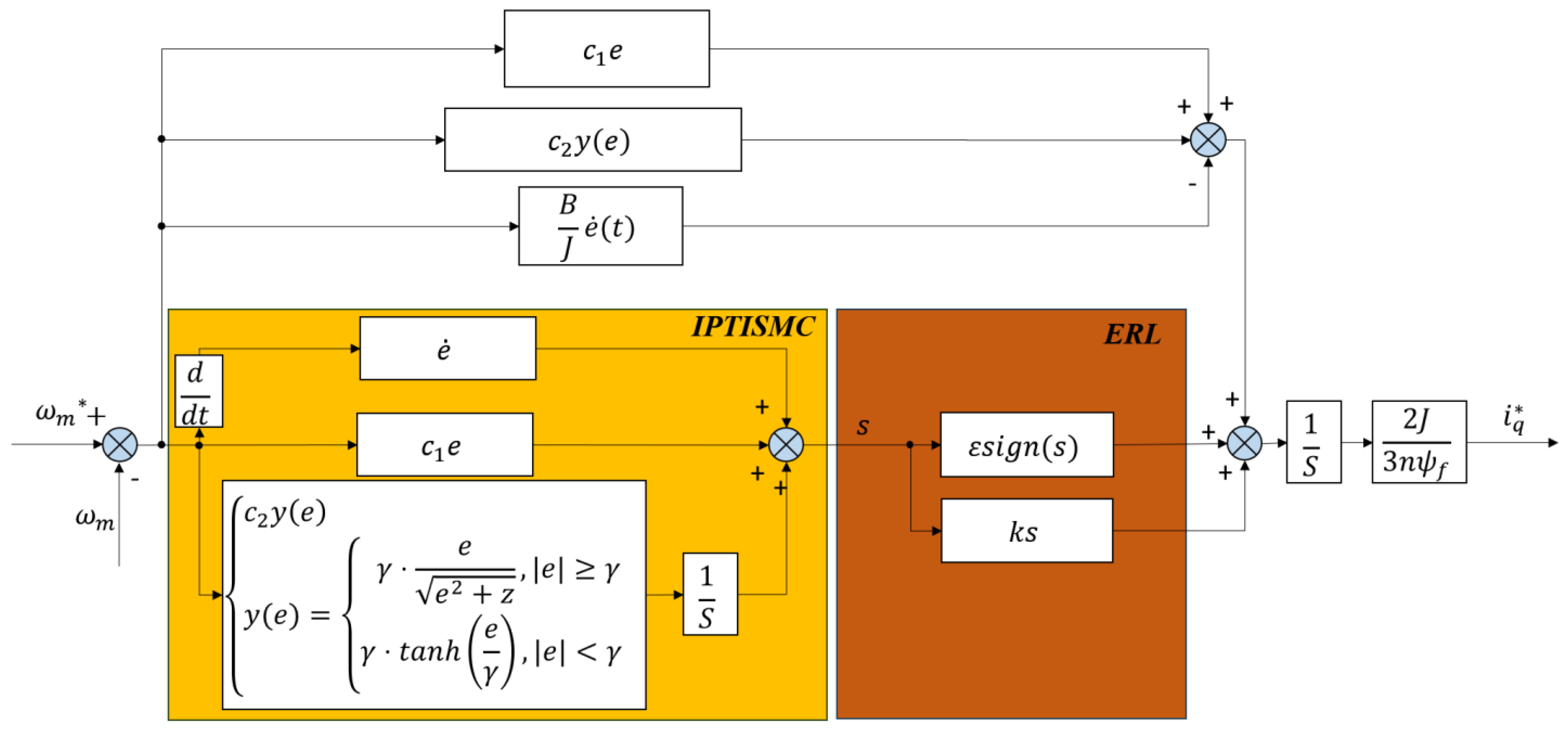
where ε and k are the gain coefficients. Figure 1 shows the block diagram of the IPTISMC-ERL system. Differentiating Equation (9) yields:
s ˙ = e ¨ + c 1 e ˙ + c 2 y e
Combining Equations (2), (3), (10), and (11), the q-axis reference current can be obtained as:
i q * = 2 J 3 n ψ f 0 t c 1 e ˙ + c 2 y e B e ˙ J + ε s i g n s + k s d t
The stability of Equation (12) is verified by Proof 1:
Proof 1.
Construct the Lyapunov function V 1 = 1 2 s 2 . Taking its time derivative yields:
V ˙ 1 = s s ˙ = s ε s i g n s k s = ε s k s 2
From Equation (13), since ε > 0 and k > 0 , it follows that V ˙ 1 0 , with equality if and only if s = 0 . According to the Lyapunov global asymptotic stability criterion, the system trajectories are globally uniformly bounded. This completes the proof. □
It can be seen from Equation (11) that increasing ε and k can improve the convergence speed and robustness of the system, but it will also aggravate the chattering phenomenon and degrade the control accuracy. When the system states approach the sliding-mode surface, the convergence speed of the linear term k s approaches zero, resulting in insufficient overall convergence speed. Therefore, IPTISMC-ERL struggles to balance the contradiction between chattering and convergence speed. To overcome the above problems, a novel reaching law (ASERL) is designed:
s ˙ = l 1 Γ + s | s | σ t a n h η s l 2 | s | δ t a n h ( | s | 1 ) s
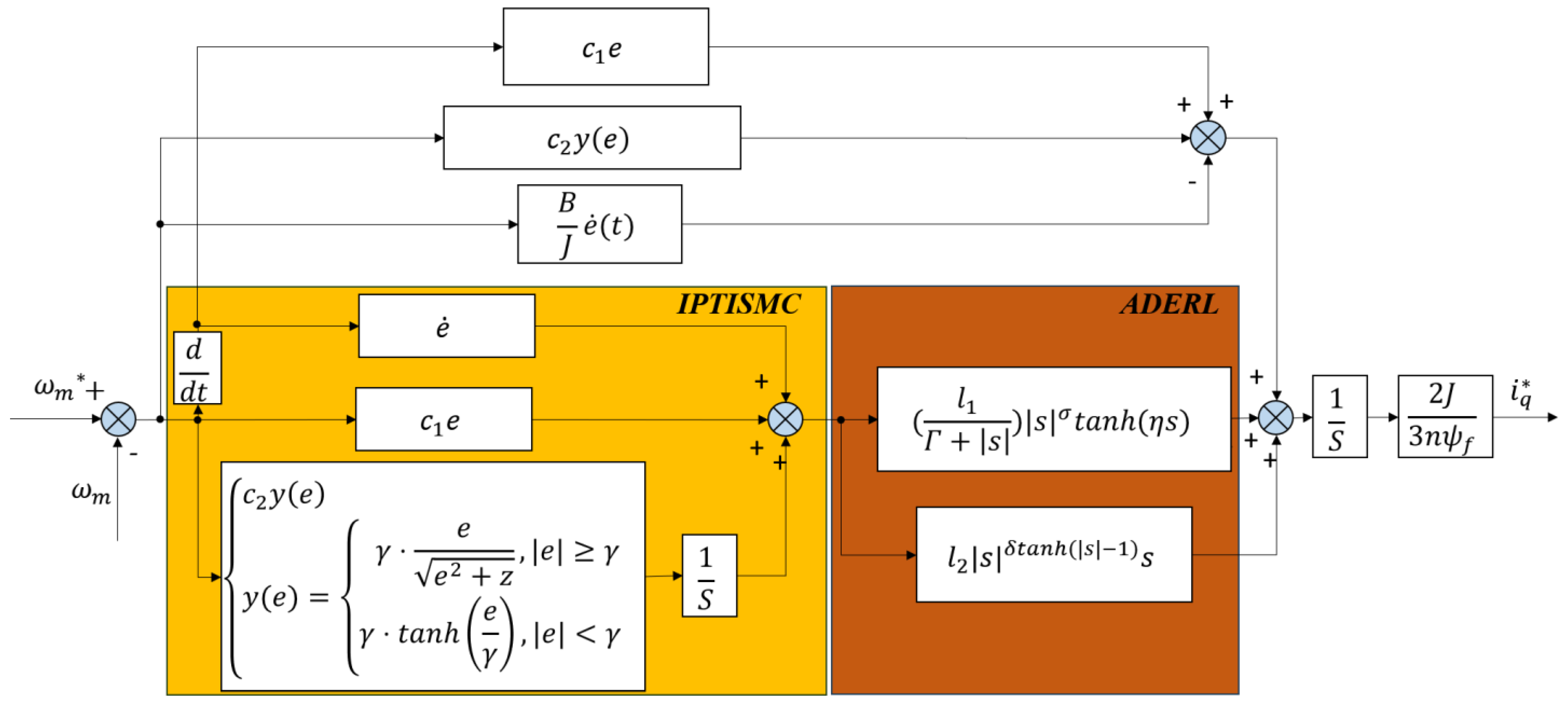
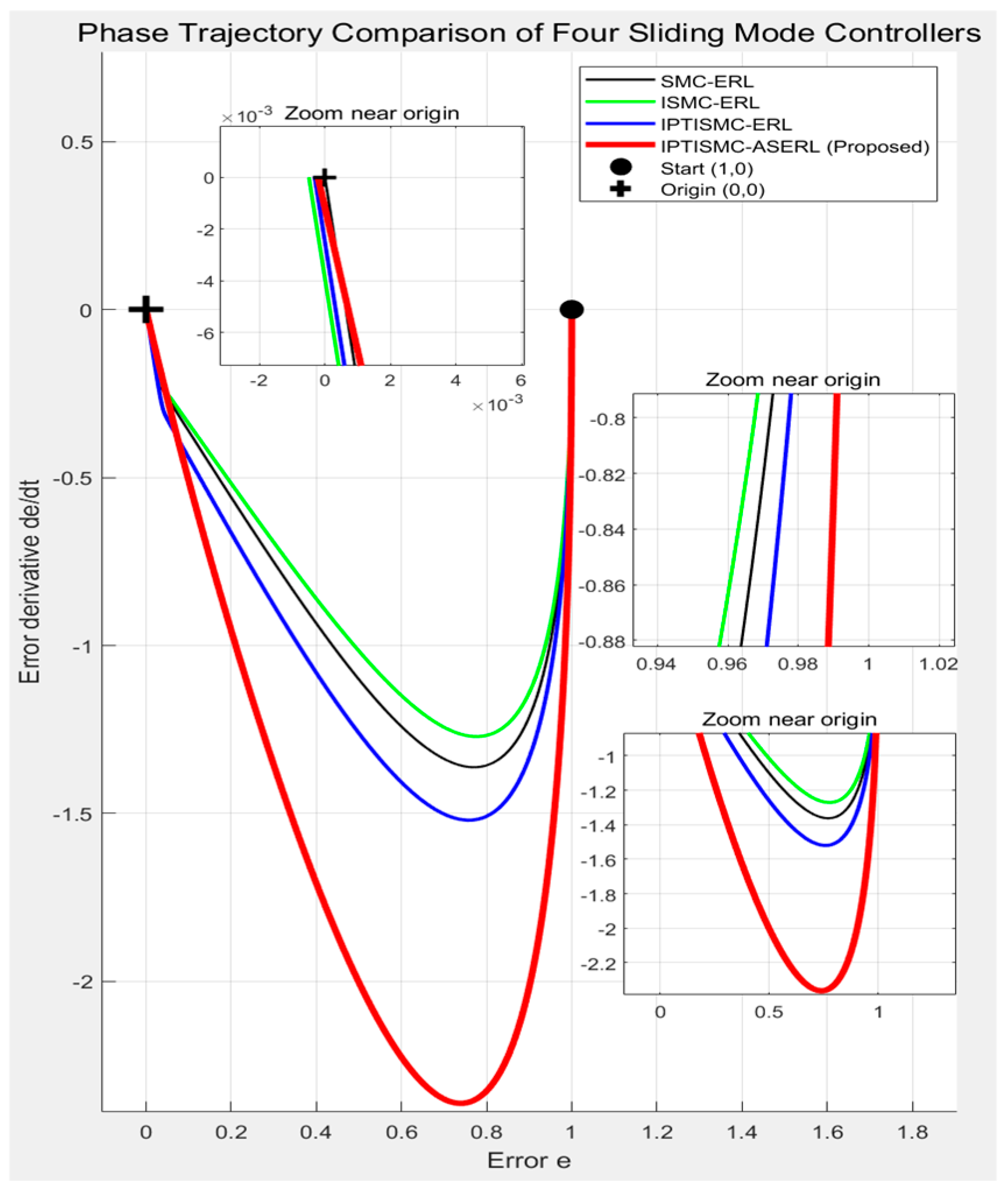
where l 1 > 0 , l 2 > 0 , Γ > 0 , η > 0,0 < σ < 1 , δ < 1 . According to Equation (14), the following characteristics can be derived: When s > 1 (system states far from the sliding-mode surface), t a n h s 1 1 , the exponent of l 2 | s | δ t a n h ( | s | 1 ) s is approximately δ , and its amplitude l 2 | s | δ + 1 increases significantly with the rise of s . In the first term, l 1 Γ + s l 1 s and t a n h η s s i g n ( s ) , whose amplitude decreases with the increase of s . At this stage, l 2 | s | δ t a n h ( | s | 1 ) s plays a dominant role, providing a strong driving force to greatly improve the system convergence speed. When s = 1 (system states in the transition stage), t a n h s 1 = 0 , l 2 | s | δ t a n h ( | s | 1 ) s is approximately l 2 s , and ( l 1 Γ + s ) | s | σ t a n h η s is approximately ( l 1 Γ + 1 ) s i g n ( s ) . The superposition of the two amplitudes satisfies l 1 Γ + s + l 2 > ρ (ρ is a small positive number), maintaining a high convergence rate to avoid convergence stagnation. When s < 1 (system states close to the sliding-mode surface), t a n h s 1 ( 1 s ) , the exponent of l 2 | s | δ t a n h ( | s | 1 ) s is approximately δ ( 1 s ) , and its amplitude converges smoothly to 0 with the decrease of s . At the same time, t a n h η s η s in the first term, whose amplitude approaches 0 as s decreases. Moreover, t a n h η s replaces the discontinuous s i g n ( s ) , which effectively suppresses chattering. Overall, this reaching law eliminates the discontinuity of the control quantity and suppresses chattering through the t a n h η s term and the adaptive gain l 1 Γ + s in the first component. Meanwhile, the exponential term δ t a n h ( | s | 1 ) in the second component realizes the adaptive regulation of “strong driving far from the sliding-mode surface and high sensitivity near the sliding-mode surface”. It not only ensures the fast response when the states are far from the sliding-mode surface, but also guarantees the smoothness when approaching the sliding-mode surface, thus improving the robustness and dynamic performance of the permanent magnet synchronous motor control system under different operating conditions. Figure 2 shows the block diagram of the IPTISMC-ASERL system. Figure 3 shows the phase trajectories obtained with different control methods.
To further weaken the sliding-mode chattering, combining Equations (2), (3), (9), and (11), the q-axis reference current can be obtained as:
i q * = 2 J 3 n ψ f 0 t c 1 e ˙ + c 2 y e B e ˙ J + ( l 1 Γ + | s | ) | s | σ t a n h η s + l 2 | s | δ t a n h ( | s | 1 ) s d t
The stability of Equation (15) is verified by Proof 2:
Proof 2.
Construct the Lyapunov function V 2 = 1 2 s 2 . Taking its time derivative yields:
V ˙ 2 = s s ˙ = s ( l 1 Γ + s ) | s | σ t a n h η s l 2 | s | δ t a n h ( | s | 1 ) s = ( l 1 Γ + s ) | s | σ + 1 t a n h η s l 2 | s | δ t a n h s 1 + 2
From Equation (15), since l 1 > 0 , l 2 > 0 , Γ > 0 , η > 0,0 < σ < 1 , δ < 1 , it can be obtained that V ˙ 2 0 , with equality if and only if s = 0 . According to Lyapunov stability theory, the system is globally stable and the system trajectories are globally uniformly bounded.
Next, the finite-time convergence of the adaptive smooth exponential reaching law on the sliding-mode surface is proved. □
Proof 3.
Choose V 3 = 1 2 s 2 , then V 3 is positive definite and radially unbounded.
V ˙ 3 = s s ˙ = s ( l 1 Γ + s ) | s | σ t a n h η s l 2 | s | δ t a n h ( | s | 1 ) s l 2 | s | δ t a n h s 1 + 2
Let β ( s ) = δ t a n h s 1 + 2 . When s 1 , 0 β ( s ) δ ; when s < 1 , δ β ( s ) < 0 . When s 1 , β ( s ) 0 , thus
| s | β s + 2 | s | 2 = 2 V 3
Substituting yields:
V ˙ 3 2 l 2 V 3
This inequality ensures exponential convergence, and the states will enter the region s < 1 in finite time. When s < 1 , we have β s δ 2 (since tanh s 1 tanh 1 < 0   a n d tanh 1 > 0.76 , we can take θ = δ 2 ), then:
| s | β s + 2 | s | 2 θ
From (14) we obtain:
V ˙ 3 2 l 2 | s | 2 θ = l 2 ( 2 V 3 ) 1 θ 2 = ζ V 3 1 θ 2
where ζ = l 2 2 1 θ 2 > 0 and 1 θ 2 ( 0,1 ) . Thus, the system converges in finite time.
By separating variables on both sides of Equation (21) and integrating, we obtain the upper bound of the convergence time T s :
T s 2 ζ θ V 3 ( 0 ) θ 2
To quantitatively evaluate the performance of the proposed controller under disturbances, the steady-state error of the system is analyzed in this section. Considering the existence of lumped bounded disturbance d ( t ) , the system dynamic Equation (2) is extended as:
J ω ˙ m = T e T L B ω m + d ( t )
where d t D and D > 0 denotes the upper bound of the disturbance. As stated previously, the stability and finite-time convergence of the system have been rigorously proved via Lyapunov functions (see Proofs 2 and 3). When the system enters the steady-state sliding motion, the sliding variable s evolves within a small neighborhood, and thus s ˙ 0 can be assumed. Substituting the adaptive smooth exponential reaching law (14) under steady-state conditions yields:
0 s ˙ = l 1 Γ + s s σ t a n h η s l 2 s δ t a n h s 1 s + d t J
where d t / J represents the normalized disturbance. Within the small steady-state error neighborhood (i.e., s is small), the magnitude of the exponential term l 2 s δ t a n h s 1 s in (14) approaches zero, and t a n h η s η s holds. Meanwhile, since Γ s , l 1 Γ + s l 1 Γ . Considering the worst-case disturbance sign, the approximate equilibrium relation satisfied by the steady-state sliding variable magnitude s s s can be derived from (24):
l 1 η Γ s s s σ + 1 D J
Accordingly, the explicit upper-bound estimate of the system steady-state error is obtained as:
s s s s Γ D l 1 η J 1 σ + 1
Equation (26) provides an explicit steady-state error bound of the system under disturbances. It directly establishes a quantitative relationship between the error upper bound and the controller parameters ( l 1 , Γ , η , σ ), indicating that increasing l 1 or η , or decreasing Γ , can reduce the error bound, thus theoretically guaranteeing the robustness of the controller.

4. Experimental Results and Conclusions

4.1. Experimental Setup and Platform

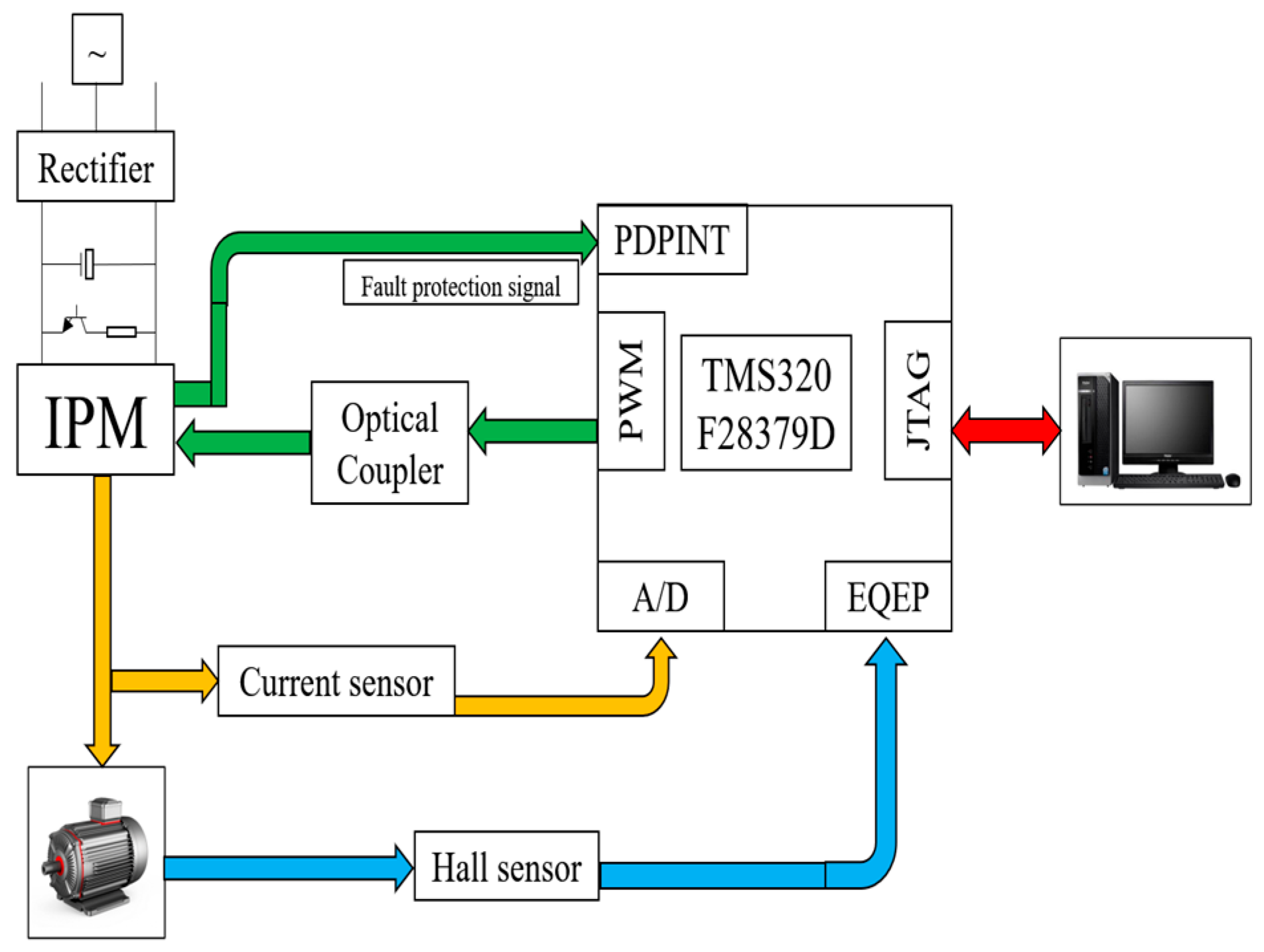
The hardware system of the experimental platform in this study is illustrated in Figure 4. Physical experiments were carried out to verify the effectiveness of the proposed IPTISMC-ASERL strategy. The platform mainly consisted of the following components: a host computer, a TMS320F28379D DSP controller, a three-phase inverter power module based on the DRV8323H gate driver, and a permanent magnet synchronous motor (PMSM) back-to-back test bench with rated powers of 200 W and 600 W, which was equipped with a dynamic torque sensor. The speed and position feedback signals were provided by a 2500-line incremental encoder, and the phase current sampling was implemented by the integrated current sense amplifiers inside the DRV8323H. This DSP controller fully meets the real-time computational requirements of the control algorithm. The proposed scheme incorporating segmented sliding surface design and adaptive smooth reaching law for IPTISMC-ASERL serves as a universal control framework, which can be generalized to the tracking control problems of other second-order nonlinear systems (e.g., unmanned aerial vehicles, UAVs), provided that the accurate dynamic equations of system errors are derived.
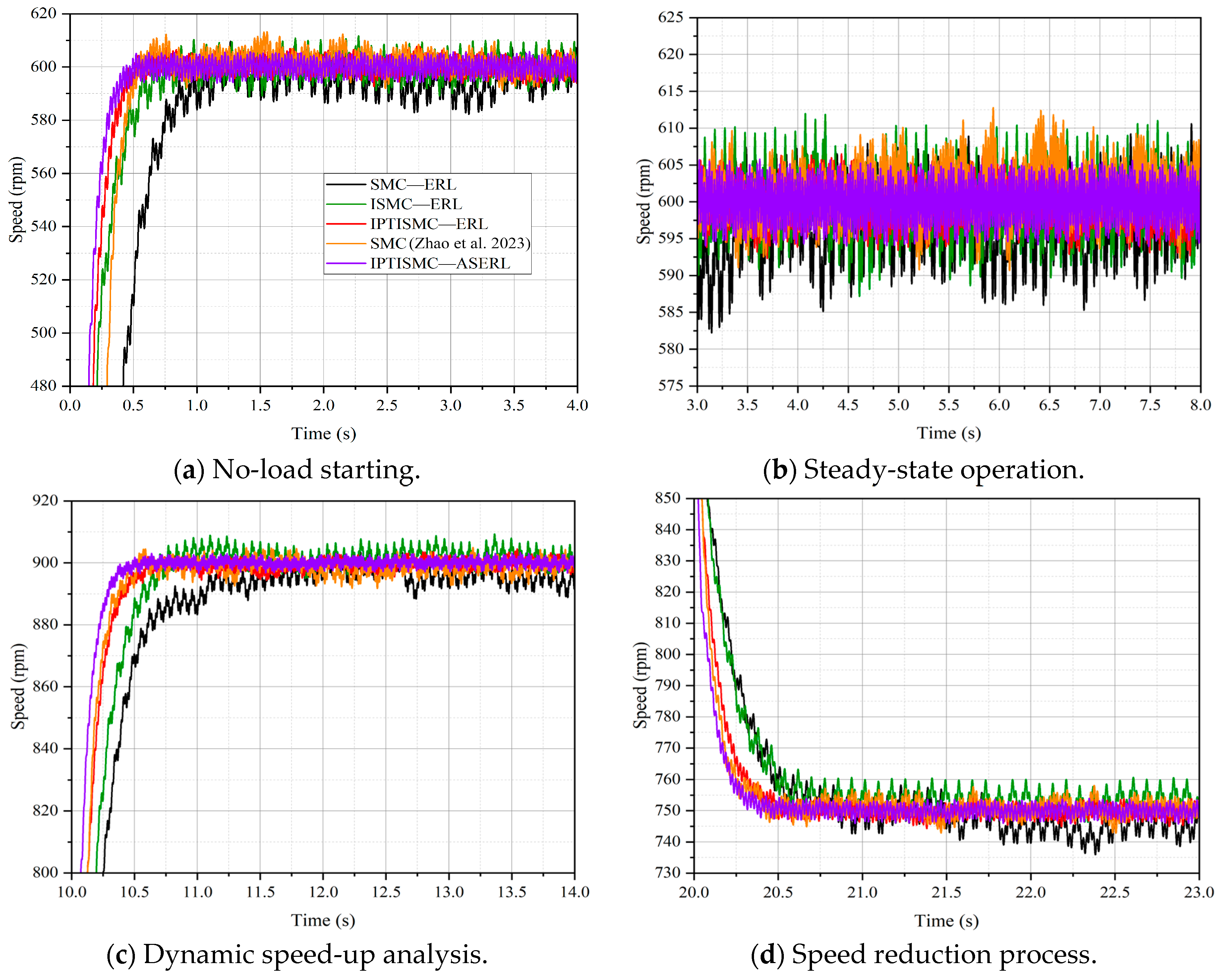
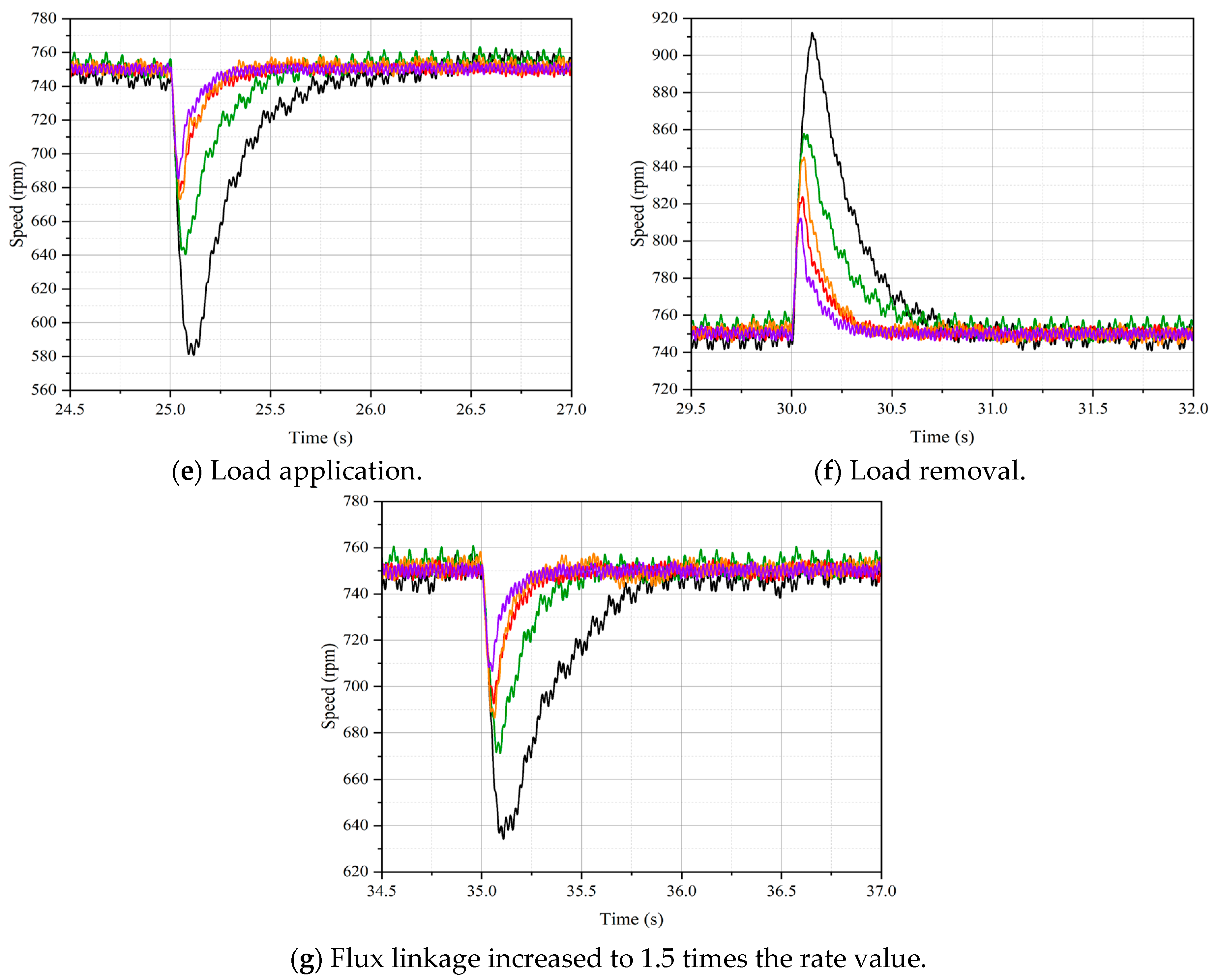
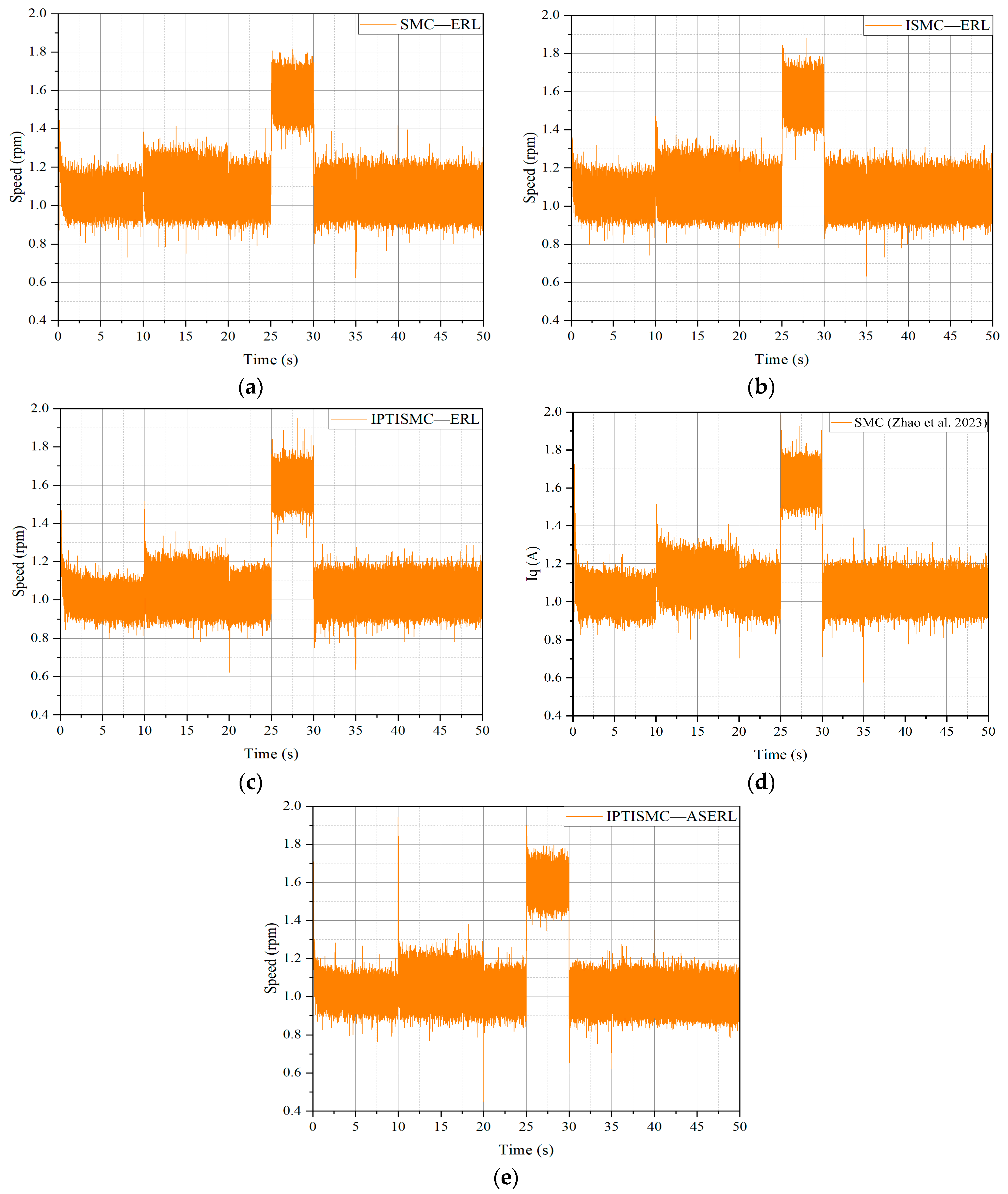
Experimental conditions were set as follows: The motor started at no-load to the rated speed of 600 r/min; the speed rose to 900 r/min at 10 s; the speed dropped to 750 r/min at 20 s; a load torque of 0.07 N·m was suddenly applied at 25 s; the load torque of 0.07 N·m was removed at 35 s; and the flux linkage was increased to 1.5 times the original value at 35 s. The speed waveform and q-axis current waveform are shown in Figure 5 and Figure 6, respectively.
The parameters of the PMSM and controller are listed in Table 1 and Table 2, respectively. In the experiment, the controller sampling frequency and SVPWM switching frequency were both set to 10 kHz (a common engineering frequency for PMSM speed control), and the cut-off frequency of the low-pass filter for signal processing was 0.001 Hz. This 10 kHz frequency matches the ITISMC-ADERL algorithm’s real-time and adaptive adjustment requirements, complies with the Nyquist sampling theorem to avoid signal distortion and phase lag, and is compatible with the TMS320F28379D DSP’s computing performance. A high-order low-pass filter (0.001 Hz cut-off) post-processed the torque sensor signal to suppress ultra-low-frequency drift and DC offset, while the encoder-derived speed feedback signal directly participated in control law computation to ensure dynamic response bandwidth.
The main computational burden of the IPTISMC-ASERL algorithm originates from the calculations of the piecewise function y e , hyperbolic tangent function t a n h η s , adaptive gain ( l 1 Γ + s ) , and power operation | s | σ . All these operations can be performed efficiently on the TMS320F28379D DSP. The adopted control frequency of 10 kHz (with a 100 μs control period) retains a sufficient computational margin, which validates the engineering implementability of the algorithm.
To ensure a fair comparison, all controllers (SMC-ERL, ISMC-ERL, IPTISMC-ERL, SMC from [27], and the proposed IPTISMC-ASERL) were independently and carefully tuned to their optimal performance using a unified set of performance criteria. These criteria emphasize fast dynamic response (short rise and settling time), high steady-state accuracy (small speed ripple), and strong disturbance rejection (low speed deviation and recovery time). The standardized parameter tuning process of the controller is summarized in Table 3.
To ensure a fair comparison, the key parameters were unified for all controllers:
c 1 = 8 : Determined by the electromechanical time constant T m = J / B 1.29 s, satisfying c 1 > 1 / T m 0.78 for stability.
z = 0.05 , Γ = 200 , η = 0.5 : Typical engineering values to balance driving force, chattering, and smoothness.
Unified Implementation Rules:
(1)
Follow the fixed tuning order: stability → accuracy → dynamic performance.
(2)
Adjust only one parameter at each step to avoid coupling effects.
(3)
All fine-tuning must satisfy the theoretical boundaries and performance criteria.
(4)
Each final parameter set is verified by five repeated experiments.

4.2. Experimental Results and Performance Analysis

To comprehensively validate the effectiveness and performance superiority of the proposed IPTISMC-ASERL, full-working-condition comparative experiments are carried out in this section using a TMS320F28379D DSP hardware platform. The selection of comparison schemes, parameter tuning, and working condition boundary settings strictly follow the academic principles of fairness, rationality, and single-variable control, with the state-of-the-art algorithm from ref. [27] adopted as the benchmark to ensure the rigor, objectivity, and reproducibility of the experimental results. Each experimental operating condition was independently repeated five times under identical conditions.

4.2.1. No-Load Starting Analysis

Figure 5a shows the speed response curve of the motor starting from standstill to 600 r/min. For SMC-ERL, the fixed gain of the reaching law cannot adapt to the large initial error, resulting in a rise time of 0.85 s and a slight overshoot. ISMC-ERL improves the convergence speed by virtue of the terminal power term, and the overshoot is alleviated, but the response still lags (0.65 s). IPTISMC-ERL shortens the rise time to 0.5 s without overshoot by optimizing the structure of the sliding-mode surface. The proposed IPTISMC-ASERL exhibits the best performance, with a rise time of only 0.4 s and no overshoot. The dynamic gain adjustment of the adaptive exponential reaching law and the anti-integral-windup capability of the nonlinear integral sliding-mode surface achieve a fast and stable response during the start-up phase.

4.2.2. Steady-State Operation Analysis

Figure 5b shows that when the motor operates steadily at 600 r/min, this ensures that all control methods, which are compared under identical operating conditions, are subject to the same practical noise interference. SMC-ERL exhibits the most severe chattering with a speed peak-to-peak value of 10 rpm, which is caused by the high-frequency switching of the control signal resulting from the sign function. ISMC-ERL reduces the peak-to-peak value to 8 rpm by introducing an integral term, but slight fluctuations still exist. Benefiting from the nonlinear integral term, IPTISMC-ERL further suppresses the chattering to 5 rpm and improves the operating smoothness. The proposed IPTISMC-ASERL achieves the best performance, with a speed peak-to-peak value of only 4 rpm. This is because the adaptive smooth reaching law generates a strong attraction field when approaching the sliding-mode surface, avoiding high-frequency switching of the control signal. Meanwhile, the adaptive gain effectively suppresses excessive control action, ensuring the accuracy and stability of steady-state operation.

4.2.3. Dynamic Speed-Up Analysis

Figure 5c depicts the dynamic response curve of the motor during speed-up from 600 r/min to 900 r/min. The fixed gain of SMC-ERL fails to adapt to large error variations, leading to slow response with a transition time of 1.05 s. ISMC-ERL optimizes the sliding-mode surface and shortens the transition time to 0.75 s, but the smoothness is degraded due to integral saturation. IPTISMC-ERL further reduces the transition time to 0.6 s with no overshoot. The proposed IPTISMC-ASERL achieves the best performance, with a transition time of only 0.5 s and no overshoot. The synergistic effect of the adaptive reaching law and the improved terminal integral sliding-mode surface enables fast and smooth speed tracking, and its dynamic speed-up performance is significantly superior to other comparative methods.

4.2.4. Dynamic Analysis of Speed Reduction Process

Figure 5d presents the dynamic response curve of the motor during speed reduction from 900 r/min to 750 r/min. The fixed gain of SMC-ERL cannot adjust the torque rapidly, resulting in fluctuations, with a transition time of 0.8 s and slight reverse overshoot. ISMC-ERL alleviates the overshoot and shortens the transition time to 0.7 s, but fluctuations still exist. IPTISMC-ERL achieves overshoot-free speed reduction by suppressing integral saturation, with a transition time of 0.55 s. The proposed IPTISMC-ASERL performs the best, with no overshoot and a transition time of only 0.45 s. The dynamic gain adjustment of the adaptive reaching law combined with the piecewise improved terminal integral sliding-mode surface ensures a smooth drop in speed, highlighting outstanding stability and rapidity in the dynamic speed reduction process.

4.2.5. Sudden Disturbance Rejection Performance Analysis

Figure 5e (sudden 0.07 N·m load application) and Figure 5f (sudden 0.07 N·m load removal) demonstrate that SMC-ERL has the weakest disturbance rejection: speed drops by 169 r/min with 0.8 s recovery time under load application, and 0.85 s recovery time under load removal. ISMC-ERL reduces the speed deviation to 110 r/min (recovery time: 0.6 s) under load application and 0.55 s under load removal, but with compensation lag. IPTISMC-ERL, via the nonlinear integral term to suppress integral saturation, reduces speed deviation to 72 r/min and recovery time to 0.4 s for both cases. The proposed IPTISMC-ASERL achieves the optimal performance: 65 r/min speed deviation and 0.28 s recovery time under load application, and 0.3 s recovery time under load removal. Compared with SMC-ERL, it improves disturbance rejection by 61.5% and shortens the recovery time by 65% under load application, and enhances disturbance rejection by 61.25% and reduces recovery time by 64.7% under load removal. The synergy of the adaptive reaching law and improved sliding-mode surface enables rapid load disturbance compensation and stable speed operation.

4.2.6. Analysis of Flux Linkage Increased to 1.5 Times the Rated Value

Figure 5g shows that when the flux linkage suddenly increases to 1.5 times the rated value, the fixed gain of SMC-ERL cannot adapt to the parameter variation, resulting in a speed deviation of 115 r/min, 0.8 s recovery time, and severe oscillation. ISMC-ERL reduces the deviation to 78 r/min and shortens the recovery time to 0.5 s, but its parameter adaptability is still limited. IPTISMC-ERL further decreases the deviation to 58 r/min with 0.4 s recovery time, and the robustness is improved. The proposed IPTISMC-ASERL achieves the best performance with only 41 r/min speed deviation and 0.3 s recovery time. Under 1.5-fold flux linkage perturbation, it improves disturbance rejection by 64.3% compared with SMC-ERL. The synergy of the improved sliding-mode surface and adaptive reaching law effectively resists parameter perturbation, showing excellent robustness.
A quantitative comparison under full operating conditions was conducted between the proposed IPTISMC-ASERL and the SMC method in [27]. During no-load startup to 600 r/min, the rise time of IPTISMC-ASERL is 0.05 s shorter. In the steady state, its peak-to-peak speed fluctuation is only 4 r/min, while that of SMC [27] is 6.5 r/min. Under dynamic acceleration and deceleration, the transition times are 0.5 s and 0.45 s, respectively, without overshoot, whereas SMC [27] takes 0.55 s and 0.6 s with unsatisfactory tracking. Under a sudden 0.07 N·m load, the speed drop of the proposed strategy is 7 r/min lower. Under 1.5-fold flux linkage perturbation, IPTISMC-ASERL has a 41 r/min speed drop and 0.30 s recovery time, while SMC [27] shows a 62 r/min drop and 0.450 s recovery time. These results sufficiently verify that IPTISMC-ASERL achieves remarkable improvements in dynamic response, steady-state accuracy, chattering suppression, disturbance rejection, and parameter robustness over SMC [27], showing strong potential for complex rail transit traction conditions.
Experiments were carried out to evaluate the system uncertainties under two typical operating conditions: sudden load mutation and parameter perturbations (variable permanent magnet flux linkage). The results verify that the adaptive mechanism of ASERL and the strong robustness of IPTISML provide excellent suppression against such uncertainties. For unmodeled dynamics or more drastic parameter variations, the proposed method can still maintain theoretical stability, as its Lyapunov stability has been rigorously proven.
Figure 5. Speed experiment [27].
Energies 19 01992 g005aEnergies 19 01992 g005b
Every experimental condition was conducted repeatedly on numerous occasions. The data illustrated in the figures of this study are derived from one typical test run, while the performance metrics compiled in Table 4 are the average values from repeated test runs.
The q-axis current waveform shown in Figure 6 further reveals the performance differences among various control methods. In the start-up phase, SMC-ERL and ISMC-ERL present obvious overshoot in the speed response with large overall fluctuation amplitude and poor steady-state convergence values. In contrast, the overshoot of IPTISMC-ERL and IPTISMC-ASERL is significantly reduced, leading to a smoother start-up process. During the steady-state operation stage, SMC-ERL and ISMC-ERL maintain continuous speed oscillations with insufficient steady-state accuracy. The oscillation amplitude of IPTISMC-ERL is narrowed, while IPTISMC-ASERL further suppresses high-frequency glitches and achieves better steady-state smoothness. In the load disturbance stage, a sudden speed rise occurs in all control strategies, but IPTISMC-ASERL has the lowest overshoot peak and smoother fluctuations during the disturbance, reflecting stronger disturbance rejection ability. SMC-ERL and ISMC-ERL exhibit more severe oscillations with relatively slow recovery speed.
Figure 6. Q-axis current waveform. (a) SMC-ERL. (b) ISMC-ERL. (c) IPTISMC-ERL. (d) SMC [27]. (e) IPTISMC-ASERL.
Energies 19 01992 g006
From the perspective of the steady-state recovery stage after disturbance, SMC-ERL and ISMC-ERL still exhibit large speed fluctuations, and the steady-state error is not effectively improved. This is due to the inherent chattering problem of conventional SMC, coupled with the lack of adaptive capability in its event-triggered mechanism, which makes it difficult to maintain high-precision control under complex disturbances. Although ISMC-ERL introduces an integral term to eliminate steady-state errors, it does not fundamentally solve the chattering problem, resulting in limited performance improvement. In contrast, IPTISMC-ERL achieves fast finite-time convergence through the terminal sliding-mode structure, and further suppresses steady-state errors by combining with the integral term, significantly improving steady-state accuracy and dynamic response. On this basis, IPTISMC-ASERL is upgraded with an adaptive smooth transition mechanism, which can dynamically adjust the triggering conditions according to system states, effectively reduce unnecessary control updates, and thus better suppress high-frequency chattering, enhancing the robustness and steady-state stability of the system. In summary, under the loaded condition at 25 s when the system achieves stable convergence, the q-axis current of IPTISMC-ASERL (1.46–1.73 A) is reduced by 0.1 A compared with SMC-ERL (1.4–1.78 A). The transient peak value of the q-axis current during sudden load variations is decreased by a certain percentage, and the high-frequency ripple of the current in a steady state is significantly mitigated. IPTISMC-ASERL presents comprehensive advantages in steady-state accuracy, disturbance rejection ability, and fluctuation suppression, demonstrating strong potential for high-precision speed control scenarios of permanent magnet synchronous motors.

5. Conclusions

This paper takes the SPMSM as the research object. Aiming at the defects of conventional sliding-mode control (severe chattering, unbalanced convergence speed and control accuracy, insufficient disturbance rejection, and parameter robustness) in SPMSM speed regulation, an IPTISMC-ASERL control strategy is proposed. Firstly, the PMSM mathematical model under the d-q rotating coordinate system is established; a piecewise terminal integral sliding-mode surface is designed to correct the defects of the traditional terminal sliding-mode surface, and an adaptive smooth exponential reaching law is proposed to optimize the reaching process. The system’s global stability and finite-time convergence are proved by Lyapunov stability theory. Finally, comparative experiments on a DSP platform verify the practicability and superior control performance of the proposed strategy.
(1)
The piecewise terminal integral sliding-mode surface achieves fast system convergence and high steady-state accuracy through piecewise cooperative control in large and small error regions and the smooth nonlinearity of the hyperbolic tangent term, effectively suppressing sliding-mode chattering.
(2)
The adaptive smooth exponential reaching law adaptively adjusts gain according to the sliding-mode surface state quantities, replaces the discontinuous sign function with a continuously differentiable hyperbolic tangent function, alleviates the contradiction between convergence speed and chattering caused by fixed gain, and realizes fast and smooth motor speed tracking.
(3)
The synergy of the two components greatly enhances the system’s disturbance rejection ability and parameter robustness, quickly compensates for load disturbances, mitigates parameter perturbation impacts, and improves system speed stability and adaptability under complex conditions.
The IPTISMC-ASERL control strategy provides an effective solution for high-precision SPMSM speed regulation, with obvious core advantages compared with conventional sliding-mode control. Future research can combine disturbance observer technology to compensate for unknown disturbances and parameter perturbations, explore more efficient parameter tuning methods to enhance practical applicability, and extend the algorithm from the experimental platform to diverse industrial scenarios to further improve system performance.

Author Contributions

Conceptualization, J.W.; Methodology, J.W.; Software, J.W.; Validation, J.W. and Z.W.; Formal analysis, J.Z.; Investigation, J.W., Z.W. and J.Z.; Writing—original draft, J.W.; Writing—review & editing, J.W.; Visualization, J.W.; Supervision, Z.W. and J.Z.; Funding acquisition, Z.W. All authors have read and agreed to the published version of the manuscript.

Funding

This research received no external funding.

Data Availability Statement

The data supporting the findings of this study are contained within the article. All further inquiries about the data can be directed to the corresponding authors.

Conflicts of Interest

Author Jingyu Zhang was employed by State Grid Jilin Electric Power Co., Ltd., Changchun Jiutai District Power Supply Company, Changchun, China. His contributions to this study were restricted to the investigation and data collation activities listed in the Author Contributions Section. This employment relationship exerted no influence on the design, implementation, data analysis, and conclusions of the present study, and does not give rise to any potential or actual conflicts of interest. The remaining authors declare that the research was conducted in the absence of any commercial or financial relationships that could be construed as a potential conflict of interest. None of the funding bodies in this study participated in any aspects of research design, data collection and analysis, manuscript writing, or the decision to submit for publication.

References

  1. Zhang, L.; Tao, R.; Zhang, Z.-X.; Chien, Y.-R.; Bai, J. PMSM non-singular fast terminal sliding mode control with disturbance compensation. Inf. Sci. 2023, 642, 119040. [Google Scholar] [CrossRef]
  2. Zhang, L.; Tao, R.; Li, X. Model-Free Adaptive Second Order Sliding Mode Control for PMSM in Electric Traction Systems Based on Terminal Attractor. IEEE Trans. Power Electron. 2026, in press. [Google Scholar]
  3. Ma, X.; Zhang, L.; Xu, Y.; Bai, J. Model-free control of permanent magnet synchronous motors with improved terminal sliding mode based on a modified exponential reaching law. Control. Eng. Pract. 2026, 166, 106630. [Google Scholar] [CrossRef]
  4. Ma, J.; Luo, C.; Qiu, L.; Liu, X.; Xu, B.; Shou, J.; Fang, Y. Recent advances in traction drive technology for rail transit. J. Zhejiang Univ.-Sci. A 2023, 24, 177–188. [Google Scholar] [CrossRef]
  5. Dai, Y.; Xu, J.; Yan, K.; Xu, D.; Yang, C. A High-Precision Parameter Identification Framework for Permanent Magnet Synchronous Traction Motors in Urban Rail Trains. IEEE Trans. Instrum. Meas. 2025, in press. [Google Scholar]
  6. Shujie, Q. Design and Comparison of Novel Permanent Magnet Synchronous Traction Motor for Rail Transit. Urban Mass Transit 2026, 24, 110–114. [Google Scholar]
  7. Ajasa, A.; Aremu, M.B.; Nasir, A. Sliding-Mode Control Strategies for PMSM speed control: A Comprehensive Review, Taxonomy and Research Gaps. arXiv 2025, arXiv:2510.18420. [Google Scholar] [CrossRef]
  8. Li, K.; Ding, J.; Sun, X.; Tian, X. Overview of sliding mode control technology for permanent magnet synchronous motor system. IEEE Access 2024, 12, 71685–71704. [Google Scholar] [CrossRef]
  9. Hu, M.; Wei, C.; Zhang, L.; Wang, P.; Zhang, D.; Xie, T. Sliding Mode Control of Symmetric Permanent Magnet Synchronous Motor Based on Novel Adaptive Reaching Law and Combining Improved Terminal Fast Sliding Mode Disturbance Observer. Symmetry 2025, 17, 2057. [Google Scholar] [CrossRef]
  10. Jin, D.; Liu, L.; Lin, Q.; Liang, D. Sensorless control strategy of PMSM with disturbance rejection based on adaptive sliding mode control law. IEEE Trans. Transp. Electrif. 2023, 10, 5424–5438. [Google Scholar] [CrossRef]
  11. Lu, H.; Yang, D.; Su, Z. Improved sliding mode control for permanent magnet synchronous motor servo system. IET Power Electron. 2023, 16, 169–179. [Google Scholar] [CrossRef]
  12. Tu, L.X.; Zhao, K.; Fang, B.; Jia, L.; Huang, Y. A Novel Model-Free Adaptive Sliding Mode Control of PMSM Based on Dynamic Linearization. Int. J. Circuit Theory Appl. 2025, in press. [Google Scholar] [CrossRef]
  13. Yoon, G.; Bak, Y. Chattering Reduction Using Various Switching Functions in the Sliding Mode Control Method for PMSM Drives. Electronics 2026, 15, 816. [Google Scholar] [CrossRef]
  14. Zhang, Q.; Zhang, C. Speed control of PMSM based on fuzzy active disturbance rejection control under small disturbances. Appl. Sci. 2023, 13, 10775. [Google Scholar] [CrossRef]
  15. Yun, R.; Lin, J.; Wu, P. Design of PMSM Controller with Continuous Function Reaching Law and Integral Sliding Surface. In Proceedings of the 2024 4th International Conference on Industrial Automation, Robotics and Control Engineering (IARCE), Chengdu, China, 15–17 November 2024; IEEE: New York, NY, USA, 2024; pp. 84–87. [Google Scholar]
  16. Gong, Y.; Zhao, X.; Wang, L. A novel robust adaptive integral terminal sliding mode control for permanent magnet synchronous motors. J. Vib. Control 2025, 31, 10775463261424013. [Google Scholar] [CrossRef]
  17. Pei, H.; Fan, P.; Ma, X.; Wang, Y.; Yang, J. A fast adaptive sliding mode observer for permanent magnet synchronous motors based on new segmented reaching law. Proc. Inst. Mech. Eng. Part D J. Automob. Eng. 2025, 239, 09544070251387379. [Google Scholar] [CrossRef]
  18. Moudoud, B.; Aissaoui, H.; Diany, M. Adaptive integral-type terminal sliding mode control: Application to trajectory tracking for mobile robot. Int. J. Adapt. Control. Signal Process. 2023, 37, 603–616. [Google Scholar] [CrossRef]
  19. Özçiflikçi, O.E.; Koç, M.; Bahçeci, S.; Selçuk, E. Overview of PMSM control strategies in electric vehicles: A review. Int. J. Dyn. Control 2024, 12, 2093–2107. [Google Scholar] [CrossRef]
  20. Hu, M.; Zhang, L.; Tao, R.; Wang, P. Research on Speed Control of Permanent Magnet Synchronous Motor Based on Improved Fast Terminal Sliding Mode with Adaptive Control Law. Symmetry 2025, 17, 1586. [Google Scholar] [CrossRef]
  21. Chen, C.; Xie, Z.; Wang, X.; Lei, Z.; Shangguan, C. Sliding mode disturbance compensated speed control for PMSM based on an advanced reaching law. Int. J. Circuit Theory Appl. 2025, 53, 1541–1555. [Google Scholar] [CrossRef]
  22. Halledj, S.E.; Bouafassa, A. Anti-disturbance GITSMC with quick reaching law for speed control of PMSM drive. Bull. Electr. Eng. Inform. 2022, 11, 3228–3238. [Google Scholar] [CrossRef]
  23. Wang, F.; He, L.; Rodriguez, J. A robust predictive speed control for SPMSM systems using a sliding mode gradient descent disturbance observer. IEEE Trans. Energy Convers. 2022, 38, 540–549. [Google Scholar] [CrossRef]
  24. Li, C.; Pan, T.; Ding, S. Finite-Time Fast Integral Terminal Sliding Mode Speed Control Method with Disturbance Observer for SPMSM. IEEE Trans. Power Electron. 2025, in press. [Google Scholar]
  25. Guo, X.; Huang, S.; Peng, Y.; Lu, K.; Huang, S.; Luo, D.; Wu, X. An improved integral sliding mode control for PMSM drives based on new variable rate reaching law with adaptive reduced-order PI observer. IEEE Trans. Transp. Electrif. 2023, 9, 4503–4516. [Google Scholar] [CrossRef]
  26. Wang, H.; Jiao, T.; Xing, X.; Yang, Y. Speed regulation of PMSM systems based on a new sliding mode reaching law. IEEE Access 2024, 12, 24062–24070. [Google Scholar] [CrossRef]
  27. Zhao, K.; Liu, W.; Zhou, R.; Dai, W.; Wu, S.; Qiu, P.; Yin, Y.; Jia, N.; Yi, J.; Huang, G. Model-free fast integral terminal sliding-mode control method based on improved fast terminal sliding-mode observer for PMSM with unknown disturbances. ISA Trans. 2023, 143, 572–581. [Google Scholar] [CrossRef] [PubMed]
Figure 1. Block diagram of the IPTISMC-ERL.
Energies 19 01992 g001
Figure 2. Block diagram of the IPTISMC-ASERL.
Energies 19 01992 g002
Figure 3. Phase trajectories.
Energies 19 01992 g003
Figure 4. Experimental platform.
Energies 19 01992 g004
Table 1. SPMSM parameters.
ParametersNumerical Value
Number of pole pairs4
Stator winding resistance0.1 Ω
Stator inductance (d-q axis)1.9 × 10⁻⁴ H
Permanent magnet chain0.0133 Wb
Moment of inertia (mechanics)4.03 × 10⁻⁴ kg·m2
Viscous damping3.1136 × 10−4 N·m·s
Table 2. Controller parameters.
SMC-ERL c 1 = 8 ;   ε = 13,000 ;   k = 20
ISMC-ERL c 1 = 8 ;   ε = 12,700 ;   k = 18 ;   c 2 = 0.007
ITISMC-ERL c 1 = 8 ;   c 2 = 0.007 ;   γ = 0.8 ;   z = 0.05 ;   ε = 17,000 ;   k = 23
SMC [27] η 1 = 10 ;   η 2 = 0.003 ;   p = 5 ;   q = 7 ;   ε = 25,000 ;   λ = 25
ITISMC-ADERL c 1 = 8 ;   c 2 = 0.007 ;   γ = 0.8 ;   z = 0.05 ;   ε = 17000 ;   k = 23 ;   l 1 = 13,000 ;   Γ = 200 ;   σ = 0.6 ;   η = 0.5 ;   l 2 = 50 ;   δ = 0.02
Note: The control law in ref. [27] is given as: i q * = F + ω ˙ e * α + ε s g n ( s ) + λ s + e ¨ + η 2 | e | p / q s g n ( e ) α η 1 .
Table 3. Standardized parameter tuning procedure for controllers.
StepParameter ModuleTuned ParametersTheoretical Boundaries and Acceptance CriteriaEngineering Tuning MethodTuning Range
  • Basic Stability and Disturbance Rejection
Reaching Law ε , k (conventional); l1 (proposed)
(1)
Satisfy sliding-mode reachability V ˙ 2 < 0 .
(2)
Control output ≤ 2 A.
(3)
Speed drop ≤ 100 r/min at 0.07 N·m load.
(4)
Steady-state chattering ≤ 5 r/min.
Increase from 10,000 until requirements are met; reduce properly if chattering is excessive10,000~25,000
2.
Steady-State Accuracy Tuning
Sliding Surface c 1 , c 2
(1)
c 1 > 0.78 for system convergence.
(2)
c 2 > 0 to eliminate steady-state errors.
(3)
Overshoot ≤ 5% during acceleration.
c 1 = 8 (fixed, unified); c 2 increased from 0.001 step by stepc1 = 8 (unified)
c2: 0.001~0.01
3.
Dynamic Performance Optimization
Sliding Surface and Reaching Law γ , z , σ , δ , Γ , η , l 2
(1)
0.5 γ 1.0 , 0 < z , σ , δ < 1.
(2)
Γ > 0 , η > 0 for bounded adaptation.
(3)
(3) Rise time ≤ 0.6 s; recovery time ≤ 0.5 s.
γ fine-tuned around 0.8; others use engineering optimal values γ : 0.5~1.0
σ : 0.4~0.8
δ : 0.01~0.05
Table 4. Comparison of mean performance with standard deviation.
Control MethodsStart-Up Response Time (s)Speed Fluctuation (Chattering) (rpm)Acceleration Response Time (s)Speed Fluctuation Under Flux Linkage Variation (rpm)Speed Fluctuation Under Sudden Load Application (rpm)
SMC-ERL0.85101.05115169
ISMC-ERL0.6580.7578110
IPTISMC-ERL0.550.65872
SMC [27]0.556.50.556278
IPTISMC-ASERL0.440.54165
Note: The data represent the mean performance indices. The small standard deviations demonstrate high experimental repeatability.
Disclaimer/Publisher’s Note: The statements, opinions and data contained in all publications are solely those of the individual author(s) and contributor(s) and not of MDPI and/or the editor(s). MDPI and/or the editor(s) disclaim responsibility for any injury to people or property resulting from any ideas, methods, instructions or products referred to in the content.