Comparative Evaluation of Deep-Learning and SARIMA Models for Short-Term Residential PV Power Forecasting



Abstract
1. Introduction
1.1. Context and Motivation
1.2. Previous Work
1.3. Research Gap
1.4. Contributions
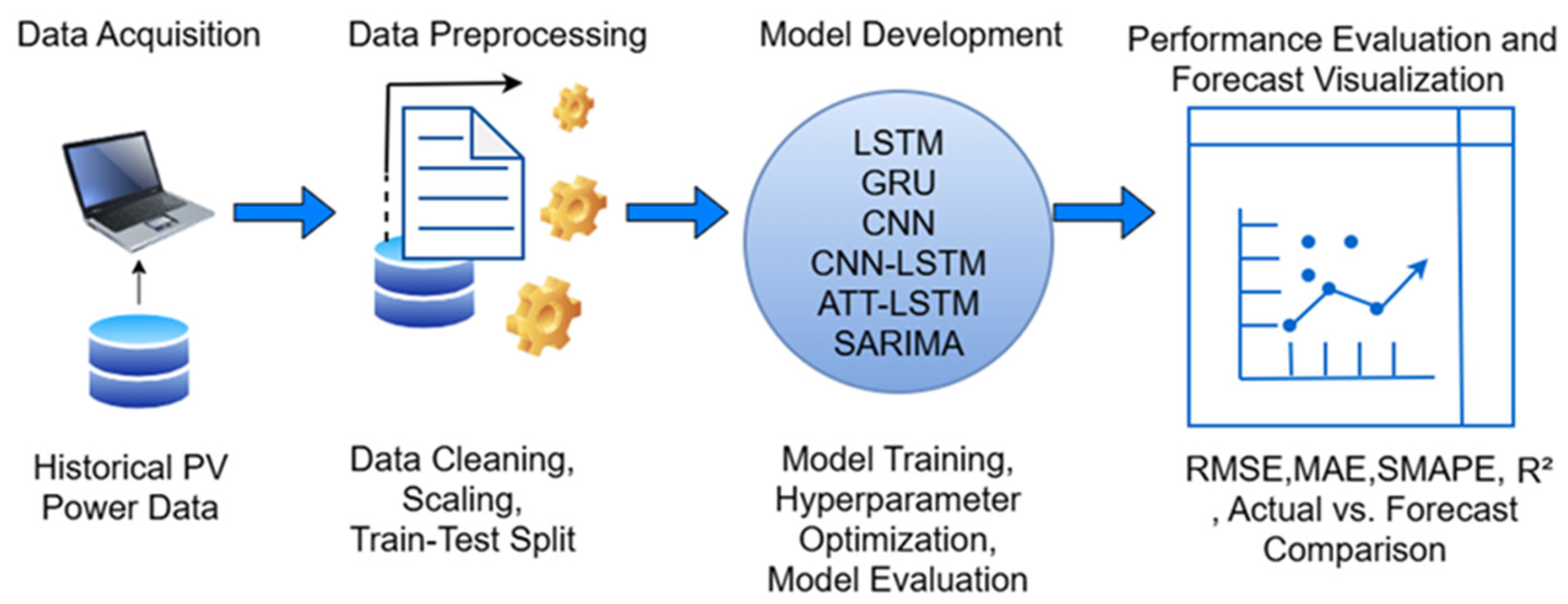
- Household-level PV forecasting:We develop forecasting models for individual residential PV systems using multiple deep-learning architectures, including LSTM, GRU, CNN, CNN–LSTM, and attention-based LSTM networks.
- Comprehensive model comparison:A systematic comparison is performed between deep-learning models and the SARIMA statistical model to evaluate their effectiveness in short-term residential PV power forecasting.
- Analysis of intra-community variability:The study analyzes PV generation patterns across multiple households within the same residential community, highlighting differences in generation behavior caused by local installation characteristics.
- Performance evaluation across households:The experimental results demonstrate that deep-learning models can effectively capture nonlinear temporal patterns in residential PV generation, while statistical models such as SARIMA remain competitive for certain households.
2. Methodology
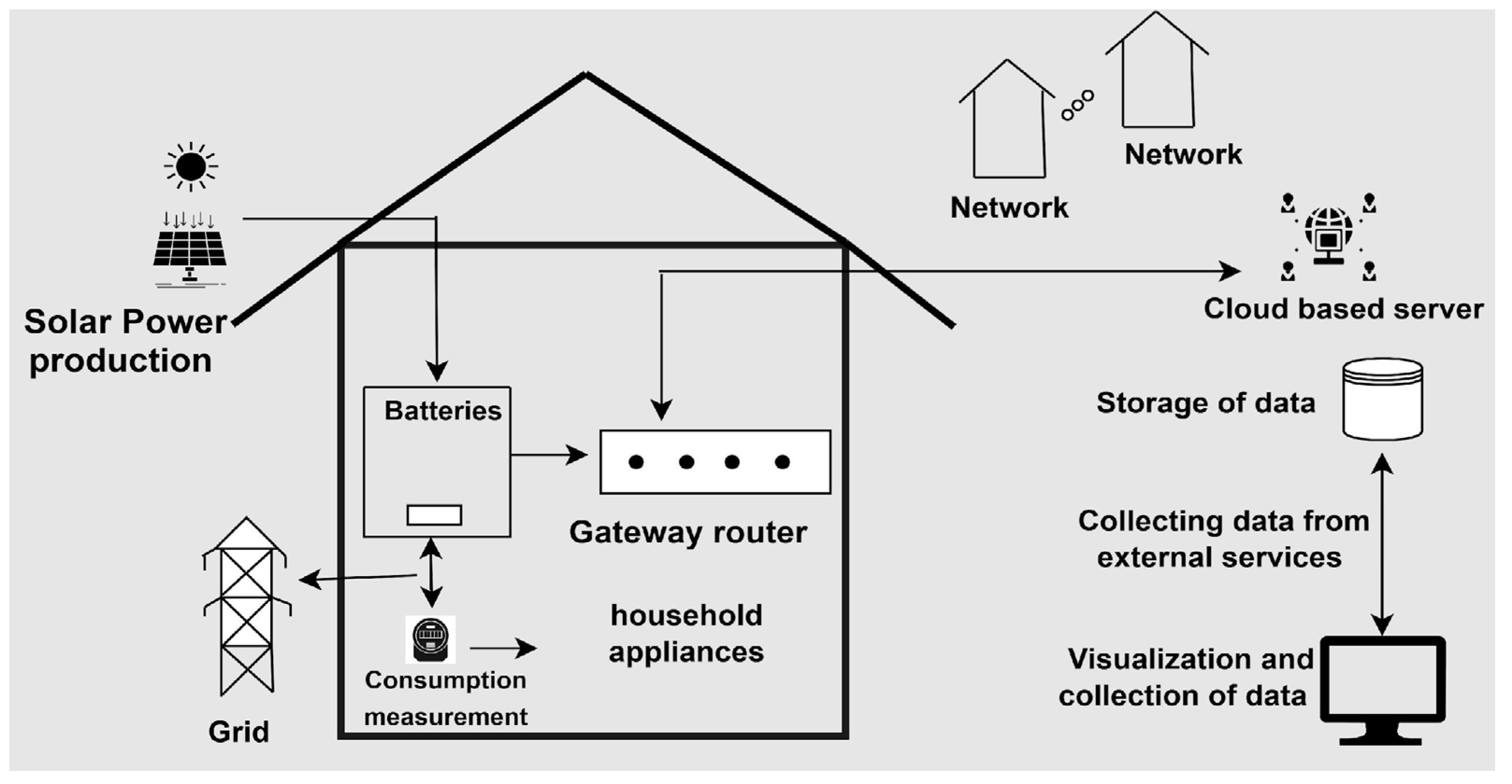
2.1. Data Collection
2.2. Data Preprocessing
2.3. Experimental Setup
2.4. Forecasting Models
2.4.1. Long Short-Term Memory
2.4.2. Gated Recurrent Unit
2.4.3. Convolutional Neural Network
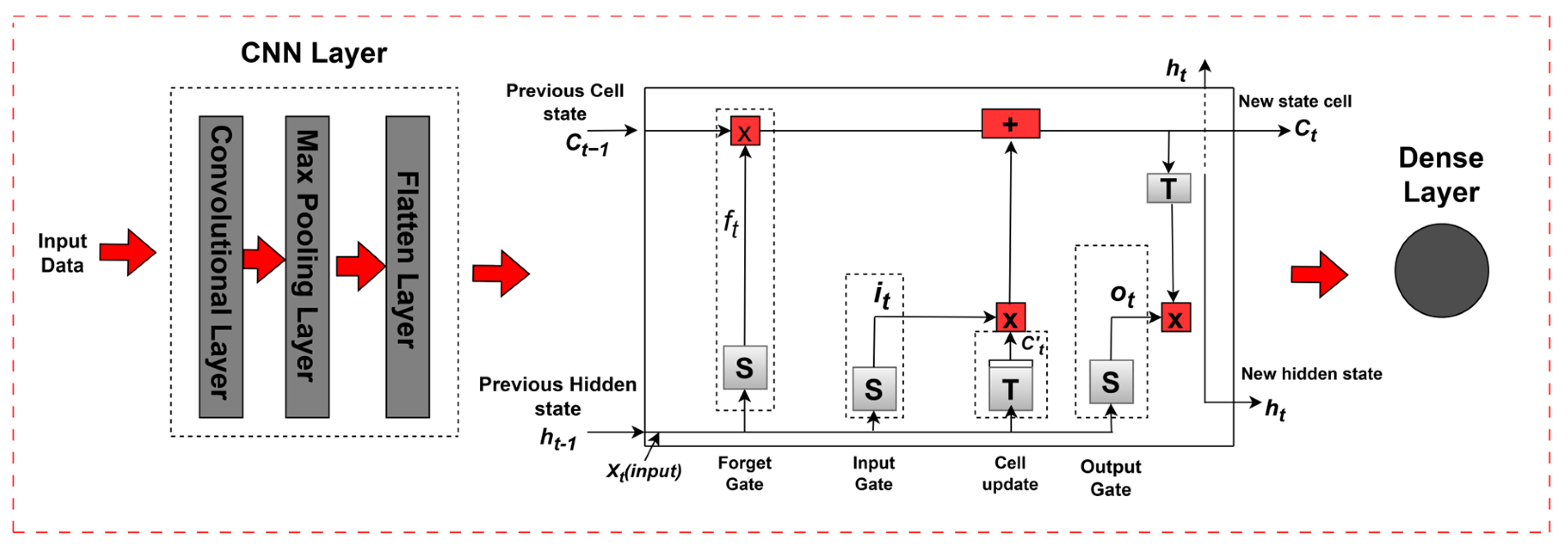
2.4.4. The CNN–LSTM Model
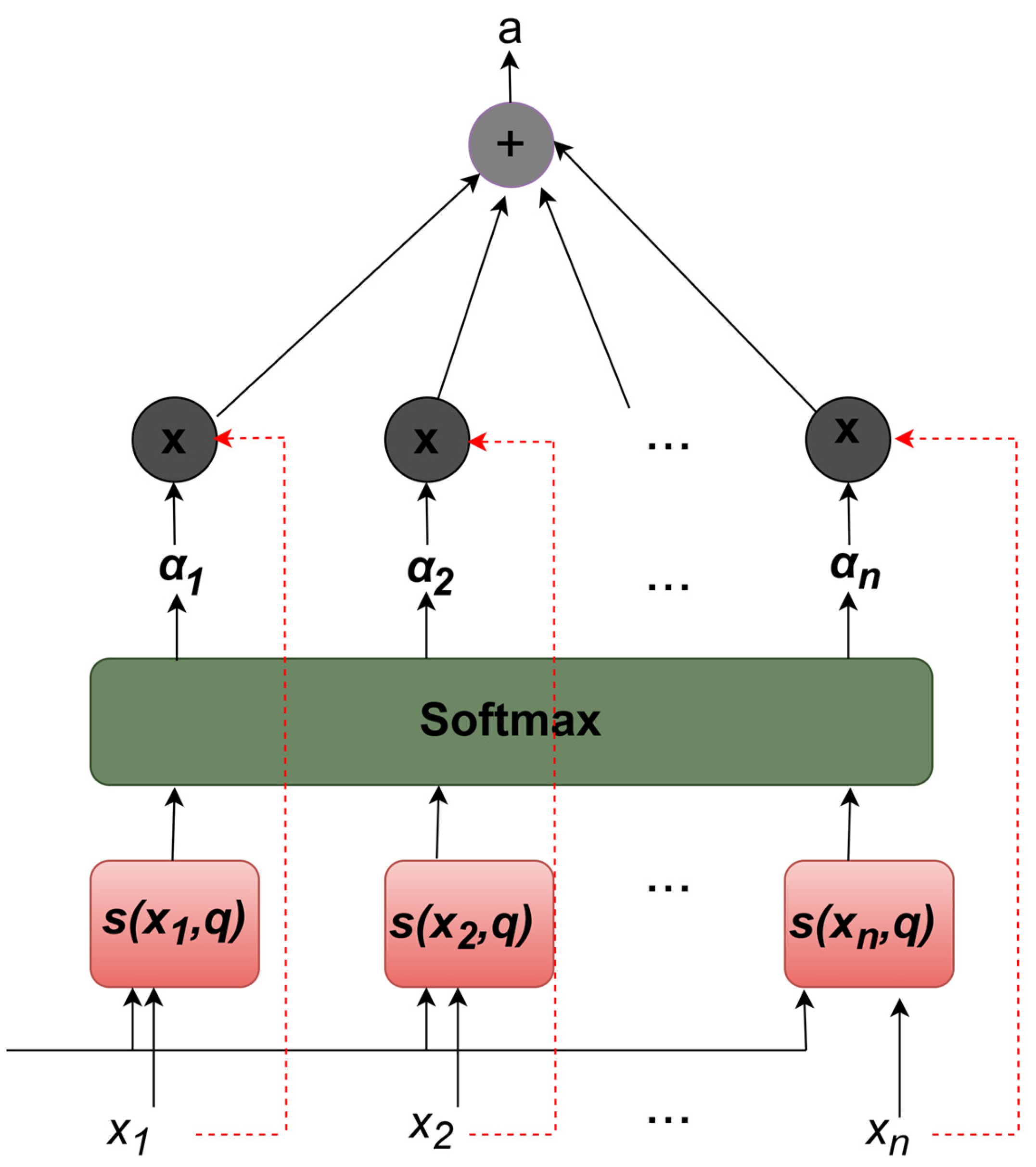
2.4.5. Attention-Based LSTM
2.4.6. Seasonal Autoregressive Integrated Moving Average SARIMA Model
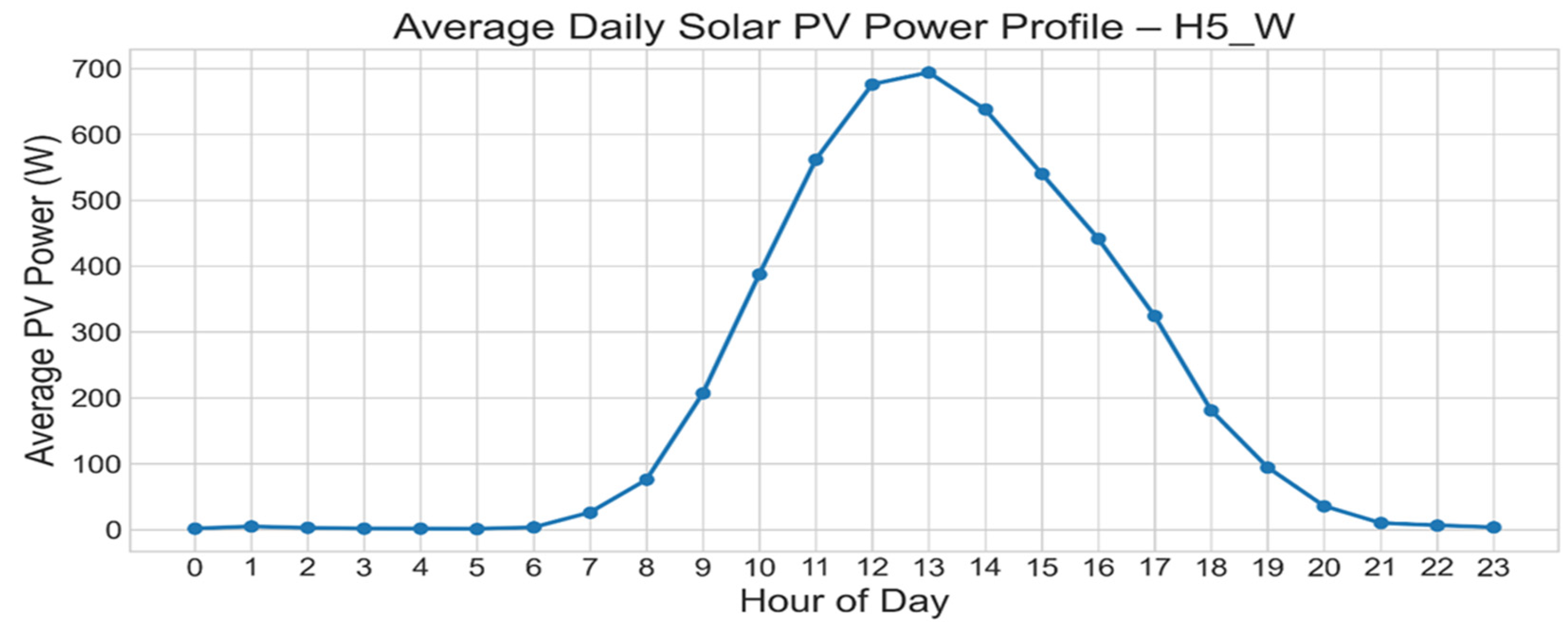
3. Dataset Description
4. Results
4.1. Performance Evaluation Metri
4.2. Quantitative Performance Comparison Across Households
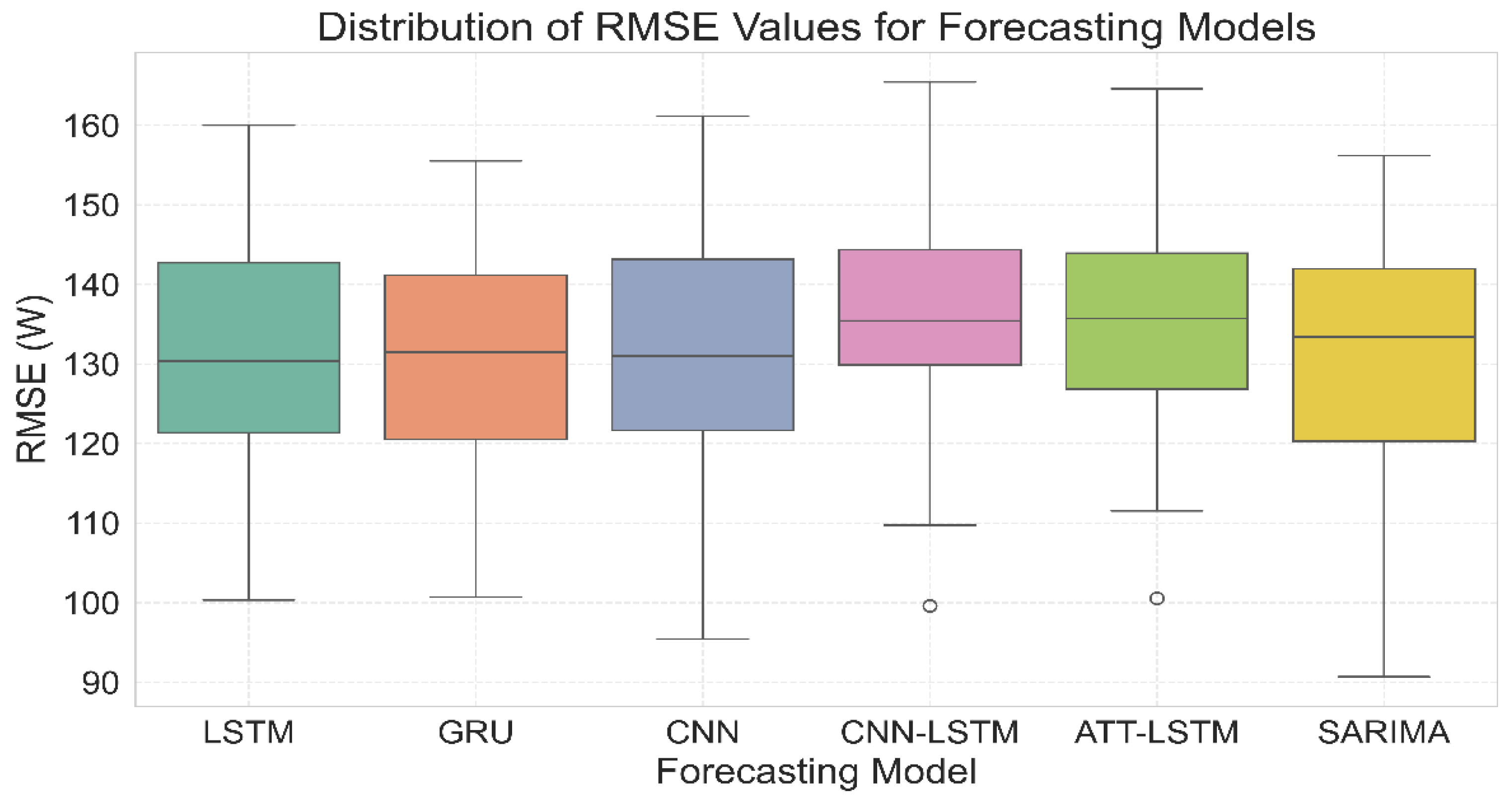
4.3. Distributional Error Analysis of Evaluated Models
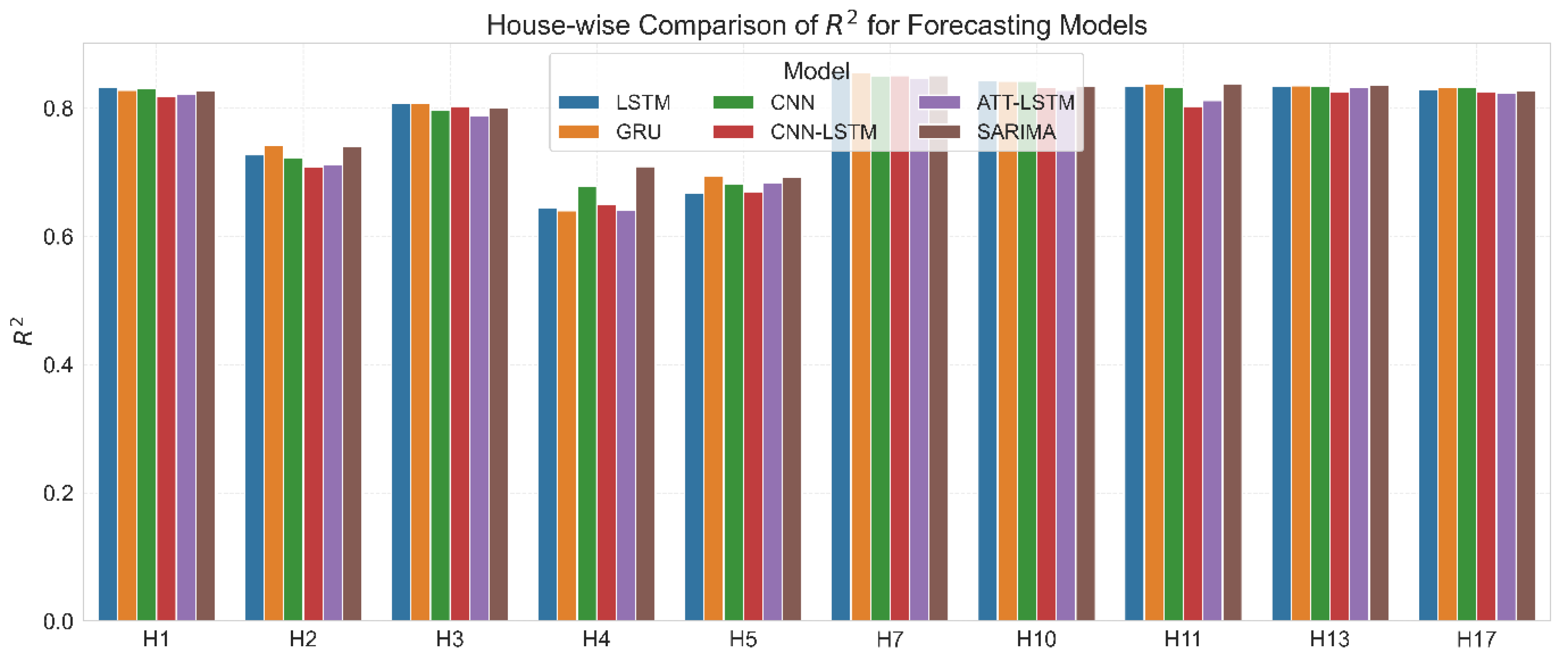
4.4. House-Wise Comparative Analysis of R2
4.5. SARIMA Model Analysis
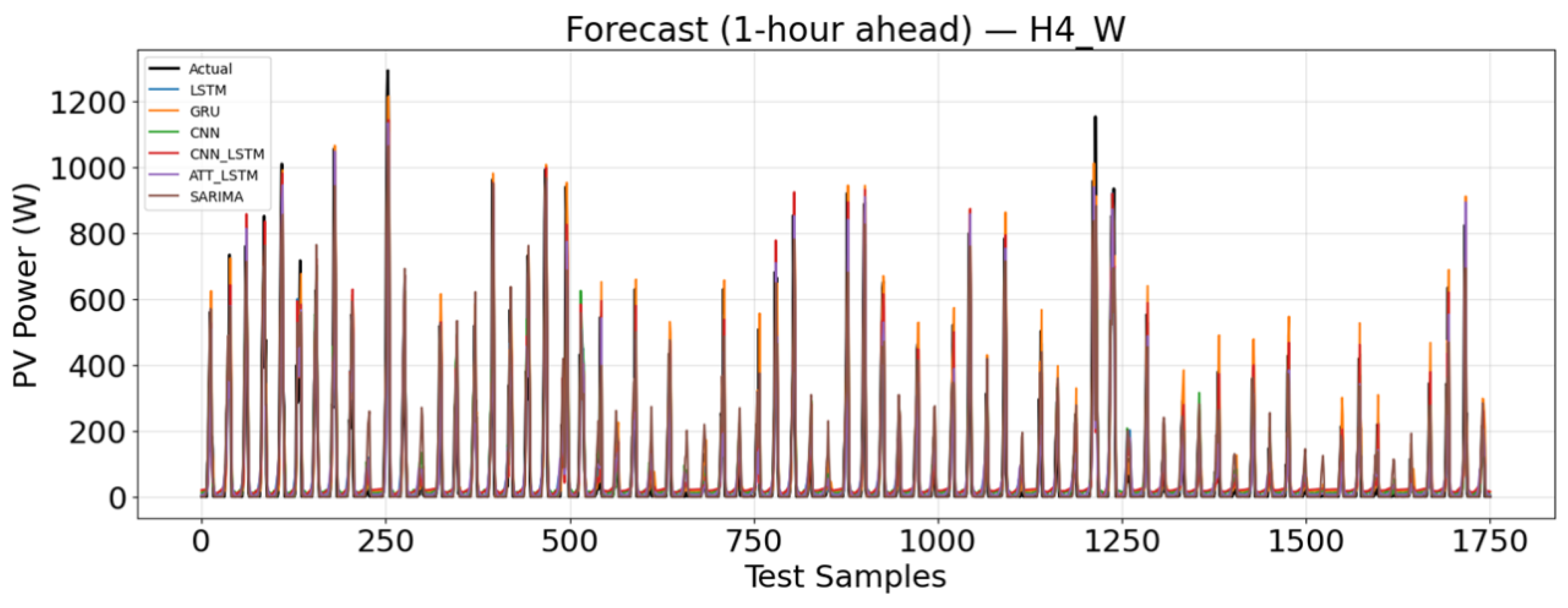
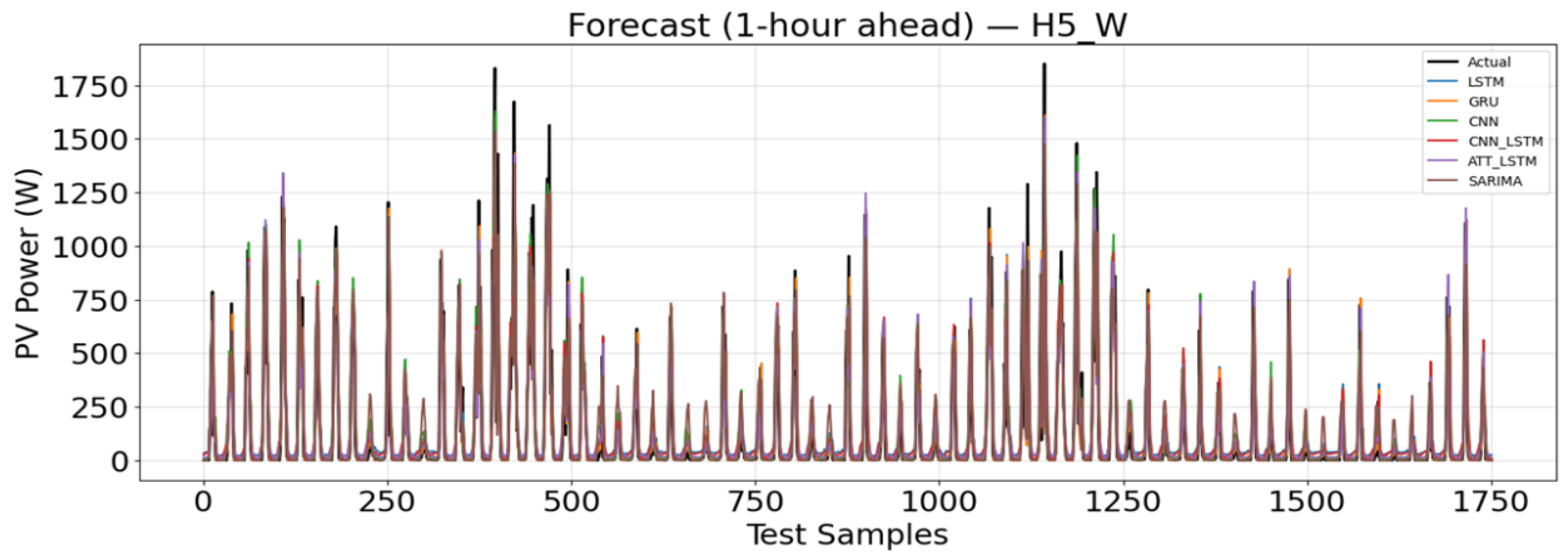
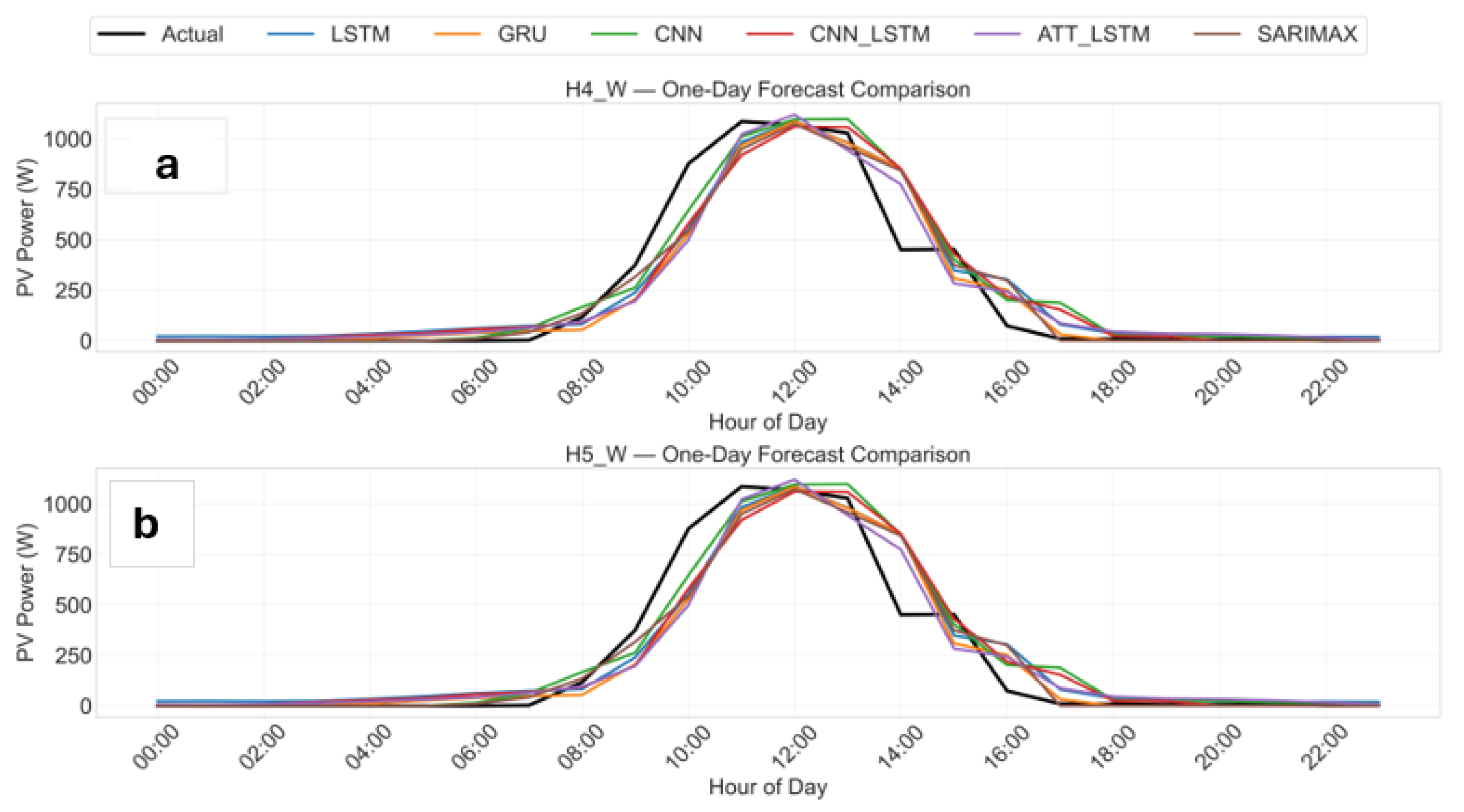
4.6. One-Hour-Ahead Forecasting for Representative Households
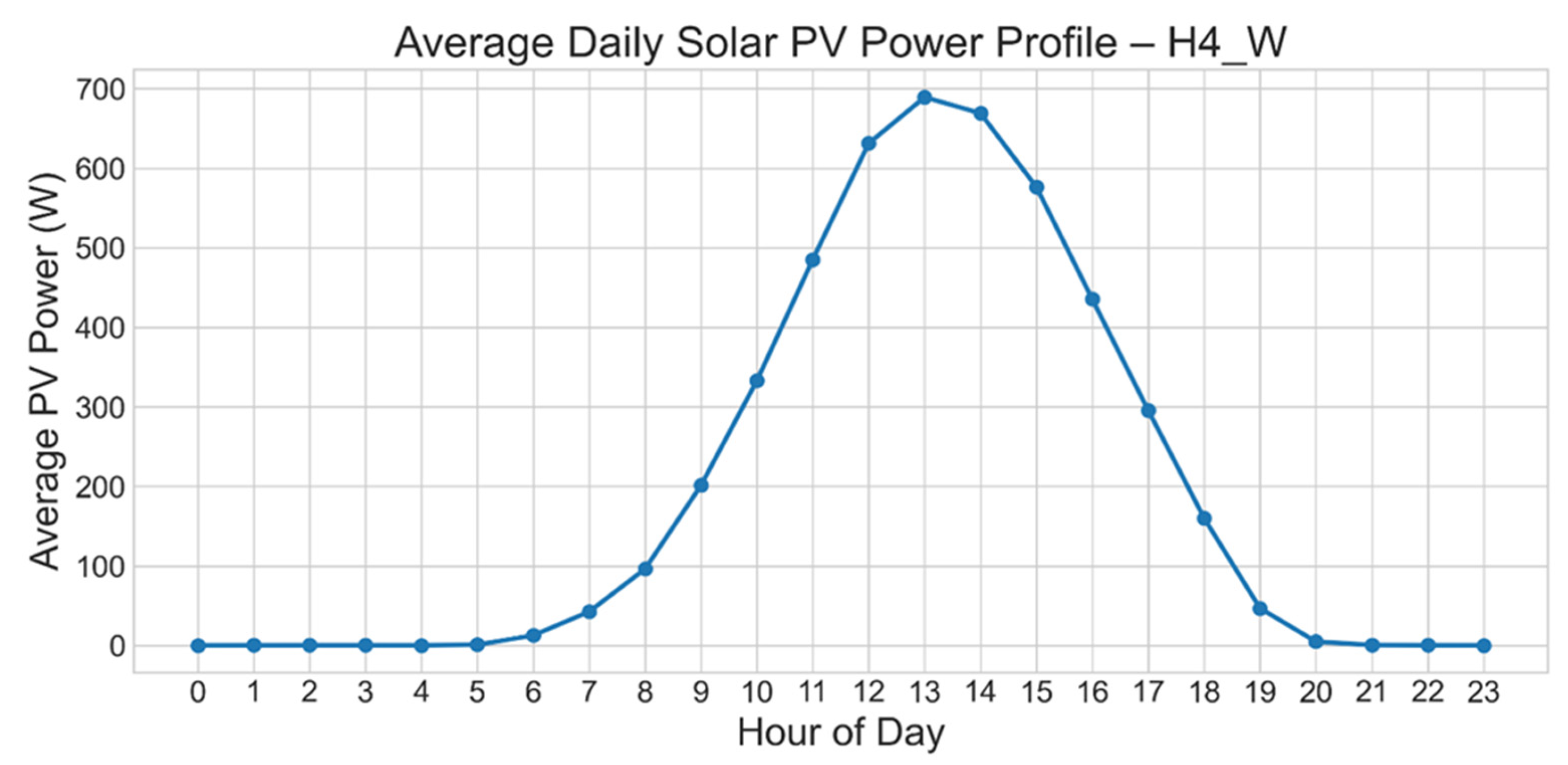
4.7. Household-Level Variability Analysis
4.8. Statistical Significance Analysis of Model Performance
5. Discussion
6. Conclusions
7. Limitations and Future Work
Supplementary Materials
Author Contributions
Funding
Data Availability Statement
Conflicts of Interest
Abbreviations
| AIC | Akaike Information Criterion |
| ARIMA | Autoregressive Integrated Moving Average |
| ATT–LSTM | Attention–LSTM |
| CNN | Convolutional Neural Network |
| EJRC | European Joint Research Centre |
| GRU | Gated Recurrent Unit |
| LSTM | Long Short–Term Memory |
| MAE | Mean Absolute Error |
| MRMI | Modified Relief–Mutual Information |
| PV | Photovoltaic |
| RMSE | Root Mean Squared Error |
| RPPFF | Renewable Power Production Forecasting Framework |
| SARIMA | Seasonal Autoregressive Integrated Moving Average |
| BIC | Bayesian Information Criterion |
| sMAPE | Symmetric Mean Absolute Percentage Error |
References
- Caramizaru, A.; Uihlein, A. Energy Communities: An Overview of Energy and Social Innovation; Publications Office of the European Union: Luxembourg, 2020. [Google Scholar]
- dos Santos, S.A.B.; Coutinho, L.R.R.; Tofoli, F.L.; Barroso, G.C. Community energy management system for residential energy communities integrating demand response, distributed generation, and energy storage systems. J. Energy Storage 2025, 132, 117832. [Google Scholar] [CrossRef]
- Kampman, B.; Blommerde, J.; Afman, M. The Potential of Energy Citizens in the European Union. 2016. Available online: www.cedelft.eu (accessed on 9 April 2026).
- Massidda, L.; Bettio, F.; Marrocu, M. Probabilistic day-ahead prediction of PV generation. A comparative analysis of forecasting methodologies and of the factors influencing accuracy. Sol. Energy 2024, 271, 112422. [Google Scholar] [CrossRef]
- Obi, M.; Bass, R. Trends and challenges of grid-connected photovoltaic systems—A review. Renew. Sustain. Energy Rev. 2016, 58, 1082–1094. [Google Scholar] [CrossRef]
- Zielińska-Sitkiewicz, M.; Chrzanowska, M.; Furmańczyk, K.; Paczutkowski, K. Analysis of electricity consumption in Poland using prediction models and neural networks. Energies 2021, 14, 6619. [Google Scholar] [CrossRef]
- Asghar, R.; Fulginei, F.R.; Quercio, M.; Mahrouch, A. Artificial Neural Networks for Photovoltaic Power Forecasting: A Review of Five Promising Models. IEEE Access 2024, 12, 90461–90485. [Google Scholar] [CrossRef]
- Mishra, M.; Singh, J.G. A comprehensive review on deep learning techniques in power system protection: Trends, challenges, applications and future directions. Results Eng. 2025, 25, 103884. [Google Scholar] [CrossRef]
- Pookpunt, S. Very-Short-Term Forecasting of Solar Radiation using ARIMA. AIP Conf. Proc. 2024, 3239, 020007. [Google Scholar] [CrossRef]
- Fara, L.; Diaconu, A.; Craciunescu, D.; Fara, S. Forecasting of Energy Production for Photovoltaic Systems Based on ARIMA and ANN Advanced Models. Int. J. Photoenergy 2021, 2021, 6777488. [Google Scholar] [CrossRef]
- Memarzadeh, G.; Keynia, F.; Amirteimoury, F.; Memarzadeh, R.; Noori, H. A New Hybrid Intelligent Method for Accurate Short-Term Electric Power Production Forecasting from Uncertain Renewable Energy Resources. Int. J. Ind. Electron. Control. Optim. 2025, 8, 45. [Google Scholar]
- Riedel, P.; Belkilani, K.; Reichert, M.; Heilscher, G.; von Schwerin, R. Enhancing PV feed-in power forecasting through federated learning with differential privacy using LSTM and GRU. Energy AI 2024, 18, 100452. [Google Scholar] [CrossRef]
- Thota, T.; Kurumthottam, A.B.; Kumar, S.R.; Mishra, J. An Enhanced Time Series based Solar Power Forecast for Microgrid System. IEEE Access 2025, 13, 144785–144797. [Google Scholar] [CrossRef]
- Aksan, F.; Suresh, V.; Janik, P.; Sikorski, T. Load Forecasting for the Laser Metal Processing Industry Using VMD and Hybrid Deep Learning Models. Energies 2023, 16, 5381. [Google Scholar] [CrossRef]
- Trivedi, R.; Bahloul, M.; Saif, A.; Patra, S.; Khadem, S. Comprehensive Dataset on Electrical Load Profiles for Energy Community in Ireland. Sci. Data 2024, 11, 621. [Google Scholar] [CrossRef]
- Abdel-Nasser, M.; Mahmoud, K. Accurate photovoltaic power forecasting models using deep LSTM-RNN. Neural Comput. Appl. 2019, 31, 2727–2740. [Google Scholar] [CrossRef]
- Xue, H.; Ma, J.; Zhang, J.; Jin, P.; Wu, J.; Du, F. Power Forecasting for Photovoltaic Microgrid Based on MultiScale CNN-LSTM Network Models. Energies 2024, 17, 3877. [Google Scholar] [CrossRef]
- Klein-Seetharaman, R.; Zhu, X.; Mather, B. Transfer Learning Trained LSTM Models for Household Load Profile Forecasting. In Proceedings of the 2025 IEEE PES Grid Edge Technologies Conference and Exposition, Grid Edge 2025, San Diego, CA, USA, 21–23 January 2025; Institute of Electrical and Electronics Engineers Inc.: Piscataway, NJ, USA, 2025. [Google Scholar] [CrossRef]
- Nguyen, T.-A.; Pham, M.-H.; Phap, V.M.; Do, Q.-H.; Nguyen, N.-T.; Nguyen, D.-T.; Nguyen, T.N. Forecasting of solar power generation in Vietnam deploying a simple GRU model. In Proceedings of the 2023 Asia Meeting on Environment and Electrical Engineering, EEE-AM, Hanoi, Vietnam, 13–15 November 2023; Institute of Electrical and Electronics Engineers Inc.: Piscataway, NJ, USA, 2023. [Google Scholar] [CrossRef]
- Bano, K.; Suresh, V.; Janik, P. Comparative analysis of Deep learning approaches for short-term solar PV power prediction. Prz. Elektrotech. 2025, 261–269. [Google Scholar] [CrossRef]
- Wang, H.; Lei, Z.; Zhang, X.; Zhou, B.; Peng, J. A review of deep learning for renewable energy forecasting. Energy Convers. Manag. 2019, 198, 111799. [Google Scholar] [CrossRef]
- Sua, L.S.; Wang, H.; Huang, J. Deep learning in renewable energy forecasting: A cross-dataset evaluation of temporal and spatial models. Energy Environ. 2025. ahead of print. [Google Scholar] [CrossRef]
- Suresh, V.; Janik, P.; Rezmer, J.; Leonowicz, Z. Forecasting solar PV output using convolutional neural networks with a sliding window algorithm. Energies 2020, 13, 723. [Google Scholar] [CrossRef]
- Liu, X.; Xiao, C.; Huang, M.; Zhang, H.; Liu, W.; Li, J. Enhancing LSTM Algorithms for Photovoltaic Power Forecasting; Institute of Electrical and Electronics Engineers (IEEE): Piscataway, NJ, USA, 2025; pp. 2818–2823. [Google Scholar] [CrossRef]
- Aslam, M.; Lee, S.J.; Khang, S.H.; Hong, S. Two-Stage Attention over LSTM with Bayesian Optimization for Day-Ahead Solar Power Forecasting. IEEE Access 2021, 9, 107387–107398. [Google Scholar] [CrossRef]
- Singh, C.; Garg, A.R. Enhancing Solar Power Output Predictions: Analyzing ARIMA and S-ARIMA Models for Short-Term Forecasting. In Proceedings of the IEEE Power India International Conference, PIICON, Jaipur, India, 10–12 December 2024; Institute of Electrical and Electronics Engineers Inc.: Piscataway, NJ, USA, 2024. [Google Scholar] [CrossRef]
- Sapundzhi, F.; Chikalov, A.; Georgiev, S.; Georgiev, I. Predictive Modeling of Photovoltaic Energy Yield Using an ARIMA Approach. Appl. Sci. 2024, 14, 11192. [Google Scholar] [CrossRef]
- Rai, A.; Shrivastava, A.; Jana, K.C. Differential attention net: Multi-directed differential attention-based hybrid deep learning model for solar power forecasting. Energy 2023, 263, 125746. [Google Scholar] [CrossRef]
- Patil, Y.; Shruti, T. Time-Series Forecasting Using ARIMA and SARIMA Models for Solar NASA POWER Data. In Proceedings of the 2025 3rd International Conference on Intelligent Systems, Advanced Computing and Communication (ISACC), Silchar, India, 27–28 February 2025; pp. 946–952. [Google Scholar]
- Hossain, M.L.; Shams, S.N.; Ullah, S.M. Time-series and deep learning approaches for renewable energy forecasting in Dhaka: A comparative study of ARIMA, SARIMA, and LSTM models. Discov. Sustain. 2025, 6, 775. [Google Scholar] [CrossRef]



| Model | Optimizer | Learning Rate | Batch Size | Epochs | Dropout | Early Stopping |
|---|---|---|---|---|---|---|
| LSTM | Adam | 0.001 | 32 | 100 | 0.2 | Yes |
| GRU | Adam | 0.001 | 32 | 100 | 0.2 | Yes |
| CNN | Adam | 0.001 | 32 | 100 | 0.2 | Yes |
| CNN–LSTM | Adam | 0.001 | 32 | 100 | 0.2 | Yes |
| ATT–LSTM | Adam | 0.001 | 32 | 100 | 0.2 | Yes |
| House Number | Model | Seasonal Order | AIC | BIC |
|---|---|---|---|---|
| H1 | (10,1) | (1,1,1,24) | 90,460.124 | 90,494.362 |
| H2 | (1,0,1) | (1,1,1,24) | 91,974.080 | 92,008.318 |
| H3 | (1,0,1) | (1,1,1,24) | 91,150.348 | 91,184.586 |
| H4 | (1,0,1) | (1,1,1,24) | 89,693.597 | 89,727.835 |
| H5 | (1,0,1) | (1,1,1,24) | 90,962.430 | 90,996.669 |
| H7 | (1,0,1) | (1,1,1,24) | 88,422.821 | 88,434.623 |
| H10 | (1,0,1) | (1,1,1,24) | 89,507.192 | 89,541.431 |
| H11 | (1,0,1) | (1,1,1,24) | 88,150.663 | 88,162.465 |
| H13 | (1,0,1) | (1,1,1,24) | 88,612.009 | 88,623.900 |
| H17 | (1,0,1) | (1,1,1,24) | 90,064.959 | 90,099.760 |
| Model | Architecture | Description |
|---|---|---|
| LSTM | Input, LSTM (64 units), Dense (32 units, ReLU), Dense (1 unit) | Captures long-term temporal dependencies in solar PV power time-series |
| GRU | Input, GRU (64 units), Dense (32 units, ReLU), Dense (1 unit) | Model’s temporal dependencies using a gated recurrent mechanism with reduced computational complexity |
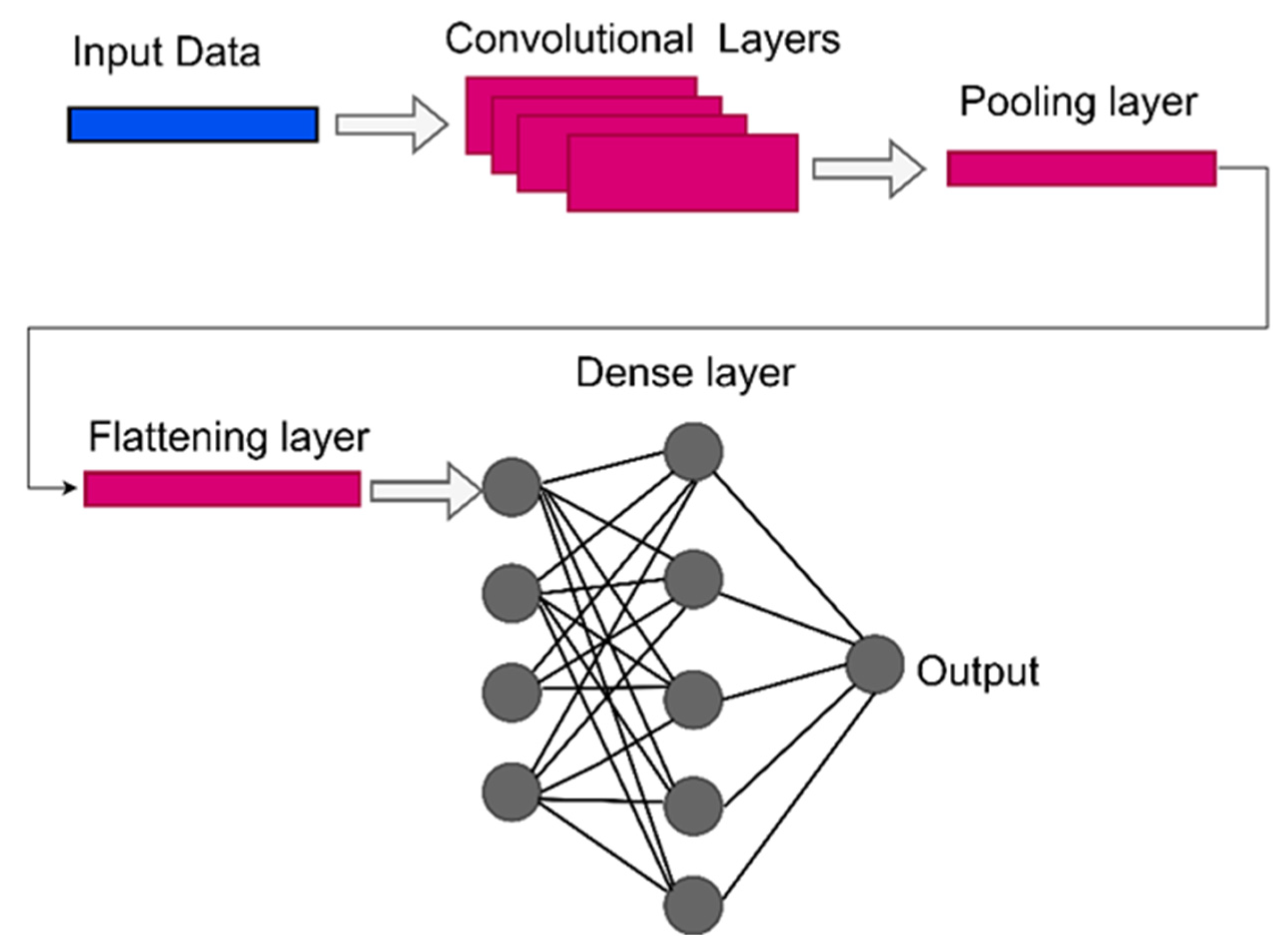
| CNN | Input, Conv1D (32 filters, kernel size 3, ReLU), MaxPooling1D (pool size 2), Flatten, Dense (32 units, ReLU), Dense (1 unit) | Extracts local temporal patterns from solar PV power sequences |
| CNN–LSTM | Input, Conv1D (32 filters, kernel size 3, ReLU), MaxPooling1D (pool size 2), LSTM (32 units), Dense (16 units, ReLU), Dense (1 unit) | Combines convolutional feature extraction with LSTM-based sequential learning |
| ATT–LSTM | Input, LSTM (64 units, return sequences), Self-attention layer, GlobalAveragePooling1D, Dense (32 units, ReLU), Dense (1 unit) | Enhances LSTM performance by focusing on the most informative time steps using an attention mechanism |
| SARIMA | Seasonal Autoregressive Integrated Moving Average (1,0,1) × (1,1,1,24) | Model linear temporal dependencies using autoregressive and moving average components with seasonal differencing; captures daily periodicity (24 h) |
| House No | Model Name | MAE [W] | RMSE [W] | sMAPE (%) | R2 |
|---|---|---|---|---|---|
| House 1 | LSTM | 65.61 ± 6.89 | 132.64 ± 2.48 | 149.14 ± 1.24 | 0.833 ± 0.006 |
| GRU | 67.20 ± 5.96 | 134.51 ± 2.34 | 148.97 ± 0.94 | 0.828 ± 0.006 | |
| CNN | 66.76 ± 2.93 | 133.40 ± 1.60 | 149.64 ± 0.20 | 0.831 ± 0.004 | |
| CNN–LSTM | 71.68 ± 2.23 | 138.41 ± 2.31 | 150.17 ± 0.43 | 0.818 ± 0.006 | |
| ATT–LSTM | 69.97 ± 8.45 | 137.18 ± 2.60 | 150.81 ± 0.87 | 0.821 ± 0.007 | |
| SARIMA | 64.10 | 134.82 | 108.04 | 0.827 | |
| House 2 | LSTM | 82.26 ± 3.82 | 160.01 ± 2.88 | 147.59 ± 1.34 | 0.727 ± 0.010 |
| GRU | 78.60 ± 4.86 | 155.52 ± 1.13 | 147.71 ± 1.10 | 0.742 ± 0.004 | |
| CNN | 84.67 ± 4.57 | 161.12 ± 3.98 | 149.06 ± 0.94 | 0.723 ± 0.014 | |
| CNN–LSTM | 92.94 ± 10.30 | 165.43 ± 8.05 | 150.11 ± 1.63 | 0.708 ± 0.029 | |
| ATT–LSTM | 92.70 ± 14.20 | 164.59 ± 7.58 | 150.34 ± 2.16 | 0.711 ± 0.027 | |
| SARIMA | 73.65 | 156.18 | 99.65 | 0.740 | |
| House 3 | LSTM | 71.22 ± 6.72 | 143.80 ± 4.70 | 143.53 ± 1.52 | 0.808 ± 0.013 |
| GRU | 70.97 ± 4.06 | 143.78 ± 1.21 | 142.44 ± 1.34 | 0.808 ± 0.003 | |
| CNN | 74.74 ± 4.44 | 147.70 ± 2.74 | 145.93 ± 0.86 | 0.797 ± 0.008 | |
| CNN–LSTM | 75.27 ± 4.27 | 145.51 ± 1.83 | 145.24 ± 1.20 | 0.803 ± 0.005 | |
| ATT–LSTM | 76.29 ± 12.58 | 150.79 ± 6.65 | 145.42 ± 2.95 | 0.788 ± 0.019 | |
| SARIMA | 69.64 | 146.40 | 107.07 | 0.801 | |
| House 4 | LSTM | 50.13 ± 5.57 | 100.35 ± 3.66 | 153.93 ± 0.97 | 0.644 ± 0.026 |
| GRU | 47.61 ± 4.47 | 100.71 ± 5.45 | 153.78 ± 0.53 | 0.640 ± 0.039 | |
| CNN | 44.46 ± 3.65 | 95.45 ± 2.33 | 154.93 ± 1.57 | 0.678 ± 0.016 | |
| CNN–LSTM | 51.75 ± 5.67 | 99.60 ± 2.64 | 155.81 ± 0.74 | 0.649 ± 0.019 | |
| ATT–LSTM | 49.98 ± 9.33 | 100.55 ± 6.44 | 156.15 ± 1.72 | 0.641 ± 0.047 | |
| SARIMA | 36.05 | 90.68 | 52.47 | 0.709 | |
| House 5 | LSTM | 74.41 ± 2.51 | 147.85 ± 3.44 | 125.64 ± 5.78 | 0.668 ± 0.015 |
| GRU | 69.84 ± 6.65 | 142.02 ± 1.87 | 124.88 ± 7.29 | 0.694 ± 0.008 | |
| CNN | 72.08 ± 4.81 | 144.89 ± 3.30 | 122.69 ± 3.38 | 0.682 ± 0.014 | |
| CNN–LSTM | 76.88 ± 4.20 | 147.56 ± 1.38 | 125.77 ± 2.98 | 0.670 ± 0.006 | |
| ATT–LSTM | 70.84 ± 6.42 | 144.48 ± 1.93 | 124.51 ± 8.46 | 0.683 ± 0.008 | |
| SARIMA | 64.95 | 142.53 | 104.60 | 0.692 | |
| House 7 | LSTM | 52.58 ± 3.41 | 106.60 ± 1.67 | 143.23 ± 0.64 | 0.859 ± 0.004 |
| GRU | 54.02 ± 5.19 | 108.19 ± 1.65 | 144.10 ± 0.65 | 0.855 ± 0.004 | |
| CNN | 57.38 ± 7.88 | 109.75 ± 1.07 | 144.63 ± 0.26 | 0.850 ± 0.011 | |
| CNN–LSTM | 56.83 ± 3.96 | 109.75 ± 1.07 | 144.63 ± 0.26 | 0.851 ± 0.003 | |
| ATT–LSTM | 54.92 ± 3.98 | 111.54 ± 1.92 | 145.15 ± 0.93 | 0.846 ± 0.005 | |
| SARIMA | 51.10 | 109.80 | 79.58 | 0.851 | |
| House 10 | LSTM | 62.46 ± 5.68 | 128.06 ± 3.73 | 144.03 ± 0.82 | 0.843 ± 0.009 |
| GRU | 61.88 ± 3.60 | 128.45 ± 2.39 | 144.26 ± 0.36 | 0.842 ± 0.006 | |
| CNN | 63.12 ± 5.83 | 128.57 ± 2.53 | 145.10 ± 0.47 | 0.842 ± 0.006 | |
| CNN–LSTM | 69.02 ± 3.52 | 132.43 ± 2.75 | 144.94 ± 0.64 | 0.832 ± 0.007 | |
| ATT–LSTM | 62.57 ± 1.69 | 134.27 ± 2.19 | 145.97 ± 0.45 | 0.828 ± 0.006 | |
| SARIMA | 61.56 | 131.98 | 81.15 | 0.834 | |
| House 11 | LSTM | 59.02 ± 2.62 | 119.56 ± 0.34 | 144.49 ± 0.49 | 0.834 ± 0.001 |
| GRU | 57.03 ± 1.99 | 118.66 ± 0.89 | 143.85 ± 0.41 | 0.837 ± 0.002 | |
| CNN | 59.89 ± 4.09 | 120.00 ± 3.10 | 145.20 ± 0.58 | 0.833 ± 0.009 | |
| CNN–LSTM | 70.23 ± 3.94 | 130.13 ± 3.41 | 146.01 ± 0.47 | 0.803 ± 0.010 | |
| ATT–LSTM | 66.54 ± 12.57 | 126.70 ± 10.29 | 146.12 ± 2.43 | 0.812 ± 0.031 | |
| SARIMA | 54.51 | 118.48 | 80.67 | 0.837 | |
| House 13 | LSTM | 61.38 ± 5.33 | 126.71 ± 0.95 | 143.55 ± 0.52 | 0.834 ± 0.002 |
| GRU | 59.07 ± 4.90 | 126.11 ± 3.14 | 143.36 ± 0.56 | 0.835 ± 0.008 | |
| CNN | 60.49 ± 4.08 | 126.60 ± 1.51 | 144.79 ± 0.32 | 0.834 ± 0.004 | |
| CNN–LSTM | 67.60 ± 7.59 | 129.78 ± 3.99 | 144.78 ± 0.59 | 0.825 ± 0.011 | |
| ATT–LSTM | 60.20 ± 5.26 | 127.22 ± 5.15 | 144.72 ± 1.35 | 0.832 ± 0.014 | |
| SARIMA | 54.26 | 125.82 | 80.32 | 0.836 | |
| House 17 | LSTM | 69.21 ± 5.79 | 139.56 ± 5.03 | 142.37 ± 0.92 | 0.829 ± 0.012 |
| GRU | 66.92 ± 3.23 | 138.46 ± 2.02 | 142.07 ± 0.60 | 0.832 ± 0.005 | |
| CNN | 68.39 ± 3.36 | 138.03 ± 0.78 | 143.53 ± 0.65 | 0.833 ± 0.002 | |
| CNN–LSTM | 73.42 ± 5.29 | 140.80 ± 3.29 | 143.18 ± 0.43 | 0.826 ± 0.008 | |
| ATT–LSTM | 69.36 ± 3.69 | 142.15 ± 3.29 | 143.21 ± 0.59 | 0.823 ± 0.008 | |
| SARIMA | 65.72 | 140.29 | 83.38 | 0.827 |
| House No | Parameter | Coefficient | St. Error |
|---|---|---|---|
| House 1 | AR (1) | 0.8240 | 0.006 |
| MA (1) | 0.0951 | 0.008 | |
| SAR (24) | 0.0451 | 0.007 | |
| SMA (24) | −0.9758 | 0.002 | |
| House 2 | AR (1) | 0.7560 | 0.006 |
| MA (1) | 0.0691 | 0.008 | |
| SAR (24) | 0.0501 | 0.007 | |
| SMA (24 | −1.0235 | 0.002 | |
| House 3 | AR (1) | 0.7936 | 0.006 |
| MA (1) | 0.0740 | 0.008 | |
| SAR (24) | 0.0472 | 0.007 | |
| SMA (24) | −1.0170 | 0.002 | |
| House 4 | AR (1) | 0.7858 | 0.005 |
| MA (1) | 0.0793 | 0.008 | |
| SAR (24) | 0.0571 | 0.007 | |
| SMA (24) | −1.0454 | 0.003 | |
| House 5 | AR (1) | 0.7614 | 0.006 |
| MA (1) | 0.0724 | 0.008 | |
| SAR (24) | 0.0370 | 0.007 | |
| SMA (24) | −0.9811 | 0.002 | |
| House 7 | AR (1) | 0.8234 | 0.006 |
| MA (1) | 0.1386 | 0.008 | |
| SAR (24) | 0.0604 | 0.007 | |
| SMA (24) | −1.0255 | 0.002 | |
| House 10 | AR (1) | 0.8185 | 0.006 |
| MA (1) | 0.0984 | 0.008 | |
| SAR (24) | 0.0400 | 0.007 | |
| SMA (24) | −0.9776 | 0.002 | |
| House 11 | AR (1) | 0.8221 | 0.006 |
| MA (1) | 0.0977 | 0.008 | |
| SAR (24) | 0.0381 | 0.007 | |
| SMA (24) | −0.9790 | 0.002 | |
| House 13 | AR (1) | 0.8248 | 0.004 |
| MA (1) | 0.1986 | 0.007 | |
| SAR (24) | 0.0679 | 0.007 | |
| SMA (24) | −1.0252 | 0.002 | |
| House 17 | AR (1) | 0.8283 | 0.006 |
| MA (1) | 0.0914 | 0.007 | |
| SAR (24) | 0.0604 | 0.007 | |
| SMA (24) | −1.0224 | 0.002 |
| House | Model Pair | p-Value (t-Test) | p-Value (Wilcoxon) | Interpretation |
|---|---|---|---|---|
| H4 | LSTM vs. GRU | 0.7770 | 0.8125 | Not significant |
| H5 | LSTM vs. GRU | 0.01444 | 0.0625 | Significant (t-test) |
| GRU | 155.52 ± 1.13 | 147.71 ± 1.10 | 0.742 ± 0.004 | |
| CNN–LSTM vs. ATT–LSTM | 0.0451 | 0.1250 | Significant (t-test) |
Disclaimer/Publisher’s Note: The statements, opinions and data contained in all publications are solely those of the individual author(s) and contributor(s) and not of MDPI and/or the editor(s). MDPI and/or the editor(s) disclaim responsibility for any injury to people or property resulting from any ideas, methods, instructions or products referred to in the content. |
© 2026 by the authors. Licensee MDPI, Basel, Switzerland. This article is an open access article distributed under the terms and conditions of the Creative Commons Attribution (CC BY) license.
Share and Cite
Bano, K.; Suresh, V.; Montana, F.; Janik, P. Comparative Evaluation of Deep-Learning and SARIMA Models for Short-Term Residential PV Power Forecasting. Energies 2026, 19, 1991. https://doi.org/10.3390/en19081991
Bano K, Suresh V, Montana F, Janik P. Comparative Evaluation of Deep-Learning and SARIMA Models for Short-Term Residential PV Power Forecasting. Energies. 2026; 19(8):1991. https://doi.org/10.3390/en19081991
Chicago/Turabian StyleBano, Kalsoom, Vishnu Suresh, Francesco Montana, and Przemyslaw Janik. 2026. "Comparative Evaluation of Deep-Learning and SARIMA Models for Short-Term Residential PV Power Forecasting" Energies 19, no. 8: 1991. https://doi.org/10.3390/en19081991
APA StyleBano, K., Suresh, V., Montana, F., & Janik, P. (2026). Comparative Evaluation of Deep-Learning and SARIMA Models for Short-Term Residential PV Power Forecasting. Energies, 19(8), 1991. https://doi.org/10.3390/en19081991