ANN-MILP Hybrid Techniques for the Integration Challenge, Power Management of the EV Charging Station with Solar-Based Grid System, and BESS


Highlights
- A small grid-connected PV-EV charging infrastructure combined with BESS for backup power flow purposes is simulated in MATLAB (version R2026a)/Simulink (version R2026a) and analyzed.
- Maximum utilization of the renewable energy resources is going to benefit the whole integrated system.
- Algorithms in the control mechanism make the system reliable for the EV load profile and load requirements.
- Make an objective function model with suitable system constraints to establish the best solution for a problematic integrated system.
- Optimized models’ components could be shown by some optimized patterns.
- MILP-based optimized results show the increased renewable power utilization and improved performance of the EV charging/discharging allocation.
- This hybrid optimization technique is associated with observed datasets.
Abstract
1. Introduction
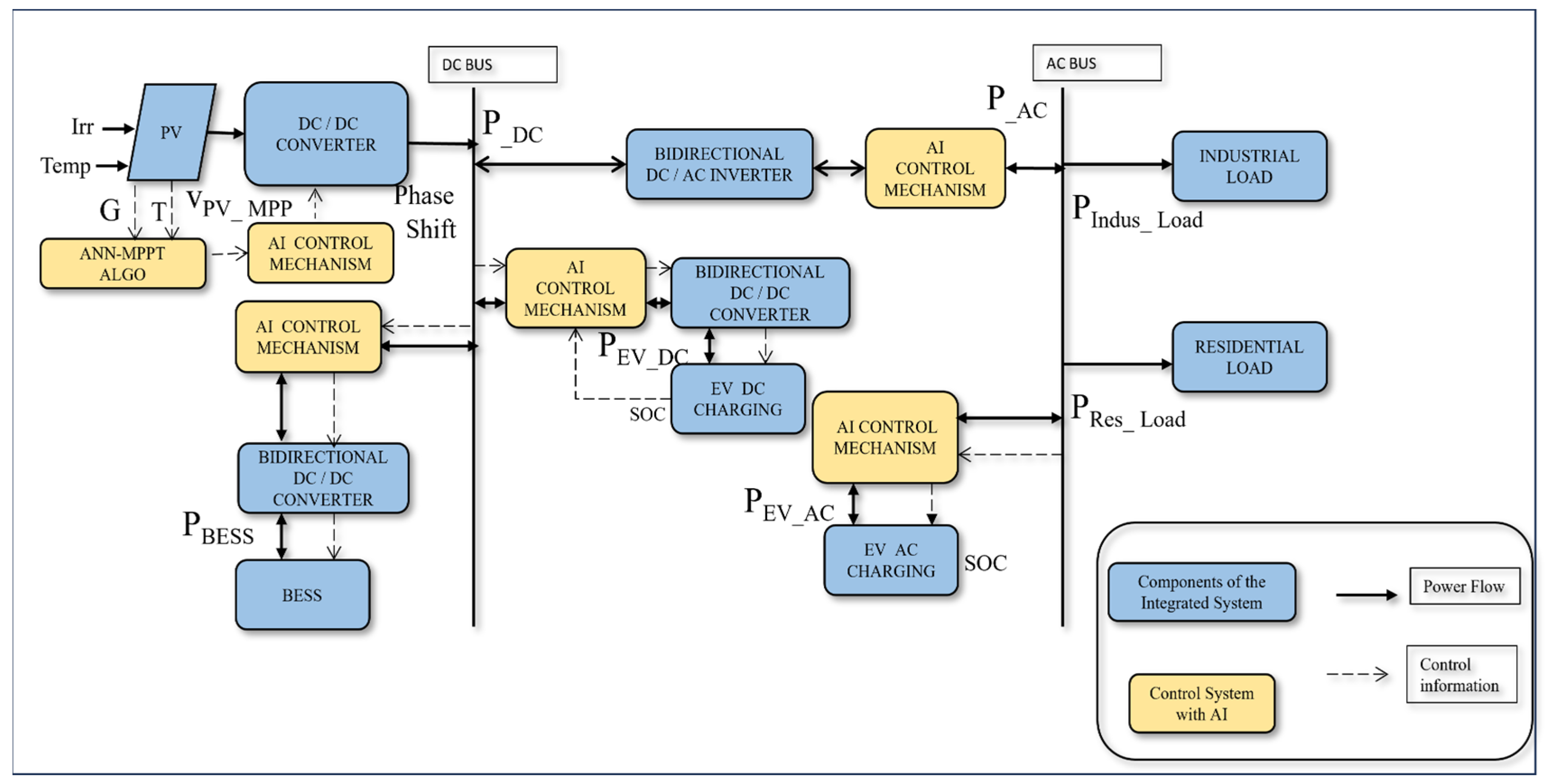
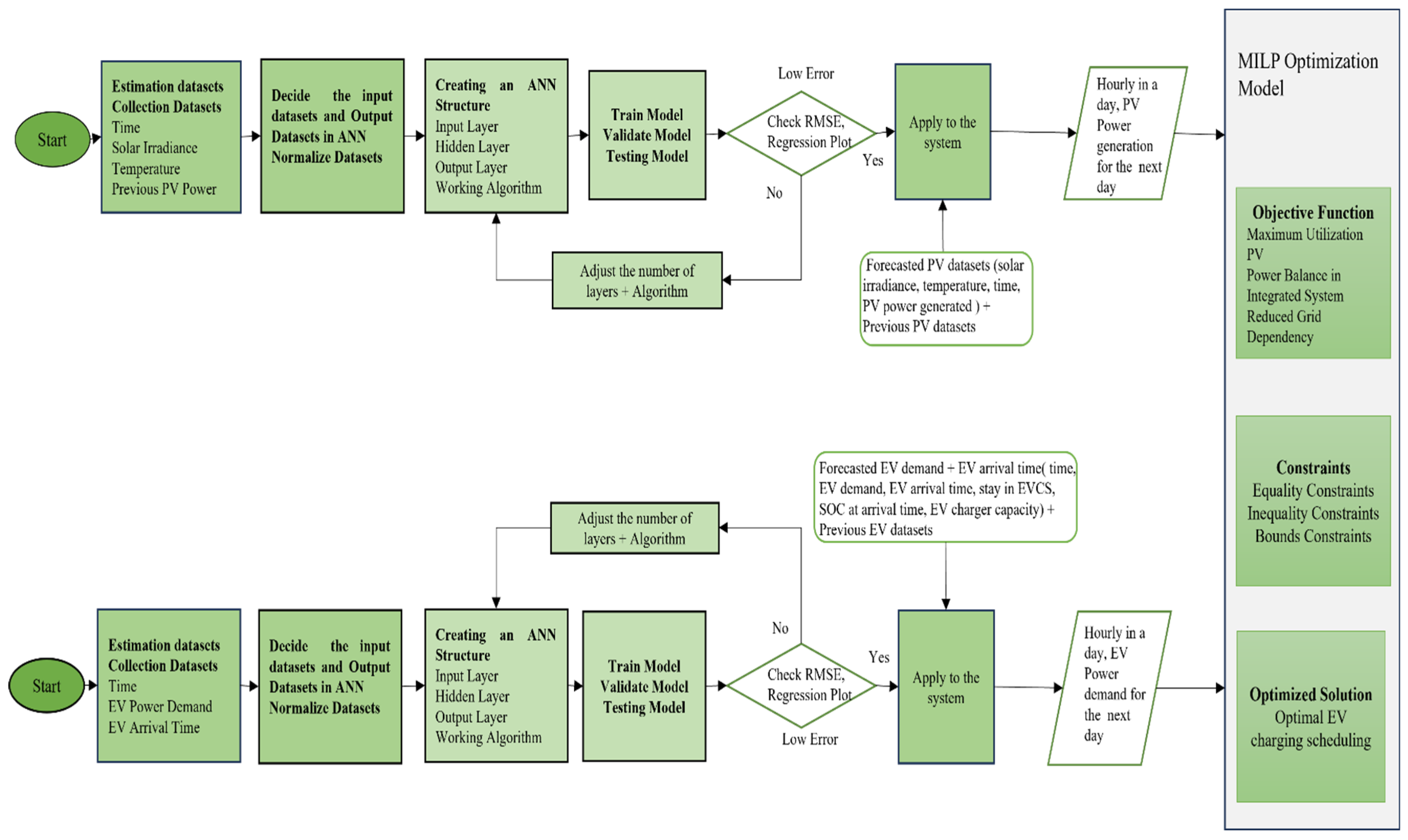
- Two-stage optimized structure.The recommended approach presents a two-stage framework instead of a single-stage power management optimized technique. In the first stage, this is targeted for solar PV-generated voltage at the maximum power point and forecasted data samples for estimating the solar PV power generated, EV demand, and its arrival patterns, whereas in the second stage, the power demand of EVs for both types of charging (AC and DC) is optimally allocated using an optimized technique. The machine learning-based forecasting estimation and optimization are separated to improve the computational time and increase versatility in operation.
- Peak demand reduction on the utility grid via the EV charging coordinated allocation and V2G technique.The peak demand of the grid is reduced by another source of power supply synchronized with an optimal coordination relationship in an EV-based integrated system. The synchronization among the solar PV system, BESS, and EVCS (EV-charging station) explicitly creates benefits for the grid’s load, such as reducing the grid dependency and mitigating the peak load demand on it. This will be achieved by the EV coordinating charging scheduling with a solar PV system and backup purpose storage, BESS. This combined task was addressed individually in a previous study; in this article, we will tackle it combined.
- Coordinating balanced power flow: both types of AC and DC EV charging loads in the integrated system.The suggested optimal framework explicitly embodies a structured approach for both types of EV charging with different power demand levels and load profiles, which makes the EVCS more realistic. Such depth infrastructure can improve the load balancing in an integrated system.
- Get the EV charging scheduling top-prioritized and maximum use of the solar PV system in the hierarchical allocation system.The power distribution from the available power resources is planned based on the priority of the EV demand—firstly fulfilled—and the maximum utilization of the renewable energy resources. Firstly, the solar PV-generated power is transferred to fulfill the EV power demand, followed by the extra power stored in the BESS for the backup purposes of the EV, as well as the grid’s load. The optimal allocation of power for reducing the grid dependency and reducing its peak load demand is done by using the grid as a secondary backup resource for power in an integrated system.
- To propose a simulation of an integrated solar PV–grid-based EV charging station for both AC and DC types in Simulink/MATLAB.
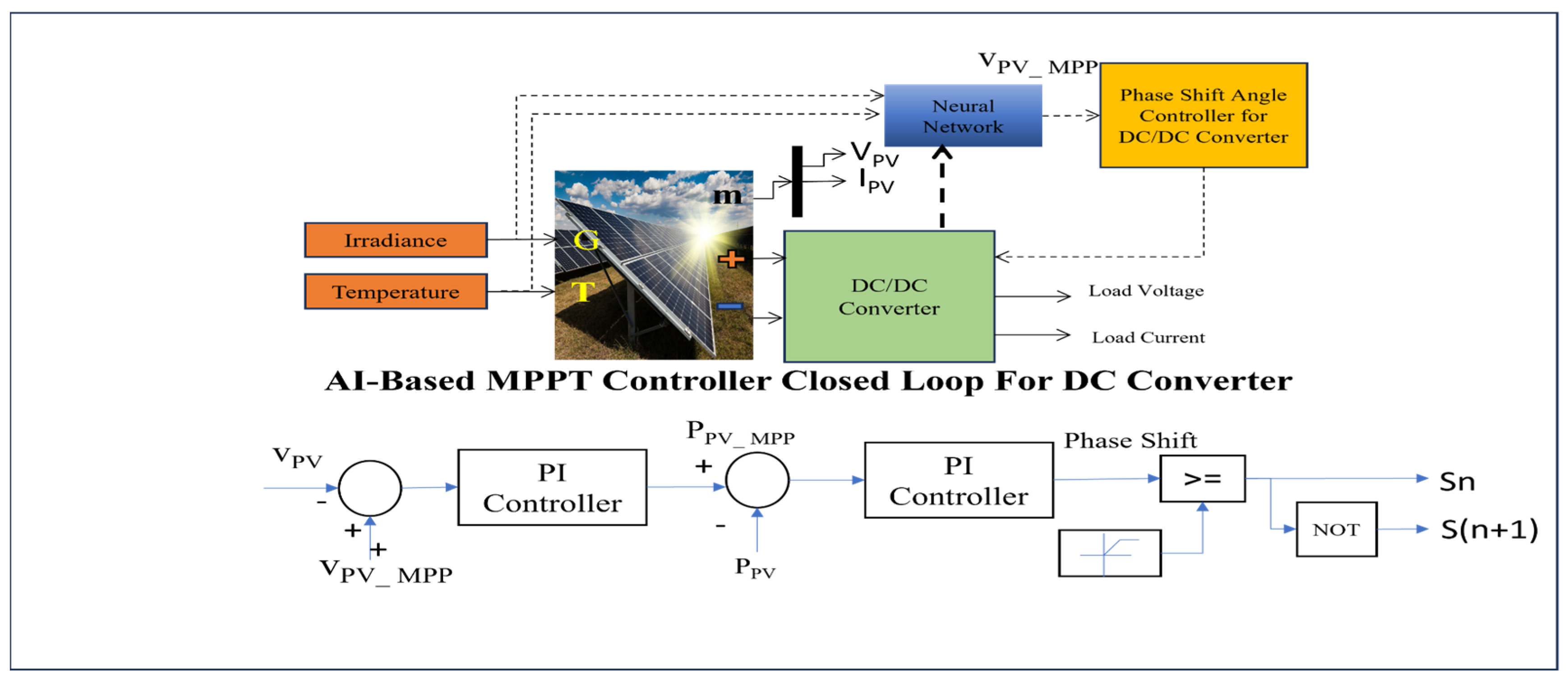
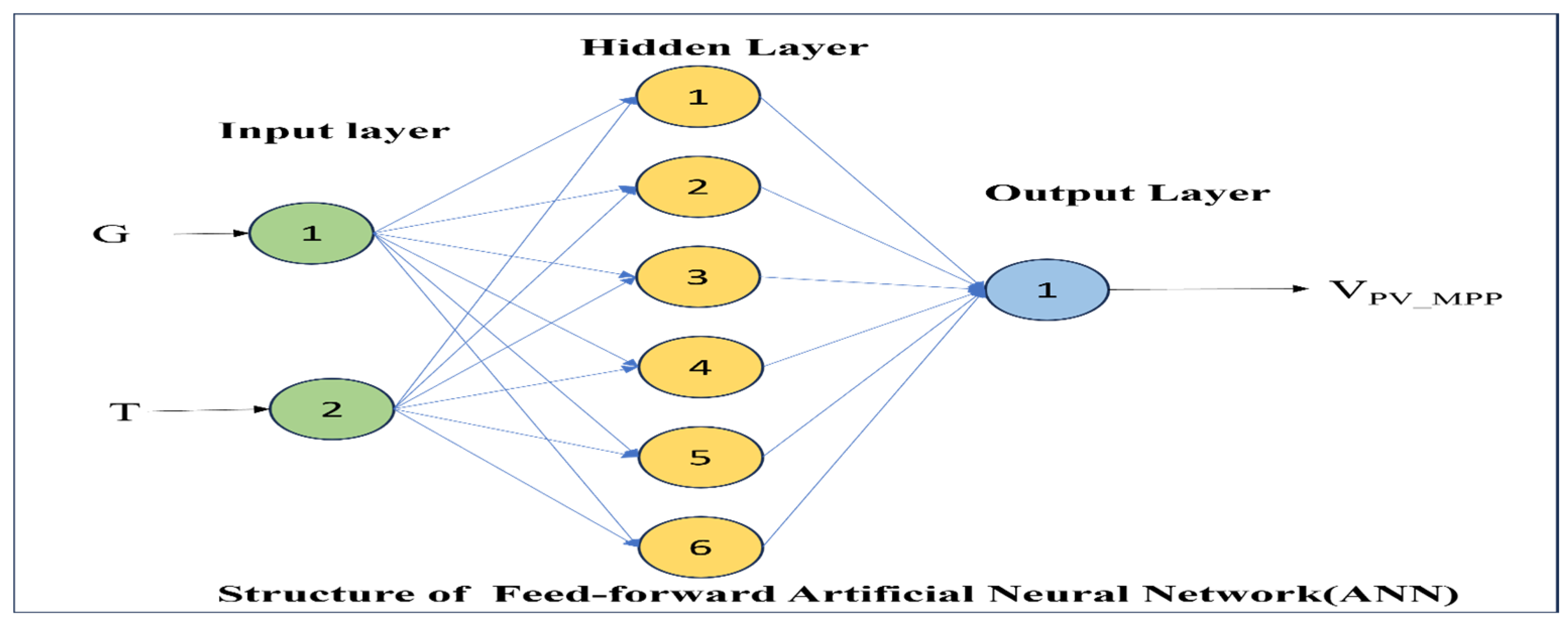
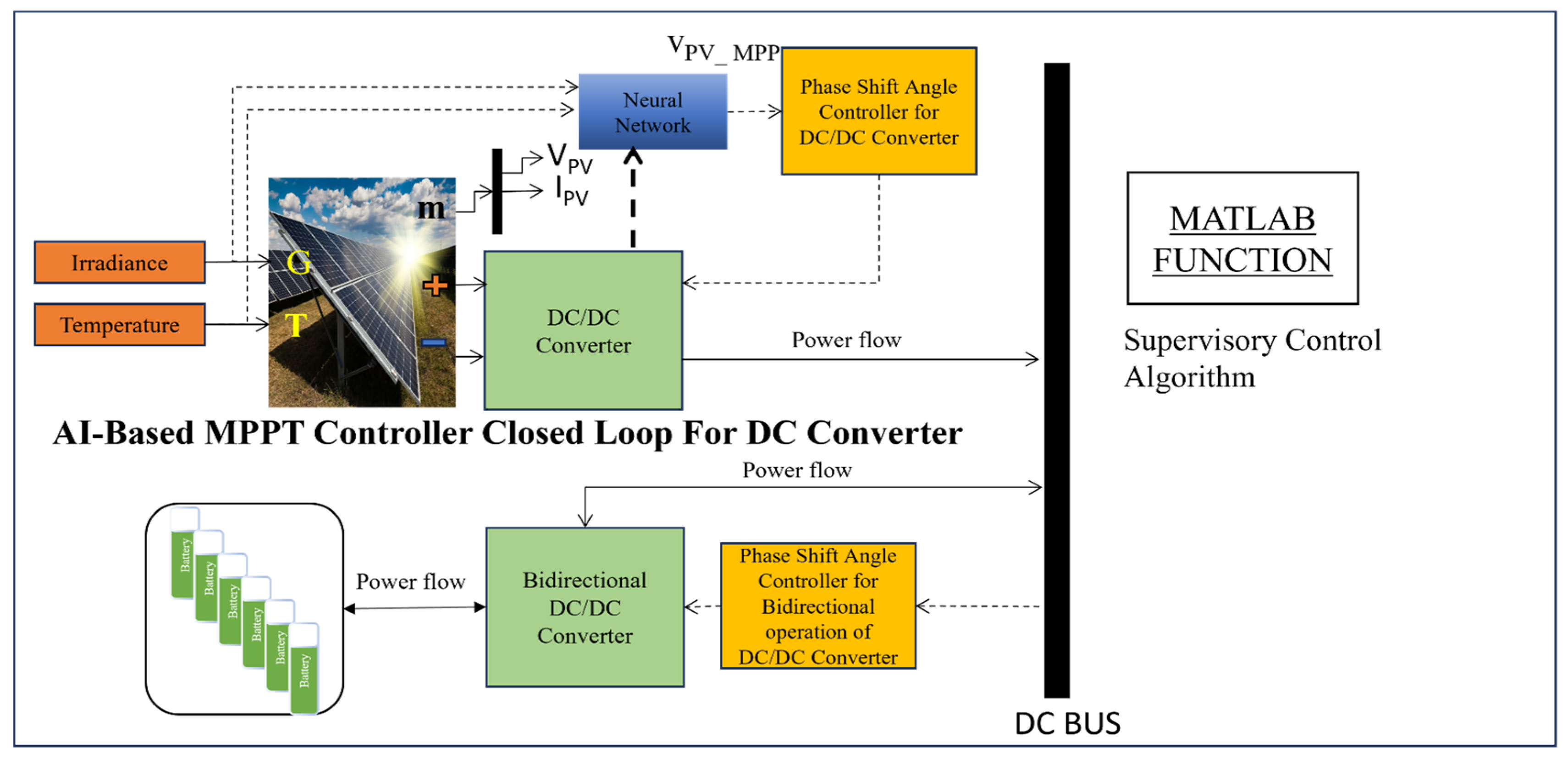
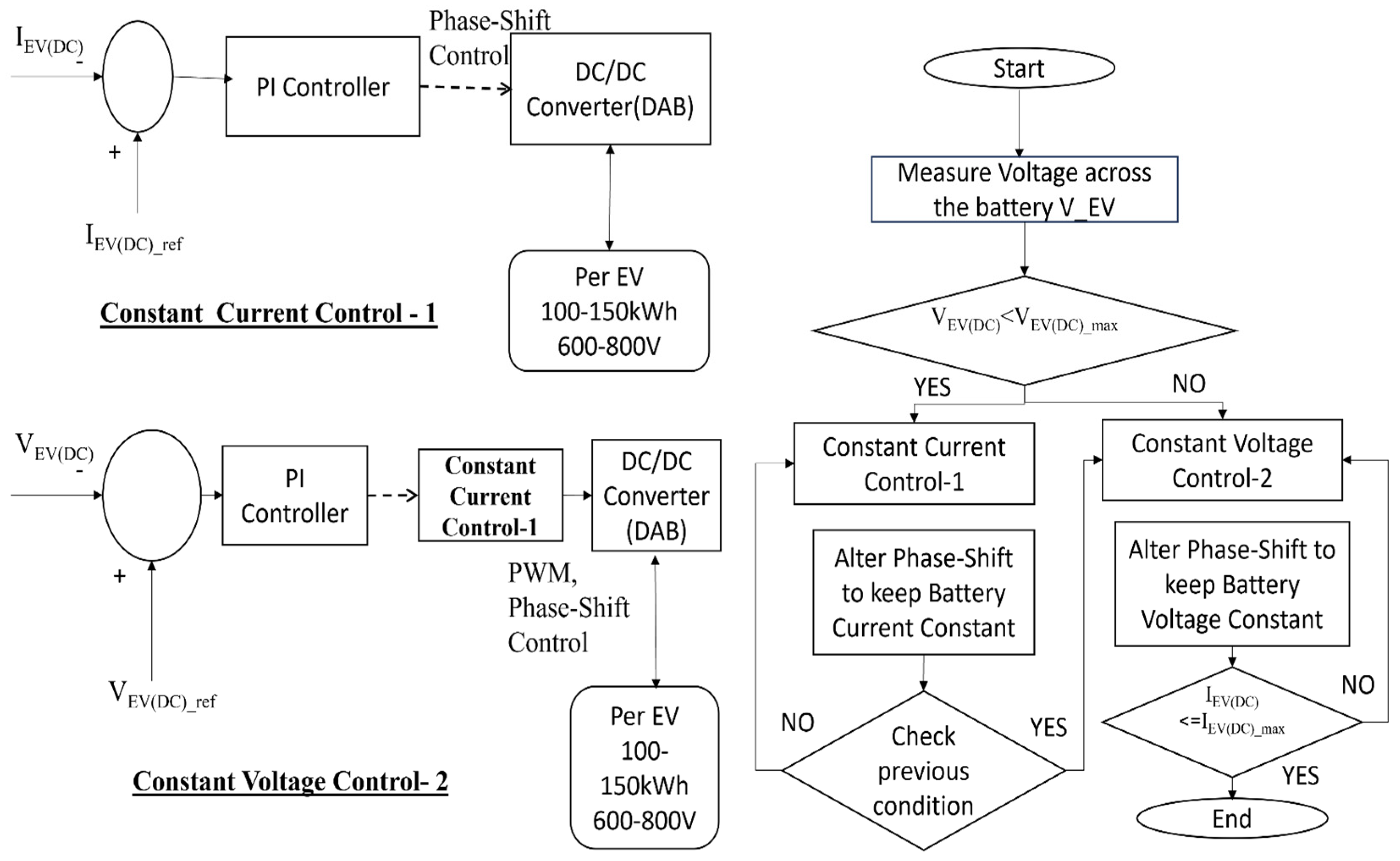
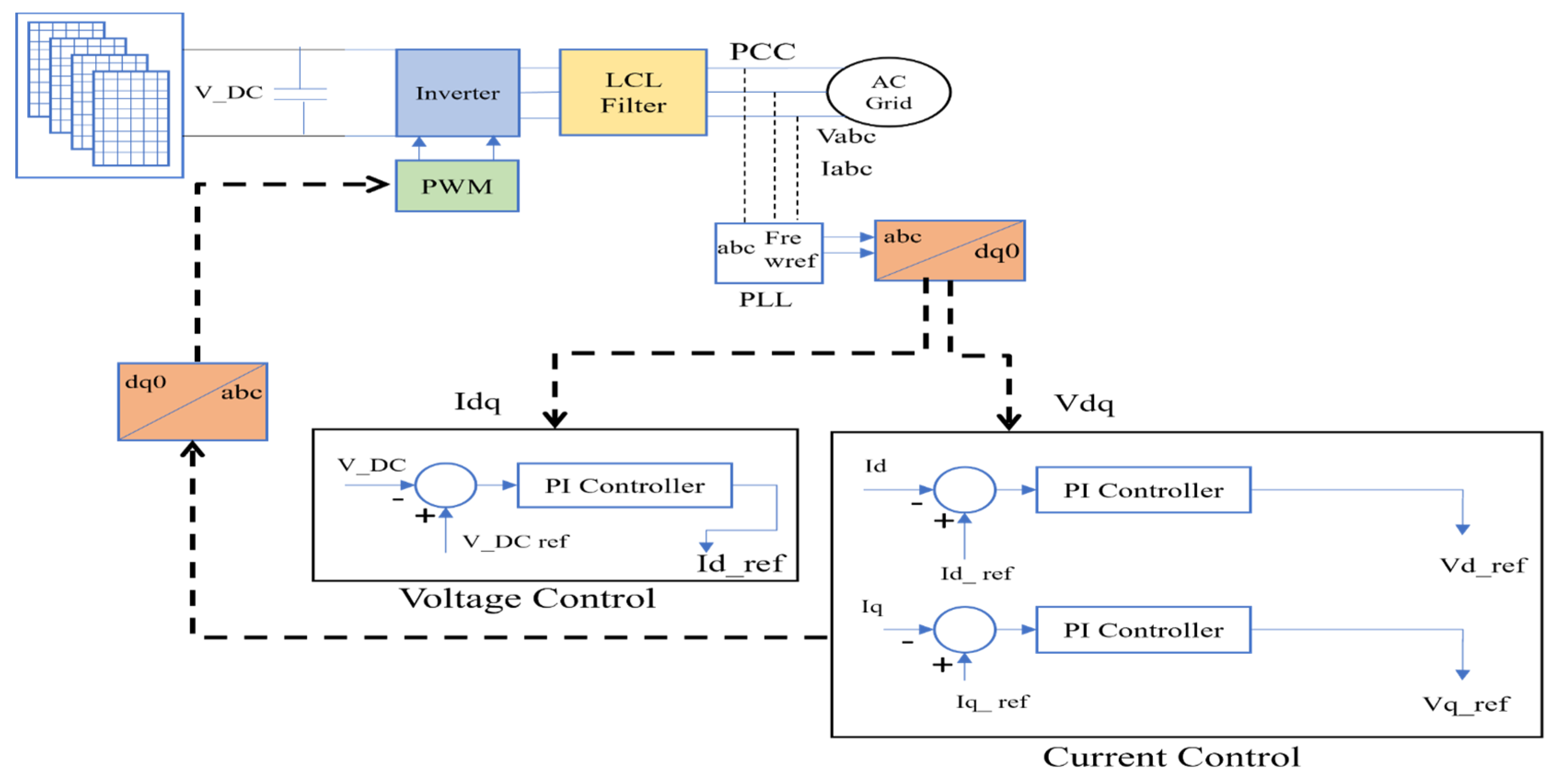
- To design a control mechanism that is AI-based, such as an ANN-based MPPT controller for a solar PV system, and a control mechanism for the phase shift controller for bidirectional and power flow control.
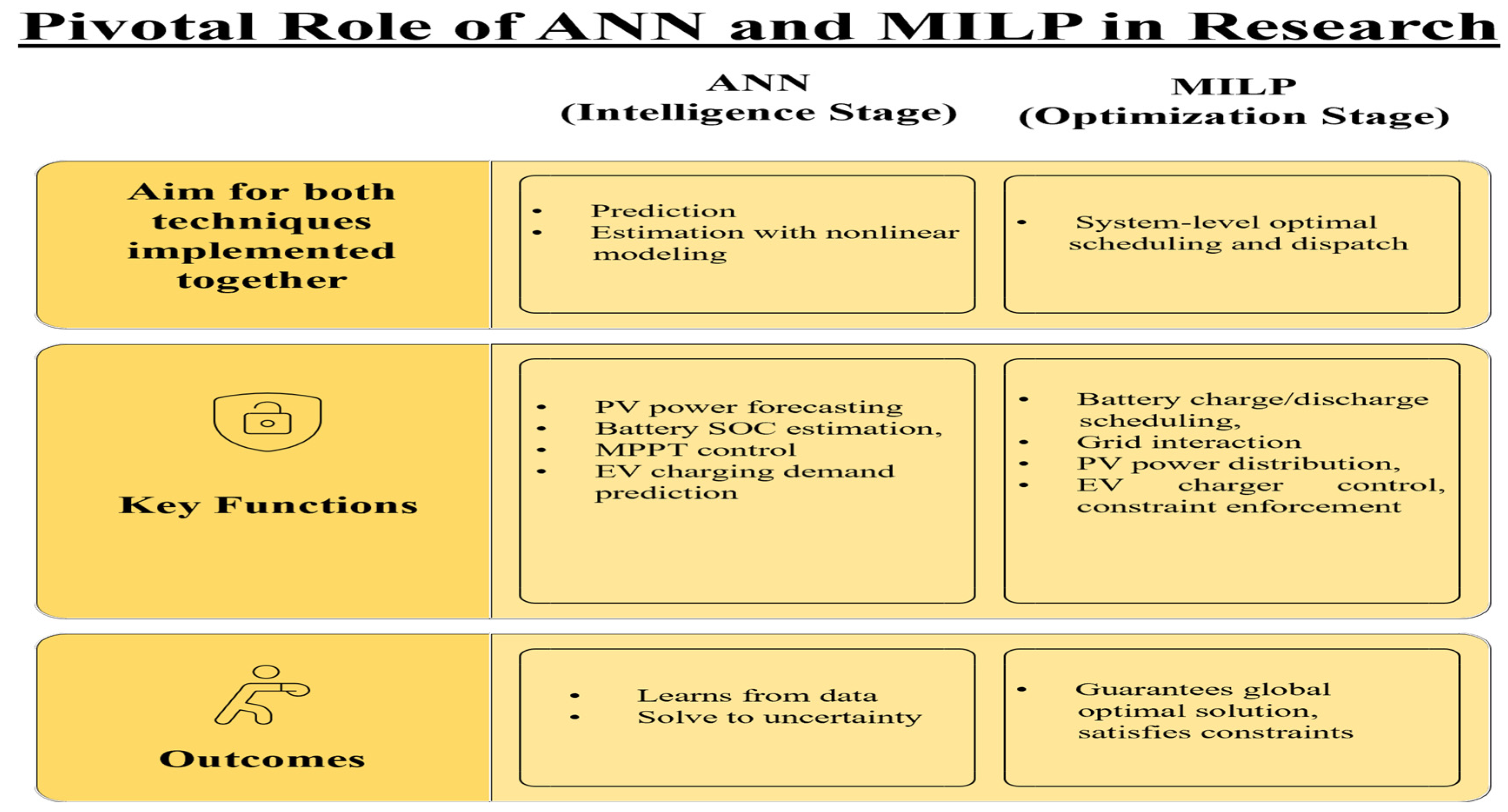
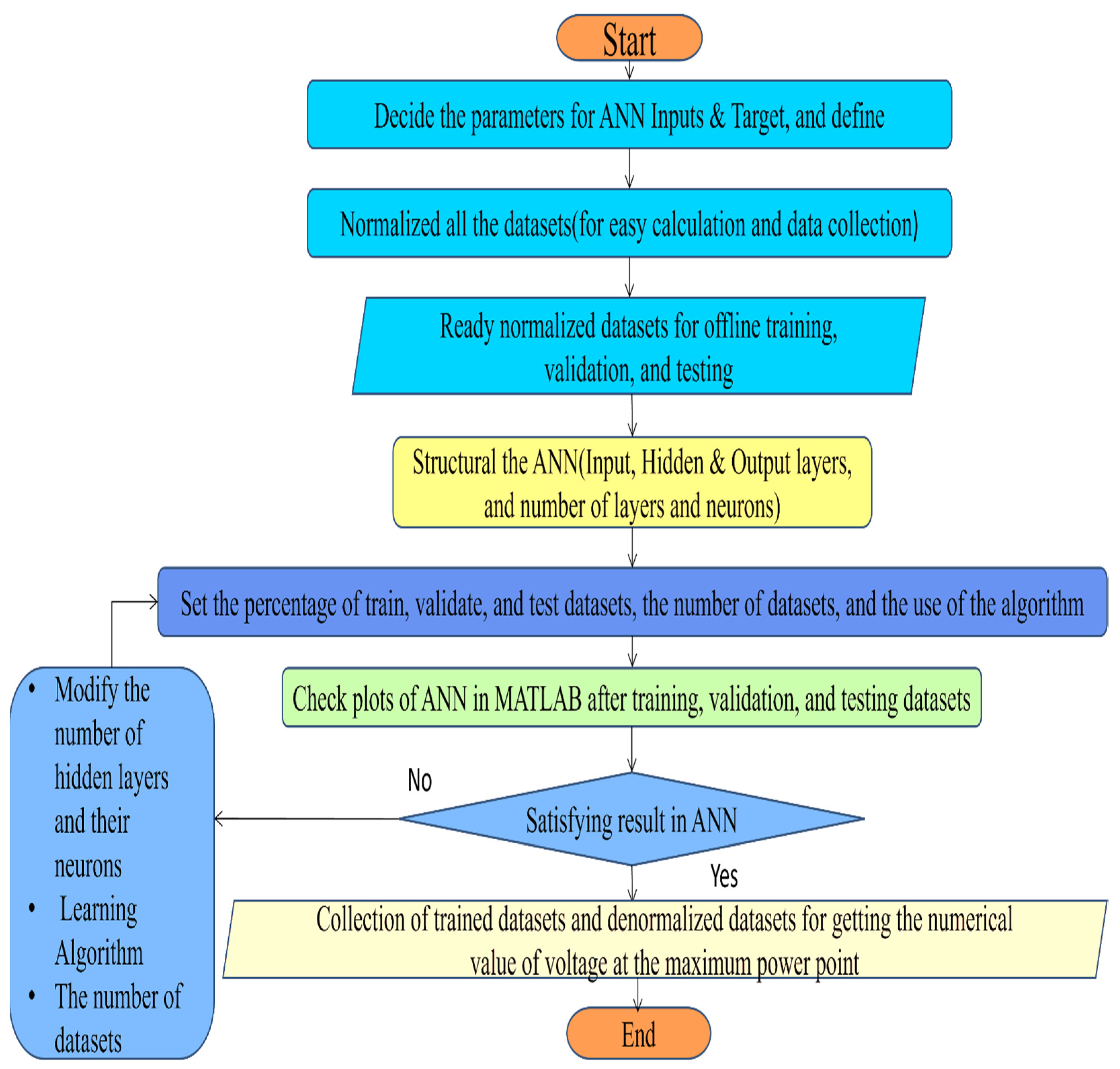
- To estimate the datasets, an ANN algorithm was used to define each dataset in 24 h for accurate optimization results at the last step.
- To make a priority list or scenarios for implementing balanced power management.
- To create an optimized approach using the MILP technique by setting an objective function to tackle the problem formation, and setting equality and inequality equations for the limits of the energy entities.
- To create feasible and resilient power management by dealing with non-linear relations using ANN and optimal solutions, using the MILP approach.
- To achieve a dynamic optimal power flow by a hybrid technique, which becomes an advanced optimal learning approach.
2. Literature Review
3. Methodology
3.1. EV Integrated Model with Solar PV-Based Grid System
3.1.1. PV System
3.1.2. Industrial Load and Distribution Transformer Through AC Bus
3.1.3. BESS (Battery Energy Storage System)
3.1.4. EVs
3.1.5. Bidirectional DC-AC Inverter
3.1.6. Unidirectional DC-DC Converter and Bidirectional DC-DC Converter (BDC)
3.2. Problem Formation
- Maximum utilization of solar PV system-generated power to supply the required load, such as charging EVs, storing electrical energy in BESS, etc., and mitigating reliance on the grid power.
- Optimal charging/discharging scheduling/allocation of the EV and BESS for ensuring the power management under a specific objective function and limits/constraints of each subsystem’s function, such as SOC limits on the BESS, EV power demand limits/constraints, EV users’ contentment-based limits, power limits of solar PV power generation, converter, etc.
- Reducing peak load at the AC Bus by controlling power flow distribution among power entities.
- The power flow regulatory system maintains a constant power at the AC and DC buses, which improves the stability.
3.3. Control Mechanism
3.3.1. AI-Based MPPT (Maximum Power Point Tracking) Controller with Unidirectional DC Converter
3.3.2. Bidirectional Dual Active Bridge DC Converter (BDA) with BESS
3.3.3. BDA with DC Fast EV Charging
3.3.4. Bidirectional DC-AC (Inverter) with Grid Loads
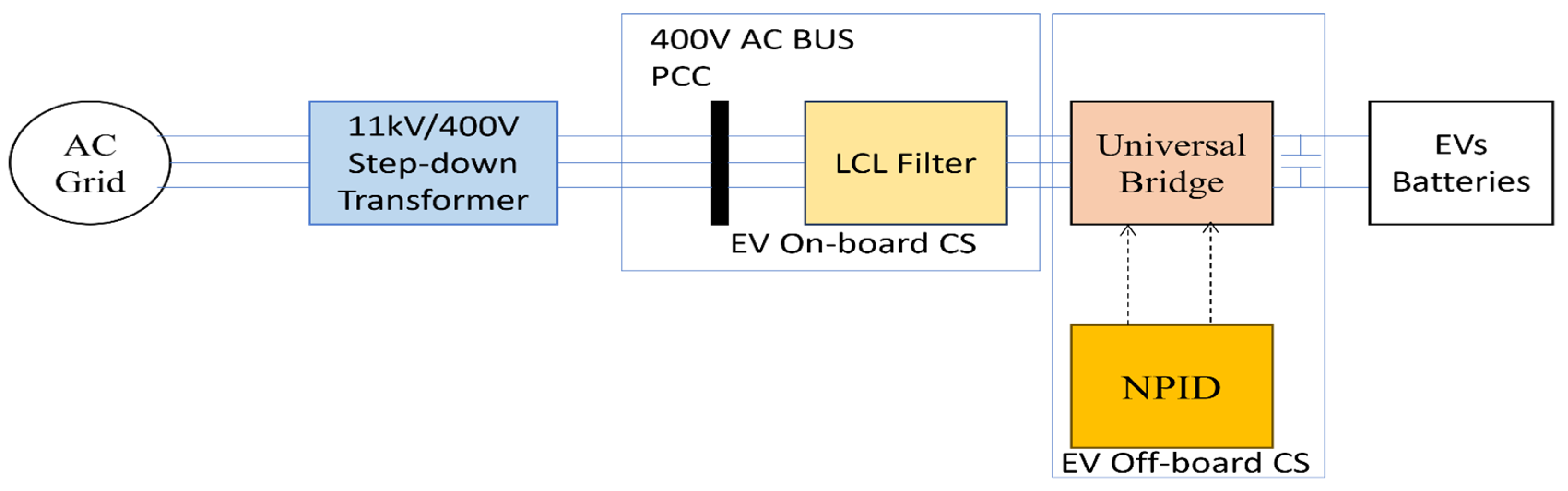
3.3.5. AC EV Charging Through AC Grid
3.3.6. Forecasting PV Power Generation, EV Demand, and EV Customers’ Arrival Time by ANN (AI) Tool

3.4. Mixed-Integer Linear Programming (MILP)
- Number of EVs: 200
- Decision variables: 14
- Operational constraints: 26
- Time frame: 24 h
- Total Computational time: 0.42–2.06 s;
- (0.4–2.0 s) for ANN forecasting and (0.02–0.06 s) for MILP optimal solution.
- (PV→EV(DC/AC)): The PV modules generated enough power to first fulfill the demand of EV charging with both types in two ways: PV modules → DC Bus → DC EV charging station, and AC Bus → transformer → AC EV charging station (on-board charging) → control mechanism → Off-board charging. In this case, a PV array will satisfy only the EV demand, not other sources of energy. The priority decides between AC/DC charging by checking the SOC conditions, arrival time of customers, etc.
- (PV → (BESS+ EV)): When there is not sufficient energy generated by PV modules (they have some but not zero). In that scenario, the battery energy storage system (BESS) supplies the remaining power to the EV charging station, allowing it to continue meeting the EV demand if the PV power is insufficient to meet the EV charging demand.
- (PV → 0, (BESS + Grid → charging of EV): There is no PV power generation for that case; both BESS and the grid will support the EV charging demand.
- (PV → Surplus power generation, PV power → (EV1 + BESS2 + Grid): In this case, PV power generation will be sufficient to manage the whole system’s loads. The “1” shows that the priority number means that one will be the first to get power.
- (EV demand → 0, (PV power generation → BESS1 + Grid): In this case, power from PV is stored for backup purposes in BESS and reduces the grid’s dependency on non-renewable power sources. The “1” shows that the priority number means that one will be the first to get power.
- (Only PV power generation → Grid): This case is rare, but it is an example of the curtailment of traditional energy resource generation and the benefits of optimal allocation of power distribution. The EV demand is zero, and BESS are fully charged.
- (PV power generation → 0, BESS fully discharged, EV →Grid loads at emergency and show independence on conventional power resources.)
3.4.1. Objective Function
- The communication delay is ignored to make a stable approach and study for the ideal application.
- Limits in SOCs and in power to avoid battery degradation or to ensure battery-safe operations.
- The PID controller mechanism supports the integrated system.
3.4.2. Power Balance Equations
3.4.3. Operational Constraints
Operational Constraints of PV Solar Module
- A.
- Equality Constraint Equations
- B.
- Inequality Constraint Equations
- C.
- Bounds
Operational Constraints for the AC Grid
- A.
- Equality Equations
- B.
- Inequality Equations
- C.
- Bounds
Operational Constraints for the BESS
- A.
- Equality Equations
- B.
- Inequality Equations
- C.
- Bounds
Operational Constraints for EVs
- A.
- Equality Equations
- B.
- Inequality Equations
- C.
- Bounds
V2G Operation Enabling
| Algorithm 1. MATLAB coding |
| Stage 1: Artificial neural network (ANN) for solar PV power generation. Input: Solar PV system datasets such as solar irradiance, air temperature, time, and solar PV power generation. Target: Forecast solar PV generation for 24 h. Stage 2: Artificial neural network (ANN) for EV Datasets. Input: EV known datasets such as EV charging demand, previous EV arrival time in CS, arrival SOC states, charging station capacity, and time. Target: 24 h forecast, EV charging demand, EV arrival time, and charging station. Stage 3: MILP for optimal EV charging/discharging, solar PV power generation, maximum utilization, and reduced grid dependency. Input: Forecasted solar PV datasets and EV datasets from Stage 1 and Stage 2. Objective Function: Power Balance: Constraints: Operational constraints of every subsystem. Decision Variables: Optimal allocation. , , , , , , , , , , . Output: The satisfying objective function and decision variables, optimal solutions throughout the day, are shown graphically. |
4. Results and Discussion
4.1. PV Modules
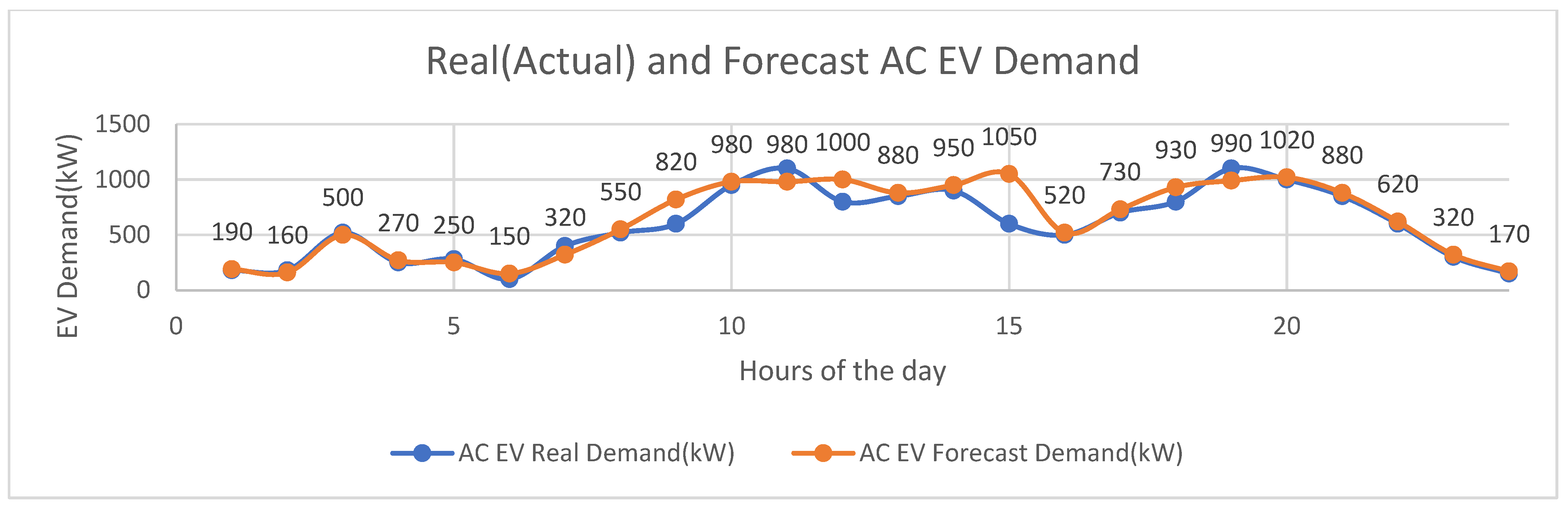
4.2. EVs Discussion
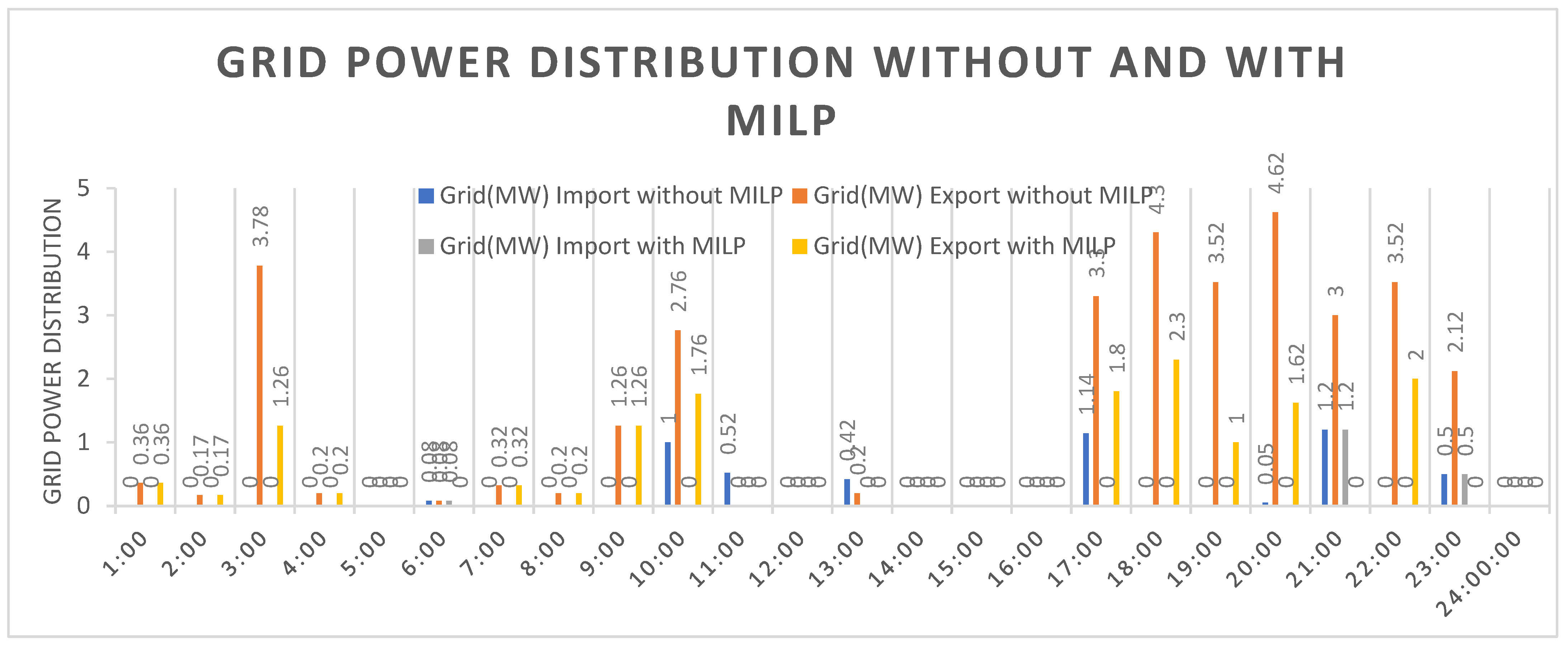
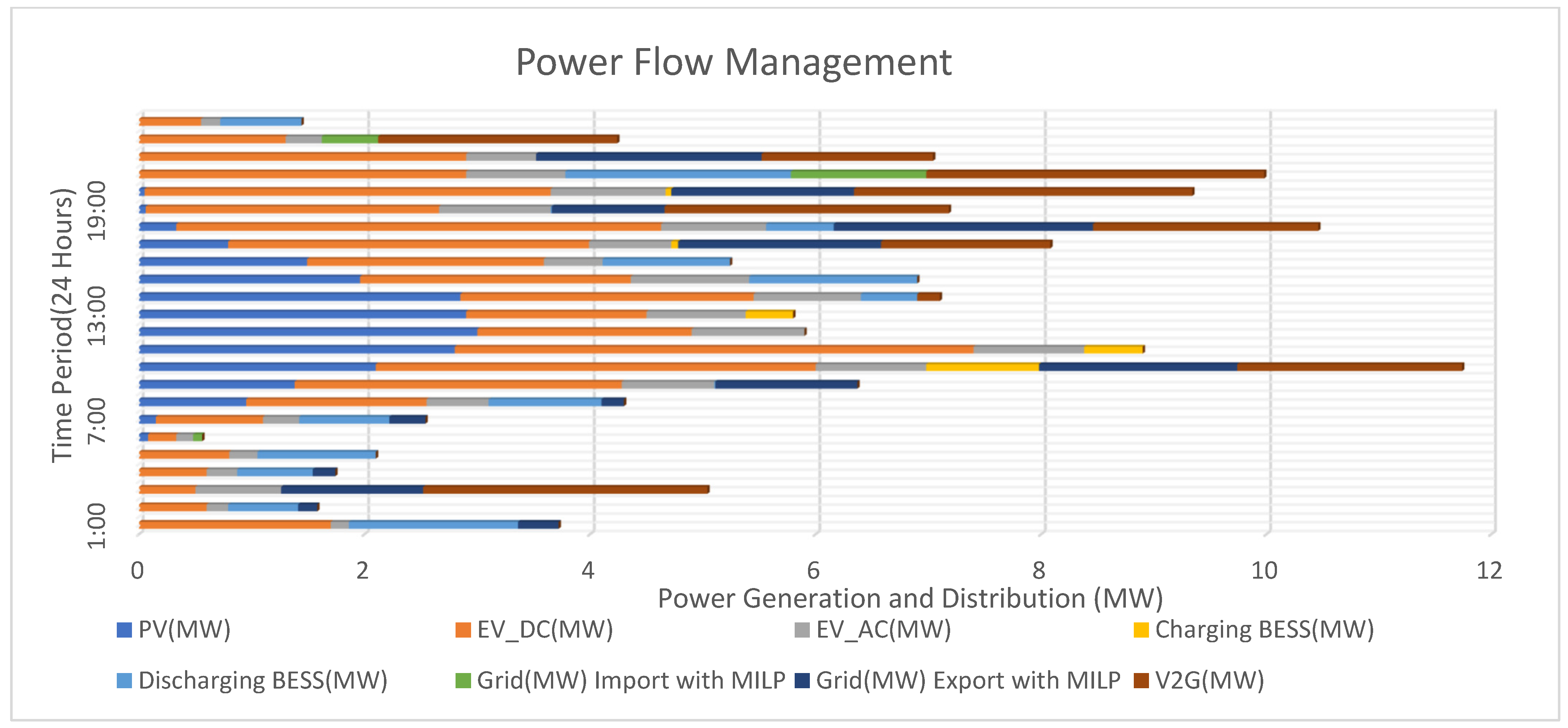
4.3. MILP Optimized Result (Optimal EV Charging/Discharging Allocation + Maximum Utilization of PV Power Generation + BESS Backup Power + Grid Dependency Reduced)
- The renewable utilization ratio (RUR) is known as the effective use of the renewable energy resources being fed to the grid loads, EV charging demand, and BESS charging during the extra generated solar power, based on this study. In technical terms, RUR % is defined as the use of renewable energy to feed all types of loads mentioned in this article to the total renewable power generated.
- The EV demand met is defined as the difference between the total needed EV demand and the demand served to EV users by any sources of power in this article, and a difference of zero means fully satisfying the EV users. Additionally, the MILP optimal charging scheduling will fulfill the EV demand to improve the satisfaction level of the EV users by adjusting the power level among power entities.
- Grid load reduction with respect to the baseline grid load demand is estimated by comparing the total load demand occurring on the grid before and after applying the proposed optimization methodology by adjusting the power demand.
- Peak load shaving on the grid means mitigating the peak load power demand of the grid by optimizing the allocation of EVs’ power demand and BESS.
- Prioritize the grid power demand.
- Solar PV power generation is used without strategic planning (extra power is curtailed and not stored in BESS, the EV power demand is met by the grid during no available solar PV power, and the power is directly taken from the solar PV system without planning).
- Unplanned BESS and EV allocation.
4.4. Sensitivity Analysis for Forecasted Datasets
5. Conclusions
Significance of This Research
- Peak load demand mitigation on the grid and reduced dependency on the grid.
- Integrated system power flow management.
- Concentrated renewable energy resource use.
- A scalable optimization approach (ANN + MILP).
6. Future Scope
- A fast, reliable system.
- 2.
- Deal with uncertain datasets.
- 3.
- Ancillary services provider.
- 4.
- Multi-timescale optimization technique.
- 5.
- Battery throughput and battery deterioration/aging modeling approach in an integrated system.
- 6.
- Real-world data sample implementation.
Author Contributions
Funding
Data Availability Statement
Conflicts of Interest
Nomenclature
| Parameters | |
| Time(t) | 24 h |
| PPV(t) | Total power generated from solar modules that come from the DAB DC-DC converter at time ‘t’ (kW) |
| VPV | Total voltage from PV modules [V] |
| IPV | Total current comes from PV modules [A] |
| VPV_MPP | Total PV voltage at maximum power point (MPP) [V] |
| V_DC | Voltage at DC bus [V] |
| I_DC | Current at DC bus [A] |
| P_DC BUS (t) | Constant power maintained at the DC bus (kW) [MW] |
| G/Irr | Solar irradiance incident on the PV solar modules (W/m2) |
| TSTC | Air temperature at standard testing conditions (°C) |
| TNOCT | Nominal operating conditions air temperature (°C) |
| P_AC BUS (t)/PGrid (t) | Constant power maintained at the AC bus (kW)/Total active power at AC bus [MW] |
| V_AC BUS (t)/VGrid (t) | Voltage at AC bus (11KV) |
| I_AC BUS (t)/IGrid (t) | Total load current at AC bus [A] |
| PIndus(t) | Total active power demanded by industrial load [MW] |
| PResi (t) | Total active power demanded by residential load [MW] |
| Decision Variables | |
| BESS charging power [MW] | |
| BESS discharging power [MW] | |
| EV discharging power [MW] | |
| Total active power demanded by the AC and the DC EV charging station (AC-EVCS + DC-EVCS) [MW] | |
| Solar PV power generated | |
| Grid power transfer to charge DC-EVCS [MW] | |
| Grid power transfer to charge AC-EVCS [MW] | |
| BESS power transfer to DC-EVCS [MW] | |
| BESS power transfer to AC-EVCS [MW] | |
| AC and DC EVCS power transfer in V2G technique [MW] | |
| Solar PV power transfer to DC-EVCS [MW] | |
| Solar PV power transfer to AC-EVCS [MW] | |
| Solar PV power transfer to BESS [MW] | |
| Solar PV power transfer to the grid [MW] | |
| Grid power imported [MW] | |
| Grid power exported [MW] | |
| Power loss [MW] | |
| Forecasted Variables | |
| Forecasted value of PPV(t) power generation [MW] | |
| Forecasted of power demand [MW] | |
| Forecast of the arrival time of EV customers [h] | |
| Control variables | |
| δ | Phase shift angle |
| Grid power reduced | |
| EV charging reduced | |
| (t), | {0, 1} |
Appendix A

| Time (Hours) | Solar PV Power (MW) | EV Demand (MW) | BESS SOC % | Grid Exchange (MW) |
|---|---|---|---|---|
| 1 | 0 | 1.68 | 98% | 0.02 |
| 2 | 0 | 1.380 | 75% | 0.17 |
| 3 | 0 | 1.52 | 35% | −1.26 (V2G) |
| 4 | 0 | 1.25 | 32% | 0.27 |
| 5 | 0 | 1.380 | 31% | 0.38 |
| 6 | 0.15 | 0.4 | 90% | 0 |
| 7 | 0.31 | 2.3 | 98% | 0 |
| 8 | 0.69 | 2.02 | 60% | 0.01 |
| 9 | 1.23 | 3.4 | 70% | 0 |
| 10 | 1.92 | 4.75 | 55% | 0 |
| 11 | 2.54 | 5.9 | 48% | 0 |
| 12 | 2.85 | 2.6 | 100% | 0 |
| 13 | 3 | 3.35 | 75% | 0 |
| 14 | 2.99 | 3.70 | 98% | 0 |
| 15 | 2.08 | 3.1 | 98% | 0 |
| 16 | 1.56 | 2.7 | 80% | 0 |
| 17 | 0.78 | 3.9 | 75% | 0.07 |
| 18 | 0.38 | 5.0 | 74% | 0.6 |
| 19 | 0.05 | 6.1 | 64% | 0.098 |
| 20 | 0.1 | 5.7 | 60% | 0.258 |
| 21 | 0 | 4.65 | 50% | 0.587 |
| 22 | 0 | 3.4 | 55% | 0.02 |
| 23 | 0 | 1.5 | 60% | 0 |
| 24 | 0 | 0.75 | 85% | 0 |
References
- Sithambaram, M.; Rajesh, P.; Shajin, F.H.; Rajeswari, I.R. Grid connected photovoltaic system-powered electric vehicle charging station for energy management using hybrid method. J. Energy Storage 2025, 108, 114828. [Google Scholar] [CrossRef]
- Sharma, J.; Sundarabalan, C.K.; Balasundar, C. Advanced energy management strategy for enhancing battery lifespan in solar PV-powered EV charging stations with hybrid energy storage systems. Renew. Energy 2025, 251, 123443. [Google Scholar] [CrossRef]
- Ali, Y.O.; EL Haini, J. Energy Management Strategies for Grid-Integrated Photovoltaic and Battery Energy Storage Systems-Enhanced Electric Vehicle Charging Stations: Classical Approaches and Neural Network Solutions. Sustain. Energy Grids Netw. 2025, 43, 101926. [Google Scholar]
- Jain, A.; Bhullar, S. Design and performance analysis of solar PV-battery energy storage system integration with three-phase grid. J. Power Sources 2025, 640, 236486. [Google Scholar] [CrossRef]
- Jain, A.; Panda, K.P.; Bhullar, S. Performance analysis of LMS and LN-LMS adaptive control algorithms for grid-tied solar PV-based EV charging systems. Comput. Electr. Eng. 2025, 127, 110532. [Google Scholar] [CrossRef]
- Mehmood, A.; Yang, F. Improvement of Power Quality of Grid-Connected EV Charging Station Using Grid-Component Based Harmonic Mitigation Technique. Energies 2025, 18, 2876. [Google Scholar] [CrossRef]
- Adiguna, S.; Afandi, A.N.; Bagaskoro, M.C. Techno-economic modeling and analysis of a PV EV charged with a battery energy storage system (BESS) on Kalimantan Island. Glob. Energy Interconnect. 2025, 8, 225–239. [Google Scholar] [CrossRef]
- Ghotge, R.; Snow, Y.; Farahani, S.; Lukszo, Z.; van Wijk, A. Optimized scheduling of EV charging in solar parking lots for local peak reduction under EV demand uncertainty. Energies 2020, 13, 1275. [Google Scholar] [CrossRef]
- Zhang, Y.; Xue, W.; Li, S.; Kang, Y.; Zhu, J.; Dong, H. Deep Learning-based Predictive Control of Vehicle-to-Grid Onboard Charger Back Stage Models. IEEE Access 2025, 13, 160707–160721. [Google Scholar] [CrossRef]
- Dhanawat, V.; Shinde, V.; Alami, R.; Akhunzada, A.; Faheem, Z.B.; Biswas, A. Electric vehicles charging station load forecasting integration with renewable energy using novel deep EfficientBiLSTMNet. IEEE Open J. Veh. Technol. 2025, 6, 2642–2661. [Google Scholar] [CrossRef]
- Shipman, R.; Roberts, R.; Waldron, J.; Naylor, S.; Pinchin, J.; Rodrigues, L.; Gillott, M. We got the power: Predicting available capacity for vehicle-to-grid services using a deep recurrent neural network. Energy 2021, 221, 119813. [Google Scholar] [CrossRef]
- Elnady, M.; Ozana, S. Artificial Intelligence techniques in Vehicle-to-Grid (V2G) systems: A review, comparative study, and model evaluation. J. Energy Storage 2025, 135, 118155. [Google Scholar] [CrossRef]
- Dang, D.N.; Le Viet, T.; Takano, H.; Duc, T.N. Estimating parameters of photovoltaic modules based on current–voltage characteristics at operating conditions. Energy Rep. 2023, 9, 18–26. [Google Scholar] [CrossRef]
- Chouay, Y.; Ouassaid, M. An accurate real time neural network based irradiance and temperature sensor for photovoltaic applications. Results Eng. 2024, 21, 101766. [Google Scholar] [CrossRef]
- Zhang, X.; Son, Y.; Choi, S. Optimal scheduling of battery energy storage systems and demand response for distribution systems with high penetration of renewable energy sources. Energies 2022, 15, 2212. [Google Scholar] [CrossRef]
- Khan, W.; Ahmad, F.; Alam, M.S. Fast EV charging station integration with grid ensuring optimal and quality power exchange. Eng. Sci. Technol. Int. J. 2019, 22, 143–152. [Google Scholar] [CrossRef]
- Al-Hattab, M.; Odeh, A.; Takruri, M. AI-Based Mobility Prediction Using Recurrent Neural Networks and Attention Mechanisms. IEEE Access 2025, 13, 179686–179695. [Google Scholar] [CrossRef]
- Jaruwatanachai, P.; Sukamongkol, Y.; Samanchuen, T. Predicting and managing EV charging demand on electrical grids: A simulation-based approach. Energies 2023, 16, 3562. [Google Scholar] [CrossRef]
- Ray, S.; Kasturi, K.; Nayak, M.R. Multi-objective electric vehicle charge scheduling for photovoltaic and battery energy storage based electric vehicle charging stations in distribution network. Green Energy Intell. Transp. 2025, 4, 100296. [Google Scholar] [CrossRef]
- Ikram, M.K.; Seyedmehmoudian, M.; Thirunavukkarasu, G.S.; Mekhilef, S.; Stojcevski, A. A two-stage fuzzy-informed optimization framework for reduced peak load and hierarchical EV management in smart grids. J. Energy Storage 2025, 136, 118308. [Google Scholar] [CrossRef]
- Feng, J.; Yao, Y.; Liu, Z. Developing an optimal building strategy for electric vehicle charging stations: Automaker role. Environ. Dev. Sustain. 2025, 27, 12091–12151. [Google Scholar] [CrossRef]
- Alguhi, A.A.; Al-Ammar, E.A.; Ko, W.; Choi, H.J.; Park, S.; Khan, M. Optimizing EVs Penetration Levels in Smart Grids Using Dynamic Pricing and Renewable Energy Backed by BESS While Maintaining Grid Constraints. IET Gener. Transm. Distrib. 2025, 19, e70120. [Google Scholar] [CrossRef]
- Fan, P.; Ke, S.; Yang, J.; Wen, Y.; Xie, L.; Li, Y.; Kamel, S. A frequency cooperative control strategy for multimicrogrids with EVs based on improved evolutionary-deep reinforcement learning. Int. J. Electr. Power Energy Syst. 2024, 159, 109991. [Google Scholar] [CrossRef]
- Tiburtini, F.M.; Lo Franco, F.; Ricco, M. Multi-objective sizing method for PV-BESS integration with ev charging stations and analysis across different parking scenarios. Batteries 2025, 11, 422. [Google Scholar] [CrossRef]
- Vikram Solar. Solar PV Modules Datasheets. Available online: https://www.vikramsolar.com/pv-modules/ (accessed on 3 January 2026).
- Gnanavendan, S.; Selvaraj, S.K.; Dev, S.J.; Mahato, K.K.; Swathish, R.S.; Sundaramali, G.; Accouche, O.; Azab, M. Challenges, solutions and future trends in EV-technology: A review. IEEE Access 2024, 12, 17242–17260. [Google Scholar] [CrossRef]
- Sharma, G.; Sood, V.K.; Alam, M.S.; Shariff, S.M. Comparison of common DC and AC bus architectures for EV fast charging stations and impact on power quality. eTransportation 2020, 5, 100066. [Google Scholar] [CrossRef]
- Syahbani, M.A.; Ramli, M.A.; Megantoro, P.; Ardiansyah, A.; Cahyani, I.D.; Dinata, N.F.P.; Firmansyah, R.; Zohri, M.; Budiman, F.N. Performance Enhancement of Grid-Forming Inverter-Controlled PV Systems: A Comparative Study with and without Battery Energy Storage under Intermittent and Unbalanced Load Conditions. Results Eng. 2025, 27, 105980. [Google Scholar] [CrossRef]
- Azizi, A.; Akhbari, M.; Danyali, S.; Tohidinejad, Z.; Shirkhani, M. A review on topology and control strategies of high-power inverters in large-scale photovoltaic power plants. Heliyon 2025, 11, e42334. [Google Scholar] [CrossRef]
- Moonem, M.A.; Pechacek, C.L.; Hernandez, R.; Krishnaswami, H. Analysis of a multilevel dual active bridge (ML-DAB) DC-DC converter using symmetric modulation. Electronics 2015, 4, 239–260. [Google Scholar] [CrossRef]
- Trivedi, S.S.; Sant, A.V. Comparative analysis of dual active bridge dc–dc converter employing Si, SiC and GaN MOSFETs for G2V and V2G operation. Energy Rep. 2022, 8, 1011–1019. [Google Scholar] [CrossRef]
- Alam, M.A.; Minai, A.F.; Bakhsh, F.I. Isolated bidirectional DC-DC Converter: A topological review. E-Prime-Adv. Electr. Eng. Electron. Energy 2024, 8, 100594. [Google Scholar] [CrossRef]
- Wang, J.; Wang, B.; Zhang, L.; Wang, J.; Shchurov, N.I.; Malozyomov, B.V. Review of bidirectional DC–DC converter topologies for hybrid energy storage system of new energy vehicles. Green Energy Intell. Transp. 2022, 1, 100010. [Google Scholar] [CrossRef]
- Tong, Y.; Salhi, I.; Wang, Q.; Lu, G.; Wu, S. Bidirectional DC-DC Converter Topologies for Hybrid Energy Storage Systems in Electric Vehicles: A Comprehensive Review. Energies 2025, 18, 2312. [Google Scholar] [CrossRef]
- Tuluhong, A.; Xu, Z.; Chang, Q.; Song, T. Recent Developments in Bidirectional DC-DC Converter Topologies, Control Strategies, and Applications in Photovoltaic Power Generation Systems: A Comparative Review and Analysis. Electronics 2025, 14, 389. [Google Scholar] [CrossRef]
- Misra, S.; Panigrahi, P.K.; Ghosh, S. Smart battery management scheme for v2g based ev smart charger–a better approach of allocation of ev based distributed generation. In 2020 IEEE International Symposium on Sustainable Energy, Signal Processing and Cyber Security (iSSSC); IEEE: New York, NY, USA, 2020; pp. 1–6. [Google Scholar]
- Karami, N.; Moubayed, N.; Outbib, R. General review and classification of different MPPT Techniques. Renew. Sustain. Energy Rev. 2017, 68, 1–18. [Google Scholar] [CrossRef]
- Gul, S.; Malik, S.M.; Sun, Y.; Alsaif, F. An artificial neural network based MPPT control of modified flyback converter for PV systems in active buildings. Energy Rep. 2024, 12, 2865–2872. [Google Scholar] [CrossRef]
- Hussain, M.T.; Sarwar, A.; Tariq, M.; Urooj, S.; BaQais, A.; Hossain, M.A. An evaluation of ANN algorithm performance for MPPT energy harvesting in solar PV systems. Sustainability 2023, 15, 11144. [Google Scholar] [CrossRef]
- Dixit, T.V.; Yadav, A.; Gupta, S. Experimental assessment of maximum power extraction from solar panel with different converter topologies. Int. Trans. Electr. Energy Syst. 2019, 29, e2712. [Google Scholar] [CrossRef]
- Solcast. Live Solar Irradiance and Weather Data. Available online: https://solcast.com/live-weather-irradiance-data (accessed on 3 January 2026).
- Mathworks. Rand Uniformly Distributed Random Numbers. MATLAB Documentation Help Centre. Available online: https://in.mathworks.com/help/matlab/ref/double.rand.html (accessed on 3 January 2026).
- Lundmark, L.; Golzar, F.; Guedez, R.; Astaneh, M. A validated forecasting model for optimizing dispatch schedules of PV-battery system in grid-connected apartment buildings. Appl. Energy 2026, 404, 127123. [Google Scholar] [CrossRef]
- Bharti, K.P.; Ashfaq, H.; Kumar, R.; Singh, R. Designing a bidirectional power flow control mechanism for integrated EVs in PV-Based grid systems supporting onboard AC charging. Sustainability 2024, 16, 8791. [Google Scholar] [CrossRef]


| Year | Authors | Hybrid System | Key Finds | Methodology | Limitation | |||
|---|---|---|---|---|---|---|---|---|
| 2025 | Sithambaram, M. et al. [1] | PV | EV | BESS | GRID | Improved power quality and power factor of the grid, PV, and battery converter. Basically, focused on the energy system’s power quality | Hybrid technique (SWO-MHFAN) | Difficult to understand, complex learning |
| √ | √ | √ | √ | |||||
| 2025 | Sharma, J. et al. [2] | PV | EV | BESS | GRID | Power management for grid stability and EV longevity | PSO algorithms for MPPT + evaluation in MATLAB/simulation + dSPACE DS1202 platform | Complex learning skills/programming, high-cost |
| √ | √ | √ | √ | |||||
| 2025 | Ali. et al. [3] | PV | EV | BESS | GRID | Maximum RES utilized, grid stability maintained, better power flow | Neural network- based ANFIS for MPPT | Not express the optimal EV scheduling properly in a graph or tabular form |
| √ | √ | √ | √ | |||||
| 2025 | Alok Jain, et al. [4] | PV | EV | BESS | GRID | Grid power quality, DC bus voltage regulation, BESS to grid operation | Perturb and observe (P&O) MPPT + LMS algorithm for control strategy | LMS algorithm has slow convergence compared to the machine learning approach |
| √ | - | √ | √ | |||||
| 2025 | Alok J., et al. [5] | PV | EV | BESS | GRID | Sudden variation in PV solar irradiance and EV power demand effect on the grid quality and stability | LMS-based controller | Not uncertainty—discuss for the EV datasets and PV, and forecast to resolve the uncertain nature. For a low-power system |
| √ | √ | - | √ | |||||
| 2025 | Mehmood, A. et al. [6] | PV | EV | BESS | GRID | Power quality improved by the grid-connected EV charging station | Conventional method—mathematical equations, datasets from manufacturers and simulated proposed model in MATLAB | Low power application |
| - | √ | - | √ | |||||
| 2025 | Adiguna, S. et al. [7] | PV | EV | BESS | GRID | Optimal combination of BESS and the grid-connected solar PV power generation with EVCS | Particle swarm optimization (PSO) and gray wolf optimization (GWO) algorithms | Very complex learning approaches |
| √ | √ | √ | √ | |||||
| 2020 | Ghotge, R. et al. [8] | PV | EV | BESS | GRID | Dealing with uncertainty in EV datasets for optimal scheduling | MATLAB simulation + model predictive control (MPC) control technique | Time-taking controlling |
| √ | √ | √ | √ | |||||
| 2025 | Alguhi, A. et al. [22] | PV + DG | EV | BESS | GRID | Renewable energy resources with BESS integration enhances the EV penetration and grid stability | MATLAB + AI-based (Combine ANN, LSTM) control and optimizer technique | Uncertain datasets of EV and solar PV power generation are not modeled |
| √ | √ | √ | √ | |||||
| 2024 | Fan, P. et al. [23] | PV | EV | BESS | GRID | Voltage and frequency regulation of the grid with EVs, optimal EVs charging scheduling | MATLAB Simulink + MILP technique = deep reinforcement learning algorithm | Predictive model of EV arrival time, EV owners’ preferences are mixing and advancing, known in the study |
| - | √ | - | √ | |||||
| 2025 | Tiburtini, F. M.et al. [24] | PV | EV | BESS | GRID | Power balance in between PV and EV by BESS sizing | Non-dominated sorting genetic algorithm-2 | Assume uncertainty is negligible or fixed, datasets of EV and PV |
| √ | √ | √ | √ | |||||
| This study | _ | PV | EV | BESS | GRID | Maximum utilized PV solar power, peak power reduction export from the utility grid, EV charging allocation in integrated system, maintain the constant power on the DC buses | MILP + AI-based control mechanism = hybrid optimization techniques for hybrid system | Easy to understand every step, estimated, forecasted model and explained optimal EV allocation in tabular form |
| √ | √ | √ | √ | |||||
| Parameters |
STC (Irradiance-
1000 W/m2, 25 °C) |
NOCT (Irradiance-
800 W/m2, 20 °C) |
|---|---|---|
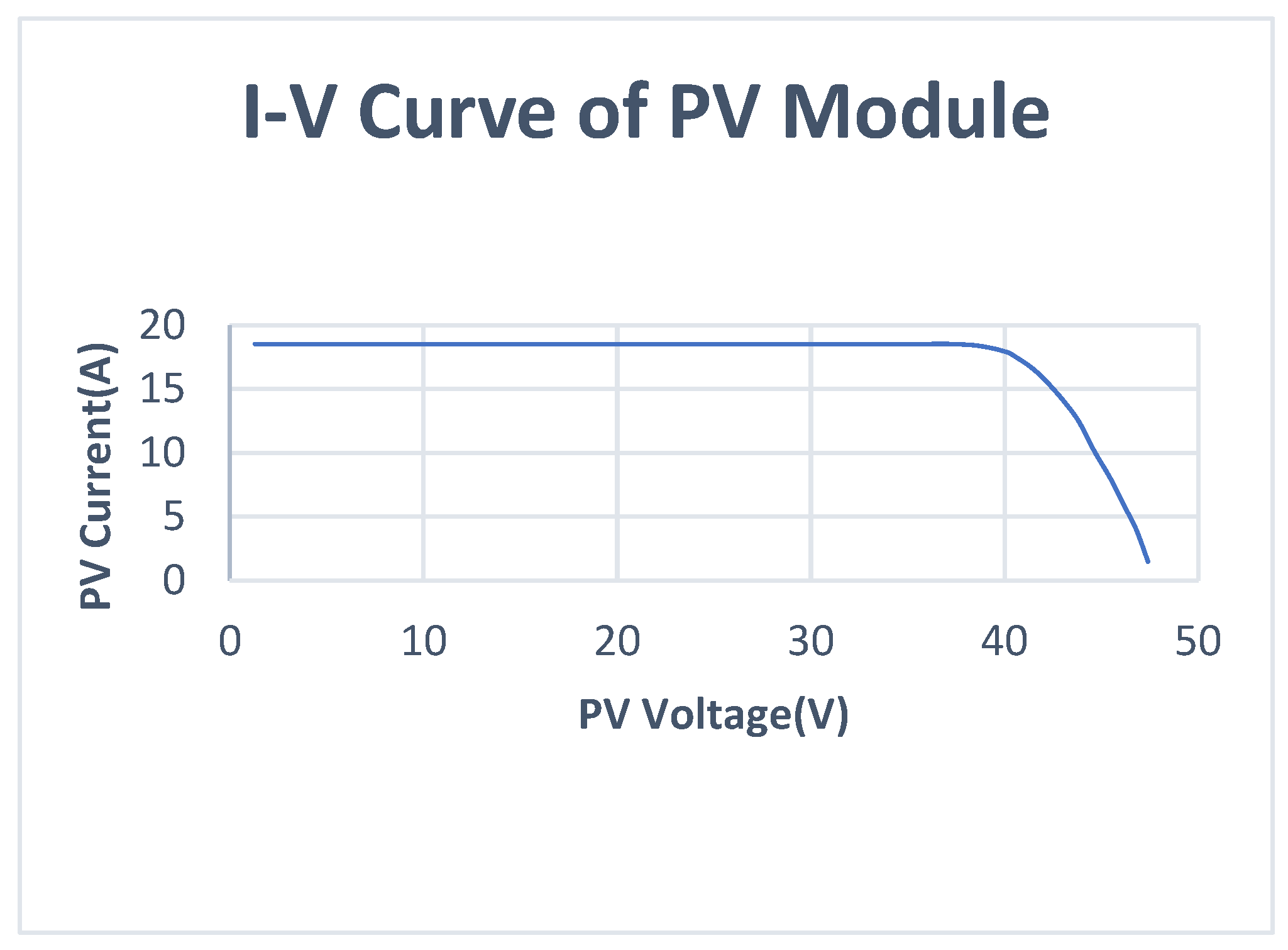
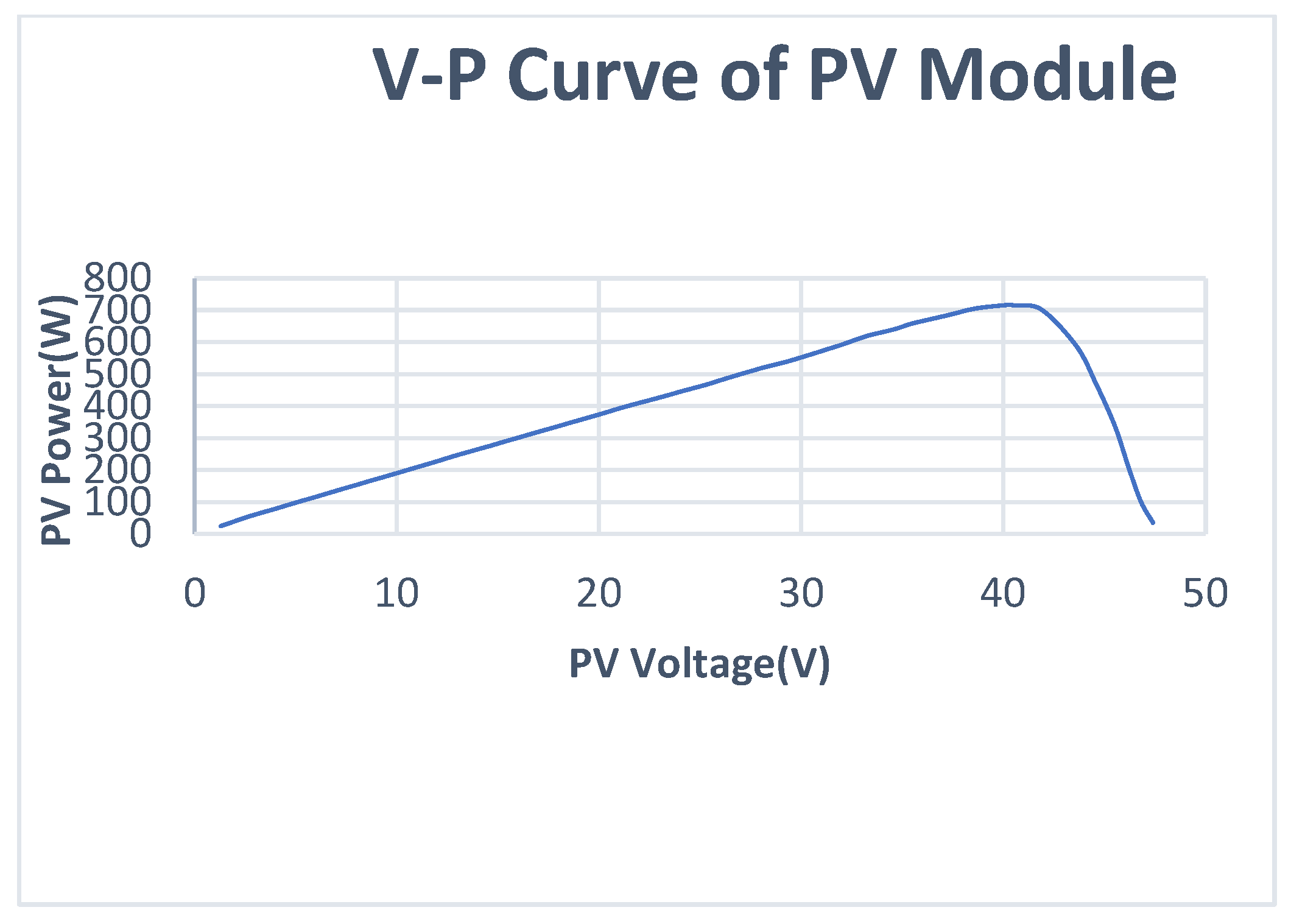
| Maximum power from PV per module (PPV_(DC)) | 715 W | 539 W |
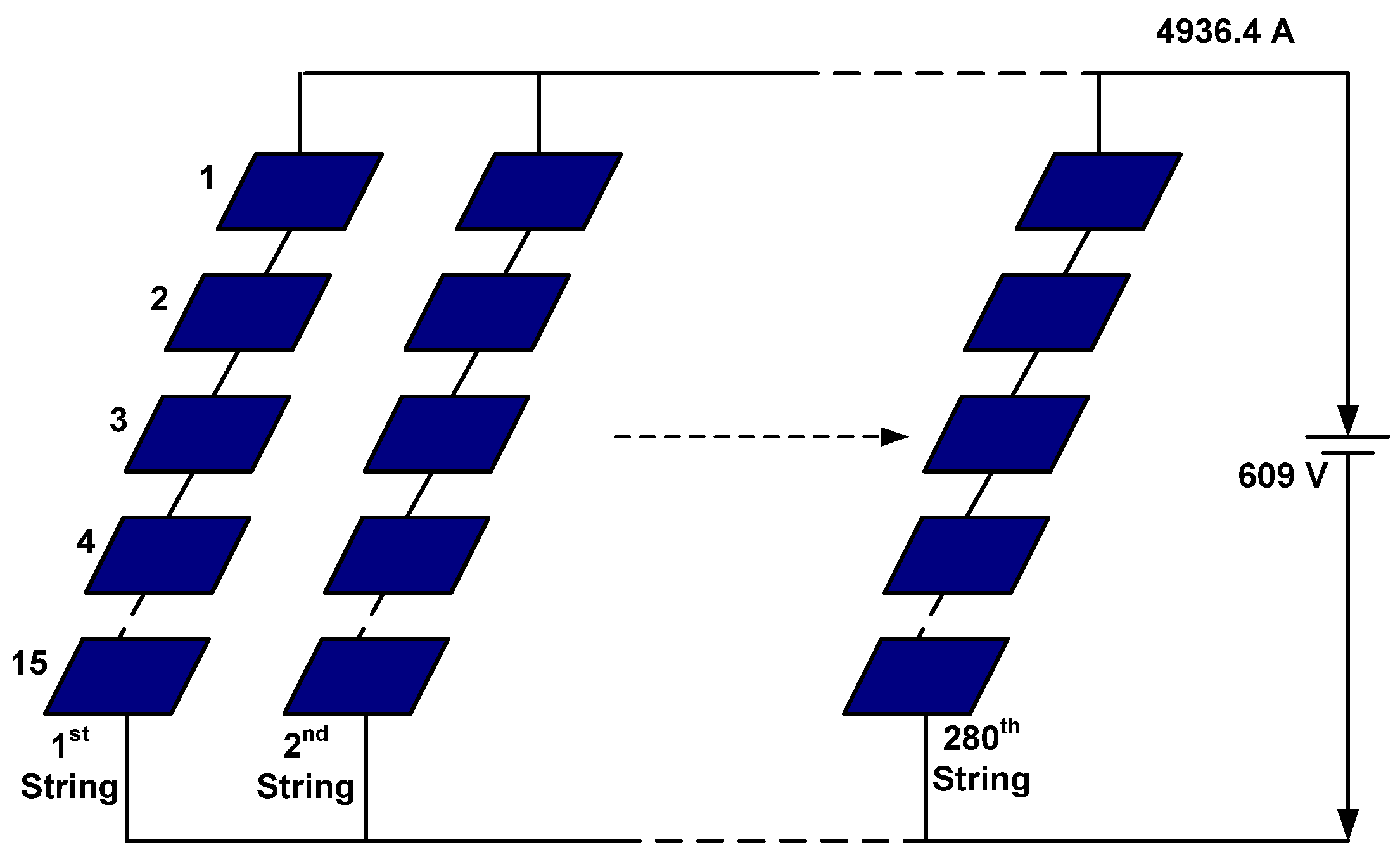
| At maximum power point, voltage (VPV_MPP) | 40.6 V | 37.6 V |
| At maximum power point, current (IPV_MPP) | 17.63 A | 14.28 A |
| Open circuit voltage (VPV_OC) | 48.1 V | 45.4 V |
| Short circuit current (IPV_SC) | 18.64 A | 15.03 A |
| Cells per module of solar PV panel | 132 | 132 |
| Number of series modules per string | 15 | 15 |
| Number of strings in parallel | 280 | 280 |
| Max efficiency | 23.02% | 23.02% |
| Temperature coefficient of VPV_OC | −0.26%/°C | −0.26%/°C |
| Temperature coefficient of IPV_SC | 0.046%/°C | 0.046%/°C |
|
Rated
Voltage (HV) kV |
Rated
Voltage (LV) kV |
Rated
Capacity MVA, kW |
Rated
Current (HV) A |
Rated
Current (LV) A |
Turn
Ratio |
Voltage
Regulation |
No
Load Loss |
Load
Loss |
Short
Circuit Current |
Connection
Type |
No Load
Current I0 |
|---|---|---|---|---|---|---|---|---|---|---|---|
| 11 kV | 415 V | 1 MVA, 900 kW | 52.49 A | 1392.2 A | 26.51:1 | 4.3% | 1.8 kW | 11 kW | 41 kA | Dyn11 | 13.92 A |
|
Voltage
Levels |
Rated
Frequency Hz |
Active Power
MW |
Reactive Power
MVAr | Load Current (A) |
|---|---|---|---|---|
| 11 kV | 50 Hz | 1 | 0.6197 | 61.75 |
| Types of EV Charging | AC Charging | DC Charging |
|---|---|---|
| No. of EVs | 100 | 100 |
| Total demanded voltage at EVCS | 400 V | 600–800 V, 80 A Proposed |
| Total demanded current at EVCS | 1760.96 A | 6250 A |
| Total station power demand by EVCS | 1.1 MW | 5 MW |
| Total apparent power demand by EVCS | 1.22 MVA | 5 MW |
| Connected transformer rating | 11 KV/400 V, 1.22 MVA | ----- |
| Rating of bidirectional DC-DC Converter | ------- | 5.5 MW |
| Types | VSI–Multilevel Inverter–NPC + LCL Filter |
|---|---|
| Ratings | 2.5 MW |
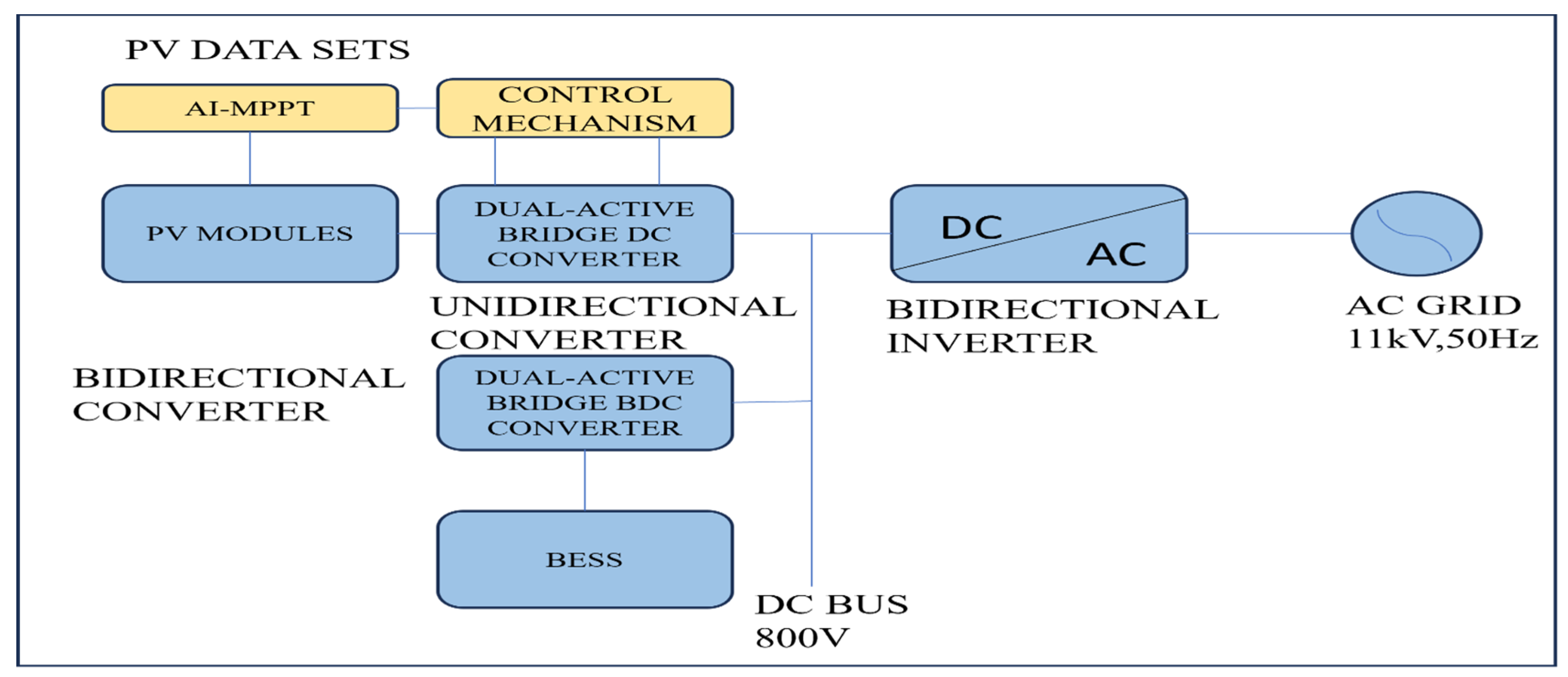
| DC input voltage, AC output | 800 V/689 V |
| AC-Bus voltage | 11 kV, 3-phase, 50 Hz |
| Transformer ratio (n) | 689/11,000 V |
| Types of Bidirectional DC-DC Converter with Battery | Dual Active Bridge BDC |
|---|---|
| Types Of DC-DC converters | Dual Active Bridge BDC |
| Types Of bidirectional DC-DC converter with EVs | Dual Active Bridge BDC |
| Specifications of DC-DC converter near PV modules (unidirectional) | |
| Capacity | 2.5 MW |
| Number of parallel converters | 5 |
| Per converter capacity | 500 kW |
| Transformer ratio (n) per converter | 609/800 = 1.35:1 |
| Control strategy | Phase-shift angle control |
| Specifications of the BDC near the battery | |
| Capacity | 2.2 MW |
| Numbers of parallel converter | 5 |
| Per converter capacity | 500 kW |
| Control strategy | Phase-shift angle control |
| Transformer ratio (n) | 600/800 = 0.75:1 |
| Specifications BDC near DC/fast charging EVCS | |
| Total Capacity | 5.5 MW |
| Maximum no. of EVs | 100 |
| Single parallel DC converter | 5, 1.1 MW |
| Control strategy | Phase-shift angle control |
| Transformer ratio (n) | 800/(600–800) ≈ 1.30 |
| S. No | Solar Irradiance (W/m2) | Air Temperature (°C) | VPV_MPP |
|---|---|---|---|
| 1. | 980 | 35.9 | 493.8 |
| 2. | 982.7 | 25.6 | 598.5 |
| 3. | 601.1 | 34.9 | 490.0 |
| 4. | 210.3 | 30.8 | 518.2 |
| 5. | 910.2 | 24.2 | 569.2 |
| 6. | 955.2 | 31.8 | 515.4 |
| 7. | 50.2 | 27.9 | 533.2 |
| 8. | 927.2 | 32.5 | 608.9 |
| 9. | 788.2 | 28.9 | 535.2 |
| 10. | 425.0 | 30.5 | 522.2 |
| 11. | 189.2 | 27.8 | 532.9 |
| 12. | 45.2 | 29.8 | 525.8 |
| 13. | 69.3 | 28.6 | 592.5 |
| 14. | 789.1 | 19.8 | 506.2 |
| 15. | 425.02 | 28.6 | 529.5 |
| 16. | 49.3 | 34.8 | 494.1 |
| 17. | 398.2 | 25.7 | 461.3 |
| 18. | 825.2 | 30.5 | 518.9 |
| 19. | 506.8 | 19.8 | 556.8 |
| 20. | 678.2 | 25.0 | 525.1 |
| 21. | 759.2 | 28.4 | 487.4 |
| 22. | 780.2 | 21.7 | 533.9 |
| 23. | 250.3 | 28.3 | 508.5 |
| 24. | 497.3 | 19.9 | 498.3 |
| 25. | 398.2 | 33.5 | 605.2 |
| 26. | 298.3 | 26.8 | 493.8 |
| 27. | 278.7 | 31.5 | 525.3 |
| 28. | 789.2 | 25.5 | 552.9 |
| 29. | 988.3 | 33.9 | 602.5 |
| 30. | 158.7 | 29.8 | 547.8 |
| 31. | 298.7 | 18.2 | 496.3 |
| 32. | 289.2 | 32.9 | 566.6 |
| 33. | 278.8 | 31.8 | 509.5 |
| 34. | 398.5 | 35.2 | 515.8 |
| 35. | 289.7 | 19.5 | 497.4 |
| 36. | 489.2 | 28.2 | 592.3 |
| 37. | 869.4 | 23.2 | 458.4 |
| 38. | 568.7 | 27.9 | 592.2 |
| 39. | 289.4 | 33.4 | 552.3 |
| 40. | 769.5 | 30.2 | 499.9 |
| Hours | PV (MW) | EV_DC (MW) | EV_AC (MW) |
Charging BESS(MW)
(Fully Charged) | Discharging BESS (MW) | Grid (MW) |
|---|---|---|---|---|---|---|
| 12:00 | 3 | 1.9 | 1 | 0 | 0 | 0 |
| Hours | PV (MW) | EV_DC (MW) | EV_AC (MW) | Charging BESS (MW) | Discharging BESS (MW) | Grid (MW) |
|---|---|---|---|---|---|---|
| 24:00 | 0 | 0.55 | 0.17 | 0 | 0.72 | 0 |
| 2:00 | 0 | 0.60 | 0.19 | 0 | 0.62 | 0.17 |
| Hours | PV (MW) | EV_DC (MW) | EV_AC (MW) | Charging BESS (MW) | Discharging BESS (MW) | Grid (MW) |
|---|---|---|---|---|---|---|
| 15:00 | 1.96 | 2.4 | 1.05 | 0 | 1.49 | 0 |
| 16:00 | 1.49 | 2.1 | 0.520 | 0 | 1.13 | 0 |
| Hours | PV (MW) | EV_DC (MW) | EV_AC (MW) |
Charging BESS
(MW) |
Discharging BESS
(MW) |
Grid
(MW) |
|---|---|---|---|---|---|---|
| 11:00 | 3 | 1.6 | 0.88 | 0.52 | 0 | 0 |
| Hours | PV (MW) | EV_DC (MW) | EV_AC (MW) |
Charging BESS
(MW) |
Discharging BESS
(MW) |
Grid
(MW) |
|---|---|---|---|---|---|---|
| 6:00 | 0.08 | 0 | 0 | 0.08 | 0 | 0 |
| Hours | PV (MW) | EV_DC (MW) | EV_AC (MW) |
Charging
BESS (MW) |
Discharging
BESS (MW) | Grid (MW) |
|---|---|---|---|---|---|---|
| 6:00 | 0.08 | 0 | 0 | 0 | 0 | 0.08 |
| Hours | PV (MW) | EV_DC (MW) | EV_AC (MW) |
EV_V2G
(MW) | Charging BESS (MW) | Discharging BESS (MW) | Grid (MW) |
|---|---|---|---|---|---|---|---|
| 3:00 | 0 | 0.5 | 0.76 | 2.52 | 0 | 0 | 1.26 |
| Scenarios | Scenario 1 | Scenario 2 | Scenario 3 | Scenario 4 | Scenario 5 | Scenario 6 | Scenario 7 |
|---|---|---|---|---|---|---|---|
| 1. RUR% | 96.67% | Undefined. No available solar PV power | 100% | 82% 0.52 MW power curtailed | 0% 0.08 MW power curtailed | 100% | Undefined. No available solar PV power |
| 2. Met EV demand | Not met | Partially fulfilled | Not met by 1.260 MW, demand unfulfilled | Fulfilled | No EV required power | No EV required power | EVs work in V2G operation and fulfill the system’s demand |
| 3. Grid load reduction with respect to baseline grid load demand | Overloaded with the 1.162 MW and increased by 92% | Not reduced. Grid loaded with 57% and 62% because of no proper allocation with BESS | Overloaded | Demand within limits | Demand within limits | Demand within limits | Take power from EVs |
| 4. Peak load | Peak load reached 2.422 MW | Extra load demand 0.472 MW 0.542 MW | Extra load demand | No peak load occurred | No peak load occurred | No peak load occurred | No peak occurred |
| Scenarios | Scenario 1 | Scenario 2 | Scenario 3 | Scenario 4 | Scenario 5 | Scenario 6 | Scenario 7 |
|---|---|---|---|---|---|---|---|
| 1. RUR% | 96.67% | Undefined | 100% | 100% | 100% | 100% | Undefined |
| Almost entirely utilized. Efficient solution | Not available renewable energy (sunlight). Utilization cannot be measured | Fully utilized to feed the EV demand | Fully utilized to feed EV charging and BESS charging (surplus power) | All solar PV-generated power is fully utilized in BESS storing | All solar PV-generated power is fully utilized in the Grid’s loads | Not available: renewable energy (sunlight) | |
| 2. Met EV demand | Total EV demand is fulfilled by PV-generated power | EV power demand is satisfied by BESS stored surplus/backup power + grid supply | EV demand is fulfilled by PV-generated power + BESS backup power | EV demand is fulfilled by PV-generated power only | No EV required power | No EV required power | EV power demand is supplied to the grid’s loads and fulfills their demand |
| 3. Grid load reduction | 100% Do not use the grid power supply because the BESS supplies the EV with stored extra power | 86% Suggested MILP optimal allocation, the grid supplies a little bit of power to the EV and mitigates the 86% grid’s load demand | 100% Total grid power is reduced by optimal allocation, and power demand is handled by PV and BESS backup power | 100% Total grid power is reduced by optimal allocation, and power demand is handled by PV only | 100% Total grid power is reduced by optimal allocation | Not applicable to this condition because the grid power load is supported by PV-generated power | Not applicable grid load reduction factor, because it is a V2G operation |
| 4. Peak load shaving on grid | 100% | 78% | 43% | 100% | 100% | This case is not applicable because PV is fed to the grid | This case is not applicable because of its V2G operation |
| Forecasted Parameters | Solar PV Power Increased +20% | Solar PV Power Decreased −20% | EV Demand Increased +20% | EV Demand Decreased −20% | EV SOC Increased +5% | EV SOC Decreased −5% | EV A. T Increased +2 h | EV A. T Decreased −2 h |
|---|---|---|---|---|---|---|---|---|
| Outcome | RUR, +15% | RUR, −10% | Entire System Demand, +5% | Entire System Demand, −10% | Charging Pattern, +2% | Charging Pattern, −3% | Scheduling duration, +1 h | Scheduling duration, −1 h |
| Sensitivity | 0.75, Moderate | 0.5, Moderate | 0.25, Low | 0.5, Moderate | 0.4, Low | 0.6, Moderate | 0.5, Moderate | 0.5, Moderate |
Disclaimer/Publisher’s Note: The statements, opinions and data contained in all publications are solely those of the individual author(s) and contributor(s) and not of MDPI and/or the editor(s). MDPI and/or the editor(s) disclaim responsibility for any injury to people or property resulting from any ideas, methods, instructions or products referred to in the content. |
© 2026 by the authors. Licensee MDPI, Basel, Switzerland. This article is an open access article distributed under the terms and conditions of the Creative Commons Attribution (CC BY) license.
Share and Cite
Bharti, K.P.; Ashfaq, H.; Kumar, R.; Singh, R. ANN-MILP Hybrid Techniques for the Integration Challenge, Power Management of the EV Charging Station with Solar-Based Grid System, and BESS. Energies 2026, 19, 1988. https://doi.org/10.3390/en19081988
Bharti KP, Ashfaq H, Kumar R, Singh R. ANN-MILP Hybrid Techniques for the Integration Challenge, Power Management of the EV Charging Station with Solar-Based Grid System, and BESS. Energies. 2026; 19(8):1988. https://doi.org/10.3390/en19081988
Chicago/Turabian StyleBharti, Km Puja, Haroon Ashfaq, Rajeev Kumar, and Rajveer Singh. 2026. "ANN-MILP Hybrid Techniques for the Integration Challenge, Power Management of the EV Charging Station with Solar-Based Grid System, and BESS" Energies 19, no. 8: 1988. https://doi.org/10.3390/en19081988
APA StyleBharti, K. P., Ashfaq, H., Kumar, R., & Singh, R. (2026). ANN-MILP Hybrid Techniques for the Integration Challenge, Power Management of the EV Charging Station with Solar-Based Grid System, and BESS. Energies, 19(8), 1988. https://doi.org/10.3390/en19081988