Coordinated Dispatch Strategy of Flexible Resources in Distribution Networks for Temporary Loads


Abstract
1. Introduction
- (1)
- Considering the power consumption characteristics and irrigation task constraints of agricultural motor-pumped wells, a flexible load model for rural motor-pumped wells is established to fully exploit their flexible regulation capabilities.
- (2)
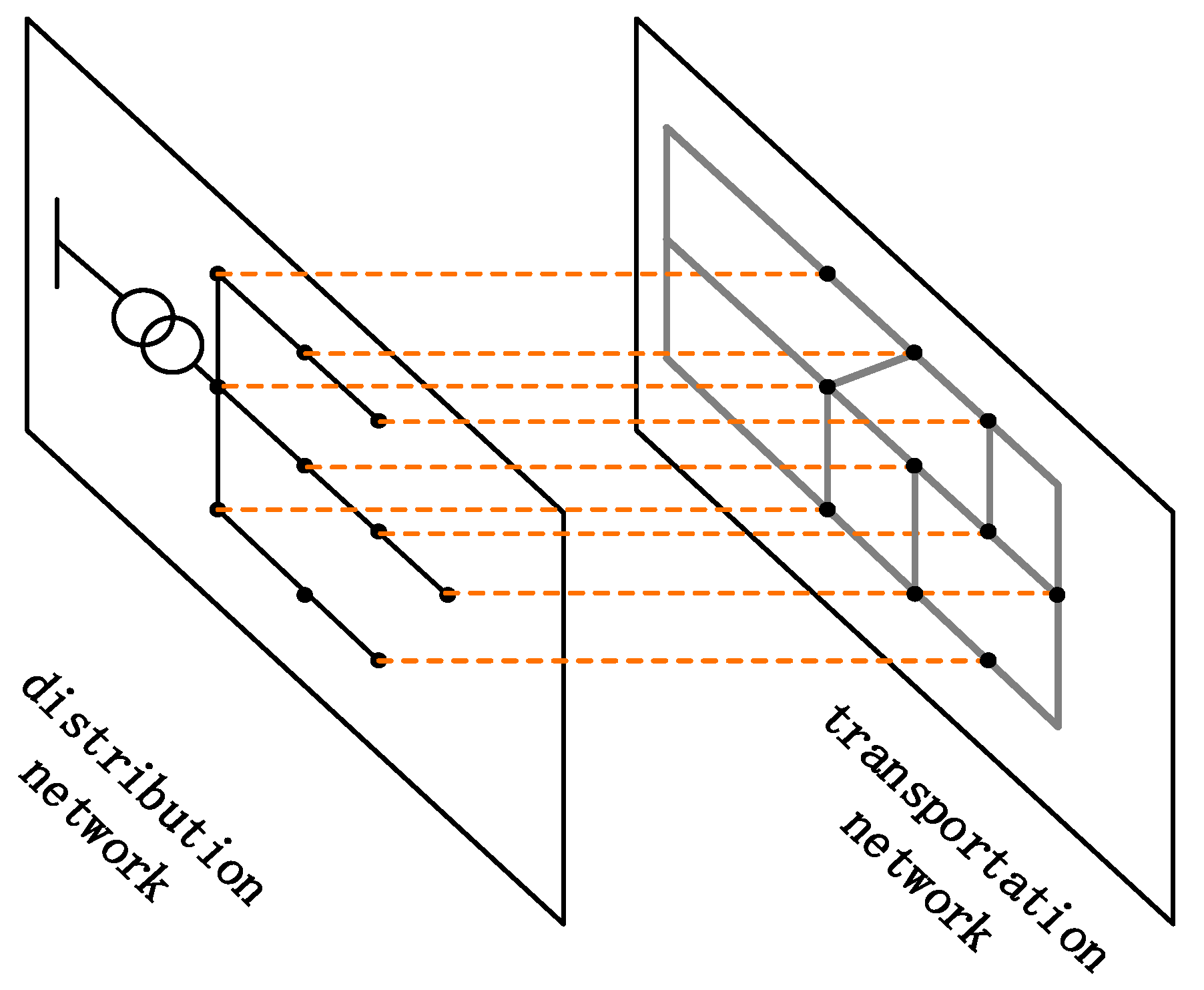
- In the context of a coupled power grid and transportation network, a spatiotemporal dispatch model for MESSs is established, considering the flexibility of energy transfer across temporal and spatial dimensions.
- (3)
- An economic dispatch model for distribution networks coordinating multiple flexible resources, including MESSs, flexible loads, and DGs, is established. In order to minimize the total system operating cost, the SOCR method is adopted to linearize the power flow constraints. This enables the coordinated dispatch of multiple flexible resources, including MESSs, motor-pumped well flexible loads, and DGs, to achieve safe and economic operation of the distribution network, reduce system network losses, and mitigate voltage violations.
2. Modeling of Typical Flexible Loads in Rural Distribution Networks
2.1. Modeling of Agricultural Motor-Pumped Wells
2.2. Flexibility Modeling of Motor-Pumped Wells
3. Dispatch Model of MESS
4. Optimal Dispatch Model for Rural Distribution Networks Coordinating Multiple Flexible Resources
4.1. Objective Function
- (1)
- Network loss cost of the system
- (2)
- Electricity loss cost caused by voltage violations
4.2. Constraints
- (1)
- DG output constraints
- (2)
- Power flow constraints of the distribution networks
- (3)
- Constraints for motor-pumped wells
- (4)
- Constraints for MESS dispatch
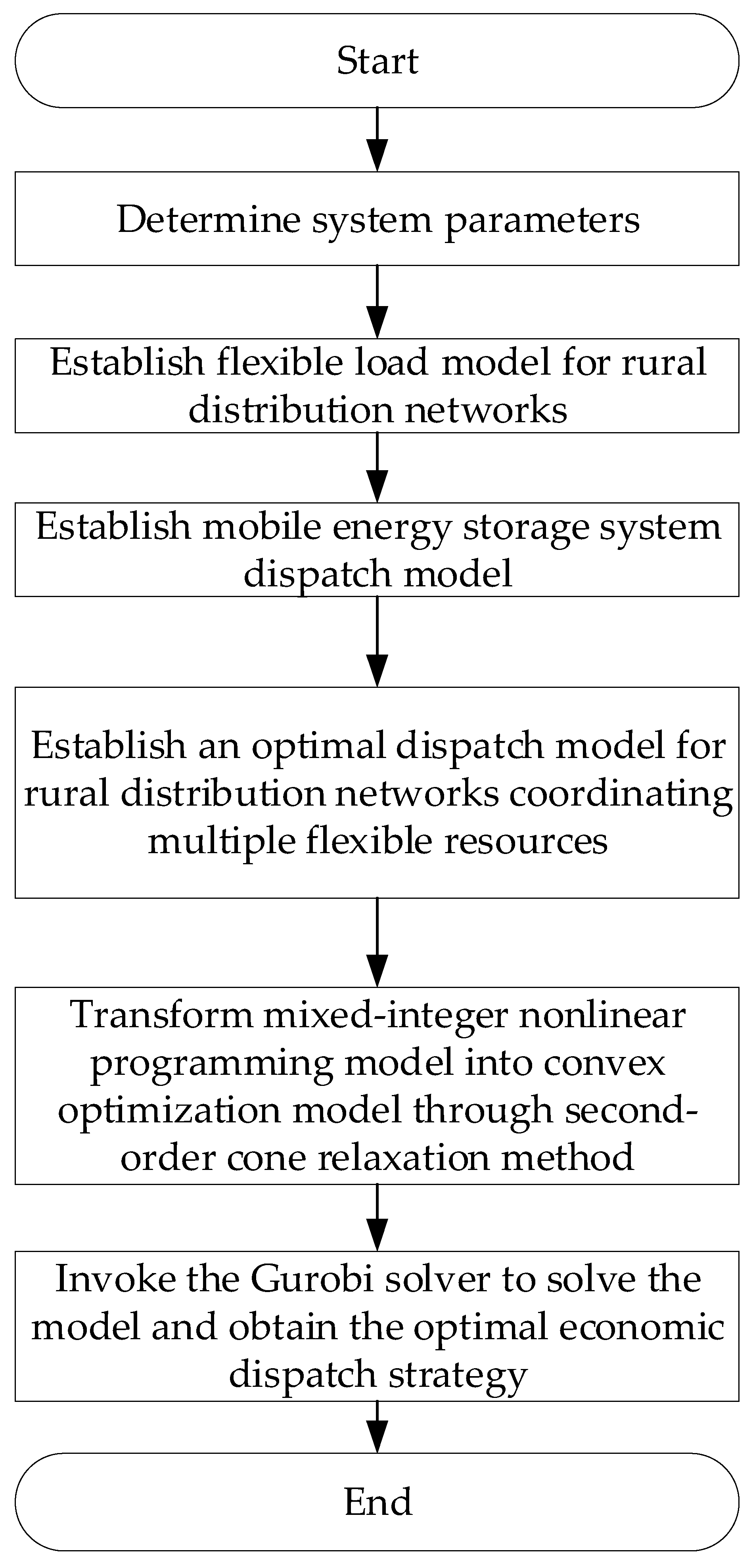
5. Solution Procedure of the Model
6. Case Study Analysis
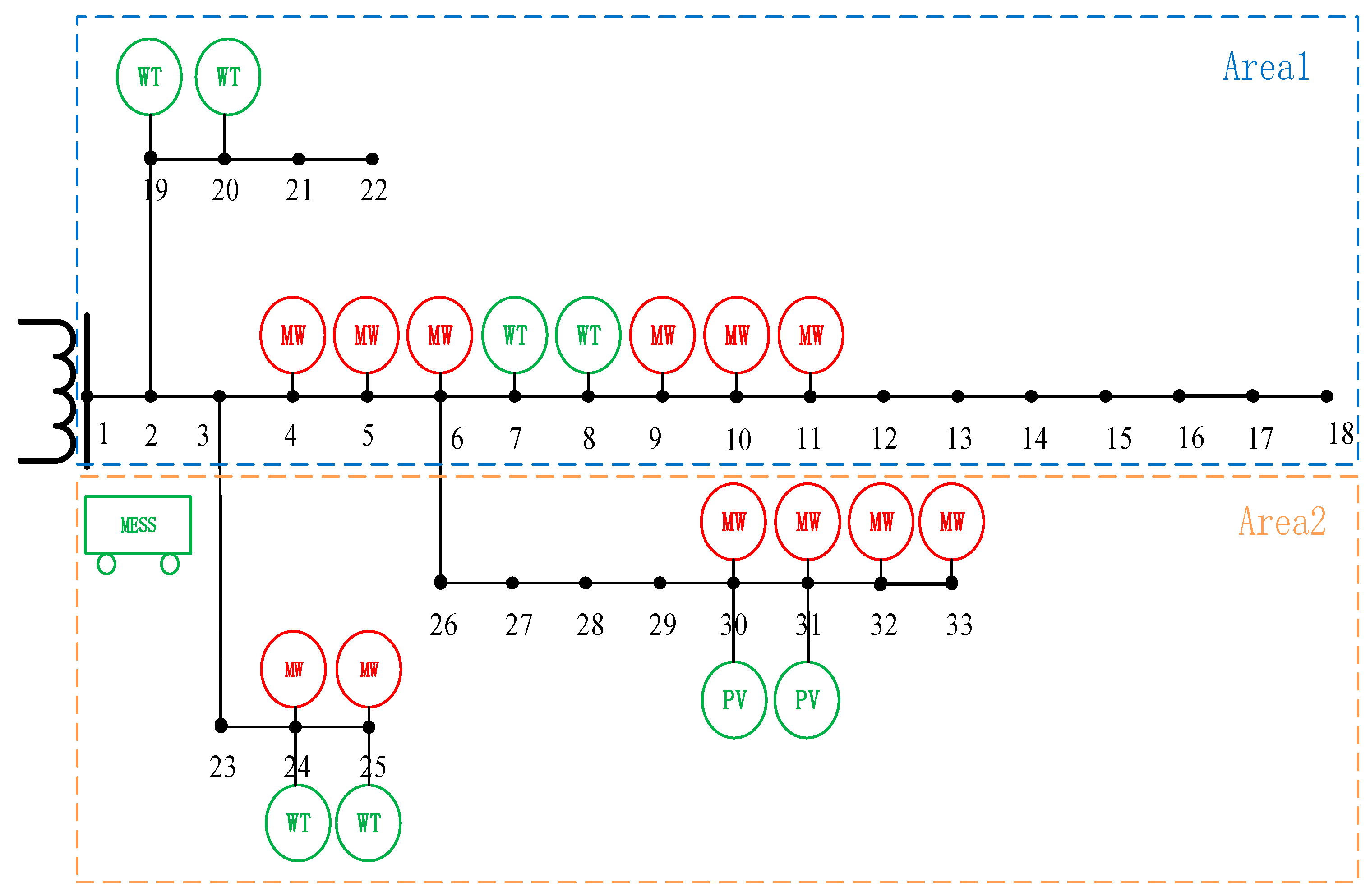
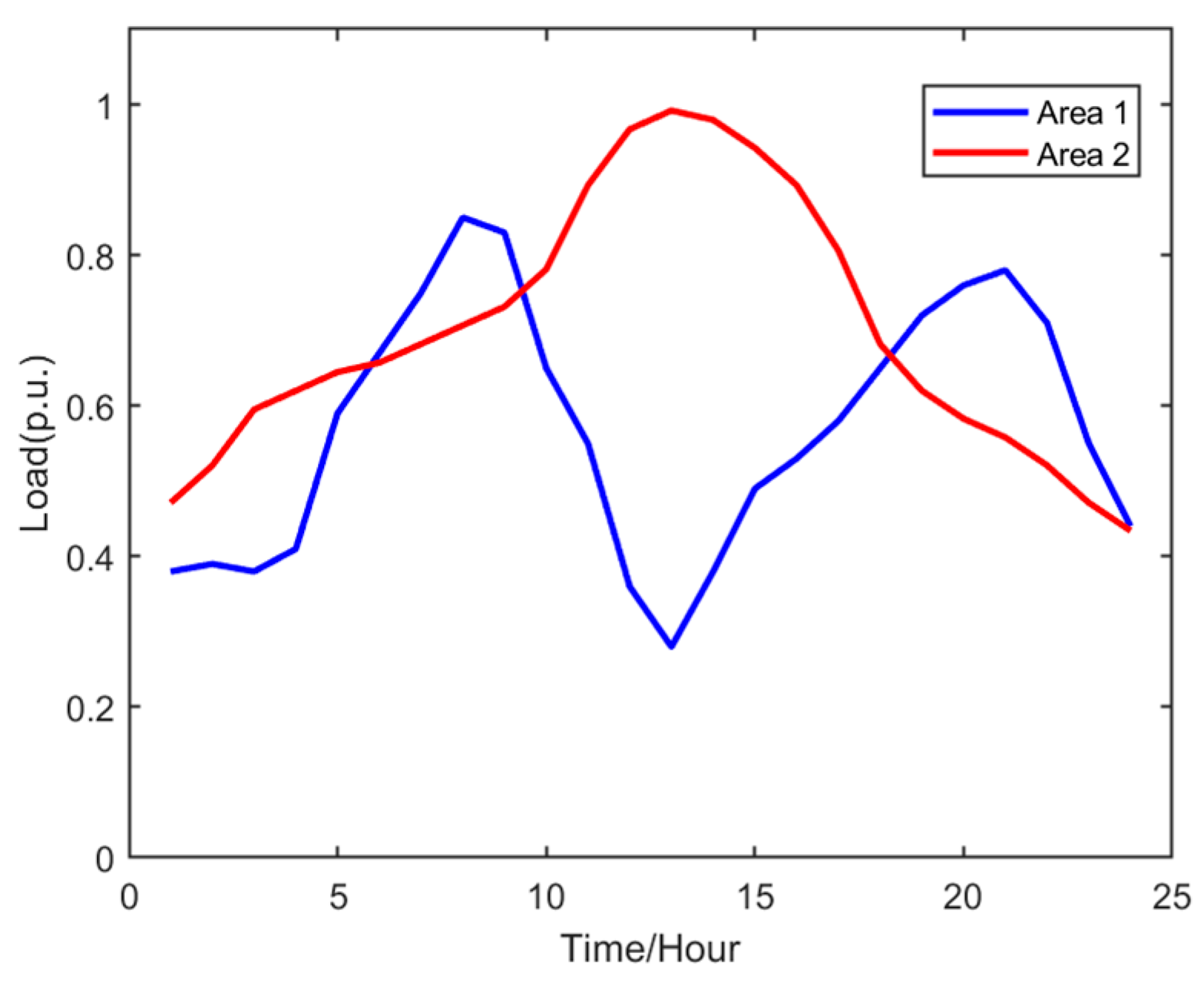
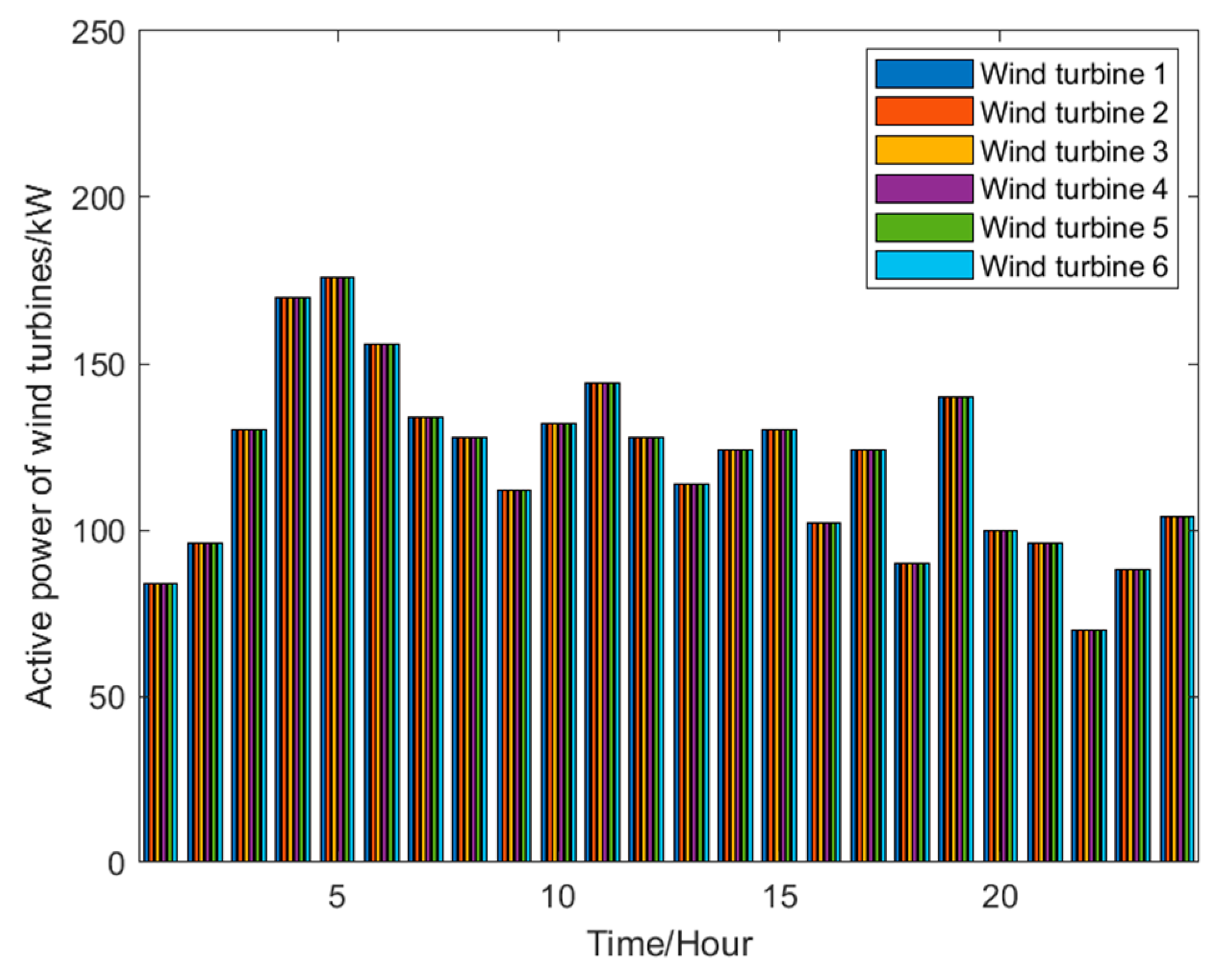
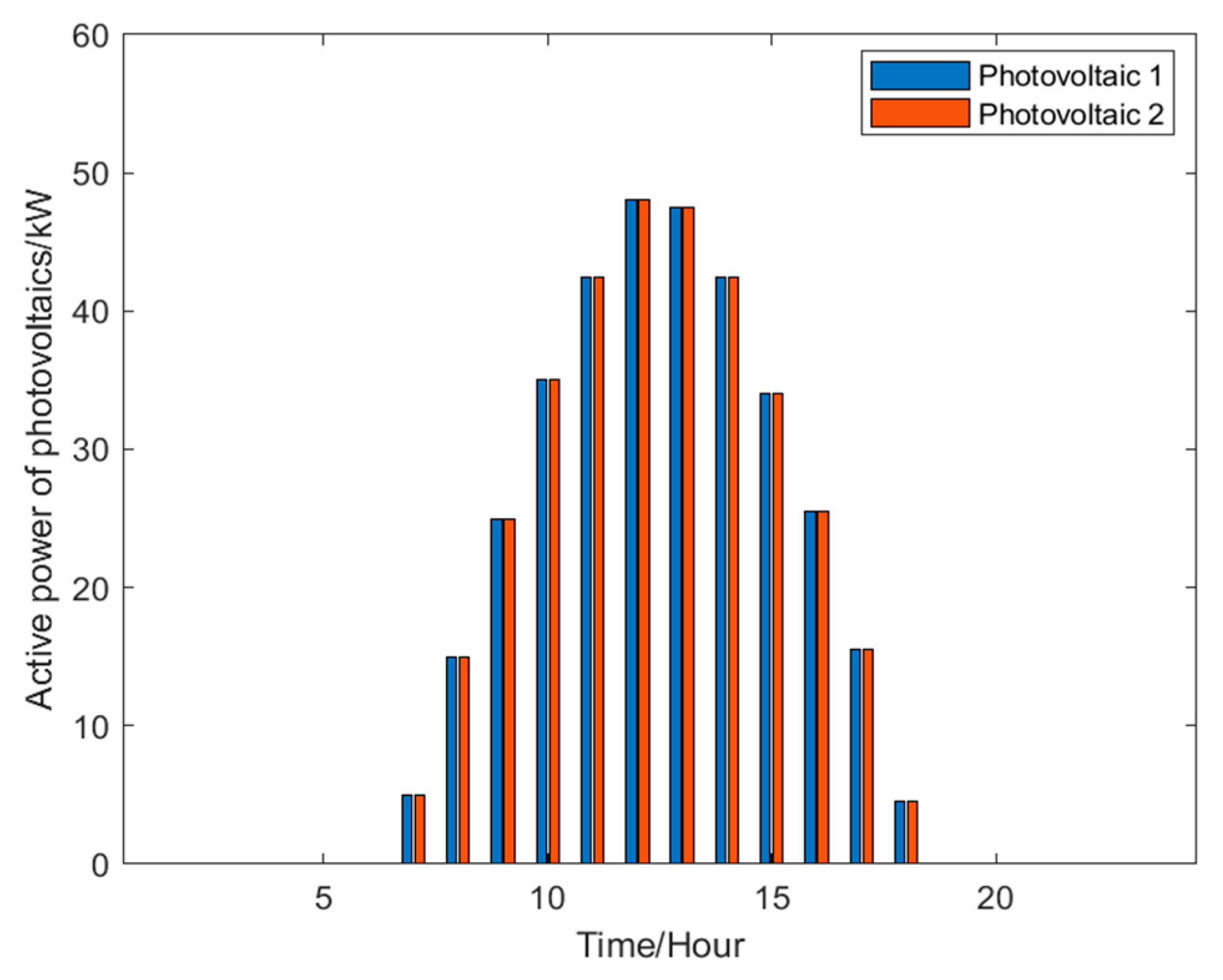
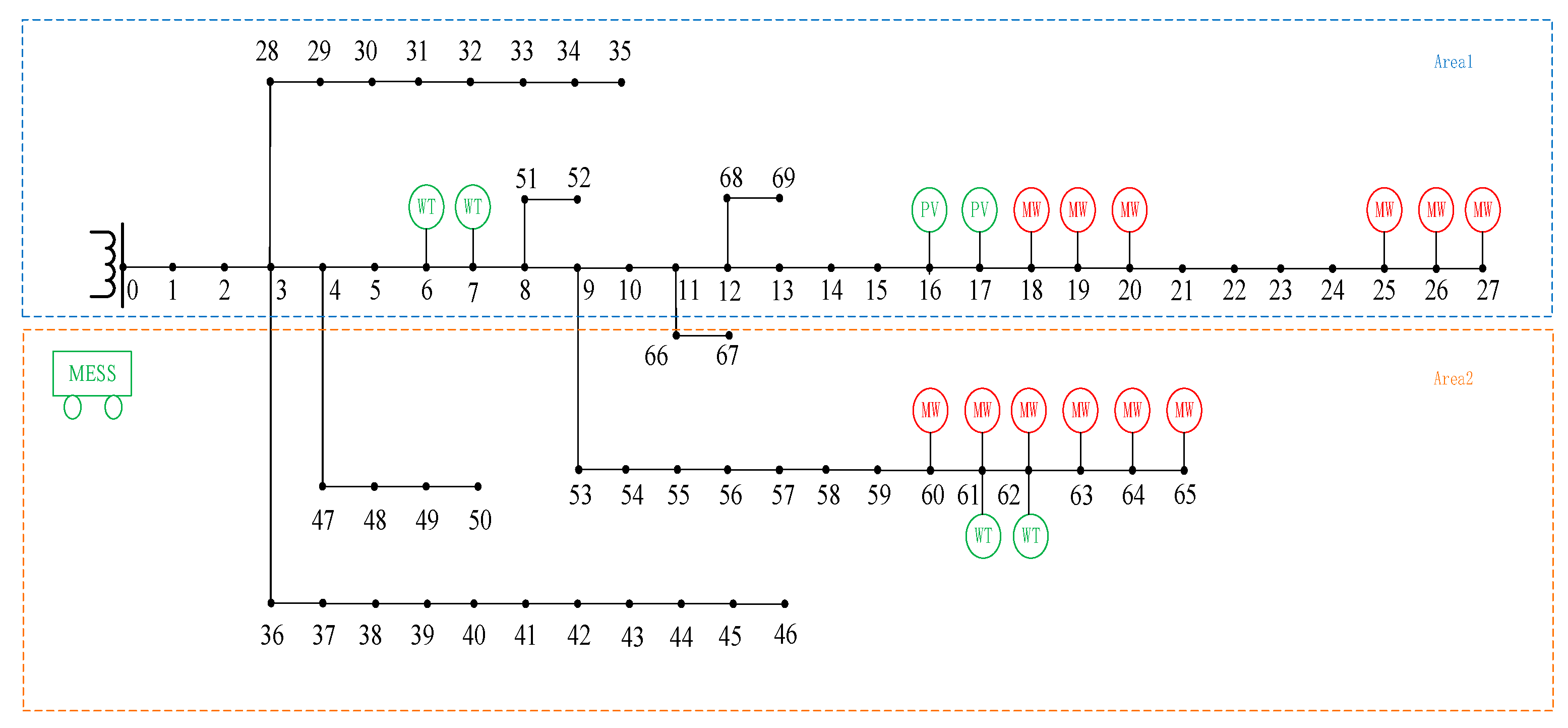
6.1. Case Study Parameters
6.2. Analysis of Results
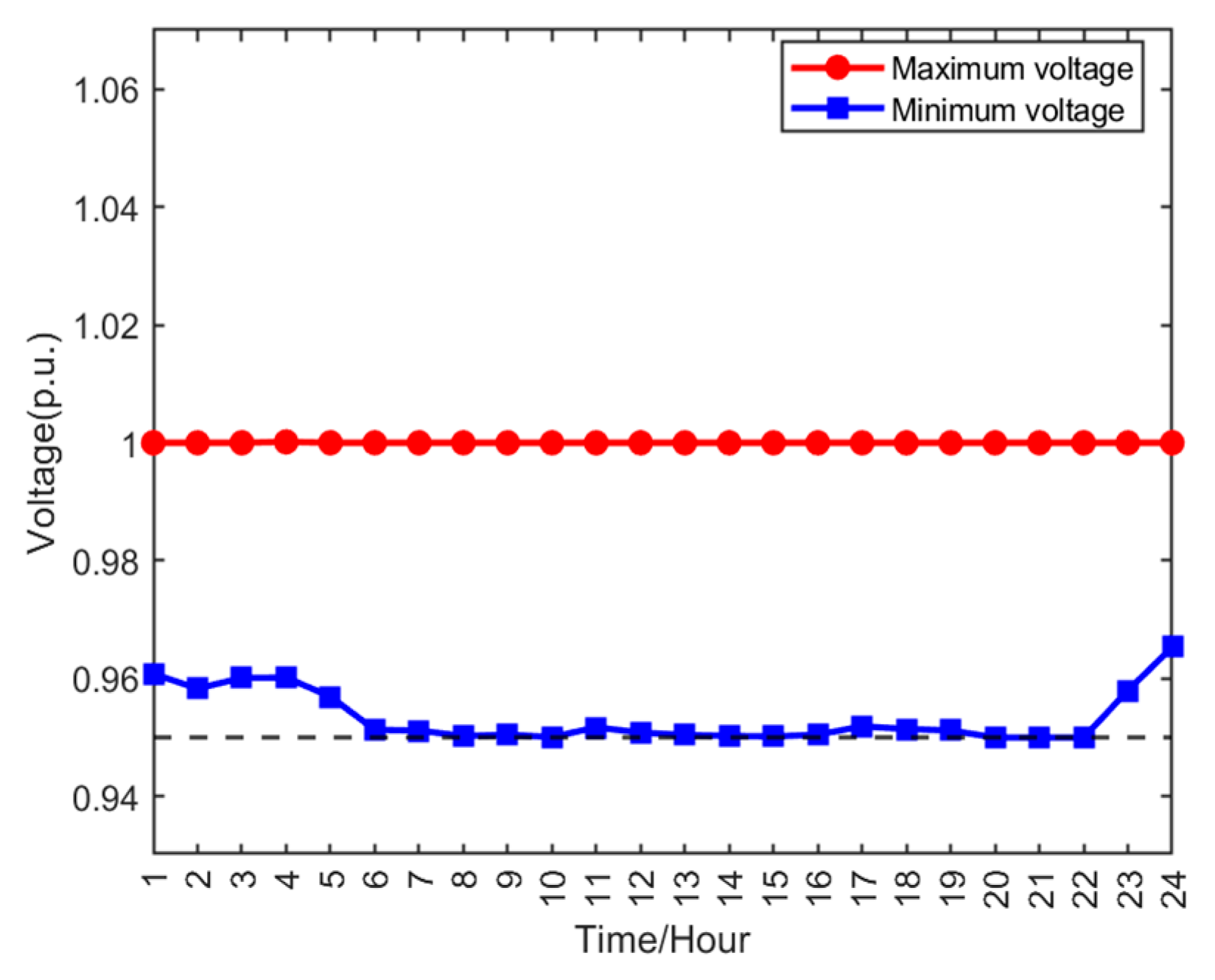
6.2.1. System Voltage and Network Loss Analysis
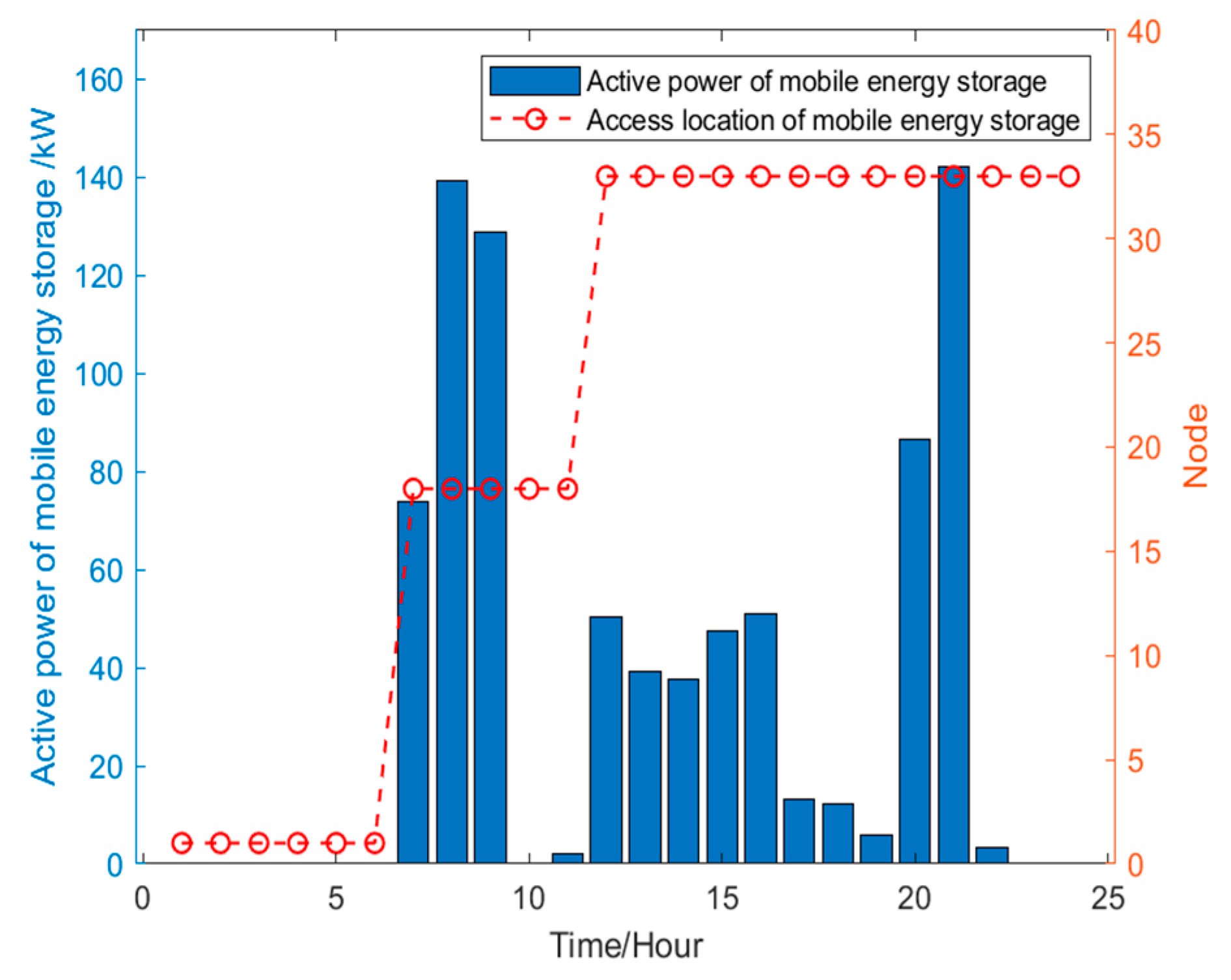
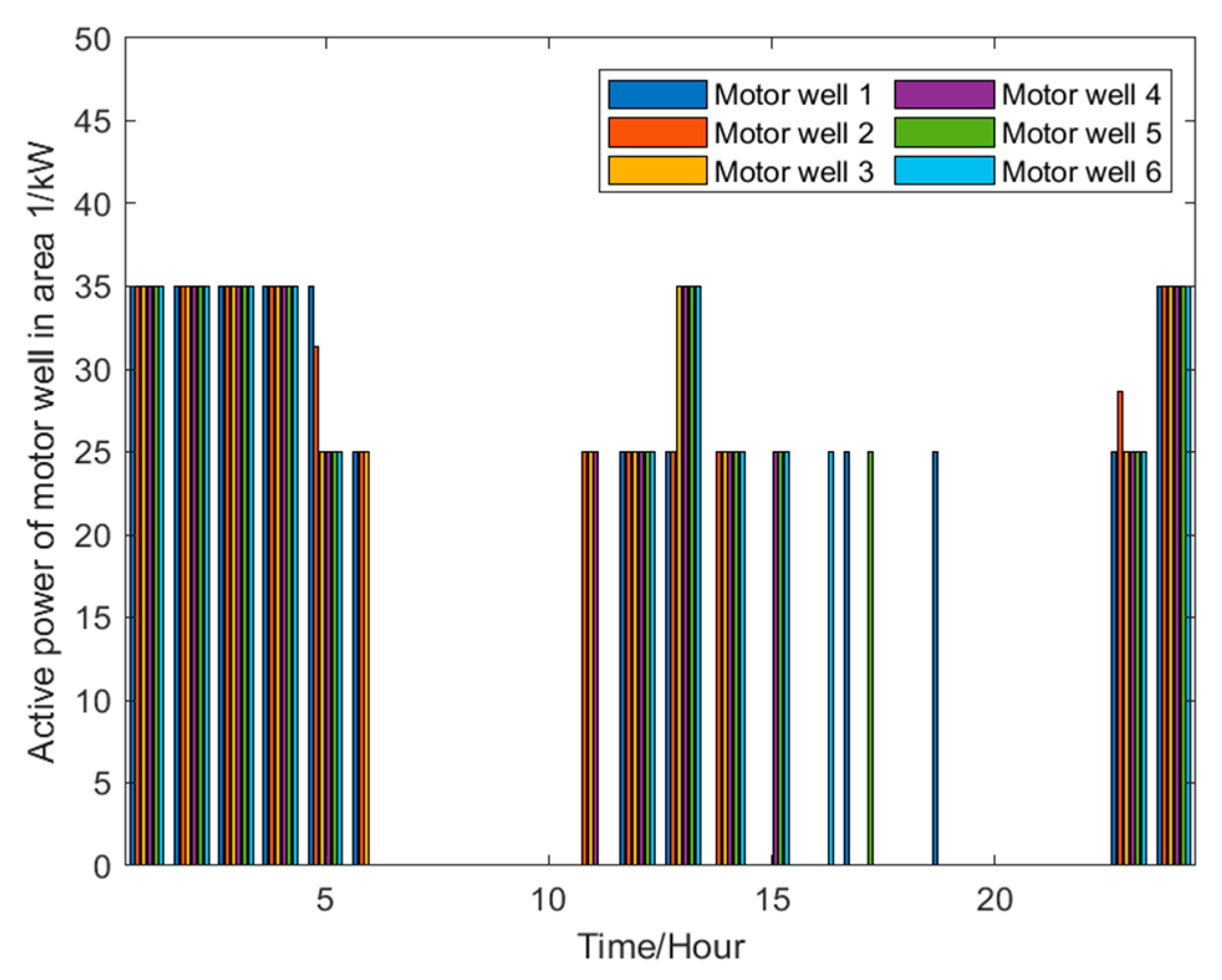
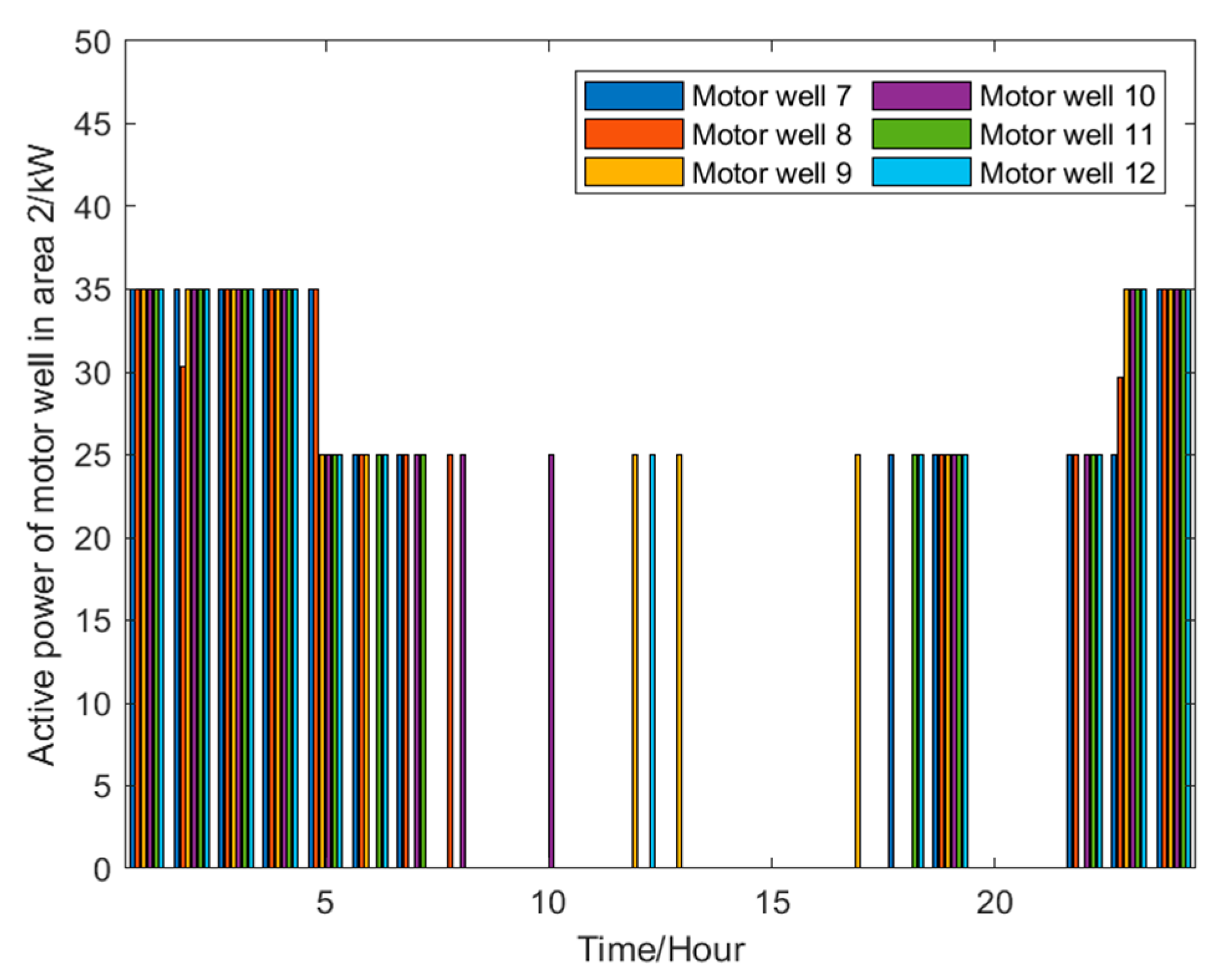
6.2.2. Analysis of Flexible Resource Dispatch Results
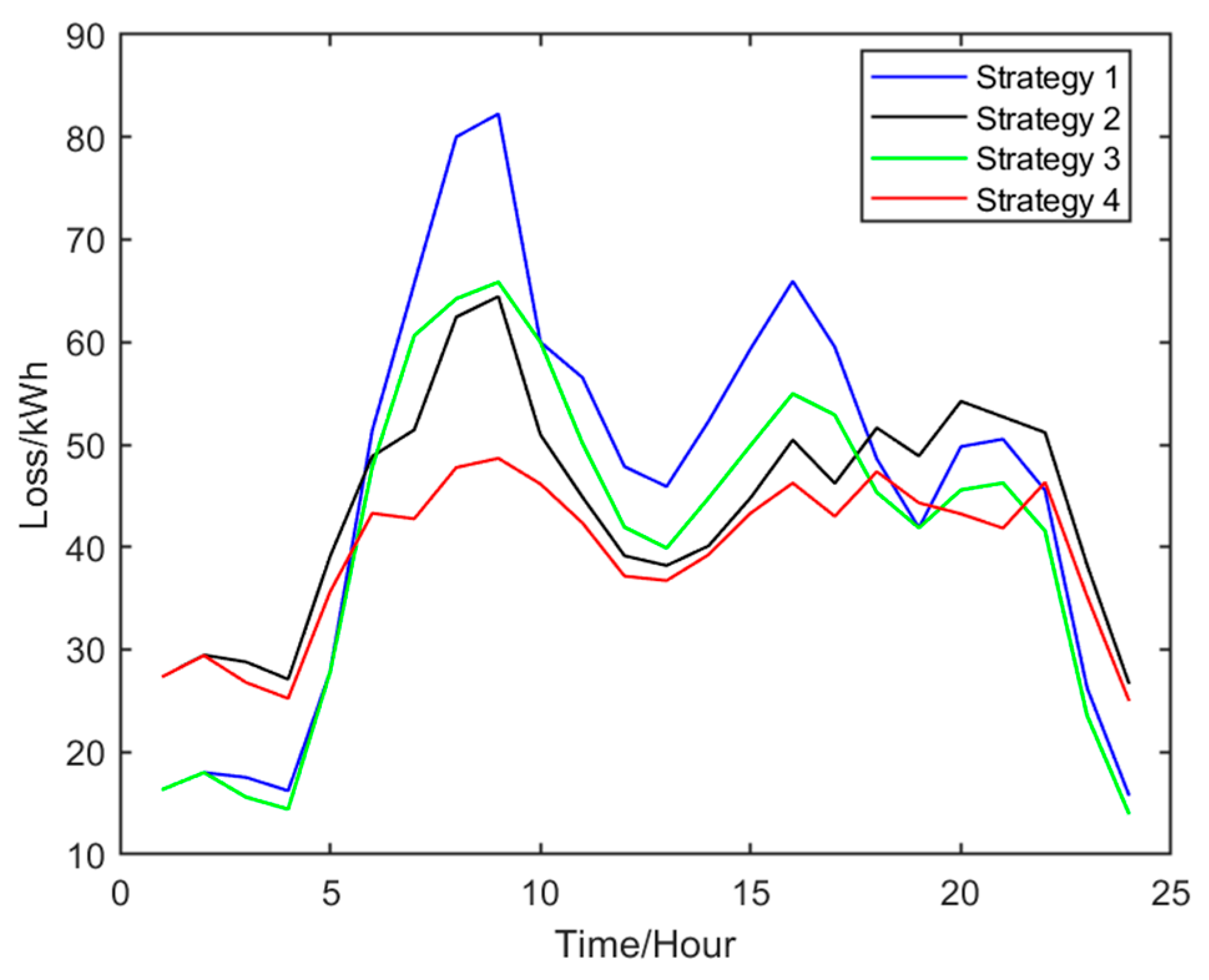
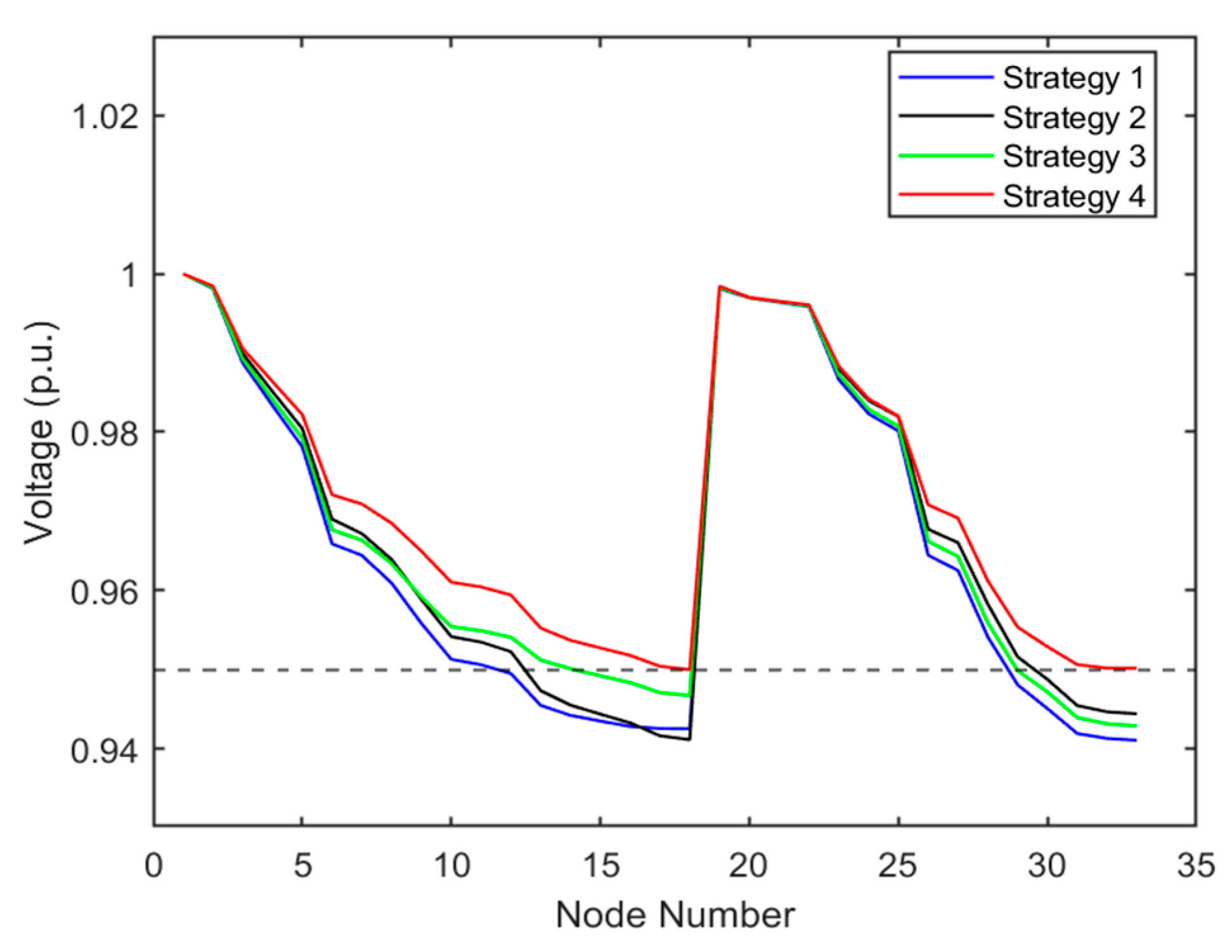
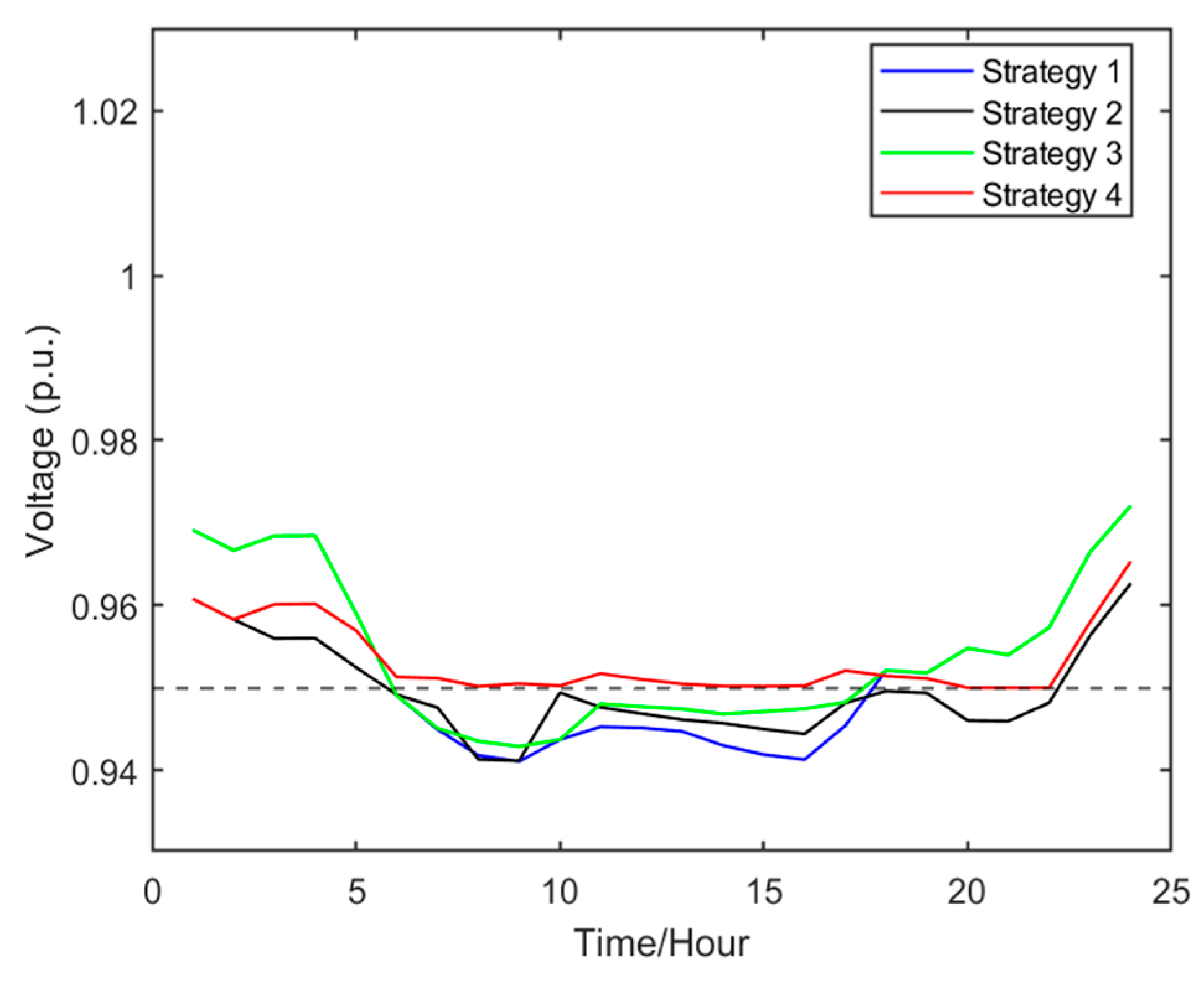
6.2.3. Comparative Analysis
- Strategy 1: Energy storage is connected at a fixed location, and flexible loads consume electricity during fixed time periods.
- Strategy 2: Energy storage is connected at a fixed location, and the flexibility of flexible load electricity consumption periods is considered.
- Strategy 3: MESS is connected, and flexible loads consume electricity during fixed time periods.
- Strategy 4: MESS is connected, and the flexibility of flexible load electricity consumption periods is considered.
6.2.4. Sensitivity Analysis
- Scenario 1: ±3% prediction error for DG output and ±5% prediction errors for load.
- Scenario 2: ±5% prediction error for DG output and ±5% prediction errors for load.
- Scenario 3: ±8% prediction error for DG output and ±5% prediction errors for load.
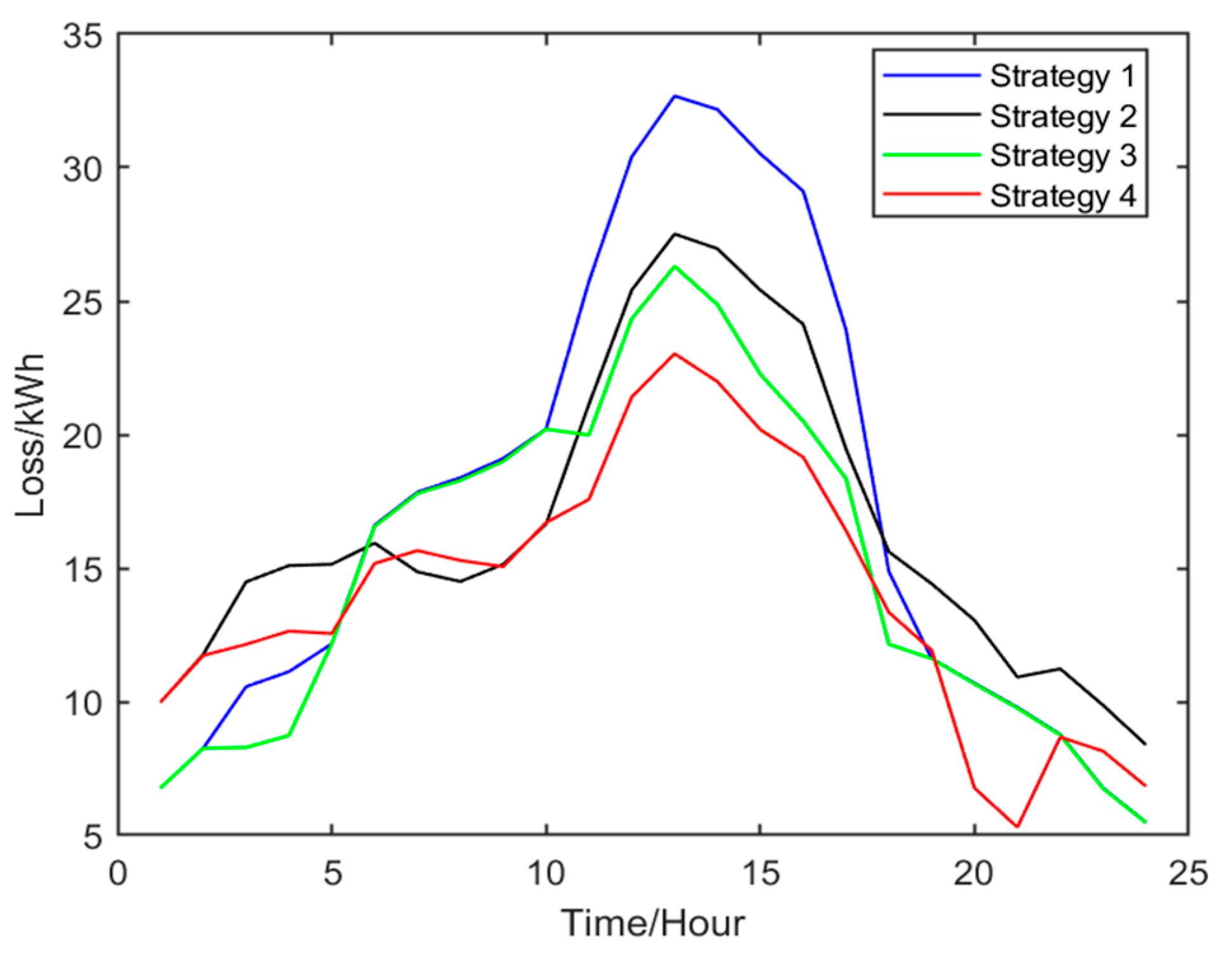
6.2.5. Scalability Analysis
- Strategy 1: Energy storage is connected at a fixed location, and flexible loads consume electricity during fixed time periods.
- Strategy 2: Energy storage is connected at a fixed location, and the flexibility of flexible load electricity consumption periods is considered.
- Strategy 3: MESS is connected, and flexible loads consume electricity during fixed time periods.
- Strategy 4: MESS is connected, and the flexibility of flexible load electricity consumption periods is considered.
7. Conclusions
- (1)
- MESS effectively leverages its energy transfer capabilities across both temporal and spatial dimensions. By being deployed at the ends of feeders, MESS significantly reduces network losses and provides critical voltage support during peak load periods and concentrated irrigation intervals.
- (2)
- Motor-pumped wells fully exploit their inherent flexibility for regulation. By flexibly scheduling irrigation timing and adjusting power consumption during periods of high DG output or low general load, these loads further reduce network losses and effectively mitigate voltage violation issues.
- (3)
- The optimal dispatch strategy for rural distribution networks based on the synergy of multiple flexibility resources, including MESS, flexible loads, and DG, reduces the total operating cost of the system by 38.35% compared to the strategy with energy storage fixed at specific locations and flexible loads operating in fixed time slots. This fully validates the effectiveness of the proposed strategy.
Author Contributions
Funding
Data Availability Statement
Conflicts of Interest
Nomenclature
| parameters | |||
| c | the congestion coefficient of the transportation network | the maximum power consumption of motor-pumped well s | |
| the cost per unit of network loss in the system | the minimum power consumption of motor-pumped well s | ||
| the electricity loss cost per unit of voltage violation in the system | the flow rate of the motor-pumped well’s water pump | ||
| the static shortest travel distance between node i and node j in the power network | the maximum allowable reactive power output of MESS k during charging | ||
| the actual shortest travel distance between node i and node j at time t considering congestion conditions | the maximum allowable reactive power output of MESS k during discharging | ||
| Δt | the time step length | the maximum reactive power output of DG h at time t | |
| E | the set of all branches in the system | the density of the liquid | |
| the maximum capacity of MESS k | the resistance value of branch ij | ||
| the minimum capacity of MESS k | T | the total dispatch period | |
| the electricity consumption for a single irrigation per hectare of arable land | the total operating time of motor-pumped well s during period T | ||
| the efficiency of the water pump | the operating duration of motor-pumped well s in time period m | ||
| the utilization rate of irrigation water | the actual shortest travel time of MESS k from node i to node j starting at time t | ||
| the energy conversion efficiency of MESS k during the charging process | the installation time of MESS k | ||
| the energy conversion efficiency of MESS k during the discharging process | the ideal speed of MESS k without considering congestion | ||
| g | the acceleration due to gravity | the maximum value of the normal operating voltage range at node i that avoids power losses | |
| the equivalent head height | the minimum value of the normal operating voltage range at node i that avoids power losses | ||
| the maximum value of the squared current in branch ij at time t | the squared value of the maximum allowable node voltage at node i in the system at time t | ||
| the maximum allowable active power output of MESS k during charging | the squared value of the minimum allowable node voltage at node i in the system at time t | ||
| the maximum allowable active and reactive power output of MESS k during discharging | the daily water requirement per hectare of crops | ||
| the maximum active and reactive power output of DG h at time t | the daily effective precipitation | ||
| the rated power consumption of the motor-pumped well during pumping and irrigation | the reactance value of branch ij | ||
| variables | |||
| 0-1 indicator variable representing the connection status between MESS unit k and node i at time t | the active power transmitted through branch ij at time t | ||
| 0-1 indicator variable representing the connection status between MESS k and node i during the time interval from t to t + 1 | the power consumption of motor-pumped well s in time period m | ||
| 0-1 indicator variable representing whether motor-pumped well s is operating in time period m | the active power of the load at node i at time t | ||
| the state of charge of MESS k at time t | the reactive power output of MESS k during charging at time t | ||
| the electricity consumption of motor-pumped well s in time period m | the reactive power output of MESS k during discharging at time t | ||
| f | the total operating cost of the system | the reactive power output of DG h at time t | |
| fL | the network loss cost of the system | the reactive power transmitted through branch ij at time t | |
| fV | the electricity loss cost caused by voltage violations | 0-1 indicator variable representing the charging state of MESS k at time t | |
| the current value of branch ij at time t | 0-1 indicator variable representing the discharging state of MESS k at time t | ||
| the squared value of the current in branch ij at time t | the voltage value at node i at time t | ||
| the active power output of MESS k during charging at time t | the degree of voltage violation | ||
| the active power output of MESS k during discharging at time t | the squared value of the voltage at node i at time t | ||
| the active power output of DG h at time t | |||
References
- Zhao, F.; Bai, F.; Liu, X.; Liu, Z. A review on renewable energy transition under China’s carbon neutrality target. Sustainability 2022, 14, 15006. [Google Scholar] [CrossRef]
- Inês, E.I.; Cebra, C.; Windt, H.J.V.D. A review of hybrid renewable energy systems in mini-grids for off-grid electrification in developing countries. Renew. Sustain. Energy Rev. 2021, 144, 111036. [Google Scholar]
- Lu, X.; Yao, Y.; Xin, Y. Pre-configuration method and scheduling strategy of distribution network mobile energy storage vehicle considering intermittent load of rural network. In Proceedings of the 2024 International Conference on Electronics and Devices, Computational Science (ICEDCS); IEEE: New York, NY, USA, 2024; pp. 695–700. [Google Scholar]
- Cai, X.; Kuang, C.; Zhong, C. Optimized Configuration of Mobile Energy Storage for Substations in Multiple Scenarios with Seasonal Source-Load Mismatches. In 2025 6th International Conference on Advanced Electrical and Energy Systems (AEES); IEEE: New York, NY, USA, 2025. [Google Scholar]
- Khodayar, M.E.; Feizi, M.R.; Vafamehr, A. Solar photovoltaic generation: Benefits and operation challenges in distribution networks. Electr. J. 2019, 32, 106658. [Google Scholar] [CrossRef]
- Shi, W.; Li, N.; Xie, X. Optimal residential demand response in distribution networks. IEEE J. Sel. Areas Commun. 2014, 32, 1441–1450. [Google Scholar] [CrossRef]
- Li, M.; Ding, M.; Huang, S. Optimal Strategy for Flexible Production Scheduling of Textile Industry Load for Flexibility Requirement of Power Grid. Autom. Electr. Power Syst. 2025, 49, 156–169. (In Chinese) [Google Scholar]
- Wu, Z.; He, B.; Mi, Z. Research on Optimal Configuration Method of Flexible Loads in Electric-Hydrogen Coupled Transportation Systems. Proc. CSEE 2026, 1–15. Available online: https://link.cnki.net/urlid/11.2107.tm.20251112.1358.003 (accessed on 13 November 2025).
- Zhang, Z.; Zhou, R.; Huang, J. Source-load linear cointegration optimization model of waste incineration power plant participating in peak load regulation. Electr. Power Autom. Equip. 2021, 41, 115–121. (In Chinese) [Google Scholar]
- Yang, S.; Guo, N.; Zhang, S. Robust Optimal Scheduling of Agricultural Microgrid Combined with Irrigation System Under Uncertainty Conditions. J. Shanghai Jiaotong Univ. 2024, 58, 1432–1442. (In Chinese) [Google Scholar]
- Zheng, Y.; Wei, R.; Feng, Y. A Refined Time-Series Production Simulation Method for New Rural Power Systems. Electr. Power 2025, 58, 71–81. (In Chinese) [Google Scholar]
- Gao, Y.; Yang, R.; Li, W. Rural distribution network reconfiguration with dispersed generation. Trans. Chin. Soc. Agric. Eng. 2013, 29, 162–169. (In Chinese) [Google Scholar]
- Niu, H.; Yang, M.; Jing, T. Linear optimal operation model and algorithm for active distribution network in rural areas. Trans. Chin. Soc. Agric. Eng. 2013, 29, 190–197. (In Chinese) [Google Scholar]
- Grover-Silva, E.; Girard, R.; Kariniotakis, G. Optimal sizing and placement of distribution grid connected battery systems through an SOCP optimal power flow algorithm. Appl. Energy 2017, 219, 385–393. [Google Scholar] [CrossRef]
- Alzahrani, A.; Alharthi, H.; Khalid, M. Minimization of power losses through optimal battery placement in a distributed network with high penetration of photovoltaics. Energies 2020, 13, 140. [Google Scholar] [CrossRef]
- Mumtahina, U.; Alahakoon, S.; Wolfs, P. Optimal allocation and sizing of battery energy storage system in distribution network using mountain gazelle optimization algorithm. Energies 2025, 18, 379. [Google Scholar] [CrossRef]
- Charlangsut, N.; Rugthaicharoencheep, N. Enhancing voltage and power stability in distribution system with photovoltaic from the benefits of battery energy storage. Energies 2025, 18, 577. [Google Scholar] [CrossRef]
- Cao, H.; Ma, L.; Liu, G.; Liu, Z.; Dong, H. Two-stage energy storage allocation considering voltage management and loss reduction requirements in unbalanced distribution networks. Energies 2024, 17, 6325. [Google Scholar] [CrossRef]
- Wu, X.; Yang, C.; Han, G.; Ye, Z.; Hu, Y. Energy loss reduction for distribution networks with energy storage systems via loss sensitive factor method. Energies 2022, 15, 5453. [Google Scholar] [CrossRef]
- Jing, Z.; Gao, L.; Mu, Y.; Liang, D. Flexibility-constrained energy storage system placement for flexible interconnected distribution networks. Sustainability 2024, 16, 9129. [Google Scholar] [CrossRef]
- Sun, L.; Yu, T. Optimal collaborative scheduling strategy of mobile energy storage system and electric vehicles considering spatio-temporal characteristics. Processes 2025, 13, 2242. [Google Scholar] [CrossRef]
- Li, J.; Wang, D.; Fan, H. Hierarchical optimal control method for active distribution networks containing mobile energy storage. Autom. Electr. Power Syst. 2022, 46, 189–198. (In Chinese) [Google Scholar]
- Sun, X.; Qiu, J.; Yi, Y. Cost-effective coordinated voltage control in active distribution networks with photovoltaics and mobile energy storage systems. IEEE Trans. Sustain. Energy 2022, 13, 501–513. [Google Scholar] [CrossRef]
- Mi, Y.; Lu, C.; Li, C. Data-driven volt-VAR coordinated scheduling with mobile energy storage system for active distribution network. IEEE Trans. Sustain. Energy 2025, 16, 242–256. [Google Scholar] [CrossRef]
- Sun, W.; Liu, W.; Zhang, J. Collaborative optimization of distribution network dynamic reconfiguration and mobile energy storage under the background of high proportion of renewable energy. Autom. Electr. Power Syst. 2021, 45, 80–90. (In Chinese) [Google Scholar]
- Sun, W.; Qiao, Y.; Liu, W. Economic scheduling of mobile energy storage in distribution networks based on equivalent reconfiguration method. Network Daily News. 2023, pp. 66–67. Available online: https://xueshu.baidu.com/ndscholar/browse/detail?paperid=1g600ah0n83k0te0y26v0rq0dn764430&site=xueshu_se (accessed on 4 April 2026).
- Wang, S.; Luo, Y.; Yu, P.; Yu, R. Integrated Coordinated Control of Source–Grid–Load–Storage in Active Distribution Network with Electric Vehicle Integration. Processes 2025, 13, 1285. [Google Scholar] [CrossRef]
- Ma, Z.; Wang, R.; Pu, D.; Yuan, G. Coordinated optimization scheme for active distribution networks considering electric vehicle charging and discharging optimization under combined heat and power generation. J. Energy Storage 2024, 101, 113699. [Google Scholar] [CrossRef]
- Ji, Y.; Zhang, Y.; Chen, L.; Zuo, J.; Wang, W.; Xu, C. The Optimal Dispatch for a Flexible Distribution Network Equipped with Mobile Energy Storage Systems and Soft Open Points. Energies 2025, 18, 2701. [Google Scholar] [CrossRef]
- Wu, T.; Zhuang, H.; Huang, Q.; Xia, S.; Zhou, Y.; Gan, W.; Terzić, J.S. Routing and scheduling of mobile energy storage systems in active distribution network based on probabilistic voltage sensitivity analysis and Hall’s theorem. Appl. Energy 2025, 386, 125535. [Google Scholar] [CrossRef]
- Xia, S.; Wang, Y.; Hu, X.; Yan, Y.; Tong, M.; Liang, H.; Wu, X.; Huo, J. Source-network-load-storage collaborated two-stage power dispatch of active distribution network with conditional value-at-risk. Int. J. Electr. Power Energy Syst. 2025, 172, 111120. [Google Scholar] [CrossRef]
- Wu, R.; Liu, S. Robust Optimization of Active Distribution Networks Considering Source-Side Uncertainty and Load-Side Demand Response. Energies 2025, 18, 3531. [Google Scholar] [CrossRef]
- Li, W.; Li, W.; Zhang, J.; Yu, X. Multi-Objective Day-Ahead Optimization Scheduling Based on MOEA/D for Active Distribution Networks with Distributed Wind and Photovoltaic Power Integration. Energies 2025, 18, 6235. [Google Scholar] [CrossRef]
- Saboori, H.; Jadid, S. Optimal scheduling of mobile utility-scale battery energy storage systems in electric power distribution networks. J. Energy Storage 2020, 31, 101615. [Google Scholar] [CrossRef]
- Xing, Q.; Chen, Z.; Leng, Z.; Lu, Y.; Liu, Y. Electric Vehicle Route Planning and Charging Navigation Strategy Based on Real-Time Traffic Information. Proc. CSEE 2020, 40, 534–550. (In Chinese) [Google Scholar]
- Shi, Z.; Wang, W.; Huang, Y.; Yunhe, H.; Ling, D. Capacity Optimization of Concentrating Solar Power Plant Based on Decision-Dependent Stochastic Programming. Proc. CSEE 2020, 40, 7511–7522. (In Chinese) [Google Scholar]
- Farivar, M.; Low, S.H. Branch flow model: Relaxations and convexification—Part I. IEEE Trans. Power Syst. 2013, 28, 2554–2564. [Google Scholar] [CrossRef]
- Farivar, M.; Low, S.H. Branch flow model: Relaxations and convexification—Part II. IEEE Trans. Power Syst. 2013, 28, 2565–2577. [Google Scholar] [CrossRef]
- Wang, Y.; Liu, W.; Yao, Q.; Wan, H.; He, J.; Xiong, X. Pre-layout and Dynamic Scheduling Strategy of Mobile Energy Storage for Resilience Enhancement of Distribution Network. Autom. Electr. Power Syst. 2022, 46, 37–45. (In Chinese) [Google Scholar]



| Ref. | Main Coordinated Resources/Scenario | Main Objective Function | Key Constraints | Uncertainty Treatment | Solution Technique |
|---|---|---|---|---|---|
| [27] | Gas turbines, flexible loads, ESSs, EV clusters in ADN | Minimize ADN operation cost and network-layer control cost | Power balance, EV charging/discharging, ESS operation, gas turbine output, network-layer constraints | Not explicitly modeled | Two-layer coordinated control, MTTA + CPLEX |
| [28] | CHP, EV charging/discharging, ADN resources | Improve operation economy and coordinated utilization of CHP and EVs | CHP operation, EV ordered charging/discharging, energy balance, network operation constraints | Implicitly considered, but no explicit risk/robust framework | Coordinated optimization model |
| [29] | MESSs + SOPs in flexible distribution network | Maximize net dispatch benefit and minimize total voltage deviation | ESS operation, time continuity, power balance, SOP capacity, DN operating constraints | Not explicitly modeled | NSGA-III |
| [30] | MESS routing and access-node scheduling in ADN | Improve MESS utilization and voltage support performance | Routing, access-node selection, voltage sensitivity, DN operation constraints | Probabilistic voltage sensitivity analysis | Probabilistic analysis + Hall’s theorem |
| [31] | Source–network–load–storage collaboration with ESS, SOP, dynamic reconfiguration | Minimize operation cost and high-risk loss | Day-ahead/intra-day coordination, dynamic reconfiguration, ESS/SOP constraints, network operation constraints | Explicitly modeled by CVaR and scenarios | Two-stage stochastic/risk dispatch |
| [32] | PV, DGs, demand response, reactive support in ADN | Improve economy and robustness under source–load uncertainty | Current, voltage, line current, DG/PV limits, DR constraints, uncertainty sets | Source-side PV uncertainty + load-side DR uncertainty | Two-stage robust optimization, column-and-constraint generation |
| [33] | Wind/PV, ESS, demand response, ADN scheduling | Coordinate economy, reliability, and safety | Renewable output models, DR constraints, ADN operation constraints | Wind/PV probabilistic modeling | MOEA/D-based multi-objective optimization |
| This paper | DGs + MESSs + motor-pumped well flexible loads in rural distribution network | Minimize total operating cost while reducing losses and mitigating voltage violations | Irrigation duration, conservation of shifted energy, adjustable operating windows, MESS transport–power coupling, SOC, SOCR-based power flow constraints | Task-driven temporal concentration is explicitly modeled; probabilistic uncertainty is not the main focus | SOCR-based coordinated optimization |
| Operating Cost (CNY) | Strategy 1 | Strategy 2 | Strategy 3 | Strategy 4 |
|---|---|---|---|---|
| Total Operating Cost | 2079.08 | 1632.05 | 1451.1 | 1281.74 |
| Network Loss Cost | 1514.5 | 1454.1 | 1329.15 | 1281.74 |
| Voltage Violation Cost | 564.58 | 177.95 | 121.95 | 0 |
| Scenarios | Scenario 1 | Scenario 2 | Scenario 3 |
|---|---|---|---|
| Operating Cost (CNY) | 1284.57 | 1286.1 | 1288.51 |
| Operating Cost (CNY) | Strategy 1 | Strategy 2 | Strategy 3 | Strategy 4 |
|---|---|---|---|---|
| Total Operating Cost | 1669.17 | 1447.13 | 1246.56 | 1133.35 |
| Network Loss Cost | 1318.69 | 1305.44 | 1191.64 | 1131.77 |
| Voltage Violation Cost | 290.48 | 141.68 | 54.92 | 1.58 |
Disclaimer/Publisher’s Note: The statements, opinions and data contained in all publications are solely those of the individual author(s) and contributor(s) and not of MDPI and/or the editor(s). MDPI and/or the editor(s) disclaim responsibility for any injury to people or property resulting from any ideas, methods, instructions or products referred to in the content. |
© 2026 by the authors. Licensee MDPI, Basel, Switzerland. This article is an open access article distributed under the terms and conditions of the Creative Commons Attribution (CC BY) license.
Share and Cite
Sun, W.; Sun, B. Coordinated Dispatch Strategy of Flexible Resources in Distribution Networks for Temporary Loads. Energies 2026, 19, 1976. https://doi.org/10.3390/en19081976
Sun W, Sun B. Coordinated Dispatch Strategy of Flexible Resources in Distribution Networks for Temporary Loads. Energies. 2026; 19(8):1976. https://doi.org/10.3390/en19081976
Chicago/Turabian StyleSun, Wenjia, and Bing Sun. 2026. "Coordinated Dispatch Strategy of Flexible Resources in Distribution Networks for Temporary Loads" Energies 19, no. 8: 1976. https://doi.org/10.3390/en19081976
APA StyleSun, W., & Sun, B. (2026). Coordinated Dispatch Strategy of Flexible Resources in Distribution Networks for Temporary Loads. Energies, 19(8), 1976. https://doi.org/10.3390/en19081976