Gas Injection Optimization and Shrinkage Control for Salt Cavern CO2 Storage (SCCS) Based on Creep-Shrinkage Sensitivity Analysis


Abstract
1. Introduction
2. Influencing Factors and Sensitivity Analysis of Cavern Shrinkage
2.1. Key Influencing Factors of Creep Shrinkage
2.1.1. Stress State of the Cavern
2.1.2. Cavern Shape
2.1.3. Cavern Volume
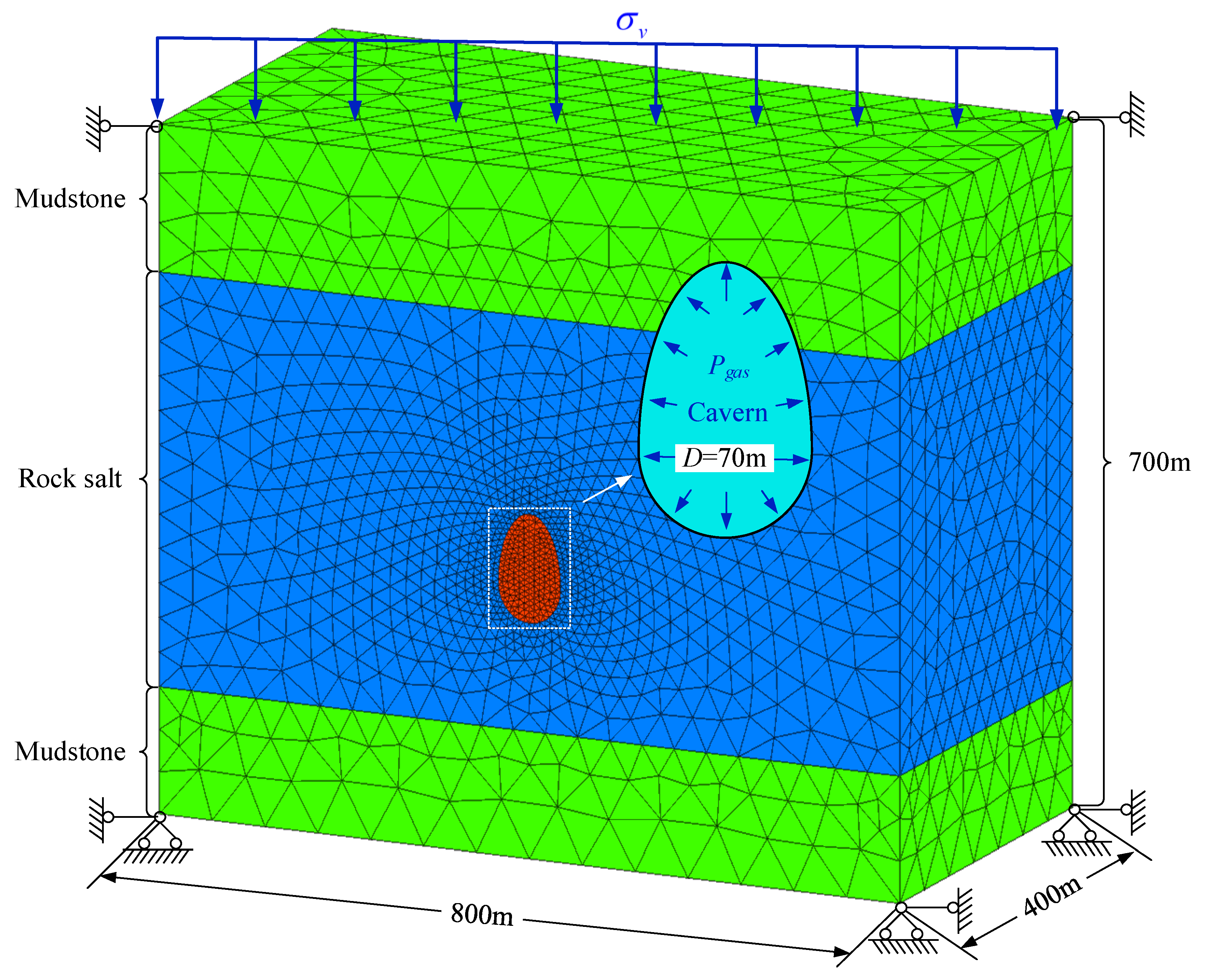
2.2. Numerical Simulation Method and Benchmark Model
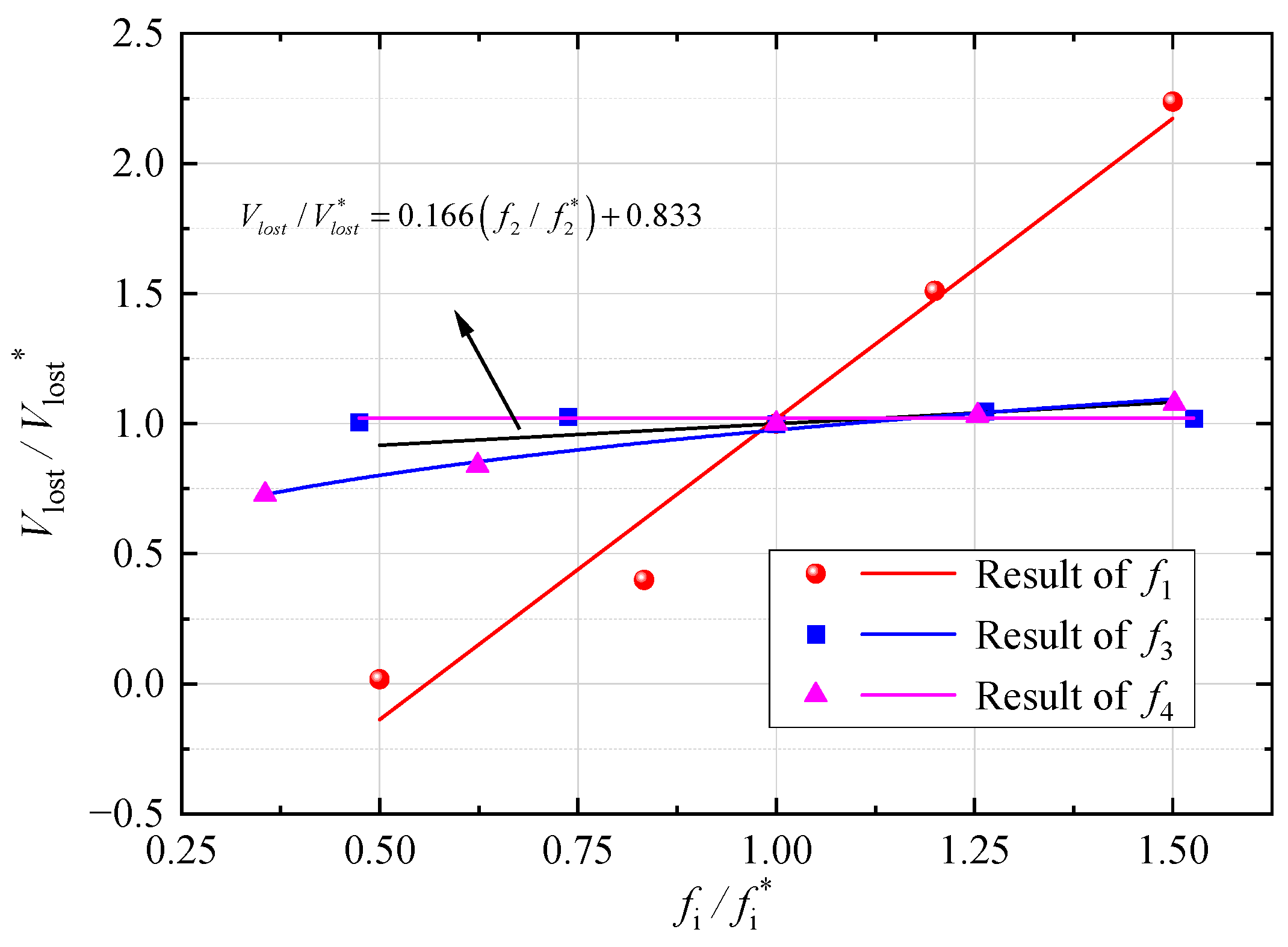
2.3. Univariate Sensitivity Analysis
3. Development and Application of the Gas Injection Optimization Model for Salt Cavern CO2 Storage
3.1. Optimization Model Formulation
3.1.1. Injection Optimization Model Decision Variables
3.1.2. Multi-Objective Function Design
- (1)
- Cavern Shrinkage Control Term
- (2)
- Cost Control Term
- (3)
- Comprehensive Objective Function
3.1.3. Constraints
- (1)
- Pressure and Storage Capacity Physical Constraints
- (2)
- Equipment Capacity Constraints
- (3)
- Task Completion Constraint
3.1.4. Analytical Proof of the Strict Convexity of the Comprehensive Objective Function
3.2. Model Standardization and Solution Method
3.2.1. Model Standardization
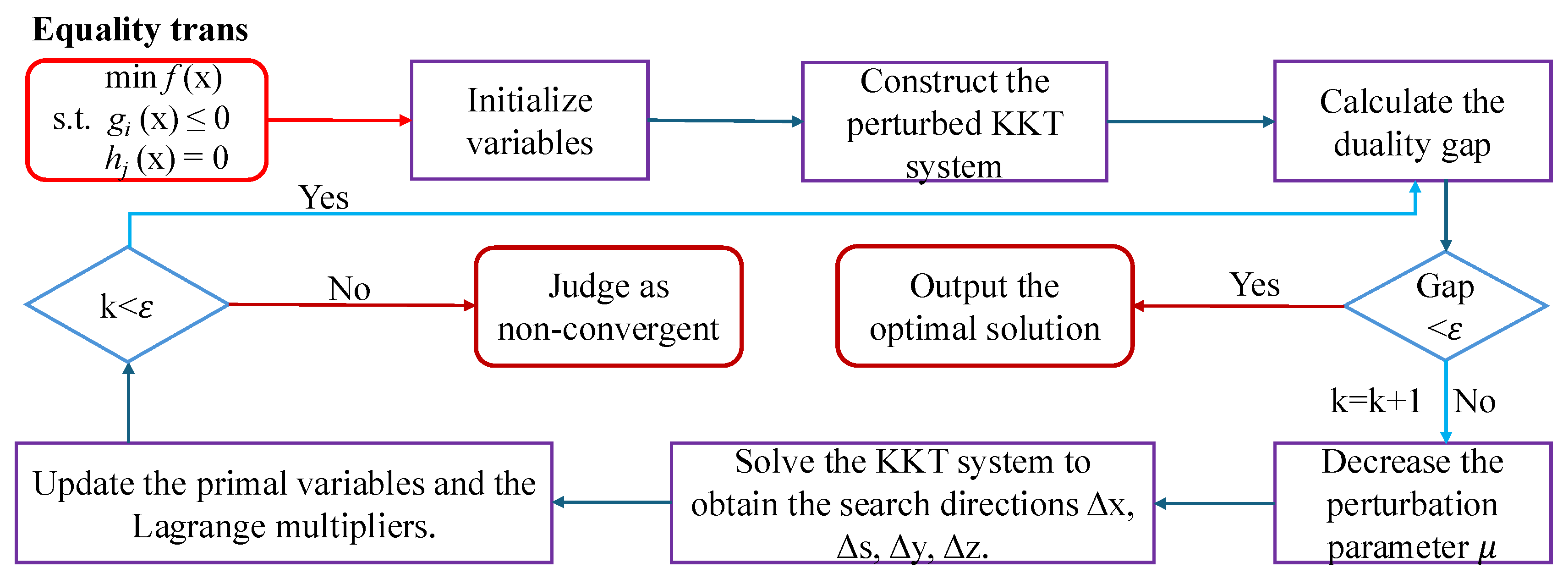
3.2.2. Solution Method and Principles
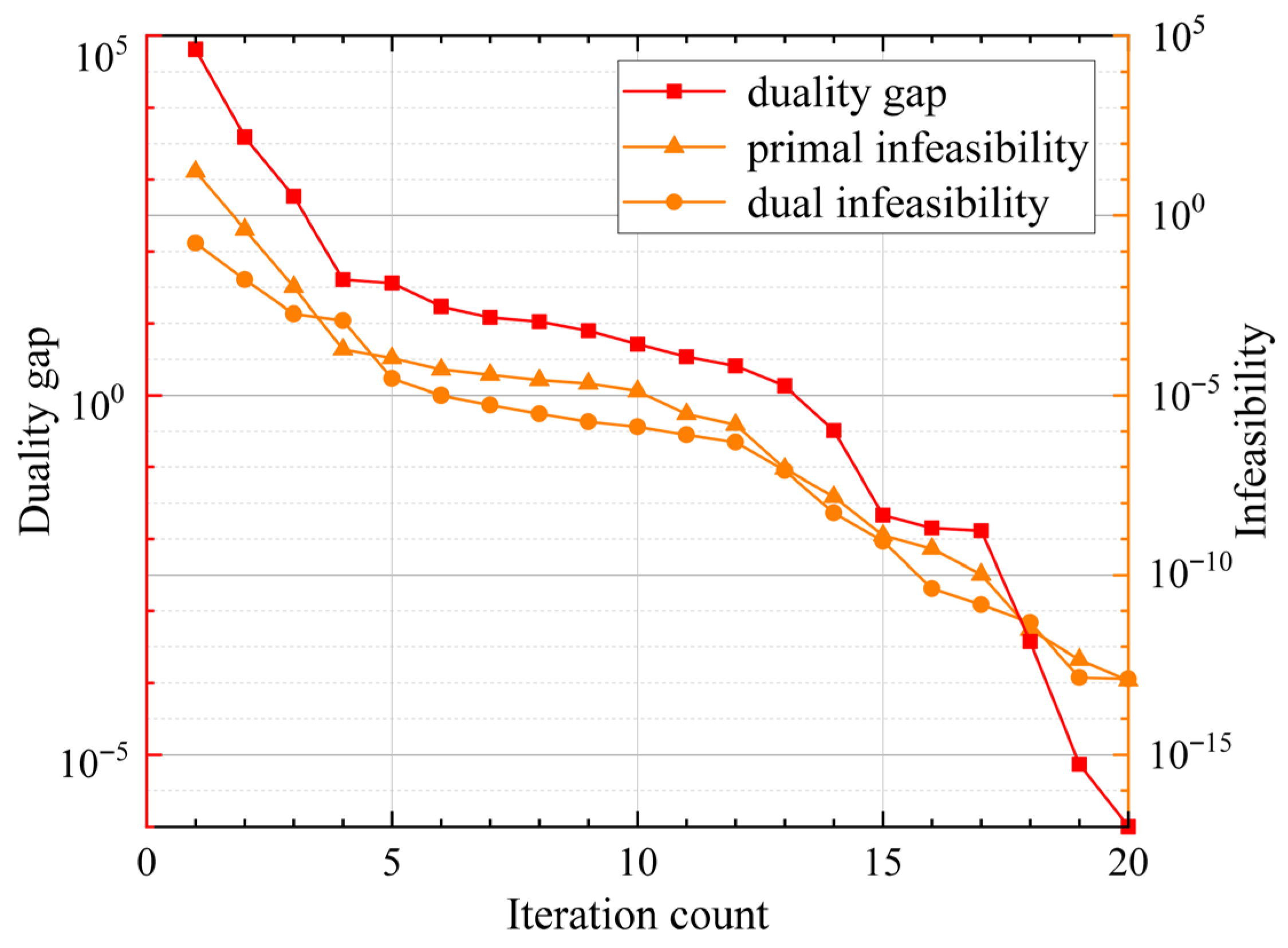
3.2.3. Solution Implementation
3.3. Application in an Actual Engineering Case
3.4. Model Applicability and Directions for Improvement
4. Conclusions
- The primary controlling factors for the volumetric shrinkage rate of SCCS caverns and their sensitivity ranking were clarified. The research reveals that the ratio of in situ stress to internal pressure (f1) is the core factor affecting the long-term shrinkage of the cavern, with its sensitivity significantly higher than that of cavern volume (f4) and the height-to-diameter ratio (f2), while the influence of the symmetry factor (f3) is negligible. The quantitative ranking of the sensitivity of each factor is .
- A multi-objective gas injection optimization model was constructed, integrating proactive shrinkage control and operational economy. The model comprehensively considers energy consumption, volumetric shrinkage rate, and time cost; utilizes sensitivity coefficients to weight heterogeneous caverns; and integrates engineering constraints, such as pressure safety, equipment capacity, and gas injection tasks. The model can effectively support the comparison and selection of different gas injection schemes; however, due to simplification, it cannot accurately calculate energy consumption and volumetric shrinkage rates and is only applicable to long-term volumetric shrinkage control.
- The efficiency and robustness of the primal-dual interior-point method for solving the model were verified. The solution of the actual case study demonstrated that the algorithm could converge stably to the optimal solution within 20 iterations and approximately 1.1 s, with the duality gap decreasing by over 11 orders of magnitude, meeting the real-time requirements of engineering scheduling.
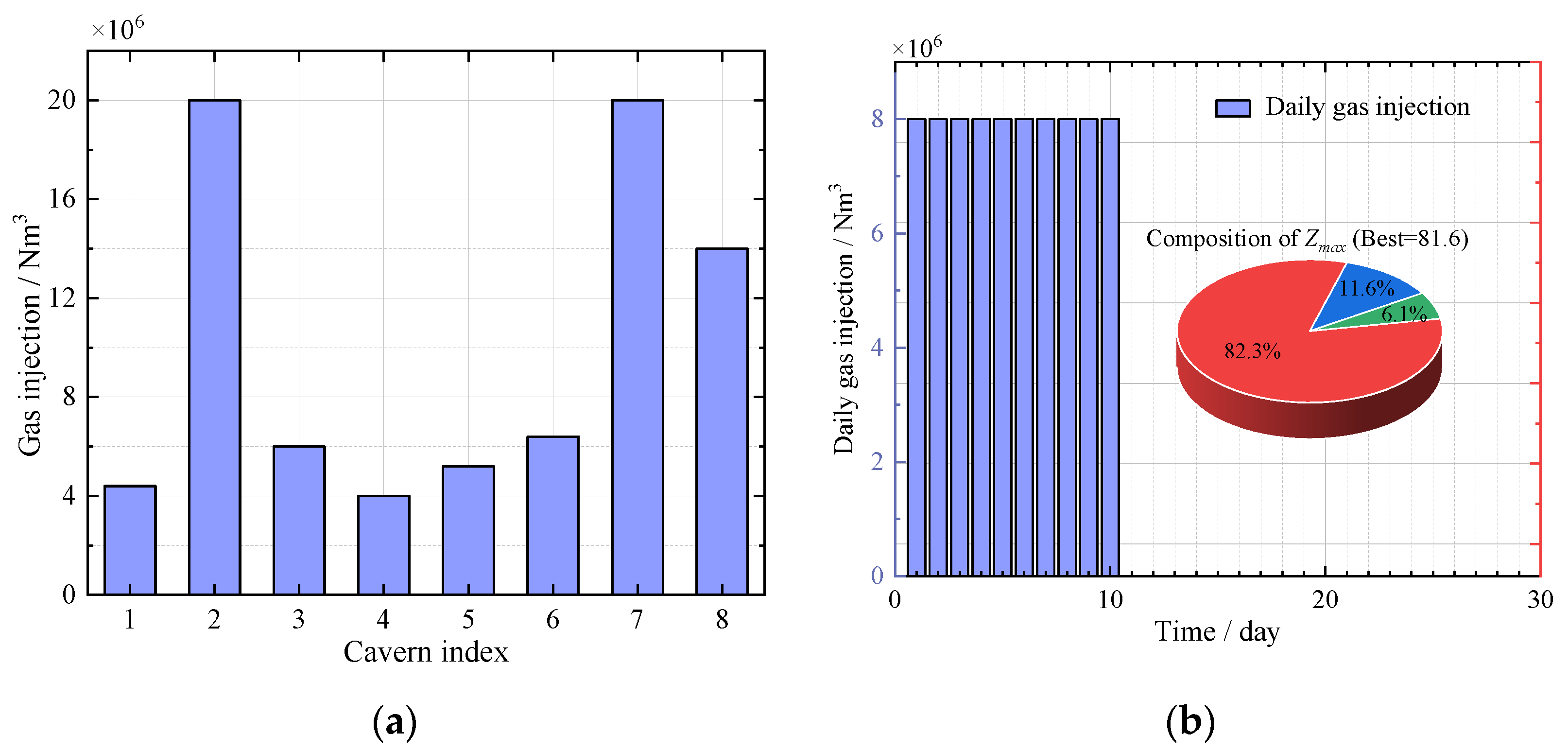
- The significant role of the optimization model in improving the reliability and economy of the scheduling scheme was confirmed. Optimization results show that the model tends to allocate more gas volume to caverns with lower initial pressure and completes the task in the shortest possible time. The comprehensive score of the optimal scheme is 14.77% higher than that of the average allocation baseline scheme, indicating that the model can fully respond to cavern heterogeneity and generate scientific and reliable scheduling schemes.
Author Contributions
Funding
Data Availability Statement
Conflicts of Interest
References
- Yang, C.; Wang, T.; Chen, H. Theoretical and Technological Challenges of Deep Underground Energy Storage in China. Engineering 2023, 25, 168–181. [Google Scholar] [CrossRef] [Scilit]
- Liu, W.; Duan, X.; Li, Q.; Wan, J.; Zhang, X.; Fang, J.; Jiang, D.; Chen, J. Analysis of pressure interval/injection and production frequency on stability of large-scale supercritical CO2 storage in salt caverns. J. Clean. Prod. 2023, 433, 139731. [Google Scholar] [CrossRef] [Scilit]
- Zeng, Z.; Ma, H.; Liang, X.; Li, H.; Zheng, Z.; Liang, R. Deliquescence of damaged rock salt under high humidity and its effect on inter-seasonal salt cavern gas storage. Energy 2024, 313, 133880. [Google Scholar] [CrossRef] [Scilit]
- Lyu, C.; Liu, J.; Ren, Y.; Liang, C.; Liao, Y. Study on very long-term creep tests and nonlinear creep-damage constitutive model of salt rock. Int. J. Rock Mech. Min. Sci. 2021, 146, 104873. [Google Scholar] [CrossRef] [Scilit]
- Cao, B.; Fu, X.; Kang, J.; Tang, P.; Xu, H.; Zhang, Y. Numerical Simulation of Flow Characteristics in CO2 Long-Term Storage in Bedded Salt Cavern. Processes 2025, 13, 1563. [Google Scholar] [CrossRef] [Scilit]
- Jiang, L.; Chunhe, Y.; Wen, W.; Xiaoping, G. Study on creep characteristics and constitutive relation of rock salt. Rock Soil Mech. 2006, 27, 1267–1271. [Google Scholar]
- Liu, W.; Zhang, S.; Zhao, S.; Xiang, H. Intrinsic model of rock nonconstant damage creep based on fractal-order theory. Appl. Math. Model. 2025, 137, 115681. [Google Scholar] [CrossRef] [Scilit]
- Zhang, H.; Wang, P.; Wanyan, Q.; Li, K.; Gao, K.; Yue, X. Sensitivity analysis of operation parameters of the salt cavern under long-term gas injection-production. Sci. Rep. 2023, 13, 20012. [Google Scholar] [CrossRef] [Scilit] [PubMed]
- Li, D.-P.; Liu, W.; Fu, P.; Li, L.; Ban, F.-S.; Li, Q.-H.; Fan, J.-Y.; Jiang, D.-Y.; Zhang, Z.-X. Stability evaluation of salt cavern hydrogen storage and optimization of operating parameters under high frequency injection production. Gas Sci. Eng. 2023, 119, 205119. [Google Scholar] [CrossRef] [Scilit]
- Du, Z.; Dai, Z.; Yin, S.; Dong, S.; Zhang, X.; Yin, H.; Soltanian, M.R. Combining machine learning and multi-objective optimization algorithms to optimize key parameters for underground hydrogen storage. Gas Sci. Eng. 2025, 142, 205713. [Google Scholar] [CrossRef] [Scilit]
- Jifeng, G.; Yongming, Y.; Mingming, G.; Juan, S.; Jiawei, W. Research and Application on Optimization of Injection Production Process for Underground Gas Storage. J. Southwest Pet. Univ. Sci. Technol. Ed. 2024, 46, 126–135. [Google Scholar]
- Raza, A.; Gholami, R.; Sarmadivaleh, M.; Tarom, N.; Rezaee, R.; Bing, C.H.; Nagarajan, R.; Hamid, M.A.; Elochukwu, H. Integrity analysis of CO2 storage sites concerning geochemical-geomechanical interactions in saline aquifers. J. Nat. Gas Sci. Eng. 2016, 36, 224–240. [Google Scholar] [CrossRef] [Scilit]
- He, T.; Wang, T.; Yang, C.; Liao, Y.; Xie, D.; Ding, Z.; Daemen, J.J.K. A mathematical model for the shape prediction of bedded salt cavern used for energy storage. Int. J. Rock Mech. Min. Sci. 2025, 186, 106029. [Google Scholar] [CrossRef] [Scilit]
- Li, J.; Shi, X.; Yang, C.; Li, Y.; Wang, T.; Ma, H.; Shi, H.; Li, J.; Liu, J. Repair of irregularly shaped salt cavern gas storage by re-leaching under gas blanket. J. Nat. Gas Sci. Eng. 2017, 45, 848–859. [Google Scholar] [CrossRef] [Scilit]
- Wang, T.; Ao, L.; Wang, B.; Ding, S.; Wang, K.; Yao, F.; Daemen, J.J.K. Tightness of an underground energy storage salt cavern with adverse geological conditions. Energy 2022, 238, 121906. [Google Scholar] [CrossRef] [Scilit]
- Harati, S.; Rezaei Gomari, S. Designing Geometrically Stable Salt Caverns for Underground Hydrogen Storage: A Case Study from Northeast England. Energy Fuels 2025, 39, 17067–17082. [Google Scholar] [CrossRef] [Scilit]
- Pajonpai, N.; Bissen, R.; Pumjan, S.; Henk, A. Shape design and safety evaluation of salt caverns for CO2 storage in northeast Thailand. Int. J. Greenh. Gas Control 2022, 120, 103773. [Google Scholar] [CrossRef] [Scilit]
- Wang, L.; Berest, P.; Brouard, B. Mechanical Behavior of Salt Caverns: Closed-Form Solutions vs Numerical Computations. Rock Mech. Rock Eng. 2015, 48, 2369–2382. [Google Scholar] [CrossRef] [Scilit]
- Yang, C.H.; Li, Y.P.; Qian, Q.H.; Wei, D.H.; Chen, F.; Yin, X.Y. Usability evaluation of the existing solution-mined caverns for gas storage. In Proceedings of the 6th Conference on the Mechanical Behavior of Salt, Fed Inst Geosci & Nat Resources, Hannover, Germany, 22–25 May 2007; pp. 399–400. [Google Scholar]
- Wei, X.; Shi, X.; Li, Y.; Liu, H.; Li, P.; Ban, S.; Liang, X.; Zhu, S.; Zhao, K.; Yang, K.; et al. Advances in research on gas storage in sediment void of salt cavern in China. Energy 2023, 284, 129243. [Google Scholar] [CrossRef] [Scilit]
- Yang, X.; Qin, Y.; Li, S.; Guo, Y.; Feng, S.; He, Z.; Qin, J.; Xu, N. Study on Surrounding Rock Stability During Solution Mining and Operation of Salt Cavern Gas Storage with Different Height-to-Diameter Ratios and Burial Depths. Appl. Sci. 2025, 15, 723. [Google Scholar] [CrossRef] [Scilit]
- Peng, M.; Li, Y.; Diao, H.; Liu, C.; Deng, S.; Wang, J.; Lin, Y. A review: Research progress and prospects of large-scale energy storage in underground salt caverns. J. Energy Storage 2025, 134, 118146. [Google Scholar] [CrossRef] [Scilit]
- Karmarkar, N. A new polynomial-time algorithm for linear-programming. Combinatorica 1984, 4, 373–395. [Google Scholar] [CrossRef] [Scilit]
- Castro, J.; Cuesta, J. Existence, uniqueness, and convergence of the regularized primal-dual central path. Oper. Res. Lett. 2010, 38, 366–371. [Google Scholar] [CrossRef] [Scilit]
- Jian, J.-B.; Pan, H.-Q.; Tang, C.-M.; Li, J.-L. A strongly sub-feasible primal-dual quasi interior-point algorithm for nonlinear inequality constrained optimization. Appl. Math. Comput. 2015, 266, 560–578. [Google Scholar] [CrossRef] [Scilit]
- Armand, P.; Benoist, J.; Orban, D. From global to local convergence of interior methods for nonlinear optimization. Optim. Methods Softw. 2013, 28, 1051–1080. [Google Scholar] [CrossRef] [Scilit]



| Lithology | Elastic Modulus (GPa) | Poisson’s Ratio | Internal Friction Angle (°) | Tensile Strength (MPa) | Creep Parameters | |
|---|---|---|---|---|---|---|
| A/(MPa−5·d−1) | n | |||||
| Mudstone | 10 | 0.27 | 30 | 1.0 | 4 × 10⁻⁷ | 3.5 |
| Salt Rock | 13 | 0.30 | 35 | 1.0 | 4 × 10⁻⁶ | 3.5 |
| Model | f1 | f2 | f3 | f4 |
|---|---|---|---|---|
| Comparative Model 1 | 0.500 | — | 0.474 | 0.356 |
| Comparative Model 2 | 0.833 | — | 0.737 | 0.624 |
| Comparative Model 3 | 1.200 | — | 1.263 | 1.254 |
| Comparative Model 4 | 1.500 | — | 1.526 | 1.502 |
| Model | Relative Volumetric Shrinkage Rate | |||
|---|---|---|---|---|
| f1 | f2 | f3 | f4 | |
| Comparative Model 1 | 2.238 | — | 1.007 | 0.727 |
| Comparative Model 2 | 1.510 | — | 1.028 | 0.839 |
| Comparative Model 3 | 0.399 | — | 1.049 | 1.031 |
| Comparative Model 4 | 0.017 | — | 1.021 | 1.077 |
| Cavern | Pmax (MPa) | P0 (Mpa) | Cavern Volume (m3) | Cushion Gas (Nm3) | Burial Depth (m) | Cavern Height (m) | Radius (m) |
|---|---|---|---|---|---|---|---|
| 1 | 14.5 | 13.5 | 543,770 | 62,533,603 | 945.3 | 86.5 | 54.8 |
| 2 | 15.5 | 9 | 330,457 | 34,202,363 | 931 | 93 | 41.2 |
| 3 | 17.5 | 12.8 | 231,342 | 15,962,612 | 997.5 | 87.2 | 35.6 |
| 4 | 17.5 | 14.8 | 206,174 | 26,081,126 | 1015 | 85.2 | 40 |
| 5 | 17.5 | 13.6 | 247,602 | 17,084,594 | 999.8 | 86.4 | 37 |
| 6 | 17.5 | 12.5 | 296,004 | 20,424,321 | 996.2 | 87.5 | 40.2 |
| 7 | 17.5 | 11.2 | 301,898 | 20,831,020 | 996.8 | 88.8 | 40.3 |
| 8 | 17.5 | 10.8 | 165,819 | 11,441,549 | 999.6 | 89.2 | 29.8 |
| Scheme | Volume Shrinkage Score | Energy Consumption Score | Time Cost Score | Composite Score |
|---|---|---|---|---|
| Optimal Solution | 84 | 63 | 100 | 81.6 |
| Baseline Strategy | 78.8 | 19.7 | 100 | 71.1 |
Disclaimer/Publisher’s Note: The statements, opinions and data contained in all publications are solely those of the individual author(s) and contributor(s) and not of MDPI and/or the editor(s). MDPI and/or the editor(s) disclaim responsibility for any injury to people or property resulting from any ideas, methods, instructions or products referred to in the content. |
© 2026 by the authors. Licensee MDPI, Basel, Switzerland. This article is an open access article distributed under the terms and conditions of the Creative Commons Attribution (CC BY) license.
Share and Cite
Jiang, T.; Zhang, Y.; Liao, Y.; Xie, D.; He, T. Gas Injection Optimization and Shrinkage Control for Salt Cavern CO2 Storage (SCCS) Based on Creep-Shrinkage Sensitivity Analysis. Energies 2026, 19, 1970. https://doi.org/10.3390/en19081970
Jiang T, Zhang Y, Liao Y, Xie D, He T. Gas Injection Optimization and Shrinkage Control for Salt Cavern CO2 Storage (SCCS) Based on Creep-Shrinkage Sensitivity Analysis. Energies. 2026; 19(8):1970. https://doi.org/10.3390/en19081970
Chicago/Turabian StyleJiang, Tingting, Yiyun Zhang, Youqiang Liao, Dongzhou Xie, and Tao He. 2026. "Gas Injection Optimization and Shrinkage Control for Salt Cavern CO2 Storage (SCCS) Based on Creep-Shrinkage Sensitivity Analysis" Energies 19, no. 8: 1970. https://doi.org/10.3390/en19081970
APA StyleJiang, T., Zhang, Y., Liao, Y., Xie, D., & He, T. (2026). Gas Injection Optimization and Shrinkage Control for Salt Cavern CO2 Storage (SCCS) Based on Creep-Shrinkage Sensitivity Analysis. Energies, 19(8), 1970. https://doi.org/10.3390/en19081970