Article

Gas Injection Optimization and Shrinkage Control for Salt Cavern CO2 Storage (SCCS) Based on Creep-Shrinkage Sensitivity Analysis


1
School of Resources and Environmental Engineering, Wuhan University of Technology, Wuhan 430070, China
2
Institute of Rock and Soil Mechanics, Chinese Academy of Sciences, Wuhan 430071, China
*
Author to whom correspondence should be addressed.
Energies 2026, 19(8), 1970; https://doi.org/10.3390/en19081970
Submission received: 2 March 2026 / Revised: 12 April 2026 / Accepted: 14 April 2026 / Published: 18 April 2026
(This article belongs to the Topic CO2 Capture and Renewable Energy, 2nd Edition)

Abstract

Salt cavern CO2 storage (SCCS) technology represents a crucial pathway for achieving large-scale carbon sequestration. However, its long-term operation faces the challenge of cavern shrinkage due to surrounding rock creep, which directly impacts storage safety and stability. Despite its importance, there is currently a lack of research focusing on the proactive control of SCCS cavern shrinkage and its collaborative optimization with operational economy. To fill this gap, this paper first investigated the effects of the stress state (f1), height-to-diameter ratio (f2), symmetry factor (f3), and cavern volume (f4) on the volumetric shrinkage rate through numerical simulations of regular caverns and univariate sensitivity analysis. The sensitivity ranking and quantitative relationships of these factors were clarified as f 1 ( 2.31 ) > f 4 ( 0.309 ) > f 2 ( 0.166 ) > f 3 ( 0 ) . Subsequently, a multi-objective nonlinear optimization model was established, and the primal-dual interior-point method was adopted as the solution algorithm. Using actual cavern data as a case study for the solution, the results demonstrate that the optimization model converges stably in approximately 1.1 s. The resulting optimal gas injection allocation scheme achieves a 14.77% improvement in the comprehensive score compared to the baseline scheme. This study provides a theoretical basis and a practical tool for the rapid generation of SCCS gas injection allocation schemes.

1. Introduction

Against the backdrop of global efforts to advance carbon neutrality, CO2 capture, utilization, and storage technology has become an indispensable critical pathway for achieving deep emission reductions [1]. Among these, SCCS technology, which involves constructing artificial cavities in deep salt formations through solution mining to store high-pressure CO2, is regarded as a crucial technical option for realizing large-scale, long-term, and safe geological sequestration [2,3]. However, during long-term storage facility operation, the surrounding rock of the cavern undergoes continuous creep driven by pressure differentials, leading to a slow shrinkage of the cavern volume, which directly impacts the long-term stability of the cavern [4]. Therefore, revealing the primary controlling factors of cavern creep shrinkage and, based on this, establishing scientific gas injection operation strategies to achieve collaborative optimization of shrinkage control and operational economy represents a core scientific problem that must be solved for SCCS technology to advance towards large-scale and intelligent application [5].
Substantial research has been conducted by scholars worldwide on the creep and stability issues of salt caverns, primarily focusing on three core aspects. First, concerning creep mechanisms and constitutive models, studies have revealed the rheological properties of salt rock under the influence of stress, temperature, and time. Constitutive models have evolved from classical empirical models like Norton’s law to complex models considering damage, hardening, and multi-field coupling, providing a theoretical foundation for numerical calculations [6,7]. Second, regarding the influencing factors and prediction of cavern shrinkage, several key factors have been identified. For instance, Zhang et al. [8] found through numerical simulation that, besides the inherent creep properties of salt rock, the operational modes of adjacent caverns, the proportion of low-pressure operation time within a single cycle, and the cavern height-to-diameter ratio are sensitive factors. Third, in the field of injection–production optimization for underground energy storage, multi-objective optimization models have been developed that comprehensively consider economics, safety, and equipment capacity. Good results in energy saving and pressure equalization have been achieved through optimization algorithms [9,10].
Despite the progress made in existing research, significant limitations remain concerning the active control of creep shrinkage and collaborative operational optimization for SCCS. Firstly, the identification of factors influencing cavern shrinkage in current studies is not comprehensive [8]. Secondly, there is a disconnect between mechanistic research and operational control; most sensitivity analyses merely reveal patterns without translating the sensitivity of shrinkage rates to various factors into control indicators and optimization objectives that can be embedded into daily scheduling [11]. Furthermore, traditional optimization models treat shrinkage merely as a passive constraint rather than a core objective to be actively minimized, making it difficult for research outcomes to achieve targeted control applications [10,12].
To address these limitations, this study first conducts systematic numerical simulations and sensitivity analyses to investigate the influence of key parameters—such as the in situ stress-to-internal pressure ratio, cavern shape, and cavern volume—on the long-term volumetric shrinkage rate of SCCS caverns. It determines their sensitivity ranking and quantitative functional relationships. Subsequently, using this quantitative function as the core control element, a multi-objective nonlinear optimization model is constructed, incorporating gas injection energy consumption. The decision variables are the daily gas injection volumes for each cavern over the upcoming month, and the model is solved efficiently using the primal-dual interior-point method. Finally, through a case study of an actual cavern group, the effectiveness of the proposed method in collaboratively optimizing shrinkage control, operational economy, and scheduling flexibility is verified, providing theoretical support for the intelligent and refined operation of SCCS facilities.

2. Influencing Factors and Sensitivity Analysis of Cavern Shrinkage

2.1. Key Influencing Factors of Creep Shrinkage

During the operation of a salt cavern CO2 storage facility, the gas pressure inside the cavern is typically lower than the vertical and horizontal stresses of the surrounding rock mass, leading to an unbalanced stress state in the salt rock. This stress state drives the salt rock to creep towards the cavern interior, macroscopically manifested as a continuous shrinkage of the cavern volume [13]. Due to the influence of solution mining techniques and salt layer heterogeneity, actual cavern geometries are complex and irregular, making it difficult to reveal universal laws through direct studies on irregular caverns [14]. In this study, actual caverns are simplified into a rotationally symmetric pear-shaped model to isolate the influence of minor geometric details and extract the primary mechanical mechanisms. As the gas injection scheduling period is fixed at one month, this study does not consider the independent effect of time on shrinkage. The investigation focuses on the impact of three categories of factors on shrinkage behavior: stress state, cavern shape, and cavern volume.

2.1.1. Stress State of the Cavern

The driving force for cavern shrinkage originates from the difference between the internal gas pressure and the in situ stress. Existing research indicates that, under otherwise constant conditions, the lower the internal pressure of the cavern, the greater the volumetric shrinkage rate, with the shrinkage rate increasing nonlinearly as the internal pressure decreases [15]. To quantify this mechanical influence, this study adopts the ratio of in situ stress to cavern internal pressure (f1) as the sensitivity analysis parameter reflecting the cavern’s stress state.

2.1.2. Cavern Shape

The shape of a regular cavern is primarily determined by two parameters: the height-to-diameter ratio and the symmetry factor. The height-to-diameter ratio is defined as the ratio of cavern height to diameter; the symmetry factor is the ratio of the height of the upper semi-ellipsoid to that of the lower semi-ellipsoid. The cavern shape directly affects the stress distribution within the surrounding rock mass, which in turn macroscopically influences the volumetric shrinkage of the cavern. Ma et al. [16] pointed out that under conditions where the burial depth exceeds 433.2 m, salt rock can be considered to be in a hydrostatic stress state. In this stress environment, when the cavern is spherical, its mechanical state is optimal, and the volumetric shrinkage rate is minimal; the further the shape deviates from a sphere, the more significant the volumetric shrinkage trend becomes. This study incorporates the height-to-diameter ratio (f2) and the symmetry factor (f3) into the sensitivity analysis system to quantitatively assess their regulatory effects on shrinkage behavior.

2.1.3. Cavern Volume

Under the premise that the geometric shape remains constant, variations in cavern volume can still influence its creep shrinkage behavior. Caverns with significantly different volumes may exhibit different shrinkage trends under identical stress conditions [17]. Therefore, this study lists cavern volume (f4) as another factor for sensitivity analysis, aiming to reveal its inherent relationship with the volumetric shrinkage rate.

2.2. Numerical Simulation Method and Benchmark Model

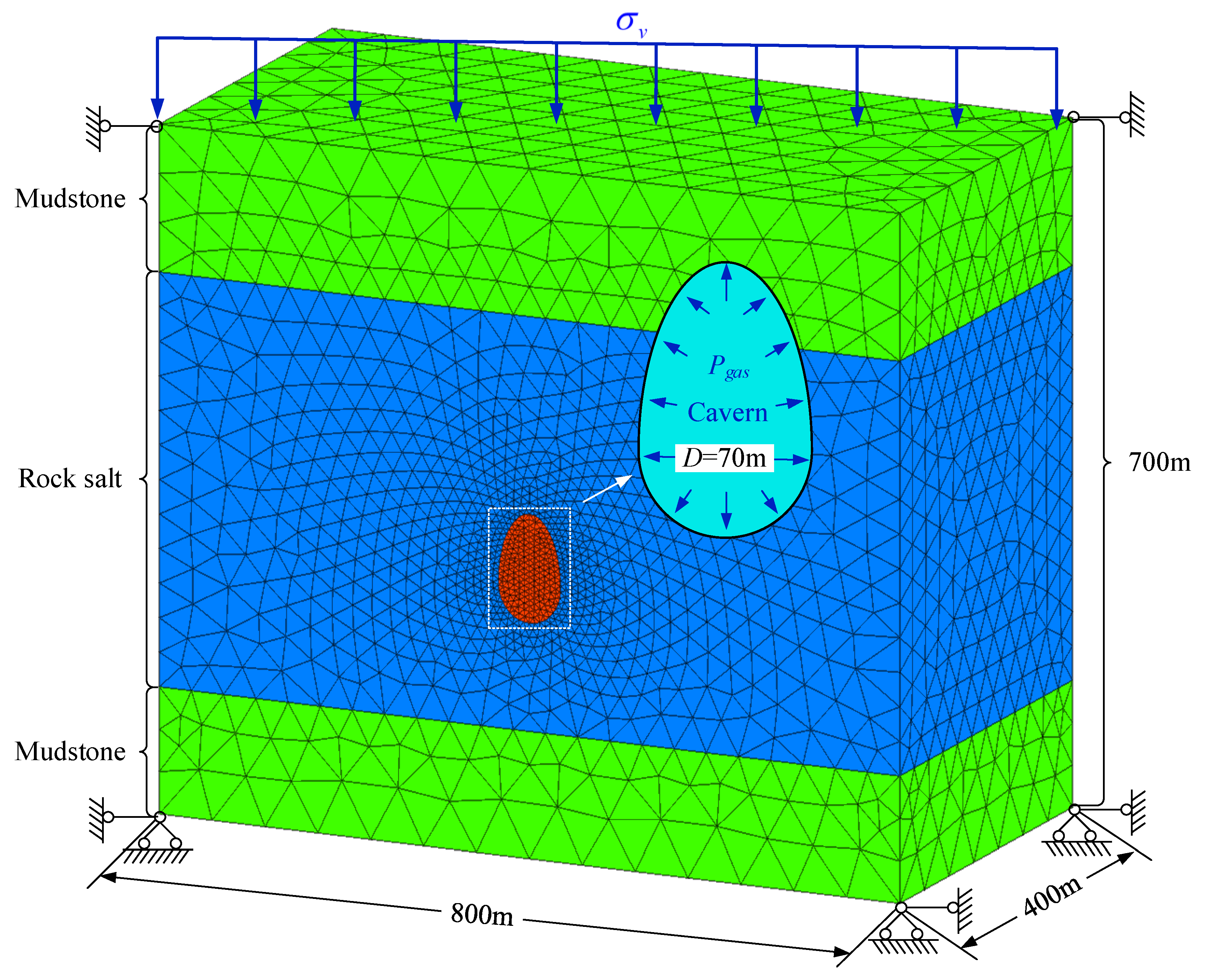
To quantitatively evaluate the effects of various influencing factors, this study employed Rhino 7 software to establish three-dimensional geometric models of different caverns. After meshing, these models were imported into FLAC3D (a numerical simulation software widely used for geotechnical creep analysis) for creep simulation. Tetrahedral elements were selected for the mesh, with refinement applied to the region near the cavern and a gradual transition to coarser elements outwards, balancing computational accuracy and efficiency. To conduct parametric sensitivity analysis, a benchmark state was defined to unify dimensions and serve as a basis for comparing the influence of each factor. A pear-shaped cavern with a diameter of 70 m, height of 115.5 m, top burial depth of 1200 m, internal pressure of 12 MPa, and a symmetry factor of 1.9 was selected as the benchmark model. The corresponding parameters of the model are taken from a typical cavern in the Jintan gas storage facility [13]. The model comprised 48,359 tetrahedral elements, and its three-dimensional geomechanical model is shown in Figure 1.
The in situ stress field of the model was set as a triaxial equal-compressive, self-weight stress field, consistent with the hydrostatic pressure assumption for deep salt rock. Boundary conditions were configured as follows: vertical displacement was constrained at the model base, and normal displacement constraints were applied to the four lateral boundaries, effectively treating the surrounding rock mass as rigid boundaries. The model top was a free surface, uniformly subjected to the self-weight stress corresponding to the thickness of the overlying strata. The salt rock layer had a thickness of 421 m, interbedded between thick mudstone layers above and below, with the model top buried at a depth of 850 m. In the numerical simulation, the Mohr-Coulomb criterion was adopted to assess the plastic zone and damage distribution in the surrounding rock, while the Norton model was selected to describe the steady-state creep behavior of the salt rock [18]. Its constitutive relation for creep strain rate is
  ε ˙ ( t ) = A σ n
where ε ˙ is the creep strain rate, s−1; σ is the deviatoric stress, MPa; and A and n are experimental constants for the salt rock material. The mechanical parameters used in the model for mudstone and salt rock were referenced from actual engineering test data from the Jintan gas storage facility, with the specific values being as follows: for salt rock, density is 2.25 g/cm3 and cohesion is 1.0 MPa; for mudstone, density is 2.76 g/cm3 and cohesion is 1.0 MPa, along with other parameters listed in Table 1 [19]. All comparative models were constructed and calculated following the same methodology.

2.3. Univariate Sensitivity Analysis

The volumetric shrinkage rate of the cavern after 100 years of operation is defined as V l o s t . According to the analysis in Section 2.1, it is primarily controlled by four factors, namely the ratio of in situ stress to internal pressure, i.e., V l o s t   =   F (   f 1 ,   f 2 ,   f 3 ,   f 4 ) . The parameters of the benchmark model are set as f *   =   { f 1   * , f 2   * , f 3   * , f 4   * } , corresponding to the benchmark shrinkage rate V l o s t   * . By varying a single factor, fi, within its reasonable range while keeping the other parameters at their benchmark values, the degree and trend of deviation of V l o s t from V l o s t   * can be systematically analyzed, thereby assessing the sensitivity of each factor.
For the height-to-diameter ratio f2, this study directly adopts the linear fitting relationship obtained from existing research [20,21]. Equation (2); therefore, data for f2 is not included in the table, and its sensitivity coefficient obtained from existing studies is 0.166.
  V l o s t / V l o s t * = 0.166 f 2 / f 2 * + 0.833
Based on this principle, the univariate comparative simulation scheme designed for this study is shown in Table 2. The table presents the ratio of each influencing factor fi relative to the benchmark value f i   * . Taking f1 as an example, its variation is achieved by adjusting the cavern’s top burial depth and internal pressure: Comparative Models 1 and 2 share the same burial depth (1200 m) but have different internal pressures (8 MPa and 10 MPa, respectively); Comparative Models 3 and 4 share the same internal pressure (8 MPa) but have different burial depths (600 m and 1000 m, respectively). A value such as 0.5 in the table indicates that the ratio of the parameter fi of the comparison model to the corresponding parameter f i   * of the baseline model is 0.5.
The cavern volumetric shrinkage rates after 100 years of simulated operation for each scheme are listed in Table 3.
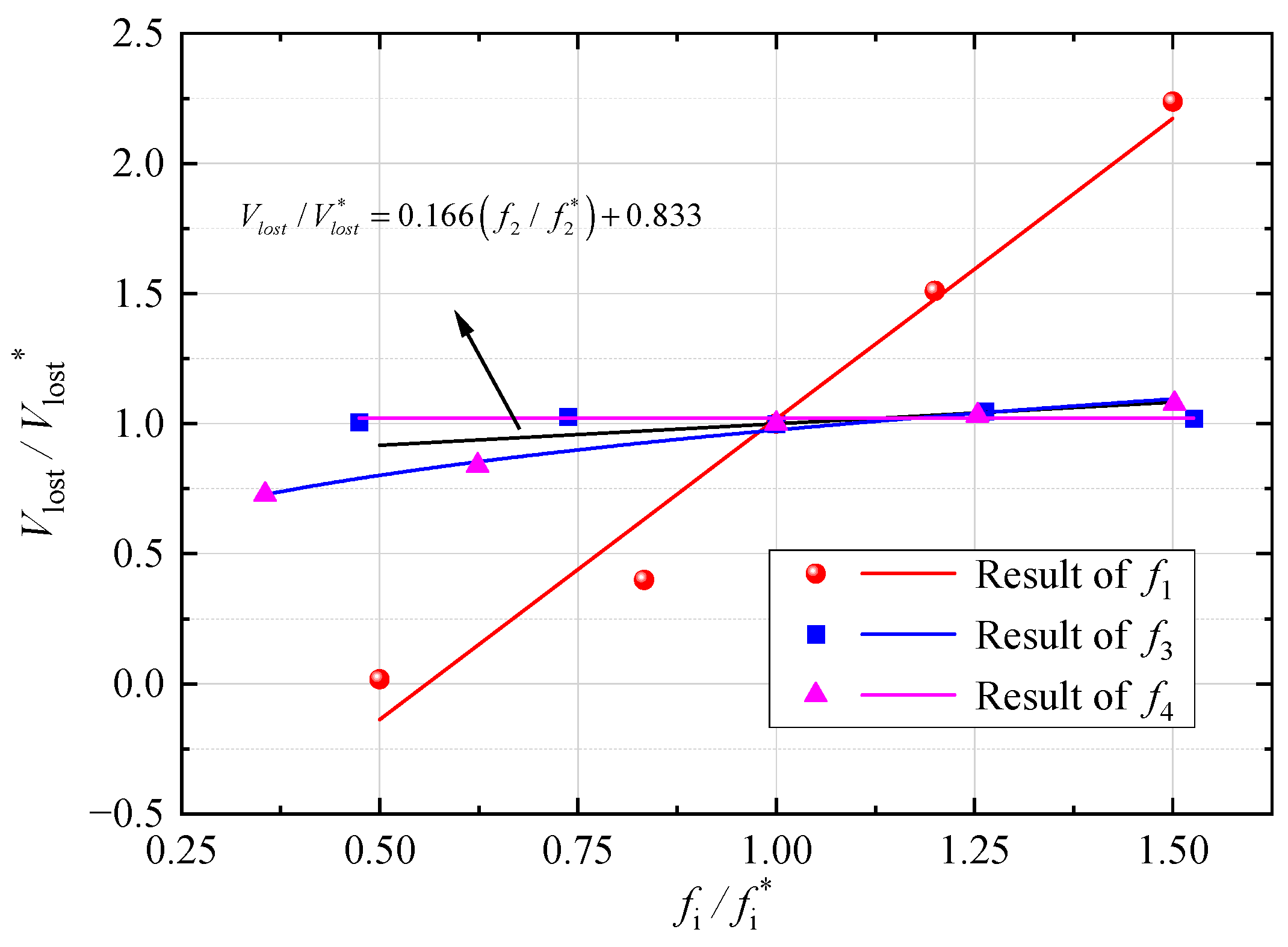
Based on the data in Table 3, scatter plots of the relative volumetric shrinkage rate against each parameter were generated, as shown in Figure 2, and function fitting was performed. The slope α i of the curve represents the sensitivity coefficient of that factor on the volumetric shrinkage rate. A positive slope value indicates that the shrinkage rate varies in the same direction as the factor, while a negative value indicates an inverse relationship.
According to the fitting results, the ratio of in situ stress to internal pressure f1 exhibits a significant linear positive correlation with the relative shrinkage rate. The fitted straight line has a slope of 2.31, and the expression is
  V l o s t / V l o s t * = 2.31 f 1 / f 1 * 1.29   R 2 = 0.973
The relationship between the symmetry factor f3 and the relative shrinkage rate is approximately constant, with a sensitivity coefficient near 0. This indicates that, within the parameter range studied, the variation in the ratio of the upper to lower parts of the cavern has a negligible impact on the total volumetric shrinkage.
The cavern volume f4 shows a nonlinear relationship with the relative shrinkage rate, best fitted by a power function:
  V l o s t / V l o s t * = 0.98 f 4 / f 4 * 0.28   R 2 = 0.986
Its sensitivity (curve slope) varies with the relative volume. Within the actual engineering parameter range, the curve is relatively flat. For ease of comparison, the average of the maximum and minimum curve slopes within this interval was taken as its equivalent sensitivity coefficient, calculated to be 0.309.
Based on the comprehensive analysis above, the ranking of the influencing factors on cavern volumetric shrinkage rate is f 1 ( 2.31 )   >   f 4 ( 0.309 )   >   f 2 ( 0.166 )   >   f 3 ( 0 ) . This indicates that the ratio of in situ stress to internal pressure f1 is the most critical factor controlling the long-term volumetric shrinkage of salt caverns, with its influence significantly greater than other geometric factors. In the actual operation of gas storage facilities, maintaining a reasonable internal pressure level is the primary measure for controlling cavern shrinkage and ensuring storage stability. Cavern volume f4 and the height-to-diameter ratio f2 also have certain influences, while the symmetry factor f3 has the least impact under the conditions of this study.

3. Development and Application of the Gas Injection Optimization Model for Salt Cavern CO2 Storage

3.1. Optimization Model Formulation

3.1.1. Injection Optimization Model Decision Variables

To achieve the intelligent allocation of gas injection volumes and the intelligent control of shrinkage in SCCS, this study constructs a gas injection optimization model. Aiming to maximize the system’s comprehensive score, this model automatically allocates the gas injection volume for each cavern based on the current system state while strictly satisfying various safety and engineering constraints. The model employs a one-dimensional decision vector X as the decision variable, whose element Qt,j is defined as the gas injection volume for the j-th cavern on the t-th day (Nm3). The expression for X is as follows:
  X = [ Q 1 , 1 , Q 2 , 1 , , Q t , 1 , Q 1 , 2 , , Q t , 2 , , Q 1 , j , , Q t , j ]
Considering that a monthly cycle is a common period for inventory assessment, market settlement, and maintenance scheduling in energy storage systems, this paper selects t = 30 days as the total number of gas injection days and conducts the optimization study using a storage facility comprising 8 caverns as an example.

3.1.2. Multi-Objective Function Design

(1)
Cavern Shrinkage Control Term
To mitigate cavern creep shrinkage and ensure long-term stability, this paper incorporates the cavern shrinkage rate into the optimization objective based on the sensitivity analysis results. SCCS projects involve multiple caverns with service lives spanning up to a hundred years. The safety control objective is to minimize the comprehensive volumetric shrinkage rate of the storage system over the 100-year sequestration period. According to the research in Section 2, the primary factor controlling the volumetric shrinkage rate of a single cavern is its internal pressure state, which has a sensitivity coefficient 7.5 to 13.92 times higher than other factors. To simplify the calculation, this paper neglects the influence of other factors and utilizes the fitted Equation (3) to calculate the volumetric shrinkage rate of a single cavern over its 100-year service life.
Based on Equation (3), the volumetric shrinkage rate V l o s t for a single cavern over 100 years of operation is
  V l o s t = 2.31 V l o s t * · f 1 / f 1 * 1.29 V l o s t *
where f1 is the ratio of in situ stress to internal pressure.
The gas injection period for SCCS typically lasts only a few months. During the CO2 compression and injection phase, influenced by gas compression work and the throttling effect, significant transient thermal effects occur within the cavern, leading to short-term local temperature fluctuations. However, the time span of this transient thermal process is extremely short, accounting for less than 1% of the service cycle, which is negligible compared to the century-long service life. After injection, during the long-term storage period, the CO2 within the cavern undergoes sufficient heat exchange with the massive surrounding salt rock formation, and the early transient thermodynamic disturbances gradually dissipate. The gas temperature ultimately stabilizes at the formation temperature and maintains long-term stability. Moreover, the amplitude of pressure fluctuations caused by transient thermodynamic disturbances is relatively small, usually within 10% of the stable operating pressure of the cavern. Therefore, when evaluating the volumetric shrinkage rate on a century scale, short-term transient thermal effects can be reasonably ignored. The cavern pressure is mainly determined by the total injection volume Q t , j . At this stage, the stabilized gas pressure inside the cavern P j 100 is calculated as
  P j 100 = P j 0 + Z ( P , T ) n R T V j = P j 0 + Z ( P , T ) R T 0.0224 V j Q t , j
where Vj is the cavern volume, n is the moles of gas, Q t , j is the gas volume in standard states (Nm3), R = 8.314 × 10⁻⁶ MPa⋅m3/(mol⋅K) is the molar gas constant, and T is the gas temperature. The burial depth of the Jintan gas storage caverns ranges from 975 m to 1200 m; this study adopts the formation temperature corresponding to the median depth of 1100 m. Measured data show that the salt cavern temperature at this depth is 53 °C, so T = 53 °C is used. The gas compressibility factor Z is determined by the Peng–Robinson equation. In SCCS projects, cavern pressure is generally maintained near the upper limit. For the Jintan gas storage facility, the upper pressure limit is between 16 MPa and 19 MPa, corresponding to Z values between 0.48 and 0.54. This study adopts the median value, Z = 0.51.
Although the construction of Equation (7) neglects secondary factors and may introduce certain errors, the core of the optimization model lies in comparing the relative impact of different injection allocation schemes on the shrinkage trend. This simplification does not affect the effective pursuit of the optimal solution within the feasible region while significantly reducing computational complexity. In this study, this simplified equation is used only for the relative comparison of volumetric shrinkage between different injection schemes and not for the precise calculation of absolute shrinkage.
Each cavern in an SCCS project differs in shape, volume, and burial depth; therefore, the same injection volume produces different shrinkage control effects in different caverns. To quantify the contribution of each cavern to the overall system shrinkage, this study defines a weight coefficient wj for each cavern j based on the sensitivity coefficients of each influencing factor:
  w j = α 1 · f 1 , j f 1 * + α 2 · f 2 , j f 2 * + α 3 · f 3 , j f 3 * + α 4 · f 4 , j f 4 *
where α 1 ,   α 2 ,   α 3 ,   α 4 , and fi,j is the initial state value of cavern j for the i-th factor.
To standardize the dimension within the objective function and provide a quantifiable reference for engineering decisions, the relative shrinkage rate of the cavern is normalized into a score (0–100) through linear transformation. The calculation formula is as follows:
  S v , j = 100 × 1 F a c t u a l F m i n F m a x F m i n
where Fmax and Fmin are the theoretical maximum and minimum relative volumetric shrinkage rates for the cavern, respectively; F a c t u a l ,   j   =   V l o s t ,   j   /   V l o s t   * is the actual relative volumetric shrinkage rate, with Factual = 1 indicating that the cavern shrinkage rate equals that of the benchmark cavern. In this study, Fmax = 2.5 and Fmin = 0.25 are adopted, corresponding to the two boundary scenarios where the shrinkage rate increases to four times the benchmark value or decreases to one-quarter of it. This range covers the majority of shrinkage variations that may occur in actual operation [8]. The total system score is the weighted average of the scores for all caverns on each day. The objective of shrinkage control is to minimize this total score, i.e.,
  min Z = j = 1 8 w j · S v , j
(2)
Cost Control Term
To control gas injection energy consumption, this paper incorporates an energy consumption control term. The core energy consumption of a salt cavern energy storage facility is concentrated in the gas injection process. This process requires high-power compressors to pressurize the gas for injection into the underground caverns and is a key aspect of cost control [22]. The energy consumption per unit of gas injection is closely related to the injection rate, cavern pressure, and compressor performance. The analysis process is relatively complex; therefore, this paper adopts a simplified treatment. Based on the principle that, given other parameters are identical, a higher initial cavern pressure results in more work required to inject a unit volume of CO2, the total energy consumption for gas injection—given the known pressures P i , 1 and P i , 100 before and after injection—is approximately estimated using the following expression:
W = j = 1 8 t = 1 30 Q t , j · R T × P i , 0 P i , 100
This simplified model is only used for the comparison of energy consumption between different injection schemes and does not serve as a precise calculation of absolute energy consumption. To facilitate engineering decision-making, unify dimensions, and coordinate with other terms in the objective function, the gas injection cost is also normalized to a range of 0 to 100 using the linear transformation method shown in Equation (9).
Furthermore, to improve operational efficiency, this paper incorporates a time cost control term. The time cost TX is defined as the total time required to complete the gas injection task, which is also normalized to the 0–100 range using the linear transformation method in Equation (9).
(3)
Comprehensive Objective Function
The cavern shrinkage control term and cost control terms are respectively normalized and then summed with weights to form the following comprehensive objective function:
min   Z = 0.8 · j = 1 8 w j · S v , j + 0.15 S w + 0.05 S T x
where Sw is the normalized energy consumption control term, and STx is the normalized time cost control term. The weights 0.8, 0.15 and 0.05 in the objective function are the coefficients for the different objectives. The values of these weight coefficients are determined based on engineering experience. This allocation reflects an optimization orientation that prioritizes the long-term stability of the caverns as the core while also considering operational economy.

3.1.3. Constraints

To ensure the engineering feasibility and safety of the gas injection operation optimization scheme, the model must satisfy the following three categories of constraints:
(1)
Pressure and Storage Capacity Physical Constraints
Let the minimum safe pressure of the storage facility be P min   j , corresponding to the minimum working gas volume V min   j , and the maximum safe pressure be P max   j corresponding to the maximum working gas volume V max   j . The initial working gas volume is set as V 0   j . The working gas volume of the cavern must always remain within the permissible safe range, with the specific expression as follows:
Let the upper pressure limit of the storage cavern be P max   j , corresponding to the maximum storage capacity V max   j . If the initial injected gas volume is V 0   j (Nm3), then the newly injected gas volume must always remain within the permissible safe range, with the specific expression as follows:
  V 0 j + t = 1 T q t j V max j
(2)
Equipment Capacity Constraints
The total daily gas injection volume of the storage system is constrained by the delivery capacity of surface facilities and pipelines. Additionally, to ensure the safety of the wellbore and injection string, the daily injection volume for each individual cavern must also be limited. Let C i n j be the maximum total daily injection capacity, and C p e r be the maximum daily injection capacity for each cavern. The constraints are
  j = 1 N q t j C i n j , q t j C p e r
(3)
Task Completion Constraint
At the end of the optimization period, the cumulative gas injection volume for each cavern must meet the predetermined production task requirement. The corresponding constraint is
  j = 1 N t = 1 T q t j = V T
where VT is the gas injection task for all caverns over the designed optimization period (T days), Nm3.

3.1.4. Analytical Proof of the Strict Convexity of the Comprehensive Objective Function

Based on the volumetric shrinkage control term and the cost control term in the comprehensive objective function, given the initial cavern pressure Pi,0, the single-cavern volumetric shrinkage rate and the injection energy consumption are mainly influenced by the final pressure Pi,100, both of which are non-linear functions of the total injection volume Qi. Meanwhile, the time cost is a linear function of the injection time. According to Equation (7), the relationship between the volumetric shrinkage rate Vlost,i (and the injection energy consumption) of cavern i and the total injection volume Qi can be abstracted into the following function form F:
  F ( Q i ) = C 1 P i 0 + k i Q i C 2
where C1, C2,   P i 0 , and ki are all non-negative real constants determined by the physical properties of the cavern.
Taking the first and second derivatives of the function F with respect to Qi yields
  F ( Q i ) Q i = C 1 · k i P i 0 + k i Q i 2
  2 F ( Q i ) Q i 2 = 2 C 1 · k i 2 P i 0 + k i Q i 3
Since both the constant terms and the variable domains are positive, the condition 2 F ( Q i ) / Q i 2 always holds. Therefore, F is a strictly convex function with respect to the injection volume Qi.
Furthermore, the normalization of the relative shrinkage rate in Equation (9) represents a linear transformation with positive coefficients. Because the strict convexity of a convex function remains unchanged after such a linear transformation. At the same time, the time cost is a linear function of the injection time, and any linear function is both convex and concave. In summary, because the comprehensive objective function is a combination of a strictly convex function and a linear function, the gas injection allocation optimization model established in this study constitutes a strictly convex optimization problem.

3.2. Model Standardization and Solution Method

To effectively solve the injection optimization model for the salt cavern CO2 storage facility, it is necessary to transform it into a standard form suitable for numerical computation. This study first completes the model standardization and subsequently employs the primal-dual interior-point method as the optimization algorithm for the solution.

3.2.1. Model Standardization

The optimization model comprises a nonlinearized objective function equation and linear constraint equation. The decision variables are the daily gas injection volumes for each storage cavern, formulated as a one-dimensional vector with a dimension of 30 × 8 = 240. To adapt to the input specifications of the interior-point method solver, the objective function and constraint conditions are organized according to the standard form of nonlinear programming, as shown below:
  min f ( x ) ,   s . t . g i ( x ) 0 , i = 1 , , m h j ( x ) = 0 , j = 1 , , p  
where g i ( x )     0 represents inequality constraints and h j ( x )   =   0 represents equality constraints. This model comprises a total of 510 inequality constraints and 1 equality constraint, with a constraint matrix size of approximately 511 × 240, representing a typical medium-scale strictly convex nonlinear optimization problem.

3.2.2. Solution Method and Principles

For the nonlinear convex optimization model, this paper adopts the primal-dual interior-point method for the solution. Since Karmarkar’s pioneering work in 1984, this method has undergone considerable development. It has now been successfully extended from solving linear programming to the field of nonlinear programming and has become one of the most mainstream and efficient algorithms for solving nonlinear programming (NLP) problems with complex inequality constraints [23]. Its advantages include: ① high computational efficiency, where solution time does not increase explosively with problem size, making it suitable for gas injection allocation involving multiple caverns and long periods in actual salt cavern CO2 storage systems; ② high numerical stability, as the algorithm reliably converges even when the constraint matrix exhibits significant order-of-magnitude disparities, ensuring the accuracy of the optimization results; and ③ low requirement for the initial point, as it can rapidly converge to the optimal solution even when starting from an infeasible point. These characteristics make it particularly suitable for handling multi-cavern, multi-constraint gas injection optimization problems, capable of meeting the engineering demands for rapidly generating gas injection allocation schemes while ensuring solution accuracy.
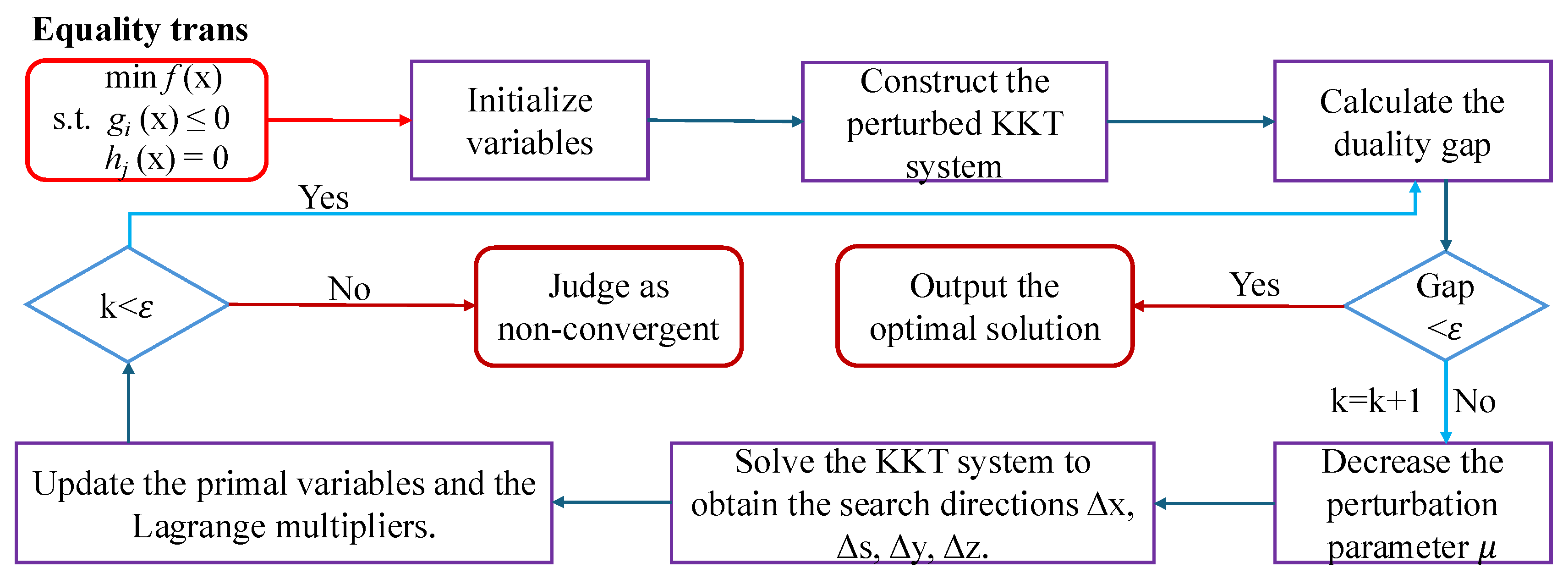
The primal-dual interior-point method relaxes the strict optimality conditions by introducing a barrier parameter, thereby constructing a central path located inside the feasible region and converging rapidly to the optimal solution along this path [24]. Its solution process is illustrated in Figure 3. The method first transforms the inequality constraints of the original problem into equality constraints by adding non-negative slack variables and constructs the Lagrangian function accordingly. Based on this function, the Karush-Kuhn-Tucker (KKT) system, encompassing primal feasibility, dual feasibility, and complementary slackness, is derived [25]. To overcome the difficulty of solving this system directly, the algorithm introduces a positive perturbation parameter (i.e., the barrier parameter) into the complementary slackness condition, forming a series of perturbed KKT systems that approximate the original conditions [24]. In each iteration step, Newton’s method is employed to solve the linear approximation of this nonlinear system, obtaining update directions for the primal and dual variables. To ensure the iteration points remain strictly within the feasible region, a backtracking line search determines an appropriate step size, guiding the solution along the central path towards the optimal vertex [26]. During the iterative process, the barrier parameter is gradually reduced. When the duality gap falls below a preset threshold, the algorithm is deemed to have converged, yielding a high-precision solution within tens of iterations.

3.2.3. Solution Implementation

The numerical computations were performed in the MATLAB R2023a environment. The CVX toolbox was used to solve the convex optimization problem. This toolbox internally invokes the SDPT3 solver, which employs the primal-dual interior-point method for solving convex optimization problems. During the solution process, the convergence tolerance was set to the default value of 10−6, the maximum number of iterations was set to 103, and other parameters were kept at their default settings.

3.3. Application in an Actual Engineering Case

To validate the engineering applicability of the established optimization model and the primal-dual interior-point method solution strategy, this study selected eight typical caverns from a salt cavern storage facility in East China as the research objects. An optimization scheduling study for CO2 injection was conducted over a scheduling period of one month. The key parameters for each cavern, derived from geological surveys and sonar cavity measurements, are detailed in Table 4.
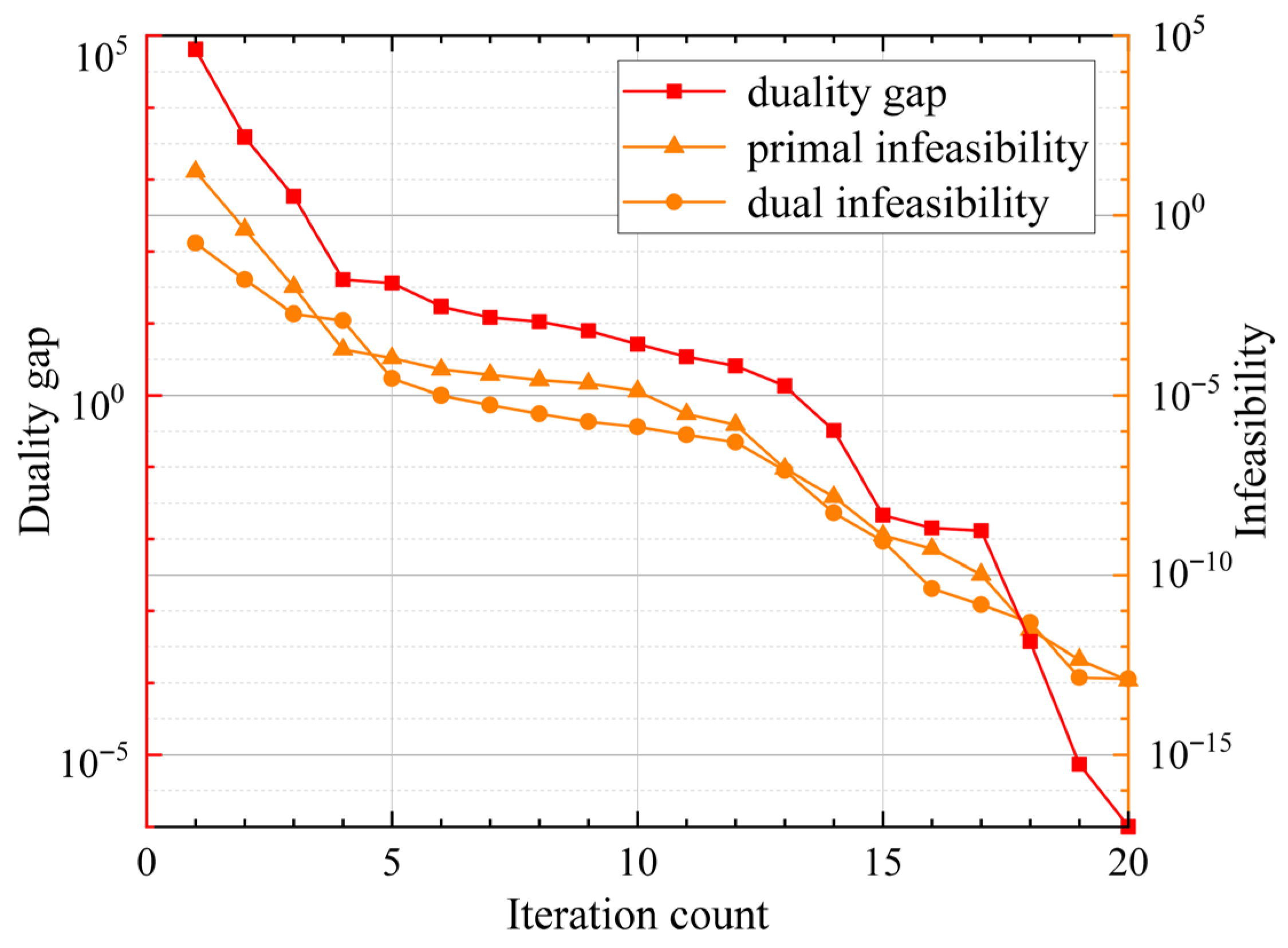
The total amount of CO2 to be injected into the storage system was set at 4 × 10⁷ Nm3. The maximum daily injection capacity of the surface system was 4 × 10⁶ Nm3/d, and the maximum daily injection volume for each individual cavern was 1 × 10⁶ Nm3. These engineering parameters were substituted into the established nonlinear programming model and solved using MATLAB R2023a on a computing environment with an Intel Core i5-10400F processor and 24 GB of RAM. The iterative optimization process of the primal-dual interior-point method is illustrated in Figure 4.
As can be observed from the figure, with the increase in iteration number, the duality gap, primal infeasibility, and dual infeasibility all exhibit a monotonically decreasing trend. After approximately 20 iterations, the primal infeasibility and dual infeasibility decreased by about 11 to 12 orders of magnitude, and the duality gap was reduced from 105 to 10−6, meeting the preset tolerance requirement (duality gap < 10−6). In the initial iterations, all metrics decreased rapidly, indicating the algorithm’s ability to quickly enter the feasible region. In the later stages, the curves tended to flatten, reflecting the favorable local convergence characteristics of the interior-point method near the optimal solution. The entire solution process took approximately 1.1 s, which can meet the rapid decision-making requirements of engineering, and no oscillation or divergence occurred during the solution process, demonstrating the good robustness of the model.
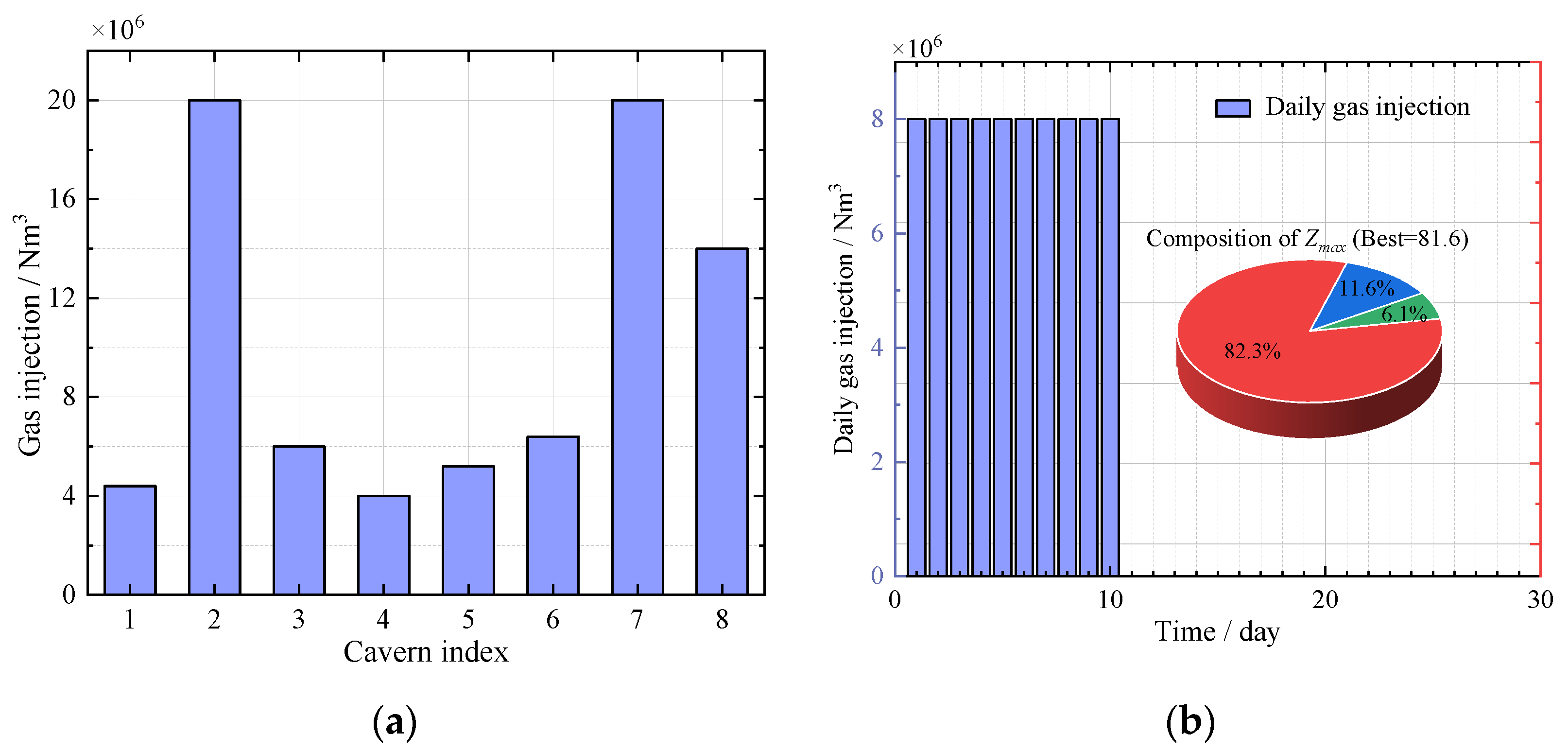
Figure 5a illustrates the gas injection volume allocation scheme for each cavern. As shown in the figure, there are significant differences in the injection volumes among caverns: Caverns 2 and 7 received the highest amount, reaching 20.0 × 10⁶ Nm3; Cavern 8 followed with 14.0 × 10⁶ Nm3; and Cavern 4 received the lowest, at only 4.0 × 10⁶ Nm3. Combined with the data in the table, under similar burial depths, the allocation of injection volume is negatively correlated with the initial pressure of the cavern, and the model tends to allocate more injection volume to caverns with lower initial pressure. The internal mechanism is that caverns with lower initial pressure experience a larger pressure change after injecting the same amount of gas, which provides better control over the volumetric shrinkage rate and can more quickly reduce the overall system shrinkage rate. For caverns with higher safety, the injection intensity is moderately controlled. Under the global optimization framework, the model automatically achieves differentiated allocation by weighing the safety benefits of each cavern, reflecting an effective response to cavern heterogeneity.
The daily gas injection volume of the storage system and the optimal value of the objective function during the injection period are shown in Figure 5b. The figure shows that the normalized optimal objective function score was 81.6. The optimized scheme involved continuous full-capacity injection into the storage system at the maximum daily injection rate of 4 × 10⁶ Nm3/d until the injection task was completed, achieving the minimum time cost.
To validate the effectiveness of the proposed model, the optimal solution generated in this study was compared against a baseline strategy. In the baseline scenario, the total gas injection volume is equally distributed across all cavities, with the injection task scheduled for completion within a 10-day timeframe. The performance comparison between the optimal and baseline solutions is summarized in the Table 5 below. As indicated by the results, the composite score of the optimal solution is 14.77% higher than that of the baseline. Specifically, the volume shrinkage score improved by 6.1%, and the energy consumption score increased by 219.8%, while the time cost score remained identical to the baseline. These findings demonstrate that the proposed model is capable of generating reliable optimal solutions that enhance operational efficiency.

3.4. Model Applicability and Directions for Improvement

The analysis above indicates that this optimization model can effectively address the multi-cavern gas injection allocation and volumetric shrinkage control problem of SCCS facilities, generating safe and reliable allocation schemes while ensuring solution efficiency.
It should be clarified that the objective of the optimization of this model focuses on the century-long control of the cavern volumetric shrinkage rate and economic balance; therefore, the impact of short-term transient thermal effects is ignored during the modeling process. Considering the practical application scenarios of salt cavern energy storage projects, the core feature of salt cavern CO2 sequestration is that CO2 is not extracted after being injected into the cavern. The gas pressure inside the cavern remains basically stable throughout its life cycle, which highly aligns with the long-term optimization assumption of the model. Therefore, this model can be effectively applied to the long-term operational scenarios of such projects, providing a scientific reference for their gas injection allocation. However, for scenarios with high-frequency injection and production processes, such as salt cavern gas storage or compressed air energy storage projects, the internal gas pressure of the cavern fluctuates significantly, and transient thermal effects will significantly impact the flow allocation and safety of each cavern. In this case, if the daily flow allocation scheme generated by this model is directly adopted, significant deviations will occur due to the neglect of pressure fluctuations and thermal-mechanical coupling effects, making it unable to meet the accuracy requirements of daily scheduling for flow decision-making. To address this limitation, future work needs to further expand the applicable scope of the model, optimize the model assumptions, and improve its adaptability to high-frequency injection–production scenarios and daily scheduling. In addition, the model still has the following limitations:
First, the description of physical mechanisms within the objective function is not yet complete. The current adoption of a volumetric shrinkage rate expression for regular caverns, rather than an analytical expression for actual irregular caverns, is primarily constrained by the complexity of the actual cavern geometry, making it difficult to accurately describe its shrinkage characteristics with a simple formula. Furthermore, the model employs simplified treatments for both the volumetric shrinkage rate and energy consumption; while this does not affect the relative comparison and selection between different schemes, it prevents the precise calculation of absolute values. Subsequent work could combine numerical simulations or machine-learning-based surrogate models to construct an objective function that more closely aligns with physical reality.
Second, the safety evaluation index is relatively singular. Although the volumetric shrinkage rate is an important indicator for assessing cavern safety, cavern stability is also influenced by factors such as roof integrity and interlayer sealing. Future studies could introduce a multi-objective optimization framework, incorporating multiple safety indicators into the objective function or constraints to achieve collaborative optimization of safety and economy.

4. Conclusions

This paper addresses the research gap in the proactive control of SCCS cavern shrinkage and its synergistic optimization with economic performance, conducting sensitivity analysis of influencing factors and optimization scheduling research. The main conclusions are as follows:
  • The primary controlling factors for the volumetric shrinkage rate of SCCS caverns and their sensitivity ranking were clarified. The research reveals that the ratio of in situ stress to internal pressure (f1) is the core factor affecting the long-term shrinkage of the cavern, with its sensitivity significantly higher than that of cavern volume (f4) and the height-to-diameter ratio (f2), while the influence of the symmetry factor (f3) is negligible. The quantitative ranking of the sensitivity of each factor is   f 1 ( 2.31 ) > f 4 ( 0.309 ) > f 2 ( 0.166 ) > f 3 ( 0 ) .
  • A multi-objective gas injection optimization model was constructed, integrating proactive shrinkage control and operational economy. The model comprehensively considers energy consumption, volumetric shrinkage rate, and time cost; utilizes sensitivity coefficients to weight heterogeneous caverns; and integrates engineering constraints, such as pressure safety, equipment capacity, and gas injection tasks. The model can effectively support the comparison and selection of different gas injection schemes; however, due to simplification, it cannot accurately calculate energy consumption and volumetric shrinkage rates and is only applicable to long-term volumetric shrinkage control.
  • The efficiency and robustness of the primal-dual interior-point method for solving the model were verified. The solution of the actual case study demonstrated that the algorithm could converge stably to the optimal solution within 20 iterations and approximately 1.1 s, with the duality gap decreasing by over 11 orders of magnitude, meeting the real-time requirements of engineering scheduling.
  • The significant role of the optimization model in improving the reliability and economy of the scheduling scheme was confirmed. Optimization results show that the model tends to allocate more gas volume to caverns with lower initial pressure and completes the task in the shortest possible time. The comprehensive score of the optimal scheme is 14.77% higher than that of the average allocation baseline scheme, indicating that the model can fully respond to cavern heterogeneity and generate scientific and reliable scheduling schemes.

Author Contributions

T.J.: Writing—review and editing, project administration, and conceptualization. Y.Z.: writing—original draft, methodology, investigation, and data curation. Y.L.: visualization and formal analysis. T.H.: validation and resources. D.X.: validation. All authors have read and agreed to the published version of the manuscript.

Funding

This research received funding from the National Science and Technology Major Project of China (No. 2024ZD1004300), the National Natural Science Foundation of China (No. 52504066, U25B20133), the National Key R&D Program of China (Grant No. 2024YFB4007100), the National Natural Science Foundation of China (Grant No. 52404066), the Natural Science Foundation of Wuhan (Grant No. 2024040701010062 and No. 2024040801020255), and the Joint Research and Development Program between Wuhan University of Technology and Shaanxi Yanchang Petroleum (Group) Co., Ltd. (Project No. yc-whlg-2025ky-05).

Data Availability Statement

The necessary data to reproduce this study are included in this article. Further inquiries can be directed at the corresponding author.

Conflicts of Interest

The authors declare that this study received funding from Shaanxi Yanchang Petroleum (Group) Co., Ltd. The funder was not involved in the study design, collection, analysis, interpretation of data, the writing of this article or the decision to submit it for publication.

References

  1. Yang, C.; Wang, T.; Chen, H. Theoretical and Technological Challenges of Deep Underground Energy Storage in China. Engineering 2023, 25, 168–181. [Google Scholar] [CrossRef]
  2. Liu, W.; Duan, X.; Li, Q.; Wan, J.; Zhang, X.; Fang, J.; Jiang, D.; Chen, J. Analysis of pressure interval/injection and production frequency on stability of large-scale supercritical CO2 storage in salt caverns. J. Clean. Prod. 2023, 433, 139731. [Google Scholar] [CrossRef]
  3. Zeng, Z.; Ma, H.; Liang, X.; Li, H.; Zheng, Z.; Liang, R. Deliquescence of damaged rock salt under high humidity and its effect on inter-seasonal salt cavern gas storage. Energy 2024, 313, 133880. [Google Scholar] [CrossRef]
  4. Lyu, C.; Liu, J.; Ren, Y.; Liang, C.; Liao, Y. Study on very long-term creep tests and nonlinear creep-damage constitutive model of salt rock. Int. J. Rock Mech. Min. Sci. 2021, 146, 104873. [Google Scholar] [CrossRef]
  5. Cao, B.; Fu, X.; Kang, J.; Tang, P.; Xu, H.; Zhang, Y. Numerical Simulation of Flow Characteristics in CO2 Long-Term Storage in Bedded Salt Cavern. Processes 2025, 13, 1563. [Google Scholar] [CrossRef]
  6. Jiang, L.; Chunhe, Y.; Wen, W.; Xiaoping, G. Study on creep characteristics and constitutive relation of rock salt. Rock Soil Mech. 2006, 27, 1267–1271. [Google Scholar]
  7. Liu, W.; Zhang, S.; Zhao, S.; Xiang, H. Intrinsic model of rock nonconstant damage creep based on fractal-order theory. Appl. Math. Model. 2025, 137, 115681. [Google Scholar] [CrossRef]
  8. Zhang, H.; Wang, P.; Wanyan, Q.; Li, K.; Gao, K.; Yue, X. Sensitivity analysis of operation parameters of the salt cavern under long-term gas injection-production. Sci. Rep. 2023, 13, 20012. [Google Scholar] [CrossRef] [PubMed]
  9. Li, D.-P.; Liu, W.; Fu, P.; Li, L.; Ban, F.-S.; Li, Q.-H.; Fan, J.-Y.; Jiang, D.-Y.; Zhang, Z.-X. Stability evaluation of salt cavern hydrogen storage and optimization of operating parameters under high frequency injection production. Gas Sci. Eng. 2023, 119, 205119. [Google Scholar] [CrossRef]
  10. Du, Z.; Dai, Z.; Yin, S.; Dong, S.; Zhang, X.; Yin, H.; Soltanian, M.R. Combining machine learning and multi-objective optimization algorithms to optimize key parameters for underground hydrogen storage. Gas Sci. Eng. 2025, 142, 205713. [Google Scholar] [CrossRef]
  11. Jifeng, G.; Yongming, Y.; Mingming, G.; Juan, S.; Jiawei, W. Research and Application on Optimization of Injection Production Process for Underground Gas Storage. J. Southwest Pet. Univ. Sci. Technol. Ed. 2024, 46, 126–135. [Google Scholar]
  12. Raza, A.; Gholami, R.; Sarmadivaleh, M.; Tarom, N.; Rezaee, R.; Bing, C.H.; Nagarajan, R.; Hamid, M.A.; Elochukwu, H. Integrity analysis of CO2 storage sites concerning geochemical-geomechanical interactions in saline aquifers. J. Nat. Gas Sci. Eng. 2016, 36, 224–240. [Google Scholar] [CrossRef]
  13. He, T.; Wang, T.; Yang, C.; Liao, Y.; Xie, D.; Ding, Z.; Daemen, J.J.K. A mathematical model for the shape prediction of bedded salt cavern used for energy storage. Int. J. Rock Mech. Min. Sci. 2025, 186, 106029. [Google Scholar] [CrossRef]
  14. Li, J.; Shi, X.; Yang, C.; Li, Y.; Wang, T.; Ma, H.; Shi, H.; Li, J.; Liu, J. Repair of irregularly shaped salt cavern gas storage by re-leaching under gas blanket. J. Nat. Gas Sci. Eng. 2017, 45, 848–859. [Google Scholar] [CrossRef]
  15. Wang, T.; Ao, L.; Wang, B.; Ding, S.; Wang, K.; Yao, F.; Daemen, J.J.K. Tightness of an underground energy storage salt cavern with adverse geological conditions. Energy 2022, 238, 121906. [Google Scholar] [CrossRef]
  16. Harati, S.; Rezaei Gomari, S. Designing Geometrically Stable Salt Caverns for Underground Hydrogen Storage: A Case Study from Northeast England. Energy Fuels 2025, 39, 17067–17082. [Google Scholar] [CrossRef]
  17. Pajonpai, N.; Bissen, R.; Pumjan, S.; Henk, A. Shape design and safety evaluation of salt caverns for CO2 storage in northeast Thailand. Int. J. Greenh. Gas Control 2022, 120, 103773. [Google Scholar] [CrossRef]
  18. Wang, L.; Berest, P.; Brouard, B. Mechanical Behavior of Salt Caverns: Closed-Form Solutions vs Numerical Computations. Rock Mech. Rock Eng. 2015, 48, 2369–2382. [Google Scholar] [CrossRef]
  19. Yang, C.H.; Li, Y.P.; Qian, Q.H.; Wei, D.H.; Chen, F.; Yin, X.Y. Usability evaluation of the existing solution-mined caverns for gas storage. In Proceedings of the 6th Conference on the Mechanical Behavior of Salt, Fed Inst Geosci & Nat Resources, Hannover, Germany, 22–25 May 2007; pp. 399–400. [Google Scholar]
  20. Wei, X.; Shi, X.; Li, Y.; Liu, H.; Li, P.; Ban, S.; Liang, X.; Zhu, S.; Zhao, K.; Yang, K.; et al. Advances in research on gas storage in sediment void of salt cavern in China. Energy 2023, 284, 129243. [Google Scholar] [CrossRef]
  21. Yang, X.; Qin, Y.; Li, S.; Guo, Y.; Feng, S.; He, Z.; Qin, J.; Xu, N. Study on Surrounding Rock Stability During Solution Mining and Operation of Salt Cavern Gas Storage with Different Height-to-Diameter Ratios and Burial Depths. Appl. Sci. 2025, 15, 723. [Google Scholar] [CrossRef]
  22. Peng, M.; Li, Y.; Diao, H.; Liu, C.; Deng, S.; Wang, J.; Lin, Y. A review: Research progress and prospects of large-scale energy storage in underground salt caverns. J. Energy Storage 2025, 134, 118146. [Google Scholar] [CrossRef]
  23. Karmarkar, N. A new polynomial-time algorithm for linear-programming. Combinatorica 1984, 4, 373–395. [Google Scholar] [CrossRef]
  24. Castro, J.; Cuesta, J. Existence, uniqueness, and convergence of the regularized primal-dual central path. Oper. Res. Lett. 2010, 38, 366–371. [Google Scholar] [CrossRef][Green Version]
  25. Jian, J.-B.; Pan, H.-Q.; Tang, C.-M.; Li, J.-L. A strongly sub-feasible primal-dual quasi interior-point algorithm for nonlinear inequality constrained optimization. Appl. Math. Comput. 2015, 266, 560–578. [Google Scholar] [CrossRef]
  26. Armand, P.; Benoist, J.; Orban, D. From global to local convergence of interior methods for nonlinear optimization. Optim. Methods Softw. 2013, 28, 1051–1080. [Google Scholar] [CrossRef]
Figure 1. Three-dimensional geological model of the benchmark cavern.
Energies 19 01970 g001
Figure 2. Fitting curves between each factor and the relative volumetric shrinkage rate.
Energies 19 01970 g002
Figure 3. Solution flowchart of the primal-dual interior-point method.
Energies 19 01970 g003
Figure 4. Iteration process of the primal-dual interior-point method.
Energies 19 01970 g004
Figure 5. Gas injection scheme for each cavern within (a) gas injection volume allocation scheme and (b) variation in daily gas injection volume over time.
Energies 19 01970 g005
Table 1. Elastoplastic and creep calculation parameters for the surrounding rock [19].
LithologyElastic Modulus (GPa)Poisson’s RatioInternal Friction Angle (°)Tensile Strength (MPa)Creep Parameters
A/(MPa−5·d−1)n
Mudstone100.27301.04 × 10−73.5
Salt Rock130.30351.04 × 10−63.5
Table 2. Design of comparative schemes for each influencing factor.
Modelf1f2f3f4
Comparative Model 10.5000.4740.356
Comparative Model 20.8330.7370.624
Comparative Model 31.2001.2631.254
Comparative Model 41.5001.5261.502
Table 3. Calculated volumetric shrinkage rates for different schemes.
ModelRelative Volumetric Shrinkage Rate
f1f2f3f4
Comparative Model 12.2381.0070.727
Comparative Model 21.5101.0280.839
Comparative Model 30.3991.0491.031
Comparative Model 40.0171.0211.077
Table 4. Operational parameters of typical caverns.
CavernPmax (MPa)P0 (Mpa)Cavern Volume (m3)Cushion Gas (Nm3)Burial Depth (m)Cavern Height (m)Radius (m)
114.513.5543,77062,533,603945.386.554.8
215.59330,45734,202,3639319341.2
317.512.8231,34215,962,612997.587.235.6
417.514.8206,17426,081,126101585.240
517.513.6247,60217,084,594999.886.437
617.512.5296,00420,424,321996.287.540.2
717.511.2301,89820,831,020996.888.840.3
817.510.8165,81911,441,549999.689.229.8
Table 5. Performance comparison between the optimal solution and baseline strategy.
SchemeVolume Shrinkage ScoreEnergy Consumption ScoreTime Cost ScoreComposite Score
Optimal Solution846310081.6
Baseline Strategy78.819.710071.1
Disclaimer/Publisher’s Note: The statements, opinions and data contained in all publications are solely those of the individual author(s) and contributor(s) and not of MDPI and/or the editor(s). MDPI and/or the editor(s) disclaim responsibility for any injury to people or property resulting from any ideas, methods, instructions or products referred to in the content.