Article

Study on Coordination Failure Due to Mis-Operation and Failure to Operate of OCRs in DC Distribution System with Distributed Energy Resource


Department of Electrical Engineering, Soongsil University, 369, Sangdo-ro, Dongjak-gu, Seoul 06978, Republic of Korea
*
Author to whom correspondence should be addressed.
Energies 2026, 19(8), 1954; https://doi.org/10.3390/en19081954
Submission received: 2 March 2026 / Revised: 3 April 2026 / Accepted: 12 April 2026 / Published: 17 April 2026

Abstract

DC distribution systems are increasingly utilized in data centers, electric vehicle charging infrastructures, and microgrids due to their superior power conversion efficiency compared to AC systems. In DC networks, the protection coordination of overcurrent relays (OCRs) is essential for selectively isolating faults and maintaining operational stability. However, the integration of distributed energy resources (DERs), such as photovoltaics, introduces significant challenges by altering the magnitude and rate of change of fault currents. This study conducts a comprehensive analysis of various scenarios by varying both the fault location and the points of common coupling (PCC) for DER. The simulation results reveal that specific configurations lead to critical instances of protection mis-operation and failure to operate, which cause coordination failures and compromised coordination time intervals (CTIs). These findings demonstrate that conventional protection strategies may fail to ensure reliability in DER-integrated DC systems due to the dynamic nature of fault current characteristics. In this paper, these diverse scenarios and the resulting vulnerabilities in protection coordination were modeled and verified using PSCAD/EMTDC V5.0.

1. Introduction

Recently, the continuous expansion of data centers has led to a sharp increase in power demand, driving interest in high-efficiency and high-reliability power supply methods. Unlike AC systems, DC systems simplify operations by eliminating the need for frequency synchronization and reactive power management. Furthermore, energy storage systems (ESSs) operate natively on DC power and integrate seamlessly with DC microgrids, reducing overall system costs and enhancing reliability [1,2]. These advantages have driven the adoption of DC systems in applications requiring high efficiency and reliability, such as data centers, telecommunications, electric vehicle (EV) charging infrastructure, and zero-net-energy buildings. In particular, recent literature highlights that the protection of microgrids with inverter-interfaced distributed energy resources (DERs) requires adaptive or advanced coordination strategies due to bidirectional power flow and changing fault signatures [3,4]. Moreover, components such as laptops, mobile phones, EVs, and renewable energy sources primarily generate DC power. In traditional AC systems, supplying power to these devices requires multiple AC-DC conversion stages, which lead to energy losses and decreased system efficiency. DC systems eliminate these conversion stages, directly supplying power to DC loads and improving overall system performance [5,6]. This efficiency advantage, combined with the ability to simplify the integration of renewable energy sources like photovoltaic (PV) systems and fuel cells, makes DC systems highly appealing [7].
Despite these advantages, fault currents in DC systems are significantly more severe than those in AC systems. The fault current occurring in a DC system can be categorized into a transient state current and a steady state current. The transient state current refers to a rapid increase in current caused by the discharge of the DC-link capacitor installed within the power converter, while the steady state current refers to the condition where current flows from the power source after the capacitor discharge has ended. Because the rapidly increasing current in the transient state can severely damage power converters, DC fault currents must be interrupted within a very short period [8,9].
Many studies have been conducted on protection methods for DC distribution systems using parameters such as overcurrent [10], undervoltage [11], current rate of change [12], differential current [13,14,15], impedance [10,11] or protection devices like fault current limiters [16]. According to the standard specifications for High-Speed Circuit Breaker Panels (DC 1500 V) (2021) by the Korea National Railway (KR), the protection method based on the current rate of change is utilized for electric railways. Furthermore, unlike AC systems, a very rapid rated interrupting time of within 20 ms is required [17]. While research on DC protection methods is actively progressing, studies on protection coordination in the context of renewable energy integration remain insufficient. Additionally, existing work focuses on protection algorithms or coordination under generic DER penetration, while detailed studies on mis-operation and failure-to-operate cases under specific DER point of common coupling (PCC) and fault location combinations are still limited [18,19].
In this paper, the overcurrent relay (OCR) protection coordination in a DC distribution system integrated with DER was analyzed. A simulated DC distribution system and OCRs were modeled using PSCAD/EMTDC V5.0. To achieve robust protection coordination, a dual-element protection scheme was implemented in a single protective device. Specifically, the primary protection utilizes the rate of change (ROC) of the fault current to ensure high-speed interruption, capitalizing on the rapid rise in DC fault currents. For backup protection, a conventional AC inverse-time overcurrent characteristic was integrated to maintain selective coordination in case of primary failure. Although this hybrid approach was designed for enhanced robustness, this study focuses on demonstrating how the integration of DER can lead to the breakdown of such robust coordination. Based on the results, the analysis was focused on cases where coordination failure occurred, along with changes in the coordination time interval (CTI) caused by the contribution of DER to the fault current.
The remainder of this paper is organized as follows. Section 2 describes the simulated DC distribution system configuration and the detailed modeling of the OCR implemented in this study. Section 3 presents the simulation results, specifically focusing on the mis-operation case and the failure-to-operate case. Finally, Section 4 concludes the paper by summarizing the key findings and providing strategic recommendations for future intelligent DC protection coordination.

2. System Modeling for Case Studies

2.1. Simulated DC Distribution System Configuration

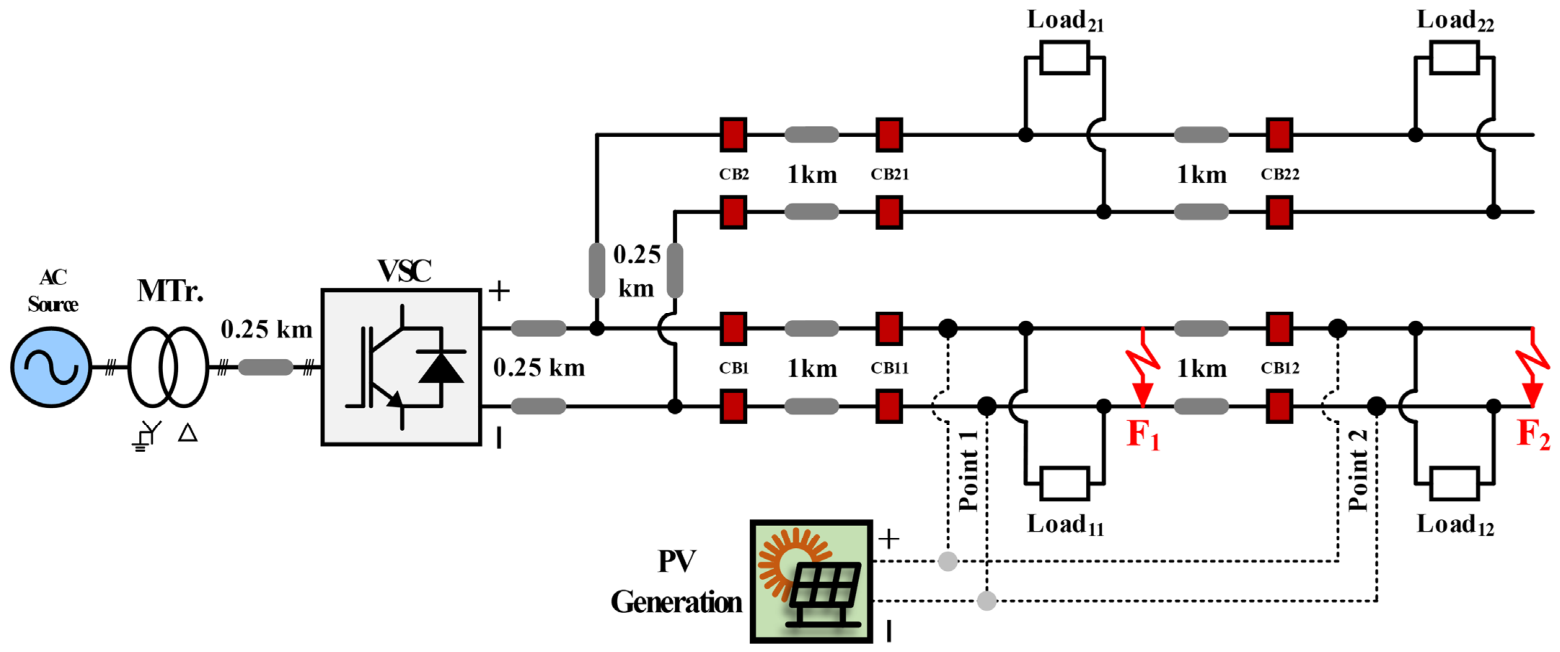
The simulated DC distribution system integrated with DER is illustrated in Figure 1. The system converted power from a 22.9 kV AC main source to 1.5 kV DC through a transformer and a voltage-sourced converter (VSC). The DC distribution system consisted of two main feeders. For the line model, overhead lines using ACSR 160 mm2 conductors were applied [20]. This specific conductor was selected to reflect a practical scenario where existing AC distribution infrastructure is repurposed for DC distribution. While DC systems can be implemented via underground cables, this study focuses on overhead line configurations to evaluate the impact of DERs on conventional grid assets. Consequently, the parasitic capacitance of the lines was assumed to be negligible, as the capacitance of overhead lines is significantly lower than that of cables and has a minimal effect on the fault transients and protection coordination analyzed in this study.
To ensure a realistic representation of fault transients, LC filtering stages were incorporated into the converter outputs. The main VSC includes an output filter with L = 100 μH and a relatively large capacitance of C = 50 mF to maintain voltage stability and analyze the impact of high-energy discharge during faults. Similarly, the PV system is modeled with a multi-stage filter (LPF and buck-boost stage) to reflect practical power conversion characteristics. The loads, each with a capacity of 0.5 MW, are connected directly to the feeders without separate input filters to focus on the interaction between the source-side transients and the line protection.
The PV system is controlled to maintain a stable DC output through a Buck-Boost converter integrated with a Maximum Power Point Tracking (MPPT) algorithm. This control strategy ensures that the PV unit operates at its optimal power point under varying conditions while providing a consistent interface to the 1.5 kV DC grid. The dynamic response of this converter-based source is reflected in the simulation to analyze its impact on the coordination of the overcurrent relays.
The first feeder branched off at a point 0.25 km away from the VSC and extended to a total length of 2 km. The second feeder was configured 0.25 km further from the first branching point. Along each feeder, two 0.5 MW loads were connected at 1 km intervals from the respective branching points. To ensure protection, circuit breakers were installed immediately after each branching point and in front of each load, resulting in a total of three circuit breakers per line. To analyze the protection characteristics, fault locations were simulated at 0 km, 1 km, and 2 km from the branching point of each feeder. Additionally, a PV system with a capacity of 0.5 MW was employed as the DER and connected at the 1 km and 2 km points of the first feeder to examine the impact of the point of common coupling (PCC). The detailed parameters of the simulated DC distribution system are summarized in Table 1.
The protection scheme for the DC distribution system was designed to execute protective operations based on the fault location: at the line inlet (downstream of CB1 or CB2), the midpoint (downstream of CB11 or CB21), or the terminal (downstream of CB12 or CB22). When a fault occurred at the line inlet, CB1 or CB2 operates as the primary protection. In this scenario, CB11, CB12, CB21, and CB22 remain inactive because CB11, CB12, CB21, and CB22 were located downstream of the fault point. For a fault occurring at the midpoint of the line, CB11 or CB21 operated as the primary protection. If the primary protection failed to clear the fault, CB1 or CB2 was configured to operate as backup protection. CB12 and CB22 did not operate since CB12 and CB22 were located downstream of the fault point. In case of a fault at the line terminal, CB12 or CB22 operated as the primary protection. If CB12 or CB22 failed to clear the fault, CB11 or CB12 provided the first stage of backup protection. If CB11 or CB12 also failed to protect the system, CB1 or CB2 operated to provide the final stage of backup protection.

2.2. Overcurrent Relay (OCR)

The OCR was selected as the primary protection method in this study due to its intrinsic reliability and intuitive fault detection capabilities in DC systems. While advanced protection methods such as differential or distance relays exist, OCRs remain the most widely adopted and cost-effective solution for distribution networks and microgrids. Therefore, identifying the coordination limits of OCRs under high DER penetration is essential for establishing a benchmark for future adaptive protection strategies.
In the OCR modeling for operating the circuit breakers of the simulated DC distribution system, a moving average was applied to the current flowing through the circuit breakers. The moving average is a method that calculates the average of data within a specific segment, which is referred to as a window, and repeats this process sequentially over time. The application of a moving average reduces rapid fluctuations in data, which prevents the malfunction of protective devices caused by transient or abrupt changes in current values. The equation for calculating the moving average was expressed as shown in (1).
M A k = 1 W i = 1 W 1 X t i
M A k is the moving average value at time t , N is the window size, and x t i is the past data point from i periods prior to time t . In this study, the moving average was applied to the current at the circuit breaker locations using a 1 ms window, and the processed moving average value was utilized as the operational condition for the OCRs. The 1 ms moving average window was selected because DC protection requires very fast fault interruption, typically within a few milliseconds [21,22]. However, since the moving average is calculated based on past data, a mathematical time delay occurs. Specifically, for an averaging window of size W, a group delay equivalent to (W+1)/2 data points are introduced to the filtered signal compared to the original raw data.
The OCRs for operating the circuit breaker were modeled as hybrid relays that simultaneously utilized the rate of change (ROC) of the current and the current magnitude. Regarding the OCR operation using the ROC, a definite-time operation was implemented to ensure rapid fault interruption because DC fault currents are characterized by an instantaneous surge immediately following a fault due to capacitor discharge. However, since the ROC converges to zero after the initial surge, the ROC is difficult to utilize as a backup protection element. These two elements are integrated using an ‘OR’ logic gate; thus, a trip signal is initiated if either the ROC or the current magnitude reaches its respective threshold. This dual-element approach ensures both high-speed primary protection and robust coordination across each section of the DC distribution system.
For protection based on current magnitude, the IEEE inverse-time characteristic [21], which is one of the OCR characteristic equations used in AC systems, was employed. The characteristic equation of the OCR was expressed as shown in (2).
T = T D × 0.0515 I I c 0.02 1 + 0.114           I > I C T D × 4.85 1 I I c 2                             I < I C
I N T C B = 1 T / f s
T is the operating time, and TD denotes the time dial setting as defined in IEEE Std C37.112 [23]. The variable I represents the fault current, while I c is the pickup (critical) current threshold for relay activation. Furthermore, the discrete-time implementation of the algorithm incorporates the sampling frequency, f s , which was set to 1 MHz in this study to ensure high-resolution capture of DC fault transients.
The T calculated in (2) was applied to (3) to generate the trip signal I N T C B . When I N T C B exceeded 1, the circuit breaker was triggered to operate. To prevent the malfunction of the circuit breakers, the critical value of ROC and the current for the two protection elements were set to values that would not trigger an operation even when a load of the same magnitude was added to each section.
The time dial (TD) is a parameter that adjusts the operating time of the relay. Although IEEE Std C37.112 generally suggests a TD range of 1 to 15 for conventional AC systems [23], a significantly smaller value of 0.002 was selected in this study. This adjustment was necessary to ensure a sufficiently fast protection response to the rapid fault current transients characteristic of DC distribution systems, where the fault current rises much faster than in typical AC grids. In particular, the ‘moderately inverse’ curve was adopted to provide an optimal balance between fast tripping and a stable coordination time margin; unlike steeper curves (e.g., extremely inverse), this characteristic ensures reliable selectivity between upstream and downstream relays even under high-speed DC fault conditions. The detailed parameters of the OCRs were summarized in Table 2.
The parameters of OCR in Table 2 were determined by analyzing the transient response during both load switching and fault conditions. For instance, the maximum ROC observed during 0.5 MW load switching at F1 and F2 was 11–13 kA/us, whereas fault conditions triggered significantly higher ROC values of 30–45 kA/us. To ensure selectivity, the dic for CB11 was set to 19 kA/us and for CB12, it was set to 10 kA/us. Although the load-induced ROC for CB12 may briefly exceed its threshold, the 4 ms operation time delay prevents unintended tripping, as load transients do not sustain high ROC levels for that duration. Similarly, the pickup currents (IC) were assigned based on the peak currents during load integration (e.g., 0.78 kA for CB11), ensuring that the relay remains inactive under all normal operational transients.
The operational performance of protective devices was classified into four categories: correct operation, correct non-operation, mis-operation, and failure to operate. Correct operation refers to the case where the protective device operates when it is required to do so, while correct non-operation occurs when the device remains inactive when it should not operate. Mis-operation is defined as the device operating when it should remain inactive, and failure to operate refers to the case where the device fails to operate despite a requirement for action. In this study, a DC distribution system was constructed to examine the occurrences of mis-operation and failure to operate of the circuit breakers.

3. Results

The operational performance of protective devices was classified into four categories: correct operation, correct non-operation, mis-operation, and failure to operate. Correct operation occurs when the protective device operates when it is required to do so, while correct non-operation occurs when the device remains inactive when it should not operate. Mis-operation is defined as the device operating when it should remain inactive, and failure to operate refers to the case where the device fails to operate despite being required to act. In this study, a DC distribution system was constructed to examine the occurrences of mis-operation and failure to operate of the circuit breakers.
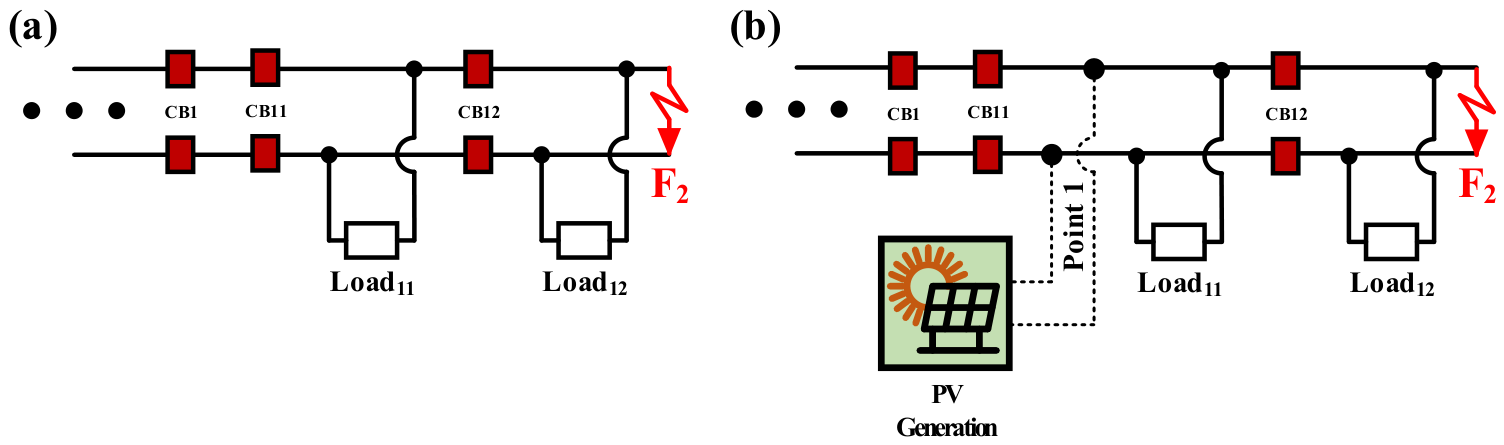
Based on the simulation results of the DC distribution system integrated with DER, cases of circuit breaker mis-operation and failure to operate were observed in two scenarios depending on the fault location and the DER connection point. A mis-operation of the circuit breaker occurred when the DER was connected to the terminal of the line (Point 2) and a fault occurred upstream of CB12 (F1) as illustrated in Figure 1. In contrast, a failure to operate occurred when the DER was connected to the midpoint of the line (Point 1) and a fault occurred at the terminal of the line (F2) (see Figure 1).

3.1. Mis-Operation Case (Fault: F1, DER: Point 2)

To analyze the mis-operation case, the following scenarios were compared:
  • Case 1: DER was not integrated, and CB11 was kept inactive to verify the CTI.
  • Case 2: DER was integrated, and CB11 was kept inactive to verify the CTI.
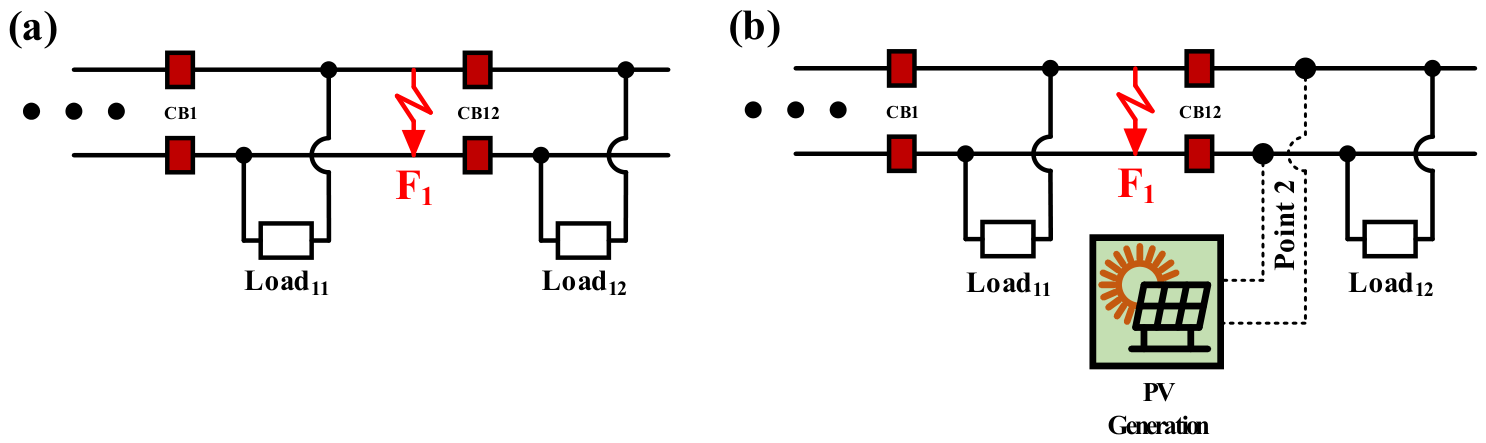
Figure 2a illustrates the schematic diagram of Case 1, in which DER was not integrated and CB11 was kept inactive to verify the CTI. And Figure 2b illustrates the schematic diagram of Case 2, in which DER was integrated and CB11 was kept inactive to verify the CTI.
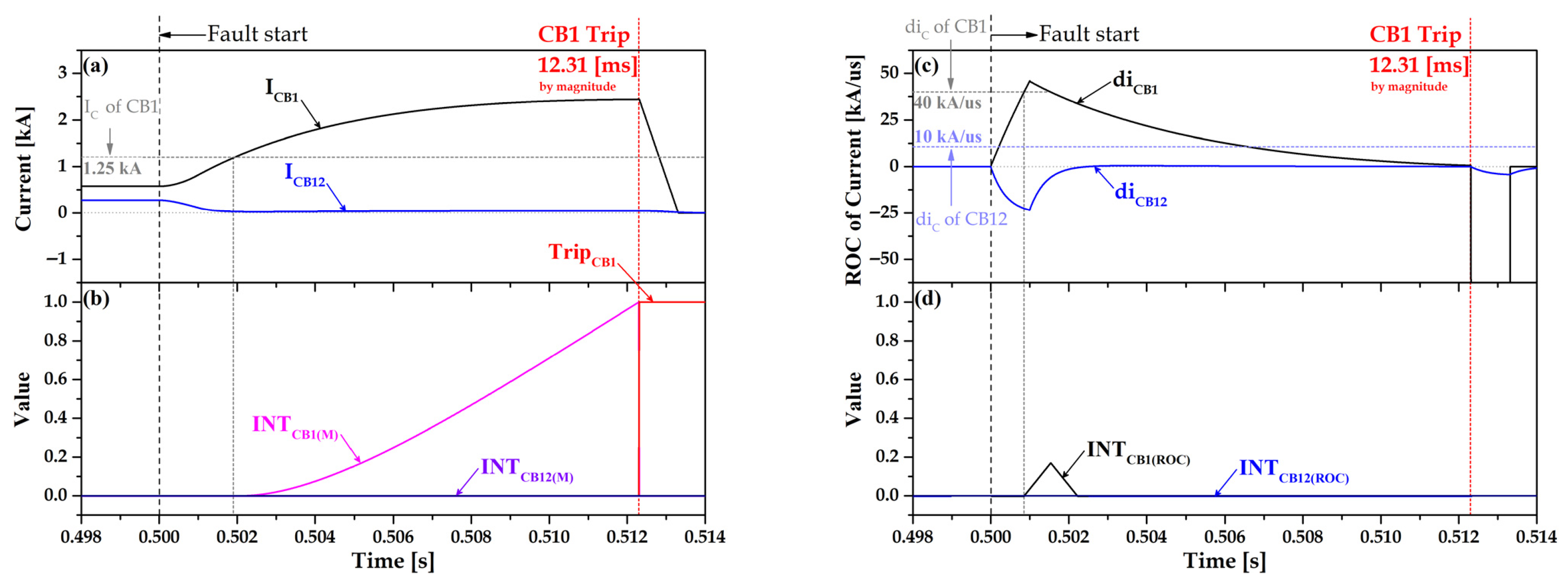
Figure 3 shows the current magnitude, the ROC of current, and the trip signals for Case 1. Immediately after the fault, the majority of the current flowed toward the fault point, causing the current of CB12 (ICB12) to drop to zero instantaneously. After the fault occurrence, the current of CB1 (ICB1) exceeded the critical current of 1.25 kA, which triggered an operational signal. Consequently, CB1 operated 12.31 ms after the fault initiated. Because CB12 was located downstream of the fault point, the current and the ROC of current at CB12 did not exceed the critical current or the critical ROC of current, and therefore, no operational signal was generated for CB12.
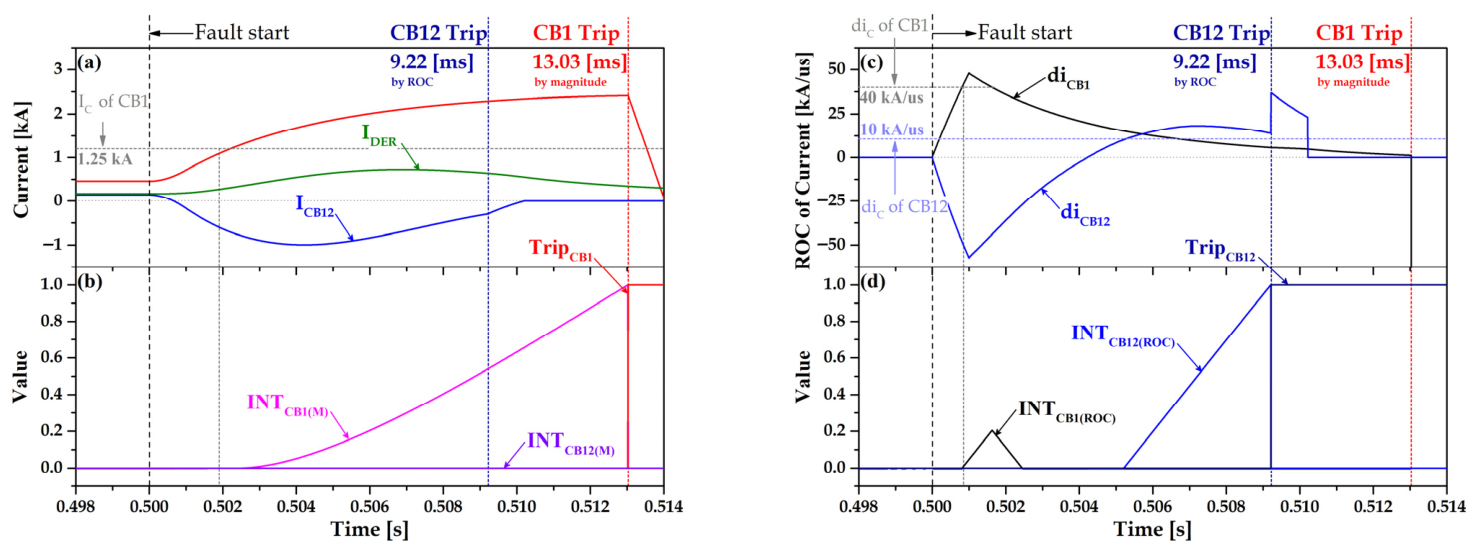
Figure 4 shows the current magnitude, the ROC of the current, and the trip signals for Case 2. Immediately after the fault, the output current of the DER (IDER) flowed instantaneously toward the fault point, causing the current of CB12 (ICB12) to flow in the reverse direction. This resulted in a negative current value and the occurrence of reverse power flow at CB12. As IDER subsequently decreased, the magnitude of the negative current ICB12 also decreased. From the perspective of the measurement direction, this manifested as an increase in current with a positive slope. Consequently, the ROC of current of CB12 (diCB12) exceeded the critical ROC of 10 kA/μs, which triggered an operational signal. Although the current of CB1 (ICB1) exceeded the critical current of 1.25 kA and initiated a trip signal first, the trip signal of CB12 (TripCB12) reached the threshold value of 1 before the trip signal of CB1 (TripCB1) could reach 1. As a result, CB12 operated 9.22 ms after the fault occurrence. In this case, CB1 should have operated as backup protection in the absence of CB11 operation; however, due to the integration of the DER, a mis-operation occurred where CB12 operated prior to CB1.
To quantitatively evaluate the protection coordination under F1 fault conditions, the operation times and CTI for Cases 1 and 2 are summarized in Table 3. To evaluate the selectivity of the protection system, the CTI was calculated as the time difference between the backup relay and the primary relay. For instance, the CTI at CB1 is determined by the difference between the operation times of CB1 (backup) and CB11 (primary), as shown in (4). Similarly, the CTI at CB11 is defined as the difference between the operation times of CB11 (backup) and CB12 (primary), as shown in (5):
C T I C B 1 = T C B 1 T C B 11
C T I C B 11 = T C B 11 T C B 12

3.2. Failure-to-Operate Case (Fault: F2, DER: Point 1)

To analyze the failure-to-operate case, the following scenarios were compared:
  • Case 3: DER was not integrated.
  • Case 4: DER was integrated.
Figure 5a illustrates the schematic diagram of Case 3, in which DER was not integrated. And Figure 5b illustrates the schematic diagram of Case 4, in which DER was integrated.
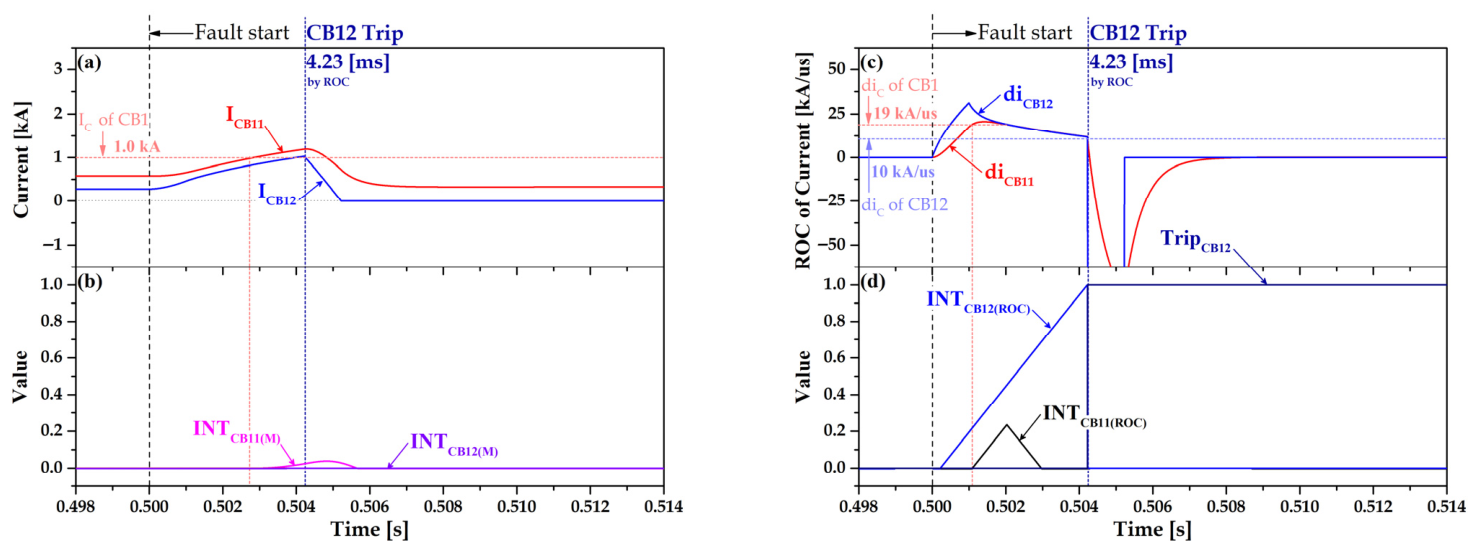
Figure 6 illustrates the current magnitude, the ROC of the current, and the circuit breaker trip signals for Case 3. Immediately after the fault, the majority of the current flowed toward the fault point, causing the ROC of current of CB12 (diCB12) to exceed the critical ROC of 10 kA/μs immediately. As the ROC of current of CB12 (diCB12) exceeded the critical ROC and maintained the operational condition for more than 4 ms, CB12 operated at 4.23 ms. Since the fault occurred at the terminal of the line, CB12 responded and operated first. In Case 3, CB11 and CB1 did not operate because the system was configured such that CB11 and CB1 would operate sequentially only if CB12 failed to operate.
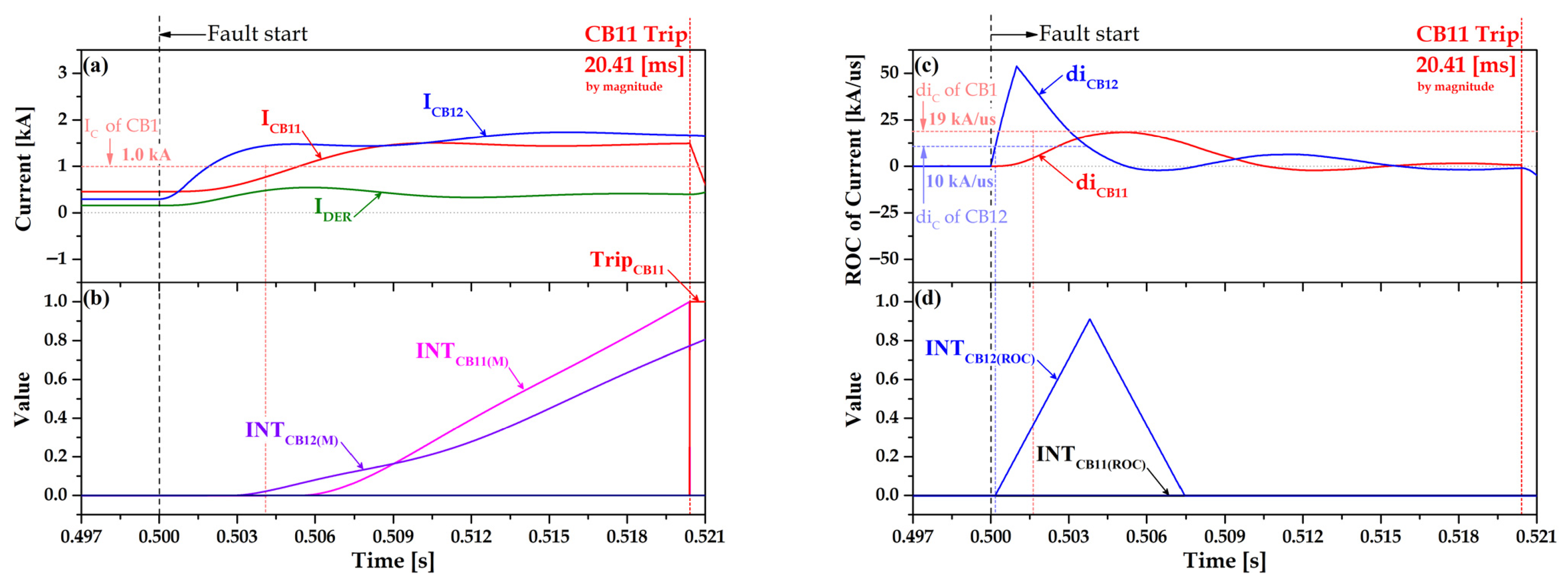
Figure 7 presented the current magnitude, the ROC of the current, and the circuit breaker trip signals for Case 4. Due to the integration of DER, the DER output current (IDER) contributed to the fault current, causing the current of CB12 (ICB12) to increase at a higher rate. Consequently, the ROC of current of CB12 (diCB12) immediately exceeded the critical ROC of 10 kA/μs, and the trip signal for CB12 was generated. However, although the current magnitude reached a higher value due to the DER integration, diCB12 briefly decreased as the DER output current (IDER) declined. As a result, the ROC of current of CB12 (diCB12) fell below the critical ROC, and the trip signal for CB12 failed to exceed 1, resulting in no operation. Subsequently, the current of CB11 (ICB11) exceeded the critical current of 1 kA, and CB11 operated 20.41 ms after the fault occurrence. Due to the DER integration at Point 1, CB12, which should have operated as the primary protection, failed to operate, and CB11 operated as backup protection instead. Consequently, a failure to operate occurred for CB12.
The coordination analysis was further extended to F2 fault conditions in Cases 3 and 4, with the DER integrated behind CB11. As shown in Table 4, the fault current contribution from the DER leads to a failure to operate (or significantly delayed operation) in CB12 in Case 4, with its operation time increasing from 4.23 ms to 24.57 ms. This delay causes the CTI at CB11 to drop to −4.16 ms. These results numerically demonstrate that the physical location of the DER and the fault point significantly influence the relay operation times, potentially leading to negative CTI values and protection failures.

4. Conclusions

In this paper, we investigated the coordination failure caused by mis-operation and failure to operate of OCRs in DC distribution systems with DER. Cases 1 and 2 demonstrated scenarios where the reverse power flow from DERs induced mis-operation of protective relays. Immediately following a fault, a momentary surge in DER output causes reverse power flow through the circuit breakers located on the DER side (upstream of the fault point), resulting in negative current values. As the DER output subsequently declines, the magnitude of this reverse power flow decreases, causing the ROC of current to shift from a negative to a positive slope. Consequently, the ROC relay element misinterprets this positive ROC as a fault signal, leading to mis-operation of circuit breakers in non-faulted sections.
Cases 3 and 4 illustrated instances where the dynamic characteristics of DER caused a failure to operate in the circuit breakers of the faulted section. Due to the DER’s contribution to the fault current immediately after the fault, the current through the breaker closest to the fault point rises more rapidly and to a higher magnitude than in a system without DER integration. This initially triggers the ROC relay element’s operational signal. However, following the DER’s transient peak output, a sharp decline in output occurs—often due to factors such as DC-link voltage sag. At this moment, the ROC of the current through the primary breaker momentarily falls below the reference threshold, causing the trip signal to vanish before exceeding the required duration. Thus, the primary breaker results in a failure-to-operate state, and fault clearance becomes dependent on backup protection breakers triggered by current-level relay elements.
Therefore, it is essential to develop intelligent protection coordination strategies and systems capable of preventing both mis-operation and failure to operate in protective devices in DER-integrated environments. The findings of this study confirm that even with a dual-element protection strategy (ROC and overcurrent), the dynamic behavior and PCCs of DERs can still lead to significant protection conflicts in DC distribution systems.
To overcome these limitations, especially in small-scale systems like islanded microgrids, advanced protection frameworks must be adopted. First, a communication-based protection coordination scheme is necessary to maintain a consistent CTI by sharing real-time status between devices, thereby preventing the disappearance of trip signals during DER transients. Second, an adaptive protection strategy that can dynamically adjust the pickup thresholds of backup relays according to the real-time system configuration and DER penetration level is required. This study provides the foundational analysis of protection boundaries and failure mechanisms essential for developing such intelligent and adaptive DC protection algorithms. Specifically, at points where reverse power flow issues are likely—such as VSCs (voltage source converters) or ESSs (energy storage systems)—the application of directional relays is indispensable to clearly distinguish the direction of power flow during fault conditions.

Author Contributions

Writing—original draft, S.-S.C.; Writing—review & editing, S.-H.L.; Supervision, S.-H.L. All authors have read and agreed to the published version of the manuscript.

Funding

This research received no external funding.

Data Availability Statement

The original contributions presented in this study are included in the article. Further inquiries can be directed to the corresponding author.

Conflicts of Interest

The authors declare no conflict of interest.

References

  1. Adegboyega, A.W.; Sepasi, S.; Howlader, H.O.R.; Griswold, B.; Matsuura, M.; Roose, L.R. DC Microgrid Deployments and Challenges: A Comprehensive Review of Academic and Corporate Implementations. Energies 2025, 18, 1064. [Google Scholar] [CrossRef]
  2. Zhang, Z.; Zeng, Y.; Liu, H.; Zhao, C.; Wang, F.; Chen, Y. Smart DC: An AI and Digital Twin-based Energy-Saving Solution for Data Centers. In Proceedings of the IEEE/IFIP Network Operations and Management Symposium, Budapest, Hungary, 25–29 April 2022. [Google Scholar] [CrossRef]
  3. Yadav, G.K.; Kirar, M.K.; Gupta, S.C. Microgrids protection: A review of technologies, challenges, and future trends. Renew. Energy Focus 2025, 55, 100720. [Google Scholar] [CrossRef]
  4. Alasali, F.; Saad, S.M.; Saidi, A.S.; Itradat, A.; Holderbaum, W.; El-Naily, N.; Elkuwafi, F.F. Powering up microgrids: A comprehensive review of innovative and intelligent protection approaches for enhanced reliability. Energy Rep. 2023, 10, 1899–1924. [Google Scholar] [CrossRef]
  5. Khushoo, M.; Sharma, A.; Kaur, G. DC microgrid-A short review on control strategies. Mater. Today Proc. 2022, 71, 362–369. [Google Scholar] [CrossRef]
  6. Zhang, C.; Wang, X.; Lin, P.; Liu, P.X.; Yan, Y.; Yang, J. Finite-Time Feedforward Decoupling and Precise Decentralized Control for DC Microgrids Towards Large-Signal Stability. IEEE Trans. Smart Grid 2020, 11, 391–402. [Google Scholar] [CrossRef]
  7. Modu, B.; Abdullah, M.P.; Sanusi, M.A.; Hamza, M.F. DC-based microgrid: Topologies, control schemes, and implementations. Alex. Eng. J. 2023, 70, 61–92. [Google Scholar] [CrossRef]
  8. Chandra, A.; Singh, G.K.; Pant, V. Protection techniques for DC microgrid-A review. Electr. Power Syst. Res. 2020, 187, 106439. [Google Scholar] [CrossRef]
  9. Yang, J.; Fletcher, J.E.; O’Reilly, J. Short-Circuit and Ground Fault Analyses and Location in VSC-Based DC Network Cables. IEEE Trans. Power Deliv. 2012, 59, 3827–3837. [Google Scholar] [CrossRef]
  10. Muniappan, M. A comprehensive review of DC fault protection methods in HVDC transmission systems. Prot. Control Mod. Power Syst. 2021, 6, 1–20. [Google Scholar] [CrossRef]
  11. Bui, D.M.; Chen, S.-L.; Wu, C.-H.; Lien, K.-Y.; Huang, C.-H.; Jen, K.-K. Review on Protection Coordination Strategies and Development of An Effective Protection Coordination System for DC Microgrid. In Proceedings of the IEEE PES Asia-Pacific Power and Energy Engineering Conference, Hong Kong, China, 7–10 December 2014. [Google Scholar]
  12. Li, C.; Rakhra, P.; Norman, P.; Niewczas, P.; Burt, G.; Clarkson, P. Practical computation of di/dt for high-speed protection of DC microgrids. In Proceedings of the IEEE Second International Conference on DC Microgrids, Nuremburg, Germany, 27–29 June 2017. [Google Scholar]
  13. Farhadi, M.; Mohammed, O.A. Event-Based Protection Scheme for a Multiterminal Hybrid DC Power System. IEEE Trans. Smart Grid 2015, 6, 1658–1669. [Google Scholar] [CrossRef]
  14. Meghwani, A.; Srivastava, S.C.; Chakrabarti, S. A Non-unit Protection Scheme for DC Microgrid Based on Local Measure-ments. IEEE Trans. Power Deliv. 2017, 32, 172–181. [Google Scholar] [CrossRef]
  15. Feng, X.; Qi, L.; Pan, J. A Novel Fault Location Method and Algorithm for DC Distribution Protection. IEEE Trans. Ind. Appl. 2017, 53, 1834–1840. [Google Scholar] [CrossRef]
  16. Srivastava, C.; Tripathy, M. DC microgrid protection issues and schemes: A critical review. Renew. Sustain. Energy Rev. 2021, 151, 111546. [Google Scholar] [CrossRef]
  17. Korea Rail Network Authority. Standard Specification (KRSA-3116-R0); KRNA: Daejeon, Republic of Korea, 2021. [Google Scholar]
  18. Kuriakose, A.; Balamurugan, S.; Lekshmi, R.R. Relay Coordination in Resilient and Sustainable Power Systems: Review on Optimization Techniques and Future Directions. Int. J. Electr. Electron. Eng. Telecommun. 2025, 14, 199–212. [Google Scholar] [CrossRef]
  19. Abullah, B.H.; Alkhayyat, M.T. Optimal coordination for directional overcurrent relays incorporating distribution generators: A comparative study. Diagnostyka 2025, 26, 2025111. [Google Scholar] [CrossRef]
  20. Kwak, C.; Han, B.; Kim, K.; Kim, J.; Rho, D. A Study on Modeling of Transient Grounding Impedance with Grounding System in Distribution System. J. Korea Acad. Ind. Coop. Soc. 2022, 23, 1–9. [Google Scholar] [CrossRef]
  21. Perez-Molina, M.J.; Larruskain, D.M.; Lopez, P.E.; Buigues, G.; Valverde, V. Review of protection systems for multi-terminal high voltage direct current grids. Renew. Sustain. Energy Rev. 2021, 144, 111037. [Google Scholar] [CrossRef]
  22. Qi, L.; Antoniazzi, A.; Raciti, L. DC distribution fault analysis, protection solutions, and example implementations. IEEE Trans. Ind. Appl. 2018, 54, 3179–3186. [Google Scholar] [CrossRef]
  23. IEEE Std C37.112-1996; IEEE Standard Inverse-Time Characteristic Equations for Overcurrent Relays. IEEE Power and Energy Society: New York, NY, USA, 1996; pp. 1–20.
Figure 1. Configuration of simulated DC distribution system with PV generation.
Energies 19 01954 g001
Figure 2. Schematic diagrams of the simulated DC distribution system. (a) Case 1: DER not integrated. (b) Case 2: DER integrated.
Energies 19 01954 g002
Figure 3. Waveforms of current magnitude, ROC of current, and trip signals for Case 1. (a) Current waveforms of CB1 (ICB1) and CB12 (ICB12). (b) Trip signal and integration value of CB1 (TripCB1, INTCB1(M)) and CB12 (TripCB12, INTCB12(M)) based on current magnitude. (c) ROC of current waveforms of CB1 (diCB1) and CB12 (diCB12). (d) Trip signal and integration value of CB1 (TripCB1, INTCB1(ROC)) and CB12 (TripCB12, INTCB12(ROC)) based on ROC of current.
Energies 19 01954 g003
Figure 4. Waveforms of current magnitude, ROC of current, and trip signals for Case 2. (a) Current waveforms of CB1 (ICB1), CB12 (ICB12), and DER (IDER). (b) Trip signal and integration value of CB1 (TripCB1, INTCB1(M)) and CB12 (TripCB12, INTCB12(M)) based on current magnitude. (c) ROC of current waveforms of CB1 (diCB1) and CB12 (diCB12). (d) Trip signal and integration value of CB1 (TripCB1, INTCB1(ROC)) and CB12 (TripCB12, INTCB12(ROC)) based on ROC of current.
Energies 19 01954 g004
Figure 5. Schematic diagrams of the simulated DC distribution system. (a) Case 3: DER not integrated. (b) Case 4: DER integrated.
Energies 19 01954 g005
Figure 6. Waveforms of current magnitude, ROC of current, and trip signals for Case 3. (a) Current waveforms of CB11 (ICB11) and CB12 (ICB12). (b) Trip signal and integration value of CB11 (TripCB11, INTCB11(M)) and CB12 (TripCB12, INTCB12(M)) based on current magnitude. (c) ROC of current waveforms of CB11 (diCB11) and CB12 (diCB12). (d) Trip signal and integration value of CB11 (TripCB11, INTCB11(ROC)) and CB12 (TripCB12, INTCB12(ROC)) based on ROC of current.
Energies 19 01954 g006
Figure 7. Waveforms of current magnitude, ROC of current, and trip signals for Case 4. (a) Current waveforms of CB11 (ICB11), CB12 (ICB12), and DER (IDER). (b) Trip signal and integration value of CB11 (TripCB11, INTCB11(M)) and CB12 (TripCB12, INTCB12(M)) based on current magnitude. (c) ROC of current waveforms of CB11 (diCB11) and CB12 (diCB12). (d) Trip signal and integration value of CB11 (TripCB11, INTCB11(ROC)) and CB12 (TripCB12, INTCB12(ROC)) based on ROC of current.
Energies 19 01954 g007
Table 1. Parameters of simulated DC distribution system.
CategoryParameterValueUnit
System VoltageAC side22.9kV
DC side1.5kV
VSC FilterOutput Inductance100μH
Output Capacitance50mF
Line SpecificationsType (Overhead Line) [20]ACSR 160mm2
Resistance (R)0.182Ω/km
Inductance (L)1.040mH/km
Capacitance (C)Negligible-
PV systemCapacity0.5MW
Low Pass Filter Inductance100μH
Low Pass Filter Capacitance1mF
Converter Inductance100μH
Converter Capacitance3mF
LoadLoad11, Load12, Load21, Load220.5MW
Table 2. Parameters of OCR.
Circuit Breaker No.ROC of Current (di/dt)Magnitude of Current (I)
Operation Time
[ms]
Critical Value
(diC)
[kA/us]
Characteristic CurveTDCritical Value
(IC)
[kA]
CB1440IEEE Moderately Inverse0.0021.25
CB11191.00
CB1210-
CB2401.15
CB21460.90
CB229-
Table 3. Operation time and coordination time interval of circuit breaker (Cases 1 and 2).
Circuit Breaker No.Without DER (Case 1)With DER (Case 2)
Operation Time
[ms]
CTI
[ms]
Operation Time
[ms]
CTI
[ms]
CB112.317.9213.038.66
CB114.39-4.37-
CB12--9.22-
Table 4. Operation time and coordination time interval of circuit breaker (Cases 3 and 4).
Circuit Breaker No.Without DER (Case 3)With DER (Case 4)
Operation Time
[ms]
CTI
[ms]
Operation Time
[ms]
CTI
[ms]
CB127.1810.6739.7219.31
CB1116.5112.2820.41−4.16
CB124.23-24.57-
Disclaimer/Publisher’s Note: The statements, opinions and data contained in all publications are solely those of the individual author(s) and contributor(s) and not of MDPI and/or the editor(s). MDPI and/or the editor(s) disclaim responsibility for any injury to people or property resulting from any ideas, methods, instructions or products referred to in the content.