3.1. Selection of Initiating Events
The objective of this study is not to comprehensively identify all potential hazards that may occur during the operation of hydrogen refueling stations. Instead, the study aims to examine whether the protection devices required by the prescriptive-based approach provide a quantitatively sufficient level of risk reduction. Therefore, rather than conducting a full risk assessment for the entire hydrogen refueling station system, a representative accident scenario for an off-site hydrogen refueling station was conservatively selected. The effectiveness of the protection layers in reducing risk was then evaluated.
Initiating events were established by considering representative accident scenarios in an off-site hydrogen refueling station configured as shown in
Figure 4. Only situations satisfying the following conditions were selected as initiating events [
23,
24,
25,
26]:
A large-scale release of high-pressure hydrogen gas is possible.
The event is directly associated with storage facilities such as hydrogen banks or with the dispenser system.
Hydrogen released to the atmosphere may encounter an ignition source and escalate into fire or explosion accidents.
The occurrence frequency of the initiating event can be estimated based on reliable frequency data.
In particular, considering condition (4), shown above, accident scenarios for which the frequency data provided by the CCPS guidelines could be directly applied were selected as representative accident scenarios. The results are summarized in
Table 5.
Among the identified initiating events, IE-01 was selected as the representative scenario because it was considered the most conservative and practically relevant case with the potential to lead to the worst accident consequences. This selection was based on several considerations. First, there are documented accident cases at hydrogen refueling stations caused by damage to the dispenser hose. If the hose ruptures, a large amount of high-pressure hydrogen gas may be released to the atmosphere. Second, the area surrounding the dispenser has the highest level of human exposure within the hydrogen refueling station. In addition, the dispenser system is relatively standardized in accordance with SAE J2601 [
27], and its safety devices are also standardized. This characteristic makes the dispenser system suitable for evaluating IPLs in LOPA [
27].
Accordingly, the representative initiating event was selected not on the basis of frequency alone, but by considering the potential release severity, relevance to dispenser-area exposure, and suitability for a conservative LOPA scenario. A comparison of the candidate initiating events is provided in
Table 6.
LOPA is a methodology that analyzes individual accident scenarios independently, where each scenario is defined by a combination of an initiating event and a consequence. In a single analysis, the level of risk reduction is evaluated for one initiating event leading to a specific consequence [
28]. Therefore, the analysis results for IE-01 may also serve as a conservative reference for other independent accident scenarios with similar or lower risk levels. For a conservative assessment, the initiating event frequency of IE-01 caused by hose rupture was assumed to be 1.0 × 10
−2 per year in this study. This value was adopted from the hose rupture frequency provided in the CCPS guidelines [
29]. Since hydrogen-refueling-station-specific initiating event frequency data remain limited, the CCPS guideline values were used in this study as conservative reference values for a representative semi-quantitative LOPA evaluation.
3.3. Identification of Independent Protection Layers Based on the KGS Code and Determination of PFD
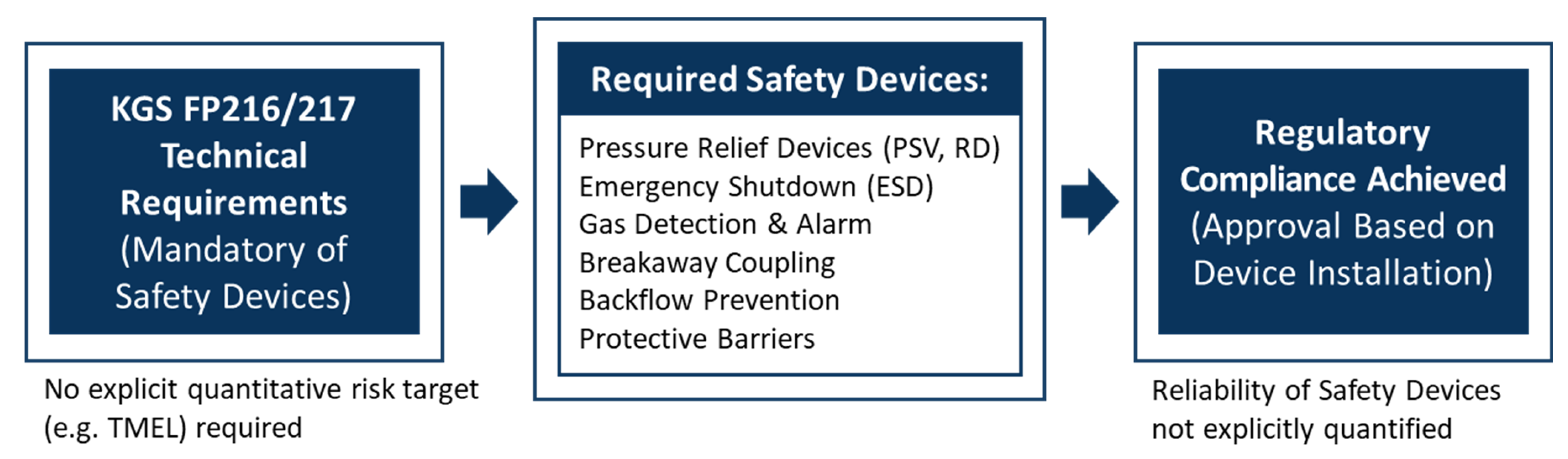
The KGS Code specifies the safety devices that must be considered in the design and construction of hydrogen refueling stations. However, it does not provide specific PFD values for individual safety devices. Therefore, in this study, representative PFD values from the CCPS LOPA guidelines, which are widely used internationally, were applied [
29].
It should be noted that the PFD values presented in the CCPS guidelines are empirical values based on the assumption that the integrity of safety devices is maintained through regular Inspection, Testing, and Preventive Maintenance (ITPM). Based on the previously selected initiating event involving a large hydrogen release caused by dispenser hose rupture and the TMEL, the safety devices required by the KGS Code were classified as IPLs, and the PFD of each IPL was estimated. Through this analysis, it was quantitatively evaluated whether the required RRF can be satisfied solely by applying the basic IPLs specified in the KGS Code.
3.3.1. Accident Scenario and Boundary for IPL Application
The accident scenario for the initiating event, IE-01, is described as follows:
In general, accident scenario analysis should comprehensively consider factors such as the location of hydrogen release from the dispenser or hose, the duration and quantity of the release, and the probability of ignition. However, the objective of this study is to evaluate whether the TMEL can be achieved solely through the application of safety devices specified in the KGS Code. Therefore, the IPL assessment in this study focuses on protection layers that can rapidly isolate and shut off hydrogen leakage under a large-release condition, thereby preventing escalation to severe accidents.
3.3.2. Identification of IPL Candidates Based on the KGS Code
Among the safety devices specified in the hydrogen refueling station codes KGS FP216 and FP217, only those that can directly contribute to risk reduction for the accident scenario and can be applied as IPLs from a LOPA perspective were selected.
- (1)
Breakaway Coupling
A breakaway coupling installed on the fueling hose is a mechanical protection device that automatically shuts off the release of hydrogen to the atmosphere when the hose is separated due to abnormal vehicle movement or external force during refueling. In particular, if a vehicle suddenly departs without disconnecting the nozzle from the hose, significant damage may occur not only to the hose but also to the dispenser unit itself. Such an event may lead to the release of a large amount of hydrogen gas into the atmosphere. Therefore, the breakaway coupling is considered a critical safety device designed to prevent this type of accident.
- (2)
Emergency Shutdown System and Shut-off Valve Closure Logic
The KGS Code specifies the installation locations and automatic shutdown functions of the Emergency Shutdown (ESD) system, allowing operators to quickly stop the flow of gas when an emergency occurs during refueling. When the ESD system is activated, major equipment such as compressors and pumps must immediately stop operation. This mechanism can be considered a protection layer in which the operator manually shuts down the system once an abnormal condition is recognized.
- (3)
Gas Leak Detection and Alarm System
The gas leak detection and alarm system detects leaked gas, activates an alarm, and automatically shuts off the gas flow. Unlike systems that only provide an alarm to notify operators of an abnormal condition, this system is integrated with an automatic shutdown function following detection. Therefore, it can be applied as an instrumentation and control-based IPL in the LOPA framework.
- (4)
Excess Flow Prevention Measures
Hydrogen piping within the dispenser is equipped with control valves for flow regulation and shut-off valves for emergency isolation. These components are essential elements required to implement the refueling protocol defined in SAE J2601. Therefore, the control valve and emergency shut-off valve can be considered as IPLs that function as excess flow prevention measures in response to abnormal increases in flow rate.
The KGS Code also specifies several additional protective measures beyond the IPL candidates identified above. Typical examples include protective walls, vehicle impact protection facilities, and ventilation systems. However, safety devices that are not directly applicable to the selected accident scenario were not considered as IPLs in this study.
3.3.3. Basis and Values for PFD of Each IPL
To verify whether the allowable total PFD criterion of 1.0 × 10
−4 or less is satisfied, representative PFD values were applied to each IPL. Since the KGS Code does not provide specific PFD values for individual safety devices, the representative IPL values suggested in the CCPS LOPA guidelines, which are commonly used in LOPA studies, were adopted [
29]. It should be noted that the PFD values adopted in this study, in accordance with the CCPS, are conditional values based on the assumption that each IPL maintains its required performance through regular inspection, testing, and preventive maintenance.
- (1)
Breakaway Coupling
According to the CCPS guidelines, a mechanical separation device with an automatic shut-off function can be recognized as an IPL, with a representative PFD value of 1.0 × 10⁻¹. It should be noted that the PFD values suggested by CCPS are applicable only when the integrity and operability of the breakaway device are ensured through regular inspection, testing, and preventive maintenance. Breakaway couplings installed in hydrogen refueling hoses are required by regulation to be certified products and are subject to periodic inspection and maintenance. Therefore, in this study, the PFD value recommended in the CCPS guidelines was applied to this protection layer.
- (2)
Emergency Shutdown System and Shut-off Valve Closure Logic
According to the CCPS guidelines, an operator’s appropriate response to abnormal conditions can be recognized as an IPL. Representative PFD values of 1.0 × 10⁻¹ or 1.0 × 10⁻² are suggested. When no specific means are available for operators to detect emergency situations, a PFD of 1.0 × 10⁻¹ is typically applied. In contrast, when abnormal conditions can be recognized through alarms or monitoring systems, a PFD of 1.0 × 10⁻² may be applied. In hydrogen refueling stations, multiple instrumentation and control systems, including alarm systems, are installed, enabling operators to quickly recognize abnormal operating conditions. Therefore, a PFD value of 1.0 × 10⁻² was applied in this study. It should also be noted that this operator response IPL is recognized only when proper operating procedures are documented and operators are adequately trained. In Korea, hydrogen refueling stations are required by regulation to establish safety management procedures, and facility operations must be conducted by authorized personnel who have received appropriate education and training. Therefore, these conditions were considered to be satisfied. Since hydrogen refueling stations are relatively compact facilities and operators are required to be present at the refueling area, prompt recognition of abnormal conditions and emergency response were assumed for this operator response credit in the present study.
- (3)
Gas Leak Detection and Alarm System
A safety interlock, consisting of a sensor, logic solver, and final control element, is a representative control and interlock-based IPL described in the CCPS guidelines. The gas leak detection and alarm system corresponds to this type of protection layer. When the reliability of a safety interlock is verified through periodic inspection and functional testing, the CCPS guidelines recommend a representative PFD value of 1.0 × 10⁻¹. Since the performance of gas leak detection and alarm systems is verified as a key inspection item during the facility completion inspection required by relevant regulations, the conditions for applying this IPL are considered to be satisfied. Therefore, a PFD value of 1.0 × 10⁻¹ was applied in this study.
- (4)
Excess Flow Prevention Measures
An excess flow prevention device whose integrity is ensured through periodic inspection can be recognized as an IPL according to the CCPS guidelines. In such cases, a representative PFD value of 1.0 × 10⁻¹ can be applied. This PFD value is applicable when the device is installed in piping that carries fluids with low contamination potential and non-corrosive characteristics. Hydrogen supplied to fuel cell vehicles at hydrogen refueling stations is a high-purity, non-corrosive gas, and therefore, the conditions for applying this criterion are considered to be satisfied.
Accordingly, the identified IPLs based on the KGS Code and the applied PFD values are summarized in
Table 8.
3.3.4. Calculation of Total PFD and Residual Accident Frequency
The total PFD is calculated as the product of the PFD values of the individual IPLs. The calculation can be expressed using Equation (3). In this study, the total PFD was calculated as the product of the individual PFD values under the assumption that the identified IPLs operate independently and that no common cause failure affects them simultaneously.
Therefore, since the allowable total PFD criterion was determined to be 1.0 × 10
−4, the risk reduction capability of the IPL combination based on the KGS Code satisfies the total PFD requirement. The Final Event Likelihood, representing the mitigated accident frequency, can be calculated as follows according to Equation (4).
3.3.5. Achievement of the TMEL
The TMEL established in this study was 1.0 × 10⁻⁶ per year. In this study, the Final Event Likelihood refers to the mitigated annual likelihood of the selected accident scenario resulting in fire or explosion following the initiating event. The calculated Final Event Likelihood was 1.0 × 10⁻⁷ per year, which is one order of magnitude lower than the target value. Therefore, the TMEL can be considered quantitatively satisfied. The LOPA results demonstrate that when the safety devices specified in the KGS Code are applied as IPLs, the TMEL can be achieved for the selected accident scenario. This indicates that the prescriptive-based technical standards contribute to ensuring a minimum level of safety.
However, this result is valid only under the assumption that the independence and reliability of each IPL are ensured, and that regular inspection, testing, and proper maintenance activities are performed. In addition, the analysis excludes factors such as simultaneous accident scenarios and common cause failures, which are typically not considered in risk assessments. Therefore, if these conditions are not fully satisfied in actual hydrogen refueling station operations, the assumed PFD values may not be maintained. In particular, instrumentation and control-based protection layers may be vulnerable to common cause failures related to power supply or control systems, and their performance may vary depending on the adequacy of maintenance practices. In other words, safety gaps may still occur even when the KGS Code and relevant regulations are fully complied with. This limitation can be regarded as a structural limitation of prescriptive-based technical standards.



 ,
,