Article

Low-Carbon Economic Optimization Model for Pre-Scheduling and Re-Scheduling of Park Integrated Energy System Considering Embodied Carbon

School of Electrical Engineering, Shanghai University of Electric Power, Shanghai 200090, China
*
Author to whom correspondence should be addressed.
Energies 2026, 19(8), 1850; https://doi.org/10.3390/en19081850
Submission received: 13 March 2026 / Revised: 3 April 2026 / Accepted: 8 April 2026 / Published: 9 April 2026
(This article belongs to the Section B: Energy and Environment)

Abstract

To address the issues that carbon trading fails to cover the full life cycle and that traditional demand response achieves poor emission reduction due to a lack of accurate carbon-intensity feedback in park integrated energy systems (PIESs) during low-carbon transition, this study proposes a two-layer optimal scheduling method synergizing life-cycle stepwise carbon trading and low-carbon demand response (LCDR) to balance low-carbon performance and economic efficiency. Firstly, based on life cycle theory, embodied carbon from new energy equipment manufacturing and transportation is incorporated into accounting, with a stepwise carbon trading mechanism designed. Secondly, corrected dynamic carbon emission factors for power and heating networks are constructed to quantify real-time carbon intensity. A dual-driven LCDR model (electricity price and carbon factor) is established to coordinate shiftable and sheddable electric-thermal loads and is combined with a two-layer scheduling model (pre-scheduling and re-scheduling) targeting the minimal total operation cost. Simulation results of a South China park show that life-cycle stepwise carbon trading reduces emissions by 16.7%, and LCDR further cuts 4.05%. Their synergy achieves significant carbon reduction with a slight cost increase, while supplementary sensitivity analyses further confirm the scalability and robustness of the proposed framework under varying load levels and demand response capabilities.

1. Introduction

With the in-depth advancement of the global “dual carbon” goals (carbon peaking and carbon neutrality), the park integrated energy system (PIES), as a core carrier for multi-energy collaborative optimization and low-carbon transition, hinges on balancing energy utilization efficiency, economic costs, and carbon emission reduction targets for its operational optimization [1]. Currently, the low-carbon transition of PIESs is confronted with two core pain points: on the one hand, carbon trading mechanisms mostly focus on the energy consumption stage, neglecting the accounting of life-cycle embodied carbon in new energy equipment manufacturing, energy transportation and other links, which leads to a large quantification deviation of carbon emissions and imprecise incentives for emission reduction [2]; on the other hand, traditional demand response mechanisms rely heavily on single price signals, lacking precise feedback on the dynamic changes of carbon intensity. Moreover, the single-stage scheduling mode has difficulty coordinating both baseload optimization and deep decarbonization demands, resulting in an imbalance between low-carbon goals and economic operation [3].
The carbon trading mechanism serves as an effective approach to drive the low-carbon transition of PIESs [4]. Previous studies have explored the application of carbon trading in integrated energy systems from various perspectives: Ref. [5] analyzed the impact of robust optimization on carbon trading; Ref. [6] proposed a scheduling method incorporating the collaborative optimization of carbon trading and a Stackelberg game to alleviate high energy consumption and carbon emissions; Ref. [7] established a collaborative scheduling model for multi-regional integrated energy systems based on carbon trading, which improved emission reduction efficiency through cross-regional energy mutual assistance; and Ref. [8] integrated carbon trading with energy storage optimization and verified the mitigating effect of energy storage allocation on carbon emission reduction costs. Nevertheless, limitations and deficiencies still exist in the existing research: Ref. [9] introduced the carbon trading model into the scheduling of wind power-integrated power systems, yet failed to consider the full life cycle of energy; Ref. [10] put forward a stepped carbon trading model, but only accounted for carbon emissions in the energy consumption stage; Ref. [11] investigated the synergistic effect of carbon trading and demand response, but did not form a complete system for the dynamic quantification of carbon-intensity and hierarchical scheduling, resulting in the underutilization of emission reduction potential; and Ref. [12] constructed an optimization framework for integrated energy systems involving carbon trading, but it did not involve the precise accounting of carbon footprints under multi-energy coupling scenarios. In summary, the traditional carbon trading mechanism, due to the lack of a life-cycle perspective, leads to incomplete carbon emission accounting [13] and fails to meet the deep decarbonization requirements of PIESs.
Demand response, as a key measure to activate flexible resources on the load side, has extended from the single power system to the integrated energy sector, yet it still has numerous deficiencies. Most existing studies focus on single response modes of price-based or incentive-based types: Ref. [14] guides load shifting through time-of-use electricity prices; Ref. [15] designs a demand response strategy based on incentive compensation; Ref. [16] considers the impact of demand-side uncertainty; Ref. [17] takes into account the effects of integrated demand response and multiple uncertainties on the system; and Ref. [18] considers the energy coordination role of flexible loads. However, none of the above integrate carbon-intensity signals. Ref. [19] attempts to incorporate carbon prices into demand response but fails to establish a quantification method for dynamic carbon emission factors, while Ref. [20] proposes a multi-time-scale demand response framework, yet it cannot solve the imbalance between low-carbon and economic objectives in single-stage scheduling. The traditional demand response mechanism lacks the complete logic of “carbon-intensity quantification—dual-driven response—hierarchical scheduling”, making it impossible to achieve precise matching between the load side and the system’s low-carbon targets.
Aiming at the core problems of incomplete carbon accounting in conventional carbon trading and the insufficient coordination between demand response and low-carbon objectives in PIESs, this paper proposes a two-layer optimal scheduling framework that integrates life-cycle carbon trading with low-carbon demand response. Unlike existing studies that usually optimize carbon trading, demand response, or hierarchical scheduling separately, the proposed method establishes a closed-loop coordination mechanism among life-cycle carbon accounting, dynamic carbon-intensity feedback, and multi-stage operational adjustment. The main contributions of this paper are summarized as follows.
(1)
A life-cycle stepped carbon trading mechanism is developed by incorporating embodied carbon from equipment manufacturing, transportation, and operation into the carbon accounting framework. In this way, the proposed model extends conventional carbon trading from operational-stage emissions to whole-process carbon accounting, thereby providing more accurate carbon constraints and stronger emission-reduction incentives.
(2)
Revised dynamic carbon emission factors for both power and heating networks are constructed to characterize the time-varying carbon intensity of the multi-energy system. Based on these signals, a dual-driven low-carbon demand response model combining electricity/heat price signals with carbon-intensity signals is established, enabling flexible electric and thermal loads to respond not only to economic incentives but also to low-carbon operational requirements.
(3)
A two-layer scheduling architecture consisting of pre-scheduling and re-scheduling is further proposed to couple the above two mechanisms into an integrated optimization framework. The pre-scheduling layer determines the baseline energy dispatch and initial carbon allocation, while the re-scheduling layer dynamically adjusts load and energy flows under carbon-overrun risk. Through this design, the proposed framework realizes the coordinated interaction among carbon pricing, carbon-intensity-aware demand response, and hierarchical scheduling, thus improving the balance between economic performance and deep decarbonization.

2. Operation Framework of PIES

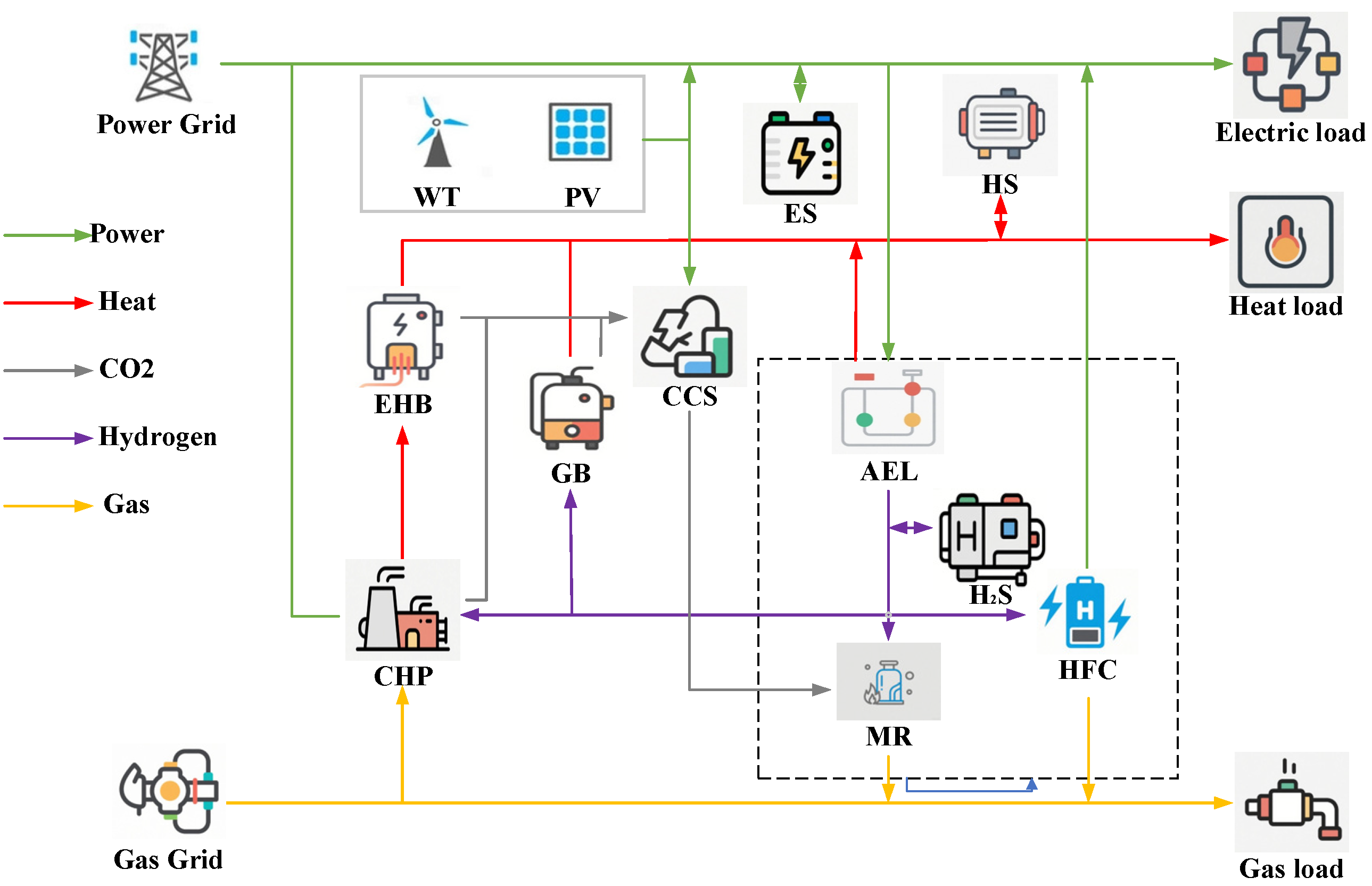
To investigate the proposed life-cycle carbon trading and two-layer low-carbon demand response, this paper establishes a PIES as an electricity-heat-gas-hydrogen coupled multi-energy system. Its energy supply structure is illustrated in Figure 1. The system covers two types of loads, namely electric load and thermal load. Specifically, the electric load is jointly supplied by hydrogen-blended gas turbines (GT), electrical energy storage (ES) equipment, the upper-level power grid, photovoltaic (PV) units, and wind turbine (WT) units. The thermal load is satisfied by hydrogen-blended gas-fired boilers, electric heating boilers (EHB), and thermal energy storage (HS) equipment. Meanwhile, alkaline electrolyzers (AEL), hydrogen fuel cells (HFC), methane reactors (MR), and hydrogen storage equipment together constitute the key links of power-to-gas (P2G), which can produce hydrogen and methane to supply the gas load.

2.1. Multi-Link Modeling of Hydrogen Energy

2.1.1. AEL

Given the electrolysis characteristics of AEL, the hydrogen produced by it features high purity and a relatively low impurity content. Therefore, this paper adopts AEL and constructs an AEL model by incorporating waste heat recovery technology during its electrolysis process:
P AEL , H 2 t = μ ael P AEL , e t P AEL , h t = μ ael , 2 P AEL , e t + ε ael T AEL t P AEL , e min P AEL , e t P AEL , e max Δ P AEL , e min P AEL , e t + 1 P AEL , e t Δ P AEL , e max
where P AEL , H 2 t and P AEL , h t represent the hydrogen production power and heat production power at time t of AEL; P AEL , e t is the electrical power flowing into AEL at time t; T AEL t is the internal temperature of AEL; μ ael , 1 , μ ael , 2 are the hydrogen production efficiency and heat production efficiency of AEL, respectively; ε ael is the operating coefficient of AEL; P AEL , e max and P AEL , e min are the upper and lower limits of AEL’s power consumption, respectively; and Δ P AEL , e max and Δ P AEL , e min are the upper and lower limits of AEL’s ramp-up, respectively.

2.1.2. HFC

HFC has the ability to realize the coupling between hydrogen and thermal energy, as well as between hydrogen and electric energy.
P HFC , e t = μ HFCe , t P HFC , in t H HFC , h t = μ HFCh , t P HFC , in t P HFC , in min P HFC , in t P HFC , in max Δ P HFC , in min P HFC , in t + 1 P HFC , in t Δ P HFC , in max κ HFC min H HFC , h t / P HFC , e t κ HFC max
where P HFC , e t is the power generation of HFC in period t; H HFC , h t is the heat generation in period t; P HFC , in t is the hydrogen consumption power of HFC in period t; μ HFCe , t and μ HFCh , t represent the power generation efficiency and heat generation efficiency of HFC, respectively; P HFC , in max and P HFC , in min are the upper and lower limits of hydrogen consumption power, respectively; Δ P HFC , in max and Δ P HFC , in min denote the upper and lower ramping limits of HFC, respectively; and κ HFC max and κ HFC min stand for the upper and lower limits of the hot spot ratio of HFC, respectively.

2.1.3. MR

MR utilizes hydrogen generated by electrolyzers to catalyze the methanation reaction, converting hydrogen into methane, and serves as a key component in this process.
P MR t = μ MR P MR , h t
where P MR t is the power output of MR; μ MR is the methanation efficiency of MR; P MR , h t is the hydrogen consumption power of MR in period t.

2.1.4. Hydrogen-Blended Gas Turbine

Research indicates that when the hydrogen blending ratio in natural gas ranges between 10% and 20%, the gas turbine’s burner can maintain safe and stable combustion characteristics. The developed mathematical model for hydrogen-blended gas turbines is presented in Equation (4).
P CHP t = Q CH 4 , CHP t + Q H 2 , CHP t η CHP P   H CHP t = Q CH 4 , CHP t + Q H 2 , CHP t η CHP t Y H 2 , CHP t = Q H 2 , CHP t L H 2 Q CH 4 , CHP t L CH 4 + Q H 2 , CHP t L H 2 1
where P CHP t and H CHP t are the power generation and heat generation outputs of the CHP unit at time t, respectively; Q CH 4 , CHP t and Q H 2 , CHP t are the natural gas consumption power and hydrogen consumption power of the CHP unit at time t, respectively; η CHP P and η CHP t denote the power generation efficiency and heat generation efficiency of the CHP unit, respectively; L CH 4 and L H 2 represent the lower heating value of natural gas and hydrogen, respectively; and Y H 2 , CHP t is the hydrogen blending ratio at time t.

2.1.5. Hydrogen-Blended Gas-Fired Boiler

The results show that the safe hydrogenation ratio of hydrogen-blended GB should be controlled within the range of 2~20% to ensure the operating performance. The modeling is shown in Equation (5):
H GB t = Q CH 4 , GB t + Q H 2 , GB t η GB Y H 2 , GB t = Q H 2 , GB t   ρ H 2 M H 2 L H 2 Q CH 4 , GB t   ρ CH 4 M CH 4 L CH 4 + Q H 2 , GB t   ρ H 2 M H 2 L H 2
where H GB t is the heating power of GB at time t; η GB is the thermal conversion efficiency of GB; Q CH 4 , GB t and Q H 2 , GB t are the gas and hydrogen consumption powers of GB at time t, respectively; ρ CH 4 and ρ H 2 represent the densities of natural gas and hydrogen, respectively; and M CH 4 and M H 2 represent the relative molecular masses of natural gas and hydrogen, respectively.

3. Ladder Carbon Trading Mechanism Based on Life-Cycle Carbon Footprint

Life-cycle carbon footprint (LCCF) refers to the total carbon emissions of a product or service throughout its entire life cycle, including raw material acquisition, production, transportation, and operation. The traditional carbon trading mechanism only accounts for carbon emissions in the energy consumption stage, while neglecting embodied carbon from links such as the manufacturing of new energy equipment and energy transportation, resulting in excessive deviations in carbon emission accounting. This paper incorporates the LCCF theory into the stepped carbon trading mechanism to construct a novel carbon trading framework featuring “whole-process accounting, stepped pricing, and collaborative carbon reduction”, which fills the theoretical gap of the traditional mechanism.

3.1. Carbon Emission Quota Model

The allocation of free carbon emission allowances in the PIES mainly covers equipment such as conventional generator units, CHP units, and GB. Carbon emissions from conventional generator units are attributed to purchased electricity, which is mainly supplied by conventional generator units in coal-fired power plants.
E PIES = E e , b u y + E CHP + E GB E e ,   buy = χ e i = 1 T P e ,   buy t E CHP = χ g i = 1 T φ P GT t + P h , t HB E GB = χ g i = 1 T H GB t
where E PIES , E e , b u y , E CHP and E GB represent the carbon emission allowances of the PIES, the upper-level power grid, CHP units, and GB, respectively; χ e and χ g denote the allocation coefficients for carbon emissions per unit of electricity and heat, respectively; φ stands for the conversion factor from electricity to heat; P e ,   buy t is the purchased electricity from the upper-level grid in period t; and T is the scheduling period.

3.2. Actual Carbon Emission Model Based on Life-Cycle Mechanism

This paper incorporates the normalized carbon emission coefficients calculated via the life-cycle assessment method into the actual carbon emission model. The constructed integrated energy system framework covers the main carbon emission sources, including coal-fired power plants, CHP units, hydrogen-blended GB, and P2G systems. For WT and PV systems, carbon emissions mainly stem from their manufacturing, transportation, and operation stages; for CHP units and gas boilers, the focus is placed on carbon emissions during equipment manufacturing, transportation, and operation. In addition, the MR in the P2G system can absorb part of the carbon dioxide during operation, thereby reducing the overall carbon emission intensity of the system.
E PIES , a = E e , buy , a + E G , a + E WT / PV , a E MR , a E e , buy , a = E e t = 1 T P e ,   buy t E G , a = E g t = 1 T ( η g-gb H GB t + η e-CHP P CHP t + η h-CHP H CHP t ) E MR , a = t = 1 T ω P MR , a t E WT / PV , a = E prod + E trans + E w o r k , w t / p v
where E PIES , a , E G , a , E MR , a , and E WT / PV , a represent the actual carbon emissions from external power purchase, CHP units, MR, and WT/PV systems in period t, respectively; ω is the CO2 absorption parameter of MR during the conversion process from hydrogen to natural gas; and E prod , E trans , and E w o r k , w t / p v denote the carbon emissions of WT/PV systems in the manufacturing, transportation, and operation stages, respectively.
Thus, the trading volume in the carbon trading market is:
Δ E PIES = E PIES , a E PIES

3.3. Stepped Carbon Trading Model

The stepped carbon trading mechanism is designed based on the principle of “punitive pricing to incentivize emission reduction”. Its core lies in dividing carbon emission intervals and setting incremental carbon prices, thereby realizing the nonlinear growth of carbon emission costs. This paper adopts the baseline-based quota allocation method and takes the trading volume derived from the life-cycle carbon emission accounting results in Section 3.2 as the transaction basis. The cost framework is formulated as follows:
C CET = λ ( 1 + ξ ) ( Δ E PIES l ) λ l , 0 Δ E PIES < l λ ( 1 + ξ ) ( Δ E PIES l ) + λ l , l Δ E PIES < 2 l λ ( 1 + 2 ξ ) ( Δ E PIES 2 l ) + ( 2 + ξ ) λ l , 2 l Δ E PIES < 3 l λ ( 1 + 3 ξ ) ( Δ E PIES 3 l ) + ( 3 + 3 ξ ) λ l , 3 l Δ E PIES < 4 l λ ( 1 + 4 ξ ) ( Δ E PIES 4 l ) + ( 4 + 6 ξ ) λ l , 4 l Δ E PIES
where C CET is the carbon trading cost; λ is the unit carbon price; ξ is the price growth rate; and l is the length of the carbon emission interval.

4. Two-Layer Low-Carbon Demand Response Mechanism

4.1. Mechanism Architecture

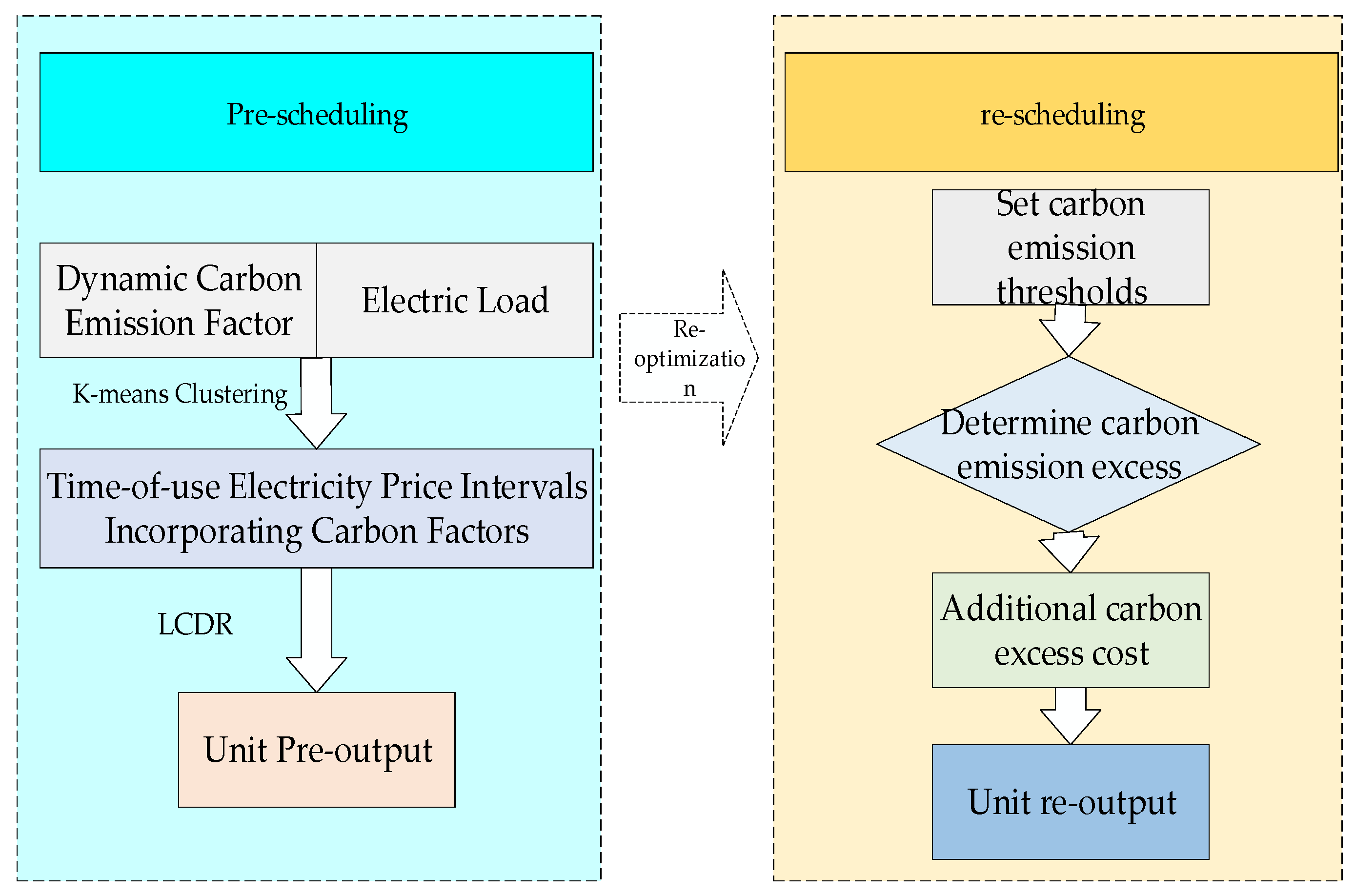
A two-layer architecture of “pre-scheduling and re-scheduling” is adopted to achieve the synergy between basic optimization and deep decarbonization of the integrated energy system. The pre-scheduling layer realizes basic load optimization and the initial allocation of carbon quotas based on the peak, flat and valley periods divided by K-means clustering. The re-scheduling layer addresses the over-carbon emission risk in pre-scheduling and accomplishes deep decarbonization through over-carbon electricity prices and cross-energy substitution. This mechanism not only retains the zero-carbon advantage of electricity-hydrogen coupling but also solves the pain point of the “imbalance between low-carbon and economic objectives” in traditional scheduling via two-layer synergy, providing technical support for the economic and low-carbon operation of electricity-hydrogen coupled PIES. The operation principle of this mechanism is illustrated in Figure 2:

4.2. Modeling of Dynamic Carbon Emission Factors

4.2.1. Revised Dynamic Carbon Emission Factor of Power Grid

ρ e , d y n , t = ρ e , b a s e · 1 α · P WT t P e , t β · θ C C S , t γ · κ H , t + δ · Δ P e , t 1 P e , t 1
where ρ e , b a s e is the baseline carbon emission factor of the power system; P WT t is the output of wind turbines in period t; P e , t is the load of the power system in period t; θ C C S , t is the average carbon capture efficiency of carbon capture and storage (CCS) in period t; κ H , t is the average hydrogen blending ratio of GT in period t; and Δ P e , t 1 is the electric load variation caused by demand response in period t − 1.

4.2.2. Revised Dynamic Carbon Emission Factor of Heat Grid

The thermal load is jointly supplied by power-to-heat (P2H) and gas-to-heat (CHP/GB) pathways, and its carbon emission factor is calculated as the weighted average of the two heat supply modes:
ρ h , d y n , t = ρ e , d y n , t · P e 2 h , t + ρ g , d y n , t · P g 2 h , t P h , t
where P e 2 h , t is the P2H power in period t; P g 2 h , t is the gas-to-heat power in period t; and P h , t is the thermal load in period t.

4.3. Dual-Drive Demand Response Model

Centered on the dual signals of revised dynamic carbon emission factor and electricity price, a multi-energy coordinated response model covering electricity, heat and gas is established.

4.3.1. Electric Load Response Model

It is demonstrated that the price elasticity matrix of demand can effectively reflect the influence of electricity price on customers’ electricity consumption behavior, and the electricity price demand elasticity matrix can be expressed as:
M e = m 11 m 12 m 1 j m 21 m 22 m 2 j m i 1 m i 2 m i j
m i j = ( P e ˜ P e ) / P e ( τ e ˜ τ e ) / τ e
M i j 0 , i = j M i j 0 , i j
where m i j represents the electricity price demand elasticity coefficient (when i = j, its self-elasticity coefficient; when ij, its cross elasticity coefficient); P e is the electricity load before demand response implementation; P e ˜ is the electricity load after demand response implementation; τ e is the electricity price before demand response implementation; and τ e ˜ is the electricity price after demand response implementation.
Given the demand elasticity coefficients, the calculation formula for users’ electricity price response participation behavior after the implementation of low-carbon demand response is as follows:
P e , t ˜ = P e , t + Δ P e , t = P e , t + P e , t 0 · j = 1 24 M e · C t o t a l ( j ) C t o t a l 0 ( j ) C t o t a l 0 ( j ) μ e · ρ e , d y n , t
where P e , t ˜ is the electric load after the implementation of low-carbon demand response; Δ P e , t is the electric load variation in period t; P e , t 0 is the initial electric load in period t; C t o t a l ( j ) is the integrated electricity price in period j; C t o t a l 0 ( j ) is the initial benchmark electricity price; and μ e is the user carbon response coefficient, which characterizes the user’s sensitivity to the dynamic carbon emission factor signal.

4.3.2. Thermal Load Response Model

With reference to the response logic of electric load, a thermal load response model is constructed by integrating thermal price elasticity and the dynamic carbon emission factor of the heating network.
P h , t ˜ = P h , t + Δ P h , t = P h , t + P h , t 0 · j = 1 24 M h · C h , t o t a l ( j ) C h , t o t a l 0 ( j ) C h , t o t a l 0 ( j )
C h , t o t a l ( j ) = C h , base ( j ) + λ h · ρ h , d y n , j
where P h , t ˜ is the thermal load after the implementation of low-carbon demand response; Δ P h , t is the thermal load variation in period t; P h , t 0 is the initial thermal load in period t; M h is the thermal price elasticity matrix; C h , t o t a l ( j ) is the integrated thermal price in period j with the dynamic carbon emission factor taken into account; C h , base ( j ) is the conventional thermal price; λ h is the thermal load carbon-price conversion coefficient; and C h , t o t a l 0 ( j ) is the initial thermal benchmark price.

5. Solution of the Two-Layer Scheduling Model

5.1. Pre-Scheduling Layer

5.1.1. Objective Function of Pre-Scheduling Layer

The pre-scheduling layer aims to minimize the total system operation cost, which includes the costs of unit operation and maintenance, energy purchase, carbon trading, wind curtailment penalty, and demand response:
min C pre = C ope + C price + C CO 2 + C cur + C DR
where C ope is the unit operation and maintenance cost; C price is the energy purchase cost; C CO 2 is the carbon trading cost; C cur is the wind curtailment penalty cost; and C DR is the demand response cost.
(1)
Unit operation and maintenance cost
C ope = t = 1 T ( C WTPV P WTPV t + C AEL P AEL t + C MR P MR t + C H 2 ( P H 2 , i n , t + P H 2 , o u t , t ) + C HFC P HFC t + C CHP P CHP t + C EHB P EHB t + C GB H GB t + C ES/HS/GS ( P e / h / g , i n , t + P e / h / g , out , t ) )
where C denotes the unit operation and maintenance cost of each piece of equipment; P represents the output power of each piece of equipment in period t; P e / h / g , i n , t and P e / h / g , out , t are the charging and discharging powers of the energy storage device, respectively.
(2)
Energy purchase cost
C price = t = 1 T α t P e ,   buy t + t = 1 T β t P g ,   buy t
where P e , b u y t and P g , b u y t are the electricity and natural gas purchased in period t, respectively; and α t and β t are the electricity purchase price and gas purchase price, respectively.
(3)
Carbon trading cost
C co 2 = C CET Δ E PIES
This formula is shown in Section 3.3
(4)
Wind curtailment penalty cost
C cur = t = 1 T k cur ( P WT ,   c u r t + P PV ,   c u r t )
where k cur is the unit penalty cost coefficient for wind and solar curtailment; and P WT ,   c u r t and P PV ,   c u r t represent the wind curtailment and solar curtailment at time t, respectively.
(5)
Demand response cost
C DR = t = 1 24 ( τ e Δ P e , t + τ h Δ P h , t )

5.1.2. Constraints of Pre-Scheduling Layer

(1)
Energy Balance Constraints
P CHP t + P WTPV t + P ES , t , dis + P e , b u y t + P HFC t = P AEL , e t + P ES , t , ch + P EHB t + P L t H CHP t + H GB t + H EHB t + H HS , t , dis + H AEL t = H HS , t , ch + H L t Q H 2 G , out t + P g , b u y t = Q CH 4 , CHP t + Q CH 4 , GB t Q AEL , H 2 t + Q H 2 S , t , dis = Q H 2 S , t , ch + Q H 2 , CHP t + Q H 2 , GB t + Q MR , in t + Q H 2 , HFC t
where each element denotes the output power of each generating unit; P L t and H L t represent the electric demand and thermal demand of the load at time t, respectively; Q H 2 G , out t is the gas production from power-to-gas; P g , b u y t is the gas purchase volume; Q CH 4 , CHP t is the gas consumption of CHP units; Q CH 4 , GB t is the gas consumption of gas boilers; Q AEL , H 2 t is the hydrogen production from AEL; Q H 2 S , t , dis and Q H 2 S , t , ch represent the hydrogen storage amount and hydrogen release amount of the hydrogen storage unit, respectively; Q H 2 , CHP t is the hydrogen consumption of CHP units; Q H 2 , GB t is the hydrogen consumption of GB; Q MR , in t is the hydrogen consumption of MR; and Q H 2 , HFC t is the hydrogen consumption of HFC.
(2)
Demand Response Constraints
Δ P e , t 0.2 P e , t 0 Δ P h , t 0.15 P h , t 0

5.2. Re-Scheduling Layer

The re-scheduling layer integrates the CO2 emission at each time interval based on the unit pre-scheduling output plan and then adjusts and sets the CO2 emission threshold in a stepwise manner.

5.2.1. Objective Function of Re-Scheduling Layer

With E pre t E lim t as a hard constraint, the deep adjustment cost is minimized, and the main formulas are given as follows:
A t = 1 , E pre t E lim t 0 , E pre t < E lim t
min C re = C pre + C uc
C u c = t = 1 24 C u c t Δ P e , t C u c t = C t o t a l , t · ( 1 + μ ^ t ) μ ^ t = ρ d y n , t ρ d y n , m i n ρ d y n , m a x ρ d y n , m i n
where E pre t denotes the CO2 emission of the PIES at time t after pre-scheduling; E pre t represents the preset CO2 emission threshold; A t is the state variable used to determine the occurrence of carbon over-emission; C u c is the carbon over-emission electricity price cost; C u c t is the carbon over-emission electricity price in period t; and μ ^ t is the normalized standard dynamic carbon emission factor.

5.2.2. Constraints of Re-Scheduling Layer

(1)
Load Reduction Constraints
The maximum load reduction in carbon over-emission periods shall not exceed 30%, and the constraints are given as follows:
Δ P e , t 0.3 P e , t ˜
where Δ P e , t is the reduced electric load.

5.3. Model Linearization and Computational Performance

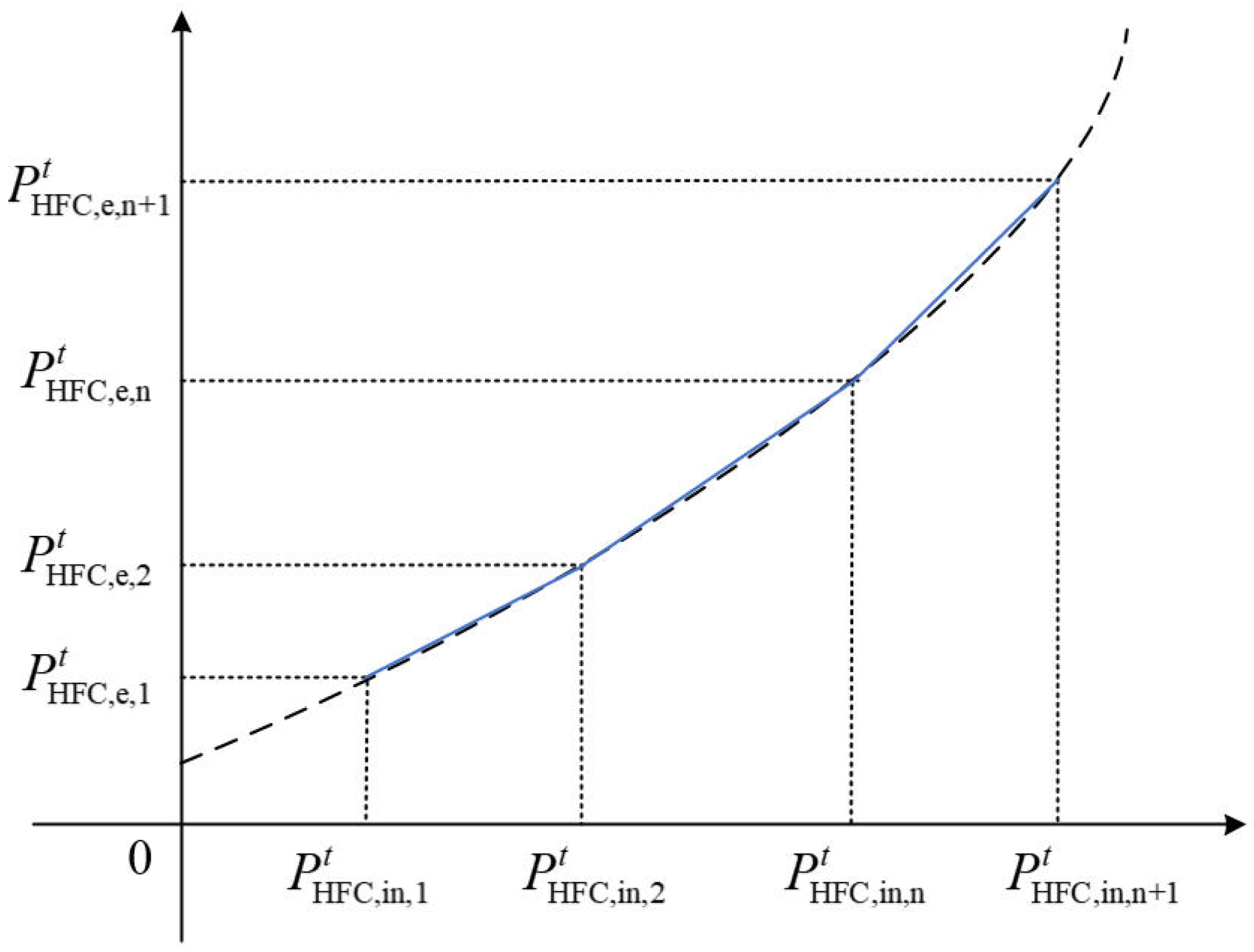
The proposed two-layer scheduling model contains mixed continuous and binary decision variables. In addition, the stepped carbon trading mechanism, demand response formulation, and multi-energy coupling relationships introduce piecewise and logical nonlinearities into the original optimization problem. To improve computational tractability, the nonlinear terms are reformulated through linearization and piecewise approximation, and the overall problem is converted into a mixed-integer linear programming (MILP) model for solution. The linearization and piecewise approximation process is shown in Figure 3. The dotted line indicates non-linearity and the blue line represents the process of linear approximation.
The resulting optimization problem is implemented in MATLAB 2021a and solved using YALMIP with CPLEX. Under the 24 h scheduling horizon with a 1 h time step, the model can be solved efficiently on a standard desktop computing platform. The computation time for one case was approximately 8.53 s on a computer equipped with R9-8940HX and 16 GB RAM. These results indicate that the proposed framework is computationally tractable for day-ahead and rolling scheduling of park integrated energy systems.
It should be noted that the present framework is designed for operational scheduling rather than second-level real-time control. For larger-scale systems or more complex uncertainty settings, future work can further improve computational efficiency by combining the proposed framework with decomposition methods, distributed optimization, or data-driven acceleration strategies.

6. Discussion

6.1. Parameter Settings

To verify the low-carbon and economic performance of the proposed framework, a park integrated energy system in southern China is adopted as the case study, and the model shown in Figure 1 is constructed accordingly. As a critical energy infrastructure, the system achieves the combined supply of electricity and natural gas via interconnection with the external power grid and natural gas supply system. Furthermore, it is assumed that the in-system equipment can meet the load demands of multiple types. The basic functions of each piece of equipment remain stable over a given period, regardless of equipment aging.
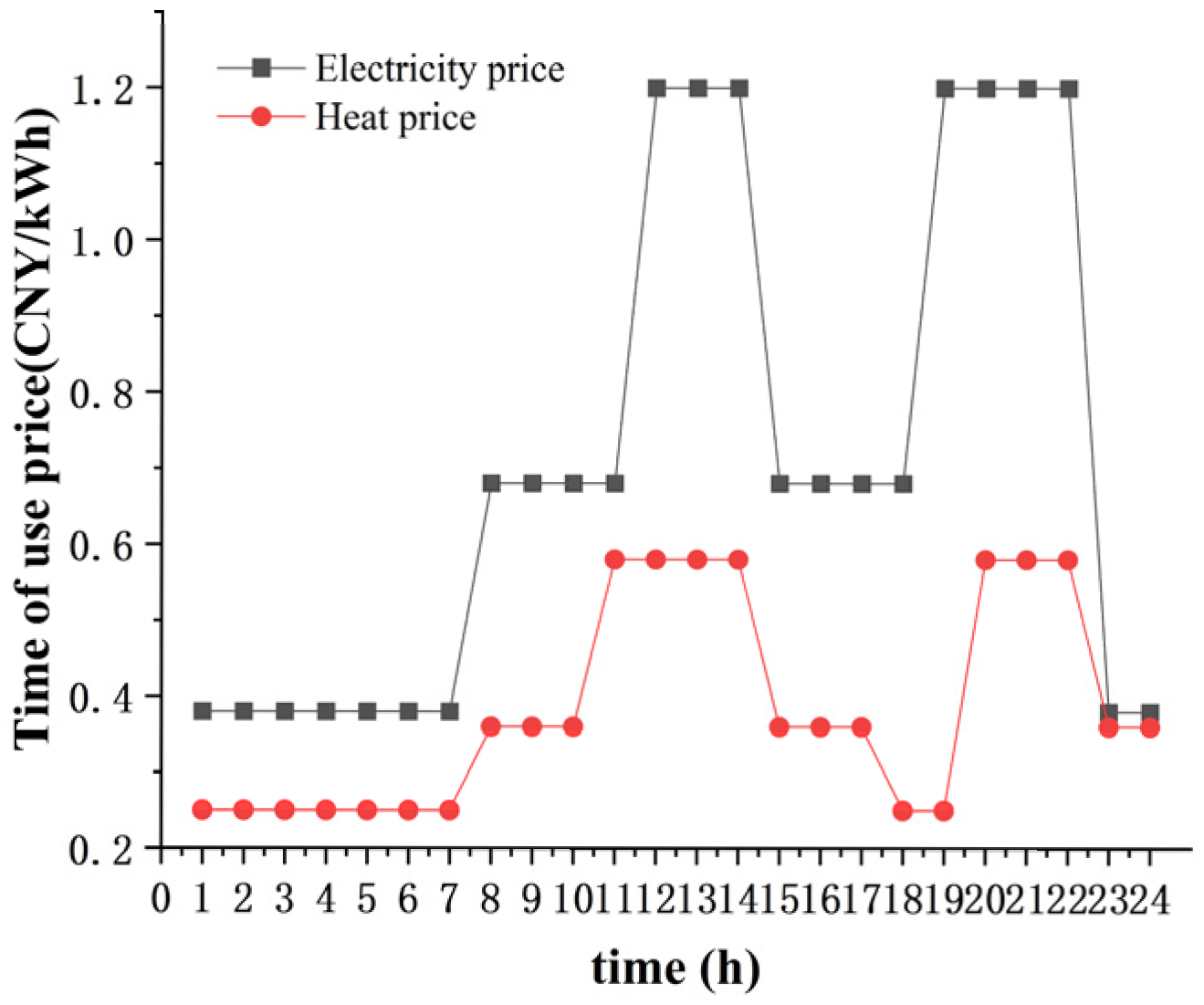
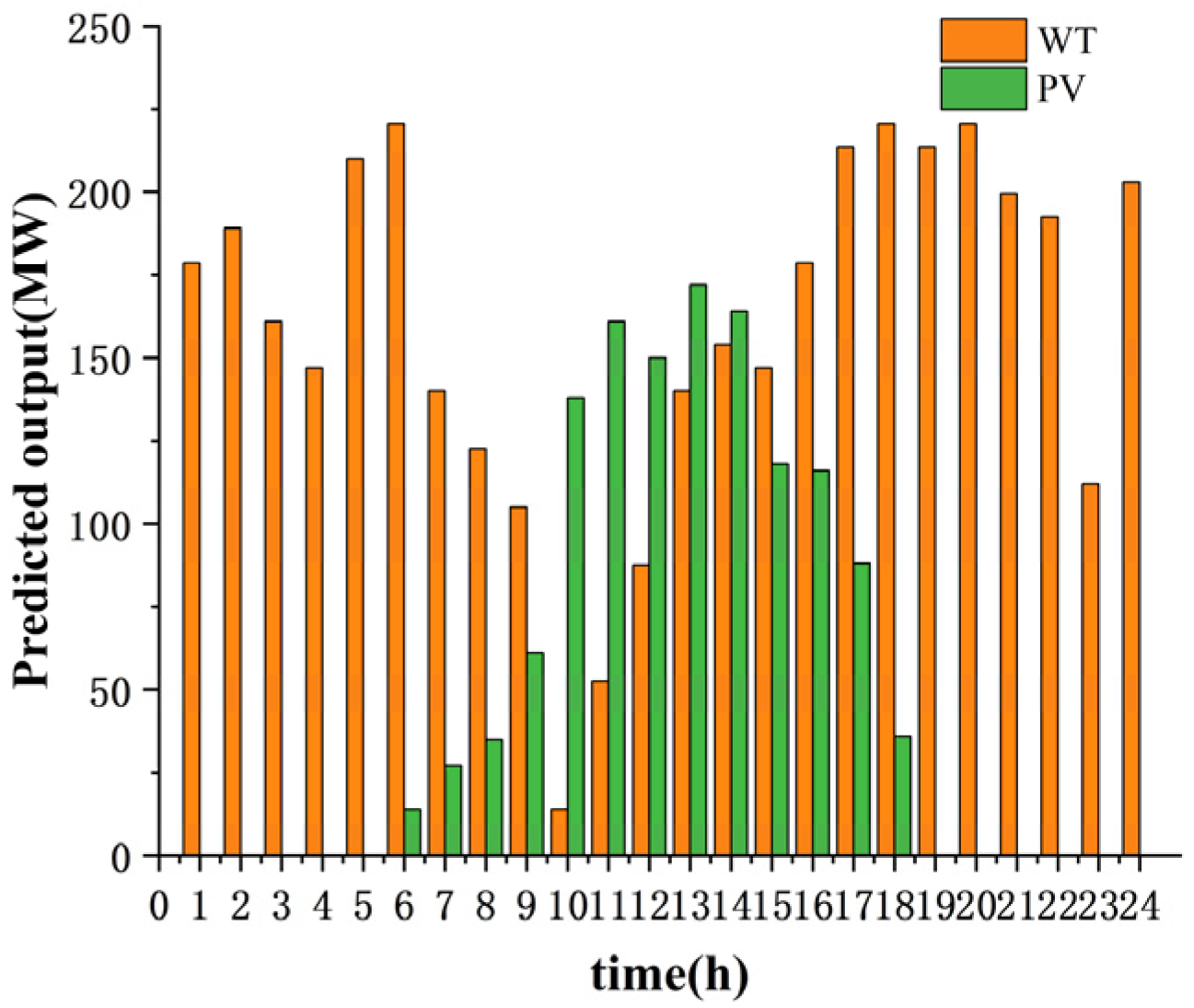
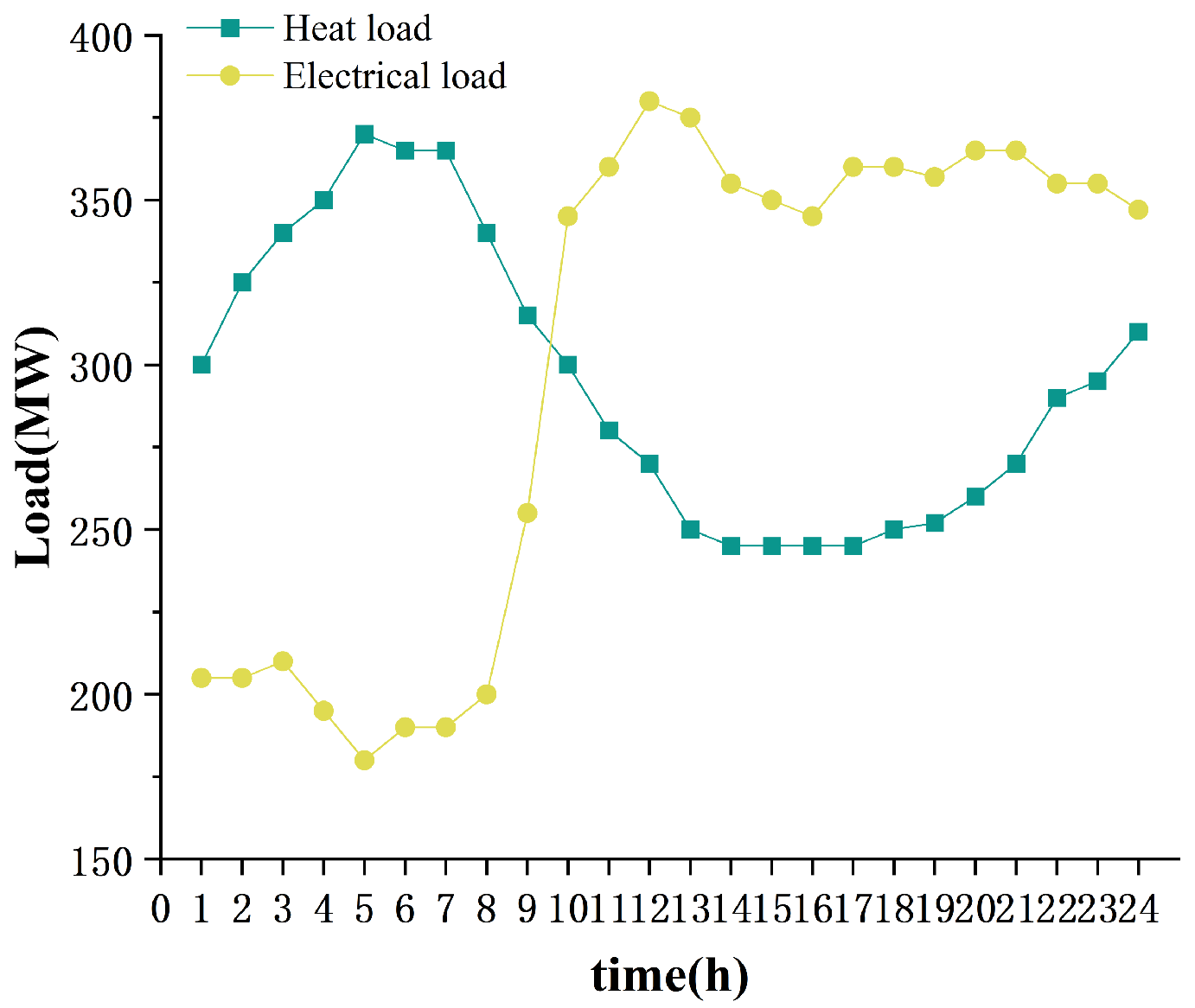
This paper performs the analysis with a 24 h scheduling cycle and a 1 h unit scheduling time step. The equipment parameters are presented in Table A1 and Table A2 in the Appendix A. The time-of-use (TOU) electricity price is formulated in compliance with the Chinese government’s requirements for improving the TOU electricity price mechanism, as detailed in Figure A1. Meanwhile, the wind and solar power output values for a typical day are derived based on the park’s natural conditions combined with the unit generation model, as shown in Figure A2. The load demand forecast of the park’s multi-energy system is depicted in Figure A3.
For carbon emission management, the carbon allowance benchmark and actual carbon emission intensity of coal-fired units are set at 0.798 kg/kWh and 1.08 kg/kWh, respectively; the corresponding values for gas turbines are set at 0.385 kg/kWh and 0.324 kg/kWh. For the carbon trading mechanism, the interval length of the stepped carbon trading scheme is set to 50 t, the base carbon trading price is set at 200 RMB/t, and the carbon price growth rate is defined as 25%.

6.2. Analysis of the Impacts of Two-Layer Low-Carbon Demand Response on PIES

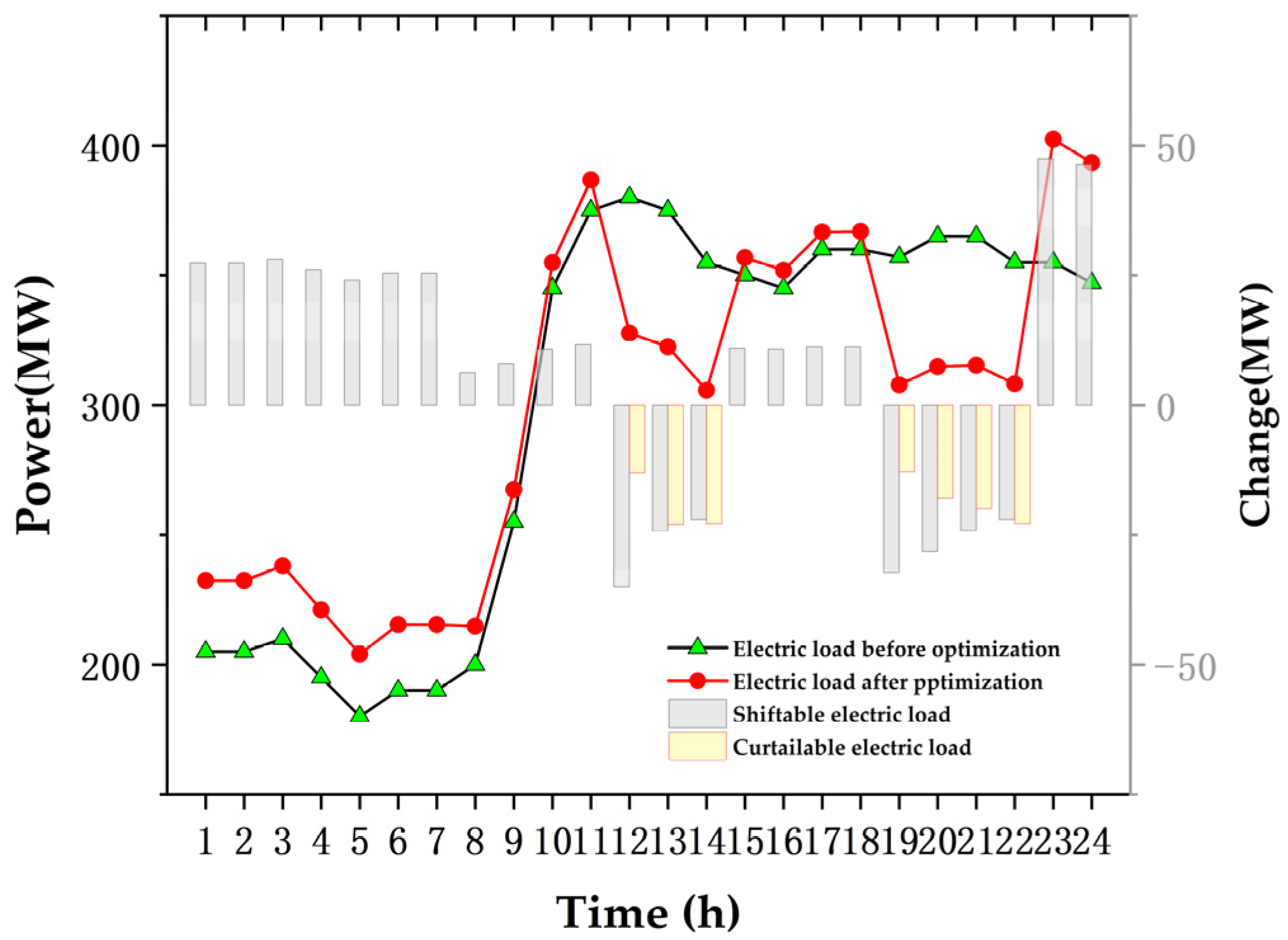
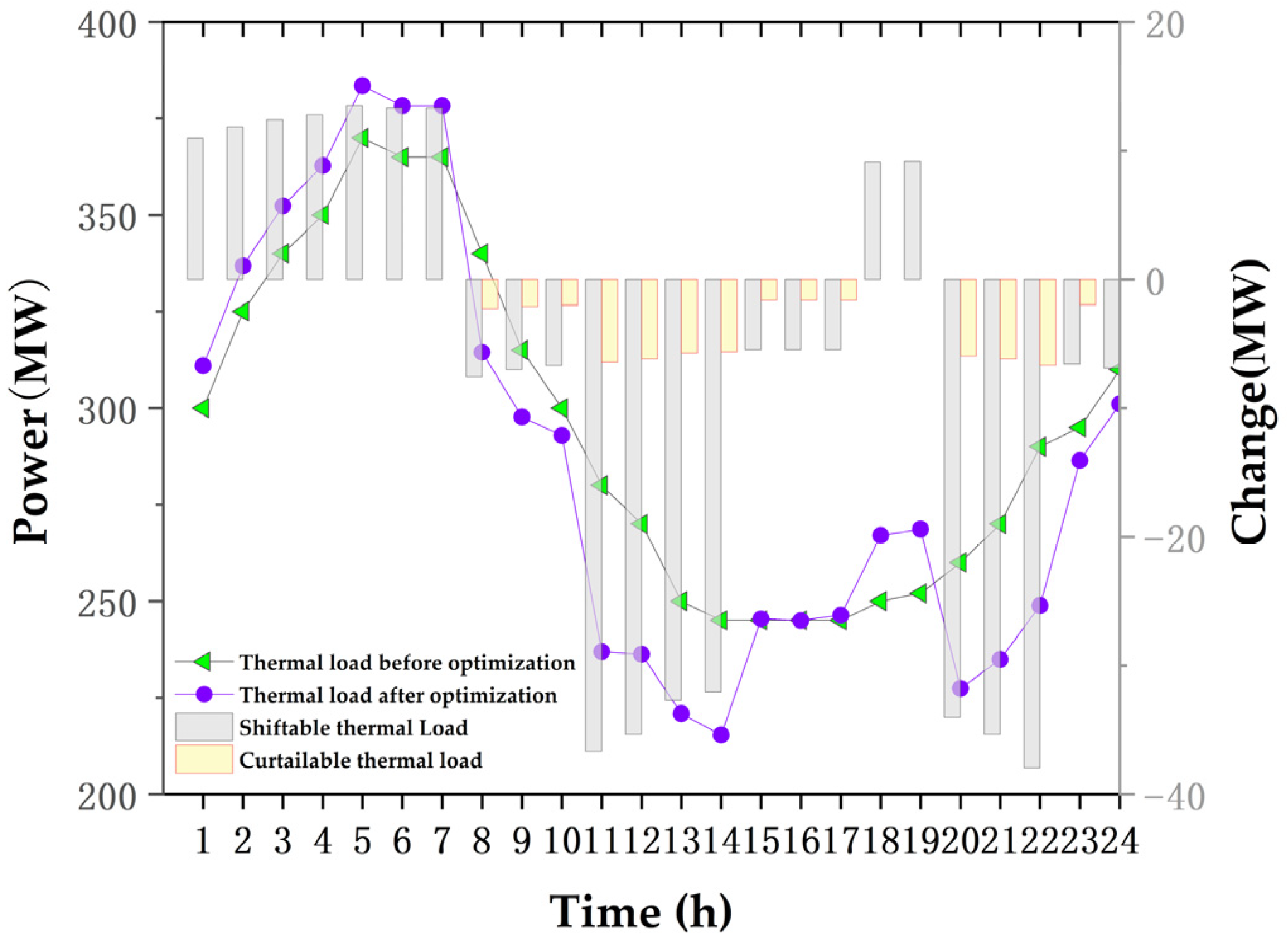
The electric load dispatch results under low-carbon demand response are illustrated in Figure 4. The period from 23:00 to 8:00 the next day corresponds to a high-wind-output interval, during which the revised dynamic carbon emission factor is relatively low and the comprehensive electricity price remains in a low range. Under the combined incentives of low carbon intensity and low electricity price, users tend to shift flexible electric loads to these periods, resulting in a noticeable increase in off-peak demand compared with the pre-response profile. In contrast, the periods 11:00–14:00 and 19:00–22:00 are typical high-carbon intervals, especially 11:00–12:00 and 19:00–20:00, when the dynamic carbon emission factor and the comprehensive electricity price are both high. During these periods, users voluntarily curtail curtailable loads and transfer shiftable loads to lower-carbon periods, while the re-scheduling layer further suppresses excessive demand under carbon-overrun risk.
Quantitatively, the average electric load over the high-carbon periods is reduced by approximately 11.56% after LCDR is implemented. This indicates that LCDR contributes not only to the reported 4.05% emission reduction but also to a clear temporal restructuring of electric demand by suppressing electricity consumption during high-carbon intervals and transferring part of the flexible load toward low-carbon periods.
The thermal load dispatch results under low-carbon demand response are shown in Figure 5. A similar response pattern can be observed for thermal demand. The periods 1:00–7:00 and 18:00–19:00 are off-peak intervals with relatively low dynamic carbon emission factors and low comprehensive thermal prices, which encourages users to shift flexible thermal loads to these periods. By contrast, the periods 11:00–14:00 and 20:00–22:00 correspond to typical thermal peak intervals, during which the dynamic carbon emission factor is relatively high because thermal supply is dominated by conventional heat sources. As a result, users tend to curtail curtailable thermal loads and shift part of the flexible demand away from these high-carbon intervals.
Quantitatively, after LCDR is applied, the average thermal load over the high-carbon periods is reduced by approximately 13.11%, and the peak thermal load is reduced by about 14.18%. This confirms that the proposed LCDR mechanism not only reduces total carbon emissions but also improves the temporal distribution of thermal demand by aligning user-side heat consumption with the time-varying carbon intensity of the system.

6.3. Impacts of the Synergy Between Life-Cycle Carbon Trading and Low-Carbon Demand Response on PIES

To comprehensively assess the low-carbon performance and economic efficiency of the PIES, this study takes the total system scheduling and operation cost as the optimization objective function and conducts a comparative analysis across the following four typical scenarios.
Scenario 1: Neither life-cycle carbon trading nor low-carbon demand response is considered, with the traditional demand response model and conventional carbon trading mechanism adopted.
Scenario 2: Traditional stepped carbon trading incorporated with the low-carbon demand response mechanism is applied.
Scenario 3: The traditional demand response model coupled with the life-cycle stepped carbon trading mechanism is utilized.
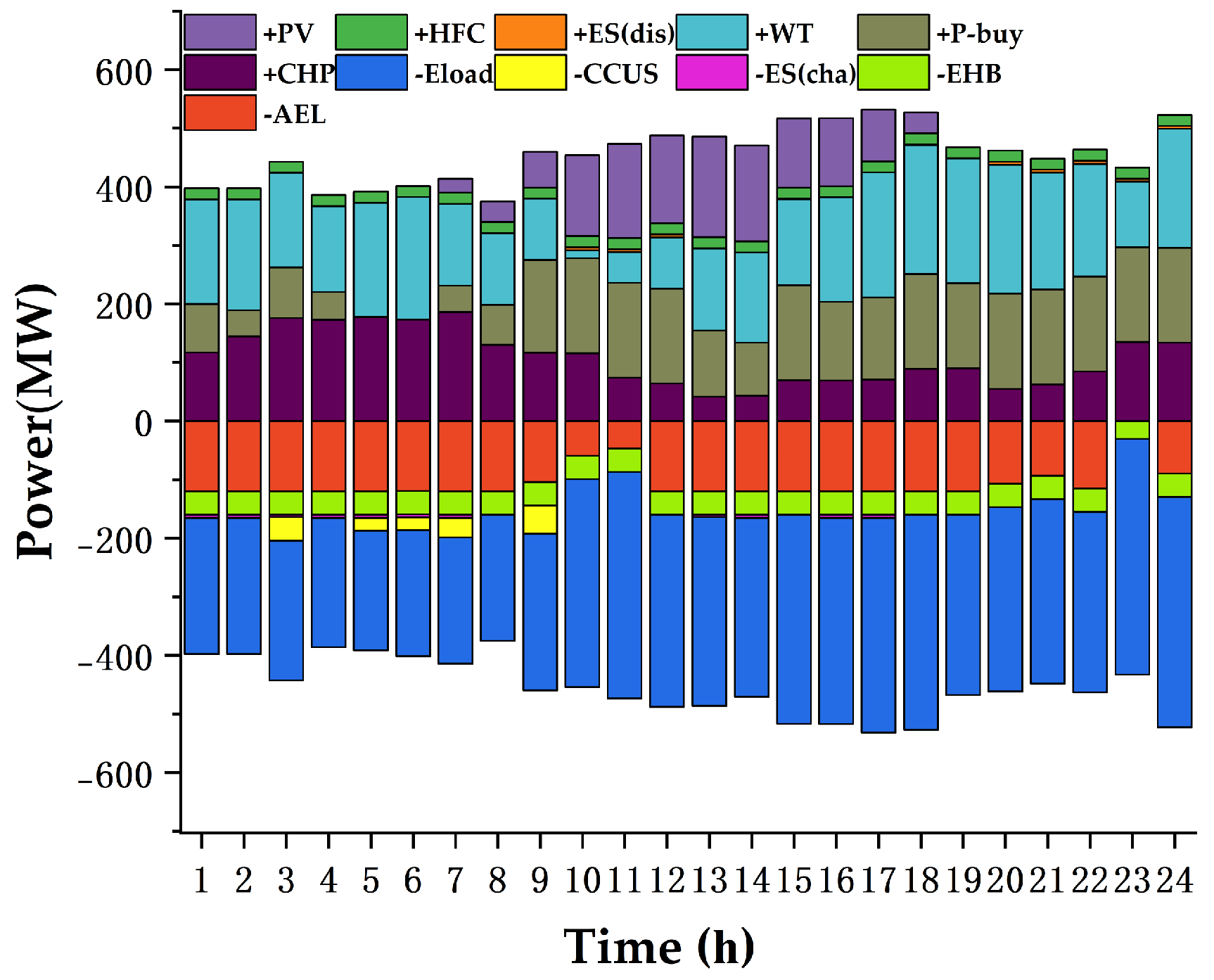
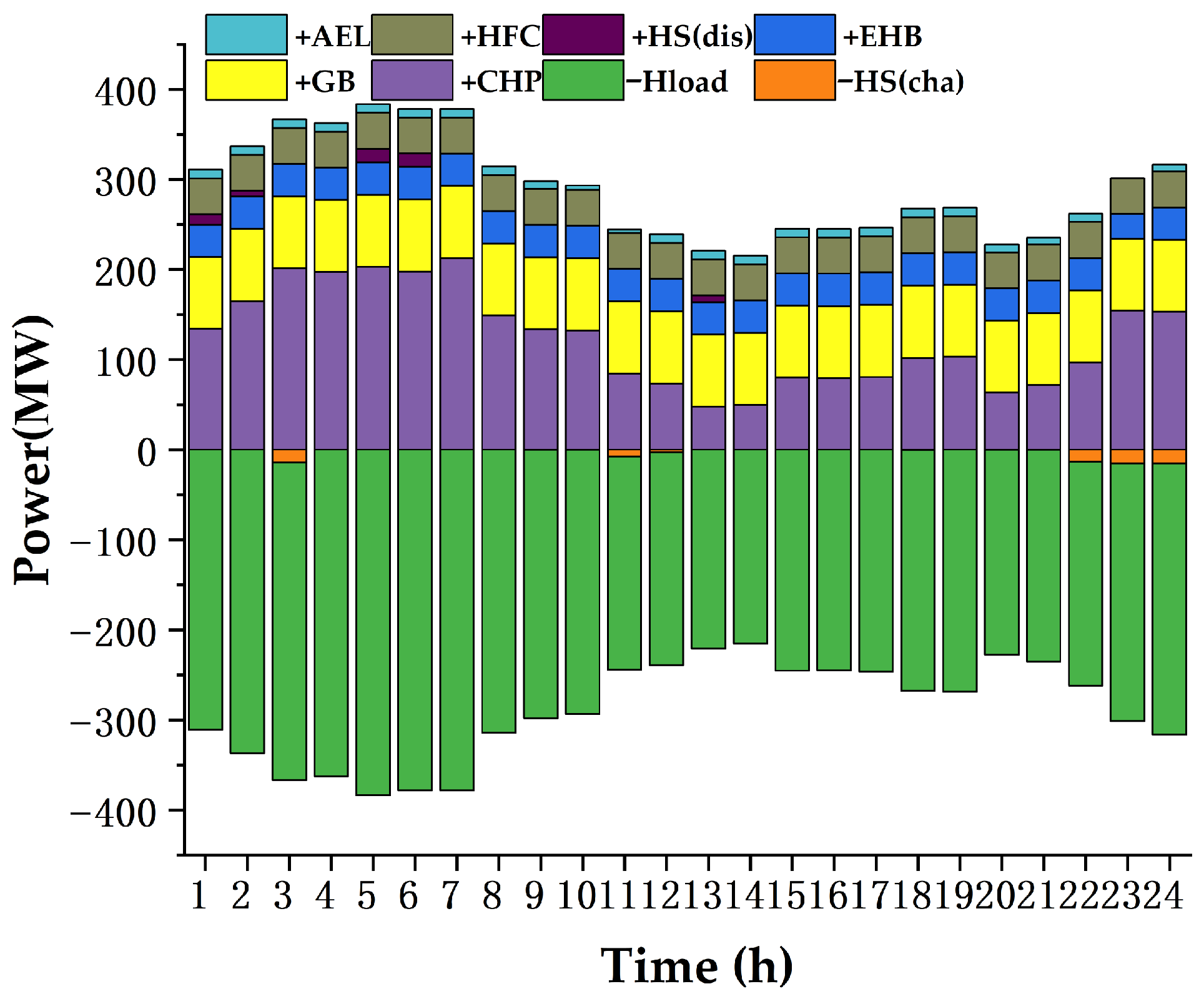
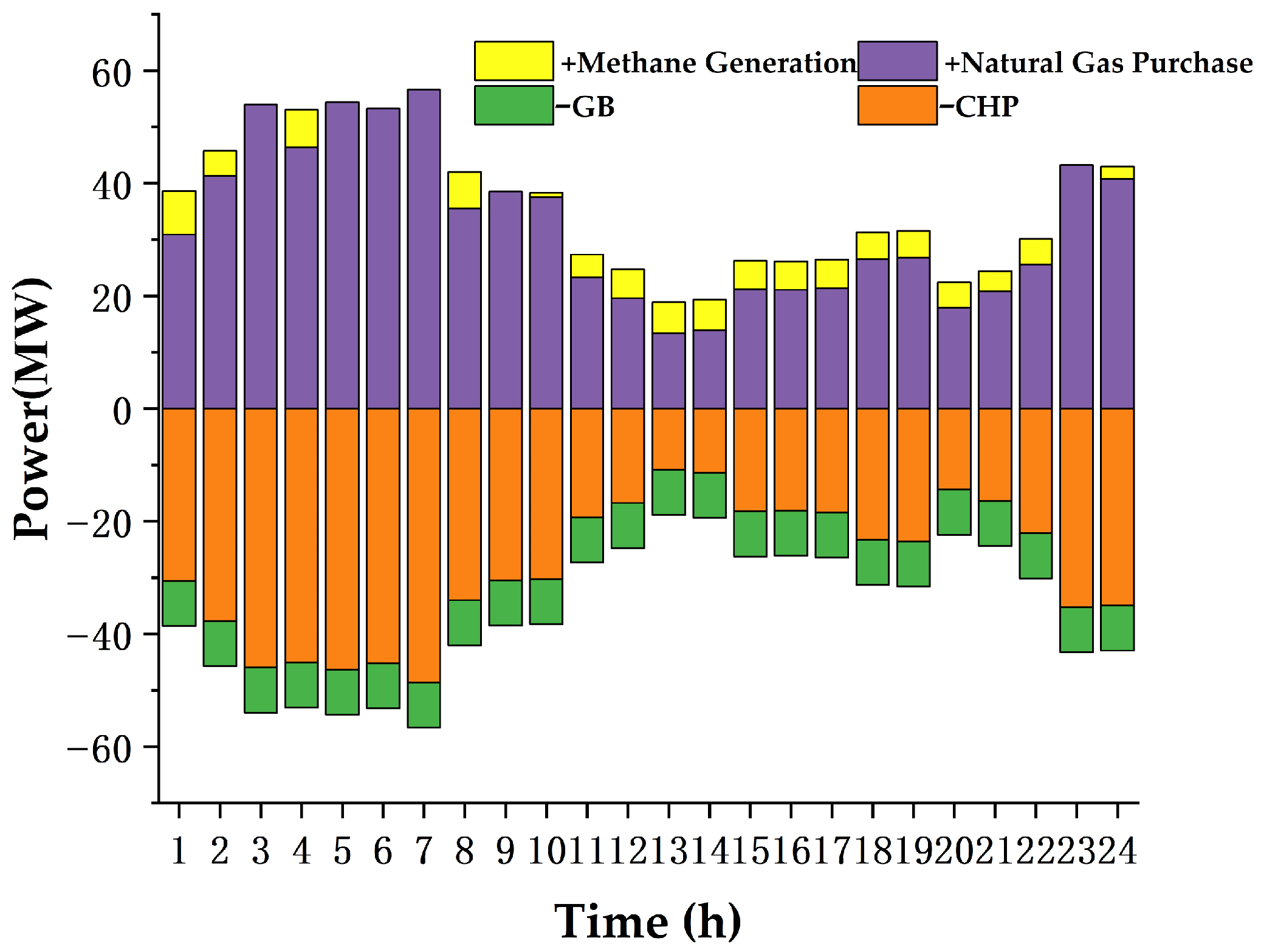
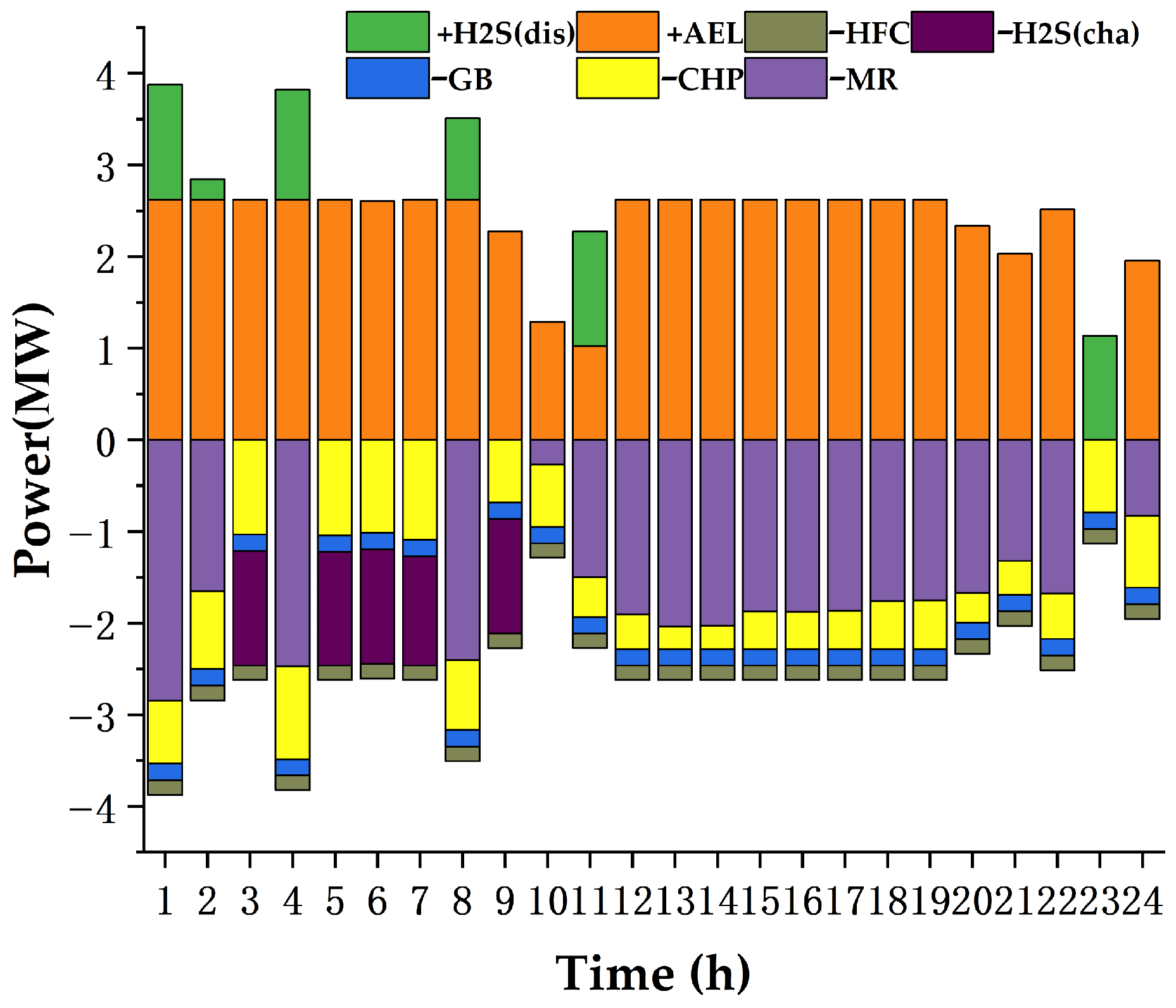
Scenario 4: Life-cycle stepped carbon trading and low-carbon demand response are implemented synergistically; the optimal scheduling results of electricity, heat, gas and hydrogen are presented in Figure 6, Figure 7, Figure 8 and Figure 9.
It can be observed from Figure 6 that during the period from 23:00 to 7:00 the next day, driven by low electricity prices, the system takes wind power as the primary power supply source, with gas turbines and hydrogen fuel cells serving as auxiliary power suppliers. Surplus electricity is accommodated through power-to-hydrogen conversion and battery energy storage. Meanwhile, carbon capture equipment consumes electricity during off-peak hours to complete low-carbon pre-treatment, thereby achieving the dual goals of economic efficiency and emission reduction.
Between 10:00 and 17:00, photovoltaic power enters its peak output stage and operates in coordination with wind power and gas turbines to meet medium-level load demand. At this stage, the charging and discharging of energy storage devices maintain a balanced state to smooth power fluctuations; power-to-hydrogen equipment operates at a reduced load, electric boilers give priority to consuming surplus photovoltaic electricity, and carbon capture equipment runs continuously to ensure the continuity of emission reduction.
To cope with peak loads, the system adopts differentiated scheduling strategies in the daytime and evening hours. From 8:00 to 12:00, the system prioritizes the accommodation of clean power by coordinating photovoltaic output and multi-energy combined supply. From 18:00 to 22:00, wind power, gas turbines, battery energy storage and hydrogen fuel cells discharge synergistically to realize low-carbon power supply. The overall scheduling strategy not only improves the accommodation rate of renewable energy but also accomplishes the synergistic objectives of low-carbon emissions and economic cost optimization via off-peak operation and multi-equipment coordinated operation.
Analysis of the thermal power balance diagram in Figure 7 shows that the thermal load stays at a relatively high level during the early morning period of 1:00–5:00. Driven by the benefit of low thermal prices, GB, CHP units (including EHB), HFC and thermal storage units are all put into operation. Meanwhile, AELs convert electric energy into thermal energy by fully utilizing the waste heat produced in the electrolysis process, and gas turbines also supply heat through waste heat recovery to maintain their basic output. This not only leverages the thermal inertia of the heating network to guarantee the stability of heat supply but also stores thermal energy for the subsequent peak-load periods.
When the thermal load is at a medium level, which overlaps with the peak photovoltaic output period, EHBs are prioritized to consume surplus PV electricity for heating, and CHP units provide heating via waste heat recovery. Thermal storage units conduct flexible charging and discharging in response to temperature fluctuations in the heating network, so as to offset the supply-demand deviation caused by thermal time lag and enhance the thermal conversion efficiency of renewable energy. During the period of 22:00–24:00, after comprehensively weighing the thermal price and thermal load revenue, the system stores the user-side surplus heat in thermal storage units, realizing the overall temporal optimization of multi-heat sources.
Analysis of the gas power balance diagram in Figure 8 shows that the gas supply modes in the studied scenario include natural gas purchased from the main grid and methane-generated gas production. In the early morning period, the methane reactor accommodates surplus electricity by leveraging the low electricity price window, achieving efficient conversion from electric energy to natural gas. Meanwhile, natural gas procured from the main grid serves as basic support and emergency backup to satisfy the gas consumption demand of gas boilers and gas turbines.
It can be observed from the analysis of the results presented in Figure 9 that the introduction of two-layer low-carbon demand response has exerted a notable impact on the hydrogen flow of the overall system. Compared with the scenario without low-carbon demand response, the system tends to dispatch hydrogen storage devices to release hydrogen during the period of 23:00–8:00, resulting in a rise in the system’s total hydrogen demand. The primary causes are as follows: First, with emission reduction set as a constraint, low-carbon demand response drives the system to prioritize the accommodation of low-carbon renewable energy sources such as wind power and photovoltaic power. Second, it guides the end-use energy side to adopt hydrogen energy as a substitute for high-carbon energy sources including natural gas and coal, which spurs the growth of hydrogen demand and in turn reversely boosts the power output of the hydrogen production sector. Meanwhile, the scheduling of hydrogen charging and discharging for hydrogen storage devices becomes more active, further expanding the operation scale of hydrogen power and ultimately elevating the overall hydrogen power level of the system.
Table 1 presents the optimal scheduling results of the four distinct scenarios:
As shown in Table 1, compared with Scenario 1, Scenario 2 reduces carbon emissions by 9.46%, while its energy purchase cost and O&M cost increase by 12.8% and 6.4%, respectively. The reasons are as follows: firstly, the refined hydrogen modeling takes the operating conditions of equipment into account, which is more consistent with the actual situation; and secondly, the hydrogen consumed by gas turbines and boilers in hydrogen-blended combustion is produced by electrolyzers, leading to increased power consumption. According to the scheduling results, compared with the linearized modeling method, the refined hydrogen modeling can effectively reduce carbon emissions with a slight increase in the total cost.
Compared with Scenario 1, Scenario 3 sees a 2.9% increase in energy purchase cost and a 7.9% rise in life-cycle carbon trading (LCCT) cost owing to the differentiated carbon trading mechanism, while its carbon emissions are reduced by 16.7%. This demonstrates that the LCCT mechanism can effectively mitigate carbon emissions with only a minor cost increment. From the comparison of scheduling results with Scenario 2, both scenarios contribute to curbing the system’s carbon emissions, whereas the LCCT mechanism based on life-cycle carbon footprint achieves a more significant emission reduction effect for the PIES.
Scenario 4 represents the optimal scheme for the low-carbon economic dispatch of the system proposed in this paper. Compared with Scenario 1, Scenario 4 reduces carbon emissions by 27.8% with a 9.1% increase in total cost. This indicates that the coordinated implementation of refined hydrogen modeling and the LCCT mechanism is more conducive to improving the low-carbon performance and economic efficiency of integrated energy systems. From an engineering perspective, this 9.1% increase in total cost may be regarded as a potentially acceptable low-carbon premium, considering that it is accompanied by a 27.8% reduction in carbon emissions under carbon-constrained operation.

6.4. Effectiveness Analysis of the LCCT Mechanism

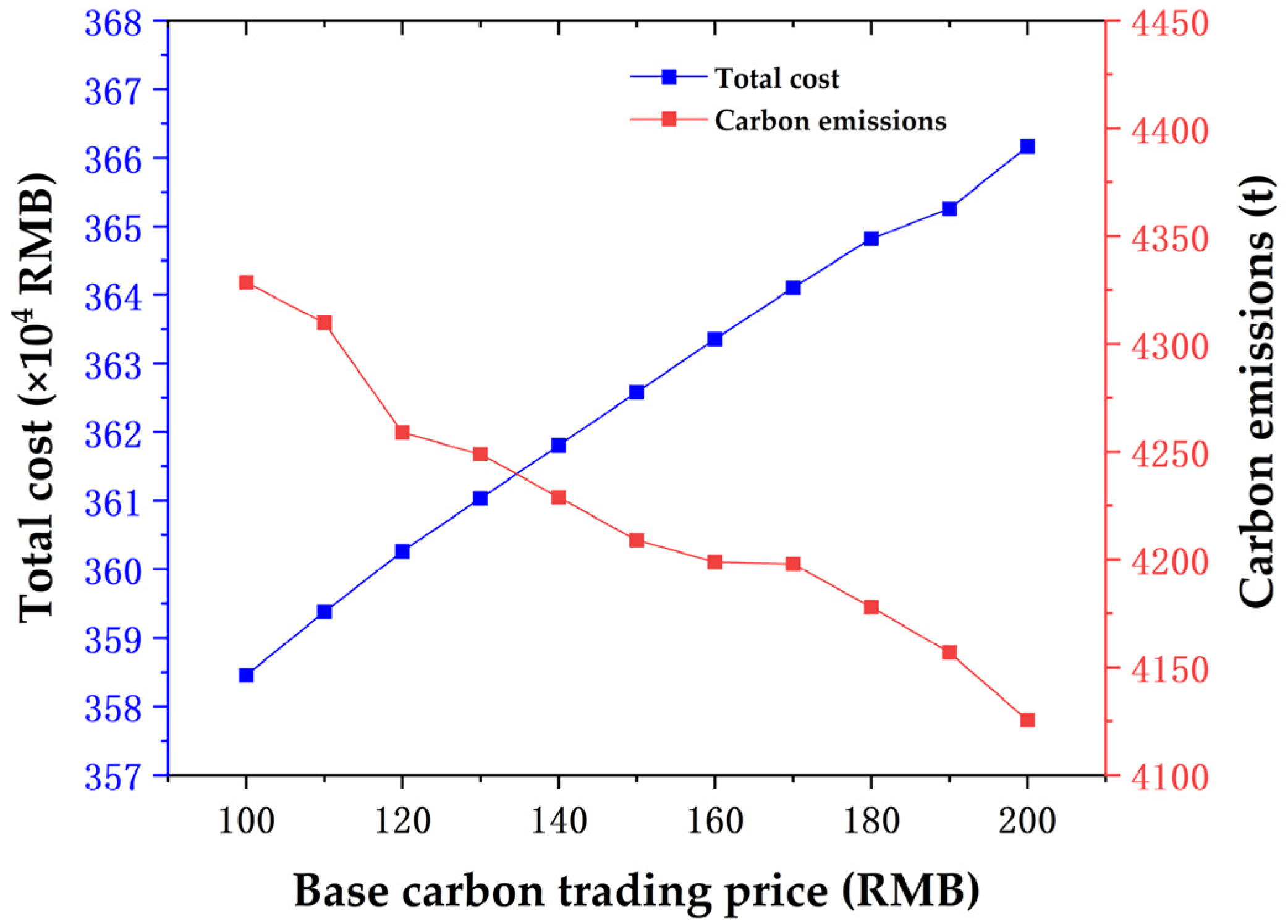
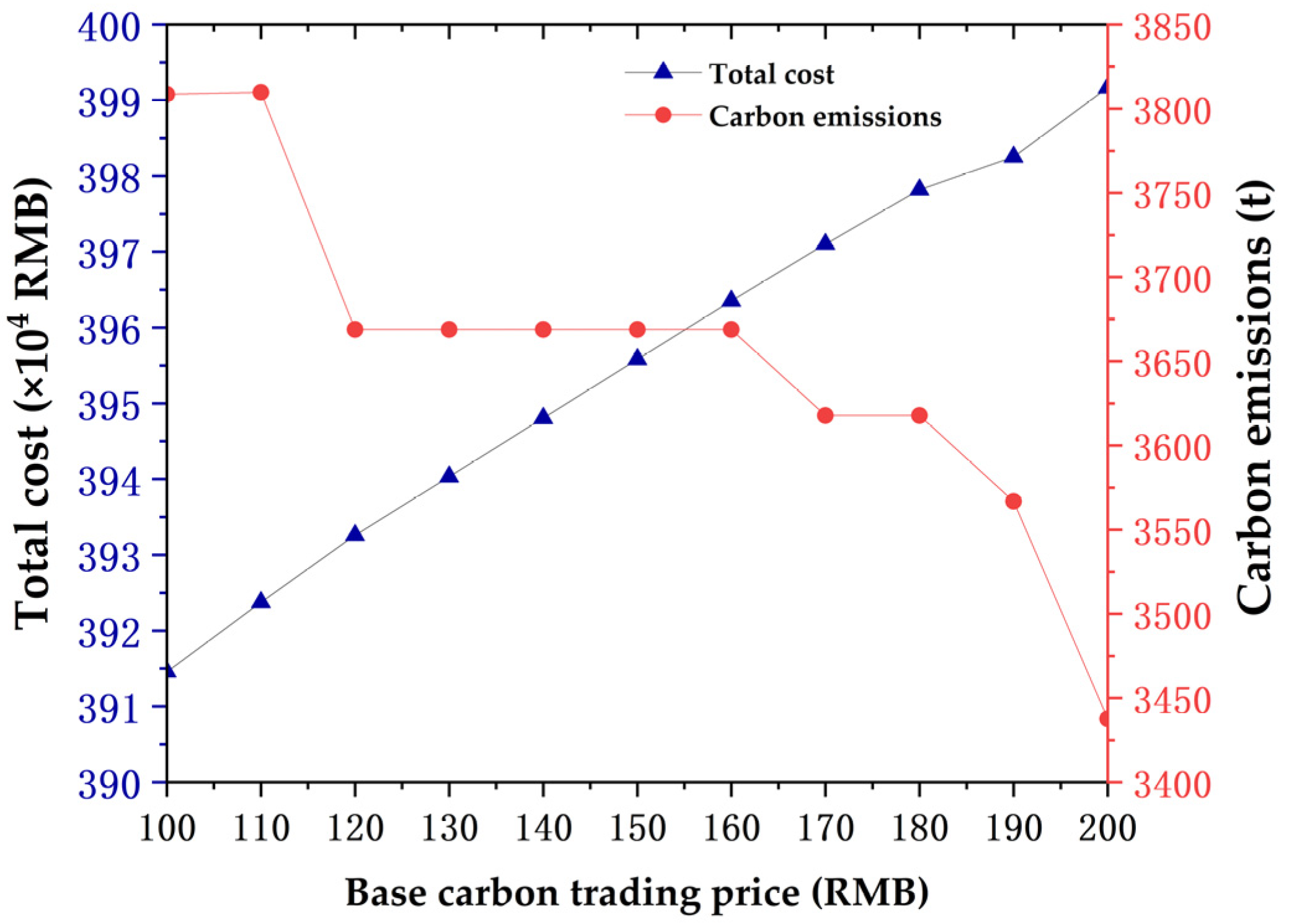
By comparing Scenario 1 and Scenario 3, an in-depth analysis is performed to examine the impacts of the LCCT mechanism on the PIES. Figure 10 and Figure 11 present the carbon emissions and total costs associated with different carbon trading strategies under diverse carbon trading benchmark prices.
As shown in Figure 10 and Figure 11, from the perspective of carbon emissions, the total carbon emissions under the conventional carbon trading mechanism exhibit an overall downward trend and decline with the gradual increase in carbon trading prices, and tend to stabilize when the trading price reaches 160 RMB per ton. In contrast, carbon emissions under stepped carbon trading present a stepped trend of rapid decline first, followed by stabilization and further reduction, reaching the minimum at a price of 200 RMB/t. In addition, at the same trading price, carbon emissions from stepped carbon trading are lower than those from conventional carbon trading. This is because the increase in the unit carbon trading price raises the investment in the power system and the carbon trading cost undertaken by the PIES, resulting in a gradual growth in the proportion of carbon trading cost to the total cost of the PIES. Such cost escalation reinforces the constraints on carbon emissions, driving down the system’s carbon emissions.
From the perspective of total cost, the total costs of both Scenario 1 and Scenario 3 increase with the rise in the base carbon trading price. However, the total cost of Scenario 3 is relatively higher, owing to the consideration of factors such as equipment wear and tear of new energy facilities. In addition, the increase in accounted carbon emissions subjects the system to higher liquidated damages.
In summary, incorporating the LCCT mechanism into the optimal scheduling model effectively reduces the total carbon emissions of the system without compromising its economic efficiency.

6.5. Sensitivity Analysis of the Proposed Two-Level Optimization Method

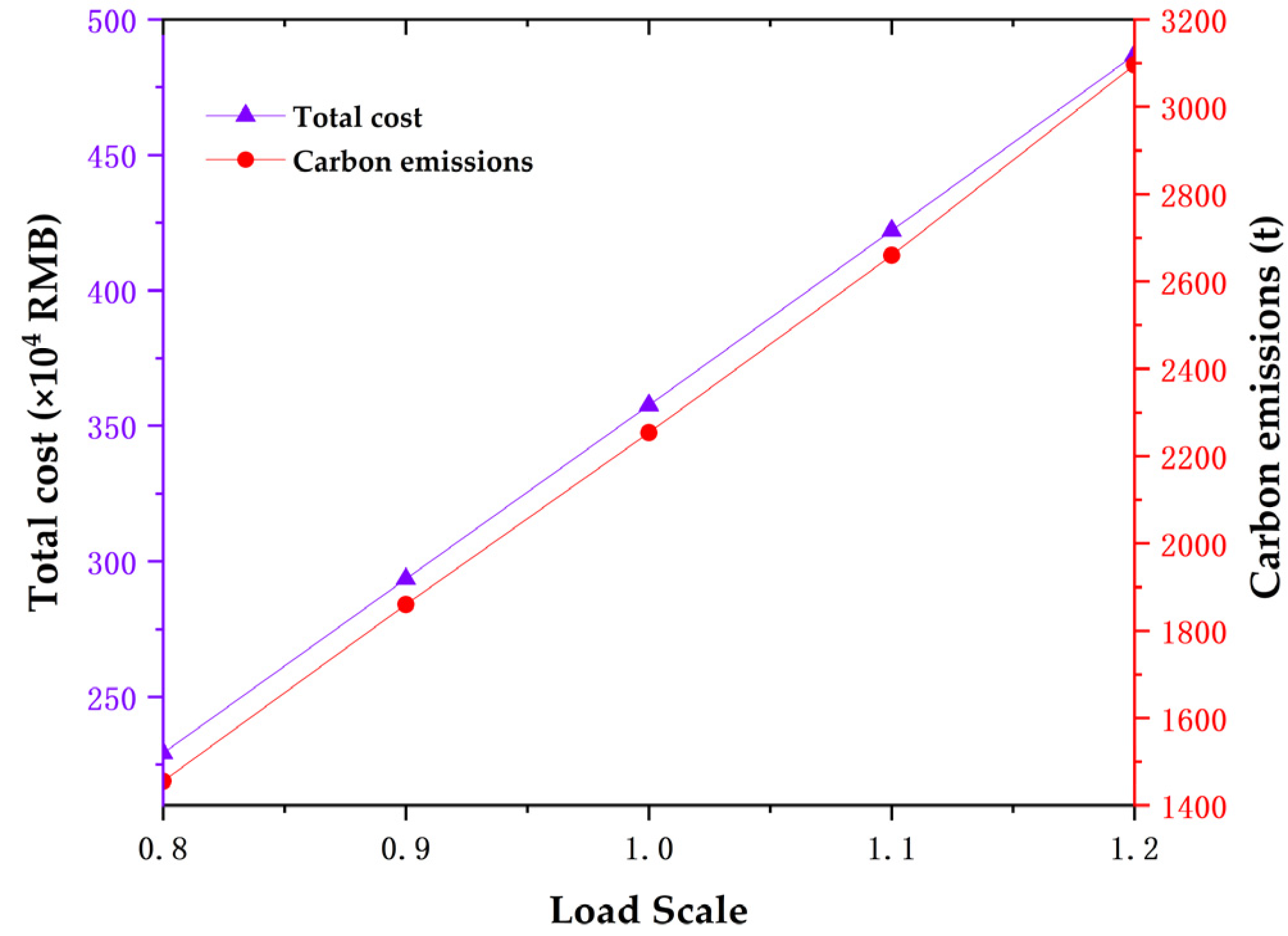
To further verify the scalability and robustness of the proposed two-level optimization framework, sensitivity analyses were conducted with respect to load fluctuation and demand response capability variation. Since the proposed method explicitly coordinates electric and thermal loads through the pre-scheduling and re-scheduling structure, and the low-carbon demand response model relies on load-side flexibility, these two factors were selected as representative uncertain parameters.
As shown in Figure 12, as the load scaling factor increases from 0.8 to 1.2, the total operating cost rises from 229.26 × 10⁴ RMB to 486.90 × 10⁴ RMB, while the total carbon emissions increase from 1455 t to 3096 t. The smooth variation trend indicates that the proposed method can adapt well to different load levels and therefore exhibits good scalability.
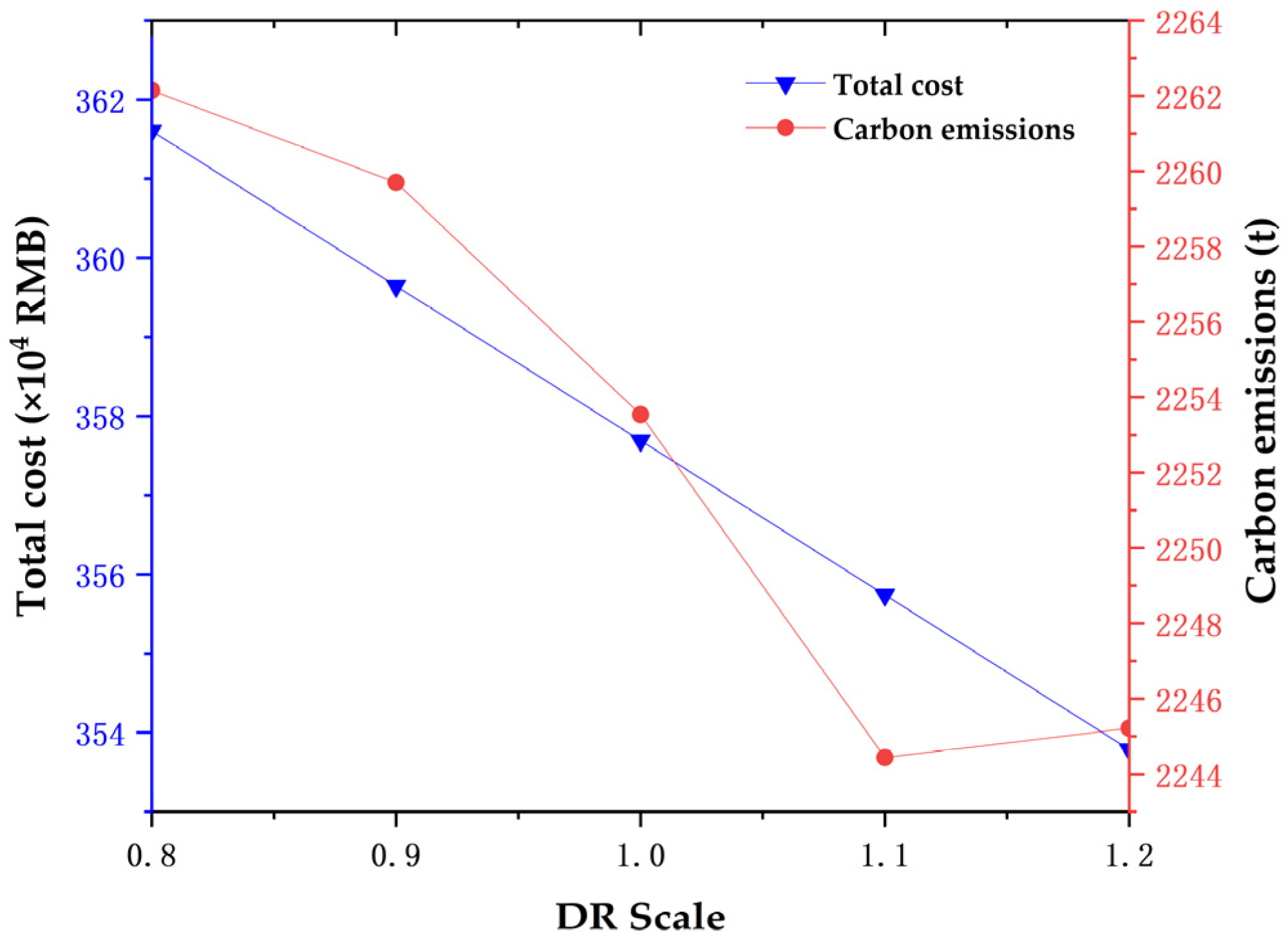
As shown in Figure 13, when the demand response coefficient increases from 0.8 to 1.2, the total operating cost decreases from 361.60 × 10⁴ RMB to 353.79 × 10⁴ RMB, and the total carbon emissions generally decrease and then remain stable, varying within a narrow range. This shows that the proposed method can maintain stable low-carbon and economic performance under different user-side flexibility conditions, thereby demonstrating good robustness.
Therefore, the additional sensitivity analyses confirm that the proposed two-level optimization framework is applicable not only to the baseline park case but also to a wider range of operating conditions.

6.6. Practical Implications, Limitations, and Future Work

The proposed framework provides a practical low-carbon scheduling solution for park integrated energy systems by coordinating life-cycle carbon trading and low-carbon demand response within a unified optimization architecture. From an engineering perspective, the two-layer structure is suitable for day-ahead and rolling scheduling, where the pre-scheduling layer can determine the baseline dispatch plan and the re-scheduling layer can further adjust flexible loads and energy flows under carbon-overrun risk. Although recent studies have explored reinforcement learning, distributed optimization, and hybrid data-driven methods for integrated energy scheduling, the present work focuses on building an interpretable coordinated framework that explicitly links life-cycle carbon accounting, dynamic carbon-intensity feedback, and two-layer operational scheduling. Therefore, the main contribution of this study lies in mechanism integration and low-carbon scheduling interpretability rather than in exhaustive benchmarking across all solution paradigms.
Nevertheless, several limitations should be acknowledged. First, the present study is conducted under a deterministic scheduling framework. Equipment failures, scheduled maintenance, and aging effects are not explicitly modeled, and the basic functions of all devices are assumed to remain stable during the scheduling horizon. Second, the wind/PV outputs and load curves are represented by typical-day data, while renewable intermittency and load forecasting errors are not explicitly incorporated into the optimization model. Third, the dynamic carbon emission factors are assumed to be available with sufficient accuracy, whereas in practical systems such information may be affected by measurement uncertainty, delayed updates, and regional data availability. Fourth, although the P2G chain and methane reactor are incorporated into the system-level carbon accounting and operation model, their component-level life-cycle contributions are not separately decomposed in the present study. In addition, the efficiency losses along the hydrogen conversion chain, including electrolysis, hydrogen storage, methanation, and fuel-cell utilization, have been implicitly reflected through the corresponding device efficiency parameters in the scheduling model, although their marginal impacts on overall system performance are not separately quantified in the present study.
Therefore, the current work should be regarded as a methodological validation of the proposed coordinated framework under representative operating conditions. Future research will focus on integrating stochastic renewable uncertainty, load forecasting errors, degradation-aware equipment models, and region-specific real operation data into the proposed framework. In addition, further studies will investigate the combination of the present model with robust optimization, distributed optimization, or data-driven scheduling methods to enhance its applicability in large-scale practical deployment. Moreover, cost-based optimization under carbon constraints should be viewed as an important transitional paradigm for practical low-carbon operation, while future deep-decarbonization systems may require broader multi-objective formulations that jointly consider carbon, cost, resilience, and policy constraints.

7. Conclusions

Aiming at the core issues of incomplete carbon trading accounting and the lack of carbon dimension synergy in conventional demand response during the low-carbon transition of PIESs, this paper proposes a two-layer optimal scheduling method featuring the synergy between life-cycle stepped carbon trading and low-carbon demand response. Based on theoretical modeling and case validation, the main conclusions are drawn as follows:
(1)
The stepped carbon trading mechanism established based on the life-cycle theory incorporates the embodied carbon throughout the whole processes of new energy equipment manufacturing, transportation and operation into the accounting system, making up for the shortcoming of conventional carbon trading that only focuses on the energy utilization stage. The case study results demonstrate that this mechanism can cut the system’s carbon emissions by 16.7%. The stepped-increasing carbon price design reinforces the constraints and incentives for high-carbon emission activities, providing a precise cost orientation for the deep decarbonization of PIESs.
(2)
The construction of revised dynamic carbon emission factors for power and heating networks, together with the pre-scheduling and re-scheduling two-layer model, enables the accurate quantification of real-time carbon intensity for multi-energy systems. On this basis, the electricity price and carbon factor dual-driven low-carbon demand response model effectively unlocks the flexible regulation potential of the electric and thermal load sides, further cutting carbon emissions by 4.05%. The implementation of demand response significantly optimizes the load curve: the load peak during high-carbon periods is effectively suppressed, and the load during low-carbon periods is reasonably elevated, achieving the precise alignment between energy consumption behavior and low-carbon objectives.
(3)
The synergy between LCCT and low-carbon demand response achieves a favorable balance between low-carbon development and economic efficiency for the PIES. Compared with the traditional scheduling mode, the system carbon emissions are reduced by 27.8% in the optimal scenario with only a 9.1% increase in total cost. This indicates that the proposed method can improve the low-carbon performance of integrated energy systems while maintaining economic viability. In addition, the supplementary sensitivity analyses on load fluctuation and demand response capability further confirm that the proposed framework has good scalability and robustness under different operating conditions.

Author Contributions

Conceptualization, Y.Z. and M.Z.; methodology, Y.Z.; software, M.Z.; validation, Y.Z.; formal analysis, M.Z.; investigation, M.Z.; resources, Y.Z.; data curation, M.Z.; writing—original draft preparation, M.Z.; writing—review and editing, Y.Z.; visualization, M.Z.; supervision, Y.Z.; project administration, Y.Z.; funding acquisition, Y.Z. All authors have read and agreed to the published version of the manuscript.

Funding

This research was funded by the Shanghai Science and Technology Plan Project under grant number 22010501400 and by the Key Laboratory of Control of Power Transmission and Conversion under grant number 2023AC02.

Data Availability Statement

The data presented in this study are available on request from the corresponding author. The data are not publicly available due to privacy restrictions.

Conflicts of Interest

The authors declare no conflicts of interest.

Abbreviations

The following abbreviations are used in this manuscript:
PIESPark integrated energy system
LCDRLow-carbon demand response
GTGas turbines
ESElectrical energy storage
PVPhotovoltaic
WTWind turbine
EHBElectric heating boilers
HSThermal energy storage
AELAlkaline electrolyzers
HFCHydrogen fuel cells
MRMethane reactors
P2GPower to gas
LCCFLife-cycle carbon footprint
CCSCarbon capture and storage
TOUTime-of-use
CHPCombined heat and power
LCCTLife-cycle carbon trading
H2SHydrogen energy storage

Appendix A

Table A1. Equipment parameters.
AppliancesCapacity (MW)Efficiency (%)
CHP35040 (heat)/35 (power)
GB30092
EHB4090
AEL12085/20 (recycle heat)
MR1570
HFC2095
WT, PV30/60-
CCS150-
Table A2. Parameters of energy storage equipment.
Capacity (MW)Capacity ConstraintsClimbing ConstraintsEfficiency (%)
ES600.1–0.90.295
HS1200.1–0.90.295
H2S500.1–0.90.295
Figure A1. Time-of-use prices of electricity and heat.
Energies 19 01850 g0a1
Figure A2. Predicted output of WT and PV.
Energies 19 01850 g0a2
Figure A3. Electrical and heat loads.
Energies 19 01850 g0a3

References

  1. Liu, L.; Qin, Z. Low-carbon planning for park-level integrated energy system considering optimal construction time sequence and hydrogen energy facility. Energy Rep. 2023, 9, 554–566. [Google Scholar] [CrossRef]
  2. Guo, R.; Ye, H.; Zhao, Y. Low carbon dispatch of electricity-gas-thermal-storage integrated energy system based on stepped carbon trading. Energy Rep. 2022, 8, 449–455. [Google Scholar] [CrossRef]
  3. Ji, X.; Li, M.; Li, M.; Han, H. Low-carbon optimal operation of the integrated energy system considering integrated demand response. Front. Energy Res. 2023, 11, 1283429. [Google Scholar] [CrossRef]
  4. Sun, H.; Sun, X.; Kou, L.; Zhang, B.; Zhu, X. Optimal scheduling of park-level integrated energy system considering ladder-type carbon trading mechanism and flexible load. Energy Rep. 2023, 9, 3417–3430. [Google Scholar] [CrossRef]
  5. Wu, Q.; Li, C. Economy-environment-energy benefit analysis for green hydrogen based integrated energy system operation under carbon trading with a robust optimization model. J. Energy Storage 2022, 55, 105560. [Google Scholar] [CrossRef]
  6. Dai, F.; Jiang, F.; Chen, L.; Wu, Y.; Xiao, C. Master–slave game-based optimal scheduling of community-integrated energy system by considering incentives for peak-shaving and ladder-type carbon trading. Front. Energy Res. 2023, 11, 1247803. [Google Scholar] [CrossRef]
  7. Li, Y.; Zhang, X.; Wang, Y.; Qiao, X.; Jiao, S.; Cao, Y.; Xu, Y.; Shahidehpour, M.; Shan, Z. Carbon-oriented optimal operation strategy based on Stackelberg game for multiple integrated energy microgrids. Electr. Power Syst. Res. 2023, 224, 109778. [Google Scholar] [CrossRef]
  8. Yu, W.; Ke, L.; Shuzhen, L.; Xin, M.; Chenghui, Z. A bi-level scheduling strategy for integrated energy systems considering integrated demand response and energy storage co-optimization. J. Energy Storage 2023, 66, 107508. [Google Scholar] [CrossRef]
  9. Gao, J.; Meng, Q.; Liu, J.; Wang, Z. Thermoelectric optimization of integrated energy system considering wind-photovoltaic uncertainty, two-stage power-to-gas and ladder-type carbon trading. Renew. Energy 2024, 221, 119806. [Google Scholar] [CrossRef]
  10. Zhu, X.; Xue, J.; Hu, M.; Liu, Z.; Gao, X.; Huang, W. Low-carbon economy dispatching of integrated energy system with P2G-HGT coupling wind power absorption based on stepped Carbon emission trading. Energy Rep. 2023, 10, 1753–1764. [Google Scholar] [CrossRef]
  11. Meng, Z.; Dong, F.; Chi, L. Optimal dispatch of integrated energy system with P2G considering carbon trading and demand response. Environ. Sci. Pollut. Res. Int. 2023, 30, 104284–104303. [Google Scholar] [CrossRef] [PubMed]
  12. Cui, Y.; Xu, Y.; Huang, T.; Wang, Y.; Cheng, D.; Zhao, Y. Low-carbon economic dispatch of integrated energy systems that incorporate CCPP-P2G and PDR considering dynamic carbon trading price. J. Clean. Prod. 2023, 423, 138812. [Google Scholar] [CrossRef]
  13. Zhang, J.; Liu, Z. Low carbon economic scheduling model for a park integrated energy system considering integrated demand response, ladder-type carbon trading and fine utilization of hydrogen. Energy 2024, 290, 130311. [Google Scholar] [CrossRef]
  14. Yuan, X.; Guo, Y.; Cui, C.; Cao, H. Time-of-Use Pricing Strategy of Integrated Energy System Based on Game Theory. Process 2022, 10, 2033. [Google Scholar] [CrossRef]
  15. Zhang, N.; Chen, J.; Liu, B.; Ji, X. Optimized Scheduling of Integrated Energy Systems with Integrated Demand Response and Liquid Carbon Dioxide Storage. Process 2024, 12, 292. [Google Scholar] [CrossRef]
  16. Yan, N.; Li, X.; Wu, Z.; Shao, J.; Guerrero, J.M. Low-Carbon economic scheduling with Demand-Side response uncertainty in regional integrated energy system. Int. J. Electr. Power Energy Syst. 2024, 156, 109691. [Google Scholar] [CrossRef]
  17. Li, H.; Li, X.; Chen, S.; Li, S.; Kang, Y.; Ma, X. Low-Carbon Optimal Scheduling of Integrated Energy System Considering Multiple Uncertainties and Electricity–Heat Integrated Demand Response. Energies 2024, 17, 245. [Google Scholar] [CrossRef]
  18. Sun, H.; Sun, X.; Kou, L.; Ke, W. Low-Carbon Economic Operation Optimization of Park-Level Integrated Energy Systems with Flexible Loads and P2G under the Carbon Trading Mechanism. Sustainability 2023, 15, 15203. [Google Scholar] [CrossRef]
  19. Ma, X.; Liang, Y.; Wang, K.; Jia, R.; Wang, X.; Du, H.; Liu, H. Dispatch for energy efficiency improvement of an integrated energy system considering multiple types of low carbon factors and demand response. Front. Energy Res. 2022, 10, 953573. [Google Scholar] [CrossRef]
  20. Wang, L.; Lin, J.; Dong, H.; Wang, Y.; Zeng, M. Demand response comprehensive incentive mechanism-based multi-time scale optimization scheduling for park integrated energy system. Energy 2023, 270, 126893. [Google Scholar] [CrossRef]
Figure 1. Structure diagram of PIES.
Energies 19 01850 g001
Figure 2. Principle of two-layer low-carbon demand response.
Energies 19 01850 g002
Figure 3. Linearization and piecewise approximation process.
Energies 19 01850 g003
Figure 4. Electric load variation under low-carbon demand response.
Energies 19 01850 g004
Figure 5. Thermal load variation under low-carbon demand response.
Energies 19 01850 g005
Figure 6. Scheduling results of power flow.
Energies 19 01850 g006
Figure 7. Scheduling results of heat flow.
Energies 19 01850 g007
Figure 8. Scheduling results of gas flow.
Energies 19 01850 g008
Figure 9. Scheduling results of hydrogen flow.
Energies 19 01850 g009
Figure 10. Impact of the carbon trading base price on the emission of CO2 into the atmosphere and the cost in Scenario 1.
Energies 19 01850 g010
Figure 11. Impact of the carbon trading base price on the emission of CO2 into the atmosphere and the cost in Scenario 3.
Energies 19 01850 g011
Figure 12. Sensitivity of total operating cost and carbon emissions to load fluctuation.
Energies 19 01850 g012
Figure 13. Sensitivity of total operating cost and carbon emissions to demand response coefficient variation.
Energies 19 01850 g013
Table 1. Scheduling results for scenarios.
ScenarioEnergy Purchase Cost
(×104 RMB)
O&M Cost
(×104 RMB)
Wind and Solar Curtailment Cost
(×104 RMB)
LCCT Cost
(×104 RMB)
Total Cost
(×104 RMB)
Carbon Emissions
(t)
1283.6243.753.5135.23366.114125.4
2320.0650.153.3535.79409.353734.8
3291.9849.211.2538.03383.033437.6
4307.3150.133.3538.39399.182977.8
Disclaimer/Publisher’s Note: The statements, opinions and data contained in all publications are solely those of the individual author(s) and contributor(s) and not of MDPI and/or the editor(s). MDPI and/or the editor(s) disclaim responsibility for any injury to people or property resulting from any ideas, methods, instructions or products referred to in the content.