Harmonic Source Modeling Techniques for Wide-Area Distribution System Monitoring: A Systematic Review




Abstract
1. Introduction
1.1. Harmonic Challenges in Modern Distribution Systems
1.2. Standards for Harmonics and Renewable Energy Integration
1.3. Importance of Harmonic Source Modeling
1.4. Contributions and Literature Gap
1.4.1. Unified Evaluation Framework
1.4.2. Systematic Comparison Across Modeling Approaches
1.4.3. Targeted Gap Analysis and Future Directions
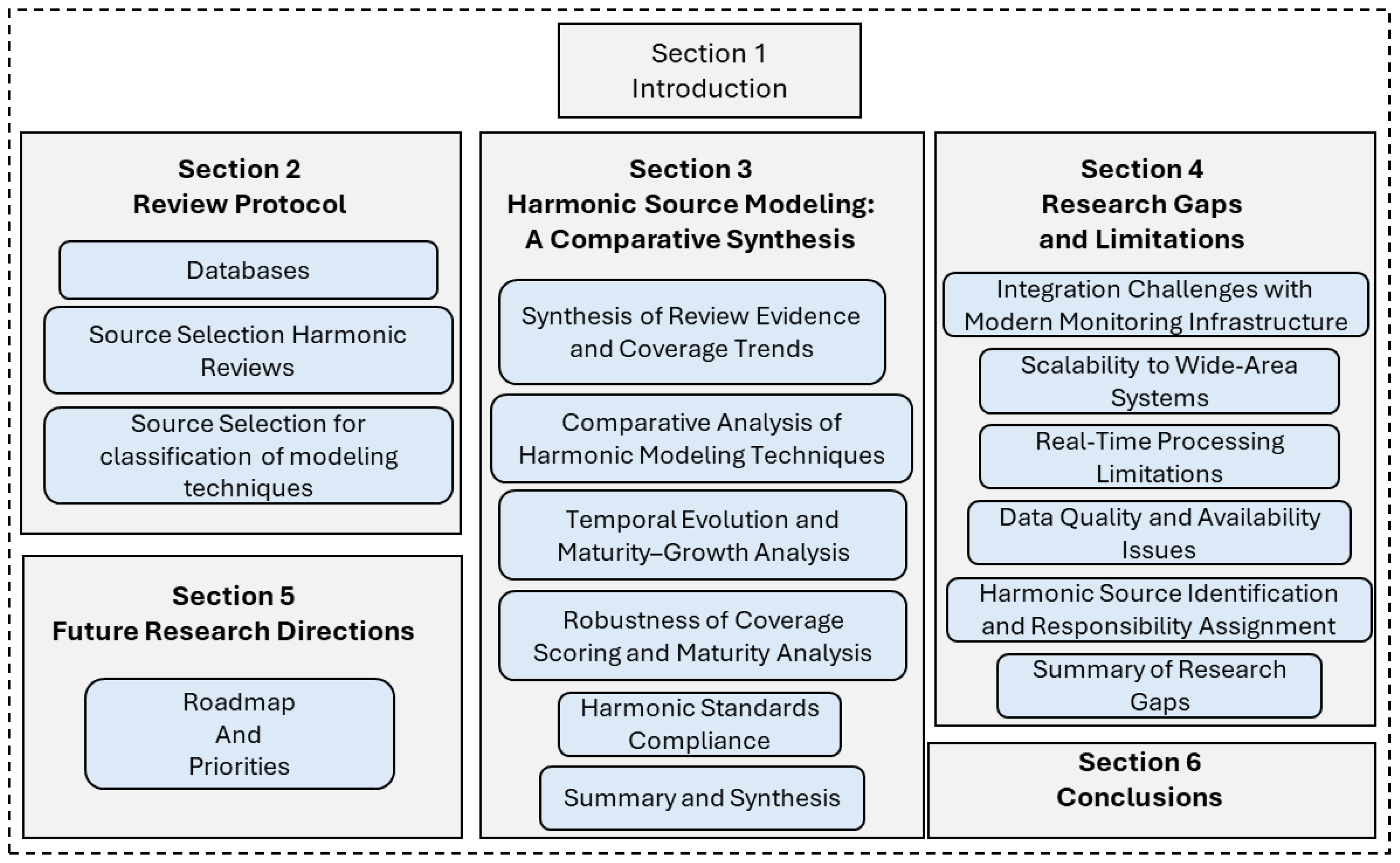
2. Review Protocol
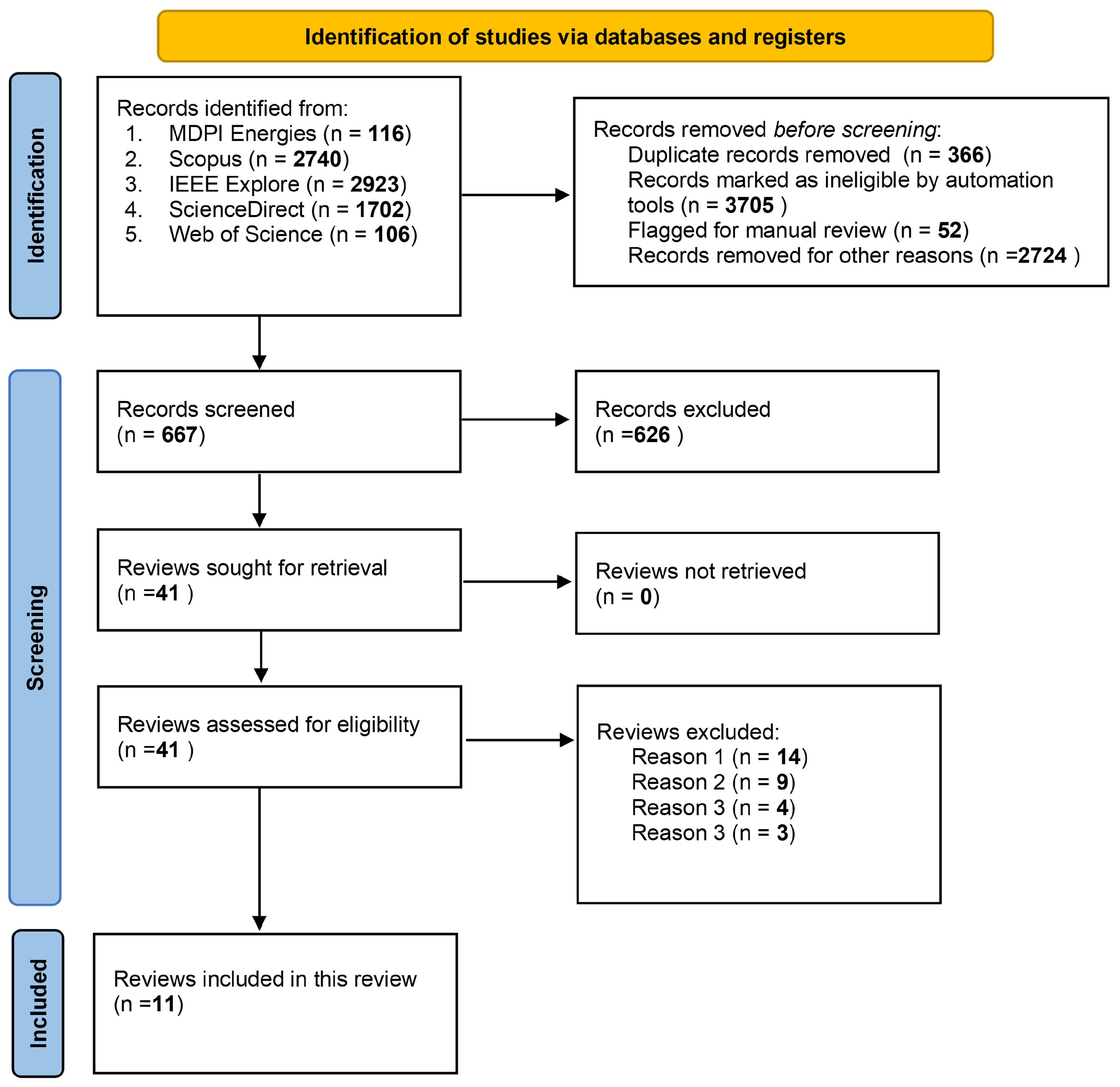
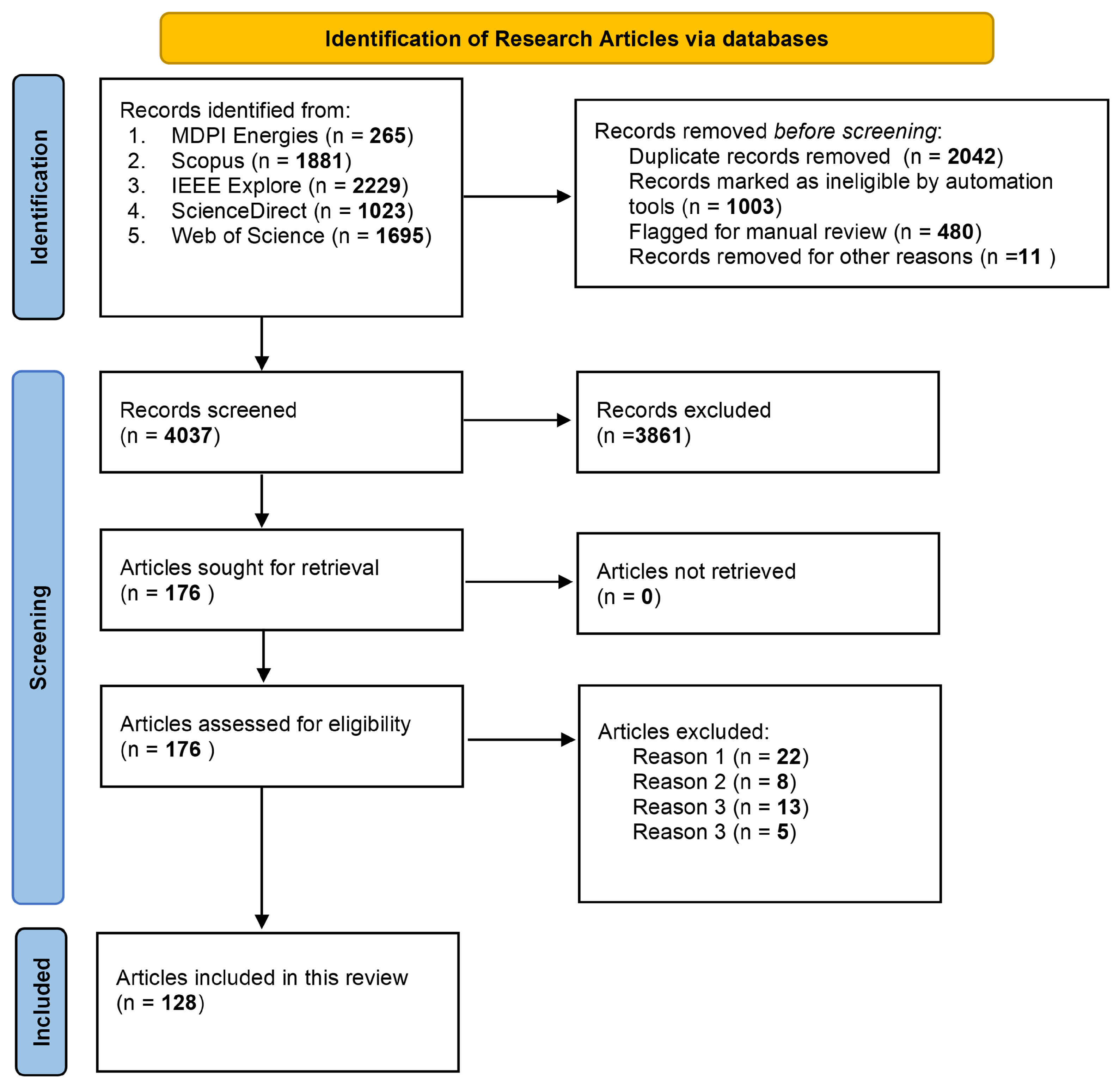
2.1. Search Strategy
2.2. Eligibility Criteria
- (i)
- Review study set: Peer-reviewed review or systematic review articles addressing harmonic modeling, detection, monitoring, or estimation in power systems, or provide a methodological discussion. This is used to support taxonomy development and contextual analysis.
- (ii)
- Research study set: Peer-reviewed research articles proposing, evaluating, or applying harmonic modeling and monitoring techniques, used for comparative methodological analysis.
- (iii)
- General criteria: Studies were required to be peer-reviewed journal articles, published in English and to provide sufficient methodological detail relevant to harmonic source modeling or monitoring.
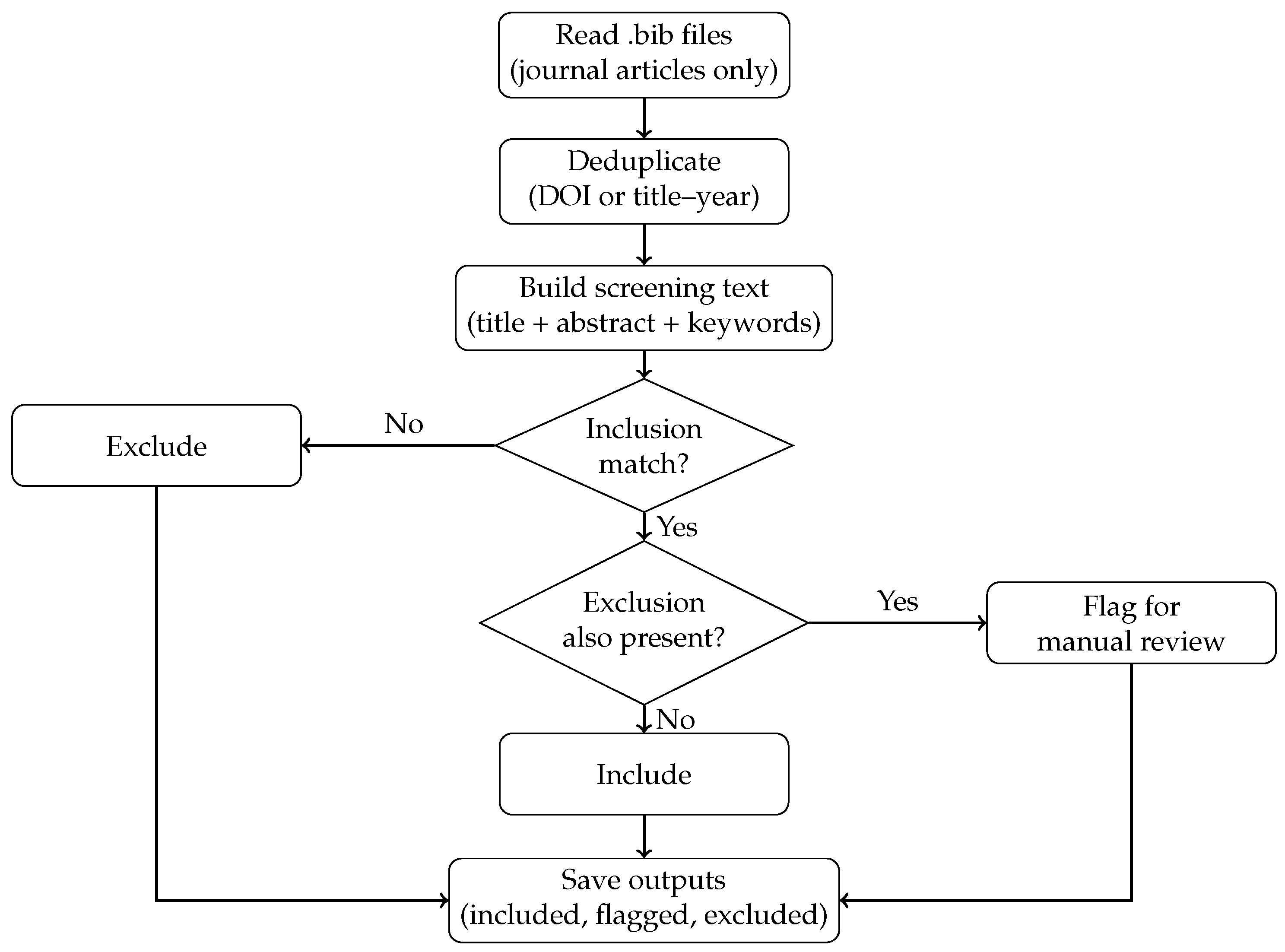
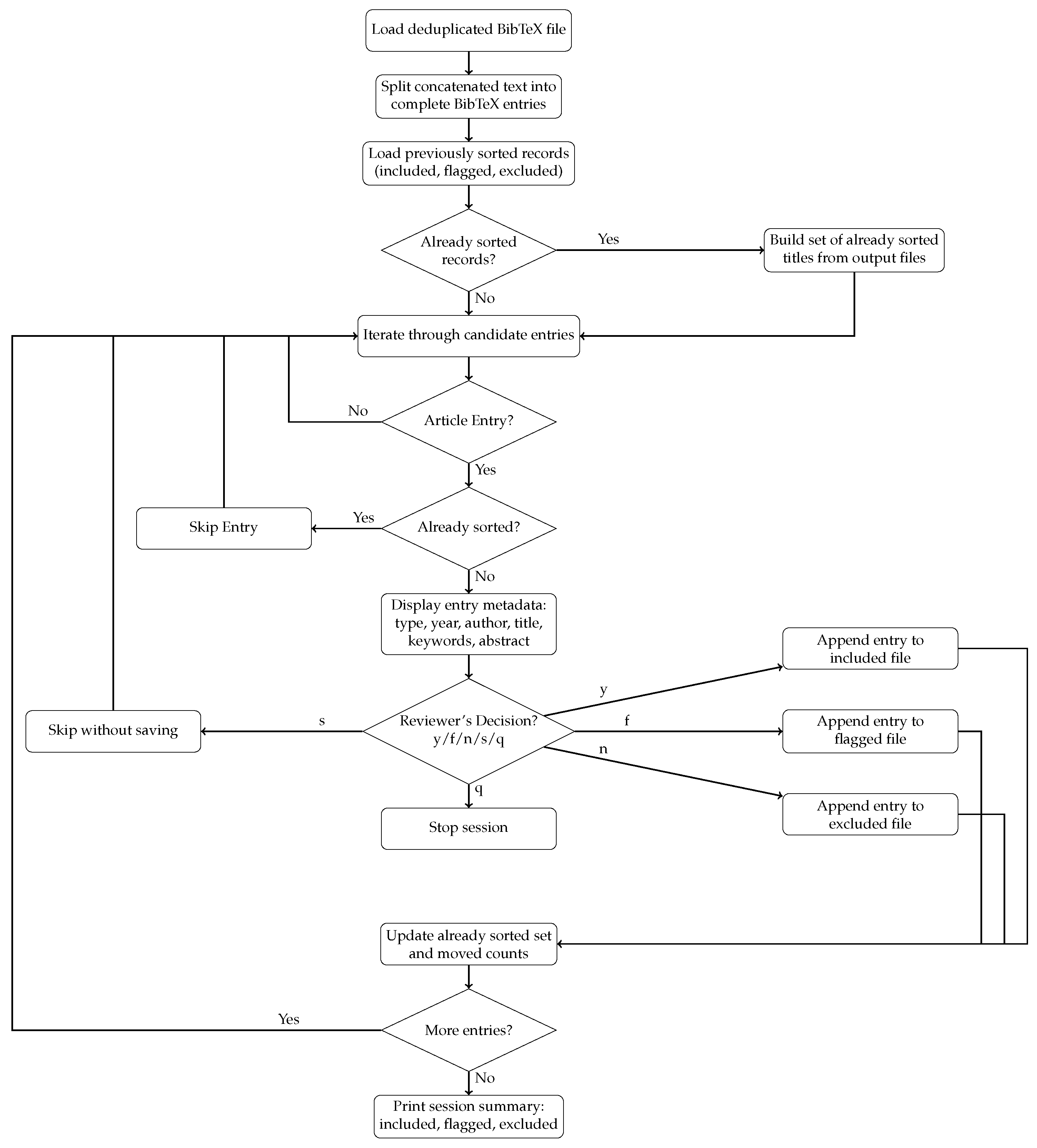
2.3. Study Selection Procedure
2.4. Review Scope and Methodological Constraints
3. Harmonic Source Modeling: A Comparative Synthesis
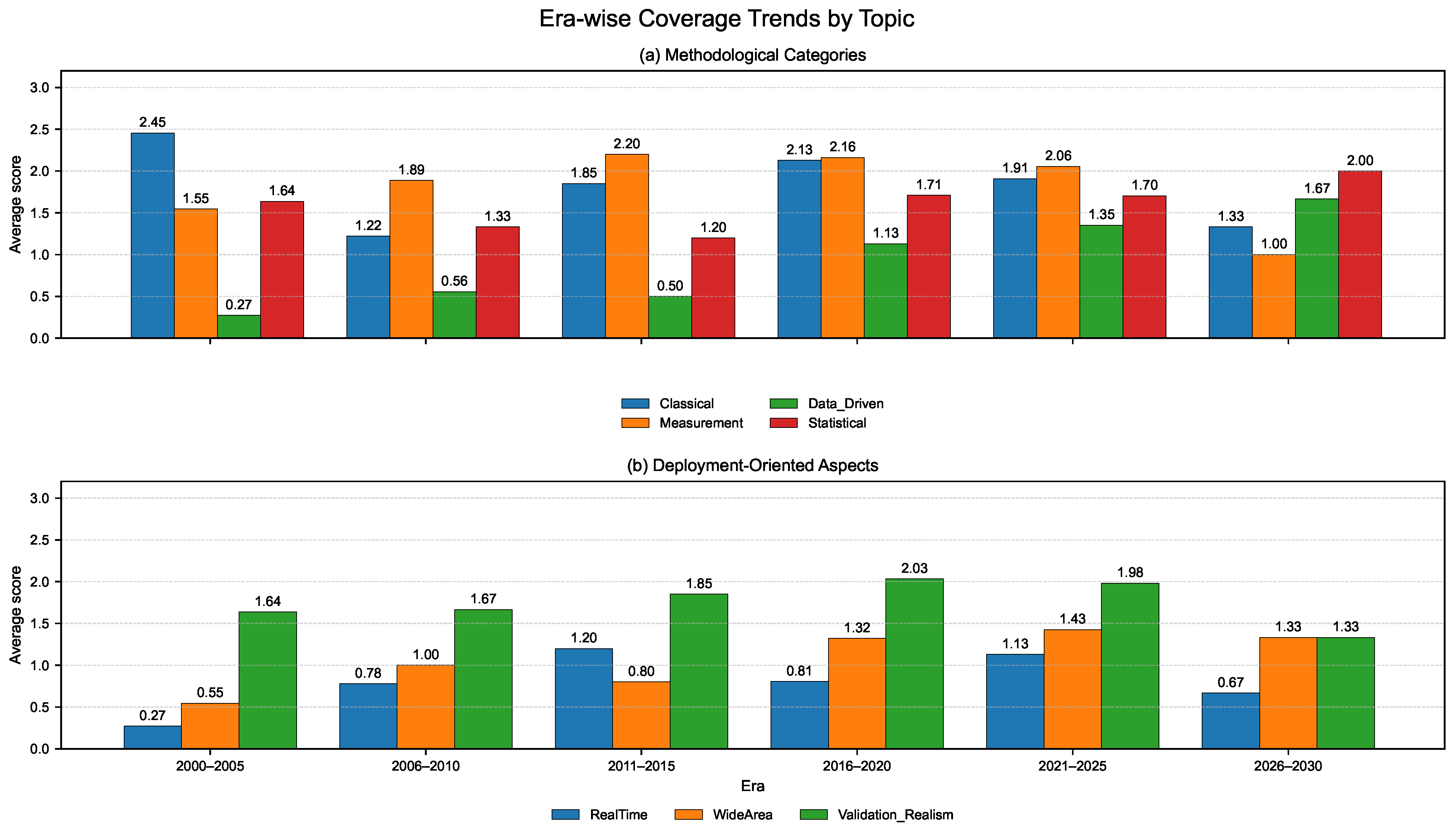
3.1. Synthesis of Review Evidence and Coverage Trends
3.2. Comparative Analysis of Harmonic Modeling Techniques
3.2.1. Classical/Analytical Harmonic Modeling Methods
3.2.2. Measurement-Based Approaches
3.2.3. Data-Driven/AI-Based Methods
3.2.4. Statistical/Probabilistic Methods
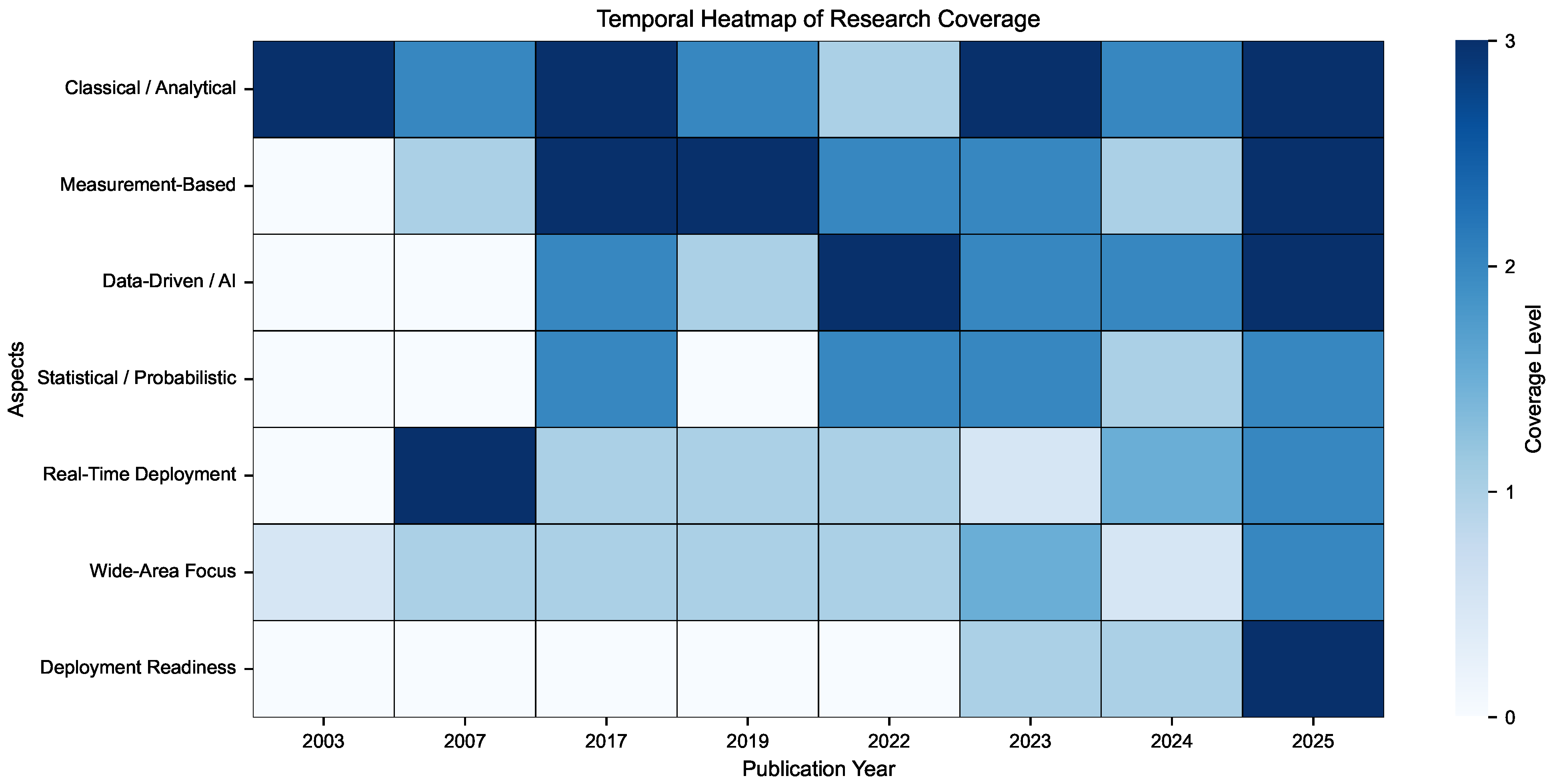
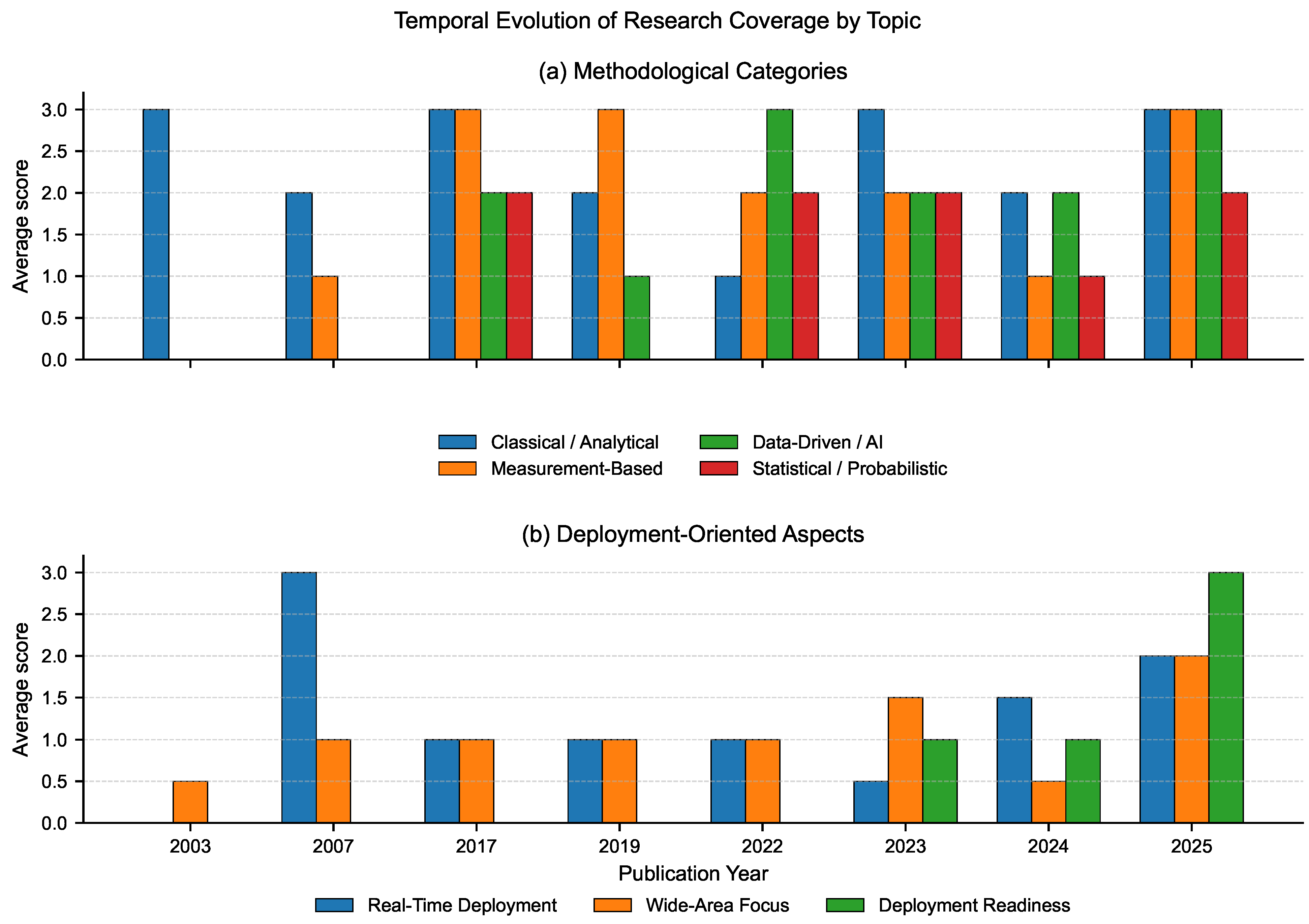
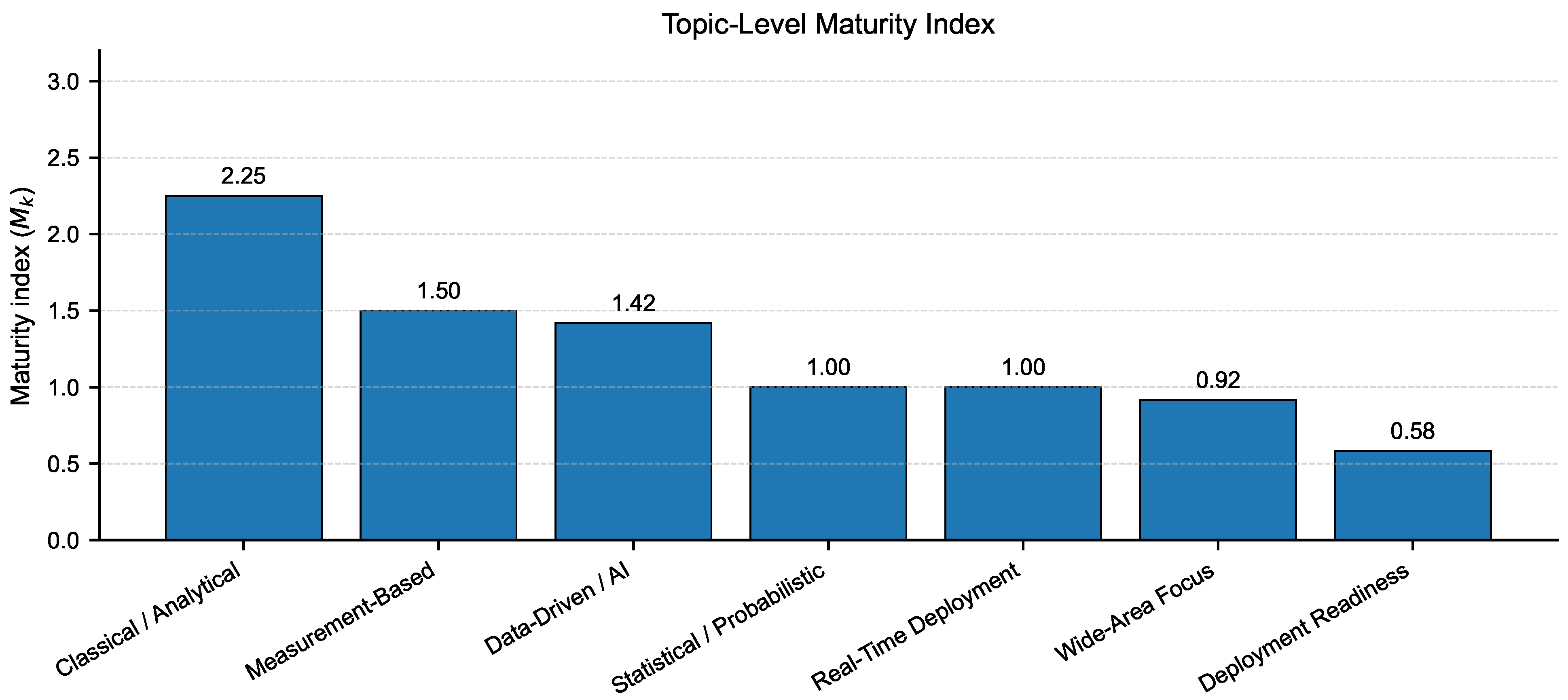
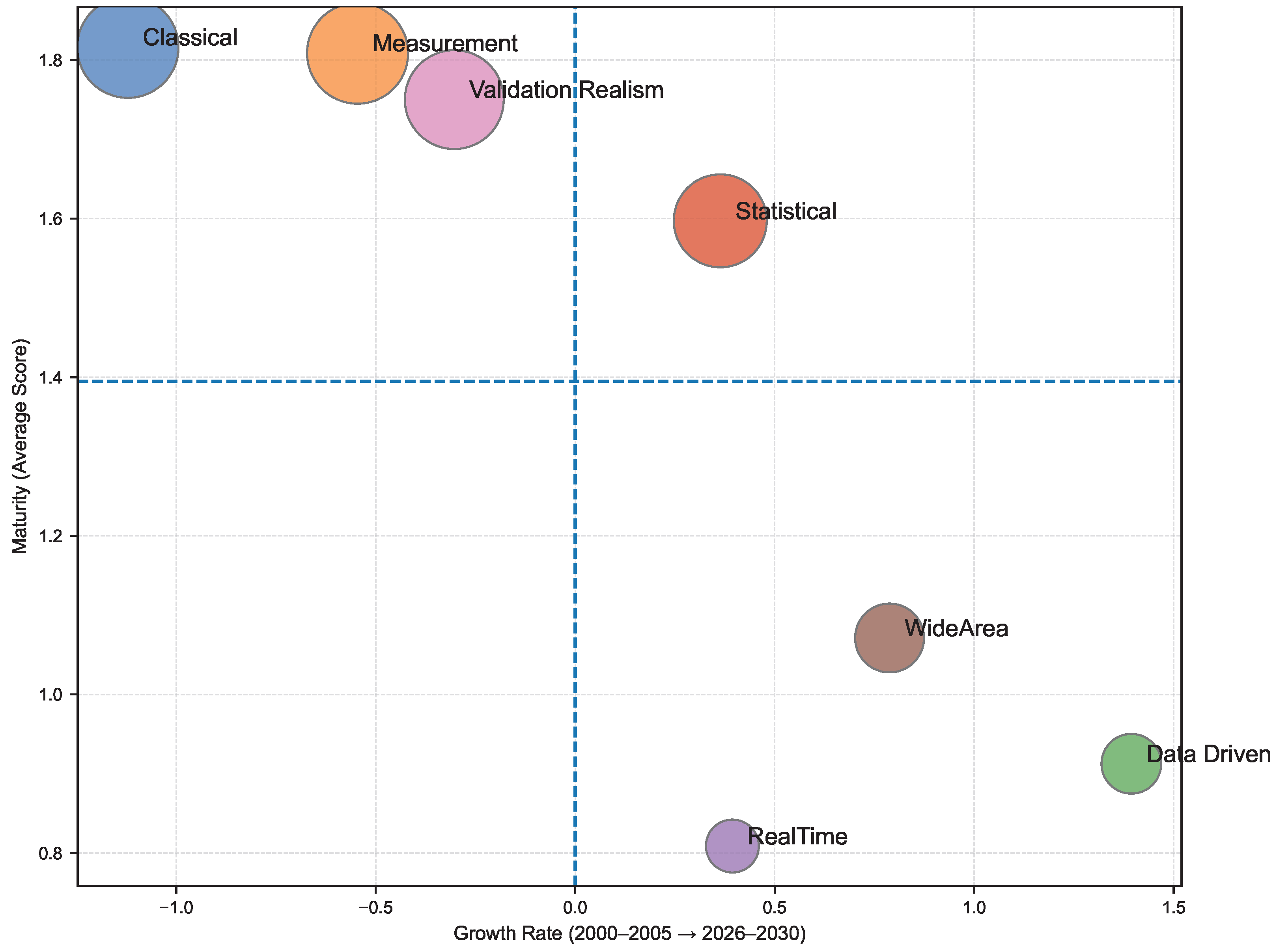
3.3. Temporal Evolution and Maturity–Growth Analysis
3.4. Robustness of Coverage Scoring and Maturity Analysis
3.5. Harmonic Standards Compliance

| Standard(s) | Phase | Primary Model | Supporting Models | Purpose |
|---|---|---|---|---|
| IEEE 519 [119,177,179,181,182], IEC 61000-3-6 [35,45,135] | Design & Planning | Classical/Worst-case | Statistical/Probabilistic | Verify harmonic limits at PCC under worst credible operating conditions |
| EN 50160, IEC 61000-3-6 [79,135,136] | Operational Assessment | Measurement-Based | Statistical (95th percentile) | Demonstrate compliance over representative time windows; acknowledge short-term, random, intermittent nature of residential loads |
| IEEE 1547.1, DSTU EN 50160 [77,111,121] | Operational Forecasting | Data-Driven/AI | Measurement-Based | Anticipate limit violations and support corrective control actions |
| DSTU EN 50160 [178], IEEE 1547.1 [23,121,180] | Real-Time Monitoring | Measurement-Based | AI/Edge Computing | Detect dynamic violations and issue predictive alerts synchronized measurements |
| IEC 61000-3-2, IEC 61000-4-7 [39,100] | Equipment Certification | Equipment Harmonic Models | Signal Processing (FFT) | Ensure device-level emission compliance and instrument conformity |
| All (Life-Cycle) [103,125,183] | Post-Event & Adaptation | Hybrid (Physics + Data) | Statistical/Learning-Based | Refine models, update thresholds, and maintain continuous assurance |
| Compliance Task | Relevant Standard(s) | Suitable Methods | Measurement Requirement | Time Scale/Application |
|---|---|---|---|---|
| Planning compliance verification (THD, harmonic limits at PCC) | IEEE 519, IEC 61000-3-6 | Classical/Analytical + Probabilistic | Network parameters + statistical load models | Offline studies, scenario analysis |
| Operational compliance assessment (95th percentile limits) | EN 50160 | Measurement-Based + Statistical | Continuous voltage/current measurements (PQ monitors, D-PMU) | Minutes to weeks (aggregation windows) |
| Real-time compliance monitoring and violation detection | IEEE 519 (monitoring), EN 50160 | Measurement-Based + AI/Edge | High-resolution synchronized measurements (D-PMU) | Sub-second to seconds |
| Responsibility allocation at PCC/source identification | IEEE 519 (current limits, PCC responsibility) | Measurement-Based (HSE, hierarchical) + AI | Multi-point synchronized measurements | Near real-time/event-based |
| Predictive compliance/preventive control | IEEE 1547.1, EN 50160 | Data-Driven/AI + Measurement-Based | Historical + streaming measurements | Seconds to minutes (forecast horizon) |
| Equipment-level emission compliance | IEC 61000-3-2, IEC 61000-4-7 | Analytical + Signal Processing | Laboratory measurements, FFT-based analysis | Testing/certification phase |
3.6. Real-Time Deployment Considerations
4. Research Gaps and Limitations
4.1. Summary of Research Gaps
4.2. Integration Challenges with Modern Monitoring Infrastructure
4.2.1. Incomplete D-PMU/H-PMU Coverage and Optimal Placement
4.2.2. Heterogeneous Data Streams and Reporting Rates
4.2.3. Communication Architecture and Bandwidth Constraints
4.3. Scalability to Wide-Area Systems
4.3.1. Computational Complexity of Network-Wide Estimation
4.3.2. Hierarchical and Partitioned Monitoring Strategies
4.3.3. Limited Field Validation at Large Scale
4.4. Real-Time Processing Limitations
4.4.1. Latency Requirements vs. Algorithm Complexity
4.4.2. Computational Resource Constraints in Embedded Systems
4.5. Data Quality and Availability Issues
4.5.1. Limited and Noisy Training Datasets for AI Methods
4.5.2. Incomplete Feeder-Level Monitoring
4.5.3. Measurement Errors and Calibration Drift
4.6. Harmonic Source Identification and Responsibility Assignment
4.6.1. Attribution Under Aggregated Measurements
4.6.2. Time-Varying and Stochastic Source Behavior
4.6.3. Lack of Standardized Responsibility Metrics
5. Future Research Directions
Roadmap and Priorities
6. Conclusions
- i
- Classical/analytical and measurement-based methods remain the most mature and consistently validated approaches.
- ii
- Data-driven methods show the strongest growth but are associated with lower levels of validation realism.
- iii
- Application-oriented aspects—including real-time capability, wide-area applicability, and validation realism—exhibit moderate and uneven development, indicating that methodological advances are not yet fully aligned with deployment-oriented progress.
Supplementary Materials
Funding
Data Availability Statement
Conflicts of Interest
Abbreviations
| AI | Artificial Intelligence |
| ANN | Artificial Neural Network |
| APF | Active Power Filtering |
| CSI | Current Source Inverter |
| DFIG | Double Fed Induction Generator |
| DG | Distributed Generation |
| D-PMU | Distribution-level Phasor Measurement Unit |
| DTR | Decision Tree Regression |
| EMT | Electromagnetic Transient |
| EV | Electric Vehicle |
| HC | Harmonic Contribution |
| H-PMU | Harmonic Phasor Measurement Unit |
| HVDC | High-Voltage Direct Current |
| LED | Light Emitting Diode |
| LV | Low Voltage |
| MLM | Machine Learning Metamodels |
| MPPL | Millisecond Pulse Power Load |
| NNR | Neural Network Regression |
| PCC | Point of Common Coupling |
| PV | Photovoltaic |
| RES | Renewable Energy Source |
| SCADA | Supervisory Control and Data Acquisition |
| SVM | Support Vector Machine |
| SVR | Support Vector Regression |
| THD | Total Harmonic Distortion |
| THDi | Current Total Harmonic Distortion |
| VSC | Voltage Source Converter |
| VSD | Variable Speed Drive |
| WAMS | Wide Area Monitoring System |
| WMU | Waveform Measurement Unit |
| WF | Wind Farm |
Appendix A. Search Strategy
| Database | Search Query/Keywords | Filters Applied | Notes |
|---|---|---|---|
| Scopus | (ALL(harmonics) AND ALL( “power systems”)) AND PUBYEAR > 1999 AND PUBYEAR < 2027 AND LIMIT-TO(DOCTYPE, “re”) AND (LIMIT-TO(SUBJAREA, “ENGI”) OR LIMIT-TO(SUBJAREA, “ENER”)) AND LIMIT-TO(LANGUAGE,“English”) | Review articles; English | Boolean search |
| IEEE Xplore | (“All Metadata”:harmonics) AND (“All Metadata”:review OR “systematic review”) | Journals only | Metadata + full-text |
| Web of Science | harmonics (All Fields) AND “power systems” (All Fields) | Article; Review Article | Topic search |
| ScienceDirect | harmonics AND “power systems” | Review articles | Full-text |
| MDPI Energies | harmonics | Engineering; Review; Journal: Energies | Journal filter |
| Database | Search Query/Keywords | Filters Applied | Notes |
|---|---|---|---|
| Scopus | TITLE-ABS-KEY (((harmonic OR harmonics) W/3 (source OR sources OR injection OR emission OR responsibility)) OR “harmonic state estimation” OR ((harmonic OR harmonics) W/3 (measurement OR monitoring OR detection OR identification)) ) AND TITLE-ABS-KEY (“power system*” OR “distribution system* ” OR “distribution network*” OR “transmission system* ” OR grid) AND PUBYEAR > 1999 AND PUBYEAR < 2027 AND (LIMIT-TO (DOCTYPE, “ar”)) AND (LIMIT-TO (LANGUAGE, “English”)) AND (LIMIT-TO (SUBJAREA, “ENGI”) OR LIMIT-TO (SUBJAREA, “ENER”)) | Article; English; Engineering/Energy | Boolean query with proximity operator |
| IEEE Xplore | ((harmonic OR harmonics) NEAR/3 (source OR sources OR injection OR emission OR responsibility) OR “harmonic state estimation” OR (harmonic OR harmonics) NEAR/3 (measurement OR monitoring OR detection OR identification)) AND (“power system*” OR “distribution system*” OR “distribution network*” OR “transmission system*” OR grid) | Journals only | Metadata + full-text search |
| Web of Science | TS = (((harmonic OR harmonics) NEAR/3 (source OR sources OR injection OR emission OR responsibility) OR “harmonic state estimation” OR (harmonic OR harmonics) NEAR/3 (measurement OR monitoring OR detection OR identification)) AND (“power system*” OR “distribution system*” OR “distribution network*” OR “transmission system*” OR grid) ) | Article; English | Topic search (title, abstract, keywords) |
| ScienceDirect | ((“harmonic source” OR “harmonic injection” OR “harmonic emission”) OR (“harmonic state estimation” OR “harmonic monitoring”)) AND (“power system” OR “distribution system” OR “distribution network” OR “transmission system” OR grid) | Research articles | Full-text search |
| MDPI Energies | (harmonics) AND (“power systems” OR “distribution systems”) AND (“harmonic source” OR “harmonic state estimation” OR “harmonic monitoring” OR “harmonic detection” OR “harmonic identification”) | Engineering; Articles; Energies | Journal-specific filtering |
Appendix B. Automated Pre-Screening Procedure
| Stage | Operation | Details |
|---|---|---|
| Text extraction | Field selection | Title, abstract, and author-provided keywords are extracted from each BibTeX record. These fields are selected as they provide the highest information density for identifying methodological relevance. |
| Text aggregation | Unified representation | The extracted fields are concatenated into a single textual sequence to form a unified screening input, ensuring that matching rules are applied consistently across all available descriptive metadata. |
| Normalization | Text standardization | The aggregated text is converted to lowercase, punctuation is removed, and whitespace is normalized. Only alphanumeric characters and hyphens are retained to ensure robust and consistent keyword matching across heterogeneous BibTeX formats. |
| Exact phrase matching | Strong inclusion criterion | Predefined domain-specific phrases (e.g., “harmonic source model”, “harmonic source modeling”, “harmonic source modelling”, “harmonic source identification”, “harmonic source estimation”, “harmonic injection model”, “harmonic injection modeling”, “harmonic current source model”, “harmonic emission model”, “harmonic source characterization”, “harmonic source representation”, “wide-area harmonic monitoring”, “real-time harmonic monitoring”) are matched directly within the screening text. This rule captures studies with explicit and unambiguous relevance to harmonic source analysis. |
| Grouped keyword matching | Flexible inclusion criterion | A lead term ( (“harmonic”, [“source”, “sources”, “injection”, “emission”]), (“harmonics”, [“source”, “sources”, “injection”, “emission”]), (“model”, [“harmonic”, “harmonics”, “source”, “injection”]), (“modeling”, [“harmonic”, “harmonics”, “source”, “injection”]), (“modelling”, [“harmonic”, “harmonics”, “source”, “injection”]), (“estimation”, [“harmonic”, “harmonics”, “source”]), (“identification”, [“harmonic”, “harmonics”, “source”]), (“characterization”, [“harmonic”, “harmonics”, “source”, “emission”]), (“representation”, [“harmonic”, “harmonics”, “source”]), (“monitoring”, [“harmonic”, “harmonics”]), (“measurement”, [“harmonic”, “harmonics”]), (“real-time”, [“harmonic”, “harmonics”, “monitoring”]), (“wide-area”, [“harmonic”, “harmonics”, “monitoring”]), (“stochastic”, [“harmonic”, “harmonics”, “source”, “injection”]), (“probabilistic”, [“harmonic”, “harmonics”, “source”, “injection”]), (“statistical”, [“harmonic”, “harmonics”, “source”, “injection”]), (“measurement-based”, [“harmonic”, “harmonics”, “estimation”, “monitoring”]), (“data-driven”, [“harmonic”, “harmonics”, “estimation”, “monitoring”]), (“machine learning”, [“harmonic”, “harmonics”, “estimation”, “identification”]), (“artificial intelligence”, [“harmonic”, “harmonics”, “estimation”, “identification”]) must co-occur with at least one companion term within the screening text. This allows detection of relevant studies that use varied terminology while preserving contextual meaning. |
| Exclusion signal detection | Non-target identification | Terms associated with mitigation or filtering (e.g., “active power filter”, “passive power filter”, “hybrid power filter”, “harmonic filter design”, “filter tuning”, “harmonic mitigation”, “harmonic compensation”, “custom power device”, “thd reduction”, “thd improvement”, “power quality index”) are identified. These terms do not directly trigger exclusion but are used to detect potential scope conflicts when combined with inclusion signals. |
| Decision logic | Rule combination | Records are classified using a conservative logic: inclusion is assigned if either exact phrase or grouped keyword criteria are satisfied; records exhibiting both inclusion and exclusion signals are flagged for manual review; records without inclusion signals are excluded. |


Raw export counts by BibTeX entry type

article: 7082
conference: 2
incollection: 6
inproceedings: 3

Screening summary

Total raw entries : 7093
Total @article only : 7082
Duplicates removed : 2042
Unique entries : 5040
Included : 3557
Flagged manual rev. : 480
Excluded : 1003

[1/3557]
YEAR : 2013
AUTHOR : Teng, Jen-Hao; Leou, Rong-Ceng; Chang, Chuo-Yean; Chan, Shun-Yu
TITLE : Harmonic Current Predictors for Wind Turbines
KEYWORDS : --
ABSTRACT : The harmonic impact caused by wind turbines should be carefully investigated
before wind turbines are interconnected. However, the harmonic currents of wind turbines
are not easily predicted due to variations in wind speed. If the harmonic current outputs
can be predicted accurately, the harmonic impact of wind turbines and wind farms on power
grids can be analyzed efficiently. Therefore, this paper analyzes the harmonic current
characteristics of wind turbines and investigates the feasibility of developing harmonic
current predictors. Field measurement, data sorting, and analysis are conducted for wind
turbines. Two harmonic current predictors are proposed based on the measured harmonic
data. One is the auto-regressive and moving average (ARMA)-based harmonic current
predictor, which can be used for real-time prediction. The other is a stochastic harmonic
current predictor considering the probability density distributions of harmonic currents.

Decision: [y] confirm include; [f] flag/recheck; [s] skip; [q] quit
Your choice: y
Saved.
Appendix C. Coverage Scoring and Maturity Analysis
References
- Lamich, M.; Balcells, J.; Corbalán, M.; Griful, E. Nonlinear Loads Model for Harmonics Flow Prediction, Using Multivariate Regression. IEEE Trans. Ind. Electron. 2017, 64, 4820–4827. [Google Scholar] [CrossRef]
- Mahmoud, A.; Owen, R.; Ortmeyer, T.; Abeyasa-kere, D.; Blair, W.; Brownfield, G.; Calabrese, C.; Caldewell, R.; Capelli, R.; Chakravarthi, K.; et al. Power System Harmonics: An Overview. IEEE Trans. Power Appar. Syst. 1983, 102, 2455–2460. [Google Scholar] [CrossRef]
- Sun, Y.; Xie, X.; Zhang, L.; Li, S. A Voltage Adaptive Dynamic Harmonic Model of Nonlinear Home Appliances. IEEE Trans. Ind. Electron. 2020, 67, 3607–3617. [Google Scholar] [CrossRef]
- Li, Z.; He, Z.; Song, Y.; Tang, L.; Wang, Y. Stochastic Assessment of Harmonic Propagation and Amplification in Power Systems Under Uncertainnty. IEEE Trans. Power Deliv. 2021, 36, 1149–1158. [Google Scholar] [CrossRef]
- Zhi, H.; Zhang, M.; Li, R.; Zhao, J.; Wang, J.; Li, X.; Cao, J.; Li, R.; Gao, L. A Power-based Piecewise Probabilistic Harmonic Model of Secondary Residential System. In Proceedings of the IEEE 5th Conference on Energy Internet and Energy System Integration (EI2); IEEE: New York, NY, USA, 2021; pp. 1175–1179. [Google Scholar] [CrossRef]
- Burch, R.; Chang, G.; Hatziadoniu, C.; Grady, M.; Liu, Y.; Marz, M.; Ortmeyer, T.; Ranade, S.; Ribeiro, P.; Xu, W. Impact of aggregate linear load modeling on harmonic analysis: A comparison of common practice and analytical models. IEEE Trans. Power Deliv. 2003, 18, 625–630. [Google Scholar] [CrossRef]
- Abdelsamad, A.S.; Myrzik, J.M.A.; Kaufhold, E.; Meyer, J.; Schegner, P. Voltage-Source Converter Harmonic Characteristic Modeling Using Hammerstein–Wiener Approach. IEEE Can. J. Electr. Comput. Eng. 2021, 44, 402–410. [Google Scholar] [CrossRef]
- Abu-Hashim, R.; Burch, R.; Chang, G.; Grady, M.; Gunther, E.; Halpin, M.; Harziadonin, C.; Liu, Y.; Marz, M.; Ortmeyer, T.; et al. Test Systems for Harmonics Modeling and Simulation. IEEE Trans. Power Deliv. 1999, 14, 579–587. [Google Scholar] [CrossRef]
- Bosovic, A.; Renner, H.; Abart, A.; Traxler, E.; Meyer, J.; Domagk, M.; Music, M. Deterministic Aggregated Harmonic Source Models for Harmonic Analysis of Large Medium Voltage Distribution Networks. IET Gener. Transm. Distrib. 2019, 13, 4421–4430. [Google Scholar] [CrossRef]
- Zhou, W.; Xie, H.; Tong, Y. Propagation mechanisms research of harmonics produced by distributed generations in distribution network. In Proceedings of the IEEE 15th International Conference on Harmonics and Quality of Power; IEEE: New York, NY, USA, 2012; pp. 774–777. [Google Scholar] [CrossRef]
- Ghosh, A.; Ledwich, G. Power Quality Enhancement Using Custom Power Devices, 1st ed.; Power Electronics and Power Systems; Springer: New York, NY, USA, 2002; p. 460. [Google Scholar] [CrossRef]
- Wang, W.; Nino, E.; Xu, W. Harmonic impedance measurement using a thyristor-controlled short circuit. IET Gener. Transm. Distrib. 2007, 1, 701–713. [Google Scholar] [CrossRef]
- Kandev, N.; Chenard, S. Method for determining customer contribution to harmonic variations in a large power network. In Proceedings of the International Conference Harmonics and Quality of Power (ICHQP), Bergamo, Italy, 26–29 September 2010; IEEE: New York, NY, USA, 2010. [Google Scholar] [CrossRef]
- Rodriguez-Pajaron, P.; Hernandez, H.; Mendonca, A.; Jovica, V.M. Residential Harmonic Injection Models Based on Field Measurements. IEEE Trans. Power Deliv. 2022, 38, 575–587. [Google Scholar] [CrossRef]
- Moradifar, A.; Foroud, A.A.; Firouzjah, K.G. Intelligent localisation of multiple non-linear loads considering impact of harmonic state estimation accuracy. IET Gener. Transm. Distrib 2017, 11, 1943–1953. [Google Scholar] [CrossRef]
- Yin, Z.; Sun, Y.; Yu, T. New methods exploration for harmonic source identification technologies. In Proceedings of the 4th International Conference on Electric Utility Deregulation and Restructuring and Power Technologies (DRPT); IEEE: New York, NY, USA, 2011; pp. 399–402. [Google Scholar] [CrossRef]
- Prates, M.O.; Almeida, P.M.; Silva, L.R.; Duque, C.A.; da Silveira, P.M.; Cerqueira, A.S.; Ribeiro, P.F. Characterization of electronic converters by time-varying harmonic phasors and waveforms. In Proceedings of the IEEE 15th International Conference on Harmonics and Quality of Power; IEEE: New York, NY, USA, 2012. [Google Scholar] [CrossRef]
- Vijay, R.; Kumar, J.S. Non Intrusive Load Monitoring and Load Disaggregation using Transient Data Analysis. In Proceedings of the Conference on Information and Communication Technology (CICT’18), Jabalpur, India, 26–28 October 2018; IEEE: New York, NY, USA, 2018. [Google Scholar] [CrossRef]
- Xu, W.; Liu, Y. A method for determining customer and utility harmonic contributions at the point of common coupling. IEEE Trans. Power Deliv. 2000, 15, 804–811. [Google Scholar] [CrossRef]
- Pyzalski, T.; Wilkosz, K. Identification of harmonic sources in a power system: A new method. In Proceedings of the IEEE Power Tech, St. Petersburg, Russia, 27–30 June 2005; IEEE: New York, NY, USA, 2005. [Google Scholar] [CrossRef]
- Carbone, R.; Carpinelli, G.; Verde, P.; Fracchia, M.; Morrison, R.E.; Pierrat, L. A review of probabilistic methods for the analysis of low frequency power system harmonic distortion. In Proceedings of the International Conference on Electromagnetic Compatibility; IET: London, UK, 1994; pp. 148–155. [Google Scholar] [CrossRef]
- Sun, Y.; Li, S.; Xu, Q.; Xie, X.; Jin, Z.; Shi, F.; Zhan, H. Harmonic Contribution Evaluation Based on the Distribution-Level PMUs. IEEE Trans. Power Deliv. 2021, 36, 909–919. [Google Scholar] [CrossRef]
- Ahmadi-Gorjayi, F.; Mohsenian-Rad, H. A Physics-Aware MIQP Approach to Harmonic State Estimation in Low-Observable Power Distribution Systems Using Harmonic Phasor Measurement Units. IEEE Trans. Smart Grid 2023, 14, 2111–2124. [Google Scholar] [CrossRef]
- Kitchenham, B.A. Procedures for Performing Systematic Reviews; Keele University: Keele, UK, 2004. [Google Scholar]
- Kitchenham, B.; Brereton, O.P.; Budgen, D.; Turner, M.; Bailey, J.; Linkman, S. Systematic literature reviews in software engineering—A systematic literature review. Inf. Softw. Technol. 2009, 51, 7–15. [Google Scholar] [CrossRef]
- Page, M.J.; McKenzie, J.E.; Bossuyt, P.M.; Boutron, I.; Hoffmann, T.C.; Mulrow, C.D.; Shamseer, L.; Tetzlaff, J.M.; Akl, E.A.; Brennan, S.E.; et al. The PRISMA 2020 statement: An updated guideline for reporting systematic reviews. BMJ 2021, 372, n71. [Google Scholar] [CrossRef]
- Watson, N.R.; Arrillaga, J. Harmonics in large systems. Electr. Power Syst. Res. 2003, 66, 15–29. [Google Scholar] [CrossRef]
- Herraiz, S.; Sainz, L.; Clua, J. Review of harmonic load flow formulations. IEEE Trans. Power Deliv. 2003, 18, 1079–1087. [Google Scholar] [CrossRef]
- Pak, L.F.; Dinavahi, V.; Chang, G.; Steurer, M.; Ribeiro, P.F. Real-Time Digital Time-Varying Harmonic Modeling and Simulation Techniques. IEEE Trans. Power Deliv. 2007, 22, 1218–1227. [Google Scholar]
- Kalair, A.; Abas, N.; Kalair, A.; Saleem, Z.; Khan, N. Review of harmonic analysis, modeling and mitigation techniques. Renew. Sustain. Energy Rev. 2017, 78, 1152–1187. [Google Scholar] [CrossRef]
- Sinvula, R.; Abo-Al-Ez, K.M.; Kahn, M.T. Harmonic Source Detection Methods: A Systematic Literature Review. IEEE Access 2019, 7, 74283–74299. [Google Scholar] [CrossRef]
- Eroğlu, H.; Cuce, E.; Cuce, P.M.; Gul, F.; Iskenderoğlu, A. Harmonic problems in renewable and sustainable energy systems: A comprehensive review. Sustain. Energy Technol. Assess. 2021, 48, 101566. [Google Scholar] [CrossRef]
- Eslami, A.; Negnevitsky, M.; Franklin, E.; Lyden, S. Review of AI applications in harmonic analysis in power systems. Renew. Sustain. Energy Rev. 2022, 154, 111897. [Google Scholar] [CrossRef]
- Taghvaie, A.; Warnakulasuriya, T.; Kumar, D.; Zare, F.; Sharma, R.; Vilathgamuwa, D.M. Comprehensive Review of Harmonic Issues and Estimation Techniques in Power System Networks Based on Traditional and Artificial Intelligence/Machine Learning. IEEE Access 2023, 11, 31417–31442. [Google Scholar] [CrossRef]
- Hu, Z.; Han, Y.; Zalhaf, A.S.; Zhou, S.; Zhao, E.; Yang, P. Harmonic Sources Modeling and Characterization in Modern Power Systems: A Comprehensive Overview. Electr. Power Syst. Res. 2023, 218, 109234. [Google Scholar] [CrossRef]
- Daniel, K.; Kütt, L.; Iqbal, M.N.; Shabbir, N.; Raja, H.A.; Sardar, M.U. A Review of Harmonic Detection, Suppression, Aggregation, and Estimation Techniques. Appl. Sci. 2024, 14, 10966. [Google Scholar] [CrossRef]
- Ali, M.; Al-Ismail, F.S.; Gulzar, M.M.; Khalid, M. A review on harmonic elimination and mitigation techniques in power converter based systems. Electr. Power Syst. Res. 2024, 234, 110573. [Google Scholar] [CrossRef]
- Qian, G.; Wang, Q.; He, S.; Dai, W.; Wei, N.; Zhou, N. Harmonic Modeling and Analysis for Parallel 12-Pulse Rectifier under Unbalanced Voltage Condition in Frequency-Domain. Energies 2022, 15, 3946. [Google Scholar] [CrossRef]
- Boroujeni, K.M.; Safargholi, F.; Malekian, K. A harmonic model validation methodology for power generation units based on voltage-current phasor characteristic. Int. J. Electr. Power Energy Syst. 2025, 165, 110494. [Google Scholar] [CrossRef]
- Duan, S.; Zhang, F.; Yu, L.; Zheng, C.; Lin, X.; Cai, K.; Jin, Q.; Wang, W.; Wang, H.; Yang, Y. Dynamic compensation study of distribution network harmonic reconstruction based on equivalent harmonic source method. J. Phys. Conf. Ser. 2024, 2846, 012030. [Google Scholar] [CrossRef]
- Shklyarskiy, Y.; Dobush, I.; Carrizosa, M.J.; Dobush, V.; Skamyin, A. Method for Evaluation of the Utility’s and Consumers’ Contribution to the Current and Voltage Distortions at the PCC. Energies 2021, 14, 8416. [Google Scholar] [CrossRef]
- Shu, Q.; Zhao, S.; Xu, F. Novel estimation method of utility harmonic impedance based on short-term impedance minimum variance criterion. IET Gener. Transm. Distrib. 2020, 14, 2951–2958. [Google Scholar] [CrossRef]
- Farhoodnea, M.; Mohamed, A.; Shareef, H.; Zayandehroodi, H. An enhanced method for contribution assessment of utility and customer harmonic distortions in radial and weakly meshed distribution systems. Int. J. Electr. Power Energy Syst. 2012, 43, 222–229. [Google Scholar] [CrossRef]
- Nassif, A.B.; Yong, J.; Mazin, H.; Wang, X.; Xu, W. An Impedance-Based Approach for Identifying Interharmonic Sources. IEEE Trans. Power Deliv. 2011, 26, 333–340. [Google Scholar] [CrossRef]
- Ghanavati, H.; Kocewiak, Ł.; Jalilian, A.; Gomis-Bellmunt, O. Transfer function-based analysis of harmonic and interharmonic current summation in type-III wind power plants using DFIG sequence impedance modeling. Electr. Power Syst. Res. 2021, 199, 107419. [Google Scholar] [CrossRef]
- Singh, R.S.; Ćuk, V.; Cobben, S. Measurement-Based Distribution Grid Harmonic Impedance Models and Their Uncertainties. Energies 2020, 13, 4259. [Google Scholar] [CrossRef]
- Molina, J.; Sainz, L.; Jose Mesas, J.; Gabriel Bergas, J. Model of discharge lamps with magnetic ballast. Electr. Power Syst. Res. 2013, 95, 112–120. [Google Scholar] [CrossRef]
- Joshi, P.; Jain, S.K. An improved active power direction method for harmonic source identification. Trans. Inst. Meas. Control 2020, 42, 2569–2577. [Google Scholar] [CrossRef]
- Tang, X.; Xu, F.; Wang, W.; Wang, C.; Chen, C.; Fang, J.; Gong, L.; Guo, C. Harmonic Contribution Quantification for Multiple Harmonic Sources Based on Minimum Impedance Fluctuation. IEEE Access 2023, 11, 87409–87419. [Google Scholar] [CrossRef]
- Tang, Z.; Li, H.; Xu, F.; Shu, Q.; Jiang, Y. A Harmonic Impedance Estimation Method Based on the Cauchy Mixed Model. Math. Probl. Eng. 2020, 2020, 1580475. [Google Scholar] [CrossRef]
- Liao, H. Power System Harmonic State Estimation and Observability Analysis via Sparsity Maximization. IEEE Trans. Power Syst. 2007, 22, 15–23. [Google Scholar] [CrossRef]
- Medina, A.; Segundo-Ramirez, J.; Ribeiro, P.; Xu, W.; Lian, K.L.; Chang, G.W.; Dinavahi, V.; Watson, N.R. Harmonic Analysis in Frequency and Time Domain. IEEE Trans. Power Deliv. 2013, 28, 1813–1821. [Google Scholar] [CrossRef]
- Ngandui, E.; Sicard, P. Probabilistic models of harmonic currents produced by twelve-pulse AC/DC converters. IEEE Trans. Power Deliv. 2004, 19, 1898–1906. [Google Scholar] [CrossRef]
- Xu, W.; Liu, X.; Liu, Y. An investigation on the validity of power-direction method for harmonic source determination. IEEE Trans. Power Deliv. 2003, 18, 214–219. [Google Scholar] [CrossRef]
- Zhang, Y.; Kang, Y.; Zheng, Z. A General Model for Residential Non-linear Loads Based on Dynamic Equivalent Admittance. IEEE Trans. Power Deliv. 2025, 40, 3004–3016. [Google Scholar] [CrossRef]
- Yang, Y.; Wang, S.; Shi, M.; Zheng, X. A Piecewise Linearization Based Method for Crossed Frequency Admittance Matrix Model Calculation of Harmonic Sources. Sensors 2025, 25, 582. [Google Scholar] [CrossRef]
- Chang, G. Characteristics and modeling of harmonic sources-power electronic devices. IEEE Trans. Power Deliv. 2001, 16, 791–800. [Google Scholar] [CrossRef]
- Yang, Y.; Wang, S.; Ren, J.; Guo, Y.; Chen, S.; Shi, M.; Zheng, X. A three parallel branches harmonic model with adaptive capability of operating state variation. Int. J. Electr. Power Energy Syst. 2025, 169, 110741. [Google Scholar] [CrossRef]
- Salles, D.; Jiang, C.; Xu, W.; Freitas, W.; Mazin, H.E. Assessing the Collective Harmonic Impact of Modern Residential Loads—Part I: Methodology. IEEE Trans. Power Deliv. 2012, 27, 1937–1946. [Google Scholar] [CrossRef]
- Bracale, A.; Collin, A.J.; Ishaq, M.; Langella, R. Comparison of frequency domain models for assessing the harmonic emissions of low voltage photovoltaic systems. IET Renew. Power Gener. 2025, 19, e13152. [Google Scholar] [CrossRef]
- Alonso, M.; Donsion, M. An improved time domain arc furnace model for harmonic analysis. IEEE Trans. Power Deliv. 2004, 19, 367–373. [Google Scholar] [CrossRef]
- Zhang, C.; Li, Y.; Han, W.; Song, G.; Zhang, H. Time-domain harmonic source location and evaluation methods based on non-linear and time-varying properties of devices. IET Gener. Transm. Distrib. 2024, 18, 2604–2624. [Google Scholar] [CrossRef]
- Zang, T.; He, Z.; Wang, Y.; Fu, L.; Peng, Z.; Qian, Q. A Piecewise Bound Constrained Optimization for Harmonic Responsibilities Assessment under Utility Harmonic Impedance Changes. Energies 2017, 10, 936. [Google Scholar] [CrossRef]
- Safargholi, F.; Malekian, K.; Schufft, W. On the Dominant Harmonic Source Identification—Part II: Application and Interpretation of Methods. IEEE Trans. Power Deliv. 2018, 33, 1278–1287. [Google Scholar] [CrossRef]
- Xu, W.; Langella, R.; Bracale, A.; Sun, Y.; Lian, K.L.; Wang, Y.; David, J. Modeling of Inverter-Based Resources for Power System Harmonics Studies. IEEE Trans. Power Deliv. 2025, 40, 166–177. [Google Scholar] [CrossRef]
- Zhao, Y.; Li, J.; Xia, D. Harmonic source identification and current separation in distribution systems. Int. J. Electr. Power Energy Syst. 2004, 26, 1–7. [Google Scholar] [CrossRef]
- Ahsan, S.M.; Khan, H.A.; Hussain, A.; Tariq, S.; Zaffar, N.A. Harmonic Analysis of Grid-Connected Solar PV Systems with Nonlinear Household Loads in Low-Voltage Distribution Networks. Sustainability 2021, 13, 3709. [Google Scholar] [CrossRef]
- Merabet, L.; Saad, S.; Abdeslam, D.O.; Merckle, J. Direct neural method for harmonic currents estimation using adaptive linear element. Electr. Power Syst. Res. 2017, 152, 61–70. [Google Scholar] [CrossRef]
- Saxena, D.; Bhaumik, S.; Singh, S.N. Identification of Multiple Harmonic Sources in Power System Using Optimally Placed Voltage Measurement Devices. IEEE Trans. Ind. Electron. 2014, 61, 2483–2492. [Google Scholar] [CrossRef]
- Rodriguez-Pajaron, P.; Hernandez, A.; Milanovic, J. Estimation of Harmonics in Partly Monitored Residential Distribution Networks With Unknown Parameters and Topology. IEEE Trans. Smart Grid 2022, 13, 3014–3027. [Google Scholar] [CrossRef]
- Zhou, W.; Ardakanian, O.; Zhang, H.T.; Yuan, Y. Bayesian Learning-Based Harmonic State Estimation in Distribution Systems With Smart Meter and DPMU Data. IEEE Trans. Smart Grid 2020, 11, 832–845. [Google Scholar] [CrossRef]
- Zhang, Y.; Lin, C.; Shao, Z.; Liu, B. A Non-Intrusive Identification Method of Harmonic Source Loads for Industrial Users. IEEE Trans. Power Deliv. 2022, 37, 4358–4369. [Google Scholar] [CrossRef]
- Zhang, Y.; Wang, Y.; Guo, J.; Shao, Z. A Method for Responsibility Division of Multi-Harmonic Sources Based on Canonical Correlation Analysis. Symmetry 2021, 13, 1451. [Google Scholar] [CrossRef]
- Ye, G.; Nijhuis, M.; Cuk, V.; Cobben, J.S. Stochastic Residential Harmonic Source Modeling for Grid Impact Studies. Energies 2017, 10, 372. [Google Scholar] [CrossRef]
- Xue, H.; Zhang, P. Subspace-Least Mean Square Method for Accurate Harmonic and Interharmonic Measurement in Power Systems. IEEE Trans. Power Deliv. 2012, 27, 1260–1267. [Google Scholar] [CrossRef]
- Xu, F.; Wang, C.; Guo, K.; Shu, Q.; Ma, Z.; Zheng, H. Harmonic Sources’ Location and Emission Estimation in Underdetermined Measurement System. IEEE Trans. Instrum. Meas. 2021, 70, 9003511. [Google Scholar] [CrossRef]
- Kan, R.; Xu, Y.; Li, Z.; Lu, M. Calculation of probabilistic harmonic power flow based on improved three-point estimation method and maximum entropy as distributed generators access to distribution network. Electr. Power Syst. Res. 2024, 230, 110197. [Google Scholar] [CrossRef]
- Xiao, X.; Zhao, L.; Zhou, S.; Liu, H.; Fu, Z.; Hu, D. Harmonic and Interharmonic Measurement Method Using Two-Fold Compound Convolution Windows and Zoom Fast Fourier Transform. Energies 2025, 18, 4047. [Google Scholar] [CrossRef]
- Xiao, X.; Li, Z.; Wang, Y.; Zhou, Y. A Practical Approach to Estimate Harmonic Distortions in Residential Distribution System. IEEE Trans. Power Deliv. 2021, 36, 1418–1427. [Google Scholar] [CrossRef]
- Xiao, Y.; Fu, J.; Hu, B.; Li, X.; Deng, C. Problems of voltage transducer in harmonic measurement. IEEE Trans. Power Deliv. 2004, 19, 1483–1487. [Google Scholar] [CrossRef]
- Sinha, P.; Goswami, S.K.; Nath, S. Wavelet-based technique for identification of harmonic source in distribution system. Int. Trans. Electr. Energy Syst. 2016, 26, 2552–2572. [Google Scholar] [CrossRef]
- Roscoe, A.J. Exploring the relative performance of frequency-tracking and fixed-filter phasor measurement unit algorithms under C37.118 test procedures, the effects of interharmonics, and initial attempts at merging P-Class response with M-Class filtering. IEEE Trans. Instrum. Meas. 2013, 62, 2140–2153. [Google Scholar] [CrossRef]
- Shuai, W.; Bai, H.; Peng, Y.; Yao, R.; Liu, Y.; Shuai, Z. A DGCRN-based harmonic source localization method for distribution systems with network uncertainty. Int. J. Electr. Power Energy Syst. 2025, 173, 111404. [Google Scholar] [CrossRef]
- Srinivasan, D.; Ng, W.; Liew, A. Neural-network-based signature recognition for harmonic source. IEEE Trans. Power Deliv. 2006, 21, 398–405. [Google Scholar] [CrossRef]
- Sharma, S.; Verma, V.; Tariq, M.; Urooj, S. Reduced Sensor-Based Harmonic Resonance Detection and its Compensation in Power Distribution System With SAPF. IEEE Access 2022, 10, 59942–59958. [Google Scholar] [CrossRef]
- Pramanik, M.; Routray, A.; Mitra, P. A two-stage adaptive symmetric-strong-tracking square-root cubature Kalman filter for harmonics and interharmonics estimation. Electr. Power Syst. Res. 2022, 210, 108133. [Google Scholar] [CrossRef]
- Sun, X.; Lei, W.; Dai, Y.; Deng, L.; Zhang, X.; Hu, L.; Liu, Q. Harmonic impedance optimization scheme for multi-resonance systems to suppress resonance. IET Gener. Transm. Distrib. 2024, 18, 2043–2054. [Google Scholar] [CrossRef]
- Stevanović, D.; Petković, P. A single-point method for identification sources of harmonic pollution applicable to standard power meters. Electr. Eng. 2015, 97, 165–174. [Google Scholar] [CrossRef]
- Wu, T.; Jiang, D.; Wang, Y.; Lei, A. Study on a Harmonic Measurement and Analysis Method for Power Supply System. Int. J. Emerg. Electr. Power Syst. 2017, 18, 20160271. [Google Scholar] [CrossRef]
- Wang, X.; Blaabjerg, F.; Wu, W. Modeling and Analysis of Harmonic Stability in an AC Power-Electronics-Based Power System. IEEE Trans. Power Electron. 2014, 29, 6421–6431. [Google Scholar] [CrossRef]
- Valtierra-Rodriguez, M.; Alfredo Osornio-Rios, R.; García-Pérez, A.; Romero-Troncoso, R.J. FPGA-based neural network harmonic estimation for continuous monitoring of the power line in industrial applications. Electr. Power Syst. Res. 2013, 98, 51–57. [Google Scholar] [CrossRef]
- Ukai, H.; Nakamura, K.; Matsui, N. DSP- and GPS-based synchronized measurement system of harmonics in wide-area distribution system. IEEE Trans. Ind. Electron. 2003, 50, 1159–1164. [Google Scholar] [CrossRef]
- Teng, J.H.; Leou, R.C.; Chang, C.Y.; Chan, S.Y. Harmonic Current Predictors for Wind Turbines. Energies 2013, 6, 1314–1328. [Google Scholar] [CrossRef]
- Qu, J.; Niu, M.; Lin, Q.; Li, Y. Application of electrical nonlinear load harmonic analysis method integrating intelligent sensor data in intelligent agricultural power management. Meas. Sens. 2025, 38, 101810. [Google Scholar] [CrossRef]
- Wang, Y.; Ma, H.; Xiao, X.; Wang, Y.; Zhang, Y.; Wang, H. Harmonic State Estimation for Distribution Networks Based on Multi-Measurement Data. IEEE Trans. Power Deliv. 2023, 38, 2311–2325. [Google Scholar] [CrossRef]
- Tao, C.; Shanxu, D.; Ting, R.; Fangrui, L. A robust parametric method for power harmonic estimation based on M-Estimators. Measurement 2010, 43, 67–77. [Google Scholar] [CrossRef]
- Zhu, X.; Peng, Q.; Zou, D.; Wang, S.; Wang, H.; Zhou, F.; Chu, D. Harmonic voltage phasor reconstruction and harmonic state estimation based on the measurement data of a capacitive voltage transformer. IET Electr. Power Appl. 2024, 18, 1332–1346. [Google Scholar] [CrossRef]
- Nduka, O.S.; Ahmadi, A.R. Data-driven robust extended computer-aided harmonic power flow analysis. IET Gener. Transm. Distrib. 2020, 14, 4398–4409. [Google Scholar] [CrossRef]
- Li, Z.; Jiang, W.; Abu-Siada, A.; Li, Z.; Xu, Y.; Liu, S. Research on a Composite Voltage and Current Measurement Device for HVDC Networks. IEEE Trans. Ind. Electron. 2021, 68, 8930–8941. [Google Scholar] [CrossRef]
- Artale, G.; Cataliotti, A.; Cosentino, V.; Cara, D.D.; Ditta, V.; Guaiana, S.; Panzavecchia, N.; Tinè, G. Performance Evaluation of Low-Cost Smart Meter Solution for IEC 61000-4-7 Class I Harmonics Measurements in the Presence of Noise Disturbances. IEEE Trans. Instrum. Meas. 2025, 74, 9007411. [Google Scholar] [CrossRef]
- Murugan, A.S.; Suresh Kumar, V.; Jayavishrutha, G.V. Lower order harmonics estimation using adaptive fuzzy neural network. Int. J. Appl. Eng. Res. 2015, 10, 3369–3374. [Google Scholar]
- Cataliotti, A.; Di Cara, D.; Emanuel, A.E.; Nuccio, S. Current Transformers Effects on the Measurement of Harmonic Active Power in LV and MV Networks. IEEE Trans. Power Deliv. 2011, 26, 360–368. [Google Scholar] [CrossRef]
- Matos, O.; Soares, T.M.; Bezerra, U.H.; de Lima Tostes, M.E.; Manito, A.R.A.; Costa, B.C., Jr. Using linear and non-parametric regression models to describe the contribution of non-linear loads on the voltage harmonic distortions in the electrical grid. IET Gener. Transm. Distrib 2016, 10, 1825–1832. [Google Scholar] [CrossRef]
- Chen, K.L.; Yang, X.; Xu, W. Contactless Voltage Distortion Measurement Using Electric Field Sensors. IEEE Trans. Smart Grid 2018, 9, 5643–5652. [Google Scholar] [CrossRef]
- Gao, S.; Li, X.; Ma, X.; Hu, H.; He, Z.; Yang, J. Measurement-Based Compartmental Modeling of Harmonic Sources in Traction Power-Supply System. IEEE Trans. Power Deliv. 2017, 32, 900–909. [Google Scholar] [CrossRef]
- Carta, A.; Locci, N.; Muscas, C. A PMU for the Measurement of Synchronized Harmonic Phasors in Three-Phase Distribution Networks. IEEE Trans. Instrum. Meas. 2009, 58, 3723–3730. [Google Scholar] [CrossRef]
- Collin, A.J.; Femine, A.D.; Gallo, D.; Langella, R.; Luiso, M. Compensation of Current Transformers’ Nonlinearities by Tensor Linearization. IEEE Trans. Instrum. Meas. 2019, 68, 3841–3849. [Google Scholar] [CrossRef]
- Orallo, C.M.; Carugati, I.; Maestri, S.; Donato, P.G.; Carrica, D.; Benedetti, M. Harmonics Measurement With a Modulated Sliding Discrete Fourier Transform Algorithm. IEEE Trans. Instrum. Meas. 2014, 63, 781–793. [Google Scholar] [CrossRef]
- Park, J.I.; Lee, H.; Yoon, M.; Park, C.H. A Novel Method for Assessing the Contribution of Harmonic Sources to Voltage Distortion in Power Systems. IEEE Access 2020, 8, 76568–76579. [Google Scholar] [CrossRef]
- Park, J.-I.; Park, C.-H. Harmonic Contribution Assessment Based on the Random Sample Consensus and Recursive Least Square Methods. Energies 2022, 15, 6448. [Google Scholar] [CrossRef]
- Park, J.-I.; Kim, D.; Park, C.-H. LSTM-Based Estimation of Harmonic Source Equivalent Parameters in Power Systems. IEEE Access 2026, 14, 6136–6145. [Google Scholar] [CrossRef]
- Yin, S.; Sun, Y.; Xu, Q.; Sun, K.; Li, Y.; Ding, L.; Liu, Y. Multi-harmonic sources identification and evaluation method based on cloud-edge-end collaboration. Int. J. Electr. Power Energy Syst. 2024, 156, 109681. [Google Scholar] [CrossRef]
- Balouji, E.; Salor, O.; McKelvey, T. Deep Learning Based Predictive Compensation of Flicker, Voltage Dips, Harmonics and Interharmonics in Electric Arc Furnaces. IEEE Trans. Ind. Appl. 2022, 58, 4214–4224. [Google Scholar] [CrossRef]
- Wang, Y.; Yu, Z.; Chi, C.; Lei, B.; Pei, J.; Wang, D. Harmonic Aggregation Entropy: A Highly Discriminative Harmonic Feature Estimator for Time Series. Entropy 2025, 27, 738. [Google Scholar] [CrossRef]
- Chen, X.; Yang, C.; Zhang, Y.; Zhu, L.; Liu, B.; Zhang, L.; Lin, N. Multi-source data driven harmonic spectrum estimation of substation feeder current. Energy Rep. 2024, 11, 3492–3500. [Google Scholar] [CrossRef]
- Abed, A.M.; El-Sehiemy, R.A.; Bentouati, B.; El-Arwash, H.M. Accurate Identification of Harmonic Distortion for Micro-Grids Using Artificial Intelligence-Based Predictive Models. IEEE Access 2024, 12, 83740–83763. [Google Scholar] [CrossRef]
- Eslami, A.; Negnevistsky, M. Harmonic Source Location and Characterization Based on Permissible Current Limits by Using Deep Learning and Image Processing. Energies 2022, 15, 9278. [Google Scholar] [CrossRef]
- Aligholian, A.; Mohsenian-Rad, H. GraphPMU: Event Clustering via Graph Representation Learning Using Locationally-Scarce Distribution-Level Fundamental and Harmonic PMU Measurements. IEEE Trans. Smart Grid 2023, 14, 2960–2972. [Google Scholar] [CrossRef]
- Eslami, A.; Negnevitsky, M.; Franklin, E.; Lyden, S. Harmonic Current Estimation of Unmonitored Harmonic Sources With a Novel Oversampling Technique for Limited Datasets. IEEE Access 2022, 10, 68897–68914. [Google Scholar] [CrossRef]
- Mei, F.; Sha, H. Classification of the Type of Harmonic Source Based on Image-Matrix Transformation and Deep Convolutional Neural Network. IEEE Access 2019, 7, 170854–170863. [Google Scholar] [CrossRef]
- Mack, P.; de Koster, M.; Lehnen, P.; Waffenschmidt, E.; Stadler, I. Power Quality State Estimation for Distribution Grids Based on Physics-Aware Neural Networks—Harmonic State Estimation. Energies 2024, 17, 5452. [Google Scholar] [CrossRef]
- Mishra, S. A hybrid least square-fuzzy bacterial foraging strategy for harmonic estimation. IEEE Trans. Evol. Comput. 2005, 9, 61–73. [Google Scholar] [CrossRef]
- Baghzouz, Y.; Burch, R.; Capasso, A.; Cavallini, A.; Emanuel, A.; Halpin, M.; Langella, R.; Montanari, G.; Olejniczak, K.; Ribeiro, P.; et al. Time-varying harmonics. II. Harmonic summation and propagation. IEEE Trans. Power Deliv. 2002, 17, 279–285. [Google Scholar] [CrossRef]
- Au, M.T.; Milanovic, J.V. Establishing harmonic distortion level of distribution network based on stochastic aggregate harmonic load models. IEEE Trans. Power Deliv. 2007, 22, 1086–1092. [Google Scholar] [CrossRef]
- Chen, B.; Guo, C.; Yang, L.; Qian, Y.; Qin, R.; Jiang, H. A multi-harmonic source responsibility division method based on symbol aggregation approximation and game combination weighting. Int. J. Electr. Power Energy Syst. 2025, 172, 111268. [Google Scholar] [CrossRef]
- Xie, X.; Peng, F.; Zhang, Y. A data-driven probabilistic harmonic power flow approach in power distribution systems with PV generations. Appl. Energy 2022, 321, 119331. [Google Scholar] [CrossRef]
- Chandran, L.R.; Karuppasamy, I.; Nair, M.G.; Sun, H.; Krishnakumari, P.K. Compressive Sensing in Power Engineering: A Comprehensive Survey of Theory and Applications, and a Case Study. J. Sens. Actuator Netw. 2025, 14, 28. [Google Scholar] [CrossRef]
- Du, Y.; Yang, H.; Ma, X. Multi-Harmonic Source Localization Based on Sparse Component Analysis and Minimum Conditional Entropy. Entropy 2020, 22, 65. [Google Scholar] [CrossRef]
- Li, Z.; Hu, H.; Wang, Y.; Tang, L.; He, Z.; Gao, S. Probabilistic Harmonic Resonance Assessment Considering Power System Uncertainties. IEEE Trans. Power Deliv. 2018, 33, 2989–2998. [Google Scholar] [CrossRef]
- D’Antona, G.; Muscas, C.; Pegoraro, P.A.; Sulis, S. Harmonic Source Estimation in Distribution Systems. IEEE Trans. Instrum. Meas. 2011, 60, 3351–3359. [Google Scholar] [CrossRef]
- Gursoy, E.; Niebur, D. Harmonic Load Identification Using Complex Independent Component Analysis. IEEE Trans. Power Deliv. 2009, 24, 285–292. [Google Scholar] [CrossRef]
- Gao, M.; Zhu, M.; Ding, T.; Jiao, Y.; Yu, Z. Analytical methods for multi-harmonic source superposition in probability framework. Electr. Power Syst. Res. 2026, 252, 112373. [Google Scholar] [CrossRef]
- Galvani, S.; Marjani, S.R.; Morsali, J.; Jirdehi, M.A. A new approach for probabilistic harmonic load flow in distribution systems based on data clustering. Electr. Power Syst. Res. 2019, 176, 105977. [Google Scholar] [CrossRef]
- Eslami, A.; Negnevitsky, M.; Franklin, E.; Lyden, S. Uncertainty-Tolerant Harmonic Meter Placement in Power Systems With High Penetration of Harmonic Sources. IEEE Access 2024, 12, 195204–195228. [Google Scholar] [CrossRef]
- Hernandez, J.C.; Ruiz-Rodriguez, F.J.; Jurado, F.; Sanchez-Sutil, F. Tracing harmonic distortion and voltage unbalance in secondary radial distribution networks with photovoltaic uncertainties by an iterative multiphase harmonic load flow. Electr. Power Syst. Res. 2020, 185, 106342. [Google Scholar] [CrossRef]
- Iqbal, M.N.; Kütt, L.; Daniel, K.; Shabbir, N.; Amjad, A.; Awan, A.W.; Ali, M. Inaccuracies and Uncertainties for Harmonic Estimation in Distribution Networks. Sustainability 2024, 16, 6523. [Google Scholar] [CrossRef]
- Hernandez Armenta, L.A.; Romero Romero, D. Multiple Harmonic Source Location Using the Least Median of Squares Method with the Presence of Outliers in High Voltage Electric Power Systems. Electr. Power Compon. Syst. 2019, 47, 1375–1386. [Google Scholar] [CrossRef]
- Vedik, B.; Shiva, C.K.; Harish, P. Reverse harmonic load flow analysis using an evolutionary technique. SN Appl. Sci. 2020, 2, 1584. [Google Scholar] [CrossRef]
- Betancourt, R.J.; Barocio, E.; Rergis, C.M.; González-López, J.M.; Sánchez, A.C. A spatio-temporal processing Padé approach for visualizing harmonic distortion propagation on electrical networks. Electr. Power Syst. Res. 2022, 203, 107643. [Google Scholar] [CrossRef]
- Carta, D.; Muscas, C.; Pegoraro, P.A.; Sulis, S. Identification and Estimation of Harmonic Sources Based on Compressive Sensing. IEEE Trans. Instrum. Meas. 2019, 68, 95–104. [Google Scholar] [CrossRef]
- Coban, M.; Saka, M. Directly power system harmonics estimation using Equilibrium Optimizer. Electr. Power Syst. Res. 2024, 234, 110565. [Google Scholar] [CrossRef]
- Dağ, O.; Uçak, C.; Usta, Ö. Harmonic source location and meter placement optimization by impedance network approach. Electr. Eng. 2012, 94, 1–10. [Google Scholar] [CrossRef]
- Elrayyah, A.; Safayet, A.; Sozer, Y.; Husain, I.; Elbuluk, M. Efficient Harmonic and Phase Estimator for Single-Phase Grid-Connected Renewable Energy Systems. IEEE Trans. Ind. Appl. 2014, 50, 620–630. [Google Scholar] [CrossRef]
- Gallas, M.; Farias, P.E.; Wontroba, A.; Morais, A.P.; Vieira, J.P.A.; Rossini, J.P.; Junior, G.C. A double-ended third harmonic method for vegetation high impedance fault location in overhead distribution systems. Electr. Power Syst. Res. 2024, 231, 110257. [Google Scholar] [CrossRef]
- Gençol, K. An efficient iterative optimization-based algorithm for the real-time estimation of harmonics under power system frequency deviations. Eng. Sci. Technol. Int. J. 2023, 47, 101543. [Google Scholar] [CrossRef]
- Goh, Z.; Radzi, M.A.M.; Thien, Y.V.; Hizam, H.B.; Abdul Wahab, N.I. Hybrid FFT-ADALINE algorithm with fast estimation of harmonics in power system. IET Signal Process. 2016, 10, 855–864. [Google Scholar] [CrossRef]
- Lin, H.C. Inter-Harmonic Identification Using Group-Harmonic Weighting Approach Based on the FFT. IEEE Trans. Power Electron. 2008, 23, 1309–1319. [Google Scholar] [CrossRef]
- Lin, H.C. Power Harmonics and Interharmonics Measurement Using Recursive Group-Harmonic Power Minimizing Algorithm. IEEE Trans. Ind. Electron. 2012, 59, 1184–1193. [Google Scholar] [CrossRef]
- Lin, H.C. Accurate Harmonic/Interharmonic Estimation Using DFT-Based Group-Harmonics Energy Diffusion Algorithm. Can. J. Electr. Comput. Eng. 2013, 36, 158–171. [Google Scholar] [CrossRef]
- Lu, Z.; Ji, T.Y.; Tang, W.H.; Wu, Q.H. Optimal Harmonic Estimation Using A Particle Swarm Optimizer. IEEE Trans. Power Deliv. 2008, 23, 1166–1174. [Google Scholar] [CrossRef]
- Papič, I.; Matvoz, D.; Špelko, A.; Xu, W.; Wang, Y.; Mueller, D.; Miller, C.; Ribeiro, P.F.; Langella, R.; Testa, A. A Benchmark Test System to Evaluate Methods of Harmonic Contribution Determination. IEEE Trans. Power Deliv. 2019, 34, 23–31. [Google Scholar] [CrossRef]
- Ramzan, M.; Othman, A.; Watson, N.R. Tensor-Based Harmonic Analysis of Distribution Systems. Energies 2022, 15, 7521. [Google Scholar] [CrossRef]
- Román-López, C.E.; Bañuelos-Cabral, E.S.; Gutiérrez-Robles, J.A.; Galván-Sánchez, V.A.; de Alba, C.L. Accurate estimation of harmonic and non-harmonic components using the NLT and Vector Fitting. Electr. Power Syst. Res. 2026, 252, 112390. [Google Scholar] [CrossRef]
- Testa, A.; Akram, M.F.; Burch, R.; Carpinelli, G.; Chang, G.; Dinavahi, V.; Hatziadoniu, C.; Grady, W.M.; Gunther, E.; Halpin, M.; et al. Interharmonics: Theory and Modeling. IEEE Trans. Power Deliv. 2007, 22, 2335–2348. [Google Scholar] [CrossRef]
- Yang, Z.; Yi, H.; Zhuo, F.; Yin, X.; Wei, W.; Zhang, Y.; Zhang, H.; Wang, Q. A system-level harmonic control method based on multibus voltage detected APF without exact phase synchronization. IEEE J. Emerg. Sel. Top. Power Electron. 2023, 11, 2618–2631. [Google Scholar] [CrossRef]
- Yu, K.; Watson, N.; Arrillaga, J. Error analysis in static harmonic State estimation: A statistical approach. IEEE Trans. Power Deliv. 2005, 20, 1045–1050. [Google Scholar] [CrossRef]
- Joyo, F.H.; Groppi, D.; Irfan, N.; Garcia, D.A. Integrating Offshore Wind and Green Hydrogen: A Systematic Review of Technological Progress and System-Level Challenges. Energies 2026, 19, 696. [Google Scholar] [CrossRef]
- Safargholi, F.; Malekian, K.; W, S. On the Dominant Harmonic Source Identification—Part I: Review of Methods. IEEE Trans. Power Deliv. 2018, 33, 1268–1277. [Google Scholar] [CrossRef]
- Sun, Y.; De-Jong, E.C.; Cuk, V.; Cobben, J.F.G. Ultra fast charging station harmonic resonance analysis in the Dutch MV grid: Application of power converter harmonic model. CIRED—Open Access Proc. J. 2017, 2017, 879–882. [Google Scholar] [CrossRef]
- Palczynska, B.; Masnicki, R.; Mindykowski, J. Compressive Sensing Approach to Harmonics Detection in the Ship Electrical Network. Sensors 2020, 20, 2744. [Google Scholar] [CrossRef]
- Dada, A.; Laboure, E.; Bensetti, M.; Yang, X.; George, B.; Caujolle, M. Machine Learning Metamodeling of Harmonic Sources in LV Distribution Networks. In Proceedings of the 20th International Conference on Harmonics & Quality of Power (ICHQP); IEEE: New York, NY, USA, 2022; pp. 1–6. [Google Scholar] [CrossRef]
- Samanta, I.S.; Panda, S.; Rout, P.K.; Bajaj, M.; Piecha, M.; Blazek, V.; Prokop, L. A Comprehensive Review of Deep-Learning Applications to Power Quality Analysis. Energies 2023, 16, 4406. [Google Scholar] [CrossRef]
- Rao, S.; Awasthy, N.; Asha, V.; Nijhawan, G.; Singh, G.; Albawi, A.; Annapoorna, E. Probabilistic Modeling and Uncertainty Quantification of Harmonic Distortions in Grid-Integrated Inverters Through Bayesian Neural Networks. In Proceedings of the 2025 International Conference on Intelligent Control, Computing and Communications (IC3); IEEE: New York, NY, USA, 2025; pp. 585–590. [Google Scholar] [CrossRef]
- Arrillaga, J.; Watson, N.R. Power System Harmonics; John Wiley & Sons: South Gate, UK, 2007. [Google Scholar]
- Li, H.; Wang, P.; Wang, J.; Huang, K.; Xu, Y. Study on harmonic source model of millisecond pulsed power load based on switching functions. In Proceedings of the 7th International Conference on Power and Energy Systems Engineering, Fukuoka, Japan, 26–29 September 2020. [Google Scholar] [CrossRef]
- Frigo, G.; Derviškadić, A.; Pegoraro, P.A.; Muscas, C.; Paolone, M. Harmonic Phasor Measurements in Real-World PMU-Based Acquisitions. In Proceedings of the IEEE International Instrumentation and Measurement Technology Conference (I2MTC), Auckland, New Zealand, 20–23 May 2019; IEEE: New York, NY, USA, 2019. [Google Scholar] [CrossRef]
- Zhang, Q.B.; Xu, C.L.; Fan, C.; Dou, R.H.; Ren, H. Design of real-time transmission scheme of wide-frequency measurement data in power electronics dominated power system. In Proceedings of the IEEE Sustainable Power and Energy Conference (iSPEC); IEEE: New York, NY, USA, 2020; pp. 634–639. [Google Scholar] [CrossRef]
- Francisco, C.; La-Rosa, C.D. Harmonics and Power Systems; CRC Press: London, UK, 2006. [Google Scholar]
- Almeida, C.F.; Kagan, N. A Novel Technique for Modeling Aggregated Harmonic-Producing Loads. In Proceedings of the CIRED 21st International Conference on Electricity Distribution, Frankfurt, Germany, 6–9 June 2011. [Google Scholar]
- Pasand, M.; Mahdi, S. Harmonic Aggregation Techniques: Methods to Compensate for Interaction Effects. Am. J. Electr. Electron. Eng. 2015, 3, 83–87. [Google Scholar] [CrossRef]
- Maise, N.; Silva, S.D.; Salles, R.S.; Degan, A.; Duque, C.A.; Ribeiro, P.F. Investigation of Harmonic Current Aggregation in the TBE/Eletronorte Transmission System. In Proceedings of the Brazilian Congress of Automation; Sociedade Brasileira de Automática: São Paulo, Brazil, 2020. [Google Scholar] [CrossRef]
- Arghandeh, R.; Meier, A.V.; Broadwater, R. Phasor-based approch for harmonic assesment from multiple distributed energy resources. In Proceedings of the IEEE PES General Meeting|Conference & Exposition; IEEE: New York, NY, USA, 2014. [Google Scholar] [CrossRef]
- Liu, Y.; Wu, L.; Li, J. D-PMU based applications for emerging active distribution systems: A review. Electr. Power Res. 2020, 179, 106063. [Google Scholar] [CrossRef]
- Zhao, Y.; Milanović, J.V. Equivalent Modelling of Wind Farms for Probabilistic Harmonic Propagation Studies. IEEE Trans. Power Deliv. 2022, 37, 603–611. [Google Scholar] [CrossRef]
- Ruiz-Rodriguez, F.J.; Hernandez, J.C.; Jurado, F. Iterative harmonic load flow by using the point-estimate method and complex affine arithmetic for radial distribution systems with photovoltaic uncertainties. Int. J. Electr. Power Energy Syst. 2020, 118, 105765. [Google Scholar] [CrossRef]
- Miegeville, L.; Guerin, P. Identification of the time-varying pattern of periodic harmonics. IEEE Trans. Power Deliv. 2006, 21, 845–851. [Google Scholar] [CrossRef]
- IEEE Std 519-2022 (Revision of IEEE Std 519-2014); IEEE Standard for Harmonic Control in Electric Power Systems. IEEE: New York, NY, USA, 2022; pp. 1–31. [CrossRef]
- Kovtun, S.; Kuts, Y.; Malko, V.; Fryz, M.; Shcherbak, L.; Kuts, V. Application of Hilbert Transform for Power Quality Indicators Monitoring in General Purpose Grids. Syst. Res. Energy 2024, 2, 71–83. [Google Scholar] [CrossRef]
- Cho, N.; Wendha, B.; Luthfi, M. Evaluations on the harmonic allocation methods of IEC 61000-3-6 and IEEE Standard 519 in the distribution systems. Electr. Power Syst. Res. 2024, 230, 110260. [Google Scholar] [CrossRef]
- IEEE Std 1547.1a-2015 (Amendment to IEEE Std 1547.1-2005); IEEE Standard Conformance Test Procedures for Equipment Interconnecting Distributed Resources with Electric Power Systems—Amendment 1. IEEE: NEw York, NY, USA, 2015; pp. 1–27. [CrossRef]
- Hernández-Mayoral, E.; Iracheta-Cortez, R.; Lecheppe, V.; Salgado, O.A.J. Modelling and Validation of a Grid-Connected DFIG by Exploiting the Frequency-Domain Harmonic Analysis. Appl. Sci. 2020, 10, 9014. [Google Scholar] [CrossRef]
- Abbas, A.S.; El-Sehiemy, R.A.; El-Ela, A.A.; Ali, E.S.; Mahmoud, K.; Lehtonen, M.; Darwish, M.M.F. Optimal Harmonic Mitigation in Distribution Systems with Inverter Based Distributed Generation. Appl. Sci. 2021, 11, 774. [Google Scholar] [CrossRef]
- Hadi, F.M.A.; Aly, H.H.; Little, T. Harmonics Forecasting of Wind and Solar Hybrid Model Driven by DFIG and PMSG Using ANN and ANFIS. IEEE Access 2023, 11, 55413–55424. [Google Scholar] [CrossRef]
- Madhukumar, H.; Bower, T.A.; Vasilakos, X.; Ullauri, J.P.; Lema, M.; Simeonidou, D. A Scalable and Distributed Hierarchical Architecture for Network Monitoring-on-Demand. In Proceedings of the 2024 3rd International Conference on 6G Networking (6GNet); IEEE: New York, NY, USA, 2024; pp. 63–68. [Google Scholar] [CrossRef]
- Chauhan, K.; Sodhi, R. Distribution-Level Synchrophasors Estimation. In Proceedings of the 20th National Power Systems Conference (NPSC); IEEE: New York, NY, USA, 2018; pp. 1–6. [Google Scholar] [CrossRef]
- Kong, X.; Yuan, X.; Wang, Y.; Xu, Y.; Yu, L. Research on Optimal D-PMU Placement Technology to Improve the Observability of Smart Distribution Networks. Energies 2019, 12, 4297. [Google Scholar] [CrossRef]
- Sulis, S.; Pegoraro, P.A.; Solinas, A.V.; Carta, D. 13—Harmonic sources estimation in distribution systems. In Monitoring and Control of Electrical Power Systems Using Machine Learning Techniques; Barocio Espejo, E., Segundo Sevilla, F.R., Korba, P., Eds.; Elsevier: Amsterdam, The Netherlands, 2023; pp. 309–329. [Google Scholar] [CrossRef]
- Yang, R.; Yu, M.; Tai, N.; Duan, R.; Lu, C. Harmonic source localization method for the port distribution system based on the stagewise regularized orthogonal matching pursuit algorithm. Front. Energy Res. 2023, 11, 1097300. [Google Scholar] [CrossRef]
- Zhao, R.; Lu, J.; Chen, Y.; Gao, Y.; Gan, K.; Li, M.; Wei, C.; Huang, R.; Xiao, F.; Che, L. Optimal µPMU Placement Considering Node Importance and Multiple Deployed Monitoring Devices in Distribution Networks. Energies 2025, 18, 395. [Google Scholar] [CrossRef]
- Ali, A.; Wahab, N.I.A.; Othman, M.L.; Farade, R.A.; Samkari, H.S.; Allehyani, M.F. Optimal µ-PMU Placement and Voltage Estimation in Distribution Networks: Evaluation Through Multiple Case Studies. Sustainability 2025, 17, 11036. [Google Scholar] [CrossRef]
- Saldaña-González, A.E.; Sumper, A.; Aragüés-Peñalba, M.; Smolnikar, M. Advanced Distribution Measurement Technologies and Data Applications for Smart Grids: A Review. Energies 2020, 13, 3730. [Google Scholar] [CrossRef]
- Livanos, N.A.I.; Hammal, S.; Giamarelos, N.; Alifragkis, V.; Psomopoulos, C.S.; Zois, E.N. OpenEdgePMU: An Open PMU Architecture with Edge Processing for Future Resilient Smart Grids. Energies 2023, 16, 2756. [Google Scholar] [CrossRef]
- Sodin, D.; Rudež, U.; Mihelin, M.; Smolnikar, M.; Čampa, A. Advanced Edge-Cloud Computing Framework for Automated PMU-Based Fault Localization in Distribution Networks. Appl. Sci. 2021, 11, 3100. [Google Scholar] [CrossRef]
- Ma, Z.; Shang, Y.; Yuan, H.; Shi, S.; Sheng, W.; Huang, R.; Shen, P. Holistic performance evaluation framework: Power distribution network health index. IET Gener. Transm. Distrib. 2017, 11, 2184–2193. [Google Scholar] [CrossRef]
- Adineh, B.; Keypour, R.; Davari, P.; Blaabjerg, F. Review of Harmonic Mitigation Methods in Microgrid: From a Hierarchical Control Perspective. IEEE J. Emerg. Sel. Top. Power Electron. 2021, 9, 3044–3060. [Google Scholar] [CrossRef]
- Das, J. Power System Harmonics; Springer: Cham, Switzerland, 2015. [Google Scholar] [CrossRef]
- Gregory, R.; Azevedo, C.; Santos, I. Study of Harmonic Distortion Propagation from a Wind Park. IEEE Lat. Am. Trans. 2020, 18, 1077–1084. [Google Scholar] [CrossRef]
- Chidurala, A.; Saha, T.K.; Mithulananthan, N. Harmonic impact of high penetration photovoltaic system on unbalanced distribution networks—Learning from an urban photovoltaic network. IET Renew. Power Gener. 2016, 10, 485–494. [Google Scholar] [CrossRef]
- Mahiwal, L.G.; Jamnani, J.G. Analysis and Mitigation of Harmonics for Standard IEEE 13 Bus Test System Using ETAP. In Proceedings of the 2019 International Conference on Computing, Power and Communication Technologies (GUCON); IEEE: New York, NY, USA, 2019; pp. 546–550. [Google Scholar]
- Malekian, K.; Safargholi, F.; Schufft, W.; Dreyer, T.; Cassoli, J.; Adloff, S.; Ackermann, F.; Moghadam, H.; Rogalla, S.; Weise, B.; et al. Harmonic model validation of power generation units. IET Renew. Power Gener. 2020, 14, 2456–2467. [Google Scholar] [CrossRef]
- Ajani, T.S.; Imoize, A.L.; Atayero, A.A. An Overview of Machine Learning within Embedded and Mobile Devices–Optimizations and Applications. Sensors 2021, 21, 4412. [Google Scholar] [CrossRef]
- Wang, Y.; Yu, Z.; Wu, J.; Wang, C.; Zhou, Q.; Hu, J. Adaptive Knowledge Distillation-Based Lightweight Intelligent Fault Diagnosis Framework in IoT Edge Computing. IEEE Internet Things J. 2024, 11, 23156–23169. [Google Scholar] [CrossRef]
- Vaiyapuri, T.; Aldosari, H. SUQ-3: A Three Stage Coarse-to-Fine Compression Framework for Sustainable Edge AI in Smart Farming. Sustainability 2025, 17, 5230. [Google Scholar] [CrossRef]
- Li, Y.; Sun, Y.; Wang, Q.; Sun, K.; Li, K.J.; Zhang, Y. Probabilistic harmonic forecasting of the distribution system considering time-varying uncertainties of the distributed energy resources and electrical loads. Appl. Energy 2023, 329, 120298. [Google Scholar] [CrossRef]
- Gopalapillai, A.; Fernandez, F.M. Quantification of harmonic pollution using non-fundamental apparent power. Electr. Eng. 2024, 106, 5303–5318. [Google Scholar] [CrossRef]
- de Oliveira, M.M.; Silva, L.R.M.; Melo, I.D.; Duque, C.A.; Ribeiro, P.F. Independent Component Analysis-Based Harmonic Transfer Impedance Estimation for Networks with Multiple Harmonic Sources. Energies 2025, 18, 85. [Google Scholar] [CrossRef]


| # | Aspect | Comprehensive (✓) | Partial (P) | Limited (L) | Not Covered (×) |
|---|---|---|---|---|---|
| 1 | Classical/Analytical | Explicit physics-based harmonic source models (harmonic load flow, Norton/Thévenin equivalents, impedance/admittance matrices, component-level models) | Analytical models present but not central to the contribution | Brief mention only | Absent |
| 2 | Measurement-Based | Harmonic sources identified or estimated directly from measurements (PMU/D-PMU, harmonic state estimation, observers, multi-point sensing) | Real measurements used but not for source identification or simulation measurements used for identification | Measurements only for validation | No measurements used |
| 3 | Data-Driven/AI | ML/DL is core to harmonic source modeling, localization, or prediction (RF, SVM, CNN, GNN, Transformers, etc.) | ML used only for preprocessing or feature extraction | AI/ML cited but not implemented | Not mentioned |
| 4 | Statistical/Probabilistic | Explicit stochastic harmonic source models or probabilistic harmonic load flow (e.g., Monte Carlo, random variables) | Statistics used only in evaluation | Distributions mentioned without explicit modeling | Deterministic only |
| 5 | Real-Time Deployment | Demonstrated online or near-real-time operation (streaming data, HIL, real-time simulators, runtime analysis) | Claimed feasible but not demonstrated | Mentioned as future work | Offline only |
| 6 | Wide-Area Focus | Multi-substation or system-wide harmonic propagation analysis | Large feeder or partial network studies | Single feeder with scalability claims | Component-level or local only |
| 7 | Validation Realism | Modeling supported by real-world deployment evidence (e.g., validation on real systems, field data, operational networks) | Modeling incorporates real-world elements (e.g., measured data) but lacks full system validation | Modeling validated only in simulation or synthetic environments | No modeling or no validation/application |
| Review | Year | 1 | 2 | 3 | 4 | 5 | 6 | 7 | Key Contribution | Limitations |
|---|---|---|---|---|---|---|---|---|---|---|
| [27] | 2003 | ✓ | × | × | × | L | P | × | Early system-level overview of harmonic analysis techniques using frequency- and time-domain methods. | Primarily offline analytical focus; limited consideration of measurement integration or deployment aspects. |
| [28] | 2003 | ✓ | × | × | × | × | P | × | Formalization of harmonic load-flow frameworks with deterministic solvers. | Model-based focus; no discussion of deployment or monitoring systems. |
| [29] | 2007 | P | L | × | × | ✓ | L | × | Review of real-time digital simulation (RTDS/HIL) for time-varying harmonics. | Focus on simulation rather than system-level monitoring or coordinated deployment. |
| [30] | 2017 | ✓ | ✓ | P | P | L | L | × | Overview of harmonic sources and mitigation in renewable-rich systems. | Limited treatment of deployment constraints and wide-area coordination. |
| [31] | 2019 | P | ✓ | L | × | L | L | × | Review of harmonic source detection at PCC using electrical indicators. | Primarily local analysis; lacks system-level deployment perspective. |
| [32] | 2021 | × | × | × | × | × | × | × | Overview of harmonic issues in renewable-dominated systems. | Does not address harmonic source modeling or deployment considerations. |
| [33] | 2022 | L | P | ✓ | P | L | L | × | Survey of AI-based methods for harmonic detection and estimation. | Limited discussion of real-world deployment and measurement infrastructure. |
| [34] | 2023 | ✓ | P | ✓ | P | × | P | P | Review of harmonic estimation techniques combining signal processing and learning. | Partial discussion of scalability; limited integration of deployment constraints. |
| [35] | 2023 | ✓ | P | × | P | × | L | × | Taxonomy of harmonic sources across different load types. | Component-level focus; limited system-level deployment considerations. |
| [36] | 2024 | P | P | P | × | L | L | P | Review of detection and estimation methods in dynamic environments. | Deployment discussed mainly at algorithm level; lacks system-wide integration. |
| [37] | 2024 | P | × | P | P | P | × | × | Review of harmonic mitigation in converter-based systems. | Device-level emphasis; limited system-wide monitoring perspective. |
| This Review | 2025 | ✓ | ✓ | ✓ | P | P | P | ✓ | Integrates modeling approaches with deployment constraints (real-time and wide-area) and provides a unified evaluation framework. | Focus on system-level synthesis; does not include experimental validation. |
| Category | Representative Methods | Key Characteristics | Data Requirements | Computational Complexity |
|---|---|---|---|---|
| Classical/Analytical | Norton/Thévenin equivalents; harmonic load flow; impedance and admittance models; time-domain equivalents | Physics-based, deterministic, highly interpretable, sensitive to parameter accuracy | Complete network parameters | Medium–High () |
| Measurement-Based | Direct measurements; harmonic state estimation; phasor-based methods; compressive sensing; D-PMU; WLS | Measurement-driven, synchronized, reduced dependence on network models | Real-time, Synchronized phasor measurements streams | Low–Medium |
| Data-Driven/AI | ANNs; CNNs; physics-aware neural networks; SVMs; random forests; deep learning ensembles | Nonlinear mapping capability, data-intensive, limited physical interpretability | Labeled historical datasets | High (training)/Low (inference) |
| Statistical/Probabilistic | Probabilistic harmonic power flow; Monte Carlo simulation; point estimate methods; Bayesian inference | Explicit uncertainty modeling, confidence bounds, planning-oriented | Statistical source models | Very High (Monte Carlo)/Medium (analytic) |
| Category | Scalability to Wide-Area | Real-Time Capability | Robustness to Uncertainty | Typical Use Cases | Refs. |
|---|---|---|---|---|---|
| Classical/Analytical | Low | Low | Low | Offline studies, harmonic planning, benchmarking | [27,35,36,40,57,64,97,110,125,132,158,159] |
| Measurement-Based | High | High | High | Wide-area harmonic monitoring, event and disturbance analysis | [22,40,70,92,95,106,112,116,140,160] |
| Data-Driven/AI | High | High | Medium–High | Fast harmonic detection, classification, and pattern recognition | [15,115,118,119,121,161,162] |
| Statistical/Probabilistic | Medium | Low | High | Risk assessment and uncertainty-aware harmonic planning | [53,77,79,126,163] |
| Method/Refs. | Representative Model | Mathematical Formulation | Key Assumptions | Strengths | Limitations |
|---|---|---|---|---|---|
| Norton/Thévenin Equivalent [40,57,90,159] | Harmonic source represented as equivalent current/voltage with impedance | Linear network, known impedance parameters | Simple, interpretable, widely used | Sensitive to parameter accuracy; limited scalability | |
| Harmonic Load Flow (HLF) [40,115,140] | Frequency-domain nodal analysis using admittance matrix | Accurate frequency-dependent admittance and load models | System-wide harmonic propagation analysis | High computational cost (); parameter sensitivity | |
| Time-Domain Models [90] | State-space or differential equation-based load models | Detailed component-level modeling | Captures transient and nonlinear dynamics | High computational burden; complex modeling | |
| Arc Furnace Model and other harmonic loads [6,61] | Nonlinear time-varying harmonic source (Fourier-based) | Balanced operation; dominant odd harmonics | Captures nonlinear and stochastic behavior | Complex harmonic coupling; difficult parameterization | |
| Diode Bridge Rectifier [164] | Pulse-based harmonic current injection model | No background harmonics; periodic operation | Analytical harmonic spectrum estimation | Simplified operation; ignores system interaction | |
| Multi-Pulse Power Link (MPPL) [165] | Switching-function-based AC/DC harmonic interaction | Ideal switching functions; known DC current behavior | Links AC/DC harmonic interactions | Requires accurate switching and DC modeling | |
| Inverter-Based Models [7,151] | Harmonic current source representation (characteristic harmonics) | Assumes inverter model, known | Grid forming inverter harmonic characterization, accounts for background harmonics | Single-point; DG/EV impacts not explicit | |
| Interharmonic Models (Converters) [154] | Frequency interaction between rectifier and inverter stages | Known pulse number and modulation characteristics | Captures interharmonic generation | Sensitive to control strategy and operating conditions | |
| Distributed Generation (DG) Models [45,60,65,67] | Converter-based DG modeled as harmonic sources | Transformer impedance, network impedance, current source | Converter-dominated generation; steady-state analysis | Suitable for renewable integration studies | Requires detailed converter modeling |
| Method/Refs. | Representative Model | Mathematical Formulation | Key Assumptions | Strengths | Limitations |
|---|---|---|---|---|---|
| Harmonic State Estimation (HSE) [51,95,96] | Estimation of harmonic voltages and source currents from redundant measurements | Quasi-steady-state; sufficient measurement redundancy | Robust to noise; statistical confidence; handles incomplete data | Requires redundancy; sensitive to measurement placement | |
| D-PMU-Based Hierarchical Methods [22,23,118] | Wide-area synchronized harmonic phasor measurement and source contribution analysis | from synchronized phasors | Accurate synchronization; sufficient D-PMU deployment | High temporal resolution; wide-area observability; source attribution | Requires infrastructure; communication and data management challenges |
| Compressive Sensing Approaches [127,160] | Sparse harmonic source reconstruction from limited measurements | Harmonic source sparsity | Reduced measurement requirements; efficient for incomplete monitoring | Sensitive to sparsity assumption; placement-dependent | |
| PMU-Based Harmonic Estimation [23,106,118,166,167] | Extended synchrophasor measurement including harmonic and inter-harmonic data | phasor representation | Accurate synchronization; extended PMU protocol | Real-time monitoring; standardized data structure | Limited harmonic resolution; data handling complexity |
| Wide-Area Measurement Framework [40,62,112,139,167] | Combined fundamental, harmonic, and inter-harmonic data streams | Reliable communication and synchronized sampling | Comprehensive spectral visibility; suitable for WAMS | Increased data volume; processing complexity | |
| Harmonic Spectrum-Based Modeling [168,169] | Harmonic injection derived from measured current spectrum | ; | Availability of historical harmonic spectra | Realistic modeling; captures load-specific behavior | Depends on data quality; limited adaptability to changing conditions |
| Harmonic Aggregation Models [170,171] | Aggregation of multiple harmonic sources considering phase interactions | Phase relationships between voltage and current | Simplifies system-level analysis | Sensitive to phase variation; may over/underestimate THD | |
| Micro-Synchrophasor (µPMU) Monitoring [172,173] | High-resolution distribution-level synchronized measurements | with high temporal resolution | Dense sensor deployment; communication reliability | Fine-grained visibility; suitable for distribution networks | Cost; data synchronization and communication challenges |
| Method/Refs. | Representative Model | Mathematical Formulation | Key Assumptions | Strengths | Limitations |
|---|---|---|---|---|---|
| Artificial Neural Networks (ANNs) [116,119] | Multilayer perceptron mapping voltage inputs to harmonic currents | Availability of labeled training data; stationarity of patterns | Captures nonlinear relationships; fast inference | Data-intensive; limited interpretability (black-box) | |
| Physics-Aware Neural Networks [121] | Neural networks with embedded physical constraints | Partial knowledge of system physics; hybrid modeling validity | Improved generalization; reduced data requirements; interpretable | Requires domain expertise; still data-dependent | |
| Multi-Source Data Fusion [115] | Integration of power quality, operational, and external data sources | , | Availability of heterogeneous data streams | Captures external influences; improves prediction accuracy | High integration complexity; data synchronization challenges |
| Support Vector Machines (SVM) [33,84] | Regression-based harmonic source estimation | Kernel selection and representative training data | Good generalization; effective with limited data | Sensitive to kernel choice; limited scalability | |
| Machine Learning Metamodels (MLM) [161] | Surrogate models approximating harmonic relationships | High-quality simulation or measurement data | Reduces computational cost; flexible modeling | Sensitive to training data quality; limited extrapolation | |
| Fuzzy Systems [33] | Rule-based inference for harmonic classification/estimation | Expert-defined rules; linguistic variable representation | Interpretable; handles uncertainty | Rule design complexity; limited scalability | |
| Decision Trees/Ensemble Methods [33] | Tree-based regression or classification models | Representative training dataset | Interpretable (trees); robust to noise (ensembles) | Overfitting risk; limited extrapolation capability | |
| Resonance Detection (ML-Based) [85,113] | Noninvasive detection using learned signal patterns | Availability of labeled disturbance patterns | Effective for event detection; real-time capable | Limited physical interpretability; data dependency |
| Method/Refs. | Representative Model | Mathematical Formulation | Key Assumptions | Strengths | Limitations |
|---|---|---|---|---|---|
| Probabilistic Harmonic Power Flow (PHPF) [77,79,133,174] | Stochastic mapping between voltage harmonics and harmonic injections | Uncertainty modeled through probabilistic input variables (voltage harmonics, sources) | Captures nonlinear harmonic interactions; supports probabilistic analysis | Computationally demanding; depends on accurate statistical characterization | |
| Monte Carlo Simulation [4,129,133,174] | Repeated sampling of input distributions with deterministic harmonic analysis | Large number of independent samples; known input distributions | Flexible; provides full output distributions | Very high computational burden; not suitable for real-time | |
| Point Estimate Methods [77,175] | Approximation of output statistics using selected deterministic samples | Input distributions approximated by finite representative points | Reduced computation compared to Monte Carlo | Accuracy depends on distribution assumptions; limited generality | |
| Kernel Density Estimation (KDE) [14] | Nonparametric estimation of harmonic current distributions | Availability of sufficient measurement samples | Flexible distribution modeling; no parametric assumption | Sensitive to bandwidth selection; data-dependent | |
| Stochastic Harmonic Aggregation [1,124,129] | Probabilistic summation of harmonic vectors | Independence or known correlation of harmonic sources and diversity factor | Captures variability of aggregated loads | Sensitive to phase assumptions; complex modeling | |
| Time-Series/DFT-Based Models [176] | Temporal evolution of harmonic components using signal decomposition | Stationarity over observation window | Captures time-varying harmonics | Limited predictive capability; data-dependent | |
| Gaussian Mixture/Nonparametric Models [14] | Statistical modeling of harmonic injections using mixture distributions | Harmonic behavior follows multimodal distributions | Captures complex stochastic behavior | Model selection complexity; requires large datasets | |
| Uncertainty Modeling (Load/Source Variability) [53,129] | Representation of load and source parameters as random variables | Known statistical characteristics of loads and sources | Enables realistic system modeling | Requires accurate statistical characterization |
| Gap Category | Specific Gap | Impact on Wide-Area Monitoring | Current Maturity Level | Priority |
|---|---|---|---|---|
| Integration Challenges | Incomplete D-PMU coverage | Limits system-wide harmonic source identification and observability | Low | High |
| Heterogeneous data fusion | Reduces estimation accuracy and reliability due to inconsistent data formats and resolutions | Medium | High | |
| Communication constraints | Prevents real-time centralized or coordinated harmonic analysis | Medium | Medium | |
| Scalability | Computational complexity | Limits feasible network size for real-time harmonic estimation | Medium | High |
| Hierarchical frameworks | Results in incomplete multi-scale monitoring and coordination across system levels | Low | High | |
| Field validation at scale | Introduces uncertainty regarding real-world performance and robustness | Low | Medium | |
| Real-Time Processing | Latency versus accuracy tradeoff | Delays mitigation actions and operational decision-making | Medium | High |
| Embedded resource constraints | Limits deployment of advanced analytics and edge AI solutions | Medium | Medium | |
| Data Quality | Limited training data for AI models | Reduces generalization capability and robustness of data-driven methods | Low | High |
| Incomplete feeder-level monitoring | Increases estimation uncertainty and obscures localized harmonic sources | Medium | Medium | |
| Measurement errors | Degrades overall estimation accuracy and confidence in results | Medium | Medium | |
| Source Identification | Attribution under aggregation | Complicates harmonic responsibility assignment among multiple sources | Low | High |
| Time-varying and stochastic sources | Limits attribution accuracy for modern loads and DERs | Low | High | |
| Lack of standardized metrics | Hinders regulatory enforcement and consistent responsibility allocation | Low | Medium |
| Theme | Research Focus | Key Ideas, Benefits, and Challenges |
|---|---|---|
| AI-Enhanced Harmonic Estimation | Physics-informed learning, multi-fidelity fusion, and sensor placement | High-rate D-PMU data can be combined with AI to overcome the limitations of sparse sensing and modeling. Promising directions include physics-informed neural networks that embed power system laws, the Bayesian fusion of D-PMU, AMI, and SCADA data, and active learning strategies for cost-effective D-PMU placement. These approaches improve accuracy and generalization but must address computational cost, topology changes, and asynchronous data. |
| Digital Twins and Learning-Based Control | Digital twins, reinforcement learning, and forecasting | Continuously synchronized digital twins enable the safe testing of harmonic mitigation strategies. Reinforcement learning can coordinate distributed active filters, whereas forecasting models can anticipate harmonic issues minutes to hours ahead. Together, they support proactive and adaptive mitigation. Key challenges include model fidelity, simulation-to-real transfer, safety guarantees, and uncertainty-aware decision making. |
| Harmonic Responsibility Assignment | Causal inference, blockchain, and game theory | Accurate and fair attribution of harmonic responsibility is essential for enforcement and incentive creation. Causal inference helps distinguish correlation from causation, cooperative game theory provides fairness guarantees, and blockchain offers transparent and auditable responsibility tracking. Scalability, privacy, and computational complexity remain open issues. |
| Advanced Measurement Technologies | Low-cost sensors and hybrid PMU–AMI devices | Dense monitoring can be achieved using low-cost harmonic sensors and hybrid devices that combine D-PMU functionality with AMI metering. Event-triggered high-rate measurements reduce data volume while improving visibility. Challenges include maintaining accuracy, managing communications, and meeting regulatory requirements. |
| Standards and Regulation | Metrics, data formats, and interoperability | Widespread adoption requires standardized harmonic responsibility metrics and interoperable D-PMU data formats. Extending existing standards (e.g., IEEE C37.118) to include harmonic phasors would reduce integration barriers and regulatory uncertainty, though stakeholder consensus and international alignment are nontrivial. |
| Cross-Cutting Themes | Uncertainty, explainability, privacy, and grid integration | Future solutions must quantify uncertainty, remain robust to imperfect data, and provide explanations that operators can trust. Privacy-preserving learning and tight integration with broader grid modernization efforts (ADMS, OMS, DERMS) are critical for real-world deployment and acceptance. |
| Research Direction | Time Horizon | Technical Feasibility | Impact on Wide-Area Monitoring | Priority | Key Stakeholders |
|---|---|---|---|---|---|
| Physics-informed neural networks for HSE | Near-term (1–2 years) | High | High | Critical | Universities, research labs, software vendors |
| Multi-fidelity data fusion frameworks | Near-term (1–2 years) | High | High | Critical | Utilities, H-PMU or D-PMU vendors, research institutions |
| Digital twin frameworks for power quality | Medium-term (2–4 years) | Medium | Very High | Critical | Utilities, software vendors, national laboratories |
| Active learning for H-PMU or D-PMU placement | Near-term (1–2 years) | High | Medium | High | Utilities, planning departments |
| Causal inference for responsibility assignment | Medium-term (2–4 years) | Medium | High | High | Regulators, utilities, research institutions |
| Reinforcement learning for active filter control | Medium-term (3–5 years) | Medium | Medium | Medium | Utilities, mitigation equipment vendors |
| Low-cost distributed harmonic sensors | Long-term (4–6 years) | Medium | High | Medium | Sensor manufacturers, utilities |
| Blockchain-based responsibility ledger | Long-term (5+ years) | Low | Medium | Low | Utilities, regulators, blockchain developers |
| Harmonic responsibility metrics standardization | Near-term (1–3 years) | High | High | Critical | IEEE, IEC, regulators, utilities |
| H-PMU or D-PMU data format and interoperability standards | Near-term (1–2 years) | High | High | Critical | IEEE, D-PMU vendors, utilities |
Disclaimer/Publisher’s Note: The statements, opinions and data contained in all publications are solely those of the individual author(s) and contributor(s) and not of MDPI and/or the editor(s). MDPI and/or the editor(s) disclaim responsibility for any injury to people or property resulting from any ideas, methods, instructions or products referred to in the content. |
© 2026 by the authors. Licensee MDPI, Basel, Switzerland. This article is an open access article distributed under the terms and conditions of the Creative Commons Attribution (CC BY) license.
Share and Cite
Mahlalela, J.S.; Massucco, S.; Mosaico, G.; Saviozzi, M. Harmonic Source Modeling Techniques for Wide-Area Distribution System Monitoring: A Systematic Review. Energies 2026, 19, 1810. https://doi.org/10.3390/en19071810
Mahlalela JS, Massucco S, Mosaico G, Saviozzi M. Harmonic Source Modeling Techniques for Wide-Area Distribution System Monitoring: A Systematic Review. Energies. 2026; 19(7):1810. https://doi.org/10.3390/en19071810
Chicago/Turabian StyleMahlalela, John Sabelo, Stefano Massucco, Gabriele Mosaico, and Matteo Saviozzi. 2026. "Harmonic Source Modeling Techniques for Wide-Area Distribution System Monitoring: A Systematic Review" Energies 19, no. 7: 1810. https://doi.org/10.3390/en19071810
APA StyleMahlalela, J. S., Massucco, S., Mosaico, G., & Saviozzi, M. (2026). Harmonic Source Modeling Techniques for Wide-Area Distribution System Monitoring: A Systematic Review. Energies, 19(7), 1810. https://doi.org/10.3390/en19071810