Article

Market Operation Strategy for Wind–Hydro-Storage in Spot and Ramping Service Markets Under the Ramping Cost Responsibility Allocation Mechanism


Hubei Provincial Key Laboratory for Operation and Control of Cascaded Hydropower Station, China Three Gorges University, Yichang 443002, China
*
Author to whom correspondence should be addressed.
Energies 2026, 19(7), 1799; https://doi.org/10.3390/en19071799
Submission received: 23 February 2026 / Revised: 30 March 2026 / Accepted: 3 April 2026 / Published: 7 April 2026

Abstract

The ramping requirement in new power systems primarily stems from net load variations and forecast errors of renewable energy and load. Designing an equitable cost allocation mechanism for ramping services based on these factors facilitates incentives for generation and load to actively reduce ramping demands, thereby alleviating system ramping pressure. Accordingly, this paper proposes a fair ramping cost allocation mechanism based on the ramping responsibility coefficients of market participants. Under this mechanism, a market-oriented operation model for wind–hydro-storage joint operation is established to verify its effectiveness in market applications. First, a ramping cost allocation mechanism is constructed based on ramping responsibility coefficients. According to the responsibility coefficients of market participants for deterministic and uncertain ramping requirements, ramping costs are allocated to the corresponding contributors in proportion to the ramping demands caused by net load variations, load forecast deviations, and renewable energy forecast deviations. Specifically, for costs arising from renewable energy forecast errors, an allocation mechanism is designed based on the difference between the declared error range and the actual error. Second, within this allocation framework, hydropower and storage (including cascade hydropower and hybrid pumped storage) are utilized as flexible resources to mitigate wind power uncertainty and reduce its ramping costs. A two-stage day-ahead and real-time bi-level game model for wind–hydro-storage cooperative decision-making is developed. The upper level optimizes bilateral trading and market bidding strategies for wind–hydro-storage, while the lower level simulates the market clearing process. Through Stackelberg game modeling, joint optimal operation of wind–hydro-storage is achieved, ensuring mutual benefits. Finally, simulation results validate that the proposed ramping cost allocation mechanism can guide renewable energy to improve output controllability through economic signals. Furthermore, the bilateral trading and coordinated market participation of wind–hydro-storage realize win–win outcomes, reduce the ramping cost allocation for wind power by 23.10%, effectively narrow peak-valley price differences, and enhance market operational efficiency.

1. Introduction

With the advancement of global low-carbon energy transition strategies, renewable energy sources such as wind and photovoltaic power have been integrated into power grids on a large scale with high penetration rates [1,2]. This has posed severe challenges to the flexible regulation capability of power grids and the economic, secure operation of power systems [3,4]. To address these issues, electricity markets worldwide have successively launched flexible ramping products to enhance the regulation capacity of power systems [5,6,7]. In line with this trend, China’s Shandong power grid took the lead in piloting a ramping ancillary service market, which was officially launched on 1 March 2024 [8].
Existing research has largely focused on the supply side of ramping ancillary services. Specifically, these studies mainly concentrate on market clearing models [9,10] and the design of flexible ramping products [11,12,13]. Studies [9,10] focuses on designing new flexibility products. Specifically, study [9] develops an uncertain flexible ramping product to address the stochastic variations of net load. Study [10] proposes an enhanced flexibility ramping product along with a corresponding payment policy. Study [11] examines the bidding strategies of energy storage in the FRP under imperfect competition. It establishes bidding models for different suppliers and a two-stage market clearing model for the Independent System Operator (ISO). Study [12,13] focuses on the participation of electric vehicles (EVs) in flexibility markets. Study [12] discusses the feasibility of EV charging station operators serving as flexibility service providers to address congestion issues in distribution networks. Study [13] develops a distributed optimization model between an EV aggregator (EVA) and the ISO. This model incentivizes the EVA to shift loads and accurately provide FRPs.
However, research on market-based mechanisms for allocating ramping ancillary service costs remains scarce. Current ramping cost allocation mechanisms, both in China and abroad, share common deficiencies in two core aspects: identifying responsible entities and ensuring effective incentive transmission. On the one hand, domestic pilot markets such as those in Shandong and Guizhou allocate ramping costs in proportion to the daily grid-connected electricity of units that do not provide ramping services. This approach results in a significant disconnect between the costs incurred and the actual sources of ramping requirements, namely renewable energy generators and electricity users. It violates the fairness principle of “who causes, who bears.” The Midcontinent Independent System Operator (MISO) in the United States has introduced user cost-sharing. However, its approach is based on the “who benefits” principle. It does not distinguish between the different sources of responsibility for deterministic ramping versus uncertain ramping [14]. Consequently, it fails to achieve precise cost attribution. On the other hand, existing mechanisms do not provide economic signals that guide market participants to reduce ramping requirements at the source. Flexible resources willing to provide ramping services still bear the costs if they do not secure a bid in the market. This undermines their incentive to participate. The California Independent System Operator (CAISO) has attempted to allocate costs based on the source of ramping requirements. However, its month-end re-settlement process is complex [15] and introduces incentive delays. This makes real-time, traceable cost allocation difficult. These shortcomings hinder the formation of effective price signals in the market. They ultimately constrain the long-term efficiency and sustainability of the ramping ancillary service market.
Wind power has high uncertainty and volatility [16]. It is a major contributor to ramping requirements. Consequently, it bears higher ramping costs. Cascade hydropower with hybrid pumped storage has excellent regulation characteristics. It can serve as an ideal synergistic resource [17]. A market trading model can be established for the coordinated participation of wind–hydro-storage. This model reduces the uncertainty and volatility of wind power output. It also lowers the ramping costs allocated to wind power. This enhances market competitiveness and improves the execution of trading plans. More importantly, such coordination can systematically alleviate ramping pressure. It can also achieve a win-win situation for multiple market participants. Existing research on wind–hydro-storage has made some progress. It primarily focuses on joint market operation models for wind power and flexible resources [18]. However, it has not addressed the interactive game problem. This problem involves the balance between bilateral trading strategies and market benefits. It arises under the ramping cost allocation mechanism.
Therefore, this study is grounded in the practical requirements of China’s electricity market reform and energy transition. It takes the Shandong ramping ancillary service market as the specific scenario. The study focuses on two interrelated core issues: optimizing the ramping cost allocation mechanism and designing coordinated strategies for wind–hydro-storage systems. The objective is to propose a market-based cost allocation mechanism that is both fair and traceable, while also being incentive-compatible. Furthermore, the study aims to provide decision-making support for multi-agent coordinated actions to reduce ramping requirements in a market environment. The main contributions are as follows:
(1)
A responsibility-based ramping cost allocation mechanism is designed to establish effective price signals. First, based on the sources of ramping requirements, the total ramping cost is proportionally divided into three parts in accordance with responsibility attribution: costs arising from net load variation, load forecast deviation, and renewable energy forecast deviation. Subsequently, the costs induced by net load variation are allocated to the load side and the renewable energy side; the costs caused by load forecast deviation are borne by the load side; and the costs triggered by renewable energy forecast deviation are borne by the renewable energy side.
(2)
To incentivize wind power to actively reduce forecast errors, a differentiated cost allocation mechanism targeting renewable energy forecast deviations is designed, which takes into account both the declared forecast error interval and the actual forecast error. Through economic signals, the power system risks stemming from renewable energy uncertainty are channeled to the renewable energy side. This guides renewable power plants to proactively improve power forecast accuracy or conduct power mutual support cooperation with flexible resources, thereby systematically reducing the uncertainty of renewable energy output.
(3)
To validate the effectiveness of the proposed allocation mechanism in market applications, a bilevel game model is constructed for the coordinated decision-making of intraday-real-time two-stage bilateral trading strategies and market bidding strategies for wind power and hydro-storage systems. The upper-level model takes wind power and hydro-storage plants as the main agents to determine their bilateral trading contracts and market bidding strategies. The lower level corresponds to a power market clearing model based on the bidding decisions of market participants. A Stackelberg game relationship is formulated between the upper and lower levels. Through continuous strategic interaction between the two levels, the optimal bidding and bilateral trading strategies of wind power and hydro-storage are obtained, realizing a win–win situation for multiple agents and providing a reference for the operational strategies of market participants.
The remainder of this paper is organized as follows: Section 2 introduces the proposed ramping cost allocation mechanism. Section 3 presents the bilevel game model for coordinated decision-making of wind–hydro-storage market bidding and bilateral trading. Section 4 describes the solution method of the proposed model. Section 5 verifies the effectiveness of the proposed methodology via numerical case studies. Section 6 draws the main conclusions.

2. Design of a Ramping Ancillary Service Cost Allocation Mechanism Based on the Ramping Responsibility Coefficient

2.1. Ramping Demand Sources

The grid dispatch center determines the daily upward and downward ramping requirements for each time period t′ (every 15 min) based on actual operating conditions. These requirements are derived from the net load variation, as well as forecast deviations of load and renewable energy. The calculation is shown in Equation (1).
R t RU = max ( P t + 1 DL P t DL + ε t + 1 load , U + ε t + 1 new , U , 0 ) R t RD = min ( P t + 1 DL P t DL + ε t + 1 load , D + ε t + 1 new , D , 0 )
where R t RU and R t RD represent the system upward and downward ramping requirements during time period t′, respectively; P t DL and P t + 1 DL denote the forecasted net load (load minus renewable energy) for time periods t′ and t′ + 1, respectively; ε t + 1 load , U and ε t + 1 load , D are the upper and lower limits of the load forecast error for time period t′ + 1; and ε t + 1 new , U and ε t + 1 new , D are the upper and lower limits of the renewable energy output forecast error for time period t′ + 1.
Based on the “who causes, who bears” principle, this paper considers the responsibility coefficients of market participants for deterministic and uncertain ramping requirements. A ramping cost allocation mechanism is designed based on the ramping responsibility coefficient. The ramping costs are allocated proportionally to the respective users according to the shares caused by net load variations and forecast deviations of load and renewable energy.

2.2. Cost Allocation Mechanism Considering Ramping Responsibility Coefficients

Systematic upward/downward ramping demands arise from the system’s net load variations and net load forecast deviations. Net load forecast deviations can be decomposed into load forecast deviations and renewable energy forecast deviations. To establish a fair and traceable ramping cost allocation mechanism, a framework of systematic attribution and responsibility tracing must be constructed. First, the total ramping cost is objectively attributed based on physical causes at the system level. Then, the attributed cost is transmitted to relevant market entities for economic liability assignment. For the ramping responsibility coefficient δ j , t θ at all layers and in all scenarios of the two-layer allocation model, the ramping responsibility contribution is used as the core weight. It is defined as the ratio of the ramping responsibility of a specific submodule/entity to the total ramping responsibility at the corresponding layer, with the general mathematical form expressed as:
δ j , t θ = Δ R j , t θ j Ω θ Δ R j , t θ
where θ = 1 denotes the system layer and θ = 2 the entity layer; Δ R j , t θ is the ramping responsibility of entity i in time period t (e.g., net load variation, forecast deviation); Ω θ represents the complete set of responsible entities at the corresponding layer.
According to the ramping responsibility coefficient calculation, for boundary cases where the responsibility amount is zero: (1) when the total system ramping responsibility amount in a given time period is zero (e.g., net load variation in period t′ produces only upward or downward ramping demand, resulting in no net ramping requirement), the corresponding ramping cost is zero, and all participants bear zero cost. This complies with the principle of “no ramping demand, no allocation cost.” (2) When the total system ramping responsibility amount is non-zero but the ramping responsibility amount of some participants is zero, the responsibility coefficient of such participants is set to zero. In this case, the ramping cost is allocated only among participants with non-zero responsibility amounts using the same unified formula, and the normalization property remains satisfied within the subset of participants with non-zero responsibility.

2.2.1. First-Layer Cost Allocation Based on the Causes of Ramping Requirements

The total ramping ancillary service cost is initially allocated according to the ramping demand proportion of each causal type. This allocation process represents an objective attribution based on physical drivers. Its purpose is to establish three independent cost pools. These cost pools provide the foundation for subsequent economic responsibility tracing to relevant market participants. Based on the proportions of net load variation, load forecast error, and renewable energy forecast error in the total ramping responsibility, the ramping ancillary service cost caused by the total ramping demand is allocated accordingly, as shown in Equations (3)–(5).
M t DL , RU = M t RU · δ t DL , RU M t Load , RU = M t RU · δ t Load , RU M t New , RU = M t RU · δ t New , RU δ t DL , RU = max ( P t + 1 DL P t DL , 0 ) max ( P t + 1 DL P t DL , 0 ) + ε t + 1 load , U + ε t + 1 new , U δ t Load , RU = ε t + 1 load , U max ( P t + 1 DL P t DL , 0 ) + ε t + 1 load , U + ε t + 1 new , U δ t New , RU = ε t + 1 new , U max ( P t + 1 DL P t DL , 0 ) + ε t + 1 load , U + ε t + 1 new , U
M t DL , RD = M t RD · δ t DL , RD M t Load , RD = M t RD · δ t Load , RD M t New , RD = M t RU · δ t New , RD δ t DL , RD = max ( P t DL P t + 1 DL , 0 ) max ( P t DL P t + 1 DL , 0 ) + ε t + 1 load , D + ε t + 1 new , D δ t Load , RD = ε t + 1 load , D max ( P t DL P t + 1 DL , 0 ) + ε t + 1 load , D + ε t + 1 new , D δ t New , RD = ε t + 1 new , D max ( P t DL P t + 1 DL , 0 ) + ε t + 1 load , D + ε t + 1 new , D
M t RU = i = 1 I P i , t RU · λ t RU M t RD = i = 1 I P i , t RD · λ t RD
where M t DL , RU , M t Load , RU and M t New , RU denote the upward ramping allocation costs caused by net load variation, load forecast error, and renewable energy forecast error during time periods t′, respectively. The parameters δ t DL , RU , δ t Load , RU and δ t New , RU are the corresponding responsibility coefficients for upward ramping demand during time periods t′, satisfying δ t DL , RU + δ t Load , RU + δ t New , RU = 1 . Similarly, M t DL , RU , M t Load , RU and M t New , RU denote the downward ramping allocation costs caused by net load variation, load forecast error, and renewable energy forecast error, respectively, during time periods t′, while δ t DL , RU , δ t Load , RU and δ t New , RU are the corresponding responsibility coefficients for downward ramping demand during time periods t′, satisfying δ t DL , RD + δ t Load , RD + δ t New , RD = 1 . Finally, M t New , RU and M t New , RD are the upward and downward ramping cost allocations for time period t caused by renewable energy forecast deviation, respectively; P i , t RU and P i , t RD are the upward and downward ramping capacities provided by ramping ancillary service supplier i during time period t′, respectively; λ t RU and λ t RD are the upward and downward ramping clearing prices, respectively.

2.2.2. Second-Layer Responsibility Tracing for Cost Allocation

A. Cost Allocation for Net Load Variation
As shown in Equation (6), the net load variation is driven by both the load side and the renewable energy side. In the new power system, the volatility on both the supply and load sides has significantly increased. On the supply side, the integration of a high proportion of renewable energy makes its output strongly dependent on meteorological conditions, exhibiting significant intermittency and randomness. On the load side, the acceleration of electrification in energy consumption, coupled with the transformation of electricity Users from traditional “Users” into “prosumers,” has fundamentally altered the characteristics of system net load. Specifically, large-scale electric vehicles, as a new type of load, exhibit significant spatiotemporal randomness in their charging behavior due to user habits. The widespread deployment of massive distributed photovoltaic systems as generation units on the load side has profoundly changed the typical shape of the net load curve, leading to an “inverse load” phenomenon—during the day, abundant sunlight causes high PV output, leading to a sharp decline in net load and forming a low-demand period; after sunset, PV output plummets while electricity demand rises, causing a rapid increase in net load. This superimposed effect of volatility on both the supply and load sides presents the system with more complex ramping scenarios.
Therefore, appropriately allocating the ramping ancillary service costs caused by net load variations to the load side and the renewable energy side not only adheres to the “who causes, who bears” cost allocation principle but also establishes an effective price signal. On one hand, it encourages load-side users to adjust their electricity consumption behavior and actively participate in demand response. On the other hand, it provides a strong economic incentive for the renewable energy side to enhance output controllability by optimizing generation profiles and configuring energy storage facilities. This helps to alleviate system ramping pressure at the source and promote coordinated optimization between supply and demand.
P t + 1 DL P t DL = k = 1 K ( P k , t + 1 P k , t ) l = 1 L ( P l , t + 1 P l , t ) P t DL P t + 1 DL = k = 1 K ( P k , t P k , t + 1 ) l = 1 L ( P l , t P l , t + 1 )
where P k , t and P k , t + 1 are the load demand of User k during time periods t and t′ + 1, respectively; P l , t and P l , t + 1 are the output of renewable unit l during time periods t′ and t′ + 1, respectively.
As indicated in Equation (6), when the load demand variation of User k during time period t′ is positive, it only triggers upward ramping requirements. In this case, User k only bears the upward ramping cost allocation for that interval. Conversely, when the output variation of renewable unit l during time period t′ is negative, it exacerbates upward ramping requirements and should likewise bear the upward ramping cost. Similarly, when the load demand variation of User k during time period t′ is negative, it only triggers downward ramping requirements. In this case, User k only bears the downward ramping cost allocation for that interval. When the output variation of renewable unit l during time period t′ is positive, it exacerbates downward ramping requirements and should bear the downward ramping cost. Therefore, for ramping ancillary service costs caused by net load variation, the allocation is performed proportionally based on the variation in load demand of Users and the variation in output of renewable units during the current time period, as detailed in Equations (7) and (8).
Δ P k , t + = max ( P k , t + 1 P k , t , 0 ) Δ P k , t = max ( P k , t P k , t + 1 , 0 ) Δ P l , t + = max ( P l , t + 1 P l , t , 0 ) Δ P l , t = max ( P l , t P l , t + 1 , 0 ) δ k , t DL , RU = Δ P k , t + k = 1 K Δ P k , t + + l = 1 L Δ P l , t δ l , t DL , RU = Δ P l , t k = 1 K Δ P k , t + + l = 1 L Δ P l , t δ k , t DL , RD = Δ P k , t k = 1 K Δ P k , t + l = 1 L Δ P l , t + δ l , t DL , RD = Δ P l , t + k = 1 K Δ P k , t + l = 1 L Δ P l , t +
M k , t DL , RU = M t DL , RU · δ k , t DL , RU M l , t DL , RU = M t DL , RU · δ l , t DL , RU M k , t DL , RD = M t DL , RD · δ k , t DL , RD M l , t DL , RD = M t DL , RD · δ l , t DL , RD
where Δ P k , t + and Δ P k , t represent the positive and negative load demand variations of User k during time period t′, respectively, with Δ P k , t + · Δ P k , t = 0 ; Δ P l , t + and Δ P l , t represent the positive and negative forecast output variations of renewable unit l during time period t′, respectively, with Δ P l , t + · Δ P l , t = 0 ; δ k , t DL , RU and δ l , t DL , RU denote the ramping responsibility coefficients for the upward net load variation borne by user k and renewable energy unit l during time period t′, respectively, with k = 1 K δ k , t DL , RU + l = 1 L δ l , t DL , RU = 1 . Similarly, δ k , t DL , RD and δ l , t DL , RD denote the ramping responsibility coefficients for the downward net load variation borne by User k and renewable energy unit l during time period t′, respectively, with k = 1 K δ k , t DL , RD + l = 1 L δ l , t DL , RD = 1 . When the ramping responsibility amount of some participants is zero (i.e., the power variation is zero), the responsibility coefficient of such participants is set to zero. In this case, the ramping cost is allocated only among the participants with non-zero responsibility amounts using the same unified formula, and the normalization property remains satisfied within the subset of participants with non-zero responsibility. M k , t DL , RU and M k , t DL , RD are the upward and downward ramping cost allocations borne by User k during time period t′ due to net load variation; M l , t DL , RU and M l , t DL , RD are the upward and downward ramping cost allocations borne by renewable unit l during time period t′ due to net load variation.
B. Cost Allocation for Load Forecast Deviation
Load forecast deviation is caused by the uncertainty in user electricity consumption behavior. Therefore, the ramping ancillary service costs arising from load forecast deviation are allocated to the load side. At present, since load-side users in the Shandong real-time market cannot participate through quantity and price bids, it is difficult to obtain individual user consumption deviations through market data. Load forecast deviation reflects the aggregated result of the entire network, making it challenging to precisely quantify the deviation attributable to individual users. Consequently, the ramping ancillary service costs caused by load forecast deviation are allocated to the load side in proportion to electricity consumption, as shown in Equation (9). This approach approximately reflects each user’s responsibility coefficient for system ramping requirements.
M k , t Load , RU = M t Load , RU · δ k , t Load , RU M k , t Load , RD = M t Load , RD · δ k , t Load , RD δ k , t Load , RU = Δ t · P k , t k = 1 K ( Δ t · P k , t ) δ k , t Load , RD = Δ t · P k , t k = 1 K ( Δ t · P k , t )
where M k , t Load , RU and M k , t Load , RD are the upward and downward ramping cost allocations borne by User k during time period t′ due to load forecast deviation, respectively; δ k , t Load , RU and δ k , t Load , RD denote the upward and downward ramping responsibility coefficients, respectively, caused by the load forecast error of user User k during time period t′. Clearly, k = 1 K δ k , t Load , RU = 1 , k = 1 K δ k , t Load , RD = 1 . Δ t is the dispatch time period.
C. Cost Allocation for Renewable Energy Forecast Deviation
Renewable energy forecast deviation should be reasonably borne by the renewable power plants responsible for the deviation. Based on the current assessment requirements imposed by grid companies on renewable plants, and considering that although research on probabilistic forecasting has advanced significantly, it has not yet been fully applied in grid dispatch and evaluation systems, and given that ramping requirements caused by renewable forecast deviations arise from the volatility and uncertainty of forecasts, renewable plants are required to submit both their power forecasts and the corresponding forecast error bounds at a specified confidence level. The ramping ancillary service costs caused by renewable energy forecast deviation are then allocated in two parts based on the submitted error bounds and the actual forecast errors, as shown in Equation (10). By comparing the declared forecast error bounds with the actual operational errors, this approach enables a more accurate quantification of the ramping ancillary service costs attributable to each renewable unit’s forecast deviation.
M l , t New = M l , t New , FE + M l , t New , AE M l , t New , FE = ( M t New , RU · δ l , t For , U + M t New , RD · δ l , t For , D ) × β M l , t New , AE = ( M t New , RU + M t New , RD ) × δ l , t Real × ( 1 β ) δ l , t For , U = ε l , t For , U l = 1 L ε l , t For , U δ l , t For , D = ε l , t For , D l = 1 L ε l , t For , D δ l , t Real = α l , t Real l = 1 L α l , t Real
where M l , t New is the ramping cost allocation borne by renewable unit l during time period t′ due to renewable energy forecast deviation; M l , t New , FE and M l , t New , AE are the ramping cost allocations borne by renewable unit l during time period t′ due to its declared forecast error interval and actual forecast error, respectively; δ l , t For , U and δ l , t For , D denote the responsibility coefficients for the upper and lower bounds of the forecast error reported by renewable energy unit l during time period t′, respectively. δ l , t Real denote the sharing coefficient borne by renewable energy unit l due to its actual forecast error during time period t′. Clearly, l = 1 L δ l , t For , U = 1 ,   l = 1 L δ l , t For , D = 1 ,   l = 1 L δ l , t Real = 1 . ε l , t For , U and ε l , t For , D are the upper and lower forecast error bounds reported by renewable unit l for time period t′, respectively; α l , t Real is the allocation coefficient for renewable unit l during time period t′ based on its actual forecast error; β is the proportion of ramping cost allocated for the declared forecast error interval to the total ramping cost borne by renewable units, with a value between 0 and 1.
The practice of renewable energy units reporting the upper and lower bounds of their forecast errors represents a commitment to forecast accuracy. To prevent some plants from intentionally underestimating their error ranges in order to reduce their cost allocation shares, a higher cost allocation proportion should be applied to units whose actual forecast errors exceed the declared ranges. This mechanism design effectively encourages renewable plant operators to continuously improve forecast accuracy while ensuring they bear corresponding responsibility for their declared forecast deviations. Therefore, the allocation coefficient for renewable unit l based on its actual forecast error can be expressed as shown in Equation (11):
α l , t Real = ε l , t Real ε l , t For , D ε l , t Real ε l , t For , U ε l , t Real × γ ε l , t Real < ε l , t For , D   o r   ε l , t Real > ε l , t For , U
where ε l , t Real is the actual error of renewable unit l during time period t′; γ is the penalty coefficient for forecast errors exceeding the declared bounds.

3. A Game Model for the Synergistic Decision-Making of Wind–Hydro-Storage in Market Bidding and Bilateral Trading

3.1. A Framework for Game-Based Collaborative Decision of Wind–Hydro-Storage in Bidding and Bilateral Market Participation

The proportion of renewable energy units connected to the grid has increased dramatically, leading to higher system operation risks and costs. If renewable power generators do not bear the risks caused by their output uncertainty, they will continue to increase installed capacity for higher profits due to their low marginal costs, while the associated risks are transferred to the grid. This situation undermines the long-term stable operation of the electricity market. Therefore, Section 1 of this paper proposes a cost allocation mechanism for renewable energy forecast deviation. Based on the forecast error intervals declared by renewable units and their actual errors, the corresponding costs are allocated to the renewable side. This encourages renewable generators to engage in power mutual support cooperation with flexible resources, actively mitigate errors, and systematically reduce the uncertainty of renewable energy output at the source.
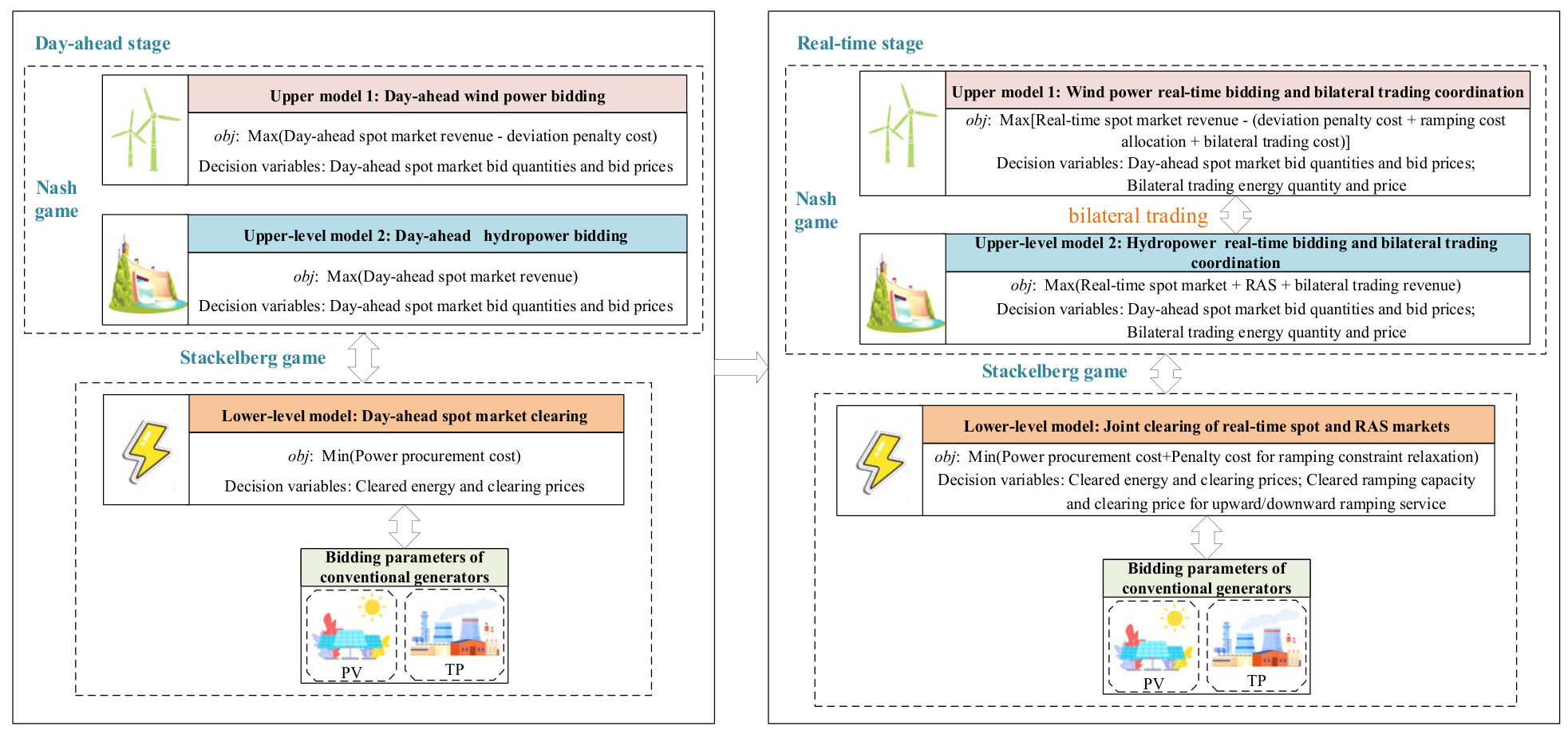
Compared to photovoltaic power stations, wind power exhibits greater output uncertainty. Therefore, this paper considers bilateral trading between wind power and cascade hydropower with hybrid pumped storage to reduce ramping cost allocation and deviation penalty costs. Based on the proposed ramping cost allocation mechanism, a bilevel game model for the coordinated decision-making of intraday-real-time two-stage bidding strategies and bilateral trading strategies for wind–hydro-storage is constructed, as shown in Figure 1: A two-layer game framework for bilateral transactions and market bidding between wind power and cascaded hydropower integrated hybrid pumped storage. This paper focuses on the bidding strategies of power generators. Consequently, the upper level formulates the main problem as a Nash game between wind power and cascade hydropower with hybrid pumped storage, each aiming to maximize their own profits. The lower level formulates the subordinate problem as the electricity market clearing process. A Stackelberg competition is established between the upper and lower levels. Through continuous interaction between the strategies of both levels, the optimal bidding strategies for wind power and cascade hydropower with hybrid pumped storage are obtained.
In the day-ahead stage, the upper-level wind power operator aims to maximize the comprehensive benefits comprising day-ahead spot market bidding revenue and deviation penalty costs, thereby formulating its bidding strategy for the day-ahead spot market. The upper-level cascade hydropower with hybrid pumped storage operator aims to maximize its day-ahead spot market revenue and formulates its bidding strategy for the day-ahead spot market, while also submitting ramping rates to the market. The lower level clears the day-ahead spot market with the optimization objective of minimizing electricity purchase costs.
In the real-time stage, the upper-level wind power operator is required to submit forecast error intervals for ramping cost allocation. Considering the maximization of comprehensive benefits—including total real-time spot market bidding revenue, deviation penalty costs, ramping cost allocation, and bilateral trading leasing costs—it performs coordinated optimization decision-making for its real-time spot market bidding strategy and bilateral trading strategy. The upper-level cascade hydropower with hybrid pumped storage operator, aiming to maximize comprehensive benefits from total real-time spot market bidding revenue, ramping ancillary service market revenue, and bilateral trading revenue, conducts coordinated optimization decision-making for its real-time spot market bidding strategy and bilateral trading strategy. The lower level clears the real-time spot and ramping ancillary service markets jointly, with the optimization objective of minimizing the sum of electricity purchase costs and ramping relaxation penalty costs.

3.2. Day-Ahead Optimization Model

3.2.1. Day-Ahead Optimization Decision Model for Wind Power

In the day-ahead stage, wind power incorporates uncertainty and risk preference into its decision-making model. A day-ahead spot market bidding model is constructed based on CVaR. For a wind farm connected to the grid at node u, the optimization objective B WP DA is to maximize the sum of expected revenue and risk utility.
max   B WP DA = ( 1 β ) s S π s B WP , s DA + β B CVaR DA
B WP ,   s DA = t T m M λ u , t DA P u , m , t WP , DA t T c t Δ P s , t DA
B CVaR DA = ε DA 1 1 α s S π s η s
ε DA B WP ,   s DA η s η s 0
where s is the index of typical scenarios; S is the total number of typical scenarios; π s is the probability of scenario s; B CVaR DA is the risk utility of wind power in day-ahead bidding; β is the decision-maker’s risk preference coefficient, with a larger β indicating a higher degree of risk aversion; B WP , s DA is the day-ahead bidding revenue of wind power under scenario s, as shown in Equation (13), which consists of day-ahead spot market revenue and day-ahead forecast deviation penalty costs [19]; λ u , t DA is the day-ahead spot market clearing price at node u during time period t; P u , m , t WP , DA is the cleared energy quantity of wind power in the m-th bid segment at node u during time period t in the day-ahead spot market; c t is the unit penalty cost for deviation energy; Δ P s , t DA is the day-ahead deviation assessment energy of wind power during time period t under scenario s; ε DA and η s are auxiliary variables for calculating B CVaR DA and CVaR, respectively; α is the corresponding confidence level.
The total bid quantity of wind power in each segment during the day-ahead stage should be less than its day-ahead forecast output. In addition, the bidding curve must satisfy the five-segment non-decreasing constraint. Therefore, the day-ahead bidding constraints for wind power are as follows:
m M P ^ u , m , t WP , DA P u , t WP , DA , For
0 λ ^ u , m 1 , t WP ,   DA λ ^ u , m , t WP ,   DA λ ^ max DA
where P ^ u , m , t WP , DA is the bid quantity declared by wind power in the m-th segment at node u during time period t; P u , t WP , DA , For is the day-ahead forecast output of the wind farm for time period t; λ ^ u , m , t WP ,   DA is the bid price declared by wind power in the m-th segment at node u during time period t; λ ^ max DA is the upper bidding price limit in the day-ahead market.

3.2.2. Day-Ahead Optimization Decision Model for Hydro-Storage

In the day-ahead stage, the cascade hydropower with hybrid pumped storage, also grid-connected at node u, aims to maximize its day-ahead spot market revenue B PH DA as the optimization objective:
B PH DA = t T m M λ u , t DA P u , m , t PH , DA
where P u , m , t PH , DA is the cleared energy quantity of cascade hydropower with hybrid pumped storage in the m-th bid segment at node u during time period t in the day-ahead spot market.
(a)
Cleared power constraint for hydro-storage:
m M P u , m , t PH , DA = r R ( P r , t H + P r , t G P r , t P )
where P r , t H is the day-ahead scheduled output of the r-th cascade hydropower station during time period t; P r , t G and P r , t P are the day-ahead scheduled generation power and pumping power of the r-th pumped storage unit during time period t, respectively, with P r , t G P r , t P = 0 .
(b)
Power output constraint for hydro-storage:
P r , min H P r , t H P r , max H P r , min G P r , t G P r , max CX P r , min P P r , t P P r , max CX
where P r , max H and P r , min H are the maximum and minimum output of the r-th cascade hydropower station, respectively; P r , max CX is the installed capacity of the r-th pumped storage station; P r , min G and P r , min P are the minimum generation power and the minimum pumping power of the r-th pumped storage unit, respectively.
(c)
Energy conversion relationship constraint:
P r , t H = D γ r H Q r , t H H r P r , t G = D γ r G Q r , t G H r P r , t P = D γ r P Q r , t P H r
where D is the acceleration due to gravity; γ r H , Q r , t H , and Hr are the comprehensive output coefficient, generation flow rate, and water head of the r-th hydropower station, respectively; γ r G and γ r P are the generation and pumping output coefficients of the r-th pumped storage unit, respectively; Q r , t G and Q r , t P are the generation and pumping flow rates of the r-th pumped storage unit, respectively.
(d)
Water balance and flow constraint:
V r , t + 1 = V r , t + Q r , t in + Q r 1 , t out Q r , t out + Q r , t P Δ t Q r , t out = Q r , t H + Q r , t G + Q r , t S Q r , min Q r , t out Q r , max Q r , min H Q r , t H Q r , max H Q r , min G Q r , t G Q r , max G Q r , min P Q r , t P Q r , max P
where V r , t and V r , t + 1 are the reservoir storage of hydropower station r during time periods t and t + 1, respectively; Q r , t in is the natural inflow of hydropower station r during time period t; Q r 1 , t out and Q r , t out are the outflow of the r − 1- and r-th cascade hydropower stations, respectively; Q r , t S is the spillage flow of hydropower station r during time period t; Q r , max and Q r , min are the maximum and minimum outflow limits of hydropower station r; Q r , max H and Q r , min H are the maximum and minimum generation flow limits of hydropower station r; Q r , max G and Q r , min G are the maximum and minimum generation flow limits of the r-th pumped storage unit; Q r , max P and Q r , min P are the maximum and minimum pumping flow limits of the r-th pumped storage unit.
(e)
Reservoir storage constraint:
V r , min < V r , t < V r , max V r 0 = V r end
where V r , min and V r , max are the minimum and maximum reservoir storage of hydropower station r, respectively; V r 0 and V r end are the initial and final reservoir storage of hydropower station r, respectively.
(f)
Day-ahead bidding constraints for hydro-storage:
m M P ^ u , m , t PH , DA r R ( P r , max H + P r , max CX )
0 λ ^ u , m 1 , t PH ,   DA λ ^   u , m , t PH , DA λ ^ max DA
where P ^ u , m , t PH , DA is the bid quantity declared by cascade hydropower with hybrid pumped storage in the m-th segment at node u during time period t in the day-ahead spot market; λ ^   u , m , t PH , DA is the bid price declared by cascade hydropower with hybrid pumped storage in the m-th segment during time period t.

3.2.3. Day-Ahead Spot Market Clearing Model

In the Shandong spot market, the generation side submits both quantity and price bids, while the load side submits only quantity bids without prices. Therefore, the day-ahead spot market clearing adopts the minimization of electricity purchase cost as the optimization objective:
min t T m M u Ω W P λ ^ u , m , t WP ,   DA P u , m , t WP , DA + v Ω PH λ ^   v , m , t PH , DA P v , m , t PH , DA + g Ω G f N f λ ^ g , f , m , t P g , f , m , t
where u Ω WP , v Ω PH , and g Ω G represent the nodes of wind farms, hydropower stations, and other generating units, respectively; N f is the total number of other conventional generators participating in the day-ahead spot market, excluding wind power and cascade hydropower with hybrid pumped storage; λ ^ g , f , m , t and P g , f , m , t are the bid price and cleared energy quantity of generator f in the m-th segment at node u during time period t, respectively.
The day-ahead spot market clearing constraints are as follows, where λ, μ, ξ, φ on the right-hand side of each constraint represent the corresponding dual variables.
(a)
Node power balance constraint:
The direct current power flow method is employed, as shown in Equation (27):
m M ( P n , m , t WP , DA + P n , m , t PH , DA + f N f P n , f , m , t ) L n , t = h Ω n B n h ( θ n , t θ h , t ) : λ n , t DA , n , t
where P n , m , t WP , DA , P n , m , t PH , DA , and P n , f , m , t are the bid quantities of wind power, hydropower, and other generator f located at node n in the m-th segment during time period t, respectively; Bnh is the susceptance of the transmission line between node n and node h; Ln,t is the conventional load at node n during time period t; Ω n represents the set of nodes connected to node n in the transmission network; θ n , t and θ h , t are the phase angles of node n and node h during time period t, respectively. Here, n Ω N denotes system nodes, and the dual variable λ n , t DA represents the day-ahead clearing price at node n during time period t.
(b)
Cleared quantity constraint for generators:
0 P g , f , m , t P ^ g , f , m , t : μ g , f , m , t G , min , μ g , f , m , t G , max , g , f , m , t 0 P u , m , t WP , DA P ^ u , m , t WP , DA : μ u , m , t WP , min , μ u , m , t WP , max , u , m , t 0 P v , m , t PH , DA P ^ v , m , t PH , DA : μ v , m , t PH , min , μ v , m , t PH , max , v , m , t
where P ^ g , f , m , t is the bid quantity declared by generator f in the m-th segment at node g during time period t.
(c)
Branch power flow constraint:
P n h max B n h ( θ n , t θ h , t ) P n h max : μ n h , t neg , μ n h , t pos , n , h , t
where P n h max is the power flow limit of the transmission line between node n and node h.
(d)
Node phase angle constraint:
π θ n , t π : ξ n , t min , ξ n , t max , n , t
(e)
Slack bus phase angle constraint:
θ 1 , t = 0 : ϕ 1 , t , t

3.3. Real-Time Stage Coordinated Optimization Decision Model

3.3.1. Real-Time Optimization Decision Model for Wind Power

In the real-time stage, wind power takes into account real-time forecast errors and submits forecast error intervals. The optimization objective is to maximize the comprehensive benefit B WP ,   s RT , which consists of the total real-time spot market bidding revenue C WP RT , deviation penalty cost C dev , s , ramping cost allocation C RAS ,   s , and bilateral trading leasing cost C bit .
max   B WP RT = ( 1 β ) s S π s B WP , s RT + β B CVaR RT
B CVaR RT = ε RT 1 1 α s S π s η s
ε RT B WP ,   s RT η s η s 0
B WP ,   s RT = C WP RT C dev ,   s C RAS ,   s C bit
C WP RT = t T m M λ u , t RT ( P u , m , t WP , RT P u , m , t WP , DA )
C dev , s = t T c t ( Δ P s , t DA + Δ P s , t RT )
C RAS ,   s = t T ( M WP , t FE + M WP ,   s , t AE ) M WP , t FE = ( M t New , RU · ε WP , t For , U l L ε l , t For , U + M t New , RD · ε WP , t For , D l L ε l , t For , D ) × β M WP ,   s , t AE = ( M t New , RU + M t New , RD ) α WP ,   s , t Real l L α l , t Real × ( 1 β ) α WP ,   s , t Real = ε s , t WP ε WP , t For , D ε s , t WP ε WP , t For , U ε s , t WP × γ ε s , t WP < ε WP , t For , D   o r   ε s , t WP > ε WP , t For , U
C bit = t T λ bit , t P bit , t
where s is the index of typical scenarios based on real-time forecast errors; S is the number of corresponding typical scenarios; π s is the probability of scenario s ; B CVaR RT is the risk utility of wind power in real-time bidding; ε RT and η s are auxiliary variables for calculating B CVaR RT and the corresponding CVaR, respectively. Although the Shandong real-time spot market adopts full quantity clearing, the settled energy in the real-time market is the deviation energy from the day-ahead spot market for the same time period. Therefore, C WP RT is as shown in Equation (36), λ u , t RT and P u , m , t WP , RT are the real-time spot market clearing price at node u during time period t and the cleared energy quantity of wind power in the m-th bid segment, respectively; Δ P s , t DA and Δ P s , t RT are the day-ahead and real-time deviation assessment energy during time period t under scenario s , respectively; λ bit , t and P bit , t are the bilateral trading price and energy quantity between wind power and cascade hydropower with hybrid pumped storage during time period t , respectively; M WP , t FE and M WP ,   s , t AE are the ramping cost allocated based on the declared error interval of wind power during time period t and the ramping cost allocated based on the error under scenario s , respectively; ε WP , t For , U and ε WP , t For , D are the upper and lower bounds of the forecast error interval declared by wind power during time period t , respectively, which are taken as ±7.5% of the forecast value based on real-time forecast errors of wind power [20]; ε s , t WP and α WP ,   s , t Real are the forecast error and allocation coefficient of wind power during time period t under scenario s , respectively.
The real-time bidding quantity and bid price of wind power should also satisfy the bidding constraints, as previously shown in Equations (24) and (25).

3.3.2. Real-Time Optimization Decision Model for Hydro-Storage

In the real-time stage, the cascade hydropower with hybrid pumped storage aims to maximize the comprehensive benefit B PH RT , which consists of the total revenue from the real-time spot market and ramping ancillary service market, as well as the revenue from bilateral trading leasing.
B PH RT = C PH RT + C PH RAS + C bit
C PH RT = t T m M λ u , t RT ( P u , m , t PH , RT P u , m , t PH , DA )
C PH RAS = t T ( λ u , t RU P u , t PH , RU + λ u , t RD P u , t PH , RD )
where C PH RT and C PH RAS are the revenue of cascade hydropower with hybrid pumped storage from the real-time spot market and the ramping ancillary service market, respectively; P u , m , t PH , RT is the cleared energy quantity of cascade hydropower with hybrid pumped storage in the m-th bid segment at node u during time period t in the real-time spot market; λ u , t RU and λ u , t RD are the clearing prices for upward and downward ramping services at node u during time period t , respectively; P u , t PH , RU and P u , t PH , RD are the cleared upward and downward ramping capacity of cascade hydropower with hybrid pumped storage at node u during time period t , respectively.
(a)
Cleared power constraint for hydro-storage:
m M P u , m , t PH , RT + P bit , t = r R P r , t H + P r , t G P r , t P
where P r , t H is the real-time scheduled output of the r-th cascade hydropower station during time period t ; P r , t G and P r , t P are the scheduled generation power and pumping power of the r-th pumped storage unit during time period t , respectively, with P r , t G P r , t P = 0 .
(b)
Real-time bidding constraints for hydro-storage:
m M P ^ u , m , t PH , RT + P bit , t r R ( P r , max H + P r , max CX )
where P ^ u , m , t PH , RT is the bid quantity declared by cascade hydropower with hybrid pumped storage in the m-th segment at node u during time period t in the real-time spot market.
In addition, the real-time scheduling and bidding prices of cascade hydropower with hybrid pumped storage must also satisfy the operational and bidding constraints, as previously shown in Equations (20)–(23) and (25).

3.3.3. Joint Clearing Model for the Real-Time Spot and Ramping Ancillary Service Market

In the real-time market, the dispatch center conducts a joint clearing of the real-time spot and ramping ancillary service markets at time t 15 minutes. The prices for upward and downward ramping services are determined as the shadow prices corresponding to the power balance constraint equations related to upward and downward ramping requirements in the optimization model. The clearing is performed with the optimization objective of minimizing the sum of electricity purchase costs and ramping constraint penalty costs:
min t T m M u Ω WP λ ^ u , m , t WP ,   RT P u , m , t WP , RT + v Ω PH λ ^ v , m , t PH ,   RT P v , m , t PH , RT ) + g Ω G f N f λ ^ g , f , m , t P g , f , m , t + n Ω N M r ( S n , t up + S n , t down )
where λ ^ g , f , m , t and P g , f , m , t are the bid price and cleared energy quantity of generator f in the m-th segment at node g during time period t in the real-time stage, respectively; Mr is the penalty factor for system ramping constraint violations; S n , t up and S n , t down are the slack variables for the upward and downward ramping constraints at node n during time period t , respectively.
In addition to the spot market clearing constraints shown in Equations (27)–(31), the real-time market introduces the following additional constraints:
(a)
Ramping supply–demand constraint:
P n , t PH , RU + i I P n , i , t RU + S n , t up R n , t RU : λ n , t up , n , t P n , t PH , RD + i I P n , i , t RD + S n , t down R n , t RD : λ n , t down , n , t
where P n , t PH , RU and P n , t PH , RD are the awarded upward and downward ramping capacities of hydropower at node n during time period t , respectively; P n , i , t RU and P n , i , t RD are the cleared upward and downward ramping capacity of unit i that provides ramping ancillary services at node n during time period t , excluding the cascade hydropower with hybrid pumped storage; R n , t RU and R n , t RD are the upward and downward ramping requirements at node n during time period t , respectively.
(b)
Cleared quantity constraint for generators:
The sum of a unit’s output during time period t and its upward ramping capacity should be less than the unit’s upper output limit during time period t + 1. Similarly, the difference between a unit’s output during time period t and its downward ramping capacity should be greater than the unit’s lower output limit during time period t + 1.
m M P g , i , m , t + P g , i , t RU P g , i , t + 1 max : μ g , i , t G , up , g , i , t m M P g , i , m , t P g , i , t RD P g , i , t + 1 min : μ g , i , t G , down , g , i , t m M P v , m , t PH , RT + P v , t PH , RU + P bit , t r R ( P r , max H + P r , max CX ) : μ v , t PH , up , v , t m M P v , m , t PH , RT P v , t PH , RD + P bit , t   r R ( P r , min H P r , max CX ) : μ v , t PH , down , v , t
where P g , i , t + 1 max and P g , i , t + 1 min are the upper and lower output limits of unit i during time period t + 1 , respectively.
(c)
Cleared ramping capacity constraint:
0 P v , t PH , RU P v PH , climb : μ PH , v , t up , min , μ PH , v , t up , max , v , t 0 P v , t PH , RD P v PH , climb : μ PH , v , t down , min , μ PH , v , t down , max , v , t 0 P g , i , t RU P g , i G , climb : μ G , g , i , t up , min , μ G , g , i , t up , max , g , i , t 0 P g , i , t RD P g , i G , climb : μ G , g , i , t down , min , μ G , g , i , t down , max , g , i , t
where P v PH , climb and P g , i G , climb are the ramping upper limits of hydropower units at node v and other units providing ramping ancillary services at node g, respectively.
(d)
Non-negativity constraint for ramping slack variables:
S n , t up 0 : ϑ n , t up , n , t S n , t down 0 : ϑ n , t down , n , t

4. Solution Methodology for the Bilevel Game-Based Optimization Model

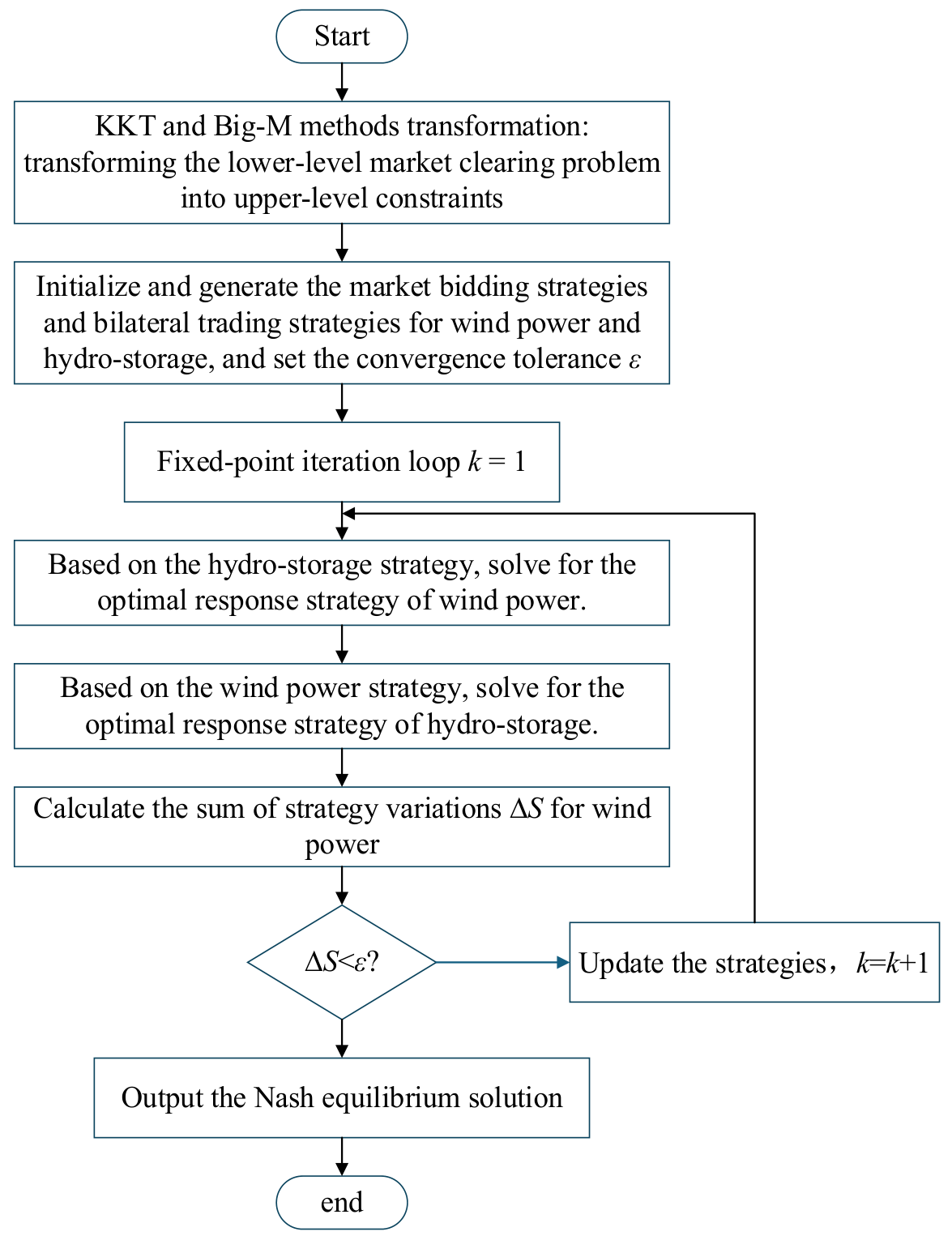
In the two-stage day-ahead and real-time bilevel optimization model constructed in this paper, the upper level consists of two independent decision-makers: the wind power operator and the cascade hydropower with hybrid pumped storage (hereinafter referred to as hydro-storage) operator, while the lower level is the electricity market clearing model. Since the lower-level market clearing model is a strictly convex optimization problem, the Karush-Kuhn-Tucker (KKT) optimality conditions can be employed to equivalently transform it into a set of linear constraints, thereby converting the original bilevel problem into a single-level problem. Specifically, the Lagrangian function of the lower-level problem is first formulated, from which the stationarity equations, primal feasibility constraints, dual feasibility constraints, and complementary slackness conditions in the KKT conditions are derived. For the nonlinear complementary slackness constraints, the Big-M method is adopted for linearization (taking the real-time stage as an example; the detailed derivation is provided in Appendix A), ensuring that all transformed constraints are linear and can serve as additional constraints for the upper-level optimization problem. Consequently, the original bilevel problem is restructured into a constrained optimization problem in which two independent decision-makers operate at the upper level. A non-cooperative game relationship exists between the wind power and hydro-storage operators at the upper level. To solve for the Nash equilibrium of this game, the fixed-point iteration method is employed. The strategy spaces of wind power and cascade hydropower are compact and convex due to physical constraints (e.g., generation capacity limits, ramping limits). Each subproblem is convex, and the joint best-response mapping is a continuous self-mapping on a compact convex set. According to the fixed-point theorem, this mapping has at least one fixed point, which corresponds to a Nash equilibrium. Moreover, sequential updates ensure that the objective function values are monotonically non-increasing and bounded below, guaranteeing convergence [21]. Taking the real-time stage as an example, the specific solution procedure is illustrated in Figure 2 and described as follows:
Step 1: Transform the lower-level market clearing model into corresponding constraints using the KKT conditions, linearize the nonlinear complementary slackness constraints via the Big-M method, and incorporate all resulting constraints as additional constraints into the upper-level optimization problems, thereby constructing single-level optimization problems for wind power and hydro-storage.
Step 2: Initialize the market bidding strategies and bilateral trading strategies for wind power and hydro-storage, and set the convergence tolerance ε.
Step 3: Fix the hydro-storage strategy and solve the single-level optimization problem for wind power. This subproblem is solved using the Gurobi solver within the MATLAB-YALMIP programming environment to obtain the optimal response strategy for wind power.
Step 4: Fix the wind power strategy and solve the single-level optimization problem for hydro-storage. This subproblem is also solved using the Gurobi solver to obtain the optimal response strategy for hydro-storage.
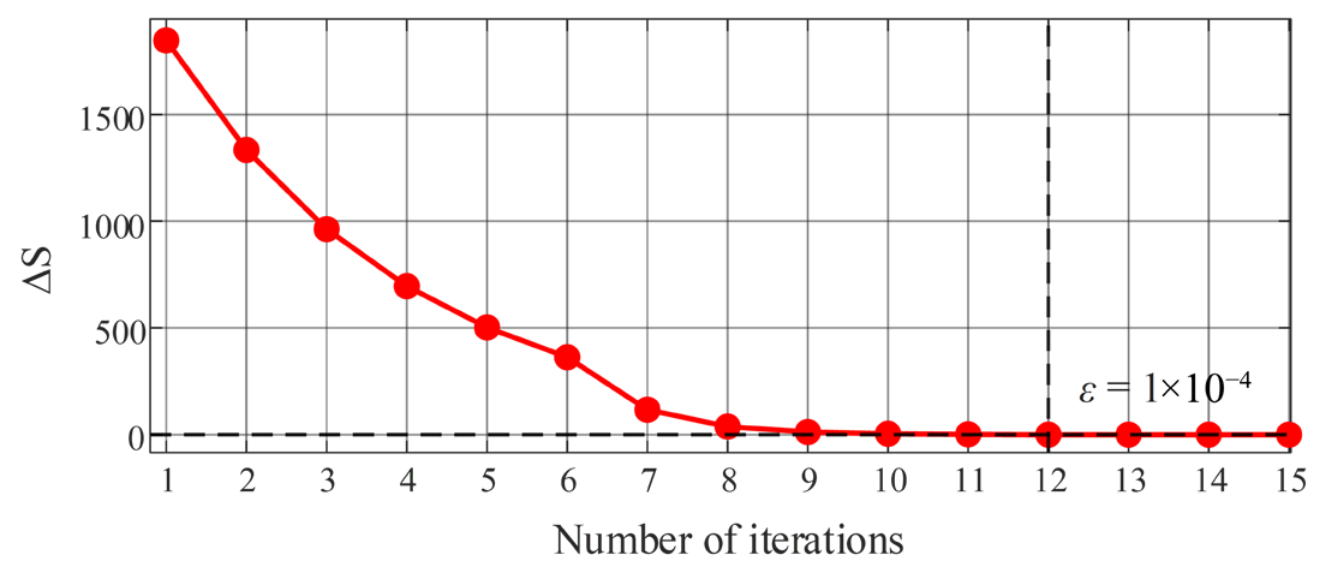
Step 5: Perform convergence verification by calculating the sum of strategy variations ΔS for wind power over two consecutive iterations. If ΔS is less than the preset convergence tolerance ε, the algorithm is deemed to have converged, and the resulting strategy combination constitutes a Nash equilibrium point. This equilibrium satisfies game stability, meaning that no participant can unilaterally adjust its own strategy to achieve higher benefits. If the convergence condition is not satisfied, update the strategies of wind power and hydro-storage, return to Step 2, and repeat the iterative calculation based on the updated strategies until convergence is achieved.

5. Results and Discussion

5.1. Case Parameters

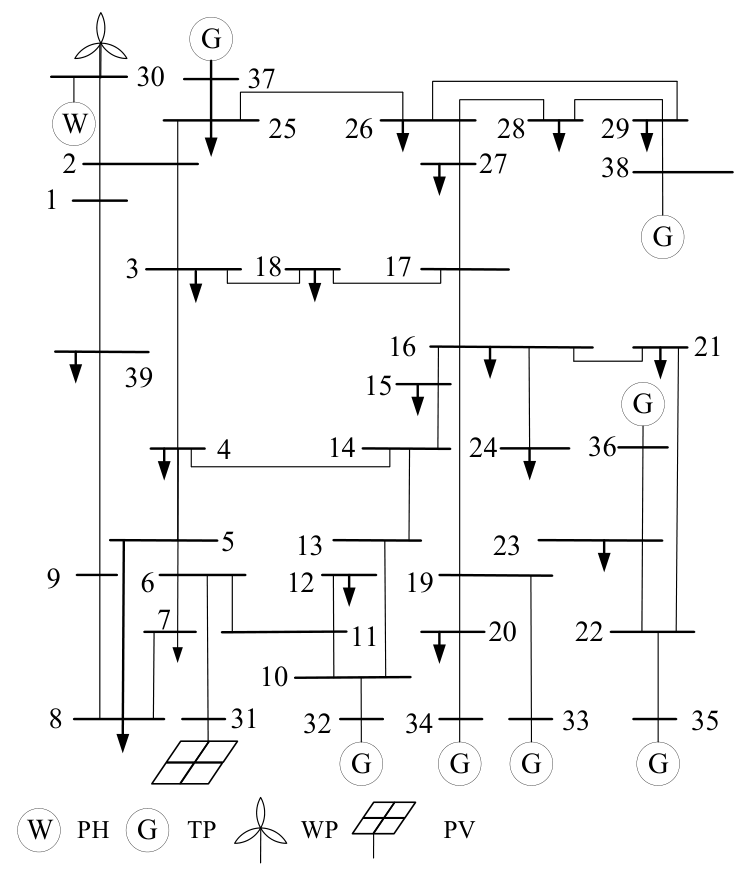
To validate and analyze the rationality and advantages of the mechanism designed in this paper, simulations are conducted based on a modified IEEE 39-bus system, as shown in Figure A1 in Appendix B. The market participants include seven thermal power plants (TP), one wind farm (WP), one photovoltaic power station (PV), one cascade hydropower station with hybrid pumped storage (PH), and six load aggregators. The parameters of the upstream and downstream hydropower stations of the cascade system are provided in Table A1 of Appendix B, while the operating parameters of other units are listed in Table A2 of Appendix B. Thermal power units submit five-step block bids based on their marginal generation costs, with generation costs expressed in a quadratic function form. To avoid the influence of unit locations on the scheduling results, the impact of network congestion is neglected, and the system marginal price (SMP) is adopted for market clearing [22]. This simplification implies that a uniform electricity price applies across the entire grid, ignoring potential nodal price differences under congestion, and assumes that all generated power can be fully absorbed. Such an approach is common in studies focusing on bidding strategies in electricity markets [23,24]. Although this simplification has its limitations, it preserves the tractability of the model and facilitates a deeper understanding of the equilibrium strategies of market participants. Incorporating network constraints remains an important direction for future research. The simulation computations in this paper were carried out under the following hardware environment: a 12th Gen Intel(R) Core(TM) i5-12450H @ 2.00 GHz processor, 16 GB of RAM, and a 64-bit Windows 11 operating system. The model was solved using MATLAB 2021b with the Gurobi 12.0.2 solver. The MIP relative optimality gap of the solver was set to 0.01%, and the time limit was set to 3600 s. The convergence tolerance ε for the fixed-point iteration was set to 10−4. The iterative convergence time for the day-ahead stage model was approximately 50 min, while that for the real-time stage ranged from 3 to 6 min (mainly depending on the number of convergence iterations in different time periods).

5.2. Analysis of Day-Ahead Bidding Strategies and Clearing Results

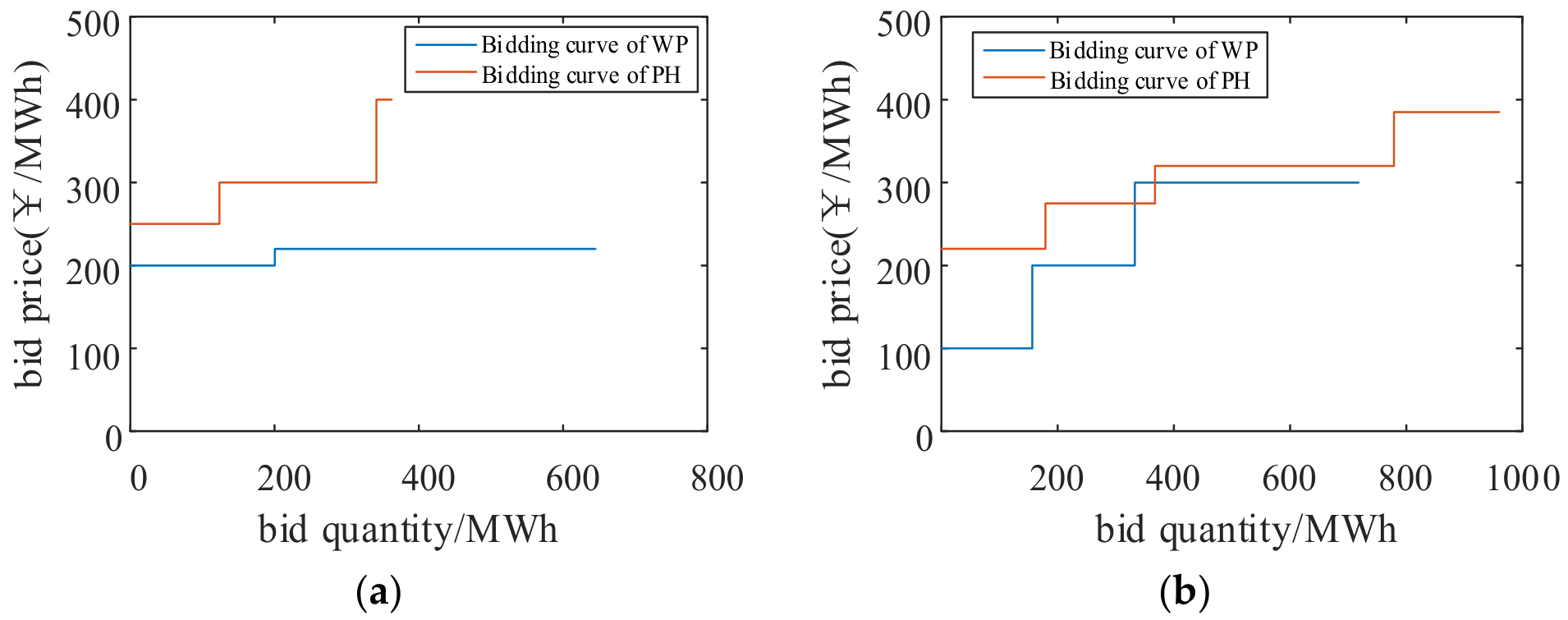
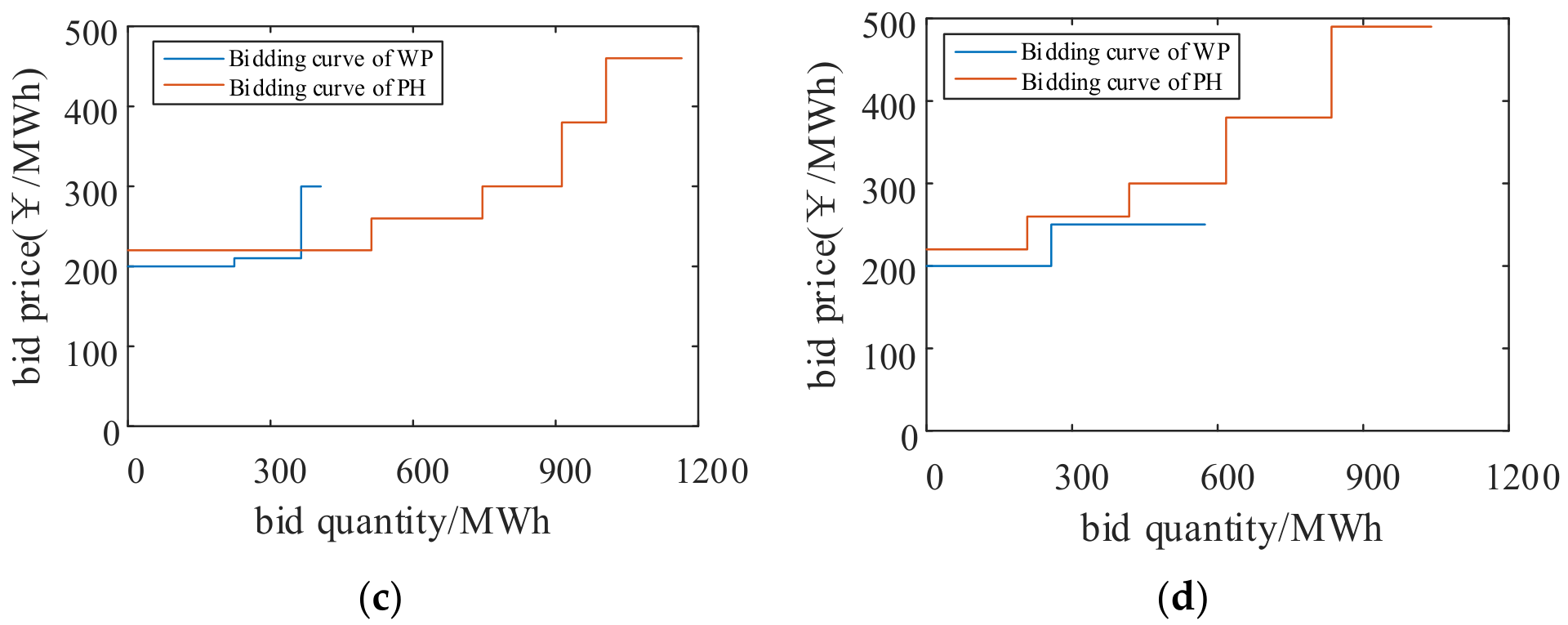
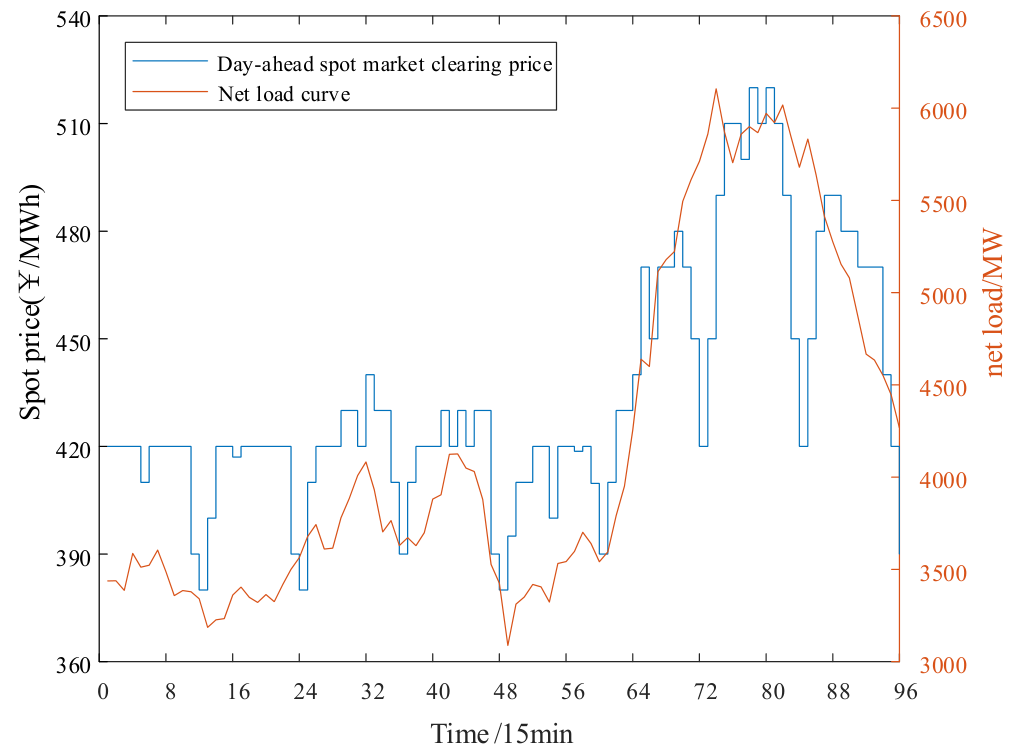
Based on multiple rounds of iteration between wind power and hydropower in the day-ahead spot market, considering each other’s bidding strategies and historical clearing results, a bidding equilibrium is ultimately achieved. The bidding curves for selected time periods are shown in Figure 3. The bidding curves exhibit a step-shaped pattern. According to the proposed model, the maximum number of bidding segments is set to five; however, due to identical bid prices or zero bid quantities in some intervals, the actual number of stepped segments in the bidding curves for certain periods (e.g., intervals 5 and 47) is less than five. The clearing prices in the day-ahead spot market are shown in Figure 4.
Figure 3 presents the segmented bidding curves of wind power and hydropower in the day-ahead market for representative time periods. The horizontal axis represents the bid capacity, and the vertical axis represents the bid price. The blue and orange curves represent the bidding strategies of wind power and hydropower, respectively. As shown in the figure, the two market participants exhibit differentiated bidding behaviors through strategic interaction. Wind power submits bids in no more than five segments, with generally low price levels and small price gradients across segments, reflecting a conservative bidding strategy aimed at securing output clearing. In contrast, hydropower adopts a bidding strategy characterized by “low-price wide capacity segments followed by stepped high-price increases.” In most time periods (e.g., periods 5, 47, and 70), hydropower maintains long low-price segments to ensure base output absorption, while gradually raising high-price segments to compete as a marginal unit. During the evening peak period (period 82), hydropower further increases its high-price segments, adopting a more aggressive bidding strategy to capture excess revenue during peak hours. These differentiated bidding strategies collectively shape the clearing outcome of the day-ahead spot market.
As shown in Figure 4, the net load curve rises significantly during the morning and evening peaks, with corresponding increases in clearing prices during these intervals. During the midday period, due to high photovoltaic output, net load decreases, leading to lower electricity prices. The electricity price peaks during the evening peak, demonstrating that the market price signal is closely aligned with the system’s supply and demand conditions.

5.3. Real-Time Ramping Cost Allocation Analysis

5.3.1. Parameter Sensitivity Analysis

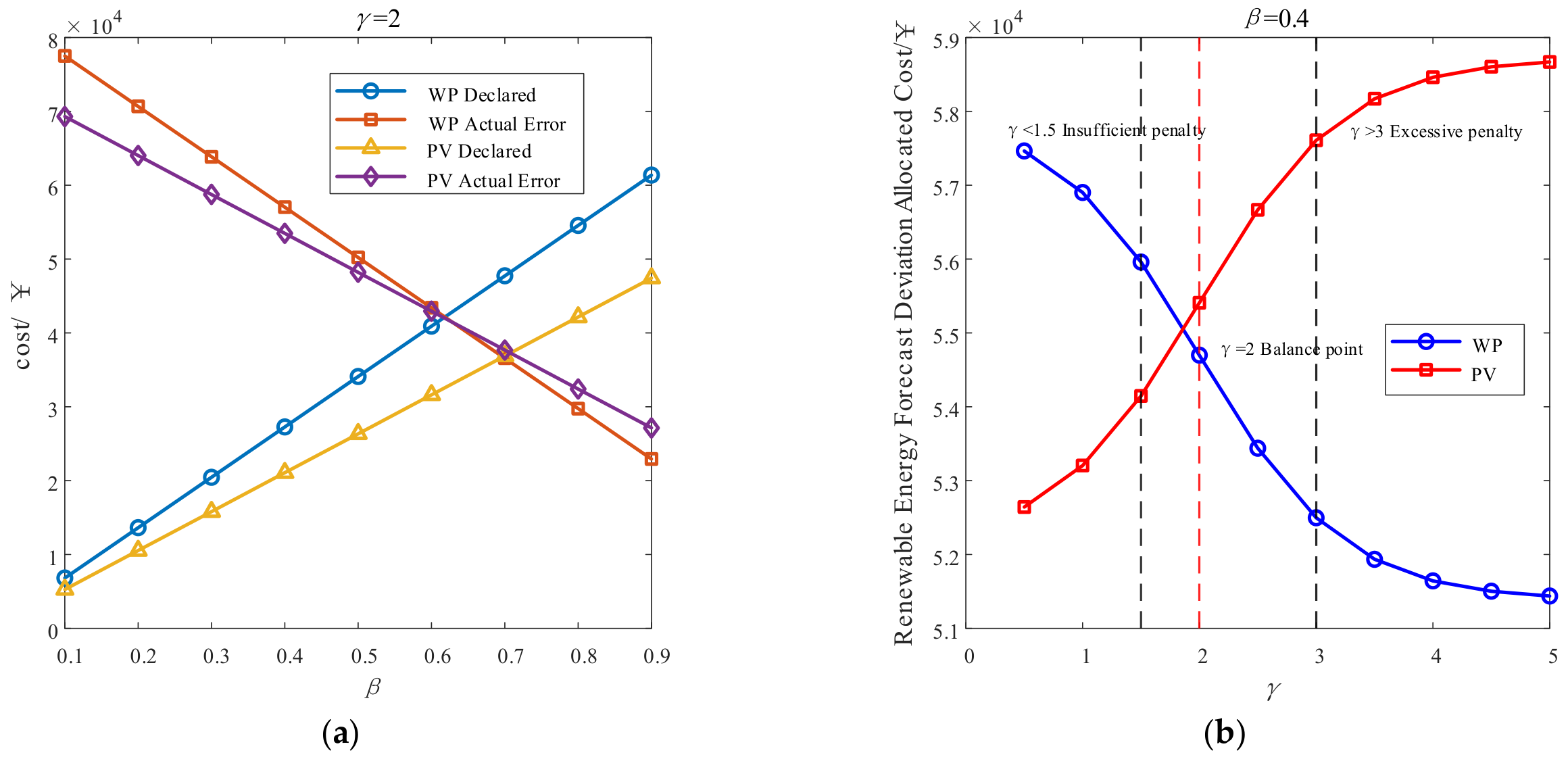
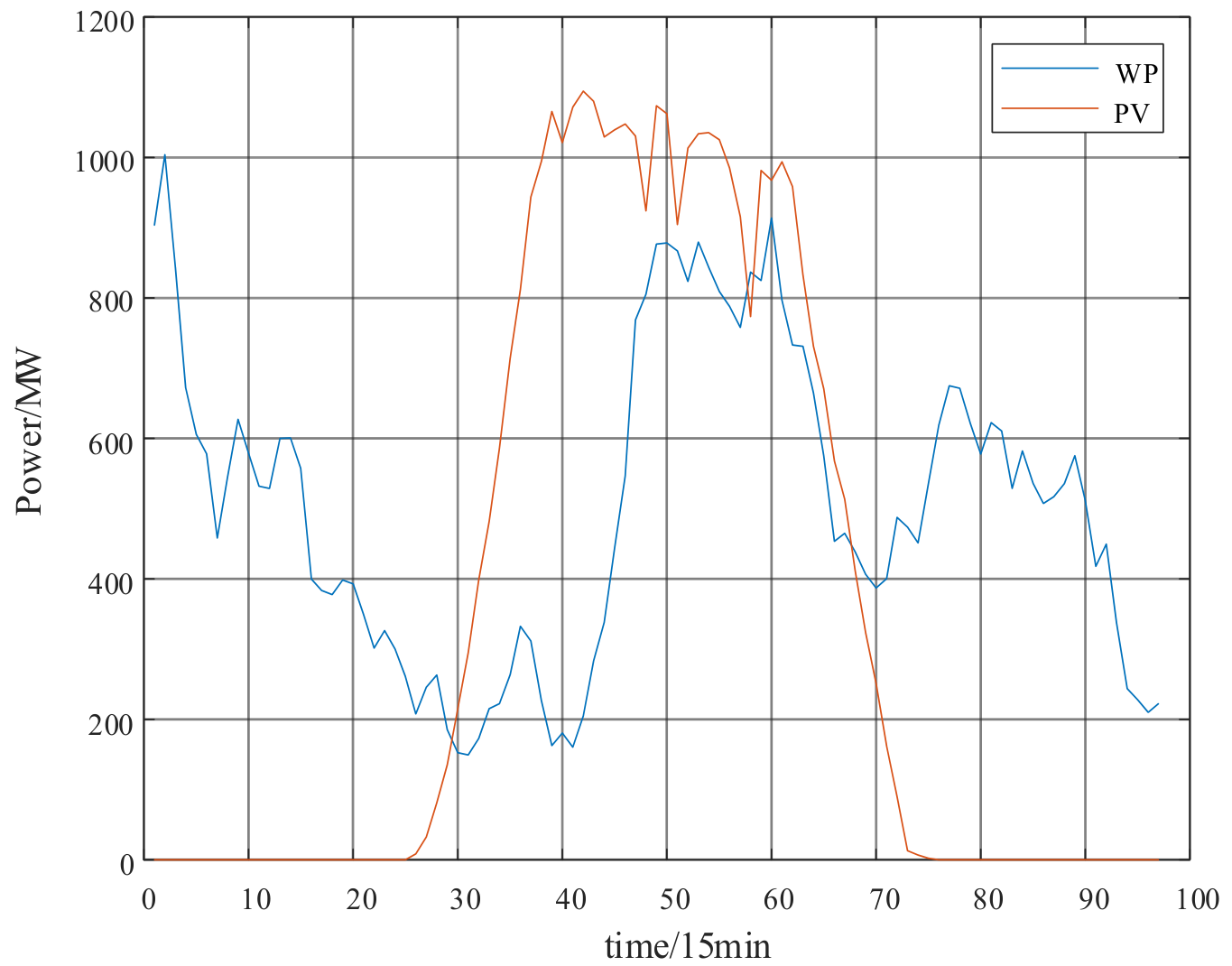
To investigate the impact of key parameters on ramping cost allocation results, this section presents sensitivity analyses for parameters β and γ to evaluate the robustness of the proposed mechanism under different parameter values, as shown in Figure 5. Based on real-time forecast errors, the wind farm and photovoltaic station declare upper and lower bounds of ±7.5% [20] and ±5% [25] of their forecast power, respectively. The detailed analyses are as follows:
(1)
Sensitivity analysis of coefficient β is presented in Figure 5a. β represents the proportion of renewable forecast deviation costs allocated based on the declared forecast error interval. As β varies from 0.1 to 0.9, the declared component costs for WP and PV increase linearly, while the actual error component costs decrease linearly. The two components are of similar magnitude at β = 0.6. In the range β ∈ [0.4, 0.8], the two components remain relatively balanced, and the total cost changes smoothly. In this case study, β is set to 0.4, which lies within this stable range, indicating that the choice of β has a limited impact on the fairness of the allocation results. Moreover, a greater weight on the declared error interval in cost allocation, which helps to more clearly reflect the improvement in cost allocation brought about by wind power’s forecast error reduction in subsequent hydro-storage coordination.
(2)
Sensitivity analysis of penalty coefficient γ is shown in Figure 5b. γ is used to impose additional costs on units whose actual forecast errors exceed their declared bounds. γ is varied from 1 to 5 to examine its effect on the allocated costs of renewable units. When γ < 1.5, the penalty is insufficient to deter strategic under-reporting. When γ > 3, the penalty becomes excessive, potentially imposing an undue burden on occasional large errors. At γ = 2, the mechanism strikes a balance between deterrence and fairness. Across different γ values, the relative ranking of allocated costs for renewable units remains consistent, indicating that the main conclusions are not sensitive to the choice of γ.
Therefore, in the subsequent study, β is set to 0.4 and γ is set to 2.

5.3.2. Comparative Analysis of Ramping Cost Allocation Methods

To highlight the effectiveness and advantages of the ramping ancillary service cost allocation method proposed in this paper, a comparative analysis of cost allocations under two different methods is conducted based on the real-time market clearing results, assuming that wind power and hydropower participate without engaging in bilateral trading.
Allocation Method 1: According to the current Shandong ramping ancillary service market implementation rules [8], ramping ancillary service costs are allocated among units that do not provide ramping services in proportion to their grid-connected energy quantities.
Allocation Method 2 (the method proposed in this paper): Ramping ancillary service costs are allocated based on the ramping responsibility coefficients of market participants.
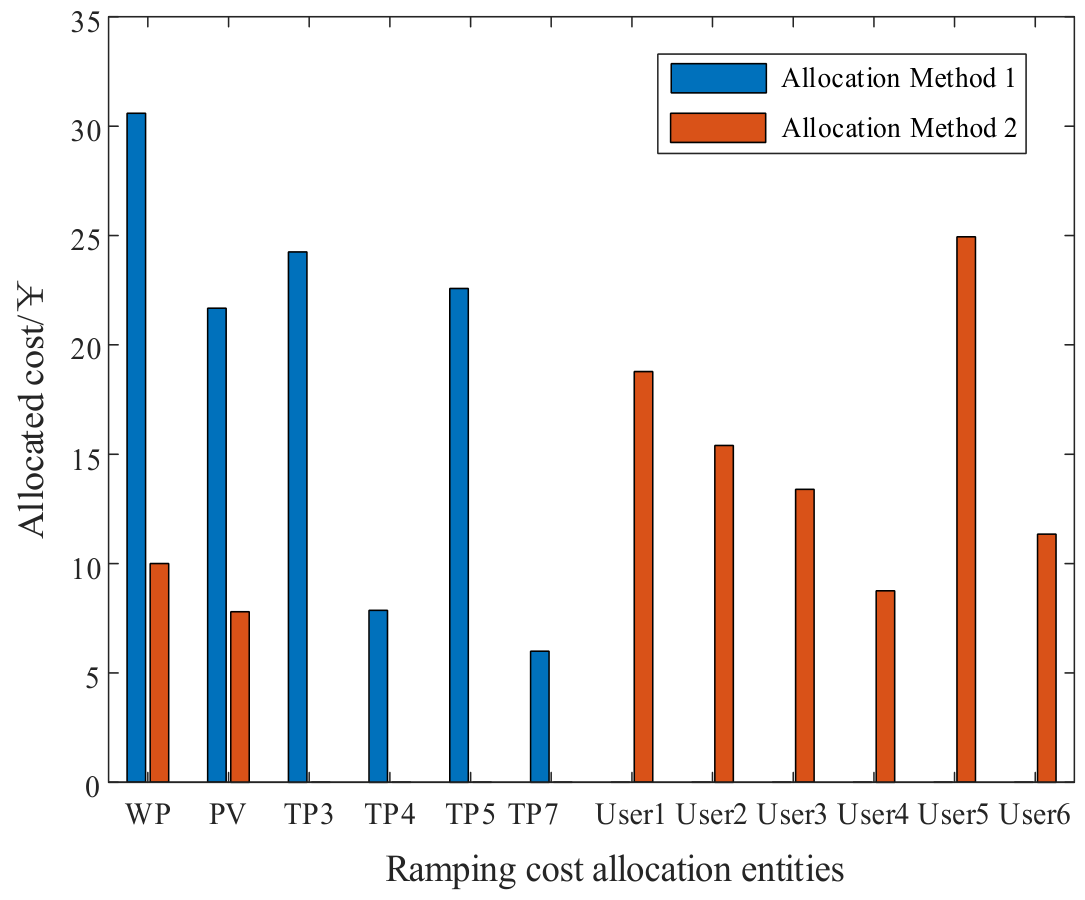
The comparison of allocated costs among different allocation methods is shown in Figure 6. WP denotes wind power plants, PV denotes photovoltaic power plants, TP denotes thermal power plants, and User denotes electricity consumers. To verify the fairness of the proposed method in this paper, two economic indicators—Gini coefficient [26] and Spearman’s rank correlation coefficient [27]—are introduced for quantitative analysis of different allocation methods. The specific calculation formulas are shown in Equations (50) and (51), and the allocation indicator results of different methods are presented in Table 1.
The Gini coefficient quantifies the fairness of ramp cost allocation by measuring the equilibrium of the allocated cost distribution, as shown in Equation (50). The value of G ranges from [0, 1], and a smaller G indicates a fairer allocation.
G = i = 1 n j = 1 n x i x j 2 n 2 x ¯
where n denotes the total number of market participants involved in the cost allocation; xi represents the allocated cost of participant i; x ¯ is the average value of the allocated costs of all participants; x i x j denotes the absolute difference between the allocated costs of any two participants.
Spearman’s rank correlation coefficient ρ quantifies the fairness of ramp cost allocation by measuring the consistency between the allocated costs and the responsibility ranking, as shown in Equation (51). The closer the indicator is to 1, the more the cost allocation aligns with the principle of “who causes, who bears”.
ρ = 1 6 i = 1 n d i 2 n n 2 1
where di is the difference between the responsibility rank and the cost rank of the i-th participant.
The analysis leads to the following conclusions:
The Gini coefficient of Allocation Method 1 is 0.6346, which is relatively high, indicating an extremely unbalanced allocation structure. This method concentrates all ramp costs on the generation side, with no participation from the demand side. Moreover, there is a serious mismatch within the generation side: stable thermal power units (TP3, TP4, TP5, TP7) that do not induce ramp demand bear high costs, while users that cause ramp demand enjoy ramp services at zero cost, resulting in a highly unbalanced overall distribution. The Gini coefficient of the proposed method (Method 2) decreases to 0.4752, a reduction of 25.1% compared with Method 1, and the overall allocation balance is significantly improved. Method 2 includes electricity users in the allocation subjects, and dispatchable thermal power units bear no costs, which effectively narrows the cost gap among different types of subjects and alleviates the allocation imbalance between the generation side and the demand side. In addition, the Spearman’s rank correlation coefficient of Method 1 is −0.5660, showing a moderate negative correlation, which indicates a serious mismatch between responsibility and cost. High-volatility users with the highest responsibility (e.g., User5) bear zero cost in Method 1, whereas stable thermal power units with the lowest responsibility (e.g., TP3, TP5) bear high costs. As a major cause of ramp demand, PV even bear lower costs than stable thermal power units due to their small grid-connected power, completely violating the fairness principle of “who causes, who bears”. The Spearman’s rank correlation coefficient of Method 2 is 1, achieving perfect positive correlation between responsibility and cost. This shows that subjects with higher ramp responsibility (e.g., high-volatility users User5, User1) bear higher costs; stable thermal power units (TP3, TP4, TP5, TP7) with no ramp responsibility bear zero cost; and new energy units undertake corresponding costs according to their own output fluctuations, achieving optimal matching between responsibility and cost.
The unreasonable mechanism of Method 1 cannot truly reflect the ramp responsibility of new energy units and users, which is not conducive to guiding market subjects to optimize their behaviors and hinders the low-carbon transition of the power system. Method 2 not only achieves dual improvements in overall allocation balance and individual responsibility matching, but also significantly reduces the grid-connection cost of new energy. The allocated cost of new energy units decreases by 65.66% on average, effectively easing the economic pressure of new energy accommodation and facilitating large-scale new energy integration and the low-carbon transition of the power system. Meanwhile, by involving users in cost allocation, ramp responsibility is made explicit, guiding the load side to reduce volatility and lowering system ramp demand at the source.

5.3.3. Analysis of the Proposed Allocation Method

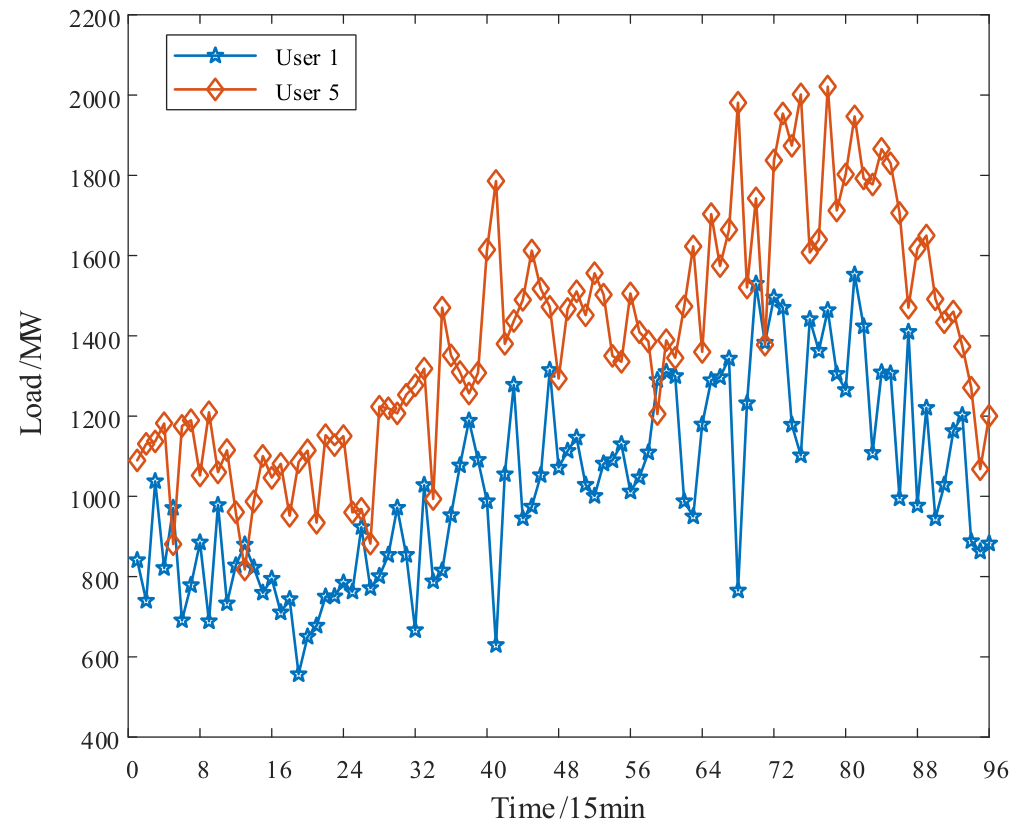
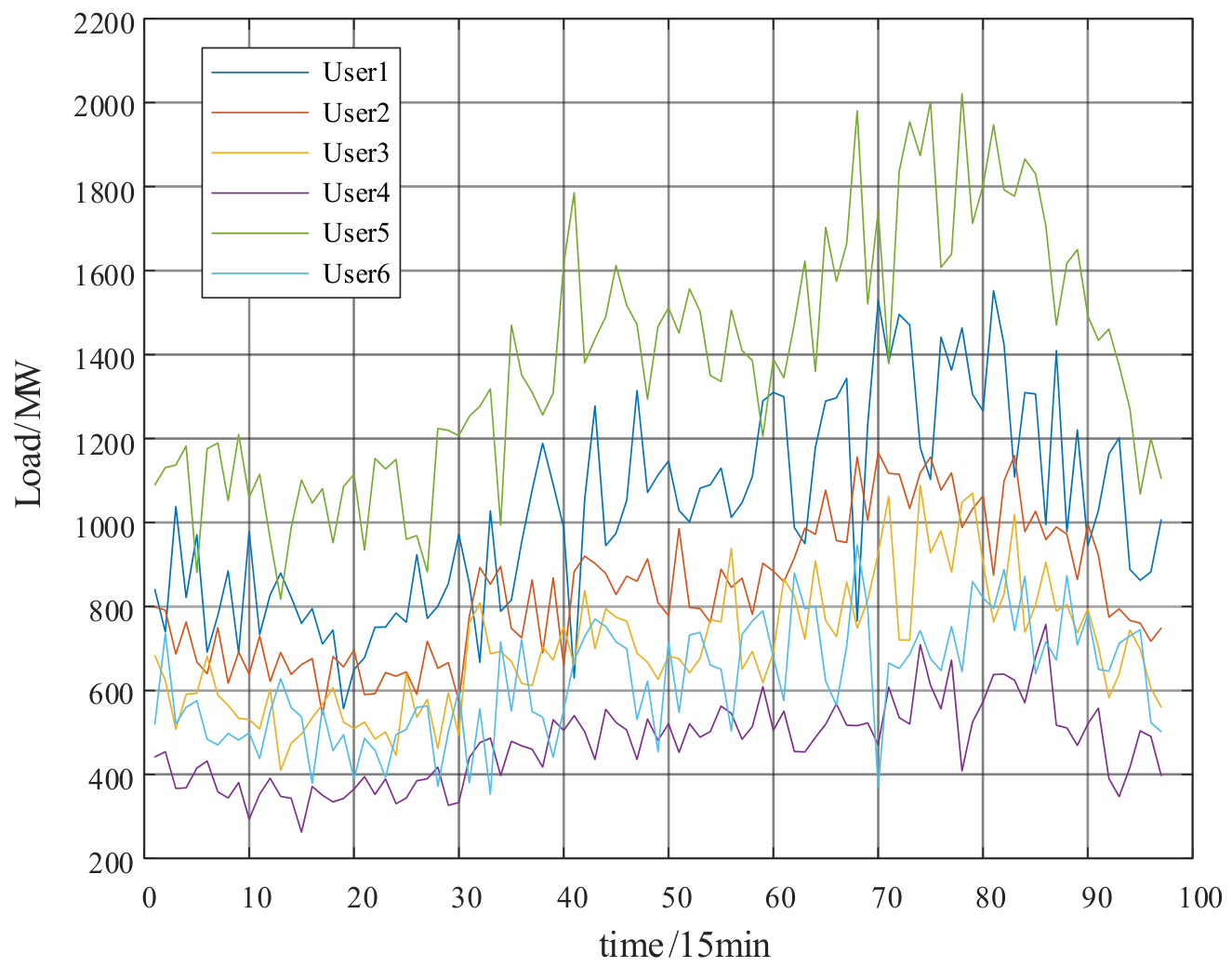
To analyze the fairness and traceability of the ramping ancillary service cost allocation method proposed in this paper, Table 2 and Table 3 present the specific sources of ramping cost allocations for users and renewable energy power stations under Allocation Method 2, respectively. Taking User 1 and User 5 as representative examples, a comparative graph of their load demand curves is plotted, as shown in Figure 7.
Table 2 lists the components of ramping costs allocated to users, including upward and downward ramping costs caused by net load variation, as well as upward and downward ramping costs caused by load uncertainty. Table 3 presents the components of ramping costs allocated to renewable energy units, including upward and downward ramping costs caused by net load variation, ramping costs based on declared forecast error intervals, and ramping costs based on actual forecast errors. This indicates that the proposed ramping ancillary service cost allocation method enables traceability in the allocation mechanism for both users and renewable energy power stations.
From the allocation results in Table 1 and Table 2, it can be observed that, in this case study, the proportion of ramping costs caused by net load variation borne by renewable energy stations is lower than that borne by the load side. This is mainly because the magnitude of renewable energy output fluctuations in this case study is significantly smaller than that of load-side fluctuations. On the load side, although User 5 has a higher total electricity consumption than User 1, User 1 exhibits greater load volatility (with a coefficient of variation 9.32% higher than that of User 5). As a result, User 1 bears an additional 1140.84 CNY in net load ramping costs compared to User 5. This difference indicates that, in this case study, users with higher load volatility bear higher ramping costs, reflecting the fairness principle of “user pays.” On the renewable energy side, the net load variation costs incurred by the photovoltaic station due to fluctuations are significantly lower than those of the wind farm. This is because, in this case study, the photovoltaic station’s output drops to zero at sunset and does not exacerbate ramping requirements through fluctuations during most of the day. However, its uncertainty-related ramping costs are comparable to those of the wind farm, which is attributable to the sharp increase in output at sunrise, leading to significant forecast errors. This finding suggests that, in this case study, the proposed allocation method can distinguish the distinct fluctuation characteristics of different renewable energy stations and create differentiated incentives through economic signals linked to these fluctuation characteristics. It should be noted that the above observations are based on the load and renewable energy output data of this case study. Load fluctuation characteristics and renewable energy output patterns may vary across different regions and seasons, and the ability of the mechanism to distinguish such characteristics and its incentive effects in broader contexts require further validation.

5.3.4. Analysis of High-Penetration Renewable Energy Scenarios

To verify the impact of different renewable energy penetration scenarios on the proposed allocation method, three thermal power plants (TP5, TP6, and TP7) in the original market configuration were replaced with one wind farm (WP1) and two photovoltaic stations (PV1 and PV2). The specific sources of ramping cost allocation for users and renewable energy stations are presented in Table 4 and Table 5, respectively.
Table 4 and Table 5 show that under the high renewable penetration scenario, the proposed method still enables traceability in the allocation of ramping costs for both users and renewable energy stations. Moreover, as the penetration of renewable energy increases, the volatility and uncertainty of renewable output intensify, leading to a corresponding rise in system ramping requirements. As a result, the total ramping costs increase by 26.41% compared with the base scenario. A comparison between Table 1 and Table 3 indicates that although total ramping costs increase, the incremental ramping requirements mainly stem from forecast deviations caused by renewable uncertainty, which reduces the share of ramping costs allocated to the load side. Consequently, the ramping costs borne by users do not change significantly. A comparison between Table 2 and Table 4 reveals that, despite an increase in total ramping costs for renewable energy under the high-penetration scenario, the average allocated costs for the original wind and photovoltaic units show a slight decrease. This phenomenon arises from the responsibility-tracing characteristic of the proposed allocation mechanism: when the number of renewable units in the system increases, the responsibility for net load variations and forecast errors is shared among more units. Therefore, although the overall system ramping demand rises due to increased variability in renewable output, the dispersion of responsibility among a larger number of units results in the allocated costs for the original renewable units remaining stable or even slightly decreasing.

5.3.5. IEEE 118-Bus System Case Study

To verify the scalability of the proposed ramping cost allocation mechanism, a test is conducted on the IEEE 118-bus system. The test system comprises 54 thermal generation units and 186 branches. Other necessary data, including generator parameters, line parameters, and load data, can be found in [28]. For this test, the system is divided into three zones based on grid topology and power flow direction. The proposed mechanism is then applied to implement cross-zone power flow tracing and ramping cost allocation. Zone 1 includes buses 1 to 40, Zone 2 includes buses 41 to 80, and Zone 3 includes buses 81 to 118. Six wind farms are connected at buses 10, 25, 26, 31, 46, and 54. Three photovoltaic power plants are connected at buses 49, 65, and 69. The system’s peak load is 6600 MW. The load demand curves and other parameters are set by proportionally scaling down the corresponding data from Section 5.3.1.
Figure 8 shows the allocated ramping costs for market participants in the three zones. The labels for consumers and renewable energy stations correspond to their grid connection node numbers. The cost distribution across the zones is highly uneven. This pattern reflects the differing levels of actual responsibility each zone bears for the system’s ramping demand. Zone 1 accounts for approximately 70% of the total cost. This high share is closely related to its load profile and generation mix. The zone contains several consumer nodes with high costs, indicating significant load volatility. Furthermore, its wind power nodes, especially the wind farm at node 10, are allocated exceptionally high costs. This shows that wind power output in zone 1 is highly unpredictable. Frequent deviations between its actual output and forecasts create sustained ramping pressure on the system, resulting in greater economic liability. In contrast, zone 3 bears a much lower cost burden. This is due to its generation mix, which is predominantly thermal power.
These results demonstrate that the proposed allocation mechanism sends clear economic signals. It successfully traces ramping costs back to their specific sources of volatility. Consumers with high load fluctuations and renewable stations with poor forecast accuracy are assigned higher costs. This effectively incentivizes market participants to improve their forecasting, engage with flexibility resources, or adjust their consumption patterns.

5.4. Real-Time Clearing Results and Benefit Analysis

5.4.1. Multi-Scenario Analysis of Real-Time Clearing Outcomes and Benefits

To demonstrate the effectiveness and advantages of the wind–hydro-storage participation strategy in the real-time market proposed in this paper, the following two typical scenarios are set up to compare the overall benefits of wind power and hydropower, as well as the operational performance of cascade hydropower with hybrid pumped storage under each scenario.
Scenario 1: Wind power and hydropower participate independently in the real-time market without engaging in bilateral trading.
Scenario 2 (The method proposed in this paper): Wind power and hydropower engage in bilateral trading and participate in the real-time market through a coordinated decision-making game that integrates bidding and bilateral trading strategies.
(1)
Comparative Analysis of Wind Power and Hydropower Benefits
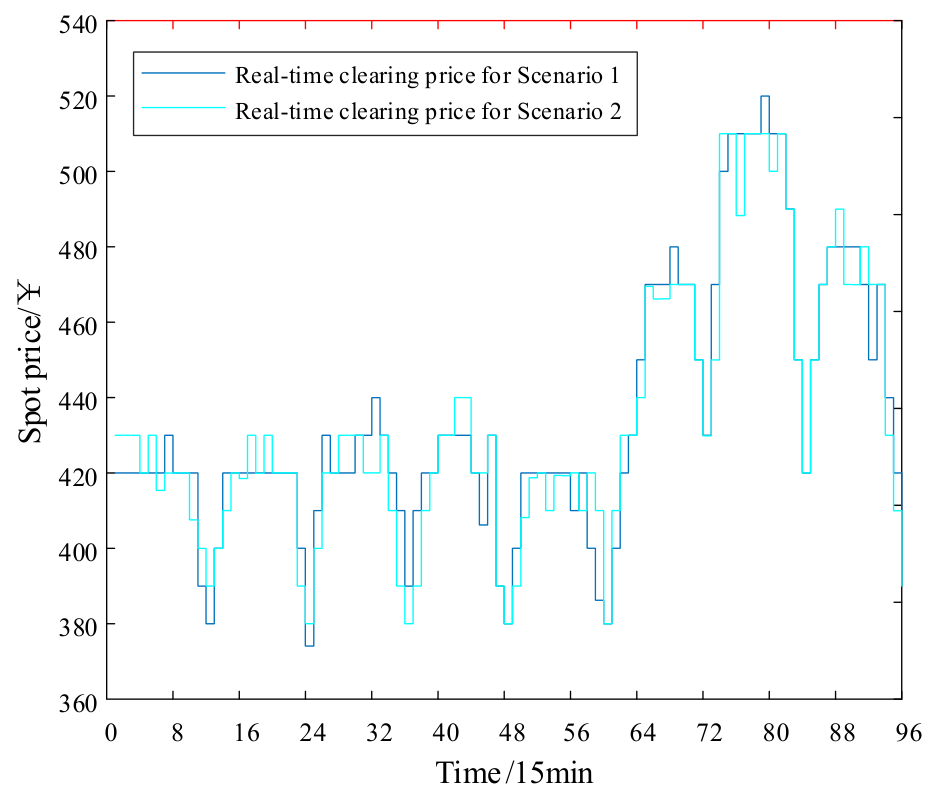
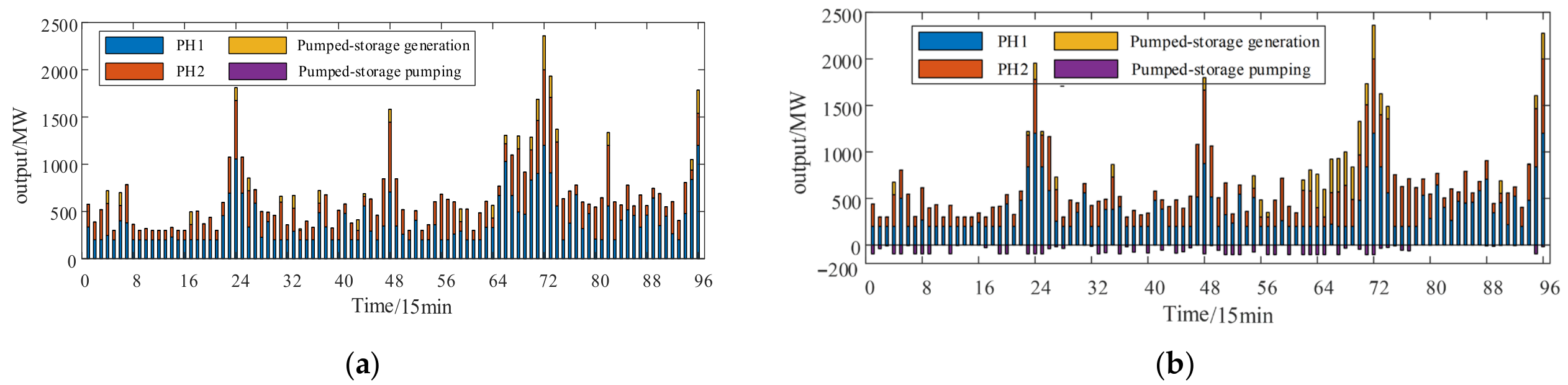
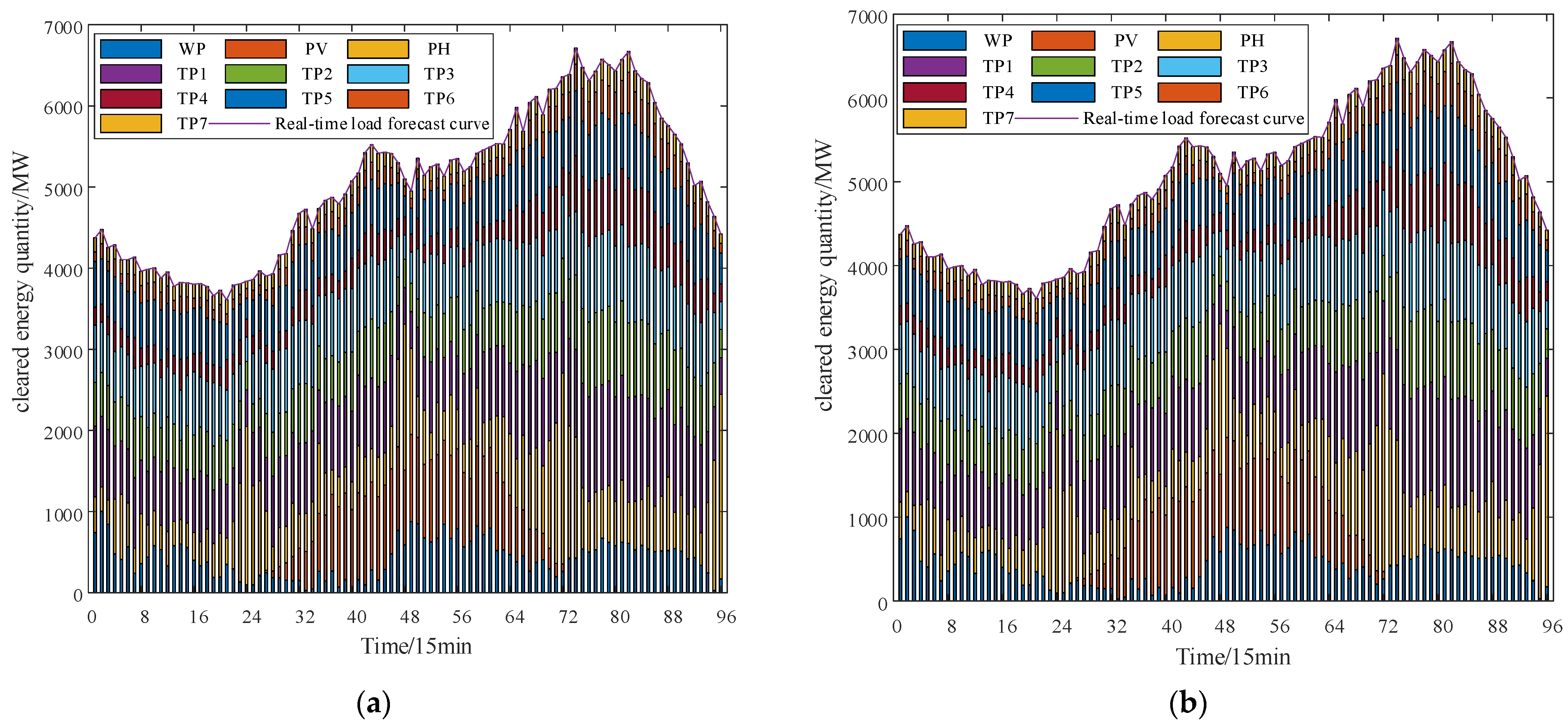
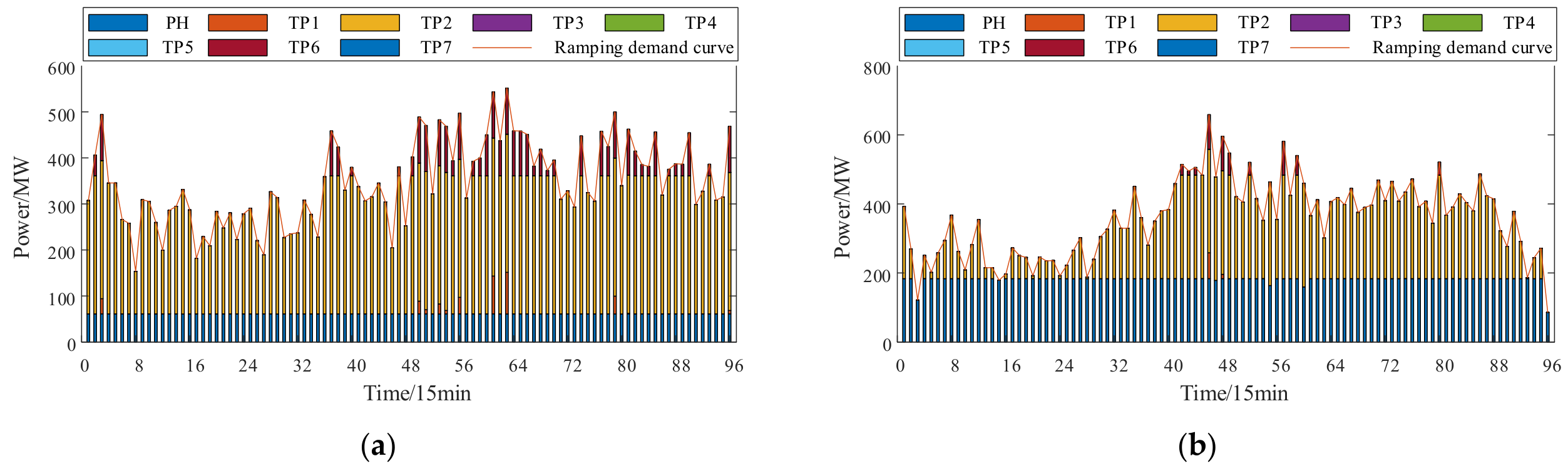
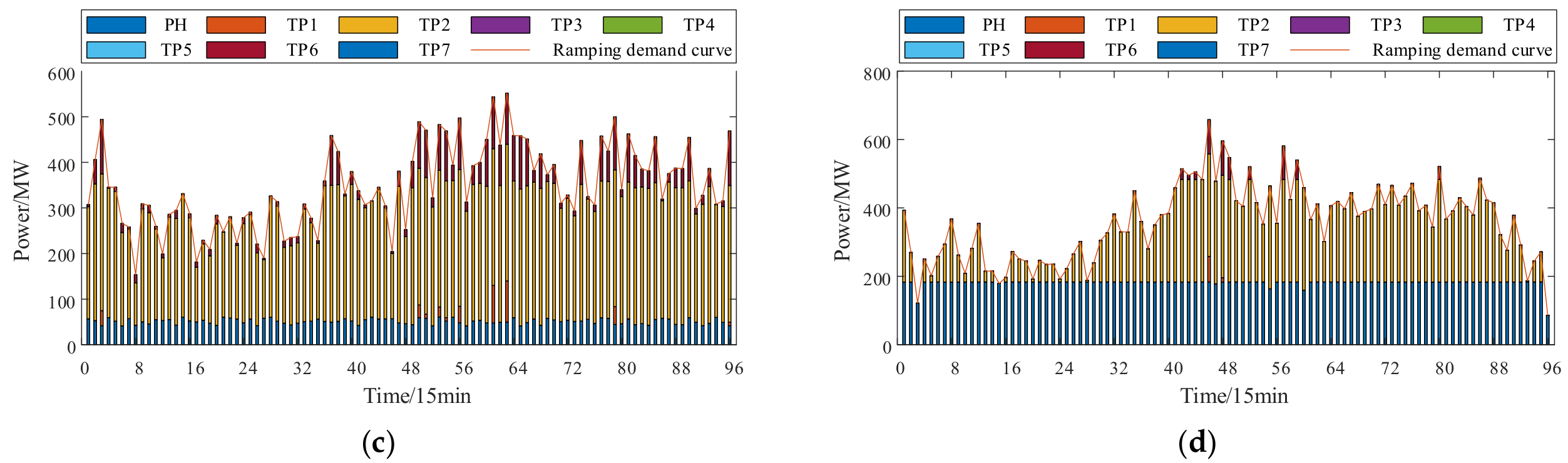
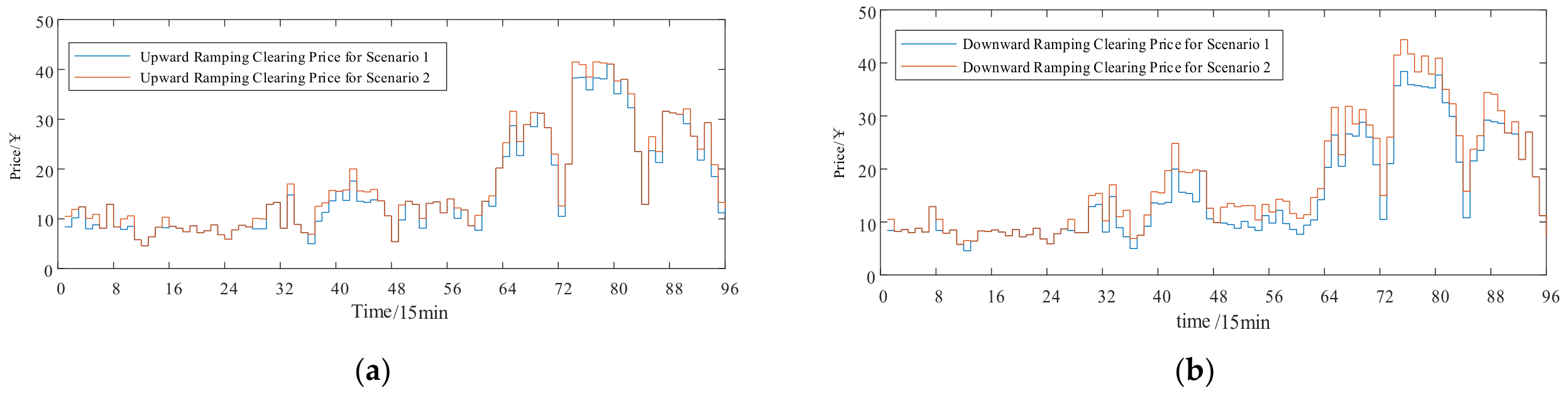
The clearing results of the multi-scenario real-time spot market and ramping ancillary service market are shown in Figure A5 and Figure A6 in Appendix C, respectively. The real-time spot clearing prices and upward/downward ramping clearing prices are presented in Figure 9 and Figure A7 in Appendix C, respectively. In addition, Table 6 summarizes the revenues of wind power and hydropower under multiple scenarios.
As shown in Table 6, the coordinated decision-making mechanism formed through bilateral trading between wind power and hydropower has significantly improved the economic benefits for both parties. Compared with Scenario 1, where both parties participate independently in the market, Scenario 2 establishes a risk-sharing model in which flexible regulation capacity is exchanged for deterministic revenue. To address the strong uncertainty of its own output, wind power purchases regulation services from hydropower, resulting in a substantial reduction in deviation penalty costs and ramping responsibility allocation costs by 51.01% and 23.10%, respectively. This leads to a total revenue increase of 451,001 ¥ compared to Scenario 1.
For hydro-storage, its role evolves from a pure power generator to a system regulation service provider. Not only does it receive regulation service compensation from wind power through bilateral contracts, but it also leverages the pumped storage unit to arbitrage by converting surplus wind power during high-output periods into scarce electricity during peak hours when market prices are favorable. This results in a total revenue increase of 171,700 ¥. The revenue analysis indicates that bilateral trading between wind power and hydro-storage, coupled with a coordinated decision-making game in real-time market participation, achieves a win–win outcome for both parties. More importantly, it establishes a market-oriented mechanism where risks and returns are aligned—wind power secures certainty by paying a predetermined cost to mitigate uncertainty risks, while hydro-storage earns additional revenue by assuming manageable risks.
Furthermore, as illustrated in Figure 9, during periods of low load demand, the bid output of wind power decreases while hydropower increases its energy storage, leading to a reduction in total market output and consequently higher electricity prices, as observed in time period 24. Conversely, during periods of high electricity prices, wind power increases its bid output, and hydropower, having stored energy during low-demand periods, also raises its bid output, thereby increasing total market generation and lowering electricity prices, as seen in time period 79. Therefore, bilateral trading between wind power and hydropower effectively reduces the peak-to-valley difference in electricity prices.
In summary, the coordinated decision-making of bidding and bilateral trading strategies for wind power and hydropower not only enhances the benefits of both parties at the micro level through risk trading but also smooths market price signals at the macro level by improving supply–demand matching, thereby enhancing the overall economic efficiency and operational performance of the power system.
(2)
Comparative Analysis of Hydropower Operation
As shown in Figure 10, which presents the operational status of hydropower under multiple scenarios, there is a fundamental difference in the hydropower dispatch mode between the two scenarios. In Scenario 1, hydropower operates as an independent market participant, with its dispatch aimed at maximizing the economic benefit of the reservoir itself, exhibiting a characteristic of “operation determined by water availability.” However, due to constraints imposed by inflow and electricity price differences, the quick regulation potential of hydropower was not fully utilized. In contrast, Scenario 2, through the coordinated decision-making mechanism, achieves a transition from “operation determined by water” to “water utilization optimized for electricity.” Hydropower dispatch is no longer confined to self-optimization; it adjusts its operation in real time based on wind power forecast errors. The utilization rate of the hybrid pumped storage is significantly higher than in Scenario 1, with the upstream reservoir focusing on energy storage and the downstream reservoir specializing in rapid regulation. This indicates that under the bilateral trading mode, hydropower, by dedicating a portion of its capacity to wind power, not only enhances its own economic benefits but also ensures its quick regulation capability is fully leveraged.

5.4.2. Wind Power Strategy Analysis Under Different Risk Preferences

Table 7 presents the revenue-risk trade-off for wind power under different risk aversion coefficients, as well as the corresponding leasing capacity from hydropower. As the risk aversion coefficient increases, the expected real-time revenue of wind power gradually decreases, while the CVaR value—representing the loss caused by risk—also declines accordingly. This indicates that wind power is willing to sacrifice part of its expected revenue to avoid risk, tending to adopt a more conservative bidding strategy.
Furthermore, the change in the risk aversion coefficient directly influences wind power’s decision on leasing capacity from hydropower. When risk aversion is low, wind power tends to lease less regulation capacity from hydropower, preferring to bear forecast error risks on its own to maximize expected revenue. As the risk aversion coefficient increases, wind power increases its leasing capacity from hydropower, hedging against uncertainty risks by paying a deterministic leasing cost.

6. Conclusions

Considering the sources of ramping requirements in the new power system, this paper proposes a fair ramping cost allocation mechanism based on the ramping responsibility coefficients of market participants. Under this mechanism, to reduce the ramping cost allocation for wind power, a market-oriented operation model for wind–hydro-storage coordinated operation is established, promoting efficient and collaborative multi-agent market participation. Through simulation analysis, the following conclusions are drawn:
(1)
Wind power and hydropower exhibit differentiated bidding behaviors through strategic interaction. In this case study, wind power adopts a conservative bidding strategy aimed at securing cleared quantities, while hydropower leverages its regulation characteristics, resulting in a bidding strategy characterized by a smoother profile but a broader capacity range.
(2)
According to the fairness analysis based on the Gini coefficient and Spearman’s rank correlation coefficient, compared with the traditional method that only allocates ramping costs to the generation side in proportion to grid-connected power, the proposed ramping cost allocation mechanism in this paper achieves higher fairness and better responsibility-cost matching, while reducing the average allocated cost of renewable energy power stations by 65.66%. This mechanism allocates costs based on the ramp responsibility of each participant, effectively correcting the mismatch between responsibility and cost in the traditional method, and can provide reasonable economic incentives for renewable energy stations to improve output forecasting accuracy and conduct energy interaction with flexible resources.
(3)
Through bilateral trading between wind power and hydropower, and participation in the real-time market via a coordinated decision-making game, the fast regulation capability of hydropower and its hybrid pumped storage is more fully utilized in this case study. The economic benefits for both parties are significantly improved compared to independent market participation, achieving a win-win outcome. In addition, a reduction in the peak-to-valley price difference is observed in this case study.
(4)
Conditional Value-at-Risk (CVaR) is introduced to quantify the revenue and risk of the coordinated decision-making between wind power market bidding and bilateral trading. In this case, study, the leased capacity from hydropower and the expected revenue of wind power are compared under different risk aversion coefficients. As the risk aversion coefficient gradually increases, the expected real-time revenue of wind power decreases, while the leased capacity from hydropower increases, allowing wind power to hedge against uncertainty risks by paying a deterministic leasing cost.

Author Contributions

Conceptualization, Y.Z. and X.L.; methodology, Y.Z. and X.L.; software, Y.Z.; validation, Y.Z., X.L. and G.S.; formal analysis, Y.Z.; investigation, X.L.; resources, Y.Z.; data curation, Y.Z.; writing—original draft preparation, Y.Z.; writing—review and editing, Y.Z., X.L. and G.S.; visualization, Y.Z.; supervision, X.L.; project administration, X.L.; funding acquisition, X.L. All authors have read and agreed to the published version of the manuscript.

Funding

This research received no external funding.

Data Availability Statement

The original contributions presented in this study are included in the article. Further inquiries can be directed to the corresponding author.

Conflicts of Interest

The authors declare no conflicts of interest.

Appendix A

(1)
Construct the Lagrangian function of the lower-level model: Based on the corresponding dual variables listed in the main text, the Lagrangian function L for the lower-level real-time market clearing model is formulated as:
min L = t T m M u Ω WP λ ^ u , m , t WP ,   RT P u , m , t WP , RT + v Ω PH λ ^ v , m , t PH ,   RT P v , m , t PH , RT ) + g Ω G f N f λ ^ g , f , m , t P g , f , m , t + n Ω N M r ( S n , t up + S n , t down ) + n Ω N λ n , t DA m M ( P n , m , t WP , DA + P n , m , t PH , DA + f N f P n , f , m , t ) L n , t h Ω n B n h ( θ n , t θ h , t ) + g Ω G f N f m M μ g , f , m , t G , min ( P g , f , m , t ) + μ g , f , m , t G , max ( P g , f , m , t P ^ g , f , m , t ) + u Ω WP m M μ u , m , t WP , min ( P u , m , t WP , DA ) + μ u , m , t WP , max ( P u , m , t WP , DA P ^ u , m , t WP , DA ) + v Ω PH m M μ v , m , t PH , min ( P v , m , t PH , DA ) + μ v , m , t PH , max ( P v , m , t PH , DA P ^ v , m , t PH , DA ) + n Ω N h Ω n μ n h , t neg P n h max B n h ( θ n , t θ h , t ) + μ n h , t pos B n h ( θ n , t θ h , t ) P n h max + n Ω N ξ n , t min ( π θ n , t ) + ξ n , t max ( π θ n , t ) + ϕ 1 , t ( θ 1 , t ) + n Ω N λ n , t up ( R n , t RU P n , t PH , RU i I P n , i , t RU S n , t up ) + λ n , t down ( R n , t RD P n , t PH , RD i I P n , i , t RD S n , t down ) + g Ω G i Ω I μ g , i , t G , up ( m M P g , i , m , t + P g , i , t RU P g , i , t + 1 max ) + μ g , i , t G , down ( P g , i , t + 1 min m M P g , i , m , t + P g , i , t RD ) + v Ω PH μ v , t PH , up m M P v , m , t PH , RT + P v , t PH , RU + P bit , t r R ( P r , max H + P r , max CX ) + μ v , t PH , down r R ( P r , min H P r , max CX ) m M P v , m , t PH , RT + P v , t PH , RD P bit , t + g Ω G i Ω I μ G , g , i , t up , min ( P g , i , t RU ) + μ G , g , i , t up , max ( P g , i , t RU P g , i G , climb ) + μ G , g , i , t down , min ( P g , i , t RD ) + μ G , g , i , t down , max ( P g , i , t RD P g , i G , climb ) + v Ω PH μ PH , v , t up , min ( P v , t PH , RU ) + μ PH , v , t up , max ( P v , t PH , RU P v PH , climb ) + μ PH , v , t down , min ( P v , t PH , RD ) + μ PH , v , t down , max ( P v , t PH , RD P v PH , climb ) + n Ω N ϑ n , t up ( S n , t up ) + ϑ n , t down ( S n , t down )
(2)
The dual variable constraints are:
λ n , t DA , μ g , f , m , t G , min , μ g , f , m , t G , max , μ u , m , t WP , min , μ u , m , t WP , max , μ v , m , t PH , min , μ v , m , t PH , max , μ n h , t neg , μ n h , t pos , ξ n , t min , ξ n , t max , ϕ 1 , t , λ n , t up , λ n , t down , μ g , i , t G , up , μ g , i , t G , down , μ v , t PH , up , μ v , t PH , down , μ G , g , i , t up , min , μ G , g , i , t up , max , μ G , g , i , t down , min , μ G , g , i , t down , max , μ PH , v , t up , min , μ PH , v , t up , max , μ PH , v , t down , min , μ PH , v , t down , max , ϑ n , t up , ϑ n , t down 0
(3)
The gradient of the Lagrangian function L is zero at the optimal solution of the original lower-level problem. Specifically, taking the partial derivatives of L with respect to the variables of the lower-level optimization problem yields:
λ ^ u , m , t WP ,   RT λ u , t RT μ u , m , t WP , min + μ u , m , t WP , max = 0 , u , m , t
λ ^ v , m , t PH ,   RT λ v , t RT μ v , m , t PH , min + μ v , m , t PH , max μ v , t PH , down + μ v , t PH , up = 0 , v , m , t
λ ^ g , f , m , t λ v , t RT μ g , f , m , t G , min + μ g , f , m , t G , max μ g , i , t G , down + μ g , i , t G , up = 0 , g , f , m , t
M r λ n , t up ϑ n , t up = 0 , n , t
M r λ n , t down ϑ n , t down = 0 , n , t
h Ω n B n h ( λ ^ n , t RT λ h , t RT ) ξ n , t min + ξ n , t max + h Ω n B n h ( μ n h , t neg + μ h n , t neg + μ n h , t pos μ h n , t pos ) = 0 , n , h , t
λ v , t up + μ v , t PH , up μ PH , v , t up , min + μ PH , v , t up , max = 0 , v , t
λ v , t down + μ v , t PH , down μ PH , v , t down , min + μ PH , v , t down , max = 0 , v , t
λ g , t up + μ g , i , t G , up μ G , g , i , t up , min + μ G , g , i , t up , max = 0 , g , i , t
λ g , t down + μ g , i , t G , down μ G , g , i , t down , min + μ G , g , i , t down , max = 0 , g , i , t
(4)
The complementary slackness constraints are:
0 ( P ^ g , f , m , t P g , f , m , t ) μ g , f , m , t G , max 0 , g , f , m , t
0 P g , f , m , t μ g , f , m , t G , min 0 , g , f , m , t
0 ( P ^ u , m , t WP , DA P u , m , t WP , DA ) μ u , m , t WP , max 0 , u , m , t
0 P u , m , t WP , DA μ u , m , t WP , min 0 , u , m , t
0 ( P ^ v , m , t PH , DA P v , m , t PH , DA ) μ v , m , t PH , max 0 , v , m , t
0 P v , m , t PH , DA μ v , m , t PH , min 0 , v , m , t
0 [ P n h max B n h ( θ n , t θ h , t ) ] μ n h , t pos 0 , n , h , t
0 [ P n h max + B n h ( θ n , t θ h , t ) ] μ n h , t neg 0 , n , h , t
0 ( π θ n , t ) ξ n , t max 0 , n , t
0 ( π + θ n , t ) ξ n , t min 0 , n , t
0 ( P n , t PH , RU + i I P n , i , t RU + S n , t up R n , t RU ) λ n , t up 0 , n , t
0 ( P n , t PH , RD + i I P n , i , t RD + S n , t down R n , t RD ) λ n , t down 0 , n , t
0 ( P g , i , t + 1 max m M P g , i , m , t P g , i , t RU ) μ g , i , t G , up 0 , g , i , t
0 ( m M P g , i , m , t P g , i , t RD P g , i , t + 1 min ) μ g , i , t G , down 0 , g , i , t
0 r R ( P r , max H + P r , max CX ) m M P v , m , t PH , RT P v , t PH , RU P bit , t μ v , t PH , up 0 , v , t
0 m M P v , m , t PH , RT P v , t PH , RD + P bit , t r R ( P r , min H P r , max CX ) μ v , t PH , down 0 , v , t
0 ( P v PH , climb P v , t PH , RU ) μ PH , v , t up , max 0 , v , t
0 P v , t PH , RU μ PH , v , t down , min 0 , v , t
0 ( P v PH , climb P v , t PH , RD ) μ PH , v , t down , max 0 , v , t
0 P v , t PH , RD μ PH , v , t down , min 0 , v , t
0 ( P g , i G , climb P g , i , t RU ) μ G , g , i , t up , max 0 , g , i , t
0 P g , i , t RU μ G , g , i , t up , min 0 , g , i , t
0 ( P g , i G , climb P g , i , t RD ) μ G , g , i , t down , max 0 , g , i , t
0 P g , i , t RD μ G , g , i , t down , min 0 , g , i , t
0 S n , t up ϑ n , t up 0 , n , t
0 S n , t down ϑ n , t down 0 , n , t
where ab denotes a ≥ 0, b ≥ 0 and ab = 0.
(5)
Linearization of complementary slackness conditions: The Big-M method is employed for linearization. Taking Equation (A13) as an example, it can be expressed using a binary variable η and a sufficiently large positive constant M as follows:
0 P ^ g , f , m , t P g , f , m , t M η 0 μ g , f , m , t G , max M ( 1 η )
At this stage, the constraints of the upper-level optimization problems for wind power and hydro-storage incorporate all the aforementioned KKT conditions (after linearization). The original bilevel problem is thus transformed into a single-level mixed-integer linear programming (MILP) problem, which can be solved directly using the Gurobi solver. The selection of the Big-M parameter has a significant impact on numerical stability and solution quality. If the M value is too small, the logical constraints of the model cannot be effectively enforced, which may produce pseudo-feasible solutions that violate the physical or economic nature of the problem, directly affecting solution correctness. If the M value is too large, it can cause severe numerical instability, where M-related terms in the objective function or constraints overshadow the original coefficient differences, blurring the true optimization direction. Additionally, overly weak linear relaxation may increase solution time. In extreme cases, this may lead to premature solver termination or suboptimal solutions. Therefore, for the complementary slackness constraints arising from the KKT transformation in this paper, following reference [29], a differentiated M-value selection strategy is adopted based on the constraint type. The details are as follows:
(1)
Direct selection based on physical bounds: Applicable to variables with clear physical bounds (e.g., power, phase angle). The M values are directly determined according to the physical characteristics of the variables. For constraints related to generation output and ramping capacity, the parameter M is directly taken as 1.2 times the corresponding unit’s maximum generation capacity or ramping capacity limit. For phase angle constraints, the parameter M is fixed at 2π, covering the maximum possible deviation of the voltage phase angle in the range [−π, π].
(2)
Dual variable-related constraints (e.g., electricity price). First, solve a single-level market clearing problem to obtain the dual variable values of each relevant constraint, and then determine the M value in combination with the market price cap, where M = (dual variable value + 1) × 100.

Appendix B

Figure A1. Modified IEEE39 node system.
Energies 19 01799 g0a1
Figure A2. Iteration convergence curve.
Energies 19 01799 g0a2
Figure A3. User load profile.
Energies 19 01799 g0a3
Figure A4. Wind and photovoltaic output curves.
Energies 19 01799 g0a4
Table A1. Parameters of upper and lower cascade hydropower stations.
ParametersUpstream Hydropower StationDownstream Hydropower StationPumped Storage
Regulation CapabilityIncomplete Annual RegulationDaily Regulation
Installed Capacity/MW1200800450
Normal Storage Level/m400200
Flood Control Level/m395.2192.2
Dead Water Level/m345180
Design Water Head/m170101.6
Output Coefficient8.58.58.5
Pumping Efficiency90%
Generation Efficiency80%
Table A2. Operation parameters of units.
Unit NumberUnit TypeConnected NodeRamping Coefficient (%/h)Installed Capacity/MW
G1WP301200
G2PV311200
G3Thermal Power3225%300
G4Thermal Power3325%1500
G5Thermal Power3430%1300
G6Thermal Power3535%1100
G7Thermal Power3625%1000
G8Thermal Power3725%800
G9Thermal Power3830%600
G10Hydro-Storage3035%2450

Appendix C

Figure A5. Comparison of real-time spot market clearing results under different scenarios. (a) Real-time spot market cleared energy quantity for Scenario 1; (b) Real-time spot market cleared energy quantity for Scenario 2.
Energies 19 01799 g0a5
Figure A6. Comparison of clearing results in the ramping ancillary services market under different scenarios. (a) Upward ramping ancillary service clearing results for Scenario 1; (b) Downward ramping ancillary service clearing results for Scenario 1; (c) Upward ramping ancillary service clearing results for Scenario 2; (d) Downward ramping ancillary service clearing results for Scenario 2.
Energies 19 01799 g0a6aEnergies 19 01799 g0a6b
Figure A7. Comparison of clearing prices in the ramping ancillary services market under different scenarios. (a) Comparison of upward ramping clearing prices under different scenarios; (b) Comparison of downward ramping clearing prices under different scenarios.
Energies 19 01799 g0a7

References

  1. Sreekumar, S.; Yamujala, S.; Sharma, K.C.; Bhakar, R.; Simon, S.P.; Rana, A.S. Flexible Ramp Products: A solution to enhance power system flexibility. Renew. Sustain. Energy Rev. 2022, 162, 112429. [Google Scholar] [CrossRef]
  2. Gong, X.; Li, X.; Zhong, Z. Strategic bidding of hydrogen-wind-photovoltaic energy system in integrated energy and flexible ramping markets with renewable energy uncertainty. Int. J. Hydrogen Energy 2024, 80, 1406–1423. [Google Scholar] [CrossRef]
  3. Wang, P.; Zhang, Y.; Ding, Y.; Wang, W.; Cui, Z.; Liu, X. Collaborative bidding optimization model for pumped storage plants participating in the electricity and flexible ramping markets considering multi-player game relationships: Case study of China. Energy 2025, 326, 136307. [Google Scholar] [CrossRef]
  4. Deng, J.; Li, X.; Liu, J. A joint optimal clearing model for energy, inertia and ramping in power systems considering multiple time scales. Appl. Energy 2025, 390, 125892. [Google Scholar] [CrossRef]
  5. CAISO. Flexible Ramping Product: Revised Draft Final Proposal; CAISO: Folsom, CA, USA, 2015. [Google Scholar]
  6. Chen, Y.; Leonard, R.; Keyser, M.; Gardner, J. Development of performance based two part regulating reserve compensation on MISO energy and ancillary service market. IEEE Trans Power Syst. 2014, 30, 142–155. [Google Scholar] [CrossRef]
  7. EPEX Spot. Flexibility Is the Answer: European Power Exchange as a Component of Security of Supply During the Solar Eclipse; EPEX: Paris, France, 2015. [Google Scholar]
  8. Circular of the Shandong Energy Regulatory Office of the National Energy Administration on Issuing the “Shandong Electric Power Ramping Ancillary Service Market Trading Rules (Trial)”. Available online: https://sdb.nea.gov.cn/dtyw/tzgg/202402/t20240208_245961.html (accessed on 8 February 2024).
  9. Saberi, L.; Alizadeh, M.; Moghaddam, M.P. Optimal scheduling of flexible ramp product and emerging flexible resources considering short-term variability impacts in power system with high RESs penetration: A novel robust UC approach. Int. J. Electr. Power Energy Syst. 2022, 142, 108279. [Google Scholar] [CrossRef]
  10. Ghaljehei, M.; Khorsand, M. Day-Ahead operational scheduling with enhanced flexible ramping product: Design and Analysis. IEEE Trans Power Syst. 2021, 37, 1842–1856. [Google Scholar] [CrossRef]
  11. Huang, C.; Han, D.; Yan, Z.; Li, Y.; Sun, C.; Jia, Q. Bidding strategy of energy storage in imperfectly competitive flexible ramping market via system dynamics method. Int. J. Electr. Power Energy Syst. 2022, 136, 107722. [Google Scholar] [CrossRef]
  12. Massana, J.; Burgas, L.; Caigueral, M.; Sumper, A.; Melendez, J.; Colomer, J. Enabling charging point operators for participation in congestion markets. Int. J. Electr. Power Energy Syst. 2025, 167, 110604. [Google Scholar] [CrossRef]
  13. Chen, W.; Sun, H.; Peng, C.; Zhou, H.; Xu, S. Distributed optimization for EVs integrated power system considering flexible ramping requirement. Int. J. Electr. Power Energy Syst. 2024, 160, 110104. [Google Scholar] [CrossRef]
  14. Zhao, Y.; Wu, G.; Cai, Q.; Wang, L.; Song, H.; Yu, Y.; Yu, P.; Wang, Z.; Dai, X.; Chen, Y. The Research on Settlement and Cost Allocation Mechanisms of Ramping Ancillary Service. Price: Theory Pract. 2024, 10, 131–137. Available online: https://kns.cnki.net/kcms2/article/abstract?v=ZBmzy5eCHcaIVc6aAXLMiRqf3b4TSX9cy_g033Tz5WUG8FbkOhh7fsHne4Fh_cYWZfAX-TTxaAz2tJuS0fGeE0DJBua2Evb37GjTFUlmbDIXZhAUkn2loxHr157BvFeqmM-zT4g2e7EGIdP8C8cQ5Ghm9EXPlhewejD51z9HI-AwlSux8BuivQ==&uniplatform=NZKPT&language=CHS (accessed on 2 April 2026).
  15. Yu, Z. Research on the Clearing and Cost Sharing Mechanism of Flexible Ramping Products in the Electricity Market. Master’s Thesis, South China University of Technology, Guangzhou, China, 2023. Available online: https://kns.cnki.net/kcms2/article/abstract?v=ZBmzy5eCHcayVMLdB_GFmcUowbQU27topzgxWd1_iU0L34kylZVySzVIIcWUwlS6gsit8OmYTRwjoKoQdHHi9Fg490_qG7pvVdI3VWjtcGqkJBuizTkINaoC4_velz_y3EVz5ZS7nM7aylzlWq-EhM46KnDZdzA8SJ5oLADsT-xDoq-2roUF7dtOKjg7Jg-F&uniplatform=NZKPT&language=CHS (accessed on 2 April 2026).
  16. Dong, R.; Wang, Y.; Huang, Y.; Zou, R. Feature-driven dynamic non-crossing quantile ensemble learning for reliable probabilistic wind power forecasting. Energy 2025, 335, 137884. [Google Scholar] [CrossRef]
  17. Ju, C.; Ding, T.; Jia, W.; Mu, C.; Zhang, H.; Sun, Y. Two-stage robust unit commitment with the cascade hydropower stations retrofitted with pump stations. Appl. Energy 2023, 334, 120675. [Google Scholar] [CrossRef]
  18. Bai, Q.; Zhao, Z.; Jin, X.; Cheng, C.; Deng, Z.; Jia, Z. Hydro-Wind Power Joint Bidding Strategies for Electricity Spot Market Considering Uncertainties of Wind Power Output and Electricity Price. Autom. Electr. Power Syst. 2024, 48, 122–133. [Google Scholar] [CrossRef]
  19. Circular of the Shandong Energy Regulatory Office of the National Energy Administration on Issuing the “Shandong Electricity Market Rules (Trial)”. Available online: https://sdb.nea.gov.cn/dtyw/tzgg/202512/t20251217_292527.html (accessed on 17 December 2025).
  20. Huang, L.; Jaharadak, A.A.b.; Ahmad, N.I.; Wang, J. A CPO-Optimized BiTCN–BiGRU–Attention Network for Short-Term Wind Power Forecasting. Energies 2026, 19, 1034. [Google Scholar] [CrossRef]
  21. Heikkil, S.; Reffett, K. Fixed point theorems and their applications to theory of Nash equilibria. Nonlinear Anal. 2015, 64, 1415–1436. [Google Scholar] [CrossRef]
  22. Orfanogianni, T.G.G. A general formulation for LMP evaluation. IEEE Trans. Power Syst. 2007, 22, 1163–1173. [Google Scholar] [CrossRef]
  23. Wang, K.; Yan, X.; Jiang, K.; Liu, N. Bidding Strategy and Regulation Method for the Unified Wind/Photovoltaic/Energy Storage Power Stations in Electricity Spot Market Considering Carbon Trading. Proc. CSEE 2023, 43, 7091–7102. [Google Scholar] [CrossRef]
  24. Biggar, D.R.; Hesamzadeh, M.R. Achieving Efficient Use of Generation and Load Resources using a Market Mechanism in an Industry with no Network Constraints. In The Economics of Electricity Markets; Wiley: Hoboken, NJ, USA, 2014; pp. 119–138. [Google Scholar] [CrossRef]
  25. Yu, W.; Dai, Y.; Wang, W.; Ren, T.; Leng, M. Short-term photovoltaic forecasting: A parallel Times Net and AT-Informer-AT method. Renew. Energy 2026, 258, 125012. [Google Scholar] [CrossRef]
  26. Corrado, G. Measurement of Inequality of Incomes. Econ. J. 1921, 121, 124–126. [Google Scholar] [CrossRef]
  27. Xia, J.; Shen, Q. Correlation analysis of different vegetable categories based on Spearman rank correlation coefficient. In Proceedings of the 2024 IEEE 6th Advanced Information Management, Communicates, Electronic and Automation Control Conference (IMCEC), Chongqing, China, 24–26 May 2024; 2024; pp. 548–551. [Google Scholar] [CrossRef]
  28. Available online: https://view.officeapps.live.com/op/view.aspx?src=http%3A%2F%2Fmotor.ece.iit.edu%2Fdata%2Fjeas_ieee118.doc&wdOrigin=BROWSELINK (accessed on 2 April 2026).
  29. Ruiz, C.; Conejo, A.J. Pool Strategy of a Producer With Endogenous Formation of Locational Marginal Prices. IEEE Trans. Power Syst. 2009, 24, 1855–1866. [Google Scholar] [CrossRef]
Figure 1. Two-layer game framework for bilateral transactions and market bidding between wind power and cascaded hydropower integrated hybrid pumped storage.
Energies 19 01799 g001
Figure 2. Solution Flowchart.
Energies 19 01799 g002
Figure 3. Partial-period bidding curves for wind power and hydropower. (a) Comparison of bidding curves at time period 5; (b) Comparison of bidding curves at time period 47; (c) Comparison of bidding curves at time period 70; (d) Comparison of bidding curves at time period 82.
Energies 19 01799 g003aEnergies 19 01799 g003b
Figure 4. Comparison of day-ahead spot market clearing prices and net load curve.
Energies 19 01799 g004
Figure 5. Sensitivity Analysis of Parameters. (a) Sensitivity Analysis of Parameter β; (b) Sensitivity Analysis of Parameter γ.
Energies 19 01799 g005
Figure 6. Comparison of allocation costs under different allocation methods.
Energies 19 01799 g006
Figure 7. Load demand curves of typical power users.
Energies 19 01799 g007
Figure 8. Ramping Cost Allocation for Market Participants in the Three Zones. (a) Ramping cost allocation of Zone 1; (b) Ramping cost allocation of Zone 2; (c) Ramping cost allocation of Zone 3.
Energies 19 01799 g008
Figure 9. Comparison of real-time clearing prices under different scenarios.
Energies 19 01799 g009
Figure 10. Comparison of hydropower operation under different scenarios. (a) Hydro-Storage operational status for Scenario 1; (b) Hydro-Storage operational status for Scenario 2.
Energies 19 01799 g010
Table 1. Comparison of Indicators for Different Methods.
IndicatorGini CoefficientSpearman’s Rank Correlation Coefficient
Allocation Method 10.6346−0.5660
Allocation Method 20.47521
Table 2. Sources of ramping allocation costs for power users.
Market ParticipantUpward Cost for Net Load Variation/¥Downward Cost for Net Load Variation/¥Upward Cost for Load Uncertainty/¥ Downward Cost for Load Uncertainty/¥Total/¥
User 17698.224519.8188,152.8187,385.91187,756.75
User 26282.954417.2071,825.9971,481.67154,007.81
User 37238.335732.7960,678.4760,283.80133,933.39
User 45016.232965.2339,807.7839,718.0987,507.33
User 56180.674932.52119,634.7118,635.7249,383.59
User 65548.053196.2252,655.0552,115.52113,514.84
Table 3. Wind turbine virtual inertia coefficients of each scheme under all wind speed scenario.
Market ParticipantUpward Ramping Cost Allocation for Net Load Variation/¥Downward Ramping Cost Allocation for Net Load Variation/¥Ramping Cost Allocation for Declared Forecast Error Interval/¥Ramping Cost Allocation for Actual Forecast Error/¥Total/¥
WP9286.316364.8127,279.4057,040.9499,971.46
PV2246.401155.8821,077.7353,494.4377,974.44
Table 4. Sources of ramping allocation costs for power users.
Market ParticipantUpward Cost for Net Load Variation/¥Downward Cost for Net Load Variation/¥Upward Cost for Load Uncertainty/¥ Downward Cost for Load Uncertainty/¥Total/¥
User 17439.204263.7386,576.7786,717.00184,996.70
User 26071.554166.9470,541.8570,934.50151,714.84
User 36994.795407.9959,593.6359,822.35131,818.76
User 44847.452797.2339,096.0739,414.0686,154.81
User 55972.714653.06117,495.81117,727.58245,849.16
User 65361.383015.1351,713.6551,716.59111,806.75
Table 5. Wind turbine virtual inertia coefficients of each scheme under all wind speed scenario.
Market ParticipantUpward Ramping Cost Allocation for Net Load Variation/¥Downward Ramping Cost Allocation for Net Load Variation/¥Ramping Cost Allocation for Declared Forecast Error Interval/¥Ramping Cost Allocation for Actual Forecast Error/¥Total/¥
WP8480.685883.2724,893.6751,837.4091,095.02
PV2051.511068.4319,234.3748,614.4270,968.73
WP111,563.647347.1930,974.5065,805.19115,690.50
PV12838.221474.2526,883.2867,645.6098,841.35
PV23043.051577.2529,049.6172,985.36106,655.30
Table 6. Comparative analysis of revenue for wind power and hydropower under different scenarios.
Market ParticipantWPHydro-Storage
ScenarioScenario 1Scenario 2Scenario 1Scenario 2
Real-Time Spot Market Revenue/104 ¥506.12519.89688.22699.59
Deviation Penalty Cost/104 ¥11.415.59
Ramping Cost Allocation/104 ¥10.007.69
Ramping Service Revenue/104 ¥36.0735.48
Bilateral Trading Cost/104 ¥6.396.39
Total Revenue/104 ¥484.71489.22724.29741.46
Table 7. Wind power’s return–risk results under different risk aversion coefficients.
Risk Aversion CoefficientExpected Revenue/104 ¥Expected Revenue/104 ¥Average Leased Capacity from Hydropower (MW, Magnitude Only)
0496.57496.3536.38
0.2492.36491.8239.89
0.4490.71489.8741.92
0.6489.22488.1544.12
0.8487.54487.2645.88
1485.17485.0248.23
Disclaimer/Publisher’s Note: The statements, opinions and data contained in all publications are solely those of the individual author(s) and contributor(s) and not of MDPI and/or the editor(s). MDPI and/or the editor(s) disclaim responsibility for any injury to people or property resulting from any ideas, methods, instructions or products referred to in the content.