Article

Ni-Doped PPy/Chitosan Composite Coatings on Stainless Steel as Efficient Electrocatalysts for Hydrogen Evolution


by
Sıla Melahat Yılmaz
1,*,
Ceyda Dağcan
1 and
Aysel Kantürk Figen
1,2
1
Hydrogen Research Center, Clean Energy Technologies Institute, Yıldız Technical University, Istanbul 34220, Türkiye
2
Department of Chemical Engineering, Yıldız Technical University, Istanbul 34220, Türkiye
*
Author to whom correspondence should be addressed.
Energies 2026, 19(7), 1749; https://doi.org/10.3390/en19071749
Submission received: 4 March 2026 / Revised: 27 March 2026 / Accepted: 30 March 2026 / Published: 2 April 2026

Abstract

Developing efficient and durable electrocatalysts for the alkaline hydrogen evolution reaction (HER) remains challenging due to intrinsically sluggish reaction kinetics and the limited long-term stability of many non-noble metal catalysts under continuous operation. Herein, a nickel-doped polypyrrole/chitosan composite electrode on stainless steel (PPy/Chi/Ni) was fabricated via electrodeposition as a low-cost and scalable method. Benefiting from the combined effects of Ni incorporation and the conductive polymer–biopolymer composite framework, the optimized PPy/Chi/Ni electrode exhibits enhanced HER activity in alkaline environment, delivering a low overpotential of η10 = 78 mV at a current density of 10 mA·cm−2 and a reduced Tafel slope of 93 mV·dec−1, indicative of accelerated reaction kinetics. Structural and morphological characterizations by XRD, FTIR, and FESEM indicate the formation of the composite structure. FESEM images suggest that the deposited layer forms a relatively uniform coating on the stainless steel substrate. EIS further reveals improved interfacial charge-transfer characteristics upon Ni doping. Additionally, long-term stability tests confirm the structural integrity of the composite electrode and its electrochemical stability under HER conditions by demonstrating stable HER performance for 15 h with only a 22 mV potential change at a constant current density. By providing a conductive interface and numerous catalytic sites, the Ni-doped electrocatalyst coating activates the stainless steel substrate, leading to a 79% reduction in overpotential compared to bare stainless steel and thereby significantly improving its HER performance.

1. Introduction

The hydrogen economy, encompassing the production, storage, transportation, and utilization of hydrogen, has a significant impact on the development of carbon-free energy systems [1]. Hydrogen production is the most critical process as it directly determines the overall environmental sustainability, energy efficiency and economic feasibility of the hydrogen supply chain [2,3]. To overcome the cost and resource limitations of platinum-group metals (PGMs), significant efforts have been devoted to the development of earth-abundant, non-noble-metal-based electrocatalysts for hydrogen evolution.
Incorporating non-precious metals into conducting polymer and biopolymer composite coatings is an effective strategy to improve HER activity in alkaline media. Among these metals, Ni is widely recognized as an active non-noble HER catalyst due to its favorable hydrogen adsorption behavior and role in water dissociation [4].
When integrated into a conductive framework, particularly within a conducting polymer matrix such as polypyrrole (PPy), Ni species can increase the electrochemically active surface area, facilitate electron transport, and promote enhanced charge-transfer kinetics through improved electronic coupling and stabilized dispersion of active sites, thereby improving alkaline HER performance [5,6]. Li et al. (2025) [7] prepared the CoNiS/MXene/PPy composite using a two-step electrodeposition method. They achieved an overpotential of 147 mV at 10 mA·cm−2 in an alkaline environment with 12 h of stability. In parallel, the incorporation of a biopolymer, such as chitosan (Chi), improves coating adhesion, mechanical stability, and interfacial compatibility with stainless steel substrates [8,9]. Varghese et al. (2024) synthesized a multifunctional Chi/ZrO2–Bi2O3 composite that exhibited an overpotential of 135.2 mV for the hydrogen evolution reaction (HER), along with a Tafel slope of 83.4 mV·dec−1, indicating favorable electrocatalytic activity [10]. The synergistic integration of Ni doping with a conducting polymer/biopolymer composite architecture enables modulation of the local electronic structure, increases electrochemically active surface area, and promotes efficient electron and ion transport across the electrode–electrolyte interface [11]. Consequently, this hybrid coating strategy provides an effective route to overcome the intrinsic limitations of bare stainless steel electrodes and conventional non-precious metal coatings, offering enhanced electrochemical behavior and improved HER performance in alkaline media [12,13]. Among the various substrates employed for electrocatalyst fabrication, stainless steel has attracted considerable attention due to its excellent mechanical strength, chemical stability, corrosion resistance, and cost-effectiveness [14,15]. However, despite these advances, studies focusing on the HER performance of stainless-steel-based electrodes in moderate alkaline electrolytes (e.g., 0.5 M KOH) remain limited, with most reports concentrating either on higher electrolyte concentrations or on OER applications [16]. Especially due to the lack of sufficient active sites on the surface of pure stainless steel, it has been reported that the surface needs to be modified in HER studies [17]. Recent studies have demonstrated the feasibility of Ni-based coatings on stainless steel for alkaline HER. For example, Zaffora et al. (2023) reported an electrodeposited NiCuMo catalyst on 304 stainless steel mesh with a near-zero onset overpotential and η values of 15 and 113 mV at 10 and 100 mA cm−2, respectively, in 1 M KOH [18], whereas Yu et al. (2024) prepared NiMoP on stainless steel mesh and obtained an η10 of 239 mV with a Tafel slope of 98.22 mV dec−1 [19].
In this context, the present study specifically aims to enhance the electrochemical properties of stainless steel electrodes by employing composite coatings that integrate a conducting polymer with a biopolymer matrix. By combining the electrical conductivity of PPy with the structural and interfacial advantages of Chi, the designed Ni-doped composite coating provides an effective platform for improving charge-transfer behavior and catalytic performance while preserving the intrinsic advantages of stainless steel substrates.

2. Materials and Methods

2.1. Materials and Characterization

Nickel nitrate hexahydrate (NiNO3·6H2O, 99.9%), pyrrole (C4H4NH, 98%), chitosan (C6H11NO4)n, low-molecular-weight), oxalic acid dihidrate (H2C2O4·2H2O, ACS reagent grade), and potassium hydroxide (KOH, ≥99.95%) were purchased from commercial suppliers and used as received without further purification. The electrodes were fabricated from 1 mm thick 304-type stainless steel sheets and cut into rectangular pieces measuring 1 × 5 cm. The measurements were performed using a Gamry Reference 3000 potentiostat/galvanostat (Gamry Instruments, Warminster, PA, USA).
The surface morphology and elemental composition of the electrodes were examined using instrumental analysis techniques, including field emission scanning electron microscopy (FESEM, Zeiss EVO LS 10, Carl Zeiss NTS, Oberkochen, Germany) combined with energy-dispersive X-ray spectroscopy (EDS). EDS measurements were conducted using a FESEM–EDS system at an acceleration voltage of 15 kV, with a total duration of 126 s (average count rate: 9693 cps). FESEM analyses was performed stainless steel electrodes (SSEs) after surface cleaning and polishing proses. Additionally, X-ray diffraction (XRD) patterns were recorded using a Malvern PANalytical X’Pert PRO/Empyrean MultiCore diffractometer (Malvern Panalytical, Almelo, The Netherlands) to investigate the crystal phase structure of the composite coatings, with a scanning range of 2θ from 2 to 90° and a scan rate of 2° min−1.
Fourier-transform infrared (FTIR) analysis was performed using a PerkinElmer Spectrum 100 spectrometer (PerkinElmer, Waltham, MA, USA) equipped with an attenuated total reflectance (ATR) accessory. The spectra were collected over the wavenumber range of 550–3500 cm−1 to identify the functional groups and confirm the chemical interactions within the conducting polymer/biopolymer composite coatings.

2.2. Synthesis of PPy/Chi/Ni Composite on Stainless Steel

Stainless steel electrodes (SSEs) were sanded with 240 and 1200 grit sandpaper for surface cleaning and polishing. Then, it was washed in an ultrasonic bath with a 50 mL ethanol/acetate (1:1) solution for 15 min. The composite electrodes were prepared via electrodeposition using cyclic voltammetry (CV) and electropolymerization was carried out using the Gamry Reference 3000 workstation (Gamry Instruments, Warminster, PA, USA) The composite electrodes were prepared via electrodeposition using cyclic voltammetry (CV) and the electropolymerization process was carried out using a Gamry Reference 3000 workstation (Gamry Instruments, Warminster, PA, USA), which is a traditional three-electrode system; in this system, stainless steel (1 × 5 cm in diameter) was used as the working electrode, a graphite rod as the counter electrode, and Ag/AgCl (in 3.5 M KCl) as the reference electrode. Prior to coating, the electrodes were passivated for 15 min at 0.5 V in a 0.1 M oxalic acid (C2H2O4) solution using the chronopotentiometric method. A coating was applied to a 1 cm × 1 cm area of SS304 via electrodeposition using an electrolyte containing 0.1 M pyrrole (Py) monomer. Subsequently, coatings were prepared by adding 10 μM chitosan (Chi) dissolved in 0.1 M C2H2O4 to the polypyrrole synthesis solution. Nickel nitrate (Ni(NO3)2) was added to the deposition bath containing 0.1 M pyrrole monomer and 10 µM chitosan at different concentrations (1.0, 2.0, 3.0, 4.0, and 5.0 mM) to optimize the catalytic activity of the coating, and the HER performance of the resulting electrodes was evaluated in triplicate. To evaluate the effect of accumulation parameters on film formation and electrochemical activity, the electropolymerization process was optimized over a potential range of −0.7 to +0.8 V at scan rates of 25, 50, and 100 mV·s−1 for 5, 10, and 20 cycles, respectively. The coatings were prepared under the following conditions: a potential range of −0.7 to +0.8 V, a scan rate of 50 mV/s, and 10 cycles for a 1 × 1 cm2 geometric area.

2.3. Electrochemical Measurements

All electrochemical experiments were performed on a Gamry potentiostat/galvanostat (Gamry Instruments, Warminster, PA, USA), and the data were recorded using the Gamry Echem Analyst software (Version 7.11.0). Electrochemical measurements were conducted in a traditional three-electrode configuration using an Ag/AgCl reference electrode, a carbon rod counter electrode, and a composite-coated stainless steel working electrode in 0.5 M KOH (pH ≈ 13.7).
Linear sweep voltammetry (LSV) was conducted in 0.5 M KOH at room temperature with iR compensation, using a scan rate of 5 mV∙s−1. The measured potentials versus Ag/AgCl were subsequently converted to the reversible hydrogen electrode (RHE) scale according to Equation (1) [20].
ERHE = EAg/Agcl + 0.197 + (0.059 × pH)
The overpotential (η) was evaluated using the equation presented below:
η = ∣ERHE
The Tafel slope was obtained by correlating the overpotential near the hydrogen evolution onset potential with the linear region of the polarization curve, and the linear region of the η–log|j| graphs was obtained through linear regression, using the same fitting criteria for all electrodes The Tafel slope values were extracted from the linear region of the η–log|j| plots in the overpotential range close to the onset of hydrogen evolution, using linear regression with identical fitting criteria for all electrodes. The resulting Tafel slope values were used to elucidate the reaction kinetics of the hydrogen evolution reaction (HER) and were calculated using the Tafel equation given below [21]:
η = a + b log j, where b = 2.303RT/αnF
In this equation, n refers to the number of electrons taking part in the hydrogen evolution reaction. F denotes Faraday’s constant, while η represents the overpotential with respect to the reversible hydrogen electrode (RHE). The parameter α corresponds to the charge-transfer coefficient, and j is the current density measured at the applied overpotential. In alkaline electrolytes, the HER proceeds through several possible rate-determining steps, including the electrochemical adsorption of hydrogen (Volmer step: H2O + M + e ⇌ M–H* + OH), followed by either the electrochemical desorption pathway (Heyrovsky step: H2O + e + M–H* ⇌ H2 + OH + M) or the chemical recombination pathway (Tafel step: H* + M–H* ⇌ H2 + M) [22,23].
Electrochemical impedance spectroscopy (EIS) measurements were carried out in 0.5 M KOH at room temperature using a frequency range from 105 Hz to 10−1 Hz, with an AC amplitude of 5 mV, under the same three-electrode configuration. The obtained impedance data were analyzed using equivalent circuit fitting to evaluate the charge-transfer characteristics of the electrodes. The hydrogen evolution stability was evaluated by the chronopotentiometric method (CP) under constant current densities of 10 mA·cm−2 current densities.

3. Results and Discussion

3.1. Structural Characterization of the Electrodes

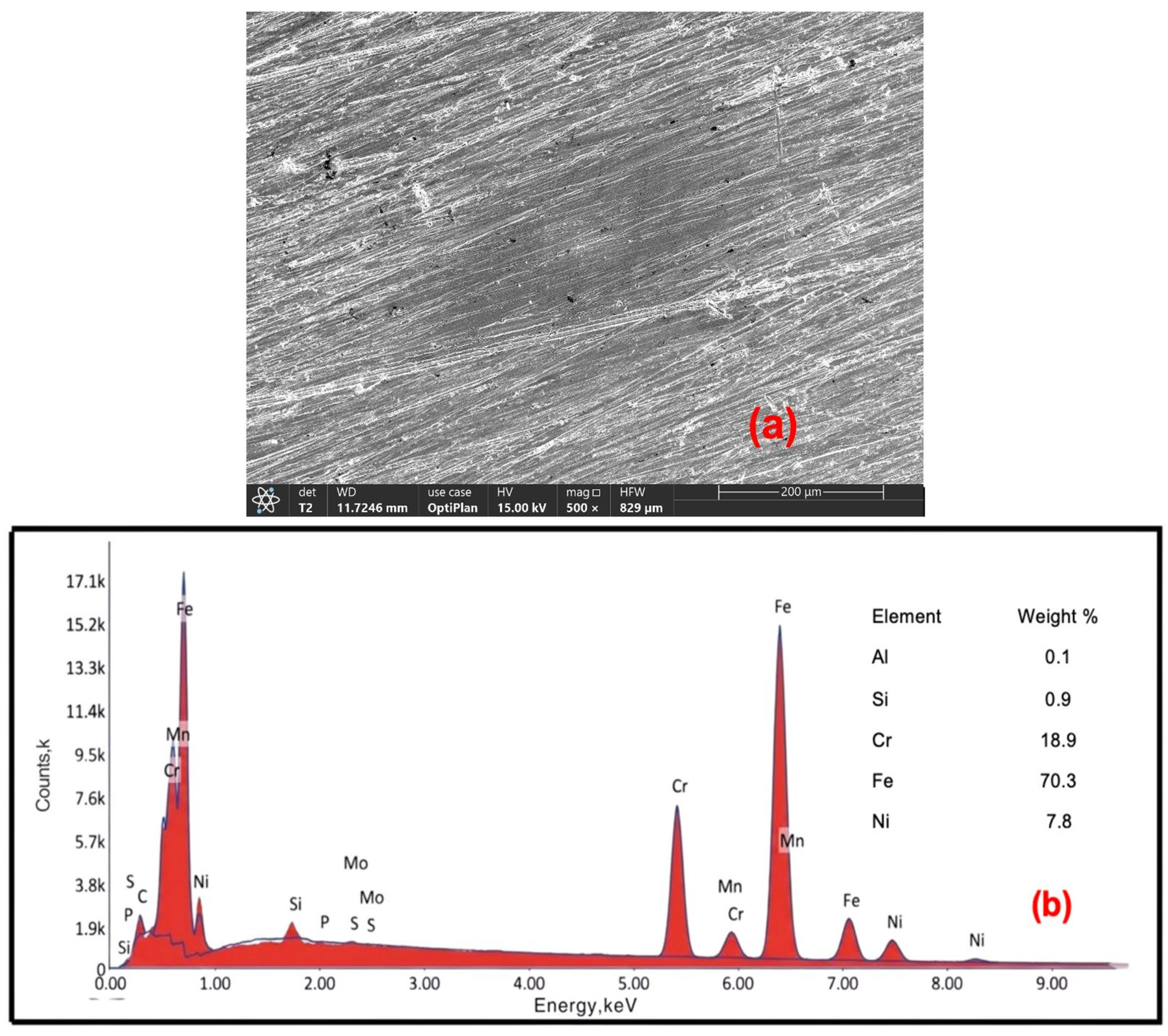
Figure 1a,b present the FESEM image and the corresponding EDS spectrum of 304 stainless steel, respectively. The FESEM image is shown in Figure 1. The surface elemental composition determined by the EDS was as follows: Fe (70.3 wt%), Cr (18.6 wt%), Si (0.9 wt%), Ni (7.8 wt%), and Al (0.1 wt%).
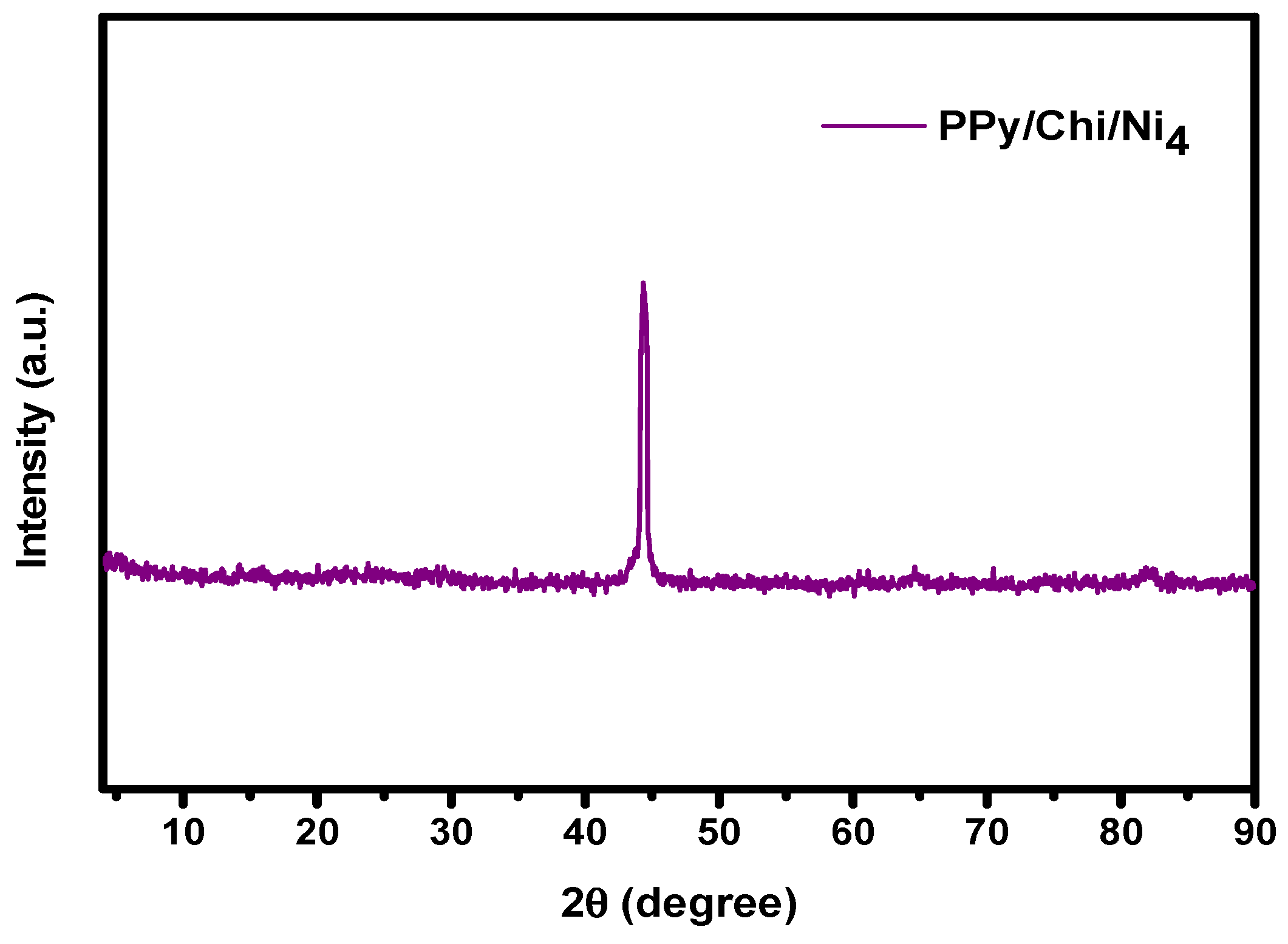
The crystalline structure of the PPy/Chi/Ni4 coating synthesized via electrochemical deposition was analyzed by X-ray diffraction (XRD) to determine the phase composition and structural characteristics of the deposited layer. The XRD pattern of the PPy/Chi/Ni4 coating is presented in Figure 2. A strong diffraction peak located at 2θ ≈ 44.5° is attributed to the (111) plane of face-centered cubic (FCC) metallic nickel, indicating the presence of crystalline Ni within the composite coating. The reflections corresponding to the (200) and (220) planes of Ni are weak or partially overlapped with the substrate contribution, which is commonly observed for thin electrochemically deposited coatings. No distinct diffraction peaks associated with PPy or Chi are detected due to their predominantly amorphous nature [24]. The intrinsically disordered molecular structure of PPy further limits its diffraction response, preventing the appearance of well-defined crystalline features in the XRD pattern [25]. Overall, the results indicate that the crystalline contribution mainly originates from metallic nickel, whereas the PPy/Chi matrix remains largely amorphous.
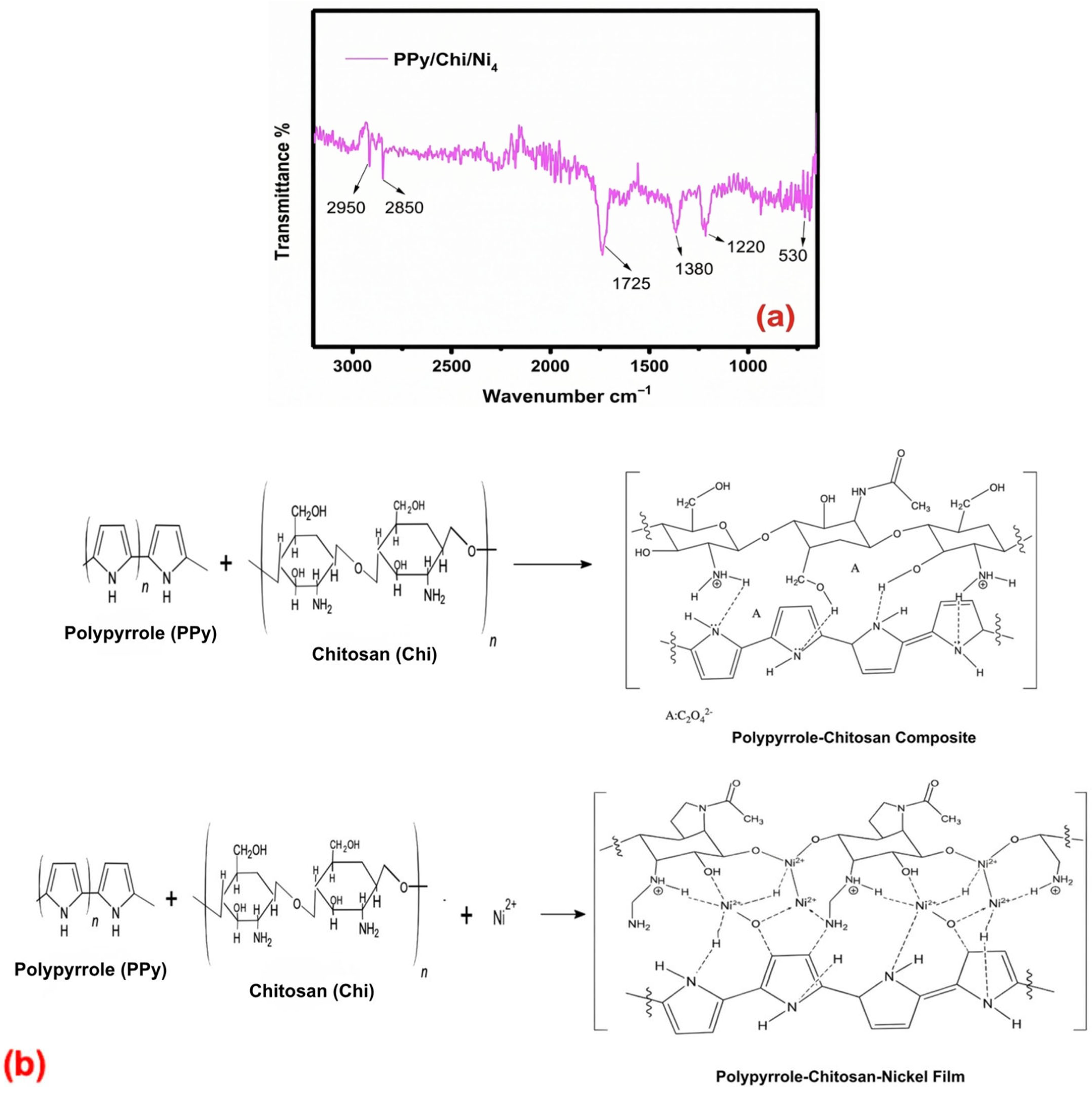
The chemical composition and functional groups of the PPy/Chi/Ni4 composite were analyzed by FTIR spectroscopy in the range of 550–3500 cm−1 (Figure 3a). A characteristic band at 530 cm−1 is attributed to metal–oxygen (M–O) vibrations, indicating the presence of Ni-related species in the composite [26]. The band at 1220 cm−1 corresponds to C–N stretching of the pyrrole ring, while the band at 1380 cm−1 is associated with characteristic polypyrrole vibrations [27,28]. Additionally, the peaks at 2850 and 2950 cm−1 are assigned to symmetric and asymmetric C–H stretching vibrations, which are typically observed in chitosan-containing systems [27]. Ni2+ ions can interact with the N- and O-containing functional groups of the polymer matrix, which may lead to slight changes in the C=O and C–N vibration regions of the FTIR spectra [29].
The interaction between PPy, chitosan, and Ni2+ is schematically illustrated in Figure 3b. Polypyrrole chains interact with the chitosan matrix through hydrogen bonding between pyrrolic nitrogen groups and hydroxyl or amino groups of chitosan [28,30]. The incorporation of Ni2+ ions further enables coordination interactions with N- and O-containing functional groups, contributing to the formation of a hybrid network structure [31,32]. These features collectively confirm the successful formation of the PPy/Chi/Ni4 composite.
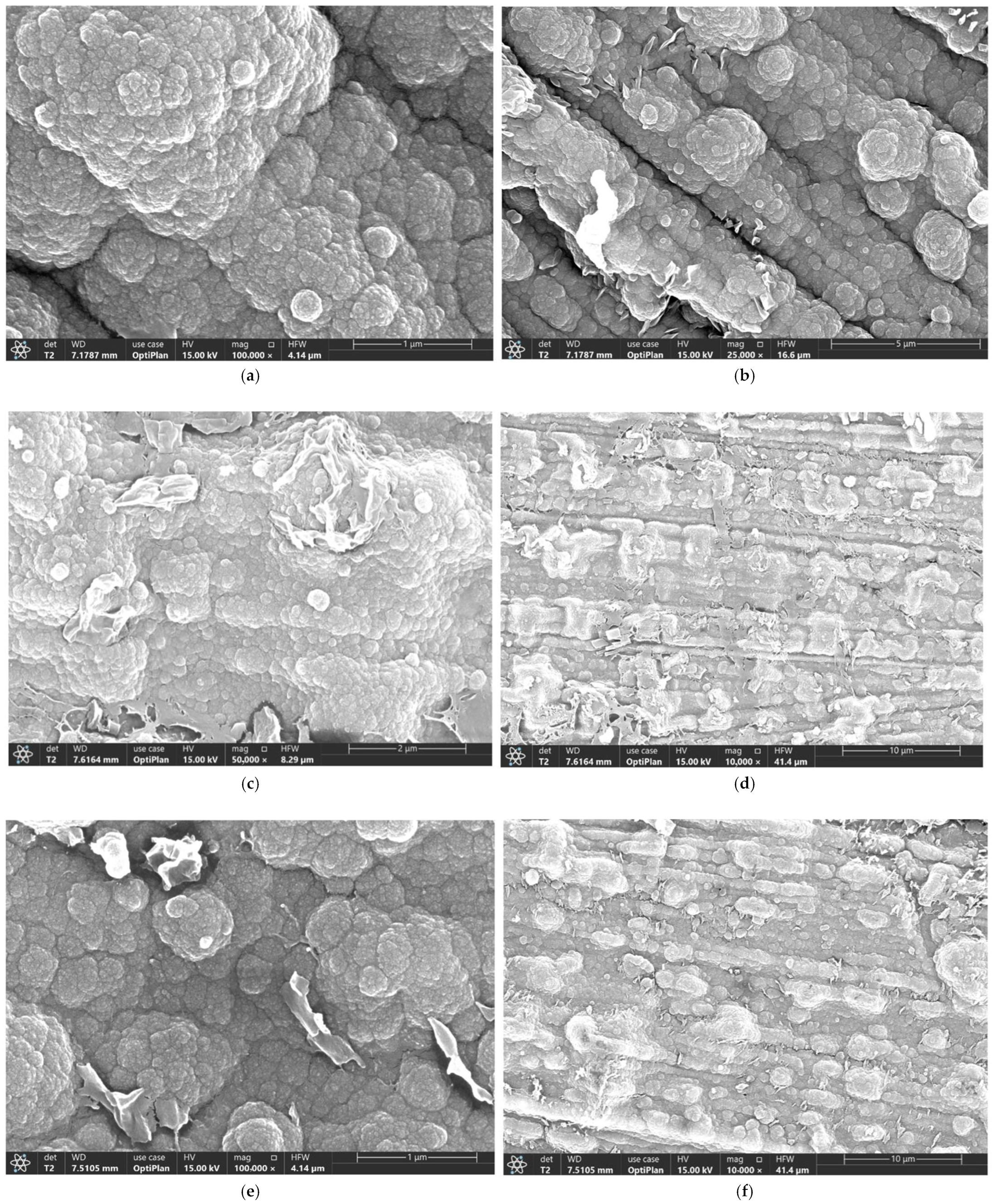
In Figure 4, FESEM images of pristine PPy, PPy/Chi and PPy/Chi/Ni4 composites placed on bare stainless steel are shown. As seen in Figure 4a,b, pure PPy exhibits typical cauliflower-like nanostructures arranged in a wavy morphology. In contrast, the PPy/Chi composite layer (Figure 4c,d) exhibits a smoother and more compact surface morphology, with small, ball-like features distributed within the polymer matrix, possibly associated with chitosan incorporation. In contrast, the PPy/Chi composite layer (Figure 4c,d) exhibits a smoother and more compact surface morphology, with small, ball-like features distributed within the polymer matrix, possibly associated with chitosan incorporation. Upon Ni incorporation (Figure 4e,f), the surface becomes noticeably rougher, with finely distributed granular features embedded in the matrix. These morphological changes show that Ni species were successfully integrated into the PPy/Chi structure without compromising overall film integrity. The surface exhibits spherical and porous characteristics, forming island-like protrusions with increasingly distinct voids between neighboring particles. The absence of significant particle agglomeration suggests a relatively well-dispersed configuration, which may enhance the accessibility of active sites and facilitate mass transport during HER. Such morphological features are generally associated with increased effective surface area and improved charge-transfer behavior, consistent with previous reports [33,34].
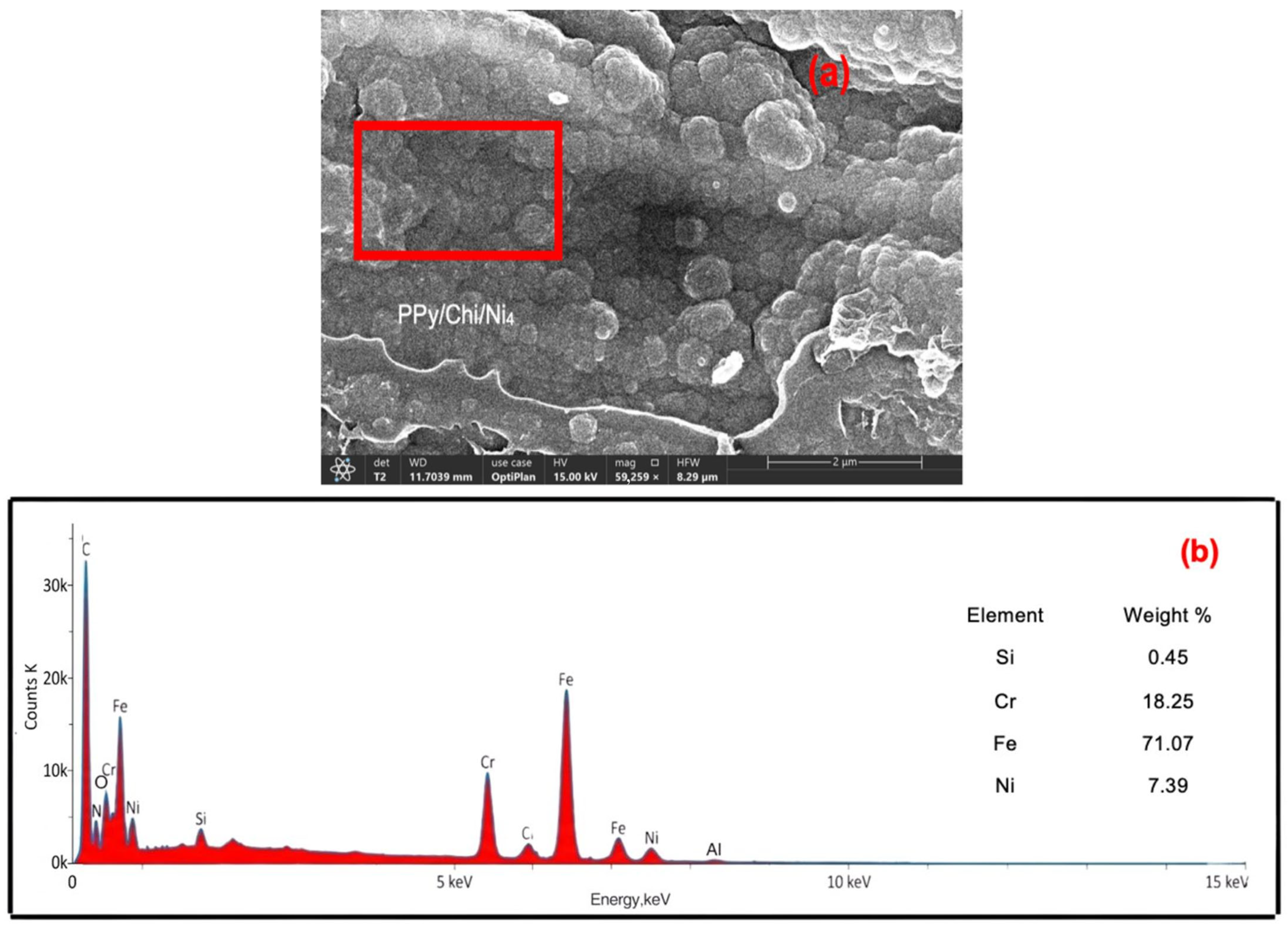
The EDS spectrum (Figure 5b) reveals the presence of Ni, along with C, N, and O elements, confirming the successful incorporation of Ni within the PPy/Chi matrix.
The EDS spectrum confirms the successful formation of the PPy/Chi/Ni4 composite on the stainless steel substrate through the presence of C, N, O, and Ni elements (Figure 5b). The C and N signals originate from the conductive polypyrrole framework, while O is associated with chitosan functional groups and surface oxygen species. The detected Ni signal indicates the incorporation of catalytically active species within the coating. Although EDS does not directly provide mechanistic information, Ni-based centers are widely reported to facilitate water dissociation in alkaline HER, while conductive polymer matrices improve interfacial electron transport and electrolyte accessibility. Although EDS does not provide direct mechanistic information, the presence and distribution of Ni in the composite are consistent with the role of Ni-based species in enhancing HER activity [35,36,37].

3.2. Electrochemical Performance of Electrodes

3.2.1. Optimization of HER Activity

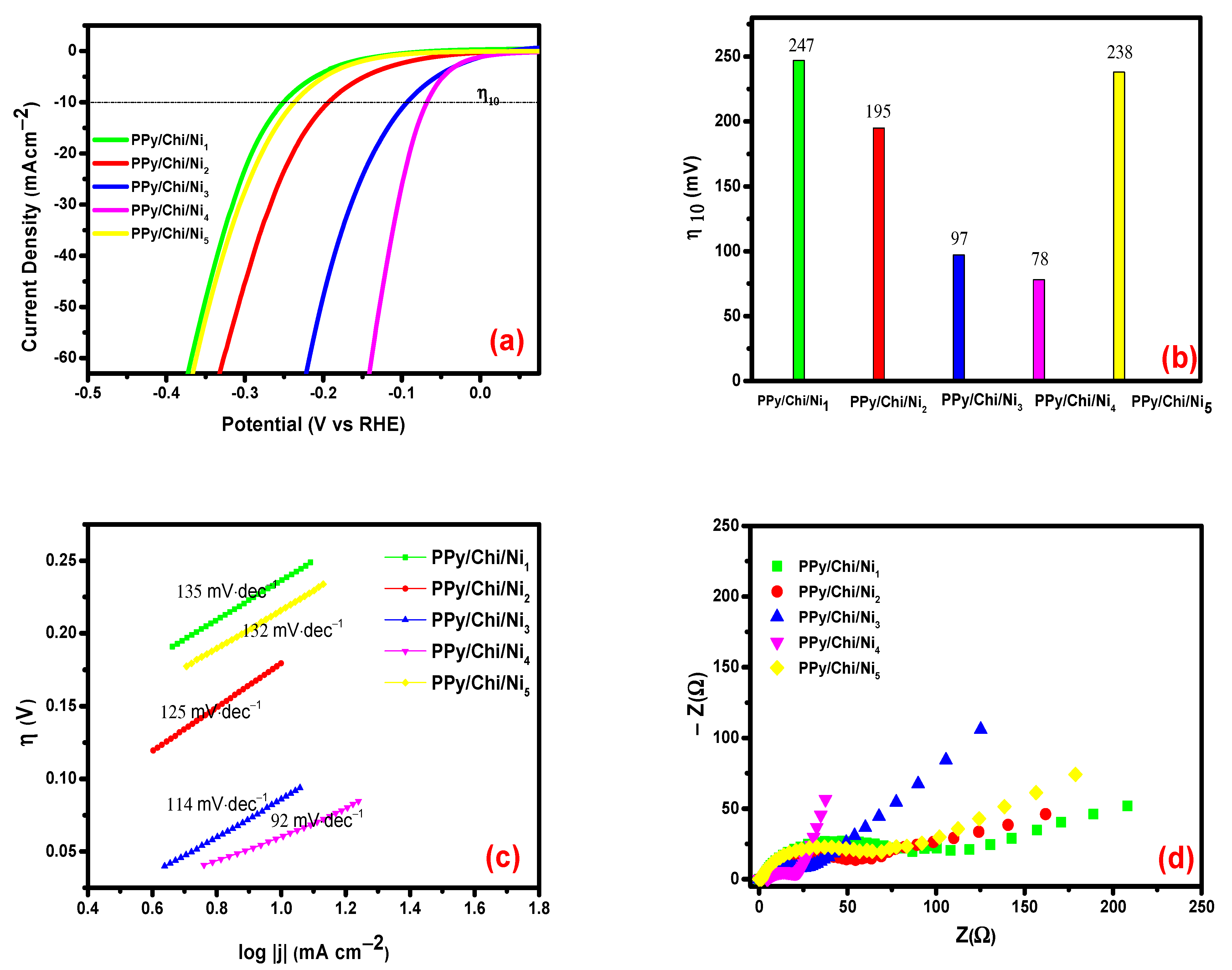
The HER performance of PPy/Chi/Nix electrodes with different Ni concentrations (x = 1–5 mM) was systematically evaluated using a conventional three-electrode configuration in 0.5 M KOH at 25 °C, employing a graphite rod as the counter electrode and Ag/AgCl (3.5 M KCl) as the reference electrode. All polarization curves were recorded with real-time iR compensation, measured in the cathodic direction, and all potentials are reported versus RHE.
In the initial stage, the synthesis parameters were optimized by varying the Ni concentration in the polymer composite. The corresponding CV curves recorded during electrodeposition are presented in Figure S1. Based on these results, the electrode prepared with 4 mM Ni2+ was selected as the optimal condition. Figure S1 also compares the CV responses of PPy, PPy/Chi, and PPy/Chi/Ni electrodes, demonstrating the effect of polymer composition and Ni incorporation.
The LSV curves of PPy/Chi/Nix (x = 1–5 mM) electrodes under optimized conditions are shown in Figure 6a. The overpotentials required to reach a current density of 10 mA cm−2 were determined as 247, 195, 97, 78, and 238 mV (vs. RHE) for PPy/Chi/Ni1, PPy/Chi/Ni2, PPy/Chi/Ni3, PPy/Chi/Ni4, and PPy/Chi/Ni5, respectively (Figure 6b). Among these, PPy/Chi/Ni4 exhibits the lowest overpotential, indicating the most favorable catalytic activity. This result suggests that an optimal Ni content enhances the number of accessible active sites and improves catalytic efficiency, whereas excessive Ni loading does not provide further benefit [38].
The reaction kinetics were analyzed using Tafel plots derived from the LSV curves (Figure 6c). The Tafel slopes of PPy/Chi/Nix electrodes were calculated as 135, 132, 125, 114, and 92 mV·dec−1 for x = 1–5 mM, respectively. The lower Tafel slope of PPy/Chi/Ni4 indicates improved HER kinetics compared to the other electrodes. In alkaline media, HER generally proceeds via a Volmer–Heyrovsky pathway, where the electrochemical adsorption step is followed by electrochemical desorption. The observed Tafel slope (~92 mV dec−1) for PPy/Chi/Ni4 is consistent with a Volmer–Heyrovsky-dominated mechanism (Figure 6c) [39]. Although increasing the Ni content generally improves HER kinetics, further loading to Ni5 does not lead to additional enhancement. The Tafel slope is related to the conductivity within the catalyst layer or pores [40]. In electrodeposited systems, higher metal incorporation can lead to the formation of thicker coatings; however, beyond optimal levels, site blocking and transport limitations may reduce the fraction of electrochemically accessible active areas, resulting in no further improvement in electrocatalytic activity [41].
EIS measurements were performed to further investigate the interfacial charge-transfer properties. The Nyquist plots (Figure 6d) and the corresponding equivalent circuit are shown in Figure S2a, while the associated Bode phase angle and magnitude plots are presented in Figure S2c,d. In the equivalent circuit, Rs represents the solution resistance, Rct is the charge-transfer resistance, CPE accounts for non-ideal capacitive behavior, and W corresponds to the Warburg element associated with diffusion-controlled mass transport processes [42]. The PPy/Chi/Ni4 electrode exhibits the lowest Rct value (59.48 Ω), indicating more efficient charge transfer at the electrode–electrolyte interface. The corresponding EIS parameters for the PPy/Chi/Nix electrodes are summarized in Table S1. Additionally, the steeper slope observed in the low-frequency region suggests improved ion diffusion compared to the other Ni-doped electrodes. In the low-frequency region, the straight line observed for PPy/Chi/Ni4 has a steeper slope compared to other Ni-doped electrocatalysts, indicating improved ion diffusion [26].

3.2.2. HER Activity

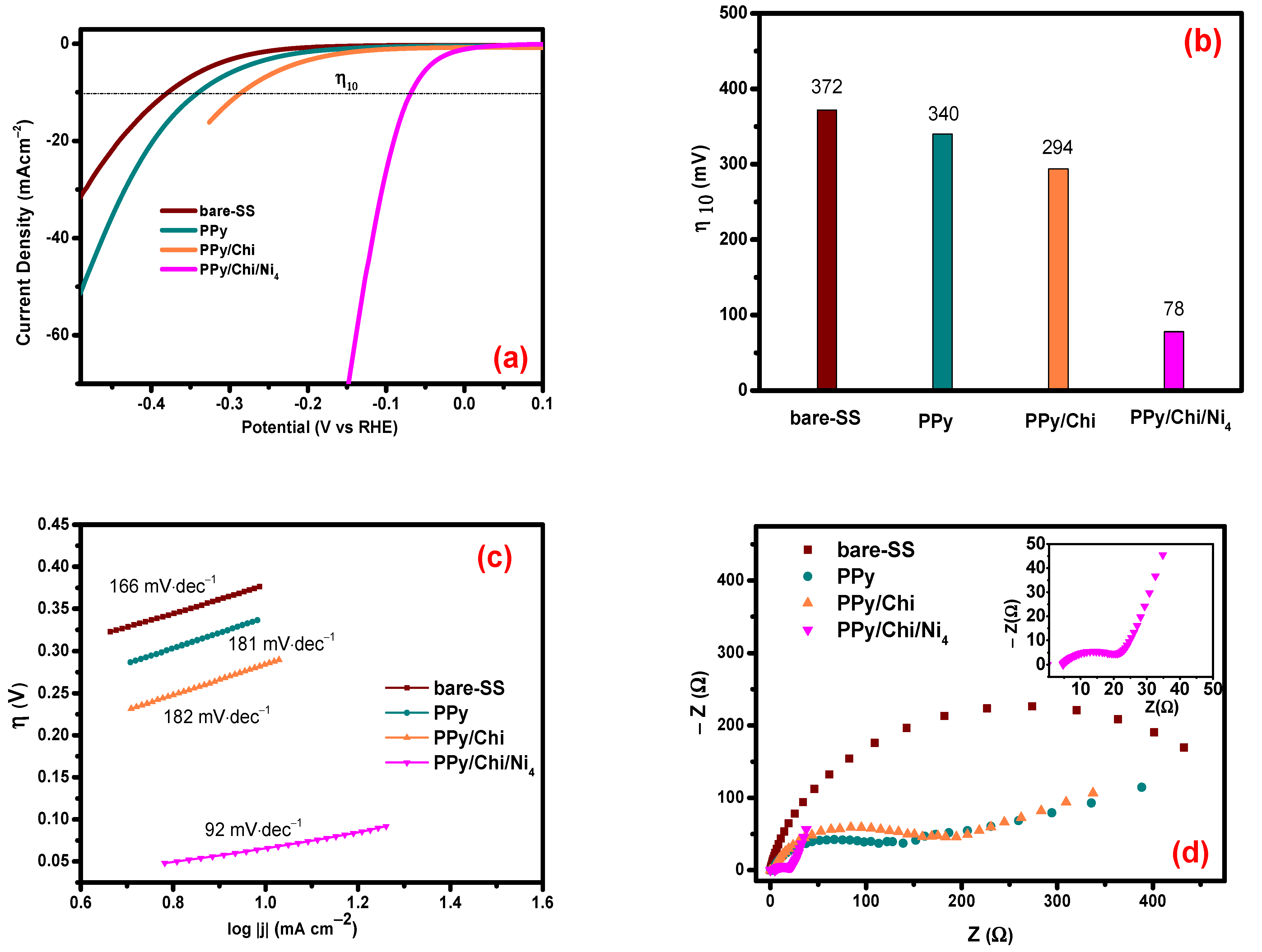
The LSV curves of bare stainless steel (SS), PPy, PPy/Chi, and PPy/Chi/Ni electrodes are compared in Figure 7a, demonstrating a progressive enhancement in HER activity with successive surface modification. The overpotentials required to achieve a current density of 10 mA cm−2 were determined as 372, 340, 294, and 78 mV (vs. RHE) for bare SS, PPy, PPy/Chi, and PPy/Chi/Ni4, respectively (Figure 7b). Among these, the PPy/Chi/Ni4 electrode exhibits the lowest overpotential (only 78 mV at η10), indicating significantly improved catalytic performance. The noticeable decrease in overpotential indicates that the composite shows improved catalytic activity. This enhancement can be mainly attributed to the synergistic contribution of PPy, which facilitates electron transport and increases the availability of electroactive sites [43]. This improvement can be attributed to the combined effect of Ni incorporation and the porous composite structure. The FESEM images (Figure 4) reveal a microstructured and porous morphology, which facilitates electrolyte penetration and improves the accessibility of active sites, thereby contributing to the enhanced HER activity. The micro-structured/porous morphology can facilitate electrolyte accessibility and mitigate concentration polarization, which is beneficial for HER [44].
The HER kinetics were further evaluated using Tafel plots derived from the polarization curves (Figure 7c). The Tafel slope values for bare SS, PPy, PPy/Chi, and PPy/Chi/Ni4 were calculated as 166, 182, 182, and 92 mV·dec−1, respectively. Among these electrodes, PPy/Chi/Ni4 exhibits the lowest Tafel slope, indicating faster HER kinetics and more favorable charge-transfer behavior. In contrast, the higher Tafel slopes observed for bare SS, PPy, and PPy/Chi indicate slower reaction kinetics. Considering the Tafel slope values (SS = 166 mV, PPy = 181 mV, and PPy/Chi =182 mV), the PPy/Chi/Ni4 electrode can effectively produce hydrogen by following the Heyrovsky pathway in the adjacent Ni active regions and exhibits good reaction kinetics [45]. The obtained Tafel slopes reflect the intrinsic kinetics of the HER and are influenced by factors such as hydrogen adsorption free energy, ionic conductivity, and the density of active catalytic sites [46]. Although the pristine PPy-coated electrode shows a slight decrease in overpotential compared with bare SS, its high Tafel slope suggests that the intrinsic HER kinetics remain limited. From this standpoint, the Tafel slope obtained for PPy/Chi/Ni4 can be considered a clear indication of its superior electrocatalytic kinetics toward the HER. Overall, these results are consistent with the overpotential and Tafel slope values reported in previous studies, as summarized in Table 1.
The effect of KOH concentration on HER performance has been systematically investigated in the literature. For instance, previous studies have shown that the HER kinetics of Ni-based catalysts are strongly influenced by electrolyte concentration, particularly by the KOH concentration [54]. These results indicate that HER performance varies significantly across the investigated concentration range, and that 0.5 M KOH falls within the commonly studied intermediate region for alkaline HER evaluation.
The charge-transfer resistance (Rct) at the electrode–electrolyte interface was investigated using the EIS method [55]. The Nyquist plots in Figure 7d were fitted using the equivalent circuit model shown in Figure S2a,b, while the corresponding Bode phase angle and impedance magnitude plots are provided in Figure S2e,f. The smaller the diameter of the semicircle in the fitting curve, the lower the Rct value, indicating a more efficient charge transfer. According to Table 2, which summarizes the electrochemical parameters of the studied electrodes, the PPy/Chi/Ni4 electrode exhibits the lowest Rct value (59.48 Ω), which is lower than those of bare SS (417.22 Ω), pristine PPy (178.87 Ω), and PPy/Chi (159.52 Ω). This result indicates that Ni incorporation significantly improves the interfacial charge-transfer properties of the PPy/Chi coating. The reduced Rct of PPy/Chi/Ni4 is consistent with its enhanced HER performance and suggests more favorable electron-transfer kinetics at the electrode–electrolyte interface. The incorporation of Ni into the PPy/Chi composite appears to promote alkaline HER by improving interfacial charge transfer, while the polymer–biopolymer framework helps preserve electrolyte accessibility and surface stability [56]. This is consistent with the markedly lower Rct value of the Ni-containing electrode.

3.3. Stability Test

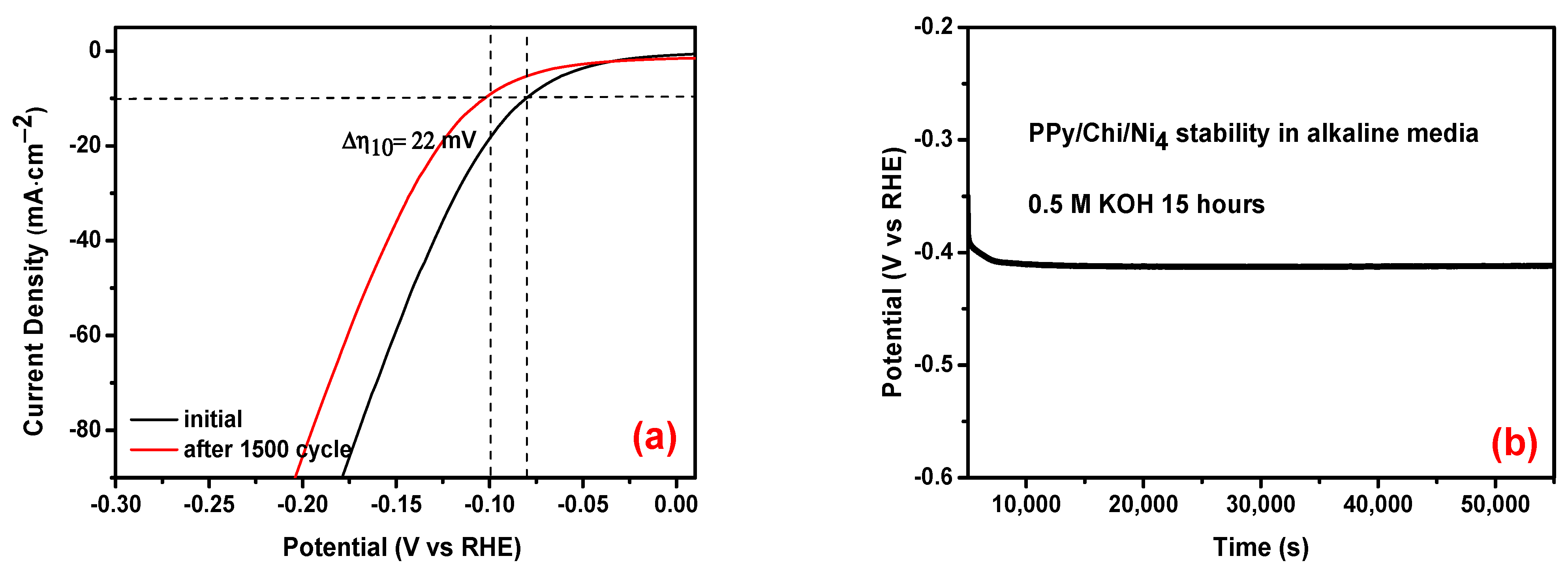
The durability of the PPy/Chi/Ni4/SS electrode against the hydrogen evolution reaction was evaluated by recording linear sweep voltammetry (LSV) curves before and after 1500 continuous electrochemical cycles. As shown in Figure 8a, the polarization curve after the cycle shows only a slight shift toward a higher overpotential. The overpotential required to reach a current density of 10 mA·cm−2 increases by approximately 22 mV after 1500 cycles, indicating that the catalytic activity is largely preserved. The slight increase in overpotential is likely related to interfacial reconfiguration and changes in the electronic environment of the active sites, rather than bulk structural degradation of the electrode [6]. The small change in η10 indicates that the electrode has good electrochemical stability during long-term use.
The long-term electrochemical stability of the PPy/Chi/Ni4/SS electrode was evaluated using CP measurements over 15 h at a constant current density of 10 mA cm−2 in 0.5 M KOH without any N2 purging or stirring. As shown in Figure 8b, the operating potential gradually shifted from 387 to 419 mV during the initial 1.5 h to sustain the applied current density. After this initial activation period, the minor potential shift observed in the early stage of CP testing reflects a transient interfacial stabilization process, commonly reported for polymer-based HER electrodes [57]. The slight potential adjustment observed during the initial stage of chronopotentiometric operation can be attributed to a transient interfacial conditioning process under continuous hydrogen evolution, while the subsequent stable potential over prolonged stability test confirms the excellent durability of the electrode material.

4. Conclusions

A new PPy/Chi/Ni4 electrode was successfully prepared on SS using the CV-supported electrodeposition method. Compared to bare SS, PPy, and PP/Chi coatings, the PPy/Chi/Ni4 electrode material exhibited excellent electrocatalytic activity against HER in an alkaline environment with a 78 mV lower overpotential at 10 mA·cm−2. The PPy/Chi/Ni4 electrode exhibited excellent long-term stability (15 h) at 10 mA·cm−2. The remarkable HER performance can be attributed to the synergy between Ni and PPy/Chi, which leads to an amorphous structure, satisfactory intrinsic activity, and high conductivity due to Ni doping. The Ni-doped electrocatalyst coating provides a conductive interface and abundant catalytic sites, significantly improving the HER performance of the stainless steel substrate and resulting in a 79% reduction in overpotential compared to bare stainless steel. This study provided insights into the enhancement of the catalytic performance of the PPy/Chi/Ni4/SS electrode.

Supplementary Materials

The following supporting information can be downloaded at: https://www.mdpi.com/article/10.3390/en19071749/s1, Figure S1. The consecutive CVs: (a) electrosynthesis of the PPy/Chi coating on SS electrode in 0.5 M KOH (Ag/AgCl reference) (inset: electrosynthesis of pristine PPy on SS); (b) optimization of Ni-doped concentration (1–5 mM); (c) optimization of scan rate (25, 50, and 100 mV s−1); (d) optimization of the number of cycles (5, 10, and 15 cycles); and (e) comparison of the 10th cycle of PPy/SS, PPy/Chi/SS, and PPy/Chi/Ni4/SS electrodes. Figure S2. Equivalent circuit models used for EIS fitting: (a) coated electrodes and (b) bare SS electrode. Bode plots recorded in 0.5 M KOH for the optimization of PPy/Chi/Nix/SS electrodes: (c) phase angle plots and (d) magnitude plots; and for pristine PPy/SS, PPy/Chi/SS, and PPy/Chi/Ni4/SS electrodes: (e) phase angle plots and (f) magnitude plots. Table S1. EIS data of Ni-doped electrodes (mean ± SD, n = 3 independent electrodes).

Author Contributions

Methodology, S.M.Y. and A.K.F.; Investigation, S.M.Y., C.D. and A.K.F.; Writing—original draft, S.M.Y.; Writing—review & editing, A.K.F.; Supervision, A.K.F. All authors have read and agreed to the published version of the manuscript.

Funding

This research received no external funding.

Data Availability Statement

The original contributions presented in this study are included in the article/Supplementary Materials. Further inquiries can be directed to the corresponding author.

Conflicts of Interest

The authors declare no conflict of interest.

References

  1. Cheng, L.; Zhou, L.; Xie, A.; Tan, A.; Jiang, H.; Zhang, R.; Miao, J.; Liu, J.; Wan, P.; Tang, Y. Heterostructured Zr-Ni4Mo/Mo2N nanorod with lattice expansion induced by Zr doping for efficient and durable hydrogen evolution reaction. Appl. Surf. Sci. 2025, 703, 163404. [Google Scholar] [CrossRef]
  2. Hu, Y.; Yang, T.; Zhou, W.; Huang, Z.; Duan, X.; Yu, M.; Zhou, W.; Lin, F.; Li, D.; Xu, J. Abundant oxygen vacancies Ce-doped TiO2 supported Pt nanoparticles for high-efficiency photoelectrocatalytic methanol oxidation. J. Alloys Compd. 2025, 1022, 179975. [Google Scholar] [CrossRef]
  3. Fang, L.; Huo, J.; Chen, Y.; Lin, H.; Li, B.; Cui, Z.; Du, L. Polymer-scaffold induced extensive hydrogen-bond network: Enabling high transport of proton and oxygen in cathode catalyst/ionomer interfaces. ACS Appl. Mater. Interfaces 2025, 17, 15910–15920. [Google Scholar] [CrossRef] [PubMed]
  4. Faid, A.Y.; Barnett, A.O.; Seland, F.; Sunde, S. NiCu mixed metal oxide catalyst for alkaline hydrogen evolution in anion exchange membrane water electrolysis. Electrochim. Acta 2021, 371, 137837. [Google Scholar] [CrossRef]
  5. Ashassi-Sorkhabi, H.; Kazempour, A.; Asghari, E.; Lamb, J.J. 3D nanostructured nickel film supported to a conducting polymer as an electrocatalyst with exceptional properties for hydrogen evolution reaction. Int. J. Hydrogen Energy 2023, 48, 29865–29876. [Google Scholar] [CrossRef]
  6. Kubra, K.T.; Noreen, F.; Junaid, A.; Nazir, A.; Arshad, S.; Bibi, K.; Batool, A.; Sattar, A.; Bahajjaj, A.A.A.; Ahmad, S.; et al. An effective bi-functional electrocatalyst for electrochemical water splitting using NiCo2O4 nanoparticles decorated with Polypyrrole nanocomposite. Fuel 2025, 397, 135381. [Google Scholar] [CrossRef]
  7. Li, H.; Su, Y.; Guo, T.; Zheng, H.; Sun, B.; Yu, C.; Cao, J.; Li, Q.; Si, W. Facile preparation of CoNiS/MXene/polypyrrole electrocatalyst with mischcrystal-amorphous interfaces for hydrogen evolution reaction. Next Energy 2025, 8, 100338. [Google Scholar] [CrossRef]
  8. Zhang, J.-S.; Zhang, W.-D. Nickel complex co-catalyst confined by chitosan onto graphitic carbon nitride for efficient H2 evolution. J. Colloid Interface Sci. 2020, 560, 11–20. [Google Scholar] [CrossRef]
  9. Bano, S.; Ganie, A.S.; Khan, R.I.A.; Sultana, S.; Khan, M.Z.; Sabir, S. Designing and application of PPy/Bi2MoO6/chitosan nanocomposites for electrochemical detection of ciprofloxacin and benzene and evaluation of hydrogen evolution reaction. Surf. Interfaces 2022, 29, 101786. [Google Scholar] [CrossRef]
  10. Varghese, A.; Sunaja Devi, K.R.; Pinheiro, D.; Jomy, J. Electrochemical investigations of chitosan/ZrO2–Bi2O3 composite for advanced energy and environmental applications. J. Environ. Chem. Eng. 2024, 12, 113824. [Google Scholar] [CrossRef]
  11. Pérez Mendoza, A.E.; Andronescu, C.; Olean-Oliveira, A. Design of conducting polymer/metal-based nanocomposites as electrocatalysts for electrochemical energy conversion. Synth. Met. 2024, 307, 117662. [Google Scholar] [CrossRef]
  12. Tavallaie, M.M.; Alizadeh, M.; Pashangeh, S. Effects of substrate materials and electrodeposition parameters on hydrogen evolution reaction of Ni–Cu–Fe coatings. Int. J. Hydrogen Energy 2024, 77, 1117–1132. [Google Scholar] [CrossRef]
  13. Santos, A.L.; Cebola, M.J.; Antunes, J.; Santos, D.M.F. Insights on the performance of nickel foam and stainless steel foam electrodes for alkaline water electrolysis. Sustainability 2023, 15, 11011. [Google Scholar] [CrossRef]
  14. Liu, Y.; Zhang, K.; Zhang, D.; Dong, W.; Jiang, T.; Zhou, H.; Li, L.; Mao, B. Industrial stainless steel meshes for efficient electrocatalytic hydrogen evolution. J. Energy Storage 2021, 41, 102844. [Google Scholar] [CrossRef]
  15. Barauskienė, I.; Laukaitis, G.; Valatka, E. Stainless steel as an electrocatalyst for overall water splitting under alkaline and neutral conditions. J. Electroanal. Chem. 2023, 950, 117880. [Google Scholar] [CrossRef]
  16. Alharbi, A.F.; Abahussain, A.A.M.; Wazeer, W.; El-Deeb, H.; Nassr, A.B.A.A. Stainless steel as gas evolving electrodes in water electrolysis: Enhancing the activity for hydrogen evolution reaction via electrodeposition of Co and CoP catalysts. Int. J. Hydrogen Energy 2023, 48, 31172–31186. [Google Scholar] [CrossRef]
  17. Solorio, V.M.; Olmos, L.; Velasco-Plascencia, M.; Vergara-Hernández, H.J.; Villalobos, J.C.; López, M.M.M.; López, J.M.S. Investigation of Pore Size on the Hydrogen Evolution Reaction of 316L Stainless Steel Porous Electrodes. Catalysts 2025, 15, 38. [Google Scholar] [CrossRef]
  18. Zaffora, A.; Di Franco, F.; Pupillo, D.; Seminara, B.; Tranchida, G.; Santamaria, M. Highly active and stable NiCuMo electrocatalyst supported on 304 stainless steel porous transport layer for hydrogen evolution in alkaline water electrolyzer. Adv. Sustain. Syst. 2023, 7, 2200486. [Google Scholar] [CrossRef]
  19. Yu, X.; Wei, D.; Habib, S.; Liu, H.; Mahmud, S. Efficient hydrogen evolution activity of NiMoP electrodeposited on stainless steel mesh. Colloids Surf. A Physicochem. Eng. Asp. 2024, 696, 134278. [Google Scholar] [CrossRef]
  20. Thangasamy, P.; He, R.; Randriamahazaka, H.; Chen, X.; Zhang, Y.; Luo, H.; Wang, H.; Zhou, M. Collectively exhaustive electrochemical hydrogen evolution reaction of polymorphic cobalt selenides derived from organic surfactants modified Co-MOFs. Appl. Catal. B Environ. 2023, 325, 122367. [Google Scholar] [CrossRef]
  21. Murthy, A.P.; Theerthagiri, J.; Premnath, K.; Madhavan, J.; Murugan, K. Single-step electrodeposited molybdenum incorporated nickel sulfide thin films from low-cost precursors as highly efficient hydrogen evolution electrocatalysts in acid medium. J. Phys. Chem. C 2017, 121, 11108–11116. [Google Scholar] [CrossRef]
  22. Murthy, A.P.; Theerthagiri, J.; Madhavan, J. Insights on Tafel constant in the analysis of hydrogen evolution reaction. J. Phys. Chem. C 2018, 122, 23943–23949. [Google Scholar] [CrossRef]
  23. Gong, M.; Wang, D.Y.; Chen, C.C.; Hwang, B.J.; Dai, H. A mini review on nickel-based electrocatalysts for alkaline hydrogen evolution reaction. Nano Res. 2016, 9, 28–46. [Google Scholar] [CrossRef]
  24. Song, Y.; Hong, P.; Li, T.; Ma, G.; Deng, Q.; Zhou, Y.; Zhang, Y. A nanoflower-like polypyrrole-based cobalt-nickel sulfide hybrid heterostructures with electrons migration to boost overall water splitting. J. Colloid Interface Sci. 2022, 618, 1–10. [Google Scholar] [CrossRef] [PubMed]
  25. Luo, W.; Sun, Y.; Han, Y.; Ding, J.; Li, T.; Hou, C.; Ma, Y. Flexible Ti3C2TxMXene/polypyrrole composite films for high-performance all-solid asymmetric supercapacitors. Electrochim. Acta 2023, 441, 141818. [Google Scholar] [CrossRef]
  26. Aadil, M.; Rafea, M.A.; Zaki, M.E.A.; Attia, M.I.; El-Aassar, R.; Alanazi, A.K.; Zulfiqar, S.; Mubeen, S. Hydrothermal synthesis and in-situ polymerization of PPy@MnCo2O4 nanohybrids for fast visible-light photocatalytic degradation of ibuprofen. J. Water Process Eng. 2025, 80, 109174. [Google Scholar] [CrossRef]
  27. Paryav, S.; Rajabifar, N.; Rostami, A.; Abbasi, M.; Akrami, M. Assembling carbon nanotube and graphene in chitosan/sodium alginate hydrogels for ion removal applications. Polymers 2025, 17, 353. [Google Scholar] [CrossRef]
  28. Li, Y.; Zou, Q.; Li, Z.; Xie, D.; Niu, Y.; Zou, J.; Zeng, X.; Juang, J. MOF derived Ni-Fe based alloy carbon materials for efficient bifunctional electrocatalysts applied in Zn-air battery. Appl. Surf. Sci. 2022, 572, 151286. [Google Scholar] [CrossRef]
  29. Kompa, A.; Fernandez, J.G. Stronger when wet: Aquatically robust chitinous objects via zero-waste coordination with metal ions. Nat. Commun. 2026, 17, 1397. [Google Scholar] [CrossRef]
  30. Gewili, N.; Abdelghany, A.M.; Mekhaimer, M.; Oraby, A. Synthesis and optical properties of chitosan/polypyrrole composite for biological applications. Lett. Appl. NanoBioSci. 2021, 10, 2742–2749. [Google Scholar] [CrossRef]
  31. Sotnikova, A.; Ivantsov, M.; Vasileva, V.; Kulikova, M. Catalytic design of matrix-isolated Ni/chitosan composites for methane decomposition. Int. J. Mol. Sci. 2026, 27, 1255. [Google Scholar] [CrossRef]
  32. Geetanjali, D.S.K.; Dhillon, S.K.; Kundu, P.P. Development of polypyrrole nanotube coated with chitosan and nickel oxide as a biocompatible anode to enhance the power generation in microbial fuel cell. J. Power Sources 2022, 539, 231595. [Google Scholar] [CrossRef]
  33. Liu, W.; Tan, W.; He, H.; Peng, Y.; Chen, Y.; Yang, Y. One–step electrodeposition of Ni–Ce–Pr–Ho/NF as an efficient electrocatalyst for hydrogen evolution reaction in alkaline medium. Energy 2022, 250, 123831. [Google Scholar] [CrossRef]
  34. Liu, C.; Pi, Y.; Yan, Q.; Li, X.; Yao, W.; Li, Z.; Wang, X.; Cheng, P. Synergistic enhancement of hydrogen evolution reaction catalysts via Ni/Co/Fe-doped Mo2C composites: Morphological, structural, and electrochemical insights. Int. J. Hydrogen Energy 2026, 223, 154362. [Google Scholar] [CrossRef]
  35. Mametja, S.; Mmelesi, O.K.; Sefadi, J.S.; Liu, X.; Gorimbo, J. Recent progress on the utilization of polypyrrole (PPy)-based nanocomposites for electrochemical applications. J. Power Sources 2025, 659, 238404. [Google Scholar] [CrossRef]
  36. Krishnan, A.; Ameen Sha, M.; Meenu, P.C.; Jayan, J.S.; Saritha, A. Role of polymers as catalyst/support in enhancing electrocatalytic HER: An overview of developments, challenges and potential paths. Int. J. Hydrogen Energy 2024, 91, 327–342. [Google Scholar] [CrossRef]
  37. Jurča, M.; Vilčáková, J.; Kazantseva, N.E.; Munteanu, A.; Munteanu, L.; Sedlačík, M.; Stejskal, J.; Stejskal, J.; Trchová, M.; Prokeš, J. Conducting and magnetic hybrid polypyrrole/nickel composites and their application in magnetorheology. Materials 2024, 17, 151. [Google Scholar] [CrossRef] [PubMed]
  38. Salehan, P.; Niknazar, S.; Ensafi, A.A.; Mousaabadi, K.Z.; Rezaei, B. Synthesis of M/Mo LDH@P-rGO (M = Ni, Co, Fe, Cu, Zn, Mn, W, and V) as a new electrocatalyst for efficient hydrogen evolution reaction in alkaline media. Int. J. Hydrogen Energy 2023, 48, 26200–26209. [Google Scholar] [CrossRef]
  39. Liang, S.; Wang, P.; Deng, J.; Liu, J.; Zhu, B.; Chen, C.; Zhu, B.; Zhang, X.; Zhu, P.; Zhao, S.; et al. Nickel/manganese oxide as a high-performance catalyst for high-current-density hydrogen evolution in alkaline media. J. Power Sources 2026, 662, 238730. [Google Scholar] [CrossRef]
  40. Van der Heijden, O.; Park, S.; Vos, R.E.; Eggebeen, J.J.J.; Koper, M.T.M. Tafel Slope Plot as a Tool to Analyze Electrocatalytic Reactions. ACS Energy Lett. 2024, 9, 1871–1879. [Google Scholar] [CrossRef] [PubMed]
  41. Zou, X.; Zhang, Y. Noble metal-free hydrogen evolution catalysts for water splitting. Chem. Soc. Rev. 2015, 44, 5148–5180. [Google Scholar] [CrossRef]
  42. Khramenkova, A.V.; Izvara, D.N.; Moshchenko, V.V.; Smoly, V.A.; Klimova, L.V.; Polozhentsev, O.E.; Kuznetzov, A.N.; Popov, K.M. Chitosan complex based hybrid material as catalyst for hydrogen evolution reaction. Front. Chem. Sci. Eng. 2025, 19, 49. [Google Scholar] [CrossRef]
  43. Ashiq, M.F.; Farooq, S.; Al-shafey, E.; Furqan, S.N.; Al-Salmi, A.F.; Fayad, E.; Fawy, K.F.; Shah, S.I.A.S.; Qin, H.L. Facile hydrothermal fabrication of Zn2MnO4/PPY nanocomposite for enhanced water splitting. Int. J. Hydrogen Energy 2025, 177, 151523. [Google Scholar] [CrossRef]
  44. Lahiri, A.; Li, G.; Endres, F. Highly efficient electrocatalytic hydrogen evolution reaction on carbonized porous conducting polymers. J. Solid State Electrochem. 2020, 24, 2763–2771. [Google Scholar] [CrossRef]
  45. Zhao, L.; Zhang, Y.; Zhao, Z.; Zhang, Q.H.; Huang, L.B.; Gu, L.; Lu, G.; Hu, J.S.; Wan, L.J. Steering elementary steps towards efficient alkaline hydrogen evolution via size-dependent Ni/NiO nanoscale heterosurfaces. Natl. Sci. Rev. 2020, 7, 27–36. [Google Scholar] [CrossRef] [PubMed]
  46. Zahra, R.; Alrowaily, A.W.; Alotaibi, B.M.; Gassoumi, A.; Alyousef, H.A.; Mirza, H.; Kumar, A.; Ali, M. Improving performance of CoMnO3 with PANI for alkaline hydrogen evolution reaction. Inorg. Chem. Commun. 2026, 183, 115694. [Google Scholar] [CrossRef]
  47. Do, H.H.; Nguyen, K.B.; Nguyen, P.N.; Pham, H.P. Facile one-step radio frequency magnetron sputtering of Ni/NiO on stainless steel for an efficient electrode for hydrogen evolution reaction. Beilstein J. Nanotechnol. 2025, 16, 837–846. [Google Scholar] [CrossRef]
  48. Noorwali, N.A.; Hardianto, Y.P.; Shah, S.S.; Dahiru, A.; Abbas, S.A.; Johan, B.A.; Aziz, M.A. Investigating Electrodeposition of Platinum Nanoparticles on Stainless-Steel Mesh Electrodes for Hydrogen Evolution Reaction. J. Electrochem. Soc. 2024, 171, 112503. [Google Scholar] [CrossRef]
  49. Abahussain, A.A.M.; Alharbi, A.F.; Wazeer, W.; El-Deeb, H.; Nassr, A.B.A.A. Stainless steel as gas evolving electrodes in water electrolysis: Boosting the electrocatalytic hydrogen evolution reaction on electrodeposited Ni@CoP modified stainless steel electrodes. Fuel 2024, 368, 131605. [Google Scholar] [CrossRef]
  50. Youn, J.S.; Jeong, S.; Oh, I.; Park, S.; Mai, H.D.; Jeon, K.J. Enhanced electrocatalytic activity of stainless steel substrate by nickel sulfides for efficient hydrogen evolution. Catalysts 2020, 10, 1274. [Google Scholar] [CrossRef]
  51. Jia, X.; Wang, Y.; Tang, J.; Song, K.; Zhang, H.; Lin, B.; Zheng, H. FeNi-LDH@Ni film modified stainless-steel as self-supported electrodes for efficient and stable overall water splitting in alkaline environments. Surf. Coat. Technol. 2023, 464, 129502. [Google Scholar] [CrossRef]
  52. Gebreslase, G.A.; Martínez-Huerta, M.V.; Sebastián, D.; Lázaro, M.J. NiCoP/CoP sponge-like structure grown on stainless steel mesh as a high-performance electrocatalyst for hydrogen evolution reaction. Electrochim. Acta 2023, 438, 141538. [Google Scholar] [CrossRef]
  53. Wang, H.-B.; Zhu, H.; Sun, Y.-S.; Ma, F.; Chen, Y.-Z.; Zeng, D.-J.; Zhou, L.; Ma, D.-Y. Ultra-thin pine tree-like MoS2 nanosheets with maximally exposed active edges terminated at side surfaces on stainless steel fiber felt for hydrogen evolution reaction. J. Alloys Compd. 2021, 876, 160163. [Google Scholar] [CrossRef]
  54. Faid, A.Y.; Foroughi, F.; Sunde, S.; Pollet, B. Unveiling hydrogen evolution dependence on KOH concentration for polycrystalline and nanostructured nickel-based catalysts. J. Appl. Electrochem. 2022, 52, 1819–1826. [Google Scholar] [CrossRef]
  55. Salehan, P.; Ensafi, A.A.; Andikaey, Z.; Rezaei, B. H-CoNiSe2/NC dodecahedral hollow structures for high-performance supercapacitors. Sci. Rep. 2023, 13, 2070. [Google Scholar] [CrossRef]
  56. Zhang, X.; Liang, Y. Nickel Hydr(oxy)oxide Nanoparticles on Metallic MoS2 Nanosheets: A Synergistic Electrocatalyst for Hydrogen Evolution Reaction. Adv. Sci. 2018, 5, 1700644. [Google Scholar] [CrossRef]
  57. Lin, H.-H.; Liang, H.-I.; Luo, S.-C. Modulating surface cation concentration via tuning the molecular structures of ethylene glycol-functionalized PEDOT for improved alkaline hydrogen evolution reaction. JACS Au 2024, 4, 3070–3083. [Google Scholar] [CrossRef]
Figure 1. (a) FESEM image and (b) SEM–EDS spectrum of the bare SS304 substrate with the corresponding surface elemental content (wt%) shown in the inset.
Energies 19 01749 g001
Figure 2. XRD spectra of PPy/Chi/Ni4 composite.
Energies 19 01749 g002
Figure 3. (a) FTIR spectrum of PPy/Chi/Ni4; (b) proposed formation mechanism illustrating PPy–chitosan interactions and Ni2+ coordination within the composite structure.
Energies 19 01749 g003
Figure 4. FESEM images of (a,b) pristine PPy; (c,d) PPy/Chi composite; (e,f) PPy/Chi/Ni4 composite.
Energies 19 01749 g004
Figure 5. PPy/Chi/Ni4 composite electrocatalyst: (a) FESEM image; (b) FESEM-EDS spectrum with the corresponding surface elemental content (wt%) shown in the inset.
Energies 19 01749 g005
Figure 6. Optimization of PPy/Chi/Nix (x = 0–5) electrodes in 0.5 M KOH, showing (a) LSV polarization curves, (b) overpotentials at 10 mA·cm−2, (c) Tafel plots, and (d) Nyquist impedance spectra.
Energies 19 01749 g006
Figure 7. Electrochemical HER performance of bare SS, pristine PPy, PPy/Chi and PPy/Chi/Ni4 electrodes in 0.5 M KOH, showing (a) LSV polarization curves; (b) overpotentials at 10 mA∙cm−2; (c) Tafel plots; (d) Nyquist plots (inset: enlarged Nyquist plot of PPy/Chi/Ni4 electrode).
Energies 19 01749 g007
Figure 8. Stability performance of PPy/Chi/Ni4/SS in 0.5 M KOH: (a) LSV polarization curves before and after 1500 CV cycles and (b) chronopotentiometric response at 10 mA·cm−2 for 15 h.
Energies 19 01749 g008
Table 1. Comparison of the electrocatalytic activities of modified catalysts on stainless steel substrates.
MaterialElectrolyteSubstrateTafel Slope
(mV·dec−1)
Overpotential
(mV vs. RHE)
References
Ni/NiO/SS-101.0 M KOHSS90.5184[47]
Pt/SSM0.5 M KOHSS Mesh71 83[48]
10Ni@CoP1.0 M KOHSS69188 [49]
NiSx/SS1.0 M KOHSS100258 [50]
FeNi-LDH@Ni/SS6.0 M KOHSS109.1399 [51]
NiCoP@SSM1.0 M KOHSS Mesh74138 [52]
NiMoP/SSM1.0 M KOHSS Mesh98.2239 [19]
MoS2/SSF1.0 M KOHSS Fiber83.6182[53]
Chi/CoNiOx 1.0 M KOHSS110210 [42]
PPy/Chi/Ni0.5 M KOHSS9478 This Study
Table 2. Equivalent circuit fitting parameters obtained from EIS data (mean ± SD, n = 3 independent electrodes).
ElectrodeRct (Ω)Rs (Ω)CPE (mF∙s(a2 −1))αW (Ω × s−1/2)
Bare SS417.22 ± 0.5461.99 ± 0.3840.92 ± 0.0270.72 ± 0.001-
PPy178.87 ± 0.4372.94 ± 0.5720.52 ± 0.0460.74 ± 0.0022.37 ± 0.429
PPy/Chi159.52 ± 0.2621.67 ± 0.2080.44 ± 0.0330.73 ± 0.0021.23 ± 0.538
PPy/Chi/Ni459.48 ± 0.3141.64 ± 0.2340.13 ± 0.0240.73 ± 0.0011.14 ± 0.561
Disclaimer/Publisher’s Note: The statements, opinions and data contained in all publications are solely those of the individual author(s) and contributor(s) and not of MDPI and/or the editor(s). MDPI and/or the editor(s) disclaim responsibility for any injury to people or property resulting from any ideas, methods, instructions or products referred to in the content.