The Relationship Between Energy Dependency, Energy Diversification, and Economic Growth: Assessing Energy Resilience in Europe

 ,
,  and
and 
Abstract
1. Introduction
2. Literature Review
2.1. Energy Diversification and the Labor Market
2.2. Energy Market Uncertainty and Energy Diversification
2.3. Globalization and Its Effects
3. Data and Methods
3.1. Data Collection
3.2. Methodological Approach
- Cross-Sectional Augmented ARDL (CS-ARDL)
- Augmented Mean Group (AMG)
- Method of Moments Quantile Regression (MMQR)
4. Results and Discussion
4.1. Descriptive Statistics and Correlation
4.2. Diagnostic Tests
4.3. Estimation and Robustness Results and Discussion
5. Conclusions and Policy Recommendations
Author Contributions
Funding
Data Availability Statement
Conflicts of Interest
References
- Raźniak, P.; Dorocki, S.; Rachwał, T.; Winiarczyk-Raźniak, A. The Role of the Energy Sector in the Command and Control Function of Cities in Conditions of Sustainability Transitions. Energies 2021, 14, 7579. [Google Scholar] [CrossRef]
- Tóth, G.; Sebestyén Szép, T. Spatial Evolution of the Energy and Economic Centers of Gravity. Resources 2019, 8, 100. [Google Scholar] [CrossRef]
- Abban, O.J.; Xing, Y.H.; Nuta, A.C.; Borah, P.S.; Nuta, F.M.; Boadi, A.D.; Quaye, E.K. Environmental impact of technological innovation under energy transition in Europe: Do energy exporters play a significant role? Gondwana Res. 2025, 140, 34–49. [Google Scholar] [CrossRef]
- Eurostat. Diversity Index of Energy Supply; Eurostat: Luxembourg, 2024. [Google Scholar] [CrossRef]
- Eurostat. Energy Imports Dependency; Eurostat: Luxembourg, 2022. [Google Scholar] [CrossRef]
- Dell’Anna, F. Green jobs and energy efficiency as strategies for economic growth and the reduction of environmental impacts. Energy Policy 2021, 149, 112031. [Google Scholar] [CrossRef]
- Ram, M.; Osorio-Aravena, J.C.; Aghahosseini, A.; Bogdanov, D.; Breyer, C. Job creation during a climate compliant global energy transition across the power, heat, transport, and desalination sectors by 2050. Energy 2022, 238, 121690. [Google Scholar] [CrossRef]
- Fabra, N.; Gutiérrez, E.; Lacuesta, A.; Ramos, R. Do renewable energy investments create local jobs? J. Public Econ. 2024, 239, 105212. [Google Scholar] [CrossRef]
- Ligita, M.; Agnese, K. Bioenergy Production for Sustainable Rural Development: Latvia’s Case. In SGEM 2016, BK 2: Political Sciences, Law, Finance, Economics and Tourism Conference Proceedings, Vol V, in International Multidisciplinary Scientific Conferences on Social Sciences and Arts, Albena, Bulgaria; STEF92 Technology Ltd.: Sofia, Bulgaria, 2016; pp. 101–108. [Google Scholar]
- Zhang, R.; Li, W.; Li, Y.; Li, H. Job losses or gains? The impact of supply-side energy transition on employment in China. Energy 2024, 308, 132804. [Google Scholar] [CrossRef]
- Gozgor, G.; Paramati, S.R. Does energy diversification cause an economic slowdown? Evidence from a newly constructed energy diversification index. Energy Econ. 2022, 109, 105970. [Google Scholar] [CrossRef]
- Cooray, A.; Shahbaz, M.; Kuziboev, B.; Çatık, A.N. Mitigating energy risk through energy sources diversification. J. Environ. Manag. 2025, 380, 124955. [Google Scholar] [CrossRef]
- Wu, H.; Liu, J.; Hu, X.; He, G.; Zhou, Y.; Wang, X.; Liu, Y.; Ma, J.; Tao, S. Fewer than 15% of coal power plant workers in China can easily shift to green jobs by 2060. One Earth 2024, 7, 1994–2007. [Google Scholar] [CrossRef]
- Gasparini, D.; Bakens, J.; Mulder, P.; Pestel, N. How green are jobs for the energy transition? Energy Res. Soc. Sci. 2025, 129, 104368. [Google Scholar] [CrossRef]
- Javed, A.; Usman, N. Skill-biased labour market effects of environmental policy and green energy transition in Italy. Energy Policy 2025, 207, 114833. [Google Scholar] [CrossRef]
- Greenberg, P.; Asitibasi, T.; Bodenhamer, A. Coal communities’ views on local economic Futures: Implications for energy transition policy and planning. Energy Policy 2025, 205, 114717. [Google Scholar] [CrossRef]
- Martínez-Cruz, A.L.; Núñez, H.M. Tension in Mexico’s energy transition: Are urban residential consumers in Aguascalientes willing to pay for renewable energy and green jobs? Energy Policy 2021, 150, 112145. [Google Scholar] [CrossRef]
- Gözkün, K.A.; Orhangazi, Ö. Green transition for Turkey: Growth, employment, and trade deficit effects. Energy Policy 2025, 202, 114577. [Google Scholar] [CrossRef]
- Ma, B.; Wang, A. Exploring the role of renewable energy in green job creation and sustainable economic development: An empirical approach. Energy Strategy Rev. 2025, 58, 101642. [Google Scholar] [CrossRef]
- Yadav, A. Promoting economic stability: The role of renewable energy transition in mitigating global volatility. Int. J. Energy Sect. Manag. 2025, 19, 1163–1185. [Google Scholar] [CrossRef]
- Schischke, A.; Rathgeber, A. The impact of renewables on spillover effects in electricity markets. Appl. Energy 2025, 399, 126489. [Google Scholar] [CrossRef]
- Sareen, K.; Panigrahi, B.K.; Nagdeve, R.; Bhalja, B.R.; Suman, S. Energy Transition: A Global Review of Wholesale Energy Markets and Variable Renewable Energy Forecasting-Related Frameworks. IEEE Power Energy Mag. 2025, 23, 53–64. [Google Scholar] [CrossRef]
- Soto, G.H.; Zambrano-Monserrate, M.A.; Usman, O. Tariffs and the transition: A study on the effects of global trade on energy mix diversification. Energy Policy 2026, 210, 115003. [Google Scholar] [CrossRef]
- Wang, M.; Xie, Z. International trade barriers, export and industrial resilience: An empirical study based on the EU and USA antidumping and countervailing policies on photovoltaic products. Energy Policy 2025, 201, 114556. [Google Scholar] [CrossRef]
- Tabash, M.I.; Elsantil, Y.; Hamadi, A.; Drachal, K. Globalization and Income Inequality in Developing Economies: A Comprehensive Analysis. Economies 2024, 12, 23. [Google Scholar] [CrossRef]
- Sethi, P.; Bhattacharjee, S.; Chakrabarti, D.; Tiwari, C. The impact of globalization and financial development on India’s income inequality. J. Policy Model. 2021, 43, 639–656. [Google Scholar] [CrossRef]
- Öcal, K.; Göksu, G.; Küçükkocaoğlu, G. The Effects of Entrepreneurship, Country Fragility, Human Development, Fixed Capital Investments and Globalization on Foreign Direct Investments in Turkiye. Veredas Direito 2025, 22, e223691. [Google Scholar] [CrossRef]
- Arslan, M. Effects of Globalization, Human Development and Corruption on Economic Growth Evidence from E7 Economies. Ekon. Polit. Finans. Araştırmaları Derg. 2025, 10, 1548–1561. [Google Scholar] [CrossRef]
- Radulović, M.; Kostić, M. Globalization and economic growth in Western Balkan countries. Reg. Sci. Policy Pract. 2024, 16, 100031. [Google Scholar] [CrossRef]
- Chiu, Y.-B.; Zhang, W. Effects of energy and economic growth on CO2 emissions: What does globalization matter? Environ. Dev. Sustain. 2022, 27, 28691–28710. [Google Scholar] [CrossRef]
- Balsalobre-Lorente, D.; Shahbaz, M.; Murshed, M.; Nuta, F.M. Environmental impact of globalization: The case of central and Eastern European emerging economies. J. Environ. Manag. 2023, 341, 118018. [Google Scholar] [CrossRef]
- Amin, N.; Song, H.; Shabbir, M.S.; Farrukh, M.U.; Haq, I. Moving towards a sustainable environment: Do disaggregated energy consumption, natural resources, financial development and economic globalization really matter? Int. J. Sustain. Dev. World Ecol. 2023, 30, 515–532. [Google Scholar] [CrossRef]
- Dai, J.; Hiung, E.Y.T.; Destek, M.A.; Ahmed, Z. Green policymaking in top emitters: Assessing the consequences of external conflicts, trade globalization, and mineral resources on sustainable development. Int. J. Sustain. Dev. World Ecol. 2024, 31, 653–667. [Google Scholar] [CrossRef]
- Audi, M.; Ahmad, K.; Poulin, M.; Ali, A. From globalization to innovation: Investigating the impact of R&D, internet penetration, and economic factors on digitalization in BRICS. Res. Glob. 2025, 11, 100314. [Google Scholar] [CrossRef]
- Ebaidalla, E.M. Does foreign finance promote the production and consumption of renewable energy in developing countries? The role of globalization. Borsa Istanb. Rev. 2025, 25, 733–745. [Google Scholar] [CrossRef]
- Wang, K.-H.; Wen, C.-P.; Long, H.; Moldovan, N.-C. Towards sustainable development: Exploring the spillover effects of green technology innovation on energy markets and economic cycles. Technol. Forecast. Soc. Chang. 2024, 203, 123368. [Google Scholar] [CrossRef]
- Roll, Y.; Semyonov, M.; Mandel, H. Gendered globalization: The relationship between globalization and gender gaps in employment and occupational opportunities. Res. Soc. Stratif. Mobil. 2024, 92, 100930. [Google Scholar] [CrossRef]
- De Hoyos, R.E.; Sarafidis, V. Testing for Cross-Sectional Dependence in Panel-Data Models. Stata J. Promot. Commun. Stat. Stata 2006, 6, 482–496. [Google Scholar] [CrossRef]
- Kripfganz, S.; Sarafidis, V. Estimating Spatial Dynamic Panel Data Models with Unobserved Common Factors in Stata. J. Stat. Softw. 2025, 113, 1–27. [Google Scholar] [CrossRef]
- Pesaran, M.H. General Diagnostic Tests for Cross Section Dependence in Panels. SSRN Electron. J. 2004. Available online: https://ssrn.com/abstract=572504 (accessed on 28 January 2026).
- Friedman, M. The Use of Ranks to Avoid the Assumption of Normality Implicit in the Analysis of Variance. J. Am. Stat. Assoc. 1937, 32, 675–701. [Google Scholar] [CrossRef]
- Frees, E.W. Assessing cross-sectional correlation in panel data. J. Econom. 1995, 69, 393–414. [Google Scholar] [CrossRef]
- Pesaran, M.H. A simple panel unit root test in the presence of cross-section dependence. J. Appl. Econom. 2007, 22, 265–312. [Google Scholar] [CrossRef]
- Westerlund, J. New Simple Tests for Panel Cointegration. Econom. Rev. 2005, 24, 297–316. [Google Scholar] [CrossRef]
- Hashem Pesaran, M.; Yamagata, T. Testing slope homogeneity in large panels. J. Econom. 2008, 142, 50–93. [Google Scholar] [CrossRef]
- Chudik, A.; Mohaddes, K.; Pesaran, M.H.; Raissi, M. Long-Run Effects in Large Heterogeneous Panel Data Models with Cross-Sectionally Correlated Errors. In Essays in Honor of Aman Ullah; Emerald Group Publishing Limited: Bingley, UK, 2016; pp. 85–135. [Google Scholar] [CrossRef]
- Chudik, A.; Pesaran, M.H. Common correlated effects estimation of heterogeneous dynamic panel data models with weakly exogenous regressors. J. Econom. 2015, 188, 393–420. [Google Scholar] [CrossRef]
- Ditzen, J. Estimating Dynamic Common-Correlated Effects in Stata. Stata J. Promot. Commun. Stat. Stata 2018, 18, 585–617. [Google Scholar] [CrossRef]
- Eberhardt, M. Estimating Panel Time-Series Models with Heterogeneous Slopes. Stata J. Promot. Commun. Stat. Stata 2012, 12, 61–71. [Google Scholar] [CrossRef]
- Eberhardt, M.; Teal, F. Productivity Analysis in Global Manufacturing Production; Department of Economics, University of Oxford: Oxford, UK, 2010. [Google Scholar]
- Breitung, J.; Salish, N. Estimation of heterogeneous panels with systematic slope variations. J. Econom. 2021, 220, 399–415. [Google Scholar] [CrossRef]
- Machado, J.A.F.; Santos Silva, J.M.C. Quantiles via moments. J. Econom. 2019, 213, 145–173. [Google Scholar] [CrossRef]
- Rios-Avila, F. MMQREG: Stata module to estimate quantile regressions via method of moments. Stat. Softw. Compon. 2020. Available online: https://econpapers.repec.org/software/bocbocode/S458750.htm (accessed on 28 January 2026).
- Directorate General for Energy; European Commission. EU Energy in Figures: Statistical Pocketbook 2025; Publications Office: Luxembourg, 2025; Available online: https://data.europa.eu/doi/10.2833/6042969 (accessed on 8 March 2026).
- Directorate General for Energy; European Commission. EU Energy in Figures: Statistical Pocketbook 2023; Publications Office: Luxembourg, 2023; Available online: https://data.europa.eu/doi/10.2833/502436 (accessed on 8 March 2026).
- Deka, A.; Ozdeser, H.; Seraj, M. The impact of primary energy supply, effective capital and renewable energy on economic growth in the EU-27 countries. A dynamic panel GMM analysis. Renew. Energy 2023, 219, 119450. [Google Scholar] [CrossRef]
- Qudrat-Ullah, H.; Nevo, C.M. The impact of renewable energy consumption and environmental sustainability on economic growth in Africa. Energy Rep. 2021, 7, 3877–3886. [Google Scholar] [CrossRef]
- Li, C.; Lin, T.; Chen, Y.; Yan, Y.; Xu, Z. Nonlinear impacts of renewable energy consumption on economic growth and environmental pollution across China. J. Clean. Prod. 2022, 368, 133183. [Google Scholar] [CrossRef]
- Triguero-Ruiz, F.; Avila-Cano, A.; Aranda, F.T. Measuring the diversification of energy sources: The energy mix. Renew. Energy 2023, 216, 119096. [Google Scholar] [CrossRef]
- Parziale, A.; Gatto, A. Economic challenges from carbon intensity reduction and energy transition: Oil demand shocks, business profitability and market structures. Int. Environ. Agreem. Polit. Law Econ. 2025, 25, 669–691. [Google Scholar] [CrossRef]
- Csereklyei, Z.; Thurner, P.W.; Langer, J.; Küchenhoff, H. Energy paths in the European Union: A model-based clustering approach. Energy Econ. 2017, 65, 442–457. [Google Scholar] [CrossRef]
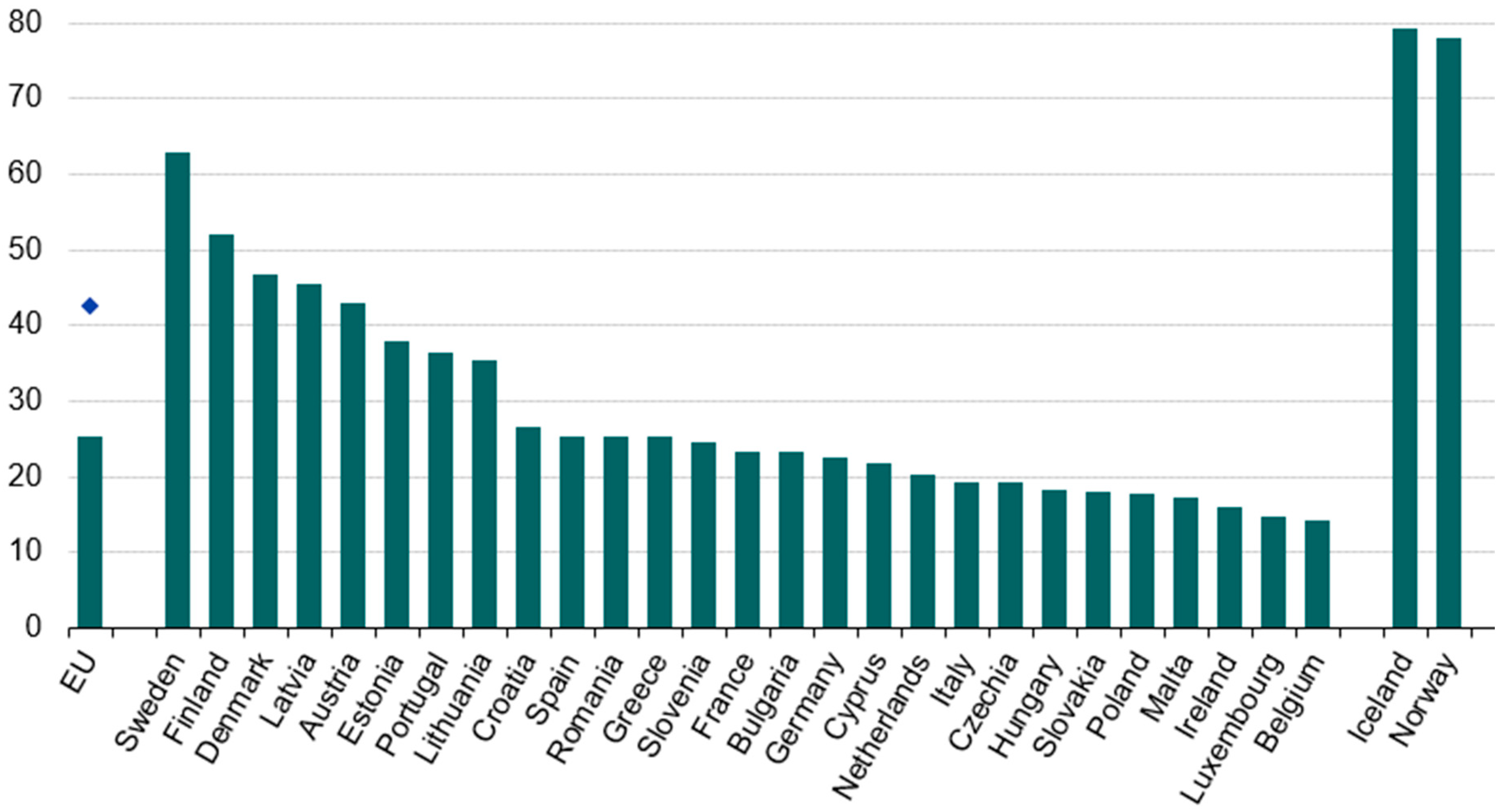
 2030 target.
2030 target.
2030 target.



| Variable | Abbrs. | Definition | Source |
|---|---|---|---|
| Economic growth | GDP | GDP per capita (constant 2015 USD) | World Bank |
| Labor market | EMPL | Employment to population ratio (15+, total %) | ILO |
| Energy transition | REN | Renewable energy (% equivalent primary energy) | Our World in Data |
| Energy diversification | DIV | Diversity index of energy supply (the composition of energy sources in the energy mix, with values between 0 and 1) | Eurostat |
| Energy independence | DEP | Energy import dependency (the share of total energy needs of a country met by imports from other countries) | Eurostat |
| N | Mean | SD | Min | Max | |
|---|---|---|---|---|---|
| GDP | 750 | 44,845.884 | 22,844.534 | 10,707.515 | 138,677.96 |
| EMPL | 750 | 52.822 | 5.656 | 37.288 | 66.509 |
| DIV | 750 | 0.2 | 0.060 | 0.117 | 0.402 |
| DEP | 750 | 53.827 | 24.207 | −50.618 | 99.598 |
| REN | 750 | 12.557 | 10.631 | 0.024 | 52.459 |
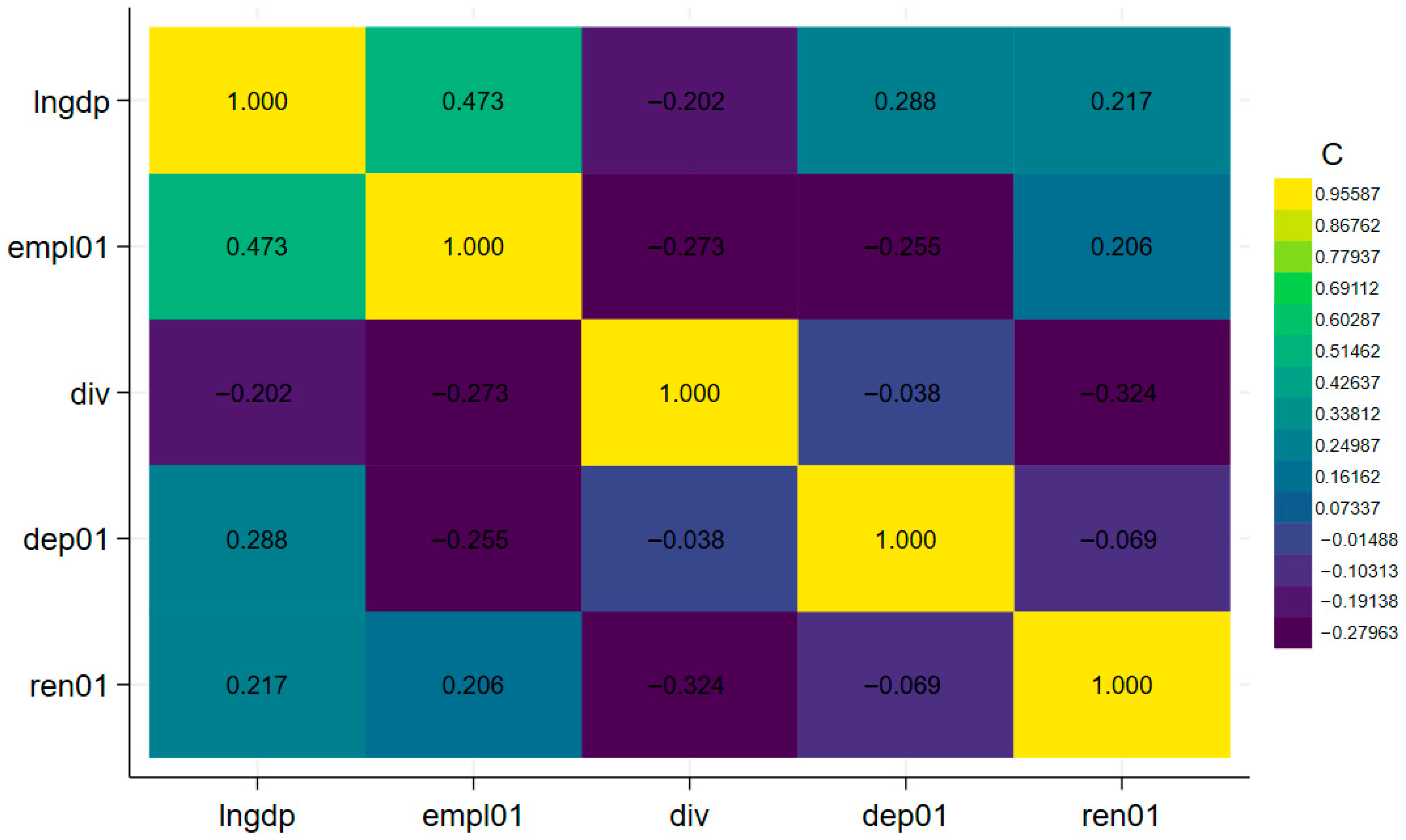
| Variables | (1) | (2) | (3) | (4) | (5) |
|---|---|---|---|---|---|
| (1) GDP | 1.000 | ||||
| (2) EMPL | 0.473 * | 1.000 | |||
| (0.000) | |||||
| (3) DIV | −0.202 * | −0.273 * | 1.000 | ||
| (0.000) | (0.000) | ||||
| (4) DEP | 0.288 * | −0.255 * | −0.038 | 1.000 | |
| (0.000) | (0.000) | (0.297) | |||
| (5) REN | 0.217 * | 0.206 * | −0.324 * | −0.069 | 1.000 |
| (0.000) | (0.000) | (0.000) | (0.061) |
| Test Type | Value | Prob. |
|---|---|---|
| Friedman | 189.373 | 0.0000 |
| Pesaran | 27.732 | 0.0000 |
| Frees | 6.001 | 0.086 |
| Variables | CIPS | |||
|---|---|---|---|---|
| Levels | First Difference | |||
| Constant | Constant &Trend | Constant | Constant &Trend | |
| GDP | −1.616 | −1.423 | −3.448 *** | −3.652 *** |
| EMPL | −1.463 *** | −2.371 | −3.538 *** | −3.613 *** |
| DIV | −2.803 | −2.991 | −5.622 *** | −5.875 *** |
| DEP | −1.554 | −3.152 | −5.630 *** | −5.835 *** |
| REN | −2.456 | −2.813 | −5.198 *** | −5.479 *** |
| Westerlund Test for Cointegration | ||
| Statistic | Prob. | |
| Variance ratio | 1.4985 | 0.0670 |
| Pedroni Test for Cointegration | ||
| Statistic | Prob. | |
| Modified Phillips–Perron t | 2.6513 | 0.0040 |
| Phillips–Perron t | −3.0728 | 0.0011 |
| Augmented Dickey–Fuller t | −3.1774 | 0.0007 |
| Statistic | Prob. | |
|---|---|---|
| Delta | 24.138 | 0.000 |
| Delta adj. | 26.987 | 0.000 |
| (1) | (2) | |
|---|---|---|
| CS-ARDL | AMG | |
| L.GDP | 0.423 *** | |
| (0.080) | ||
| EMPL | 7.243 | 1.276 *** |
| (5.281) | (0.223) | |
| DIV | 3.654 * | 0.079 |
| (2.135) | (0.205) | |
| DEP | 1.187 * | 0.195 *** |
| (1.124) | (0.075) | |
| REN | 0.979 * | 0.172 * |
| (1.670) | (0.114) | |
| Constant | 0.708 | |
| (1.737) | ||
| Observations | 675.000 | 750.000 |
| Countries | 25.000 | 25.000 |
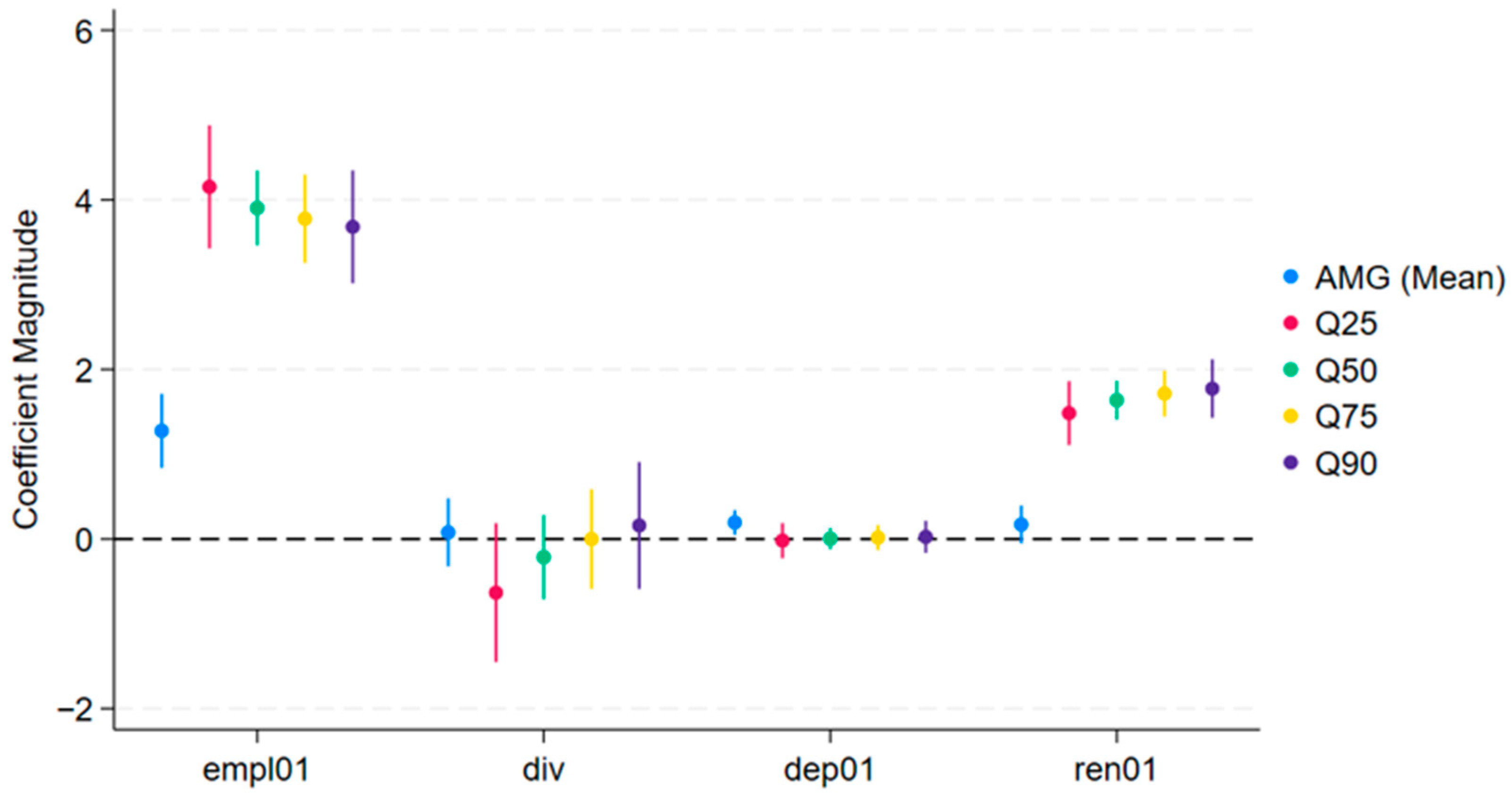
| (1) | (2) | (3) | (4) | |
|---|---|---|---|---|
| Q25 | Q50 | Q75 | Q90 | |
| EMPL | 4.153 *** | 3.904 *** | 3.777 *** | 3.681 *** |
| (0.371) | (0.225) | (0.267) | (0.340) | |
| DIV | −0.632 | −0.214 | −0.000 | 0.160 * |
| (0.418) | (0.254) | (0.300) | (0.382) | |
| DEP | −0.019 | 0.004 | 0.017 * | 0.026* |
| (0.106) | (0.064) | (0.076) | (0.097) | |
| REN | 1.484 *** | 1.637 *** | 1.715 *** | 1.774 *** |
| (0.192) | (0.117) | (0.138) | (0.176) | |
| Observations | 750.000 | 750.000 | 750.000 | 750.000 |
Disclaimer/Publisher’s Note: The statements, opinions and data contained in all publications are solely those of the individual author(s) and contributor(s) and not of MDPI and/or the editor(s). MDPI and/or the editor(s) disclaim responsibility for any injury to people or property resulting from any ideas, methods, instructions or products referred to in the content. |
© 2026 by the authors. Licensee MDPI, Basel, Switzerland. This article is an open access article distributed under the terms and conditions of the Creative Commons Attribution (CC BY) license.
Share and Cite
Dimen, L.; Huseynova, K.; Muhammadali, A.; Huseynova, A.; Aslanov, E.; Hajiyeva, N.; Nuta, A.C. The Relationship Between Energy Dependency, Energy Diversification, and Economic Growth: Assessing Energy Resilience in Europe. Energies 2026, 19, 1723. https://doi.org/10.3390/en19071723
Dimen L, Huseynova K, Muhammadali A, Huseynova A, Aslanov E, Hajiyeva N, Nuta AC. The Relationship Between Energy Dependency, Energy Diversification, and Economic Growth: Assessing Energy Resilience in Europe. Energies. 2026; 19(7):1723. https://doi.org/10.3390/en19071723
Chicago/Turabian StyleDimen, Levente, Khatira Huseynova, Abdin Muhammadali, Alida Huseynova, Emin Aslanov, Nargiz Hajiyeva, and Alina Cristina Nuta. 2026. "The Relationship Between Energy Dependency, Energy Diversification, and Economic Growth: Assessing Energy Resilience in Europe" Energies 19, no. 7: 1723. https://doi.org/10.3390/en19071723
APA StyleDimen, L., Huseynova, K., Muhammadali, A., Huseynova, A., Aslanov, E., Hajiyeva, N., & Nuta, A. C. (2026). The Relationship Between Energy Dependency, Energy Diversification, and Economic Growth: Assessing Energy Resilience in Europe. Energies, 19(7), 1723. https://doi.org/10.3390/en19071723