Impact of Thermodynamic Constraints on the Lability of Activation Energy as a Function of Conversion Degree


Abstract
1. Introduction and Kinetic Formalism
2. Basis of the Analysis and Aim of the Work
3. Models of the Thermal Dissociation of CaCO3 (Calcite)
3.1. Model H-CL
3.2. Model V
3.3. Comparison of the H-CL and V Models
3.4. Discussion
4. Conclusions
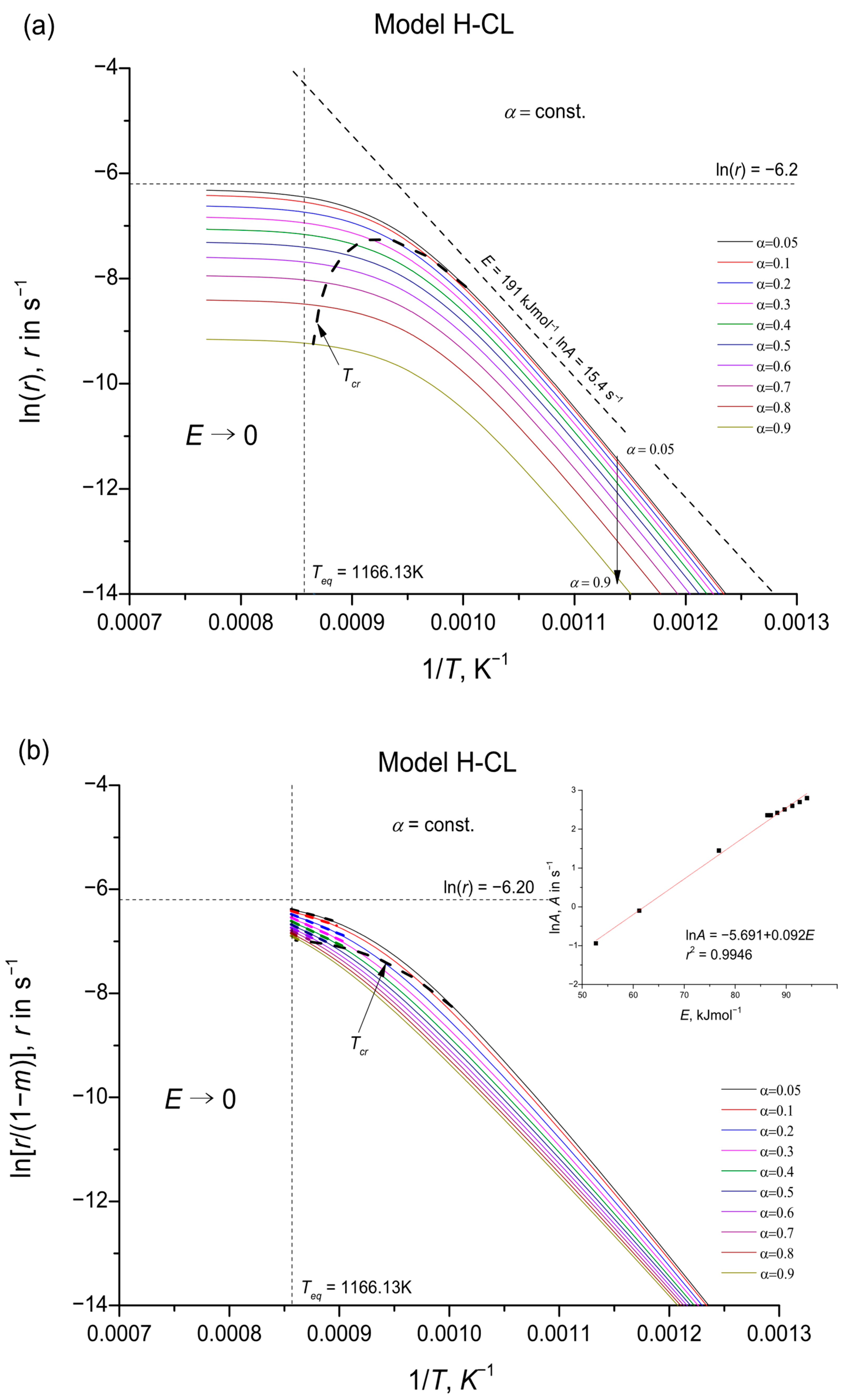
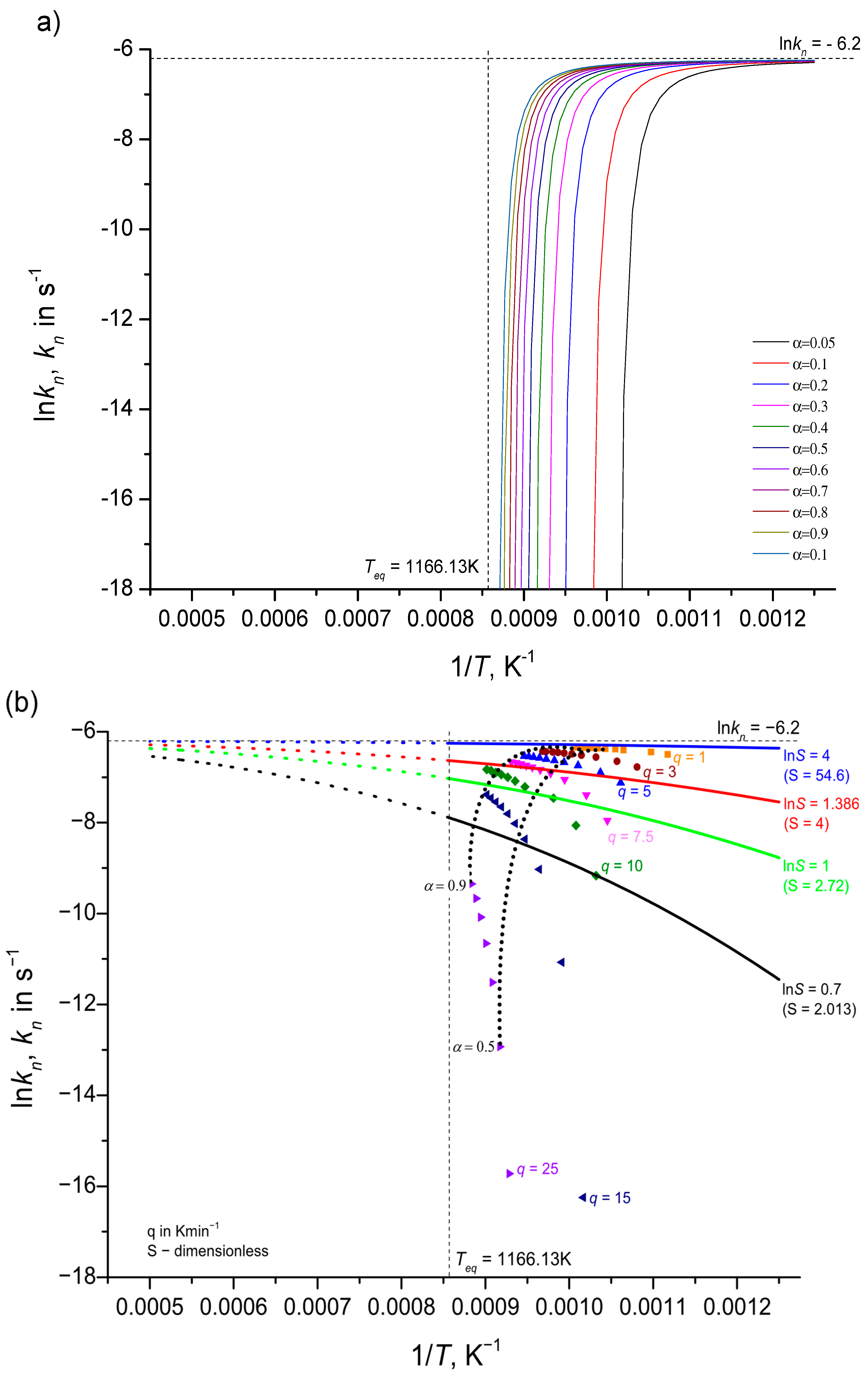
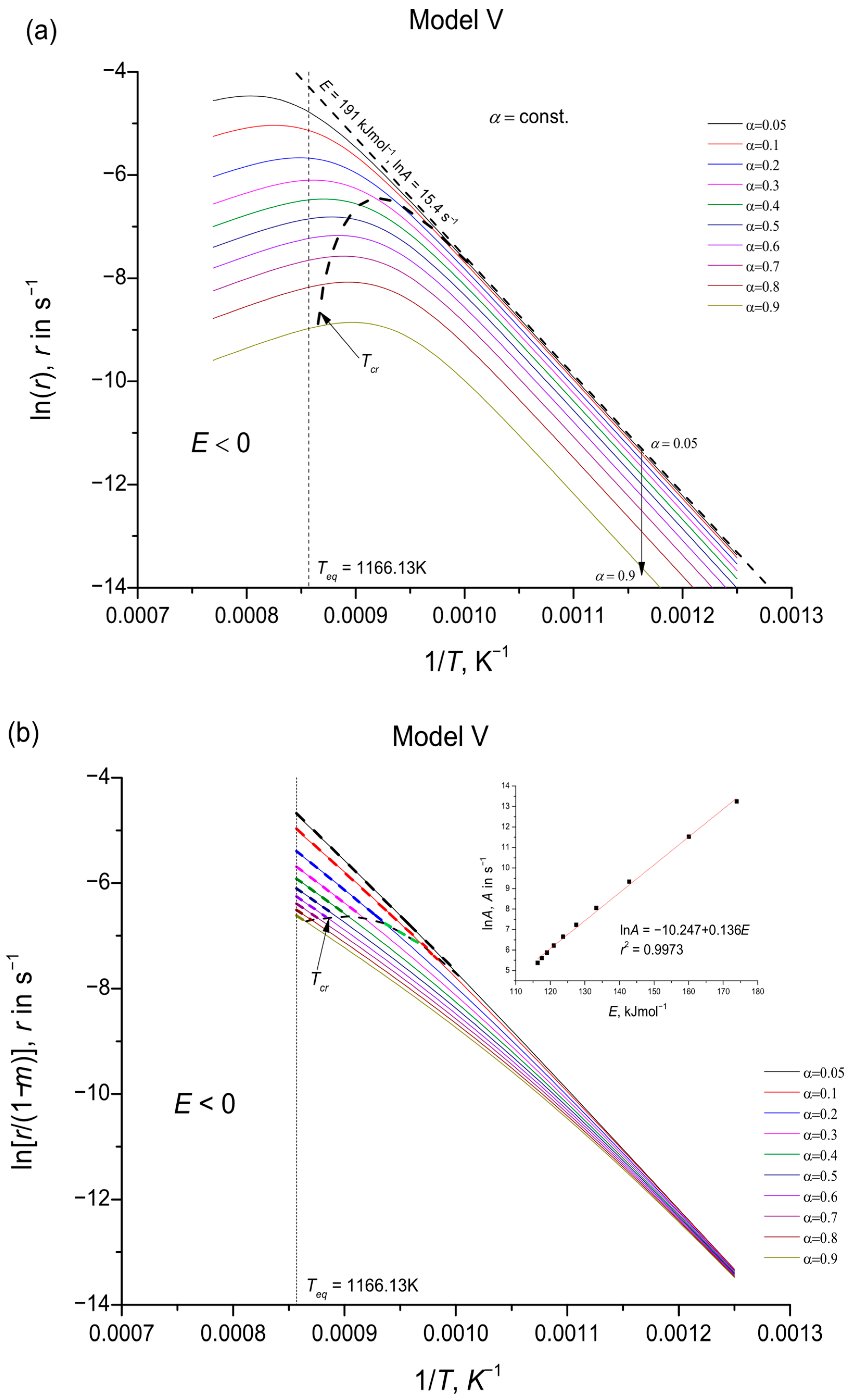
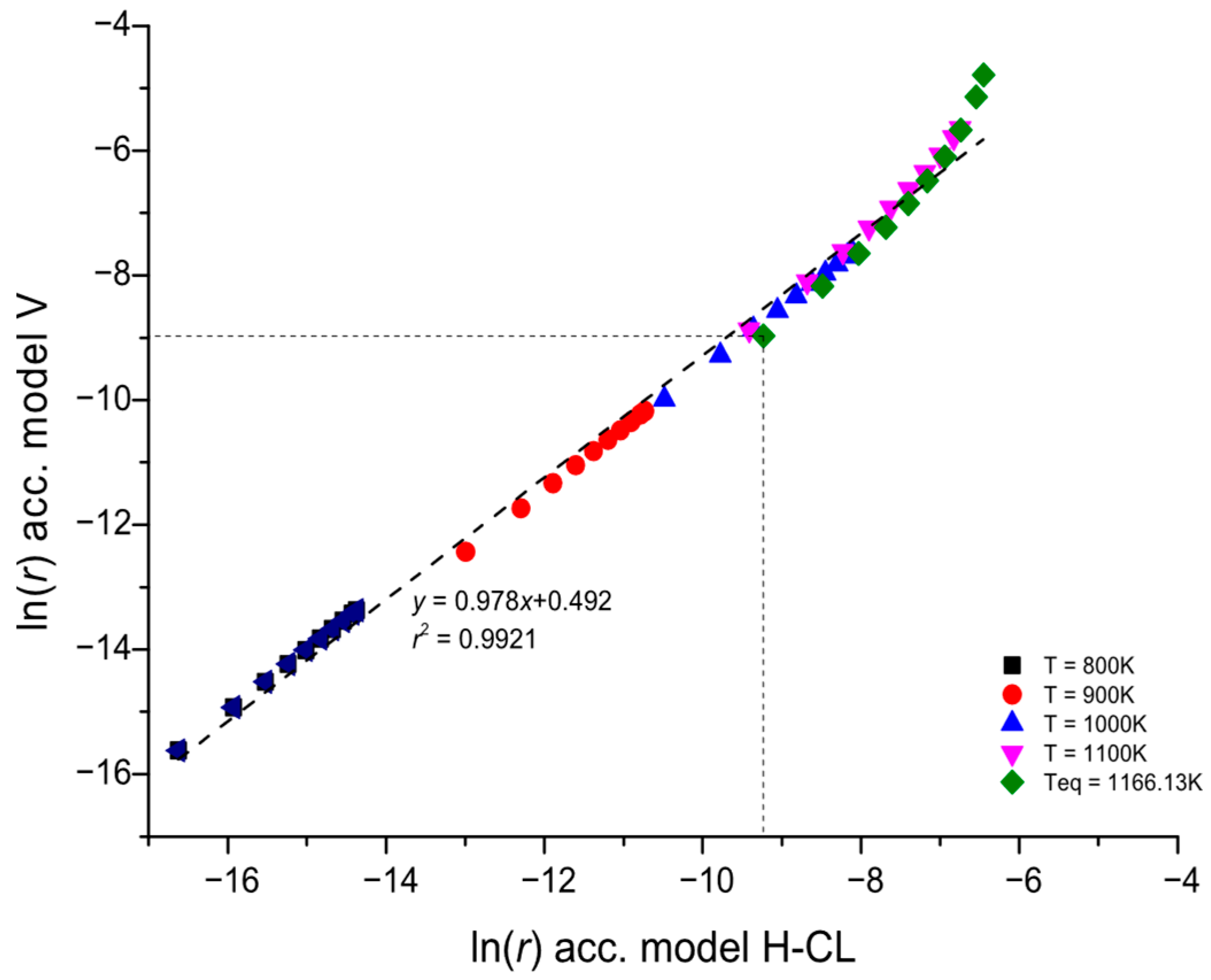
- In the analysis of two kinetic models under isothermal conditions, defined as kinetic–nucleation (the H-CL, as kinetic model) and kinetic–desorption (the V, as thermodynamic model), it was shown under simplifying assumptions that both models yield similar reaction/process rates up to the equilibrium temperature (Teq) (Figure 4). At higher temperatures, nucleation becomes dominant: the H-CL model leads to activation energy E → 0, whereas the V model reaches a negative activation energy E < 0. In both cases, the sequence of activation energies has an apparent character.
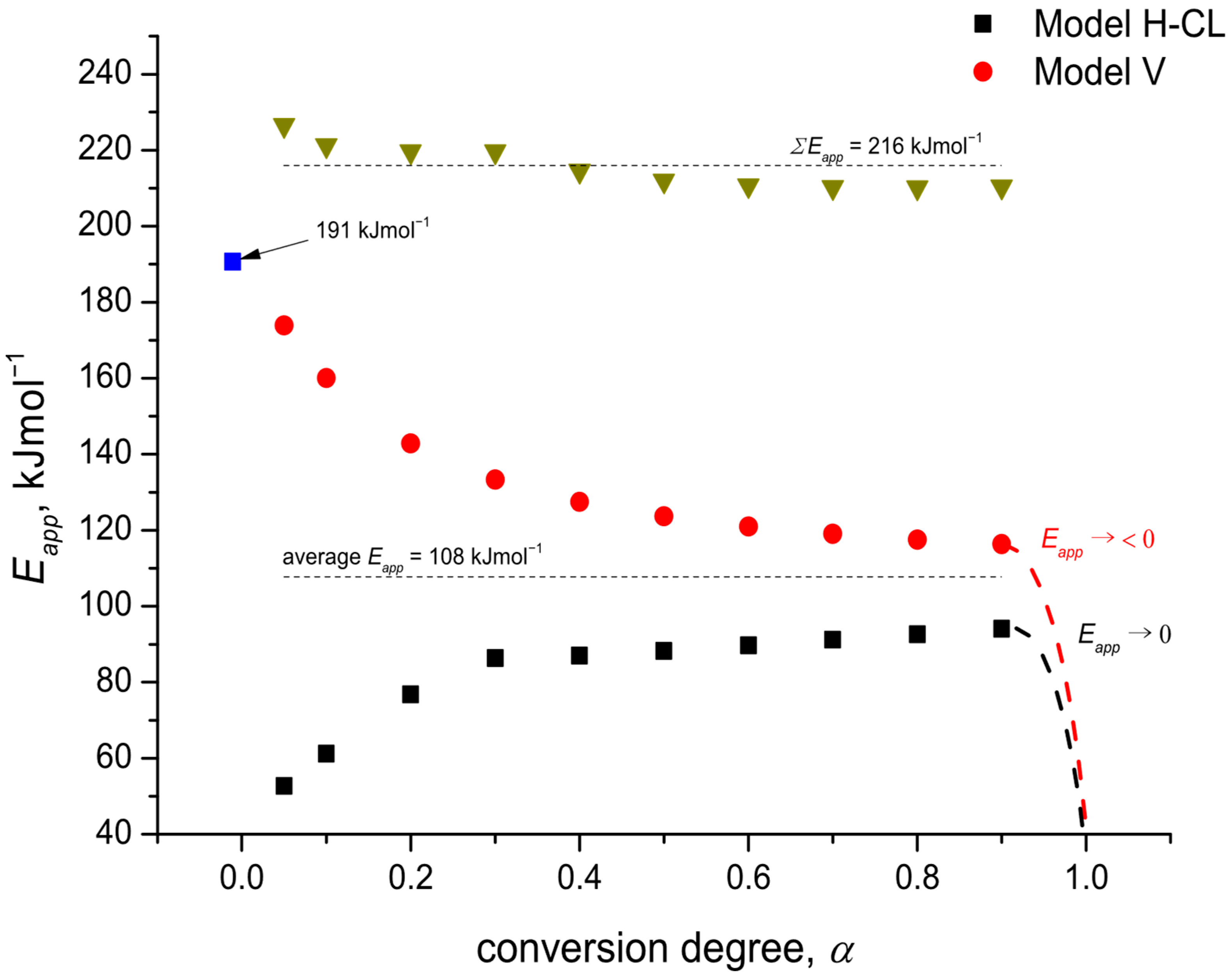
- The H-CL and V models, in terms of apparent activation energy, represent the same reaction/process, with a varying contribution of the individual pathways of calcite decomposition and the transformation of the resulting oxide. These energies were assigned to the imposed conversion degree as isoconversional values. In the H-CL model, this energy is significantly lower than the assumed value for the overall reaction ( 191 kJ·mol−1) and complements the energy in the V model. In this case, the sum of the apparent activation energies is constant and close to the assumed value. In other words, the constant sum of the apparent activation energies of the H-CL and V models corresponds to the activation energy of the completed reaction/process (Figure 5).
- In contrast to the apparent activation energy obtained from isothermal analyses of the H-CL and V models, the thermodynamic constraint in the form of an equilibrium conversion degree causes the two models to become complementary. Once this constraint is removed under dynamic conditions and, additionally, within the isoconversional computational procedure, low conversion degrees span a very wide temperature range. Consequently, a common observation is the simultaneous occurrence of chemical reactions and solid-state product transformation.
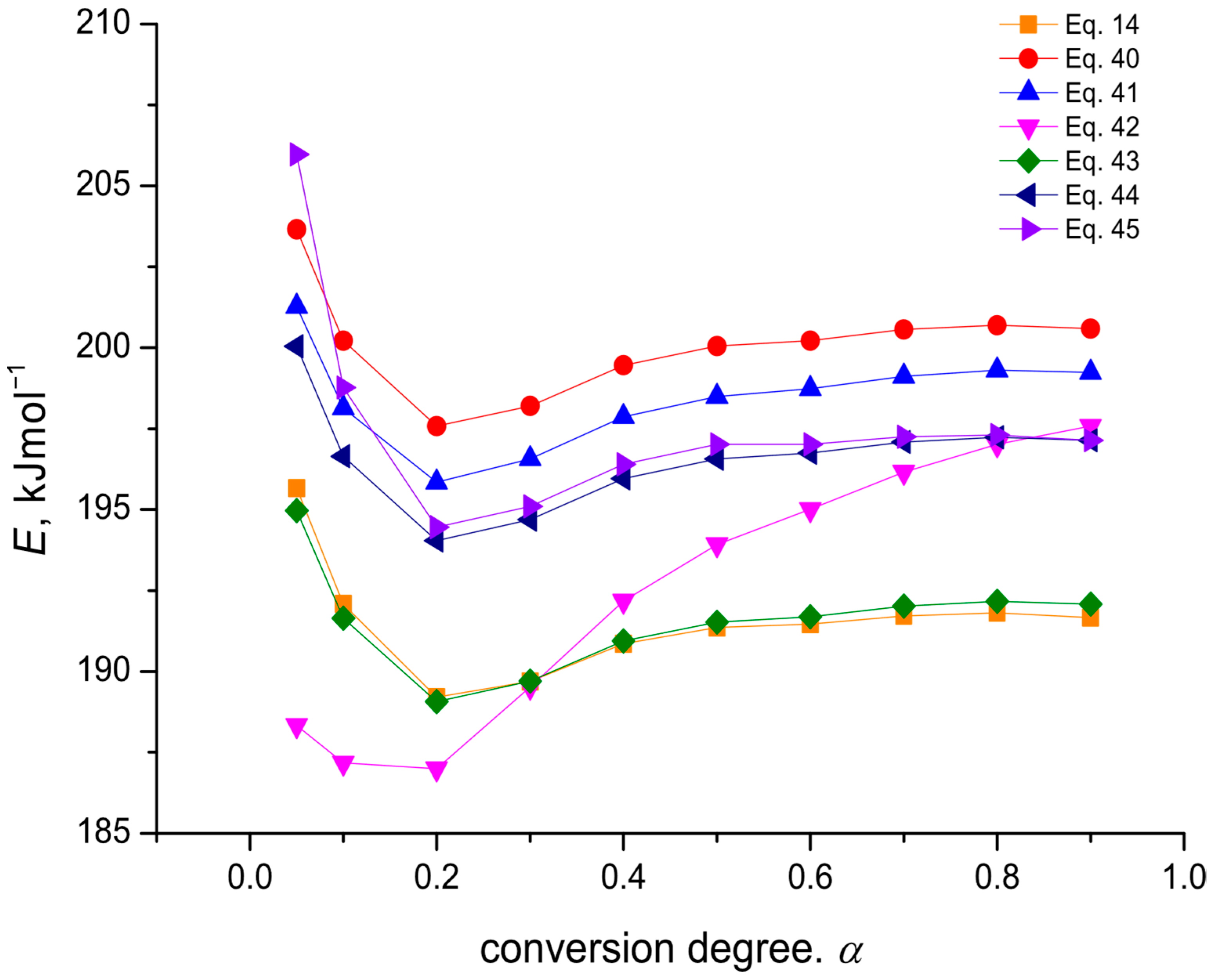
- In the context of the isoconversional reaction variant, for dynamic conditions several approaches in this area were analyzed (Table 2). A close agreement was observed between Vyazovkin’s method using the Coats–Redfern equation and a new approach based on a power approximation (Equation (43)).
- From the CaL perspective, an important aspect is balancing the free energy of the reaction/process using the Arrhenius parameters determined, together with evaluation of the free energy of nucleation according to Equation (30). In thermodynamic terms, the H-CL model, which emphasizes the nucleation process, and the V model, describing the transformation of the metastable oxide, represent the same phenomenon, differing only slightly in entropy.
Author Contributions
Funding
Data Availability Statement
Conflicts of Interest
Abbreviations
| Abbreviations | |
| CaL | Calcium looping |
| FR | Friedman equation |
| FWO | Flynn–Wall–Ozawa equation |
| GRE | General Rate Equation |
| H-CL | Model by Hyatt et al. [38] and Cai, Li [43] |
| KAS | Kissinger–Akahira–Sunose equation |
| KCE | Kinetic compensation effect, linear relationship between |
| V | Model by Valverde et al. [39,40,41,42] |
| Nomenclature | |
| coefficients, Equation (42)—Table 2 | |
| activity of the metastable CaO*, 1 | |
| pre-exponential factor, s−1 | |
| activation energy, Jmol−1, in text kJmol−1 | |
| kinetics function of conversion degree | |
| kinetic function of conversion degree with thermodynamic limitation | |
| thermodynamic functions acc. free energy J·mol−1, enthalpy J·mol−1 and entropy J·(mol·K)−1 | |
| function of thermodynamic limitation | |
| rate constant, dependent on temperature, s−1 | |
| equilibrium constant | |
| refers to an active site where in a molecule of CO2 | |
| temperature integral | |
| ratio of conversion degree to equilibrium conversion degree | |
| exponent, Equation (43)—Table 2 | |
| quantity of heating rate | |
| auxiliary quantity in Equations (11)–(13) | |
| coefficients in Equation (39) | |
| partial pressure and equilibrium pressure, respectively, Pa | |
| reaction/process rate, s−1 | |
| rate in pure nitrogen acc. [38], Equation (17), s−1 | |
| determination coefficient | |
| =8.314 J·(mol·K)−1, universal gas constant | |
| heating rate, Ks−1 or Kmin−1 | |
| relative rate of decomposition reaction in dynamic state, Equation (42)—Table 2, K | |
| time, s or min | |
| absolute temperature, K | |
| conversion degree, 1 | |
| stoichiometric ratio | |
| Subscripts | |
| 0 | initial state |
| 1 | forwards |
| 2 | backwards |
| app | apparent |
| cr | critical temperature |
| d | desorption |
| eq | equilibrium |
| f | final |
| i, j | ith or jth point |
| iso | isokinetic |
| n | nucleation |
| (−n) | denucleation |
| r | refers to reaction |
| α | refers to conversion degree |
| refers to the activity of the metastable form | |
| Superscripts | |
| standard state |
Appendix A
Explanations for Table 2
References
- Koga, N.; Favergeon, L.; Kodani, S. Impact of atmospheric water vapor on the thermal decomposition of calcium hydroxide: A universal kinetic approach to a physico-geometrical consecutive reaction in solid–gas systems under different partial pressures of product gas. Phys. Chem. Chem. Phys. 2019, 21, 11615–11632. [Google Scholar] [CrossRef]
- Koga, N.; Vyazovkin, S.; Burnham, A.K.; Favergeon, L.; Muravyev, N.V.; Pérez-Maqueda, L.A.; Saggese, C.; Sánchez-Jiménez, P.E. ICTAC Kinetics Committee recommendations for analysis of thermal decomposition kinetics. Thermochim. Acta 2023, 719, 179384. [Google Scholar] [CrossRef]
- Hotta, M.; Koga, N. Extended kinetic approach to reversible thermal decomposition of solids: A universal description considering the effect of the gaseous product and the kinetic compensation effect. Thermochim. Acta 2024, 733, 179699. [Google Scholar] [CrossRef]
- Friedman, H.L. Kinetics of thermal degradation of char-forming plastics from thermogravimetry. Application to a phenolic plastic. J. Polym. Sci. Part C Polym. Symp. 1964, 6, 183–195. [Google Scholar] [CrossRef]
- Kropidłowska, A.; Rotaru, A.; Strankowski, M.; Becker, B.; Segal, E. Heteroleptic cadmium(II) complex, potential precursor for semiconducting CdS layers. J. Therm. Anal. Calorim. 2008, 91, 903–909. [Google Scholar] [CrossRef]
- Budrugeac, P. On the use of the model-free way method for kinetic analysis of thermoanalytical data—Advantages and limitations. Thermochim. Acta 2021, 706, 179063. [Google Scholar] [CrossRef]
- Senum, G.I.; Yang, R.T. Rational approximations of the integral of the Arrhenius function. J. Therm. Anal. 1977, 11, 445–447. [Google Scholar] [CrossRef]
- Madhusudanan, P.M.; Krishnan, K.; Ninan, K.N. New approximation for the p(x) function in the evaluation of non-isothermal kinetic data. Thermochim. Acta 1986, 97, 189–201. [Google Scholar] [CrossRef]
- Starink, M.J. The determination of activation energy from linear heating rate experiments: A comparison of the accuracy of isoconversion methods. Thermochim. Acta 2003, 404, 163–176. [Google Scholar] [CrossRef]
- Órfão, J.J.M. Review and evaluation of the approximations to the temperature integral. AIChE J. 2007, 53, 2905–2915. [Google Scholar] [CrossRef]
- Cai, J.; Liu, R. Kinetic analysis of solid-state reactions: Precision of the activation energy obtained from one type of integral methods without neglecting the low temperature end of the temperature integral. Solid State Sci. 2008, 10, 659–663. [Google Scholar] [CrossRef]
- Sbirrazzuoli, N. Determination of Pre-Exponential Factors and of the Mathematical Functions f(α) or G(α) That Describe the Reaction Mechanism in a Model-Free Way. Thermochim. Acta 2013, 564, 59–69. [Google Scholar] [CrossRef]
- Carrero-Mantilla, J.I.; Rojas-González, A.F. Calculation of the temperature integrals used in the processing of thermogravimetric analysis data. Ing. Compet. 2019, 21, 7450. [Google Scholar] [CrossRef]
- Vyazovkin, S. Isoconversional Kinetics of Thermally Stimulated Processes; University of Alabama: Birmingham, AL, USA, 2015. [Google Scholar] [CrossRef]
- Vyazovkin, S. (Ed.) Thermal Analysis Kinetics for Understanding Materials Behavior; MDPI: Basel, Switzerland, 2020; ISBN 978-3-03936-559-3. [Google Scholar] [CrossRef]
- Tao, Q.; Krivec, T.; Kern, W. Single-step kinetic predictions based on a constructed isoconversional state diagram. Macromol. Theory Simul. 2023, 32, 2300066. [Google Scholar] [CrossRef]
- Mianowski, A.; Ściążko, M.; Radko, T. Vyazovkin’s isoconversional method as a universal approach. Thermochim. Acta 2021, 696, 178822. [Google Scholar] [CrossRef]
- Mianowski, A.; Radko, T. The possibility of identification of activation energy by means of temperature criterion. Thermochim. Acta 1994, 247, 389–405. [Google Scholar] [CrossRef]
- Mianowski, A.; Siudyga, T.; Polański, J. Szarawara–Kozik’s temperature criterion in the context of three-parameter equation for modeling ammonia or methanol decomposition during heterogenous catalysis. React. Kinet. Mech. Catal. 2018, 125, 493–504. [Google Scholar] [CrossRef]
- Sbirrazzuoli, N. Advanced isoconversional kinetic analysis: Insight in mechanisms and simulations. Successes and future. Thermochim. Acta 2024, 733, 179688. [Google Scholar] [CrossRef]
- Luo, L.; Zhang, Z.; Li, C.; He, F.; Zhang, X.; Cai, J. Insight into master plots method for kinetic analysis of lignocellulosic biomass pyrolysis. Energy 2021, 233, 121194. [Google Scholar] [CrossRef]
- Chen, Y.; Tian, Y.; Qi, M.; Shu, C.-M.; Liu, Y. Pyrolysis mechanism of palmityl alcohol: Combined with experiments, reaction molecular dynamics, and density functional theory simulation. J. Anal. Appl. Pyrolysis 2025, 186, 106983. [Google Scholar] [CrossRef]
- Maciejewski, M.; Oswald, H.-R.; Reller, A. Thermal transformations of vaterite and calcite. Thermochim. Acta 1994, 234, 315–328. [Google Scholar] [CrossRef]
- Maciejewski, M. Computational Aspects of Kinetic Analysis: Part B. The ICTAC Kinetics Project—The decomposition kinetics of calcium carbonate revisited or some tips on survival in the kinetic minefield. Thermochim. Acta 2000, 355, 145–154. [Google Scholar] [CrossRef]
- Maciejewski, M. Somewhere between fiction and reality. The usefulness of kinetic data of solid-state reactions. J. Therm. Anal. 1992, 38, 51–70. [Google Scholar] [CrossRef]
- Maciejewski, M.; Bałdyga, J. The influence of the pressure of the gaseous product on the reversible thermal decomposition of solids. Thermochim. Acta 1985, 92, 105–108. [Google Scholar] [CrossRef]
- Maciejewski, M.; Reller, A. How (un)reliable are kinetic data of reversible solid-state decomposition processes? Thermochim. Acta 1987, 110, 145–152. [Google Scholar] [CrossRef]
- Maciejewski, M. The application of kinetic parameters to the investigation of thermal stability determined from rising temperature experiments. Thermochim. Acta 1987, 113, 287–303. [Google Scholar] [CrossRef]
- Hotta, M.; Tone, T.; Favergeon, L.; Koga, N. Kinetic Parameterization of the Effects of Atmospheric and Self-Generated Carbon Dioxide on the Thermal Decomposition of Calcium Carbonate. J. Phys. Chem. C 2022, 126, 7880–7895. [Google Scholar] [CrossRef]
- Hotta, M.; Favergeon, L.; Koga, N. Kinetic Insight into the Effect of Self-Generated CO2 on the Thermal Decomposition of Inorganic Carbonates in an Inert Gas Atmosphere: ZnCO3 and CaCO3. J. Phys. Chem. C 2023, 127, 13065–13080. [Google Scholar] [CrossRef]
- Hotta, M.; Koga, N. Physicogeometrical Kinetic Insight into the Acceleration Effect of Atmospheric Water Vapor on Thermal Decomposition of Calcium Carbonate. J. Phys. Chem. C 2024, 128, 11583–11597. [Google Scholar] [CrossRef]
- Martínez, I.; Grasa, G.; Murillo, R.; Arias, B.; Abanades, J.C. Kinetics of Calcination of Partially Carbonated Particles in a Ca-Looping System for CO2 Capture. Energy Fuels 2012, 26, 1432–1440. [Google Scholar] [CrossRef]
- Valverde, J.M.; Medina, S. Reduction of calcination temperature in the Calcium Looping process for CO2 capture by using Helium: In-situ XRD analysis. ACS Sustain. Chem. Eng. 2016, 4, 7090–7099. [Google Scholar] [CrossRef]
- Medina-Carrasco, S.; Valverde, J.M. The Calcium Looping process for energy storage: Insights from in situ XRD analysis. Chem. Eng. J. 2022, 429, 132244. [Google Scholar] [CrossRef]
- Fedunik-Hofman, L.; Bayon, A.; Donne, S.W. Comparative Kinetic Analysis of CaCO3/CaO Reaction System for Energy Storage and Carbon Capture. Appl. Sci. 2019, 9, 4601. [Google Scholar] [CrossRef]
- Romano, M.C.; Martinez, I.; Murillo, R.; Arstad, B.; Blum, R.; Ozcan, D.C.; Ahn, H.; Brandami, S. Guidelines for Modeling and Simulation of Ca-Looping Processes; EERA: Berlin, Germany, 2012. [Google Scholar]
- Kumari, P.; Al Amoodi, N.; Dumée, L.F.; Al Hajaj, A. Integrated calcium looping technologies for enhanced CO2 valorisation—A critical review. Carbon Capture Sci. Technol. 2025, 14, 100371. [Google Scholar] [CrossRef]
- Hyatt, E.P.; Cutler, I.B.; Wadsworth, M.E. Calcium Carbonate Decomposition in Carbon Dioxide Atmosphere. J. Am. Ceram. Soc. 1958, 41, 70–74. [Google Scholar] [CrossRef]
- Valverde, J.M. On the negative activation energy for limestone calcination at high temperatures nearby equilibrium. Chem. Eng. Sci. 2015, 132, 169–177. [Google Scholar] [CrossRef]
- Valverde, J.M.; Sanchez-Jimenez, P.E.; Perez-Maqueda, L.A. Calcium-looping for post-combustion CO2 capture. On the adverse effect of sorbent regeneration under CO2. Appl. Energy 2014, 126, 161–171. [Google Scholar] [CrossRef]
- Valverde, J.M.; Sanchez-Jimenez, P.E.; Perez-Maqueda, L.A. Relevant Influence of Limestone Crystallinity on CO2 Capture in The Ca-Looping Technology at Realistic Calcination Conditions. Environ. Sci. Technol. 2014, 48, 9882–9889. [Google Scholar] [CrossRef]
- Valverde, J.M.; Sanchez-Jimenez, P.E.; Perez-Maqueda, L.A. Limestone calcination nearby equilibrium: Kinetics, CaO crystal structure, sintering and reactivity. J. Phys. Chem. C 2015, 119, 1623–1641. [Google Scholar] [CrossRef]
- Cai, J.; Li, Z. First Principle-based Rate Equation Theory for the Calcination Kinetics of CaCO3 in Calcium Looping. Energy Fuels 2024, 38, 8145–8156. [Google Scholar] [CrossRef]
- Mianowski, A.; Radko, T.; Bigda, R. Isokinetic and Compensation Temperature in the Analysis of Thermal Dissociation of the Solid Phase under Dynamic Conditions. Energies 2023, 16, 5692. [Google Scholar] [CrossRef]
- Mianowski, A.; Bigda, R. Use of Kinetic Parameters from Thermal Analysis for Balancing Free Energy of Activation Based on Calcite Decomposition. Energies 2025, 18, 570. [Google Scholar] [CrossRef]
- Mianowski, A.; Szul, M. Practical Aspects of the Analysis of Thermal Dissociation and Pyrolysis Processes in Terms of Transition State Theory. Energies 2025, 18, 2619. [Google Scholar] [CrossRef]
- Beruto, D.T.; Searcy, A.W.; Kim, M.G. Microstructure, kinetic, structure, thermodynamic analysis for calcite decomposition: Free-surface and powder bed experiments. Thermochim. Acta 2004, 424, 99–109. [Google Scholar] [CrossRef]
- Mianowski, A.; Radko, T.; Bigda, R. Elements of Transition-State Theory in Relation to the Thermal Dissociation of Selected Solid Compounds. Energies 2024, 17, 2669. [Google Scholar] [CrossRef]
- Šesták, J. Thermal Analysis and Thermodynamic Properties of Solids; Elsevier: Amsterdam, The Netherlands, 2021. [Google Scholar]
- Błażejowski, J. Evaluation of kinetic constants for the solid state reactions under linear temperature increase conditions. Thermochim. Acta 1981, 48, 109–124. [Google Scholar] [CrossRef]
- Ingraham, T.R. Thermodynamics of the thermal decomposition of cupric sulfate and cupric oxysulfate. Trans. Metall. Soc. AIME 1965, 233, 359–363. [Google Scholar]
- Aghili, A.; Shabani, A.H. Application of the orthogonal collocation method in evaluating the rate of reactions using thermogravimetric analysis data. Thermochim. Acta 2024, 733, 179698. [Google Scholar] [CrossRef]
- Várhegyi, G. Can varying activation energy be determined reliably from thermogravimetric experiments? J. Therm. Anal. Calorim. 2024, 149, 7367–7378. [Google Scholar] [CrossRef]
- Kumar, V.K.; Hallad, S.C.; Panwar, N.L. Thermogravimetric pyrolysis investigation of pistachio shell for its potential of thermal properties, kinetics and thermodynamics. Discover Energy 2024, 4, 7. [Google Scholar] [CrossRef]
- Ridichie, A.; Ledeţi, A.; Bengescu, C.; Sbârcea, L.; Bertici, R.A.; Ivan, D.L.; Vlase, G.; Vlase, T.; Peter, F.; Ledeţi, I. Thermal Stability and Degradation of Three Similar-Structured Endogenous Estrogens. Analytica 2025, 6, 52. [Google Scholar] [CrossRef]
- Elbeih, A.; Nabil, A.; Wafy, T.Z.; Elshenawy, T. Thermal Properties and Detonation Parameters of Modified Low-Sensitive Explosive Composition. FirePhysChem 2025, 100009. [Google Scholar] [CrossRef]
- Budrugeac, P.; Cucos, A.; Dasčalu, R.; Atkinson, I.; Osiceanu, P. Application of model-free and multivariate nonlinear regression methods for evaluation of the kinetic scheme and kinetic parameters of thermal decomposition of low density polyethylene. Thermochim. Acta 2022, 708, 179138. [Google Scholar] [CrossRef]
- Aghili, A.; Stolov, A.A. Accuracy of the isoconversional principle in thermal analysis of complex condensed phase reactions. ChemRxiv, 2025; preprint. [CrossRef]
- Brachi, P.; Santes, V.; Torres-Garcia, E. Pyrolytic degradation of spent coffee ground: A thermokinetic analysis through the dependence of activation energy on conversion and temperature. Fuel 2021, 302, 120995. [Google Scholar] [CrossRef]
- Liu, Y.; Zhao, Z.; Chen, R.; Xu, X. Kinetic and thermodynamic study of micron waste polypropylene thermal degradation. J. Polym. Sci. 2023, 61, 1513–1527. [Google Scholar] [CrossRef]



| Rate Constant, s−1 | E, kJmol−1 | lnA,A in s−1 |
|---|---|---|
| 191.0 | 15.4 | |
| 0 to 55.70, | −6.20 | |
| −52.41 | −13.53 |
| E= | Comment | Reference | No. of Eq. | Average Value of E, kJ·mol−1 |
|---|---|---|---|---|
| The simplest version of the Vyazovkin concept using the Coats–Redfern equation | [17] | (14) | 191.55 1.64 | |
| In Equation (9), the temperature integral is approximated by the form | Solution acc. [50] | (40) | 200.12 1.55 | |
| The commonly used Doyle approximation, applied in Equation (8) | (41) | 198.46 1.44 | ||
| The derivative of the three-parametric equation, here , or equivalently , in comparison with the reference equation and the linear equation, | [44] | (42) | 192.39 3.91 | |
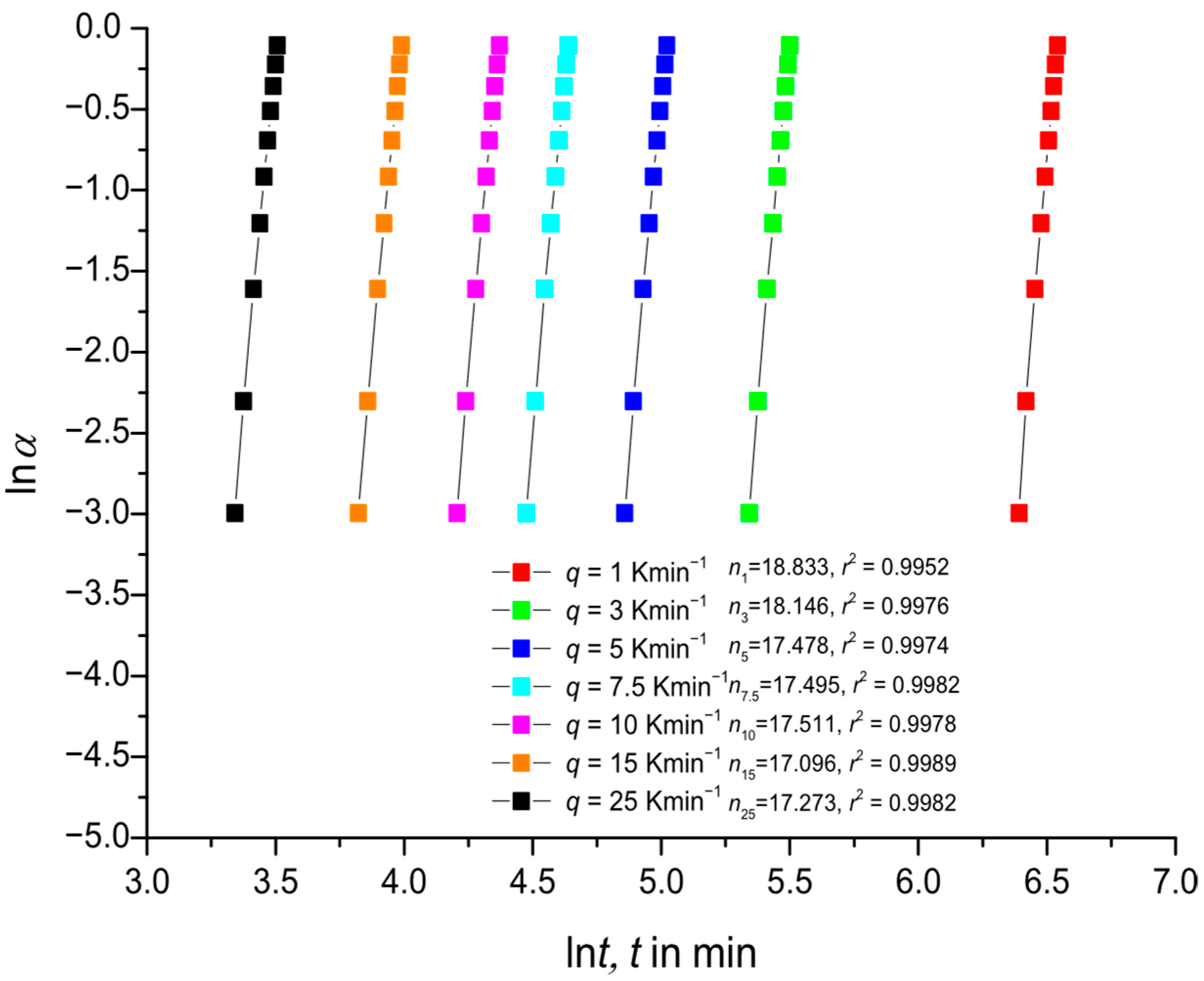
| The basic relation is based on an isotherm, where denotes the finite time for 1, and n = var is the exponent, corresponding to the slope in the double-logarithmic representation (Figure 6) | The new approach uses 298.15 K, taking into account the variable slope for two heating rates | (43) | 191.58 1.50 | |
| The new approach: 298.15 K, constant | (44) | 196.62 1.53 | ||
| The new approach: denote the temperatures for each heating rate for 0.05, constant | (45) | 197.64 3.00 |
Disclaimer/Publisher’s Note: The statements, opinions and data contained in all publications are solely those of the individual author(s) and contributor(s) and not of MDPI and/or the editor(s). MDPI and/or the editor(s) disclaim responsibility for any injury to people or property resulting from any ideas, methods, instructions or products referred to in the content. |
© 2026 by the authors. Licensee MDPI, Basel, Switzerland. This article is an open access article distributed under the terms and conditions of the Creative Commons Attribution (CC BY) license.
Share and Cite
Mianowski, A.; Bigda, R.; Radko, T. Impact of Thermodynamic Constraints on the Lability of Activation Energy as a Function of Conversion Degree. Energies 2026, 19, 1720. https://doi.org/10.3390/en19071720
Mianowski A, Bigda R, Radko T. Impact of Thermodynamic Constraints on the Lability of Activation Energy as a Function of Conversion Degree. Energies. 2026; 19(7):1720. https://doi.org/10.3390/en19071720
Chicago/Turabian StyleMianowski, Andrzej, Rafał Bigda, and Tomasz Radko. 2026. "Impact of Thermodynamic Constraints on the Lability of Activation Energy as a Function of Conversion Degree" Energies 19, no. 7: 1720. https://doi.org/10.3390/en19071720
APA StyleMianowski, A., Bigda, R., & Radko, T. (2026). Impact of Thermodynamic Constraints on the Lability of Activation Energy as a Function of Conversion Degree. Energies, 19(7), 1720. https://doi.org/10.3390/en19071720