


Abstract
Given the extremely low proven rate of coal-measure gas (CMG) in China, this review treats CMG as an integrated whole to analyze its co-accumulation dynamics, building upon its fundamental differences from conventional oil and gas accumulation. It systematically evaluates the geological controls, dynamic mechanisms, and qualitative and quantitative research methods of CMG co-accumulation reservoirs. Based on superimposition characteristics, CMG reservoirs are classified into three types. Relevant studies highlight that the CMG co-accumulation process is profoundly governed by extreme reservoir heterogeneity, leading to the formation of distinct diffusion and seepage pore systems within the porous media. Currently, although traditional qualitative analysis methods for CMG accumulation are relatively mature, quantitative research still holds significant room for advancement. In light of this, key future research directions are proposed, aiming to provide a theoretical foundation for the efficient co-exploration and co-exploitation of CMG.
1. Introduction
With the rapid growth of China’s economy and the practical needs of addressing climate change and developing a low-carbon economy, CMG has been highly valued in recent years. China’s coal measures are widely distributed and characterized by large thicknesses. According to preliminary evaluations, China’s CMG resources are about 136–178 trillion m3, and more than 60% of the gas sources found in large and medium-sized gas fields are related to coal-measure source rocks [1,2]. CMG refers to the gas generated and preserved in coal-measure reservoirs (coal, mudstone, tight sandstone, and other lithologies) [2,3]. It usually refers to coalbed methane, shale (mudstone) gas, and tight sandstone gas, collectively called “three gases” or “unconventional gases” in coal measures. CMG has the characteristics of multiple coal layers occurring in groups, various types of gas reservoir assemblages, and superposition and symbiosis of multiple sets of pressure systems. Because it is difficult to obtain the best benefit by developing a single coal seam, combined mining is an important way to improve development efficiency in multi-coal-seam areas. However, despite favorable early exploration results in regions like the Ordos Basin (e.g., Linxing-Shenfu and Daning-Jixian blocks) and the Qinshui Basin, the overall exploration extent remains low. Currently, the proven rate of CMG in China is less than 1% [4]. This massive discrepancy highlights a critical bottleneck: the dynamic evolution and co-accumulation mechanisms of these multi-type gases are profoundly more complex than currently understood.
Coal-measure reservoirs exhibit extreme petrophysical heterogeneity, with drastic variations in capillary pressure, nanoscale pore structures, and competitive adsorption, rendering conventional oil and gas accumulation dynamics inapplicable [5]. Currently, most studies tend to focus on single-type reservoirs, while comprehensive investigations treating the coal measure as an integrated whole remain relatively limited [4,6]. This profound lack of understanding regarding the co-accumulation dynamics of CMG has severely restricted its scaled co-exploration and co-exploitation. Furthermore, there is currently no comprehensive review that systematically synthesizes the dynamic coupling among co-accumulation dynamics, hydrocarbon expulsion pathways, reservoir characteristics, and fluid migration modes specifically from the perspective of how CMG differs from conventional oil and gas.
To precisely bridge this knowledge gap, this review builds upon the fundamental differences between CMG and conventional hydrocarbons to systematically evaluate the geological controls, accumulation dynamic evolution, and related research methods of CMG. By clarifying this theoretical framework, this paper aims to provide clear directions for future research on co-accumulation mechanisms, thereby laying a solid theoretical foundation for the efficient exploration and combined development of unconventional natural gas in coal measures.
2. Geological Controls on CMG Co-Accumulation
2.1. Coal-Measure Gas Reservoir Superimposition Characteristics
Source rocks dominated by coal and carbonaceous mudstone in the coal measures provide an important material basis for gas generation. The sandstone and siltstone in the coal measures provide storage space for gas occurrence. CMG has the characteristics of coal-measure reservoir superposition, self-generation and self-storage, exogenous adjacent storage, multi-stage continuous gas generation, frequent exchanges of fluids (gas and water), and large-area accumulation [7,8]. Among them, the characteristics of reservoir superposition and co-accumulation are closely associated with other characteristics of CMG accumulation and play a key role in the CMG accumulation.
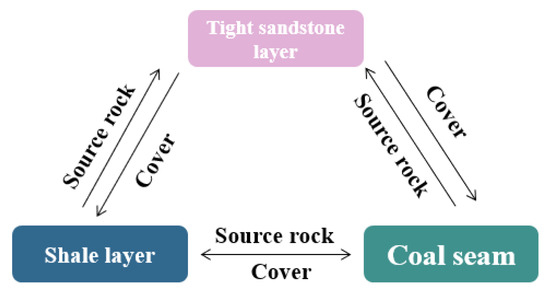
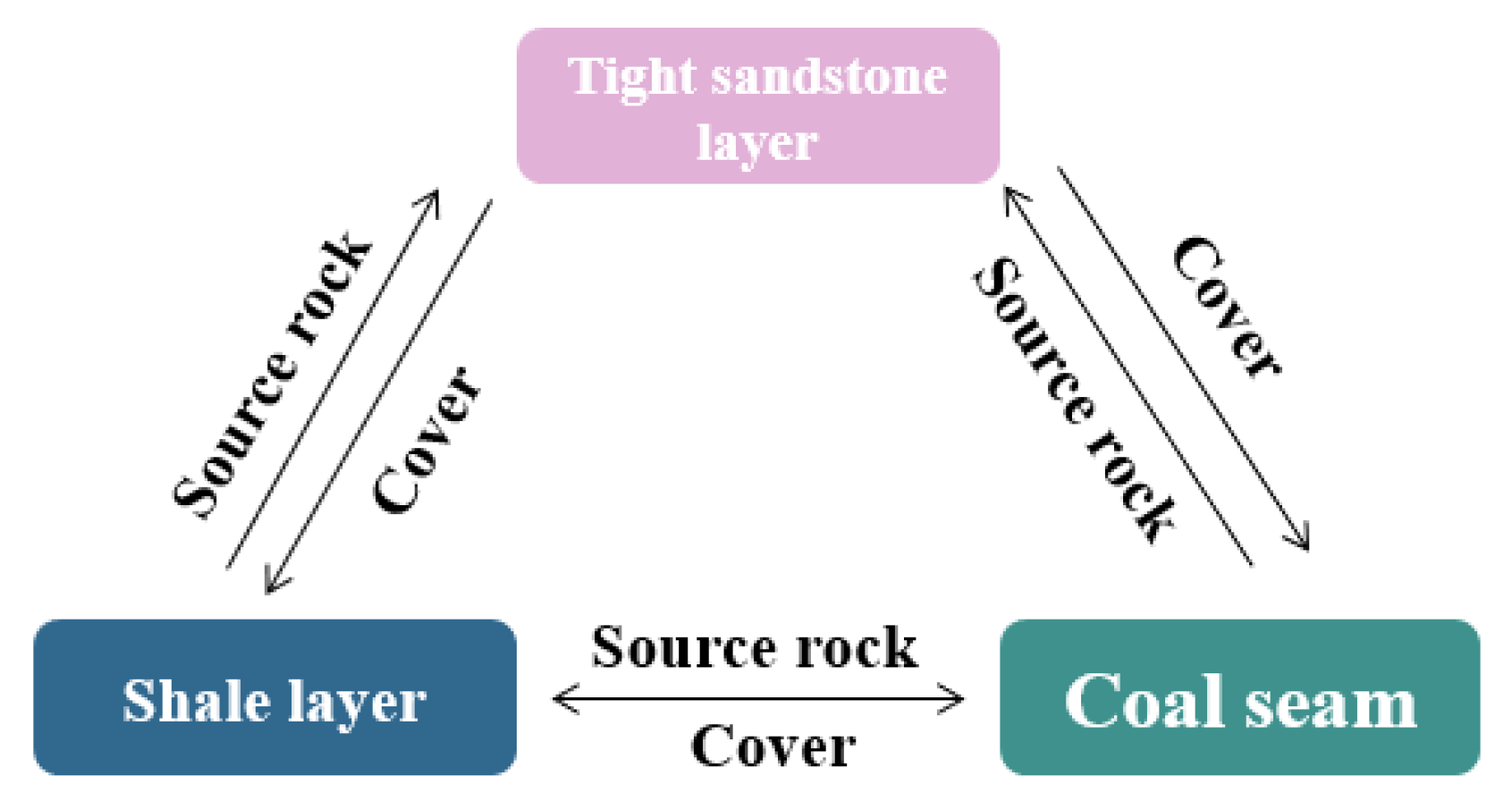
The CMG reservoirs are characterized by diverse lithologies, relatively thin rock layers, and strong cyclicity due to the influence of the sedimentary environment. Mudstones, sandstones, and coal seams are frequently interbedded. These three lithologies are closely superimposed and symbiotic, and the main coal seams and organic-rich mudstones are continuously and stably developed. In particular, the former provides an effective gas source for the symbiosis of CMG. The mudstones, coal seams, and tight sandstones in the coal measures form a sandwich-type reservoir–cap assemblage that has a complex distribution, as shown in Figure 1.
Figure 1.
Assemblage relationship of coal-measure gas reservoirs and caprocks (adapted from [9]).
Many scholars have studied and divided the superposition relationship and gas reservoir types of coal-measure reservoirs from the perspectives of lithological association and source–reservoir combination, but all are based on the complex lithological association in coal measures, as shown in Table 1.
Table 1.
Lithological assemblage and source–reservoir assemblage of CMG.
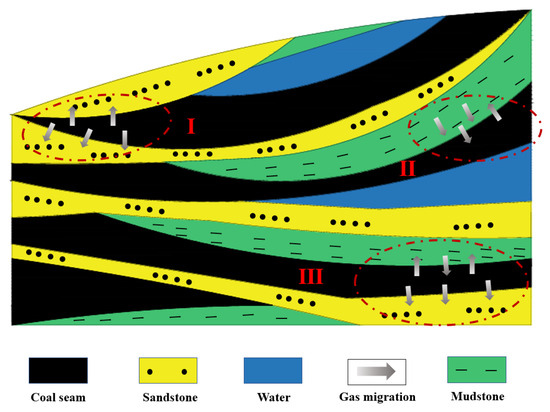
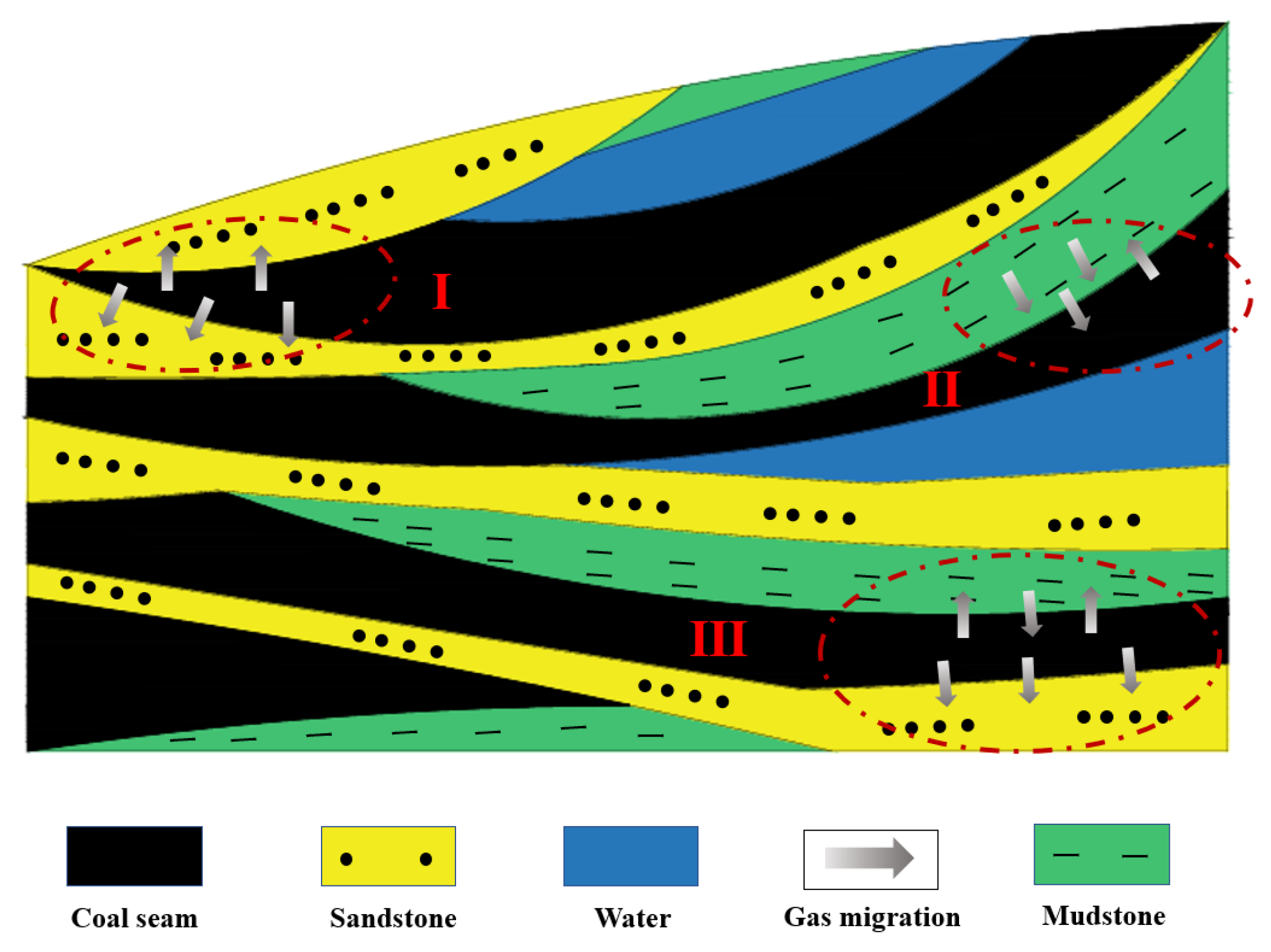
Based on a comprehensive analysis of lithological assemblages and their spatial distribution characteristics, CMG reservoirs can be systematically classified into three primary categories based on their superimposition characteristics: coal seam–sandstone gas reservoirs (Type I), coal seam–mudstone (shale) gas reservoirs (Type II), and “sandwich” style coal seam–mudstone–sandstone multi-lithology gas reservoirs (Type III), as illustrated in Figure 2. Furthermore, depending on the vertical superimposition relationships of these multi-type reservoirs, they can be further subdivided into upper-source and lower-source configurations.
Figure 2.
Classification of superimposition characteristics of coal-measure reservoirs.
Type I refers to coal seam–tight sandstone gas reservoirs. In this configuration, the coal seam acts as the primary source rock and is interbedded with tight sandstone, which serves as both a reservoir and a regional caprock. The coal seam generates a massive amount of natural gas; while a portion is self-stored in an adsorbed state to form coalbed methane, continuous hydrocarbon generation leads to significant formation overpressure. This overpressure subsequently drives the excess natural gas to migrate into the adjacent sandstones. Notably, the intense hydrocarbon generation overpressure, coupled with the capillary pressure gradient at the lithological interface, is sufficient to overcome the natural buoyancy of the gas [17]. This dynamic mechanism enables the gas to migrate not only upward but also downward, charging into the underlying tight sandstones and ultimately accumulating in a free state [18].
Type II represents coal seam–mudstone gas reservoirs. In this assemblage, the coal seam is closely symbiotic with mudstone or shale. Because mudstone typically possesses extremely low permeability and an exceptionally high capillary entry pressure, it primarily acts as an effective regional floor or caprock rather than a viable reservoir [3]. Constrained by this severe lithological barrier, the cross-formational migration of natural gas is relatively weak. This restriction allows the coal seam itself to retain a high gas content and exceptionally high resource abundance, making it a primary target for commercial coalbed methane (CBM) development [19] (e.g., in the southern Qinshui Basin).
Type III is a composite coal seam–mudstone–sandstone gas reservoir. This type exhibits a highly complex “sandwich” architecture characterized by intricately interbedded coal seams, mudstone (or shale), and tight sandstone. In this integrated system, both the coal seam and the carbonaceous mudstone serve as effective source rocks. Once their intrinsic adsorption saturation demands are met, they collectively supply gas to the interstratified tight sandstones. The spatial distribution of such reservoirs demonstrates extreme heterogeneity, and the gas migration pathways (encompassing both upward and downward trajectories) become profoundly complicated due to the presence of multiple lithological interfaces and dynamic fluid–solid coupling effects [20,21]. Although this multi-reservoir superimposed structure holds tremendous natural gas resource potential, its extreme petrophysical heterogeneity dictates that its development costs and engineering technical difficulties are the highest among the three types [22].
Currently, related classifications are predominantly based on qualitative analysis, while quantitative classifications of the spatial superimposition characteristics of coal-measure reservoirs in specific regions remain relatively scarce. In the future, integrating extensive exploration and development data to foster a virtuous cycle and deepening the investigation into reservoir spatial architectures will significantly facilitate the co-exploration and co-exploitation of CMG.
2.2. Migration and Conduction Systems
Migration and conduction systems generally include connected sand bodies, faults, and unconformity surfaces. Many scholars have conducted extensive research on the migration systems of conventional oil and gas [23,24], classifying and denominating these systems in accordance with different principles and focuses. In general, there are four types of conduction systems: reservoir conduction systems, fracture conduction systems, unconformity conduction systems, and composite conduction systems [25]. The conduction systems for large-scale natural gas migration in coal measures include faults, internal and external fissures of coal seams, joints, bedding planes, and permeable sand bodies within coal measures. In the absence of large-scale migration pathways, natural gas in coal measures is mainly driven by abnormal pore pressure and migrates in an episodic gas inrush mode—this migration is characterized by rapid vertical short-distance accumulation. The similarities and differences between conventional oil and gas migration and unconventional natural gas migration in coal measures are presented in Table 2.
Table 2.
Similarities and differences between conventional oil and gas migration pathways and CMG.
The occurrence phase of CMG is predominantly the adsorbed state, resulting in characteristically short migration distances. Within the source area, primary migration is the dominant type, executed through diffusion, filling, and seepage. While faults serve as the critical “expressways” for long-distance, far-source migration, the conduction system within the reservoir itself relies on a hierarchical network composed of connected pores, joints, and micro-fractures. This hydrocarbon expulsion system can be systematically analyzed across three scales: macroscopic, mesoscopic, and microscopic, as synthesized in Table 3.
Table 3.
Hydrocarbon expulsion pathways of CMG.
From a macroscopic perspective, faults and unconformity surfaces function as the primary conduits for regional gas redistribution. These pathways facilitate large-scale, far-source migration, allowing natural gas to transcend lithological barriers and accumulate in favorable zones, predominantly in a free state [26]. These macroscopic features are fed by the mesoscopic system, where fissures, joints, and bedding planes act as “collecting channels.” At this level, migration distances are relatively short, and the flow mechanism transitions into a combination of Darcy and non-Darcy seepage. Specifically, well-developed fractures significantly reduce flow resistance, making Darcy seepage the dominant mode for rapid gas pooling. At the microscopic level, the system is grounded in the reservoir’s pore spaces and microfissures. Here, the migration distance is minimized, and gas transport is stringently governed by non-Darcy seepage due to intense fluid–solid interactions in nanoscale confined spaces.
Crucially, these three scales are not isolated but function as a synergistic “relay” system: gas initially expelled from microscopic pores is collected by mesoscopic fractures, which then channel the fluid into macroscopic faults for long-distance transport [16]. This multi-scale interaction demonstrates that reservoir architecture exerts a decisive impact on the overall migration efficiency and final accumulation pattern of CMG. The various migration pathways do not function in isolation; instead, they form a synergistic, hierarchical conduction network that facilitates gas accumulation and reservoir formation.
2.3. Heterogeneity of Coal-Measure Reservoirs
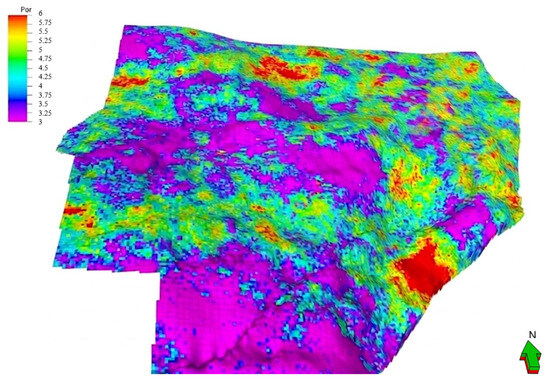
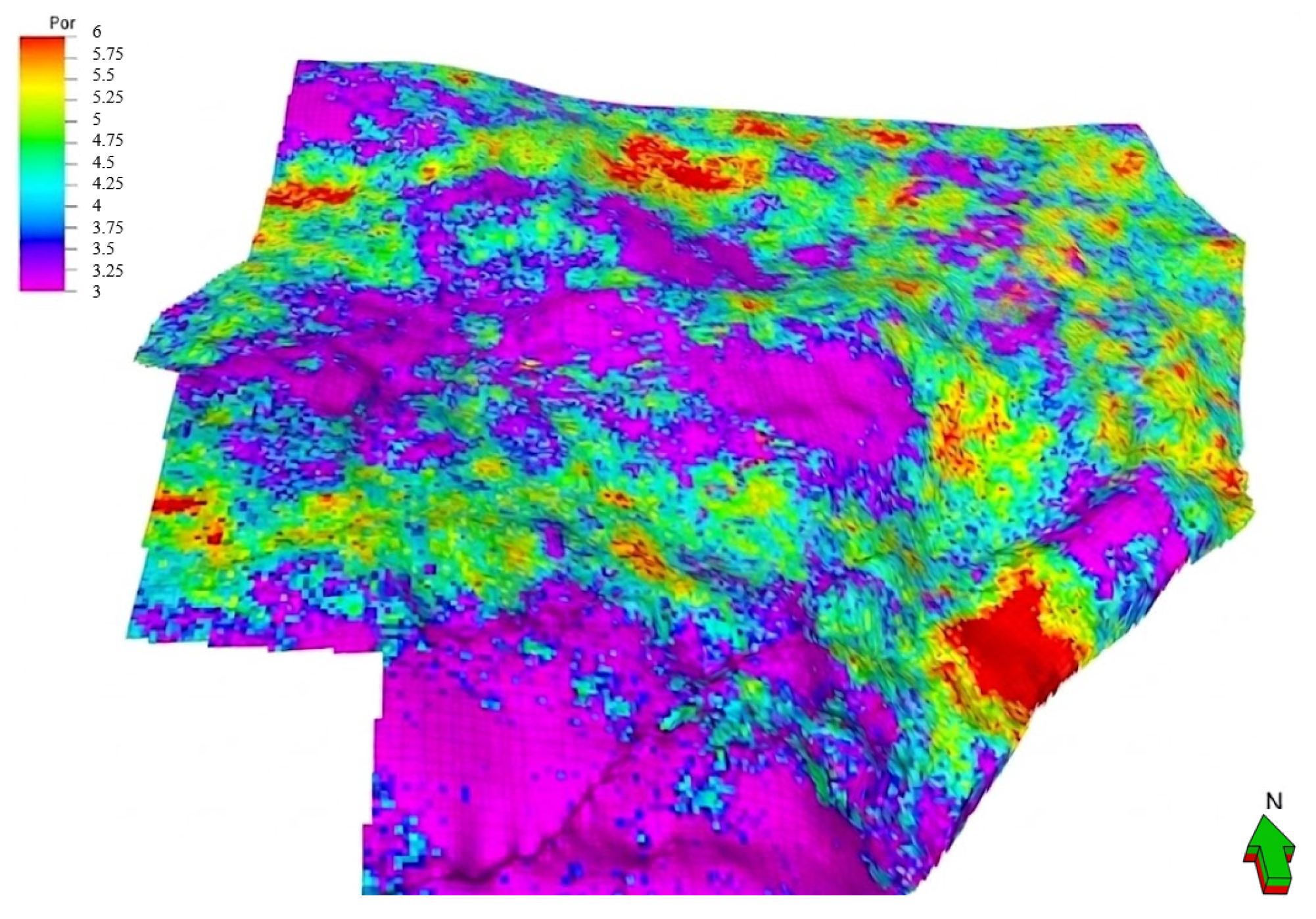
The physical properties of reservoirs exert an important impact on reservoir behavior [27]. However, coal-measure reservoirs exhibit extremely strong heterogeneity, which significantly affects the co-accumulation process of CMG. Macroscopically, coal-measure reservoirs typically consist of multiple superimposed and interbedded lithologies. Consequently, the spatial distribution of physical properties within the same reservoir type varies significantly, such as the porosity distribution shown in Figure 3, which directly controls the gas migration pathways and accumulation zones.
Figure 3.
Porosity distribution characteristics of coal-measure reservoirs in a region.
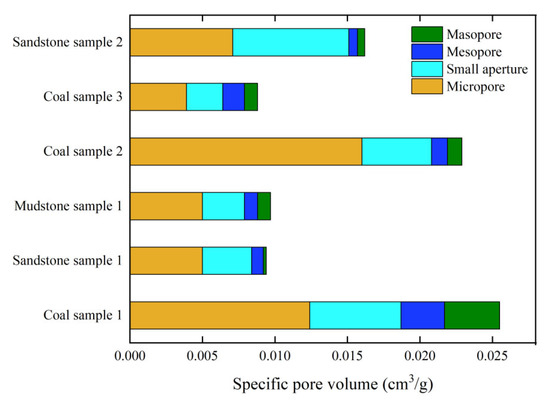
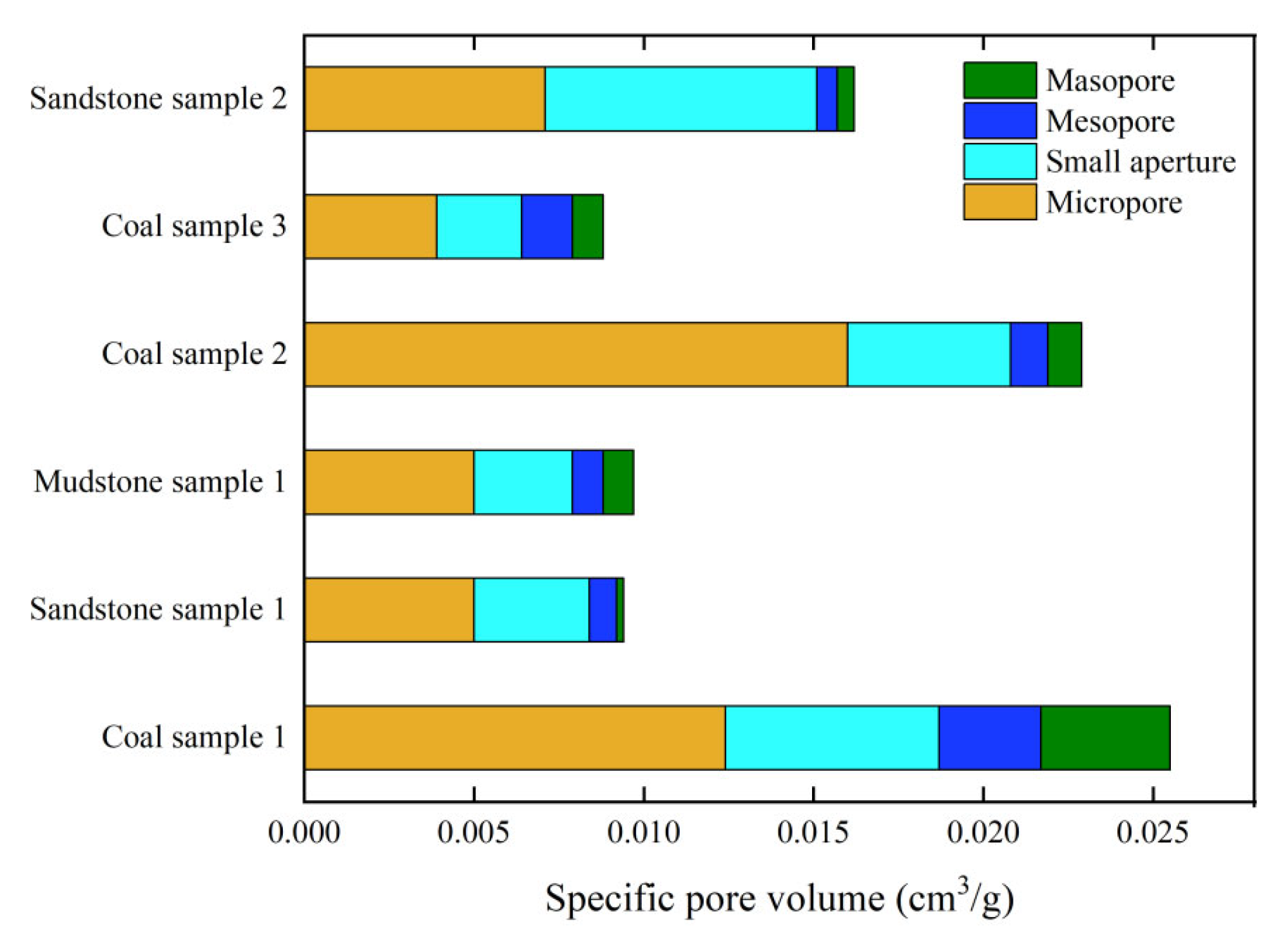
Microscopically, the pore structure presents further complexity. Figure 4 shows the pore volume and its percentage in coal, mudstone, and sandstone characterized by a combination of liquid nitrogen adsorption and mercury intrusion porosimetry (MIP). The pore volumes of these lithologies are primarily composed of micropores and small pores. Notably, the abundance of micropores in coal is much higher, making its physical properties exceptionally complex.
Figure 4.
Pore volume and percentage of coal, mudstone, and sandstone in a certain region under combined liquid nitrogen adsorption and mercury intrusion porosimetry (MIP) characterization.
This significant difference in pore structures among different lithologies induces strong capillary pressure gradients and notable differences in gas–water relative permeability at the interfaces [28]. Dominated by micropores, coal seams possess an extremely high capillary breakthrough pressure; therefore, they act not only as source rocks but also as dynamic barriers resisting the invasion of external fluids. In contrast, although the adjacent tight sandstones have relatively larger pore sizes, their poor pore connectivity makes the migrating gas highly susceptible to strong gas–water two-phase flow interference. When natural gas generated in the coal seam migrates into the interbedded tight sandstone or shale, the abrupt change at the pore-throat scale requires the driving pressure to overcome significantly increased capillary resistance, thereby inducing the “threshold pressure gradient (TPG)” phenomenon under non-Darcy flow [29]. The structural superimposition of lithologies and the microscopic pore-throat configuration jointly control the differential accumulation and spatial gas–water distribution patterns of natural gas in coal measures.
The lithology of coal-measure reservoirs is complex and variable, and the significant differences in pore structures among different rock types make the natural gas migration process highly complicated. In view of this, constructing a 3D pore distribution model that can accurately reflect multi-lithology combinations has become a crucial foundation for deeply understanding the accumulation dynamics, fluid migration pathways, gas–water distribution characteristics, and preservation conditions of CMG. Currently, research on pore evolution mostly focuses on factors such as compaction, diagenesis, and tectonic modification, but most studies are limited to single-well or specific-interval analyses [30,31]. Systematic research integrating the sequence stratigraphic framework with the spatial lateral variations of reservoirs such as coal-measure shale and tight sandstone, particularly discussions on their distribution patterns and main controlling factors, remains relatively weak [32].
3. Dynamics and Evolution of Coal-Measure Gas Reservoir Formation
In the study of accumulation characteristics, traditional oil and gas research focuses on trap-based hydrocarbon accumulation. Its goal is to determine whether oil and gas exist in a trap, with the basin evolution history and fluid migration framework as the basis and the energy field as the core (including the evolution of the temperature field, pressure field, and stress field, as well as the chemical dynamics and fluid dynamics processes controlled by these fields [33,34]). After source rocks generate large amounts of gas, the key to studying CMG accumulation is whether the generated gas can be self-generated and self-stored in the source rocks while migrating to and being preserved in adjacent reservoirs of gas generation. Therefore, it is mainly controlled by five factors: hydrocarbon generation intensity, reservoir formation dynamics, migration paths, migration modes, and preservation conditions [4,22]. Among them, hydrocarbon generation intensity determines the abundance of CMG resources and influences CMG migration; reservoir formation dynamics and migration modes determine the type and distribution of CMG reservoirs; and preservation conditions determine the maximum depth of CMG co-accumulation reservoirs [35].
3.1. Characterization of Reservoir Formation Dynamics
For conventional oil and gas, due to the good porosity and permeability characteristics of their reservoirs, oil and gas are expelled from the source rocks under the action of residual pressure, then undergo secondary migration driven by buoyancy and accumulate in relatively independent conventional traps [36,37]. Buoyancy is the core driving force for conventional oil and gas accumulation.
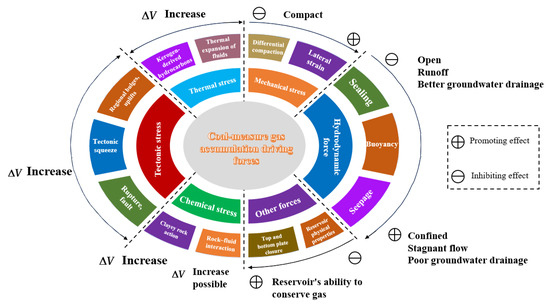
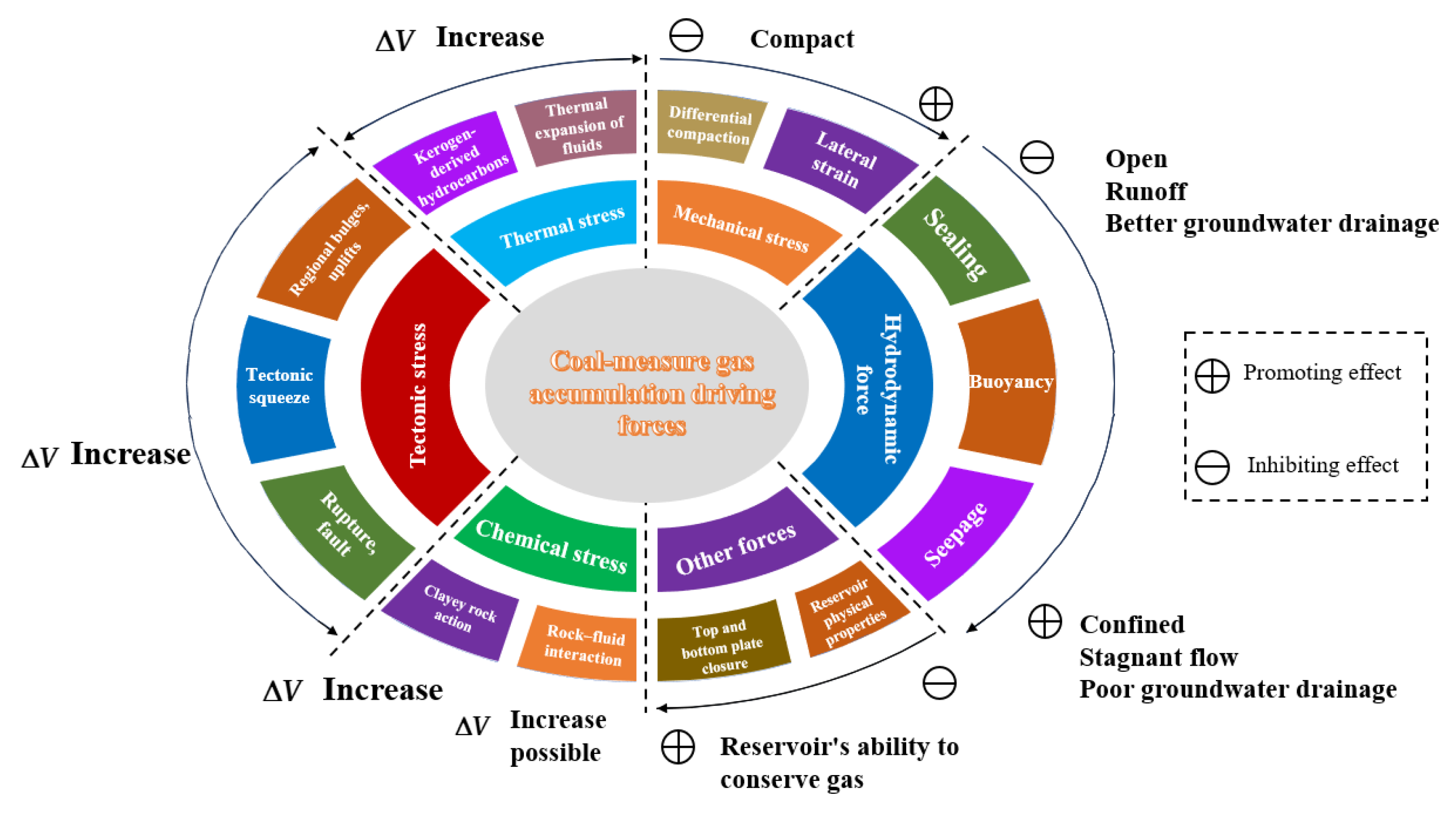
However, nanoscale pores are mainly developed in coal-measure reservoirs, accounting for more than 85% of the total pores. The driving forces for migration and accumulation and the flow patterns of fluids in nanoscale pores are completely different from those in millimeter-scale and micron-scale reservoirs. CMG is mainly characterized by in-source storage, adjacent-layer filling, secondary migration, and large-area continuous accumulation. In the process of CMG accumulation, overpressure driving force, capillary resistance, hydrodynamic displacement, sealing, and capillary pressure difference between adjacent reservoirs also make important contributions to gas enrichment. The CMG accumulation driving forces can be divided into mechanical stress, chemical stress, tectonic stress, thermal stress, hydrodynamic force, capillary force, and other forces, as shown in Figure 5.
Figure 5.
Power sources of CMG accumulation.
Among them, hydrocarbon generation overpressure (driven by chemical and thermal stresses) acts as the dominant driving force. The volumetric expansion of the generated gas within confined pore spaces produces extreme overpressure, serving as the primary engine to actively overcome regional resistance [38]. Conversely, capillary force acts as the principal resistance in tight coal-measure systems, forming a threshold that must be breached. Other forces play critical auxiliary roles: tectonic stress primarily alters the physical structure of the reservoir to create pathways, while hydrodynamic forces mainly provide a sealing mechanism.
Based on this dynamic hierarchy, the accumulation process unfolds in distinct stages. First, the gas stored within the source rocks either accumulates in situ as coalbed methane or shale gas, or undergoes only short-distance migration. This initial stage is predominantly driven by hydrocarbon generation overpressure, fluid thermal expansion, and diffusive forces, resulting in adsorption and differential pressure-driven accumulation [39].
Subsequently, gas migration into adjacent layers primarily occurs at the coal–sand and shale–sand interfaces. The dynamic transfer of natural gas from coal seams to adjacent tight sandstone reservoirs is not a random diffusion process but rather a structurally controlled event dictated by three key geological conditions. Source-to-reservoir pressure gradient: the continuous generation of natural gas creates a strong internal overpressure, driving the gas toward the relatively lower-pressure sandstone. Permeability and capillary contrast: although tight sandstone has low permeability, its capillary entry pressure is significantly lower than that of the regional mudstone caprock; therefore, gas is preferentially forced into the sandstone (the path of least capillary resistance). Tectonic fracture systems: matrix permeability alone is insufficient in tight strata; tectonic micro-fractures bridge the coal seams and sandstones, serving as highly efficient pathways for episodic gas transfer [35]. Furthermore, undercompaction and abnormal pore fluid pressures during the sedimentary-diagenetic stage further exacerbate these pressure differentials.
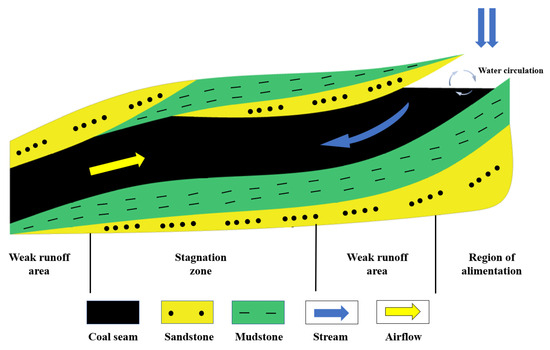
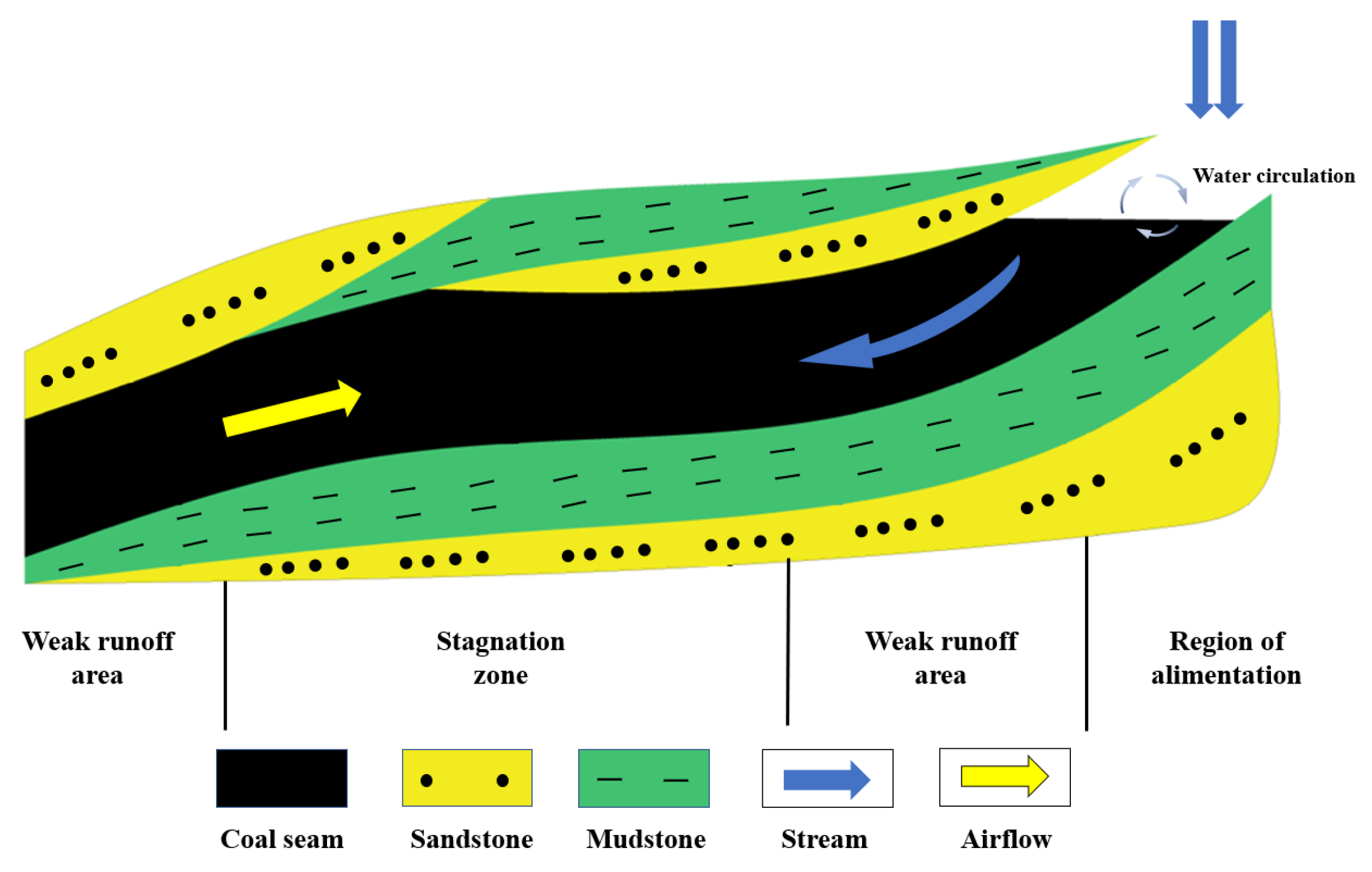
During secondary migration within tight sandstones or relatively high-porosity shale layers, the gas utilizes faults, micro-fractures, or relatively high-permeability zones formed by tectonic stress as primary migration pathways. Driven continuously by hydrocarbon generation overpressure, the gas pushes into the sand bodies, forming a continuous gas cushion and resulting in piston-like propagation. In these tight formations, the role of buoyancy is extremely limited. Additionally, for most coal-measure reservoirs, basinal hydrodynamic forces primarily act as a sealing mechanism (water-blocking) rather than a driving force [40,41], as shown in Figure 6.
Figure 6.
Hydrodynamic sealing of CMG (adapted from [40]).
Specifically, the formation of a hydrodynamic seal is governed by the regional hydraulic potential gradient. When the hydrostatic head in the peripheral or overlying aquifers is significantly higher than the internal gas potential within the coal-measure strata, the inward-directed hydraulic pressure acts as a “fluid barrier”. This prevents the buoyancy-driven upward migration and lateral dissipation of natural gas [42]. Furthermore, in the tight sandstone and mudstone layers surrounding the coal seams, the presence of stagnant or slow-moving groundwater induces a “water-blocking” effect. Because these sealing layers are water-saturated, gas must overcome extremely high capillary entry pressures to displace the pore water and escape.
Finally, gas reservoirs undergo adjustments in response to tectonic movements after their initial formation. Tectonic activity is a crucial driving force leading to the destruction, migration, and re-accumulation of original gas reservoirs [43,44]. During periods of intense tectonic activity, the sudden surge in fluid pressure caused by strong tectonic compression exerts a far greater impact on natural gas migration than gravity and capillary forces. Conversely, during stratal uplift, the decrease in temperature and pressure leads to pore fluid shrinkage and pore volume expansion, which is the root cause of abnormally low reservoir pressure. An abnormally low-pressure area is typically a low-potential area, forming a negative-pressure field. Under the suction effect of this negative-pressure field, natural gas from surrounding areas accumulates into the low-pressure zone. Tectonic stress is one of the primary driving forces for the adjustment and modification of CMG reservoirs, a process that is jointly controlled by the sealing capacity of the roof and floor strata and hydrodynamic conditions.
3.2. Qualitative Study of Reservoir Formation Dynamics
The evolution of fluid dynamics is an important part of fluid history analysis. The qualitative study of reservoir-forming dynamics primarily focuses on analyzing the direction and spatial distribution characteristics of fluid migration over different periods and provides a basis for the quantitative prediction of oil and gas resources. It mainly includes present-day fluid dynamics analysis and paleofluid dynamics analysis.
3.2.1. Analysis of Present-Day Fluids
Present-day fluid analysis can be conducted spatially from two dimensions: vertical (along the thickness direction of strata) and horizontal (along the horizontal direction of the ground) to reveal the spatial distribution characteristics of fluids. Vertically, the fluid characteristics at different depths and in different strata are investigated using pressure profiles and hydrochemical profiles. Horizontally, the spatial scales of fluid research, from large to small, are basins, petroleum systems, zones, traps, and pore-fracture systems [45]. By analyzing data from different spatial scales obtained through exploration, an overall understanding of basin fluids is developed. This understanding is then used to further guide exploration work at different local scales. In turn, the overall understanding can be corrected and improved through the continuous deepening of the understanding of the local scale. The comprehensive analysis of fluid geochemistry is an important means to determine the source and movement direction of basin fluid. The formation and evolution of the hydrodynamic field in coal-bearing basins is a comprehensive reflection of the combined effects of the geological laws, structural characteristics, and pore fluid evolution of different lithological stratigraphic units in three-dimensional space. It is directly controlled by basin geomorphology, hydrological networks, depositional environments, tectonic properties, and the basin’s evolutionary history [46,47]. The depth of influence of surface water and atmospheric water can be determined by the distribution of hydrochemical composition, water types, distribution of total dissolved solids (TDS) in water, stable isotopic composition of water, and distribution of rock-forming minerals. The direction of gas migration can be determined based on the spatial variations in gas composition and isotopic composition [48].
3.2.2. Paleofluid Analysis
The purpose of paleofluid analysis is to trace the evolutionary history of paleofluids and determine the direction and pattern of paleofluid migration in different periods. Paleofluid analysis mainly includes paleofluid chemical analysis methods and paleofluid dynamics analysis methods.
Paleofluid chemical analysis methods mainly include fluid inclusion analysis, diagenetic analysis, isotopic analysis, and other methods. Fluid inclusions and chemical anomalies in formation water are the most direct evidence of paleofluid activity in a basin. As relics of geological history, fluid inclusions can directly provide information about fluids at the corresponding geological stage, reflect the physicochemical environment of the paleofluid flow stage, determine the degree of oil and gas evolution, and further identify the timing and direction of paleofluid migration. Scholars have conducted numerous studies using fluid inclusion analysis to reveal the characteristics and evolution of paleofluids [49,50]. In addition, the flow of paleofluids in a basin leads to changes in the temperature field, pressure field, and diagenetic conditions. These changes may cause the rocks and their organic matter in the basin to form authigenic minerals or veins through corresponding water–rock interactions and diagenetic and metamorphic processes. Paleofluid activity in the basin can be traced using isotopic geochemical analysis or specific geochemical markers preserved in rocks.
3.3. Quantitative Study of Reservoir Formation Dynamics
Quantitative research on the accumulation dynamics of CMG requires a cross-scale comprehensive approach, ranging from microscopic molecular interactions to macroscopic basin evolution. Unlike the analytical approach for conventional oil and gas, which is primarily based on macroscopic fluid potential and Darcy’s law, the quantitative characterization of CMG must account for its complex cross-scale physical characteristics [51]. By establishing a multi-scale integration framework, this paper systematically reviews the related quantitative research progress: At the microscopic scale, it explores the adsorption thermodynamic behavior and isothermal adsorption models of natural gas. At the mesoscopic scale, it characterizes the multi-scale non-Darcy flow features in nanopores and their seepage models. At the macroscopic scale, utilizing multi-field coupled basin numerical simulation, it conducts research on fluid migration processes and the prediction of accumulation zones.
3.3.1. Quantitative Models of Gas Adsorption Thermodynamics
Unraveling the adsorption thermodynamics is crucial for understanding the dynamics of CMG co-accumulation, which helps clarify the microscopic migration dynamics, occurrence state transitions, and accumulation potential of gas in heterogeneous coal-measure strata. The fluid–solid interaction within coal-measure source rocks is predominantly governed by physical adsorption, typically described by the Langmuir monolayer adsorption model [52]. Under isothermal conditions, the mathematical relationship between the equilibrium gas pressure and the adsorbed volume can be expressed as
where is the adsorbed gas volume under standard conditions, represents the equilibrium pressure, and is the Langmuir pressure.
The classical Langmuir model provides a fundamental framework for adsorption research, but its assumptions (homogeneous surface, isothermal conditions, single-component gas) are difficult to fully apply to complex geological environments. Therefore, scholars have carried out targeted modifications, with major achievements including: the Extended Langmuir Model (multi-component gas mixtures) [53], the Langmuir–Freundlich composite model (heterogeneous pore adsorption) [54], and the Temperature–Pressure-corrected Langmuir model (deep high-temperature and high-pressure reservoirs) [55]. Among these, the Extended Langmuir model is the most widely applied in the study of CMG co-accumulation; it can quantitatively characterize the competitive adsorption behavior of multi-component gases, providing a more precise theoretical tool for the dynamic analysis of mixed gas migration and accumulation.
The Extended Langmuir Model (ELM) is widely applied in the research of multi-gas co-accumulation. Natural coal-measure reservoirs typically host a mixture of CH4, CO2, and heavy hydrocarbons, and the ELM can quantitatively characterize the competitive adsorption behavior among multi-component gas phases. This model assumes that each gas component competes for adsorption on the same homogeneous active sites on the coal surface, with no lateral interactions. For an n-component mixture, the adsorbed volume of component i can be expressed as
where is the adsorbed volume of the mixed component and are the pure-gas Langmuir volume and pressure of component , respectively; is the partial pressure of component in the free gas phase; and is the total number of gas components in the system. This competitive mechanism fundamentally drives the dynamic displacement, migration, and accumulation of mixed gases during geological evolution. However, the ELM possesses inherent theoretical limitations when applied to complex geological systems. First, regarding the strict constraint of thermodynamic consistency, the most critical theoretical limitation of the ELM is that it maintains thermodynamic consistency only when the saturation (maximum) adsorption capacities of all components in the mixture are perfectly equal. However, in real adsorption systems, unequal maximum adsorption capacities among different components are ubiquitous. This inconsistency leads to substantial errors in predicting partial pressures and competitive displacement ratios, particularly under high formation pressures [56,57].
Furthermore, the model neglects lateral interactions between adsorbate molecules. The ELM assumes that adsorbed molecules are completely independent, with no lateral interactions existing between adjacent adsorbed species. However, within the actual pores of coal-measure reservoirs—especially under deep, high-pressure, or supercritical conditions—intermolecular forces between adsorbed molecules are quite significant. These lateral interactions can drastically alter the adsorption equilibrium, resulting in severe deviations between ELM predictions and experimental data in high-loading scenarios [58].
Finally, the ELM relies on the assumption of surface homogeneity. It inherits the assumption of the classical Langmuir model, positing that the adsorbent surface is absolutely uniform energetically; this implies that every binding site possesses the exact same adsorption affinity [59]. This fails to account for the extreme energetic heterogeneity of the coal-measure matrix, which is characterized by complex surface functional groups and multi-scale fractal pore structures. At medium-to-high surface coverages, high-energy sites are occupied first, and subsequent adsorption occurs on highly heterogeneous low-energy sites, rendering the ELM’s predictions particularly inaccurate under such conditions [60].
To address the extreme microscopic heterogeneity of the coal matrix, the Langmuir–Freundlich (L-F) composite model is widely adopted. The complex combination of functional groups and the multi-scale pore hierarchy (from micropores to macropores) on the coal surface lead to an uneven distribution of surface energy. By introducing a heterogeneity exponent, the L-F model successfully bridges the Langmuir behavior in the low-pressure range with the Freundlich characteristics in the high-pressure range, thereby providing a more precise fit for the adsorption behavior of strongly heterogeneous source rocks.
where is the adsorbed gas volume; is the maximum Langmuir adsorption capacity; is the equilibrium gas pressure; is the pressure at which half of the maximum adsorption capacity is reached; and is the dimensionless heterogeneity exponent, characterizing the energetic diversity and structural complexity of the pore surfaces.
Under high-temperature and high-pressure (HTHP) conditions, methane exists in a supercritical state, and the free gas density increases significantly, making the experimentally measured adsorption amount the “excess adsorption”. To accurately evaluate the true geological natural gas reserves under a complex burial history, a density correction must be introduced. Therefore, to accurately depict the phase-state dynamics during the deep accumulation process, the supercritical excess adsorption model must be employed:
where is the excess adsorption capacity, is the free gas phase density (which increases with pressure), and represents the adsorbed phase density. This model effectively compensates for the distortion in adsorption evaluation caused by supercritical methane, making it suitable for the dynamic analysis of deep CMG co-accumulation. The characteristics of these four adsorption models are compared (Table 4).
Table 4.
Comparison of the characteristics of the four adsorption models.
In recent years, domestic and international scholars have conducted extensive model modification work targeting multi-component competition, pore heterogeneity, and HTHP conditions. Among them, the ELM is widely applied to characterize the competitive adsorption of CH4 and CO2 gas mixtures in coal-measure strata [61,62], enabling a more accurate quantification of the displacement effect of CO2 on CH4; the L-F composite model, by introducing a heterogeneity exponent, effectively adapts to the complex pore structure of the coal matrix, demonstrating superior performance in fitting the adsorption of supercritical methane or CH4 and CO2 [63,64,65]; for deep reservoirs, the development of the supercritical excess adsorption model and the temperature-pressure corrected model has broken through the limitations of the classical model in characterizing the supercritical state, providing core mathematical tools for the accurate evaluation of deep CMG geological reserves [66,67]. Future research needs to further focus on adsorption dynamics under multi-field coupling, machine learning-assisted prediction of adsorption capacity, and model corrections under complex fluid conditions, in order to continuously drive the research on CMG co-accumulation [68,69].
3.3.2. Quantitative Models of Multi-Scale Flow and Non-Darcy Seepage
For the quantitative study of conventional oil and gas fluid dynamics, scholars have developed a series of theories and models, such as fluid potential theory, percolation models, and Darcy’s law of seepage [70,71]. Among these, the fluid potential method takes the potential energy of hydrocarbon migration and accumulation as its core, considers the combined effects of pressure, hydrodynamic force, buoyancy (or gravity), and capillary force, ignores reservoir heterogeneity, and overlooks the influence of tectonic stress and thermal stress on gas migration when analyzing fluid potential. When considering the influence of pressure on gas migration, only hydrostatic pressure is generally considered, while the influence of abnormal pressure is rarely considered. Percolation models abstract the flow space into a network structure, considering the influence of reservoir heterogeneity but lacking saturation information; Darcy’s flow model can simulate the dynamic process of oil and gas migration and characterize the distribution of oil and gas saturations. However, for coal-measure reservoirs, due to the presence of abundant nanoscale pores, fluid flow patterns hardly conform to Darcy’s law of seepage, so Darcy’s flow model cannot be directly applied to the study of CMG migration and accumulation.
After a large amount of CMG is generated, it migrates and accumulates in reservoirs through mechanisms such as adsorption, diffusion, and seepage under the influence of reservoir-forming dynamics. Due to the presence of a large number of micro–nanopores in coal-measure reservoirs, the gas flow process differs completely from that in millimeter-scale and micron-scale pores. There are various gas diffusion patterns and nonlinear flow behaviors, such as Knudsen diffusion [72], Fickian diffusion [73], nonlinear non-Darcy seepage [74], and strong nonlinear capillary forces, among other phenomena. A detailed comparison of the basic assumptions, applicability, and potential limitations of these transport models is systematically summarized in Table 5.
Table 5.
Comparison of basic assumptions, applicability, and limitations of gas transport models in coal-measure reservoirs.
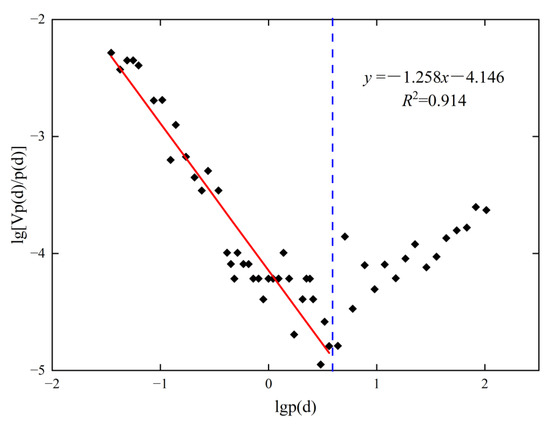
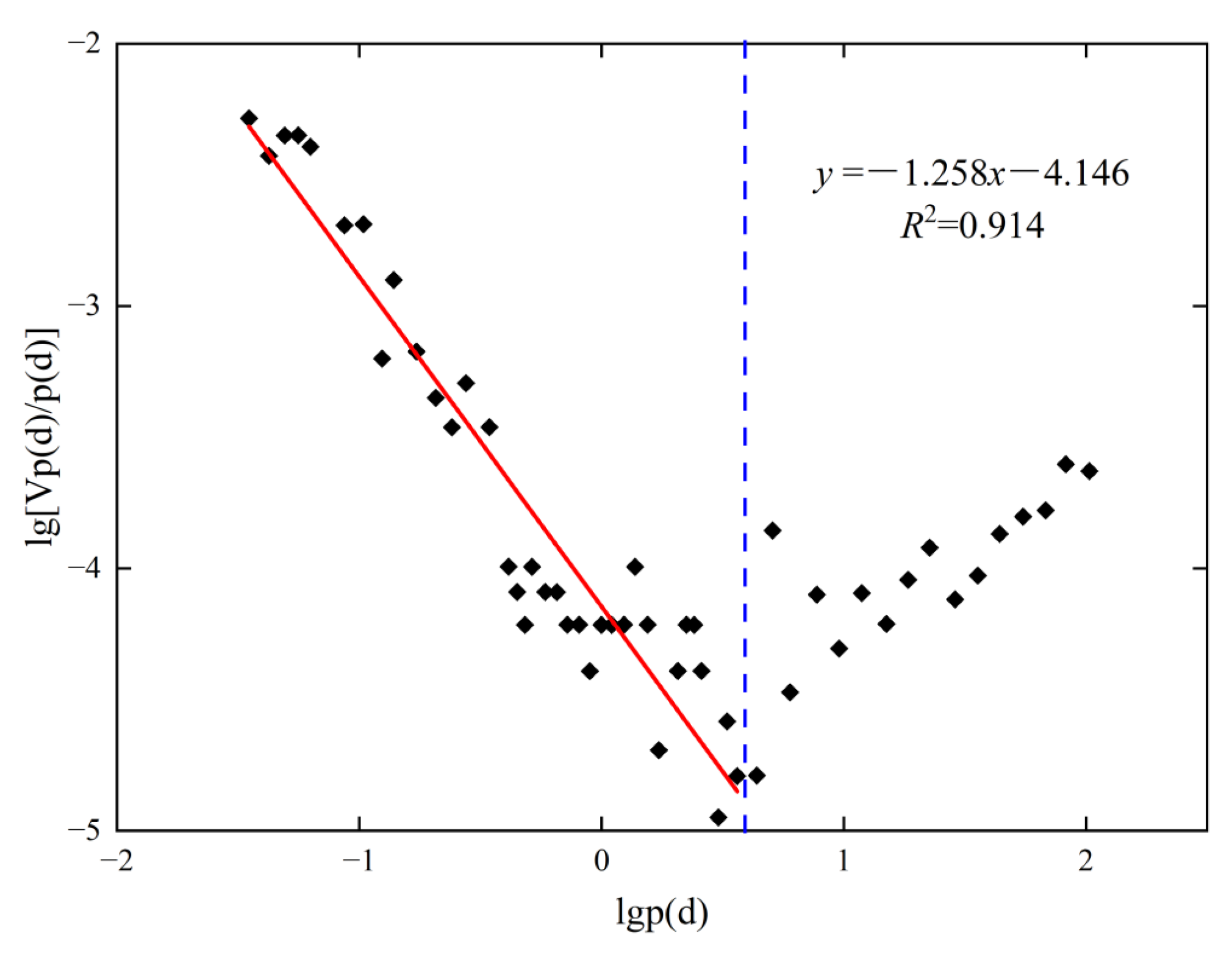
To accurately describe this cross-scale transport, it is essential to delineate the physical boundaries of different pore systems. Coal-measure reservoirs develop two distinct pore networks: diffusion pores (including adsorption pores) and seepage pores. Based on the fractal model of porous media in coal matrix, it is assumed that as long as and satisfy the linear relationship, the pore distribution satisfies the linear characteristics. Among them, is the injection pressure in the mercury injection experiment, which satisfies the formula with the pore size :
where is capillary pressure, MPa; is the interfacial tension between distilled water and air, ; is the contact angle between distilled water and coal, (°); d is capillary diameter, nm. is the pore volume increment when the injection pressure is . The and scatter plots are drawn from the experimental data of mercury injection of coal samples, and the linear part is fitted to obtain the fitting trend line of and , as shown in Figure 7.
Figure 7.
Relationship between coal sample and in a certain area. The blue dotted line marks the boundary at 100 nm.
The boundary point determined by the linear fitting of and can well identify the boundary between diffusion pores and seepage pores of different coal samples. The left side of the boundary point represents the seepage pores with a larger pore size, while the right side represents the diffusion pores with a smaller pore size. Combined with the classification method of matrix pores, it is considered that the critical pore size of diffusion pores and seepage pores is determined to be 100 nm.
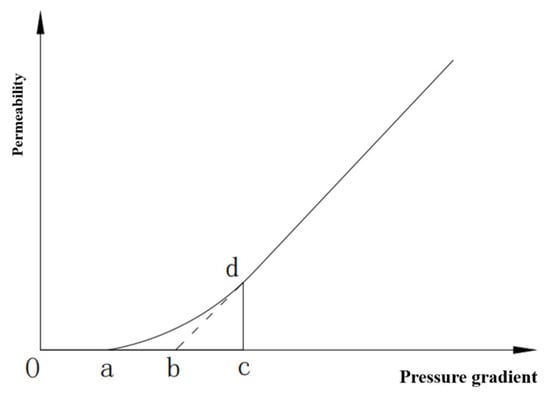
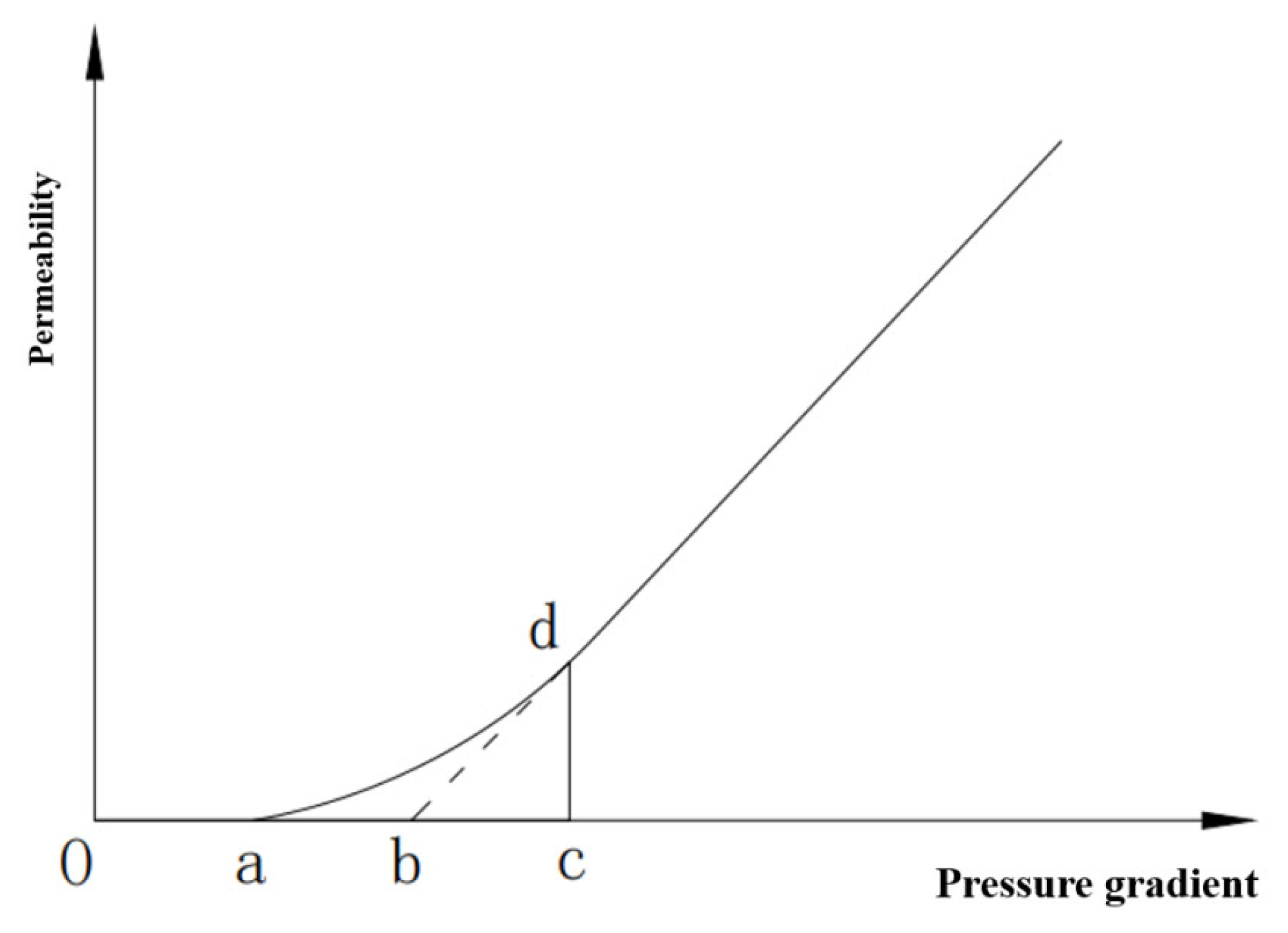
Furthermore, as the pore size increases to the meso- and macropore range (e.g., 100–1000 nm), gas migration transitions into the seepage flow regime. In this state, the tightly adsorbed boundary fluid layer occupies a significant proportion of the pore throat, heavily restricting fluid mobility and resulting in a nonlinear relationship between flow velocity and pressure gradient, thereby inducing a TPG. This low-velocity non-Darcy behavior is highly dependent on pore size: as the pore size increases, the relative thickness and influence of the boundary layer decrease [75]. Therefore, the TPG must be overcome to initiate flow, as shown in Figure 8.
Figure 8.
Typical gas flow curves for low-permeability sandstones [76]. a represents the threshold pressure gradient; b is the pseudo-threshold pressure gradient; the ad section is the nonlinear flow regime, and flow becomes linear beyond point d.
To quantitatively determine this critical boundary between low-velocity nonlinear non-Darcy flow and linear Darcy flow, the equilibrium between capillary pressure and external atmospheric pressure is established:
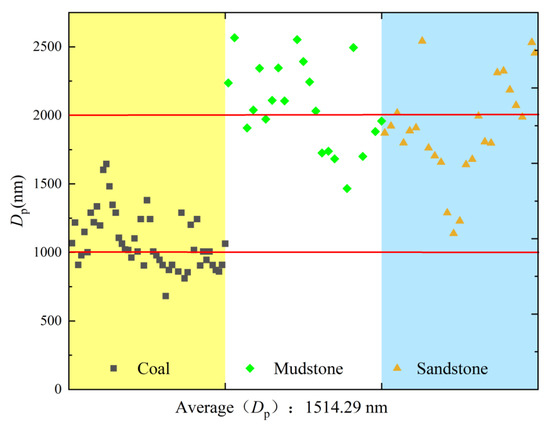
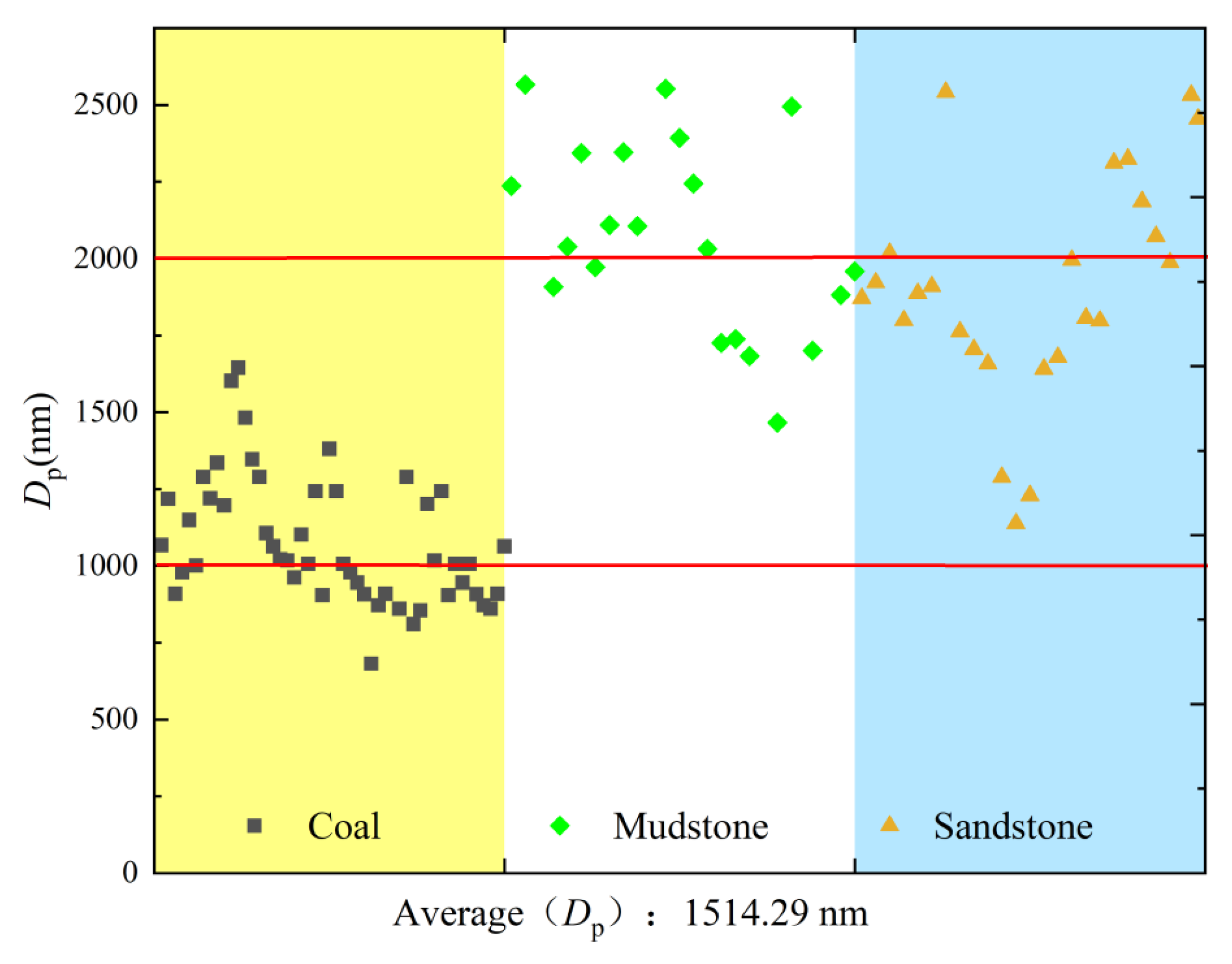
where is the critical pore size of low-speed nonlinear seepage and linear seepage, nm; is standard atmospheric pressure, N/m2. The pore capillary pressure at the critical pore diameter is equal to the external atmospheric pressure, and the starting pressure gradient is 0. It can be seen from Figure 9 that the critical pore size is mostly concentrated at 1000–2000 nm, and the average critical pore size is 1514 nm. Combined with the Hordot matrix pore classification method, it is considered that the critical pore size of low-velocity nonlinear seepage and linear seepage is determined to be 1000 nm.
Figure 9.
Critical pore sizes of low-velocity nonlinear seepage and linear seepage of samples in different regions.
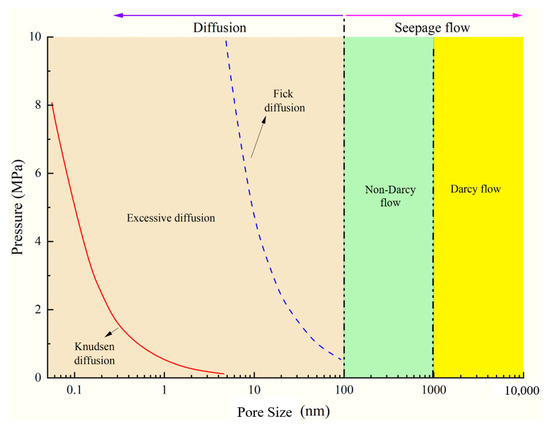
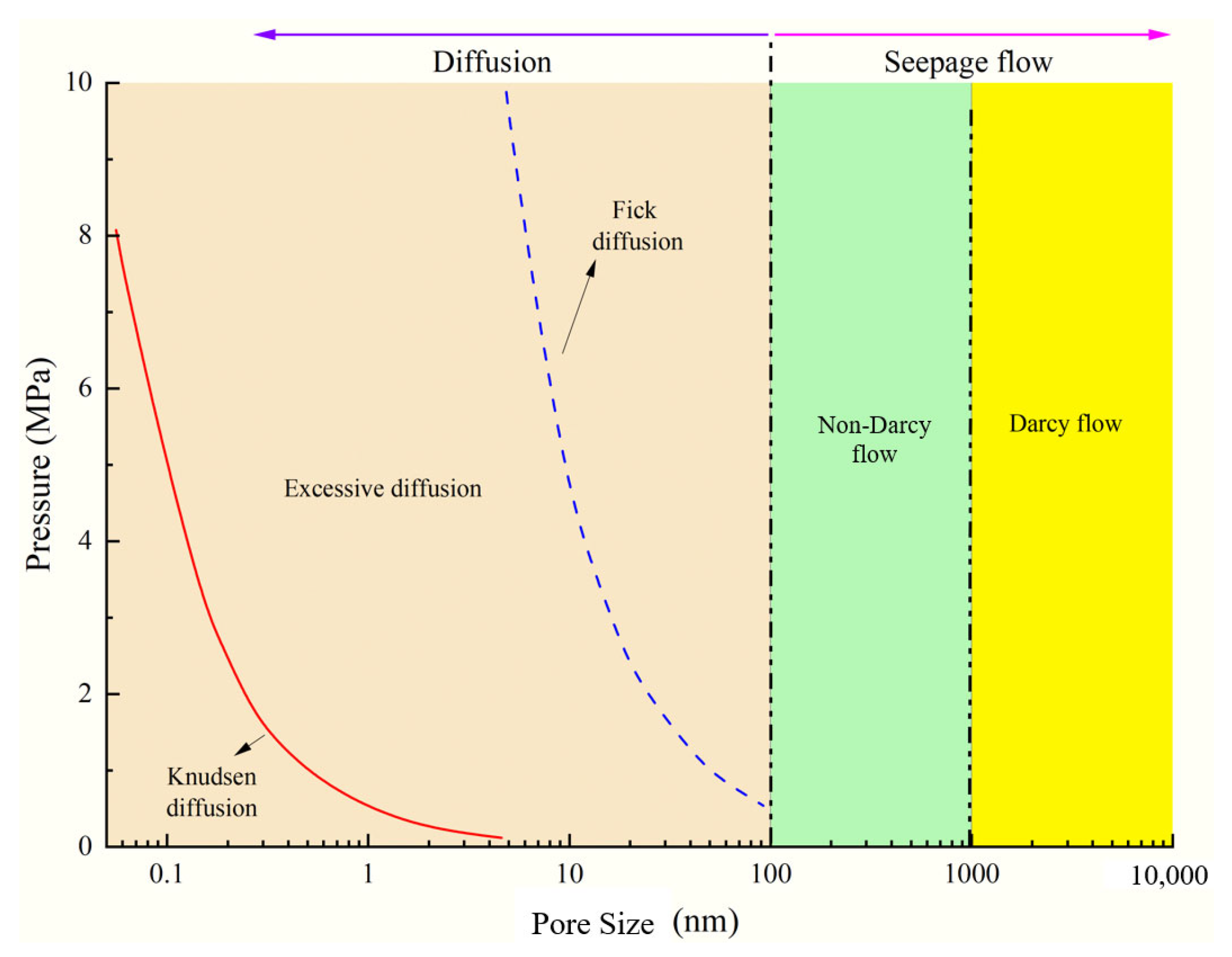
In summary, as indicated in the diffusion–seepage characteristic diagram (Figure 10), the transition of gas transport mechanisms is stringently governed by pore size and fluid–solid interactions.
Figure 10.
Diagram of two-stage, two-type diffusion and two-stage, two-type seepage characteristics.
In nanoscale micropores (<10 nm), the molecular mean free path of the gas significantly exceeds the pore diameter. Here, molecule–wall collisions completely dominate, making Knudsen diffusion the primary transport mechanism under ultra-low spatial confinement [72]. As the pore size increases into the mesopore range (10–100 nm), the frequency of intermolecular collisions rises. The flow transitions into a regime governed by Fickian diffusion and transition diffusion, where transport is primarily driven by concentration gradients rather than molecule–wall interactions [73]. When the pore diameter expands beyond 100 nm, gas transport evolves from diffusion to pressure-driven seepage. Within this regime, however, the tightly adsorbed boundary fluid layer still occupies a significant proportion of the pore throat, heavily restricting fluid mobility. This fluid–solid boundary effect induces a TPG, resulting in characteristic low-velocity non-Darcy flow (pre-Darcy flow) [77,78]. Once the pore size exceeds approximately 1000 nm, the relative thickness and influence of the boundary layer become negligible. The TPG is largely overcome, and gas seepage smoothly transitions into conventional linear Darcy flow driven entirely by fluid potential.
Integrating these dynamic mechanisms, the comprehensive relationship between pore size and natural gas occurrence/production is presented in Table 6. As pore size increases from 0 to 10,000 nm, the production mode of CMG sequentially transitions from desorption, Knudsen diffusion, Fickian diffusion, and low-velocity nonlinear seepage, to linear seepage, with the corresponding governing equations shifting accordingly.
Table 6.
Relationship between pore size and natural gas occurrence and production of CMG reservoirs.
Additionally, the pore-scale gas occurrence fundamentally governs the reservoir development strategies [79,80]. Given the dominance of micropores (<10 nm), a gradual pressure drawdown is essential to mitigate permeability impairment caused by pore-throat compaction. Furthermore, stimulation tactics should be tailored to the specific pore hierarchy: deploying a dense network of micro-fractures is necessary to overcome high matrix resistance in micropores, whereas maintaining main-fracture conductivity is prioritized in macropore-rich zones. Such logic is indispensable for optimizing well patterns and fracturing parameters in CMG co-production.
Furthermore, to quantitatively study the apparent permeability and diffusion characteristics across these complex scales, researchers have established a series of models to quantitatively study the apparent permeability and diffusion characteristics of CMG. These models can be roughly divided into two categories: one is continuous [81,82], and the other is coupled [83,84]. The continuous model considers the correction coefficient, and the coupling model is a contribution coupling model based on multiple migration mechanisms. The two types of models have their own advantages and disadvantages due to differences in their assumptions and computational approaches. Continuous models are more computationally efficient but rely on more empirical parameters. Coupled models have a more comprehensive physical mechanism, cover the entire pore size range, but involve more complex coupling parameters.
The total mass flux of two-stage two-type diffusion can be expressed as follows:
where is the gas mass flux from the diffusion pore to the seepage pore, ; is the contribution coefficient of different diffusion mechanisms, dimensionless.
The contribution calculation coefficient is
where is the Knudsen coefficient from Knudsen diffusion to Fick diffusion, typically taken as 0.1.
Two-stage, two-type seepage is expressed as
where is the absolute permeability of the seepage pore, m2; is the relative permeability of water phase in the seepage pores system, dimensionless; is the relative permeability of gas phase in the seepage pore system, dimensionless; is the water phase pressure in the seepage pore system, MPa; is the gas pressure in the seepage pore system, MPa.
In this formula, , , and satisfy the following two additional equations:
where is the capillary pressure of the seepage pore system, MPa; , are the gas-water saturation of the seepage pore system, %.
3.3.3. Basin-Scale Simulation
Basin-scale simulation, encompassing both physical and numerical approaches, serves as a highly effective method for analyzing fluid migration by integrating fluid dynamics with complex geological models [85]. Both physical and numerical basin simulations are effective methods for analyzing fluid migration. While numerical simulation integrates fluid flow mathematical equations with geological models, physical simulation reproduces these dynamic processes in a laboratory setting [86]. Physical simulation mainly involves establishing a similar physical model in the laboratory based on an actual geological model, injecting actual fluids, calculating parameters such as pressure, flow rate, and saturation via sensor monitoring, or utilizing visual techniques for fluid migration paths (e.g., Computed Tomography (CT) Scanning and staining agents) to visually reproduce the underground fluid migration process [87]. Physical simulation is intuitive and realistic, enabling the simulation of complex fracture systems, irregular pore structures, and other geological features that are difficult to numerically discretize. However, it has drawbacks such as high cost, long cycle time, imprecise parameter control, and poor reproducibility. Currently, the models employed in physical simulations are generally small-scale [88], making it difficult to accurately replicate actual geological formations. Although some researchers have constructed relatively larger physical models, these rarely account for the impact of petrophysical heterogeneity in coal-measure reservoirs [89]. In the future, physical simulation apparatuses can be further upgraded to capture more authentic co-accumulation mechanisms.
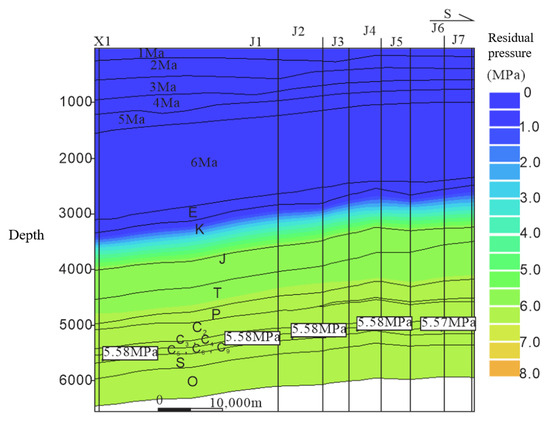
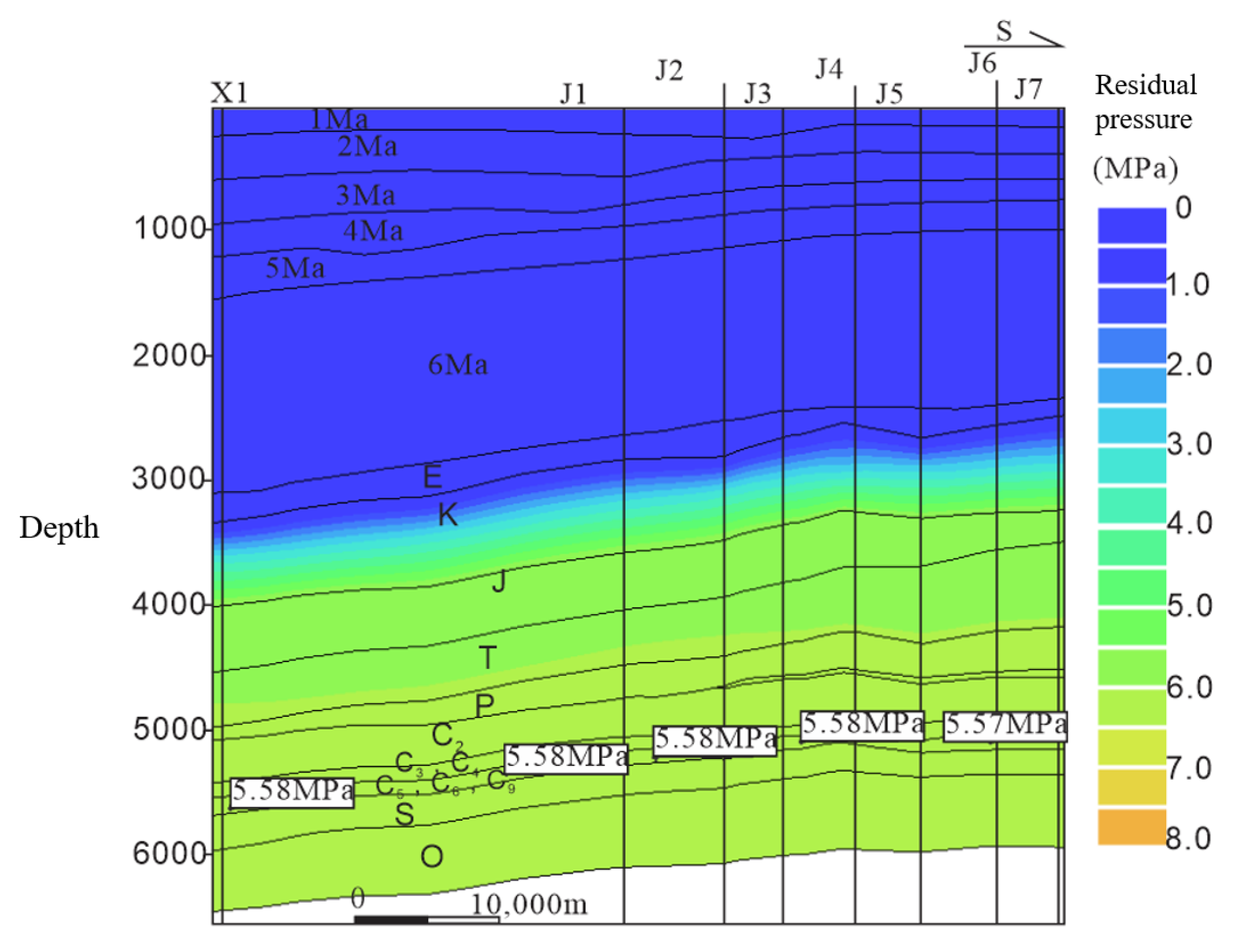
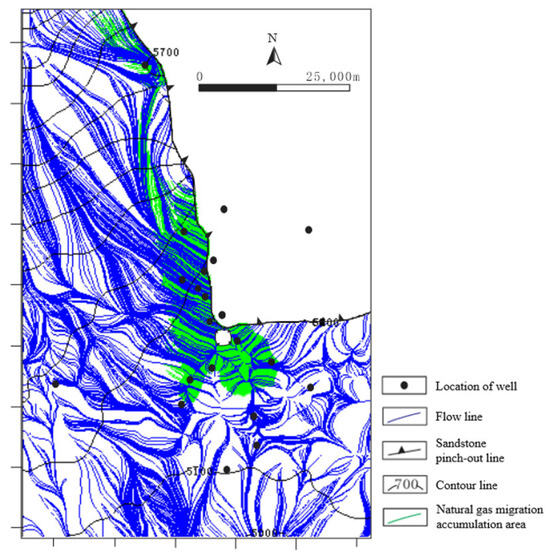
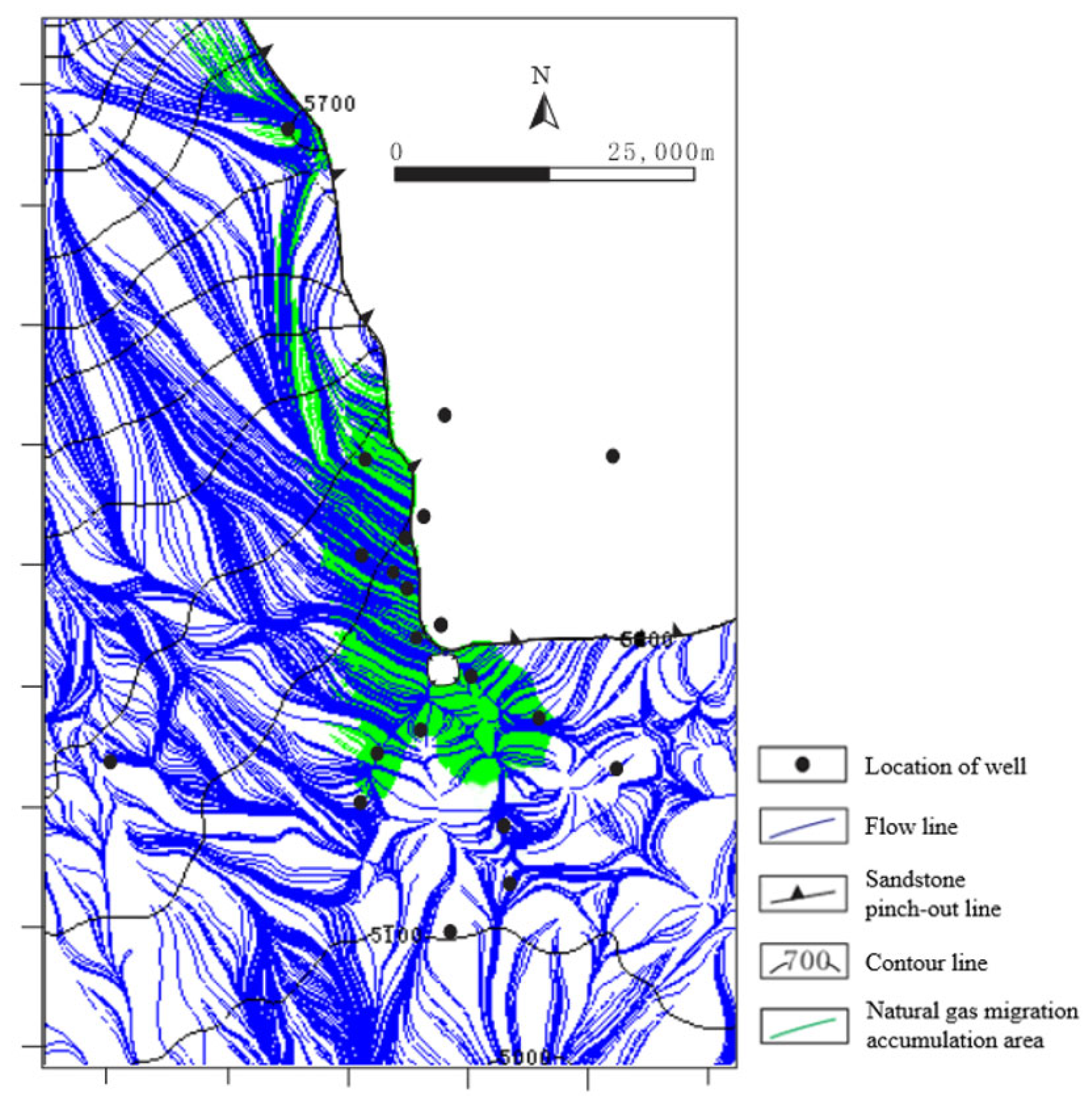
Currently, however, to overcome these inherent physical limitations, numerical basin simulation has been widely adopted [90]. This method relies on existing geological data to construct 3D models, define boundary conditions, establish governing mathematical equations for geophysical processes, and utilize various numerical solution algorithms. It enables the comprehensive reconstruction of a basin’s thermal, burial, hydrocarbon generation, expulsion, and migration-accumulation histories, visualizing the dynamic flow field distribution over geological time. As shown in Figure 11 and Figure 12, the basin numerical simulation results include the vertical distribution map of accumulation dynamics and the map of natural gas migration paths and accumulation zones, respectively. The simulations for these results were performed using PetroMod software (version 2019, Schlumberger, Houston, TX, USA) [91]. The numerical model employs the Finite Volume Method (FVM) for spatial discretization and utilizes a hybrid Darcy flow and invasion percolation approach to simulate secondary migration and accumulation. The 3D geological mesh was constructed to precisely match the target horizons, ensuring computational accuracy. The computations were executed on a standard workstation (Intel Core i9, 64 GB RAM).
Figure 11.
Residual pressure distribution from hydrodynamic evolution in a certain region.
Figure 12.
Basin numerical simulation of natural gas migration paths and accumulation zones.
Moreover, at present, commonly used basin simulation software (e.g., TEMISPACK, BasinMod, PetroMod, BasIMS) typically employs Darcy’s Law to characterize low-velocity seepage for simulating fluid migration, with buoyancy as the main driving force after the fluid enters the carrier bed [34]. Crucially, traditional Darcy-based simulators do not intrinsically account for the unique adsorption characteristics, fluid–solid interactions, and non-Darcy flow mechanisms inherent to coal-measure reservoirs [86,92].
Consequently, establishing a multi-stage diffusion–seepage geological model and numerical model suitable for CMG migration and accumulation, as well as conducting discrete simulations, is one of the primary research directions in the field of CMG accumulation dynamics [51,90,93].
4. Conclusions
This review systematically evaluates the geological controls, accumulation dynamics, and both qualitative and quantitative research methods concerning CMG co-accumulation reservoirs. First, it comprehensively analyzes CMG as an integrated system, highlighting that its co-accumulation process is profoundly governed by reservoir heterogeneity, with distinct diffusion and seepage pore systems developing within the porous media. Additionally, this review synthesizes the driving forces and type classifications of CMG co-accumulation, outlining the corresponding research methods from both qualitative and quantitative perspectives. Although traditional qualitative analysis methods for CMG accumulation are relatively mature, quantitative research still holds significant room for advancement. To overcome these critical bottlenecks and facilitate the exploration and development of CMG co-accumulation, future research should focus on the following key directions:
First, there is a need for the quantitative evaluation of reservoir superimposition. Existing classifications of reservoir superimposition are overly broad and predominantly qualitative, which is highly unfavorable for guiding practical exploration and development. Future classifications should be based on actual local geological characteristics, incorporating quantitative analysis derived from exploration results, and dynamically adjusting alongside development outcomes to form a virtuous cycle.
Furthermore, it is necessary to establish unified cross-scale transport models. The natural gas migration process between coal-measure reservoirs is exceptionally complex, and there is currently a lack of unified transport models that integrate nanopore adsorption, micro-fracture diffusion, and macro-fracture seepage. Future work should establish multi-stage diffusion–seepage geological and numerical models to improve computational efficiency and accuracy under complex geological conditions, thereby better guiding co-exploration and co-exploitation.
Moreover, researchers can delve deeper into dynamic fluid interference and interaction mechanisms. Currently, most physical and numerical models are established under simplified assumptions—particularly treating coal-measure strata as homogeneous—which significantly impacts the reliability of related findings. Future research should embrace the actual complexity of coal measures, focusing on the dynamic interaction mechanisms and dominant transformation processes of the driving forces during co-accumulation.
Finally, traditional Darcy-based simulators do not intrinsically account for the unique adsorption characteristics, fluid–solid interactions, and non-Darcy flow mechanisms inherent to coal-measure reservoirs. Therefore, establishing multi-stage diffusion–seepage geological and numerical models suitable for CMG migration and accumulation, as well as conducting discrete simulations, remains one of the primary research directions in the field of CMG accumulation dynamics.
Author Contributions
Conceptualization, X.L. and Z.J.; methodology, X.L.; software, H.Z.; validation, X.L., Z.J. and Z.Z.; formal analysis, X.L.; investigation, X.L.; resources, Z.J.; data curation, H.Z.; writing—original draft preparation, X.L.; writing—review and editing, X.L., Z.J., H.Z. and Z.Z.; visualization, H.Z.; supervision, X.L.; project administration, X.L.; funding acquisition, X.L. All authors have read and agreed to the published version of the manuscript.
Funding
This research was funded by the National Natural Science Foundation of China (No. 42272199), the Natural Science Foundation of Henan Province (No. 222300420556), the China Scholarship Council (No. 202407040109).
Data Availability Statement
Some or all data, models, or codes that support the findings of this study are available from the corresponding author upon reasonable request.
Conflicts of Interest
The authors declare no conflicts of interest.
References
- Dai, J.; Zou, C.; Tao, S.; Liu, Q.; Zhou, Q.; Hu, A.; Yang, C. Formation conditions and main controlling factors of large gas fields in China. Nat. Gas Geosci. 2007, 18, 473–484. [Google Scholar]
- Zou, C.; Yang, Z.; Ma, F.; Sun, Q.; Li, F.; Pan, S.; Tian, W. Resource types, formation, distribution and prospects of coal-measure gas. Pet. Explor. Dev. 2019, 46, 451–462. [Google Scholar] [CrossRef] [Scilit]
- Xie, W.; Gan, H.; Chen, C.; Vandeginste, V.; Chen, S.; Wang, M.; Wang, J.; Yu, Z. A model for superimposed coalbed methane, shale gas and tight sandstone reservoirs, Taiyuan Formation, Yushe-Wuxiang Block, eastern Qinshui Basin. Sci. Rep. 2022, 12, 11455. [Google Scholar] [CrossRef] [Scilit] [PubMed]
- Qin, Y. Strategic thinking on research of coal measure gas accumulation system and development geology. J. China Coal Soc. 2021, 46, 2387–2399. [Google Scholar]
- Ouyang, Y.; Tian, W.; Sun, B.; Wang, B.; Qi, L.; Sun, Q.; Yang, Q.; Dong, H. Accumulation characteristics and exploration strategies of coal measure gas in China. Nat. Gas Ind. B 2018, 5, 444–451. [Google Scholar] [CrossRef] [Scilit]
- Zhang, A.; Chen, S.; Tang, D.; Tao, S.; Tang, S.; Pu, Y.; Zhang, T. Coal Measure Gas System of the Middle Jurassic Xishanyao Formation, Southern Margin of the Junggar Basin, China. J. Earth Sci. 2025, 36, 2138–2160. [Google Scholar] [CrossRef] [Scilit]
- Qin, Y.; Moore, T.A.; Shen, J.; Yang, Z.; Shen, Y.; Wang, G. Resources and geology of coalbed methane in China: A review. In Coal Geology of China; Routledge: Oxfordshire, UK, 2020; pp. 247–282. [Google Scholar]
- Li, G.; Jia, C.; Zhao, Q.; Zhou, T.; Gao, J. Coal-rock gas accumulation mechanism and the whole petroleum system of coal measures. Pet. Explor. Dev. 2025, 52, 33–49. [Google Scholar] [CrossRef] [Scilit]
- Liang, B.; Shi, Y.; Sun, W.; Liu, Q. Reservoir forming characteristics of the three gasesin coal measure and the possibility of commingling in China. J. China Coal Soc. 2016, 41, 167–173. [Google Scholar]
- Liang, H.; Lin, Y.; Qian, Z.; Liu, J.; Yu, T. Study on coexistence of absorbed gas and free gas in coal strata south of Qinshui Basin. China Pet. Explor. 2011, 16, 72–78,88. [Google Scholar]
- Qin, Y.; Wei, C.; Zhang, Z.; Wang, C.; Yang, Z.; Liang, J.; Liu, Y. Geological controls of free natural gas reservoirs in coal measures and overlying strata in the Central and Southern Qinshui Basin. Earth Sci. Front. 2016, 23, 24–35. [Google Scholar]
- Cao, D.; Liu, K.; Liu, J.; Xu, H.; Li, J.; Qin, G. Combination characteristics of unconventional gas in coal measure in the west margin of Ordos Basin. J. China Coal Soc. 2016, 41, 277–285. [Google Scholar]
- Lin, Y.; Shu, Y.; Zhao, C.; Li, X.; Zhang, C. The overall exploration method and favorable area prediction of natural gas in the coal-bearing strata, Qinshui Basin, China. Nat. Gas Geosci. 2017, 28, 744–754. [Google Scholar]
- Qin, Y.; Xiong, M.; Yi, T.; Yang, Z.; Wu, C. On unattached multiple superposed coalbed-methane system: In a case of the Shuigonghe Syncline, Zhijin-Nayong Coalfield. Geol. Rev. 2008, 54, 65–70. [Google Scholar]
- Xi, Z.; Tang, S.; Yang, G.; Li, L.; Gong, M.; Wang, K.; Zhang, B. Accumulation and combination characteristics of coal measure gas of Shaoyang depression in the central Hunan. J. China Coal Soc. 2018, 43, 1589–1597. [Google Scholar]
- Li, Y.; Xu, W.; Gao, J.; Wu, P.; Tao, C.; Tian, Y.; Li, J.; Zhang, Y. Mechanism of coal measure gas accumulation under integrated control of source reservoir-transport system: A case study from east margin of Ordos Basin. J. China Coal Soc. 2021, 46, 2440–2453. [Google Scholar]
- He, X.; Li, J.; Duan, D.; Liu, B.; Shang, X.; Li, W.; Xu, Z.; Du, Z.; Xu, C. Driving forces of natural gas flow and gas–water distribution patterns in tight gas reservoirs: A case study of NX Gas Field in the offshore Xihu Depression, East China. Energies 2023, 16, 6028. [Google Scholar] [CrossRef] [Scilit]
- Dan, L.; Chunmei, D.; Chengyan, L.; Lihua, R.; Zhenxing, T. Control factors on tight sandstone reservoirs below source rocks in the Rangzijing slope zone of southern Songliao Basin, East China. Pet. Explor. Dev. 2013, 40, 742–750. [Google Scholar] [CrossRef] [Scilit]
- Jiang, L.; Song, Y.; Zhao, W.; Bo, D.; Liu, S.; Hao, J. Main controlling factor of coalbed methane enrichment area in southern Qinshui Basin, China. J. Pet. Explor. Prod. Technol. 2024, 14, 165–173. [Google Scholar] [CrossRef] [Scilit]
- Tian, W.; Zhao, S.; Tian, F.; Li, X.; Huo, W.; Zhong, G.; Li, S. Symbiotic combination and accumulation of coal measure gas in the Daning–Jixian Block, eastern margin of Ordos basin, China. Energies 2023, 16, 1737. [Google Scholar] [CrossRef] [Scilit]
- Liu, J.; Shen, M.; Huang, X.; Yu, B.; Nie, Z.; Yang, D. Anisotropic flow-solid coupling model for gas extraction from cis-layer boreholes and its application. ACS Omega 2022, 7, 48150–48162. [Google Scholar] [CrossRef] [Scilit]
- Bi, C.; Hu, Z.; Tang, D.; Tao, S.; Zhang, J.; Tang, S.; Huang, H.; Tang, Y.; Yuan, Y.; Xu, Y.; et al. Research progress of coal measure gas and some important scientific problems. Geol. China 2021, 48, 402–423. [Google Scholar]
- Pang, X.; Li, Y.; Jiang, Z. Key geological controls on migration and accumulation for hydrocarbons derived from mature source rocks in Qaidam Basin. J. Pet. Sci. 2004, 41, 79–95. [Google Scholar] [CrossRef] [Scilit]
- Twinomujuni, L.; Liu, K.; Batte, A.G.; Sedziafa, V.; Namara, B. Subsurface characterization and petroleum system evaluation of the onshore southern Lake Albert Rift Basin, Uganda: Insights from basin and petroleum systems modeling. Energies 2026, 19, 1281. [Google Scholar] [CrossRef] [Scilit]
- Chen, H.; Zhu, X.; Zhang, Q.; Zhang, X.; Zhang, Y.; Li, Y. Advances in pathway system research. Geol. Rev. 2009, 55, 269–276. [Google Scholar]
- Hou, P.; Liang, X.; Zhang, Y.; He, J.; Gao, F.; Liu, J. 3D multi-scale reconstruction of fractured shale and influence of fracture morphology on shale gas flow. Nat. Resour. Res. 2021, 30, 2463–2481. [Google Scholar] [CrossRef] [Scilit]
- Hou, X.; Wang, Y.; Zhu, Y.; Xiang, J. Pore structure complexity and its significance to the petrophysical properties of coal measure gas reservoirs in Qinshui Basin, China. Front. Earth Sci. 2021, 15, 860–875. [Google Scholar] [CrossRef] [Scilit]
- Wang, Y.; Kang, Y.; You, L.; Chen, M.; Cheng, Y.; Tu, Y.; Tian, J. Effect of pore-throat heterogeneity on gas–water flow in tight gas reservoirs: From micro-to centimeter scale. Energy Fuels 2024, 38, 5075–5087. [Google Scholar] [CrossRef] [Scilit]
- Pan, J.; Peng, Y. Experimental evaluation of microscopic pore structure and fluid migration characteristics of coal-measure sandstone reservoirs. Front. Earth Sci. 2022, 10, 1002745. [Google Scholar] [CrossRef] [Scilit]
- Zhang, Y.; Tian, J.; Zhang, X.; Li, J.; Liang, Q.; Zheng, X. Diagenesis evolution and pore types in tight sandstone of Shanxi Formation reservoir in Hangjinqi area, Ordos Basin, Northern China. Energies 2022, 15, 470. [Google Scholar] [CrossRef] [Scilit]
- Guo, H.; Xia, W.; Shan, X.; Xi, K.; Peng, B.; Yang, X.; Zou, Z.; Yuan, W. Diagenetic genesis and evolution of coal-bearing tight sandstone reservoir in the Yangxia Formation, northern Kuqa Depression, Tarim Basin. ACS Omega 2024, 9, 18314–18326. [Google Scholar] [CrossRef] [Scilit]
- Yang, X.; Tang, S.; Zhang, S.; Xi, Z.; Wang, K.; Wang, Z.; Lv, J. Applying 3D geological modeling to predict favorable areas for coalbed methane accumulation: A case study in the Qinshui Basin. Front. Earth Sci. 2024, 18, 763–781. [Google Scholar] [CrossRef] [Scilit]
- England, W.; Mackenzie, A.; Mann, D.; Quigley, T. The movement and entrapment of petroleum fluids in the subsurface. J. Geol. Soc. 1987, 144, 327–347. [Google Scholar] [CrossRef] [Scilit]
- Baur, F.; Katz, B. Some practical guidance for petroleum migration modeling. Mar. Pet. Geol. 2018, 93, 409–421. [Google Scholar] [CrossRef] [Scilit]
- Qin, Y. Research progress of symbiotic accumulation of coal measure gas in China. Nat. Gas Ind. B 2018, 5, 466–474. [Google Scholar] [CrossRef] [Scilit]
- Tian, S.; Chen, Y.; Zhang, X.; Zhang, X.; Cui, G.; He, H.-Q. The fluid dynamics mechanism in migration-accumulation dynamics system. Earth Sci. Front. 2001, 8, 329. [Google Scholar]
- Liu, X.; Xi, S.; Huang, D.; Zhang, Q.; Wang, X. Dynamic conditions of Mesozoic petroleum secondary migration, Ordos Basin. Pet. Explor. Dev. 2008, 35, 143–147. [Google Scholar] [CrossRef] [Scilit]
- Liu, J.; Zhang, C.; Jiang, Y.; Bai, G. Overpressure and gas charging in tight sandstone: Xujiahe Formation, northeastern Sichuan Basin. Pet. Sci. 2022, 19, 2583–2600. [Google Scholar] [CrossRef] [Scilit]
- Chen, G.; Jiang, S.; Li, C.; Li, S.; Peng, P.; Mo, L.; Zhang, Y.; Zhang, L.; Zhang, T. Progress in shale reservoir upgrading through in-situ heating. Oil Gas Geol. 2022, 43, 286–296. [Google Scholar]
- Li, Y.; Meng, S.; Wu, P.; Niu, X. Accumulation mechanisms and classification of CBM reservoir types: A case study from the eastern margin of the Ordos. Nat. Gas Ind. 2017, 37, 22–30. [Google Scholar] [CrossRef]
- Yao, S.; Wu, C.; Yang, C.; Li, R.; Chen, Y. Study on pressure characteristics and difference causes of coal reservoirs in Bide-Santang Basin of western Guizhou. Coal Sci. Technol. 2019, 47, 162–168. [Google Scholar]
- Zhang, J.; Liu, D.; Cai, Y.; Pan, Z.; Yao, Y.; Wang, Y. Geological and hydrological controls on the accumulation of coalbed methane within the No. 3 coal seam of the southern Qinshui Basin. Int. J. Coal Geol. 2017, 182, 94–111. [Google Scholar] [CrossRef] [Scilit]
- Sang, S.; Han, S.; Liu, S.; Zhou, X.; Li, M.; Hu, Q.; Zhang, C. Comprehensive study on the enrichment mechanism of coalbed methane in high rank coal reservoirs. J. China Coal Soc. 2022, 47, 388–403. [Google Scholar]
- Jia, T.; Sang, S.; Han, S. High pressure formation mechanism of reservoir in Songhe Mine Field and its impact to coalbed methane development. Coal Sci. Technol. 2016, 44, 50–54. [Google Scholar]
- Kang, Y.; Wu, W. Methodological system of fluid analysis in petroliferous basins: With a discussion on several research subjects for which studies should be enhanced. Geol. Rev. 1999, 45, 151–157. [Google Scholar] [CrossRef]
- Wang, D.; Jiang, Z.; Du, W.; Liu, D.; Shao, X.; Feng, X.; Chen, Y.; Chen, W.; Yang, Y. Fluid activity characteristics of shallow shale veins in the Wufeng-Longmaxi Formation in the Shixi syncline in northern Guizhou and their significance for shale gas preservation. Nat. Gas Ind. B 2024, 11, 511–524. [Google Scholar] [CrossRef] [Scilit]
- Liu, H.; Zhang, B.; Li, X.; Liu, C.; Wang, C.; Wang, F.; Cui, Z.; Chen, D. Influence of geological structures on the occurrence of coalbed methane in Sima coal mine, China. Front. Earth Sci. 2022, 10, 1000520. [Google Scholar] [CrossRef] [Scilit]
- Song, Z.; Jin, S.; Luo, B.; Luo, Q.; Tian, X.; Yang, D.; Zhang, Z.; Zhang, W.; Wu, L.; Tao, J. Geochemical differences in natural gas of Sinian Dengying Formation on the east and west sides of the Deyang-Anyue rift trough and their genesis, Sichuan Basin, SW China. Pet. Explor. Dev. 2025, 52, 374–384. [Google Scholar] [CrossRef] [Scilit]
- Chen, S.; Liu, J. Research progress and prospects of the stages, genesis and fluid evolution of micro-fracture veins in petroliferous basins. Bull. Geol. Sci. Technol. 2021, 40, 81–92. [Google Scholar]
- Liang, Z.; Jiang, Z.; Wu, W.; Guo, J.; Wang, M.; Liu, D.; Nie, Z.; Xue, Z. Characteristics and geological significance of fluid inclusion of Wufeng-Longmaxi Formation in different tectonic units in Changning area, southern Sichuan. J. Cent. South Univ. Sci. Technol. 2022, 53, 3652–3665. [Google Scholar]
- Liu, D.; Zhao, Z.; Cai, Y.; Xu, S.; Qiu, F.; Sun, F. Review on deep coal measure gas accumulation and its geological effects of efficient coproduction. Energy Fuels 2025, 39, 14437–14454. [Google Scholar] [CrossRef] [Scilit]
- Langmuir, I. The adsorption of gases on plane surfaces of glass, mica and platinum. J. Am. Chem. Soc. 1918, 40, 1361–1403. [Google Scholar] [CrossRef] [Scilit]
- Markham, E.; Benton, A.F. The adsorption of gas mixtures by silica. J. Am. Chem. Soc. 1931, 53, 497–507. [Google Scholar] [CrossRef] [Scilit]
- Sips, R. On the structure of a catalyst surface. J. Chem. Phys. 1948, 16, 490–495. [Google Scholar] [CrossRef] [Scilit]
- Sakurovs, R.; Day, S.; Weir, S.; Duffy, G. Application of a modified Dubinin-Radushkevich equation to adsorption of gases by coals under supercritical conditions. Energy Fuels 2007, 21, 992–997. [Google Scholar] [CrossRef] [Scilit]
- LeVan, M.D.; Vermeulen, T. Binary Langmuir and Freundlich isotherms for ideal adsorbed solutions. J. Phys. Chem. 1981, 85, 3247–3250. [Google Scholar] [CrossRef] [Scilit]
- Alafnan, S.; Awotunde, A.; Glatz, G.; Adjei, S.; Alrumaih, I.; Gowida, A. Langmuir adsorption isotherm in unconventional resources: Applicability and limitations. J. Pet. Sci. Eng. 2021, 207, 109172. [Google Scholar] [CrossRef] [Scilit]
- Sudibandriyo, M.; Pan, Z.; Fitzgerald, J.E.; Robinson, R.L.; Gasem, K.A. Adsorption of methane, nitrogen, carbon dioxide, and their binary mixtures on dry activated carbon at 318.2 K and pressures up to 13.6 MPa. Langmuir 2003, 19, 5323–5331. [Google Scholar] [CrossRef] [Scilit]
- Kapoor, A.; Ritter, J.A.; Yang, R. An extended Langmuir model for adsorption of gas mixtures on heterogeneous surfaces. Langmuir 1990, 6, 660–664. [Google Scholar] [CrossRef] [Scilit]
- Bai, R.; Yang, R.T. Heterogeneous extended langmuir model with multiregion surfaces for adsorption of mixtures. J. Colloid Interface Sci. 2002, 253, 16–22. [Google Scholar] [CrossRef] [Scilit]
- Yan, M.; Wang, C.; Lin, H.; Ji, P.; Li, S.; Jia, H. Study on the influence of multiple factors on the CH4/CO2 adsorption selective prediction model in coal. Processes 2025, 13, 1757. [Google Scholar] [CrossRef] [Scilit]
- Ottiger, S.; Pini, R.; Storti, G.; Mazzotti, M. Measuring and modeling the competitive adsorption of CO2, CH4, and N2 on a dry coal. Langmuir 2008, 24, 9531–9540. [Google Scholar] [CrossRef] [Scilit] [PubMed]
- Fan, Z.; Liu, H.; Liu, J.; Xue, S.; Zhang, K.; Xu, H.; Fang, H. Modeling of supercritical CO2 adsorption for low-permeability coal seam of Huainan–Huaibei Coalfield, China. ACS Omega 2023, 8, 44195–44211. [Google Scholar] [CrossRef] [Scilit] [PubMed]
- Liu, H.; Sang, S.; Liu, S.; Wu, H.; Lan, T.; Xu, H.; Ren, B. Supercritical-CO2 adsorption quantification and modeling for a deep coalbed methane reservoir in the southern Qinshui Basin, China. Acs Omega 2019, 4, 11685–11700. [Google Scholar] [CrossRef] [Scilit] [PubMed]
- Zhang, Y.; Fan, N.; Wang, Y.; Qiao, L.; Deng, C. Multiple models characterize the dynamic adsorption behavior of supercritical CO2 on medium to high rank coal. ACS Omega 2025, 10, 5809–5818. [Google Scholar] [CrossRef] [Scilit]
- Chen, X.; Wu, C.; Zhang, H.; Liu, S.; Wang, X.; Li, H.; Yao, Z.; Wureyimu, K.; Huang, F.; Cao, Z. Research on the adsorption characteristics and adsorption capacity pedictions of spercritical methane in deep coal seams. Processes 2025, 13, 2186. [Google Scholar] [CrossRef] [Scilit]
- Wang, C.; Zhang, Q.; Tang, S.; Wu, C. Supercritical CO2 adsorption behavior in deep coal seams of the Qinshui Basin: Model, Mechanisms, and implications for geological storage. Fuel 2026, 413, 138229. [Google Scholar] [CrossRef] [Scilit]
- Faurie, D.G.; Koech, L.; Premlall, K. Multivariate property analysis of CO2 adsorption in South African coals using machine learning based modelling. Fuel 2026, 407, 137307. [Google Scholar] [CrossRef] [Scilit]
- Li, W.; Li, W.; Busch, A.; Wang, L.; Anggara, F.; Yang, S. Machine learning algorithm to predict methane adsorption capacity of coal. Energy Fuels 2024, 38, 23422–23432. [Google Scholar] [CrossRef] [Scilit]
- Zhou, X.; Pang, X.; Li, Q.; Pang, H.; Xiang, C.; Jiang, Z.; Li, S.; Liu, L. Advances and problems in hydrocarbon exploration in the Tazhong area, Tarim Basin. Pet. Sci. 2010, 7, 164–178. [Google Scholar] [CrossRef] [Scilit]
- Hu, T.; Pang, X.; Jiang, F. Whole petroleum system theory and new directions for petroleum geology development. Adv. Geo-Energy Res. 2024, 11, 1–5. [Google Scholar] [CrossRef] [Scilit]
- Afagwu, C.; Alafnan, S.; Mahmoud, M.; Akkutlu, I.Y. Modeling of natural gas self-diffusion in the micro-pores of organic-rich shales coupling sorption and geomechanical effects. J. Nat. Gas Sci. 2022, 106, 104757. [Google Scholar] [CrossRef] [Scilit]
- Zhao, X.; Chen, Z.; Wang, B.; Liao, X.; Li, D.; Zhou, B. A Multi-medium and Multi-mechanism model for CO2 injection and storage in fractured shale gas reservoirs. Fuel 2023, 345, 128167. [Google Scholar] [CrossRef] [Scilit]
- Souza Debossam, J.G.; de Souza, G.; Amaral Souto, H.P.; Pires, A.P. Numerical simulation of single-phase two-component non-Darcy flow in naturally fractured reservoirs for enhanced gas recovery and carbon dioxide storage. Braz. J. Chem. Eng. 2024, 41, 197–219. [Google Scholar] [CrossRef] [Scilit]
- Wang, S.; Hou, P.; Liang, X.; Su, S.; Liu, Q. A 3D fractal model coupled with transport and action mechanisms to predict the apparent permeability of shale matrix. Fractals 2024, 32, 2450039. [Google Scholar] [CrossRef]
- Lin, X.; Zeng, J.; Wang, J.; Huang, M. Natural gas reservoir characteristics and non-Darcy flow in low-permeability sandstone reservoir of Sulige Gas Field, Ordos Basin. Energies 2020, 13, 1774. [Google Scholar] [CrossRef] [Scilit]
- Zhou, Y.; Wu, S.-T.; Zhu, R.-K.; Jiang, X.-H.; Hua, G.-L. A new model for determining the effective permeability of tight reservoirs based on Fractal-Monte Carlo method. Pet. Sci. 2025, 22, 3101–3118. [Google Scholar] [CrossRef] [Scilit]
- Xiong, Y.; Yu, J.; Sun, H.; Yuan, J.; Huang, Z.; Wu, Y.-s. A new non-Darcy flow model for low-velocity multiphase flow in tight reservoirs. Transp. Porous Media 2017, 117, 367–383. [Google Scholar] [CrossRef] [Scilit]
- Li, R.; Wang, S.; Lyu, S.; Xiao, Y.; Su, D.; Wang, J. Dynamic behaviours of reservoir pressure during coalbed methane production in the southern Qinshui Basin, North China. Eng. Geol. 2018, 238, 76–85. [Google Scholar] [CrossRef] [Scilit]
- Moore, T.A. Coalbed methane: A review. Int. J. Coal Geol. 2012, 101, 36–81. [Google Scholar] [CrossRef] [Scilit]
- Guria, C. Pressure- and temperature-dependent klinkenberg slippage effect in porous media to non-ideal gases. Geoenergy Sci. Eng. 2023, 224, 211629. [Google Scholar] [CrossRef] [Scilit]
- Sharma, G.; Guria, C. An improved Klinkenberg permeability model for tight reservoir cores: Effects of non-linear gas slippage to real gases. Geoenergy Sci. Eng. 2024, 233, 212477. [Google Scholar] [CrossRef] [Scilit]
- Wu, K.; Li, X.; Wang, C.; Yu, W.; Chen, Z. Model for surface diffusion of adsorbed gas in nanopores of shale gas reservoirs. Ind. Eng. Chem. Res. 2015, 54, 3225–3236. [Google Scholar] [CrossRef] [Scilit]
- Javadpour, F. Nanopores and apparent permeability of gas flow in mudrocks (shales and siltstone). J. Can. Pet. Technol. 2009, 48, 16–21. [Google Scholar] [CrossRef] [Scilit]
- Yao, Y.; Wang, F.; Liu, D.; Sun, X.; Wang, H. Quantitative characterization of the evolution of in-situ adsorption/free gas in deep coal seams: Insights from NMR fluid detection and geological time simulations. Int. J. Coal Geol. 2024, 285, 104474. [Google Scholar] [CrossRef] [Scilit]
- Wu, Y.-S.; Li, J.; Ding, D.-Y.; Wang, C.; Di, Y. A generalized framework model for the simulation of gas production in unconventional gas reservoirs. SPE J. 2014, 19, 845–857. [Google Scholar] [CrossRef] [Scilit]
- Liu, P.; Nie, B.; Zhao, Z.; Li, J.; Yang, H.; Qin, C. Permeability of micro-scale structure in coal: Insights from μ-CT image and pore network modelling. Gas Sci. Eng. 2023, 111, 204931. [Google Scholar] [CrossRef] [Scilit]
- Wang, C.; Zhao, Y.; Ning, L.; Bi, J. Permeability evolution of coal subjected to triaxial compression based on in-situ nuclear magnetic resonance. Int. J. Rock Mech. Min. Sci. 2022, 159, 105213. [Google Scholar] [CrossRef] [Scilit]
- Xu, J.; Zhang, C.; Peng, S.; Jia, L.; Guo, S.; Li, Q. Multiple layers superposed CBM system commingled drainage schedule and its optimization. J. China Coal Soc. 2018, 43, 1677–1686. [Google Scholar]
- Yan, G.; Song, Y.; Quan, F.; Cheng, Q.; Wu, P. Numerical simulation of the coal measure gas accumulation process in Well Z-7 in Qinshui Basin. Processes 2024, 12, 2491. [Google Scholar] [CrossRef] [Scilit]
- Schlumberger. PetroMod Basin Modeling Software User Manual, version 2020; Schlumberger: Aachen, Germany, 2020. [Google Scholar]
- Liu, Y.; Zhang, X.; Zhang, W.; Guo, W.; Kang, L.; Liu, D.; Gao, J.; Yu, R.; Sun, Y. A review of macroscopic modeling for shale gas production: Gas flow mechanisms, multiscale transport, and solution techniques. Processes 2023, 11, 2766. [Google Scholar] [CrossRef] [Scilit]
- Li, Z.; Wang, S.; Wei, G.; Wang, H.; Zhao, H.; Liang, R. The seepage driving mechanism and effect of CO2 displacing CH4 in coal seam under different pressures. Energy 2024, 293, 130740. [Google Scholar] [CrossRef] [Scilit]


Disclaimer/Publisher’s Note: The statements, opinions and data contained in all publications are solely those of the individual author(s) and contributor(s) and not of MDPI and/or the editor(s). MDPI and/or the editor(s) disclaim responsibility for any injury to people or property resulting from any ideas, methods, instructions or products referred to in the content. |
© 2026 by the authors. Licensee MDPI, Basel, Switzerland. This article is an open access article distributed under the terms and conditions of the Creative Commons Attribution (CC BY) license.