Review

Physics–Data-Integrated Hybrid Simulation for Transient Stability in New Power Systems: Status, Challenges, and Prospects

1
Department of Electrical Engineering, Tsinghua University, Beijing 100084, China
2
China Southern Power Grid Company Limited, Guangzhou 510525, China
*
Author to whom correspondence should be addressed.
Energies 2026, 19(7), 1687; https://doi.org/10.3390/en19071687
Submission received: 23 January 2026 / Revised: 9 March 2026 / Accepted: 13 March 2026 / Published: 30 March 2026

Abstract

The strong non-linearity and multi-scale coupling characteristics of massive heterogeneous components in modern power systems pose severe challenges to traditional numerical simulation methods, rendering them inadequate for urgent online real-time assessment. This paper systematically reviews state-of-the-art hybrid transient stability simulation technologies that deeply integrate physics and data. It first dissects the critical bottlenecks of traditional numerical simulations—specifically computational inefficiency, convergence fragility, and model fidelity gaps—to elucidate the necessity of evolving toward a new physics–data integration paradigm. Subsequently, the review categorizes current methodologies into three technical dimensions: artificial intelligence (AI)-enhanced numerical solvers, AI-based surrogate modeling, and physics-embedded AI modeling. These approaches are synthesized to demonstrate their unique advantages in breaking through computational speed limits, enhancing numerical robustness, and effectively bridging the fidelity gap between simulation models and physical reality. Finally, addressing existing limitations regarding physical consistency and generalization, the paper proposes future research directions, including constructing network architectures with hard physical constraints, enhancing adaptability to complex grid scenarios, and developing self-evolving intelligent simulation frameworks to ensure future grid security.

1. Introduction

With the deepening of the energy transition, modern power systems are accelerating their formation [1,2]. In this paper, ‘New Power System’ is defined as a modern grid characterized by the ‘double-high’ features: a high proportion of renewable energy generation (leading to source-side uncertainty and low inertia) and a high proportion of power electronic devices (introducing multi-timescale dynamics and strong nonlinearity). However, this transformation brings unprecedented challenges to transient stability analysis. First, the strong stochastic volatility of renewable energy [3] and the “crosstalk” effects of fault propagation cause operating conditions to grow exponentially, triggering a “scenario explosion” in computational dimensions [4]. Second, system stability exhibits high time variance and complexity; as the ratio between synchronous machines and renewable equipment shifts dynamically, dominant instability modes rapidly transition between rotor angle, voltage, and frequency stability, making offline analysis based on typical fault sets insufficient for depicting real-time security boundaries [5,6]. Furthermore, facing massive distributed heterogeneous resources, traditional modeling methods face an insurmountable bottleneck: even if modeling granularity is continuously increased, it remains difficult to effectively overcome inherent discrepancies in control parameters and operating environments among generating units [7].
Nevertheless, simply relying on traditional numerical simulations to address these issues is becoming increasingly untenable due to inherent computational constraints. From the perspective of scientific computing, traditional structured modeling faces an “accuracy paradox” when dealing with massive sources and loads [8]. Refining modeling based on topology is rigidly constrained by serial computing logic and the “memory wall” bottleneck, limiting the potential to translate hardware power into simulation speed [9]. Simultaneously, a numerical stability crisis is becoming prominent; the strong coupling of multi-time-scale dynamics causes the Jacobian matrix to easily become ill-conditioned, leading to non-convergence under critical operating conditions [10,11]. While pure data-driven methods offer speed, they face a “credibility crisis” regarding physical consistency. Fortunately, the proliferation of Wide-Area Measurement Systems (WAMS) allows for mining potential dynamic laws from massive data [12,13], providing a new avenue for online self-evolution.
To bridge the intractable gap between mathematical models and physical reality, the academic community is shifting toward a “Physics-Data Integrated Hybrid Simulation” paradigm [14]. Early hybrid simulations reconciled the conflict between accuracy and speed to some extent through multi-rate interface technologies [15]. In the AI era, the heterogeneous architecture of “AI inference + numerical calculation” endows simulation with new connotations [16]. AI models not only serve as efficient “computational accelerators” to break through the speed bottlenecks of solving differential-algebraic equations (DAEs) [17,18], but also constitute a novel cognitive framework. By correcting physical modeling deviations via data-driven methods [19,20], this paradigm effectively bridges the fidelity gap, providing core technical support for fast, high-precision simulation [14].
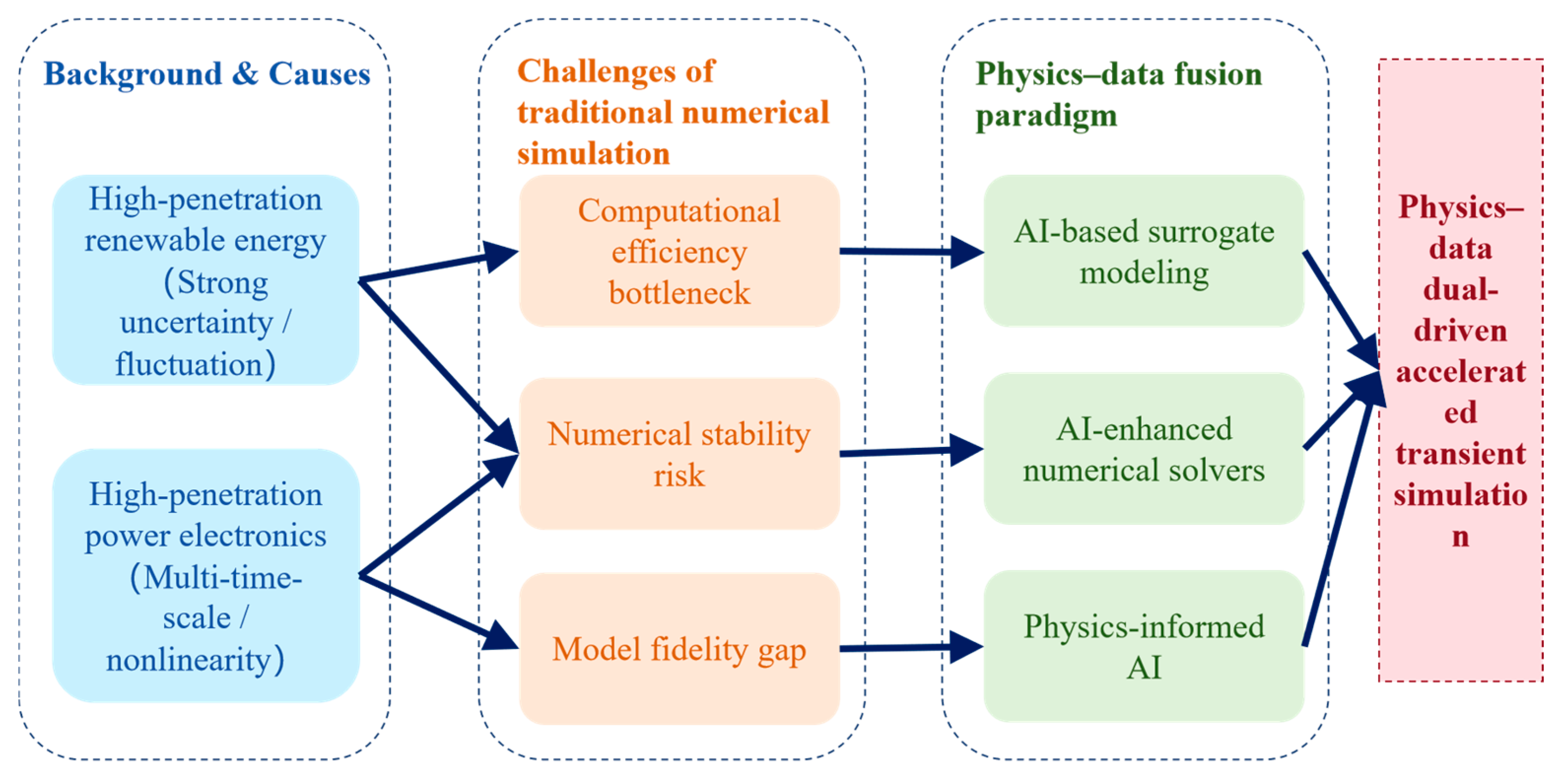
This review aims to systematically review hybrid transient stability simulation technologies characterized by the deep integration of physics and data. It first dissects the common challenges plaguing traditional simulations and elucidates the underlying rationale driving the evolution from conventional hybrid methods toward a new paradigm of deep physics–data integration. Subsequently, the key technological architectures—comprising AI-enhanced numerical solvers, AI-based surrogate modeling, and physics-embedded learning—are comprehensively surveyed, as illustrated in Figure 1. Furthermore, the application potential of hybrid simulation is evaluated across three critical dimensions: computational efficiency, numerical stability, and model fidelity. Finally, the paper concludes with an outlook on future research directions while addressing persistent challenges, such as physical consistency constraints and generalization capabilities. The distinct significance of this review is to provide a theoretical roadmap for the transition from “Model-Driven” to “Physics-Data Dual-Driven” simulation, helping researchers identify critical technologies for building the next generation of self-evolving intelligent simulation frameworks. To clearly distinguish the contribution of this review from existing literature, Table 1 presents a comparative analysis with representative review articles.

2. Limitations of Traditional Transient Simulation and Evolution of Hybrid Simulation Technologies

2.1. Traditional Transient Simulation

2.1.1. Electromechanical Transient Simulation

Electromechanical transient simulation focuses on describing the slow dynamic processes involving the interaction between the rotor mechanical motion of synchronous generators and electromagnetic power. It serves as the primary tool for analyzing classical stability issues—such as angle, voltage, and frequency stability—in large-scale power grids [24]. Based on fundamental frequency phasor theory, this method assumes network parameters remain constant at power frequency and ignores electromagnetic transients (EMT) in stator windings and transmission networks. By simplifying network equations into algebraic equations, it allows for large simulation time steps (typically 10 ms), making it highly efficient for long-term simulations of grids containing thousands of nodes [25]. However, in new power systems, this method naturally filters out non-fundamental frequency components. Consequently, it fails to accurately capture the millisecond-level or even microsecond-level switching behaviors and control responses of converters [26]. This leads to significant risks of model distortion when analyzing problems involving fast dynamic interactions, such as sub-/super-synchronous oscillations and wideband resonance [27].

2.1.2. EMT Simulation

In contrast to electromechanical simulation, EMT simulation aims to solve differential equations in the time domain to precisely reproduce instantaneous voltage and current waveforms. It is a critical basis for analyzing the dynamic characteristics of systems with a high penetration of power electronic devices [28]. Benefiting from microsecond-level time steps, EMT simulation can finely characterize the electromagnetic transient processes of various components, including lines, transformers, rotating machines, and power electronic devices. It captures full-frequency dynamics ranging from lightning overvoltages to high-frequency converter modulation, demonstrating extremely high modeling precision [29]. Specifically, to capture fast switching transients, EMT simulations typically require a time step in the range of 1–50 μs, whereas traditional electromechanical simulations operate at a much larger step of approximately 10 ms. For a large-scale grid with thousands of nodes, this orders-of-magnitude difference in temporal resolution imposes an exorbitant computational burden, often exceeding the real-time capability of single-core processors. However, this high precision comes at the cost of significant computational resources. The combination of high-order models and minute time steps imposes a heavy computational burden when applied to large-scale main grid analysis [30]. Furthermore, constructing high-precision EMT models requires detailed internal device parameters and control logic. This not only complicates the model initialization process [31] but also results in a substantial workload for model construction and maintenance, limiting its widespread application in large-scale system analysis [32].

2.2. Analysis of the Common Bottlenecks and Challenges of Traditional Simulation Methods

2.2.1. Bottlenecks in Computational Efficiency

As the scale and complexity of power systems increase, traditional numerical simulation methods face difficulties in improving computational efficiency, primarily in three aspects: (1) Algorithmic Level: The numerical solution of differential equations for dynamic elements relies on complex logical judgments and serial calculation structures. This intrinsic algorithmic characteristic makes it difficult to translate growing hardware power into substantial improvements in simulation speed [33]. (2) Parallel Computing Level: Traditional numerical simulations typically employ coarse-grained parallel strategies, resulting in frequent data exchange between calculation nodes. Massive state variables and parameters require repeated memory access during calculation, which is further constrained by unavoidable serial processing segments [34]. (3) Hardware Adaptation Level: Although AI chips far exceed traditional CPUs in floating-point operation capabilities and high-concurrency processing, existing numerical simulation architectures have not yet fully leveraged the advantages of this hardware. Consequently, the potential of advanced hardware resources in the field of power system simulation remains largely unleashed [35].

2.2.2. Risks in Numerical Convergence

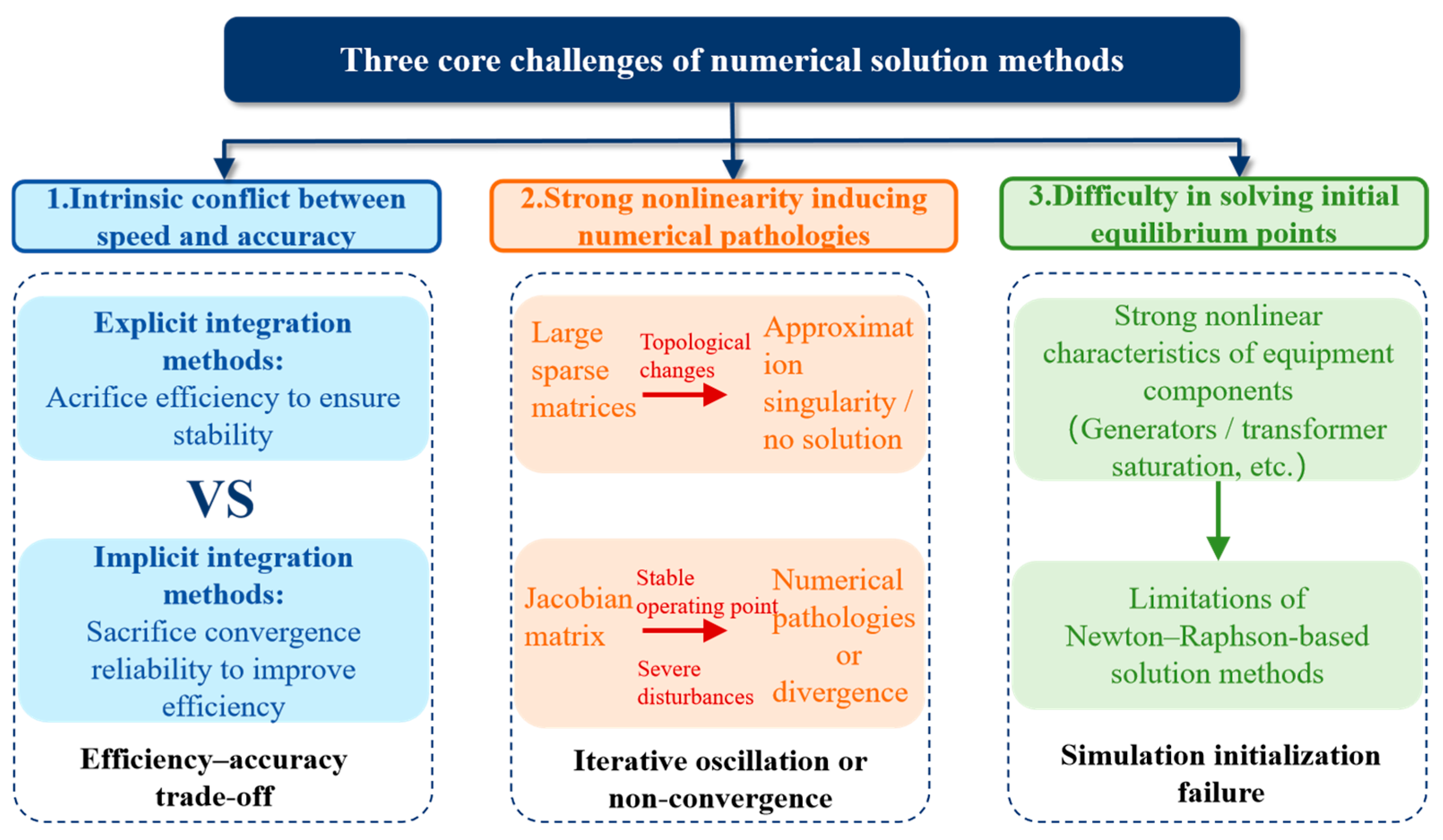
As shown in Figure 2, traditional numerical methods face three core difficulties when applied to new power system simulations, severely constraining efficiency and reliability. First is the inherent contradiction between speed and accuracy in numerical integration algorithms [36]. Explicit integration methods require extremely small steps due to stiff system constraints, leading to low efficiency; conversely, implicit methods, while allowing larger steps, face severe convergence challenges when iteratively solving large-scale systems of non-linear equations [37,38]. Second is matrix numerical ill-conditioning caused by strong non-linearity. In complex scenarios, such as high renewable energy penetration via weak grids, drastic topology changes or operation near stability limits can easily cause the coefficient matrices [24] and the Jacobian matrices to become ill-conditioned or even singular [39,40,41]. This often triggers severe oscillation or divergence during the iteration process, leading to solution failure. Third is the difficulty in solving initial equilibrium points. Influenced by strong non-linear characteristics like generator saturation, the widely used Newton-Raphson method is extremely sensitive to initial values due to its local convergence properties. The lack of high-quality initial values often prevents the algorithm from converging to a physically feasible equilibrium point, directly obstructing the startup of the simulation [42].

2.2.3. Gaps in Model Fidelity

Beyond numerical challenges, traditional modeling methods face a fundamental crisis in bridging the gap between models and physical reality. Traditional power system models are built upon the deterministic physical mechanisms of equipment such as synchronous generators. However, the dynamic behavior of modern power systems is increasingly dominated by the control logic of massive numbers of power electronic devices [6]. The high complexity, commercial confidentiality, and frequent updates of these control algorithms make precise source-level modeling unfeasible [43]. Meanwhile, traditional modeling philosophies based on “equivalence” and “aggregation” have largely failed when dealing with large-scale clusters of heterogeneous power electronic equipment. Simple parameter averaging or model simplification cannot reproduce collective dynamics triggered by complex non-linear interactions among heterogeneous units (e.g., sub-/super-synchronous oscillations) [44]. Furthermore, due to the lack of intrinsic mechanisms to effectively fuse massive field measurement data for adaptive model evolution, the gap between simulation models and physical reality has widened from numerical discrepancies at the parameter level to structural mismatches regarding key physical phenomena [45].

2.3. Hybrid Simulation and Its Implications

To address the irreconcilable contradiction between computational efficiency and modeling accuracy in single-mode simulations, generalized hybrid simulation technology has emerged, offering new perspectives for computation across multi-dimensional spatiotemporal scales. From the time dimension, multi-rate simulation technology allows for variable step-size integration based on the speed of subsystem dynamics, realizing on-demand allocation of computational resources [46]. From the space dimension, multi-mode simulation technology utilizes spatial partitioning to apply differentiated modeling or numerical solution methods to different subsystems, enabling multi-physics coupling simulations of thermal, electric, and circuit fields [47]. This generalized hybrid simulation strategy provides important methodological guidance for solving complex system simulation problems by flexibly adapting to specific scenarios and requirements.
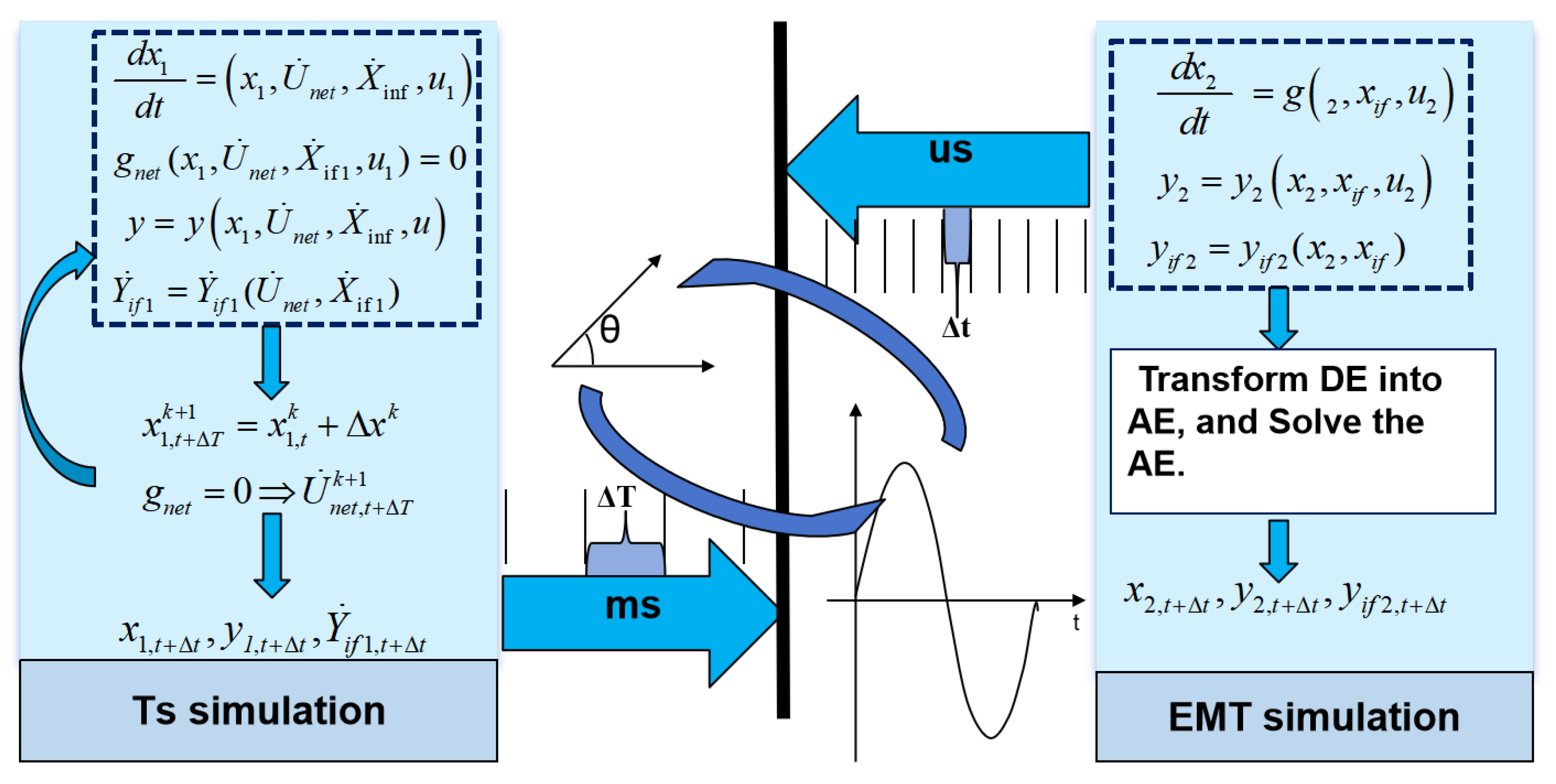
Mapping this philosophy specifically to the power system domain, the emergence of Electromechanical-Electromagnetic Transient (TS-EMT) hybrid simulation marks a new height in the development of traditional simulation technology. Figure 3 mathematically illustrates the principle of digital hybrid simulation, which achieves a joint solution through state mapping and time-scale coordination. This method aims to solve the challenge in transient stability analysis of large-scale grids where local power electronic switching transients significantly impact global stability [48]. Its core lies in dividing the grid into a “detailed zone” modeled by EMT and an “external zone” modeled by TS, using interface technologies to achieve real-time interaction and iterative matching of boundary conditions [49,50]. Existing literature has widely demonstrated the application of this technology in scenarios such as fault analysis in AC/DC hybrid systems and grid integration characteristics of large-scale renewable energy stations, verifying its effectiveness in coordinating global simulation scale with local modeling granularity [51,52]. It has become the preferred solution in engineering for handling cross-scale dynamic problems.
Table 2 below presents a comparative analysis of different simulation methods across multiple dimensions.
However, while traditional TS-EMT hybrid simulation alleviates the conflict between accuracy and efficiency to a certain extent, it fundamentally remains within the framework of traditional numerical computation. Crucially, the bottleneck stems primarily from interface instability and numerical stiffness. Specifically, latency and synchronization errors during the interaction between phasor-domain and time-domain solvers can introduce artificial energy, leading to numerical divergence. Furthermore, expanding the detailed EMT boundary to capture widespread inverter dynamics exponentially increases system stiffness, necessitating minute time steps that ultimately negate the efficiency gains of the hybrid approach. In light of these computational limitations and the increasingly complex dynamic characteristics of new power systems, future simulation technology must break the constraints of purely numerical frameworks. It is imperative to evolve toward the deep fusion of physical mechanisms and data-driven approaches, incorporating artificial intelligence to empower hybrid simulation architectures and thereby overcome the obstacles that traditional methods cannot surmount.

3. Paradigm Evolution: From Multi-Spatiotemporal Scale Coupling to Deep Physics–Data Integration

3.1. Boundaries of Traditional Hybrid Simulation: Inherent Limitations of Structured Modeling

Although traditional hybrid simulation achieves coordination among models of varying granularity via interface technologies, its core remains confined within the rigid framework of “structured modeling” [53]. Within this framework, the performance of the simulator is highly dependent on the completeness of prior physical knowledge. However, in modern power systems, the control logic of massive power electronic devices often exists in a “black-box” or “grey-box” state. Coupled with stochastic and volatile operating environments, deterministic equations derived from first principles struggle to accurately describe the system’s true dynamic behavior. This “absence of a cognitive dimension” renders traditional hybrid simulation inadequate when confronting unmodeled dynamics or time-varying parameter characteristics [54]. Consequently, merely stitching together multi-scale simulations at the numerical solution level is insufficient to address these challenges; a new cognitive dimension must be introduced at the source of modeling.

3.2. The Rise in Data Elements: The Dual Impetus of Simulation Drivers

The proliferation of WAMS and Phasor Measurement Unit (PMU) has generated power system data characterized by massive volume, high dimensionality, and multi-source heterogeneity, providing a novel “data driving force” for the transformation of simulation paradigms [55]. Crucially, recent algorithmic advancements—such as random matrix theory-based filtering [56] and probability error minimization [57]—have validated the feasibility of extracting high-fidelity data even from imperfect measurements, thereby ensuring a solid informational foundation for physics–data fusion. Unlike traditional modes relying on deductive reasoning from physical equations, data-driven methods employ inductive reasoning to capture potential nonlinear laws and high-order correlation features directly from observational data. They possess an inherent “model-free” advantage, effectively compensating for the blind spots of physical modeling.
Nevertheless, pure data-driven methods in power systems face a “credibility crisis” characterized by poor interpretability, weak generalization capabilities, and an inability to satisfy physical constraints such as power conservation [58]. Therefore, future simulation paradigms should neither cling to isolated silos of traditional physical mechanisms nor blindly trust black-box data predictions. Instead, they must seek an organic combination of physical mechanisms and data patterns, forming a new morphology of hybrid intelligent simulation powered by the dual drive of “mechanism + data.”.

3.3. Construction Logic of the Fusion Paradigm: Complementarity, Embedding, and Closed-Loop

The fusion of physics and data is not a simple superposition but a profound organic reconstruction. The construction logic of this novel hybrid simulation paradigm is first reflected in the level of complementary advantages. Physical models are utilized to ensure boundary controllability and physical consistency of the simulation, while data models are leveraged to enhance computational efficiency and fitting capabilities for unknown dynamics. For instance, while maintaining the topological constraints of network equations, AI surrogate models can replace time-consuming numerical integration steps, thereby breaking through computational speed bottlenecks without sacrificing physical interpretability [59].
On this basis, the fusion logic deepens into structural embedding. This requires breaking traditional “serial” thinking by directly “embedding” physical laws as prior knowledge or regularization terms into the loss functions or network architectures of neural networks. Such physics-embedded AI models inherently possess physical intelligence, which not only significantly reduces dependence on large data volumes but also ensures that simulation results conform to physical laws [60]. Table 3 and Table 4 illustrate the key technologies and characteristics of different hybrid simulation techniques.
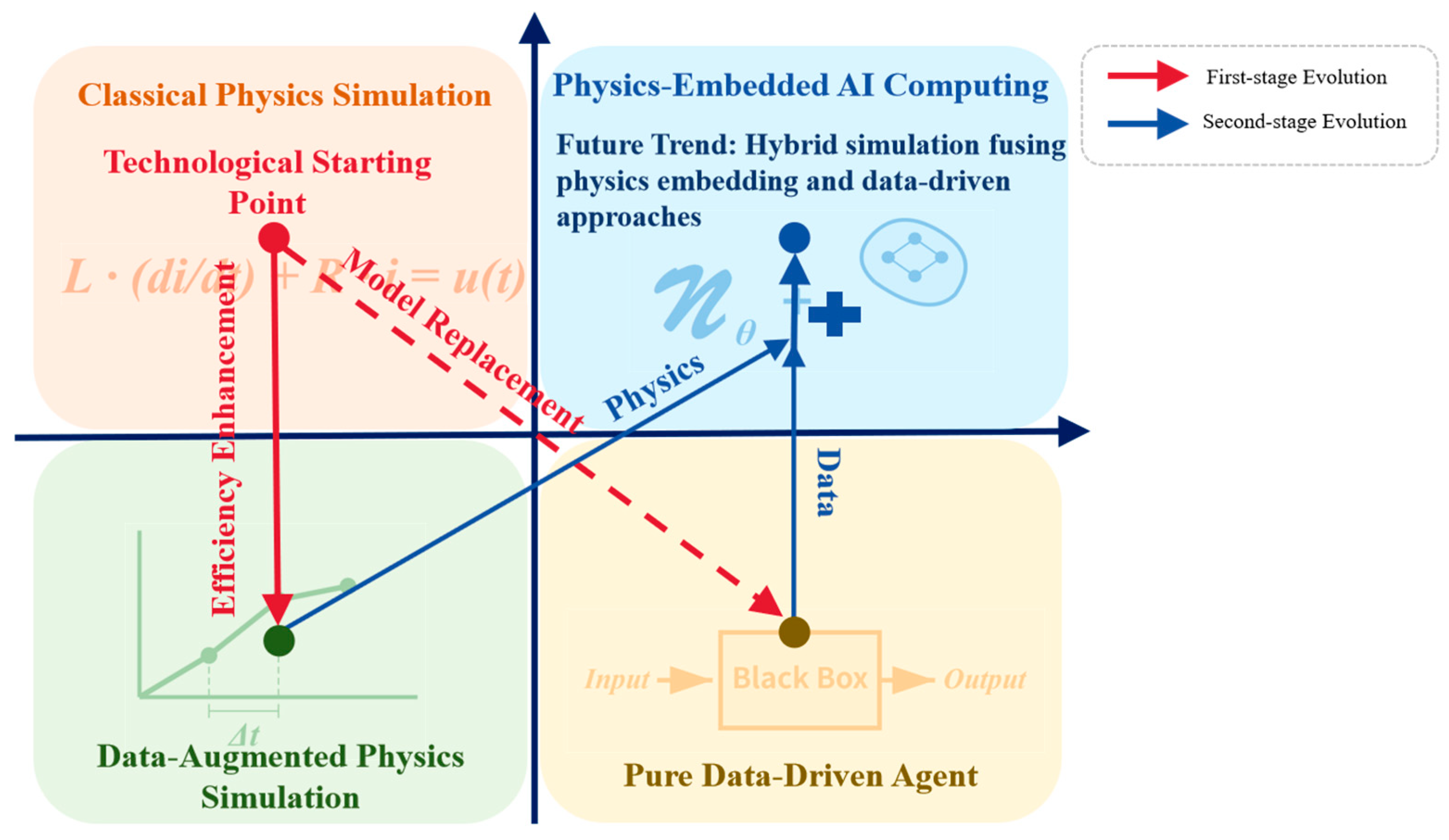
Ultimately, this fusion will propel simulation systems toward a dynamic closed loop. By establishing a real-time interaction mechanism between “simulation and measurement,” measured data is used to correct simulation model deviations online on one hand, while the simulation model fills spatiotemporal blind spots in measurement data on the other. This continuous interaction and evolution will transform the simulation system from a static computational tool into a transient stability hybrid simulation method that co-evolves with the physical power grid [15]. Figure 4 depicts the evolutionary process from classical physical simulation to hybrid simulation characterized by the deep integration of physics embedding and data-driven approaches. This novel paradigm evolution provides top-level methodological guidance for the key technologies to be elaborated upon subsequently, including AI surrogate modeling, physics-embedded learning, and AI-enhanced solvers.

4. Key Technologies and Case Verification of AI-Driven Hybrid Simulation for Power Systems

4.1. AI-Enhanced Numerical Solver Technologies: Optimizing the Numerical Solution Process for Acceleration

AI-enhanced modeling and solving technologies are not limited to the partial or global replacement of traditional simulation modeling. Instead, acting as embedded modules, they perform targeted optimization on specific bottlenecks within the traditional numerical solution workflow to enhance the computational efficiency and convergence stability of the solver. A primary application of this technology is accelerating the iterative solution of numerical models. In simulations employing implicit integration methods, each time step requires iteratively solving systems of nonlinear equations, large-scale linear equations, and differential equations, which constitutes the main computational overhead and convergence bottleneck. To address this, a lightweight neural network can be trained to rapidly provide a high-quality initial guess for the iterative solver at the current step based on the states of preceding time steps, thereby significantly reducing the number of iterations. Furthermore, the use of neural networks to directly approximate the computationally expensive Jacobian matrix or its inverse can be explored to further optimize the solution process [61]. However, it is crucial to acknowledge that utilizing neural-network-approximated Jacobians introduces inherent risks of error propagation, which may ultimately lead to potential divergence and the loss of numerical stability, particularly when the system encounters unseen operating conditions outside the training distribution. Another critical direction is the realization of intelligent adaptive step-size control. Traditional adaptive step-size strategies are mostly based on heuristic rules, making it difficult to achieve global optimality. By introducing reinforcement learning, an AI agent can be trained to learn the optimal step-size control strategy. Based on the current dynamic state of the system, this agent determines an integration step size that guarantees numerical accuracy while maximizing computational efficiency. This approach enables dynamic and refined management of computational resources, demonstrating a superior “efficiency-accuracy” trade-off compared to traditional methods when handling complex scenarios involving multi-time-scale dynamics [62,63].
To implement these AI-enhanced techniques in industrial-grade platforms, distinct integration strategies are adopted depending on the simulation environment. For commercial offline software such as PSS/E, DIgSILENT, and ADPSS, AI modules typically interact with the core solver through co-simulation interfaces including Python APIs or dynamic link libraries. This allows the AI model to inject high-quality initial guesses into the Newton-Raphson solver at each time step without altering the underlying source code. In contrast, real-time simulators like OPAL-RT and RTDS demand ultra-low latency for Hardware-in-the-Loop applications. Consequently, AI-enhanced solvers are deployed on heterogeneous hardware architectures where the heavy numerical integration remains on the CPU, while neural network inference is offloaded to embedded FPGAs or GPUs. This architecture specifically supports TS–EMT hybrid simulation by rapidly predicting boundary conditions, ensuring synchronization within microsecond-level time steps [64].

4.2. AI Surrogate Modeling and Simulation: From Function Fitting to Operator Learning

By constructing AI models capable of efficiently reproducing the input-output relationships of traditional numerical simulators via deep learning, an order-of-magnitude improvement in computational efficiency can be achieved while maintaining acceptable accuracy. This technological path primarily comprises two developmental stages:
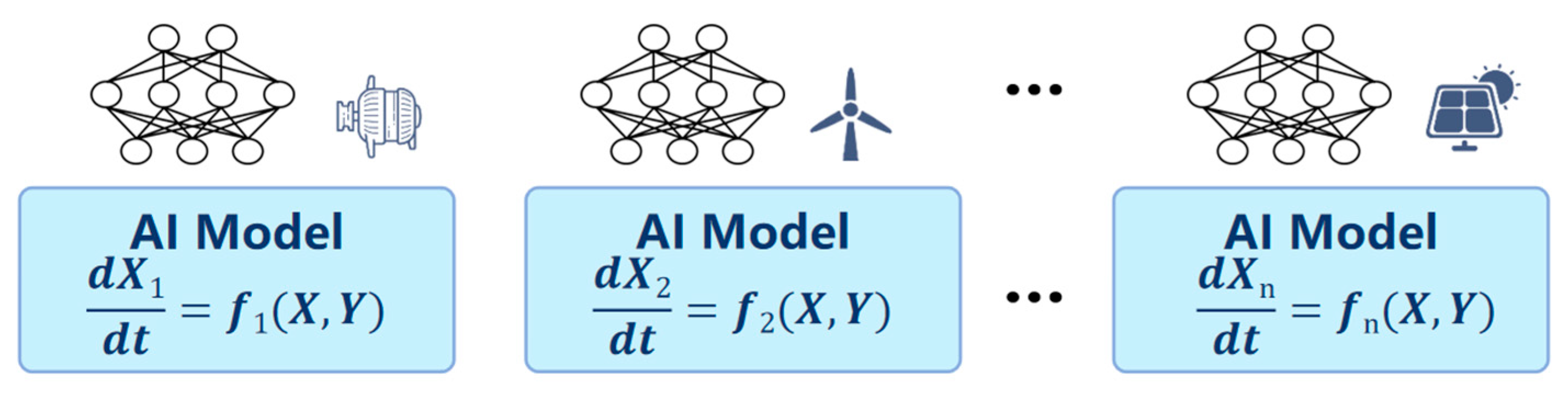
The initial stage is AI modeling based on function fitting using a Deep Neural Network (DNN). Figure 5 presents the unified AI modeling diagram for different types of components. Its core idea is to treat the time-consuming simulation process y = G(u) (where u is the input and y is the output) as a high-dimensional nonlinear function and approximate it using DNN [65]. In terms of implementation, Multi-Layer Perceptron (MLP) and Convolutional Neural Network (CNN) are commonly used for static mapping tasks such as transient stability assessment, mapping initial system operating conditions and disturbance information to stability criteria or indices [54,66]. Meanwhile, Recurrent Neural Networks (RNNs) and their variants are widely applied in dynamic trajectory prediction, learning the mapping from initial states to time series of critical state variables [67,68]. The extremely fast inference speed of such surrogate models makes large-scale probabilistic stability assessment and online dynamic security analysis computationally feasible.
A more advanced stage is surrogate modeling based on operator learning using neural operators. Unlike traditional DNNs that learn mappings between finite-dimensional vector spaces, neural operators—particularly Fourier Neural Operators—aim to learn mapping operators between infinite-dimensional function spaces [69]. They learn the mapping rules from an input function (e.g., the time-domain waveform of a disturbance signal) to an output function (e.g., the complete trajectory of the system’s dynamic response), rather than relationships between specific discrete points. Consequently, neural operators possess superior generalization capabilities; a fully trained model can handle a family of input disturbances with varying parameters or morphologies, significantly reducing the reliance on massive and diverse training samples. This represents a significant developmental direction for surrogate simulation technology.

4.3. Physics-Informed AI Modeling and Simulation: Integrating Data with Physical Laws

Physics-informed AI simulation technology aims to overcome the inherent “black-box” nature of pure data-driven models, their reliance on large-scale labeled data, and potential physical inconsistencies [16]. Its core lies in embedding the physical laws governed by power systems (in the form of DAEs) as strong prior knowledge into the neural network’s training framework.
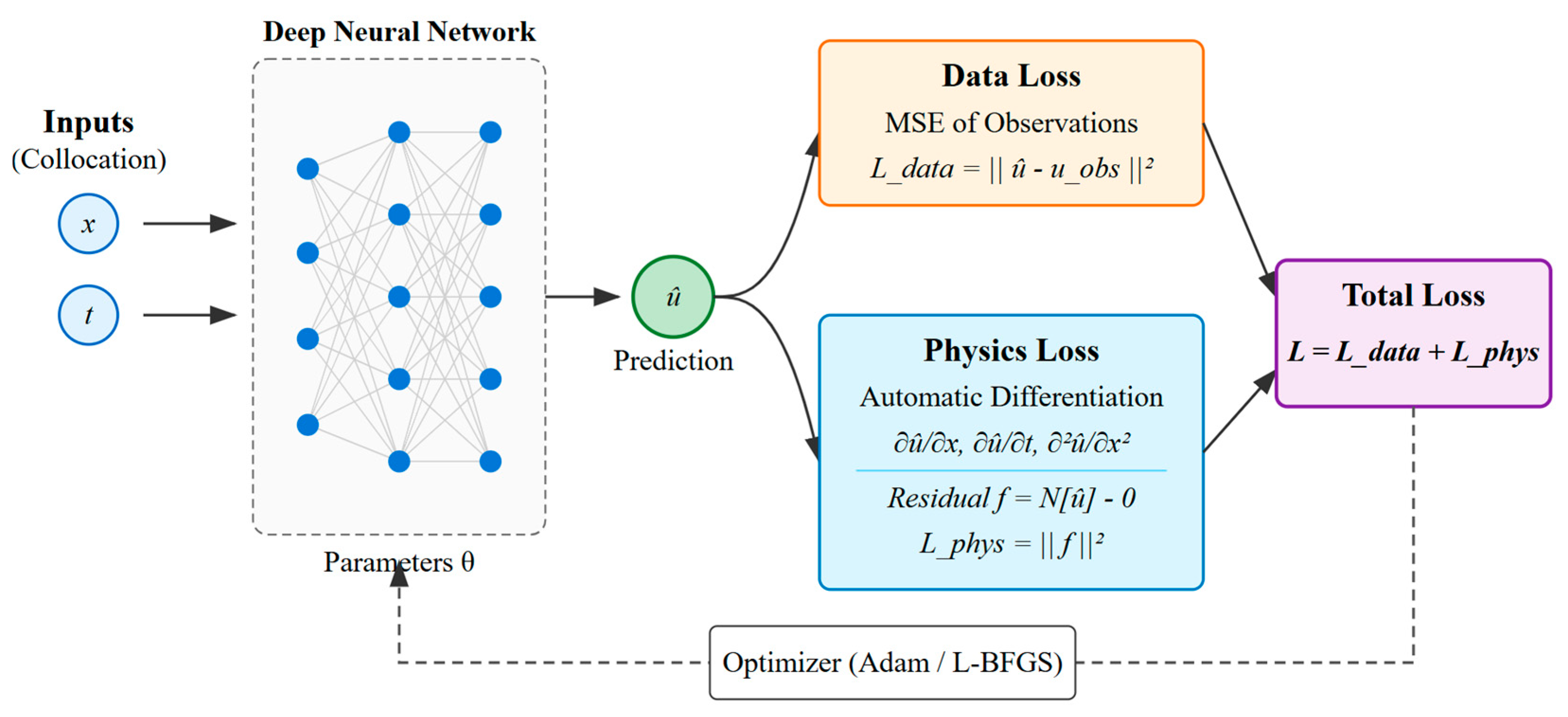
Among these, the PINNs are representative technology. The loss function of PINNs consists of two components, as shown in Figure 6: a traditional data loss term used to fit known observational or simulation data, and a core physical loss term [70]. The physical loss term is calculated by substituting the neural network’s output and its derivatives (obtained via automatic differentiation) into the system’s DAEs to obtain equation residuals. By minimizing these two loss terms, PINNs can learn solutions that both satisfy data samples and adhere to underlying physical equations [59], making it naturally suitable for solving inverse problems such as parameter identification [71].
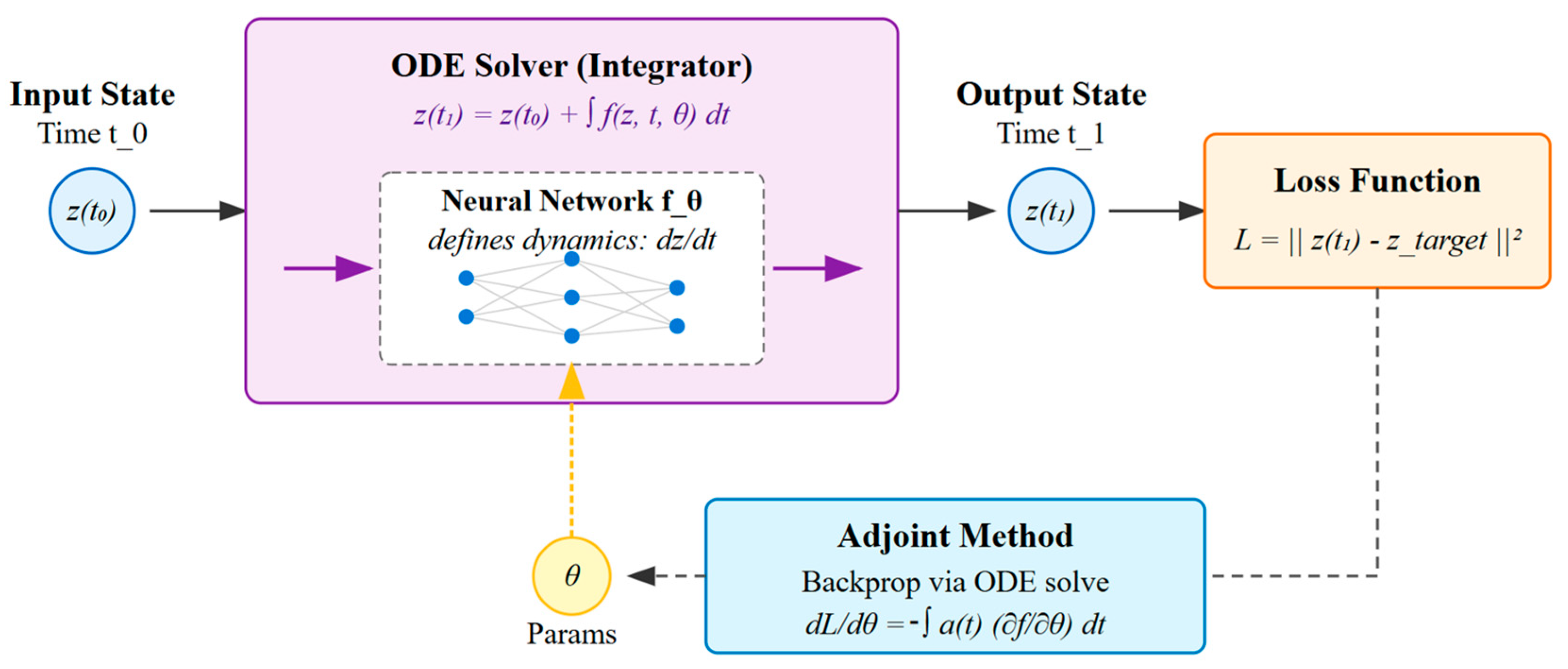
Another key technology is Neural ODEs. Unlike PINNs which assumes the equation is known and uses a network to fit its solution, it aims to enable a neural network to directly learn and represent the unknown dynamic evolution patterns of the system [19]. Figure 7 illustrates the principles framework of Neural ODEs. Under this framework, the forward propagation process of the network is transformed into a numerical solution process of a differential equation. Neural ODEs provide a powerful tool for “grey-box” system identification, making it particularly suitable for data-driven dynamic modeling of power electronic devices containing commercial secrets or complex control logic [72]. It is capable of learning equivalent dynamic behavior models directly from external observational data [61].

4.4. Case Study Verification

Currently, AI surrogate modeling enables the precise generation of transient trajectories for nonlinear dynamic systems. This section presents the modeling of the dynamic behavior of a ten-order nonlinear dynamic system. This system is constructed based on a general mathematical model, and it shares the core mathematical characteristics with the dynamic equations of the power system (DAEs), such as high dimensionality, strong nonlinearity, and coupling. Specifically, the state variables can be conceptually mapped to the state of the power system (such as rotor angle, angular velocity, or the internal state of the converter), and the nonlinear coupling terms simulate the interactions between different components. This abstraction enables us to verify the ability of the artificial intelligence model to capture complex transient behaviors (such as oscillations and step responses), without relying on a specific power grid topology. It can be precisely described by the state equation as follows:
x * = f ( x , p , u )
The state vector x is defined as:
x = x 1 , x 2 , x 3 , x 4 , x 5 , x 6 , x 7 , x 8 , x 9 , x 10 T ,
The parameter vector p is defined as:
p = p 1 , p 2 , p 3 , p 4 , p 5 , p 6 , p 7 , p 8 T ,
The input vector u(t) is defined as:
u ( t ) = u 1 ( t ) , u 2 ( t ) T ,
The total differential equation can be decomposed into a summation of four distinct components:
x * = l i n e a r _ p a r t + n o n l i n e a r _ p a r t + p a r a m _ p a r t + i n p u t _ p a r t ,
The linear_part is defined by a matrix-vector product Ax. Here, A 10 × 10 , and the matrix is sparse, with its non-zero elements predominantly distributed across 2 × 2 diagonal blocks.
The vector nonlinear_part form representing the nonlinear coupling terms involving state variables is given by:
n o n l i n e a r _ p a r t = 0.01 x 1 ( x 1 2 + x 2 2 ) , 0.01 x 2 ( x 1 2 + x 2 2 ) × 10 , 0 , 0 , 0 , 0 , 0 , 0 , 0 , 0.1 sin ( x 9 ) + 0.1 x 4 x 7 T ,
The vector param_part form describing the coupling relationship between variable physical parameters p and state variables x are:
p a r a m _ p a r t = 0 , 0 , p 1 x 1 , p 2 x 2 , p 3 x 6 , p 4 x 5 + 0.1 x 6 x 9 , p 5 tanh ( x 8 ) , p 6 x 7 , p 7 x 3 , p 8 x 4 T ,
The vector u(t) form describing how external input signals act upon the system is:
i n p u t _ p a r t = u 1 ( t ) , u 2 ( t ) , 0 , 0 , 0 , 0 , 0 , 0 , 0 , 0 T ,
Summing the aforementioned four components yields the final mathematical expression of the system:
x 1 * = 0.1 x 1 + 1.0 x 2 0.01 x 1 ( x 1 2 + x 2 2 ) + u 1 ( t ) x 2 * = 1.0 x 1 0.1 x 2 0.01 x 2 ( x 1 2 + x 2 2 ) × 10 + u 2 ( t ) x 3 * = 0.1 x 3 + 2.0 x 4 + p 1 x 1 x 4 * = 2.0 x 3 0.1 x 4 + p 2 x 2 x 5 * = 0.1 x 5 + 2.0 x 6 + p 3 x 6 x 6 * = 2.0 x 5 0.1 x 6 + p 4 x 5 + 0.1 x 6 x 9 x 7 * = 0.1 x 7 + 6.0 x 8 + p 5 tanh ( x 8 ) x 8 * = 6.0 x 7 0.1 x 8 + p 6 x 7 x 9 * = 0.5 x 9 + p 7 x 3 x 10 * = 0.3 x 10 + 0.1 sin ( x 9 ) + 0.1 x 4 x 7 + p 8 x 4 ,
When the system is subjected to a smooth sinusoidal superposition signal containing random steps—designed to simulate sudden disturbances and non-stationary operating conditions:
To sufficiently capture the diverse dynamic characteristics of the power system, we construct a composite excitation signal containing both multi-frequency oscillations and step changes as the training input. The input trajectory ui(t) is defined as:
u i ( t ) = 0.3 k = 1 3 A i , k sin ( ω i , k t + ϕ i , k ) + m = 1 M i Δ u i , m H ( t t i , m )
where the first term represents continuous fluctuations modeled by a superposition of three sinusoidal components, and the second term introduces discrete transient disturbances modeled by Heaviside step functions.
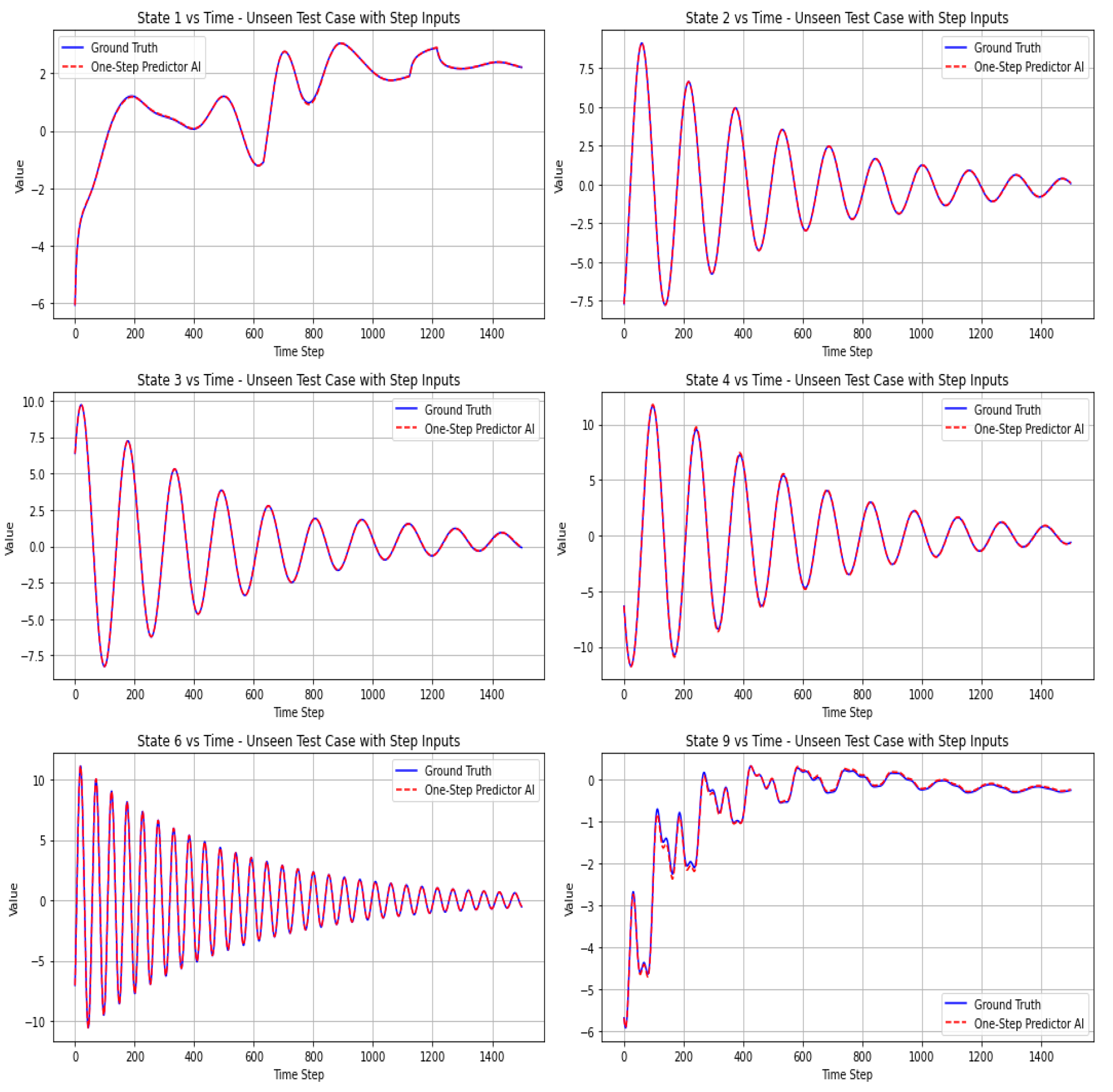
The specific test results are shown in Figure 8:
The test results demonstrate that the Mean Squared Error between the single-step prediction output on the new dataset and the Ground Truth stabilizes at the magnitude of 10−4. The model exhibits strong generalization capability and robustness against operating conditions and parameter perturbations that were not included in the training set, thereby verifying the accuracy and applicability of the proposed modeling method.

5. Potential and Application Scenarios of Hybrid Simulation

5.1. Analysis of the Potential to Overcome Three Fundamental Obstacles of Traditional Simulation

5.1.1. Overcoming Speed Bottlenecks: Upgrading from “Offline Detailed Calculation” to “Online Second-Level Response”

AI surrogate models, particularly neural operators, can reproduce the results of traditional minute-level numerical simulations with millisecond-level inference speeds by learning high-dimensional nonlinear mapping relationships between inputs and outputs [73,74]. This “train once, infer ten-thousand times” paradigm fundamentally transforms the inefficient “calculate case-by-case” mode of traditional simulation. Meanwhile, technologies such as AI-enhanced intelligent step-size control can optimize the solution process from within, excavating the potential for computational efficiency improvements [75].
Hybrid simulation will propel power grid dynamic analysis from offline planning studies to online real-time applications. The N-k contingency scanning and screening, which previously took hours, can be completed in minutes or even seconds in the future. This will make the online generation and rolling optimization of preventive and emergency control strategies a reality, greatly enhancing the grid’s defensive capability against sudden disturbances.

5.1.2. Overcoming Numerical Challenges: Shifting from “Fragile Solving” to “Robust Prediction”

Hybrid simulation systematically mitigates the convergence difficulties of traditional numerical solutions through two pathways. First, AI enhancement technologies can provide high-quality initial guesses for the Newton-Raphson method. This helps the solver bypass convergence “traps” caused by ill-conditioned Jacobian matrices [76]. Second, mesh-free solvers like PINNs avoid Jacobian matrix inversion during optimization. Adopting these models fundamentally circumvents the convergence bottlenecks of traditional iterations [77].
This implies that the reliability of simulation tools under extreme operating conditions—such as large-scale renewable integration via weak grids or severe faults—will be substantially improved. This achieves a transition from frequent “calculation interruptions” to stable dynamic prediction, greatly strengthening the confidence of dispatch operators in mastering system security boundaries.

5.1.3. Bridging the Modeling Gap: Evolving from “Model-Driven” to “Physics-Data Fusion”

The hybrid simulation paradigm provides a systematic solution to the root problem of the “disconnect between models and physical reality.” Technologies like Neural Ordinary Differential Equations (Neural ODEs) can directly learn and identify the “grey-box” or “black-box” dynamics of power electronic clusters from measured data, resolving the dilemma of “unmodelable components” caused by commercial confidentiality and high heterogeneity [78].
Simultaneously, physics embedding technologies can endogenously fuse massive PMU/WAMS measured data into the simulation framework, establishing a robust “measurement-driven calibration” mechanism suitable for practical engineering applications. By comparing real-time field measurements with simulation outputs, the physics-embedded AI module automatically identifies parameter drifts—such as variations in inertia constants and damping coefficients—and performs online correction. This process transforms the simulation system into a self-evolving intelligent simulation framework [79] that maintains high fidelity to the physical grid even under time-varying operating conditions. Consequently, this framework not only accurately reproduces historical events but also precisely predicts future dynamics, providing core technical support for achieving “holographic state perception, intelligent risk early warning, and autonomous decision optimization” of the power grid.

5.2. Assessment of Application Scenarios for the New Hybrid Simulation Paradigm

Regarding engineering maturity, physics–data-integrated simulation is transitioning from research to pilot application. Offline capabilities, such as AI-based security screening, have reached a maturity level supporting pilot deployment in control centers for decision support. In contrast, online closed-loop control remains largely at the proof-of-concept stage. Consequently, current real-world deployments operate primarily in an “advisory mode” rather than “autonomous control” to ensure grid safety. Building on this deployment status, the specific application potential of this paradigm is evaluated below, categorized into critical high-value scenarios and foundational support scenarios.

5.2.1. Critical High-Value Scenarios

In the context of high renewable energy penetration, traditional dynamic security assessment methods based on offline calculation can no longer meet online application demands. The new hybrid simulation paradigm realizes minute-level rolling assessment of massive pre-contingency sets by constructing a two-level assessment framework of “AI Fast Screening—AI Surrogate Precision Calculation”. It updates system stability boundaries in real time, thereby significantly enhancing the situational awareness and risk pre-control levels of dispatch operations. Moreover, by operating inside an Energy Management System (EMS) or Wide-Area Monitoring and Control (WAMC) platform, this AI-hybrid engine utilizes real-time PMU data to validate and generate emergency control actions within seconds after a major disturbance, effectively preventing cascading failures.
Addressing wideband oscillation issues such as subsynchronous and supersynchronous oscillations, traditional electromechanical transient models struggle to accurately characterize their dynamics, while EMT simulations are difficult to apply online. Hybrid simulation employs an “Offline EMT Training—Online AI Surrogate Prediction” mode to map high-fidelity simulation information to efficient surrogate models. This achieves second-level prediction and risk early warning of novel oscillation instability modes, providing critical time support for the rapid deployment of online suppression measures [80].

5.2.2. Foundational Support Scenarios

High-efficiency, high-fidelity hybrid simulation models are the key foundation for building a transparent power grid. By embedding physical mechanisms and constraint conditions into data-driven models, this paradigm enables dynamic simulation that evolves synchronously with the real grid state, providing a credible core engine for applications such as upper-layer intelligent dispatch [74], fault diagnosis, and active defense.
In planning and optimization problems considering the uncertainty of large-scale wind and solar power output fluctuations, hybrid simulation relies on high-efficiency AI surrogate models to support large-scale Monte Carlo simulation calculations [81]. This allows for a systematic assessment of the dynamic and static performance of planning schemes in a statistical sense, thereby improving the robustness and reliability of planning and decision-making results.

6. Challenges, Future Outlook and Conclusions

6.1. Critical Challenges and Inherent Risks

Although physics–data-integrated simulation has the potential for transformational change, the transition from cutting-edge research to industrial applications faces severe challenges and inherent risks. The most critical challenge is physical consistency and safety, which are bottlenecks that must be overcome in practical applications. Since standard neural networks essentially operate as statistical approximators, it is still very difficult to strictly follow the basic physical principles throughout the spatial and temporal domain, which may bring potential safety risks in closed-loop control. Secondly, numerical stability and robustness are major issues. In numerical solvers that utilize artificial intelligence, replacing deterministic calculations with neural network predictions (e.g., approximated Jacobians) introduces random uncertainty. If the prediction error exceeds the convergence region, the solver may diverge or converge to a mathematically valid but non-physical equilibrium state, thereby reducing reliability under unforeseen operating conditions. Finally, challenges in interpretability, generalization ability, and data scarcity still exist. The “black box” nature of deep learning weakens the trust of operators, and when the grid topology changes, the model’s performance may drop sharply. Deterministic artificial intelligence models often cannot consider probabilistic uncertainties, such as measurement noise, sensor failures, or unpredictable load behavior. The cost of obtaining high-quality data annotations for complex transient events is high, and the scarcity of high-quality field data further exacerbates the situation.

6.2. Future Research Directions

To address these bottlenecks and achieve engineering maturity, future research must focus on three strategic directions. First, efforts should prioritize constructing “hard” constraint architectures, developing networks (e.g., symplectic neural networks) that mathematically guarantee the satisfaction of physical conservation laws, shifting from soft penalty-based training to intrinsic structural constraints. Second, enhancing adaptability is crucial; utilizing techniques like Graph Neural Networks (GNNs) and transfer learning can embed topological information, ensuring models generalize effectively across variable grid structures. Third, the field must move toward self-evolving digital twins by establishing a “simulation-measurement” closed-loop. By continuously fusing real-time WAMS/PMU data, hybrid models can correct parameter drifts, reducing reliance on offline training data and bridging the gap between simulation and physical reality.

6.3. Conclusions

This paper systematically reviews the physics–data-integrated hybrid simulation paradigm for transient stability in New Power Systems. The analysis elucidates that the “scenario explosion” and complex dynamics of modern grids have created insurmountable bottlenecks for traditional numerical simulations regarding efficiency and fidelity. Consequently, three key technical pathways—AI-enhanced numerical solvers, AI-based surrogate modeling, and physics-embedded AI modeling—are synthesized. Evaluations indicate that this heterogeneous architecture effectively overcomes the intrinsic limitations of serial computing logic. Specifically, AI-enhanced solvers improve robustness against ill-conditioned matrices, AI surrogates achieve order-of-magnitude speedups, and physics-embedded frameworks provide a novel cognitive structure that bridges the fidelity gap. This paradigm shift paves the way for power system analysis to evolve from offline deduction to online, real-time intelligent assessment, serving as a core engine for the secure operation of future energy infrastructures.

Author Contributions

Conceptualization, S.Z. and R.J.; methodology, S.Z. and R.J.; software, R.J.; validation, B.D., T.Z. and S.T.; formal analysis, R.J., H.Z. and X.H.; investigation, H.Z., T.Z. and W.Z.; resources, S.Z.; data curation, B.D.; writing—original draft preparation, R.J. and H.Z.; writing—review and editing, S.Z.; supervision, S.Z.; project administration, S.Z.; funding acquisition, S.Z. All authors have read and agreed to the published version of the manuscript.

Funding

This research was funded by National Natural Science Foundation of China (U22B6008).

Data Availability Statement

No new data were created or analyzed in this study. Data sharing is not applicable to this article.

Conflicts of Interest

The Author Hao Zhang was employed by the company China Southern Power Grid Company Limited. The remaining authors declare that the research was conducted in the absence of any commercial or financial relationships that could be construed as a potential conflict of interest. The authors declare that this study received funding from National Natural Science Foundation of China. The funder was not involved in the study design, collection, analysis, interpretation of data, the writing of this article, or the decision to submit it for publication.

References

  1. Couto, A.; Estanqueiro, A. Exploring wind and solar PV generation complementarity to meet electricity demand. Energies 2020, 13, 4132. [Google Scholar] [CrossRef]
  2. Liu, F.; Xu, K.; Liu, Y.; Xu, W.; Ma, R.; Ma, T.; Su, Y.; Liu, C.; Chen, W. Research on a new power system development planning model based on two-tier planning. Front. Energy Res. 2024, 11, 2023. [Google Scholar] [CrossRef]
  3. Cardenas, B.; Garvey, S.; Baniamerian, Z.; Mehdipour, R. The effect of wind turbines’ load factor on the overall cost of electricity. J. Phys. Conf. Ser. 2024, 2929, 012006. [Google Scholar] [CrossRef]
  4. Yu, M.; Zhang, Y.; Zhang, S.; Hu, J.; Yang, S.; Du, W.; Li, J. A new adaptive switching control method for the complex operating condition of the grid-connected power system. J. Electr. Comput. Eng. 2022, 1, 7071316. [Google Scholar] [CrossRef]
  5. Hatziargyriou, N.; Milanovic, J.; Rahmann, C.; Ajjarapu, V.; Canizares, C.; Erlich, I.; Hill, D.; Hiskens, I.; Kamwa, I.; Pal, B.; et al. Definition and classification of power system stability–Revisited & extended. IEEE Trans. Power Syst. 2021, 36, 3271–3281. [Google Scholar] [CrossRef]
  6. Milano, F.; Dörfler, F.; Hug, G.; Hill, D.J.; Verbič, G. Foundations and challenges of low-inertia systems. In Proceedings of the 2018 Power Systems Computation Conference (PSCC), Dublin, Ireland, 11–15 June 2018. [Google Scholar] [CrossRef]
  7. Kroposki, B.; Johnson, B.; Zhang, Y.; Gevorgian, V.; Denholm, P.; Hodge, B.M.; Hannegan, B. Achieving a 100% renewable grid: Operating and planning challenges. IEEE Power Energy Mag. 2017, 15, 61–73. [Google Scholar] [CrossRef]
  8. Wang, X.; Blaabjerg, F. Harmonic stability in power electronics-based power systems: Concept, modeling, and analysis. IEEE Trans. Power Electron. 2019, 10, 2858–2870. [Google Scholar] [CrossRef]
  9. Park, B. Stochastic Power System Dynamic Simulation Using Parallel-in-Time Algorithm. IEEE Access 2024, 12, 28500–28510. [Google Scholar] [CrossRef]
  10. Milanović, J.V.; Yamashita, K.; Villanueva, S.M.; Djokić, S.Ž.; Korunović, D.M. International industry practice on power system load modeling. IEEE Trans. Power Syst. 2013, 28, 3038–3046. [Google Scholar] [CrossRef]
  11. Hiskens, I.A. Nonlinear dynamic model evaluation from disturbance measurements. IEEE Trans. Power Syst. 2001, 16, 702–710. [Google Scholar] [CrossRef]
  12. Brunton, S.L.; Proctor, J.L.; Kutz, J.N. Discovering governing equations from data by sparse identification of nonlinear dynamical systems. Proc. Natl. Acad. Sci. USA 2016, 113, 3932–3937. [Google Scholar] [CrossRef]
  13. Sarajcev, P. Machine Learning in Power System Dynamic Security Assessment. Energies 2022, 15, 3962. [Google Scholar] [CrossRef]
  14. Brosinsky, C.; Westermann, D.; Krebs, R. Recent and prospective developments in power system control centers: Adapting the digital twin technology for application in power system control centers. In Proceedings of the 2018 IEEE International Energy Conference (ENERGYCON), Limassol, Cyprus, 3–7 June 2018. [Google Scholar] [CrossRef]
  15. Zhao, J.; Gómez-Expósito, A.; Netto, M.; Mili, L.; Abur, A.; Terzija, V.; Kamwa, I.; Pal, B.; Singh, A.K.; Qi, J.; et al. Power system dynamic state estimation: Motivations, definitions, methodologies, and future perspectives. IEEE Trans. Power Syst. 2019, 34, 3188–3198. [Google Scholar] [CrossRef]
  16. Karniadakis, G.E.; Kevrekidis, I.G.; Lu, L.; Perdikaris, P.; Wang, S.; Yang, L. Physics-informed machine learning. Nat. Rev. Phys. 2021, 3, 422–440. [Google Scholar] [CrossRef]
  17. Sârbu, N.A.; Petreuș, D. Hardware in the Loop Simulation for Renewable Energy Resources. In Proceedings of the 2025 International Spring Seminar on Electronics Technology (ISSE), Budapest, Hungary, 14–18 May 2025. [Google Scholar] [CrossRef]
  18. Willard, J.; Jia, X.; Xu, S.; Steinbach, M.; Kumar, V. Integrating scientific knowledge with machine learning for engineering and environmental systems. ACM Comput. Surv. 2022, 55, 1–37. [Google Scholar] [CrossRef]
  19. Chen, R.T.Q.; Rubanova, Y.; Bettencourt, J.; Duvenaud, D.K. Neural ordinary differential equations. In Proceedings of the 32nd International Conference on Neural Information Processing Systems (NeurIPS), Montréal, QC, Canada, 3–8 December 2018. [Google Scholar] [CrossRef]
  20. Donon, B.; Liu, Z.; Liu, W.; Guyon, I.; Marot, A.; Schoenauer, M. Deep Statistical Solvers. In Proceedings of the 34th International Conference on Neural Information Processing Systems (NIPS’20), Red Hook, NY, USA, 6–12 December 2020; Available online: https://dl.acm.org/doi/10.5555/3495724.3496387 (accessed on 1 August 2025).
  21. Zhao, H.; Meng, L.; Jiang, Y.; Li, B. Overview and Prospect of Real Time Simulation Platforms for New-type Power System. High Volt. Eng. 2024, 10, 4611–4626. Available online: http://dianda.cqvip.com/Qikan/Article/Detail?id=7113325466 (accessed on 5 September 2025).
  22. Huang, S.; Wang, L.; Xiong, L.; Zhou, Y.; Gao, F.; Huang, W. Hierarchical Robustness Strategy Combining Model-Free Prediction and Fixed-Time Control for Islanded AC Microgrids. IEEE Trans. Smart Grid 2025, 16, 4380–4394. [Google Scholar] [CrossRef]
  23. Huang, H.; Kumar, A.; Lin, Y. From Islanding Detection to Islanding Identification: A Critical Step Towards Self-Healing Distribution Networks with Grid-Forming Inverter Fleets. IEEE Trans. Smart Grid 2026, 1. [Google Scholar] [CrossRef]
  24. Kumissa, T.L.; Shewarega, F. Fast Power System Transient Stability Simulation. Energies 2023, 16, 7157. [Google Scholar] [CrossRef]
  25. Fabozzi, D.; Van Cutsem, T. Simplified time-domain simulation of detailed long-term dynamic models. In Proceedings of the 2009 IEEE Power & Energy Society General Meeting, Calgary, AB, Canada, 26–30 July 2009. [Google Scholar] [CrossRef]
  26. Shah, R.; Mithulananthan, N.; Sode-Yome, A.; Lee, K.Y. Impact of large-scale PV penetration on power system oscillatory stability. In Proceedings of the IEEE PES General Meeting, Minneapolis, MN, USA, 25–29 July 2010. [Google Scholar] [CrossRef]
  27. Fan, L.; Miao, Z. Mitigating SSR using DFIG-based wind generation. IEEE Trans. Sustain. Energy 2012, 3, 349–358. [Google Scholar] [CrossRef]
  28. Filizadeh, S.; Belanger, J.; Fernandez, F.; Forsyth, P.; Mahseredjian, J.; Morales, J. Electromagnetic transient modeling and simulation of large power systems: EMT simulators for the future grid. IEEE Power Energy Mag. 2025, 23, 53–65. [Google Scholar] [CrossRef]
  29. Huang, L.; Guo, H.; Shao, L.; Feng, S.; Yao, S.; Zhao, G. Electromagnetic transient simulation method for voltage source converter. In Proceedings of the 2024 3rd International Conference on Energy, Power and Electrical Technology (ICEPET), Chengdu, China, 17–19 May 2024. [Google Scholar] [CrossRef]
  30. Tang, Y.; Wan, L.; Hou, J. Full electromagnetic transient simulation for large power systems. Glob. Energy Interconnect. 2019, 2, 29–36. [Google Scholar] [CrossRef]
  31. Liu, Y.; Song, Y.; Zhao, L.; Chen, Y.; Shen, C. A General Initialization Scheme for Electromagnetic Transient Simulation: Towards Large-Scale Hybrid AC-DC Grids. In Proceedings of the 2020 IEEE Power & Energy Society General Meeting (PESGM), Montreal, QC, Canada, 2–6 August 2020. [Google Scholar] [CrossRef]
  32. Zadkhast, P.; Lin, X.; Howell, F.; Ko, B.; Hur, K. Practical challenges in hybrid simulation studies interfacing transient stability and electro-magnetic transient simulations. Electr. Power Syst. Res. 2021, 190, 106596. [Google Scholar] [CrossRef]
  33. Sajjadi, M.; Sun, K. Accelerating power system dynamic simulations with physics-informed neural networks. In Proceedings of the 2025 57th North American Power Symposium (NAPS), Hartford, CT, USA, 26–28 October 2025. [Google Scholar] [CrossRef]
  34. Li, Y.; Zhou, X.; Wu, Z.; Guo, J. Parallel algorithms for transient stability simulation on PC cluster. In Proceedings of the International Conference on Power System Technology, Kunming, China, 13–17 October 2002. [Google Scholar] [CrossRef]
  35. Song, Y.; Chen, Y.; Huang, S.; Xu, Y.; Yu, Z.; Xue, W. Efficient GPU-Based Electromagnetic Transient Simulation for Power Systems with Thread-Oriented Transformation and Automatic Code Generation. IEEE Access 2018, 6, 25724–25736. [Google Scholar] [CrossRef]
  36. Echalih, S.; Abouloifa, A.; Hekss, Z.; Lachkar, I.; El Aroudi, A.; Giri, F. Advanced Nonlinear Control of Single Phase Shunt Active Power Filter Based on Full Bridge Dual Buck Converter. IFAC-PapersOnLine 2022, 55, 659–664. [Google Scholar] [CrossRef]
  37. Jochen, S.; Baosen, Z.; Spyros, C. PINNSim: A simulator for power system dynamics based on Physics-Informed Neural Networks. Electr. Power Syst. Res. 2024, 235, 110796. [Google Scholar] [CrossRef]
  38. Verduzco-Durán, J.M.; Medina-Rios, A.; Ramos-Paz, A.; Cisneros-Magaña, R.; Godinez-Delgado, J.C. Electromagnetic transient analysis using a frequency dependent network equivalent for power systems integrating wind generation sources. In Proceedings of the 2024 IEEE Power & Energy Society General Meeting (PESGM), Seattle, WA, USA, 21–25 July 2024. [Google Scholar] [CrossRef]
  39. Weng, G.; Jiang, R.; Li, Q.; Weng, B.; Cai, Z.; Han, Y.; Lu, S. Power flow calculation of the integrated electric-gas energy system based on the improved continuous Newton method. Zhejiang Electr. Power 2024, 43, 116–122. [Google Scholar] [CrossRef]
  40. Sun, H.; Xu, S.; Xu, T.; Bi, J.; Zhao, B.; Guo, Q.; He, J.; Song, R. Analysis of the Definition and Classification of Power System Security and Stability. Proc. Chin. Soc. Electr. Eng. 2022, 42, 7796–7809. [Google Scholar] [CrossRef]
  41. Wang, X.; Harnefors, L.; Blaabjerg, F. Unified impedance model of grid-connected voltage-source converters. IEEE Trans. Power Electron. 2018, 33, 1775–1787. [Google Scholar] [CrossRef]
  42. Milano, F.; Anghel, M. Impact of time delays on power system stability. IEEE Trans. Circuits Syst. I Reg. Papers 2012, 59, 889–900. [Google Scholar] [CrossRef]
  43. He, X.; Geng, H.; Mu, G. Modeling of wind turbine generators for power system stability studies: A review. Renew. Sustain. Energy Rev. 2021, 143, 110865. [Google Scholar] [CrossRef]
  44. Alexander, F.; Turhan, D.; Mats, L. Aggregated models of active distribution networks for stability studies of large transmission systems. Electr. Power Syst. Res. 2022, 212, 108607. [Google Scholar] [CrossRef]
  45. Zhang, Y.; Jiang, H.; Gao, K.; Zhang, J.; Liu, J.; Wang, Y. Generator Model Validation and Parameter Calibration Based on PMU Measurement Data. In Proceedings of the 2019 IEEE International Conference on Energy Internet (ICEI), Nanjing, China, 27–31 May 2019. [Google Scholar] [CrossRef]
  46. Huang, K.; Liu, Y.; Sun, K.; Qiu, F. PI-Controlled Variable Time-Step Power System Simulation Using an Adaptive Order Differential Transformation Method. IEEE Trans. Power Syst. 2024, 39, 6332–6344. [Google Scholar] [CrossRef]
  47. Sado, K.; Peskar, J.; Ionita, S.; Hannum, J.; Downey, A.; Booth, K. Real-time Electro-thermal Simulations for Power Electronic Converters. In Proceedings of the 2024 IEEE Applied Power Electronics Conference and Exposition (APEC), Long Beach, CA, USA, 25–29 February 2024. [Google Scholar] [CrossRef]
  48. Li, G.; An, T.; Liang, J.; Liu, W.; Tibin, J.; Lu, J.; Lan, Y. Studies of commutation failures in hybrid LCC/MMC HVDC systems. Glob. Energy Interconnect. 2020, 3, 193–204. [Google Scholar] [CrossRef]
  49. Zhang, P.; Martí, J.; Dommel, H.W. Shifted frequency analysis-EMTP multirate simulation of power systems. Electr. Power Syst. Res. 2010, 57, 2564–2574. [Google Scholar] [CrossRef]
  50. Zhao, C.; Miao, W.; Zhao, H.; He, J.; Cheng, Y.; Zhou, G.; Jiang, Y. Real-Time electromagnetic and electromechanical hybrid simulation based on RTLAB-power factory. In Proceedings of the 2024 IEEE 2nd International Conference on Control, Electronics and Computer Technology (ICCECT), Jilin, China, 26–28 April 2024. [Google Scholar] [CrossRef]
  51. Dong, Y.; Guo, J.; Miao, S.; Hou, J.; Han, J.; Ma, S.; Wang, T. A novel electromagnetic transient simulation method of large-scale AC power system with high penetrations of DFIG-based wind farms. IEEE Access 2022, 10, 53372–53383. [Google Scholar] [CrossRef]
  52. Xiong, M.; Wang, B.; Vaidhynathan, D.; Maack, J.; Liu, Y.; Abhyankar, S.; Palmer, B.; Henriquez-Auba, R.; Hoke, A.; Sun, K.; et al. EMT-TS Hybrid Simulation for Large Power Grids Considering IBR-Driven Dynamics. In Proceedings of the IECON 2024—50th Annual Conference of the IEEE Industrial Electronics Society, Chicago, IL, USA, 3–6 November 2024. [Google Scholar] [CrossRef]
  53. Hu, J.; Wang, Q.; Ye, Y.; Tang, Y. High-resolution real-time power systems state estimation: A combined physics-embedded and data-driven perspective. IEEE Trans. Power Syst. 2025, 40, 1532–1544. [Google Scholar] [CrossRef]
  54. Zhu, L.; Hill, D.J.; Lu, C. Hierarchical deep learning machine for power system online transient stability prediction. IEEE Trans. Power Syst. 2020, 35, 2399–2411. [Google Scholar] [CrossRef]
  55. Lindi, T.; Shewarega, F. Adaptive order and step-size differential transformation method-based power system transient stability simulation. Aust. J. Electr. Electron. Eng. 2024, 22, 212–225. [Google Scholar] [CrossRef]
  56. Song, W.; Lin, J.; He, J.; Lu, C. PMU-based Online Real-time Linear Power Flow Calculation Method with Minimizing Probability Errors. CSEE J. Power Energy Syst. 2024, 1–12. Available online: https://ieeexplore.ieee.org/document/10899787 (accessed on 22 January 2026).
  57. Song, W.; Lu, C.; Lin, J.; Fang, C.; Liu, S. A low-quality PMU data identification method with dynamic criteria based on spatial-temporal correlations and random matrices. Appl. Energy 2023, 343, 121213. [Google Scholar] [CrossRef]
  58. Moghassemi, A.; Ebrahimi, S.; Padmanaban, S.; Mitolo, M.; Holm-Nielsen, J.B. Two fast metaheuristic-based MPPT techniques for partially shaded photovoltaic system. Int. J. Electr. Power Energy Syst. 2022, 137, 107567. [Google Scholar] [CrossRef]
  59. Misyris, G.S.; Venzke, A.; Chatzivasileiadis, S. Physics-Informed Neural Networks for Power Systems. In Proceedings of the 2020 IEEE Power & Energy Society General Meeting (PESGM), Montreal, QC, Canada, 3–6 August 2020; Available online: https://api.semanticscholar.org/CorpusID:207852456 (accessed on 12 August 2025).
  60. Wen, L.; Xi, J.; Hu, H.; Xiong, L.; Lu, G.; Xiao, T. Neural ODE-based dynamic modeling and predictive control for power regulation in distribution networks. Energies 2025, 18, 3419. [Google Scholar] [CrossRef]
  61. Zamzam, A.S.; Sidiropoulos, N.D. Physics-aware neural networks for distribution system state estimation. IEEE Trans. Power Syst. 2020, 35, 4347–4356. [Google Scholar] [CrossRef]
  62. Huang, Q.; Huang, R.; Hao, W.; Tan, J.; Fan, R.; Huang, Z. Adaptive power system emergency control using deep reinforcement learning. IEEE Trans. Smart Grid 2020, 11, 1171–1182. [Google Scholar] [CrossRef]
  63. Duan, J.; Shi, D.; Diao, R.; Li, H.; Wang, Z.; Zhang, B.; Bian, D.; Yi, Z. Deep-reinforcement-learning-based autonomous voltage control for power grid operations. IEEE Trans. Smart Grid 2020, 35, 814–817. [Google Scholar] [CrossRef]
  64. Liu, C.; Su, P.; Bai, H.; Guo, X.; Martínez, A.; Garcia, J. An FPGA-accelerated multi-level AI-integrated simulation framework for multi-time domain power systems with high penetration of power converters. Energy AI 2025, 21, 100574. [Google Scholar] [CrossRef]
  65. Sun, M.; Konstantelos, I.; Strbac, G. A deep learning-based feature extraction framework for system security assessment. IEEE Trans. Smart Grid 2019, 10, 5007–5020. [Google Scholar] [CrossRef]
  66. Zhang, Y.; Xu, Y.; Dong, Z.Y.; Xu, J.X.; Wong, K.P. Intelligent early warning of power system dynamic insecurity risk: Toward near-real-time assessment. IEEE Trans. Ind. Inform. 2017, 13, 2544–2554. [Google Scholar] [CrossRef]
  67. Yu, J.Q.; Hill, D.J.; Lam, A.Y.S.; Gu, J.; Li, V.O.K. Intelligent time-adaptive transient stability assessment system. IEEE Trans. Power Syst. 2018, 33, 1049–1058. [Google Scholar] [CrossRef]
  68. Wang, B.; Fang, B.; Wang, H.; Liu, H.; Liu, Y. Power system transient stability assessment based on big data and the core vector machine. IEEE Trans. Smart Grid 2016, 7, 2561–2570. [Google Scholar] [CrossRef]
  69. Lu, L.; Jin, P.; Pang, G.; Zhang, Z.; Karniadakis, G.E. Learning nonlinear operators via DeepONet based on the universal approximation theorem of operators. Nat. Mach. Intell. 2021, 3, 218–229. Available online: https://www.nature.com/articles/s42256-021-00302-5 (accessed on 1 October 2025). [CrossRef]
  70. Raissi, M.; Perdikaris, P.; Karniadakis, G.E. Physics-informed neural networks: A deep learning framework for solving forward and inverse problems involving nonlinear partial differential equations. J. Comput. Phys. 2019, 378, 686–707. [Google Scholar] [CrossRef]
  71. Falas, S.; Asprou, M.; Konstantinou, C.; Michael, M.K. Physics-informed neural networks for accelerating power system state estimation. In Proceedings of the 2023 IEEE PES Innovative Smart Grid Technologies Europe (ISGT EUROPE), Grenoble, France, 23–26 October 2023. [Google Scholar] [CrossRef]
  72. Schiassi, E.; De Florio, M.; D’Ambrosio, A.; Mortari, D.; Furfaro, R. Physics-informed neural networks and functional interpolation for data-driven parameters discovery of epidemiological compartmental models. Mathematics 2021, 9, 2069. [Google Scholar] [CrossRef]
  73. Zhang, R. Artificial intelligence in power system security and stability analysis: A comprehensive review. Electr. Eng. Sys. Sci. 2024. [Google Scholar] [CrossRef]
  74. Cuevas, M.; Álvarez-Malebrán, R.; Rahmann, C.; Ortiz, D.; Peña, J.; Rozas-Valderrama, R. Artificial intelligence techniques for dynamic security assessments—A survey. Artif. Intell. Rev. 2024, 57, 340. [Google Scholar] [CrossRef]
  75. Huang, Q.; Vittal, V. Advanced EMT and phasor-domain hybrid simulation with simulation mode switching capability. IEEE Trans. Power Syst. 2018, 33, 6298–6308. [Google Scholar] [CrossRef]
  76. Yang, K.; Wang, X.; Chen, X.; Wang, R.; Geng, G.; Jiang, Q. Data-driven dynamic modeling for inverter-based resources using neural networks. Nat. Commun. 2025, 16, 11696. [Google Scholar] [CrossRef] [PubMed]
  77. Ye, Z.; Bao, W.; Li, X.; Li, Z.; Lu, C.; Zhang, L. Research on online perception method of urban rail train information driven by data-physical model fusion. Proc. Chin. Soc. Electr. Eng. 2024, 1–14. Available online: https://link.cnki.net/doi/10.13334/j.0258-8013.pcsee.251939 (accessed on 22 January 2026).
  78. Jasmin, Y.; Lim, J.; O’Grady, D.; Downar, T.; Duraisamy, K. A hybrid surrogate modeling framework for the Digital Twin of a Fluoride-salt-cooled High-temperature Reactor (FHR). Nucl. Eng. Des. 2025, 433, 113690. [Google Scholar] [CrossRef]
  79. Liu, X.; Zou, Z.; Tang, J.; Wang, Z.; Cheng, M. Modeling and stability analysis of converter-based power systems. In Proceedings of the 2021 IEEE Sustainable Power and Energy Conference (iSPEC), Nanjing, China, 23–25 December 2021. [Google Scholar] [CrossRef]
  80. Liu, D.; Zhang, J.; Lu, C. Application methods and challenges of artificial Intelligence in power system stability analysis and control. Sci. China Technol. Sci. 2026, 56, 178–200. Available online: https://link.cnki.net/urlid/11.5844.TH.20260107.1030.002 (accessed on 22 January 2026). [CrossRef]
  81. Khan, A.H.; Omar, S.; Mushtary, N.; Verma, R.; Kumar, D.; Alam, S. Digital Twin and Artificial Intelligence Incorporated with Surrogate Modeling for Hybrid and Sustainable Energy Systems; Fathi, M., Zio, E., Eds.; Springer: Berlin/Heidelberg, Germany, 2022. [Google Scholar] [CrossRef]
Figure 1. Research background and intrinsic motivation of the physics–data fusion simulation paradigms.
Energies 19 01687 g001
Figure 2. The difficulties of numerical solution methods.
Energies 19 01687 g002
Figure 3. Mathematical overview of digital hybrid simulation.
Energies 19 01687 g003
Figure 4. Evolution of hybrid simulation integrating physics embedding and data-driven approaches.
Energies 19 01687 g004
Figure 5. Schematic diagram of unified modeling for AI heterogeneous dynamic components.
Energies 19 01687 g005
Figure 6. PINNs’ principles architecture diagram.
Energies 19 01687 g006
Figure 7. A diagram detailing neural ODEs’ principles and architecture.
Energies 19 01687 g007
Figure 8. Comparison of ground truth data and predicted data.
Energies 19 01687 g008
Table 1. Comparison of this work with representative articles in the field.
Literature TypeMain FocusContribution of This Work
Pure Data-Driven Reviews [21]Application of deep learning (CNN, LSTM) in stability assessment.Systematizes “Physics-Embedded AI” to ensure interpretability and physical fidelity beyond pure data fitting.
Hardware/Platform Reviews [18]Real-time simulation platforms (FPGA, GPU) and hardware architectures.Focuses on algorithmic innovations capable of leveraging these hardware resources.
Specific Technical Studies [22,23]Novel control or sensing strategies for specific scenarios.Synthesizes specific solutions into a unified macro-level “Physics-Data Integrated” framework, bridging component-level techniques with system-level simulation.
This ReviewSystematic review of the Physics–Data Integrated Hybrid Simulation paradigm.Clarifies the intrinsic motivation of paradigm evolution; Provides a hierarchical classification of hybrid technologies; Analyzes the potential to break through efficiency and fidelity bottlenecks.
Table 2. Multidimensional Comparative Analysis of Different Simulation Methods.
Electromechanical Transient Simulation EMT SimulationHybrid Simulation
AccuracyElectromechanical Time Scale (ms–s)
Electromagnetic Time Scale (μs–ms)
Power Electronic Switching Dynamics
Large-scale System Modeling Capability
Numerical Convergence under Strong Non-linearity
Ease of Achieving Faster-than-Real-Time
Unified Real-Time TS-EMT Simulation for Large-Scale Systems
Unified Multi-Time-Scale Simulation Framework without Interfaces
Improving Accuracy Using Real System Measurement Data
Note. “✔” indicates that the requirement can be met. “✖” indicates that the requirement cannot be met.
Table 3. The key technologies of the two-dimensional transient stability simulation paradigm.
Implementation Technology
Equation Modeling & Numerical SolutionAI Modeling & Inference
InformationPhysical LawsClassical Physical Simulation:
1. Electromechanical/EMT time-domain simulation
2. Numerical integration (Implicit/Explicit)
3. Newton-Raphson method
Physics-Embedded AI Computing:
1. Physics-Informed Neural Networks (PINNs)
2. Neural Ordinary Differential Equations (Neural ODEs)
3. Conservative/Symplectic constrained Neural Networks, etc.
DataData-Enhanced Physical Simulation:
1. AI-enhanced numerical solvers
2. Reinforcement learning for adaptive step-size
3. Parameter identification and correction based on measured data
Pure Data-Driven Surrogate:
1. AI-based surrogate modeling
2. Neural Operators
3. End-to-end learning
Table 4. The key characteristics of the two-dimensional transient stability simulation paradigm.
Implementation Technology
Equation Modeling & Numerical SolutionAI Modeling & Inference
InformationPhysical LawsClassical Physical Simulation:
1. High fidelity (dependent on model accuracy)
2. Strong interpretability (White-box)
3. Computationally expensive, poor convergence
Physics-Embedded AI Computing:
1. Strong mechanism constraints
2. Small-sample learning: Overcomes data scarcity and significantly reduces data labeling costs by using physical laws as unsupervised labels.
3. Avoids traditional numerical convergence issues
4. Evaluation Metrics: Multi-objective metrics combining empirical Data Loss (e.g., MSE) and Physics Residual Loss (e.g., PDE residuals).
DataData-Enhanced Physical Simulation:
1. Improves speed, efficiency, and robustness of traditional simulation
2. The initial fusion of measured data without changing the core solution framework
3. Evaluation Metrics: Effectiveness is primarily evaluated by tracking the reduction in iteration steps, computational time saved, and improved convergence rates under ill-conditioned scenarios.
Pure Data-Driven Surrogate:
1. Extreme inference speed (Orders of magnitude faster)
2. Relies on massive labeled data (Black-box, highly vulnerable to data scarcity)
3. Generalization capability is the core challenge
4. Evaluation Metrics: Performance is typically evaluated relying solely on statistical metrics (e.g., MSE, MAE, RMSE) without physical bounding guarantees.
Disclaimer/Publisher’s Note: The statements, opinions and data contained in all publications are solely those of the individual author(s) and contributor(s) and not of MDPI and/or the editor(s). MDPI and/or the editor(s) disclaim responsibility for any injury to people or property resulting from any ideas, methods, instructions or products referred to in the content.