Physics–Data-Integrated Hybrid Simulation for Transient Stability in New Power Systems: Status, Challenges, and Prospects

Abstract
1. Introduction
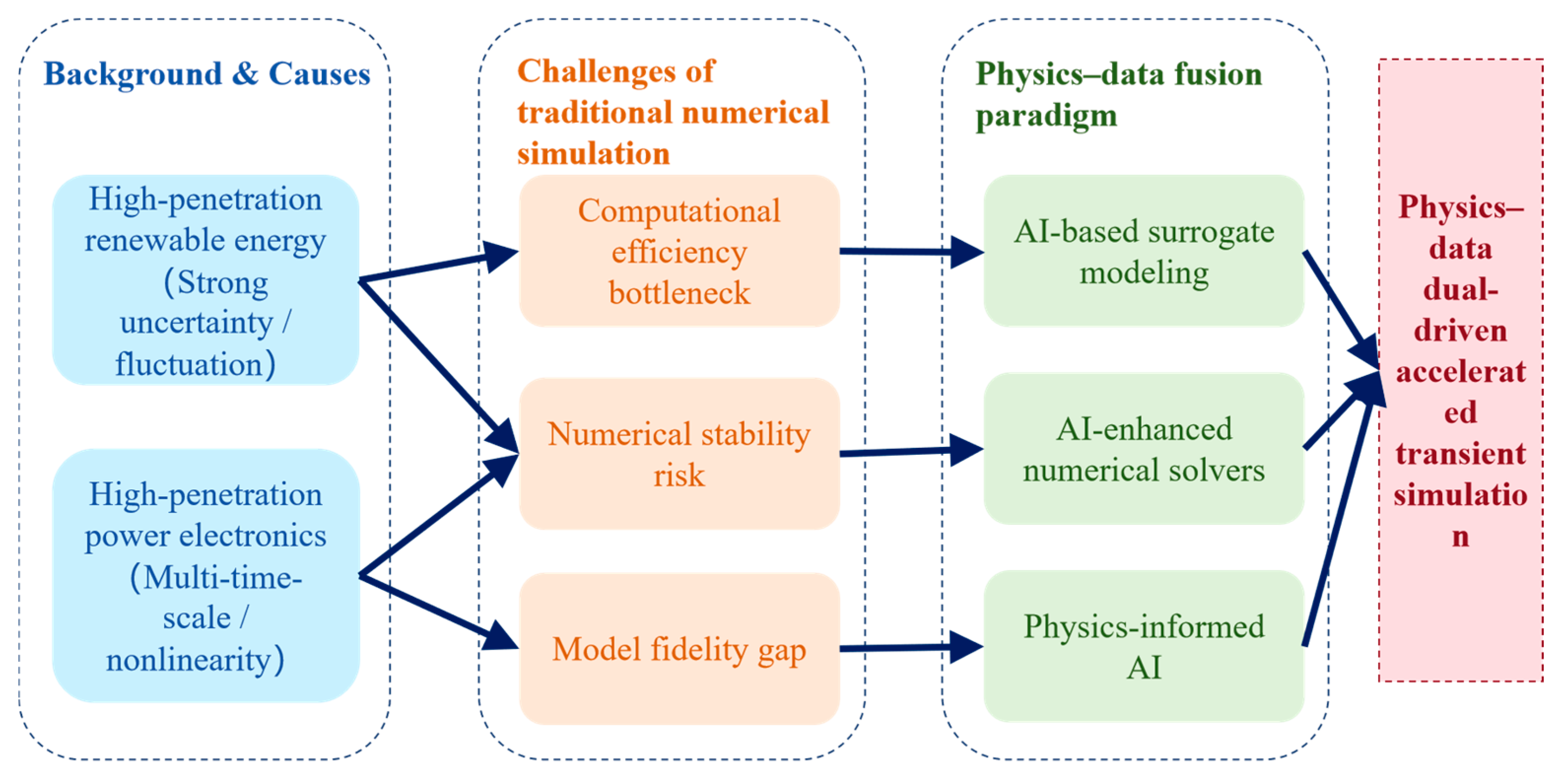
2. Limitations of Traditional Transient Simulation and Evolution of Hybrid Simulation Technologies
2.1. Traditional Transient Simulation
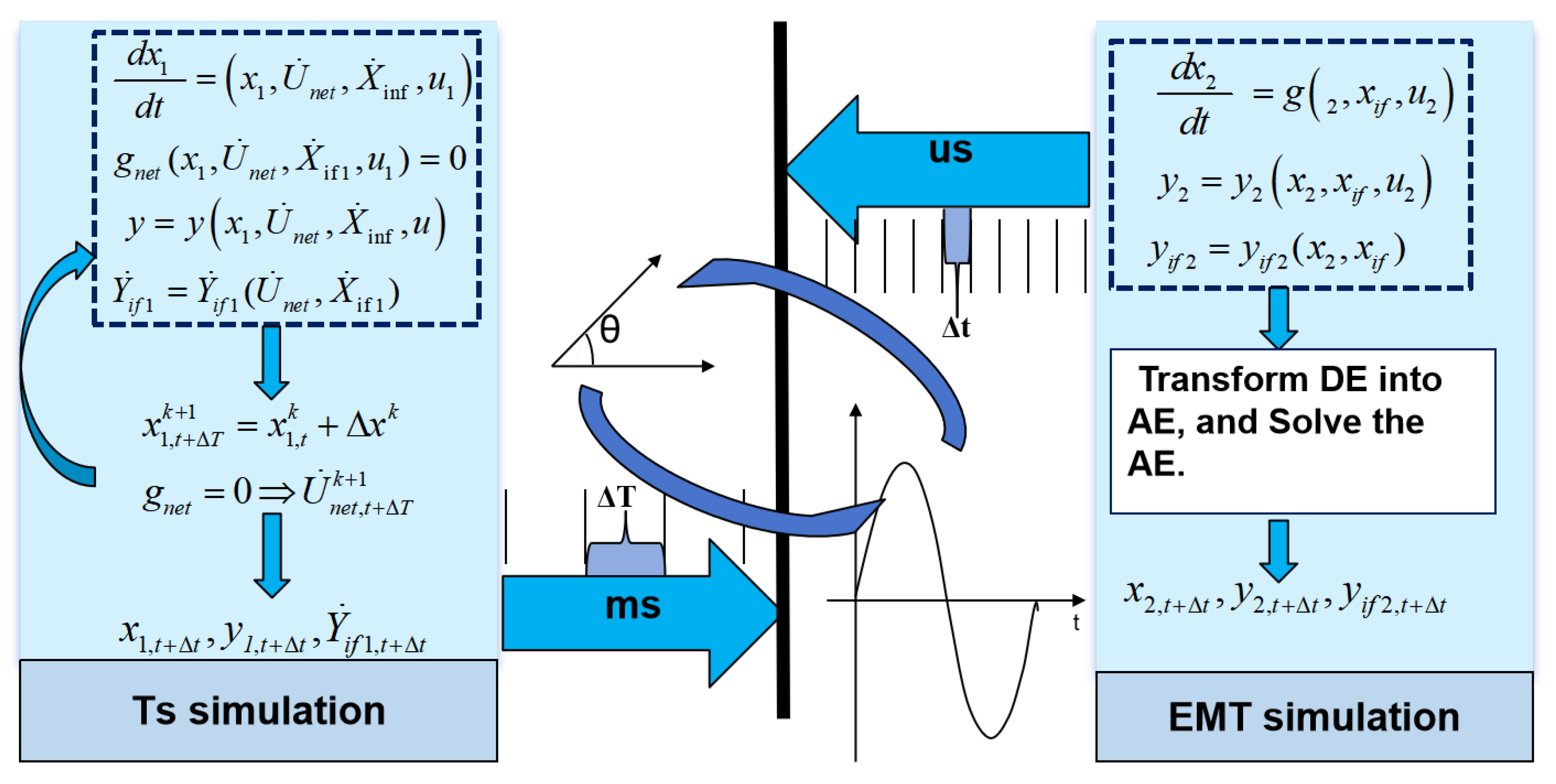
2.1.1. Electromechanical Transient Simulation
2.1.2. EMT Simulation
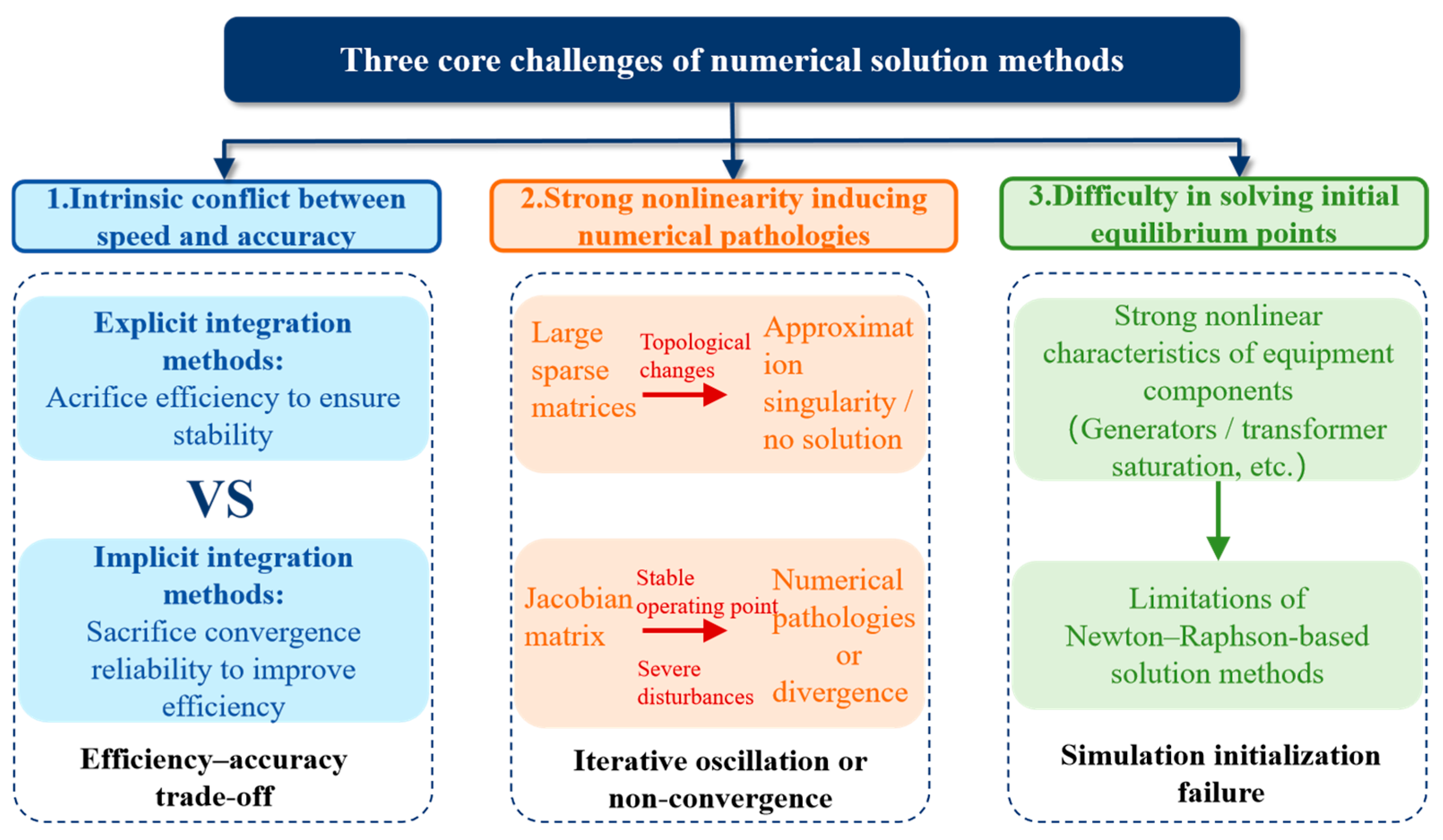
2.2. Analysis of the Common Bottlenecks and Challenges of Traditional Simulation Methods
2.2.1. Bottlenecks in Computational Efficiency
2.2.2. Risks in Numerical Convergence
2.2.3. Gaps in Model Fidelity
2.3. Hybrid Simulation and Its Implications
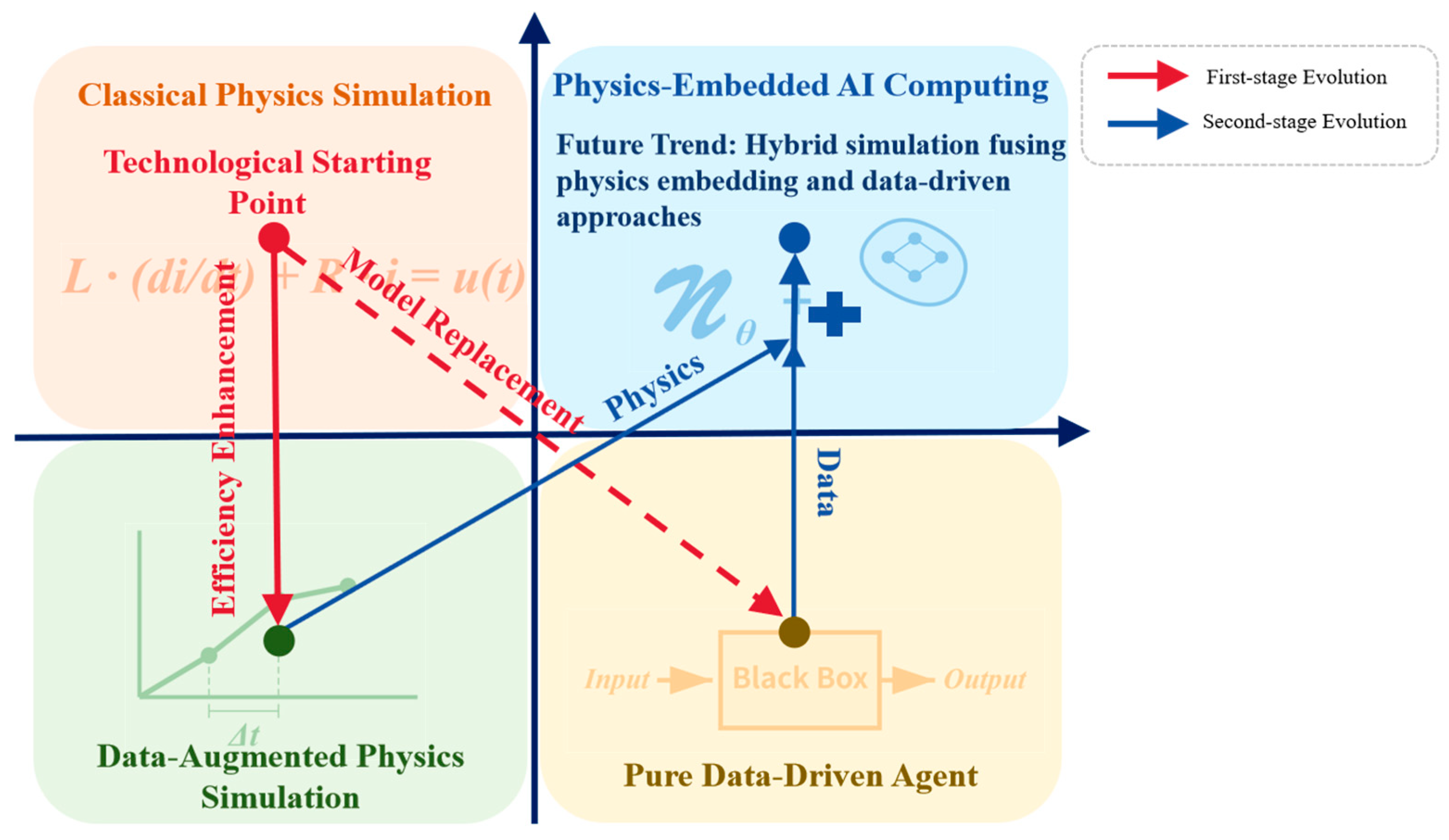
3. Paradigm Evolution: From Multi-Spatiotemporal Scale Coupling to Deep Physics–Data Integration
3.1. Boundaries of Traditional Hybrid Simulation: Inherent Limitations of Structured Modeling
3.2. The Rise in Data Elements: The Dual Impetus of Simulation Drivers
3.3. Construction Logic of the Fusion Paradigm: Complementarity, Embedding, and Closed-Loop
4. Key Technologies and Case Verification of AI-Driven Hybrid Simulation for Power Systems
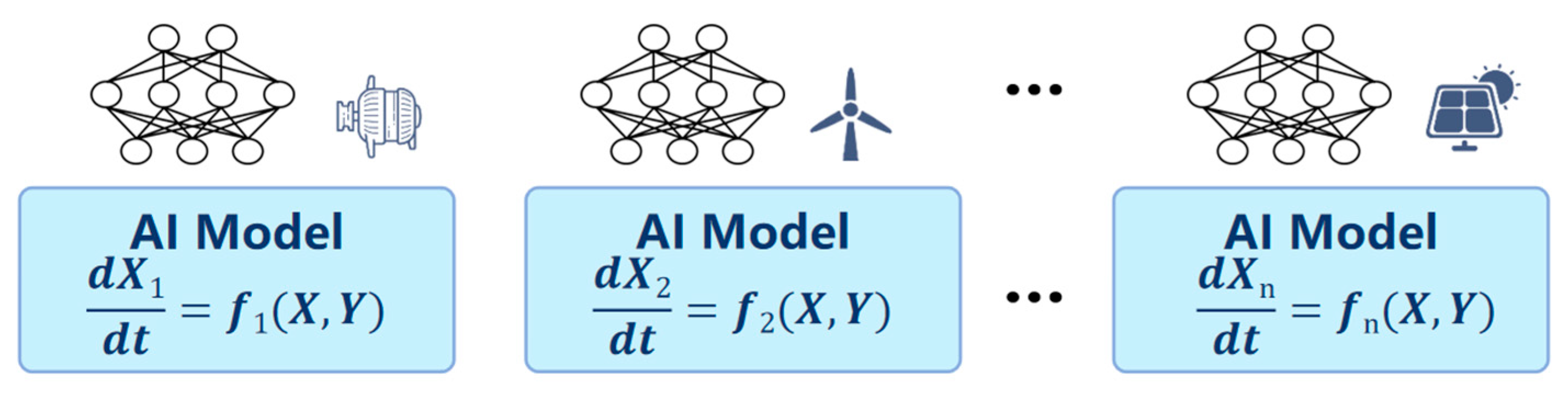
4.1. AI-Enhanced Numerical Solver Technologies: Optimizing the Numerical Solution Process for Acceleration
4.2. AI Surrogate Modeling and Simulation: From Function Fitting to Operator Learning
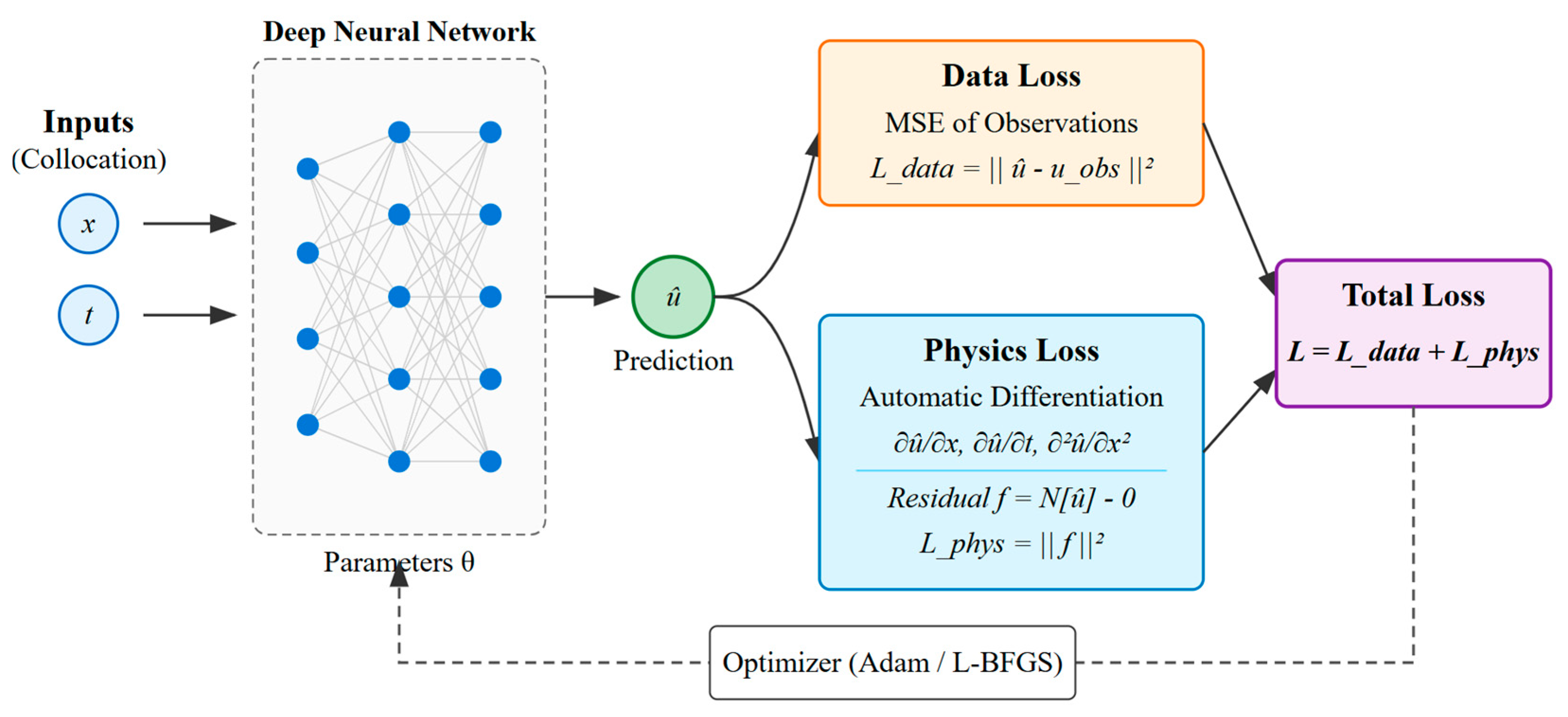
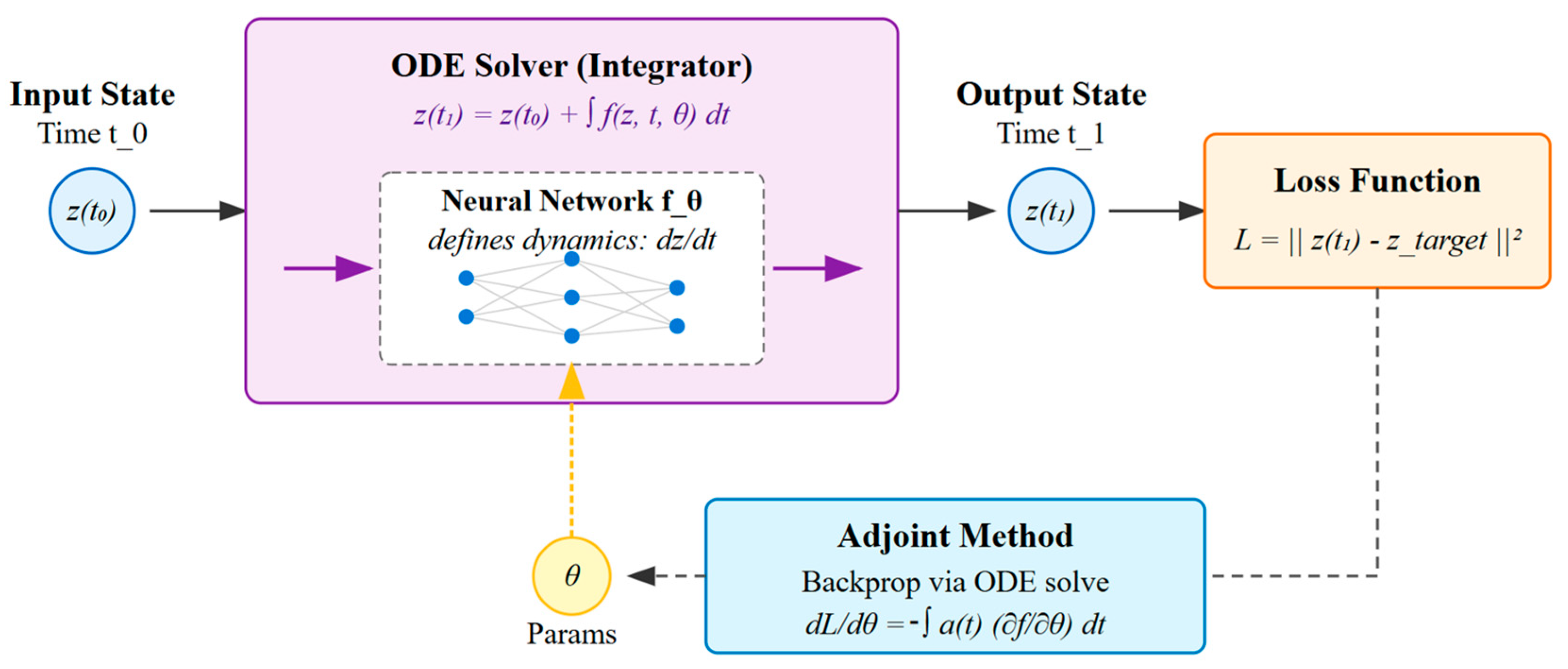
4.3. Physics-Informed AI Modeling and Simulation: Integrating Data with Physical Laws
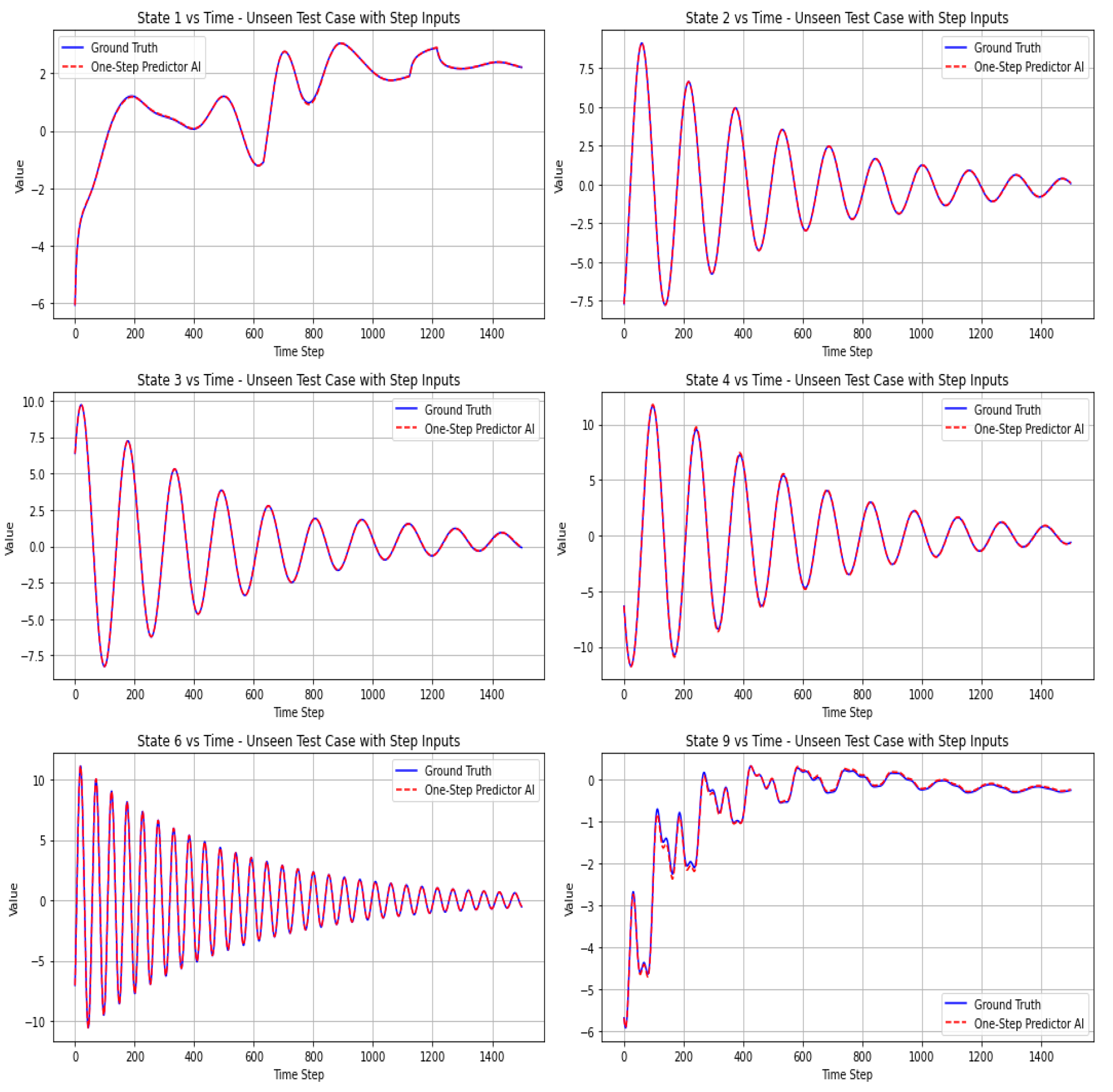
4.4. Case Study Verification
5. Potential and Application Scenarios of Hybrid Simulation
5.1. Analysis of the Potential to Overcome Three Fundamental Obstacles of Traditional Simulation
5.1.1. Overcoming Speed Bottlenecks: Upgrading from “Offline Detailed Calculation” to “Online Second-Level Response”
5.1.2. Overcoming Numerical Challenges: Shifting from “Fragile Solving” to “Robust Prediction”
5.1.3. Bridging the Modeling Gap: Evolving from “Model-Driven” to “Physics-Data Fusion”
5.2. Assessment of Application Scenarios for the New Hybrid Simulation Paradigm
5.2.1. Critical High-Value Scenarios
5.2.2. Foundational Support Scenarios
6. Challenges, Future Outlook and Conclusions
6.1. Critical Challenges and Inherent Risks
6.2. Future Research Directions
6.3. Conclusions
Author Contributions
Funding
Data Availability Statement
Conflicts of Interest
References
- Couto, A.; Estanqueiro, A. Exploring wind and solar PV generation complementarity to meet electricity demand. Energies 2020, 13, 4132. [Google Scholar] [CrossRef]
- Liu, F.; Xu, K.; Liu, Y.; Xu, W.; Ma, R.; Ma, T.; Su, Y.; Liu, C.; Chen, W. Research on a new power system development planning model based on two-tier planning. Front. Energy Res. 2024, 11, 2023. [Google Scholar] [CrossRef]
- Cardenas, B.; Garvey, S.; Baniamerian, Z.; Mehdipour, R. The effect of wind turbines’ load factor on the overall cost of electricity. J. Phys. Conf. Ser. 2024, 2929, 012006. [Google Scholar] [CrossRef]
- Yu, M.; Zhang, Y.; Zhang, S.; Hu, J.; Yang, S.; Du, W.; Li, J. A new adaptive switching control method for the complex operating condition of the grid-connected power system. J. Electr. Comput. Eng. 2022, 1, 7071316. [Google Scholar] [CrossRef]
- Hatziargyriou, N.; Milanovic, J.; Rahmann, C.; Ajjarapu, V.; Canizares, C.; Erlich, I.; Hill, D.; Hiskens, I.; Kamwa, I.; Pal, B.; et al. Definition and classification of power system stability–Revisited & extended. IEEE Trans. Power Syst. 2021, 36, 3271–3281. [Google Scholar] [CrossRef]
- Milano, F.; Dörfler, F.; Hug, G.; Hill, D.J.; Verbič, G. Foundations and challenges of low-inertia systems. In Proceedings of the 2018 Power Systems Computation Conference (PSCC), Dublin, Ireland, 11–15 June 2018. [Google Scholar] [CrossRef]
- Kroposki, B.; Johnson, B.; Zhang, Y.; Gevorgian, V.; Denholm, P.; Hodge, B.M.; Hannegan, B. Achieving a 100% renewable grid: Operating and planning challenges. IEEE Power Energy Mag. 2017, 15, 61–73. [Google Scholar] [CrossRef]
- Wang, X.; Blaabjerg, F. Harmonic stability in power electronics-based power systems: Concept, modeling, and analysis. IEEE Trans. Power Electron. 2019, 10, 2858–2870. [Google Scholar] [CrossRef]
- Park, B. Stochastic Power System Dynamic Simulation Using Parallel-in-Time Algorithm. IEEE Access 2024, 12, 28500–28510. [Google Scholar] [CrossRef]
- Milanović, J.V.; Yamashita, K.; Villanueva, S.M.; Djokić, S.Ž.; Korunović, D.M. International industry practice on power system load modeling. IEEE Trans. Power Syst. 2013, 28, 3038–3046. [Google Scholar] [CrossRef]
- Hiskens, I.A. Nonlinear dynamic model evaluation from disturbance measurements. IEEE Trans. Power Syst. 2001, 16, 702–710. [Google Scholar] [CrossRef]
- Brunton, S.L.; Proctor, J.L.; Kutz, J.N. Discovering governing equations from data by sparse identification of nonlinear dynamical systems. Proc. Natl. Acad. Sci. USA 2016, 113, 3932–3937. [Google Scholar] [CrossRef]
- Sarajcev, P. Machine Learning in Power System Dynamic Security Assessment. Energies 2022, 15, 3962. [Google Scholar] [CrossRef]
- Brosinsky, C.; Westermann, D.; Krebs, R. Recent and prospective developments in power system control centers: Adapting the digital twin technology for application in power system control centers. In Proceedings of the 2018 IEEE International Energy Conference (ENERGYCON), Limassol, Cyprus, 3–7 June 2018. [Google Scholar] [CrossRef]
- Zhao, J.; Gómez-Expósito, A.; Netto, M.; Mili, L.; Abur, A.; Terzija, V.; Kamwa, I.; Pal, B.; Singh, A.K.; Qi, J.; et al. Power system dynamic state estimation: Motivations, definitions, methodologies, and future perspectives. IEEE Trans. Power Syst. 2019, 34, 3188–3198. [Google Scholar] [CrossRef]
- Karniadakis, G.E.; Kevrekidis, I.G.; Lu, L.; Perdikaris, P.; Wang, S.; Yang, L. Physics-informed machine learning. Nat. Rev. Phys. 2021, 3, 422–440. [Google Scholar] [CrossRef]
- Sârbu, N.A.; Petreuș, D. Hardware in the Loop Simulation for Renewable Energy Resources. In Proceedings of the 2025 International Spring Seminar on Electronics Technology (ISSE), Budapest, Hungary, 14–18 May 2025. [Google Scholar] [CrossRef]
- Willard, J.; Jia, X.; Xu, S.; Steinbach, M.; Kumar, V. Integrating scientific knowledge with machine learning for engineering and environmental systems. ACM Comput. Surv. 2022, 55, 1–37. [Google Scholar] [CrossRef]
- Chen, R.T.Q.; Rubanova, Y.; Bettencourt, J.; Duvenaud, D.K. Neural ordinary differential equations. In Proceedings of the 32nd International Conference on Neural Information Processing Systems (NeurIPS), Montréal, QC, Canada, 3–8 December 2018. [Google Scholar] [CrossRef]
- Donon, B.; Liu, Z.; Liu, W.; Guyon, I.; Marot, A.; Schoenauer, M. Deep Statistical Solvers. In Proceedings of the 34th International Conference on Neural Information Processing Systems (NIPS’20), Red Hook, NY, USA, 6–12 December 2020; Available online: https://dl.acm.org/doi/10.5555/3495724.3496387 (accessed on 1 August 2025).
- Zhao, H.; Meng, L.; Jiang, Y.; Li, B. Overview and Prospect of Real Time Simulation Platforms for New-type Power System. High Volt. Eng. 2024, 10, 4611–4626. Available online: http://dianda.cqvip.com/Qikan/Article/Detail?id=7113325466 (accessed on 5 September 2025).
- Huang, S.; Wang, L.; Xiong, L.; Zhou, Y.; Gao, F.; Huang, W. Hierarchical Robustness Strategy Combining Model-Free Prediction and Fixed-Time Control for Islanded AC Microgrids. IEEE Trans. Smart Grid 2025, 16, 4380–4394. [Google Scholar] [CrossRef]
- Huang, H.; Kumar, A.; Lin, Y. From Islanding Detection to Islanding Identification: A Critical Step Towards Self-Healing Distribution Networks with Grid-Forming Inverter Fleets. IEEE Trans. Smart Grid 2026, 1. [Google Scholar] [CrossRef]
- Kumissa, T.L.; Shewarega, F. Fast Power System Transient Stability Simulation. Energies 2023, 16, 7157. [Google Scholar] [CrossRef]
- Fabozzi, D.; Van Cutsem, T. Simplified time-domain simulation of detailed long-term dynamic models. In Proceedings of the 2009 IEEE Power & Energy Society General Meeting, Calgary, AB, Canada, 26–30 July 2009. [Google Scholar] [CrossRef]
- Shah, R.; Mithulananthan, N.; Sode-Yome, A.; Lee, K.Y. Impact of large-scale PV penetration on power system oscillatory stability. In Proceedings of the IEEE PES General Meeting, Minneapolis, MN, USA, 25–29 July 2010. [Google Scholar] [CrossRef]
- Fan, L.; Miao, Z. Mitigating SSR using DFIG-based wind generation. IEEE Trans. Sustain. Energy 2012, 3, 349–358. [Google Scholar] [CrossRef]
- Filizadeh, S.; Belanger, J.; Fernandez, F.; Forsyth, P.; Mahseredjian, J.; Morales, J. Electromagnetic transient modeling and simulation of large power systems: EMT simulators for the future grid. IEEE Power Energy Mag. 2025, 23, 53–65. [Google Scholar] [CrossRef]
- Huang, L.; Guo, H.; Shao, L.; Feng, S.; Yao, S.; Zhao, G. Electromagnetic transient simulation method for voltage source converter. In Proceedings of the 2024 3rd International Conference on Energy, Power and Electrical Technology (ICEPET), Chengdu, China, 17–19 May 2024. [Google Scholar] [CrossRef]
- Tang, Y.; Wan, L.; Hou, J. Full electromagnetic transient simulation for large power systems. Glob. Energy Interconnect. 2019, 2, 29–36. [Google Scholar] [CrossRef]
- Liu, Y.; Song, Y.; Zhao, L.; Chen, Y.; Shen, C. A General Initialization Scheme for Electromagnetic Transient Simulation: Towards Large-Scale Hybrid AC-DC Grids. In Proceedings of the 2020 IEEE Power & Energy Society General Meeting (PESGM), Montreal, QC, Canada, 2–6 August 2020. [Google Scholar] [CrossRef]
- Zadkhast, P.; Lin, X.; Howell, F.; Ko, B.; Hur, K. Practical challenges in hybrid simulation studies interfacing transient stability and electro-magnetic transient simulations. Electr. Power Syst. Res. 2021, 190, 106596. [Google Scholar] [CrossRef]
- Sajjadi, M.; Sun, K. Accelerating power system dynamic simulations with physics-informed neural networks. In Proceedings of the 2025 57th North American Power Symposium (NAPS), Hartford, CT, USA, 26–28 October 2025. [Google Scholar] [CrossRef]
- Li, Y.; Zhou, X.; Wu, Z.; Guo, J. Parallel algorithms for transient stability simulation on PC cluster. In Proceedings of the International Conference on Power System Technology, Kunming, China, 13–17 October 2002. [Google Scholar] [CrossRef]
- Song, Y.; Chen, Y.; Huang, S.; Xu, Y.; Yu, Z.; Xue, W. Efficient GPU-Based Electromagnetic Transient Simulation for Power Systems with Thread-Oriented Transformation and Automatic Code Generation. IEEE Access 2018, 6, 25724–25736. [Google Scholar] [CrossRef]
- Echalih, S.; Abouloifa, A.; Hekss, Z.; Lachkar, I.; El Aroudi, A.; Giri, F. Advanced Nonlinear Control of Single Phase Shunt Active Power Filter Based on Full Bridge Dual Buck Converter. IFAC-PapersOnLine 2022, 55, 659–664. [Google Scholar] [CrossRef]
- Jochen, S.; Baosen, Z.; Spyros, C. PINNSim: A simulator for power system dynamics based on Physics-Informed Neural Networks. Electr. Power Syst. Res. 2024, 235, 110796. [Google Scholar] [CrossRef]
- Verduzco-Durán, J.M.; Medina-Rios, A.; Ramos-Paz, A.; Cisneros-Magaña, R.; Godinez-Delgado, J.C. Electromagnetic transient analysis using a frequency dependent network equivalent for power systems integrating wind generation sources. In Proceedings of the 2024 IEEE Power & Energy Society General Meeting (PESGM), Seattle, WA, USA, 21–25 July 2024. [Google Scholar] [CrossRef]
- Weng, G.; Jiang, R.; Li, Q.; Weng, B.; Cai, Z.; Han, Y.; Lu, S. Power flow calculation of the integrated electric-gas energy system based on the improved continuous Newton method. Zhejiang Electr. Power 2024, 43, 116–122. [Google Scholar] [CrossRef]
- Sun, H.; Xu, S.; Xu, T.; Bi, J.; Zhao, B.; Guo, Q.; He, J.; Song, R. Analysis of the Definition and Classification of Power System Security and Stability. Proc. Chin. Soc. Electr. Eng. 2022, 42, 7796–7809. [Google Scholar] [CrossRef]
- Wang, X.; Harnefors, L.; Blaabjerg, F. Unified impedance model of grid-connected voltage-source converters. IEEE Trans. Power Electron. 2018, 33, 1775–1787. [Google Scholar] [CrossRef]
- Milano, F.; Anghel, M. Impact of time delays on power system stability. IEEE Trans. Circuits Syst. I Reg. Papers 2012, 59, 889–900. [Google Scholar] [CrossRef]
- He, X.; Geng, H.; Mu, G. Modeling of wind turbine generators for power system stability studies: A review. Renew. Sustain. Energy Rev. 2021, 143, 110865. [Google Scholar] [CrossRef]
- Alexander, F.; Turhan, D.; Mats, L. Aggregated models of active distribution networks for stability studies of large transmission systems. Electr. Power Syst. Res. 2022, 212, 108607. [Google Scholar] [CrossRef]
- Zhang, Y.; Jiang, H.; Gao, K.; Zhang, J.; Liu, J.; Wang, Y. Generator Model Validation and Parameter Calibration Based on PMU Measurement Data. In Proceedings of the 2019 IEEE International Conference on Energy Internet (ICEI), Nanjing, China, 27–31 May 2019. [Google Scholar] [CrossRef]
- Huang, K.; Liu, Y.; Sun, K.; Qiu, F. PI-Controlled Variable Time-Step Power System Simulation Using an Adaptive Order Differential Transformation Method. IEEE Trans. Power Syst. 2024, 39, 6332–6344. [Google Scholar] [CrossRef]
- Sado, K.; Peskar, J.; Ionita, S.; Hannum, J.; Downey, A.; Booth, K. Real-time Electro-thermal Simulations for Power Electronic Converters. In Proceedings of the 2024 IEEE Applied Power Electronics Conference and Exposition (APEC), Long Beach, CA, USA, 25–29 February 2024. [Google Scholar] [CrossRef]
- Li, G.; An, T.; Liang, J.; Liu, W.; Tibin, J.; Lu, J.; Lan, Y. Studies of commutation failures in hybrid LCC/MMC HVDC systems. Glob. Energy Interconnect. 2020, 3, 193–204. [Google Scholar] [CrossRef]
- Zhang, P.; Martí, J.; Dommel, H.W. Shifted frequency analysis-EMTP multirate simulation of power systems. Electr. Power Syst. Res. 2010, 57, 2564–2574. [Google Scholar] [CrossRef]
- Zhao, C.; Miao, W.; Zhao, H.; He, J.; Cheng, Y.; Zhou, G.; Jiang, Y. Real-Time electromagnetic and electromechanical hybrid simulation based on RTLAB-power factory. In Proceedings of the 2024 IEEE 2nd International Conference on Control, Electronics and Computer Technology (ICCECT), Jilin, China, 26–28 April 2024. [Google Scholar] [CrossRef]
- Dong, Y.; Guo, J.; Miao, S.; Hou, J.; Han, J.; Ma, S.; Wang, T. A novel electromagnetic transient simulation method of large-scale AC power system with high penetrations of DFIG-based wind farms. IEEE Access 2022, 10, 53372–53383. [Google Scholar] [CrossRef]
- Xiong, M.; Wang, B.; Vaidhynathan, D.; Maack, J.; Liu, Y.; Abhyankar, S.; Palmer, B.; Henriquez-Auba, R.; Hoke, A.; Sun, K.; et al. EMT-TS Hybrid Simulation for Large Power Grids Considering IBR-Driven Dynamics. In Proceedings of the IECON 2024—50th Annual Conference of the IEEE Industrial Electronics Society, Chicago, IL, USA, 3–6 November 2024. [Google Scholar] [CrossRef]
- Hu, J.; Wang, Q.; Ye, Y.; Tang, Y. High-resolution real-time power systems state estimation: A combined physics-embedded and data-driven perspective. IEEE Trans. Power Syst. 2025, 40, 1532–1544. [Google Scholar] [CrossRef]
- Zhu, L.; Hill, D.J.; Lu, C. Hierarchical deep learning machine for power system online transient stability prediction. IEEE Trans. Power Syst. 2020, 35, 2399–2411. [Google Scholar] [CrossRef]
- Lindi, T.; Shewarega, F. Adaptive order and step-size differential transformation method-based power system transient stability simulation. Aust. J. Electr. Electron. Eng. 2024, 22, 212–225. [Google Scholar] [CrossRef]
- Song, W.; Lin, J.; He, J.; Lu, C. PMU-based Online Real-time Linear Power Flow Calculation Method with Minimizing Probability Errors. CSEE J. Power Energy Syst. 2024, 1–12. Available online: https://ieeexplore.ieee.org/document/10899787 (accessed on 22 January 2026).
- Song, W.; Lu, C.; Lin, J.; Fang, C.; Liu, S. A low-quality PMU data identification method with dynamic criteria based on spatial-temporal correlations and random matrices. Appl. Energy 2023, 343, 121213. [Google Scholar] [CrossRef]
- Moghassemi, A.; Ebrahimi, S.; Padmanaban, S.; Mitolo, M.; Holm-Nielsen, J.B. Two fast metaheuristic-based MPPT techniques for partially shaded photovoltaic system. Int. J. Electr. Power Energy Syst. 2022, 137, 107567. [Google Scholar] [CrossRef]
- Misyris, G.S.; Venzke, A.; Chatzivasileiadis, S. Physics-Informed Neural Networks for Power Systems. In Proceedings of the 2020 IEEE Power & Energy Society General Meeting (PESGM), Montreal, QC, Canada, 3–6 August 2020; Available online: https://api.semanticscholar.org/CorpusID:207852456 (accessed on 12 August 2025).
- Wen, L.; Xi, J.; Hu, H.; Xiong, L.; Lu, G.; Xiao, T. Neural ODE-based dynamic modeling and predictive control for power regulation in distribution networks. Energies 2025, 18, 3419. [Google Scholar] [CrossRef]
- Zamzam, A.S.; Sidiropoulos, N.D. Physics-aware neural networks for distribution system state estimation. IEEE Trans. Power Syst. 2020, 35, 4347–4356. [Google Scholar] [CrossRef]
- Huang, Q.; Huang, R.; Hao, W.; Tan, J.; Fan, R.; Huang, Z. Adaptive power system emergency control using deep reinforcement learning. IEEE Trans. Smart Grid 2020, 11, 1171–1182. [Google Scholar] [CrossRef]
- Duan, J.; Shi, D.; Diao, R.; Li, H.; Wang, Z.; Zhang, B.; Bian, D.; Yi, Z. Deep-reinforcement-learning-based autonomous voltage control for power grid operations. IEEE Trans. Smart Grid 2020, 35, 814–817. [Google Scholar] [CrossRef]
- Liu, C.; Su, P.; Bai, H.; Guo, X.; Martínez, A.; Garcia, J. An FPGA-accelerated multi-level AI-integrated simulation framework for multi-time domain power systems with high penetration of power converters. Energy AI 2025, 21, 100574. [Google Scholar] [CrossRef]
- Sun, M.; Konstantelos, I.; Strbac, G. A deep learning-based feature extraction framework for system security assessment. IEEE Trans. Smart Grid 2019, 10, 5007–5020. [Google Scholar] [CrossRef]
- Zhang, Y.; Xu, Y.; Dong, Z.Y.; Xu, J.X.; Wong, K.P. Intelligent early warning of power system dynamic insecurity risk: Toward near-real-time assessment. IEEE Trans. Ind. Inform. 2017, 13, 2544–2554. [Google Scholar] [CrossRef]
- Yu, J.Q.; Hill, D.J.; Lam, A.Y.S.; Gu, J.; Li, V.O.K. Intelligent time-adaptive transient stability assessment system. IEEE Trans. Power Syst. 2018, 33, 1049–1058. [Google Scholar] [CrossRef]
- Wang, B.; Fang, B.; Wang, H.; Liu, H.; Liu, Y. Power system transient stability assessment based on big data and the core vector machine. IEEE Trans. Smart Grid 2016, 7, 2561–2570. [Google Scholar] [CrossRef]
- Lu, L.; Jin, P.; Pang, G.; Zhang, Z.; Karniadakis, G.E. Learning nonlinear operators via DeepONet based on the universal approximation theorem of operators. Nat. Mach. Intell. 2021, 3, 218–229. Available online: https://www.nature.com/articles/s42256-021-00302-5 (accessed on 1 October 2025). [CrossRef]
- Raissi, M.; Perdikaris, P.; Karniadakis, G.E. Physics-informed neural networks: A deep learning framework for solving forward and inverse problems involving nonlinear partial differential equations. J. Comput. Phys. 2019, 378, 686–707. [Google Scholar] [CrossRef]
- Falas, S.; Asprou, M.; Konstantinou, C.; Michael, M.K. Physics-informed neural networks for accelerating power system state estimation. In Proceedings of the 2023 IEEE PES Innovative Smart Grid Technologies Europe (ISGT EUROPE), Grenoble, France, 23–26 October 2023. [Google Scholar] [CrossRef]
- Schiassi, E.; De Florio, M.; D’Ambrosio, A.; Mortari, D.; Furfaro, R. Physics-informed neural networks and functional interpolation for data-driven parameters discovery of epidemiological compartmental models. Mathematics 2021, 9, 2069. [Google Scholar] [CrossRef]
- Zhang, R. Artificial intelligence in power system security and stability analysis: A comprehensive review. Electr. Eng. Sys. Sci. 2024. [Google Scholar] [CrossRef]
- Cuevas, M.; Álvarez-Malebrán, R.; Rahmann, C.; Ortiz, D.; Peña, J.; Rozas-Valderrama, R. Artificial intelligence techniques for dynamic security assessments—A survey. Artif. Intell. Rev. 2024, 57, 340. [Google Scholar] [CrossRef]
- Huang, Q.; Vittal, V. Advanced EMT and phasor-domain hybrid simulation with simulation mode switching capability. IEEE Trans. Power Syst. 2018, 33, 6298–6308. [Google Scholar] [CrossRef]
- Yang, K.; Wang, X.; Chen, X.; Wang, R.; Geng, G.; Jiang, Q. Data-driven dynamic modeling for inverter-based resources using neural networks. Nat. Commun. 2025, 16, 11696. [Google Scholar] [CrossRef] [PubMed]
- Ye, Z.; Bao, W.; Li, X.; Li, Z.; Lu, C.; Zhang, L. Research on online perception method of urban rail train information driven by data-physical model fusion. Proc. Chin. Soc. Electr. Eng. 2024, 1–14. Available online: https://link.cnki.net/doi/10.13334/j.0258-8013.pcsee.251939 (accessed on 22 January 2026).
- Jasmin, Y.; Lim, J.; O’Grady, D.; Downar, T.; Duraisamy, K. A hybrid surrogate modeling framework for the Digital Twin of a Fluoride-salt-cooled High-temperature Reactor (FHR). Nucl. Eng. Des. 2025, 433, 113690. [Google Scholar] [CrossRef]
- Liu, X.; Zou, Z.; Tang, J.; Wang, Z.; Cheng, M. Modeling and stability analysis of converter-based power systems. In Proceedings of the 2021 IEEE Sustainable Power and Energy Conference (iSPEC), Nanjing, China, 23–25 December 2021. [Google Scholar] [CrossRef]
- Liu, D.; Zhang, J.; Lu, C. Application methods and challenges of artificial Intelligence in power system stability analysis and control. Sci. China Technol. Sci. 2026, 56, 178–200. Available online: https://link.cnki.net/urlid/11.5844.TH.20260107.1030.002 (accessed on 22 January 2026). [CrossRef]
- Khan, A.H.; Omar, S.; Mushtary, N.; Verma, R.; Kumar, D.; Alam, S. Digital Twin and Artificial Intelligence Incorporated with Surrogate Modeling for Hybrid and Sustainable Energy Systems; Fathi, M., Zio, E., Eds.; Springer: Berlin/Heidelberg, Germany, 2022. [Google Scholar] [CrossRef]



| Literature Type | Main Focus | Contribution of This Work |
|---|---|---|
| Pure Data-Driven Reviews [21] | Application of deep learning (CNN, LSTM) in stability assessment. | Systematizes “Physics-Embedded AI” to ensure interpretability and physical fidelity beyond pure data fitting. |
| Hardware/Platform Reviews [18] | Real-time simulation platforms (FPGA, GPU) and hardware architectures. | Focuses on algorithmic innovations capable of leveraging these hardware resources. |
| Specific Technical Studies [22,23] | Novel control or sensing strategies for specific scenarios. | Synthesizes specific solutions into a unified macro-level “Physics-Data Integrated” framework, bridging component-level techniques with system-level simulation. |
| This Review | Systematic review of the Physics–Data Integrated Hybrid Simulation paradigm. | Clarifies the intrinsic motivation of paradigm evolution; Provides a hierarchical classification of hybrid technologies; Analyzes the potential to break through efficiency and fidelity bottlenecks. |
| Electromechanical Transient Simulation | EMT Simulation | Hybrid Simulation | ||
|---|---|---|---|---|
| Accuracy | Electromechanical Time Scale (ms–s) | ✔ | ✔ | ✔ |
| Electromagnetic Time Scale (μs–ms) | ✖ | ✔ | ✔ | |
| Power Electronic Switching Dynamics | ✖ | ✔ | ✔ | |
| Large-scale System Modeling Capability | ✔ | ✖ | ✔ | |
| Numerical Convergence under Strong Non-linearity | ✔ | ✖ | ✖ | |
| Ease of Achieving Faster-than-Real-Time | ✔ | ✖ | ✖ | |
| Unified Real-Time TS-EMT Simulation for Large-Scale Systems | ✖ | ✖ | ✖ | |
| Unified Multi-Time-Scale Simulation Framework without Interfaces | ✖ | ✖ | ✖ | |
| Improving Accuracy Using Real System Measurement Data | ✖ | ✖ | ✖ | |
| Implementation Technology | |||
|---|---|---|---|
| Equation Modeling & Numerical Solution | AI Modeling & Inference | ||
| Information | Physical Laws | Classical Physical Simulation: 1. Electromechanical/EMT time-domain simulation 2. Numerical integration (Implicit/Explicit) 3. Newton-Raphson method | Physics-Embedded AI Computing: 1. Physics-Informed Neural Networks (PINNs) 2. Neural Ordinary Differential Equations (Neural ODEs) 3. Conservative/Symplectic constrained Neural Networks, etc. |
| Data | Data-Enhanced Physical Simulation: 1. AI-enhanced numerical solvers 2. Reinforcement learning for adaptive step-size 3. Parameter identification and correction based on measured data | Pure Data-Driven Surrogate: 1. AI-based surrogate modeling 2. Neural Operators 3. End-to-end learning | |
| Implementation Technology | |||
|---|---|---|---|
| Equation Modeling & Numerical Solution | AI Modeling & Inference | ||
| Information | Physical Laws | Classical Physical Simulation: 1. High fidelity (dependent on model accuracy) 2. Strong interpretability (White-box) 3. Computationally expensive, poor convergence | Physics-Embedded AI Computing: 1. Strong mechanism constraints 2. Small-sample learning: Overcomes data scarcity and significantly reduces data labeling costs by using physical laws as unsupervised labels. 3. Avoids traditional numerical convergence issues 4. Evaluation Metrics: Multi-objective metrics combining empirical Data Loss (e.g., MSE) and Physics Residual Loss (e.g., PDE residuals). |
| Data | Data-Enhanced Physical Simulation: 1. Improves speed, efficiency, and robustness of traditional simulation 2. The initial fusion of measured data without changing the core solution framework 3. Evaluation Metrics: Effectiveness is primarily evaluated by tracking the reduction in iteration steps, computational time saved, and improved convergence rates under ill-conditioned scenarios. | Pure Data-Driven Surrogate: 1. Extreme inference speed (Orders of magnitude faster) 2. Relies on massive labeled data (Black-box, highly vulnerable to data scarcity) 3. Generalization capability is the core challenge 4. Evaluation Metrics: Performance is typically evaluated relying solely on statistical metrics (e.g., MSE, MAE, RMSE) without physical bounding guarantees. | |
Disclaimer/Publisher’s Note: The statements, opinions and data contained in all publications are solely those of the individual author(s) and contributor(s) and not of MDPI and/or the editor(s). MDPI and/or the editor(s) disclaim responsibility for any injury to people or property resulting from any ideas, methods, instructions or products referred to in the content. |
© 2026 by the authors. Licensee MDPI, Basel, Switzerland. This article is an open access article distributed under the terms and conditions of the Creative Commons Attribution (CC BY) license.
Share and Cite
Jiao, R.; Zhang, S.; Zhang, H.; Deng, B.; Zhang, T.; Tang, S.; Hu, X.; Zhang, W. Physics–Data-Integrated Hybrid Simulation for Transient Stability in New Power Systems: Status, Challenges, and Prospects. Energies 2026, 19, 1687. https://doi.org/10.3390/en19071687
Jiao R, Zhang S, Zhang H, Deng B, Zhang T, Tang S, Hu X, Zhang W. Physics–Data-Integrated Hybrid Simulation for Transient Stability in New Power Systems: Status, Challenges, and Prospects. Energies. 2026; 19(7):1687. https://doi.org/10.3390/en19071687
Chicago/Turabian StyleJiao, Ruiqi, Shuqing Zhang, Hao Zhang, Beila Deng, Tongtong Zhang, Shaopu Tang, Xianfa Hu, and Weijie Zhang. 2026. "Physics–Data-Integrated Hybrid Simulation for Transient Stability in New Power Systems: Status, Challenges, and Prospects" Energies 19, no. 7: 1687. https://doi.org/10.3390/en19071687
APA StyleJiao, R., Zhang, S., Zhang, H., Deng, B., Zhang, T., Tang, S., Hu, X., & Zhang, W. (2026). Physics–Data-Integrated Hybrid Simulation for Transient Stability in New Power Systems: Status, Challenges, and Prospects. Energies, 19(7), 1687. https://doi.org/10.3390/en19071687