


Abstract
Compressed air leakages represent a major source of energy waste and financial loss in industrial facilities. However, accurately detecting and quantifying these leaks remains challenging due to the wide variation in the accuracy, cost, usability, and practical applicability of available methods. This paper presents a structured review and evaluation of leakage localization and quantification methods for compressed air systems (CASs), categorized into hardware-, software-, and non-technical-based approaches. Based on expert interviews and a comprehensive literature review, a set of evaluation criteria was defined and applied within a multi-criteria decision analysis (MCDA) framework. The Analytic Hierarchy Process (AHP) was used to derive criteria weights, while the Technique for Order Preference by Similarity to Ideal Solution (TOPSIS) was employed to rank the alternatives separately for localization and quantification tasks. To enhance practical relevance, five expert interviews were conducted with industrial stakeholders from diverse professional backgrounds, including maintenance engineers and energy managers. A questionnaire was also distributed to assess the methods. The results provide illustrative insights into the relative suitability of different methods. Within the scope of this exploratory study, from a practical industrial perspective, the compressor duty cycle method and non-intrusive load monitoring (NILM) appear to be promising approaches to leakage quantification, while ultrasonic detection is preferred for localization. Notably, discrepancies between questionnaire-based rankings and expert interview insights highlight the limitations of purely survey-driven evaluations. The proposed framework supports industrial decision-makers in selecting leakage detection and quantification methods by balancing technical performance, implementation effort, and operational constraints, thereby contributing to reduced energy losses and improved system efficiency.
Keywords:
compressed air systems (CASs); air leakage localization and quantification; energy efficiency; ultrasonic detection; nonintrusive load monitoring (NILM); master controller; multi-criteria decision analysis (MCDA); analytic hierarchy process (AHP); technique for order preference by similarity to ideal solution (TOPSIS) 1. Introduction
Compressed air is one of the most important utilities in industrial processes and is widely used. According to a 2021 study by the German Environment Agency (UBA) [1], about 80% of the energy consumption of CAS is attributed to screw and piston compressors, while 20% is related to turbo compressors. In addition, approximately 80% of compressed air is used for material transport or processing applications such as cooling, drying, and dispersing, while the remaining 20% is used to drive machinery and technology.
According to a comprehensive study by Radgen and Blaustein (2001) [2], compressed air systems (CASs) account for approximately 10% of industrial electricity consumption in the European Union (EU-14). In Germany alone, the Arbeitsgemeinschaft Energiebilanzen (AGEB) [3] estimated that CAS consumed around 13.9 TWh in 2022, representing nearly 7% of total industrial electricity demand.
Given the EU’s reliance on imported energy, efficiency improvements are of particular importance. Directive (EU) 2023/1791 [4] requires that overall energy consumption be reduced by 11.7% by 2030 compared to the 2020 baseline. Similarly, Germany’s Energy Efficiency Act (EnEfG) [5], passed in September 2023, stipulates reductions of 26.5% in final energy consumption and 39.3% in primary energy consumption by 2030, compared to 2008 baselines.
Reducing compressed air leaks is one of the most cost-effective measures to enhance energy efficiency, with economic savings potential estimated at 9–16% of CAS electricity consumption ([6] p. 56 with 9%, [2] p. 2 with 16%, [7] p. 38 with 14%). However, due to a lack of awareness of the energy costs associated with compressed air, as well as the difficulties in accurately identifying and quantifying leakages, the elimination of leaks remains a challenge in many companies and is often neglected. It is important to note that compressors are inherently inefficient due to the significant heat generated during compression. The compressed air is usually treated afterward—using dryers and filters—to achieve the purity classes defined in ISO 8573-1:2010 [8], depending on the area of application.
Based on practical experience and the study of Kamenszká et al. [9], the most common causes of compressed air leaks include leaking valves, defective pneumatic cylinders, damaged seals (e.g., bolted, flanged, or screw connections), worn hoses and couplings, improperly installed components such as dryers and filters, uncontrolled blow-off devices, aging or poorly maintained pneumatic tools, and unused machines that remain connected to the air supply.
Murvay and Silea (2012) [10] classified leakage detection methods into three categories:
- Non-technical methods (biological methods).
- Hardware-based methods.
- Software-based methods.
Biological methods rely on natural human or animal senses such as hearing, smell, and sight to detect environmental changes. Hardware methods use specialized devices to enhance sensory perception, allowing staff to monitor factors that cannot be easily detected by human senses alone. Software methods rely on algorithms and computer programs to analyze data from sensors or systems, monitoring parameters such as temperature changes, flow rate, and pressure fluctuations.
While differences in physical properties between technical gases (such as methane) and ambient air are used in leakage detection methods for gases, only a limited number of leakage detection methods can be applied to compressed air systems (CASs). Methane leakage detection is particularly important because methane is a highly potent greenhouse gas, and associated emissions can lead to significant environmental and economic impacts. Over a 20-year time horizon, methane exhibits a greenhouse effect more than 80 times higher than that of CO2, making leak detection and mitigation especially critical [11]. Based on various studies (see the following) and expert interviews, the following methods are identified and reviewed to detect or quantify compressed air leaks.
- Hissing air detection by sound [9], soap bubble testing or leakage spray [9,12], as a non-technical method.
- Ultrasound technology [9,12], infrared thermography [12] and flow meters as a hardware method.
- The determination of leakage by emptying the vessel [9] and the determination of leakage by measuring the compressor duty cycle [9], nonintrusive load monitoring [13,14] or any automatic method based on software [15] (most based on historical values and anomalies [16] in volume flow or pressure [12]). For example, master controller data can be used to compare current and historical data.
This study is based on a comprehensive literature review and interviews with experts working in the field of compressed air systems. A questionnaire (see Appendix B) was developed to complement the interview findings and gather additional insights.
The main contributions of this study can be summarized as follows:
- 1.
- A comprehensive review and categorization of compressed air leak detection and quantification methods, including hardware-, software-, and non-technical approaches.
- 2.
- The development of a structured multi-criteria decision analysis (MCDA) framework combining the Analytic Hierarchy Process (AHP) and the Technique for Order Preference by Similarity to Ideal Solution (TOPSIS).
- 3.
- The integration of expert knowledge through interviews and questionnaires to derive evaluation criteria and weights relevant for industrial applications.
- 4.
- An exploratory ranking of leakage detection and quantification methods, highlighting differences between theoretical performance and practical industrial applicability.
2. Materials and Methods
This section consists of five subsections. The first subsection introduces the expert interview panel. The second subsection presents the quantification methods, the third subsection describes the localization methods, the fourth subsection outlines the evaluation criteria, and the final subsection introduces the multi-criteria decision analysis.
2.1. Expert Interviews
For this study, five experts working in Germany and representing different professional fields related to compressed air systems were interviewed. The group consisted of:
- A sales representative from a manufacturer of testing devices based on ultrasonic sensor technology;
- A service manager from a compressor manufacturer;
- A service manager from a large company with numerous locations and extensive compressed air applications;
- An energy management officer from a company that supplies fittings, pressure regulators, and electronic components for the safe filling of containers with fluids;
- And an employee from a service provider for leakage detection and measurement technology, who, in addition to measurement interfaces, also offers services such as data analysis, system design, and leak detection.
To protect personal data, all interview partners were anonymized, and only aggregated results are reported. Leakage detection methods are further categorized into localization and quantification methods, depending on their intended purpose. The expert panel size is limited; therefore, the results should be interpreted as exploratory, rather than statistically representative. The objective of the expert input was to provide informed professional judgment to support the development and demonstration of the MCDA framework.
2.2. Leakage Quantification Methods
The selection of an appropriate method depends primarily on the intended objective. Some methods are suitable for continuous monitoring, whereas others are applied temporarily on an as-needed basis. In addition, the size of the company and the complexity of the compressed air system play a significant role in determining the most appropriate approach.
For example, the compressed air storage tank emptying method is suitable for relatively small companies with simple system configurations. In contrast, methods such as measuring compressor duty cycles, utilizing master controllers, or installing flow meters are generally more practical and effective for larger companies with more complex compressed air systems. All leakage quantification methods are described below:
- Determining Leakage by Emptying The Vessel: In this method, the pressure drop in the compressed air storage tank is monitored over a defined period of time. To estimate the leakage in the system during this observation, the supply line must be shut off, and all consumers must be switched off. In addition, the volume of the pipe network should be less than 10% of the compressed air storage tank volume in order to achieve good measurement accuracy [9].However, as the method description states, the network volume is required as an input parameter, which is difficult to determine in large systems. Especially in the case of compressed air systems, most pipe networks have grown historically, and the total network volume is often not readily available. However, this method is easy to apply in small companies. This method is applied temporarily and only deployed when required.
- Determination of Leakage by Measuring Compressor Duty Cycle: Similar to the previous method, all consumers must be switched off. However, in this case, the compressor remains in operation and is connected to the pipe network. This method can be applied to compressed air systems with fixed-speed compressors. Due to leakage, the system pressure decreases, and the compressor operates until this pressure drop is compensated. The total running time of the compressor should cover at least five compressor switching intervals to achieve good accuracy [9]. This method is less time-consuming than the previous one but is more difficult to apply because it requires two timers: one to record the compressor operating time and another to measure the total observation period. It is also possible to use a variable-speed drive (VSD) for this method; however, the leakage must be in the operating control range of the compressor. Similar to the previous method, this approach is applied only when required.
- Non-Intrusive Load Monitoring (NILM): Typically, at large companies, production and consumption are automatically monitored using software, such as a master controller. This approach is software-based and uses historically stored data as reference parameters to compare differences between current and past operating conditions. Several methods are commonly used to detect leakages, including evaluating power consumption during non-production periods of the compressed air system (CAS) [14], estimating leakage based on variable-speed-drive behavior during non-production periods [15], automatic leakage detection through pressure drop measurement, and anomaly detection using pressure-drop patterns within time-series data [16]. According to the conducted interviews, a master controller is feasible and recommended for companies operating at least three compressors, including one with a VSD. It is also possible to use a fixed-speed compressor; however, a master controller is needed for load optimization. Without a VSD, optimizing the load becomes much more difficult. These systems are also used to efficiently operate multiple compressors and typically synchronize maintenance schedules to minimize downtime. They are limited in precision due to their dependency on data quality and operational stability. This method requires more effort and investigation than the previously described methods; however, it is already implemented at most large companies for monitoring production and demand and can, therefore, enhance both processes. These methods are continuous; therefore, in the case of leakage estimation, stored data are available, and no temporary deployment is required.
- Flow sensors: Typically, most large companies apply an energy management system in accordance with ISO 50001 [17]. For the continuous monitoring of efficient compressed air usage, flow measurement is essential. This measurement helps determine consumption profiles and supports resource management. As a side effect, flow sensors can also be used to identify leakage at the location of the measurement device. As shown, this method is only applicable when flow meters are installed at appropriate locations. However, the required number of installations can quickly make this approach expensive. Therefore, it is mainly practical for larger companies with highly monitored consumption, while it is often not feasible for smaller companies. Similar to the previous method, this approach is continuously applied for monitoring purposes.
2.3. Leakage Localization Methods
With the methods described in Section 2.2, it is not possible to localize a leakage; so, the following describes the localization methods.
- Soap Bubble Testing: A spray containing mild soapy water is applied to locations with a higher probability of leakage. The formation of bubbles indicates the exact location of the leak [9]. This method does not require extensive investigation and is easy to use; however, it is time-consuming and difficult to apply in all locations. Furthermore, the reliability of this method is limited in the presence of dirt or contamination, and it can only be applied when the approximate location of the leakage is known. Therefore, it is often not practical for large systems and must be combined with the other following methods, although it allows very precise leakage localization.
- Hissing Air Detection by Sound: If company staff are trained to be attentive to unusual sounds, they can use their human perception to roughly locate leakages. This method can be easily disturbed by other ambient sounds and requires a high level of operator attention; therefore, it is generally not practical in large industrial facilities. It can still provide useful hints and may be combined with the previous method to identify the location more precisely. Using this method, it is generally possible to estimate large leakages, while smaller leaks often remain undetected [9]. This method performs best during non-production periods and in cases where large leakages are present.
- Ultrasound Detection: When pressurized air escapes into the atmosphere, turbulence in the air molecules generates ultrasonic sound waves. Ultrasound has a frequency range of 20 to 100 kHz, which is beyond the human hearing range. Devices based on this technology are equipped with microphones that can detect frequencies within the ultrasonic range [9,18]. Based on experience and the conducted interviews, acoustic reflections, flow noise, and ambient sound interference are significant sources of disturbance for the ultrasonic technique. In practice, leak detection is typically carried out within the machines. However, in the presence of safety enclosures, measurements are limited to the machine connections, since such enclosures often prevent direct ultrasonic measurement. The operational limits of ultrasonic devices are theoretically defined by a leak tightness requirement greater than mbar·L/s, whereas in practice, they are typically around mbar·L/s or higher. Some of these devices, based on historical sound data obtained in the manufacturer’s microphone laboratory, can provide a rough estimate of leakage rates. However, they are primarily used for localization and are generally not considered highly reliable for quantifying leakages. The leak tightness specification in bar·mL/s is uncommon in the field of compressed air and is more relevant for closed systems involving hazardous substances such as helium or hydrogen, and it is described in DIN EN 1779:2024-12 [19].
- Infrared Thermography: Due to the Joule–Thomson effect, gas expansion (pressure reduction) is accompanied by a temperature change resulting from energy exchange with the surrounding environment. In the case of compressed air, this expansion at leakage points causes localized surface cooling. In principle, infrared (IR) cameras could potentially detect leaks by identifying these temperature differences. However, expert interviews and our own laboratory tests indicate that these temperature changes are generally too small to be practically useful for compressed air leak detection. Moreover, temperature readings are easily influenced by external heat sources, such as lamps, and IR cameras are significantly more expensive than ultrasonic microphones. While Dudic et al. [18] reported successful detection of larger leaks with IR cameras, modern devices—such as FLIR models with thermal sensitivity <40 mK at 30° [20]—still cannot reliably detect the small temperature variations caused by typical compressed air leaks. In contrast, methane detection with IR relies on differences in IR absorption between the gas and the background [21], rather than cooling effects. Compressed air has no distinct IR absorption properties compared to ambient air, making this approach unsuitable. Consequently, IR cameras are rarely used in industrial practice for compressed air leak localization, and none of the interviewed experts applied them. Based on both theoretical limitations and practical experience, IR cameras were therefore excluded from the MCDA.
- Flow sensors: As mentioned in Section 2.2, these flow sensors, which are typically available in highly automated large companies, can be used roughly for both localization and quantification as a side effect. In general, this approach does not enable the quantification of individual leakage points; instead, it provides an aggregated leakage estimate at the machine or system level.
2.4. Evaluation Criteria
A set of evaluation criteria was defined based on previous studies and expert interviews. The evaluation criteria include the following:
- 1.
- Cost (investment) [10,12,22];
- 2.
- Detection speed (amount of time required by a method or technology to identify a leakage) [10,22];
- 3.
- Ease of retrofitting (upgradability) [10,22];
- 4.
- Ease of use (ergonomics, handling, weight) [10,22];
- 5.
- Leak localization (positional accuracy) [10,12,22];
- 6.
- Leak size estimation (quantitative accuracy) [10,12,22];
- 7.
- Resistance to interference factors [12];
- 8.
- False alarm redundancy [22];
- 9.
- Ease of reporting for ISO 50001:2018 [17].
While investment or implementation costs, ease of use, leak localization, and size estimation are easy to understand, other criteria require further explanation. Easy retrofitting applies to both hardware and software methods and indicates whether the system can be upgraded or modified to improve its application. Furthermore, resistance to interference is primarily a hardware or non-technical issue, whereas false alarm redundancy is mostly a software-related problem.
Ease of reporting is mainly relevant for hardware or software systems that can automatically generate reports, whereas in non-technical cases, a person typically produces the report manually. Additionally, it may be beneficial to introduce practical applicability as an evaluation criterion to better address discrepancies between theoretical rankings and real-world implementation. The importance of practical applicability emerged during the analysis and interpretation of the interview results. Since the evaluation framework and questionnaire had already been finalized during the data collection phase, it was not possible to incorporate this additional criterion into the MCDA model without repeating the survey. Therefore, practical applicability is discussed qualitatively in the discussion section and proposed as an additional criterion for future studies.
2.5. Multicriteria Decision Analysis (MCDA)
MCDA provides a class of methods that help decision-makers analyze decisions based on different criteria and aspects. MCDA approaches can generally be divided into two categories [23]:
- Multi-Attribute Decision Making (MADM);
- Multi-Objective Decision Making (MODM).
MODM is designed for problems where the number of alternatives is not explicitly defined, and objectives are expressed as quantifiable functions. In contrast, MADM is more suitable when a finite number of alternatives must be compared against multiple predefined criteria.
There are several decision-making models, many of which are listed in [24].
In this paper, the Technique for Order Preference by Similarity to Ideal Solution (TOPSIS) is used to identify the best leak detection methods, while the Analytical Hierarchy Process (AHP) method, which was developed by Lorie Saaty [25] is applied for weighting the criteria. Once the weights are determined, the performance index will be calculated using TOPSIS, and the decision-making matrix will be defined. The TOPSIS method, developed by Hwang and Yoon in 1981 [26], is based on evaluating alternatives according to their distance from ideal solutions. The best alternative is the one with the shortest Euclidean distance from the Positive Ideal Solution (PIS) and the farthest distance from the Negative Ideal Solution (NIS).
If there are n criteria and m alternatives, the decision-making matrix will have a size of and can be represented as follows:
The AHP method consists of two main steps [25,27]:
- 1.
- Developing a hierarchical structure with the goal at the top level, the attributes or criteria at the second level, and the alternatives at the third level.
- 2.
- Determining the relative importance of different attributes/criteria with respect to the goal.
In this paper, the objective is to define criteria—based on expert interviews and the published literature (see Section 2.4)—to identify the best method for leakage localization among the various methods described in Section 2.3, as well as the best method for leakage quantification among the methods presented in Section 2.2.
The next step is to determine the relative importance of the different criteria, i.e., to weight the criteria. This weighting is carried out using the nine-point scale (shown in Table 1), which represents the standard scale proposed by Saaty [25] for this method. To accomplish this, the first step is to create a pairwise comparison matrix.
Table 1.
Priority rating levels in pairwise comparison using the AHP method.
The weights for the different criteria were calculated, and the resulting values are presented in Table 2.
Table 2.
Criteria weights for leakage detection methods derived from expert interviews using the AHP method.
The next step is to select the best method using TOPSIS. The first step is to develop the alternatives and criteria matrix, with criteria in the rows and alternatives in the columns. In this paper, nine evaluation criteria (see Section 2.4) were defined and applied to four alternative quantification methods and five alternative localization methods. Accordingly, two comparison matrices were constructed: for quantification methods and for localization methods.
While a 9-point scale (see Table 1) is used in the AHP method for pairwise comparison of criteria, a 5-point scale (see below) was used in the questionnaire to evaluate the methods against the criteria in order to reduce the complexity of the assessment and to increase the response rate. Most of the criteria cannot be determined precisely and are qualitative in nature. In such cases, qualitative judgments must be converted into quantitative values using an appropriate scale. To assess the different leakage detection methods, stakeholders evaluated each method using a five-point qualitative scale:
Five-point scale: Very High (5), High (4), Moderate (3), Low (2), and Very Low (1).
After developing the matrix, the next step is normalization. If there are m alternatives and n criteria, the normalized value is calculated by dividing each element in a column by the square root of the sum of the squares of all elements in that column. Mathematically, this can be expressed as:
Using the AHP-derived criteria weights , it is possible to calculate the weighted normalized decision matrix. Each element of the weighted normalized matrix, , is obtained by multiplying the normalized value with the corresponding criterion weight :
The weighted normalized decision matrix can be used to determine the ideal best (PIS) and ideal worst (NIS) values for each criterion [28].
- For beneficial criteria (e.g., detection speed, ease of use), the ideal best solution is the highest value in the column, and the ideal worst solution is the lowest value.
- For non-beneficial criteria (e.g., cost, false alarm redundancy), the situation is the opposite: the ideal best solution is the lowest value, and the ideal worst solution is the highest value.
Once the PIS and NIS are defined, the next step is to calculate the Euclidean distance of each alternative from both the ideal best () and the ideal worst solutions ():
Both values, () and (), can then be combined to calculate the comparative value (also called the relative closeness to the ideal solution) [26] (p. 132) for each alternative leak detection method. This value expresses how close an alternative is to the ideal best solution and how far it is from the ideal worst solution. Mathematically, it is defined as:
The calculated separation measures () and () and the resulting relative closeness for each alternative are reported in Table 3 and Table 4 to ensure transparency of the TOPSIS evaluation. Using the comparative value , all alternatives can be sorted based on their suitability as a leak detection method. The values range between 0 and 1. A value close to 1 represents the best alternative, while values close to 0 indicate the worst alternative. In the results section, two tables are presented showing the TOPSIS results for localization and quantification (Table 3 and Table 4). The maximum relative closeness values are shaded in gray.
3. Results
The weights of the evaluation criteria were derived using the AHP method. Based on the interviews, it became evident that industry representatives place greater emphasis on ISO 50001 compliance, ease of use, and the reliability of the detection equipment than on acquisition cost. Table 2 presents the calculated weights derived from the expert responses. These weights were subsequently used in the TOPSIS analysis to evaluate the alternatives. In the AHP method, it is essential that the pairwise comparison matrix is consistent. Therefore, the Consistency Index (CI) must be calculated and compared with the Random Consistency Index (RCI), and the resulting Consistency Ratio (CR) must be less than 0.1. For a matrix size of nine, the RCI value is 1.453 (See Appendix A). In this study, a Consistency Ratio of 0.031 (<0.1) was obtained, confirming that the pairwise comparisons and the derived criteria weights are consistent and reliable.
Using these evaluations, the TOPSIS method was applied to compute the relative closeness to the ideal solution for each alternative. Table 3 summarizes the results for quantification methods, while Table 4 presents the evaluation of localization methods. A higher relative closeness value indicates a more favorable method based on the selected criteria.
3.1. Results for Leakage Quantification Methods
Table 3 presents the relative closeness to the ideal solution for the four quantification options based on responses from five stakeholders. It should be noted that only three participants completed the questionnaire in full. The remaining responses were incomplete and, therefore, could not be included in the evaluation. Across all participants, the use of flow meters achieved the highest overall performance, followed by the compressed air storage tank emptying method. The compressor duty cycle method and the software-based NILM approach ranked third and fourth, respectively. From a practical standpoint, these methods are used in most companies, while other higher-ranked methods are rarely applied due to practical difficulties.
Corrective action is generally initiated when the total leakage reaches approximately 20% of the system’s output. Initially, easily accessible leaks are repaired, while more complex cases are evaluated using an economic feasibility assessment. In line with the Pareto principle, experts reported that roughly 20% of leaks account for around 80% of total leakage losses, guiding prioritization during maintenance.
Furthermore, a requested compressed air index, such as the specific energy consumption (SEC) in —which serves as a general efficiency indicator—usually does not exist in companies when planning a leakage inspection. According to available resources [29], typical SEC values range between and .
Table 3.
Evaluation of leakage quantification alternatives by different stakeholders using TOPSIS to identify the relative closeness to the ideal solution.
3.2. Results for Leakage Localization Methods
Table 4 shows the relative closeness to the ideal solution obtained for the four localization alternatives based on responses from five stakeholders (see Section 2.1). It should be noted that, similar to the quantification methods, only four participants completed the questionnaire for the localization methods in full. The remaining responses were incomplete and were, therefore, excluded from the evaluation. Among the evaluated methods, the soap-bubble test achieved the highest value, followed by hissing-sound detection. However, from a practical standpoint, these two methods are not feasible for large industrial facilities. Ultrasonic detection ranked next and is typically the preferred method in practice. The use of flow meters ranked last.
After estimating the leakage rate using a quantification method, ultrasonic devices are most commonly used to locate the exact leakage position. Some companies outsource leakage inspections to external service providers, while most large companies have trained personnel equipped with ultrasonic detectors. Thermography was not included in the evaluation because it is not used in practice for compressed-air leakage detection. A further explanation for the exclusion of this method is presented in Section 2.3.
Table 4.
Evaluation of leakage localization alternatives by different stakeholders using TOPSIS to identify the relative closeness to the ideal solution.
4. Discussion
The results demonstrate a clear divergence between questionnaire-based rankings and insights obtained from expert interviews, particularly with respect to the practical applicability of leakage detection methods (See the Appendix C). While simple and low-cost techniques such as soap bubble testing or hissing air detection by sound performed well in the questionnaire evaluation, experts highlighted significant limitations when these methods are applied in large-scale industrial environments. Similarly, for quantification, the use of flow meters as a non-typical method and vessel emptying as a low-cost approach achieved high rankings in the questionnaire results. However, in terms of practical applicability, compressor duty cycle and NILM methods were identified as more usable and are commonly applied in real-world settings.
Consequently, incorporating practical applicability as an explicit evaluation criterion could improve future assessments by bridging the gap between theoretical rankings and industrial feasibility.
The limited number of expert interviews represents an additional limitation of this study. Nevertheless, the interviewed experts possessed extensive domain knowledge, and the study is intended as an exploratory decision-support framework, rather than a statistically representative survey. Future work should expand the expert pool and include sensitivity analyses to further validate the robustness of the MCDA results.
5. Conclusions
This study presented a structured evaluation of compressed air leakage localization and quantification methods using a combined AHP–TOPSIS multi-criteria decision analysis framework. By integrating expert interviews with questionnaire-based assessments, the study highlighted important differences between theoretical method rankings and practical industrial applicability.
The results indicate that, within the scope of this study, compressor duty cycle–based approaches and non-intrusive load monitoring are the most suitable methods for leakage quantification in large industrial systems, while ultrasonic detection remains the preferred technique for leakage localization. Simpler methods, although highly ranked in questionnaire evaluations, are often constrained by practical limitations in real-world applications.
The proposed framework provides a transparent and adaptable decision-support tool for industrial stakeholders seeking to select appropriate leakage detection and quantification methods. Future research should focus on expanding the expert dataset, incorporating practical applicability as an explicit evaluation criterion.
Author Contributions
A.H.: conceptualization, writing—original draft, visualization, software, and investigation; P.R.: writing—review and editing and supervision. All authors have read and agreed to the published version of the manuscript.
Funding
This work was partially supported by the Zentrales Innovationsprogramm Mittelstand (ZIM) program of BMWi under grant number FKZ : KK5319401BR1.
Institutional Review Board Statement
In accordance with Regulation (EU) 2016/679, no personal data as defined under Article 4 was processed; therefore, the study posed minimal risk to participants’ privacy, making verbal consent appropriate and sufficient in this context. Therefore, an Institutional Review Board Statement was not necessary as no ethical issues had been envisaged related to our work.
Informed Consent Statement
Verbal informed consent was obtained from the participants. Verbal consent was obtained rather than written because the data collected was limited exclusively to the participants’ professional and technical expertise, and no personal or identifiable data was recorded. The participants were informed about the purpose of the study and explicitly agreed to the recording, use, and publication of the provided information.
Data Availability Statement
The original contributions presented in this study are included in the article. Further inquiries can be directed to the corresponding author.
Acknowledgments
We would like to thank the five industry participants for taking the time to complete the questionnaire and meet for the interview.
Conflicts of Interest
The authors declare no conflicts of interest.
Abbreviations
The following abbreviations are used in this manuscript:
| AGEB | Arbeitsgemeinschaft Energiebilanzen |
| AHP | Analytical Hierarchy Process |
| BMWi | Federal Ministry for Economic Affairs and Energy in Germany |
| CAS | Compressed Air System |
| CI | Consistency Index |
| CR | Consistency Ratio |
| EnEfG | Energieeffizienzgesetz (Energy efficiency Act) |
| EU | European Union |
| MADM | Multi-Attribute Decision Making |
| MCDA | Multi-Criteria Decision Analysis |
| MODM | Multi-Objective Decision Making |
| NIS | Negative Ideal Solution |
| NILM | Nonintrusive Load Monitoring |
| PIS | Positive Ideal Solution |
| RCI | Random Consistency Index |
| SEC | Specific Energy Consumption |
| TOPSIS | Technique for Order Preference by Similarity to Ideal Solution |
| UBA | Umweltbundesamt (the German Environment Agency) |
| VSD | Variable-Speed Drive |
Appendix A. Random Consistency Index
It is important to emphasize that n in Table A1 is the number of Criteria and, in this case, 9, which is shaded in grey.
Table A1.
Random Consistency Index (RCI) values for [30].
Appendix B. Questionnaire
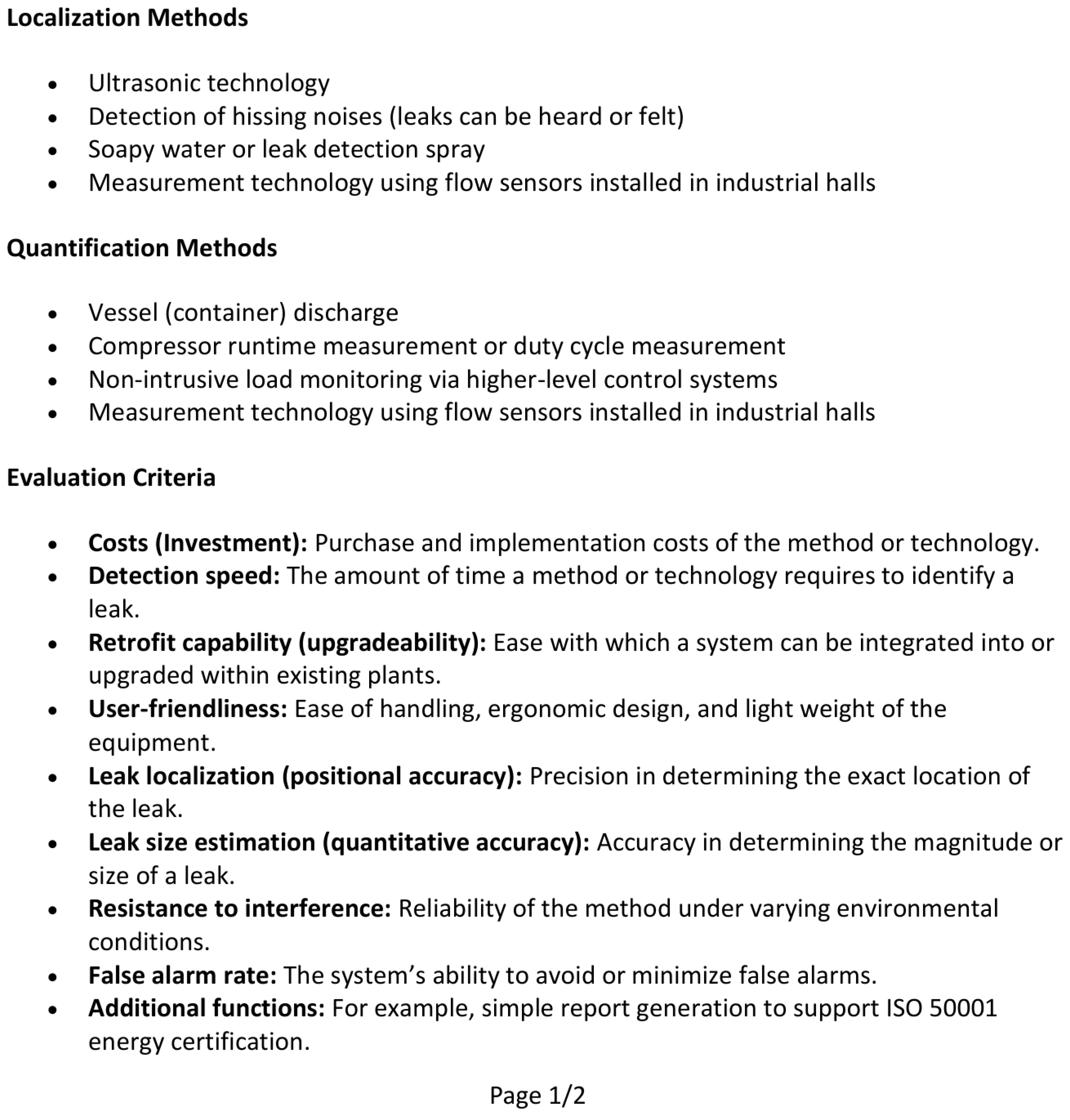
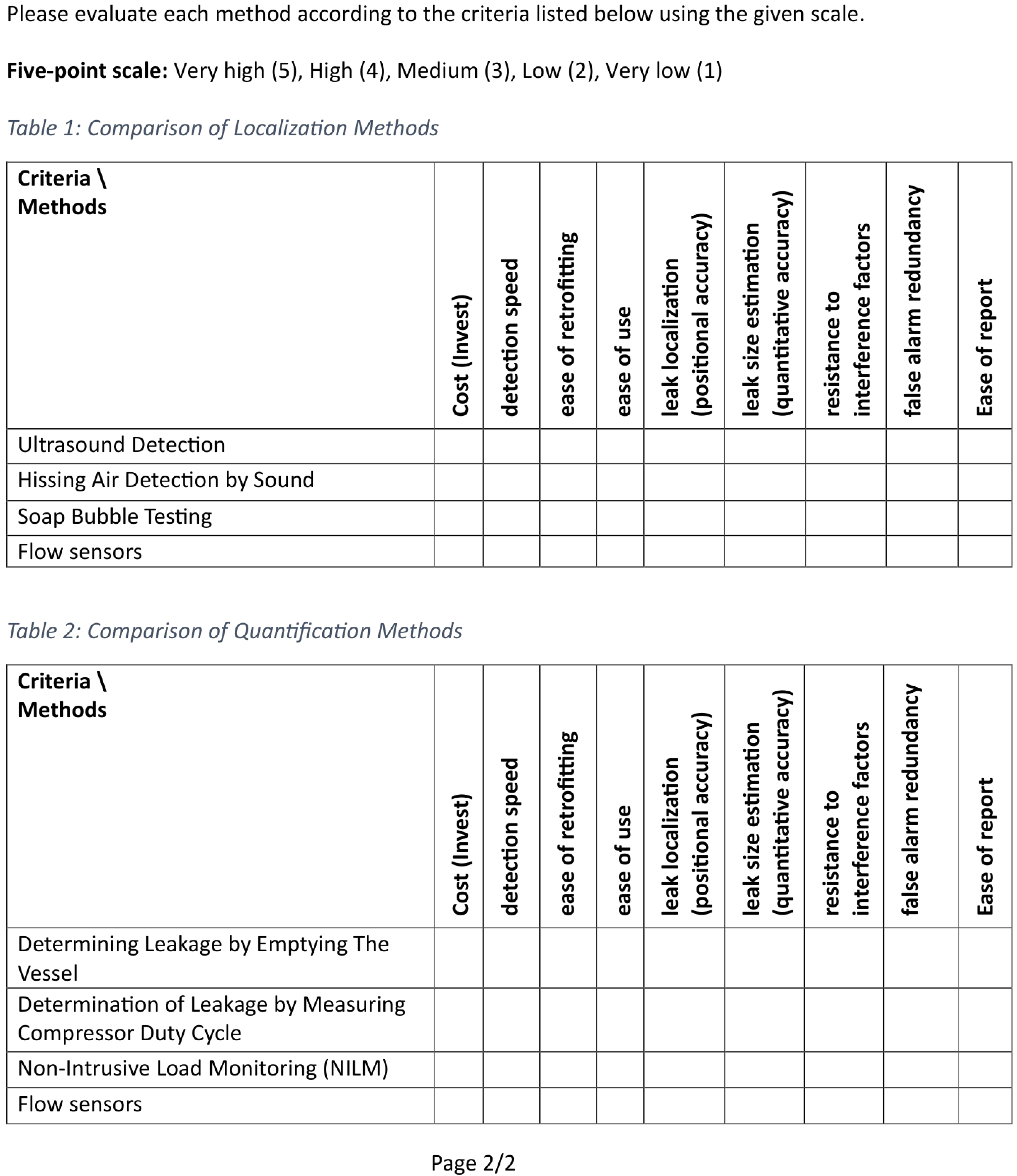
The questionnaire first presented the evaluated methods and the corresponding criteria. Participants were then asked to rate each method against these criteria using a five-point qualitative scale.
Figure A1.
Questionnaire for the Evaluation of Leakage Identification and Quantification Methods, page 1.
This is the second page of the questionnaire, which contains the evaluation tables.
Figure A2.
Questionnaire for the Evaluation of Leakage Identification and Quantification Methods, page 2.
Appendix C. Interviews Summary
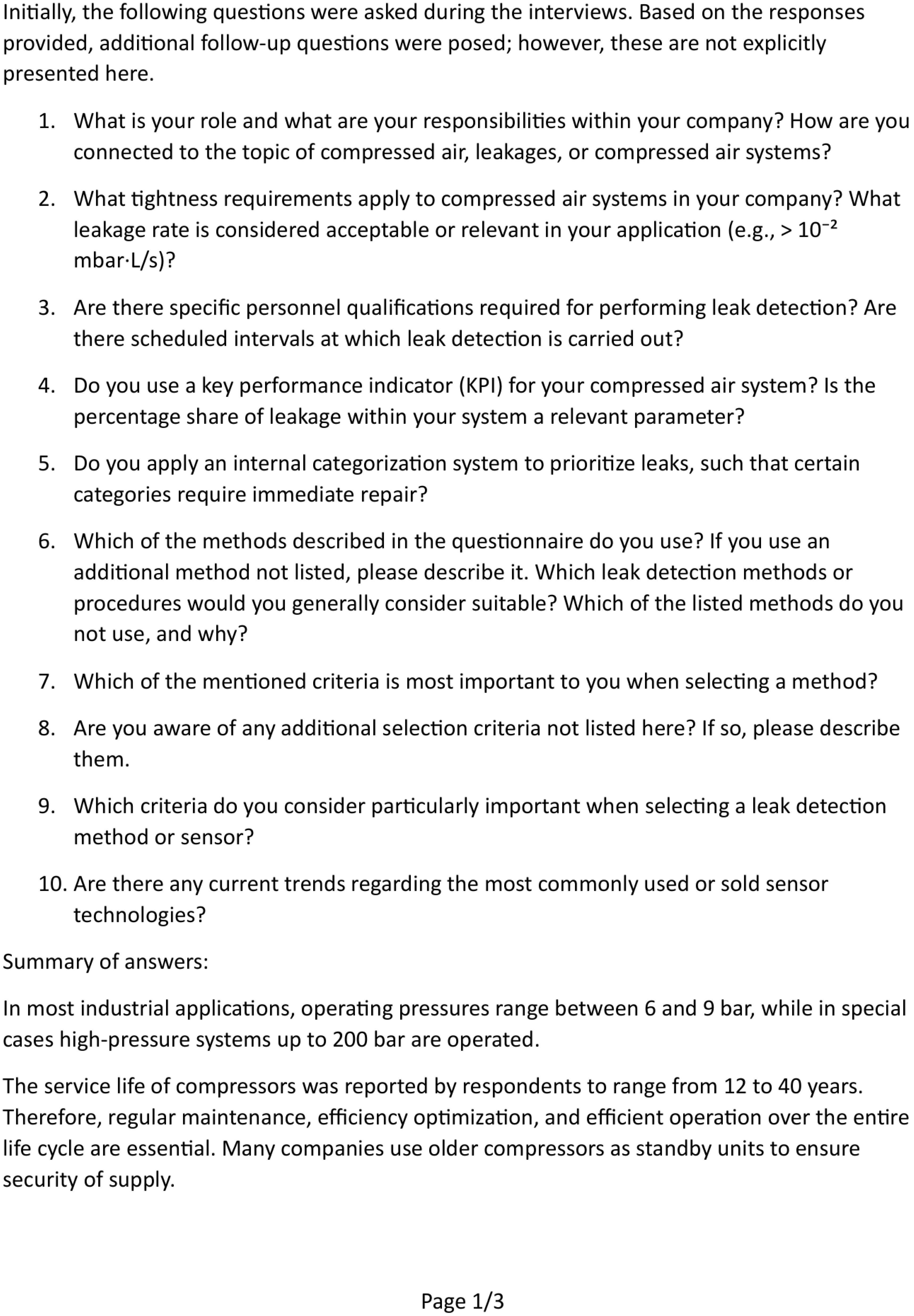
The interview summary spans three pages: the first page mainly presents the questions, while the following pages summarize the answers.
Figure A3.
Interviews Summary page 1.
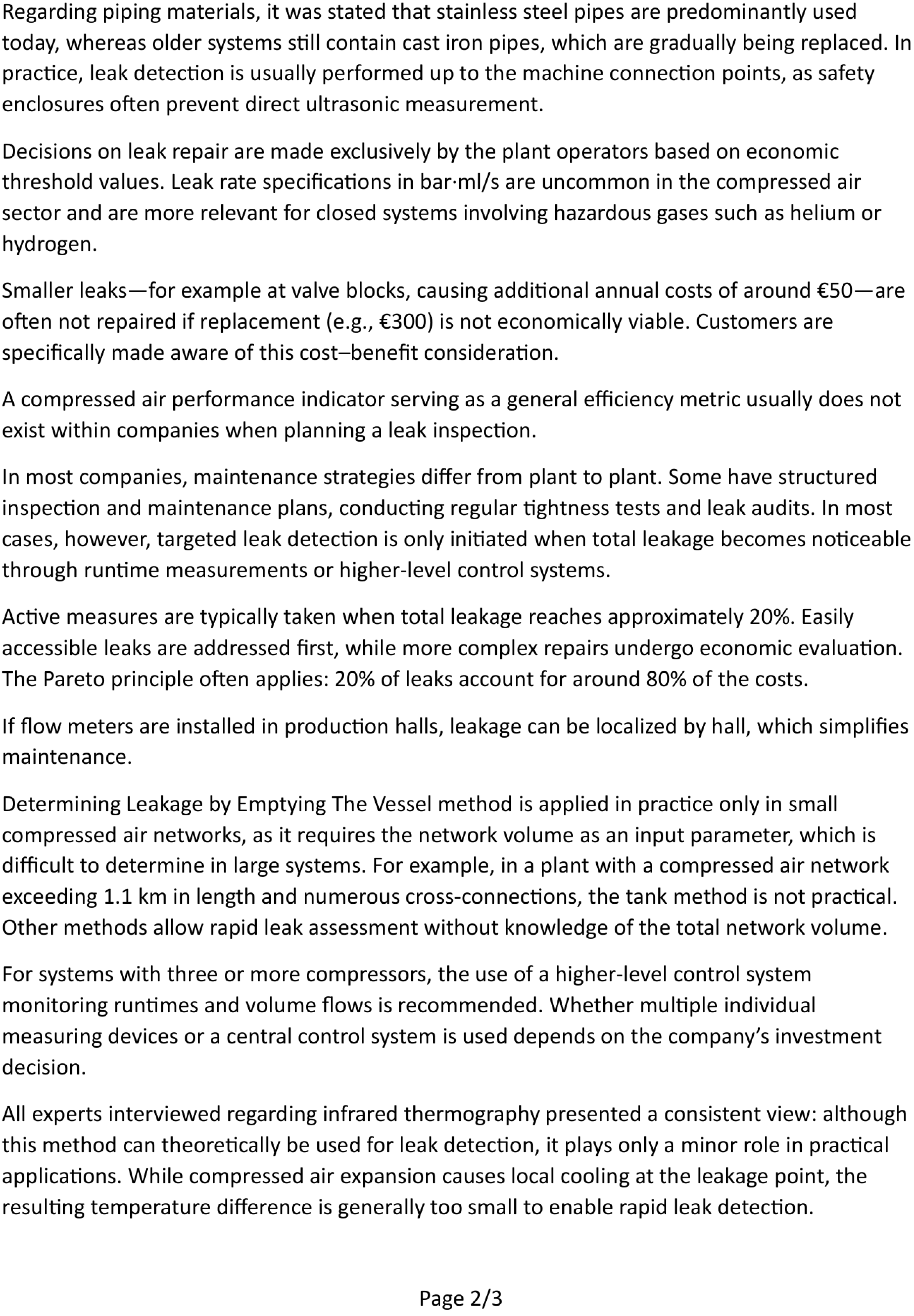
Here is the second page of the interview summary.
Figure A4.
Interviews Summary page 2.
Here is the third page of the interview summary.
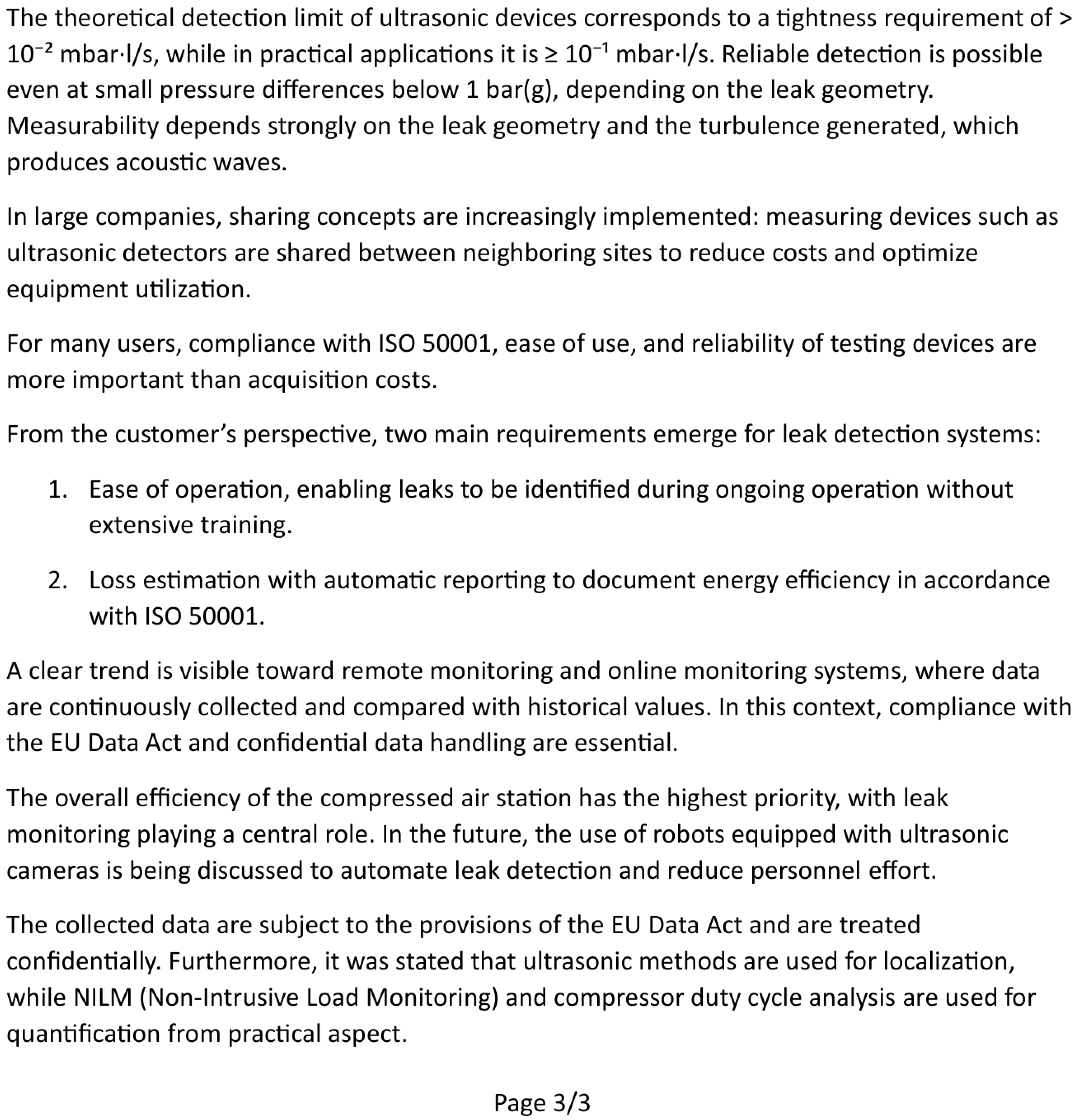
Figure A5.
Interviews Summary page 3.
References
- Radermacher, T.; Merx, M.; Sitte, A. Potenzialstudie Energie-/Kosteneinsparung in der Fluidtechnik; CLIMATE CHANGE 19/2021; Umweltbundesamt: Berlin, Germany, 2021. [Google Scholar] [CrossRef]
- Radgen, P.; Blaustein, E. Compressed Air Systems in the European Union: Energy, Emissions, Savings Potential and Policy Actions; Log X Publishing: Stuttgart, Germany, 2001. [Google Scholar]
- Rohde, C. Erstellung von Anwendungsbilanzen für die Jahre 2021 bis 2023 für die Sektoren Industrie und GHD, 2025. Available online: https://ag-energiebilanzen.de/wp-content/uploads/2024/11/Anwendungsbilanz_Industrie_2023_final_20250324.pdf (accessed on 28 November 2025).
- Directive 2023/1791 of European Union on Energy Efficiency and Amending Regulation, 2023. Available online: https://eur-lex.europa.eu/eli/dir/2023/1791/oj (accessed on 28 November 2025).
- Gesetz zur Steigerung der Energieeffizienz in Deutschland (Energieeffizienzgesetz-EnEfG), 2023. Available online: https://www.gesetze-im-internet.de/enefg/BJNR1350B0023.html (accessed on 28 November 2025).
- McKane, A.; Hasanbeigi, A. Motor Systems Efficiency Supply Curves. United Nations Industrial Development Organization. 2010. Available online: https://www.ctc-n.org/sites/www.ctc-n.org/files/resources/unido_-_un-energy_-_2010_-_motor_systems_efficiency_supply_curves_2.pdf (accessed on 28 November 2025).
- Hülsmann, S.; Köpschall, M.E.A. Energy Efficiency in Production in the Drive and Handling Technology Field. Project Consortium. 2012. Available online: https://www.eneffah.de/EnEffAH_Broschuere_engl.pdf (accessed on 28 November 2025).
- ISO 8573-1:2010; Compressed air Part 1: Contaminants and Purity Classes. 2010. Available online: https://www.iso.org/standard/46418.html (accessed on 28 November 2025).
- Kamenszká, A.; Matúšová, M. Methods of Identifying Air Leaks in Pneumatically Operated Equipment in the Industry. Mach. Technol. Mater. 2023, 17, 207–211. [Google Scholar]
- Murvay, P.S.; Silea, I. A survey on gas leak detection and localization techniques. J. Loss Prev. Process Ind. 2012, 25, 966–973. [Google Scholar] [CrossRef] [Scilit]
- Suditu, S.; Dumitrache, L.; Branoiu, G.; Dragut, S.; Eparu, C.N.; Stan, I.G.; Prundurel, A.P. A Case Study on Advanced Detection and Management of Fugitive Methane Emissions in the Romanian Oil and Gas Sector. Sustainability 2025, 17, 11359. [Google Scholar] [CrossRef] [Scilit]
- Gao, F.; Lin, J.; Ge, Y.; Lu, S.; Zhang, Y. A mechanism and method of leak detection for pressure vessel: Whether, when, and how. IEEE Trans. Instrum. Meas. 2020, 69, 6004–6015. [Google Scholar] [CrossRef] [Scilit]
- Doyle, F.; Cosgrove, J. An approach to optimising compressed air systems in production operations. Int. J. Ambient. Energy 2018, 39, 194–201. [Google Scholar] [CrossRef] [Scilit]
- Martin Nascimento, G.F.; Wurtz, F.; Kuo-Peng, P.; Delinchant, B.; Jhoe Batistela, N. Quantifying Compressed Air Leakage through Non-Intrusive Load Monitoring Techniques in the Context of Energy Audits. Energies 2022, 15, 3213. [Google Scholar] [CrossRef] [Scilit]
- Pöyhönen, S.; Ahola, J.; Ahonen, T.; Hammo, S.; Niemelä, M. Variable-Speed-Drive-Based Estimation of the Leakage Rate in Compressed Air Systems. IEEE Trans. Ind. Electron. 2018, 65, 8906–8914. [Google Scholar] [CrossRef] [Scilit]
- Desmet, A.; Delore, M. Leak detection in compressed air systems using unsupervised anomaly detection techniques. In Proceedings of the Annual Conference of the PHM Society, St. Petersburg, FL, USA, 5 October 2017; Volume 9. [Google Scholar] [CrossRef] [Scilit]
- ISO 50001:2018; Energy Management Systems—Requirements with Guidance for Use. 2018. Available online: https://www.iso.org/standard/69426.html (accessed on 28 November 2025).
- Dudić, S.; Ignjatović, I.; Šešlija, D.; Blagojević, V.; Stojiljković, M. Leakage quantification of compressed air using ultrasound and infrared thermography. Measurement 2012, 45, 1689–1694. [Google Scholar] [CrossRef] [Scilit]
- Non-Destructive Testing-Leak Testing-Criteria for Method and Technique Selection; German and English version prEN 1779:2024, 2024. Available online: https://www.dinmedia.de/en/draft-standard/din-en-1779/384653977 (accessed on 28 November 2025).
- Thermal Camera Flir I34, 2026. Available online: https://www.flir.com/products/i34/?srsltid=AfmBOopcfAuxw6D3jdDKdExSSAyJTgLXwRF-f44AzR8vyZ2dgCUDCuZy (accessed on 20 February 2025).
- Zuo, J.; Li, Z.; Xu, W.; Zuo, J.; Rong, Z. Automated Detection of Methane Leaks by Combining Infrared Imaging and a Gas-Faster Region-Based Convolutional Neural Network Technique. Sensors 2025, 25, 5714. [Google Scholar] [CrossRef] [Scilit] [PubMed]
- Boaz, L.; Kaijage, S.; Sinde, R. An overview of pipeline leak detection and location systems. In Proceedings of the 2nd Pan African International Conference on Science, Computing and Telecommunications (PACT 2014); IEEE: Piscataway, NJ, USA, 2014; pp. 133–137. [Google Scholar] [CrossRef] [Scilit]
- Zimmermann, H.J.; Gutsche, L. Multi-Criteria Analyse; Springer: Berlin/Heidelberg, Germany, 1991; pp. 1431–4061. [Google Scholar] [CrossRef] [Scilit]
- Wang, J.J.; Jing, Y.Y.; Zhang, C.F.; Zhao, J.H. Review on multi-criteria decision analysis aid in sustainable energy decision-making. Renew. Sustain. Energy Rev. 2009, 13, 2263–2278. [Google Scholar] [CrossRef] [Scilit]
- Wind, Y.; Saaty, T.L. Marketing Applications of the Analytic Hierarchy Process. Manag. Sci. 1980, 26, 641–658. [Google Scholar] [CrossRef] [Scilit]
- Ching-Lai Hwang, K.Y. Multiple Attribute Decision Making; Lecture Notes in Economics and Mathematical Systems; Springer: Berlin/Heidelberg, Germany, 1981. [Google Scholar] [CrossRef] [Scilit]
- Singh, T.; Agrawal, P. Concurrent design of nanofluid for x-abilities using MADM approach. Concurr. Eng. 2012, 301–314. [Google Scholar] [CrossRef] [Scilit]
- Lai, Y.J.; Liu, T.Y.; Hwang, C.L. TOPSIS for MODM. Eur. J. Oper. Res. 1994, 76, 486–500. [Google Scholar] [CrossRef] [Scilit]
- Reference Document on Best Available Techniques for Energy Efficiency, 2009. Available online: https://bureau-industrial-transformation.jrc.ec.europa.eu/sites/default/files/2021-09/ENE_Adopted_02-2009corrected20210914.pdf (accessed on 28 November 2025).
- Golden, B.L.; Wang, Q. An Alternate Measure of Consistency. In The Analytic Hierarchy Process: Applications and Studies; Golden, B.L., Wasil, E.A., Harker, P.T., Eds.; Springer: Berlin/Heidelberg, Germany, 1989; pp. 68–81. [Google Scholar] [CrossRef] [Scilit]

Disclaimer/Publisher’s Note: The statements, opinions and data contained in all publications are solely those of the individual author(s) and contributor(s) and not of MDPI and/or the editor(s). MDPI and/or the editor(s) disclaim responsibility for any injury to people or property resulting from any ideas, methods, instructions or products referred to in the content. |
© 2026 by the authors. Licensee MDPI, Basel, Switzerland. This article is an open access article distributed under the terms and conditions of the Creative Commons Attribution (CC BY) license.