1. Introduction
Brushless DC (BLDC) motors are popular in many modern applications because they offer high efficiency, quick response and compact design. Despite these advantages, maintaining smooth torque and stable performance at low speeds is still difficult, especially when using direct torque control (DTC), which is known to produce visible torque ripple and depends strongly on precise PI tuning. Many existing optimization strategies struggle to find reliable PI gains when the motor operates under changing loads or speeds. This problem highlights the need for a more effective tuning strategy, motivating the use of the Sailfish Optimization algorithm (SFO) to strengthen the PI–DTC performance. Since the initial DTC strategy proposals by Takahashi, Noguchi, and Depenbrock in the 1980s, DTC has grown in strength and acceptance. The list makes it clear that BLDC motors offer the benefits of both conventional DC motors and AC motors, because they lack brushes and collectors yet have the mechanical and electrical architecture of AC motors and DC motors, respectively [
1]. By converting the motor’s three-phase parameters (voltage and currents in three phases) into separate vector components in two phases using Clarke transformation, the DTC technique suggests controlling each component independently, just like typical DC motors do. Despite being created for induction motors, DTC has been applied to many different kinds of motors, such as switching reluctance motors, permanent-magnet AC motors, linear motors, and BLDC motors [
2].
Electric cars, servo systems, and CNC machines are just a few of the increasingly widespread, everyday commercial applications for BLDC motors. Strong beginning torque, broad speed ranges, linear torque and speed characteristics, high power densities, high efficiency, minimal maintenance requirements, and environmental compatibility are the main factors contributing to the increasing popularity of BLDC motors [
3,
4,
5,
6]. Even though permanent-magnet motors provide benefits such as longer working life, noiseless operation, high ratio of torque to volume, high speed, and enhanced efficiency, they are still available as BLAC and BLDC motors [
7,
8,
9,
10], making BLDC motors the ideal option for a variety of uses, such as servos and traction drives. Torque ripple is a major issue for high-performance applications of BLDC motors [
11,
12]. The decrease in torque ripple has been the subject of numerous investigations. Direct torque control is a helpful technique in high-performance applications for minimizing torque ripples. DTC was primarily designed to directly control electromagnetic torque and flux in induction motor drives. Direct torque control methods for BLDC motor speed management in high-performance applications are the main subject of this work. Unlike vector control with strong speed regulation, this approach offers a quick torque response. The torque and flux are controlled using hysteresis controllers. The application of PI control is examined using a speed control approach [
13].
The literature contains several BLDC motor drive methods. The maximum power consumption through BLDC modeling was achieved using an artificial-neural-network-based method. An axial flux BLDC motor was driven by a very straightforward and efficient three-level neutral-point clamped inverter [
14]. Digital pulse-width modulation (PWM) in field-programmable gate arrays (FPGAs) and BLDC motor drivers has also been described [
15]. In addition, BLDC drivers were tested using a variety of DTC-based methodologies. Reference [
16] suggests the DTC technique for BLDC motors fed by matrix converters. In [
17], for the DTC of BLDC motors in the constant torque range, a four-switch inverter was suggested. This study proposes a revolutionary DTC method approach for small electric vehicles that operate at naturally variable torque and speed settings. Using the speed error, the PI controller in the technique was able to identify the best stator flux reference value. The results of the dynamic simulations confirmed the validity of the suggested technique.
The DTC approach depends on the torque-slip frequency connection to ascertain the torque and flux linkage’s ideal voltage vector control. Brushless DC (BLDC) motor drives have made use of DTC due to its straightforward design, quick dynamic response, and superior tolerance to rotor parameters [
18,
19]. Three components make up a typical traditional DTC: a switching table, hysteresis comparators, and torque and flux estimation. The outputs of the hysteresis comparators determine the inverter’s output voltage vectors. Large torque and flux ripples are conventional DTC’s main drawbacks [
20,
21], as well as fluctuating switching frequency [
22]. Numerous techniques, such as adaptive control, fuzzy control and model-predictive control have been proposed in the literature to solve these issues. In recent years, researchers have made great progress in reducing torque ripple and achieving a stable DTC switching frequency [
23,
24]. There have been reports of some designs that have a constant switching frequency and less torque ripple. However, two regulators are required to regulate the torque and flux linkage, and they must cooperate to coordinate the control. Multilevel inverters can generate smoother torque because they have more voltage space vectors. Adding more switching devices raises hardware costs and complicates the system. Conventional DTC was the first to use duty ratio control in [
25]. These techniques are very complicated and largely rely on the motor parameters, even though they produce a steady switching frequency and greatly lessen torque ripple.
A new DTC technique is put forth that keeps the switching frequency constant while lowering torque ripples. The duty ratio is calculated at each cycle to control the torque during a continuous switching cycle. The torque is determined by the torque errors required to calculate the active voltage vector. The symmetrical pulse-width modulation technique reduces torque ripple and current harmonics and is based on the enhanced DTC scheme for a permanent-magnet synchronous motor. Tests and simulations are used to compare the effectiveness of the suggested DTC and traditional DTC approaches [
26]; because they are easy to use, PI controllers are typically utilized for BLDC motor control. However, their performance is unpredictable when the load and speed change. As control strategies to alter traditional PI, techniques utilizing neural networks (NNs) and fuzzy logic have been introduced. A conventional PI controller provides the required data for NN training offline, leading to an imprecise dynamic response [
27].
Optimization techniques are used to modify the PI controller in order to achieve a quick reaction when the load and speed change. Making use of optimization techniques such as particle swarm optimization (PSO) [
28], cuckoo search [
29], a piecewise affine PI controller [
30], and Ziegler–Nichols-influenced tuning, the controller was modified to control the BLDC drive’s torque and speed [
31]. The velocity equation’s random variables yield to the ideal value in PSO. A revised controller with enhanced capability is required to address the ripple issue of the BLDC drive in order to overcome these obstacles. In this piece, the BLDC’s SVPWM-DTC is managed by a PI controller that has been modified using the Sailfish algorithm to improve torque and speed responsiveness. In this work, an enhanced direct torque control (DTC) strategy for brushless DC (BLDC) motor drives is developed with the objective of reducing torque ripples and improving speed regulation under both transient and steady-state operating conditions. The study integrates a Space Vector Pulse-Width Modulation (SVPWM)-based DTC framework with a proportional–integral (PI) controller whose gains are optimized using the constrained Sailfish Optimization (SFO) algorithm. Hence, to evaluate speed-tracking performance, a unified objective function is formulated by combining rise time, settling time and overshoot, enabling systematic optimization of the controller parameters. The proposed SFO-PI controller is tested across multiple operating modes representative of electric vehicle (EV) and industrial BLDC applications, including adaptive speed regulation, no-load stability, load disturbances, and steady-state torque conditions. The primary objectives of this research are summarized as follows:
To build an improved direct torque control (DTC) system for BLDC motor drives to boost the dynamic speed regulation and minimize the torque ripple.
To design a restricted PI controller based on Sailfish Optimization (SFO) that can automatically change the integral and proportional gains for better transient and steady-state speed performance.
To construct a single, multi-parameter objective function for systematic controller optimization that covers overshoot, rise time, and settling time.
To compare the performance of the suggested SFO-PI controller with traditional control methods, such as GWO-PI, PI and PID controllers.
To verify the suggested control strategy using comprehensive simulation studies within different levels of load and speed, typical of real-world BLDC motor applications.
2. Computational Strategy of the Sailfish Optimization Algorithm (SFO)
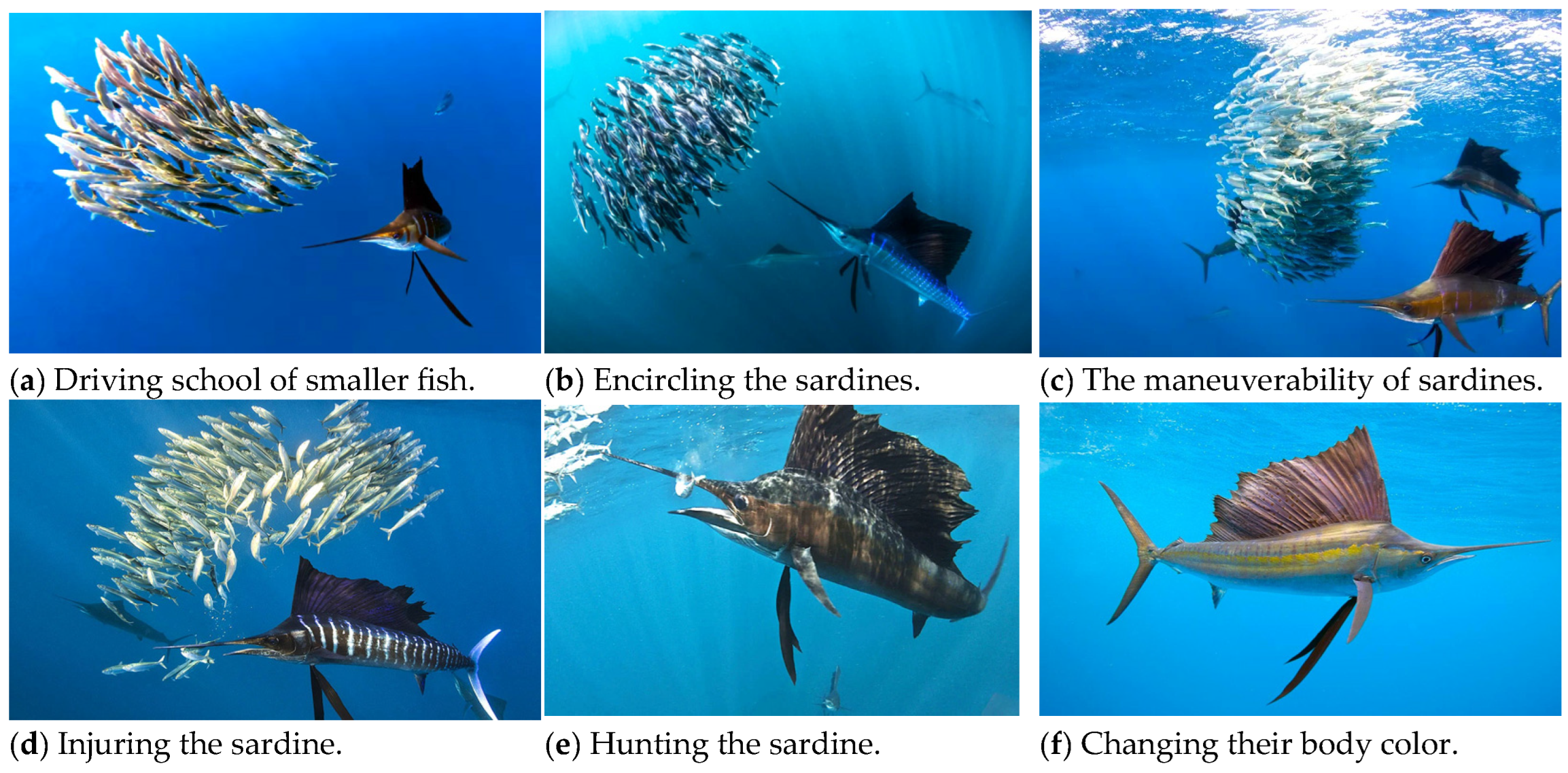
Collective hunting is a fascinating example of social behavior in fish, bird, mammal, and arthropod groups. When hunting in groups, predators do not have to exert as much effort in order to kill prey as they would if they were hunting alone. Predators use their specialized roles of chasing and catching the prey in the more intricate form of group hunting, whereas in the most basic form, they attempt to kill the prey with little to no assault coordination. Alternating attacks are one of the more intricate group hunting tactics. The hunter can conserve energy by using this tactic while the prey is being harmed by other predators. Sailfish (Istiophorus platypterus) hunting in groups that alternately target schooling sardine prey (Sardinella aurita) are prime examples of this type of tactic, as is visible in
Figure 1 [
32].
Figure 1 shows group hunting techniques of sailfish; sailfish are deemed to be the fastest beings in the water, moving at about 100 km/h. When smaller fish schools, such as sardines,
Figure 1a, forage together, they are pushed toward the surface, as shown in
Figure 1b. Sailfish find it extremely difficult to accelerate and control the sardines during attack, as seen in
Figure 1c. The rostrum cutting motion of the sailfish either hits one sardine, weakening it, or injures multiple sardines—
Figure 1d. Sardines are unable to react to this group hunting because they are unable to move quickly enough to avoid the sailfish’s rostrum, which has one of the fastest accelerations ever observed in an aquatic vertebrate. The sailfish can swiftly catch injured sardines because their behavior indicates that they will be detached from the school of prey and unable to follow—
Figure 1e. Sardines are not killed in most sailfish attacks, and only a small percentage are captured directly. However, a growing number of sardines are being injured because of the frequent attacks by sailfish. Animals that hunt in packs, like wolves, are more likely to engage in this kind of hunting. Nevertheless, these sailfish societies frequently disband and reassemble fresh individuals [
32]. During an attack, a sailfish’s enormous pelvic and dorsal fins stay upright, most likely to maintain body stability—
Figure 1f. Additionally, right before an attack, their generally bluish-silver lateral sides turn nearly black, changing the hue of their body. Although the exact cause of color changes is unknown, sailfish are believed to be able to communicate with one another [
33], as they use physical changes to determine who goes first to avoid harming another sailfish. The attack-alternation tactic used in sailfish group hunting serves as the main inspiration for the SFO algorithm. In the following subsection, an optimization technique is constructed using a mathematical description of the natural behaviors of sardines and sailfish.
2.1. Mathematical Modeling of the SFO
One type of population-based metaheuristic is the SFO algorithm. One of the variables in the problem is that it is assumed that the sailfish are possible solutions in this algorithm, as well as their position within the search space. Consequently, the population is produced at random over the solution space.
2.1.1. SFO Algorithm Initialization
The sailfish’s changing location vectors allow it to hunt in one-, two-, three-, or hyper-dimensional space. The
member at the kth searching bout in a d-dimensional search space has a current location
. It has been suggested that matrix
presented in Equation (1) [
32] might preserve the location of every sailfish. Thus, during optimization, these places display the variables of every solution.
where
presents the value of
dimension of
sailfish, and
and
stand for the number of sailfish and variables, respectively.
Additionally, the fitness function is calculated as follows in Equation (2) to determine each sailfish’s fitness:
The fitness value for every solution is displayed in the following matrix in Equation (3) to assess each sailfish:
where
is the fitness function, the number of sailfish is
, while
presents the
dimension value for
sailfish, and
maintains the fitness value that gives each sailfish its fitness or objective function value. The corresponding sailfish’s fitness value in the
matrix is shown by the fitness function’s output, which gets the first row of the
matrix.
The school of sardines is another crucial element of the SFO algorithm. The sardines are thought to be swimming in the search area as well. Thus, the following is how the sardines’ location and fitness values are used:
where the number of sardines is
, and
is the value of
dimension of
sardine. The position of every sardine is indicated of the
matrix in Equation (4).
where
is the number of sardines in Equation (5),
is the objective function,
records the fit value of each sardine, and
shows the value of the
sardine with
dimension. It is noteworthy that the answers are correlated with sailfish and sardines. The primary element dispersed throughout the search space in this algorithm is the sailfish, and sardines can work together to identify the ideal position in this field. Sailfish can actually consume sardines while seeking the search space, and they will adjust their position if they find a better answer than the one that they already have [
32].
2.1.2. Attack-Alternation Strategy
In actuality, sailfish typically target the school of prey while none of their fellows are attacking. Stated differently, sailfish can increase the likelihood of hunting success by initiating a coordinated attack in time [
33]. Prey are pursued and herded by sailfish.
Without direct coordination, sailfish herd by shifting their positions based on where other hunters are located within the prey school. The attack-alternation method used by sailfish during group hunting is demonstrated by the SFO algorithm. Sailfish do not just attack from the right to the left or from the top to the bottom and vice versa. Rather, search agents provide the exploration phase, which comprises looking through a large area of the search space to find the interesting answers that have not yet been refined. Sailfish can launch attacks inside a constricting circle and in all directions, and adjust their location within a sphere centered on the optimal answer.
At the
iteration, the sailfish’s new position in the SFO algorithm
in Equation (6) [
32] updates as follows:
where
represents the current position of the sailfish,
defines the best position of injured sardines formed thus far,
represents the location of elite sailfish formed thus far,
is a random number between 0 and 1, and
is a coefficient at the
iteration that is generated as follows in Equation (7):
Additionally, the number of the prey at each iteration is indicated by the prey density,
. Since there will be fewer prey when sailfish hunt in groups, the
parameter is crucial for keeping track of the sailfish’s location in relation to the prey school. The adaptive formula for this parameter is shown in Equation (8):
where
and
represent the number of sardines and sailfish, respectively, in each algorithm cycle. Furthermore, because the sardines are initially larger in number than the sailfish,
is equal to
, as
represents the population proportion of sardines that was originally made up of sailfish.
The position of the sailfish can be adjusted based on the mean separation between the best sardine (injured sardine) and the best sailfish (elite sailfish) at any given time during the iteration. This tactic will preserve the promising portion of the search space. Additionally, by changing the value of
, sailfish can reach various locations across the school. Equation (7) states that the range of
fluctuation is between −1 and 1. However, it fluctuates based on the amount of prey. Put another way, the value of
will approach −1 or 1 if
increases in relation to
. When
, the tendency of the
parameter is 1; when
, it tends to −1, while it tends to zero when
rand (0, 1) = 0.5. Sailfish divergence and convergence near prey schools can be analytically modeled by varying their
and updating their positions. This places a strong emphasis on global exploration and solution searching. In this way, any sailfish has two ways to update its position surrounding the school of prey with the SFO algorithm’s aid. First, elite sailfish and damaged sardines have a different attack strategy to hunt schools, as shown by sailfish in
Figure 1b,c. The second technique uses sailfish mimicking to encircle the prey, similar to sailfish in
Figure 1a, by occupying vacant space surrounding the prey school. In both cases, sailfish willhurt more sardines during the initial phases of hunting, which will increase the likelihood of a successful capture during subsequent phases of cooperative hunting [
32].
2.1.3. Hunting and Catching Prey
To replicate this behavior, every sardine is required to adjust its position in relation to the sailfish’s current optimal location and its attack intensity during each iteration. In the Sailfish Optimization (SFO) algorithm, the updated position of a sardine at the
iteration, denoted as
, can be expressed as follows in Equation (9):
In this expression,
represents the best position identified by the elite sailfish up to that point, while
denotes the sardine’s current location. The term
is a randomly generated value between 0 and 1, and
corresponds to the sailfish’s attack power at each iteration, which is computed as follows in Equation (10):
In this model, the coefficients and are applied to gradually reduce the attack power in a linear manner from its initial value to zero. The effects of Equations (9) and (10) can be observed through the various possible sardine positions after a sailfish attack on the prey group. During an attack, sardines quickly scatter to different locations, adjusting their positions to confuse the predator and minimize the chance of being detected. These movements are influenced by the parameters and , where the random value determines the extent of sardine dispersion around the predator within the search space. Equation (9) is central to the algorithm because it specifies how sardines relocate themselves in response to each sailfish attack. This behavior allows a sardine to move away from the elite sailfish while simultaneously benefiting from information shared by nearby sardines. As a result, it functions as a strong local search mechanism, effectively balancing exploration and exploitation within the optimization process.
Furthermore, both the number of sardines that adjust their positions and the magnitude of their movement are influenced by the sailfish’s attack power
. As previously explained, the sailfish’s attack power gradually decreases throughout the hunting process. This reduction in attack intensity helps guide the search agents toward convergence in an adaptive manner. Based on the value of
, the proportion of sardines that update their positions
and the number of variables they modify
can be determined using the following expressions in Equations (11) and (12):
In this context, represents the number of variables at the iteration, and denotes the total number of sardines in each algorithmic cycle. Based on the value of the attack power , the update behavior of the sardines is determined. When the sailfish’s attack intensity is low (), only sardines update their positions, and each of these modifies of their variables. In contrast, when the attack intensity is high (), the positions of all sardines are updated.
Overall, the parameters and enhance the stochastic nature of the SFO algorithm, helping it avoid premature convergence and reducing the likelihood of becoming trapped in local optima throughout the optimization process.
At the last stage of the hunting process, an injured sardine that becomes separated from the school is rapidly captured. In the proposed algorithm, this event is modeled by assuming that a prey is caught when a sardine attains a better fitness value than its associated sailfish. When this condition is met, the sailfish’s position is replaced with the most recent location of the captured sardine, thereby improving its ability to pursue new prey. The corresponding update relation is expressed as follows in Equation (13) [
32]:
In this expression, represents the sardine’s position at the iteration, while denotes the sailfish’s position at the same iteration.
3. Tuning of BLDC Speed Control with the PI Controller Tuned with SFO
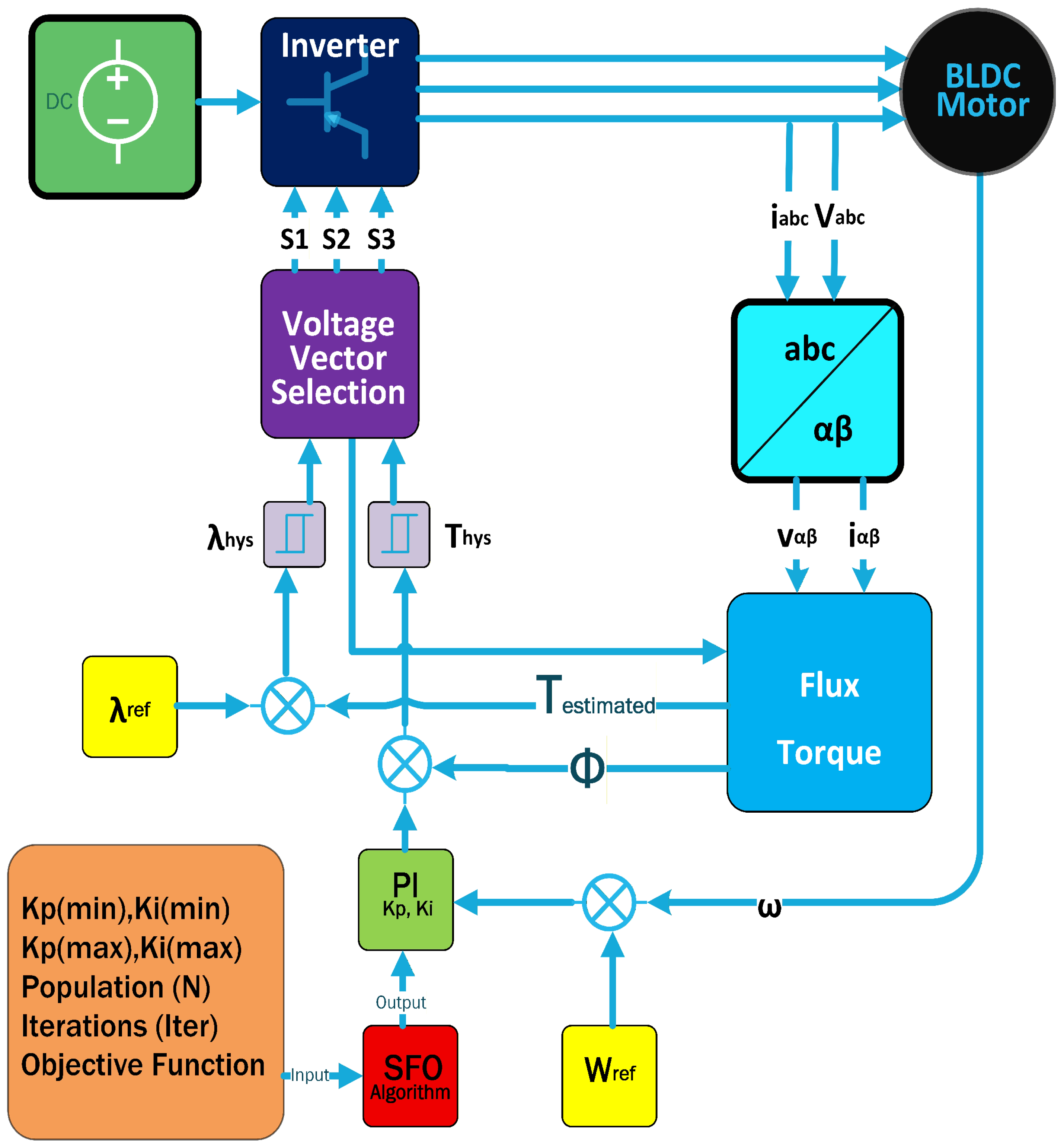
This section discusses the Sailfish Optimization algorithm-based approach, which enhances the effectiveness and efficiency of BLDC motor speed control. The PI controller parameters are adjusted using SFO techniques. The motor speed error, which is determined by deducting the measured speed from the intended speed, is fed into the optimization module. The proportional and integral gain parameters of the PI controller are optimized by the optimization techniques. To get the best speed control performance, the PI controller then uses the optimized gains to create a control signal. The block diagram compares the reference speed to the measured speed and uses the difference to help the PI controller create a torque reference. This torque reference is then compared to the estimated torque, and the reference flux is compared to the estimated flux. Both of these errors go through their own hysteresis comparators, which create switching states that help choose the right voltage vector. The voltage vector selection block produces the signals needed to switch the inverter, which powers the BLDC motor. The measured phase voltages and currents of are converted into the frame, and these values are used in the flux and torque estimation block to calculate the current stator flux and electromagnetic torque. These estimated values help complete the inner direct torque control (DTC) loop, while the speed feedback completes the outer loop, ensuring a quick torque response and stable speed control.
Figure 2 is the proposed direct torque control of the BLDC drive block diagram that can give BLDC motors the best possible speed control. The goal of using these optimization techniques in BLDC motor drive applications is to improve speed control accuracy and energy efficiency while overcoming the drawbacks of the non-optimized approach. Subsequent subsections concentrate on developing objective functions specifically designed for effective BLDC motor speed management. The main performance criteria that are necessary for BLDC motor speed control optimization are captured in a single objective function shown in Equation (14):
The relative significance of the speed signal parameters is determined by the weights
[
34]. In this instance, a one-third proportion has been selected, indicating that each parameter has an equal impact on the system response.
In the proposed procedure each sailfish represents a candidate solution vector defined as shown in Equation (15):
where
and
are the proportional and integral gains of the speed controller, respectively. The search process is conducted within predefined parameter bounds
and
. For every candidate solution, the PMSM Simulink model is executed, and the dynamic performance index values are extracted from the Simulink scope output of the motor speed in the time-domain response. The objective function is formulated as a weighted sum of key transient performance metrics given by Equation (14). Also, equal weighting factors are used. The optimization objective is to minimize this function in order to enhance transient characteristics and reduce overshoot and settling time. The inputs to the SFO-based PI tuning procedure include the lower and upper bounds of
and
, the population size (number of sailfish), the maximum number of iterations, and the defined objective function based on the PMSM dynamic response. The outputs of the algorithm are the optimal PI gains and the corresponding minimum objective function value. Furthermore, the pseudocode is as follows:
Sailfish algorithm pseudocode
1. Initialize sailfish population.
2. Initialize sardine population randomly.
3. Set algorithm parameters.
4. Evaluate objective function of all sailfish and sardines.
5. Find the best solution.
6. While the solution not satisfied
For each sailfish ( in Sf)
Calculate using Equation (7)
Update sailfish position from Equation (6)
End For
Calculate the sailfish’s attack power from Equation (10)
If (attack power < 0.5) then
Calculate using Equation (11)
Calculate using Equation (12)
Select subset of sardines based on α and β
Update selected sardine position using Equation (9)
Else
Update all sardine position using Equation (9)
End If
Evaluate fitness of all sardines
If (best sardine fitness better than a sailfish fitness) then
Replace corresponding sailfish using Equation (13)
Remove hunted sardine from population
Update elite sailfish
Update injured sardine
End If
End While
7. Return elite sailfish as optimal solution. |
4. Simulation Results of the Proposed System
The simulation was done on a BLDC motor controlled by DTC-PI and tuned with SFO; the simulation considered both steady-state and transient circumstances; the motor speed control system was compared with the traditional GWO-PI, PI and PID under speed and torque modes. A range of operating modes were used to assess and analyze the control system that was implemented using Simulink. The effects of several optimization algorithms, such as GWO-PI, PI, PID, and SFO-PI, were assessed. To guarantee methodological consistency, all optimization algorithms were implemented under the same configuration parameters: identical population size of 50, identical maximum number of iterations 100, and identical decision-variable bounds.
In contrast, the PI controller’s search space increases and to , respectively. Following a number of system tests, the population and number of iterations were selected for a more accurate comparison, and the upper and lower bounds of the gains were determined.
These key performance indicators (KPIs) were extracted from the motor speed response using the MATLAB 2014 stepinfo function to ensure standardized and reproducible evaluation across all controllers. The baseline for comparison was the conventionally tuned PI controller.
Both the SFO algorithm and GWO algorithm were tested under the same parameters for a fair comparison, shown in
Table 1.
The model uses a BLDC motor with a input voltage. The stator-phase resistance is , the inertia is 0.19 × 10⁻⁴ kg·m2, and the stator-phase inductance is 0.0144 × 10⁻³ H. The viscous damping is 10−6 N·m·s, and the torque constant is .
The test protocol included five operating modes: no load, 25%, 50%, 75%, and 100% rated torque conditions, evaluated at reference speeds of 600 rpm and 2000 rpm. Load torque was applied as a step mechanical disturbance to the motor shaft to evaluate disturbance rejection capability, transient stability, and steady-state accuracy. All controllers were assessed under identical load profiles and reference speed commands.
4.1. Modes of Operations
The optimization algorithms’ efficacy was assessed using five modes that take into account the BLDC motor’s steady and transient responses.
4.1.1. Mode 1: No Torque Applied
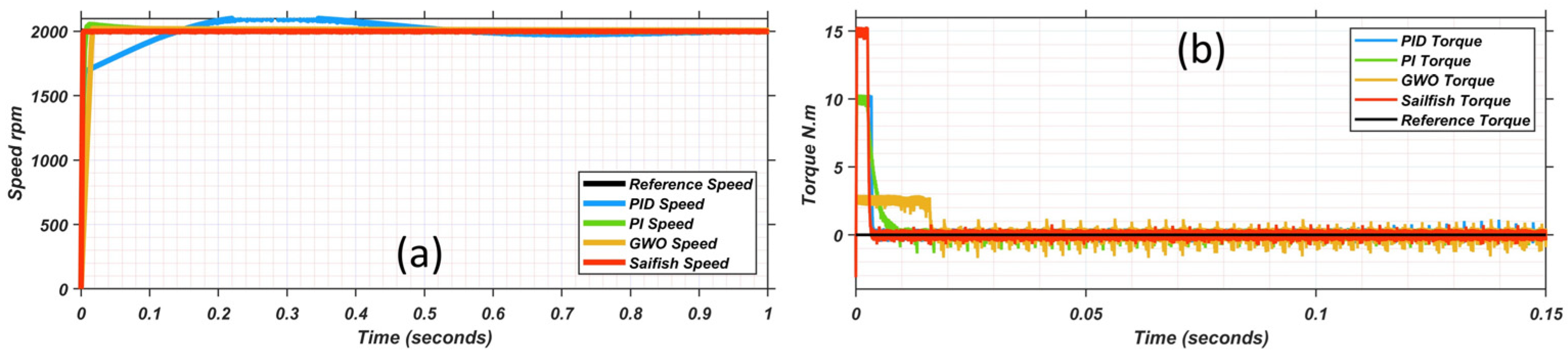
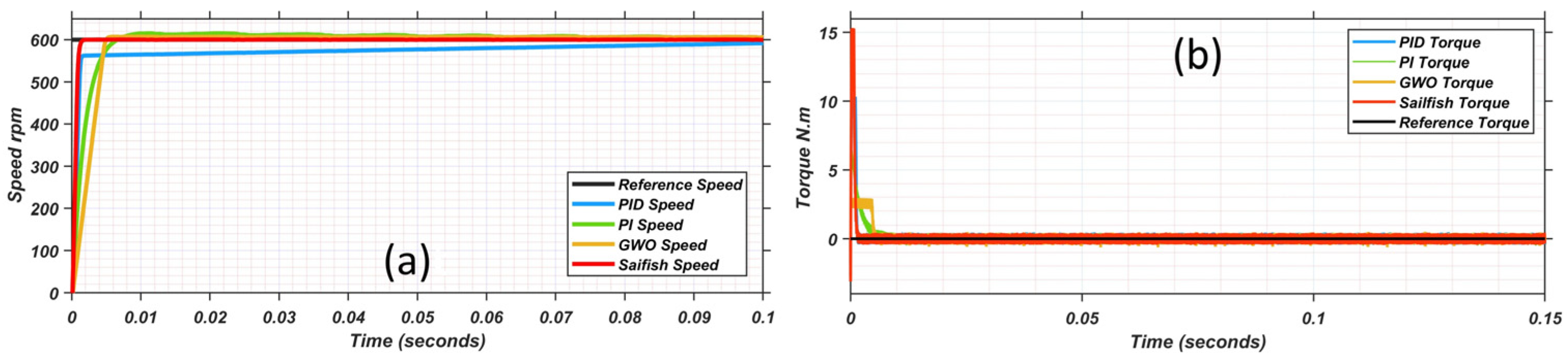
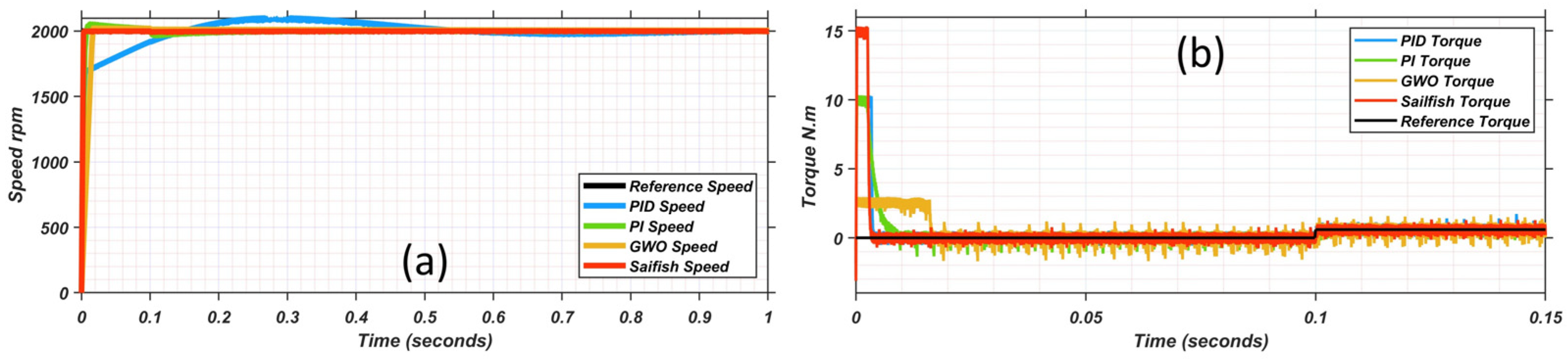
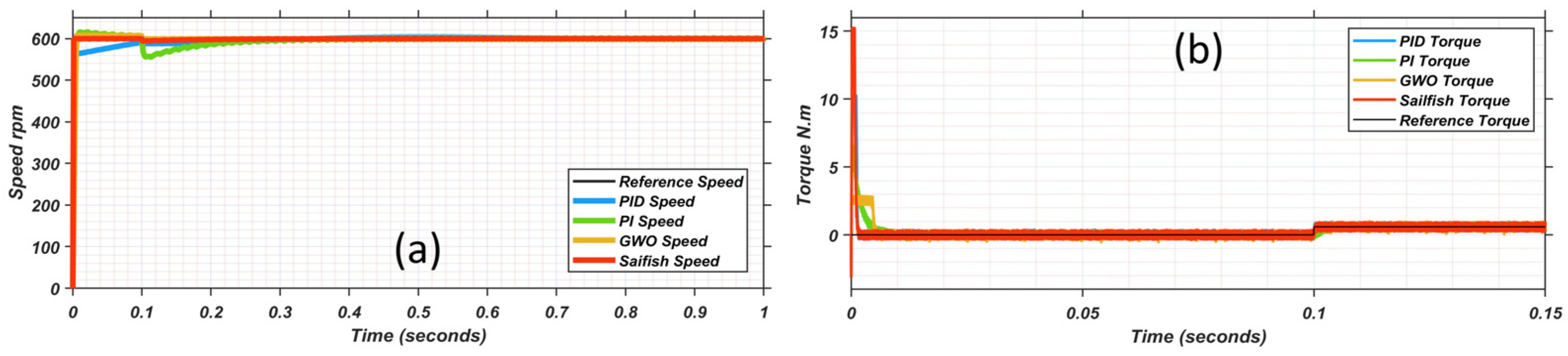
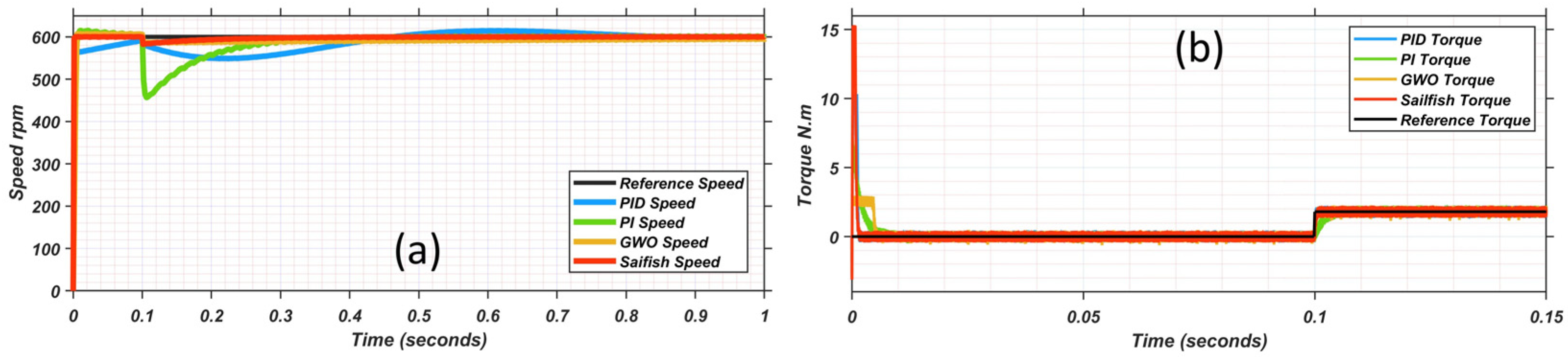
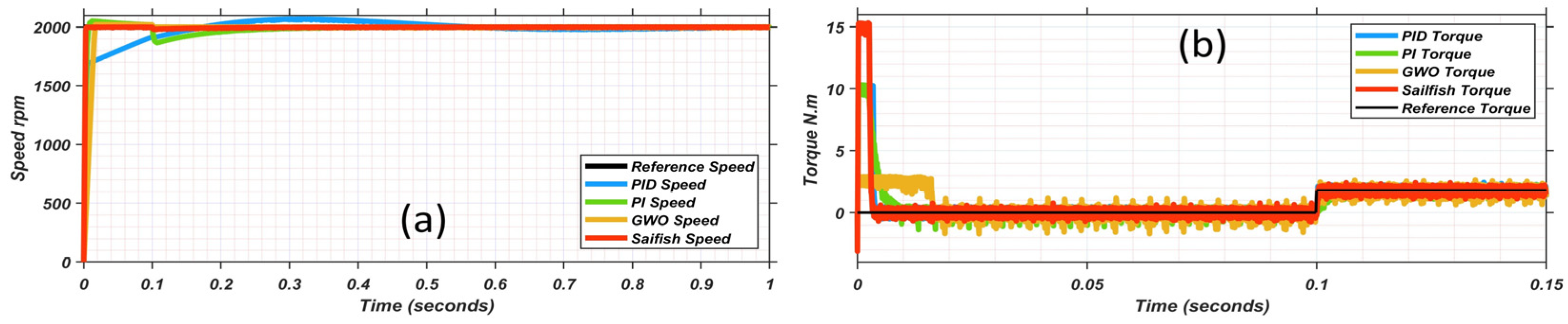
Figure 3 and
Figure 4: These are the figures of Mode 1: (a) motor speed at 600 rpm and 2000 rpm; (b) torque without load. At 600 rpm with no load torque, at low speed, Sailfish-PI again demonstrates the fastest rise time and near-perfect tracking, with a short and efficient torque burst. PID lags behind in speed response, and PI and GWO-PI overshoot more noticeably. The torque response of Sailfish-PI is smoother and better damped compared to the others.
At 2000 rpm with no load torque, the Sailfish-PI controller reaches the reference speed the fastest with minimal overshoot and smooth convergence. In contrast, PID and PI show larger overshoot and slower settling. The torque plot shows Sailfish-PI applying a strong but brief control effort and quickly stabilizing, while the others exhibit oscillations or prolonged settling.
4.1.2. Mode 2: 25% Torque Applied
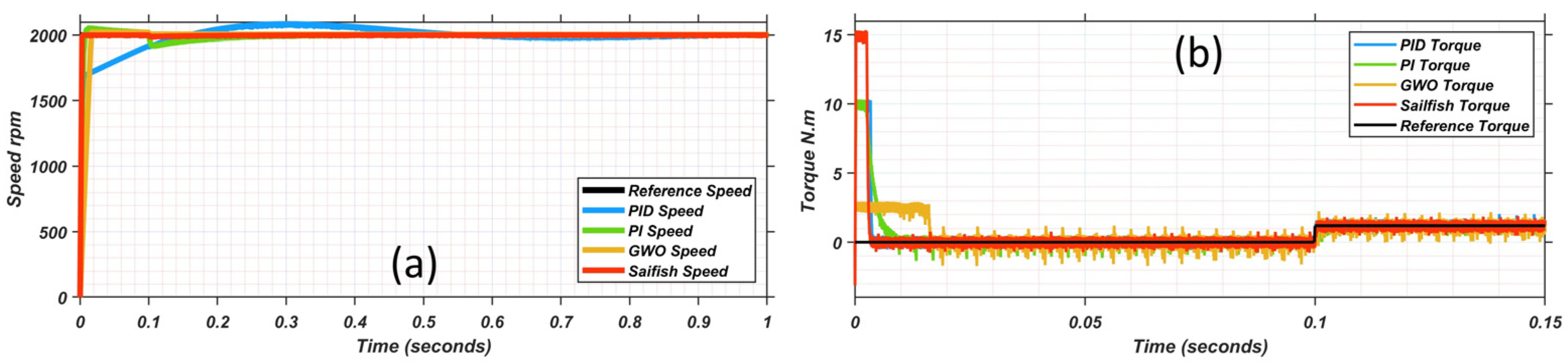
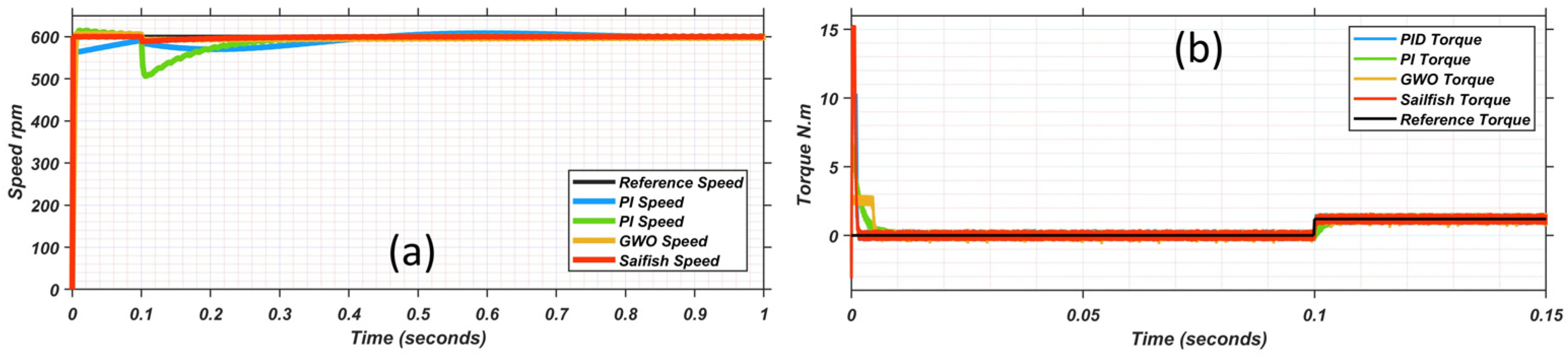
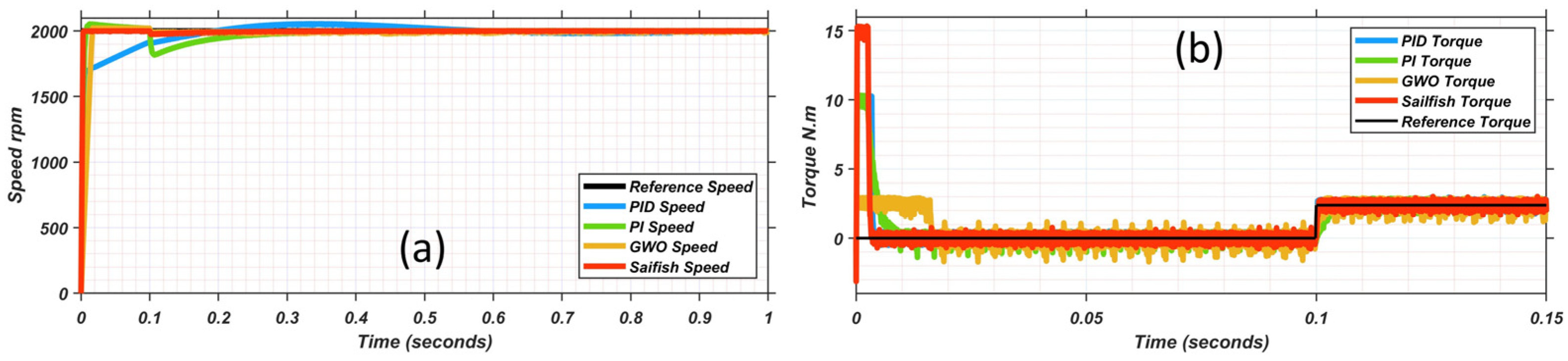
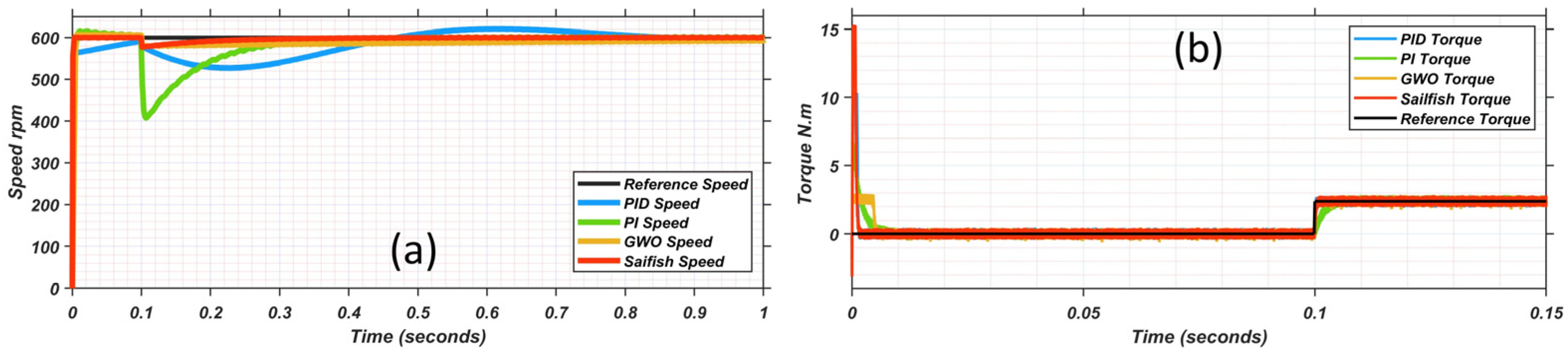
Figure 5 and
Figure 6: These are the figures of Mode 2: (a) motor speed at 600 rpm and 2000 rpm; (b) torque wit 25% torque applied. At 600 rpm under 25% torque, Sailfish-PI maintains superior performance, rapidly reaching the target with negligible deviation. PI shows visible oscillation and slower convergence. PID is again slower and less accurate. In torque plots, Sailfish-PI remains smooth and consistent, while the others experience transient instability and torque ripple.
At 2000 rpm under 25% torque, Sailfish-PI again achieves the fastest and most stable response, closely tracking the reference with minimal overshoot and steady-state error. PI and GWO-PI show moderate overshoot and slower settling, while PID lags behind with a noticeable overshoot and longer convergence. Torque response confirms that Sailfish-PI applies an initial burst and then stabilizes efficiently, whereas the other controllers show oscillations or prolonged settling efforts.
4.1.3. Mode 3: 50% Torque Applied
Figure 7 and
Figure 8: These are the figures of the Mode 2: (a) motor speed at 600 rpm and 2000 rpm; (b) torque with 50% torque applied. At 600 rpm under 50% torque, the Sailfish controller maintains better tracking of the reference with minimal overshoot. PI has visible dips after load, while PID is slower to settle. Sailfish achieves smooth torque adjustment. PI and GWO show slight oscillations, while PID takes longer to stabilize.
At 2000 rpm under 50% torque, Sailfish closely follows the reference speed with minimal overshoot and fastest settling. PID and PI lag slightly and show more deviation. Torque Response: Sailfish provides the smoothest torque with rapid stabilization after load application. The other controllers exhibit more oscillation.
4.1.4. Mode 4: 75% Torque Applied
Figure 9 and
Figure 10: These are the figures of Mode 2: (a) motor speed at 600 rpm and 2000 rpm; (b) torque with 75% torque applied. At a speed of 600 rpm under 75% torque, the Sailfish controller reaches the target speed quickly and accurately with minimal overshoot and torque ripple. GWO follows closely, although it responds slightly slower and shows mild torque ripples. The PID controller initially overshoots and then settles slightly below the reference speed. The PI controller performs the worst, with a slow response, noticeable oscillations, and steady-state error. For torque, again, the Sailfish controller demonstrates the fastest and most stable tracking with clean torque behavior even at 2000 rpm. The GWO controller shows decent performance but introduces some torque ripples. PID produces moderate overshoots and ripples. The PI controller underperforms, with a significant speed drop and slow recovery.
4.1.5. Mode 5: Full Torque Applied
Figure 11 and
Figure 12: These are the figures for Mode 2: (a) motor speed at 600 rpm and 2000 rpm; (b) torque with full torque applied. At 600 rpm under 100% torque, the Sailfish controller reaches the target speed quickly and smoothly with almost no overshoot, while GWO performs well but with slight fluctuations. PID and PI are slower and less stable. In terms of torque, Sailfish stays steady and close to the reference, with GWO slightly less stable. PID and PI show more ripples and instability, especially at the start.
At 2000 rpm the trend is similar. Sailfish again gives the best speed and torque control. PI dips below the target before recovering, and PID lags. Torque control is smooth with Sailfish, decent with GWO, and more erratic with PID and PI. Overall, Sailfish stands out for its fast, stable, and accurate performance, followed by GWO. PID and PI struggle more, especially under full load.
4.2. Metric Analysis of the BLDC Motor
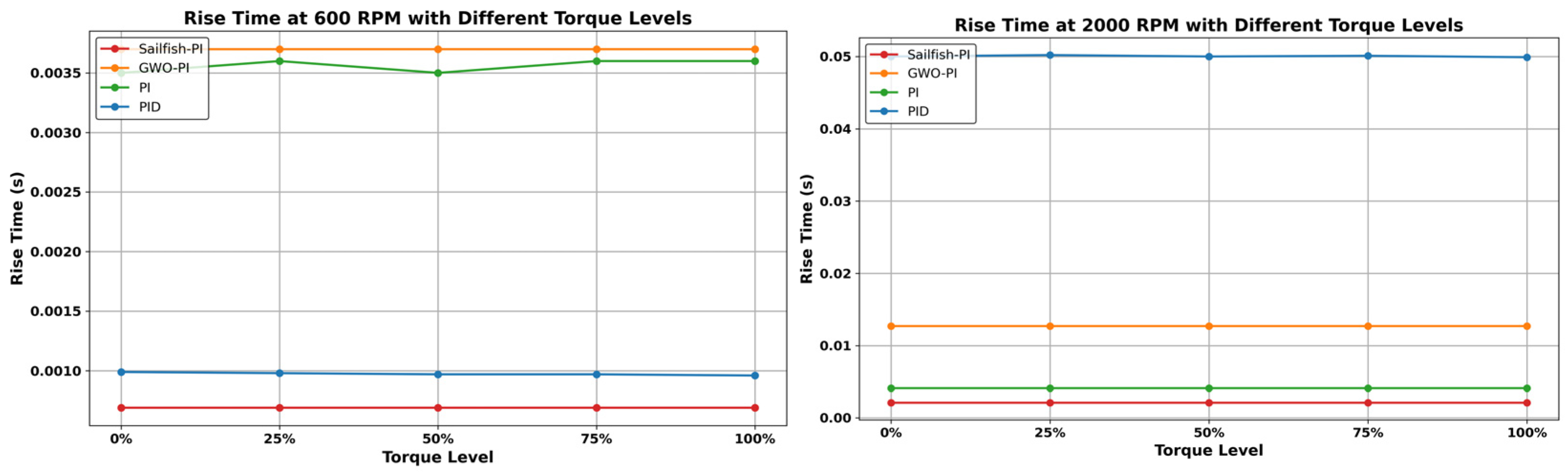
Figure 13: This is the rise time at 600 rpm and 2000 rpm. Sailfish-PI once again had the fastest increase time (~0.0007 s) at 600 rpm and was torque-insensitive. While GWO-PI and PI had somewhat higher rising times (~0.0036 s), with minimal variations, PID was steady but slower (~0.001 s). Sailfish-PI’s better dynamic performance across a range of loads and speeds is highlighted by its overall most responsive and consistent behavior, as is detailed in
Table 2.
All controllers’ rise time performance was assessed at 2000 rpm and 600 rpm for varying torque levels. Regardless of variations in load, all controllers maintained steady rise times at 2000 rpm. PID had the slowest response (~0.05 s), suggesting a more delayed reaction, while Sailfish-PI had the fastest increase time (~0.002 s), closely followed by PI and GWO-PI, as is detailed in
Table 3.
- b.
Settling time
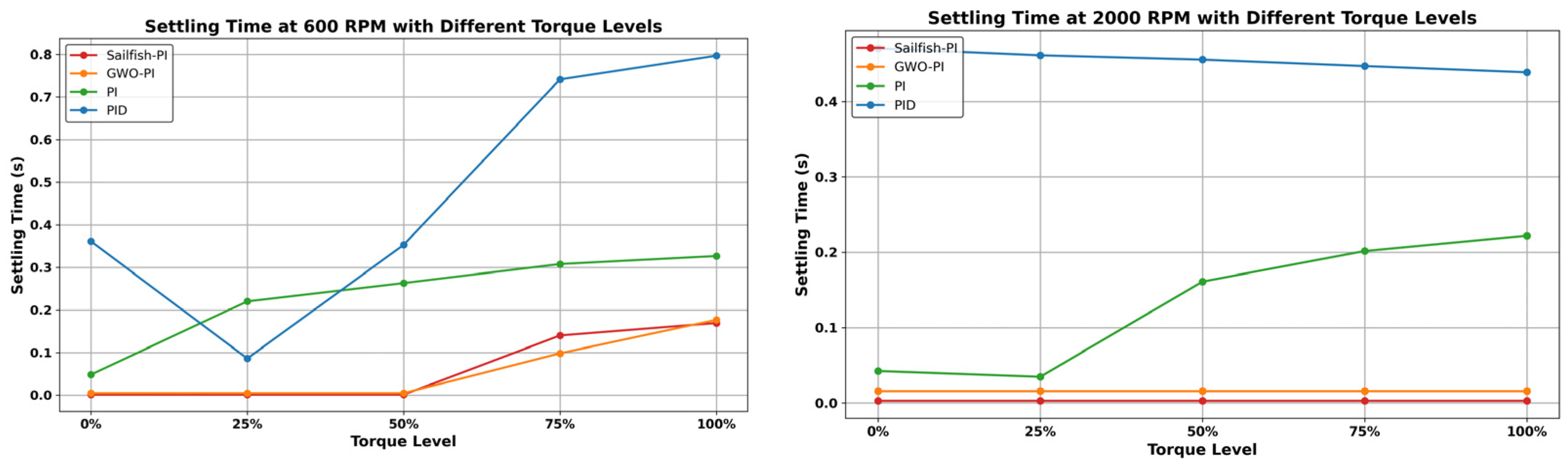
Figure 14: This is the settling time at 600 rpm and 2000 rpm. Sailfish-PI and GWO-PI maintained low settling times at 600 rpm until 50% torque, but then increased, particularly when fully loaded. PI increased gradually at every torque level. PID exhibited erratic behavior, beginning moderately, decreasing at 25%, and then abruptly increasing to 0.79 s at 100% torque. While Sailfish-PI continued to be the most effective in dynamic settling, this suggests decreased stability for PID at slower speeds and higher loads, as is detailed in
Table 4.
At 2000 rpm and 600 rpm, the settling time performance was investigated with different torque levels. Sailfish-PI and GWO-PI demonstrated exceptional stability at 2000 rpm by achieving extremely low and almost constant settling times. After 50%, PI showed a rapid rise in settling time, which increased steadily with torque. Although it dropped significantly with torque, PID had the longest settling time overall, as is detailed in
Table 5.
- c.
Overshoot
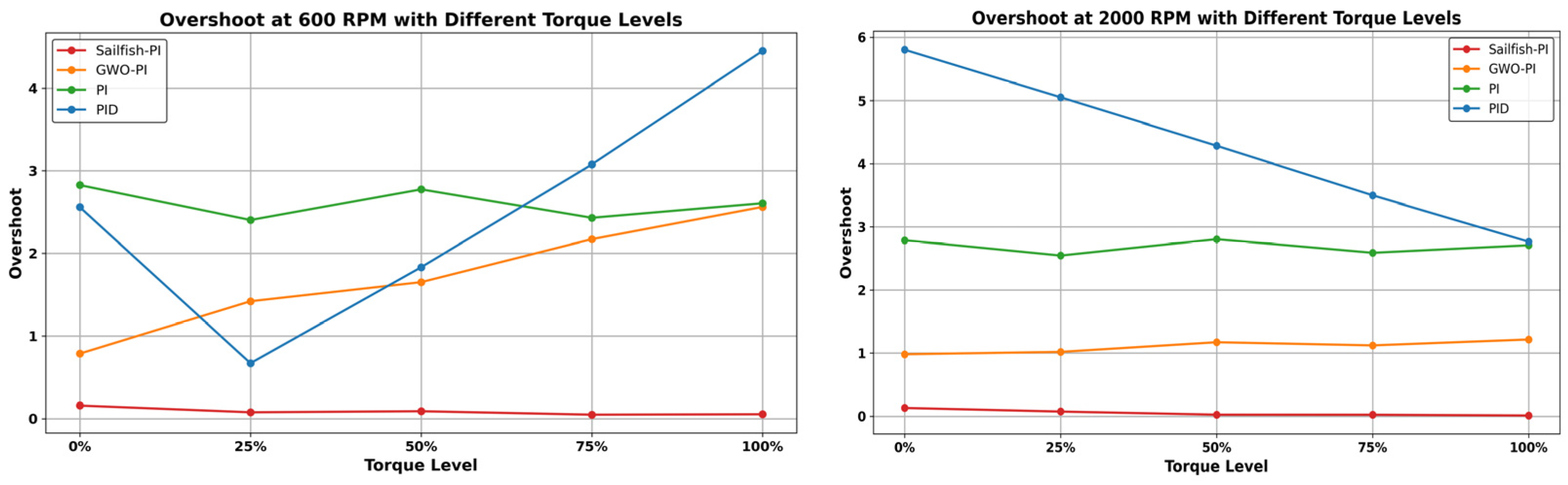
Figure 15: This is the overshoot at 600 rpm and 2000 rpm. The overshoot performance of the Sailfish-PI, GWO-PI, PI, and PID controllers was evaluated at 2000 rpm and 600 rpm across varying torque levels. At 600 rpm, Sailfish-PI again maintained minimal and stable overshoot. GWO-PI’s overshoot increased more noticeably with torque, and PI showed similar moderate behavior as at higher speed. PID performance was erratic, initially low but rising sharply with torque, highlighting its limitations at low speed and high load, as is detailed in
Table 6. At 2000 rpm, Sailfish-PI showed consistently low and decreasing overshoot with increasing torque, indicating strong stability. GWO-PI exhibited a slight rise in overshoot, while PI remained moderately stable. PID started with high overshoot that decreased as torque increased, suggesting poor performance at low load, as is detailed in
Table 7. Overall, Sailfish-PI demonstrated superior robustness and consistency under all conditions, while PID was the least reliable, particularly at lower speeds.
- d.
Undershoot
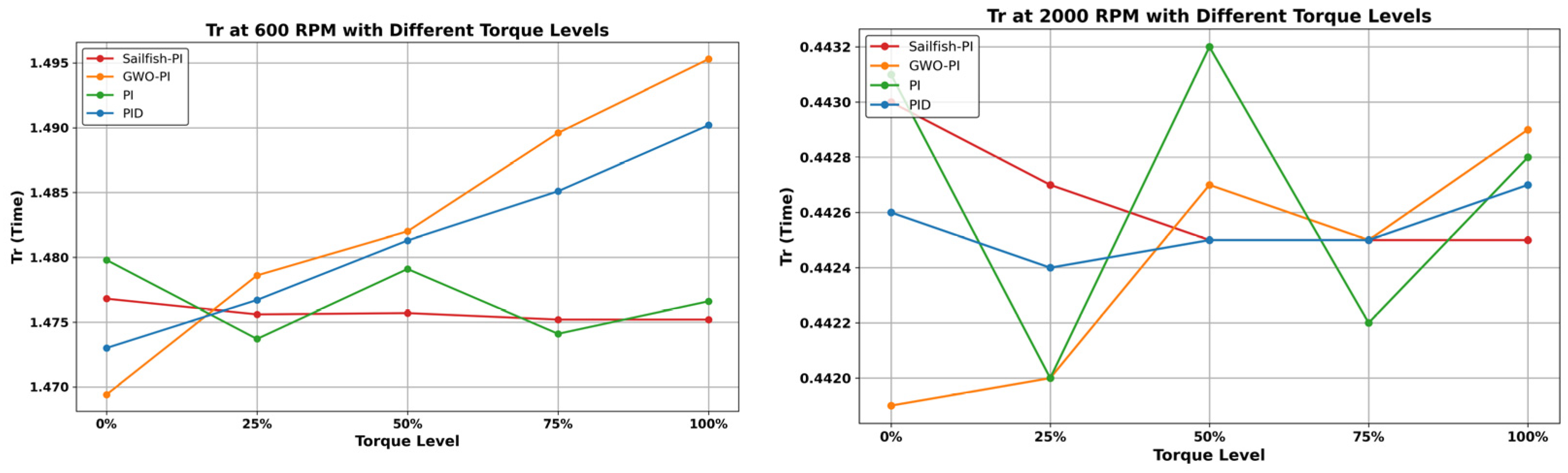
Figure 16: This is the undershoot at 600 rpm and 2000 rpm. At 600 rpm, the time response values were slightly higher for all controllers. Sailfish-PI again stood out for its smooth and steady performance. GWO-PI and PID gradually increased with torque, hinting at a slight slowdown under heavier load. PI stayed relatively balanced, with only small fluctuations. Overall, Sailfish-PI continued to deliver the most stable and reliable response across different speeds and torque levels, as is detailed in
Table 8.
At 2000 rpm, all controllers showed very steady time response values, with only tiny changes as torque increased. Sailfish-PI remained the most consistent, barely shifting at all. GWO-PI and PID had some small ups and downs, while PI showed a bit more variation, especially around mid-range torque. Still, the overall differences were minor, suggesting that all controllers handled timing well at high speed, as is detailed in
Table 9.
- e.
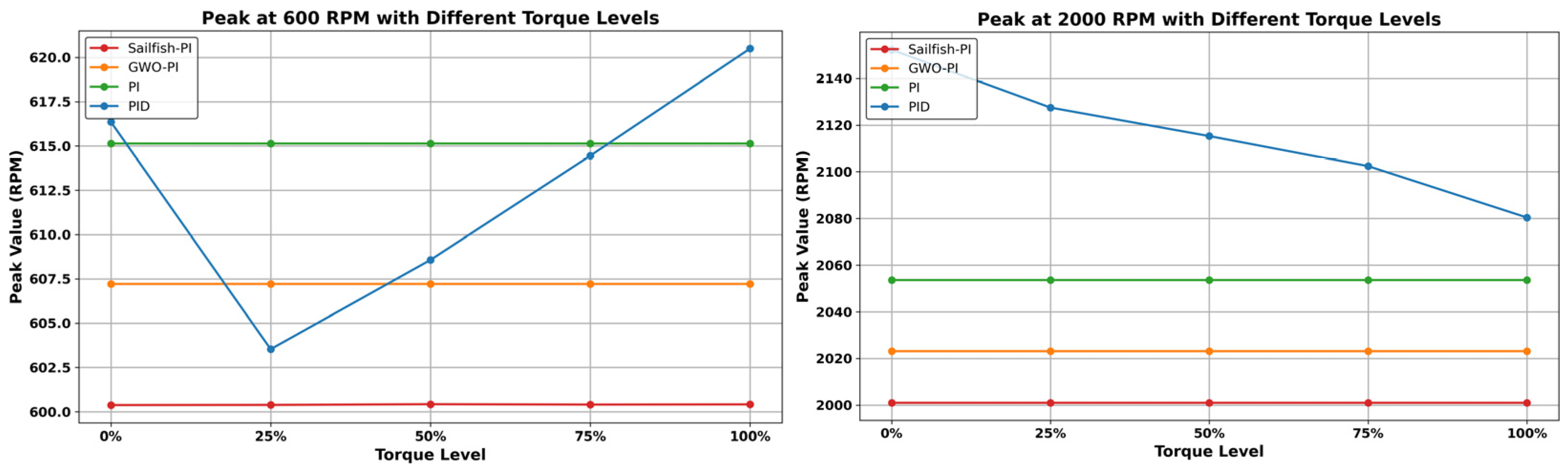
Peak
Figure 17: This is the peak at 600 rpm and 2000 rpm. These graphs show how different control strategies handle motor speed when torque changes. At both 600 rpm and 2000 rpm setpoints, the Sailfish-PI controller consistently delivers the most stable and accurate performance, keeping the peak rpm nearly flat and very close to the target. In contrast, the PID controller struggles with torque variations, especially at 2000 rpm, where its peak rpm drops noticeably as torque increases. The PI and GWO-PI controllers perform better than PID but are not as precise or steady as Sailfish-PI, as shown in
Table 10 and
Table 11.
5. Experimental Results
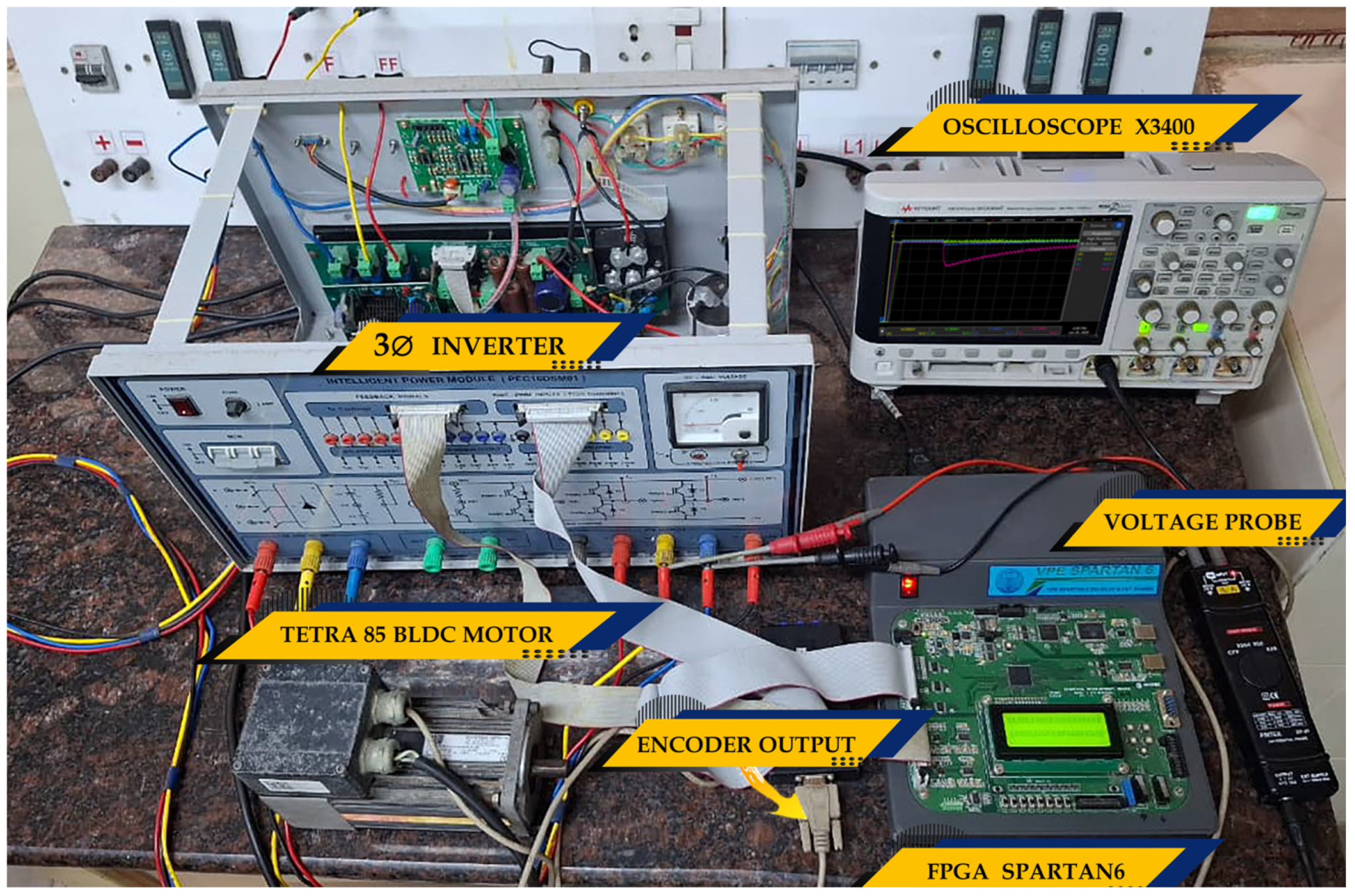
A real-time experimental setup was created to verify the behavior of the proposed Sailfish Optimization algorithm (SFO)-based PI controller for BLDC motor speed regulation. As the main actuator in the test system, a BLDC motor (TETRA-85) (Motor Power Company s.r.l., Reggio Emilia, Italy) with a 2.2 Nm nominal torque rating was used in the setup. A three-phase PEC16DSMO1 inverter (Vi Microsystems Pvt., Ltd., Tamil Nadu, India) with six IGBT power switches powers the motor, ensuring dependable and effective commutation. A FPGA Spartan-6 controller (Advanced Micro Devices, Inc., Sunnyvale, CA, USA) manages the inverter’s operation by executing the real-time control algorithm and producing the necessary gate pulses for the IGBTs. High-speed computation and accurate control signal generation are made possible by this FPGA-based design, which guarantees accurate PI controller performance under dynamic load situations. The motor’s speed waveforms are recorded using an Oscilloscope X3400 four-channel digital oscilloscope (Saelig Company, Inc., New York, NY, USA) for signal monitoring and data collection and the complete setup is shown in
Figure 18. A belt-coupled system was used to apply the required torque.
5.1. Mode 1: No-Load Condition
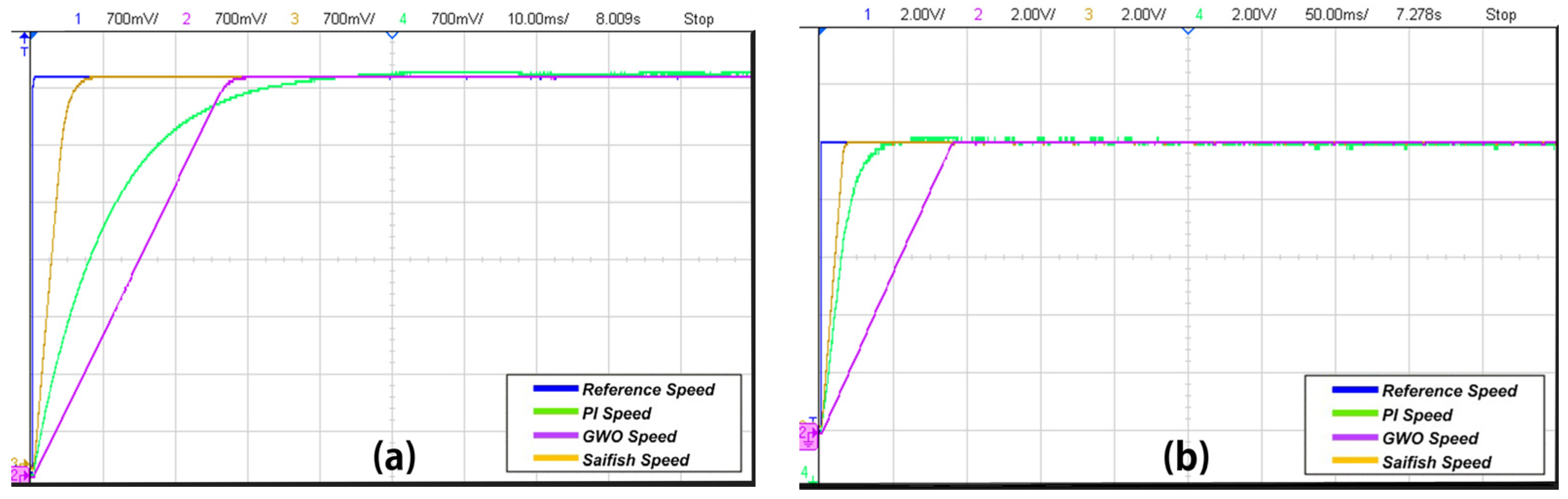
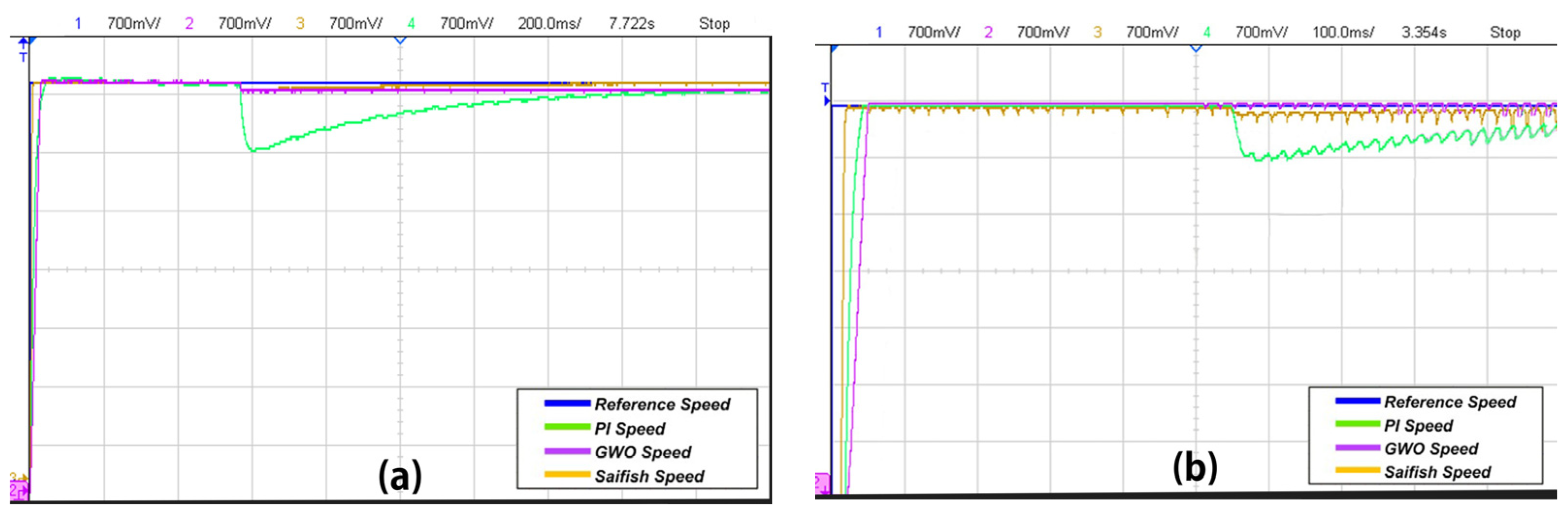
Figure 19: This is Mode 1 with motor speed at (a) 600 rpm and (b) 2000 rpm and no load. The reference speed at 600 rpm and 2000 rpm could be tracked by all three control techniques with little steady-state error when there was no load. Nonetheless, significant variations were noted in the settling properties and rise time. Especially during the transient phase, the traditional PI controller showed a comparatively slower reaction and increased overshoot. In comparison with the traditional PI, the GWO-based PI controller achieved a faster rise time and less overshoot, improving the transient responsiveness. The highest dynamic performance was attained by the suggested Sailfish Optimization algorithm, which showed smooth steady-state behavior, a faster speed convergence, and little overshoot. This demonstrates the SFO’s exceptional capacity for parameter adjustment in order to get the best possible proportional and integral improvements.
5.2. Mode 2: 25%-Load Condition
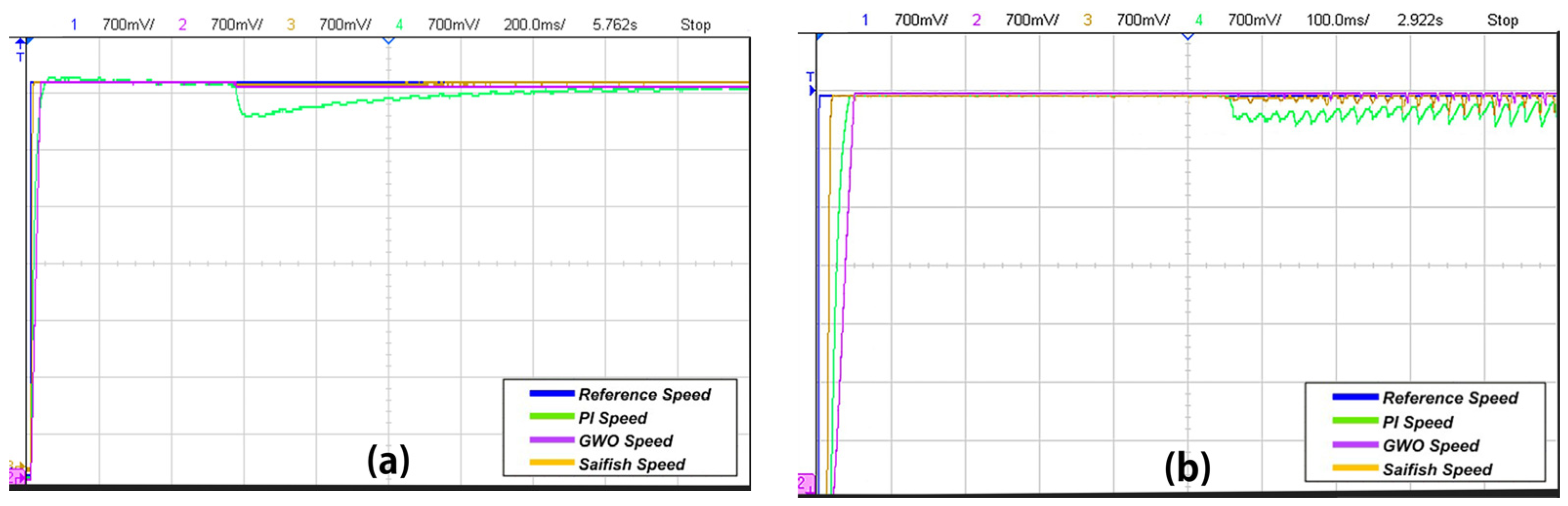
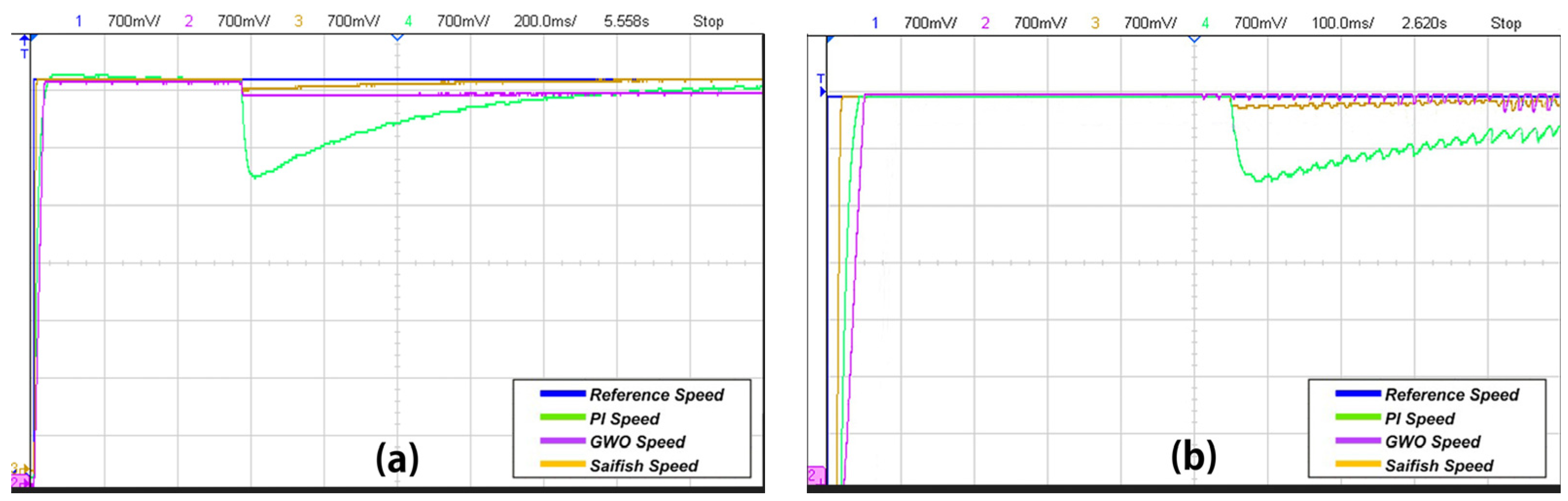
Figure 20: This is Mode 2 with motor speed at (a) 600 rpm and (b) 2000 rpm and 25% load. Under dynamic torque settings, each controller’s efficacy was further examined. After the load disturbance, the traditional PI controller had a slight speed reduction and took longer to recover. Although it displayed slight oscillations when the load was applied, the GWO-based controller maintained superior speed regulation. However, the SFO-based controller quickly recovered to reference speed and demonstrated exceptional robustness against load variation during the 600 rpm speed deviation. At 2000 rpm, the controller continued to operate steadily even at higher speeds, demonstrating its capacity to effectively manage both low- and high-speed settings.
5.3. Mode 3: 50%-Load Condition
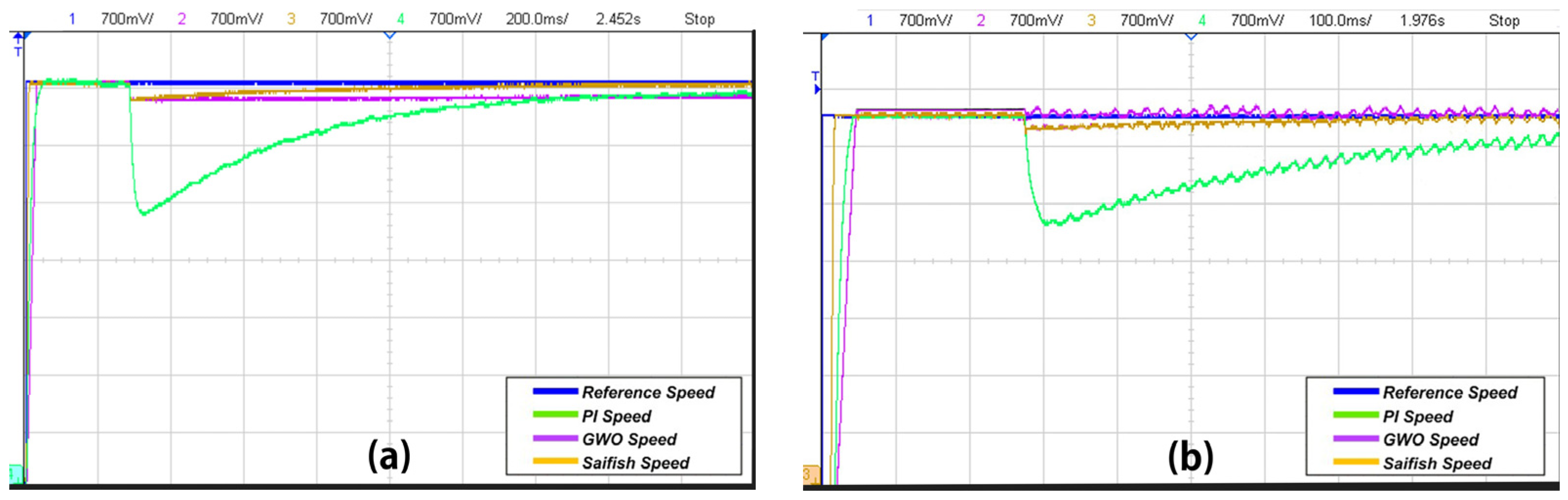
Figure 21: This is Mode 3 with motor speed at (a) 600 rpm and (b) 2000 rpm and 50% load. To evaluate mid-load performance and controller robustness, the motor was tested in this mode at 600 rpm and 2000 rpm with a 50% load torque applied. When the load was applied under these circumstances, the traditional PI controller saw a noticeable speed drop right away, followed by a gradual recovery to the reference speed. This shows a poorer ability to adjust to changing torque demands and a limited capacity to reject disturbances. By lowering the speed deviation’s magnitude and duration, the GWO-based PI controller outperformed the classical PI controller. At higher speeds, though, it continued to show slight oscillations around the steady-state value, suggesting some sensitivity to changes in the dynamic load. Once more, the most accurate and stable response was given by the PI controller adjusted by the Sailfish Optimization algorithm (SFO), which maintained the reference speed with very little steady-state error and very little transient deviation. The system’s rapid recovery from the load disturbance demonstrates the SFO approach’s optimal gain tuning and robustness. The algorithm’s successful balance between exploration and exploitation during parameter optimization is responsible for this better performance.
5.4. Mode 4: 75%-Load Condition
Figure 22: This is Mode 4 with motor speed at (a) 600 rpm and (b) 2000 rpm and 75% load. The test assesses the controller’s performance under near-rated loading conditions, where torque disturbances are more noticeable, at a 75% load torque. Reduced control effectiveness under high load was indicated by the PI controller’s significant speed dip and longer settling time. Faster speed restoration was a moderate improvement provided by the GWO-based PI controller; however, it still showed minor oscillations close to the steady-state region, particularly at 2000 rpm. On the other hand, the SFO-optimized PI controller demonstrated exceptional load-handling capabilities, preserving speed stability with a quick transient recovery and very little departure from the reference value. The SFO controller demonstrated its resilience to significant torque perturbations by maintaining high accuracy and smooth operation even at 75% load. These findings show that, at all load levels, the Sailfish Optimization algorithm continuously performs better than the traditional and GWO-based tuning techniques. The SFO’s effectiveness in adjusting PI controller parameters for BLDC motor drives is confirmed by the improvements, which include faster dynamic response, reduced overshoot, enhanced steady-state accuracy, and superior disturbance rejection capability.
5.5. Mode 5: Full-Load Condition
Figure 23: This is Mode 5 with motor speed at (a) 600 rpm and (b) 2000 rpm and full load. To assess the controllers’ performance at maximum torque demand, the TETRA 85 BLDC motor was run at 600 rpm and 2000 rpm under 100% rated load in this last test scenario. Since it puts the system’s steady-state stability and transient response to the test under extreme stress, this is the most difficult operating condition. Following the application of full load, the conventional PI controller showed a notable decrease in speed, which was followed by a gradual recovery toward the reference value. The significant deviation and prolonged settling time show that the traditional tuning method is not resilient or flexible at high torque levels. The dynamic response was enhanced by the GWO-tuned PI controller, which demonstrated less overshoot and quicker recovery than the traditional PI controller. It did, however, continue to exhibit oscillatory behavior around the steady-state speed, especially at 2000 rpm, indicating that its parameter optimization is less successful when operating at full load. On the other hand, the PI controller based on the Sailfish Optimization algorithm (SFO) demonstrated outstanding dynamic and steady-state performance. It maintained close tracking of reference speed with minimal speed deviation, fast recovery, and negligible oscillations, even at 100% load. Strong disturbance rejection and stability were demonstrated by the controller, underscoring the SFO’s ability to generate ideal proportional and integral gains that strike a balance between smooth control effort and speed accuracy. Overall, the findings demonstrate that, under all load conditions, from no load to full-load operation, the SFO-optimized PI controller continuously provides better robustness, quicker response, and increased stability when compared to both the conventional and GWO-based controllers as shown in
Table 12.
6. Conclusions
This research has presented one of the best technologies to improve the brushless direct current (BLDC) motor drive performance by integrating the Sailfish Optimization algorithm (SFO) with a direct torque control (DTC) strategy. Unlike conventional DTC methods that require simultaneous reference control of both torque and flux, the proposed scheme simplifies the control structure by utilizing speed as the sole reference input while dynamically adapting the flux through the optimized Sailfish-tuned PI controller. Comprehensive simulations were conducted under a variety of operating conditions, including different speed and torque levels. Comparative analysis against traditional PI, PID, and Gray Wolf Optimization (GWO)-based controllers demonstrated that the proposed Sailfish-PI controller consistently achieved superior dynamic and steady-state performance. Specifically, it exhibited faster rise times with 2.1 ms, shorter settling times with 2.9 ms under 2.39 Nm nominal torque at 2000 rpm speed, minimal overshoot and undershoot, enhanced torque smoothness, and an almost flat peak extremely near to the target with 2001 rpm across all tested load variations. This robust response is attributed to the Sailfish algorithm’s balanced exploration and exploitation capabilities, inspired by the collaborative and adaptive hunting behavior of sailfish in nature. The study’s results confirm that the Sailfish-PI approach effectively mitigates key drawbacks associated with conventional PI controllers, such as sensitivity to load variations and insufficient adaptability to nonlinear motor dynamics. The improved dynamic speed tracking, reduced torque ripple, and constant switching frequency of the proposed system make it particularly suitable for applications with variable speed and torque demands, such as electric vehicles and industrial automation systems. These results indicate that, for the considered motor configuration and operating conditions, the SFO-based tuning enhances the dynamic response and robustness of the PI-controlled DTC drive compared to the selected benchmark controllers. However, since the evaluation was conducted on a single BLDC motor with specific parameter bounds and operating profiles, this limited the tested experimental setup. Broader generalization to other motor ratings and inverter topologies requires further validation. Additionally, extending the approach to multi-objective scenarios, incorporating sensorless control, or hybridizing with other soft computing techniques could further improve the adaptability of BLDC motor control through challenging and unpredictable situations.
7. Limitations and Future Work
Even though the suggested Sailfish Optimization algorithm (SFO)-based PI controller performed well in simulation and real-time tests, there are still certain issues that present room for improvement. The testing was carried out in a controlled laboratory setting with reasonably steady supply voltage, temperature, and motor aging effects. Adaptive tuning procedures are necessary in real-world applications due to variables including inverter nonlinearities, mechanical wear, and temperature fluctuations that might affect controller performance. Furthermore, even though the SFO algorithm produced robust control and fast convergence, its computational cost is comparatively expensive when compared to conventional techniques, making it difficult to apply on low-cost embedded devices with constrained processing power. The PI controller’s fixed-gain structure is another area that needs work. In dynamic or unexpected operating settings, the controller does not self-adjust, even though SFO efficiently optimizes the gains for the tested conditions. Future research might examine the incorporation of adaptive or hybrid optimization strategies, in which fuzzy adaptation or online learning are used to update the controller gains in real time. It should be noted that the algorithm was applied on a motor drive with low-power applications, and it should be tested on high-power applications. The algorithm is single and considers the speed value only; moving forward by considering the torque and efficiency as a multi-objective algorithm would be optimal. Broadly speaking, the research’s future goals include applying the suggested MATLAB-based methodology to multi-motor systems including microgrid converters, industrial automation networks, and electric car drives. The applicability could be further strengthened by incorporating fault-tolerant design, sensorless control approaches, and hardware-in-the-loop (HIL) testing. Furthermore, incorporating cutting-edge computational tools like AI-assisted optimization or dSPACE co-processing could greatly improve the speed, accuracy, and adaptability of next-generation BLDC motor control systems.




 ,
,