Article

Industrial Park-Based Energy Transition Policies and Urban Carbon Intensity: Evidence Using China’s Low-Carbon Industrial Park Pilots

School of Finance and Economics, Jimei University, Xiamen 361021, China
*
Author to whom correspondence should be addressed.
Energies 2026, 19(7), 1643; https://doi.org/10.3390/en19071643
Submission received: 3 March 2026 / Revised: 22 March 2026 / Accepted: 25 March 2026 / Published: 27 March 2026

Abstract

In response to global climate change, low-carbon transition in the industrial sector has become essential for emission reduction. Industrial parks, as concentrated centers of production, are major sources of urban energy use and carbon emissions. Whether park-based policy interventions can generate broader decarbonization effects remains unclear. This study conceptualizes China’s National Low-Carbon Industrial Park Pilot Policy (NLCIPP) as a meso-level systemic intervention and examines its impact on urban carbon intensity (UCI). Using panel data for 282 Chinese cities from 2006 to 2020, causal effects are identified through a multi-period DID framework combined with a synthetic DID approach. The results show that the NLCIPP significantly reduces UCI, indicating that energy-oriented interventions at the industrial park level can induce broader decarbonization outcomes. The policy effect mainly works via reduced energy consumption and enhanced green technological capability, while the contribution of industrial structural upgrading is relatively limited. Stronger impacts appear in central regions, cities with stricter environmental regulation, and non-resource-based cities, highlighting the context-dependent effectiveness of energy transition policies. These findings provide empirical evidence for designing effective industrial energy policies to promote low-carbon transition.

1. Introduction

Low-carbon transition in industry is essential for systemic emission reductions amid global climate change [1,2]. Recent international studies have also emphasized the critical role of policy-driven industrial decarbonization in achieving net-zero targets [3,4,5]. Industrial parks, as spatially concentrated hubs of industrial activity, drive regional economic growth while concentrating energy use and carbon emissions [6]. According to statistics, various industrial park types contribute over 50% of China’s industrial output, with carbon emissions exceeding 30% of total industrial emissions [7,8]. This unique space–economic unit not only exhibits an “amplification effect” in emission reduction efforts but also, due to its agglomeration characteristics, possesses distinctive “demonstration” and “scale” effects in technology diffusion, management innovation, and system optimization [9]. Therefore, policy interventions targeting industrial parks can strongly promote industrial decarbonization.
The existing low-carbon pilot policy framework in China spans multiple levels, including cities, industrial parks, and communities. However, academic attention has long focused on the effectiveness of low-carbon city pilots [10,11,12] and carbon emissions trading pilots [13,14,15,16], while systematic and rigorous causal effect studies on low-carbon pilot policies at the industrial park level remain scarce. This research gap stands in stark contrast to the practical importance of industrial parks. Since its launch in 2013, the national low-carbon industrial park pilot policy (NLCIPP) has aimed to explore replicable and scalable models for industrial decarbonization. Clarifying its true policy effects, underlying mechanisms, and heterogeneous characteristics not only fills a critical gap in the existing policy evaluation system at the industrial agglomeration level but also provides precise decision-making guidance for green upgrading of industrial parks nationwide. This study is undertaken in this context, aiming to systematically examine how the park-level pilot policy affects urban carbon intensity (UCI).
Existing literature primarily develops along two main paths. In the field of low-carbon policy effect evaluation, scholars have extensively examined the environmental and economic impacts of policy instruments such as low-carbon city pilots [10,11,12,17] and carbon emissions trading systems [13,14,15,16]. Many of these studies employ causal inference methods, such as difference-in-differences (DID), to assess the policies’ contributions to lowering carbon intensity and fostering green technological innovation [12,18,19,20]. They also delve into the underlying mechanisms and heterogeneous effects, providing rich empirical evidence for understanding the operational outcomes of macro-level environmental regulation policies. Similar strands of research have also emerged in the international context, examining the effectiveness of climate policies in promoting industrial decarbonization and technological transition [21,22,23].
In the domain of low-carbon development in industrial parks, some scholars have conducted qualitative case studies to analyze the practical models, driving factors, and challenges of specific parks’ low-carbon transformation [24,25,26,27,28,29]. Other studies have attempted to advance the discussion using quantitative modeling approaches—for example, by constructing multi-objective optimization models to plan low-carbon development paths for parks [30,31,32,33], or by employing scenario analysis to simulate emission reduction potential and economic benefits under different combinations of policies and technologies [34,35,36]. Prior research provides insights into the complexity of industrial parks’ low-carbon transition from multiple perspectives.
Nevertheless, important limitations remain in the existing literature. First, the role of industrial parks as meso-level policy carriers has been largely overlooked in causal evaluation frameworks, leaving a missing link between macro policy design and micro-level implementation. Second, current studies rarely establish a clear empirical connection between park-level interventions and city-level environmental outcomes, making it difficult to assess their broader policy relevance. Third, the mechanisms through which such policies operate—particularly across technological, structural, and energy dimensions—remain insufficiently understood.
To deepen the understanding of meso-level environmental policies, this study aims to employ rigorous econometric methods to systematically evaluate the causal effects of the NLCIPP on UCI, while also revealing its underlying mechanisms and boundary conditions. Specifically, the study focuses on the following three progressive questions: First, does the pilot policy significantly suppress carbon intensity in the cities where it is implemented? Second, if the policy is effective, through which mechanisms and pathways does it achieve this impact? Third, do the policy effects exhibit systematic heterogeneity depending on regional development stages, the stringency of local environmental regulations, and the cities’ own resource endowments?
This study makes three key contributions. First, from a research perspective, this study incorporates the NLCIPP—a representative meso-level environmental policy—into a quantitative evaluation framework, thereby complementing existing evidence on low-carbon cities and carbon market pilots. Second, in terms of methodology, this study employs multi-period DID and synthetic DID models for large-sample empirical analysis. In contrast to the predominant reliance on qualitative case studies in this field, it provides systematic quantitative evidence on policy effectiveness, while further exploring underlying mechanisms and heterogeneous effects. Third, in terms of policy implications, the findings reveal limitations in the policy’s role in promoting industrial structure upgrading and identify significant heterogeneous effects, providing insights for more targeted and adaptive policy design.
The paper is organized as follows. Section 2 introduces the policy background and theoretical analysis. Section 3 outlines the research design, covering model specification, variable selection, and data description. Section 4 presents the empirical results and robustness checks, and further conducts mechanism testing and heterogeneity analysis. Section 5 concludes with the main findings and policy implications.

2. Policy Background and Theoretical Analysis

2.1. Policy Background

With China’s “dual carbon” goals, industrial decarbonization has become a key national priority. Industrial parks, as major centers of production and energy consumption, are also significant sources of emissions. Promoting integrated emissions reduction through pilot demonstrations in these parks has therefore become an important pathway for green upgrading. Against this backdrop, the NLCIPP was launched in 2013 to explore replicable low-carbon development models.
The pilot program focuses on improving carbon management and innovating low-carbon mechanisms through five main tasks: (1) promoting low-carbon production by optimizing energy structures and industrial chains; (2) establishing innovation platforms to advance low-carbon technologies; (3) developing carbon management systems, including emissions accounting, monitoring, and carbon market exploration; (4) strengthening low-carbon infrastructure, particularly renewable energy and efficient energy systems; and (5) enhancing international cooperation to introduce advanced technologies and management practices.
In terms of implementation, 55 parks were initially selected as applicants through recommendation and review procedures. After submitting implementation plans in 2014, 39 parks were approved as the first batch and began operation in 2015. An additional 12 parks were approved in December 2015 as the second batch, starting in 2016. In the empirical analysis, treatment timing is defined based on the actual implementation year: cities with first-batch parks are treated from 2015, and those with second-batch parks from 2016. This approach reflects that substantive policy effects emerge only after implementation, while earlier stages are unlikely to produce immediate impacts. The detailed list of pilot parks, compiled from publicly available government documents, is provided in an online data repository (see Data Availability Statement for the repository link).

2.2. Theoretical Analysis

Based on the IPAT/STIRPAT framework, carbon emissions depend on economic scale, energy intensity, and technology [37,38]. Structural change and endogenous growth theories further identify industrial upgrading and technological innovation as key drivers of low-carbon development [39,40]. Accordingly, environmental regulation and related policies influence carbon outcomes through scale, structural, and technological channels [41,42,43]. The NLCIPP targets low-carbon production, technology, management, and infrastructure. These measures affect UCI by altering energy use, industrial structure, and technological progress. This study therefore examines three channels: energy consumption, industrial upgrading, and technological innovation.

2.2.1. Scale Effect: Reducing Energy Consumption

From the scale perspective, The NLCIPP reduces UCI by lowering energy use per unit of output through low-carbon production and infrastructure development. The STIRPAT framework links energy consumption directly to carbon emissions [38,44]. Consistent with this theoretical perspective, international empirical studies show that policy-driven improvements in energy efficiency and energy structure can effectively reduce carbon intensity [45,46]. However, traditional industrial parks are generally characterized by low energy-use efficiency and a high dependence on fossil fuels [47,48]. In response, the NLCIPP promotes low-carbon production across the entire process and accelerates transformation in energy-intensive industries through process improvements, equipment upgrading, and material substitution. The policy also optimizes energy structures and infrastructure by encouraging centralized energy supply, combined cooling, heating and power systems, distributed energy, and smart microgrids. These measures improve energy efficiency, expand the use of renewables, and reduce fossil fuel dependence. As a result, energy and carbon intensity can decline even with continued industrial growth, contributing to lower UCI through the scale channel.

2.2.2. Structural Effect: Optimizing the Industrial Structure

From the structural perspective, the NLCIPP promotes industrial upgrading toward low-carbon and high-value-added activities by tightening entry standards, restructuring industrial chains, and supporting emerging industries. Structural change theory highlights large differences in energy use and emissions across sectors, implying that shifting production toward cleaner and higher-value industries reduces carbon intensity [49,50]. This mechanism is further supported by international empirical evidence, which shows that environmental policies can drive such industrial restructuring and thereby contribute to emission reductions [51,52]. The NLCIPP restricts high-carbon capacity through stricter entry and production standards while guiding new investment toward low-carbon activities. At the same time, it encourages industrial linkages and resource recycling within parks, fostering more efficient and low-carbon production networks. In parallel, the NLCIPP supports emerging low-carbon industries and producer services. This dual approach—restricting high-carbon sectors while promoting low-carbon ones—compresses the space of emission-intensive activities and accelerates the growth of cleaner industries. As industrial structure shifts within parks, these changes spill over to the city level, contributing to lower UCI.

2.2.3. Technological Effect: Promoting Green Technological Innovation

From the technological perspective, the NLCIPP reduces UCI by promoting technological progress through low-carbon innovation, carbon management, and international cooperation. Endogenous growth theory identifies technological progress as a key driver of efficiency improvement and sustainable growth [53]. The Porter Hypothesis further suggests that well-designed environmental regulation can stimulate innovation and reduce emissions [54]. This mechanism is supported by a growing body of international empirical evidence, which shows that such regulation-induced innovation contributes significantly to emission reduction outcomes [55,56]. The NLCIPP supports low-carbon technologies by promoting R&D, diffusion, and application, thereby lowering innovation costs and uncertainty. It also strengthens carbon management through emission inventories, information platforms, and trading mechanisms, improving firms’ capacity for emission control. Together, technological and management innovation reduce emissions per unit of output and generate spillover effects that raise the overall level of low-carbon technology within and beyond industrial parks. International cooperation further accelerates the diffusion of advanced technologies and practices, providing sustained support for long-term reductions in UCI.
Accordingly, the following hypotheses are tested:
H1: 
The NLCIPP significantly reduces UCI.
H2: 
The NLCIPP reduces UCI through reduced energy use, industrial upgrading, and green technological innovation.

3. Research Design

3.1. Model Specification

This study treats the NLCIPP as a quasi-natural experiment to evaluate its impact. The rationality of this research design is based on two main considerations. First, the policy was launched under the unified deployment of the national government rather than being initiated by the parks themselves, thereby providing a quasi-natural experiment for empirical analysis. Second, pilot selection involves some randomness, allowing non-pilot parks to serve as a suitable control group and ensuring comparability between treated and control units. It is important to clarify that although the policy is implemented at the industrial park level, we define treatment at the city level. This choice reflects the nature of the policy as a place-based intervention with broader city-wide implications, where pilot parks serve as key platforms for policy diffusion, demonstration effects, and industrial spillovers. While this binary measure does not explicitly capture variation in treatment intensity across cities (e.g., the number of pilot parks), it provides a parsimonious and conservative identification strategy. In particular, by treating all exposed cities uniformly, the specification may attenuate the estimated effects in cities with multiple parks. Therefore, our estimates should be interpreted as lower-bound effects of the policy. Given that the policy was implemented in two batches (2015 and 2016), a multi-period DID model is employed. The model specification is given in Equation (1):
C I i , t = α 1 + β 1 D I D i , t + β 2 X i , t + μ i + θ t + ε i , t
In the equation, i and t denote the city and year, respectively; C I i , t represents the UCI of city i in year t . The key variable is D I D i , t , defined as the interaction between a treatment indicator ( t r e a t i ) and a post-policy dummy ( p o s t t ). t r e a t i equals 1 for cities with at least one low-carbon industrial park, while p o s t t equals 1 from the implementation year onward. β 1 measures the effect of the NLCIPP on UCI. X i , t includes control variables, μ i and θ t denote city and year fixed effects, and ε i , t is the error term.

3.2. Variable Selection

3.2.1. Dependent Variable

The dependent variable is UCI, measured as carbon emissions per unit of economic output at the city level. Compared with total emissions, UCI controls for differences in economic scale and industrial structure, providing a clearer measure of policy effects. It also facilitates cross-city comparison and aligns closely with low-carbon development objectives. Regarding data acquisition and processing, this study uses the Emissions Database for Global Atmospheric Research (EDGAR) gridded CO2 emission dataset. City-level emissions are obtained by spatially aggregating grid data using ArcGIS 10.2, and UCI is calculated by dividing emissions by city GDP. Compared with aggregate data, this measure captures intra-city spatial variation, including the distribution of industrial parks and related spillover effects, providing a more detailed basis for policy evaluation.

3.2.2. Explanatory Variable

The explanatory variable is the NLCIPP, measured by a dummy variable ( D I D i , t ). Specifically, a city is coded as 1 from the year it hosts at least one pilot park, and 0 otherwise. As the policy was introduced in two waves (2015 and 2016), treatment timing varies across cities.

3.2.3. Control Variables

This study constructs a multidimensional system of control variables to effectively account for factors that may influence UCI. Economic development (PGDP) is measured by GDP per capita. Population density (POP) is calculated as the ratio of resident population to administrative area. Technological input (TECH) is proxied by the ratio of R&D expenditure to GDP. Government intervention (GOV) is measured by the share of fiscal expenditure in GDP. Openness (FDI) is captured by the actual utilization of foreign direct investment. Environmental regulation (ER) follows Chen and Chen [57], measured by the frequency of environment-related terms in government work reports. Industrial agglomeration (INA) is measured using the location quotient based on manufacturing employment. In addition, to account for potential nonlinear effects of economic development, the squared term of PGDP (PGDP22) is included in line with the EKC hypothesis.

3.3. Data Sources

This study uses a sample of 282 prefecture-level and above cities in China over the period 2006–2020. The sample period starts in 2006, when energy conservation and emission reduction were formally incorporated into national development planning, and ends in 2020 to avoid potential structural distortions associated with the COVID-19 pandemic. The sample covers most cities in mainland China and is broadly representative.
Data are compiled from multiple sources. Information on NLCIPP is collected from official government documents (https://www.miit.gov.cn/) and manually verified. Control variables are obtained from the China City Statistical Yearbook, local statistical yearbooks, and the EPS database, with cross-checking to ensure consistency. Carbon emissions are derived from the EDGAR gridded dataset (0.1° × 0.1°) and aggregated to the city level using ArcGIS. All dependent variables and non-ratio control variables are transformed into natural logarithms to mitigate heteroscedasticity. Descriptive statistics are reported in Table 1.

4. Empirical Results and Discussion

4.1. Baseline Regression Results

Table 2 reports the baseline results of the multi-period DID estimation. Column (1) presents the preliminary estimates without control variables or fixed effects. The coefficient on NLCIPP is significantly negative at the 1% level, suggesting that the policy is associated with a reduction in UCI. Column (2) further incorporates city-level control variables and both city and year fixed effects. The estimated coefficient remains significantly negative at the 1% level, indicating that the emission-reduction effect of the NLCIPP is robust after controlling for observable characteristics and unobserved heterogeneity.

4.2. Parallel Trend Test

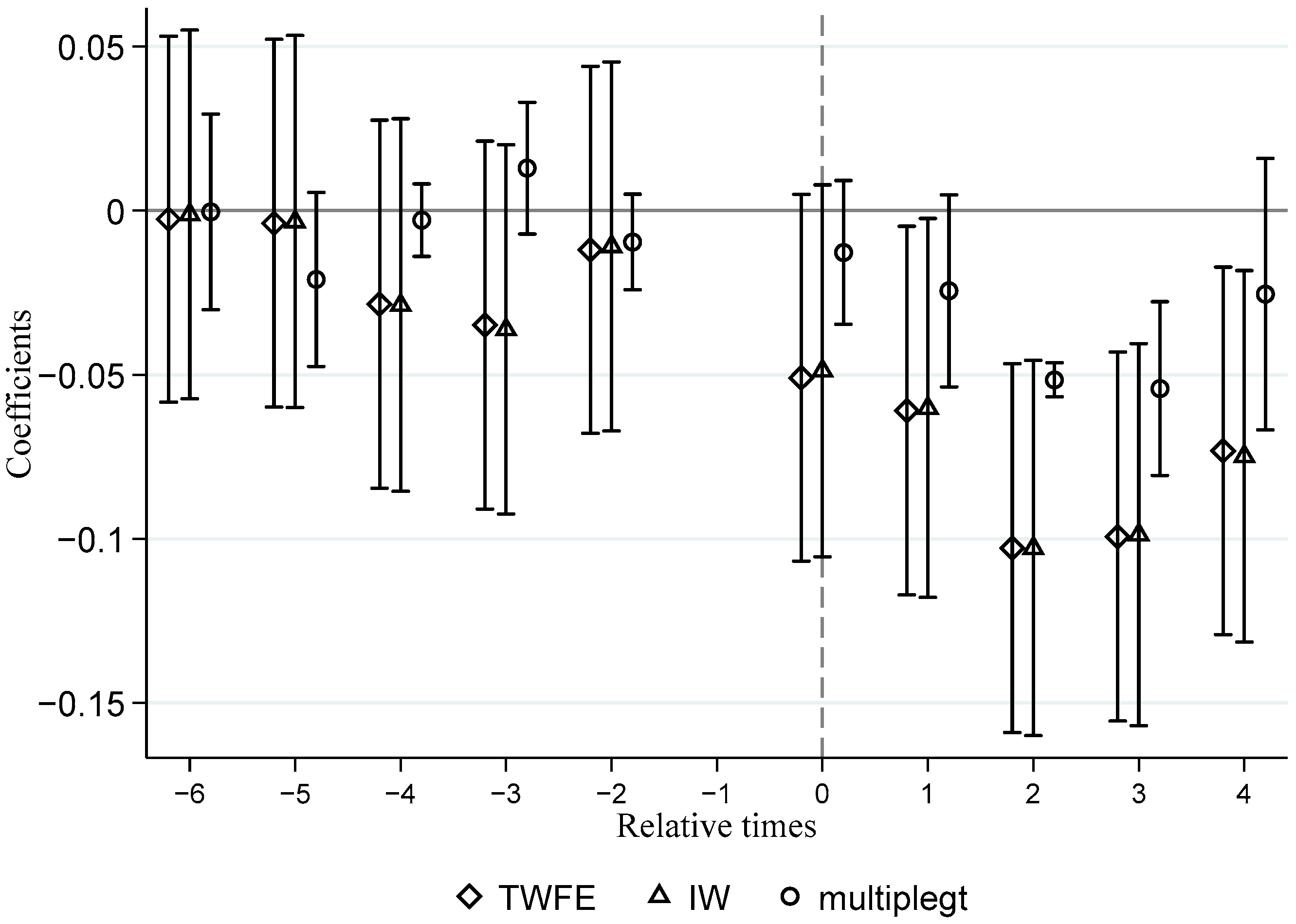
The DID framework relies on the parallel trend’s assumption, requiring similar pre-treatment trends between treated and control groups. To examine this, relative-time indicators are constructed based on the policy implementation year, with the period t = −1 omitted as the reference group. Given the long sample window, all periods earlier than six years before treatment are grouped into a single category to improve estimation stability.
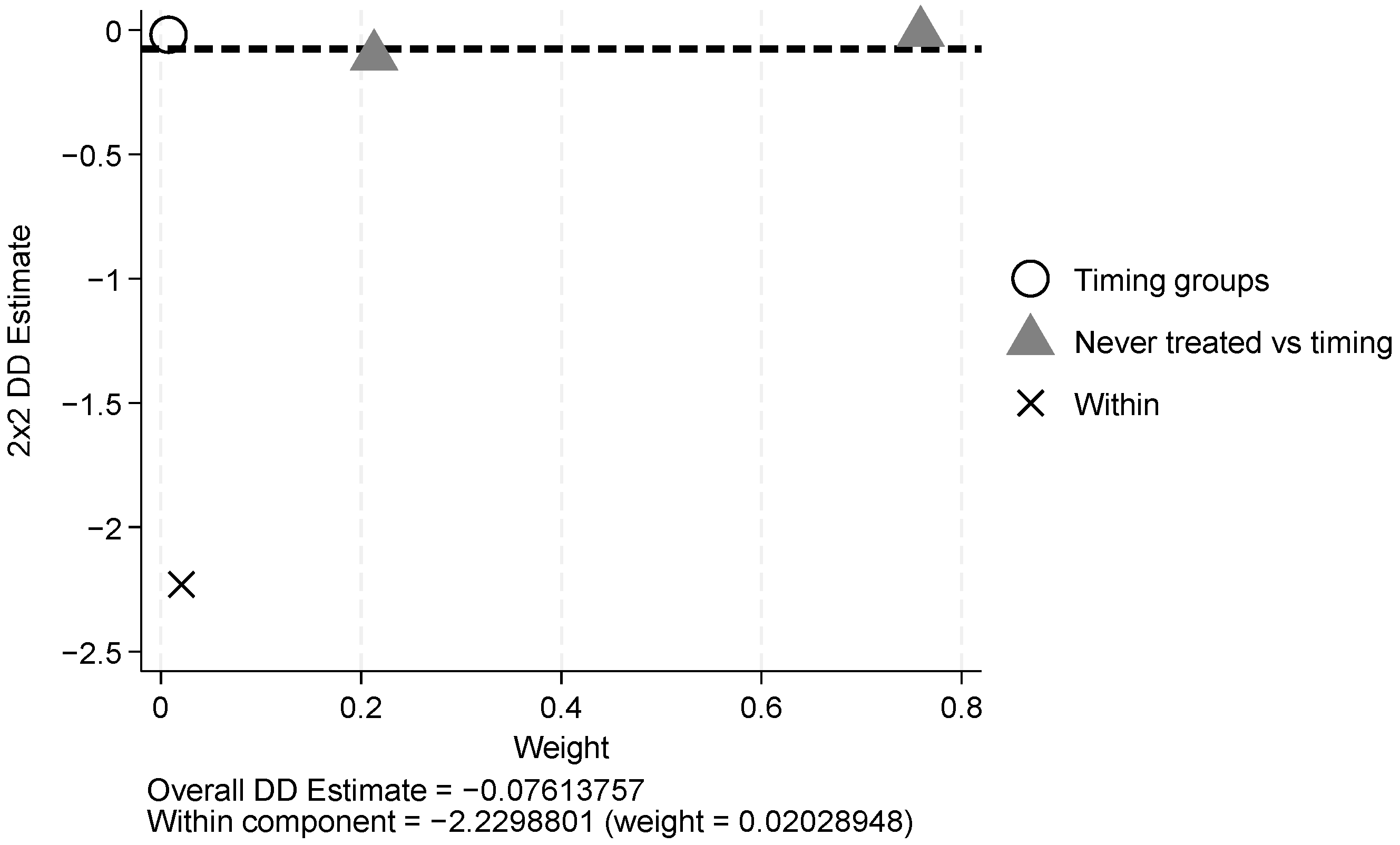
Recent studies note that the traditional two-way fixed effects (TWFE) estimator may suffer from negative weighting in multi-period settings with heterogeneous treatment effects, potentially leading to biased results. To address this concern, the Goodman-Bacon [58] decomposition method is applied to assess the composition of the TWFE estimates. As shown in Figure 1, comparisons between treated and never-treated cities account for about 97% of the total weight. This indicates that the estimates are primarily driven by valid treatment–control comparisons, suggesting that the TWFE results are reliable.
To further verify parallel trends, multiple estimators are applied. In addition to the standard TWFE model, the interaction-weighted (IW) estimator [59] and the multiplet estimator [60] are used to account for heterogeneous treatment effects and staggered implementation. Figure 2 shows that, before the NLCIPP rollout, treated and control cities exhibit very similar trends in UCI across all estimation methods, confirming that the parallel trends assumption holds for the sample.

4.3. Placebo Test

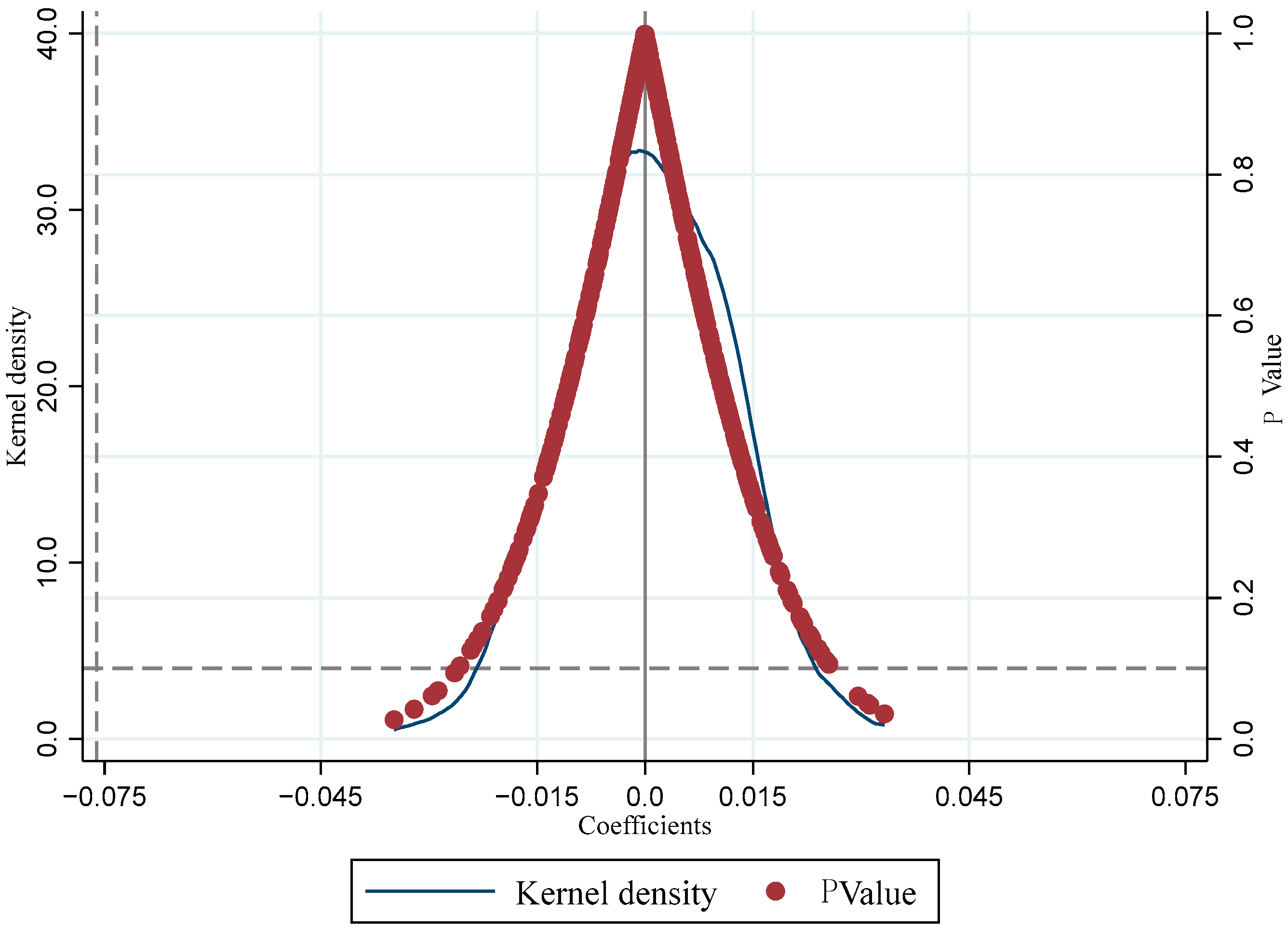
To check for potential confounding from unobserved factors, a placebo test is conducted. Fictitious pilot cities and implementation years are randomly assigned, keeping the sample size and time span unchanged, and the DID model is re-estimated 500 times. Figure 3 shows that the resulting placebo coefficients are mostly centered around zero, symmetrically distributed, and largely statistically insignificant. The actual baseline estimate lies well outside this distribution, indicating that the findings are not driven by random variation and supporting the credibility of the policy’s effect on reducing UCI.

4.4. Synthetic DID Test

The DID approach relies on the parallel trend’s assumption, but pre-treatment similarity does not guarantee parallel post-treatment trends, and the city selection process for NLCIPP may introduce bias. To address these concerns, the synthetic DID method proposed by Arkhangelsky et al. [61] is employed. Synthetic DID combines the synthetic control method with DID, improving comparability between treated and control cities, reducing reliance on strict parallel trends, and allowing dynamic tracking of policy effects.
Table 3 reports the SDID estimates, with and without control variables in columns (1) and (2). The coefficients are significantly negative at the 10% level, supporting the robustness of the baseline results and confirming that the NLCIPP reduces UCI.

4.5. Other Robustness Tests

4.5.1. Lagged Independent Variables

To mitigate potential endogeneity arising from reverse causality between the explanatory and dependent variables, this study introduces lagged explanatory variables and re-estimates the regressions. As shown in Table 4, the coefficients of the key explanatory variable remain significantly negative at the 1% level when lagged by 1, 2, and 3 periods, indicating the robustness of the findings. Moreover, these results suggest that the emission-reduction effect of the NLCIPP is persistent over time rather than merely a short-term effect.

4.5.2. Alternative Dependent Variables

To avoid potential bias caused by measurement errors in a single dataset, this study constructs an alternative measure of UCI2 using the high-resolution global carbon emission gridded data published by Jones et al. [62]. The gridded data were extracted and aggregated to the prefecture-level city scale using ArcGIS. Table 5 presents results using an alternative dependent variable. The NLCIPP remains significantly negative at the 1% level, indicating that its effect on reducing UCI is robust across different measurements and supporting the reliability of the baseline findings.

4.5.3. Interactive Fixed Effects

The baseline regressions already control for city-specific and year-specific effects, capturing both persistent urban characteristics and broad macro-level influences. However, time-varying province-level factors may still be omitted. To address this, province-by-year interactive fixed effects are added, and the results are reported in Table 6. The NLCIPP coefficient remains significantly negative at the 1% level, with or without additional controls, indicating that its effect on reducing UCI is robust even after accounting for time-varying provincial characteristics.

4.5.4. Clustering Standard Errors

Clustering standard errors helps adjust for within-cluster correlation, providing a more accurate measure of data variability. While conventional standard errors assume independent observations, in practice, data from the same city or province are often correlated, which can lead to underestimated standard errors and biased inference. Clustering at the city or provincial level better captures the underlying data structure, mitigating underestimation and enhancing the reliability of statistical inference. In this study, standard errors are clustered at both the city and provincial levels to assess the robustness of the results. As shown in Table 7, the NLCIPP continues to exhibit a significant negative effect on UCI under both clustering schemes, demonstrating that the policy’s emission-reduction impact remains consistent and statistically reliable.

4.5.5. Excluding Direct-Controlled Municipalities

Due to their policy particularity, resource allocation advantages, and unique economic and population structures, the municipalities directly under the central government differ significantly from other regions, which may interfere with the accuracy and generalizability of the regression results. To address this, the regressions are re-estimated in the robustness check by omitting the four centrally-administered cities (Beijing, Shanghai, Tianjin, and Chongqing). Table 8 shows that even after this exclusion, the NLCIPP coefficient remains significantly negative, suggesting that the baseline findings are not driven by the municipalities’ special characteristics and reinforcing the robustness and broader applicability of the results.

4.5.6. Removing Concurrent Policy Interference

During the NLCIPP pilot, several other policies could also influence urban carbon emissions, including carbon emissions trading (CET), low-carbon city pilots (LCC), and energy-saving and emission-reduction fiscal measures (EFP) [63,64,65]. To account for these concurrent policies, three dummy variables are incorporated into the baseline regressions. Columns (1)–(3) in Table 9 report the results when each policy is controlled individually, while column (4) presents the estimates with all three policies included simultaneously. In all cases, the NLCIPP coefficient remains significantly negative, indicating that its emission-reduction effect is robust and not driven by other overlapping policies.

4.5.7. Propensity Score Matching (PSM) Method

Differences between the treatment and control groups may confound the estimated effect of the NLCIPP. To address this, propensity score matching (PSM) is applied to create comparable samples, improving the identification of the policy impact. PSM estimates each observation’s likelihood of being in the treatment group using a logistic regression and pairs units with similar propensity scores to balance covariates. The results using nearest-neighbor matching are reported in Table 10. The NLCIPP coefficient remains significantly negative, indicating that its emission-reduction effect persists after accounting for baseline differences between groups. This reinforces the robustness of the findings and suggests that the observed effect stems from the pilot itself rather than pre-existing disparities.

4.6. Mechanism Test

To investigate the policy mechanisms, this study adopts the one-step approach of Jiang [66], which incorporates mediating variables directly into the regression. This method estimates both the total effect of the NLCIPP on UCI and the indirect effects through specific channels. Energy consumption, industrial upgrading, and green technological progress are selected as potential mediators to examine their roles in transmitting the policy’s impact.

4.6.1. Energy Consumption Reduction

This study examines whether the NLCIPP reduces UCI by lowering energy consumption, a key channel of the scale effect. Energy consumption (EC) is measured as the proportion of carbon emissions from coal in total city-level emissions, based on the global gridded carbon emission dataset [62]. This indicator reflects reliance on high-carbon energy and provides a quantitative basis for assessing reductions in energy intensity per unit of output.
Column (1) of Table 11 indicates that the NLCIPP significantly lowers the coal proportion in total carbon emissions at the 1% level, suggesting that the policy reduces energy intensity and helps decrease UCI. This outcome is driven by several policy measures: the NLCIPP promotes low-carbon production and energy-efficient infrastructure, encourages substitution of coal with cleaner energy sources such as natural gas, solar, wind, and biomass, and supports energy-saving retrofits and equipment upgrades through technical guidance and financial incentives. Furthermore, industrial clustering within the parks facilitates the diffusion of energy-efficient practices and low-carbon technologies. Collectively, these measures reduce energy use per unit of industrial output, decouple industrial growth from carbon emissions, and provide a systematic pathway for reducing UCI.

4.6.2. Industrial Structure Upgrading

This study also examines whether the NLCIPP affects UCI by altering the industrial structure. The degree of industrial structure upgrading (ISU) is measured by calculating the angle of the three-dimensional geometric vector formed by the value-added shares of the primary, secondary, and tertiary industries [67]. This indicator captures both the direction and level of industrial upgrading, with greater angles indicating a stronger shift toward a more advanced industrial structure. The advantage of this measure is that it reflects overall trends in industrial structure changes, avoiding the limitations of single indicators (e.g., the share of the tertiary sector) and providing a more comprehensive assessment of industrial optimization.
Column (2) of Table 11 indicates that the NLCIPP has no significant impact on industrial structure upgrading, suggesting that its effect on UCI is not transmitted through this channel. This outcome can be attributed to several reasons: First, the NLCIPP focuses on lowering carbon emissions via technological innovation, low-carbon production, and enhanced energy efficiency, rather than directly promoting industrial restructuring. Second, industrial parks are predominantly manufacturing-oriented, and the agglomeration effect may limit shifts in the overall industrial structure within the park, making short-term structural upgrading difficult. Finally, industrial upgrading typically requires a longer timeframe and a combination of broader economic and policy interventions.

4.6.3. Green Technological Progress

To examine the technological channel of the NLCIPP on UCI, this study examines its impact on green total factor productivity (GTFP). GTFP is measured using a global Malmquist–Luenberger (ML) index based on the super-efficiency Slacks-Based Measure (SBM) model. The calculation incorporates capital, labor, and energy as inputs, economic output as the desirable output, and environmental pollutants as undesirable outputs. This method has been widely adopted in previous studies to evaluate green productivity and environmental performance [68,69].
Column (3) of Table 11 indicates that the NLCIPP significantly enhances GTFP, suggesting that the policy lowers UCI by fostering green technological progress. Specifically, the policy achieves this by supporting low-carbon technology R&D and application, promoting park-level technology spillovers through firm clustering, and establishing cooperation platforms for knowledge sharing and industry–university–research collaboration. These measures lower the cost and risk of green innovation, accelerate the adoption of advanced low-carbon technologies, and enhance overall production efficiency and environmental performance, thereby contributing to the reduction in UCI.

4.7. Heterogeneity Analysis

4.7.1. Regional Heterogeneity

First, this study analyzes the heterogeneous effects of the NLCIPP at the regional level. Cities are grouped into eastern, central, and western regions based on location and economic development, and the policy effect on UCI is estimated separately for each. Table 12 shows that the NLCIPP significantly reduces UCI in central cities, indicating a stronger carbon-reduction effect there. In contrast, the coefficients in the eastern and western regions are negative but not statistically significant, suggesting a relatively limited policy effect. This variation can be attributed to regional characteristics: the central region, with its concentration of energy-intensive industries, benefits more from technological upgrading and energy restructuring; the eastern region, already advanced in green technology and energy optimization, shows smaller marginal gains; and the western region’s lower economic development and limited infrastructure likely constrain policy effectiveness.

4.7.2. Environmental Regulation Intensity

Second, this study examines the heterogeneous effects of the NLCIPP from the perspective of environmental regulation intensity. Following Chen and Chen [57], city-level regulation intensity is measured via text analysis of government work reports, calculating the share of words related to environmental regulation. Table 13 shows that the NLCIPP significantly reduces UCI in cities with strong environmental regulation, while its effect is insignificant in cities with weaker regulation. This difference may be explained by several factors: cities with stricter regulation tend to enforce policies more effectively, encouraging firms to adopt cleaner technologies and green energy; higher regulation intensity often coincides with better environmental infrastructure and public awareness, supporting policy implementation; and cities with weaker regulation may face limited enforcement, capacity, or funding, reducing the policy’s impact.

4.7.3. Resource-Based Cities

In addition, this study examines the heterogeneous effects of the NLCIPP from the perspective of city endowments. Cities are classified as resource-based or non-resource-based according to the National Sustainable Development Plan for Resource-Based Cities (2013–2020). Resource-based cities are generally dominated by resource extraction and primary processing industries, with less diversified industrial structures and higher energy consumption, which may affect the policy’s effectiveness compared with non-resource-based cities. Table 14 shows that the NLCIPP significantly lowers UCI in non-resource-based cities but has no significant effect in resource-based cities. This difference can be explained by two factors: non-resource-based cities’ diversified industries allow greater scope for technological upgrading and energy optimization, enhancing the policy’s impact, while resource-based cities face structural rigidity that limits short-term emission reductions.

5. Conclusions and Implications

In the urgent context of global climate governance, industrial parks, as major industrial hubs, directly influence regional and national emission reduction outcomes through their low-carbon development. Evaluating the implementation effects of NLCIPP is of significant theoretical and practical importance for optimizing policy design and promoting green transformation. This study uses a multi-period DID approach to evaluate the effect of the NLCIPP on UCI. Robustness checks confirm the reliability of the results, while further analysis examines the policy’s mechanisms and heterogeneous effects. The key findings are as follows:
(1) The NLCIPP significantly reduces UCI, mainly through green technological progress and energy structure optimization. In contrast, industrial upgrading does not play a significant role, indicating that its driving force in industrial transformation remains to be strengthened.
(2) The policy effect exhibits obvious regional heterogeneity. Geographically, the policy achieves the most notable emission reduction effect in the central region, while its impact is relatively limited in the eastern and western regions, reflecting the moderating role of regional development stages and endowment conditions on policy effectiveness.
(3) Policy effectiveness varies with environmental regulation intensity and city endowments. Stronger regulation is associated with a larger reduction in UCI, while the effect is significant in non-resource-based cities but weak in resource-based ones, highlighting the roles of governance capacity and resource dependence.
The findings lead to the following policy recommendations. First, the NLCIPP should be further strengthened and expanded to fully leverage its positive effects on promoting green technological progress and optimizing the energy structure. Policy design should strengthen incentives for clean technology R&D and deployment, along with renewable energy substitution, to build a sustained momentum for green innovation and energy transition. At the same time, the policy’s limitations in facilitating industrial structure upgrading should be addressed. Measures such as differentiated industrial entry standards and low-carbon transformation of industrial chains can be implemented to enhance emission reduction effects at the industrial structure level, achieving coordinated multi-path carbon mitigation.
Second, differentiated low-carbon transformation strategies for industrial parks should be developed according to local conditions, taking into full account the moderating effects of regional development levels and resource and environmental endowments on policy effectiveness. In the central region, the pilot program can be further deepened and supported with increased policy incentives. For the eastern and western regions, low-carbon development models that align with local industrial and energy structures should be explored to avoid efficiency losses caused by “one-size-fits-all” policies, thereby improving the precision and adaptability of policy implementation.
Third, it is important to strengthen local environmental regulation and governance capacity, particularly in resource-dependent cities, where reliance on high-carbon industries may constrain low-carbon transition. Environmental enforcement should be made more consistent and rigorous, and carbon emission control should be integrated into local government performance evaluation systems to incentivize proactive promotion of low-carbon industrial park transformation. In resource-dependent cities, mechanisms such as transition finance and ecological compensation can guide the gradual reduction in dependence on high-carbon industries, improving the long-term performance of low-carbon policies across different city types.
Several limitations of this study warrant attention. First, the carbon emissions data are derived from the EDGAR dataset, which primarily captures territorial (Scope 1) emissions and does not account for emissions embodied in electricity consumption (Scope 2). As a result, if the policy induces a shift from on-site fossil fuel use to externally generated electricity, part of the emissions may be displaced geographically rather than reduced in aggregate. Therefore, our estimates should be interpreted as reflecting changes in local emission intensity rather than total consumption-based emissions. Second, due to data availability, the treatment is defined at the city level using a binary indicator, which does not fully capture variation in policy intensity across cities (e.g., differences in the number or scale of pilot parks). Although this specification provides a parsimonious and transparent identification strategy, it may attenuate the estimated effects, and thus our results should be interpreted as conservative estimates of the policy impact.


Author Contributions

Conceptualization, R.L. and J.X.; data curation, R.L. and J.X.; formal analysis, R.L.; investigation, J.X.; methodology, R.L. and J.X.; software, J.X.; validation, R.L.; visualization, J.X.; writing—original draft preparation, R.L.; writing—review and editing, R.L. and J.X. All authors have read and agreed to the published version of the manuscript.

Funding

This research received no external funding.

Data Availability Statement

The original data presented in the study are openly available in FigShare at https://doi.org/10.6084/m9.figshare.31354174.

Acknowledgments

The authors are grateful to the anonymous referees who provided valuable comments and suggestions to significantly improve the quality of the paper.

Conflicts of Interest

The authors declare no conflicts of interest.

References

  1. Nilsson, L.J.; Bauer, F.; Åhman, M.; Andersson, F.N.; Bataille, C.; de la Rue du Can, S.; Ericsson, K.; Hansen, T.; Johansson, B.; Lechtenböhmer, S. An industrial policy framework for transforming energy and emissions intensive industries towards zero emissions. Clim. Policy 2021, 21, 1053–1065. [Google Scholar] [CrossRef]
  2. Chen, J.; Feng, T.; Hu, J.; Zhou, X. Effects of Carbon Emission Trading Policy on the Low-Carbon Transition of Industrial Energy: Evidence from China. Energies 2026, 19, 940. [Google Scholar] [CrossRef]
  3. Gillingham, K.T.; Barrage, L.; Armitage, S.; Burtraw, D.; Colmer, J.; de Preux, L.; Hawkins-Pierot, J.; Holt, C.; Karplus, V.J.; Löfgren, Å. New frontiers in research on industrial decarbonization. Science 2025, 390, 338–340. [Google Scholar] [CrossRef] [PubMed]
  4. Herman, K.S.; Hall, J.K.; Sovacool, B.K.; Iskandarova, M. The industrial decarbonization paradigm: Carbon lock-in or path renewal in the United Kingdom? Ecol. Econ. 2025, 235, 108628. [Google Scholar] [CrossRef]
  5. Jewell, J.; Cherp, A.; Geels, F.W.; Suzuki, M.; Nacke, L.; Tosun, J.; Bhowmik, S.; Kazlou, T.; Jakhmola, A.; Vinichenko, V. Policy-driven growth of technologies to accelerate climate action. Nat. Rev. Earth Environ. 2026, 2026, 1–18. [Google Scholar] [CrossRef]
  6. Qian, Y.; Zhao, J.; Lyu, Y.; Liu, Y.; Tian, J.; Chen, L. Uncovering the roadmap of decoupling economic growth and CO2 emissions targeting energy-resource-emission-intensive industrial parks located nearby large river: Practices and implications from China. J. Clean. Prod. 2023, 393, 136306. [Google Scholar] [CrossRef]
  7. Guo, Y.; Tian, J.; Zang, N.; Gao, Y.; Chen, L. The role of industrial parks in mitigating greenhouse gas emissions from China. Environ. Sci. Technol. 2018, 52, 7754–7762. [Google Scholar] [CrossRef]
  8. Yan, K.; Gao, H.; Liu, R.; Lyu, Y.; Wan, M.; Tian, J.; Chen, L. Review on low-carbon development in Chinese industrial parks driven by bioeconomy strategies. Renew. Sustain. Energy Rev. 2024, 199, 114541. [Google Scholar] [CrossRef]
  9. Wang, Y.; Ren, H.; Dong, L.; Park, H.-S.; Zhang, Y.; Xu, Y. Smart solutions shape for sustainable low-carbon future: A review on smart cities and industrial parks in China. Technol. Forecast. Soc. Change 2019, 144, 103–117. [Google Scholar] [CrossRef]
  10. Yu, Y.; Zhang, N. Low-carbon city pilot and carbon emission efficiency: Quasi-experimental evidence from China. Energy Econ. 2021, 96, 105125. [Google Scholar] [CrossRef]
  11. Liu, X.; Li, Y.; Chen, X.; Liu, J. Evaluation of low carbon city pilot policy effect on carbon abatement in China: An empirical evidence based on time-varying DID model. Cities 2022, 123, 103582. [Google Scholar] [CrossRef]
  12. Zeng, S.; Jin, G.; Tan, K.; Liu, X. Can low-carbon city construction reduce carbon intensity? Empirical evidence from low-carbon city pilot policy in China. J. Environ. Manag. 2023, 332, 117363. [Google Scholar] [CrossRef] [PubMed]
  13. Hong, Q.; Cui, L.; Hong, P. The impact of carbon emissions trading on energy efficiency: Evidence from quasi-experiment in China’s carbon emissions trading pilot. Energy Econ. 2022, 110, 106025. [Google Scholar] [CrossRef]
  14. Xiao, Y.; Huang, H.; Qian, X.-M.; Chen, L. Can carbon emission trading pilot facilitate green development performance? Evidence from a quasi-natural experiment in China. J. Clean. Prod. 2023, 400, 136755. [Google Scholar] [CrossRef]
  15. Luan, L.; Liu, P.; Mei, Y. The impact of pilot carbon market on firms’ performance in China. Energy Econ. 2025, 142, 108164. [Google Scholar] [CrossRef]
  16. Zheng, Y.; Wang, J.; Zhao, Z.; Guo, J. Evaluating the Well-Being Effects of a Carbon Emissions Trading System: Evidence from 273 Chinese Cities. Systems 2026, 14, 59. [Google Scholar] [CrossRef]
  17. Li, X.N.; Chen, H.H. China’s Low-Carbon City Pilot Policy, Eco-Efficiency, and Energy Consumption: Study Based on Period-by-Period PSM-DID Model. Energies 2025, 18, 4126. [Google Scholar] [CrossRef]
  18. Wang, Y.; Yao, J. Innovation or introduction? Impacts of the low-carbon city pilot policy on the pathways toward green technology progress. Heliyon 2024, 10, e28745. [Google Scholar] [CrossRef]
  19. Liu, Z.; Sun, H. Assessing the impact of emissions trading scheme on low-carbon technological innovation: Evidence from China. Environ. Impact Assess. Rev. 2021, 89, 106589. [Google Scholar] [CrossRef]
  20. Gao, Y.; Li, M.; Xue, J.; Liu, Y. Evaluation of effectiveness of China’s carbon emissions trading scheme in carbon mitigation. Energy Econ. 2020, 90, 104872. [Google Scholar] [CrossRef]
  21. Thombs, R.P.; Zhang, W.; Sovacool, B.K. Do industrial decarbonization policies deliver? A global assessment of policy effectiveness across 150 nations, 1990–2020. Environ. Res. Lett. 2025, 20, 044014. [Google Scholar] [CrossRef]
  22. Wieners, C.; Lamperti, F.; Dosi, G.; Roventini, A. Policies for rapid decarbonization with steady economic transition and employment creation. Nat. Sustain. 2025, 2025, 117–129. [Google Scholar] [CrossRef]
  23. Griffiths, S.; Sovacool, B.; Iskandarova, M.; Walnum, H.J. Bridging the gap between defossilization and decarbonization to achieve net-zero industry. Environ. Res. Lett. 2025, 20, 024063. [Google Scholar] [CrossRef]
  24. Wang, H.; Lei, Y.; Wang, H.; Liu, M.; Yang, J.; Bi, J. Carbon reduction potentials of China’s industrial parks: A case study of Suzhou Industry Park. Energy 2013, 55, 668–675. [Google Scholar] [CrossRef]
  25. Feng, J.-C.; Yan, J.; Yu, Z.; Zeng, X.; Xu, W. Case study of an industrial park toward zero carbon emission. Appl. Energy 2018, 209, 65–78. [Google Scholar] [CrossRef]
  26. Liu, T.; Wang, Y.; Song, Q.; Qi, Y. Low-carbon governance in China–Case study of low carbon industry park pilot. J. Clean. Prod. 2018, 174, 837–846. [Google Scholar] [CrossRef]
  27. Yu, X.; Lu, B.; Wang, R. Analysis of low carbon pilot industrial parks in China: Classification and case study. J. Clean. Prod. 2018, 187, 763–769. [Google Scholar] [CrossRef]
  28. Chen, T.; Liu, G.; Ahmed, S. Exploring challenges in implementing sustainable energy solutions and green tourism for eco-industrial parks in China. J. Renew. Sustain. Energy 2024, 16, 064901. [Google Scholar] [CrossRef]
  29. Wu, Y.; Zhang, S.; Koko, A.F.; Han, Z. Analyzing the Correlation Between the Growth of University Science and Technology Innovation Parks (USTIPs) and Regional Economic Development in Yangtze River Delta, China. Systems 2025, 13, 1105. [Google Scholar] [CrossRef]
  30. Du, C.; Yuan, Y.; Sun, L.; Fujii, M.; Song, W.; Yao, Y.; Ren, J. Achieving synergy between pollution reduction and carbon mitigation in the eco-industrial park: A multi-objective optimization framework. J. Environ. Manag. 2025, 390, 126257. [Google Scholar] [CrossRef]
  31. Li, K.; Yang, R.; He, X. Realizing low-carbon development of industrial parks in China: Model construction and its application. Energy 2024, 301, 131664. [Google Scholar] [CrossRef]
  32. Zhao, Y.; Wang, S.; Gao, G.; Wu, Y.; Zhang, R. Integrated optimization model to explore the green transformation of energy-intensive industrial parks from environmental-economic perspectives. Energy 2025, 325, 136200. [Google Scholar] [CrossRef]
  33. Su, C.; Deng, J.; Li, X.; Cheng, F.; Huang, W.; Wang, C.; He, W.; Wang, X. Research on the Game Strategy of Mutual Safety Risk Prevention and Control of Industrial Park Enterprises under Blockchain Technology. Systems 2024, 12, 351. [Google Scholar] [CrossRef]
  34. Feng, D.; Xu, W.; Gao, X.; Yang, Y.; Feng, S.; Yang, X.; Li, H. Carbon emission prediction and the reduction pathway in industrial parks: A scenario analysis based on the integration of the LEAP model with LMDI decomposition. Energies 2023, 16, 7356. [Google Scholar] [CrossRef]
  35. Zhao, Y.; Wang, S.; Gao, G.; Xue, X.; Song, H.; Zhang, R. Exploring the green and low-carbon development pathway for an energy-intensive industrial park in China. J. Clean. Prod. 2024, 459, 142384. [Google Scholar] [CrossRef]
  36. Wei, X.; Qiu, R.; Liang, Y.; Liao, Q.; Klemeš, J.J.; Xue, J.; Zhang, H. Roadmap to carbon emissions neutral industrial parks: Energy, economic and environmental analysis. Energy 2022, 238, 121732. [Google Scholar] [CrossRef]
  37. Ehrlich, P.R.; Holdren, J.P. Impact of population growth. Science 1971, 171, 1212–1217. [Google Scholar] [CrossRef]
  38. Dietz, T.; Rosa, E.A. Effects of population and affluence on CO2 emissions. Proc. Natl. Acad. Sci. USA 1997, 94, 175–179. [Google Scholar] [CrossRef]
  39. Chenery, H.B. Patterns of industrial growth. Am. Econ. Rev. 1960, 50, 624–654. [Google Scholar]
  40. Aghion, P.; Howitt, P. A Schumpeterian perspective on growth and competition. In New Theories in Growth and Development; Springer: Berlin/Heidelberg, Germany, 1998; pp. 9–49. [Google Scholar]
  41. Pan, X.; Ai, B.; Li, C.; Pan, X.; Yan, Y. Dynamic relationship among environmental regulation, technological innovation and energy efficiency based on large scale provincial panel data in China. Technol. Forecast. Soc. Change 2019, 144, 428–435. [Google Scholar] [CrossRef]
  42. Yin, K.; Miao, Y.; Huang, C. Environmental regulation, technological innovation, and industrial structure upgrading. Energy Environ. 2024, 35, 207–227. [Google Scholar] [CrossRef]
  43. Du, K.; Cheng, Y.; Yao, X. Environmental regulation, green technology innovation, and industrial structure upgrading: The road to the green transformation of Chinese cities. Energy Econ. 2021, 98, 105247. [Google Scholar] [CrossRef]
  44. York, R.; Rosa, E.A.; Dietz, T. STIRPAT, IPAT and ImPACT: Analytic tools for unpacking the driving forces of environmental impacts. Ecol. Econ. 2003, 46, 351–365. [Google Scholar] [CrossRef]
  45. Azizi, S.; Radfar, R.; Ghatari, A.; Nikoomaram, H. Assessing the impact of energy efficiency and renewable energy on CO2 emissions reduction: Empirical evidence from the power industry. Int. J. Environ. Sci. Technol. 2025, 22, 2269–2288. [Google Scholar] [CrossRef]
  46. Bera, M.; Das, S.; Garai, S.; Dutta, S.; Choudhury, M.R.; Tripathi, S.; Chatterjee, G. Advancing energy efficiency: Innovative technologies and strategic measures for achieving net zero emissions. Carbon Footpr. 2025, 4, 3. [Google Scholar] [CrossRef]
  47. Dong, H.; Geng, Y.; Xi, F.; Fujita, T. Carbon footprint evaluation at industrial park level: A hybrid life cycle assessment approach. Energy Policy 2013, 57, 298–307. [Google Scholar] [CrossRef]
  48. Guo, Y.; Tian, J.; Chen, L. Managing energy infrastructure to decarbonize industrial parks in China. Nat. Commun. 2020, 11, 981. [Google Scholar] [CrossRef]
  49. Cheng, Z.; Li, L.; Liu, J. Industrial structure, technical progress and carbon intensity in China’s provinces. Renew. Sustain. Energy Rev. 2018, 81, 2935–2946. [Google Scholar] [CrossRef]
  50. Savona, M.; Ciarli, T. Structural changes and sustainability. A selected review of the empirical evidence. Ecol. Econ. 2019, 159, 244–260. [Google Scholar] [CrossRef]
  51. Pata, U.K.; Karlilar Pata, S. Do structural change and forest load capacity factor provide a reduction in carbon emissions in the BRICS countries? Air Qual. Atmos. Health 2025, 18, 333–341. [Google Scholar] [CrossRef]
  52. Muhammad, S.; Pan, Y.; Agha, M.H.; Umar, M.; Chen, S. Industrial structure, energy intensity and environmental efficiency across developed and developing economies: The intermediary role of primary, secondary and tertiary industry. Energy 2022, 247, 123576. [Google Scholar] [CrossRef]
  53. Aghion, P. Endogenous Growth Theory; MIT Press: Cambridge, MA, USA, 1998; Volume 2, pp. 155–173. [Google Scholar]
  54. Porter, M.E.; Linde, C.v.d. Toward a new conception of the environment-competitiveness relationship. J. Econ. Perspect. 1995, 9, 97–118. [Google Scholar] [CrossRef]
  55. Dehdar, F.; Silva, N.; Fuinhas, J.A.; Koengkan, M.; Nazeer, N. The impact of technology and government policies on OECD carbon dioxide emissions. Energies 2022, 15, 8486. [Google Scholar] [CrossRef]
  56. Olasehinde-Williams, G.; Folorunsho, A. Environmental policy, green trade and sustainable development in Europe: New perspective on the Porter hypothesis. Energy Environ. 2025, 36, 1443–1461. [Google Scholar] [CrossRef]
  57. Chen, S.; Chen, D. Air pollution, government regulations and high-quality economic development. Econ. Res. J. 2018, 53, 20–34. [Google Scholar]
  58. Goodman-Bacon, A. Difference-in-differences with variation in treatment timing. J. Econom. 2021, 225, 254–277. [Google Scholar] [CrossRef]
  59. Sun, L.; Abraham, S. Estimating dynamic treatment effects in event studies with heterogeneous treatment effects. J. Econom. 2021, 225, 175–199. [Google Scholar] [CrossRef]
  60. De Chaisemartin, C.; d’Haultfoeuille, X. Two-way fixed effects estimators with heterogeneous treatment effects. Am. Econ. Rev. 2020, 110, 2964–2996. [Google Scholar] [CrossRef]
  61. Arkhangelsky, D.; Athey, S.; Hirshberg, D.A.; Imbens, G.W.; Wager, S. Synthetic difference-in-differences. Am. Econ. Rev. 2021, 111, 4088–4118. [Google Scholar] [CrossRef]
  62. Jones, M.W.; Andrew, R.M.; Peters, G.P.; Janssens-Maenhout, G.; De-Gol, A.J.; Ciais, P.; Patra, P.K.; Chevallier, F.; Le Quéré, C. Gridded fossil CO2 emissions and related O2 combustion consistent with national inventories 1959–2018. Sci. Data 2021, 8, 2. [Google Scholar] [CrossRef]
  63. Liu, L.; Lv, Y.; Gao, D.; Mo, X. Towards a greener future: Assessing the impact of carbon emission trading on urban carbon efficiency in China. Energy Environ. 2025, 36, 3395–3415. [Google Scholar] [CrossRef]
  64. Huo, W.; Qi, J.; Yang, T.; Liu, J.; Liu, M.; Zhou, Z. Effects of China’s pilot low-carbon city policy on carbon emission reduction: A quasi-natural experiment based on satellite data. Technol. Forecast. Soc. Change 2022, 175, 121422. [Google Scholar] [CrossRef]
  65. Sun, L.; Feng, N. Research on fiscal policies supporting green and low-carbon transition to promote energy conservation and emission reduction in cities: Empirical evidence from China. J. Clean. Prod. 2023, 430, 139688. [Google Scholar] [CrossRef]
  66. Jiang, T. Mediating effects and moderating effects in causal inference. China Ind. Econ. 2022, 5, 100–120. [Google Scholar]
  67. Zhao, K.; Gao, Y.; Liu, X. The impact of environmental regulation on industrial structure upgrading: A case study of low carbon city pilot policy. Energy Policy 2025, 197, 114432. [Google Scholar] [CrossRef]
  68. Al-Majali, A.A. Estimation of green total factor productivity and green efficiency in Jordan based on the Super-SBM model. J. Econ. Stud. 2025, 52, 1113–1122. [Google Scholar] [CrossRef]
  69. Ma, M.; Yang, Y.; Ma, Y.; Wang, Z. Evaluation and heterogeneity of the green total factor productivity of Shandong Province, China: A super-SBM and GML analysis. Sci. Rep. 2025, 15, 21901. [Google Scholar] [CrossRef]
Figure 1. Bacon decomposition.
Energies 19 01643 g001
Figure 2. Parallel trend test.
Energies 19 01643 g002
Figure 3. Placebo test.
Energies 19 01643 g003
Table 1. Descriptive statistics.
VariablesObservationsMeanStd. Dev.MinimumMaximum
UCI42300.48660.8726−3.03193.0384
DID42300.05300.22410.00001.0000
PGDP423010.73000.67928.078715.6752
PGDP24230115.594214.468465.2652245.7120
POP42305.74040.91991.54757.8874
TECH42300.08390.00910.00000.0931
GOV423014.50030.957210.961918.2405
ER42300.05850.01310.00000.0876
INA42300.85830.48860.00143.1524
Table 2. Baseline regression results.
(1)(2)
UCIUCI
DID−0.1759 ***−0.0761 ***
(0.0597)(0.0170)
constant0.4960 ***9.0751 ***
(0.0138)(0.7172)
Control variablesNoYes
Time-fixedNoYes
Individual-fixedNoYes
N42304230
R20.00200.7462
Note: *, **, and *** denote significance at the 10%, 5%, and 1% levels, respectively; same for all tables below.
Table 3. Synthetic DID test results.
(1)(2)
UCIUCI
SDID−0.0376 *−0.0481 *
(0.0223)(0.0239)
Control variablesNoYes
Time-fixedYesYes
Individual-fixedYesYes
N42304230
Table 4. Results of lagged independent variables.
(1)(2)(3)
UCIUCIUCI
L.DID−0.0750 ***
(0.0174)
L2.DID −0.0738 ***
(0.0181)
L3.DID −0.0581 ***
(0.0194)
constant10.3310 ***11.5567 ***13.4183 ***
(0.7691)(0.8278)(0.8859)
Control variablesYesYesYes
Time-fixedYesYesYes
Individual-fixedYesYesYes
N394836663384
R20.71420.67500.6524
Table 5. Results of alternative dependent variables.
(1)(2)
UCI2UCI2
DID−0.2885 ***−0.0577 ***
(0.0669)(0.0118)
constant−5.9737 ***7.0088 ***
(0.0154)(0.4992)
Control variablesNoYes
Time-fixedNoYes
Individual-fixedNoYes
N42304230
R20.00440.8861
Table 6. Results of interactive fixed effects.
(1)(2)
UCIUCI
DID−0.0473 ***−0.0673 ***
(0.0173)(0.0169)
constant0.4975 ***5.3562 ***
(0.0028)(0.8077)
Control variablesNoYes
Time-fixedYesYes
Individual-fixedYesYes
Time#province fixedYesYes
N42304230
R20.96600.9680
Table 7. Results of clustering standard errors.
(1)(2)
UCIUCI
DID−0.0761 ***−0.0761 ***
(0.0291)(0.0234)
constant9.0751 ***9.0751 ***
(2.7250)(3.1010)
Control variablesYesYes
Time-fixedYesYes
Individual-fixedYesYes
N42304230
R20.74620.7462
Table 8. Results of excluding direct-controlled municipalities.
(1)(2)(3)
UCIUCIUCI
DID−0.1518 **−0.0335 *−0.0771 ***
(0.0612)(0.0192)(0.0175)
constant0.5040 ***1.0748 ***9.1081 ***
(0.0139)(0.0123)(0.7222)
Control variablesNoNoYes
Time-fixedNoYesYes
Individual-fixedNoYesYes
N417041704170
R20.00150.68580.7436
Table 9. Results of excluding concurrent policy interference.
(1)(2)(3)(4)
UCIUCIUCIUCI
DID−0.0843 ***−0.0685 ***−0.0759 ***−0.0755 ***
(0.0183)(0.0171)(0.0170)(0.0184)
CET0.0263 0.0236
(0.0161) (0.0161)
LCC −0.0566 *** −0.0552 ***
(0.0141) (0.0141)
EFP 0.05370.0461
(0.0440)(0.0440)
constant9.0893 ***9.2050 ***9.0854 ***9.2231 ***
(0.7173)(0.7166)(0.7171)(0.7165)
Control variablesYesYesYesYes
Time-fixedYesYesYesYes
Individual-fixedYesYesYesYes
N4230423042304230
R20.74630.74720.74630.7474
Table 10. Results using the PSM method.
(1)
UCI
DID−0.0582 ***
(0.0159)
constant14.9472 ***
(1.9290)
Control variablesYes
Time-fixedYes
Individual-fixedYes
N2908
R20.6745
Table 11. Mechanism analysis results.
(1)(2)(3)
ECISUGTFP
DID−0.0054 ***−0.01360.0161 ***
(0.0008)(0.0105)(0.0038)
constant0.4898 ***2.5250 ***1.1243 ***
(0.0336)(0.4439)(0.1615)
Control variablesYesYesYes
Time-fixedYesYesYes
Individual-fixedYesYesYes
N423042304230
R20.83770.67040.1391
Table 12. Regional heterogeneity analysis results.
(1)(2)(3)
EasternCentralWestern
UCIUCIUCI
DID−0.0292−0.1168 ***−0.0622
(0.0265)(0.0260)(0.0541)
constant2.66650.683110.5725 **
(1.6381)(1.3620)(4.1180)
Control variablesYesYesYes
Time-fixedYesYesYes
Individual-fixedYesYesYes
N12901200495
R20.77090.84540.6075
Table 13. Heterogeneity analysis results by environmental regulation intensity.
(1)(2)
HighLow
UCIUCI
DID−0.0840 ***−0.0373
(0.0189)(0.0370)
constant9.6717 ***9.1696 ***
(1.3937)(1.0033)
Control variablesYesYes
Time-fixedYesYes
Individual-fixedYesYes
N21152115
R20.73490.7051
Table 14. Heterogeneity analysis results for resource-based cities.
(1)(2)
Resource-Based CitiesNon-Resource-Based Cities
UCIUCI
DID−0.0508−0.0653 ***
(0.0357)(0.0196)
constant9.2377 ***6.1788 ***
(1.0978)(0.9973)
Control variablesYesYes
Time-fixedYesYes
Individual-fixedYesYes
N14852745
R20.74760.7541
Disclaimer/Publisher’s Note: The statements, opinions and data contained in all publications are solely those of the individual author(s) and contributor(s) and not of MDPI and/or the editor(s). MDPI and/or the editor(s) disclaim responsibility for any injury to people or property resulting from any ideas, methods, instructions or products referred to in the content.