Article

A Method for Predicting the Waterflood Sweep Efficiency in Deepwater Turbidite Channel Oil Reservoirs


1
State Key Laboratory of Offshore Oil Exploitation, Chaoyang, Beijing 100028, China
2
CNOOC Research Institute Co., Ltd., Chaoyang, Beijing 100028, China
3
CNOOC International, Ltd., Chaoyang, Beijing 100028, China
4
Faculty of Petroleum and Natural Gas Engineering, Southwest Petroleum University, Chengdu 610500, China
*
Author to whom correspondence should be addressed.
Energies 2026, 19(7), 1605; https://doi.org/10.3390/en19071605
Submission received: 2 February 2026 / Revised: 4 March 2026 / Accepted: 12 March 2026 / Published: 25 March 2026
(This article belongs to the Special Issue New Advances in Oil, Gas and Geothermal Reservoirs—3rd Edition)

Abstract

The complex architecture and stacking patterns of deepwater turbidite channel sandbodies introduce significant uncertainty in injector–producer connectivity. This uncertainty affects both the mechanisms and the quantitative evaluation of the waterflood sweep. In this study, a representative reservoir in the Niger Delta Basin is selected as a case study. Injector–producer well groups are first classified into three connectivity patterns—coeval, cross-stage, and hybrid based on geological and seismic constraints. Time-lapse seismic data are then interpreted to delineate sweep morphology and to infer the controlling mechanisms associated with each pattern. Coeval connectivity exhibits a relatively uniform and continuous front advance with minimal barriers. Cross-stage connectivity shows fragmented swept regions with pronounced bypassing, and localized preferential breakthrough caused by discontinuous sandbodies and pervasive barriers. Hybrid connectivity is characterized by intermediate behavior, combining features of both patterns. To translate these mechanistic differences into quantitative metrics for development evaluation, an oil–water relative permeability ratio correlation for low viscosity oil is established that remains valid across the full water cut range, thereby overcoming the limitations of conventional semi-log linear correlations at both low and ultra-high water cut stages. Based on this framework, a production data-driven predictive model for waterflood sweep efficiency is derived using production data and steady state flow theory. The model is validated across well groups representing different connectivity patterns. Field application yields a consistent ranking of sweep efficiency: coeval > hybrid > cross-stage, with group average values of 0.86, 0.80, and 0.70, respectively. These results agree with the mechanistic interpretation derived from time-lapse seismic analysis. The proposed methodology provides a practical quantitative framework for evaluating injector–producer connectivity and comparing development strategies in deepwater turbidite channel reservoirs.

1. Introduction

Global deepwater oil and gas resources are abundant, with undiscovered reserves exceeding 300 × 108 t of oil and 34 × 1012 m3 of natural gas, offering substantial potential for reserve growth and production increase [1,2,3]. The global deepwater oil and gas industry has formed a mature “Golden Triangle” centered on the Gulf of Mexico, offshore Brazil, and West Africa, while newly confirmed hydrocarbon-bearing basins in regions such as Guyana in Latin America and the South China Sea have expanded the frontier of deepwater exploration [4,5,6]. Among these, deepwater turbidite channel reservoirs have become one of the primary targets for deepwater oil and gas exploration and development, yet their development performance remains highly sensitive to sandbody connectivity and flow behavior.
Turbidite channel reservoirs are mainly formed in deepwater settings through gravity flow deposition. Turbidity currents transport and deposit large amounts of sandy sediments in submarine channels, gradually developing into elongated channel sandbodies [7,8]. During depositional evolution, channel systems often undergo significant lateral migration, vertical stacking, and erosional infill [9,10], resulting in considerable uncertainty in sandbody distribution and connectivity patterns. Previous studies [11,12,13,14] have applied three-dimensional (3D) seismic data, well log interpretation, and outcrop analogs to characterize turbidite channel connectivity and architecture [15,16,17]. For instance, Liu et al. [18], based on high-resolution 3D seismic data from the Niger Delta, established a hierarchical architecture model of “system–composite–single channel,” emphasizing the geometric and distributional differences among restricted, semi-restricted, and unrestricted channel systems. Similarly, Zhang et al. [19], integrating core, log, and seismic inversion data, revealed vertical petrophysical differences among distinct channel fill types within sinuous channel systems and clarified the distribution of high porosity, high permeability sandbodies in channel bends, thereby demonstrating differences in reservoir connectivity both vertically and laterally. However, these studies provide limited insights into flow connectivity during waterflooding.
Meanwhile, due to the high capital investment required for deepwater oilfields, a development strategy of “fewer wells, higher production” is generally adopted. This inevitably requires wider well spacing, which further amplifies the influence of complex sandbody connectivity patterns on waterflood sweep efficiency between injection–production well pairs [20]. Under such wide spacing conditions, connectivity is no longer merely a geological description but becomes a primary control on dynamic displacement behavior. Field practice in the Bonga deepwater oilfield of the Niger Delta indicates that although the “fewer wells with higher productivity” strategy can effectively reduce overall costs, the complex architecture of turbidite channel sandbodies leads to significant variation in sweep efficiency, with some wells experiencing poor injection–production correspondence and premature water breakthrough [21,22,23]. Through well testing, seismic sedimentology, and numerical simulation, researchers have analyzed sandbody migration and stacking processes in turbidite channel reservoirs to quantitatively characterize dynamic connectivity under wide well spacing. Results show that interchannel barriers and reservoir heterogeneity significantly affect waterflood sweep efficiency, and that even with apparent connectivity between sandbodies, complex connectivity patterns can still result in early water breakthrough and reduced sweep efficiency during injection–production operations [24,25]. These observations highlight the need for a quantitative framework that links geological connectivity patterns to measurable sweep efficiency metrics.
The Lower Congo Basin and Niger Delta Basin, as representative areas of deepwater turbidite channel reservoirs, have been extensively studied in terms of depositional mechanisms, depositional models, sedimentary characteristics and evolution, channel distribution and architecture, water rise mechanisms, and prediction of development performance [26,27,28,29,30,31,32,33]. However, relatively little research has focused on the mechanisms of waterflood sweep and the quantitative characterization of waterflood sweep coefficient in deepwater turbidite channel reservoirs. Waterflood sweep efficiency is a key indicator for evaluating the effectiveness of waterflood development. Prediction methods mainly include experimental methods, numerical simulations, and production performance analysis [34,35,36]. Experimental methods typically rely on core flooding tests, which can directly reveal oil–water two–phase flow behaviors but are costly and subject to scale effects, making them insufficient to capture the complexity of actual turbidite channel reservoirs [37,38]. Numerical simulations allow integrated consideration of reservoir heterogeneity and well configurations but are limited by the high cost of parameter acquisition [39,40]. In contrast, the waterflood characteristic curve method, which is based on production dynamics, is simple to apply and better reflects reservoir connectivity and injection–production responses than core experiments or well logging, and has therefore been widely used [41,42]. Nevertheless, the waterflood characteristic curve method becomes less reliable at high water cut because the underlying relationship between the oil–water relative permeability ratio and water saturation departs from the commonly assumed semi-logarithmic linear form. Specifically, the conventional correlations assume a straight-line relationship between K r o / K r w and S w on semi-log coordinates; however, experimental relative permeability data typically exhibit an approximately linear segment only over the mid-range, with pronounced curvature toward both the low and high saturation ends. Accordingly, the conventional correlations fail to capture full range displacement behavior, particularly during ultra-high water cut stages. This mismatch prevents conventional correlations from capturing the full range displacement behavior and can lead to distortion of Type A and Type B waterflood characteristic curves, including an apparent upturn at ultra-high water cut. Several alternative correlations have been proposed for the high water cut regime [43,44,45,46], which may improve fitting in the late stage but often lose accuracy at low to moderate water cut, limiting their general applicability. Therefore, a full water cut range correlation for the oil–water relative permeability ratio is essential to achieve consistent quantitative evaluation of sweep efficiency in deepwater turbidite channel reservoirs.
In this study, a representative deepwater turbidite channel reservoir in the Niger Delta Basin is used as a case study to establish an integrated methodology for quantifying waterflood sweep efficiency under different injector–producer connectivity patterns. We first classify injector–producer well pairs into three connectivity patterns based on geological and seismic constraints, and then interpret time-lapse seismic responses to elucidate the corresponding sweep mechanisms. By linking sweep morphology with production behavior, the mechanistic differences associated with each connectivity pattern are identified. To enable consistent quantitative comparison over the full water cut evolution, we further develop a full water cut oil–water relative permeability ratio correlation for low viscosity oil, and on this basis, derive a predictive model for waterflood sweep efficiency, which is validated using production performance data within each connectivity group.
The remainder of this paper is organized as follows. Section 2 describes the geological setting and classifies injection–production connectivity into three patterns. Section 3 interprets time-lapse seismic data to reveal sweep mechanisms for each connectivity pattern. Section 4 develops a full water cut range oil–water relative permeability ratio correlation to enable quantitative sweep evaluation over the entire water cut range. Section 5 derives a sweep efficiency predictive model and validates it using well production data grouped by connectivity pattern. Finally, Section 6 summarizes the main conclusions.

2. Geological and Reservoir Characteristics of the Study Area and Injection–Production Connectivity Patterns

2.1. Geological and Reservoir Characteristics

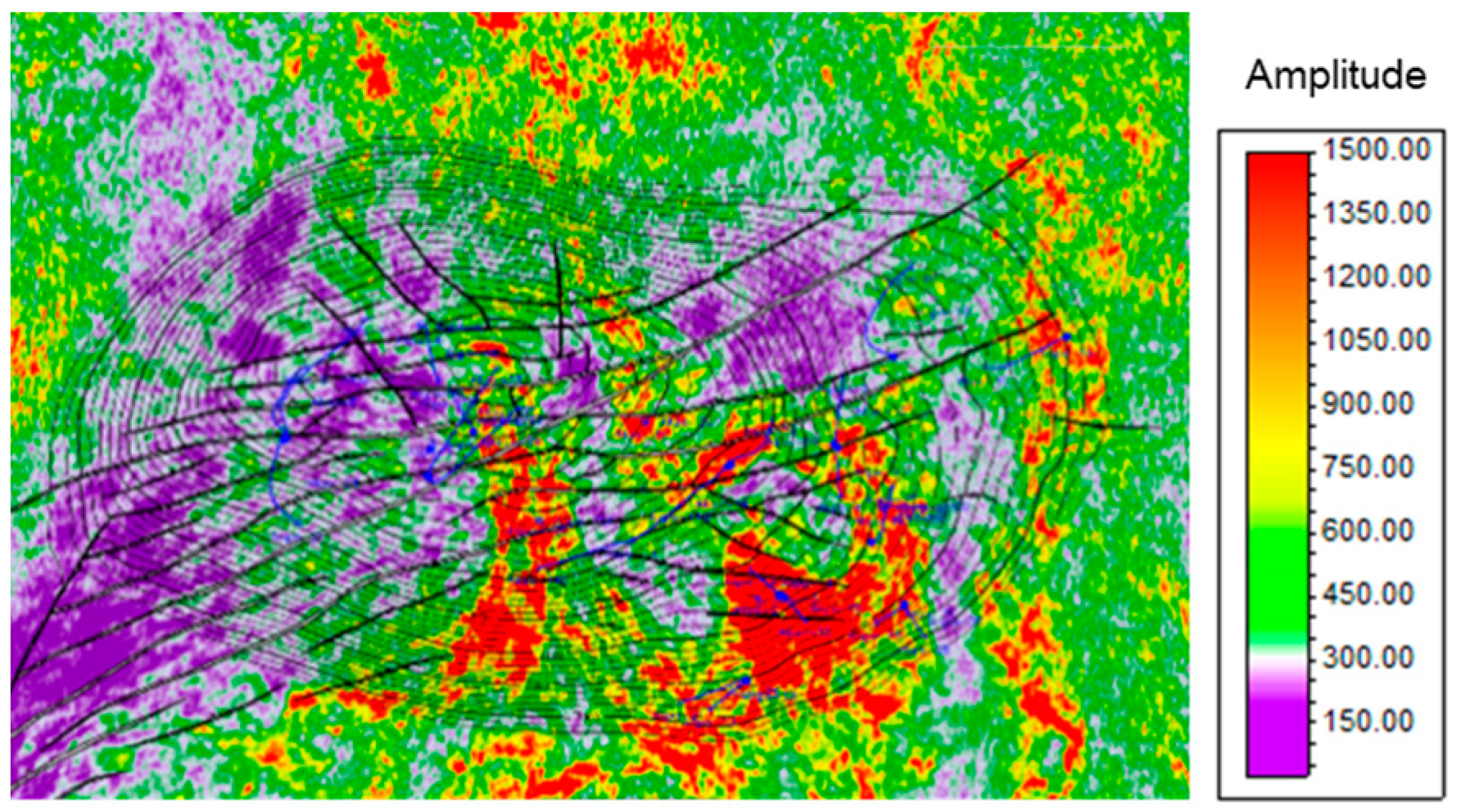
Field A is a fault-bound, four-way dip faulted anticline. Geological evaluations indicate that these faults remain sealed in their inactive state, with no significant fluid exchange occurring across the fault blocks. The structure extends predominantly in the east–west direction and is relatively shorter in the north–south direction, exhibiting a steep flank to the west and south and a gentle dip to the east and north. Vertically, the principal oil-bearing intervals occur in the middle to upper Miocene Agbada Formation of the Tertiary system. Figure 1 shows a seismic attribute map of the turbidite channels. The figure displays deepwater turbidite fan deposits made of many composite sandbodies. These sandbodies include both composite channel deposits and lobe deposits. The upper reservoir interval mostly has composite channels, while the lower interval has lobe deposits. In the map, black lines show faults, and circular lines show structural contours. Red, yellow, and green colors show sandstone, while purple shows mudstone. The red and yellow areas show the main part of the channel.
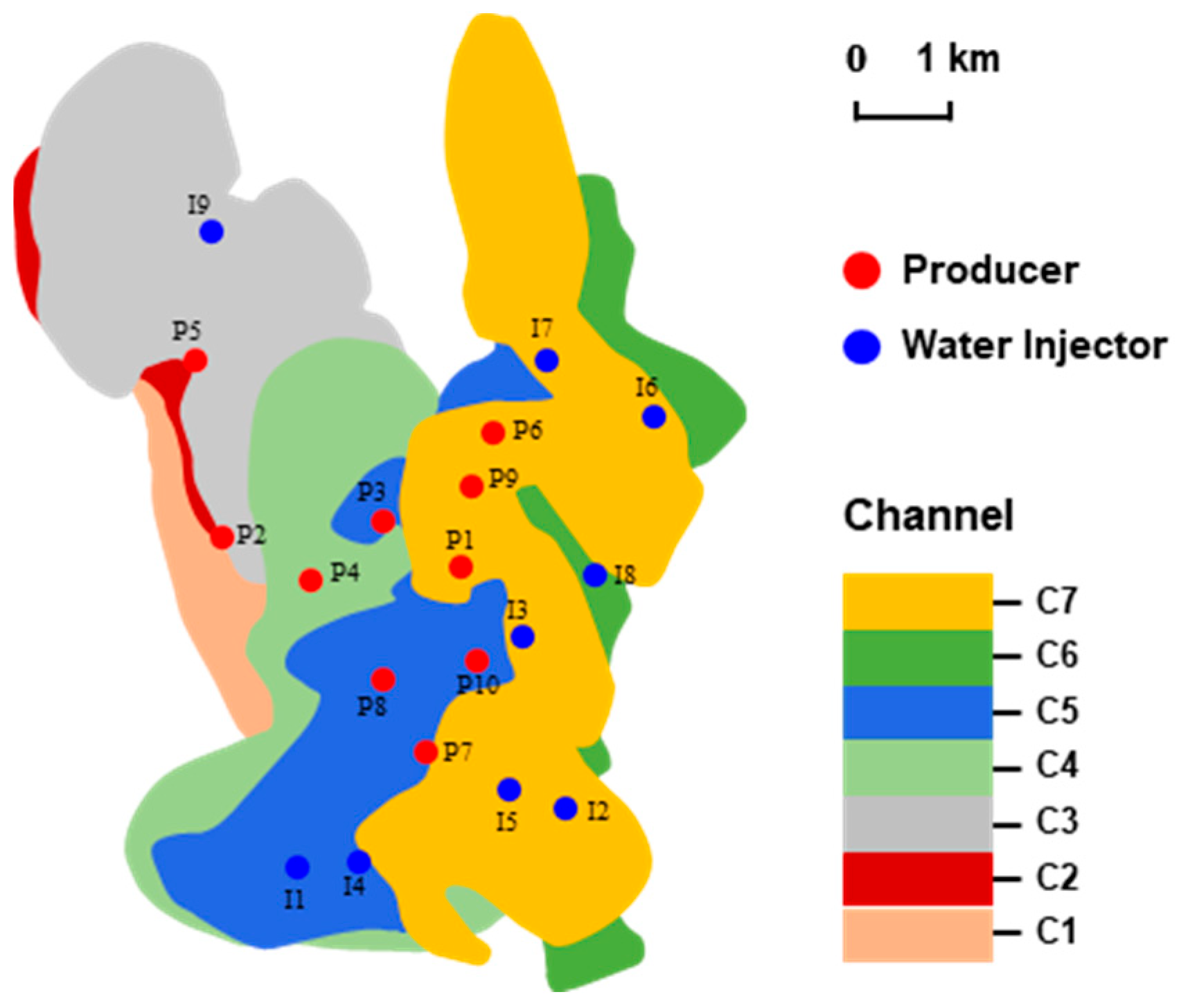
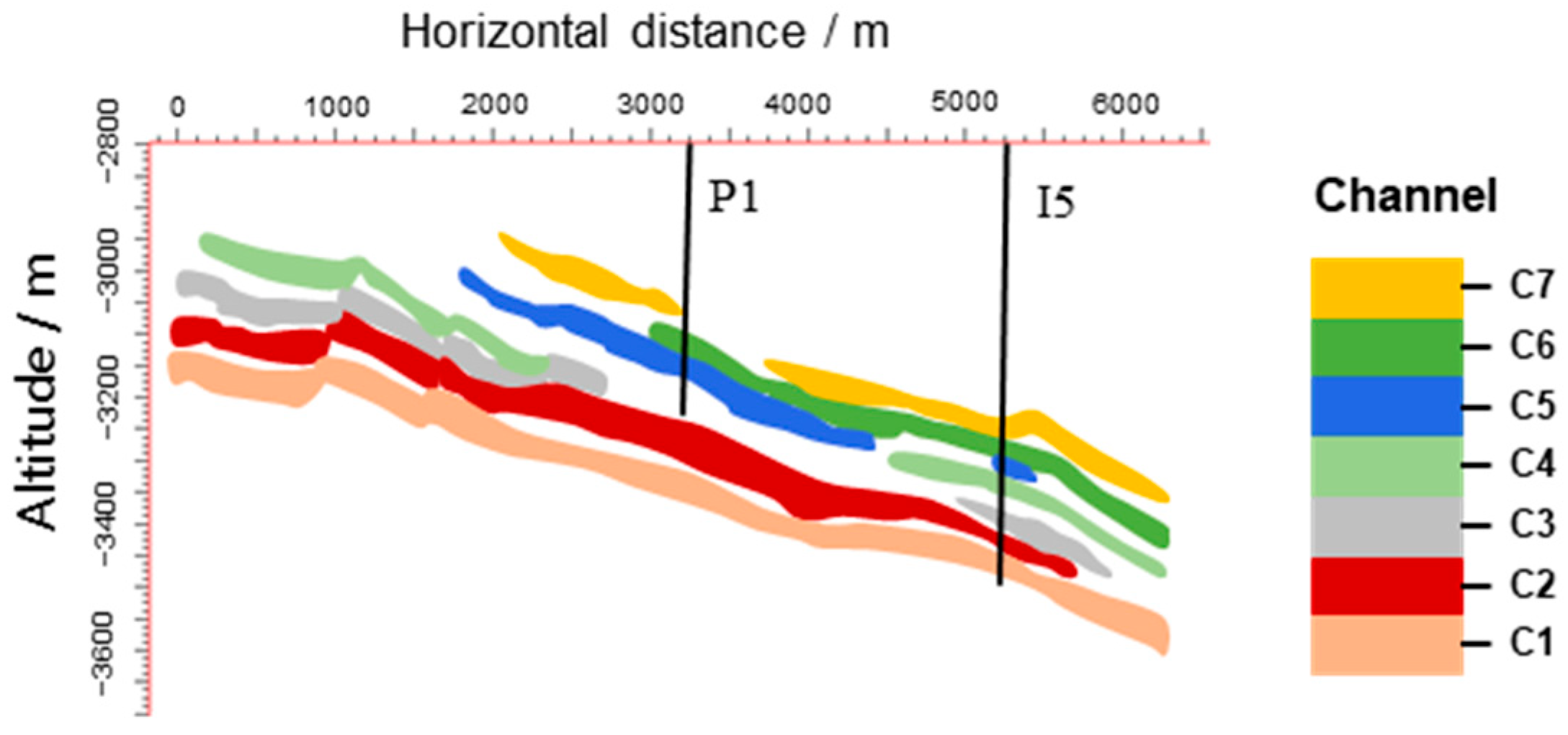
This study uses high-resolution geophysical data and well data to describe the channels and predict lateral boundaries. The C Sand is the primary producing interval in Field A and is extensively faulted. It is part of the upper composite channel deposits. Stratigraphically, the C Sand can be further subdivided into two depositional units: CU and CL. Within CU, four channel systems (C4, C5, C6, and C7) can be identified from bottom to top, whereas CL contains three channel systems (C1, C2, and C3) in upward succession. Studies indicate that within both CU and CL, multiple-channel systems are stacked vertically and shifted laterally, resulting in a variety of superposition styles (Figure 2 and Figure 3).

2.2. Classification of Sandbody Connectivity Patterns Between Injection–Production Well Pairs

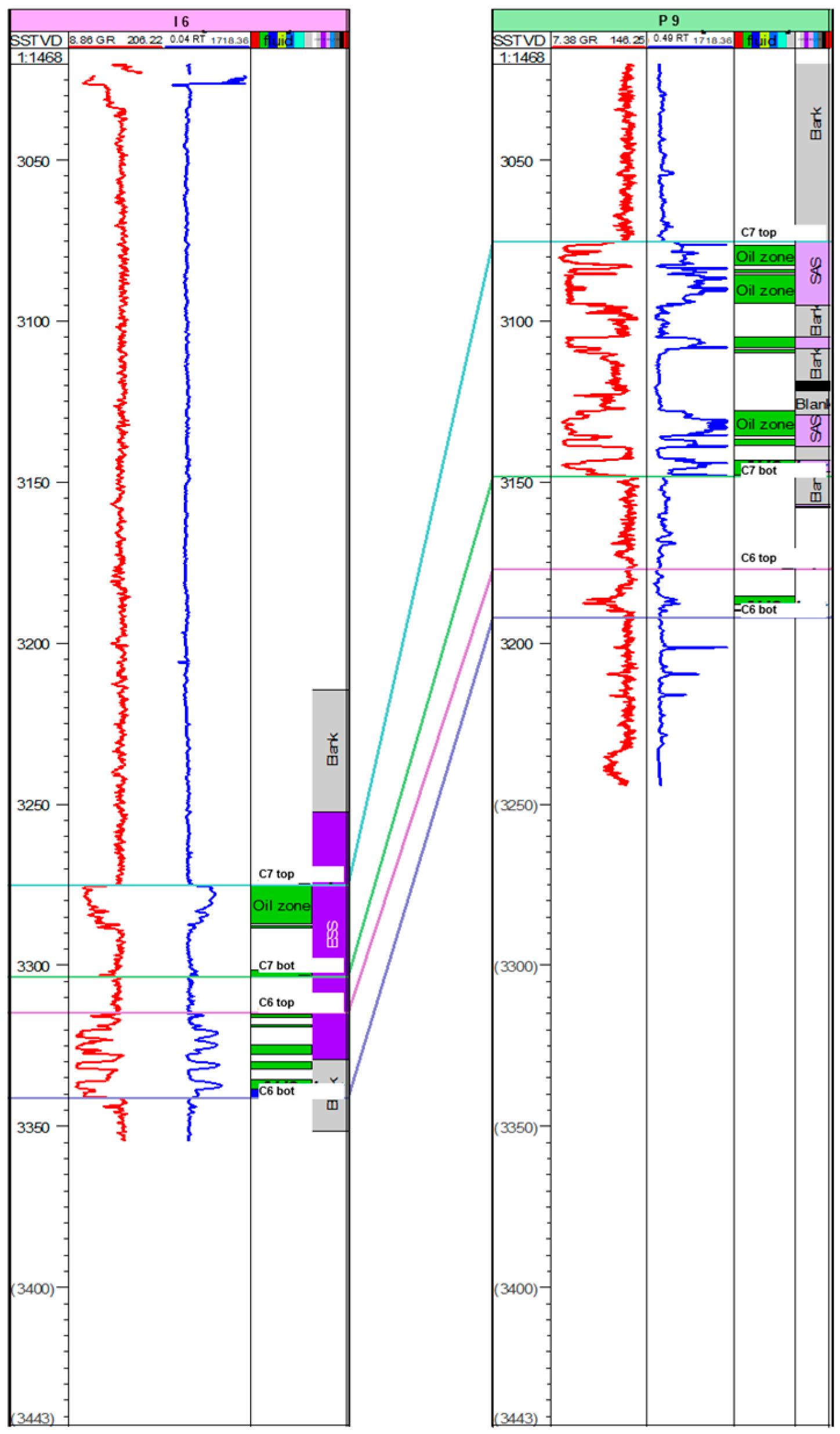
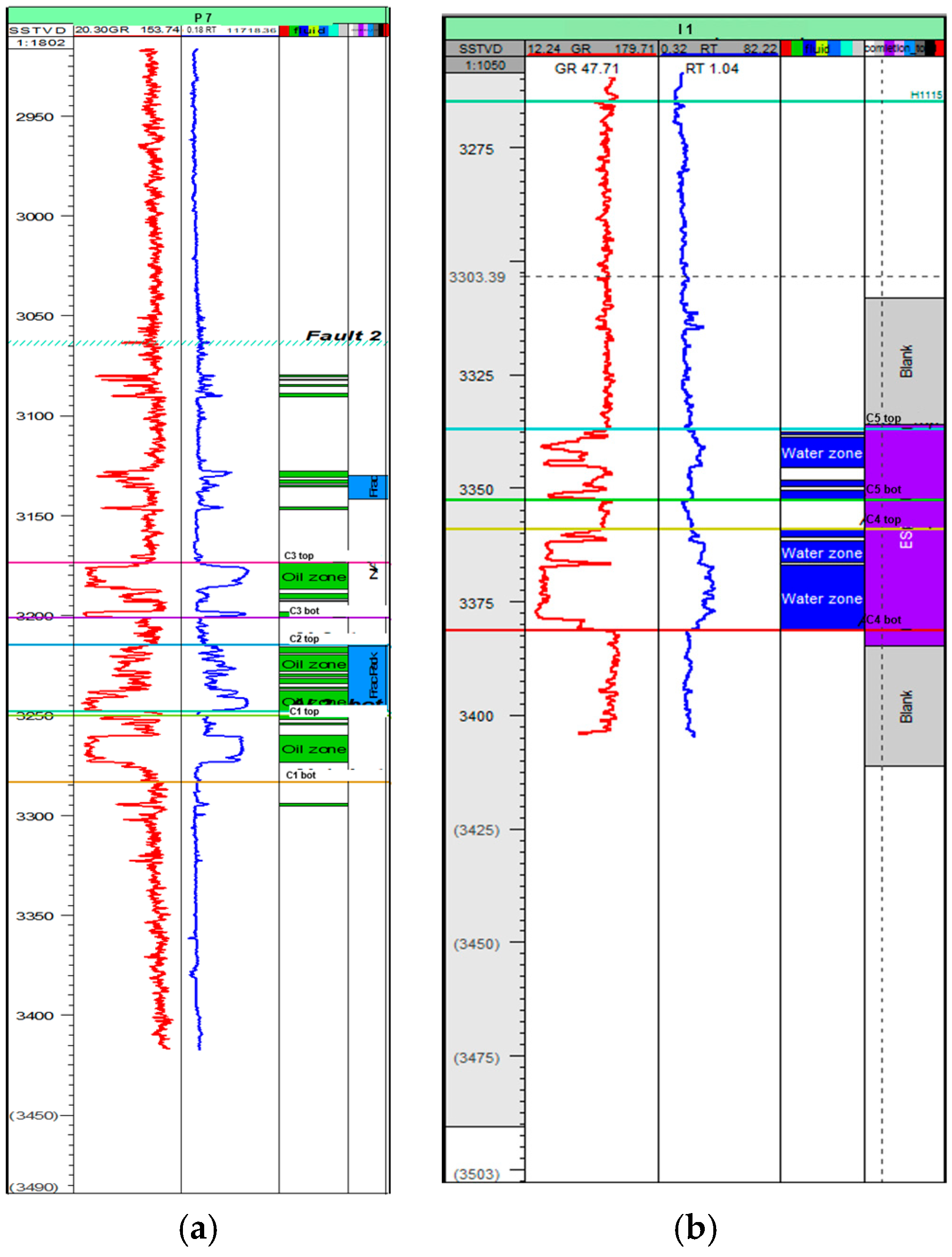
This study uses well logs, seismic data, and production data to identify sedimentary facies and connectivity. Channel sandbodies show low gamma ray, low density, and high resistivity on well logs. The log curves are usually bell-shaped or box-shaped. From the center of the channel to the edges, the sand layers get thinner and the reservoir quality becomes worse. In contrast, mudstones between channels show high gamma ray and flat log curves. We also used production data from the last ten years to check if the sand bodies are connected. Figure 4 shows the well logs for wells I6 and P9, and Figure 5 shows the logs for wells P7 and I1. Well logs show that the perforated zones are in channels from the same time, different times, or both. These logs show that thick sandbodies are stable and have good continuity along the channel. Also, the lateral movement and vertical stacking of sandbodies form composite bodies. This improves the connectivity between wells. Based on seismic profiles, stacking styles, and well data, we classify the connectivity into three patterns: coeval, cross-stage, and hybrid.
(1)
Coeval connectivity
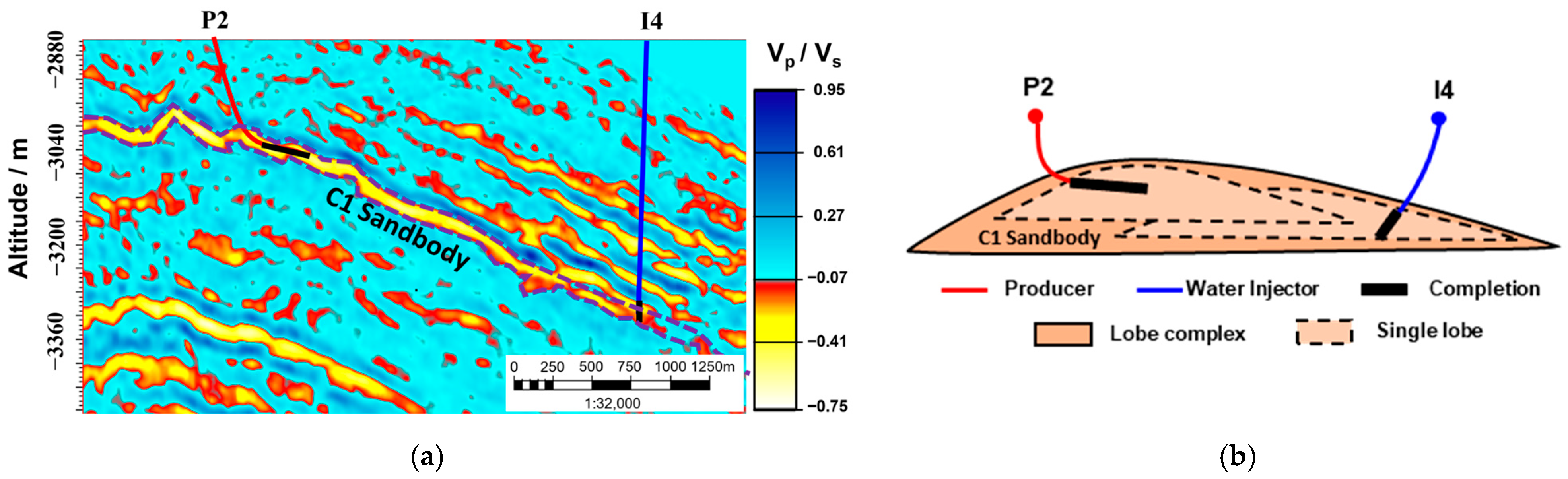
In this pattern, the completed intervals of both production and injection wells are located within the same channel unit of the same depositional period. The sandbody architecture is dominated by lateral stacking, resulting in continuous reservoirs with excellent intra-layer connectivity, thereby enabling direct injection–production response within the same stratigraphic unit. For example, both wells P2 and I4 are completed in the C1 sandbody, where the reservoir interval is stable in thickness and laterally continuous between the wells (Figure 6).
(2)
Cross-stage connectivity
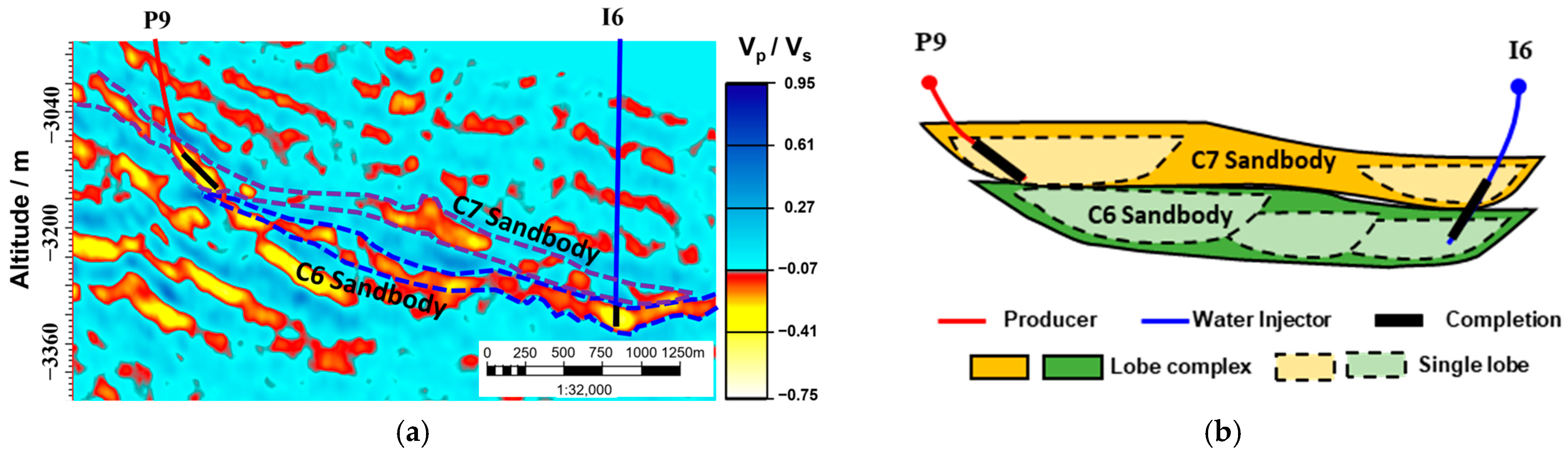
This pattern occurs when the production and injection wells are completed in sandbodies of different depositional periods. Later-stage sandbodies are vertically cut and stacked upon earlier composite sandbodies, and waterflood displacement between wells is realized through the overlapping zones of the sandbodies. For instance, well I6 (completed in the C6 and C7 sandbodies) and well P9 (completed in the C7 sandbody) are not directly connected within C7, but effective injection–production communication is established through the overlap between the C6 and C7 sandbodies (Figure 7). These overlapping zones are typically characterized by relatively poorer reservoir properties.
(3)
Hybrid connectivity
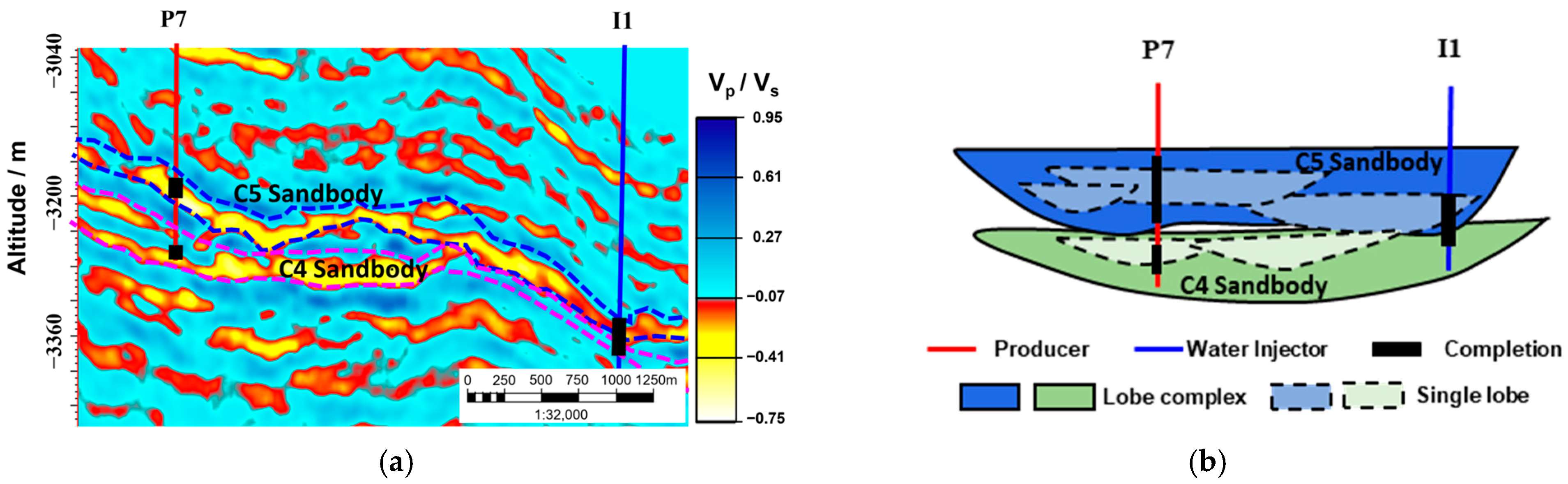
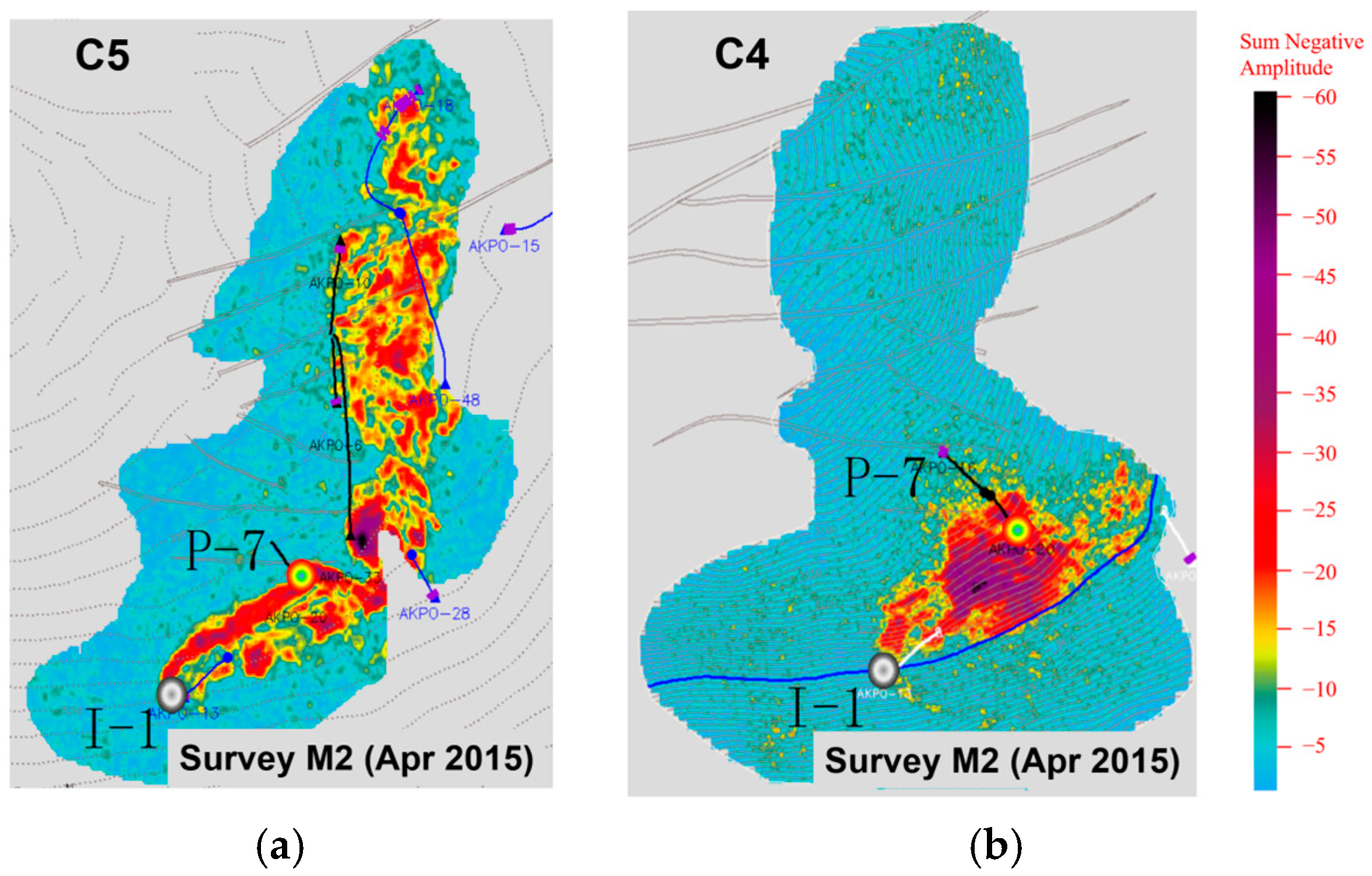
This pattern integrates the features of both direct and cross-stage connectivity. The key characteristic is that the production and injection wells are simultaneously connected within sandbodies of the same depositional period, while additional cross-layer connectivity is provided by vertical stacking and overlapping of different sandbodies. A typical example is the pair of wells P7 and I1. The two wells are efficiently connected within the C5 sandbody of the same depositional period, whereas connectivity within the C4 sandbody is significantly weaker and mainly achieved through the overlapping between the C4 and C5 sandbodies (Figure 8).

3. Waterflood Sweep Mechanisms Under Different Connectivity Patterns

Different connectivity patterns lead to distinct distributions of preferential flow pathways and barriers, necessitating independent observations to identify and compare the corresponding differences in sweep morphology. In this study, time-lapse seismic data from different periods are used to analyze the waterflood sweep characteristics between injector–producer well groups for three connectivity patterns, both in map view and in vertical sections. The swept areas are identified by analyzing changes in seismic amplitudes across different years. These variations occur because water replaces oil in the reservoir, which changes the seismic signal. Such amplitude differences help define the boundaries of the swept zones shown in the figures.

3.1. Coeval Connectivity

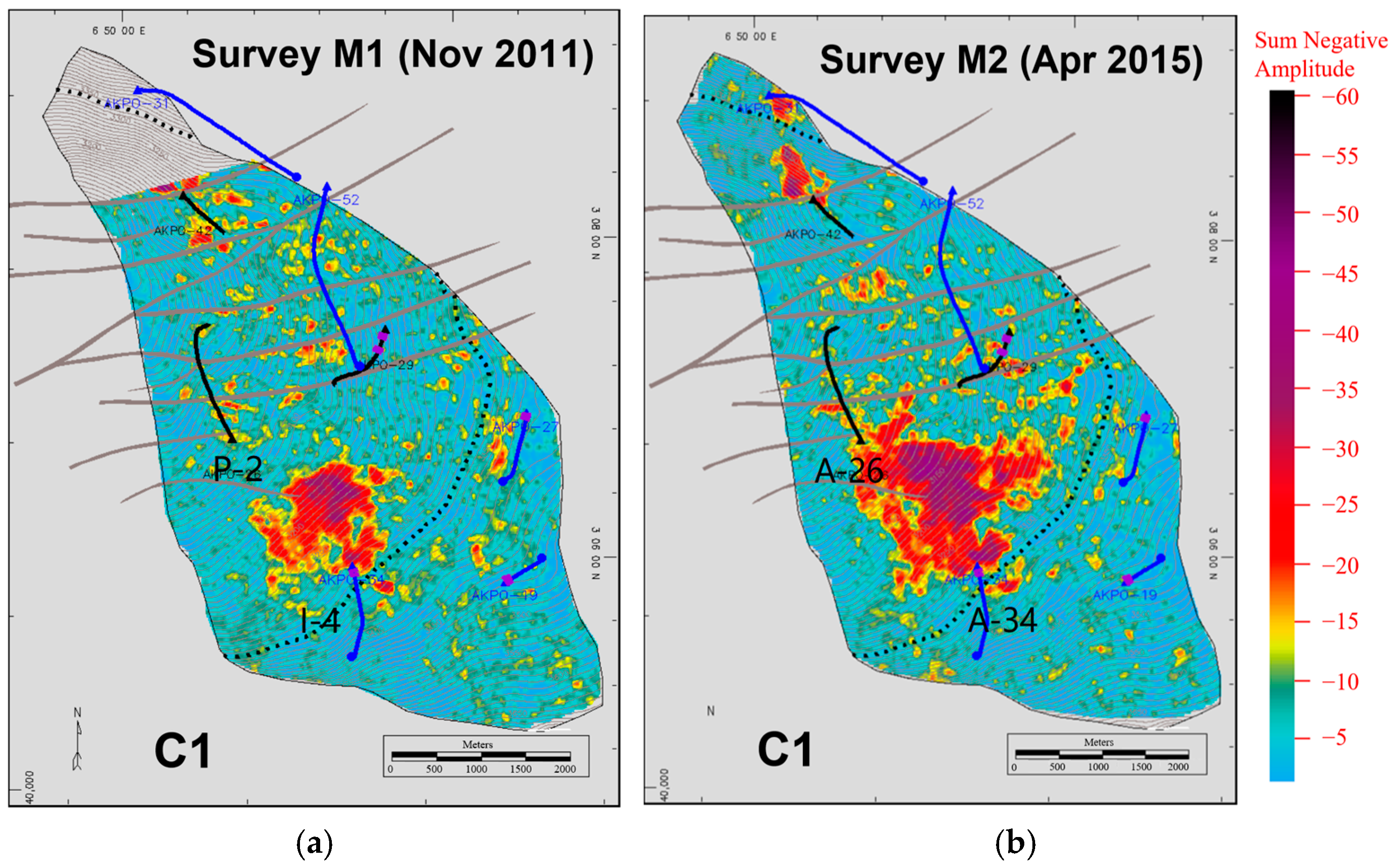
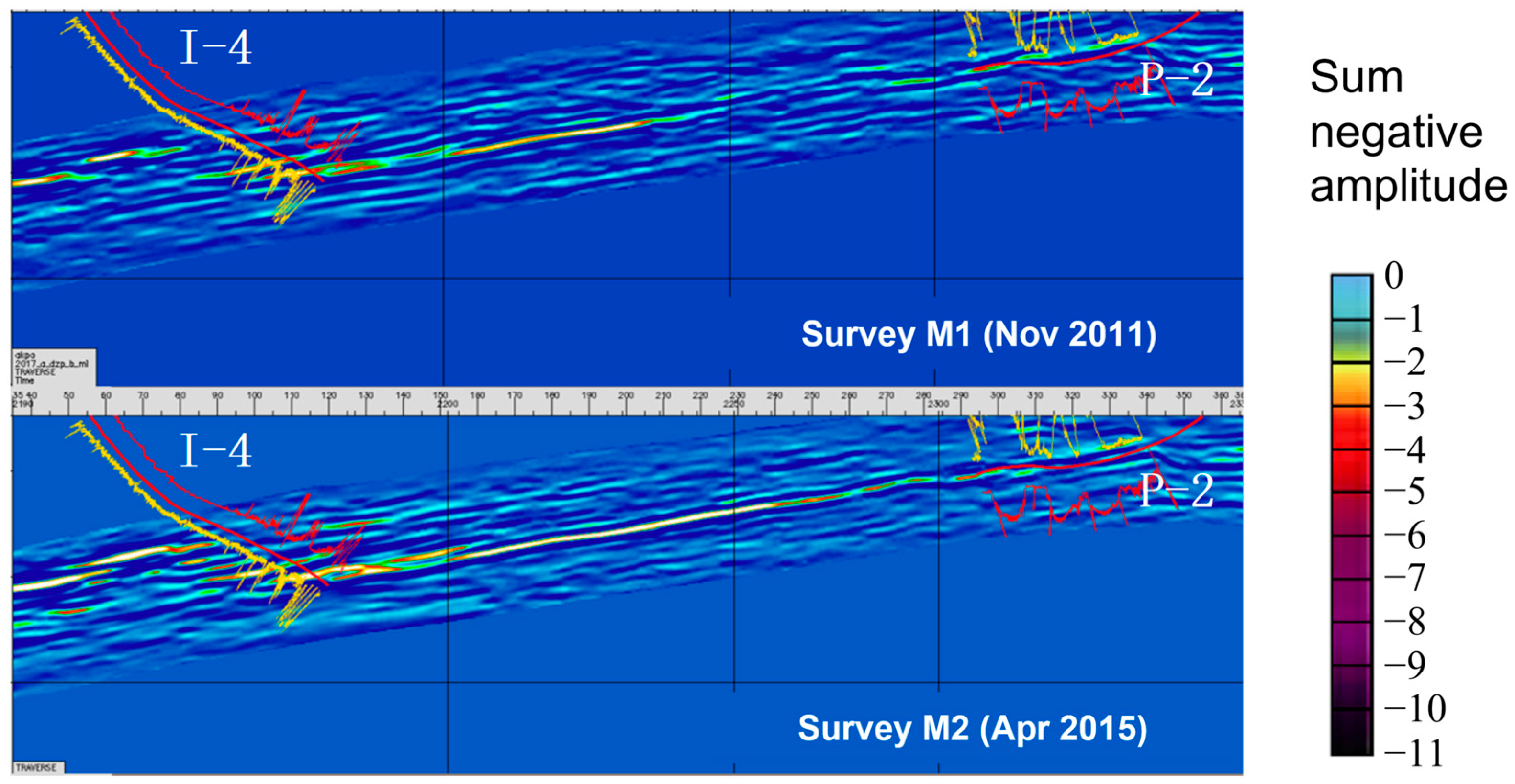
The time-lapse seismic interpretation shown in Figure 9 illustrates the waterflood sweep region between wells under the coeval connectivity pattern. Comparison of sweep extents in 2011 and 2015 indicates that the displacement front advanced very uniformly in this pattern. This suggests that sandbodies between wells are laterally extensive and homogeneous, with good continuity. The interwell vertical section in Figure 10 further demonstrates that injected water advances almost uniformly along the base of the wells, with virtually no flow barriers. Consequently, in plan view, the area within the displacement front shows almost no unswept zones, implying continuous sandbody development with minimal mudstone barriers. In the vertical section, the flood front advances consistently and without interruption between wells, reflecting a highly uniform waterflood sweep.

3.2. Cross-Stage Connectivity

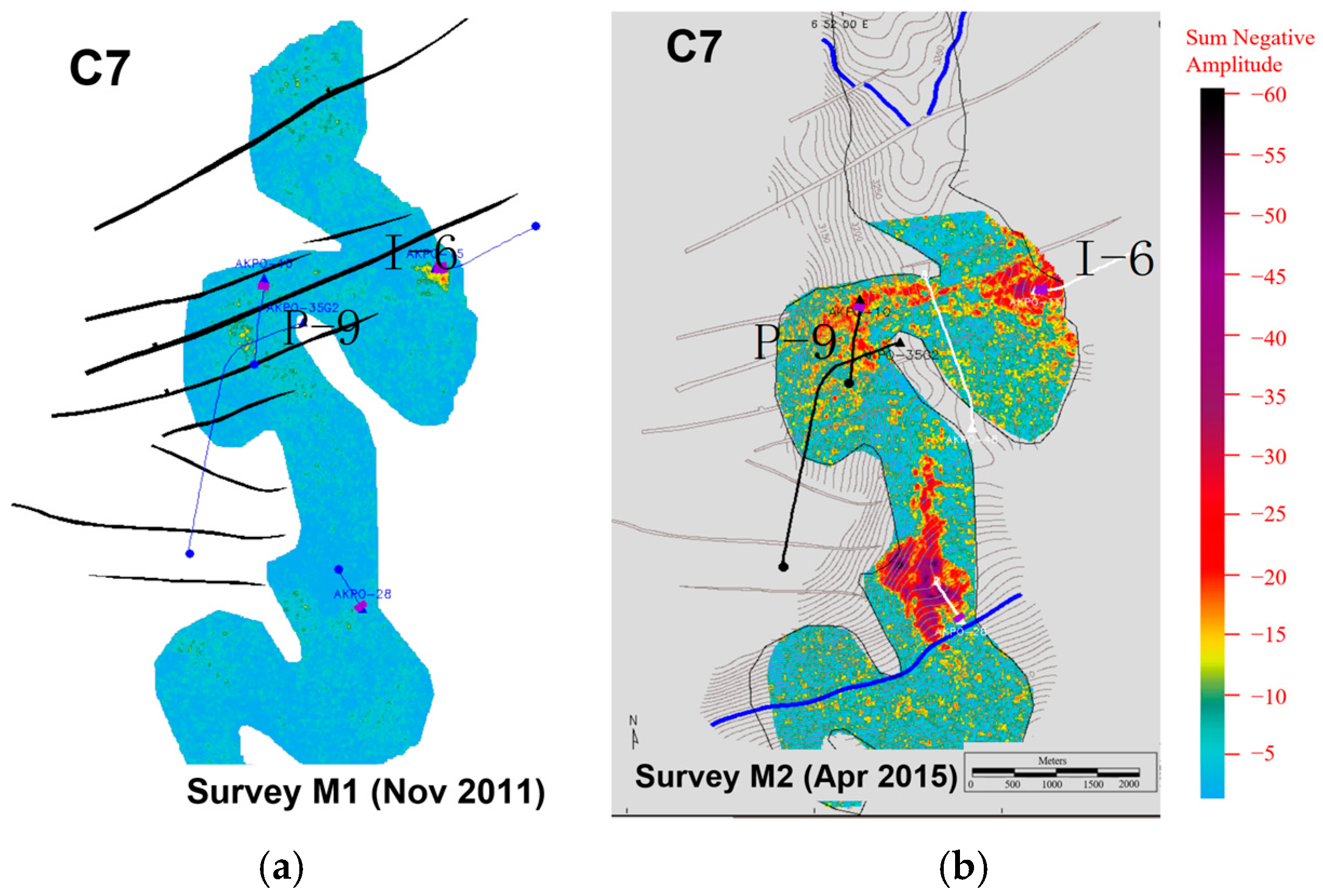
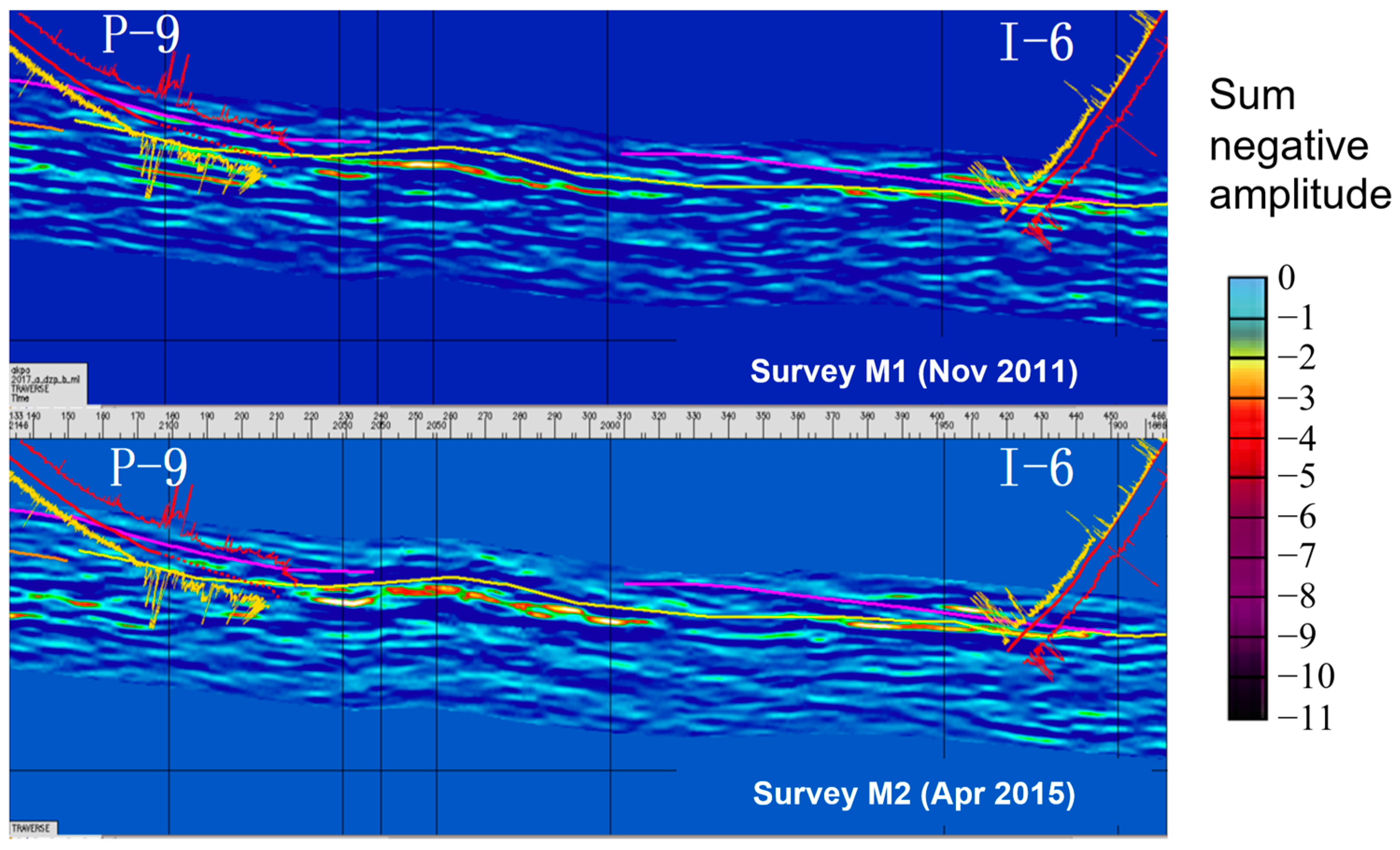
The cross-stage connectivity shows significant differences in sweep extent and patterns compared with the coeval connectivity. Comparison of the 2011 and 2015 time-lapse seismic results (Figure 11) reveals that the waterflood sweep between injection–production wells is highly non-uniform and poorly continuous. Large unswept zones and numerous flow barriers are present within the swept region. In plan view, this manifests as an irregular front with uneven advancement and localized preferential breakthroughs along specific directions. In the vertical section (Figure 12), multiple discontinuities appear between wells, and injected water is often unable to advance linearly, instead bypassing barriers through circuitous flow paths. Therefore, in this connectivity pattern, interwell sandbodies are frequently discontinuous, and waterflood sweep effectiveness is significantly reduced.

3.3. Hybrid Connectivity

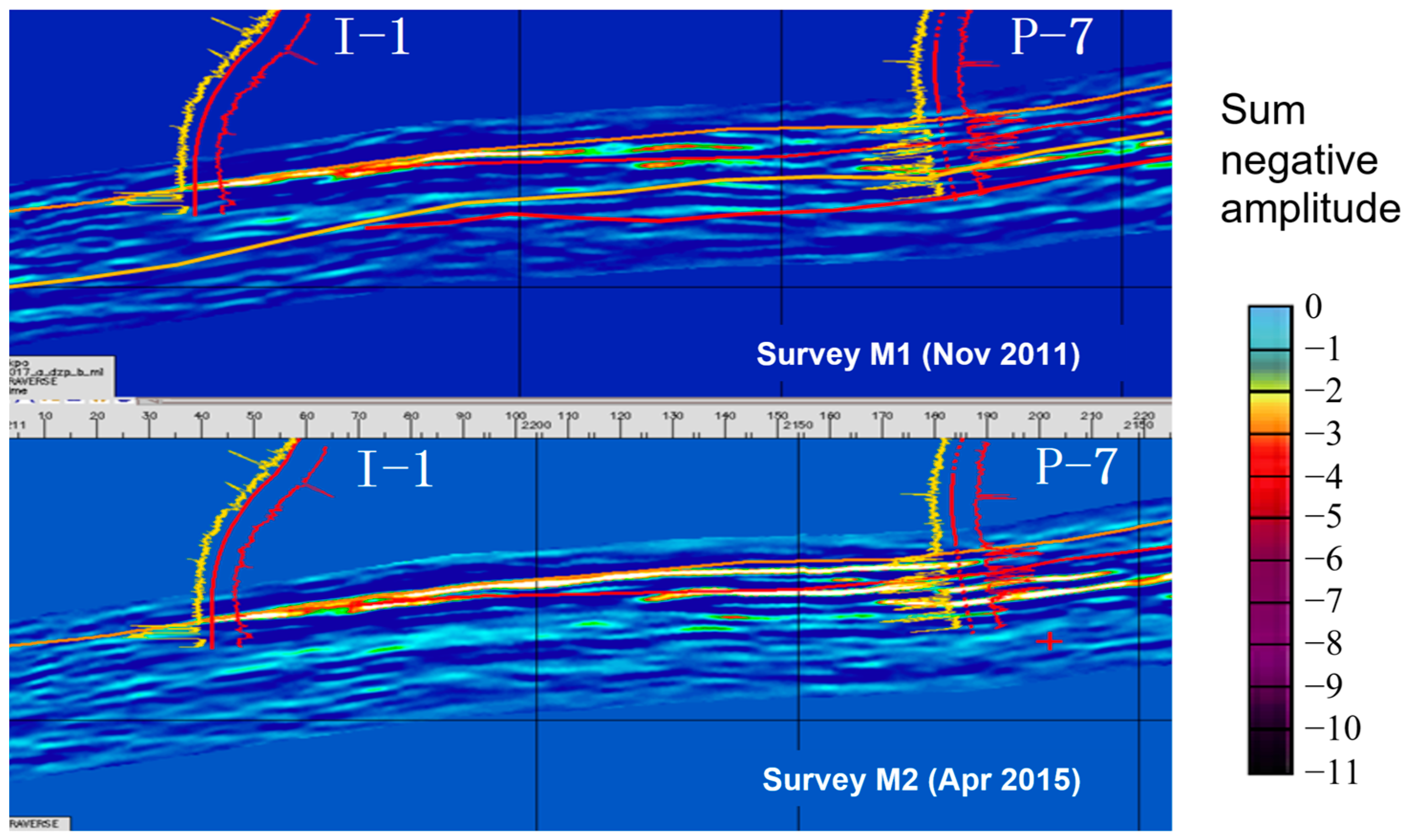
The injection–production well groups with hybrid connectivity exhibit the combined features of the two aforementioned connectivity patterns in terms of both areal extent and displacement characteristics (Figure 13 and Figure 14). In the directly connected layers, the waterflood front advances uniformly, with little or no interruption between the swept sandbodies. In the overlap connected layers, however, the injected water front progresses unevenly, with frequent discontinuities between swept sandbodies, and the injected water often bypasses and flows around interlayer barriers. Consequently, when viewed as a whole, the overall waterflood sweep performance is relatively favorable.

4. A Full Water Cut Range Relative Permeability Ratio Correlation for Low Viscosity Oil

The time-lapse seismic interpretation in Section 3 indicates that the waterflood sweep exhibits distinct morphologies under different injector–producer connectivity patterns. To enable practical application in development evaluation and well group comparisons, these morphological differences must be translated into quantitative metrics such as sweep efficiency. In deepwater fields characterized by large well spacing and high production rates, water breakthrough is commonly followed by rapid water encroachment; therefore, the quantitative method employed must remain valid over the full range of water cut evolution. Otherwise, sweep efficiency comparisons among connectivity patterns become unreliable.
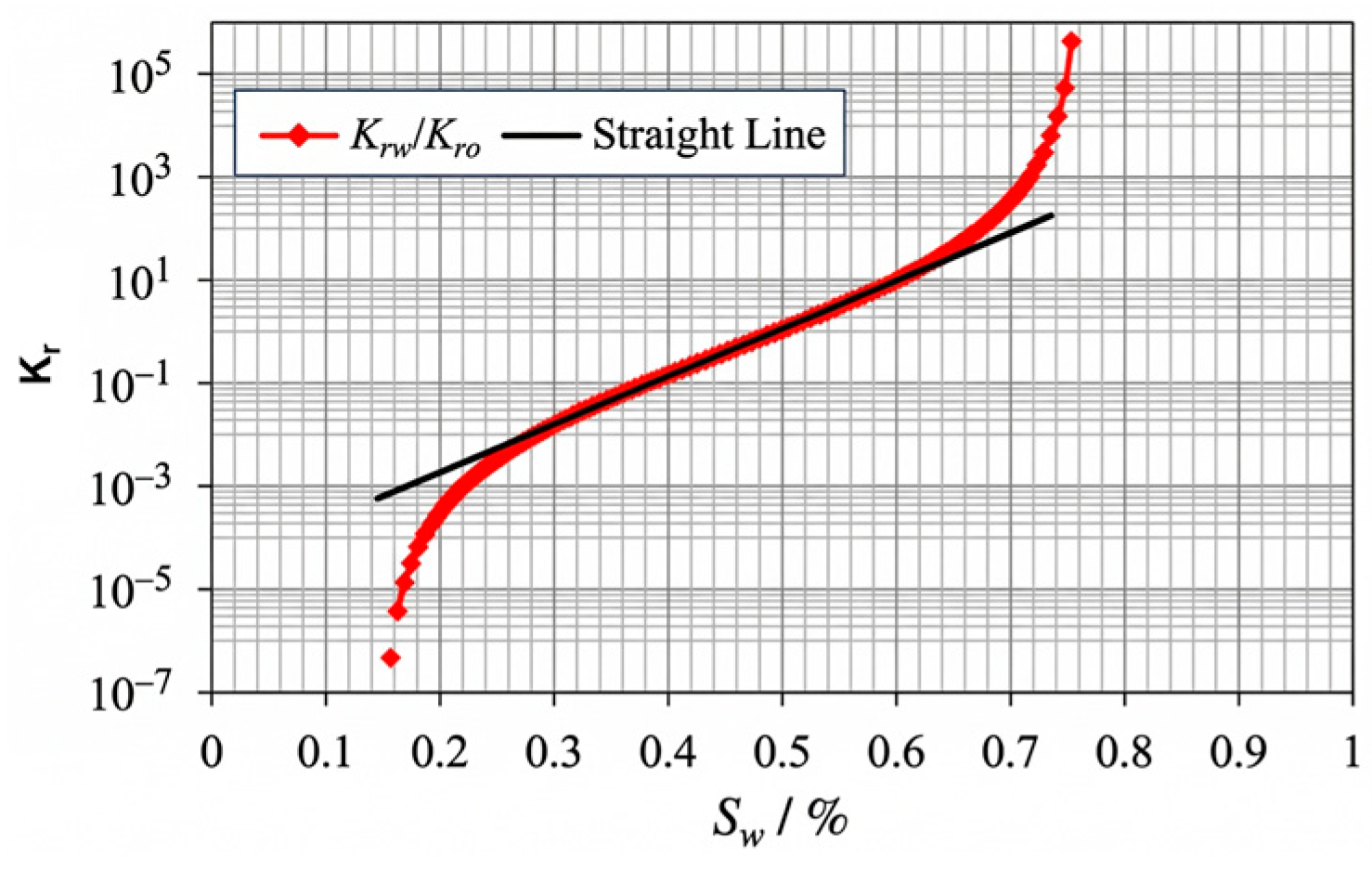
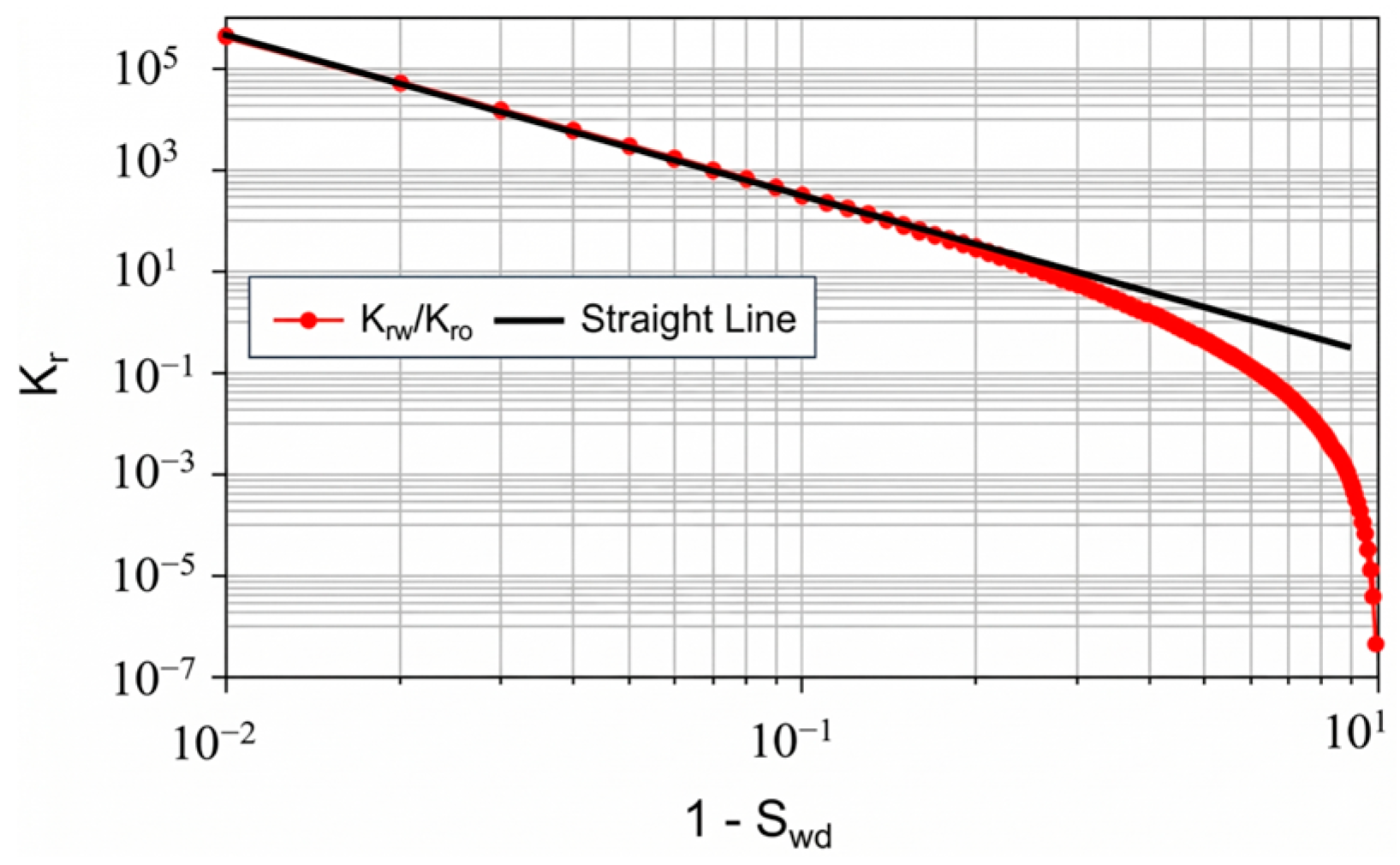
Conventional correlations for the oil–water relative permeability ratio (e.g., Equation (1)) are only approximately linear over the mid-range on a semi-logarithmic plot, whereas pronounced nonlinearity occurs near both ends of the curve (Figure 15). Accordingly, these correlations cannot capture displacement behavior over the full water cut range, and they may lead to the upturn of Type A and Type B waterflood characteristic curves at ultra-high water cut. To address this limitation, several alternative expressions have been proposed in the literature for the high water cut regime, such as Equation (2). However, these formulations are typically applicable only at ultra-high water cut (Figure 16), which substantially restricts their practical use. Consequently, this work develops a new characterization approach for the oil–water relative permeability ratio that remains valid across the entire water cut range, thereby improving the applicability and consistency of sweep efficiency evaluation.
K r w K r o = d e c S w ,
K rw K ro = m 1 S wd n
where the normalized water saturation is expressed as:
S w d = S w e S w i 1 S o r S w i ,
where the Kro and Krw are the relative permeabilities of the oil and water phases (dimensionless); Swe is the water saturation at the outlet end (fraction); Swi is the irreducible water saturation (fraction); Sor is the residual oil saturation (fraction); and c, d, m, and n are real constants.
Figure 15. Semi-logarithmic relationship between oil–water relative permeability ratio and water saturation.
Energies 19 01605 g015
Figure 16. Relationship between oil–water relative permeability ratio and normalized water saturation.
Energies 19 01605 g016
Taking the Z Reservoir, a deepwater reservoir characterized by low viscosity oil, as the primary research object, a novel oil–water relative permeability ratio correlation was derived to overcome the limitations of traditional semi-log linear expressions. The derivation is based on the generalized power law relative permeability model (Equation (4)). In low viscosity oil systems, the interference between oil and water phases is relatively balanced compared to heavy oil reservoirs, suggesting that the phase exponents nw and no can be approximated as a single characteristic value. By setting nw = no = n, the generalized expression is simplified into Equation (5). This simplification is supported by conventional relative permeability theories where nw and no typically fall within the range of two to four [12]. By adopting this power law ratio form, the model accounts for the curvature at the extreme saturation ends that is often neglected by conventional semi-logarithmic models.
In this correlation, the parameters carry distinct physical implications derived from microscopic displacement theory. Swd denotes the normalized water saturation, representing the fraction of movable water within the pore space, while (1 − Swd) corresponds to the normalized oil saturation, representing the fraction of movable oil. The term Swd/(1 − Swd) physically represents the dynamic volumetric ratio of mobile water to mobile oil at the microscopic scale. The exponents nw and no reflect the connectivity and tortuosity of the flow paths for the water and oil phases, respectively. When simplified to n, it serves as a comprehensive seepage index that incorporates the combined effects of pore structure, wettability, and reservoir heterogeneity on the two-phase flow resistance.
k r w k r o = S w d n w 1 S w d n o
k r w k r o = S w d 1 S w d n
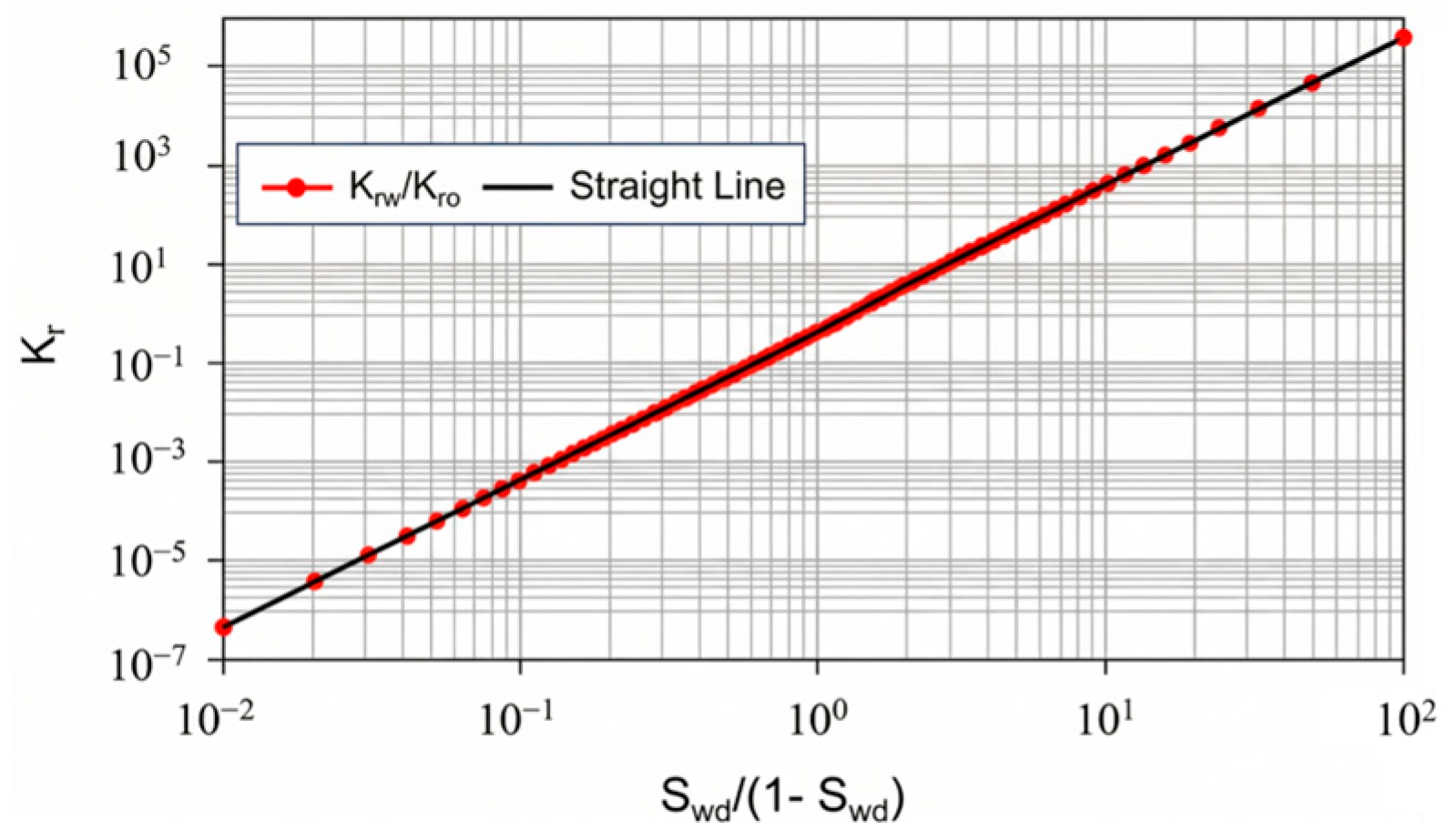
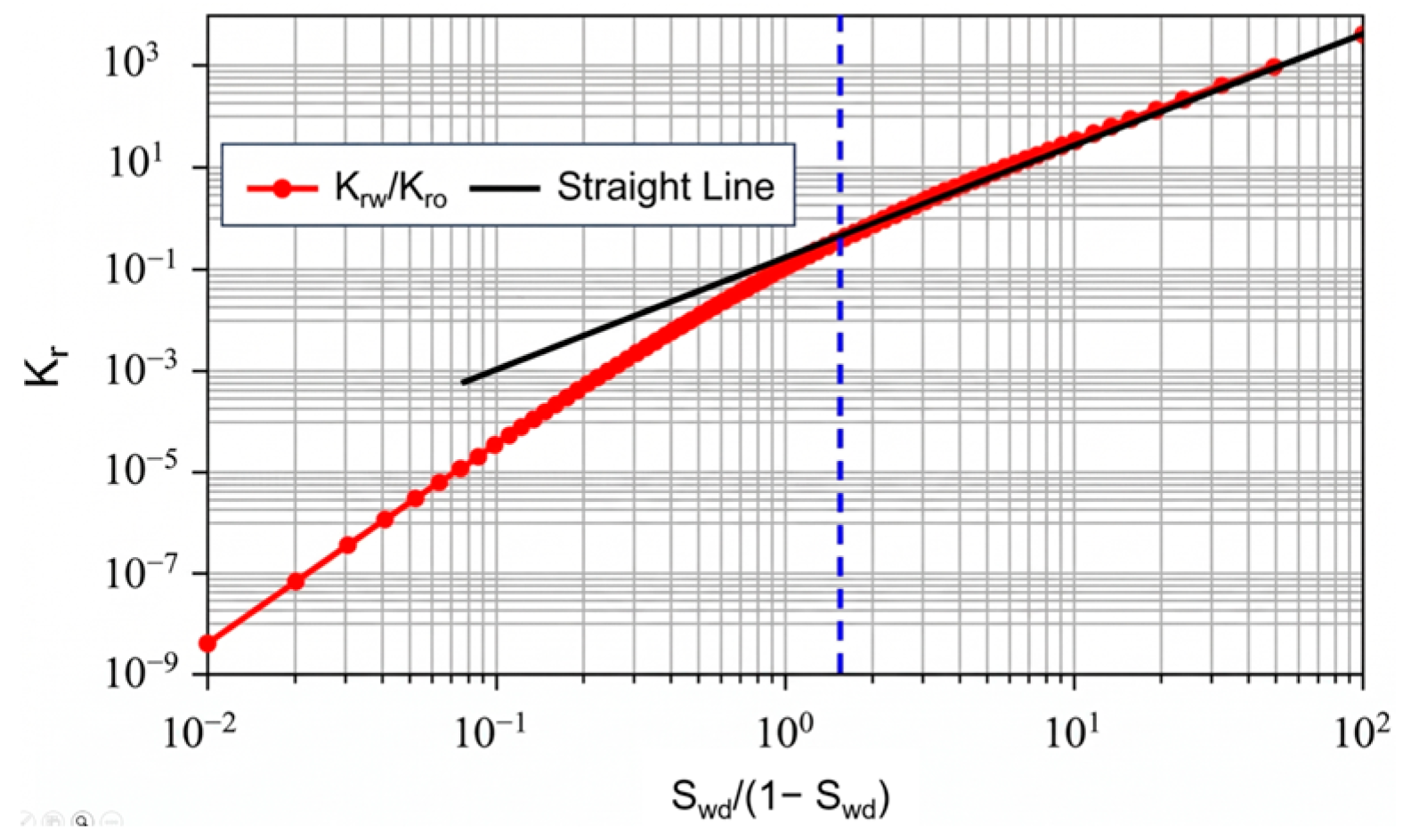
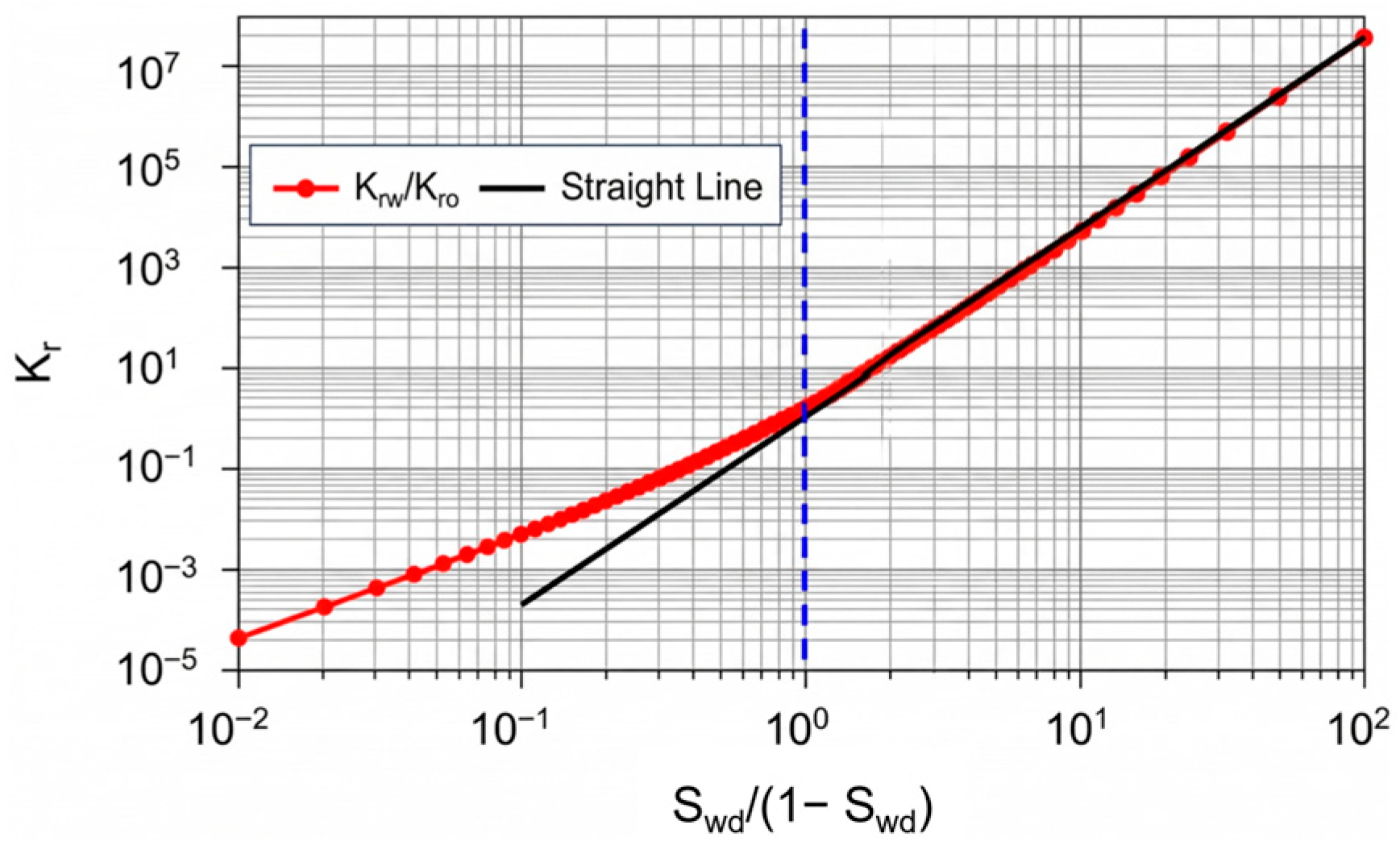
For low viscosity oil, the water–oil mobility ratio M ranges from 0.1 to 5. The applicability of the proposed new correlation was evaluated using theoretical relative permeability curves. The evaluation results are summarized in Table 1 and illustrated in Figure 17, Figure 18 and Figure 19. The new oil–water relative permeability ratio correlation is applicable starting from the low water cut stage and remains valid across the entire water cut range up to 100%. The estimation procedure for the characteristic exponent n is established through the applicability evaluation presented in Table 1. As shown in Table 1, when nw = no, the correlation remains valid across the entire saturation range, as indicated by the “ALL” status in the linear range columns. This confirms that for symmetrical phase exponents, the relationship between l n K r w K r o and l n S w d 1 S w d is linear from low to ultra-high water cut. Consequently, n can be estimated by performing a linear regression on field production data using Equation (14).

5. Quantitative Characterization Model of Waterflood Sweep Efficiency Under Different Connectivity Patterns

After establishing an oil–water relative permeability ratio correlation applicable over the full water cut range, a predictive model for sweep efficiency can be derived and validated using production data from wells within each connectivity pattern.

5.1. A Full Water Cut–Range Predictive Model for Waterflood Sweep Efficiency

Given that Field Z possesses a continuous production history exceeding ten years, the reservoir pressure and fluid distribution have evolved beyond the initial transient response phase and entered a pseudo steady state flow regime. Consequently, the dynamic water cut evolution is primarily governed by the established interwell connectivity patterns and the relative mobility of the oil and water phases, rather than short-term pressure fluctuations. Furthermore, the “fewer wells, higher production” strategy characteristic of deepwater operations maintains high interstitial flow velocities within the turbidite channels. Under such conditions, viscous forces dominate over gravitational effects, thereby suppressing gravity segregation. Therefore, based on steady state flow theory and using the newly proposed full water cut range oil–water relative permeability ratio correlation for low viscosity oil presented in Section 4, a new predictive model for waterflood sweep efficiency was derived. Under pressure-maintained waterflooding development, the cumulative oil production of the reservoir can be expressed using the volumetric material balance equation for geological reserves as:
N p = 100 S h ϕ B o i ( S w S w i )
From Equation (6), the relationship between recovery factor and average reservoir water saturation can be expressed as:
R = N P N = S w S w i 1 S w i
The displacement efficiency of oil is expressed as:
E D = S o i S o r 1 S or S wi
Substituting Equations (7) and (8) into Equation (3), we obtain:
S wd = E V = S w S wi 1 S or S wi = R E D = N p N E D
The movable oil reserves, Nom, can be expressed as:
N o m = N E D
Substituting Equation (10) into Equation (9), we obtain:
S wd = N p N o m
Under steady state flow conditions, the water–oil ratio (WOR) can be expressed as:
W O R = Q w Q o = μ o B o K r w μ w B w K r o
Substituting Equation (4) into Equation (12) gives:
W O R = μ o B o μ w B w S w d 1 S w d n
Taking the logarithm of both sides of Equation (13) yields:
ln W O R = A + B ln S w d 1 S w d   or   ln W O R = A + B ln E V 1 E V
where A = ln μ o B o μ w B w + h , B = n .
Equation (14) represents the proposed predictive model for waterflood sweep efficiency applicable to low viscosity oil over the full water cut range.
In the equation, h, A, and B are treated as constants (where h is the effective reservoir thickness, m); Soi is the initial oil saturation (%). Np denotes cumulative oil production (104 m3), N is the geological reserves (104 m3), and Nom is the movable oil reserves (104 m3). Bo and Bw are the formation volume factors of oil and water (m3/m3). φ is the average reservoir porosity (fraction), and R is the recovery factor (%). Qo and Qw are the oil and water production rates (m3/d), and WOR is the water–oil ratio (fraction). μo and μw are the viscosities of formation oil and water (mPa·s).
While the steady state approximation is applicable to reservoirs with long production histories and high interstitial flow velocities sufficient to suppress gravity tonguing, it exhibits inherent limitations in early-stage reservoirs dominated by transient pressure or gravity differentiation. For such reservoirs, utilizing steady state flow theory may lead to an overestimation of sweep efficiency by neglecting localized bypassing and non-uniform displacement fronts, thus diminishing the accuracy of the evaluation. Furthermore, the proposed predictive model was derived specifically for low viscosity oil reservoirs. In high viscosity applications, the fluid mobility ratio undergoes significant changes. Consequently, model parameters A and B require rigorous recalibration based on specific field data. Directly extrapolating the sweep efficiency values obtained in this study without accounting for these distinct flow regimes and fluid properties may lead to inaccurate estimations.

5.2. Data and Methods

The quantitative characterization of waterflood sweep efficiency in the deepwater turbidite reservoir integrates static reservoir parameters with dynamic production indicators. In this study, the independent variables consist of the water and oil production rates (Qo, Qw), cumulative oil production (Np), and movable oil reserves (Nom). These variables are utilized to establish Equation (14), where the volumetric sweep efficiency (Ev) is treated as the dependent variable for subsequent prediction.
The systematic workflow for characterizing and predicting sweep efficiency is executed through the following three stages:
  • Production Data Preprocessing: Recent field production dynamics are utilized, specifically monthly production data, where each month serves as a discrete time point. The raw monthly records of Qo, Qw, and Np are filtered to remove outliers caused by operational adjustments. These processed data points are then used to calculate the monthly WOR and the recovery degree (Np/Nom). This high-resolution temporal preprocessing ensures the regression captures the stable displacement mechanisms rather than short-term transient fluctuations.
  • Fitting Process of Model: First, the historical production data for each well, including Np and WOR, were transformed into the linear coordinates defined by the model. To ensure the physical relevance of the parameters, only the data points following the water breakthrough were selected for fitting. The slope A and intercept B were then determined by minimizing the sum of squared residuals between the measured and predicted values. The reliability of the fitting process was quantitatively assessed using the correlation coefficient R2. This linearized fitting approach effectively simplifies the parameter estimation process while maintaining the theoretical rigor of the full water cut range relative permeability correlation.
  • Sweep Efficiency Prediction: Upon obtaining values for A and B, the future sweep efficiency is predicted as a function of the projected water cut evolution. By substituting the predicted WOR values into Equation (15), the volumetric sweep efficiency can be quantitatively determined:
E v = 1 1 + exp 1 B ln W O R A
By defining the coordinates as l n W O R and l n E v 1 E v , Equation (14) effectively linearizes the complex multiphase flow process. This linearization allows for the robust characterization of waterflood performance using a two-parameter linear regression, which provides a physically consistent and mathematically simple framework for evaluating interwell connectivity.

5.3. Application

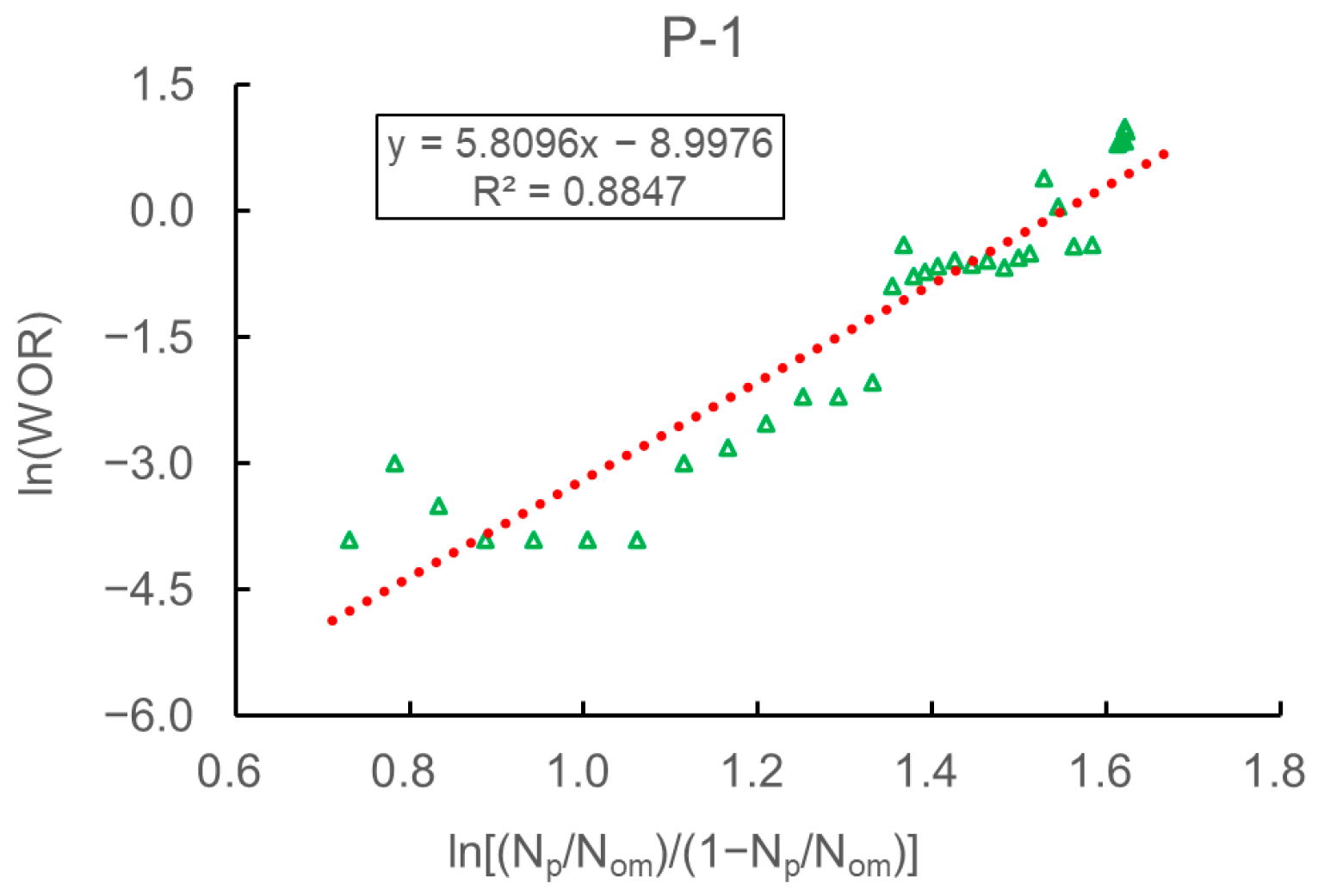
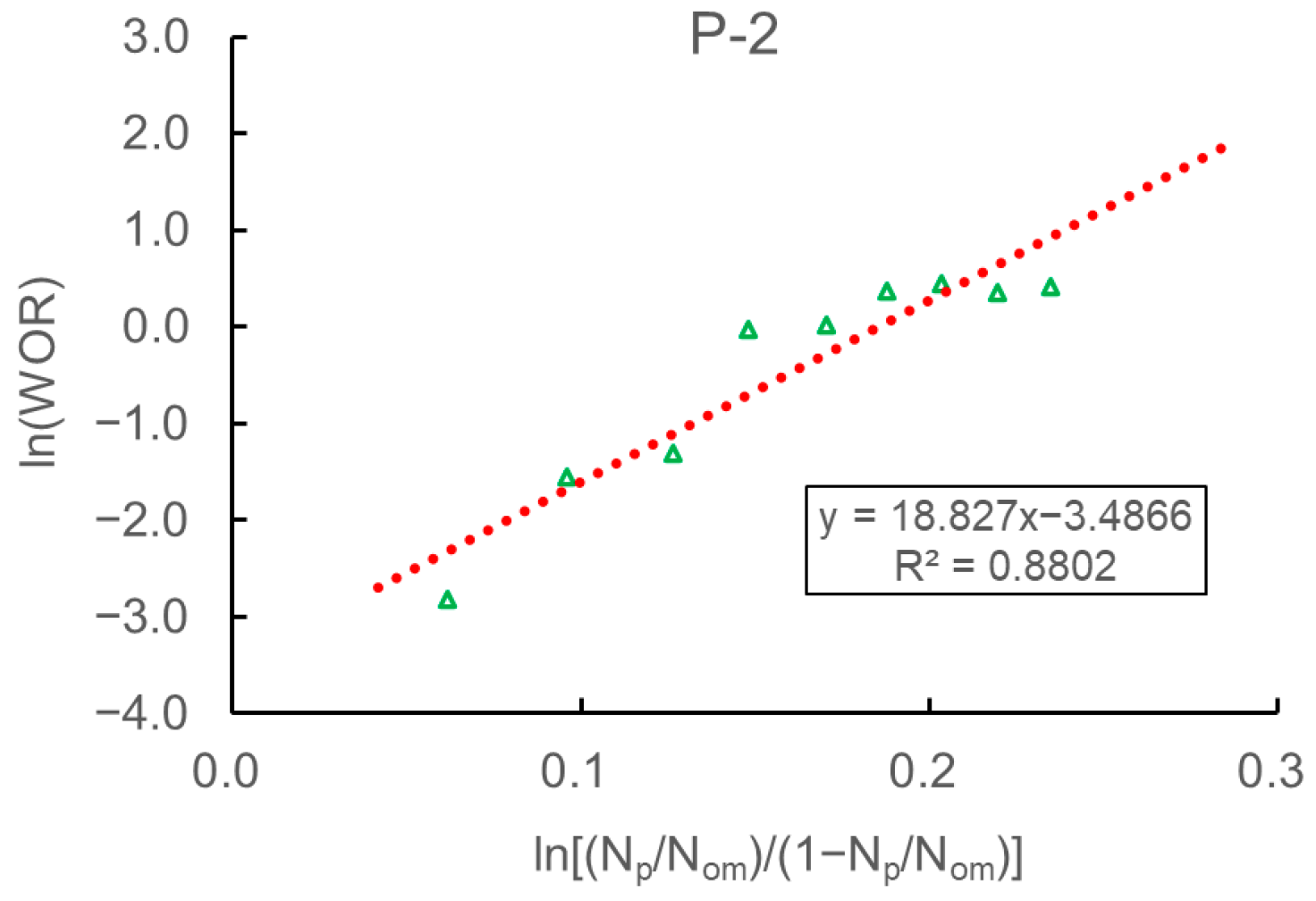
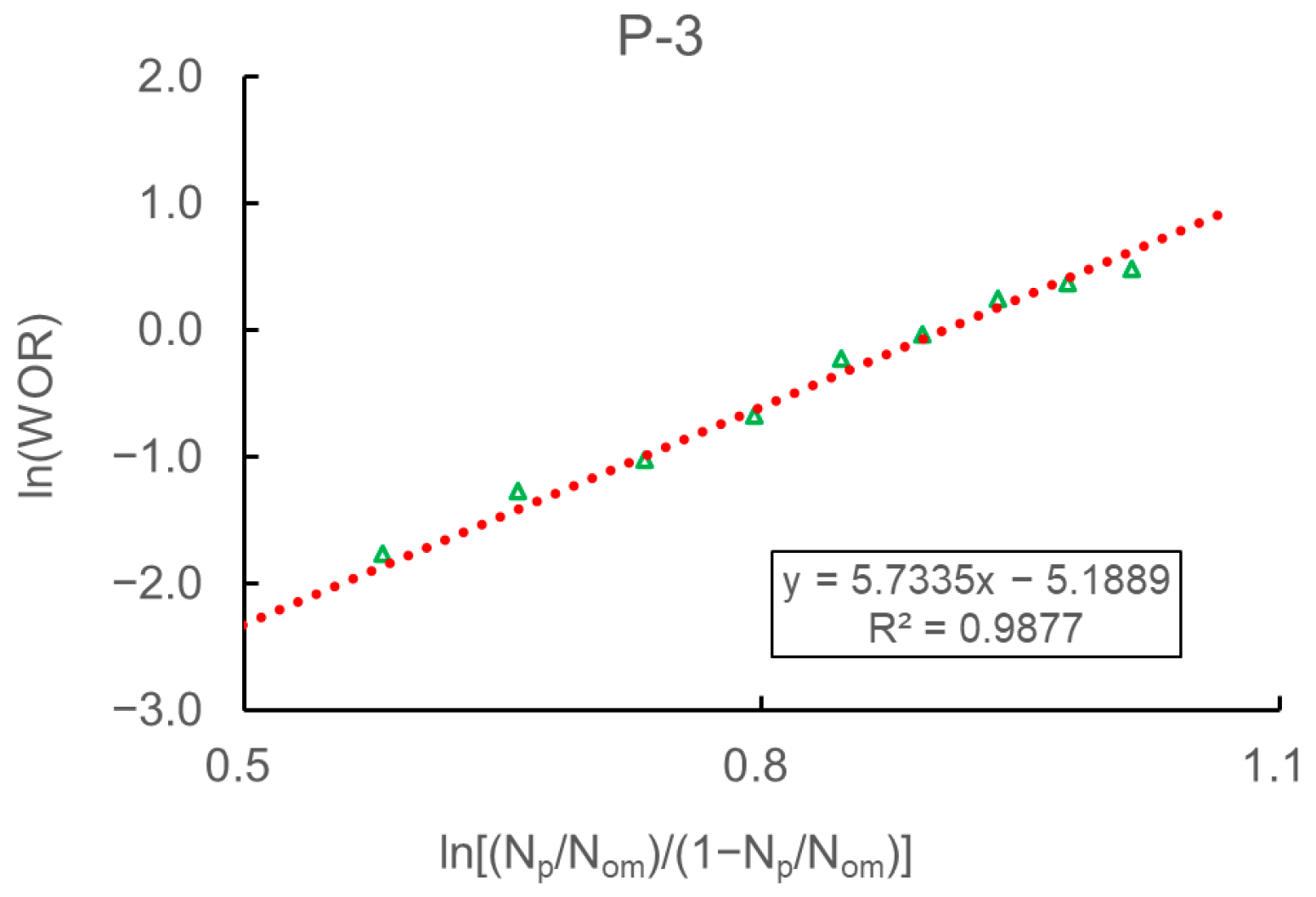
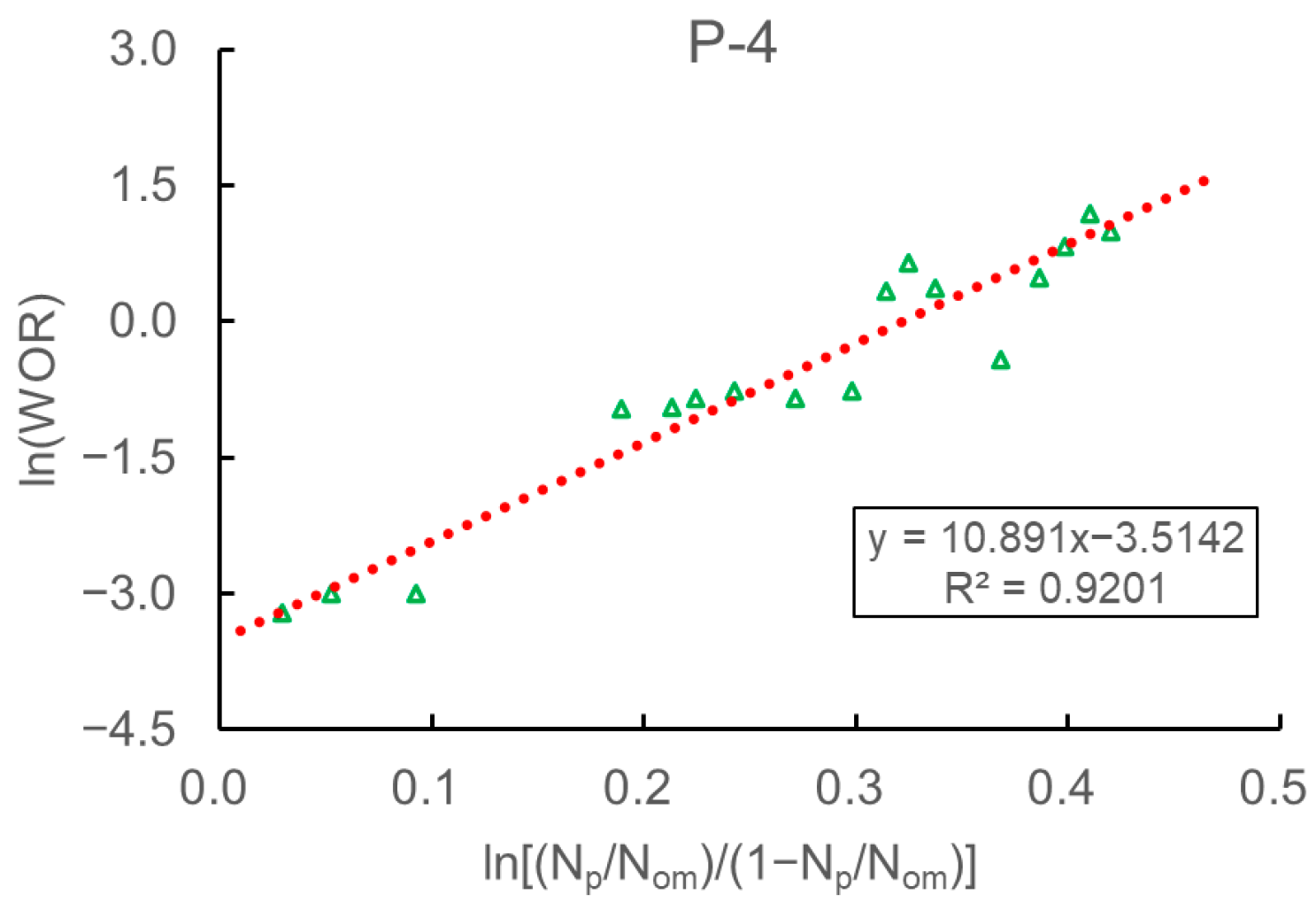
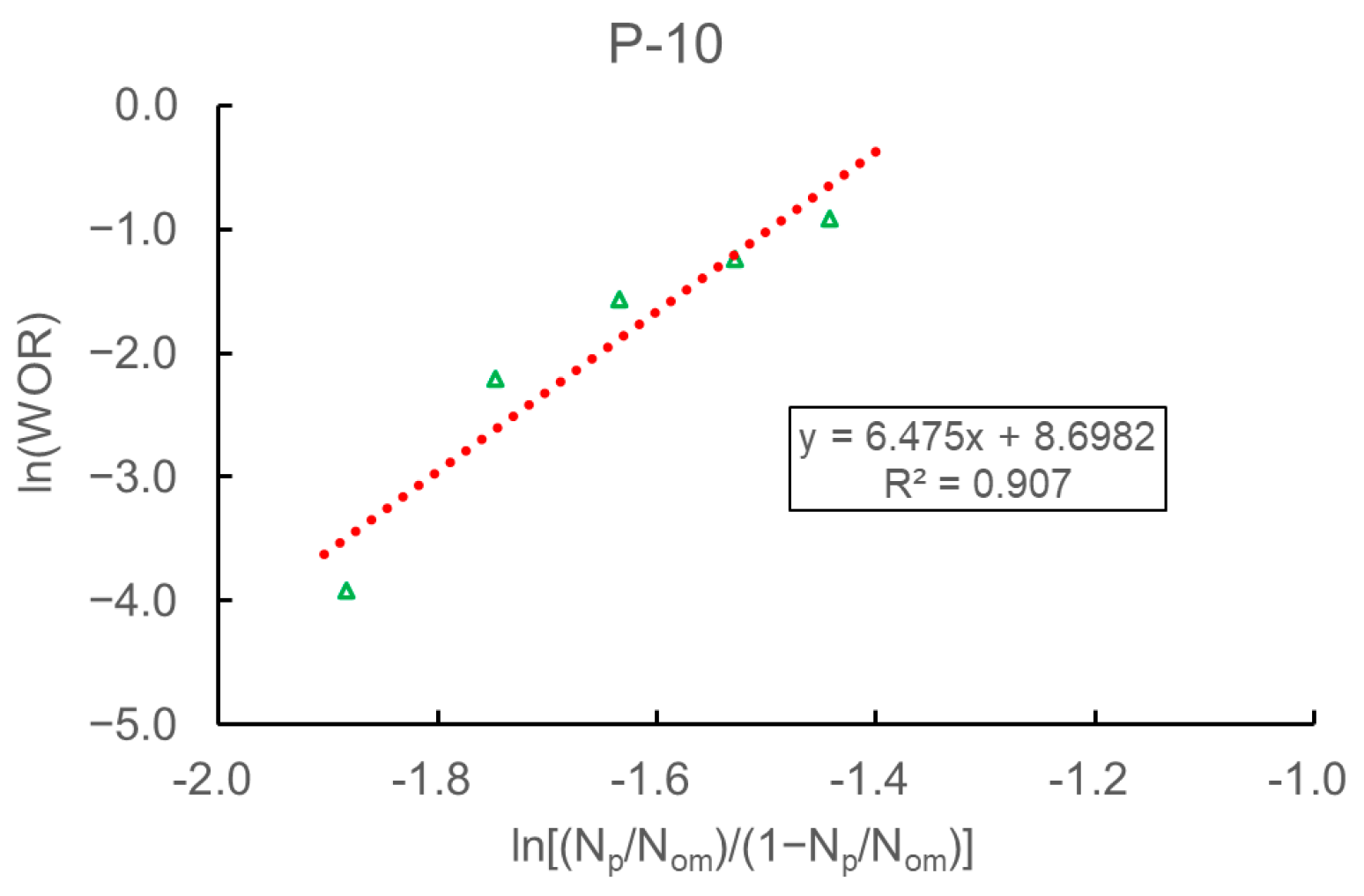
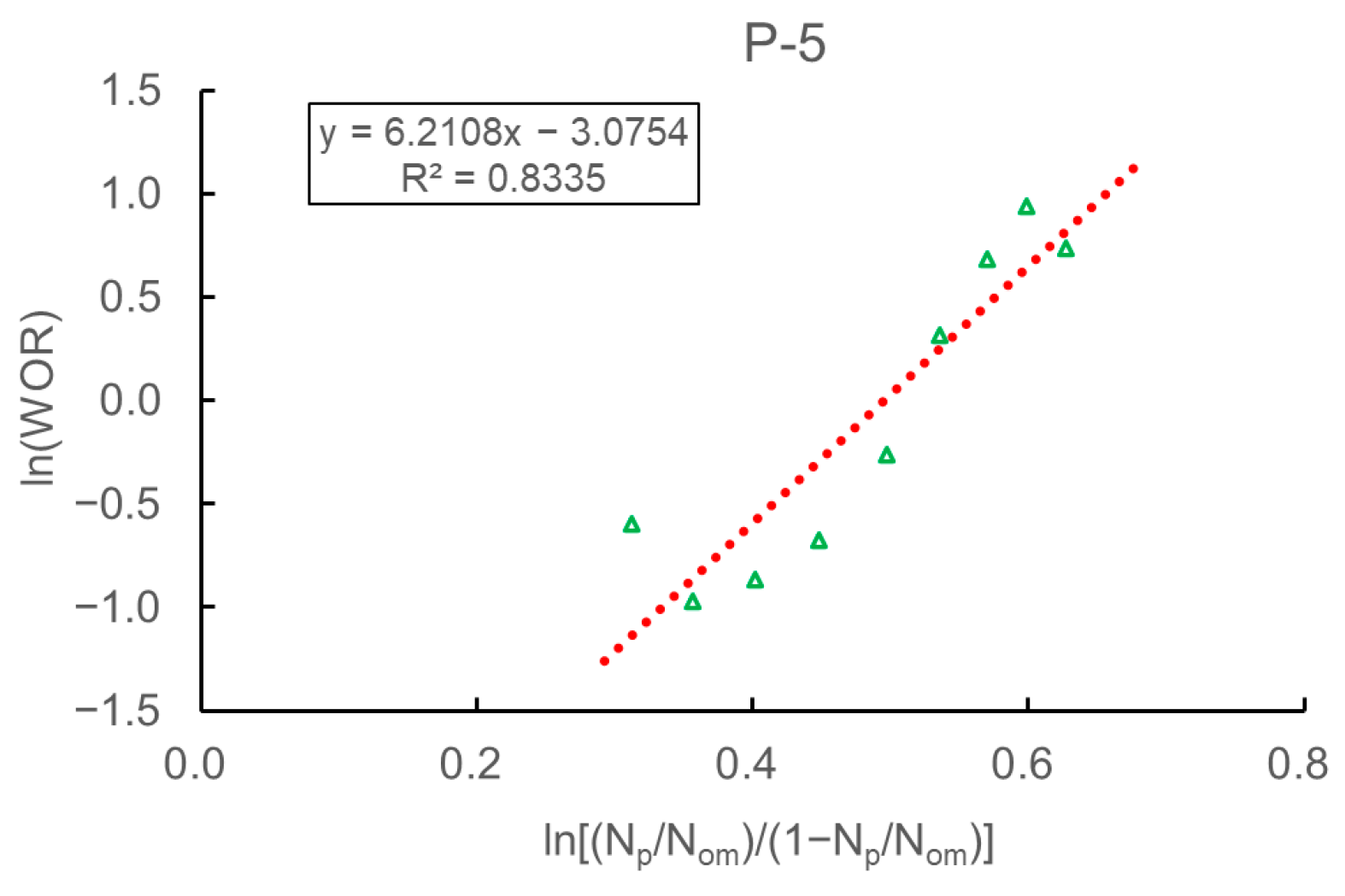
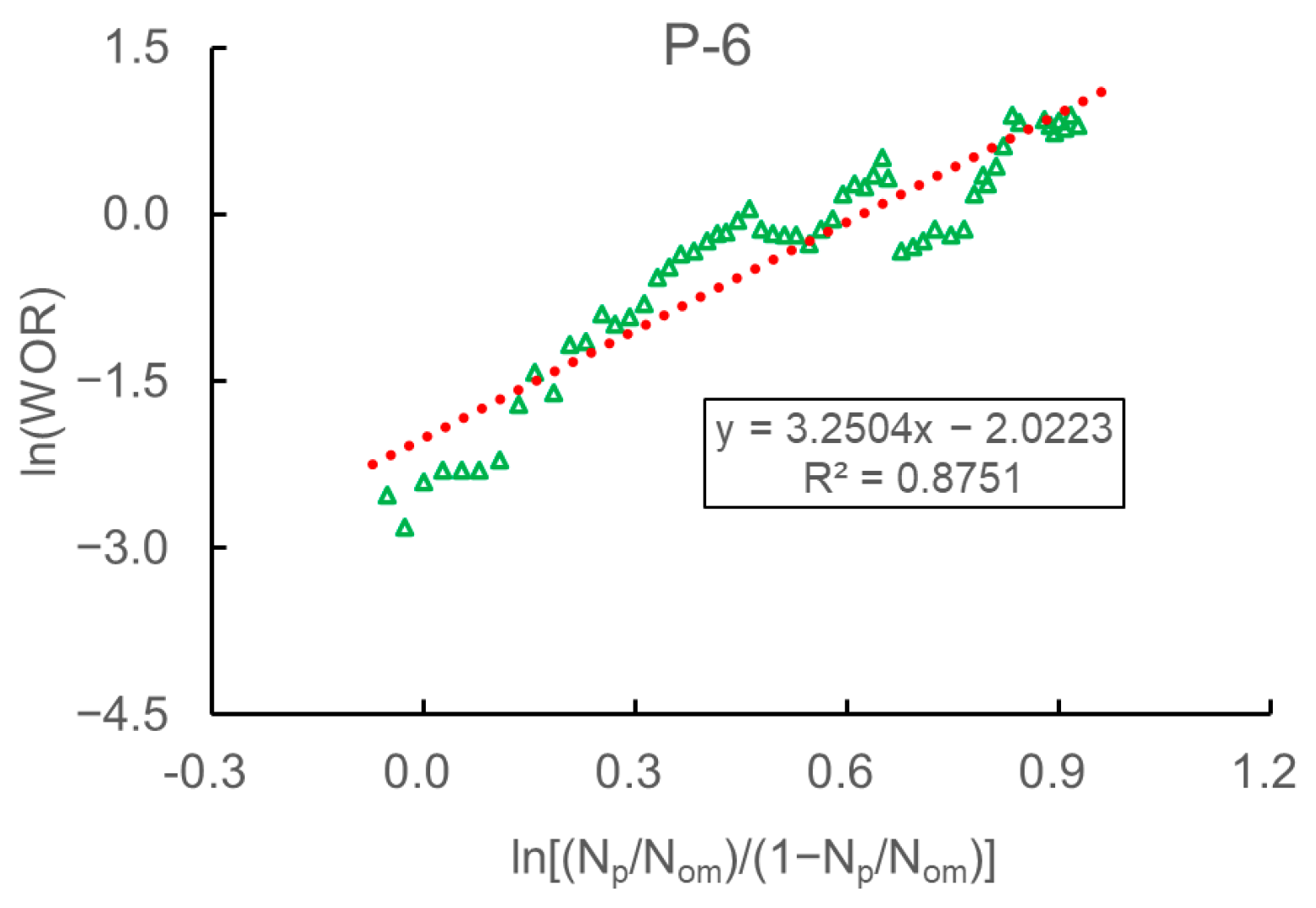
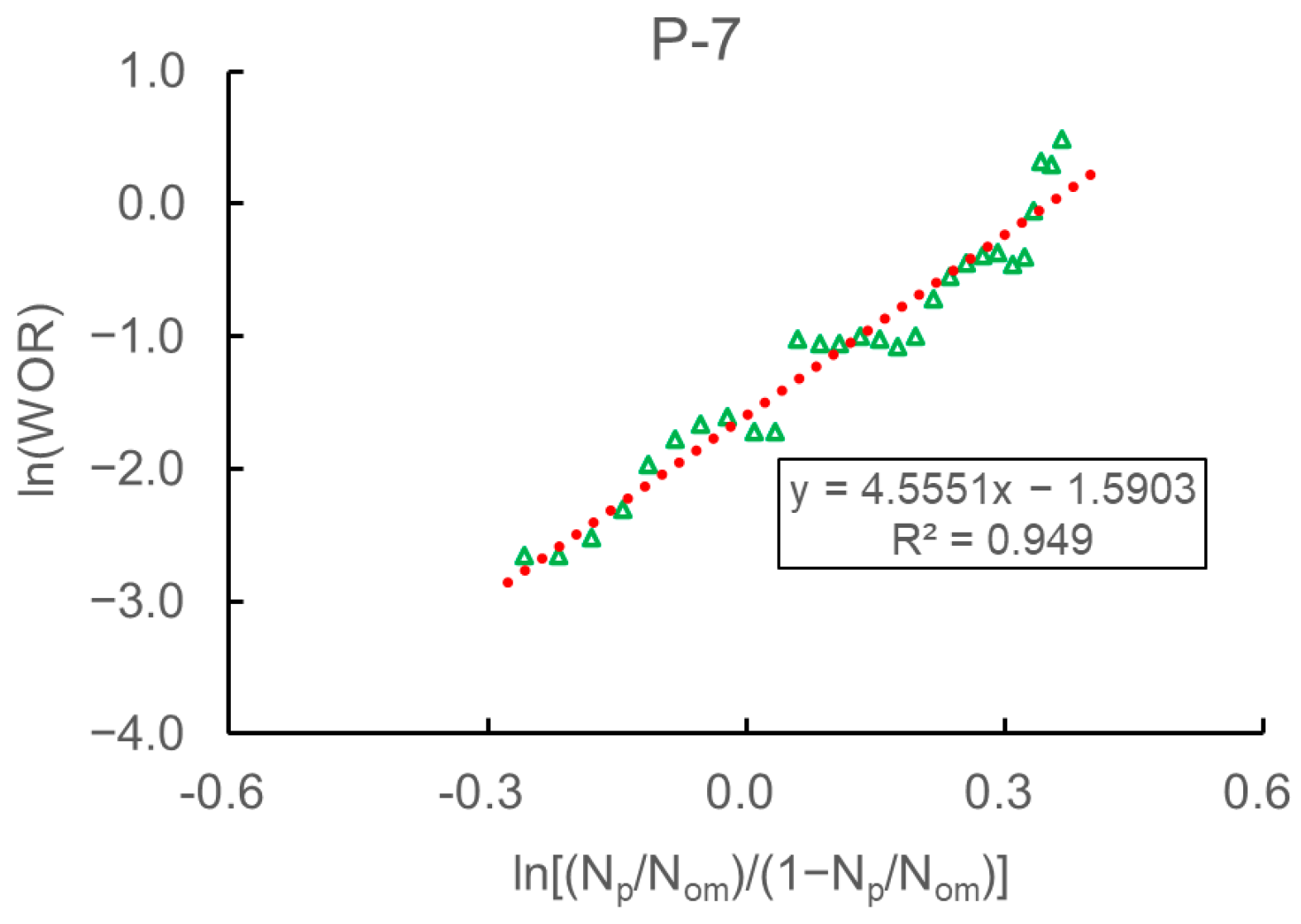
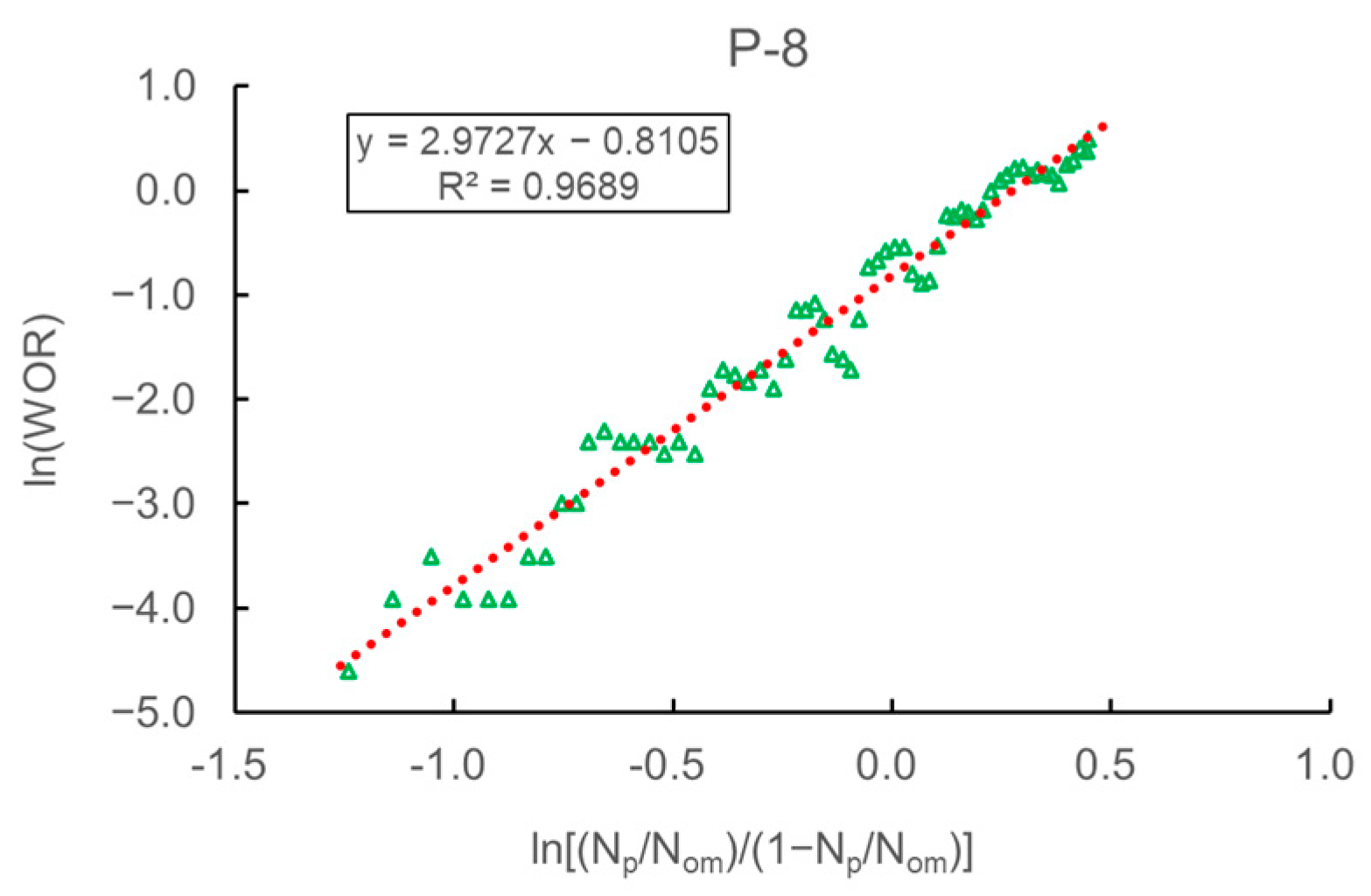
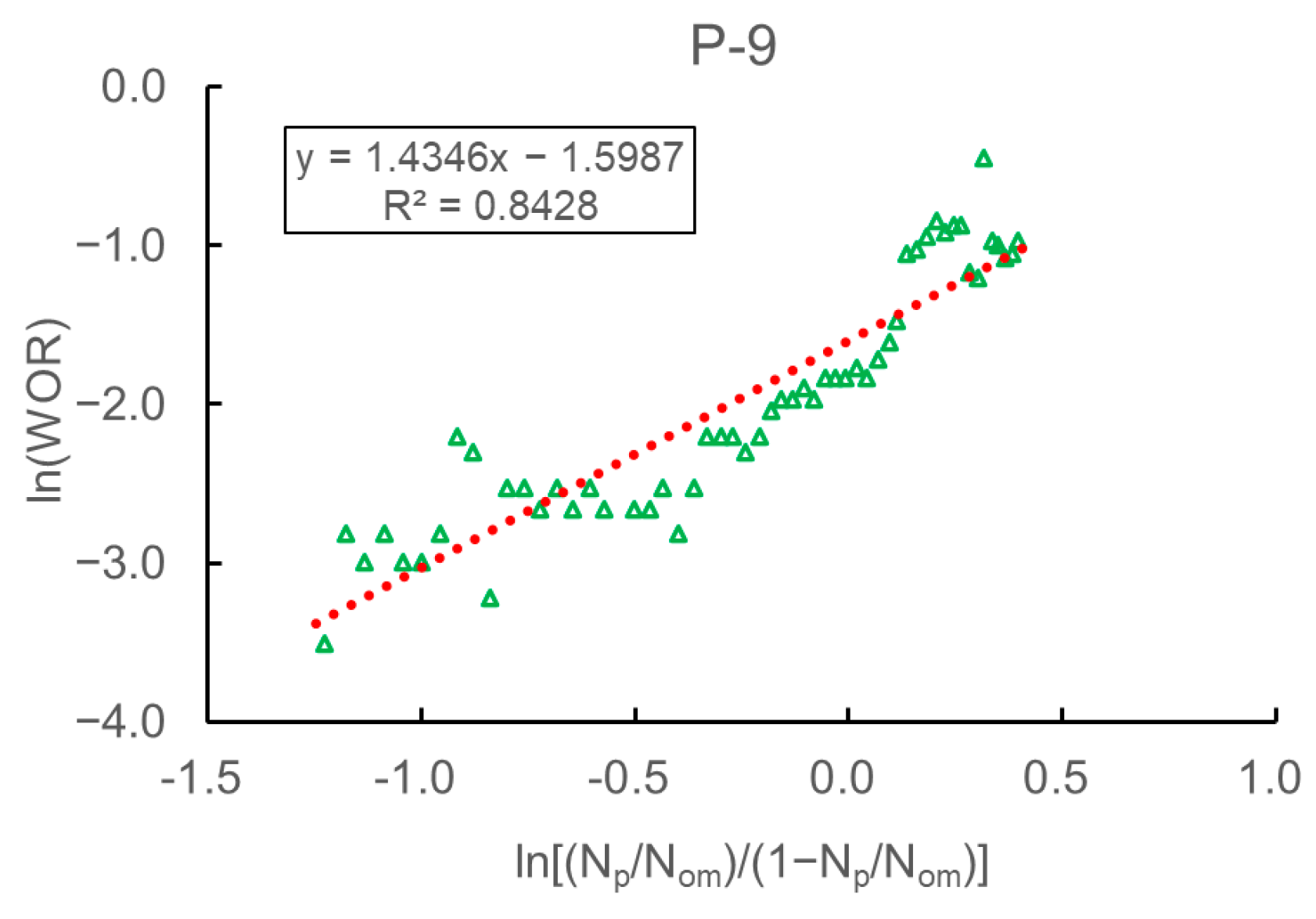
To validate the applicability of the proposed full watercut range waterflood sweep efficiency model under different injector–producer connectivity patterns, the producing wells in the field were grouped into coeval connectivity, hybrid connectivity, and cross-stage connectivity according to the connectivity classification in Section 2.2 (with sample sizes of 6, 2, and 2 wells, respectively). The model parameters were estimated by matching the production performance data for each well, and the fitting results are summarized in Table 2.
In Equation (14), parameter A represents the slope term of the linearized relationship, whereas parameter B denotes the intercept term. The matching results indicate that A is generally the largest for the coeval connectivity group, intermediate for the hybrid group, and smallest for the cross-stage group. This trend indicates a faster post-breakthrough water cut increase under coeval connectivity, and a comparatively slower increase under cross-stage connectivity. These differences are consistent with the distinct flow mechanisms inferred from time-lapse seismic data. Coeval connectivity is characterized by a more uniform front advance and limited barrier influence. Cross-stage connectivity, in contrast, exhibits more pronounced bypassing and barrier-dominated flow.
The well-by-well matching curves are shown in Figure 20, Figure 21, Figure 22, Figure 23, Figure 24, Figure 25, Figure 26, Figure 27, Figure 28 and Figure 29, demonstrating consistently good matches across all three connectivity groups. It is important to note a limitation regarding the sample size in the current validation phase. Specifically, the cross-stage and hybrid connectivity patterns were validated using production data from only two wells each. While the derived sweep efficiency ranking is physically consistent with the dynamic mechanisms revealed by the time-lapse seismic interpretations, the relatively small sample size inherently limits the statistical significance of the quantitative conclusions for these specific groups. Future work should incorporate additional well pairs from comparable deepwater turbidite reservoirs to strengthen statistical confidence in the proposed quantitative findings.
Using the fitted parameters, sweep efficiency was calculated for each injector–producer well group, with results reported in Table 3. The results show that predicted sweep efficiency exhibits a strong dependence on connectivity pattern: the average sweep efficiency is 0.86 for coeval connectivity, 0.80 for hybrid connectivity, and 0.70 for cross-stage connectivity, giving the ranking coeval > hybrid > cross-stage. This trend is consistent with the sweep morphology differences interpreted from the time-lapse seismic data in Section 3. Coeval connectivity shows better sandbody continuity and fewer barriers, which promote a more uniform front advance limit upswept zones; cross-stage connectivity, in contrast, is characterized by discontinuous sandbodies and stronger barrier control. This leads to fragmented sweep, more bypassing, and reduced overall sweep efficiency; hybrid connectivity exhibits intermediate behavior, reflecting the combined influence of both patterns.
Overall, the proposed model provides a stable quantitative framework for comparing sweep efficiency among injector–producer well groups with different connectivity patterns. It can serve as a practical quantitative tool for connectivity diagnosis and for evaluating development strategies in deepwater turbidite channel reservoirs.

6. Conclusions

  • Injector–producer connectivity plays a dominant role in controlling waterflood sweep behavior. Distinct connectivity patterns lead to fundamentally different sweep characteristics. Under coeval connectivity, the waterflood front advances in a relatively uniform and continuous manner with limited disturbance; under cross-stage connectivity, flow barriers exert a strong influence, resulting in pronounced bypassing and localized preferential breakthrough; hybrid connectivity combines features of both patterns, reflecting a sweep response that integrates coeval and cross-stage flow behaviors. These observations confirm that connectivity architecture directly governs sweep morphology and efficiency.
  • A new oil–water relative permeability ratio correlation applicable to low viscosity oil across the full water cut range was developed to support quantitative sweep efficiency evaluation. This correlation overcomes the limitations of conventional methods, which are not valid throughout all water cut stages. It was evaluated using a set of theoretical relative permeability curves covering typical Corey exponent ranges and mobility ratio conditions representative of low viscosity oil. The results show that the correlation remains accurate from low water cut up to 100% water cut, thus providing a consistent basis for quantitatively characterizing sweep efficiency under different connectivity patterns.
  • A predictive model for waterflood sweep efficiency was developed based on the full water cut relative permeability correlation and validated using field production data. The model yields a consistent sweep efficiency ranking (coeval > hybrid > cross-stage) that aligns with seismic mechanistic interpretations, providing a robust quantitative basis for connectivity evaluation in deepwater reservoirs. Although the current steady state and low viscosity assumptions may necessitate parameter recalibration for transient dominant or high viscosity systems, the proposed methodology offers a practical and scalable tool for comparative development performance assessment.

Author Contributions

Conceptualization, Z.Y. and Y.L.; methodology, Z.Y., L.Y. and X.L.; writing—original draft preparation, Z.Y. and X.L.; writing—review and editing, Z.Y. and X.L.; visualization, Z.Y. and Y.L.; supervision, L.Y. and Y.L.; project administration, L.Y.; funding acquisition, Z.Y. and L.Y. All authors have read and agreed to the published version of the manuscript.

Funding

This research was funded by National Science and Technology Major Project of China, grant number 2025ZD1407406.

Data Availability Statement

Restrictions apply to the availability of these data. The data were obtained from CNOOC Research Institute Ltd. and are available from the corresponding authors with the permission of CNOOC Research Institute Ltd.

Conflicts of Interest

Authors Zhiwang Yuan and Xiaoqi Liu were employed by the company CNOOC Research Institute Co., Ltd. Author Li Yang was employed by the company CNOOC International, Ltd. The remaining authors declare that the research was conducted in the absence of any commercial or financial relationships that could be construed as a potential conflict of interest.

References

  1. Wen, Z.; Wang, J.; Wang, Z.; He, Z.; Song, C.; Liu, X.; Zhang, N.; Ji, T. Analysis of the World Deepwater Oil and Gas Exploration Situation. Pet. Explor. Dev. 2023, 50, 1060–1076. [Google Scholar] [CrossRef]
  2. Wang, Z.; Wang, S. Comprehensive Review of Advances and Research in Global Deepwater Exploration and Development. Nat. Gas Oil 2024, 42, 1–10. Available online: https://kns.cnki.net/kcms2/article/abstract?v=BkbJkO_np9MOuk0ULsKj_dsPDzlyOyxVPnuvSFciO6YrHXvSEdRTiob88C7rR4p5or4z9En1LVMPiUq0yBihpcxJKa6P5lV1gw9zCzVZKGgrrjiHd74ogIho2S8n3iIGSisHqjiaCg0X0nXiZkQQhhqPefGEFkrGYJDmwb8A5APc0qGf2tFa9w==&uniplatform=NZKPT&language=CHS (accessed on 11 March 2026).
  3. Li, H.; Zhang, M.; Lau, H.; Fu, S. China’s Deepwater Field Development: Subsurface Challenges and Opportunities. In Proceedings of the Offshore Technology Conference, Houston, TX, USA, 4–7 May 2020; p. D031S040R003. [Google Scholar]
  4. Jiang, D.; Zhang, H.; Li, C.; Hao, J.; Li, F.; Zhang, W.; Sun, D. Global Deep- and Ultra-Deep Water Oil and Gas Exploration: Review and Outlook. Mar. Geol. Front. 2022, 38, 1–12. [Google Scholar] [CrossRef]
  5. Chen, X.; Wang, Z.; Gu, S.; Yue, W.; Wei, Q.; Fan, Z.; Cui, H.; Zhang, Y. Global Deepwater Oil and Gas Development Characteristics, Potential Distribution and Development Trend. Pet. Sci. Technol. Forum 2023, 42, 69–76. Available online: https://kns.cnki.net/kcms2/article/abstract?v=BkbJkO_np9OXzVGkiF-OhmzLbnkqAsOzyYhx8lg579fPf9yDvCZu7O2UUeBkb5OV0T3k36CeL5OvXlio5Atb4ZTLgTmy53a3QAo7bvlENAAMeDJN86OPo4SskgYU5TrZxn8xsTkTVcj9bGE9eFbaah1UE1nkCLsRJA9OzbST_wL0l7a32ck7mA==&uniplatform=NZKPT&language=CHS (accessed on 11 March 2026).
  6. Wilson, A. Waterflooding Proves Useful in Deepwater Gulf of Mexico Overpressured Turbidites. J. Pet. Technol. 2014, 66, 113–115. [Google Scholar] [CrossRef]
  7. Wynn, R.B.; Cronin, B.T.; Peakall, J. Sinuous Deep Water Channels: Genesis, Geometry and Architecture. Mar. Pet. Geol. 2007, 24, 341–387. [Google Scholar] [CrossRef]
  8. Gao, Y.Q.; Cheng, H.B.; Li, G.H.; Li, H.Y.; Tan, H.G.; Zhang, J.; Zhu, D.Y. Gelation and Reservoir Conformance Control Performance of in Situ Crosslinked Polymer Gels Prepared with Different Crosslinkers. Pet. Sci. 2026, 23, S1995822626000038. [Google Scholar] [CrossRef]
  9. Meirovitz, C.D.; Stright, L.; Hubbard, S.M.; Romans, B.W. The Influence of Inter- and Intra-Channel Architecture on Deep-Water Turbidite Reservoir Performance. Pet. Geosci. 2021, 27, petgeo2020-005. [Google Scholar] [CrossRef]
  10. McHargue, T.; Pyrcz, M.J.; Sullivan, M.D.; Clark, J.D.; Fildani, A.; Romans, B.W.; Covault, J.A.; Levy, M.; Posamentier, H.W.; Drinkwater, N.J. Architecture of Turbidite Channel Systems on the Continental Slope: Patterns and Predictions. Mar. Pet. Geol. 2011, 28, 728–743. [Google Scholar] [CrossRef]
  11. Li, Y.; Wang, Z.; Hu, Z.; Xu, B.; Li, Y.; Pu, W.; Zhao, J. A Review of in Situ Upgrading Technology for Heavy Crude Oil. Petroleum 2021, 7, 117–122. [Google Scholar] [CrossRef]
  12. Zhu, D.; Zhang, J.; Li, G.; Gao, Y.; Tan, H.; Li, H.; Cheng, H.; Lu, C. Development of Oil Sludge Preformed Particle Gels (OS PPG) for Petroleum Reservoir Conformance Control. Energy Fuels 2026, 40, 2027–2037. [Google Scholar] [CrossRef]
  13. He, T.; Li, Y.; Zhao, J.; Chen, J.; Yang, M.; Wang, Y.; Huang, Z.; Wang, S. Exploring Interfacial Property and Adsorption Characteristic of Different Surfactant Forms in Porous Medium. Chem. Eng. J. 2025, 507, 160560. [Google Scholar] [CrossRef]
  14. Zhang, J.; Tan, H.G.; Zhang, T.; Gao, Y.Q.; Cheng, H.B.; Li, H.Y.; Zhu, D.Y. New Injection Method Using Composite Gel System and Gel Breaker to Improve Sweep Efficiency and Mitigate Formation Damage. Pet. Sci. 2026, 23, 383–392. [Google Scholar] [CrossRef]
  15. Mayall, M.; Jones, E.; Casey, M. Turbidite Channel Reservoirs—Key Elements in Facies Prediction and Effective Development. Mar. Pet. Geol. 2006, 23, 821–841. [Google Scholar] [CrossRef]
  16. Zhang, L.F.; Pan, M.; Li, Z.L. 3D Modeling of Deepwater Turbidite Lobes: A Review of the Research Status and Progress. Pet. Sci. 2020, 17, 317–333. [Google Scholar] [CrossRef]
  17. Barbosa, G.S.; Pena dos Reis, R.; Garcia, A.J.V.; Barberes, G.d.A.; Garcia, G.G. Petroleum Systems Analysis of Turbidite Reservoirs in Rift and Passive Margin Atlantic Basins (Brazil and Portugal). Energies 2022, 15, 8224. [Google Scholar] [CrossRef]
  18. Liu, L.; Zhang, T.; Zhao, X.; Wu, S.; Hu, J.; Wang, X.; Zhang, Y. Sedimentary Architecture Models of Deepwater Turbidite Channel Systems in the Niger Delta Continental Slope, West Africa. Pet. Sci. 2013, 10, 139–148. [Google Scholar] [CrossRef]
  19. Zhang, J.; Wu, S.; Wang, X.; Lin, Y.; Fan, H.; Jiang, L.; Wan, Q.; Yin, H.; Lu, Y. Reservoir Quality Variations within a Sinuous Deep Water Channel System in the Niger Delta Basin, Offshore West Africa. Mar. Pet. Geol. 2015, 63, 166–188. [Google Scholar] [CrossRef]
  20. Kang, B.; Xiong, H.; Liu, P.; Yuan, Z.; Xiao, P. Refined Prediction Method for Production Performance of Deep Water Turbidite Sandstone Oilfield: A Case Study of AKPO in Niger Delta Basin, West Africa. ACS Omega 2024, 9, 34345–34357. [Google Scholar] [CrossRef]
  21. Inikori, S.O.; Coxe, B.; Ageh, E.; Van Der Bok, J. Development of World Class Oil Production and Water Injection Rate and High Ultimate Recovery Wells in Deepwater Turbidites—Bonga Example. SPE Prod. Oper. 2009, 24, 293–302. [Google Scholar] [CrossRef]
  22. Akingbade, D.; Umurhohwo, J.; Effiom, O.; Pirmez, C.; Weaver, S. An Integrated Approach to Identifying and Reducing Reservoir Uncertainties in a Turbidite Deep Water Environment. In Proceedings of the Nigeria Annual International Conference and Exhibition, Abuja, Nigeria, 30 July–3 August 2011; p. SPE-150740-MS. [Google Scholar]
  23. Adoghe, L.; Effiom, O.; Bakare, O.; Nkanga, A.; Liu, F.; Okoroafor, R. Optimizing Waterflooding Schemes and Completion Decisions in Deepwater Environments Using Formation Pressure While Drilling (FPWD): A Bonga Field Application. In Proceedings of the Nigeria Annual International Conference and Exhibition, Lagos, Nigeria, 6–8 August 2012; p. SPE-162997-MS. [Google Scholar]
  24. Zubarev, D.; Mardanov, R.; Bochkarev, V.A.; Khmelevskij, V. Flexible Multi Well Interference Test Design for a Deep Water Field. In Proceedings of the SPE Russian Petroleum Technology Conference, Moscow, Russia, 22–24 October 2019; p. D023S013R003. [Google Scholar]
  25. Morris, P.D.; Sylvester, Z.; Covault, J.A.; Mohrig, D.; Jensen, J.L. The Impact of Reservoir Architecture on Dynamic Connectivity in Sinuous Deep Water Channel Systems. Interpretation 2025, 13, T607–T628. [Google Scholar] [CrossRef]
  26. Zhang, W.; Duan, T.; Liu, Z.; Yuan, S.; Lin, Y.; Xu, H. Application of Multi Point Geostatistics in Deep Water Turbidity Channel Simulation: A Case Study of Plutonio Oilfield in Angola. Pet. Explor. Dev. 2016, 43, 443–450. [Google Scholar] [CrossRef]
  27. Yuan, Z.; Yang, L.; Yang, B.; Zhang, Y.; Chen, X. Strategy and Practice of High Efficient Water Injection in Deep Sea Turbidite Sandstone Oilfield. J. Southwest Pet. Univ. 2021, 43, 117–127. [Google Scholar] [CrossRef]
  28. Bu, F.; Zhang, X.; Chen, G. Gravity Flow Depositional Mode and Reservoir Characteristics of Niger Delta Basin: Taking AKPO Oilfield as an Example. J. Xi’an Shiyou Univ. 2017, 32, 64–70. Available online: https://kns.cnki.net/kcms2/article/abstract?v=BkbJkO_np9PeLGjIzlMekKWl92IeYa-z8hLmvF9yLOr-1OJ2rrD1jhupKCXROHPzS80xIJ7E-r_eX0WSEoUY8dMrAtFEU05dA9tCh0XHcMph5jA3hKp3IjHFfejFuDnDca8VBLcdnlT8c5KTzCE7yByh5xaKb0rCcdJf_aRU1prTlEooj3IW9w==&uniplatform=NZKPT&language=CHS (accessed on 11 March 2026).
  29. Bu, F.; Zhang, Y.; Yang, B.; Gao, B.; Gao, Y. Technique and Application of Fine Connectivity Characterization of Composite Deep Water Turbidite Channels. Fault-Block Oil Gas Field 2015, 22, 309–313. Available online: https://link.cnki.net/urlid/41.1219.te.20150601.1155.009 (accessed on 11 March 2026).
  30. Yuan, Z.; Yang, B.; Yang, L.; Gu, W.; Chen, X.; Kang, B.; Li, C.; Zhang, H. Water-Cut Rising Mechanism and Optimized Water Injection Technology for Deepwater Turbidite Sandstone Oilfield: A Case Study of AKPO Oilfield in Niger Delta Basin, West Africa. Pet. Explor. Dev. 2018, 45, 302–311. [Google Scholar] [CrossRef]
  31. Zhao, X.; Wu, S.; Liu, L. Sedimentary Architecture Model of Deep Water Channel Complexes in Slope Area of West Africa. J. China Univ. Pet. 2012, 36, 1–5. Available online: https://kns.cnki.net/kcms2/article/abstract?v=BkbJkO_np9P1jKhVzJWR1ZHTnVZatIEXDuIhLzTJI_Z7MO4ffBvClEny4Qt3VIADxzPRo84PZUfZNq998souTM2-picV3yughzQZIW0ew2DGmqiAzInv4sR03_QgFM5uQ7RWYu198rwtaE5ARpsVUYGc9sFMvUmRwJlo9eDgcCxyfYiw4Zaj3A==&uniplatform=NZKPT&language=CHS (accessed on 11 March 2026).
  32. Zhao, X.; Wu, S.; Liu, L. Characterization of Reservoir Architectures for Neogene Deepwater Turbidity Channels of Akpo Oilfield, Niger Delta Basin. Acta Pet. Sin. 2012, 33, 1049–1058. Available online: https://kns.cnki.net/kcms2/article/abstract?v=BkbJkO_np9NvngFB0-8eUOICHAuZWaBqizWccZnYHE33FinHZtImgfMJtanNE4Ji-MlfYXIpehPeTpHTxFY-W75I2imWCYxAqoj3IQBdjms-M_e6x1Ik4wM44pWs0Gwdqs6wllqmJZpf4o0Ib8k3xVaqOfszR6fojxbIJCZm_mPJjTbAF1A8AQ==&uniplatform=NZKPT&language=CHS (accessed on 11 March 2026).
  33. Lv, M.; Wang, Y.; Chen, Y. A Discussion on Origins of Submarine Fan Deposition Model and its Exploration Significance in Nigeria Deep Water Area. China Offshore Oil Gas 2008, 20, 275–282. Available online: https://kns.cnki.net/kcms2/article/abstract?v=BkbJkO_np9NddrAo9melskQ14xXTCtj0AFAxKhTco__6AqU16tbjvUu26acc2c-yWR_WU3PjSy1KBKEwpsMgx5HRBwLLstgTkewIVUFniaKCz-PeQm7PXssnfKNm3pQjE1lqkXCdne1SnTQ8wgBW8a7bhvRgBKClqeU6g0G3CV8u1LkwG_1Dww==&uniplatform=NZKPT&language=CHS (accessed on 11 March 2026).
  34. Zhang, Z.; Li, X.; Gao, M.; Sun, Z.; Wang, D.; Zhu, L.; Hou, J.; Wang, Y. Characterization and Inversion Method of Relative Permeability of Emulsion Flooding. ACS Omega 2024, 9, 43793–43807. [Google Scholar] [CrossRef]
  35. Liu, C.; Zhou, W.; Jiang, J. Dynamic Calculation of Water Sweep Efficiency and Relative Permeability Curve on Water Drive Reservoir. Front. Energy Res. 2022, 10, 922435. [Google Scholar] [CrossRef]
  36. Xie, L.; Xin, X.; Ding, Y.; Wei, T.; Yu, G. Development Adjustment Scheme of a Low Permeability Reservoir in the SN Oilfield. Energies 2023, 16, 5770. [Google Scholar] [CrossRef]
  37. Qi, G.; Zhao, J.; He, H.; Sun, E.; Yuan, X.; Wang, S. A New Relative Permeability Characterization Method Considering High Waterflooding Pore Volume. Energies 2022, 15, 3868. [Google Scholar] [CrossRef]
  38. Guo, H.; Cheng, L.; Jia, P.; Cao, R. An Improved Method for Fitting Relative Permeability Curve Using Nuclear Magnetic Resonance Imaging. Geoenergy Sci. Eng. 2023, 227, 211812. [Google Scholar] [CrossRef]
  39. Darban, A.; Ghaedi, M.; Qajar, J. Analysis of the Impacts of Relative Permeability and Mobility Ratio on Heterogeneity Loss Error during Upscaling of Geological Models. Oil Gas Sci. Technol. Rev. IFP Energ. Nouv. 2020, 75, 53. [Google Scholar] [CrossRef]
  40. Andrianov, N.; Nick, H.M. Modeling of Waterflood Efficiency Using Outcrop Based Fractured Models. J. Pet. Sci. Eng. 2019, 183, 106350. [Google Scholar] [CrossRef]
  41. Dou, H.; Zhang, H.; Shen, S. Correct Understanding and Application of Waterflooding Characteristic Curves. Pet. Explor. Dev. 2019, 46, 796–803. [Google Scholar] [CrossRef]
  42. Gao, L.; Song, K.; Ma, C.; Li, L. Two Straight Lines to Forecast Development Index of High Water Cut Oilfield. Pet. Drill. Tech. 2008, 36, 72–74. [Google Scholar]
  43. Song, Z.; Li, Z.; Lai, F.; Liu, G.; Gan, H. Derivation of Water Flooding Characteristic Curve for High Water Cut Oilfields. Pet. Explor. Dev. 2013, 40, 216–223. [Google Scholar] [CrossRef]
  44. Hu, G. A New Method for Calculating Volumetric Sweep Efficiency in a Water Flooding Oilfield. Pet. Explor. Dev. 2013, 40, 111–114. [Google Scholar] [CrossRef]
  45. Tillero, E.; Mogollon, J.L. Unified Oil and Water Fractional Flow Functions: Improving Waterflood Performance Analytical Modeling Techniques. In Proceedings of the SPE Latin American and Caribbean Petroleum Engineering Conference, Virtual, 27–31 July 2020; p. D021S007R001. [Google Scholar]
  46. Li, S.; Feng, Q.; Zhang, X.; Yu, C.; Huang, Y. A New Water Flooding Characteristic Curve at Ultra High Water Cut Stage. J. Pet. Explor. Prod. Technol. 2023, 13, 101–110. [Google Scholar] [CrossRef]
Figure 1. Seismic attribute map of turbidite channels in the oilfield.
Energies 19 01605 g001
Figure 2. Plan distribution of composite channels in the C reservoir of oilfield A.
Energies 19 01605 g002
Figure 3. Vertical stacking of multistage channels in the C reservoir of the oilfield A.
Energies 19 01605 g003
Figure 4. Well logging cross-section of I6 and P9 (red line: Gamma Ray log; blue line: True Resistivity log).
Energies 19 01605 g004
Figure 5. (a) Well logging profile of well P7; (b) well logging profile of well I1 (red line: Gamma Ray log; blue line: True Resistivity log).
Energies 19 01605 g005
Figure 6. (a) Seismic profile between injection well I4 and production well P2; (b) connectivity pattern between injection well I4 and production well P2.
Energies 19 01605 g006
Figure 7. (a) Seismic profile between injection well I6 and production well P9; (b) connectivity pattern between injection well I6 and production well P9.
Energies 19 01605 g007
Figure 8. (a) Seismic profile between injection well I1 and production well P7; (b) connectivity pattern between injection well I1 and production well P7.
Energies 19 01605 g008
Figure 9. Plan view of waterflood sweep between injection well I4 and production well P2. (a) waterflood sweep extent of channel system C1 in 2011, (b) waterflood sweep extent of channel system C1 in 2015. The grey lines represent faults, dashed lines represent sandbody boundaries, and the black and blue solid lines indicate the connectivity between injection and production wells.
Energies 19 01605 g009
Figure 10. Vertical profile of waterflood sweep between injection well I4 and production well P2. The red log curves show resistivity (Rt), and the yellow log curves show gamma ray (GR).
Energies 19 01605 g010
Figure 11. Plan view of waterflood sweep between injection well I6 and production well P9. (a) waterflood sweep extent of channel system C7 in 2011, (b) waterflood sweep extent of channel system C7 in 2015. The grey lines represent faults, dashed lines represent sandbody boundaries, and the black and blue solid lines indicate the connectivity between injection and production wells.
Energies 19 01605 g011
Figure 12. Vertical profile of waterflood sweep between injection well I6 and production well P9. The red log curves show resistivity (Rt), and the yellow log curves show gamma ray (GR).
Energies 19 01605 g012
Figure 13. Plan view of waterflood sweep between injection well I1 and production well P7. (a) waterflood sweep extent of channel system C5 in 2015, (b) waterflood sweep extent of channel system C4 in 2015. The grey lines represent faults, dashed lines represent sandbody boundaries, and the black and blue solid lines indicate the connectivity between injection and production wells.
Energies 19 01605 g013
Figure 14. Vertical profile of waterflood sweep between injection well I1 and production well P7. The red log curves show resistivity (Rt), and the yellow log curves show gamma ray (GR).
Energies 19 01605 g014
Figure 17. Fitting of measured relative permeability using the new oil–water correlation (water cut: 0.0–1.0; nw = 3, no = 3, M = 0.5).
Energies 19 01605 g017
Figure 18. Fitting of measured relative permeability using the new oil–water correlation (water cut: 0.29–1.0; nw = 4, no = 2, M = 0.5). The region to the right of the blue dashed line exhibits a linear trend.
Energies 19 01605 g018
Figure 19. Fitting of measured relative permeability using the new oil–water correlation (water cut: 0.67–1.0; nw = 2, no = 4, M = 0.5). The region to the right of the blue dashed line exhibits a linear trend.
Energies 19 01605 g019
Figure 20. Fitting curve of the new predictive model for waterflood sweep efficiency in well P1.
Energies 19 01605 g020
Figure 21. Fitting curve of the new predictive model for waterflood sweep efficiency in well P2.
Energies 19 01605 g021
Figure 22. Fitting curve of the new predictive model for waterflood sweep efficiency in well P3.
Energies 19 01605 g022
Figure 23. Fitting curve of the new predictive model for waterflood sweep efficiency in well P4.
Energies 19 01605 g023
Figure 24. Fitting curve of the new predictive model for waterflood sweep efficiency in well P10.
Energies 19 01605 g024
Figure 25. Fitting curve of the new predictive model for waterflood sweep efficiency in well P5.
Energies 19 01605 g025
Figure 26. Fitting curve of the new predictive model for waterflood sweep efficiency in well P6.
Energies 19 01605 g026
Figure 27. Fitting curve of the new predictive model for waterflood sweep efficiency in well P7.
Energies 19 01605 g027
Figure 28. Fitting curve of the new predictive model for waterflood sweep efficiency in well P8.
Energies 19 01605 g028
Figure 29. Fitting curve of the new predictive model for waterflood sweep efficiency in well P9.
Energies 19 01605 g029
Table 1. Applicability evaluation of the new oil–water relative permeability ratio correlation.
Seepage Parameters ln K r w K r o   and   ln 1 S w d ln K r w K r o   and   ln S w d 1 S w d
MnwnoLinear StartLinear StartLinear End
ln 1 S w d Rf/%fw/% ln S w d 1 S w d Rf/%fw/% ln S w d 1 S w d Rf/%fw/%
0.1221.57879ALL
0.1231.270851.601722.008999
0.1241.270951.002661.408099
0.1321.680790.603534.6099100
0.1331.37386ALL
0.1341.373962.201001.6083100
0.1421.578700.2055124.6099100
0.1431.578911.202302.4092100
0.1441.57898ALL
1.0221.57895ALL
1.0231.270961.601772.0089100
1.0241.270991.0026241.4080100
1.0321.680950.6035124.60100100
1.0331.37397ALL
1.0341.327972.20100.001.6083100
1.0421.578910.2055394.60100100
1.0431.578981.202312.4092100
1.0441.578100ALL
5.0221.57899ALL
5.0231.270991.6017222.0089100
5.0241.2701001.4019321.0074100
5.0321.682991.801631.9087100
5.0331.37399ALL
5.0341.3731001.801431.2077100
5.0421.578980.6035162.0089100
5.0431.578991.202332.4092100
5.0441.578100ALL
Table 2. Fitting parameters of the new predictive model for waterflood sweep efficiency.
Connectivity
Pattern
Well NameFitting
Parameter A
Fitting
Parameter B
Correlation
Coefficient
CoevalP15.89.00.8847
P218.83.50.8802
P35.75.20.9877
P410.93.50.9201
P106.58.70.9070
P56.23.10.8335
Cross-stageP83.00.80.9689
P91.41.60.8428
HybridP65.22.40.8751
P73.53.10.9490
Table 3. Calculated results of waterflood sweep efficiency in oil wells.
Water Cut Rise PatternWell NameSweep Efficiency (Single Well)Average
CoevalP10.8540.86
P20.846
P30.856
P40.883
P50.888
P100.841
Cross-stageP80.7360.70
P90.663
HybridP60.8040.80
P70.798
Disclaimer/Publisher’s Note: The statements, opinions and data contained in all publications are solely those of the individual author(s) and contributor(s) and not of MDPI and/or the editor(s). MDPI and/or the editor(s) disclaim responsibility for any injury to people or property resulting from any ideas, methods, instructions or products referred to in the content.