Combustion and Power Generation Characteristics of a Thermoelectric Generator Fueled by Hydrogen-Enriched Compressed Natural Gas (HCNG)


Abstract
1. Introduction
2. Materials and Methods
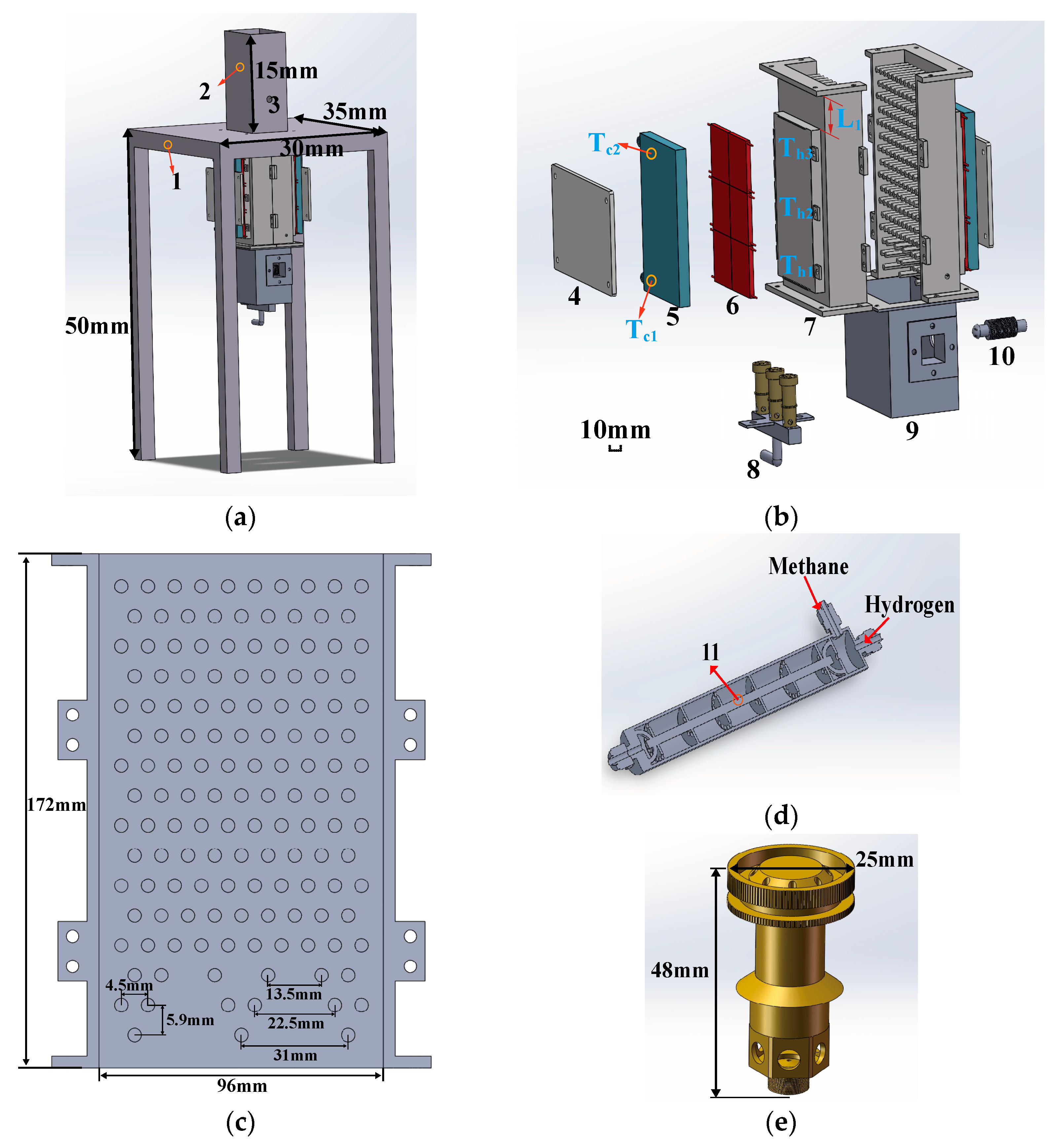
2.1. The Setup of the TEG
2.1.1. Combustion Subsystem
2.1.2. Power Generation Subsystem
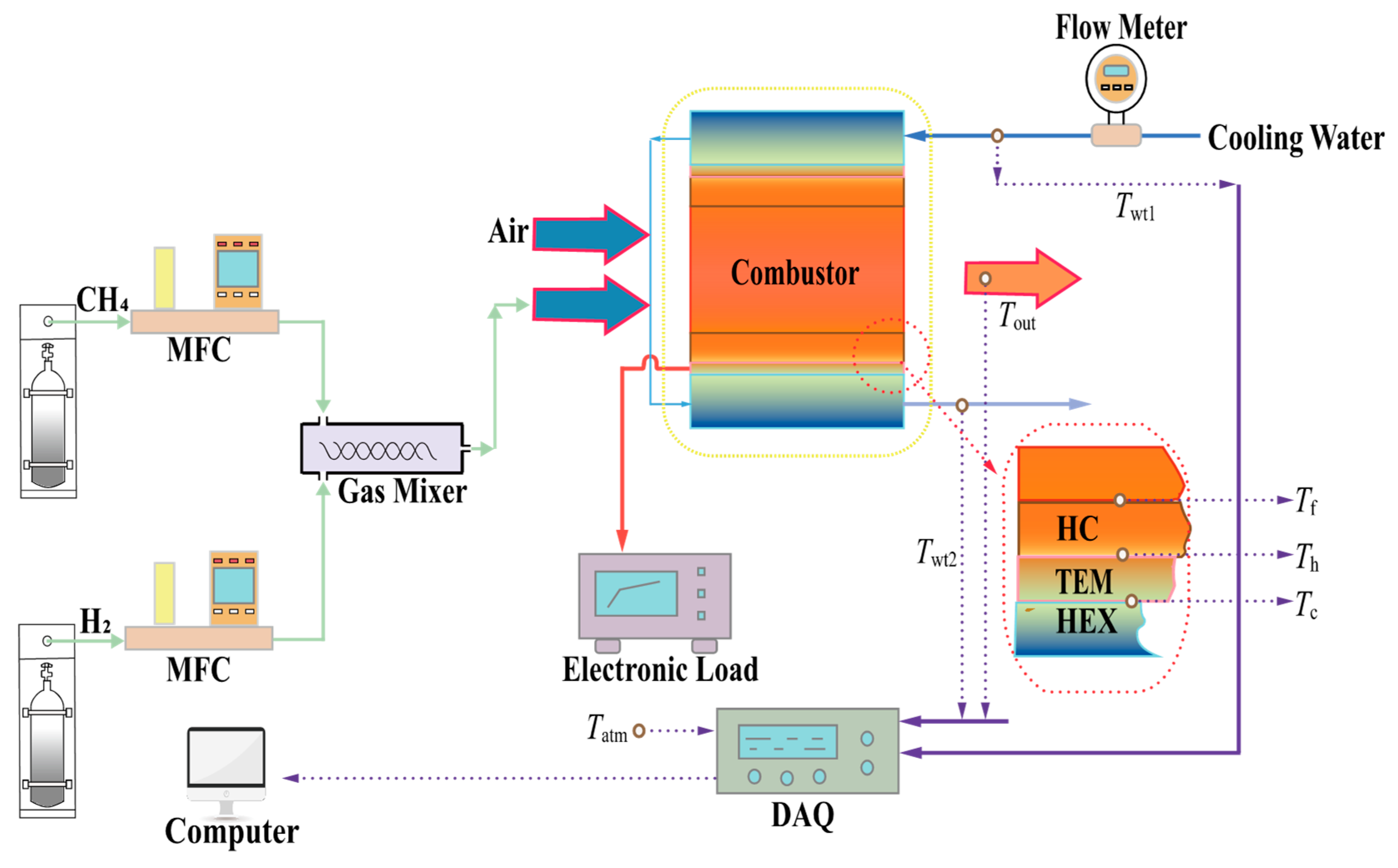
2.2. Experimental Setup
2.3. Parameter Definitions
2.4. Experimental Case and Procedure
- Verify ambient temperature and humidity; open the cooling water valve to ensure the cold-side temperature maintains a constant value.
- Set the flow rates of NG and hydrogen; open the fuel supply valve. Simultaneously press and hold the ignition electrode button until combustion stabilizes.
- Wait until the hot-side temperature stabilizes at a constant value, then record relevant data.
- After completing measurements, first close the fuel supply valve and allow system cooling. Then close the cooling water valve to conclude the experiment or repeat the procedure starting from step (2).
2.5. Error Analysis
3. Results and Discussions
3.1. Flame Stability
3.2. Temperature Distribution
3.3. Pollutant Emissions
3.4. Power Generation and Efficiency
3.5. Energy Flow Analysis
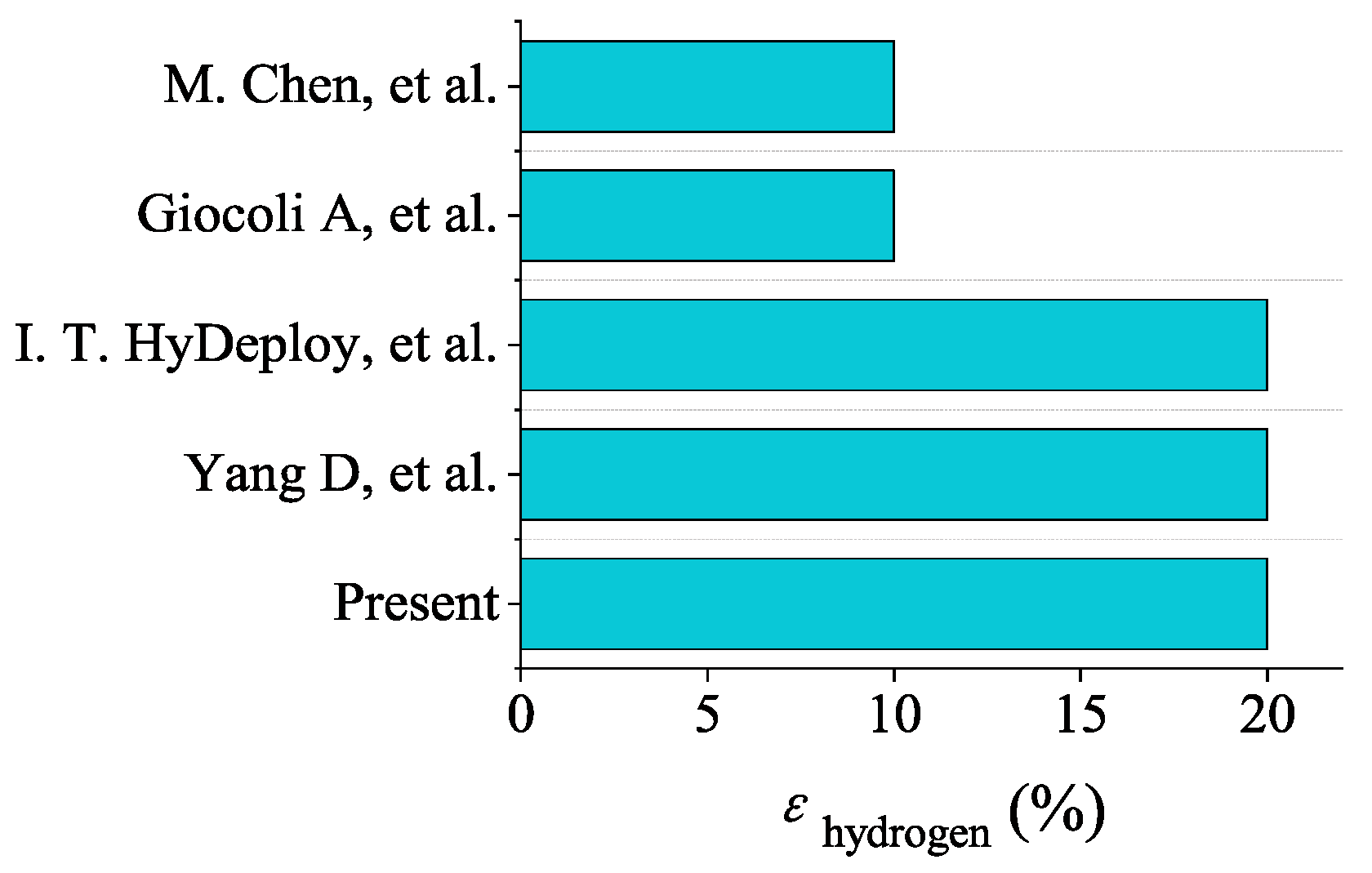
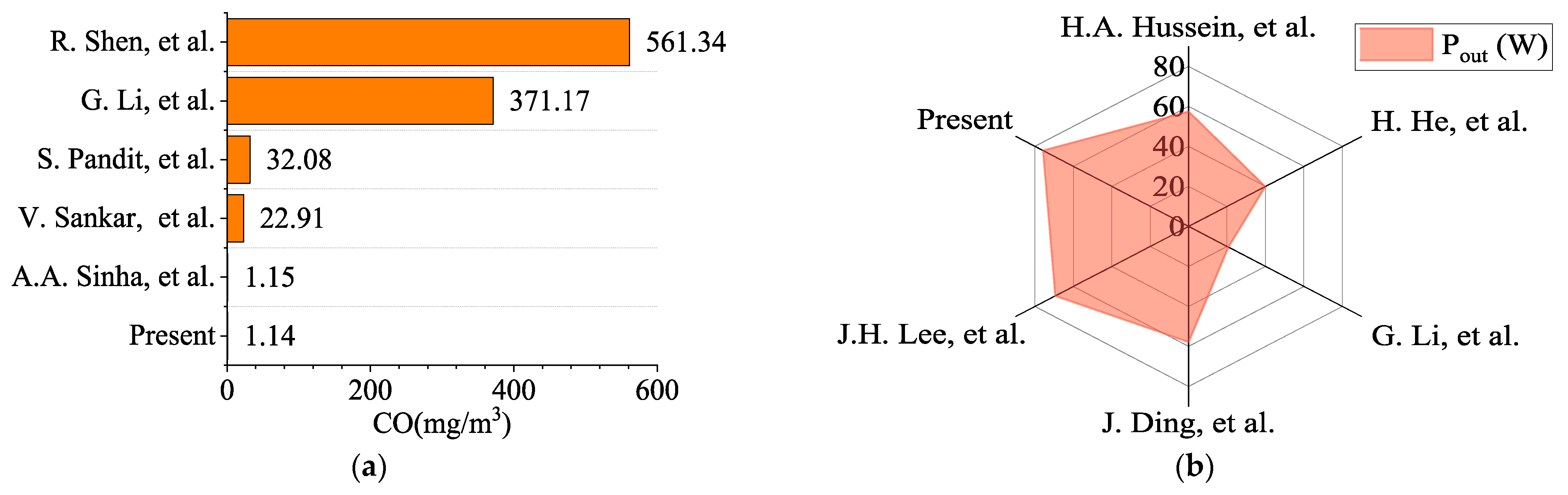
3.6. Quantitative Comparison with Prior Studies
4. Conclusions
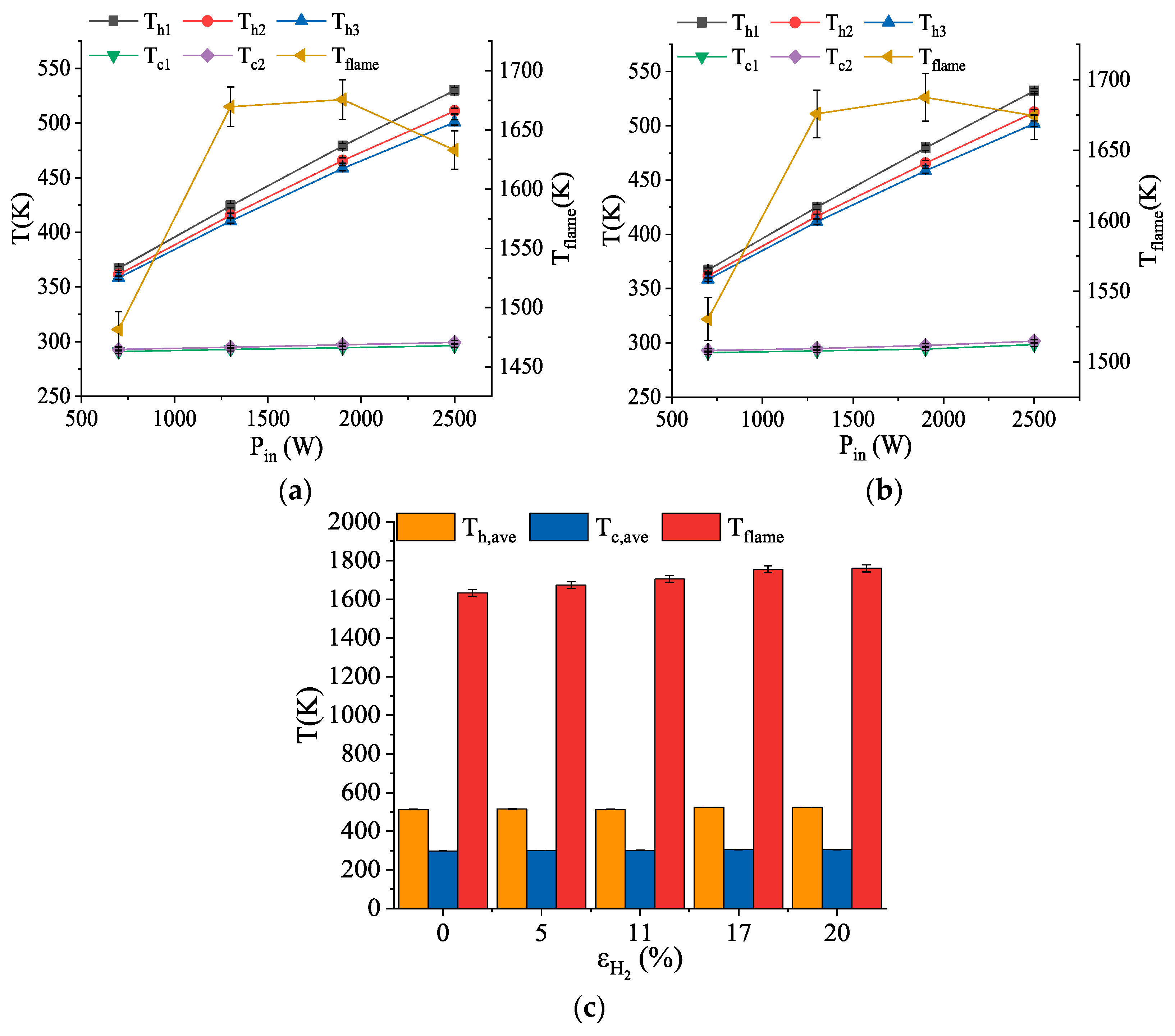
- At a fixed input power, progressively increasing the hydrogen blending ratio from 0% to 20% produced no discernible change in the heat collector hot- and cold-side temperatures, although the peak flame temperature increased. This finding indicates that the employment of HCNG in domestic gas burners does not compromise the system’s heat-transfer performance.
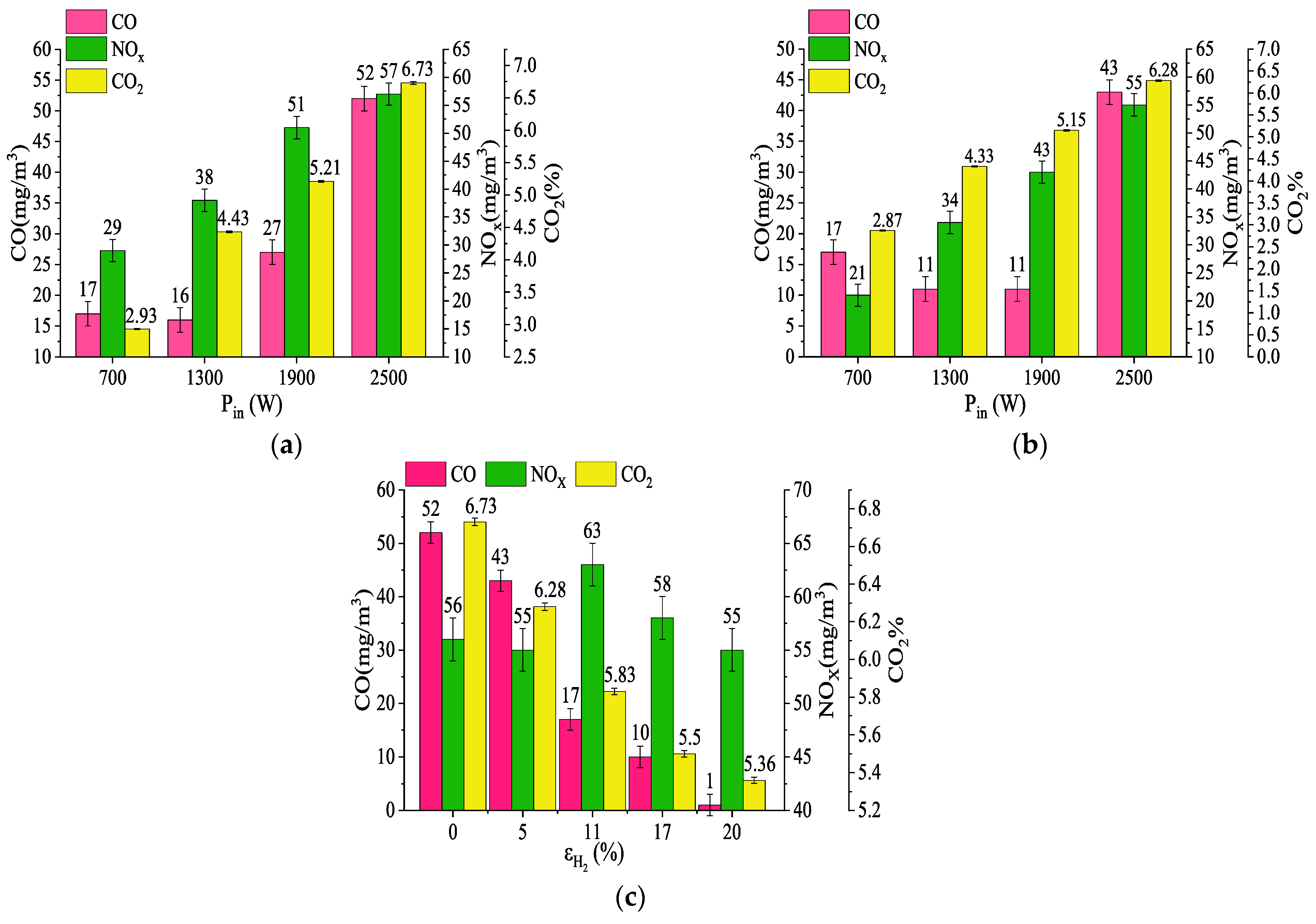
- Hydrogen addition can effectively reduce CO and CO2 pollutant emissions. For example, at an input power of 2500 W, CO and CO2 emissions at a 0% hydrogen blending ratio were 52.7 mg/m3 and 6.73%, respectively; when the hydrogen blending ratio was increased to 20%, these values decreased to 1 mg/m3 and 5.36%, respectively.
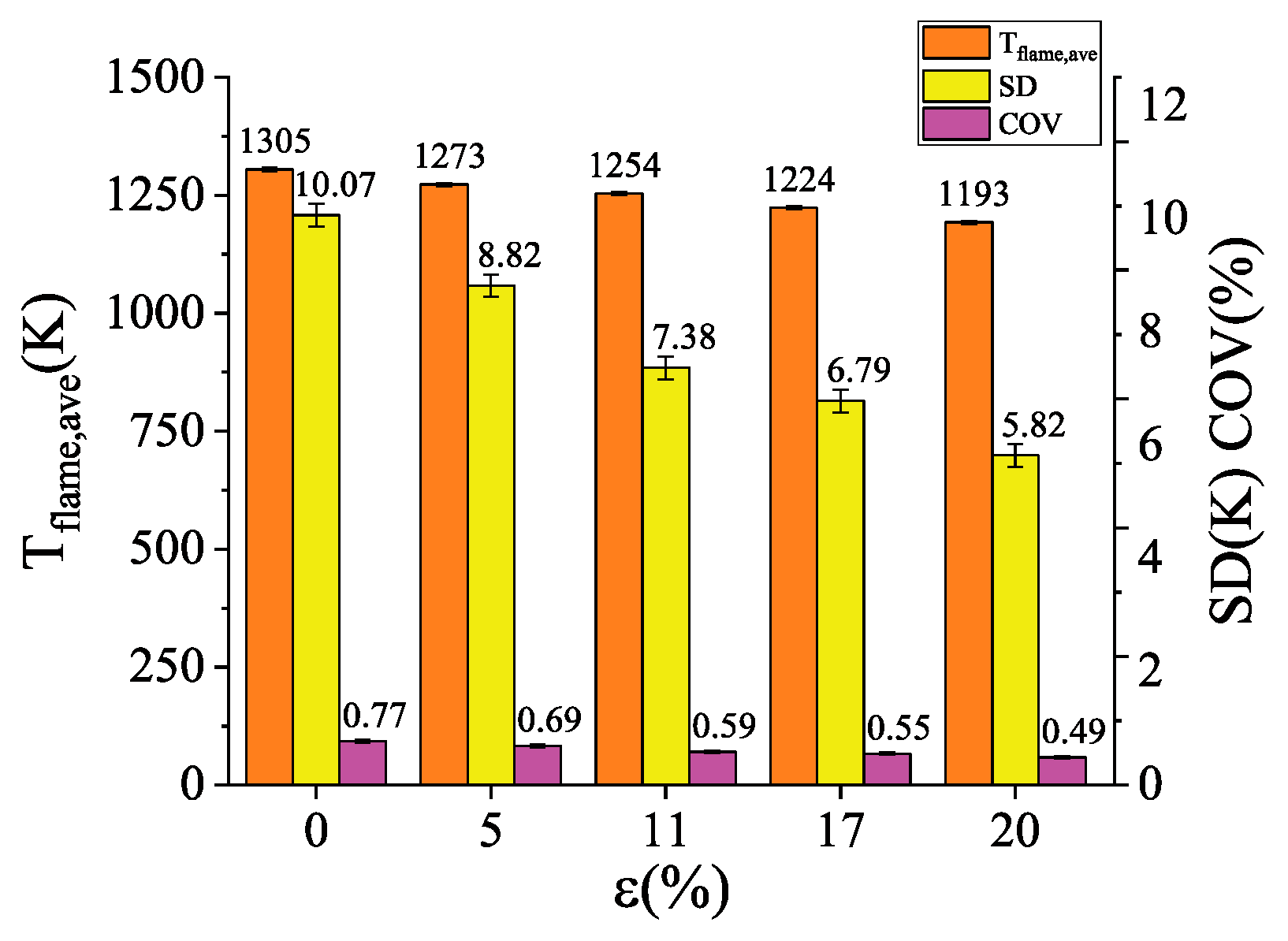
- As the hydrogen blending ratio increases, the average flame temperature gradually decreases, from 1305 K to 1193 K, a drop of about 8.6%. At the same time, flame stability increases, with the coefficient of variation dropping from 0.77% to 0.49%. This indicates that as the hydrogen blending ratio increases, the stability of the flame improves progressively.
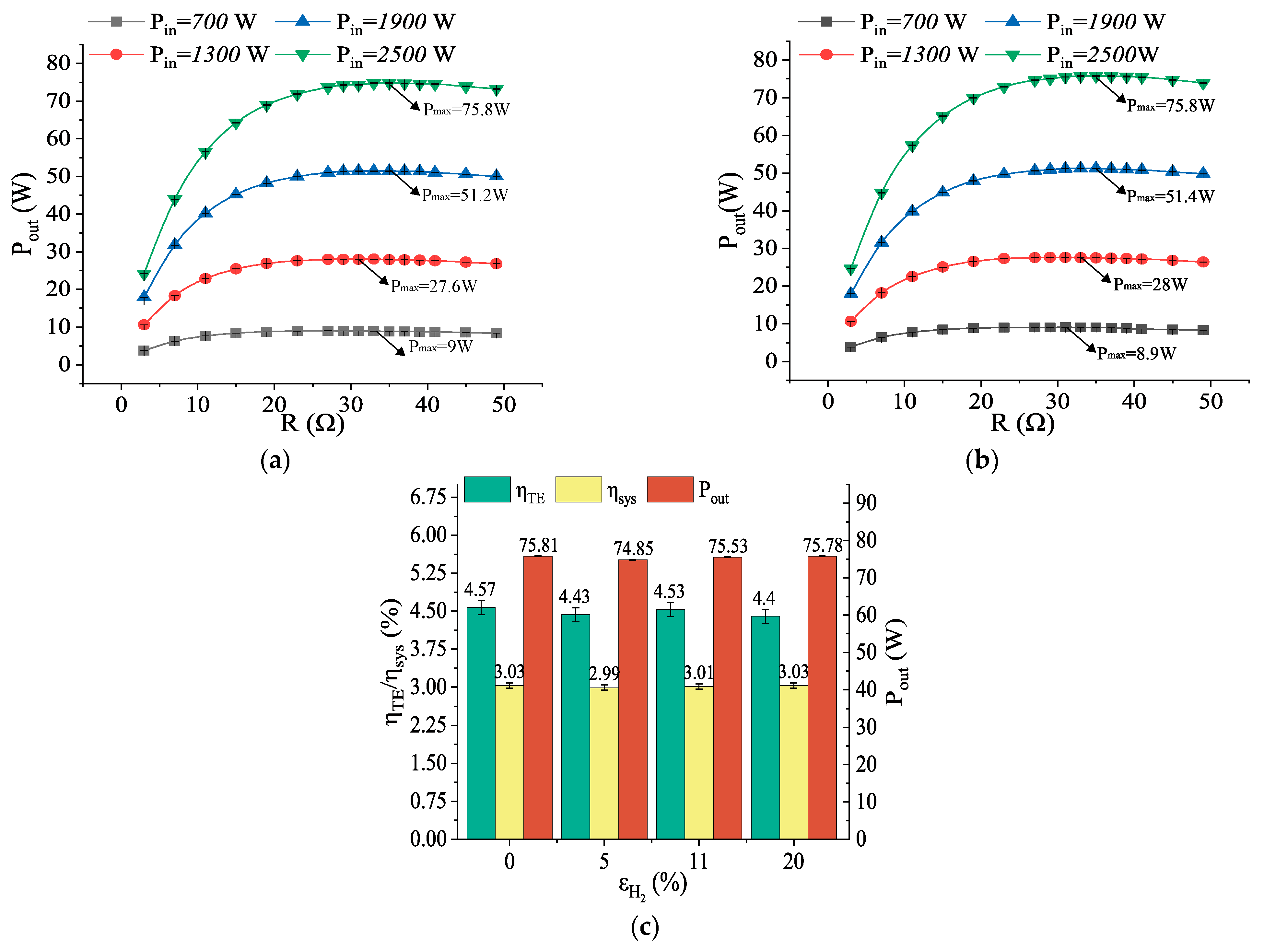
- The power output of TEG fueled by HCNG is comparable to that achieved with NG. At an identical input power of 2500 W, the output power at a 0% hydrogen blending ratio was 75.8 W, and at a 20% hydrogen blending ratio it likewise remained 75.8 W. These results show that it is completely feasible to use HCNG to drive TEG.
Author Contributions
Funding
Data Availability Statement
Acknowledgments
Conflicts of Interest
Abbreviations
| DAQ | Data acquisition |
| HCNG | Hydrogen compressed natural gas |
| NG | Natural gas |
| HEX | Water-cooled heat exchanger |
| MFC | Mass flow rate controller |
| LHV | Low heating value |
| TEG | Thermoelectric generator |
| TEM | Thermoelectric module |
| SD | Standard deviation |
| COV | Coefficient of variation |
| Nomenclature | |
| AC | External surface area of combustion chamber (m2) |
| AHC | External surface area of heat collector (m2) |
| cw | Heat capacity of cooling water (J/kg·K) |
| hair | Convective heat transfer coefficient (W/m2·K) |
| I | TEG current (A) |
| L | Length of the TE leg (m) |
| L1 | Compensatory length of heat collector (m) |
| N | Total number of samples (item) |
| n | Electrical contact ratio (m) |
| P | Electric power (W) |
| Pin | Input power (W) |
| qcomb | Heat generated by combustion (W) |
| qconv | Heat loss rate through convections (W) |
| qflue | Heat flow rate of flue gases (W) |
| qHC | Heat flux collected by heat collector (W) |
| qloss1 | Heat loss of combustion chamber side wall (W) |
| qloss2 | Heat loss of collector side wall (W) |
| Tf | Flue gas temperature (K) |
| Tf,av | Average flue gas temperature (K) |
| Tflame | Flame temperature(K) |
| Th | Hot-end temperature (K) |
| Th,av | Average hot-end temperature (K) |
| Tout | Outlet gas temperature from heat collector (K) |
| Twt1 | Water inlet temperature (K) |
| Twt2 | Water outlet temperature (K) |
| U | TEG voltage (V) |
| VCH4 | Volumetric flow rate of CH4 (L/min) |
| VH2 | Volumetric flow rate of H2 (L/min) |
| Vw | Volumetric flow rate of cooling water (L/min) |
| w | Ratio of ceramic thickness to the length of TE leg (dimensionless) |
| Z | TE figure-of-merit (1/K) |
| ρw | Water density (kg/m3) |
| ε | Emissivity (dimensionless) |
| εhydrogen | Hydrogen blending ratio (%) |
| σ | Stefan–Boltzmann constant (W/m2·K4) |
| ηcomb | Combustion efficiency (%) |
| ηheat | Heat collection efficiency (%) |
| ηsys | Overall power generation efficiency (%) |
| ηTE | TE efficiency (%) |
| qrad | Heat loss rate through thermal radiations (W) |
| qw | Heat take away by cooling water (W) |
| r | Thermal contact ratio (dimensionless) |
| Rld | Load resistance (Ω) |
| T | Temperature (K) |
| Tatm | Atmospheric temperature (K) |
| Tb | Side wall temperature of combustion chamber (K) |
| Tb,av | Average temperature of combustion chamber side wall (K) |
| Tc | Cold-end temperature (K) |
| Tc,av | Average cold-end temperature (K) |
References
- Liu, L.-L.; Feng, T.-T.; Kong, J.-J. Can Carbon Trading Policy and Local Public Expenditures Synergize to Promote Carbon Emission Reduction in the Power Industry? Resour. Conserv. Recycl. 2023, 188, 106659. [Google Scholar] [CrossRef]
- Shahid, M.I.; Farhan, M.; Rao, A.; Salam, H.A.; Chen, T.; Li, X.; Ma, F. Performance, Emissions and Thermodynamic Analysis of Hydrogen-Enriched Compressed Natural Gas Engine. Therm. Sci. Eng. Prog. 2025, 63, 103643. [Google Scholar] [CrossRef]
- De Simio, L.; Iannaccone, S.; Guido, C.; Napolitano, P.; Maiello, A. Natural Gas/Hydrogen Blends for Heavy-Duty Spark Ignition Engines: Performance and Emissions Analysis. Int. J. Hydrogen Energy 2024, 50, 743–757. [Google Scholar] [CrossRef]
- Navarro, E.; Leo, T.J.; Corral, R. CO2 Emissions from a Spark Ignition Engine Operating on Natural Gas–Hydrogen Blends (HCNG). Appl. Energy 2013, 101, 112–120. [Google Scholar] [CrossRef]
- Zareei, J.; Rohani, A.; Nuñez Alvarez, J.R. The Effect of EGR and Hydrogen Addition to Natural Gas on Performance and Exhaust Emissions in a Diesel Engine by AVL Fire Multi-Domain Simulation, GPR Model, and Multi-Objective Genetic Algorithm. Int. J. Hydrogen Energy 2022, 47, 21565–21581. [Google Scholar] [CrossRef]
- CRC Handbook of Thermoelectrics. Available online: https://www.americool.com/CRC.pdf (accessed on 23 February 2026).
- He, Z.; You, J.; Kang, D.; Zou, Q.; Zhang, W.; Zhang, Z. Overall Numerical Simulation of Chemical-Thermal-Electric Conversion for an All-in-One Thermoelectric Generator Based on Micro Scale Combustion. Energy 2024, 292, 130307. [Google Scholar] [CrossRef]
- Li, G.; Zhang, X.; Zheng, Y.; Zhu, Y.; Guo, W.; Tang, Y. Development of a Powerful Miniature Hydrogen Catalytic Combustion Powered Thermoelectric Generator. Int. J. Hydrogen Energy 2023, 48, 22264–22276. [Google Scholar] [CrossRef]
- Xie, B.; Peng, Q.; Shi, Z.; Wei, J.; Kang, Z.; Wei, D.; Tian, X.; Fu, G. Investigation of CH4 and Porous Media Addition on Thermal and Working Performance in Premixed H2/Air Combustion for Micro Thermophotovoltaic. Fuel 2023, 339, 127444. [Google Scholar] [CrossRef]
- Ding, J.; E, J.; Li, J.; Cai, L.; Luo, B. Effect Analysis on Energy Conversion Enhancement of Porous Medium Micro-Combustor and Thermoelectric System and Its Optimization. Energy Convers. Manag. 2023, 292, 117441. [Google Scholar] [CrossRef]
- Sorgulu, F.; Ozturk, M.; Javani, N.; Dincer, I. Experimental Investigation for Combustion Performance of Hydrogen and Natural Gas Fuel Blends. Int. J. Hydrogen Energy 2023, 48, 34476–34485. [Google Scholar] [CrossRef]
- Du, W.; Zhou, S.; Qiu, H.; Zhao, J.; Fan, Y. Experiment and Numerical Study of the Combustion Behavior of Hydrogen-Blended Natural Gas in Swirl Burners. Case Stud. Therm. Eng. 2022, 39, 102468. [Google Scholar] [CrossRef]
- Chen, Y.; Niu, J.; Liu, W.; Long, L.; Huang, T.; Sun, Y.; Wan, Z.; Yu, B. Experimental Analysis and Modeling on the Blending Limit of Domestic Burner with Porous Media for Hydrogen Enriched Natural Gas. Int. J. Hydrogen Energy 2024, 88, 1321–1331. [Google Scholar] [CrossRef]
- Lu, P.; Wei, S.; Ni, S.; Wu, Y. Performance Analysis of Combining Solid Oxide Electrolysis Cell Hydrogen Production and Marine Hydrogen Compressed Natural Gas Engine System. J. Clean. Prod. 2024, 462, 142708. [Google Scholar] [CrossRef]
- Zhao, H.; Zhao, D.; Sun, D.; Semlitsch, B. Electrical Power, Energy Efficiency, NO and CO Emissions Investigations of an Ammonia/Methane-Fueled Micro-Thermal Photovoltaic System with a Reduced Chemical Reaction Mechanism. Energy 2024, 305, 132248. [Google Scholar] [CrossRef]
- Li, G.; Zhang, X.; Zheng, Y.; Guo, W.; Tang, Y.; Ye, C. An Ultra-High Efficient Micro Combined Heat and Power Cogeneration System Based on Gas Combustion Powered Thermoelectric Generator. Appl. Therm. Eng. 2023, 222, 119941. [Google Scholar] [CrossRef]
- Danışmaz, M. Geometric Analysis of Pin Fin Heat Sinks: Effects of Ellipticity and Perforation for Fin on Heat Transfer. Case Stud. Therm. Eng. 2025, 74, 106918. [Google Scholar] [CrossRef]
- Árpád, I.W.; Kiss, J.T.; Kocsis, D. Role of the Volume-Specific Surface Area in Heat Transfer Objects: A Critical Thinking-Based Investigation of Newton’s Law of Cooling. Int. J. Heat Mass Transf. 2024, 227, 125535. [Google Scholar] [CrossRef]
- Li, G.; Zhi, Y.; Wang, S.; Zheng, Y.; Shen, R.; Guo, W.; Tang, Y. Hydrocarbon Combustion Powered Micro Thermoelectric Generator with an Inverted T-Shape Heat Collector. Appl. Therm. Eng. 2025, 259, 124808. [Google Scholar] [CrossRef]
- Li, G.; Li, Q.; Wang, S.; Jiang, P.; Zhao, D.; Guo, W.; Tang, Y. Efficient Standalone Micro Thermoelectric Generator Powered by Low Noise Premixed Combustion. Energy 2024, 308, 132849. [Google Scholar] [CrossRef]
- Li, Q.; Li, G.; Zheng, Y.; Xiao, Y.; Liu, S.; Guo, W.; Tang, Y. Impact of Hydrogen on the Performance of a Gas-Fired Thermoelectric Generator. J. Therm. Sci. 2025, 34, 2154–2166. [Google Scholar] [CrossRef]
- Giocoli, A.; Motola, V.; Scarlat, N.; Pierro, N.; Dipinto, S. Techno-Economic Viability of Renewable Electricity Surplus to Green Hydrogen and Biomethane, for a Future Sustainable Energy System: Hints from Southern Italy. Renew. Sustain. Energy Transit. 2023, 3, 100051. [Google Scholar] [CrossRef]
- Yang, D.; Xi, Y.; Cai, G. Day-Ahead Dispatch Model of Electro-Thermal Integrated Energy System with Power to Gas Function. Appl. Sci. 2017, 7, 1326. [Google Scholar] [CrossRef]
- Isaac, T. HyDeploy: The UK’s First Hydrogen Blending Deployment Project. Clean Energy 2019, 3, 114–125. [Google Scholar] [CrossRef]
- Meng, X.; Chen, M.; Gu, A.; Wu, X.; Liu, B.; Zhou, J.; Mao, Z. China’s Hydrogen Development Strategy in the Context of Double Carbon Targets. Nat. Gas Ind. B 2022, 9, 521–547. [Google Scholar] [CrossRef]
- Cristello, J.B.; Yang, J.M.; Hugo, R.; Lee, Y.; Park, S.S. Feasibility Analysis of Blending Hydrogen into Natural Gas Networks. Int. J. Hydrogen Energy 2023, 48, 17605–17629. [Google Scholar] [CrossRef]
- Lou, Z.X.; Xu, H.C.; Yuan, M. Safety and emission performance test and evaluation of natural gas mixed with hydrogen combustion on domestic gas appliances. Petrochem. Technol. 2019, 48, 50–56. [Google Scholar] [CrossRef]
- Taylor, J.R. Introduction to Error Analysis: The Study of Uncertainties in Physical Measurements; University Science Books: Melville, NY, USA, 1997; Available online: https://books.google.com.hk/books/about/An_introduction_to_error_analysis.html?id=giFQcZub80oC&redir_esc=y (accessed on 24 February 2026).
- Pandey, V.; Badruddin, I.A.; Khan, T.M.Y. Effect of H2 Blends with Compressed Natural Gas on Emissions of SI Engine Having Modified Ignition Timings. Fuel 2022, 321, 123930. [Google Scholar] [CrossRef]
- Farhan, M.; Chen, T.; Shahid, M.I.; Rao, A.; Xiao, Q.; Ma, F. Effect of Exhaust Gas Recirculation on Knock of HCNG Fueled Spark Ignition Engine and Prediction of Knock Intensity by Improved Particle Swarm Optimization-Back Propagation Neural Network. Appl. Therm. Eng. 2025, 264, 125439. [Google Scholar] [CrossRef]
- Li, G.N.; Yi, M.B.; Tulu, M.B.; Zheng, Y.Q.; Guo, W.W.; Tang, Y.J. Miniature Self-Powering and Self-Aspirating Combustion-Powered Thermoelectric Generator Burning Gas Fuels for Combined Heat and Power Supply. J. Power Sources 2021, 506, 230263. [Google Scholar] [CrossRef]
- Sinha, A.A.; Srivastava, K.; Rajpoot, A.S.; Choudhary, T.; Pandey, S.P.; Sanjay. A Thermodynamic Approach to Analyze Energy, Exergy, Emission, and Sustainability (3E-S) Performance by Utilizing Low Temperature Waste Heat in SOFC–CHP-TEG System. Int. J. Hydrogen Energy 2024, 63, 1088–1104. [Google Scholar] [CrossRef]
- Li, G.; Fan, Y.; Li, Q.; Zheng, Y.; Zhao, D.; Wang, S.; Dong, S.; Guo, W.; Tang, Y. A Review on Micro Combustion Powered Thermoelectric Generator: History, State-of-the-Art and Challenges to Commercialization. Renew. Sustain. Energy Rev. 2025, 207, 114897. [Google Scholar] [CrossRef]
- Shen, R.; Li, G.; Zhu, Y.; Tang, Y.; Guo, W.; Zheng, Y.; Huang, K. Development of a Compact High-Performance Combustion Powered Thermoelectric Generator Based on Swirl Burner. Energy 2024, 286, 129455. [Google Scholar] [CrossRef]
- Li, G.; Zhu, Z.; Zheng, Y.; Guo, W.; Tang, Y. Development of a Powerful Hybrid Micro Thermoelectric Generator Based on an Ultrahigh Capacity Miniature Combustor. Appl. Therm. Eng. 2022, 206, 118039. [Google Scholar] [CrossRef]
- Sankar, V.; Velamati, R.K.; Mukhopadhyay, S. Experimental and Numerical Studies on Scaling and Thermal Conductivity of Backward Step Ethanol Fueled Micro-Combustor. Case Stud. Therm. Eng. 2025, 66, 105751. [Google Scholar] [CrossRef]
- Pandit, S.; Chandra Das, D.; Das, B.; Newar, P.P. The Performance Assessment of TIBC Cookstove with Multi-Solid Fuels for Small-Scale Electricity Generation in Remote Areas. Renew. Energy 2025, 242, 122409. [Google Scholar] [CrossRef]
- Hussein, H.A.; Wang, Z.; Alani, W.K.; Zheng, J.; Fayad, M.A. A Novel Experimental Design for Free Energy from the Heat-Gaining Panel Using Multi-Thermoelectric Generators (TEGs) Panel. Case Stud. Therm. Eng. 2023, 50, 103431. [Google Scholar] [CrossRef]
- He, H.; Liang, S.; He, Z.; Wu, Y.; Niu, C.; Rong, M. An Optimized Electrical Topology of Automobile Exhaust Thermoelectric Generator System for High Power Output. J. Power Sources 2024, 604, 234502. [Google Scholar] [CrossRef]
- Lee, J.H.; Kim, T.Y. Reconstruction of Flow and Temperature Fields of Exhaust Gas Flow for Enhancing the Energy Harvesting Performance of a Thermoelectric Generator. Appl. Therm. Eng. 2025, 280, 128035. [Google Scholar] [CrossRef]



| Equipment | Model | Accuracy | Unit | Measurement |
|---|---|---|---|---|
| Mass Flow Controller | Alicat MC-20SLPM-D | ±0.6% | LPM | |
| Electronic Load Instrument | Prodigit 3305F | ±0.1% | W | , , |
| Water Flow Meter | IkunK24 | ±4.0% | L/min | |
| Type-K Thermocouple, TC Ltd., Uxbridge, UK | Type-K | ±0.5% | K | ,,,,, |
| Type-S Thermocouple, TC Ltd., Uxbridge, UK | Type-S | ±1.0% | K | |
| Data Acquisition Instrument | HY005 | \ | \ | \ |
| Flue Gas Analyzer | Testo 340 | ±2.0, ±2.0, ±0.3 | mg/m3, mg/m3, % | CO, , |
| – | (L/min) | (L/min) | (%) | (W) | (Ω) | (L/min) | Cooling Mode |
|---|---|---|---|---|---|---|---|
| 1 | 0.92–4.60 | 0 | 0% | 700–2500 (600 *) | 3–49 | 4.3 | Open loop |
| 2 | 0.91–4.53 | 0.05–0.24 | 5% | 500–2500 (200 *) | 3–49 | 4.3 | Open loop |
| 3 | 4.56 | 0.14 | 3% | 2500 | 3–49 | 4.3 | Open loop |
| 4 | 4.48 | 0.39 | 8% | 2500 | 3–49 | 4.3 | Open loop |
| 5 | 4.43 | 0.55 | 11% | 2500 | 3–49 | 4.3 | Open loop |
| 6 | 4.38 | 0.71 | 14% | 2500 | 3–49 | 4.3 | Open loop |
| 7 | 4.33 | 0.89 | 17% | 2500 | 3–49 | 4.3 | Open loop |
| 8 | 4.28 | 1.07 | 20% | 2500 | 3–49 | 4.3 | Open loop |
| Parameter | Error | Parameter | Error |
|---|---|---|---|
| (voltage) | ±0.1% | (type K thermocouple) | ±0.5% |
| (current) | ±0.1% | (type S thermocouple) | ±1.0% |
| (tap water flow rate) | ±4.0% | (volumetric flow rate) | ±0.6% |
| (electrical power) | ±0.14% | ±3.11% | |
| ±0.17% | ±3.92% |
Disclaimer/Publisher’s Note: The statements, opinions and data contained in all publications are solely those of the individual author(s) and contributor(s) and not of MDPI and/or the editor(s). MDPI and/or the editor(s) disclaim responsibility for any injury to people or property resulting from any ideas, methods, instructions or products referred to in the content. |
© 2026 by the authors. Licensee MDPI, Basel, Switzerland. This article is an open access article distributed under the terms and conditions of the Creative Commons Attribution (CC BY) license.
Share and Cite
Li, C.; Wang, X.; Gu, C.; Zhang, Z.; Zheng, Y.; Liu, L. Combustion and Power Generation Characteristics of a Thermoelectric Generator Fueled by Hydrogen-Enriched Compressed Natural Gas (HCNG). Energies 2026, 19, 1604. https://doi.org/10.3390/en19071604
Li C, Wang X, Gu C, Zhang Z, Zheng Y, Liu L. Combustion and Power Generation Characteristics of a Thermoelectric Generator Fueled by Hydrogen-Enriched Compressed Natural Gas (HCNG). Energies. 2026; 19(7):1604. https://doi.org/10.3390/en19071604
Chicago/Turabian StyleLi, Changle, Xugang Wang, Chengdong Gu, Zhanming Zhang, Youqu Zheng, and Liu Liu. 2026. "Combustion and Power Generation Characteristics of a Thermoelectric Generator Fueled by Hydrogen-Enriched Compressed Natural Gas (HCNG)" Energies 19, no. 7: 1604. https://doi.org/10.3390/en19071604
APA StyleLi, C., Wang, X., Gu, C., Zhang, Z., Zheng, Y., & Liu, L. (2026). Combustion and Power Generation Characteristics of a Thermoelectric Generator Fueled by Hydrogen-Enriched Compressed Natural Gas (HCNG). Energies, 19(7), 1604. https://doi.org/10.3390/en19071604