1. Introduction
Driven by decarbonization targets, renewable energy sources such as wind power and photovoltaics have been rapidly deployed and integrated into the grid, introducing greater volatility and uncertainty and posing significant challenges to maintaining power balance in power systems with high renewable penetration [
1,
2,
3,
4]. Against this background, enhancing system flexibility has become increasingly important for maintaining power balance under high renewable penetration [
3,
5]. Leveraging mature technologies, large installed capacity, and strong regulating performance, hydropower is evolving from a traditional bulk energy provider toward a key resource that provides both energy and balancing capability [
6,
7,
8]. Specifically, hydropower offers rapid ramping capability, a wide operating range, and negligible start-up cost compared with thermal units, making it one of the most cost-effective sources of flexibility for integrating variable renewable energy [
7,
8].
As hydropower is increasingly dispatched for power balancing and residual load smoothing, vibration zones (VZs) have become a major physical constraint, limiting the power output range and regulation capability of hydropower units, especially due to more frequent off-design operation and associated fatigue/damage concerns [
9]. Hydraulic studies indicate that when a unit operates under partial-load conditions, a rotating vortex rope can form in the draft tube and induce low-frequency pressure pulsations (draft-tube surge), which can trigger power swings, amplify dynamic stresses, and significantly increase vibration levels [
10,
11,
12]. In engineering practice, the corresponding high-vibration power output range is commonly referred to as the rough load zone (RLZ) [
13]. To convert these physical phenomena into dispatchable operating constraints, practitioners often delineate the relevant range as a forbidden operating zone (FOZ), based on whether monitored indicators such as mechanical vibration exceed national-standard criteria. For example, the Chinese national standard GB/T 32584 [
14] specifies that the shaft vibration of large hydropower units should not exceed 100
m (peak-to-peak) under normal operating conditions, while ISO 20816-5 [
15] defines zone boundaries (A/B/C/D) for overall vibration severity, where Zone C and Zone D indicate unacceptable vibration levels that require operational restrictions or shutdown. Furthermore, to balance unit safety and system regulation requirements, some plants have adopted a three-zone classification, partitioning operating conditions into a safe operating zone (SOZ), a restricted operating zone (ROZ), and an FOZ [
16], and developing corresponding operation control and dispatch strategies such as strict FOZ avoidance, limited-duration ROZ operation under supervision, within-plant load redistribution, and coordinated start-up/shut-down scheduling and AGC-based real-time control.
When VZ constraints are neglected in short-term hydropower scheduling for tractability, the resulting schedules can differ substantially from those obtained with a high-fidelity model that explicitly represents VZs [
17]. Such simplification may also lead to a systematic overestimation of the dispatchable regulation margin of hydropower, thereby increasing the operational risk of curtailment and load shedding [
18]. Existing studies have largely focused on refined VZ modeling under a strictly prohibited treatment. In [
19], a short-term scheduling model is formulated for cascade hydropower plants under strong hydraulic coupling while considering head-dependent prohibited operating zones, which correspond to the forbidden operating zone (FOZ) in this work. For irregular, hole-containing VZs, ref. [
20] employs the constrained Delaunay triangulation (CDT) method together with convex combination constraints to transform complex geometric constraints into linear constraints. In coupled hydro–solar and related settings, a risk index based on the probability of operating-point excursion into vibration-prone regions has been introduced and incorporated into the scheduling framework through predictive constraints that limit expected vibration risk over a given horizon [
21]. For hydro–PV–energy storage hybrid systems, a risk control strategy has been proposed to jointly quantify regulation flexibility and reduce the frequency of vibration-zone crossing via a nested scheduling structure [
22]. Furthermore, a segmented optimization HUC model has been developed to refine vibration-region characteristics and embed a predictive risk control strategy into the unit commitment formulation to mitigate undesirable vibration exposure [
23]. From a control perspective, refs. [
24,
25] reduce both the time spent operating in VZs and the frequency of VZ operation under fast-varying conditions by improving hydropower–battery coordination and the automatic generation control (AGC) framework. At the within-plant load distribution level, ref. [
26] applies intelligent optimization methods (e.g., improved particle swarm optimization (PSO) and bi-level dynamic programming) to balance economic performance and vibration-zone avoidance. However, short-term optimization that explicitly accounts for the restricted operating zone (ROZ) has been studied mainly in AGC-based real-time control, whereas day-ahead short-term scheduling models incorporating the ROZ remain scarce. Therefore, further research is needed on day-ahead short-term hydropower scheduling for plants with complex VZ characteristics.
With large-scale integration of wind and photovoltaic generation, the demand for balancing-oriented hydropower dispatch continues to increase. In day-ahead short-term hydropower scheduling, neglecting the restricted operating zone (ROZ) within vibration zones (VZs) can overestimate the regulation margin and introduce system-level risks. Conversely, treating the ROZ in the same way as the forbidden operating zone (FOZ) contradicts the three-zone classification commonly adopted in practice, resulting in an overly conservative model that overlooks the fact that brief ROZ operation is permitted under plant operating rules and can be used, when necessary, to support balancing tasks under supervision. This motivates a scheduling model that can both capture the complex geometry of VZs and reflect the operational characteristic of the ROZ—namely, brief entry is allowed, whereas sustained operation should be avoided and penalized. Achieving an optimal trade-off between unit safety and system balancing requirements involves the following challenges:
(1) How to distinguish, within a unified optimization model, the FOZ that must be strictly avoided from the ROZ where brief entry is permitted but sustained operation should be penalized, and to model them accordingly; (2) How to efficiently and accurately transform the resulting head-dependent, hole-containing, non-convex feasible set composed of the safe operating zone (SOZ), the ROZ, and the FOZ into MILP-compatible linear constraints; (3) How to reflect the engineering practice that short-term operation in the ROZ is allowable but prolonged stay should be discouraged by introducing ROZ-related penalty terms while maintaining tractability.
To address these issues, this paper proposes a vibration-zone avoidance method for hydropower units that explicitly accounts for the restricted operating zone (ROZ). The main contributions are summarized as follows:
(1) A novel mixed-integer linear programming (MILP) model is developed for day-ahead short-term hydropower scheduling with vibration-zone avoidance. At the day-ahead short-term scheduling level, the model adopts a practice-based three-zone classification, enforces the forbidden operating zone (FOZ) as a hard constraint, and penalizes operation in the restricted operating zone (ROZ), thereby achieving a desirable trade-off between unit safety and system balancing requirements. (2) To handle the resulting non-convex feasible regions more efficiently than conventional CDT or big-M approaches, an optimal convex partition (OCP) algorithm is employed to decompose the non-convex SOZ and ROZ into a minimum number of convex subregions. The zone-selection constraints are then reformulated into MILP-compatible constraints using barycentric coordinates and convex combination modeling. (3) ROZ-state indicator variables are introduced to quantify ROZ operation over dispatch periods and impose soft penalties in the objective function, enabling explicit control of ROZ usage. (4) Comparative case studies are conducted by benchmarking the proposed soft-constraint formulation against an ROZ-ignored model and a conservative avoidance model, validating its advantages in improving residual load smoothing performance while maintaining operational safety.
3. Solution Method
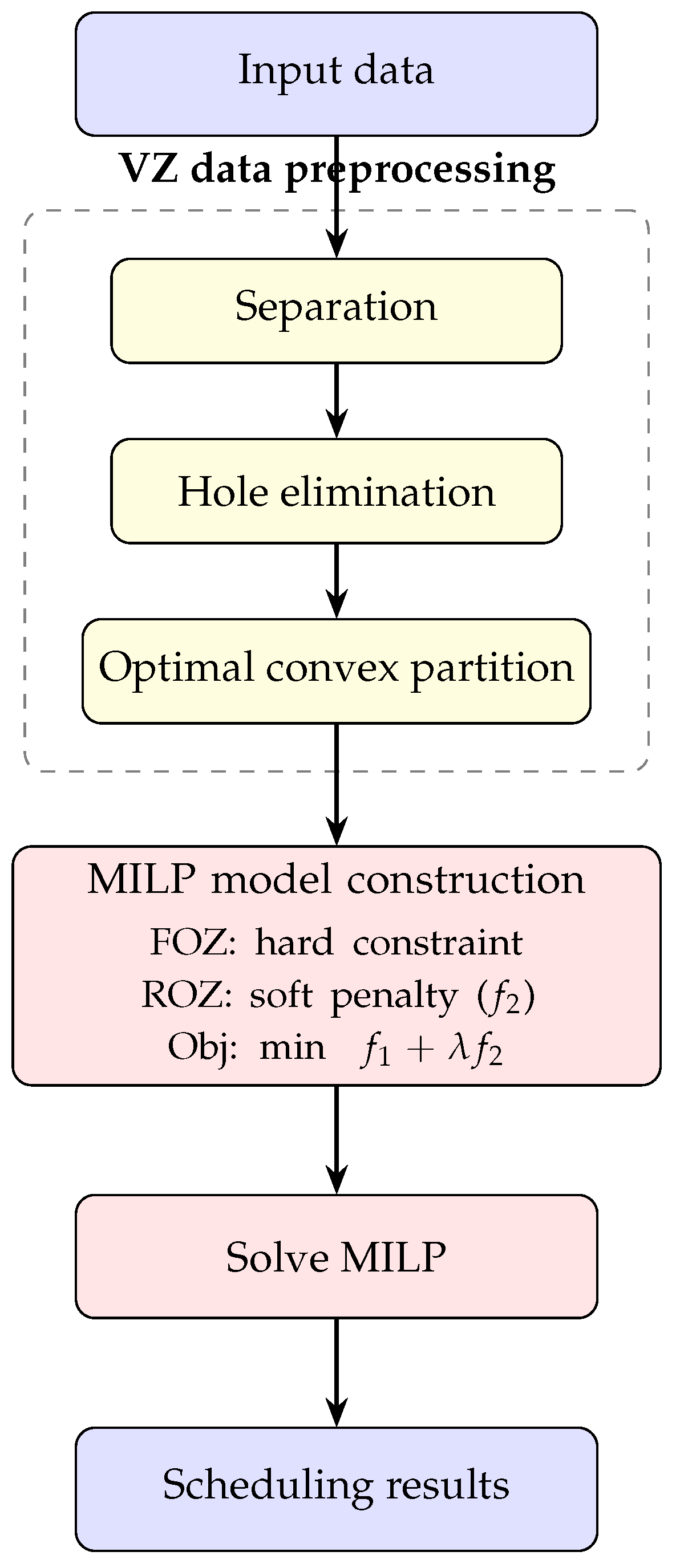
The overall workflow of the proposed method is shown in
Figure 1.
3.1. Vibration-Zone Data Preprocessing
Complex and irregular vibration zones (VZs) typically exhibit non-convex geometries and may contain holes in the region. To facilitate the implementation of the hard constraint for the forbidden operating zone (FOZ) and the soft constraint for the restricted operating zone (ROZ), the safe operating zone (SOZ) and the ROZ are preprocessed separately through separation, hole elimination, and convex partition. In what follows, the (preprocessed) SOZ or ROZ is collectively referred to as the allowable operating region. Note that although the same preprocessing procedure is applied, the SOZ and the ROZ are processed independently.
(1) Separation
If the allowable operating region (SOZ or ROZ) consists of one or more mutually disconnected components, we first perform separation of disconnected components. Each component is then examined to determine whether it contains holes in the region and/or is non-convex, and the subsequent preprocessing steps are applied accordingly. The union of the convex subregions obtained from all components constitutes the final preprocessing result.
(2) Hole elimination
If the allowable operating region contains an internal FOZ area that is not connected to the exterior boundary, the allowable operating region is regarded as having holes in the region. In this case, hole elimination is performed as follows: (i) select a point on the boundary of a hole and a visible point on the exterior boundary, and construct a line segment that lies entirely within the allowable operating region; (ii) traverse a path that enters along the segment, loops once around the hole boundary, and exits along the segment in reverse, using as a bidirectional corridor to merge the hole boundary into the exterior boundary; (iii) repeat the above procedure for all holes in the region until a simple polygon without holes in the region is obtained.
(3) Convex partition
If the allowable operating region remains non-convex after separation and hole elimination, the optimal convex partition (OCP) algorithm proposed by Keil and Snoeyink is applied to obtain an optimal convex partition [
27]. Theoretically, this algorithm yields the minimum number of convex subregions, thereby reducing the number of variables introduced in subsequent modeling.
where
denotes the safe operating zone (SOZ) of unit
i;
denotes the
kth convex subregion in the SOZ of unit
i;
denotes the total number of convex subregions in the SOZ of unit
i;
denotes the restricted operating zone (ROZ) of unit
i;
denotes the
kth convex subregion in the ROZ of unit
i;
denotes the total number of convex subregions in the ROZ of unit
i.
With the above formulation, the operating point is constrained to belong to either the SOZ or the ROZ. Meanwhile, the indicator variable , which identifies whether unit i operates in the ROZ in period t, is obtained, thereby enabling penalization of ROZ operation in the objective function.
3.2. Linearization of FOZ and ROZ Constraints
After preprocessing the vibration zone (VZ) operating zones, the convex subregions of the safe operating zone (SOZ) and the restricted operating zone (ROZ) can be obtained. Then, using the barycentric coordinates method, one can determine whether a unit’s operating point falls within a given convex subregion of the SOZ or ROZ. The forbidden operating zone (FOZ) constraint requires that the unit operating point must not lie in the FOZ, and hence it must lie in either the SOZ or the ROZ. This can be enforced via convex combination constraints.
where
denotes the
nth vertex of the
kth convex subregion in the SOZ of unit
i;
denotes the weight associated with
;
denotes the number of vertices of the
kth convex subregion in the SOZ of unit
i;
is a binary variable that equals 1 if the operating point of unit
i in period
t falls within the
kth convex subregion of the SOZ;
denotes the
nth vertex of the
kth convex subregion in the ROZ of unit
i;
denotes the weight associated with
;
denotes the number of vertices of the
kth convex subregion in the ROZ of unit
i;
is a binary variable that equals 1 if the operating point of unit
i in period
t falls within the
kth convex subregion of the ROZ.
With the above formulation, the operating point is constrained to lie in either the SOZ or the ROZ, and the indicator variable indicating whether unit i falls within the ROZ in period t is obtained, thereby enabling penalization of ROZ operation.
The non-convex, hole-containing feasible region can also be handled by combining big-M formulations with SOS2-type adjacency constraints on a triangulated mesh. Such an approach is capable of enforcing both FOZ exclusion and ROZ penalization; however, triangulation typically produces a substantially larger number of subregions than the optimal convex partition, introducing more binary selection variables and requiring carefully chosen big-M constants that tend to weaken the LP relaxation and slow branch-and-bound convergence [
28]. In contrast, the OCP-based convex combination approach decomposes the SOZ and ROZ into the minimum number of convex subregions, minimizing the number of binary zone-selection variables
per unit per period without requiring big-M constants, which yields a tighter LP relaxation and improves computational efficiency.
In summary, the operating-zone constraints are reformulated into MILP-compatible constraints through preprocessing and convex combination modeling. The resulting day-ahead scheduling model can be solved using a commercial MILP solver (e.g., Gurobi).
3.3. Linearization of Power Conversion Function
The nonlinear power conversion function is approximated by a two-dimensional piecewise linear surface defined on a triangular mesh over the feasible .
We let denote the set of triangles and let be the coordinates of vertex of triangle .
Introducing binary variables
and convex combination weights
, we write
subject to
4. Case Study
4.1. Background
To verify the effectiveness and practicality of the proposed method, a giant hydropower plant in China is selected as the case study. The plant has a total installed capacity of over 10,000 MW and comprises 12 generating units.
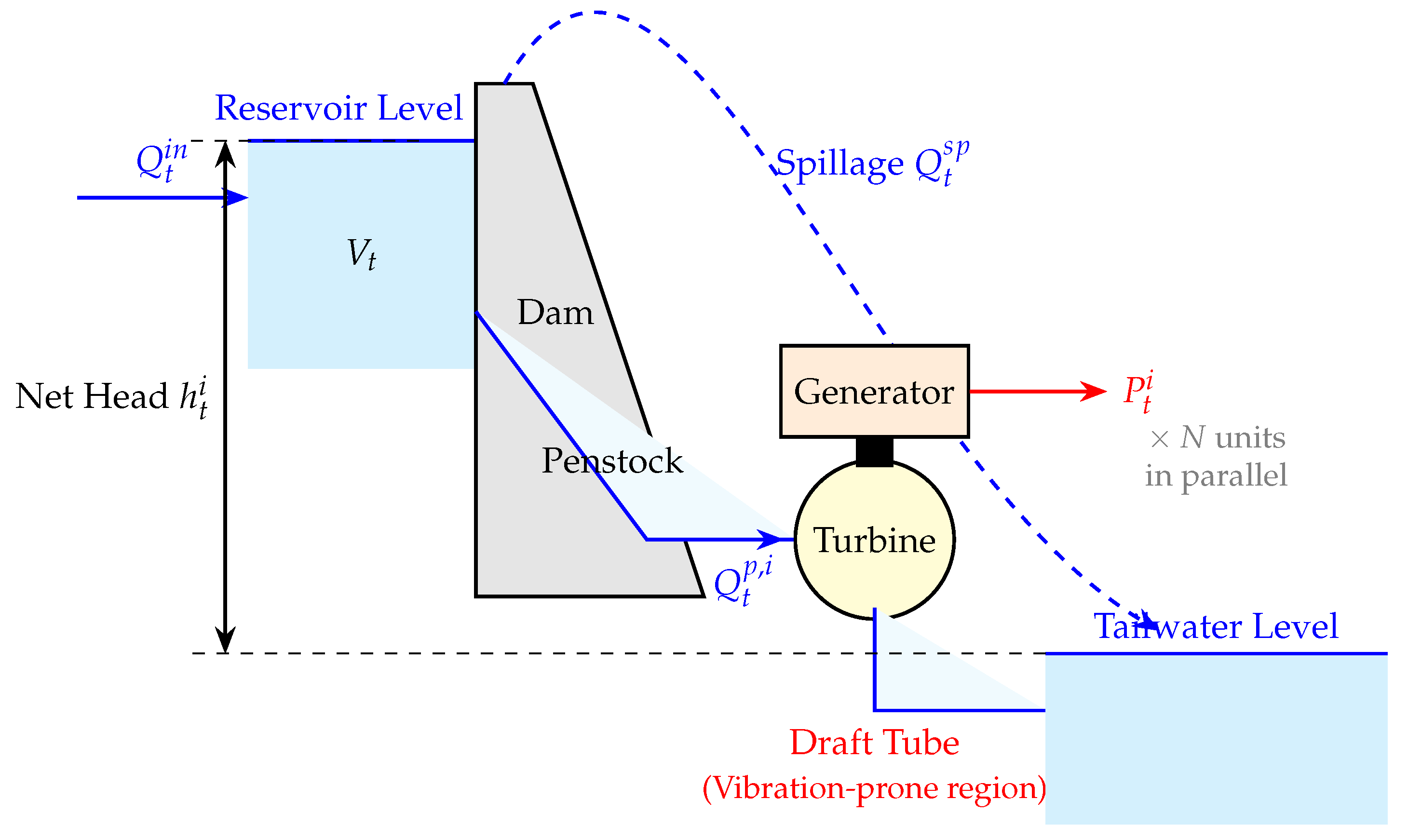
Figure 2 illustrates the schematic layout of a single hydropower unit, showing the key dispatch variables and the vibration-prone draft-tube region. The vibration zones (VZs) exhibit typical irregular and non-convex characteristics. In engineering practice, the plant adopts a three-zone classification of operating conditions into the safe operating zone (SOZ), the restricted operating zone (ROZ), and the forbidden operating zone (FOZ), and the corresponding ROZ and FOZ data are available. To demonstrate the applicability of the proposed model under diverse operating conditions, two typical-day scenarios representing the wet and dry seasons are selected from historical operating records during 2021–2024 by choosing the days whose daily average inflow and load demand are closest to the seasonal medians. As shown in
Table 1, the wet season typical day features a daily average inflow of 8820
/s, an initial water level of 963.21 m, a final water level of 964.17 m, a daily energy demand of 89,914 MWh, and a peak/minimum load of 1014/450 MW. The dry season typical day has a substantially lower inflow of 1931.79
/s, an initial water level of 589.36 m, a final water level of 589.13 m, a daily energy demand of 23,955 MWh, and a peak/minimum load of 325/145 MW. The contrasting hydrological and load conditions of the two scenarios enable a comprehensive evaluation of the proposed method under both high- and low-inflow regimes.
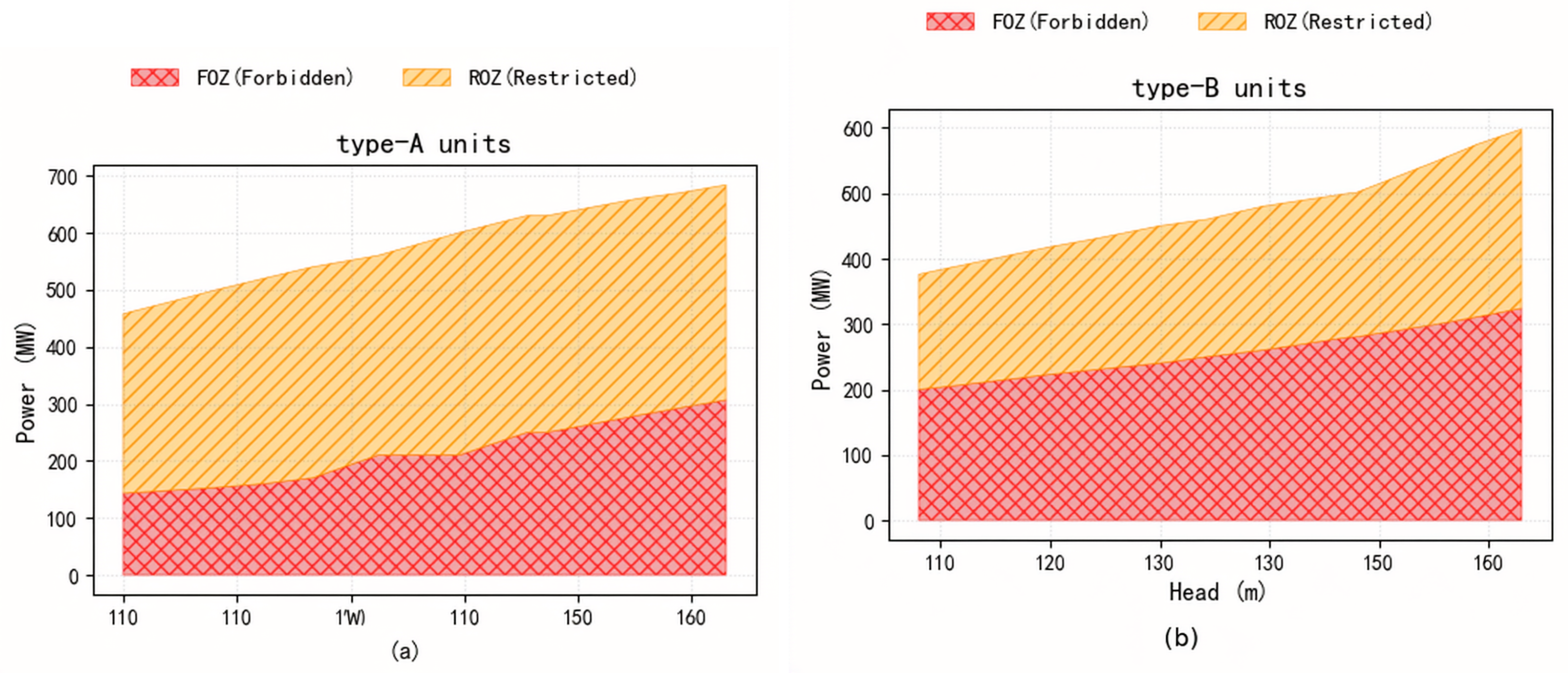
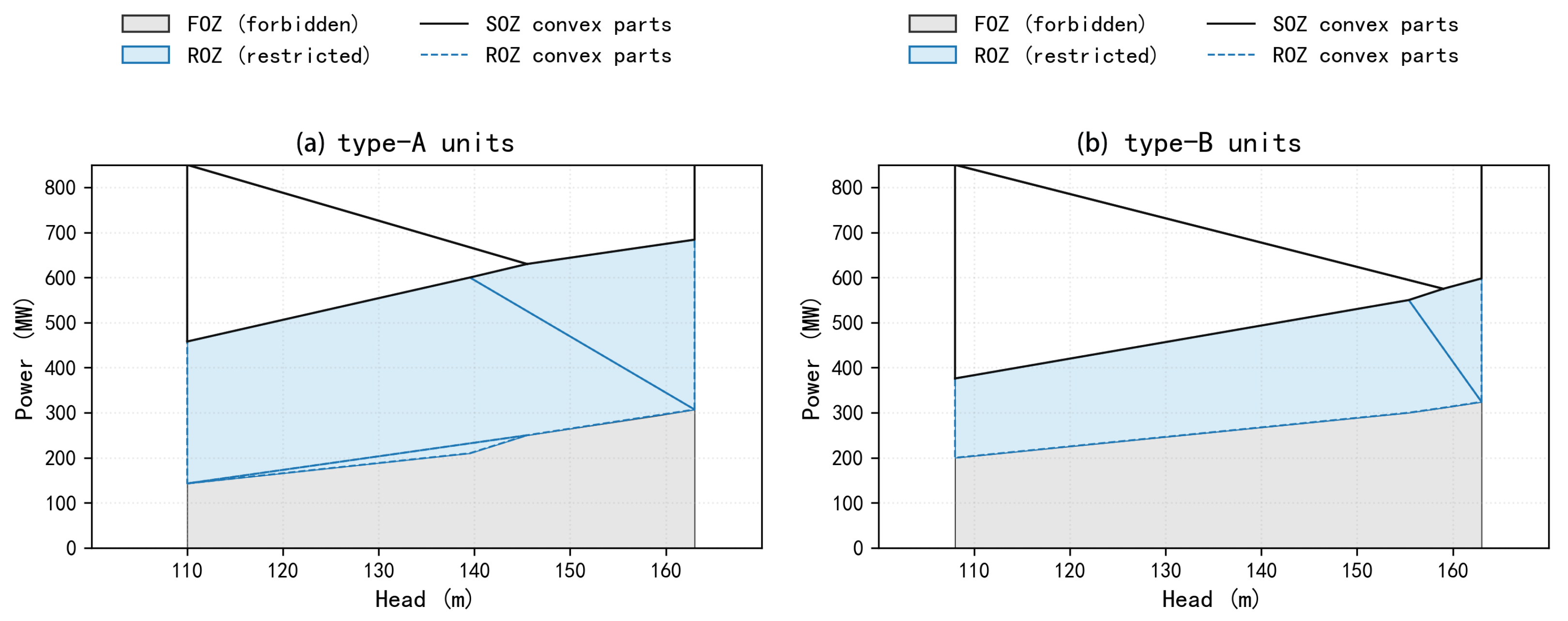
The VZ distributions for the type-A and type-B units are shown in
Figure 3.
4.2. Design of Comparative Schemes
To thoroughly evaluate the effectiveness of the proposed trade-off model in balancing unit safety and residual-load smoothing performance, three comparative schemes are designed based on the two typical-day scenarios described in
Section 4.1, namely the wet-season and dry-season cases. All schemes share the same reservoir and unit operating constraints, load scenarios, and solver settings, thereby enabling a consistent assessment of residual-load smoothing performance and operational safety. The differences among the schemes lie mainly in how the restricted operating zone (ROZ) is treated, while the forbidden operating zone (FOZ) is strictly avoided as a hard constraint in all schemes.
(1) Scheme I: Model without ROZ consideration
Scheme I corresponds to a day-ahead short-term scheduling formulation in which only the basic safety requirement associated with the FOZ is enforced, while the ROZ is not explicitly penalized. The objective function considers only residual-load smoothing:
Regarding constraints, the FOZ is enforced as a hard constraint to prevent unit operating points from entering the FOZ. Meanwhile, the ROZ and the safe operating zone (SOZ) are jointly treated as the allowable operating region, and no additional penalty or restriction is introduced to distinguish the potential risk of operating in the ROZ. Therefore, the allowable operating region is given by . Scheme I serves as the balancing-performance benchmark, characterizing the achievable level of under the FOZ hard constraint, together with the associated ROZ exposure reflected by .
(2) Scheme II: Conservative avoidance model
Scheme II represents a conventional conservative vibration-zone avoidance practice, in which the ROZ is treated as non-allowable together with the FOZ. The objective function has the same form as that in Scheme I (see Equation (
35)).
Regarding constraints, Scheme II merges the ROZ into a strictly prohibited region and confines unit operating points to the SOZ only, i.e., the allowable operating region is reduced to . Scheme II is used as the safety benchmark to quantify the deterioration in residual-load smoothing performance induced by conservative modeling under near-complete vibration-zone avoidance.
(3) Scheme III: Proposed trade-off model
Scheme III is the complete trade-off model proposed in this paper, aiming to enhance balancing capability while ensuring safe unit operation. Its objective function is given by
where
measures residual-load smoothing performance and
denotes the total number of ROZ unit periods over all units and periods. The value of
is determined based on the sensitivity analysis in
Section 4.3. Regarding constraints, Scheme III enforces the FOZ as a hard constraint and penalizes operation in the ROZ through
, thereby enabling an explicit trade-off between balancing performance and operational safety.
Scheme III, together with Schemes I and II, is used for a unified case study comparison to systematically examine how different VZ-handling strategies affect residual-load smoothing performance, ROZ exposure, and unit operating trajectories, thereby validating the effectiveness of the proposed trade-off model in coordinating unit safety and balancing requirements.
4.3. Sensitivity Analysis of the ROZ Penalty Coefficient
To determine a suitable baseline value of the trade-off coefficient
in (1), a sensitivity analysis is conducted on a separate scenario reserved for parameter tuning. This scenario is selected from historical operating records during 2021–2024 among days with the largest load fluctuations, and is distinct from the wet-season and dry-season typical days used for model validation in
Section 4.5 and
Section 4.6. Using a separate tuning scenario avoids circularity between parameter selection and performance evaluation and allows the baseline parameter to be chosen independently of the final validation cases.
The coefficient controls the relative importance of residual-load smoothing and restricted-operating-zone (ROZ) avoidance. A larger imposes a stronger penalty on ROZ operation. For each tested value of , the same model, data set, and solver settings are used, so that the resulting changes in and can be compared on a consistent basis. Here, denotes the average absolute deviation (AAD) of the residual load, while denotes the total number of ROZ unit periods over all units and periods.
All instances are solved using the same Gurobi settings and a fixed time limit of 9600 s. The model size is 52,007 variables and 22,956 constraints for all tested values of
. Due to the combinatorial complexity of the MILP, some instances terminate with nonzero optimality gaps, which are reported in
Table 2. Therefore, the following analysis focuses on the overall trade-off trend across different values of
, rather than on exact optimality of individual points.
Table 2 summarizes representative results of the sensitivity analysis.
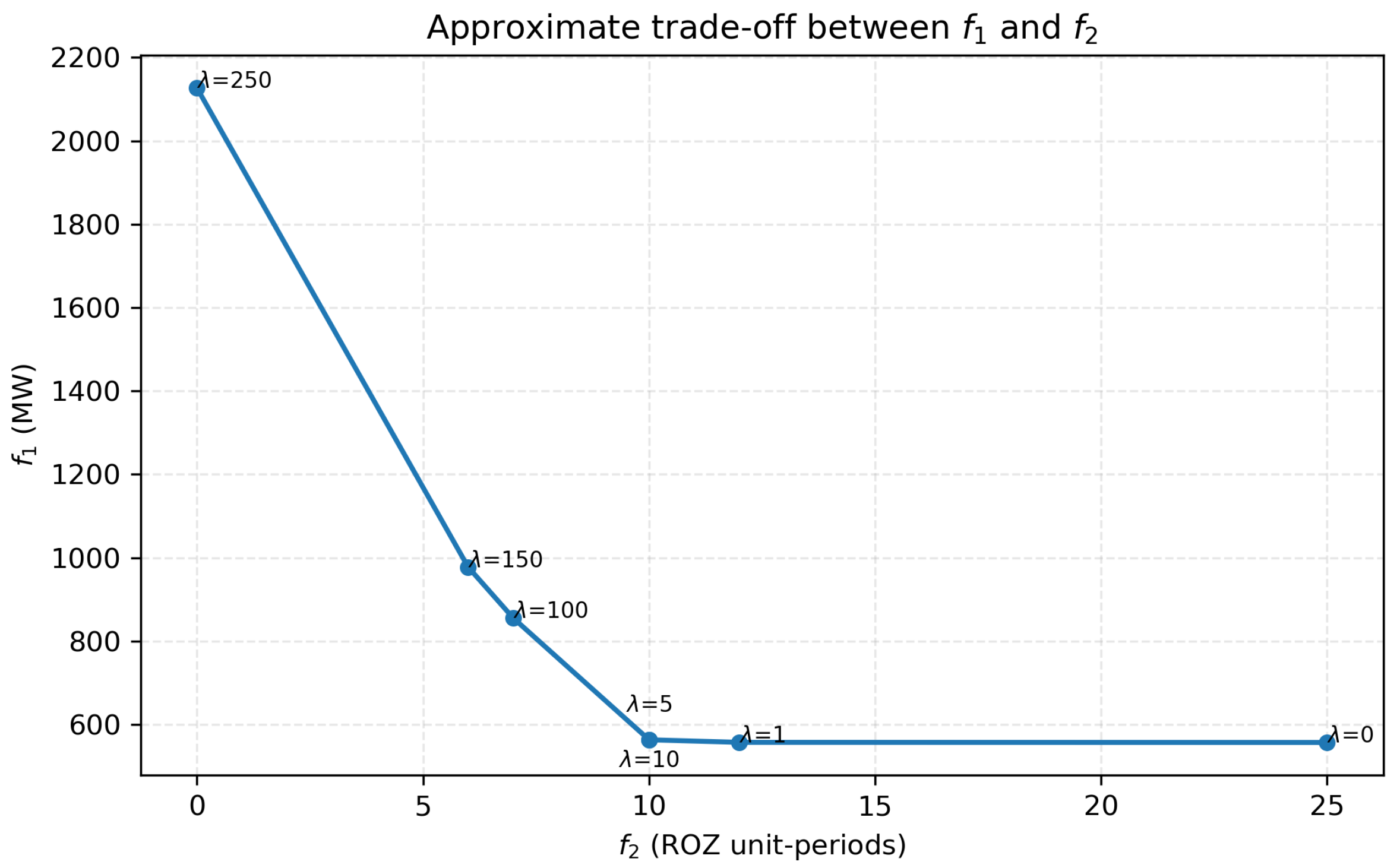
Figure 4 further illustrates the approximate trade-off curve between residual-load smoothing and ROZ avoidance implied by the tested values of
.
As increases from 0 to a small positive value, ROZ occupancy decreases sharply while the deterioration in residual-load smoothing remains very limited. Specifically, when increases from 0 to 1, decreases from 25 to 12, whereas increases only marginally from 556.83 MW to 557.11 MW. This indicates that introducing even a modest ROZ penalty is already effective in suppressing unnecessary ROZ operation.
For intermediate values of , the model exhibits a relatively stable compromise region. In particular, for between 5 and 10, remains at 10 unit periods, while stays in a narrow range of approximately 563 MW. This suggests that, within this range, the parameter choice is not overly sensitive and the model can achieve a robust balance between balancing performance and ROZ avoidance.
When is further increased to large values, can be reduced further, but only at the expense of a pronounced increase in . For example, increasing from 10 to 250 reduces from 10 to 0, but increases from 563.59 MW to 2126.89 MW. This result shows that excessive emphasis on ROZ avoidance leads to a substantial sacrifice in residual-load smoothing performance.
Based on the above observations,
is adopted as the baseline value in the subsequent comparative case studies. This value lies in a relatively stable compromise region, where ROZ occupancy is substantially reduced compared with the unpenalized case (
), while the deterioration in residual-load smoothing performance remains limited. The comparative results under this setting are presented in
Section 4.5 and
Section 4.6.
4.4. Convex Subregions of Vibration Zones
Building on the preprocessing procedure described above (separation, hole elimination, and OCP),
Figure 5 presents the convex partition outcomes for two units corresponding to the two unit types in the case study (type A and type B).
For the type A unit, the ROZ is decomposed into convex subregions with 12 vertices in total, and the SOZ is decomposed into convex subregions with 8 vertices in total.
For the type B unit, the ROZ is decomposed into convex subregions with 10 vertices in total, and the SOZ is decomposed into convex subregions with 8 vertices in total.
In total, type A uses 5 convex subregions and 20 vertices, while type-B uses 4 convex subregions and 18 vertices, which means type-A has 1 more convex subregion and 2 more vertices.
Because the SOZ partition is identical for the two unit types, the difference in geometric complexity is mainly caused by the ROZ partition.
This difference affects the size of the zone membership formulation: per unit and per period, the number of binary selection variables scales with , and the number of convex combination weights scales with the total number of vertices, so compared with type B, type A introduces one additional binary variable and two additional continuous weights in these constraints.
This indicates that, for the selected representatives, the ROZ boundary of the type A unit is slightly more intricate after preprocessing, leading to a larger partition size.
4.5. Comparative Analysis for the Wet Season Typical Day
As reported in
Table 3, the ROZ-ignored model and the proposed trade-off model both achieve a residual-load AAD of 0, whereas the conservative avoidance model yields 1776.07 MW. This indicates that, under wet-season conditions, the proposed soft-constraint treatment preserves the residual-load smoothing capability of the ROZ-ignored formulation, while fully excluding the ROZ leads to a substantial loss of regulation flexibility.
Regarding ROZ exposure, the ROZ-ignored model yields 45 ROZ unit periods, whereas the proposed trade-off model reduces this value to 5, corresponding to an 88.9% reduction. Moreover, these remaining five ROZ unit periods are concentrated in a single dispatch period and involve only five units, indicating that the proposed model compresses ROZ usage into a very limited time window. By contrast, the conservative avoidance model eliminates ROZ operation completely, but does so at the cost of a much larger residual-load deviation.
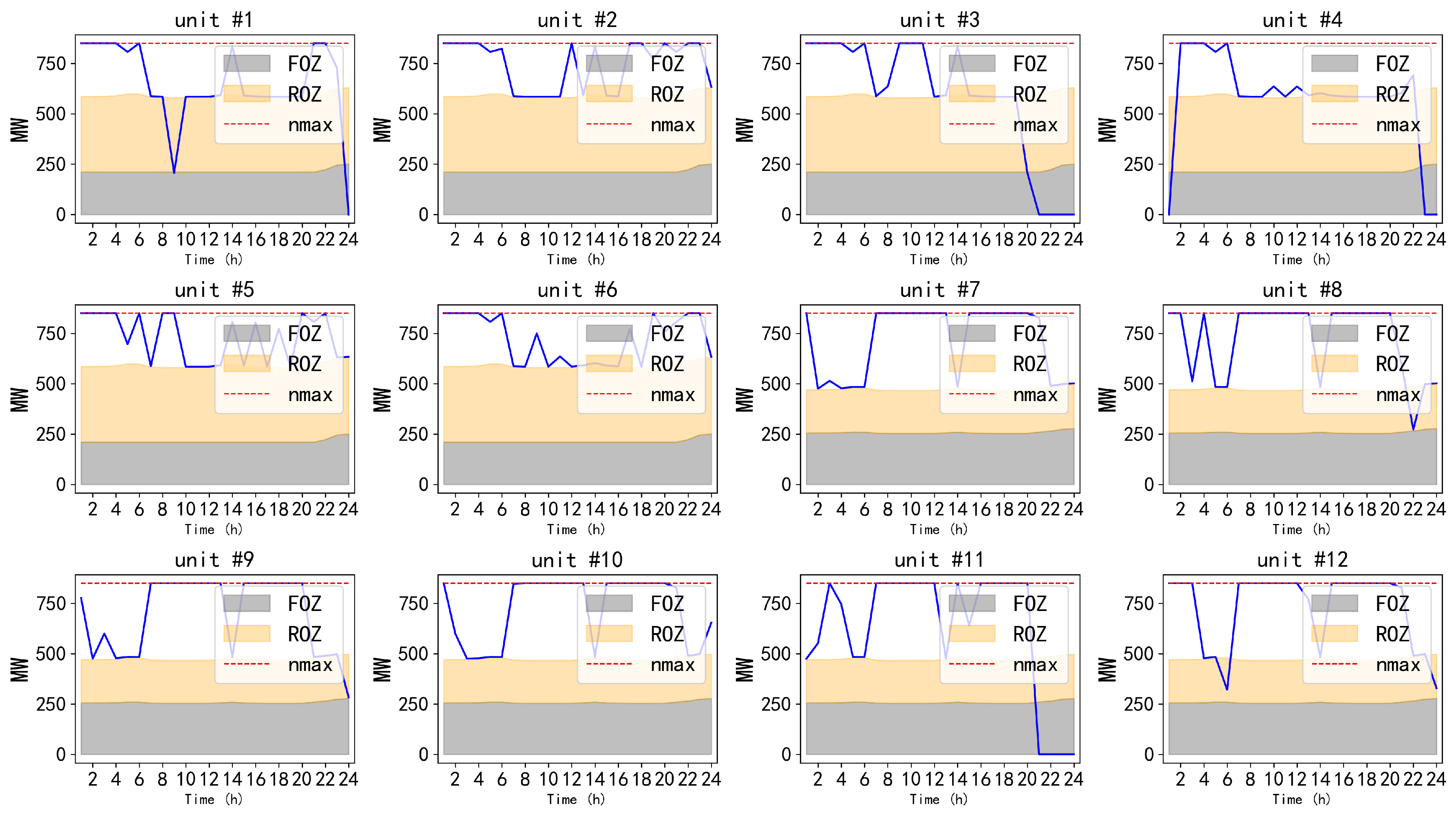
Table 3 also reports the computational performance. For the proposed trade-off model, the solution time is 3601.96 s with a 9.76% optimality gap. The relatively long computation is mainly caused by the additional binary subregion selection variables and convex combination variables introduced by the explicit ROZ representation. Nevertheless, this computational burden remains acceptable for day-ahead scheduling applications. The unit power output trajectories under the proposed trade-off model in the wet season case are shown in
Figure 6.
4.6. Comparative Analysis for the Dry Season Typical Day
The results for the dry season typical day are summarized in
Table 4. Under the dry-season typical-day scenario, the proposed trade-off model again maintains the residual-load AAD at 0, identical to the ROZ-ignored model, whereas the conservative avoidance model yields 1373.59 MW. This shows that, when water availability and regulation margin are tighter, fully prohibiting ROZ operation still causes a marked deterioration in residual-load smoothing performance.
Regarding ROZ exposure, the ROZ-ignored model produces 81 ROZ unit periods, while the proposed trade-off model reduces this value to four, corresponding to a 95.1% reduction. These four ROZ unit periods are again concentrated in a single dispatch period, indicating that the proposed formulation allows only highly limited and targeted use of the ROZ. By contrast, the conservative avoidance model eliminates ROZ operation completely, but at the expense of balancing performance.
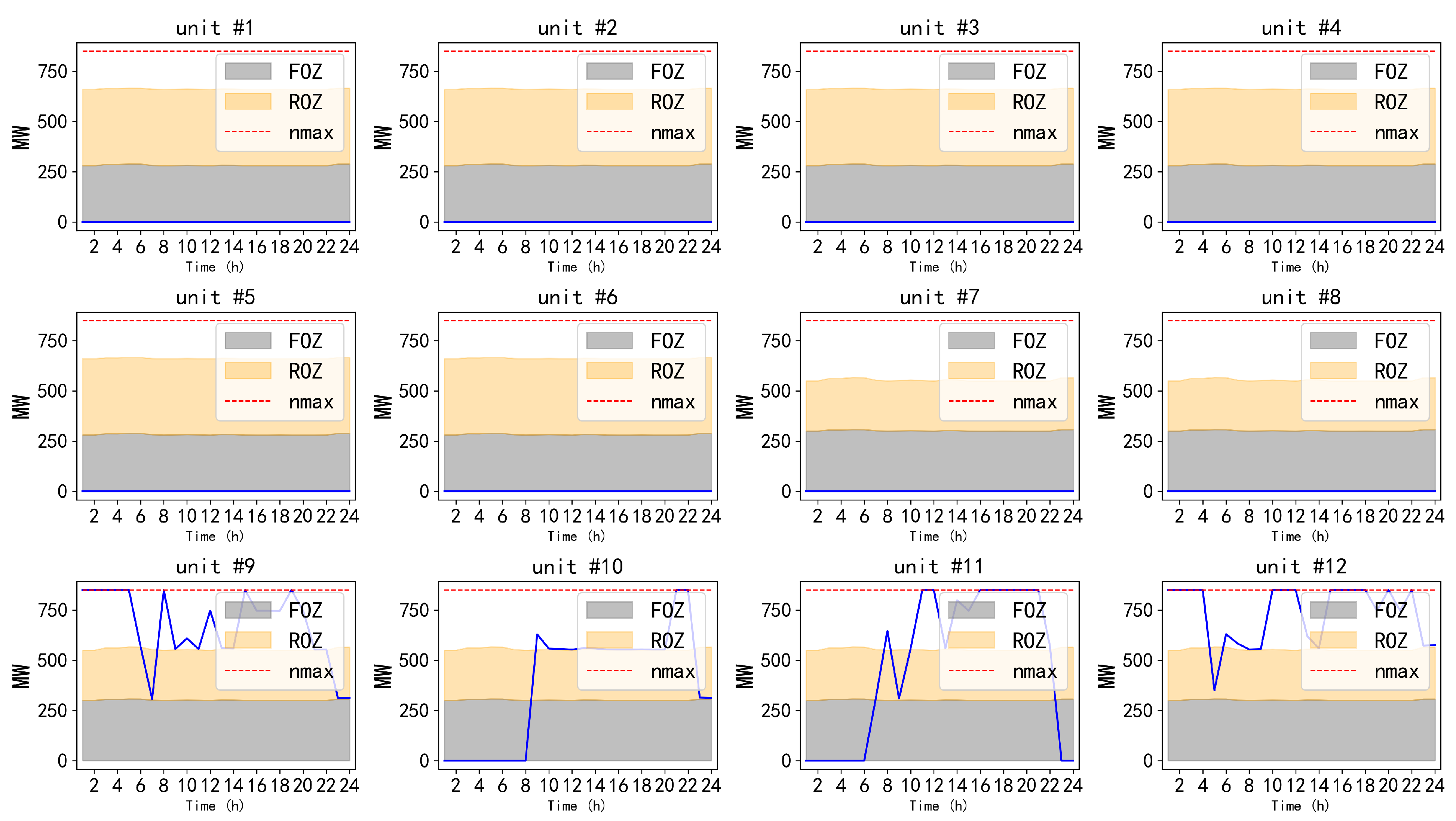
For the proposed trade-off model, the solution time is 3647.82 s with a 9.21% optimality gap. Although the mixed-integer formulation becomes computationally intensive after introducing explicit ROZ-state and convex combination constraints, the solution can still be obtained within about one hour, which is acceptable for day-ahead scheduling. The unit power output trajectories under the proposed trade-off model in the dry season case are shown in
Figure 7.
5. Conclusions
To address the power-balancing challenges induced by high renewable penetration while ensuring the safe operation of hydropower units under complex vibration-zone (VZ) constraints, this paper proposes a MILP-based short-term hydropower optimal scheduling method that explicitly accounts for the restricted operating zone (ROZ). At the day-ahead scheduling level, the proposed method adopts a practice-based three-zone VZ classification: the forbidden operating zone (FOZ) is strictly avoided via hard constraints, while ROZ operation is permitted but penalized to limit the time spent in the ROZ. By leveraging optimal convex partition (OCP) and the barycentric coordinates method, the proposed framework reformulates the original non-convex feasible region into a mixed-integer linear programming (MILP) model.
Case studies on representative typical days in the wet season and the dry season validate the effectiveness of the proposed method. The results show that the proposed trade-off formulation achieves an efficient balance between unit safety and residual load smoothing performance. While maintaining residual load smoothing performance comparable to that of the ROZ-ignored formulation, it significantly reduces the number of periods in which units operate in the ROZ, thereby improving operational safety and addressing the deficiency of the ROZ-ignored formulation, which sacrifices unit safety to pursue load smoothing. Meanwhile, compared with the conservative avoidance formulation that treats the ROZ as fully prohibited, the proposed method avoids excessive conservatism that would otherwise lead to a substantial degradation in residual load smoothing performance.
In summary, the proposed approach can exploit the regulation capability afforded by limited ROZ utilization while maintaining unit safety, offering a practical framework for vibration-zone-aware dispatch of large-scale hydropower plants with complex VZ characteristics.
Nevertheless, several simplifying assumptions may limit the applicability of the current model and merit further investigation. The binary ROZ indicator treats all operating points within a restricted zone as equally undesirable, whereas in practice vibration severity varies with the specific location in the zone, and cumulative fatigue damage depends on both intensity and continuous exposure duration. Future work could introduce graded penalties and consecutive-period constraints to better reflect this physical reality. The deterministic formulation also assumes perfect foreknowledge of inflows and load demands; under increasing renewable penetration, these uncertainties become non-negligible and may lead to suboptimal or infeasible schedules if ignored, making stochastic or robust extensions a natural next step. Additionally, the validation is limited to a single plant with two seasonal scenarios; testing on diverse turbine types, VZ geometries, cascade systems, and multi-scenario settings is needed before broader conclusions can be drawn. For significantly larger systems, decomposition strategies may be necessary to maintain tractability. Future work may further incorporate efficiency degradation or performance loss associated with vibration-prone operation into the scheduling framework.