Article

Research and Predictive Evaluation of Main Control Factors for Gas Enrichment in No.13 Coal Mine in Henan Province

1
China Pingmei Shenma Holding Group Co., Ltd., Pingdingshan 467000, China
2
CCTEG Xi’an Transparent Geology Technology Co., Ltd., Xi’an 712000, China
3
State Key Laboratory of Intelligent Coal Mining and Strata Control, Xi’an 712000, China
4
Xi’an Research Institute, China Coal Technology & Engineering Group Corp., Xi’an 710077, China
*
Author to whom correspondence should be addressed.
Energies 2026, 19(7), 1602; https://doi.org/10.3390/en19071602
Submission received: 28 January 2026 / Revised: 25 February 2026 / Accepted: 19 March 2026 / Published: 24 March 2026
(This article belongs to the Topic Advances in Coal Mine Disaster Prevention Technology)

Abstract

Coal mine gas disasters have always been a major threat to coal mine safety production. With the increasing depth and intensity of mining, the importance of studying gas geological laws is becoming increasingly prominent. In the actual mining process in coal mines, there is often a phenomenon of sudden increase in gas accumulation and gas emission in local areas. The study and prediction of the main influencing factors of gas enrichment are important research foundations for guiding the precise implementation of gas control engineering and avoiding coal and gas outburst accidents. Research shows that gas accumulates in local areas (such as abnormal structural and coal thickness areas), and gas pressure also increases locally; in areas where coal seam thickness changes dramatically, there is a sharp increase in gas content in mines. Prominent accidents all occurred in the coal seam area with a thickness exceeding 5 m. There is a significant spatial coupling between gas enrichment zoning and outburst accidents. The strip-shaped high-enrichment area based on gas content gradient division has a northeast southwest distribution consistent with the direction of structural extension. This study reveals the cross scale occurrence law of coalbed methane under multiple disturbances during the mining process, elucidates the non-equilibrium occurrence characteristics of methane, delineates local gas enrichment areas, uses theoretical models to predict gas emission and distribution laws, and provides parameter support for constructing gas geological attribute models.

1. Introduction

The study of regularities in gas release aims to reveal the inherent relationship between geological conditions and gas occurrence, migration, and emission, providing a theoretical basis for gas disaster prevention and resource utilization [1,2]. As the mining depth increases at a rate of 10–30 m per year, the pressure, content, and emission of coal seam gas continue to increase, making gas control increasingly difficult [3,4]. Some scholars analyze the main controlling geological factors, further calculate the gas content measured during geological exploration and the gas content measured on site, and predict the gas content by dividing the mine into different gas geological units [5,6,7,8].
The geological conditions of coal mines in China are complex, with numerous high-gas and coal and gas mine outbursts [9]. In recent years, with the development of theories and technologies such as gas geology, seepage mechanics, and intelligent monitoring, scholars in China and other countries have made significant progress in the study of regularities in gas release [10,11,12]. Research on regularities in gas release started earlier internationally, and multiple breakthroughs have been made in theoretical exploration and technical application. In the mid-20th century, Soviet scholar P.M. Krichevsky first applied the theory of permeability to describe the process of gas migration in coal seams, laying the foundation for the theory of coal rock gas permeability. Research on gas geology in China began in the 1950s, and after more than 70 years of development, a gas geological theoretical system with Chinese characteristics has been formed. Academician Zhou Shining systematically studied the relationship between geological structure and gas content, and proposed eight main factors that affect gas occurrence, laying the foundation for gas prediction [13]. In terms of prediction methods and techniques, Chinese scholars have explored the application of artificial intelligence methods such as gray theory, neural networks, and support vector machines in predicting gas outburst rates and outburst hazards [14,15]. The structural properties and gas flow laws of coal and rock masses are extremely complex and vary with the depth of mining. No single theory can solve their specific problems. In terms of technological applications, transparent gas geological technology will become a research hotspot. Foreign scholars have made significant progress in the study of gas geological occurrence patterns [16,17,18]. Research has found that over 90% of typical gas outbursts occur in areas of strong deformation, such as asymmetric anticline hubs, inclined fold hubs, strike slip faults, thrust faults, and strong deformation zones around thrust and normal faults [19,20]. By integrating multi-source information such as 3D seismic, transient electromagnetic, and high-density electrical methods, a dynamic 3D transparent geological model is constructed to achieve an accurate and intuitive display of gas geological conditions. In terms of data application, a unified gas geological big data platform will be established to achieve the collection, storage, sharing, and analysis of multi-source data. By using data mining and machine learning techniques, valuable information is extracted from massive data to construct a high-precision gas disaster warning model [21,22,23]. Bondarenko, V. et al. proposed an experimental analysis method to evaluate the effect of pre-drilling on the intensity of gas dynamic phenomena through indirect indicators such as stress redistribution and initial gas release rate [24,25].
The main problems in the current research on regularities in gas release in high-gas mines include: high gas content, high pressure, and complex structures; difficulty in identifying gas-rich areas and failure to achieve gas geological transparency; lack of comprehensive analysis of multiple factors in gas enrichment areas; insufficient utilization of gas extraction data; a gas geological model carrier not having been formed yet. The aim of this study is to understand the main geological factors that affect gas distribution, predict the gas distribution characteristics of unmined areas, delineate gas enrichment areas, and provide theoretical support for mining engineering deployment decisions and precise management of gas disasters.

2. Geological Conditions of the Mine

2.1. Regional Geological Structure Characteristics

The Pingdingshan mining area is located in the southern margin of the North China Plate. The main body of the studied mine is the southwest wing of the Xiang-jia Anticline, and the main structure of the mining field is the southwest wing of the Xiang-jia Anticline. The stratigraphic strike is 305–340°, the dip is 215–250°, and the dip angle is 10–25°. The joints and faults within the area have fixed distribution directions, specific mechanical properties, and cutting relationships. There are structural traces of different levels and orders. There are tectonic movements during the Yanshanian and Himalayan periods in the area. Igneous rocks erupt, and folds and fractures have different effects on gas and coal seams.
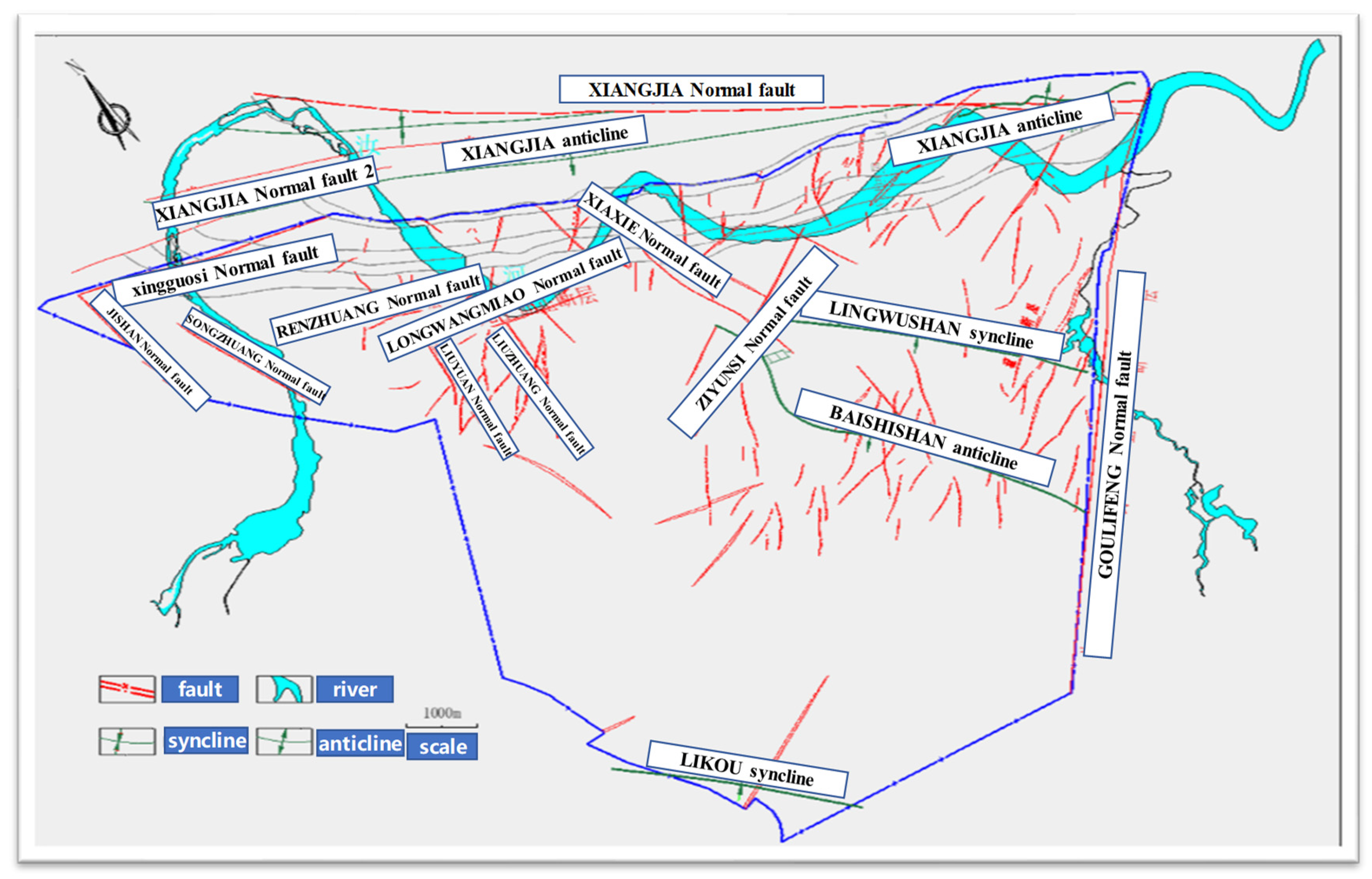
The fault structures within the mine field are limited and influenced by regional structures, including secondary NWW and NNE faults that are consistent with, associated with, and inherited from regional faults, as well as secondary fault structures that are restricted and modified by them, making the mine field structure relatively complex. As shown in Figure 1. However, the overall trend is mainly NW and NE, and they are all high-angle normal faults. During exploration in the mine field, 34 faults were discovered, all of which are normal faults. Among them, 13 have been controlled, 10 are well controlled, and 3 are basically controlled. Eight of them were only seen in one hole and only caused local changes in the coal seam (with a drop of less than 30 m). The large number of small-scale faults interpreted by ground 3D seismic exploration are also normal faults, and their distribution has the same regularity as regional fault distribution.
The definition of complex structure is the occurrence of coal bearing strata varying greatly along the strike and dip, with well-developed faults. Sometimes, it is severely affected by magmatic rocks, which affects the reasonable division of mining areas and can only be divided into some regular mining areas. This mainly includes:
(1)
Block structures severely damaged by several sets of faults;
(2)
On the basis of monoclines, synclines, or anticlines, secondary folds and faults being well-developed;
(3)
Tight folds, accompanied by a certain number of faults.
In summary, the complexity of mine structures and geological types are complex.

2.2. Development Characteristics of Target Coal Seam

The coal seams that can be mined in the thirteen mines from the bottom to the top are 1-4, 2-1-1, 2-1-2, 2-2, 4-2, 4-3, and 7-4, totaling seven layers. The mineability of each coal seam is evaluated and assessed separately below (Table 1).
The thickness of the 2-1 coal seam is 0~9.0 m, with a general thickness of 4.0–6.3 m and an average thickness of 5.20 m. The structure of the 2-1 coal seam is simple and without any dirt bands. The 2-1 coal seam is a relatively stable and locally mineable coal seam. Roof conditions: The basic roof is composed of gray white fine-to-medium grained sandstone, with a thickness of 0–33.53 m and an average thickness of 10.8 m. The unidirectional compressive strength is greater than 78.48 MPa, and it belongs to the Class II roof classification (moderately stable roof). Floor condition: Interbedding of fine sandstone, sandy mudstone and siltstone. The direct bottom is gray-black sandy mudstone, with a thickness of about 1.2 m and a unidirectional compressive strength of 33.35 MPa.
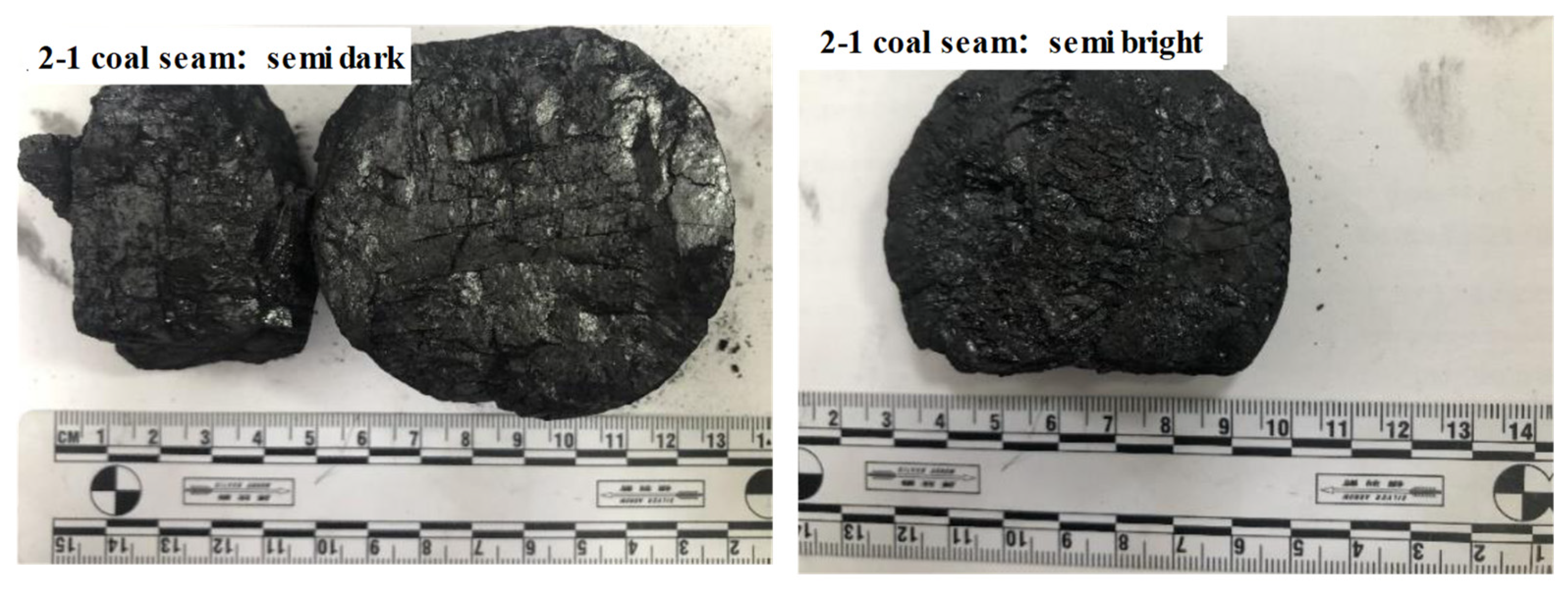
The coal sample is block shaped, with a small amount in the form of particles and powder. The macroscopic coal rock type is mainly semi-dark and semi-bright, with a gray-black color, as shown in Figure 2. Microscopic coal rock characteristics: According to the analysis of microscopic components, the content of organic components is generally greater than 75%. The organic components are mainly vitrinite, accounting for approximately 79.6% of the organic components, followed by sericite. The vitrinite group usually has relatively high aromaticity and a regular microcrystalline structure, which directly affects its gas adsorption capacity and mechanical strength. There is a clear zoning of coal types from west to east along this direction, with a coking coal zone in the west and a lean coal zone in the east. The metamorphism of the 2-1 coal seam from south to north presents as gas coal belt → fat coal belt → coking coal belt → lean coal belt, and the 2-1 coal seam in this verification area is located within the coking coal belt.

2.3. Geological Status of Mine Gas

The coal consistent coefficient (f) is a comprehensive indicator that represents the ability of coal to resist external damage, which is mainly determined by the physical and mechanical properties of coal. It reflects the amount of energy consumed per unit mass of coal destruction, that is, whether the coal body is easily damaged and prone to protrusion. After testing, the firmness coefficients of coal seam 2-1-1 in this mine is 0.32~0.97, and the firmness coefficients of coal seam 2-1-2 is 0.32~0.97 (see Table 2). The 2-1-1 coal seam and the 2-1-2 coal seam are originally the same coal seam. Due to the influence of the sedimentary environment, local stratification occurs, so the firmness coefficients of the two coal seams are the same. The initial gas release rate (Δp) of coal reflects the ability of coal to adsorb gas, and the rate of gas release under normal pressure reflects the microstructure of coal, and is one of the indicators reflecting the degree of coal seam outburst danger. The greater the initial velocity of gas release from coal, the greater the risk of coal seam outburst.
As of 16 August 2018, the target coal mine has experienced four coal and gas outburst accidents, and there have been no new outburst accidents since then. Table 3 shows the statistics of prominent accidents since the construction of the well.

3. The Influence of Geological Environment on Gas Occurrence

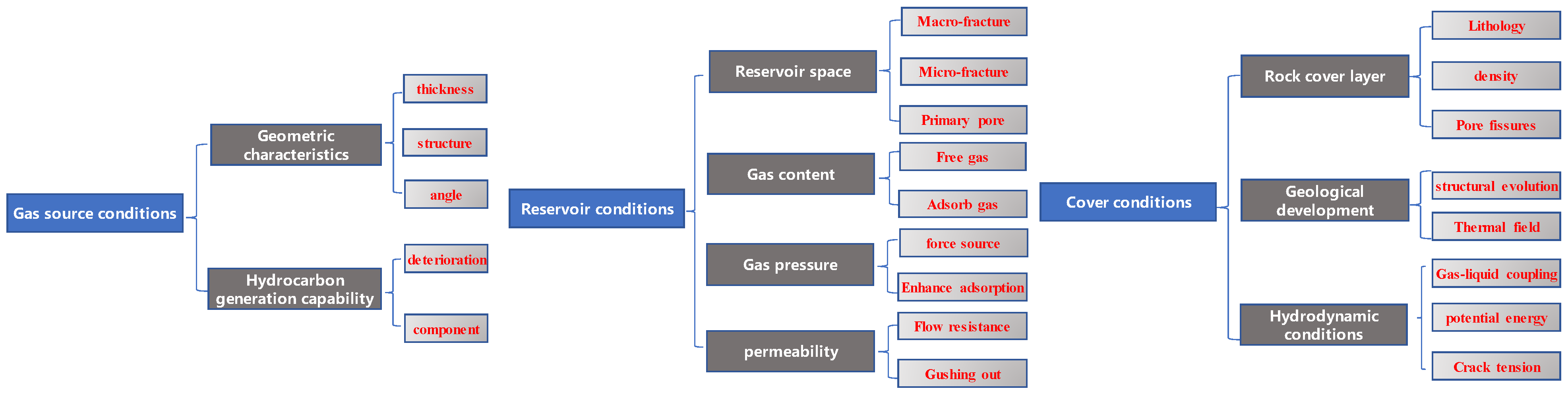
According to the mechanism of gas occurrence and enrichment, the formation of gas enrichment is constrained by gas source conditions, storage conditions, and preservation conditions, as shown in Figure 3. These geological control factors are intricate and complex, with mutual influences and constraints between them. A single factor may play a key role in the formation of coal seam gas enrichment areas in individual regions, while most mine gas enrichment is the result of effective allocation of multiple geological factors over time and space.

3.1. The Influence of Stress Environment on Gas

Gas pressure is not a fixed value, but the result of dynamic balance and comprehensive effects of various geological and engineering factors. These factors collectively control the processes of gas generation, migration, accumulation, and escape. The in situ stress, gas adsorption desorption characteristics, and temperature determine the existence state and energy of gas in coal. Geo-stress is a direct mechanical factor that controls gas pressure. The high-stress environment not only compresses the coal rock matrix, reducing its permeability, but more importantly, a portion of the geo-stress is effectively converted into pore fluid pressure (i.e., gas pressure). The distribution of geo-stress field (including the direction and magnitude of maximum and minimum principal stresses) directly controls the distribution of gas pressure. The adsorption of coal on gas is an exothermic process, while desorption is an endothermic process. According to the Langmuir equation, the higher the gas pressure, the greater the amount of gas adsorbed by coal. On the contrary, when gas pressure decreases due to mining and pressure relief, adsorbed gas will desorb in large quantities and become free gas, maintaining or changing the gas pressure in the pores. This is a dynamic equilibrium process.

3.2. The Influence of Coal Seam Burial Depth on Gas

As the burial depth of the coal seam increases, not only does the permeability of the coal seam and surrounding rock decrease due to increased geo-stress, but the distance of gas migration to the surface also increases. Both of these factors are conducive to gas storage. A large amount of actual data indicates that within a certain depth range, the gas content in coal seams increases with the increase in burial depth. In shallow coal seams, especially when outcrops exist, the gas in the coal seam is prone to dissipate into the atmosphere, and air also permeates into the coal seam, resulting in a very low gas content. If the coal seam is covered by a thicker alluvial layer without outcrops through the surface, it is difficult for the gas to dissipate, and the gas content in the coal seam is relatively high.
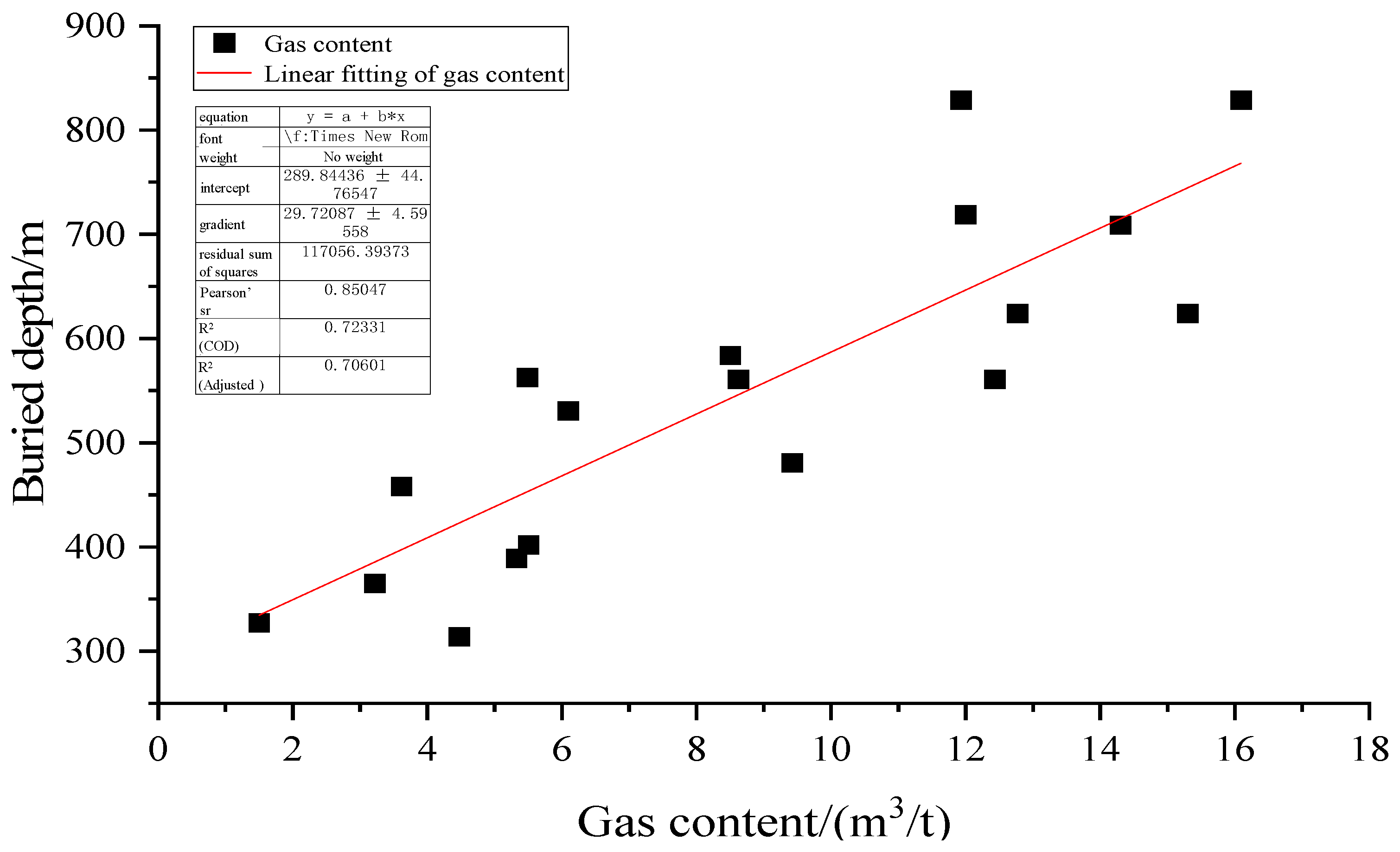
Generally speaking, the gas pressure in coal seams gradually increases with the increase in burial depth. As the gas pressure increases, the proportion of free gas in coal and rock increases, and the adsorbed gas in coal tends to become saturated. Therefore, theoretically, within a certain depth range, the methane content in coal increases with the increase in burial depth. However, if the burial depth continues to increase, the rate of increase in gas content in coal will slow down. For the mine studied in this paper, the burial depth of coal seams and geological structures within the minefield have a significant impact on gas occurrence. The gas content in the entire minefield increases with depth, which also proves the correlation between gas content and burial depth, as shown in Figure 4.

4. Analysis of the Enrichment Pattern of Mine Gas

4.1. Gas Geological Occurrence Laws During the Exploration Phase

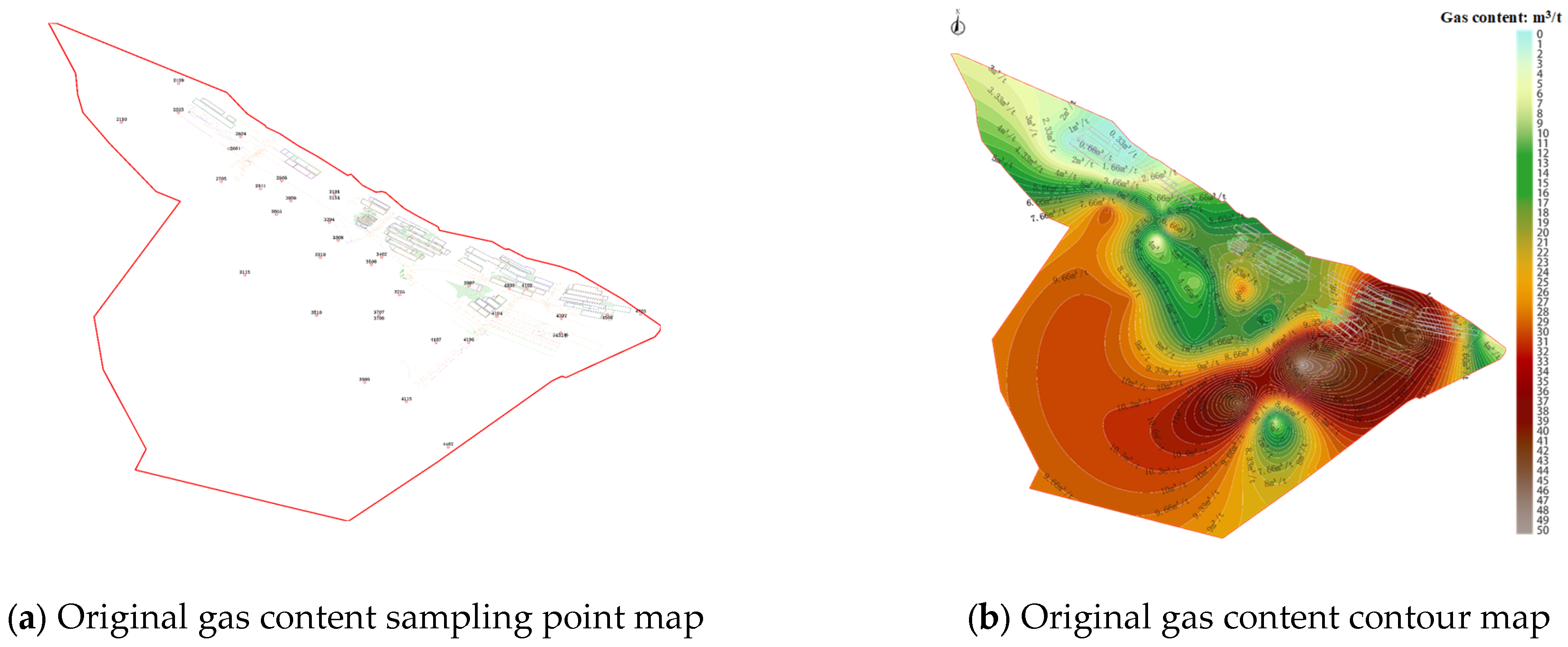
The gas content during the exploration period, which is tested in a period without being disturbed by underground tunneling, coal mining, and other engineering activities, is an important indicator that best reflects the original gas occurrence conditions. Obtain three-dimensional coordinates for gas content and gas pressure measurements on the mining engineering plan. Import the extracted coordinate data into GIS software and obtain the contour map of gas content distribution through the Kriging interpolation algorithm. The selection of the variation function model is a spherical model because it can best characterize the spatial structure of gas content. The search radius is set to be 5 km, and it is specified that when interpolating each unknown point, at least 4 and at most 12 nearest known sample points must be searched within its radius range. We conducted statistics tests and analysis on the gas content test data from 36 drilling holes deployed during the exploration phase of the mining area. Using specialized software, we drew contour maps of the original gas content in the mine during the exploration period (see Figure 5). The scale of the gas geological map in the article is 1:5000.
The distribution of gas content exhibits an overall trend of being higher in the east than in the west, and higher in the south than in the north. There are three high points of gas content in the upper part of the southeast, with gas content values of 13.00 m3/t, 13.60 m3/t, and 14.00 m3/t, respectively, extending outward from these centers. Using the ZIYUNSI normal fault as the dividing line, the coal seam gas content is relatively low in the area to the west of the fault, while the coal seam gas content and pressure are both relatively high in the area to the east of the fault. The depth of coal seams in this mine gradually increases from north to south, and the gas content significantly increases with the depth of the coal seams. The scale of the gas geological map in the article is 1:5000.
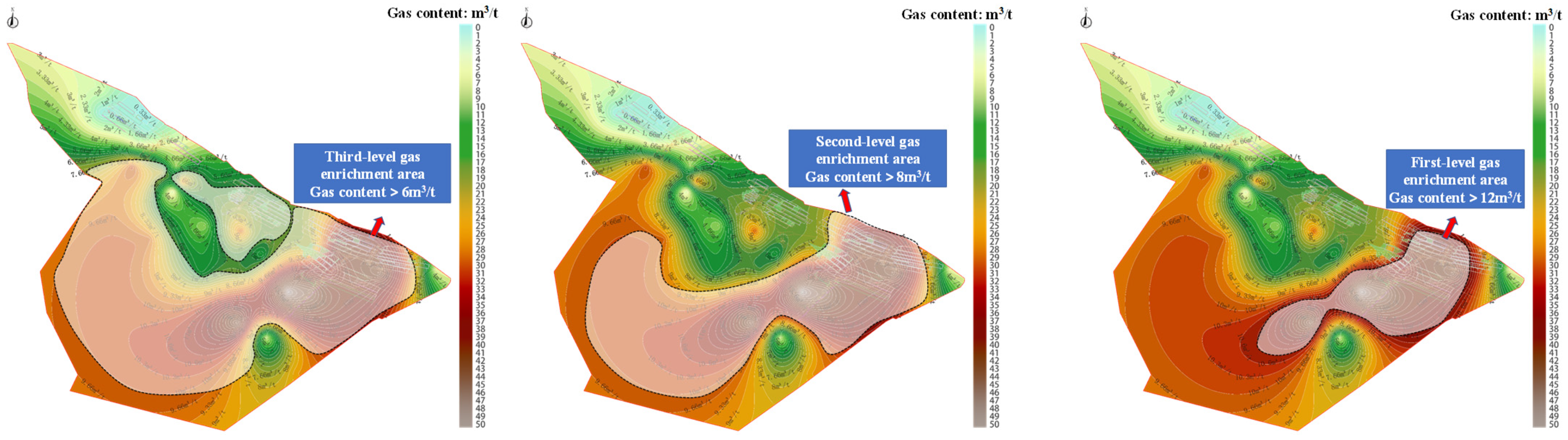
Based on the thresholds of 6, 8, and 12 m3/t, three levels of gas enrichment zones can be identified in the mine, as shown in Figure 6. The primary enrichment zone is primarily located in mining area No.1, No.3, and No.5. These three gas enrichment zones are distributed in a strip-like pattern from the northeast to the southwest. The maximum gas content reaches 16.83 m3/t, located in the area on the west side of the track underpass in mining area No.3.

4.2. Gas Enrichment Law During Mining Period

Residual gas content refers to the amount of gas that remains in the coal seam or goaf after natural discharge or artificial extraction during coal mining and cannot be further desorbed. It represents the gas trapped or sealed in micropores by coal under specific conditions (current geo-stress, temperature, pressure, etc.), which cannot be effectively utilized or poses a direct threat of outburst. Usually, coal samples are collected on-site and measured using the desorption method in the laboratory. After crushing the coal sample, measure the final amount of gas that cannot be desorbed under standard conditions, which is the residual gas content. Based on the analysis of the mine gas ledger, 451 sets of gas content values in the mining area can be obtained.
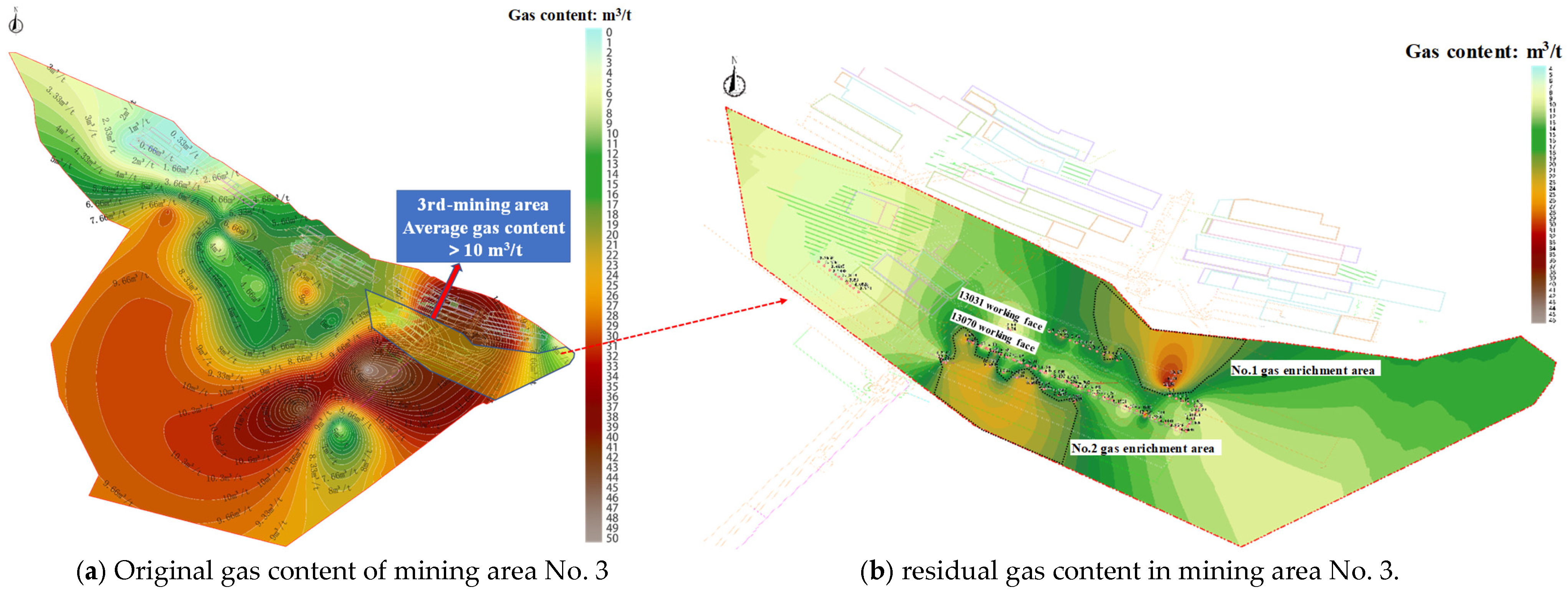
As shown in Figure 7, two enrichment areas are distributed in mining area 3. Gas enrichment area 1 is located within the open-off cut range of working face 13031, with a core point gas content of 12.68 m3/t, radiating northward. In 2008, a coal and gas outburst accident occurred at working face 13031, with a gas emission volume of 32,927 m3 and a coal emission volume of 594 tons, at a coal seam floor elevation of −637 m. The gas enrichment area analyzed is consistent with the location of coal and gas outburst accidents, indicating that the working face is located in a high-gas area.
Gas enrichment area 2 is located in the outer section of working face 13070, extending southward. The gas content on one side of the haulage roadway (lower side) is significantly lower than that on the return air roadway (upper side). Based on the previous analysis, it can be shown that the greater the depth of the coal seam, the higher the gas content. Since the coal seam is inclined, the elevation on one side of the transportation roadway is lower than that on the return air roadway, resulting in the transportation roadway side being in a higher-gas-content area. Compared with the original gas content in mining area 3 (Figure 7b), the gas content has been significantly reduced after treatment, with only relatively high-gas-enrichment areas existing in some regions. Due to the high initial gas content in mining area No.3, the mine management adopted a comprehensive control measure combining the extraction of the upper protective layer and gas drainage from the floor. After the control measures were implemented, the gas content was significantly reduced, ensuring safe production at the working face.

4.3. Discussion

This study collected data on the original gas content during mine exploration and residual gas content during underground mining. With the help of professional software such as CAD (2025) and GIS (10.8), the Kriging interpolation algorithm was used to draw the distribution maps of the original gas content in the entire mine and the residual gas content in the mining area. We were able to intuitively display the distribution pattern of gas, analyze the main geological factors affecting gas distribution, and summarize the correlation between gas outburst accidents and gas distribution. Compared with previous gas geological analysis methods, this method can systematically and intuitively study the distribution characteristics of gas, divide different levels of gas enrichment areas, and scientifically guide gas extraction and gas disaster control. In subsequent research, the obtained gas data will be used to generate a gas distribution map in the three-dimensional geological model of the entire mine, and the gas geological model will be updated in real-time based on the latest gas parameters to achieve gas geological transparency.

5. Conclusions

(1)
The enrichment of mine gas is controlled by the synergistic effect of multiple factors. Geological structures dominate the migration and storage of gas, while the depth and thickness of coal seams jointly affect reservoir pressure and adsorption capacity. These conditions collectively determine the heterogeneous distribution pattern of gas in space.
(2)
The distribution of gas exhibits a systematic spatial evolution pattern. Overall, the gas content significantly increases with increasing burial depth. On the plane, the increasing trend from north to south and from west to east reveals the influence of sedimentary environment and structural background conditions on gas migration and preservation.
(3)
The local enrichment of gas is closely related to structural coal thickness anomalies. In areas of structural variation (such as near faults or anticlines) and coal seam thickening, high-concentration gas accumulation zones are often formed due to stress concentration or increased storage space, forming potential geological units for coal and gas outbursts.
(4)
Based on the thresholds of 6, 9, and 12 m3/t, three levels of gas enrichment zones can be delineated in the mine. There is a significant spatial coupling between gas enrichment zoning and outburst accidents. The strip-shaped high-enrichment area based on gas content gradient division has a northeast southwest distribution consistent with the direction of structural extension. All prominent accidents in history have occurred within this highly enriched zone, which not only confirms that this zone is a high-risk geological carrier for outbursts, but also suggests that gas accumulation under structural control is the fundamental geological cause of outbursts.

Author Contributions

Conceptualization, X.F.; methodology, D.Z.; software, B.B.; validation, W.D.; formal analysis, M.L.; investigation, W.D. and X.F.; re-sources, W.D.; data curation, W.D.; writing—original draft preparation, W.D.; writing—review and editing, W.D.; visualization, B.B.; supervision, M.L.; project administration, W.D.; funding acquisition, W.D. All authors have read and agreed to the published version of the manuscript.

Funding

Our thanks go to the funding supported by the Key Research and Development Projects of Shaanxi Province (No. 2024GX-YBXM-492; No. 2025CY-YBXM-609); Research project “Key Technology Research on Transparent Geology in Deep Complex Coal Mines of China Pingmei Shenma Holding Group Co., Ltd”.

Institutional Review Board Statement

Studies not involving humans or animals.

Informed Consent Statement

Not applicable.

Data Availability Statement

Due to confidentiality policies, data sharing requirements cannot be met.

Acknowledgments

We would like to express our gratitude to the No.13 Mine of Henan Pingmei Coal Mining Group for their substantial support for this research. All data and materials utilized in this study were provided by the No.13 Mine.

Conflicts of Interest

Author Mao Li and Xinchuan Fan were employed by the company China Pingmei Shenma Holding Group Co., Ltd. Author Wengang Du, Dongling Zhang and Baojun Bai were employed by the company CCTEG Xi’an Transparent Geology Technology Co., Ltd. Author Wengang Du was employed by the company State Key Laboratory of Intelligent Coal Mining and Strata Control. Author Wengang Du, Dongling Zhang and Baojun Bai were employed by the company Xi’an Research Institute, China Coal Technology & Engineering Group Corp. Authors declare that the research was conducted in the absence of any commercial or financial relationships that could be construed as a potential conflict of interest.

References

  1. Tao, M.; Chen, X.; Ma, Y.; Wang, Y.; Li, Z.; Xiao, W.; Huang, Z. Geological–Geochemical Models and Isotope Fractionation Laws and Control Factors of Thermogenic Coalbed Gas in Panxian, China. Energy Fuels 2020, 34, 2665–2673. [Google Scholar] [CrossRef]
  2. Yi, W.; Tu, Z.; Feng, Y.; Li, T.; Jiang, H. Study on distribution laws of gas-bearing property of coal seams and geological control factors in Hancheng Mining Area. Coal Sci. Technol. 2017, 23, 63–70. [Google Scholar]
  3. Wei, G.; Li, J.; Zhang, S.; Xie, Z.; Yang, W.; Yang, D.; Zhang, F.; Zhao, Z. New progress in the studies on basic geological theories of natural gas in China. Nat. Gas Ind. 2012, 32, 6–14. [Google Scholar] [CrossRef]
  4. Wei, G.; Xie, Z.; Li, J.; Yang, W.; Zhang, S.; Zhang, Q.; Liu, X.; Wang, D.; Zhang, F.; Cheng, H. New research progress of natural gas geological theories in China during the 12th Five-Year Plan period. Nat. Gas Ind. B 2017, 5, 105–117. [Google Scholar] [CrossRef]
  5. Wang, J.; Hou, Q.; Zeng, F.; Guo, G.-J. Stress Sensitivity for the Occurrence of Coalbed Gas Outbursts: A Reactive Force Field Molecular Dynamics Study. Energy Fuels 2021, 35, 5801–5807. [Google Scholar] [CrossRef]
  6. Swanson, S.M.; Mastalerz, M.D.; Engle, M.A.; Valentine, B.J.; Warwick, P.D.; Hackley, P.C.; Belkin, H.E. Pore characteristics of Wilcox Group Coal, U.S. Gulf Coast Region: Implications for the occurrence of coalbed gas. Int. J. Coal Geol. 2015, 139, 80–94. [Google Scholar] [CrossRef]
  7. Li, J.; Cui, M.; Zhang, J.; Liu, L.; Qu, J.; Li, W. Experimental study on dynamic occurrence and migration of gas and water in deep coal measure reservoirs in Yan’an area of Eastern Ordos Basin. Fuel 2025, 405, 136654. [Google Scholar] [CrossRef]
  8. Dupuy, M.; Garel, E.; Chatton, E.; Labasque, T.; Mattei, A.; Santoni, S.; Vergnaud, V.; Aquilina, L.; Huneau, F. Using natural gas content of groundwater to improve the understanding of complex thermo-mineral spring systems. J. Hydrol. 2024, 634, 130956. [Google Scholar] [CrossRef]
  9. Jin, Y.; Tong, X.; Zheng, X.; Li, Y.; Dong, B. Risk assessment of coal and gas outbursts driven by the theory of three types of hazards coupled with 80 accident cases. Saf. Sci. 2024, 184, 106771. [Google Scholar] [CrossRef]
  10. Sun, Y. Important Achievement and Advance of Natural Gas Geology and Geochemical Exploration in China. Acta Geol. Sin. Engl. Ed. 2015, 89, 1411. [Google Scholar] [CrossRef]
  11. Zhao, Z.G.; Zhang, M.M.; Yan, J.P. Research on the Characteristics of Gas Geology in Yongshanqiao Mining Area, Jiangxi Province. Appl. Mech. Mater. 2012, 164, 511–516. [Google Scholar] [CrossRef]
  12. Miloserdova, L.; Dantsova, K. Experience of teaching the discipline “Aerospace methods in Oil and Gas Geology” at Gubkin Russian State University of Oil and Gas. Neft. Khozyaystvo 2022, 2022, 5. (In Russian) [Google Scholar] [CrossRef]
  13. Lin, B.; Zhou, S.; Zhang, R. The Inducing Condition of Shock Waves in Gas Explosion. J. Exp. Mech. 1998, 13, 463–468. [Google Scholar]
  14. Yang, S.-Q.; Sun, Y.; Chen, Z.-Y.; Yu, B.-H.; Xu, Q. Establishment of grey-neural network forecasting model of coal and gas outburst. Procedia Earth Planet. Sci. 2009, 1, 148–153. [Google Scholar] [CrossRef][Green Version]
  15. Liang, B.; Qin, B.; Sun, W.J.; Wang, S.Y.; Dan, Y.S. The application of intelligent weighting grey target decision model in the assessment of coal-gas outburst. J. China Coal Soc. 2013, 38, 1611–1615. [Google Scholar]
  16. Hu, H.; Zhai, C.; Chu, Y.; Feng, J.; Shi, J.; Liu, X.; Zhang, G. Integrated framework for feature extraction and weighting in coal and gas outburst classification. J. Intell. Fuzzy Syst. Appl. Eng. Technol. 2023, 45, 4871–4884. [Google Scholar] [CrossRef]
  17. Nittrouer, C.A.; Kuehl, S.A.; Demaster, D.J.; Kowsmann, R.O. Geological Society of America Bulletin The deltaic nature of Amazon shelf sedimentation. Geol. Soc. Am. Bull. 1986, 97, 444–458. [Google Scholar] [CrossRef]
  18. Revuelta, M.B. Geological Occurrence. In The Basics of Aggregates; Springer Textbooks in Earth Sciences, Geography and Environment; Springer: Cham, Switzerland, 2024; pp. 53–100. [Google Scholar] [CrossRef]
  19. Kvenvolden, K.A. A primer on the geological occurrence of gas hydrate. Geol. Soc. Lond. Spec. Publ. 1998, 137, 9–30. [Google Scholar] [CrossRef]
  20. Shepherd, J.; Rixon, L.; Griffiths, L. Outbursts and geological structures in coal mines: A review. Int. J. Rock Mech. Min. Sci. Geomech. Abstr. 1981, 18, 267–283. [Google Scholar] [CrossRef]
  21. Zhang, Q. Risk Assessment of Gas Explosion Disaster Based on Random Forest Model. IOP Conf. Ser. Earth Environ. Sci. 2020, 446, 022081. [Google Scholar] [CrossRef]
  22. Liu, H.; Zhang, B.; Li, X.; Liu, C.; Wang, C.; Wang, F.; Cui, Z.; Chen, D. Influence of geological structures on the occurrence of coalbed methane in Sima coal mine, China. Front. Earth Sci. 2022, 10, 1000520. [Google Scholar] [CrossRef]
  23. Zheng, S.; Wang, L.; Chen, D.; Liu, Y.; Jiang, C. Main control factors of coalbed methane occurrence differences in adjacent coal seams—A case study of Luling coal mine, Huaibei Coalfield, China. Nat. Hazards 2024, 120, 11183–11207. [Google Scholar] [CrossRef]
  24. Thiruchittampalam, S.; Singh, S.K.; Banerjee, B.P.; Glenn, N.F.; Raval, S. Spoil characterisation using UAV-based optical remote sensing in coal mine dumps. Int. J. Coal Sci. Technol. 2023, 10, 65. [Google Scholar] [CrossRef]
  25. Bondarenko, V.; Kovalevska, I.; Krasnyk, V.; Chernyak, V.; Haidai, O.; Sachko, R.; Vivcharenko, I. Methodical principles of experimental-analytical research into the influence of pre-drilled wells on the intensity of gas-dynamic phenomena manifestations. Min. Miner. Depos. 2024, 18, 67–81. [Google Scholar] [CrossRef]
Figure 1. Geological structure outline map of mines.
Energies 19 01602 g001
Figure 2. Macro coal seam description sample.
Energies 19 01602 g002
Figure 3. Geological factors of coalbed gas enrichment.
Energies 19 01602 g003
Figure 4. The relationship between gas content and coal seam depth.
Energies 19 01602 g004
Figure 5. Sampling point distribution map of gas content during exploration period.
Energies 19 01602 g005
Figure 6. Classification of gas enrichment zones at different levels.
Energies 19 01602 g006
Figure 7. Distribution map of gas content of mining area No.3.
Energies 19 01602 g007
Table 1. Basic information on main mineable coal seams.
Coal Seam NumberCoal Seam Thickness (m)Coal Seam Stability
Thickness Range (m)Average Thickness (m)
1-40~2.571.17relatively stable
2-10~9.05.2relatively stable
2-20~3.431.65relatively stable
4-20~2.601.10stable
4-30~2.570.89unstable
7-40~2.711.31relatively stable
Table 2. Test results of coal gas parameters.
Sampling NumberCoal SeamSampling SiteFirmness Coefficients: fInitial Gas Release Rate: Δp
1coal seam 2-1-2East Roadway 360 m0.977.5
2East Roadway 150 m0.784.5
3Point 3 of return airway0.4114.0
4Point 5 of return airway0.3211.5
5coal seam 2-1-1East Roadway 30 m0.976.0
6East Roadway 20 m0.7813.5
7Point G30.4117.5
8Point G20.3213.0
Table 3. Previous coal and gas outburst accidents.
NumberTimeAccident SiteElevation/mThe Amount of Coal Thrown Out/tThe Amount of Gas Thrown Out/m3
112 March 200211090 working face−5051963840
220 January 200813031 haulage roadway−63759432,927
313 June 201011111 excavating tunnels−5331133308,557
416 August 201811111 working face−51130110,123
Disclaimer/Publisher’s Note: The statements, opinions and data contained in all publications are solely those of the individual author(s) and contributor(s) and not of MDPI and/or the editor(s). MDPI and/or the editor(s) disclaim responsibility for any injury to people or property resulting from any ideas, methods, instructions or products referred to in the content.