Large Language Models in Sustainable Energy Systems: A Systematic Review on Modeling, Optimization, Governance, and Alignment to Sustainable Development Goals


Abstract
1. Introduction
2. Methodology
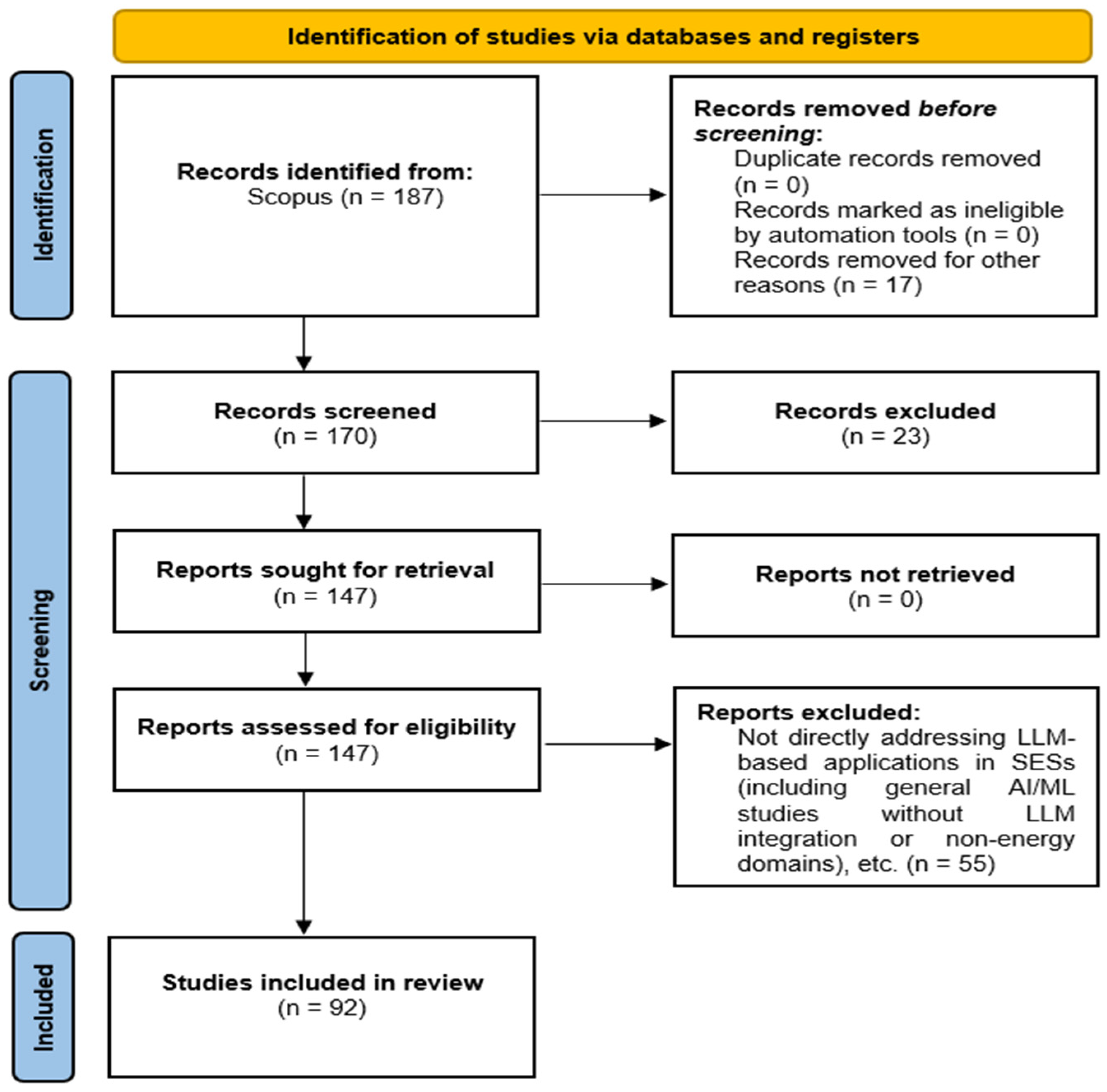
2.1. PRISMA
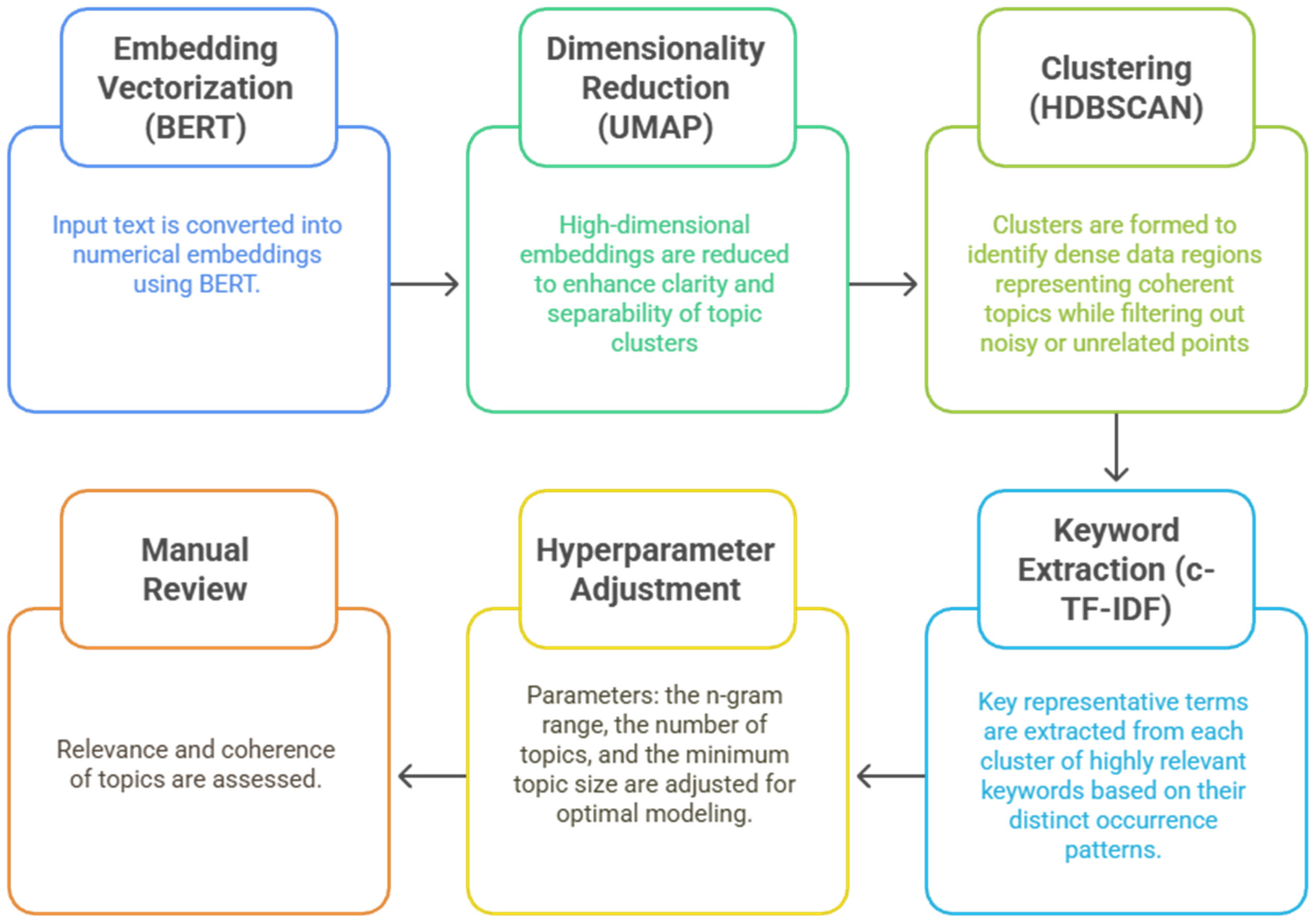
2.2. BERTopic Modeling
2.3. Case Studies
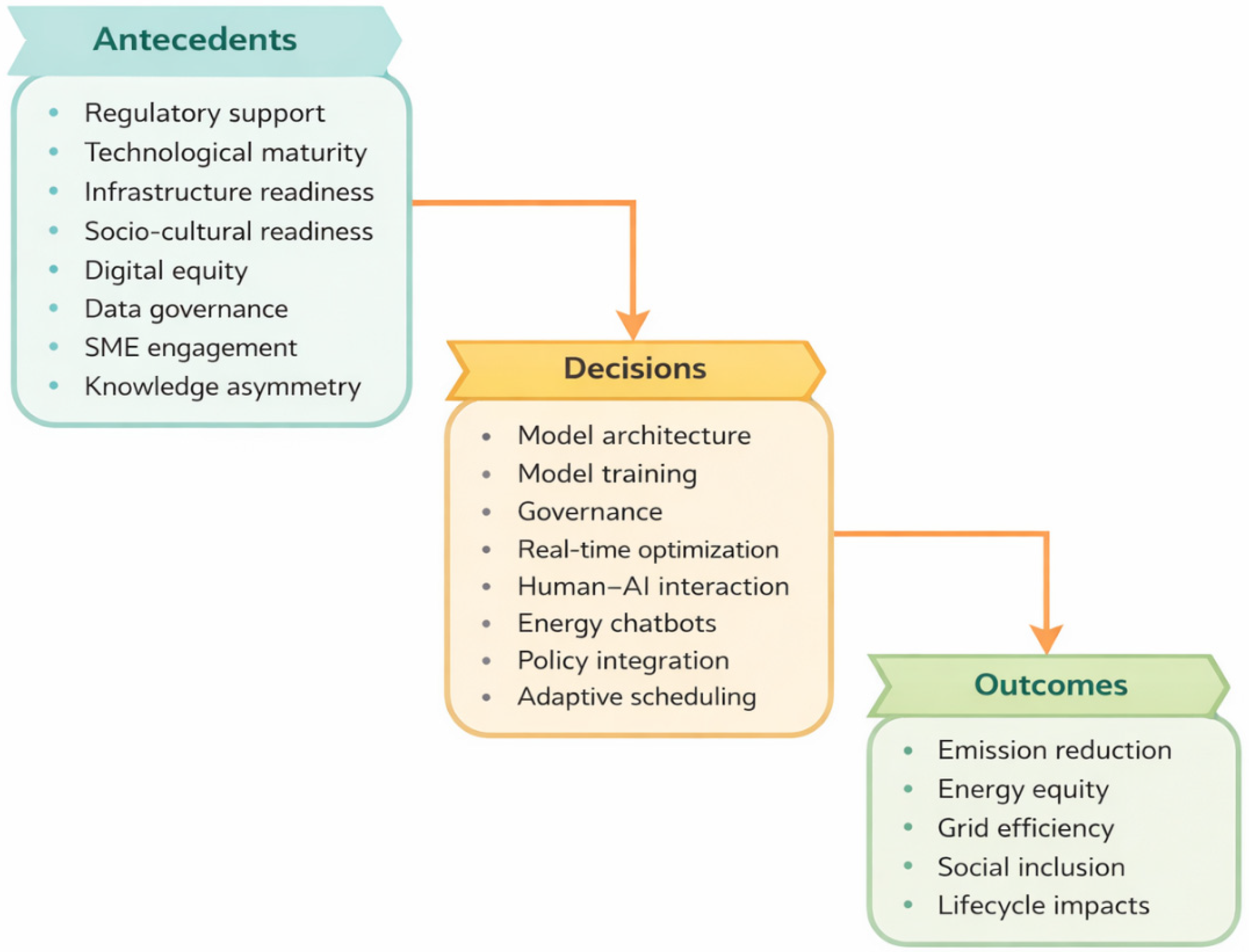
2.4. ADO Framework
3. Results
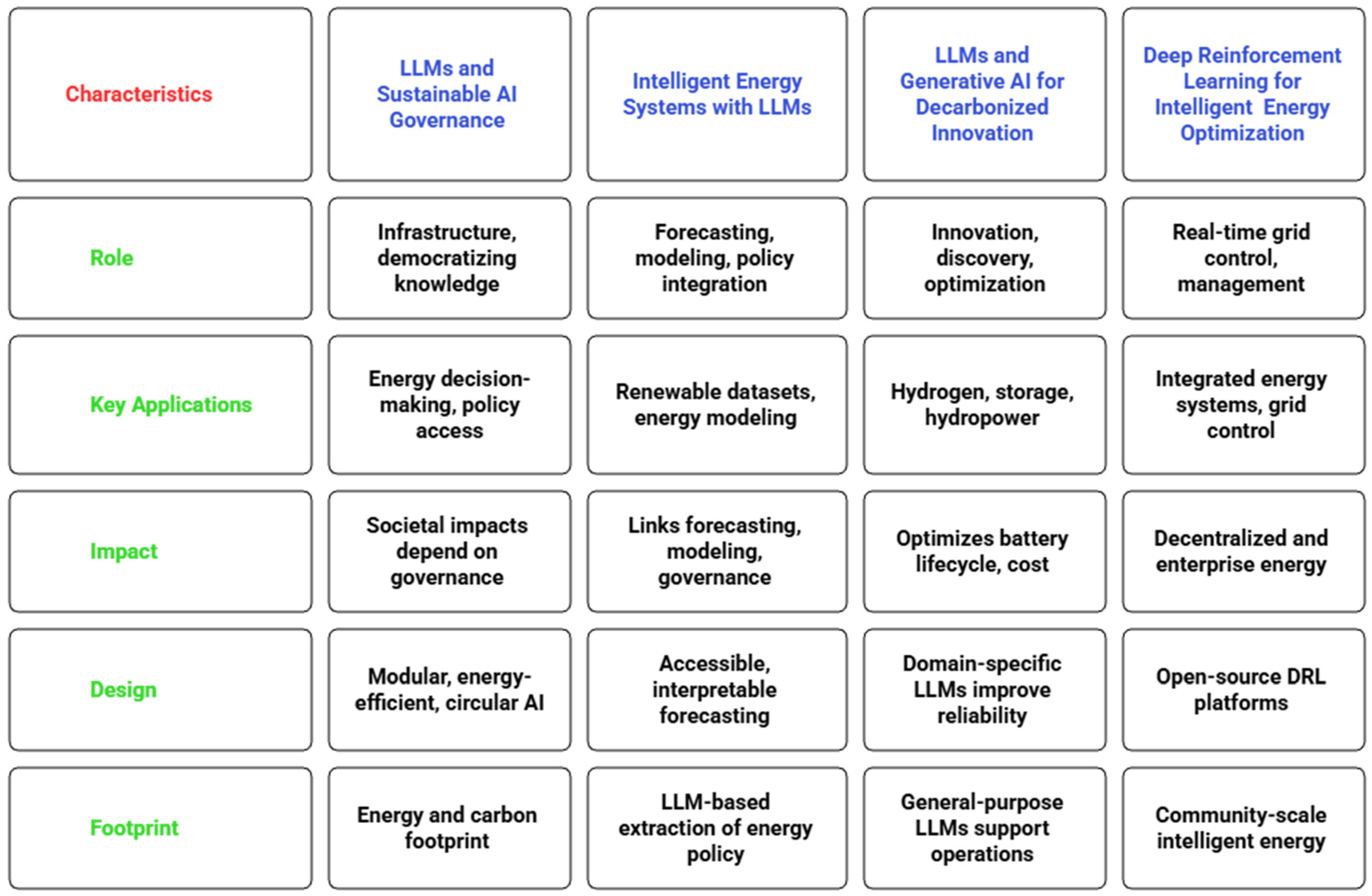
3.1. Themes Based on BERTopic
3.1.1. LLMs and Sustainable AI: Enablers, Trade-Offs, and Governance Pathways in Energy Transition
3.1.2. Advancing Intelligent Energy Systems with LLMs: Forecasting, Modeling, and Policy Integration
3.1.3. LLMs and Generative AI for Decarbonized Innovation: A Multisectoral Application in Hydrogen, Electrochemical Storage, and Infrastructure Optimization
3.1.4. Deep Reinforcement Learning for Intelligent Energy System Optimization: Decarbonization, Infrastructure Innovation, and Clean Energy Access
3.2. Case Studies
4. Discussion
5. Implications
5.1. Implications for Theory
5.2. Implications for Policy
5.3. Implications for Practice
6. Future Research Directions
6.1. Antecedents: Enablers of LLMs in SESs
- FR1: What is the impact of regulatory flexibility on the adoption and scale-up of LLM-based applications in sustainable energy governance?
- FR2: How does stakeholder trust in AI systems and data governance facilitate decentralized energy optimization?
- P1: Energy organizations in adaptive regulatory environments adopt LLM-based planning with greater readiness, in addition to the presence of stringent policy frameworks.
- P2: Communities that accept AI systems as transparent and inclusive are willing to adopt LLM-based energy tools.
6.2. Decisions: Strategic Choices in LLM-Driven SESs
- FR3: How do governance mechanisms and participatory governance influence public acceptance of LLMs and AI-enabled energy tools?
- FR4: What are the environmental trade-offs between centralized and federated learning approaches in LLM applications for SESs?
- P3: Users are more likely to accept LLM-based energy scheduling systems if they are provided with transparent explanations of decision logic.
- P4: Federated AI systems in smart grid applications will produce at least 30% fewer training-related emissions than centralized models with the same levels of accuracy.
6.3. Outcomes: Impacts and Consequences of Decisions
- FR5: What are the measurable outcomes of environmental sustainability achieved through LLM applications in smart energy systems?
- FR6: How does the integration of AI in SESs foster energy access equity in various socioeconomic and geographic regions?
- P5: AI-optimized grids using DRL achieve at least 15% lower carbon emissions over five years than conventionally managed grids.
- P6: Rural and marginalized communities have less satisfaction and do not benefit from LLM-based energy systems.
7. Conclusions
Supplementary Materials
Author Contributions
Funding
Data Availability Statement
Acknowledgments
Conflicts of Interest
Abbreviations
| SESs | Sustainable Energy Systems |
| LLMs | Large Language Models |
| AI | Artificial Intelligence |
| SDG | Sustainable Development Goal |
| GenAI | Generative Artificial Intelligence |
| PRISMA | Preferred Reporting Items for Systematic Reviews and Meta-Analyses |
| ADO | Antecedents–Decisions–Outcomes |
| RL | Reinforcement Learning |
| DRL | Deep Reinforcement Learning |
| BERT | Bidirectional Encoder Representations from Transformers |
| NMF | Non-negative Matrix Factorization |
| LDA | Latent Dirichlet Allocation |
| PLSA | Probabilistic Latent Semantic Analysis |
| NLP | Natural Language Processing |
| UMA | Uniform Manifold Approximation and Projection |
| HDB-SCAN | Hierarchical Density-Based Spatial Clustering of Applications with Noise |
| BEMs | Building Energy Models |
| RAG | Retrieval-Augmented Generation |
| RECs | Renewable Energy Communities |
| NR-IES | Nuclear-Renewable Integrated Energy System |
| PPO | Proximal Policy Optimization |
| SAC | Soft Actor–Critic |
| TD3 | Twin Delayed Deep Deterministic Policy Gradient |
| DQN | Deep Q-network |
| WRF | Weather Research and Forecasting |
References
- Kyei, S.K.; Boateng, H.K.; Frimpong, A.J. Renewable energy innovations: Fulfilling SDG targets. Clean Energy 2025, 9, 190–203. [Google Scholar] [CrossRef]
- Zhao, Q.; Wang, L.; Stan, S.E.; Mirza, N. Can artificial intelligence help accelerate the transition to renewable energy? Energy Econ. 2024, 134, 107584. [Google Scholar] [CrossRef]
- Raman, R.; Gunasekar, S.; Dávid, L.D.; Rahmat, A.F.; Nedungadi, P. Aligning sustainable aviation fuel research with sustainable development goals: Trends and thematic analysis. Energy Rep. 2024, 12, 2642–2652. [Google Scholar] [CrossRef]
- Zhao, A.P.; Alhazmi, M.; Li, S.; Li, J.; Xie, D.; Chen, S.; Hu, P.J.-H.; Ju, X. Enhancing Los Angeles’ resilient energy systems amid wildfires. Sci. Rep. 2025, 15, 20813. [Google Scholar] [CrossRef]
- Tsao, Y.C.; Banyupramesta, I.A.; Lu, J.C. Optimizing grid energy management through the integration of inverter-based resources and community energy prosumers for sustainable energy systems. Energy Convers. Manag. 2025, 344, 120265. [Google Scholar] [CrossRef]
- Yaffid, R.; Sundari, S. Renewable Energy and Economic Growth: Comparative Evidence from Germany, Denmark, and China and Strategic Implications for Indonesia. Asian J. Manag. Entrep. Soc. Sci. 2025, 5, 608–627. [Google Scholar]
- Wang, Y.; Xie, Y.; Shao, G.; Zhao, P.; Xie, D.; Liu, T.; Gu, C.; Li, S.; Shi, C.; Zhang, Y.; et al. Low-carbon upgrading to China’s communications base stations for economic profits and additional environmental and public health benefits. Cell Rep. Sustain. 2025, 2, 100492. [Google Scholar] [CrossRef]
- Klemm, C.; Wiese, F. Indicators for the optimization of sustainable urban energy systems based on energy system modeling. Energy Sustain. Soc. 2022, 12, 3. [Google Scholar] [CrossRef]
- Raman, R.; Pattnaik, D.; Kumar, C.; Nedungadi, P. Advancing sustainable energy systems: A decade of SETA research contribution to sustainable development goals. Sustain. Energy Technol. Assess. 2024, 71, 103978. [Google Scholar] [CrossRef]
- Sharma, S.; Ali, I. Efficient Optimization Techniques for Renewable and Sustainable Energy Systems. In Optimization in Sustainable Energy: Methods and Applications; Scrivener Publishing LLC: Beverly, MA, USA, 2026; pp. 405–464. [Google Scholar] [CrossRef]
- Nwala, K.C.; Kabeyi, M.J.B.; Olanrewaju, O.A. A Visual and Strategic Framework for Integrated Renewable Energy Systems: Bridging Technological, Economic, Environmental, Social, and Regulatory Dimensions. Energies 2025, 18, 5468. [Google Scholar] [CrossRef]
- Yao, Z.; Lum, Y.; Johnston, A.; Mejia-Mendoza, L.M.; Zhou, X.; Wen, Y.; Aspuru-Guzik, A.; Sargent, E.H.; Seh, Z.W. Machine learning for a sustainable energy future. Nat. Rev. Mater. 2023, 8, 202–215. [Google Scholar] [CrossRef]
- Buster, G.; Pinchuk, P.; Barrons, J.; McKeever, R.; Levine, A.; Lopez, A. Supporting energy policy research with large language models: A case study in wind energy siting ordinances. Energy AI 2024, 18, 100431. [Google Scholar] [CrossRef]
- Dewi, T.; Risma, P.; Oktarina, Y.; Dwijayanti, S.; Mardiyati, E.N.; Sianipar, A.B.; Hibrizi, D.R.; Azhar, M.S.; Linarti, D. Smart integrated aquaponics system: Hybrid solar-hydro energy with deep learning forecasting for optimized energy management in aquaculture and hydroponics. Energy Sustain. Dev. 2025, 85, 101683. [Google Scholar] [CrossRef]
- Zhao, Z.; Tang, D.; Liu, C.; Wang, L.; Zhang, Z.; Zhu, H.; Chen, K.; Nie, Q.; Ji, Y. A Large language model-based multiagent manufacturing system for intelligent shopfloors. Adv. Eng. Inform. 2026, 69, 103888. [Google Scholar] [CrossRef]
- Zhao, A.P.; Li, S.; Qian, T.; Guan, A.; Cheng, X.; Kim, J.; Alhazmi, M.; Hernando-Gil, I. Can People Flow Enhance the Shared Energy Facility Management? IEEE Trans. Smart Grid 2025, 16, 4673–4684. [Google Scholar] [CrossRef]
- Li, H.; He, X.; Wu, Y.; Liu, G.; Wang, H.; Wen, X.; Li, L. Digital twin and AI-driven robotic embodied control system: A novel adaptive learning and decision optimization method. Robot. Comput. Integr. Manuf. 2026, 98, 103138. [Google Scholar] [CrossRef]
- Arslan, M.; Mahdjoubi, L.; Munawar, S. Driving sustainable energy transitions with a multi-source RAG-LLM system. Energy Build. 2024, 324, 114827. [Google Scholar] [CrossRef]
- Gabber, H.A.; Hemied, O.S. Domain-Specific Large Language Model for Renewable Energy and Hydrogen Deployment Strategies. Energies 2024, 17, 6063. [Google Scholar] [CrossRef]
- Guo, C.; Wang, X.; Zheng, Y.; Zhang, F. Real-time optimal energy management of microgrid with uncertainties based on deep reinforcement learning. Energy 2022, 238, 121873. [Google Scholar] [CrossRef]
- Boukoberine, M.N.; Zia, M.F.; Berghout, T.; Benbouzid, M. Reinforcement learning-based energy management for hybrid electric vehicles: A comprehensive up-to-date review on methods, challenges, and research gaps. Energy AI 2025, 21, 100514. [Google Scholar] [CrossRef]
- Ye, Z.; Qiu, D.; Li, S.; Fan, Z.; Strbac, G. Federated Reinforcement Learning for decentralized peer-to-peer energy trading. Energy AI 2025, 20, 100500. [Google Scholar] [CrossRef]
- Pimenow, S.; Pimenowa, O.; Prus, P. Challenges of artificial intelligence development in the context of energy consumption and impact on climate change. Energies 2024, 17, 5965. [Google Scholar] [CrossRef]
- Ding, C.X.; Zhong, S.; Li, S.; Alhazmi, M. Regulatory-driven optimization of integrated energy systems: A legal and policy-compliant framework for flexibility and carbon management. Energy Rep. 2025, 14, 157–172. [Google Scholar] [CrossRef]
- Zhang, H.; Liao, K.; Yang, J.; Yin, Z.; He, Z. Long-term and Short-term Coordinated Scheduling for wind-PV-hydro-storage hybrid energy system based on deep reinforcement learning. IEEE Trans. Sustain. Energy 2025, 16, 1697–1710. [Google Scholar] [CrossRef]
- Shahin, M.; Simjoo, M. Potential applications of innovative AI-based tools in hydrogen energy development: Leveraging large language model technologies. Int. J. Hydrogen Energy 2025, 102, 918–936. [Google Scholar] [CrossRef]
- Ashraf, A.; Basheer, M.; Gonzalez, J.M.; Martínez Ceseña, E.A.; Etichia, M.; Obuobie, E.; Bottacin-Busolin, A.; Adamowski, J.; Panteli, M.; Harou, J.J. Delivering equity in low-carbon multisector infrastructure planning. Nat. Commun. 2025, 16, 5320. [Google Scholar] [CrossRef]
- Wen, J.; Yin, H.T.; Chang, C.P.; Tang, K. How AI shapes greener futures: Comparative insights from equity vs debt investment responses in renewable energy. Energy Econ. 2024, 136, 107700. [Google Scholar] [CrossRef]
- Li, T.T.; Zhao, A.P.; Wang, Y.; Li, S.; Fei, J.; Wang, Z.; Xiang, Y. Integrating solar-powered electric vehicles into sustainable energy systems. Nat. Rev. Electr. Eng. 2025, 2, 467–479. [Google Scholar] [CrossRef]
- Cai, H.; Zhang, W.; Yuan, Q.; Salameh, A.A.; Alahmari, S.; Ferrara, M. Cost-effective intelligent building: Energy management system using machine learning and multicriteria decision support. Energy Econ. 2025, 142, 108184. [Google Scholar] [CrossRef]
- Hussain, A.; Musilek, P. Energy management of buildings with energy storage and solar photovoltaic: A diversity in experience approach for deep reinforcement learning agents. Energy AI 2024, 15, 100313. [Google Scholar] [CrossRef]
- Wang, Y.; Wu, J.; He, H.; Wei, Z.; Sun, F. Data-driven energy management for electric vehicles using offline reinforcement learning. Nat. Commun. 2025, 16, 2835. [Google Scholar] [CrossRef]
- Elsisi, M.; Amer, M.; Su, C.L.; Aljohani, T.; Ali, M.N.; Sharawy, M. A comprehensive review of machine learning and Internet of Things integrations for emission monitoring and resilient sustainable energy management of ships in port areas. Renew. Sustain. Energy Rev. 2025, 218, 115843. [Google Scholar] [CrossRef]
- Barahona, I.; Almulhim, T. Renewable energies and circular economies: A systematic literature review before the ChatGPT boom. Energy Rep. 2024, 11, 2656–2669. [Google Scholar] [CrossRef]
- Antonesi, G.; Cioara, T.; Anghel, I.; Michalakopoulos, V.; Sarmas, E.; Toderean, L. From Transformers to Large Language Models: A systematic review of AI applications in the energy sector towards Agentic Digital Twins. arXiv 2025, arXiv:2506.06359. [Google Scholar]
- Alka, T.A.; Suresh, M.; Raman, R. Exploring the trajectory of migrant entrepreneurship research: BERTopic modeling. J. Organ. Change Manag. 2025. epub ahead of print. [Google Scholar] [CrossRef]
- Paul, J.; Benito, G.R.G. A review of research on outward foreign direct investment from emerging countries, including China: What do we know, how do we know and where should we be heading? Asia Pac. Bus. Rev. 2018, 24, 90–115. [Google Scholar] [CrossRef]
- Grootendorst, M. BERTopic: Neural topic modeling with a class-based TF-IDF procedure. arXiv 2022, arXiv:2203.05794. [Google Scholar] [CrossRef]
- Gillespie, A.; Glăveanu, V.; de Saint-Laurent, C.; Zittoun, T.; Bernal Marcos, M.J. Multiresolution design: Using qualitative and quantitative analyses to recursively zoom in and out of the same dataset. J. Mix. Methods Res. 2024, 20, 16–35. [Google Scholar] [CrossRef]
- Nedungadi, P.; Veena, G.; Tang, K.Y.; Menon, R.R.; Raman, R. AI techniques and applications for online social networks and media: Insights from BERTopic modeling. IEEE Access 2025, 13, 37389–37407. [Google Scholar] [CrossRef]
- Raman, R.; Sreenivasan, A.; Kulkarni, N.V.; Suresh, M.; Nedungadi, P. Analyzing the contributions of biofuels, biomass, and bioenergy to sustainable development goals. iScience 2025, 28, 112157. [Google Scholar] [CrossRef]
- Roberge, G.; Kashnitsky, Y.; James, C. Elsevier 2022 sustainable development goals (sdg) mapping. Mendeley Data 2022, 1, 2022. [Google Scholar]
- Page, M.J.; Moher, D.; Bossuyt, P.M.; Boutron, I.; Hoffmann, T.C.; Mulrow, C.D.; Shamseer, L.; Tetzlaff, J.M.; Akl, E.A.; Brennan, S.E.; et al. PRISMA 2020 explanation and elaboration: Updated guidance and exemplars for reporting systematic reviews. BMJ 2021, 372, n160. [Google Scholar] [CrossRef] [PubMed]
- Alka, T.A.; Raman, R.; Suresh, M. Analyzing the causal relationships among socioeconomic factors influencing sustainable energy enterprises in India. Energies 2025, 18, 4373. [Google Scholar] [CrossRef]
- Alka, T.A.; Raman, R.; Suresh, M. Research trends in innovation ecosystem and circular economy. Discov. Sustain. 2024, 5, 323. [Google Scholar] [CrossRef]
- Donthu, N.; Kumar, S.; Mukherjee, D.; Pandey, N.; Lim, W.M. How to conduct a bibliometric analysis: An overview and guidelines. J. Bus. Res. 2021, 133, 285–296. [Google Scholar] [CrossRef]
- Raman, R.; Pattnaik, D.; Lathabai, H.H.; Kumar, C.; Govindan, K.; Nedungadi, P. Green and sustainable AI research: An integrated thematic and topic modeling analysis. J. Big Data 2024, 11, 55. [Google Scholar] [CrossRef]
- Egger, R.; Yu, J. A topic modeling comparison between lda, nmf, Top2Vec, and bertopic to demystify twitter posts. Front. Sociol. 2022, 7, 886498. [Google Scholar] [CrossRef]
- Wang, Z.; Chen, J.; Chen, J.; Chen, H. Identifying interdisciplinary topics and their evolution based on BERTopic. Scientometrics 2024, 129, 7359–7384. [Google Scholar] [CrossRef]
- Kim, K.; Kogler, D.F.; Maliphol, S. Identifying interdisciplinary emergence in the science of science: Combination of network analysis and BERTopic. Humanit. Soc. Sci. Commun. 2024, 11, 603. [Google Scholar] [CrossRef]
- Khodeir, N.; Elghannam, F. Efficient topic identification for urgent MOOC Forum posts using BERTopic and traditional topic modeling techniques. Educ. Inf. Technol. 2025, 30, 5501–5527. [Google Scholar] [CrossRef]
- Bedard-Vallee, A.; James, C.; Roberge, G. Elsevier 2023 Sustainable Development Goals (SDGs) Mapping. Elsevier Data Repository. 2023, Version 1. Available online: https://elsevier.digitalcommonsdata.com/datasets/y2zyy9vwzy/1 (accessed on 13 February 2026).
- Trevisan, L.V.; Leal Filho, W.; Pedrozo, E.Á. Transformative organisational learning for sustainability in higher education: A literature review and an international multicase study. J. Clean. Prod. 2024, 447, 141634. [Google Scholar] [CrossRef]
- Kasaraneni, H.; Rosaline, S. Automatic merging of Scopus and Web of Science data for simplified and effective bibliometric analysis. Ann. Data Sci. 2024, 11, 785–802. [Google Scholar] [CrossRef]
- Koi-Akrofi, G.Y.; Aboagye-Darko, D.; Gaisie, E.; Banaseka, F. IT project success in perspective: Systematic literature review analysis founded on the ADO, TCM, and the PSALAR frameworks. Manag. Rev. Q. 2023, 74, 2401–2441. [Google Scholar] [CrossRef]
- Paul, J.; Merchant, A.; Dwivedi, Y.K.; Rose, G. Writing an impactful review article: What do we know and what do we need to know? J. Bus. Res. 2021, 133, 337–340. [Google Scholar] [CrossRef]
- Paul, J.; Khatri, P.; Kaur Duggal, H. Frameworks for developing impactful systematic literature reviews and theory building: What, Why and How? J. Decis. Syst. 2024, 33, 537–550. [Google Scholar] [CrossRef]
- Singh, S.; Paul, J.; Dhir, S. Innovation implementation in Asia-Pacific countries: A review and research agenda. In Trends in Asia Pacific Business and Management Research; Routledge: London, UK, 2022; pp. 36–64. [Google Scholar]
- Choudhary, P.; Thenmozhi, M. Fintech and financial sector: ADO analysis and future research agenda. Int. Rev. Financ. Anal. 2024, 93, 103201. [Google Scholar] [CrossRef]
- Nammouchi, A.; Chaabani, C.; Theocharis, A.; Kassler, A. Towards Explainable Renewable Energy Communities Operations Using Generative AI. In Proceedings of the 2024 IEEE PES Innovative Smart Grid Technologies Europe (ISGT EUROPE); IEEE: New York, NY, USA, 2024; pp. 1–5. [Google Scholar]
- Wang, H.; Hua, W.; Peng, J.; Hu, M. Public sentiment analysis of data center energy consumption using social media data and large language models. Energy Build. 2025, 341, 115802. [Google Scholar] [CrossRef]
- Pahune, S.; Akhtar, Z.; Mandapati, V.; Siddique, K. The importance of AI data governance in large language models. Big Data Cogn. Comput. 2025, 9, 147. [Google Scholar] [CrossRef]
- Patil, R.; Gudivada, V. A review of current trends, techniques, and challenges in large language models (llms). Appl. Sci. 2024, 14, 2074. [Google Scholar] [CrossRef]
- Zhang, L.; Ford, V.; Chen, Z.; Chen, J. Automatic building energy model development and debugging using large language models agentic workflow. Energy Build. 2025, 327, 115116. [Google Scholar] [CrossRef]
- Sarwar, F.A.; Hernando-Gil, I.; Vechiu, I. Review of energy management systems and optimization methods for hydrogen-based hybrid building microgrids. Energy Convers. Econ. 2024, 5, 259–279. [Google Scholar] [CrossRef]
- Dai, X.; Liu, G.P.; Hu, W.; Lei, Z.; Zhou, H. Learning from ChatGPT: A transformer-based model for wind power forecasting. In Proceedings of the 2023 IEEE International Conference on Environment and Electrical Engineering and 2023 IEEE Industrial and Commercial Power Systems Europe (EEEIC/I&CPS Europe); IEEE: New York, NY, USA, 2023; pp. 1–6. [Google Scholar]
- Duan, Z.; Bian, C.; Yang, S.; Li, C. Prompting large language model for multi-location multi-step zero-shot wind power forecasting. Expert Syst. Appl. 2025, 280, 127436. [Google Scholar] [CrossRef]
- Chang, X.; Liang, D.; Peng, F.; Zhang, G. A New Prediction Paradigm for Nonprofessionals: Prompt-based Zero-code Wind Power Prediction. In Proceedings of the 2024 6th International Conference on Power and Energy Technology (ICPET); IEEE: New York, NY, USA, 2024; pp. 1782–1787. [Google Scholar]
- Akinci, T.C.; Nogay, H.S.; Penchev, M.; Martinez-Morales, A.A.; Raju, A. A hybrid approach to wind power intensity classification using decision trees and large language models. Renew. Energy 2025, 250, 123388. [Google Scholar] [CrossRef]
- Ock, J.; Guntuboina, C.; Barati Farimani, A. Catalyst energy prediction with CatBERTa: Unveiling feature exploration strategies through large language models. ACS Catal. 2023, 13, 16032–16044. [Google Scholar] [CrossRef]
- Li, S.; You, F. GenAI for Scientific Discovery in Electrochemical Energy Storage: State-of-the-Art and Perspectives from Nano-and Micro-Scale. Small 2024, 20, 2406153. [Google Scholar] [CrossRef]
- Zhu, J.; Zhang, L.; Lu, J.; Wu, X.; Wei, C. Research on the Application of ChatGPT-like Language Models in Hydropower Stations. In E3S Web of Conferences; EDP Sciences: Les Ulis, France, 2024; Volume 561, p. 02026. [Google Scholar]
- Singh, D.; Shah, O.A.; Arora, S. Adaptive control strategies for effective integration of solar power into smart grids using reinforcement learning. Energy Storage Sav. 2024, 3, 327–340. [Google Scholar] [CrossRef]
- Zhou, W.; Zhuang, Y.; Chen, Y. How does artificial intelligence affect pollutant emissions by improving energy efficiency and developing green technology. Energy Econ. 2024, 131, 107355. [Google Scholar] [CrossRef]
- Li, T.T.; Liang, R.; Shang, Y.; Ding, C.X.; Hua, Y.; Wang, Z.; Alhazmi, M. SustainLLM: AI-driven lifecycle sustainability assessment and energy transition optimization. Sustain. Energy Technol. Assess. 2025, 82, 104475. [Google Scholar] [CrossRef]
- Yi, Z.; Luo, Y.; Westover, T.; Katikaneni, S.; Ponkiya, B.; Sah, S.; Mahmud, S.; Raker, D.; Javaid, A.; Heben, M.J.; et al. Deep reinforcement learning based optimization for a tightly coupled nuclear renewable integrated energy system. Appl. Energy 2022, 328, 120113. [Google Scholar] [CrossRef]
- Maryasin, O.Y. Two-stage problem of optimizing smart grid energy consumption at the enterprise. In Proceedings of the 2022 4th International Conference on Control Systems, Mathematical Modeling, Automation and Energy Efficiency (SUMMA); IEEE: New York, NY, USA, 2022; pp. 808–813. [Google Scholar]
- Yang, Y.; Brozovsky, J.; Liu, P.; Goia, F. Data-driven energy management of a neighborhood with renewable energy sources. In Building Simulation 2023; IBPSA: Las Cruces, NM, USA, 2023; Volume 18, pp. 3499–3507. [Google Scholar]
- Ali, K.; Schultz, D.M.; Revell, A.; Stallard, T.; Ouro, P. Assessment of five wind-farm parameterizations in the weather research and forecasting model: A case study of wind farms in the North Sea. Mon. Weather Rev. 2023, 151, 2333–2359. [Google Scholar] [CrossRef]
- Jin, M.; Sel, B.; Hardeep, F.; Yin, W. Democratizing energy management with llm-assisted optimization autoformalism. In Proceedings of the 2024 IEEE International Conference on Communications, Control, and Computing Technologies for Smart Grids (SmartGridComm); IEEE: New York, NY, USA, 2024; pp. 258–263. [Google Scholar]
- Zhang, L.; Chen, Z. Opportunities of applying Large Language Models in building energy sector. Renew. Sustain. Energy Rev. 2025, 214, 115558. [Google Scholar] [CrossRef]
- Kim, H.J.; Kim, M.K. Real-time price forecasting combined deep reinforcement learning for predictive home energy management system. IEEE Internet Things J. 2025, 12, 34806–34821. [Google Scholar] [CrossRef]
- Chen, J.; Liu, Z.; Huang, X.; Wu, C.; Liu, Q.; Jiang, G.; Pu, Y.; Lei, Y.; Chen, X.; Wang, X.; et al. When large language models meet personalization: Perspectives of challenges and opportunities. World Wide Web 2024, 27, 42. [Google Scholar] [CrossRef]
- Świrski, K.; Błach, P. Energy Storage Management Using Artificial Intelligence to Maximize Polish Energy Market Profits. Energies 2024, 17, 4855. [Google Scholar] [CrossRef]
- Alhazmi, M.; Li, O.P.; Huo, D.; Zhang, H.; Bao, Z. Can digital twin technology revolutionize wildfire management and energy resilience in Los Angeles? Energy Rep. 2025, 14, 3118–3131. [Google Scholar] [CrossRef]
- Tsihrintzis, G.A.; Sarmas, E.; Marinakis, V.; Panagoulias, D.; Tsihrintzi, E.A.; Virvou, M. Evaluating non-expert stakeholder interaction with artificial intelligence on energy urban domain using VIRTSI: The case of ChatGPT. In Proceedings of the 2024 15th International Conference on Information, Intelligence, Systems & Applications (IISA); IEEE: New York, NY, USA, 2024; pp. 1–10. [Google Scholar]
- Mohamed, B.; Babiker, S.; Aldybous, A.; Kabbaj, N.; Brahimi, T. “Fiction to Function” Shaping Renewable Energy Education with MATLAB and ChatGPT-Driven Environments. In Proceedings of the 2024 21st Learning and Technology Conference (L&T); IEEE: New York, NY, USA, 2024; pp. 7–12. [Google Scholar]
- Oh, S.; Kum, S.; Moon, J. Real-time environment monitoring and response through iot and retrieval-augmented generation. In Proceedings of the 2024 15th International Conference on Information and Communication Technology Convergence (ICTC); IEEE: New York, NY, USA, 2024; pp. 1658–1659. [Google Scholar]
- Amjad, F.; Korotko, T.; Rosin, A. Forecasting pv energy generation using transformer-based architectures: A comparative study of lag-llama, tft, and deepar. In Proceedings of the 2024 IEEE 65th International Scientific Conference on Power and Electrical Engineering of Riga Technical University (RTUCON); IEEE: New York, NY, USA, 2024; pp. 1–6. [Google Scholar]
- Li, Y.; Ni, S.; Tang, X.; Xie, S.; Wang, P. Analysis of EU’s coupled carbon and electricity market development based on generative pre-trained transformer large model and implications in China. Sustainability 2024, 16, 10747. [Google Scholar] [CrossRef]
- Wang, X.; Bai, F.; Cai, Y. Electricity load forecasting using large language models. In Proceedings of the International Conference on Mechatronic Engineering and Artificial Intelligence (MEAI 2024); SPIE: Bellingham, WA, USA, 2025; Volume 13555, pp. 664–668. [Google Scholar]
- Sriram, A.; Miller, B.K.; Chen, R.T.; Wood, B.M. Flowllm: Flow matching for material generation with large language models as base distributions. Adv. Neural Inf. Process. Syst. 2024, 37, 46025–46046. [Google Scholar]
- Wang, Q.; Yang, F.; Wang, Y.; Zhang, D.; Sato, R.; Zhang, L.; Cheng, E.J.; Yan, Y.; Chen, Y.; Kisu, K.; et al. Unraveling the Complexity of Divalent Hydride Electrolytes in Solid-State Batteries via a Data-Driven Framework with Large Language Model. Angew. Chem. Int. Ed. 2025, 64, e202506573. [Google Scholar]
- Almilaify, Y.; Nweye, K.; Nagy, Z. Scalex: Scalability exploration of multi-agent reinforcement learning agents in grid-interactive efficient buildings. In Proceedings of the 10th ACM International Conference on Systems for Energy-Efficient Buildings, Cities, and Transportation, Istanbul, Turkey, 15–16 November 2023; pp. 261–264. [Google Scholar]
- Friansa, K.; Pradipta, J.; Nanda, R.M.; Haq, I.N.; Mangkuto, R.A.; Iskandar, R.F.; Wasesa, M.; Leksono, E. Enhancing university building energy flexibility performance using reinforcement learning control. IEEE Access 2024, 12, 192377–192395. [Google Scholar] [CrossRef]
- Egbemhenghe, A.U.; Ojeyemi, T.; Iwuozor, K.O.; Emenike, E.C.; Ogunsanya, T.I.; Anidiobi, S.U.; Adeniyi, A.G. Revolutionizing water treatment, conservation, and management: Harnessing the power of AI-driven ChatGPT solutions. Environ. Chall. 2023, 13, 100782. [Google Scholar] [CrossRef]
- Oprea, S.V.; Bâra, A. A recommendation system for prosumers based on large language models. Sensors 2024, 24, 3530. [Google Scholar] [CrossRef] [PubMed]
- Alarcón-López, C.; Krütli, P.; Gillet, D. Assessing ChatGPT’s Influence on Critical Thinking in Sustainability Oriented Activities. In Proceedings of the 2024 IEEE Global Engineering Education Conference (EDUCON); IEEE: New York, NY, USA, 2024; pp. 1–10. [Google Scholar]
- Adem, T.; McCrabb, A.; Goyal, V.; Bertacco, V. Evergreen: Comprehensive carbon model for performance-emission tradeoffs. In Proceedings of the 2024 IEEE International Symposium on Workload Characterization (IISWC); IEEE: New York, NY, USA, 2024; pp. 132–143. [Google Scholar]
- Leon, M. The escalating AI’s energy demands and the imperative need for sustainable solutions. WSEAS Trans. Syst. 2024, 23, 444–457. [Google Scholar] [CrossRef]
- Bernardini, A.; Lezoche, M.; Angelini, S.; Dondossola, G.; Terruggia, R. Advancing Internet-Connected Devices Posture Analysis with a Meta-Search Engine: A Case Study in Energy Systems. In Proceedings of the Joint National Conference on Cybersecurity (ITASEC & SERICS 2025), Bologna, IT, USA, 3–8 February 2025. [Google Scholar]
- Huang, L.; Deng, W.; Jiang, Y.; Zhong, Q. Development trends of large language models and their applications in green digital intelligence of supply chains. In Proceedings of the 2024 5th International Conference on Computer Science and Management Technology, Xiamen, China, 18–20 October 2024; pp. 770–774. [Google Scholar]
- Weers, J.; Podgorny, S.; Taverna, N.; Anderson, A.; Porse, S.; Buster, G. Empowering Geothermal Research: The Geothermal Data Repository’s New AI Research Assistant; No. NREL/CP-6A20-90339; National Renewable Energy Laboratory (NREL): Golden, CO, USA, 2024. [Google Scholar]
- Verdoodt, J.; Milleville, K.; Huang, H.; Vandeviver, C.; Verstockt, S.; Van de Weghe, N. Geosocial media’s perspective on energy: A text classification approach using natural language processing. J. Locat. Based Serv. 2025, 1–26. [Google Scholar] [CrossRef]
- Isaza-Giraldo, A.; Bala, P.; Jiskrová, A.; Sachser, L.; Campos, P.; Pereira, L. Meta-evaluating the Effects of Social Preferences on NPC-evaluators in an Energy Community Game. In Proceedings of the Extended Abstracts of the CHI Conference on Human Factors in Computing Systems, Yokohama, Japan, 26 April–1 May 2025; pp. 1–10. [Google Scholar]
- Cha, S. The potential role of small modular reactors (SMRs) in addressing the increasing power demand of the artificial intelligence industry: A scenario-based analysis. Nucl. Eng. Technol. 2025, 57, 103314. [Google Scholar] [CrossRef]
- Petzinna, N.; Nikora, V.; Onoufriou, J.; Williamson, B.J. Evaluating the performance of a dual-frequency multibeam echosounder for small target detection. J. Mar. Sci. Eng. 2023, 11, 2084. [Google Scholar] [CrossRef]
- Rodríguez-Muñoz-de-Baena, I.; Coronado-Vaca, M.; Vaquero-Lafuente, E. Fine-tuning transformer models for M&A target prediction in the US ENERGY sector. Cogent Bus. Manag. 2025, 12, 2487219. [Google Scholar]
- Na, G.S. Artificial intelligence for learning material synthesis processes of thermoelectric materials. Chem. Mater. 2023, 35, 8272–8280. [Google Scholar] [CrossRef]
- Xie, T.; Wan, Y.; Zhou, Y.; Huang, W.; Liu, Y.; Linghu, Q.; Wang, S.; Kit, C.; Grazian, C.; Zhang, W.; et al. Creation of a structured solar cell material dataset and performance prediction using large language models. Patterns 2024, 5, 100955. [Google Scholar] [CrossRef]
- Feng, Z.; Lu, J.; Zhang, C.; Liu, D.; Jia, Z.; Wang, Y.; Wang, C. New Facile Continuous Microwave Pipeline Technology for the Preparation of Highly Stable and Active Carbon-Supported Platinum Catalyst. ChemElectroChem 2024, 11, e202300546. [Google Scholar] [CrossRef]
- Jo, B.; Chen, W.; Jung, H.S. Comprehensive review of advances in machine-learning-driven optimization and characterization of perovskite materials for photovoltaic devices. J. Energy Chem. 2025, 101, 298–323. [Google Scholar] [CrossRef]
- Shehata, A.M.; Kalia, N.; Comer, R. Advancing isolation techniques for geothermal wells: Development of polymer and nanoparticle system. In SPE Canadian Energy Technology Conference; SPE: Richardson, TX, USA, 2024; p. D021S015R001. [Google Scholar]
- Parsamanesh, M.; Shekarriz, S.; Montazer, M. Enhanced thermal stability of eutectic PCMs via microencapsulation: Inverse emulsion polymerization with silica shells. Therm. Sci. Eng. Prog. 2025, 60, 103420. [Google Scholar] [CrossRef]
- Sanguinetti, M.; Pani, A.; Perniciano, A.; Zedda, L.; Loddo, A.; Atzori, M. Assessing Italian large language models on energy feedback generation: A human evaluation Study. In Proceedings of the 10th Italian Conference on Computational Linguistics (CLiC-it 2024), Pisa, Italy, 4–6 December 2024; pp. 880–887. [Google Scholar]
- Saeed, F.; Aldera, S.; Al-Shamma’a, A.A.; Farh, H.M.H. Rapid adaptation in photovoltaic defect detection: Integrating CLIP with YOLOv8n for efficient learning. Energy Rep. 2024, 12, 5383–5395. [Google Scholar] [CrossRef]



| References | Context | Characteristics | SDG Focus |
|---|---|---|---|
| Ali et al. [79] | Offshore wind farm simulation using WRF | Wind turbine parameterization, mesoscale modeling |  |
| Zhang et al. [64] | BEM development through LLMs | Agentic workflow, EnergyPlus |  |
| Jin et al. [80] | Personalized energy optimization through LLMs | Autoformalism, language-based control |  |
| Maryasin [77] | Smart grid optimization at the enterprise level | Two-stage optimization, RL plus linear programming |  |
| Yang et al. [78] | RL in neighborhood energy systems in cold climates | CityLearn, storage coordination, and low-quality data processing | |
| Zhou et al. [74] | Deep RL-based real-time scheduling in uncertainty | SEDRL platform, open-source integration | |
| Elements | Area of Focus | SDG Targets |
|---|---|---|
| Antecedents | Regulatory support, technological maturity, infrastructure, sociocultural readiness, digital equity, data governance, SME engagement, and knowledge asymmetry |  |
| Decisions | Model architecture, model training, governance, real-time optimization, human–AI, energy chatbot, policy, adaptive scheduling |  |
| Outcomes | Emission reduction, energy equity, grid efficiency, social inclusion, lifecycle impacts. |  |
Disclaimer/Publisher’s Note: The statements, opinions and data contained in all publications are solely those of the individual author(s) and contributor(s) and not of MDPI and/or the editor(s). MDPI and/or the editor(s) disclaim responsibility for any injury to people or property resulting from any ideas, methods, instructions or products referred to in the content. |
© 2026 by the authors. Licensee MDPI, Basel, Switzerland. This article is an open access article distributed under the terms and conditions of the Creative Commons Attribution (CC BY) license.
Share and Cite
Alka, T.A.; Suresh, M.; Mandal, S.; Filho, W.L.; Raman, R. Large Language Models in Sustainable Energy Systems: A Systematic Review on Modeling, Optimization, Governance, and Alignment to Sustainable Development Goals. Energies 2026, 19, 1588. https://doi.org/10.3390/en19061588
Alka TA, Suresh M, Mandal S, Filho WL, Raman R. Large Language Models in Sustainable Energy Systems: A Systematic Review on Modeling, Optimization, Governance, and Alignment to Sustainable Development Goals. Energies. 2026; 19(6):1588. https://doi.org/10.3390/en19061588
Chicago/Turabian StyleAlka, T. A., M. Suresh, Santanu Mandal, Walter Leal Filho, and Raghu Raman. 2026. "Large Language Models in Sustainable Energy Systems: A Systematic Review on Modeling, Optimization, Governance, and Alignment to Sustainable Development Goals" Energies 19, no. 6: 1588. https://doi.org/10.3390/en19061588
APA StyleAlka, T. A., Suresh, M., Mandal, S., Filho, W. L., & Raman, R. (2026). Large Language Models in Sustainable Energy Systems: A Systematic Review on Modeling, Optimization, Governance, and Alignment to Sustainable Development Goals. Energies, 19(6), 1588. https://doi.org/10.3390/en19061588