Review

Aggregation of Distributed Energy Resources and Energy Storage Systems in Active Distribution Networks: A Critical Review


Centre for New Energy Transition Research (CfNETR), Federation University Australia, Ballarat, VIC 3353, Australia
*
Author to whom correspondence should be addressed.
Energies 2026, 19(6), 1579; https://doi.org/10.3390/en19061579
Submission received: 20 February 2026 / Revised: 19 March 2026 / Accepted: 20 March 2026 / Published: 23 March 2026
(This article belongs to the Special Issue Modeling and Optimization of Energy Storage in Power Systems)

Abstract

The transition of modern power systems is going through the challenges of uncertainties originating from equipment unavailability, forecasting errors, market fluctuations, prosumer behaviors, regulatory and policy changes, and extreme weather conditions. These uncertainties can cause deviations from the planned operating points leading to non-optimal and even infeasible operation conditions. Energy storage systems (ESSs) can address these challenges in active distribution networks by compensating deviations caused by uncertainties. Consequently, aggregating distributed energy resources (DERs) and ESSs in active distribution networks is a key research area. This paper first introduces these uncertainties and their imposed challenges on aggregated systems. Moreover, correlations and interdependencies among uncertainties and their impacts on aggregating DERs and ESSs are thoroughly investigated. Subsequently, a critical review of the state-of-the-art aggregation optimization approaches is presented, and the comparison is made between static and dynamic DER-ESS aggregation processes. Next, the practical requirements and applications of DER-ESS aggregation are investigated. Finally, conclusions and future research directions in the area of DER-ESS aggregation are presented.

1. Introduction

1.1. Motivation and Background

The transition to sustainable energy involves the integration of DERs, such as solar photovoltaics (PV), wind turbines (WTs), electric vehicles (EVs), demand response (DR), and ESSs, into active distribution networks (ADNs) to meet demand efficiently and address environmental concerns. The findings of [1] indicate that the share of renewable electricity generation increased from 28% to 32.1% over the four years from 2020 to 2024. It also predicts that, between 2024 and 2030, technology will be responsible for increasing renewable capacity by 80%, with the driving forces being large-scale solar farms and rooftop solar installations. Additionally, around 11 GW of grid-scale energy storage capacity was added in 2022 alone [2], with a forecasted ~9% compound annual growth rate of the distributed ESS market size [3]; it is evident that the requirement for ESSs is becoming increasingly prominent.
However, the separate integration of DERs and ESSs into ADNs poses various challenges, such as conflicting interactions and uncertainties associated with their operation. These uncertainties often arise from the intermittent and variable nature of the underlying energy resources. Fluctuations in solar irradiance, cloud cover, atmospheric conditions, time of day or season, location, and temperature cause intermittency in PV output [4,5]. Similarly, turbulence, wind shear, weather patterns, and air density can cause variations in wind generation [6,7]. Besides inherent uncertainties, demand-side factors, such as consumer behavior and EV charging/discharging, introduce further unpredictability into the operation of ADNs. Additionally, market price changes, regulatory and policy updates, and network topology variations create further uncertainties [8]. Addressing these uncertainties is crucial, as they can cause system operating conditions to deviate from planned to non-optimal or even infeasible states. ESSs seem to be a viable solution for handling these uncertainties, with additional features such as load balancing, grid support during emergencies, and capacity support [8,9]. Thus, the aggregation of DERs and ESSs in ADNs has become a prominent focus of research in recent years. An aggregator is a single intermediary that gathers flexibility from prosumers’ devices and sells it to distribution system (DS) operators (DSOs) or balance responsible parties [10].
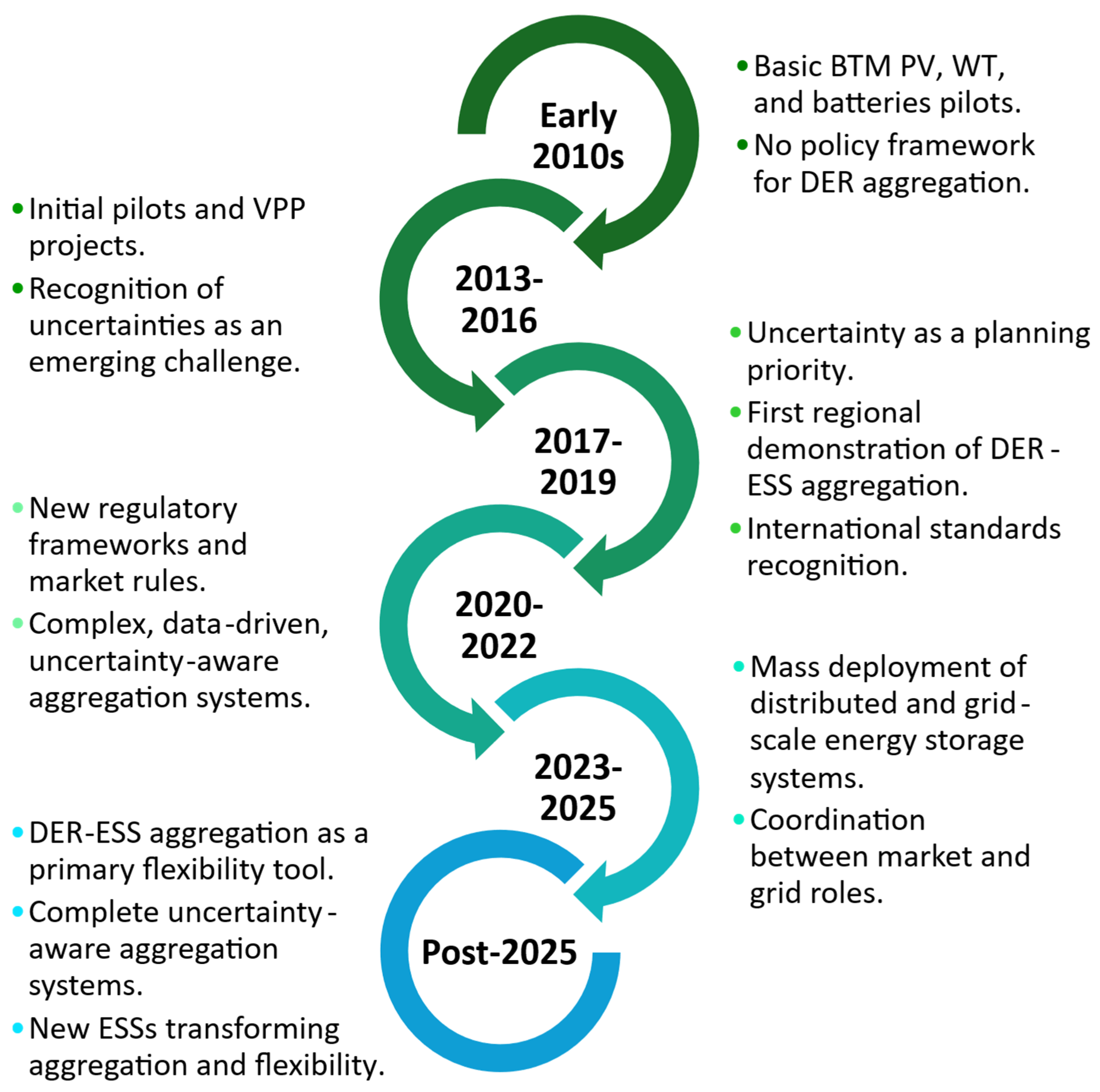
Figure 1 illustrates the DER-ESS aggregation roadmap, showing the development of tested projects, the implied rules and regulations, and the deployment of ESSs from the early 2010s to the post-2025 period. Early systems operated independently behind-the-meter (BTM) small-scale PVs, WTs, and batteries without policies or frameworks for aggregation [9,11]. Early pilot and virtual power plant (VPP) projects from 2013 to 2016 laid the groundwork [11]. As DERs and ESSs installations grow globally, utilities and policymakers identify uncertainty as a key challenge [9,11,12]. From 2017 to 2019, countries like the USA, Germany, and Japan started large-scale VPP and grid service pilot projects, laying the foundation for regional DER-ESS aggregation [9,11]. Academic research began prioritizing uncertainty in planning, while international efforts recognized the importance of harmonized data, secure communication, aggregation thresholds, and interoperability [9,11]. From 2020 to 2022, regulatory changes enabled aggregators to participate in wholesale and balancing markets, resulting in more data-driven, complex, and uncertainty-aware aggregation processes [11,13,14,15]. Since 2023, ESSs have been rapidly expanded to offset renewable generation uncertainty and provide flexibility with GWh-scale batteries. Meanwhile, system operators and regulators are focusing on coordinating market and grid roles and digitalizing interconnection [11,16]. Post-2025, the emergence of more complex, uncertainty-aware DER-ESS aggregation processes, along with new ESS technologies, is expected to drive aggregation as a primary flexibility tool [9,15,16].
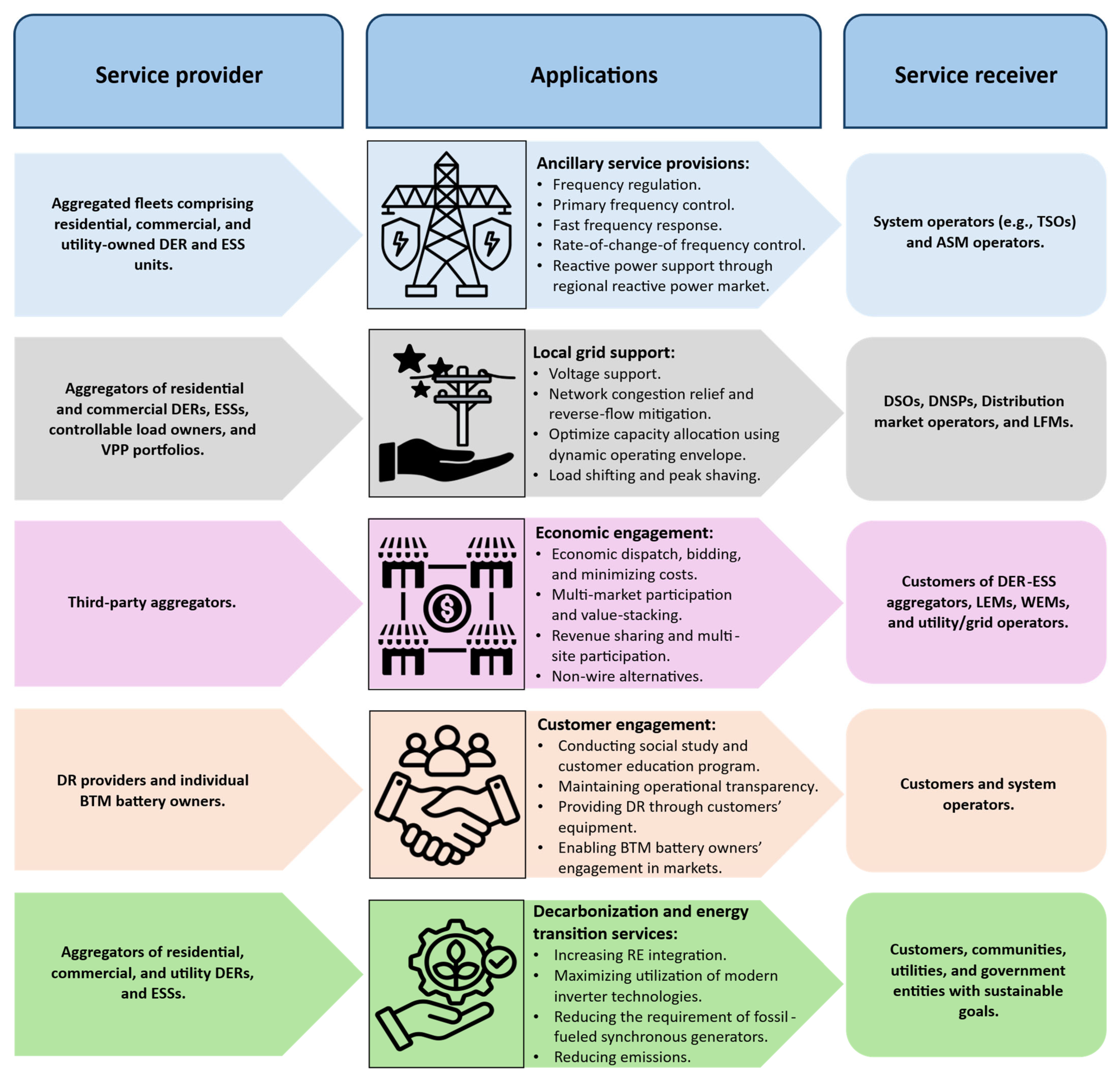
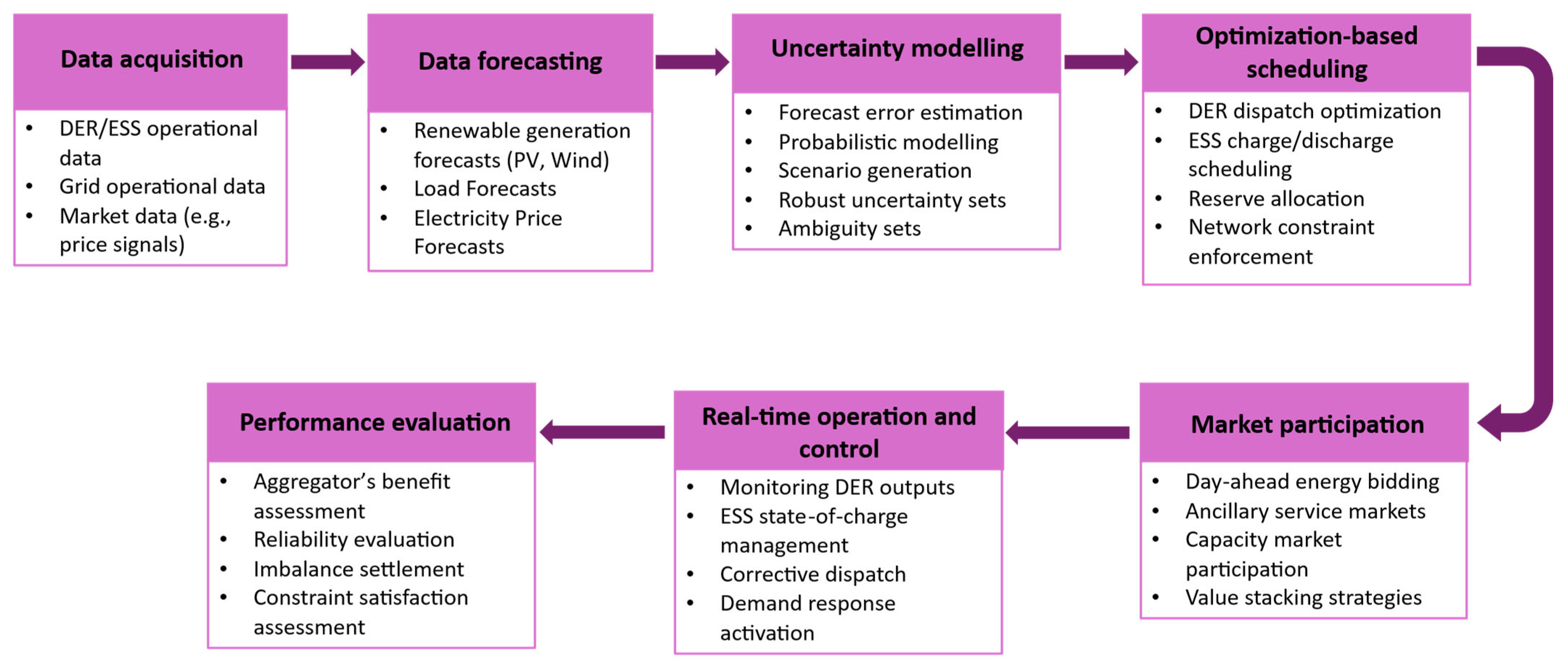
This work reviews optimization strategies for DER-ESS aggregation. Moreover, it delves deeper into the concept of dynamic aggregation. In VPP, dynamic aggregation involves combining internal resources in a way that can be adjusted in response to regulatory changes, enhancing flexibility and economic performance [17]. Unlike static aggregation, dynamic aggregation continuously updates resource composition and strategies in response to regulatory changes and evolving resource characteristics [18]. In the practical field, DER aggregators (DERAs) face unique problems that extend far beyond the assumptions of academic research. Implementing DER-ESS aggregation involves not just optimization algorithms but also requires operational robustness, real-time functionality, regulatory compliance, and adaptable communication infrastructure [19]. This review discusses the requirements for DER-ESS aggregation, including regulation frameworks and standards, communication aspects, data protection, and security systems. Following this, it discusses the application of DER-ESS aggregation in real-world settings, including frequency regulation, peak shaving, voltage support, revenue generation, and emissions reduction. Finally, the paper concludes by summarizing the key findings and proposing future research directions.

1.2. Contributions

The main contributions of this paper are summarized below:
  • This paper presents a comprehensive review of the uncertainties associated with DER-ESS aggregation processes and analyzes their impacts on operations, performance, costs, system efficiency, and computational complexity. It further evaluates how these uncertainties affect stakeholders engaged in DER-ESS aggregation in ADNs. Additionally, uncertainty correlations, their types, and impacts on DER-ESS aggregation processes are thoroughly discussed.
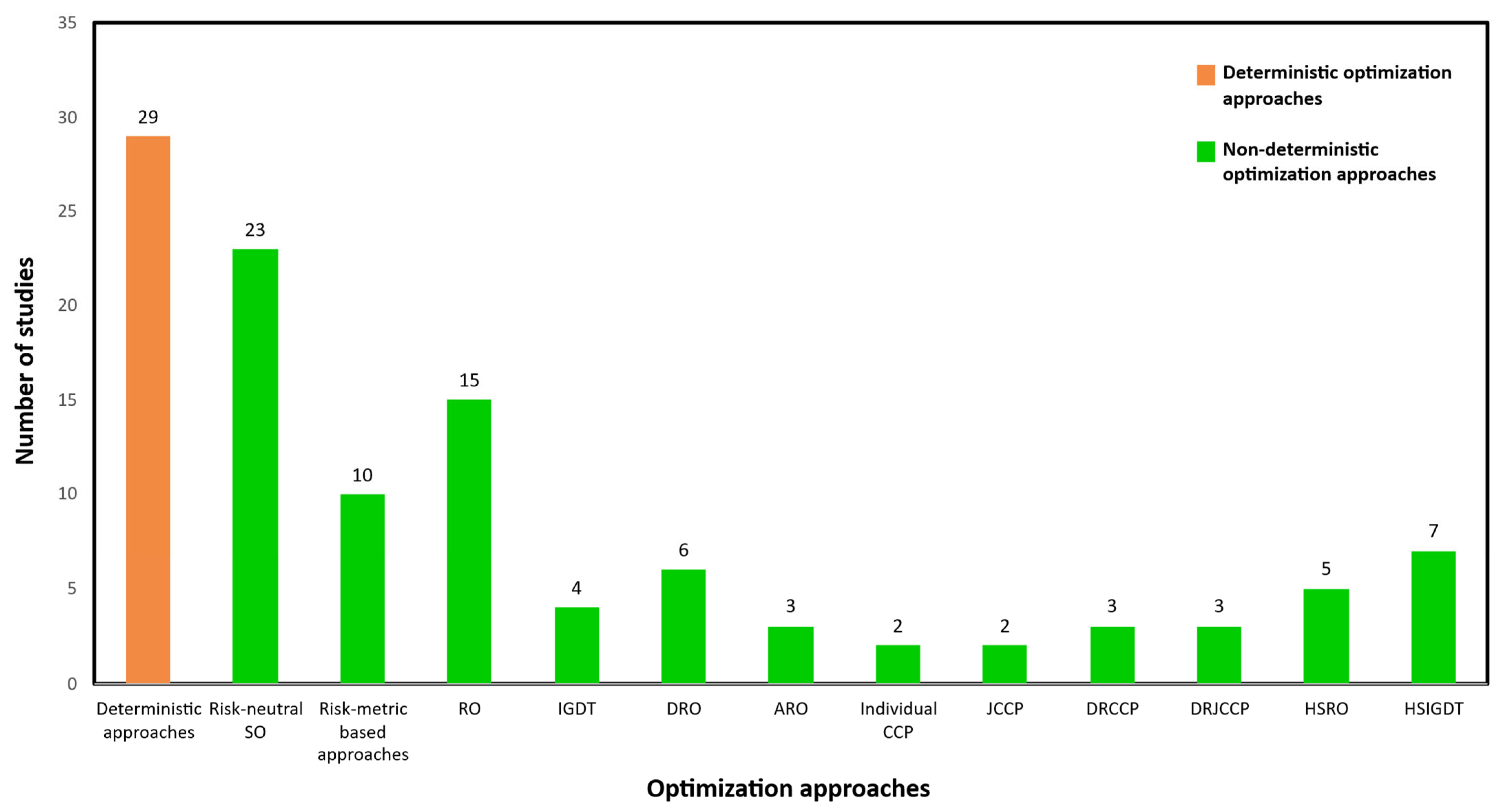
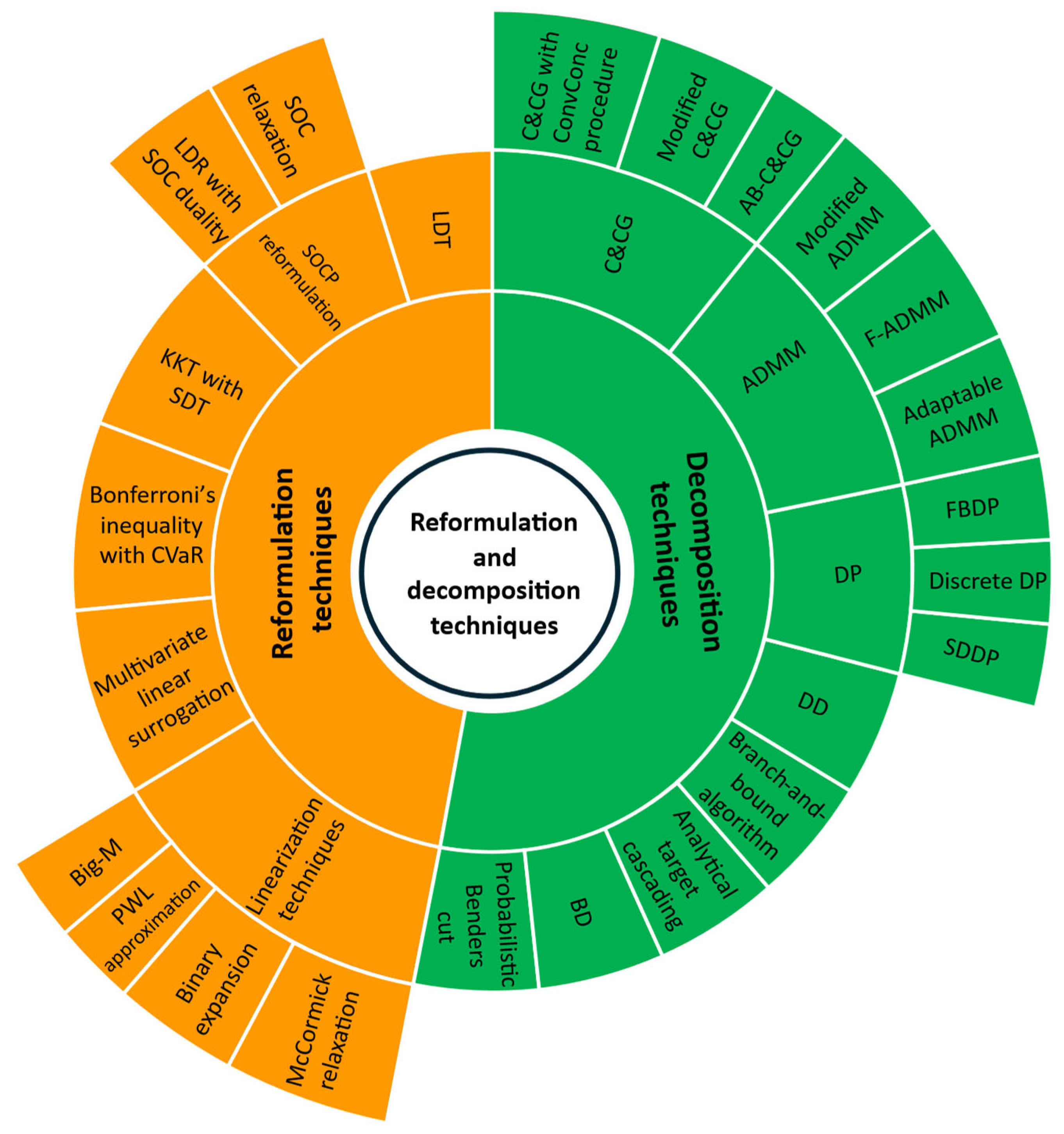
  • This work critically reviews methods for modeling uncertainty and uncertainty correlations in DER-ESS aggregation. Moreover, deterministic and non-deterministic optimization approaches are investigated, and their solution methodologies, including commercial solvers, reformulation, and decomposition techniques, are discussed.
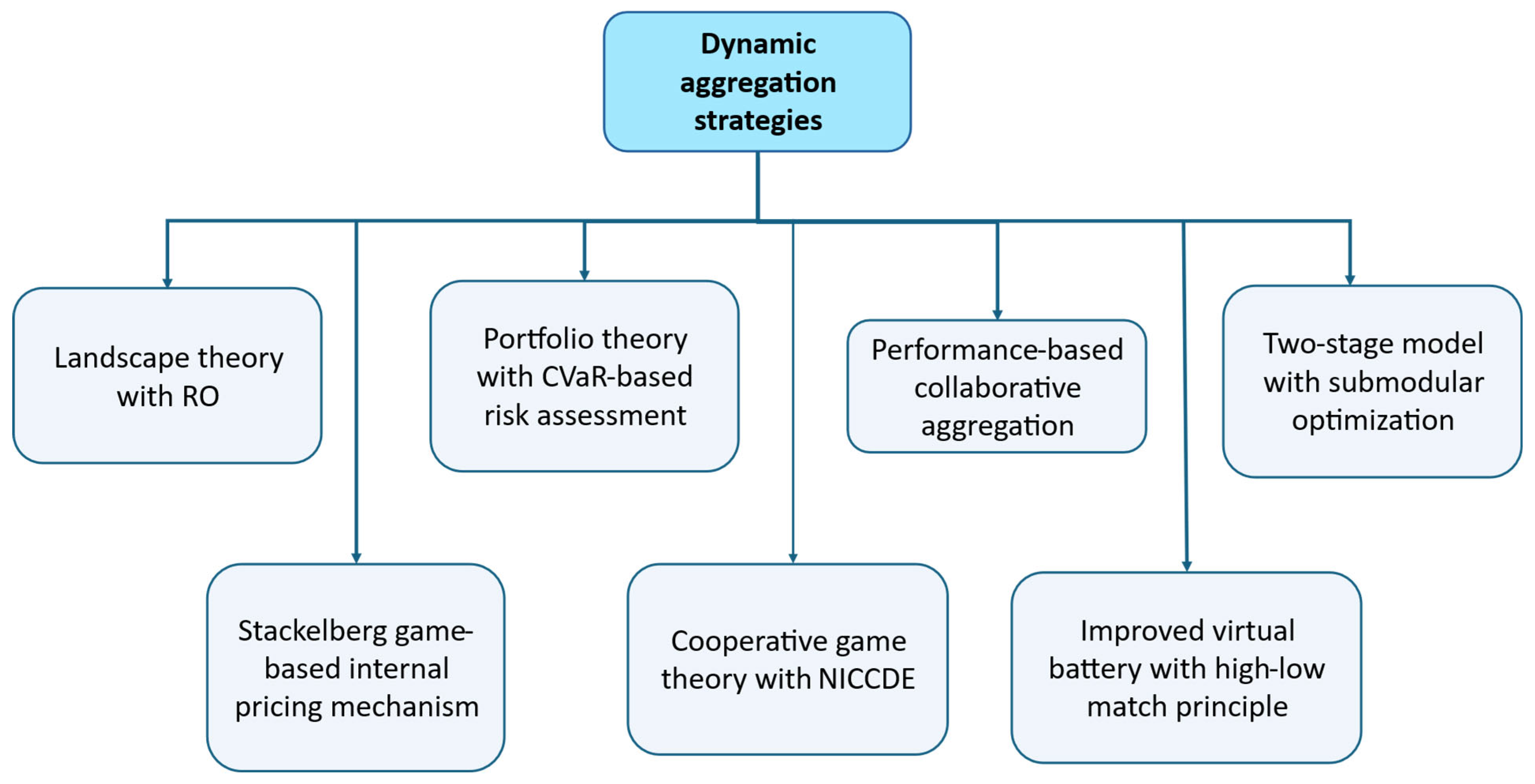
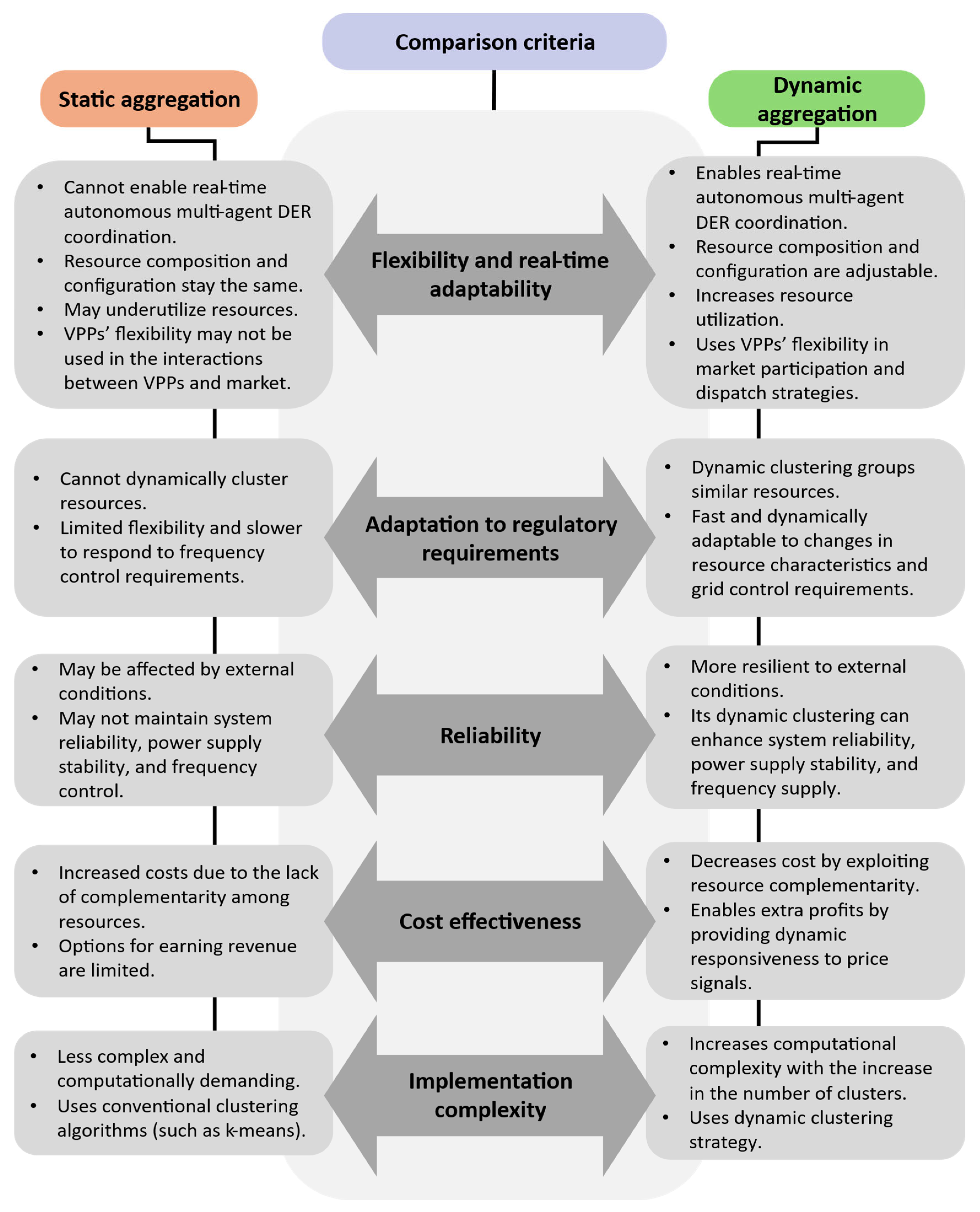
  • This work clarifies static and dynamic aggregation and discusses dynamic aggregation strategies. It further provides a comparative analysis between static and dynamic aggregation.
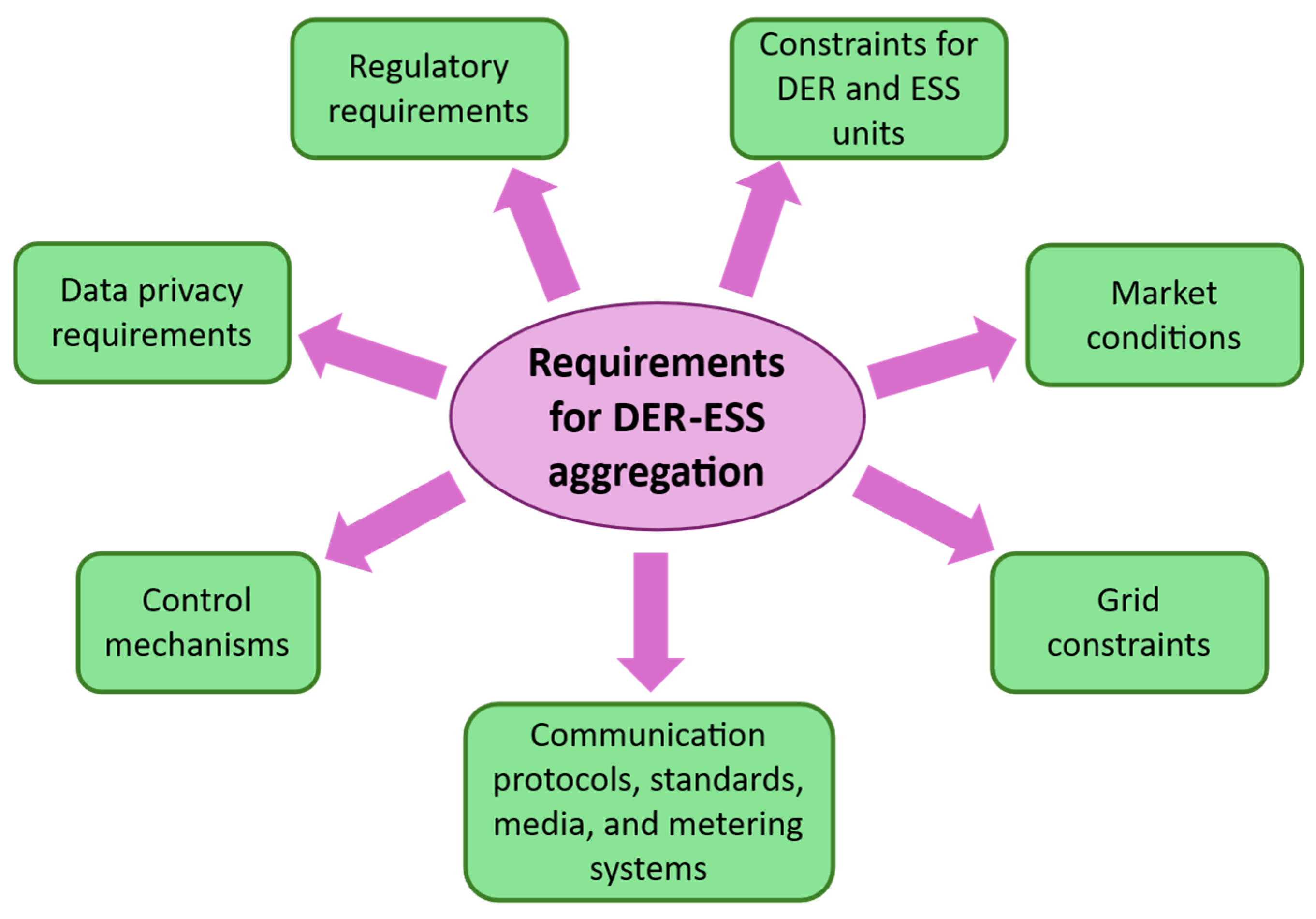
  • This study outlines key requirements for practical DER-ESS aggregation, including regulations and data privacy, market conditions, DER/ESS/grid constraints, control mechanisms, and communication protocols, standards, media, and metering systems. Finally, it highlights practical applications of DER-ESS aggregation.
Peer-to-peer review: The review in [20] provides a survey of deployed technologies, systems, and architectures for DER aggregation. It also shares lessons learned from various pilot and demonstration projects and outlines future research and development directions to unlock the full potential of DER aggregation technologies. However, that work does not cover the discussions regarding the theoretical aspects of DER aggregation. The review in [21] systematically classifies uncertainties and discusses uncertainty modeling and optimization techniques applicable to various microgrid applications. Its discussion regarding the impacts of uncertainties is confined to the performance and resilience of energy management systems. Although it addresses specific aspects of uncertainty correlations in microgrid energy management, it lacks a comprehensive, in-depth analysis of uncertainty correlation modeling. The study in [22] incorporates several deterministic optimization and heuristic approaches for VPP operation. Its discussion regarding uncertainties is limited to VPP market models and their economic performance. Although it presents numerous VPP-based projects, a comprehensive evaluation and classification of their applications is not addressed. The study in [23] investigates information and communication technologies, regulatory and market frameworks, metering and data exchange measures employed in DER aggregation. Similarly, the work in [24] only encompasses communication standards for DER aggregation. Additionally, the study [23] provides a surface-level investigation into data privacy requirements. However, other requirements for DER-ESS aggregation, such as control mechanisms, component and grid constraints, have not been covered. Although both works in [23,24] have highlighted several DER aggregation projects, their corresponding applications are not thoroughly evaluated. Finally, the study in [25] reviews only scenario generation as an uncertainty modeling method and stochastic optimization (SO) as a non-deterministic optimization approach for EV aggregators. Evaluation of prior review studies reveals a gap in the comprehensive assessment of the impacts of various uncertainties on DER-ESS aggregation from both technical and economic perspectives. In addition, the impacts of these uncertainties from the perspectives of different stakeholders in ADNs remain insufficiently explored. In-depth analysis of correlated uncertainties, their impacts on DER-ESS aggregated systems, and modeling methods for uncertainty correlations in DER-ESS aggregation have not been covered elsewhere. Furthermore, there is a lack of systematic literature review on optimization approaches for DER-ESS aggregation and on critical assessment of static and dynamic aggregation. Finally, very few studies simultaneously address both the theoretical and practical aspects of DER-ESS aggregation. This review addresses these gaps in the DER-ESS aggregation studies and provides a systematic, structured, and novel overview of various aspects of DER-ESS aggregation, focusing on both research and real-world implementation.

1.3. Organization

The paper is organized as follows: Section 2 describes the methodology employed in the literature review. Section 3 explores uncertainties, the nature of uncertainty correlations, and their impacts from both technical and stakeholder perspectives. Section 4 covers modeling methods for uncertainties and their correlations, optimization approaches and solution methodologies, and a comparative assessment of static and dynamic aggregation. Practical requirements and applications of DER-ESS aggregation are addressed in Section 5. The conclusions and prospects for future research are presented in Section 6.

2. Literature Review Methodology

This study reviews recent approaches to DER-ESS aggregation in ADNs and outlines recommendations for future research. The authors developed a systematic method for selecting relevant works.
The literature search was conducted using combinations of keywords such as distributed energy resource aggregation, energy storage system, aggregator, aggregation, bidding strategy, flexibility aggregation, market participation, optimal scheduling, data-driven strategies, reinforcement learning, and uncertainty modeling. These keywords were used across major academic databases to ensure comprehensive coverage of relevant studies.
Papers were included if they addressed DER aggregation, energy storage, applications of aggregators, uncertainty-aware optimization, market participation of aggregators, and cooperative and non-cooperative frameworks among aggregators. Studies that did not focus on DER aggregation frameworks or lacked sufficient methodological relevance to the topic were excluded.
The quality evaluation considered several factors, including (i) the technical relevance and methodological contribution of the study, (ii) the reputation of the journal or publisher where the work was published, (iii) the impact of the research, reflected through citation counts and readership metrics where available, and (iv) the publication time, ensuring that recent developments in DER aggregation and energy storage coordination were adequately captured while still including important foundational studies.
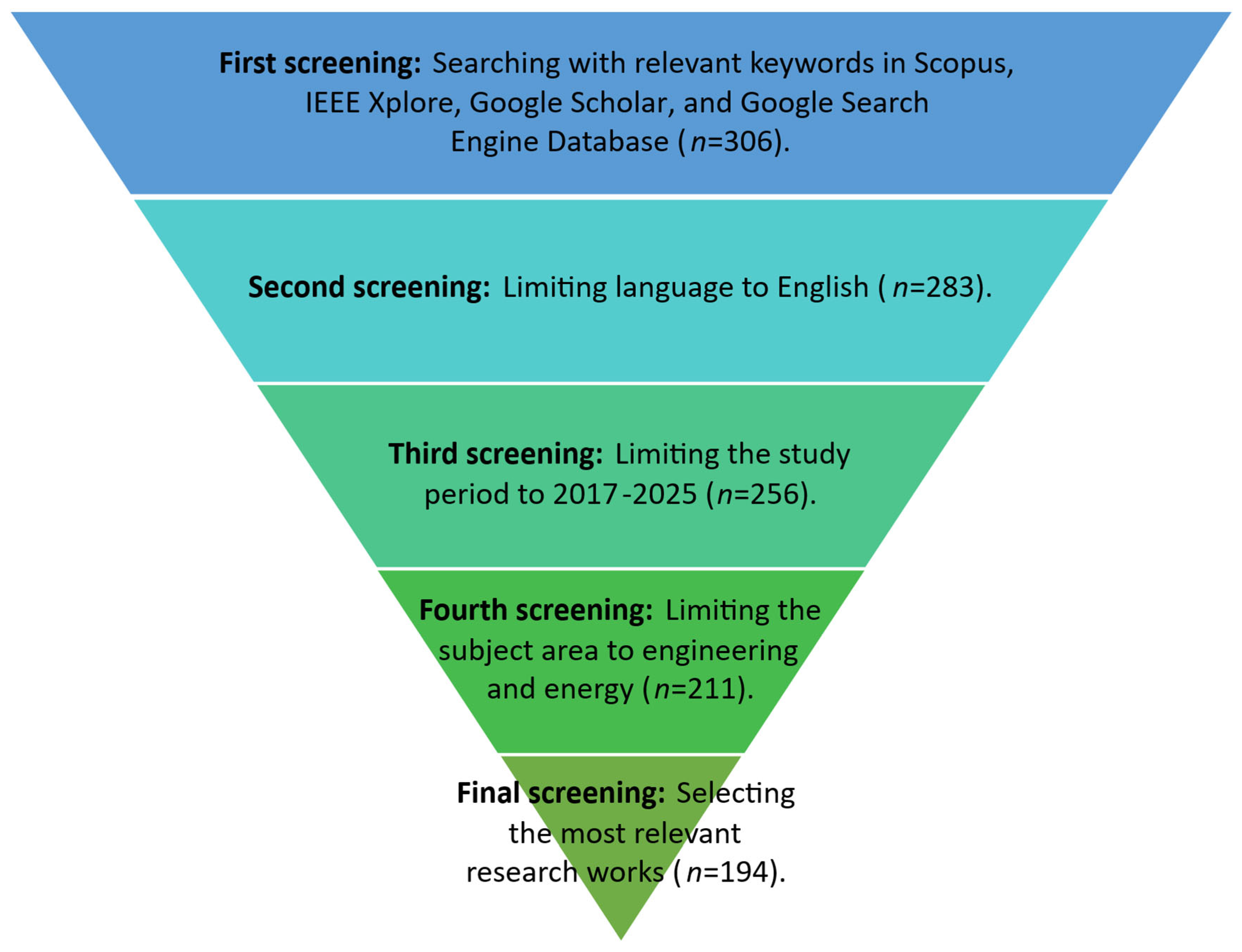
Figure 2 depicts the methodology applied for research work selection (n refers to the number of pertinent research works found in each screening stage):
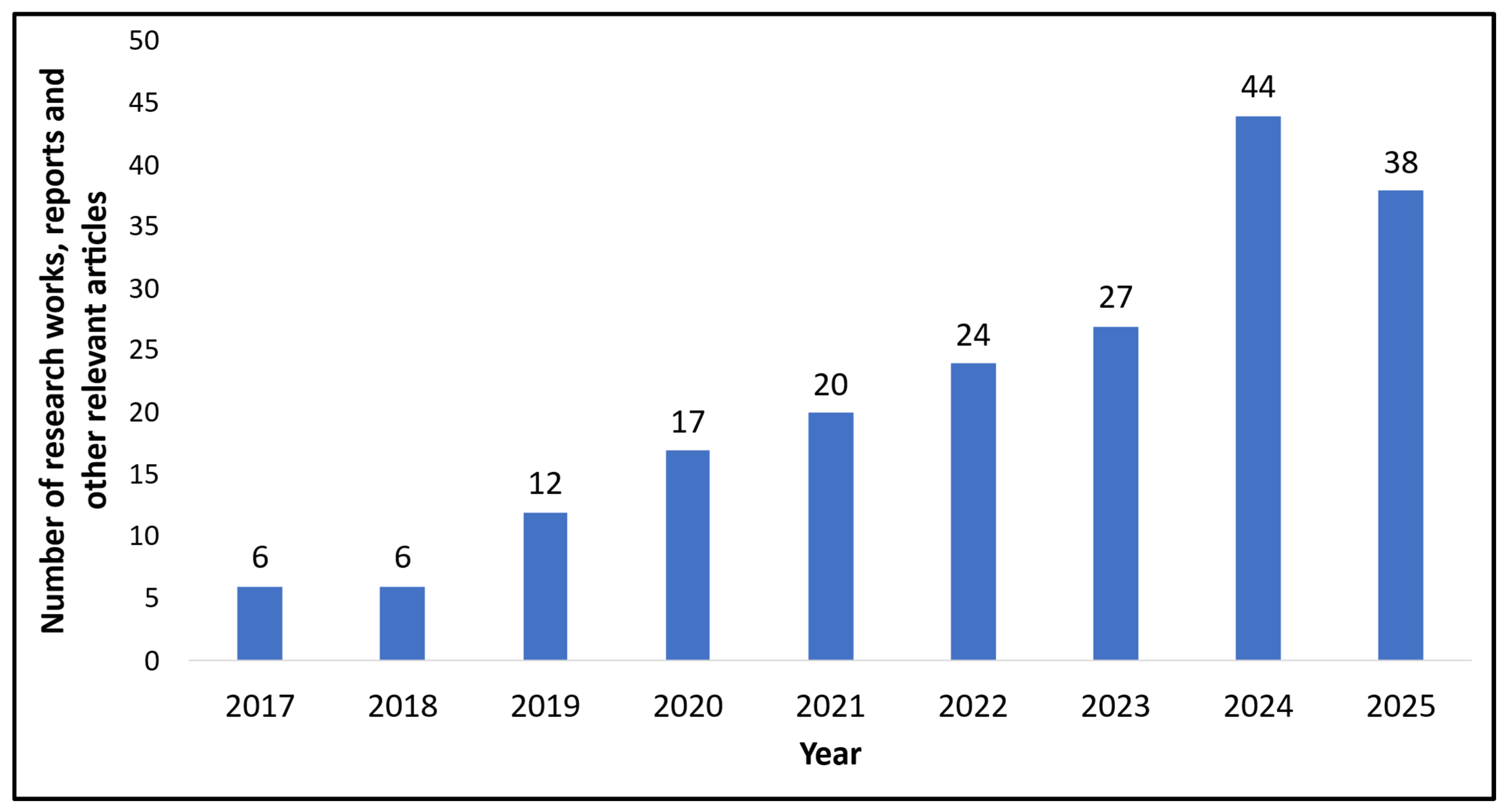
This bibliographical review uses a systematic approach to refine research papers for a literature review, as shown in Figure 2. The initial screening using database searches on Scopus, IEEE Xplore, Google Scholar, and Google Search Engine identified 306 papers based on relevant keywords. The second filter, which limited results by language, restricted the selection to English-only articles, reducing the total to 283. The third filter, applying a time range from 2017 to 2025, further narrowed the selection to 256. The period of 2017–2025 was chosen for article selection based on the adoption trends of DER-ESS aggregation technologies during this time. The fourth filter, focused on engineering and energy relevance, decreased n to 211. In the last stage, the research works were evaluated one by one to select the most relevant, high-quality studies, resulting in n = 194. Of these, 118 were research papers (on DER–ESS aggregation, dynamic aggregation, and artificial intelligence-based (AI) DER-ESS aggregation strategies), 54 were technical and industrial reports, and 22 were other types of articles. Figure 3 shows the number of papers published during the period from 2017 to November 2025. Overall, it shows an increasing trend, indicating that interest in DER-ESS aggregation has grown in recent years (note that the count for the year 2025 includes only papers published up to November).
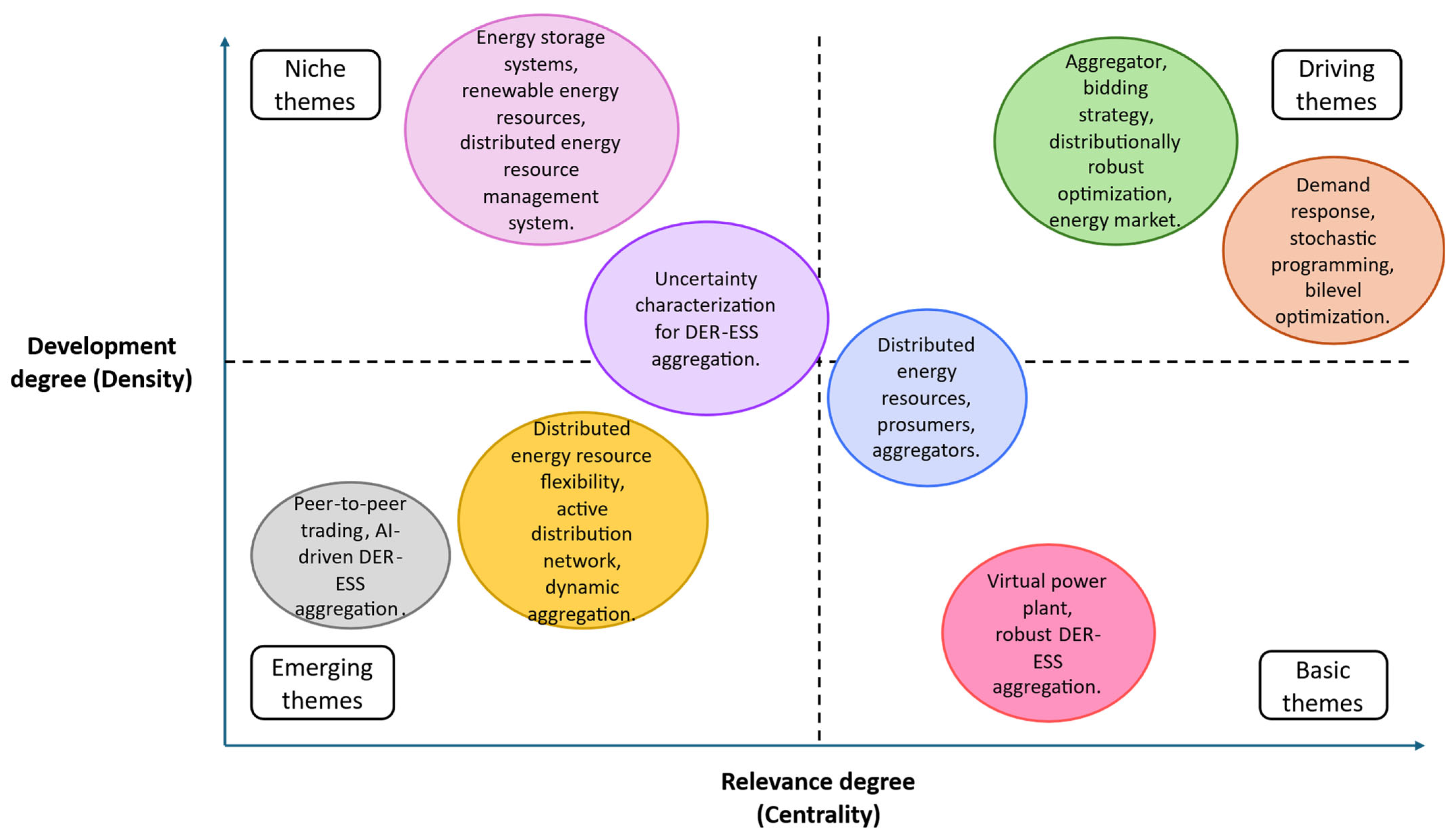
The thematic map in Figure 4 shows the most relevant issues in DER-ESS aggregation research based on the keywords of different researchers. In this figure, centrality indicates a theme’s connection to the broader field, while density reflects its internal development and specialization. The upper-right quadrant (driving themes) contains the most central and well-developed research themes. The first cluster of “Aggregator, bidding strategy, distributionally robust optimization, energy market” indicates that market participation and bidding under conditions of uncertainty have become a fundamental and well-established area of research in DER-ESS aggregation. Its high centrality indicates that aggregator decision-making is closely linked to many DER-ESS aggregation topics, while its high density indicates a well-established methodological foundation. The second cluster, “Demand response, stochastic programming, bilevel optimization” and the mention of distributionally robust optimization (DRO) confirm that uncertainty-aware modeling approaches and hierarchical decision-making techniques constitute a major research backbone. At the same time, several research works on this theme focus on using flexible demand as a controllable resource under uncertainty.
The lower-right quadrant encompasses basic or transversal topics that are conceptually significant across the field but are not as internally developed as the driving themes. The cluster “Distributed energy resources, prosumers, aggregators” suggests that these concepts form the core basis of DER-ESS aggregation studies, connecting technical, economic, and market-oriented aspects. Its lower density implies that this theme remains broad and dispersed. It is expected in a field where multiple applications of DERs, prosumers, and aggregators exist. Similarly, the discussion pertains to the “Virtual power plant, robust DER-ESS aggregation strategies” cluster, and its lower density indicates that this theme remains in development concerning implementation specifics and incorporation with practical constraints.
The niche themes are those which are internally mature but lack interaction with the rest of the research landscape. The high density and low centrality of cluster “Energy storage systems, renewable energy resources, distributed energy resource management system” indicate that this theme is well developed but largely confined to narrower technical boundaries. The moderate-to-high density of the cluster “Uncertainty characterization for DER-ESS aggregators” suggests that uncertainty in DER-ESS aggregation studies is already a technically developed topic, while its limited centrality indicates that there are still gaps remaining in the consideration and modeling of uncertainty correlation in these studies.
Finally, the clusters in the lower-left quadrant may indicate emerging themes. The position of the cluster “Distributed energy resource flexibility, active distribution network, dynamic aggregation” implies that research in dynamic aggregation and network-aware flexibility may not have become mature in the literature, despite their growing practical significance. Moreover, the theme “Peer-to-peer trading, AI-based DER-ESS aggregation” indicates that peer-to-peer trading has not been fully integrated into the dominant knowledge structure of DER-ESS aggregation under uncertainty. Moreover, research on AI-based DER-ESS aggregation strategies is at a relatively early stage of development, but it is attracting growing scholarly attention and shows strong potential for further advancement.
Overall, the map shows that literature on DER-ESS aggregation is centered on a few highly operational, market-oriented themes, supported by broader foundational topics and complemented by several specialized or still-maturing research directions.

3. Uncertainties and Their Impacts on DER-ESS Aggregation

This section examines uncertainties in DER-ESS aggregation, including renewable energy (RE) generation and load forecasting errors, market price fluctuations, changes in prosumer behavior, policy changes, and component failures. These uncertainties restrict system operation, emphasizing the importance of identifying their sources. Additionally, it addresses the potential impacts of these uncertainties on the DER-ESS aggregation process. Furthermore, correlations among different uncertainties, their nature, and the impacts of considering uncertainty correlations on the DER-ESS aggregation process are investigated.

3.1. Uncertainties Associated with DER-ESS Aggregation

DERs, such as solar, wind, and small hydro, play a vital role but face variability and intermittency, introducing uncertainties in power generation. These uncertainties, driven by weather, seasons, and environmental changes, affect energy output. Most of the reviewed studies on PV focus on uncertainties arising from solar irradiance variability, cloud coverage, and diurnal changes [26]. Similarly, the output of WTs varies due to the stochastic nature of meteorological parameters [27,28,29]. The output uncertainty of hydro pumps (HPs) arises from water level fluctuations caused by uneven rainfall and natural inflow [30]. The study in [31] considers PV, wind power (WP), and HP output uncertainties. Most of the factors affecting DER generation outputs, such as global horizontal irradiance, water level, cloud coverage, and wind speed, are forecasted. Forecast errors pose a significant challenge in DER-ESS aggregation, complicating the scheduling of ESSs to compensate for unavailable sources.
Demand-side uncertainties in DER-ESS aggregation stem from the unpredictable and variable energy consumption profiles, as well as EV availability and EV charging behaviors of consumers [32,33]. Consumption patterns may vary gradually or exhibit sudden and unpredictable changes [34]. Human behavior is influenced by demographics, as prosumers with similar demographics often share similar schedules, consumption habits, and flexibility. Furthermore, sociodemographic characteristics are correlated with prosumers’ DR participation [32]. The availability of EV charging stations within a specific demographic influences the charging and discharging behavior of EV users. Additional factors, such as arrival and departure times, introduce uncertainties in both load and EV usage patterns [33]. Thereby, demography plays an important role in introducing uncertainties. Cost savings and supply security are consistently reported as the most critical drivers for the adoption of DERs and participation in aggregation programs [35].
Changes in regulations create uncertainty for DER-ESS aggregation, as varying rules, compensation mechanisms, and policies from governments and regulators influence DER participation in energy markets [8,36]. Complex regulations vary significantly across states, resulting in uneven playing fields and increased business costs [37]. Regulation and policy changes influence how DERs and ESSs are used by either encouraging or limiting their use [13,38]. Australian state-based incentives, including the NSW energy saving scheme [39], Victorian energy upgrades [40], and the Victorian solar homes program [39], provide incentives, subsidies, and rebates for installing renewable alternatives and ESSs over inefficient and energy-consuming appliances. On the contrary, the Australian federal government also imposes restrictions through the implementation of technical standards. For instance, AS 4777.2:2020 has been mandated by the Australian Energy Market Commission (AEMC) to ensure compliance for small embedded DERs [41]. Furthermore, the export and import limits for DERs are set by distributed network service providers (DNSPs) to maintain grid integrity [42]. Thus, financial benefits and compatibility positively drive prosumers to adopt DER-ESS aggregation, while restrictions reduce financial attractiveness and slow down the pace of this uptake. Regulatory fragmentation, slow adoption, unclear enforcement, and inconsistent standards create uncertainty for DER-ESS aggregation, impacting investments and business models. Additionally, varying jurisdictional treatments for DER compensation mechanisms create revenue stacking uncertainties. This occurs when aggregators seek to participate simultaneously in both retail DR programs and wholesale capacity markets [43]. Most studies indicate that dynamic policies and contested regulations continue to hinder the maturation of DER-ESS aggregation technology [43,44,45,46].
As one of the primary roles of DERAs is to participate in the market, almost every aggregation approach considers market prices in its corresponding modeling and optimization [47]. These fluctuations, caused by changes in fuel prices, grid congestion, RE integration, and demand-side management, create uncertainty in energy trading and pricing [48]. DERAs participate in various types of markets, such as day-ahead, spot, real-time, wholesale, and ancillary service markets (ASMs). Fluctuations in market prices consequently affect their decision-making process [49]. Market price uncertainties significantly impact profit-sharing and optimal energy use strategies among prosumers [50]. Uncertainty in day-ahead market prices increases operational and investment risks. It complicates DERAs’ decisions, such as whether to charge or discharge ESSs. Meanwhile, analyzing wholesale electric market (WEM) prices with the inclusion of time-of-use rates and feed-in tariffs has also become a key research focus [51].
The reliability concerns for individual components limit the reliability of aggregated DER-ESS portfolios. Each DER unit may have its unique operating conditions, environmental stress, or maintenance requirements. As a result, the likelihood of an unexpected outage or deterioration in performance increases with the number and diversity of the aggregated assets [52]. Furthermore, component failures, including DER unavailability, bus and line outages, impact the aggregator’s reliable decision-making [47,53]. Failures in advanced metering infrastructure (AMI) create uncertainty about customers’ DR participation [54]. DERs such as PVs, WTs, and HPs often deviate from their ideal behavior due to factors including component corrosion, delamination, control system malfunctions, and gearbox failures. These issues can result in significant deviations in output. For instance, cell cracks in PV modules and potential-induced degradation can lead to power losses of approximately 3% and 5%, respectively [55]. In addition, high temperature and moisture exposure may reduce the short-circuit current by 6–13% [55]. A recent study in [56] suggests that PV-related uncertainties are likely to intensify under future climate warming. Global rooftop PV exposure to high-temperature risk and extreme high-temperature risk may increase by 29% and 97% under 2° and 4° Celsius warming above pre-industrial levels. As a result, this will accelerate PV cell aging, shorten service life, and increase the levelized cost of electricity.
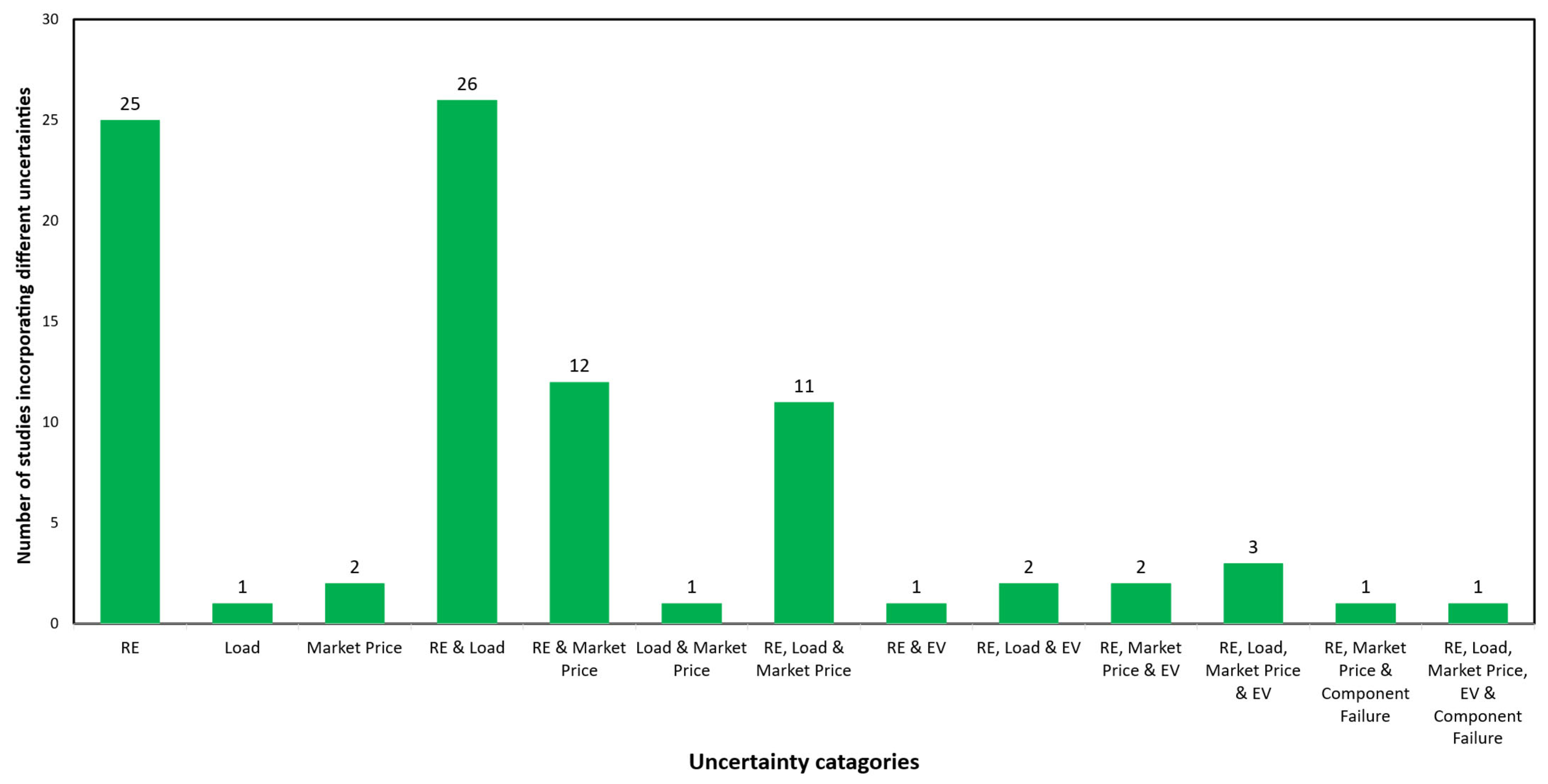
Figure 5 categorizes various studies according to the uncertainties addressed within each. It demonstrates that, out of a total of 118 studies, 88 incorporate one or multiple uncertainties into their optimization frameworks. The figure shows that researchers mainly focus on modeling multiple uncertainties rather than just a single uncertain variable. Specifically, 60 studies address multiple uncertainties, and 28 studies focus on handling a single uncertainty. Accounting for a single uncertainty, a total of 25, 1, and 2 studies incorporate uncertainties related to RE, load, and market price, respectively. Overall, 26 studies address accounting RE and load uncertainties, representing the highest number among studies covering single or multiple uncertainties. It is followed by 12 and 11 studies that incorporate uncertainties related to RE and market price, and to RE, load, and market price. A few studies include uncertainties related to EVs and other factors, ranging from 1 to 3 per category. Finally, 2 papers consider component failure along with other uncertainties.
To avoid potential misinterpretation, it should be noted that the categories shown in Figure 5 are intended to provide a descriptive overview of the relative research attention given to different uncertainty sources rather than a statistically precise classification. Some categories contain only a small number of studies because certain uncertainty types, such as component failure or regulatory uncertainties, have received limited attention in the existing DER–ESS aggregation literature. These categories were retained to highlight emerging research gaps and to emphasize areas that require further investigation.

3.2. Impacts of Uncertainties on DER-ESS Aggregation

In this section, the various impacts of uncertainties on DER-ESS aggregation process are thoroughly investigated. After that, it provides a cross-study synthesis of the reviewed research works.

3.2.1. Impact on System Operational Costs and Economic Risk

Various uncertainties raise operational costs and strain DERAs’ economic planning. Prediction errors, reserve buffers, energy spillage, and market price fluctuations increase financial risks, complicating aggregation schemes [47,57,58,59,60]. Overlooking these uncertainties may result in a loss of profit, which in turn could impact DER-ESS aggregation strategies [57].
Stochasticity of resources increases operational costs and is directly linked to decision-making factors [58]. The uncertainties of RE sources (RESs) pose challenges for controlling the outputs of DERs to mitigate their adverse effects on ADNs, potentially creating significant voltage profile fluctuations and additional operational costs in ADNs [58]. Moreover, uncertainties in RE generations increase scheduling costs for DERAs [59]. Uncertainties that cause a mismatch between planned energy supply and actual generation can lead to spillage costs (when actual generation exceeds the scheduled output) and reserve requirement costs (when it falls short) [59]. Additional economic risks arise from customer price responses, which may increase scheduling and bidding costs and may result in the DERA purchasing energy at high prices and selling at low prices [59]. Consequently, price forecast errors may result in lost revenues for aggregators. Electricity price uncertainty significantly impacts the optimal solution for DER-ESS aggregation because it influences decision-making in the electricity market [47]. Incorporating ESS degradation costs into the risk-aware optimization of DER offerings and allocations reveals that uncertainties, such as those arising from weather conditions and customer load, significantly affect the aggregator’s bidding performance and market revenues [60].

3.2.2. Impact on System Reliability and Stability

DER aggregation is evolving to prioritize not only economic and environmentally friendly energy, but also system reliability and stability. However, this transition is challenged by uncertainties in demand, supply, and external sources, adversely affecting the secure and stable operation of DER-ESS aggregated systems in ADNs [61].
Uncertainties in RESs can compromise the operational reliability of the aggregated system [62]. Ignoring forecast errors at the aggregation level may result in infeasible schedules, thereby posing risks to reliability and stability [63]. Furthermore, in coupled transmission and distribution systems, dispatch decisions affected by uncertainties may lead to issues such as power imbalances, frequency and voltage violations, and line congestion [61]. If aggregators cannot provide contracted flexibility in balancing markets because of RE generation uncertainty, they are penalized through imbalance settlement costs [64]. Moreover, ignoring uncertainties results in an underestimation of imbalance risks, which may jeopardize the secure and stable operation of the system, even when ESSs are present [65]. Additionally, uncertainties in RE generation and consumption can lead to possible interruption of supply [66]. These uncertainties can impose risk margins on VPP operation, and necessitate continuous adjustment of ESS dispatch schedules to ensure system reliability and stability [67]. Such uncertainties may necessitate additional reserves to prevent load loss and renewable power curtailment. Insufficient up/down risk reserve capacity can lead to a high value of expected energy not supplied and expected energy wasted [29]. Complications in load restoration decisions caused by uncertainties in power injection at control nodes lead to lower reliability indices [29,68]. Furthermore, higher uncertainties reduce the upper limit of flexibility available to mitigate risks, thereby subsequently decreasing the system reliability [69].

3.2.3. Impact on Dispatch, Scheduling, and Control Strategy

Scheduling, dispatch, and control strategies are vital for the effective operation of aggregated DERs and ESSs. The stochastic nature of renewable resources like PV and WT causes deviations between forecasted and actual output, complicating short-term scheduling and dispatch planning. Uncertainties arising from forecasting errors in generation, demand, and other uncertain factors can reduce dispatch efficiency, degrade control performance, and may require frequent rescheduling of aggregated resources [58,68,70]. As the magnitude of forecast errors increases, the complexity of scheduling and dispatch decisions grows correspondingly, making it more difficult for aggregators to maintain optimal and reliable operation under dynamic conditions. Forecast errors in generation and load demand may cause over-generation or under-generation from the dispatchable units and lead to inefficiencies in energy dispatch and scheduling [70]. This further increases discrepancies between energy supply and demand, which could affect the operator’s ability to maintain stable grid operations [32,71]. Uncertainties in RE generation forecasts and demand can disrupt the coordinated operation of aggregated DER units, causing individual resources to respond asynchronously or, in some cases, behave counterproductively [71]. Moreover, charging and discharging schedules of ESS units should be dynamically adjusted to manage fluctuations within operational limits [72]. Additionally, forecasting errors can complicate this process by causing unnecessarily high reserve allocations for ESS units, thereby limiting their available capacity for real-time charging and discharging. As a result, the ability to respond to real-time fluctuations decreases, leading to suboptimal ESS utilization [73]. Furthermore, the interaction among multiple DER units under uncertain network and market conditions complicates real-time scheduling [74]. The integration of advanced control strategies into DER-ESS aggregated systems facilitates the coordinated operation of multiple units or clusters to meet regulatory requirements, such as voltage and frequency regulation limits, and to comply with network constraints.

3.2.4. Impact on Market Participation and Revenue Optimization

Market participation and revenue generation are some of the main responsibilities of the DERAs [75]. However, DERAs face various challenges due to uncertainties in RESs, demand, markets, and regulatory and policy changes. These uncertainties hinder the market participation and decision-making processes for DERAs, making them more complex and time-consuming. As a result, they may incur losses, which could negatively affect their future market participation decisions.
Aggregator’s suboptimal scheduling decisions can lead to inefficient market participation and missed revenue opportunities [51]. Uncertainty in market price and load forecasting errors can increase operational expenses, as the aggregator must consistently hedge against associated risks [76]. Additionally, coalition-level uncertainties, which refer to the inflexible demand, outdoor temperature, and PV generation of each prosumer within a coalition, can result in increased costs, thereby necessitating the implementation of effective management strategies for these uncertainties [77]. In non-deterministic optimization frameworks, higher uncertainty budgets for these uncertainties usually lead to increased management costs [66]. Aggregators must consider RE generation uncertainties when determining bidding capacities to maximize market revenue [60]. Therefore, uncertainties affect the bidding benefits of aggregators [60]. Furthermore, the inability of aggregators to meet their bids results in a failure to comply with market requirements, thereby leading to penalties [60]. Although aggregators’ conservative strategies minimize the likelihood of penalties, they result in reduced efficiency, increased operational costs, and missed revenue opportunities [60,66]. Due to market price and RE generation uncertainties, an aggregator’s profits often fluctuate and may result in minimal gains or losses [78]. Moreover, as the deviation of profit from the expected profit increases, the decision-making process of the aggregator may become more conservative [79].
Uncertainties regarding regulatory and policy changes create inconsistencies in rules such as participation eligibility, payment schemes, dispatch protocols, market entry criteria, incentives, and standards across different regions [80,81,82]. Additionally, these uncertainties can lead to discrepancies in incentive programs like rebates, performance incentives, solar or battery subsidies, and grid or equipment standards. Consequently, such discrepancies create uneven competitive environments, reducing customers’ motivation to participate in these programs [80,81,82]. Furthermore, these discrepancies can reduce the financial appeal for DERAs to participate in both energy markets and ASMs [83,84].

3.2.5. Impact on Overall Aggregation Efficiency and Resource Management

The overall aggregation efficiency and management of a DER-ESS system depend on how effectively the coordinated operation of DERs and ESSs is carried out to fully utilize their available flexibility. However, uncertainties related to RE generation, prosumer behavior, and market conditions influence the efficiency of DER-ESS aggregation and the synchronization of resource management. The presence of such uncertainties disrupts coordinated scheduling, complicates resource allocation, and increases operational costs by forcing aggregators to adopt conservative reserve margins [85,86].
The small individual size and inherent uncertainties of RESs, coupled with their continuously increasing penetration into power systems, have complicated the task of optimal scheduling and coordination [85]. Therefore, the aggregator may fail to achieve its expected flexibility and performance levels [44]. These challenges are further intensified by the lack of standardized, real-time control coordination mechanisms and data visibility frameworks, resulting in unexpected DER tripping [82,87]. Furthermore, adding resources to an aggregator without proper coordination may induce the Braess paradox, a counter-intuitive phenomenon in which improving or adding system components can inadvertently degrade overall performance [18].
As the number of BTM DERs and ESSs continues to grow, the net load forecasting is becoming increasingly challenging [44]. Therefore, DERAs must exercise caution when making aggregation decisions under forecast uncertainty, as both overestimation and underestimation of available flexibility can result in operational inefficiencies and increased costs [88]. Furthermore, uncertainties can lead to asynchronous decision-making among the DERAs operating in the same local energy market (LEM), resulting in suboptimal coordination, resource allocation inefficiencies, higher operational costs, and potential reliability issues [86]. Uncertainties related to RE generation and demand-side EV charging/discharging complicate day-ahead resource pooling aggregators [89]. Collectively, these inefficiencies not only affect local grid performance but also diminish the aggregator’s competitiveness in emerging transactive energy market structures [90].

3.2.6. Impact on Computational Modeling of DER-ESS Aggregation

DER-ESS aggregation frameworks necessitate computational modeling for their calculations and overall decision-making processes. However, the uncertainties from RESs, customer load, EV charging behavior, etc., complicate the computational aspects of DER-ESS aggregation systems.
In DER-ESS aggregation deterministic formulations, model accuracy may be undermined by simplified or static representations of stochastic parameters, resulting in suboptimal operating decisions under real-world variability [60,91,92]. This necessitates using non-deterministic optimization approaches incorporating uncertainties for this problem. Although non-deterministic approaches incorporate uncertainty, their computational demands may be so high that they can prohibit real-time applications [8]. Furthermore, the dimensionality of the optimization problem typically increases, potentially leading to non-convexity and requiring greater computational effort and longer solution times [93]. For instance, the complexity of the aggregator’s bidding strategy increases with the inclusion of market price and WP uncertainties, leading to a higher computational burden in solving the problem [94]. Some uncertainty modeling methods may require high-resolution temporal data and introduce significant data dependency [95]. Additionally, if the uncertainty budget has high values, the solution space becomes broader, allowing uncertainties to fluctuate across a wide range [77]. Researchers have employed decomposition strategies such as Benders decomposition (BD), the alternating direction method of multipliers (ADMM), and column-and-constraint generation (C&CG) to reduce problem size and computational complexity while retaining solution quality [63,85,96]. Nevertheless, in the presence of binary uncertainties, standard decomposition methods may encounter complications and may not guarantee convergence [51]. As the number of RE resources grows and their types and geographic distributions vary, they may require significant computational effort for the non-deterministic optimization of DER-ESS aggregation [62]. Moreover, hidden and unaccounted correlations among wind, demand, and electricity prices can further complicate aggregator bidding strategies, and simple stochastic models may not perform well for all scenarios [97]. Achieving an appropriate balance between modeling fidelity and computational efficiency remains a fundamental challenge in uncertainty-aware DER-ESS aggregation.
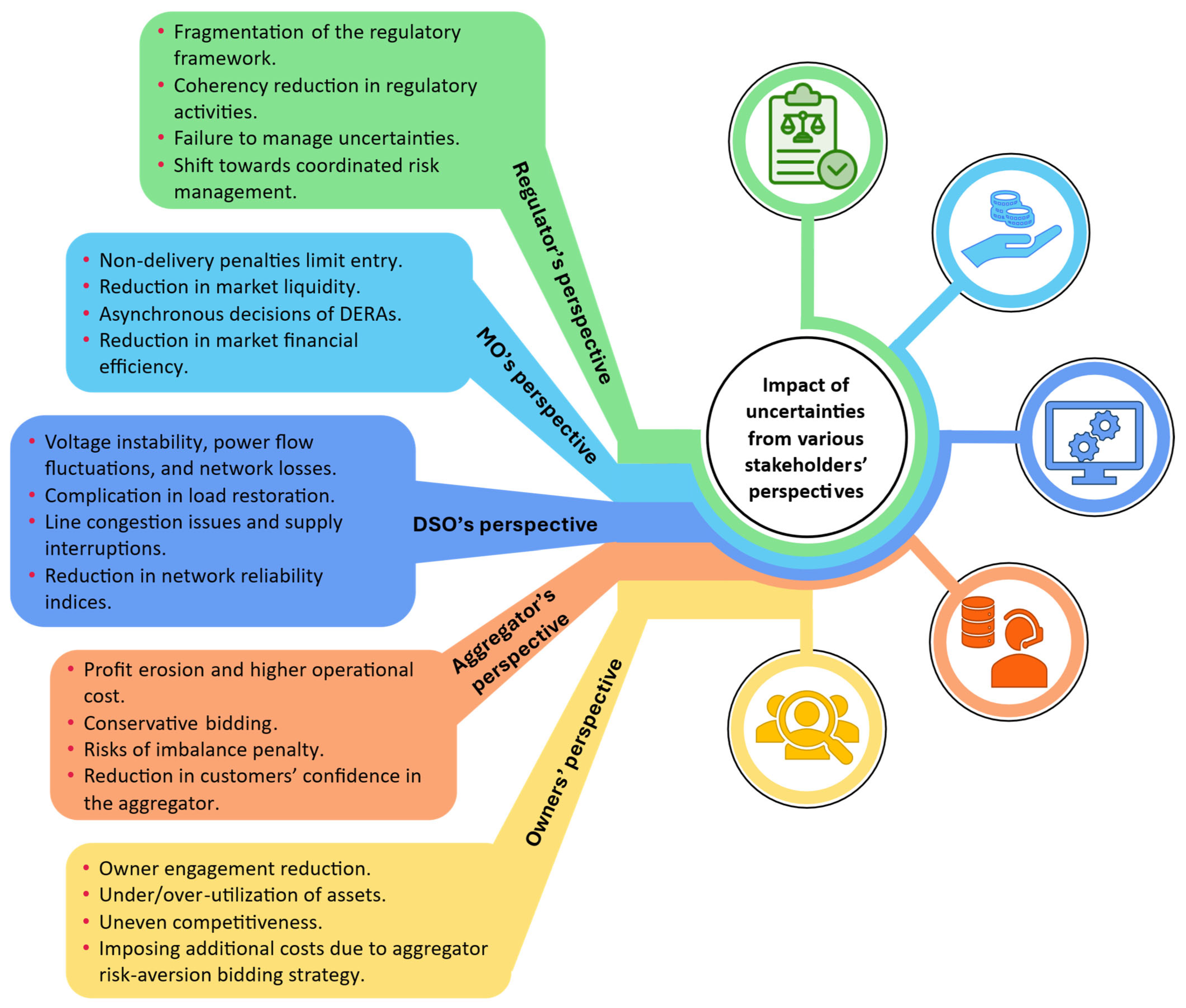
The preceding discussion analyzes the impacts of uncertainty from a technical standpoint. However, uncertainties affect the market, regulatory, and other arrangements that are built upon their corresponding underlying sources [98]. Figure 6 provides an overview of the impacts of uncertainties from the perspectives of various stakeholders involved in the DER-ESS aggregation process, including the regulator, DSO, market operator (MO), aggregators, and DER and ESS owners. The introduction of uncertainties is fragmenting the old, steady-state regulatory framework for promoting economic efficiency [98]. This traditional regulatory framework may not keep pace with evolving realities, leading to a significant decline in the coherence of regulatory activities. Therefore, regulators’ primary objective of promoting economic efficiency is gradually shifting towards coordinated risk management [98]. From MO’s viewpoint, increased non-delivery risk from aggregators requires implementing stricter penalty-based settlement schemes, which then act as a barrier to their participation in balancing markets [99]. Additionally, underbidding by aggregators or a reduced number of aggregator participants can limit available flexibility, thereby lowering market liquidity [100,101]. Moreover, asynchronous and aggressive bidding by aggregators can distort the supply curve, leading to less predictable market outcomes [86]. This necessitates more frequent and substantial re-dispatch and balancing actions, thereby reducing overall market efficiency. At the network level, the DSO is concerned with network security, as uncertain power injections and withdrawals can cause voltage deviations, grid congestion, and load restoration issues [102,103,104]. For the aggregator, uncertainties create challenges such as higher operational costs, reduced profits, and increased imbalance penalties, resulting in suboptimal bidding and a diminished reputation in service delivery [60,64]. Finally, from the owners’ perspective, uncertainties in market prices, compliance costs, and regulatory changes lower the financial appeal of participating in DER-ESS aggregation programs and create uneven competition [80,81,82]. Unexpected component failures and load withdrawals can decrease asset utilization, and aggregator risk-aversion bidding strategies impact DER-ESS owners [53,59]. Overall, recasting the results into these five stakeholder-specific perspectives demonstrates how uncertainties can lead to various types of risks and performance issues for each party. Effective uncertainty handling requires addressing all these stakeholder concerns.

3.2.7. Cross-Study Synthesis: Convergence, Divergence, and Research Gaps

While Section 3.2.1, Section 3.2.2, Section 3.2.3, Section 3.2.4, Section 3.2.5 and Section 3.2.6 examine the impacts of uncertainty across economic, reliability, operational, market, efficiency, and computational dimensions, a cross-study synthesis reveals several important patterns in the literature.
First, clear areas of conceptual convergence emerge. Across the reviewed studies, there is a strong agreement that forecast uncertainties in renewable generation, load demand, and market prices fundamentally shape DER–ESS aggregation performance [59,69]. Most works consistently report that higher forecast errors increase reserve requirements, impose risk margins, and lead aggregators to adopt more conservative scheduling and bidding strategies [105,106]. Moreover, incorporating uncertainty explicitly within optimization frameworks generally improves operational feasibility and reliability indicators (e.g., reduced load shedding, lower expected energy not supplied, and fewer imbalance penalties), albeit often at the cost of increased operational expenditure or reduced expected profit [71,107]. Thus, the literature broadly converges on the necessity of uncertainty-aware modeling for maintaining both economic viability and system security in aggregated DER–ESS systems.
Second, methodological divergence is also observed. Although there is consensus regarding the importance of uncertainty modeling, studies differ significantly in how uncertainty should be represented and managed [108]. Robust optimization (RO) approaches emphasize worst-case feasibility and solution robustness, prioritizing reliability under extreme deviations [109]. In contrast, stochastic and chance-constrained formulations aim to balance economic efficiency and risk exposure using probabilistic representations. Some works demonstrate that RO formulations enhance solution robustness but may result in conservative and costlier solutions, whereas others argue that well-calibrated stochastic models can achieve comparable robustness with improved economic performance [105,109]. These differing conclusions largely stem from variations in forecast data availability, scenario generation techniques, ESS flexibility assumptions, and risk tolerance preferences. This diversity reflects the evolving maturity of uncertainty modeling techniques rather than inconsistency in objectives.
Third, several research gaps remain. Despite substantial progress in uncertainty modeling for DER-ESS aggregation, comparability across studies remains limited due to the absence of standardized resilience and reliability metrics for evaluating optimization-based solutions under uncertainty. Many works evaluate performance using proxies such as load shedding or expected energy not supplied, while fewer integrate dynamic stability considerations, stakeholder-level impacts, and network-constrained operation within unified frameworks [95,110]. Furthermore, only a limited number of studies simultaneously incorporate multi-layer uncertainties (such as technical, economical, and regulatory uncertainties) alongside dynamic aggregation strategies and real-time coordination mechanisms. The lack of benchmarked evaluation environments under consistent uncertainty assumptions also restricts direct comparison between static and dynamic aggregation paradigms.
Collectively, these observations indicate that the field is converging toward uncertainty-aware, integrated optimization frameworks for DER–ESS aggregation, yet further research is required to standardize evaluation metrics, enhance cross-study comparability, and develop scalable models that jointly address technical, economic, and regulatory uncertainties.

3.3. Correlations Among Uncertainties and Their Impacts on DER-ESS Aggregation

Various uncertainties associated with DER-ESS aggregation may not act independently; instead, the behavior of one uncertain variable is often influenced by, or correlated with, others. In practical systems, these uncertainties may exhibit interconnected behaviors across temporal and spatial dimensions. Such dependencies give rise to correlations among uncertain variables. Although accounting for uncertainty correlations improves model reliability and robustness, it adds additional complexity to the DER-ESS aggregation process. In this section, these uncertainty correlations and their impacts on DER-ESS aggregation are discussed.

3.3.1. Correlated Uncertainties and Nature of Correlations

Uncertainties in ADNs are interlinked through physical, temporal, and behavioral processes, resulting in measurable correlations that impact system performance and decision-making [8]. These correlations are categorized as temporal, spatial, and cross-correlations. Temporal correlation refers to the dependence of a random variable over different time intervals, while spatial correlation indicates relationships among uncertain variables observed at different geographical locations [111,112]. In contrast, cross-correlation describes the degree of similarity or dependence between two different random variables [113]. A positive correlation occurs when two variables increase or decrease together, whereas a negative correlation arises when one variable increases while the other decreases, or vice versa [113,114].
In DER-ESS aggregation, several types of correlated uncertainties have been identified. RE generation units within an ADN show temporal and spatial correlations due to shared environmental factors such as irradiance, temperature, and wind patterns [58]. For example, PV units in the same geographic area exhibit highly correlated outputs during the daytime due to similar irradiation conditions. Similarly, the power output of a WT unit typically exhibits strong temporal correlation, attributable to the closely related fluctuations in wind speed and air density [85,115]. Furthermore, cross-correlation exists between different RESs, such as PV and WT, on spatial and temporal scales due to the meteorological relationship between solar and wind resources [63,116,117]. During the daytime in coastal regions, higher solar irradiance leads to a larger thermal gradient and induces higher wind speed, leading to a positive correlation between solar irradiance and WP [118]. Conversely, under cloudy or rainy conditions, solar irradiance decreases, whereas turbulence-induced wind speed escalates, resulting in a negative correlation [119].
In ADNs, RES power outputs and load demand exhibit correlation due to common underlying factors, including weather conditions and behavioral patterns across both spatial and temporal scales [120,121]. For instance, PV outputs and nearby loads frequently exhibit positive correlation during summer days, when high solar irradiance coincides with increased air-conditioning usage. However, as evening approaches, PV generation begins to decline, but load demand remains elevated, resulting in a negative correlation during these periods [122]. Similarly, meteorological events can simultaneously drive wind generation and alter demand patterns, thereby creating a statistical dependence between their uncertainties [123]. Uncertainties can occur in the power injection at certain buses due to the stochastic nature of consumer behavior and PV generation [96]. Additionally, load and RE generation forecast errors can propagate to different nodes in an ADN, leading to uncertainties in nodal power injections [33]. Therefore, spatial correlation is exhibited between these nodes due to the correlation between RE generation and load uncertainties.
Electricity market prices and RE generation uncertainties are correlated due to changes in the supply-demand balance. Moreover, the intensity of this correlation depends on the market penetration of RE generation [97]. For example, the electricity market prices exhibit hidden non-linear correlations with WP in wind-penetrated markets [97]. Different electricity tariff systems (e.g., day-ahead and real-time) of different countries show correlations between the day-ahead and real-time prices [107]. Furthermore, market-clearing mechanisms can create strong interdependence between different trading timeframes, as day-ahead market results impact intraday and real-time market prices [97]. These examples collectively demonstrate that uncertainties in supply, demand, and flexibility assets are interconnected stochastic processes. Their correlations must be incorporated into both modeling and optimization frameworks to ensure practical and reliable DER-ESS aggregation. Ignoring these correlations can lead to underestimated uncertainty propagation and can result in non-optimal or risky scheduling decisions.

3.3.2. Impact of Uncertainty Correlation on DER-ESS Aggregation

Modeling uncertainty correlations and incorporating them into optimization frameworks significantly impacts the economics and reliability of DER-ESS aggregated systems [85,123]. Uncertainty correlation modeling can offer the DER-ESS aggregator a more comprehensive understanding of how multiple uncertainties collectively influence system performance [85,123]. However, the uncertainty correlations between renewable generations, demands, and market prices complicate the decision-making process of aggregators. Due to these correlations, simple stochastic models tend to incur losses in specific scenarios, whereas robust models may become excessively conservative [97]. Electricity markets with high WP penetration and significant output variability may experience increased price volatility and reduced price predictability [97]. Ignoring uncertainty correlations may lead to inefficient solutions, as such correlations are integral to the underlying uncertainty structure of the system. For example, ignoring the stochastic dependence characterizing the multivariate uncertainty of WTs’ outputs may result in suboptimal planning and operational decisions [123]. Furthermore, ignoring tail dependencies (extreme joint failures) results in inaccurate capacity evaluation of DER-ESS aggregated systems [117]. Conversely, by identifying correlations among RESs, aggregators can leverage the complementary characteristics of these resources, ultimately resulting in increased reliability and a more stable dispatch process [117].
In probabilistic modeling, accounting for multivariate correlations among uncertainties is crucial for accurately representing realistic scenarios [120]. Moreover, constructing uncertainty sets that incorporate correlation and temporal coupling provides a more accurate representation of the underlying distributions of uncertainties, in comparison to independent modeling [17]. Correlations among generated uncertainty scenarios for PV outputs, flexibility market prices, and flexibility requests should be considered, as uncertainties collectively affect the aggregator’s scheduling process [124]. Ignoring or oversimplifying meteorologically correlated uncertainties can result in inaccurate reliability assessments [117]. However, incorporating uncertainty correlations into DER-ESS aggregation optimization introduces additional computational complexity. For instance, uncertainty sets constructed considering correlation and temporal coupling may become more extensive [17]. Furthermore, considering multivariate uncertainties in traditional multi-stage stochastic programming may lead to a combinatorial explosion of possible realizations, making the problem intractable [123]. Accurately modeling tail dependence, temporal decay rates, and other higher-order statistical characteristics often require extensive historical datasets, which may not be readily available [108]. Additionally, generating high-quality scenarios while incorporating spatio-temporal correlations is typically identified as a complicated task [121].

4. Optimization Approaches for DER-ESS Aggregation

DER-ESS aggregators employ various optimization approaches for tasks including market participation, dispatch, and day-ahead and real-time scheduling, interacting with other stakeholders (e.g., DSO, prosumers, and MOs). This section begins with a critical analysis of deterministic optimization models employed in DER-ESS aggregation. Then, various aspects of non-deterministic optimization approaches, including uncertainty characterization, uncertainty correlation modeling, and corresponding uncertainty handling techniques, are investigated. Subsequently, different solution approaches to these optimization problems are presented. Afterward, a comparative analysis is presented between static and dynamic aggregation. Finally, AI-based DER–ESS aggregation strategies are reviewed and discussed.

4.1. Deterministic Optimization Approaches for DER-ESS Aggregation

Deterministic optimization approaches use fixed and known input values in their models. In these methods, uncertainty is not modeled, and the optimization is based on the best available estimate [60,125]. This section discusses various implementations of deterministic approaches in DER-ESS aggregation and provides a comparative analysis of these approaches.
In linear programming (LP), the objective function and the associated constraints are linear. LP models guarantee rapid convergence and produce globally optimal solutions within a convex feasible region. LP is commonly used for modeling aggregators’ participation in LEM, local flexibility market (LFM), and ASMs [126,127,128]. Centralized approaches require a central coordinator and are prone to a single point of failure and scalability issues [126]. Furthermore, privacy preservation of local information is one of the main requirements of user participation in the DER-ESS aggregation. The distributed optimization method based on LP addresses scalability issues arising from an increasing number of resources in the aggregation system and enables a tractable and faster feasible solution compared with mixed-integer linear programming (MILP)-based optimization. Additionally, it maintains the confidentiality of individual prosumers participating in the aggregation process [126]. However, unlike LP, MILP can accommodate both discrete and continuous decision variables. This capability makes MILP especially suitable for DER-ESS aggregation, where binary variables typically represent the commitment status (on/off) of distributed resources and generators, as well as the availability status of individual storage units [92,129,130] and DR decisions [70]. Furthermore, the participation status of DER and ESS owners, the presence or absence of user types in a cluster archetype, and the selection of power sources within a VPP portfolio can be modeled using binary variables [129,131,132]. At the same time, the active and reactive power of DER and ESS units, grid exchange, and prosumer cash flow can be simultaneously modeled using continuous variables within a MILP framework [129,131,132]. This simultaneous handling of mixed variables allows MILP to model ancillary service and balancing service provision problems for aggregators, thereby reducing losses and emissions of VPP aggregators and optimizing self-consumption and economic performance [129,131,132,133]. Owing to MILP modeling flexibility and linear structure, it has been widely utilized to compute optimal operational schedules of flexible DER and ESS units and to coordinate the provision of balancing services such as manual frequency restoration reserves [134]. Additionally, MILP can simultaneously model and optimize continuous power-bid trajectories that include binary activation and comfort constraints for diverse DER-ESS portfolios [135].
Although MILP is employed for a broad spectrum of problems related to DER-ESS aggregation, the aggregator’s problem formulation cannot account for nonlinear alternating current (AC) power flow constraints and thermal circuit limits. Mixed-integer quadratically constrained programming (MIQCP) can effectively formulate aggregators’ power scheduling and grid service-based problems while considering AC active and reactive power flows, voltage magnitude constraints, and thermal circuit limits [136]. Consideration of prosumers’ or owners’ reactions to the aggregator’s decision is vital to the aggregator’s continued operation. Mixed-integer non-linear programming (MINLP) can effectively model complex interactions between aggregators and prosumers within non-linear market equilibrium frameworks, whereas other methods fail. For instance, MINLP can incorporate comprehensive AC power-flow physics into the DSO’s system to model secure, constraint-aware aggregated bids, surpassing linear transportation market models. Additionally, it can model bid acceptance/rejection with binary variables [110]. However, its computational burden is substantial, and if it is relaxed to second-order cone (SOC) programming (SOCP), the binary integrality may be lost [110].

4.2. Non-Deterministic Optimization Approaches for DER-ESS Aggregation

Non-deterministic optimization methods incorporate uncertainty modeling. This section first critically analyzes various uncertainty modeling and uncertainty correlation modeling techniques employed in DER-ESS aggregation. After that, it discusses optimization approaches for handling uncertainties and uncertainty correlations.

4.2.1. Modeling of Uncertainties

Scenario generation and reduction techniques: Scenario generation techniques may sample probability distribution functions (PDFs) to generate scenarios [125]. PV output and solar irradiance uncertainties mostly follow the Beta and Lognormal distributions [32,54,57,69,116,124]. Uncertainties related to WP may be modeled using Weibull PDFs [54,57,76]. Due to its ability to capture symmetric behavior, the normal (Gaussian) distribution is widely used to model uncertainties in day-ahead and real-time electricity market prices, prosumer net demand, EV arrival/departure times, customer DRs, etc. [28,57,77,137]. The log-normal distribution is employed to capture asymmetric, non-negative uncertainties, such as the daily driven distances (primarily short distances) of plug-in hybrid EVs [54]. Apart from continuous uncertainties, discrete uncertainty modeling is also employed in DER-ESS aggregation studies. For example, the occurrence of price spikes and the occurrence and number of short-term operating reserve calls are characterized using discrete uncertainty modeling techniques [137,138]. Additionally, some DER-ESS aggregation studies also model extreme but rare uncertainty realizations. For example, due to the “fat-tailed” characteristics of the Cauchy distribution, it is utilized to capture extreme real-time price spikes [137]. However, obtaining PDFs for multiple uncertainties within a system may be challenging due to limited data availability [139].
In DER-ESS aggregation studies, scenario generation from PDFs or historical data uses various techniques, including direct-sampling, the Roulette Wheel mechanism (RWM), multi-parameter cluster-based (MPCB) scenario generation, Monte Carlo simulation (MCS), and Latin hypercube sampling (LHS). Generally, direct-sampling and MCS methods generate scenarios by randomly sampling from historical data or PDFs [140,141]. Although these methods can provide a simple representation of uncertainties (even for complex uncertainties such as component failures), they typically require large sample sizes to achieve statistical convergence [53,140]. In RWM, a continuous PDF (e.g., for RE or market price) is discretized into multiple class intervals, each with an associated probability [69,94]. It proceeds by randomly selecting a number between 0 and 1, mapping it to the corresponding interval, and selecting that interval’s representative value (such as its mid-value) [94]. RWM maintains computational tractability by representing the propagation of uncertainties with a reduced number of scenarios in comparison to MCS or direct-sampling methods [94]. If PDFs are unknown, uniform sampling method employing sample average approximation is utilized to generate scenarios from historical data, assuming equal probabilistic weights for each of the generated scenarios [88]. However, this approach cannot capture tail risks and extreme uncertain events [88]. MPCB exploits the temporal structure of the corresponding uncertain parameters and scales them to use the Euclidean distance to assess similarities among various data points. While the direct-sampling method employs a single-step process, MPCB adopts a multi-step approach comprising clustering, statistical analysis, and scenario generation, thereby reducing the computational resources required for optimization [140]. LHS is a hierarchical sampling method that calculates and permutes sampling values to generate scenarios, including RE generation scenarios [116,142]. Unlike random sampling, it enhances scenario quality through stratified probability space coverage [97]. Multiple scenario-generation methods can be applied to model different uncertainties in the same problem. For example, auto-regressive integrated moving average (ARIMA) and MCS can be used to generate scenarios for market price uncertainties and contingencies, respectively, in the same scheduling problem [53].
The large number of scenarios improves the accuracy of representation of uncertain parameters but increases computational complexity due to additional decision variables and constraints for each scenario [125]. Therefore, scenario reduction methods are employed in DER-ESS aggregation studies to reduce the problem size while concisely capturing the diversity of uncertainty propagation. Most DER-ESS aggregation studies employ probability-distance-based and cluster-based scenario reduction techniques.
The most common probability-distance metric, the Kantorovich distance, is employed to quantify the probabilistic disparity between various generated scenarios, enabling their elimination based on the minimum distance [79]. Although this method has a higher dimensionality-reduction capability while preserving the statistical structure, it may ignore some important scenarios [53,85]. Fast non-dominated sorting technique uses scenario dominance check and probability distance to reduce PV and demand scenarios in operational optimization with distributed ESS [143]. Heuristic algorithms, including backward reduction and forward selection techniques, utilize the Kantorovich distance to reduce scenarios by sequentially eliminating or selecting scenarios from an original scenario set and updating the probability of the retained scenarios [142,144]. These techniques are used for scenario reduction related to uncertainties in RE, market price, and demand [69,76]. Compared to forward selection, fast forward selection (FFS) avoids redundant probability-distance calculations, making it faster and better for strong reduction, especially for reduction ratios below 25% [145]. Furthermore, the Growe-Kuska method incorporates both FFS and simultaneous backward reduction (SBR), allowing aggregators to choose between moderate reduction with SBR and aggressive reduction with FFS in load scheduling and energy sharing [137,146]. FFS and SBR enable aggregators to make practical market-responsive decisions by eliminating computational redundancy [141].
Cluster-based methods, such as those based on K-means clustering [28], generally compute distances among all scenarios and classify them into different clusters based on those distances [142]. Additionally, it can group time-series data related to uncertain parameters, which may not reduce the number of scenarios directly but decrease the data dimensionality. However, the K-means clustering algorithm is sensitive to data and uses averages as cluster centroids, which may not match actual data points. In contrast, K-medoids selects one of the actual data points within the cluster as the representative center. Thereby, K-medoids better preserves the characteristics of the actual data points and is more robust to outliers [147,148].
Robust uncertainty sets: Robust uncertainty sets model uncertainties under limited data availability and ensure solution feasibility across various realizations within these sets [125]. Uncertainty sets, including box (or interval), ellipsoidal, and polyhedral sets, are employed in DER-ESS aggregation studies [63,96,149].
Box or interval-based uncertainty sets are represented as bounded deviations by specifying nominal (or forecasted) values and deviation ranges or uncertainty coefficients [150,151]. Additionally, time-dependent formulations of these errors/coefficients allow the intervals to vary across the optimization horizon [149]. Interval-based sets incorporating symmetric variation bands assume equal upward/downward deviations from forecasted RE generation [151]. However, both directional deviations may not place equal operational stress. Asymmetric robust intervals are used to bound the uncertainty sets tightly in a direction less likely to cause operational stress, thereby avoiding unnecessary conservatism [152]. Quantile-based interval sets use empirically derived confidence intervals to define uncertainty sets, rather than arbitrary bounds [121]. Interval-based uncertainty sets are also used with a budget parameter to control the total variation interval of uncertain parameters [66]. Additionally, different budget parameters are applied to different uncertainties (e.g., load and RE generation) in envelope-curve-based uncertainty sets to represent extreme realizations [59]. Furthermore, cardinality-constrained uncertainty sets ensure more realistic extreme scenarios by limiting their simultaneous occurrence [153]. However, box uncertainty sets may include impossible realizations [153]. Ellipsoidal sets bound feasible uncertain realizations and reduce conservatism [63].
Polyhedral uncertainty sets are convex polytopes that bound uncertain parameters with interval-based constraints in the feasible region [154,155]. In DER-ESS aggregation studies, budget-based polyhedral uncertainty sets are used to model uncertainties in RE generation and demand [77,154]. Furthermore, uncertainties in the price quota curve are modeled using budget-based multi-range polyhedral uncertainty sets, where the uncertainty interval is divided into multiple smaller ranges [89]. This allows residential aggregators to reduce conservatism and explore future realizations. Additionally, while exploring multiple uncertainties related to market-clearing price, power injection, etc., a vertex-based polyhedral set is used. This approach converts the infinite-dimensional uncertainty space into a finite set of extreme scenarios by enumerating all possible combinations of upper and lower limits of each uncertain parameter [96]. However, uncertainty sets ignore the variation in occurrence probability of different realizations of uncertain parameters [125].
Information gap decision theory (IGDT) uses uncertainty sets along with info-gap models (e.g., envelop-bound, energy-bound, fractional error models) to represent uncertainties [8]. For instance, in the aggregator’s bidding strategy, the envelope-bound model is used to address uncertainties in RE generation and DR availability [155]. Additionally, a fractional error model representing the maximum allowable deviation is used to model WEM prices [79].
Ambiguity sets: An ambiguity set is the collection of possible distributions of an uncertain parameter [125]. Although different ambiguity sets have been presented in the literature [156], most of the DER-ESS aggregation studies focus on moment-based and metric-based ambiguity sets as discussed below.
The moment-based approach uses first-order (mean) and second-order (covariance) moments estimated from historical data to build an ambiguity set [33,125]. Additionally, support-bounds, defining the feasible ranges of uncertain parameter values, are considered when constructing ambiguity sets [157,158]. Moment-based ambiguity sets based on exact moments are smaller in size and less ambiguity-averse. In contrast, ambiguity sets formed from distributions with similar but not identical moments offer larger, more ambiguity-averse sets [125]. In DER-ESS aggregation studies, moment-based ambiguity sets are used to model uncertainties, including RE and load forecast errors, initial charge-levels of plug-in EVs, and electricity market prices [107,157,158]. Ambiguity sets constructed from the statistical moments of auto-regressive moving average (ARMA) model-generated scenarios can benefit from the time-dependent modeling capability of ARMA while maintaining robustness against distributional errors [159]. However, moment-based ambiguity sets may not capture the entire shape of the distributions [8].
The metric-based approach uses a probabilistic distance (e.g., the Wasserstein distance) as a radius to define a sphere in the space of probability distributions. Its center contains empirical distributions from training samples, and the remaining space holds the distributions within a probabilistic distance less than or equal to the radius [78,125]. Wasserstein metric-based ambiguity sets are used to model uncertainties in RE generation, DER flexibility, WEM prices, and demand in aggregation studies [51,61,65]. Furthermore, uncertainties in aggregated DER flexibility, including power and energy limits, are modeled using the Wasserstein metric assuming 1-norm calculations (absolute differences between paired samples) as the ground metric. Moreover, it integrates 1-norm calculations over the optimal joint distribution to form the ambiguity set [60]. Metric-based ambiguity sets are flexible for modeling uncertainties when the distribution’s shape matters [8]. Additionally, data-driven supporting sets assist in addressing excessive conservatism by bounding the uncertain parameter space [109]. Although the Wasserstein distance allows fine-tuning of conservatism, its selection requires balancing modeling fidelity and numerical resolution [78]. Moreover, the relationship between allowable risk probability and Wasserstein radius in joint chance-constrained problems (JCCPs) remains unclear and may need empirical determination [33]. Additionally, the computational cost of metric-based sets increases with sample size, decreasing their effectiveness for large models with extensive datasets [33]. Moment-based and metric-based ambiguity sets incorporate continuous distributions and rely on the duality theorem for tractability. However, models with binary resource variables can render the duality theorem inapplicable [160]. Thereby, multiple discrete scenario-based ambiguity sets with norm-based confidence constraints are used. The size and conservatism of the ambiguity set are controlled by confidence intervals constructed using norm-1 and norm-∞ constraints [160].
Hybrid approaches: Sources of uncertainties in DER-ESS aggregation problems are heterogeneous, and the difficulty of predicting them and assessing their severity may vary considerably [77,94]. Therefore, applying the same modeling approach to each of them may not yield the best results. Furthermore, in practical systems, these techniques vary due to the availability of historical data. For example, Hong’s 2m point estimate method is used when the PDFs of uncertainties (e.g., RE, load, price) are available, but DR participation uncertainty is modeled using an IGDT-based approach because its PDFs are not available [54]. Furthermore, an aggregator’s varying preferences may need different uncertainty modeling techniques [54,79]. For instance, data-driven histogram-based scenario generation is used to model competing market participants’ bidding strategy scenarios, and IGDT is used to model WP to adjust decisions based on WP severity [106].

4.2.2. Modeling Methods of Uncertainty Correlations

DER-ESS aggregation studies predominantly utilize a variety of multivariate distributions, copulas, autoregressive models, uncertainty sets, sorting techniques, and deep learning-based forecasting tools to capture uncertainty correlations [47,63,97,117,120,123].
Single PDFs (e.g., univariate normal distributions) assume that uncertainties (e.g., RE and demand) are independent and cannot capture relationships among uncertainties [8,120]. Multivariate distributions can be used to model the spatial correlation of uncertainties, including RE generation and load [120]. Sklar’s theorem states that a multivariate joint distribution can be expressed as a combination of individual univariate marginal distributions or cumulative distribution functions and a copula (e.g., a Gaussian copula) to model correlation structure [117,161]. For example, the correlation between WP and PV generation is modeled using a Gaussian copula that links individual cumulative distribution functions via a correlation matrix. Compared to linear correlation techniques, Gaussian copula better models nonlinear dependencies and tail events [117]. Moreover, t-copula provides more efficient modeling of extreme co-fluctuations of RES units during high-variability periods [117].
Temporal dependencies should be considered to account for the future evolution of uncertainties [123]. Autoregressive models can capture this by incorporating sequential realizations of an uncertain variable (e.g., WP) [85]. Additionally, a multi-stage uncertainty model based on a vector autoregressive technique can capture both temporal and cross-correlations between WP and demand uncertainties [123].
Compared to simple cubic (box) uncertainty sets, ellipsoidal sets can model correlations. However, as the problem size increases (e.g., with more RE units and longer scheduling horizons), the computational complexity also increases [63]. Therefore, the uncertainty set is discretized using the extreme scenario method, which captures temporal and spatial correlations and ensures solution tractability [63]. Moreover, Cholesky decomposition is employed within the uncertainty sets to model cross-correlations, while Shannon entropy is used to capture temporal coupling among RES uncertainties [17]. However, Cholesky decomposition may distort strata from the LHS method and cannot reproduce the original distribution of stochastic variables in non-normal cases [162]. Thereby, a ‘rank correlation’-based LHS-RC technique is used that sorts LHS-generated samples and models spatial and temporal correlations between continuous uncertain parameters, including RE generation, demand, and electricity price [47,162]. Additionally, LHS-RC preserves the individual behavior of uncertain parameters by uniformly sampling within each parameter’s uncertainty spectrum [162].
An advanced deep learning-based forecasting tool, including bi-directional long short-term memory (BLSTM), can capture hidden, nonlinear, and long-range correlations. Its forward and backward processing layers allow it to learn from both past and future trends, whereas ARIMA relies solely on past observations with linear assumptions [97]. BLSTM is used to capture complex correlations between WP and electricity price in a DER-ESS aggregation study [97]. However, BLSTM is computationally demanding, and generating scenarios with LHS (using BLSTM-derived data) underrepresents dynamic interdependencies and rare tail events in volatile electricity markets by assuming static correlations [97].

4.2.3. Optimization Approaches Under Uncertainties

This section discusses non-deterministic optimization approaches for DER-ESS aggregation studies in the presence of uncertainties and their correlations. The discussion is organized around risk assessment, robustness against distributional ambiguity and worst-case uncertainty realization, constraint violation, and hybridized non-deterministic optimization approaches.
Risk-neutral stochastic optimization (SO) approaches: Risk-neutral SO approaches focus on embedding multiple scenarios (weighted by their probabilities) and maximizing the aggregator’s expected profit without incorporating risk measures [124,125]. This formulation treats profits (or costs) above and below the expected value equally [125]. Single-stage SPs are used to formulate problems involving participation and bidding strategies in energy (e.g., WEM) and flexibility markets (e.g., ASM), scheduling DERs in these markets, and real-time pricing strategies in DER-ESS aggregation studies [124,163,164]. Although single-stage SPs do not require complex formulations, incorporating integer variables (e.g., for the timing of the regulation service window) may introduce multiplicative nonlinearities [163].
Two-stage SP is used for sequential decision-making involving uncertainties [165]. Two-stage SPs are used to model joint participation of aggregators in LEM, WEM, and reserve markets while accounting for RE generation and market price uncertainties [141,165]. Two-stage SP assumes that information about uncertainties is perfect for second-stage decision making [123]. However, in practice, uncertainty is disclosed gradually, only for the ongoing hour. Thereby, typical two-stage SPs may underestimate the impacts of uncertainties [123]. Multi-stage SPs with recourse address this issue by gradually revealing stochastic values and making decisions based on current and future outputs [123].
Optimization approaches with risk metrics: Optimization approaches with risk metrics focus on measuring and controlling risks due to uncertainties in DER-ESS aggregation studies [107]. Conventional risk metrics, such as value-at-risk (VaR) and conditional value-at-risk (CVaR), are used in DER-ESS aggregation studies [88,105].
VaR is used to bound the maximum cost that can occur with a degree of confidence [95,125]. Traditional VaR metrics assume Gaussian distributions [29]. When forecast errors (e.g., demand forecast errors) deviate significantly from normality, Cornish-Fisher VaR can be used. This technique incorporates high-order distributional characteristics, such as skewness and kurtosis, into the VaR quantile calculation via fourth-order polynomial expansion [29]. However, VaR measures only the frequency of threshold violations, not their magnitude. CVaR addresses this issue [125]. Additionally, CVaR captures risks beyond VaR-based calculations and is more effective for aggregators’ bidding strategies [78,166]. In SPs, CVaR is incorporated to achieve a trade-off between risk minimization and operating cost minimization, while accounting for RE generation, demand, and market price uncertainties [88,167]. Furthermore, adjusting the risk level through CVaR offers aggregators transparent insights to facilitate informed decision-making [77,89]. However, CVaR is highly sensitive to extreme values when the underlying uncertain variables do not follow normal distributions. Therefore, a worst-case CVaR (WCVaR) metric is proposed that considers the CVaR values for worst-case realizations across a family of distributions within a Wasserstein ambiguity set [107]. Applying WCVaR in the DRO process can mitigate real-time price risks and increase the economic benefit of VPP aggregation [107].
RO and IGDT approaches: RO is used when sufficient data for PDF formulation may not be available, and an uncertain realization may lead to a catastrophic outcome [125]. In RO, the aggregator seeks to maximize its profit, anticipating the worst-case realizations of uncertainties, including RE generation, demand, electricity price, and external shocks due to component failures [59,150,168]. Single-stage RO, based on the Soyster model, can focus on aggregator’s bidding and scheduling strategy in the day-ahead market. It offers strong protection against uncertainties, but is overly conservative [149,169]. Two-stage RO models provide flexibility in accounting for multiple decisions. For example, decisions regarding unit commitment, self-scheduling, and day-ahead bidding are addressed in the first stage, whereas balancing energy, inter-VPP trading, and real-time market decisions are conducted in the second stage [68,150,153]. Typical two-stage RO approaches use tunable degrees of robustness to control the level of conservativeness [68,153]. Some other methods are adopted to control conservatism. For example, in minimax regret-based arbitrage strategies, aggregators dynamically adjust the conservatism based on previous forecast errors [150]. Two-stage RO incorporating the minimum-volume enclosing ellipsoid technique minimizes the volume of the ellipsoidal uncertainty set, thereby eliminating infeasible worst-case realizations while retaining uncertainty correlations [63]. However, RO does not consistently ensure a feasible solution when non-linear equality constraints (e.g., AC power flow constraints) are present [125].
RO requires the knowledge of the exact uncertainty set [54]. However, IGDT does not require PDFs or fluctuation ranges of uncertainties and offers efficient handling of severe uncertainties [170]. In DER-ESS aggregation studies, IGDT is used to handle RE generation, demand, DR, and electricity price uncertainties [29,105,170,171]. IGDT provides aggregators with two formulation options, namely risk-averse and risk-seeker (i.e., opportunity-seeker). While a risk-averse aggregator hedges against risks even at the cost of sacrificing profits, an opportunity-seeker aggregator sacrifices risk-awareness in exchange for higher profits [105]. A unidirectional IGDT considers only risk-averse or risk-seeking strategies over the entire horizon. In contrast, a bidirectional IGDT generates two Pareto frontiers and adaptively (e.g., hourly) switches between strategies based on market conditions [171]. While single-horizon IGDT uses a single global uncertainty horizon to model an uncertainty source, multi-horizon IGDT can model multiple uncertain variables across their respective uncertainty horizons [171,172]. Therefore, bi-directional multi-horizon IGDT is used to manage multiple uncertainties (e.g., RE generation, electricity price, and load) with hourly adaptive risk assessments in the VPP self-scheduling problem [171]. In hierarchical frameworks (e.g., leader-follower), uncertainties may affect the leader’s decision and cascade down to lower levels. Nested structured IGDT can handle these uncertainties while considering the hierarchical causalities [170].
DRO and adaptive/adjustable robust optimization (ARO) approaches: The DRO approach involves maximizing the aggregator’s profit while hedging against the worst-case distribution within an ambiguity set [125,160]. Data-driven DRO uses historical or predicted data from various forecasting tools (e.g., Bayesian neural networks) to construct ambiguity sets [116,117]. These approaches can maintain realistic operating conditions, capture the characteristics of uncertain realizations, and account for resource heterogeneity, such as for large-scale EV dispatch problems [116]. DRO achieves an optimal balance—more robust than SO with less data, yet less conservative or more cost-effective than RO [160]. This property makes it suitable for addressing problems related to bidding, energy sharing via virtual energy storage, joint trading, pricing, and scheduling, as well as minimizing carbon emissions through day-ahead scheduling in DER-ESS aggregation studies [116,158,159,160].
Static RO approaches do not allow decision-makers to react to the realization of uncertain variables [154]. ARO enables real-time decision adjustments as more information on the uncertain variables becomes available [66]. ARO’s hierarchical structure incorporates a here-and-now and a wait-and-see approach, and it may be formulated as a tri-level optimization problem [173]. This allows aggregators to efficiently model decisions regarding day-ahead market participation and resource allocation [66,154]. At the same time, it allows aggregators to adapt their real-time decisions regarding resource scheduling, participation in regulatory services, and bidding, while accounting for worst-case realizations of RE generation, demand, energy, and market price uncertainties [66,121,154]. This ability to balance robustness and adaptability makes ARO suitable for managing the dynamic and uncertain behaviors of LEM, LFM, and WEM [121,174]. However, min-max-min problems are challenging and computationally intensive due to their nested nature and non-convexity [173]. Furthermore, unstable solutions may arise from complex interactions among the nested optimization layers [66]. In DER-ESS aggregated systems, ARO formulations result in trade-offs between conservatism and profitability, and between robustness and bid acceptance probability [121,154].
Optimization approaches limiting the risk of constraint violations: Uncertainties may impact the constraints in aggregated systems, making them vulnerable to violations. Chance-constrained programming (CCP) approaches, including individual CCP, JCCP, distributionally robust CCP (DRCCP), and distributionally robust joint CCP (DRJCCP), can limit the risk of constraint violations while maintaining computational tractability in the DER-ESS aggregation process [65,143,157,175].
Individual CCP enforces individual violation probability for each of its probabilistic constraints [125]. Individual CCPs can be used to mitigate the impact of distributed generation uncertainty [175]. The Gaussian mixture decomposition approach can convert these probabilistic constraints into deterministic forms via quantile-based transformation techniques [175,176]. A uniform joint violation probability can be applied across multiple chance constraints, accounting for any constraint violation [125]. For example, probabilistic constraints of nodal voltage and branch current violations can be modeled using JCCP, where a violation probability is enforced to account for the violation of either or both of these constraints [143]. Similarly, acceptable violation levels for reserve scarcity, voltage, and line capacity limits can be modeled using JCCP [32].
DRCCP enforces individual violation probabilities for each of its probabilistic constraints under worst-case distributions (same or different) [125]. DRCCP ensures maximum dispatchable PV output within safe bounds, effectively coordinating residential PV and battery ESS (BESS) units [51]. Furthermore, it models permissible constraint violations within a secure margin associated with the instantaneous power boundary, the cumulative energy boundary, the energy balance, and the upward/downward regulation capacity [60]. Thereby, aggregators can achieve an optimal trade-off between revenue maximization and risk-reduction in joint frequency and regulation markets [60]. ADN’s hard constraints, including power flow, voltage, and line limits, must be satisfied for all uncertainty realizations. In contrast, soft constraints allowing violations, such as the real and reactive power supplied by ADN’s operator at the point of common coupling, can be modeled using DRCCP [157]. However, DRCCPs may exhibit non-convexity [60,125]. Therefore, VaR and CVaR-based reformulation approaches are used to convert non-convex DRCCPs into tractable formulations [51,157]. The VaR-based approach separates the uncertainty parameters from the decision variables in the chance constraints [51]. The CVaR-based approach converts chance constraints into equivalent CVaR-based constraints [157].
DRJCCP is the distributionally robust form of JCCP [125]. In studies, DRJCCP is used to model constraint violations regarding RE and other distributed generation outputs and capacity, voltage, branch power flow, and main grid reserve [33,61,65]. Individual chance constraints may allow significant risk in certain instances. In contrast, joint chance constraints ensure high probability compliance with multiple safety conditions [65]. However, DRJCCP may be non-deterministic polynomial-time (NP)-hard and may exhibit non-convexity [33,61]. A combined Bonferroni and CVaR approximation method can be used to decompose the joint chance constraints into individual chance constraints and reformulate the problem into a tractable form [61,65]. Furthermore, alternative methods, such as moment-based reformulations with second-order cone constraints and iterative algorithms for joint violation probability estimation, can be used [33].
Hybrid optimization approaches: The hybridization of various uncertainty handling techniques can facilitate more flexible and adaptive decision-making in real-world contexts [8]. Among these techniques, hybrid stochastic-RO (HSRO) and hybrid stochastic-IGDT (HSIGDT) approaches have been used for DER-ESS aggregation [77,177].
HSRO combines SP and RO to handle different kinds of uncertainties [178]. For example, SP with CVaR-based risk management handles uncertain real-time energy and reserve prices, while RO manages demand and PV capacity uncertainties [178]. This hybrid technique maintains a balance between computational tractability and reasonable conservatism. HSRO approaches are mainly used for modeling aggregators’ bidding strategies in local community markets, and self-scheduling strategies in energy and reserve markets [77,178,179].
HSIGDT exploits the advantages of both SP and IGDT methods [177]. The SP typically manages uncertainties with available historical data, while IGDT can address severe uncertainties without such data [170]. For example, solar and WP generation, and EV-related uncertainties are handled by SP in [76,79]. Conversely, the unavailability of historical data (for DR participation) or the aggregator’s risk-preference may lead to choosing the IGDT approach [54,79]. Single IGDT lacks the ability to model multiple uncertainties and binary uncertainties. HSIGDT can simultaneously handle continuous uncertainties (e.g., forecast errors of RE generation and market price) and binary uncertainties (e.g., DER unavailability) [47]. Furthermore, HSIGDT provides a higher degree of freedom or strategic optionality for hedging against risk against market price uncertainties compared to SP [76].
Figure 7 shows the categorization and distribution of different optimization approaches used in the literature specifically for DER-ESS aggregation. Out of the 112 papers shown in Figure 7, 83 and 29 adopt non-deterministic and deterministic optimization approaches, respectively. The studies incorporating deterministic and non-deterministic optimization approaches are highlighted in orange and green bars, respectively. Among the non-deterministic approaches, risk-neutral SO methods have been used more frequently than other techniques due to their simplicity and ease of implementation. Within the hybrid category, HSRO and HSIGDT comprise 5 and 7 studies, respectively. The number of studies in the CCP categories is lower, with each category comprising 2–3 papers.
Overall, this figure suggests that research on DER-ESS aggregation is moving from deterministic to hybrid, non-deterministic optimization approaches. In addition, CCP-based approaches, ARO, and DRO formulations appear to offer strong potential for future research and further development in this field.
While the methodological characteristics of stochastic, robust, distributionally robust, chance-constrained, and hybrid optimization approaches have been discussed in this subsection, the following discussion provides a comparative evaluation of these approaches based on practical implementation criteria.
To further strengthen the critical assessment of optimization approaches for DER–ESS aggregation, this review evaluates the surveyed methods using several semi-quantitative criteria, including computational complexity, scalability, uncertainty-handling capability, data requirements, and suitability for real-time operation [125]. These criteria are widely used in the literature on DER-ESS aggregation for evaluating the practical applicability of energy management frameworks [125,142]. Computational complexity reflects the difficulty of solving an optimization model when large numbers of DERs and uncertainties are involved. Scalability indicates the capability of a method to manage large portfolios of geographically distributed resources. Uncertainty-handling capability evaluates how effectively a method characterizes and represents stochastic variability and correlations among uncertain variables, while data requirements describe the amount of historical or probabilistic information needed for model calibration [125,142]. Real-time suitability reflects whether the method can be applied under strict operational time constraints.
From this comparative perspective, deterministic methods generally show lower computational complexity and better scalability, but weaker uncertainty representation. Scenario-based stochastic approaches provide stronger uncertainty characterization compared to deterministic methods, although often at the cost of higher computational burden and greater dependence on historical data [85,125]. RO addresses uncertainties using uncertainty sets and worst-case realizations, requiring less probabilistic information; however, it may produce conservative solutions [125,149]. Chance-constrained approaches provide an effective means of limiting violation risk under uncertainty, although they usually require accurate statistical information and may become computationally demanding [125,157]. Hybrid approaches offer greater modeling flexibility by combining the strengths of multiple frameworks, but this often increases formulation complexity and implementation effort [177,178,179]. Overall, these approaches involve trade-offs between modeling accuracy, computational effort, and real-time applicability, highlighting the need to select optimization frameworks according to system scale, data availability, and operational requirements.

4.3. Solution Methodologies

This section discusses the solution methodologies employed for solving optimization problems in DER-ESS aggregation. It begins with an investigation of direct solution methods utilizing commercial solvers. Subsequently, various reformulation and decomposition techniques are investigated.

4.3.1. Direct Solution Methods Used for DER-ESS Aggregation

Direct solving approaches tackle the optimization problem in its original form, without resorting to reformulation or decomposition. Table 1 provides an overview of the programming tools and solvers used to solve various types of optimization problems in DER-ESS aggregation. The table shows that, although several solvers have been used for MILP and SOCP problems, relatively few have been applied to NLP and MINLP problems.

4.3.2. Reformulation and Decomposition Techniques Used for DER-ESS Aggregation

Complex formulations of optimization problems may not be solved directly. Therefore, various reformulation techniques are used to transform the original intractable problem into a tractable equivalent form [125]. Figure 8 shows some commonly used reformulation techniques in DER-ESS aggregation studies. Karush-Kuhn-Tucker (KKT) optimality conditions and the strong duality theorem (SDT) can be used to convert a bi-level program to a single-level optimization problem [184,185]. However, the mathematical programming with equilibrium constraints derived from this process may be computationally demanding [186,187]. Moreover, when dealing with bilinear terms, MILP reformulation using KKT may introduce additional variables and constraints, which makes the problem computationally intensive to solve as the problem’s scale increases [63]. Binary expansion method can address this issue and reduce computational time [63]. Piecewise linear (PWL) approximation combined with data-driven algorithms can be used when the upper-level objective function of a bi-level optimization problem contains a bilinear term, and SDT cannot be used directly [188]. McCormick relaxation and Big-M methods have also been utilized to linearize bilinear terms [47,178]. In a bi-level optimization problem, if the upper-level objective function contains terms involving lower-level model variables, a multivariate linear surrogate model can be used to reformulate them only to contain the upper-level variables [188]. SOC relaxation and linear decision rules (LDRs) with SOC duality are used in [29,32] to reformulate non-convex optimization problems into SOCP problems, which are solvable by commercial solvers. Furthermore, Lagrange duality theory (LDT) can be used to reformulate an NP-hard model (e.g., WCVaR-based DRO) into a convex semi-definite programming formulation [107].
Decomposition methods break down the original problem into smaller sub-problems and solve them independently [189]. Figure 8 shows some common decomposition techniques applied in DER-ESS aggregation studies. Single-level optimization problems derived from bi-level optimization problems using KKT optimality conditions and SDT, may contain binary variables and require higher computational efforts to solve. Thereby, a modified branch-and-bound algorithm with a quasi-relaxation technique is used in [140] to eliminate these binary variables and reduce computational effort. Dual decomposition (DD) softens the coupling constraints and incorporates them into the cost function. It is mainly used in multi-agent-based problems (e.g., aggregator, prosumer) to respect their privacy [126,134]. Analytical target cascading uses iterative target-response coordination between an aggregator and microgrids to achieve consensus on shared variables [136,189]. This process ensures that decentralized optimization converges to a feasible and optimal solution [136,189]. The probabilistic Benders cut algorithm can be used to decompose the outer bi-level problem of a nested bi-level optimization problem into a master problem and a set of probabilistic subproblems [47]. C&CG technique [153] and its advanced versions, such as adaptive buffer-C&CG (AB-C&CG) [160], C&CG with convex-concave (ConvConc) procedures [155], and a modified C&CG (incorporating Nash equilibrium validation) [176], have been used in DER-ESS aggregation studies. Compared to BD, the C&CG method may attain a more compact solution and require fewer iterations [68,153]. Therefore, some studies have suggested that C&CG demonstrates higher resolution efficiency [68,153]. The standard ADMM is suitable for decomposable convex problems with equality constraints [190]. A modified version of ADMM has been used in [190] to account for both equality and inequality constraints. Fast-ADMM (F-ADMM) incorporates a predictor-corrector mechanism in the dual variable updates and accelerates the convergence approximately 3 times faster than standard ADMM [191]. An adaptive ADMM in [192] dynamically adjusts a penalty factor to improve convergence rate and accuracy, outperforming standard ADMM which cannot adjust the penalties. Dynamic programming (DP) based approaches, such as stochastic dual DP (SDDP), can be used to decompose a multi-stage stochastic problem into master problems and sub-problems [123]. Additionally, other DP methods, such as discrete DP [54] and forward-backward DP (FBDP) [171] have been used in DER-ESS aggregation studies.

4.4. Dynamic Aggregation Approaches

This section first explains the concept of static and dynamic aggregation. After that, it provides an overview of the dynamic aggregation process. Finally, it provides a comparative discussion on static and dynamic aggregation.

4.4.1. The Concept and Technical Aspects of Dynamic Aggregation

Literature offers closely related definitions of dynamic aggregation. In [18], it is defined as a mechanism for flexibly selecting, coordinating, and eliminating individual resources to form aggregators. This process is dynamic and adaptable to changes in grid control requirements and resource characteristics [147]. Additionally, it is adaptable to changes in operational environment, market conditions, and enables multi-energy complementarity [17,193]. Dynamic aggregation allows DERs within a VPP to flexibly join in different compositions and improve the VPP’s regulation ability (e.g., frequency regulation and spinning reserve) [17]. In essence, dynamic aggregation enables strategic selection of resources in response to operational requirements and market conditions.
This review identifies ten studies that explicitly implement dynamic aggregation strategies. Figure 9 provides an overview of dynamic aggregation strategies. Landscape theory is utilized in [152] to quantify DER complementarity by modeling aggregated energy with a time-varying matching parameter. Its dynamic nature stems from the time-indexed optimization of binary selection variables and dispatch powers per period under RO constraints, thereby enabling the reselection of DERs. A robust dynamic aggregation model that incorporates time-varying power, energy, and ramping constraints is used in [155]. These dynamic constraints enable real-time optimization of dispatch signals by adjusting power generation, energy storage, and ramping rates based on load and renewable energy fluctuations. A dynamic aggregation strategy is proposed in [139], combining the improved cuckoo search algorithm with risk measures. The CVaR formulation enables risk adjustment based on the investor’s preference, while the improved cuckoo search algorithm ensures adaptive optimization of resource allocation. The performance-based collaborative aggregation strategy employs a progressive expansion algorithm to dynamically expand the feasible region over time. It iteratively adjusts based on uncertainty and temporal coupling among DER outputs [17]. In contrast, the static counterpart estimates a fixed feasible region without considering these iterative, time-dependent adjustments.
Two-stage dynamic aggregation strategies for resource selection and coordination are computationally intensive combinatorial optimization problems. Thereby, submodularity-based optimization approaches exploit the concept of diminishing marginal returns to achieve 90–97% near-optimal solutions [18,147]. In static aggregation, the resource composition is fixed, and the optimization focuses solely on coordinating these resources, making it a simpler approach compared to dynamic aggregation. Game theory-based approaches are also used in dynamic aggregation strategies [67,194], especially a Stackelberg game-based internal pricing mechanism has been developed in [67]. Compared to static aggregation with fixed pricing, the transaction satisfactory index in [67] enables real-time participation decisions in dynamic aggregation modeling. Cooperative game theory with a novel inverse cotangent compound differential evolution (NICCDE) models cooperative relationships among multiple autonomous agents in dynamic aggregation and solves the associated non-linear optimization problems [193]. In [195], an improved virtual battery model is used to unify heterogeneous DER operational parameters (e.g., energy, power, response performance) into a single polytope representation, and a “high-low match principle” is used to group DERs with complementary responsiveness.

4.4.2. Static vs. Dynamic Aggregation

Unlike dynamic aggregation, static aggregation refers to resource composition without accounting for DERs’ operational flexibility, independent system operator (ISO)/regional transmission operator regulation instructions, or market-clearing curves [195]. This section provides a comparative study between static and dynamic aggregation processes.
Figure 10 demonstrates a detailed comparative analysis of the static and dynamic aggregation processes. In electricity markets, regulation requirements are periodically updated, and resource characteristics may change over time due to factors such as user habits, equipment conditions, and control strategies [18]. Dynamic aggregation can adjust resource composition and coordination strategies in response to changing regulation requirements and resource characteristics [147]. In contrast, static aggregation relies on fixed resource compositions, which limit flexibility and complementarity in large and diverse resource pools [147]. Dynamic aggregation can increase the capacity to aggregate DERs effectively by adapting their composition [17]. Furthermore, dynamic aggregation strategies enable real-time adaptability of heterogeneous DERs through a multi-agent scheduling architecture and continuous state monitoring via a cyber-physical system [193]. Additionally, it enables VPPs to collaboratively optimize outputs across multiple markets and generate long-term revenues [17]. However, the computational complexity of dynamic aggregation methods may increase with the number of power trajectories, DERs, resource clusters, and the scale of the DS [17,147]. Therefore, dynamic clustering methods (e.g., dynamic K-medoids) and submodular optimization can be employed within dynamic aggregation strategies to reduce resource dimensionality, while balancing computational complexity and performance degradation [147].

4.5. AI-Based DER-ESS Aggregation Strategies

In recent years, AI-based DER–ESS aggregation strategies have emerged as an important research direction. These strategies reduce reliance on explicit mathematical models by learning control policies directly from data and environment interaction [196]. This section discusses several strategies for AI-based DER-ESS aggregation and provides a comprehensive assessment of AI-based approaches alongside model-based methods for addressing uncertainty, dynamic participation, and real-time coordination in DER-ESS aggregation.
Traditional model-based optimization approaches require precise system models, which may not be readily available or so accurate [196]. Moreover, these methods struggle with handling dynamic and stochastic changes and may not capture real-time information and interactions between multiple energy carriers. The research in [196] addresses these gaps by employing a multi-agent reinforcement learning (MARL) method to enable aggregation of flexible DERs and ESSs across multi-building multi-energy VPPs in electricity markets. Compared with conventional MARL, this study combines a multi-agent Transformer with an AdaptMLP adapter module to enable adaptive aggregation as buildings dynamically join or leave. The research in [197] proposes a model-assisted MARL framework for three-stage VPP scheduling and jointly addresses the bidding, re-dispatching, and disaggregation processes. It complements model-based methods by avoiding reliance on explicit modeling and accurate uncertainty representation, while also addressing the slow convergence of the purely model-free reinforcement learning (RL) approach through model-assisted constraint management. A multi-agent offline and transfer learning framework is developed in [198], which enables an aggregator to train, deploy, and transfer control policies for community-level DERs in grid-interactive communities. The RL control approach employed in that study can utilize both real-time and historical data. Moreover, it does not require a system model, as in model predictive control. However, the RL control approach is data intensive. A model-free multi-agent deep RL-based decentralized approach for coordinating EV aggregators and energy hubs in a multi-energy system is proposed in [199]. The long short-term memory module utilized in that work can handle multiple uncertainties without requiring a specific uncertainty characterization model. A distributed robust multi-agent deep deterministic policy gradient approach for DER aggregation is proposed in [200], which enables distributed virtual alliances or aggregators and the DSO to dynamically optimize bidding and dispatching strategies in the day-ahead market. The study in [201] applies a multi-agent twin delayed deep deterministic policy gradient approach to a price-maker VPP, where the main market participants are modeled as agents and the VPP learns multi-segment day-ahead bidding strategies to maximize revenue.
The main strengths of these AI-based approaches are online adaptability, reduced dependence on explicit uncertainty distributions, the ability to capture strategic interaction, and support for privacy-preserving coordination [196,197,199,200]. Their limitations include training cost, limited interpretability, dependence on simulation environments, and still-incomplete theoretical guarantees on feasibility, safety, and convergence in real power-market operation [196,198,199].

5. Practical Requirements and Applications for DER-ESS Aggregation

This chapter presents the practical requirements for implementing DER-ESS aggregation, followed by a discussion of its real-world applications. Finally, it provides an illustrative workflow of DER-ESS aggregator operation under uncertainty.

5.1. Requirements for Practical DER-ESS Aggregation

This section discusses the requirements for practical DER-ESS aggregation, including regulatory and data privacy requirements, appropriate market conditions, constraints on DER, ESS units, as well as the grid, and the associated control mechanisms, communication protocols, standards, media, and metering systems. Figure 11 presents an overview of the requirements for the practical implementation of DER-ESS aggregation. These requirements are discussed in the following subsections.

5.1.1. Regulatory Requirements and Market Conditions

Regulatory requirements and market conditions for DER-ESS aggregation vary across regions. This discussion focuses on the USA, Australia, and the European Union (EU).
In the USA, the Federal Energy Regulatory Commission (FERC) mandates a minimum aggregation size of 100 kW for WEM participation [202]. In Australia, the AEMC has reduced entry barriers for small generator aggregators below 5 MW [203]. The EU electricity regulation 2019/943 requires a minimum bid size of 100 kW for participating in day-ahead and intraday energy markets and in providing peak-shaving services [204]. Regulators also impose some restrictions to ensure system security. FERC Order 2222-A allows grid operators to deny market entry to a DER if it poses significant risks to DS’s safety or reliability [205]. New York ISO does not permit aggregators to submit commitment parameters (such as a start-up bid) as a part of their energy market offers [206].
FERC Order-2222, AEMC Rule 2024, and EU directive 2019/44 allow aggregators to participate independently in energy, capacity, and ancillary service markets [202,207,208]. These frameworks encourage participation across multiple markets and prevent double charges [209], double compensation, and double counting [210,211]. DERAs must register with the relevant regional transmission organization in the USA [212] or with the Australian Energy Market Operator (AEMO) in Australia [213], while complying with cybersecurity standards [214]. They must register under at least one participation model to suit DERA’s physical and operational features [202]. The EU allows member states to choose aggregators’ licensing procedure. France and Italy permit aggregators to operate without a special license, whereas Turkey requires a minimum capital requirement [215,216].

5.1.2. Constraints for DER, ESS Units, and Grid

In addition to regulatory aggregation thresholds, DER-ESS aggregation is subject to technical and network constraints.
FERC Order 2222 requires DERs to possess at least one fundamental capability, such as energy injection, withdrawal, or regulation, to qualify for aggregation [217]. In Australia’s National Electricity Market (NEM), scheduled DER or ESS units must meet a minimum ramp rate of 3 MW/min or 3% of rated capacity [218]. Under AEMO rules, aggregators should have a separate connection point and install a NEM-compliant metering system for each generating unit [203]. Based on AEMC regulations in Australia, scheduled resources must follow dispatch instructions, while considering technical and network constraints [219]. Moreover, if equipment limits change due to changes in conditions, participants should rebid to keep dispatch feasible [220]. In the US, Australian, and EU contexts, grid constraints include bus voltage limits, thermal line limits, dynamic export limits, and nodal power balance constraints [221,222].

5.1.3. Data Privacy Requirements and Control Mechanisms

Data privacy is a critical requirement for DER-ESS aggregation. DER owners must be provided with transparent data privacy agreements detailing data collection, storage, access, and third-party sharing [214,223]. They should also be informed of applicable security rules and retain the right to freely choose or change aggregators and terminate contracts [214].
Aggregators must protect information, including customer and financial data [224]. Before initiating services, aggregators should conduct data privacy impact assessments and implement necessary data management and access controls [223]. They must establish contractual agreements with suppliers before engaging consumers [225]. In EU context, market participants are required to provide offer and operational data for balancing services within balancing market time window [226]. Security measures, such as local security platforms with protocol translation, role-based access, firewall policies, and firmware verification, can enable secure integration of DERs over public networks [223]. The CIA (Confidentiality, Integrity, and Availability) and AAA (Availability, Authorization, and Accounting) frameworks have been suggested in [227] to provide equipment protection against cyberattacks and to enable secure data transactions on authorized systems.
Control architectures for aggregation are typically classified as centralized, decentralized, or hybrid [221,228]. Both centralized and decentralized approaches can be driven by control, dispatch, and price signals. Autonomous control mechanisms can automatically adjust resource power output or import capabilities [228], while federated distributed energy resource management system (DERMS) architecture can enable secure near-real-time aggregation and transactive control [229]. Control mechanisms may include platforms such as EcoStruxure DERMS for operating envelopes, deX for DER registration, and an Internet of Things hub for system communication [230].

5.1.4. Communication Protocols, Standards, Media, and Metering Systems

Communication protocols, standards, media, and metering systems for DER-ESS aggregation are discussed as follows.
OpenADR 2.0 and IEEE 2030.5 handle DER control, pricing, and billing, while ANSI/CTA-2045 governs device-grid interactions [24]. AS/NZS 4777.2 and IEEE 1547-2018 set grid-interconnection requirements for inverter-based DERs, while SAE J3072 covers requirements for inverter-based plug-in EVs [24,231]. SunSpec Modbus and DNP3 define interoperable communications [24,231]. OpenADR 3.0 improves OpenADR 2.0 by simplifying specifications and enabling direct internet device connections [232]. A common information model (CIM)-based semantic standard has been proposed to address fragmented DER data systems and maintain interoperability [44]. CIM is a system-to-system protocol that can incorporate device-specific protocols such as IEC 61850-7-402, IEEE 2030.5, CTA-2045, and OpenADR, and can enable interactions between systems and devices [44].
Both wired and wireless media are used in DER-ESS aggregation. Short and medium-range wired media include direct connections for utility-scale DERs and neighborhood networks, while optical fibers are used in wide-area networks, providing a more secure, reliable, higher-throughput, and lower-latency solution [233,234]. Wireless technologies such as Zigbee, WirelessHART, Bluetooth, and WiFi offer low latency but have limited range and device connectivity [233]. 4G-LTE and 5G technologies can harness industrial Internet of Things connectivity for VPP and assist in connecting assets in remote sites [235].
DER-ESS aggregated systems may use various metering systems, such as smart meters (SMs) and AMIs. The second generation of SM and AMI, 2G SM and AMI2, enable consumers to access their data via smartphones and join LFMs [236]. Integrating Sense’s AI software with next-gen SMs boosts operations [237]. Additionally, Sense also offers higher frequency monitoring via secure cloud application programming interfaces [237].

5.2. Practical Applications for DER-ESS Aggregation

This section examines practical applications of DER–ESS aggregation through an analysis of selected industrial project reports published between 2018 and 2025 [238,239,240,241,242,243,244,245,246,247,248,249]. Figure 12 provides an overview of key application areas, corresponding service providers, and receivers identified from these real-world demonstrations.
As conventional generators are progressively replaced by wind and solar resources, reliance on conventional droop control with legacy parameter settings may become impractical. In the Australian NEM low-inertia test system, primary frequency control would require more than 10 GW of DER/BESS capacity following a 750-MW generation-loss event [244]. A BESS response time study with RE penetration sweep in a mixed-generation (including both renewable and synchronous generators) frequency dynamic model shows that a grid-following inverter-based BESS with tuned operating parameters (1 GW BESS, 0.7% droop, no dead-band) can regulate frequency for penetration levels up to 86% [244]. Tests conducted on a simplified 34-GW network show that tuned DER/BESS droop control with synthetic inertia provides additional damping, improves frequency containment, and reduces the rate-of-change-of-frequency following a 750-MW generation-loss contingency at RE penetration levels above 95%. At extreme RE penetration levels (98–100%), grid-forming inverter-based DER/BESS provides superior frequency support performance due to its faster response; however, this advantage diminishes at RE penetration levels below approximately 90–95% [244]. Tesla Powerwall systems have been tested for fast frequency response in the South Australia VPP [243], demonstrating eligibility for AEMO’s very fast frequency control ASMs (FCASMs). In the NEM, aggregators can bid into FCASMs and respond to AEMO automatic generation control signals for frequency regulation [244]. The Power Potential project in [241] has conducted a live-system trial in the world-first regional reactive power market on the Southeast England transmission-distribution interface, demonstrating that DERs in distribution networks can provide dynamic voltage support at the transmission level.
DER-ESS aggregators actively participate in voltage support in DSs. Tesla’s VPP can reduce active power contributions to FCASMs to provide reactive power for voltage support [242]. In [238], the DERMS developed by General Electric Grid Solutions coordinates aggregated DERs to avoid capacity and reverse-flow violations in DSs. Multiple projects (SMUD, Green Mountain Power, MECO, SCE, and San Jose EPIC) demonstrate the use of peak-shaving and load-shifting services to mitigate asset overloading and congestion [238,239]. To optimize capacity allocation and utilize spare network capacity, project Symphony applied a dynamic operating envelop-based calculator and optimization algorithm [248], while project Jupiter plans to extend this tool as part of future DSO solutions [249].
Customer engagement has been a key focus across several projects [245,247,249]. Project EDGE has conducted a customer-centric social study to assess customer opinion on DER integration complexity, and project Jupiter has implemented a customer education strategy to raise awareness of market participation benefits [245,249]. The project Converge has employed value-centric customer research and transparent operations to increase customer engagement [247]. Study [239] demonstrates that customer-owned assets can deliver effective DR services and enable BTM battery owners to support DS and participate in WEMs.
DER-ESS aggregation enables economic dispatch and coordinated day-ahead/hourly bidding while minimizing operational costs [238]. The project Pearlstone enables multi-site customer participation in energy markets while ensuring cybersecurity and equitable revenue sharing [240]. American and Australian projects demonstrate that aggregators can simultaneously participate in WEMs, FCASMs, and DS support services [238,242], thereby enabling value stacking for individual DER owners [245]. The project Symphony with Western Power’s Grid Transformation Engine can optimize network investment costs by exploiting the benefits of DERs [238,248].
Finally, the increased deployment of RE generation and smart appliances supports decarbonization goals [249]. The project RMI Power Shift in the US provides quantitative evidence that aggregating DERs and ESSs can reduce CO2-equivalent emissions by millions of metric tons annually [246]. Modern inverter technologies also reduce dependence on conventional synchronous generator backup and associated infrastructure [244].

5.3. Illustrative Workflow of DER-ESS Aggregator Operation Under Uncertainty

To further illustrate the practical implementation of DER-ESS aggregation discussed in Section 5.1 and Section 5.2, this section presents an illustrative workflow describing the end-to-end operation of a DER-ESS aggregator under uncertainty. Figure 13 illustrates the overall operational workflow, highlighting the sequential stages involved in coordinating DER and ESS resources from data acquisition to post-operation evaluation. The workflow integrates operational practices reported in the reviewed literature and real-world demonstration projects. As shown in Figure 13, the process typically begins with data acquisition and forecasting, where operational data from DER units, ESS units, market platforms, and network operators are collected, and required future data are forecasted [123]. These include renewable generation forecasts (e.g., PV and wind output), load demand predictions, and electricity price forecasts. Since such forecasts are inherently uncertain due to weather variability, demand fluctuations, and market dynamics, aggregators incorporate uncertainty modeling techniques such as stochastic scenarios, robust uncertainty sets, probabilistic constraints, or ambiguity sets to capture possible deviations between forecasted and actual conditions [157].
Based on the forecast and uncertainty models, the aggregator performs optimization-based scheduling to determine the optimal dispatch of DER and ESS resources, such as day-ahead scheduling, ESS charging/discharging coordination, reserve allocation, and bidding strategies for energy and ASMs while respecting network and operational constraints [69]. The optimized schedule is then used for market participation, where aggregators submit bids to WEMs, balancing markets, or ASMs, often enabling value stacking across multiple services [49]. During real-time operation, the aggregator continuously performs monitoring and control, adjusting DER dispatch, ESS operation, and DR signals to compensate for deviations from forecasts. Finally, post-operation settlement and performance evaluation are carried out to assess aggregator’s benefit, reliability indicators, energy delivery accuracy, and imbalance penalties [108]. Overall, as summarized in Figure 13, this workflow demonstrates how DER–ESS aggregators integrate forecasting, uncertainty modeling, optimization, market participation, and real-time control to ensure reliable and economically efficient system operation under uncertain conditions.

6. Conclusions and Future Research Directions

DER-ESS aggregation technology is progressing in research and practical applications. This paper comprehensively reviews the uncertainties associated with DER-ESS aggregation and demonstrates that they can significantly hinder system dispatch, scheduling, and control, reduce overall aggregation efficiency and economic incentives, and increase modeling complexity. Additionally, they pose operational and financial risks to stakeholders involved in DER-ESS aggregation in ADNs. The review emphasizes that modeling uncertainty correlations is essential for accurate uncertainty propagation, though it requires balancing realism, tractability, and robustness. The study shows that MILP is the dominant deterministic optimization approach, while MIQCP and MINLP can improve practical fidelity at the expense of higher computational burden. The paper presents a comparative discussion of uncertainty modeling techniques and investigates uncertainty-correlation modeling methods. The findings indicate that uncertainty-handling methods should be selected based on uncertainty characteristics, data availability, aggregators’ risk preferences, and acceptable constraint violation levels. Another central insight is that solution methods should be chosen based on modeling complexity and operational requirements. The comparative study of static and dynamic aggregation demonstrates that dynamic aggregation improves aggregation efficiency through real-time, flexible, and market-responsive coordination of heterogeneous DER and ESS units, but can increase computational complexity. The investigation into practical requirements for DER-ESS aggregation shows that aggregators should comply with rules and regulations, respect equipment and system constraints, and protect their own and customers’ data privacy. Finally, the analysis of the practical projects suggests that DER-ESS aggregation can enhance transmission and distribution system reliability, deliver financial benefits to stakeholders, and enable end-users to support sustainability and environmental goals.
Table 2 synthesizes the key research gaps in the respective research areas in DER-ESS aggregation and links them to corresponding future research directions. It provides a structured view of the main challenges and highlights the areas with the strongest potential for future development.

Author Contributions

Conceptualization—P.D.G., R.S., and N.A.; methodology—P.D.G., R.S., and N.A.; validation—P.D.G., R.S., and N.A.; investigation—P.D.G. and N.H.; data curation—P.D.G. and N.H.; writing—P.D.G. and N.H.; writing—review and editing—R.S. and N.A.; supervision—R.S. and N.A.; project administration—R.S. and N.A. All authors have read and agreed to the published version of the manuscript.

Funding

This research received no external funding.

Data Availability Statement

Data is contained within the article.

Conflicts of Interest

The authors declare no conflicts of interest.

Abbreviations

The following abbreviations are used in this manuscript:
AAAAuthentication, Authorization, and Accounting
AB-C&CGAdaptive Buffer-Column-and-Constraint Generation
ACAlternating Current
ADMMAlternative Direction Method of Multipliers
ADNActive Distribution Network
AEMCAustralian Energy Market Commission
AEMOAustralian Energy Market Operator
AIArtificial Intelligence
AMIAdvanced Metering Infrastructure
AROAdaptive Robust Optimization
ASMAncillary Services Market
ARIMAAuto-Regressive Integrated Moving Average
ARMAAuto-Regressive Moving Average
BDBenders Decomposition
BESSBattery Energy Storage System
BLSTMBi-Directional Long Short-Term Memory
BTMBehind-The-Meter
C&CGColumn-and-Constraint Generation
CCPChance-Constrained Programming
CIAConfidentiality, Integrity, and Availability
CIMCommon Information Model
ConvConcConvex-Concave
CVaRConditional Value-at-Risk
DDDual Decomposition
DERDistributed Energy Resource
DERADistributed Energy Resource Aggregator
DERMSDistributed Energy Resource Management System
DPDynamic Programming
DRDynamic Response
DRCCPDistributionally Robust Chance-Constrained Programming
DRJCCPDistributionally Robust Joint Chance-Constrained Programming
DRODistributionally Robust Optimization
DSDistribution System
DSODistribution System Operator
ESSEnergy Storage System
EUEuropean Union
EVElectric Vehicle
F-ADMMFast-Alternative Direction Method of Multipliers
FBDPForward-Backward Dynamic Programming
FERCFederal Energy Regulatory Commission
FFSFast Forward Selection
HPHydro Pump
HSIGDTHybrid Stochastic Information-Gap Decision Theory
HSROHybrid Stochastic Robust Optimization
IGDTInformation-Gap Decision Theory
ISOIndependent System Operator
JCCPJoint Chance-Constrained Programming
LDRLinear Decision Rule
LDTLagrangian Duality Theory
LEMLocal Energy Market
LFMLocal Flexibility Market
LHSLatin Hypercube Sampling
LPLinear Programming
MARLMulti-Agent Reinforcement Learning
MCSMonte Carlo Simulation
MILPMixed-Integer Linear Programming
MINLPMixed-Integer Nonlinear Programming
MIQCPMixed-Integer Quadratically Constrained Programming
MPCBMulti-Parameter Cluster-Based
NEMNational Electricity Market
NICCDENovel Inverse Cotangent Compound Differential Evolution
NPNon-Deterministic Polynomial-Time
PDFProbability Distribution Function
PVPhotovoltaic
PWLPiecewise Linear
RERenewable Energy
RESRenewable Energy Source
RLReinforcement Learning
RORobust Optimization
RWMRoulette Wheel Mechanism
SBRSimultaneous Backward Reduction
SDDPStochastic Dual Dynamic Programming
SDTStrong Duality Theory
SMSmart Meter
SOStochastic Optimization
SOCPSecond-Order Cone Programming
SPStochastic Problem
VPPVirtual Power Plant
WCVaRWorst-Case Conditional Value-at-Risk
WEMWholesale Electricity Market
WPWind Power
WTWind Turbine

References

  1. Solar PV. Available online: https://www.iea.org/energy-system/renewables/solar-pv (accessed on 7 July 2025).
  2. Grid-Scale Storage. Available online: https://www.iea.org/energy-system/electricity/grid-scale-storage (accessed on 7 July 2025).
  3. Distributed Energy Storage System Market Revenue to Cross. Available online: https://www.globenewswire.com/news-release/2023/09/20/2746245/0/en/Distributed-Energy-Storage-System-Market-revenue-to-cross-USD-15-Billion-by-2035-says-Research-Nester.html (accessed on 7 July 2025).
  4. Nejati, M.; Amjady, N. A New Solar Power Prediction Method Based on Feature Clustering and Hybrid-Classification-Regression Forecasting. IEEE Trans. Sustain. Energy 2022, 13, 1188–1198. [Google Scholar] [CrossRef]
  5. Kharazi, S.; Amjady, N.; Nejati, M.; Zareipour, H. A New Closed-Loop Solar Power Forecasting Method with Sample Selection. IEEE Trans. Sustain. Energy 2024, 15, 687–698. [Google Scholar] [CrossRef]
  6. Nejati, M.; Amjady, N.; Zareipour, H. A New Multi-Resolution Closed-Loop Wind Power Forecasting Method. IEEE Trans. Sustain. Energy 2023, 14, 2079–2091. [Google Scholar] [CrossRef]
  7. Amjady, N.; Keynia, F.; Zareipour, H. Wind Power Prediction by a New Forecast Engine Composed of Modified Hybrid Neural Network and Enhanced Particle Swarm Optimization. IEEE Trans. Sustain. Energy 2011, 2, 265–276. [Google Scholar] [CrossRef]
  8. Varathan, G.; Belwin Edward, J. A review of uncertainty management approaches for active distribution system planning. Renew. Sustain. Energy Rev. 2024, 205, 114808. [Google Scholar] [CrossRef]
  9. Durand, J.-M.; Duarte, M.J.; Clerens, P. Joint EASE/EERA Recommendations for a European Energy Storage Technology Development Roadmap Towards 2030; European Association for Storage of Energy, European Energy Research Alliance: Brussels, Belgium, 2013. [Google Scholar]
  10. Bertolini, M.; Morosinotto, G. Business Models for Energy Community in the Aggregator Perspective: State of the Art and Research Gaps. Energies 2023, 16, 4487. [Google Scholar] [CrossRef]
  11. De Martini, P.; Kristov, L.; Higgens, M.; Asano, M.; Taft, J.; Beeman, E. Coordination of Distributed Energy Resources—International System Architecture Insights for Future Market Design; Newport Consortium: Orange County, CA, USA, 2018. [Google Scholar]
  12. International Renewable Energy Agency. REmap 2030: A Renewable Energy Roadmap; IRENA: Abu Dhabi, United Arab Emirates, 2014. [Google Scholar]
  13. Baldwin, D.; Kerby, J.; Powell, D.; Margolis, R.; Zuboy, J.; Siddiqui, S.; Boenker, K.; Schweitzer, E.; McDermott, T. Distributed Energy Resource Interconnection Roadmap; U.S. Department of Energy, Interconnection Innovation e-Xchange (i2X): Washington, DC, USA, 2025.
  14. Ochoa, L.; Gonçalves Givisiez, A.; Jaglal, D.; Liu, M.Z.; Nacmanson, W. CSIRO Australian Research Planning for Global Power Systems Transformation: Topic 8 “Distributed Energy Resources”; Commonwealth Scientific and Industrial Research Organization: Canberra, ACT, Australia, 2021. [Google Scholar]
  15. Australian Research Leadership in the Global Power System Transformation—Stage Two. Available online: https://www.csiro.au/-/media/EF/Files/GPST-Roadmap/Final-Reports/Executive-Summary-GPST-Stage-2.pdf (accessed on 7 February 2026).
  16. Bouckaert, S.; Fernandez Pales, A.; McGlade, C.; Remme, U.; Wanner, B.; Varro, L.; D’Ambrosio, D.; Spencer, T. Net Zero by 2050: A Roadmap for the Global Energy Sector; International Energy Agency: Paris, France, 2021. [Google Scholar]
  17. Liu, X.; Li, Y.; Wang, L.; Tang, J.; Qiu, H.; Berizzi, A.; Valentin, I.; Gao, C. Dynamic aggregation strategy for a virtual power plant to improve flexible regulation ability. Energy 2024, 297, 131261. [Google Scholar] [CrossRef]
  18. Ding, Z.; Li, Y.; Zhang, K.; Peng, J.C.H. Two-Stage dynamic aggregation involving flexible resource composition and coordination based on submodular optimization. Appl. Energy 2024, 360, 122829. [Google Scholar] [CrossRef]
  19. Gray, G.R. DERMS, Federated Architecture for DER, and the Enabling Standards. In Proceedings of the CIGRE Canada Conference & Expo 2020 (Virtual), Toronto, ON, Canada, 20–21 October 2020. Paper CIGRE-256.. [Google Scholar]
  20. Adham, M.; Keene, S.; Bass, R.B. Distributed Energy Resources: A Systematic Literature Review. Energy Rep. 2025, 13, 1980–1999. [Google Scholar] [CrossRef]
  21. Cabrera-Tobar, A.; Massi Pavan, A.; Petrone, G.; Spagnuolo, G. A Review of the Optimization and Control Techniques in the Presence of Uncertainties for the Energy Management of Microgrids. Energies 2022, 15, 9114. [Google Scholar] [CrossRef]
  22. Naval, N.; Yusta, J.M. Virtual power plant models and electricity markets—A review. Renew. Sustain. Energy Rev. 2021, 149, 111393. [Google Scholar] [CrossRef]
  23. Stekli, J.; Bai, L.; Cali, U.; Halden, U.; Dynge, M.F. Distributed energy resource participation in electricity markets: A review of approaches, modeling, and enabling information and communication technologies. Energy Strategy Rev. 2022, 43, 100940. [Google Scholar] [CrossRef]
  24. Obi, M.; Slay, T.; Bass, R. Distributed energy resource aggregation using customer-owned equipment: A review of literature and standards. Energy Rep. 2020, 6, 2358–2369. [Google Scholar] [CrossRef]
  25. Zakaria, A.; Ismail, F.B.; Lipu, M.S.H.; Hannan, M.A. Uncertainty models for stochastic optimization in renewable energy applications. Renew. Energy 2020, 145, 1543–1571. [Google Scholar] [CrossRef]
  26. Prilliman, M.J.; Hansen, C.W.; Keith, J.M.F.; Janzou, S.; Theristis, M.; Scheiner, A.; Ozakyol, E. Quantifying Uncertainty in PV Energy Estimates Final Report; National Renewable Energy Laboratory: Golden, CO, USA, 2024.
  27. Li, H.; Duan, J.; Zhang, D.; Yang, J. A Distributed Energy Resources Aggregation Model Based on Multi-Scenario and Multi-Objective Methodology. Appl. Sci. 2019, 9, 3586. [Google Scholar] [CrossRef]
  28. Gough, M.; Santos, S.F.; Javadi, M.S.; Home-Ortiz, J.M.; Castro, R.; Catalão, J.P.S. Bi-Level stochastic energy trading model for technical virtual power plants considering various renewable energy sources, energy storage systems and electric vehicles. J. Energy Storage 2023, 68, 107742. [Google Scholar] [CrossRef]
  29. Yan, X.; Gao, C.; Song, M.; Chen, T.; Ding, J.; Guo, M.; Wang, X.; Abbes, D. An IGDT-Based Day-Ahead Co-Optimization of Energy and Reserve in a VPP Considering Multiple Uncertainties. IEEE Trans. Ind. Appl. 2022, 58, 4037–4049. [Google Scholar] [CrossRef]
  30. Kriaučiūnienė, J.; Šarauskienė, D. Uncertainty Estimation in the Modeling of a Flood Wave Caused by a Dam Failure in a Hydropower System with Pumped Hydro Energy Storage. Sustainability 2024, 16, 3528. [Google Scholar] [CrossRef]
  31. Xu, K.; Li, Z.; Chen, N.; Ye, X.; Yang, L. Aggregation Mechanism between Virtual Power Plants and Distributed Energy Resources. In Proceedings of the 2023 IEEE 7th Conference on Energy Internet and Energy System Integration (EI2), Hangzhou, China, 15–18 December 2023; pp. 4273–4280. [Google Scholar]
  32. He, M.; Soltani, Z.; Khorsand, M.; Dock, A.; Malaty, P.; Esmaili, M. Behavior-Aware Aggregation of Distributed Energy Resources for Risk-Aware Operational Scheduling of Distribution Systems. Energies 2022, 15, 9420. [Google Scholar] [CrossRef]
  33. Zhu, J.; Xu, Y.; Tai, N.; Sun, H. Joint chance-constrained energy-reserve co-optimization for distribution networks with flexible resource aggregators. Appl. Energy 2025, 388, 125685. [Google Scholar] [CrossRef]
  34. Baek, K.; Kim, J.; Ko, W. Correlation Analysis between Quantified Uncertainty Factors and Optimal Operation Cost of Commercial Building-Distributed Energy Resources. In Proceedings of the 2019 IEEE PES GTD Grand International Conference and Exposition Asia (GTD Asia), Bangkok, Thailand, 19–23 March 2019; pp. 860–865. [Google Scholar]
  35. Jacob John, J.; Virginia, W.; Rotman, J. Project EDGE: General Community Perceptions of Distributed Energy Resources; Australian Energy Market Operator: Melbourne, VIC, Australia, 2022. [Google Scholar]
  36. Tapio, R.M.; Preziuso, D.C. Distributed Wind and Impacts of FERC Order No. 2222 Implementation; Pacific Northwest National Laboratory (PNNL): Richland, WA, USA, 2024.
  37. A Small Distributed Energy Resources Project That Could Have a Big Impact. Available online: https://www.caiso.com/about/news/energy-matters-blog/a-small-distributed-energy-resources-project-that-could-have-a-big-impact (accessed on 29 July 2025).
  38. 2025 Q1 VPP and Supporting DER Policy and Regulatory Updates. Available online: https://sepapower.org/knowledge/2025-q1-vpp-der-policy-updates/ (accessed on 29 July 2025).
  39. What Government Incentives Are Available for Solar in Australia? Available online: https://solahart.com.au/knowledge-base/what-government-incentives-are-available-solar-australia (accessed on 11 July 2025).
  40. About the Victorian Energy Upgrades Program. Available online: https://www.esc.vic.gov.au/victorian-energy-upgrades/about-victorian-energy-upgrades-program (accessed on 9 February 2026).
  41. Technical Standards for Distributed Energy Resources. Available online: https://www.aemc.gov.au/rule-changes/technical-standards-distributed-energy-resources (accessed on 11 July 2025).
  42. AEMC. Access, Pricing and Incentive Arrangements for Distributed Energy Resources, Rule Determination; Australian Energy Market Commission: Sydney, NSW, Australia, 2021.
  43. Hu, Q.; Cui, H.; Wu, Q.; Chen, T.; Shi, Q. Editorial: Advances in Distributed Energy Resources Aggregation for the Low Carbon Future. Front. Energy Res. 2023, 10, 1029751. [Google Scholar] [CrossRef]
  44. NERC SPIDEWG. Reducing DER Variability and Uncertainty Impacts on the Bulk Power System: DER Data Collection, Storage, and Sharing with DER Aggregators; North American Electric Reliability Corporation: Atlanta, GA, USA, 2024. [Google Scholar]
  45. Forrester, S.; Hledik, R.; Bigelow, A.; Frick, N.M.; Viswanathan, K. State Regulatory Opportunities to Advance Distributed Energy Resource Aggregations in Wholesale Markets; Lawrence Berkeley National Laboratory: Berkeley, CA, USA, 2025.
  46. Grid and Market Integration of Distributed Energy Resources. Available online: https://power-eng.sydney.edu.au/research/grid-and-market-integration-of-distributed-energy-resources/ (accessed on 8 June 2025).
  47. Yazdaninejad, M.; Amjady, N.; Hatziargyriou, N. Nested Bilevel Optimization for DERA Operation Strategy: A Stochastic Multiobjective IGDT Model with Hybrid Endogenous/Exogenous Scenarios. IEEE Syst. J. 2021, 15, 5495–5506. [Google Scholar] [CrossRef]
  48. Amjady, N. Short-Term Electricity Price Forecasting. In Electric Power Systems: Advanced Forecasting Techniques and Optimal Generation Scheduling; Catalão, J.P.S., Ed.; CRC Press: Boca Raton, FL, USA, 2017; pp. 75–132. ISBN 9781439893968. [Google Scholar]
  49. Arosio, M.; Falabretti, D. DER Participation in Ancillary Services Market: An Analysis of Current Trends and Future Opportunities. Energies 2023, 16, 2443. [Google Scholar] [CrossRef]
  50. Yin, S.; Ai, Q.; Li, Z.; Zhang, Y.; Lu, T. Energy management for aggregate prosumers in a virtual power plant: A robust Stackelberg game approach. Int. J. Electr. Power Energy Syst. 2020, 117, 105605. [Google Scholar] [CrossRef]
  51. Liu, H.; Qiu, J.; Zhao, J.; Tao, Y.; Dong, Z.Y. A Customer-Centric Distributed Data-Driven Stochastic Coordination Method for Residential PV and BESS. IEEE Trans. Power Syst. 2023, 38, 5806–5819. [Google Scholar] [CrossRef]
  52. DER Aggregation. Available online: https://energy.sustainability-directory.com/term/der-aggregation/ (accessed on 8 June 2025).
  53. Zakernezhad, H.; Setayesh Nazar, M.; Shafie-khah, M.; Catalão, J.P.S. Optimal scheduling of an active distribution system considering distributed energy resources, demand response aggregators and electrical energy storage. Appl. Energy 2022, 314, 118865. [Google Scholar] [CrossRef]
  54. Maulik, A. A hybrid probabilistic information gap decision theory based energy management of an active distribution network. Sustain. Energy Technol. Assess. 2022, 53, 102756. [Google Scholar] [CrossRef]
  55. Poddar, S.; Warren, H.; Hamer, P.; Nuttal, M.; Tomczyk, J.; Hoex, B. Global-Scale Non-Linear Modelling of Photovoltaic Module Degradation. In Proceedings of the Asia-Pacific Solar Research Conference (APSRC), Melbourne, VIC, Australia, 5–7 December 2023. [Google Scholar]
  56. Wu, H.; Kong, Q.; Huber, M.; Sun, M.; Craig, M.T. Climate change will increase high-temperature risks, degradation, and costs of rooftop photovoltaics globally. Joule 2026, 10, 102218. [Google Scholar] [CrossRef]
  57. Ullah, Z.; Arshad; Hassanin, H.; Cugley, J.; Alawi, M.A. Planning, Operation, and Design of Market-Based Virtual Power Plant Considering Uncertainty. Energies 2022, 15, 7290. [Google Scholar] [CrossRef]
  58. Chen, X.; Lin, J.; Liu, F.; Song, Y. Optimal Control of DERs in ADN Under Spatial and Temporal Correlated Uncertainties. IEEE Trans. Smart Grid 2020, 11, 1216–1228. [Google Scholar] [CrossRef]
  59. Wang, F.; Ge, X.; Yang, P.; Li, K.; Mi, Z.; Siano, P.; Duić, N. Day-ahead optimal bidding and scheduling strategies for der aggregator considering responsive uncertainty under real-time pricing. Energy 2020, 213, 118765. [Google Scholar] [CrossRef]
  60. Dai, X.; Chen, C.; Wang, J.; Fan, S.; Yin, S. A Distributionally Robust Chance-Constrained Offering Strategy for Distributed Energy Resources in Joint Energy and Frequency Regulation Markets. Electr. Power Syst. Res. 2025, 238, 111106. [Google Scholar] [CrossRef]
  61. Wen, Y.; Hu, Z.; Chen, X.; Bao, Z.; Liu, C. Centralized Distributionally Robust Chance-Constrained Dispatch of Integrated Transmission-Distribution Systems. IEEE Trans. Power Syst. 2024, 39, 2947–2959. [Google Scholar] [CrossRef]
  62. Bianchi, S.; De Filippo, A.; Magnani, S.; Mosaico, G.; Silvestro, F. VIRTUS Project: A Scalable Aggregation Platform for the Intelligent Virtual Management of Distributed Energy Resources. Energies 2021, 14, 3663. [Google Scholar] [CrossRef]
  63. Luan, J.; Liu, B.; Guo, H.; Wang, Z.; Huang, T.; Liang, H.; Zhou, K. A Robust Aggregate Model of Virtual Power Plant Considering Uncertainty and Acceleration Strategies. In Proceedings of the 2023 3rd International Conference on Electrical Engineering and Control Science (IC2ECS), Hangzhou, China, 29–31 December 2023; pp. 672–681. [Google Scholar]
  64. Tsaousoglou, G.; Makris, P.; Varvarigos, E. Electricity market policies for penalizing volatility and scheduling strategies: The value of aggregation, flexibility, and correlation. Sustain. Energy Grids Netw. 2017, 12, 57–68. [Google Scholar] [CrossRef]
  65. Noori, A.; Tavassoli, B.; Fereidunian, A. Distributionally Robust Joint Chance-Constrained Optimization Framework for Electricity Imbalance: Integrating Renewables and Storages. arXiv 2024. [Google Scholar] [CrossRef]
  66. Khojasteh, M.; Faria, P.; Vale, Z. Adaptive robust strategy for energy and regulation Service Management in Local Energy Communities. Appl. Energy 2025, 377, 124648. [Google Scholar] [CrossRef]
  67. Meng, H.; Jia, H.; Xu, T.; Hatziargyriou, N.; Wei, W.; Wang, R. Internal pricing driven dynamic aggregation of virtual power plant with energy storage systems. Energy 2025, 321, 135470. [Google Scholar] [CrossRef]
  68. Ju, L.; Lv, S.; Li, Y.; Li, Y.; Qi, X.; Li, G.; Zhang, F. Two-Stage scheduling optimization model and benefit allocation strategy for virtual power plant clusters aggregated by multidimensional information indicators. Renew. Energy 2025, 240, 122245. [Google Scholar] [CrossRef]
  69. Di Somma, M.; Graditi, G.; Siano, P. Optimal Bidding Strategy for a DER Aggregator in the Day-Ahead Market in the Presence of Demand Flexibility. IEEE Trans. Ind. Electron. 2019, 66, 1509–1519. [Google Scholar] [CrossRef]
  70. Faria, P.; Spínola, J.; Vale, Z. Reschedule of Distributed Energy Resources by an Aggregator for Market Participation. Energies 2018, 11, 713. [Google Scholar] [CrossRef]
  71. Shen, Y.; Wu, W.; Wang, Q.; Li, Y.; Li, S.; Teng, W. Hierarchical Coordinated Automatic Generation Control Involving Distributed Energy Resources: An Aggregation Approach. IEEE Trans. Smart Grid 2024, 16, 1379–1391. [Google Scholar] [CrossRef]
  72. Ko, R.; Kang, D.; Joo, S.K. Mixed Integer Quadratic Programming Based Scheduling Methods for Day-Ahead Bidding and Intra-Day Operation of Virtual Power Plant. Energies 2019, 12, 1410. [Google Scholar] [CrossRef]
  73. Ur Rehman, W.; Kimball, J.W.; Bo, R. Multilayered Energy Management Framework for Extreme Fast Charging Stations Considering Demand Charges, Battery Degradation, and Forecast Uncertainties. IEEE Trans. Transp. Electrif. 2024, 10, 760–776. [Google Scholar] [CrossRef]
  74. Yang, J.; Wiedmann, T.; Luo, F.; Yan, G.; Wen, F.; Broadbent, G.H. A Fully Decentralized Hierarchical Transactive Energy Framework for Charging EVs with Local DERs in Power Distribution Systems. IEEE Trans. Transp. Electrif. 2022, 8, 3041–3055. [Google Scholar] [CrossRef]
  75. FERC Order No. 2222 Explainer: Facilitating Participation in Electricity Markets by Distributed Energy Resources. Available online: https://www.ferc.gov/ferc-order-no-2222-explainer-facilitating-participation-electricity-markets-distributed-energy (accessed on 12 December 2025).
  76. Kim, H.J.; Kim, M.K. Risk-based hybrid energy management with developing bidding strategy and advanced demand response of grid-connected microgrid based on stochastic/information gap decision theory. Int. J. Electr. Power Energy Syst. 2021, 131, 107046. [Google Scholar] [CrossRef]
  77. Tostado-Véliz, M.; Meteab, W.K.; Siano, P.; Jurado, F. Risk-averse strategic participation of prosumers coalition in local community markets. Sustain. Cities Soc. 2025, 118, 106035. [Google Scholar] [CrossRef]
  78. Laouali, I.H.; Egorov, A.; Toro-Cárdenas, M.; Casaleiro, Â.; Yuan, H.; Da Silva, N.P. Distributionally Robust Bidding Strategies for Aggregated Demand-Side Flexibility. In Proceedings of the 2024 International Conference on Smart Energy Systems and Technologies (SEST), Torino, Italy, 10–12 September 2024; pp. 1–6. [Google Scholar]
  79. Vahid-Ghavidel, M.; Shafie-khah, M.; Javadi, M.S.; Santos, S.F.; Gough, M.; Quijano, D.A.; Catalao, J.P.S. Hybrid IGDT-stochastic self-scheduling of a distributed energy resources aggregator in a multi-energy system. Energy 2023, 265, 126289. [Google Scholar] [CrossRef]
  80. Bieler, S.; Goldenberg, C.; McEvoy, A.; Stephan, K.; Katerina, A. Aggregated Distributed Energy Resources in 2024: The Fundamental; The National Association of State Energy Officials: Arlington, VA, USA; National Association of Regulatory Utility Commissioners: Washington, DC, USA, 2024. [Google Scholar]
  81. Indiana Michigan Power. Engineering Impacts from Distributed Energy Resources Aggregation; Indiana Michigan Power: Fort Wayne, IN, USA, 2023. [Google Scholar]
  82. Distributed Energy Resources (DERs), DER Aggregations, and Virtual Power Plants Supporting the Power Grid. Available online: https://msites.epri.com/der-vpp-ferc2222 (accessed on 9 August 2025).
  83. Migden-Ostrander, J.; Shenot, J.; Kadoch, C.; Dupuy, M.; Linvill, C. Enabling Third-Party Aggregation of Distributed Energy Resources; Public Service Commission of Arkansas: Little Rock, AR, USA, 2018.
  84. IEA. Unlocking the Potential of Distributed Energy Resources: Power System Opportunities and Best Practices; International Energy Agency: Paris, France, 2022. [Google Scholar]
  85. Fatouros, P.; Konstantelos, I.; Papadaskalopoulos, D.; Strbac, G. A Stochastic Dual Dynamic Programming Approach for Optimal Operation of DER Aggregators. In Proceedings of the 2017 IEEE Manchester PowerTech, Manchester, UK, 18–22 June 2017; pp. 1–6. [Google Scholar]
  86. Crespo-Vazquez, J.L.; Alskaif, T.; Gonzalez-Rueda, A.M.; Gibescu, M. A Community-Based Energy Market Design Using Decentralized Decision-Making under Uncertainty. IEEE Trans. Smart Grid 2021, 12, 1782–1793. [Google Scholar] [CrossRef]
  87. NERC. BPS Reliability Perspectives for Distributed Energy Resource Aggregators; North American Electric Reliability Corporation: Atlanta, GA, USA, 2022. [Google Scholar]
  88. Deng, Y.; Zhou, P.; Guo, Y.; Wang, B.; Hua, H. Multi-Period Two-Stage Stochastic DER Aggregation for Power Flexibility Reserve. In Proceedings of the 2022 IEEE International Conference on Energy Internet (ICEI) (Virtual Conference), Online, 28–29 December 2022; pp. 19–24. [Google Scholar]
  89. Alahyari, A.; Patsios, C.; Zografou-Barredo, N.M.; Saifutdinov, T.; Sarantakos, I. A Stochastic multi-range robust approach for low carbon technology participation in electricity markets. Int. J. Electr. Power Energy Syst. 2024, 157, 109825. [Google Scholar] [CrossRef]
  90. Malik, S. Peer-to-Peer Energy Trading in Microgrids: A Game-Theoretic Approach. Ph.D. Thesis, University of Galway, Galway, Ireland, 2024. [Google Scholar]
  91. Fatouros, P. A Multistage Stochastic Modelling Framework for the Optimal Operation of DER Aggregators under Multidimensional Uncertainty Using Stochastic Dual Dynamic Programming. Ph.D. Thesis, Imperial College London, London, UK, 2017. [Google Scholar]
  92. Holzer, J.; Cornachione, M.; Li, L.; Schweitzer, E.; Eldridge, B. Modeling distributed energy resource aggregations in security constrained unit commitment and economic dispatch. Int. J. Electr. Power Energy Syst. 2025, 170, 110727. [Google Scholar] [CrossRef]
  93. Taheri, S.; Kekatos, V.; Veeramachaneni, S.; Zhang, B. Data-Driven Modeling of Aggregate Flexibility Under Uncertain and Non-Convex Device Models. IEEE Trans. Smart Grid 2022, 13, 4572–4582. [Google Scholar] [CrossRef]
  94. Alahyari, A.; Ehsan, M.; Moghimi, M. Managing Distributed Energy Resources (DERs) Through Virtual Power Plant Technology (VPP): A Stochastic Information-Gap Decision Theory (IGDT) Approach. Iran. J. Sci. Technol. Trans. Electr. Eng. 2020, 44, 279–291. [Google Scholar] [CrossRef]
  95. Olabi, A.-G.; Dassisti, M.; Zhang, Z.; Alonso-Travesset, À.; Martín, H.; Coronas, S.; De La Hoz, J. Optimization Models under Uncertainty in Distributed Generation Systems: A Review. Energies 2022, 15, 1932. [Google Scholar] [CrossRef]
  96. Liu, C.; Li, Z. Network-Security Informed Offer-Making of Aggregator with Utility-Owned Storage Lease Opportunity: Robust Stackelberg Game and Distributed Solution Methods. IEEE Trans. Smart Grid 2025, 16, 3045–3057. [Google Scholar] [CrossRef]
  97. Hu, S.; Liu, D.; Yang, N.; Li, C.; Xu, E.; Xu, X.; Wu, F. AI-based integration of flexible diverse electricity aggregators in multiple electricity markets under uncertainty. Energy 2025, 333, 137114. [Google Scholar] [CrossRef]
  98. Ben-David, R. Rethinking markets, regulation and governance for the energy transition. In Proceedings of the ACCC/AER Regulatory Conference, Brisbane, QLD, Australia, 3–4 August 2023. [Google Scholar]
  99. Lazović, Đ.; Đurišić, Ž. Advanced Flexibility Support through DSO-Coordinated Participation of DER Aggregators in the Balancing Market. Energies 2023, 16, 3440. [Google Scholar] [CrossRef]
  100. Zegers, A.; Natiesta, T. Single Marketplace for Flexibility; SGAN Discussion Paper, Annex 6, Task 5; International Energy Agency: Paris, France, 2017. [Google Scholar]
  101. Compass Lexecon; ENTSO-E. Bidding Zone Review of the 2025 Target Year; European Network of Transmission System Operators for Electricity: Brussels, Belgium, 2025. [Google Scholar]
  102. Fonseca, N.S.; Soares, F.; Coelho, A.; Iria, J. DSO Framework to Handle High Participation of DER in Electricity Markets. In Proceedings of the 20th International Conference on the European Energy Market (EEM), Lappeenranta, Finland, 6–8 June 2023; pp. 1–6. [Google Scholar]
  103. Amjady, N.; Shah, R.; Islam, S.; Amin, R.; Miah, S.; Usman, M. WP3.12: Modelling and Assessment of Integrated System Performance and Technical Implications; Centre for New Energy Technologies: Melbourne, VIC, Australia, 2024. [Google Scholar]
  104. Liu, F.; Chen, C.; Lin, C.; Bie, Z. Improving Resilience of Distribution System with Aggregated Distributed RESs and Loads. In Proceedings of the 2022 IEEE/IAS Industrial and Commercial Power System Asia (I&CPS Asia), Shanghai, China, 8–11 July 2022; pp. 1062–1067. [Google Scholar]
  105. Lu, X.; Li, K.; Wang, F.; Mi, Z.; Sun, R.; Wang, X.; Lai, J. Optimal Bidding Strategy of DER Aggregator Considering Dual Uncertainty via Information Gap Decision Theory. IEEE Trans. Ind. Appl. 2021, 57, 158–169. [Google Scholar] [CrossRef]
  106. Li, B.; Wang, X.; Shahidehpour, M.; Jiang, C.; Li, Z. DER Aggregator’s Data-Driven Bidding Strategy Using the Information Gap Decision Theory in a Non-Cooperative Electricity Market. IEEE Trans. Smart Grid 2019, 10, 6756–6767. [Google Scholar] [CrossRef]
  107. Wang, Y.; Huang, W.; Chen, H.; Yu, Z.; Hu, L.; Huang, Y. Optimal scheduling strategy for virtual power plants with aggregated user-side distributed energy storage and photovoltaics based on CVaR-distributionally robust optimization. J. Energy Storage 2024, 86, 110770. [Google Scholar] [CrossRef]
  108. Singh, V.; Moger, T.; Jena, D. Uncertainty handling techniques in power systems: A critical review. Electr. Power Syst. Res. 2022, 203, 107633. [Google Scholar] [CrossRef]
  109. Li, B.; Zhao, H.; Wang, X.; Zhao, Y.; Zhang, Y.; Lu, H.; Wang, Y. Distributionally robust offering strategy of the aggregator integrating renewable energy generator and energy storage considering uncertainty and connections between the mid-to-long-term and spot electricity markets. Renew. Energy 2022, 201, 400–417. [Google Scholar] [CrossRef]
  110. Mezghani, I.; Stevens, N.; Papavasiliou, A.; Chatzigiannis, D.I. Hierarchical Coordination of Transmission and Distribution System Operations in European Balancing Markets. IEEE Trans. Power Syst. 2023, 38, 3990–4002. [Google Scholar] [CrossRef]
  111. Temporal Correlation. Available online: https://www.sciencedirect.com/topics/computer-science/temporal-correlation (accessed on 10 September 2025).
  112. Spatial Correlation. Available online: https://www.sciencedirect.com/topics/computer-science/spatial-correlation (accessed on 10 August 2025).
  113. Cross-Correlation. Available online: https://en.wikipedia.org/wiki/Cross-correlation (accessed on 11 June 2025).
  114. Positive vs. Negative Correlations (Definitions and Examples). Available online: https://uk.indeed.com/career-advice/career-development/positive-vs-negative-correlation (accessed on 11 June 2025).
  115. Lindberg, O.; Lingfors, D.; Arnqvist, J. Analyzing the mechanisms behind temporal correlation between power sources using frequency separated time scales: A Swedish case study on PV and wind. Energy 2022, 259, 124817. [Google Scholar] [CrossRef]
  116. Chen, Y.; Niu, Y.; Qu, C.; Du, M.; Wang, J. Data-driven-based distributionally robust optimization approach for a virtual power plant considering the responsiveness of electric vehicles and Ladder-type carbon trading. Int. J. Electr. Power Energy Syst. 2024, 157, 109893. [Google Scholar] [CrossRef]
  117. Li, C.; Dai, J.; Zhu, S.; Guo, R.; Liu, Z.; Jiang, Y.; Tian, S.; Wen, Y. Credible capacity evaluation of virtual power plants considering wind and PV Uncertainties. Sci. Rep. 2025, 15, 41976. [Google Scholar] [CrossRef]
  118. Wu, H.; West, S.R. Co-optimisation of wind and solar energy and intermittency for renewable generator site selection. Heliyon 2024, 10, e26891. [Google Scholar] [CrossRef]
  119. Richardson, D.; Pitman, A.J.; Ridder, N.N. Climate influence on compound solar and wind droughts in Australia. NPJ Clim. Atmos. Sci. 2023, 6, 184. [Google Scholar] [CrossRef]
  120. Liu, F.; Chen, C.; Lin, C.; Li, G.; Xie, H.; Bie, Z. Utilizing Aggregated Distributed Renewable Energy Sources with Control Coordination for Resilient Distribution System Restoration. IEEE Trans. Sustain. Energy 2023, 14, 1043–1056. [Google Scholar] [CrossRef]
  121. Correa-Florez, C.A.; Michiorri, A.; Kariniotakis, G. Optimal Participation of Residential Aggregators in Energy and Local Flexibility Markets. IEEE Trans. Smart Grid 2020, 11, 1644–1656. [Google Scholar] [CrossRef]
  122. Fu, Y.; Bai, H.; Cai, Y.; Yang, W.; Li, Y. Optimal configuration method of demand-side flexible resources for enhancing renewable energy integration. Sci. Rep. 2024, 14, 7658. [Google Scholar] [CrossRef]
  123. Fatouros, P.; Konstantelos, I.; Papadaskalopoulos, D.; Strbac, G. Stochastic Dual Dynamic Programming for Operation of DER Aggregators under Multi-Dimensional Uncertainty. IEEE Trans. Sustain. Energy 2019, 10, 459–469. [Google Scholar] [CrossRef]
  124. Najafi-Ghalelou, A.; Khorasany, M.; Azim, M.I.; Razzaghi, R. Optimal Scheduling of Distributed Energy Resources Aggregators in Energy and Flexibility Markets. In Proceedings of the 2024 IEEE 34th Australasian Universities Power Engineering Conference (AUPEC), Sydney, NSW, Australia, 24–29 November 2024; pp. 1–6. [Google Scholar]
  125. Roald, L.A.; Pozo, D.; Papavasiliou, A.; Molzahn, D.K.; Kazempour, J.; Conejo, A. Power systems optimization under uncertainty: A review of methods and applications. Electr. Power Syst. Res. 2023, 214, 108725. [Google Scholar] [CrossRef]
  126. Dolatabadi, M.; Siano, P. A Scalable Privacy Preserving Distributed Parallel Optimization for a Large-Scale Aggregation of Prosumers with Residential PV-Battery Systems. IEEE Access 2020, 8, 210950–210960. [Google Scholar] [CrossRef]
  127. Haghifam, S.; Laaksonen, H.; Shafie-Khah, M. Integration of DERs in the Aggregator Platform for the Optimal Participation in Wholesale and Local Electricity Markets. In Proceedings of CIRED 2021—26th International Conference and Exhibition on Electricity Distribution, Geneva, Switzerland, 20–23 September 2021; pp. 2129–2133. [Google Scholar]
  128. Kaffash, M.; Zobiri, F.; Sampathirao, A.K.; Vrabel, V.; Krikler, B. Optimal Bidding by Aggregator of Energy Community in the DSO Flexibility Market. In Proceedings of the 21st International Conference on the European Energy Market (EEM), Lisbon, Portugal, 27–29 May 2025; pp. 990–995. [Google Scholar]
  129. Lesniak, A.; Chudy, D.; Dzikowski, R. Modelling of Distributed Resource Aggregation for the Provision of Ancillary Services. Energies 2020, 13, 4598. [Google Scholar] [CrossRef]
  130. Yoon, S.J.; Ryu, K.S.; Kim, C.; Nam, Y.H.; Kim, D.J.; Kim, B. Optimal Bidding Scheduling of Virtual Power Plants Using a Dual-MILP (Mixed-Integer Linear Programming) Approach under a Real-Time Energy Market. Energies 2024, 17, 3773. [Google Scholar] [CrossRef]
  131. Aoun, A.; Adda, M.; Ilinca, A.; Ghandour, M.; Ibrahim, H. Optimizing Virtual Power Plant Management: A Novel MILP Algorithm to Minimize Levelized Cost of Energy, Technical Losses, and Greenhouse Gas Emissions. Energies 2024, 17, 4075. [Google Scholar] [CrossRef]
  132. Barone, G.; Buonomano, A.; Cipolla, G.; Forzano, C.; Giuzio, G.F.; Russo, G. Designing aggregation criteria for end-users integration in energy communities: Energy and economic optimisation based on hybrid neural networks models. Appl. Energy 2024, 371, 123543. [Google Scholar] [CrossRef]
  133. Ramírez-López, S.; Gutiérrez-Alcaraz, G.; Gough, M.; Javadi, M.S.; Osório, G.J.; Catalão, J.P.S. Bi-Level Approach for Flexibility Provision by Prosumers in Distribution Networks. IEEE Trans. Ind. Appl. 2023, 60, 2490–2500. [Google Scholar] [CrossRef]
  134. La Bella, A.; Falsone, A.; Ioli, D.; Prandini, M.; Scattolini, R. A mixed-integer distributed approach to prosumers aggregation for providing balancing services. Int. J. Electr. Power Energy Syst. 2021, 133, 107228. [Google Scholar] [CrossRef]
  135. Ruiz-Carames, N.; Jimeno-Huarte, J.; Gonzalez-Sanchez, D.; Madina-Donabeitia, C.; Munoz-Mateos, I. A Bidding Algorithm for the Joint Participation of Distributed Energy Resources in Day-Ahead Energy and mFRR Markets. In Proceedings of the 21st International Conference on the European Energy Market (EEM), Lisbon, Portugal, 27–29 May 2025; pp. 495–500. [Google Scholar]
  136. Alowaifeer, M.; Alkhraijah, M.; Meliopoulos, A.P.S.; Grijalva, S. Grid Services Optimization from Multiple Microgrids. IEEE Trans. Smart Grid 2022, 13, 8–19. [Google Scholar] [CrossRef]
  137. Melendez, K.A.; Subramanian, V.; Das, T.K.; Kwon, C. Empowering end-use consumers of electricity to aggregate for demand-side participation. Appl. Energy 2019, 248, 372–382. [Google Scholar] [CrossRef]
  138. Rai, U.; Chen, J.; Oluleye, G.; Hawkes, A. Stochastic optimisation model to optimise the contractual generation capacity of a battery-integrated distributed energy resource in a balancing services contract. Energy 2025, 322, 135525. [Google Scholar] [CrossRef]
  139. Fu, Y.; Xiong, Z.; Wang, J.; Qu, Y.; Li, Y.; Jiao, Y. Dynamic Aggregation Optimization of Multiple Power Sources in Virtual Power Plant Based on Improved Cuckoo Algorithm Considering Conditional Value at Risk. In Proceedings of the 2023 5th International Conference on Power and Energy Technology (ICPET), Tianjin, China, 27–30 July 2023; pp. 1327–1335. [Google Scholar]
  140. Sarfarazi, S.; Mohammadi, S.; Khastieva, D.; Hesamzadeh, M.R.; Bertsch, V.; Bunn, D. An optimal real-time pricing strategy for aggregating distributed generation and battery storage systems in energy communities: A stochastic bilevel optimization approach. Int. J. Electr. Power Energy Syst. 2023, 147, 108770. [Google Scholar] [CrossRef]
  141. Haghifam, S.; Dadashi, M.; Laaksonen, H.; Zare, K.; Shafie-khah, M. A two-stage stochastic bilevel programming approach for offering strategy of DER aggregators in local and wholesale electricity markets. IET Renew. Power Gener. 2022, 16, 2732–2747. [Google Scholar] [CrossRef]
  142. Wang, Z.; Bu, S.; Wen, J.; Huang, C. A comprehensive review on uncertainty modeling methods in modern power systems. Int. J. Electr. Power Energy Syst. 2025, 166, 110534. [Google Scholar] [CrossRef]
  143. Liu, J.; Niu, C.; Zhang, Y.; Xie, A.; Lu, R.; Yu, S.; Qiao, S.; Lin, Z. A Multi-Time Scale Hierarchical Coordinated Optimization Operation Strategy for Distribution Networks with Aggregated Distributed Energy Storage. Appl. Sci. 2025, 15, 2075. [Google Scholar] [CrossRef]
  144. Conejo, A.J.; Carrión, M.; Morales, J.M. Uncertainty Characterization via Scenarios. In Decision Making Under Uncertainty in Electricity Markets; Hillier, F.S., Ed.; Springer: New York, NY, USA, 2010; Volume 1, pp. 63–119. [Google Scholar]
  145. Heitsch, H.; Römisch, W. Scenario Reduction Algorithms in Stochastic Programming. In Computational Optimization and Applications; Springer: Berlin/Heidelberg, Germany, 2003; Volume 24, pp. 187–206. [Google Scholar]
  146. Gröwe-Kuska, N.; Heitsch, H.; Römisch, W. Scenario Reduction and Scenario Tree Construction for Power Management Problems. In Proceedings of the 2003 IEEE Bologna PowerTech Conference, Bologna, Italy, 23–26 June 2003; Volume 3, pp. 152–158. [Google Scholar]
  147. Teng, X.; Zheng, T.; Cao, J.; Jin, Y.; Mo, Q.; Ding, Z.; Wang, Y. Dynamic Aggregation of Multiple Flexible Resources in Virtual Power Plants to Meet Diverse Frequency Control Requirements. IET Gener. Transm. Distrib. 2025, 19, e70063. [Google Scholar] [CrossRef]
  148. Volpato, G.; Carraro, G.; De Giovanni, L.; Dal Cin, E.; Danieli, P.; Bregolin, E.; Lazzaretto, A. A stochastic optimization procedure to design the fair aggregation of energy users in a Renewable Energy Community. Renew. Energy 2024, 237, 121580. [Google Scholar] [CrossRef]
  149. Khajeh, H.; Foroud, A.A.; Firoozi, H. Robust bidding strategies and scheduling of a price-maker microgrid aggregator participating in a pool-based electricity market. IET Gener. Transm. Distrib. 2019, 13, 468–477. [Google Scholar] [CrossRef]
  150. Xie, P.; Liu, M.; Chen, C.; Tang, W.; Wang, H. Optimal two-stage arbitraging and scheduling strategy for distributed energy resource aggregators. Heliyon 2024, 10, e37666. [Google Scholar] [CrossRef] [PubMed]
  151. Cha, S.H.; Kwak, S.H.; Ko, W. A Robust Optimization Model of Aggregated Resources Considering Serving Ratio for Providing Reserve Power in the Joint Electricity Market. Energies 2023, 16, 7061. [Google Scholar] [CrossRef]
  152. Du, Y.; Guo, L.; Yang, X.; Xiong, X.; Yang, Z.; Yu, J.; Hou, H.; Ge, X. A Virtual Power Plant Construction Method Considering Dynamic Aggregation of Discrete Distributed Resources. In Proceedings of the 2022 4th International Conference on Smart Power & Internet Energy Systems (SPIES), Beijing, China, 9–12 December 2022; pp. 2295–2300. [Google Scholar]
  153. Chen, Y.; Niu, Y.; Du, M.; Wang, J. A two-stage robust optimization model for a virtual power plant considering responsiveness-based electric vehicle aggregation. J. Clean. Prod. 2023, 405, 136690. [Google Scholar] [CrossRef]
  154. Khojasteh, M.; Faria, P.; Lezama, F.; Vale, Z. A novel adaptive robust model for scheduling distributed energy resources in local electricity and flexibility markets. Appl. Energy 2023, 342, 121144. [Google Scholar] [CrossRef]
  155. Zhao, H.; Wang, B.; Wang, X.; Pan, Z.; Sun, H.; Liu, Z.; Guo, Q. Active Dynamic Aggregation Model for Distributed Integrated Energy System as Virtual Power Plant. J. Mod. Power Syst. Clean Energy 2020, 8, 831–840. [Google Scholar] [CrossRef]
  156. Dehghan, S.; Aristidou, P.; Amjady, N.; Conejo, A. A Distributionally Robust AC Network-Constrained Unit Commitment. IEEE Trans. Power Syst. 2021, 36, 5258–5270. [Google Scholar] [CrossRef]
  157. Rayati, M.; Bozorg, M.; Cherkaoui, R.; Carpita, M. Distributionally Robust Chance Constrained Optimization for Providing Flexibility in an Active Distribution Network. IEEE Trans. Smart Grid 2022, 13, 2920–2934. [Google Scholar] [CrossRef]
  158. Sun, G.; Chen, X.; Zhou, Y.; Chen, S.; Wei, Z. Decentralized distributionally robust energy and reserve co-optimization of smart building clusters with virtual energy storage capability. Energy Build. 2024, 309, 114040. [Google Scholar] [CrossRef]
  159. Han, X.; Hug, G. A distributionally robust bidding strategy for a wind-storage aggregator. Electr. Power Syst. Res. 2020, 189, 106745. [Google Scholar] [CrossRef]
  160. Xiong, H.; Luo, F.; Yan, M.; Yan, L.; Guo, C.; Ranzi, G. Distributionally robust and transactive energy management scheme for integrated wind-concentrated solar virtual power plants. Appl. Energy 2024, 368, 123148. [Google Scholar] [CrossRef]
  161. Hasan, K.N.; Preece, R.; Milanović, J. V Existing approaches and trends in uncertainty modelling and probabilistic stability analysis of power systems with renewable generation. Renew. Sustain. Energy Rev. 2019, 101, 168–180. [Google Scholar] [CrossRef]
  162. Sharifzadeh, H.; Amjady, N.; Zareipour, H. Multi-Period stochastic security-constrained opf considering the uncertainty sources of wind power, load demand and equipment unavailability. Electr. Power Syst. Res. 2017, 146, 33–42. [Google Scholar] [CrossRef]
  163. Siano, P.; Mohammad, D. MILP Optimization model for assessing the participation of distributed residential PV-battery systems in ancillary services market. CSEE J. Power Energy Syst. 2020, 7, 348–357. [Google Scholar] [CrossRef]
  164. Soma, G.G.; Tina, G.M.; Conti, S. Optimal Bidding Strategies for the Participation of Aggregators in Energy Flexibility Markets. Energies 2025, 18, 2870. [Google Scholar] [CrossRef]
  165. Hua, K.; Xu, Q.; Fang, L.; Xu, X. Bi-Level Optimization-Based Bidding Strategy for Energy Storage Using Two-Stage Stochastic Programming. Energies 2025, 18, 4447. [Google Scholar] [CrossRef]
  166. Laouali, I.H.; Toro-Cárdenas, M.; Casaleiro, Â.; Cartaxo, R.; Da Silva, N.P.; Yuan, H. Risk-Averse Bidding Strategy for Energy Community Trading in the Spot Market. In Proceedings of the IEEE PES Innovative Smart Grid Technologies Europe (ISGT Europe), Dubrovnik, Croatia, 14–17 October 2024; pp. 1–5. [Google Scholar]
  167. Nadeem, F.; Kumar Goswami, A.; Kumar Tiwari, P.; Pushkarna, M.; Bandhu, D.; Alhazmi, M. Multistage Scheduling of VPP Under Distributed Locational Marginal Prices and LCOE Evaluation. IEEE Access 2024, 12, 132236–132253. [Google Scholar] [CrossRef]
  168. Zakernezhad, H.; Nazar, M.S.; Shafie-khah, M.; Catalão, J.P.S. Optimal resilient operation of multi-carrier energy systems in electricity markets considering distributed energy resource aggregators. Appl. Energy 2021, 299, 117271. [Google Scholar] [CrossRef]
  169. Bertsimas, D.; Sim, M. The Price of Robustness. Oper. Res. 2004, 52, 35–53. [Google Scholar] [CrossRef]
  170. Dorahaki, S.; Muyeen, S.M.; Amjady, N.; Iqbal, A.; Shah, R.; Islam, S. Prescriptive Decision-Making in a Nested Bi-Level MO-IGDT Model for Integrating Parking Lots into a Local Multi-Carrier Energy System. CSEE J. Power Energy Syst. 2025, 12, 84–98. [Google Scholar] [CrossRef]
  171. Yazdaninejad, M.; Amjady, N.; Dehghan, S. VPP Self-Scheduling Strategy Using Multi-Horizon IGDT, Enhanced Normalized Normal Constraint, and Bi-Directional Decision-Making Approach. IEEE Trans. Smart Grid 2020, 11, 3632–3645. [Google Scholar] [CrossRef]
  172. Izadi, M.; Hossein Hosseinian, S.; Dehghan, S.; Fakharian, A.; Amjady, N. Resiliency-Oriented operation of distribution networks under unexpected wildfires using Multi-Horizon Information-Gap decision theory. Appl. Energy 2023, 334, 120536. [Google Scholar] [CrossRef]
  173. Amjady, N.; Attarha, A.; Dehghan, S.; Conejo, A.J. Adaptive Robust Expansion Planning for a Distribution Network with DERs. IEEE Trans. Power Syst. 2018, 33, 1698–1715. [Google Scholar] [CrossRef]
  174. Attarha, A.; Amjady, N.; Dehghan, S. Affinely Adjustable Robust Bidding Strategy for a Solar Plant Paired with a Battery Storage. IEEE Trans. Smart Grid 2019, 10, 2629–2640. [Google Scholar] [CrossRef]
  175. Liu, X.; Huang, T.; Qiu, H.; Li, Y.; Lin, X.; Shi, J. Optimal aggregation of a virtual power plant based on a distribution-level market with the participation of bounded rational agents. Appl. Energy 2024, 364, 123196. [Google Scholar] [CrossRef]
  176. Liu, X.; Lin, X.; Huang, T.; Li, Y.; Mazza, A.; Valentin, I. Optimal Aggregation Method of a Virtual Power Plant Based on a Nash-Stackelberg Game. In Proceedings of the 2023 International Conference on Smart Energy Systems and Technologies (SEST), Mugla, Turkey, 4–6 September 2023; pp. 1–6. [Google Scholar]
  177. Zandrazavi, S.F.; Pozos, A.T.; Franco, J.F. Hybrid Stochastic/Information Gap Decision Theory Model for Optimal Energy Management of Grid-Connected Microgrids with Uncertainties in Renewable Energy Generation and Demand. In Proceedings of the 2021 IEEE International Conference on Environment and Electrical Engineering and 2021 IEEE Industrial and Commercial Power Systems Europe (EEEIC/I&CPS Europe), Bari, Italy, 7–10 September 2021; pp. 1–6. [Google Scholar]
  178. Wang, J.; Xie, N.; Huang, C.; Wang, Y. Two-stage stochastic-robust model for the self-scheduling problem of an aggregator participating in energy and reserve markets. Prot. Control Mod. Power Syst. 2023, 8, 45. [Google Scholar] [CrossRef]
  179. Afzali, S.; Parsa Moghaddam, M.; Sheikh-El-Eslami, M.K.; Zamani, R. A Flexibility-oriented bidding strategy for virtual power plants incorporating local energy communities: A bi-level stochastic-robust methodology. Appl. Energy 2025, 399, 126355. [Google Scholar] [CrossRef]
  180. Iria, J.; Soares, F.; Matos, M. Optimal bidding strategy for an aggregator of prosumers in energy and secondary reserve markets. Appl. Energy 2019, 238, 1361–1372. [Google Scholar] [CrossRef]
  181. Sabillon, C.; Mohamed, A.A.; Golriz, A.; Venkatesh, B. Optimal operation of small, numerous, and disparate ders via aggregation in transactive distribution systems with universal metering. IET Gener. Transm. Distrib. 2021, 15, 2422–2434. [Google Scholar] [CrossRef]
  182. Utkarsh, K.; Ding, F.; Jin, X.; Blonsky, M.; Padullaparti, H.; Balamurugan, S.P. A Network-Aware Distributed Energy Resource Aggregation Framework for Flexible, Cost-Optimal, and Resilient Operation. IEEE Trans. Smart Grid 2022, 13, 1213–1224. [Google Scholar] [CrossRef]
  183. Attarha, A.; Scott, P.; Thiébaux, S. Network-Aware Participation of Aggregators in NEM Energy and FCAS Markets. In Proceedings of the 11th ACM International Conference on Future Energy Systems (e-Energy 2020), Virtual Event, Melbourne, VIC, Australia, 22–26 June 2020; pp. 14–24. [Google Scholar]
  184. Dorahaki, S.; Amjady, N.; Muyeen, S.M. An adaptive bi-level optimization model for market integration of community energy storage in local trading and upstream energy and regulation services. J. Energy Storage 2025, 123, 116715. [Google Scholar] [CrossRef]
  185. Li, Q.; Dong, F.; Zhou, G.; Mu, C.; Wang, Z.; Liu, J.; Yan, P.; Yu, D. Co-optimization of virtual power plants and distribution grids: Emphasizing flexible resource aggregation and battery capacity degradation. Appl. Energy 2025, 377, 124519. [Google Scholar] [CrossRef]
  186. Shomalzadeh, K.; Scherpen, J.M.A.; Camlibel, M.K. Bilevel aggregator-prosumers’ optimization problem in real-time: A convex optimization approach. Oper. Res. Lett. 2022, 50, 568–573. [Google Scholar] [CrossRef]
  187. Liu, C.; Li, Z. Offer-Making Model for Aggregators of Prosumers Under Network Security Constraints and Complex Market Environment. Energy Internet 2025, 2, 313–327. [Google Scholar] [CrossRef]
  188. Lei, Z.; Liu, M.; Shen, Z. Analysis of strategic bidding of a DER aggregator in energy markets through the Stackelberg game model with the mixed-integer lower-level problem. Int. J. Electr. Power Energy Syst. 2023, 152, 109237. [Google Scholar] [CrossRef]
  189. Jin, X.; Wu, Q.; Jia, H. Local flexibility markets: Literature review on concepts, models and clearing methods. Appl. Energy 2020, 261, 114387. [Google Scholar] [CrossRef]
  190. Cheng, X.; Yao, R.; Postnikov, A.; Hu, Y.; Varga, L. Decentralized intelligent multi-party competitive aggregation framework for electricity prosumers. Appl. Energy 2024, 373, 123860. [Google Scholar] [CrossRef]
  191. Zhao, X.; Li, L.; Tao, Y.; Lai, S.; Zhou, X.; Qiu, J. Aggregated operation of heterogeneous small-capacity distributed energy resources in peer-to-peer energy trading. Int. J. Electr. Power Energy Syst. 2022, 141, 108162. [Google Scholar] [CrossRef]
  192. Esfahani, M.; Alizadeh, A.; Amjady, N.; Kamwa, I. A distributed VPP-integrated co-optimization framework for energy scheduling, frequency regulation, and voltage support using data-driven distributionally robust optimization with Wasserstein metric. Appl. Energy 2024, 361, 122883. [Google Scholar] [CrossRef]
  193. Wang, K.; Cheng, B.; Ren, Y.; Wang, S.; Ji, R.; Kong, X. Flexible resource dynamic aggregation regulation method of virtual power plant to ensure more renewable energy generation. Process Saf. Environ. Prot. 2023, 180, 339–350. [Google Scholar] [CrossRef]
  194. Liu, Y.; Yao, L.; Liao, S.; Xu, J.; Cheng, F. Hierarchical scheduling method for distribution network-microgrid clusters considering flexible grouping. Int. J. Electr. Power Energy Syst. 2025, 169, 110797. [Google Scholar] [CrossRef]
  195. Ge, X.; Wang, G.; Wang, F. Optimal day-ahead dispatching strategy for VPP using dynamic grouping DER aggregation method based on improved virtual battery model. Energy 2025, 326, 136166. [Google Scholar] [CrossRef]
  196. Wu, H.; Qiu, D.; Zhang, L.; Sun, M. Adaptive multi-agent reinforcement learning for flexible resource management in a virtual power plant with dynamic participating multi-energy buildings. Appl. Energy 2024, 374, 123998. [Google Scholar] [CrossRef]
  197. Xu, B.; Luan, W.; Yang, J.; Zhao, B.; Long, C.; Ai, Q.; Xiang, J. Integrated three-stage decentralized scheduling for virtual power plants: A model-assisted multi-agent reinforcement learning method. Appl. Energy 2024, 376, 123985. [Google Scholar] [CrossRef]
  198. Nweye, K.; Sankaranarayanan, S.; Nagy, Z. MERLIN: Multi-agent offline and transfer learning for occupant-centric operation of grid-interactive communities. Appl. Energy 2023, 346, 121323. [Google Scholar] [CrossRef]
  199. Zhang, B.; Hu, W.; Cao, D.; Ghias, A.M.Y.M.; Chen, Z. Novel Data-Driven decentralized coordination model for electric vehicle aggregator and energy hub entities in multi-energy system using an improved multi-agent drl approach. Appl. Energy 2023, 339, 120902. [Google Scholar] [CrossRef]
  200. Zhu, Z.; Chan, K.W.; Xia, S.; Bu, S. Optimal Bi-Level Bidding and Dispatching Strategy Between Active Distribution Network and Virtual Alliances Using Distributed Robust Multi-Agent Deep Reinforcement Learning. IEEE Trans. Smart Grid 2022, 13, 2833–2843. [Google Scholar] [CrossRef]
  201. Jiang, Y.; Dong, J.; Huang, H. Optimal bidding strategy for the price-maker virtual power plant in the day-ahead market based on multi-agent twin delayed deep deterministic policy gradient algorithm. Energy 2024, 306, 132388. [Google Scholar] [CrossRef]
  202. Federal Energy Regulatory Commission. FERC-Order No. 2222-A; Department of Energy: Washington, DC, USA, 2021.
  203. Small Generation Aggregators in the NEM. Available online: https://www.aemo.com.au/-/media/files/electricity/nem/participant_information/registration/small-generation-aggregator/small-generator-aggregator-fact-sheet.pdf?la=en (accessed on 25 January 2026).
  204. Regulation (EU) 2019/943 of the European Parliament and of the Council of 5 June 2019 on the Internal Market for Electricity. Available online: https://eur-lex.europa.eu/legal-content/EN/TXT/HTML/?uri=CELEX%3A02019R0943-20240716 (accessed on 2 February 2026).
  205. FERC Order 2222 Highlights-II/III. Available online: https://raokonidena.substack.com/p/ferc-order-2222-highlights-iiseveral (accessed on 26 January 2026).
  206. Market Training-Frequently Asked Questions (FAQs): Distributed Energy Resource (DER) and Aggregation Participation Model. Available online: https://www.nyiso.com/documents/20142/49802416/DER-and-Aggregation-Participation-Model-FAQ.pdf/967117fb-8bbb-1916-651a-0f9dbe904780 (accessed on 2 February 2026).
  207. AEMO. Voluntarily Scheduled Resource Guidelines Part of the Integrating Price-Responsive Resources (IPRR) Rule; Australian Energy Market Operator: Melbourne, VIC, Australia, 2025. [Google Scholar]
  208. European Union. Directive (EU) 2019/944 of the European Parliament and of the Council of 5 June 2019 on Common Rules for the Internal Market for Electricity and Amending Directive 2012/27. J. Eur. Union 2019, 158, 125–199. [Google Scholar]
  209. SmartEN. Implementing EU Laws; Smart Energy Europe: Brussels, Belgium, 2024. [Google Scholar]
  210. Order No. 2222-Preparing the Distribution Grid and Retail Programs to Maximize the Value of DERs for Customers. Available online: https://www.nrel.gov/media/docs/libraries/grid/ieee-std-1547-workshop-2022-order-2222.pdf?sfvrsn=f4084060_1 (accessed on 26 January 2026).
  211. AEMC. Unlocking CER Benefits Through Flexible Trading, Rule Determination; Australian Energy Market Commission: Sydney, NSW, Australia, 2024.
  212. Participation of DER Aggregations in Wholesale Markets. Available online: https://www.energypa.org/wp-content/uploads/2024/10/FERC-Order-No-2222-D-Croop.pdf (accessed on 26 January 2026).
  213. Small Resource Aggregators in the NEM. Available online: https://www.aemo.com.au/-/media/files/electricity/nem/participant_information/registration/2024/registration-fact-sheet-nem-small-resource-aggregators.pdf?la=en (accessed on 26 January 2026).
  214. Collaborative Utility Solutions. FERC ORDER 2222 & DER Policy and Implementation Report; Collaborative Utility Solutions: Austin, TX, USA, 2025. [Google Scholar]
  215. SmartEN. The Implementation of the Electricity Market Design to Drive Demand-Side Flexibility; Smart Energy Europe: Brussels, Belgium, 2022. [Google Scholar]
  216. Aggregator License Conditions in the Electricity Market. Available online: https://www.lbfpartners.com/en/news/aggregator-license-conditions-in-the-electricity-market (accessed on 26 January 2026).
  217. FERC Order No. 2222: Background and Order Requirements. Available online: https://www.iso-ne.com/static-assets/documents/100015/20240913-mrwg-a07-order-2222-overview-and-update.pdf (accessed on 26 January 2026).
  218. AEMC. Integrating Energy Storage Systems into the NEM, Rule Determination; Australian Energy Market Commission: Sydney, NSW, Australia, 2021.
  219. AEMO Electricity Market Monitoring. Dispatch Procedure; Australian Energy Market Operator: Melbourne, VIC, Australia, 2025. [Google Scholar]
  220. AER. Rebidding and Technical Parameters Guideline; Australian Energy Regulator: Canberra, ACT, Australia, 2024.
  221. Dynamic Limits Pty Ltd. The Role of Decentralised Control for Managing Network Constraints for DER on Regional, Rural, and Remote Networks; Dynamic Limits Pty Ltd.: Adelaide, SA, Australia, 2020. [Google Scholar]
  222. AREA. Network Hosting Capacity Projects Progress Report (Year One); Australian Renewable Energy Agency: Canberra, ACT, Australia, 2020.
  223. Biasi, J.; Kopin, D.; Boemer, J.; Cordova, J.; Francia, X.; Mondal, A.; Schmall, J.; Rizvi, S.; Mickens, S.; King, M.; et al. Privacy and Security Impacts of DER and DER Aggregators; NERC: Washington, DC, USA, 2023. [Google Scholar]
  224. Powell, C.; Hauck, K.; Sanghvi, A.; Hasandka, A.; Van Natta, J.; Reynolds, T. Guide to the Distributed Energy Resources Cybersecurity Framework; National Renewable Energy Laboratory: Golden, CO, USA, 2019.
  225. Bray, R.; Woodman, B. Barriers to Independent Aggregators in Europe; University of Exeter Energy Policy Group: Cornwall, UK, 2019. [Google Scholar]
  226. I-SEM Training: Balancing Market Bidding and Data Submission. Available online: https://www.sem-o.com/sites/semo/files/documents/training/Balancing-Market-Bidding-and-Data-Submission.pdf (accessed on 26 January 2026).
  227. Carter, C.; Lai, C.; Jacobs, N.; Hossain-Mckenzie, S.; Cordeiro, P.; Onunkwo, L.; Johnson, J. Cyber Security Primer for DER Vendors, Aggregators, and Grid Operators; Sandia National Laboratories: Albuquerque, NM, USA; Livermore, CA, USA, 2017.
  228. Houck, K.K. Distribution Grid Orchestration; US Department of Energy: Washington, DC, USA, 2024.
  229. Baggu, M. Integration of Microgrids, DER Aggregators, and DERMS with ADMS; National Renewable Energy Lab: Golden, CO, USA, 2022.
  230. Evoenergy; Schneider Electric; Greensync. DER Integration and Automation Project: Final Report and Knowledge Sharing; Australian Renewable Energy Agency: Canberra, ACT, Australia, 2021.
  231. AS/NZS 4777.2—Inverter Requirements Standard. Available online: https://www.aemo.com.au/initiatives/major-programs/nem-distributed-energy-resources-der-program/standards-and-connections/as-nzs-4777-2-inverter-requirements-standard (accessed on 27 January 2026).
  232. Nordman, B.; Parker, L.; Prakash, K.; Piette, M.A. Transforming Demand Response Using Open ADR 3.0; Lawrence Berkeley National Laboratory: Berkeley, CA, USA, 2024.
  233. The University of Sydney; Nokia Asia-Pacific & Japan; The Warren Centre. Digital Energy Systems: Challenges, Opportunities and Technologies; The University of Sydney: Sydney, NSW, Australia, 2020. [Google Scholar]
  234. NRECA; NRTC; Ericsson. The Value of a Broadband Backbone for America’s Electric Cooperatives: A Benefit Assessment Study; National Rural Electric Cooperative Association: Arlington, VA, USA, 2018. [Google Scholar]
  235. Enabling IIoT Connectivity for Virtual Power Plants. Available online: https://www.powermag.com/enabling-iiot-connectivity-for-virtual-power-plants/ (accessed on 28 January 2026).
  236. De Martinin, P.; Patel, S.; Kathan, D. TSO-DSO-Aggregator Market and Operational Coordination Requirements; US Department of Energy: Washington, DC, USA, 2024.
  237. Sense. Sense Response to AEMC Review of the Regulatory Framework for Metering Services; Sense: London, UK, 2023. [Google Scholar]
  238. Ardani, K.; O’shaughnessy, E.; Schwabe, P. Coordinating Distributed Energy Resources for Grid Services: A Case Study of Pacific Gas and Electric; National Renewable Energy Laboratory: Golden, CO, USA, 2018.
  239. Cook, J.J.; Ardani, K.; O’Shaughnessy, E.; Smith, B.; Margolis, R. Expanding PV Value: Lessons Learned from Utility-Led Distributed Energy Resource Aggregation in the United States; National Renewable Energy Laboratory: Golden, CO, USA, 2018.
  240. OpenADR Alliance. OpenADR European Cast Study: Demand-Side Resource Aggregation; OpenADR Alliance: San Ramon, CA, USA, 2020. [Google Scholar]
  241. NGESO. Power Potential (Transmission & Distribution Interface 2.0): Project Close Down Report Power Potential; National Grid Electricity System Operator and UK Power Networks: London, UK, 2021. [Google Scholar]
  242. AEMO. AEMO NEM Virtual Power Plant Demonstrations; Australian Energy Market Operator: Melbourne, VIC, Australia, 2021. [Google Scholar]
  243. Tesla Motors Australia Pty Ltd. South Australia Virtual Power Plant Phase 3A; Tesla Motors Australia Pty Ltd.: Alexandria, NSW, Australia, 2022. [Google Scholar]
  244. Franklin, E.; Alam, K.; Amin, R.; Negnevitsky, M.; Scott, P.; Iria, J.; Gordon, D.; Attarha, A.; Thiebaux, S. Optimal DER Scheduling for Frequency Stability Study Report; University of Tasmania and Australian National University: Hobart, TAS, Australia, 2022. [Google Scholar]
  245. AEMO. Mondo Power Pty Ltd.; AusNet Electricity Services Pty Ltd. Project EDGE; Australian Energy Market Operator: Melbourne, VIC, Australia, 2023. [Google Scholar]
  246. Becker, J.; Brehm, K.; Cohen, J.; Fitch, T.; Shwisberg, L. Power Shift: How Virtual Power Plants Unlock Cleaner, More Affordable Electricity Systems; Rocky Mountain Institute: Basalt, CO, USA, 2024. [Google Scholar]
  247. Jones, L.; Watson, P.; Wilson, S.; Martin, B.; Gordon, D. KSR 12 Converge Project: Final Knowledge Sharing Report; Australian National University: Canberra, ACT, Australia, 2024. [Google Scholar]
  248. Western Power; AEMO; Synergy; Energy Policy WA. WP 8.4 Project Symphony Final Report; Western Power: Perth, WA, Australia, 2024.
  249. Alexander, D.; Allan, M. Project Jupiter: Vision and Impact Pathway; Western Power: Perth, WA, Australia, 2025. [Google Scholar]
Figure 1. Highlights of DER-ESS aggregation roadmap.
Energies 19 01579 g001
Figure 2. Step-by-step search and screening methodology.
Energies 19 01579 g002
Figure 3. Distribution of articles over the last 9 years after the third screening (2017–November 2025).
Energies 19 01579 g003
Figure 4. Thematic analysis of DER-ESS aggregation studies (thematic map for distribution of research themes).
Energies 19 01579 g004
Figure 5. The number of research papers incorporated different types of uncertainties.
Energies 19 01579 g005
Figure 6. Impacts of uncertainties from different stakeholders’ perspectives in ADNs.
Energies 19 01579 g006
Figure 7. Number of studies on various optimization approaches for DER-ESS aggregation.
Energies 19 01579 g007
Figure 8. Reformulation and decomposition techniques used in DER-ESS aggregation studies.
Energies 19 01579 g008
Figure 9. Dynamic aggregation strategies.
Energies 19 01579 g009
Figure 10. Comparison between static and dynamic aggregation processes.
Energies 19 01579 g010
Figure 11. Practical requirements for DER-ESS aggregation.
Energies 19 01579 g011
Figure 12. Practical applications of DER-ESS aggregation.
Energies 19 01579 g012
Figure 13. End-to-end operational workflow of DER–ESS aggregator under uncertainty.
Energies 19 01579 g013
Table 1. Programming tools and solvers used in DER-ESS aggregation studies.
Optimization ProblemProgramming ToolSolverReferences
LPMATLAB, PythonMOSEK, linprog, FICO Xpress, CPLEX[85,110,123,166,180]
MILPGAMS, MATLAB, Python, Julia, AMPLCPLEX, intlprog, MOSEK, Gurobi[59,94,110,124,130,160,181]
SOCPPython, GAMS, MATLABGurobi, CPLEX, ECOS, MOSEK[32,51,65,110,157,158,182]
Mixed-integer SOCPMATLAB, AMPLGurobi, CPLEX[29,137,177]
NLPPython, JuliaIPOPT[92,102,110,138,158,183]
MINLPGAMSDICOPT, SBB[79,171]
Table 2. Identified research areas, research gaps, and future research directions in the DER-ESS aggregation domain.
Research AreasResearch GapsFuture Research Directions
System boundary and stakeholders’ scope to evaluate uncertainty impactsThis study focuses on uncertainty impacts from the perspective of stakeholders within ADNs, while the perspective of transmission-network stakeholders remains unexplored.Examine the impacts of uncertainty from the transmission system operator’s perspective and at the transmission-distribution interface.
Operation at extreme eventsMost current methods depend on forecast-driven operations. Extreme or abnormal events may render forecasts unreliable. Adaptive control strategies are needed to shift from predictive to reactive operation when uncertainty exceeds defined thresholds.
Behavior-aware prosumer modelsProsumer behavior is influenced by psychological and socio-economic factors that may vary under uncertainties. These factors are often oversimplified or ignored. Future studies should develop behavior-aware prosumer models incorporating behavioral uncertainty, responsiveness, and heterogeneity.
Complex uncertainty modelingGaussian, Weibull, and Beta PDFs often fail to capture non-stationarity, regime shifts, and climate-driven changes.Time-varying and regime-switching models should be developed to represent seasonality, climate effects, and evolving prosumer behaviors.
Modern scenario generation methodsMost studies rely on classical scenario-generation methods.Researchers can explore AI-based scenario generation for DER-ESS aggregation, which typically provides greater flexibility for uncertainty modeling than conventional statistical scenario generation methods.
Uncertainty correlation modelingMost studies assume fixed spatial/temporal correlations, but real systems exhibit time-varying, seasonal, and event-driven correlation patterns. Additionally, current correlation techniques often overlook coupled uncertainties arising from heterogeneous resource cooperation.Future research can develop dynamic correlation models capturing weather fronts, demand rebounds, and market coupling effects. Additionally, attention is required for developing condition-adaptive, learning-based correlation models.
Data-efficient uncertainty characterizationCopula-based and stochastic process models typically require long datasets, which are often scarce for emerging DER technologies and markets.Data-efficient correlation estimation methods using shrinkage covariance, Bayesian updating, and physics-informed constraints should be developed.
Optimization adaptabilityMost non-deterministic models rely on offline uncertainty estimation and lack online learning or adaptive updates.Develop online learning and adaptive update mechanisms.
Security and privacy maintenanceStudies on privacy-preserving techniques for secure real-time dispatch under uncertainties are still limited.Privacy-preserving techniques such as differential privacy, secure multi-party computation, and blockchain can enhance DER-ESS aggregation by enabling secure real-time dispatch under uncertainty while maintaining manageable computational complexity.
Uncertainty in aggregators’ strategic interactionsAlthough many studies address competition and cooperation among aggregators, few model uncertainties in rivals’ decision-making.Future work can incorporate competition-behavior uncertainty.
Techno-economic assessmentThe impacts of DER-ESS aggregation strategies on network reinforcement investment and asset degradation have not been sufficiently studied.Future research works can explore the economic benefits of DER-ESS aggregation for deferring network investment costs while incorporating asset degradation and failure risks.
Optimization scalabilitySO and DRO methods face scalability challenges for near-real-time aggregation.Hybrid non-deterministic optimization approaches should be explored to combine complementary strengths.
Incorporating emerging ESS technologiesMost aggregation studies are based on conventional ESS assumptions.Emerging ESS technologies, such as flow batteries, sodium-ion batteries, zinc-air, and iron-air BESSs, exhibit distinct operational characteristics that can be integrated into aggregation models.
Bidding strategiesMost studies on aggregators’ bidding strategies have not studied incorporating hybrid ESSs and truck-pulled mobile ESSs.Greater attention should be directed to aggregators’ bidding strategies involving hybrid ESSs and to the use of truck-pulled mobile ESSs as aggregator assets for locational services at both distribution and transmission levels.
Case study in unbalanced networksMost aggregation models assume balanced ADNs, despite uncertainty-induced imbalances. Future work should validate DER-ESS aggregation strategies in unbalanced networks.
Dynamic aggregationDynamic aggregation studies are still confined to simplified resource models.Dynamic DER-ESS aggregation research should further integrate uncertain resource models and hybridization approaches to better capture complex operational constraints.
Expandable RLMost MARL or deep RL frameworks still function as black boxes, so operators find it hard to understand why a control or bidding decision was made. This reduces trust, auditability, and readiness for deployment. Develop knowledge-guided or physics-informed RL paired with rule extraction, interpretable models, and explainable AI to make policies easier to interpret, validate, and deploy in aggregator operations.
Requirements for DER-ESS aggregation Although multiple communication standards support DER-ESS aggregation, few explicitly address DER data fragmentation.Standardization bodies should prioritize interoperability, while industry stakeholders should focus on performance monitoring, dispute resolution, and end-to-end valuation frameworks.
Disclaimer/Publisher’s Note: The statements, opinions and data contained in all publications are solely those of the individual author(s) and contributor(s) and not of MDPI and/or the editor(s). MDPI and/or the editor(s) disclaim responsibility for any injury to people or property resulting from any ideas, methods, instructions or products referred to in the content.