Article

Reliability-Oriented Distribution System Reinforcement Planning with Renewable Resources Considering Network Restoration and Intentional Islanding


by
Majed A. Alotaibi
1,2
1
Department of Electrical Engineering, College of Engineering, King Saud University, Riyadh 11421, Saudi Arabia
2
Saudi Electricity Company Chair in Power System Reliability and Security, King Saud University, Riyadh 12372, Saudi Arabia
Energies 2026, 19(6), 1581; https://doi.org/10.3390/en19061581
Submission received: 9 February 2026 / Revised: 15 March 2026 / Accepted: 19 March 2026 / Published: 23 March 2026

Abstract

Reliability of service is a key factor in evaluating service providers in a deregulated power market. This places significant pressure on planners to explore various alternatives and assess each option from both technical and economic viewpoints. This study presents a multistage, value-oriented reinforcement planning framework for improving the reliability performance of distribution systems while ensuring compliance with regulatory reliability thresholds. The proposed framework determines the optimal placement of normally open switches tie lines and identifies required capacity upgrades for feeders and substations. System operation under contingency conditions is modeled through two coordinated decision layers, namely network restoration and intentional islanded operation. A probabilistic analytical reliability assessment approach is developed to evaluate system performance under these operating modes, explicitly accounting for variability in load demand, renewable-based distributed generation output, and component failure uncertainty. Owing to the combinatorial nature of the planning problem, a genetic algorithm (GA)-based metaheuristic is applied to solve the proposed optimization problem and identify the optimal planning solution. The proposed strategy showed an effective and superior contribution to minimizing the expenditures required for reliability enhancement during contingency and in normal operation.

1. Introduction

Rapid population growth and increasing industrial activity have led to a sustained rise in electricity demand. Distribution system planning is essential to meet this demand by adding reliable and affordable components to the power grid [1]. Renewable energy resources such as wind and photovoltaic (PV) systems are increasingly integrated into distribution networks because of their significant impact on enhancing system operation and improving reliability indices, including SAIFI, SAIDI, and energy not supplied (ENS). Recent studies indicate that coordinated scheduling of photovoltaic, wind, and energy storage-based microgrids combined with network reconfiguration can substantially reduce interruption frequency and duration while enhancing self-healing capabilities [2]. Despite the inherent intermittency of renewable sources, stochastic reliability assessments demonstrate that distributed energy resources and electric vehicle charging stations can improve overall system reliability when supported by energy storage systems [3]. However, while advanced distribution automation and communication infrastructures significantly enhance the coordinated reliability benefits of renewable integration [4], modern inverter-based resources (IBRs), particularly those compliant with IEEE 1547 standards, also provide autonomous grid-support functionalities such as voltage regulation and ride-through capabilities, enabling local reliability support even in less automated networks. Therefore, comprehensive reliability-oriented planning frameworks are required to consider renewable generation, and system uncertainties.
Power distribution planning employs simulation and optimization-based models to identify the most cost-effective reinforcement alternatives for meeting system demand growth while maintaining acceptable reliability levels imposed by regulators. These models evaluate various planning alternatives using different objective functions that may focus on minimizing investment and operational expenditures, including operation and maintenance costs and system losses, while maximizing reliability levels. This approach enables planners to assess the economic and reliability implications associated with integrating renewable energy resources into distribution networks.
Distribution system reliability is important to everyone involved in the electricity industry, from planners and operators to regulators, because it measures how well the system is serving its customers. Reliability assessment in power systems is frequently conducted using failure-oriented analytical techniques, including failure mode and effect analysis (FMEA), where system performance is examined under single-component outage scenarios commonly referred to as N-1 contingencies, and it requires that the system be capable of operating and catching all demand and service requirements even if one component fails. An analytical reliability assessment framework based on N-1 contingency conditions is detailed in reference [5]. Distribution planning relies on energy-oriented and customer-oriented reliability indices to quantitatively assess system performance under contingency conditions. These indices help identify vulnerable network components and evaluate alternative reinforcement strategies, thereby supporting cost-effective investment decisions that enhance service continuity and overall grid resilience.
When a fault-induced outage occurs within a distribution network—such as phase-to-ground or phase-to-phase faults caused by vegetation contact, equipment aging, or customer-side failures—protective devices operate to isolate the affected feeder section from the main grid. In systems equipped with distributed generation, the isolated section may subsequently operate in an intentional islanded configuration, provided that local generation can sustain the connected load within operational limits. Under these circumstances, an assessment must be conducted to verify the ability of distributed generation resources to sustain the local demand for the entire duration of the outage. This evaluation, commonly referred to as generation adequacy assessment, is strongly influenced by the inherent variability of DG power output as well as fluctuations in system demand to address this issue, a range of analytical frameworks and simulation techniques have been developed to assess supply adequacy during islanded operating conditions.
Many studies on distribution system reliability utilize diverse modeling techniques to capture the stochastic nature of demand and renewable generation. Monte Carlo Simulation (MCS) is widely adopted for its detailed probabilistic insights; for instance, ref. [6] used a time-sequential MCS with ARMA models for wind speed, while [7,8] applied it to urban grid planning and smart grid islanding. However, the high computational burden of MCS often limits its use in complex optimization.
To improve efficiency, analytical methods like the Probability Outage Table (POT) have been employed in [9,10] to assess load shedding and islanding safety policies. Similarly, ref. [11] combined automation planning with reliability metrics to minimize operational costs. To further reduce complexity, ref. [12,13] utilized representative clustering of hourly data, though this often sacrifices the granularity of annual variations. Conversely, ref. [14,15] utilized sequential MCS and Markov chain modeling to capture time-varying behaviors, though these models scale poorly as system states increase. To mitigate this, reduction-based methods were proposed in [16,17] to simplify generation and load levels.
Despite these advancements, a significant gap remains. While frameworks in [18,19,20,21] explore operational limits, restoration, and dispatchable DGs, they often overlook the combined impact of DG intermittency and synchronized grid connectivity during recovery. Maintaining synchronization can mitigate hardware overheating during load transfers—a factor largely missing from current simulation-based models. To bridge this, ref. [22] integrated analytical cut-set techniques with chronological MCS to evaluate power transfer capacities efficiently.
The transition toward active distribution networks (ADNs) has recently shifted the focus of reinforcement planning from simple capacity expansion to integrated reliability-oriented frameworks that account for high distributed generation (DG) penetration and evolving regulatory standards. Recent studies highlight a move toward bridging the gap between infrastructure investment and operational flexibility; for instance, Karafotis, P.A et al. [23] and Villarreal, M.I.Z. et al. [24] demonstrated that integrating reliability indicators like SAIDI and ENS into expansion models facilitates more efficient switch placement and infrastructure prioritization.
Addressing the stochastic nature of renewables, Aguila Téllez, A. [25] developed a weather-aware probabilistic framework to capture the non-monotonic impact of PV penetration on system reliability, while He, Chuan, et al. [26] proposed a distributionally robust expansion planning approach to ensure stability even under worst-case renewable output scenarios. Furthermore, the shift from passive restoration to active “self-healing” is emphasized by Konar, S. [27], who explored using DERs as black-start units to assess resource participation and generate valid switching sequence during sequential restoration of distribution grid. Complementing these strategies, advanced metaheuristics have been developed to solve the resulting NP-hard optimization problems, most notably the improved particle swarm optimization (IPSO) framework by A. Alanazi and T. Alanazi in [28], which utilizes chaotic inertia weights to optimize switch and DG placement. While recent studies have significantly advanced reliability-constrained expansion and operational flexibility in active distribution networks, most existing approaches treat long-term reinforcement planning and real-time contingency management as separate optimization problems. Furthermore, limited attention has been given to integrating hierarchical restoration and intentional islanding within a unified probabilistic reinforcement framework that explicitly accounts for renewable intermittency and regulatory reliability thresholds. A comparative summary of the discussed methodologies and their respective limitations is provided in Table 1.
This gap motivates the development of the proposed integrated planning methodology.
The key contributions of this paper can be outlined as follows:
  • Integrated Reinforcement-Oriented Reliability Planning Framework: Unlike existing approaches that separately address operational scheduling or switch allocation, this paper proposes a unified planning framework that simultaneously optimizes tie line allocation, normally open (NO) switch placement, feeder upgrades, and substation reinforcement. The framework directly embeds regulatory reliability constraints within the investment decision process, ensuring that infrastructure expansion is both technically and economically justified.
  • Hierarchical Contingency Recovery Strategy: To address limitations of single-mode restoration models, a two-level operational hierarchy is developed. The first level performs network reconfiguration for load restoration, followed by a secondary transition to intentional islanded operation when feasible. This coordinated sequencing enhances load recovery capability while reducing excessive capital investment in redundant infrastructure.
  • Probabilistic Analytical Reliability Assessment under Multi-Source Uncertainty: In contrast to computationally intensive Monte Carlo-based approaches, the proposed method formulates an analytical probabilistic reliability model that captures load variability, renewable DG intermittency, and component failure uncertainties within a unified optimization framework. This enables efficient evaluation of long-term planning alternatives without sacrificing modeling rigor.

2. Research Design and Modeling

This section introduces a modeling framework for assessing the reliability of distribution networks under uncertainty. Probabilistic approaches are used to capture variations in load demand and the intermittent output of PV and wind generation, producing discrete operating scenarios. These scenarios serve as the foundation for a reliability-oriented planning model that assesses system performance and identifies cost-effective strategies to maintain acceptable service quality.

2.1. Probabilistic Operating Scenarios for Integrating Uncertainty into Systems

The variations in load demand, together with the inherent intermittency of PV- and wind-based DGs driven by solar irradiance and wind speed, are recognized as dominant factors affecting distribution system planning and reliability assessments. Given that reliability planning addresses long-term operating conditions, probabilistic modeling approaches based on probability density functions (PDFs) are adopted, as they are well suited to capturing such uncertainties. A detailed description of the DG output modeling, load representation, and formulation of system operating scenarios can be found in [29].

2.1.1. Load Modeling

To identify the most appropriate PDF for representing system demand, a data-driven evaluation process was conducted. Historical load measurements were examined and tested against several candidate PDFs using the Kolmogorov–Smirnov (K–S) test. The results indicated that the normal distribution provides the closest match to the observed demand behavior. Subsequently, the selected distribution was discretized into multiple demand states, and the occurrence probability associated with each state was calculated.

2.1.2. PV- and Wind-Based DG Modeling

Historical records of solar irradiance and wind speed for the studied system are collected and statistically analyzed to identify suitable probability density functions for modeling their inherent randomness. Based on the K–S test results, solar irradiance is best characterized by a beta distribution, while wind speed follows a Weibull distribution. The selected distributions are discretized into a set of representative states, with the probability of occurrence assigned to each state. The corresponding multistate power output of wind-based distributed generators is obtained using the wind turbine power curve described in [29], and the wind output power for each state will be acquired from the equation below in (1):
P w v i = 0 ,                   0 < v < v c i n     a n d   v > v o u t P r a t e d v i v c i n v r a t e d v i n ,                         v c i n < v < v r a t e d P w r                                                                   v r < v < v c o  
where v c i n , v r a t e d , and v c o are the cut-in speed, rated speed, and cut-out speed of the wind turbine, respectively, and their values in Table 2; P w v is the output power during state i; and v i is the average speed of state i.
Similarly, the multistate power production of photovoltaic units is calculated using standard PV power equations in conjunction with voltage–current (V–I) characteristics of the PV modules as described in [29]. As solar irradiance is divided into states, the PV output power for each state will be acquired from equations below in (2)–(6).
T c y = T A + s a y N O T 20 0.8
I y = s a y I s c + k i T c 25
V y = V O C k v × T c y
F F = V M M P × I M M P V O C × I s c
P V s y ( S s y ) = N m × F F × V y × I y
where the following are defined: T c y : cell temperature C during state y; T A : ambient temperature C; k v : voltage temperature coefficient V/C; k i : current temperature coefficient A/C; NOT: nominal operating temperature of cell in C; FF: fill factor; Nm: number of modules; Isc: short circuit current in A; V O C : open circuit voltage in V; I M M P : current at maximum power point in A; V M M P : voltage at maximum power point in V; P V s y ( S s y ) : output power during state y, and S s y : average irradiance of state y. Table 3 details the PV module technical specifications.

2.1.3. Developing the Probabilistic Operating Scenario

After defining the discrete states associated with wind generation, photovoltaic generation, and system demand, a comprehensive scenario matrix is constructed. This matrix consists of three columns that enumerate all possible combinations of wind power output, solar power output, and load demand states, thereby representing the complete set of operating scenarios considered in the analysis. The number of rows in this matrix is the result of multiplying the number of wind, solar, and load states. Each state’s probability is calculated by multiplying the probabilities of the corresponding wind, solar, and load states.

2.2. Proposed Model for the Reliability-Based Reinforcement Planning

Reliability-oriented planning models for distribution systems do not seek to maximize service continuity without constraint. Instead, they aim to achieve acceptable levels of service quality by defining specific reliability performance targets and fulfilling these requirements in a cost-effective manner. The subsequent sections present a detailed description of the problem formulation and describe the approach used to evaluate system reliability.

2.2.1. Problem Formulation

In this section, the reinforcement planning problem for the distribution system is formulated as a reliability-constrained optimization model. The objective is to minimize the total net present value (NPV) of investment and interruption-related costs while ensuring that regulatory reliability targets are satisfied at all load points throughout the planning horizon. The main objective of the planning framework is to reduce the overall costs related to energy not supplied (CENS), tie line investments (CTL), the installation of normally open switches (CNOS), and the upgrading of existing feeders and substations (CUPG). Mathematically, the objective function can be expressed as:
M i n Z = t T C E N S t + C L T t + C N O S t + C U P G ( t ) 1 + τ t 1 K + P f c n c μ c
In this formulation, the binary parameter μ c is assigned to each reliability constraint c with n c representing the cumulative count of these requirements. Furthermore, a penalty constant P f is utilized; it is assigned a significant magnitude if a constraint is breached and remains at zero otherwise. The specific algebraic formulations for every segment of the primary objective function are detailed in the following set of equations:
C E N S t = t N E N S i , t I C
C L T t = f T f I T C f , t × N f , t
C N O S t = N O N O S I N O C N O , t × N N O , t
C U P G t = i Ω E S u Ω U C u U S × σ i , u , t + i Ω E L a Ω a C a U F L i , j β i , j , a
where:
  • E N S denotes the energy not served at bus i during stage t , and I C represents the associated interruption cost penalty in $/MWh.
  • I T C f , t is the investment cost of tie line f at stage t , while I N O C N O , t represents the investment cost of normally open switch N O at stage t .
  • N f , t is a binary variable equal to 1 if tie line f is selected at stage t , and 0 otherwise. Similarly, N N O , t equals 1 if switch N O is selected at stage t , and 0 otherwise.
  • C u U S and C a U F correspond to the costs of upgrading existing substations and feeders, respectively, with u and a representing the chosen alternatives for substations and feeders.
  • L i , j represents the length of feeder i j in kilometers.
  • σ i , u , t and β i , j , a are binary variables associated with substation and feeder upgrade decisions, respectively.
  • N denotes the set of system buses, T f the set of candidate tie lines, and N O S the set of normally open switches.
  • E S and E L represent the sets of existing substations and feeders, respectively.
  • Ω U and Ω a correspond to the sets of available upgrade alternatives for substations and feeders.
The system’s total energy not supplied cost (CENS) is determined by summing the energy not served (ENS) across all buses and multiplying each by its respective interruption cost per MWh.
Although the objective function minimizes the total net present value (NPV) of investment and interruption-related costs, the proposed framework is fundamentally reliability-oriented. This is because system reliability indices are imposed as binding constraints throughout the planning horizon. Specifically, the planning decisions must ensure that the service continuity indicators at each load point remain within predefined regulatory limits. Therefore, cost minimization is performed subject to satisfying reliability performance requirements, ensuring that economic efficiency does not compromise system dependability.
The ENS for individual buses can be determined using Equation (13). Optimization is subject to the following system constraints:
S A I D I i , t S A I D I i t a r g e t e d  
E N S i , t E N S i t a r g e t e d  
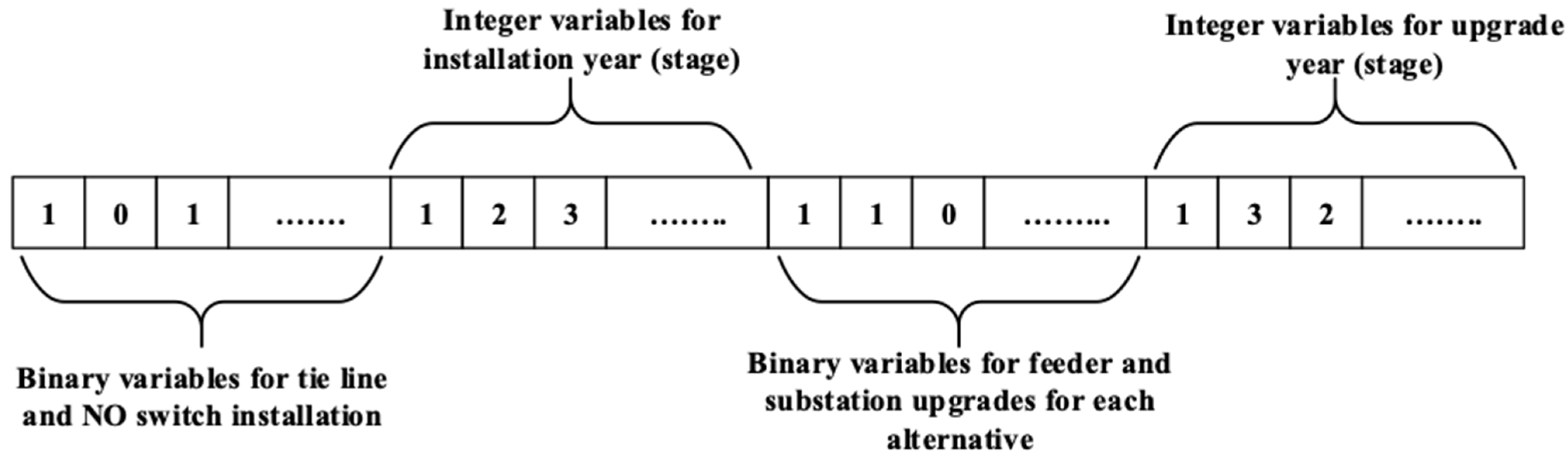
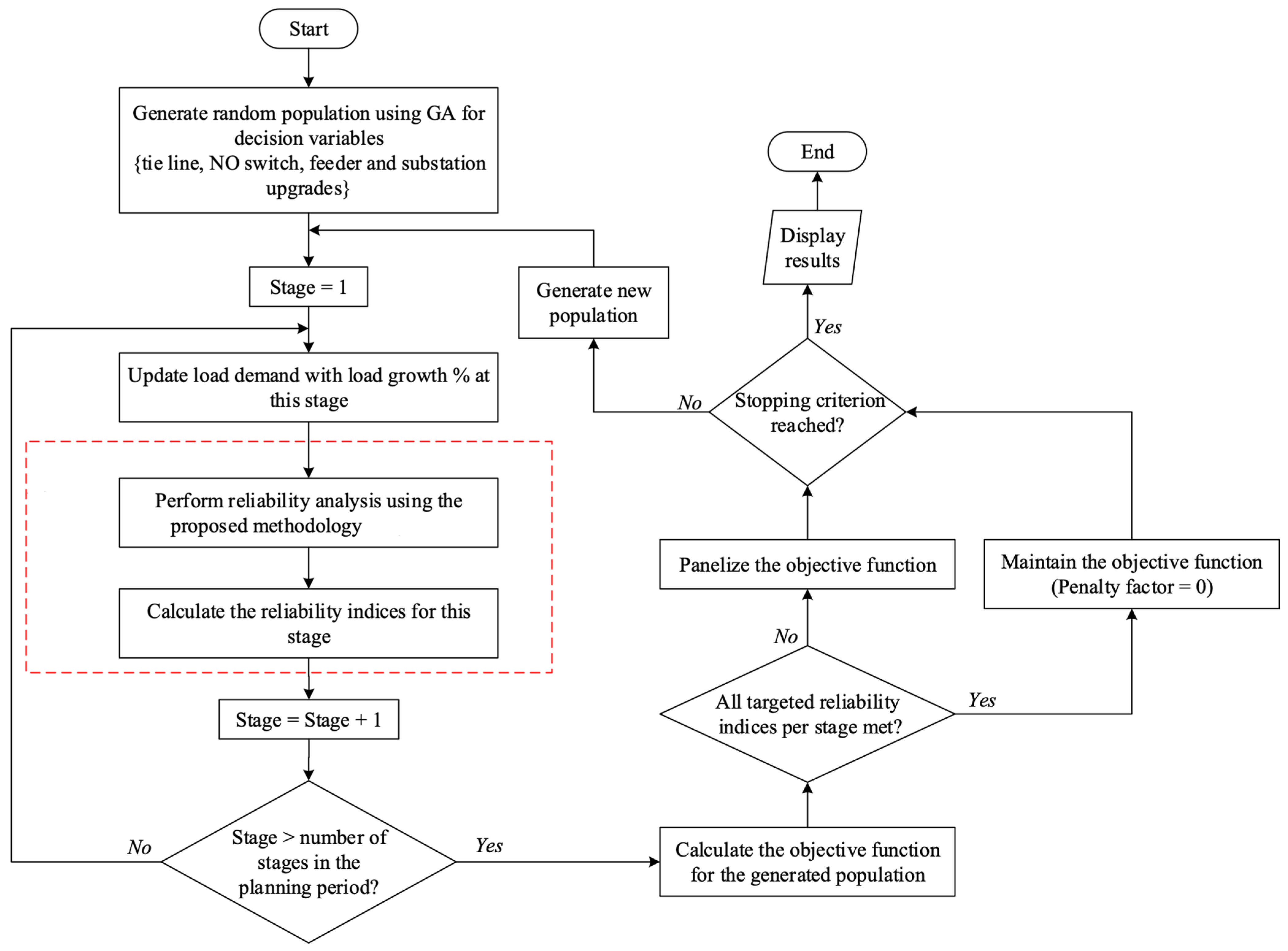
Here, S A I D I i targeted and E N S i targeted represent the mandated performance benchmarks for the System Average Interruption Duration Index and energy not served. Beyond meeting these goals, the network must adhere to several technical requirements, such as maintaining the supply–demand equilibrium and staying within voltage and thermal thresholds for buses and substations. These operational boundaries, which are detailed later in this paper, are applied to every individual contingency case. Because system architecture significantly influences reliability tuning, metaheuristic techniques are frequently used to solve these complex problems. This research utilizes a genetic algorithm (GA) to facilitate reinforcement planning based on reliability metrics. The process begins with an initial group of potential solutions known as chromosomes, which are formed by various genes. Each generation involves assessing the fitness of these chromosomes and ranking them based on how effectively they minimize the objective function. To handle non-compliant solutions, an external penalty mechanism is integrated directly into the main objective function. Prior to the GA execution, data strings are structured to meet the algorithm’s specific format. Each chromosome serves as a digital map for a potential solution, detailing the placement of normally open (NO) switches, tie line configurations, and necessary infrastructure upgrades. Consequently, the optimization decision vector uses binary values for component selection and integer values to represent the scheduled years for investment. A typical chromosome encoding for this planning problem is illustrated in Figure 1, while Figure 2 provides a visual summary of the optimization workflow.

2.2.2. Distribution System Reliability Assessment with DGs

This section focuses on evaluating the reliability of the distribution system considering DG units. The assessment is performed using the N−1 contingency principle, which requires that the system remains capable of supplying the demand and maintaining service standards even if any single component becomes unavailable. The analysis takes into account the impact of both component outages and the presence of DGs, ensuring that the system can either restore the affected loads or operate in islanded mode if necessary. Every system component’s unavailability is taken into account in the N−1 analysis. This study only considers outages or failures in substations and in lines. Incorporating dispatchable or renewable DGs into distribution networks highlights their ability to improve overall system reliability. During occurrence of disturbance, protection devices disconnect the affected parts of the system, enabling the rest of the network to function normally. As a result, this action causes the formation of islands within the system. DGs improve system reliability primarily by supplying power to all or part of the loads within the formed islands or by supporting the system in maintaining operational limits during load restoration. The proposed reliability assessment approach starts by defining three fundamental sets:
  • Sequence-Path Set for each Bus ( S P i ): This set includes every element situated on the direct series route that links the main substation to a specific bus. A bus’s operational status is fundamentally governed by the availability of the components within this trajectory. Consequently, a malfunction in any single component along this sequence path triggers a bus outage. This state of inactivity persists until the faulty item is restored, causing a transient loss of power to all associated loads. In other words, if any element in the sequence path fails, the bus experiences downtime until the component is repaired, resulting in a temporary interruption of the connected load.
  • Affected Bus Set for Each Contingency ( A B C ): In the event of a contingency, protection devices isolate the faulty section of the network, causing sustained interruptions for all downstream loads. This set contains only the buses that are impacted by the specific contingency.
  • Potential Solutions for Restoration per Contingency ( P R C ): In the event of a system outage, the protection devices may isolate a portion of the network, forming an island. The restoration process involves repairing the fault and reconnecting the affected loads. However, if alternative restoration paths exist, customers in the isolated section can be reconnected to the main source via switching operations, reducing their downtime from the full repair time to the switching duration.
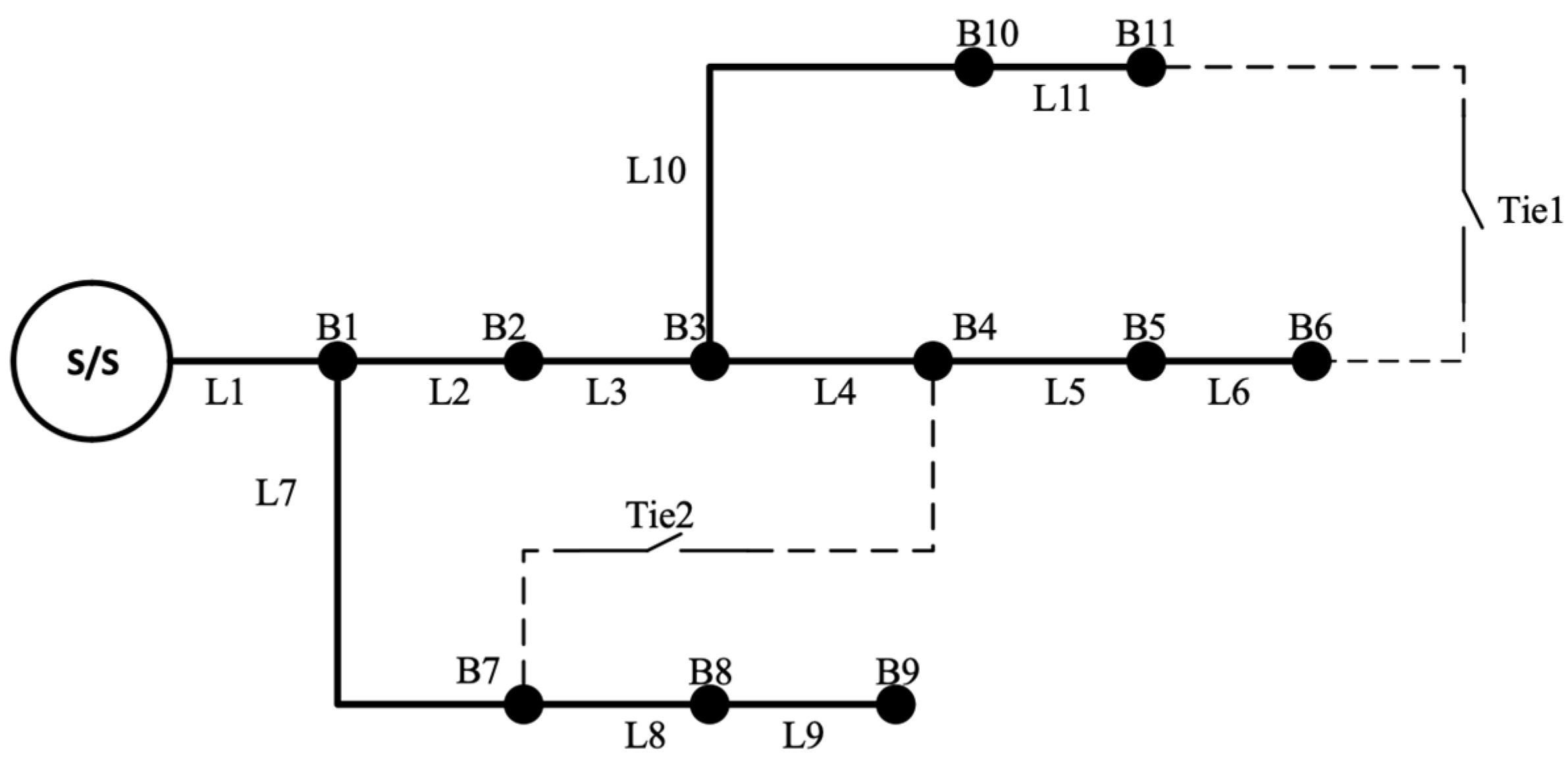
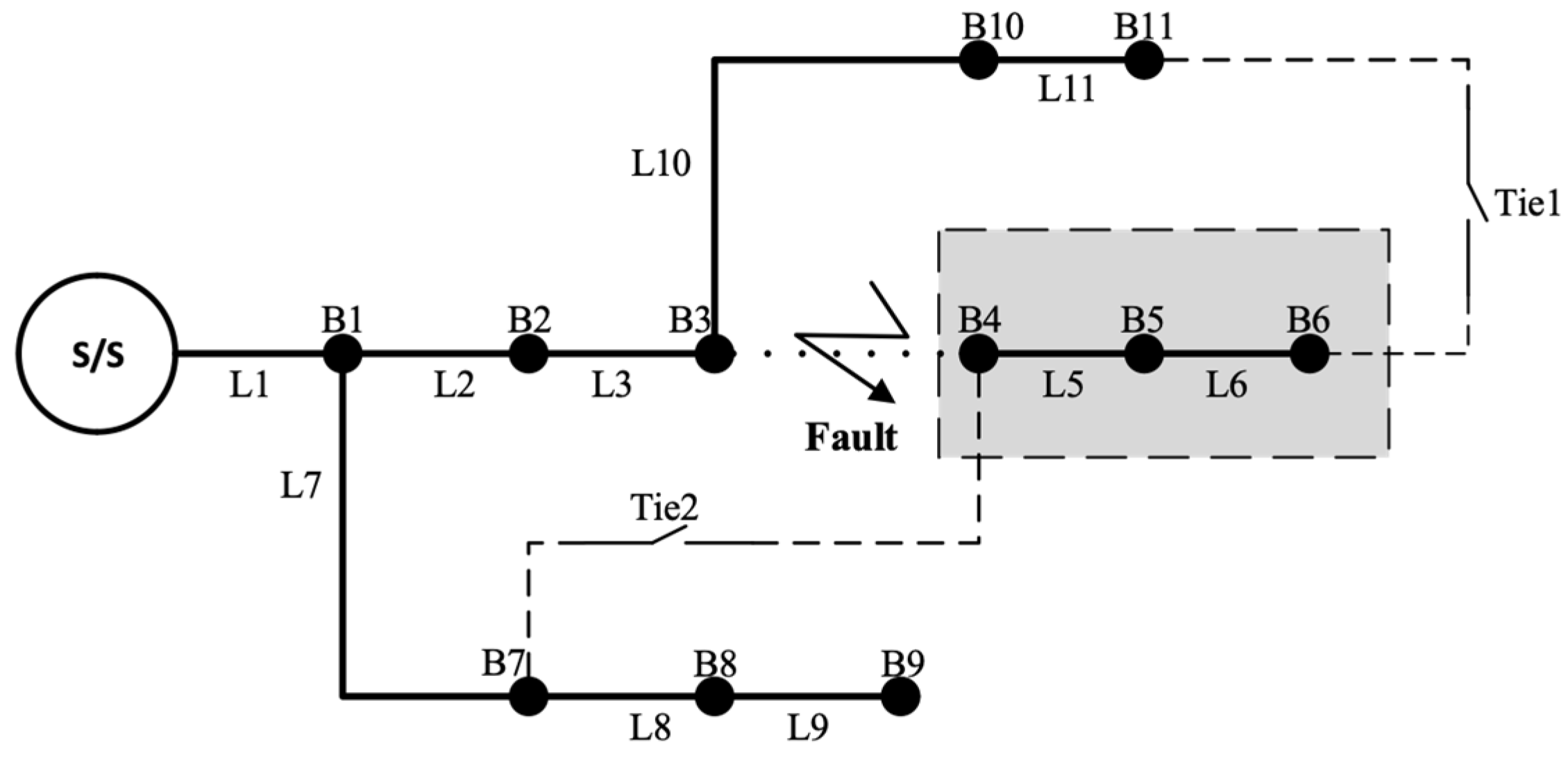
To illustrate the formation of these sets, let us study the 11-bus system illustrated in Figure 3. If line 4 experiences an outage, the affected buses are Bus 4, Bus 5, and Bus 6, as shown in Figure 4. There are two possible restoration paths available for these buses, associated with tie lines 1 and 2, which can be employed to re-energize the impacted buses. Table 4 provides a comprehensive breakdown of the sequence-path sets associated with each bus, and Table 5 outlines the affected buses along with their associated potential restoration paths for each contingency. The restoration framework follows a standard FLISR (Fault Location, Isolation, and Service Restoration) sequence. In the event of a permanent fault (e.g., Line 4), the simulation logic first identifies the faulted branch and opens the nearest upstream and downstream sectionalizing switches to achieve isolation. Subsequently, a feasibility check for feeder-to-feeder transfer is conducted, ensuring that the adjacent feeder has sufficient capacity to support the un-faulted but isolated load. Only after these steps are confirmed, the tie line switch (Tie 1 or Tie 2) closed to restore service. Tie lines are strategically placed to facilitate power transfer between independent feeders, ensuring that service restoration effectively offloads the primary feeder during peak demand or contingency events. This aligns with current industry trends toward self-healing grid architectures and smart grid schemes. These sets ensure that the mathematical formulation of the Affected Bus Set ( A B C ) remains deterministic and aligned with the physical boundaries of the faulted segment. By isolating the fault at its nearest terminals, the framework can precisely quantify the reliability improvements—such as the reduction in energy not served (ENS) and System Average Interruption Duration Index (SAIDI)—offered by the deployment of DGs and the activation of hierarchical restoration modes. By integrating these considerations of fault isolation and device coordination, the proposed framework provides a realistic platform for evaluating the economic and technical trade-offs of different reliability-enhancing investments. This contextualization ensures that the analysis of unserved load and the assessment of DG competitiveness reflect the evolving operational standards of modern, self-healing distribution systems.
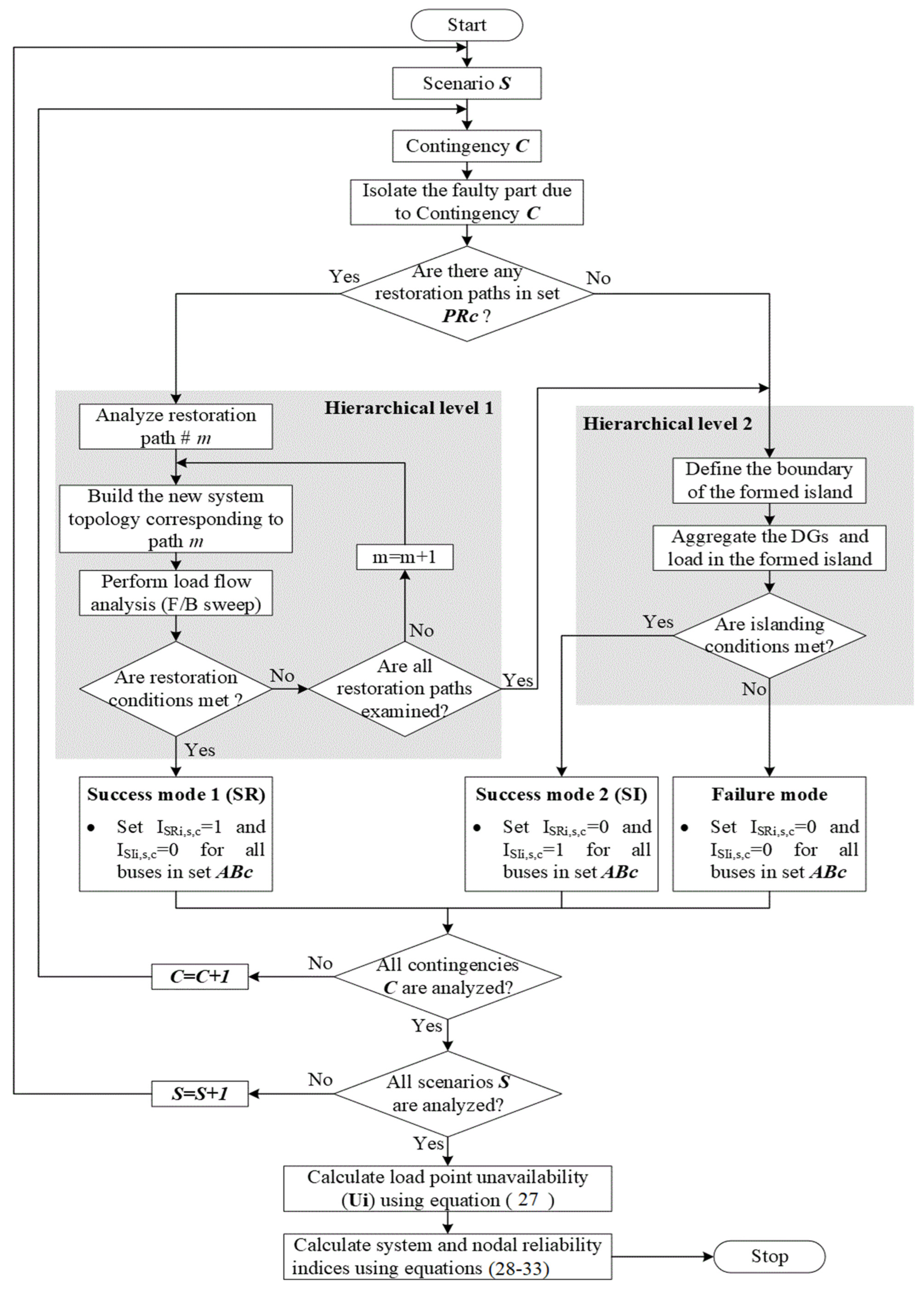
Once all relevant sets are defined for each bus and contingency, the reliability indices for the individual buses can be calculated, accounting for both planned restoration actions and intentional islanding operations. When this type of contingency occurs, certain system buses (i.e., those included in the affected bus set ABC) are isolated by the protection system, forming islands. Intentional restoration is considered successful if at least one restoration path exists for the formed island, the path does not cause feeder overloads or excessive voltage drops, and the substation receiving the transferred loads is not overloaded. If any of these conditions are violated, the intentional restoration is deemed unsuccessful. To manage this, every possible recovery pathway for the created island is cataloged and assessed. We utilize a forward/backward sweep load flow technique for every network topology and operational case. This analysis determines critical system states, such as voltage levels at the buses, power injections at the substation, and individual feeder flows, ensuring that no operational thresholds are breached.
A. 
Successful Restoration Conditions (Success Mode 1): Restoration is deemed successful when all of the upcoming conditions are satisfied:
  • At-least one restoration path reconnects the isolated island to the main source.
  • The restoration path does not exceed the thermal limit of the receiving feeder.
    I f I f M
  • The substation receiving the transferred loads is not overloaded:
    S s u b S s u b M a x  
  • Bus voltages along the restoration path remain within permissible limits:
    V i M i n V i V i M a x
  • The power balance constraint is satisfied, ensuring that all generation sources supply the total demand and system losses:
    i S P G i + i D G P D G i i N P D i i T f P l o s s f = 0
    i S Q G i + i D G Q D G i i N Q D i i T f Q l o s s f = 0
Here, P G i and Q G i are the active and reactive power supplied by the substations, P D G i and Q D G i denote the active and reactive power from DG units, P D i and Q D i are the bus demands, and P loss f and Q loss f represent feeder losses. The sets S , D G , N , and T f correspond to substation buses, DG buses, load buses, and feeders, respectively.
If no restoration path exists or the intentional restoration fails, the system proceeds to intentional islanding. The island operation succeeds only if the total DG within the island meets or exceeds the combined load and losses.
B. 
Successful Islanding Requirements (Success Mode 2): To ensure successful island mode for disconnected loads, it is crucial that the total power generated by the distributed generators (DGs) within the island matches the total load and losses of that island:
P D G I P D I + P L o s s I
where P D G I is the total DG power inside island I , P D I is the total load, and P Loss I is the total system loss within the island, assumed to be 5% of the islanded load [7]. The outcome consists of two successful modes, namely successful restoration and successful islanding, and one failure mode. The algorithm needs to choose one of these modes for each contingency scenario. Figure 5 presents the flowchart of the proposed general methodology for evaluating distribution system reliability in the presence of DGs.
C. 
Reliability Indices Calculation: To ensure successful island mode for disconnected loads, it is crucial that the total power generated by the DGs within the island can meet the total demand and losses of that island:
The reliability indices of the distribution system are calculated after establishing all relevant sets, considering both successful restoration and intentional islanding. The downtime for each load point i is determined as:
D T i = C S P i λ C r C  
where λ C is the failure rate and r C is the repair time of component C within the sequence path S P i . The probability that load point i is isolated due to failures along its sequence path is given by:
P i i s o l a t e d = C S P i λ C r C N H  
with N H = 8760   h per year. For a specific contingency C , the probability of isolation is:
P i , c i s o l a t e d = λ C r C N H ,                                   i f   c S P i 0 ,                                             i f   c S P i  
The probability that bus i operates in a successful mode following contingency C depends on both the isolation probability and the likelihood of either successful restoration or islanding. Assuming independence between these events, the probability of success is:
P i s u c c e s s = P i i s o l a t e d × P i , c S R S I  
Here, P i , C SRSI represents the probability that either restoration or islanding conditions are satisfied. This probability is determined by summing the occurrence probabilities of all operating scenarios s that meet the success conditions:
P i , c S R S I = s = 1 T s P s I S R i , s , c + I S I i , s , c  
I S R i , s , c = 1 ,                 i f   r e s t o r a t i o n   c o n d i t i o n s   a r e     m e t 0 ,                 o t h e r w i s e
I S I i , s , c = 1 ,                 i f   r e s t o r a t i o n   c o n d i t i o n s   a r e     m e t 0 ,                 o t h e r w i s e
where I S R ( i , s , C ) and I S I ( i , s , C ) are indicator functions for successful restoration and islanding, respectively. If success mode 1 occurs, I S R = 1 and I S I = 0 ; if success mode 2 occurs, I S R = 0 and I S I = 1 . Both are zero in case of failure, as illustrated in Figure 5. Using these probabilities, the unavailability of load point i is computed as:
U i = C S P i λ C r C P i s u c c e s s × N H  
The reliability indices for the system are then determined by:
S A I D I = i U i N i i N i
A S A I = i N i × N H i U i N i i N i × N H
A S U I = 1 A S A I
E N S = i Ω E S L a ( i ) U i
Here, N i represents the customers’ number at bus i , L a ( i ) denotes the average load at that bus, and N H = 8760   h . The reliability indices for the individual buses are calculated as follows:
S A I D I i = i S P i λ C r C P i , c s u c c e s s × N H
E N S i = L a ( i ) i S P i λ C r C P i , c s u c c e s s × N H

3. Results

Several case studies were conducted to evaluate the effectiveness of the proposed framework. The details and results of these studies are outlined below:

3.1. Overview of the Distribution System Studied

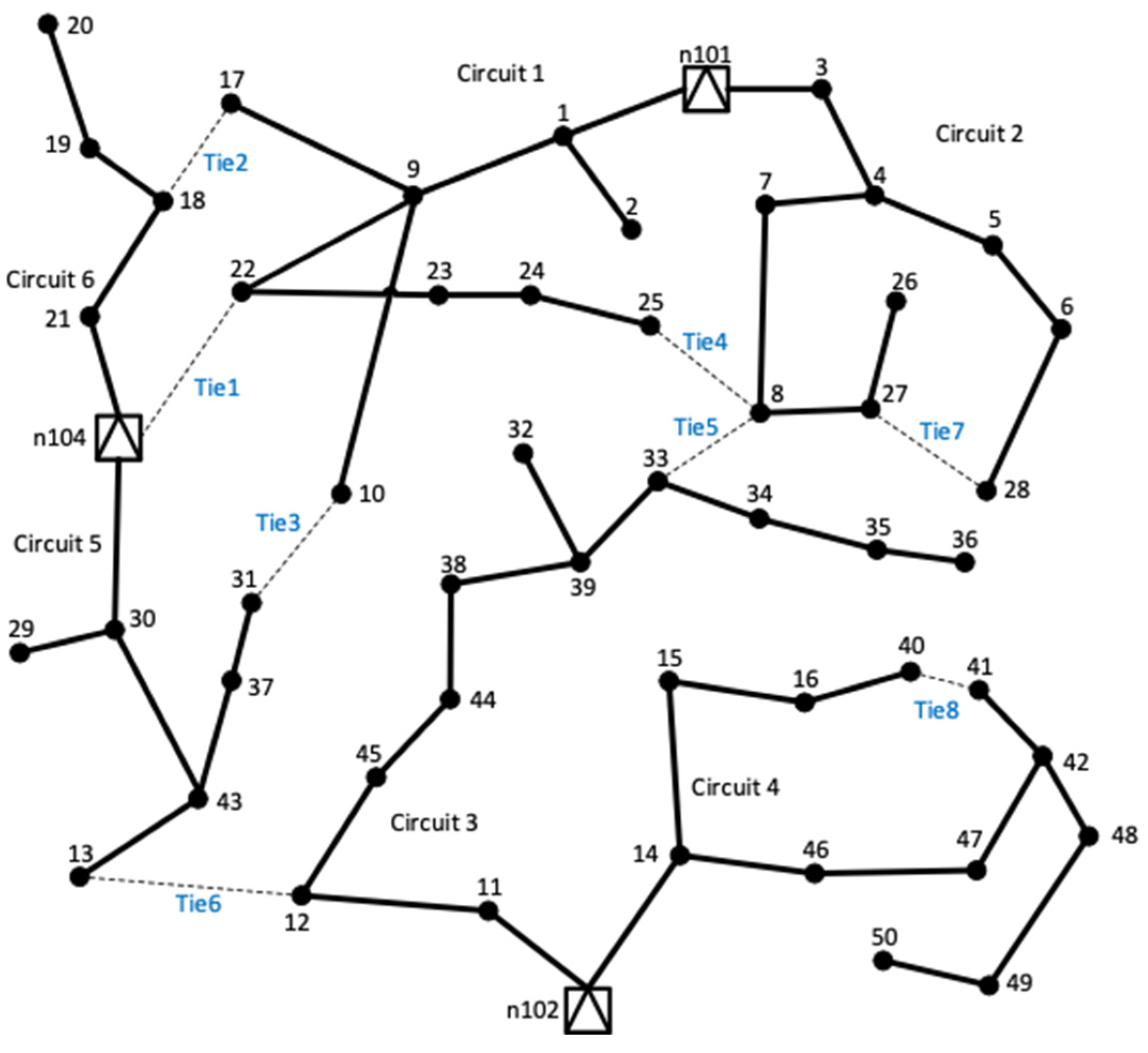
The effectiveness of the proposed planning framework is evaluated using a 54-bus radial distribution system. The complete network data are available in [32], and the system configuration is illustrated in Figure 6. The network consists of 50 existing feeders, three substations, and eight candidate tie lines, operating at a nominal voltage level of 15 kV. The reliability parameters of all system components, including failure rates and repair times, are provided in Table 6.
For each planning stage and at every load point, the target reliability thresholds are set to SAIDI ≤ 2.5 h/year and ENS ≤ 5 MWh/year, as adopted from [33]. The interruption cost penalty is assumed to be 2000 $/MWh, while the installation cost of a normally open (NO) switch is set to $4700 [34]. The construction cost of a new tie line is considered to be $2 × 10⁶ per kilometer.
Two transformer alternatives are evaluated for substation upgrades: a 13.3 MVA unit with an installation cost of $8 × 10⁶ and a 16.7 MVA unit costing $10 × 106. The existing substation capacity is 16.7 MVA. Additionally, three feeder upgrade options are analyzed, with thermal ratings of 250 A, 450 A, and 900 A, and corresponding installation costs of $3.5 × 10⁵/km, $4.6 × 10⁵/km, and $9.2 × 10⁵/km, respectively. Detailed feeder lengths and thermal limits are provided in [35].
The planning horizon is 15 years, divided into three five-year stages, with an assumed annual load growth rate of 3%. An interest rate of 10% and a system power factor of 0.9 are considered. The capacities and locations of distributed generation (DG) units are summarized in Table 7. The distribution network under study integrates community-scale PV and wind generation. These DER units are customer-owned and interconnected at 15 kV medium-voltage feeders. While the utility does not control the size or location of these customer-owned assets, it manages the network’s reliability through the strategic placement and operation of tie lines and sectionalizing switches. The technical modeling follows standard interconnection requirements for medium-voltage grids, ensuring that the proposed reliability framework is situated within a realistic operational context
It should be noted that the adopted technical and economic parameters, including reliability targets, interruption cost coefficients, upgrade costs, and financial assumptions, correspond to standard benchmark values widely used in distribution system planning studies, ensuring comparability with existing literature.

3.2. Cases Under Studies and Results

To evaluate the performance of the proposed model, this research evaluates two distinct scenarios: the first involves reinforcement planning restricted to dispatchable and controllable DG units, while the second expands the scope to integrate wind- and PV-based generation. The specific geographical placements and power ratings for the DGs employed throughout the network are documented in Table 5.

3.2.1. Reliability-Based Reinforcement Planning Considering CDGs

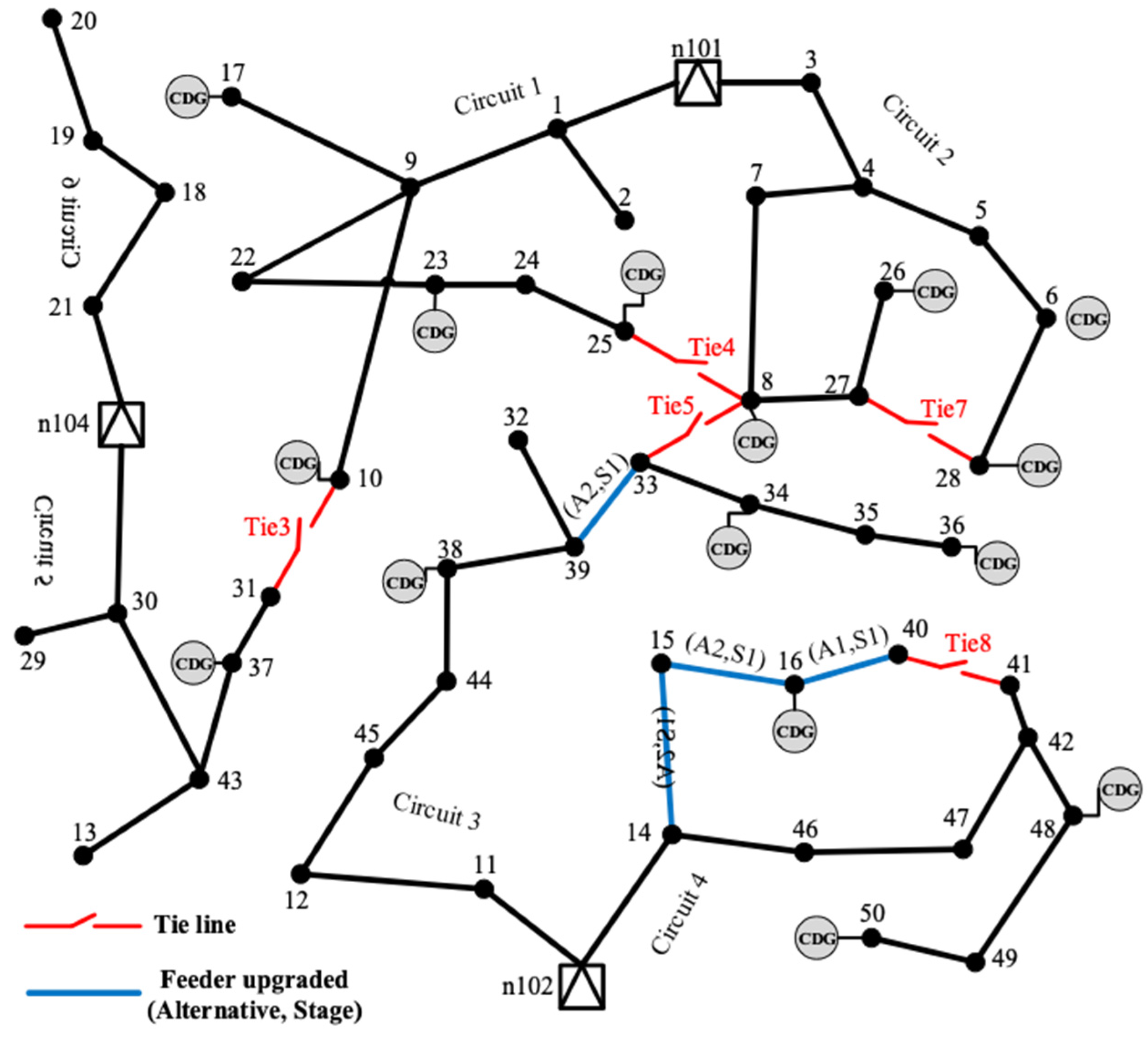
In this case study, the system uncertainty is attributed to load variations and component failures. Controllable DGs (CDGs) supply a fixed power output based on their rated capacities. The analysis shows that installing five tie lines along with normally open (NO) switches is required to enhance system reliability and attain the targeted SAIDI and ENS indices at each bus. The first stage involves the deployment of lines 3, 4, 5, 7, and 8. Detailed visual confirmation of this installation phase is provided in Figure 7. Furthermore, 4 feeders must be upgraded during the first stage to support successful restoration during contingencies and to mitigate congestion caused by transferring loads to alternate feeders. Upgrades for feeders 14–15, 15–16, and 33–39 are executed according to the second alternative, whereas feeder 16–40 follows the specifications of the first alternative. Figure 7 presents the system configuration following the reliability reinforcement planning.
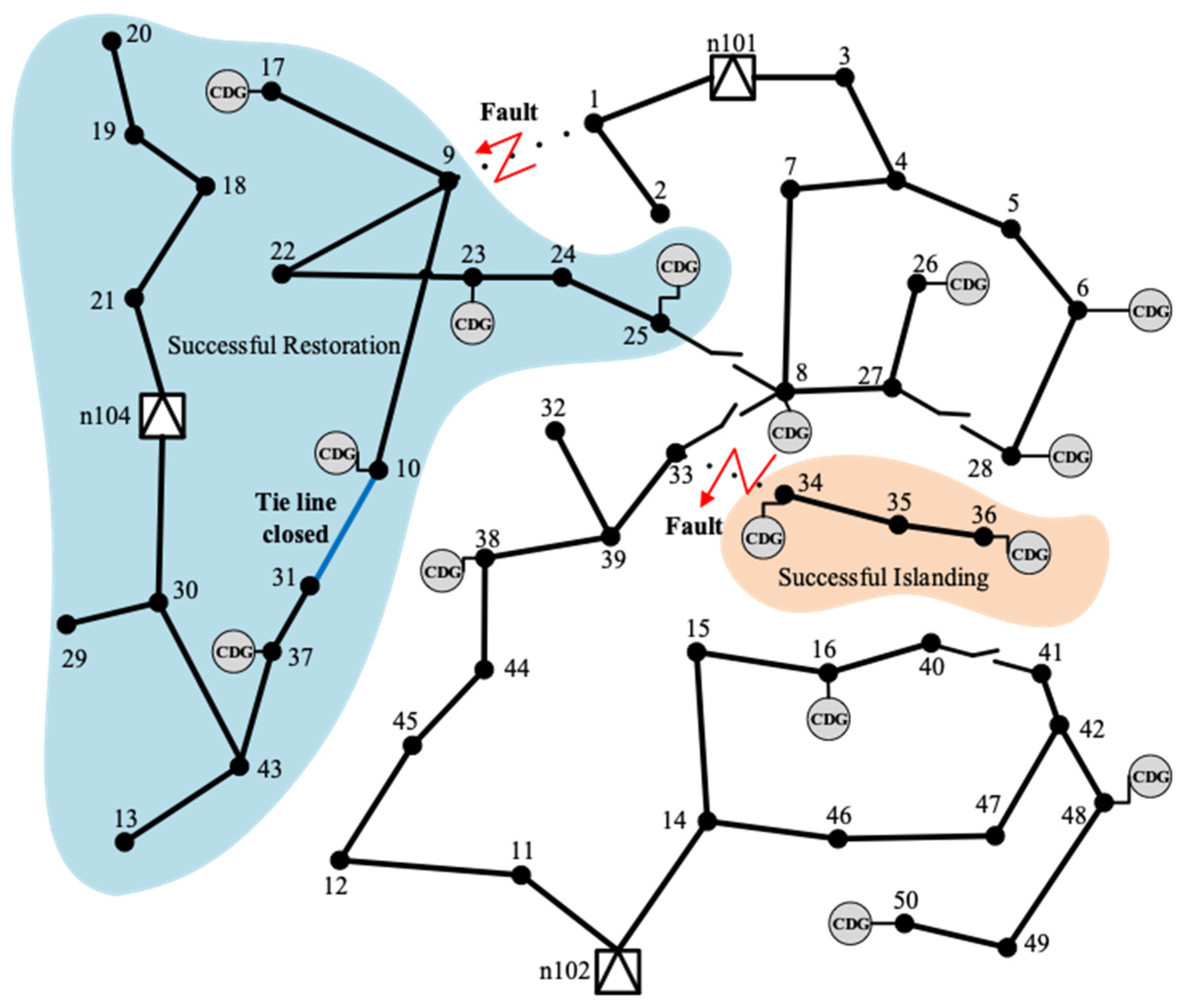
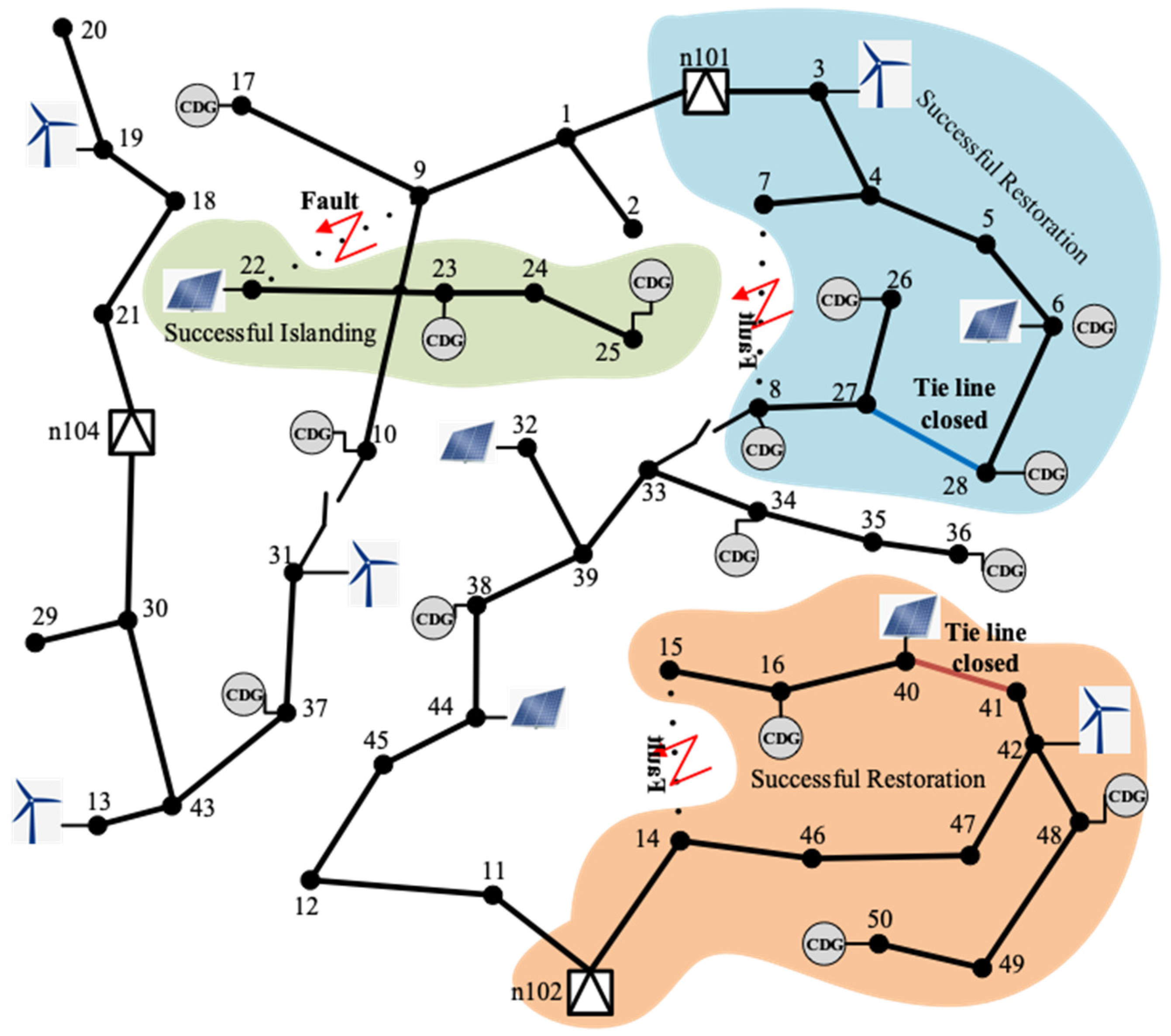
Figure 8 illustrates the system’s response to two distinct contingencies. In the event of a fault on feeders 1–9, the affected load points (9, 10, 17, 22, 23, 24, and 25) are restored by opening the switch on feeder 1–9 and closing the normally open (NO) switch on tie feeder 10–31. This procedure reconnects the affected loads to the source (substation n104) without resulting in voltage violations at any bus or thermal overloads at the feeders or substations. The distributed generators (DGs) in the impacted area assist in the restoration by reducing potential thermal congestion that may result from transferring loads. For a contingency on feeders 33–34, the affected load points (34–36) are disconnected from the main grid since no restoration path exists. However, the DGs located at buses 34 and 36 supply the required power, enabling successful islanding. Their capacities are sufficient to meet both the local demand and system losses within the islanded area.
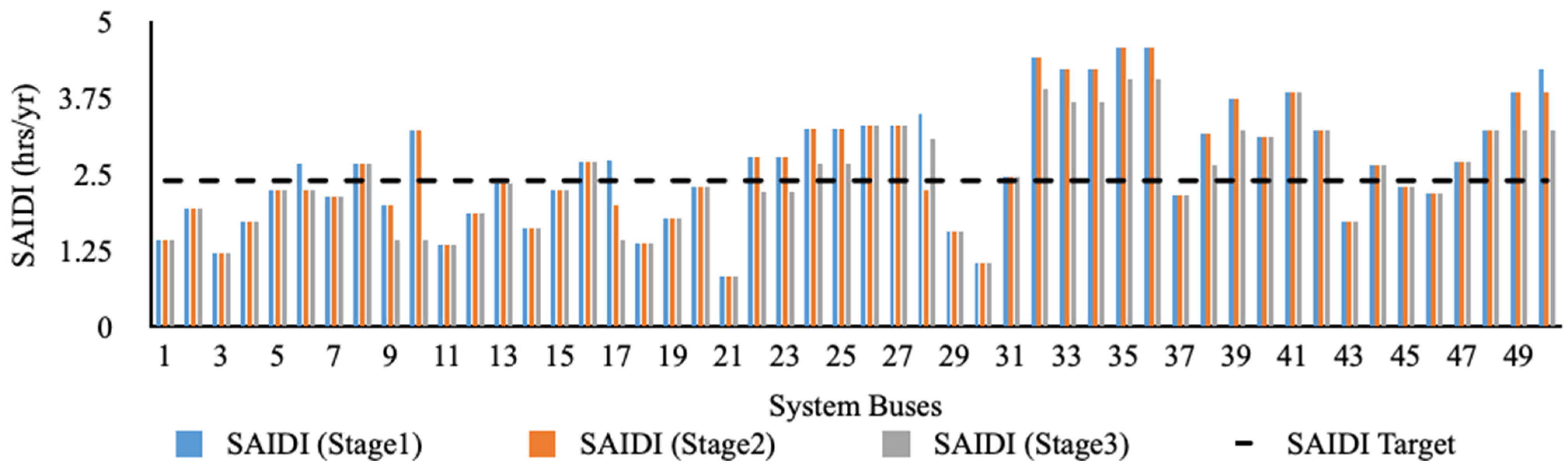
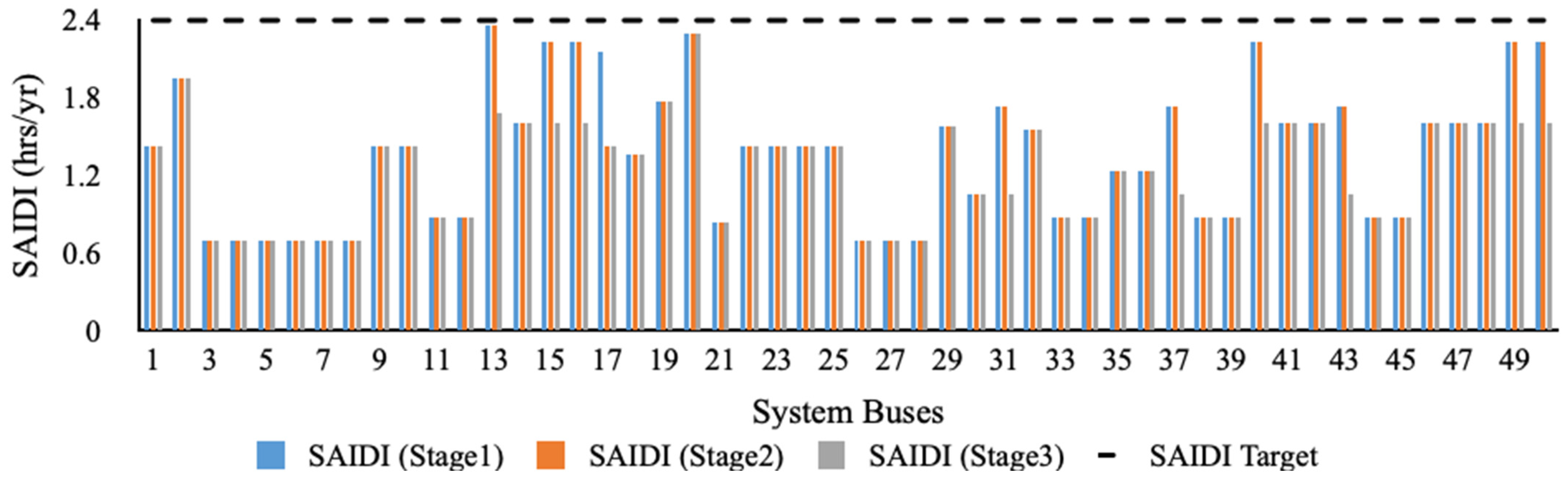
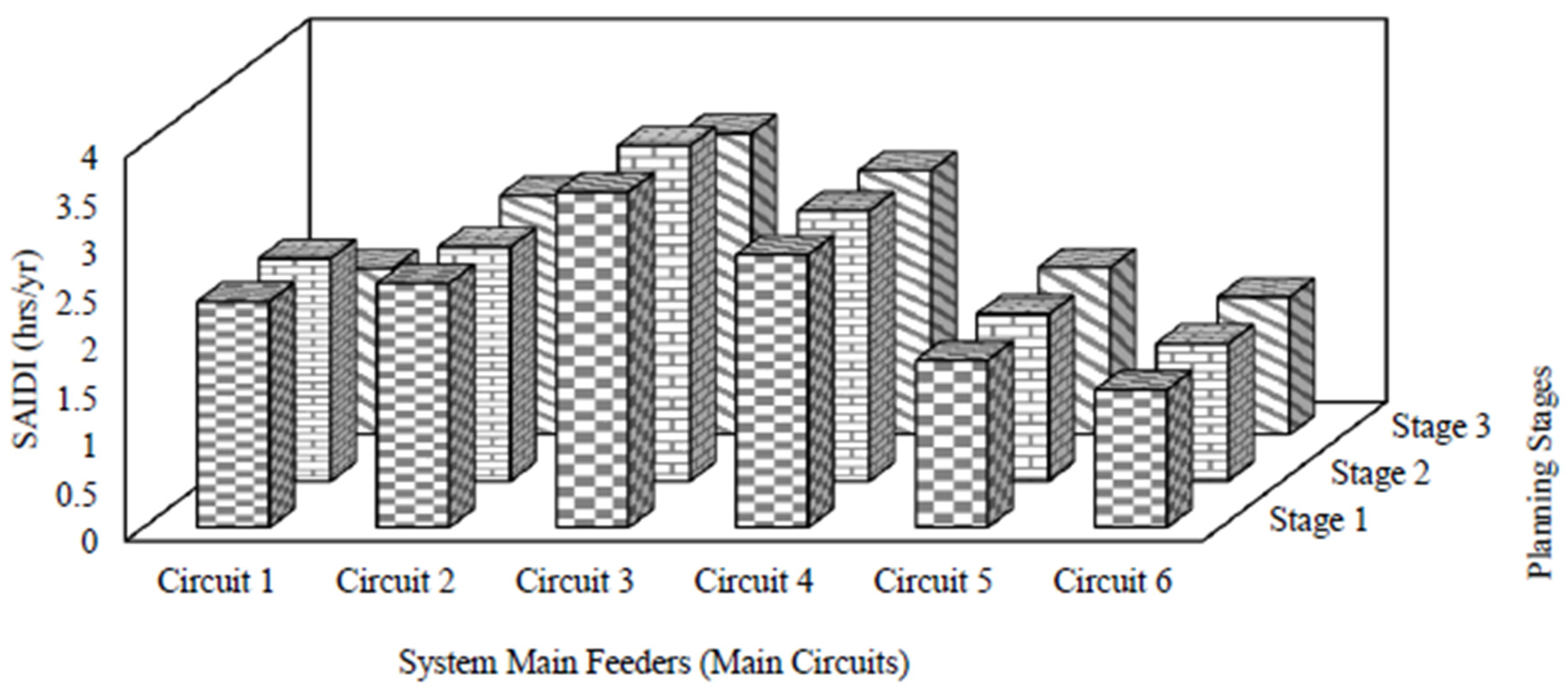
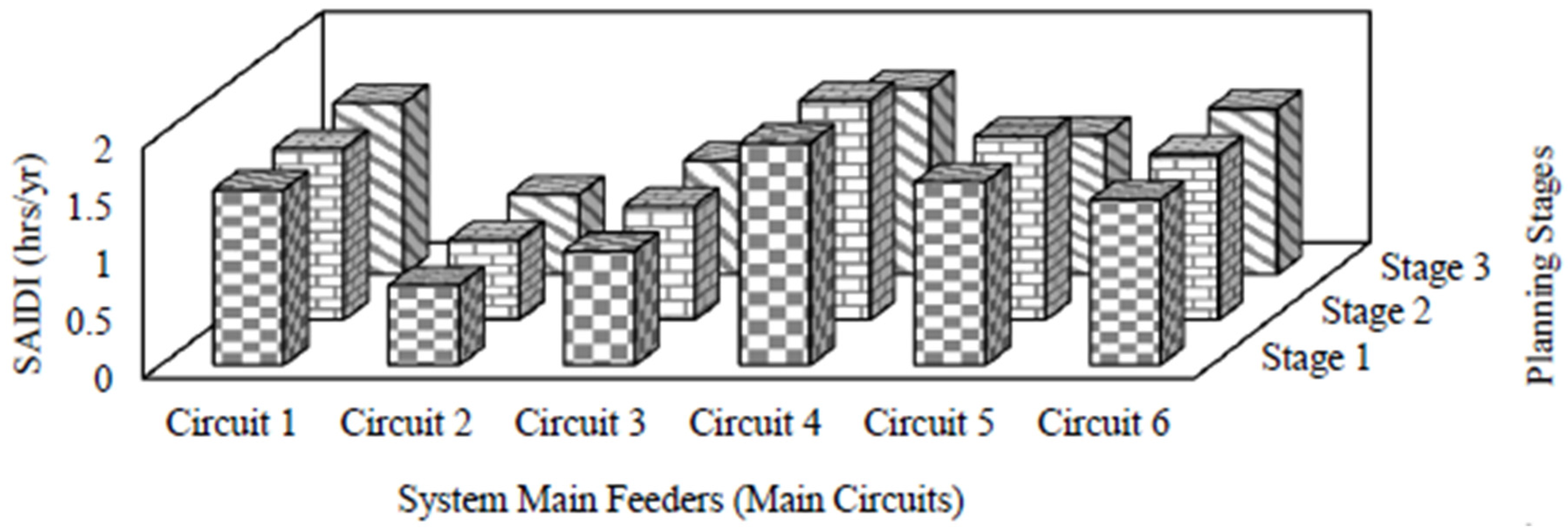
Figure 9 and Figure 10 depict the SAIDI values for each bus prior to and following the implementation of the reliability reinforcement plan, respectively. As illustrated in Figure 10, prior to implementing the reinforcement measures, 27 buses—accounting for 54% of the total network—did not satisfy the nodal SAIDI-based reliability requirement. At multiple points throughout the planning horizon, these buses exceeded the regulatory SAIDI threshold of 2.5 h/year. Once the 5 tie lines are optimally installed and the required feeder upgrades are performed, as listed in Table 8, the SAIDI at all buses and across all planning stages is significantly reduced and maintained below the regulatory limit, as demonstrated in Figure 10. Additionally, the SAIDI values for the primary feeders decrease markedly due to improvements at the bus level. Figure 11 and Figure 12 present the SAIDI values for the main feeders before and after the implementation of the reinforcement plan, respectively.
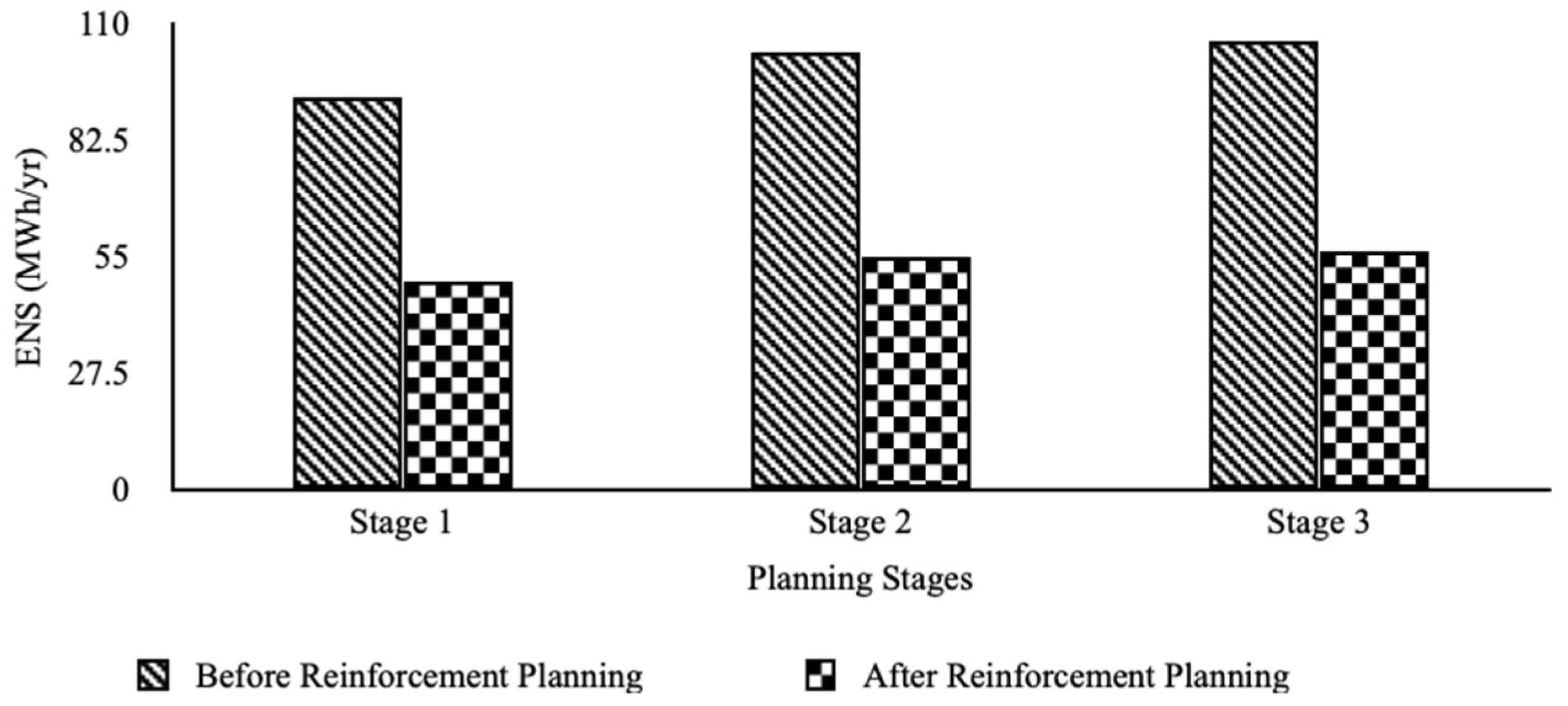
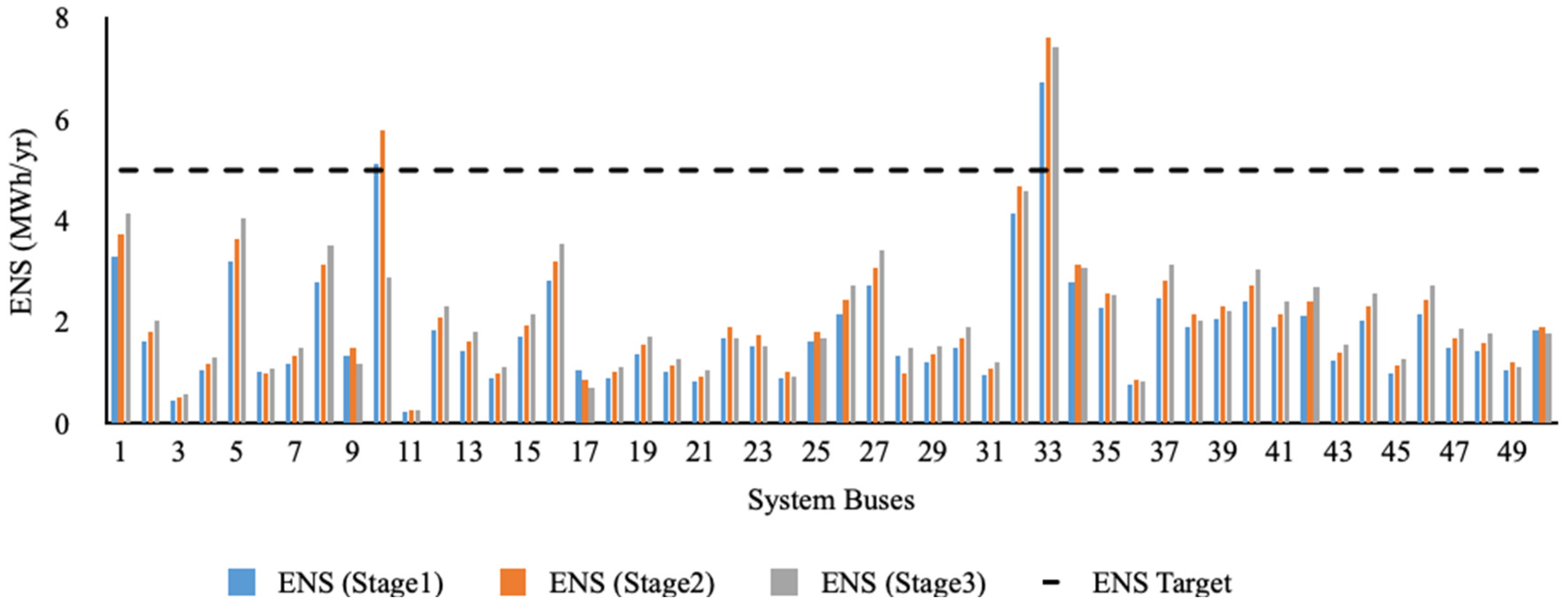
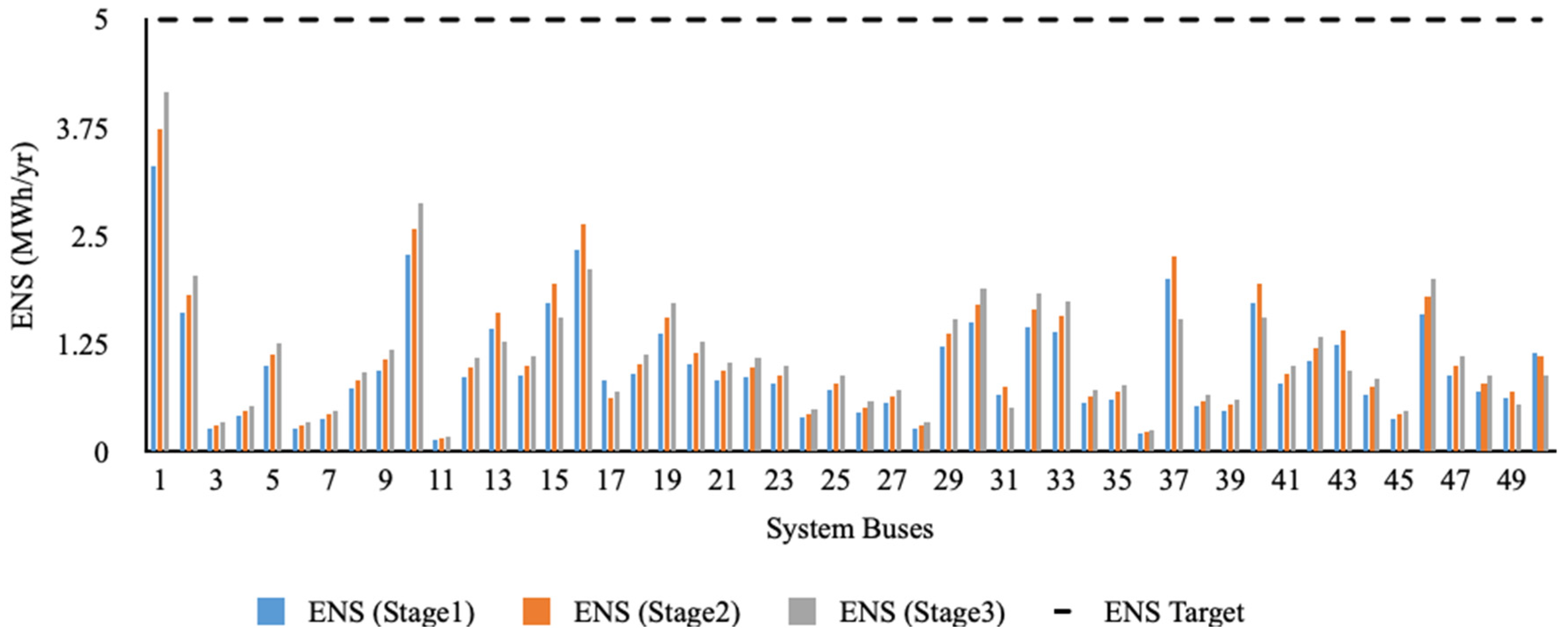
Applying the proposed reliability reinforcement framework results in a substantial decrease in the expected energy not served (ENS), as illustrated by the comparative values for each phase in Figure 13. During the initial stage, the ENS value drops from 92.5 MWh/year to 48.9 MWh/year, while the second stage sees this metric cut from 103.4 MWh/year down to 54.8 MWh/year. Finally, the third phase shows a similar trend of improvement, with a decline from 106 MWh/year to 56 MWh/year. Overall, the planning model achieves approximately a 47% reduction in total ENS across all stages. The associated ENS cost is also lowered, decreasing from $1.5 × 10⁶ to $0.739 × 10⁶. Figure 14 and Figure 15 illustrate the ENS at each bus for all stages before and after the implementation of the planning measures. Prior to planning, three buses exceeded the maximum allowed ENS per bus. After applying the reinforcement strategy, these violations were resolved, and ENS values across the majority of buses were minimized.
The analysis indicates that the net present value (NPV) of the total investment cost for reliability reinforcement incurred by the LDC $8.84522 × 10^6. The primary expense within this total is the deployment of tie lines, which represents roughly 7% of the budget. Upgrading selected system feeders accounts for 11.7% of the total cost, while the NPV of total CENS over the planning horizon constitutes roughly 9% of the overall expenditure. The cost associated with normally open (NO) switches is $23.5 × 10^3. A comprehensive breakdown of the total planning NPV and individual reinforcement costs is provided in Table 9.

3.2.2. Reliability-Based Reinforcement Planning with Controllable, Wind, and PV

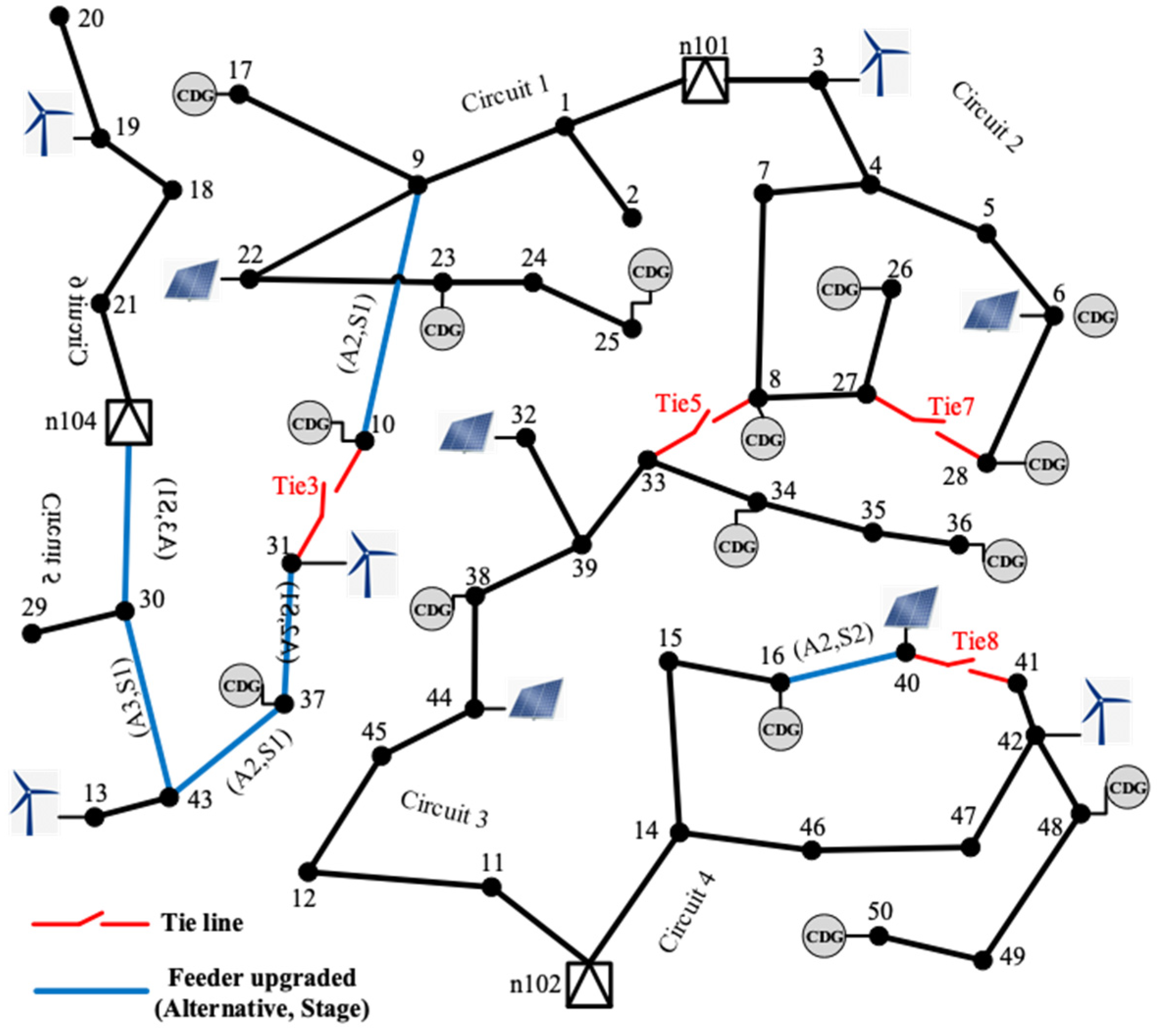
This case study examines reliability reinforcement planning while considering variations in system loads, uncertainties in power output from generating sources, and equipment failures. The results indicate that enhancing system reliability and keeping the reliability indices within regulatory limits requires the deployment of four tie lines and four normally open (NO) in addition to upgrading six feeders. In the first planning stage, tie lines 3, 5, 7, and 8, along with the NO switches, are installed, as shown in Figure 16. Feeders 9–10, 31–37, and 37–43 are upgraded with Alternative 2 in the first stage, whereas feeder 16–40 is scheduled for upgrade in the second stage with Alternative 2. Feeders 30–43 and n104–30 are upgraded in the first stage using Alternative 3. These upgrades are necessary to ensure that the feeders, together with other system components, can handle loads disconnected due to contingencies and prevent thermal overloading during the restoration process. Compared to Case Study 1, the total number of required tie lines is reduced by one, reflecting the additional support provided by renewable generation, which enhances the effectiveness of islanding-based modes. The findings suggest that because the CDG at bus 37 is scheduled for connection during the second stage, as specified in Table 8, the infrastructure upgrade for feeders n104–30, 30–43, 37–43, and 31–37 must be completed beforehand in stage one to manage load transfers during an outage in circuit one. This accounts for the higher number of feeder upgrades in this scenario. Figure 16 presents the system topology after applying reliability reinforcement planning for Case Study 2, and Table 10 lists all required installations and upgrades.
Figure 17 illustrates the optimal corrective actions for three different contingencies. In the event of an outage on feeders 9–22, the affected buses can be isolated from the main grid, and their demand can be met using local generation sources, specifically the CDGs at buses 23 and 25 and the PV-based DG at bus 22. For a fault on feeders 7–8, the affected loads are restored by opening the switches on feeders 7–8 and closing the tie line between buses 27 and 28. These actions enable successful restoration while ensuring that all operational and security limits of the system are maintained.
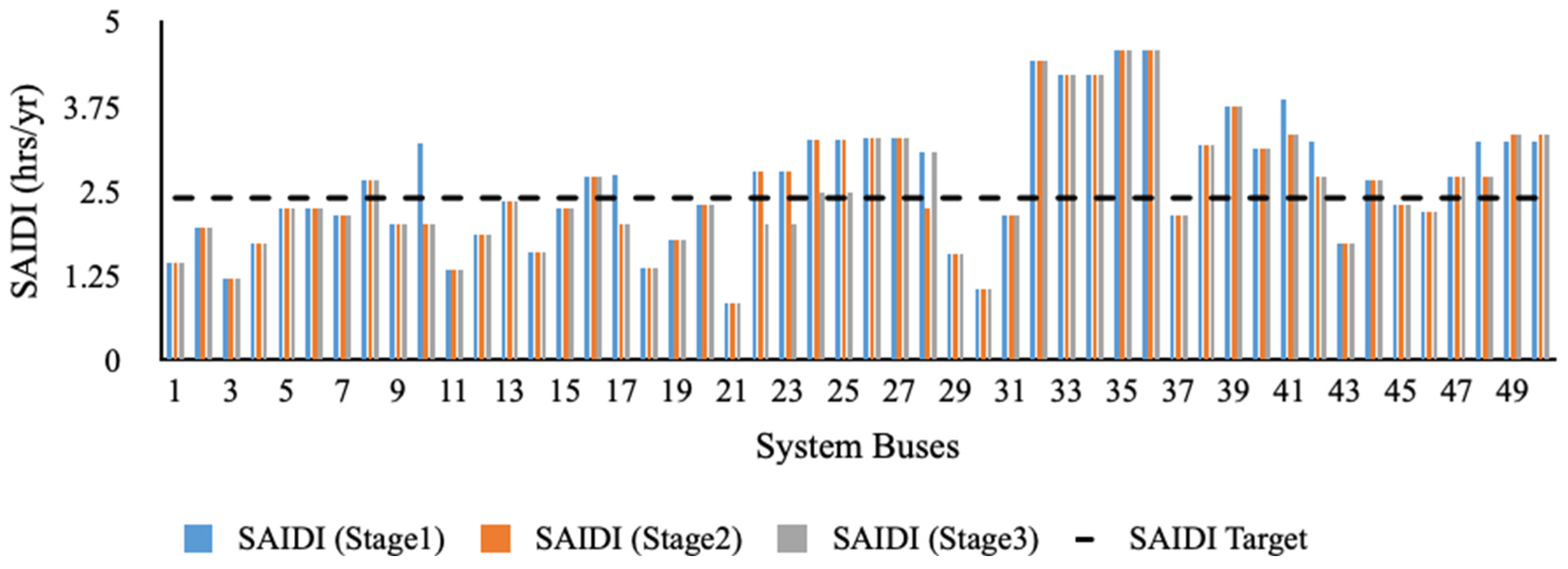
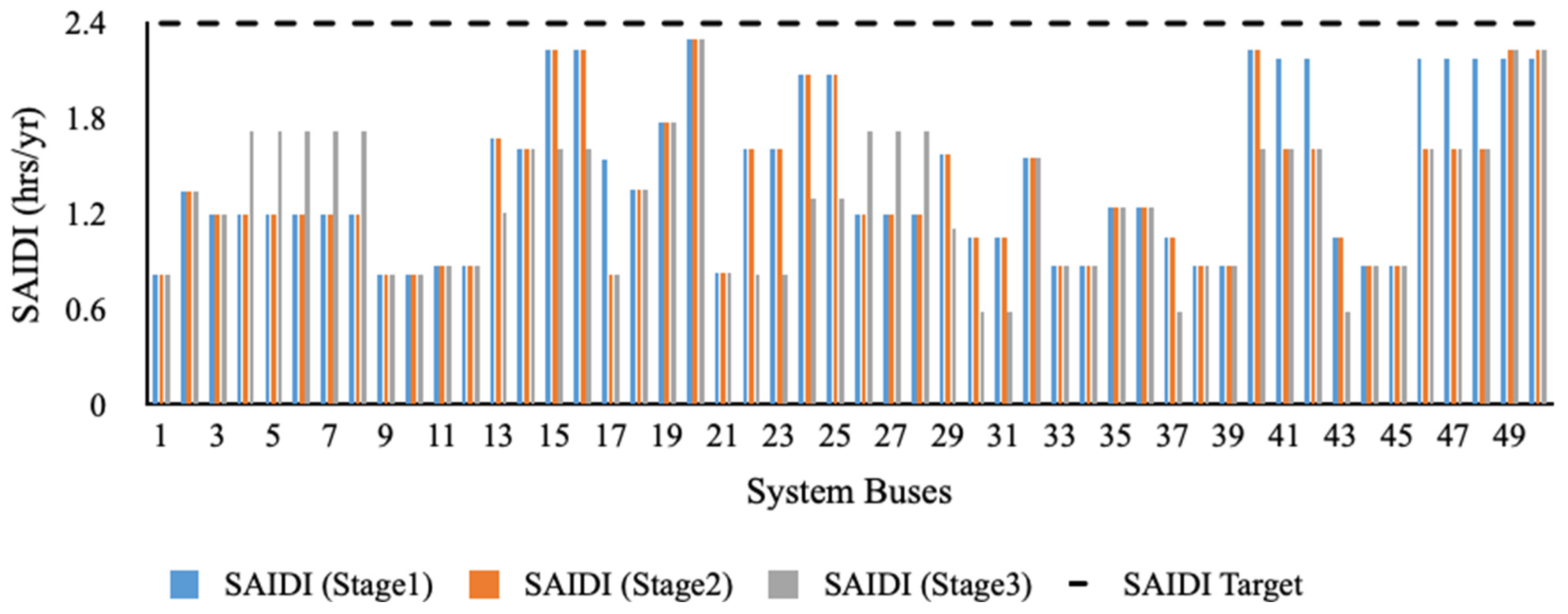
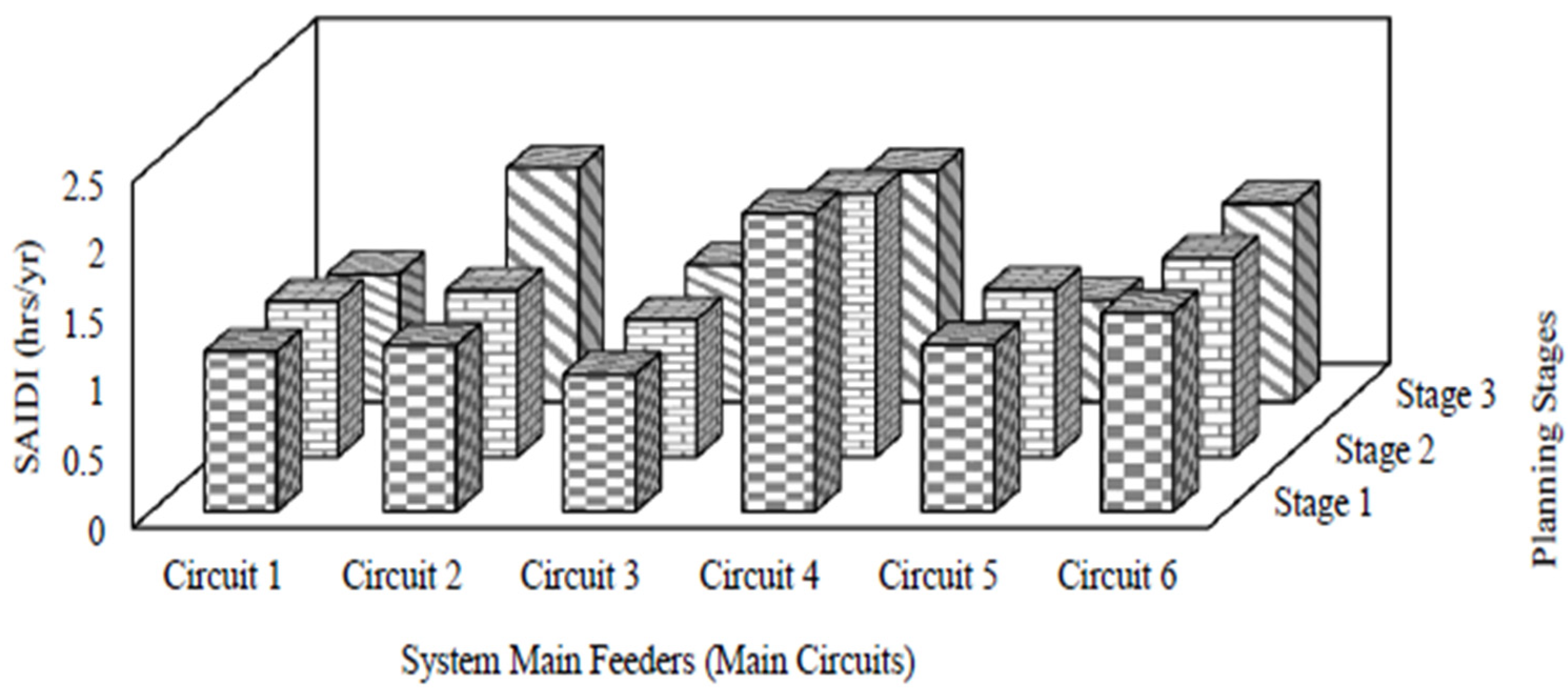
Figure 18 and Figure 19 illustrate the comparative SAIDI levels for every bus in the system throughout Case Study 2, highlighting the results before and after the implementation of the recommended reliability enhancement planning. Initially, several buses did not satisfy the reliability requirements. However, with the strategic installation of four tie lines and the necessary feeder upgrades detailed in Table 10, As illustrated in Figure 19, the proposed method ensures that SAIDI levels at every individual bus remain consistently lower than the mandated limits throughout all phases of the planning stage. Moreover, the SAIDI of the primary feeders also decreases substantially due to the overall improvement in bus-level reliability. Figure 20 depicts the SAIDI values for the main feeders after implementing the reinforcement plan.
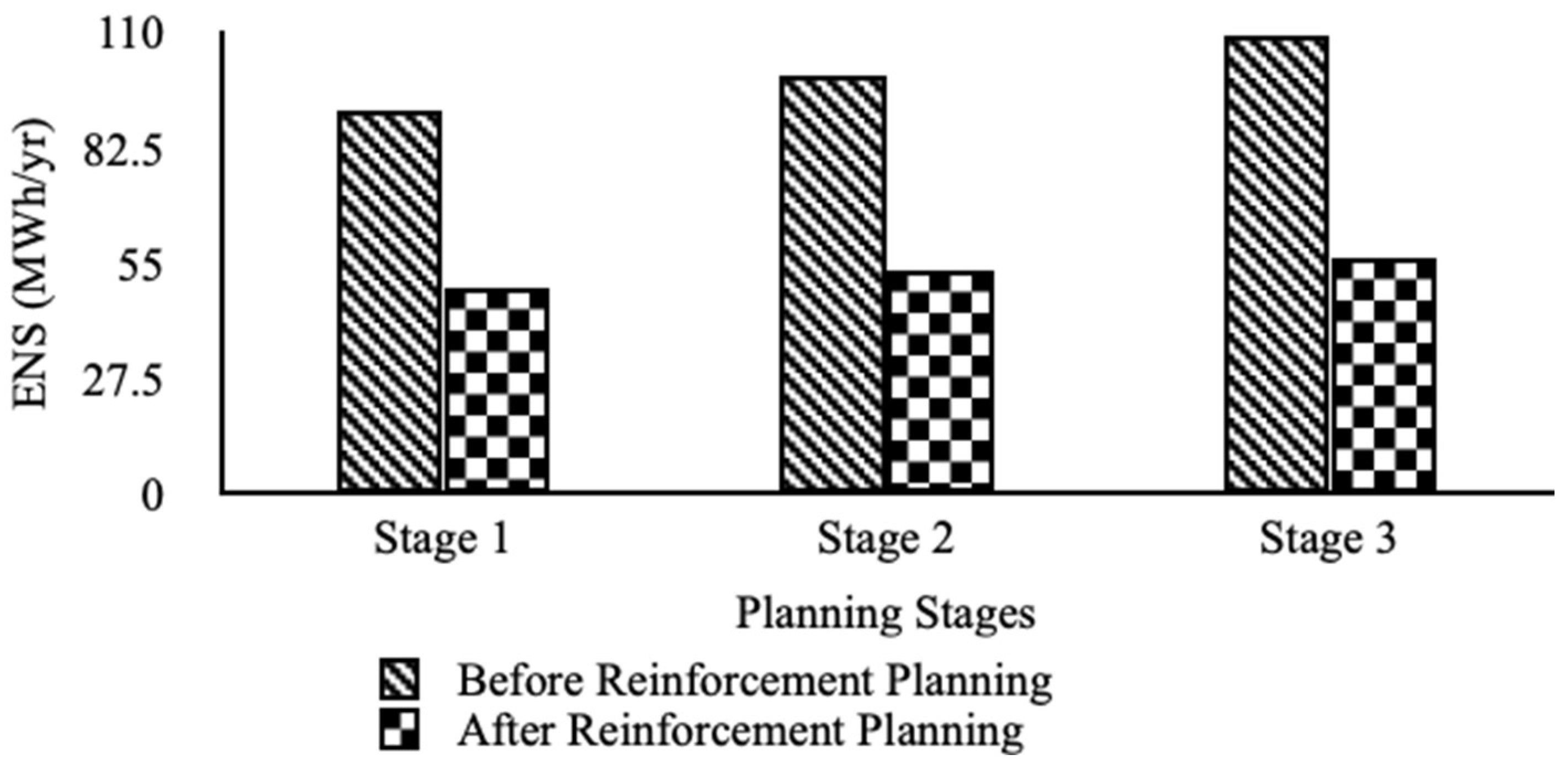
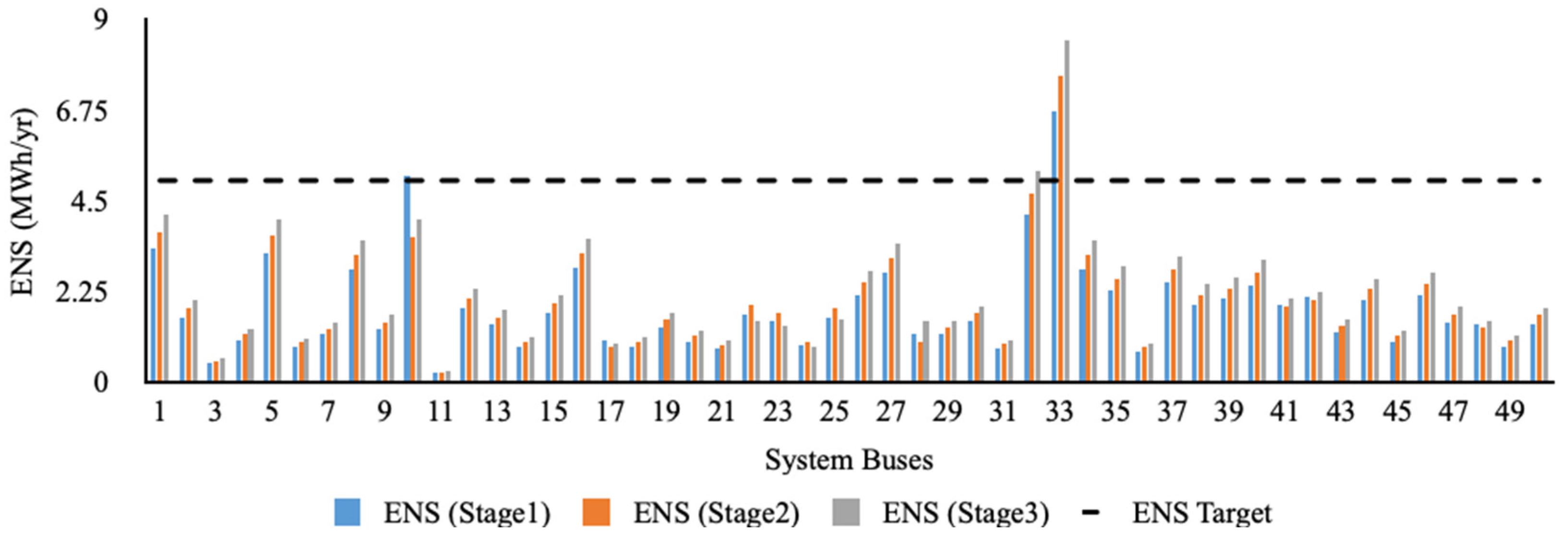
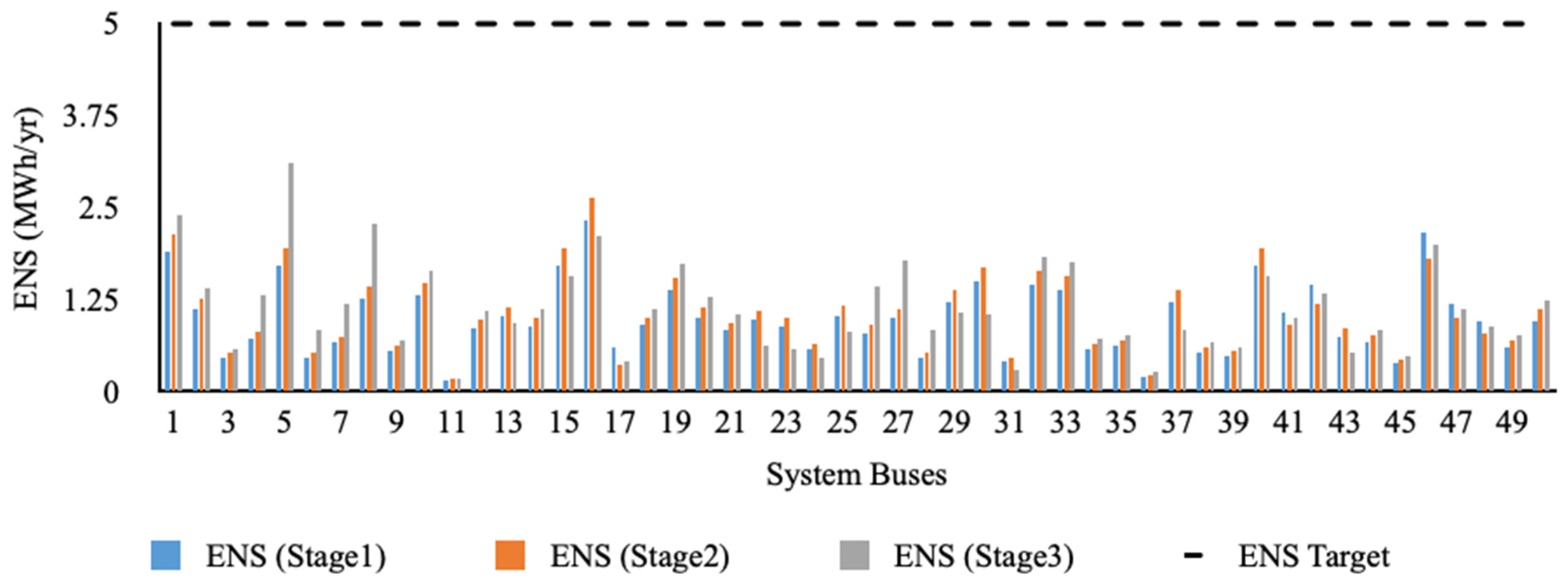
Figure 21 presents the expected energy not served (ENS) at each stage before and after implementing the proposed reliability reinforcement model for Case Study 2. The results indicate a substantial reduction in ENS following the application of the planning approach. Specifically, ENS decreases from 91.5 MWh/year to 48.9 MWh/year in Stage 1, from 99.7 MWh/year to 52.9 MWh/year in Stage 2, and from 109.7 MWh/year to 56 MWh/year in Stage 3. Overall, the ENS is reduced by approximately 52% across all planning stages. As a result, the associated ENS cost declines from $1.48 × 10^6 to $7.84 × 10^5. Figure 22 and Figure 23 illustrate the ENS for each bus at every stage, before and after implementing the reinforcement planning, respectively.
Based on the findings for the second case study, the net present value of the overall investment cost for reliability planning amounts to $9.14 × 10⁶ USD. The largest portion of this cost, approximately 64.2%, is attributed to the installation of tie lines. Upgrading selected system feeders account for 27% of the overall NPV cost, while the NPV of the total cost of energy not served (CENS) over the planning horizon represents about 8.5% of the total expenditure. The cost of normally open (NO) switches is $18.8 × 10³ USD. Table 11 provides a detailed breakdown of the NPV of total planning costs and all expenses associated with the reinforcement process. Compared to Case Study 1, the total NPV in this scenario is slightly higher due to the additional feeder upgrades required to accommodate transferred loads. The capacities of controllable DGs (CDGs) are somewhat lower in Case Study 2 because of the integration of non-dispatchable renewable DGs. Fluctuations in power output from PV- and wind-based DGs during the restoration process can potentially cause thermal overloads in certain feeders, especially when generation is low. Although Case Study 2 requires fewer tie lines and switches than Case Study 1, the increased investment for feeder upgrades leads to higher overall planning costs.

4. Discussion

The proposed reinforcement planning framework demonstrates a significant improvement in distribution system reliability and cost-effectiveness. However, to ensure a balanced evaluation, several application limitations and technical deficiencies must be acknowledged, which provide a roadmap for future enhancement.

4.1. Application Limitations and Deficiencies

First, the current model primarily focuses on N−1 contingency scenarios for substations and feeders. While this is a standard industry benchmark, the framework does not currently account for simultaneous multi-component failures (N-k contingencies) or extreme high-impact, low-probability (HILP) events, such as natural disasters, which may require different resilience-oriented strategies. Second, the probabilistic modeling of load and renewable intermittency, while superior to deterministic methods, relies on historical data and specific probability density functions (Normal, Beta, and Weibull). In regions with highly volatile weather patterns or rapid shifts in consumer behavior (e.g., high EV penetration), these static distributions may require frequent recalibration to maintain accuracy. Also, the model utilizes a forward/backward sweep load flow technique to ensure operational thresholds are not breached. However, it primarily focuses on steady-state analysis and does not account for the dynamic stability issues that may arise during the transition to intentional islanding or high-speed switching operations. Furthermore, while the GA effectively navigates the combinatorial search space for the planning problem, its computational intensity increases with the scale of the network, potentially limiting its real-time application in very large-scale, interconnected transmission-distribution systems. Finally, the study assumes a constant system loss of 5% during islanded operations; however, in actual operational environments, losses may vary dynamically based on the specific topology of the formed island.

4.2. Future Research Directions

To address these deficiencies, future research will focus on the following areas:
  • Integration of energy storage systems (ESSs): Incorporating ESSs into the planning model to mitigate the intermittency of renewable resources, particularly during extended periods of intentional islanding.
  • Dynamic Stability Analysis: Incorporating transient stability constraints into the planning phase would ensure that formed islands remain stable during the initial moments of grid disconnection.
  • Dynamic Microgrid Management: Developing advanced algorithms for dynamic boundary definitions of intentional islands, allowing for more flexible load-resource matching across different feeder sections.
  • Active Network Management: Integrating demand response programs and real-time distribution automation to enhance the flexibility and speed of the network restoration process.
  • Resilience Enhancement: Extending the reliability framework to include resilience metrics that account for HILP events and multi-component failure scenarios.
  • Multi-Objective Optimization: Expanding the GA-based metaheuristic to a multi-objective approach could allow planners to simultaneously optimize for reliability, carbon footprint reduction, and power quality indices.

5. Conclusions

This paper has presented a comprehensive, multistage reinforcement planning framework specifically engineered to enhance the reliability of modern distribution systems integrated with intermittent renewable energy resources by optimizing the strategic placement of tie lines, normally open (NO) switches, and necessary infrastructure capacity upgrades. The primary novelty and technical contribution of this research lie in the development of a sophisticated two-level operational hierarchy that moves beyond traditional static planning by explicitly integrating dynamic network restoration and intentional islanding into a unified, probabilistic reliability assessment. By employing a data-driven approach using specific probability density functions, including Normal, Beta, and Weibull distributions, the model captures the complex stochastic nature of load demand and renewable resource variability more accurately than conventional deterministic or clustered-data methods. Through the implementation of a GA to navigate the high-dimensional combinatorial search space of multi-year planning, the study demonstrates, via detailed case studies, a substantial reduction ENS and a marked improvement in the SAIDI while simultaneously minimizing total capital and operational expenditures. Furthermore, the findings underscore a critical technical synergy: the strategic use of DG not only supports intentional islanding but also facilitates more effective network restoration by alleviating thermal burdens on backup pathways, thereby preventing hardware overheating during critical load transfer scenarios. Looking forward, the research provides a foundation for several specific future work directions, including the incorporation of energy storage systems (ESSs) for enhanced intermittency management, the development of dynamic microgrid boundary definitions to maximize multi-DG utilization, the integration of active network management through advanced demand response, and the expansion of the model to address system resilience against high-impact, low-probability (HILP) extreme weather events and the implementation of multi-objective optimization to simultaneously address reliability, carbon footprint reduction, and power quality indices.

Funding

This work was supported by the King Saud University, Saudi Arabia, Deanship of Scientific Research, Saudi Electricity Company Research Chair in Power System Reliability and Security.

Data Availability Statement

The original contributions presented in this study are included in the article. Further inquiries can be directed to the corresponding author.

Acknowledgments

The author would like to extend his gratitude to the King Saud University, Saudi Arabia, Deanship of Scientific Research, Saudi Electricity Company Research Chair in Power System Reliability and Security for supporting this work.

Conflicts of Interest

Author was employed by the company Saudi Electricity Company Research Chair in Power System Reliability and Security. The author declare that this study received funding from Saudi Electricity Company Research Chair in Power System Reliability and Security. The funder was not involved in the study design, collection, analysis, interpretation of data, the writing of this article or the decision to submit it for publication.

References

  1. Abid, M.S.; Apon, H.J.; Morshed, K.A.; Ahmed, A. Optimal planning of multiple renewable energy-integrated distribution system with uncertainties using artificial hummingbird algorithms. IEEE Access 2022, 10, 40716–40730. [Google Scholar] [CrossRef]
  2. Kalantari, A.; Lesani, H. Operation Scheduling of Distribution Network with Photovoltaic/Wind/Battery Multi-Microgrids and Reconfiguration considering Reliability and Self-Healing. Int. J. Energy Res. 2024, 2024, 5724653. [Google Scholar] [CrossRef]
  3. Sangeetha, P.; Suresh Babu, G.; Vidyasagar, E. Reliability Assessment of Distribution System with the Integration of Distributed Energy Resources and Electric Vehicle Charging Stations. WSEAS Trans. Power Syst. 2025, 20, 14–28. [Google Scholar] [CrossRef]
  4. Luo, F.; Ge, N.; Xu, J. Power Supply Reliability Analysis of Distribution Systems Considering Data Transmission Quality of Distribution Automation Terminals. Energies 2023, 16, 7826. [Google Scholar] [CrossRef]
  5. Allan, R.N.; Billinton, R. Reliability Evaluation of Power Systems; Springer Science & Business Media: New York, NY, USA, 2013. [Google Scholar]
  6. Wang, P.; Billinton, R. Reliability benefit analysis of adding WTG to a distribution system. IEEE Trans. Energy Convers. 2001, 16, 134–139. [Google Scholar] [CrossRef]
  7. Wang, M.; Yang, M.; Fang, Z.; Wang, M.; Wu, Q. A practical feeder planning model for urban distribution system. IEEE Trans. Power Syst. 2022, 38, 1297–1308. [Google Scholar] [CrossRef]
  8. Conti, S.; Rizzo, S.A. Monte Carlo simulation by using a systematic approach to assess distribution system reliability considering intentional islanding. IEEE Trans. Power Deliv. 2015, 30, 64–73. [Google Scholar] [CrossRef]
  9. Conti, S.; Nicolosi, R.; Rizzo, S. Generalized systematic approach to assess distribution system reliability with renewable distributed generators and microgrids. IEEE Trans. Power Deliv. 2012, 27, 261–270. [Google Scholar] [CrossRef]
  10. Atwa, Y.M.; El-Saadany, E.F. Reliability evaluation for distribution system with renewable distributed generation during islanded mode of operation. IEEE Trans. Power Syst. 2009, 24, 572–581. [Google Scholar] [CrossRef]
  11. Pirouzi, S.; Zaghian, M.; Aghaei, J.; Chabok, H.; Abbasi, M.; Norouzi, M.; Shafie-khah, M.; Catalão, J.P. Hybrid planning of distributed generation and distribution automation to improve reliability and operation indices. Int. J. Electr. Power Energy Syst. 2022, 135, 107540. [Google Scholar] [CrossRef]
  12. Wang, P.; Billinton, R. Time-sequential simulation technique for rural distribution system reliability cost/worth evaluation including wind generation as alternative supply. IEE Proc.-Gener. Transm. Distrib. 2001, 148, 355–360. [Google Scholar] [CrossRef]
  13. Zou, K.; Agalgaonkar, A.P.; Muttaqi, K.M.; Perera, S. An analytical approach for reliability evaluation of distribution systems containing dispatchable and nondispatchable renewable DG units. IEEE Trans. Smart Grid 2014, 5, 2657–2665. [Google Scholar] [CrossRef]
  14. Celli, G.; Ghiani, E.; Pilo, F.; Soma, G.G. Reliability assessment in smart distribution networks. Electr. Power Syst. Res. 2013, 104, 164–175. [Google Scholar] [CrossRef]
  15. Conti, S.; Faraci, G.; La Corte, A.; Nicolosi, R.; Rizzo, S.A.; Schembra, G. Effect of islanding and telecontrolled switches on distribution system reliability considering load and green-energy fluctuations. Appl. Sci. 2016, 6, 138. [Google Scholar] [CrossRef]
  16. Chen, C.; Wu, W.; Zhang, B.; Singh, C. An analytical adequacy evaluation method for distribution networks considering protection strategies and distributed generators. IEEE Trans. Power Deliv. 2014, 30, 1392–1400. [Google Scholar] [CrossRef]
  17. Alotaibi, M.A.; Salama, M. An efficient probabilistic-chronological matching modeling for DG planning and reliability assessment in power distribution systems. Renew. Energy 2016, 99, 158–169. [Google Scholar] [CrossRef]
  18. Escalera, A.; Hayes, B.; Prodanovic, M. Reliability assessment of active distribution networks considering distributed energy resources and operational limits. In CIRED Workshop; IET: Stevenage, UK, 2016; pp. 1–4. [Google Scholar]
  19. Li, W.; Wang, P.; Li, Z.; Liu, Y. Reliability evaluation of complex radial distribution systems considering restoration sequence and network constraints. IEEE Trans. Power Deliv. 2004, 19, 753–758. [Google Scholar] [CrossRef]
  20. Guo, H.; Levi, V.; Buhari, M. Reliability assessment of smart distribution networks. In Proceedings of the Innovative Smart Grid Technologies-Asia (ISGT ASIA), Bangkok, Thailand, 3–6 November 2015; pp. 1–6. [Google Scholar]
  21. Neto, C.; da Silva, M.G.; Rodrigues, A.B. Impact of distributed generation on reliability evaluation of radial distribution systems under network constraints. In Proceedings of the International Conference on Probabilistic Methods Applied to Power Systems (PMAPS), Stockholm, Sweden, 11–15 June 2006; pp. 1–6. [Google Scholar]
  22. da Silva, A.M.L.; Nascimento, L.C.; da Rosa, M.A.; Issicaba, D.; Lopes, J.A.P. Distributed energy resources impact on distribution system reliability under load transfer restrictions. IEEE Trans. Smart Grid 2012, 3, 2048–2055. [Google Scholar] [CrossRef]
  23. Karafotis, P.A.; Evangelopoulos, V.A.; Georgilakis, P.S. Reliability-oriented reconfiguration of power distribution systems considering load and RES production scenarios. IEEE Trans. Power Deliv. 2022, 37, 4668–4678. [Google Scholar] [CrossRef]
  24. Villarreal, M.I.Z.; Téllez, A.A.; Krishnan, N.; García, M. Expansion Planning of Electrical Distribution Systems Considering Voltage Quality and Reliability Criteria. Energies 2025, 18, 2822. [Google Scholar] [CrossRef]
  25. Aguila Téllez, A.; Krishnan, N.; García, E.; Carrión, D.; Ruiz, M. A Probabilistic Framework for Reliability Assessment of Active Distribution Networks with High Renewable Penetration Under Extreme Weather Conditions. Energies 2025, 18, 6525. [Google Scholar] [CrossRef]
  26. He, C.; Zhou, Y.; Liu, X.; Nan, L.; Liu, T.; Wu, L. Reliability-constrained distributionally robust expansion planning of integrated electricity-gas distribution system with demand response. Energy 2025, 321, 135409. [Google Scholar] [CrossRef]
  27. Konar, S.; Srivastava, A.K. Mpc-based black start and restoration for resilient DER-rich electric distribution system. IEEE Access 2023, 11, 69177–69189. [Google Scholar] [CrossRef]
  28. Alanazi, A.; Alanazi, T.I. Multi-Objective Framework for Optimal Placement of Distributed Generations and Switches in Reconfigurable Distribution Networks: An Improved Particle Swarm Optimization Approach. Sustainability 2023, 15, 9034. [Google Scholar] [CrossRef]
  29. Alotaibi, M.; Salama, M. An incentive-based multistage expansion planning model for smart distribution systems. IEEE Trans. Power Syst. 2018, 33, 5469–5485. [Google Scholar] [CrossRef]
  30. Alotaibi, M.A. Modeling of Renewable Resources in Distribution System Planning and Operation. Master’s Thesis, University of Waterloo, Waterloo, ON, Canada, 2014. [Google Scholar]
  31. Alotaibi, M.A. Incentive-Based Expansion Planning and Reliability Enhancement Models for Smart Distribution Systems. Ph.D. Thesis, University of Waterloo, Waterloo, ON, Canada, 2018. [Google Scholar]
  32. Romero, R.; Franco, J.F.; Leão, F.B.; Rider, M.J.; De Souza, E.S. A new mathematical model for the restoration problem in balanced radial distribution systems. IEEE Trans. Power Syst. 2015, 31, 1259–1268. [Google Scholar] [CrossRef]
  33. Borges, L.; Falcao, D.M. Optimal distributed generation allocation for reliability, losses, and voltage improvement. Int. J. Electr. Power Energy Syst. 2006, 28, 413–420. [Google Scholar] [CrossRef]
  34. Moradi, M.; Fotuhi-Firuzabad, M. Optimal switch placement in distribution systems using trinary particle swarm optimization algorithm. IEEE Trans. Power Deliv. 2008, 23, 271–279. [Google Scholar] [CrossRef]
  35. Allan, R.N.; Billinton, R.; Sjarief, I.; Goel, L.; So, K.S. A reliability test system for educational purposes—Basic distribution system data and results. IEEE Trans. Power Syst. 1991, 6, 813–820. [Google Scholar] [CrossRef]
Figure 1. Typical chromosome encoding structure for the planning problem [31].
Energies 19 01581 g001
Figure 2. Flowchart illustrating the proposed GA-based implementation of the proposed planning framework [31].
Energies 19 01581 g002
Figure 3. Typical diagram of an 11-bus primary distribution system [31].
Energies 19 01581 g003
Figure 4. Island formation due to a fault in line 4 [31].
Energies 19 01581 g004
Figure 5. Flowchart illustrating the proposed reliability evaluation model for the distribution system [31].
Energies 19 01581 g005
Figure 6. Configuration of the primary distribution system with the locations of candidate tie lines.
Energies 19 01581 g006
Figure 7. Distribution system configuration after implementing reliability reinforcement planning for Case Study 1.
Energies 19 01581 g007
Figure 8. Figure illustrates the best restoration processes for two different contingencies for Case Study 1.
Energies 19 01581 g008
Figure 9. SAIDI values at each bus prior to implementing reliability reinforcement in Case Study 1.
Energies 19 01581 g009
Figure 10. SAIDI values at each bus following the implementation of reliability reinforcement in Case Study 1.
Energies 19 01581 g010
Figure 11. SAIDI values for the main feeders prior to implementing reliability reinforcement in Case Study 1.
Energies 19 01581 g011
Figure 12. SAIDI values for the main feeders following the implementation of reliability reinforcement in Case Study 1.
Energies 19 01581 g012
Figure 13. Expected energy not served (ENS) at each stage before and after implementing reliability reinforcement in Case Study 1.
Energies 19 01581 g013
Figure 14. Energy not served (ENS) at each bus prior to implementing reliability reinforcement in Case Study 1.
Energies 19 01581 g014
Figure 15. Energy not served (ENS) at each bus following the implementation of reliability reinforcement in Case Study 1.
Energies 19 01581 g015
Figure 16. System configuration after implementing reliability reinforcement planning in Case Study 2.
Energies 19 01581 g016
Figure 17. Optimal restoration process for three different contingencies in Case Study 2.
Energies 19 01581 g017
Figure 18. SAIDI values at each bus prior to implementing reliability reinforcement in Case Study 2.
Energies 19 01581 g018
Figure 19. SAIDI values at each bus following the implementation of reliability reinforcement in Case Study 2.
Energies 19 01581 g019
Figure 20. SAIDI values for the main feeders following the implementation of reliability reinforcement in Case Study 2.
Energies 19 01581 g020
Figure 21. Expected energy not served (ENS) at each stage before and after implementing reliability planning for Case Study 2.
Energies 19 01581 g021
Figure 22. ENS for each bus before reliability planning for Case Study 2.
Energies 19 01581 g022
Figure 23. Energy not served (ENS) values for each bus after implementing reliability planning in Case Study 2.
Energies 19 01581 g023
Table 1. Comparative summary of distribution system reliability literature.
CategoryReferencesMethodologyKey ContributionsResearch Gaps Addressed by This Paper
Traditional Simulation[6,7,8,14,20]Monte Carlo (MCS)/Sequential MCSDetailed probabilistic modeling; captures time-varying wind and load behaviorHigh computational burden; limited suitability for long-term planning optimization
Analytical & Simplified[9,10,11,12,13,15,16,17,22]Point Estimate Techniques (POT), Markov Chains, Data ClusteringImproved computational efficiency; suitable for adequacy evaluationReduced modeling granularity; limited coordination with restoration strategies
Operational & Recovery[19,21]Power Flow, Restoration modelingFocus on thermal limits and backup capacity during contingenciesOften neglects DG intermittency and long-term reinforcement planning
Recent ADN Planning[23,24,25,26,27,28]Robust Optimization, IPSO, Weather-aware ModelsIntegration of SAIDI/ENS; self-healing and black-start capabilitiesAbsence of a unified reinforcement planning framework incorporating hierarchical contingency recovery
Table 2. Wind turbine parameters [30].
Cut-in Speed ( v c i n ) m/s3
Rated speed ( v r a t e d ) m/s12
Cut-out speed ( v c o ) m/s25
Table 3. PV module technical specifications [30].
ParameterValue
Nominal Power(+/−5%) 75.0 W
Voltage at Pmax46.9 V
Current at Pmax1.6 A
Open Circuit Voltage 60.1
Short Circuit Current1.82
Temperature Coeff. of Voc(−0.2%/C)
Temperature Coeff. of Isc(+0.04%/C)
Nominal Cell Operating Temp.43 C
Table 4. Sequence paths and corresponding sequence path sets for each bus in the distribution system [31].
Bus (i)Sequence Path Sequence   Path   Set   ( S P i )
Bus 1S/S ⇒ Line 1S/S, Line 1
Bus 2S/S ⇒Line1 ⇒Line2S/S, Line 1, Line 2
Bus 3S/S ⇒ Line 1 ⇒ Line 2 ⇒ Line 3S/S, Line 1, Line 2, Line 3
Bus 4S/S ⇒ Line 1 ⇒ Line 2 ⇒ Line 3 ⇒ Line 4S/S, Line 1, Line 2, Line 3, Line 4
Bus 5S/S ⇒ Line 1 ⇒ Line 2 ⇒ Line 3 ⇒ Line 4 ⇒ Line 5S/S, Line 1, Line 2, Line 3, Line 4, Line 5
Bus 6S/S ⇒ Line 1 ⇒Line 2⇒Line 3⇒Line 4⇒Line 5 ⇒Line 6S/S, Line 1, Line 2, Line 3, Line 4, Line 5, Line 6
Bus 7S/S ⇒ Line 1 ⇒ Line 7S/S, Line 1, Line 7
Bus8S/S ⇒ Line 1 ⇒ Line 7 ⇒ Line 8S/S, Line 1, Line 7, Line 8
Bus 9S/S ⇒ Line 1 ⇒ Line 7 ⇒ Line 8 ⇒ Line 9S/S, Line 1, Line 7, Line 8, Line 9
Bus 10S/S ⇒ Line 1 ⇒ Line 2 ⇒ Line 3 ⇒ Line 10S/S, Line 1, Line 2, Line 3, Line 10
Bus 11S/S ⇒ Line 1 ⇒ Line 2 ⇒ Line 3 ⇒ Line 10 ⇒ Line 11S/S, Line 1, Line 2, Line 3, Line 10, Line 11
Table 5. Sets of affected buses with their associated potential restoration paths for each contingency [31].
Contingency (C)Set of Affected Buses (ABC)Potential Restoration Paths (PRC)
S/S1, 2, 3, 4, 5, 6, 7, 8, 9, 10, 11
Line 11, 2, 3, 4, 5, 6, 7, 8, 9, 10, 11
Line 22, 3, 4, 5, 6, 10, 11Tie2
Line 33, 4, 5, 6, 10, 11Tie2
Line 44, 5, 6Tie1, Tie2
Line 55, 6Tie1
Line 66Tie1
Line 77, 8, 9Tie2
Line 88, 9
Line 99
Line 1010, 11Tie1
Line 1111Tie1
Table 6. Reliability parameters of the system components [7,24].
Failure   Rate   ( λ c ) Repair   Time   ( r c )
Feeders 0.21/km8 h
Substation 0.6/10024 h
Table 7. Distribution of DGs including their locations and capacities in the system.
Case NoStage No(Location, Sizing) *
Case Study 1 16 (0), 8 (0.7), 10 (1.5), 16 (0.4), 17 (0.1), 23 (0.9), 25 (0.7), 26 (1.1)
28 (0.4), 34 (2.6), 36 (0.4), 37 (0.3), 38 (0.9), 48 (1.3), and 50 (0.4)
26 (0.5), 8 (1.4), 10 (1.8), 16 (1.3), 17 (0.7), 23 (1.4), 25 (0.7), 26 (1.2),
28 (0.5), 34 (2.6), 36 (0.5), 37 (0.6), 38 (2.2), 48 (1.4), and 50 (0.7)
36 (0.9), 8 (1.9), 10 (2.5), 16 (2), 17 (1.1), 23 (1.7), 25 (0.8), 26 (1.2)
28 (0.5), 34 (2.7), 36 (0.5), 37 (1.2), 38 (3.5), 48 (1.4), and 50 (1.3)
Case Study 21CDG: 6 (0.1), 8 (0.8), 10 (1.5), 16 (0.4), 17 (0.1), 23 (0.8), 25 (0.7), 26(1.1),
28 (0.3), 34 (2.4), 36 (0.5), 37 (0.0), 38 (1.0), 48 (0.9), and 50 (0.8)
Wind-DG: 3 (0.1), 13 (1.3), 19 (1.0), 31 (1.9), and 42 (0.3)
PV-G: 6 (2.0), 22 (0.6), 32 (1.2), 40 (0.8), and 44 (0.1)
2CDG: 6 (0.3), 8 (1.0), 10 (2.1), 16 (1.1), 17 (0.8), 23 (1.1), 25 (0.9), 26(1.4),
7 728 (0.5), 34 (2.5), 36 (0.5), 37 (0.3), 38 (2.2), 48 (1.9), and 50 (0.8)
Wind-DG: 3 (0.1), 13 (1.3), 19 (1.0), 31 (1.9), and 42 (0.3)
3CDG: 6 (0.3), 8 (1.0), 10 (2.3), 16 (1.7), 17 (1.0), 23 (1.6), 25 (0.9), 26(1.4),
28 (0.5), 34 (2.7), 36 (0.5), 37 (1.2), 38 (2.3), 48 (2.1), and 50 (0.9)
Wind-DG: 3 (0.1), 13 (1.3), 19 (1.0), 31 (1.9), and 42 (0.3)
PV-DG: 6 (2.0), 22 (0.6), 32 (1.2), 40 (0.8), and 44 (0.1)
* The first value denotes the location, while the number in parentheses specifies the total DG capacity at that bus in megawatts (MW).
Table 8. Recommended investment actions for Case Study 1.
Installed Tie Lines and N/O Switches System Components to Upgrade
Tie-3Feeder route 14–15 (A2, S1)
Tie-4Feeder route 15–16 (A2, S1)
Tie-5Feeder route 16–40 (A1, S1)
Tie-7Feeder route 33–39 (A2, S1)
Tie-8
Table 9. Net present value (NPV) of all planning-related expenses for Case Study 1.
Reinforcement Planning Cost ComponentCost (USD)
CENS792,680
CTL6,992,000
CNOS23,500
CUPG1,037,040
NPV of total cost 8,845,220
Table 10. Required installations and feeder upgrade plans for Case Study 2.
Installed Tie Lines and NO SwitchesUpgraded System Assets
Tie 3Feeder route 9–10 (A2, S1)
Tie 5Feeder route 31–37 (A2, S1)
Tie 7 Feeder route 37–43 (A2, S1)
Tie 8 Feeder route 30–43 (A3, S1)
Feeder route n104–30 (A3, S1)
Feeder route 16–40 (A2, S2)
Table 11. Net present value (NPV) of planning expenses for Case Study 2.
Reinforcement Planning Costs BreakdownCost (USD)
CENS784,010
CTL5,868,000
CNOS18,800
CUPG2,469,491.9
NPV of total cost 9,140,302
Disclaimer/Publisher’s Note: The statements, opinions and data contained in all publications are solely those of the individual author(s) and contributor(s) and not of MDPI and/or the editor(s). MDPI and/or the editor(s) disclaim responsibility for any injury to people or property resulting from any ideas, methods, instructions or products referred to in the content.