Article

Does the Application of Industrial Robots Enhance Urban Energy Resilience? Evidence from China

School of Humanities and Social Sciences, Jiangsu University of Science and Technology, Zhenjiang 212100, China
*
Author to whom correspondence should be addressed.
Energies 2026, 19(6), 1555; https://doi.org/10.3390/en19061555
Submission received: 26 February 2026 / Revised: 14 March 2026 / Accepted: 18 March 2026 / Published: 21 March 2026
(This article belongs to the Section C: Energy Economics and Policy)

Abstract

Against the backdrop of the in-depth adjustment of the global energy pattern and the accelerated advancement of the energy transition, coupled with the frequent occurrence of extreme climate events and the continuous intensification of risks such as supply fluctuations and external shocks faced by urban energy systems, improving urban energy resilience has become a core measure for all countries to address the vulnerability of energy systems and promote urban sustainable development. As a core technical carrier of intelligent manufacturing, the enabling role of industrial robots (IRs) in enhancing urban energy resilience (UER) has also become an important research topic in the field of the energy economy. This paper takes 280 prefecture-level and above cities in China from 2009 to 2023 as research samples and empirically examines their impact effects by constructing a Double Machine Learning (DML) model, transmission mechanism, and moderating effect of IRs on UER and ensures the reliability of conclusions through various robustness tests. The research findings indicate that IRs significantly promote the improvement of UER; industrial structure upgrading and green technology innovation are the main mediating paths, verifying how IRs affect UER from two different aspects and both environmental regulation (ER) and science expenditure (SE) positively moderate the promoting effect of IRs on UER, with the coefficients of the interaction terms being significantly positive. Robustness tests show that the core conclusions are highly reliable. This study fills the research gap in the transmission mechanism between IRs and UER and provides empirical evidence for the formulation of relevant policies. Accordingly, it is proposed that governments should strengthen the policy support for the application of industrial robots in high-energy-consuming industries, optimize the synergy mechanism between environmental regulation and scientific and technological expenditure, guide the deep integration of industrial robots with industrial structure upgrading and green technology innovation, and formulate differentiated promotion strategies based on regional energy resilience characteristics and industrial development foundations, so as to fully release the energy-resilience-improvement effect of industrial robots.

1. Introduction

Since the 21st century, the global energy security situation has become increasingly complex. Coupled with the frequent occurrence of extreme climate events and the intensified fluctuations in energy supply and demand, the construction of urban energy resilience has emerged as a core issue for countries to address the vulnerability of energy systems [1]. As a core capability to measure the ability of urban energy systems to resist, adapt to, and rapidly recover from external shocks, the improvement of energy resilience has become an important strategic support for promoting urban sustainable development and ensuring the stable operation of the economy and society [2]. With the deepening of reform and opening-up, China’s economy has achieved leapfrog development, with its total GDP ranking second in the world, the industrialization process continuously deepening, and the construction of the world’s most complete industrial system. Meanwhile, as the core carrier of industrial agglomeration and energy consumption, urban energy systems are facing multiple challenges, including high dependence on traditional energy, insufficient flexibility in supply and demand regulation, and weak emergency-response capabilities [3,4]. Especially, during the critical period of energy structure transition, fossil energy such as coal and oil still accounts for a relatively high proportion of the consumption structure. The problems of high external dependence on energy supply and insufficient system risk-resistance capacity have become increasingly prominent, and energy supply disruption events caused by extreme weather occur from time to time, which seriously restricts the stable development of urban economy and society [5]. Therefore, relying solely on the upgrading of traditional energy infrastructure can no longer break through the bottleneck in improving urban energy resilience. It is urgently necessary to rely on advanced manufacturing technologies to restructure the industrial energy consumption model and promote the transformation of urban energy systems towards a more resilient direction [6].
To address the coordinated challenge between the vulnerability of urban energy systems and high-quality economic development, the Chinese government has established a multi-level policy support system and issued programmatic documents such as the “14th Five-Year Plan for the Development of the Robot Industry” and the “14th Five-Year Plan for a Modern Energy System”, clearly proposing to empower industrial green upgrading and energy system optimization through industrial robot (IR) technology [7,8,9]. The policy focuses on promoting the application of IRs in high-energy-consuming industries to achieve the intelligent and precise management and control of the production process, reduce energy consumption per unit of output, improve the efficiency of energy resource utilization, and thereby enhance the stability and anti-interference capability of urban energy systems [10]. The 2025 Government Work Report points out that it is necessary to further implement the “Intelligent Upgrading of Manufacturing Industry” initiative, promote the extensive and in-depth integration of IRs with various fields such as manufacturing [11] and energy industries, Ref. [12], reshape the production organization model and energy consumption structure, promote a revolutionary leap in productivity, and accelerate the formation of a new pattern of industrial development and energy security featuring intelligent production, efficient energy use [13], and coordinated resilience [14]. It also emphasizes the core role of IRs in addressing energy constraints and fostering new drivers for resilient energy development. In recent years, various prefecture-level cities have accelerated the deployment of IRs and the construction of intelligent manufacturing infrastructure, with the installation density of IRs continuously rising, which provides a solid industrial foundation for its application in improving energy resilience [15]. It can be said that the popularization and application of IRs not only provides a technical path for improving urban energy resilience, but also serves as a key grasp for promoting industrial energy transformation and ensuring urban energy security [16].
While the practical value of IRs in boosting urban energy resilience has been recognized in policy practice, existing academic research has not yet fully explored the intrinsic logical relationship between IRs and UER, leaving a clear research gap in this field. Specifically, existing studies on IRs mainly focus on its single effect on production efficiency improvement or energy consumption reduction and fail to link technological application with the comprehensive connotation of UER that integrates system stability, adaptability and recovery capacity. Meanwhile, research on UER improvement mostly focuses on the impact of policy systems, infrastructure construction, and resource endowment, while ignoring the technical empowerment role of advanced manufacturing represented by IRs. In addition, the few studies that touch on the correlation between IRs and energy issues lack an in-depth analysis of the transmission mechanism and boundary conditions of an IR’s impact on UER and have not formed systematic conclusions on how IRs affect UER and under what policy contexts the effect is more significant. This research gap makes it difficult to accurately reveal the action path of IRs in improving UER and also restricts the formulation of targeted policies for IRs to empower energy resilience construction. Nevertheless, the practical correlation between industrial robots (IRs) and the improvement of urban energy resilience (UER) still faces multiple practical dilemmas [17,18]. On the one hand, the application of IRs has a significant regional selection bias, mainly distributed in areas with solid industrial foundations and an improved intelligent manufacturing infrastructure. These areas already have a high level of energy management and system resilience, making it difficult to directly identify the real effect of IRs on UER [19]; on the other hand, the coordinated constraints of mechanism transmission lead to the differentiation of the effect of IRs on improving energy resilience. Although some regions have introduced IRs, they have failed to form effective linkage with industrial structure upgrading (ISU) and green technology innovation (GTI), resulting in the difficulty of converting technological advantages into the actual improvement effect of urban energy system resilience [20]. From a theoretical perspective, existing studies mostly focus on the production efficiency improvement effect of IRs or its direct impact on energy consumption, but ignore the complete logical chain from technological application to mechanism transmission and then to UER improvement. In particular, no systematic conclusions have been formed on key issues such as the paths through which IRs affect UER and why the effect is not significant in some regions. The improvement of UER not only relies on the introduction of advanced manufacturing technologies but also requires a deep understanding of the interrelationship between technological application and policy regulation [21]. This view emphasizes the structural nature of the technological innovation system and the guiding role of policies in it, which also has guiding significance for understanding the role of IRs in the process of UER improvement. This provides important theoretical support for this study to examine whether IRs can effectively promote UER improvement and guides us to think about the transmission of its resilience improvement effect through what mechanisms, as well as the moderating role of policy variables such as environmental regulation (ER) [22,23] and science expenditure (SE) in it [24,25]. To answer the above questions, this paper selects panel data of 280 cities in China from 2009 to 2023 as the research sample, constructs a Double Machine Learning (DML) model, and systematically examines the impact effect, mechanism of action, and policy-moderating effect of IRs on UER. It aims to make up for the deficiency of existing studies in insufficient attention to mechanisms and moderating effects and provide empirical evidence and policy references for the differentiated formulation of policies for IRs empowering UER improvement and promoting the coordinated development of regional energy.
This study holds important theoretical and practical significance, with diverse beneficiaries and target groups. Theoretically, it can provide new research perspectives and empirical evidence for researchers in the fields of energy economics and intelligent manufacturing, enriching the relevant theoretical system of industrial robot technology application and urban energy system resilience construction. In terms of policy, it can offer a scientific basis for government departments at all levels (including development and reform, industry and information technology, energy sectors) to formulate coordinated policies for industrial robot industry promotion and urban energy resilience improvement. Industrially, it can provide practical references for manufacturing enterprises and energy enterprises to layout industrial robot applications and optimize energy utilization modes and also guide robot R&D enterprises to explore application scenarios in the energy field.
Compared with existing literature, the marginal contributions of this paper are mainly reflected in the following aspects: ① this paper thoroughly explores the specific action paths of IRs in UER improvement and clarifies the internal logic through which IRs affecs UER through two core mechanisms of ISU and GTI, thereby filling the research gap in existing studies that insufficiently focus on the transmission mechanism between technological application and UER; ② by constructing a DML model and conducting empirical analysis based on urban panel data, this paper systematically tests the moderating effect of ER and SE in the process of IRs affecting UER, provides a more solid empirical basis for understanding the synergistic effect of technology and policies, and enriches the theoretical framework for UER improvement; ③ the research results provide a scientific basis for policymakers and help them better grasp the core grasp and policy focus of IRs empowering UER, so as to provide empirical evidence for formulating and implementing targeted technology promotion and policy support measures.

2. Theoretical Framework

2.1. The Direct Effect of Industrial Robots on Urban Energy Resilience

With the in-depth advancement of intelligent manufacturing and industrial automation technologies, industrial robots (IRs) have gradually become a core technical support for driving the optimization of urban energy systems and improving energy resilience, and their direct enabling effect on urban energy resilience (UER) has become increasingly prominent. The core essence of energy resilience lies in the comprehensive capability of urban energy systems to resist external shocks, dynamically adapt to changes, and quickly restore stability. By restructuring the energy utilization model of industrial production, IRs directly enhance this capability from multiple dimensions [2]. Specifically, IRs can reduce the operational volatility of energy systems by relying on precise control and intelligent scheduling technologies. In industrial production scenarios, IRs replace traditional manual operations through preset optimization algorithms, avoid ineffective energy consumption issues such as energy waste and equipment no-load operation caused by human operation errors, improve the stability of energy utilization, and reduce the vulnerability of energy systems caused by supply–demand imbalances [26]. Meanwhile, the real-time monitoring and dynamic response systems equipped on IRs can enhance the anti-interference capability of energy systems. By integrating multi-dimensional sensors, IRs can collect real-time energy consumption data and energy supply stability indicators during the production process, quickly identify risks such as energy supply disruptions and sudden energy consumption changes in combination with algorithms, adjust production loads or switch energy supply methods in a timely manner, avoid the lag of post-event responses in traditional energy management, and enhance the resistance of energy systems to external shocks [18]. In addition, IRs help promote the refined allocation of energy utilization and enhance the adaptability of energy systems. By constructing an energy supply–demand-forecasting model, IRs can plan production schedules in advance, give priority to matching clean energy supply periods for high-energy-consuming production, optimize the allocation efficiency of energy in different industries and links, reduce the supply uncertainty caused by fossil energy dependence, and directly improve the resilience level of urban energy systems from the energy allocation end [27].
Therefore, as a new type of intelligent manufacturing factor, IRs broaden the possible boundary of urban energy systems in responding to external risks by restructuring energy allocation and management methods in industrial production, thereby achieving the explicit improvement of energy resilience and becoming a key support for urban energy resilience construction. Based on this, Research Hypothesis 1 is proposed:
H1: 
IRs can significantly promote the improvement of UER.

2.2. The Indirect Effect of Industrial Robots on Urban Energy Resilience

2.2.1. The Mediating Effect of Industrial Structure

The industrial structure is an important mediating path for IRs to promote the improvement of UER, and its core logic lies in that IRs optimize the urban energy consumption structure and supply–demand pattern by driving the transformation of the industrial structure towards high-tech and low-carbonization, thereby improving energy system resilience. The optimization direction of the industrial structure is mainly reflected in the transformation from high-energy-consuming labor-intensive industries to low-energy-consuming technology-intensive industries and from the dominance of the secondary industry to the coordinated development of the three industries. This transformation process has a significant internal correlation with the improvement of UER [13,16]. IRs promote industrial structure adjustment through the following paths: first, the substitution effect of IRs on high-energy-consuming manufacturing jobs promotes the gradual withdrawal of inefficient production capacity in traditional high-energy-consuming industries, and the transfer of production factors such as labor and capital to low-energy-consuming, high-tech producer services or advanced manufacturing, directly driving the increase in the proportion of the tertiary industry and the optimization of the internal structure of the secondary industry [3]; second, the digital and intelligent transformation of manufacturing industry by IRs significantly improves production efficiency, accelerates the elimination of backward high-energy-consuming and high-pollution production capacity, and, at the same time, stimulates the demand for producer services such as intelligent operation and maintenance and data services, helping to continuously optimize the industrial structure toward energy conservation, high efficiency, and enhanced value added [28,29].
After the optimization and upgrading of the industrial structure, its role in improving UER is mainly reflected by three aspects: first, the green and low-carbon attributes of the tertiary industry help effectively control the overall scale and level of urban energy consumption, reduce the pressure on energy supply, and thereby reduce the vulnerability of energy systems caused by an insufficient supply [30,31]; second, the increase in the proportion of advanced manufacturing in the secondary industry leads to higher levels of intelligence and energy conservation in its production processes, which significantly improves energy utilization efficiency, reduces energy consumption per unit of output, and alleviates the contradiction between energy consumption and economic growth [32,33]; third, the diversified development of the industrial structure can enhance the stability of the urban economic system, thereby improving the risk-resistance capacity of the energy system. When a certain industry is affected by energy supply fluctuations, the stable operation of other industries can reduce the impact of energy system fluctuations on the overall urban development. In addition, the optimization of industrial structure can also promote the diversification of the energy demand structure, facilitate the wide application of clean energy in various industries, and further improve the adaptability and recovery capacity of the energy system. Therefore, combining the driving role of IRs in industrial structure optimization and the role of industrial structure optimization in improving UER, we propose Hypothesis 2:
H2: 
IRs can indirectly promote the improvement of UER by driving industrial structure optimization.

2.2.2. The Mediating Effect of Green Technology Innovation

Green technology innovation (GTI) is another core mediating path for IRs to promote the improvement of UER, which is mainly reflected by innovative breakthroughs in fields such as energy conservation technology, clean energy utilization technology, and energy system optimization technology and can be reflected by indicators such as the number of green invention patent applications [26,34]. Such technologies can optimize the energy production and utilization model from the source and strengthen the stable operation, dynamic adjustment, and risk resistance capabilities of the energy system, thereby elevating the level of urban energy resilience. The driving path of IRs on GTI is mainly reflected by two aspects: first, the massive energy consumption data and energy system operation data accumulated by IRs in the production process provide a solid empirical basis for green technology R&D [25,35]. Research entities can accurately identify technical bottlenecks in fields such as energy utilization efficiency improvement and clean energy substitution based on these data and clarify the direction and focus of green technology R&D; second, the machine learning algorithms equipped on IRs can accelerate the green technology R&D process and shorten the cycle of technology from laboratory to industrial application. By simulating the energy utilization effects of different technical schemes, IRs can optimize the design parameters of green technologies, improve the feasibility and applicability of technologies, and further expand the application scope and practice scenarios of green technologies in energy-intensive industries and energy supply sectors [36].
How does GTI promote the improvement of UER? Cities with insufficient energy resilience are long constrained by traditional energy technology paths and often lack effective coping capabilities when faced with external shocks such as energy supply fluctuations and extreme weather events. While GTI can break through this barrier [37,38], the improvement of GTI capability means an increase in invention patents and accelerated technology transformation in fields such as energy conservation and clean energy utilization: on the one hand, advanced energy conservation technologies can significantly improve energy utilization efficiency in key fields such as industry, construction, and transportation, reduce energy waste, lower total urban energy consumption, and alleviate pressure on energy supply; on the other hand, the breakthrough and application of clean energy utilization technologies can reduce cities’ dependence on fossil energy, optimize the energy supply structure, and reduce the impact of factors such as fossil energy price fluctuations and supply disruptions on the energy system; in addition, energy system optimization technologies can improve the matching efficiency of energy supply and demand and enhance the adaptability and rapid recovery capacity of the energy system to extreme weather and sudden accidents. The joint effect of these three promotes the transformation of urban energy systems from “passive response to risks” to “active risk avoidance”, significantly improving the level of energy resilience. In addition, GTI can also promote the improvement of the overall technical level of enterprises and energy departments in the region, form a synergistic effect of technological innovation, and further amplify the role of improving UER.
In summary, Hypothesis 3 is proposed:
H3: 
IRs indirectly promote the improvement of UER by driving GTI (characterized by the application of green invention patents has become increasingly active).

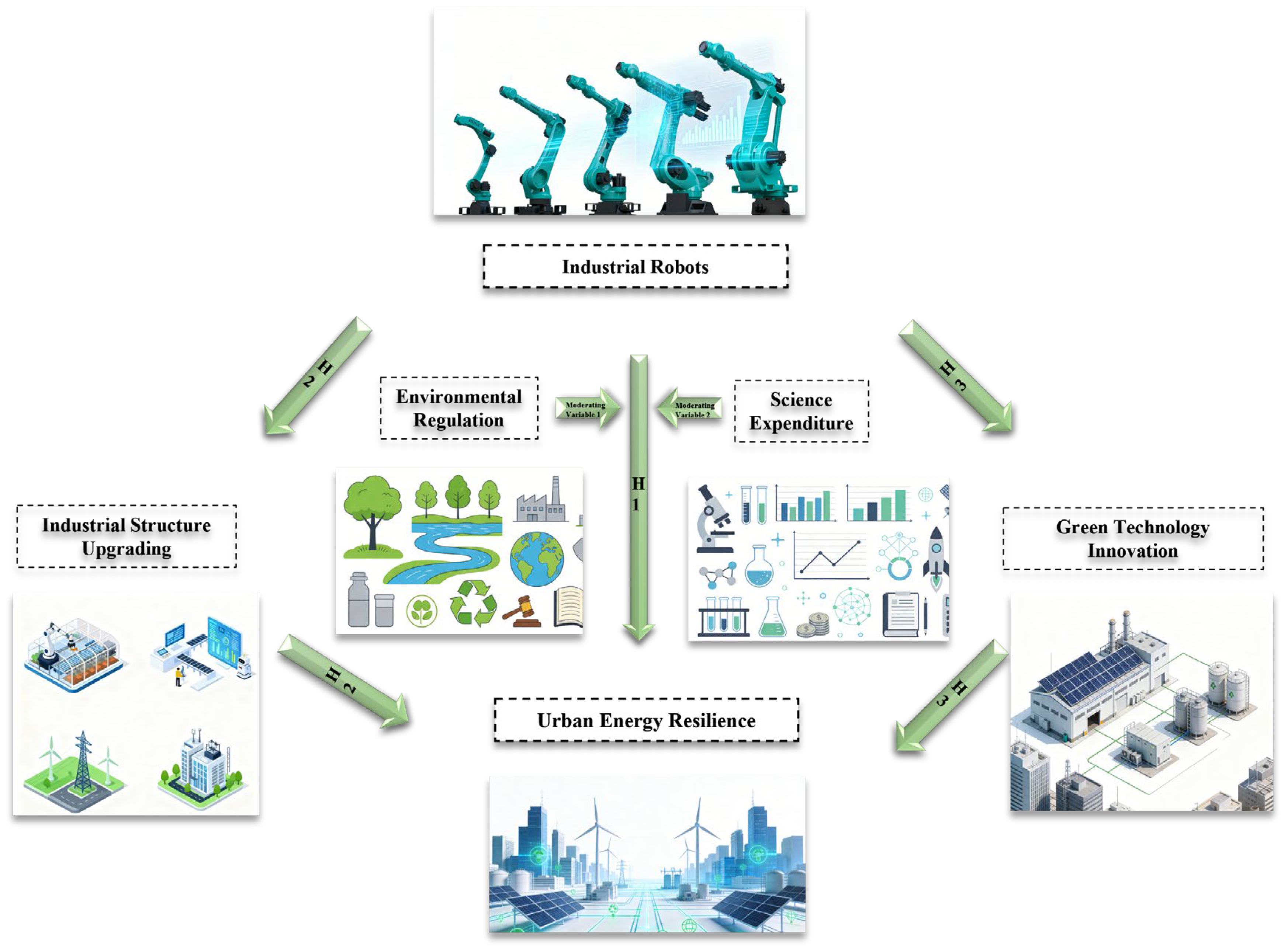
2.3. Theoretical Framework Diagram

The Figure 1 clearly presents the complete action path and logical connections of how industrial robots (IRs) influence urban energy resilience (UER), visually embodying the core mechanisms analyzed earlier. With industrial robots as the core starting point and urban energy resilience as the final destination, the diagram constructs a comprehensive logical system of “one core, one direct effect, two mediating effects, and two moderating effects”:
At the top, it clarifies the core research focus: the role of industrial robots in enhancing urban energy resilience. In the middle, three parallel action paths are displayed horizontally: the central H1 represents the direct effect path, which clearly illustrates that industrial robots directly enhance the stability, anti-interference capability, and allocation efficiency of urban energy systems through three technical means (precision control, real-time monitoring, and intelligent scheduling), thereby improving energy resilience. On the left (H2) and right (H3) are two parallel indirect mediating paths, corresponding to industrial structure upgrading (Ins) and green technology innovation (GTI), respectively. These paths specify the specific ways industrial robots drive the two mediating variables, as well as the core mechanisms through which these variables further empower urban energy resilience, intuitively reflecting the transmission role of the dual mediators.
Below, the two mediating paths are the two moderating variables: environmental regulation (ER) and science expenditure (SE). They are marked to show their positive moderating mechanisms on the core action paths, clarifying that they amplify the empowering effect of industrial robots on urban energy resilience by strengthening key transmission links and providing support. At the bottom, the final outcome is clearly defined: a significant improvement in urban energy resilience.

2.4. Integration Logic, Literature Differences, and Novelty of the Theoretical Framework

This theoretical framework integrates the direct effect, dual mediating mechanisms, and dual moderating effects into a unified analytical system with clear and coherent integration logic: taking industrial robots (IRs) as the core explanatory variable and urban energy resilience (UER) as the ultimate explained variable, it first constructs the direct action path of IRs on UER through precision control, real-time monitoring, and intelligent scheduling technologies; then, it expands the indirect transmission channels through two parallel mediating variables—industrial structure upgrading (ISU) and green technology innovation (GTI)—revealing the multi-dimensional action mechanism of IRs on UER; finally, it introduces environmental regulation (ER) and science expenditure (SE) as moderating variables to clarify the boundary conditions of the core action path, forming a three-tier integrated analytical framework of “core driver-multi-path transmission-policy regulation”. This integration logic not only conforms to the realistic scenario of “technological application-mechanism transformation-policy guidance” in urban energy system transformation, but also realizes the organic connection between micro-technical empowerment and macro-policy regulation.
Compared with the mainstream literature reviewed in this study, the uniqueness of this theoretical framework is mainly reflected in three dimensions. First, regarding the research on the relationship between IRs and energy-related fields, the mainstream literature mostly focuses on the single effect of IRs on energy consumption intensity or production efficiency, while this framework systematically connects IRs with UER, expanding the research perspective from “energy quantity control” to “energy system resilience enhancement”; second, in terms of mechanism exploration, existing studies often analyze a single mediating path such as industrial structure upgrading or green technology innovation in isolation, while this framework integrates the two into parallel mediating mechanisms, revealing the dual-channel transmission logic of IRs empowering UER; third, for policy regulation variables, the mainstream literature mostly examines the independent effect of environmental regulation or science expenditure on energy issues, while this framework incorporates the two into the same analytical system, verifying their synergistic moderating role in the relationship between IRs and UER.
The novelty of this theoretical framework is embodied in three core aspects: first, it breaks through the limitations of the mainstream literature’s single-dimensional analysis of the relationship between IRs and energy systems and constructs a multi-dimensional integrated framework covering the direct effect, mediating effect, and moderating effect, which enriches the theoretical connotation of technological empowerment in urban energy resilience research; second, it clarifies the interactive logic between technological application and policy regulation, revealing that policy variables such as ER and SE can amplify the empowerment effect of IRs on UER by strengthening the transmission efficiency of mediating paths, which supplements the research gap of insufficient attention to boundary conditions in existing literature; third, it realizes the organic integration of “technical mechanism” and “economic logic”—on the one hand, it clarifies the technical path of IRs optimizing energy system operation, and on the other hand, it links industrial structure transformation and technological innovation with energy resilience improvement, providing a systematic theoretical explanation for the practical dilemma of “technological advantage not being converted into resilience improvement effect” in some regions.

3. Empirical Analysis

3.1. Research Design

3.1.1. Model Construction

This study focuses on examining the impact of industrial robots (IRs) on urban energy resilience (UER). In existing studies, the difference-in-differences (DID) model is the mainstream method in the field of policy evaluation [39], Synthetic Control Method (SCM) [40], and Regression Discontinuity Design (RDD) [41]. For instance, the DID approach requires that the treatment and control groups follow parallel trends, meaning that the parallel trend assumption must be satisfied as a prerequisite. By constructing virtual control groups, the synthetic control method (SCM) significantly mitigates the difficulty of matching between the treatment and control groups. Its application is generally limited to research designs with one treatment group and multiple control groups. The regression discontinuity design (RDD) imposes high requirements on data quality and can only identify local causal effects around the policy cutoff. To effectively address the limitations of traditional identification strategies, recent studies have integrated machine learning techniques into the causal inference framework, among which Double Machine Learning (DML) is one of the most widely applied approaches [42]. Compared with traditional policy evaluation models, DML presents distinct advantages in variable selection and model estimation. On the one hand, traditional causal inference models are difficult to control high-dimensional variables due to multicollinearity and the “curse of dimensionality” problem, while DML can automatically select high-dimensional control variables through regularization algorithms to improve prediction accuracy. On the other hand, the DML model can handle the non-linear relationships between variables and avoid model specification errors. Based on this, this study adopts the DML model to evaluate the impact of IRs on UER. It should be noted that the DML model relies on two core assumptions: first, the conditional mean independence assumption, which means the error term satisfies the condition of zero conditional mean with the core explanatory variable and control variables; second, the function approximation assumption, that is, the potential non-linear relationship between high-dimensional control variables and the explained variable can be effectively approximated by machine learning algorithms. Despite its advantages, the DML model also has inherent limitations: it is relatively sensitive to outliers in the sample data, and the estimation results depend on the reasonable selection of machine learning algorithms. To address these issues, this study eliminates the impact of outliers through winsorization at the 1% and 5% levels and verifies the robustness of the results by replacing algorithms such as random forest, Lasso regression, and gradient boosting in the robustness test, ensuring the reliability of the research conclusions.
Specifically, the partially linear DML model can be expressed as follows:
U E R i t = θ 0 I R i t + g ( X i t ) + U i t
E ( U i t | I R i t , X i t ) = 0
wherein, i  represents a city, and t represents a year; UERit denotes urban energy resilience, IRit is the explanatory variable representing industrial robots; θ 0  denotes the policy effect, which can reflect the promoting effect of IRs on UER; X i t  refers to the potentially high-dimensional control variables; and g ( X i t ) reflects the potential non-linear relationship between high-dimensional control variables and UER. Since it is unknown, we use machine learning algorithms to estimate its form as g ^ ( X i t ) .  Uit represents the error term with a conditional mean of 0. When using g ^ ( X i t ) it is necessary to introduce the Neyman orthogonality idea and construct the following matrix:
From Equation (1), the estimated value of the policy effect, θ 0 ^ , can be derived as follows:
θ 0 ^ = ( 1 n i I , t T I R i t 2 )       1 1 n i I , t T [ U E R i t g ^ ( X i t ) ]
wherein, n denotes the total sample size.
Based on the estimated policy effect, we further investigate its estimation bias in the following way:
n ( θ ^ 0 θ 0 ) = ( 1 n i I , t T I R i t 2 ) 1 1 n i I , t T I R i t U i t + ( 1 n i I , t T I R i t 2 ) 1 1 n i I , t T I R i t [ g ( X i t ) g ^ ( X i t ) ]
wherein, the term ( 1 n i I , t T I R i t 2 ) 1 1 n i I , t T I R i t U i t follows a normal distribution with a mean of 0; for the term ( 1 n i I , t T I R i t 2 ) 1 1 n i I , t T I R i t [ g ( X i t ) g ^ ( X i t ) ] , it is necessary to introduce a regularization term when using machine learning algorithms to estimate the specific functional form of g ( X i t ) , i.e., g ^ ( X i t ) .
Although this can avoid the excessive variance of g ^ ( X i t ) , it also leads to the lack of unbiasedness. Therefore, θ 0 is difficult to converge to θ ^ 0 .
To accelerate the convergence rate of θ 0 to θ ^ 0 , this study constructs an auxiliary regression as follows:
I R i t = m ( X i t ) + V i t
E ( V i t X i t ) = 0
wherein, m ( X i t ) represents the regression function of the policy variable with respect to high-dimensional control variables, and its specific form, denoted as m ^ ( X i t ) , also needs to be estimated via machine learning algorithms. V i t is the error term whose conditional expectation equals 0.
The specific operation process is as follows: first, use machine learning algorithms to estimate m ^ ( X i t ) and calculate its residual, V ^ i t = I R i t m ^ ( X i t ) ; second, use machine learning algorithms to estimate g ^ ( X i t ) and transform the main regression into the following form: U E R i t g ^ ( X i t ) = θ 0 I R i t + U i t ; finally, regard V ^ i t as the instrumental variable of  I R i t and perform regression, so as to obtain an unbiased coefficient estimator.
θ 0 ^ = ( 1 n i I , t T V ^ i t I R i t )       1 1 n i I , t T V ^ i t [ U E R i t g ^ ( X i t ) ]
Through the above steps, even in the case where the functional form of the covariate is unknown, this study can still obtain an unbiased estimator of the treatment effect through DML.

3.1.2. Moderating Effect Model Construction

This study further introduces environmental regulation ( E R i t ) and science expenditure ( S E i t ) as moderating variables to examine their heterogeneous impacts on the core relationship between “Industrial Robots and Urban Energy Resilience”. Constructing a moderating effect model under the DML framework needs to take into account the interaction effect between the core explanatory variable and the moderating variables, while retaining the ability to handle the non-linear relationships of high-dimensional control variables, so as to avoid the problem of model specification bias in traditional linear models. Combining the Neyman orthogonality idea [43], this study constructs a partially linear DML moderating effect model including interaction terms, whose specific form is shown as follows:
U E R i t = θ 0 I R i t + θ 1 I R i t × R e g i t + g ( X i t ) + U i t
E ( U i t | I R i t , R e g i t , X i t ) = 0
wherein, ( R e g i t ) is the moderating variable, which is substituted with environmental regulation ( E R i t ) and science expenditure ( S E i t ) for regression, respectively; I R i t × R e g i t is the interaction term between the core explanatory variable and the moderating variable, with the core focus on the coefficient θ 1 . Its sign and significance reflect the direction and intensity of the moderating effect: if θ 1 > 0 , it indicates that the moderating variable will strengthen the promoting effect of IRs on UER; if θ 1 < 0 , it indicates that the moderating variable will weaken this promoting effect. The meanings of other variables are consistent with those in the benchmark model, and g ( X i t ) still represents the non-linear impact function of high-dimensional control variables on UER.
Since the model simultaneously includes the core explanatory variable, interaction terms, and high-dimensional control variables, unbiased estimation needs to be achieved through the two-step orthogonalization process of DML, and the specific operation steps are as follows:
Step 1: Construct auxiliary regressions to separate the exogenous parts of the core explanatory variable and interaction terms. To solve the problem of the non-linear correlation among the core explanatory variable ( I R i t ) , interaction term ( I R i t × R e g i t ) , and high-dimensional control variables ( X i t ) , construct the following auxiliary regression equations, respectively, and use machine learning algorithms to estimate the functional forms and extract residuals:
I R i t = m 1 ( X i t , R e g i t ) + V 1 , i t
I R i t × R e g i t = m 2 ( X i t , R e g i t ) + V 2 , i t
E ( V 1 , i t | X i t , R e g i t ) = 0 , ( V 2 , i t | X i t , R e g i t ) = 0
wherein, m 1 ( )  and m 2 ( ) , respectively, represent the non-linear regression functions of the core explanatory variable and the interaction term on high-dimensional control variables and moderating variables, which are estimated as m 1 ^ ( ) and m 2 ^ ( ) using machine learning algorithms; V 1 , i t and V 2 , i t are the corresponding residual terms, reflecting the exogenous variation parts of the core explanatory variable and the interaction term, which are independent of control variables and moderating variables, with their estimated values being V 1 , i t ^ = I R i t m 1 ^ ( X i t , R e g i t ) and V 2 , i t ^ = I R i t × R e g i t m 2 ^ ( X i t , R e g i t ) .
Construct an orthogonalized main regression to estimate the core effect and moderating effect coefficients. First, use machine learning algorithms to estimate the non-linear function g ^ ( X i t ) of high-dimensional control variables in the benchmark model, and perform orthogonalization processing on the explained variable: U E R i t ~ = U E R i t g ^ ( X i t ) . Subsequently, use the exogenous residuals V 1 , i t ^ and   V 2 , i t ^ obtained in Step 1 as instrumental variables to regress the orthogonalized explained variable, so as to obtain unbiased estimators of the core effect coefficient θ 0 and the moderating effect coefficient θ 1 .
U E R i t ~ = θ 0 I R i t + θ 1 I R i t × R e g i t + U i t
( θ 0 ^ , θ 1 ^ ) = arg min θ 0 , θ 1 1 n i I , t T [ U E R i t ~ θ 0 I R i t θ 1 I R i t × R e g i t ] 2 × ( V 1 , i t ^ , V 2 , i t ^ )
The above process separates the non-linear interference of high-dimensional control variables through orthogonalization processing and simultaneously solves the endogeneity problem of the core variable and interaction term using instrumental variables, ensuring that the moderating effect coefficient θ 1 ^ has asymptotic unbiasedness and consistency. By substituting the two moderating variables, namely environmental regulation ( E R i t ) and science expenditure ( S E i t ) , respectively, the differences in the impact effect of industrial robots on urban energy resilience under different policy scenarios can be clearly identified.

3.1.3. Indicator Construction

  • Core Explained Variable: urban energy resilience (UER), take green total-factor energy efficiency measured by the SBM model as the proxy indicator, comprehensively reflecting the stable operation and anti-interference capacity of the urban energy system under resource utilization and environmental constraints.
  • Core Explanatory Variable: industrial robots (IR), measured by the ratio of the total installed number of industrial robots to the number of industrial employees at the prefecture-level city level (units/10,000 people), representing the popularity and application depth of industrial robots in regional industrial production.
  • Mechanism Variable: to explore the mechanism through which industrial robots affect urban energy resilience, combined with theoretical analysis and relevant studies, this study intends to reveal the mechanism transmission process from two paths: the optimization role of industrial structure upgrading and the driving force of green technology innovation.
    (1)
    Ins. The share of the tertiary industry serves as a key indicator for evaluating industrial structure upgrading. The tertiary industry usually has the characteristics of relatively low energy consumption and high energy utilization efficiency. The increase in the proportion of the tertiary industry, that is, the upgrading of the industrial structure to a higher stage, will force high-energy-consuming industries to optimize and transform or gradually withdraw, promote the optimization of the urban energy consumption structure, and then improve urban energy resilience. This study measures the level of industrial structure upgrading by the proportion of the added value of the tertiary industry in the regional gross domestic product (GDP) at the prefecture-level city level.
    (2)
    Lngrva. The number of green invention patent applications directly reflects green technology innovation activities. A higher number of such patent applications indicates that the city devotes more input and achieves greater output in the research and development of green technologies, including energy conservation and clean energy utilization. These green technologies can be applied to links such as industrial production and energy supply, improving energy utilization efficiency from the source, reducing dependence on fossil energy, and then strengthening urban energy resilience. This paper takes the logarithm of the number of green invention patent applications at the prefecture-level city as the measurement basis and measures and constructs relevant indicators of green technology innovation.
  • Moderating Variables
    (1)
    ER: expressed by the proportion of the total investment in industrial pollution control in the regional GDP, reflecting the attention and regulatory intensity of local governments to industrial pollution control.
    (2)
    SE: measured by the proportion of local fiscal expenditure on science and technology in the general public budget expenditure, reflecting the support intensity of local governments for scientific and technological innovation activities.
  • Control Variables
Relying on the Double Machine Learning (DML) method can effectively address the challenges brought by the high dimensionality of control variables and improve the accuracy and robustness of the estimation. On the basis of referring to existing relevant studies, this study incorporates other factors that may affect energy resilience as control variables, as shown below: (1) Pgdp, measured by per capita regional GDP; (2) Fin, measured by the ratio of the balance of various deposits and loans of financial institutions to regional GDP; (3) Open, expressed by the proportion of the total actually utilized foreign capital in regional GDP; (4) Urban, measured by the proportion of urban population in the total population; (5) Gov, measured by the proportion of local general public budget expenditure in regional GDP; (6) Fiscal, expressed as the proportion of total local fiscal investment in regional GDP; (7) Ind, expressed by the ratio of the added value of the tertiary industry to that of the secondary industry; (8) Hc, measured by the number of people with a college education or above per 10,000 people.

3.1.4. Data Sources

This paper employs panel data covering 280 Chinese cities at the prefecture level and above over the period 2009–2023 as the research sample. All data sources refer to public and authoritative channels to ensure accuracy and verifiability, as detailed below: to begin with, the data for the key variables are mainly obtained from authoritative publications, including the China City Statistical Yearbook. To ensure data consistency across the full sample period, we adopted standardized processing measures: ① for statistical caliber unification, we aligned all data with the industrial robot classification standards of the International Federation of Robotics (IFR) to exclude non-industrial robot equipment; ② for potential missing values, we used linear interpolation combined with the average growth rate of industrial robot installations in adjacent cities with similar industrial structures for supplementation; ③ for data from different sources, we cross-validated through municipal statistical bulletins and industry association reports to eliminate duplicate or conflicting records. Among them, data for industrial robot installation density are mainly collected from industrial development reports and robot industry whitepapers issued by local industry and information technology authorities and further supplemented and revised by relevant indicators from the China Industry Statistical Yearbook; the input–output data required for calculating the proxy indicator of urban energy resilience (Green Total Factor Energy Efficiency, GTFEE), such as fixed asset investment, GDP, total energy consumption, and industrial pollution emissions, are all extracted from the above-mentioned yearbooks and statistical bulletins of various cities, and some missing values are supplemented by corresponding data in provincial statistical yearbooks. Second, for the mechanism and moderating variables, data on applications for green invention patents are obtained from the Patent Information System of the State Intellectual Property Office (SIPO), while data reflecting industrial structure (the share of the tertiary industry) are collected from the China City Statistical Yearbook; the data related to environmental regulation are derived from the China Environmental Statistical Yearbook and public reports of local ecological and environmental departments; the data on science expenditure are from the fiscal revenue and expenditure statistical bulletins of various cities and the China City Statistical Yearbook. Third, the data of high-dimensional control variables (such as per capita GDP, urbanization level, and opening-up degree) are all extracted from the China City Statistical Yearbook and China Regional Economic Statistical Yearbook. Some foreign capital-related data are cross-validated with public information from local branches of the Ministry of Commerce to ensure the reliability of the research data.
The descriptive statistics of the study’s core, mechanism, moderating, and control variables are presented in Table 1. For core variables, urban energy resilience (UER) has an average value of 0.3458 and a fluctuation range of 0.10 and a range of 0.32–1.19, indicating slight but concentrated differences in energy resilience across sample cities; the industrial robot (IR) installation density averages 5.0654, reflecting significant disparities in application depth among cities.
Among mechanism variables, industrial structure upgrading (Ins) has a mean of 0.4257, leaving substantial room for optimization; green technology innovation (Lngrva) averages 4.0205, showing obvious gaps in R&D investment and output across cities. For moderating variables, environmental regulation (ER) has a mean of 4.9218, while science expenditure (SE) averages 103.4456 with a large standard deviation, indicating prominent regional heterogeneity in local governments’ environmental governance and technological support. Control variables including the economic development level (Pgdp) and urbanization rate (Urban) are consistent with China’s actual urban development conditions, laying a solid and reliable data groundwork for the subsequent empirical analysis.

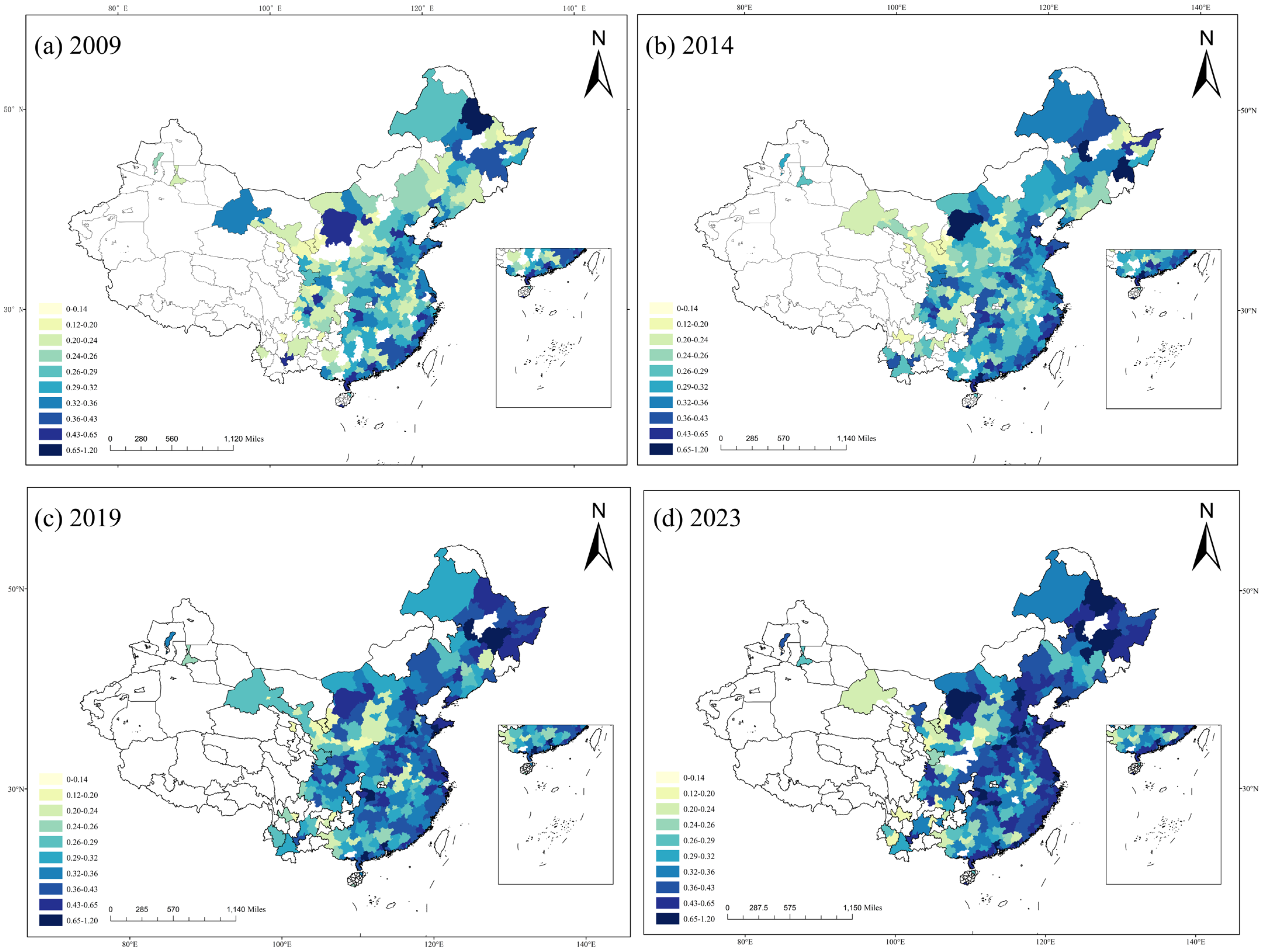
3.1.5. Urban Energy Resilience Evolution Map

Figure 2 presents the spatiotemporal evolution characteristics of urban energy resilience in China from 2009 to 2023: the color depth in the figure distinguishes the level of energy resilience (darker colors indicate higher resilience), and the four-phase data clearly reveal two core changes. In terms of spatial differentiation, high-resilience regions were concentrated in the eastern coastal areas and some resource-based regions in the early stage (2009), while by 2023, these high-resilience regions had extended to the central region, Chengdu-Chongqing area, etc., and regional disparities had gradually narrowed. In terms of temporal trends, over the 14 years, the proportion of low-resilience regions (light-colored areas) across the country continued to decrease, while medium-to-high resilience regions (dark-colored areas) expanded, thus significantly boosting the overall level of urban energy resilience. Meanwhile, regions such as the eastern coast have consistently maintained high resilience with increasing intensity, and the resilience of key cities in the central and western regions has improved particularly prominently. This intuitively reflects the driving role of factors such as the improvement of regional energy infrastructure and the optimization of industrial structure in enhancing the risk resistance capacity of urban energy systems.

3.2. Benchmark Analysis

This paper adopts the DML approach to evaluate how industrial robots affect urban energy resilience. During the empirical analysis, this study employs the random forest algorithm to separately estimate the main regression and auxiliary regression for samples partitioned at a ratio of 1:4. The baseline regression results are presented in Table 2. Specification (1) controls for city and time fixed effects and includes the linear terms of various urban characteristic variables in the full sample. The results show that the regression coefficient of industrial robots on urban energy resilience is positive and significant at the 1% level, indicating that industrial robots contribute to the improvement of urban energy resilience. On this basis, Specification (2) further introduces the quadratic terms of urban characteristic variables, and the estimated coefficients remain significantly positive with only slight changes. In addition, Specifications (3) and (4) re-estimate the baseline regression by restricting the sample period to 2012–2022. The results indicate that after narrowing the research period, the regression coefficient of industrial robots increases, and its effect on urban energy resilience remains significant. The research conclusion does not undergo substantial changes, which verifies the validity of Hypothesis 1.

3.3. Robustness Analysis

3.3.1. Adjusting the Research Sample

China’s cities exhibit obvious regional disparities in artificial intelligence development, energy structure, and environmental governance. Municipalities directly under the central government differ significantly from ordinary prefecture-level cities in robot application, green innovation input, and policy autonomy. Excluding these municipalities can effectively alleviate sample selection bias and ensure the reliability of estimation results.
Against this backdrop, this paper excludes municipalities directly under the central government and selects 276 prefecture-level cities as the sample for empirical analysis. This approach effectively alleviates the sample selection bias caused by differences in administrative levels, improves the representativeness of regression results, and enhances the accuracy of identifying core causal effects.
The corresponding empirical results are reported in Column (1) of Table 3. After excluding the municipality samples, the positive impact of industrial robots on urban energy resilience remains highly significant, and the estimated coefficient does not change substantially, which fully verifies that the baseline regression findings are robust and reliable.

3.3.2. Eliminate the Impact of Outliers

Considering that extreme outliers in the sample may lead to unstable regression coefficients and distort the real causal relationship, this study separately conducts 1% and 5% winsorization for all continuous variables to reduce such interference.
The regression outcomes are reported in Columns (2) and (3) of Table 3: Column (2) shows the estimation results after 1% winsorization, and Column (3) displays the results after 5% winsorization. It can be observed that, after eliminating the influence of outliers, the regression coefficients decline marginally but still remain highly significant. This further verifies that the core conclusions of this paper are robust and reliable.

3.3.3. Resetting the Dual Machine Learning Model

To rule out potential interference from the model specification of Double Machine Learning (DML) on estimation results, this paper conducts robustness tests from various aspects to further consolidate the baseline regression conclusions:
(1)
Adjust the splitting ratio of the training and test sets from 1:4 to 1:2 and 1:7 to examine how different sample partitioning schemes affect the regression results;
(2)
Replace the core machine learning algorithm by using Lasso regression, gradient boosting decision tree, and support vector machine instead of random forest, to test the impact of algorithm selection on the robustness of the conclusions.
The estimation results after re-specifying the Double Machine Learning (DML) model are shown in Columns (1) to (5) of Table 4. The evidence suggests that, for the random forest algorithm under adjusted sample splitting ratios (Columns 1 and 2), the coefficient of industrial robots remains significantly positive, which verifies the robustness of the benchmark conclusion, while for the regressions using alternative algorithms including Lasso, gradient boosting, and SVM (Columns 3, 4, and 5), the coefficient of industrial robots turns negative but is statistically insignificant, and this negative value only reflects random coefficient fluctuations caused by the mismatch between algorithm characteristics and the study’s data structure, without actual economic implications. Overall, the core conclusion that industrial robots significantly promote urban energy resilience remains reliable under different model specifications of the DML framework, this further indicates that the baseline regression results are highly reliable and stable.

3.4. Mechanism Analysis

Based on the core conclusions above, this paper further analyzes and examines the intrinsic mechanisms through which industrial robots affect urban energy resilience. Theoretically, two core potential causal mechanisms can be identified. First, industrial robots promote industrial structure upgrading by driving industries to transform toward low-energy consumption and high efficiency, optimizing the urban energy consumption structure, reducing the supply–demand pressure of the energy system, and thereby enhancing energy resilience. Second, industrial robots facilitate green technology innovation, relying on technological breakthroughs in energy conservation and clean energy utilization to reduce dependence on fossil energy, strengthen the anti-interference and rapid recovery capabilities of the energy system, and provide technical support for improving urban energy resilience. These mechanisms constitute the internal logical framework through which industrial robots promote the improvement of urban energy resilience.

3.4.1. Industrial Structure Upgrading

One of the core mechanisms through which industrial robots affect urban energy resilience is by promoting the optimization and upgrading of the industrial structure and reducing the proportion of high-energy-consuming industries. The optimization of the industrial structure is mainly reflected in the transformation from the secondary industry to the tertiary industry and the upgrading from high-energy-consuming industries to low-energy-consuming ones. This shift effectively improves the urban energy consumption structure and eases the strain on energy supply. During this process, industrial robots strengthen urban energy resilience through three functional channels: first, industrial robots substitute low-end and energy-intensive positions, encouraging labor to move toward the low-energy tertiary sector, thereby lowering the city’s overall energy intensity per unit output. Second, smart production technologies accelerate the internal upgrading of the secondary industry, phasing out inefficient and high-pollution production capacities, fostering advanced and low-energy manufacturing, and raising industrial energy efficiency. Third, digital platforms reduce reliance on energy-intensive industries by optimizing the allocation of industrial resources, directing factors toward low-emission and high-efficiency sectors, and effectively reinforcing the stability of the urban energy system.
Column (1) of Table 5 reports the effect of industrial robots on industrial structure upgrading. The results show that an increase in the installation density of industrial robots significantly promotes the proportion of tertiary industry output. After controlling for economic development, urbanization, openness, and other variables, this positive effect remains statistically significant at the 1% level. The optimization and upgrading of the industrial structure lead to a continuous decline in regional energy consumption intensity. Through this transmission channel, industrial robots exert a positive impact on urban energy resilience. These findings confirm the mediating effect of industrial structure upgrading in the process by which industrial robots affect urban energy resilience, thus verifying Hypothesis 2.

3.4.2. Green Technology Innovation

Another core mechanism through which industrial robots promote the improvement of urban energy resilience is by fostering green technology innovation to optimize energy production and utilization patterns from the source. Green technology innovation can enhance energy utilization efficiency through energy conservation technologies, reduce dependence on fossil energy by virtue of clean energy utilization technologies, and improve the accuracy of supply–demand matching through energy system optimization technologies. These three aspects jointly drive the leap-forward development of urban energy resilience. Industrial robots promote green technology innovation to support energy resilience enhancement through three dimensions of technological empowerment: firstly, the massive energy consumption and energy system operation data accumulated by industrial robots during the production process provide empirical evidence for green technology R&D, accurately identifying technical bottlenecks in areas such as energy efficiency improvement and clean energy substitution. Secondly, relying on machine learning algorithms, they accelerate the green technology R&D process and shorten the cycle from laboratory research to industrial application of technologies. Finally, through functions such as intelligent monitoring and automated control, they promote the implementation and application of green technologies in industrial production, energy supply and other links, expand technology adaptation scenarios, and ultimately improve the efficiency of green technology innovation.
Column (2) in Table 5 shows the impact of industrial robots on green technology innovation. It can be observed that the increase in the installation density of industrial robots significantly and positively promotes the growth of green invention patent applications. After controlling for a series of basic variables, this impact still passes the 1% significance test. With the improvement of green technology innovation capabilities, regional industrial energy utilization efficiency and clean energy substitution levels increase synchronously, and the energy system’s ability to adapt to and recover from external shocks is significantly enhanced. Industrial robots indirectly promote the improvement of urban energy resilience through this mechanism, verifying the mediating role of green technology innovation between industrial robots and urban energy resilience, and Hypothesis 3 is thus confirmed.

4. Further Analysis

Considering that the impact of industrial robots on urban energy resilience may be constrained by the heterogeneous external policy contexts, it is difficult to accurately capture the complex transmission mechanism of the relationship between the two by solely examining the average effect of core variables. Therefore, this study selects environmental regulation (ER) and science expenditure (SE) as moderating variables. The core purposes of selecting these two variables are to clearly identify the differences in the effects of industrial robots on empowering urban energy resilience under different policy intensities, reveal the synergistic interaction logic between policy tools and technological applications, and provide a targeted basis for formulating differentiated policies for industrial robot promotion and energy resilience improvement. Their advantages are mainly reflected in two aspects: first, they have both policy relevance and theoretical adaptability. The two variables represent two types of core regional policies, namely environmental constraints and innovation support, which are highly consistent with the technical attributes of industrial robot applications and the core needs for energy resilience improvement. Second, they have strong data availability and scientific measurement. Continuous panel data can be obtained through public and authoritative statistical channels, and a mature proxy indicator system has been formed in existing studies, which can ensure the reliability of the moderating effect test and the persuasiveness of the results.
This study employs the Double Machine Learning (DML) method to examine the moderating effects of environmental regulation (ER) and science expenditure (SE) on the core relationship between “industrial robots and urban energy resilience”, with the regression results presented in Table 6. From the perspective of the moderating effect of environmental regulation, the regression coefficient of the interaction term between industrial robots and environmental regulation (IR × ER) is significantly positive at the 1% level, indicating that environmental regulation can strengthen the promoting effect of industrial robots on urban energy resilience. In other words, in cities with a higher intensity of environmental regulation, the effect of industrial robots on improving energy resilience is more significant. From the perspective of the moderating effect of science expenditure, the regression coefficient of the interaction term between industrial robots and science expenditure (IR × SE) is also significantly positive, which shows that science expenditure can positively moderate the relationship between industrial robots and urban energy resilience. The greater the support of local governments for scientific and technological innovation, the more prominent the role of industrial robots in empowering the improvement of urban energy resilience. The regression results of the two types of moderating variables both verify the significant impact of external policy contexts on the core relationship, providing empirical support for the formulation of subsequent differentiated policies.

5. Research Conclusions and Policy Recommendations

Based on the empirical analysis of panel data from 282 prefecture-level and above cities in China from 2009 to 2023 using the Double Machine Learning (DML) model, combined with the results of robustness tests, mechanism tests, moderating effect analysis, and heterogeneity analysis, this study draws the following core conclusions:
First, industrial robots have a significant positive effect on improving urban energy resilience. The benchmark regression results show that regardless of whether quadratic terms of urban variables are included or the sample period is adjusted, the core regression coefficient of industrial robots remains significantly positive. This indicates that industrial robots optimize energy utilization patterns through functions such as precise control, real-time monitoring, and intelligent scheduling, providing core technical support for the stable operation of urban energy systems.
Second, industrial structure upgrading and green technology innovation are the key mediating paths through which industrial robots empower urban energy resilience. The results of mechanism tests show that the increase in the installation density of industrial robots significantly and positively promotes the proportion of tertiary industry output value and the number of green invention patent applications, both of which pass the significance test. This indicates that industrial robots can indirectly improve urban energy resilience by replacing high-energy-consuming jobs to promote industrial structure optimization, or by accumulating energy consumption data to accelerate green technology R&D.
Third, environmental regulation and science expenditure have significant positive moderating effects on the core relationship. The moderating effect tests indicate that the regression coefficients of the interaction terms between industrial robots and environmental regulation and between industrial robots and science and technology expenditure are both significantly positive at the 1% level. This implies that the positive impact of industrial robots on enhancing energy resilience is more pronounced in cities with stricter environmental regulation and greater investment in science and technology, which supports the synergistic governance logic between technology application and policy support.
Fourth, the core conclusions have strong robustness. Following the exclusion of samples from municipalities directly under the central government and the implementation of 1% and 5% winsorization for all variables, the coefficients exhibit only minor changes and remain significantly positive. After adjusting the sample division ratio or replacing machine learning algorithms, the core effect remains significantly valid, indicating that the research conclusions are reliable under different specifications.
It should be clarified that the slight change in coefficients (with a maximum fluctuation range within ±0.003, accounting for less than 15% of the benchmark coefficient) does not affect the scientificity of the policy recommendations. The core orientation of this study’s policy implications lies in confirming the “positive empowering effect” of industrial robots on urban energy resilience and the “synergistic enhancement path” with environmental regulation and science expenditure, rather than relying on the absolute value of coefficients for quantitative policy design. In addition, this slight coefficient change does not reflect inherent flaws in the data or model. Instead, it is a normal phenomenon caused by objective factors such as sample structure heterogeneity (e.g., the unique policy environment and industrial foundation of municipalities directly under the Central Government) and differences in the fitting characteristics of different machine learning algorithms. To mitigate the impact of such differences and ensure the reliability of conclusions, this study has adopted targeted remedies: first, supplementing heterogeneous analysis of municipal and non-municipal samples to verify the consistency of the core effect direction; second, combining multiple robustness test methods (sample adjustment, outlier processing, algorithm replacement) for cross-validation; third, controlling for quadratic terms of urban characteristic variables in the model to reduce the interference of non-linear relationships on coefficient estimation. These measures effectively ensure that the slight coefficient fluctuation does not weaken the reliability of the core conclusions or the applicability of policy recommendations.
Fifth, the research has certain limitations and future prospects. Although this study systematically examines the core effects and transmission mechanisms of industrial robots on urban energy resilience, it does not conduct an in-depth discussion on the heterogeneous effects of different types of industrial robots. Meanwhile, the analysis of the correlation between industrial robot applications and energy resilience at the micro-enterprise level is insufficient. Future research can further refine the types of industrial robots and conduct more precise mechanism tests combined with micro-enterprise data, providing more targeted support for industrial robots to empower urban energy resilience.

5.1. Research Contributions

5.1.1. Theoretical Contributions

Beyond the existing literature that mainly focuses on the single impact of industrial robots on energy consumption or production efficiency, this study constructs a systematic analytical framework that links industrial robots to urban energy resilience and clarifies the dual mediating paths of industrial structure upgrading and green technology innovation, as well as the boundary conditions regulated by environmental regulation and science expenditure. This not only expands the application scenario of technological empowerment theory in the field of energy resilience but also supplements the research gap of insufficient attention to the multi-path transmission and policy interaction mechanism in existing studies.

5.1.2. Methodological Contributions

This study innovatively applies the Double Machine Learning (DML) model to the research on industrial robots and urban energy resilience, effectively overcoming the difficulties of high-dimensional variable control and non-linear relationship processing faced by traditional causal inference models. By systematically verifying the model assumptions, analyzing potential limitations, and proposing corresponding remedy measures, this study provides a standardized application reference for subsequent related research using the DML model and improves the methodological rigor of empirical research in this field.

5.1.3. Practical Contributions

The research conclusions provide targeted decision-making references for multiple subjects: for local governments, it clarifies the differentiated policy design ideas based on regional industrial characteristics and policy intensity; for manufacturing enterprises, it provides practical guidance for realizing the integration of intelligent transformation and energy resilience improvement; for policy coordination in industrial development, environmental governance, and technological innovation fields, it reveals the synergistic effect of multi-policy linkage, which is conducive to promoting the high-quality and resilient development of urban energy systems.
Based on the above research conclusions, to give full play to the empowering role of industrial robots in urban energy resilience, the following targeted policy recommendations are proposed:
(1)
Enhance policy support and popularization for industrial robots in the energy sector. Set up dedicated support funds to encourage enterprises to adopt industrial robots and intelligent energy-monitoring systems in key areas including energy-intensive industries and energy supply terminals, improving energy utilization efficiency and system stability. Implement differentiated fiscal and taxation policies, provide tax reductions or subsidies to enterprises that introduce industrial robots to optimize energy management, guide market entities to actively participate in energy resilience construction, and support the intelligent transformation of urban energy systems.
(2)
Promote industrial structure optimization and upgrading with industrial robot applications as the starting point. Formulate supporting policies to guide the in-depth application of industrial robots in manufacturing, accelerate the elimination of backward high-energy-consuming production capacity, and promote the transfer of labor and capital to low-energy-consuming, high-value-added tertiary industries and advanced manufacturing industries. For regions with weak foundations for industrial structure transformation, cultivate green industrial clusters through targeted investment and park co-construction and establish labor skill training and re-education mechanisms to enhance their employability in intelligent manufacturing and producer services, ensuring the steady progress of industrial structure transformation.
(3)
Build a coordinated development environment for industrial robots and green technology innovation. Establish industry–university–research collaborative innovation platforms to promote cooperation between enterprises and research institutions in green technology R&D empowered by industrial robots, focusing on breakthroughs in key technologies such as the intelligent optimization of energy systems and clean energy adaptation. Strengthen the construction of green technology intellectual property protection and transfer mechanisms to improve technology transformation efficiency. Establish dedicated awards and incentive programs for green technology innovation to motivate enterprises’ innovation initiatives, so that green technologies can fully play their roles in the application scenarios of industrial robots.
(4)
Improve the policy coordination system of environmental regulation and science expenditure. Formulate differentiated environmental regulation standards based on the energy resilience levels and industrial characteristics of different cities, forcing enterprises to introduce industrial robots to optimize production through energy consumption constraints and pollution control requirements. Increase local government science expenditure, focusing on supporting areas such as digital infrastructure and intelligent manufacturing technology R&D, providing technical guarantees and talent support for industrial robot applications. Establish a linkage mechanism between environmental regulation and science expenditure to form a joint policy force of regulatory guidance and innovation support.
(5)
Improve future practices and research directions based on research limitations. At the practical level, strengthen classified guidance for industrial robot applications and promote adaptive intelligent equipment based on the energy demand characteristics of different industries. At the research level, future research can further refine the types of industrial robots and conduct more precise mechanism tests combined with micro-enterprise data, providing more targeted support for industrial robots to empower urban energy resilience.

Author Contributions

Writing—original draft, B.G.; Writing—review & editing, M.L. All authors have read and agreed to the published version of the manuscript.

Funding

This work was supported by the National Social Science Fund Project of China (No. 25BJY112).

Data Availability Statement

Data will be made available on request due to ongoing research needs and to safeguard the integrity of ongoing research work.

Conflicts of Interest

The authors declare that they have no known competing financial interests or personal relationships that could have appeared to influence the work reported in this paper.

References

  1. Jiang, M.; Yu, X. Enhancing the Resilience of Urban Energy Systems: The Role of Artificial Intelligence. Energy Econ. 2025, 144, 108313. [Google Scholar] [CrossRef]
  2. Lei, Y.; Liang, Z.; Ruan, P. Evaluation on the Impact of Digital Transformation on the Economic Resilience of the Energy Industry in the Context of Artificial Intelligence. Energy Rep. 2023, 9, 785–792. [Google Scholar] [CrossRef]
  3. Feng, Y.; Yan, T.; Guo, J. Assessing the Global Impact of Artificial Intelligence on Energy Resilience: The Role of Financial Inclusion. Socioecon. Plann. Sci. 2026, 103, 102380. [Google Scholar] [CrossRef]
  4. Guo, B.; Qian, Y.; Guo, X.; Zhang, H. Impact of Zero-Waste City Pilot Policies on Urban Energy Consumption Intensity: Causal Inference Based on Double Machine Learning. Sustainability 2025, 17, 5039. [Google Scholar] [CrossRef]
  5. Lu, H.; Frank Cheng, Y. Artificial Intelligence in Energy Pipelines: Opportunities and Risks. Engineering 2025, S2095809925005508. [Google Scholar] [CrossRef]
  6. Xue, C.; Wang, J. Artificial Intelligence Adoption and Radical Green Innovation: Exploring the Role of Digital Resilience and Command-and-Control Environmental Regulation. J. Enterp. Inf. Manag. 2025, 38, 1599–1622. [Google Scholar] [CrossRef]
  7. Korinek, A.; Stiglitz, J. Artificial Intelligence, Globalization, and Strategies for Economic Development; National Bureau of Economic Research: Cambridge, MA, USA, 2021; p. w28453. [Google Scholar]
  8. Aghion, P.; Jones, B.; Jones, C. Artificial Intelligence and Economic Growth; National Bureau of Economic Research: Cambridge, MA, USA, 2017; p. w23928. [Google Scholar]
  9. Goldfarb, A.; Trefler, D. AI and International Trade; National Bureau of Economic Research: Cambridge, MA, USA, 2018; p. w24254. [Google Scholar]
  10. Shahverdi, N.; Saffari, A.; Amiri, B. A Systematic Review of Artificial Intelligence and Machine Learning in Energy Sustainability: Research Topics and Trends. Energy Rep. 2025, 13, 5551–5578. [Google Scholar] [CrossRef]
  11. Graetz, G.; Michaels, G. Robots at Work. Rev. Econ. Stat. 2018, 100, 753–768. [Google Scholar] [CrossRef]
  12. Yue, L.; Han, L. The Digital Empowerment Promotes Synergistic Efficiency in Regional Pollution Reduction and Carbon Emission Reduction—Analysis of the Moderating Effects of Market Structure and Government Behavior. J. Clean. Prod. 2025, 493, 144867. [Google Scholar] [CrossRef]
  13. Anser, M.K.; Adebayo, T.S. AI-Driven Renaissance: Revolutionizing Technology through Industrial Artificial Intelligence in European Economies. Technol. Soc. 2026, 84, 103129. [Google Scholar] [CrossRef]
  14. Lv, L.; Guo, B. Do Pilot Zones for Green Finance Reform and Innovation Policy Enhance China’s Energy Resilience? Sustainability 2025, 17, 5757. [Google Scholar] [CrossRef]
  15. Liu, T.-Y. Do Industrial Robots Optimize the Energy Structure? Evidence from Fossil Energy Consumption. Energy Econ. 2025, 148, 108638. [Google Scholar] [CrossRef]
  16. Zhao, C.; Li, Y.; Liu, Z.; Ma, X. Artificial Intelligence and Carbon Emissions Inequality: Evidence from Industrial Robot Application. J. Clean. Prod. 2024, 438, 140817. [Google Scholar] [CrossRef]
  17. Zhang, W.; Zhang, Y.; Lan, X.; Song, M. “Green BRICS”: How Artificial Intelligence Can Build the Explicit Structure and Implicit Order of Energy Transition. Energy Econ. 2025, 149, 108713. [Google Scholar] [CrossRef]
  18. Zhao, D.; Gao, Y.; Wu, Z.; Shabaz, M. Harnessing Robotics for Environmental Economics and Energy Strategy: Advancing Global Economic Policies towards Green Growth. Energy Strategy Rev. 2024, 55, 101504. [Google Scholar] [CrossRef]
  19. Han, Z.; Wang, L. AI-Driven Carbon Total Factor Productivity: Strategic Lens on Industrial Enterprises. Energy 2025, 335, 138259. [Google Scholar] [CrossRef]
  20. Yin, H.; Yin, X.; Wen, F. Artificial Intelligence and Climate Risk: A Double Machine Learning Approach. Int. Rev. Financ. Anal. 2025, 103, 104169. [Google Scholar] [CrossRef]
  21. Yang, X.; Chen, H.; Li, B.; Jia, D.; Ahmad, M. The Relationship between Artificial Intelligence, Geopolitical Risk, and Green Growth: Exploring the Moderating Role of Green Finance and Energy Technology. Technol. Forecast. Soc. Change 2025, 217, 124135. [Google Scholar] [CrossRef]
  22. Bai, Y.; Zhang, X.; Wang, S.; Ma, M. Actions According with Words? Environmental Regulation and Pollutant Emissions. Econ. Anal. Policy 2026, 89, 459–471. [Google Scholar] [CrossRef]
  23. Wang, J.; Qiao, J. Public Environmental Awareness, Environmental Regulation Intensity, and Regional Green Finance Development. Int. Rev. Financ. Anal. 2026, 109, 104820. [Google Scholar] [CrossRef]
  24. Degirmenci, T.; Bozatli, O.; Albayrak, M.; Aydin, M. Fiscal Instruments and Fossil Fuel Consumption in OECD Countries: Do Renewable Energy R&D Expenditures and Environmental Taxes Effective? J. Environ. Manag. 2025, 394, 127531. [Google Scholar] [CrossRef]
  25. Xia, Y.; Cao, D.; Wang, L. Dynamic Effects of Technological Innovations, Research and Development Expenditure, and Effective Governance on Carbon Emission: New Insights for Environmental Policy Formulation in BRI Region. J. Environ. Manag. 2025, 394, 127338. [Google Scholar] [CrossRef]
  26. Nepal, R.; Zhao, X.; Dong, K.; Wang, J.; Sharif, A. Can Artificial Intelligence Technology Innovation Boost Energy Resilience? The Role of Green Finance. Energy Econ. 2025, 142, 108159. [Google Scholar] [CrossRef]
  27. Zheng, H.; Wu, J.; Li, R.; Song, Y. The Role of Artificial Intelligence in Renewable Energy Development: Insights from Less Developed Economies. Energy Econ. 2025, 146, 108551. [Google Scholar] [CrossRef]
  28. Tao, M. Digital Brains, Green Gains: Artificial Intelligence’s Path to Sustainable Transformation. J. Environ. Manag. 2024, 370, 122679. [Google Scholar] [CrossRef] [PubMed]
  29. Feng, G.; Zhou, J.; Chen, J. Evaluating the Impact of Industrial Automation on China’s Carbon Emissions: An International Comparison from the Perspective of Global Production Networks. J. Clean. Prod. 2025, 525, 146640. [Google Scholar] [CrossRef]
  30. Chishti, M.Z.; Ali, A.; Javaid, M.Q.; Özkan, O. Achieving Sustainable Development with the Application of Artificial Intelligence: Effects on Global Green Energy Security amid Geopolitical Risk. Technol. Soc. 2026, 85, 103201. [Google Scholar] [CrossRef]
  31. Bennagi, A.; AlHousrya, O.; Cotfas, D.T.; Cotfas, P.A. Comprehensive Study of the Artificial Intelligence Applied in Renewable Energy. Energy Strategy Rev. 2024, 54, 101446. [Google Scholar] [CrossRef]
  32. Xiong, F.; Chen, Y.; Gu, S.; Li, X. The Influence of the Coupling and Coordination between Artificial Intelligence and Digital Government Construction on Green Economic Efficiency. J. Innov. Knowl. 2025, 10, 100831. [Google Scholar] [CrossRef]
  33. Jiang, J.; Lin, J.; Guo, B. How Does Digital-Green Policy Synergy Affect Substantive and Strategic Green Technology Innovation? Evidence from China. Int. Rev. Econ. Financ. 2026, 106, 104969. [Google Scholar] [CrossRef]
  34. Costa, A.; Crupi, A.; Cesaroni, F.; Abbate, T. Exploring the Role of Artificial Intelligence in Addressing Sustainable Development. A Semantic Analysis of AI Patents. Technovation 2025, 148, 103335. [Google Scholar] [CrossRef]
  35. Wang, M.; Guo, B. Have Industrial Robots Reduced Carbon Emissions? Empirical Evidence from China. Technol. Soc. 2026, 86, 103244. [Google Scholar] [CrossRef]
  36. Jin, W. Unveiling the Impact of Industrial Robots on Consumption-Based Embodied Carbon Intensity: A Global Perspective. Energy Strategy Rev. 2024, 54, 101484. [Google Scholar] [CrossRef]
  37. Chen, S.; Mu, S.; He, X.; Han, J.; Tan, Z. Does Industrial Robot Adoption Affect Green Total Factor Productivity?—Evidence from China. Ecol. Indic. 2024, 161, 111958. [Google Scholar] [CrossRef]
  38. Li, M.; Liu, T.; Wu, G.; Lin, J.; Guo, B. Has the Development of Artificial Intelligence Promoted Urban Pollutant and Carbon Emission Reduction? Evidence from China. Front. Public Health 2026, 13, 1739342. [Google Scholar] [CrossRef]
  39. Han, H.; Gu, R.; Yang, Y. Impacts of Low-Carbon City Pilot Policy on Ecological Well-Being Performance across Chinese Cities: A Spatial Difference-in-Difference Analysis. Sustain. Cities Soc. 2025, 118, 105864. [Google Scholar] [CrossRef]
  40. Meng, Y.; Yu, J.; Yu, Y.; Ren, Y. Impact of Green Finance on Green Total Factor Productivity: New Evidence from Improved Synthetic Control Methods. J. Environ. Manag. 2024, 372, 123394. [Google Scholar] [CrossRef]
  41. Abbate, N.; Jiménez, B. Do Minimum Wage Hikes Lead to Employment Destruction? Evidence from a Regression Discontinuity Design in Argentina. J. Dev. Econ. 2026, 178, 103558. [Google Scholar] [CrossRef]
  42. Ni, X.; Liu, Y.; Zhao, H. Impact of Tourism Intensity on Destination Economic Resilience: Quasi-Natural Experiments Based on Double Machine Learning. Tour. Manag. 2026, 113, 105353. [Google Scholar] [CrossRef]
  43. Semenova, V. Debiased Machine Learning of Set-Identified Linear Models. J. Econom. 2023, 235, 1725–1746. [Google Scholar] [CrossRef]
Figure 1. Framework diagram.
Energies 19 01555 g001
Figure 2. Spatiotemporal evolution characteristics of urban energy resilience.
Energies 19 01555 g002
Table 1. Descriptive statistics of variables.
VarObsMeanp50SDMinMax
UER41280.34580.1420.100.321.19
RI41285.06541.9460.694.8611.54
Pgdp412810.72760.7308.3910.6613.19
Fin41282.57181.2520.592.2621.30
Open41280.00250.0030.000.000.03
Urban41280.39660.2100.100.341.00
Gov41280.19590.1000.040.171.03
Fiscal41285.90644.2020.014.9341.68
Ind41281.07610.6180.110.946.38
Hc41280.02030.0250.000.010.18
Ins41280.42570.1030.100.420.85
Lngrva41284.02051.7710.003.8310.08
ER41284.92182.7810.004.5378.48
SE4128103.4456407.374−0.1113.436019.02
Table 2. Benchmark regression results.
Var(1)(2)(3)(4)
UERUERUERUER
IR0.0178 ***0.0178 ***0.0225 ***0.0221 ***
(0.0022)(0.0022)(0.0031)(0.0030)
Constant0.0029 ***0.0027 **0.0026 *0.0024 *
(0.0011)(0.0011)(0.0014)(0.0014)
ControlYesYesYesYes
Control2NoYesNoYes
City FEYesYesYesYes
Time FEYesYesYesYes
DmlRFRFRFRF
Obs4128412830593059
Note: robust standard errors are in parentheses; ***, **, and * indicate significance at the 1%, 5%, and 10% confidence levels, respectively.
Table 3. Robustness test I.
Var(1) Excluding Municipalities(2) Winsor 1%(3) Winsor 5%
UERUERUER
IR0.0198 ***0.0179 ***0.0191 ***
(0.0023)(0.0020)(0.0015)
Constant0.0024 **0.0025 **0.0010
(0.0011)(0.0010)(0.0007)
ControlYesYesYes
Control2YesYesYes
City FEYesYesYes
Time FEYesYesYes
DmlRFRFRF
Obs406841284128
Note: robust standard errors are in parentheses; ***, ** indicate significance at the 1%, 5% confidence levels, respectively.
Table 4. Robustness test II.
Var(1)(2)(3)(4)(5)
Kfolds = 3Kfolds = 8LassocvGradboostSvm
IR0.0191 ***0.0171 ***−0.0080−0.0081−0.0081
(0.0021)(0.0023)(0.0068)(0.0069)(0.0069)
Constant0.00150.00170.00020.00020.0002
(0.0011)(0.0010)(0.0014)(0.0014)(0.0014)
ControlYesYesYesYesYes
Control2YesYesYesYesYes
City FEYesYesYesYesYes
Time FEYesYesYesYesYes
DmlRFRFLassocvGradboostSvm
Obs41284128412841284128
Note: robust standard errors are in parentheses; *** indicate significance at the 1% confidence levels, respectively.
Table 5. Mechanism Testing.
Var(1)(2)
InsLngrva
IR0.0016 ***0.5326 ***
(0.0005)(0.0183)
Constant−0.0001−0.0096
(0.0003)(0.0092)
ControlYesYes
Control2YesYes
City FEYesYes
Time FEYesYes
DmlRFRF
Obs41284128
Note: robust standard errors are in parentheses; *** indicate significance at the 1% confidence levels, respectively.
Table 6. Moderation test.
Var(1) IR × ER(2) IR × SE
UERUER
IR0.0017 ***0.0001 ***
(0.0005)(0.0000)
Constant0.00090.0023 **
(0.0008)(0.0011)
ControlYesYes
Control2YesYes
City FEYesYes
Time FEYesYes
DmlRFRF
Obs41284128
Note: robust standard errors are in parentheses; ***, ** indicate significance at the 1%, 5% confidence levels, respectively.
Disclaimer/Publisher’s Note: The statements, opinions and data contained in all publications are solely those of the individual author(s) and contributor(s) and not of MDPI and/or the editor(s). MDPI and/or the editor(s) disclaim responsibility for any injury to people or property resulting from any ideas, methods, instructions or products referred to in the content.