Article

Information Mining Based on Seasonal and Trend Decomposition Using Loess for Non-Continuous EV Charging Prediction

1
College of Information Science and Technology, Beijing University of Chemical Technology, Beijing 100029, China
2
Beijing Institute of Control Engineering, Beijing 100190, China
3
Academy of Broadcasting Science, National Radio and Television Administration, Beijing 100045, China
*
Author to whom correspondence should be addressed.
Energies 2026, 19(6), 1556; https://doi.org/10.3390/en19061556
Submission received: 24 February 2026 / Revised: 13 March 2026 / Accepted: 18 March 2026 / Published: 21 March 2026
(This article belongs to the Section E: Electric Vehicles)

Abstract

With the widespread adoption of electric vehicles, predicting user charging consumption can enhance the operational efficiency of charging infrastructure. However, differences in user charging habits result in charging station operators obtaining data that is non-continuous and event-driven, lacking internal battery state information. This makes traditional methods difficult to apply directly. This paper explores how to accurately predict user charging consumption based on non-continuous observation data from charging stations. To this end, we propose a three-stage solution: (1) Design a method for segmenting the temporal sequence of users’ internal charging behavior based on statistical significance testing, enabling unsupervised recognition of homogeneous sequences of user behavior patterns; (2) establish a continuous-time reconstruction mechanism based on a physics-inspired power decay model to convert discrete homogenous sequences into equidistant daily sequences of charging consumption; (3) utilize seasonal and trend decomposition using Loess (STL) time-series decomposition to extract the component from the reconstructed sequence and input it as a feature into the Long Short-Term Memory (LSTM) prediction model. Through experimental validation using real charging data, the proposed method significantly enhances prediction performance, providing an effective solution for forecasting user charging consumption in actual charging stations.

1. Introduction

With the large-scale deployment of electric vehicles and distributed energy storage systems, the user base for charging stations is also growing rapidly. User charging behavior exhibits heterogeneity and randomness in terms of temporal distribution, scale of charging consumption, and frequency, influenced by individual lifestyle habits. This situation increases the complexity of charging facility operations management and grid load scheduling. Against this backdrop, conducting research on accurately predicting user charging consumption can help charging station operators improve equipment utilization and provide a reliable basis for operational decision-making at both the operational level (e.g., load balancing, charging scheduling) and the strategic level (e.g., infrastructure planning and grid management).
In the actual operation and management of charging stations, data mismatch issues may arise. Numerous high-precision models based on physical battery characteristics already exist in the current battery field, which are capable of accurately predicting a battery’s state of charge (SOC) [1] and state of health (SOH) [2]. However, the datasets for these models often include internal parameters such as the battery’s rated capacity and complete charge–discharge voltage curves. Operators can only record user charging behavior information—such as start and end times, and the amount of electricity charged—by transmitting data through charging stations. Real-time internal data from the user’s battery itself is typically inaccessible. This also makes it difficult to directly apply prediction methods that rely on internal battery data modeling in actual charging operation scenarios.
Furthermore, the behavioral data collected by charging stations possesses inherent complexity, presenting additional challenges for modeling. From a temporal structure perspective, charging events do not occur daily but are triggered by users’ actual daily needs, resulting in data records exhibiting non-continuous, event-driven characteristics. Such irregularly sampled time-series data fails to meet the fundamental requirement of “equally spaced sampling” demanded by some classical time-series decomposition methods. From a user behavior perspective, the same user may adjust charging duration and capacity or switch batteries based on varying travel needs and usage habits. Ignoring these inherent differences in models and mixing heterogeneous data for modeling introduces noise, compromising the model’s predictive accuracy and robustness.
Given the aforementioned context and challenges, this paper investigates how to construct a model capable of capturing characteristics and predicting user charging consumption when only non-continuous data from charging stations is available, and this data potentially involves mixed charging patterns. Regarding this issue, the main contributions of this paper are as follows:
  • Proposes a time-series segmentation method for user internal behavior patterns based on statistical significance. By detecting distribution breakpoints across multidimensional features, it unsupervisedly identifies consistent sub-sequences within a single user’s charging data to isolate noise caused by heterogeneous pattern mixing.
  • A continuous-time reconstruction mechanism is designed based on a physics-inspired energy decay model. This mechanism converts discrete charging event sequences into an evenly spaced daily energy consumption series that conforms to the underlying patterns of electricity usage, thereby establishing a structured, continuous data foundation for subsequent time-series decomposition.
  • Develop a predictive model integrating time-series decomposition with deep learning. Utilize STL (seasonal and trend decomposition using Loess) time-series decomposition techniques to extract trend components with clear physical significance from reconstructed sequences. Feed this feature as a key input into the LSTM for learning, thereby enhancing the model’s ability to capture patterns in charging consumption fluctuations.

2. Related Work

2.1. Research on User Charging Behaviors and Pattern Recognition

Analyzing electric vehicle (EV) users’ charging behavior is a prerequisite for prediction. Existing studies have demonstrated that pattern recognition can quantify behavioral differences across users and reveal the diversity of behaviors within individual users, thereby providing a foundation for predictive modeling.
Differences in charging patterns across users directly influence charging behavior prediction. Märtz et al., based on 2.6 million real-world charging records in Germany, employed a two-stage clustering method using charging start time and charging pile plug-in duration as features, identifying seven distinct charging patterns. They found significant differences in charging duration and power distribution across these patterns [3]. Kim et al., using long-term operational data from 499 EVs in South Korea, modeled the start and end SOC as probability distributions and applied hierarchical clustering with Jensen–Shannon divergence, identifying seven representative charging patterns. They observed that the “full-charge pattern” exhibited an average end SOC of 95.6%, while the “partial-charge pattern” showed an average SOC change in only 27.3% [4]. These two studies demonstrate from temporal and SOC dimensions, respectively, that charging patterns with different features exist across users, and that using a unified model for prediction without considering pattern differentiation leads to errors.
Multi-pattern behavior also exists within individual users. Wang et al., based on nearly 10,000 EVs in Shanghai, classified users into five categories—commuter, family, long-shift, flexible, and day-shift—and found that the same user exhibits different charging patterns under different usage scenarios, with differences in charging frequency and timing [5]. This indicates that even for the same user, charging behavior is not fixed but varies with usage context. Charging behavior exhibits multi-level heterogeneity: different patterns exist across users, and multiple patterns also exist within individual users. Therefore, before predictive modeling, automatically identifying and segmenting behavioral patterns within a single user under unsupervised conditions is a preliminary step for improving individual-level prediction accuracy.

2.2. Temporal Reconstruction of Non-Continuous Charging Data

Charging stations can only collect data when users initiate charging activities to meet their needs. Since each user’s charging needs vary over time, the charging behavior data collected by charging stations forms a non-continuous time series. For irregularly sampled time-series data, time-series decomposition methods based on equidistant intervals are difficult to apply directly. To address this issue, existing studies often employ interpolation and resampling techniques to convert non-equidistant charging data into regular time series, thereby meeting the input requirements of standard time-series analysis methods [6].
These interpolation and resampling techniques primarily focus on mathematical data alignment and format conversion, without considering the physical principles influencing the charging process. The variation in battery charge between consecutive charging events does not follow arbitrary mathematical curves but is influenced by factors such as user travel habits and vehicle energy consumption characteristics, adhering to specific physical principles [7]. Simple linear interpolation may generate spurious data points that do not align with actual charging behavior, obscuring true charging consumption patterns and introducing bias in subsequent feature extraction and model predictions. Time-series decomposition methods (e.g., STL) can extract trend and seasonal information from charging behavior, facilitating a better understanding of user habits. However, these methods require equidistant time intervals. Therefore, we need to establish a reconstruction mechanism guided by the intrinsic physical principles of charging behavior, converting irregularly sampled charging data into equidistant time series, thereby enabling the application of decomposition methods while preserving underlying charging patterns.

2.3. Charging Consumption Prediction Model and the Features Used

Charging consumption prediction primarily relies on data-driven methods, which can be categorized into traditional machine learning and deep learning approaches. Machine learning models, such as XGBoost, Random Forest, CatBoost, LightGBM, SVM/SVR, etc., typically rely on features like historical load, time, weather, and so on. These models excel at uncovering complex nonlinear relationships and have demonstrated strong performance in short-term forecasting tasks. For instance, Cui et al. achieved high accuracy in load forecasting using an XGBoost-RF feature selection combined with a CNN-GRU model [8], while Sreekumar and Lekshmi compared four machine learning models (Random Forest, CatBoost, XGBoost, and LightGBM) for charging station demand prediction, with CatBoost achieving the best accuracy [9].
Deep learning models, exemplified by recurrent neural networks and their variants, such as LSTM and GRU, can capture long-term dependencies in time-series data and mitigate the vanishing gradient problem. Xin et al. showed that combining CNN with LSTM improves electric vehicle charging load prediction accuracy [10]. Hussain et al. developed a context-aware transformer model that outperforms LSTM and hybrid models in short-term charging demand forecasting [11].
These models each have their own advantages in different prediction scenarios. Existing research has largely focused on adjusting feature structures or improving models. Building upon this foundation, establishing a standardized data preprocessing methodology can also contribute to enhancing model-prediction accuracy.

3. Data Description and Feature Construction

3.1. Data Source and Preprocessing

Our data originates from the “Lvchongchong” charging station real-time operation platform. The data covers the period from February 2022 to October 2024, encompassing historical charging records for approximately 500 users. The raw data consists of approximately 180,000 records, with each charging order serving as the basic unit. Each order corresponds to a complete charging process, including details such as charging duration and charging consumption. All data is automatically collected and recorded by the charging station equipment during the charging process, ensuring the objectivity and reliability of the data.
The specific information included in the order is as follows: User ID, order number, charging consumption, creation time, voltage, current, power, temperature, and charging status. The meanings of the above information are shown in Table 1. Except for the user ID, order number, and charging status, all other information is recorded at 10 min intervals during the charging process. All user IDs have been anonymized by the platform operator to protect user privacy, and users are required to register in the system to use the charging service, which is standard practice for charging operators.
To build a dataset reflecting users’ actual charging behavior, we performed the following data cleaning and filtering steps. Since the raw data was scattered across multiple files, we aggregated and categorized all charging records by user ID. Abnormal charging processes may occur in real-world scenarios, so we need to exclude orders where the “Charging Status” is not “charging completed/door opened successfully.” Such orders typically represent a charging process that was unexpectedly interrupted and do not reflect a complete charging behavior. At the same time, orders with zero charging consumption shall be excluded as invalid records. Such orders typically result from sensor malfunctions or users failing to actually initiate charging, accounting for approximately 1.9% of the total raw data. The aforementioned preprocessing steps aim to eliminate interference from abnormal charging events in the modeling process, ensuring subsequent analyses are based on data that accurately reflects users’ true charging consumption intentions.

3.2. Feature Definition and Calculation

All features we utilize are derived from raw data recorded by charging station sensors. During charging, the device records information every ten minutes. To characterize users’ charging behavior, we treat each charging order as the fundamental unit of analysis. Process all temporal information under this order (as shown in Table 1) to generate a vector containing multidimensional features. We extracted and constructed a total of 17 features from charging order information, categorizing them into five major groups: Order Time-related features, Power and Electrical features, features of the Charging Process, Behavioral–Temporal features, and Environmental features. For a complete list of features along with their detailed definitions and calculation methods, refer to Table 2.

4. User Charging Behavior Pattern Recognition

Building upon the multidimensional features constructed in Section 3, we propose a time-series segmentation method based on statistical significance testing. This method aims to unsupervisedly identify switching points in charging behavior patterns for individual users over time. The core idea is to identify sub-sequences with relatively consistent behavior by detecting significant temporal differences in the distribution of multidimensional features, without requiring the prior specification of the number of patterns. We selected K-means and Gaussian Mixture Model (GMM) as comparison experiments to validate the effectiveness of the proposed method.

4.1. Time-Series Segmentation Method Based on Statistical Significance Testing

User charging behavior typically remains stable over a given period, but may undergo periodic changes due to factors such as vehicle replacement, shifts in usage scenarios, or seasonal transitions. This change will be reflected in the characteristics of the charging process, such as charging power, voltage, current, consumption, and duration. If historical data mixed with different patterns is used for modeling, the heterogeneity of the data will introduce noise, interfering with the model’s learning of stable charging patterns. Therefore, in the modeling process for charging consumption prediction, the preliminary step involves identifying stable charging behavior patterns within the time series of individual users. This user charging behavior pattern recognition is essentially a temporal segmentation problem. The objective is to partition the user’s entire charging history into a series of contiguous segments, ensuring that charging behavior within each segment exhibits high statistical homogeneity, while distinct segments display discernible statistical differences.
Common clustering methods (such as K-means and GMM) typically operate under the assumption of “sample-independent and identically distributed” data, rely on predefined cluster number search ranges, and focus on discovering global structural patterns. When user behavior undergoes a comprehensive shift at a specific point in time, employing global clustering methods may result in samples across different time periods being erroneously grouped into the same cluster, or may overreact to short-term random fluctuations.
To address the aforementioned issues, we propose a time-series segmentation method based on statistical significance testing. This method first sorts the user’s charging behavior data by order time. It then slides a virtual segmentation point along this time series to examine whether statistically significant differences exist in the multidimensional feature distributions between the two sub-sequences before and after this point. If such differences are detected, the point is identified as the time when the behavioral pattern undergoes a sudden change—pinpointing a potential pattern boundary. This enables the automatic segmentation of user charging behavior patterns. The steps are as follows:
(1)
Input and sorting: For each target user, sort all charging orders in ascending order by “Minimum Creation Time of The Order” to obtain a time series with data volume M. Each data point corresponds to a feature vector { x 1 , x 2 , …, x N } of length N (N = 14), where x i represents a feature as described in Section 3.2. These features encompass five major categories: Order Time-related features, Power and Electrical features, features of the Charging Process, Behavioral–Temporal features, and Environmental features. Select 14 features from this set: Weekday, Workday, Average Charging Power, Maximum Charging Power, Average Charging Current, Average Charging Voltage, Charging Duration, Charging Consumption, Charging Efficiency, Power Peak Distribution, Power-to-Consumption Ratio, the Next Charging Interval, Average Temperature, and Maximum Temperature.
(2)
Candidate split point iteration: Successively consider each position i in the time-series data where L m i n ≤ i ≤ M − L m i n as a candidate split point. Here, L m i n represents the minimum segment length threshold, set to 20 in this paper.
(3)
Mann–Whitney U test: At each candidate point i, the sequence is divided into two sub-segments: S 1 = { x 1 , x 2 , …, x i 1 } and S 2 = { x i , x i = 1 , …, x N }. A Mann–Whitney U test [12] is performed on each feature separately within S 1 and S 2 . This method does not require data to follow a specific distribution (such as normal distribution), making it more suitable for field data with unknown distribution patterns, such as charging behavior.
(4)
Split point determination: Record the number F of features for which the null hypothesis is rejected at significance level α = 0.05 , where the null hypothesis states that the distributions of the two segments are identical. Calculate the proportion of significant features r i = F / 14 , where 14 is the total number of features. If r i exceeds the preset threshold τ (set at 0.75 in this study), the candidate point i is deemed to exhibit a change in behavioral pattern and is designated as a split point.
(5)
Time interval supplementation: Considering that prolonged interruptions (e.g., vehicle idling, battery replacement) serve as explicit behavioral pattern switching signals, we introduce supplementary rules. If the time interval between two consecutive charging behaviors exceeds the maximum threshold T m a x (set at 60 days in this study), a split point is inserted at that interval regardless of statistical test outcomes.
Through the above steps, this temporal segmentation method achieves adaptive segmentation of a single user’s charging behavior without relying on a predetermined number of patterns. After segmentation, user charging behavior data is divided into multiple consecutive time segments. Charging behavior within each segment exhibits relatively consistent statistical characteristics, while significant statistical differences exist between different segments.

4.2. Comparative Experiments and Results Analysis

We selected K-means [13] and GMM [14] as the comparison experiments for the proposed method in this paper. For a fair comparison, all three methods utilize the same feature set without introducing additional information. For the K-means and GMM methods, we perform global clustering on the behavioral data of individual users. Within a reasonable range, we set the cluster number search interval—defined here as 1 to 10—to automatically select the optimal number of clusters. The method proposed in this paper does not rely on a predetermined number of patterns but instead adaptively determines the number of patterns through a temporal segmentation mechanism. The results of behavioral pattern recognition using the three methods on a dataset of 500 users are shown in Table 3.
The K-means and GMM algorithms identified two or more behavioral patterns for most users, with a significant number of users (K-means: 169, GMM: 108) classified into six or more distinct patterns. The algorithm may have overreacted to normal random fluctuations in user charging behavior, resulting in excessive segmentation of orders that should have been grouped under the same stable behavioral pattern. Although this fine-grained segmentation can mathematically reduce intra-cluster variance, the numerous patterns identified are likely to lack clear behavioral semantics or physical significance. They reflect more the discreteness of the data itself than genuine phased changes in user behavior. This is related to the algorithm’s mechanism. K-means and GMM both belong to partitioning-based clustering, which requires dividing the dataset into a predetermined number of subsets. K-means ensures the compactness of each cluster by minimizing the distance between intra-cluster samples and their respective cluster centers (i.e., intra-cluster variance). GMM attempts to fit the distribution of the entire dataset using a combination of multiple Gaussian distributions by maximizing the likelihood function. Both approaches impose strong assumptions on the data structure. K-means imposes a geometric constraint of implicit spherical clusters, while GMM requires each component to follow a Gaussian distribution. User behavior data may not align with these assumptions, and algorithms are prone to over-segmenting in ways that defy actual behavioral logic in order to fit the assumptions.
The recognition results of the method proposed in this paper exhibit different distribution characteristics. This method is based on statistical significance testing. Its mechanism dictates that it will only identify a pattern shift when the user’s charging behavior across two consecutive time periods undergoes a systematic transformation across multiple feature dimensions. In our data, over 65% of users (333 individuals) were identified with only 1–2 patterns. This distribution aligns more closely with our prior understanding of real-world usage: for most users, core driving and charging habits remain relatively stable during the 1–2 year period. The pattern split points identified by our method are more likely to correspond to distinct behavioral transition points with clear physical significance. For instance, these include battery replacement, a shift in primary usage from commuting to long-distance operations, or significant adjustments to charging habits, rather than overreactions to short-term random fluctuations.
From the perspective of subsequent predictive modeling applications, model training requires homogeneous data to learn stable mapping relationships. K-means and GMM may generate excessive and overly granular pattern divisions, disrupting the temporal continuity of the data and potentially increasing the difficulty of model training. It should be clarified that the task in this section is to segment the time series of charging orders for individual users using the 14 features defined in Section 3.2, identifying different behavior patterns within the same user over time. This is not a clustering of different users into user groups. The goal of this study is not to provide qualitative descriptions or semantic labels for the identified patterns (e.g., “commuting pattern”, “family pattern”). The segmentation of these patterns is intended to provide statistically purer training samples for subsequent predictive modeling—each segmented subsequence exhibits internally consistent behavior, reducing noise caused by pattern mixing and thereby improving prediction accuracy.

5. Reconstruction of Equidistant Time-Series Data

To transform non-equidistant charging behavior data into a format suitable for time-series decomposition methods while preserving physical meaning, this chapter proposes a continuous-time charging consumption reconstruction mechanism. By leveraging existing charging behavior data, we construct a continuous daily charging consumption sequence that aligns with users’ actual usage patterns. This method focuses on characterizing user charging consumption patterns at the behavioral level, rather than precisely simulating electrochemical processes within the battery.

5.1. Charging Consumption Degradation Function Modeling

In actual charging station operations, user charging behavior is triggered on demand rather than occurring at fixed intervals. Therefore, the data obtained by operators consists of discrete charging orders. This recording method implies that the user’s actual charging consumption during the period between two charging events cannot be directly observed. This results in the original charging data exhibiting non-equidistant, sparsely sampled characteristics over time. This conflicts with the premise of equidistant continuous inputs required by most time-series decomposition methods and forecasting models.
Battery charge will gradually decrease as the vehicle is driven and as onboard devices are used. If a user’s daily travel habits are relatively consistent, this consumption is typically continuous and gradual. Additionally, users typically initiate charging before the battery charge drops to a certain threshold, rather than allowing it to be completely depleted. This charging mode implies that between two charging events, the change in battery charge can be approximated as a curve that decreases from the initial value after charging to a non-zero remaining charge.
To model the battery consumption process between charging events, we employ a single-exponential decay function [15], expressed as follows:
γ t = A e t / τ + C
Here, γ t (in units of kWh) denotes the battery charge on day t after charging is complete. A represents the initial value of the decay process, which can be understood as the maximum available charge at the start of charging. τ is the time constant that governs the rate of decay of the battery charge, reflecting the daily charging consumption intensity of users. C represents the charging threshold, denoting the minimum battery charge users habitually maintain. This reflects the fact that users typically do not fully deplete their battery charge but instead recharge before the level drops to this threshold.
To avoid instability caused by directly fitting global parameters, we introduce a local construction method. Between consecutive charging events, an empirical approach is used to first rapidly generate a set of simulated sampling points, followed by nonlinear fitting to estimate the parameters of the decay function [16]. Assuming the battery charge data collected after a certain charge is Q, and the interval between this charge and the next is d days, then construct the composite point for day t t 0 , d 1 :
γ s y n t = γ 0 × e t / d
These composite points t , γ s y n characterize the battery’s natural degradation trend during that charge cycle and serve as the input point set for nonlinear least-squares fitting. Then, by fitting Equation (1), optimize the parameters τ and C. Parameter A can be initialized by estimating the battery charge from the user’s historical data. We assign it the physical meaning of the maximum battery charge recorded during the first year.

5.2. Charge Sequence Reconstruction Process

Without relying on the battery’s original rated capacity or complete charge–discharge cycle data, the formula in Section 5.1 is used to convert the original non-equidistant charging behavior data into an equidistant daily charge consumption sequence. The data reconstruction process is as follows:
(1)
Data preparation: After completing the user behavior pattern recognition in Section 4, we selected the pattern with the highest data volume under the same user for subsequent experiments. Each charging record contains three pieces of information: the start time of charging, the amount of charge Q for this session, and the number of days d until the next charge. If multiple charging sessions occur on the same day, add their respective charge amounts together. The total sum shall be recorded as the day’s charge amount.
(2)
Segment-by-segment reconstruction: We process each charging interval in turn, filling in the missing battery charge values for the intermediate dates within each interval.
(a)
Constructing the synthetic point: Use Formula (2) to generate the synthetic electricity value γ s y n for each day within this interval.
(b)
Fitting parameters: Using synthetic points, nonlinear least-squares fitting is employed to obtain the parameters τ , C, and A that characterize the attenuation behavior of this interval.
(c)
Calculate the reconstruction value: Substitute the fitted parameters into Formula (1) to compute the reconstruction battery charge value γ t for each day (from day 1 to day d-1) within this interval.
(d)
Mark charging days: Generate a corresponding “charging mark” sequence. Mark dates with actual charging events as 1, and mark all other dates reconstructed by the model as 0.
(3)
Sequence concatenation: Reconstruct the daily charge consumption sequence from all charging intervals for this user and the corresponding charging event sequence. Concatenate them in chronological order to obtain an equidistant (one data point per day) continuous time series.
Through this reconstruction process, a regular sequence aligned with the user’s charge consumption patterns was generated without requiring internal battery data. The reconstruction mechanism is designed based on physical meaning rather than arbitrary mathematical interpolation—it avoids the unreasonable assumption that battery charge drops to zero on non-charging days, and instead models gradual consumption based on user behavior patterns, which better reflects real-world vehicle usage. We need subsequent time-series analysis methods to extract trend and seasonal information from charging behavior. In this study, we employ STL decomposition as it is relatively easy to understand and analyze; however, this method requires equidistant time intervals as input. Therefore, the reconstruction process serves as a necessary preprocessing step, transforming sparse ‘event points’ into continuous ‘curves’ to enable subsequent temporal decomposition and predictive modeling.

6. Charge Consumption Time-Series Decomposition

This section investigates the separation of structural trends reflecting long-term changes in users’ charge consumption and seasonal fluctuations, revealing their periodic behavioral patterns from the reconstructed continuous charge consumption sequence presented in Section 5. Achieving this separation enables the model to directly learn regular patterns within the time series, rather than being disrupted by random noise, thereby enhancing prediction accuracy.

6.1. STL Decomposition Method

The reconstructed daily charge consumption sequence for users integrates multiple information components. Directly inputting this sequence into the predictive model may make it difficult for the model to distinguish and learn key disciplines across different time scales. To isolate and extract the factors influencing battery charge fluctuations, we employ a time-series decomposition method based on STL. STL (seasonal and trend decomposition using Loess) is a time-series decomposition method based on locally weighted regression, which decomposes the original sequence into trend, seasonal, and residual components [17]. Trend items are used to represent long-term patterns of change in a sequence, such as the gradual increase or decrease in the overall charging level of users. Seasonal items capture cyclical fluctuations, such as regular charging patterns influenced by users’ workday, weekend, or monthly behavioral habits. The residuals encompass random fluctuations and noise, i.e., the portion that cannot be explained by the trend and seasonal items.
The decomposition process is as follows: Apply low-pass filtering to the original sequence to obtain an initial trend estimate. Subtract the current trend estimate from the original sequence to obtain the detrended sequence. Group the sequence by period length, perform Loess smoothing on each subgroup, and extract the seasonal component. Subtract the current seasonal component from the original sequence to obtain the deseasonalized sequence. Perform Loess smoothing on the sequence and update the trend component estimates. Calculate the residuals, where the residual equals the original sequence minus the trend component and the seasonal component. Identify anomalous observations based on residual magnitude and reduce their weights. Repeat the above steps until the trend and seasonal estimates converge.

6.2. Analysis of Decomposition Results

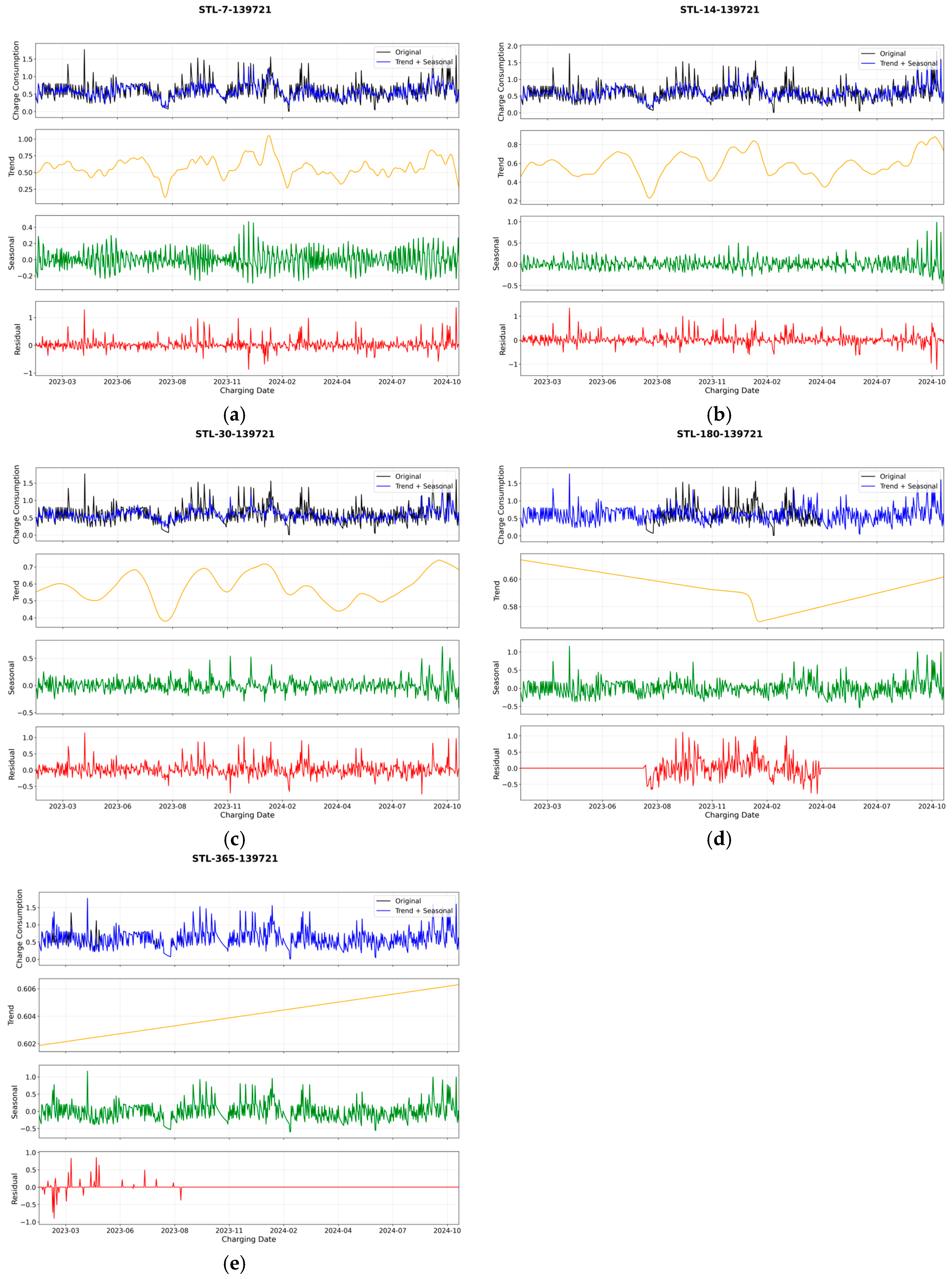
To analyze potential patterns in user charging behavior, this paper employs the STL method to perform different periodic decompositions on reconstructed charge consumption sequences. We have established five periodic parameters: 7 days, 14 days, 30 days, 180 days, and 365 days. These are designed to capture behavioral pattern characteristics across different time scales, ranging from weekly habits to annual trends.
Taking User ID 139721 as an example, its STL decomposition results are shown in Figure 1. Each panel sequentially displays the comparison between the original charge consumption sequence and the sum of trend and seasonal components, followed by the trend component, seasonal component, and residual component.
When using shorter decomposition periods, the trend component gradually smooths out as the period length increases, representing the overall trajectory of charge consumption over weeks to months. Under 7-day, 14-day, and 30-day periods, the seasonal component exhibits relatively pronounced and regular fluctuations. This indicates that users’ charging behaviors are likely to be similar during consecutive weeks or months. This better aligns with the actual situation of users having regular charge consumption patterns in the short-to-medium term.
As the decomposition period extended to 180 days and 365 days, the trend component’s shape underwent a noticeable change, gradually approaching a flat straight line. This reflects that, over longer time scales, users’ charge consumption levels are driven by certain slow-changing factors, such as lifestyle adjustments, gradual deterioration of vehicle performance over time, or macro-level impacts from seasonal climate. At the same time, the difference between the original sequence and the seasonal component becomes very small. Seasonal items themselves now show almost no discernible periodic fluctuations. This result aligns more effectively with actual conditions, as users’ charging behaviors are unlikely to follow a completely consistent, cyclical pattern over periods of six months or a year. Fluctuations over long periods are more likely to be absorbed into trend components or manifest as random residual fluctuations.
The results of the multiscale decomposition indicate that users’ charging behavior exhibits a distinct hierarchical structure over time. Short-period decomposition can isolate regular fluctuation patterns within medium-to-short timeframes, while long-period decomposition focuses on revealing the long-term evolution of charge consumption levels. By extracting components from different periods as input features for the prediction model, physically meaningful temporal structure information can be incorporated into the model. This enhances the model’s ability to capture the dynamics of user behavior, preventing it from learning spurious or short-sighted correlations within the raw sequences.

7. Predictive Model and Experimental Analysis

7.1. Experimental Design and Evaluation Indicators

This chapter evaluates the performance of the constructed prediction model for the user charging consumption prediction task and analyzes the impact of different model architectures and feature engineering strategies on prediction accuracy. The experiment is based on the time-series data of user charging behavior, with all models divided into training and testing sets according to their temporal sequence (i.e., the data is divided in time order without random permutation). The first 80% of historical data is used as the training set, while the remaining 20% serves as the test set, thereby preventing the leakage of future information from affecting the model’s performance evaluation. During model training, parameter learning is performed exclusively using the training set data, while the test set is solely employed to validate the model’s generalization capability.
Unlike traditional battery life prediction tasks, the charging data studied in this paper exhibits significant user heterogeneity and event-driven characteristics. Due to limitations in data collection, we are unable to access information regarding the internal state of users’ batteries, such as battery model or capacity degradation, leading to unobservable differences in battery hardware conditions across users. A user’s charging behavior is jointly influenced by factors such as personal travel habits, usage frequency, and the external environment, resulting in significant differences in the characteristics of these time series across users. Therefore, applying a single model to predict outcomes for all users tends to yield poor results, overlooking these individual differences. From this perspective, different user types can be viewed as independent prediction tasks, necessitating a case-by-case analysis. In the following experiments, we focus on users whose charging behavior is relatively regular and predictable, demonstrating and analyzing the model’s predictive performance on these cases.
In evaluating model performance, we employ the Mean Absolute Error (MAE), Root Mean Square Error (RMSE), Mean Absolute Percentage Error (MAPE), Symmetric Mean Absolute Percentage Error (SMAPE), and Coefficient of Determination (R2) as assessment metrics. Among these, MAE and RMSE reflect the absolute deviation between predicted values and actual values. MAPE and SMAPE are used to measure the stability of relative error across different sample sizes. R2 indicates the extent to which the model explains the variability in charging consumption. Through a multi-indicator joint evaluation, the comprehensive performance of the model in terms of accuracy and robustness can be fully characterized.

7.2. Analysis of Prediction Performance of Different LSTM Network Structures

To investigate the impact of model complexity on the charging consumption prediction task, we designed a set of baseline comparison experiments. Test the performance of LSTM network structures with varying depths (number of layers) and widths (number of neurons per layer) without introducing any additional features. In all experiments, both the input sequences and the prediction targets were normalized to a unified scale using Min–Max normalization, in order to eliminate the influence of different dimensional units and accelerate model convergence. For sequence construction, a sliding window of length 10 was adopted, which uses the charging data from 10 consecutive time steps as input to predict the charging value at the next time step (the 11th step). The LSTM model extracts temporal dependency features from the input sequence and outputs the predicted value for the subsequent time step. After prediction, the model outputs were inverse-transformed back to the original scale to compute the errors against the actual observed values.
As shown in Table 4, all experiments achieved generally good performance, with R2 values around 0.9. Under the basic configuration (e.g., a single-layer LSTM with 64 neurons), the model was already able to capture the trend of charging consumption with reasonable accuracy, demonstrating fitting capability.
Under the same number of neurons, increasing the number of LSTM layers did not lead to significant improvements in prediction performance. With 64 neurons, the single-layer LSTM (Experiment 1) achieved an MAE of 0.0231 and an R2 of 0.9051. When increased to two layers (Experiment 2), the R2 dropped to 0.8910. When extended to three layers (Experiment 3), the MAE rose to 0.0377, while the R2 showed only a marginal increase to 0.9096. These results indicate that adding more layers did not bring substantial performance gains, suggesting that the model’s predictive capability is already well realized with a relatively simple structure.
Under the same number of LSTM layers, increasing the number of neurons also yielded limited improvement in model performance. Taking the single-layer LSTM as an example, when the number of neurons was increased from 64 (Experiment 1) to 128 (Experiment 4), the MAE rose from 0.0231 to 0.0512, while the R2 decreased slightly from 0.9051 to 0.8928. When further increased to 256 neurons (Experiment 7), the R2 was 0.9024, still not outperforming Experiment 1. This trend suggests that increasing the number of neurons offers limited performance gains, possibly because the task complexity does not require such a large network, with redundant parameters instead being introduced and causing performance fluctuations.
The proposed user charging behavior pattern recognition method divided the user into two modes, which is consistent with the analysis results in Section 4 and aligns with prior real-world knowledge. For most users, vehicle usage and charging habits remain relatively stable over a period of one to two years. Therefore, pattern switching points in user behavior are typically few, and no frequent pattern changes occur. Before applying pattern recognition (Experiment 10), the R2 was 0.8309, which is lower than that of Experiment 1 after pattern recognition, further validating the effectiveness of the pattern recognition method in improving model accuracy.
After conducting experiments with different network structures, we selected the single-layer LSTM with 64 neurons (Experiment 1) as the baseline comparative experiment. This configuration demonstrated stable performance with metrics close to optimal, and compared to more complex networks, it offers fewer parameters and a lower risk of overfitting. Considering the characteristics of the current task, we are predicting a univariate time series of user charging consumption, and after behavioral pattern recognition and sequence reconstruction, the regularity of the data itself has been enhanced. Under such circumstances, lightweight recurrent networks like LSTM exhibit better adaptability due to their parameter efficiency and training stability. In contrast, although attention-based architectures such as transformers excel at capturing long-range dependencies, their advantages are less pronounced in scenarios with limited data size and moderate sequence length. Moreover, they often require larger datasets and more complex parameter tuning to achieve effective performance. Therefore, under the current task setting, selecting the LSTM from Experiment 1 as the baseline model is more reasonable.

7.3. Analysis of Prediction Performance After Incorporating STL Decomposition of Features

After establishing the baseline model, we further introduced STL decomposition to extract the trend and seasonal components from the original charging sequence, aiming to investigate the impact of structural decomposition on prediction performance. The raw charging data inherently contains both long-term trends and periodic fluctuations. By applying STL decomposition, these two types of information can be separated, making the temporal structure of each component more homogeneous and thereby reducing the difficulty of modeling. Using the trend or seasonal component as either input or prediction target for the LSTM is essentially an attempt to enable the model to learn temporal dependencies within a defined structure. As shown in the decomposition results for different periods in Section 6.2, for short-to-medium periods, the trend component exhibits a relatively smooth trajectory of overall charging consumption, while the seasonal component displays regular fluctuations. For longer periods, however, the trend component gradually flattens into a nearly straight line, and the seasonal component becomes nearly irregular, potentially obscuring detailed information. Therefore, we selected STL decomposition with periods of 7, 14, and 30 for experimentation and analysis. The results are presented in Table 5. It should be noted that the numerical range of the seasonal component itself is very small; thus, calculating MAPE, SMAPE, and R2 for this component is statistically meaningless, and these values are not reported in the Table.
In terms of predictive performance for the components themselves, Experiments 11, 14, and 17 all achieved R2 values exceeding 0.9, with the trend component predictions for periods 7 and 14 reaching R2 above 0.99. This indicates that the trend components obtained via STL decomposition possess a stable temporal structure, enabling the LSTM to effectively capture their change regularity. Experiments 12, 15, and 18 yielded extremely small prediction errors, with the seasonal components for periods 7 and 14 exhibiting particularly low errors. This suggests that the fluctuation patterns of short-period seasonal components are more pronounced and can also be effectively learned by the model. These results collectively validate the rationality of the STL decomposition method, confirming that the two components respectively encapsulate the corresponding structural information inherent in the original data.
Since both the trend and seasonal components can be accurately predicted, under the framework of STL decomposition, we aim to eliminate the influence of the residual components and allow the model to learn only the variations in these two components, thereby enabling a clearer understanding of the structure of charging consumption. By the decomposed structure, we provide the model with prior knowledge, such as the current position within a periodic cycle and the direction of the long-term trend, to facilitate more accurate predictions. Based on this rationale, we experiment with using both the trend and seasonal components simultaneously as input features to predict the original charging consumption (Experiments 13, 16, and 19). It is important to emphasize that this model does not simply learn the additive relationship “trend + seasonal = charging consumption.” Instead, it treats the trend and seasonal components as two semantically meaningful input features, allowing the LSTM to learn a nonlinear mapping function ϜT,S that approximates the true value. This modeling strategy informs the model that charging consumption is composed of a smooth trend superimposed with periodic fluctuations, enabling it to learn these two distinct patterns and integrate them to generate predictions.
When the trend and seasonal components were jointly used as input features to predict charging consumption, model performance improved. In Experiment 13, the R2 increased to 0.9743, representing an improvement over the 0.9051 achieved in Experiment 1, and the RMSE also decreased. This indicates that decomposition with a period of 7 enhances the model’s ability to utilize structural information. Experiment 16 yielded even better performance, with MAE dropping to 0.0198, RMSE to 0.0254, and R2 reaching 0.9851, which was the highest among all experiments. This suggests that decomposition with a period of 14 strikes an effective balance between preserving trend information and capturing periodic fluctuations, making it a reasonably structural division scale. In contrast, Experiment 19 resulted in degraded performance, with an R2 of 0.8958, falling below that of Experiment 1. Here, the period was set to 30, indicating that excessive period length leads to over-smoothing of the trend component and weakened regularity in the seasonal component. As a result, the effective information embedded in the original sequence is diluted or even dispersed, ultimately undermining prediction accuracy. Longer decomposition periods do not necessarily yield better results; the decomposition scale must align with the actual periodic characteristics inherent in the data. Mismatches in scale may lead to information loss and compromised predictive performance.
A comprehensive comparison reveals that introducing STL decomposition with an appropriate period (7 or 14) can enhance model-prediction performance, with the most significant improvement observed at a period of 14. Reconstructing the original time series and separating information at different temporal scales, followed by learning with LSTM, constitutes an effective structure-enhanced modeling approach. This method embeds the structural characteristics of the time series into the deep learning modeling process, rather than relying solely on the model to implicitly learn trend and periodic information. By doing so, it reduces the learning burden on the model to a certain extent and improves fitting accuracy.

8. Conclusions and Prospects

This paper investigates the challenges encountered in the practical operation of charging stations. Predicting user charging demand under conditions where only discontinuous, event-driven data is observable from charging stations. To address this challenge, we propose a predictive method that integrates user internal behavior pattern recognition, continuous charging consumption reconstruction, and time-series decomposition.
To address the interference caused by user behavior heterogeneity in modeling, a time-series segmentation method based on statistical significance testing is proposed. This method identifies sub-sequences across different stages of a single user’s charging behavior. Compared to traditional clustering approaches, it segments patterns with distinct behavioral semantics, thereby providing a more homogeneous training data foundation for subsequent predictive models.
To overcome the limitations of discontinuous sampling in raw data, a continuous-time reconstruction mechanism based on a physics-inspired decay model has been designed. This mechanism converts discrete charging events into a sequence of daily charge consumption that aligns with actual user behavior, without relying on internal battery information. This resolves the contradiction between the data requirements of the STL temporal decomposition method and the inherent form of raw data.
To validate the effectiveness of the proposed approach, we constructed a deep learning prediction model incorporating STL decomposition features. STL decomposition was applied to extract trend and seasonal components from the reconstructed sequence, which were then used as feature input into the LSTM model. Experimental results demonstrate that, with an appropriately selected decomposition period, these components effectively improve prediction accuracy. The trend component captures the evolution of user charging behavior, reflecting the overall direction and stable patterns of electricity demand; the seasonal component captures periodic fluctuations, embodying the cyclical nature of user charging habits. By eliminating the interference of random noise contained in the residual component, STL decomposition separates physically meaningful information from the original sequence. Feeding these structured features into the model effectively guides the learning process, thereby enhancing prediction performance.
Although this paper has achieved certain research results, there is still room for expansion. Future research may incorporate richer user vehicle usage behavior and environmental information at the data level, such as mileage, travel frequency, and meteorological factors, to enhance the model’s understanding of the mechanisms underlying charging demand formation. At the methodological level, we can continue to explore the potential of sequence modeling approaches, such as transformers, for handling long sequences and enabling cross-user transfer learning. Additionally, from a practical application perspective, the predictive model can be integrated with scenarios such as charging scheduling and grid load management to further validate its engineering utility.

Author Contributions

Conceptualization, D.G. and X.L.; methodology, Y.Z.; software, Y.Z.; validation, Y.Z., Z.L., and Y.L.; formal analysis, Y.Z.; investigation, Y.Z.; resources, Z.L.; data curation, Z.L.; writing—original draft preparation, Y.Z.; writing—review and editing, Y.L. and X.L.; visualization, Y.L.; supervision, D.G.; project administration, D.G.; funding acquisition, D.G. All authors have read and agreed to the published version of the manuscript.

Funding

This work is partly supported by Natural Science Foundation of China (No:42371476).

Institutional Review Board Statement

Not applicable.

Informed Consent Statement

Not applicable.

Data Availability Statement

The dataset presented in this article cannot be directly obtained at present, because the data comes from the operator and there are other ongoing research and protection of user privacy.

Conflicts of Interest

The authors declare no conflicts of interest.

References

  1. Chemali, E.; Kollmeyer, P.J.; Preindl, M.; Emadi, A. State-of-charge estimation of Li-ion batteries using deep neural networks: A machine learning approach. J. Power Sources 2018, 400, 242–255. [Google Scholar] [CrossRef]
  2. Ma, Y.; Shan, C.; Gao, J.; Chen, H. A novel method for state of health estimation of lithium-ion batteries based on improved LSTM and health indicators extraction. Energy 2022, 251, 123973. [Google Scholar] [CrossRef]
  3. Märtz, A.; Langenmayr, U.; Ried, S.; Seddig, K.; Jochem, P. Charging behavior of electric vehicles: Temporal clustering based on real-world data. Energies 2022, 15, 6575. [Google Scholar] [CrossRef]
  4. Kim, K.; Kim, G.; Yoo, J.; Heo, J.; Cho, J.; Ryu, S.; Kim, J. Data-driven clustering analysis for representative electric vehicle charging profile in South Korea. Sensors 2024, 24, 6800. [Google Scholar] [CrossRef] [PubMed]
  5. Wang, R.; Xu, Z.; Chen, Z.; Zhong, M. Revealing charging patterns of electric vehicles with intrinsic usage heterogeneity. Transp. Res. Part D Transp. Environ. 2026, 150, 105101. [Google Scholar] [CrossRef]
  6. Ahn, H.; Sun, K.; Kim, K.P. Comparison of missing data imputation methods in time series forecasting. Comput. Mater. Contin. 2022, 70, 767–779. [Google Scholar] [CrossRef]
  7. Huang, Q.; Li, J.; Xu, Q.; He, C.; Yang, C.; Cai, L.; Xu, Q.; Xiang, L.; Zou, X.; Li, X. State of charge estimation in batteries for electric vehicle based on Levenberg–Marquardt algorithm and Kalman filter. World Electr. Veh. J. 2024, 15, 391. [Google Scholar] [CrossRef]
  8. Cui, J.; Kuang, W.; Geng, K.; Bi, A.; Bi, F.; Zheng, X.; Lin, C. Advanced short-term load forecasting with XGBoost-RF feature selection and CNN-GRU. Processes 2024, 12, 2466. [Google Scholar] [CrossRef]
  9. Sreekumar, A.V.; Lekshmi, R.R. Electric vehicle charging station demand prediction model deploying data slotting. Results Eng. 2024, 24, 103095. [Google Scholar] [CrossRef]
  10. Xin, F.; Yang, X.; Wang, B.; Xu, R.; Mei, F.; Zheng, J. Research on electric vehicle charging load prediction method based on spectral clustering and deep learning network. Front. Energy Res. 2024, 12, 1294453. [Google Scholar] [CrossRef]
  11. Hussain, A.; Lu, Q.C.; Rizvi, S.S.; Wang, S.; Kwon, S.J. Short-term demand forecasting of electric vehicle charging stations using context-aware temporal transformer model. Sci. Rep. 2025, 15, 36652. [Google Scholar] [CrossRef] [PubMed]
  12. Dinneen, L.C.; Blakesley, B.C. Algorithm AS 62: A generator for the sampling distribution of the Mann–Whitney U statistic. J. R. Stat. Soc. Ser. C (Appl. Stat.) 1973, 22, 269–273. [Google Scholar] [CrossRef]
  13. Kanungo, T.; Mount, D.M.; Netanyahu, N.S.; Piatko, C.D.; Silverman, R.; Wu, A.Y. An efficient k-means clustering algorithm: Analysis and implementation. IEEE Trans. Pattern Anal. Mach. Intell. 2002, 24, 881–892. [Google Scholar] [CrossRef]
  14. Kuyuk, H.S.; Yildirim, E.; Dogan, E.; Horasan, G. Application of k-means and Gaussian mixture model for classification of seismic activities in Istanbul. Nonlinear Process. Geophys. 2012, 19, 411–419. [Google Scholar] [CrossRef]
  15. Wang, J.; Liu, P.; Hicks-Garner, J.; Sherman, E.; Soukiazian, S.; Verbrugge, M.; Tataria, H.; Musser, J.; Finamore, P. Cycle-life model for graphite–LiFePO4 cells. J. Power Sources 2011, 196, 3942–3948. [Google Scholar] [CrossRef]
  16. Zhu, J.G.; Sun, Z.C.; Wei, X.Z.; Dai, H.F. A new lithium-ion battery internal temperature on-line estimate method based on electrochemical impedance spectroscopy measurement. J. Power Sources 2015, 274, 990–1004. [Google Scholar] [CrossRef]
  17. Cu, Y.; Wang, K.; Zhang, L.; Liu, Z.; Liu, Y.; Mo, L. A time series decomposition-based interpretable electricity price forecasting method. Energies 2025, 18, 664. [Google Scholar] [CrossRef]
Figure 1. The STL decomposition results of the data with User ID 139721, from (ae), are period 7, 14, 30, 180, and 365 respectively.
Energies 19 01556 g001
Table 1. Charging order raw data specification.
Variable NameData Interpretation
User IDUser unique identifier, used to distinguish different users.
Order NumberOne charging process corresponds to one order number.
Charging ConsumptionUnit: kilowatt-hour (kWh), record once every 10 min during charging process.
Creation DateThe data format is “Year-Month-Day Hour:Minute:Second”, and it is recorded every 10 min during the charging process.
Charging Voltage of The Charging StationUnit: Volt (V), record once every 10 min during charging process.
Charging Current of The Charging StationUnit: Ampere (A), record once every 10 min during charging process.
Charging Power of The Charging StationUnit: Watt (W), record once every 10 min during charging process.
Charging Temperature of The Charging StationUnit: Kelvin (K), record once every 10 min during charging process.
Charging StatusIndicates whether the charging process has been completed normally.
Table 2. Explanation of charging data feature construction.
Feature ClassificationVariable NameData InterpretationCalculation
Formula
Order Time-related featuresUser IDUser unique identifier, used to distinguish different users./
Order NumberOne charging process corresponds to one order number./
Minimum Creation Time of The OrderIndicates the start time of the order. t m i n = m i n C r e a t i o n   D a t e
Maximum Creation Time of The OrderIndicates the end time of the order. t m a x = m a x C r e a t i o n   D a t e
WeekdayRange of values: 1–7. Map the “0–6 encoding” of Python 3 to “1–7 encoding”. w e e k d a y = w e e k d a y t m i n + 1
WorkdayAccording to the regular working days in China (Monday to Friday), working days are represented by 1 and weekends by 0. i s _ w o r k d a y = 1 w e e k d a y 5 0 w e e k d a y > 5
Power and Electrical featuresAverage Charging PowerUnit: Watt (W), the average value of all power sampling points during the order period. W m e a n = 1 N i = 1 N W i
Maximum Charging PowerUnit: Watt (W), the maximum value of all power sampling points during the order period. W m a x = m a x W i
Average Charging CurrentUnit: Ampere (A), the average value of all current sampling points during the order period. I m e a n = 1 N i = 1 N I i
Average Charging VoltageUnit: Volt (V), the average value of all voltage sampling points during the order period. V m e a n = 1 N i = 1 N V i
Features of The Charging ProcessCharging DurationUnit: Minutes, duration of the charging process T = t m a x t m i n 60
Charging ConsumptionUnit: kilowatt-hour (kWh), maximum value of all charging Consumption sampling points during the order period. E m a x = m a x E i
Charging EfficiencyMeasure the ratio between the actual charging capacity and the theoretical charging energy (Dimensionless). η = E m a x W m e a n × T 60
Power Peak DistributionCount the number of sampling points where the power reaches its maximum value, which reflects the duration of high power (Count). W p e a k _ d i s t = i = 1 N 1 W i = W m a x 0 o t h e r w i s e
Power-to-Consumption RatioIndicates the average power level corresponding to the unit charging Consumption (Dimensionless). W m e a n E m a x
Behavioral–Temporal featuresThe Last Charging IntervalUnit: Days, the interval between the start time of the current order and the start time of the previous order. T 1 = t o _ m i n t o 1 _ m i n
The Next Charging IntervalUnit: Days, the interval between the start time of the current order and the start time of the next order. T 2 = t o + 1 _ m i n t o _ m i n
Environmental featuresAverage TemperatureUnit: Kelvin (K), the average values of all temperature sampling points during the order period. K m e a n = 1 N i = 1 N K i
Maximum TemperatureUnit: Kelvin (K), the maximum values of all temperature sampling points during the order period. K m a x = m a x K i
Table 3. Number of battery behavior pattern recognition results.
Pattern Recognition QuantityOrder NumberK-MeansGMM
117100
2162197276
3995572
4372733
5202421
652424
752818
804715
91409
1005832
Table 4. The prediction performance results of different LSTM network structures.
Experiment NumberNumber of LSTM LayersNumber of NeuronsMAERMSEMAPE (%)SMAPE (%)R2
11640.02310.06822.783.180.9051
22640.05200.07318.158.140.8910
33640.03770.06665.825.990.9096
411280.05120.07258.048.040.8928
521280.02360.06543.103.460.9128
631280.02700.06733.383.760.9078
712560.02730.06923.213.630.9024
822560.03020.06454.664.900.9151
932560.03560.07074.655.030.8980
10
(without pattern recognition)
1640.06360.13477.007.560.8309
Table 5. The prediction performance results of LSTM after introducing STL decomposition features.
Experiment NumberFeatureForecast TargetMAERMSEMAPE (%)SMAPE (%)R2
11Trend
(period = 7)
Trend
(period = 7)
0.01170.01562.152.130.9932
12Seasonal
(period = 7)
Seasonal
(period = 7)
0.00050.0005///
13Trend,
Seasonal
(period = 7)
Charging Consumption0.02270.030262.772.840.9743
14Trend
(period = 14)
Trend
(period = 14)
0.01190.01711.611.630.9919
15Seasonal
(period = 14)
Seasonal
(period = 14)
0.00100.0015///
16Trend,
Seasonal
(period = 14)
Charging Consumption0.01980.02542.682.700.9851
17Trend
(period = 30)
Trend
(period = 30)
0.04200.04606.606.360.9396
18Seasonal
(period = 30)
Seasonal
(period = 30)
0.02420.0758///
19Trend,
Seasonal
(period = 30)
Charging Consumption0.05580.06457.817.480.8958
Disclaimer/Publisher’s Note: The statements, opinions and data contained in all publications are solely those of the individual author(s) and contributor(s) and not of MDPI and/or the editor(s). MDPI and/or the editor(s) disclaim responsibility for any injury to people or property resulting from any ideas, methods, instructions or products referred to in the content.