Article

Reconstruction and Exploitation Simulation Analysis of Marine Hydrate Reservoirs Based on Color Recognition Technology

1
School of Mechanical and Automotive Engineering, South China University of Technology, Guangzhou 510640, China
2
Key Lab of Enhanced Heat Transfer and Energy Conservation, Ministry of Education, Guangzhou 510640, China
3
School of Chemistry and Chemical Engineering, South China University of Technology, Guangzhou 510641, China
*
Authors to whom correspondence should be addressed.
Energies 2026, 19(6), 1538; https://doi.org/10.3390/en19061538
Submission received: 13 February 2026 / Revised: 8 March 2026 / Accepted: 17 March 2026 / Published: 20 March 2026
(This article belongs to the Section H: Geo-Energy)

Abstract

Natural gas hydrates, as an abundant potential energy resource, are widely present in marine sediments. In this paper, a novel method using color recognition technology is proposed for reconstructing marine hydrate reservoirs. By identifying the red, green, and blue values of image colors within the study area’s grid, numerical values are assigned and translated into geological parameters. These parameters are then input into the Computer Modeling Group software to establish heterogeneous reservoirs, and numerical simulations are conducted. The results indicate that this method successfully establishes a correspondence between color features and geological parameters. The reconstructed model images exhibit a high degree of consistency with the original images, allowing for precise parameter readings. The method was applied to hydrate reservoirs in the second trial production area of the South China Sea, the Shenhu SH2 area, and the Nankai Trough. The cumulative gas production obtained through numerical simulation of the reconstructed models closely matched the known production data, with discrepancies of 3.5%, 0.9%, and 7.6%, respectively. These findings confirm the reliability of the model, providing valuable insights for future studies on heterogeneous hydrate reservoirs and extending its application prospects to heterogeneous oil and gas reservoir research.

1. Introduction

Natural gas hydrates are ice-like substances formed under high-pressure and low-temperature conditions. Water molecules form cages through hydrogen bonding, encapsulating methane and other small-molecule gases within them [1]. They are abundant in marine slope sediments and represent a significant potential energy resource. With the increasing global energy demand for energy and the growing need for clean fuels, the extraction and utilization of natural gas hydrates have become a key area of research.
At present, there are three main methods for studying hydrate mining: laboratory simulation, hydrate reservoir trial recovery, and computer simulation. Among them, laboratory simulation, due to its small scale, cannot effectively replicate large-scale actual reservoirs, making its conclusions of limited practical value. Hydrate reservoir trial recovery, while capable of obtaining valuable data, requires substantial financial investment and entails significant risks. Computer simulation, by leveraging the valuable data from the other two methods, allows for the comprehensive exploration of the extraction process and facilitates the deeper study of natural gas hydrate production. Computer simulation primarily utilizes two main models: homogeneous models and heterogeneous models. The homogeneous model, which is statistically based, is used for simulating hydrate extraction by assuming uniform physical properties within the study area. This model simplifies complex geological conditions and physico-chemical processes by using averaged values to describe the entire reservoir, thereby ignoring the spatial heterogeneity that affects fluid flow, heat transfer, and phase changes. This simplification can lead to significant discrepancies between the simulation results and actual field conditions. In natural environments, geological conditions are often extremely complex, and ideal homogeneous models rarely exist over large areas. Extensive field exploration data reveal significant variations in reservoir parameters across different regions and depths, which makes the results derived from homogeneous models limited in practical application. Therefore, the establishment of heterogeneous models is crucial. Heterogeneous models more accurately represent reservoir physical properties and are closer to actual geological features. By considering the spatial variability of reservoir parameters, these models can more accurately simulate the hydrate extraction process, providing more reliable guidance for practical applications.
In actual exploration, geologists acquire field data on reservoir physical properties through seismic wave reflections [2,3,4], well-logging [5,6,7], and other geological exploration methods [8,9,10]. These data reflect the complexity of geological structures, depositional environments, and the distribution of hydrates, underscoring significant spatial heterogeneity. Due to the high confidentiality of these data, the publicly available information is fragmented, making it challenging to obtain systematic data from open sources. To establish heterogeneous models, a large amount of detailed reservoir parameter data is required. To address this issue, a color recognition technology specifically designed for hydrate research has been introduced. This technology utilizes partially missing data and the limited reservoir parameters that have been released to study various hydrate reservoirs. Color recognition technology, based on image processing and statistical analysis techniques [11], identifies correlations between color features and geological parameters. By analyzing image data, preliminary estimates of reservoir parameter distribution in different regions can be made, providing a reference for the establishment of heterogeneous models. Specifically, the process involves several steps. First, existing geological images are preprocessed to remove noise and interference, ensuring image quality. Next, a color recognition algorithm is employed to extract color information from the images and compare it with known reservoir parameters, establishing a mapping relationship between color features and reservoir parameters. Following this, statistical analysis is performed to calculate the probability distribution of reservoir parameters corresponding to different color features, enabling the generation of an initial reservoir parameter distribution map. Finally, the model is calibrated and optimized using published reservoir parameter data, ultimately establishing a highly accurate heterogeneous model.

2. Establishment of Hydrate Reservoirs

2.1. Method for Establishing Geological Reservoir Parameters

Homogeneous reservoir parameters have been widely used in the simulation of gas hydrate extraction in various regions, such as those in the South China Sea [12,13,14,15], the Sea of Japan [16,17,18], the Ulleung Basin in South Korea [19,20], and the Indian Ocean [21]. The key reservoir parameters for assessing resource volume and extraction feasibility include hydrate saturation, distribution depth, distribution area, porosity, and permeability. These parameters not only directly impact resource evaluation results but also influence the selection and optimization of extraction technologies as well as economic benefits. Hydrate saturation, defined as the volume proportion of hydrates within the pore volume of the reservoir, is a crucial indicator for assessing the extractable natural gas resources in place. Higher saturation levels in a reservoir indicate more natural gas storage, leading to higher extraction benefits. Distribution depth refers to the specific geological position of the hydrates, while distribution area reflects the extent of their spread. Hydrate distribution typically ranges from hundreds to thousands of meters within seabed sediments. Larger distribution areas and optimal depths enhance the feasibility and economic viability of extraction. Porosity and permeability are key parameters describing the properties of reservoir rocks. Porosity represents the proportion of pore space within the reservoir rock, while permeability describes the ability of fluids to flow through it. These two parameters directly influence the flow and extraction efficiency of natural gas.
When establishing geological reservoir parameter models, the methods commonly employed are listed in Table 1. These methods include borehole drilling, profiling, geophysical data analysis, and discrete point-based analytical techniques. Traditional methods face challenges when dealing with heterogeneous reservoir parameters, such as difficulties in accurately inverting heterogeneous parameters from the limited reference literature data and the susceptibility of multi-source data analysis to data consistency issues, which require the processing of large datasets. In contrast, color restoration technology offers a novel approach for inverting heterogeneous reservoir parameters. By analyzing image data, preliminary estimates of reservoir parameter distributions in different regions can be made, providing a reference for the establishment of heterogeneous models. The advantage of this method lies in its ability to fully utilize existing public data and partially missing data, performing parameter statistics through color recognition technology, thereby significantly reducing the time and cost of geological modeling. Additionally, the application of color recognition technology automates and enhances the efficiency of the data processing process, reducing human intervention and errors.

2.2. Color Recognition Technology Restoration and Reshaping Methods

To achieve accurate color recognition and express the characteristics of hydrate reservoirs effectively, a software program with a meticulous restoration process was developed. This process includes data extraction, grid division, noise removal, and the final mapping of color features to reservoir parameters. The initial step involves extracting relevant information about the hydrate reservoir to be restored, collecting key parameters such as saturation, depth distribution, area distribution, porosity, and permeability, including mean and extreme values. These parameters are sourced from the existing literature or databases, which provide spatial distributions of saturation, porosity, and permeability at different depths and locations within the reservoir.
Using the custom-developed software, images containing the necessary parameter information are loaded. The software first selects four boundary lines to define the work area for effective recognition, excluding areas outside these boundaries from recognition.
After delineating the effective area, the software performs grid division, followed by further subdivision into smaller grids, and then assigns values. The division is conducted horizontally and vertically, with special attention to the size of each grid cell. Typically, for hydrate reservoirs, the horizontal direction is divided into grids of 10 m each, while the vertical direction is divided into grids of 1 m each.
Post-grid division, the effective area may contain irrelevant markings, lines, or text acting as noise, which need to be removed to ensure the clarity and accuracy of subsequent analyses. For stubborn noise signals, non-local means denoising techniques are applied to effectively remove noise while preserving the grid edges, ensuring that critical details are not lost in the process.
Within the effective area, red, green, and blue values (RGB values) can be input directly into the software, or positions can be selected in the image to automatically capture RGB values. Each color marker is assigned a unique identifier, and these identifiers are matched with natural numbers. The software reads the colors within the grid cells of the effective area and associates them with the corresponding identifiers.
The final step involves statistical analysis, calculating the probability distribution of reservoir parameters corresponding to different color features. By inputting or automatically capturing the RGB values of each grid area color in image processing software, each RGB value is marked with an identifier. The process is conducted as follows: Select a total of n RGB values, denoted as 0, 1, 2 n − 1. First, select the white color scale, which is used as the background color, and then select multiple colors corresponding to the image workspace for color recognition and labeling. Calculate the weight of each identifier in the grid area. The weights corresponding to each identifier are denoted as a1, a2, …, am…, an, where am is the weight corresponding to the mth identifier. Formula (1) is used, where the first identifier is the background color and is not included in the statistics to obtain am.
m = 2 n a m = 1
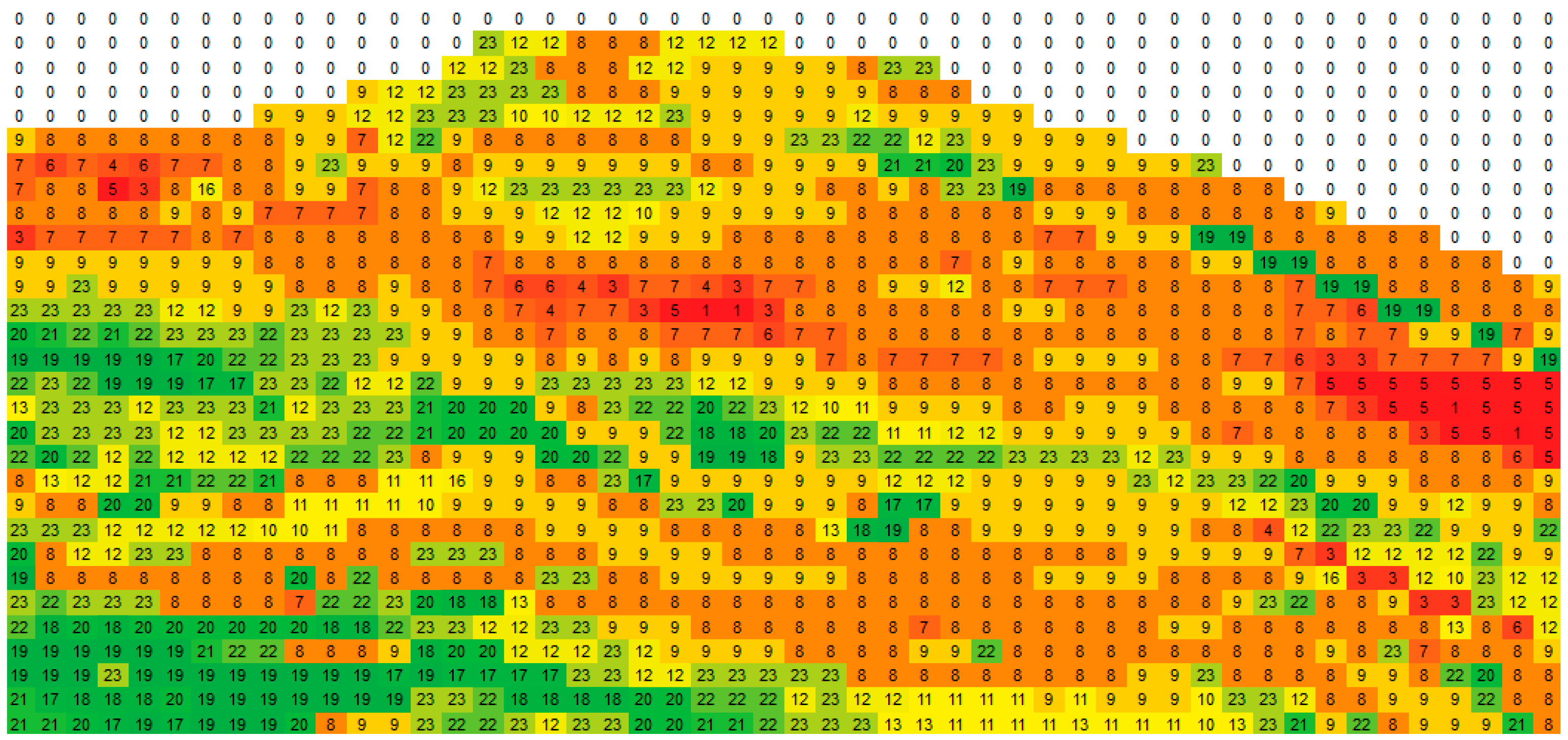
The software generates an identifier document, mapping the recognized color markers to reservoir parameters, thus translating the image data into reservoir parameters in Figure 1. Given that the average saturation is S ¯ h , according to the RGB gradient, the maximum saturation is S h , m a x and the minimum saturation is S h , m i n , with a total of n identifiers. The first identifier is not included in the statistics, and the mth identifier corresponds to the saturation using Formula (2), where mn and m ≠ 1. Therefore, according to Formula (3), S ¯ h can be obtained.
S h , m = m 2 n 2 × S h , m a x S h , m i n + S h , m i n
m = 2 n ( a m × S h , m ) = S ¯ h
In this work, four heterogeneous hydrate reservoirs were selected for color recognition to demonstrate the effectiveness of this approach.

2.3. Algorithm Workflow

The implementation steps of the mesh color coding method are shown as follows.

2.3.1. Image Loading and Mesh Definition

  • A target image is loaded.
  • The mesh boundaries are defined by clicking four points on the image to specify the top left and bottom right corners.
  • The grid is subdivided horizontally and vertically by setting the number of segments and the positions of dividing lines.

2.3.2. Noise Line Detection and Mask Generation

  • A region is defined by the mesh boundaries.
  • A grayscale copy of the image is smoothed with a 3 × 3 Gaussian filter.
  • Curve points are detected where vertical intensity changes exceed a threshold of 5 gray levels. These points are marked in a binary mask.
  • Short lines in the mask are removed.
  • The endpoints of the remaining lines are extracted, and any two endpoints within a Chebyshev distance ≤ 2 pixels are connected by a white line, bridging small gaps.

2.3.3. Manual Editing of the Mask

  • The endpoints are connected by clicking two points; a line is drawn in the mask using Bresenham’s algorithm.
  • An eraser tool allows the removal of unwanted mask pixels with a square brush of selectable size (3 × 3 to 17 × 17).
  • All edits are recorded in an undo/redo buffer.

2.3.4. Color Palette Definition

  • A list of up to 100 colors (RGB triplets) is defined, either by manual entry or by picking colors directly from the image.
  • The palette is displayed in a color bar, and its order can be rearranged.

2.3.5. Color Assignment to Each Mesh Cell

  • For every mesh cell, the algorithm computes its exact image coordinates from the grid boundaries and subdivision parameters.
  • All pixels overlapping the cell are examined; each pixel contributes a weight equal to the overlapping area.
  • The pixel’s RGB value is compared with all palette colors using Euclidean distance; the nearest color accumulates the pixel’s weight.
  • After processing all pixels in the cell, the color with the highest total weight is assigned as the cell’s code, and a confidence value (maxWeight/totalWeight × 10,000) is stored in an auxiliary array.
  • The final code matrix can be exported as a plain matrix.

3. Color Recognition Technology for Restoring Hydrate Reservoirs

The South China Sea is a region where the Pacific Plate, the Indo-Australian Plate, and the Eurasian Plate converge. With a continental slope area of more than 10,000 square kilometers and an average water depth of 1200 m, it is considered a highly prospective area for natural gas hydrates. Within this region, the Shenhu area on the northern slope of the South China Sea is particularly noteworthy for its natural gas hydrate deposits. This area was the first area in China where scientific drilling research for hydrate research was conducted, located in the Pearl River Mouth Basin between the Xisha Trough and the Dongsha Islands.
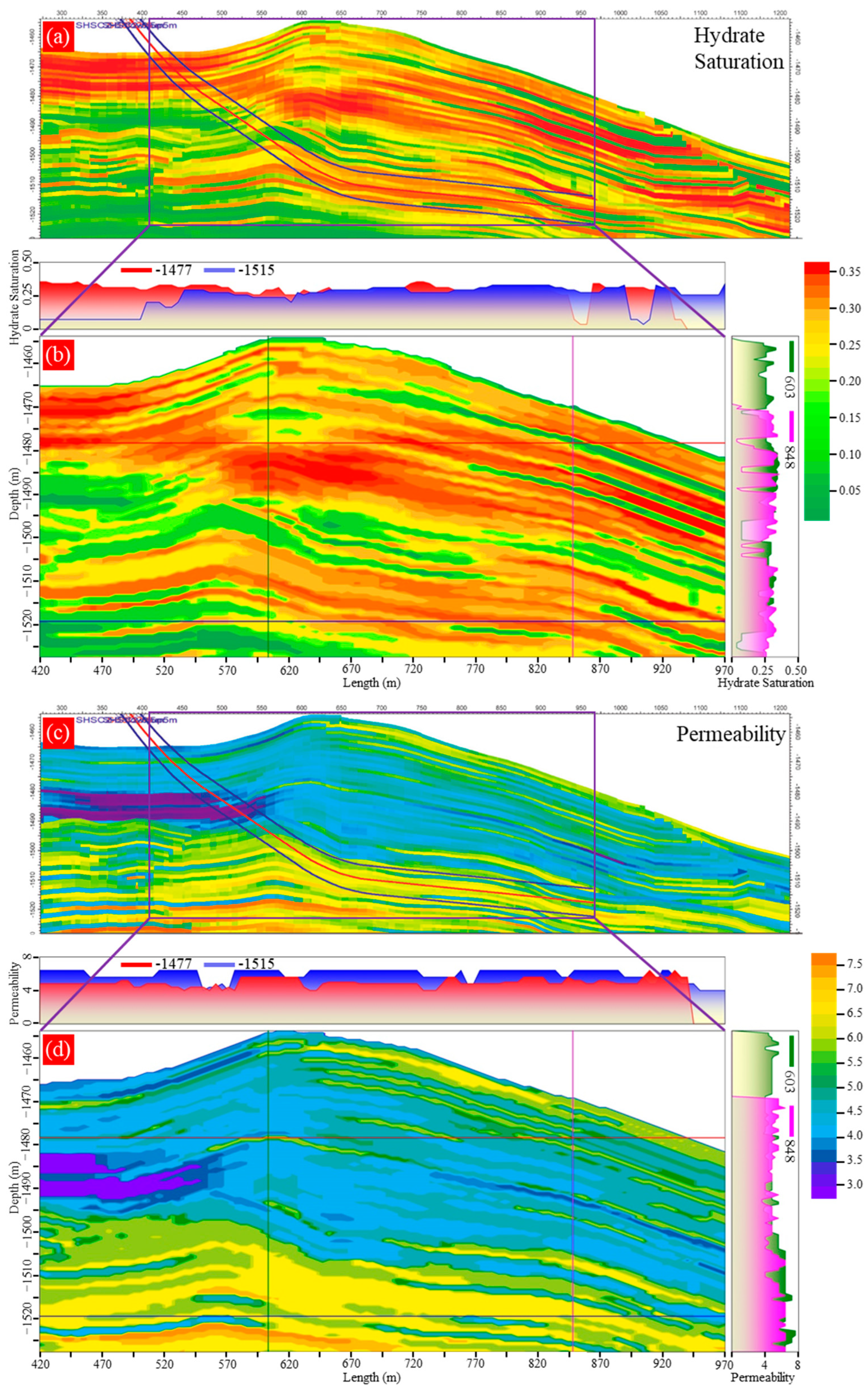
In 2007, while drilling activities were being conducted by the China Geological Survey, gas hydrate-bearing sediments were discovered in the SH2, SH3, and SH7 areas, with estimated hydrate deposit thicknesses ranging from 10 to 44 m. The hydrates are found within sediments primarily composed of silty clay and clayey silt, with porosity ranging from 0.33 to 0.48 [22,23], and hydrate saturation levels between 25% and 48% [24]. In this work, we focus on the restoration and reconstruction of the second trial production area of the South China Sea hydrate deposits, using images of the saturation field and permeability field as the primary data [25], as shown in Figure 2a,c.
Hydrates are influenced by temperature, pressure, gas sources, and gas compositions, leading to variability in the formation areas based on different stratigraphic structures. In the Shenhu area of the South China Sea, hydrate layers exhibit diverse production states and varying thicknesses within stable regions. Logging data from Well W11 indicate the presence of thin or dispersed hydrates, thick hydrates, and alternating types of hydrates at different depths. According to the principles of hydrate accumulation, sufficient natural gas is required to form hydrate reservoirs, and gas must migrate through effective channels to reach the hydrate stability zone. These channels are widely distributed in the Shenhu area, providing a basis for large-scale reservoir formation. Scholars believe that shallow gas in the Shenhu area mainly originates from biogenic sources, while deep gas is primarily thermogenic, with biogenic gas being the main source for reservoir formation [26]. The heterogeneous characteristics of hydrate reservoirs at different depths and locations in the Shenhu area are evident. The average hydrate saturation in Well W11 is 0.233, while in Well W17, it is 0.195 [27], with permeability ranging from 2 to 8 mD. The initial saturation of heterogeneous hydrate reservoirs ranges from 3.67% to 36.67%, with permeability between 2 mD and 8 mD. Due to the lack of additional public data, other parameters are not set as heterogeneous. The saturation field from Figure 2a was selected for restoration, with the horizontal coordinates ranging from 420 to 970 m and vertical coordinates from 1454 to 1523 m.
In Figure 2a, a red line and two blue lines appear, representing the horizontal well trajectories during drilling, rather than corresponding saturation levels. These colors are considered noise signals and need to be processed. After identifying the noise, additional noise signal lines may appear in non-well trajectory areas, which must be manually removed. For color restoration, white color markers with RGB values (255, 255, 255) were initially selected, followed by a gradient of 20 color markers from red to blue, with RGB values of (255, 15, 0), (255, 46, 0), (255, 78, 0), (255, 109, 0), (255, 140, 0), (255, 172, 0), (255, 203, 0), (255, 235, 0), (243, 255, 0), (212, 255, 0), (180, 255, 0), (149, 255, 0), (117, 255, 0), (86, 255, 0), (55, 255, 0), (23, 255, 0), (0, 255, 0), (0, 255, 39), (0, 255, 70), and (0, 255, 102). During color recognition, two additional color markers with RGB values (68, 181, 73) and (0, 168, 78) were identified to fill in the gaps. These 23 color markers were assigned values from 0 to 22. After recognition, based on the weight of markers 1 to 20 and the target average value of 0.233, the specific saturation values for markers 1 to 20 were derived and replaced, with markers 21 and 22 being intermediate values. This process yielded the results shown in Figure 2b, completing the saturation recognition.
In Figure 2c, a red line and two blue lines also represent horizontal well trajectories, which are considered noise signals and need to be processed. For color restoration, white color markers with RGB values (255, 255, 255) were selected first, followed by a gradient of 15 color markers from red to purple, with RGB values of (255, 15, 0), (255, 102, 0), (255, 188, 0), (236, 255, 0), (149, 255, 0), (63, 255, 0), (0, 255, 23), (0, 255, 110), (0, 255, 196), (0, 228, 255), (10, 89, 169), (0, 55, 255), (31, 0, 255), (118, 0, 255), (204, 0, 255). Five additional color markers with RGB values (252, 237, 4), (165, 205, 57), (0, 159, 225), (0, 174, 239), and (0, 170, 184) were identified. These 21 color markers were assigned values from 0 to 20. After recognition, based on the permeability range of 8 to 2 mD corresponding to markers 1 to 15, the specific permeability values were derived and replaced, with markers 16 to 20 serving as intermediate values. This process yielded the results shown in Figure 2d, completing the permeability recognition.
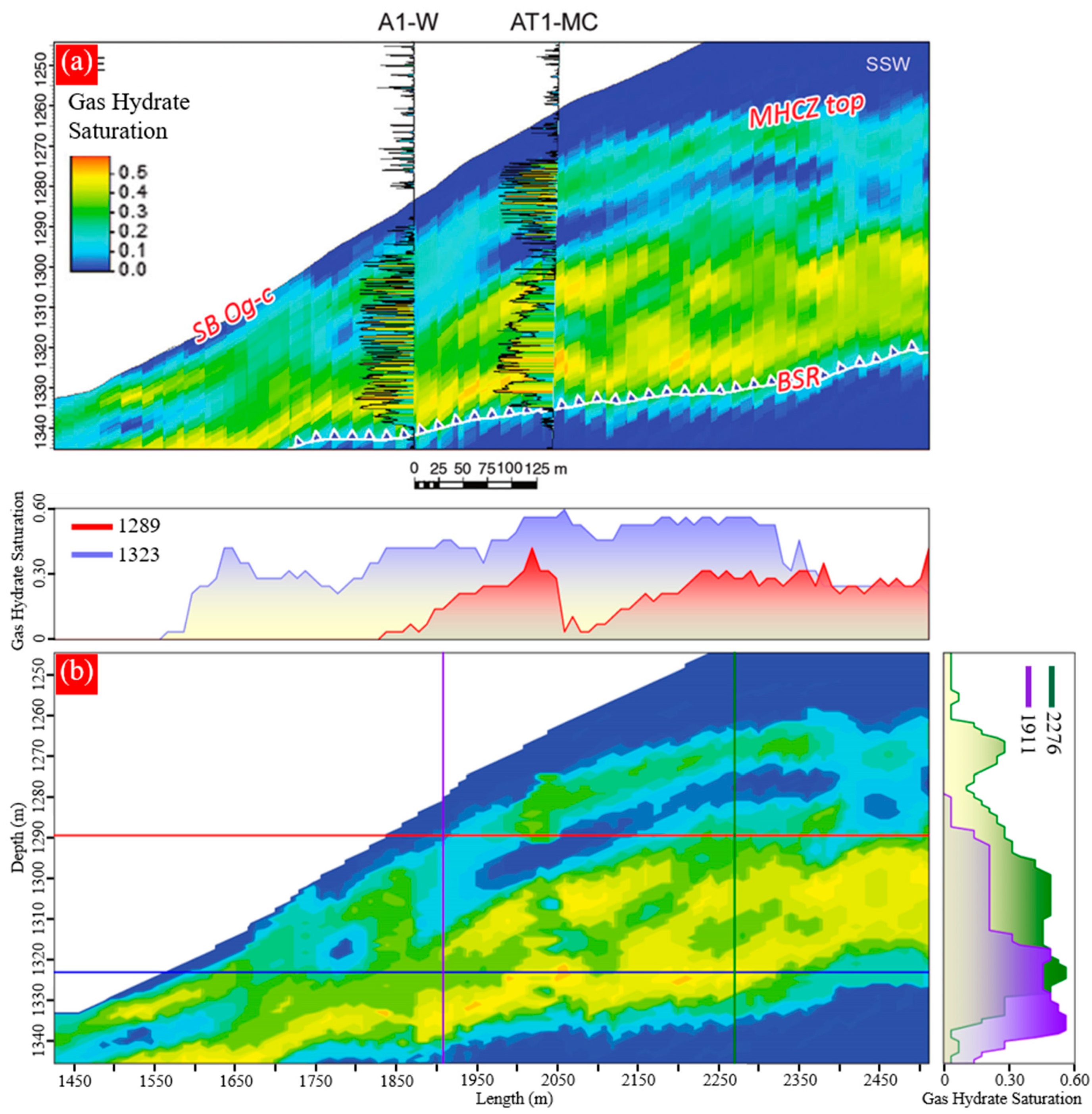
Tamaki et al. [28] used logging data and 3D seismic data as inputs. Seismic data provided information on the lateral distribution of hydrate saturation, while logging data offered vertical distribution details. These data were then integrated using geostatistical methods to generate the spatial distribution of natural gas hydrate saturation.
In Figure 3a, the two black lines running from top to bottom represent logging responses, along with a white BSR (Bottom Simulating Reflector) line and red text, all of which are noise signals. These must be identified and processed during color restoration. First, white color markers with RGB values (255, 255, 255) are selected. Then, a gradient of 20 color markers from blue to red, with RGB values (0, 0, 255), (0, 51, 255), (0, 102, 255), (0, 153, 255), (0, 204, 255), (0, 255, 255), (0, 255, 204), (0, 255, 153), (0, 255, 102), (0, 255, 51), (0, 255, 0), (64, 255, 0), (128, 255, 0), (191, 255, 0), (255, 255, 0), (255, 204, 0), (255, 153, 0), (255, 102, 0), (255, 51, 0), and (255, 0, 0), are selected. These 21 color markers are assigned values from 0 to 20, representing saturation levels increasing proportionally from 0 to 0.7. After processing the noise, the final Figure 3b is obtained, completing the hydrate saturation recognition.
Sun et al. [29] used field measurement data from eight wells, including water depth, aquifer thickness, logging data, core porosity, intrinsic permeability, and reservoir seismic exploration interpretation data, to establish an actual geological model of the target area using stochastic modeling methods. The top of the hydrate-bearing layer is buried 155–229 m below the seafloor (MBSF), with a thickness ranging from 10 to 43 m, located at a water depth of 1108–1245 m. A three-dimensional porosity and permeability distribution model of the hydrate-bearing aquifer was established using the sequential Gaussian simulation method.
In Figure 4a, there are five dotted vertical lines, representing the trajectories of vertical wells, with dots indicating perforations. Each color’s edge also has short black lines representing contour lines. These elements are unrelated to the solid-phase concentration of hydrates and are considered noise signals. During color restoration, these noise signals must be identified and processed. Initially, a white color marker with RGB values (255, 255, 255) is selected, followed by a gradient of 25 color markers from purple to red, with RGB values of (255, 0, 154), (255, 0, 210), (255, 0, 255), (217, 0, 255), (153, 0, 255), (81, 0, 255), (9, 0, 255), (0, 35, 255), (0, 95, 255), (0, 151, 255), (0, 211, 255), (0, 250, 240), (0, 255, 183), (0, 250, 117), (0, 255, 36), (0, 255, 20), (0, 255, 10), (0, 255, 0), (54, 255, 0), (190, 255, 0), (254, 240, 0), (255, 186, 0), (255, 126, 0), (255, 68, 0), and (255, 7, 0). These 26 color markers are assigned values from 0 to 25, representing a proportional increase in solid-phase hydrate concentration from 0 to 4500. After processing the noise, the final Figure 4b is obtained, completing the hydrate saturation recognition.
In Figure 4c, the vertical well perforations and contour lines are also unrelated to gas concentration and are considered noise signals. During color restoration, these noise signals must be identified and processed. Initially, a white color marker with RGB values (255, 255, 255) is selected, followed by a gradient of 26 color markers from red to yellow, with RGB values of (255, 0, 7), (255, 0, 70), (255, 0, 128), (255, 0, 185), (255, 0, 240), (245, 0, 255), (182, 0, 255), (111, 0, 255), (43, 0, 255), (0, 7, 255), (0, 68, 255), (0, 128, 254), (0, 186, 255), (0, 240, 255), (0, 255, 209), (0, 252, 145), (0, 255, 78), (0, 255, 0), (0, 254, 0), (0, 250, 0), (54, 255, 0), (147, 254, 0), (234, 253, 0), (255, 206, 0), and (255, 151, 0). These 26 color markers are assigned values from 0 to 25, representing a proportional increase in gas saturation from 0 to 0.75. After processing the noise, the final Figure 4d is obtained, completing the gas saturation recognition.
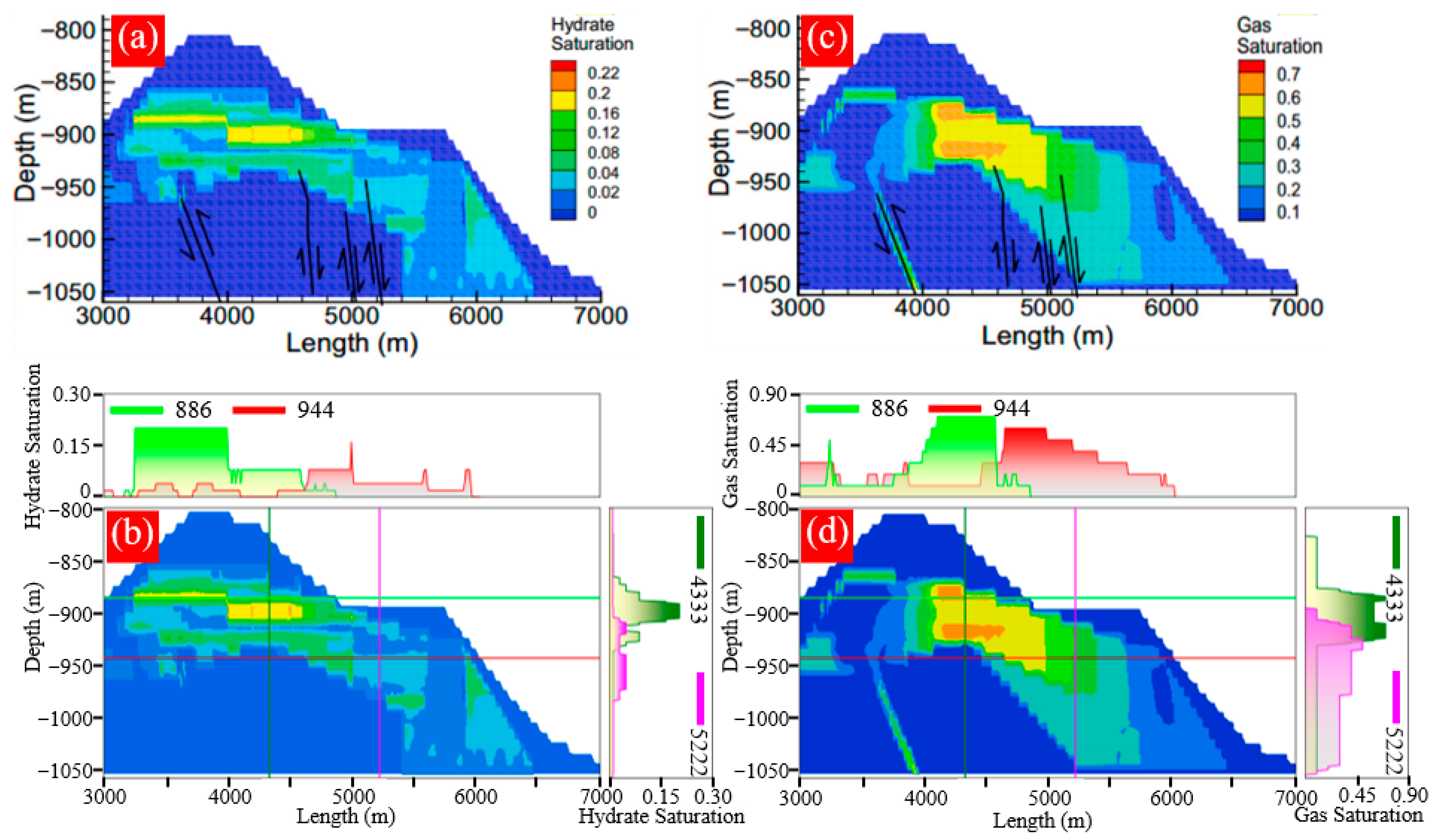
Dhakal [30] developed a numerical simulation model to simulate the flow of methane gas along the fault zone of the hydrate ridge in the southern Cascadia margin. The simulation shows that the natural gas hydrates in this area may form through the migration of natural gas from deeper sources via faults. Hydrates are distributed along the slope of the southern ridge, with relatively high saturation levels.
In Figure 5a, there are 12 black lines representing fracture trajectories rather than hydrate saturation. These are noise signals that need to be identified and processed during color restoration. First, a white color marker with RGB values (255, 255, 255) is selected, followed by a gradient of 9 color markers, from red to blue, with RGB values (0, 52, 204), (0, 96, 225), (0, 187, 227), (0, 196, 95), (0, 197, 0), (106, 211, 0), (255, 233, 0), (255, 124, 0), and (242, 0, 0). Upon color recognition, an additional color marker with RGB value (0, 142, 247) was identified and added. These 11 color markers are assigned values from 0 to 10, representing a proportional increase in saturation from 0 to 0.7, with the additional color marker corresponding to a value of 0.051. After processing the noise, Figure 5b is obtained, completing the hydrate saturation recognition.
In Figure 5c, the 12 black lines represent fracture trajectories rather than gas saturation, and these are noise signals that need to be identified and processed during color restoration. First, a white color marker with RGB values (255, 255, 255) is selected, followed by a gradient of 8 color markers from red to blue with RGB values (0, 51, 203), (0, 110, 231), (0, 190, 177), (0, 198, 60), (20, 204, 0), (226, 228, 0), (255, 146, 0), and (242, 0, 0). These 9 color markers are assigned values from 0 to 8, representing a proportional increase in gas saturation from 0 to 0.7. After processing the noise, the final Figure 5d is obtained, completing the gas saturation recognition.
A comparative analysis of the parameters was conducted using PSNR and SSIM in Table 2.

4. Numerical Simulation Theory and Comparative Analysis of Results

4.1. Numerical Simulation Theory

The Computer Modeling Group (CMG) 2015 software was used, a heavy oil simulation software that did not inherently include a hydrate module; therefore, the hydrate model was user-defined. CMG-STRAS is known for its robust capabilities and has been widely used by academics and researchers for hydrate simulation studies, achieving significant success in practical exploration. Hydrates were defined as a solid phase within the software. Consequently, they are considered to occupy pore spaces but cannot be initialized directly using saturation values. Instead, the saturation must be converted into solid-phase concentration for initialization. The relationship between water saturation and gas saturation is set to satisfy the equation Sw + Sg = 1. The solid model captures the relationship between permeability and porosity. For relative permeability and capillary pressure, reference was made to the empirical methods of Van Genuchten [31], Parker [32], and Hong [33].
When depressurization is used to extract hydrates, only the decomposition and secondary generation reactions of hydrates are considered, as shown in the following formula:
C H 4 H y d r a t e n H 2 O + C H 4
n H 2 O + C H 4 C H 4 H y d r a t e
Among them, n represents the number of hydrates, usually taken as 5.75.
For the decomposition rate of hydrates, the calculation is based on the Kim–Bishnoi [34] formula
d c h d t = K d A d e c f e f g
According to the Arrhenius formula
K d = K d 0 e x p ( E R T )
A d e c = Φ 2 A h s S w S h
The decomposition rate of hydrates is
d c h d t = ( K d 0 A h s / ρ w ρ h ) ( Φ S h ρ h ) ( Φ S w ρ w ) P e · e x p ( E R T ) ( 1 1 K )
The synthesis rate of hydrates is
d c h d t = ( K f 0 A h s / ρ w ) ( Φ S w ρ w ) ( 1 + Φ S h ) · e x p ( E R T ) ( 1 K 1 )
Wherein K d 0 represents the inherent decomposition rate constant of hydrates, with the unit being gmol/(s·Pa·m2); Kd represents the rate constant of hydrate decomposition, with the unit being gmol/(s·Pa·m2); K f 0 represents the inherent rate constant of hydrate formation, with the unit being gmol/(s·Pa·m2); Adec represents reaction area per unit volume, with the unit being m2/m3; Ahs represents the reaction surface area for a unit spherical hydrate particle, with the unit being m2/m3; fe represents the equilibrium pressure of the gas phase under ideal conditions, with the unit being Pa; fg represents the partial pressure of the gas phase in a porous medium, with the unit being Pa; E represents the reaction activation energy of the hydrate, with the unit being J/mol; R represents the gas constant, with the unit being J/(mol·K); T represents the temperature, with the unit being K; Ch represents the solid-phase concentration of the hydrate, with the unit being gmol/m3; and K represents the ratio of fe to fg. The data on hydrate kinetic constants are shown in Table 3.
In the software, K is determined by rxk1, rxk2, rxk3, rxk4, and rxk5, as shown in the following formula:
K = ( ( r x k 1 / p ) + ( r x k 2 × p ) + ( r x k 3 ) ) × e x p ( ( r x k 4 ) / ( T r x k 5 ) )
where K = 1 indicates a three-phase equilibrium state, K > 1 indicates a hydrate decomposition state, and K < 1 indicates a hydrate formation state. K represents the equilibrium ratio, commonly used to describe the equilibrium constant in chemical reactions or physical processes; p represents the Pressure, with units that must be consistent with other parameters in the formula; T represents the temperature, with the unit K; and rxk1, rxk2, rxk3, rxk4, and rxk5 represent the empirical coefficients, determined by software or users based on the specific system.
Permeability varies with porosity and is calculated based on the Carman–Kozeny equation.
k ( Φ ) = k 0 ( Φ Φ 0 ) ε ( 1 Φ 0 1 Φ ) 2
The empirical coefficient ε is taken as 5.
Porosity refers to the ratio of the pore volume to the total volume of the rock. In conventional reservoir simulation, there is generally only one porosity. However, when treating hydrates as a solid phase, it is necessary to properly handle the relationship between the total pore volume and the fluid pore volume to correctly represent the porosity variation process. The total volume of a grid block, Vb, is composed of the following parts: (1) solid rock matrix volume (Vr); (2) oil phase component volume (Vo); (3) gas phase component volume (Vg); (4) water phase component volume (Vw); and (5) solid phase component volume (Vs).
V b = V o + V g + V w + V s
Fluid   volume   V f = V o + V g + V w
Pore   volume   V v = V b V r = V f V s
Total   porosity   Φ v = V v / V b
Fluid   porosity   Φ f = V f V b = ( V v V s ) / V b = ( V v / V b ) / ( 1 V s / V v )
It   can   also   be   expressed   as   Φ f = Φ v ( 1 c s / ρ s )

4.2. Result Comparison

To verify the reliability of the reconstructed heterogeneous model, CMG software is used to simulate the first three reconstructed reservoirs and compare the results with existing data.
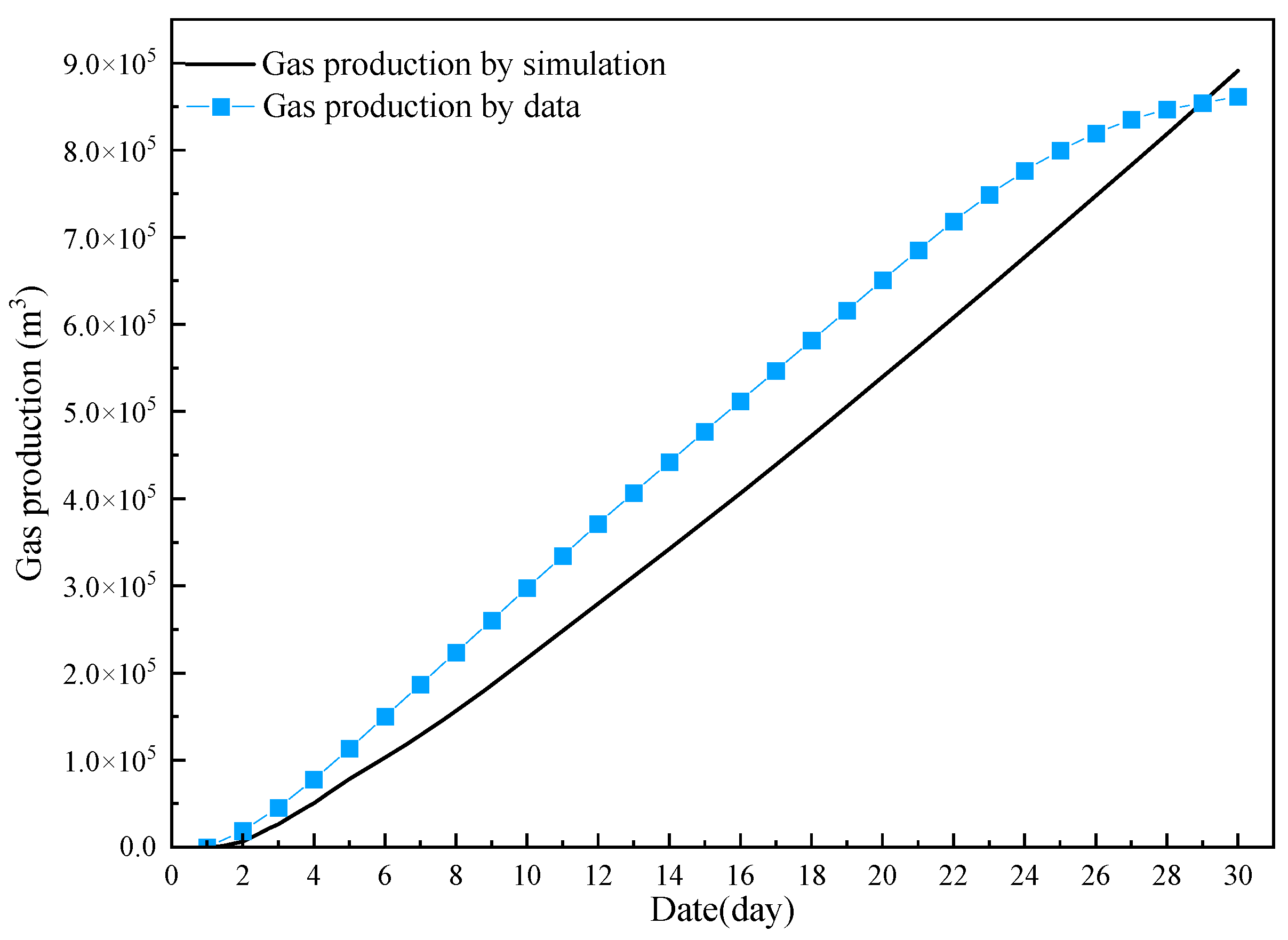
The first reconstructed model represents the hydrate reservoir from the second trial production in the South China Sea. During this trial, horizontal wells employed three cluster spacings of 2 m, 3 m, and 4 m, along with various construction parameters to modify the reservoir. Techniques including rotational sand cleaning, turbulent sand flushing, and dense plug sand carrying were applied to increase reservoir permeability by 4 to 6 times. As a result, the permeability around the production wells was adjusted to 18 mD. The second trial production of hydrates in the Shenhu area of the South China Sea achieved an average daily gas production of 2.87 × 10⁴ m3, with a total gas production of 8.61 × 10⁵ m3 over 30 days. A comparison of the simulated cumulative gas production with the data from the second South China Sea trial shows that the fitted final gas production is 8.91 × 10⁵ m3, which is 3.5% higher than the actual production, as shown in Figure 6.
From the simulated gas production curve, the first two days show low-speed gas production, while days 2 to 30 exhibit high-speed gas production. The low-speed gas production stage primarily produces free gas, and during this phase, the actual gas production rate is higher than the simulated capacity. During the later stage of high-speed gas production, hydrate decomposition occurs. Before the 29th day, the simulated gas production capacity is lower than the actual rate, whereas after the 29th day, to prevent the input of methane gas and avoid the formation of secondary hydrates [38], the simulated capacity exceeds the actual rate. This phenomenon can be attributed to two factors: Firstly, the rapid release of free gas during the low-speed production phase likely contributes to a higher-than-simulated gas production rate. This aligns with experimental observations indicating that the gas production rate in different gas production stages is significantly different, and the gas production rate in the initial stage is faster [39]. Secondly, during the high-speed gas production phase, the rate of hydrate decomposition and subsequent gas release in actual operations may have been influenced by various construction techniques and field conditions, which were not fully reflected in the simulation. As demonstrated by Ouchi et al. in their history-matching study [40], the discrepancies between modeled and actual production behavior are primarily attributed to vertical and horizontal heterogeneities of the formation and the complexly disturbed situation in the near-wellbore region due to the unconsolidated nature of the sediments.
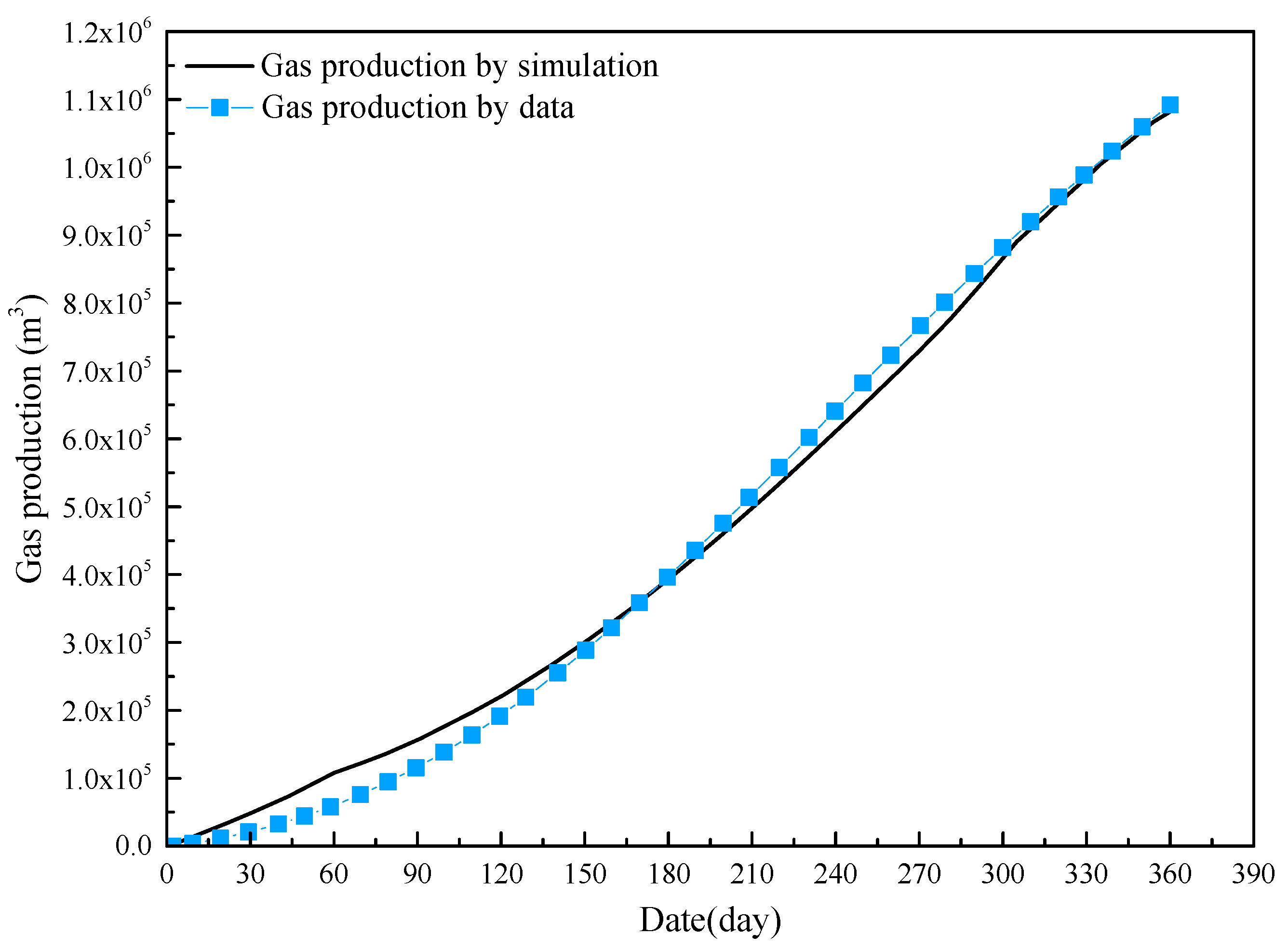
The second reconstructed model represents the hydrate reservoir SH2 in the Shenhu area. According to Sun et al. [29], simulated production over 360 days reported a total gas production of 1.09 × 10⁶ m3. A comparison of the cumulative gas production from the simulation with the data from the literature shows that the fitted final gas production is 1.08 × 10⁶ m3, which is 0.9% lower than the reported value, as shown in Figure 7.
From the simulated gas production curve, the first 30 days show low-speed gas production, days 30 to 90 show medium-speed gas production, and days 90 to 360 show high-speed gas production. The simulation results in this study closely match the simulation data from the literature. Sun et al. [29] arranged five vertical wells with a well spacing of 1000 m, a bottom-hole flowing pressure of 2500 kPa, and perforations distributed across 4 to 13 layers vertically, with a total of 50 vertical grids. In our simulation, 73 vertical grids were uniformly set, with the perforation positions of the five vertical wells located at layers 7–21, 10–30, 7–21, 6–19, and 6–18, respectively, a setup that differs from the original. In Figure 4a, the five wells from the original study can be clearly seen, with different perforation depths appearing to use the same vertical grid layers in their simulation. This suggests that they might have used a non-uniform grid arrangement or non-uniform grids in their modeling. Since uniformly arranged grids were used in our simulation, the perforations span a larger range of vertical grids, resulting in higher gas production during the high-speed production phase.
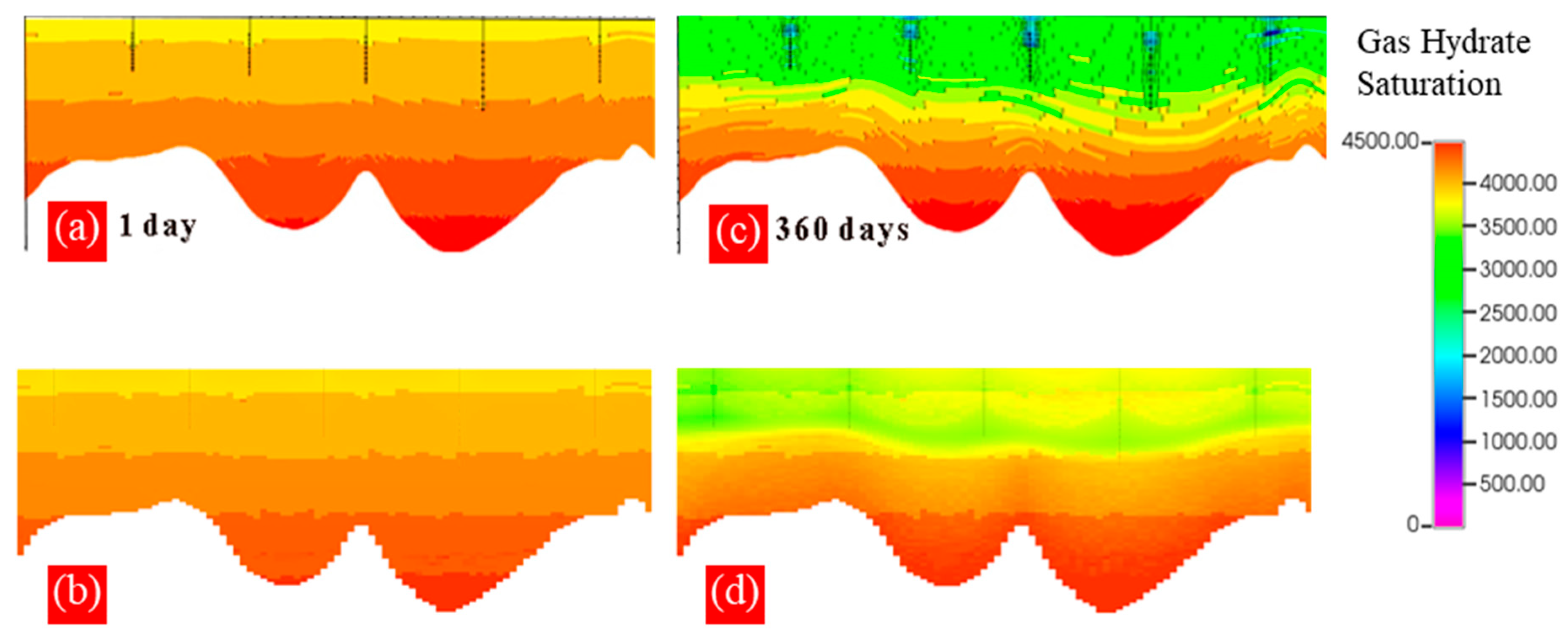
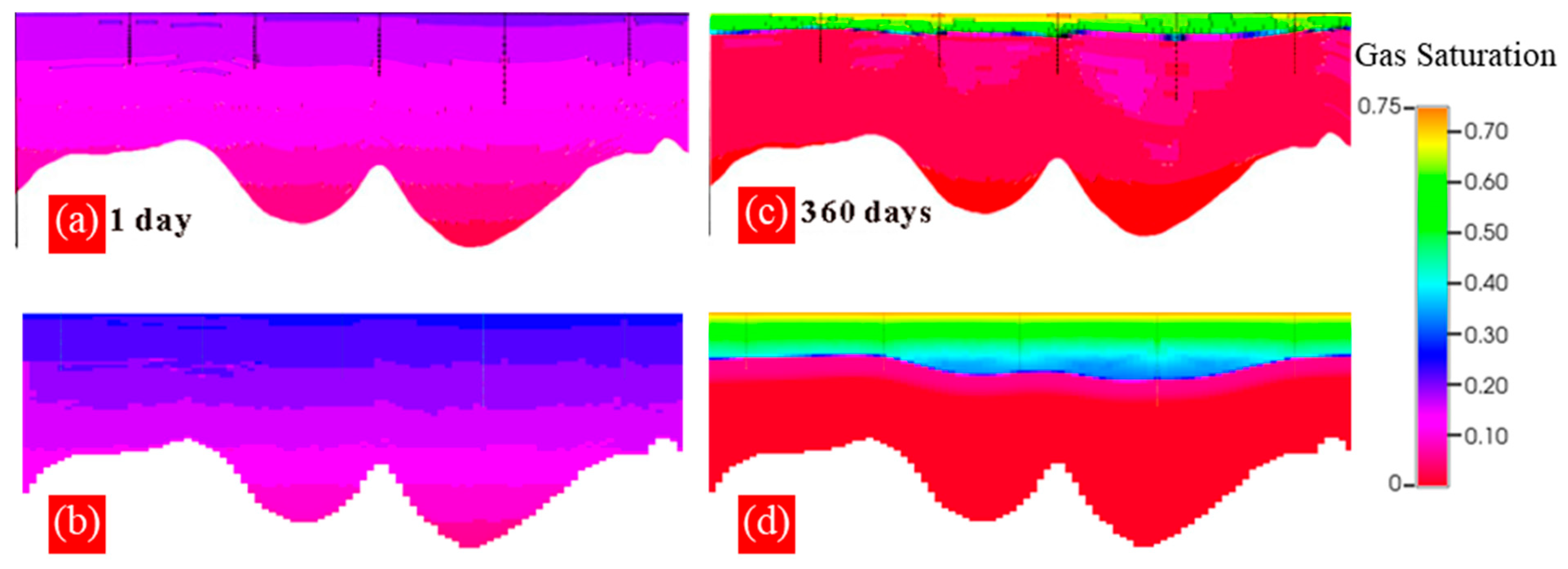
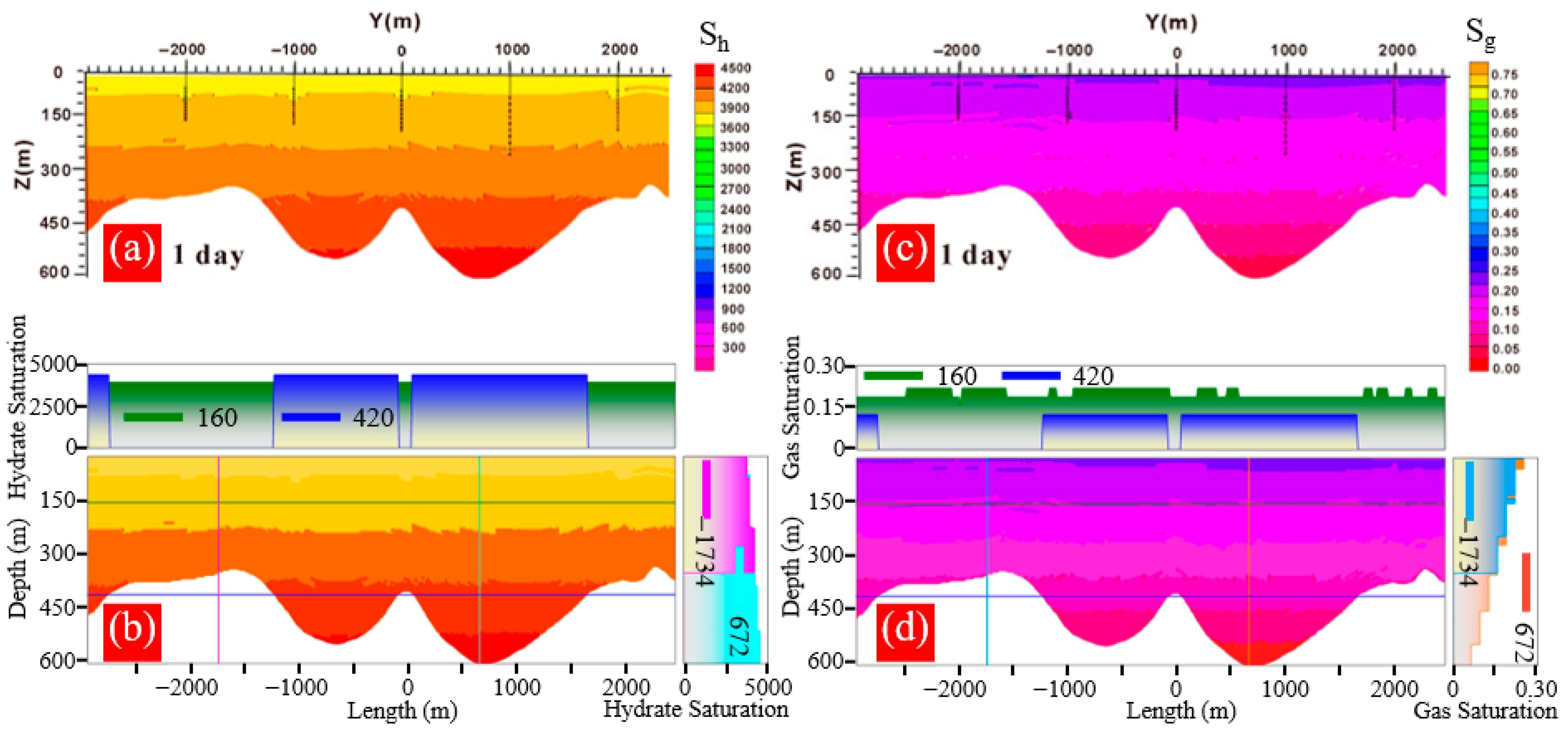
The distribution of gas hydrate saturation and gas saturation is shown in Figure 8 and Figure 9, respectively. The distribution of gas hydrate saturation can be observed in Figure 8, which is influenced by factors such as thermal fluid flow, and a trend of gas hydrate dissociation is clearly observed, with the primary dissociation zone located in the upper section. In Figure 8, the distribution of gas saturation is displayed, showing significant gas consumption in the lowermost layer and an increase in gas content in the uppermost layer, driven by the combined effects of thermal fluid flow and gravity.
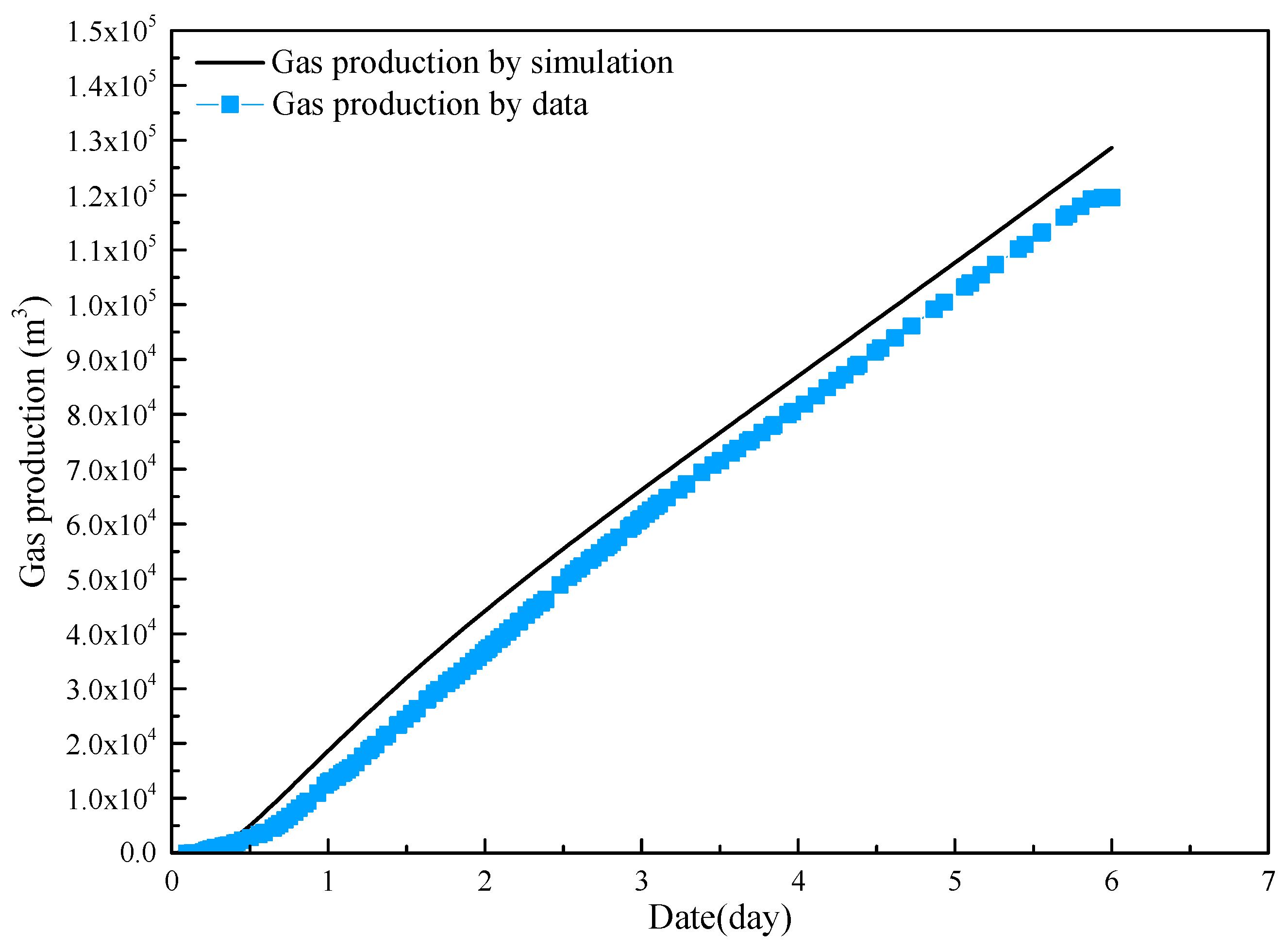
The third reconstructed model represents the hydrate reservoir in the Nankai Trough, off Japan. The Japan Oil, Gas and Metals National Corporation (JOGMEC) conducted the world’s first offshore hydrate production test in the Nankai Trough using the depressurization method. A single vertical well was used for depressurization production, while two additional vertical wells monitored changes in reservoir temperature and other characteristics. The test ended after six days due to severe sand production, yielding 1.2 × 10⁵ m3 of methane gas, with an average gas production rate of 2 × 10⁴ m3 per day. The instantaneous production rate was taken into consideration, provided by Konno et al. [41], and because production had not completely ceased by the sixth day, we selected a six-day production period. The cumulative gas production over six days was obtained by integration, yielding a total of 1.195 × 10⁵ m3. A comparison of the cumulative gas production from the simulation with the data from the Nankai Trough production test shows that the fitted final gas production is 1.286 × 10⁵ m3, which is 7.6% higher than the test result, as shown in Figure 10.
From the simulated gas production curve, the first half-day shows low-speed gas production, while from half a day to six days shows high-speed gas production. Overall, the simulation results align closely with the actual production data from Japan during both the low-speed and high-speed gas production phases. In the actual production test, sand production influenced the outcomes, with sand particles being carried out of the formation along with the gas, entering the production wellbore, and clogging the wellbore and production pipelines. This reduced gas flow and significantly decreased gas production, causing a sharp decline in production starting from the sixth day until production ceased. In this simulation, the impacts of sand production were not considered. Sand control measures need to be accounted for in such processes [42]; however, the present model primarily considered macroscopic factors such as reservoir pressure and gas flow, without accounting for microscopic formation changes and sand production phenomena. Because sand production was not included in the simulation, the gas production process remained unobstructed, resulting in the higher simulated gas production.
In summary, the gas production patterns align well with known production data. This demonstrates that the reconstructed heterogeneous models are reliable and can accurately represent the gas production behavior of natural gas hydrate reservoirs.

5. Conclusions

In this paper, a novel method for reconstructing heterogeneous marine hydrate reservoirs based on color recognition is proposed. A custom-developed color recognition software was utilized to convert image data into RGB values, which were subsequently assigned corresponding geological parameters. The reconstructed models were compared with the original images, and their feasibility was validated through numerical simulations using CMG software. The comparison and simulation results demonstrate the following: (1) the reconstructed hydrate reservoir characteristic maps exhibit strong consistency with the original images in terms of color range and distribution; (2) the reconstructed maps enable convenient extraction of parameter values within coordinate systems; (3) the gas production behaviors of the established models align well with known production data. Specifically, the difference between the reconstructed heterogeneous South China Sea hydrate model and the actual production results is 3.5%, the difference between the reconstructed heterogeneous Shenhu SH2 area hydrate model and the literature-simulated production results is 0.9%, and the difference between the reconstructed heterogeneous Nankai Trough hydrate model and the actual production results is 7.6%.
These results validate the reliability of the proposed reconstruction method for heterogeneous hydrate reservoirs. This work addresses a critical gap in hydrate reservoir characterization by introducing a color recognition-based approach that transforms readily available visual data into quantitatively accurate geological models—a strategy not previously reported in this field. The high fidelity achieved demonstrates that this method not only preserves the spatial heterogeneity essential for accurate production forecasting but also significantly simplifies the reservoir modeling process. Beyond its immediate application to hydrate reservoirs, this approach offers a transformative pathway for reconstructing heterogeneous oil and gas reservoirs, particularly where detailed geological data are limited but visual information exists. These findings provide both a practical tool and a theoretical foundation for advancing heterogeneous reservoir studies, opening new avenues for more reliable resource assessment and production optimization in marine energy systems.

Author Contributions

Writing—review & editing, W.M., S.H., Y.W. and S.F.; Supervision, S.H., Y.W. and S.F. All authors have read and agreed to the published version of the manuscript.

Funding

This study was supported by the Key Research & Development Program of Guangzhou (202206050002) and the National Natural Science Foundation of China (21736005).

Data Availability Statement

The original data presented in the study are openly available in [FigShare] at DOI: 10.6084/m9.figshare.31813231.

Conflicts of Interest

The authors declare no conflict of interest.

References

  1. Sloan, E.D. Fundamental principles and applications of natural gas hydrates. Nature 2003, 426, 353–359. [Google Scholar] [CrossRef]
  2. Zhang, W.; Liang, J.; Wei, J.; Lu, J.A.; Su, P.; Lin, L.; Huang, W.; Guo, Y.; Deng, W.; Yang, X.; et al. Geological and geophysical features of and controls on occurrence and accumulation of gas hydrates in the first offshore gas-hydrate production test region in the Shenhu area, Northern South China Sea. Mar. Pet. Geol. 2020, 114, 104191. [Google Scholar] [CrossRef]
  3. Li, L.; Liu, H.; Zhang, X.; Lei, X.; Sha, Z. BSRs, estimated heat flow, hydrate-related gas volume and their implications for methane seepage and gas hydrate in the Dongsha region, northern South China Sea. Mar. Pet. Geol. 2015, 67, 785–794. [Google Scholar] [CrossRef]
  4. Liu, B.; Chen, J.; Pinheiro, L.M.; Yang, L.; Liu, S.; Guan, Y.; Song, H.; Wu, N.; Xu, H.; Yang, R. An insight into shallow gas hydrates in the Dongsha area, South China Sea. Acta Oceanol. Sin. 2021, 40, 136–146. [Google Scholar] [CrossRef]
  5. Zhu, L.; Zhou, X.; Sun, J.; Liu, Y.; Wang, J.; Wu, S. Reservoir classification and log prediction of gas hydrate occurrence in the Qiongdongnan Basin, South China Sea. Front. Mar. Sci. 2023, 10, 1055843. [Google Scholar] [CrossRef]
  6. Wang, J.; Wu, S.; Kong, X.; Li, Q.; Wang, J.; Ding, R. Geophysical characterization of a fine-grained gas hydrate reservoir in the Shenhu area, northern South China Sea: Integration of seismic data and downhole logs. Mar. Pet. Geol. 2018, 92, 895–903. [Google Scholar] [CrossRef]
  7. Kang, D.; Zhang, Z.; Lu, J.A.; Phillips, S.C.; Liang, J.; Deng, W.; Zhong, C.; Meng, D. Insights on gas hydrate formation and growth within an interbedded sand reservoir from well logging at the Qiongdongnan basin, South China Sea. Mar. Geol. 2024, 475, 107343. [Google Scholar] [CrossRef]
  8. Hsu, S.-K.; Chiang, C.-W.; Evans, R.L.; Chen, C.-S.; Chiu, S.-D.; Ma, Y.-F.; Chen, S.-C.; Tsai, C.-H.; Lin, S.-S.; Wang, Y. Marine controlled source electromagnetic method used for the gas hydrate investigation in the offshore area of SW Taiwan. J. Asian Earth Sci. 2014, 92, 224–232. [Google Scholar] [CrossRef]
  9. Jing, J.-E.; Chen, K.; Deng, M.; Zhao, Q.-X.; Luo, X.-H.; Tu, G.-H.; Wang, M. A marine controlled-source electromagnetic survey to detect gas hydrates in the Qiongdongnan Basin, South China Sea. J. Asian Earth Sci. 2019, 171, 201–212. [Google Scholar] [CrossRef]
  10. Liu, Y.; Chen, Q.; Li, S.; Wang, X.; Zhao, J.; Zou, C. Characterizing spatial distribution of ice and methane hydrates in sediments using cross-hole electrical resistivity tomography. Gas Sci. Eng. 2024, 128, 205378. [Google Scholar] [CrossRef]
  11. Huang, S.; Jin, X.; Jiang, Q.; Liu, L. Deep learning for image colorization: Current and future prospects. Eng. Appl. Artif. Intell. 2022, 114, 105006. [Google Scholar] [CrossRef]
  12. Zhang, Q.; Wang, Y. Numerical Simulations of Combined Brine Flooding With Electrical Heating–Assisted Depressurization for Exploitation of Natural Gas Hydrate in the Shenhu Area of the South China Sea. Front. Earth Sci. 2022, 10, 843521. [Google Scholar] [CrossRef]
  13. Wang, Y.; Feng, J.-C.; Li, X.-S.; Zhang, Y.; Li, G. Evaluation of Gas Production from Marine Hydrate Deposits at the GMGS2-Site 8, Pearl River Mouth Basin, South China Sea. Energies 2016, 9, 222. [Google Scholar] [CrossRef]
  14. Zhang, L.; Zhang, Y.; Chen, C.; Li, X.-S.; Chen, Z.-Y. Numerical Simulation of Hydrate Decomposition during the Drilling Process of the Hydrate Reservoir in the Northern South China Sea. Energies 2022, 15, 3273. [Google Scholar] [CrossRef]
  15. Wang, R.; Zhang, J.; Wang, T.; Lu, H. Numerical Simulation of Improved Gas Production from Oceanic Gas Hydrate Accumulation by Permeability Enhancement Associated with Geomechanical Response. J. Mar. Sci. Eng. 2023, 11, 1468. [Google Scholar] [CrossRef]
  16. Ye, H.; Wu, X.; Li, D. Numerical Simulation of Natural Gas Hydrate Exploitation in Complex Structure Wells: Productivity Improvement Analysis. Mathematics 2021, 9, 2184. [Google Scholar] [CrossRef]
  17. Yu, T.; Guan, G.; Abudula, A.; Yoshida, A.; Wang, D.; Song, Y. Heat-assisted production strategy for oceanic methane hydrate development in the Nankai Trough, Japan. J. Pet. Sci. Eng. 2019, 174, 649–662. [Google Scholar] [CrossRef]
  18. Yu, T.; Guan, G.; Abudula, A.; Yoshida, A.; Wang, D.; Song, Y. Application of horizontal wells to the oceanic methane hydrate production in the Nankai Trough, Japan. J. Nat. Gas Sci. Eng. 2019, 62, 113–131. [Google Scholar] [CrossRef]
  19. Janicki, G.; Schlüter, S.; Hennig, T.; Deerberg, G. Simulation of Subsea Gas Hydrate Exploitation. Energy Procedia 2014, 59, 82–89. [Google Scholar] [CrossRef]
  20. Yoon, H.C.; Kim, J. The impacts of scaled capillary pressure combined with coupled flow and geomechanics on gas hydrate deposits. Geomech. Energy Environ. 2024, 37, 100529. [Google Scholar] [CrossRef]
  21. Boswell, R.; Yoneda, J.; Waite, W.F. India National Gas Hydrate Program Expedition 02 summary of scientific results: Evaluation of natural gas-hydrate-bearing pressure cores. Mar. Pet. Geol. 2019, 108, 143–153. [Google Scholar] [CrossRef]
  22. Zhang, K.; Moridis, G.J.; Wu, N.; Li, X. Evaluation of Alternative Horizontal Well Designs for Gas ProductionFrom Hydrate Deposits in the Shenhu Area, South China Sea. In Proceedings of the International Oil and Gas Conference and Exhibition in China, Beijing, China, 8–10 June 2010. [Google Scholar]
  23. Liu, C.; Meng, Q.; He, X.; Li, C.; Ye, Y.; Lu, Z.; Zhu, Y.; Li, Y.; Liang, J. Comparison of the characteristics for natural gas hydrate recovered from marine and terrestrial areas in China. J. Geochem. Explor. 2015, 152, 67–74. [Google Scholar] [CrossRef]
  24. Huang, L.; Su, Z.; Wu, N.-Y. Evaluation on the gas production potential of different lithological hydrate accumulations in marine environment. Energy 2015, 91, 782–798. [Google Scholar] [CrossRef]
  25. Ye, J.-L.; Qin, X.-W.; Xie, W.-W.; Lu, H.-L.; Ma, B.-J.; Qiu, H.-J.; Liang, J.-Q.; Lu, J.-A.; Kuang, Z.-G.; Lu, C.; et al. The second natural gas hydrate production test in the South China Sea. China Geol. 2020, 3, 197–209. [Google Scholar] [CrossRef]
  26. Zhang, W.; Liang, J.; Wei, J.; Su, P.; Lin, L.; Huang, W. Origin of natural gases and associated gas hydrates in the Shenhu area, northern South China Sea: Results from the China gas hydrate drilling expeditions. J. Asian Earth Sci. 2019, 183, 103953. [Google Scholar] [CrossRef]
  27. Su, P.B.; Liang, J.Q.; Zhang, W.; Liu, F.; Wang, F.; Li, T.; Wang, X.; Wang, L. Natural gas hydrate accumulation system in the Shenhu sea area of the northern South China Sea. Nat. Gas Ind. 2020, 40, 77–89. (In Chinese) [Google Scholar]
  28. Tamaki, M.; Suzuki, K.; Fujii, T.; Sato, A. Prediction and validation of gas hydrate saturation distribution in the eastern Nankai Trough, Japan: Geostatistical approach integrating well-log and 3D seismic data. Interpretation 2016, 4, SA83–SA94. [Google Scholar] [CrossRef]
  29. Sun, Z.; Xin, Y.; Sun, Q.; Ma, R.; Zhang, J.; Lv, S.; Cai, M.; Wang, H. Numerical Simulation of the Depressurization Process of a Natural Gas Hydrate Reservoir: An Attempt at Optimization of Field Operational Factors with Multiple Wells in a Real 3D Geological Model. Energies 2016, 9, 714. [Google Scholar] [CrossRef]
  30. Dhakal, S.; Gupta, I. Simulating gas hydrate formation in the southern hydrate ridge, Cascadia Margin. J. Nat. Gas Sci. Eng. 2021, 88, 103845. [Google Scholar] [CrossRef]
  31. Van Genuchten, M.T. A Closed-form Equation for Predicting the Hydraulic Conductivity of Unsaturated Soils. Soil Sci. Soc. Am. J. 1980, 44, 892–898. [Google Scholar] [CrossRef]
  32. Parker, J.C.; Lenhard, R.J.; Kuppusamy, T. A parametric model for constitutive properties governing multiphase flow in porous media. Water Resour. Res. 1987, 23, 618–624. [Google Scholar] [CrossRef]
  33. Hong, H.N.; Pooladi-Darvish, M. A Numerical Study on Gas Production From Formations Containing Gas Hydrates. In Proceedings of the Canadian International Petroleum Conference, Calgary, Alberta, 10–12 June 2003. [Google Scholar]
  34. Kim, H.C.; Bishnoi, P.R.; Heidemann, R.A.; Rizvi, S.S.H. Kinetics of methane hydrate decomposition. Chem. Eng. Sci. 1987, 42, 1645–1653. [Google Scholar] [CrossRef]
  35. Wang, X.H.; Xu, X.J.; Cai, J.; Wu, Y.W.; Chen, Y.X.; Pang, W.X.; Chen, G.J. Experimental study on the intrinsic dissociation rate of methane hydrate. Chem. Eng. Sci. 2023, 282, 119278. [Google Scholar] [CrossRef]
  36. Bergeron, S.; Beltrán, J.G.; Servio, P. Reaction rate constant of methane clathrate formation. Fuel 2010, 89, 294. [Google Scholar] [CrossRef]
  37. Liu, J.; Yan, L.J.; Chen, G.J.; Guo, T.M. Kinetics of methane hydrate dissociation in active carbon. Acta Chim. Sin. 2002, 60, 1385. (In Chinese) [Google Scholar]
  38. Mao, P.; Lu, W.; Wan, Y.; Wu, N. Effects of Submarine Methane-Rich Fluids on Gas Hydrate Production During Depressurization. J. Mar. Sci. Eng. 2025, 13, 2166. [Google Scholar] [CrossRef]
  39. Sun, X.; Liu, J.; Wang, X.; Sun, C.; Chen, G. Review of experimental and numerical simulation research on the development of natural gas hydrate reservoir with underlying gas. Chem. Ind. Eng. Prog. 2024, 43, 2091. (In Chinese) [Google Scholar]
  40. Ouchi, H.; Yamamoto, K.; Akamine, K. Numerical history-matching of modeling and actual gas production behavior and causes of the discrepancy of the Nankai Trough gas-hydrate production test cases. Energy Fuels 2022, 36, 210. [Google Scholar] [CrossRef]
  41. Konno, Y.; Fujii, T.; Sato, A.; Naiki, M.; Masuda, Y.; Yamamoto, K.; Nagao, J. Key Findings of the World’s First Offshore Methane Hydrate Production Test off the Coast of Japan: Toward Future Commercial Production. Energy Fuels 2017, 31, 2607–2616. [Google Scholar] [CrossRef]
  42. Zhao, X.; Zhao, Y.; Mu, M.; Zhou, A.; Zhao, H.; Xie, F. Plugging Experiments for Ceramic Filling Layer with Different Grain Sizes Under Gas–Water Mixed Flow for Natural Gas Hydrate Development. Energies 2025, 18, 1761. [Google Scholar] [CrossRef]
Figure 1. Schematic diagram of the reconstructed data results.
Energies 19 01538 g001
Figure 2. Comparative diagram of color restoration for the stratigraphy of the South China Sea. (a) Distribution map of gas hydrate saturation in the literature. (b) Gas hydrate saturation distribution map of a partially reconstructed area (enlarged) using the color restoration method, with cross-sectional views at depths of 1477 m and 1515 m and vertical sections of 603 m and 848 m. (c) Permeability distribution map in the literature. (d) Permeability distribution map of a partially reconstructed area (enlarged) using the color restoration method, with cross-sectional views at depths of 1477 m and 1515 m and vertical sections of 603 m and 848 m.
Energies 19 01538 g002
Figure 3. Comparative diagram of color restoration for the stratigraphy of the Nankai Trough, Japan. (a) Distribution map of gas hydrate saturation in the literature. (b) Gas hydrate saturation distribution map reconstructed using the color restoration method, with color scale consistent with the original map, and cross-sectional views at depths of 1289 m and 1323 m, and vertical sections of 1911 m and 2276 m.
Energies 19 01538 g003
Figure 4. Comparative diagram of color restoration for the SH2 area of the Shenhu region in the South China Sea. (a) Distribution map of gas hydrate saturation in the literature. (b) Gas hydrate saturation distribution map of a partially reconstructed area (enlarged) using the color restoration method, with cross-sectional views at depths of 160 m and 420 m and vertical sections of 672 m and 1734 m. (c) Permeability distribution map in the literature. (d) Permeability distribution map of a partially reconstructed area (enlarged) using the color restoration method, with cross-sectional views at depths of 160 m and 420 m and vertical sections of 672 m and 1734 m.
Energies 19 01538 g004
Figure 5. Comparative diagram of color restoration for the southern hydrate ridge of the Cascadia margin in the Atlantic. (a) Distribution map of gas hydrate saturation in the literature. (b) Gas hydrate saturation distribution map of a partially reconstructed area (enlarged) using the color restoration method, with cross-sectional views at depths of 1477 m and 1515 m and vertical sections of 603 m and 848 m. (c) Permeability distribution map in the literature. (d) Permeability distribution map of a partially reconstructed area (enlarged) using the color restoration method, with cross-sectional views at depths of 1477 m and 1515 m and vertical sections of 603 m and 848 m.
Energies 19 01538 g005
Figure 6. History match of gas production in a heterogeneous hydrate reservoir in the South China Sea.
Energies 19 01538 g006
Figure 7. History match of gas production in a heterogeneous hydrate reservoir in the SH2 area of the Shenhu region.
Energies 19 01538 g007
Figure 8. Comparison of gas hydrate saturation in the Shenhu SH2 area of the South China Sea. (a) Distribution of gas hydrate saturation on day 1 from the literature. (b) Distribution of gas hydrate saturation on day 1 in a partial region reconstructed using the color restoration method. (c) Distribution of gas hydrate saturation on day 360 from the literature. (d) Distribution of gas hydrate saturation on day 360 in a partial region reconstructed using the color restoration method.
Energies 19 01538 g008
Figure 9. Comparison of gas saturation in the Shenhu SH2 area of the South China Sea. (a) Distribution of gas saturation on day 1 from the literature. (b) Distribution of gas saturation on day 1 in a partial region reconstructed using the color restoration method. (c) Distribution of gas saturation on day 360 from the literature. (d) Distribution of gas saturation on day 360 in a partial region reconstructed using the color restoration method.
Energies 19 01538 g009
Figure 10. History match of gas production in a heterogeneous hydrate reservoir in the Nankai Trough region of Japan.
Energies 19 01538 g010
Table 1. Method for establishing geological reservoir parameters.
MethodAble to Deduce the Parameters of Heterogeneous Reservoirs Based on Literature Parameters Characteristic
Based on drillingProbably notUtilizing core and logging data
Based on profileProbably notUtilizing logging and seismic data
Based on geophysical dataProbably notUtilizing data from logging while drilling, ocean controllable sources, and acoustic logging
Based on discrete pointsProbably notVarious types of data obtained through sampling points
Based on color restorationYesUtilizing geological reservoir data constructed by others
Table 2. Analysis of the parameters using PSNR and SSIM.
Comparison ContentPSNR in RGB Space (dB)SSIM
in RGB Space
Grayscale SSIM
Figure 2a vs. Figure 2b26.140.7800.837
Figure 2c vs. Figure 2d24.690.7710.856
Figure 3a vs. Figure 3b28.800.8650.901
Figure 4a vs. Figure 4b32.880.9450.967
Figure 4c vs. Figure 4d30.720.9230.960
Figure 5a vs. Figure 5b30.300.8960.933
Figure 5c vs. Figure 5d28.880.8880.929
Table 3. Data on hydrate kinetic constants.
ParameterValueUnitSource/Literature
Intrinsic Dissociation Rate Constant ( K d 0 )18,905.35mol/(m2 · s)Wang et al. [35]
Intrinsic Formation Rate Constant ( K f 0 )8.3 × 10⁻⁸–6.15 × 10⁻⁷m/sBergeron et al. [36]
Activation Energy (E)89.77kJ/molLiu et al. [37]
Gas Constant (R)8.314J/(mol · K)Theoretical value
Disclaimer/Publisher’s Note: The statements, opinions and data contained in all publications are solely those of the individual author(s) and contributor(s) and not of MDPI and/or the editor(s). MDPI and/or the editor(s) disclaim responsibility for any injury to people or property resulting from any ideas, methods, instructions or products referred to in the content.