1. Introduction
The transportation sector remains a significant contributor to greenhouse gas emissions, with passenger vehicles accounting for a substantial share of CO
2 output in the European Union [
1,
2,
3]. Hybrid electric vehicles (HEVs) offer a promising pathway to reduce fuel consumption and emissions by combining internal combustion engines with electric propulsion systems [
4,
5].
The energy management system (EMS) is central to realizing the efficiency potential of hybrid powertrains, as it governs the power distribution between the combustion engine and electric machines during vehicle operation [
4]. It can address multiple, often conflicting objectives including fuel efficiency, battery state of charge (SoC), and driving comfort aspects such as noise emissions [
5]. This multi-objective nature necessitates optimization-based control strategies capable of balancing these competing demands.
Model Predictive Control (MPC) has emerged as a particularly suitable framework for hybrid vehicle energy management, as it enables predictive optimization over a finite horizon while incorporating system constraints and multiple objectives [
6,
7,
8,
9]. By utilizing a system model to predict future states, MPC determines optimal control inputs that minimize a defined cost function subject to operational boundaries [
10]. This predictive capability is especially advantageous in hybrid powertrains where anticipating future driving conditions can significantly improve energy utilization.
Beyond solver selection, which is the focus of the present study, the broader literature on MPC-based energy management has explored adaptive and learning-based extensions. Adaptive MPC strategies adjust prediction models or cost function parameters during operation to improve robustness across varying driving conditions [
11], while adaptive dynamic programming enables the online learning of control policies without requiring complete system models [
12]. Deep reinforcement learning has been applied to hybrid vehicle energy management to handle high-dimensional state spaces and achieve near-optimal performance across diverse scenarios [
13,
14]. Event-triggered MPC formulations reduce computational burden by executing the optimization only when relevant state changes occur [
15]. These approaches address the control framework itself, whereas the choice of optimization solver for the underlying MINLP problem has received comparatively little attention and constitutes the focus of this study.
The underlying optimization problem in parallel hybrid powertrains constitutes a Mixed-Integer Nonlinear Programming (MINLP) problem. The decision space comprises continuous variables such as torque distribution among the combustion engine and electric machines, as well as discrete variables including engine on/off states and clutch engagement [
16]. This mixed-integer structure, combined with the nonlinear characteristics of for example component efficiency maps, creates a non-convex solution space that poses distinct challenges for optimization algorithms.
Gradient-based methods such as Sequential Quadratic Programming (SQP) are widely employed for MPC applications due to their computational efficiency and well-established convergence properties for continuous problems [
17,
18]. When applied to MINLP problems, however, these methods require decomposition into multiple continuous subproblems, solving each operating mode separately and subsequently selecting the optimal solution. In contrast, metaheuristic approaches such as Genetic Algorithms (GA) can handle the mixed-integer structure directly through their population-based, derivative-free search mechanism [
19,
20,
21]. While GAs offer flexibility in handling arbitrary problem structures, they typically require higher computational effort compared to gradient-based methods. The traditionally higher computational demand of metaheuristic approaches has historically constrained their applicability in real-time control systems. However, the computational capabilities of automotive Electronic Control Units (ECUs) have increased substantially in recent years. The demand for computing power is quickly increasing in the automotive domain, and car manufacturers as well as tier-one suppliers are gradually introducing multicore ECUs in their electronic architectures [
22,
23]. These multicore architectures offer higher levels of parallelism and enable the implementation of more complex control algorithms [
22,
24]. In parallel, optimization methods for automatic control are increasingly being deployed on embedded hardware platforms for application-specific needs such as guaranteed communication latency and cost effectiveness [
25,
26]. This development greatly broadens the scope of applications to which optimization methods can be applied in sectors such as automotive [
25]. Together with advances in solver algorithms, these hardware improvements continue to expand the boundaries of real-time optimization in embedded control systems [
23,
24,
26]. While these technological advances create new opportunities for deploying both gradient-based and metaheuristic optimization in automotive applications. This study focuses on GA and SQP as representatives of the two principal solver paradigms, metaheuristic and gradient-based, while approaches such as Dynamic Programming are excluded due to the curse of dimensionality in multi-objective problems with multiple continuous control variables.
The selection of GA and SQP as representative solvers is motivated by their position as established methods within the two principal paradigms for solving MINLP problems in real-time control applications. GA represents the class of derivative-free, population-based metaheuristic methods, which also includes Particle Swarm Optimization and Simulated Annealing. SQP represents gradient-based iterative methods that solve a sequence of continuous subproblems. Modern MINLP frameworks such as Bonmin employ branch-and-bound strategies in which continuous NLP relaxations are solved at each node of the search tree, typically using gradient-based solvers such as Ipopt [
27]. While these frameworks offer theoretical advantages for convex problems [
28], the non-convex nature of the powertrain energy management problem limits their applicability to heuristic modes, and the computational overhead of the branch-and-bound tree poses challenges for real-time implementation at the sampling rates required in this study. Mixed-Integer Quadratic Programming (MIQP) formulations require the cost function and constraints to be quadratic, which does not hold for the nonlinear component efficiency maps considered here without introducing additional approximation errors. Hybrid MPC frameworks that combine integer and continuous optimization typically rely on gradient-based or metaheuristic core solvers and thus do not constitute a fundamentally different paradigm. By comparing GA and SQP, this study therefore covers the two ends of the spectrum between global search capability and computational efficiency that is relevant for embedded energy management applications.
Despite the extensive literature on both optimization approaches individually, comparisons between metaheuristic and gradient-based solvers within MPC frameworks for hybrid vehicle energy management remain limited. Existing studies predominantly focus on either approach in isolation, leaving open questions regarding their relative performance across different driving scenarios and optimization objectives. This gap is particularly relevant for powertrain concept development, where the choice of optimization algorithm can significantly influence design decisions.
This study presents a systematic comparison between GA and SQP as optimization solvers within an MPC-based energy management system for a P1P3 parallel hybrid powertrain in a Model-in-the-Loop environment coupling the MPC controller in implemented in MATLAB R2024b with the vehicle plant model implemented in GT Suite v2024. A multi-objective cost function addressing system efficiency, SoC management, and noise emissions is formulated, with the cost function parameterized through Design of Experiments (DoE). The comparative evaluation encompasses the regulatory WLTC as well as a real-world RDE scenario, a short urban and rural phase followed by highway driving conditions. The contribution of this work lies in providing quantitative evidence for algorithm selection in MINLP energy management problems.
This paper is organized as follows:
Section 2 describes the vehicle and powertrain model under investigation.
Section 3 presents the MPC framework and cost function formulation.
Section 4 details the implementation of both optimization algorithms.
Section 5 discusses the comparative results, and
Section 6 concludes with implications for algorithm selection in hybrid vehicle energy management.
2. Vehicle and Powertrain Model
This section describes the 48 V mild hybrid powertrain configuration used in this study. First, the P1P3 parallel hybrid architecture is introduced, followed by a description of the available operating modes and their constraints. Subsequently, the main component specifications are presented. The powertrain and vehicle configurations were derived based on a market projection for the year 2030+ for a typical C-class vehicle [
29].
The powertrain and vehicle simulation models are implemented in GT-Suite and were developed and validated against experimental data in a preceding study [
30]. Component parameters, including the ICE efficiency map, electric machine characteristics, battery model, and transmission data, are derived from test bench measurements and supplier specifications. The co-simulation environment coupling the MPC controller in MATLAB with the GT-Suite plant model was established in [
29] and is adopted without modification for the present study.
2.1. Powertrain Architecture
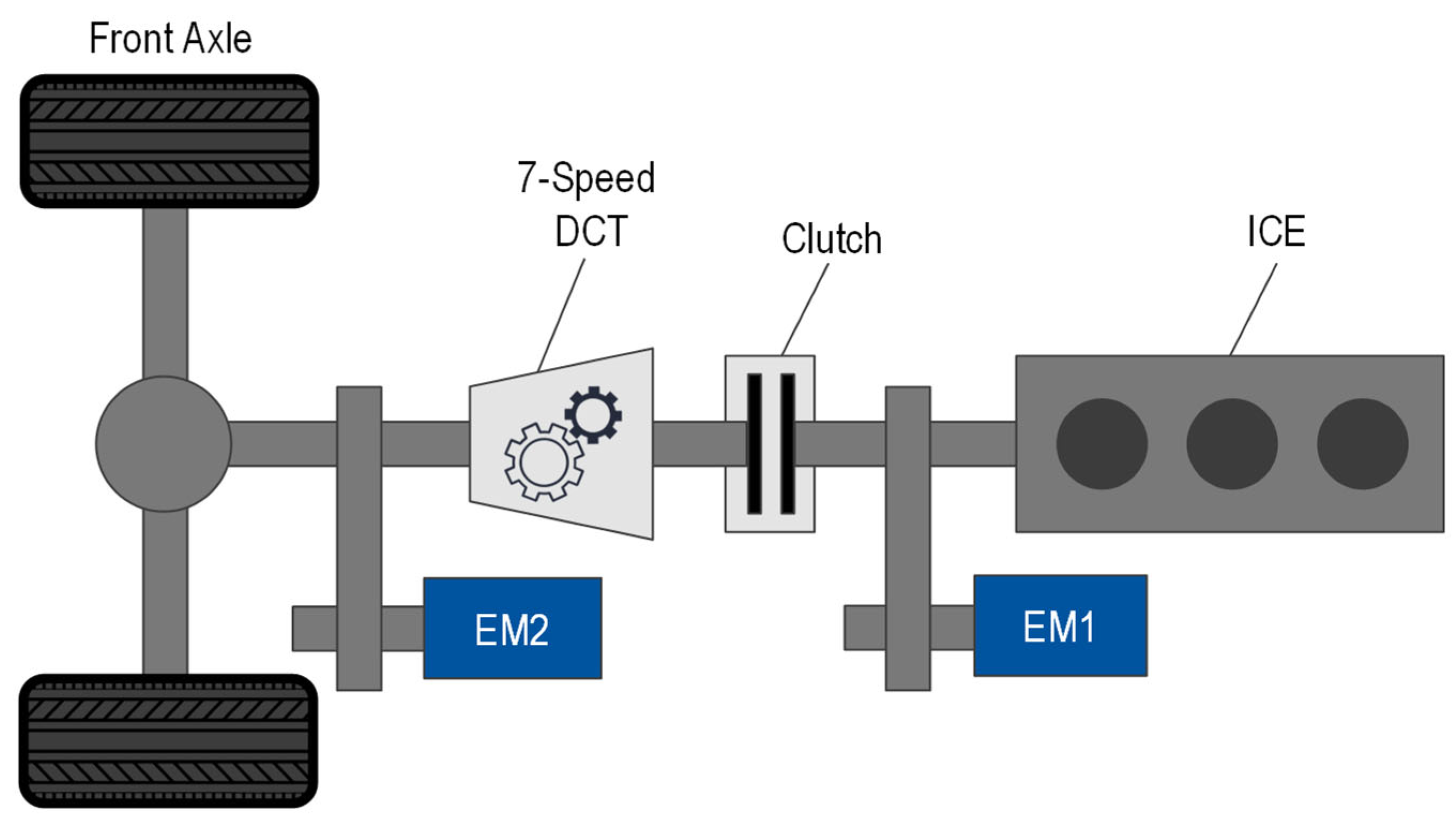
The investigated powertrain follows a P1P3 parallel hybrid configuration, combining features of both parallel and serial hybrid topologies. In this architecture, two electric machines (EM) are integrated alongside a conventional internal combustion engine (ICE), enabling multiple operating modes. A simplified representation of the powertrain layout is shown in
Figure 1.
The first electric machine (EM1) is positioned directly behind the ICE and before the clutch, corresponding to the P1 position. This configuration enables EM1 to function as a starter-generator and to facilitate serial operation when the clutch is disengaged. The second electric machine (EM2) is located after the transmission at the P3 position, providing capabilities for electric driving, regenerative braking, and load point shifting during parallel operation [
31,
32].
The ICE can be mechanically decoupled from the drivetrain via a clutch, allowing independent operation of the combustion engine and enabling purely electric propulsion. A seven speed dual clutch transmission (DCT) connects the powertrain to the front axle through a differential.
2.2. Component Specifications
The main powertrain components and their specifications are summarized in
Table 1. The ICE provides a maximum power of 80 kW, suitable for the investigated mid-size passenger vehicle application. The electric machines are dimensioned asymmetrically: EM2 with 20 kW enables electric driving and load point shifting, while EM1 with 15 kW is primarily designed for engine starting and limited serial operation.
2.3. Operating Modes
The P1P3 configuration enables three following operating modes which are electric, serial and parallel mode.
In electric mode the clutch is open and the ICE is deactivated. EM2 solely provides the required traction torque, limited by the available battery power and the electric machine’s torque–speed characteristics. This mode is typically employed at low vehicle speeds and during coasting.
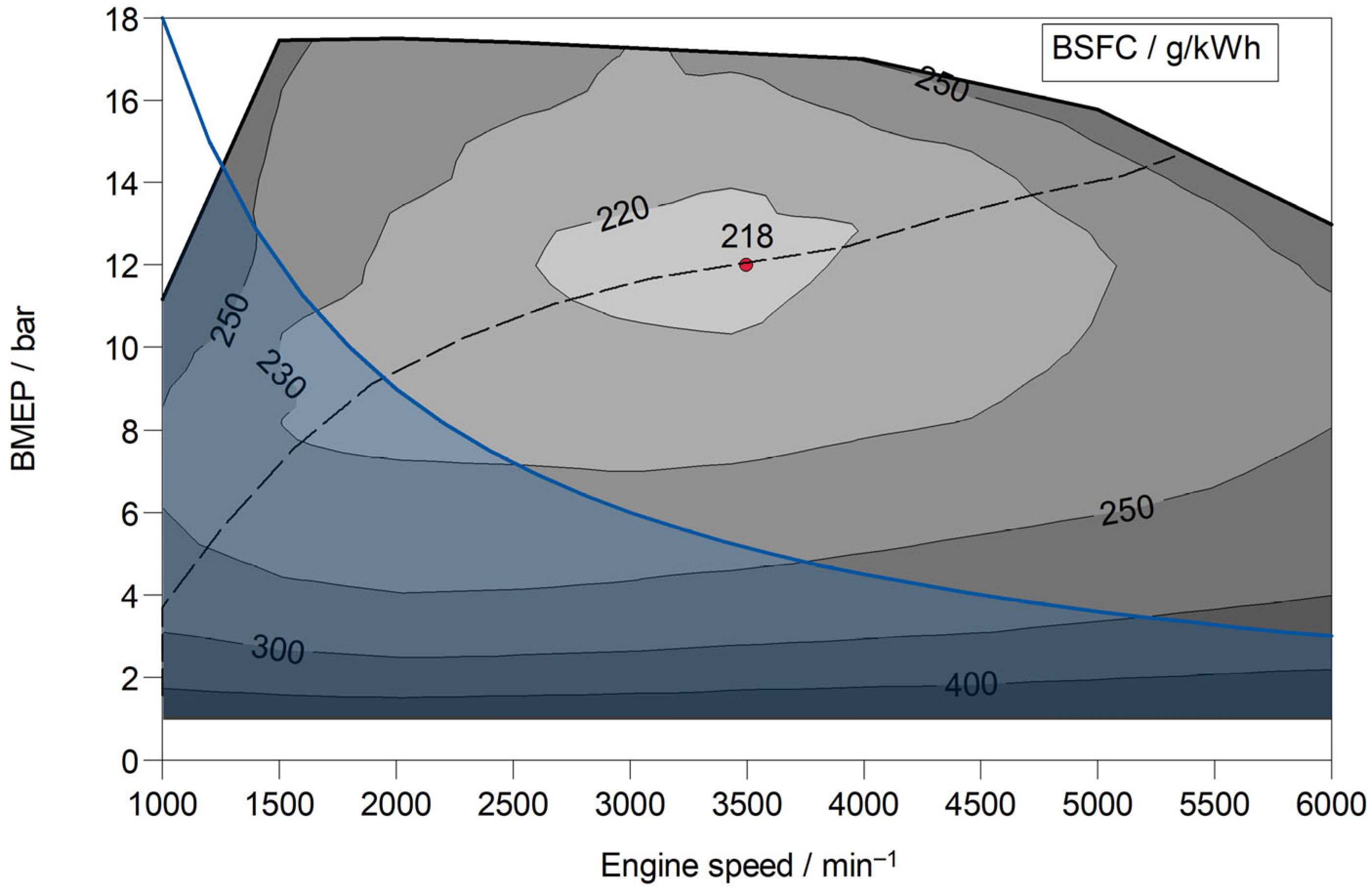
In serial mode the clutch remains open while the ICE operates. EM1 functions as a generator, converting mechanical energy from the ICE to electrical energy, which is either stored in the battery or directly used by EM2 for propulsion. This mode allows the ICE to operate at efficiency-optimized points independent of vehicle speed. However, in the investigated powertrain configuration, the serial operating range is significantly constrained by the power rating of EM1. As illustrated in
Figure 2, the ICE can only be operated below the 15 kW power hyperbola during serial mode, effectively limiting this mode to low-load driving conditions.
In parallel mode the clutch is closed, mechanically coupling the ICE to the drivetrain. Both the ICE and EM2 can simultaneously contribute to traction, enabling load point shifting strategies. EM2 can either assist the ICE (boosting) or act as a generator for battery charging (load point shift).
4. Optimization Algorithms
This section describes the two optimization algorithms employed to solve the MPC optimization problem: Genetic Algorithm (GA) and Sequential Quadratic Programming (SQP). These algorithms represent fundamentally different approaches to optimization. GA belongs to the class of metaheuristic, derivative-free methods that explore the solution space through population-based stochastic search, offering flexibility in handling arbitrary problem structures including mixed-integer formulations and non-differentiable models [
38,
39]. SQP, in contrast, is a gradient-based method that iteratively solves quadratic subproblems, providing computational efficiency but requiring differentiable system models and problem reformulation when discrete variables are present [
40]. Following the algorithm descriptions, the reduced-order models and the Design of Experiments approach for cost function weight tuning are presented.
4.1. Genetic Algorithm
GA operates on a population of candidate solutions representing different combinations of operating modes and torque distributions over the prediction horizon, iteratively improving them through selection, crossover, and mutation operators.
4.1.1. Algorithm Structure
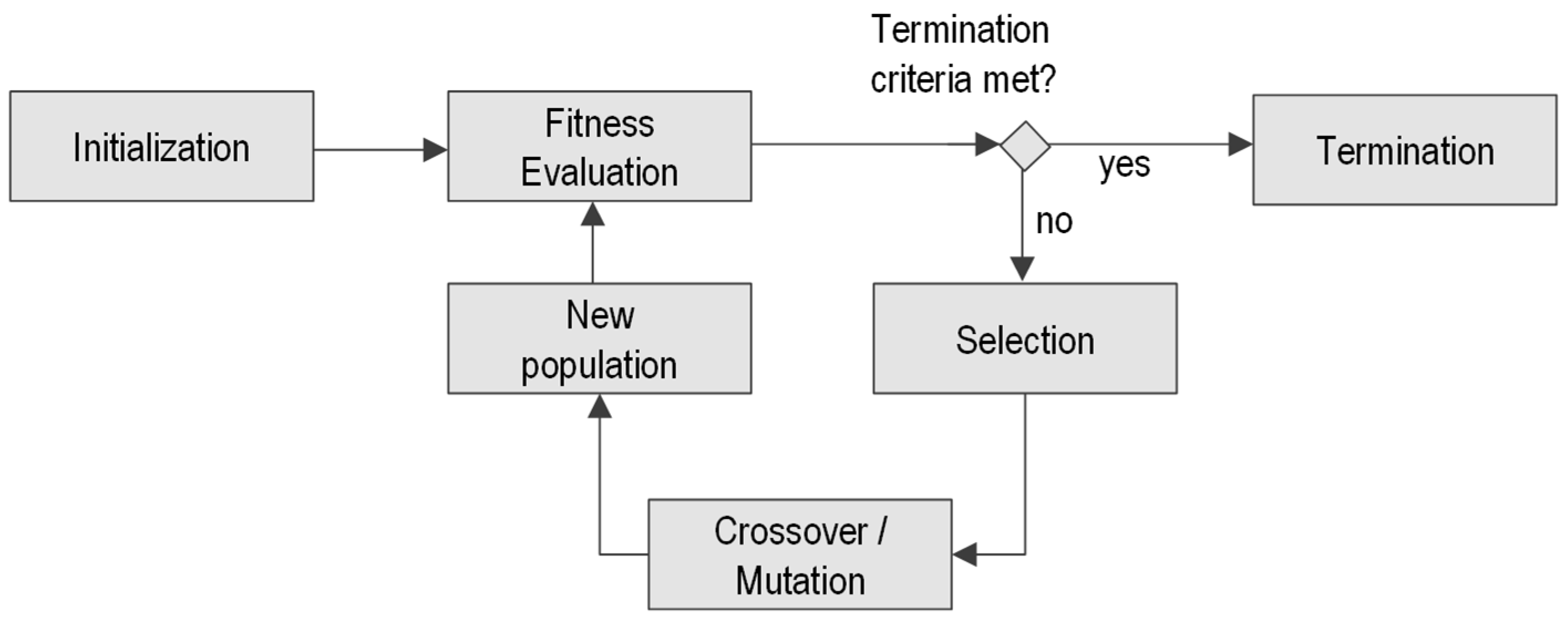
The GA implementation follows the standard evolutionary cycle illustrated in
Figure 3. The search process begins with the initialization of a population, where each individual encodes a potential solution to the energy management problem. In the context of this study, an individual’s chromosome contains the torque values for ICE, EM1, and EM2 as well as the operating mode selection over the prediction horizon. Each individual is then evaluated using the cost function defined in
Section 3.2, where lower cost corresponds to higher fitness. Based on these fitness values, individuals are selected for reproduction, with better-performing solutions having higher probability of contributing to the next generation. The selected individuals undergo crossover, combining genetic information from two parents, and mutation, introducing random variations to maintain exploration of the solution space. This evolutionary cycle repeats until a termination criterion is met, such as reaching a maximum number of generations or achieving convergence in the fitness function [
41,
42].
4.1.2. Implementation
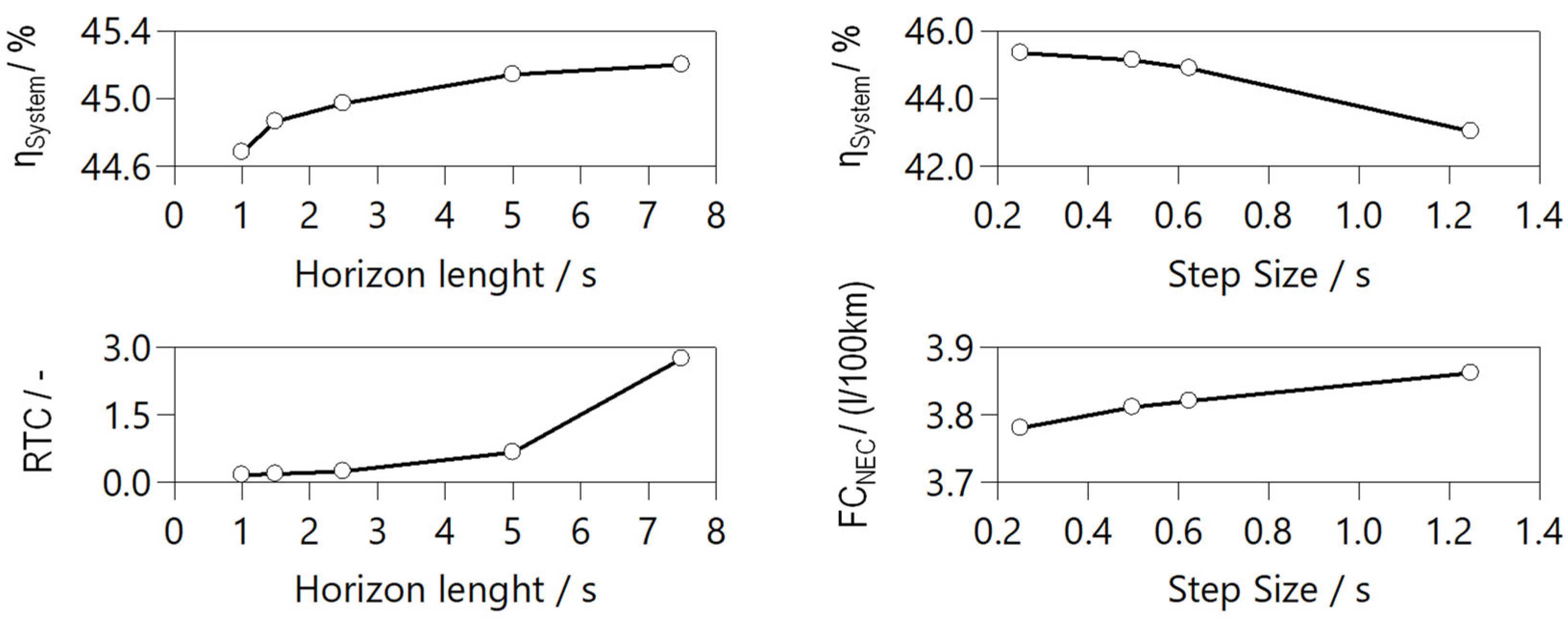
The optimization is executed at each control time step with a sampling interval of 0.1 s, a receding horizon of five seconds and a horizon step size of 0.5 s. The prediction horizon length and the discretization step size within the horizon represent key design parameters of the MPC formulation. Their selection involves a trade-off between optimization performance and computational feasibility, as a longer horizon provides the optimizer with more information about future driving conditions, while finer discretization increases the resolution of the predicted trajectory. To quantify these effects, a parameter study is conducted with the GA-based MPC on the WLTC.
Figure 4 (left column) shows the influence of the prediction horizon length on system efficiency and real-time capability at a constant step size of 0.5 s. System efficiency increases with the horizon length, rising from 44.68% at one second to 45.14% at five seconds. Beyond five seconds, the efficiency gain diminishes, with only 0.06 percentage points improvement between five and 7.5 s. The computational effort, however, increases progressively with the horizon length. At five seconds (RTC = 0.646), the simulation remains well within real-time capability. At 7.5 s, the RTC rises to 2.735, exceeding the real-time threshold and rendering this configuration unsuitable for online implementation.
Figure 4 (right column) shows the influence of the step size on system efficiency and corrected fuel consumption at a constant horizon length of five seconds. Reducing the step size from 0.5 to 0.25 s improves fuel consumption from 3.810 to 3.780 L/100 km and increases system efficiency from 45.14% to 45.34%. However, halving the step size doubles the number of decision variables per horizon, increasing computational effort accordingly. Conversely, increasing the step size to 1.25 s reduces system efficiency to 43.04% and increases fuel consumption to 3.860 L/100 km, effectively eliminating the benefit of the MPC over the deterministic reference.
Based on these results, a prediction horizon of five seconds discretized into ten steps of 0.5 s is selected. This configuration achieves system efficiency within 0.2 percentage points of the finest discretization tested while maintaining real-time capability with sufficient margin. The same horizon length and step size are applied to the SQP-based implementation to ensure a fair comparison.
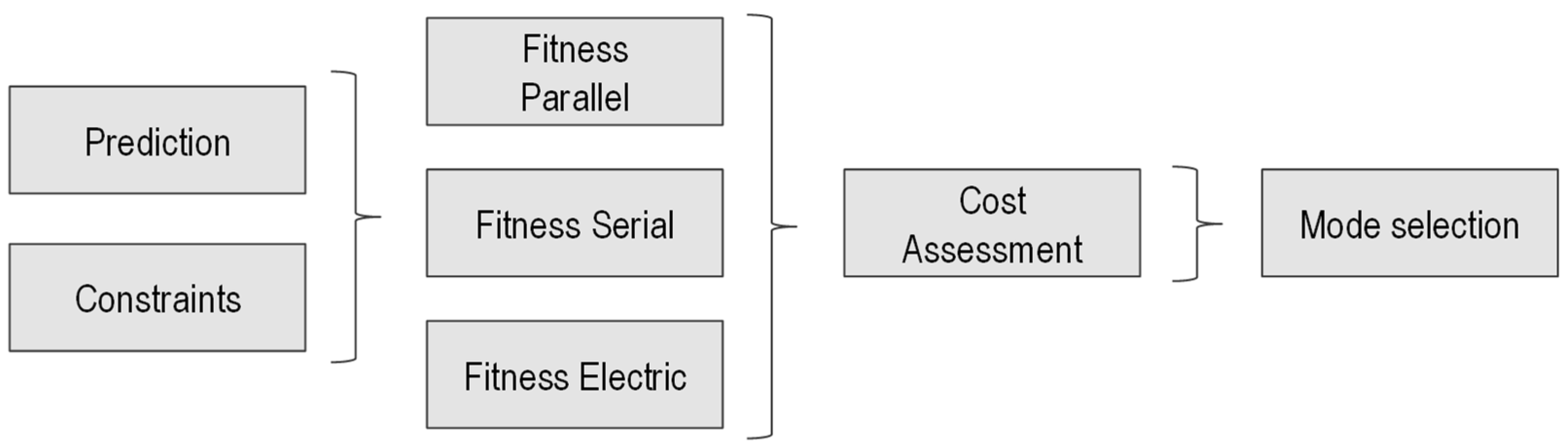
The GA directly handles the mixed-integer nature of the problem by encoding both continuous variables (torques) and discrete variables (operating mode). An upstream predictor module receives the current driver torque demand Tdriver, future vehicle speed vveh, and current gear state, and predicts the power demand as well as the gear trajectory with these values over the prediction horizon. Based on the predicted states, the constraint module determines the feasible operating region considering component limits and battery power boundaries. The optimizer then searches for the optimal control sequence within this feasible region.
The GA operates with a population size of 36 individuals. A mutation rate of 16.67% is applied to maintain diversity in the search space. The algorithm terminates when either a maximum of 200 generations is reached or the relative improvement in the best fitness value remains below 1 × 10⁻⁶ for 20 consecutive generations.
4.2. Sequential Quadratic Programming
As an alternative to the metaheuristic GA approach, Sequential Quadratic Programming is implemented to solve the MPC optimization problem. SQP is a gradient-based iterative method that approximates the nonlinear optimization problem as a sequence of quadratic subproblems [
40].
4.2.1. Mode-Specific Optimization
Since the energy management problem constitutes a Mixed-Integer Problem combining continuous torque variables with discrete mode decisions, it cannot be directly solved by gradient-based methods. Therefore, the optimization is structured as three separate mode-specific subproblems that are solved in parallel, as illustrated in
Figure 5:
Each subproblem represents one of the three operating modes: electric mode (clutch open, ICE off), serial mode (clutch open, ICE on), and parallel mode (clutch closed, ICE on). The three optimization problems are solved simultaneously, and the mode yielding the lowest cost is selected for implementation. This parallel evaluation approach transforms the original MINLP into multiple continuous NLPs that can be efficiently solved using gradient-based methods.
4.2.2. Optimal Control Problem Formulation
Each mode-specific optimization is formulated as an Optimal Control Problem (OCP). The objective is to find the optimal control trajectory that minimizes a cost functional while satisfying system dynamics and constraints. Following the formulation in [
43], the cost functional consists of two components: the Lagrange cost l(x, z, u), which accumulates path costs over the prediction horizon, and the Mayer cost M(x(T)), which penalizes the terminal state. The state vector x contains the battery state of charge, z represents algebraic variables, u denotes the control input vector comprising the component torques, and T specifies the prediction horizon length. The system dynamics are described by the function f, while inequality constraints are captured by g. The resulting OCP is formulated according to Equations (15)–(18).
For numerical solution, the continuous OCP must be transcribed into a finite-dimensional optimization problem. This is achieved using the multiple shooting method [
44], which discretizes the horizon into N time steps and treats the state and control values at each discretization point as optimization variables. The discretized state transition from time step k to k + 1 is represented by the function Φ
k. Applying this discretization yields the Nonlinear Programming problem given by Equations (19)–(22).
4.2.3. Control Variables per Mode
The control vector formulation differs for each operating mode due to the mechanical coupling constraints imposed by the powertrain architecture. These constraints determine which variables can be independently controlled and which are defined by kinematic relationships.
In parallel mode, the clutch is closed and the ICE is mechanically coupled to the drivetrain. Equation (23) defines the control vector u
parallel, which comprises the torques of EM2 (T
EM2) and ICE (T
ICE).
In parallel mode, EM1 is not an independent control variable. Due to the mechanical coupling between EM1 and the ICE through the belt drive, the EM1 torque is determined by the ICE torque according to Equation (26), reducing the independent control inputs to TEM2 and TICE.
Due to the mechanical coupling through the closed clutch, the ICE speed n
ICE is kinematically constrained. Equation (24) describes how n
ICE is determined by the wheel speed n
wheel, the differential ratio i
diff, and the current gear ratio i
gear.
In serial mode, the clutch is open, decoupling the ICE from the drivetrain. This removes the kinematic constraint on ICE speed, introducing it as an additional degree of freedom. The control vector u
serial is therefore extended to include the ICE speed n
ICE, as shown in Equation (25).
The EM1 torque T
EM1 remains kinematically coupled to the ICE through the EM1 gear ratio i
EM1, and is therefore not an independent control variable. Equation (26) describes the relationship between ICE torque and EM1 torque.
In electric mode, the ICE is deactivated and only EM2 provides traction torque. The torque delivered at the wheels T
wheel depends on the EM2 torque T
EM2, the EM2 gear ratio i
EM2, and the differential ratio i
diff, as given by Equation (27).
4.2.4. Implementation with Acados
The SQP-based MPC is implemented using the acados v0.4.3 software framework [
43]. Acados provides efficient solvers for optimal control problems and enables automatic C-code generation for the solution algorithm. The OCP is defined in MATLAB using CasADi for symbolic expressions [
45], and acados generates the corresponding solver as an S-Function block that can be directly integrated in Simulink.
The SQP solver is initialized at each MPC time step using a warm-start strategy, where the solution from the previous time step serves as the initial guess for the current optimization. This approach exploits the temporal similarity between consecutive MPC problems, as the driving conditions and system states typically change only incrementally between time steps. Warm-starting reduces the number of SQP iterations required for convergence and mitigates the risk of the solver converging to unfavorable local optima. However, since the optimization is decomposed into three mode-specific subproblems that are solved independently (
Section 4.2.1), the warm-start applies within each mode but does not provide information transfer across modes. The mode selection itself remains a greedy decision at each time step, which represents the primary structural limitation of the SQP approach compared to the GA’s integrated search over mode and torque simultaneously.
The SQP solver is configured with the default settings provided by the acados framework. The NLP solver tolerances for stationarity, equality, inequality, and complementarity residuals are set to 1 × 10⁻⁶, with a maximum of 200 SQP iterations. The quadratic subproblems are solved using HPIPM with a maximum of 100 QP iterations.
4.3. Reduced-Order Models
Both optimization approaches require reduced-order models (ROMs) to predict system behavior over the horizon. However, the model requirements differ between GA and SQP due to their different solution mechanisms.
4.3.1. Model Requirements
GA can utilize arbitrary model structures including lookup tables, piecewise functions, and other non-differentiable representations. The only requirement is that the model can be evaluated for a given set of inputs. This flexibility allows the use of measurement-based efficiency maps and empirical correlations also used in the plant model directly without mathematical reformulation.
SQP requires models that are continuously differentiable to enable gradient computation. Lookup tables and discontinuous functions must be approximated by smooth analytical expressions or polynomial fits. This constraint limits modeling flexibility and accuracy but enables efficient gradient-based search.
4.3.2. Implemented Models
While some models can be implemented identically for GA and SQP, others require different formulations due to the differentiability requirements of gradient-based optimization. Models based on analytical expressions, such as the battery model, are used in identical form for both approaches. However, models that rely on lookup tables in their original form, such as the ICE efficiency and transmission efficiency models, must be reformulated for the SQP implementation.
The battery state of charge change ΔSoC over a time step Δt is calculated from the battery current I
Bat according to Equation (28).
The battery current is derived from a power balance considering the open-circuit voltage U
Bat, the internal resistance R
Bat, and the electrical power demand P
electrical from the electric machines and auxiliary consumers. This relationship is given by Equation (29).
The open-circuit voltage and internal resistance are functions of the current SoC and cell temperature, obtained from characteristic maps. Since these parameters vary slowly compared to the optimization time scale and limited horizon length, they are treated as constants over the prediction horizon.
The ICE efficiency η
ICE characterizes the conversion of fuel energy to mechanical work. It is determined from the brake-specific fuel consumption (BSFC) as a function of engine speed n
ICE and torque T
ICE. Equation (30) describes the relationship between ICE efficiency, indicated engine power P
ICE, fuel mass flow rate ṁ
fuel, and the lower heating value of the fuel H
u.
For the GA implementation, the BSFC is obtained directly from a lookup table. For the SQP implementation, this characteristic map is approximated by a smooth polynomial function.
The transmission efficiency η
gear accounts for losses in the gearbox and depends on multiple operating parameters. Equation (31) expresses the transmission efficiency as a function of oil temperature T
oil, input speed n
gear,in, current gear ratio i
gear, and transmitted torque T
wheel.
Like the ICE efficiency model, the GA implementation uses the original lookup table representation, while the SQP implementation employs a smooth analytical approximation.
To quantify the approximation error introduced by the polynomial fits in the SQP implementation, each fitted function is validated against the original lookup table at all grid points.
Table 2 summarizes the results. The fuel mass flow rate model, which directly determines BSFC and thus fuel consumption, achieves R
2 = 0.9999 with a maximum deviation of 2.002%. The engine noise model achieves R
2 = 0.9946 (RMSE 0.8631%) and the masking noise model R
2 = 0.9990 (RMSE 0.3501%). These results confirm that the polynomial approximations faithfully represent the original characteristic maps.
For the present set of reduced-order models, the polynomial approximations achieve sufficient accuracy to ensure a fair comparison. However, as the model complexity increases, for instance through the inclusion of transient emission models with additional state dependencies, maintaining comparable approximation quality for the SQP formulation becomes increasingly challenging.
4.4. Cost Function Weight Tuning
The performance of the MPC strongly depends on the weighting factors in the cost function.
In multi-objective optimization, varying these weights generates a set of non-dominated solutions known as the Pareto front, where no solution can improve one objective without degrading another [
46,
47]. This trade-off characteristic is inherent to the conflicting objectives of fuel efficiency and noise reduction, while maintaining SoC.
To determine weights, a Design of Experiments (DoE) approach is employed. The DoE systematically varies the three weighting factors wSoC, wη,ICE, and wNoise using a space-filling design while evaluating the resulting performance metrics. The WLTC serves as the design cycle for this optimization. Each weight combination is simulated in co-simulation, and the resulting fuel consumption, end-of-cycle SoC, and average ICE efficiency are recorded.
The DoE comprises 230 design points and 17 validation points, covering the full weight space from 0 to 1 for each objective. A third-order polynomial response surface model fitted to the design points achieves R2 of 0.92 for normalized fuel consumption and R2 of 0.89 for end-of-cycle SoC, confirming that the model captures the principal trends in the design space. The validation points yield comparable accuracy (R2 = 0.89 for fuel consumption, R2 of 0.87 for SoC), indicating that the response surface does not overfit the design data.
The relationship between weights and performance metrics is captured using a response surface model, which enables identification of weight combinations that achieve the desired optimization targets.
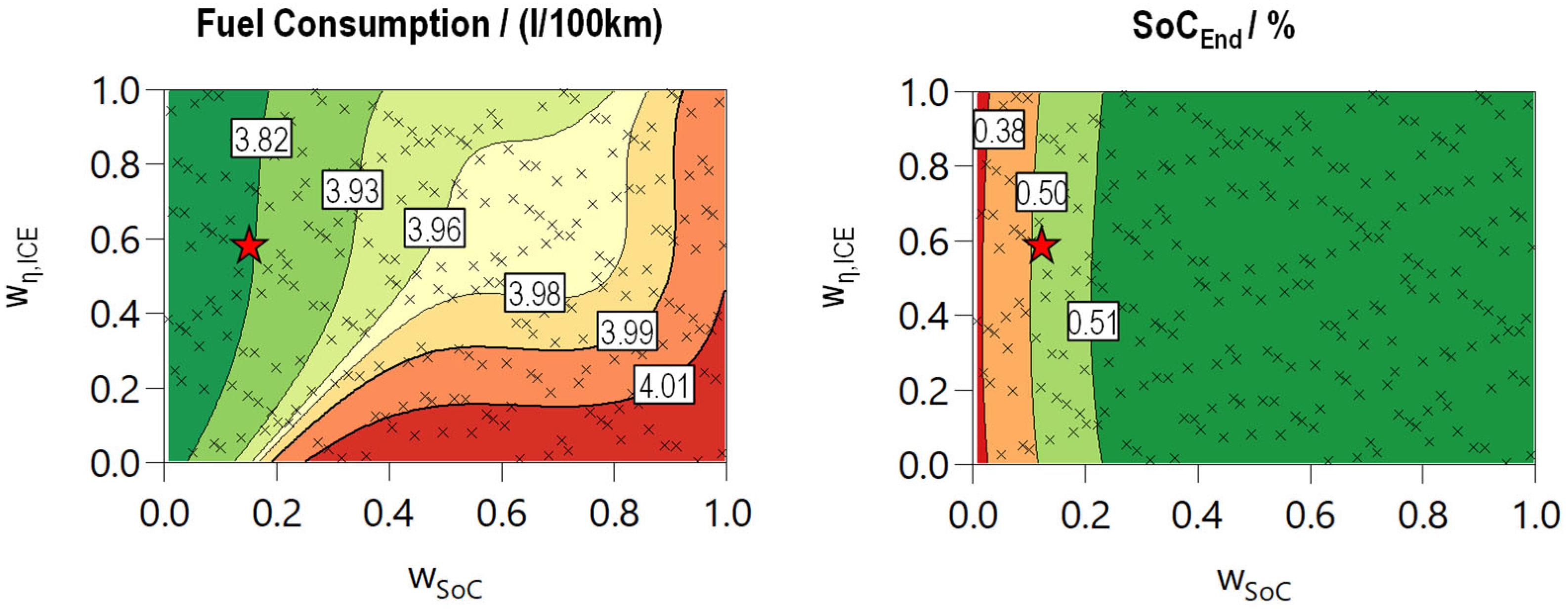
Figure 6 presents the response surfaces for fuel consumption (left) and end-of-cycle SoC (right) as functions of w
SoC and w
η,ICE with w
Noise held at the selected value of 0.21. The individual DoE simulation points are overlaid as markers. Correlation analysis across all 247 DoE points reveals that the two primary KPIs respond to different weights. Fuel consumption correlates positively with w
SoC and negatively with w
η,ICE. End-of-cycle SoC, in contrast, correlates with w
SoC but is practically independent of w
η,ICE. This decoupled sensitivity structure is visible in
Figure 6, where the SoC contour lines run nearly vertically across the entire w
η,ICE range.
The primary objective is defined as minimizing fuel consumption while maintaining a balanced end-of-cycle SoC near the reference value of 0.5. Based on the DoE analysis, the optimal weighting factors are determined as shown in
Table 3. ICE efficiency receives the highest weight, reflecting its dominant influence on fuel consumption, while the SoC weight is set to the minimum value that maintains charge-sustaining operation on the design cycle. The noise weight contributes to improved acoustic behavior. Correlation analysis across all DoE points reveals that the two primary KPIs respond to different weights. Fuel consumption is governed jointly by w
SoC and w
η,ICE, whereas end-of-cycle SoC depends almost exclusively on w
SoC and is practically independent of w
η,ICE. This decoupled sensitivity structure is visible in
Figure 6, where the SoC contour lines run nearly vertically across the entire w
η,ICE range.
Table 3 illustrates this behavior through representative weight variations that isolate the effect of individual weights. Reducing w
SoC causes battery depletion regardless of w
η,ICE, while increasing it ensures charge-sustaining operation at the cost of higher fuel consumption. Varying w
η,ICE affects fuel consumption but leaves end-of-cycle SoC nearly unchanged. The high ratio of w
η,ICE to w
SoC in the selected weight set therefore does not compromise SoC management, as the two weights govern independent KPIs. This weight set is applied to both the GA-based and SQP-based MPC implementations to ensure a fair comparison under identical tuning conditions.
The selected weight set thus represents a Pareto-efficient compromise in which wSoC is set to the minimum value that maintains charge-sustaining operation, allowing wη,ICE to maximize its fuel-consumption-reducing effect. The ratio wη,ICE/wSoC does not compromise SoC management because the two weights govern independent KPIs. During sustained highway driving, the parallel operating mode inherently involves load-point shifting, which charges the battery as a byproduct of ICE efficiency optimization, providing an additional mechanism that supports charge-sustaining operation.
The present study applies a single weight set calibrated on the WLTC to all driving scenarios. Adaptive weight strategies, including multi-cycle calibration and online recalibration during vehicle operation, represent a promising extension to improve robustness across diverse driving conditions and will be addressed in future work.
5. Results
This section presents the comparative evaluation of the GA-based and SQP-based MPC implementations. The evaluation encompasses two driving cycles: the WLTC as the design cycle, and a RDE scenario representing mixed urban, rural and highway driving conditions.
The WLTC serves a dual purpose in this study. First, it provides the basis for cost function weight calibration through the DoE process described in
Section 4.4. Second, it represents the primary benchmark for comparing both optimization approaches under conditions for which they were explicitly tuned.
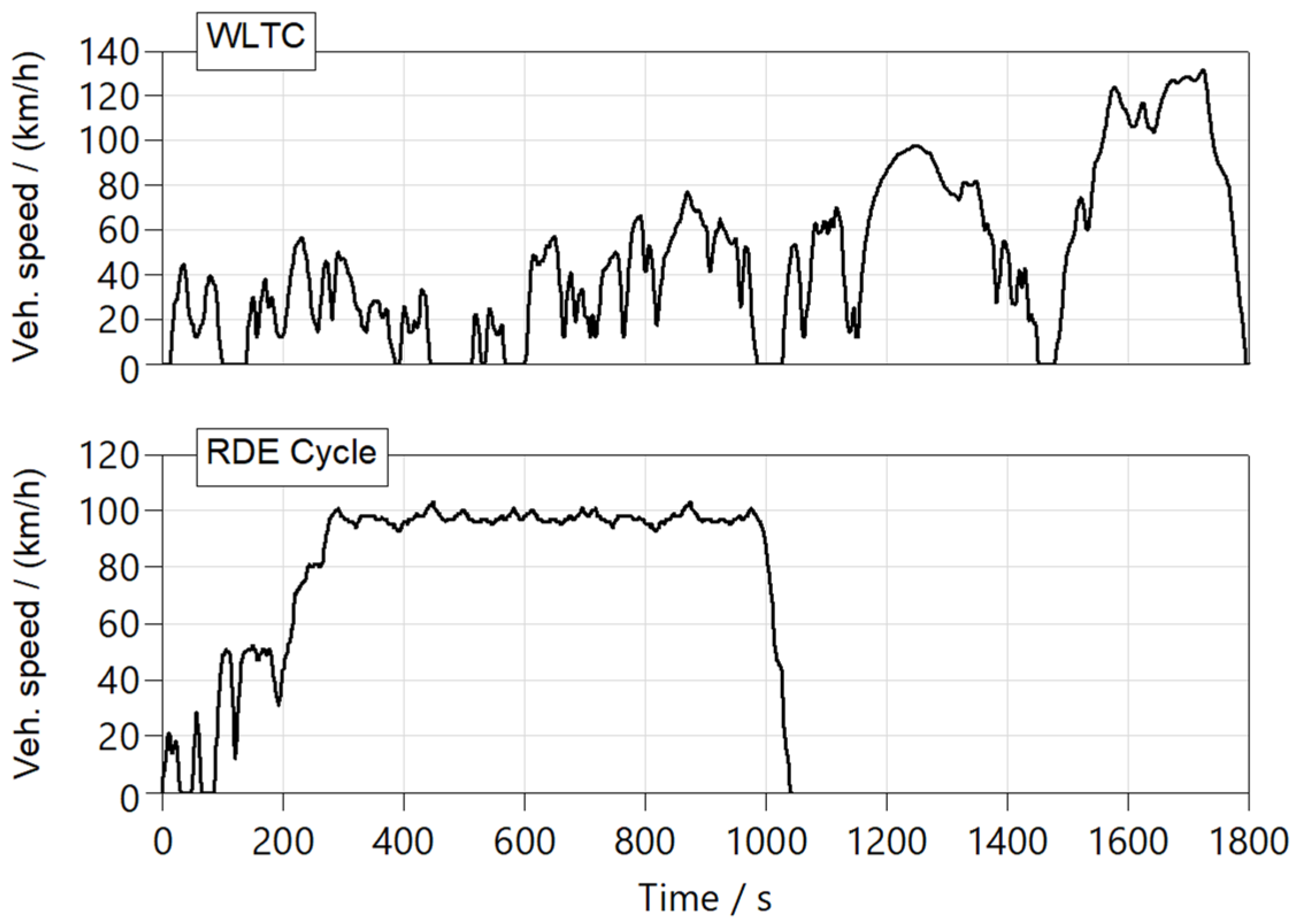
The RDE cycle, in contrast, serves as validation scenario to assess the generalization capability of both approaches. Importantly, the weight set optimized for the WLTC is applied without modification to the RDE simulations. This deliberate choice tests whether the calibrated strategies transfer effectively to driving conditions that differ significantly from the design cycle. The RDE cycle features acceleration and deceleration with low average speeds in the beginning followed by sustained high-speed driving in the second and last third of the cycle.
Figure 7 shows the velocity profiles of the two cycles.
Following an introduction of the performance metrics and the fuel consumption correction methodology, the results for each cycle are discussed, concluding with an analysis of computational performance. In this study perfect prediction of future driving conditions are assumed. These assumptions ensure identical boundary conditions for both solvers, which are necessary to isolate the effect of the optimization algorithm. Evaluating robustness to prediction uncertainty, driver variability, and component aging is addressed in ongoing research.
5.1. Performance Metrics and Fuel Consumption Correction
The comparison between the two optimization approaches is based on four key performance indicators (KPIs): corrected fuel consumption, average system efficiency, noise emissions, and computational performance.
5.1.1. Fuel Consumption Correction
Comparing fuel consumption between different energy management strategies in hybrid vehicles requires careful consideration of the battery state of charge at the end of the cycle. If one strategy depletes the battery more than another, its raw fuel consumption appears lower, but this comparison would be misleading since the electrical energy was effectively borrowed from the battery.
To ensure fair comparison, the fuel consumption is corrected for the net energy change (NEC) of the high-voltage battery [
48]. The NEC correction factor f
NEC quantifies the ratio of electrical energy change to chemical fuel energy consumed over the cycle. It is calculated from the battery voltage U
Bat, battery current I
Bat, fuel mass flow rate ṁ
fuel, and the lower heating value of the fuel H
u. The integration is performed over the total cycle duration t
Total. Equation (32) defines the NEC correction factor.
The raw fuel consumption f
FuelCon is expressed in liters per 100 km and is calculated from the fuel volume flow rate V
dot,fuel and the total distance traveled s
Total according to Equation (33).
The corrected fuel consumption f
FuelCon,corr is then obtained by applying the NEC correction factor to the raw consumption, as given by Equation (34).
This correction effectively penalizes strategies that deplete the battery (fNEC < 0) and credits strategies that charge it (fNEC > 0). For meaningful comparison, the end-of-cycle SoC deviation should remain within ±3% of the reference value. Larger deviations reduce the reliability of the correction.
5.1.2. System Efficiency
The average system efficiency ηsys represents the time-averaged efficiency of the complete powertrain. The calculation depends on the power flow direction, distinguishing between traction with battery discharging, traction with battery charging, and regenerative braking. In each case, the efficiency is defined as the ratio of useful power output to total power input.
During traction with simultaneous battery discharging (P
Wheel > 0 and P
Bat > 0), the wheel power P
Wheel represents the useful output, while the sum of battery power P
Bat and fuel power (ṁ
fuel · H
u) constitutes the input. Equation (35) defines the system efficiency for this operating condition.
During traction with simultaneous battery charging (P
Wheel > 0 and P
Bat ≤ 0), both the wheel power and the absolute battery charging power represent useful outputs, with fuel power as the sole input. Equation (36) applies to this case.
During regenerative braking (P
Wheel < 0 and P
Bat ≤ 0), the recovered battery power represents the useful output, while the sum of braking power P
Wheel and any fuel power constitutes the input. Equation (37) describes this operating condition.
The system efficiency accounts for all energy conversion losses including the ICE, electric machines, transmission, and battery. This metric captures the overall energy utilization effectiveness and is particularly sensitive to the operating mode distribution, as electric operation typically achieves higher system efficiency than combustion-based modes.
5.1.3. Computational Performance Metric
The real-time capability (RTC) quantifies the computational burden of each algorithm. It is defined as the ratio of the time required to simulate the cycle t
Sim to the actual cycle duration t
Cycle, as given by Equation (38).
An RTC value below 1 indicates real-time capability, meaning the algorithm can compute control actions faster than required for online implementation.
5.1.4. Noise Metric
The cumulative noise metric ΔE
Noise quantifies the excess masking noise overshoot integrated over the driving cycle. It is derived from the difference between the ICE interior noise intensity and the vehicle rolling and wind noise intensity at each time step, accumulated only when the ICE noise exceeds the masking threshold. The metric is expressed in J/m
2 and captures both the duration and intensity of acoustically perceptible engine noise events. A detailed derivation of this metric, including the underlying transfer functions and the psychoacoustic masking model, is provided in [
36].
5.2. Design Cycle Results (WLTC)
The WLTC serves as the design cycle for both optimization approaches, with simulations conducted at an ambient temperature of 23 °C according to regulatory specifications [
34]. Since both algorithms were calibrated using the same DoE-optimized weight set on this cycle, the WLTC results primarily reveal differences in the optimization algorithms’ ability to find optimal solutions given identical tuning. For comparison, a state-of-the-art deterministic EMS is included, which was calibrated using a DoE approach with the primary objective of minimizing fuel consumption without explicit consideration of noise emissions [
49,
50,
51].
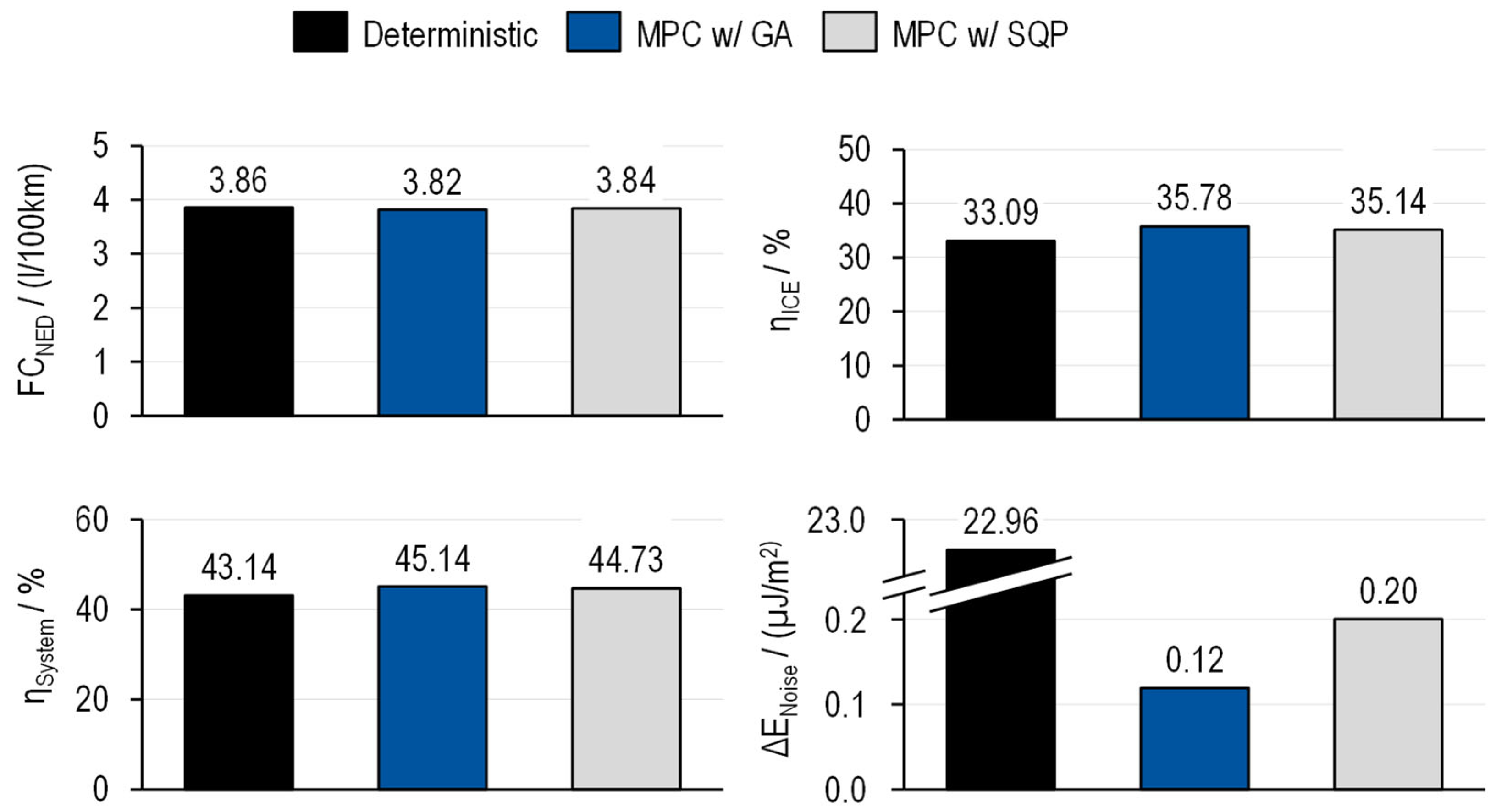
Figure 8 summarizes the KPIs for both MPC approaches and the deterministic reference strategy. Regarding corrected fuel consumption, the GA-based MPC achieves 3.82 L/100 km, representing a reduction of 1.0% compared to the deterministic reference (3.86 L/100 km). The SQP-based MPC reaches 3.84 L/100 km, corresponding to a reduction of 0.5% relative to the deterministic strategy. The system efficiency results demonstrate the effectiveness of both MPC approaches in improving overall powertrain energy utilization. The GA-based MPC achieves an average system efficiency of 45.14%, which corresponds to a relative improvement of 4.6% compared to the deterministic reference (43.14%). The SQP-based approach reaches 44.73%, representing a 3.7% improvement over the deterministic strategy. Both MPC implementations thus achieve notably higher system efficiency than the fuel-optimized reference. The most pronounced differences between the strategies appear in the noise emission results. The deterministic reference, optimized primarily for fuel consumption, produces cumulative noise emissions of 23.0 µJ/m
2. In contrast, the GA-based MPC reduces noise emissions to 0.12 µJ/m
2, corresponding to a reduction of 99.5%. The SQP-based MPC achieves 0.20 µJ/m
2, representing a reduction of 99.1%. These substantial reductions demonstrate that the multi-objective cost function effectively guides both algorithms toward ICE operating points where engine noise remains below the masking threshold, a capability not present in the fuel-focused deterministic strategy.
It should be noted that the deterministic reference strategy was calibrated with the primary objective of minimizing fuel consumption and does not include noise emissions in its optimization targets. The comparison therefore quantifies the noise reduction achieved by including acoustic behavior in the MPC cost function, rather than the noise reduction attributable to the predictive nature of the MPC alone. A noise-optimized deterministic strategy would provide an additional benchmark to isolate the contribution of the MPC framework from the effect of multi-objective formulation. However, since the primary focus of this study is the comparison between GA and SQP under identical cost function formulations, and a noise-optimized deterministic strategy does not represent current state of the art in powertrain concept development, such a benchmark is not considered here.
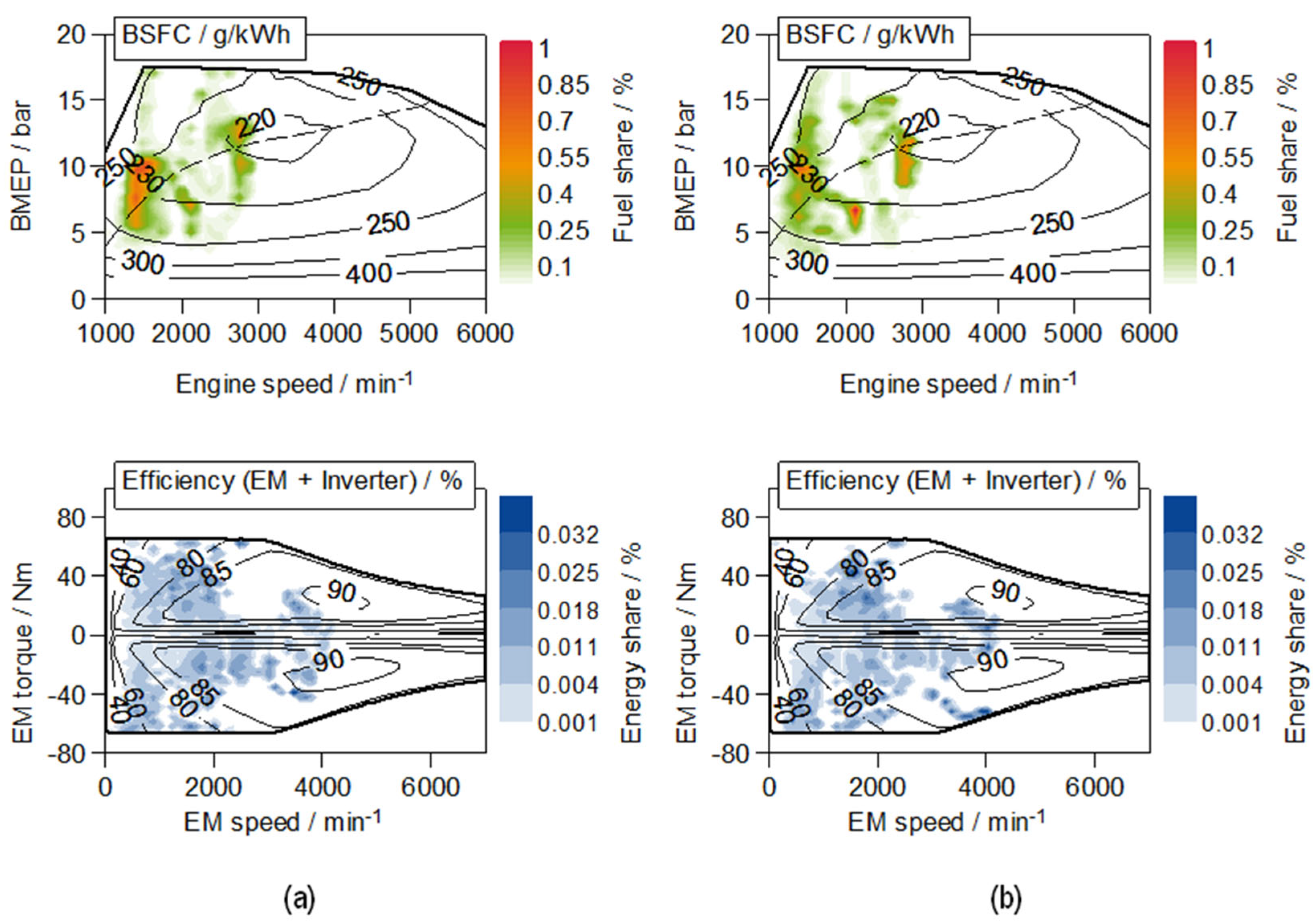
The operating behavior underlying these performance differences is illustrated in
Figure 9, which shows the fuel share and energy share diagrams for both MPC approaches. Both algorithms concentrate ICE operation in the high-efficiency region of the BSFC map, with operating points clustered along the optimal efficiency line. The EM2 energy share diagrams in the lower portion of
Figure 9 reveal similar patterns for both approaches, with regenerative braking energy concentrated in the high-efficiency region of the electric machine map.
Table 4 quantifies the operating mode distribution. The deterministic strategy operates 42.9% in parallel mode, 11.5% in serial mode, and 45.6% in electric mode. Both MPC approaches show a distinctly different pattern: the GA-based MPC operates 48.0% in parallel mode, only 0.9% in serial mode, and 51.1% in electric mode. Similarly, the SQP-based MPC achieves 47.8% parallel, 1.3% serial, and 50.8% electric operation. The near-complete avoidance of serial mode by both MPC approaches (reduction of 92% for GA and 89% for SQP compared to the deterministic strategy) is consistent with the EM1 power limitation discussed in
Section 2.2, which restricts serial operation to low-load conditions where it offers limited efficiency benefits.
The similarity in mode distributions between GA and SQP on the design cycle is notable. Both approaches select parallel mode within 0.2 percentage points of each other, and electric mode within 0.3 percentage points. This convergence shows that for the WLTC, both optimization algorithms identify similar optimal mode sequences despite their fundamentally different search mechanisms.
To assess the stochastic variability of the GA-based approach, three independent simulation runs with different random seeds are conducted on the WLTC.
Table 5 reports the mean and standard deviation of the resulting KPIs. The corrected fuel consumption varies by less than 0.3% across runs (coefficient of variation 0.14%), and end-of-cycle SoC remains within 0.08 percentage points of the mean. These results indicate that the GA-based MPC produces repeatable solutions despite the stochastic nature of the evolutionary search. This behavior is consistent with the MPC framework, where the GA is re-initialized at each control time step with a sampling interval of 0.1 s, effectively limiting the accumulation of stochastic variation over the cycle.
5.3. Real-World Driving Results (RDE)
The RDE cycle represents real-world driving conditions that differ from the standardized WLTC. As described in
Section 5, the cost function weights remain unchanged from the WLTC calibration, making this scenario a test of generalization capability rather than cycle-specific optimization. The RDE cycle features urban driving with frequent acceleration and deceleration at low speeds in the initial phase, followed by sustained high-speed highway driving in the latter portions, as shown in
Figure 7.
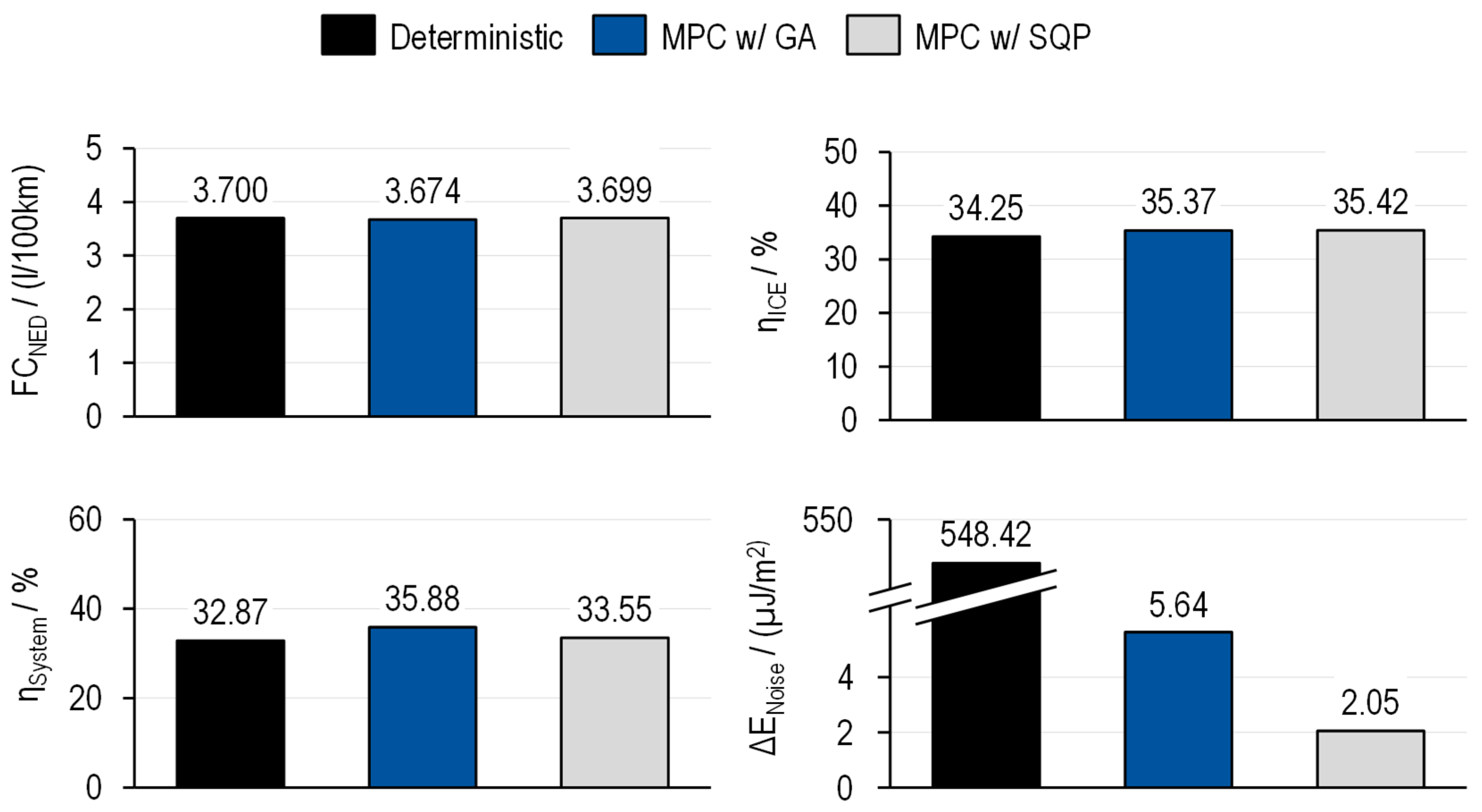
Figure 10 presents the performance comparison for the RDE cycle. The corrected fuel consumption results show that the GA-based MPC achieves 3.674 L/100 km, representing a reduction of 0.7% compared to the deterministic reference (3.700 L/100 km). The SQP-based MPC reaches 3.699 L/100 km, corresponding to a minimal reduction of less than 0.1% relative to the deterministic strategy. The performance gap between GA and SQP widens compared to the WLTC; while both approaches achieved similar fuel consumption on the design cycle (0.5% difference), the RDE cycle reveals a difference of 0.7% between GA and SQP. This near-parity results from SQP operating with a less charge-sustaining SoC trajectory compared to the deterministic strategy. While SQP achieves lower raw fuel consumption, the NEC correction largely offsets this advantage. The efficiency metrics in
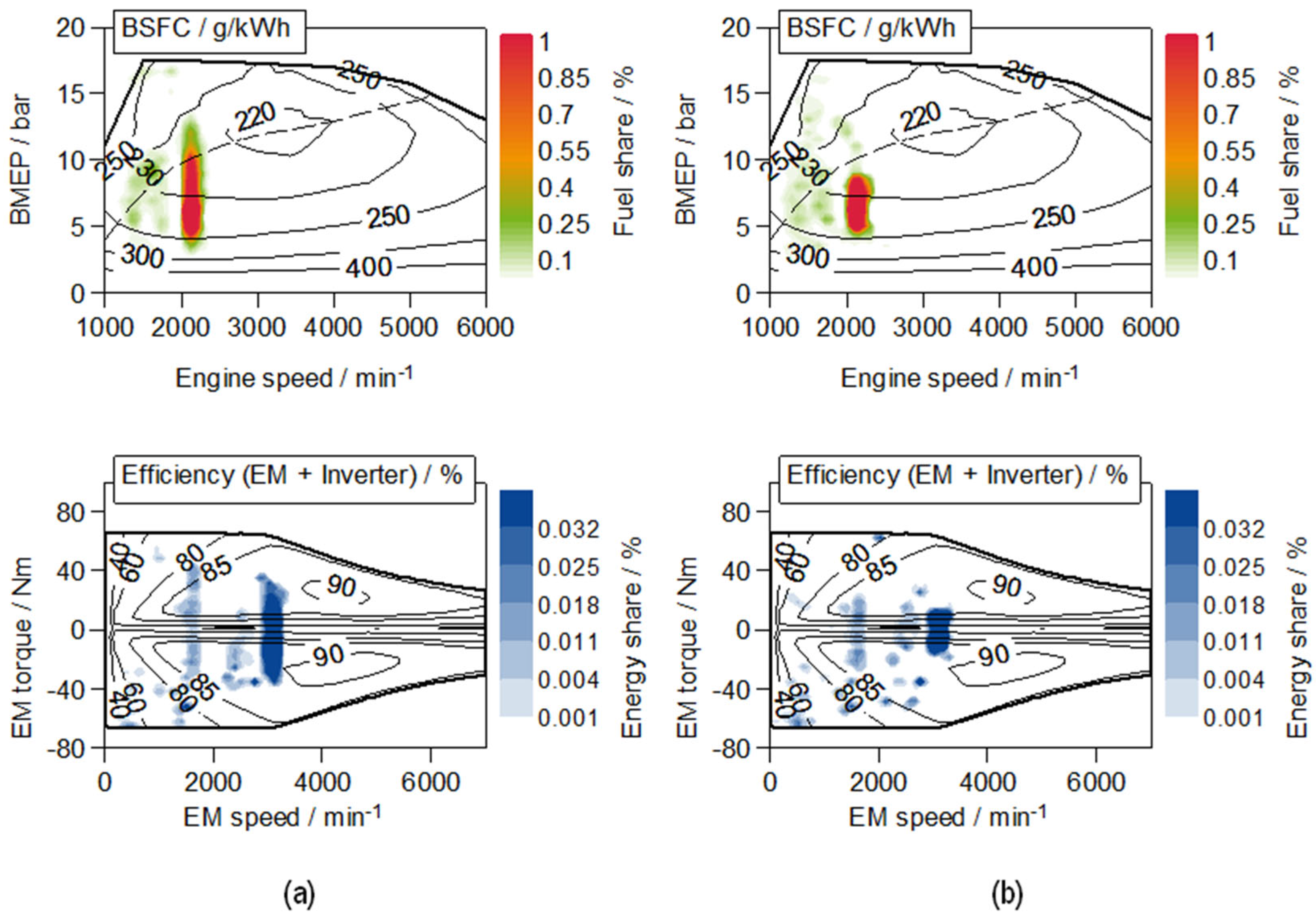
Figure 10 reveal a notable trade-off between ICE efficiency and system efficiency. The SQP-based MPC achieves higher ICE efficiency (35.42%) compared to GA (35.37%), yet the GA-based approach attains higher system efficiency (35.88% vs. 33.55% for SQP). This apparent contradiction, higher ICE efficiency but lower system efficiency for SQP, can be explained by examining the operating behavior in
Figure 11.
Figure 11 shows the fuel share and energy share diagrams for the RDE cycle. The upper row displays the ICE operating points, while the lower row shows the EM2 energy distribution. Comparing the SQP approach (
Figure 11b) with the GA approach (
Figure 11a), the SQP concentrates ICE operation more tightly in the high-efficiency region of the BSFC map, explaining the higher average ICE efficiency observed in
Figure 10.
However, the EM2 energy share diagrams in the lower portion of
Figure 11 reveal the source of SQP’s lower system efficiency. The SQP approach operates EM2 in regions of lower electric machine efficiency compared to GA.
The GA-based approach (
Figure 11a, bottom) shows EM2 operation more concentrated in the high-efficiency region (85–90% efficiency contours), while SQP (
Figure 11b, bottom) exhibits broader distribution extending into lower-efficiency regions.
This trade-off demonstrates that optimizing individual component efficiency does not necessarily translate to optimal system efficiency. The SQP’s mode-specific optimization structure, which solves separate problems for each operating mode, appears to prioritize ICE efficiency without fully accounting for the resulting impact on electric machine operation. The GA’s integrated optimization, encoding both mode selection and torque distribution within the same chromosome, achieves better coordination between ICE and EM2 operation, resulting in higher overall system efficiency despite lower ICE efficiency.
Since the SQP solver employs warm-starting from the previous time step (
Section 4.2.4), the observed performance gap is more likely attributable to the decomposed optimization structure than to convergence issues within individual subproblems.
The noise emission results on the RDE cycle show that the deterministic reference produces cumulative noise emissions of 548.42 µJ/m2, considerably higher than the WLTC value (23.0 µJ/m2) due to the different speed and load profiles. The SQP-based MPC achieves the lowest noise emissions at 2.05 µJ/m2, corresponding to a reduction of 99.6% compared to the deterministic reference. The GA-based MPC reduces noise emissions to 5.64 µJ/m2, representing a reduction of 99.0%. While the absolute noise levels are higher than in the WLTC, the MPC approaches continue to demonstrate their effectiveness in avoiding acoustically unfavorable ICE operating points.
The widening performance gap between GA and SQP from the design cycle (WLTC) to the validation cycle (RDE) provides insight into the generalization characteristics of both approaches. On the WLTC, both algorithms achieved fuel consumption within 0.5% of each other. On the RDE cycle, this gap increases to 0.7%, with GA maintaining its advantage. Furthermore, the analysis of
Figure 11 reveals that SQP’s decomposed optimization structure leads to suboptimal coordination between powertrain components. While achieving favorable ICE operating points, the approach compromises EM2 efficiency, ultimately resulting in lower system efficiency. The GA’s population-based global search, which considers the complete solution space simultaneously, achieves more balanced component utilization and thus better overall system performance on driving conditions outside the calibration domain. Given the high model fidelity of the SQP polynomial fits reported in
Section 4.3, the observed performance differences between GA and SQP are primarily attributable to the optimization algorithms rather than to discrepancies in the underlying models.
5.4. Computational Performance
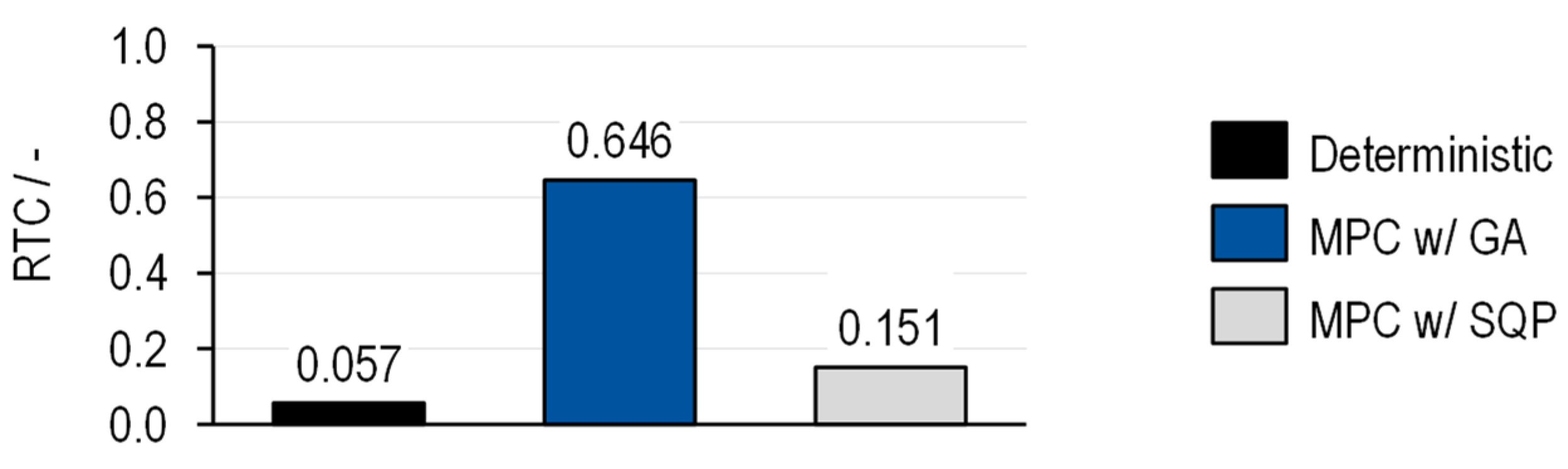
The SQP-based approach demonstrates approximately four times faster computation compared to the GA.
Figure 12 compares the computational performance of both approaches, measured as the Real-Time Capability (RTC) during WLTC simulation.
This significant speed advantage stems from the efficient gradient-based search and the optimized C-code generated by acados. Despite this difference, both approaches remain real-time capable (RTC < 1), meaning either could be deployed for online energy management.
The computational advantage of SQP becomes particularly relevant for applications requiring extensive simulation studies, such as (DoE) calibration. The faster execution enables more comprehensive parameter studies within practical time constraints. However, for online vehicle implementation where control updates occur at 0.1 s intervals, both algorithms provide sufficient computational margin.
All simulations are conducted on a standard laptop computer equipped with an Intel Core i7 processor and 16 GB RAM. The MPC optimization is executed on a single core. The real-time capability reported in this study is evaluated in a Model-in-the-Loop environment. The RTC metric is well suited for comparing the computational performance of the two solver approaches within this MiL framework but does not allow direct conclusions regarding embedded deployment. Hardware-in-the-Loop testing and embedded benchmarking on representative ECU hardware represent necessary validation steps toward series production and are planned as a part of future work.
6. Conclusions
This study presented a systematic comparison between Genetic Algorithm and Sequential Quadratic Programming as optimization solvers within a Model Predictive Control framework for energy management of a P1P3 parallel hybrid powertrain. Both approaches were evaluated using the same cost function weights calibrated through Design of Experiments on the WLTC and subsequently applied to an RDE validation cycle without recalibration.
On the WLTC (design cycle), the GA-based MPC achieves a corrected fuel consumption of 3.82 L/100 km, representing a reduction of 1.0% compared to the deterministic reference strategy (3.86 L/100 km). The SQP-based MPC reaches 3.84 L/100 km, corresponding to a reduction of 0.5%. Both MPC approaches improve system efficiency relative to the deterministic reference, with GA achieving 45.14% (+4.6%) and SQP achieving 44.73% (+3.7%). The operating mode distributions are similar for both algorithms, with approximately 48% parallel mode, 51% electric mode, and less than 2% serial mode operation. Noise emissions are reduced by more than 99% for both MPC approaches compared to the deterministic reference, which was optimized for fuel consumption without explicit consideration of acoustic behavior. On the RDE validation cycle, the GA-based MPC achieves 3.674 L/100 km, a reduction of 0.7% compared to the deterministic reference (3.700 L/100 km), while SQP reaches 3.699 L/100 km with less than 0.1% reduction. The performance gap between GA and SQP widens from 0.5% on the WLTC to 0.7% on the RDE cycle, indicating differences in generalization behavior when operating outside the calibration domain. System efficiency improvements relative to the deterministic reference amount to 9.2% for GA (35.88%) and 2.1% for SQP (33.55%). The energy share analysis reveals that SQP achieves higher ICE efficiency (35.42% versus 35.37% for GA) but operates EM2 in lower-efficiency regions, while GA achieves more balanced component utilization across the powertrain. This trade-off demonstrates that optimizing individual component efficiency does not necessarily translate to optimal system efficiency. The SQP’s mode-specific optimization structure, which solves separate problems for each operating mode, appears to prioritize ICE efficiency without fully accounting for the resulting impact on electric machine operation. The GA’s integrated optimization, encoding both mode selection and torque distribution within the same chromosome, achieves better coordination between ICE and EM2 operation, resulting in higher overall system efficiency despite lower ICE efficiency. Noise emission reductions of 99.6% for SQP and 99.0% for GA are observed compared to the deterministic reference. Regarding computational performance, the SQP-based approach computes approximately 4.3 times faster than GA, with Real-Time Capability values of 0.151 versus 0.646, respectively. Both approaches remain real-time capable for online vehicle implementation. Beyond computational efficiency, the two approaches differ in their requirements for reduced-order models. SQP requires continuously differentiable formulations, while GA can directly incorporate non-differentiable model structures such as lookup tables. This flexibility in model integration represents a structural advantage for applications where high-fidelity component models are available but may not be readily reformulated into differentiable expressions.
For concept development applications where solution quality and model flexibility take precedence over computational efficiency, the GA-based approach represents the favorable choice based on the results of this study. For applications requiring extensive parameter studies or embedded implementation with minimal computational resources, the SQP-based approach offers advantages through faster execution and automatic code generation. Both optimization approaches provide viable solutions for MPC-based energy management, with the selection depending on the specific requirements of the application context.