1. Introduction
Gas turbines have emerged as pivotal components across diverse industrial sectors, primarily owing to their remarkable efficiency and robust reliability. Central to their operation is the Brayton cycle, characterized by two isentropic processes and two isobaric processes. A key strategy for augmenting the power output of gas turbines lies in elevating the temperature ratio; consequently, raising the turbine inlet temperature serves as a critical approach to enhance the overall efficiency of these systems [
1]. Nonetheless, the increase in turbine inlet temperature invariably leads to an escalated thermal load on the turbine. Furthermore, the high-pressure environment in modern advanced gas turbines structurally necessitates the use of low-aspect-ratio blades. This configuration intensifies blade-passage flow interactions, which in turn exacerbates the aerothermal loading and complicates the blade heat transfer characteristics. The intrinsic bending properties of the blades contribute to the lateral movement of the gas flow from the pressure surface to the suction surface within the cascade channel, thereby inducing secondary flow phenomena [
2]. The emergence of complex secondary flow patterns significantly compromises the overall aerodynamic efficiency of the turbine, especially when the turbine operates with a low-aspect-ratio cascade.
In the early 1940s and 1950s, some scholars studied the generation mechanism of secondary flow in cascade channels. Hawthome et al. [
3] first proposed the secondary flow theory, which showed that the cross-flow from the pressure surface to the suction surface caused a pair of counter-rotating vortices at the cascade outlet. However, the authors did not realize the influence of viscosity, so the model could not accurately predict the secondary flow loss. Later, Langston et al. [
4]. carried out secondary flow experiments in the endwall zone based on large-scale flat cascades in 1980, and described the flow separation process between the endwall and the blade surface in detail. Upon impingement on the blade leading edge (LE), the horseshoe vortex separates into two components: the pressure-side leg (PSL) and the suction-side leg (SSL). The PSL subsequently translates along the pressure surface, and the SSL advects downstream along the suction surface. PSL migrates to the suction surface and gradually develops into the passage vortex under the lateral pressure difference. Sharma et al. [
5] defined a semi-empirical model for predicting endwall secondary flow losses in 1987, and they pointed out that boundary layer losses and losses in the cascade channel are two different losses. Sharma’s interpretation of the secondary flow in the endwall was basically consistent with Langston’s, but he pointed out that the boundary layer close to the endwall would climb along the suction surface to form a passage vortex, and the airflow was induced to move towards the blade tip. Subsequently, Goldstein et al. [
6] presented the secondary flow model of the endwall measured by experiments in 1988. He believed that PSL would move away from the endwall and toward the blade tip while moving toward the suction surface, and the suction side (SS) of the horseshoe vortex also moved along the blade tip and was always located above the horseshoe vortex.
The seminal secondary flow models established by Langston, Sharma, and Goldstein share a common foundation, with their primary distinctions lying in the detailed representation of the horseshoe vortex behavior near the suction surface. A more integrative model, later proposed by Wang et al. [
7] in 1997, is widely accepted for its relatively complete description of the flow evolution, particularly in tracing the transition from a multi-vortex system at the inlet to a dominant single-vortex structure. The authors pointed out that the pressure side (PS) of the horseshoe vortex and the suction side of the horseshoe vortex converged at the quarter position of the suction surface, and then the suction side of the horseshoe vortex swirled around the passage vortex. Friedrichs [
8] and Benner et al. [
9] analyzed the flow characteristics at the endwall through the oil flow method, and further refined the action law of the secondary flow in the cascade. A highly non-uniform heat transfer distribution is observed on the endwall, a direct consequence of the complex, three-dimensional vortical structures in the passage. These vortices create substantial local variations in thermal conditions. Early experimental work by Graziani et al. [
10] corroborates this, reporting a wedge-shaped zone of attenuated heat transfer at the leading edge. Later, Laveau et al. [
11] also used more advanced measurement methods to observe the wedge-shaped area of the low-heat-transfer coefficient in the front section of the guide vane passage, and the authors pointed out that the heat transfer performance on both sides of the passage vortex separation line was significantly different. According to the heat transfer characteristics of the endwall, Friedrichs et al. [
12] divided seven potential high heat transfer areas. Boyle [
13] and Simon [
2] summarized the heat transfer characteristics on the endwall and found that the endwall heat transfer significantly depended on the inlet Reynolds number and the development of secondary flow.
To enhance the flow and heat transfer characteristics within the cascade, researchers have proposed the non-axisymmetric endwall method. This approach modifies the configuration of the endwall, effectively diminishing the strength of the passage vortex and attenuating the turbulent kinetic energy of the fluid adjacent to the suction surface. Consequently, this technique suppresses the development of corner vortices, reduces overall pressure losses, and partially mitigates the intensity of heat transfer. The base concept of the non-axisymmetric endwall was first proposed by Rose [
14] in 1994: concave at the suction surface could decrease flow rate and increase static pressure, and convex at the pressure surface could increase flow rate and decrease static pressure, so as to weaken the transverse pressure gradient in cascade channel. Rose improved the pressure uniformity at the trailing edge of the guide vane by using the non-axisymmetric endwall. Using a phase-change technique, Winkler et al. [
15,
16] investigated the flow in a linear cascade by solidifying a water–ethylene glycol mixture. The resulting congealed shape revealed an aerodynamically favorable geometry associated with reduced total pressure loss. In a related study on a non-axisymmetric endwall (Pack B), Lynch [
17,
18] reported an augmented Nusselt number near the leading edge, yet a reduction in the spatially averaged heat transfer across the entire endwall surface. The author also pointed out that the inlet Reynolds number hardly influenced the heat transfer level. Following the approach established by Winkler [
15,
16] for contour generation, Lafleur et al. [
19] investigated the thermal performance of a non-axisymmetric endwall. Their study documented a substantial decrease in the Nusselt number compared to the flat-endwall case. Li [
20] conducted an investigation into the aerodynamic control effects of non-axisymmetric and endwall contouring on corner separation, focusing specifically on the mitigation of such separation phenomena. However, this study overlooked the heat transfer characteristics associated with the non-axisymmetric endwall structure on the endwall itself. Zhang [
21] and Hendrickson [
22] independently optimized the design of non-axisymmetric endwall structures within blade cascade channels by integrating various cooling configurations. Their findings revealed that the incorporation of film cooling structures into these non-axisymmetric endwalls can achieve a certain degree of optimization in both aerodynamic loss and heat transfer characteristics.
At present, there are a lot of studies on non-axisymmetric endwall. However, conventional non-axisymmetric endwall contouring strategies predominantly target the modulation of secondary flows within turbine cascade passages, particularly the passage vortex. These approaches often overlook the manipulation of the leading-edge horseshoe vortex, which serves as the primary origin of the passage vortex and significantly influences both aerodynamic losses and endwall heat transfer. While existing contouring methods effectively alter downstream vortex dynamics, the horseshoe vortex—a critical determinant of secondary flow development and thermal performance—remains underexplored. Addressing this gap is essential for holistic endwall design optimization, as suppressing the horseshoe vortex could mitigate the root causes of inefficiency and thermal degradation in axial turbines. Therefore, the heat transfer and flow characteristics under asymmetric endwalls still need to be further studied. Earlier, the authors [
23] found that the shape change in the channel affected the migration and development of the secondary vortex system, significantly weakening the heat transfer effect in the throat region, but had little effect on the horseshoe vortex at the leading edge.
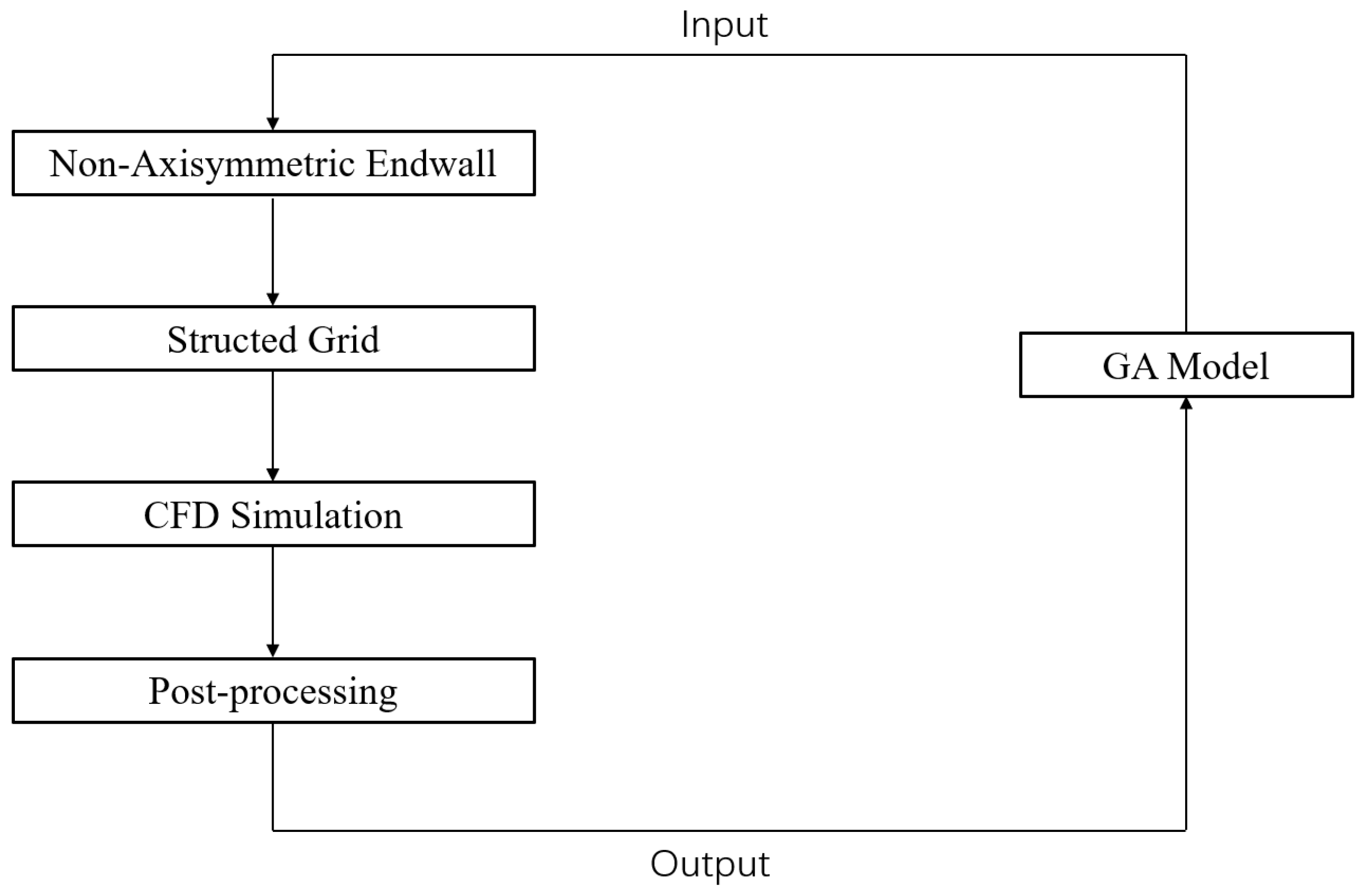
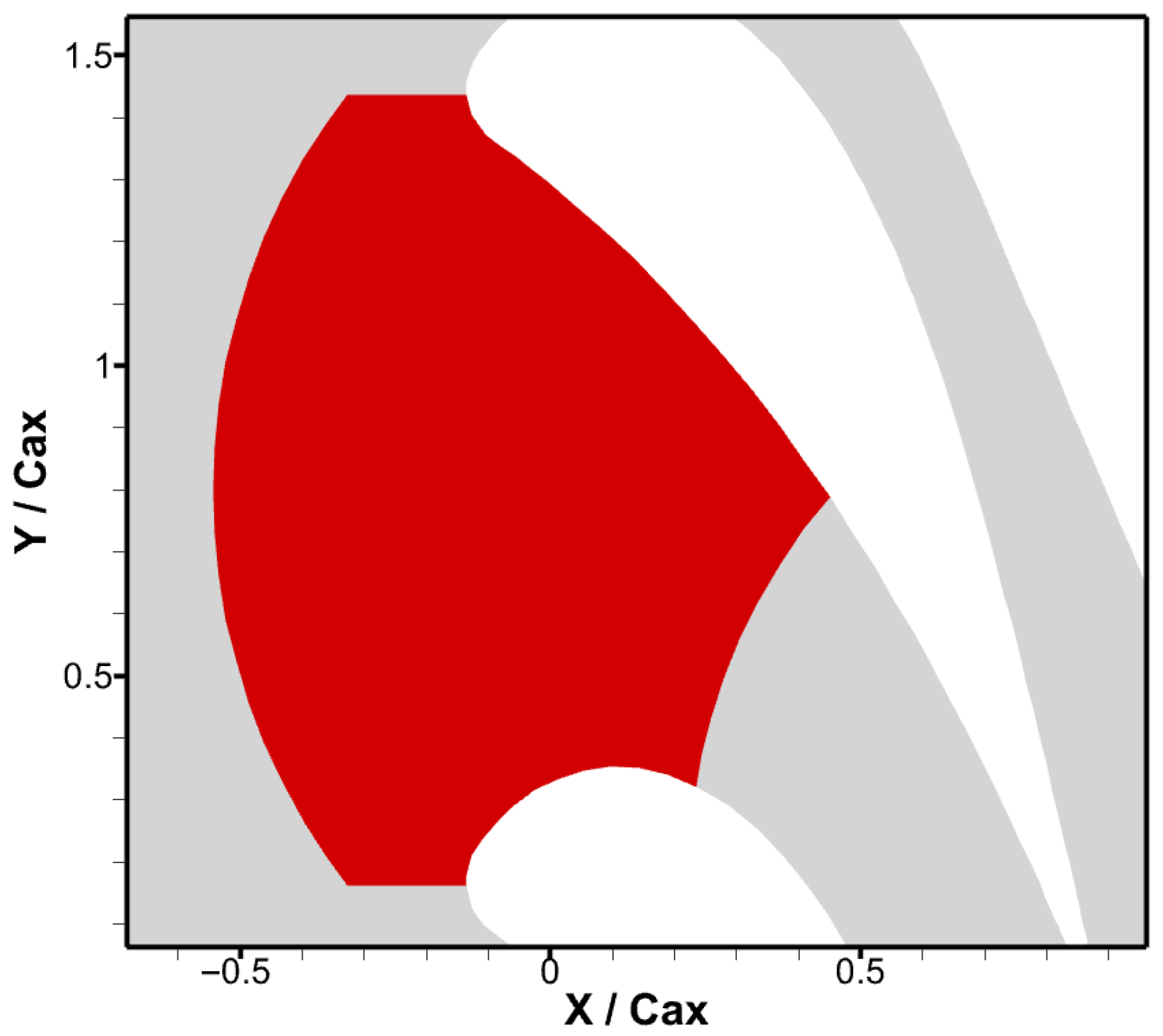
Therefore, this study aims to address this identified research gap by specifically targeting the horseshoe vortex at its origin. We present a focused optimization of the endwall contour from the leading edge to the mid-passage region using a multi-island genetic algorithm. The primary objective is to directly disrupt the formation and initial development of the horseshoe vortex structure, thereby suppressing the subsequent generation of the passage vortex and its associated losses. This work distinguishes itself from prior studies by systematically investigating how a strategically optimized leading-edge and forward-passage endwall geometry can concurrently ameliorate both aerodynamic performance (quantified by total pressure loss) and thermal performance (quantified by the endwall heat transfer coefficient). The findings are expected to provide a novel, physics-informed contouring strategy that targets the foundational source of secondary flows, offering a pathway for more effective aerothermal optimization in axial turbine design.
3. Numerical Setup
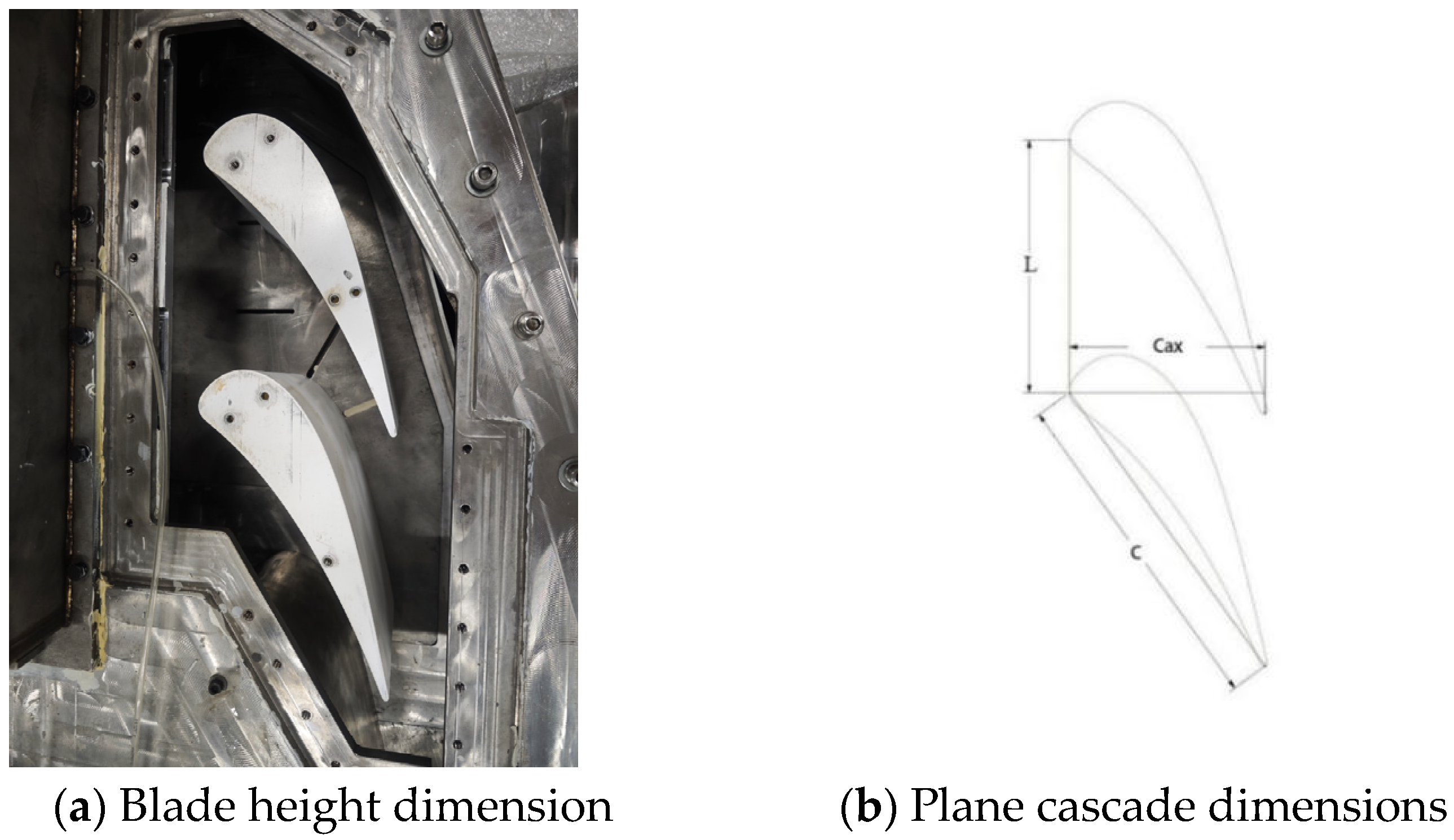
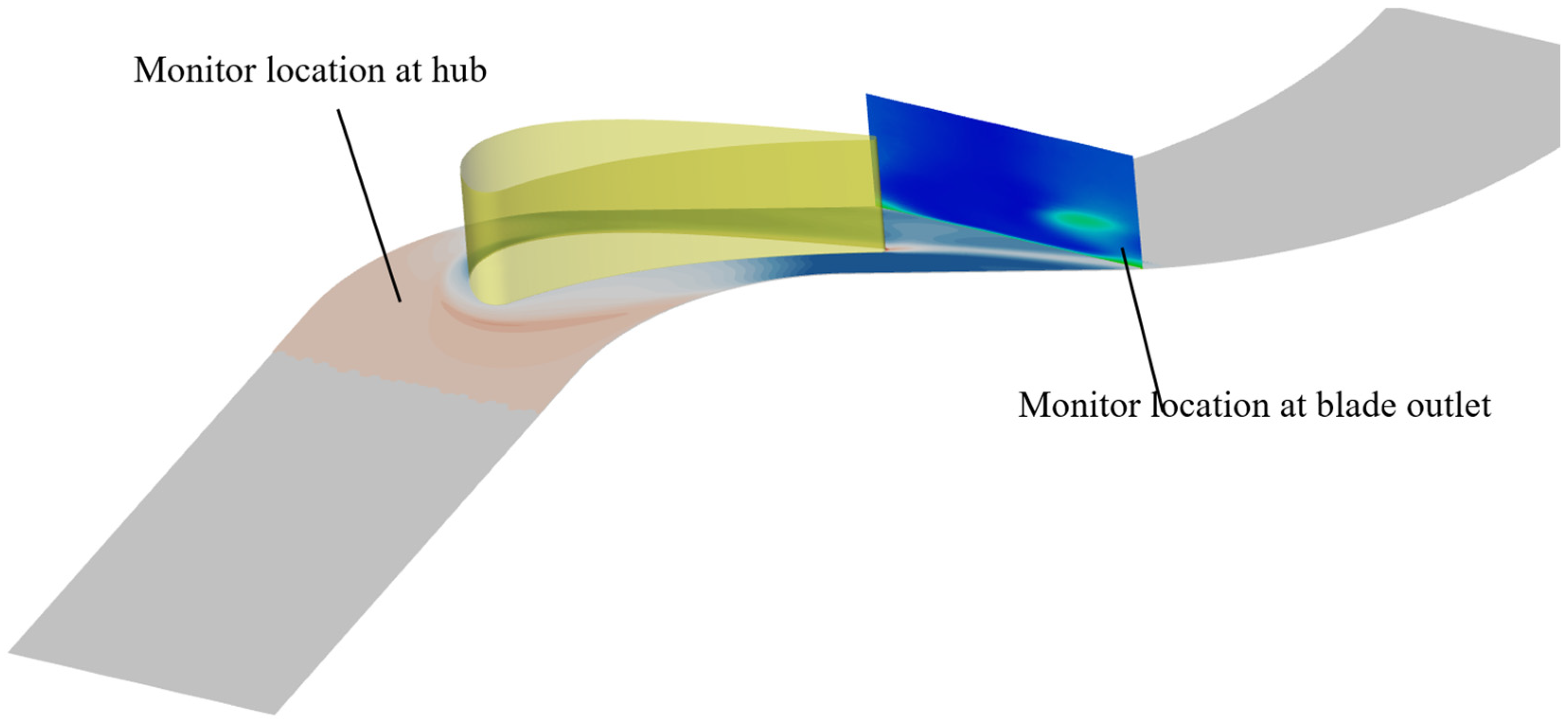
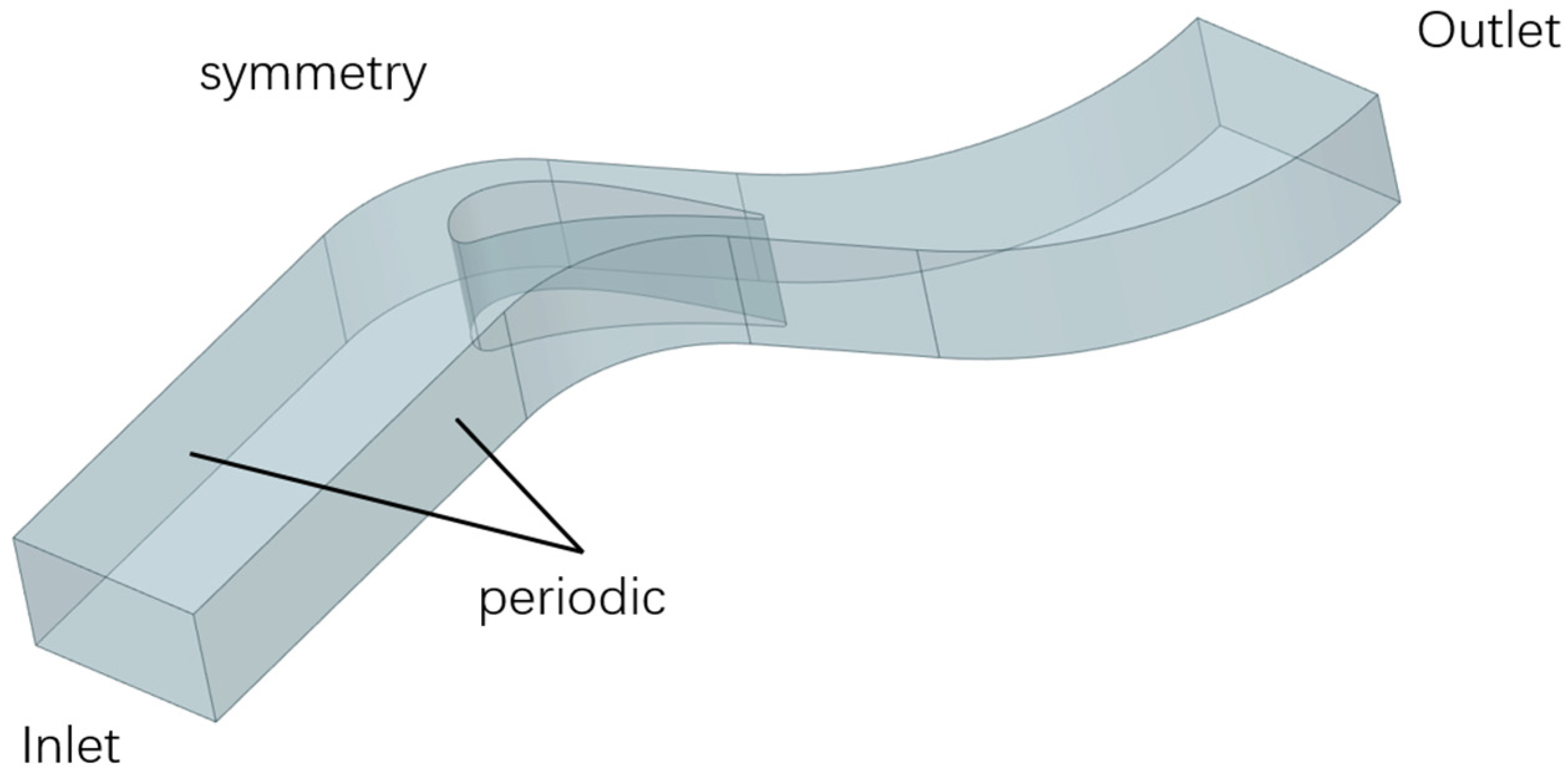
The blade geometry employed in the numerical simulations matches the experimental dimensions. To allow the full development of the incoming boundary layer, the computational domain was extended upstream and downstream of the blade passage. Specifically, the inlet and outlet extensions were set to 3 times and 2.7 times the axial chord length, respectively. A single-passage model with periodic boundaries in the pitchwise direction was adopted to reduce computational expense. Accordingly, the domain height was taken at midspan, representing a semi-span (half-blade-height) configuration.
Computational efficiency was improved through the application of periodic and symmetry boundary conditions, which allowed for a significant reduction in the grid cell count. The sidewalls of the model were set as periodic boundary conditions. The hub and blade surfaces were defined as no-slip walls, while the outlet was specified as a pressure outlet with a static pressure of 101,325 Pa. The top boundary of the model was configured as a symmetry condition. The inlet conditions are summarized in
Table 2. The overall computational domain is illustrated in
Figure 5.
The RANS (Reynolds-Average Navier–Stokes) method is used for the overall numerical simulation, and the specific turbulence model is SST k-ω in ANSYS FLUENT (2023R1), which has a good effect on the separation flow under relatively large adverse pressure gradient and the flow simulation under appropriate curvature. A pressure–velocity coupled solver was employed, in which the spatial discretization of gradient terms adopted the Green–Gauss node-based method, and pressure was solved using a second-order scheme. In order to ensure the convergence of the calculated results, the computational residual of the governing equation is limited to 10
−5, which requires at least 150 iterations in the progress. To monitor the convergence behavior of the simulation, the spatially averaged endwall heat transfer coefficient and the outlet total pressure loss coefficient were tracked. The locations of these monitoring points are indicated in
Figure 5.
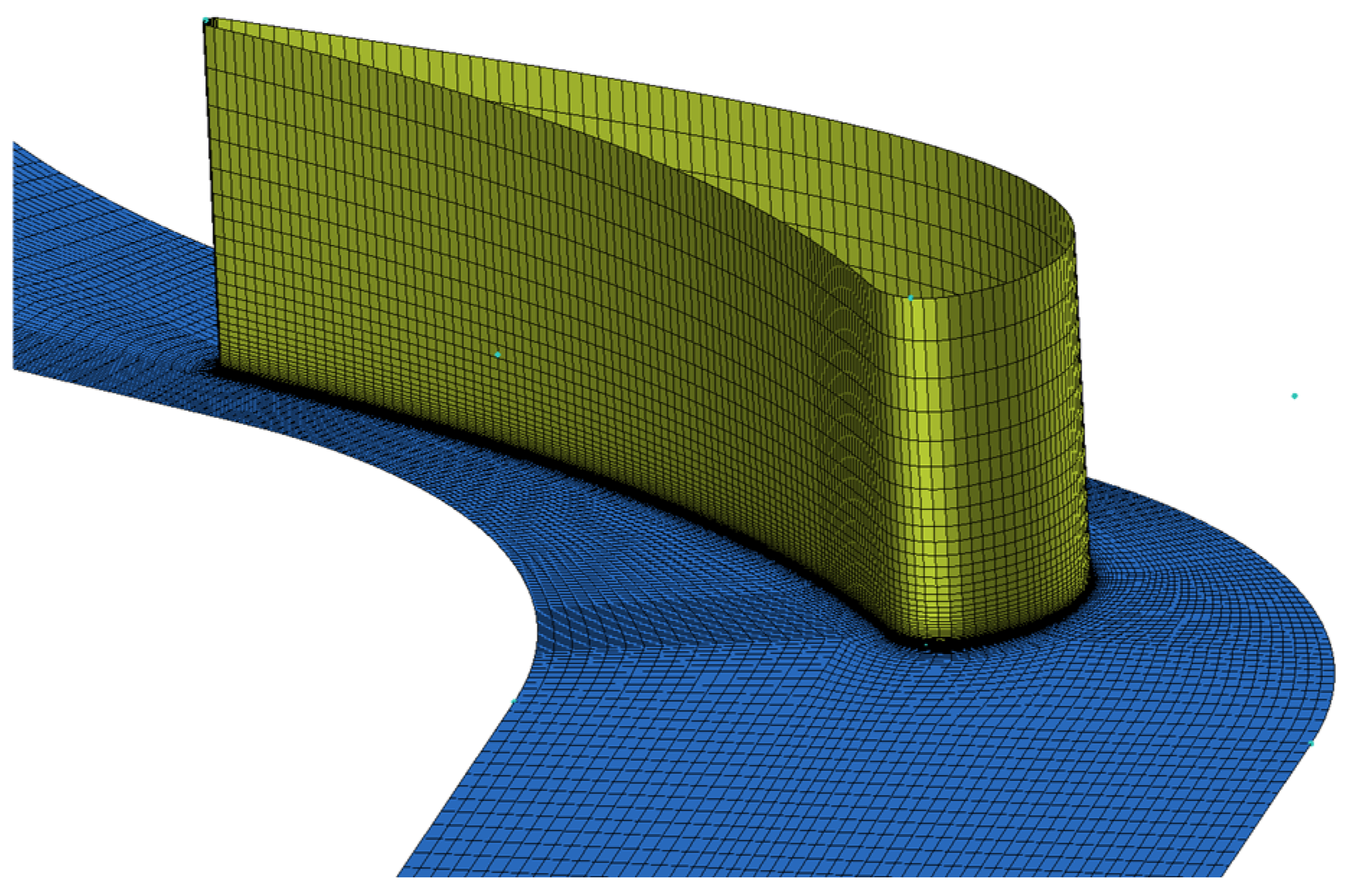
To enhance computational reliability, a structured hexahedral mesh was generated using ICEM CFD (2023R1), as illustrated in
Figure 6. Local refinement was applied to the endwall and blade surfaces to ensure a y+ value below 1, thereby positioning the first grid layer within the viscous sublayer. The height of the first boundary layer mesh was set to 2 × 10
−6 m, with a mesh growth rate of 1.12. Additionally, O-type grid blocks were constructed around the blade to maintain smooth and undistorted flow-field resolution, which is critical for accurately capturing near-wall flow behavior.
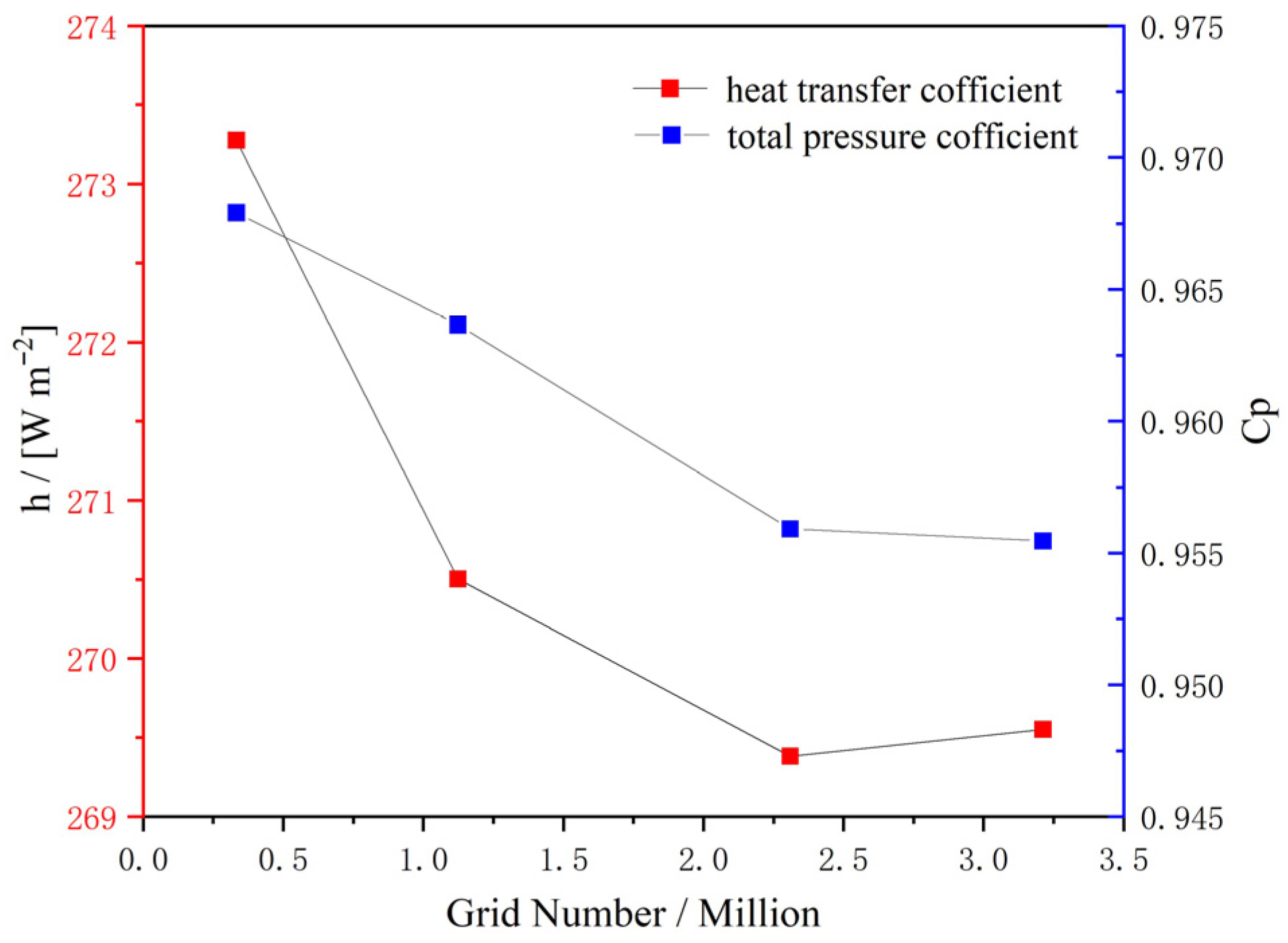
A grid independence study was conducted using four mesh configurations with varying densities: 0.3 million, 1.04 million, 2.14 million, and 2.97 million nodes. The heat transfer coefficient on the endwall surface and the total pressure loss coefficient at the blade outlet were adopted as the key indicators for evaluating thermal and aerodynamic performance, respectively. As shown in
Figure 7, both parameters exhibited negligible variation beyond the mesh with 214 million nodes. Consequently, this grid size was selected for all subsequent simulations to ensure computational accuracy while maintaining efficiency.
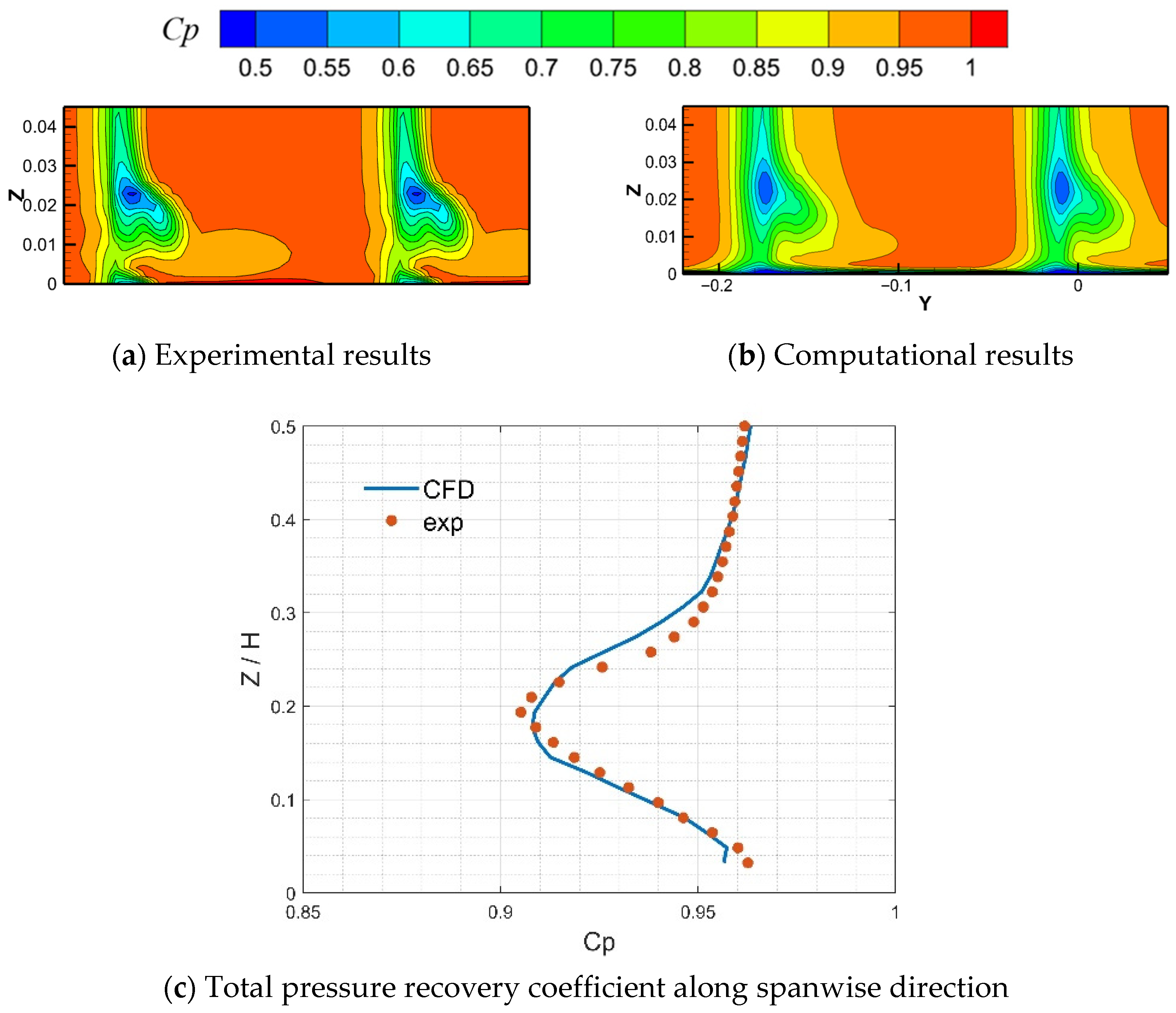
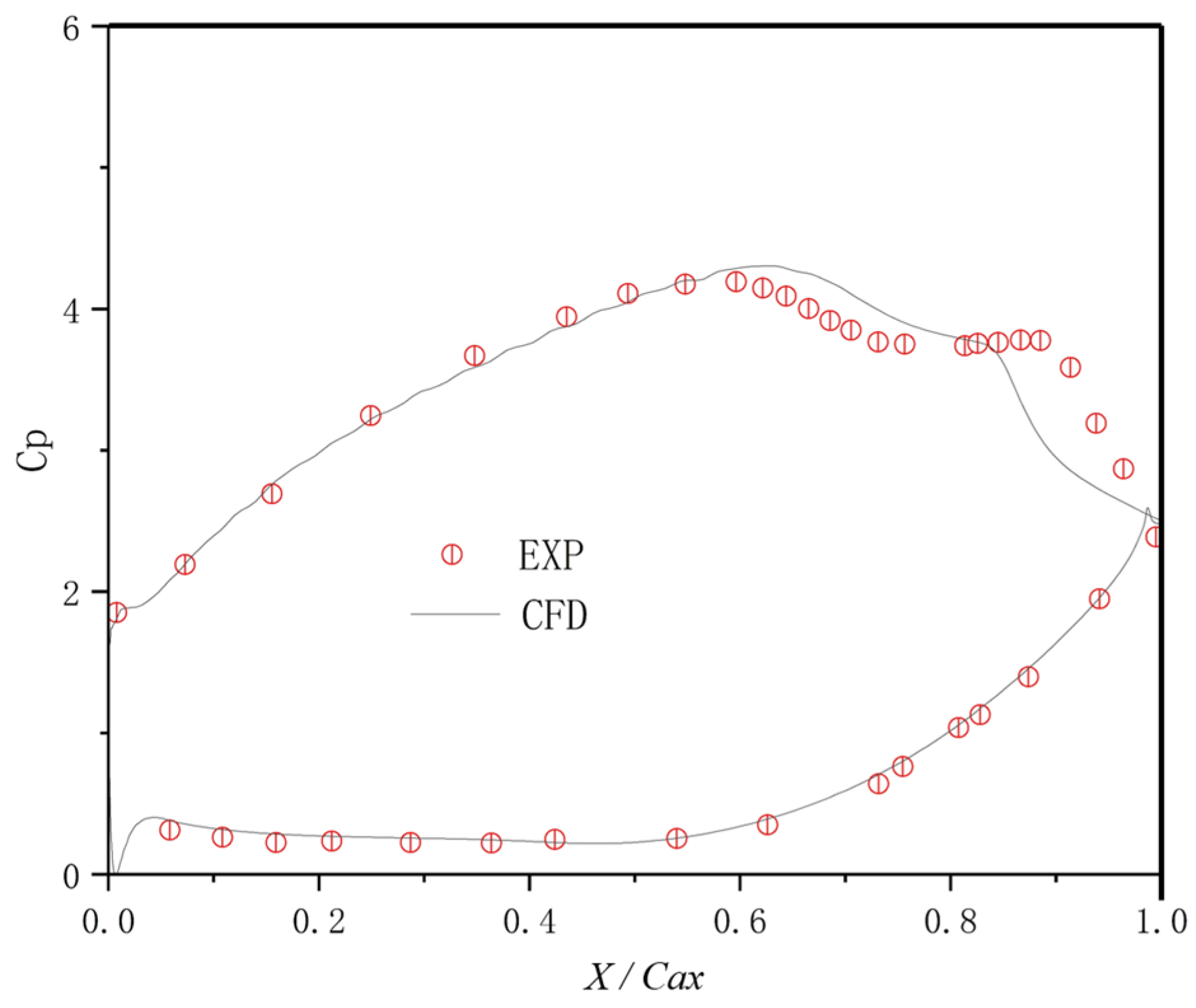
The distribution of total pressure recovery coefficient at the blade outlet was compared between experimental and computational results through two methods. The experiment was conducted in the Institute of Engineering Thermophysics, the Chinese Academy of Sciences, and
Figure 2 shows the experimental platform and the geometric model The findings demonstrated good agreement between the two approaches (as shown in
Figure 8), indicating that the computational results could be used for fluid-field analysis in the cascade. The total pressure recovery coefficient is defined as:
Cp is total pressure recovery coefficient, Pt,in and Pt,out have the same meaning as Equation (3), and Pref is the reference pressure.
To further evaluate the simulation capability of the CFD model for the flow within the cascade, numerical simulations were carried out using the SST turbulence model and compared with the results from reference [
25]. The comparative analysis shows that the SST model can predict the flow characteristics in the cascade with relatively good accuracy.
This study acknowledges the inherent limitations of the RANS method in simulating complex turbulent flows, particularly in capturing the full spectrum of unsteady phenomena and fine-scale turbulent structures. Although turbulence closure models introduce a certain degree of uncertainty into quantitative predictions, the RANS approach has been well-established for capturing key secondary flow features in the endwall region (as shown in
Figure 8 and
Figure 9) and has been extensively validated for predicting integral performance metrics, such as overall loss trends, in turbomachinery applications. Therefore, within the scope of engineering design and optimization—especially for parametric studies and comparative analyses—the RANS method is widely recognized as a standard tool in both industry and academia [
22,
23,
26,
27]. In the present work, the consistent application of the same RANS model and numerical framework across all configurations ensures a fair and coherent basis for comparison. The observed physical trends—such as the monotonic variation in loss and heat transfer coefficients with design parameters—reflect a systematic response, thereby strengthening confidence in the reported relative differences. Although absolute values may be subject to modeling uncertainties, the comparative results and optimization trends presented here are robust and consistent with findings from similar studies in the literature [
23]. In summary, for evaluating the effects of a streamwise-clustering-based contour design, the RANS method provides a reasonable and reliable foundation for the conclusions drawn in this study.
4. Results and Discussion
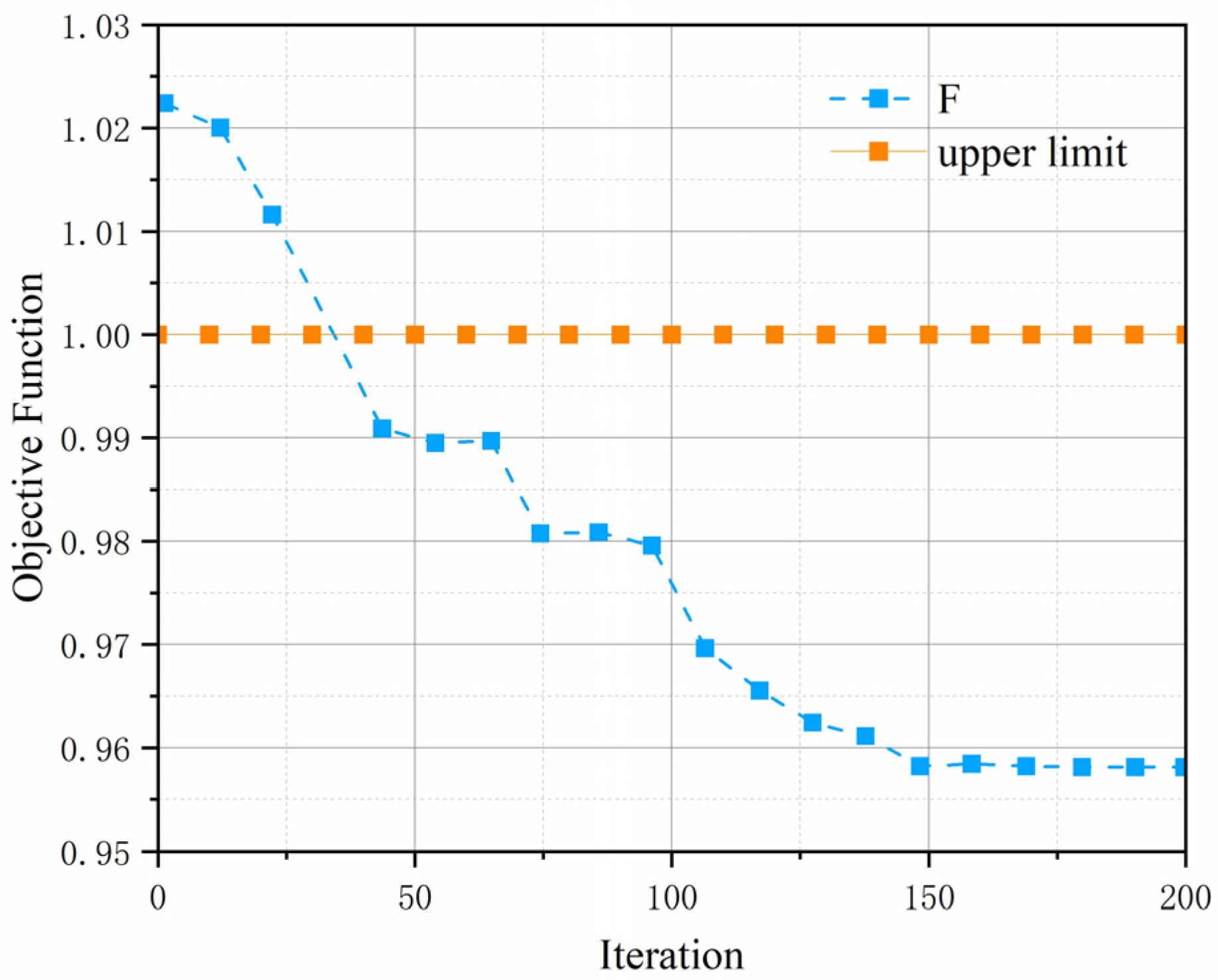
Figure 10 illustrates the convergence history of the optimization objective, where the red line denotes the upper limit of 1 for the objective function, and the blue curve represents the objective function itself. As the iterative process advances, the objective function F progressively decreases and eventually stabilizes. A lower value of the objective function indicates that the corresponding non-axisymmetric endwall profile can substantially enhance the flow and heat transfer performance. The optimization converged to the following parameters:
a1 = 0.22826,
b = 8.084001,
Sx = 40, and
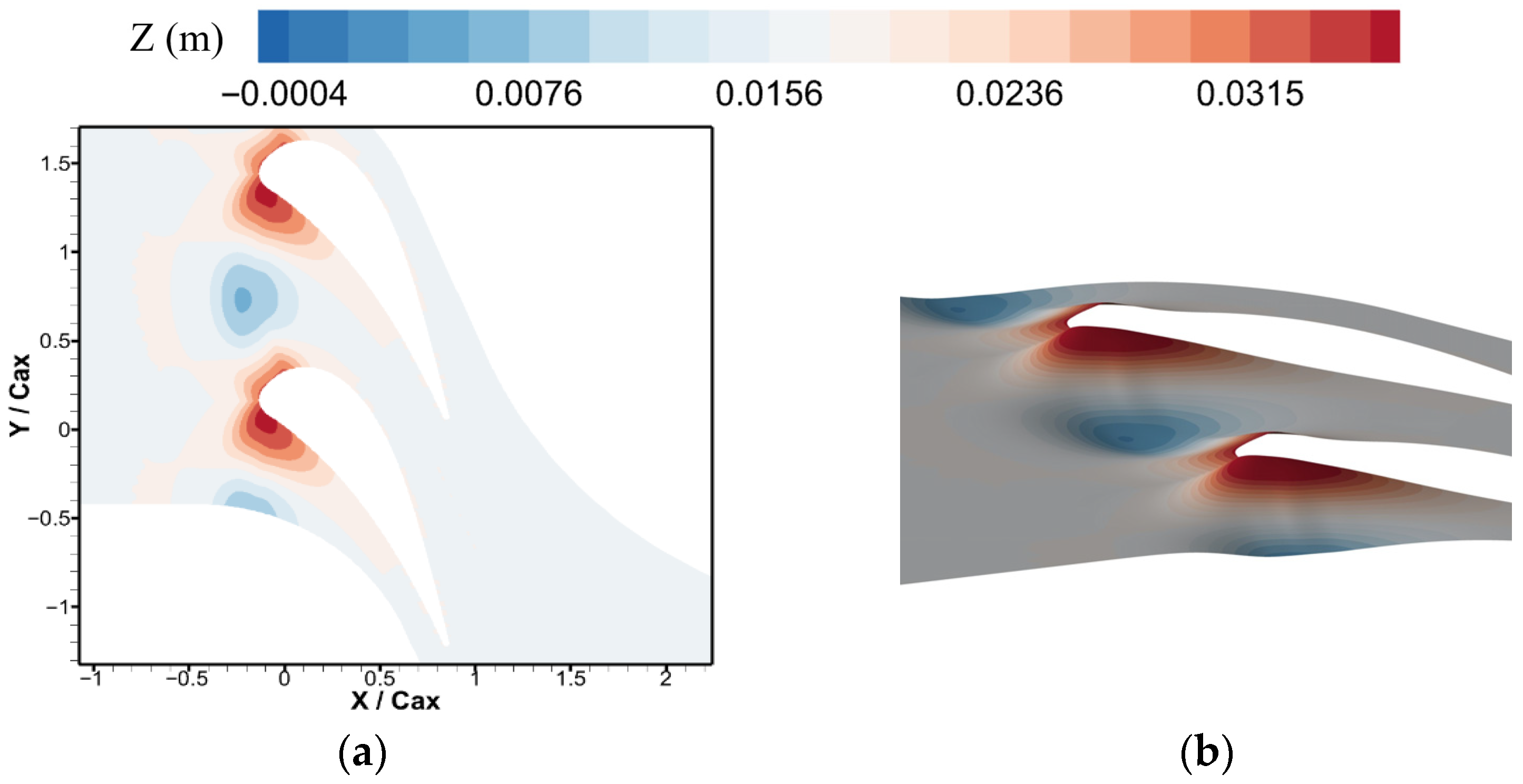
Sy = 95. The final optimized endwall geometry is presented in
Figure 11, with the detailed height distribution shown in
Figure 12.
Figure 12a displays a two-dimensional contour plot of the endwall. To facilitate better understanding, the specific three-dimensional configuration of the endwall is presented in
Figure 12b. In this distribution, the parameter
Sx = 40 indicates that the peak location of the contour is at 40% of the streamwise length of the design domain, approximately at its mid-chord region. Meanwhile,
Sy = 95 signifies that this peak is located at 95% of the spanwise height, positioned close to the blade cascade. The overall shape is characterized by a convex region near the leading edge and a slightly concave contour in the mid-channel region along the pitchwise direction. The maximum fluctuation in height amounts to approximately 5.38% of the blade height.
To verify the accuracy of the MIGA optimization model, a Sobol sensitivity analysis was performed for preliminary validation of the optimization results. Sensitivity analysis is a widely used technique in optimization algorithms, with Sobol sensitivity analysis being a prominent variance-based method. This approach quantifies the influence of various input variables on the objective function. In regression analysis, a Taylor series expansion can be applied to derive the following variance relationships:
The first-order sensitivity index and the total-effect index are defined as:
Here,
Si represents the first-order sensitivity index, and
STi denotes the total-effect index. The first-order sensitivity index measures the contribution of a single input parameter to the output variance, while the total-effect index captures the combined effect of a parameter and its interactions with all other parameters on the output variance. The absolute values of
Si and
STi indicate the degree of influence exerted by individual independent variables on the dependent variable. Specifically, the first-order sensitivity index is calculated using the following formula:
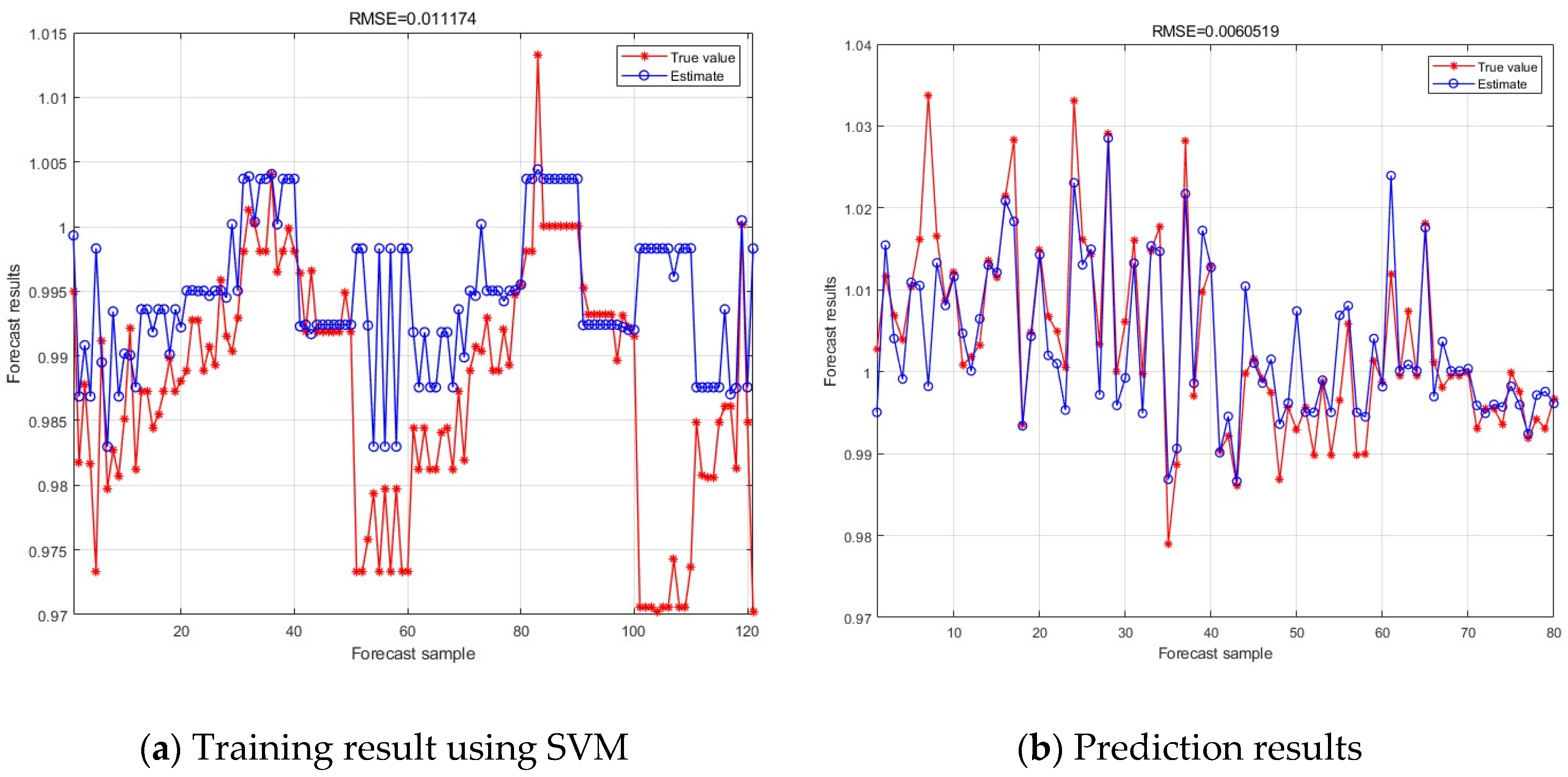
Sobol sensitivity analysis requires samples, which are generated by a surrogate model implemented with LibSVM. The training and prediction results of LibSVM are presented in
Figure 13. The model was trained using the first 80 computational results and validated against the remaining 120 results. The root mean square error (RMSE) between the predicted and actual values was 0.011174, demonstrating that the LibSVM predictive model can effectively validate the optimization outcomes.
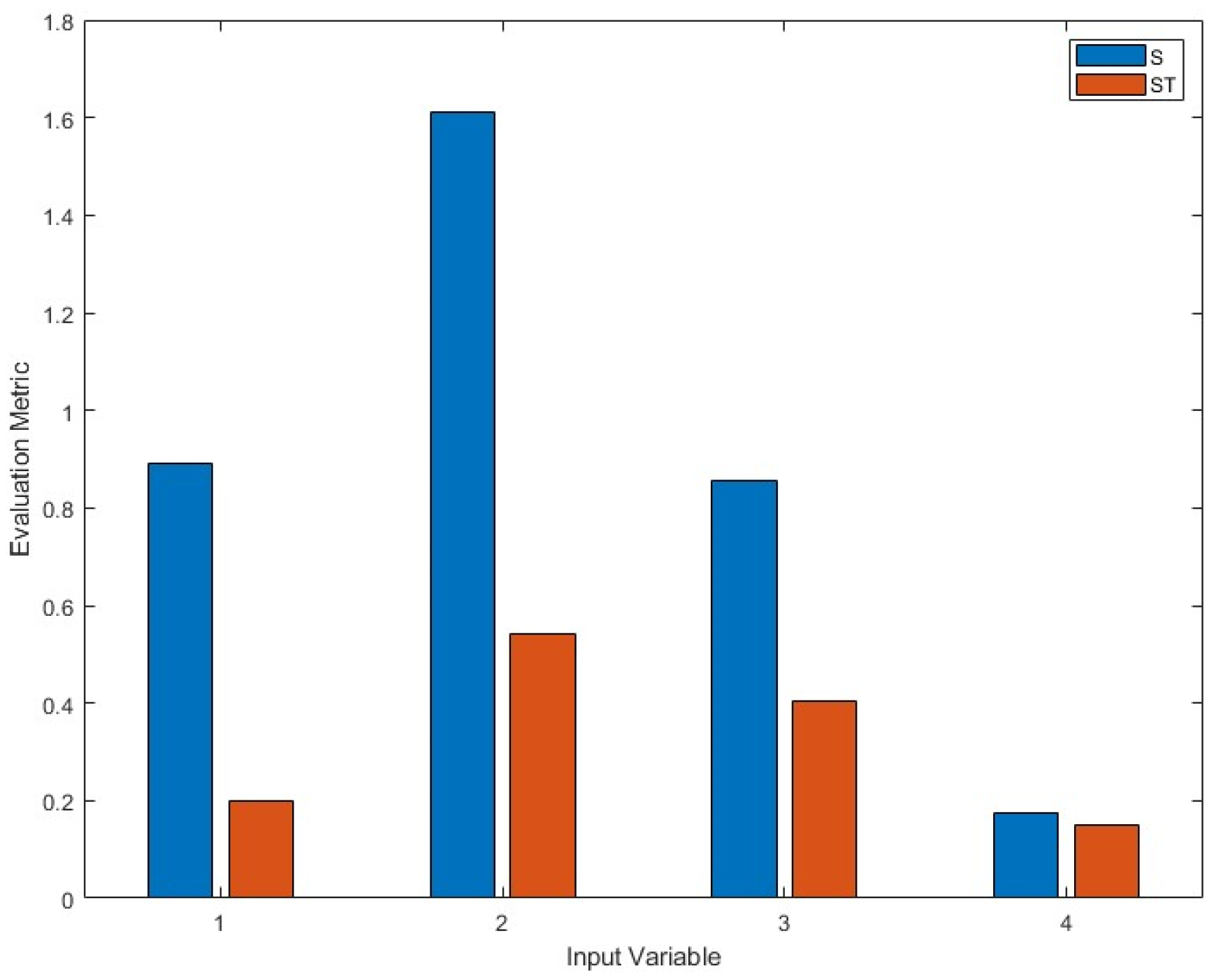
Figure 14 shows the sensitivity analysis of the optimized parameters, where indices 1 to 4 correspond to the four parameters (
Sy0,
Sx0,
B,
a1). The sensitivity analysis results confirm that in the non-axisymmetric endwall configuration, the parameters primarily influence the heat transfer coefficient and aerodynamic loss coefficient in the endwall region by affecting the suction-side and pressure-side branches of the horseshoe vortex.
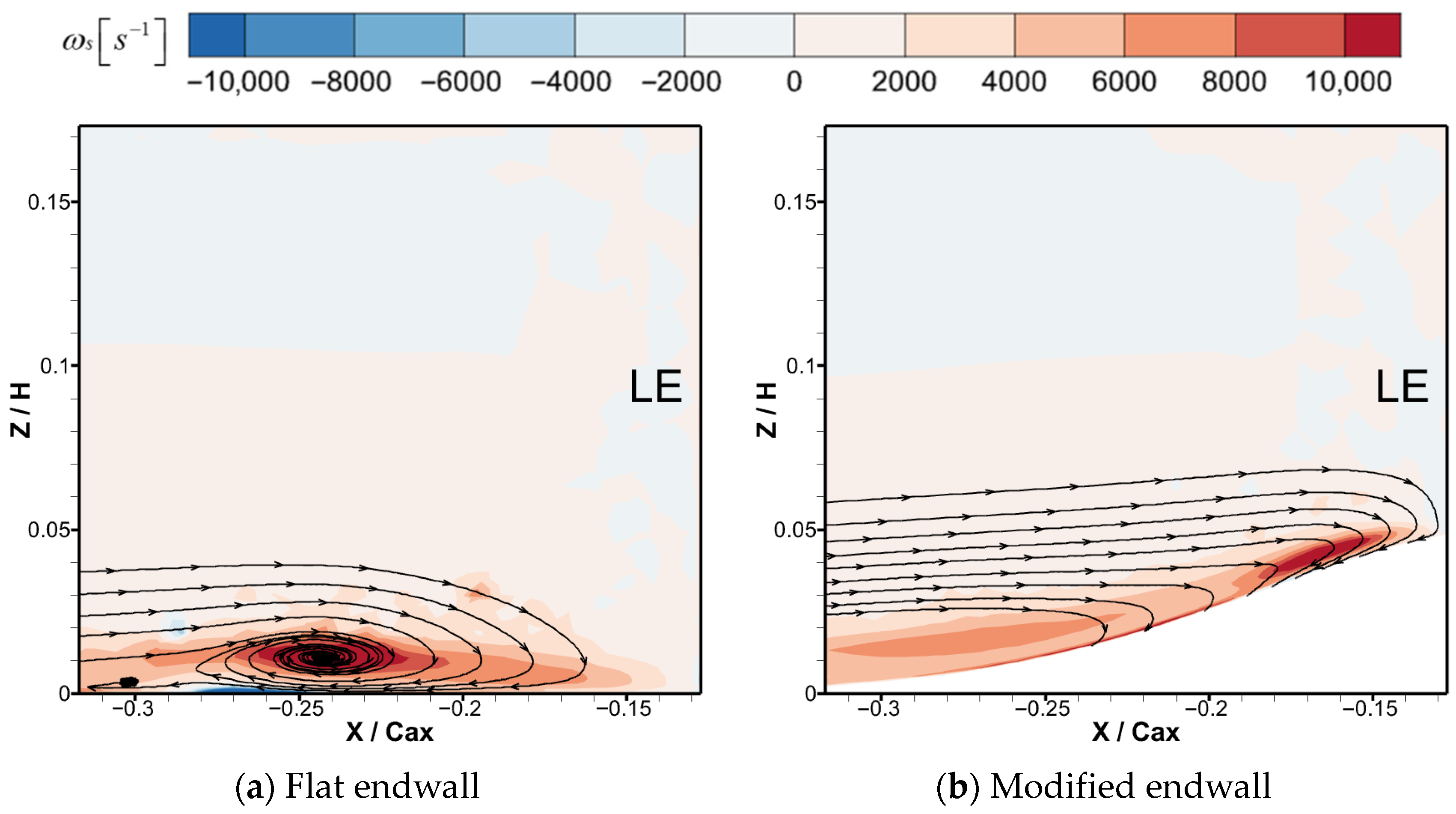
Due to the unique structure of the leading edge at the blade endwall, the incoming flow is stagnated at the leading edge and flows towards the endwall under the radial pressure difference from midspan to endwall in the cascade channel, resulting in a backflow, which intersected with the incoming flow at the upstream of the leading edge, then forming a horseshoe vortex.
Figure 15 shows the schematic diagram of the horseshoe vortex in the flat cascade and modified cascade at
Y/
Cax = 0.13. The shape of the endwall, as shown in
Figure 10, significantly changes the structure of the horseshoe vortex. Compared with the flat cascade, the structure of the horseshoe vortex of the modified cascade is damaged, the horseshoe vortex position is closer to the leading edge, and the overall vorticity intensity is significantly weakened, which has a great influence on the development characteristics of the downstream passage vortex.
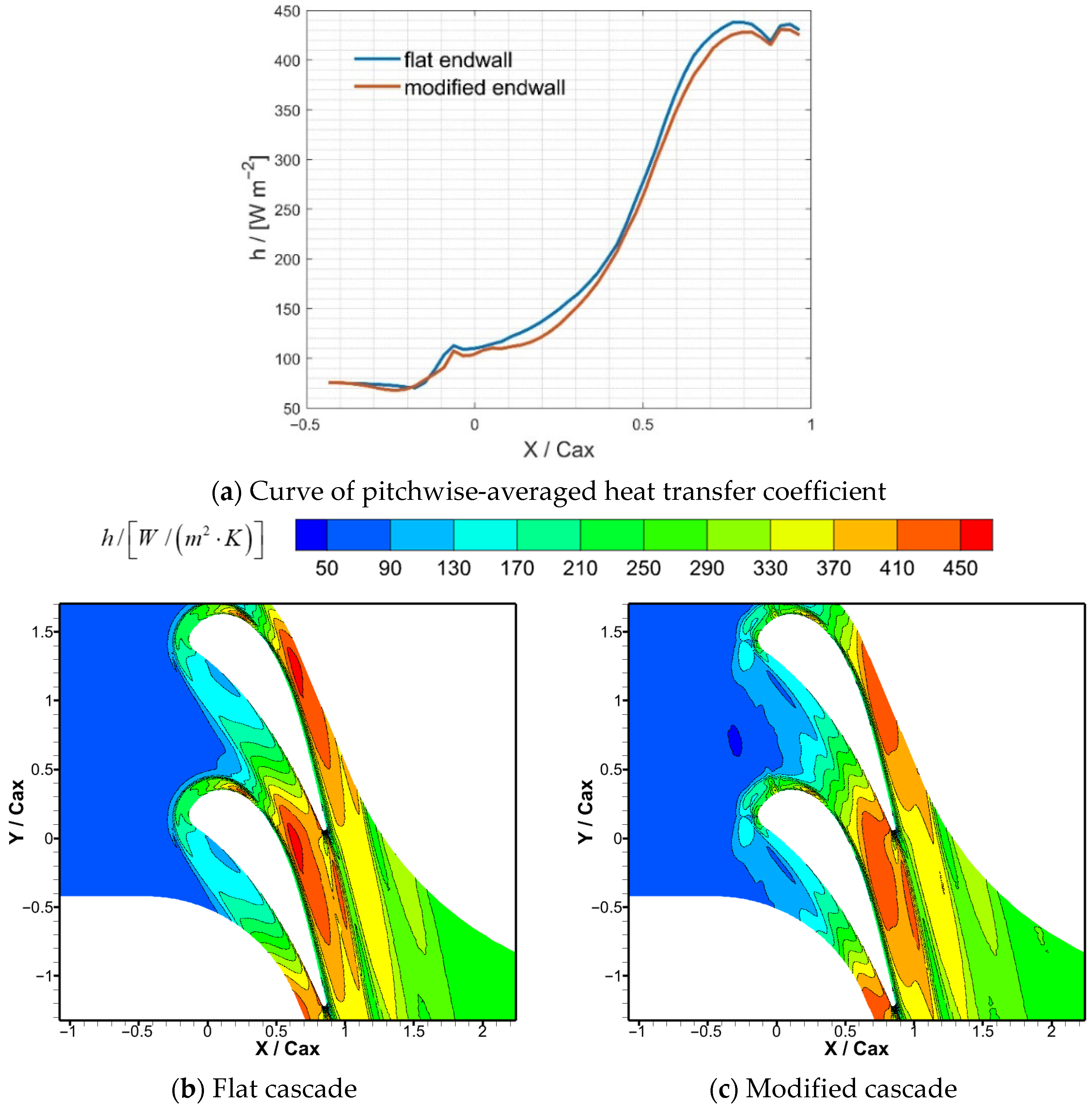
The heat transfer coefficient on the flat-endwall and the modified-endwall surface is roughly similar in distribution, but the value of the modified endwall is relatively lower. From the leading edge to trailing edge, the heat transfer coefficient on the modified endwall surface decreases, especially in the front section of the channel and the throat zone, as shown in
Figure 16a.
The decrease in the heat transfer coefficient at the front of the modified endwall channel is mainly due to the expansion in the area of the low-heat-transfer wedge zone (see
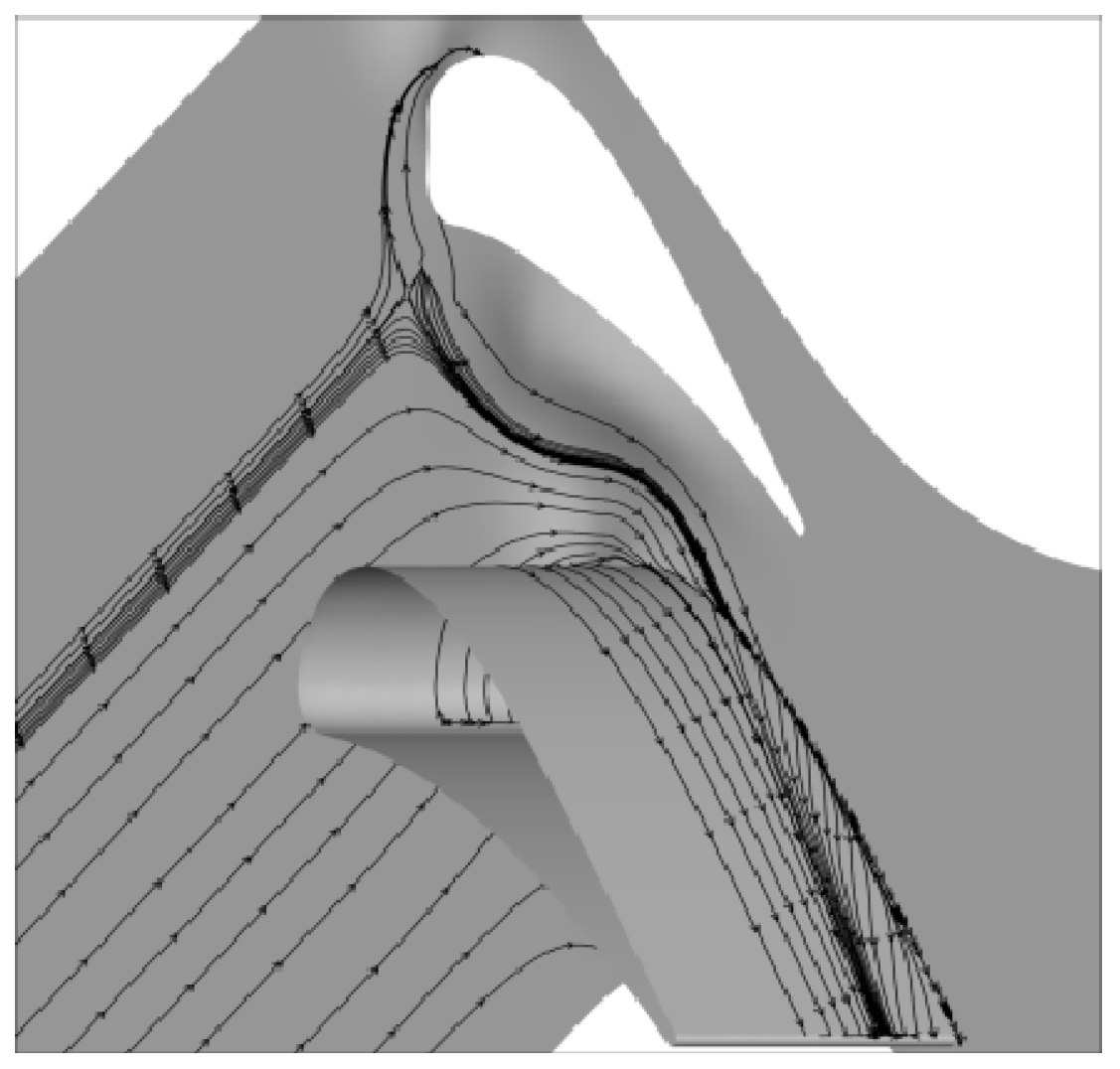
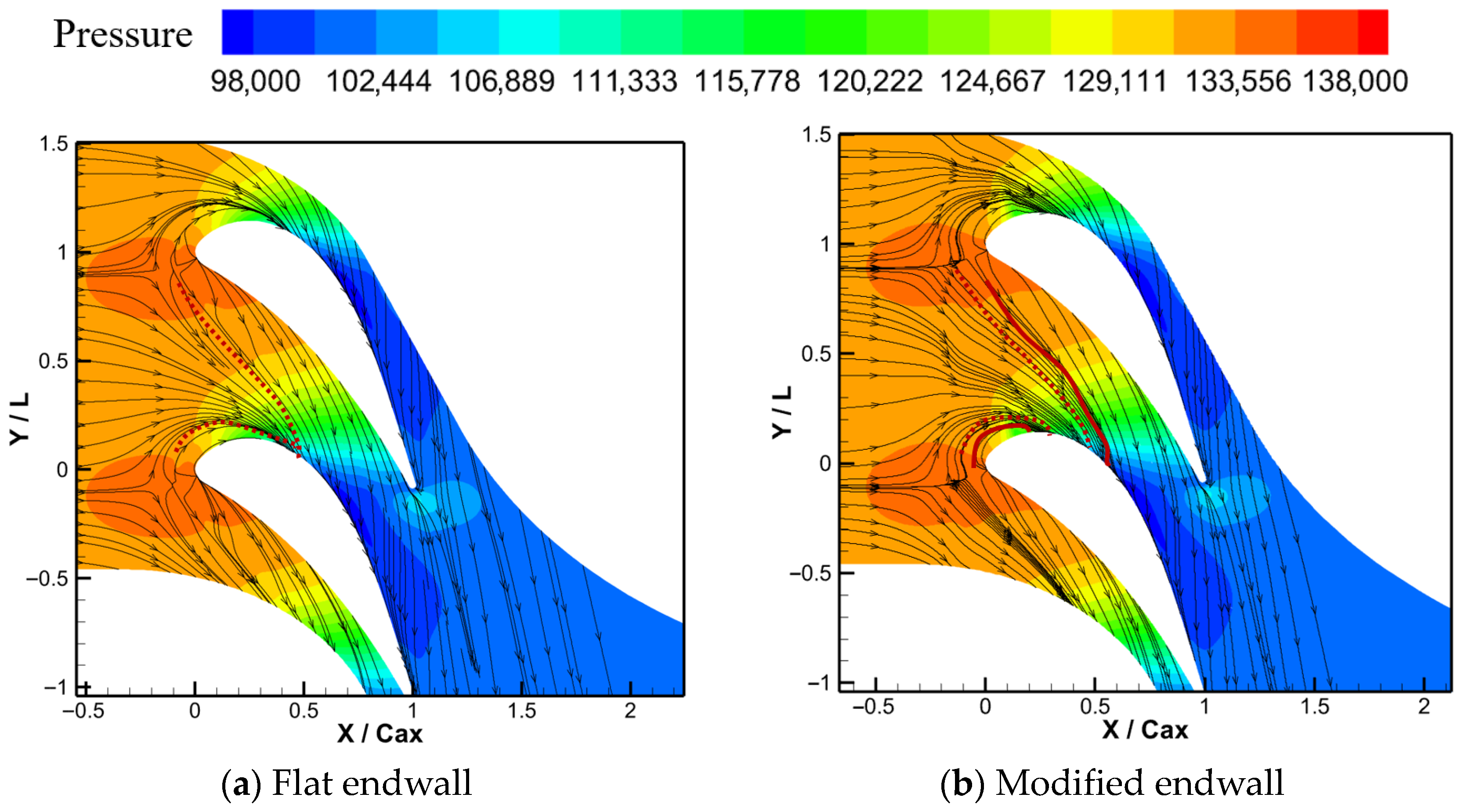
Figure 16b,c). The horseshoe vortex is divided into two parts at the leading edge, and the two branches generate a separation line when they develop downstream (as shown in
Figure 17). The red dotted line is the separation line of two branches of the horseshoe vortex at the flat endwall; however, at the modified endwall, the red dotted line is the separation line of the two branches.
It can be seen that the pressure side of the horseshoe vortex at the modified endwall moves downstream, while the suction side moves upstream, which leads to the expansion of the zone between the two separation lines at the modified endwall. Since the upstream region of the separation line is almost unaffected by the secondary vortex and controlled by the free stream boundary layer, the heat transfer coefficient at the front of the modified endwall is lower than that at the flat endwall. Moreover, the weakening of the horseshoe vortex of the modified endwall also inhibits the migration and development of the passage vortex, thus impairing the heat transfer level at the downstream endwall. In addition, the backward movement of the separation line of the pressure side of the horseshoe vortex delays the separation of the incoming boundary layer, which further reduces the influence range of the secondary vortex in the cascade channel.
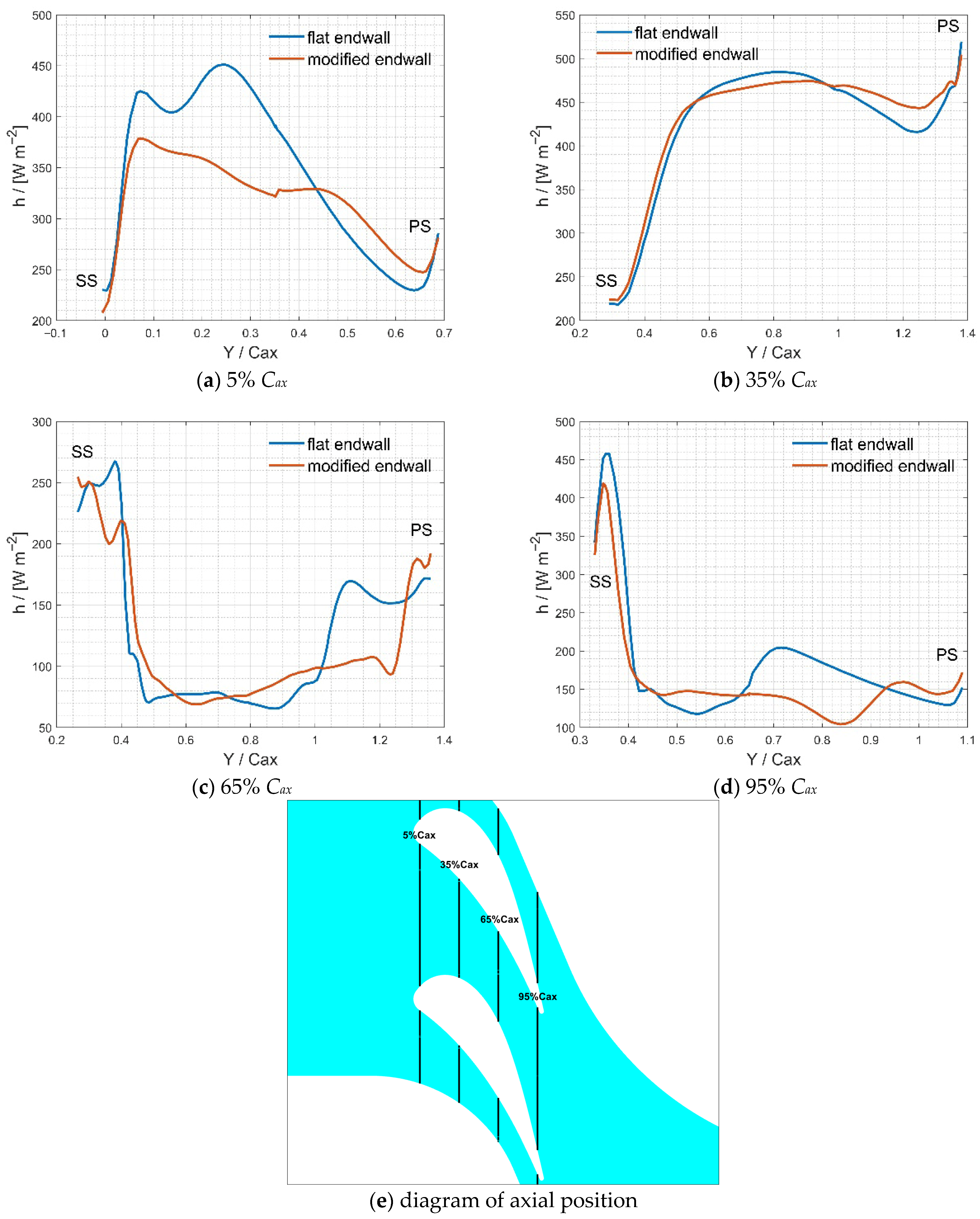
Figure 18 shows the heat transfer coefficient distribution along the pitchwise direction at different axial positions on the endwall surface. The blue curve is the heat transfer coefficient corresponding to the flat endwall, and the red curve is the heat transfer coefficient corresponding to the modified endwall. At 5%
Cax, the secondary vortex system causes strong heat transfer at the corner of pressure surface and suction surface. In addition, the suction side of the horseshoe vortex rolls low-energy fluid, near the wall and close to the suction surface, under the cross-flow.
The peak value of the heat transfer coefficient is concentrated in the corner region of the suction surface. At 35% Cax, the lateral migration of the pressure side of the horseshoe vortex further enhanced the heat transfer in the corner region of the suction surface, while the heat transfer levels in the main endwall region and the corner region of the pressure surface were lower. At 65% Cax, the passage vortex has been basically formed and climbs along the blade height, which weakens the influence on the endwall, decreases the heat transfer coefficient in the corner area of the suction surface, and increases the heat transfer coefficient in the main area of the endwall and the corner region of the pressure surface. The 95% Cax is basically located at the throat of the passage, where the flow velocity is faster, which is the most important factor affecting the heat transfer coefficient. Therefore, the heat transfer level in the main area of the endwall is relatively high, and the passage vortex also induces corner vortex in the corner region of the pressure surface, promoting the heat transfer level at the pressure surface corner.
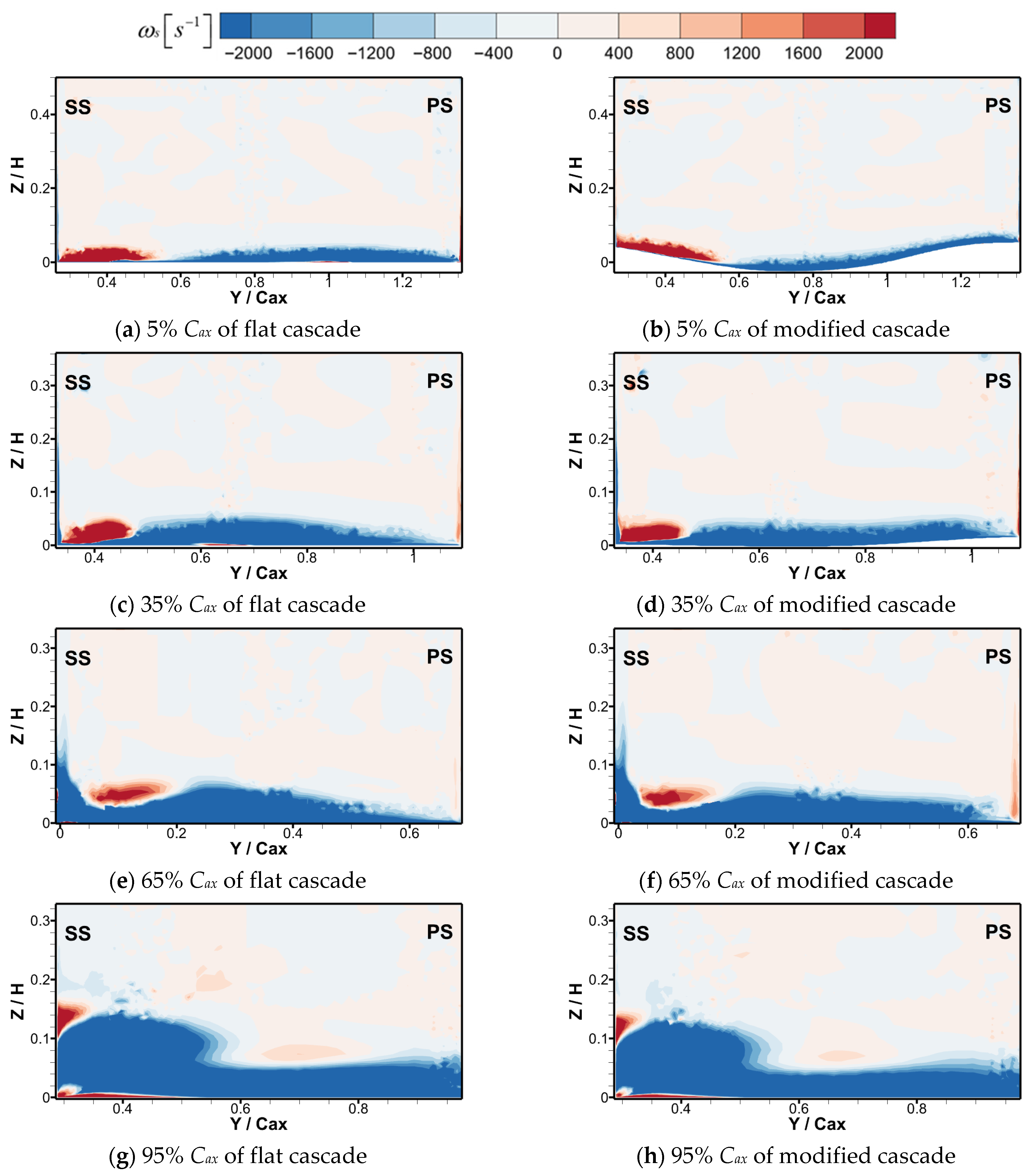
The mitigation of the horseshoe vortex by the modified endwall leads to a modification of the development and trajectory of passage secondary flows. The resultant changes in the flow structure, represented by streamwise vorticity contours at multiple axial planes, are shown in
Figure 19. Here, the definition of streamwise vortices is provided as follows:
In which, Ωy and Ωz represent the distributions of vorticity in the spanwise and camber line directions, respectively, and β is the angle between the velocity direction and the axial direction.
The blue vortex rotates counterclockwise along the streamwise direction, consistent with the rotational direction of the pressure side of horseshoe vortex. The red vortex rotates clockwise along the streamwise direction, in the same direction as the suction side of the horseshoe vortex. At 5% Cax position, the suction side of horseshoe vortex is close to the suction surface, and the pressure side of the horseshoe vortex migrates towards the suction surface. And at this time, the two vortex systems are not fully formed. At 35% Cax position, the two vortex systems develop and increase in size and strength. The pressure side of horseshoe vortex is closer to the suction surface, and the suction side branch induces a vortex with the same rotational direction as the pressure side of horseshoe vortex. At 65% Cax, the pressure side of horseshoe vortex merges with the counter vortex induced by the suction side branch to form a passage vortex, which pushes out the suction side of horseshoe vortex, and dissipation occurs in the suction side branch. At 95% Cax, the suction side of the horseshoe vortex has dissipated, and the dominant vortex system in the whole cascade channel is the passage vortex. When a non-axisymmetric endwall is adopted, endzone vortex intensity further drops. This structure alters boundary-layer development and interferes with vortex generation and evolution. Its special shape changes fluid paths, weakening strong vortices and reducing their size and intensity, which directly affects endwall heat transfer.
As illustrated in
Figure 17 and
Figure 19, at the 5% axial chord location, the convex profile of the non-axisymmetric endwall induces local flow acceleration near the leading edge, resulting in an increase in static pressure within the endwall region. This flow modification causes the pressure-side branch of the horseshoe vortex to separate into two distinct vortical structures, while the suction-side branch exhibits a marked reduction in vorticity. Progressing downstream along the cascade, the non-axisymmetric contour promotes more rapid dissipation of the suction-side branch, consistent with its decay and disappearance by approximately 35% axial chord, as captured in
Figure 17b. Furthermore, due to the initially lower vorticity of the pressure-side branch in the leading-edge zone, its capacity to entrain low-momentum endwall fluid is diminished. Consequently, the passage vortex that develops near the trailing edge under the non-axisymmetric endwall configuration is significantly weaker compared to the baseline flat-endwall case.
The observed attenuation of vortex structures under the non-axisymmetric endwall configuration has direct implications for heat transfer. Vortices typically enhance endwall heat transfer by intensifying turbulent mixing and thinning the thermal boundary layer. The suppression of the horseshoe vortex branches and the weakening of the passage vortex reduce turbulent fluctuations near the endwall, thereby stabilizing the thermal boundary layer. This stabilization leads to a decrease in convective heat transfer rates across the endwall surface. A comparison between
Figure 18 (vorticity contours) and
Figure 16 (heat transfer distribution) corroborates this mechanism: regions of diminished vorticity magnitude and spatial extent in
Figure 19 correspond spatially to zones of reduced heat transfer coefficient in
Figure 16. This spatial correlation confirms that the aerodynamic damping of vortex structures by the non-axisymmetric endwall is the primary driver for the concomitant reduction in the endwall heat load.
Compared with the flat endwall, the intensity of the passage vortex and corner vortex under the modified endwall is significantly reduced. Secondary flows lead to large aerodynamic losses in cascade channel, especially passage vortex, which is the main source of aerodynamic losses.
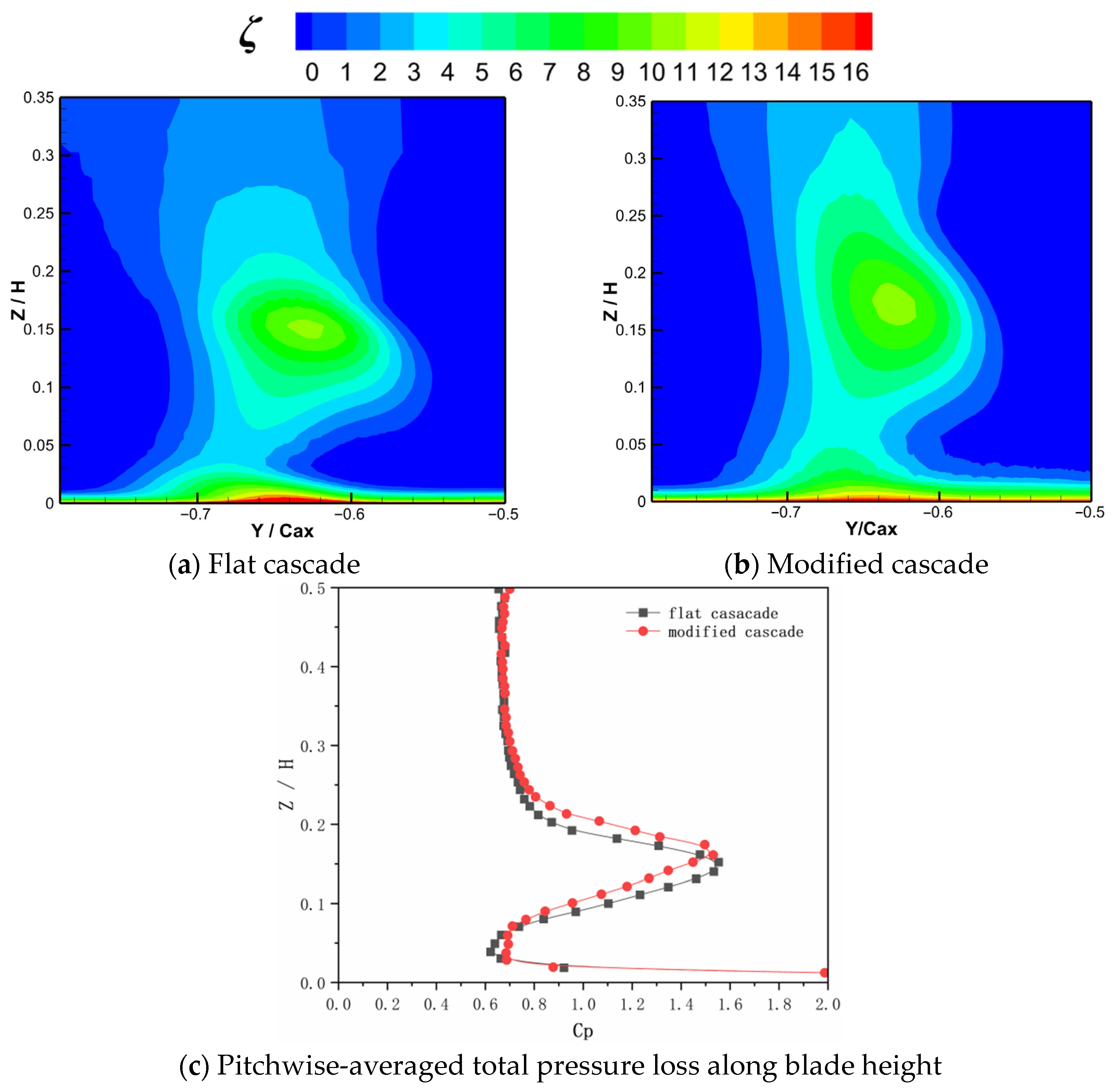
Figure 20 shows the distribution of total pressure loss at the blade outlet. The black dashed lines in
Figure 20a,b are at the same horizontal position as the total pressure loss core in flat cascade.
Figure 20c reflects the variation in total pressure loss at this position along blade height, and its distribution is generally consistent with the results shown in
Figure 20a,b.
In the position very close to the endwall, the total pressure loss of the flat and the modified cascade is similar, but the total pressure loss of the modified cascade decreases slightly at the position from 3% to 7% blade height. From 7% to 16% blade height, the total pressure loss of the modified cascade is significantly greater than that of the flat cascade, which is consistent with the result described above that the total pressure loss core in modified cascade decreases, and the strength of the total pressure loss core in modified cascade increases slightly. From 16% to 30% blade height, the total pressure loss of the flat cascade is higher than that of the modified one, while at 30% blade height above, the total pressure loss flat and modified cascade is almost the same, indicating that the influence zone of the passage vortex in the cascade is roughly 30% blade height, and the effect range of the passage vortex under the flat cascade is larger than that of the modified one.
From the perspective of qualitative analysis, the endwall shape corresponding to the modified cascade obviously decreases the horseshoe vortex intensity at leading edge of blade, weakens the migration and development of secondary flows in the channel, and then reduces the aerodynamic loss in cascade and heat transfer level on the endwall surface. From the perspective of quantitative analysis, compared with the flat endwall, the total pressure loss at the blade outlet is reduced by 1.96%, and the average heat transfer coefficient on the endwall surface is decreased by 3.05%. The overall improvement effect is obvious.
5. Conclusions
We developed a modular optimization framework for non-axisymmetric endwall contouring, integrating three key components: a Bézier curve-based parametric modeling for adaptive geometric control across blade geometries, and multi-objective aerothermal optimization targeting universal parameters (total pressure loss coefficient, heat transfer coefficient). The framework emphasizes mechanistic analysis of secondary flow phenomena (horseshoe vortex dynamics, passage vortex suppression) rather than case-specific features. This method can alter the secondary flow trajectory in the endwall region. While demonstrating quantitative improvements (1.96% total pressure loss reduction, 3.05% heat transfer reduction) in a prototype cascade, the underlying physics—particularly endwall-induced modulation of vortex migration pathways—reveals generalizable principles applicable to axial turbines across pressure ratios and Reynolds numbers, offering a vortex trajectory-based paradigm for cross-operational turbine design. Specific conclusions are as follows:
The modified endwall destroyed the horseshoe vortex structure at the leading edge, weakened the horseshoe vortex intensity, significantly changed the development and migration characteristics of the pressure and suction side of the horseshoe vortex in the cascade channel, impaired the intensity of the passage vortex, and reduced the height of the passage vortex and the aerodynamic loss in the cascade. By comparison, the modified endwall blade outlet position reduced the total pressure loss by 1.96%, and the aerodynamic performance improved significantly.
The modified endwall makes the pressure side of the horseshoe vortex move downstream, delaying the separation of the incoming boundary layer. Meanwhile, the suction side of the horseshoe vortex moves upstream, significantly increasing the area of the leading-edge low-heat-transfer wedge zone, obviously decreasing the heat transfer coefficient at the front of the cascade channel, inhibiting the development process of the passage vortex structure, and further reducing the heat transfer level in the middle and rear sections of the channel. The average heat transfer coefficient on the endwall surface decreased by 3.05%, and the heat transfer characteristics also improved significantly.
Overall, this paper proposes an efficient non-axisymmetric endwall contouring approach and elucidates the underlying flow physics governing its behavior. This work contributes to the understanding of endwall flow control and offers practical insights for turbine designers seeking to implement such passive optimization techniques.




 ,
,