Article

Accelerating Mini-Grid Development: An Automated Workflow for Design, Optimization, and Techno-Economic Assessment of Low-Voltage Distribution Networks

The Polytechnic School, Ira A. Fulton Schools of Engineering, Arizona State University, Mesa, AZ 85212, USA
*
Author to whom correspondence should be addressed.
Energies 2026, 19(6), 1526; https://doi.org/10.3390/en19061526
Submission received: 4 February 2026 / Revised: 25 February 2026 / Accepted: 13 March 2026 / Published: 19 March 2026
(This article belongs to the Section F1: Electrical Power System)

Abstract

Reliable and efficient low-voltage distribution networks are critical for scaling mini-grid deployment and advancing universal electricity access, yet prevailing design practices remain manual, heuristic, and difficult to scale. This study presents a fully automated workflow that integrates geospatial feature extraction, distribution network layout, conductor sizing, mixed-integer linear programming-based phase balancing, nonlinear AC power flow validation, and system costing to generate rapid, standard-compliant techno-economic designs for greenfield mini-grid sites. The methodology is demonstrated across 62 rural sites to confirm practicality for large-scale rural electrification planning. Designs were evaluated for single-phase, three-phase, and hybrid low-voltage configurations. When design constraints were relaxed, single-phase networks achieved the lowest median voltage drop (~0.8%) and technical losses (~0.6%); however, under realistic voltage-drop and ampacity limits, compliance relied on conductor oversizing, resulting in low utilization (median loading <20%) and substantially higher costs. Fewer than half of the sites met construction feasibility limits for parallel conductors, and single-phase designs were typically 3–4× more expensive than multi-phase alternatives. Multi-phase layouts delivered comparable technical performance at significantly lower cost. Phase-balancing optimization reduced voltage drop by 15–20% and current unbalance by ~50%, enabling loss reduction and increased load accommodation. Overall, the results demonstrate that automated low-voltage network design can replace manual drafting with scalable, data-driven workflows that reduce soft costs while improving technical performance, constructability, and investment readiness.

1. Introduction

Achieving universal access to electricity will require accelerating the deployment of decentralized solutions to reach rural populations and either grid extension or densification to reach urban unelectrified populations [1,2]. For rural areas, the World Bank estimates that mini-grids will provide the least-cost electrification strategy for approximately two-thirds of unserved populations. This translates to approximately 490 million people and 217,000 new installations in an investment exceeding USD 127 billion [3,4].
While pledges and investments have been made, project implementation is slowed by inefficiencies in project development cycles, low investor confidence, and regulatory uncertainty [5,6]. These circumstances pressure developers to fast-track technical designs and prioritize generation asset selection and sizing because established tools can readily optimize costs and energetic efficiency [7,8]. In contrast, distribution network planning, including network topology and conductor selection, is often treated as a secondary concern that is addressed using conventional approaches that are loosely integrated and not optimized [9]. This creates challenges for realizing mini-grids because distribution design choices such as feeder layout, conductor sizing, and phase allocation strongly influence both capital cost and technical feasibility, and such choices are often made through disconnected drafting and spreadsheet calculations that must be iterated repeatedly as assumptions change. This is time-consuming and prone to human error and leads to suboptimal results. An integrated computational approach will create rapid, consistent, and verifiable distribution planning that enables mini-grid deployment at scale, and including optimization will improve technical efficiency and financial efficiency.
Low-voltage distribution networks represent the most economically feasible and technically suitable solutions for electricity delivery in small geographically dispersed rural communities [10]. Low-voltage networks are typically designed with a radial topology where feeders branch outward from a single generation source to simplify installation, management, and maintenance [11]. There are three primary low-voltage radial configurations: single-phase, three-phase, and hybrid configurations [12]. A hybrid configuration features a three-phase main feeder with single-phase lateral extensions. Each configuration offers unique trade-offs in initial investment costs, equipment availability, reliability, and operational maintenance [13]. Consequently, selecting the best topology and associated conductor sizing is essential for minimizing upfront investments and ensuring project expectations are met.
Ensuring high power quality is important for the reliable and efficient operation of low-voltage networks [14]. Power quality depends on how effectively voltage regulation, current symmetry, and technical losses are managed under unbalanced conditions [15]. Among these factors, phase balancing is a key consideration because it dictates the distribution of currents and voltages evenly across phases [16]. Poor phase balance can increase neutral currents, voltage deviations, and conductor heating [16,17]. Incorporating phase balancing in the design process is therefore essential to improve efficiency, stability, and long-term reliability, and such a step is not commonly completed in mini-grid design.
Despite their critical role, the design of low-voltage networks in mini-grids remains a manual process that is heavily dependent on designer experience and heuristic approaches [18,19]. This frequently leads to suboptimal network designs and inaccurate cost estimates, which in turn creates uncertainty in financial viability and slows project deployment [18,20]. Such inefficiencies inflate soft costs during detailed engineering, site assessments, and time-consuming tasks such as manual network drafting and iterative spreadsheet-based calculations [3,5]. Reducing soft costs through automation is essential, with proven successes in related fields [21,22,23,24]. For example, the utility-scale solar industry employs automated design methods, such as clustering-based optimization, to dramatically reduce manual drafting needs. This process enables the generation of optimized plant layouts, reduces engineering time, and allows developers to select financially optimal designs with minimal manual effort [25]. Similarly, Geographic Information System (GIS) tools have successfully automated site selection and techno-economic assessments of utility-scale solar power plants, reducing the time and expertise required for feasibility studies and permitting [26,27]. Without automation, each mini-grid must be individually and manually designed from scratch, which creates substantial barriers to the scalable deployment needed to meet global electrification goals [28].
The scientific literature and engineering practice have advanced along several parallel tracks to address the inefficiencies in distribution system planning. One stream of work has focused on high-level planning and employs GIS for site selection and preliminary resource assessment [29,30,31,32,33,34]. Another area of work has concentrated on optimizing discrete components and subsystems, with studies dedicated to optimal generation and storage selection and sizing [35,36,37,38,39,40,41], conductor selection [42,43,44,45,46], and broad topographical comparisons such as alternating current (AC) versus direct current (DC) [47,48,49,50,51]. A third area has applied optimization algorithms to tasks such as feeder routing and distribution network layout design [52,53,54,55,56]. While these studies provide valuable tools for specific parts of a project, they exist separately and can miss design improvements and time-saving efficiencies enabled by a single, integrated workflow [19,57].
Recent advances to bridge gaps or blend steps of the microgrid design process include frameworks such as uGrid from Cicilio et al. [58], which integrates equipment sizing and network layout, yet this does not include power flow analysis for validation or optimization. Other approaches focus on specific niches such as low-power DC microgrids [59] or rely on manual parameter tuning for topology generation [60]. While these tools represent important progress, continued work is needed to develop an integrated workflow for end-to-end design of low-voltage distribution networks.
Furthermore, the systematic, techno-economic comparison of single-phase, three-phase, and hybrid low-voltage configurations remains an under-explored area of research. Most existing analyses rely on anecdotal or isolated case studies, making it difficult to form a data-driven determination of the optimal topology for a given community [61]. Minimal published literature is available on the requisite systems engineering needed to scientifically and computationally integrate geospatial layout extraction, standard-compliant conductor sizing, phase assignment, nonlinear AC validation under consistent voltage-drop and ampacity constraints, and financial analyses. This gap prevents comparisons of single-phase, three-phase, and hybrid low-voltage architectures and motivates the unified workflow developed in this study.
This paper develops and demonstrates a novel computational framework to automate the design and analysis of low-voltage mini-grid networks. The integrated workflow enables scalable and cost-effective mini-grid development by linking geospatial layout extraction, standard-compliant conductor sizing, phase balancing, nonlinear AC validation, and techno-economic costing under consistent assumptions. The generalized approach is applied to a portfolio of 62 independent and spatially unique communities in Fiji to illustrate how the geographic-agnostic analyses are transferable to other greenfield, low-voltage mini-grid planning scenarios. This work contributes to the literature by introducing:
  • An end-to-end automated network design workflow: Translates raw geospatial and load inputs into multiple standard-compliant low-voltage network designs, including conductor sizing, cost estimation, and nonlinear AC power flow validation.
  • A layout-aware phase-balancing optimization: Develops a mixed-integer linear programming (MILP) formulation for phase assignment within the workflow to improve current balance and reduce losses relative to heuristic phasing.
  • A portfolio-scale topology comparison: Provides a quantitative techno-economic comparison of single-phase, three-phase, and hybrid low-voltage configurations across multiple sites under consistent voltage-drop and ampacity constraints.
The remainder of this paper is structured as follows: Section 2 introduces the methodology and design framework, Section 3 presents aggregated statistics from a portfolio of case study sites, Section 4 presents a selected case study in detail, and Section 5 discusses the implications, conclusions, and directions for future research.

2. Materials and Methods

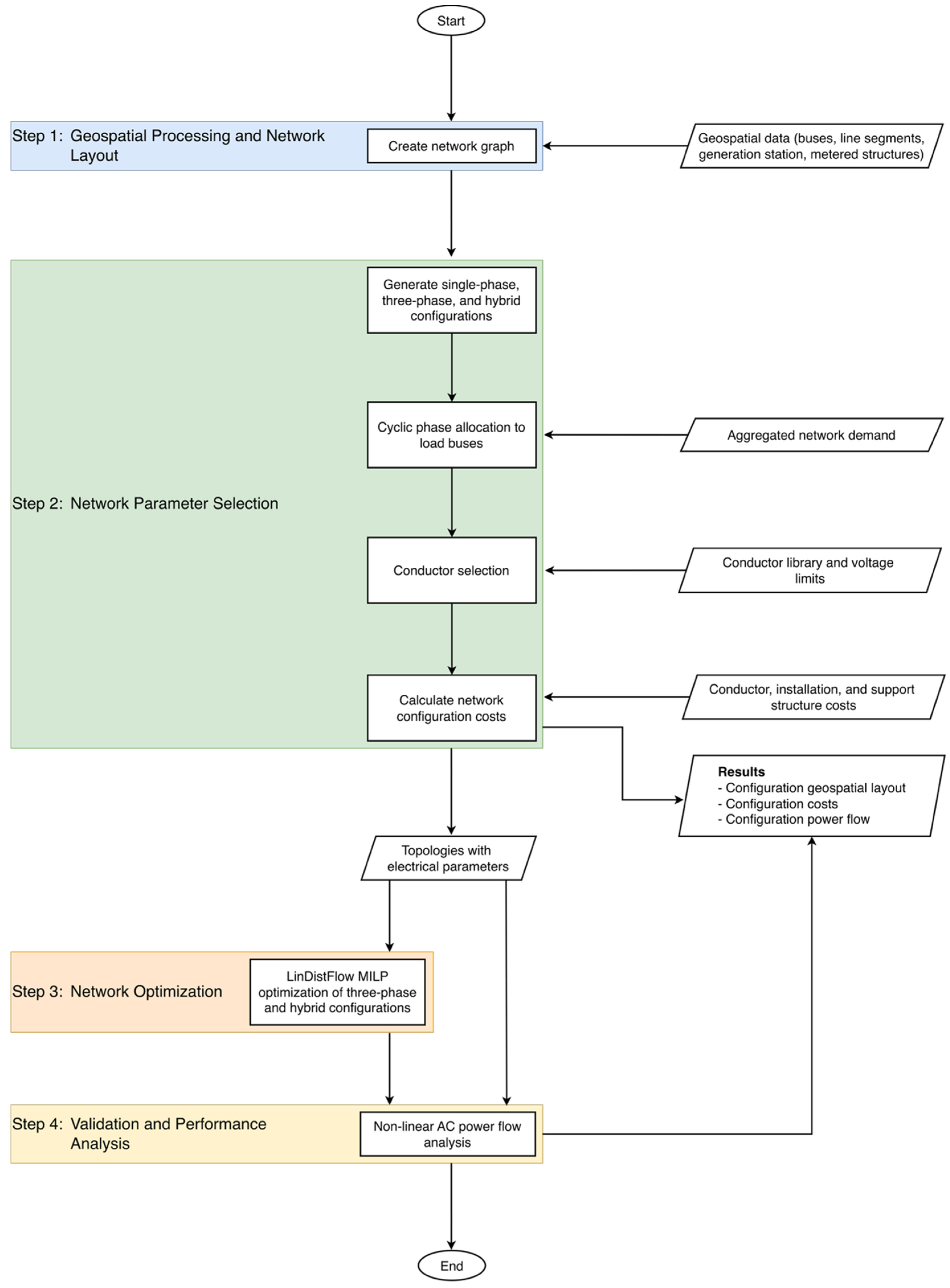
The automated workflow for low-voltage mini-grid design incorporates four major processes as illustrated in Figure 1: (1) geospatial processing and network layout, (2) network parameter selection, (3) network optimization, (4) validation and performance analysis. This integrated workflow transforms raw geospatial data into multiple, technically analyzed, validated, and cost-optimal network designs to permit a systematic techno-economic comparison, as presented in Figure 1.

2.1. Step 1: Geospatial Processing and Network Layout

Geospatial processing begins by constructing a directed network graph, G =   N ,   S , from the geospatial data layers of the power plant, poles, lines, and the metered structures and connecting service lines from a standard Coordinate Reference System (CRS). Set N represents electrical buses and set S represents line segments connecting an upstream bus h s N to a downstream bus t s N (with h for the head bus and t for the tail bus). Each line segment s has a Euclidean geometric length d s that is calculated between its head bus h s and tail bus t s . Line segments have a categorical attribute to define network hierarchy according to:
  • Main feeder: primary high-capacity backbone from the source;
  • Lateral: lower-capacity line that branches from the main feeder to provide power to loads.
The bus nearest to the power plant is designated as the source bus, n o , and establishes the voltage reference for the network. A connectivity check corrects geospatial inaccuracies to ensure a continuous radial network.

2.2. Step 2: Network Parameter Selection

This step generates network parameters for single-phase, three-phase, and hybrid configurations. The hybrid configuration designates main feeders as three-phase and laterals as single-phase, while the other two configurations apply a uniform phasing topology across the entire graph network. The aggregate network demand is assigned equally to all metered structures, defining the active power demand P l for each load. The corresponding reactive power is computed using Equation (1), where cos θ m i n is the minimum allowable power factor.
Q l = P l × tan cos 1 cos θ m i n
For three-phase and hybrid designs, a standard heuristic cyclic load allocation algorithm distributes loads by sequentially assigning each load to a phase in a repeating pattern (A B C A …), providing a baseline phase allocation without the high computational cost of formal optimization [62].
An iterative algorithm then selects a conductor for each network path from a predefined library. A path represents the sequence of line segments and buses that form the main feeders and laterals. The algorithm employs a hierarchical voltage-drop strategy, allocating the total permissible voltage drop, V m a x , across the network, and assigns a larger portion of the voltage drop, V m s m a x , to the main feeders because they carry cumulative power over longer distances, with a smaller voltage drop, V l a t m a x , allocated for the shorter laterals serving fewer end-users. For instance, the algorithm might allocate a 6% total voltage drop by assigning 4% to main feeders and 2% to laterals, per Equation (2). Voltage drops are reported relative to the nominal system voltage; therefore V r e f = V L L n o m is used for three-phase specifications, while V r e f = V L N n o m is used for single-phase paths.
V m s m a x V r e f + V l a t m a x V r e f V m a x %     w i t h     V r e f = V L N n o m         for   1 ϕ V L L n o m       for   3 ϕ  
The total active power for a path, P p a t h t o t , is calculated as the sum of all downstream loads served by that path using Equation (3):
P p a t h t o t = l d s u b P l
Path lengths are defined in Equations (4) and (5). A tolerance factor, T F , accounts for sag in overhead lines, joints in undergrounds systems, and routing uncertainty:
d p a t h t o t = s p a t h d s
d p a t h e f f = 1 + T F d p a t h t o t
The current levels for conductor sizing use P p a t h t o t scaled by a load growth factor, L G F , to equate the expected system demand at the target year planning horizon. The current equations for single-phase and three-phase paths are presented in Equations (6) and (7), respectively.
I p a t h 1 ϕ = L G F × P p a t h t o t V L N n o m × cos θ m i n
I p a t h 3 ϕ = L G F × P p a t h t o t 3   × V L L n o m × cos θ m i n
Candidate conductors from a conductor library are screened against two criteria: voltage drop and thermal limits. Voltage drop along a path is a function of current, impedance, length, and the number of parallel conductors as evaluated in Equations (8)–(10) [63,64,65]. The effective impedance, Z e f f , of a candidate conductor is first calculated using the positive sequence resistance, r s , and reactance, x s .
Z e f f = r s cos θ m i n + x s sin θ m i n
The voltage drop for single-phase and three-phase paths is then approximated using Equations (9) and (10), where n p a r is the number of parallel conductors per phase.
V p a t h 1 ϕ 2 × I p a t h 1 ϕ × Z e f f ×   d p a t h e f f   n p a r
V p a t h 3 ϕ 3 × I p a t h 3 ϕ × Z e f f ×   d p a t h e f f   n p a r
The number of parallel conductors per phase, n p a r , is determined from Equations (11) and (12), where n p a r = n p a r 1 ϕ is for a single-phase path and n p a r = n p a r 3 ϕ is for a three-phase path, such that n p a r n p a r m a x , where n p a r m a x represents the maximum number of conductors that is physically feasible to install.
n p a r 1 ϕ = 2 × I p a t h 1 ϕ × Z e f f × d p a t h e f f V L N n o m × V p a t h 1 ϕ
n p a r 3 ϕ = 3 × I p a t h 3 ϕ × Z e f f × d p a t h e f f V L L n o m × V p a t h 3 ϕ
Each path in the network is independently assigned a unique conductor size. The selected conductor(s) are then checked for compliance with thermal limits to prevent overheating. This requirement is enforced using Equation (13), where I s a m p is the maximum current flow along the given path, I l i b a m p is the rated ampacity of the selected conductor, and S F is the safety factor applied to account for short-circuit and thermal stress. If the thermal criterion is not satisfied, the algorithm automatically selects the next available conductor size from the library until the condition is met.
max s path I s a m p I l i b a m p × n p a r S F   with   n p a r = n p a r 1 ϕ       for   1 ϕ n p a r 3 ϕ           for   3 ϕ  
Each network path is then assigned a conductor procurement cost based on the conductor type, conductor size, and the effective path length. The cost for each path is computed using Equation (14), where C c o n d is the per-unit distance-cost of the selected conductor, n p a r is the number of parallel conductors per phase, and d p a t h e f f is the effective path length from Equation (5).
C p a t h = d p a t h e f f × C c o n d × n p a r
The total cost of conductors for the network, C c o n d t o t , is then determined by summing up the costs of every individual path, C p a t h , using Equation (15).
C c o n d t o t = P a t h s C p a t h
Other project costs such as installation, labor, metering, and soft costs (engineering and project development) are calculated based on the conductor costs [5,6]. The cost per path can be used to calculate total capital cost for the remaining parts of the distribution network using secondary data on the typical percentage breakdown of total project costs for trenching, civil works, protection and metering equipment, installation hardware, consumer-side wiring, and associated logistical requirements. Public data reported on project costs place conductor materials as 30–40% of total distribution network costs, while civil works and installation typically are 40–55% of total costs, protection and metering 5–12%, and soft costs and logistics 10–20% [3,5,6]. Values from these reports enable the use of power engineering results to estimate the total costs of the low-voltage distribution network by assuming a cost breakdown of 35% for conductors, 40% for civil works and installation, 10% for protection and metering, and 15% for soft costs and logistics. This enables Equation (16) to be used to calculate the total capital cost for the distribution network based on the conductor costs and Equation (17) to be used to calculate costs of the other three major budget items based on the total capital cost for the distribution network.
C d i s t = C c o n d t o t 35 %
C i = β i × C d i s t

2.3. Step 3: Network Optimization

The heuristic designs from Step 2 satisfy technical constraints but may not be optimal for the three-phase and hybrid configurations where phase imbalances can degrade power quality and increase system losses [16]. This problem is addressed using a linearized LinDistFlow [66] MILP formulation that assigns loads and laterals to single phases to produce an optimized network configuration that minimizes the overall phase load imbalance across the network.
MILP was selected as the optimization approach due to its versatility and proven successes in distribution network optimization tasks such as optimal feeder routing [67,68], network reconfiguration [69,70,71], and distributed generation siting [72]. Additionally, MILP has been successfully applied to phase-balancing problems in existing systems to minimize losses and improve load distribution [73,74,75]. The principal strength of MILP is in its ability to deterministically find optimal solutions for problems involving both discrete decisions and continuous variables, making it particularly well-suited to the automated design framework.
The optimization step focuses on phase assignment for the three-phase and hybrid configurations while keeping the network layout and conductor selections fixed from Step 2. This design choice keeps the MILP computationally tractable and isolates the impact of phase allocation on voltage regulation, losses, and unbalance. As with most mixed-integer programs, solve time can increase with feeder size and the number of binary phase-assignment variables; therefore, the MILP is not used here to also optimize routing or conductor sizing. Importantly, because the optimization relies on a linearized electrical representation, all candidate designs are subsequently validated using nonlinear steady-state AC power flow to confirm compliance with the voltage-drop, loss, and ampacity criteria in Step 4.

2.3.1. Preprocessing and Model Setup

The phase-balancing optimization is applied to only three-phase and hybrid configurations. Network data are converted to a per-unit system using a selected base power S b a s e , nominal line-to-neutral voltage V b a s e =   V L N n o m , and a base impedance computed using Equation (18).
Z b a s e = V b a s e 2 S b a s e
Each single-phase lateral is represented as a lumped load with aggregated active and reactive power in both single-phase systems and hybrid systems. For each three-phase line segment, the per-unit positive sequence resistance and reactance are computed using Equations (19) and (20), respectively.
R s e f f = r s × d s Z b a s e
X s e f f = x s × d s Z b a s e

2.3.2. Model Formulation

The MILP generates optimal phase balancing using four sets of information: three-phase buses ( N 3 ), three-phase line segments ( S 3 ), phases ( P = A ,   B ,   C ), and single-phase loads, including both the individual and aggregated lateral loads for the hybrid configurations. Model inputs are the load demand ( P l ,   Q l ) , line segment impedances ( R s   e f f ,   X s e f f ), operational limits for voltage ( V m a x ,   V m i n ), and the maximum allowable voltage imbalance ( α ). All quantities are expressed in per-unit values. The discrete decision variable for load assignment is a binary, x l , p , which assigns each load l to a phase p . Continuous decision variables are the per-phase power flows ( P s ,   p ,   Q s ,   p ), currents ( I s ,   p ), squared voltage magnitude ( W n ,   p =   V n , p 2 ) at bus n on phase p , and an auxiliary variable ( δ s , p ) that measures the deviation of current on line segment s from the per-phase average.
The objective function seeks to minimize current imbalance across a network by minimizing the total absolute deviation of phase currents from their segment average. This objective is formulated in Equation (21) and constrained by Equation (22).
m i n s   S 3 p P δ s , p
δ s , p I s ,   p 1 P k P I s ,   k ,     s S 3 ,     p P
This formulation is subject to a set of linear constraints governing the network’s physical behavior and operational limits. The discrete phase assignment is constrained by Equation (23).
p P x l , p = 1 ,     l L
Equations (24) and (25) are introduced to ensure the power inflows at each bus equal the power outflows including any local demand.
s : t s = n P s , p s : h s = n P s , p = l : n l = n x l , p P l ,     n N 3 \ n o ,   p P
s : t s = n Q s , p s : h s = n Q s , p = l : n l = n x l , p Q l ,     n N 3 \ n o ,   p P
Equation (26) expresses the voltage drop across each segment using the LinDistFlow approximation [76]. This links the squared voltage at downstream node W t s , p to the voltage at its upstream neighbor W h s , p , where W t s , p =   V t s , p 2 and W h s , p =   V h s , p 2 .
W t s , p = W h s , p 2 R s e f f × P s , p + X s e f f × Q s , p ,     s S 3 , p P
Equations (27) and (28) ensure phase currents and bus voltages remain within the specified limits.
I s , p I s p u ,         s S 3 ,       p P
V m i n 2 W n , p V m a x 2 ,           n N 3 \ n o ,       p P
Equation (29) expresses a constraint on voltage unbalance using a standard definition [77,78] that is nonlinear and thus incompatible with the MILP formulation. A linear surrogate derived from a first-order Taylor expansion in Equation (33) is used in place of Equation (29), where W n ,   a v g = 1 P k P W n ,   k .
V p V a v g V a v g   α *
The MILP-compatible surrogate is obtained by linearizing the squared-voltage term about V a v g . Let V p = V a v g + V . Since W n , p = V p 2 , a first-order Taylor expansion yields Equation (30),
W n , p = V a v g + V 2 V a v g 2 + 2 V a v g × V = W n ,   a v g + 2 V a v g × V
and therefore
W n , p W n ,   a v g 2 V a v g × V
Applying Equation (29) gives V α * V a v g , resulting in Equation (32) and hence Equation (33):
W n , p W n ,   a v g 2 α * × V a v g 2    
W n , p W n ,   a v g 2 α * × W n ,   a v g ,     n N 3 \ n o ,   p P
As a first-order Taylor surrogate, Equation (33) is most accurate for small-to-moderate deviations around nominal, lightly unbalanced conditions and may deviate under extreme imbalance. The surrogate is used solely to preserve MILP tractability, and the final feasibility of candidate designs is enforced through the nonlinear AC power flow validation described in Step 4.
This step of the process is iterative, using a fixed-point approach to resolve the interdependence between load currents and bus voltages. This interdependence arises because currents are computed from specified power and bus voltages I * = S / V , and bus voltages are in turn updated by those currents. Phase currents are updated using bus voltages from the MILP, and a binary search algorithm is embedded to find the smallest admissible α l o w that yields a feasible solution. Convergence is reached when the change in voltage between iterations falls below a predefined tolerance, ϵ V , or after a limit on the iteration count. In each iteration, the binary search converges to its prescribed tolerance before the full MILP is solved, and if the outer loop terminates or the maximum number of iterations k m a x is reached, the algorithm returns the most recent feasible unbalance value α * and corresponding voltage profile. This process is summarized in Algorithm 1.
Algorithm 1. MILP Optimization for Phase Balancing
Requires: network data (topology and impedances), load data ( P l ,   Q l ), convergence tolerance ( ϵ V ), binary search tolerance ( ϵ α ), maximum iterations ( k m a x ), and unbalance bounds [ α m a x ,   α m i n ].
Ensures: optimal phase assignments ( x l , p * ), final voltage profile ( V n , p * ), branch flows ( P s , p * , Q s , p * ), and final unbalance ( α * ).
1:procedure PhaseBalancing
2:  for each node n, phase p do
3:      V n , p k 1.0   p . u .
4:  end for
5:
6:  repeat
7:     V o l d V k
8:     // --- Load Current Update ---
9:     for each load l at node n , phase p do
10:       I l = P l 2 + Q l 2 V n , p k
11:     end for
12:
13:     // --- Binary Search for Minimum Feasible Unbalance ---
14:      α l o w     α m i n , α h i g h     α m a x
15:     while α h i g h   α l o w   >   ϵ α do
16:       α m i d = α l o w + α h i g h 2
17:      Problem   Formulate feasibility MILP with fixed I l and α m i d
18:      if Problem is feasible continue
19:          α h i g h     α m i d
20:      else
21:          α l o w     α m i d
22:      end if
23:     end while
24:      α *   α h i g h // --- Store smallest feasible unbalance for this iteration
25:     // --- Main Optimization Solve ---
26:     Objective  Minimize chosen objective function
27:     Constraints LinDistFlow voltage drop, thermal limits, voltage bounds, and α *
28:     Variable  x l , p I s , p , P s , p , Q s , p , W n , p
29:      x l , p * , W n , p * , P s , p * , Q s , p * Solve full MILP
30:
31:     // --- Voltage Update ---
32:     for each node n , phase p do
33:       V n , p k + 1 W n , p *
34:     end for
35:
36:     // --- Convergence Test ---
37:      V i t e r   m a x n , p V n , p k + 1 V n , p o l d
38:      k     k + 1
39:  until V i t e r   ϵ V   o r   k     k m a x
40:
41:  // --- Return Final Results ---
42:  return α * , x l , p * , V n , p k ,   P s , p * , Q s , p *
43:end procedure
The primary output of the optimization step is a set of optimal phase assignments ( x l , p * ) that define the final optimized network configurations. This information, combined with the line segment specifications from Step 2, provide the complete input for the subsequent power flow validation.

2.4. Step 4: Validation and Performance Analysis

A full nonlinear AC power flow is computed using the Open-source Distribution System Simulator (OpenDSS ) to quantify the performance of the final configurations. The simulation evaluates technical viability by verifying that voltages stay within statutory limits and that no conductor exceeds its rated thermal ampacity. For each viable design, the analysis computes key performance metrics including the operational efficiency of each configuration from total active power losses and voltage stability from the minimum steady-state voltage. The resulting data provides evidence for comparing network topologies and identifying the optimal design strategy.

3. Case Study Data

The developed workflow and optimization were applied to a portfolio of 62 island communities in the Republic of Fiji, which is an archipelago of over 300 islands in the South Pacific. Fiji has three main islands that host independent grids owned by Electricity Fiji Limited (EFL), supplying electricity to over 70% of the population. For the remaining islands, decentralized mini-grids are the primary strategy for rural electrification. Fiji is used as a demonstration dataset that is rich with primary data on many independent communities that are spatially unique. The primary data shared here can also be used to support other scientific or engineering studies thereby advancing a domain that often lacks data by completing and validating new research.
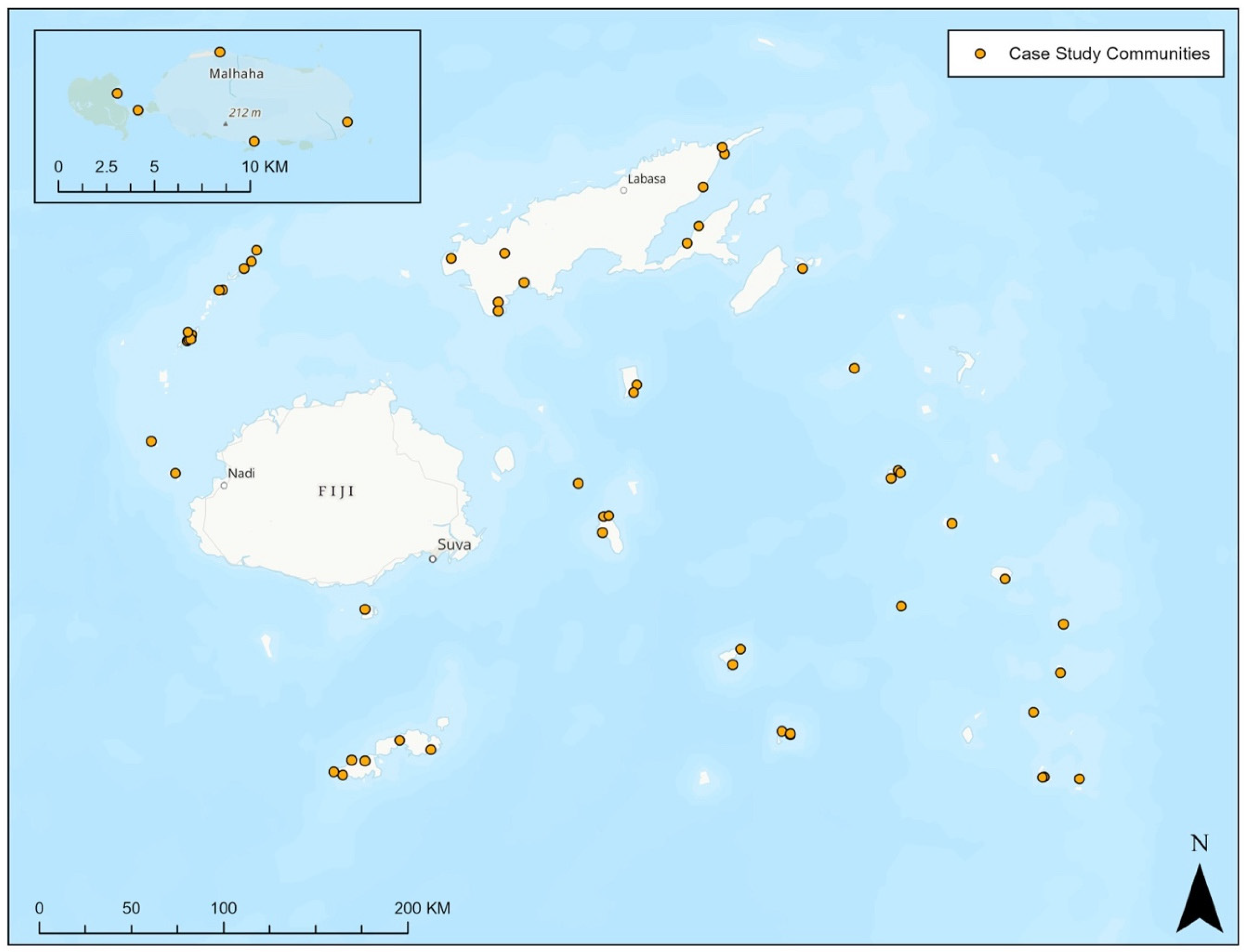
Figure 2 shows the case study dataset of 62 communities that span 17 islands and feature compact settlement patterns of standalone households. This arrangement makes medium-voltage distribution unnecessary and uneconomical, positioning low-voltage networks as the most suitable and cost-effective solution. All networks were designed as underground systems using XLPE-insulated cables to improve resilience against frequent cyclones. Low-voltage designs follow the Australian/New Zealand Standards [79], which is commonplace across Pacific Island Countries (PICs). Key parameters and governing factors are summarized in Table 1. The portfolio is a heterogeneous dataset of communities with varying densities and network sizes that enable broad evaluation of configuration-level trends (single-phase, three-phase, and hybrid) rather than conclusions tied to any single community.
Procurement costs for cables were obtained from local suppliers and expressed in USD to standardize application across the portfolio. Multi-phase paths were designed using standard four-core cables, while single-phase paths were designed using two single-core cables, consistent with design requirements and locally available conductors [79]. These values provided the cable–cost relationship presented in Table 2. The largest conductor size available from procurement data was 150 mm2, which defined the upper limit for cable sizing and associated unit costs in the analysis.

4. Results

4.1. Technically Compliant Sites

4.1.1. Technical Compliance

The algorithms and automated workflow demonstrated a high success rate in producing technically compliant designs across the case study portfolio. Three configurations were assessed: single-phase, three-phase, and hybrid. For the multi-phase designs (three-phase and hybrid), both heuristic and optimized variants were evaluated to compare the cyclic load allocation with MILP-optimized phase allocation. A design was classified as compliant if the minimum network voltage was ≥0.95 p.u. (i.e., maximum voltage drop < 0.05 p.u.), peak-load losses were ≤5% of total generation, and maximum cable loading did not exceed 100% of the rated ampacity [79,80]. These metrics were selected to correspond with standard engineering design practices for constraints on voltage regulation, thermal limits, and loss acceptability in low-voltage networks.
Table 3 summarizes compliance check outcomes across the 62 sites, with all configurations achieving high success rates, ranging from 89% to 95%. Single-phase sites showed the highest compliance rates with valid designs for 59 sites (95%). Three-phase followed with 57 compliant sites (92%) in both heuristic and optimized variants. Hybrid performed slightly lower, with 56 compliant sites in the heuristic case (90%) and 55 with optimization (89%).
Differences in compliance rates were primarily driven by differences in phase allocation methods. In the three-phase configuration, cyclic allocation distributed loads across phases similarly to optimization and therefore optimization did not alter compliance outcomes (recalling that demand was assumed equal across nodes). In contrast, the hybrid configuration required the solver to actively rebalance lateral phases. This additional constraint reduced feasibility in networks with clustered demand or uneven demand distribution, leading to slightly lower compliance rates after optimization. The few non-compliant cases provided useful diagnostics that flagged designs that violated voltage drop, power loss, or ampacity limits, thereby highlighting sites that warranted more engineering review.

4.1.2. Technical Results

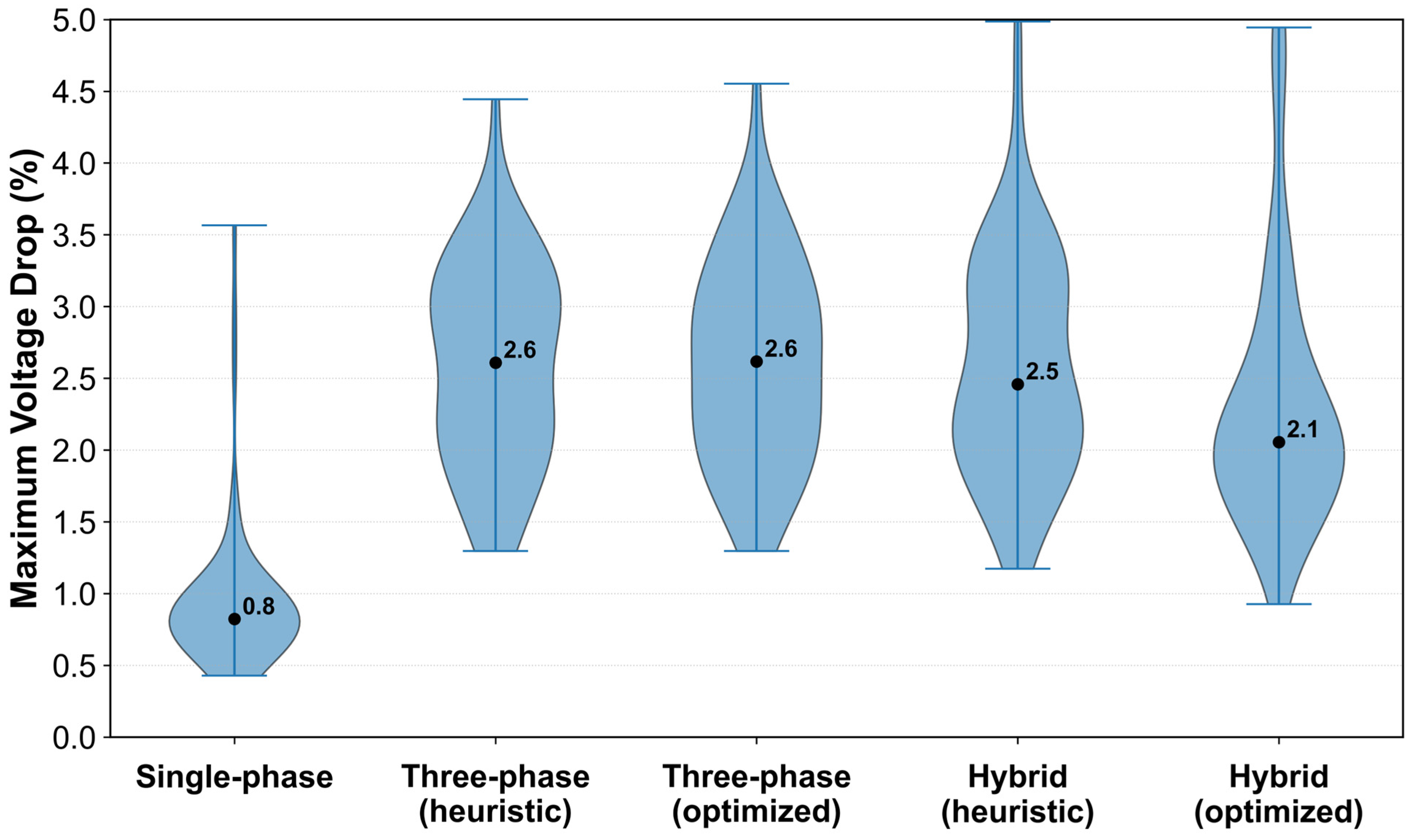
Figure 3 provides a comparison of voltage drop across all technically compliant sites and configurations. Violin plots were used to display the distribution of observations across the portfolio of sites because this can reveal potential multi-modal densities and skewness in the distribution, which enhances the inferences that can be drawn. When comparing the compliant sites for each configuration and including the optimized variants, single-phase designs recorded the lowest median voltage drop (0.8%) as a result of the voltage-driven oversizing required meeting the limit of a 5% voltage drop. In contrast, three-phase and hybrid configurations exhibited higher voltage drops ranging from approximately 0.9 to 5.0%. The hybrid configuration benefitted most from optimization, with the phase-reallocation method reducing a median voltage drop from 2.5% to 2.1%, representing an average improvement of about 16% across the portfolio without any change in conductor size. Optimization therefore improved current symmetry and voltage quality through phase balancing without any additional material use (or cost).
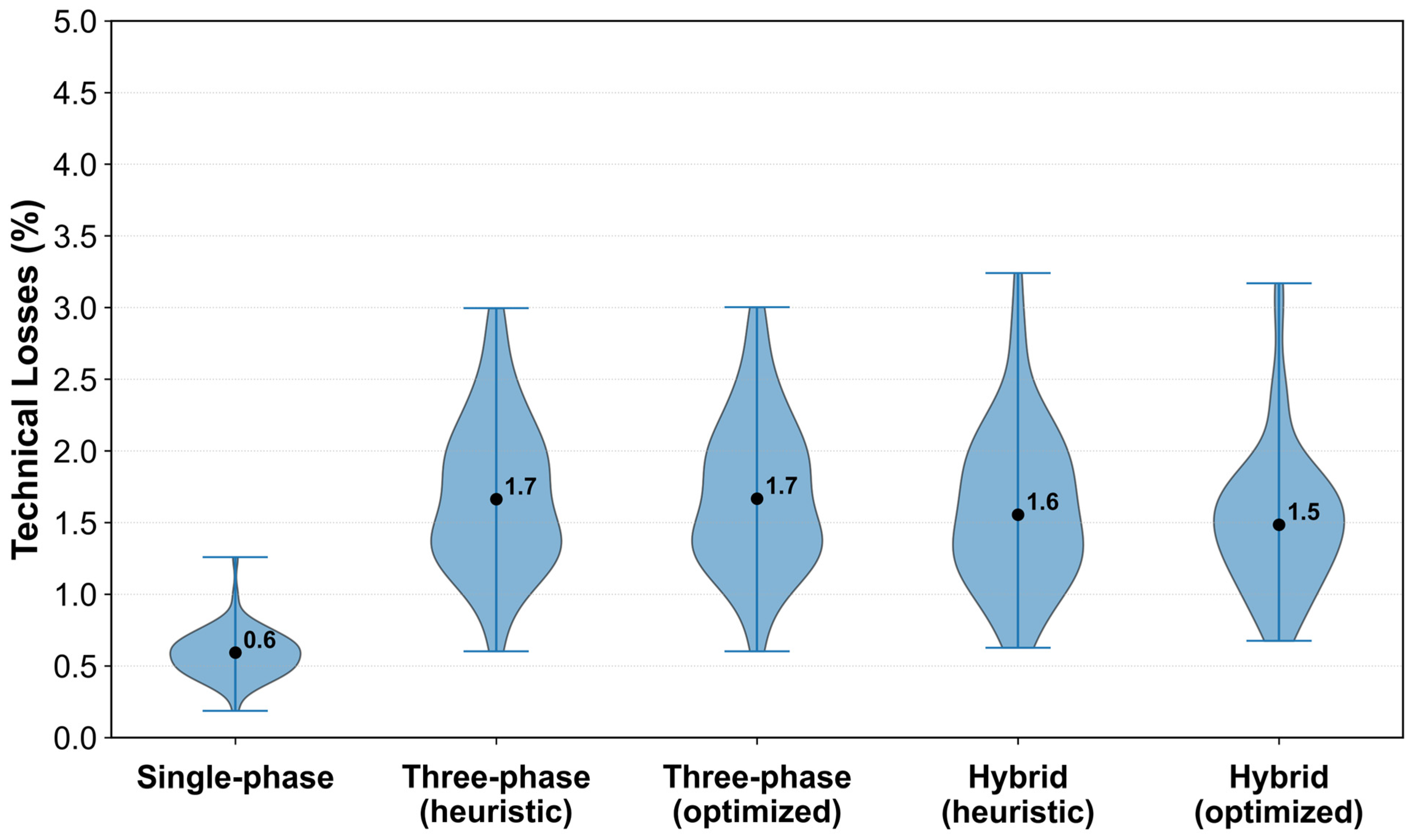
Technical losses followed a similar trend, as shown in Figure 4. Single-phase networks exhibited the lowest median losses (0.6%) because the larger conductors required to meet voltage-drop constraints produced lower impedance. Three-phase and hybrid configurations incurred slightly higher median losses of 1.5–1.7% with maximum values near 3.3%, still within the 5% limit. Optimization did not significantly change the magnitude of technical losses but reduced their dispersion in the hybrid configuration, indicating that the solver improved uniformity in electrical efficiency across diverse site conditions.
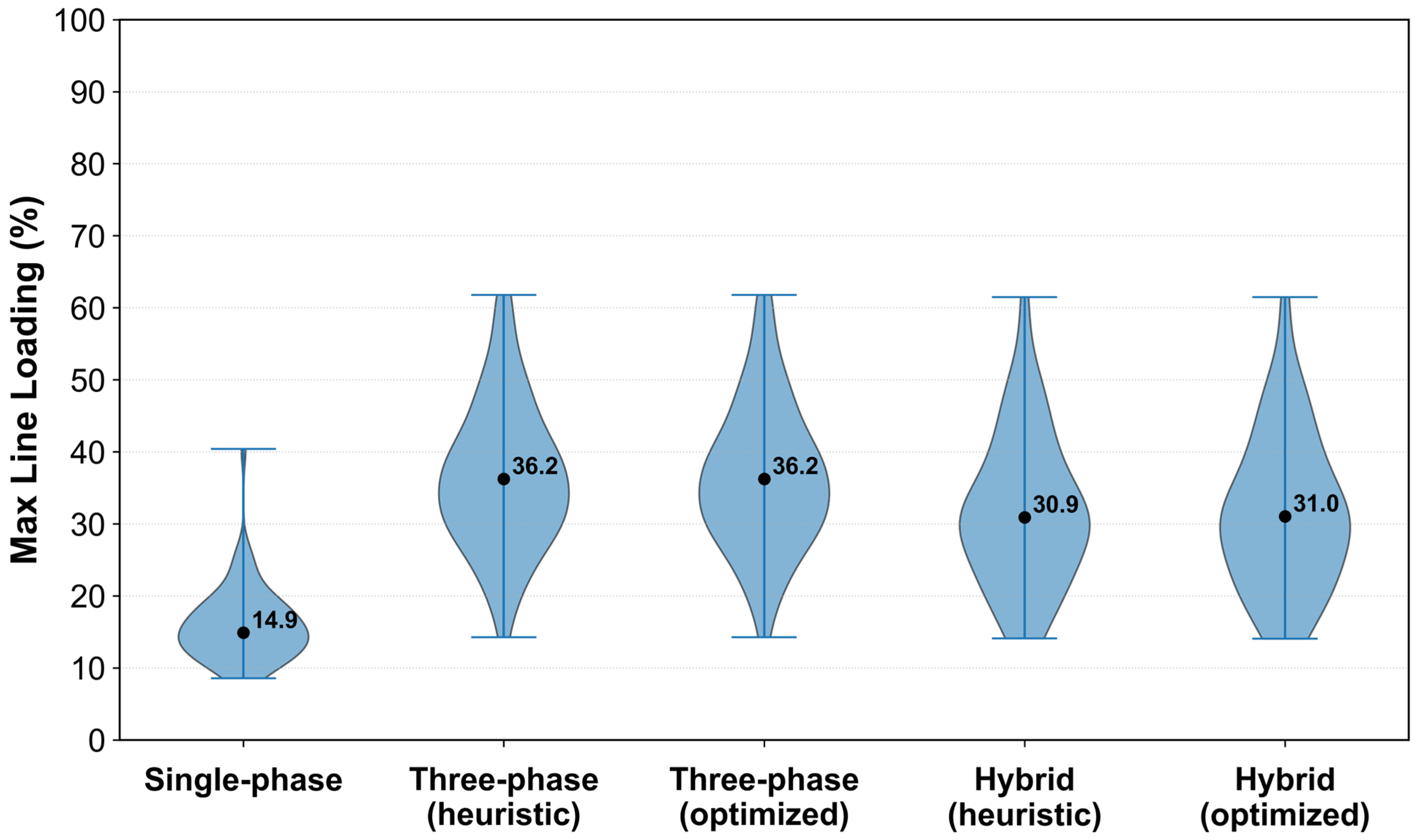
Figure 5 shows the relationship between conductor sizing and utilization. Single-phase networks operated far below rated ampacity, with a median loading of 15%, confirming that the voltage-driven oversizing led to under-utilization of installed capacity. In contrast, three-phase and hybrid networks operated at higher average loading levels between 31 and 36% and a max loading level of about 62%, which demonstrated more efficient use of the selected conductors. The similarity between the heuristic and optimized cases confirmed that optimization redistributed currents among phases without increasing thermal stress or altering overall capacity margins.
These results demonstrated that single-phase designs achieved compliance primarily through oversizing, whereas multi-phase configurations achieved comparable or improved technical outcomes with multi-phase lines and optimized phase balancing. Optimization routines enhanced voltage regulation and electrical uniformity, particularly in hybrid networks, while maintaining acceptable losses and loading. These physical differences in sizing and utilization formed the basis for subsequent economic analysis, with implications reflected in capital investment requirements.

4.1.3. Economic Analysis

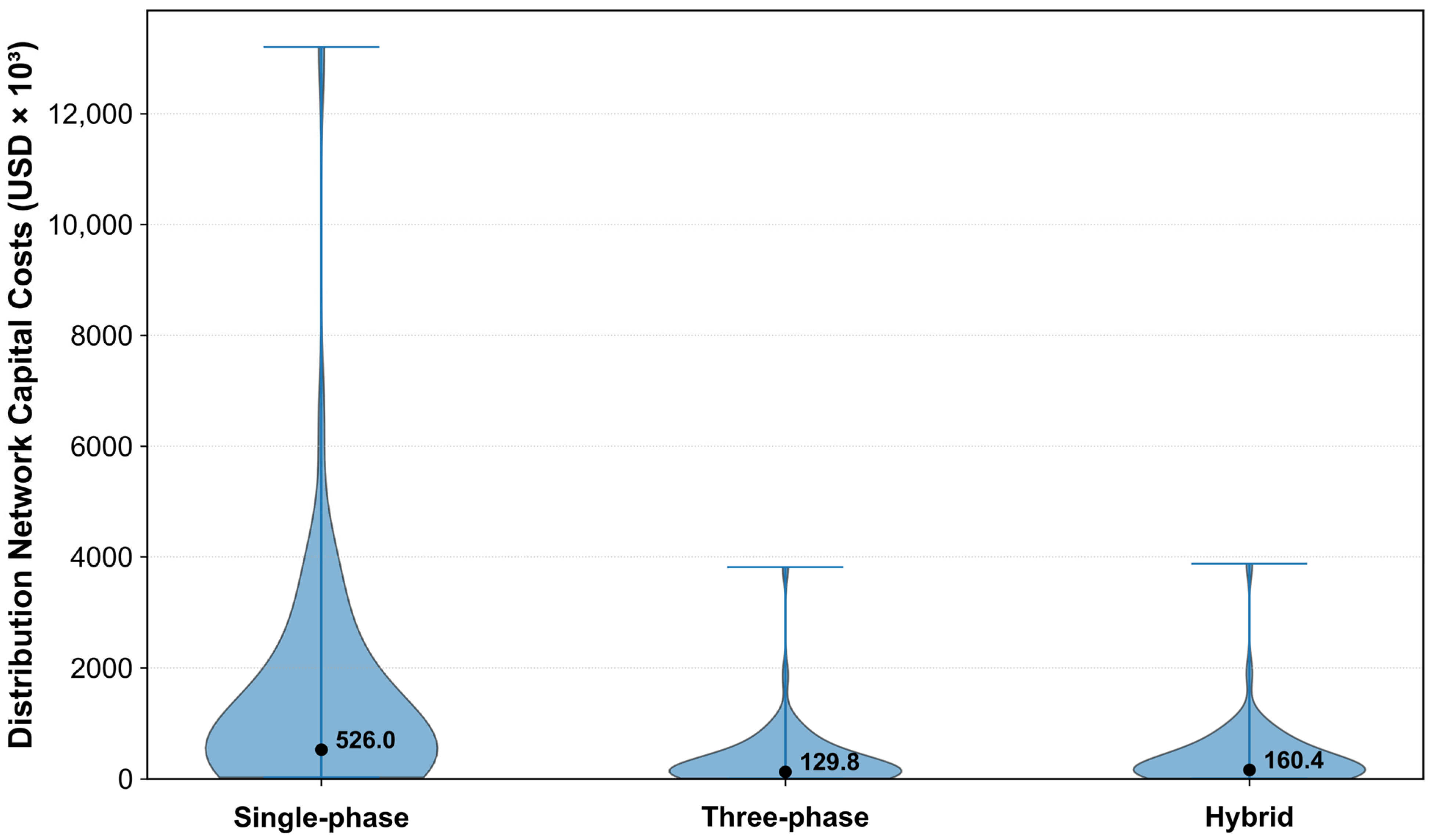
Total distribution costs were estimated by combining capital expenditures for cabling with related and relative costs for civil works and installation, protection and metering, and soft costs and logistics as introduced in Equations (14)–(16). Network cabling costs were first computed using Equation (14) based on the selected cables, path lengths, and number of parallel conductors, with the remaining costs of the distribution network calculated using Equations (15) and (16). Summary statistics for the median of each budget element and total costs are reported in Table 4, with Figure 6 providing a visual summary of the cost distributions across all technically compliant sites.
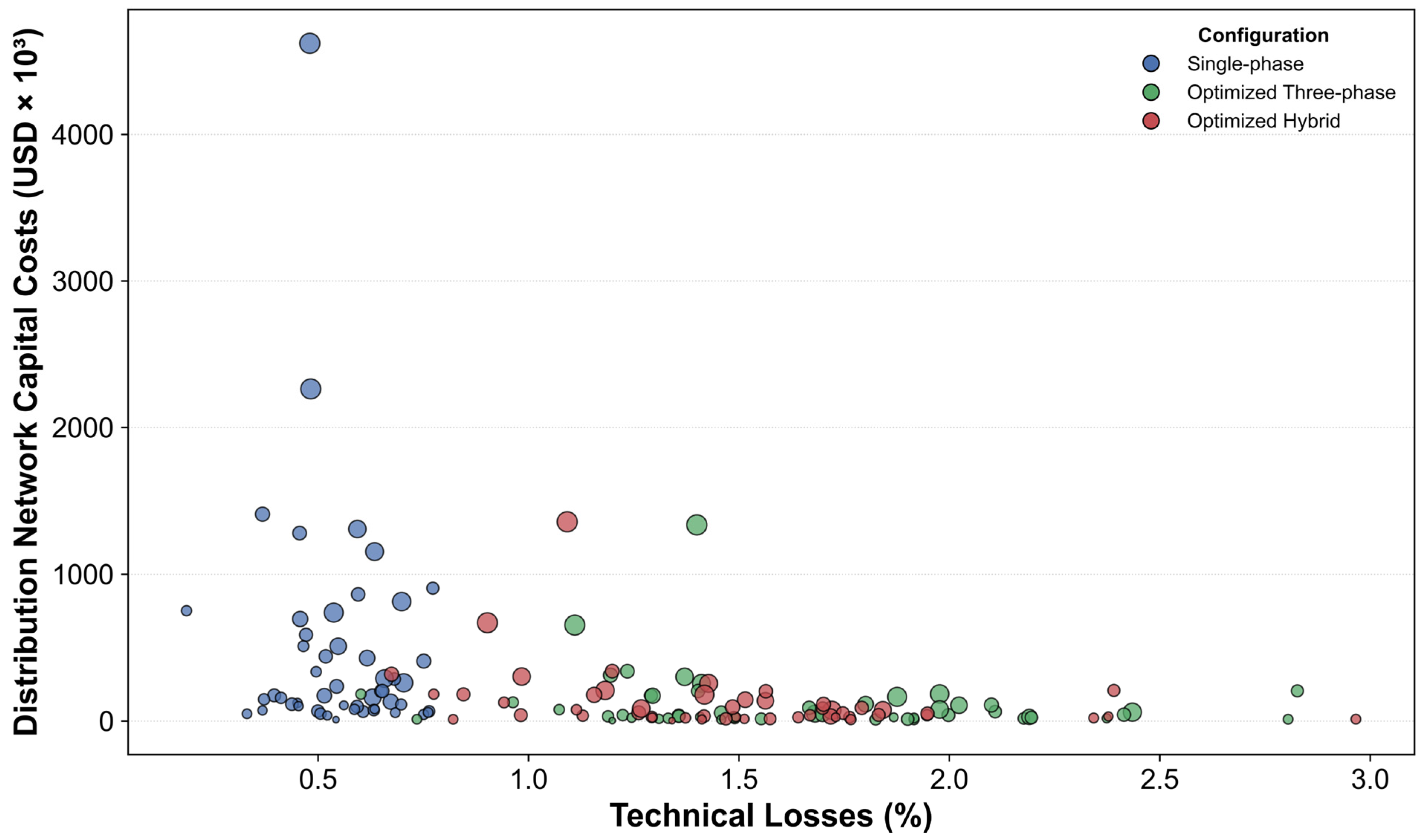
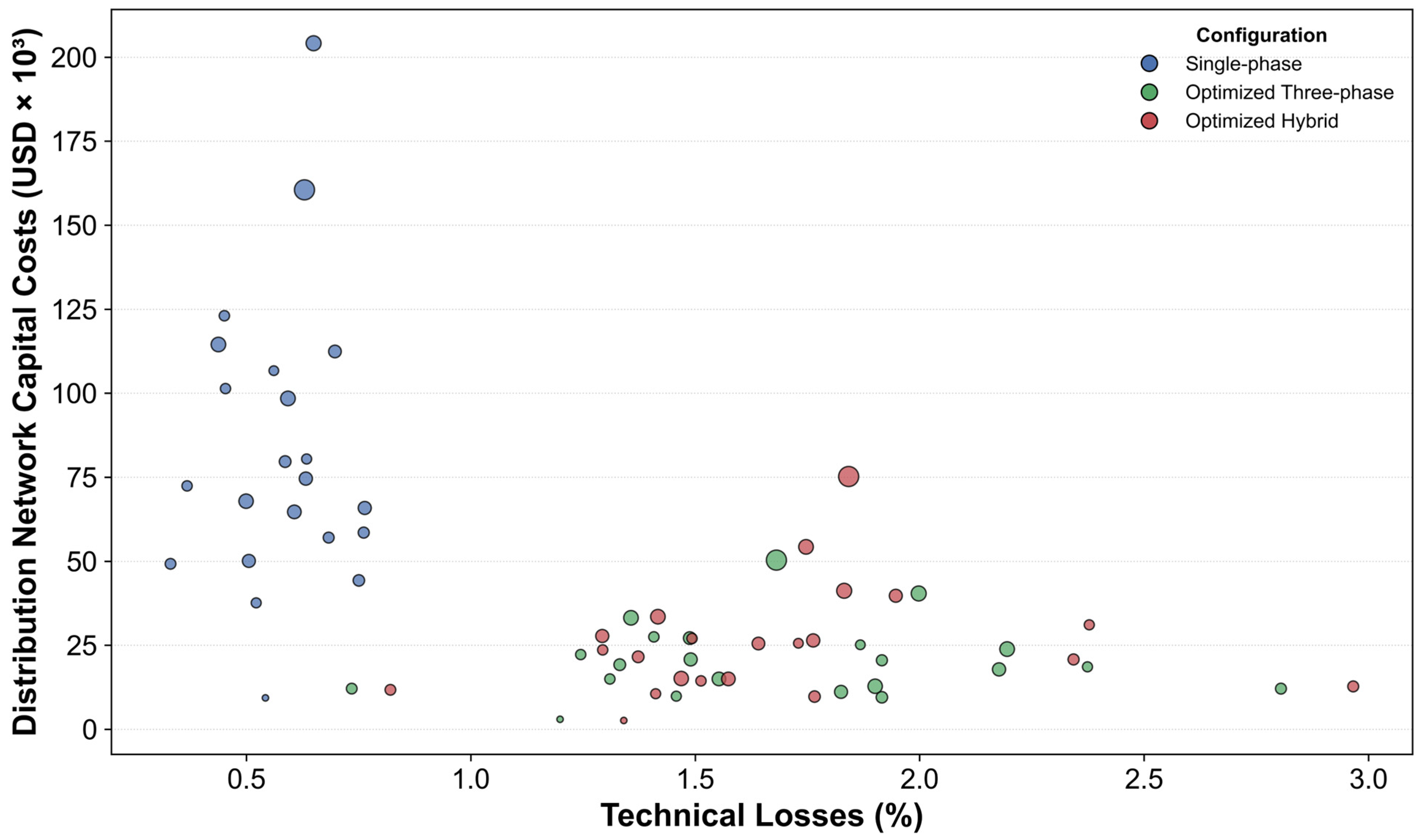
Single-phase designs incurred the highest costs across all configurations. The median single-phase network required a total low-voltage distribution investment of 526,000 USD, compared with 129,800 USD for the three-phase configuration and 160,400 USD for the hybrid design (Table 4). This difference arose because the high cabling requirement in the single-phase case (184,100 USD) drove the higher associated civil works and installation costs (210,400 USD) and higher protection and metering and soft costs (52,600 USD and 78,900 USD, respectively). In contrast, the three-phase and hybrid configurations combined lower cabling expenditures (45,430 USD and 56,140 USD) with proportionally smaller non-cable components, resulting in total costs that were roughly one-quarter to one-third of the single-phase total. Figure 6 presents the cost distributions across all technically compliant sites, confirming that the cost advantage of multi-phase designs persisted with full distribution network costs considered. Figure 7 visualizes the joint effects of CAPEX, peak load, and technical losses for all technically compliant sites. Each point represents a site-level design, and the bubble size scales with demand. Single-phase delivers the lowest losses but shows very large CAPEX variability, including extreme high-cost outliers. It is also apparent that minimum losses do not correspond to minimum CAPEX. CAPEX generally increases with peak load, but single-phase scales more steeply and inconsistently. The next section extends this comparison to the subset of physically feasible designs to determine whether these relative advantages of multi-phase designs persisted when construction constraints were imposed.
A consistent hierarchy emerged in the network configuration types across the portfolio of sites. Single-phase networks achieved technical compliance primarily through voltage-driven conductor oversizing, which systematically resulted in low ampacity utilization (median loading near 15%) and higher total CAPEX. In contrast, three-phase and hybrid networks met the same voltage-drop and ampacity constraints with higher conductor utilization (median loading roughly 31–36%) and substantially lower total distribution CAPEX (approximately one-quarter to one-third of the single-phase median). Phase-balancing optimization yielded the strongest portfolio-wide benefit in hybrid networks by improving voltage regulation and reducing unbalance without changes in conductor size, indicating that performance gains were achieved through current redistribution rather than additional conductor material.

4.2. Physically Feasible Sites

4.2.1. Physical Feasibility

Technical compliance alone did not guarantee the physical feasibility of construction. A second screening evaluated whether each design satisfied practical construction limits. A design was considered physically feasible if no more than three parallel cables per phase ( n p a r 3 ) were required, thereby avoiding severe ampacity derating from mutual heating and the escalating costs of associated civil works. The constraint on the number of parallel conductors can be adjusted based on local codes, supply availability, and developer preference. This screening focused on the main feeders because they carried the highest currents that governed overall system feasibility. Parallel conductors were not permitted for the laterals because they served small, localized low-demand clusters with limited span length, typical for off-grid mini-grids.
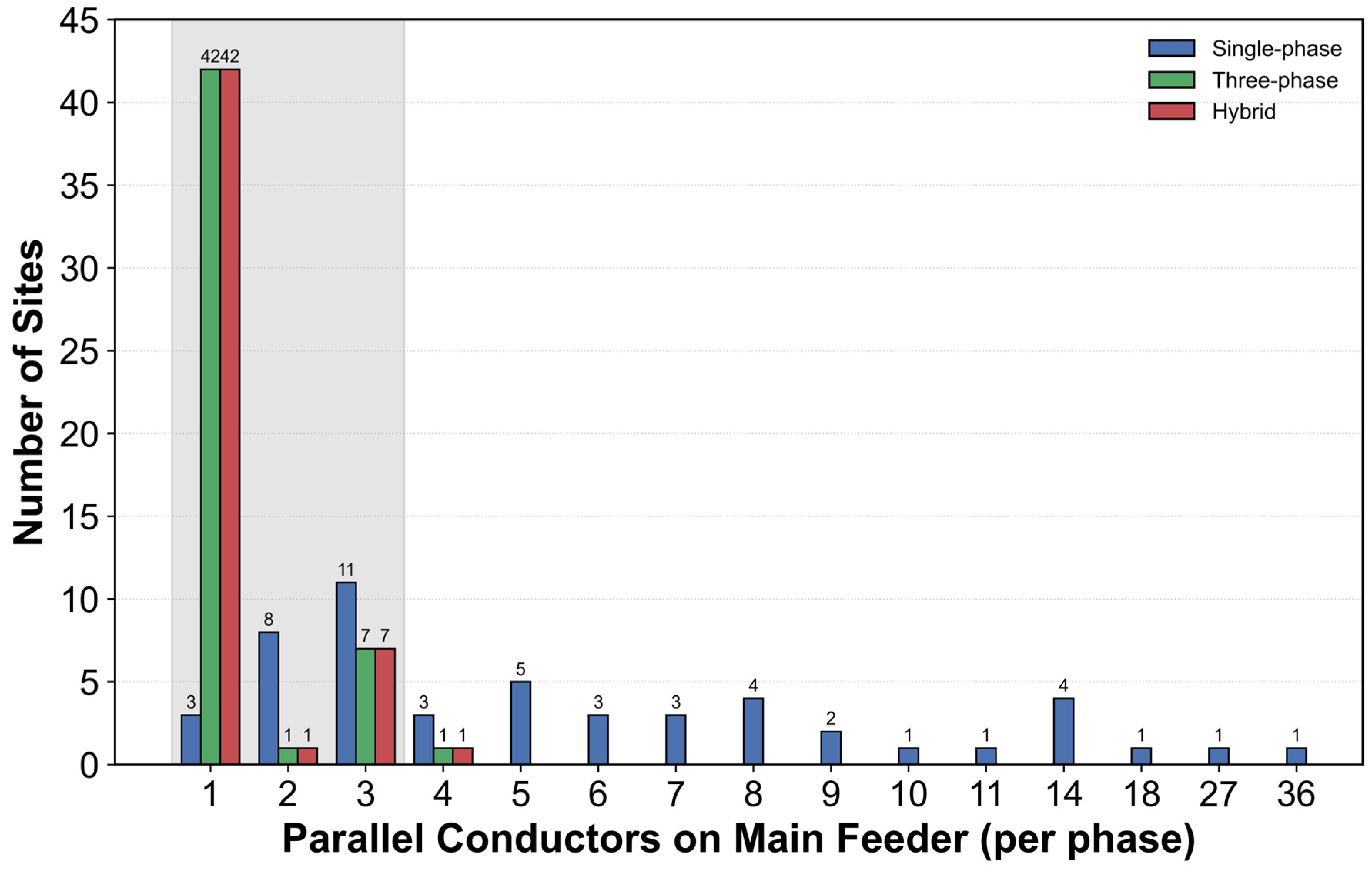
The feasibility screening considered a common set of 51 sites that produced technically compliant designs under all three configurations to ensure consistent comparison. Figure 8 shows the distribution of parallel conductors per phase. Single-phase designs performed poorly, with only 22 out of 51 sites (43%) determined to be feasible. Three-phase and hybrid designs performed far better, with 50 out of 51 sites (98%) meeting practical feasibility requirements. These results showed that while single-phase networks achieved high technical compliance, they frequently failed at achieving practical construction limits. Multi-phase networks met both technical and construction feasibility requirements under the same voltage-drop and ampacity constraints.

4.2.2. Technical Results

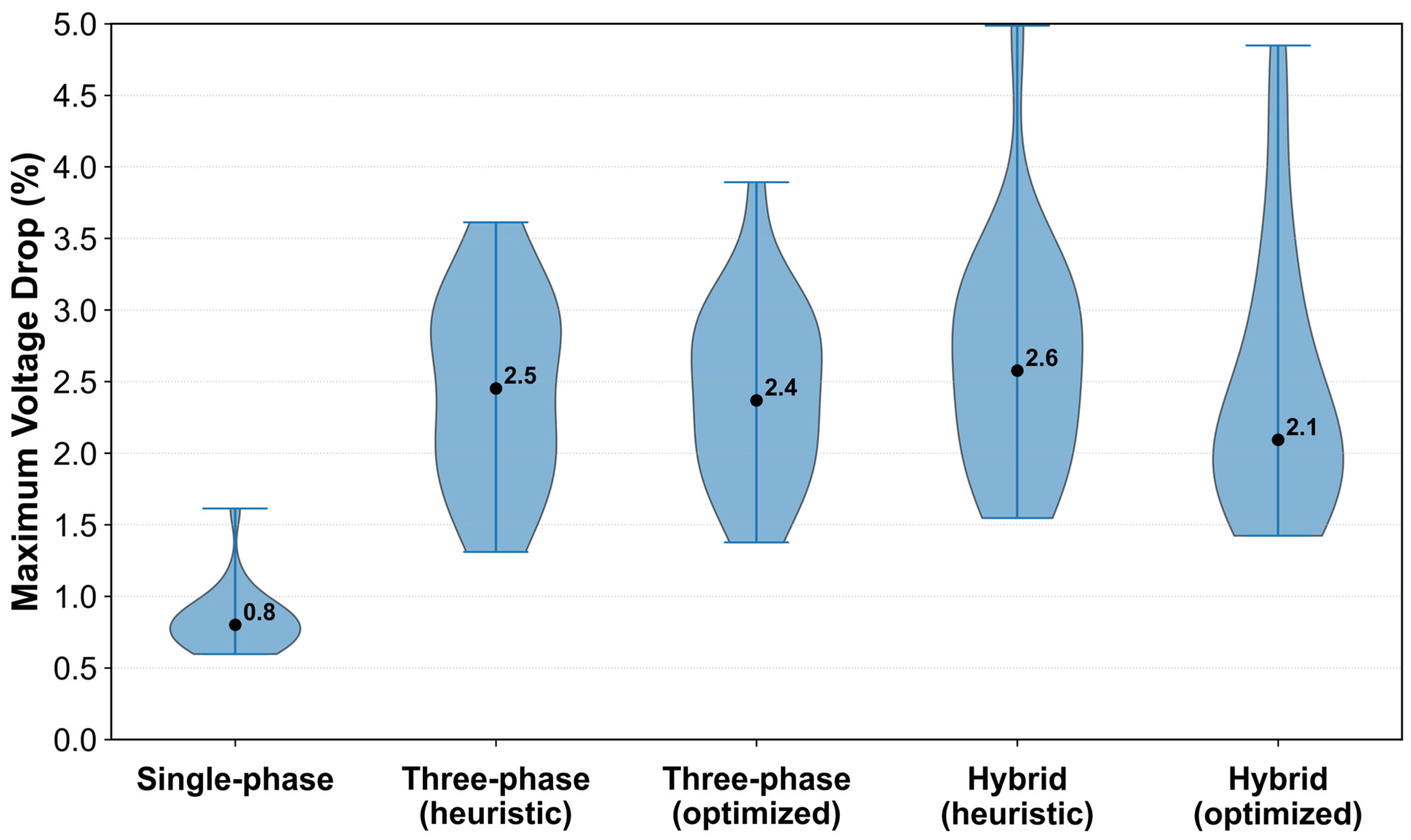
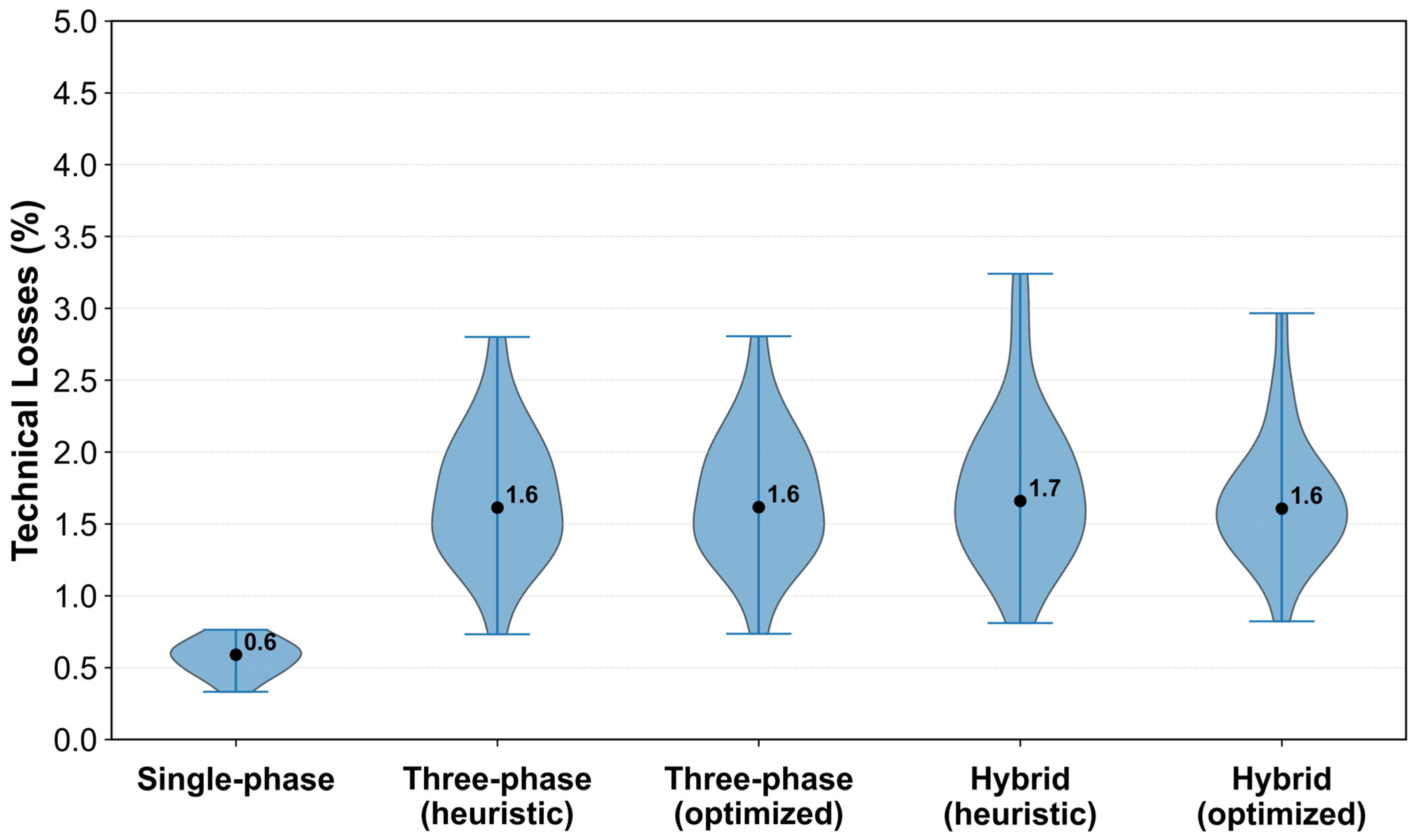
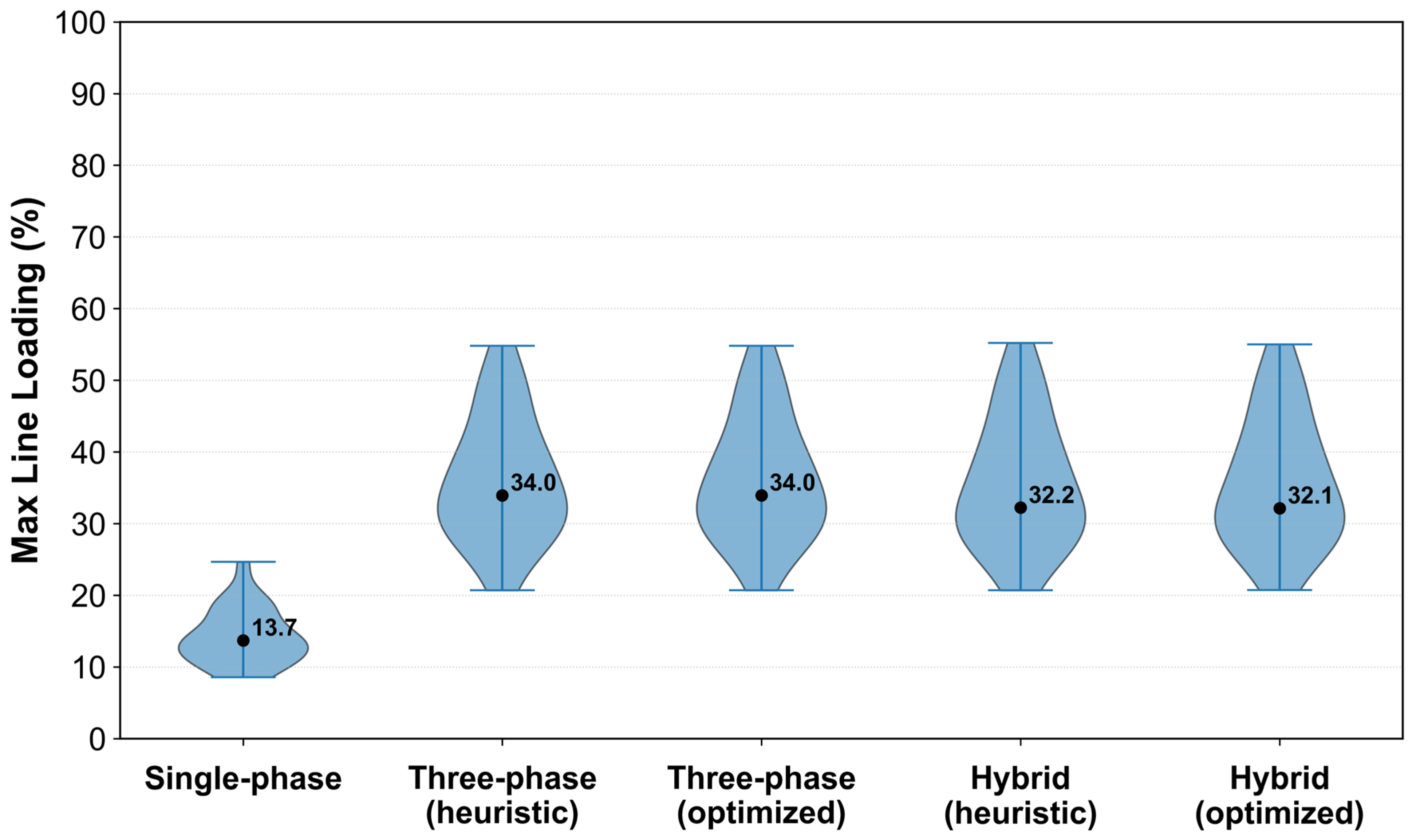
This analysis examined whether the configuration-level trends observed in Section 4.1 remained consistent once physically impractical layouts were excluded. The focus was on the 22 sites that satisfied both technical compliance and construction feasibility criteria across all three configuration types. Across the feasible subset, the resulting voltage-drop, technical loss, and loading trends followed the same hierarchy observed in the technically compliant portfolio. As shown in Figure 9, the single-phase baseline maintained the lowest median voltage drop at 0.8%, while the three-phase and hybrid configurations produced medians ranging from 2.1% and 2.6%. Figure 10 shows that median technical losses were 0.6% for the single-phase case and 1.6–1.7% for multi-phase variants. Figure 11 shows corresponding loading results with single-phase feeders operating at approximately 13.7% of rated ampacity, compared with 32.1–34.0% for multi-phase variants. These results confirmed that the configuration-level performance hierarchy remained unchanged under practical construction constraints.

4.2.3. Economic Analysis

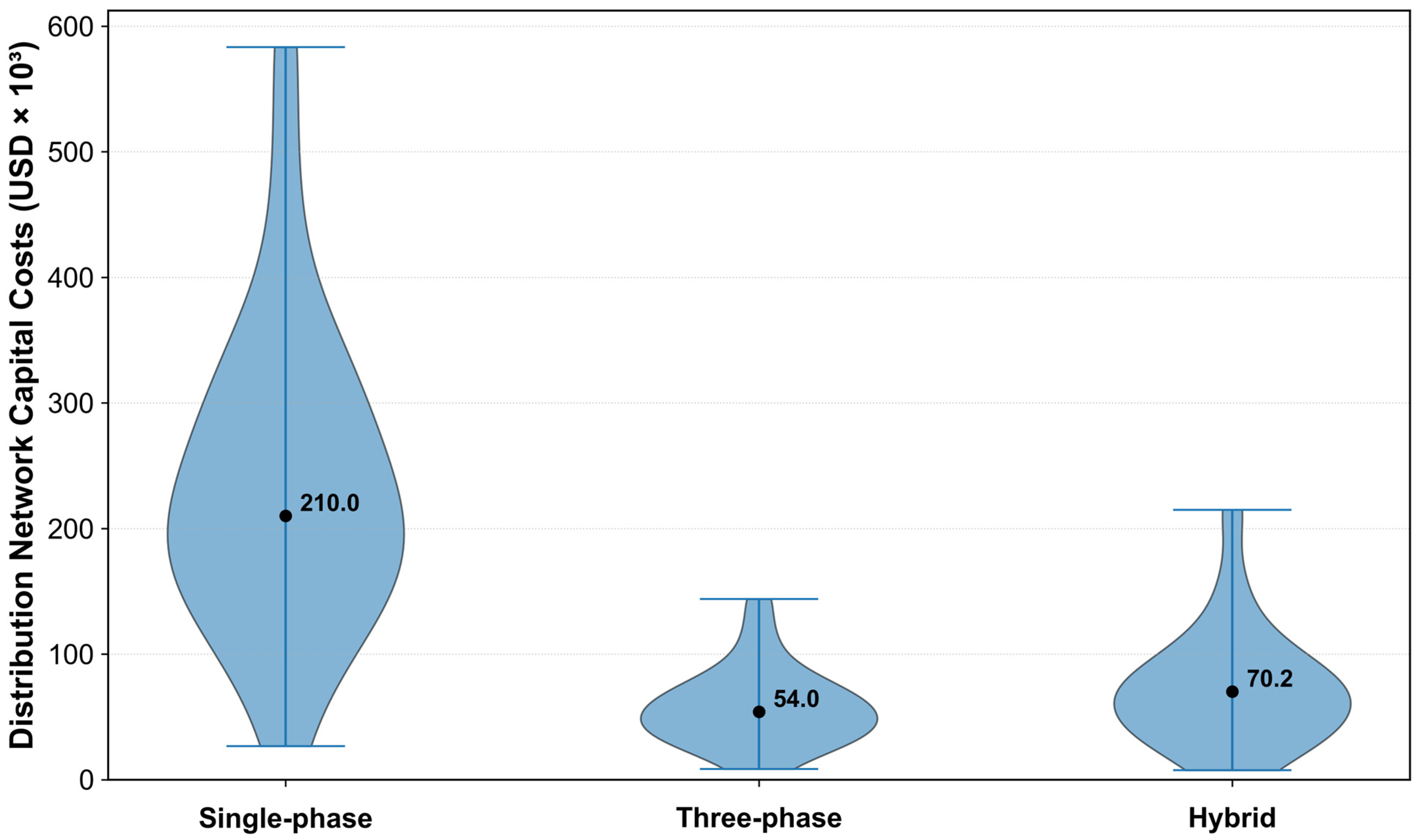
Capital costs for the 22 physically feasible sites are summarized in Figure 12 and the median of each budget element is presented in Table 5. Single-phase designs remained the most expensive configuration, with a median total low-voltage distribution cost of 210,000 USD. The three-phase and hybrid configurations required substantially lower investment, with median total low-voltage distribution costs of 54,000 USD and 70,200 USD, respectively. Enforcing construction feasibility therefore did not alter the economic ranking established in the technical analysis: single-phase networks remained the highest-cost option, whereas the multi-phase configurations retained a clear economic advantage. Figure 13 visualizes the joint effects of CAPEX, peak load, and technical losses for physically feasible sites. Filtering out sites for construction feasibility removes extreme high-CAPEX solutions and compresses the distribution of costs. Optimized three-phase and hybrid designs dominate the low-CAPEX region. Single-phase remains the configuration with the lowest losses. The technically feasible subset also shows a clearer relationship between CAPEX and peak load. The feasible three-phase and hybrid networks achieved technically compliant and economically viable designs, demonstrating that their efficiency persisted once construction constraints were applied. These results establish multi-phase systems as practical and cost-resilient design options for low-voltage distribution planning.

4.3. Results for Selected Example Site

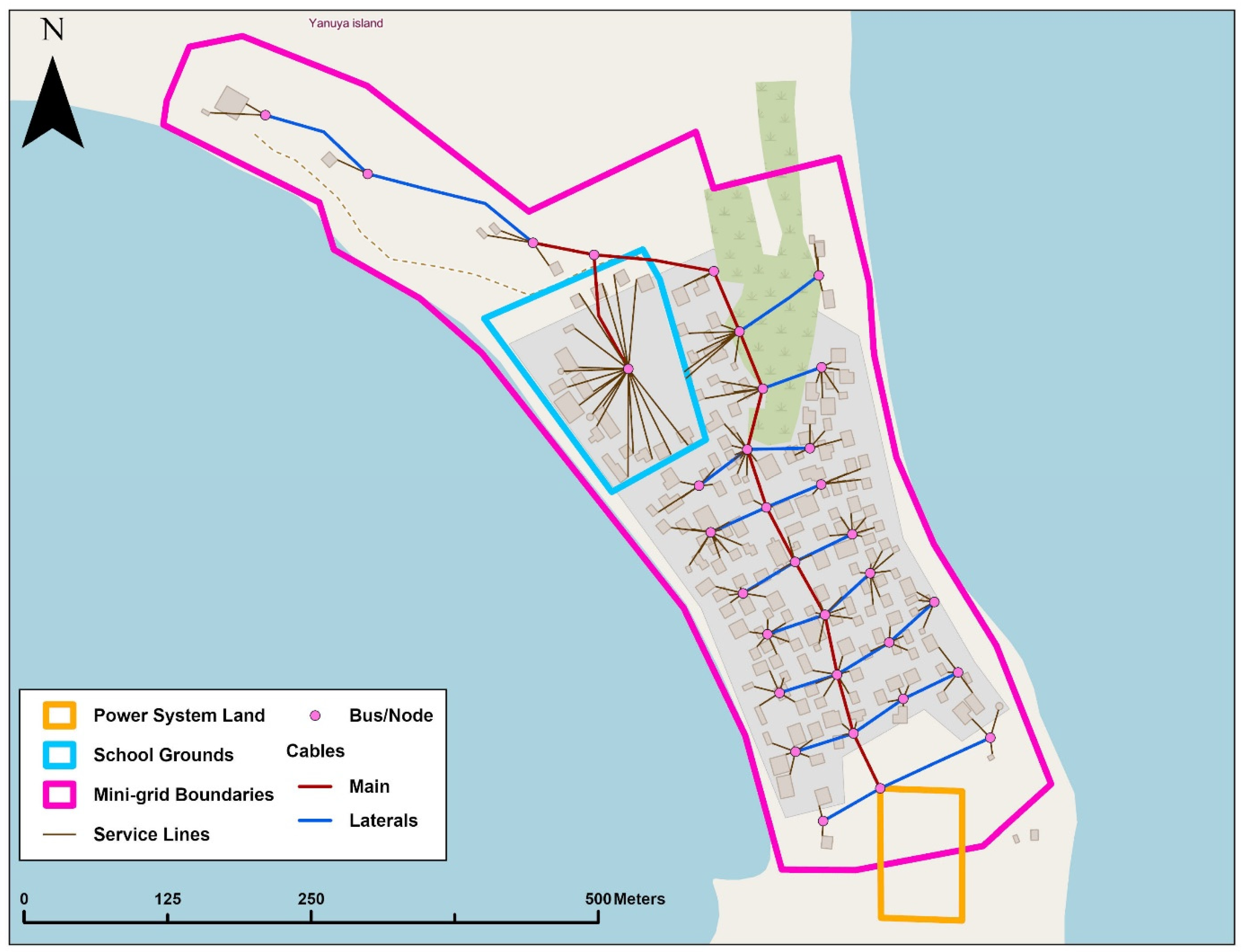
One of the larger sites from the Fiji portfolio was selected as an example to provide deeper insight into how configuration selection and optimization influenced results. The selected network, shown in Figure 14, is characterized by long feeders and a peak diversified demand of 62.5 kW. The system supplies power to an isolated island community of 700 residents through 162 metered structures with key parameters summarized in Table 6.
The single-phase, three-phase, and hybrid configurations were first evaluated in their heuristic form to isolate the influence of phase architecture on technical performance prior to optimization. As presented in Table 7, the single-phase configuration achieved the highest minimum voltage (0.9929 p.u.) and lowest total losses (0.71%), while the three-phase and hybrid designs operated at slightly lower voltages (0.9703 p.u. and 0.9802 p.u.) and higher losses (1.37% and 1.08%). The superior technical performance of the single-phase configuration illustrates the larger cross-sectional area of its main trunk conductors, which reduces line impedance and consequently reduces voltage drop relative to the multi-phase designs.
The effectiveness of the linearized LinDistFlow MILP optimization algorithm was evaluated using the hybrid configuration because the three-phase case assumed equal load distribution and produced near-balanced operation under the heuristic allocation. The hybrid topology, which contained both single-phase and three-phase laterals, provided a more realistic test of the performance of the optimization routine.
As shown in Table 8, optimization reduced the Current Unbalance Factor (IUF) at the source from 12.31% to 0.58%, achieving a significant reduction of 95.29%. Active losses at peak demand decreased by 9.26%, and the minimum network voltage increased from 0.9802 p.u. to 0.9855 p.u., two more notable improvements. The Voltage Unbalance Factor (VUF) also declined by 95.30%, confirming that the solver effectively reallocated single-phase loads to improve current balance and voltage regulation across the network. Optimization for phase balancing showed clear improvements in all metrics.
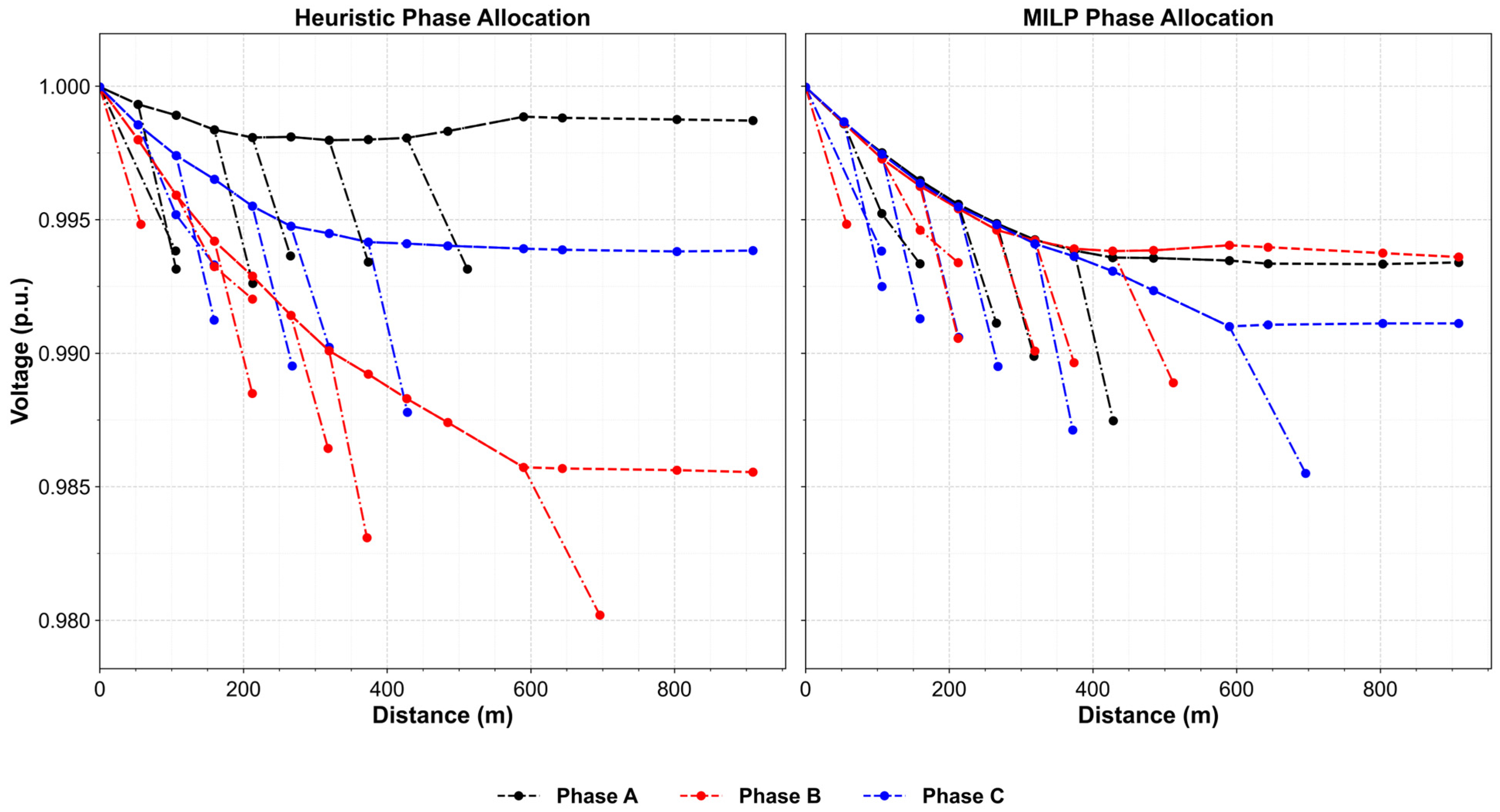
Figure 15 illustrates these improvements by comparing the phase-to-neutral voltage profiles along the main trunk under heuristic and MILP phase allocation strategies. In the heuristic allocation (left), uneven phase loading caused dispersion in phase-to-neutral voltages, with Phase B experiencing lower voltages while Phase A had higher voltages. The slight voltage increases along Phase A resulted from neutral voltage displacement [81,82], which caused higher voltage in the lightly loaded phase and a corresponding lower voltage in the heavily loaded phase. MILP optimization (right) redistributed single-phase loads, resulting in more symmetrical phase currents and a flatter voltage profile. These patterns for the selected example site were consistent with broader portfolio-wide trends.
Beyond technical performance, the example site highlighted how configuration choice translated into markedly different low-voltage distribution costs. As shown in Table 9, the single-phase design required a total low-voltage distribution expenditure of 3,758,554 USD, compared with 864,940 USD and 870,238 USD for the three-phase and hybrid designs, respectively. Choosing a single-phase layout for this network would increase costs by more than 2.8 million USD with only modest gains in losses and voltage drop. This cost gap arose from the parallel and larger conductor cross-sectional areas and larger lengths in the single-phase trunk, which also increased the costs of the associated civil works, protection, and soft-cost components. In contrast, the three-phase and hybrid designs achieved acceptable voltages and losses with substantially lower material requirements. This clearly illustrates that, for long rural feeders, multi-phase layouts deliver comparable technical performance at a fraction of the low-voltage distribution cost.

4.4. Results of Phase Balancing

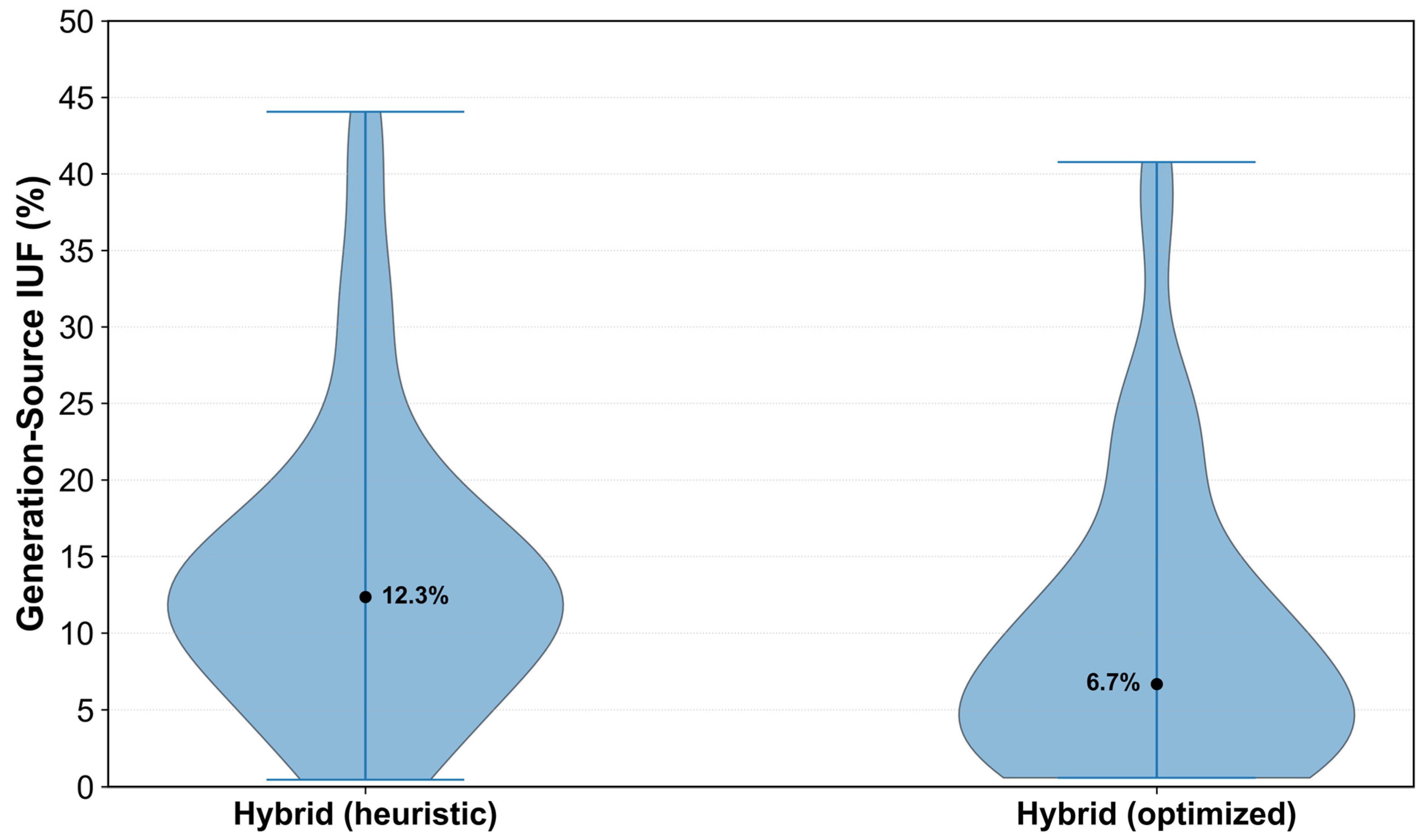
Looking back to the technically compliant hybrid sites, Figure 16 shows that the generation-source IUF decreased from a median of 12.3% in the heuristic designs to 6.7% after optimization, a 45.5% reduction. The optimized networks also exhibited a narrower spread in IUF values, indicating that the solver consistently reduced residual neutral currents across diverse network layouts. By reallocating single-phase loads to balance phase currents, the optimization framework reduced neutral conductor stress, stabilized phase-to-neutral voltages, and lowered technical losses, while also preserving acceptable operational margins for future load growth and network expansion.

5. Discussion

This study developed and applied an automated workflow for low-voltage network design, optimization, and techno-economic assessment with a focus on application to new builds for rural electrification. The workflow integrated geospatial network modeling, conductor sizing, and mixed-integer linear programming (MILP) optimization for phase balancing, followed by AC power flow validation to ensure compliance with technical standards and physical feasibility constraints. Methods were applied to a case study set of 62 unelectrified island communities in Fiji. A total of five network designs were developed, analyzed, and contrasted for each site. These included three primary electrical configurations—single-phase, three-phase, and hybrid with a three-phase main and single-phase laterals—and two variants for each of the multi-phase designs to explore both heuristic and MILP techniques for phase balancing. Results demonstrated that the workflow captured the interdependence between technical compliance, physical feasibility, and cost. The progression from the full portfolio to the physically feasible subset of designs confirmed that constraint enforcement, rather than optimization alone, established the cost hierarchy of the configurations. Once voltage and ampacity limits were enforced, material use and cost were primarily determined by how effectively each configuration utilized conductors.
The methods developed in this work directly address limits and challenges in standard industry practices such as repeated manual drafting, spreadsheet checks, and iterative revisions when voltage-drop, ampacity, or constructability issues emerge late in the engineering cycle. This fragmentation increases soft costs, delays procurement-ready designs, introduces opportunities for human error when translating data between pieces of software or documents, and reduces the reproducibility of configuration comparisons across candidate sites. This study addresses these challenges by providing an integrated pipeline that generates multiple standard-consistent low-voltage designs, validates designs using steady-state AC power flow, and produces transparent cost breakdowns for budgeting and design option comparison. In practical terms, this enables developers, utilities, electrification agencies, and funding institutions to screen portfolios efficiently, identify least-cost configurations that satisfy voltage-drop and ampacity limits, and flag sites requiring deeper engineering review due to constructability constraints such as excessive parallel conductors. The framework is compatible with GIS-based data environments and power flow validation workflows, supporting integration into existing planning toolchains and improving the traceability and defensibility of design decisions. This work establishes a practical method to rapidly translate early-stage geospatial and demand data into standard-based design alternatives for rapid review.
Single-phase networks achieved superior electrical performance when design constraints were relaxed, exhibiting the lowest median voltage drop (around 0.8%) and minimal technical losses (about 0.6%). However, under realistic voltage-drop and ampacity limits, compliance was maintained primarily through conductor oversizing, which led to under-utilized conductors and higher costs. Median conductor loading was below 20% of the rated capacity in single-phase designs, and fewer than half of the 62 sites met construction feasibility limits on allowable parallel conductors (three or fewer). As a result, single-phase designs commonly had a 3–4× higher cost than multi-phase counterparts. In macro terms, the portfolio indicates that single-phase compliance is typically achieved through voltage-driven oversizing and parallel conductors, whereas multi-phase compliance is achieved through higher conductor utilization and phase sharing, which drives the observed cost hierarchy.
Three-phase networks remained the most robust and cost-efficient configuration in all 62 sites. The balanced loading yielded voltage drops within 2–3% and technical losses below 3%, indicating efficient electrical performance. Nearly all sites satisfied construction feasibility limits, confirming the practical deployment of three-phase designs at scale for the portfolio of sites. The hybrid configuration performed between these two extremes. MILP optimization improved phase balance and reduced neutral currents, reducing voltage drop by approximately 15–20% and reducing current unbalance by about 50%. These gains confirmed that phase balancing is a key driver of electrical efficiency and enables reduced losses, improved voltage stability, and lower material requirements. Furthermore, the reduction in voltage drop through phase balancing permits additional load to be added to the mini-grid, thereby increasing revenue potential and improving bankability. These advantages can be compared against the additional materials and terminations required in mixed-phase construction. Overall, hybrid networks offered greater layout flexibility for irregular feeder topologies but did not achieve lower costs than fully three-phase systems. The hybrid designs also created more opportunity for network expansion and load growth by providing additional voltage-drop headroom for future load growth.
The practical feasibility screening evaluated whether technically compliant configurations could also be constructed within physical limits by enforcing a practical construction constraint of n ≤ 3 parallel conductors per phase on the main trunks to reflect trench-width and thermal-derating limits typical of underground distribution systems. While 98% of the multi-phase (three-phase and hybrid) networks satisfied this condition, only 43% of single-phase designs remained feasible once physical limits were applied. Most violations in single-phase layouts occurred as network length and load increased, reflecting the need for excessive parallel conductors to maintain voltage compliance. These results confirmed that multi-phase architectures are inherently more practical for implementation under real-world construction constraints. Embedding such feasibility limits within the automation workflow ensures that resulting designs are both technically sound and physically realizable.
Across the portfolio, economic results for single-phase systems were commonly 3–4× higher than multi-phase counterparts. These quantitative results indicate that, for long rural feeders, multi-phase layouts provided a significant cost advantage while also delivering comparable technical performance that fell within permissible limits. The selected example site showed the same pattern: a single-phase layout increased costs by 335%, and while the single-phase layout provided improvements of 76% and 57% in voltage drop and technical losses, respectively, all three configurations were within technically compliant limits and therefore the increased cost of a single-phase network is unnecessary—voltage drop for single-phase was 0.71%, three-phase was 2.97%, and hybrid was 1.98%, all within the 5% limit. Multi-phase configurations achieved compliant voltages and ampacity limits with substantially lower material intensity, which in turn reduced civil works, protection, and soft cost components. As a result, three-phase and hybrid networks consistently emerged as the least-cost low-voltage designs across all study sites. Single-phase layouts did not produce the minimum cost solution in any case, and the minimum observed single-phase cost of 60,620 USD exceeded the minimum observed multi-phase cost of 16,969 USD by 357%.
The work demonstrated a workflow that provides a reliable and scalable foundation for low-voltage network design that integrates compliance verification, optimization, and cost evaluation within a single automated process. The case study application to 62 sites and associated generalizable findings confirmed scalable applications to large-scale rural electrification planning. The transparent and standard-based approach embedded within the automated network design process can enable engineers to evaluate multiple configuration options consistently within a unified analytical environment, reducing manual effort and improving the validity of design decisions. The integrated compliance and feasibility checks ensure that layouts satisfy regulatory and physical requirements before detailed design, minimizing redesign cycles and engineering time.
The reported findings support study objectives by demonstrating that standard-consistent designs can be rapidly generated at scale, constructability screening materially differentiates feasible configurations, and the resulting feasibility and utilization patterns explain the observed hierarchy in costs between network configuration topologies. The portfolio-wide evidence supports generalizable conclusions that are traceable to the compliance outcomes, feasibility screening results, and cost distributions.
The methodology chosen has five potential limitations to the generalizability of the results. First, the analysis assumes deterministic peak-demand conditions and equal load allocation across nodes; real mini-grids exhibit temporal variability, uncertainty in demand growth, and appliance-driven phase asymmetry that may affect optimal phase allocation and operating margins. This does not detract from the primary motivations and conclusions of this study, which focus on configuration-level comparisons and relative rankings; findings pertaining to voltage-driven oversizing in single-phase designs, higher utilization in multi-phase designs, and the role of phase balancing in hybrid systems remain valid. Second, the workflow focuses on radial low-voltage architectures and does not evaluate meshed operation, which can be important in some utility planning contexts. This does not undermine the reported results because the study’s objective is to evaluate radial mini-grid architectures that are commonly adopted for simplicity and cost in rural electrification. Third, spatial layouts are derived from geospatial data rather than being augmented with potential routing improvements from community discussion, rights-of-way, or corridor selection. Routing conductors based on the location of buildings, roadways, and walkways is commonplace, and the analysis still supports the generalized findings because the comparisons are performed across the same layout for each configuration, isolating the effect of phase architecture, sizing, and phase allocation on compliance, feasibility, and cost. Fourth, the study emphasizes underground construction and applies a simplified constructability screen (n ≤ 3 parallel conductors per phase on main trunks) to represent trench-width and thermal-derating considerations. Actual construction constraints also depend on soil conditions, installation practices, and procurement availability. Nonetheless, the feasibility screen captures a key practical failure mode (excessive parallel conductors on heavily loaded main feeders). The persistence of the multi-phase feasibility advantage supports the validity of the constructability-related conclusions within the intended engineering context. Finally, validation is based on steady-state AC power flow and does not include dynamic performance, protection coordination, or fault studies. Steady-state AC validation is a standard practice and sufficient for evaluating voltage-drop, loading, and loss metrics used to judge technical compliance. Dynamic and protection studies are important extensions but are not required to support the comparative techno-economic conclusions presented here.
Although this study focused on underground networks with fixed spatial layouts and static loads, the workflow is directly extendable to overhead and mixed configurations. Future work could incorporate geospatial routing, low-voltage–medium-voltage coordination, and distributed energy resource integration to capture dynamic and bidirectional power flow effects. These extensions would enhance the framework’s application to grid modernization, voltage regulation planning, and hosting capacity analysis. Future work could include a sensitivity analysis on key planning inputs, such as load growth, power factor uncertainty, cable and civil cost multipliers, and constructability thresholds, and include a time-series power flow study of conductor loading over a year. Another area worth studying is low-voltage DC networks. Furthermore, while small isolated mini-grids predominately have a single centralized source of generation, the study could be expanded to permit distributed energy resources in multiple locations of the network. Network design and power flow methods could also be updated in future work to include medium-voltage analyses, thereby permitting expansion to larger networks and larger loads.


Author Contributions

Conceptualization, O.M. and N.G.J.; methodology, O.M., J.N. and N.G.J.; software, O.M. and G.M.; validation, O.M., J.N. and N.G.J.; formal analysis, O.M.; resources, E.V.H.; data curation, O.M., A.A. and E.V.H.; writing—original draft preparation, O.M.; writing—review and editing, V.A. and N.G.J.; visualization, O.M. and A.A.; supervision, N.G.J.; funding acquisition, E.V.H. and N.G.J. All authors have read and agreed to the published version of the manuscript.

Funding

This work was funded in part by the U.S. Trade and Development Agency (USTDA) under Grant No. 1131PL22GH31277.

Data Availability Statement

The data presented in this study are available on request from the corresponding author. The data is not available due to privacy and contractual restrictions.

Acknowledgments

The authors graciously thank Ryan Sparks, Marlon Acevedo, Dylan Lanning, Joji Wata, and Taniela Tabuya for their efforts conducting site visits and data collection and processing.

Conflicts of Interest

The authors declare no conflicts of interest.

Nomenclature

SymbolUnitsDescription
Sets and Indices
G -The directed graph G =   N ,   S representing the electrical network.
N -The set of all buses in the network, indexed by n .
S -The set of all line segments (conductor or cable sections) in the network, indexed by s .
L -The set of all single-phase loads/laterals, indexed by l .
P -The set of phases A ,   B ,   C .
N 3 ϕ -The subset of three-phase buses in N .
S 3 ϕ -The subset of three-phase line segments in S .
n o -The index for the bus designated as the source/slack bus.
h s ,   t s -The head (upstream) and tail (downstream) bus of line segment s .
n l -The three-phase bus to which load l is connected.
p a t h -The sequence of line segments and buses forming a main feeder or lateral.
d s u b -The set of all downstream loads served by a specific path.
k -The index for the iteration number in the optimization loop.
Parameters
P l ,   Q l p.u.The peak active and reactive power demand for load l .
θ m i n radiansThe angle corresponding to the minimum power factor.
cos θ m i n -The specified minimum power factor.
V L L n o m ,   V L N n o m kVThe nominal line-to-line and line-to-neutral voltage.
V r e f kVThe reference voltage for voltage-drop calculations (either V L L n o m o r     V L N n o m )
V m i n ,   V m a x p.uThe minimum and maximum permissible voltage limits.
V m a x %The maximum permissible voltage drop for the network.
V m s m a x ,   V l a t m a x %The partitioned voltage-drop limits for main feeders and laterals.
L G F -The load growth factor applied to forecast demand.
S F -The safety factor applied in ampacity checks for short-circuit and thermal limits.
T F -The tolerance factor accounting for sag, joints, and routing uncertainty.
d s kmThe surveyed geometric length of line segment s .
r s ,   x s Ω / k m The positive sequence resistance and reactance in per unit length of a conductor.
I l i b a m p kAThe thermal current limit (ampacity) of a conductor from the library.
n p a r m a x -The maximum number of conductors per phase that can be installed.
S b a s e ,   V b a s e kVA, kVThe base power and voltage for the network.
ϵ V ,   ϵ α p.u., -The convergence tolerance for the optimization algorithm.
k m a x -The index for the maximum number of iterations in the optimization loop.
Variables (Decision, State, and Auxiliary)
n p a r -The number of parallel conductors per phase for a path where n p a r = n p a r 1 ϕ for a single-phase path and n p a r = n p a r 3 ϕ for a three-phase path.
x l , p -Binary decision: 1 if load l is connected to phase p and 0 otherwise.
P s , p ,   Q s , p p.u.State: The active power and reactive power flow in segment s on phase p .
I s , p p.u.State: The apparent current flow in segment s on phase p .
δ s , p p.u.Auxiliary: A variable representing current deviation in segment s on phase p from the average of all three phases.
V p p.u.The voltage on phase p .
V a v g p.u.The average phase voltage.
W n , p ( p . u . ) 2 State: The squared voltage magnitude at node n on phase p .
W t s , p ( p . u . ) 2 State: The squared voltage magnitude at the tail (downstream) bus t s of segment s .
W h s , p ( p . u . ) 2 State: The squared voltage magnitude at the head (upstream) bus h s of segment s .
α l o w ,   α m i d ,   α h i g h -The lower, midpoint and upper voltage unbalance bounds.
V n , p k p.u.The voltage on a specific node n in phase p , for iteration k .
V o l d p.u.The voltage vector from the previous iteration.
V i t e r p.u.The change in voltage between iterations.
Metrics and Calculated Values
I l p.u.The voltage-dependent current drawn by load l .
P p a t h t o t kWThe sum of loads served by a path.
d p a t h t o t kmThe total surveyed path length, calculated as the sum of line segment lengths.
d p a t h e f f kmThe effective path length including the tolerance factor T F for routing uncertainty.
I p a t h 3 ϕ ,   I p a t h 1 ϕ kAThe design current for a three-phase or single-phase path.
Z e f f Ω The effective impedance of a conductor or circuit.
Z b a s e Ω The base impedance for the network.
V p a t h 3 ϕ ,   V p a t h 1 ϕ kVThe approximated voltage drop across a three-phase or single-phase path.
I s a m p kAThe thermal current limit (ampacity) of the conductor chosen for line segment s .
I s p u p . u . The thermal current limit in per unit of the conductor for line segment s .
R s e f f ,   X s e f f p . u . The positive sequence resistance and reactance in per unit of line segment s .
W n ,   a v g ( p . u . ) 2 The average of the squared voltage magnitude for all phases at bus n .
α *-The final minimum unbalanced voltage used by optimization.
C c o n d $/mThe per-unit distance cost of the selected conductor .
C p a t h $The total capital cost for a single path.
C c o n d t o t $The total capital costs for all conductors in a network.
C d i s t $The total distribution network capital costs including all components.
C i $The allocated cost of distribution category i (civil works, protection and metering, or soft costs), computed as a percentage of C d i s t .

Abbreviations

The following abbreviations are used in this manuscript:
ACAlternating Current
CAPEXCapital Expenditure
CRSCoordinate Reference System
DCDirect Current
EFLElectricity Fiji Limited
GISGeographic Information System
IUFCurrent Unbalance Factor
kAKiloampere
kVKilovolt
kVAKilovolt-Ampere
kWKilowatt
LVLow-Voltage
MILPMixed-Integer Linear Programming
MINLPMixed-Integer Nonlinear Programming
MVMedium-Voltage
p.u.Per Unit
PVPhotovoltaic
USDUnited States Dollars
VUFVoltage Unbalance Factor
XLPECross-Linked Polyethylene

References

  1. IEA. SDG7: Data and Projections; IEA (International Energy Agency): Paris, France, 2024; Available online: https://www.iea.org/reports/sdg7-data-and-projections (accessed on 6 August 2025).
  2. IEA. Tracking SDG7: The Energy Progress Report; IEA (International Energy Agency): Paris, France, 2025; Available online: https://www.iea.org/reports/tracking-sdg7-the-energy-progress-report-2025 (accessed on 6 August 2025).
  3. Energy Sector Management Assistance Program. Mini Grids for Half a Billion People: Market Outlook and Handbook for Decision Makers; World Bank: Washington, DC, USA, 2022; Available online: https://www.esmap.org/mini_grids_for_half_a_billion_people_the_report (accessed on 6 August 2025).
  4. Egli, F.; Agutu, C.; Steffen, B.; Schmidt, T.S. The cost of electrifying all households in 40 Sub-Saharan African countries by 2030. Nat. Commun. 2023, 14, 5066. [Google Scholar] [CrossRef]
  5. Agenbroad, J.; Carlin, K.; Ernst, K.; Doig, S. Six Ways to Reduce Minigrid Costs by 60% for Rural Electrification. Available online: https://rmi.org/wp-content/uploads/2018/12/rmi-seeds-minigrid-report.pdf (accessed on 6 August 2025).
  6. Africa Minigrid Developers Association (AMDA). Benchmarking Africa’s Minigrids Report; Africa Minigrid Developers Association (AMDA): Nairobi, Kenya, 2024; Available online: https://www.africamda.org/wp-content/uploads/2025/04/Benchmarking-Africas-Minigrids-Report-2024-Online-version.pdf (accessed on 17 September 2025).
  7. Blechinger, P.; Papadis, E.; Baart, M.; Telep, P.; Simonsen, F. What Size Shall It Be? A Guide to Mini-Grid Sizing and Demand Forecasting; Deutsche Gesellschaft für Internationale Zusammenarbeit (GIZ) GmbH: Bonn, Germany, 2016. [Google Scholar]
  8. Catalogue of Mini-Grid Tools. energypedia. Available online: https://energypedia.info/wiki/Catalogue_of_Mini-Grid_Tools (accessed on 3 September 2025).
  9. Volnyi, V.; Ilyushin, P.; Suslov, K.; Filippov, S. Approaches to Building AC and AC–DC Microgrids on Top of Existing Passive Distribution Networks. Energies 2023, 15, 5799. [Google Scholar] [CrossRef]
  10. Khon, K.; Chhlonh, C.; Vai, V.; Alvarez-Herault, M.-C.; Raison, B.; Bun, L. Comprehensive Low Voltage Microgrid Planning Methodology for Rural Electrification. Sustainability 2023, 15, 2841. [Google Scholar] [CrossRef]
  11. Mokryani, G. Future Distribution Networks: Planning, Operation, and Control; AIP Publishing: Melville, NY, USA, 2022. [Google Scholar] [CrossRef]
  12. Minetti, M.; Procopio, R.; Bonfiglio, A. Analytical load flow solution for radial distribution networks. Sustain. Energy Grids Netw. 2025, 43, 101871. [Google Scholar] [CrossRef]
  13. Al-Jaafreh, M.A.A.; Mokryani, G. Planning and operation of LV distribution networks: A comprehensive review. IET Energy Syst. Integr. 2019, 1, 133–146. [Google Scholar] [CrossRef]
  14. IEEE Std 1159-2019; IEEE Recommended Practice for Monitoring Electric Power Quality. IEEE: Piscataway, NJ, USA, 2019.
  15. Otcenasova, A.; Bolf, A.; Altus, J.; Regula, M. The Influence of Power Quality Indices on Active Power Losses in a Local Distribution Grid. Energies 2019, 12, 1389. [Google Scholar] [CrossRef]
  16. Ma, K.; Fang, L.; Kong, W. Review of distribution network phase unbalance: Scale, causes, consequences, solutions, and future research direction. CSEE J. Power Energy Syst. 2020, 6, 479–488. [Google Scholar] [CrossRef]
  17. Peppanen, J.; Bello, M.; Dugan, R.; Rylander, M.; Araiza, J.; Kedis, M.; Sanchez, I.; Maitra, A. Modeling Power Electronic Equipment to Improve Distribution Feeder Current and Voltage Balance. In 2018 IEEE/PES Transmission and Distribution Conference and Exposition (T&D), Denver, CO, USA, 16–19 April 2018; IEEE: Piscataway, NJ, USA, 2018; pp. 1–9. [Google Scholar] [CrossRef]
  18. Ciller, P.; Lumbreras, S.; González-García, A. Network Cost Estimation for Mini-Grids in Large-Scale Rural Electrification Planning. Energies 2021, 14, 7382. [Google Scholar] [CrossRef]
  19. Ghiani, E.; Serpi, A.; Pilloni, V.; Sias, G.; Simone, M.; Marcialis, G.; Armano, G.; Pegoraro, P.A. A Multidisciplinary Approach for the Development of Smart Distribution Networks. Energies 2018, 11, 2530. [Google Scholar] [CrossRef]
  20. Bukari, D.; Quansah, D.A.; Kemausuor, F.; Adaramola, M.S. Ex-post design, operations and financial cost-benefit analysis of mini-grids in Ghana: What can we learn? Energy Sustain. Dev. 2022, 68, 390–409. [Google Scholar] [CrossRef]
  21. Abada, I.; Othmani, M.; Tatry, L. An innovative approach for the optimal sizing of mini-grids in rural areas integrating the demand, the supply, and the grid. Renew. Sustain. Energy Rev. 2021, 146, 111117. [Google Scholar] [CrossRef]
  22. IRENA. Innovation Outlook: Renewable Mini-Grids; International Renewable Energy Agency: Abu Dhabi, United Arab Emirates, 2016. [Google Scholar]
  23. Kemabonta, T.; Van Hove, E.; Johnson, N.G.; Alsanad, A. Accelerating Mini-grid Feasibility Assessments with Rapid Engineering and Business Model Evaluation. In 2022 IEEE Global Humanitarian Technology Conference (GHTC), Santa Clara, CA, USA, 8–11 September 2022; IEEE: Piscataway, NJ, USA, 2022; pp. 196–203. [Google Scholar] [CrossRef]
  24. Trageser, M.; Pape, M.; Frings, K.; Erlinghagen, P.; Kurth, M.; Vertgewall, C.M.; Monti, A.; Busse, T. Automated routing of feeders in electrical distribution grids. Electr. Power Syst. Res. 2022, 211, 108217. [Google Scholar] [CrossRef]
  25. Rhee, K. Clustering Based Optimization and Automation of Utility Scale Solar Site Design. In 2020 47th IEEE Photovoltaic Specialists Conference (PVSC), Calgary, AB, Canada, 15 June 2020–21 August 2020; IEEE: Piscataway, NJ, USA, 2020; pp. 21–24. [Google Scholar] [CrossRef]
  26. Benalcazar, P.; Komorowska, A.; Kamiński, J. A GIS-based method for assessing the economics of utility-scale photovoltaic systems. Appl. Energy 2023, 353, 122044. [Google Scholar] [CrossRef]
  27. Pillot, B.; Al-Kurdi, N.; Gervet, C.; Linguet, L. An integrated GIS and robust optimization framework for solar PV plant planning scenarios at utility scale. Appl. Energy 2020, 260, 114257. [Google Scholar] [CrossRef]
  28. Mini-Grids Partnership & Sustainable Energy for All (SEforALL). State of the Global Mini-Grids Market Report 2024; SEforALL: Washington, DC, USA, 2024; Available online: https://www.seforall.org/publications/state-of-the-global-mini-grids-market-report-2024 (accessed on 6 August 2025).
  29. Taye, B.Z.; Workineh, T.G.; Nebey, A.H.; Kefale, H.A. Rural electrification planning using Geographic Information System (GIS). Cogent Eng. 2020, 7, 1836730. [Google Scholar] [CrossRef]
  30. Huld, T.; Moner-Girona, M.; Kriston, A. Geospatial Analysis of Photovoltaic Mini-Grid System Performance. Energies 2017, 10, 218. [Google Scholar] [CrossRef]
  31. Domínguez, J.; Bellini, C.; Arribas, L.; Amador, J.; Torres-Pérez, M.; Martín, A.M. IntiGIS-Local: A Geospatial Approach to Assessing Rural Electrification Alternatives for Sustainable Socio-Economic Development in Isolated Communities—A Case Study of Guasasa, Cuba. Energies 2024, 17, 3835. [Google Scholar] [CrossRef]
  32. Tafula, J.E.; Justo, C.D.; Moura, P.; Mendes, J.; Soares, A. Multicriteria Decision-Making Approach for Optimum Site Selection for Off-Grid Solar Photovoltaic Microgrids in Mozambique. Energies 2023, 16, 2894. [Google Scholar] [CrossRef]
  33. Isihak, S.; Akpan, U.; Bhattacharyya, S. Evolution of GIS-based rural electrification planning models and an application of OnSSET in Nigeria. Renew. Sustain. Energy Transit. 2022, 2, 100019. [Google Scholar] [CrossRef]
  34. Korkovelos, A.; Khavari, B.; Sahlberg, A.; Howells, M.; Arderne, C. The Role of Open Access Data in Geospatial Electrification Planning and the Achievement of SDG7. An OnSSET-Based Case Study for Malawi. Energies 2019, 12, 1395. [Google Scholar] [CrossRef]
  35. Grisales-Noreña, L.; Restrepo-Cuestas, B.; Cortés-Caicedo, B.; Montano, J.; Rosales-Muñoz, A.; Rivera, M. Optimal Location and Sizing of Distributed Generators and Energy Storage Systems in Microgrids: A Review. Energies 2022, 16, 106. [Google Scholar] [CrossRef]
  36. Kumar, A.; Verma, A.; Talwar, R. Optimal techno-economic sizing of a multi-generation microgrid system with reduced dependency on grid for critical health-care, educational and industrial facilities. Energy 2020, 208, 118248. [Google Scholar] [CrossRef]
  37. Stevanato, N.; Pellecchia, G.; Sangiorgio, I.; Shendrikova, D.; Soares, C.A.; Mereu, R.; Colombo, E. Planning third generation minigrids: Multi-objective optimization and brownfield investment approaches in modelling village-scale on-grid and off-grid energy systems. Renew. Sustain. Energy Transit. 2023, 3, 100053. [Google Scholar] [CrossRef]
  38. Wu, D.; Ma, X.; Huang, S.; Fu, T.; Balducci, P. Stochastic optimal sizing of distributed energy resources for a cost-effective and resilient Microgrid. Energy 2020, 198, 117284. [Google Scholar] [CrossRef]
  39. Hannan, M.A.; Faisal, M.; Jern Ker, P.; Begum, R.A.; Dong, Z.Y.; Zhang, C. Review of optimal methods and algorithms for sizing energy storage systems to achieve decarbonization in microgrid applications. Renew. Sustain. Energy Rev. 2020, 131, 110022. [Google Scholar] [CrossRef]
  40. Roldán-Blay, C.; Escrivá-Escrivá, G.; Roldán-Porta, C.; Dasí-Crespo, D. Optimal sizing and design of renewable power plants in rural microgrids using multi-objective particle swarm optimization and branch and bound methods. Energy 2023, 284, 129318. [Google Scholar] [CrossRef]
  41. Rangel, N.; Li, H.; Aristidou, P. An optimisation tool for minimising fuel consumption, costs and emissions from Diesel-PV-Battery hybrid microgrids. Appl. Energy 2023, 335, 120748. [Google Scholar] [CrossRef]
  42. Montoya, O.D.; Grisales-Noreña, L.F.; Florez-Cediel, O.D. Exact Mixed-Integer Nonlinear Programming Formulation for Conductor Size Selection in Balanced Distribution Networks: Single and Multi-Objective Analyses. Electricity 2025, 6, 14. [Google Scholar] [CrossRef]
  43. Pradilla-Rozo, J.D.; Vega-Forero, J.A.; Montoya, O.D. Application of the Gradient-Based Metaheuristic Optimizerto Solve the Optimal Conductor Selection Problemin Three-Phase Asymmetric Distribution Networks. Energies 2023, 16, 888. [Google Scholar] [CrossRef]
  44. Gallego Pareja, L.A.; López-Lezama, J.M.; Gómez Carmona, O. A MILP Model for Optimal Conductor Selection and Capacitor Banks Placement in Primary Distribution Systems. Energies 2023, 16, 4340. [Google Scholar] [CrossRef]
  45. Ponce, D.; Aguila Téllez, A.; Krishnan, N. Optimal Selection of Conductors in Distribution System Designs Using Multi-Criteria Decision. Energies 2023, 16, 7167. [Google Scholar] [CrossRef]
  46. Waswa, L.; Chihota, M.J.; Bekker, B. Toward Optimal Active Distribution Network Planning: A Critical Review of Conductor Size Selection Methods. IEEE Access 2023, 11, 144812–144830. [Google Scholar] [CrossRef]
  47. Memon, D.A.; Ali, K.H.; Memon, A.A.; Ansari, J.A.; Badar, J.; Alharbi, M.; Banatwala, A.Z.; Kumar, M. Comparative analysis and implementation of DC microgrid systems versus AC microgrid performance. Front. Energy Res. 2024, 12, 1370547. [Google Scholar] [CrossRef]
  48. Eskander, M.M.; Silva, C.A. Techno-economic and environmental comparative analysis for DC microgrids in households: Portuguese and French household case study. Appl. Energy 2023, 349, 121495. [Google Scholar] [CrossRef]
  49. Mirzaeva, G.; Miller, D. DC and AC Microgrids for Standalone Applications. IEEE Trans. Ind. Appl. 2023, 59, 7908–7918. [Google Scholar] [CrossRef]
  50. Jithin, K.; Purayil Haridev, P.; Mayadevi, N.; Harikumar, R.P.; Mini, V.P. A Review on Challenges in DC Microgrid Planning and Implementation. J. Mod. Power Syst. Clean Energy 2023, 11, 1375–1395. [Google Scholar] [CrossRef]
  51. Haddadi, M.; Gorji, S.A.; Yu, S.S. An Overview of Inertia Emulation Strategies for DC Microgrids: Stability Analysis and AC Microgrid Analogies. IEEE Open J. Ind. Electron. Soc. 2025, 6, 491–521. [Google Scholar] [CrossRef]
  52. Behzadi, S.; Bagheri, A. A Convex Micro-Grid-Based Optimization Model for Planning of Resilient and Sustainable Distribution Systems Considering Feeders Routing and Siting/Sizing of Substations and DG Units. Sustain. Cities Soc. 2023, 97, 104787. [Google Scholar] [CrossRef]
  53. Cortés-Caicedo, B.; Montoya, O.D.; Grisales-Noreña, L.F.; Gil-González, W.; Ardila-Rey, J.A. Simultaneous Feeder Routing and Conductor Selection in Rural Distribution Networks Using an Exact MINLP Approach. Smart Cities 2025, 8, 68. [Google Scholar] [CrossRef]
  54. Fletcher, J.R.E.; Fernando, T.; Iu, H.H.-C.; Reynolds, M.; Fani, S. Spatial Optimization for the Planning of Sparse Power Distribution Networks. IEEE Trans. Power Syst. 2018, 33, 6686–6695. [Google Scholar] [CrossRef]
  55. Pavón, W.; Inga, E.; Simani, S. Optimal Routing an Ungrounded Electrical Distribution System Based on Heuristic Method with Micro Grids Integration. Sustainability 2019, 11, 1607. [Google Scholar] [CrossRef]
  56. Ayazi, S.; Askarzadeh, A. Finding optimal path of feeder routing problem in power distribution network by an efficient and new methodology. Int. Trans. Electr. Energy Syst. 2021, 31, 231–244. [Google Scholar] [CrossRef]
  57. Etukudoh, E.A.; Fabuyide, A.; Ibekwe, K.I.; Sonko, S.; Ilojianya, V.I. Electrical Engineering in Renewable Energy Systems: A Review of Design and Integration Challenges. Eng. Sci. Technol. J. 2024, 5, 231–244. [Google Scholar] [CrossRef]
  58. Cicilio, P.; Orosz, M.; Mueller, A.; Cotilla-Sanchez, E. uGrid: Reliable Minigrid Design and Planning Toolset for Rural Electrification. IEEE Access 2019, 7, 163988–163999. [Google Scholar] [CrossRef]
  59. Nasir, M.; Iqbal, S.; Khan, H.A. Optimal Planning and Design of Low-Voltage Low-Power Solar DC Microgrids. IEEE Trans. Power Syst. 2018, 33, 2919–2928. [Google Scholar] [CrossRef]
  60. Vai, V.; Cecile Alvarez Herault, M.; Raison, B.; Bun, L. Optimal Low-voltage Distribution Topology with Integration of PV and Storage for Rural Electrification in Developing Countries: A Case Study of Cambodia. J. Mod. Power Syst. Clean Energy 2020, 8, 531–539. [Google Scholar] [CrossRef]
  61. Eales, A.; Banda, E.; Frame, D.; Strachan, S. Understanding solar minigrid sustainability and impact through a holistic key performance indicator framework. Environ. Res. Infrastruct. Sustain. 2024, 4, 045008. [Google Scholar] [CrossRef]
  62. Eam, D.; Vai, V.; Eng, S.; You, L. Optimizing Phase Allocation Arrangement for a Rural LVAC Distribution System: A Case Study in Cambodia. In 2022 4th International Conference on Electrical, Control and Instrumentation Engineering (ICECIE), KualaLumpur, Malaysia, 26 November 2022; IEEE: Piscataway, NJ, USA, 2022; pp. 1–6. [Google Scholar] [CrossRef]
  63. Hallemans, L.; Ravyts, S.; Stul, K.; Fekriasl, S.; Van Tichelen, P.; Capelle, J.; Driesen, J. Moving towards a methodology for conductor sizing and protection in LVDC microgrids. Int. J. Electr. Power Energy Syst. 2023, 154, 109407. [Google Scholar] [CrossRef]
  64. International Electrotechnical Commission. Low-Voltage Electrical Installations. Part 5–52: Selection and Erection of Electrical Equipment. Wiring Systems; International Electrotechnical Commission: Geneva, Switzerland, 2009. [Google Scholar]
  65. Short, T.A. Electric Power Distribution Handbook; CRC Press: Boca Raton, FL, USA, 2004. [Google Scholar]
  66. Su, Y.; Liu, F.; Kang, K.; Wang, Z. Implicit Sparsity of LinDistFlow Model. IEEE Trans. Power Syst. 2023, 38, 4966–4969. [Google Scholar] [CrossRef]
  67. Bosisio, A.; Berizzi, A.; Amaldi, E.; Bovo, C.; Andy Sun, X. Optimal Feeder Routing in Urban Distribution Networks Planning with Layout Constraints and Losses. J. Mod. Power Syst. Clean Energy 2020, 8, 1005–1013. [Google Scholar] [CrossRef]
  68. Wang, M.; Yang, M.; Fang, Z.; Wang, M.; Wu, Q. A Practical Feeder Planning Model for Urban Distribution System. IEEE Trans. Power Syst. 2023, 38, 1297–1308. [Google Scholar] [CrossRef]
  69. Jooshaki, M.; Karimi-Arpanahi, S.; Lehtonen, M.; Millar, R.J.; Fotuhi-Firuzabad, M. An MILP Model for Optimal Placement of Sectionalizing Switches and Tie Lines in Distribution Networks with Complex Topologies. IEEE Trans. Smart Grid 2021, 12, 4740–4751. [Google Scholar] [CrossRef]
  70. Gallego Pareja, L.A.; López-Lezama, J.M.; Carmona, O.G. Optimal Feeder Reconfiguration and Placement of Voltage Regulators in Electrical Distribution Networks Using a Linear Mathematical Model. Sustainability 2023, 15, 854. [Google Scholar] [CrossRef]
  71. Gallego, L.A.; Lopez-Lezama, J.M.; Carmona, O.G. A Mixed-Integer Linear Programming Model for Simultaneous Optimal Reconfiguration and Optimal Placement of Capacitor Banks in Distribution Networks. IEEE Access 2022, 10, 52655–52673. [Google Scholar] [CrossRef]
  72. Alanazi, M.S. A MILP model for optimal renewable wind DG allocation in smart distribution systems considering voltage stability and line loss. Alex. Eng. J. 2022, 61, 5887–5901. [Google Scholar] [CrossRef]
  73. Lin, C.-H.; Ku, T.-T.; Li, C.-S.; Chen, C.-S. Optimal Phase Balancing in Electricity Distribution Feeders Using Mixed-Integer Linear Programming. Sustainability 2023, 15, 4473. [Google Scholar] [CrossRef]
  74. Pereira, O.; Quiros-Tortos, J.; Valverde, G. Phase Rebalancing of Distribution Circuits Dominated by Single-Phase Loads. IEEE Trans. Power Syst. 2021, 36, 5333–5344. [Google Scholar] [CrossRef]
  75. Gupta, R.K.; Molzahn, D.K. Optimizing Phase Allocation in Unbalanced Power Distribution Networks using a Linearized DistFlow Formulation. arXiv 2025, arXiv:2501.06917. [Google Scholar] [CrossRef]
  76. Lin, H.; Shen, X.; Guo, Y.; Ding, T.; Sun, H. A linear Distflow model considering line shunts for fast calculation and voltage control of power distribution systems. Appl. Energy 2024, 357, 122467. [Google Scholar] [CrossRef]
  77. Al-Shetwi, A.Q.; Hannan, M.A.; Jern, K.P.; Mansur, M.; Mahlia, T.M.I. Grid-connected renewable energy sources: Review of the recent integration requirements and control methods. J. Clean. Prod. 2020, 253, 119831. [Google Scholar] [CrossRef]
  78. Denis; Sinuraya, E.W.; Soemantri, M.; Rafif, I.R. Evaluation and Mitigation of Voltage and Current Unbalance at MSTP Undip Jepara. J. Phys. Conf. Ser. 2022, 2406, 012013. [Google Scholar] [CrossRef]
  79. AS/NZS 3008.1.1:2009; Electrical Installations: Selection of Cables. Part, Cables for Alternating Voltages up to and Including 0.6/1 kV: Typical Australian Installation Conditions. Standards New Zealand: Wellington, New Zealand, 2017.
  80. Sadiq, E.H.; Antar, R.K. Minimizing Power Losses in Distribution Networks: A Comprehensive Review. Chin. J. Electr. Eng. 2024, 10, 20–36. [Google Scholar] [CrossRef]
  81. Yan, R.; Li, Y.; Saha, T.K.; Wang, L.; Hossain, M.I. Modeling and Analysis of Open-Delta Step Voltage Regulators for Unbalanced Distribution Network with Photovoltaic Power Generation. IEEE Trans. Smart Grid 2018, 9, 2224–2234. [Google Scholar] [CrossRef]
  82. Rafi, F.H.M.; Hossain, M.J.; Rahman, M.S.; Taghizadeh, S. An overview of unbalance compensation techniques using power electronic converters for active distribution systems with renewable generation. Renew. Sustain. Energy Rev. 2020, 125, 109812. [Google Scholar] [CrossRef]
Figure 1. Workflow for automated low-voltage mini-grid network design and analysis.
Energies 19 01526 g001
Figure 2. Map of case study communities.
Energies 19 01526 g002
Figure 3. Maximum voltage-drop distribution of network configurations for technically compliant sites.
Energies 19 01526 g003
Figure 4. Technical losses distribution of network configurations for technically compliant sites.
Energies 19 01526 g004
Figure 5. Max line loading distribution of network configurations for technically compliant sites.
Energies 19 01526 g005
Figure 6. Distribution of total CAPEX of network configurations for technically compliant sites.
Energies 19 01526 g006
Figure 7. Relationship of total CAPEX to peak demand and technical losses for all technically compliant sites (bubble size scales with peak demand).
Energies 19 01526 g007
Figure 8. Distribution of parallel cables per phase of network configurations for technically compliant sites, with the shaded region indicating the physically feasible sites.
Energies 19 01526 g008
Figure 9. Maximum voltage-drop distribution of network configurations for physically feasible sites.
Energies 19 01526 g009
Figure 10. Technical losses distribution of network configurations for physically feasible sites.
Energies 19 01526 g010
Figure 11. Maximum line loading distribution of network configurations for physically feasible sites.
Energies 19 01526 g011
Figure 12. Network capital cost distribution of network configurations for physically feasible sites.
Energies 19 01526 g012
Figure 13. Relationship of total CAPEX to peak demand and technical losses for physically feasible sites (bubble size scales with peak demand).
Energies 19 01526 g013
Figure 14. Distribution network for selected example site.
Energies 19 01526 g014
Figure 15. Phase-to-neutral voltage profiles of main feeders for heuristic (left) and MILP optimization (right) for selected example site.
Energies 19 01526 g015
Figure 16. Generation-source Current Unbalance Factor (IUF) for heuristic and optimized hybrid configurations for technically compliant hybrid sites.
Energies 19 01526 g016
Table 1. Technical parameters for low-voltage network design.
ParameterSymbolValueUnits
Lowest permissible power factor cos θ m i n 0.85 (lagging)
Safety factor S F 0.25
Path tolerance T F 0.05
Maximum system voltage V m a x 1.05p.u.
Standard design voltage V s t d 1.00p.u.
Minimum voltage (main feeder) V m s ,   m i n 0.97p.u.
Minimum voltage laterals (laterals) V l a t ,   m i n 0.95p.u.
Nominal line-to-line voltage V L L ,   n o m 0.415kV
Nominal line-to-neutral voltage V L N ,   n o m 0.240kV
Table 2. Cable Procurement quotations from local supplier in United States dollars (USD).
Cable Size (mm2)Single Core (USD/m)Four Core (USD/m)
2.50.403.74
40.715.50
61.197.04
101.9411.00
163.0815.18
255.0623.98
357.0430.36
509.2441.14
7012.5465.85
9516.7281.49
12021.12108.68
15026.38135.08
Table 3. Technical compliance rates of network configurations for the case study portfolio.
ConfigurationCompliant SitesSuccess Rate (%)
Single-phase5995
Three-phase (heuristic)5792
Three-phase (optimized)5792
Hybrid (heuristic)5690
Hybrid (optimized)5589
Table 4. Network capital cost per configuration expressed as median for technically compliant sites (USD).
ConfigurationCable CostsCivil Works and InstallationProtection and MeteringSoft Costs and LogisticsTotal Cost
Single-phase184,100210,40052,60078,900526,000
Three-phase45,43051,92012,98019,470129,800
Hybrid56,14064,16016,04024,060160,400
Table 5. Network capital cost per configuration expressed as median for physically feasible sites (USD).
ConfigurationCable CostsCivil Works and InstallationProtection and MeteringSoft Costs and LogisticsTotal Cost
Single-phase73,50084,00021,00031,500210,000
Three-phase18,90021,6005400810054,000
Hybrid24,57028,080702010,53070,200
Table 6. Network parameters of selected example site.
ParameterValueUnit
Number of buses33
Number of line segments32
Nominal system voltage 0.415 k V L L
Total main feeder length0.91km
Total lateral branch length2.06km
Total connected load73.53kVA
Peak diversified demand62.5kW
Table 7. Power flow results and key performance metrics for configurations with heuristic design for selected example site.
MetricConfiguration
Single-PhaseThree-PhaseHybrid
Minimum voltage (p.u.)0.99290.97030.9802
Maximum voltage drop (%)0.712.971.98
Total generation (kW)66.5967.1166.91
Total network kW loss at peak (%)0.591.371.08
Maximum cable loading (%)15.7621.8118.34
Total network kVAR loss (%)0.290.470.53
Table 8. Comparison of hybrid configuration performance for heuristic and MILP optimization for selected example site.
ParameterHeuristicMILP% Change
Minimum voltage (p.u.)0.98020.9855+0.54
Active power losses (kW)1.080.98−9.26
Current unbalance factor (IUF%)12.310.58−95.29
Voltage unbalance factor (VUF%)0.000560.00003−95.30
Table 9. Network capital costs for selected example site (USD).
ConfigurationCable CostsCivil Works and InstallationProtection and MeteringSoft Costs and LogisticsTotal Cost
Single-phase1,315,4941,503,422375,855563,7833,758,554
Three-phase302,729345,97686,494129,741864,940
Hybrid304,583348,09587,024130,536870,238
Disclaimer/Publisher’s Note: The statements, opinions and data contained in all publications are solely those of the individual author(s) and contributor(s) and not of MDPI and/or the editor(s). MDPI and/or the editor(s) disclaim responsibility for any injury to people or property resulting from any ideas, methods, instructions or products referred to in the content.